EP3637862B1 - Benutzervorrichtung, drahtloskommunikationssystem und drahtloskommunikationsverfahren - Google Patents
Benutzervorrichtung, drahtloskommunikationssystem und drahtloskommunikationsverfahren Download PDFInfo
- Publication number
- EP3637862B1 EP3637862B1 EP18818010.3A EP18818010A EP3637862B1 EP 3637862 B1 EP3637862 B1 EP 3637862B1 EP 18818010 A EP18818010 A EP 18818010A EP 3637862 B1 EP3637862 B1 EP 3637862B1
- Authority
- EP
- European Patent Office
- Prior art keywords
- handover
- radio communication
- rule
- filter
- qos
- Prior art date
- Legal status (The legal status is an assumption and is not a legal conclusion. Google has not performed a legal analysis and makes no representation as to the accuracy of the status listed.)
- Active
Links
Images




Classifications
-
- H—ELECTRICITY
- H04—ELECTRIC COMMUNICATION TECHNIQUE
- H04W—WIRELESS COMMUNICATION NETWORKS
- H04W28/00—Network traffic management; Network resource management
- H04W28/02—Traffic management, e.g. flow control or congestion control
- H04W28/0252—Traffic management, e.g. flow control or congestion control per individual bearer or channel
- H04W28/0263—Traffic management, e.g. flow control or congestion control per individual bearer or channel involving mapping traffic to individual bearers or channels, e.g. traffic flow template [TFT]
-
- H—ELECTRICITY
- H04—ELECTRIC COMMUNICATION TECHNIQUE
- H04W—WIRELESS COMMUNICATION NETWORKS
- H04W36/00—Hand-off or reselection arrangements
- H04W36/0005—Control or signalling for completing the hand-off
- H04W36/0011—Control or signalling for completing the hand-off for data sessions of end-to-end connection
- H04W36/0022—Control or signalling for completing the hand-off for data sessions of end-to-end connection for transferring data sessions between adjacent core network technologies
-
- H—ELECTRICITY
- H04—ELECTRIC COMMUNICATION TECHNIQUE
- H04W—WIRELESS COMMUNICATION NETWORKS
- H04W36/00—Hand-off or reselection arrangements
- H04W36/0005—Control or signalling for completing the hand-off
- H04W36/0011—Control or signalling for completing the hand-off for data sessions of end-to-end connection
- H04W36/0033—Control or signalling for completing the hand-off for data sessions of end-to-end connection with transfer of context information
- H04W36/0044—Control or signalling for completing the hand-off for data sessions of end-to-end connection with transfer of context information of quality context information
-
- H—ELECTRICITY
- H04—ELECTRIC COMMUNICATION TECHNIQUE
- H04W—WIRELESS COMMUNICATION NETWORKS
- H04W36/00—Hand-off or reselection arrangements
- H04W36/0005—Control or signalling for completing the hand-off
- H04W36/0083—Determination of parameters used for hand-off, e.g. generation or modification of neighbour cell lists
- H04W36/00837—Determination of triggering parameters for hand-off
-
- H—ELECTRICITY
- H04—ELECTRIC COMMUNICATION TECHNIQUE
- H04W—WIRELESS COMMUNICATION NETWORKS
- H04W36/00—Hand-off or reselection arrangements
- H04W36/14—Reselecting a network or an air interface
- H04W36/144—Reselecting a network or an air interface over a different radio air interface technology
- H04W36/1443—Reselecting a network or an air interface over a different radio air interface technology between licensed networks
-
- H—ELECTRICITY
- H04—ELECTRIC COMMUNICATION TECHNIQUE
- H04W—WIRELESS COMMUNICATION NETWORKS
- H04W36/00—Hand-off or reselection arrangements
- H04W36/16—Performing reselection for specific purposes
- H04W36/22—Performing reselection for specific purposes for handling the traffic
-
- H—ELECTRICITY
- H04—ELECTRIC COMMUNICATION TECHNIQUE
- H04W—WIRELESS COMMUNICATION NETWORKS
- H04W36/00—Hand-off or reselection arrangements
- H04W36/24—Reselection being triggered by specific parameters
- H04W36/30—Reselection being triggered by specific parameters by measured or perceived connection quality data
- H04W36/304—Reselection being triggered by specific parameters by measured or perceived connection quality data due to measured or perceived resources with higher communication quality
-
- H—ELECTRICITY
- H04—ELECTRIC COMMUNICATION TECHNIQUE
- H04W—WIRELESS COMMUNICATION NETWORKS
- H04W40/00—Communication routing or communication path finding
- H04W40/34—Modification of an existing route
- H04W40/36—Modification of an existing route due to handover
-
- H—ELECTRICITY
- H04—ELECTRIC COMMUNICATION TECHNIQUE
- H04W—WIRELESS COMMUNICATION NETWORKS
- H04W48/00—Access restriction; Network selection; Access point selection
- H04W48/18—Selecting a network or a communication service
Definitions
- the present invention relates to a user device and a radio communication method capable of performing inter-system handover.
- 3rd Generation Partnership Project specifies Long Term Evolution (LTE), and with an aim of further speeding, specifies LTE-Advanced (hereinafter, it is assumed that 4G includes the LTE-Advanced).
- LTE Long Term Evolution
- 4G includes the LTE-Advanced
- 5G 5G New Radio
- the specifications of such 5G also include inter-work between 4G and 5G, for example, handover of a user device (User Equipment, UE) between 4G and 5G.
- UE User Equipment
- 5G 5G Core
- a mapping between PDN connection set in the EPC and PDU session set in the 5GC is necessary.
- TFT traffic flow template
- IP flow traffic flow
- Non-Patent Document 1 a method of associating, regardless of the content of the TFT associated with the EPS bearer, a default QoS rule with the QoS flow of the handover destination has been proposed (see Non-Patent Document 1) .
- this method when executing the handover, it is not necessary to exchange information between the UE and the EPC-5GC. Therefore, the handover procedure from 4G to 5G can be simplified. Furthermore, because the handover processing load is reduced, this may lead to reduction in delay.
- the 5GC determine to disable an activated reflective QoS rule, the 5GC should notify the UE and UPF explicitly via C- plane.
- the 5GC can implicitly notify the UE that the reflective QoS has been disabled via U-plane.
- the UE shall delete all derived QoS rules when the reflective QoS is disabled.
- NTT DOCOMO Single Registration-based handover from EPS to 5GS procedure", 3GPP DRAFT; S2-173317-23502 SINGLE REG EPC TO 5GC HO_V1.4, 3RD GENERATION PARTNERSHIP PROJECT (3GPP), MOBILE COMPETENCE CENTRE; 650, ROUTE DES LUCIOLES; F-06921 SOPHIA-ANTIPOLIS CEDEX; FRANCE vol. SA WG2, no.
- the UE does not receive a PDU Session Modification command from the SMF via MME and E-UTRAN. This is to avoid changes to the signalling in EPS and in particular to the Handover Command.
- the UE and the SMF derive the PDU Session ID from the corresponding Default EBI as proposed in S2-172154 (submitted by ZTE to SA2#120) and the QFI from the corresponding EBI.
- the UE and the SMF derive the 5G QoS flow template for each QoS flow from the EPS TFT which was assigned for the corresponding EPS bearer.
- the UE continues to use the same MBR value that was assigned in EPC for the corresponding EPS GBR bearer, and if needed the network can update the MBR after the handover to 5GS has been completed.
- Non-Patent Document 1 considers a case in which a particular TFT is not associated with the EPS bearer (that is, a case in which a so-called "match all" filter is associated).
- VoLTE Voice over LTE
- a particular TFT is associated with the EPS bearer.
- QoS quality of service
- One object of the present invention is to provide a user device, a radio communication system, and a radio communication method that can autonomously reflect the content of the TFT in the QoS rule associated with the QoS flow of the handover destination even when the particular traffic flow template (TFT) is associated with the EPS bearer.
- TFT traffic flow template
- FIG. 1 is an overall structural diagram of a radio communication system 10 according to the present embodiment.
- the radio communication system 10 supports a plurality of radio communication schemes.
- the radio communication system 10 is constituted by a plurality of the radio communication systems that varies in the radio communication schemes.
- the radio communication system 10 is constituted by a radio communication system in accordance with 4G (first radio communication system) and a radio communication system in accordance with 5G (second radio communication system).
- the “4G” is a radio communication system in accordance with Long Term Evolution (LTE), and includes an Evolved Universal Terrestrial Radio Access Network 20 (hereinafter, "E-UTRAN 20"), a Mobility Management Entity 100 (hereinafter, "MME 100"), a Serving Gateway 150 (hereinafter, "SGW 150”), and the like.
- E-UTRAN 20 Evolved Universal Terrestrial Radio Access Network 20
- MME 100 Mobility Management Entity 100
- SGW 150 Serving Gateway 150
- the “5G” is a successor system of the LTE called New Radio (NR) and the like, and includes a 5G Radio Access Network 30 (hereinafter, “5G RAN 30"), an Access and Mobility Management Function 200 (hereinafter, "AMF 200"), a Session Management Function / PDN Gateway-C plane 300 (hereinafter, "SMF/PGW-C 300"), a User Plane Function 400 (hereinafter, "UPF/PGW-U 400”), a Unified Data Management 500 (hereinafter, "UDM 500”), a Policy Control Function / Policy and Charging Rules Function 600 (hereinafter, "PCF/PCRF 600”), and the like.
- the configuration of nodes that constitute the 5G shown in FIG. 1 is in accordance with the standards stipulated in 3GPP TS 23.501 and the like.
- a Data Network 40 (hereinafter, "DN 40") is connected to the SGW 150 and the UPF/PGW-U 400.
- An IP network such as the Internet is connected to the DN 40.
- FIG. 1 however, only the nodes (devices) relating to the present disclosure are shown.
- the SMF/PGW-C 300, the UPF/PGW-U 400, and the PCF/PCRF 600 are explained so because it is assumed that the 4G functions (PGW-C, PGW-U, PCRF), too, would expand in the future and develop so as to function as the 5G.
- the "4G” can be referred to as the LTE (including LTE-Advanced), and the "5G” can be referred to as the New Radio (NR) and the like.
- a node group at the 4G core network side excluding the E-UTRAN 20 can be referred to as the Evolved Packet Core (EPC).
- EPC Evolved Packet Core
- a node group at the 5G core network side excluding the 5G RAN 30 can be referred to as the 5G Core (5GC).
- 5G Core 5G Core
- the E-UTRAN 20 includes a radio base station 25.
- the radio base station 25 can be referred to as eNB (eNode B) .
- the 5G RAN 30 includes a radio base station 35.
- the radio base station 35 can be referred to as gNB (gNode B).
- a user device 50 (hereinafter, "UE 50") supports the 4G and the 5G.
- the UE 50 executes radio communication in accordance with the 4G with the radio base station 25, and executes radio communication in accordance with the 5G with the radio base station 35.
- the UE 50 performs handover between 4G (first radio communication system) and 5G (second radio communication system) .
- the UE 50 can perform handover from 4G to 5G and from 5G to 4G.
- the UE 50, the EPC, and the 5GC acquire association between the EPS bearer and the QoS flow by using mapping information in which a flow identifier (QoS Flow ID) for recognizing a type of the QoS flow set in the 5G and a bearer identifier (EPS Bearer ID) for recognizing a type of the EPS bearer set in the 4G are associated. Handover is performed between the bearer and the QoS flow that are associated with each other.
- QoS Flow ID a flow identifier
- EPS Bearer ID bearer identifier
- the EPS Bearer ID may be abbreviated to EBI
- the QoS Flow ID may be abbreviated to QFI.
- a functional block configuration of the radio communication system 10 is explained below. Specifically, a functional block configuration of the UE 50 and the SMF/PGW-C 300 is explained below.
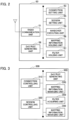
- FIG. 2 is a functional block diagram of the UE 50.
- the UE 50 includes a radio communication unit 51, a connection setting unit 53, a session setting unit 55, a mapping information holding unit 56, a filter holding unit 57, a QoS rule generating unit 58, and a handover executing unit 59.
- the radio communication unit 51 performs radio communication in accordance with the 4G and the 5G. Specifically, the radio communication unit 51 transmits and receives radio signals to and from the radio base station 25 in accordance with the 4G. Moreover, the radio communication unit 51 transmits and receives radio signals to and from the radio base station 35 in accordance with the 5G.
- the type of the UE 50 is not particularly limited. That is, the UE 50 can belong to the ordinary UE category, or can belong to a category for Internet of Things (IoT), specifically a category (category M1, M2) for bandwidth reduced low complexity UE (BL UE).
- IoT Internet of Things
- BL UE bandwidth reduced low complexity UE
- the UE 50 may be able to perform carrier aggregation (CA) and dual connectivity (DC).
- CA carrier aggregation
- DC dual connectivity
- the connection setting unit 53 sets Packet Data Network connection (PDN connection) with the EPC. Specifically, the connection setting unit 53 sets the PDN connection that goes via the EPS bearer that is a logical communication path set with the EPC. That is, the PDN connection is related (is associated) to the EPS bearer.
- PDN connection Packet Data Network connection
- the session setting unit 55 sets Protocol Data Unit session (PDU session) with the 5GC. Specifically, the session setting unit 55 sets the PDU session that shows a connection relation (association) between the UE 50 and the DN 40 that provides PDN Connectivity service.
- PDU session Protocol Data Unit session
- the PDU session is related (is associated) to the QoS flow (5G QoS Flow) prescribed in the 5GC.
- the QoS flow corresponds with a particular quality of service (QoS).
- a communication (traffic) assigned to the QoS flow receives the same handling with respect to scheduling, queue management, shaping, configuration of the radio link control layer (RLC), and the like of.
- the mapping information holding unit 56 holds mapping information (association information) in which the type of the EPS bearer and the type of the QoS flow (5G QoS Flow) are mapped with each other.
- mapping information association information
- the EPS bearer is set in the 4G.
- the QoS flow is set in the 5G, and it is prescribed depending on the particular quality of service.
- the mapping information is necessary when the UE 50 performs handover (inter-system handover) between 4G and 5G. That is, the mapping between the EPS bearer related to the PDN connection and the QoS flow related to the PDU session becomes necessary when the UE 50 performs the inter-system handover.
- the mapping information held in the mapping information holding unit 56 includes such association between the EPS Bearer ID and the QoS Flow ID. That is, the EPS Bearer ID for recognizing the type of the EPS bearer and the QoS Flow ID for recognizing the type of the QoS flow are mapped with each other in the mapping information. Note that, a detailed explanation about the mapping information is given below with reference to FIGS. 5 and 6 .
- the mapping information holding unit 56 can hold the mapping information received from the EPC or the 5GC.
- the mapping information can be transmitted to the UE 50 as a message, notification information (SIB (System Information Block)), and the like of the radio resource control layer (RRC layer).
- SIB System Information Block
- RRC layer radio resource control layer
- mapping information can be stored beforehand in Universal Integrated Circuit Card (UICC), Universal Subscriber Identity Module (USIM), and the like of the UE 50. Furthermore, the mapping information can be updated together when firmware is updated by FOTA (Firmware On-The-Air) . Alternatively, the mapping information can be updated together when the operating system of the UE 50 is updated.
- UICC Universal Integrated Circuit Card
- USIM Universal Subscriber Identity Module
- the mapping information can be updated together when firmware is updated by FOTA (Firmware On-The-Air) .
- FOTA Firmware On-The-Air
- the mapping information can be updated together when the operating system of the UE 50 is updated.
- the filter holding unit 57 holds a filter of the traffic flow (IP flow) associated with the EPS bearer. Specifically, the filter holding unit 57 holds a traffic flow template (TFT) associated with the EPS bearer set for the UE 50 in the 4G.
- IP flow traffic flow
- TFT traffic flow template
- the TFT includes Filter id (filter identifier), Precedence order (precedence), and Filter Content (filter content).
- Filter id filter identifier
- Precedence Precedence
- Filter Content filter content
- the TFT may be called a filter list and the like. More information about the TFT will be given later.
- the QoS rule generating unit 58 generates a quality-of-service rule associated with the QoS flow. Specifically, the QoS rule generating unit 58 autonomously generates 5G QoS Rule associated with the QoS flow.
- the QoS rule generating unit 58 generates the 5G QoS Rule associated with a particular QoS flow (5G QoS Flow) based on the EBI (bearer identifier) for recognizing the type of the EPS bearer and the filter (TFT) held by the filter holding unit 57.
- the QoS rule generating unit 58 can derive the 5G QoS Rule associated with the EPS bearer set by the UE 50 and generate the QoS flow.
- a timing at which the QoS rule generating unit 58 generates the 5G QoS Rule is not particularly limited.
- the QoS rule generating unit 58 can generate the 5G QoS Rule when the handover of the UE 50 is performed by the handover executing unit 59.
- the QoS rule generating unit 58 can generate the 5G QoS Rule at a timing (see FIG. 4 ) when the UE 50 sets the radio bearer with the 5G RAN 30, a timing (see FIG. 8 ) at which the UE 50 transmits Handover Complete.
- the QoS rule generating unit 58 can generate Rule id (rule identifier) for recognizing the 5G QoS Rule based on the EBI and the Filter id (filter identifier) for recognizing the filter (TFT).
- Rule id rule identifier
- Filter id filter identifier
- TFT filter identifier
- the handover executing unit 59 performs intra-system handover of the UE 50 and the inter-system handover of the UE 50. That is, the handover executing unit 59 performs the handover from 4G to 5G and the handover from 5G to 4G.
- the handover executing unit 59 performs the inter-system handover between 4G and 5G by using the mapping information held by the mapping information holding unit 56.
- the handover executing unit 59 acquires, by using the mapping information, the association between the EPS bearer set by the UE 50 and the QoS flow set by the UE 50. Furthermore, the handover executing unit 59 performs, based on the acquired association, the handover between the mutually associated EPS bearer and the QoS flow.
- the handover executing unit 59 performs the handover in accordance with interworking procedures prescribed in 3GPP TS 23.502 Section 4.11 (System interworking procedures with EPS).
- the handover executing unit 59 can hold the acquired association between the EPS bearer and the QoS flow and the 5G QoS Rule generated based on the EBI and the filter (TFT).
- the SMF/PGW-C 300 can hold this association (and the 5G QoS Rule) until the QoS flow is released. Accordingly, the UE 50 and the SMF/PGW-C 300 can readily refer to this acquired association between the EPS bearer and the QoS flow when the need arises.
- FIG. 3 is a functional block diagram of the SMF/PGW-C 300.
- the SMF/PGW-C 300 includes a connection controlling unit 310, a session controlling unit 320, a mapping information holding unit 330, a mapping information managing unit 340, a filter acquiring unit 350, and a QoS rule generating unit 360.
- the connection controlling unit 310 performs a control of the PDN connection set with the UE 50. Specifically, the connection controlling unit 310 performs setting, releasement, and the like of the PDN connection while cooperating with other nodes (MME 100, AMF 200, and the like) that constitute the EPC or the 5GC.
- MME 100, AMF 200, and the like nodes
- the session controlling unit 320 performs a control of the PDU session set with the UE 50. Specifically, the session controlling unit 320 performs setting, releasement, and the like of the PDU session while cooperating with other nodes (AMF 200 and the like) that constitute the EPC or the 5GC.
- AMF 200 and the like nodes
- the mapping information holding unit 330 holds the same mapping information (association information) as the mapping information held by the UE 50. That is, the mapping information holding unit 330 holds the mapping information in which the type of the EPS bearer and the type of the QoS flow are mapped with each other.
- mapping information holding unit 330 can hold the mapping information generated or updated by the mapping information managing unit 340.
- the mapping information managing unit 340 manages the mapping information (association information) in which the type of the EPS bearer and the type of the QoS flow are mapped with each other. Specifically, the mapping information managing unit 340 generates the mapping information based on information supplied by other nodes that constitute the EPC or the 5GC. Note that, the content of the specific mapping may be specified by an operator of the radio communication system 10, or the content may be generated automatically based on a predetermined algorithm.
- the mapping information managing unit 340 can cause the mapping information holding unit 330 to hold the generated mapping information and can transmit the same to the UE 50.
- the mapping information can be transmitted to the UE 50 in the form of the message, the notification information, and the like of the RRC layer.
- the mapping information managing unit 340 can update the content of the mapping information based on the information supplied by other nodes that constitute the EPC or the 5GC.
- the mapping information managing unit 340 causes the mapping information holding unit 330 to hold the updated mapping information.
- the filter acquiring unit 350 acquires the filter (TFT) of the traffic flow (IP flow) associated with the EPS bearer. Specifically, the filter acquiring unit 350 acquires the TFT associated with the EPS bearer set for the UE 50 in the 4G.
- TFT filter of the traffic flow
- the filter acquiring unit 350 acquires content (Filter id, Precedence order, and Filter Content) of the TFT by using a session administration function provided in SMF and PGW-C.
- the SMF and the PGW-C hold information about the EPS bearer of the 4G by virtue of the session administration function, and the filter acquiring unit 350 can acquire the Filter id, the Precedence order, and the Filter Content by using the session administration function.
- the QoS rule generating unit 360 generates the same quality-of-service rule as the QoS rule generating unit 58 of the UE 50. Specifically, the QoS rule generating unit 360 generates the 5G QoS Rule associated with a particular QoS flow based on the EBI of the EPS bearer and the filter (TFT) acquired by the filter acquiring unit 350.
- the QoS rule generating unit 360 can generate the 5G QoS Rule for the QoS flow associated with the EPS bearer set by the UE 50.
- the QoS rule generating unit 360 can generate the 5G QoS Rule when the handover of the UE 50 is performed.
- the QoS rule generating unit 360 can generate the Rule id (rule identifier) for recognizing the 5G QoS Rule based on the EBI and the Filter id (filter identifier) for recognizing the filter (TFT).
- the mapping between the EPS bearer related to the PDN connection and the QoS flow related to the PDU session is necessary.
- the UE 50 can perform the inter-system handover of the UE 50 by using the EPS bearer and the PDU session.
- the UE 50 holds the mapping information in which the EPS Bearer ID, for recognizing the type of the EPS bearer, and the QoS flow are mapped with each other. Specifically, the UE 50 holds the mapping information showing the association between the EPS Bearer ID and the QoS Flow ID. Therefore, each time the UE 50 performs the inter-system handover, it is not necessary to transmit to the UE 50 the mapping information, that is, the association between the EPS Bearer ID and the QoS Flow ID.
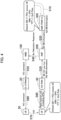
- FIG. 4 shows a conceptual sequence of the inter-system handover from 4G to 5G by the UE 50.
- the SMF/PGW-C 300 generates the mapping information based on an association rule prescribed beforehand between the EPS Bearer ID (EBI) and the QoS Flow ID (QFI) (Step S10).
- the SMF/PGW-C 300 can generate the mapping information beforehand regardless of a timing at which the inter-system handover of the UE 50 is performed.
- the SMF/PGW-C 300 identifies, by using the mapping information, the QoS flow associated with the EPS bearer identified by the EBI. Furthermore, the SMF/PGW-C 300 generates the quality-of-service rule (5G QoS Rule) associated with the QoS flow based on the filter (TFT) associated with the EPS bearer. Note that, a specific method for generating the 5G QoS Rule will be explained in detail later by referring to FIG. 6 .
- mapping information is supplied beforehand to the UE 50, and the same is held by the UE 50 also.
- various methods can be employed, such as using the notification information and pre-installing in UICC/USIM and the like.
- Step S20 when the UE 50 performs the inter-system handover in a state in which the mapping information has been held in the UE 50 beforehand, the SMF/PGW-C 300 transmits N2 SM Information to the AMF 200 (Step S20). Note that, the process procedure after Step S20 is similar to the existing sequence used to perform the inter-system handover from 4G to 5G.
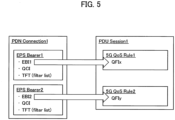
- FIGS. 5 and 6 are views for explaining an operation up to generation of setting content of the PDU session (QoS flow) based on setting content of the PDN connection (EPS bearer).
- FIG. 5 is a view for explaining an operation for identifying, by using the mapping information, the PDU session (QoS flow) associated with the PDN connection (EPS bearer).
- FIG. 6 is a view for explaining an operation for generating, based on the filter (TFT) associated with the EPS bearer, the quality-of-service rule (5G QoS Rule) associated with the identified QoS flow.
- TFT filter
- 5G QoS Rule quality-of-service rule
- the UE 50 (also the SMF/PGW-C 300, this holds true in the below explanation as well) identifies, based on the above-explained mapping information containing the association between the EPS Bearer ID and the QoS Flow ID, the QFI associated with the EBI of the set EPS bearer.
- the setting information of the EPS bearer includes, other than the EBI, QoS Class Identifier (QCI), the TFT (filter list), and the like.
- QCI QoS Class Identifier
- TFT filter list
- each of the UE 50 and the 5GC also SMF/PGW-C 300
- a common 5G QoS Rule that is, TFT
- TFT time division multiple access
- the UE 50 generates the 5G QoS Rule associated with the QoS flow identified based on the mapping information. Specifically, the UE 50 generates content of the 5G QoS Rule based on content of the TFT (filter list) associated with the EPS bearer. Precisely, the UE 50 derives the content of the 5G QoS Rule based on the content of the TFT. That is, between the UE 50 and the 5GC (also SMF/PGW-C300 and the like), it is not necessary to exchange data and the like for synchronizing the content of the 5G QoS Rules.
- the 5GC also SMF/PGW-C300 and the like
- the content of the TFT and the content of the 5G QoS Rule are associated one-to-one.
- the Filter id of the TFT and the Rule id of the 5G QoS Rule are associated one-to-one.
- the Precedence order and the Filter Content of the TFT are copied as the content of the 5G QoS Rule.
- the Rule id is generated automatically based on a rule that uses the value of the EBI. Specifically, by expressing a value (4 bits) of the EBI with the upper four bits of the Rule id and expressing a value of the Filter id with the lower four bits of the Rule id, the Rule id is configured so as to be able to be identified uniquely between PDU sessions.
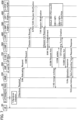
- FIG. 7 shows an example of a sequence in a handover preparation phase.
- FIG. 8 shows an example of a sequence in a handover execution phase.
- FIGS. 7 and 8 are shown in 3GPP TS 23.502 Section 4.11 (System interworking procedures with EPS), and the like. Particularly, the examples of the sequences shown in FIGS. 7 and 8 are shown in the document related to 3GPP ("TS 23.502: P-CR for Single Registration-based Interworking from EPS to 5GS procedure" S2-171013, SA WG2 Meeting #119, 3GPP, February 2017 ). The content that is different from the above document is mainly explained below.
- the SMF/PGW-C 300 in the handover preparation phase, the SMF/PGW-C 300 generates the ID of the PDU session and assigns a predetermined QoS flow (Step 8 of FIG. 7 ) . When doing so, the SMF/PGW-C 300 uses the mapping information generated beforehand.
- the SMF/PGW-C 300 identifies, by using the mapping information, the QoS flow associated with the EPS bearer identified based on the EBI. Furthermore, the SMF/PGW-C 300 generates, based on the filter (TFT) associated with the EPS bearer, the quality-of-service rule (5G QoS Rule) associated with the QoS flow.
- TFT filter
- 5G QoS Rule quality-of-service rule
- the UE 50 performs association between the EBI and the QFI by using the mapping information that is the same as the mapping information used by the SMF/PGW-C 300 (Step 3 shown in FIG. 8 ) .
- the UE 50 identifies the QoS flow associated with the EPS bearer identified by the EBI by using the mapping information. Furthermore, the UE 50 generates, based on the filter (TFT) associated with the EPS bearer, the quality-of-service rule (5G QoS Rule) associated with the QoS flow.
- TFT filter
- 5G QoS Rule quality-of-service rule
- mapping information held beforehand is used, transmission and reception of the mapping information is not performed in the handover preparation phase (specifically, at Step 15) and in the handover execution phase (specifically, at Steps 1 and 2).
- mapping information held by the UE 50 and the SMF/PGW-C 300 can be updated, so that an CAM (Operation, Administration, Management) system of the network (EPC, 5GC) side can supply the updated mapping information to a node of the UE 50, the SMF/PGW-C 300, and the like.
- EPC Evolution, Administration, Management
- FIG. 9 is a view for explaining the setting of the QoS rule and the TFT when the UE 50 performs 4G-5G-4G handover.
- the UE 50 when the UE 50 performs transition (handover) from 4G to 5G, as mentioned earlier, the UE 50 and the 5GC (SMF/PGW-C 300) autonomously generate the 5G QoS Rule, that is, derive the 5G QoS Rule based on the TFT of the EPS bearer.
- the 5GC SMF/PGW-C 300
- the 5GC when the 5GC sets a new QoS flow (QFI), the 5GC notifies the UE 50 of the content (entire content) of the TFT of the EPS bearer associated with the 5G QoS Rule of the new QoS flow.
- QFI QoS flow
- the 5GC notifies the UE 50 of the content (entire content) of the TFT of the EPS bearer associated with the 5G QoS Rule of the new QoS flow.
- PDU Session Modification procedure e.g., " 23. 502: QoS mapping for 5GC-EPC interworking", S2-173339, 3GPP TSG SA WG2 Meeting #121, 3GPP, May 2017 ).
- the UE 50 uses this TFT and continues communication via the EPS bearer.
- the UE 50 (and SMF/PGW-C 300) can generate, precisely, derive, based on the EBI and the filter (TFT) of the EPS bearer, the 5G QoS Rule associated with the QoS flow identified based on the mapping information.
- TFT filter
- the content of the TFT can be autonomously reflected in the 5G QoS Rule associated with the QoS flow of the handover destination. That is, according to the radio communication system 10, even when the EPS bearer is associated with a particular TFT, a flexible inter-system handover (from 4G to 5G and from 5G to 4G) of the UE 50 can be implemented while maintaining a desired quality of the service.
- the 5G QoS Rule can be generated at the time of performing the handover of the UE 50 from 4G to 5G. Therefore, a new 5G QoS Rule can be generated depending on the need of the 5G QoS Rule.
- the Rule id having a regularity can be generated automatically based on the EBI and the Filter id. Therefore, even when the UE 50 and the 5GC (SMF/PGW-C 300) independently generate respective 5G QoS Rules, the same Rule id can be allocated, and the same 5G QoS Rule can be surely recognized in the UE 50 and the 5GC.
- the SMF/PGW-C 300 generated and held the mapping information and the quality-of-service rule (5G QoS Rule).
- the mapping information and the quality-of-service rule can be generated or held or both by other nodes (e.g., AMF 200) that constitute the 5GC or other nodes (e.g., MME 100) that constitute the EPC.
- the use of the above method of generating the 5G QoS Rule is not limited to when performing the handover of the UE 50.
- the above method of generating the 5G QoS Rule can be used, when the content of the TFT is updated and the like, to notify this fact to the related node (UE 50, MME 100, SGW150, SMF/PGW-C 300, and the like) by Protocol Configuration Options (PCO) prescribed in 3GPP 24.008.
- PCO Protocol Configuration Options
- each functional block may be realized by one device combined physically and / or logically.
- two or more devices separated physically and / or logically may be directly and / or indirectly connected (for example, wired and / or wireless) to each other, and each functional block may be realized by these plural devices.
- FIG. 10 is a diagram showing an example of a hardware configuration of the devices.
- each of the devices can be configured as a computer device including a processor 1001, a memory 1002, a storage 1003, a communication device 1004, an input device 1005, an output device 1006, and a bus 1007.
- the functional blocks of the devices can be realized by any of hardware elements of the computer device or a desired combination of the hardware elements.
- the processor 1001 for example, operates an operating system to control the entire computer.
- the processor 1001 can be configured with a central processing unit (CPU) including an interface with a peripheral device, a control device, a computing device, a register, and the like.
- CPU central processing unit
- the memory 1002 is a computer readable recording medium and is configured, for example, with at least one of ROM (Read Only Memory), EPROM (Erasable Programmable ROM), EEPROM (Electrically Erasable Programmable ROM), RAM (Random Access Memory), and the like.
- the memory 1002 can be called register, cache, main memory (main memory), and the like.
- the memory 1002 can store therein a computer program (computer program codes), software modules, and the like that can execute the method according to the above embodiments.
- the storage 1003 is a computer readable recording medium.
- Examples of the storage 1003 include an optical disk such as CD-ROM (Compact Disc ROM), a hard disk drive, a flexible disk, a magneto-optical disk (for example, a compact disk, a digital versatile disk, a Blu-ray (Registered Trademark) disk), a smart card, a flash memory (for example, a card, a stick, a key drive), a floppy (Registered Trademark) disk, a magnetic strip, and the like.
- the storage 1003 can be called an auxiliary storage device.
- the recording medium can be, for example, a database including the memory 1002 and / or the storage 1003, a server, or other appropriate medium.
- the communication device 1004 is hardware (transmission / reception device) capable of performing communication between computers via a wired and / or wireless network.
- the communication device 1004 is also called, for example, a network device, a network controller, a network card, a communication module, and the like.
- the input device 1005 is an input device (for example, a keyboard, a mouse, a microphone, a switch, a button, a sensor, and the like) that accepts input from the outside.
- the output device 1006 is an output device (for example, a display, a speaker, an LED lamp, and the like) that outputs data to the outside. Note that, the input device 1005 and the output device 1006 may be integrated (for example, a touch screen).
- the respective devices such as the processor 1001 and the memory 1002, are connected to each other with the bus 1007 for communicating information there among.
- the bus 1007 can be constituted by a single bus or can be constituted by separate buses between the devices.
- the manner of notification of information is not limited to the one explained in the embodiments, and the notification may be performed in other manner.
- the notification of information can be performed by physical layer signaling (for example, DCI (Downlink Control Information), UCI (Uplink Control Information)), upper layer signaling (for example, RRC signaling, MAC (Medium Access Control) signaling, notification information (MIB (Master Information Block), SIB (System Information Block)), other signals, or a combination thereof.
- the RRC signaling can be called an RRC message
- the RRC signaling can be, for example, an RRC Connection Setup message, an RRC Connection Reconfiguration message, and the like.
- the input / output information can be stored in a specific location (for example, a memory) or can be managed in a management table.
- the information to be input / output can be overwritten, updated, or added.
- the information can be deleted after outputting.
- the inputted information can be transmitted to another device.
- the specific operations performed by the SMF/PGW-C 300 can be performed by another network node (device).
- functions of the SMF/PGW-C 300 can be provided by combining a plurality of other network nodes.
- the used parameter and the like can be represented by an absolute value, can be expressed as a relative value from a predetermined value, or can be represented by corresponding other information.
- the radio resource can be indicated by an index.
- the radio base stations 25 and 35 can accommodate one or more (for example, three) cells (also called sectors).
- the entire coverage area of the base station can be divided into a plurality of smaller areas.
- communication service can be provided by a base station subsystem (for example, a small base station for indoor use RRH: Remote Radio Head).
- the term “cell” or “sector” refers to a part or all of the coverage area of a base station and / or a base station subsystem that performs communication service in this coverage.
- base station eNB
- cell refers to a part or all of the coverage area of a base station and / or a base station subsystem that performs communication service in this coverage.
- base station eNB
- cell refers to a part or all of the coverage area of a base station and / or a base station subsystem that performs communication service in this coverage.
- base station eNode B
- gNB gNode B
- an access point a femtocell, a small cell, and the like.
- the UE 50 is called by the persons skilled in the art as a subscriber station, a mobile unit, a subscriber unit, a radio unit, a remote unit, a mobile device, a radio device, a radio communication device, a remote device, a mobile subscriber station, an access terminal, a mobile terminal, a radio terminal, a remote terminal, a handset, a user agent, a mobile client, a client, or with some other suitable term.
- the phrase “based on” does not mean “based only on” unless explicitly stated otherwise. In other words, the phrase “based on” means both “based only on” and “based at least on”.
- any reference to an element using a designation such as “first”, “second”, and the like used in the present specification generally does not limit the amount or order of those elements. Such designations can be used in the present specification as a convenient way to distinguish between two or more elements. Thus, the reference to the first and second elements does not imply that only two elements can be adopted, or that the first element must precede the second element in some or the other manner.
- the radio communication system, and the radio communication method explained above are useful in that the content of the TFT can be autonomously reflected in the QoS rule associated with the QoS flow of the handover destination even when the particular traffic flow template (TFT) is associated with the EPS bearer.
- TFT traffic flow template
Landscapes
- Engineering & Computer Science (AREA)
- Computer Networks & Wireless Communication (AREA)
- Signal Processing (AREA)
- Computer Security & Cryptography (AREA)
- Mobile Radio Communication Systems (AREA)
Claims (3)
- Benutzervorrichtung (50), die eine Übergabe zwischen einem ersten Funkkommunikationsnetz gemäß 4G und einem zweiten Funkkommunikationsnetz gemäß 5G durchführt, umfassend:eine Assoziationsinformations-Halteeinheit (56), die konfiguriert ist, um Assoziationsinformationen zu halten, die eine Assoziation zwischen einem Typ eines Trägers, der in dem ersten Funkkommunikationsnetz eingestellt ist, und einem Typ eines Flusses, der in dem zweiten Funkkommunikationsnetz eingestellt ist, anzeigen und die von einer Dienstqualität abhängen;eine Filterhalteeinheit (57), die konfiguriert ist, um einen Filter eines Verkehrsflusses zu halten, der mit dem Trägersatz für die Benutzervorrichtung in dem ersten Funkkommunikationsnetz assoziiert ist;eine Regelableitungseinheit (58), die konfiguriert ist, um auf der Grundlage eines Trägeridentifikators zum Erkennen des Typs des Trägers und des von der Filterhalteeinheit gehaltenen Filters eine Dienstqualitätsregel abzuleiten, die mit dem Fluss assoziiert ist; undeine Übergabeausführungseinheit (59), die konfiguriert ist, um die Übergabe von dem ersten Funkkommunikationsnetz zu dem zweiten Funkkommunikationsnetz durchzuführen; wobei die Regelableitungseinheit (58) konfiguriert ist, um die Dienstqualitätsregel abzuleiten, wenn die Übergabe durch die Übergabeausführungseinheit (59) durchgeführt wird.
- Benutzervorrichtung nach Anspruch 1, wobei die Regelableitungseinheit (58) konfiguriert ist, um auf der Grundlage des Trägeridentifikators und eines Filteridentifikators zum Erkennen des Filters einen Regelidentifikator zum Erkennen der Dienstqualitätsregel abzuleiten.
- Funkkommunikationsverfahren, das in einer Benutzervorrichtung (50) implementiert ist, das eine Übergabe zwischen einem ersten Funkkommunikationsnetz gemäß 4G und einem zweiten Funkkommunikationsnetz gemäß 5G durchführt, umfassend:Halten, in dem eine Benutzervorrichtung Zuordnungsinformationen hält, die eine Zuordnung zwischen einem Typ eines in dem ersten Funkkommunikationsnetz eingestellten Trägers und einem Typ eines Flusses, der in dem zweiten Funkkommunikationsnetz eingestellt ist und der von einer Dienstqualität abhängt, und einem Filter eines Verkehrsflusses, der mit dem Trägersatz für die Benutzervorrichtung in dem ersten Funkkommunikationsnetz assoziiert ist, anzeigen; undAbleiten, bei dem die Benutzervorrichtung auf der Grundlage einer Trägeridentifikators zum Erkennen des Typs des Trägers und des gehaltenen Filters eine Dienstqualitätsregel ableitet, die mit dem Fluss assoziiert ist;Durchführung der Übergabe vom ersten Funkkommunikationsnetz zum zweiten Funkkommunikationsnetz, wobei die Dienstqualitätsregel abgeleitet wird, wenn die Übergabe durchgeführt wird.
Applications Claiming Priority (2)
| Application Number | Priority Date | Filing Date | Title |
|---|---|---|---|
| JP2017118964 | 2017-06-16 | ||
| PCT/JP2018/023023 WO2018230730A1 (ja) | 2017-06-16 | 2018-06-15 | ユーザ装置、無線通信システム及び無線通信方法 |
Publications (3)
| Publication Number | Publication Date |
|---|---|
| EP3637862A1 EP3637862A1 (de) | 2020-04-15 |
| EP3637862A4 EP3637862A4 (de) | 2020-06-17 |
| EP3637862B1 true EP3637862B1 (de) | 2024-10-30 |
Family
ID=64660492
Family Applications (1)
| Application Number | Title | Priority Date | Filing Date |
|---|---|---|---|
| EP18818010.3A Active EP3637862B1 (de) | 2017-06-16 | 2018-06-15 | Benutzervorrichtung, drahtloskommunikationssystem und drahtloskommunikationsverfahren |
Country Status (7)
| Country | Link |
|---|---|
| US (1) | US20200112894A1 (de) |
| EP (1) | EP3637862B1 (de) |
| JP (1) | JP6887495B2 (de) |
| CN (1) | CN110754116B (de) |
| MX (1) | MX2019015239A (de) |
| PL (1) | PL3637862T3 (de) |
| WO (1) | WO2018230730A1 (de) |
Families Citing this family (12)
| Publication number | Priority date | Publication date | Assignee | Title |
|---|---|---|---|---|
| ES2870553T3 (es) | 2017-03-17 | 2021-10-27 | Nec Corp | Dispositivo de red, método de comunicación y programa informático |
| JP2019004406A (ja) * | 2017-06-19 | 2019-01-10 | シャープ株式会社 | ユーザ装置、amf、コアネットワーク装置、p−cscf、及び通信制御方法 |
| CN119172818A (zh) * | 2017-07-14 | 2024-12-20 | 华为技术有限公司 | 网络切换方法及装置 |
| CN109392178B (zh) * | 2017-08-10 | 2021-07-13 | 维沃移动通信有限公司 | Mpdu传输的方法、用户侧设备和网络侧设备 |
| KR102329925B1 (ko) * | 2017-08-14 | 2021-11-23 | 삼성전자 주식회사 | 4g/5g 동시 등록된 이동 통신 단말을 위한 네트워크 이동시 데이터 동기화 제공 방안 |
| CN109803329B (zh) * | 2017-11-16 | 2021-01-22 | 电信科学技术研究院 | 数据前转隧道确定方法、接入和移动性管理设备及基站 |
| CN109819481B (zh) * | 2017-11-20 | 2021-05-11 | 华为技术有限公司 | 一种网络切换方法及会话管理网元 |
| US11153925B2 (en) * | 2019-01-14 | 2021-10-19 | Mediatek Inc. | Handling of QoS flow description without valid EPS bearer context |
| EP3883298B1 (de) * | 2019-09-23 | 2023-11-29 | Guangdong Oppo Mobile Telecommunications Corp., Ltd. | Verfahren und vorrichtung für systeminteroperation |
| US20230018958A1 (en) * | 2019-12-25 | 2023-01-19 | Telefonaktiebolaget Lm Ericsson (Publ) | Transferring data flows for pdu sessions at 5gs to eps mobility |
| JP7438851B2 (ja) * | 2020-06-01 | 2024-02-27 | 本田技研工業株式会社 | 移動体制御装置、移動体、移動体管理システム、移動体制御方法、およびプログラム |
| CN114095984B (zh) * | 2021-11-02 | 2023-08-18 | 中国联合网络通信集团有限公司 | 会话管理方法、oam和amf |
Family Cites Families (36)
| Publication number | Priority date | Publication date | Assignee | Title |
|---|---|---|---|---|
| US7051030B2 (en) * | 2001-08-06 | 2006-05-23 | Sun Microsystems, Inc. | Method and system for managing a directory with a template |
| US7870231B2 (en) * | 2006-07-21 | 2011-01-11 | Qualcomm Incorporated | Efficiently assigning precedence values to new and existing QoS filters |
| CN1976343B (zh) * | 2006-11-10 | 2010-07-28 | 华为技术有限公司 | 提高传输控制协议数据吞吐量的方法及系统 |
| RU2450485C2 (ru) * | 2008-01-17 | 2012-05-10 | Нокиа Корпорейшн | Управление битовой скоростью адаптивного мультискоростного кодека в системе беспроводной связи |
| CN101621788A (zh) * | 2008-06-30 | 2010-01-06 | 华为技术有限公司 | 一种发送演进分组数据网络系统承载服务质量参数的方法及装置 |
| CN101431423B (zh) * | 2008-12-24 | 2011-04-13 | 华为技术有限公司 | 一种用户业务流计费核减方法和装置 |
| US11973804B2 (en) * | 2009-01-28 | 2024-04-30 | Headwater Research Llc | Network service plan design |
| WO2011120559A1 (en) * | 2010-03-30 | 2011-10-06 | Nokia Siemens Networks Oy | Enhanced admission control in relay-enhanced access networks |
| US8792340B2 (en) * | 2010-06-14 | 2014-07-29 | Alcatel Lucent | Admission control for shared LTE network |
| US9088989B2 (en) * | 2010-07-15 | 2015-07-21 | Rivada Networks, Llc | Methods and systems for managing dynamic spectrum arbitrage based on usage of network resources |
| WO2013110345A1 (en) * | 2012-01-27 | 2013-08-01 | Telefonaktiebolaget L M Ericsson (Publ) | Handover of priority calls from a circuit switched access network with single radio voice call continuity |
| EP2815603B1 (de) * | 2012-02-17 | 2019-09-25 | Interdigital Patent Holdings, Inc. | Hierarchische verkehrsdifferenzierung zur verwaltung von überlastungen und/oder der erfahrensqualität von benutzern |
| TW201442527A (zh) * | 2013-01-11 | 2014-11-01 | Interdigital Patent Holdings | 使用者平面壅塞管理 |
| US10560887B2 (en) * | 2013-05-06 | 2020-02-11 | Qualcomm Incorporated | Routing modification based on handover detection |
| US9622134B2 (en) * | 2013-05-06 | 2017-04-11 | Qualcomm Incorporated | Coordinating handover events across RATs |
| US9648545B2 (en) * | 2013-05-28 | 2017-05-09 | Rivada Networks, Llc | Methods and system for dynamic spectrum arbitrage policy driven quality of service |
| US10334485B2 (en) * | 2014-04-15 | 2019-06-25 | Nokia Solutions And Networks Oy | Interworking with bearer-based system |
| US10638537B2 (en) * | 2015-05-14 | 2020-04-28 | Samsung Electronics Co., Ltd. | Apparatus and method for managing radio resource in wireless communication system |
| CN112312314B (zh) * | 2015-06-23 | 2024-06-25 | 交互数字专利控股公司 | 用于邻近服务通信的优先级处理 |
| EP3465989B1 (de) * | 2016-05-26 | 2022-04-13 | Parallel Wireless Inc. | Ende-zu-ende-priorisierung für mobile basisstation |
| US11706657B2 (en) * | 2016-05-26 | 2023-07-18 | Parallel Wireless, Inc. | End-to-end prioritization for mobile base station |
| US11166334B2 (en) * | 2016-07-01 | 2021-11-02 | Idac Holdings, Inc. | Methods for supporting session continuity on per-session basis |
| US10856265B2 (en) * | 2016-07-05 | 2020-12-01 | Lg Electronics Inc. | Method for selecting resource operation preferred by user in wireless communication system and device for same |
| KR102503538B1 (ko) * | 2016-11-28 | 2023-02-24 | 삼성전자 주식회사 | 무선 통신 시스템에서, 게이트웨이의 네트워크 할당 방법 및 이를 위한 게이트웨이, 이동 관리 엔티티의 네트워크 할당 방법 및 이를 위한 이동 관리 엔티티, 단말의 네트워크 연결 방법 및 이를 위한 단말 |
| WO2018075828A1 (en) * | 2016-10-19 | 2018-04-26 | Convida Wireless, Llc | Apparatus |
| WO2018081984A1 (en) * | 2016-11-03 | 2018-05-11 | Qualcomm Incorporated | Plural bearers for an application |
| US11582654B2 (en) * | 2016-11-04 | 2023-02-14 | Telefonaktiebolaget Lm Ericsson (Publ) | Systems and methods of handing over a wireless device |
| CN109937590B (zh) * | 2016-11-09 | 2021-09-14 | Lg电子株式会社 | 切换方法和用户设备 |
| US10171369B2 (en) * | 2016-12-22 | 2019-01-01 | Huawei Technologies Co., Ltd. | Systems and methods for buffer management |
| CN111247820B (zh) * | 2017-03-10 | 2023-04-25 | 苹果公司 | 用于设备到设备发现的技术协调 |
| CN110651497B (zh) * | 2017-03-23 | 2022-04-19 | 瑞典爱立信有限公司 | 用于系统间切换的方法和装置 |
| US20180324631A1 (en) * | 2017-05-05 | 2018-11-08 | Mediatek Inc. | Using sdap headers for handling of as/nas reflective qos and to ensure in-sequence packet delivery during remapping in 5g communication systems |
| EP3986019B1 (de) * | 2017-05-09 | 2024-09-25 | Huawei Technologies Co., Ltd. | Verfahren zur kontrolle der dienstgüte und sitzungsverwaltungsfunktionseinheit |
| US11096082B2 (en) * | 2017-05-29 | 2021-08-17 | Lg Electronics Inc. | Method for managing uplink quality of service and base station for performing same method |
| WO2018228678A1 (en) * | 2017-06-13 | 2018-12-20 | Telefonaktiebolaget Lm Ericsson (Publ) | Quality of service initiated handover |
| WO2020223640A1 (en) * | 2019-05-02 | 2020-11-05 | Intel Corporation | Quality of service (qos) in information centric networking (icn) |
-
2018
- 2018-06-15 US US16/622,748 patent/US20200112894A1/en active Pending
- 2018-06-15 MX MX2019015239A patent/MX2019015239A/es unknown
- 2018-06-15 EP EP18818010.3A patent/EP3637862B1/de active Active
- 2018-06-15 CN CN201880039007.0A patent/CN110754116B/zh active Active
- 2018-06-15 PL PL18818010.3T patent/PL3637862T3/pl unknown
- 2018-06-15 WO PCT/JP2018/023023 patent/WO2018230730A1/ja not_active Ceased
- 2018-06-15 JP JP2019525584A patent/JP6887495B2/ja active Active
Also Published As
| Publication number | Publication date |
|---|---|
| EP3637862A1 (de) | 2020-04-15 |
| WO2018230730A1 (ja) | 2018-12-20 |
| CN110754116A (zh) | 2020-02-04 |
| CN110754116B (zh) | 2023-03-21 |
| JP6887495B2 (ja) | 2021-06-16 |
| PL3637862T3 (pl) | 2025-01-13 |
| US20200112894A1 (en) | 2020-04-09 |
| JPWO2018230730A1 (ja) | 2020-04-16 |
| MX2019015239A (es) | 2020-02-13 |
| EP3637862A4 (de) | 2020-06-17 |
Similar Documents
| Publication | Publication Date | Title |
|---|---|---|
| EP3637862B1 (de) | Benutzervorrichtung, drahtloskommunikationssystem und drahtloskommunikationsverfahren | |
| RU2764259C1 (ru) | Способ для активизации или деактивизации соединения плоскости пользователя в каждом сеансе | |
| US10674363B2 (en) | Access control method, user equipment, and network device | |
| US11445420B2 (en) | User device, radio communication system, and radio communication method | |
| US11937319B2 (en) | Integrity protection handling at the gNB-CU-UP | |
| US11323976B2 (en) | Network device and radio communication method | |
| US11943700B2 (en) | User device | |
| EP3668207B1 (de) | Funkbasisstation und funkkommunikationsverfahren | |
| US10772146B2 (en) | Multi-connectivity communication method, device, and terminal | |
| EP3562207A1 (de) | Datenübertragungsverfahren, netzwerkvorrichtung und endgerätevorrichtung | |
| CN114071788A (zh) | Ue和网络之间的多接入pdu会话状态同步方法及相关用户设备 | |
| EP3718340B1 (de) | Zuteilung und freigabe von telekommunikationsnetzträgern | |
| US12149939B2 (en) | Communication system | |
| CN105723797A (zh) | 达到最大承载数目时维护最大承载数目的方法 | |
| JP6754900B2 (ja) | 無線通信システム、ユーザ装置、無線基地局及び無線通信方法 | |
| CN107018555A (zh) | 网络接入方法、网络接入控制方法、用户终端及基站 | |
| EP4572295A1 (de) | Kommunikationsverfahren und kommunikationsvorrichtung | |
| EP3735031B1 (de) | Übergabeverarbeitungsverfahren, netzwerkvorrichtung, endgerät und computerspeichermedium | |
| CN119678517B (zh) | 用于无线网络中的scg安全的方法、设备和系统 |
Legal Events
| Date | Code | Title | Description |
|---|---|---|---|
| STAA | Information on the status of an ep patent application or granted ep patent |
Free format text: STATUS: THE INTERNATIONAL PUBLICATION HAS BEEN MADE |
|
| PUAI | Public reference made under article 153(3) epc to a published international application that has entered the european phase |
Free format text: ORIGINAL CODE: 0009012 |
|
| STAA | Information on the status of an ep patent application or granted ep patent |
Free format text: STATUS: REQUEST FOR EXAMINATION WAS MADE |
|
| 17P | Request for examination filed |
Effective date: 20200110 |
|
| AK | Designated contracting states |
Kind code of ref document: A1 Designated state(s): AL AT BE BG CH CY CZ DE DK EE ES FI FR GB GR HR HU IE IS IT LI LT LU LV MC MK MT NL NO PL PT RO RS SE SI SK SM TR |
|
| AX | Request for extension of the european patent |
Extension state: BA ME |
|
| REG | Reference to a national code |
Ref legal event code: R079 Free format text: PREVIOUS MAIN CLASS: H04W0048180000 Ipc: H04W0036000000 Ref country code: DE Ref legal event code: R079 Ref document number: 602018076055 Country of ref document: DE Free format text: PREVIOUS MAIN CLASS: H04W0048180000 Ipc: H04W0036000000 |
|
| A4 | Supplementary search report drawn up and despatched |
Effective date: 20200515 |
|
| RIC1 | Information provided on ipc code assigned before grant |
Ipc: H04W 48/18 20090101ALI20200511BHEP Ipc: H04W 28/02 20090101ALI20200511BHEP Ipc: H04W 36/14 20090101ALI20200511BHEP Ipc: H04W 36/00 20090101AFI20200511BHEP |
|
| DAV | Request for validation of the european patent (deleted) | ||
| DAX | Request for extension of the european patent (deleted) | ||
| STAA | Information on the status of an ep patent application or granted ep patent |
Free format text: STATUS: EXAMINATION IS IN PROGRESS |
|
| 17Q | First examination report despatched |
Effective date: 20211105 |
|
| P01 | Opt-out of the competence of the unified patent court (upc) registered |
Effective date: 20230509 |
|
| GRAP | Despatch of communication of intention to grant a patent |
Free format text: ORIGINAL CODE: EPIDOSNIGR1 |
|
| STAA | Information on the status of an ep patent application or granted ep patent |
Free format text: STATUS: GRANT OF PATENT IS INTENDED |
|
| RIC1 | Information provided on ipc code assigned before grant |
Ipc: H04W 40/36 20090101ALI20240429BHEP Ipc: H04W 48/18 20090101ALI20240429BHEP Ipc: H04W 36/14 20090101ALI20240429BHEP Ipc: H04W 28/02 20090101ALI20240429BHEP Ipc: H04W 36/00 20090101AFI20240429BHEP |
|
| INTG | Intention to grant announced |
Effective date: 20240527 |
|
| GRAS | Grant fee paid |
Free format text: ORIGINAL CODE: EPIDOSNIGR3 |
|
| GRAA | (expected) grant |
Free format text: ORIGINAL CODE: 0009210 |
|
| STAA | Information on the status of an ep patent application or granted ep patent |
Free format text: STATUS: THE PATENT HAS BEEN GRANTED |
|
| AK | Designated contracting states |
Kind code of ref document: B1 Designated state(s): AL AT BE BG CH CY CZ DE DK EE ES FI FR GB GR HR HU IE IS IT LI LT LU LV MC MK MT NL NO PL PT RO RS SE SI SK SM TR |
|
| REG | Reference to a national code |
Ref country code: GB Ref legal event code: FG4D |
|
| REG | Reference to a national code |
Ref country code: CH Ref legal event code: EP |
|
| REG | Reference to a national code |
Ref country code: DE Ref legal event code: R096 Ref document number: 602018076055 Country of ref document: DE |
|
| REG | Reference to a national code |
Ref country code: IE Ref legal event code: FG4D |
|
| REG | Reference to a national code |
Ref country code: LT Ref legal event code: MG9D |
|
| REG | Reference to a national code |
Ref country code: NL Ref legal event code: MP Effective date: 20241030 |
|
| PG25 | Lapsed in a contracting state [announced via postgrant information from national office to epo] |
Ref country code: HR Free format text: LAPSE BECAUSE OF FAILURE TO SUBMIT A TRANSLATION OF THE DESCRIPTION OR TO PAY THE FEE WITHIN THE PRESCRIBED TIME-LIMIT Effective date: 20241030 Ref country code: PT Free format text: LAPSE BECAUSE OF FAILURE TO SUBMIT A TRANSLATION OF THE DESCRIPTION OR TO PAY THE FEE WITHIN THE PRESCRIBED TIME-LIMIT Effective date: 20250228 Ref country code: IS Free format text: LAPSE BECAUSE OF FAILURE TO SUBMIT A TRANSLATION OF THE DESCRIPTION OR TO PAY THE FEE WITHIN THE PRESCRIBED TIME-LIMIT Effective date: 20250228 |
|
| PG25 | Lapsed in a contracting state [announced via postgrant information from national office to epo] |
Ref country code: FI Free format text: LAPSE BECAUSE OF FAILURE TO SUBMIT A TRANSLATION OF THE DESCRIPTION OR TO PAY THE FEE WITHIN THE PRESCRIBED TIME-LIMIT Effective date: 20241030 Ref country code: NL Free format text: LAPSE BECAUSE OF FAILURE TO SUBMIT A TRANSLATION OF THE DESCRIPTION OR TO PAY THE FEE WITHIN THE PRESCRIBED TIME-LIMIT Effective date: 20241030 |
|
| REG | Reference to a national code |
Ref country code: AT Ref legal event code: MK05 Ref document number: 1738154 Country of ref document: AT Kind code of ref document: T Effective date: 20241030 |
|
| PG25 | Lapsed in a contracting state [announced via postgrant information from national office to epo] |
Ref country code: BG Free format text: LAPSE BECAUSE OF FAILURE TO SUBMIT A TRANSLATION OF THE DESCRIPTION OR TO PAY THE FEE WITHIN THE PRESCRIBED TIME-LIMIT Effective date: 20241030 |
|
| PG25 | Lapsed in a contracting state [announced via postgrant information from national office to epo] |
Ref country code: ES Free format text: LAPSE BECAUSE OF FAILURE TO SUBMIT A TRANSLATION OF THE DESCRIPTION OR TO PAY THE FEE WITHIN THE PRESCRIBED TIME-LIMIT Effective date: 20241030 |
|
| PG25 | Lapsed in a contracting state [announced via postgrant information from national office to epo] |
Ref country code: NO Free format text: LAPSE BECAUSE OF FAILURE TO SUBMIT A TRANSLATION OF THE DESCRIPTION OR TO PAY THE FEE WITHIN THE PRESCRIBED TIME-LIMIT Effective date: 20250130 |
|
| PG25 | Lapsed in a contracting state [announced via postgrant information from national office to epo] |
Ref country code: LV Free format text: LAPSE BECAUSE OF FAILURE TO SUBMIT A TRANSLATION OF THE DESCRIPTION OR TO PAY THE FEE WITHIN THE PRESCRIBED TIME-LIMIT Effective date: 20241030 Ref country code: GR Free format text: LAPSE BECAUSE OF FAILURE TO SUBMIT A TRANSLATION OF THE DESCRIPTION OR TO PAY THE FEE WITHIN THE PRESCRIBED TIME-LIMIT Effective date: 20250131 Ref country code: AT Free format text: LAPSE BECAUSE OF FAILURE TO SUBMIT A TRANSLATION OF THE DESCRIPTION OR TO PAY THE FEE WITHIN THE PRESCRIBED TIME-LIMIT Effective date: 20241030 |
|
| PG25 | Lapsed in a contracting state [announced via postgrant information from national office to epo] |
Ref country code: RS Free format text: LAPSE BECAUSE OF FAILURE TO SUBMIT A TRANSLATION OF THE DESCRIPTION OR TO PAY THE FEE WITHIN THE PRESCRIBED TIME-LIMIT Effective date: 20250130 |
|
| PG25 | Lapsed in a contracting state [announced via postgrant information from national office to epo] |
Ref country code: SM Free format text: LAPSE BECAUSE OF FAILURE TO SUBMIT A TRANSLATION OF THE DESCRIPTION OR TO PAY THE FEE WITHIN THE PRESCRIBED TIME-LIMIT Effective date: 20241030 |
|
| PGFP | Annual fee paid to national office [announced via postgrant information from national office to epo] |
Ref country code: PL Payment date: 20250527 Year of fee payment: 8 Ref country code: DE Payment date: 20250624 Year of fee payment: 8 |
|
| PG25 | Lapsed in a contracting state [announced via postgrant information from national office to epo] |
Ref country code: DK Free format text: LAPSE BECAUSE OF FAILURE TO SUBMIT A TRANSLATION OF THE DESCRIPTION OR TO PAY THE FEE WITHIN THE PRESCRIBED TIME-LIMIT Effective date: 20241030 |
|
| PGFP | Annual fee paid to national office [announced via postgrant information from national office to epo] |
Ref country code: GB Payment date: 20250624 Year of fee payment: 8 |
|
| PGFP | Annual fee paid to national office [announced via postgrant information from national office to epo] |
Ref country code: IT Payment date: 20250530 Year of fee payment: 8 |
|
| PG25 | Lapsed in a contracting state [announced via postgrant information from national office to epo] |
Ref country code: EE Free format text: LAPSE BECAUSE OF FAILURE TO SUBMIT A TRANSLATION OF THE DESCRIPTION OR TO PAY THE FEE WITHIN THE PRESCRIBED TIME-LIMIT Effective date: 20241030 |
|
| PG25 | Lapsed in a contracting state [announced via postgrant information from national office to epo] |
Ref country code: RO Free format text: LAPSE BECAUSE OF FAILURE TO SUBMIT A TRANSLATION OF THE DESCRIPTION OR TO PAY THE FEE WITHIN THE PRESCRIBED TIME-LIMIT Effective date: 20241030 |
|
| PG25 | Lapsed in a contracting state [announced via postgrant information from national office to epo] |
Ref country code: SK Free format text: LAPSE BECAUSE OF FAILURE TO SUBMIT A TRANSLATION OF THE DESCRIPTION OR TO PAY THE FEE WITHIN THE PRESCRIBED TIME-LIMIT Effective date: 20241030 |
|
| PG25 | Lapsed in a contracting state [announced via postgrant information from national office to epo] |
Ref country code: CZ Free format text: LAPSE BECAUSE OF FAILURE TO SUBMIT A TRANSLATION OF THE DESCRIPTION OR TO PAY THE FEE WITHIN THE PRESCRIBED TIME-LIMIT Effective date: 20241030 |
|
| REG | Reference to a national code |
Ref country code: DE Ref legal event code: R097 Ref document number: 602018076055 Country of ref document: DE |
|
| PLBE | No opposition filed within time limit |
Free format text: ORIGINAL CODE: 0009261 |
|
| STAA | Information on the status of an ep patent application or granted ep patent |
Free format text: STATUS: NO OPPOSITION FILED WITHIN TIME LIMIT |
|
| PG25 | Lapsed in a contracting state [announced via postgrant information from national office to epo] |
Ref country code: SE Free format text: LAPSE BECAUSE OF FAILURE TO SUBMIT A TRANSLATION OF THE DESCRIPTION OR TO PAY THE FEE WITHIN THE PRESCRIBED TIME-LIMIT Effective date: 20241030 |
|
| 26N | No opposition filed |
Effective date: 20250731 |
|
| REG | Reference to a national code |
Ref country code: CH Ref legal event code: H13 Free format text: ST27 STATUS EVENT CODE: U-0-0-H10-H13 (AS PROVIDED BY THE NATIONAL OFFICE) Effective date: 20260127 |
|
| PG25 | Lapsed in a contracting state [announced via postgrant information from national office to epo] |
Ref country code: MC Free format text: LAPSE BECAUSE OF FAILURE TO SUBMIT A TRANSLATION OF THE DESCRIPTION OR TO PAY THE FEE WITHIN THE PRESCRIBED TIME-LIMIT Effective date: 20241030 |
|
| PG25 | Lapsed in a contracting state [announced via postgrant information from national office to epo] |
Ref country code: LU Free format text: LAPSE BECAUSE OF NON-PAYMENT OF DUE FEES Effective date: 20250615 |
|
| REG | Reference to a national code |
Ref country code: BE Ref legal event code: MM Effective date: 20250630 |
|
| PG25 | Lapsed in a contracting state [announced via postgrant information from national office to epo] |
Ref country code: IE Free format text: LAPSE BECAUSE OF NON-PAYMENT OF DUE FEES Effective date: 20250615 |
|
| PG25 | Lapsed in a contracting state [announced via postgrant information from national office to epo] |
Ref country code: BE Free format text: LAPSE BECAUSE OF NON-PAYMENT OF DUE FEES Effective date: 20250630 |
|
| PG25 | Lapsed in a contracting state [announced via postgrant information from national office to epo] |
Ref country code: FR Free format text: LAPSE BECAUSE OF NON-PAYMENT OF DUE FEES Effective date: 20250630 |