EP3638542B1 - System und verfahren zur bestimmung des kontextualisierten betriebs eines fahrzeugs - Google Patents
System und verfahren zur bestimmung des kontextualisierten betriebs eines fahrzeugs Download PDFInfo
- Publication number
- EP3638542B1 EP3638542B1 EP18772853.0A EP18772853A EP3638542B1 EP 3638542 B1 EP3638542 B1 EP 3638542B1 EP 18772853 A EP18772853 A EP 18772853A EP 3638542 B1 EP3638542 B1 EP 3638542B1
- Authority
- EP
- European Patent Office
- Prior art keywords
- event
- vehicle
- exterior
- interior
- data
- Prior art date
- Legal status (The legal status is an assumption and is not a legal conclusion. Google has not performed a legal analysis and makes no representation as to the accuracy of the status listed.)
- Active
Links
Images

Classifications
-
- G—PHYSICS
- G06—COMPUTING OR CALCULATING; COUNTING
- G06N—COMPUTING ARRANGEMENTS BASED ON SPECIFIC COMPUTATIONAL MODELS
- G06N20/00—Machine learning
-
- B—PERFORMING OPERATIONS; TRANSPORTING
- B60—VEHICLES IN GENERAL
- B60W—CONJOINT CONTROL OF VEHICLE SUB-UNITS OF DIFFERENT TYPE OR DIFFERENT FUNCTION; CONTROL SYSTEMS SPECIALLY ADAPTED FOR HYBRID VEHICLES; ROAD VEHICLE DRIVE CONTROL SYSTEMS FOR PURPOSES NOT RELATED TO THE CONTROL OF A PARTICULAR SUB-UNIT
- B60W30/00—Purposes of road vehicle drive control systems not related to the control of a particular sub-unit, e.g. of systems using conjoint control of vehicle sub-units
-
- B—PERFORMING OPERATIONS; TRANSPORTING
- B60—VEHICLES IN GENERAL
- B60W—CONJOINT CONTROL OF VEHICLE SUB-UNITS OF DIFFERENT TYPE OR DIFFERENT FUNCTION; CONTROL SYSTEMS SPECIALLY ADAPTED FOR HYBRID VEHICLES; ROAD VEHICLE DRIVE CONTROL SYSTEMS FOR PURPOSES NOT RELATED TO THE CONTROL OF A PARTICULAR SUB-UNIT
- B60W30/00—Purposes of road vehicle drive control systems not related to the control of a particular sub-unit, e.g. of systems using conjoint control of vehicle sub-units
- B60W30/08—Active safety systems predicting or avoiding probable or impending collision or attempting to minimise its consequences
- B60W30/095—Predicting travel path or likelihood of collision
-
- B—PERFORMING OPERATIONS; TRANSPORTING
- B60—VEHICLES IN GENERAL
- B60W—CONJOINT CONTROL OF VEHICLE SUB-UNITS OF DIFFERENT TYPE OR DIFFERENT FUNCTION; CONTROL SYSTEMS SPECIALLY ADAPTED FOR HYBRID VEHICLES; ROAD VEHICLE DRIVE CONTROL SYSTEMS FOR PURPOSES NOT RELATED TO THE CONTROL OF A PARTICULAR SUB-UNIT
- B60W40/00—Estimation or calculation of non-directly measurable driving parameters for road vehicle drive control systems not related to the control of a particular sub unit, e.g. by using mathematical models
- B60W40/08—Estimation or calculation of non-directly measurable driving parameters for road vehicle drive control systems not related to the control of a particular sub unit, e.g. by using mathematical models related to drivers or passengers
-
- B—PERFORMING OPERATIONS; TRANSPORTING
- B60—VEHICLES IN GENERAL
- B60W—CONJOINT CONTROL OF VEHICLE SUB-UNITS OF DIFFERENT TYPE OR DIFFERENT FUNCTION; CONTROL SYSTEMS SPECIALLY ADAPTED FOR HYBRID VEHICLES; ROAD VEHICLE DRIVE CONTROL SYSTEMS FOR PURPOSES NOT RELATED TO THE CONTROL OF A PARTICULAR SUB-UNIT
- B60W60/00—Drive control systems specially adapted for autonomous road vehicles
- B60W60/001—Planning or execution of driving tasks
-
- B—PERFORMING OPERATIONS; TRANSPORTING
- B60—VEHICLES IN GENERAL
- B60W—CONJOINT CONTROL OF VEHICLE SUB-UNITS OF DIFFERENT TYPE OR DIFFERENT FUNCTION; CONTROL SYSTEMS SPECIALLY ADAPTED FOR HYBRID VEHICLES; ROAD VEHICLE DRIVE CONTROL SYSTEMS FOR PURPOSES NOT RELATED TO THE CONTROL OF A PARTICULAR SUB-UNIT
- B60W60/00—Drive control systems specially adapted for autonomous road vehicles
- B60W60/005—Handover processes
- B60W60/0053—Handover processes from vehicle to occupant
- B60W60/0055—Handover processes from vehicle to occupant only part of driving tasks shifted to occupants
-
- G—PHYSICS
- G05—CONTROLLING; REGULATING
- G05D—SYSTEMS FOR CONTROLLING OR REGULATING NON-ELECTRIC VARIABLES
- G05D1/00—Control of position, course, altitude or attitude of land, water, air or space vehicles, e.g. using automatic pilots
- G05D1/02—Control of position or course in two dimensions
- G05D1/021—Control of position or course in two dimensions specially adapted to land vehicles
- G05D1/0212—Control of position or course in two dimensions specially adapted to land vehicles with means for defining a desired trajectory
- G05D1/0214—Control of position or course in two dimensions specially adapted to land vehicles with means for defining a desired trajectory in accordance with safety or protection criteria, e.g. avoiding hazardous areas
-
- G—PHYSICS
- G05—CONTROLLING; REGULATING
- G05D—SYSTEMS FOR CONTROLLING OR REGULATING NON-ELECTRIC VARIABLES
- G05D1/00—Control of position, course, altitude or attitude of land, water, air or space vehicles, e.g. using automatic pilots
- G05D1/02—Control of position or course in two dimensions
- G05D1/021—Control of position or course in two dimensions specially adapted to land vehicles
- G05D1/0212—Control of position or course in two dimensions specially adapted to land vehicles with means for defining a desired trajectory
- G05D1/0221—Control of position or course in two dimensions specially adapted to land vehicles with means for defining a desired trajectory involving a learning process
-
- G—PHYSICS
- G05—CONTROLLING; REGULATING
- G05D—SYSTEMS FOR CONTROLLING OR REGULATING NON-ELECTRIC VARIABLES
- G05D1/00—Control of position, course, altitude or attitude of land, water, air or space vehicles, e.g. using automatic pilots
- G05D1/02—Control of position or course in two dimensions
- G05D1/021—Control of position or course in two dimensions specially adapted to land vehicles
- G05D1/0231—Control of position or course in two dimensions specially adapted to land vehicles using optical position detecting means
- G05D1/0246—Control of position or course in two dimensions specially adapted to land vehicles using optical position detecting means using a video camera in combination with image processing means
- G05D1/0251—Control of position or course in two dimensions specially adapted to land vehicles using optical position detecting means using a video camera in combination with image processing means extracting 3D information from a plurality of images taken from different locations, e.g. stereo vision
-
- G—PHYSICS
- G06—COMPUTING OR CALCULATING; COUNTING
- G06F—ELECTRIC DIGITAL DATA PROCESSING
- G06F18/00—Pattern recognition
- G06F18/20—Analysing
- G06F18/21—Design or setup of recognition systems or techniques; Extraction of features in feature space; Blind source separation
- G06F18/214—Generating training patterns; Bootstrap methods, e.g. bagging or boosting
- G06F18/2148—Generating training patterns; Bootstrap methods, e.g. bagging or boosting characterised by the process organisation or structure, e.g. boosting cascade
-
- G—PHYSICS
- G06—COMPUTING OR CALCULATING; COUNTING
- G06F—ELECTRIC DIGITAL DATA PROCESSING
- G06F18/00—Pattern recognition
- G06F18/20—Analysing
- G06F18/24—Classification techniques
-
- G—PHYSICS
- G06—COMPUTING OR CALCULATING; COUNTING
- G06F—ELECTRIC DIGITAL DATA PROCESSING
- G06F18/00—Pattern recognition
- G06F18/20—Analysing
- G06F18/25—Fusion techniques
- G06F18/251—Fusion techniques of input or preprocessed data
-
- G—PHYSICS
- G06—COMPUTING OR CALCULATING; COUNTING
- G06F—ELECTRIC DIGITAL DATA PROCESSING
- G06F18/00—Pattern recognition
- G06F18/20—Analysing
- G06F18/25—Fusion techniques
- G06F18/254—Fusion techniques of classification results, e.g. of results related to same input data
- G06F18/256—Fusion techniques of classification results, e.g. of results related to same input data of results relating to different input data, e.g. multimodal recognition
-
- G—PHYSICS
- G06—COMPUTING OR CALCULATING; COUNTING
- G06N—COMPUTING ARRANGEMENTS BASED ON SPECIFIC COMPUTATIONAL MODELS
- G06N3/00—Computing arrangements based on biological models
- G06N3/02—Neural networks
- G06N3/04—Architecture, e.g. interconnection topology
- G06N3/0464—Convolutional networks [CNN, ConvNet]
-
- G—PHYSICS
- G06—COMPUTING OR CALCULATING; COUNTING
- G06N—COMPUTING ARRANGEMENTS BASED ON SPECIFIC COMPUTATIONAL MODELS
- G06N3/00—Computing arrangements based on biological models
- G06N3/02—Neural networks
- G06N3/08—Learning methods
- G06N3/084—Backpropagation, e.g. using gradient descent
-
- G—PHYSICS
- G06—COMPUTING OR CALCULATING; COUNTING
- G06N—COMPUTING ARRANGEMENTS BASED ON SPECIFIC COMPUTATIONAL MODELS
- G06N3/00—Computing arrangements based on biological models
- G06N3/02—Neural networks
- G06N3/08—Learning methods
- G06N3/09—Supervised learning
-
- G—PHYSICS
- G06—COMPUTING OR CALCULATING; COUNTING
- G06Q—INFORMATION AND COMMUNICATION TECHNOLOGY [ICT] SPECIALLY ADAPTED FOR ADMINISTRATIVE, COMMERCIAL, FINANCIAL, MANAGERIAL OR SUPERVISORY PURPOSES; SYSTEMS OR METHODS SPECIALLY ADAPTED FOR ADMINISTRATIVE, COMMERCIAL, FINANCIAL, MANAGERIAL OR SUPERVISORY PURPOSES, NOT OTHERWISE PROVIDED FOR
- G06Q10/00—Administration; Management
-
- G—PHYSICS
- G06—COMPUTING OR CALCULATING; COUNTING
- G06T—IMAGE DATA PROCESSING OR GENERATION, IN GENERAL
- G06T7/00—Image analysis
- G06T7/50—Depth or shape recovery
-
- G—PHYSICS
- G06—COMPUTING OR CALCULATING; COUNTING
- G06T—IMAGE DATA PROCESSING OR GENERATION, IN GENERAL
- G06T7/00—Image analysis
- G06T7/70—Determining position or orientation of objects or cameras
-
- G—PHYSICS
- G06—COMPUTING OR CALCULATING; COUNTING
- G06V—IMAGE OR VIDEO RECOGNITION OR UNDERSTANDING
- G06V10/00—Arrangements for image or video recognition or understanding
- G06V10/70—Arrangements for image or video recognition or understanding using pattern recognition or machine learning
- G06V10/77—Processing image or video features in feature spaces; using data integration or data reduction, e.g. principal component analysis [PCA] or independent component analysis [ICA] or self-organising maps [SOM]; Blind source separation
- G06V10/80—Fusion, i.e. combining data from various sources at the sensor level, preprocessing level, feature extraction level or classification level
- G06V10/809—Fusion, i.e. combining data from various sources at the sensor level, preprocessing level, feature extraction level or classification level of classification results, e.g. where the classifiers operate on the same input data
- G06V10/811—Fusion, i.e. combining data from various sources at the sensor level, preprocessing level, feature extraction level or classification level of classification results, e.g. where the classifiers operate on the same input data the classifiers operating on different input data, e.g. multi-modal recognition
-
- G—PHYSICS
- G06—COMPUTING OR CALCULATING; COUNTING
- G06V—IMAGE OR VIDEO RECOGNITION OR UNDERSTANDING
- G06V20/00—Scenes; Scene-specific elements
- G06V20/50—Context or environment of the image
- G06V20/56—Context or environment of the image exterior to a vehicle by using sensors mounted on the vehicle
- G06V20/58—Recognition of moving objects or obstacles, e.g. vehicles or pedestrians; Recognition of traffic objects, e.g. traffic signs, traffic lights or roads
-
- G—PHYSICS
- G06—COMPUTING OR CALCULATING; COUNTING
- G06V—IMAGE OR VIDEO RECOGNITION OR UNDERSTANDING
- G06V20/00—Scenes; Scene-specific elements
- G06V20/50—Context or environment of the image
- G06V20/59—Context or environment of the image inside of a vehicle, e.g. relating to seat occupancy, driver state or inner lighting conditions
- G06V20/597—Recognising the driver's state or behaviour, e.g. attention or drowsiness
-
- G—PHYSICS
- G07—CHECKING-DEVICES
- G07C—TIME OR ATTENDANCE REGISTERS; REGISTERING OR INDICATING THE WORKING OF MACHINES; GENERATING RANDOM NUMBERS; VOTING OR LOTTERY APPARATUS; ARRANGEMENTS, SYSTEMS OR APPARATUS FOR CHECKING NOT PROVIDED FOR ELSEWHERE
- G07C5/00—Registering or indicating the working of vehicles
- G07C5/08—Registering or indicating performance data other than driving, working, idle, or waiting time, with or without registering driving, working, idle or waiting time
- G07C5/0841—Registering performance data
- G07C5/085—Registering performance data using electronic data carriers
- G07C5/0866—Registering performance data using electronic data carriers the electronic data carrier being a digital video recorder in combination with video camera
-
- G—PHYSICS
- G08—SIGNALLING
- G08G—TRAFFIC CONTROL SYSTEMS
- G08G1/00—Traffic control systems for road vehicles
- G08G1/01—Detecting movement of traffic to be counted or controlled
- G08G1/0104—Measuring and analyzing of parameters relative to traffic conditions
- G08G1/0108—Measuring and analyzing of parameters relative to traffic conditions based on the source of data
- G08G1/0112—Measuring and analyzing of parameters relative to traffic conditions based on the source of data from the vehicle, e.g. floating car data [FCD]
-
- G—PHYSICS
- G08—SIGNALLING
- G08G—TRAFFIC CONTROL SYSTEMS
- G08G1/00—Traffic control systems for road vehicles
- G08G1/01—Detecting movement of traffic to be counted or controlled
- G08G1/0104—Measuring and analyzing of parameters relative to traffic conditions
- G08G1/0125—Traffic data processing
- G08G1/0129—Traffic data processing for creating historical data or processing based on historical data
-
- G—PHYSICS
- G08—SIGNALLING
- G08G—TRAFFIC CONTROL SYSTEMS
- G08G1/00—Traffic control systems for road vehicles
- G08G1/01—Detecting movement of traffic to be counted or controlled
- G08G1/0104—Measuring and analyzing of parameters relative to traffic conditions
- G08G1/0137—Measuring and analyzing of parameters relative to traffic conditions for specific applications
- G08G1/0145—Measuring and analyzing of parameters relative to traffic conditions for specific applications for active traffic flow control
-
- G—PHYSICS
- G08—SIGNALLING
- G08G—TRAFFIC CONTROL SYSTEMS
- G08G1/00—Traffic control systems for road vehicles
- G08G1/01—Detecting movement of traffic to be counted or controlled
- G08G1/04—Detecting movement of traffic to be counted or controlled using optical or ultrasonic detectors
-
- G—PHYSICS
- G08—SIGNALLING
- G08G—TRAFFIC CONTROL SYSTEMS
- G08G1/00—Traffic control systems for road vehicles
- G08G1/16—Anti-collision systems
- G08G1/166—Anti-collision systems for active traffic, e.g. moving vehicles, pedestrians, bikes
-
- B—PERFORMING OPERATIONS; TRANSPORTING
- B60—VEHICLES IN GENERAL
- B60W—CONJOINT CONTROL OF VEHICLE SUB-UNITS OF DIFFERENT TYPE OR DIFFERENT FUNCTION; CONTROL SYSTEMS SPECIALLY ADAPTED FOR HYBRID VEHICLES; ROAD VEHICLE DRIVE CONTROL SYSTEMS FOR PURPOSES NOT RELATED TO THE CONTROL OF A PARTICULAR SUB-UNIT
- B60W40/00—Estimation or calculation of non-directly measurable driving parameters for road vehicle drive control systems not related to the control of a particular sub unit, e.g. by using mathematical models
- B60W40/08—Estimation or calculation of non-directly measurable driving parameters for road vehicle drive control systems not related to the control of a particular sub unit, e.g. by using mathematical models related to drivers or passengers
- B60W2040/0872—Driver physiology
-
- B—PERFORMING OPERATIONS; TRANSPORTING
- B60—VEHICLES IN GENERAL
- B60W—CONJOINT CONTROL OF VEHICLE SUB-UNITS OF DIFFERENT TYPE OR DIFFERENT FUNCTION; CONTROL SYSTEMS SPECIALLY ADAPTED FOR HYBRID VEHICLES; ROAD VEHICLE DRIVE CONTROL SYSTEMS FOR PURPOSES NOT RELATED TO THE CONTROL OF A PARTICULAR SUB-UNIT
- B60W50/00—Details of control systems for road vehicle drive control not related to the control of a particular sub-unit, e.g. process diagnostic or vehicle driver interfaces
- B60W50/08—Interaction between the driver and the control system
- B60W50/14—Means for informing the driver, warning the driver or prompting a driver intervention
- B60W2050/146—Display means
-
- B—PERFORMING OPERATIONS; TRANSPORTING
- B60—VEHICLES IN GENERAL
- B60W—CONJOINT CONTROL OF VEHICLE SUB-UNITS OF DIFFERENT TYPE OR DIFFERENT FUNCTION; CONTROL SYSTEMS SPECIALLY ADAPTED FOR HYBRID VEHICLES; ROAD VEHICLE DRIVE CONTROL SYSTEMS FOR PURPOSES NOT RELATED TO THE CONTROL OF A PARTICULAR SUB-UNIT
- B60W2420/00—Indexing codes relating to the type of sensors based on the principle of their operation
- B60W2420/40—Photo, light or radio wave sensitive means, e.g. infrared sensors
- B60W2420/403—Image sensing, e.g. optical camera
-
- B—PERFORMING OPERATIONS; TRANSPORTING
- B60—VEHICLES IN GENERAL
- B60W—CONJOINT CONTROL OF VEHICLE SUB-UNITS OF DIFFERENT TYPE OR DIFFERENT FUNCTION; CONTROL SYSTEMS SPECIALLY ADAPTED FOR HYBRID VEHICLES; ROAD VEHICLE DRIVE CONTROL SYSTEMS FOR PURPOSES NOT RELATED TO THE CONTROL OF A PARTICULAR SUB-UNIT
- B60W2540/00—Input parameters relating to occupants
- B60W2540/043—Identity of occupants
-
- B—PERFORMING OPERATIONS; TRANSPORTING
- B60—VEHICLES IN GENERAL
- B60W—CONJOINT CONTROL OF VEHICLE SUB-UNITS OF DIFFERENT TYPE OR DIFFERENT FUNCTION; CONTROL SYSTEMS SPECIALLY ADAPTED FOR HYBRID VEHICLES; ROAD VEHICLE DRIVE CONTROL SYSTEMS FOR PURPOSES NOT RELATED TO THE CONTROL OF A PARTICULAR SUB-UNIT
- B60W2540/00—Input parameters relating to occupants
- B60W2540/049—Number of occupants
-
- B—PERFORMING OPERATIONS; TRANSPORTING
- B60—VEHICLES IN GENERAL
- B60W—CONJOINT CONTROL OF VEHICLE SUB-UNITS OF DIFFERENT TYPE OR DIFFERENT FUNCTION; CONTROL SYSTEMS SPECIALLY ADAPTED FOR HYBRID VEHICLES; ROAD VEHICLE DRIVE CONTROL SYSTEMS FOR PURPOSES NOT RELATED TO THE CONTROL OF A PARTICULAR SUB-UNIT
- B60W2540/00—Input parameters relating to occupants
- B60W2540/18—Steering angle
-
- B—PERFORMING OPERATIONS; TRANSPORTING
- B60—VEHICLES IN GENERAL
- B60W—CONJOINT CONTROL OF VEHICLE SUB-UNITS OF DIFFERENT TYPE OR DIFFERENT FUNCTION; CONTROL SYSTEMS SPECIALLY ADAPTED FOR HYBRID VEHICLES; ROAD VEHICLE DRIVE CONTROL SYSTEMS FOR PURPOSES NOT RELATED TO THE CONTROL OF A PARTICULAR SUB-UNIT
- B60W2540/00—Input parameters relating to occupants
- B60W2540/22—Psychological state; Stress level or workload
-
- B—PERFORMING OPERATIONS; TRANSPORTING
- B60—VEHICLES IN GENERAL
- B60W—CONJOINT CONTROL OF VEHICLE SUB-UNITS OF DIFFERENT TYPE OR DIFFERENT FUNCTION; CONTROL SYSTEMS SPECIALLY ADAPTED FOR HYBRID VEHICLES; ROAD VEHICLE DRIVE CONTROL SYSTEMS FOR PURPOSES NOT RELATED TO THE CONTROL OF A PARTICULAR SUB-UNIT
- B60W2540/00—Input parameters relating to occupants
- B60W2540/223—Posture, e.g. hand, foot, or seat position, turned or inclined
-
- B—PERFORMING OPERATIONS; TRANSPORTING
- B60—VEHICLES IN GENERAL
- B60W—CONJOINT CONTROL OF VEHICLE SUB-UNITS OF DIFFERENT TYPE OR DIFFERENT FUNCTION; CONTROL SYSTEMS SPECIALLY ADAPTED FOR HYBRID VEHICLES; ROAD VEHICLE DRIVE CONTROL SYSTEMS FOR PURPOSES NOT RELATED TO THE CONTROL OF A PARTICULAR SUB-UNIT
- B60W2540/00—Input parameters relating to occupants
- B60W2540/225—Direction of gaze
-
- B—PERFORMING OPERATIONS; TRANSPORTING
- B60—VEHICLES IN GENERAL
- B60W—CONJOINT CONTROL OF VEHICLE SUB-UNITS OF DIFFERENT TYPE OR DIFFERENT FUNCTION; CONTROL SYSTEMS SPECIALLY ADAPTED FOR HYBRID VEHICLES; ROAD VEHICLE DRIVE CONTROL SYSTEMS FOR PURPOSES NOT RELATED TO THE CONTROL OF A PARTICULAR SUB-UNIT
- B60W2540/00—Input parameters relating to occupants
- B60W2540/229—Attention level, e.g. attentive to driving, reading or sleeping
-
- B—PERFORMING OPERATIONS; TRANSPORTING
- B60—VEHICLES IN GENERAL
- B60W—CONJOINT CONTROL OF VEHICLE SUB-UNITS OF DIFFERENT TYPE OR DIFFERENT FUNCTION; CONTROL SYSTEMS SPECIALLY ADAPTED FOR HYBRID VEHICLES; ROAD VEHICLE DRIVE CONTROL SYSTEMS FOR PURPOSES NOT RELATED TO THE CONTROL OF A PARTICULAR SUB-UNIT
- B60W2554/00—Input parameters relating to objects
-
- B—PERFORMING OPERATIONS; TRANSPORTING
- B60—VEHICLES IN GENERAL
- B60W—CONJOINT CONTROL OF VEHICLE SUB-UNITS OF DIFFERENT TYPE OR DIFFERENT FUNCTION; CONTROL SYSTEMS SPECIALLY ADAPTED FOR HYBRID VEHICLES; ROAD VEHICLE DRIVE CONTROL SYSTEMS FOR PURPOSES NOT RELATED TO THE CONTROL OF A PARTICULAR SUB-UNIT
- B60W2554/00—Input parameters relating to objects
- B60W2554/20—Static objects
-
- B—PERFORMING OPERATIONS; TRANSPORTING
- B60—VEHICLES IN GENERAL
- B60W—CONJOINT CONTROL OF VEHICLE SUB-UNITS OF DIFFERENT TYPE OR DIFFERENT FUNCTION; CONTROL SYSTEMS SPECIALLY ADAPTED FOR HYBRID VEHICLES; ROAD VEHICLE DRIVE CONTROL SYSTEMS FOR PURPOSES NOT RELATED TO THE CONTROL OF A PARTICULAR SUB-UNIT
- B60W2554/00—Input parameters relating to objects
- B60W2554/40—Dynamic objects, e.g. animals, windblown objects
- B60W2554/402—Type
- B60W2554/4026—Cycles
-
- B—PERFORMING OPERATIONS; TRANSPORTING
- B60—VEHICLES IN GENERAL
- B60W—CONJOINT CONTROL OF VEHICLE SUB-UNITS OF DIFFERENT TYPE OR DIFFERENT FUNCTION; CONTROL SYSTEMS SPECIALLY ADAPTED FOR HYBRID VEHICLES; ROAD VEHICLE DRIVE CONTROL SYSTEMS FOR PURPOSES NOT RELATED TO THE CONTROL OF A PARTICULAR SUB-UNIT
- B60W2554/00—Input parameters relating to objects
- B60W2554/40—Dynamic objects, e.g. animals, windblown objects
- B60W2554/402—Type
- B60W2554/4029—Pedestrians
-
- B—PERFORMING OPERATIONS; TRANSPORTING
- B60—VEHICLES IN GENERAL
- B60W—CONJOINT CONTROL OF VEHICLE SUB-UNITS OF DIFFERENT TYPE OR DIFFERENT FUNCTION; CONTROL SYSTEMS SPECIALLY ADAPTED FOR HYBRID VEHICLES; ROAD VEHICLE DRIVE CONTROL SYSTEMS FOR PURPOSES NOT RELATED TO THE CONTROL OF A PARTICULAR SUB-UNIT
- B60W2554/00—Input parameters relating to objects
- B60W2554/60—Traversable objects, e.g. speed bumps or curbs
-
- B—PERFORMING OPERATIONS; TRANSPORTING
- B60—VEHICLES IN GENERAL
- B60W—CONJOINT CONTROL OF VEHICLE SUB-UNITS OF DIFFERENT TYPE OR DIFFERENT FUNCTION; CONTROL SYSTEMS SPECIALLY ADAPTED FOR HYBRID VEHICLES; ROAD VEHICLE DRIVE CONTROL SYSTEMS FOR PURPOSES NOT RELATED TO THE CONTROL OF A PARTICULAR SUB-UNIT
- B60W2554/00—Input parameters relating to objects
- B60W2554/80—Spatial relation or speed relative to objects
-
- B—PERFORMING OPERATIONS; TRANSPORTING
- B60—VEHICLES IN GENERAL
- B60W—CONJOINT CONTROL OF VEHICLE SUB-UNITS OF DIFFERENT TYPE OR DIFFERENT FUNCTION; CONTROL SYSTEMS SPECIALLY ADAPTED FOR HYBRID VEHICLES; ROAD VEHICLE DRIVE CONTROL SYSTEMS FOR PURPOSES NOT RELATED TO THE CONTROL OF A PARTICULAR SUB-UNIT
- B60W2555/00—Input parameters relating to exterior conditions, not covered by groups B60W2552/00, B60W2554/00
- B60W2555/20—Ambient conditions, e.g. wind or rain
-
- B—PERFORMING OPERATIONS; TRANSPORTING
- B60—VEHICLES IN GENERAL
- B60W—CONJOINT CONTROL OF VEHICLE SUB-UNITS OF DIFFERENT TYPE OR DIFFERENT FUNCTION; CONTROL SYSTEMS SPECIALLY ADAPTED FOR HYBRID VEHICLES; ROAD VEHICLE DRIVE CONTROL SYSTEMS FOR PURPOSES NOT RELATED TO THE CONTROL OF A PARTICULAR SUB-UNIT
- B60W2556/00—Input parameters relating to data
- B60W2556/05—Big data
-
- B—PERFORMING OPERATIONS; TRANSPORTING
- B60—VEHICLES IN GENERAL
- B60W—CONJOINT CONTROL OF VEHICLE SUB-UNITS OF DIFFERENT TYPE OR DIFFERENT FUNCTION; CONTROL SYSTEMS SPECIALLY ADAPTED FOR HYBRID VEHICLES; ROAD VEHICLE DRIVE CONTROL SYSTEMS FOR PURPOSES NOT RELATED TO THE CONTROL OF A PARTICULAR SUB-UNIT
- B60W2556/00—Input parameters relating to data
- B60W2556/10—Historical data
-
- G—PHYSICS
- G06—COMPUTING OR CALCULATING; COUNTING
- G06Q—INFORMATION AND COMMUNICATION TECHNOLOGY [ICT] SPECIALLY ADAPTED FOR ADMINISTRATIVE, COMMERCIAL, FINANCIAL, MANAGERIAL OR SUPERVISORY PURPOSES; SYSTEMS OR METHODS SPECIALLY ADAPTED FOR ADMINISTRATIVE, COMMERCIAL, FINANCIAL, MANAGERIAL OR SUPERVISORY PURPOSES, NOT OTHERWISE PROVIDED FOR
- G06Q10/00—Administration; Management
- G06Q10/20—Administration of product repair or maintenance
-
- G—PHYSICS
- G06—COMPUTING OR CALCULATING; COUNTING
- G06T—IMAGE DATA PROCESSING OR GENERATION, IN GENERAL
- G06T2207/00—Indexing scheme for image analysis or image enhancement
- G06T2207/20—Special algorithmic details
- G06T2207/20076—Probabilistic image processing
-
- H—ELECTRICITY
- H04—ELECTRIC COMMUNICATION TECHNIQUE
- H04N—PICTORIAL COMMUNICATION, e.g. TELEVISION
- H04N23/00—Cameras or camera modules comprising electronic image sensors; Control thereof
- H04N23/90—Arrangement of cameras or camera modules, e.g. multiple cameras in TV studios or sports stadiums
Definitions
- This invention relates generally to the automotive analysis field, and more specifically to a new and useful system and method for contextualized vehicle operation determination in the automotive analysis field.
- US 2017/053461 A1 describes a method for detecting an accident of a vehicle, the method including: receiving a movement dataset collected at least at one of a location sensor and a motion sensor arranged within the vehicle, during a time period of movement of the vehicle, extracting a set of movement features associated with at least one of a position, a velocity, and an acceleration characterizing the movement of the vehicle during the time period, detecting a vehicular accident event from processing the set of movement features with an accident detection model, and in response to detecting the vehicular accident event, automatically initiating an accident response action.
- US 2008/036580 describes an interior monitoring system of a vehicle wherein at least one transducer is arranged on a first side of the structure of the vehicle and transmits waves toward an opposite, second side of the structure so that any objects contained in the interior space of the structure are situated between the first and second sides.
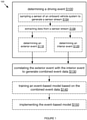
- the method 100 for contextualized vehicle operation determination includes: determining a driving event S100, which can include sampling a sensor of an onboard vehicle system to generate a sensor stream S104, extracting data from a sensor stream S106, determining an exterior event S110, and determining an interior event S120; and correlating the exterior event with the interior event to generate combined event data S130.
- the method can optionally include: training an event-based model based on the combined event data S140; and implementing the event-based model S150.
- the method functions to collect real-world data associating events related to vehicle operation with events related to the context in which the vehicle is operated.
- the method can also function to associate external driving conditions with intrinsic vehicle operation.
- the method can also function to train autonomous vehicle models which can be used for autonomous vehicle control, determination of vehicle maintenance requirements, determination of insurance claim information, and/or used for other driving-related analyses.
- the method can also function to generate models that correlate (e.g., spatially, causally, temporally, etc.): vehicle control inputs, vehicle contextual information, vehicle operation, exterior events, interior events, and other vehicle-related information (e.g., driver behavior, driver distraction, etc.) with one another in any suitable correlated combination.
- the method and/or variations thereof can be performed by and/or implemented at various related systems.
- the method is preferably performed for a physical vehicle traversing through a physical volume, but can additionally or alternatively be performed for a virtual model (e.g., of a vehicle), a simulated vehicle, or otherwise suitably performed.
- the physical vehicle can be an automobile, a motorcycle, a velocipede (e.g., a bicycle, a tricycle, etc.), a skateboard, an aerial system (e.g., a drone, plane, etc.), or be any other suitable vehicle.
- the vehicle can be driven by a human driver, be automatically controlled (e.g., by an onboard computer system executing an autonomous vehicle control model), be telematically controlled (e.g., by a teleoperator, by a remote computing system, etc.), or be otherwise suitably controlled.
- the method is preferably performed for a single vehicle, but can additionally or alternatively be performed for a plurality of vehicles, a pair of vehicles involved in a vehicle event (e.g., in a crash, in a near-miss, etc.), and/or any other suitable number and/or grouping of vehicles.
- the vehicle preferably includes one or more sensors (e.g., permanently integrated with the vehicle, installed in a removable dashboard-mounted or windshield-mounted module, integrated into a mountable unit coupled to the vehicle at a single interior or exterior location, etc.), a power system, an onboard processing system (e.g., a vehicle computer), a memory system (e.g., onboard flash memory storage), and a communication module.
- the vehicle can include any other suitable subsystems and/or components, either integrated into the vehicle (e.g., during manufacturing, as an aftermarket add on, etc.), coupled to a removable module (e.g., a mobile device, a dashboard-mounted system, etc.), and/or otherwise suitably associated with the vehicle.
- the method is preferably implemented at least partially at an onboard vehicle system 200, which includes one or more sensors 210 (e.g., optical sensors, audio sensors, stereocameras, stereomicrophones, inertial sensors, accelerometers, magnetometers, gyroscopes, ambient light sensors, etc.).
- the onboard vehicle system 200 can also include a power system 220, a processing system 230 including a memory 235, and a communication system 240.
- the onboard vehicle system is preferably arranged proximal the dashboard of the vehicle (e.g., mounted atop the dashboard, coupled to the inner surface of the windshield, etc.), but can be otherwise suitably arranged.
- the onboard vehicle system is preferably separate from the vehicle (e.g., installed into the vehicle, removable from and/or installable into the vehicle by the user or related entity, etc.), but can alternatively be integrated into the vehicle or otherwise permanently or semi-permanently attached to the vehicle.
- the method can also be implemented at and/or executed in conjunction with a user device 300 and/or a remote computing system 400.
- the user device 300 can include a mobile device associated with the user (e.g., a smartphone, tablet, laptop, etc.) and any other suitable device.
- the remote computing system 400 preferably includes a database 410 and analysis modules 420.
- the remote computing system 400 can execute any suitable Blocks or portions of the method 100 (e.g., at one or more analysis modules 420).
- the onboard vehicle system preferably includes at least one outward facing (e.g., exterior-facing) camera 211 (e.g., directed toward the front of the vehicle through the front windshield) and at least one inward facing (e.g., interior facing) camera 212 (e.g., directed in a substantially opposite direction as the forward facing camera); however, the onboard vehicle system can include any suitable number of cameras directed in any suitable direction.
- the cameras are preferably video cameras that collect image streams (e.g., sequences of images), but can additionally or alternatively include single-frame cameras that collect images in an ad hoc or any other suitable manner (e.g., based on a capture trigger, in bursts of frames, etc.).
- the cameras can each be: monocular cameras (e.g., CCD image sensors, CMOS image sensors), stereocameras, hyperspectral cameras, multispectral cameras, or any suitable camera.
- One or more intrinsic parameters for each camera e.g., focal length, skew coefficient, pixel skew, image sensor format, principal point (e.g., optical center), distortion (e.g., radial distortion, tangential distortion) can be known (e.g., determined from the manufacturer, calibrated, etc.), estimated, or otherwise determined.
- One or more extrinsic parameters for each camera e.g., pose, rotation, translation, heading, camera center position, etc.
- the relative spatial orientation is preferably determined (e.g., calculated, estimated, harcoded, etc.) based on the relationship between the cameras, but can be otherwise determined.
- the aforementioned information can be stored: onboard, in the remote computing system, in the user device, or otherwise stored.
- the cameras can be connected to (and operate based on) the same clock (e.g., onboard clock, GPS clock, etc.), synchronized clocks, unsynchronized clocks, or any other suitable clock.
- the onboard vehicle system can include a processor (e.g., CPU, GPU, etc.), which can, in variations, implement machine learning models and/or modules (e.g., a convolutional neural network-based model) and/or portions thereof.
- the processor can also receive, transmit, and/or process data (e.g., in cooperation with a communication subsystem of the onboard vehicle system).
- the onboard vehicle system can include any suitable outputs, such as a speaker, a vibration mechanism (e.g., haptic output), a display, and/or any other suitable output mechanisms.
- the onboard vehicle system can also include a communication subsystem (e.g., for long and/or medium range communication such as cellular or Wi-Fi, short range communication such as Bluetooth Low-Energy or near field communications, direct wired communication such as a connection to a CAN bus of the vehicle, etc.), a location system (e.g., GPS, cellular trilateration system, etc.), and/or a power system (e.g., a battery, a connector for connecting the system to vehicle-generated electricity, etc.).
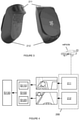
- the onboard vehicle system is preferably self-contained in a single mountable unit enclosed by a housing, as shown by example in FIGURE 3 , but can additionally or alternatively include components arranged in a distributed or any other suitable manner.
- the relative spatial orientation between the inward and outward facing cameras (and/or the respective fields of view of the cameras) is preferably known (e.g., within a threshold degree of certainty), such that the location of features detectable in the images recorded by the outward facing camera or cameras can be determined relative to the location of features detectable in the images recorded by the inward facing camera or cameras (e.g., in order to determine a gaze parameter, such as a gaze vector, a gaze region, etc.; determine a focal point based on the gaze region and pupil dilation, a point in space at which an occupant's or driver's gaze is directed; to determine that the right portion of the field of view of the outward facing camera is correlated with the left portion of the field of view of the inward facing camera; etc.).
- a gaze parameter such as a gaze vector, a gaze region, etc.
- a focal point based on the gaze region and pupil dilation, a point in space at which an occupant's or driver's gaze is directed
- the known relative spatial orientation is preferably stored and/or encoded into the onboard vehicle system (e.g., a processor thereof), such that the information (e.g., the known relative spatial orientation, derived quantities thereof, etc.) are usable by the onboard vehicle system in various computations and/or other suitable determinations (e.g., implementations of various Blocks of the method 100).
- the onboard vehicle system e.g., a processor thereof
- the information e.g., the known relative spatial orientation, derived quantities thereof, etc.
- suitable determinations e.g., implementations of various Blocks of the method 100.
- the relative spatial orientation can be determined using a pixel map (e.g., correlating one or more of the outward camera pixels with one or more of the inward camera pixels; correlating the relative positions of the outward and inward pixels; storing a vector between the outward and inward pixel, etc.), region map (e.g., correlating one or more of the outward camera field of view regions with one or more of the inward camera regions), edge map (e.g., correlating one or more of the outward camera edges or reference points with one or more of the inward camera edges or reference points) the geometry of the mounting point(s) of the onboard vehicle system combined with the geometry of the onboard vehicle system itself (e.g., camera relationships, extrinsic parameters), and/or by any other suitable means.
- a pixel map e.g., correlating one or more of the outward camera pixels with one or more of the inward camera pixels; correlating the relative positions of the outward and inward pixels; storing a vector between the outward and inward
- the inward and outward facing cameras are statically mounted to the same housing, and thus the relative positions of the inward and outward facing cameras are statically determined.
- the inward and outward facing cameras are mobile within the housing but mutually rigidly coupled, such that tracking the position of either the inward facing camera, the outward facing camera, or both the inward and outward facing cameras allows a pixel map between the imagery of one camera and the imagery of the other camera to be regenerated based on the position.
- the inward and outward facing cameras are independently movable (e.g., separate and distinct systems), and the relative spatial orientation and/or pixel mapping is determined automatically (e.g., based on optical angle of arrival, optical fiducials detecting in video streams of the respective cameras, etc.).
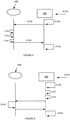
- Data streams e.g., video streams, lidar streams, gyroscope streams, IMU streams, etc.
- the inward and outward facing cameras can be temporally synchronized (e.g., via a shared internal clock and/or synchronized clocks).
- the onboard vehicle system can include adjustable mounting heights between an internal vehicle surface and the plane of cameras of the onboard vehicle system; alternatively, the mounting heights can be fixed.
- the onboard vehicle system preferably includes an adjustable mounting angle between optical axes of cameras of the onboard vehicle system and a plane defined by the wheelbase of the vehicle; alternatively, the mounting angle can be fixed.
- the onboard vehicle system can have any suitable form factor, such as an integrated, compact form factor as shown in FIGURE 3 or any other suitable form factor.
- the onboard vehicle system can include a feedback mechanism (e.g., a digital position encoder, an angle encoder, etc.) to report the mounting heights and/or angles to a processor (e.g., controller) of the onboard vehicle system for use in determining the relative orientation between cameras.
- a feedback mechanism e.g., a digital position encoder, an angle encoder, etc.
- the onboard vehicle system can additionally or alternatively store a predetermined set of relative orientations associated with various allowable (e.g., mechanically allowable, permissible in software, etc.) adjustable positions (e.g., heights, angles, etc.) of the cameras or other sensors of the onboard vehicle system.
- the onboard vehicle system can be operable between various operating modes, including an automatic calibration mode.
- the automatic calibration mode the onboard vehicle system adapts to the geometry, behavior, and other characteristics of a particular vehicle in order to calibrate the sensors of the onboard vehicle system.
- the automatic calibration mode can include performing baseline measurements of sound, imagery, and other suitable background data to enable differential measurements (e.g., departures from the baseline measurements).
- performing baseline measurements can include automatically detecting and eliminating A-pillars, the vehicle hood, and other objects (e.g., that do not move substantially relative to the camera of the onboard vehicle system while the vehicle is in motion); measuring baseline audio levels (e.g., background noise, engine noise, periodic and/or non-periodic audible sounds emitted by vehicle components, etc.); and any other suitable measurements of steady, quasi-steady, and any other suitable measurable parameters.
- baseline audio levels e.g., background noise, engine noise, periodic and/or non-periodic audible sounds emitted by vehicle components, etc.
- Variations of the method and/or portions thereof are preferably performed at least partially at a remote computing system (e.g., a remote server), which can include one or more databases (e.g., for storing data and/or from which to retrieve data) and analysis modules (e.g., for performing any Blocks of the method and/or variations and examples thereof).
- a remote computing system e.g., a remote server
- databases e.g., for storing data and/or from which to retrieve data
- analysis modules e.g., for performing any Blocks of the method and/or variations and examples thereof.
- Various blocks of the method can be performed in cooperation with a mobile device associated with an occupant of the vehicle (e.g., an occupant device, a user device, a phone of the user wherein the user is a passenger or driver, etc.) or with another entity.
- the method and/or portions thereof can be otherwise suitably performed with any suitable system(s).
- Blocks S110-S150 and/or other portions of the method can employ machine learning approaches including any one or more of: supervised learning (e.g., using logistic regression, using back propagation neural networks, using random forests, decision trees, etc.), unsupervised learning (e.g., using an a priori algorithm, using K-means clustering), semi-supervised learning, reinforcement learning (e.g., using a Q-learning algorithm, using temporal difference learning), a regression algorithm (e.g., ordinary least squares, logistic regression, stepwise regression, multivariate adaptive regression splines, locally estimated scatterplot smoothing, etc.), an instance-based method (e.g., k-nearest neighbor, learning vector quantization, self-organizing map, etc.), a regularization method (e.g., ridge regression, least absolute shrinkage and selection operator, elastic net, etc.), a decision tree learning method (e.g., classification and regression tree, iterative dichotomiser 3, C4.5, chi-squared automatic interaction detection,
- Data collected and/or generated by the method is preferably transferred (and/or created at) a remote computing system, but can alternatively be transferred between any suitable computing systems (e.g., including an onboard computer, VCU, mobile device within and/or linked to the vehicle, etc.).
- a remote computing system e.g., including an onboard computer, VCU, mobile device within and/or linked to the vehicle, etc.
- the method is preferably performed continuously in real- or near-real time; however, the method can additionally or alternatively be performed in response to occurrence of a trigger event (e.g., a change in the baseline state of the vehicle, activation of the vehicle and/or onboard vehicle system by a user, detection of an occupant entering the vehicle, detection or identification of a driver, a determination that a driving event such as a collision or near-miss has occurred, etc.), iteratively performed at a predetermined frequency (e.g., every millisecond), performed a single time during a driving session, performed a single time for a particular vehicle, and/or performed with any other suitable temporal characteristics.
- a trigger event e.g., a change in the baseline state of the vehicle, activation of the vehicle and/or onboard vehicle system by a user, detection of an occupant entering the vehicle, detection or identification of a driver, a determination that a driving event such as a collision or near-miss has occurred, etc.
- a predetermined frequency
- Variants of the systems and/or methods can confer several benefits and/or advantages.
- variants of the method can create a dataset derived from real-world events (e.g., non-simulated events) that can be used to train autonomous vehicle control models.
- datasets can include a clean (e.g., structured, labeled, pre-classified, categorized, devoid of false positives or false negatives, etc.) set of skilled driving actions and/or vehicle operations (e.g., actions and/or operations that comply with traffic guidelines, avoid adverse vehicle events, etc.) in various driving contexts (e.g., weather conditions, traffic conditions, time periods, etc.), that can be used to train autonomous vehicle control models.
- a clean e.g., structured, labeled, pre-classified, categorized, devoid of false positives or false negatives, etc.
- skilled driving actions and/or vehicle operations e.g., actions and/or operations that comply with traffic guidelines, avoid adverse vehicle events, etc.
- driving contexts e.g., weather conditions, traffic conditions, time periods, etc.
- Such datasets can additionally or alternatively include a set of examples of unskilled driving behavior and/or vehicle operations in various driving contexts (e.g., to filter other datasets for actions and/or operations that do not comply with traffic guidelines, avoid adverse vehicle events, to provide a labeled set of false positives relative to skilled driving, etc.).
- variants of the method can automatically weight gathered training data for generating and training autonomous vehicle control models.
- Automatic weighting can include determining a score associated with a quality of vehicle operational data based on driver behavior, as well as associating vehicle operational data with a particular driver and/or other individual.
- variants of the method can include determining occupant characteristics to associate with vehicle operational data.
- Such characteristics can include driver identifying information, driver history (e.g., accident history, automotive insurance premium history, etc.), number of vehicle occupants (e.g., to determine driving weight of the vehicle; can be determined from video streams, estimated suspension ride height, etc.).
- variants of the method can enable monitoring of driver behavior (e.g., to ensure drivers in a commercial fleet of vehicles are driving appropriately).
- Intrinsic characteristics can include a vehicle make, a vehicle model, and other vehicle information (e.g., from pattern-matching of interior images to a database of vehicle interiors organized by make and model).
- Intrinsic characteristics can include dynamically changing information, such as emergent maintenance issues (e.g., abnormal noises, vibrations, etc.).
- variants of the method can enable temporal correlation of interior events with exterior events to generate combined event data that is enriched with the context provided (e.g., by the exterior event to the interior event, by the interior event to the exterior event, etc.).
- an interior event can include the widening of a driver's eyes and the exterior event can include the activation of the brake lights of a leading vehicle
- correlating the interior event with the exterior event can include associating the widening of the driver's eyes with the activation of the brake lights in time (e.g., temporally associating)
- the method can include generating combined event data that includes an indication that the driver visibly responded to the brake light activation and a calculation of the driver's response time.
- an interior event can include a driver's gaze direction meeting a directional criterion (e.g., the gaze being apparently directed to a particular location as determined from an interior image) and the exterior event can include an object external to the vehicle meeting another criterion (e.g., entering a region of space proximal to the vehicle as determined from an exterior image), and correlating the interior event with the exterior event can include determining that the driver directed his or her gaze toward the external object within a predetermined time window relative to the external object meeting the criterion.
- a directional criterion e.g., the gaze being apparently directed to a particular location as determined from an interior image
- the exterior event can include an object external to the vehicle meeting another criterion (e.g., entering a region of space proximal to the vehicle as determined from an exterior image)
- correlating the interior event with the exterior event can include determining that the driver directed his or her gaze toward the external object within a predetermined time window relative to the external object meeting the criterio
- the geometric correlation of the interior event and the exterior event is preferably based on intrinsic relationships (e.g., orientations, mounting positions, etc.) between sensors (e.g., interior- and exterior-facing cameras) of the onboard vehicle system that enables computation of relative perspectives and positions between sensor outputs (e.g., images).
- sensors e.g., interior- and exterior-facing cameras
- geometric correlation can be otherwise suitably performed and result in any suitable combined event data.
- an interior event can include a driver distraction event (e.g., a cognitive distraction event, a look-down event, a look-away event, a mobile device interaction, a vehicle console interaction, etc.) and the exterior event can include a lane drift event, and the combined event data can include an assignment of causality to the interior event (e.g., labeling the exterior event with a cause that includes the interior event).
- a driver distraction event e.g., a cognitive distraction event, a look-down event, a look-away event, a mobile device interaction, a vehicle console interaction, etc.
- the exterior event can include a lane drift event
- the combined event data can include an assignment of causality to the interior event (e.g., labeling the exterior event with a cause that includes the interior event).
- the method 100 for correlating interior and exterior driving events includes: determining a driving event S100, which includes determining an exterior event S110, and determining an interior event S120; and correlating the exterior event with the interior event to generate combined event data S130.
- the method 100 and Blocks of the method 100 can also include: sampling a data stream at a sensor of an onboard vehicle system S104; extracting activity data from a data stream S106; transmitting data between an onboard system and a remote computing system S135; training an event-based model based on the combined event data S140; and implementing the event-based model S150.
- Block S100 includes determining a driving event.
- Block S100 functions to determine the occurrence of an event related to driving (e.g., that a driving event has occurred, is occurring, will occur, etc.).
- Block S100 can also function to monitor (e.g., continuously, periodically) vehicle operation.
- Block S100 can also function to track vehicle usage.
- Block S100 can include Block S104, which includes: sampling a data stream at a sensor of an onboard vehicle system.
- Block S104 functions to gather raw sensor data from the vehicle and/or the vicinity of the vehicle (e.g., vehicle interior, vehicle exterior, etc.).
- Vehicle sensor data that is collectively composed of one or more data streams preferably includes two-way video data (e.g., inward facing video camera data and outward facing video camera data), and can also include inertial data, gyroscope data, location data, routing data, kinematic data, and other suitable vehicle telemetry data (e.g., collected from an OBD II port via a suitable data connection).
- vehicle sensor data can include any other suitable data.
- collecting vehicle sensor data can also, in variations, include collecting geometrically related data streams (e.g., collecting image data streams including pixels of inward facing camera data spatially mapped to pixels of outward facing camera data), for use in subsequent Blocks of the method.
- Collecting vehicle sensor data can include sampling at sensors of a sensor system (e.g., onboard vehicle system), receiving sensor data from the vehicle, and/or otherwise suitably collecting sensor data. Any suitable number of sensor streams (e.g., data streams) can be sampled, and sensors can be of various types (e.g., interior IMU sensors and exterior-facing cameras in conjunction, interior and exterior facing cameras in conjunction, etc.).
- sampling can be performed within a time window (e.g., over a time period).
- Sampling can also be performed among multiple sensors, in parallel and/or serially in any suitable combination (e.g., wherein a subset of sensor streams are collected in parallel, and another subset of sensor streams are collected serially and/or asynchronously).
- Sampling can be performed within overlapping time windows at various sensors (e.g., partially overlapping, completely overlapping, wherein time windows are coextensive, partially coextensive, etc.).
- Block S104 includes sampling a first image stream within a first time window at an interior-facing camera of an onboard vehicle system, wherein the onboard vehicle system is integrated into a mountable unit coupled to a vehicle at a single interior location and sampling a second image stream within a second time window at an exterior-facing camera of the onboard vehicle system, wherein the first and second time period are coextensive.
- Block S100 can include Block S106, which includes: extracting activity data from a data stream.
- Block S106 functions to process the raw sensor data and derive (e.g., extract) parameters and/or characteristics that are related to driving events, and/or from which driving events can be determined in relation to Block S100 and/or portions thereof.
- Extracting vehicle operational data can be performed by implementing a set of rules in the form of a model, such as an artificial neural network (e.g., a convolutional neural network), Bayesian model, a deterministic model, a stochastic and/or probabilistic model, and any other suitable model (e.g., any suitable machine learning as described above).
- an artificial neural network e.g., a convolutional neural network
- Bayesian model e.g., a deterministic model
- stochastic and/or probabilistic model e.g., any suitable machine learning as described above.
- Extracting vehicle operational data is preferably performed onboard the vehicle (e.g., at an onboard vehicle system, a vehicle computing unit, an electronic control unit, a processor of the onboard vehicle system, a mobile device onboard the vehicle, etc.), but can additionally or alternatively be performed at a remote computing system subsequent to (and/or simultaneously with) transmission of vehicle sensor data to the remote computing system (e.g., over a cellular radio channel).
- extracting activity data using a model includes determining that a combination of sampled measurement values substantially matches a predetermined pattern indicative of known vehicle operational behavior (e.g., performing curve fitting on a curve of acceleration versus time curve to identify a predetermined pattern and/or a set of curve features known to correspond to a vehicle turning through a certain subtended angle).
- extracting vehicle operational data includes translating data received from an OBD II port of the vehicle (e.g., using a lookup table).
- extracting vehicle operational data includes determining vehicle speed and direction by implementing a set of rules that track road markings and/or landmarks in collected imagery as the markings and/or landmarks move through a sequence of image frames (e.g., using optical flow image processing algorithms).
- extracting vehicle operational data includes determining the location of the vehicle by combining GPS and IMU information (e.g., using IMU data used for dead-reckoning localization).
- extracting vehicle operational data includes estimating a vehicle speed and/or acceleration based on microphone measurements of an audible vehicle parameter (e.g., an engine revolution parameter or revolutions per minute, a road noise parameter or decibel level of background noise, etc.).
- extracting vehicle operational data includes measuring a vibration parameter (e.g., frequency, amplitude, time dependency) of the vehicle using an IMU (e.g., of the onboard vehicle system).
- a vibration parameter e.g., frequency, amplitude, time dependency
- extracting vehicle operational data can include otherwise suitably determining vehicle operational data based on vehicle sensor data.
- extracting data can include extracting interior activity data.
- Extracting interior activity data includes extracting data from a data stream (e.g., an image stream, a gyroscopic data stream, an IMU data stream, etc.) that encodes information concerning activities occurring within a vehicle interior.
- a data stream e.g., an image stream, a gyroscopic data stream, an IMU data stream, etc.
- Such interior activity data can include driver activity (e.g., driver gaze motion, driver hand positions, driver control inputs, etc.), passenger activity (e.g., passenger conversation content, passenger speaking volume, passenger speaking time points, etc.), vehicle interior qualities (e.g., overall noise level, ambient light level within the cabin, etc.), intrinsic vehicle information perceptible from within the vehicle (e.g., vibration, acoustic signatures, interior appointments such as upholstery colors or materials, etc.), and any other suitable activity data related to the vehicle interior and/or collected from within the vehicle (e.g., at the onboard vehicle system).
- driver activity e.g., driver gaze motion, driver hand positions, driver control inputs, etc.
- passenger activity e.g., passenger conversation content, passenger speaking volume, passenger speaking time points, etc.
- vehicle interior qualities e.g., overall noise level, ambient light level within the cabin, etc.
- intrinsic vehicle information perceptible from within the vehicle e.g., vibration, acoustic signatures, interior appointments such as upholstery
- Block S106 includes extracting interior activity data from an image stream sampled at an interior facing camera of an onboard vehicle system.
- Block S106 includes extracting a driver gaze direction as a function of time from the image stream sampled over a time window.
- the output of Block S106 in this example can include a time series of coordinates in two- or three-dimensional space, wherein the coordinate at each time represents a most-probable location of the center of the driver's gaze.
- the coordinate can be mapped onto a pixel or pixels of an image from an image stream associated with an exterior facing camera. Such mapping is preferably performed based on known geometric relationships between interior and exterior cameras, but can be otherwise suitably performed (e.g., in accordance with one or more variations of Block S130).
- Block S106 includes extracting interior activity data from gyroscope data.
- extracting interior activity data can include determining a mean time interval between steering inputs (e.g., by the driver) based on the gyroscope data.
- extracting data can include extracting exterior activity data.
- Extracting exterior activity data includes extracting data from a data stream (e.g., an image stream, a gyroscopic data stream, an IMU data stream, etc.) that encodes information concerning activities occurring outside a vehicle.
- a data stream e.g., an image stream, a gyroscopic data stream, an IMU data stream, etc.
- Such exterior activity data can include data related to driver actions (e.g., following distance, lane drift, lane changes, turning, braking, braking rate, slowing and/or stopping distance, reaction of the vehicle to control inputs by the driver, etc.), external object activity (e.g., relative distances between the vehicle and external objects such as other vehicles, pedestrians, lane lines, traffic signage and signals, roadway features, etc.), vehicle exterior qualities (e.g., external noise level, ambient light level outside the cabin, audio signatures from surroundings such as sirens, visible signatures from surroundings such as brake lights, headlights, etc.), intrinsic vehicle information perceptible from views of a scene external to the vehicle (e.g., exterior panel vibration, acoustic signatures, images viewable in mirrors such as a rearview mirror, exterior vehicle characteristics such as paint colors or aftermarket components, etc.), and any other suitable activity data related to the vehicle exterior and/or collected by a sensor that can detect aspects of the environment external to the vehicle (e.g., at the onboard vehicle system
- Block S106 includes extracting exterior activity data from an image stream (exterior image(s)) sampled at an exterior facing camera of an onboard vehicle system. Extracting exterior activity data can include identifying blobs, object edges, object state (e.g., red traffic light, green traffic light, etc.), or other object features (e.g., gradients, pose, distance, etc.) from the exterior image; determining object types, object kinematics, object trajectories, multi-object interactions, or other object parameters from the exterior image, ambient environment data, or extracting any other suitable information from one or more exterior images (e.g., time series of exterior images).
- object state e.g., red traffic light, green traffic light, etc.
- object features e.g., gradients, pose, distance, etc.
- extracting the exterior activity data includes determining (e.g., computing) a relative position between the vehicle and an object depicted in the image stream (e.g., within a time window).
- the output of Block S106 in this example includes a time series of coordinates, wherein each of the set of coordinates defines an outline of the object in the image stream and the relative distance between the vehicle and each point of the outline of the object.
- the output of Block S106 can additionally or alternatively include any other suitable output.
- determining event data can include determining vehicle operation data in relation to a driving event.
- Vehicle operation data is preferably data related to vehicle operation (e.g., characteristics of the vehicle while the vehicle is operated and/or driven), but can additionally or alternatively include any other suitable data.
- Vehicle operational data can include vehicle outputs (e.g., engine output power, transmission gear state, throttle and/or accelerator pedal position, fuel injection parameters, voltage and/or current values of any vehicle components operating on electrical power, brake lever position, brake pedal position, brake caliper position, etc.), vehicle kinematics (e.g., acceleration, velocity, position, planned traversal path, current traversal path, past traversal path, trajectory, etc.), vehicle inputs (e.g., accelerator pedal position, steering wheel position, gear shifter position, etc.), driver parameters (e.g., whether the driver is distracted or not, a distraction level of a distracted driver, a head position of a driver, etc.), vehicle cabin parameters (e.g., noise levels, number of passengers in the vehicle, etc.), and any other suitable data related to the operation of a vehicle.
- Block S110 can include collecting vehicle sensor data and extracting vehicle operational data from vehicle sensor data, which can be performed substantially simultaneously, sequentially, or with any other suitable relative temporal characteristics.
- Block S100 is preferably performed by an onboard vehicle system such as that described above, but can alternatively be performed by or at any suitable system or combination of systems.
- Block S100 preferably includes collecting at least exterior image data and telemetry data, but can additionally or alternatively include collecting interior image data and any other suitable data.
- Block S100 is preferably performed continuously in real- or near-real time during vehicle operation, but can additionally or alternatively be performed when the vehicle and/or installed onboard vehicle system is activated by an occupant of the vehicle and/or remote operator (e.g., when a fleet manager activates the vehicle operational data determination process by remotely activating the sensor system, sending a text message to the vehicle driver prompting the driver to activate the sensor system, etc.).
- Block S100 can include constantly recording video streams from both inwardly and outwardly directed video cameras, and maintaining a buffer (e.g., a 10 minute buffer, a 20 minute buffer, a 5 hour buffer, an adjustable buffer, lossless storage of all video data, transmission and/or streaming of video data off-board the vehicle, etc.) of video streams.
- Block S100 can be performed in response to a user input (e.g., a user pressing a record button of the onboard vehicle system), be performed periodically and/or asynchronously, and/or be performed with any other suitable temporal characteristics.
- determining event data can include determining vehicle context data.
- Vehicle context data is preferably information indicative of the ambient environment of the vehicle during operation.
- Block S100 can include collecting environmental data, determining vehicle context data from the environmental data, and can optionally include determining intrinsic vehicle data, each of which can be performed substantially concurrently and/or asynchronously performed.
- Collecting environmental data functions to gather information (e.g., environmental parameters, environmental data) indicative of the physical environment surrounding the vehicle.
- the environmental data can be included in a resultant training data set, used to select analysis modules (e.g., different analysis modules are selected for different times of day or ambient lighting levels), or otherwise used.
- Such information can include ambient weather, temperature, pressure, light levels, noise levels, and any other suitable ambient environmental data.
- Environmental data can include nearby obstacles (e.g., static, moving) in the vicinity of the vehicle, such as curbs, other vehicles, pedestrians, non-automotive vehicles (e.g., bicycles, skateboards, etc.), and any other suitable obstacles.
- Environmental data can also include parameters associated with such obstacles, such as a number of obstacles (e.g., a number of cars within a threshold distance of the vehicle), trajectories of obstacles, and any other suitable parameters.
- Collecting can include sampling at the onboard vehicle system, retrieving from a remote database, receiving from adjacent and/or nearby vehicles (e.g., in front of the vehicle containing the onboard vehicle system, behind the vehicle, etc.).
- collecting environmental data includes measuring ambient weather parameters (e.g., precipitation level and/or classification, visibility, temperature, ambient light level, etc.) using sensors of the onboard vehicle system.
- collecting environmental data can include determining any other suitable data.
- Determining the vehicle context data based on the environmental data functions to obtain data that contextualizes the vehicle operational data, for provision to subsequent blocks of the method.
- Determining the vehicle context data can include extracting the vehicle context data (e.g., via image processing techniques, via any suitable extraction as described above in relation to Block S106) to generate a set of objects and/or object parameters based on the environmental data (e.g., raindrops, opacity parameters related to visibility, etc.).
- Determining the vehicle context data can also include foreground and background segmentation, object recognition and classification, optical flow analyses, and/or any other suitable data analysis processes.
- intrinsic vehicle data is preferably data indicative of intrinsic characteristics of the vehicle (e.g., data that identifies the vehicle, data that are related to the nature of the vehicle versus the operational qualities of the vehicle, etc.).
- Intrinsic vehicle data can include vehicle identity data, such as a VIN and/or any other suitable identifying data (e.g., a make and model of the vehicle).
- Vehicle identity data can be associated with a user device in a database and thereby determined (e.g., retrieved), entered manually by a user (e.g., at a previous time point to execution of determining the intrinsic vehicle data and stored in a user profile for subsequent retrieval, etc.), and/or otherwise suitably designated and determined.
- Determining intrinsic vehicle data can include retrieving a vehicle maintenance history report (e.g., using an API and in combination with a VIN lookup), and/or otherwise suitably determining any suitable intrinsic vehicle data.
- Block S100 can include determining a near-miss event (e.g., wherein the event data is associated with a near-miss).
- a near-miss event e.g., as determined in variations of Block S100 and/or other portions of the method 100 and Blocks thereof
- a near-miss event is preferably a near-miss event (e.g., near-crash, near-collision, etc.) determined substantially as described in U.S. Application Serial No. 15/892,899 , titled “System and Methods for Near-Crash Determination" and filed 09-FEB-2018, which is incorporated herein in its entirety by this reference.
- a near-miss event can additionally or alternatively include any other suitable driving event and/or be otherwise suitably determined.
- Block S100 can optionally include Block S105, which includes determining driver behavior.
- Block S105 functions to determine actions taken by the driver while operating the vehicle (e.g., driving the vehicle, occupying the vehicle while the vehicle is running, etc.).
- Block S105 can also function to determine a distraction level of the driver.
- Block S105 can include determining driver control inputs, determining occupant (e.g., driver and/or passenger) data, and determining a driver distraction factor (e.g., a value characterizing a level of driver distraction), each of which can be performed substantially simultaneously, asynchronously, periodically, and/or with any other suitable temporal characteristics.
- Block S105 is preferably performed at the onboard vehicle system, and more preferably at an inward facing camera of the onboard vehicle system; however, Block S105 can be otherwise suitably performed at any other suitable system and/or system components.
- Block S105 includes linking to a mobile device associated with one or more occupants (e.g., linking the onboard vehicle system to the mobile device, linking the vehicle computer to the mobile device, etc.) and automatically pairing with the mobile device and retrieving data associated with one or more occupants from a database.
- determining driver distraction in relation to Block S105 and/or other Blocks of the method 100 includes determining driver distraction substantially as described in U.S. Application Serial No. 15/805,348, titled “System and Method for Driver Distraction Determination” and filed 07-NOV-2017 , which is incorporated herein in its entirety by this reference.
- determining driver distraction can be otherwise suitably performed.
- Determining driver control inputs functions to obtain information indicative of actions taken by a driver intended to control the vehicle (e.g., steering control inputs, pedal control inputs, etc.).
- determining driver control inputs includes performing object recognition and classification to determine positions of a driver's hands on a steering wheel of the vehicle, determining trajectories of the driver's hand in the rotational plane of the steering wheel, and computing a steering input parameter (e.g., a number of degrees through which the steering wheel was rotated) from the imagery data.
- determining driver control inputs includes determining an acceleration parameter (e.g., a throttle level applied by a driver) based on auditory data that includes an engine noise (e.g., noise originating from engine revolutions) produced due to an acceleration input (e.g., that increases or decreases the frequency and/or volume of an engine noise).
- determining drive control inputs includes determining a number of times within a specified time period the driver has provided a control input at the steering wheel, based on gyroscopic data sampled from a gyroscope of the onboard vehicle system.
- determining driver control inputs can be otherwise suitably performed in any suitable manner.
- Determining occupant data can function to obtain data related to vehicle occupants for incorporation into a contextual dataset and/or for subsequent provision to other Blocks of the method. Determining occupant data can include performing facial recognition and/or other suitable image processing on interior sensor data (e.g., inward-facing imagery) collected by an onboard vehicle system (e.g., to determine driver identity, passenger identity, number of passengers, to estimate gross passenger weight, etc.). Occupant data can include driver identity data (e.g., retrieved from a database associated with a user account and/or profile of the driver), such as a driver's license number, a registration number, a driver name, and/or any other suitable data identifying the driver. However, determining occupant data can include otherwise suitably determining any suitable data.
- driver identity data e.g., retrieved from a database associated with a user account and/or profile of the driver
- determining occupant data can include otherwise suitably determining any suitable data.
- the distraction factor value can be determined using equations, regression, classification, neural networks (e.g., convolutional neural networks, deep neural networks), heuristics, selection (e.g., from a library, graph, or chart), instance-based methods (e.g., nearest neighbor), regularization methods (e.g., ridge regression), decision trees, Bayesian methods, kernel methods, probability, deterministic methods, a combination of the above, or any other suitable method.
- the distraction factor value can be a binary state, a score, or be any other suitable measure of a driver's distraction level.
- Block S100 can include Block S110, which includes: determining an exterior event.
- Block S110 functions to determine a driving event based on data collected in relation to occurrences exterior to (e.g., outside the cabin of) the vehicle.
- the exterior event can be determined to be any of the aforementioned driving events, as well as any other suitable driving event.
- the exterior event can also be determined based on any of the data types, characteristics, and/or parameters described above (e.g., vehicle operational data, driver behavior data, intrinsic vehicle data, etc.) which are sampled at and/or extracted from exterior-oriented data streams (e.g., an exterior-facing camera, a rangefinder directed at objects surrounding the vehicle, a portion of an interior-facing camera frame that views regions outside the vehicle, etc.).
- determining the exterior event can determining that a distance between the vehicle and an object depicted in a first region of an image stream (e.g., corresponding to an exterior-facing camera) has fallen below a threshold distance.
- the exterior event in this example is the crossing of the threshold distance by the object, wherein the distance is determined (e.g., as exterior activity data) in accordance with a variation of Block S106.
- the object can be a secondary vehicle, and determining the exterior event includes determining that the relative position between the vehicle and the secondary vehicle has fallen below a threshold distance (e.g., such as in an instance of tailgating, the secondary vehicle cutting off the vehicle, the secondary vehicle suddenly braking, etc.).
- Block S100 can include Block S120, which includes: determining an interior event.
- Block S120 functions to determine a driving event based on data collected in relation to occurrences interior to (e.g., within the cabin of) the vehicle.
- the interior event can be determined to be any of the aforementioned driving events, as well as any other suitable driving event.
- the interior event can also be determined based on any of the data types, characteristics, and/or parameters described above (e.g., driver distraction based on imagery of the driver, vehicle operational data such as driver control inputs, driver behavior data, extrinsic vehicle data, etc.) which are sampled at and/or extracted from interior-oriented data streams (e.g., an interior-facing camera, a rangefinder directed at objects inside the vehicle, a portion of an exterior-facing camera frame that views regions inside the vehicle, etc.).
- vehicle operational data such as driver control inputs, driver behavior data, extrinsic vehicle data, etc.
- interior-oriented data streams e.g., an interior-facing camera, a rangefinder directed at objects inside the vehicle, a portion of an exterior-facing camera frame that views regions inside the vehicle, etc.
- determining an interior event can include mapping a driver gaze direction relative to a first region of an image stream from an exterior camera (e.g., extracted in accordance with a variation of Block S106 based on a relative orientation between an interior-facing camera and an exterior-facing camera of the onboard vehicle system).
- the interior event includes the driver looking toward a particular region of the external environment (e.g., as depicted within the image stream from an external facing camera).
- determining the interior event includes determining a driver distraction event based on a mean time interval between control inputs (e.g., steering inputs, pedal inputs, etc.) exceeding a threshold duration.
- control inputs e.g., steering inputs, pedal inputs, etc.
- Block S130 includes: correlating the exterior event with the interior event to generate combined event data.
- Inputs to Block S130 include an exterior event and an interior event, as determined in relation to portions of Block S100 (e.g., Block S110, Block S120, etc.).
- Inputs to Block S130 can thus include vehicle operational data, vehicle context data, and/or driver behavior data as described above, and/or any other suitable data.
- Block S130 functions to produce an enriched (e.g., multivariate, weighted) dataset obtained by collecting interior event data and exterior event data from a population of vehicles and/or drivers.
- Block S130 can also function to determine the context, optionally including driver behavior, of a vehicle operational datum (e.g., a parameter value of one of any suitable vehicle operational parameter or characteristic).
- Block S130 can be performed substantially in real- or near-real time in conjunction with S110 and S120, but can additionally or alternatively be performed asynchronously or with any other suitable relative temporal characteristics.
- Block S130 can be performed continuously, upon detection of a trigger (e.g., a detected vehicle event such as a swerve, lane change, start, stop, etc.), or otherwise suitably performed.
- Block S130 can include synchronizing input data with vehicle operational data, labeling synchronized data, transmitting synchronized and labeled data to a remote computing system, and determining a weighting for the vehicle operational data, each of which can be performed substantially simultaneously, asynchronously, and/or with any other suitable relative temporal characteristics.
- Block S130 is preferably implemented at a population of vehicles, each having an onboard vehicle system, in combination with one or more analysis modules of a remote computing system; however, Block S130 can be otherwise suitably implemented at any suitable system and/or combination of systems.
- Block S130 can include generating a training dataset using the combined event data.
- the training dataset can include: physical locations of external objects (e.g., detected from outward-facing sensor signals) relative to a vehicle reference point (e.g., the driver's eyes, gaze direction, sensor mounting point, other internal reference point, etc.); internal object position (e.g., location, pose) relative to external object position; external object trajectory relative to the vehicle reference point; internal or external video frame(s) associated with user parameters and/or vehicle operation parameters; or any other suitable data.
- vehicle reference point e.g., the driver's eyes, gaze direction, sensor mounting point, other internal reference point, etc.
- internal object position e.g., location, pose
- the analysis modules can be implemented using equations, regression, classification, neural networks (e.g., convolutional neural networks, deep neural networks), heuristics, selection (e.g., from a library, graph, or chart), instance-based methods (e.g., nearest neighbor), regularization methods (e.g., ridge regression), decision trees, Bayesian methods, kernel methods, probability, deterministic methods, a combination of the above, or any other suitable method.
- neural networks e.g., convolutional neural networks, deep neural networks
- heuristics selection (e.g., from a library, graph, or chart), instance-based methods (e.g., nearest neighbor), regularization methods (e.g., ridge regression), decision trees, Bayesian methods, kernel methods, probability, deterministic methods, a combination of the above, or any other suitable method.
- Generating a training dataset can include classifying event data (e.g., combined event data) to generate an event label and labeling the event data (e.g., the classified data) with the event label.
- Classifying and labeling is preferably performed automatically (e.g., by a classifier and/or labeler model implemented at a computer system of the onboard computing system, a remote computing system, etc.), but can additionally or alternatively be performed by a human in whole or in part (e.g., via bootstrapping the classifier and/or labeler, via purely-human classification and/or labeling, etc.).
- Labeling event data can include labeling the underlying sampled data stream (e.g., a portion of a data stream sampled within a time window and from which event data is determined) and/or derived data (e.g., the combined event data), and any other suitable data.
- Block S130 can include synchronizing interior and exterior events (e.g., as determined in Block S120 and S110, respectively). Synchronizing interior and exterior events functions to associate interior event data (e.g., vehicle context data, driver behavior data) with related exterior event data to generate synchronized data (e.g., wherein the combined event data is synchronized data). Synchronizing can include temporally synchronizing, spatially synchronizing, or otherwise suitably synchronizing. Labeling synchronized data can function to associate the synchronized data with labels (e.g., header data) that enable categorization and/or correlation of the synchronized data by other Blocks of the method, and to generate synchronized labeled data.
- labels e.g., header data
- Transmitting synchronized (and/or labeled) data to a remote computing system functions to provide the data for analysis at the remote computing system in combination with data received from other vehicles of the population of vehicles.
- the output of the synchronization, labeling, and/or transmitting of the input data can be used for weighting the vehicle operational data, or for any other suitable purpose.
- Block S130 can include determining that a driver gaze direction (e.g., determined in accordance with a variation of Block S120) overlaps with a region of an external image stream (e.g., corresponding to an object as it crosses a threshold relative distance determined in accordance with a variation of Block S110) at a time point within a time window (e.g., a time window in which the source data for determination of the driver's gaze direction is sampled in accordance with a variation of Block S104; concurrently, simultaneously, contemporaneously, etc.), and determining a risk value, risk score, and any other suitable distraction metric value based on gaze direction overlap with an exterior feature of interest (e.g., the region of the external image stream sampled from an exterior-facing camera camera) and/or an object of interest (e.g., a blob in vehicle trajectory or path; a moving or stationary obstacle; road signage such as traffic light, stop sign, road-painted signs, etc.; and any other suitable object, etc.).
- determining a weighting (e.g., weight factor) for driving event data functions to modify the event data (e.g., exterior event data, interior event data, etc.) with contextual data (e.g., interior event data, exterior event data) in order to generate the training dataset.
- event data e.g., exterior event data, interior event data, etc.
- contextual data e.g., interior event data, exterior event data
- Determining the weighting can include determining a driver score (e.g., from driver behavior determined in Block S105, historic driving behavior retrieved from a database, from a driver distraction factor, from a driver profile stored onboard the vehicle at the onboard vehicle system, etc.), determining a context score (e.g., from an adverse weather determination such as low visibility, a vehicle intrinsic datum such as suboptimal suspension operation, etc.), and/or otherwise suitably determining a weighting (e.g., weight factor).
- Determining the weighting can include weighting the vehicle operational data to generate weighted vehicle operational data (e.g., a training dataset). Determining the weighting is preferably performed by the remote computing system, but can be otherwise suitably performed at any suitable location. Determining the weighting can be based on vehicle operational data, contextual data, and/or driver behavior data; alternatively, a weighting can be determined based on any other suitable data.
- the event data can include a weightable characteristic (e.g., a characteristic that can be weighted).
- a weightable characteristic can include an event score, an event severity (e.g., a quantitative severity spanning a number from 0-100 wherein o corresponds to a non-event and a 100 corresponds to a collision that totals the vehicle; a qualitative severity selected from among several predetermined severity categories such as near-miss, fender-bender, vehicle inoperative, vehicle totaled; etc.), and any other suitable characteristic of an event to which a weight can be assigned (e.g., wherein the weighting is determined as described above).
- Block S130 includes determining a distraction score based on correlating driver gaze parameters (e.g., a gaze direction determined in one or more variations of Block S120) with a position of an object (e.g., a risky object position determined in one or more variations of Block S110).
- the determined distraction score in this variation can define a static value, and can also define a dynamic value (e.g., a value that increases as a function of gaze distance from the risky object, a value based on a probability of the gaze overlapping the risky object within a time window, a value based on a gaze sweep velocity, etc.).
- determining the distraction score can include generating a virtual representation of the scene based on interior and exterior imagery and correlating driver gaze parameters and object position in virtual space.
- determining the distractions core can be based on a pixel map of image regions in both the interior imagery and the exterior imagery (e.g., wherein a left side of an exterior image corresponds to a right side of an interior image due to the relative geometric arrangement of the interior and exterior cameras).
- Block S130 includes determining a driver distraction score based on a reaction of the driver (e.g., determined in accordance with one or more variations of Block S100) to an object (e.g., a position or behavior of the object determined in accordance with one or more variations of Block S100).
- Block S130 can include determining a gaze region in an exterior image based on a gaze direction of the driver (e.g., based on a standard viewing area associated with a human gaze, based on a historical perception region from historical data, based on historical data related to perceived objects or objects reacted to when a particular driver gazes toward a particular region, etc.), determining objects within the gaze region (e.g., in accordance with one or more variations of Block S110), determining a driver reaction (e.g., in accordance with one or more variations of Block S120, based on a subsequent driver action, etc.) to the determined objects, and determining (e.g., increasing, decreasing, selecting, computing, etc.) a distraction score based on the driver reaction.
- a gaze direction of the driver e.g., based on a standard viewing area associated with a human gaze, based on a historical perception region from historical data, based on historical data related to perceived objects or objects reacted to when a particular driver gazes toward
- correlating the interior event and the exterior event can include determining a multifactorial risk score.
- Block S130 can include determining a multifactorial risk score based on a combination of the interior event (e.g., a driver distraction event) and the exterior event (e.g., an aggressive driving event such as tailgating, overly rapid lane change, etc.), wherein the multifactorial risk score is nonlinearly related to the risk scores associated with each of the interior and/or exterior events individually.
- a multifactorial risk score for a combined event can be four times the risk score associated with the interior event or the exterior event in isolation; however, the magnitude of the multifactorial risk score can additionally or alternatively be related to the magnitudes of the risk scores of the interior and/or exterior events in any other suitable manner.
- correlating the interior event with the exterior event can include: determining a distraction weight based on the driver distraction event; determining a severity of the exterior event; and weighting the severity of the exterior event by the distraction weight.
- the combined event data includes a distraction-weighted exterior event.
- Block S100 can include determining a near-miss event
- Block S130 can include associating an interior event (e.g., determined in accordance with a variation of Block S110) with the near-miss event and associating the exterior event (e.g., determined in accordance with a variation of Block S120) with the near-miss event.
- the combined event data generated in Block S130 can include the near-miss event itself and the associated interior and exterior event, respectively.
- Block S130 can include assigning causality between the third driving event and one or more of the interior event and the exterior event.
- the interior event can include a driver distraction event
- the third driving event can be a near-miss event
- Block S130 can include determining that the driver distraction event caused the near-miss event.
- a determination can be made based on the exterior event (e.g., wherein the exterior event is a following distance falling below a threshold, and the determination can include that the following distance was too little for adequate response time given the driver distraction event in the event of a crash or other adverse event, leading to the determination of a near-miss event).
- Assigning causality can include calculating a probability that a driving event caused another driving event (e.g., based on historical or actuarial data, based on an event-fault model that associates driver behaviors with outcomes based on predictive analytics, etc.).
- determining the exterior event includes determining a near-miss event (e.g., wherein the exterior event is a near-miss event), and Block S130 includes associating the interior event with the near-miss event and calculating a probability that the interior event caused the near-miss event.
- the generated combined event data includes the near-miss event, the associated interior event, and the calculated probability.
- the method 100 can include Block S135, which includes: transmitting data between an onboard system and a remote computing system S135.
- Block S135 functions to transfer data between the vehicle (e.g., an onboard system of the vehicle) and a remote location (e.g., a remote computing system).
- Block S135 can also function to transfer control instructions (e.g., wherein the data includes control instructions).
- Block S135 can also function to transfer raw data (e.g., data sampled in accordance with one or more variations of Block S104), extracted data (e.g., data extracted in accordance with one or more variations of Block S106), event data (e.g., driving event data determined in accordance with one or more variations of Block S100), and/or any other suitable data.
- Transmitted data is preferably performed by a communications system (e.g., of an onboard vehicle system, of a remote computing system, etc.), but can additionally or alternatively be performed by any suitable system or components.
- Block S135 can be performed at various times relative to various Blocks of the method 100, dependent upon whether a previous or subsequent Block is performed at an onboard system or at a remote system.
- Block S135 can include transmitting raw sensor data between an onboard system and the remote computing system, and accordingly can be executed after Block S104 and prior to Block S106.
- Block S135 can include transmitting combined event data to the remote computing system, and accordingly can be executed subsequent to Block S130 and prior to Block S140.
- Block S135 can additionally or alternatively be executed at any suitable time.
- the method 100 can optionally include Block S140, which includes training an event-based model based on the combined event data.
- Block S140 functions to generate a trained model (e.g., for autonomous vehicle control, for automatic driving event classification, etc.).
- Models trained using the generated dataset from Block S130 can include any one or more of the models previously mentioned, and/or any other suitable models.
- Block S140 can be performed in real time (e.g., as the training set is generated), in non-real time (e.g., after the generation of a training dataset corpus for deployment), in response to a trigger event (e.g., a user request), and/or otherwise performed with any suitable temporal characteristics.
- a trigger event e.g., a user request
- Block S140 includes training a vehicle control model, wherein the vehicle control model associates event data (e.g., interior event data, exterior event data, etc.) with a desired vehicle control input to achieve a planning goal (e.g., a primitive planning goal such as lane keeping, a complex planning goal such as route following in accordance with traffic rules and signals, etc.).
- a planning goal e.g., a primitive planning goal such as lane keeping, a complex planning goal such as route following in accordance with traffic rules and signals, etc.
- Block S140 includes training a notification model, wherein the notification model generates a driver notification based on event data (e.g., interior event data, exterior event data, combined event data, etc.).
- the driver notification can include various notification types, such as an audio message (e.g., a tone, a spoken message, etc.) rendered at an aural output mechanism (e.g., of an onboard vehicle system, of a mobile device onboard the vehicle, etc.), a visual message (e.g., a flashing light, a continuous light, text notifications, etc.) rendered at a visual output mechanism (e.g., of an onboard vehicle system, of a mobile device onboard the vehicle, etc.), haptic feedback (e.g., at the steering wheel, chair, etc.), and/or any other suitable notification type.
- an audio message e.g., a tone, a spoken message, etc.
- an aural output mechanism e.g., of an onboard vehicle system, of a mobile device onboard the vehicle, etc.
- a visual message e.g., a flashing light, a continuous light, text notifications, etc.
- haptic feedback e.g., at the steering wheel
- the driver notification generated by the notification model can include notification parameters, wherein the notification parameters can be determined (e.g., calculated, selected, estimated, iteratively determined, output by a trained model, etc.) based on: event data (e.g., the event class), the distraction score, user preferences or history, or based on any other suitable driving context parameter value.
- event data e.g., the event class
- notification parameters include: duration; pattern; output source; intensity, or any other suitable notification parameter.
- the intensity of the driver notification can be otherwise based and/or otherwise suitably determined.
- the method can optionally include Block S150, which includes implementing the event-based model (e.g., as trained in accordance with variations of Block S140).
- Block S150 can include using the trained model to control autonomous vehicle operation.
- Block S150 functions to automatically or semiautomatically operate a vehicle.
- Block S150 can include remotely controlling the autonomous vehicle; for example, as shown in FIGURE 5 , the method can include streaming sensor data (e.g., contextual data, intrinsic vehicle data, etc.) to a remote computing system, generating control instructions at the remote computing system using the trained model, and transmitting control instructions to the vehicle where the control instructions are automatically executed.
- sensor data e.g., contextual data, intrinsic vehicle data, etc.
- Block S150 can include transmitting parameters of the trained model to a vehicle, and the vehicle (e.g., a computing system at the vehicle) uses the trained model to determine control instructions based on sensor data collected at the vehicle (e.g., at an onboard vehicle system of the vehicle.
- the vehicle e.g., a computing system at the vehicle
- Block S150 can be otherwise suitably performed in any suitable manner and at any suitable location.
- Block S150 can include implementing a notification model to transmit an event-based notification to a driver.
- the notification is preferably transmitted in real-time (e.g., substantially real-time, near real-time, etc.) based on or in response to driving event determination (e.g., as in variations of Block S100), interior and exterior event correlation (e.g., as in variations of Block S130), and any other suitable Block or portion of the method 100.
- Block S150 includes transmitting an event-based notification to the driver in response to determining a multifactorial risk score, wherein the intensity of the notification (e.g., volume of an audio notification, frequency of an alert message, etc.) is based on the magnitude of the multifactorial risk score (e.g., determined in accordance with one or more variations of Block S130).
- Block S150 can include transmitting or otherwise providing a notification to a driver in any other suitable manner and with any suitable basis.
- the systems and methods of the preferred embodiment and variations thereof can be embodied and/or implemented at least in part as a machine configured to receive a computer-readable medium storing computer-readable instructions.
- the instructions are preferably executed by computer-executable components preferably integrated with the system and one or more portions of the processor and/or the controller 430.
- the computer-readable medium can be stored on any suitable computer-readable media such as RAMs, ROMs, flash memory, EEPROMs, optical devices (CD or DVD), hard drives, floppy drives, or any suitable device.
- the computer-executable component is preferably a general or application specific processor, but any suitable dedicated hardware or hardware/firmware combination device can alternatively or additionally execute the instructions.
- each block in the flowchart or block diagrams may represent a module, segment, step, or portion of code, which comprises one or more executable instructions for implementing the specified logical function(s).
- the functions noted in the block can occur out of the order noted in the FIGURES. For example, two blocks shown in succession may, in fact, be executed substantially concurrently, or the blocks may sometimes be executed in the reverse order, depending upon the functionality involved.
Landscapes
- Engineering & Computer Science (AREA)
- Physics & Mathematics (AREA)
- General Physics & Mathematics (AREA)
- Theoretical Computer Science (AREA)
- Computer Vision & Pattern Recognition (AREA)
- Data Mining & Analysis (AREA)
- Artificial Intelligence (AREA)
- Evolutionary Computation (AREA)
- Automation & Control Theory (AREA)
- General Engineering & Computer Science (AREA)
- Multimedia (AREA)
- Software Systems (AREA)
- Life Sciences & Earth Sciences (AREA)
- Mathematical Physics (AREA)
- Computing Systems (AREA)
- Mechanical Engineering (AREA)
- Transportation (AREA)
- Analytical Chemistry (AREA)
- Chemical & Material Sciences (AREA)
- Health & Medical Sciences (AREA)
- General Health & Medical Sciences (AREA)
- Evolutionary Biology (AREA)
- Bioinformatics & Cheminformatics (AREA)
- Bioinformatics & Computational Biology (AREA)
- Remote Sensing (AREA)
- Radar, Positioning & Navigation (AREA)
- Aviation & Aerospace Engineering (AREA)
- Medical Informatics (AREA)
- Molecular Biology (AREA)
- Biomedical Technology (AREA)
- Biophysics (AREA)
- Computational Linguistics (AREA)
- Business, Economics & Management (AREA)
- Electromagnetism (AREA)
- Human Computer Interaction (AREA)
- Databases & Information Systems (AREA)
- Economics (AREA)
- General Business, Economics & Management (AREA)
- Tourism & Hospitality (AREA)
- Strategic Management (AREA)
Claims (15)
- Ein Verfahren zum Bestimmen und Korrelieren von Ereignisdaten, das folgende Schritte aufweist:Erhalten (S104) eines ersten Bildstroms innerhalb eines ersten Zeitfensters, wobei der erste Bildstrom an einer nach innen gerichteten Kamera eines eingebauten Fahrzeugsystems erzeugt wird, wobei das eingebaute Fahrzeugsystem dazu konfiguriert ist, an ein Fahrzeug gekoppelt zu werden;Extrahieren (S106) von Innenraumaktivitätsdaten aus dem ersten Bildstrom;Erhalten (S104) eines zweiten Bildstroms innerhalb eines zweiten Zeitfensters, wobei der zweite Bildstrom an einer nach außen gerichteten Kamera des eingebauten Fahrzeugsystems erzeugt wird; undExtrahieren (S106) von Außenraumaktivitätsdaten aus dem zweiten Bildstrom;dadurch gekennzeichnet, dass:das erste Zeitfenster und das zweite Zeitfenster zumindest teilweise deckungsgleich sind; unddas Verfahren ferner folgende Schritte aufweist:Bestimmen (S120) eines Innenraumereignisses auf Basis der Innenraumaktivitätsdaten;Bestimmen (S110) eines Außenraumereignisses auf Basis der Außenraumaktivitätsdaten; undKorrelieren (S130) des Innenraumereignisses mit dem Außenraumereignis.
- Das Verfahren gemäß Anspruch 1, das ferner folgenden Schritt aufweist:
Trainieren eines Fahrzeugsteuerungsmodells an einem Fernrechensystem unter Verwendung von Trainingsdaten, die zumindest einen Teil des ersten Bildstroms und zumindest einen Teil des zweiten Bildstroms umfassen. - Das Verfahren gemäß Anspruch 1, wobeidie Innenraumaktivitätsdaten eine Fahrerblickrichtung aufweisen unddas Bestimmen des Innenraumereignisses ein Abbilden der Fahrerblickrichtung relativ zu einem ersten Bereich des zweiten Bildstroms auf Basis einer relativen Ausrichtung zwischen der nach innen gerichteten Kamera und der nach außen gerichteten Kamera des eingebauten Fahrzeugsystems aufweist, wobei das Bestimmen des Außenraumereignisses ein Bestimmen aufweist, dass ein Abstand zwischen dem Fahrzeug und einem in dem ersten Bereich des zweiten Bildstroms dargestellten Objekt unter einen Schwellenwert gefallen ist, und wobei das Korrelieren des Innenraumereignisses mit dem Außenraumereignis ein Bestimmen aufweist, dass an einem Zeitpunkt innerhalb des ersten Zeitfensters die Fahrerblickrichtung mit dem ersten Bereich des zweiten Bildstroms überlappt.
- Das Verfahren gemäß Anspruch 1, wobeidas Innenraumereignis ein Fahrerablenkungsereignis aufweist undwobei das Verfahren ferner folgende Schritte aufweist:Bestimmen einer Ablenkungsgewichtung auf Basis des Fahrerablenkungsereignisses;Bestimmen eines Schweregrads des Außenraumereignisses; undGewichten des Schweregrads des Außenraumereignisses mit Hilfe der Ablenkungsgewichtung.
- Das Verfahren gemäß Anspruch 4, wobei das Extrahieren der Außenraumaktivitätsdaten ein Bestimmen einer relativen Position zwischen dem Fahrzeug und einem in dem zweiten Bildstrom dargestellten Objekt innerhalb des zweiten Zeitfensters aufweist.
- Das Verfahren gemäß Anspruch 5, wobei das Objekt ein sekundäres Fahrzeug ist und wobei das Bestimmen des Außenraumereignisses ein Bestimmen aufweist, dass die relative Position zwischen dem Fahrzeug und dem sekundären Fahrzeug unter einen Schwellenabstand gefallen ist.
- Das Verfahren gemäß Anspruch 1, das ferner ein Bestimmen eines Beinahunfallereignisses aufweist, wobei das Beinahunfallereignis innerhalb des ersten Zeitfensters auftritt, und wobei das Korrelieren des Innenraumereignisses mit dem Außenraumereignis folgende Schritte aufweist:Zuordnen des Innenraumereignisses zu dem Beinahunfallereignis; undZuordnen des Außenraumereignisses zu dem Beinahunfallereignis.
- Das Verfahren gemäß Anspruch 1, wobei der Vorgang des Korrelierens des Innenraumereignisses mit dem Außenraumereignis ein Bestimmen einer zeitlichen Korrelation zwischen dem Innenraumereignis und dem Außenraumereignis aufweist.
- Das Verfahren gemäß Anspruch 1, wobei der Vorgang des Korrelierens des Innenraumereignisses mit dem Außenraumereignis ein Bestimmen einer geometrischen Korrelation zwischen dem Innenraumereignis und dem Außenraumereignis aufweist.
- Das Verfahren gemäß Anspruch 1, wobei der Vorgang des Korrelierens des Innenraumereignisses mit dem Außenraumereignis ein Bestimmen einer semantischen Korrelation zwischen dem Innenraumereignis und dem Außenraumereignis aufweist.
- Das Verfahren gemäß Anspruch 1, wobei der Vorgang des Korrelierens des Innenraumereignisses mit dem Außenraumereignis ein Bestimmen einer kausalen Korrelation zwischen dem Innenraumereignis und dem Außenraumereignis aufweist.
- Das Verfahren gemäß Anspruch 1, wobei der erste Bildstrom und der zweite Bildstrom jeweils durch die nach innen gerichtete Kamera und die nach außen gerichtete Kamera des eingebauten Fahrzeugsystems parallel abgetastet werden.
- Das Verfahren gemäß Anspruch 1, wobei das eingebaute Fahrzeugsystem ein Gehäuse aufweist, an dem die nach innen gerichtete Kamera und die nach außen gerichtete Kamera befestigt sind, und wobei das eingebaute Fahrzeugsystem einen bekannten Befestigungspunkt aufweist und dazu konfiguriert ist, an dem bekannten Befestigungspunkt an dem Fahrzeug befestigt zu werden.
- Das Verfahren gemäß Anspruch 1, wobei die nach innen gerichtete Kamera und die nach außen gerichtete Kamera des eingebauten Fahrzeugsystems auf Basis einer gleichen Taktung arbeiten.
- Das Verfahren gemäß Anspruch 1, wobei das eingebaute Fahrzeugsystem einen Speicher aufweist, der Parameter der nach innen gerichteten Kamera und der nach außen gerichteten Kamera speichert.
Applications Claiming Priority (2)
| Application Number | Priority Date | Filing Date | Title |
|---|---|---|---|
| US201762521091P | 2017-06-16 | 2017-06-16 | |
| PCT/IB2018/000748 WO2018229548A2 (en) | 2017-06-16 | 2018-06-18 | System and method for contextualized vehicle operation determination |
Publications (2)
| Publication Number | Publication Date |
|---|---|
| EP3638542A2 EP3638542A2 (de) | 2020-04-22 |
| EP3638542B1 true EP3638542B1 (de) | 2022-01-26 |
Family
ID=63638144
Family Applications (1)
| Application Number | Title | Priority Date | Filing Date |
|---|---|---|---|
| EP18772853.0A Active EP3638542B1 (de) | 2017-06-16 | 2018-06-18 | System und verfahren zur bestimmung des kontextualisierten betriebs eines fahrzeugs |
Country Status (3)
| Country | Link |
|---|---|
| US (4) | US10430695B2 (de) |
| EP (1) | EP3638542B1 (de) |
| WO (1) | WO2018229548A2 (de) |
Cited By (10)
| Publication number | Priority date | Publication date | Assignee | Title |
|---|---|---|---|---|
| US20210304593A1 (en) * | 2017-06-28 | 2021-09-30 | Zendrive, Inc. | Method and system for determining traffic-related characteristics |
| US11659368B2 (en) | 2016-09-12 | 2023-05-23 | Zendrive, Inc. | Method for mobile device-based cooperative data capture |
| US11734963B2 (en) | 2013-03-12 | 2023-08-22 | Zendrive, Inc. | System and method for determining a driver in a telematic application |
| US11775010B2 (en) | 2019-12-02 | 2023-10-03 | Zendrive, Inc. | System and method for assessing device usage |
| US11878720B2 (en) | 2016-12-09 | 2024-01-23 | Zendrive, Inc. | Method and system for risk modeling in autonomous vehicles |
| US11927447B2 (en) | 2015-08-20 | 2024-03-12 | Zendrive, Inc. | Method for accelerometer-assisted navigation |
| US12400272B2 (en) | 2019-12-02 | 2025-08-26 | Credit Karma, Llc | System and method for assessing device usage |
| US12444209B2 (en) | 2022-05-30 | 2025-10-14 | Toyota Connected North America, Inc. | In-cabin occupant age determination |
| US12483869B2 (en) | 2017-11-27 | 2025-11-25 | Credit Karma, Llc | System and method for vehicle sensing and analysis |
| US12610210B2 (en) | 2015-08-20 | 2026-04-21 | Credit Karma Llc | Method for smartphone-based accident detection |
Families Citing this family (125)
| Publication number | Priority date | Publication date | Assignee | Title |
|---|---|---|---|---|
| WO2016093725A1 (ru) * | 2014-12-08 | 2016-06-16 | Инвенсенс Интернешнл, Инк. | Способ позиционирования мобильного терминала в момент происхождения триггерного события |
| US10733004B2 (en) * | 2017-04-26 | 2020-08-04 | At&T Intellectual Property I, L.P. | Intelligent service on-demand robot virtualization |
| US11354616B1 (en) | 2017-05-11 | 2022-06-07 | State Farm Mutual Automobile Insurance Company | Vehicle driver safety performance based on relativity |
| US10493994B1 (en) * | 2017-05-11 | 2019-12-03 | State Farm Mutual Automobile Insurance Company | Vehicle driver performance based on contextual changes and driver response |
| US12013695B1 (en) | 2017-05-16 | 2024-06-18 | State Farm Mutual Automobile Insurance Company | Autonomous vehicle operation based on real-time analytics |
| US10592785B2 (en) * | 2017-07-12 | 2020-03-17 | Futurewei Technologies, Inc. | Integrated system for detection of driver condition |
| US11560177B1 (en) | 2017-09-13 | 2023-01-24 | State Farm Mutual Automobile Insurance Company | Real-time vehicle driver feedback based on analytics |
| US10723027B2 (en) * | 2017-09-26 | 2020-07-28 | Toyota Research Institute, Inc. | Robot systems incorporating cloud services systems |
| US11048257B2 (en) | 2018-01-23 | 2021-06-29 | Gopro, Inc. | Relative image capture device orientation calibration |
| KR102463722B1 (ko) * | 2018-02-20 | 2022-11-07 | 현대자동차주식회사 | 차량의 속도 설정 장치 및 방법 |
| DE102018203287B4 (de) * | 2018-03-06 | 2024-03-07 | Audi Ag | Verfahren und System zum Betreiben einer Spurhalteassistenzvorrichtung eines Kraftfahrzeugs |
| US10838986B2 (en) * | 2018-07-12 | 2020-11-17 | Here Global B.V. | Method and system for classifying vehicle based road sign observations |
| US20200017124A1 (en) * | 2018-07-12 | 2020-01-16 | Sf Motors, Inc. | Adaptive driver monitoring for advanced driver-assistance systems |
| US10926888B2 (en) * | 2018-08-07 | 2021-02-23 | The Boeing Company | Methods and systems for identifying associated events in an aircraft |
| US10864920B1 (en) | 2018-08-31 | 2020-12-15 | Uatc, Llc | Vehicle operator awareness system |
| US10875538B2 (en) * | 2018-09-18 | 2020-12-29 | Allstate Insurance Company | Exhaustive driving analytical systems and modelers |
| US10839694B2 (en) * | 2018-10-18 | 2020-11-17 | Cartica Ai Ltd | Blind spot alert |
| US11209821B2 (en) * | 2018-11-02 | 2021-12-28 | Aurora Operations, Inc. | Labeling autonomous vehicle data |
| US11829143B2 (en) | 2018-11-02 | 2023-11-28 | Aurora Operations, Inc. | Labeling autonomous vehicle data |
| US11086319B2 (en) | 2018-11-02 | 2021-08-10 | Aurora Operations, Inc. | Generating testing instances for autonomous vehicles |
| FR3090170B1 (fr) * | 2018-12-12 | 2020-11-27 | Safran Electronics & Defense | Dispositif et procédé d’hybridation inertielle/vidéo |
| US11360442B2 (en) * | 2019-01-31 | 2022-06-14 | Morgan Stanley Services Group Inc. | Exposure minimization response by artificial intelligence |
| US10901375B2 (en) * | 2019-01-31 | 2021-01-26 | Morgan Stanley Services Group Inc. | Chaotic system anomaly response by artificial intelligence |
| US10951752B2 (en) * | 2019-02-14 | 2021-03-16 | Eric GRUNFELD | System for preventing texting while driving and offering usage-based insurance benefits |
| US11209456B2 (en) * | 2019-02-22 | 2021-12-28 | Woven Planet North America, Inc. | Integrated movement measurement unit |
| US10983591B1 (en) * | 2019-02-25 | 2021-04-20 | Facebook Technologies, Llc | Eye rank |
| EP3719697B1 (de) | 2019-04-04 | 2023-10-18 | Aptiv Technologies Limited | Verfahren und vorrichtung zur bestimmung, ob eine hand mit einem manuellen steuerelement eines fahrzeugs kooperiert |
| US11787413B2 (en) | 2019-04-26 | 2023-10-17 | Samsara Inc. | Baseline event detection system |
| US11494921B2 (en) * | 2019-04-26 | 2022-11-08 | Samsara Networks Inc. | Machine-learned model based event detection |
| US10999374B2 (en) | 2019-04-26 | 2021-05-04 | Samsara Inc. | Event detection system |
| US11080568B2 (en) | 2019-04-26 | 2021-08-03 | Samsara Inc. | Object-model based event detection system |
| US20200363800A1 (en) * | 2019-05-13 | 2020-11-19 | Great Wall Motor Company Limited | Decision Making Methods and Systems for Automated Vehicle |
| EP3745310B1 (de) * | 2019-05-28 | 2025-04-23 | Robert Bosch GmbH | Verfahren zur kalibrierung eines multisensorsystems unter verwendung eines künstlichen neuronalen netzes |
| US11138433B2 (en) * | 2019-06-07 | 2021-10-05 | The Boeing Company | Cabin experience network with a sensor processing unit |
| JP7228472B2 (ja) * | 2019-06-07 | 2023-02-24 | 本田技研工業株式会社 | 認識装置、認識方法、およびプログラム |
| US10814815B1 (en) * | 2019-06-11 | 2020-10-27 | Tangerine Innovation Holding Inc. | System for determining occurrence of an automobile accident and characterizing the accident |
| US20200394455A1 (en) * | 2019-06-15 | 2020-12-17 | Paul Lee | Data analytics engine for dynamic network-based resource-sharing |
| US12288166B2 (en) * | 2019-06-28 | 2025-04-29 | Intel Corporation | Assessment and response mechanism for autonomous systems |
| DE102019119084A1 (de) * | 2019-07-15 | 2021-01-21 | Valeo Schalter Und Sensoren Gmbh | Bestimmen eines Signalstatus einer Lichtsignalanlage |
| US11496617B2 (en) | 2019-07-22 | 2022-11-08 | Jeremy Davis | Car surveillance system |
| EP4470865A3 (de) * | 2019-09-17 | 2025-03-05 | Aptiv Technologies AG | Verfahren und vorrichtung zur bestimmung einer schätzung der fähigkeit eines fahrzeugführers zur übernahme der steuerung eines fahrzeugs |
| EP4066076B1 (de) * | 2019-11-27 | 2023-12-27 | The Toro Company | Autonome maschinennavigation in verschiedenen beleuchtungsumgebungen |
| US10820166B1 (en) | 2019-12-04 | 2020-10-27 | Toyota Connected North America, Inc. | Systems and methods for obtaining location intelligence |
| CN111143429A (zh) * | 2019-12-05 | 2020-05-12 | 珠海广通汽车有限公司 | 一种车辆路试数据评价方法、装置和系统 |
| EP4090567B1 (de) * | 2020-01-23 | 2024-11-06 | Baidu.com Times Technology (Beijing) Co., Ltd. | Plattformübergreifende steuerungsprofilierung zur steuerung von autonomem fahrzeug |
| EP3859192B1 (de) | 2020-02-03 | 2022-12-21 | Robert Bosch GmbH | Vorrichtung, verfahren und maschinenlernsystem zur bestimmung eines zustands eines getriebes für ein fahrzeug |
| JP2021123178A (ja) * | 2020-02-03 | 2021-08-30 | 株式会社デンソー | 経路計画装置、経路計画方法、経路計画プログラム |
| KR20210111558A (ko) * | 2020-03-03 | 2021-09-13 | 현대자동차주식회사 | 운전자 보조 장치 및 그의 경고 방법 |
| US11122488B1 (en) | 2020-03-18 | 2021-09-14 | Samsara Inc. | Systems and methods for providing a dynamic coverage handovers |
| US11675042B1 (en) | 2020-03-18 | 2023-06-13 | Samsara Inc. | Systems and methods of remote object tracking |
| US11218547B2 (en) * | 2020-03-30 | 2022-01-04 | Wipro Limited | Method and system for delivering dynamically created content to HMI of a vehicle |
| US11782451B1 (en) | 2020-04-21 | 2023-10-10 | Aurora Operations, Inc. | Training machine learning model for controlling autonomous vehicle |
| US11479142B1 (en) | 2020-05-01 | 2022-10-25 | Samsara Inc. | Estimated state of charge determination |
| US11190373B1 (en) | 2020-05-01 | 2021-11-30 | Samsara Inc. | Vehicle gateway device and interactive graphical user interfaces associated therewith |
| WO2021231640A1 (en) * | 2020-05-13 | 2021-11-18 | Cogility Software Corporation | Systems and methods to compute a risk metric on a network of processing nodes |
| TWI810455B (zh) * | 2020-05-21 | 2023-08-01 | 微星科技股份有限公司 | 載具分派系統及載具分派方法 |
| US12014588B2 (en) | 2020-06-08 | 2024-06-18 | Bendix Commercial Vehicle Systems Llc | Automatic event classification |
| US11597408B2 (en) | 2020-07-09 | 2023-03-07 | Aptiv Technologies Limited | Vehicle control system |
| US11046205B1 (en) | 2020-07-21 | 2021-06-29 | Samsara Inc. | Electric vehicle charge determination |
| US11151880B1 (en) | 2020-08-21 | 2021-10-19 | Toyota Motor Engineering & Manufacturing North America, Inc. | Systems and methods for providing guidance to vehicle drivers regarding predicted lane-change behavior of other vehicle drivers |
| US11995983B2 (en) * | 2020-10-16 | 2024-05-28 | Grabtaxi Holdings Pte. Ltd. | Method, electronic device, and system for detecting overspeeding |
| US12097845B2 (en) * | 2020-10-28 | 2024-09-24 | Toyota Research Institute, Inc. | Systems and methods for identifying high-risk driving situations from driving data |
| US11341786B1 (en) | 2020-11-13 | 2022-05-24 | Samsara Inc. | Dynamic delivery of vehicle event data |
| US11352013B1 (en) | 2020-11-13 | 2022-06-07 | Samsara Inc. | Refining event triggers using machine learning model feedback |
| US11643102B1 (en) | 2020-11-23 | 2023-05-09 | Samsara Inc. | Dash cam with artificial intelligence safety event detection |
| US12079702B2 (en) * | 2020-11-24 | 2024-09-03 | Toyota Motor Engineering & Manufacturing North America, Inc. | Driving automation device to mitigate the risk of other road users |
| EP4256823A4 (de) * | 2020-12-01 | 2024-11-06 | Ridecell, Inc. | Systeme und verfahren zur extraktion von daten aus autonomen fahrzeugen |
| CN112598819B (zh) * | 2020-12-17 | 2022-07-01 | 北京百度网讯科技有限公司 | 自动驾驶系统的测试方法、装置、电子设备及存储介质 |
| US11365980B1 (en) | 2020-12-18 | 2022-06-21 | Samsara Inc. | Vehicle gateway device and interactive map graphical user interfaces associated therewith |
| WO2022144839A1 (en) * | 2020-12-31 | 2022-07-07 | Cipia Vision Ltd. | Systems and methods for determining driver control over a vehicle |
| US11132853B1 (en) | 2021-01-28 | 2021-09-28 | Samsara Inc. | Vehicle gateway device and interactive cohort graphical user interfaces associated therewith |
| US11126910B1 (en) | 2021-03-10 | 2021-09-21 | Samsara Inc. | Models for stop sign database creation |
| JP7177205B2 (ja) * | 2021-03-25 | 2022-11-22 | 本田技研工業株式会社 | 車両制御装置、車両、車両制御装置の動作方法及びプログラム |
| US11838884B1 (en) | 2021-05-03 | 2023-12-05 | Samsara Inc. | Low power mode for cloud-connected on-vehicle gateway device |
| US11356605B1 (en) | 2021-05-10 | 2022-06-07 | Samsara Inc. | Dual-stream video management |
| DE102021002918B4 (de) * | 2021-06-07 | 2023-04-06 | Mercedes-Benz Group AG | Verfahren zur Erkennung von für ein Fahrzeug sicherheitsrelevanten Objekten |
| CN114791842B (zh) | 2021-06-22 | 2025-05-06 | 中信科智联科技有限公司 | 一种车路协同信息处理方法、装置和终端设备 |
| US20230053243A1 (en) * | 2021-08-11 | 2023-02-16 | Baidu Usa Llc | Hybrid Performance Critic for Planning Module's Parameter Tuning in Autonomous Driving Vehicles |
| US12112851B2 (en) | 2021-08-18 | 2024-10-08 | Toyota Motor North America, Inc. | Linking personal environment and transport operation |
| AU2022332110A1 (en) * | 2021-08-23 | 2024-02-15 | Gentex Corporation | Rearview assembly adjustment system |
| US12325370B2 (en) | 2021-08-26 | 2025-06-10 | Toyota Motor Engineering & Manufacturing North America, Inc. | Determining an identification of an occupant within a vehicle |
| US12346794B2 (en) * | 2021-08-27 | 2025-07-01 | Toyota Motor Engineering & Manufacturing North America, Inc. | Systems and methods for predicting trajectories of multiple vehicles |
| US11356909B1 (en) | 2021-09-10 | 2022-06-07 | Samsara Inc. | Systems and methods for handovers between cellular networks on an asset gateway device |
| US11863712B1 (en) | 2021-10-06 | 2024-01-02 | Samsara Inc. | Daisy chaining dash cams |
| EP4177126B1 (de) * | 2021-11-08 | 2025-01-08 | Volvo Car Corporation | Fahrersteuerungssystem für ein fahrzeug |
| US11386325B1 (en) | 2021-11-12 | 2022-07-12 | Samsara Inc. | Ensemble neural network state machine for detecting distractions |
| US11352014B1 (en) | 2021-11-12 | 2022-06-07 | Samsara Inc. | Tuning layers of a modular neural network |
| US12145578B2 (en) * | 2021-12-01 | 2024-11-19 | Nauto, Inc. | Devices and methods for assisting operation of vehicles based on situational assessment fusing expoential risks (SAFER) |
| US11683579B1 (en) | 2022-04-04 | 2023-06-20 | Samsara Inc. | Multistream camera architecture |
| US12228944B1 (en) | 2022-04-15 | 2025-02-18 | Samsara Inc. | Refining issue detection across a fleet of physical assets |
| US11522857B1 (en) | 2022-04-18 | 2022-12-06 | Samsara Inc. | Video gateway for camera discovery and authentication |
| US12426007B1 (en) | 2022-04-29 | 2025-09-23 | Samsara Inc. | Power optimized geolocation |
| JP7805247B2 (ja) * | 2022-05-31 | 2026-01-23 | 本田技研工業株式会社 | 運転支援装置、および運転支援ユニット |
| US20230391367A1 (en) * | 2022-06-01 | 2023-12-07 | Motional Ad Llc | Inferring autonomous driving rules from data |
| US12197610B2 (en) | 2022-06-16 | 2025-01-14 | Samsara Inc. | Data privacy in driver monitoring system |
| US12445285B1 (en) | 2022-06-23 | 2025-10-14 | Samsara Inc. | ID token monitoring system |
| US11861955B1 (en) | 2022-06-28 | 2024-01-02 | Samsara Inc. | Unified platform for asset monitoring |
| US12479446B1 (en) | 2022-07-20 | 2025-11-25 | Samsara Inc. | Driver identification using diverse driver assignment sources |
| KR20240029394A (ko) * | 2022-08-26 | 2024-03-05 | 현대모비스 주식회사 | 군집 주행 제어 장치 및 군집 주행의 제어 방법 |
| DE102022209635A1 (de) * | 2022-09-14 | 2024-03-14 | Volkswagen Aktiengesellschaft | Verfahren zum Betreiben eines lernenden Systems, Computerprogrammprodukt sowie Fahrzeug |
| US12511947B1 (en) | 2022-09-19 | 2025-12-30 | Samsara Inc. | Image data download using a gateway device |
| US12269498B1 (en) | 2022-09-21 | 2025-04-08 | Samsara Inc. | Vehicle speed management |
| US12306010B1 (en) | 2022-09-21 | 2025-05-20 | Samsara Inc. | Resolving inconsistencies in vehicle guidance maps |
| US12368903B1 (en) | 2022-09-23 | 2025-07-22 | Samsara Inc. | Cloud storage backend |
| US12524314B1 (en) | 2022-09-23 | 2026-01-13 | Samsara Inc. | Cloud gateway storage |
| US12344168B1 (en) | 2022-09-27 | 2025-07-01 | Samsara Inc. | Systems and methods for dashcam installation |
| KR102594804B1 (ko) * | 2022-09-27 | 2023-10-30 | (주)에이아이매틱스 | 메모리 연동 가능한 계층적 구조 기반의 이벤트 검출 방법 및 장치 |
| CN115510180B (zh) * | 2022-09-30 | 2025-12-12 | 中国电子科技集团公司第十研究所 | 一种面向多领域的复杂事件要素抽取方法 |
| US12534097B1 (en) | 2022-11-01 | 2026-01-27 | Samsara Inc. | Driver alerting and feedback |
| US12561624B1 (en) | 2022-11-01 | 2026-02-24 | Samsara Inc. | Method and system to automate task assignment |
| WO2024223046A1 (en) * | 2023-04-27 | 2024-10-31 | Siemens Aktiengesellschaft | System and method for determining collision severity index for a vehicle-to-vehicle collision |
| EP4739555A1 (de) * | 2023-07-05 | 2026-05-13 | Karma Automotive, Inc. | Verfahren zur erkennung und warnung abgelenkter fahrer |
| US12223677B1 (en) * | 2023-07-18 | 2025-02-11 | Aurora Operations, Inc. | Map-anchored object detection |
| US20250035446A1 (en) * | 2023-07-25 | 2025-01-30 | Qualcomm Incorporated | Spatial awareness via gap filling |
| US20250206316A1 (en) * | 2023-12-21 | 2025-06-26 | Zoox, Inc. | Neural network audio processing to determine weather characteristics |
| US20250206326A1 (en) * | 2023-12-22 | 2025-06-26 | Toyota Jidosha Kabushiki Kaisha | Dynamically setting a limit that effects an actuator of a vehicle |
| US12565143B1 (en) | 2024-01-30 | 2026-03-03 | Samsara Inc. | Vehicle device with safety alert system |
| JP2025118185A (ja) * | 2024-01-31 | 2025-08-13 | パナソニックオートモーティブシステムズ株式会社 | 運転支援システム、運転支援方法、およびプログラム |
| US20250259203A1 (en) * | 2024-02-14 | 2025-08-14 | GM Global Technology Operations LLC | System and method of promoting operator focus through systematic positive reinforcement |
| US12327445B1 (en) | 2024-04-02 | 2025-06-10 | Samsara Inc. | Artificial intelligence inspection assistant |
| US12346712B1 (en) | 2024-04-02 | 2025-07-01 | Samsara Inc. | Artificial intelligence application assistant |
| US12253617B1 (en) | 2024-04-08 | 2025-03-18 | Samsara Inc. | Low power physical asset location determination |
| CN118072229B (zh) * | 2024-04-18 | 2024-06-28 | 江西财经大学 | 基于层次特征对齐的视频显著目标检测方法及系统 |
| US12260616B1 (en) | 2024-06-14 | 2025-03-25 | Samsara Inc. | Multi-task machine learning model for event detection |
| CN119644724B (zh) * | 2024-11-15 | 2025-10-03 | 长安大学 | 基于sqp和grnn的自动驾驶汽车动力学参数自适应辨识方法 |
Family Cites Families (134)
| Publication number | Priority date | Publication date | Assignee | Title |
|---|---|---|---|---|
| EP0469198B1 (de) | 1990-07-31 | 1998-05-27 | Hewlett-Packard Company | Objektbasiertes System |
| US8604932B2 (en) | 1992-05-05 | 2013-12-10 | American Vehicular Sciences, LLC | Driver fatigue monitoring system and method |
| US7788008B2 (en) | 1995-06-07 | 2010-08-31 | Automotive Technologies International, Inc. | Eye monitoring system and method for vehicular occupants |
| US9290146B2 (en) * | 1992-05-05 | 2016-03-22 | Intelligent Technologies International, Inc. | Optical monitoring of vehicle interiors |
| US7421321B2 (en) | 1995-06-07 | 2008-09-02 | Automotive Technologies International, Inc. | System for obtaining vehicular information |
| US20070154063A1 (en) | 1995-06-07 | 2007-07-05 | Automotive Technologies International, Inc. | Image Processing Using Rear View Mirror-Mounted Imaging Device |
| US7580782B2 (en) * | 1995-10-30 | 2009-08-25 | Automotive Technologies International, Inc. | Vehicular electronic system with crash sensors and occupant protection systems |
| US6018728A (en) | 1996-02-09 | 2000-01-25 | Sarnoff Corporation | Method and apparatus for training a neural network to learn hierarchical representations of objects and to detect and classify objects with uncertain training data |
| AUPQ896000A0 (en) | 2000-07-24 | 2000-08-17 | Seeing Machines Pty Ltd | Facial image processing system |
| US6496117B2 (en) | 2001-03-30 | 2002-12-17 | Koninklijke Philips Electronics N.V. | System for monitoring a driver's attention to driving |
| US6927694B1 (en) | 2001-08-20 | 2005-08-09 | Research Foundation Of The University Of Central Florida | Algorithm for monitoring head/eye motion for driver alertness with one camera |
| US7148913B2 (en) | 2001-10-12 | 2006-12-12 | Hrl Laboratories, Llc | Vision-based pointer tracking and object classification method and apparatus |
| WO2004004320A1 (en) | 2002-07-01 | 2004-01-08 | The Regents Of The University Of California | Digital processing of video images |
| WO2004059900A2 (en) | 2002-12-17 | 2004-07-15 | Evolution Robotics, Inc. | Systems and methods for visual simultaneous localization and mapping |
| DE10323915A1 (de) | 2003-05-23 | 2005-02-03 | Daimlerchrysler Ag | Kamerabasierte Positionserkennung für ein Straßenfahrzeug |
| CN1802273B (zh) | 2003-06-06 | 2010-05-12 | 沃尔沃技术公司 | 根据被解释的驾驶员活动控制车辆子系统的方法和装置 |
| DE10336638A1 (de) | 2003-07-25 | 2005-02-10 | Robert Bosch Gmbh | Vorrichtung zur Klassifizierung wengistens eines Objekts in einem Fahrzeugumfeld |
| WO2005069675A1 (ja) | 2004-01-20 | 2005-07-28 | Omron Corporation | 運転中における電話使用時の電話対策装置及び電話対策方法 |
| JP4329622B2 (ja) | 2004-06-02 | 2009-09-09 | 日産自動車株式会社 | 車両用運転操作補助装置および車両用運転操作補助装置を備えた車両 |
| DE102004031557B4 (de) | 2004-06-29 | 2016-12-22 | Conti Temic Microelectronic Gmbh | Verfahren und Crash-Sensor für eine Vorrichtung zur insassengefährdungsrelevanten Aktivierung von Insassen-Schutzeinrichtungen in einem Kraftfahrzeug bei Crashfällen |
| WO2006102183A2 (en) | 2005-03-18 | 2006-09-28 | Gatekeeper Systems, Inc. | Two-way communication system for tracking locations and statuses of wheeled vehicles |
| CN101163940B (zh) | 2005-04-25 | 2013-07-24 | 株式会社吉奥技术研究所 | 摄影位置分析方法 |
| JP4852604B2 (ja) | 2005-07-11 | 2012-01-11 | ボルボ テクノロジー コーポレイション | ドライバid認証を実施するための方法と装置 |
| US20070050108A1 (en) | 2005-08-15 | 2007-03-01 | Larschan Bradley R | Driver activity and vehicle operation logging and reporting |
| EP1754621B1 (de) | 2005-08-18 | 2009-10-14 | Honda Research Institute Europe GmbH | Fahrerassistenzsystem |
| US7933786B2 (en) | 2005-11-01 | 2011-04-26 | Accenture Global Services Limited | Collaborative intelligent task processor for insurance claims |
| US7646922B2 (en) | 2005-12-30 | 2010-01-12 | Honeywell International Inc. | Object classification in video images |
| BRPI0712837B8 (pt) | 2006-06-11 | 2021-06-22 | Volvo Tech Corporation | método para determinação e análise de uma localização de interesse visual |
| US7853072B2 (en) | 2006-07-20 | 2010-12-14 | Sarnoff Corporation | System and method for detecting still objects in images |
| US7912288B2 (en) | 2006-09-21 | 2011-03-22 | Microsoft Corporation | Object detection and recognition system |
| US7579942B2 (en) | 2006-10-09 | 2009-08-25 | Toyota Motor Engineering & Manufacturing North America, Inc. | Extra-vehicular threat predictor |
| US8174568B2 (en) | 2006-12-01 | 2012-05-08 | Sri International | Unified framework for precise vision-aided navigation |
| WO2009076600A2 (en) | 2007-12-12 | 2009-06-18 | New York University | System, method and computer-accessible medium for normalizing databases through mixing |
| US8022831B1 (en) | 2008-01-03 | 2011-09-20 | Pamela Wood-Eyre | Interactive fatigue management system and method |
| GB2492246B (en) | 2008-03-03 | 2013-04-10 | Videoiq Inc | Dynamic object classification |
| EP2291733B1 (de) * | 2008-06-27 | 2015-02-25 | Ford Global Technologies, LLC | System und verfahren zum aufzeichnen von fahrzeugereignissen und zur erzeugung von berichten im zusammenhang mit den aufgezeichneten fahrzeugereignissen basierend auf dem fahrerstatus |
| WO2010073333A1 (ja) | 2008-12-25 | 2010-07-01 | トヨタ自動車株式会社 | 運転支援装置 |
| US7868821B2 (en) | 2009-01-15 | 2011-01-11 | Alpine Electronics, Inc | Method and apparatus to estimate vehicle position and recognized landmark positions using GPS and camera |
| DE102009005730A1 (de) | 2009-01-22 | 2010-07-29 | Hella Kgaa Hueck & Co. | Verfahren und Vorrichtung zur Überwachung der Aufmerksamkeit eines Fahrzeugführers |
| US8854199B2 (en) | 2009-01-26 | 2014-10-07 | Lytx, Inc. | Driver risk assessment system and method employing automated driver log |
| US20100209891A1 (en) | 2009-02-18 | 2010-08-19 | Gm Global Technology Operations, Inc. | Driving skill recognition based on stop-and-go driving behavior |
| US20100209881A1 (en) | 2009-02-18 | 2010-08-19 | Gm Global Technology Operations, Inc. | Driving skill recognition based on behavioral diagnosis |
| US8254670B2 (en) | 2009-02-25 | 2012-08-28 | Toyota Motor Engineering & Manufacturing North America, Inc. | Self-learning object detection and classification systems and methods |
| JP5142047B2 (ja) | 2009-02-26 | 2013-02-13 | アイシン・エィ・ダブリュ株式会社 | ナビゲーション装置及びナビゲーション用プログラム |
| US8054168B2 (en) | 2009-02-27 | 2011-11-08 | General Motors Llc | System and method for estimating an emergency level of a vehicular accident |
| CN102077259B (zh) | 2009-02-27 | 2013-09-25 | 丰田自动车株式会社 | 车辆相对位置推定装置及车辆相对位置推定方法 |
| US8266132B2 (en) | 2009-03-03 | 2012-09-11 | Microsoft Corporation | Map aggregation |
| JP4788798B2 (ja) | 2009-04-23 | 2011-10-05 | トヨタ自動車株式会社 | 物体検出装置 |
| US8369608B2 (en) | 2009-06-22 | 2013-02-05 | Toyota Motor Engineering & Manufacturing North America, Inc. | System and method for detecting drowsy facial expressions of vehicle drivers under changing illumination conditions |
| WO2010151603A1 (en) | 2009-06-23 | 2010-12-29 | L&P Property Management Company | Drowsy driver detection system |
| US9460601B2 (en) | 2009-09-20 | 2016-10-04 | Tibet MIMAR | Driver distraction and drowsiness warning and sleepiness reduction for accident avoidance |
| US8502860B2 (en) | 2009-09-29 | 2013-08-06 | Toyota Motor Engineering & Manufacturing North America (Tema) | Electronic control system, electronic control unit and associated methodology of adapting 3D panoramic views of vehicle surroundings by predicting driver intent |
| AU2009243442B2 (en) | 2009-11-30 | 2013-06-13 | Canon Kabushiki Kaisha | Detection of abnormal behaviour in video objects |
| EP2395478A1 (de) | 2010-06-12 | 2011-12-14 | Toyota Motor Europe NV/SA | Monokulare 3D-Poseneinschätzung und deren Verfolgung durch Erkennung |
| US8676498B2 (en) | 2010-09-24 | 2014-03-18 | Honeywell International Inc. | Camera and inertial measurement unit integration with navigation data feedback for feature tracking |
| DE102010049351A1 (de) | 2010-10-23 | 2012-04-26 | Daimler Ag | Verfahren zum Betreiben einer Bremsassistenzvorrichtung und Bremsassistenzvorrichtung für ein Fahrzeug |
| US8836784B2 (en) * | 2010-10-27 | 2014-09-16 | Intellectual Ventures Fund 83 Llc | Automotive imaging system for recording exception events |
| US8447519B2 (en) | 2010-11-10 | 2013-05-21 | GM Global Technology Operations LLC | Method of augmenting GPS or GPS/sensor vehicle positioning using additional in-vehicle vision sensors |
| US9146558B2 (en) | 2010-11-30 | 2015-09-29 | Irobot Corporation | Mobile robot and method of operating thereof |
| KR101306286B1 (ko) | 2010-12-17 | 2013-09-09 | 주식회사 팬택 | X-레이 뷰 기반의 증강 현실 제공 장치 및 방법 |
| US8620026B2 (en) | 2011-04-13 | 2013-12-31 | International Business Machines Corporation | Video-based detection of multiple object types under varying poses |
| US20140049601A1 (en) | 2011-05-05 | 2014-02-20 | Panono Gmbh | Camera system for capturing images and methods thereof |
| US8195394B1 (en) | 2011-07-13 | 2012-06-05 | Google Inc. | Object detection and classification for autonomous vehicles |
| US8761439B1 (en) | 2011-08-24 | 2014-06-24 | Sri International | Method and apparatus for generating three-dimensional pose using monocular visual sensor and inertial measurement unit |
| US8606492B1 (en) | 2011-08-31 | 2013-12-10 | Drivecam, Inc. | Driver log generation |
| US8744642B2 (en) | 2011-09-16 | 2014-06-03 | Lytx, Inc. | Driver identification based on face data |
| US9235750B1 (en) | 2011-09-16 | 2016-01-12 | Lytx, Inc. | Using passive driver identification and other input for providing real-time alerts or actions |
| US20130093886A1 (en) | 2011-10-18 | 2013-04-18 | Ariel Inventions, Llc | Method and system for using a vehicle-based digital imagery system to identify another vehicle |
| US9111147B2 (en) | 2011-11-14 | 2015-08-18 | Massachusetts Institute Of Technology | Assisted video surveillance of persons-of-interest |
| CN104010914B (zh) | 2011-12-29 | 2017-11-07 | 英特尔公司 | 用于辨识车辆乘员的系统、方法和装置 |
| JP5863481B2 (ja) | 2012-01-30 | 2016-02-16 | 日立マクセル株式会社 | 車両用衝突危険予測装置 |
| US8457827B1 (en) | 2012-03-15 | 2013-06-04 | Google Inc. | Modifying behavior of autonomous vehicle based on predicted behavior of other vehicles |
| JP5729345B2 (ja) | 2012-04-10 | 2015-06-03 | 株式会社デンソー | 感情モニタリングシステム |
| US8634822B2 (en) | 2012-06-24 | 2014-01-21 | Tango Networks, Inc. | Automatic identification of a vehicle driver based on driving behavior |
| SE536586C2 (sv) | 2012-07-02 | 2014-03-11 | Scania Cv Ab | Anordning och förfarande för att bedöma olycksrisk vid framförande av ett fordon |
| JP5944781B2 (ja) | 2012-07-31 | 2016-07-05 | 株式会社デンソーアイティーラボラトリ | 移動体認識システム、移動体認識プログラム、及び移動体認識方法 |
| US8510196B1 (en) | 2012-08-16 | 2013-08-13 | Allstate Insurance Company | Feedback loop in mobile damage assessment and claims processing |
| DE102012016800A1 (de) | 2012-08-23 | 2014-02-27 | Audi Ag | Verfahren und Vorrichtung zur Ermittlung einer Fahrzeugposition in einer kartierten Umgebung |
| DE102012216386A1 (de) | 2012-09-14 | 2014-03-20 | Robert Bosch Gmbh | Verfahren zum Betreiben eines Fahrerassistenzsystems eines Fahrzeugs |
| GB2506365B (en) | 2012-09-26 | 2017-12-20 | Masternaut Risk Solutions Ltd | Vehicle incident detection |
| US9488492B2 (en) | 2014-03-18 | 2016-11-08 | Sri International | Real-time system for multi-modal 3D geospatial mapping, object recognition, scene annotation and analytics |
| US9081650B1 (en) | 2012-12-19 | 2015-07-14 | Allstate Insurance Company | Traffic based driving analysis |
| US9535878B1 (en) | 2012-12-19 | 2017-01-03 | Allstate Insurance Company | Driving event data analysis |
| EP2752348A1 (de) | 2013-01-04 | 2014-07-09 | Continental Automotive Systems, Inc. | Adaptives Notbrems- und Lenkunterstützungssystem auf Grundlage der Fahreraufmerksamkeit |
| US9439036B2 (en) | 2013-01-25 | 2016-09-06 | Visa International Service Association | Systems and methods to select locations of interest based on distance from route points or route paths |
| US9367065B2 (en) | 2013-01-25 | 2016-06-14 | Google Inc. | Modifying behavior of autonomous vehicles based on sensor blind spots and limitations |
| US8847771B2 (en) | 2013-01-25 | 2014-09-30 | Toyota Motor Engineering & Manufacturing North America, Inc. | Method and apparatus for early detection of dynamic attentive states for providing an inattentive warning |
| US8952819B2 (en) | 2013-01-31 | 2015-02-10 | Lytx, Inc. | Direct observation event triggering of drowsiness |
| US20140267703A1 (en) | 2013-03-15 | 2014-09-18 | Robert M. Taylor | Method and Apparatus of Mapping Landmark Position and Orientation |
| US9349113B2 (en) | 2013-03-26 | 2016-05-24 | 3 Strike, Llc | Storage container with inventory control |
| EP2851870B1 (de) | 2013-09-20 | 2019-01-23 | Application Solutions (Electronics and Vision) Limited | Verfahren zur Kalkulation der Selbstbewegung eines Gegenstandes |
| US20150084757A1 (en) | 2013-09-23 | 2015-03-26 | Agero, Inc. | Methods and systems for determining auto accidents using mobile phones and initiating emergency response |
| US9305214B1 (en) | 2013-10-29 | 2016-04-05 | The United States Of America, As Represented By The Secretary Of The Navy | Systems and methods for real-time horizon detection in images |
| US9327743B2 (en) | 2013-12-19 | 2016-05-03 | Thales Canada Inc | Guideway mounted vehicle localization system |
| JP6268303B2 (ja) | 2014-02-04 | 2018-01-24 | フラウンホーファー−ゲゼルシャフト・ツール・フェルデルング・デル・アンゲヴァンテン・フォルシュング・アインゲトラーゲネル・フェライン | 2d画像分析装置 |
| US9342888B2 (en) | 2014-02-08 | 2016-05-17 | Honda Motor Co., Ltd. | System and method for mapping, localization and pose correction of a vehicle based on images |
| US9158962B1 (en) | 2014-05-07 | 2015-10-13 | Lytx, Inc. | Passive driver identification |
| EP2950294B1 (de) | 2014-05-30 | 2019-05-08 | Honda Research Institute Europe GmbH | Verfahren und Fahrzeug mit fortschrittlichem Fahrerassistenzsystem zur risikobasierten Verkehrsszenenanalyse |
| DE112014006721T5 (de) | 2014-06-03 | 2017-02-16 | Bayerische Motoren Werke Aktiengesellschaft | Adaptive Warnungsverwaltung für das fortschrittiiche Fahrerassistenzsystem (ADAS) |
| US9242654B2 (en) | 2014-06-27 | 2016-01-26 | International Business Machines Corporation | Determining vehicle collision risk |
| EP3161572B1 (de) | 2014-06-27 | 2019-01-23 | Crown Equipment Corporation | Wiederfinden eines verlorenen fahrzeuges unter verwendung von assoziierten merkmalspaaren |
| JP6441616B2 (ja) | 2014-08-29 | 2018-12-19 | 株式会社ゼンリン | 位置特定装置、運転支援装置および制御プログラム |
| US20160086021A1 (en) | 2014-09-24 | 2016-03-24 | 1A Smart Start, Inc. | Substance Testing Systems and Methods with Test Subject Identification Using Electronic Facial Recognition Techniques |
| US9519289B2 (en) | 2014-11-26 | 2016-12-13 | Irobot Corporation | Systems and methods for performing simultaneous localization and mapping using machine vision systems |
| US9886856B2 (en) | 2014-12-04 | 2018-02-06 | Here Global B.V. | Near miss system |
| DE102014226185B4 (de) | 2014-12-17 | 2022-09-29 | Bayerische Motoren Werke Aktiengesellschaft | Verfahren und Blickrichtungserkennungssystem zum Bestimmen einer Blickrichtung einer Person, sowie Verwendung des Blickrichtungserkennungssystems in einem Kraftfahrzeug |
| EP3057061B1 (de) | 2015-02-16 | 2017-08-30 | Application Solutions (Electronics and Vision) Limited | Verfahren und Vorrichtung zur Schätzung von Kraftfahrzeugeigenbewegung aus Surround-Blickbildern |
| US20160244022A1 (en) | 2015-02-24 | 2016-08-25 | Ford Global Technologies, Llc | Vehicle control action sequence for operator authentication |
| US20160267335A1 (en) | 2015-03-13 | 2016-09-15 | Harman International Industries, Incorporated | Driver distraction detection system |
| WO2016146486A1 (en) | 2015-03-13 | 2016-09-22 | SensoMotoric Instruments Gesellschaft für innovative Sensorik mbH | Method for operating an eye tracking device for multi-user eye tracking and eye tracking device |
| DE102015206200A1 (de) | 2015-04-08 | 2016-10-13 | Robert Bosch Gmbh | Verfahren und Vorrichtung zur Aufmerksamkeitserkennung eines Fahrzeugführers |
| US20160300242A1 (en) | 2015-04-10 | 2016-10-13 | Uber Technologies, Inc. | Driver verification system for transport services |
| US9767625B1 (en) | 2015-04-13 | 2017-09-19 | Allstate Insurance Company | Automatic crash detection |
| KR101693991B1 (ko) | 2015-05-18 | 2017-01-17 | 현대자동차주식회사 | 친환경 차량의 제어 시스템 및 방법 |
| US9679480B2 (en) | 2015-08-07 | 2017-06-13 | Ford Global Technologies, Llc | Vehicle driver responsibility factor assessment and broadcast |
| US9845097B2 (en) | 2015-08-12 | 2017-12-19 | Ford Global Technologies, Llc | Driver attention evaluation |
| KR20170020036A (ko) | 2015-08-13 | 2017-02-22 | 현대자동차주식회사 | 운전자의 생체 정보에 관한 비밀 모드가 적용된 시스템 및 그 동작 방법 |
| US10586102B2 (en) | 2015-08-18 | 2020-03-10 | Qualcomm Incorporated | Systems and methods for object tracking |
| US9818239B2 (en) * | 2015-08-20 | 2017-11-14 | Zendrive, Inc. | Method for smartphone-based accident detection |
| US20170053555A1 (en) | 2015-08-21 | 2017-02-23 | Trimble Navigation Limited | System and method for evaluating driver behavior |
| JP6406171B2 (ja) | 2015-08-25 | 2018-10-17 | トヨタ自動車株式会社 | 瞬目検知装置 |
| US9996756B2 (en) * | 2015-08-31 | 2018-06-12 | Lytx, Inc. | Detecting risky driving with machine vision |
| US10150448B2 (en) | 2015-09-18 | 2018-12-11 | Ford Global Technologies. Llc | Autonomous vehicle unauthorized passenger or object detection |
| US9914460B2 (en) | 2015-09-25 | 2018-03-13 | Mcafee, Llc | Contextual scoring of automobile drivers |
| US9718468B2 (en) | 2015-10-13 | 2017-08-01 | Verizon Patent And Licensing Inc. | Collision prediction system |
| US10515417B2 (en) | 2015-10-16 | 2019-12-24 | Accenture Global Services Limited | Device based incident detection and notification |
| US9734455B2 (en) | 2015-11-04 | 2017-08-15 | Zoox, Inc. | Automated extraction of semantic information to enhance incremental mapping modifications for robotic vehicles |
| US10019637B2 (en) | 2015-11-13 | 2018-07-10 | Honda Motor Co., Ltd. | Method and system for moving object detection with single camera |
| US9892558B2 (en) | 2016-02-19 | 2018-02-13 | The Boeing Company | Methods for localization using geotagged photographs and three-dimensional visualization |
| US10289113B2 (en) | 2016-02-25 | 2019-05-14 | Ford Global Technologies, Llc | Autonomous occupant attention-based control |
| US10126141B2 (en) | 2016-05-02 | 2018-11-13 | Google Llc | Systems and methods for using real-time imagery in navigation |
| EP3496969A4 (de) | 2016-08-10 | 2020-09-16 | Xevo Inc. | Verfahren und system zur bereitstellung von informationen über gesammelte und gespeicherte metadaten mit einem abgeleiteten aufmerksamkeitsmodell |
| EP3504676A4 (de) | 2016-08-26 | 2020-03-25 | Allstate Insurance Company | Automatische hagelschadendetektion und -reparatur |
| EP3513265B1 (de) * | 2016-09-14 | 2024-09-18 | Nauto, Inc. | Verfahren zur bestimmung von beinahekollisionen |
-
2018
- 2018-06-18 EP EP18772853.0A patent/EP3638542B1/de active Active
- 2018-06-18 WO PCT/IB2018/000748 patent/WO2018229548A2/en not_active Ceased
- 2018-06-18 US US16/011,437 patent/US10430695B2/en active Active
-
2019
- 2019-06-04 US US16/430,810 patent/US11281944B2/en active Active
-
2022
- 2022-03-14 US US17/694,658 patent/US12321829B2/en active Active
-
2025
- 2025-05-20 US US19/213,973 patent/US20250278673A1/en active Pending
Non-Patent Citations (1)
| Title |
|---|
| None * |
Cited By (14)
| Publication number | Priority date | Publication date | Assignee | Title |
|---|---|---|---|---|
| US11734963B2 (en) | 2013-03-12 | 2023-08-22 | Zendrive, Inc. | System and method for determining a driver in a telematic application |
| US12230073B2 (en) | 2013-03-12 | 2025-02-18 | Credit Karma, Llc | System and method for determining a driver in a telematic application |
| US12610210B2 (en) | 2015-08-20 | 2026-04-21 | Credit Karma Llc | Method for smartphone-based accident detection |
| US11927447B2 (en) | 2015-08-20 | 2024-03-12 | Zendrive, Inc. | Method for accelerometer-assisted navigation |
| US12192865B2 (en) | 2016-09-12 | 2025-01-07 | Credit Karma, Llc | Method for mobile device-based cooperative data capture |
| US11659368B2 (en) | 2016-09-12 | 2023-05-23 | Zendrive, Inc. | Method for mobile device-based cooperative data capture |
| US11878720B2 (en) | 2016-12-09 | 2024-01-23 | Zendrive, Inc. | Method and system for risk modeling in autonomous vehicles |
| US11735037B2 (en) * | 2017-06-28 | 2023-08-22 | Zendrive, Inc. | Method and system for determining traffic-related characteristics |
| US20210304593A1 (en) * | 2017-06-28 | 2021-09-30 | Zendrive, Inc. | Method and system for determining traffic-related characteristics |
| US12483869B2 (en) | 2017-11-27 | 2025-11-25 | Credit Karma, Llc | System and method for vehicle sensing and analysis |
| US11775010B2 (en) | 2019-12-02 | 2023-10-03 | Zendrive, Inc. | System and method for assessing device usage |
| US12400272B2 (en) | 2019-12-02 | 2025-08-26 | Credit Karma, Llc | System and method for assessing device usage |
| US12524040B2 (en) | 2019-12-02 | 2026-01-13 | Credit Karma, Llc | System and method for assessing device usage |
| US12444209B2 (en) | 2022-05-30 | 2025-10-14 | Toyota Connected North America, Inc. | In-cabin occupant age determination |
Also Published As
| Publication number | Publication date |
|---|---|
| US20220207309A1 (en) | 2022-06-30 |
| US12321829B2 (en) | 2025-06-03 |
| WO2018229548A3 (en) | 2019-02-14 |
| US10430695B2 (en) | 2019-10-01 |
| US20180365533A1 (en) | 2018-12-20 |
| EP3638542A2 (de) | 2020-04-22 |
| WO2018229548A2 (en) | 2018-12-20 |
| US20250278673A1 (en) | 2025-09-04 |
| US20190286948A1 (en) | 2019-09-19 |
| US11281944B2 (en) | 2022-03-22 |
Similar Documents
| Publication | Publication Date | Title |
|---|---|---|
| US12321829B2 (en) | System and method for contextualized vehicle operation determination | |
| US12258016B2 (en) | Methods and devices for triggering vehicular actions based on passenger actions | |
| US11392131B2 (en) | Method for determining driving policy | |
| US11485284B2 (en) | System and method for driver distraction determination | |
| CN114026611B (zh) | 使用热图检测驾驶员注意力 | |
| US10769456B2 (en) | Systems and methods for near-crash determination | |
| US20170072850A1 (en) | Dynamic vehicle notification system and method | |
| US20170174129A1 (en) | Vehicular visual information system and method | |
| US20190087668A1 (en) | Electronic device and control method thereof | |
| JP2020521978A (ja) | 安全ルート決定のためのシステムと方法 | |
| CN117809434A (zh) | 车辆紧急检测系统、方法和计算机程序产品 | |
| US12354420B2 (en) | Systems and methods for an automobile status recorder |
Legal Events
| Date | Code | Title | Description |
|---|---|---|---|
| STAA | Information on the status of an ep patent application or granted ep patent |
Free format text: STATUS: UNKNOWN |
|
| STAA | Information on the status of an ep patent application or granted ep patent |
Free format text: STATUS: THE INTERNATIONAL PUBLICATION HAS BEEN MADE |
|
| PUAI | Public reference made under article 153(3) epc to a published international application that has entered the european phase |
Free format text: ORIGINAL CODE: 0009012 |
|
| STAA | Information on the status of an ep patent application or granted ep patent |
Free format text: STATUS: REQUEST FOR EXAMINATION WAS MADE |
|
| 17P | Request for examination filed |
Effective date: 20200108 |
|
| AK | Designated contracting states |
Kind code of ref document: A2 Designated state(s): AL AT BE BG CH CY CZ DE DK EE ES FI FR GB GR HR HU IE IS IT LI LT LU LV MC MK MT NL NO PL PT RO RS SE SI SK SM TR |
|
| AX | Request for extension of the european patent |
Extension state: BA ME |
|
| RIN1 | Information on inventor provided before grant (corrected) |
Inventor name: LEVKOVA, LUDMILLA Inventor name: SATZODA, RAVI, KUMAR Inventor name: GLEESON-MAY, MICHAEL Inventor name: SATHYANARAYANA, SUCHITRA Inventor name: THOMPSON, ALEX |
|
| DAV | Request for validation of the european patent (deleted) | ||
| DAX | Request for extension of the european patent (deleted) | ||
| STAA | Information on the status of an ep patent application or granted ep patent |
Free format text: STATUS: EXAMINATION IS IN PROGRESS |
|
| 17Q | First examination report despatched |
Effective date: 20201110 |
|
| REG | Reference to a national code |
Ref country code: DE Ref legal event code: R079 Ref document number: 602018030128 Country of ref document: DE Free format text: PREVIOUS MAIN CLASS: B60Q0009000000 Ipc: G05D0001020000 |
|
| RIC1 | Information provided on ipc code assigned before grant |
Ipc: G05D 1/02 20200101AFI20210604BHEP Ipc: B60W 40/08 20120101ALI20210604BHEP Ipc: G06K 9/62 20060101ALI20210604BHEP Ipc: G06N 20/00 20190101ALI20210604BHEP Ipc: G06Q 10/00 20120101ALI20210604BHEP Ipc: G08G 1/01 20060101ALI20210604BHEP Ipc: G08G 1/04 20060101ALI20210604BHEP Ipc: G08G 1/16 20060101ALI20210604BHEP Ipc: G07C 5/08 20060101ALI20210604BHEP Ipc: G06K 9/00 20060101ALI20210604BHEP |
|
| GRAP | Despatch of communication of intention to grant a patent |
Free format text: ORIGINAL CODE: EPIDOSNIGR1 |
|
| STAA | Information on the status of an ep patent application or granted ep patent |
Free format text: STATUS: GRANT OF PATENT IS INTENDED |
|
| INTG | Intention to grant announced |
Effective date: 20210810 |
|
| GRAS | Grant fee paid |
Free format text: ORIGINAL CODE: EPIDOSNIGR3 |
|
| GRAA | (expected) grant |
Free format text: ORIGINAL CODE: 0009210 |
|
| STAA | Information on the status of an ep patent application or granted ep patent |
Free format text: STATUS: THE PATENT HAS BEEN GRANTED |
|
| AK | Designated contracting states |
Kind code of ref document: B1 Designated state(s): AL AT BE BG CH CY CZ DE DK EE ES FI FR GB GR HR HU IE IS IT LI LT LU LV MC MK MT NL NO PL PT RO RS SE SI SK SM TR |
|
| REG | Reference to a national code |
Ref country code: GB Ref legal event code: FG4D |
|
| REG | Reference to a national code |
Ref country code: CH Ref legal event code: EP |
|
| REG | Reference to a national code |
Ref country code: AT Ref legal event code: REF Ref document number: 1465786 Country of ref document: AT Kind code of ref document: T Effective date: 20220215 |
|
| REG | Reference to a national code |
Ref country code: IE Ref legal event code: FG4D |
|
| REG | Reference to a national code |
Ref country code: DE Ref legal event code: R096 Ref document number: 602018030128 Country of ref document: DE |
|
| REG | Reference to a national code |
Ref country code: SE Ref legal event code: TRGR |
|
| REG | Reference to a national code |
Ref country code: LT Ref legal event code: MG9D |
|
| REG | Reference to a national code |
Ref country code: NL Ref legal event code: MP Effective date: 20220126 |
|
| REG | Reference to a national code |
Ref country code: AT Ref legal event code: MK05 Ref document number: 1465786 Country of ref document: AT Kind code of ref document: T Effective date: 20220126 |
|
| PG25 | Lapsed in a contracting state [announced via postgrant information from national office to epo] |
Ref country code: NL Free format text: LAPSE BECAUSE OF FAILURE TO SUBMIT A TRANSLATION OF THE DESCRIPTION OR TO PAY THE FEE WITHIN THE PRESCRIBED TIME-LIMIT Effective date: 20220126 |
|
| PG25 | Lapsed in a contracting state [announced via postgrant information from national office to epo] |
Ref country code: RS Free format text: LAPSE BECAUSE OF FAILURE TO SUBMIT A TRANSLATION OF THE DESCRIPTION OR TO PAY THE FEE WITHIN THE PRESCRIBED TIME-LIMIT Effective date: 20220126 Ref country code: PT Free format text: LAPSE BECAUSE OF FAILURE TO SUBMIT A TRANSLATION OF THE DESCRIPTION OR TO PAY THE FEE WITHIN THE PRESCRIBED TIME-LIMIT Effective date: 20220526 Ref country code: NO Free format text: LAPSE BECAUSE OF FAILURE TO SUBMIT A TRANSLATION OF THE DESCRIPTION OR TO PAY THE FEE WITHIN THE PRESCRIBED TIME-LIMIT Effective date: 20220426 Ref country code: LT Free format text: LAPSE BECAUSE OF FAILURE TO SUBMIT A TRANSLATION OF THE DESCRIPTION OR TO PAY THE FEE WITHIN THE PRESCRIBED TIME-LIMIT Effective date: 20220126 Ref country code: HR Free format text: LAPSE BECAUSE OF FAILURE TO SUBMIT A TRANSLATION OF THE DESCRIPTION OR TO PAY THE FEE WITHIN THE PRESCRIBED TIME-LIMIT Effective date: 20220126 Ref country code: ES Free format text: LAPSE BECAUSE OF FAILURE TO SUBMIT A TRANSLATION OF THE DESCRIPTION OR TO PAY THE FEE WITHIN THE PRESCRIBED TIME-LIMIT Effective date: 20220126 Ref country code: BG Free format text: LAPSE BECAUSE OF FAILURE TO SUBMIT A TRANSLATION OF THE DESCRIPTION OR TO PAY THE FEE WITHIN THE PRESCRIBED TIME-LIMIT Effective date: 20220426 |
|
| PG25 | Lapsed in a contracting state [announced via postgrant information from national office to epo] |
Ref country code: PL Free format text: LAPSE BECAUSE OF FAILURE TO SUBMIT A TRANSLATION OF THE DESCRIPTION OR TO PAY THE FEE WITHIN THE PRESCRIBED TIME-LIMIT Effective date: 20220126 Ref country code: LV Free format text: LAPSE BECAUSE OF FAILURE TO SUBMIT A TRANSLATION OF THE DESCRIPTION OR TO PAY THE FEE WITHIN THE PRESCRIBED TIME-LIMIT Effective date: 20220126 Ref country code: GR Free format text: LAPSE BECAUSE OF FAILURE TO SUBMIT A TRANSLATION OF THE DESCRIPTION OR TO PAY THE FEE WITHIN THE PRESCRIBED TIME-LIMIT Effective date: 20220427 Ref country code: FI Free format text: LAPSE BECAUSE OF FAILURE TO SUBMIT A TRANSLATION OF THE DESCRIPTION OR TO PAY THE FEE WITHIN THE PRESCRIBED TIME-LIMIT Effective date: 20220126 Ref country code: AT Free format text: LAPSE BECAUSE OF FAILURE TO SUBMIT A TRANSLATION OF THE DESCRIPTION OR TO PAY THE FEE WITHIN THE PRESCRIBED TIME-LIMIT Effective date: 20220126 |
|
| PG25 | Lapsed in a contracting state [announced via postgrant information from national office to epo] |
Ref country code: IS Free format text: LAPSE BECAUSE OF FAILURE TO SUBMIT A TRANSLATION OF THE DESCRIPTION OR TO PAY THE FEE WITHIN THE PRESCRIBED TIME-LIMIT Effective date: 20220526 |
|
| REG | Reference to a national code |
Ref country code: DE Ref legal event code: R097 Ref document number: 602018030128 Country of ref document: DE |
|
| PG25 | Lapsed in a contracting state [announced via postgrant information from national office to epo] |
Ref country code: SM Free format text: LAPSE BECAUSE OF FAILURE TO SUBMIT A TRANSLATION OF THE DESCRIPTION OR TO PAY THE FEE WITHIN THE PRESCRIBED TIME-LIMIT Effective date: 20220126 Ref country code: SK Free format text: LAPSE BECAUSE OF FAILURE TO SUBMIT A TRANSLATION OF THE DESCRIPTION OR TO PAY THE FEE WITHIN THE PRESCRIBED TIME-LIMIT Effective date: 20220126 Ref country code: RO Free format text: LAPSE BECAUSE OF FAILURE TO SUBMIT A TRANSLATION OF THE DESCRIPTION OR TO PAY THE FEE WITHIN THE PRESCRIBED TIME-LIMIT Effective date: 20220126 Ref country code: EE Free format text: LAPSE BECAUSE OF FAILURE TO SUBMIT A TRANSLATION OF THE DESCRIPTION OR TO PAY THE FEE WITHIN THE PRESCRIBED TIME-LIMIT Effective date: 20220126 Ref country code: DK Free format text: LAPSE BECAUSE OF FAILURE TO SUBMIT A TRANSLATION OF THE DESCRIPTION OR TO PAY THE FEE WITHIN THE PRESCRIBED TIME-LIMIT Effective date: 20220126 Ref country code: CZ Free format text: LAPSE BECAUSE OF FAILURE TO SUBMIT A TRANSLATION OF THE DESCRIPTION OR TO PAY THE FEE WITHIN THE PRESCRIBED TIME-LIMIT Effective date: 20220126 |
|
| PG25 | Lapsed in a contracting state [announced via postgrant information from national office to epo] |
Ref country code: AL Free format text: LAPSE BECAUSE OF FAILURE TO SUBMIT A TRANSLATION OF THE DESCRIPTION OR TO PAY THE FEE WITHIN THE PRESCRIBED TIME-LIMIT Effective date: 20220126 |
|
| PLBE | No opposition filed within time limit |
Free format text: ORIGINAL CODE: 0009261 |
|
| STAA | Information on the status of an ep patent application or granted ep patent |
Free format text: STATUS: NO OPPOSITION FILED WITHIN TIME LIMIT |
|
| 26N | No opposition filed |
Effective date: 20221027 |
|
| PG25 | Lapsed in a contracting state [announced via postgrant information from national office to epo] |
Ref country code: MC Free format text: LAPSE BECAUSE OF FAILURE TO SUBMIT A TRANSLATION OF THE DESCRIPTION OR TO PAY THE FEE WITHIN THE PRESCRIBED TIME-LIMIT Effective date: 20220126 |
|
| REG | Reference to a national code |
Ref country code: CH Ref legal event code: PL |
|
| REG | Reference to a national code |
Ref country code: BE Ref legal event code: MM Effective date: 20220630 |
|
| PG25 | Lapsed in a contracting state [announced via postgrant information from national office to epo] |
Ref country code: SI Free format text: LAPSE BECAUSE OF FAILURE TO SUBMIT A TRANSLATION OF THE DESCRIPTION OR TO PAY THE FEE WITHIN THE PRESCRIBED TIME-LIMIT Effective date: 20220126 |
|
| PG25 | Lapsed in a contracting state [announced via postgrant information from national office to epo] |
Ref country code: LU Free format text: LAPSE BECAUSE OF NON-PAYMENT OF DUE FEES Effective date: 20220618 Ref country code: LI Free format text: LAPSE BECAUSE OF NON-PAYMENT OF DUE FEES Effective date: 20220630 Ref country code: CH Free format text: LAPSE BECAUSE OF NON-PAYMENT OF DUE FEES Effective date: 20220630 |
|
| PG25 | Lapsed in a contracting state [announced via postgrant information from national office to epo] |
Ref country code: BE Free format text: LAPSE BECAUSE OF NON-PAYMENT OF DUE FEES Effective date: 20220630 |
|
| REG | Reference to a national code |
Ref country code: DE Ref legal event code: R079 Ref document number: 602018030128 Country of ref document: DE Free format text: PREVIOUS MAIN CLASS: G05D0001020000 Ipc: G05D0001430000 |
|
| PG25 | Lapsed in a contracting state [announced via postgrant information from national office to epo] |
Ref country code: MK Free format text: LAPSE BECAUSE OF FAILURE TO SUBMIT A TRANSLATION OF THE DESCRIPTION OR TO PAY THE FEE WITHIN THE PRESCRIBED TIME-LIMIT Effective date: 20220126 Ref country code: CY Free format text: LAPSE BECAUSE OF FAILURE TO SUBMIT A TRANSLATION OF THE DESCRIPTION OR TO PAY THE FEE WITHIN THE PRESCRIBED TIME-LIMIT Effective date: 20220126 |
|
| PG25 | Lapsed in a contracting state [announced via postgrant information from national office to epo] |
Ref country code: HU Free format text: LAPSE BECAUSE OF FAILURE TO SUBMIT A TRANSLATION OF THE DESCRIPTION OR TO PAY THE FEE WITHIN THE PRESCRIBED TIME-LIMIT; INVALID AB INITIO Effective date: 20180618 |
|
| PG25 | Lapsed in a contracting state [announced via postgrant information from national office to epo] |
Ref country code: MT Free format text: LAPSE BECAUSE OF FAILURE TO SUBMIT A TRANSLATION OF THE DESCRIPTION OR TO PAY THE FEE WITHIN THE PRESCRIBED TIME-LIMIT Effective date: 20220126 |
|
| PGFP | Annual fee paid to national office [announced via postgrant information from national office to epo] |
Ref country code: SE Payment date: 20250310 Year of fee payment: 8 |
|
| PGFP | Annual fee paid to national office [announced via postgrant information from national office to epo] |
Ref country code: DE Payment date: 20250402 Year of fee payment: 8 |
|
| PGFP | Annual fee paid to national office [announced via postgrant information from national office to epo] |
Ref country code: GB Payment date: 20250401 Year of fee payment: 8 |
|
| PGFP | Annual fee paid to national office [announced via postgrant information from national office to epo] |
Ref country code: IT Payment date: 20250522 Year of fee payment: 8 |
|
| PGFP | Annual fee paid to national office [announced via postgrant information from national office to epo] |
Ref country code: FR Payment date: 20250409 Year of fee payment: 8 |
|
| PGFP | Annual fee paid to national office [announced via postgrant information from national office to epo] |
Ref country code: IE Payment date: 20250402 Year of fee payment: 8 |
|
| PG25 | Lapsed in a contracting state [announced via postgrant information from national office to epo] |
Ref country code: TR Free format text: LAPSE BECAUSE OF FAILURE TO SUBMIT A TRANSLATION OF THE DESCRIPTION OR TO PAY THE FEE WITHIN THE PRESCRIBED TIME-LIMIT Effective date: 20220126 |