EP3638642B1 - Mehrschichtige wasserabweisende systeme mit kontrollierter freisetzung von wirkstoffen in wasser und boden - Google Patents
Mehrschichtige wasserabweisende systeme mit kontrollierter freisetzung von wirkstoffen in wasser und boden Download PDFInfo
- Publication number
- EP3638642B1 EP3638642B1 EP18737989.6A EP18737989A EP3638642B1 EP 3638642 B1 EP3638642 B1 EP 3638642B1 EP 18737989 A EP18737989 A EP 18737989A EP 3638642 B1 EP3638642 B1 EP 3638642B1
- Authority
- EP
- European Patent Office
- Prior art keywords
- layer
- coating
- release
- layers
- cores
- Prior art date
- Legal status (The legal status is an assumption and is not a legal conclusion. Google has not performed a legal analysis and makes no representation as to the accuracy of the status listed.)
- Active
Links
Images


Classifications
-
- C—CHEMISTRY; METALLURGY
- C05—FERTILISERS; MANUFACTURE THEREOF
- C05G—MIXTURES OF FERTILISERS COVERED INDIVIDUALLY BY DIFFERENT SUBCLASSES OF CLASS C05; MIXTURES OF ONE OR MORE FERTILISERS WITH MATERIALS NOT HAVING A SPECIFIC FERTILISING ACTIVITY, e.g. PESTICIDES, SOIL-CONDITIONERS, WETTING AGENTS; FERTILISERS CHARACTERISED BY THEIR FORM
- C05G3/00—Mixtures of one or more fertilisers with additives not having a specially fertilising activity
- C05G3/40—Mixtures of one or more fertilisers with additives not having a specially fertilising activity for affecting fertiliser dosage or release rate; for affecting solubility
-
- C—CHEMISTRY; METALLURGY
- C05—FERTILISERS; MANUFACTURE THEREOF
- C05G—MIXTURES OF FERTILISERS COVERED INDIVIDUALLY BY DIFFERENT SUBCLASSES OF CLASS C05; MIXTURES OF ONE OR MORE FERTILISERS WITH MATERIALS NOT HAVING A SPECIFIC FERTILISING ACTIVITY, e.g. PESTICIDES, SOIL-CONDITIONERS, WETTING AGENTS; FERTILISERS CHARACTERISED BY THEIR FORM
- C05G5/00—Fertilisers characterised by their form
- C05G5/30—Layered or coated, e.g. dust-preventing coatings
-
- C—CHEMISTRY; METALLURGY
- C05—FERTILISERS; MANUFACTURE THEREOF
- C05G—MIXTURES OF FERTILISERS COVERED INDIVIDUALLY BY DIFFERENT SUBCLASSES OF CLASS C05; MIXTURES OF ONE OR MORE FERTILISERS WITH MATERIALS NOT HAVING A SPECIFIC FERTILISING ACTIVITY, e.g. PESTICIDES, SOIL-CONDITIONERS, WETTING AGENTS; FERTILISERS CHARACTERISED BY THEIR FORM
- C05G5/00—Fertilisers characterised by their form
- C05G5/30—Layered or coated, e.g. dust-preventing coatings
- C05G5/37—Layered or coated, e.g. dust-preventing coatings layered or coated with a polymer
-
- C—CHEMISTRY; METALLURGY
- C05—FERTILISERS; MANUFACTURE THEREOF
- C05G—MIXTURES OF FERTILISERS COVERED INDIVIDUALLY BY DIFFERENT SUBCLASSES OF CLASS C05; MIXTURES OF ONE OR MORE FERTILISERS WITH MATERIALS NOT HAVING A SPECIFIC FERTILISING ACTIVITY, e.g. PESTICIDES, SOIL-CONDITIONERS, WETTING AGENTS; FERTILISERS CHARACTERISED BY THEIR FORM
- C05G5/00—Fertilisers characterised by their form
- C05G5/30—Layered or coated, e.g. dust-preventing coatings
- C05G5/38—Layered or coated, e.g. dust-preventing coatings layered or coated with wax or resins
Definitions
- the invention relates to formulations for controlled release both in water and in soils, and to the components and processes that enable effective coating of cores in various forms.
- the technology used for implementing the invention i.e., multilayer coating of cores with the addition of various additives and active ingredients, enables modulation of release of the active ingredients in the desired times and modes. Release is adjusted according to the desired targets.
- the technology does not use any organic solvent, but is based upon a thermodynamic technology that uses the phase transitions through control of the heat introduced into or removed from the system.
- the invention uses low-cost compounds, mostly of natural derivation and in any case biodegradable. Hence, the materials and technology necessary for implementing the present invention have a low environmental impact.
- Osmocote technology or the like proposes a method of coating that is sufficiently porous to promote an osmotic mechanism of release of the nutrients.
- the technology is described and protected, for example, by the following patents: EP0628527-A , US5652196 , EP0628527 , US4657576 .
- Biostimulants are amongst the first instruments used by man in agriculture. However, little has been done over the years to refine and improve their quality and effectiveness. In the last ten years, a growing amount of research has been undertaken by manufacturers of biostimulants to identify new bioactive compounds and to better understand the impact of these compounds on the crops and the quality of the agricultural products in a wide range of environmental conditions of growth.
- Falling in this panorama is the activity of research of the present inventors, the first aim of which was to obtain an optimal system of release in the soil that would adapt to the needs of the specific crops in their specific context, namely, a system or a structure that would enable the controlled release, preferably delayed, of soluble active products, such as biostimulants and/or fertilisers for use in agriculture, products that otherwise would be released in a non-calibrated way.
- soluble active products such as biostimulants and/or fertilisers for use in agriculture
- the present invention is based upon the discovery that the use of multilayer-coating systems, obtained through a thermodynamic-coating technology using particular materials, enables the desired result to be achieved; namely, a composite structure is obtained that enables the controlled and/or delayed release of active products, in water and in the soil. This effect is achieved since the treatment according to the invention reduces the hygroscopicity of the active products rendering them at least moderately water-repellent.
- the first layer could be a wax, the second a polymer, the third a wax or a different compound.
- release of the individual active ingredients can be modulated by different parameters, for example the environmental conditions, such as temperature, humidity, precipitations, pH of the soil, microbial mass of the soil, species of micro-organisms present in the soil, salinity, and other parameters linked to the type of soil.
- the method described in the invention can also be used for reducing the hygroscopicity of the organic fertilisers and other products of agricultural interest and obtaining in this way products of higher commercial value since they are less subject to clumping, crushing and flow resistant.
- the resistance of the layers both through the appropriate choice of the materials and through the thickness of the layer, which by recourse to "doping" of the materials used by addition of dispersed canalizing agents - i.e., additives added to the formulation that have the purpose of shortening or lengthening the release, and hence of modulating it (a technology in itself known, but not in applications of this sort).
- the multilayer technology used in the present invention enables different active components to be set between the various coating layers, thus obtaining a release in differentiated times and modes. For instance, if a salt or an enzyme, or a specific component is deposited between the second and third layers, this substance will be released individually in a time that is linked to the thickness and to the chemico-physical composition of the third layer (the outermost layer).
- Multilayer technology hence enables the release of individual and different active components at different times, enabling use in one and the same formulation even of agents that are theoretically incompatible with one another or components that are not synergistic.
- an advantage of the present invention is represented by the fact that the use of any organic solvent is deliberately avoided; hence, it is implemented with solvent-free technology.
- coated products with controlled release of any active ingredient of agronomic interest and in general agricultural interest, especially biostimulants.
- coated products we mean formulations or compositions of substances having a layered or multilayered structure.
- controlled release of the active ingredients we mean a release modulated over time, for example, a slower and longer release than what can be obtained in the absence of the layered structure according to the invention. Delayed release is able to minimise the loss of active ingredients/fertilisers as a result of them being washed away by rain water or irrigation water, increasing the efficiency of use and reducing the environmental impact.
- the possibility of reducing the rate of release of biostimulants during the initial steps of growth of the plant renders possible synchronisation of application of the aforesaid substances with the demand of the plant during growth. Delayed release moreover enables reduction of costs and reduction in the frequency of application, at the same time increasing operator safety.
- Biostimulants represent, however, the preferred embodiment of the invention.
- biostimulant we mean any agent, active ingredient, compound, formulation of compounds, substance, or other products of natural derivation, whether vegetable or animal, which, when applied to plants or soils, improves the physiological processes of germination, growth, and ripening, thus rendering these processes more efficient.
- Biostimulants improve the efficiency of the metabolism of the plant, inducing an increase in the production and quality of the crop. They increase the tolerance of the plant and the recovery from abiotic stresses. They facilitate assumption, translocation, and use of the nutrients. They improve the quality of the products, including the sugar contents, colour, size, and amount of fruit. They improve the water balance of the plant. Finally, they improve some physico-chemical properties of the soil and favour development of complementary micro-organisms in the soil.
- biostimulants or phytostimulants
- protein hydrolysates peptides
- mixtures of protein hydrolysates of animal origin, vegetable origin, or ones coming from processing of fish
- products of vegetable origin humic substances
- extracts of marine algae vegetable extracts containing phyto-hormones, micro-organisms, macro-organisms, micro-elements, meso-elements, and macro-elements.
- micro-elements we mean additional elements such as salts of metals (e.g., boron, cobalt, copper, iron, manganese, molybdenum, zinc) that complete the formulation in a quantity of less than 0.1% w/w.
- salts of metals e.g., boron, cobalt, copper, iron, manganese, molybdenum, zinc
- meso-elements or “secondary elements” we mean elements such as magnesium, calcium, sodium, sulphur.
- macro-elements or “main elements of fertility” we mean elements such as nitrogen, phosphorus, and potassium, which participate in the formulation with percentages higher than 0.1%.
- the system proposed by the invention consists in solid cores of spherical or pseudo-spherical shape, e.g., granules, pellets, or tablets, which are coated with a number of membranes that are able to limit diffusion of the active ingredients in aqueous fluids.
- Said cores consist of or contain the active ingredient or the mixtures of active ingredients, for example one or more biostimulants consisting of a mixture of amino acids, oligopeptides, and peptides, or a protein hydrolysate, or else vegetable extracts.
- the final coated particles may be considered multilayer microcapsules.
- the cores that contain the active substance can be prepared by means of any known technique for the production of particulates, such as the techniques that envisage drying of solutions, or else compacting of powders. Technologies of spray-drying, prilling, granulation, pelletising, extrusion, or compression of mixtures containing the active substances possibly mixed with appropriate excipients and/or additives may be used.
- the active substances are solubilised or suspended in a solubilising or suspending carrier, preferably water, and the solution/suspension is nebulized in an environment that favours instantaneous drying of the solutions/suspensions so as to obtain evaporation of the drops of the liquid means and solidification of the solute/dispersate in the form of powder or granules.
- a solubilising or suspending carrier preferably water
- the solutions or suspensions containing the active substances are made to drip in an environment where there is a countercurrent of air or other gas, with consequent instantaneous solidification of the drops of liquid to form solid particles by means of a drying and/or cooling process.
- a solid particulate with small grain size (powder) is transformed into a product with large grain size in which the particles have a spheroidal or hemispherical shape.
- the particulate with small grain size may be obtained by drying a liquid in appropriate conditions.
- the active ingredients are used in pure form or mixed with suitable excipients and dehydrated in dryers capable of depositing the materials on inert cores and generating cores of material having a size of between 1 and 5 mm.
- Excipients suitable for the purpose are, for example: calcium sulphate; calcium carbonate; other soluble calcium salts; iron (II) sulphate; lignin; calcium, magnesium, and sodium sulphonates; polyethylene glycol at various degrees of polymerisation; or waxes of vegetable or animal origin.
- the cores are prepared by compressing with punches having a diameter of between 2 and 6 mm, preferably 3-4 mm, mixtures of powder containing, in addition to the powder of the active substances, excipients for compression such as soluble or insoluble diluents, disgregants, hardening agents, lubricants, glidants, and colourants.
- excipients for compression such as soluble or insoluble diluents, disgregants, hardening agents, lubricants, glidants, and colourants.
- soluble diluents there may be used: soluble cellulose derivatives; sugars; polyols; polyethylene-glycol derivatives; soluble inorganic salts; or soluble organic salts.
- insoluble diluents there may be used: insoluble cellulose derivatives (microcrystalline cellulose or ethyl cellulose); insoluble polymers (polyvinyl acetate); inorganic salts (dibasic calcium phosphate or calcium carbonate).
- disgregants there may be used: starch; starch derivatives (such as sodium starch glycolate); or cellulose derivatives (such as sodium carboxymethyl cellulose).
- hardeners excipients may be used that are able to enhance the strength of the cores, for example cellulose derivatives, such as hydroxypropyl cellulose, hydroxypropylmethyl cellulose, or else polymers and copolymers of acrylic and methacrylic acid, or vinyl polymers.
- Solid lubricants may, for example, be magnesium stearate, calcium stearate, polypropylene and polyethylene glycol copolymers (poloxamers), stearic acid, or leucin.
- Liquid lubricants may be silicone derivatives or fatty acids used alone or in mixtures.
- glidants we mean materials that are able to improve the properties of flowability of the mixtures to be subjected to the tabletting process.
- Preferred glidants may, for example, be colloidal silica, or else talc.
- anti-adherents we mean materials that are able to limit adhesion of the compacts to the punches during the tabletting process.
- Preferred anti-adherents may, for example, be talc, silicone derivatives, hydrogenated fatty acids, and organic salts of the stearic acid.
- the cores obtained by compression may have a mass of between 8 and 100 mg.
- pelletising the cores are produced by using mixtures of active substances in pelletising excipients, such as cellulose derivatives, hardeners, and any other additive normally used in the art.
- the machine extrudes the component at high pressures, also leading to a rise in temperature.
- the product thus obtained passes through an appropriately perforated plate referred to as "drawing die", which bestows the shape thereon.
- the holes are circular, and the pellet produced has a cylindrical shape. It may be necessary to use another machine that is able to abrade and round off the corners of the pellet in order to render its shape more similar to that of a sphere.
- the cores as described above are subsequently coated with one or more layers or coating membranes.
- All the materials used are low-melting ones; i.e., they melt at a temperature lower than 120°C, preferably a temperature T lower than 100°, 80°, 70°, 60°, 50°, or 40°C.
- the cores are coated with one or more of the following coating layers, preferably in the following order from the innermost to the outermost:
- canalizing agent we mean any additive supplemented to the coating materials applied on cores containing the active ingredient or ingredients that will be able to modify or modulate the kinetics of permeability of the active ingredients through the coating layer and hence to slow down or speed up the rate of release thereof.
- the capacity of control of the canalizing additive depends upon its chemico-physical characteristics, upon its concentration in the coating layer, and upon the modalities of introduction of the additive into the layer.
- hydrophilic canalizing agents their presence in the coating layer favours permeation of the aqueous fluids in the coating layer, enables dissolution of soluble active ingredients carried, and increases the rate of diffusion thereof through the coating layer.
- the canalizing agent is normally present in the dry material that constitutes a single coating layer in a percentage of between 1% and 50%, preferably between 2% and 30%, or between 5% and 10%.
- the canalizing agent is normally included in the ready-for-use end product in a percentage of between 0.5% and 10%, preferably between 1% and 5%.
- the canalizing agent When the canalizing agent is soluble in the coating material, it can be applied on the cores in dispersion in the molecular state (solubilised or co-molten) and the solid coating will be constituted by a layer containing the canalizing agent in molecular form. If the canalizing agent is not soluble in the coating materials (liquids in solution or molten materials) used for the coating, it can be used as solid in suspension or as liquid in emulsion, and the coating layer will be constituted by solid material with the canalizing agent dispersed in particulate form therein. In this case, the capacity of modifying the permeability of the coating layer will depend upon the size of the particles of canalizing agent within the coating layer.
- the rate of release will be proportional to the size of the particles of canalizing agent present.
- the grain size of the canalizing agent in the form of particles may range between 1000 ⁇ m to 0.1 ⁇ m.
- An optimal grain size of the canalizing agent is less than 50 ⁇ m (i.e., 0.050 mm).
- the canalizing agents are protein hydrolysates.
- Preferred examples are the commercial product PN 14 (a dry powder containing amino acids and peptides), or else enzymes and micro-organisms (in either liquid or solid form), organic fertilisers such as meat flour and fur flour, dried algae, wood shavings, or else lignin sulphonate in either liquid or solid form.
- PN 14 a dry powder containing amino acids and peptides
- enzymes and micro-organisms in either liquid or solid form
- organic fertilisers such as meat flour and fur flour, dried algae, wood shavings, or else lignin sulphonate in either liquid or solid form.
- the smoothing or thickening layer is able to bestow on the substrate/core properties and geometries more suited to the application of the subsequent coatings and reduce the amount of coating material necessary.
- the thickness of the layers applied strictly depends upon the type of substrate to be coated. In the case where the substrate is spherical and smooth, the smoothing and thickening layer is not necessary.
- Layer 1 is constituted by insoluble lipophilic materials, partially insoluble in water and of a low-melting type, which can be used alone or in mixture.
- these materials are: fats, hydrogenated fats, natural or synthetic waxes, or polymers of high molecular weight.
- the waxes may be natural, for example palm wax, or else synthetic waxes or paraffins.
- waxes suitable for the present invention are: beeswax, carnauba wax, sealing wax, lignite wax, rice wax, castor wax, lanolin, commercial wax SPICA Sasol H1, commercial wax SPICA Sasol C80, commercial wax SPICA Sasol A28, commercial wax SPICA Micro 600, commercial wax SPICA MPW301, and commercial wax SPICA 105.
- Waxes are substances made up of esters of fatty acids and alcohols, of vegetable, animal, mineral, or synthetic origin. From the chemical standpoint, waxes in a strict sense are mixtures of esters, alcohols, saturated acids with longest chain of between 14 and 30 carbon atoms.
- the low-melting polymers suitable for the invention are thermoplastic polymers, such as, for example, vinyl polymers and acrylic polymers.
- Other materials suitable for providing the smoothing layer are hydrogenated or non-hydrogenated oils and fats and insoluble or soluble diluents, such as microcrystalline cellulose, dibasic calcium phosphate, lactose, and vegetable or animal flours and meals.
- Layer 1 smoothing-thickening layer
- the core or substrate containing the active ingredients has a rough surface, with sharp corners or surface irregularities.
- application of large coating thicknesses is required to be able to obtain continuity of coating and a sufficient strength of the coating layer (such as in the case of tablets).
- Layer 1 can contain the canalizing agents, as described above, above all if not contained in other layers.
- the aforesaid canalizing agents present chemico-physical characteristics that render them incompatible with lipophilic materials
- application of the coating mixture is possible by exploiting the low melting points of lipophilic materials.
- the coating mass is heated to a temperature higher than the melting points of the lipophilic materials, and the canalizing agents are dispersed within the liquid.
- the coating mass is consequently constituted by a mixture of materials that can be co-molten, when the melting points of the canalizing agents are lower than the coating temperature, or else dispersed in solid suspension within the liquid mass.
- the materials solidify by cooling when they are transferred onto the surface of the substrate or core, thus generating a homogeneous layer of lipophilic materials canalized with hydrophilic materials.
- the solids stratify uniformly within the coating layer.
- the grain size of the dispersed materials is of fundamental importance to be able to guarantee an adequate uniformity of distribution and favour homogeneity of the mixture during distribution on the substrates.
- the presence of a hydrophilic material within the hydrophobic structure of the coating layer is able to modulate the permeability of the control system, very probably by providing preferential channels for the passage of the aqueous fluids.
- the rate of release is consequently controlled by the concentration of hydrophilic material present in the composition, as well as by the thickness of the coating layer, rendering the mechanism of control of release more robust and rendering control of release more flexible according to the needs.
- the possibility of modulating release is particularly useful when the substrate is characterized by a surface that requires application of large coating thicknesses.
- Layer 1 low-melting hydrophilic polymers provided with high viscosity (PEG 8000) as canalizing agents, a reduction of the rate of release of the active ingredients can be obtained.
- these canalizing agents have a low-melting point, in the molten state they present high viscosity and are difficult to mix with the dispersing lipophilic materials.
- these polymers are dispersed in the molten wax, they create molten/molten emulsions, where the dispersing phase is constituted by the lipophilic material and the dispersed phase is the hydrophilic polymer.
- active ingredients with hydrophilic characteristics can be carried in the lipophilic layer and, once in contact with the aqueous fluids, be released slowly.
- active ingredients carried in the lipophilic layer can be released with kinetics (rate and times) of release different from those of the active ingredients carried in the core.
- Layer 1 can be obtained also with prevalently hydrophilic materials with high viscosity (PEG 8000) with lipophilic canalizing agents constituted by highly lipophilic waxes.
- PEG 8000 hydrophilic dispersing phase
- lipophilic dispersed phase wax with high molecular weight
- This layer is constituted by coating material with elastic or rigid properties prevalently obtained from water-insoluble polymers, which are able to increase the strength of the multilayer coating system. Since these polymers are essentially insoluble or weakly soluble in water, they are normally applied in the form of suspension, dispersion, or emulsion in aqueous medium.
- the mechanical-reinforcement layer is principally constituted by a water-soluble or non-water-soluble material possibly in mixture with one or more components chosen from among plasticising agents, anti-adherent agents, and canalizing agents.
- suitable materials are: polyvinyl acetate; ethyl cellulose; cellulose acetate; insoluble acrylic or vinyl polymers with high permeability in regard to water, such as poly(ethylacrylate-comethylmethacrylate-cotrimethylammonium-ethylmethacrylate chloride) in a ratio of 1:2:0.1, poly(ethylacrylate-comethylmethacrylate-cotrimethylammonium ethylmethacrylate chloride) in a ratio of 1:2:0.2, and poly(ethylacrylate-comethylmethacrylate) in a ratio of 2:1; hydroxypropyl methylcellulose (HPMC); hydroxypropylcellulose (HPC); hydroxyethyl cellulose; polyvinyl alcohol (PVA); and polyethylene
- the thickness of the reinforcement layer is not sufficient to guarantee a control of the release of the active ingredients.
- the kinetics of release from the core is controlled by Layer 1 or Layer 3.
- an active ingredient in solution or suspension it is possible to insert an active ingredient in solution or suspension to obtain modes of release different from the ones that can be obtained when the active ingredient is carried only in the core.
- the active ingredient inserted in Layer 2 may be the same one added in the core, or else may be a different active ingredient.
- the active ingredient added in Layer 2 will be released before the one contained in the core.
- This layer comprises wax.
- Coatings for their application on the cores of the coating membrane or membranes, the technologies of spray coating and melt coating are used according to the film-forming characteristics of the materials used.
- the core can be coated with a smoothing layer or control layer applied by melt-coating, or else the layer is a reinforcement layer applied by spray coating.
- Each film or layer may be constituted by a polymeric material and/or waxy material applied according to the need in molten form or in a form dispersed in aqueous medium as suspension or emulsion.
- the polymeric material is applied as aqueous emulsion or suspension.
- the water is removed, for example via a current of hot air, and the drying rate can be controlled through the flow and the temperature of the air.
- the polymeric material generates, by coalescence during drying, a continuous polymeric layer that envelops the granule or tablet.
- Suitable commercial suspensions/emulsions are, for example, Vinavil Ravemul T37 (see datasheet), Vinavil Crilat 1815 (see datasheet), Vinavil 8130L, Vinavil EVA 4612.
- the waxy material can be formulated together with adequate additive dispersed in the molten mass in the form of molten/molten or molten/solid. For instance, when a mixture of wax and additive is brought above the melting points of both of the components, a dispersed molten/molten mix is obtained. Instead, when the operation is carried out at a temperature higher than the melting point of wax but lower than the melting point of the additive, a molten/solid dispersion will be obtained. After solidification, the characteristics of release both in soil and in the aqueous vehicle of this coating mix will in any case be different from those of the pure components applied individually.
- the process of preparation of the product according to the invention uses thermodynamic multilayer technology.
- thermodynamic method we mean the use of heat for depositing material in molten form and form the coating layers.
- the technology exploits the phase transitions of low-melting materials through control of the heat introduced into or removed from the system.
- the coating materials consist of or comprise components that melt at relatively low temperatures ( ⁇ 100°C). These materials are brought into the molten state through heating and are deposited or applied on the surface of the cores in successive coating layers of a thickness variable according to the needs. After deposition, by subtracting heat from the system on which operation is carried out, the solidification of the molten material is obtained with formation of a coating layer or film. After solidification, it is possible to heat the system again to process further the coating or else apply other coating layers on the cold substrate, repeating the same method various times, thus obtaining a multilayer structure. By adding heat to or subtracting heat from the system, it is possible to modulate appropriately the temperatures around the point of phase transition of the coating materials, thus obtaining the desired result of homogeneity of coating, sphericity, and adequate thickness.
- the coating materials are applied in layers or films laid on top of one another by means of any process known to the person skilled in the field, for instance, via the technologies of spray coating and melt coating , according to the film-forming characteristics of the materials used and according to the equipment used.
- the process according to the invention does not use organic solvents, some of which may be dangerous or flammable, but simply natural solutions (aqueous or oily solutions).
- the equipment used for implementing the systems according to the invention is equipment known in the specific technical sector of the invention; for example, a coating pan can be used.
- the coating pan is constituted by a rotary drum heated both on the outside and by a flow of air.
- An injection system spray-coating makes it possible to spread the coating evenly on the moving mass of cores.
- the flow of air and control of heat enable deposition of the material and consolidation thereof.
- the coating process may be obtained using a fluid-bed process, which is preferable for substrates of small size ( ⁇ 4 mm).
- the cores are appropriately kept in stirring at the desired temperature with an ascending flow of air.
- the molten coating material is sprayed appropriately in a circumscribed area of the machine. Control of the flows of air enables the desired result to be obtained.
- Another method is the one that uses a mechanical stirrer for keeping the mass of the cores in motion.
- This is a stirred cylinder, within which the cores are kept.
- the coating material is added from above whilst stirrer guarantees contact with the heating walls.
- it is possible also to bind fine powders through the use of bonding agents or in environments with controlled humidity (in a cylindrical or fluid-bed container).
- the preferred coating modality is use of a coating pan with a perforated drum.
- perforated drum with substrates of a size of less than 2 mm it is necessary to apply a sufficiently fine mesh to prevent exit of the cores through the holes in the drum.
- the multilayer granular formulations according to the invention are obtained.
- the method according to the invention envisages one, two, three or more steps of coating of the cores with as many layers (the smoothing/thickening layer, the mechanical-reinforcement layer, and the layer for control of release, and/or intermediate layers of active ingredients), in which each step comprises one or more cycles of deposition of the corresponding materials.
- the process according to the invention may comprise a step A, namely, one or more cycles of coating of the cores with a smoothing and/or thickening layer.
- the purpose of this layer is to bestow on the substrates/cores properties and geometries that are most suited to the application of the subsequent coatings and to reduce the amount of coating material needed.
- the cores consisting of or comprising the active ingredient or ingredients are heated and are coated with a low-melting material in molten form, with or without canalizing agent, for generating the smoothing/thickening layer. Finally, the cores thus coated are cooled.
- Another embodiment of the process according to the invention comprises the step B, where the cores consisting of or comprising the active ingredient or ingredients are heated to a temperature below their melting points. If the cores have been previously coated with the smoothing/thickening layer, the temperature will be kept below the melting point of said layer. Next, the cores are treated in one or more coating cycles with molten coating material, with or without canalizing agent, suitable for creating a mechanical-reinforcement layer. Finally, the cores thus coated are cooled, hence enabling consolidation of the mechanical-reinforcement layer.
- step C envisages step C, in which the cores are coated with a layer for control of release of the active ingredients.
- the coating step C uses the same coating materials, or preferably materials different from the ones described for step A. Also in this case, the coating materials may or may not contain canalizing agents.
- the non-coated cores or, alternatively, the cores coated in step A and/or in step B are heated, taking care to prevent melting of the cores themselves or of the previous coating.
- the cores are treated in one or more coating cycles with molten coating material suitable for creating a layer for control of release of the active ingredients.
- the cores thus coated are cooled to enable consolidation of the control layer, namely, the layer that modulates the rate of release in the soil or in the environment of the active ingredients contained in the core.
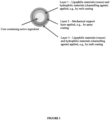
- a system with three layers is schematically illustrated in Figure 1 and represents the preferred embodiment of the invention.
- the individual particles may comprise, between two coating layers, an additional layer containing an active ingredient identical to or different from the one already contained in the core.
- the additional layer may be located, for example, between the reinforcement layer and the control layer or else between the smoothing layer and the reinforcement layer.
- the additional layer containing the second active ingredient may be located outside the control layer and will in turn then be coated with a second control layer.
- the second active ingredient maybe dissolved or suspended directly within the liquid/fluid mass used for generating a coating layer, for example in the material that constitutes the smoothing layer, or reinforcement layer, or control layer.
- the spherical shape is not the only one considered within the scope of the present invention; systems may be obtained with a cylindrical starting shape (pellets) and an irregular starting shape (fluid-bed granules, agglomerates, etc.).
- the coated product according to the invention is supplied in a ready-to-use article or formulation.
- a single formulation may comprise particles of just one type, hence containing just one active ingredient, for example a biostimulant, or else particles of a different structural and/or functional type containing two or more active ingredients.
- formulations ready for application in agriculture may be made up as specified below.
- Formulation 1 10% of tablets containing biostimulant of animal origin for quick release (approximately 10 days), 10% of tablets containing biostimulant of animal origin for slow release (approximately 40 days), 80% of tablets containing natural active ingredients of vegetable origin (extracts of algae and other vegetable flours) supplemented with inorganic elements in small amounts, with coating with modulated release within 60 days.
- Formulation 2 2% of tablets containing biostimulant of animal origin for quick release (approximately 10 days), 98% of inorganic fertiliser of a slow-release NPK type.
- Formulation 3 100% of biostimulant of animal origin supplemented with inorganic salts with an amount of 20% on the core (potassium, phosphorus, and salts of iron, boron, manganese, and molybdenum) according to the specific requirements of the various crops and coated with thicknesses that enable slow release (40-80-120 days).
- the present invention finds application in the agronomic field as additive or activator of common fertilisers. It is moreover possible to use this type of technology to coat other types of active ingredient that requires a slow release in water, a certain resistance to humidity, and reduction of hygroscopicity.
- the method described in the invention may be used also for reducing the hygroscopicity of organic fertilisers and obtaining in this way products of higher commercial value since they are less subject to clumping, crushing and flow resistant.
- the method comprises the stages listed below.
- the method is carried out at room temperature (20-25°C).
- hydrolysates of animal or vegetable origin may be products in solid form. These products are readily soluble in water and quickly release amino acids and peptides into the soil. In order to delay release thereof, hydrolysates in solid form have been coated with polymeric layers laid on top of one another that prevent contact with water and hence slow down release thereof. To evaluate the tightness and effectiveness of the coating the test of release in water is carried out as described hereinafter.
- the method comprises the steps listed below.
- the method is carried out at the temperature of 40°C in a thermostatted environment.
- an orbital mini-stirrer with incubator is used (code VWR 444-0274).
- the stirring rate to be used is 100 rpm.
- cores were used containing the active ingredient PN 14 obtained by drying of solutions, granulation of powders, or compression of powders.
- the coating process was carried out using an apparatus of a high-shear mixer type (Kenwood), with "trickle" system of distribution of the binding material.
- the method envisages slow and continuous pouring of the coating liquid in the form of a thin trickle. This enables deposition of the coating material on the material to be coated in a controlled way according to the thickness of the trickle.
- a 10-1 coating pan with non-perforated bottom (Logica Progetti, Italy) with system for diffusing the air with non-immersed tube and two-way nebuliser (mod. 970 7-1 S75 Schlick, Germany) with a nozzle having a diameter of 1.2 mm, and a tube having an internal diameter of 1.6 mm.
- the system of distribution of the molten substance was provided with 90° 5-L airless atomiser (Logica Progetti, Italy).
- the cores were coated with three layers of materials.
- the innermost layer (Layer 1) was applied by stratification of molten material by melt coating
- the intermediate layer (Layer 2) was applied by spray coating of vinyl or acrylic polymers in aqueous dispersion
- the outermost layer (Layer 3) was applied by layering of molten and coloured material.
- the process was carried out by loading approximately 300 g of substrate into the high shear mixer system or else by loading 3000 g of substrate into the coating pan.
- equipment commonly employed for coating substrates of small dimensions that is able to keep the materials in constant motion, is provided with heating and cooling systems, and equipped for distribution of the molten materials and the materials in dispersion with liquid carriers (melt coating of spray coating).
- the product was kept in rotation in the apparatus at the minimum rpm (approximately 3 rpm).
- the substrate was heated by means of a ventilation system using hot air at 60°C for the product to reach an ideal temperature for coating (45-46°C).
- the system for suction of air contributed to eliminating the powder present on the surfaces of the granules. This powder, rotating together with the granules, would risk creating interference with the uniformity of the coating.
- a minimal amount of lipophilic liquid that does not solubilise the active ingredient is added (e.g., peanut oil or liquid paraffin) in order to facilitate subsequent coating of the granules by preparing the surfaces of the cores for an optimal adhesion of the first layer.
- lipophilic liquid e.g., peanut oil or liquid paraffin
- the presence of this thin film of liquid lipophilic material favours adhesion of the layer of lipophilic material on the surface of the substrates, which prevalently have a hydrophilic nature.
- this step further reduces the presence of powder on the surface of the substrate.
- the speed of stirring of the substrate is increased, and the distribution of the molten material kept at the temperature of 90°C starts.
- the temperature of the ventilation air is fixed at 45°C to keep the cores at the temperature of around 45°C.
- the distribution of the molten material is alternated with steps of cooling/rolling of the product.
- Layer 1 is constituted by a lipophilic material and by a hydrophilic material that functions as low-melting canalizing agent, such as PEG 400, PEG 1500, PEG 4000, poloxamer P407, or poloxamer P807
- the coating mass is constituted by a mixture of the two co-molten materials that solidify by cooling on the surface of the substrate.
- the canalizing hydrophilic material is not a low-melting material, the solid is distributed in suspension in the molten lipophilic mass.
- the grain size of the suspended solid In the case of canalizing agents distributed in suspension, it is of fundamental importance for the grain size of the suspended solid to be less than 100 ⁇ m, preferably less than 50 ⁇ m, to enable a more uniform distribution on the surface of the substrate so as to prevent phenomena of occlusion of the distribution systems.
- the coating material In order to limit sedimentation of the solid in the molten mass, the coating material is kept under constant stirring. The rate of release is controlled by the concentration of polymer present in the composition. The amount of canalizing agent is present in the composition.
- a coating is applied with an aqueous dispersion of an acrylic or vinyl polymer in aqueous suspension (50% w/w) (Ravemul T37 or CRILAT 1815, Vinavil) by using a nebuliser supplied with a peristaltic pump.
- the coated material Before removing the coated systems from the apparatus, the coated material should be cooled so as to solidify completely the materials applied on the surfaces. This operation is carried out by introducing cold air into the apparatus until a temperature of the product is reached approximately 15°C lower than the melting point of the material with the lowest melting point applied.
- Example 1 SICIT 61 (not according to the invention)
- a rotary compressor Ronchi FA (Officine Meccaniche Ronchi, Italy) was used with acquisition of the forces of compression of the upper punch (F A ) and lower punch (F L ) and of the pre-compression and expulsion forces (F E ) with 2.5-mm punches (radius of curvature 2.5 mm).
- composition of the mixture used for the tabletting process had an average weight of 13 mg, breaking strength of 10N, and a friability of 0.3%.
- Example 2 SICIT 63 (not according to the invention)
- SICIT 63 Component Quantity (g) Quantity (%) Promoter peanut oil 25 1,6 vegetable palm wax 686 45.0 Layer 1 canalizing agent PEG 14 4000 0,9 Layer 2 Crilat 1815 100 6,6 vegetable palm wax 686 45.0 Layer 3 canalizing agent: PEG 14 4000 0,9 orange wax colourant 1 0.1 Total 1526 100
- Example 3 SICIT 64 (not according to the invention)
- SICIT 64 Component Quantity (g) Quantity (%) Promoter peanut oil 25 1.6 Layer 1 vegetable palm wax 686 45.0 canalizing agent - polaxamer P407 (2%) 14 0.9 Layer 2 Crilat 1815 100 6.6 Layer 3 vegetable palm wax 686 45.0 canalizing agent: polaxamer P407 (2%) 14 0.9 pink wax colourant 1 0.1 Total 1526 100.0
- PN 14 non-low-melting canalizing agent
- SICIT 65 Component Quantity (g) Quantity (%) Promoter peanut oil 25 3.4 Layer 1 vegetable palm wax 665 91.6 canalizing agent: PN 14 (5%) 35 4.8 blue wax colourant 1 0.1 Total 726 100.0
- Example 5 SICIT 80 (not according to the invention)
- the starting substrate is identical to what has been described for SICIT 61.
- the equipment and the process conditions for producing the system are similar.
- the canalizing agent used in this example was poloxamer P407, a block copolymer constituted by a polyethylene-glycol block, a polypropylene-glycol block, and a polyethylene-glycol block. Owing to its hydrophilic and lipophilic properties, it is considered a good surfactant. Poloxamer is soluble in water and in the molten state evenly distributes in the lipophilic mass. Poloxamer has a melting point that enables co-melting with the wax, altering the characteristics of viscosity of the coating phase. For this reason, it is important for the coating material to be kept under constant stirring during coating.
- SICIT 80 Component Quantity (g) Quantity (%) Promoter peanut oil 25 1.5 vegetable palm wax 686 42.2
- This is constituted by PN 14 granular cores with a starting size of less than 2 mm (3000 g), with systems canalized with 1% PN 14 canalizing agent.
- the PN 14 active ingredient is characterized by a high solubility in water and a grain size of less than 50 ⁇ m, the powder dispersed in suspension of the molten wax in Layers 1 and 3 was exploited for modulating the permeability of Layers 1 and 3. Within each layer an amount of canalizing agent equal to 1% of the layered mass was added.
- SICIT 36 granules Component Quantity (g) Quantity (%) Promoter peanut oil 22.5 1.2 Layer 1 vegetable palm wax 792 43.5 canalizing agent: PN 14 8 0,4 Layer 2 Crilat 1815 100 5.5 Layer 3 vegetable palm wax 891 48,9 canalizing agent: PN 14 9 0.5 Total 1822.5 100
- Example 7 SICIT 83 (not according to the invention)
- SICIT 83 Component Quantity (g) Quantity (%) Promoter peanut oil 25 1.5 Layer 1 vegetable palm wax 700 43.1 Layer 2 Crilat 1815 100 6.2 Layer 3 vegetable palm wax 800 49.2 orange colourant 1 0.1 Total 1626 100.0
- Example 8 SICIT 84 (according to the invention)
- SICIT 84 Component Quantity (g) Quantity (%) Promoter peanut oil 22.5 1.2 Layer 1 vegetable palm wax 784 43.0 canalizing agent: PN 14 (2%) 16 0.9 Layer 2 Crilat 1815 100 5.5 Layer 3 vegetable palm wax 900 49.4 blue wax colourant 1 0.1 Total 1823.5 100
- Example 9 SICIT 85 (not according to the invention)
- Layer 2 is obtained with Ravemul T37, an aqueous dispersion of a vinylacetate polymer derivative.
- Layer 3 contains poloxamer P407 at 1% as canalizing agent.
- the system has PN 14 granular cores with starting size of less than 1-4 mm, not sifted.
- SICIT 85 Component Quantity (g) Quantity (%) Promoter peanut oil 25 1.3 Layer 1 vegetable palm wax 792 41.7 saccharose crystals 68 3.6 canalizing agent: poloxamer 407 (1%) 8 0.4 Layer 2 Ravemul T37 100 5.3 Promoter peanut oil 5 0.3 Layer 3 vegetable palm wax 891 46.9 canalizing agent: poloxamer 407 (1%) 9 0.5 green wax colourant 1 0.1 Total 1899 100.0
- Example 10 SICIT 930 (not according to the invention)
- the saccharose canalizing agent is characterized by a high solubility in water and a grain size of less than 50 ⁇ m, the powder dispersed in suspension of PEG 8000 in the molten state in Layers 1 and 3 was exploited for modulating the permeability of Layers 1 and 3.
- SICIT 930 granules Component Quantity (g) Quantity (%) Promoter paraffin oil 25 1,4 PEG 8000 792 44.1 Layer 1 (micronised) saccharose Surelease (ethyl-cellulose) 8 0,4 Layer 2 70 3,9 Layer 3 PEG 8000 891 49,6 (micronised) saccharose 9 0.5 Total 1795 100
- the PN 14 active ingredient is characterized by a high solubility in water and a grain size of less than 50 ⁇ m, the powder dispersed in suspension in the molten wax in Layers 1 and 3 was exploited for modulating the permeability of Layers 1 and 3. Within each layer an amount of canalizing agent equal to 1% of the layered mass was added.
- a batch system with stirrer and wall heating is used.
- the stirring rate is low, and the stirrer is provided with a ploughshare mixer that enables a greater contact of the product with the wall.
- GS412 Tablets Component Quantity (g) Quantity (%) GS412 Tablets 300 73.5% Promoter palm oil 5 1.2% Layer 1 vegetable palm wax 24 5.9% canalizing agent: PN 14 (2%) 6 1.5% Layer 2 Crilat 1815 3 0.7% Layer 3 vegetable palm wax 56 13.7% canalizing agent: PN 14 (2%) 14 3.4% Total 408
- Example 12 GS 412 (not according to the invention)
- a batch system with stirrer and wall heating is used.
- the stirring rate is low, and the stirrer is provided with a ploughshare mixer that enables a greater contact of the product with the wall.
- Example 13 SICIT 961 (not according to the invention)
- low-melting canalizing agent manganese sulphate
- Example 14 SICIT 952 (not according to the invention)
- SICIT 952 Component Quantity (g) Quantity (%) Promoter peanut oil 30 3.7 Layer 1 beeswax 750 91.4 canalizing agent: yeast, Saccharomyces Cerevisiae powder (5%) 40 4.9 green wax colourant 1 0.1 Total 821 100.0
- the first analytical approach is evaluation of the release in water of the various products.
- the results of the release in water of some non-canalized or canalized formulations (SICIT 61, SICIT 65) set in comparison with a slow-release commercial product (Osmocote Tablet NR) are illustrated in Figure 3 .
- the (middle) curve corresponding to SICIT 83 represents the profile of release of a non-canalized product.
- the bottom curve (GS 412) highlights a slower release and is an example of a canalizing agent that delays release of the active ingredients, thus lengthening the times of effectiveness.
- the other two upper curves (SICIT 36 and GS 410) correspond to products in which the canalizing agents increase the rate of release, this given the same formulation, namely, three layers of the same materials.
Landscapes
- Life Sciences & Earth Sciences (AREA)
- Pest Control & Pesticides (AREA)
- Chemical & Material Sciences (AREA)
- Organic Chemistry (AREA)
- Agricultural Chemicals And Associated Chemicals (AREA)
Claims (16)
- Beschichtetes Produkt mit kontrollierter Freisetzung, im Wasser oder in dem Boden, löslicher Wirkstoffe von agronomischem und landwirtschaftlichem Interesse, dadurch gekennzeichnet, dass es einen Kern umfasst, der aus einem oder mehreren Wirkstoffen besteht oder diese enthält, wobei der Kern mit mindestens einer äußeren Schicht für eine Kontrolle einer Freisetzung des Wirkstoffs oder der Wirkstoffe und einer Anzahl "n" zusätzlicher Beschichtungsschichten beschichtet wird, wobei "n" 0, 1, 2, 3, 4 oder 5 sein kann, und wobei mindestens eine Schicht ein oder mehrere Kanalisierungsmittel umfasst, die die Freisetzungsrate des Wirkstoffs oder der Wirkstoffe bestimmen; wobei die Kanalisierungsmittel Proteinhydrolysate sind; und
wobei die Schicht für die Kontrolle der Freisetzung ein nicht wasserlösliches oder wasserabweisendes Material mit niedrigem Schmelzpunkt umfasst, das aus Wachsen ausgewählt ist. - Produkt nach Anspruch 1, dadurch gekennzeichnet, dass "n" gleich 1 ist und dass die zusätzliche Beschichtungsschicht eine Schicht zum Glätten/Verdicken des Kerns ist oder eine Schicht mit mechanischer Verstärkung ist oder dadurch gekennzeichnet, dass "n" gleich 2 ist und die zusätzlichen Beschichtungsschichten eine Schicht mit mechanischer Verstärkung und eine Schicht zum Glätten und/oder Verdicken des Kerns sind, der unter der Verstärkungsschicht liegt.
- Produkt nach einem der Ansprüche 1 oder 2,
dadurch gekennzeichnet, dass der Kern mit mehreren glättenden und/oder verdickenden Schichten oder Schichten mit mechanischer Verstärkung oder Schichten für die Kontrolle der Freisetzung beschichtet ist, die sich optional mit einer oder mehreren Schichten abwechseln, umfassend Wirkstoffe, die einander identisch sind oder sich voneinander unterscheiden. - Produkt nach einem der Ansprüche 1 bis 3, wobei das Kanalisierungsmittel in Mengen zwischen 0,5 % und 10 % (Gew./Gew.), vorzugsweise zwischen 1 % und 5 % (Gew./Gew.) des Endprodukts vorhanden ist.
- Produkt nach einem der Ansprüche 1 bis 4, in Form eines Granulats oder einer Tablette oder einer Mikrotablette oder eines Pellets und/oder
dadurch gekennzeichnet, dass der Kern die Form eines Granulats, einer Tablette, einer Mikrotablette oder eines Pellets hat. - Produkt nach einem der Ansprüche 2 bis 5, dadurch gekennzeichnet, dass die Glättungs-/Verdickungsschicht ein nicht wasserlösliches oder wasserabweisendes Material mit niedrigem Schmelzpunkt umfasst, das aus Wachsen ausgewählt ist.
- Produkt nach einem der Ansprüche 2 bis 6,
dadurch gekennzeichnet, dass die Schicht mit mechanischer Verstärkung wasserlösliche oder nicht wasserlösliche Polymere umfasst und optional Additive, die aus Weichmachern, Antihaftmitteln und Kanalisierungsmitteln ausgewählt sind. - Produkt nach einem der Ansprüche 1 bis 7, wobei ein oder mehrere Wirkstoffe aus Biostimulanzien, Düngemitteln, Phytotherapeutika, Pestiziden, Fungiziden, Herbiziden, Pflanzenhormonen, Wachstumsfaktoren und Enzymen ausgewählt sind.
- Produkt nach einem der Ansprüche 1 bis 8, wobei der Wirkstoff ein Biostimulans ist, der aus Proteinhydrolysaten oder Mischungen von Proteinhydrolysaten pflanzlichen oder tierischen Ursprungs, Peptiden oder Oligopeptiden, Nebenprodukten einer Gemüseverarbeitung, Mikroelementen und Makroelementen, Phytostimulanzien und Mikroorganismen ausgewählt ist.
- Produkt nach einem der Ansprüche 1 bis 9, umfassend mindestens zwei unterschiedliche Wirkstoffe, und/oder wobei mindestens zwei Wirkstoffe in dem Kern eingeschlossen sind oder ein Wirkstoff in dem Material eingeschlossen ist, das eines von der Glättungsschicht, der Verstärkungsschicht oder der Schicht für die Kontrolle der Freisetzung ausbildet oder sonst ein Wirkstoff eine zusätzliche Zwischenschicht zwischen der Glättungsschicht, der Verstärkungsschicht oder der Schicht für die Kontrolle der Freisetzung ausbildet.
- Verfahren zum Herstellen eines Produkts nach einem der Ansprüche 1 bis 10, umfassend mindestens die folgenden Schritte:Erhitzen der Kerne, die aus dem Wirkstoff oder den Wirkstoffen bestehen oder diese umfassen;Beschichten der Kerne mit einem Beschichtungsmaterial in geschmolzener Form;Abkühlen der auf diese Weise beschichteten Kerne;Wiederholen des gesamten Zyklus n-mal, wobei n zwischen 2 und 5 liegt, um ein Korn mit n+1 Schichten zu erhalten, die den Kern beschichten;wobei das Beschichtungsmaterial mindestens einer Schicht, die den Kern beschichtet, Proteinhydrolysate als Kanalisierungsmittel enthält.
- Verfahren nach Anspruch 11, wobei für jeden Zyklus das Beschichtungsmaterial das gleiche oder ein unterschiedliches als das Material ist, das in dem vorhergehenden Zyklus aufgetragen wird, und/oder wobei Zyklen einer Aufbringung von Beschichtungsschichten mit Zyklen der Aufbringung von Schichten abwechseln, die aus den Wirkstoffen bestehen oder diese umfassen.
- Verfahren nach einem der Ansprüche 11 oder 12, umfassend mindestens einen der folgenden Schritte: Schritt A, bei dem die Kerne mit Material beschichtet werden, das eine Glättungs-/Verdickungsschicht erzeugt; Schritt B, bei dem die Kerne mit Material beschichtet werden, das eine Schicht mit mechanischer Verstärkung erzeugt; oder Schritt C, bei dem die Kerne mit einem Material beschichtet werden, das eine Schicht für die Kontrolle der Freigabe des Wirkstoffs oder der Wirkstoffe erzeugt.
- Verfahren nach Anspruch 13, umfassend Schritt A und Schritt C oder Schritt B und Schritt C oder nacheinander die Schritte A, B und C.
- Verfahren nach einem der Ansprüche 11 bis 14, wobei mindestens ein Material, das in den Schritten A und/oder B und/oder C verwendet wird, ein nicht wasserlösliches, niedrig schmelzendes Material ist, das aus Fetten, Wachsen, niedrig schmelzenden Polymeren, hydrierten oder nicht hydrierten Ölen oder Fetten, Proteinhydrolysaten und derivatisierten Gelatinen und natürlichen oder synthetischen Paraffinen, optional umfassend lösliche oder unlösliche Verdünnungsmittel, ausgewählt ist.
- Verwendung des Produkts nach einem der Ansprüche 1 bis 10 zum Verbessern des Ertrags und der Qualität von Nutzpflanzen und/oder zum Verbessern der Qualität des Erdbodens.
Applications Claiming Priority (2)
| Application Number | Priority Date | Filing Date | Title |
|---|---|---|---|
| IT102017000064875A IT201700064875A1 (it) | 2017-06-12 | 2017-06-12 | Sistemi multistrato idrorepellenti a rilascio controllato di principi attivi in acqua e nel terreno. |
| PCT/IB2018/054236 WO2018229648A1 (en) | 2017-06-12 | 2018-06-12 | Multilayer hydrorepellent systems with controlled release of active agents in water and soil |
Publications (3)
| Publication Number | Publication Date |
|---|---|
| EP3638642A1 EP3638642A1 (de) | 2020-04-22 |
| EP3638642C0 EP3638642C0 (de) | 2024-12-11 |
| EP3638642B1 true EP3638642B1 (de) | 2024-12-11 |
Family
ID=60138771
Family Applications (1)
| Application Number | Title | Priority Date | Filing Date |
|---|---|---|---|
| EP18737989.6A Active EP3638642B1 (de) | 2017-06-12 | 2018-06-12 | Mehrschichtige wasserabweisende systeme mit kontrollierter freisetzung von wirkstoffen in wasser und boden |
Country Status (4)
| Country | Link |
|---|---|
| US (2) | US20200290937A1 (de) |
| EP (1) | EP3638642B1 (de) |
| IT (1) | IT201700064875A1 (de) |
| WO (1) | WO2018229648A1 (de) |
Families Citing this family (2)
| Publication number | Priority date | Publication date | Assignee | Title |
|---|---|---|---|---|
| CN116813416A (zh) * | 2023-07-21 | 2023-09-29 | 北京化工大学 | 一种多层包膜缓释肥料 |
| CN117481007B (zh) * | 2023-10-25 | 2024-05-07 | 中国科学院南京土壤研究所 | 一种干旱区滴灌棉花水肥盐一体化高效栽培技术 |
Citations (2)
| Publication number | Priority date | Publication date | Assignee | Title |
|---|---|---|---|---|
| WO1998037039A1 (en) * | 1997-02-19 | 1998-08-27 | Asahi Kasei Kogyo Kabushiki Kaisha | Granular fertilizer coated with decomposable coating film and process for producing the same |
| CN105646109A (zh) * | 2016-03-23 | 2016-06-08 | 山东绿亨生物工程有限公司 | 一种复合微生物菌肥及其制备方法 |
Family Cites Families (5)
| Publication number | Priority date | Publication date | Assignee | Title |
|---|---|---|---|---|
| US3475154A (en) * | 1964-11-30 | 1969-10-28 | Dainippon Toryo Kk | Plural coated pellet form products and process of making |
| US3295950A (en) * | 1965-05-03 | 1967-01-03 | Tennessee Valley Authority | Method of making sulfur-coated fertilizer pellet having a controlled dissolution rate |
| JP3291077B2 (ja) * | 1993-07-21 | 2002-06-10 | 旭化成株式会社 | 分解速度の異なる被膜材よりなる多層被覆粒状肥料 |
| US5464633A (en) * | 1994-05-24 | 1995-11-07 | Jagotec Ag | Pharmaceutical tablets releasing the active substance after a definite period of time |
| ITUA20161799A1 (it) * | 2016-03-18 | 2017-09-18 | Recordati Ind Chimica E Farmaceutica S P A | Composizione farmaceutica a rilascio prolungato comprendente cisteamina o un suo sale |
-
2017
- 2017-06-12 IT IT102017000064875A patent/IT201700064875A1/it unknown
-
2018
- 2018-06-12 US US16/621,339 patent/US20200290937A1/en not_active Abandoned
- 2018-06-12 WO PCT/IB2018/054236 patent/WO2018229648A1/en not_active Ceased
- 2018-06-12 EP EP18737989.6A patent/EP3638642B1/de active Active
-
2023
- 2023-11-07 US US18/503,433 patent/US20240182379A1/en active Pending
Patent Citations (2)
| Publication number | Priority date | Publication date | Assignee | Title |
|---|---|---|---|---|
| WO1998037039A1 (en) * | 1997-02-19 | 1998-08-27 | Asahi Kasei Kogyo Kabushiki Kaisha | Granular fertilizer coated with decomposable coating film and process for producing the same |
| CN105646109A (zh) * | 2016-03-23 | 2016-06-08 | 山东绿亨生物工程有限公司 | 一种复合微生物菌肥及其制备方法 |
Also Published As
| Publication number | Publication date |
|---|---|
| EP3638642C0 (de) | 2024-12-11 |
| US20200290937A1 (en) | 2020-09-17 |
| EP3638642A1 (de) | 2020-04-22 |
| WO2018229648A1 (en) | 2018-12-20 |
| US20240182379A1 (en) | 2024-06-06 |
| IT201700064875A1 (it) | 2018-12-12 |
Similar Documents
| Publication | Publication Date | Title |
|---|---|---|
| Azeem et al. | Review on materials & methods to produce controlled release coated urea fertilizer | |
| US20240182379A1 (en) | Multilayer hydrorepellent systems with controlled release of active agents in water and soil | |
| AU2019232821B2 (en) | Multi-purpose lignin-carbohydrate binding system | |
| CA1110972A (en) | Tableting of microcapsules | |
| CN105358506A (zh) | 制备缓释基质型颗粒复合肥料的方法和由其获得的缓释基质型颗粒复合肥料 | |
| WO2020069478A1 (en) | Agricultural coating containing sugar ester and methods | |
| WO2011080764A1 (en) | Method of coating zinc sulphate monohydrate on npk granules | |
| Perez-Garcia et al. | Controlled release of ammonium nitrate from ethylcellulose coated formulations | |
| Izydorczyk et al. | Granulation as the method of rational fertilizer application | |
| Sopanrao Muley et al. | Formulation and optimization of lansoprazole pellets using factorial design prepared by extrusion-spheronization technique using carboxymethyl tamarind kernel powder | |
| WO2006021708A1 (fr) | Granules d'engrais et procede de fabrication | |
| CA2632547C (fr) | Composition a liberation prolongee de l'actif, son procede de preparation et son utilisation | |
| JPH0761915B2 (ja) | 農材多重被覆粒状肥料 | |
| JP4677146B2 (ja) | 被覆型徐放性粒剤 | |
| JP4164253B2 (ja) | 被覆型徐放性混合粒剤およびその製法 | |
| FR2956948B1 (fr) | Composition herbicide et ses procedes de preparation | |
| JP3746677B2 (ja) | 徐放性農薬混合粒剤 | |
| JPH0753291A (ja) | 微量要素含有被覆粒状肥料 | |
| JPH0826875A (ja) | 被覆肥料の製造方法およびその製品 | |
| JP3959429B2 (ja) | コーティング種子の製法 | |
| JP2002226287A (ja) | 高吸水性樹脂被覆生物活性粒状物およびその製造方法 | |
| JPS6340789A (ja) | 分解性被膜で被覆された粒状肥料とその製造方法 | |
| Jabeen et al. | Microencapsulation: A potential and promising approach in drug delivery system | |
| Chimsook | The Effect of Combinations of Wall Materials on Encapsulation of Phenolic Contents from Extract of Clitoria ternatea | |
| WO2005089544A1 (ja) | 徐放性農園芸用粒剤組成物 |
Legal Events
| Date | Code | Title | Description |
|---|---|---|---|
| STAA | Information on the status of an ep patent application or granted ep patent |
Free format text: STATUS: UNKNOWN |
|
| STAA | Information on the status of an ep patent application or granted ep patent |
Free format text: STATUS: THE INTERNATIONAL PUBLICATION HAS BEEN MADE |
|
| PUAI | Public reference made under article 153(3) epc to a published international application that has entered the european phase |
Free format text: ORIGINAL CODE: 0009012 |
|
| STAA | Information on the status of an ep patent application or granted ep patent |
Free format text: STATUS: REQUEST FOR EXAMINATION WAS MADE |
|
| 17P | Request for examination filed |
Effective date: 20191213 |
|
| AK | Designated contracting states |
Kind code of ref document: A1 Designated state(s): AL AT BE BG CH CY CZ DE DK EE ES FI FR GB GR HR HU IE IS IT LI LT LU LV MC MK MT NL NO PL PT RO RS SE SI SK SM TR |
|
| AX | Request for extension of the european patent |
Extension state: BA ME |
|
| RIN1 | Information on inventor provided before grant (corrected) |
Inventor name: NERESINI, MASSIMO COSTANTINO Inventor name: PITUELLO, CHIARA Inventor name: PRIANTE, FERNANDO Inventor name: ASNICAR, MANUEL Inventor name: PALUGAN, LUCA Inventor name: CEREA, MATTEO |
|
| RIN1 | Information on inventor provided before grant (corrected) |
Inventor name: PITUELLO, CHIARA Inventor name: PALUGAN, LUCA Inventor name: NERESINI, MASSIMO COSTANTINO Inventor name: CEREA, MATTEO Inventor name: PRIANTE, FERNANDO Inventor name: ASNICAR, MANUEL |
|
| DAV | Request for validation of the european patent (deleted) | ||
| DAX | Request for extension of the european patent (deleted) | ||
| STAA | Information on the status of an ep patent application or granted ep patent |
Free format text: STATUS: EXAMINATION IS IN PROGRESS |
|
| 17Q | First examination report despatched |
Effective date: 20230919 |
|
| GRAP | Despatch of communication of intention to grant a patent |
Free format text: ORIGINAL CODE: EPIDOSNIGR1 |
|
| STAA | Information on the status of an ep patent application or granted ep patent |
Free format text: STATUS: GRANT OF PATENT IS INTENDED |
|
| INTG | Intention to grant announced |
Effective date: 20240809 |
|
| RIN1 | Information on inventor provided before grant (corrected) |
Inventor name: NERESINI, MASSIMO COSTANTINO Inventor name: PITUELLO, CHIARA Inventor name: CEREA, MATTEO Inventor name: PRIANTE, FERNANDO Inventor name: PALUGAN, LUCA Inventor name: ASNICAR, MANUEL |
|
| GRAS | Grant fee paid |
Free format text: ORIGINAL CODE: EPIDOSNIGR3 |
|
| GRAA | (expected) grant |
Free format text: ORIGINAL CODE: 0009210 |
|
| STAA | Information on the status of an ep patent application or granted ep patent |
Free format text: STATUS: THE PATENT HAS BEEN GRANTED |
|
| AK | Designated contracting states |
Kind code of ref document: B1 Designated state(s): AL AT BE BG CH CY CZ DE DK EE ES FI FR GB GR HR HU IE IS IT LI LT LU LV MC MK MT NL NO PL PT RO RS SE SI SK SM TR |
|
| REG | Reference to a national code |
Ref country code: GB Ref legal event code: FG4D |
|
| REG | Reference to a national code |
Ref country code: CH Ref legal event code: EP |
|
| REG | Reference to a national code |
Ref country code: IE Ref legal event code: FG4D |
|
| REG | Reference to a national code |
Ref country code: DE Ref legal event code: R096 Ref document number: 602018077489 Country of ref document: DE |
|
| U01 | Request for unitary effect filed |
Effective date: 20241227 |
|
| U07 | Unitary effect registered |
Designated state(s): AT BE BG DE DK EE FI FR IT LT LU LV MT NL PT RO SE SI Effective date: 20250114 |
|
| PG25 | Lapsed in a contracting state [announced via postgrant information from national office to epo] |
Ref country code: HR Free format text: LAPSE BECAUSE OF FAILURE TO SUBMIT A TRANSLATION OF THE DESCRIPTION OR TO PAY THE FEE WITHIN THE PRESCRIBED TIME-LIMIT Effective date: 20241211 |
|
| PG25 | Lapsed in a contracting state [announced via postgrant information from national office to epo] |
Ref country code: ES Free format text: LAPSE BECAUSE OF FAILURE TO SUBMIT A TRANSLATION OF THE DESCRIPTION OR TO PAY THE FEE WITHIN THE PRESCRIBED TIME-LIMIT Effective date: 20241211 |
|
| PG25 | Lapsed in a contracting state [announced via postgrant information from national office to epo] |
Ref country code: NO Free format text: LAPSE BECAUSE OF FAILURE TO SUBMIT A TRANSLATION OF THE DESCRIPTION OR TO PAY THE FEE WITHIN THE PRESCRIBED TIME-LIMIT Effective date: 20250311 |
|
| PG25 | Lapsed in a contracting state [announced via postgrant information from national office to epo] |
Ref country code: GR Free format text: LAPSE BECAUSE OF FAILURE TO SUBMIT A TRANSLATION OF THE DESCRIPTION OR TO PAY THE FEE WITHIN THE PRESCRIBED TIME-LIMIT Effective date: 20250312 |
|
| PG25 | Lapsed in a contracting state [announced via postgrant information from national office to epo] |
Ref country code: RS Free format text: LAPSE BECAUSE OF FAILURE TO SUBMIT A TRANSLATION OF THE DESCRIPTION OR TO PAY THE FEE WITHIN THE PRESCRIBED TIME-LIMIT Effective date: 20250311 |
|
| PG25 | Lapsed in a contracting state [announced via postgrant information from national office to epo] |
Ref country code: SM Free format text: LAPSE BECAUSE OF FAILURE TO SUBMIT A TRANSLATION OF THE DESCRIPTION OR TO PAY THE FEE WITHIN THE PRESCRIBED TIME-LIMIT Effective date: 20241211 |
|
| PG25 | Lapsed in a contracting state [announced via postgrant information from national office to epo] |
Ref country code: PL Free format text: LAPSE BECAUSE OF FAILURE TO SUBMIT A TRANSLATION OF THE DESCRIPTION OR TO PAY THE FEE WITHIN THE PRESCRIBED TIME-LIMIT Effective date: 20241211 |
|
| PG25 | Lapsed in a contracting state [announced via postgrant information from national office to epo] |
Ref country code: IS Free format text: LAPSE BECAUSE OF FAILURE TO SUBMIT A TRANSLATION OF THE DESCRIPTION OR TO PAY THE FEE WITHIN THE PRESCRIBED TIME-LIMIT Effective date: 20250411 |
|
| PG25 | Lapsed in a contracting state [announced via postgrant information from national office to epo] |
Ref country code: SK Free format text: LAPSE BECAUSE OF FAILURE TO SUBMIT A TRANSLATION OF THE DESCRIPTION OR TO PAY THE FEE WITHIN THE PRESCRIBED TIME-LIMIT Effective date: 20241211 |
|
| PG25 | Lapsed in a contracting state [announced via postgrant information from national office to epo] |
Ref country code: CZ Free format text: LAPSE BECAUSE OF FAILURE TO SUBMIT A TRANSLATION OF THE DESCRIPTION OR TO PAY THE FEE WITHIN THE PRESCRIBED TIME-LIMIT Effective date: 20241211 |
|
| PLBE | No opposition filed within time limit |
Free format text: ORIGINAL CODE: 0009261 |
|
| STAA | Information on the status of an ep patent application or granted ep patent |
Free format text: STATUS: NO OPPOSITION FILED WITHIN TIME LIMIT |
|
| REG | Reference to a national code |
Ref country code: CH Ref legal event code: L10 Free format text: ST27 STATUS EVENT CODE: U-0-0-L10-L00 (AS PROVIDED BY THE NATIONAL OFFICE) Effective date: 20251022 |
|
| 26N | No opposition filed |
Effective date: 20250912 |
|
| U21 | Renewal fee for the european patent with unitary effect paid with additional fee |
Year of fee payment: 8 Effective date: 20251127 |
|
| REG | Reference to a national code |
Ref country code: CH Ref legal event code: H13 Free format text: ST27 STATUS EVENT CODE: U-0-0-H10-H13 (AS PROVIDED BY THE NATIONAL OFFICE) Effective date: 20260127 |
|
| PG25 | Lapsed in a contracting state [announced via postgrant information from national office to epo] |
Ref country code: MC Free format text: LAPSE BECAUSE OF FAILURE TO SUBMIT A TRANSLATION OF THE DESCRIPTION OR TO PAY THE FEE WITHIN THE PRESCRIBED TIME-LIMIT Effective date: 20241211 |
|
| GBPC | Gb: european patent ceased through non-payment of renewal fee |
Effective date: 20250612 |
|
| PG25 | Lapsed in a contracting state [announced via postgrant information from national office to epo] |
Ref country code: GB Free format text: LAPSE BECAUSE OF NON-PAYMENT OF DUE FEES Effective date: 20250612 |
|
| PG25 | Lapsed in a contracting state [announced via postgrant information from national office to epo] |
Ref country code: IE Free format text: LAPSE BECAUSE OF NON-PAYMENT OF DUE FEES Effective date: 20250612 |
|
| PG25 | Lapsed in a contracting state [announced via postgrant information from national office to epo] |
Ref country code: CH Free format text: LAPSE BECAUSE OF NON-PAYMENT OF DUE FEES Effective date: 20250630 |