EP3639883A1 - Kilohertz e-tns stimulation - Google Patents
Kilohertz e-tns stimulation Download PDFInfo
- Publication number
- EP3639883A1 EP3639883A1 EP18201148.6A EP18201148A EP3639883A1 EP 3639883 A1 EP3639883 A1 EP 3639883A1 EP 18201148 A EP18201148 A EP 18201148A EP 3639883 A1 EP3639883 A1 EP 3639883A1
- Authority
- EP
- European Patent Office
- Prior art keywords
- pulse
- kilohertz
- microampere
- treatment
- microseconds
- Prior art date
- Legal status (The legal status is an assumption and is not a legal conclusion. Google has not performed a legal analysis and makes no representation as to the accuracy of the status listed.)
- Withdrawn
Links
- 230000000638 stimulation Effects 0.000 title abstract description 4
- 238000011282 treatment Methods 0.000 claims abstract description 53
- 210000003901 trigeminal nerve Anatomy 0.000 claims abstract description 24
- 206010019233 Headaches Diseases 0.000 claims abstract description 19
- 231100000869 headache Toxicity 0.000 claims abstract description 19
- 238000000034 method Methods 0.000 claims abstract description 16
- 230000007383 nerve stimulation Effects 0.000 claims abstract description 14
- 230000003449 preventive effect Effects 0.000 claims abstract description 14
- 210000001061 forehead Anatomy 0.000 claims description 15
- 210000005036 nerve Anatomy 0.000 claims description 12
- 208000012902 Nervous system disease Diseases 0.000 claims description 7
- 239000000853 adhesive Substances 0.000 claims description 7
- 208000019695 Migraine disease Diseases 0.000 claims description 6
- 206010027599 migraine Diseases 0.000 claims description 5
- 208000024827 Alzheimer disease Diseases 0.000 claims description 3
- 208000019901 Anxiety disease Diseases 0.000 claims description 3
- 208000006096 Attention Deficit Disorder with Hyperactivity Diseases 0.000 claims description 3
- 208000036864 Attention deficit/hyperactivity disease Diseases 0.000 claims description 3
- 208000015879 Cerebellar disease Diseases 0.000 claims description 3
- 206010008072 Cerebellar syndrome Diseases 0.000 claims description 3
- 208000000094 Chronic Pain Diseases 0.000 claims description 3
- 206010009094 Chronic paroxysmal hemicrania Diseases 0.000 claims description 3
- 208000006561 Cluster Headache Diseases 0.000 claims description 3
- 206010010071 Coma Diseases 0.000 claims description 3
- 208000007590 Disorders of Excessive Somnolence Diseases 0.000 claims description 3
- 206010013643 Drop attacks Diseases 0.000 claims description 3
- 208000001640 Fibromyalgia Diseases 0.000 claims description 3
- 208000021384 Obsessive-Compulsive disease Diseases 0.000 claims description 3
- 208000002193 Pain Diseases 0.000 claims description 3
- 208000018737 Parkinson disease Diseases 0.000 claims description 3
- 208000008348 Post-Concussion Syndrome Diseases 0.000 claims description 3
- 208000007077 SUNCT syndrome Diseases 0.000 claims description 3
- 208000013738 Sleep Initiation and Maintenance disease Diseases 0.000 claims description 3
- 206010043269 Tension headache Diseases 0.000 claims description 3
- 208000008548 Tension-Type Headache Diseases 0.000 claims description 3
- 206010044565 Tremor Diseases 0.000 claims description 3
- 230000036506 anxiety Effects 0.000 claims description 3
- 201000007201 aphasia Diseases 0.000 claims description 3
- 208000015802 attention deficit-hyperactivity disease Diseases 0.000 claims description 3
- 208000026725 cyclothymic disease Diseases 0.000 claims description 3
- 206010015037 epilepsy Diseases 0.000 claims description 3
- 210000000256 facial nerve Anatomy 0.000 claims description 3
- 208000020727 hemicrania continua Diseases 0.000 claims description 3
- 206010020765 hypersomnia Diseases 0.000 claims description 3
- 206010022437 insomnia Diseases 0.000 claims description 3
- 201000006417 multiple sclerosis Diseases 0.000 claims description 3
- 208000007777 paroxysmal Hemicrania Diseases 0.000 claims description 3
- 201000002859 sleep apnea Diseases 0.000 claims description 3
- 208000019116 sleep disease Diseases 0.000 claims description 3
- 208000023516 stroke disease Diseases 0.000 claims description 3
- 206010042772 syncope Diseases 0.000 claims description 3
- 208000011580 syndromic disease Diseases 0.000 claims description 3
- 206010044652 trigeminal neuralgia Diseases 0.000 claims description 3
- 230000002051 biphasic effect Effects 0.000 description 27
- 238000002646 transcutaneous electrical nerve stimulation Methods 0.000 description 10
- 208000035824 paresthesia Diseases 0.000 description 5
- 230000036982 action potential Effects 0.000 description 4
- 208000004454 Hyperalgesia Diseases 0.000 description 2
- 230000001154 acute effect Effects 0.000 description 2
- 206010053552 allodynia Diseases 0.000 description 2
- 238000013459 approach Methods 0.000 description 2
- 229940079593 drug Drugs 0.000 description 2
- 239000003814 drug Substances 0.000 description 2
- 239000012528 membrane Substances 0.000 description 2
- 210000002569 neuron Anatomy 0.000 description 2
- 229940021182 non-steroidal anti-inflammatory drug Drugs 0.000 description 2
- 230000000144 pharmacologic effect Effects 0.000 description 2
- 206010072720 Medication overuse headache Diseases 0.000 description 1
- 208000017143 Secondary Headache disease Diseases 0.000 description 1
- 238000009825 accumulation Methods 0.000 description 1
- 229940035676 analgesics Drugs 0.000 description 1
- 239000000730 antalgic agent Substances 0.000 description 1
- 210000004027 cell Anatomy 0.000 description 1
- 230000000694 effects Effects 0.000 description 1
- 210000003128 head Anatomy 0.000 description 1
- 238000003780 insertion Methods 0.000 description 1
- 230000037431 insertion Effects 0.000 description 1
- 150000002500 ions Chemical class 0.000 description 1
- 238000002483 medication Methods 0.000 description 1
- 239000003607 modifier Substances 0.000 description 1
- 230000035699 permeability Effects 0.000 description 1
- 230000010287 polarization Effects 0.000 description 1
- 230000002265 prevention Effects 0.000 description 1
- 230000036279 refractory period Effects 0.000 description 1
- 210000003625 skull Anatomy 0.000 description 1
- 238000001356 surgical procedure Methods 0.000 description 1
- 230000002123 temporal effect Effects 0.000 description 1
Images



Classifications
-
- A—HUMAN NECESSITIES
- A61—MEDICAL OR VETERINARY SCIENCE; HYGIENE
- A61N—ELECTROTHERAPY; MAGNETOTHERAPY; RADIATION THERAPY; ULTRASOUND THERAPY
- A61N1/00—Electrotherapy; Circuits therefor
- A61N1/02—Details
- A61N1/04—Electrodes
- A61N1/0404—Electrodes for external use
- A61N1/0408—Use-related aspects
- A61N1/0456—Specially adapted for transcutaneous electrical nerve stimulation [TENS]
-
- A—HUMAN NECESSITIES
- A61—MEDICAL OR VETERINARY SCIENCE; HYGIENE
- A61N—ELECTROTHERAPY; MAGNETOTHERAPY; RADIATION THERAPY; ULTRASOUND THERAPY
- A61N1/00—Electrotherapy; Circuits therefor
- A61N1/02—Details
- A61N1/04—Electrodes
- A61N1/0404—Electrodes for external use
- A61N1/0472—Structure-related aspects
- A61N1/0492—Patch electrodes
-
- A—HUMAN NECESSITIES
- A61—MEDICAL OR VETERINARY SCIENCE; HYGIENE
- A61N—ELECTROTHERAPY; MAGNETOTHERAPY; RADIATION THERAPY; ULTRASOUND THERAPY
- A61N1/00—Electrotherapy; Circuits therefor
- A61N1/18—Applying electric currents by contact electrodes
- A61N1/32—Applying electric currents by contact electrodes alternating or intermittent currents
- A61N1/36—Applying electric currents by contact electrodes alternating or intermittent currents for stimulation
- A61N1/36014—External stimulators, e.g. with patch electrodes
- A61N1/36021—External stimulators, e.g. with patch electrodes for treatment of pain
-
- A—HUMAN NECESSITIES
- A61—MEDICAL OR VETERINARY SCIENCE; HYGIENE
- A61N—ELECTROTHERAPY; MAGNETOTHERAPY; RADIATION THERAPY; ULTRASOUND THERAPY
- A61N1/00—Electrotherapy; Circuits therefor
- A61N1/18—Applying electric currents by contact electrodes
- A61N1/32—Applying electric currents by contact electrodes alternating or intermittent currents
- A61N1/36—Applying electric currents by contact electrodes alternating or intermittent currents for stimulation
- A61N1/36014—External stimulators, e.g. with patch electrodes
- A61N1/36025—External stimulators, e.g. with patch electrodes for treating a mental or cerebral condition
-
- A—HUMAN NECESSITIES
- A61—MEDICAL OR VETERINARY SCIENCE; HYGIENE
- A61N—ELECTROTHERAPY; MAGNETOTHERAPY; RADIATION THERAPY; ULTRASOUND THERAPY
- A61N1/00—Electrotherapy; Circuits therefor
- A61N1/18—Applying electric currents by contact electrodes
- A61N1/32—Applying electric currents by contact electrodes alternating or intermittent currents
- A61N1/36—Applying electric currents by contact electrodes alternating or intermittent currents for stimulation
- A61N1/36014—External stimulators, e.g. with patch electrodes
- A61N1/3603—Control systems
- A61N1/36034—Control systems specified by the stimulation parameters
Definitions
- the invention pertains to the technical field of devices and methods for the abortive or preventive treatment of a headache via transcutaneous electrical nerve stimulation (TENS), in particular via external trigeminal nerve stimulation (e-TNS).
- TNS transcutaneous electrical nerve stimulation
- e-TNS external trigeminal nerve stimulation
- NSAIDs non-steroidal anti-inflammatory drugs
- Neurostimulation has been shown to be a good alternative to pharmacologic approaches, and is suitable for both acute treatment and prevention treatment.
- WO 2016/155 773 discloses a device for the transcutaneous electrical stimulation of the trigeminal nerve, and in particular the supratrochlear and supraorbital nerves of the ophthalmic branch of the trigeminal nerve.
- the device is configured for generating rectangular biphasic pulses with a width between 10 and 1000 ⁇ s, a frequency between 10 and 300 Hz, and an intensity between 1 and 35 mA.
- Preferential parameters are a width of about 250 ⁇ s, a frequency of about 120 Hz, and an intensity of about 16 mA.
- e-TNS Through its action on the nerve, e-TNS generates paresthesia on the forehead and/or the skull that can be felt as unpleasant by some patients. In addition, a portion of migraine patients suffer from forehead cutaneous allodynia. In combination with the forehead cutaneous allodynia, the paresthesia induced by e-TNS are very painful, which renders e-TNS treatment impossible for these patients.
- US 2010/0 030 299 A1 discloses a battery-operated TENS unit to treat headache in an abortive and/or preventive manner.
- the document discloses comb-like electrodes to be placed at the back of the head.
- the document discloses, amongst other combinations, monophasic pulses of frequency/width: 3 kHz/50 ⁇ s and 10 kHz/40 ⁇ s.
- the document further discloses, amongst other examples, spaced rectangular biphasic pulse streams with frequency 1 kHz and a biphasic pulse width of 275 or 475 ⁇ s.
- the output current may be limited via a series resistance to a maximum of, amongst other values, 10 mA or 5 mA.
- the device according to the document is not suited for trigeminal nerve stimulation.
- the present invention aims to resolve at least some of the problems mentioned above.
- the present invention provides for a device for the abortive or preventive treatment of a headache via external trigeminal nerve stimulation (e-TNS), according to claim 1.
- e-TNS external trigeminal nerve stimulation
- the present invention provides for a method for the abortive or preventive treatment of a headache via e-TNS, according to claim 16.
- the present invention provides for use of a device according to the first aspect for the electrotherapeutic treatment of a neurological disorder, according to claim 18.
- the present invention is advantageous, as the particular treatment parameters avoid or mitigate paresthesia.
- the present invention concerns a device and a method for the abortive or preventive treatment of a headache via external trigeminal nerve stimulation (e-TNS), as well as use of the device for the electrotherapeutic treatment of a neurological disorder.
- e-TNS external trigeminal nerve stimulation
- a compartment refers to one or more than one compartment.
- the value to which the modifier "about” refers is itself also specifically disclosed.
- the invention provides a device for the abortive or preventive treatment of a headache via e-TNS.
- the device is configured for non-invasive transcutaneous electrical nerve stimulation (TENS) of the trigeminal nerve via consecutive pulses.
- the consecutive pulses comprise:
- the invention provides a method for the abortive or preventive treatment of a headache via e-TNS.
- the method comprises the step of non-invasive TENS of the trigeminal nerve via consecutive pulses.
- the consecutive pulses comprise:
- the device according to the first aspect may be used in the preventive or abortive electrotherapeutic treatment of a headache.
- the invention may therefore also pertain to a device according to the first aspect for use in the preventive or abortive electrotherapeutic treatment of a headache.
- the device according to the first aspect may be used in the electrotherapeutic treatment of a neurological disorder selected from the group consisting of migraine, tension headaches, cluster headaches, hemicrania continua, short-lasting unilateral neuralgiform headache attacks with conjunctival injection and tearing (SUNCT), chronic paroxysmal hemicrania, trigeminal neuralgia, facial nerve disturbances, fibromyalgia, chronic pain, depression, cyclothymia, post-traumatic stress syndrome, post-concussion syndrome, coma, anxiety, tremor, aphasia, obsessive compulsive disorder, insomnia, sleep disorders, sleep apnea syndrome, hypersomnia, epilepsy, drop attacks, attention deficit hyperactivity disorder, Parkinson's disease, Alzheimer's disease, multiple sclerosis, stroke and Cerebellar syndrome.
- a neurological disorder selected from the group consisting of migraine, tension headaches, cluster headaches, hemicrania continua, short-lasting unilateral neuralgiform headache attacks
- the invention may therefore also pertain to a device according to the first aspect for use in the electrotherapeutic treatment of a neurological disorder selected from said group.
- the invention may also pertain to use of a device according to the first aspect for the electrotherapeutic treatment of a neurological disorder selected from said group.
- e-TNS has previously been shown to be very effective for treatment of a headache, and in particular migraine.
- the treatment can be effected via non-invasive TENS, which, as opposed to percutaneous methods requiring electrode insertion, can be effected entirely non-invasive, i.e. without surgery.
- the applicant has surprisingly discovered that the particular treatment parameters of the present invention avoid or mitigate paresthesia during the treatment. The applicant deems this may be attributed to the following explanation.
- the membrane pumps modify the ions (Na+ and K+) permeability through the nerve membrane to reestablish the rest potential that is needed to make the nerve cell excitable again.
- the impulse When the repetition frequency of the impulses is high enough, the impulse is fired during the refractory period after the action potential and cannot generate a new action potential, but is enough to keep the cell depolarized and prevent the reestablishment of the rest polarization, making the nerve cell not able to trigger the action potential and paresthesia.
- a device according to the first aspect may be configured for carrying out a method according to the second aspect and that a method according to the second aspect may be performed with a device according to the first aspect.
- the different aspects of the present invention are hence interrelated. Therefore, each feature described above and below may relate to each of the aspects of the present invention, even if it has been described in conjunction with a particular aspect.
- treatment parameters comprise properties of the consecutive pulses, such as pulse repetition frequency f and/or pulse repetition period T p , pulse amplitude, pulse width T w , and treatment time T t .
- pulse amplitude is the maximum absolute amplitude.
- the pulse repetition frequency is the inverse of the average pulse repetition period of the consecutive pulses.
- the device and/or the method are configured for transcutaneous electrical nerve stimulation (TENS) of the supraorbital and supratrochlear nerves of the ophthalmic branch of the trigeminal nerve via the consecutive pulses.
- the device and/or the method are configured for non-invasive TENS of the afferent paths of the supratrochlear and supraorbital nerves of the ophthalmic branch of the trigeminal nerve via the consecutive pulses. This is advantageous, as these nerves can be easily stimulated via non-invasive TENS through a skin portion, typically a person's forehead, and more specifically the supraorbital region, which is typically hairless or comprises a low amount of hair, allowing for easy application and removal of an electrode.
- the pulses are rectangular pulses.
- two consecutive pulses comprise a net charge transfer of at most 1 picocoulomb, preferably at most 0.1 picocoulomb, more preferably at most 0.01 picocoulomb, even more preferably at most 0.001 picocoulomb, and most preferably in essence no net charge transfer, i.e. a net charge transfer of in essence 0.0 picocoulomb.
- a rectangular biphasic pulse comprises said two consecutive pulses, which are both rectangular and monophasic.
- the first pulse comprises an in essence constant first amplitude A 1 during a first pulse width T 1 .
- the second pulse in time later than the first pulse, comprises an in essence constant second amplitude A 2 during a second pulse width T 2 .
- the second amplitude comprises an opposite sign with respect to the constant first amplitude, i.e. A 1 .A 2 ⁇ 0 .
- An in essence zero net charge transfer is realized when A 1 . T 1 + A 2 .T 2 ⁇ 0. This is advantageous as the trigeminal nerve may be stimulated without net charge accumulation during treatment.
- the biphasic pulse is a symmetric rectangular biphasic pulse.
- the first pulse width is in essence equal to the second pulse width, i.e. T 1 ⁇ T 2
- the constant first amplitude is in essence the opposite of the constant second amplitude, i.e. A 1 + A 2 ⁇ 0 .
- the rectangular biphasic pulse may be gapped or may be non-gapped, i.e. the first pulse and the second pulse may or may not comprise a time gap in between. In the latter case, the second pulse is in essence immediately subsequent to the first pulse.
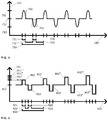
- Figure 1 shows several consecutive pulses on a two-dimensional graph comprising an amplitude axis (101) and a time axis (100).
- Amplitude (112) denotes that no current is transferred, i.e. an amplitude of 0.0 milliampere.
- a pulse (102) comprises a pulse width T w (121) and a pulse repetition period T p (123), both of which are time parameters.
- the pulse furthermore comprises a pulse amplitude A (111).
- a pulse may be rectangular, thereby comprising an in essence constant amplitude A during the pulse width T w , as is the case in Figure 1 .
- the applied current signal may be continuous.
- a pulse may thereby be triangular or sinusoidal
- Figure 2 shows several consecutive pulses on a two-dimensional graph comprising an amplitude axis (101) and a time axis (100).
- Amplitude (312) denotes that no current is transferred, i.e. an amplitude of 0.0 milliampere.
- Two consecutive pulses (302, 303) comprise a net charge transfer of in essence 0.0 picocoulomb.
- a rectangular gapped biphasic pulse comprises a first monophasic rectangular pulse (302) and a second monophasic rectangular pulse (303).
- the first pulse (302) comprises a pulse width T 1,w (321), an amplitude A 1 (311), and a time gap T 1,g (322) to the second pulse.
- the second pulse (303) comprises a pulse width T 2,w (324), and an amplitude A 2 (313), whereby A 1 and A 2 comprise opposite phase, i.e. A 1 .A 2 ⁇ 0 .
- the second pulse comprises a time gap T 2,g (325) to the following pulse.
- the pulse repetition period T p (330) is the repetition period of the biphasic pulse, i.e. the time span in between the beginning of two consecutive rectangular biphasic pulses.
- the two consecutive pulses (302, 303) comprises an in essence zero net charge transfer, i.e. A 1 .T 1,w + A 2 .T 2,w ⁇ 0.
- the biphasic pulse may be symmetric, in which case A 1 + A 2 ⁇ 0 , but may alternatively be non-symmetric, in which case
- Figure 3 shows several consecutive pulses on a two-dimensional graph comprising an amplitude axis (101) and a time axis (100).
- Amplitude (512) denotes that no current is transferred, i.e. an amplitude of 0.0 milliampere.
- Two consecutive triangular pulses (502, 503) comprise a net charge transfer of in essence 0.0 picocoulomb.
- a symmetric triangular gapped biphasic pulse comprises a first monophasic triangular pulse (502) and a second monophasic triangular pulse (503).
- the first pulse (502) comprises a pulse width T 1,w (521), an amplitude A 1 (511), and a time gap T 1,g (522) to the second pulse.
- the second pulse (503) comprises a pulse width T 2,w (524), and an amplitude A 2 (513), whereby A 1 and A 2 comprise opposite phase, i.e. A 1 .A 2 ⁇ 0 .
- the second pulse comprises a time gap T 2,g (525) to the following pulse.
- the pulse repetition period T p (530) is the repetition period of the biphasic pulse, i.e. the time span in between the beginning of two consecutive biphasic pulses.
- the time gaps of the first pulse and the second pulse may or may not be equal.
- the pulse widths of the first pulse and the second pulse are equal, as the biphasic pulse is symmetric.
- the pulse amplitudes, i.e. the absolute values of the amplitudes, of the first pulse and the second pulse are equal, as the biphasic pulse is symmetric.
- Figure 4 shows several consecutive pulses on a two-dimensional graph comprising an amplitude axis (101) and a time axis (100).
- Amplitude (712) denotes that no current is transferred, i.e. an amplitude of 0.0 milliampere.
- Two consecutive sinusoidal pulses (702, 703) comprise a net charge transfer of in essence 0.0 picocoulomb.
- a symmetric sinusoidal gapped biphasic pulse comprises a first monophasic sinusoidal pulse (702) and a second monophasic sinusoidal pulse (703).
- the first pulse (702) comprises a pulse width T 1,w (721), an amplitude A 1 (711), and a time gap T 1,g (722) to the second pulse.
- the second pulse (703) comprises a pulse width T 2,w (724), and an amplitude A 2 (713), whereby A 1 and A 2 comprise opposite phase, i.e. A 1 .A 2 ⁇ 0 .
- the second pulse comprises a time gap T 2,g (725) to the following pulse.
- the pulse repetition period T p (730) is the repetition period of the biphasic pulse, i.e. the time span in between the beginning of two consecutive biphasic pulses.
- the time gaps of the first pulse and the second pulse may or may not be equal.
- the pulse widths of the first pulse and the second pulse are equal, as the biphasic pulse is symmetric.
- the pulse amplitudes, i.e. the absolute values of the amplitudes, of the first pulse and the second pulse are equal, as the biphasic pulse is symmetric.
- the pulse repetition frequency is between 2 and 40 kilohertz.
- the pulse repetition frequency is preferably at least 4 kilohertz, more preferably at least 6 kilohertz, even more preferably at least 7 kilohertz, yet even more preferably at least 8 kilohertz, and most preferably at least 9 kilohertz.
- the pulse repetition frequency is preferably is preferably at most 30 kilohertz, more preferably at most 24 kilohertz, even more preferably at most 20 kilohertz, yet even more preferably at most 16 kilohertz, with greater preference at most 14 kilohertz, with an even greater preference at most 12 kilohertz, and with greatest preference at most 11 kilohertz.
- the pulse repetition frequency is about 10 kilohertz.
- the pulse width is between 4 and 240 microseconds, preferably between 8 and 120 microseconds, more preferably between 12 and 60 microseconds, even more preferably between 16 and 50 microseconds, yet even more preferably between 20 and 40 microseconds, and most preferably between 25 and 35 microseconds. In a particularly preferred embodiment, the pulse width is about 30 microseconds.
- the pulse amplitude is between 1 and 128 milliampere, preferably between 2 and 64 milliampere, more preferably between 4 and 32 milliampere, even more preferably between 5 and 16 milliampere, most preferably between 6 and 12 milliampere. In a particularly preferred embodiment, the pulse amplitude is about 8 milliampere.
- the treatment time is at least 5 minutes, preferably at least 10 minutes, more preferably at least 15 minutes, even more preferably at least 20 minutes, yet even more preferably at least 25 minutes, with greater preference at least 30 minutes, with even greater preference at least 40 minutes, with yet even greater preference at least 45 minutes, and with greatest preference at least 60 minutes.
- the device according to first aspect and the method according to the second aspect may be configured for non-invasive TENS of the afferent paths of the supratrochlear and supraorbital nerves of the ophthalmic branch of the trigeminal nerve via rectangular pulses comprising:
- the device is configured for increasing, preferably linearly increasing, the pulse amplitude at a rate of at most 480 microampere/second prior to the treatment.
- the method comprises the step of increasing, preferably linearly increasing, the pulse amplitude at a rate of at most 480 microampere/second prior to the treatment step.
- the rate is preferably at most 240 microampere/second, more preferably at most 120 microampere/second, even more preferably at most 60 microampere/second, yet even more preferably at most 30 microampere/second, and most preferably at most 15 microampere/second. In a particularly preferred embodiment, the rate is about 9.5 microampere/second.
- the increasing is performed during a start-up time span of at least 4 minutes, preferably at least 6 minutes, more preferably at least 8 minutes, even more preferably at least 10 minutes, and most preferably at least 12 minutes.
- the pulse amplitude remains in essence constant during the treatment time. This is advantageous, as it allows a person to become gradually accustomed to the amplitude of the treatment during a start-up phase prior to the treatment.
- FIG. 5 shows several consecutive symmetric biphasic rectangular pulses during the start-up on a two-dimensional graph comprising an amplitude axis (101) and a time axis (100).
- Amplitude (912) denotes that no current is transferred, i.e. an amplitude of 0.0 milliampere.
- Each biphasic pulse comprises a first pulse (902, 902', 902", 902"') and a second pulse (903, 903', 903", 903 '” ), which comprise successively larger pulse amplitudes (911, 911', 911", 911 '” ) over the subsequent biphasic pulses.
- the increase of the pulse amplitude is in the present case linear.
- the first pulse (902) comprises a pulse width T 1,w (921), and a time gap T 1 , g (922) to the second pulse.
- the second pulse (903) comprises a pulse width T 2,w (924), and a time gap T 2,g (925) to the following pulse.
- the time gaps of the first pulse and the second pulse may or may not be equal.
- the pulse widths of the first pulse and the second pulse are equal, as the biphasic pulses are symmetric.
- the pulse repetition period T p (930) is the repetition period of the biphasic pulse, i.e. the time span in between the beginning of two consecutive rectangular biphasic pulses.
- the device is portable and configured for self-support on a person's forehead.
- the portable device may comprise an electrode piece and a powering apparatus.
- the powering apparatus may be configured for manual attachment to and manual detachment from the electrode piece.
- the electrode piece may comprise a pair of spaced self-adhesive conductive gel zones for application to a person's forehead.
- the powering apparatus is configured for manual attachment to and manual detachment from the electrode piece via at least two engaging pairs of metallic contacts.
- the engaging pairs of metallic contacts are thereby further configured for establishing electrical connection between the powering apparatus and the pair of spaced self-adhesive conductive gel zones.
- an engaging pair of metallic contacts comprises a snap button or a magnet.
- the electrode piece is configured for application on the person's forehead in the supraorbital region, thereby covering the afferent paths of the supratrochlear and supraorbital nerves of the ophthalmic branch of the trigeminal nerve.
- the device comprises a powering apparatus configured for determining an impedance for electrical current transfer, whereby the powering apparatus is further configured for aborting treatment upon determining an impedance above a predefined threshold.
- the device comprises at least one physiological sensor.
- the device is configured for aborting treatment and/or adapting one or more treatment parameters based at least in part on a signal obtained from said at least one physiological sensor.
- the device comprises a powering apparatus configured for retaining a battery.
- the powering apparatus may retain a battery.
- the battery may be rechargeable.
- the powering apparatus may comprise a USB port for recharging the battery.
- the USB port may also allow for transferring treatment parameters to the powering apparatus and/or receiving information about a treatment session from the powering apparatus.
- the powering apparatus may comprise a contactless recharging module for inductively or capacitively recharging the battery.
- Figures 6A and 6B show an embodiment of a powering apparatus of a device according to the present invention.
- Figure 7 shows an embodiment of an electrode piece (30) of a device according to the present invention, applied to a person's forehead in the supraorbital region (20).
- Figure 8 shows a self-supporting device attached to a person's forehead, comprising a powering apparatus according to Figures 6A and 6B and an electrode piece according to Figure 7 .
- the powering apparatus comprises an upper part (2) and a lower part (3) which may be relatively fixed.
- the lower part (3) comprises a control opening (5) through which at least one control means (5'), such as a button for example, may protrude.
- the lower part (3) furthermore comprises two magnet openings (6), through each of which a magnet (6') may protrude.
- the lower part (3) furthermore also comprises a micro-USB opening (7) through which a micro-USB port (7') may protrude.
- the electrode piece (30) comprises a front side and a back side. At the back side (not shown), the electrode piece (30) comprises a pair of spaced self-adhesive conductive gel zones for application to a person's forehead. At the front side, the electrode piece (30) comprises a pair of metallic contacts, preferably magnetic metallic contacts, comprising a relative distance corresponding to the magnet openings (6) of the powering apparatus. Each metallic contact is electrically connected to a self-adhesive conductive gel zone. The device is via the magnets and metallic contacts configured for removable attachment of the powering apparatus to the electrode piece.
- the upper and lower parts (2, 3) provide for an internal space for housing a printed circuit board (PCB) (10) and a battery (11).
- Mechanical movement of the control means (5') may be transferred via an intermediary component (5") to the PCB (10), where said mechanical movement may be converted to suitable impedance (resistance, capacitance, inductance), voltage and/or current changes.
- the battery (11) may be connected via at least two wires (12) to the PCB (10).
- the PCB comprises two contact blades (6") configured for retaining the battery against the PCB and further each configured for contact with a magnet (6').
- the PCB further comprises a microcontroller unit (15) and a tangible non-transitory computer-readable storage medium.
- the micro-USB port allows for recharging the battery and for transferring treatment parameters and/or other information to and/or from the powering device.
- the PCB is configured for:
Landscapes
- Health & Medical Sciences (AREA)
- Life Sciences & Earth Sciences (AREA)
- Engineering & Computer Science (AREA)
- Biomedical Technology (AREA)
- Nuclear Medicine, Radiotherapy & Molecular Imaging (AREA)
- Radiology & Medical Imaging (AREA)
- Animal Behavior & Ethology (AREA)
- General Health & Medical Sciences (AREA)
- Public Health (AREA)
- Veterinary Medicine (AREA)
- Heart & Thoracic Surgery (AREA)
- Biophysics (AREA)
- Pain & Pain Management (AREA)
- Child & Adolescent Psychology (AREA)
- Developmental Disabilities (AREA)
- Hospice & Palliative Care (AREA)
- Neurology (AREA)
- Psychiatry (AREA)
- Psychology (AREA)
- Social Psychology (AREA)
- Electrotherapy Devices (AREA)
Priority Applications (13)
| Application Number | Priority Date | Filing Date | Title |
|---|---|---|---|
| EP18201148.6A EP3639883A1 (de) | 2018-10-18 | 2018-10-18 | Kilohertz e-tns stimulation |
| EP19786625.4A EP3866907A1 (de) | 2018-10-18 | 2019-10-18 | Kilohertz-e-tns-stimulation |
| MX2021004512A MX2021004512A (es) | 2018-10-18 | 2019-10-18 | Estimulación e-tns por kilohercios. |
| US17/286,702 US20210370047A1 (en) | 2018-10-18 | 2019-10-18 | Kilohertz e-TNS Stimulation |
| BR112021007375-2A BR112021007375A2 (pt) | 2018-10-18 | 2019-10-18 | estimulação kilohertz e-tns |
| AU2019362603A AU2019362603B2 (en) | 2018-10-18 | 2019-10-18 | Kilohertz e-TNS stimulation |
| KR1020217014870A KR20210088590A (ko) | 2018-10-18 | 2019-10-18 | 킬로헤르츠 e-tns 자극 |
| JP2021521418A JP2022505411A (ja) | 2018-10-18 | 2019-10-18 | キロヘルツe-tns刺激 |
| PCT/EP2019/078355 WO2020079218A1 (en) | 2018-10-18 | 2019-10-18 | Kilohertz e-tns stimulation |
| CN201980083922.4A CN113453746A (zh) | 2018-10-18 | 2019-10-18 | 千赫兹e-tns刺激 |
| CA3116803A CA3116803A1 (en) | 2018-10-18 | 2019-10-18 | Kilohertz e-tns stimulation |
| JP2024158996A JP2024167443A (ja) | 2018-10-18 | 2024-09-13 | キロヘルツe-tns刺激 |
| AU2025205571A AU2025205571A1 (en) | 2018-10-18 | 2025-07-17 | Kilohertz e-TNS stimulation |
Applications Claiming Priority (1)
| Application Number | Priority Date | Filing Date | Title |
|---|---|---|---|
| EP18201148.6A EP3639883A1 (de) | 2018-10-18 | 2018-10-18 | Kilohertz e-tns stimulation |
Publications (1)
| Publication Number | Publication Date |
|---|---|
| EP3639883A1 true EP3639883A1 (de) | 2020-04-22 |
Family
ID=63914826
Family Applications (2)
| Application Number | Title | Priority Date | Filing Date |
|---|---|---|---|
| EP18201148.6A Withdrawn EP3639883A1 (de) | 2018-10-18 | 2018-10-18 | Kilohertz e-tns stimulation |
| EP19786625.4A Pending EP3866907A1 (de) | 2018-10-18 | 2019-10-18 | Kilohertz-e-tns-stimulation |
Family Applications After (1)
| Application Number | Title | Priority Date | Filing Date |
|---|---|---|---|
| EP19786625.4A Pending EP3866907A1 (de) | 2018-10-18 | 2019-10-18 | Kilohertz-e-tns-stimulation |
Country Status (10)
| Country | Link |
|---|---|
| US (1) | US20210370047A1 (de) |
| EP (2) | EP3639883A1 (de) |
| JP (2) | JP2022505411A (de) |
| KR (1) | KR20210088590A (de) |
| CN (1) | CN113453746A (de) |
| AU (2) | AU2019362603B2 (de) |
| BR (1) | BR112021007375A2 (de) |
| CA (1) | CA3116803A1 (de) |
| MX (1) | MX2021004512A (de) |
| WO (1) | WO2020079218A1 (de) |
Cited By (3)
| Publication number | Priority date | Publication date | Assignee | Title |
|---|---|---|---|---|
| US11433234B2 (en) | 2017-05-19 | 2022-09-06 | Cefaly Technology Sprl | External trigeminal nerve stimulation for the acute non-invasive treatment of migraine attacks |
| WO2023052797A1 (en) * | 2021-10-01 | 2023-04-06 | Rt17 D.O.O. | Device suitable for treating an organism, including treatments such as electro-analgesia treatment and/or treatment of oedemas |
| US12220577B2 (en) | 2015-03-30 | 2025-02-11 | Cefaly Technology Sprl | Device for the transcutaneous electrical stimulation of the trigeminal nerve |
Families Citing this family (11)
| Publication number | Priority date | Publication date | Assignee | Title |
|---|---|---|---|---|
| US10695575B1 (en) | 2016-05-10 | 2020-06-30 | Btl Medical Technologies S.R.O. | Aesthetic method of biological structure treatment by magnetic field |
| US20180001107A1 (en) | 2016-07-01 | 2018-01-04 | Btl Holdings Limited | Aesthetic method of biological structure treatment by magnetic field |
| WO2022245881A1 (en) * | 2021-05-18 | 2022-11-24 | Tivic Health Systems Inc. | Migraine treatment device with adaptive circuit |
| US11464993B2 (en) | 2016-05-03 | 2022-10-11 | Btl Healthcare Technologies A.S. | Device including RF source of energy and vacuum system |
| CN117462844A (zh) | 2017-02-02 | 2024-01-30 | 福禄神经学公司 | 用于经颅直流电刺激tdcs的头戴设备和包括头戴设备的系统 |
| US12558146B2 (en) | 2019-04-11 | 2026-02-24 | Btl Medical Solutions A.S. | Methods and devices for aesthetic treatment of biological structures by radiofrequency and magnetic energy |
| JP2023515722A (ja) | 2020-05-04 | 2023-04-13 | ビーティーエル ヘルスケア テクノロジーズ エー.エス. | 患者の非アテンド式治療のためのデバイスおよび方法 |
| US11878167B2 (en) | 2020-05-04 | 2024-01-23 | Btl Healthcare Technologies A.S. | Device and method for unattended treatment of a patient |
| US12611545B2 (en) | 2020-05-04 | 2026-04-28 | Btl Healthcare Technologies A.S. | Device and method for unattended treatment of a patient |
| WO2022221644A2 (en) | 2021-04-16 | 2022-10-20 | Texas Medical Center | Systems and methods for stimulating two or more nerve branches |
| US20260097226A1 (en) | 2024-10-08 | 2026-04-09 | Btl Medical Solutions A.S. | Devices and methods for application of a magnetic field to the nervous system |
Citations (5)
| Publication number | Priority date | Publication date | Assignee | Title |
|---|---|---|---|---|
| US20100030299A1 (en) | 2007-04-13 | 2010-02-04 | Alejandro Covalin | Apparatus and method for the treatment of headache |
| US20130296967A1 (en) * | 2012-05-03 | 2013-11-07 | Ioannis Mihail Skaribas | External, head-worn electrical stimulator for treating headache conditions |
| WO2016044659A1 (en) * | 2014-09-17 | 2016-03-24 | Neurosigma, Inc. | Template for trigeminal neurostimulation |
| WO2016155773A1 (en) | 2015-03-30 | 2016-10-06 | Cefaly Technology Sprl | Device for the transcutaneous electrical stimulation of the trigeminal nerve |
| CN206239894U (zh) * | 2016-06-15 | 2017-06-13 | 释烦离技术公司 | 三叉神经经皮电刺激设备及包括该设备的套件 |
Family Cites Families (10)
| Publication number | Priority date | Publication date | Assignee | Title |
|---|---|---|---|---|
| US7526345B2 (en) * | 2004-06-10 | 2009-04-28 | Medtronic Emergency Response Systems, Inc. | Assessing medical electrode condition |
| WO2006044793A2 (en) * | 2004-10-18 | 2006-04-27 | Louisiana Tech University Foundation | Medical devices for the detection, prevention and/or treatment of neurological disorders, and methods related thereto |
| US20070276449A1 (en) * | 2005-06-15 | 2007-11-29 | Med-Lectric Corporation | Interactive transcutaneous electrical nerve stimulation device |
| WO2013128306A1 (en) * | 2012-02-28 | 2013-09-06 | Koninklijke Philips N.V. | Combined aed and cpr delivery assistance unit |
| WO2014022215A1 (en) * | 2012-07-28 | 2014-02-06 | Thimble Bioelectronics, Inc. | System and method for managing pain |
| WO2017178946A1 (en) * | 2016-04-14 | 2017-10-19 | Neurolief Ltd. | Method and device for transdermally applying electrical stimulation to a region of the head having high impedance |
| GB201601536D0 (en) * | 2016-01-27 | 2016-03-09 | Neurolief Ltd | Resilient head mounted device for neurostimulation and sensing of body parameters |
| US20180000685A1 (en) * | 2016-07-01 | 2018-01-04 | NeuroRhythmics, Inc. | Neurologic therapy devices, systems, and methods |
| WO2018039602A1 (en) * | 2016-08-26 | 2018-03-01 | Wisconsin Alumni Research Foundation | Neuromodulation to modulate glymphatic clearance |
| CN108904977A (zh) * | 2018-04-16 | 2018-11-30 | 宁波越凡医疗科技有限公司 | 输出电刺激脉冲的装置 |
-
2018
- 2018-10-18 EP EP18201148.6A patent/EP3639883A1/de not_active Withdrawn
-
2019
- 2019-10-18 US US17/286,702 patent/US20210370047A1/en active Pending
- 2019-10-18 BR BR112021007375-2A patent/BR112021007375A2/pt not_active Application Discontinuation
- 2019-10-18 WO PCT/EP2019/078355 patent/WO2020079218A1/en not_active Ceased
- 2019-10-18 CA CA3116803A patent/CA3116803A1/en active Pending
- 2019-10-18 AU AU2019362603A patent/AU2019362603B2/en active Active
- 2019-10-18 MX MX2021004512A patent/MX2021004512A/es unknown
- 2019-10-18 EP EP19786625.4A patent/EP3866907A1/de active Pending
- 2019-10-18 JP JP2021521418A patent/JP2022505411A/ja active Pending
- 2019-10-18 CN CN201980083922.4A patent/CN113453746A/zh active Pending
- 2019-10-18 KR KR1020217014870A patent/KR20210088590A/ko not_active Ceased
-
2024
- 2024-09-13 JP JP2024158996A patent/JP2024167443A/ja active Pending
-
2025
- 2025-07-17 AU AU2025205571A patent/AU2025205571A1/en active Pending
Patent Citations (6)
| Publication number | Priority date | Publication date | Assignee | Title |
|---|---|---|---|---|
| US20100030299A1 (en) | 2007-04-13 | 2010-02-04 | Alejandro Covalin | Apparatus and method for the treatment of headache |
| US20130296967A1 (en) * | 2012-05-03 | 2013-11-07 | Ioannis Mihail Skaribas | External, head-worn electrical stimulator for treating headache conditions |
| WO2016044659A1 (en) * | 2014-09-17 | 2016-03-24 | Neurosigma, Inc. | Template for trigeminal neurostimulation |
| WO2016155773A1 (en) | 2015-03-30 | 2016-10-06 | Cefaly Technology Sprl | Device for the transcutaneous electrical stimulation of the trigeminal nerve |
| US20180056065A1 (en) * | 2015-03-30 | 2018-03-01 | Cefaly Technology Sprl | Device for the transcutaneous electrical stimulation of the trigeminal nerve |
| CN206239894U (zh) * | 2016-06-15 | 2017-06-13 | 释烦离技术公司 | 三叉神经经皮电刺激设备及包括该设备的套件 |
Non-Patent Citations (2)
| Title |
|---|
| FRANZ RIEDERER ET AL: "Transcutaneous Supraorbital Nerve Stimulation (t-SNS) with the Cefaly Device for Migraine Prevention: A Review of the Available Data", PAIN AND THERAPY, vol. 4, no. 2, 14 October 2015 (2015-10-14), pages 135 - 147, XP055576115, ISSN: 2193-8237, DOI: 10.1007/s40122-015-0039-5 * |
| SOLOMON; GUGLIELMO: "Treatment of Headache by Transcutaneous Electrical Stimulation", HEADACHE, vol. 25, no. 1, 1985, pages 12 - 15 |
Cited By (3)
| Publication number | Priority date | Publication date | Assignee | Title |
|---|---|---|---|---|
| US12220577B2 (en) | 2015-03-30 | 2025-02-11 | Cefaly Technology Sprl | Device for the transcutaneous electrical stimulation of the trigeminal nerve |
| US11433234B2 (en) | 2017-05-19 | 2022-09-06 | Cefaly Technology Sprl | External trigeminal nerve stimulation for the acute non-invasive treatment of migraine attacks |
| WO2023052797A1 (en) * | 2021-10-01 | 2023-04-06 | Rt17 D.O.O. | Device suitable for treating an organism, including treatments such as electro-analgesia treatment and/or treatment of oedemas |
Also Published As
| Publication number | Publication date |
|---|---|
| CA3116803A1 (en) | 2020-04-23 |
| MX2021004512A (es) | 2022-03-17 |
| BR112021007375A2 (pt) | 2021-07-20 |
| JP2022505411A (ja) | 2022-01-14 |
| AU2019362603A1 (en) | 2021-05-27 |
| AU2019362603B2 (en) | 2025-06-12 |
| AU2025205571A1 (en) | 2025-08-07 |
| CN113453746A (zh) | 2021-09-28 |
| WO2020079218A1 (en) | 2020-04-23 |
| JP2024167443A (ja) | 2024-12-03 |
| EP3866907A1 (de) | 2021-08-25 |
| US20210370047A1 (en) | 2021-12-02 |
| KR20210088590A (ko) | 2021-07-14 |
Similar Documents
| Publication | Publication Date | Title |
|---|---|---|
| EP3639883A1 (de) | Kilohertz e-tns stimulation | |
| US12220577B2 (en) | Device for the transcutaneous electrical stimulation of the trigeminal nerve | |
| US8612007B2 (en) | Cranial-electro stimulator | |
| US20070150027A1 (en) | Non-invasive device and method for electrical stimulation of neural tissue | |
| US8914123B2 (en) | Apparatus for electro-inhibition of facial muscles | |
| US20150100112A1 (en) | Electromagnetic stimulation device for changing nerve threshold | |
| WO2004064915A3 (en) | Spinal cord stimulation with interferential current | |
| JP6937767B2 (ja) | 効果的な侵襲性振幅変調神経刺激のための装置と方法 | |
| US20160022987A1 (en) | Device and method for the application of a transcutaneous electrical stimulation stimulus | |
| KR102633307B1 (ko) | 뇌의 교차 단-펄스 전기 자극 | |
| JP2008506464A (ja) | 神経刺激効率及び/又は効力の強化又はそれに影響を及ぼすためのシステム及び方法 | |
| JP2022505411A5 (de) | ||
| MX2013010215A (es) | Dispositivos y metodos para la estimulacion electrica capacitiva no invasiva y su uso para la estimulacion del nervio vago en el cuello de un paciente. | |
| AU2017228581B2 (en) | High frequency electromagnetic field stimulator for changing nerve threshold | |
| AU2006203085B8 (en) | Vagus nerve stimulation by electrical signals for controlling cerebellar tremor | |
| HK40061274A (en) | Kilohertz e-tns stimulation | |
| CA2707351C (en) | Improved cranial-electro stimulator | |
| KR200328964Y1 (ko) | 위상 차이가 있는 전기 침들의 장치 | |
| WO2026090439A1 (en) | Transcutaneous auricular vagus nerve stimulation devices and methods of use | |
| TW201507752A (zh) | 改變神經閾值之高頻電磁場刺激器 |
Legal Events
| Date | Code | Title | Description |
|---|---|---|---|
| PUAI | Public reference made under article 153(3) epc to a published international application that has entered the european phase |
Free format text: ORIGINAL CODE: 0009012 |
|
| STAA | Information on the status of an ep patent application or granted ep patent |
Free format text: STATUS: THE APPLICATION HAS BEEN PUBLISHED |
|
| AK | Designated contracting states |
Kind code of ref document: A1 Designated state(s): AL AT BE BG CH CY CZ DE DK EE ES FI FR GB GR HR HU IE IS IT LI LT LU LV MC MK MT NL NO PL PT RO RS SE SI SK SM TR |
|
| AX | Request for extension of the european patent |
Extension state: BA ME |
|
| STAA | Information on the status of an ep patent application or granted ep patent |
Free format text: STATUS: THE APPLICATION IS DEEMED TO BE WITHDRAWN |
|
| 18D | Application deemed to be withdrawn |
Effective date: 20201023 |