EP3640596A1 - Verfahren und vorrichtung zur bestimmung einer bewegungsbahn - Google Patents
Verfahren und vorrichtung zur bestimmung einer bewegungsbahn Download PDFInfo
- Publication number
- EP3640596A1 EP3640596A1 EP18834716.5A EP18834716A EP3640596A1 EP 3640596 A1 EP3640596 A1 EP 3640596A1 EP 18834716 A EP18834716 A EP 18834716A EP 3640596 A1 EP3640596 A1 EP 3640596A1
- Authority
- EP
- European Patent Office
- Prior art keywords
- filtered
- points
- point
- original track
- track points
- Prior art date
- Legal status (The legal status is an assumption and is not a legal conclusion. Google has not performed a legal analysis and makes no representation as to the accuracy of the status listed.)
- Withdrawn
Links
Images


Classifications
-
- G—PHYSICS
- G01—MEASURING; TESTING
- G01S—RADIO DIRECTION-FINDING; RADIO NAVIGATION; DETERMINING DISTANCE OR VELOCITY BY USE OF RADIO WAVES; LOCATING OR PRESENCE-DETECTING BY USE OF THE REFLECTION OR RERADIATION OF RADIO WAVES; ANALOGOUS ARRANGEMENTS USING OTHER WAVES
- G01S19/00—Satellite radio beacon positioning systems; Determining position, velocity or attitude using signals transmitted by such systems
- G01S19/38—Determining a navigation solution using signals transmitted by a satellite radio beacon positioning system
- G01S19/39—Determining a navigation solution using signals transmitted by a satellite radio beacon positioning system the satellite radio beacon positioning system transmitting time-stamped messages, e.g. GPS [Global Positioning System], GLONASS [Global Orbiting Navigation Satellite System] or GALILEO
- G01S19/393—Trajectory determination or predictive tracking, e.g. Kalman filtering
-
- G—PHYSICS
- G01—MEASURING; TESTING
- G01S—RADIO DIRECTION-FINDING; RADIO NAVIGATION; DETERMINING DISTANCE OR VELOCITY BY USE OF RADIO WAVES; LOCATING OR PRESENCE-DETECTING BY USE OF THE REFLECTION OR RERADIATION OF RADIO WAVES; ANALOGOUS ARRANGEMENTS USING OTHER WAVES
- G01S19/00—Satellite radio beacon positioning systems; Determining position, velocity or attitude using signals transmitted by such systems
- G01S19/01—Satellite radio beacon positioning systems transmitting time-stamped messages, e.g. GPS [Global Positioning System], GLONASS [Global Orbiting Navigation Satellite System] or GALILEO
- G01S19/13—Receivers
- G01S19/14—Receivers specially adapted for specific applications
-
- G—PHYSICS
- G01—MEASURING; TESTING
- G01S—RADIO DIRECTION-FINDING; RADIO NAVIGATION; DETERMINING DISTANCE OR VELOCITY BY USE OF RADIO WAVES; LOCATING OR PRESENCE-DETECTING BY USE OF THE REFLECTION OR RERADIATION OF RADIO WAVES; ANALOGOUS ARRANGEMENTS USING OTHER WAVES
- G01S19/00—Satellite radio beacon positioning systems; Determining position, velocity or attitude using signals transmitted by such systems
- G01S19/38—Determining a navigation solution using signals transmitted by a satellite radio beacon positioning system
- G01S19/39—Determining a navigation solution using signals transmitted by a satellite radio beacon positioning system the satellite radio beacon positioning system transmitting time-stamped messages, e.g. GPS [Global Positioning System], GLONASS [Global Orbiting Navigation Satellite System] or GALILEO
- G01S19/40—Correcting position, velocity or attitude
-
- G—PHYSICS
- G06—COMPUTING OR CALCULATING; COUNTING
- G06T—IMAGE DATA PROCESSING OR GENERATION, IN GENERAL
- G06T7/00—Image analysis
- G06T7/20—Analysis of motion
- G06T7/207—Analysis of motion for motion estimation over a hierarchy of resolutions
-
- G—PHYSICS
- G06—COMPUTING OR CALCULATING; COUNTING
- G06T—IMAGE DATA PROCESSING OR GENERATION, IN GENERAL
- G06T7/00—Image analysis
- G06T7/20—Analysis of motion
- G06T7/215—Motion-based segmentation
-
- H—ELECTRICITY
- H04—ELECTRIC COMMUNICATION TECHNIQUE
- H04L—TRANSMISSION OF DIGITAL INFORMATION, e.g. TELEGRAPHIC COMMUNICATION
- H04L67/00—Network arrangements or protocols for supporting network services or applications
- H04L67/50—Network services
- H04L67/535—Tracking the activity of the user
-
- G—PHYSICS
- G01—MEASURING; TESTING
- G01C—MEASURING DISTANCES, LEVELS OR BEARINGS; SURVEYING; NAVIGATION; GYROSCOPIC INSTRUMENTS; PHOTOGRAMMETRY OR VIDEOGRAMMETRY
- G01C21/00—Navigation; Navigational instruments not provided for in groups G01C1/00 - G01C19/00
- G01C21/26—Navigation; Navigational instruments not provided for in groups G01C1/00 - G01C19/00 specially adapted for navigation in a road network
- G01C21/28—Navigation; Navigational instruments not provided for in groups G01C1/00 - G01C19/00 specially adapted for navigation in a road network with correlation of data from several navigational instruments
- G01C21/30—Map- or contour-matching
-
- G—PHYSICS
- G01—MEASURING; TESTING
- G01S—RADIO DIRECTION-FINDING; RADIO NAVIGATION; DETERMINING DISTANCE OR VELOCITY BY USE OF RADIO WAVES; LOCATING OR PRESENCE-DETECTING BY USE OF THE REFLECTION OR RERADIATION OF RADIO WAVES; ANALOGOUS ARRANGEMENTS USING OTHER WAVES
- G01S19/00—Satellite radio beacon positioning systems; Determining position, velocity or attitude using signals transmitted by such systems
- G01S19/38—Determining a navigation solution using signals transmitted by a satellite radio beacon positioning system
- G01S19/39—Determining a navigation solution using signals transmitted by a satellite radio beacon positioning system the satellite radio beacon positioning system transmitting time-stamped messages, e.g. GPS [Global Positioning System], GLONASS [Global Orbiting Navigation Satellite System] or GALILEO
- G01S19/42—Determining position
- G01S19/50—Determining position whereby the position solution is constrained to lie upon a particular curve or surface, e.g. for locomotives on railway tracks
-
- G—PHYSICS
- G06—COMPUTING OR CALCULATING; COUNTING
- G06T—IMAGE DATA PROCESSING OR GENERATION, IN GENERAL
- G06T2207/00—Indexing scheme for image analysis or image enhancement
- G06T2207/10—Image acquisition modality
- G06T2207/10016—Video; Image sequence
Definitions
- This application relates to fields of information technologies, and more specifically, to a method and an apparatus for determining a moving track.
- Map matching is an error correction technology for moving track data.
- the technology is based on a pattern recognition theory, and may be based on an assumption that a vehicle always travels on a road.
- Abasic idea of the technology is to compare and match vehicle location information measured by using a positioning method with electronic map data of a navigation system with reference to a vehicle positioning track and a road network in a digital map, to find a road segment on which a vehicle is located.
- a combination of a positioning technology and a map matching technology can effectively reduce an error caused by positioning sampling and greatly improve accuracy of vehicle positioning, and has been widely applied to fields such as global positioning system (global positioning system, GPS) navigation and traffic flow analysis.
- global positioning system global positioning system
- map matching based on a hidden Markov model has the best accuracy and robustness.
- the method is mainly designed for a track with a small error, for example, a GPS track of which the error is at the level of 10 m, and in terms of matching accuracy, an ideal result can be achieved.
- This application provides a method and an apparatus for determining a moving track, capable of filtering and correcting a track point that may have a negative effect during a map matching procedure.
- a method for determining a moving track including: obtaining locations of n original track points P 1 to P n during a moving process of a mobile terminal, where a time point at which the mobile terminal passes the i th original track point P i in the n original track points P 1 to P n is earlier than a time point at which the mobile terminal passes the (i+1) th original track point P i +1 , and n is a positive integer; performing filtering on the n original track points P 1 to P n , where the filtering is used to delete at least one of the n original track points P 1 to P n , and/or update a location of at least one of the n original track points P 1 to P n ; and determining a moving track of the mobile terminal on at least one road in a road map based on target track points that are obtained by performing the filtering on the n original track points P 1 to P n , where the road map includes a plurality of roads.
- At least one type of filtering is performed on the n original track points during the moving process of the mobile terminal, to obtain m target points; and road map matching is further performed on the m target track points, to obtain the moving track of the mobile terminal, so that a track point that has a relatively large error and that produces a negative effect in the original track points can be filtered out or changed, thereby allowing the processed target track points to be more accurate during the map matching.
- a high-noise data obtaining manner such as base station positioning, and a special situation such as quick positioning
- the subsequent map matching procedure is more accurate and the obtained moving track is closer to an actual situation.
- a server can obtain locations of n original track points P 1 to P n during the moving process of the mobile terminal, where the n original track points P 1 to P n may be all or some of the several track points that are collected by a base station.
- the server may obtain all track points that are collected by the base station, and the n original track points P 1 to P n are all of the track points; or the server may process all track points, and the n original track points P 1 to P n may be some of the track points that are obtained by the server by processing all the original track points.
- the base station may use a same sampling time, for example, obtain, by using a same time interval, the locations of the track points at each time point, or use different sampling times, that is, collect the locations of the track points when the mobile terminal moves at different time intervals.
- the filtering in the method may include at least one of difference filtering, speed filtering, angle filtering, distortion degree filtering, trimmed mean filtering, and near-point filtering, where the speed filtering, the angle filtering, the distortion degree filtering, and the near-point filtering may be used to delete at least one of the n original track points P 1 to P n , and the difference filtering and the trimmed mean filtering may be used to update a location of at least one of the n original track points P 1 to P n .
- the performing filtering on the n original track points P 1 to P n includes: performing difference filtering on the n original track points P 1 to P n , where the difference filtering is used to rearrange points whose locations coincide, that is, update locations of coincident points.
- the performing filtering on the n original track points P 1 to P n includes: obtaining a to-be-filtered points P x to P x + a -1 in the n original track points P 1 to P n , where the a to-be-filtered points P x to P x + a -1 are located at a first location, and x and a are positive integers; obtaining b to-be-filtered points P x + a to P x + a + b- 1 in the n original track points P 1 to P n , where the b to-be-filtered points P x + a to P x + a + b- 1 are located at a second location, and b is a positive integer greater than 1; obtaining c to-be-filtered points P x + a + b to P x + a + b + c -1 in the n original track points P 1 to P
- the evenly arranging to-be-filtered points P x + ⁇ a /2 ⁇ to P x + a + ⁇ b /2 ⁇ on a straight line from the first location to the second location includes: arranging the to-be-filtered point P x + ⁇ a /2 ⁇ at the first location and the to-be-filtered point P x + a + ⁇ b /2 ⁇ at the second location, equally dividing the straight line between the first location and the second location by distance, and arranging each to-be-filtered point between the to-be-filtered point P x + ⁇ a /2 ⁇ and the to-be-filtered point P x + a + ⁇ b /2 ⁇ sequentially.
- the evenly arranging to-be-filtered points P x + a + ⁇ b /2 ⁇ to P x + a + b + ⁇ c /2 ⁇ on a straight line from the second location to the third location includes: arranging the to-be-filtered point P x + a + ⁇ b /2 ⁇ at the second location and the to-be-filtered point P x + a + b + ⁇ c /2 ⁇ at the third location, equally dividing the straight line between the second location and the third location by distance, and arranging each to-be-filtered point between the to-be-filtered point P x + a + ⁇ b /2 ⁇ and the to-be-filtered point P x + a + b + ⁇ c /2 ⁇ sequentially.
- the coincident track points may be rearranged, and locations of some of the track points may be updated, so that the track points are more evenly distributed.
- the performing filtering on the n original track points P 1 to P n includes: performing speed filtering on the n original track points P 1 to P n , where the speed filtering is used to filter a point with a relatively high speed, for example, filter a point of which a speed is greater than or equal to a preset speed.
- the performing filtering on the n original track points P 1 to P n includes: obtaining, a speed at a first to-be-filtered point P a in the n original track points P 1 to P n , where a is a positive integer less than or equal to n; and deleting the first to-be-filtered point P a if the speed at the first to-be-filtered point P a is greater than or equal to a preset speed.
- the preset speed may be set based on an actual situation, for example, may be set based on an average speed during the whole moving process of the mobile terminal, or may be set based on a speed of the mobile terminal within a specific period of time or distance, and the embodiments of this application are not limited thereto.
- the performing filtering on the n original track points P 1 to P n includes: performing angle filtering on the n original track points P 1 to P n , where the angle filtering is used to delete vertexes of some angles that are greater than or equal to a preset angle.
- the performing filtering on the n original track points P 1 to P n includes: obtaining four to-be-filtered points P c , P c +1 , P c +2 , and P c +3 in the n original track points P 1 to P n , where c is a positive integer, and c+3 is less than or equal to n; determining a first angle ⁇ P c P c +1 P c +2 and a second angle ⁇ P c +1 P c +2 P c +3 ; and deleting the to-be-filtered point P c +1 or the to-be-filtered point P c +2 in the four to-be-filtered points P c , P c +1 , P c +2 , and P c +3 if the first angle is less than or equal to a first preset angle and the second angle is less than or equal to a second preset angle.
- the preset angle may be set based on an actual situation, where the first preset angle and the second preset angle may be set to be the same or different, and the embodiments of this application are not limited thereto.
- a track of the mobile terminal is generally a relatively smooth line segment, and if there is a relatively small acute angle, it is likely to be caused by a sampling error. Therefore, a track point with a large error may be filtered out by using the angle filtering.
- the performing filtering on the n original track points P 1 to P n includes: performing distortion degree filtering on the n original track points P 1 to P n , where in the distortion degree filtering, some points with excessively large distortion degrees are deleted.
- the performing filtering on the n original track points P 1 to P n includes: obtaining 2 ⁇ +1 to-be-filtered points P f - ⁇ to P f + ⁇ in the n original track points P 1 to P n , where f and ⁇ are positive integers, and f is greater than ⁇ ; determining a distance between a to-be-filtered point P g and an adjacent to-be-filtered point P g +1 that are in the 2 ⁇ +1 to-be-filtered points P f - ⁇ to P f + ⁇ , where g is set to range from f- ⁇ to f+ ⁇ -1, to obtain 2a distances; determining that a distance between the first to-be-filtered point P f - ⁇ and the last to-be-filtered point P f + ⁇ in the 2 ⁇ +1 to-be-filtered points P f - ⁇ to P f + ⁇ is a first distance
- the server may: traverse each point in the n original track points P 1 to P n , where any track point P f is used as an example herein.
- a half window size is set to ⁇ with the to-be-filtered point P f as a center, that is, the to-be-filtered point P f is centered, and ⁇ to-be-filtered points before P f and ⁇ to-be-filtered points after P f in the n original track points P 1 to P n are obtained, to obtain a total of 2 ⁇ +1 to-be-filtered points P f - ⁇ to P f + ⁇ .
- a distance between every two adjacent to-be-filtered points in the 2 ⁇ +1 to-be-filtered points P f - ⁇ to P f + ⁇ is determined, and all the distances are summed up.
- a distance between the first to-be-filtered point P f - ⁇ and the last to-be-filtered point P f + ⁇ that are in the 2 ⁇ +1 to-be-filtered points P f - ⁇ to P f + ⁇ is then determined, where the distance is referred to as a first distance, so that a distortion degree of the to-be-filtered point P f is equal to the quotient of the sum of the 2 ⁇ distances and the first distance.
- the preset distortion degree ⁇ may be set based on an actual situation, and generally, the distortion degree ⁇ is set to satisfy ⁇ 1.
- a track of the mobile terminal should be a relatively smooth line segment, that is, a corresponding distortion degree is relatively small, in other words, approaches 1. If a serious distortion occurs, it is very likely that the serious distortion is caused by a sampling error. Therefore, filtering needs to be performed, and by using the distortion degree filtering, some points with large errors may be filtered out.
- the performing filtering on the n original track points P 1 to P n includes: performing trimmed mean filtering on the n original track points P 1 to P n , where in the trimmed mean filtering, coordinates of some or all the track points may be updated.
- the performing filtering on the n original track points P 1 to P n includes: obtaining 2 ⁇ +1 to-be-filtered points P l - ⁇ to P l + ⁇ in the n original track points P 1 to P n , where l and ⁇ are positive integers, and l is greater than ⁇ ; determining, in the 2 ⁇ +1 to-be-filtered points P l - ⁇ to P l + ⁇ , an average value of longitudes of all k to-be-filtered points and an average value of latitudes of all h to-be-filtered points, where k and h are positive integers less than 2 ⁇ +1; and determining that the average value of the longitudes and the average value of the latitudes are respectively a longitude and a latitude that are of the ( ⁇ +1) th to-be-filtered point P l in the 2 ⁇ +1 to-be-filtered points P l - ⁇ to P
- the performing filtering on the n original track points P 1 to P n includes: establishing a rectangular coordinate system, where the rectangular coordinate system includes an X-axis in a horizontal direction and a Y-axis in a vertical direction; determining coordinates of each of the n original track points P 1 to P n ; obtaining 2 ⁇ +1 to-be-filtered points P l - ⁇ to P l + ⁇ in the n original track points P 1 to P n , where l and ⁇ are positive integers, and l is greater than ⁇ ; determining, in the 2 ⁇ +1 to-be-filtered points P l - ⁇ to P l + ⁇ , an average value of X-axis coordinates of k to-be-filtered points and an average value of Y-axis coordinates of h to-be-filtered points, where k and h are positive integers less than 2 ⁇ +1; and determining that the
- k to-be-filtered points and h to-be-filtered points are determined, where the k to-be-filtered points and the h to-be-filtered points may be consecutive or inconsecutive, a value of k may be equal to or may not be equal to a value of h, and the k to-be-filtered points and the h to-be-filtered points may be the same points or may be different points.
- all of the 2 ⁇ +1 to-be-filtered points may be arranged based on magnitudes of first coordinate values, where the first coordinate may refer to the foregoing longitude value or X-axis coordinate, to-be-filtered points that correspond to maximum and minimum values are removed, and only k to-be-filtered points that correspond to intermediate values are taken; and similarly, all the to-be-filtered points are further arranged based on magnitudes of second coordinate values, where the second coordinate may refer to the foregoing latitude value or X-axis coordinate, to-be-filtered points that correspond to maximum and minimum values are removed, and only h to-be-filtered points that correspond to intermediate values are taken.
- the trimmed mean filtering may be performed on each of the n original track points P 1 to P n , or may be performed on some track points. For example, the trimmed mean filtering is only performed on some points of which coordinate value changes are relatively large.
- a difference threshold may be set. When a variation of a coordinate value is less than the difference threshold, it is determined that the coordinate value change is relatively small, and the trimmed mean filtering is not performed, but the embodiments of this application are not limited thereto.
- coordinates of a current point may be adjusted with reference to locations of several points before and after the point, so that the shape of the track is smoother, and subsequent map matching is helped.
- the performing filtering on the n original track points P 1 to P n includes: performing near-point filtering on the n original track points P 1 to P n , where the near-point filtering is used to delete the track points that are relatively close to each other.
- the performing filtering on the n original track points P 1 to P n includes: obtaining the y th to-be-filtered point P y and the (y+1) th to-be-filtered point P y +1 in the n original track points P 1 to P n ; and deleting the y th to-be-filtered point P y and/or the (y+1) th to-be-filtered point P y +1 if a distance between the y th to-be-filtered point P y and the (y+1) th to-be-filtered point P y +1 is less than or equal to a preset distance.
- the performing filtering on the n original track points P 1 to P n includes: obtaining the (y-1) th to-be-filtered point P y -1 , the y th to-be-filtered point P y , and the (y+1) th to-be-filtered point P y +1 in the n original track points P 1 to P n ; and deleting the y th to-be-filtered point P y ; otherwise, reserving the to-be-filtered points P y if a distance between the (y-1) th to-be-filtered point P y -1 and the y th to-be-filtered point P y is less than or equal to a preset distance, and a distance between the y th to-be-filtered point P y and the (y+1) th to-be-filtered point P y +1 is also less than or equal to the preset distance.
- the near-point filtering can eliminate a positioning error caused by an excessively slow moving speed or a static status of the mobile terminal and an impact on map matching, to resolve an anchor point drift problem caused by a stay of the mobile terminal.
- the mobile terminal may be a vehicle, the vehicle may stop or slow down during traveling, and the near-point filtering can eliminate a positioning error caused by a stopping or slowing-down process of the vehicle.
- the foregoing filtering may include at least one of the difference filtering, the speed filtering, the angle filtering, the distortion degree filtering, the trimmed mean filtering, and the near-point filtering. Therefore, when the filtering process includes at least two filtering procedures, n original track points P 1 to P n in any non-first filtering may be obtained by renumbering remaining track points after previous filtering.
- At least one filtering manner of the difference filtering, the speed filtering, the angle filtering, the distortion degree filtering, the trimmed mean filtering, and the near-point filtering may be randomly chosen. For example, because procedures of the angle filtering and the distortion degree filtering are similar, choosing to perform only one of them is acceptable. For another example, because the difference filtering is relatively complex and a probability that original track points completely overlap is relatively small, choosing not to perform the difference filtering is acceptable. For another example, with consideration of a calculation effect, if it is determined to perform the difference filtering, the difference filtering may be set to be first filtering, and then, other filtering is performed.
- the road map is obtained, and each of the plurality of roads in the road map only includes two ends and does not include any branch road.
- the performing filtering on the n original track points P 1 to P n includes: performing the filtering on the n original track points P 1 to P n to obtain m target track points, where m is a positive integer less than or equal to n.
- the determining a moving track of the mobile terminal on at least one road in a road map based on target track points obtained by performing the filtering on the n original track points P 1 to P n includes: matching the m target track points with m points that are on the road in the road map, where the m points are arranged chronologically; and determining, based on the road occupied by the m points, the moving track of the mobile terminal on the at least one road.
- the determining a moving track of the mobile terminal on at least one road in a road map based on target track points obtained by performing the filtering on the n original track points P 1 to P n includes: obtaining a first point and a second point that are temporally consecutive in the m points, where a time point of the first point is earlier than a time point of the second point; if the first point and the second point are located on a same road, determining that the track of the mobile terminal moves from the first point to the second point along the same road; if the first point is located on a first road, the second point is located on a second road, and the first road is different from and is connected to the second road, determining that the track of the mobile terminal moves along the first point on the first road to the second point on the second road; and if the first point is located on the first road, the second point is located on the second road, and the first road is different from and is not connected
- At least one type of filtering is performed on the n original track points during the moving process of the mobile terminal, to obtain m target points; and road map matching is further performed on the m target track points, to obtain the moving track of the mobile terminal, so that a track point that has a relatively large error and that produces a negative effect in the original track points can be filtered out or changed, thereby allowing the processed target track points to be more accurate during the map matching.
- a high-noise data obtaining manner such as base station positioning, and a special situation such as quick positioning
- the subsequent map matching procedure is more accurate and the obtained moving track is closer to an actual situation.
- an apparatus for determining a moving track configured to perform the method in the foregoing first aspect or any possible implementation of the first aspect.
- the apparatus includes a unit configured to perform the method in the foregoing first aspect or any possible implementation of the first aspect.
- an apparatus for determining a moving track including a storage unit and a processor, where the storage unit is configured to store an instruction, the processor is configured to execute the instruction stored in the memory, and when the processor executes the instruction stored in the memory, the execution enables the processor to perform the method in the first aspect or any possible implementation of the first aspect.
- a computer-readable medium configured to store a computer program, where the computer program includes an instruction that is used to perform the method in the first aspect or any possible implementation of the first aspect.
- a computer program product including an instruction is provided.
- the instruction of the computer program product is run on a computer, the computer performs the method for determining a moving track in the foregoing first aspect or any possible implementation of the first aspect.
- the computer program product can be run on the apparatus for determining a moving track in the foregoing third aspect.
- GSM Global System for Mobile Communications
- CDMA Code Division Multiple Access
- WCDMA Wideband Code Division Multiple Access
- GPRS General Packet Radio Service
- LTE Long Term Evolution
- FDD Frequency Division Duplex
- TDD Time Division Duplex
- UMTS Universal Mobile Telecommunications System
- WiMAX Worldwide Interoperability for Microwave Access
- a mobile terminal may include, but is not limited to, a mobile station (Mobile Station, MS), a mobile terminal (Mobile Terminal), a mobile telephone (Mobile Telephone), user equipment (User Equipment, UE), a handset (handset) and portable equipment (portable equipment), a vehicle (vehicle), and the like.
- the mobile terminal may communicate with one or more core networks by using a radio access network (Radio Access Network, RAN).
- RAN Radio Access Network
- the mobile terminal may be a vehicle, or may be a portable, pocket-sized, handheld, computer built-in, or in-vehicle mobile apparatus or the like.
- the embodiments of this application also relate to a base station, and the base station can collect a moving track of a mobile terminal in a moving process.
- an existing base station may be reused by the base station, that is, the base station may be an apparatus deployed in a radio access network to provide a wireless communication function for the terminal device.
- the base station may include a macro base station, a micro base station, a relay station, an access point, and the like in various forms. In systems using different radio access technologies, names of devices that have base station functions may be different.
- the device in the LTE network, the device may be referred to as an evolved NodeB (Evolved NodeB, eNB, or eNodeB), and in a 3rd Generation (3rd Generation, 3G) network, the device may be referred to as a NodeB (Node B).
- Evolved NodeB evolved NodeB
- eNB evolved NodeB
- 3rd Generation 3rd Generation
- FIG. 1 is a schematic flowchart of a method 100 for determining a moving track according to an embodiment of this application.
- the method 100 may be performed by a server, for example, a positioning server.
- the positioning server can obtain data of a moving track of a terminal device collected by a base station, and perform related processing on the data.
- the positioning server may alternatively be the base station, and this embodiment of this application is not limited thereto.
- description is provided below by using the method 100 performed by a server as an example.
- the method 100 includes S110: Obtain locations of n original track points P 1 to P n during a moving process of a mobile terminal, where a time point at which the mobile terminal passes the i th original track point P i in the n original track points P 1 to P n is earlier than a time point at which the mobile terminal passes the (i+1) th original track point P i +1 , and n is a positive integer.
- the base station may collect a moving track of the mobile terminal, to obtain locations of several track points.
- the server may obtain locations of n original track points P 1 to P n during the moving process of the mobile terminal, where the n original track points P 1 to P n may be all or some of the several track points that are collected by the base station.
- the server may obtain all track points that are collected by the base station, and the n original track points P 1 to P n are all of the track points; or the server may process all track points, and the n original track points P 1 to P n may be some of the track points that are obtained by the server by processing all the original track points, and this embodiment of this application is not limited thereto.
- the mobile terminal may be located in different locations over time.
- the base station collects the track points during the moving process of the mobile terminal, and correspondingly, each track point includes a time point at which the mobile terminal passes the track point.
- the n original track points P 1 to P n of the mobile terminal that are obtained by the server may be arranged based on time points at which the mobile terminal passes the original track points, for example, a time point at which the mobile terminal passes the i th original track point P i in the n original track points P 1 to P n is earlier than a time point at which the mobile terminal passes the (i+1) th original track point P i +1 .
- the base station may use a same sampling time, for example, obtain, by using a same time interval, the locations of the track points at each time point, or use different sampling times, that is, collect the locations of the track points when the mobile terminal moves at different time intervals.
- the method 100 further includes S120: Perform filtering on the n original track points P 1 to P n , where the filtering may be used to delete at least one of the n original track points P 1 to P n , and/or update a location of at least one of the n original track points P 1 to P n .
- the filtering may include at least one of difference filtering, speed filtering, angle filtering, distortion degree filtering, trimmed mean filtering, and near-point filtering, where the speed filtering, the angle filtering, the distortion degree filtering, and the near-point filtering may be used to delete at least one of the n original track points P 1 to P n , and the difference filtering and the trimmed mean filtering may be used to update a location of at least one of the n original track points P 1 to P n .
- filtering is performed on the n original track points P 1 to P n , and the filtering may be difference filtering.
- the server obtains a to-be-filtered points P x to P x + a -1 in the n original track points P 1 to P n , where the a to-be-filtered points P x to P x + a -1 are located at a first location, and x and a are positive integers, that is, when a is greater than 1, the a to-be-filtered points P x to P x + a -1 coincide completely at the first location; then obtains b to-be-filtered points P x + a to P x + a + b -1 in the n original track points P 1 to P n , where the b to-be-filtered points P x + a to P x + a + b -1 are located at a second location, and b is a positive integer greater than 1, that is, the b to
- the first location is connected to the second location to obtain a straight line, and to-be-filtered points P x + ⁇ a /2 ⁇ to P x + a + ⁇ b /2 ⁇ are evenly arranged on the straight line from the first location to the second location, where a to-be-filtered point P x + ⁇ a /2 ⁇ is at the first location, a to-be-filtered point P x + a + ⁇ b /2 ⁇ is at the second location, the straight line between the first location and the second location is equally divided by distance, and each to-be-filtered point between the to-be-filtered point P x + ⁇ a /2 ⁇ and the to-be-filtered point P x + a + ⁇ b /2 ⁇ is arranged sequentially.
- the second location is connected to the third location to obtain a straight line
- to-be-filtered points P x + a + ⁇ b /2 ⁇ to P x + a + b + ⁇ c /2 ⁇ are evenly arranged on the straight line from the second location to the third location, where a to-be-filtered point P x + a + ⁇ b /2 ⁇ is at the second location, a to-be-filtered point P x + a + b + ⁇ c /2 ⁇ is at the third location
- the straight line between the second location and the third location is equally divided by distance
- each to-be-filtered point between the to-be-filtered point P x + a + ⁇ b /2 ⁇ and the to-be-filtered point P x + a + b + ⁇ c /2 ⁇ is arranged sequentially, and ⁇ ⁇ indicates rounding down.
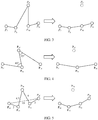
- FIG. 2 is a schematic diagram of difference filtering according to an embodiment of this application.
- the point A is connected to the point B to obtain a line segment AB.
- coincident points may be rearranged, and locations of some of track points may be updated, so that the track points are more evenly distributed.
- filtering is performed on the n original track points P 1 to P n , and the filtering may be speed filtering.
- the server obtains a speed at a first to-be-filtered point P a in the n original track points P 1 to P n , where each track point of the n original track points P 1 to P n may serve as the first to-be-filtered point P a sequentially; and if the speed at the first to-be-filtered point P a is greater than or equal to a preset speed, deletes the first to-be-filtered point P a .
- this embodiment of this application is not limited thereto.
- FIG. 3 is a schematic diagram of speed filtering according to an embodiment of this application.
- each track point of the n original track points P 1 to P n may serve as the first to-be-filtered point P a sequentially, and description is provided herein by using the first to-be-filtered point P 9 as an example.
- Determining a speed at P 9 may be determining that an average speed in a distance from P 8 to P 9 is the speed at P 9 , or determining that an average speed in a distance from P 9 to P 10 is the speed at P 9 . If the speed at P 9 is greater than or equal to the preset speed, as shown in FIG. 3 , P 9 may be deleted; and if the speed at P 9 is less than the preset speed, P 9 is reserved.
- the preset speed may be set based on an actual situation, for example, may be set based on an average speed during the whole moving process of the mobile terminal, or may be set based on a speed of the mobile terminal within a specific period of time or distance, and this embodiment of this application is not limited thereto.
- filtering is performed on the n original track points P 1 to P n , and the filtering may be angle filtering.
- the angle filtering may be used to filter out a vertex of an angle that is greater than or equal to a preset angle.
- the server may obtain four to-be-filtered points P c , P c +1 , P c +2 , and P c +3 in the n original track points P 1 to P n , where c is a positive integer, and c+3 is less than or equal to n; determine a first angle ⁇ P c P c +1 P c +2 and a second angle ⁇ P c +1 P c +2 P c +3 ; and delete the to-be-filtered point P c +1 or the to-be-filtered point P c +2 in the four to-be-filtered points P c , P c +1 , P c +2 , and P c +3 if the first angle is less than or equal to a first preset angle and the second angle is less than or equal to a second preset angle, where the preset angle includes the first preset angle and the second preset angle.
- FIG. 4 is a schematic diagram of angle filtering according to an embodiment of this application.
- four to-be-filtered points are obtained in the n original track points P 1 to P n , for example, P 13 , P 14 , P 15 , and P 16 .
- both the first preset angle and the second preset angle are set to 80°, both ⁇ P 13 P 14 P 15 and ⁇ P 14 P 15 P 16 are less than the preset angle, so that P 14 or P 15 may be deleted, for example, P 15 may be deleted in FIG. 4 .
- the preset angle may be set based on an actual situation, where the first preset angle and the second preset angle may be set to be the same or different, and this embodiment of this application is not limited thereto.
- a track of the mobile terminal is generally a relatively smooth line segment, and if there is a relatively small acute angle, it is likely to be caused by a sampling error. Therefore, a track point with a relatively large error may be filtered out by using the angle filtering.
- filtering is performed on the n original track points P 1 to P n , and the filtering may be distortion degree filtering.
- the server obtains 2 ⁇ +1 to-be-filtered points P f - ⁇ to P f + ⁇ in the n original track points P 1 to P n , where f and ⁇ are positive integers, and f is greater than ⁇ .
- the server determines a distance between any to-be-filtered point P g and an adjacent to-be-filtered point P g +1 that are in the 2 ⁇ +1 to-be-filtered points P f - ⁇ to P f + ⁇ , where each of f - ⁇ to f + ⁇ -1 serves as g separately, and a total of 2a distances can be obtained; determines that a distance between the first to-be-filtered point P f - ⁇ and the last to-be-filtered point P f + ⁇ in the 2 ⁇ +1 to-be-filtered points P f - ⁇ to P f + ⁇ is a first distance; determines that a quotient of a sum of the 2 ⁇ distances and the first distance is a distortion degree; and deletes the ( ⁇ +1) th to-be-filtered point P f in the 2 ⁇ +1 to-be-filtered points P f - ⁇ to P f + ⁇ when the distortion degree is greater than or equal to a preset distortion degree.
- the server may: traverse each point in the n original track points P 1 to P n , where any track point P f is used as an example herein.
- a half window size is set to ⁇ with the to-be-filtered point P f as a center, that is, the to-be-filtered point P f is centered, ⁇ to-be-filtered points before P f and ⁇ to-be-filtered points after P f in the n original track points P 1 to P n are obtained, to obtain a total of 2 ⁇ +1 to-be-filtered points P f - ⁇ to P f + ⁇ .
- a distance between every two adjacent to-be-filtered points in the 2 ⁇ +1 to-be-filtered points P f - ⁇ to P f + ⁇ is determined, and all the distances are summed up.
- a distance between the first to-be-filtered point P f - ⁇ and the last to-be-filtered point P f + ⁇ that are in the 2 ⁇ +1 to-be-filtered points P f - ⁇ to P f + ⁇ is then determined, where the distance is referred to as a first distance, so that a distortion degree of the to-be-filtered point P f is equal to the quotient of the sum of the 2 ⁇ distances and the first distance.
- the preset distortion degree ⁇ may be set based on an actual situation, and the distortion degree ⁇ is generally set to satisfy ⁇ 1.
- this embodiment of this application is not limited thereto.
- FIG. 5 is a schematic diagram of distortion degree filtering according to an embodiment of this application.
- the server traverses each point in the n original track points P 1 to P n , where a to-be-filtered point P 24 is used as an example herein.
- a track of the mobile terminal should be a relatively smooth line segment, that is, a corresponding distortion degree is relatively small, in other words, approaches 1. If a serious distortion occurs, it is very likely that the serious distortion is caused by a sampling error. Therefore, filtering needs to be performed, and by using the distortion degree filtering, some points with large errors may be filtered out.
- a filtering process is performed on the n original track points P 1 to P n , and the filtering may be trimmed mean filtering.
- the server obtains 2 ⁇ +1 to-be-filtered points P l - ⁇ to P l + ⁇ in the n original track points P 1 to P n , where l and ⁇ are positive integers, and l is greater than ⁇ .
- a location of each to-be-filtered point may be represented by at least two coordinate values.
- each to-be-filtered point represented by two coordinate values is used as an example herein, and the two coordinates are a first coordinate and a second coordinate respectively.
- An average value of first coordinates of all k to-be-filtered points and an average value of second coordinates of all h to-be-filtered points are determined, where k and h are positive integers less than 2 ⁇ +1.
- an average values of another coordinate value may also be calculated continuously.
- the average value of first coordinates and the average value of second coordinates are respectively determined as a first coordinate value and a second coordinate value that are of the l th to-be-filtered point P l in the 2 ⁇ +1 to-be-filtered points P l - ⁇ to P l + ⁇ .
- the k to-be-filtered points and the h to-be-filtered points are determined, where the k to-be-filtered points and the h to-be-filtered points may be consecutive or inconsecutive, a value of k may be equal to or may not be equal to a value of h, and the k to-be-filtered points and the h to-be-filtered points may be the same points or different points.
- all of the 2 ⁇ +1 to-be-filtered points may be arranged based on magnitudes of first coordinate values, where the first coordinate may refer to the foregoing longitude value or X-axis coordinate, to-be-filtered points that correspond to maximum and minimum values are removed, and only k to-be-filtered points that correspond to intermediate values are taken; and similarly, all the to-be-filtered points are further arranged based on magnitudes of second coordinate values, where the second coordinate may refer to the foregoing latitude value or X-axis coordinate, to-be-filtered points that correspond to maximum and minimum values are removed, and only h to-be-filtered points that correspond to intermediate values are taken.
- the at least two coordinate values of each of the 2 ⁇ +1 to-be-filtered points P l- ⁇ to P l + ⁇ may be respectively a longitude coordinate and a latitude coordinate.
- an average value of longitudes of all k to-be-filtered points P m to P m + k -1 and an average value of latitudes of all h to-be-filtered points P m to P m + h -1 are determined, and the average value of the longitudes and the average value of the latitudes are respectively determined as a longitude and a latitude of the l th to-be-filtered point P l in the 2 ⁇ +1 to-be-filtered points P l - ⁇ to P l + ⁇ .
- the at least two coordinate values of each of the 2 ⁇ +1 to-be-filtered points P l- ⁇ to P l + ⁇ may be an X-axis coordinate and a Y-axis coordinate in a rectangular coordinate system, where an origin (0,0) of the rectangular coordinate system may be set at any point, that is, the rectangular coordinate system may be established with any point as a reference.
- a rectangular coordinate system is established with a location of a first track point P 1 in the n original track points P 1 to P n as an origin, a horizontal direction as an X axis, and a vertical direction as a Y axis.
- a corresponding X axis and a corresponding Y axis may be determined for each of the obtained 2 ⁇ +1 to-be-filtered points P l - ⁇ to P l + ⁇ .
- An average value of X-axis coordinates of all k to-be-filtered points P m to P m + k -1 and an average value of Y-axis coordinates of all h to-be-filtered points P m to P m + k -1 are determined, and the average value of the X-axis coordinates and the average value of the Y-axis coordinates are respectively determined as an X-axis coordinate and a Y-axis coordinate of the l th to-be-filtered point P l in the 2 ⁇ +1 to-be-filtered points P l - ⁇ to P l + ⁇ .
- At least two coordinate values of each of the 2 ⁇ +1 to-be-filtered points P l - ⁇ to P l + ⁇ may further be coordinate values in another coordinate system, and details are not described herein again.
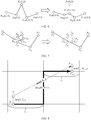
- FIG. 6 is a schematic diagram of trimmed mean filtering according to an embodiment of this application.
- the rectangular coordinate system uses a location of P 14 as an origin, a horizontal direction as an X axis, and a vertical direction as a Y axis.
- X new and Y new serve as new X-axis and Y-axis coordinate values of P 17 : (3,0.23), that is, P 17 ′ shown in FIG. 6 is an updated location.
- the trimmed mean filtering may be performed on each of the n original track points P 1 to P n , or may be performed on some track points. For example, the trimmed mean filtering is only performed on some points of which coordinate value changes are relatively large.
- a difference threshold may be set. When a variation of a coordinate value is less than the difference threshold, it is determined that the coordinate value change is relatively small, and the trimmed mean filtering is not performed, but the embodiments of this application are not limited thereto.
- the original coordinate value of P 17 can still be used by skipping performing trimmed mean filtering on the track point P 17 .
- coordinates of a current point may be adjusted with reference to locations of several points before and after the point, so that the shape of the track is smoother, and subsequent map matching is helped.
- filtering is performed on the n original track points P 1 to P n , and the filtering may be near-point filtering.
- the server obtains the y th to-be-filtered point P y and the (y+1) th to-be-filtered point P y +1 in the n original track points P 1 to P n ; and deletes the y th to-be-filtered point P y and/or the (y+1) th to-be-filtered point P y +1 if a distance between the y th to-be-filtered point P y and the (y+1) th to-be-filtered point P y +1 is less than or equal to a preset distance; otherwise, reserves the two to-be-filtered points P y and P y +1 .
- the server may also obtain the (y-1) th to-be-filtered point P y -1 , the y th to-be-filtered point P y , and the (y+1) th to-be-filtered point P y +1 in the n original track points P 1 to P n ; and delete the y th to-be-filtered point P y ; otherwise, reserve the to-be-filtered point P y if a distance between the (y-1) th to-be-filtered point P y -1 and the y th to-be-filtered point P y is less than or equal to a preset distance, and a distance between the y th to-be-filtered point P y and the (y+1) th to-be-filtered point P y +1 is also less than or equal to the preset distance.
- the preset distance can be set based on an actual situation.
- the preset distance can be set based on a moving speed of the mobile terminal and a sampling time, or the preset distance can be set based on an average value of a distance between every two adjacent points in the n original track points P 1 to P n , and this embodiment of this application is not limited thereto.
- FIG. 7 is a schematic diagram of near-point filtering according to an embodiment of this application.
- each of n original track points P 1 to P n may be used as the y th to-be-filtered point P y sequentially, where the to-be-filtered points P 15 and P 23 are used as an example for description herein.
- a distance between every two adjacent to-be-filtered points in P 15 to P 23 is calculated separately, and it is assumed that only distances of P 16 P 17 , P 17 P 18 , P 18 P 19 , P 19 P 20 , and P 20 P 21 are less than or equal to the preset distance.
- both points P 16 and P 17 can be deleted, and similarly, P 16 to P 21 need to be deleted; or P 16 or P 17 may be deleted, if P 16 is deleted, P 16 to P 20 are deleted correspondingly, and if P 17 is deleted, P 17 to P 21 are deleted correspondingly, that is, as shown in FIG. 7 , remaining points are P 15 , P 16 , P 22 , and P 23 ; or adjacent to-be-filtered points whose distance is less than or equal to the preset distance in points P 16 and P 21 are deleted, that is, P 17 to P 20 are deleted.
- the near-point filtering can eliminate a positioning error caused by an excessively slow moving speed or a static status of the mobile terminal and an impact on map matching, to resolve an anchor point drift problem caused by a stay of the mobile terminal.
- the mobile terminal may be a vehicle, the vehicle may stop or slow down during traveling, and the near-point filtering can eliminate a positioning error caused by a stopping or slowing-down process of the vehicle.
- the filtering in S120 may include at least one of the difference filtering, the speed filtering, the angle filtering, the distortion degree filtering, the trimmed mean filtering, and the near-point filtering. Therefore, when the filtering process includes at least two filtering procedures, n original track points P 1 to P n in any non-first filtering may be obtained by renumbering remaining track points after previous filtering.
- At least one filtering manner of the difference filtering, the speed filtering, the angle filtering, the distortion degree filtering, the trimmed mean filtering, and the near-point filtering may be randomly chosen. For example, because procedures of the angle filtering and the distortion degree filtering are similar, choosing to perform only one of them is acceptable. For another example, because the difference filtering is relatively complex and a probability that original track points completely overlap is relatively small, choosing not to perform the difference filtering is acceptable. For another example, with consideration of a calculation effect, if it is determined to perform the difference filtering, the difference filtering may be set to be first filtering, and then, other filtering is performed.
- the speed filtering, the angle filtering, the trimmed mean filtering, and the near-point filtering can be performed sequentially.
- the difference filtering, the speed filtering, the distortion degree filtering, the trimmed mean filtering, and the near-point filtering may be performed sequentially.
- the method 100 further includes: S130: Determine a moving track of the mobile terminal on at least one road in a road map based on target track points obtained by performing the filtering on the n original track points P 1 to P n , where the road map includes a plurality of roads.
- a server obtains the road map, and the road map includes a plurality of roads.
- the road map in this embodiment of this application may use original data of various existing maps, for example, the largest open source map project OpenStreetMap, OSM for short, in the world.
- An original map file downloaded from the OSM official website is in an XML format; or another map format may also be used, and this embodiment of this application is not limited thereto.
- the road map may include a plurality of roads, and the roads can be divided into several classifications, and for example, may include: a motorway (motorway), a trunk (trunk), a residential route (residential), and some unclassified roads (unclassified).
- the plurality of roads may be divided into passable or impassable roads based on whether the vehicle can pass. For example, an ordinary vehicle cannot pass a residential-grade road.
- the road in the original map can be segmented to obtain a road map including a plurality of roads. For example, segmentation is performed based on a direct cross point between roads, so that each road in the obtained road map is a shortest road. That is, each road is allowed to include only two nodes, namely, a start and an end, without including any branch therebetween.
- each road may be bidirectional, or may be unidirectional, and this embodiment of this application is not limited thereto.
- a point in the map may be identified by using a node, the point may be any point in the map, and each point may have corresponding latitude and longitude information; and a broken line in the original map may further be identified by using a way, a k value may be set for each way, and when the k value is "highway", it indicates that the way corresponds and identifies one road.
- the road grades may be classified as motorway, trunk, primary, secondary, tertiary, unclassified, residential, and service in descending order. Because the last two grades (residential and service) are impassable to a vehicle, and it is assumed that the mobile terminal being the vehicle is used as an example herein, when the original map is constructed and segmented to obtain the road map, roads at the two grades may be ignored. Therefore, only a road indicating that a vehicle can pass is reserved herein, that is, the way identifies a road that a vehicle can pass in the map.
- the node may be used to identify any point in the original map.
- a node on a road is reserved herein.
- a node that is on a road and that is identified by using the node in the original map is reserved.
- the node is reserved and serves a node in a road network, while other nodes are only used to describe a shape of a road segment, and can be ignored herein.
- each way needs to be segmented, and when a node thereof is passed by a plurality of ways, the current way needs to be segmented by the node into two road segments.
- segmentation is continuously performed until it is ensured that only two points, namely, a start and an end, of one road segment are passed by a plurality of ways.
- a segmented road map can be obtained by using an algorithm 1 below.
- the algorithm 1 describes a procedure of a road map construction algorithm, where N and W respectively represent the node and the way read from the OSM; and V is a vertex set of the road map obtained after segmentation, and E is an edge set of the road map that is obtained after segmentation; and E' is a temporary edge set and is used to record a set of road segments into which a current w is segmented.
- a behavior of a split(E, n) function refers to checking every edge in the edge set E, to determine whether there is a road e passing n. If there is e passing n, e is segmented, based on n, into edges e 1 and e 2 .
- the server obtains the road map that includes a plurality of roads, and matches each of target track points obtained by performing the foregoing filtering with the roads in the road map, to obtain at least one corresponding road.
- m target track points are obtained by performing filtering on n original track points P 1 to P n , where m is less than and equal to n.
- Road matching is performed between the m target track points and the road map to obtain m roads, where there may be a same road in the m roads.
- the m target track points may be, for example, matched with the roads through a plurality of algorithms, for example, with consideration of accuracy and robustness, the road matching can be performed based on a hidden Markov model (Hidden Markov Model, HMM), and map matching of the HMM is provided with the best accuracy and robustness.
- HMM Hidden Markov Model
- the HMM is one of Markov chains, and the state thereof cannot be observed directly, but can be observed through an observation sequence. It is assumed that nodes O 1 , O 2 , ..., O n are an observed sequence. The HMM assumes that each observed sequence is generated by a corresponding hidden state, and correspondingly, H 1 , H 2 , ..., H n are a hidden state sequence.
- Each hidden state is related to a previous hidden state, but is not related to a more previous hidden state.
- the HMM map matching algorithm uses a real road segment corresponding to each observation point as a hidden state, the mobile terminal is regarded to transition between hidden states (that is, transition between the road segments), and each hidden state generates an observed state (that is, an actually obtained location of a target track point).
- a path namely, a road segment sequence
- track matching is obtained by obtaining a hidden state sequence having a largest probability in a given observation state.
- FIG. 8 is a schematic diagram of a road map matching method according to an embodiment of this application. As shown in FIG. 8 , for m target track points Z 1 to Z m obtained after filtering, any track point Z i is selected, a radiation probability of a candidate road r a is marked as P(Z i
- a farther distance between the candidate road segment and a sampling point indicates a smaller possibility of actually moving on the road segment and a smaller radiation probability.
- a positioning data error follows Gaussian distribution, then: P Z i
- r a 1 2 ⁇ ⁇ ⁇ e ⁇ dist Z a X i , a 2 2 ⁇ ⁇ where, as shown in FIG. 8 , X i,a is a projection point of Z i on r a .
- the second one that needs to be modeled is a transition probability.
- Any target track point Z i has a series of candidate matching road segments, for example, roads r a , r b ....
- the transition probability refers to a probability of transitioning from a current state to a next state.
- an actual driving path is usually close to a shortest path as much as possible. Therefore, a larger difference between a distance on the road and the shortest distance indicates a lower transition probability.
- a candidate matching road of any target track point Z i is the road segment r a .
- a candidate matching road of a next target track point Z i+1 of the target track point Z i is the road segment r b .
- X i+1,b is marked as a projection point of the target track point Z i+1 on the road segment r b , and then a probability of transitioning from r a that matches Z i to r b matches Z i+1 is: P r b
- Z) is expanded, and a first-order Markov property of the Markov chain is used, including: P R
- R P R P Z 1 , Z 2 , ... , Z m
- r 1 , r 2 , ... , r m P r 1 , r 2 , ... , r m ⁇ P Z i
- a state sequence R can be obtained by using the Viterbi algorithm, so that a posterior probability of the entire sequence is the largest, and the sequence R corresponds to m roads that correspond to m target track points.
- m roads are obtained based on the m target track points; and a moving track of the mobile terminal on the road map is determined based on the m roads.
- the moving track of the mobile terminal on the road map may be determined by using a plurality of algorithms.
- the moving track may be determined by using the following method.
- an actual traveling path of the mobile terminal corresponding to the target track points Z i and Z i+1 is determined, where a matched road of Z i is marked as n, and a matched road of Z i+1 is marked as r i+1 ; and an actual road path, determined by the server, along which the mobile terminal moves from Z i to Z i+1 is marked as R i .
- the moving track of the mobile terminal is from the road r i to the shortest road path r', and then to the road r i+1 , for example, the path shown by the gray line segment in FIG. 9 .
- the m roads corresponding to the m target track points are matched based on the foregoing manner, to obtain at least one consecutive road, that is, the moving track of the mobile terminal on the road map.
- At least one type of filtering is performed on the n original track points during the moving process of the mobile terminal, to obtain m target points; and road map matching is further performed on the m target track points, to obtain the moving track of the mobile terminal, so that a track point that has a relatively large error and that produces a negative effect in the original track points can be filtered out or changed, thereby allowing the processed target track points to be more accurate during the map matching.
- a high-noise data obtaining manner such as base station positioning, and a special situation such as quick positioning
- the subsequent map matching procedure is more accurate and the obtained moving track is closer to an actual situation.
- sequence numbers of the foregoing processes do not mean execution sequences in various embodiments of this application.
- the execution sequences of the processes should be determined according to functions and internal logic of the processes, and should not be construed as any limitation on the implementation processes of the embodiments of this application.
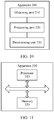
- an apparatus 200 for determining a moving track includes an obtaining unit 210, a processing unit 220, and a determining unit 230.
- the obtaining unit 210 is configured to obtain locations of n original track points P 1 to P n during a moving process of a mobile terminal, where a time point at which the mobile terminal passes the i th original track point P i in the n original track points P 1 to P n is earlier than a time point at which the mobile terminal passes the (i+1) th original track point P i +1 , and n is a positive integer.
- the processing unit 220 is configured to perform filtering on the n original track points P 1 to P n , where the filtering is used to delete at least one of the n original track points P 1 to P n , and/or update a location of at least one of the n original track points P 1 to P n .
- the determining unit 230 is configured to determine a moving track of the mobile terminal on at least one road in a road map based on target track points obtained by performing the filtering on the n original track points P 1 to P n , where the road map includes a plurality of roads.
- the apparatus for determining a moving track in the embodiments of this application, at least one type of filtering is performed on the n original track points during the moving process of the mobile terminal, to obtain m target points; and road map matching is further performed on the m target track points, to obtain the moving track of the mobile terminal, so that a track point that has a relatively large error and that produces a negative effect in the original track points can be filtered out or changed, thereby allowing the processed target track points to be more accurate during the map matching.
- a high-noise data obtaining manner such as base station positioning, and a special situation such as quick positioning
- the subsequent map matching procedure is more accurate and the obtained moving track is closer to an actual situation.
- the processing unit 220 is specifically configured to: obtain a to-be-filtered points P x to P x + a -1 in the n original track points P 1 to P n , where the a to-be-filtered points P x to P x + a -1 are located at a first location, x and a are positive integers; obtain b to-be-filtered points P x + a to P x + a + b -1 in the n original track points P 1 to P n , where the b to-be-filtered points P x + a to P x + a + b -1 are located at a second location, b is a positive integer greater than 1; obtain c to-be-filtered points P x + a + b to P x + a + b + c -1 in the n original track points P 1 to P n , where the c to-be-filtered points P x + a + b to P x + a + b +
- the processing unit 220 is specifically configured to: obtain a speed at a first to-be-filtered point P a in the n original track points P 1 to P n , where a is a positive integer less than or equal to n; and delete the first to-be-filtered point P a if the speed at the first to-be-filtered point P a is greater than or equal to a preset speed.
- the processing unit 220 is specifically configured to: obtain four to-be-filtered points P c , P c +1 , P c +2 , and P c +3 in the n original track points P 1 to P n , where c is a positive integer, and c+3 is less than or equal to n; determine a first angle ⁇ P c P c +1 P c +2 and a second angle ⁇ P c +1 P c +2 P c +3 ; and delete the to-be-filtered point P c +1 or the to-be-filtered point P c +2 in the four to-be-filtered points P c , P c +1 , P c +2 , and P c +3 if the first angle is less than or equal to a first preset angle and the second angle is less than or equal to a second preset angle.
- the processing unit 220 is specifically configured to: obtain 2 ⁇ +1 to-be-filtered points P f - ⁇ to P f + ⁇ in the n original track points P 1 to P n , where f and ⁇ are positive integers, and f is greater than ⁇ ; determine a distance between a to-be-filtered point P g and an adjacent to-be-filtered point P g +1 that are in the 2 ⁇ +1 to-be-filtered points P f- ⁇ to P f + ⁇ , where g is set to range from f- ⁇ to f+ ⁇ -1, to obtain 2 ⁇ distances; determine that a distance between the first to-be-filtered point P f - ⁇ and the last to-be-filtered point P f + ⁇ that are in the 2 ⁇ +1 to-be-filtered points P f - ⁇ to P f + ⁇ is a first distance; determine that a quotient of a sum of the 2 ⁇ distances and the first distance is a distortion degree; and delete the (
- the processing unit 220 is specifically configured to: obtain 2 ⁇ +1 to-be-filtered points P l - ⁇ to P l + ⁇ in the n original track points P 1 to P n , where l and ⁇ are positive integers and l is greater than ⁇ ; determine, in the 2 ⁇ +1 to-be-filtered points P l - ⁇ to P l + ⁇ , an average value of longitudes of all k to-be-filtered points and an average value of latitudes of all h to-be-filtered points, where k and h are positive integers less than 2 ⁇ +1; and respectively determine the average value of the longitudes and the average value of the latitudes as a longitude and a latitude of the ( ⁇ +1) th to-be-filtered point P l in the 2 ⁇ +1 to-be-filtered points P l - ⁇ to P l + ⁇ .
- the processing unit 220 is specifically configured to: obtain the y th to-be-filtered point P y and the (y+1) th to-be-filtered point P y +1 in the n original track points P 1 to P n ; and delete the y th to-be-filtered point P y and/or the (y+1) th to-be-filtered point P y +1 if a distance between the y th to-be-filtered point P y and the (y+1) th to-be-filtered point P y +1 is less than or equal to a preset distance.
- the apparatus 200 for determining a moving track may correspond to performing the method 100 in the embodiments of this application, and in the apparatus 200, the foregoing and other operations and/or functions of units are respectively performed for corresponding procedures of the server in each method in FIG. 1 to FIG. 9 .
- the apparatus 200 for determining a moving track may correspond to performing the method 100 in the embodiments of this application, and in the apparatus 200, the foregoing and other operations and/or functions of units are respectively performed for corresponding procedures of the server in each method in FIG. 1 to FIG. 9 .
- details are not described herein again.
- the apparatus for determining a moving track in the embodiments of this application, at least one type of filtering is performed on the n original track points during the moving process of the mobile terminal, to obtain m target points; and road map matching is further performed on the m target track points, to obtain the moving track of the mobile terminal, so that a track point that has a relatively large error and that produces a negative effect in the original track points can be filtered out or changed, thereby allowing the processed target track points to be more accurate during the map matching.
- a high-noise data obtaining manner such as base station positioning, and a special situation such as quick positioning
- the subsequent map matching procedure is more accurate and the obtained moving track is closer to an actual situation.
- FIG. 11 is a schematic block diagram of an apparatus 300 for determining a moving track according to an embodiment of this application.
- the apparatus 300 includes a processor 310.
- the apparatus 300 further includes a memory 320, and the memory 320 is connected to the processor 310.
- the processor 310 and the memory 320 may communicate with each other through an inner connection path, to transfer and/or control a data signal.
- the memory 320 may be configured to store an instruction
- the processor 310 is configured to perform the instruction stored in the memory 320
- the processor 310 is further configured to: obtain locations of n original track points P 1 to P n during a moving process of a mobile terminal, where a time point at which the mobile terminal passes the i th original track point P i in the n original track points P 1 to P n is earlier than a time point at which the mobile terminal passes the (i+1) th original track point P i +1 , and n is a positive integer; perform filtering on the n original track points P 1 to P n , where the filtering is used to delete at least one of the n original track points P 1 to P n , and/or update a location of at least one of the n original track points P 1 to P n ; and determine a moving track of the mobile terminal on at least one road in a road map based on target track points obtained by performing the filtering on the n original track points P 1 to P n
- the apparatus for determining a moving track in the embodiments of this application, at least one type of filtering is performed on the n original track points during the moving process of the mobile terminal, to obtain m target points; and road map matching is further performed on the m target track points, to obtain the moving track of the mobile terminal, so that a track point that has a relatively large error and that produces a negative effect in the original track points can be filtered out or changed, thereby allowing the processed target track points to be more accurate during the map matching.
- a high-noise data obtaining manner such as base station positioning, and a special situation such as quick positioning
- the subsequent map matching procedure is more accurate and the obtained moving track is closer to an actual situation.
- the processor 310 is configured to: obtain a to-be-filtered points P x to P x + a -1 in the n original track points P 1 to P n , where the a to-be-filtered points P x to P x + a -1 are located at a first location, and x and a are positive integers; obtain b to-be-filtered points P x + a to P x + a + b -1 in the n original track points P 1 to P n , where the b to-be-filtered points P x + a to P x + a + b -1 are located at a second location, and b is a positive integer greater than 1; obtain c to-be-filtered points P x + a + b to P x + a + b + c -1 in the n original track points P 1 to P n , where the c to-be-filtered points P x + a + b to P x + , where the c to
- the processor 310 is configured to: obtain a speed at a first to-be-filtered point P a in the n original track points P 1 to P n , where a is a positive integer less than or equal to n; and delete the first to-be-filtered point P a if the speed at the first to-be-filtered point P a is greater than or equal to a preset speed.
- the processor 310 is configured to: obtain four to-be-filtered points P c , P c +1 , P c +2 , and P c +3 in the n original track points P 1 to P n , where c is a positive integer, and c+3 is less than or equal to n; determine a first angle ⁇ P c P c +1 P c +2 and a second angle ⁇ P c +1 P c +2 P c +3 ; and delete the to-be-filtered point P c +1 or the to-be-filtered point P c +2 in the four to-be-filtered points P c , P c +1 , P c +2 , and P c +3 if the first angle is less than or equal to a first preset angle and the second angle is less than or equal to a second preset angle.
- the processor 310 is configured to: obtain 2 ⁇ +1 to-be-filtered points P f - ⁇ to P f + ⁇ in the n original track points P 1 to P n , where f and a are positive integers, and f is greater than a; determine a distance between a to-be-filtered point P g and an adjacent to-be-filtered point P g +1 that are in the 2 ⁇ +1 to-be-filtered points P f - ⁇ to P f + ⁇ , where g is set to range from f- ⁇ to f+ ⁇ -1, to obtain 2a distances; determine that a distance between the first to-be-filtered point P f - ⁇ and the last to-be-filtered point P f + ⁇ that are in the 2 ⁇ +1 to-be-filtered points P f - ⁇ to P f + ⁇ is a first distance; determine that a quotient of a sum of the 2a distances and the first distance is a distortion degree;
- the processor 310 is configured to: obtain 2 ⁇ +1 to-be-filtered points P l - ⁇ to P l + ⁇ in the n original track points P 1 to P n , where l and ⁇ are positive integers, and l is greater than ⁇ ; determine, in the 2 ⁇ +1 to-be-filtered points P l - ⁇ to P l + ⁇ , an average value of longitudes of all k to-be-filtered points and an average value of latitudes of all h to-be-filtered points, where k and h are positive integers less than 2 ⁇ +1; and determine that the average value of the longitudes and the average value of the latitudes are respectively a longitude and a latitude that are of the ( ⁇ +1) th to-be-filtered point P l in the 2 ⁇ +1 to-be-filtered points P l - ⁇ to P l + ⁇ .
- the processor 310 is configured to: obtain a y th to-be-filtered point P y and a (y+1) th to-be-filtered point P y +1 in the n original track points P 1 to P n ; and delete the y th to-be-filtered point P y and/or the (y+1) th to-be-filtered point P y +1 if a distance between the y th to-be-filtered point P y and the (y+1) th to-be-filtered point P y +1 is less than or equal to a preset distance.
- the apparatus 300 for determining a moving track may correspond to the apparatus 200 in the embodiments of this application, and may correspond to a corresponding execution body in the method 100 according to the embodiments of this application, and the foregoing and other operations and/or functions of the units of the apparatus 300 are respectively intended to implement corresponding procedures of the server in the methods in FIG. 1 to FIG. 9 .
- the apparatus 300 for determining a moving track may correspond to the apparatus 200 in the embodiments of this application, and may correspond to a corresponding execution body in the method 100 according to the embodiments of this application, and the foregoing and other operations and/or functions of the units of the apparatus 300 are respectively intended to implement corresponding procedures of the server in the methods in FIG. 1 to FIG. 9 .
- details are not described herein again.
- the apparatus for determining a moving track in the embodiments of this application, at least one type of filtering is performed on the n original track points during the moving process of the mobile terminal, to obtain m target points; and road map matching is further performed on the m target track points, to obtain the moving track of the mobile terminal, so that a track point that has a relatively large error and that produces a negative effect in the original track points can be filtered out or changed, thereby allowing the processed target track points to be more accurate during the map matching.
- a high-noise data obtaining manner such as base station positioning, and a special situation such as quick positioning
- the subsequent map matching procedure is more accurate and the obtained moving track is closer to an actual situation.
- the processor may be an integrated circuit chip and has a signal processing capability.
- steps in the foregoing method embodiments can be implemented by using a hardware integrated logical circuit in the processor, or by using instructions in a form of software.
- the processor may be a general purpose processor, a digital signal processor (Digital Signal Processor, DSP), an application specific integrated circuit (Application Specific Integrated Circuit, ASIC), a field programmable gate array (Field Programmable Gate Array, FPGA) or another programmable logical device, a discrete gate or transistor logic device, or a discrete hardware component.
- DSP Digital Signal Processor
- ASIC Application Specific Integrated Circuit
- FPGA Field Programmable Gate Array
- the general purpose processor may be a microprocessor, or the processor may be any conventional processor or the like. Steps of the methods disclosed with reference to the embodiments of this application may be directly executed and accomplished by means of a hardware decoding processor, or may be executed and accomplished by using a combination of hardware and software modules in the decoding processor.
- a software module may be located in a mature storage medium in the art, such as a random access memory, a flash memory, a read-only memory, a programmable read-only memory, an electrically erasable programmable memory, a register, or the like. The storage medium is located in the memory, and a processor reads information in the memory and completes the steps in the foregoing methods in combination with hardware of the processor.
- the memory in the embodiments of this application may be a volatile memory or a nonvolatile memory, or may include a volatile memory and a nonvolatile memory.
- the nonvolatile memory may be a read-only memory (Read-Only Memory, ROM), a programmable read-only memory (Programmable ROM, PROM), an erasable programmable read-only memory (Erasable PROM, EPROM), an electrically erasable programmable read-only memory (Electrically EPROM, EEPROM), or a flash memory.
- the volatile memory may be a random access memory (Random Access Memory, RAM), used as an external cache.
- RAMs may be used, for example, a static random access memory (Static RAM, SRAM), a dynamic random access memory (Dynamic RAM, DRAM), a synchronous dynamic random access memory (Synchronous DRAM, SDRAM), a double data rate synchronous dynamic random access memory (Double Data Rate SDRAM, DDR SDRAM), an enhanced synchronous dynamic random access memory (Enhanced SDRAM, ESDRAM), a synchlink dynamic random access memory (Synchlink DRAM, SLDRAM), and a direct rambus random access memory (Direct Rambus RAM, DR RAM).
- Static RAM static random access memory
- DRAM dynamic random access memory
- DRAM synchronous dynamic random access memory
- SDRAM double data rate synchronous dynamic random access memory
- Enhanced SDRAM, ESDRAM enhanced synchronous dynamic random access memory
- Synchlink DRAM, SLDRAM synchlink dynamic random access memory
- Direct Rambus RAM Direct Rambus RAM
- the disclosed system, apparatus, and method may be implemented in other manners.
- the described apparatus embodiment is merely an example.
- the unit division is merely logical function division and may be other division in actual implementation.
- a plurality of units or components may be combined or integrated into another system, or some features may be ignored or not performed.
- the displayed or discussed mutual couplings or direct couplings or communication connections may be implemented by using some interfaces.
- the indirect couplings or communication connections between the apparatuses or units may be implemented in electronic, mechanical, or other forms.
- the units described as separate parts may or may not be physically separate, and parts displayed as units may or may not be physical units, may be located in one position, or may be distributed on a plurality of network units. Some or all of the units may be selected based on actual requirements to achieve the objectives of the solutions of the embodiments.
- the functions When the functions are implemented in the form of a software functional unit and sold or used as an independent product, the functions may be stored in a computer-readable storage medium. Based on such an understanding, the technical solutions of this application essentially, or the part contributing to the prior art, or some of the technical solutions may be implemented in a form of a software product.
- the software product is stored in a storage medium, and includes several instructions for instructing a computer device (which may be a personal computer, a server, or a network device) to perform all or some of the steps of the methods described in the embodiments of this application.
- the foregoing storage medium includes: any medium that can store program code, such as a USB flash drive, a removable hard disk, a read-only memory (Read-Only Memory, ROM), a random access memory (Random Access Memory, RAM), a magnetic disk, or an optical disc.
- program code such as a USB flash drive, a removable hard disk, a read-only memory (Read-Only Memory, ROM), a random access memory (Random Access Memory, RAM), a magnetic disk, or an optical disc.
Landscapes
- Engineering & Computer Science (AREA)
- Remote Sensing (AREA)
- Radar, Positioning & Navigation (AREA)
- Physics & Mathematics (AREA)
- General Physics & Mathematics (AREA)
- Computer Networks & Wireless Communication (AREA)
- Multimedia (AREA)
- Theoretical Computer Science (AREA)
- Computer Vision & Pattern Recognition (AREA)
- Automation & Control Theory (AREA)
- Computer Hardware Design (AREA)
- General Engineering & Computer Science (AREA)
- Signal Processing (AREA)
- Navigation (AREA)
- Image Processing (AREA)
Applications Claiming Priority (2)
| Application Number | Priority Date | Filing Date | Title |
|---|---|---|---|
| CN201710586941.1A CN109269514A (zh) | 2017-07-18 | 2017-07-18 | 确定运动轨迹的方法和装置 |
| PCT/CN2018/094740 WO2019015485A1 (zh) | 2017-07-18 | 2018-07-06 | 确定运动轨迹的方法和装置 |
Publications (2)
| Publication Number | Publication Date |
|---|---|
| EP3640596A1 true EP3640596A1 (de) | 2020-04-22 |
| EP3640596A4 EP3640596A4 (de) | 2020-09-16 |
Family
ID=65015376
Family Applications (1)
| Application Number | Title | Priority Date | Filing Date |
|---|---|---|---|
| EP18834716.5A Withdrawn EP3640596A4 (de) | 2017-07-18 | 2018-07-06 | Verfahren und vorrichtung zur bestimmung einer bewegungsbahn |
Country Status (4)
| Country | Link |
|---|---|
| US (1) | US20200151885A1 (de) |
| EP (1) | EP3640596A4 (de) |
| CN (1) | CN109269514A (de) |
| WO (1) | WO2019015485A1 (de) |
Cited By (8)
| Publication number | Priority date | Publication date | Assignee | Title |
|---|---|---|---|---|
| CN111615061A (zh) * | 2020-05-09 | 2020-09-01 | 国家计算机网络与信息安全管理中心山东分中心 | 移动终端轨迹数据的去噪方法及装置 |
| EP4083575A3 (de) * | 2021-04-27 | 2023-03-15 | Via Transportation, Inc. | Systeme und verfahren zur routenrekonstruktion |
| WO2024025360A1 (ko) * | 2022-07-27 | 2024-02-01 | 홍익대학교 산학협력단 | 지구위치데이터 맵 매칭방법 및 이를 위한 컴퓨팅 장치 |
| US12430595B2 (en) | 2013-03-15 | 2025-09-30 | Via Transportation, Inc. | System and method for transportation |
| US12437353B2 (en) | 2017-05-22 | 2025-10-07 | Via Transportation, Inc. | Systems and methods for managing ridesharing vehicles |
| US12461537B2 (en) | 2018-01-08 | 2025-11-04 | Via Transportation, Inc. | Accounting for driver reaction time when providing driving instructions |
| US12572995B2 (en) | 2021-05-07 | 2026-03-10 | Via Transportation, Inc. | Systems and methods for plan determination |
| US12675527B2 (en) | 2022-08-17 | 2026-07-07 | Via Transportation, Inc. | Systems and methods for reachability of different destinations |
Families Citing this family (35)
| Publication number | Priority date | Publication date | Assignee | Title |
|---|---|---|---|---|
| CN110858990B (zh) * | 2018-08-22 | 2021-04-20 | 华为技术有限公司 | 一种网络重选的方法及装置 |
| CN111857113B (zh) * | 2019-04-12 | 2023-11-03 | 北京地平线机器人技术研发有限公司 | 可移动设备的定位方法及定位装置 |
| US11218887B2 (en) * | 2019-10-15 | 2022-01-04 | Cisco Technology, Inc. | Switching of networks for a mobile device using location based predictive algorithm |
| CN110650437B (zh) * | 2019-11-27 | 2020-02-18 | 苏宁云计算有限公司 | 电子围栏上的围栏点删除方法、装置及计算机设备 |
| CN110991525B (zh) * | 2019-11-29 | 2022-08-16 | 西安交通大学 | 基于运营商轨迹数据的伴随模式匹配方法 |
| CN112985430B (zh) * | 2019-12-13 | 2024-06-25 | 百度在线网络技术(北京)有限公司 | 地图匹配的容灾方法、装置、设备及存储介质 |
| CN111368014B (zh) * | 2019-12-23 | 2024-04-19 | 广东小天才科技有限公司 | 一种运动轨迹的生成方法、终端设备及存储介质 |
| CN111158368B (zh) * | 2019-12-31 | 2024-02-02 | 深圳市优必选科技股份有限公司 | 一种双足机器人及其轨迹跟随方法和装置 |
| CN111723304B (zh) * | 2020-01-03 | 2023-07-14 | 腾讯科技(深圳)有限公司 | 一种轨迹点识别方法和相关装置 |
| CN113408973A (zh) * | 2020-03-17 | 2021-09-17 | 北京京东振世信息技术有限公司 | 生成轨迹数据的方法和装置 |
| CN113495939A (zh) * | 2020-04-08 | 2021-10-12 | 中移智行网络科技有限公司 | 基于道格拉斯-普克算法的车辆轨迹纠偏方法和装置 |
| CN113539050B (zh) * | 2020-04-20 | 2022-09-23 | 华为技术有限公司 | 数据处理方法、装置及设备 |
| CN111679297A (zh) * | 2020-05-08 | 2020-09-18 | 四川超影科技有限公司 | 一种gps定位轨迹的噪声点漂移去除方法 |
| CN111735461B (zh) * | 2020-06-10 | 2023-11-17 | 腾讯科技(深圳)有限公司 | 行驶轨迹的处理方法、装置及电子设备 |
| CN112487114B (zh) * | 2020-11-10 | 2021-08-31 | 电子科技大学 | 一种城市交叉口地图匹配方法 |
| CN112365088B (zh) * | 2020-11-28 | 2024-04-26 | 北京梧桐车联科技有限责任公司 | 行程关键点的确定方法、装置、设备及可读存储介质 |
| CN112527932B (zh) * | 2020-12-04 | 2023-09-26 | 北京百度网讯科技有限公司 | 道路数据处理的方法、装置、设备及存储介质 |
| CN112541852B (zh) * | 2020-12-24 | 2024-04-12 | 南方科技大学 | 城市人流监控方法、装置、电子设备及存储介质 |
| CN112907686B (zh) * | 2021-02-09 | 2021-12-14 | 青海师范大学 | 用于矢量轨迹压缩的余弦垂距判别方法、装置和设备 |
| CN113157848A (zh) * | 2021-05-06 | 2021-07-23 | 清华大学 | 航路确定方法及装置、电子设备和存储介质 |
| CN116009523A (zh) * | 2021-10-22 | 2023-04-25 | 苏州艾利特机器人有限公司 | 一种轨迹跟踪方法、装置、设备和存储介质 |
| CN113806426A (zh) * | 2021-11-16 | 2021-12-17 | 亿海蓝(北京)数据技术股份公司 | 轨迹数据的处理方法、装置、可读存储介质和电子设备 |
| CN114419186B (zh) * | 2021-12-15 | 2025-04-25 | 武汉中海庭数据技术有限公司 | 一种基于原始轨迹生成道路分歧合流点的方法 |
| CN114838735B (zh) * | 2022-03-21 | 2024-05-10 | 江苏盛海智能科技有限公司 | 一种基于movebase的路径循迹方法及终端 |
| CN114925049B (zh) * | 2022-05-10 | 2025-04-18 | 青岛海信网络科技股份有限公司 | 一种轨迹校正方法 |
| CN115439813B (zh) * | 2022-08-04 | 2025-10-31 | 新石器慧通(北京)科技有限公司 | 路沿跟踪方法、装置、计算机可读存储介质及驾驶装置 |
| CN115540879A (zh) * | 2022-09-19 | 2022-12-30 | 深圳依时货拉拉科技有限公司 | 路网匹配方法及装置、计算机设备及可读存储介质 |
| CN115454144B (zh) * | 2022-10-28 | 2023-02-24 | 中国电子科技集团公司第二十八研究所 | 一种动目标飞行轨迹平滑方法及系统 |
| CN116182866B (zh) * | 2023-02-14 | 2026-01-02 | 南京领行科技股份有限公司 | 行驶轨迹的重合检测方法、装置、电子设备及介质 |
| CN116840878A (zh) * | 2023-05-25 | 2023-10-03 | 深圳市正浩创新科技股份有限公司 | 自移动设备的回充方法、自移动设备和可读存储介质 |
| CN116430423B (zh) * | 2023-06-13 | 2023-08-29 | 广州悦跑信息科技有限公司 | 一种运动数据中卫星导航定位轨迹点坐标修正方法 |
| CN117232538A (zh) * | 2023-08-25 | 2023-12-15 | 江苏东成工具科技有限公司 | 一种轨迹处理方法、装置和计算机可读存储介质 |
| CN118033703B (zh) * | 2024-04-12 | 2024-07-12 | 华能信息技术有限公司 | 一种基于地图融合的无人驾驶矿车定位方法及系统 |
| CN119445001B (zh) * | 2025-01-08 | 2025-04-29 | 北京智网易联科技有限公司 | 基于三维网格的低空航迹处理方法及装置 |
| CN119667734B (zh) * | 2025-02-18 | 2025-08-08 | 杭州智元研究院有限公司 | 一种视频轨迹与gps定位融合应用的行动轨迹复盘方法 |
Family Cites Families (13)
| Publication number | Priority date | Publication date | Assignee | Title |
|---|---|---|---|---|
| JP4348441B2 (ja) * | 2007-01-22 | 2009-10-21 | 国立大学法人 大阪教育大学 | 位置検出装置、位置検出方法、データ判定装置、データ判定方法、コンピュータプログラム及び記憶媒体 |
| US8798902B2 (en) * | 2008-02-05 | 2014-08-05 | General Electric Company | System, method and computer software code for obtaining information for routing a powered system and adjusting a route in accordance with relevant information |
| CN101458434B (zh) * | 2009-01-08 | 2010-09-08 | 浙江大学 | 精确测量和预测乒乓球轨迹系统 |
| US9273968B2 (en) * | 2010-06-23 | 2016-03-01 | Aisin Aw Co., Ltd. | Track information generating device, track information generating method, and computer-readable storage medium |
| US9167386B2 (en) * | 2012-06-26 | 2015-10-20 | The Governing Council Of The University Of Toronto | System, method and computer program for dynamic generation of a radio map |
| CN103037507A (zh) * | 2012-12-17 | 2013-04-10 | 浙江鸿程计算机系统有限公司 | 一种基于Cell-ID定位技术的地图匹配方法 |
| CN104115180B (zh) * | 2013-02-21 | 2017-06-09 | 索尼公司 | 信息处理设备、信息处理方法和程序 |
| CN104596507B (zh) * | 2015-02-09 | 2017-10-03 | 成都小步创想畅联科技有限公司 | 一种移动终端出行轨迹的确定方法 |
| CN105628033B (zh) * | 2016-02-26 | 2019-04-02 | 广西鑫朗通信技术有限公司 | 一种基于道路连通关系的地图匹配方法 |
| CN105890599A (zh) * | 2016-04-12 | 2016-08-24 | 上海牵挂网络科技有限公司 | 一种基于地理位置足迹噪点的过滤算法 |
| CN106231671B (zh) * | 2016-08-09 | 2019-05-17 | 南京掌控网络科技有限公司 | 一种移动设备的移动轨迹优化方法 |
| CN106483537A (zh) * | 2016-09-22 | 2017-03-08 | 深圳市时代经纬科技有限公司 | 一种卫星定位轨迹的优化方法 |
| CN106650771A (zh) * | 2016-09-29 | 2017-05-10 | 百度在线网络技术(北京)有限公司 | 基于聚类分析的轨迹去噪方法以及装置 |
-
2017
- 2017-07-18 CN CN201710586941.1A patent/CN109269514A/zh active Pending
-
2018
- 2018-07-06 EP EP18834716.5A patent/EP3640596A4/de not_active Withdrawn
- 2018-07-06 WO PCT/CN2018/094740 patent/WO2019015485A1/zh not_active Ceased
-
2020
- 2020-01-17 US US16/746,666 patent/US20200151885A1/en not_active Abandoned
Cited By (9)
| Publication number | Priority date | Publication date | Assignee | Title |
|---|---|---|---|---|
| US12430595B2 (en) | 2013-03-15 | 2025-09-30 | Via Transportation, Inc. | System and method for transportation |
| US12437353B2 (en) | 2017-05-22 | 2025-10-07 | Via Transportation, Inc. | Systems and methods for managing ridesharing vehicles |
| US12461537B2 (en) | 2018-01-08 | 2025-11-04 | Via Transportation, Inc. | Accounting for driver reaction time when providing driving instructions |
| CN111615061A (zh) * | 2020-05-09 | 2020-09-01 | 国家计算机网络与信息安全管理中心山东分中心 | 移动终端轨迹数据的去噪方法及装置 |
| CN111615061B (zh) * | 2020-05-09 | 2022-02-15 | 国家计算机网络与信息安全管理中心山东分中心 | 移动终端轨迹数据的去噪方法及装置 |
| EP4083575A3 (de) * | 2021-04-27 | 2023-03-15 | Via Transportation, Inc. | Systeme und verfahren zur routenrekonstruktion |
| US12572995B2 (en) | 2021-05-07 | 2026-03-10 | Via Transportation, Inc. | Systems and methods for plan determination |
| WO2024025360A1 (ko) * | 2022-07-27 | 2024-02-01 | 홍익대학교 산학협력단 | 지구위치데이터 맵 매칭방법 및 이를 위한 컴퓨팅 장치 |
| US12675527B2 (en) | 2022-08-17 | 2026-07-07 | Via Transportation, Inc. | Systems and methods for reachability of different destinations |
Also Published As
| Publication number | Publication date |
|---|---|
| CN109269514A (zh) | 2019-01-25 |
| WO2019015485A1 (zh) | 2019-01-24 |
| EP3640596A4 (de) | 2020-09-16 |
| US20200151885A1 (en) | 2020-05-14 |
Similar Documents
| Publication | Publication Date | Title |
|---|---|---|
| US20200151885A1 (en) | Method and apparatus for determining moving track | |
| ES2544750T3 (es) | Cálculo poligonal adaptable en posicionamiento de identidad celular mejorado adaptable | |
| US9107132B2 (en) | Trajectory-aware location-based hand-offs | |
| US9357473B2 (en) | Adaptive wireless access point discovery | |
| CN104270714B (zh) | 确定用户行动轨迹的方法和装置 | |
| CN111797189B (zh) | 数据源质量评价方法与装置、设备、计算机可读存储介质 | |
| US20110227791A1 (en) | Selecting beacons for location inference | |
| EP3624497A1 (de) | Verfahren und vorrichtung zur korrektur eines positionierungsversatzes | |
| CN110702133B (zh) | 路径规划方法、机器人以及具有存储功能的装置 | |
| US20140300776A1 (en) | Picture locating method and system based on navigation function of mobile terminal | |
| EP3461105B1 (de) | Positionierungsverfahren und server | |
| Anagnostopoulos et al. | Intelligent trajectory classification for improved movement prediction | |
| CN117553801B (zh) | 拓扑路径图生成方法、装置、机器人及存储介质 | |
| Huang et al. | Frequent pattern-based map-matching on low sampling rate trajectories | |
| Wu et al. | Clsters: A general system for reducing errors of trajectories under challenging localization situations | |
| EP2039197A1 (de) | Dynamische routenprädiktion auf der basis von verkehrsmustern von mobileinheiten | |
| CN107708072A (zh) | 基于移动通信网络的轨迹分析方法及装置 | |
| CN112836991A (zh) | 站点规划方法、装置、终端设备和可读存储介质 | |
| US10582341B2 (en) | Facilitating estimation of mobile device presence inside a defined region | |
| CN103415070A (zh) | 基于可移动路径的定位方法及装置 | |
| CN104515528A (zh) | 基于路段累积概率的单点地图匹配方法 | |
| CN107018525A (zh) | 定位方法、装置及系统 | |
| CN113282808B (zh) | 轨迹的存储方法、系统及存储介质 | |
| CN103208189B (zh) | 一种监控道路流量方法及设备 | |
| CN114245309A (zh) | 定位方法、装置、设备及存储介质 |
Legal Events
| Date | Code | Title | Description |
|---|---|---|---|
| STAA | Information on the status of an ep patent application or granted ep patent |
Free format text: STATUS: THE INTERNATIONAL PUBLICATION HAS BEEN MADE |
|
| PUAI | Public reference made under article 153(3) epc to a published international application that has entered the european phase |
Free format text: ORIGINAL CODE: 0009012 |
|
| STAA | Information on the status of an ep patent application or granted ep patent |
Free format text: STATUS: REQUEST FOR EXAMINATION WAS MADE |
|
| 17P | Request for examination filed |
Effective date: 20200113 |
|
| AK | Designated contracting states |
Kind code of ref document: A1 Designated state(s): AL AT BE BG CH CY CZ DE DK EE ES FI FR GB GR HR HU IE IS IT LI LT LU LV MC MK MT NL NO PL PT RO RS SE SI SK SM TR |
|
| AX | Request for extension of the european patent |
Extension state: BA ME |
|
| RIN1 | Information on inventor provided before grant (corrected) |
Inventor name: YANG, LI Inventor name: SUN, WEIWEI Inventor name: WU, HAO |
|
| RIC1 | Information provided on ipc code assigned before grant |
Ipc: H04L 29/08 20060101ALI20200527BHEP Ipc: G01C 21/30 20060101AFI20200527BHEP |
|
| A4 | Supplementary search report drawn up and despatched |
Effective date: 20200814 |
|
| RIC1 | Information provided on ipc code assigned before grant |
Ipc: G01S 19/37 20100101ALI20200810BHEP Ipc: G01C 21/30 20060101AFI20200810BHEP Ipc: H04L 29/08 20060101ALI20200810BHEP |
|
| DAV | Request for validation of the european patent (deleted) | ||
| DAX | Request for extension of the european patent (deleted) | ||
| STAA | Information on the status of an ep patent application or granted ep patent |
Free format text: STATUS: THE APPLICATION HAS BEEN WITHDRAWN |
|
| 18W | Application withdrawn |
Effective date: 20210910 |