EP3640873A1 - Système et procédé d'optimisation dynamique concurrente de décisions de réapprovisionnement dans un environnement de noeud en réseau - Google Patents
Système et procédé d'optimisation dynamique concurrente de décisions de réapprovisionnement dans un environnement de noeud en réseau Download PDFInfo
- Publication number
- EP3640873A1 EP3640873A1 EP19203540.0A EP19203540A EP3640873A1 EP 3640873 A1 EP3640873 A1 EP 3640873A1 EP 19203540 A EP19203540 A EP 19203540A EP 3640873 A1 EP3640873 A1 EP 3640873A1
- Authority
- EP
- European Patent Office
- Prior art keywords
- replenishment
- actionable
- matrix
- networked node
- node environment
- Prior art date
- Legal status (The legal status is an assumption and is not a legal conclusion. Google has not performed a legal analysis and makes no representation as to the accuracy of the status listed.)
- Withdrawn
Links
Images


Classifications
-
- G—PHYSICS
- G06—COMPUTING OR CALCULATING; COUNTING
- G06Q—INFORMATION AND COMMUNICATION TECHNOLOGY [ICT] SPECIALLY ADAPTED FOR ADMINISTRATIVE, COMMERCIAL, FINANCIAL, MANAGERIAL OR SUPERVISORY PURPOSES; SYSTEMS OR METHODS SPECIALLY ADAPTED FOR ADMINISTRATIVE, COMMERCIAL, FINANCIAL, MANAGERIAL OR SUPERVISORY PURPOSES, NOT OTHERWISE PROVIDED FOR
- G06Q10/00—Administration; Management
- G06Q10/04—Forecasting or optimisation specially adapted for administrative or management purposes, e.g. linear programming or "cutting stock problem"
-
- G—PHYSICS
- G06—COMPUTING OR CALCULATING; COUNTING
- G06Q—INFORMATION AND COMMUNICATION TECHNOLOGY [ICT] SPECIALLY ADAPTED FOR ADMINISTRATIVE, COMMERCIAL, FINANCIAL, MANAGERIAL OR SUPERVISORY PURPOSES; SYSTEMS OR METHODS SPECIALLY ADAPTED FOR ADMINISTRATIVE, COMMERCIAL, FINANCIAL, MANAGERIAL OR SUPERVISORY PURPOSES, NOT OTHERWISE PROVIDED FOR
- G06Q10/00—Administration; Management
- G06Q10/06—Resources, workflows, human or project management; Enterprise or organisation planning; Enterprise or organisation modelling
- G06Q10/063—Operations research, analysis or management
- G06Q10/0631—Resource planning, allocation, distributing or scheduling for enterprises or organisations
- G06Q10/06315—Needs-based resource requirements planning or analysis
-
- G—PHYSICS
- G06—COMPUTING OR CALCULATING; COUNTING
- G06N—COMPUTING ARRANGEMENTS BASED ON SPECIFIC COMPUTATIONAL MODELS
- G06N20/00—Machine learning
-
- G—PHYSICS
- G06—COMPUTING OR CALCULATING; COUNTING
- G06Q—INFORMATION AND COMMUNICATION TECHNOLOGY [ICT] SPECIALLY ADAPTED FOR ADMINISTRATIVE, COMMERCIAL, FINANCIAL, MANAGERIAL OR SUPERVISORY PURPOSES; SYSTEMS OR METHODS SPECIALLY ADAPTED FOR ADMINISTRATIVE, COMMERCIAL, FINANCIAL, MANAGERIAL OR SUPERVISORY PURPOSES, NOT OTHERWISE PROVIDED FOR
- G06Q10/00—Administration; Management
- G06Q10/06—Resources, workflows, human or project management; Enterprise or organisation planning; Enterprise or organisation modelling
- G06Q10/067—Enterprise or organisation modelling
-
- G—PHYSICS
- G06—COMPUTING OR CALCULATING; COUNTING
- G06Q—INFORMATION AND COMMUNICATION TECHNOLOGY [ICT] SPECIALLY ADAPTED FOR ADMINISTRATIVE, COMMERCIAL, FINANCIAL, MANAGERIAL OR SUPERVISORY PURPOSES; SYSTEMS OR METHODS SPECIALLY ADAPTED FOR ADMINISTRATIVE, COMMERCIAL, FINANCIAL, MANAGERIAL OR SUPERVISORY PURPOSES, NOT OTHERWISE PROVIDED FOR
- G06Q10/00—Administration; Management
- G06Q10/08—Logistics, e.g. warehousing, loading or distribution; Inventory or stock management
- G06Q10/087—Inventory or stock management, e.g. order filling, procurement or balancing against orders
-
- G—PHYSICS
- G06—COMPUTING OR CALCULATING; COUNTING
- G06Q—INFORMATION AND COMMUNICATION TECHNOLOGY [ICT] SPECIALLY ADAPTED FOR ADMINISTRATIVE, COMMERCIAL, FINANCIAL, MANAGERIAL OR SUPERVISORY PURPOSES; SYSTEMS OR METHODS SPECIALLY ADAPTED FOR ADMINISTRATIVE, COMMERCIAL, FINANCIAL, MANAGERIAL OR SUPERVISORY PURPOSES, NOT OTHERWISE PROVIDED FOR
- G06Q30/00—Commerce
- G06Q30/02—Marketing; Price estimation or determination; Fundraising
- G06Q30/0283—Price estimation or determination
Definitions
- the disclosure herein generally relates to optimization process, and, more particularly, to a system and method for concurrent dynamic optimization of replenishment decision in a networked node environment.
- Replenishment planning (e.g., in retail) is triggered based on a demand forecast, store inventory levels, sales, replenishment schedules and various replenishment parameters (shelf capacity, safety stock, lead times, shelf life etc.). These inputs are used to compute quantity of each product that must be supplied to each store, in order to maintain sufficient stock to meet customer demand.
- replenishment parameters (shelf capacity, safety stock, lead times, shelf life etc.) which are pre-dominantly static and based on pre-set rules.
- the suggested orders are taken as fixed requirements for a warehouse and a transportation network, and are first executed in the warehouse in best possible way that suits warehouse operations and subsequently in transport operations.
- order quantities are optimized from point of view of stores, the efficiency of rest of the supply chain is hampered by the one-way propagation of requirements.
- the current system also doesn't consider future delivery quantities and adjust current order appropriately (stock build-up or ramp-down).
- the current replenishment system is a pure pull-based system, where the replenishment quantities are demanded by stores and have to be met by the rest of the supply chain.
- Local optimization of replenishment quantities without cognizance of operational capacity throughout the supply chain has huge implications on product availability and wastage.
- these localized optimizations are done through disparate systems using classical optimization approaches which have certain inherent pitfalls: a. Localized sequential optimization by independent modules without any joint information sharing resulting in overall suboptimal operations, b. Hand off between modules lead to noise and difficulties in course correction, resulting in inability to adapt to business dynamics, c. Time consuming execution and computationally infeasible to re-run frequently in-turn affecting the delivery times to stores and customers, d. No learnings from historical data and minimal simulation of operational environment leveraged in optimization decision, e. Static rules, large periodicity (high latency) and incapable of dynamic changes in short time.
- Embodiments of the present disclosure present technological improvements as solutions to one or more of the above-mentioned technical problems recognized by the inventors in conventional systems. For example, in one aspect, a processor implemented method of concurrent dynamic optimization of replenishment suggestive actionable element in a networked node environment is provided.
- the processor implemented method includes at least one of: receiving, via one or more hardware processors, at least one current state attribute associated with the networked node environment at a predetermined time interval; obtaining, via the one or more hardware processors, an optimized entity actionable matrix by mapping the at least one of current state attribute and an associated actionable entity; computing, via the one or more hardware processors, a predictive replenishment matrix for an impending cycle of the networked node environment based on the optimized entity actionable matrix; identifying, via the one or more hardware processors, a reward function for the predictive replenishment matrix; and determining, via the one or more hardware processors, the replenishment suggestive actionable element based on the reward function.
- the reward function includes a computation of overall cost with regard to a realized revenue associated with aggregation of the plurality of nodes.
- the at least one current state attribute may include at least one of (i) product levels across a plurality of stores in the networked node environment, (ii) real-time tracking information of plurality of delivery vehicles, (iii) availability of labor in the predetermined time interval, and (iv) inventory levels of the plurality of products in the networked node environment.
- the optimized entity actionable matrix may include a plurality of parameters associated with corresponding the at least one of current state attribute.
- the predictive replenishment matrix may include a plurality of nodes and a plurality of pre-trained historical parameters.
- the at least one suggestive actionable element may correspond to at least one decision.
- a processor implemented system for concurrent dynamic optimization of replenishment suggestive actionable element in a networked node environment comprises a memory storing instructions; one or more communication interfaces; and one or more hardware processors coupled to the memory via the one or more communication interfaces, wherein the one or more hardware processors are configured by the instructions to: receive, at least one current state attribute associated with the networked node environment at a predetermined time interval; obtain, an optimized entity actionable matrix by mapping the at least one of current state attribute and an associated actionable entity; compute, a predictive replenishment matrix for an impending cycle of the networked node environment based on the optimized entity actionable matrix; identify, a reward function for the predictive replenishment matrix; and determine, at least one suggestive actionable element based on the reward function.
- the reward function includes a computation of overall cost with regard to a realized revenue associated with aggregation of the plurality of nodes.
- the at least one current state attribute may include at least one of (i) product levels across a plurality of stores in the networked node environment, (ii) real-time tracking information of plurality of delivery vehicles, (iii) availability of labor in the predetermined time interval, and (iv) inventory levels of the plurality of products in the networked node environment.
- the optimized entity actionable matrix may include a plurality of parameters associated with corresponding the at least one of current state attribute.
- the predictive replenishment matrix may include a plurality of nodes and a plurality of pre-trained historical parameters.
- the at least one suggestive actionable element may correspond to at least one decision.
- one or more non-transitory machine readable information storage mediums comprising one or more instructions which when executed by one or more hardware processors causes at least one of: receiving, via one or more hardware processors, at least one current state attribute associated with the networked node environment at a predetermined time interval; obtaining, via the one or more hardware processors, an optimized entity actionable matrix by mapping the at least one of current state attribute and an associated actionable entity; computing, via the one or more hardware processors, a predictive replenishment matrix for an impending cycle of the networked node environment based on the optimized entity actionable matrix; identifying, via the one or more hardware processors, a reward function for the predictive replenishment matrix; and determining, via the one or more hardware processors, the replenishment suggestive actionable element based on the reward function.
- the reward function includes a computation of overall cost with regard to a realized revenue associated with aggregation of the plurality of nodes.
- the at least one current state attribute may include at least one of (i) product levels across a plurality of stores in the networked node environment, (ii) real-time tracking information of plurality of delivery vehicles, (iii) availability of labor in the predetermined time interval, and (iv) inventory levels of the plurality of products in the networked node environment.
- the optimized entity actionable matrix may include a plurality of parameters associated with corresponding the at least one of current state attribute.
- the predictive replenishment matrix may include a plurality of nodes and a plurality of pre-trained historical parameters.
- the at least one suggestive actionable element may correspond to at least one decision.
- FIG. 1 through FIG. 4 where similar reference characters denote corresponding features consistently throughout the figures, there are shown preferred embodiments and these embodiments are described in the context of the following exemplary system and/or method.
- FIG. 1 is a block diagram illustrates concurrent dynamic optimization of replenishment decision, according to an embodiment of the present disclosure.
- the system 100 includes one or more processors 104, communication interface device(s) or input/output (I/O) interface(s) 106, and one or more data storage devices or memory 102 operatively coupled to the one or more processors 104.
- the memory 102 comprises a database 108.
- the one or more processors 104 that are hardware processors can be implemented as one or more microprocessors, microcomputers, microcontrollers, digital signal processors, central processing units, state machines, logic circuitries, and/or any devices that manipulate signals based on operational instructions.
- the processors) is configured to fetch and execute computer-readable instructions stored in the memory.
- the system 100 can be implemented in a variety of computing systems, such as laptop computers, notebooks, hand-held devices, workstations, mainframe computers, servers, a network cloud and the like.
- the I/O interface device(s) 106 can include a variety of software and hardware interfaces, for example, a web interface, a graphical user interface, and the like and can facilitate multiple communications within a wide variety of networks N/W and protocol types, including wired networks, for example, LAN, cable, etc., and wireless networks, such as WLAN, cellular, or satellite.
- the I/O interface device(s) can include one or more ports for connecting a number of devices to one another or to another server.
- the memory 102 may include any computer-readable medium known in the art including, for example, volatile memory, such as static random access memory (SRAM) and dynamic random access memory (DRAM), and/or non-volatile memory, such as read only memory (ROM), erasable programmable ROM, flash memories, hard disks, optical disks, and magnetic tapes.
- volatile memory such as static random access memory (SRAM) and dynamic random access memory (DRAM)
- non-volatile memory such as read only memory (ROM), erasable programmable ROM, flash memories, hard disks, optical disks, and magnetic tapes.
- the memory 102 includes a plurality of modules and a repository for storing data processed, received, and generated by the plurality of modules.
- the plurality of modules may include routines, programs, objects, components, data structures, and so on, which perform particular tasks or implement particular abstract data types.
- the database 108 stores information pertaining to inputs fed to the system 100 and/or outputs generated by the system 100 (e.g., data/output generated at each stage of the data processing), specific to the methodology described herein. More specifically, the database 108 stores information being processed at each step of the proposed methodology.
- the repository includes a system database and other data.
- the other data may include data generated as a result of the execution of one or more modules in the plurality of modules.
- FIG. 2 is an exemplary block diagram illustrates concurrent dynamic optimization of replenishment decision of a networked node environment, according to an embodiment of the present disclosure.
- the decision corresponds to a suggestive actionable element.
- a networked node environment corresponds to a supply chain network.
- a replenishment decision system 200 includes a replenishment planner 202, an environmental simulator 204, a performance and environment monitor 206, a warehouse manager 208, a transport manager 210, a store manager 212, a supply chain data lake 214, a demand predictor 216, and an assortment planner 218.
- the replenishment planner 202 is configured to determine optimal replenishment quantity per item per stocking location e.g. stores, a distribution center (DCs), etc.
- DCs distribution center
- the replenishment planner 202 is configured to import data from historical operation of all pre-existing components, in addition to one or more historical replenishment decisions, one or more forecasts, one or more predictions of upcoming demand, and one or more operational characteristics of other components of the supply chain network, including but not limited to the assortment planner 218, the demand predictor 216, and all master data of currently held inventory.
- an optimized entity actionable matrix is obtained by mapping the one or more current state attribute and an associated actionable entity.
- the optimized entity actionable matrix includes a plurality of parameters associated with the corresponding one or more current state attribute.
- one or more current state attribute associated with the supply chain network is sensed at a predetermined time interval.
- the one or more current state attribute includes (i) product levels across a plurality of stores in the networked node environment, (ii) real-time tracking information of plurality of delivery vehicles, (iii) availability of labor in the predetermined time interval, and (iv) inventory levels of the plurality of products in the networked node environment.
- the replenishment planner 202 is configured to compute a predictive replenishment matrix for an impending cycle of the networked node environment based on the optimized entity actionable matrix.
- the predictive replenishment matrix includes a plurality of nodes, and a plurality of pre-trained historical parameters. For example, a possible replenishment plan for upcoming cycle of the supply chain network using one or more imported data and the pre-trained parameters of the replenishment planner 202.
- the pre-trained parameters may relate to one or more parameters of an artificial neural network.
- the environmental simulator 204 is configured to simulate operations and product flow.
- the possible replenishment plan is sent to the environment simulator 204 for evaluation and feedback, where implemented in the environmental simulator 204 to obtain one or more future effects on operation of the supply chain network.
- the environmental simulator 204 provides feedback to the replenishment planner 202 on order decisions based on achievable overall performance.
- the environmental simulator 204 provides projections on capacity needed during fulfillment of the generated replenishment plan.
- a finalized plan is then computed by the replenishment planner 202 to the pre-existing components of the supply chain network, including the warehouse manager 208, the transport manager 210, and the store manager 212.
- the environment simulator 204 further provides additional information regarding the possible replenishment plan, in order to ensure smooth coordination between the pre-existing components.
- the additional information includes but not limited to a case-wise allocation of inventory, and an allocation of specific units to specific vehicles in a transportation system.
- the performance and environment monitor 206 is configured to monitor the performance of replenishment decisions as well as changes in the environment.
- the replenishment planner 202 may be retrained and the environmental simulator 204 may need to be adjusted based on a trigger from the performance and environment monitor 206.
- the performance and environment monitor 206 operates in parallel to the flow, continuously measuring one or more efficiency indicators.
- a re-parameterization of the replenishment planner 202 is triggered.
- this exercise updates the parameters of an artificial neural network for future cycles of the supply chain network.
- the supply chain data lake 214 is configured to receive one or more required data for the replenishment planner 202 and the environmental simulator 204 to operate.
- demand forecast and planning information such as a store level assortment plan and a delivery plan may form a trigger for the replenishment planning.
- real time data on inventory and sales from warehouse management and store systems provides inventory state information for engine to decide on an order quantity.
- the warehouse manager 208 is configured to leverage same processing logic used in replenishment planning simulation for building loading units (e.g., pallets or roller cages). For example, the warehouse manager 208 ensures realization of projected holistic benefit versus localized process benefit.
- the transport manager 210 is configured to leverage the projected loading units from the transport manager 210 to derive tactical transport plan which reserves capacity i.e., type of trailers and drivers.
- trained algorithm is plugged into the real supply chain system of the retailer post training process, which is configured to produce one or more periodic replenishment decisions.
- daily performance metrics are used for continual online training, enabling the algorithm to react to changes in system behavior and/or constraints. For example, real time sales and inventory consumption at stores are incorporated while calculating replenishment orders.
- the demand predictor 216 is configured to segregate demand into various priorities / criticalities to determine most important component of the demand required for immediate fulfilment of needs of the plurality of nodes.
- the demand predictor 216 provide an ability to flex the replenishment quantities within a delivery slot or across horizon of delivery slots in order to optimize beyond availability in the supply chain network.
- the system leveraging multitude of machine learning and artificial intelligence techniques to create an optimized replenishment order for an item to a destination location, including but not limited to time-series forecasting using long short-term memory networks, decision-marking using reinforcement learning, and unsupervised clustering for aggregating multiple products with similar characteristics.
- the system is configured to learn one or more constraints and one or more rules which can maximize benefits for the retailer by concurrently looking at one or more key performance indicators (KPI) derived through environment simulation.
- KPI key performance indicators
- usage of the reinforcement learning to minimize the overall cost to the retailer, and a combination of cost of out of stock, cost of obsoleteness/wastage and cost of the supply chain network.
- the concurrent holistic optimization considering the one or more KPIs and one or more constraints simultaneously to achieve the organizational goal while arriving at a replenishment quantity decision.
- a set of store, a transport, and a warehouse agents compute one or more proposed decisions relevant to their own context. For example, the transportation agent computes routing and loading of trucks, the store agent computes replenishment quantities of all products, and the warehouse agent computes labor assignments.
- the one or more decisions are computed using a pre-trained parameters of a set of neural networks.
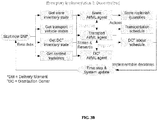
- FIG. 3A-3B is an exemplary view illustrates of concurrent dynamic optimizing of replenishment decision, according to an embodiment of the present disclosure.
- the system 100 comprises one or more data storage devices or the memory 102 operatively coupled to the one or more hardware processors 104 and is configured to store instructions for execution of steps of the method by the one or more processors 104.
- There are two exemplary implementations of the process flow one with a single centralized agent for computing the actions, and another with a set of AI/ML based algorithms that negotiate to find a mutually acceptable set of actions. In both cases, there exists improvisation by integrating the optimization of the store, transportation, and DC sub-systems.
- every delivery moment starts by sensing the current state of the supply chain (for example, through IoT devices or information from enterprise applications such as 'Point of Sale' or any other digital mechanism to capture consumption).
- the raw sensed data is converted into one or more features, following which are fed to the AI/ML algorithm(s).
- the algorithms are based on a set of techniques known as a reinforcement learning.
- the output is a set of actions, which are converted by post-processing (IT systems) into a set of implementable decisions.
- the decisions are implemented in simulation or in the real system as the case may be, for the upcoming delivery moment.
- the process flow restarts in the next delivery moment.
- a reward-penalty mechanism is used to teach the RL agents on how good a particular order quantity decision is, in the current context (current state).
- the total replenishment score can be overall reward for a particular replenishment decision. Calculation of the replenishment score is depended on projections given by the environmental simulator 204 and the one or more KPIs calculated at different levels. In initial phase of the solution, a rule based weightage can be applied on the one or more KPIs to arrive at a single replenishment score.
- a capacity of the truck that travels from DC to store is a total of 10 boxes of either product, or some combination of them.
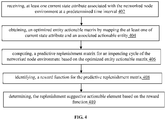
- FIG. 4 is an exemplary flow diagram illustrating a method of concurrent dynamic optimization of replenishment decision, according to an embodiment of the present disclosure.
- the system 100 comprises one or more data storage devices or the memory 102 operatively coupled to the one or more hardware processors 104 and is configured to store instructions for execution of steps of the method by the one or more processors 104.
- the flow diagram depicted is better understood by way of following explanation/description. The steps of the method of the present disclosure will now be explained with reference to the components of the system 200 as depicted in FIG. 2 .
- At step 402 at least one current state attribute associated with the networked node environment is received at a predetermined time interval.
- an optimized entity actionable matrix is obtained by mapping the at least one of current state attribute and the associated actionable entity.
- a predictive replenishment matrix for an impending cycle of the networked node environment is computed based on the optimized entity actionable matrix.
- a reward function is identified for the predictive replenishment matrix.
- the reward function includes a computation of overall cost with regard to a realized revenue associated with aggregation of the plurality of nodes.
- the replenishment suggestive actionable element is determined based on the reward function.
- the at least one current state attribute includes at least one of (i) product levels across a plurality of stores in the networked node environment, (ii) real-time tracking information of plurality of delivery vehicles, (iii) availability of labor in the predetermined time interval, and (iv) inventory levels of the plurality of products in the networked node environment.
- the optimized entity actionable matrix comprises a plurality of parameters associated with corresponding the at least one of current state attribute.
- the predictive replenishment matrix comprises a plurality of nodes and a plurality of pre-trained historical parameters.
- the at least one suggestive actionable element corresponds to at least one decision.
- the embodiments of the present disclosure addresses if there is an exponentially larger complexity in the problem when a large number of products are involved, including (i) sharing of capacity between products leading to cannibalisation, (ii) different expiry periods for otherwise similar products requiring special handling, (iii) affinity between products allowing more efficient transport of certain combinations of products over others.
- a replenishment decision system is about a replenishment operations involving generation of replenishment orders (e.g., stores/dark stores to the distribution centre (DC), the DC to vendor and stores/dark stores to vendor) through multidimensional concurrent optimization (covering product availability, wastage/obsoleteness and cost to serve) based on a real time demand, supply and capacity information.
- the solution deliver seamless capabilities to business, integrated across online and brick & mortar channels, to derive most optimal order quantity at node-item level for immediate and future delivery schedules.
- the objective of the invention is to arrive at replenishment orders which are tailored for needs of the destination node (e.g. stores) with least cost to the overall supply chain network in terms of out of stock, wastage and supply chain operations.
- the system is introduced by bidirectional information sharing and negotiation between the (traditionally) sequential components of the supply chain, thus enabling the algorithm to arrive at system-optimal solutions.
- the embodiments of the present disclosure takes a completely new approach in overcoming shortcomings of classical optimization through a concurrent machine learning based optimization mechanism by learning from the supply chain operations environment and associated history.
- the embodiments of the present disclosure have a clear advancement over current systems since (a) models and works with supply chain operational constraints and processes directly, by keeping the system in the loop.
- replenishment order decisions are implemented directly in the real system, and rewards/training is carried out based on the results at the end of the day;
- It is a closed-loop system, ensuring that changes to any constraints/processes within the supply chain, or to patterns in forecast and inventory consumption, are accounted for automatically without any human intervention;
- the embodiments of the present disclosure provides a concrete (both systemic and methodical) way to optimize replenishment order quantity in a holistic manner, which directly include a business impact in terms of improved sales, reduced wastage and minimal supply chain cost;
- the additional cost incurred by the retailer when implementing the approach is minimal, the cost incurred is in building a high fidelity environment simulation and also adjusting the simulation environment based on changing reality; and
- Execution of the replenishment plan should be aligned with the environment simulated during the replenishment planning to derive the benefit of holistic optimization.
- the embodiments of the present disclosure looks at holistic benefit for the retailer while taking a decision on replenishment quantity for an item to be replenished to a stocking location which ensures highest level of availability and least product wastage through an improved capacity utilization across all operations in supply chain including the warehouse / the distribution center / fulfilment center, transportation, supplier and others.
- the embodiments of the present disclosure in which, the reinforcement learning can be trained offline, where most of the computational effort are expended and online operation of the algorithm are very fast.
- the embodiments of the present disclosure is at convergence of multiple arts, including (i) retail supply chain domain expertise, (ii) data mining, (iii) artificial intelligence, and (iv) IT system development.
- the machine learning driven approach in deciding replenishment orders or plan creates an autonomous replenishment engine based on real time exploitative learning as well. This new approach also provides a faster mechanism to generate replenishment plans which will indirectly help in creating frequent plans using real time data in a given day versus once in a day planning.
- the hardware device can be any kind of device which can be programmed including e.g. any kind of computer like a server or a personal computer, or the like, or any combination thereof.
- the device may also include means which could be e.g. hardware means like e.g. an application-specific integrated circuit (ASIC), a field-programmable gate array (FPGA), or a combination of hardware and software means, e.g.
- ASIC application-specific integrated circuit
- FPGA field-programmable gate array
- the means can include both hardware means and software means.
- the method embodiments described herein could be implemented in hardware and software.
- the device may also include software means.
- the embodiments may be implemented on different hardware devices, e.g. using a plurality of CPUs.
- the embodiments herein can comprise hardware and software elements.
- the embodiments that are implemented in software include but are not limited to, firmware, resident software, microcode, etc.
- the functions performed by various components described herein may be implemented in other components or combinations of other components.
- a computer-usable or computer readable medium can be any apparatus that can comprise, store, communicate, propagate, or transport the program for use by or in connection with the instruction execution system, apparatus, or device.
- a computer-readable storage medium refers to any type of physical memory on which information or data readable by a processor may be stored.
- a computer-readable storage medium may store instructions for execution by one or more processors, including instructions for causing the processor(s) to perform steps or stages consistent with the embodiments described herein.
- the term "computer-readable medium” should be understood to include tangible items and exclude carrier waves and transient signals, i.e., be non-transitory. Examples include random access memory (RAM), read-only memory (ROM), volatile memory, nonvolatile memory, hard drives, CD ROMs, DVDs, flash drives, disks, and any other known physical storage media.
Landscapes
- Business, Economics & Management (AREA)
- Engineering & Computer Science (AREA)
- Human Resources & Organizations (AREA)
- Strategic Management (AREA)
- Economics (AREA)
- Theoretical Computer Science (AREA)
- Development Economics (AREA)
- Entrepreneurship & Innovation (AREA)
- General Physics & Mathematics (AREA)
- Physics & Mathematics (AREA)
- General Business, Economics & Management (AREA)
- Marketing (AREA)
- Game Theory and Decision Science (AREA)
- Quality & Reliability (AREA)
- Tourism & Hospitality (AREA)
- Operations Research (AREA)
- Finance (AREA)
- Accounting & Taxation (AREA)
- Software Systems (AREA)
- Educational Administration (AREA)
- Computer Vision & Pattern Recognition (AREA)
- Data Mining & Analysis (AREA)
- Evolutionary Computation (AREA)
- Medical Informatics (AREA)
- Artificial Intelligence (AREA)
- Computing Systems (AREA)
- General Engineering & Computer Science (AREA)
- Mathematical Physics (AREA)
- Management, Administration, Business Operations System, And Electronic Commerce (AREA)
Applications Claiming Priority (1)
| Application Number | Priority Date | Filing Date | Title |
|---|---|---|---|
| IN201821039466 | 2018-10-17 |
Publications (1)
| Publication Number | Publication Date |
|---|---|
| EP3640873A1 true EP3640873A1 (fr) | 2020-04-22 |
Family
ID=68281160
Family Applications (1)
| Application Number | Title | Priority Date | Filing Date |
|---|---|---|---|
| EP19203540.0A Withdrawn EP3640873A1 (fr) | 2018-10-17 | 2019-10-16 | Système et procédé d'optimisation dynamique concurrente de décisions de réapprovisionnement dans un environnement de noeud en réseau |
Country Status (3)
| Country | Link |
|---|---|
| US (1) | US11321650B2 (fr) |
| EP (1) | EP3640873A1 (fr) |
| AU (1) | AU2019250212A1 (fr) |
Families Citing this family (15)
| Publication number | Priority date | Publication date | Assignee | Title |
|---|---|---|---|---|
| JP6728495B2 (ja) * | 2016-11-04 | 2020-07-22 | ディープマインド テクノロジーズ リミテッド | 強化学習を用いた環境予測 |
| US11620612B2 (en) * | 2018-11-01 | 2023-04-04 | C3.Ai, Inc. | Systems and methods for inventory management and optimization |
| US12555069B2 (en) | 2018-11-01 | 2026-02-17 | C3.Ai, Inc. | Systems and methods for inventory management and optimization |
| EP3877933B1 (fr) * | 2018-11-06 | 2025-10-01 | ServiceNow, Inc. | Système de prévision de chaîne d'approvisionnement |
| US11853938B1 (en) * | 2019-12-13 | 2023-12-26 | Blue Yonder Group, Inc. | System and method of reinforced machine-learning retail allocation |
| US11727348B2 (en) * | 2020-07-30 | 2023-08-15 | Oracle International Corporation | System and method for self-tuning optimization of an item replenishment policy |
| US20220067619A1 (en) * | 2020-08-31 | 2022-03-03 | Clari Inc. | System and method to provide prescriptive actions for winning a sales opportunity using deep reinforcement learning |
| US20240070529A1 (en) * | 2021-09-21 | 2024-02-29 | Matthew Wampler | Artificial intelligence operations manager system and method |
| US20230196278A1 (en) * | 2021-12-16 | 2023-06-22 | International Business Machines Corporation | Network inventory replenishment planner |
| US12602649B2 (en) * | 2022-03-18 | 2026-04-14 | Oracle International Corporation | Predicting supply chain policies using machine learning |
| US11995669B2 (en) * | 2022-04-20 | 2024-05-28 | Target Brands, Inc. | Method and system for simulating fulfillment of digital orders |
| CN114781724B (zh) * | 2022-04-22 | 2026-04-17 | 杭州观远数据有限公司 | 基于强化学习和模仿学习的智能补货决策方法及存储介质 |
| US20250139648A1 (en) * | 2023-10-31 | 2025-05-01 | Walmart Apollo, Llc | Dynamic minimum presentation for optimized fresh item production |
| US12561647B1 (en) * | 2025-07-28 | 2026-02-24 | U.S. Bancorp, National Association | Machine learning models for generation of execution action data structures based on device delivery latency |
| CN120950560B (zh) * | 2025-08-01 | 2026-04-14 | 深圳市民防科技有限公司 | 结合环境感知的防滑液配方调优方法及系统 |
Citations (4)
| Publication number | Priority date | Publication date | Assignee | Title |
|---|---|---|---|---|
| US20030126103A1 (en) * | 2001-11-14 | 2003-07-03 | Ye Chen | Agent using detailed predictive model |
| US20070027745A1 (en) * | 2005-07-28 | 2007-02-01 | Sap Ag | System and method of assortment, space, and price optimization in retail store |
| US20120290495A1 (en) * | 2011-05-09 | 2012-11-15 | Infosys Technologies Limited | System and method for establishing transshipment of a product between stocking locations |
| US20160086118A1 (en) * | 2014-09-19 | 2016-03-24 | Niagara Bottling, Llc. | Direct To Store Supply Chain System And Method |
Family Cites Families (28)
| Publication number | Priority date | Publication date | Assignee | Title |
|---|---|---|---|---|
| US6144945A (en) * | 1997-07-14 | 2000-11-07 | International Business Machines Corporation | Method for fast and accurate evaluation of periodic review inventory policy |
| US6249774B1 (en) * | 1998-02-23 | 2001-06-19 | Bergen Brunswig Corporation | Method for owning, managing, automatically replenishing, and invoicing inventory items |
| AU3771800A (en) * | 1999-03-26 | 2000-10-16 | Retail Pipeline Integration Group, Inc., The | Method and system for determining time-phased sales forecasts and projected replenishment shipments in a supply chain |
| US7480623B1 (en) * | 2000-03-25 | 2009-01-20 | The Retail Pipeline Integration Group, Inc. | Method and system for determining time-phased product sales forecasts and projected replenishment shipments for a retail store supply chain |
| US7571166B1 (en) | 2001-06-19 | 2009-08-04 | Click Acquisitions, Inc. | Virtual private supply chain |
| US20030004784A1 (en) | 2001-06-29 | 2003-01-02 | International Business Machines Corporation | Methods and apparatus for automatic replenishment of inventory using embedded sensor system and electronic marketplace |
| US7552066B1 (en) * | 2001-07-05 | 2009-06-23 | The Retail Pipeline Integration Group, Inc. | Method and system for retail store supply chain sales forecasting and replenishment shipment determination |
| US7383284B2 (en) * | 2002-04-30 | 2008-06-03 | Sap Aktiengesellschaft | Inventory management |
| US7487120B1 (en) * | 2002-10-10 | 2009-02-03 | Taiwan Semiconductor Manufacturing Company, Ltd. | Methods and system for continuous replenishment planning of consignment inventory |
| US8050985B2 (en) * | 2002-12-27 | 2011-11-01 | Sap Aktiengeselleschaft | Method and process for planning replenishment of products in a distribution system |
| US20090006156A1 (en) * | 2007-01-26 | 2009-01-01 | Herbert Dennis Hunt | Associating a granting matrix with an analytic platform |
| US7657453B2 (en) | 2004-06-30 | 2010-02-02 | Sap Aktiengesellschaft | System, computer-readable medium and method for filtering exceptions generated by forecasting and replenishment engine |
| US7896244B2 (en) * | 2006-12-15 | 2011-03-01 | Ziti Technologies Limited Liability Company | System and method for managing a collection of stock replenishment systems |
| US20120317059A1 (en) | 2011-06-13 | 2012-12-13 | Infosys Limited | System and method for space and resource optimization |
| WO2014128845A1 (fr) * | 2013-02-20 | 2014-08-28 | 株式会社日立製作所 | Dispositif de génération de règle de fourniture et programme de génération de règle de fourniture |
| US20150032512A1 (en) * | 2013-07-26 | 2015-01-29 | Teradata Corporation | Method and system for optimizing product inventory cost and sales revenue through tuning of replenishment factors |
| IN2014MU00735A (fr) * | 2014-03-04 | 2015-09-25 | Tata Consultancy Services Ltd | |
| US11501042B2 (en) * | 2014-03-24 | 2022-11-15 | Imagars Llc | Decisions with big data |
| US10181107B2 (en) * | 2014-06-25 | 2019-01-15 | Oracle International Corporation | Using consumption data and an inventory model to generate a replenishment plan |
| GB201419498D0 (en) * | 2014-10-31 | 2014-12-17 | Ocado Innovation Ltd | System and method for fulfilling E-commerce orders from a hierarchy of fulfilment centres |
| US20170185933A1 (en) * | 2015-06-14 | 2017-06-29 | Jda Software Group, Inc. | Distribution-Independent Inventory Approach under Multiple Service Level Targets |
| US10977609B1 (en) * | 2015-06-14 | 2021-04-13 | Blue Yonder Group, Inc. | Distribution-independent inventory approach under multiple service level targets |
| US11176588B2 (en) * | 2017-01-16 | 2021-11-16 | Ncr Corporation | Network-based inventory replenishment |
| US10839348B2 (en) * | 2017-01-27 | 2020-11-17 | Walmart Apollo, Llc | System and method for optimizing inventory replenishment |
| US10902356B2 (en) | 2017-09-07 | 2021-01-26 | International Business Machines Corporation | Real-time cognitive supply chain optimization |
| US11544810B2 (en) * | 2018-01-31 | 2023-01-03 | Maplebear Inc. | Predictive inventory availability |
| US20200090110A1 (en) * | 2018-09-17 | 2020-03-19 | International Business Machines Corporation | System and method for cognitive and preemptive fashion inventory management & order fulfilment |
| US10713622B1 (en) * | 2019-12-06 | 2020-07-14 | Coupang Corp. | Computer-implemented systems and methods for intelligent prediction of out of stock items and proactive reordering |
-
2019
- 2019-10-16 EP EP19203540.0A patent/EP3640873A1/fr not_active Withdrawn
- 2019-10-17 AU AU2019250212A patent/AU2019250212A1/en not_active Abandoned
- 2019-10-17 US US16/656,065 patent/US11321650B2/en active Active
Patent Citations (4)
| Publication number | Priority date | Publication date | Assignee | Title |
|---|---|---|---|---|
| US20030126103A1 (en) * | 2001-11-14 | 2003-07-03 | Ye Chen | Agent using detailed predictive model |
| US20070027745A1 (en) * | 2005-07-28 | 2007-02-01 | Sap Ag | System and method of assortment, space, and price optimization in retail store |
| US20120290495A1 (en) * | 2011-05-09 | 2012-11-15 | Infosys Technologies Limited | System and method for establishing transshipment of a product between stocking locations |
| US20160086118A1 (en) * | 2014-09-19 | 2016-03-24 | Niagara Bottling, Llc. | Direct To Store Supply Chain System And Method |
Also Published As
| Publication number | Publication date |
|---|---|
| AU2019250212A1 (en) | 2020-05-07 |
| US20200126015A1 (en) | 2020-04-23 |
| US11321650B2 (en) | 2022-05-03 |
Similar Documents
| Publication | Publication Date | Title |
|---|---|---|
| US11321650B2 (en) | System and method for concurrent dynamic optimization of replenishment decision in networked node environment | |
| Oluyisola et al. | Designing and developing smart production planning and control systems in the industry 4.0 era: a methodology and case study | |
| Qi et al. | A practical end-to-end inventory management model with deep learning | |
| US12333489B2 (en) | Systems and methods for inventory management and optimization | |
| US12354045B2 (en) | Orchestrated intelligent supply chain optimizer | |
| US12555024B2 (en) | Dynamic data selection for a machine learning model | |
| US9805330B2 (en) | System and method for root cause analysis and early warning of inventory problems | |
| US20150254589A1 (en) | System and Method to Provide Inventory Optimization in a Multi-Echelon Supply Chain Network | |
| CN113099729A (zh) | 生产调度的深度强化学习 | |
| CN111630491B (zh) | 具有可定制机器预测的可扩展软件工具 | |
| CN114118503A (zh) | 供应链库存优化方法、装置、设备和存储介质 | |
| US20230306347A1 (en) | Systems and methods for supply chain optimization with channel saliency | |
| US11687875B2 (en) | Distribution-independent inventory approach under multiple service level targets | |
| Guo et al. | An online mirror descent learning algorithm for multiproduct inventory systems | |
| US20250378410A1 (en) | Strategic and Tactical Intelligence in Dynamic Segmentation | |
| Arts et al. | Base-stock policies for lost-sales models: Aggregation and asymptotics | |
| Mozafari et al. | Dynamic pricing and freight transportation planning in oligopolistic freight networks: a game theoretic approach | |
| Shukla et al. | Actor-critic driven deep reinforcement learning for optimising agri-food supply chain | |
| Alvo et al. | Deep Reinforcement Learning for Inventory Networks: Toward Reliable Policy Optimization | |
| Liang | Adaptive Risk-Aware Planning in Multi-Echelon Supply Chains via Distributional Reinforcement Learning | |
| Deng | Multi-products production control and human-autonomous truck distribution planning with the use of collaborative multi-agent reinforcement learning | |
| Zhao et al. | Hierarchical Multi-Agent Reinforcement Learning for Dynamic Inventory Allocation with Demand Uncertainty | |
| Patelli et al. | Intelligent Job Scheduling: Better Service for Less Carbon | |
| HK40047632A (en) | Deep reinforcement learning for production scheduling |
Legal Events
| Date | Code | Title | Description |
|---|---|---|---|
| PUAI | Public reference made under article 153(3) epc to a published international application that has entered the european phase |
Free format text: ORIGINAL CODE: 0009012 |
|
| STAA | Information on the status of an ep patent application or granted ep patent |
Free format text: STATUS: THE APPLICATION HAS BEEN PUBLISHED |
|
| AK | Designated contracting states |
Kind code of ref document: A1 Designated state(s): AL AT BE BG CH CY CZ DE DK EE ES FI FR GB GR HR HU IE IS IT LI LT LU LV MC MK MT NL NO PL PT RO RS SE SI SK SM TR |
|
| AX | Request for extension of the european patent |
Extension state: BA ME |
|
| 18D | Application deemed to be withdrawn |
Effective date: 20201023 |