EP3643663B1 - Système et procédé de fourniture automatique à un passager d'un service d'ascenseur dans un bâtiment lorsque le passager quitte une pièce du bâtiment - Google Patents
Système et procédé de fourniture automatique à un passager d'un service d'ascenseur dans un bâtiment lorsque le passager quitte une pièce du bâtiment Download PDFInfo
- Publication number
- EP3643663B1 EP3643663B1 EP19204951.8A EP19204951A EP3643663B1 EP 3643663 B1 EP3643663 B1 EP 3643663B1 EP 19204951 A EP19204951 A EP 19204951A EP 3643663 B1 EP3643663 B1 EP 3643663B1
- Authority
- EP
- European Patent Office
- Prior art keywords
- passenger
- elevator
- controller
- room
- building
- Prior art date
- Legal status (The legal status is an assumption and is not a legal conclusion. Google has not performed a legal analysis and makes no representation as to the accuracy of the status listed.)
- Active
Links
Images

Classifications
-
- B—PERFORMING OPERATIONS; TRANSPORTING
- B66—HOISTING; LIFTING; HAULING
- B66B—ELEVATORS; ESCALATORS OR MOVING WALKWAYS
- B66B1/00—Control systems of elevators in general
- B66B1/02—Control systems without regulation, i.e. without retroactive action
- B66B1/06—Control systems without regulation, i.e. without retroactive action electric
-
- B—PERFORMING OPERATIONS; TRANSPORTING
- B66—HOISTING; LIFTING; HAULING
- B66B—ELEVATORS; ESCALATORS OR MOVING WALKWAYS
- B66B1/00—Control systems of elevators in general
- B66B1/34—Details, e.g. call counting devices, data transmission from car to control system, devices giving information to the control system
- B66B1/46—Adaptations of switches or switchgear
- B66B1/468—Call registering systems
-
- B—PERFORMING OPERATIONS; TRANSPORTING
- B66—HOISTING; LIFTING; HAULING
- B66B—ELEVATORS; ESCALATORS OR MOVING WALKWAYS
- B66B1/00—Control systems of elevators in general
- B66B1/24—Control systems with regulation, i.e. with retroactive action, for influencing travelling speed, acceleration, or deceleration
- B66B1/2408—Control systems with regulation, i.e. with retroactive action, for influencing travelling speed, acceleration, or deceleration where the allocation of a call to an elevator car is of importance, i.e. by means of a supervisory or group controller
-
- B—PERFORMING OPERATIONS; TRANSPORTING
- B66—HOISTING; LIFTING; HAULING
- B66B—ELEVATORS; ESCALATORS OR MOVING WALKWAYS
- B66B1/00—Control systems of elevators in general
- B66B1/24—Control systems with regulation, i.e. with retroactive action, for influencing travelling speed, acceleration, or deceleration
- B66B1/28—Control systems with regulation, i.e. with retroactive action, for influencing travelling speed, acceleration, or deceleration electrical
-
- B—PERFORMING OPERATIONS; TRANSPORTING
- B66—HOISTING; LIFTING; HAULING
- B66B—ELEVATORS; ESCALATORS OR MOVING WALKWAYS
- B66B1/00—Control systems of elevators in general
- B66B1/34—Details, e.g. call counting devices, data transmission from car to control system, devices giving information to the control system
- B66B1/3415—Control system configuration and the data transmission or communication within the control system
- B66B1/3423—Control system configuration, i.e. lay-out
-
- B—PERFORMING OPERATIONS; TRANSPORTING
- B66—HOISTING; LIFTING; HAULING
- B66B—ELEVATORS; ESCALATORS OR MOVING WALKWAYS
- B66B1/00—Control systems of elevators in general
- B66B1/34—Details, e.g. call counting devices, data transmission from car to control system, devices giving information to the control system
- B66B1/3415—Control system configuration and the data transmission or communication within the control system
- B66B1/3446—Data transmission or communication within the control system
-
- B—PERFORMING OPERATIONS; TRANSPORTING
- B66—HOISTING; LIFTING; HAULING
- B66B—ELEVATORS; ESCALATORS OR MOVING WALKWAYS
- B66B1/00—Control systems of elevators in general
- B66B1/34—Details, e.g. call counting devices, data transmission from car to control system, devices giving information to the control system
- B66B1/3415—Control system configuration and the data transmission or communication within the control system
- B66B1/3446—Data transmission or communication within the control system
- B66B1/3461—Data transmission or communication within the control system between the elevator control system and remote or mobile stations
-
- B—PERFORMING OPERATIONS; TRANSPORTING
- B66—HOISTING; LIFTING; HAULING
- B66B—ELEVATORS; ESCALATORS OR MOVING WALKWAYS
- B66B5/00—Applications of checking, fault-correcting, or safety devices in elevators
- B66B5/0006—Monitoring devices or performance analysers
- B66B5/0012—Devices monitoring the users of the elevator system
-
- B—PERFORMING OPERATIONS; TRANSPORTING
- B66—HOISTING; LIFTING; HAULING
- B66B—ELEVATORS; ESCALATORS OR MOVING WALKWAYS
- B66B2201/00—Aspects of control systems of elevators
- B66B2201/10—Details with respect to the type of call input
- B66B2201/101—Single call input
-
- B—PERFORMING OPERATIONS; TRANSPORTING
- B66—HOISTING; LIFTING; HAULING
- B66B—ELEVATORS; ESCALATORS OR MOVING WALKWAYS
- B66B2201/00—Aspects of control systems of elevators
- B66B2201/20—Details of the evaluation method for the allocation of a call to an elevator car
-
- B—PERFORMING OPERATIONS; TRANSPORTING
- B66—HOISTING; LIFTING; HAULING
- B66B—ELEVATORS; ESCALATORS OR MOVING WALKWAYS
- B66B2201/00—Aspects of control systems of elevators
- B66B2201/40—Details of the change of control mode
- B66B2201/46—Switches or switchgear
- B66B2201/4607—Call registering systems
- B66B2201/4615—Wherein the destination is registered before boarding
-
- B—PERFORMING OPERATIONS; TRANSPORTING
- B66—HOISTING; LIFTING; HAULING
- B66B—ELEVATORS; ESCALATORS OR MOVING WALKWAYS
- B66B2201/00—Aspects of control systems of elevators
- B66B2201/40—Details of the change of control mode
- B66B2201/46—Switches or switchgear
- B66B2201/4607—Call registering systems
- B66B2201/4638—Wherein the call is registered without making physical contact with the elevator system
Definitions
- the embodiments herein relate to an elevator system and more specifically to a system and method for automatically providing elevator service in a building to a passenger upon the passenger leaving a room in the building.
- Hotel rooms may be equipped with key card locks which are integrated with lock management systems (LMS).
- LMS lock management systems
- a door lock state may be continuously monitored by the LMS. If a guest intends on leaving their room he/she may have to lock the room door by removing a key card from a key card holder inside the room. Then he/she may have to walk to an elevator lobby and call the elevator a by manually actuating a button on a control counsel and wait for the elevator to arrive.
- LMS lock management systems
- WO 2010/000332 A1 describes a method for operation of an elevator system where a functional designator is operated on at least one input apparatus of a building door. A designator signal is produced and used to carry out a start call for an elevator cab to a starting floor.
- US 2013/048436 A1 describes a method for automatically prompting a car call in an elevator system.
- the system includes a door sensing device and a surveillance device for monitoring passenger actions, thereby defining the starting point and the final point of a passenger's traveling path.
- US 2011/048862 A1 describes a method for an elevator system wherein an opening and/or closing of a building door causes at least one starting door signal to be generated and at least one elevator car is ascertained for the starting door signal.
- JP 2004 262619 A describes a service system of a building where a hall registration means reads identification information recorded in a room card, and if it identifies the user as a registered individual, it automatically calls an elevator car and automatically registers a destination floor.
- a door unlocking unit mounted to a room door of the designation floor reads the identification information in the room car and if it identifies the user as a registered individual, it unlocks the room door.
- a building comprising an elevator system and a first device; the an elevator system comprising: a system controller that communicates with a first device and responsively controls an elevator car for transporting a passenger, the system controller is configured to render a plurality of determinations for transporting the passenger, including: a first determination that the first device is transmitting first data that is indicative of the passenger seeking elevator service, a second determination to assign the elevator car to provide elevator service to the passenger, and the system controller is configured to transmit a first instruction to the elevator car to effect the second determination, wherein the first device receives a communication indicating that the power to one or more devices in a room is in an off state.
- the first data indicates that a door lock has been engaged by the passenger.
- the first data indicates that the first device is disposed on a first level, whereby the system controller determines the passenger requires elevator service at a first lobby.
- the first data provides a room identifier indicating that the one or more devices are located in a specific room.
- the first data is received from a card controller, and the card controller determines the power in the specific room is in the off state.
- the one or more devices includes an air conditioning system.
- system controller renders the second determination, if the elevator car is at a second lobby, and the first instructions include the elevator car traveling to the first lobby and idling at the first lobby until engaged by the passenger.
- the communication is received by the system controller over a wireless network.
- the wireless network is a personal area network (PAN).
- PAN personal area network
- a method comprising: rendering, with a controller for an elevator system, a first determination that a first device is transmitting first data that is indicative of a passenger seeking elevator service, rendering, with the controller, a second determination to assign an elevator car to provide elevator service to the passenger, and transmitting, with the controller, a first instruction to the elevator car to effect the second determination, wherein the first device receives a communication indicating that the power to one or more devices in a room is in an off state.
- the first data may indicate that a door lock has been engaged by the passenger.
- the first data may indicate that the first device is disposed on a first level.
- the system controller nay determine that the passenger requires elevator service at the first lobby.
- the first data may provide a room identifier indicating that the one or more devices are located in a specific room.
- the first data may be received from a card controller.
- the card controller may determine the power in the specific room is in the off state.
- the one or more devices may include an air conditioning system.
- the system controller may render the second determination, if the elevator car is at the second lobby, the first instructions include the elevator car traveling to the first lobby and idling at the first lobby until engages by the passenger.
- the plurality of devices nay communicate with the system controller over a wireless network.
- the wireless network may be a personal area network (PAN).
- PAN personal area network
- the tension member 107 engages the machine 111, which is part of an overhead structure of the elevator system 101.
- the machine 111 is configured to control movement between the elevator car 103 and the counterweight 105.
- the position reference system 113 may be mounted on a fixed part at the top of the elevator hoistway 117, such as on a support or guide rail, and may be configured to provide position signals related to a position of the elevator car 103 within the elevator hoistway 117. In other embodiments, the position reference system 113 may be directly mounted to a moving component of the machine 111, or may be located in other positions and/or configurations as known in the art.
- the position reference system 113 can be any device or mechanism for monitoring a position of an elevator car and/or counter weight, as known in the art.
- the position reference system 113 can be an encoder, sensor, or other system and can include velocity sensing, absolute position sensing, etc., as will be appreciated by those of skill in the art.
- the controller 115 is located, as shown, in a controller room 121 of the elevator hoistway 117 and is configured to control the operation of the elevator system 101, and particularly the elevator car 103.
- the controller 115 may provide drive signals to the machine 111 to control the acceleration, deceleration, leveling, stopping, etc. of the elevator car 103.
- the controller 115 may also be configured to receive position signals from the position reference system 113 or any other desired position reference device.
- the elevator car 103 may stop at one or more landings 125 as controlled by the controller 115.
- the controller 115 can be located and/or configured in other locations or positions within the elevator system 101. In one embodiment, the controller may be located remotely or in the cloud.
- the machine 111 may include a motor or similar driving mechanism.
- the machine 111 is configured to include an electrically driven motor.
- the power supply for the motor may be any power source, including a power grid, which, in combination with other components, is supplied to the motor.
- the machine 111 may include a traction sheave that imparts force to tension member 107 to move the elevator car 103 within elevator hoistway 117.
- FIG. 1 is merely a non-limiting example presented for illustrative and explanatory purposes.
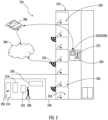
- an elevator system 200 in a building 210 that includes a plurality of levels 220 and a respective plurality of lobbies 230.
- the first level 240 has a first lobby 250.
- the building 210 includes an elevator car 260 for transporting a passenger 270 between the plurality of lobbies 230.
- the first level 240 may be subdivided to include the first lobby 250 and a room 280.
- the room 280 may fixedly include a first device 290 (e.g., a processor-based device or smart device) that is engageable by the passenger 270 when leaving the room 280.
- the system 200 comprises a system controller 300 that communicates with the first device 290 and responsively controls the elevator car 260 to transport the passenger 270.
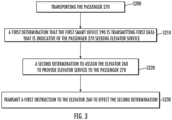
- the system controller 300 is configured to render a plurality of determinations when executing a process S200 for transporting the passenger 270.
- the system controller 300 renders a first determination that the first device 290 is transmitting first data that is indicative of the passenger 270 seeking elevator service.
- the system controller 300 makes a second determination to assign the elevator car 260 to provide elevator service to the passenger 270.
- the system controller 300 is configured to transmit a first instruction to the elevator car 260 to effect the second determination.
- the room 280 has a door 310 that is an egress door and the first device 290 is a door lock.
- the first data may indicate that the door 310 has been engaged by the passenger 270.
- the system includes a plurality of devices including the first device 290 and a second device 330 (e.g., a processor-based devices or smart devices).
- the second device 330 may be a first power controller for the room 280.
- the first determination may include the system controller 300 communicating with the first power controller 330 to confirm that power to one or more utilities in the room 280 is in an off state.
- the first data may indicate that the first device 290 is disposed on the first level 240. From this the system controller 300 may determine the passenger 270 requires elevator service at the first lobby 250.
- the building 210 may comprise a distribution of plurality of the power controllers including the first power controller 330.
- the first data may provide a room identifier whereby the system controller 300 determines that the first power controller 330 controls power for the room 280.
- a third device 340 may be in the room 280.
- the third device 340 may be a card controller in operational communication with the first power controller 330.
- the first power controller 330 may set power to the one or more utilities in the room 280 to the off state.
- the one or more utilities includes an air conditioning unit.
- the system controller 300 renders the second determination, if the elevator car 260 is at the second lobby, the first instructions include the elevator car 260 traveling to the first lobby 250 and idling at the first lobby 250 until engages by the passenger.
- the plurality of devices communicate with the system controller 300 over a wireless network.
- the wireless network 360 may be a personal area network (PAN), for example, Bluetooth, accessible through one or more PAN beacons 370.
- PAN personal area network
- a system which may continuously monitor door states available in a building/hotel from a controller which may be a lock management system (LMS).
- LMS lock management system
- the system may obtain corresponding level information of the room from the LMS.
- the system may then instruct an elevator to provide service on the same level as the room so as to provide service to the passenger. For example a guest is allocated a room on a level in a hotel. Within the room, when the guest (passenger) removes the key card from the key card holder, the power supply controller turns power off in the room.
- the system may read both the data from the lock management system and the energy management system to determine that guest (passenger) has left the room. Then the system may send an elevator to the level of the guest. Before the guest (passenger) arrives near the elevator, the assigned elevator may arrive to provide elevator service.
- smart devices may contain one or more processors capable of communication using with other such devices by applying wired and/or wireless telecommunication protocols.
- a smart device include a mobile phone, personal data assistant (PDA), tablet, watch, wearable or other processor-based devices.
- Protocols applied by smart devices may include local area network (LAN) protocols and/or a private area network (PAN) protocols.
- LAN protocols may apply Wi-Fi technology, which is a technology based on the Section 802.11 standards from the Institute of Electrical and Electronics Engineers, or IEEE.
- PAN protocols include, for example, Bluetooth Low Energy (BTLE), which is a wireless technology standard designed and marketed by the Bluetooth Special Interest Group (SIG) for exchanging data over short distances using short-wavelength radio waves.
- PAN protocols may also include Zigbee, a technology based on Section 802.15.4 protocols from the Institute of Electrical and Electronics Engineers (IEEE). More specifically, Zigbee represents a suite of high-level communication protocols used to create personal area networks with small, low-power digital radios for low-power low-bandwidth needs, and is best suited for small scale projects using wireless connections.
- Wireless protocols may further include short range communication (SRC) protocols, which may be utilized with radio-frequency identification (RFID) technology. RFID may be used for communicating with an integrated chip (IC) on an RFID smartcard.
- SRC short range communication
- RFID radio-frequency identification
- Wireless protocols may further include long range, low powered wide area network (LoRa and LPWAN) protocols that enable low data rate communications to be made over long distances by sensors and actuators for machine-to-machine (M2M) and Internet of Things (IoT) applications.
- LoRa and LPWAN long range, low powered wide area network protocols that enable low data rate communications to be made over long distances by sensors and actuators for machine-to-machine (M2M) and Internet of Things (IoT) applications.
- M2M machine-to-machine
- IoT Internet of Things
- embodiments can be in the form of processorimplemented processes and devices for practicing those processes, such as a processor.
- Embodiments can also be in the form of computer program code containing instructions embodied in tangible media, such as network cloud storage, SD cards, flash drives, floppy diskettes, CD ROMs, hard drives, or any other computer-readable storage medium, wherein, when the computer program code is loaded into and executed by a computer, the computer becomes a device for practicing the embodiments.
- Embodiments can also be in the form of computer program code, for example, whether stored in a storage medium, loaded into and/or executed by a computer, or transmitted over some transmission medium, loaded into and/or executed by a computer, or transmitted over some transmission medium, such as over electrical wiring or cabling, through fiber optics, or via electromagnetic radiation, wherein, when the computer program code is loaded into an executed by a computer, the computer becomes an device for practicing the embodiments.
- the computer program code segments configure the microprocessor to create specific logic circuits.
Landscapes
- Engineering & Computer Science (AREA)
- Automation & Control Theory (AREA)
- Computer Networks & Wireless Communication (AREA)
- Indicating And Signalling Devices For Elevators (AREA)
Claims (14)
- Bâtiment comprenant un système d'ascenseur et un premier dispositif (290) ;
le système d'ascenseur (200) comprenant :un dispositif de commande de système (300) qui communique avec le premier dispositif (290) et commande en réponse une cabine d'ascenseur (260) pour transporter un passager (270),le dispositif de commande de système (300) est configuré pour rendre une pluralité de déterminations pour transporter le passager (270), comportant :une première détermination selon laquelle le premier dispositif (290) transmet des premières données indiquant que le passager (270) recherche un service d'ascenseur,une seconde détermination pour affecter la cabine d'ascenseur (260) afin de fournir un service d'ascenseur au passager (270), etle dispositif de commande de système (300) est configuré pour transmettre une première instruction à la cabine d'ascenseur (260) pour effectuer la seconde détermination ; etcaractérisé en ce que :
le premier dispositif (290) reçoit une communication indiquant que l'alimentation d'un ou de plusieurs dispositifs dans une pièce (280) est dans un état éteint. - Bâtiment selon la revendication 1, dans lequel les premières données indiquent qu'un verrou de porte a été engagé par le passager (270).
- Bâtiment selon les revendications 1 ou 2, dans lequel les premières données indiquent que le premier dispositif (290) est disposé sur un premier niveau (240), moyennant quoi le dispositif de commande de système (300) détermine que le passager (270) a besoin d'un service d'ascenseur dans un premier hall (250).
- Bâtiment selon une quelconque revendication précédente, dans lequel les premières données fournissent un identifiant de pièce indiquant que les un ou plusieurs dispositifs sont situés dans une pièce spécifique (280), dans lequel les premières données sont reçues d'un dispositif de commande de carte (340) et le dispositif de commande de carte (340) détermine que l'alimentation dans la pièce spécifique (280) est dans l'état éteint.
- Bâtiment selon la revendication 4, dans lequel les un ou plusieurs dispositifs (290, 330, 340) comportent un système de climatisation.
- Bâtiment selon la revendication 3 ou l'une quelconque des revendications 4 à 5 lorsqu'elles dépendent de la revendication 3, dans lequel le dispositif de commande de système (300) rend la seconde détermination, si la cabine d'ascenseur (260) se trouve dans un second hall, et les premières instructions comportent la cabine d'ascenseur (260) se déplaçant vers le premier hall (250) et restant au repos dans le premier hall (250) jusqu'à ce qu'elle soit engagée par le passager (270).
- Bâtiment selon une quelconque revendication précédente, dans lequel la communication est reçue par le dispositif de commande de système (300) sur un réseau sans fil (360), le réseau sans fil (360) étant de préférence un réseau personnel.
- Procédé comprenant :le rendu, avec un dispositif de commande pour un système d'ascenseur (200), d'une première détermination selon laquelle un premier dispositif (290) transmet des premières données indiquant qu'un passager (270) recherche un service d'ascenseur, le rendu, avec le dispositif de commande, d'une seconde détermination pour affecter une cabine d'ascenseur (260) afin de fournir un service d'ascenseur au passager (270), etla transmission, avec le dispositif de commande, d'une première instruction à la cabine d'ascenseur (260) pour effectuer la seconde détermination ; etcaractérisé en ce que :
le premier dispositif (290) reçoit une communication indiquant que l'alimentation d'un ou de plusieurs dispositifs dans une pièce (280) est dans un état éteint. - Procédé selon la revendication 8, dans lequel les premières données indiquent qu'un verrou de porte a été engagé par le passager (270).
- Procédé selon la revendication 8 ou 9, dans lequel les premières données indiquent que le premier dispositif (290) est disposé sur un premier niveau (240), moyennant quoi le dispositif de commande de système (300) détermine que le passager (270) a besoin d'un service d'ascenseur dans le premier hall (250).
- Procédé selon l'une quelconque des revendications 8 à 10, dans lequel les premières données fournissent un identifiant de pièce indiquant que les un ou plusieurs dispositifs (290, 330, 340) sont situés dans une pièce spécifique (280).
- Procédé selon la revendication 11, dans lequel les premières données sont reçues d'un dispositif de commande de carte (340), et le dispositif de commande de carte (340) détermine que l'alimentation dans la pièce spécifique (280) est dans l'état éteint, et dans lequel les un ou plusieurs dispositifs comportent de préférence un système de climatisation.
- Procédé selon la revendication 10 ou les revendications 11 ou 12 lorsqu'elles dépendent de la revendication 10, dans lequel le dispositif de commande de système (300) rend la seconde détermination, si la cabine d'ascenseur (260) se trouve dans le second hall, les premières instructions comportent la cabine d'ascenseur (260) se déplaçant vers le premier hall (250) et restant au repos dans le premier hall (250) jusqu'à ce qu'elle soit engagée par le passager (270).
- Procédé selon la revendication 10 ou l'une quelconque de la revendication 11 à 13 lorsqu'elles dépendent de la revendication 10, dans lequel la pluralité de dispositifs (320) communiquent avec le dispositif de commande de système (300) sur un réseau sans fil (360), dans lequel le réseau sans fil (360) est de préférence un réseau personnel.
Applications Claiming Priority (1)
| Application Number | Priority Date | Filing Date | Title |
|---|---|---|---|
| IN201811040366 | 2018-10-26 |
Publications (2)
| Publication Number | Publication Date |
|---|---|
| EP3643663A1 EP3643663A1 (fr) | 2020-04-29 |
| EP3643663B1 true EP3643663B1 (fr) | 2025-05-14 |
Family
ID=68342710
Family Applications (1)
| Application Number | Title | Priority Date | Filing Date |
|---|---|---|---|
| EP19204951.8A Active EP3643663B1 (fr) | 2018-10-26 | 2019-10-23 | Système et procédé de fourniture automatique à un passager d'un service d'ascenseur dans un bâtiment lorsque le passager quitte une pièce du bâtiment |
Country Status (3)
| Country | Link |
|---|---|
| US (1) | US20200130995A1 (fr) |
| EP (1) | EP3643663B1 (fr) |
| CN (1) | CN111099463A (fr) |
Families Citing this family (4)
| Publication number | Priority date | Publication date | Assignee | Title |
|---|---|---|---|---|
| CN111071886A (zh) * | 2018-10-22 | 2020-04-28 | 奥的斯电梯公司 | 用于跟踪电梯乘坐质量的系统 |
| EP3643663B1 (fr) * | 2018-10-26 | 2025-05-14 | Otis Elevator Company | Système et procédé de fourniture automatique à un passager d'un service d'ascenseur dans un bâtiment lorsque le passager quitte une pièce du bâtiment |
| US12049382B2 (en) * | 2019-04-11 | 2024-07-30 | Otis Elevator Company | Management of elevator service |
| EP3822209B1 (fr) * | 2019-11-18 | 2026-05-06 | Honeywell International Inc. | Système d'ascenseur doté d'un réseau maillé avec émetteur-récepteur proxy |
Family Cites Families (13)
| Publication number | Priority date | Publication date | Assignee | Title |
|---|---|---|---|---|
| EP0832838B1 (fr) * | 1996-09-26 | 2003-12-10 | Inventio Ag | Dispositif de commande pour un ascenseur |
| JP2004262619A (ja) * | 2003-03-03 | 2004-09-24 | Toshiba Elevator Co Ltd | エレベータを備えたビルディングのサービス装置 |
| WO2009132690A1 (fr) * | 2008-04-28 | 2009-11-05 | Inventio Ag | Procédé pour utiliser un système d'ascenseur, système d'ascenseur approprié et procédé pour moderniser un tel système d'ascenseur |
| US20110100762A1 (en) * | 2008-04-28 | 2011-05-05 | Inventio Ag | Method of using an elevator system, elevator system for such a method and method of retrofitting such an elevator system and electronic door trim |
| BRPI0822547B8 (pt) * | 2008-04-28 | 2022-07-12 | Inventio Aktiengellschaft | Processo para transporte de passageiros, instalação de elevador e processo para reequipar uma instalação de elevador |
| WO2010000332A1 (fr) * | 2008-07-04 | 2010-01-07 | Inventio Ag | Procédé d’actionnement d’un système d’ascenseur et procédé d’actionnement d’une porte de bâtiment |
| FI122875B (fi) * | 2010-12-30 | 2012-08-15 | Kone Corp | Kuljetusjärjestelmä |
| US20130048436A1 (en) * | 2011-08-29 | 2013-02-28 | Mark Kit Jiun Chan | Automated elevator car call prompting |
| FI124131B (fi) * | 2012-11-14 | 2014-03-31 | Kone Corp | Hissijärjestelmä |
| FI123998B (fi) * | 2012-12-18 | 2014-01-31 | Kone Corp | Hissijärjestelmä |
| EP2779117A1 (fr) * | 2013-03-15 | 2014-09-17 | Inventio AG | Commande d'accès pour zones à portes multiples |
| US10273117B2 (en) * | 2015-09-30 | 2019-04-30 | Mastercard International Incorporated | Controlling an elevator car to take a user to a destination floor based on calendar information from a mobile device |
| EP3643663B1 (fr) * | 2018-10-26 | 2025-05-14 | Otis Elevator Company | Système et procédé de fourniture automatique à un passager d'un service d'ascenseur dans un bâtiment lorsque le passager quitte une pièce du bâtiment |
-
2019
- 2019-10-23 EP EP19204951.8A patent/EP3643663B1/fr active Active
- 2019-10-23 US US16/661,395 patent/US20200130995A1/en not_active Abandoned
- 2019-10-25 CN CN201911022733.4A patent/CN111099463A/zh active Pending
Also Published As
| Publication number | Publication date |
|---|---|
| US20200130995A1 (en) | 2020-04-30 |
| CN111099463A (zh) | 2020-05-05 |
| EP3643663A1 (fr) | 2020-04-29 |
Similar Documents
| Publication | Publication Date | Title |
|---|---|---|
| EP3643663B1 (fr) | Système et procédé de fourniture automatique à un passager d'un service d'ascenseur dans un bâtiment lorsque le passager quitte une pièce du bâtiment | |
| US10827238B2 (en) | Elevator door sensor integrated with a long range communication gateway | |
| EP3578492B1 (fr) | Transfert de données de système de transport | |
| EP3647247B1 (fr) | Réaffectation basée sur la superposition | |
| EP3643661B1 (fr) | Appels d'ascenseur de mobiles associés | |
| CN110654943B (zh) | 电梯装置输入终端和走廊固定装置的位置和定向的自动确定 | |
| EP3693309B1 (fr) | Exécution d'un service d'ascenseur basé sur la proximité intérieure d'un dispositif mobile avec un hall d'ascenseur | |
| EP3650383B1 (fr) | Système et procédé de hiérarchisation de service d'appels d'ascenseurs à distance en fonction de la proximité du hall d'ascenseur | |
| EP3656715B1 (fr) | Système de fourniture de service d'ascenseur à des personnes accompagnées d'animaux de compagnie | |
| EP3825271B1 (fr) | Procédé et appareil de sécurisation de service d'ascenseur sur un réseau de télécommunication | |
| EP3643660B1 (fr) | Système de fourniture de service d'ascenseur | |
| EP3674240A1 (fr) | Système et procédé d'attribution de service d'ascenseur sur la base d'un emplacement souhaité d'une pluralité de passagers | |
| CN112938697A (zh) | 用于穿梭电梯系统的改进的乘客接口 | |
| EP3666711B1 (fr) | Système et procédé de fonctionnement d'un système d'ascenseur au cours d'un verrouillage | |
| US12116241B2 (en) | Methods of decreasing the elevator wait time by integrating with calendar server | |
| EP3822209B1 (fr) | Système d'ascenseur doté d'un réseau maillé avec émetteur-récepteur proxy | |
| EP3643662B1 (fr) | Système d'ascenseur permettant de diriger un passager vers un locataire dans un bâtiment, que le passager soit à l'intérieur ou à l'extérieur du bâtiment | |
| US20220204312A1 (en) | Method for triggering automatic elevator calls |
Legal Events
| Date | Code | Title | Description |
|---|---|---|---|
| PUAI | Public reference made under article 153(3) epc to a published international application that has entered the european phase |
Free format text: ORIGINAL CODE: 0009012 |
|
| STAA | Information on the status of an ep patent application or granted ep patent |
Free format text: STATUS: THE APPLICATION HAS BEEN PUBLISHED |
|
| AK | Designated contracting states |
Kind code of ref document: A1 Designated state(s): AL AT BE BG CH CY CZ DE DK EE ES FI FR GB GR HR HU IE IS IT LI LT LU LV MC MK MT NL NO PL PT RO RS SE SI SK SM TR |
|
| AX | Request for extension of the european patent |
Extension state: BA ME |
|
| STAA | Information on the status of an ep patent application or granted ep patent |
Free format text: STATUS: REQUEST FOR EXAMINATION WAS MADE |
|
| 17P | Request for examination filed |
Effective date: 20201028 |
|
| RBV | Designated contracting states (corrected) |
Designated state(s): AL AT BE BG CH CY CZ DE DK EE ES FI FR GB GR HR HU IE IS IT LI LT LU LV MC MK MT NL NO PL PT RO RS SE SI SK SM TR |
|
| STAA | Information on the status of an ep patent application or granted ep patent |
Free format text: STATUS: EXAMINATION IS IN PROGRESS |
|
| 17Q | First examination report despatched |
Effective date: 20220517 |
|
| GRAP | Despatch of communication of intention to grant a patent |
Free format text: ORIGINAL CODE: EPIDOSNIGR1 |
|
| STAA | Information on the status of an ep patent application or granted ep patent |
Free format text: STATUS: GRANT OF PATENT IS INTENDED |
|
| INTG | Intention to grant announced |
Effective date: 20250103 |
|
| GRAS | Grant fee paid |
Free format text: ORIGINAL CODE: EPIDOSNIGR3 |
|
| GRAA | (expected) grant |
Free format text: ORIGINAL CODE: 0009210 |
|
| STAA | Information on the status of an ep patent application or granted ep patent |
Free format text: STATUS: THE PATENT HAS BEEN GRANTED |
|
| AK | Designated contracting states |
Kind code of ref document: B1 Designated state(s): AL AT BE BG CH CY CZ DE DK EE ES FI FR GB GR HR HU IE IS IT LI LT LU LV MC MK MT NL NO PL PT RO RS SE SI SK SM TR |
|
| REG | Reference to a national code |
Ref country code: GB Ref legal event code: FG4D |
|
| REG | Reference to a national code |
Ref country code: CH Ref legal event code: EP |
|
| REG | Reference to a national code |
Ref country code: DE Ref legal event code: R096 Ref document number: 602019069907 Country of ref document: DE |
|
| REG | Reference to a national code |
Ref country code: IE Ref legal event code: FG4D |
|
| REG | Reference to a national code |
Ref country code: NL Ref legal event code: MP Effective date: 20250514 |
|
| PG25 | Lapsed in a contracting state [announced via postgrant information from national office to epo] |
Ref country code: PT Free format text: LAPSE BECAUSE OF FAILURE TO SUBMIT A TRANSLATION OF THE DESCRIPTION OR TO PAY THE FEE WITHIN THE PRESCRIBED TIME-LIMIT Effective date: 20250915 Ref country code: FI Free format text: LAPSE BECAUSE OF FAILURE TO SUBMIT A TRANSLATION OF THE DESCRIPTION OR TO PAY THE FEE WITHIN THE PRESCRIBED TIME-LIMIT Effective date: 20250514 Ref country code: ES Free format text: LAPSE BECAUSE OF FAILURE TO SUBMIT A TRANSLATION OF THE DESCRIPTION OR TO PAY THE FEE WITHIN THE PRESCRIBED TIME-LIMIT Effective date: 20250514 |
|
| REG | Reference to a national code |
Ref country code: LT Ref legal event code: MG9D |
|
| PG25 | Lapsed in a contracting state [announced via postgrant information from national office to epo] |
Ref country code: NO Free format text: LAPSE BECAUSE OF FAILURE TO SUBMIT A TRANSLATION OF THE DESCRIPTION OR TO PAY THE FEE WITHIN THE PRESCRIBED TIME-LIMIT Effective date: 20250814 Ref country code: GR Free format text: LAPSE BECAUSE OF FAILURE TO SUBMIT A TRANSLATION OF THE DESCRIPTION OR TO PAY THE FEE WITHIN THE PRESCRIBED TIME-LIMIT Effective date: 20250815 |
|
| PG25 | Lapsed in a contracting state [announced via postgrant information from national office to epo] |
Ref country code: PL Free format text: LAPSE BECAUSE OF FAILURE TO SUBMIT A TRANSLATION OF THE DESCRIPTION OR TO PAY THE FEE WITHIN THE PRESCRIBED TIME-LIMIT Effective date: 20250514 Ref country code: NL Free format text: LAPSE BECAUSE OF FAILURE TO SUBMIT A TRANSLATION OF THE DESCRIPTION OR TO PAY THE FEE WITHIN THE PRESCRIBED TIME-LIMIT Effective date: 20250514 |
|
| REG | Reference to a national code |
Ref country code: AT Ref legal event code: MK05 Ref document number: 1794676 Country of ref document: AT Kind code of ref document: T Effective date: 20250514 |
|
| PG25 | Lapsed in a contracting state [announced via postgrant information from national office to epo] |
Ref country code: BG Free format text: LAPSE BECAUSE OF FAILURE TO SUBMIT A TRANSLATION OF THE DESCRIPTION OR TO PAY THE FEE WITHIN THE PRESCRIBED TIME-LIMIT Effective date: 20250514 |
|
| PG25 | Lapsed in a contracting state [announced via postgrant information from national office to epo] |
Ref country code: HR Free format text: LAPSE BECAUSE OF FAILURE TO SUBMIT A TRANSLATION OF THE DESCRIPTION OR TO PAY THE FEE WITHIN THE PRESCRIBED TIME-LIMIT Effective date: 20250514 |
|
| PG25 | Lapsed in a contracting state [announced via postgrant information from national office to epo] |
Ref country code: AT Free format text: LAPSE BECAUSE OF FAILURE TO SUBMIT A TRANSLATION OF THE DESCRIPTION OR TO PAY THE FEE WITHIN THE PRESCRIBED TIME-LIMIT Effective date: 20250514 |
|
| PGFP | Annual fee paid to national office [announced via postgrant information from national office to epo] |
Ref country code: FR Payment date: 20250925 Year of fee payment: 7 |
|
| PG25 | Lapsed in a contracting state [announced via postgrant information from national office to epo] |
Ref country code: RS Free format text: LAPSE BECAUSE OF FAILURE TO SUBMIT A TRANSLATION OF THE DESCRIPTION OR TO PAY THE FEE WITHIN THE PRESCRIBED TIME-LIMIT Effective date: 20250814 |
|
| PG25 | Lapsed in a contracting state [announced via postgrant information from national office to epo] |
Ref country code: IS Free format text: LAPSE BECAUSE OF FAILURE TO SUBMIT A TRANSLATION OF THE DESCRIPTION OR TO PAY THE FEE WITHIN THE PRESCRIBED TIME-LIMIT Effective date: 20250914 |
|
| PG25 | Lapsed in a contracting state [announced via postgrant information from national office to epo] |
Ref country code: LV Free format text: LAPSE BECAUSE OF FAILURE TO SUBMIT A TRANSLATION OF THE DESCRIPTION OR TO PAY THE FEE WITHIN THE PRESCRIBED TIME-LIMIT Effective date: 20250514 |
|
| PGFP | Annual fee paid to national office [announced via postgrant information from national office to epo] |
Ref country code: DE Payment date: 20250923 Year of fee payment: 7 |
|
| PG25 | Lapsed in a contracting state [announced via postgrant information from national office to epo] |
Ref country code: DK Free format text: LAPSE BECAUSE OF FAILURE TO SUBMIT A TRANSLATION OF THE DESCRIPTION OR TO PAY THE FEE WITHIN THE PRESCRIBED TIME-LIMIT Effective date: 20250514 Ref country code: SM Free format text: LAPSE BECAUSE OF FAILURE TO SUBMIT A TRANSLATION OF THE DESCRIPTION OR TO PAY THE FEE WITHIN THE PRESCRIBED TIME-LIMIT Effective date: 20250514 |
|
| PG25 | Lapsed in a contracting state [announced via postgrant information from national office to epo] |
Ref country code: CZ Free format text: LAPSE BECAUSE OF FAILURE TO SUBMIT A TRANSLATION OF THE DESCRIPTION OR TO PAY THE FEE WITHIN THE PRESCRIBED TIME-LIMIT Effective date: 20250514 |
|
| PG25 | Lapsed in a contracting state [announced via postgrant information from national office to epo] |
Ref country code: EE Free format text: LAPSE BECAUSE OF FAILURE TO SUBMIT A TRANSLATION OF THE DESCRIPTION OR TO PAY THE FEE WITHIN THE PRESCRIBED TIME-LIMIT Effective date: 20250514 |
|
| PG25 | Lapsed in a contracting state [announced via postgrant information from national office to epo] |
Ref country code: RO Free format text: LAPSE BECAUSE OF FAILURE TO SUBMIT A TRANSLATION OF THE DESCRIPTION OR TO PAY THE FEE WITHIN THE PRESCRIBED TIME-LIMIT Effective date: 20250514 Ref country code: SK Free format text: LAPSE BECAUSE OF FAILURE TO SUBMIT A TRANSLATION OF THE DESCRIPTION OR TO PAY THE FEE WITHIN THE PRESCRIBED TIME-LIMIT Effective date: 20250514 |
|
| PG25 | Lapsed in a contracting state [announced via postgrant information from national office to epo] |
Ref country code: IT Free format text: LAPSE BECAUSE OF FAILURE TO SUBMIT A TRANSLATION OF THE DESCRIPTION OR TO PAY THE FEE WITHIN THE PRESCRIBED TIME-LIMIT Effective date: 20250514 |
|
| REG | Reference to a national code |
Ref country code: DE Ref legal event code: R097 Ref document number: 602019069907 Country of ref document: DE |
|
| PLBE | No opposition filed within time limit |
Free format text: ORIGINAL CODE: 0009261 |
|
| STAA | Information on the status of an ep patent application or granted ep patent |
Free format text: STATUS: NO OPPOSITION FILED WITHIN TIME LIMIT |
|
| REG | Reference to a national code |
Ref country code: CH Ref legal event code: L10 Free format text: ST27 STATUS EVENT CODE: U-0-0-L10-L00 (AS PROVIDED BY THE NATIONAL OFFICE) Effective date: 20260325 |
|
| 26N | No opposition filed |
Effective date: 20260217 |