EP3643786A2 - Procédé de production de d-psicose à partir d'un complexe de d-psicose-borate à l'aide d'une chromatographie et composition contenant du d-psicose - Google Patents
Procédé de production de d-psicose à partir d'un complexe de d-psicose-borate à l'aide d'une chromatographie et composition contenant du d-psicose Download PDFInfo
- Publication number
- EP3643786A2 EP3643786A2 EP18820578.5A EP18820578A EP3643786A2 EP 3643786 A2 EP3643786 A2 EP 3643786A2 EP 18820578 A EP18820578 A EP 18820578A EP 3643786 A2 EP3643786 A2 EP 3643786A2
- Authority
- EP
- European Patent Office
- Prior art keywords
- psicose
- borate
- composition
- content
- fructose
- Prior art date
- Legal status (The legal status is an assumption and is not a legal conclusion. Google has not performed a legal analysis and makes no representation as to the accuracy of the status listed.)
- Pending
Links
- BJHIKXHVCXFQLS-PUFIMZNGSA-N D-psicose Chemical compound OC[C@@H](O)[C@@H](O)[C@@H](O)C(=O)CO BJHIKXHVCXFQLS-PUFIMZNGSA-N 0.000 title claims abstract description 71
- 239000000203 mixture Substances 0.000 title claims abstract description 46
- QADQAWOKDKJYSE-IWIWCEOHSA-N B(O)(O)O.OCC(=O)[C@H](O)[C@H](O)[C@H](O)CO Chemical compound B(O)(O)O.OCC(=O)[C@H](O)[C@H](O)[C@H](O)CO QADQAWOKDKJYSE-IWIWCEOHSA-N 0.000 title claims abstract description 32
- 238000004587 chromatography analysis Methods 0.000 title claims abstract description 31
- 238000004519 manufacturing process Methods 0.000 title claims abstract description 15
- BTBUEUYNUDRHOZ-UHFFFAOYSA-N Borate Chemical compound [O-]B([O-])[O-] BTBUEUYNUDRHOZ-UHFFFAOYSA-N 0.000 claims abstract description 90
- 238000000034 method Methods 0.000 claims abstract description 38
- 150000001768 cations Chemical class 0.000 claims abstract description 11
- LKDRXBCSQODPBY-JDJSBBGDSA-N D-allulose Chemical compound OCC1(O)OC[C@@H](O)[C@@H](O)[C@H]1O LKDRXBCSQODPBY-JDJSBBGDSA-N 0.000 claims description 41
- RFSUNEUAIZKAJO-ARQDHWQXSA-N Fructose Chemical compound OC[C@H]1O[C@](O)(CO)[C@@H](O)[C@@H]1O RFSUNEUAIZKAJO-ARQDHWQXSA-N 0.000 claims description 41
- 229930091371 Fructose Natural products 0.000 claims description 28
- 239000005715 Fructose Substances 0.000 claims description 28
- 239000007787 solid Substances 0.000 claims description 18
- 102000004190 Enzymes Human genes 0.000 claims description 17
- 108090000790 Enzymes Proteins 0.000 claims description 17
- 238000006345 epimerization reaction Methods 0.000 claims description 16
- RFSUNEUAIZKAJO-VRPWFDPXSA-N D-Fructose Natural products OC[C@H]1OC(O)(CO)[C@@H](O)[C@@H]1O RFSUNEUAIZKAJO-VRPWFDPXSA-N 0.000 claims description 13
- 229910001424 calcium ion Inorganic materials 0.000 claims description 8
- BHPQYMZQTOCNFJ-UHFFFAOYSA-N Calcium cation Chemical compound [Ca+2] BHPQYMZQTOCNFJ-UHFFFAOYSA-N 0.000 claims description 7
- 229910001427 strontium ion Inorganic materials 0.000 claims description 7
- NWUYHJFMYQTDRP-UHFFFAOYSA-N 1,2-bis(ethenyl)benzene;1-ethenyl-2-ethylbenzene;styrene Chemical compound C=CC1=CC=CC=C1.CCC1=CC=CC=C1C=C.C=CC1=CC=CC=C1C=C NWUYHJFMYQTDRP-UHFFFAOYSA-N 0.000 claims description 6
- 229910001422 barium ion Inorganic materials 0.000 claims description 6
- XLYOFNOQVPJJNP-UHFFFAOYSA-N water Substances O XLYOFNOQVPJJNP-UHFFFAOYSA-N 0.000 claims description 5
- 239000003729 cation exchange resin Substances 0.000 claims description 4
- 241000589155 Agrobacterium tumefaciens Species 0.000 claims description 3
- 238000010828 elution Methods 0.000 claims description 3
- 241001430110 Kaistia granuli Species 0.000 claims description 2
- 238000006243 chemical reaction Methods 0.000 description 16
- 230000002255 enzymatic effect Effects 0.000 description 13
- 239000008186 active pharmaceutical agent Substances 0.000 description 10
- ZOXJGFHDIHLPTG-UHFFFAOYSA-N Boron Chemical compound [B] ZOXJGFHDIHLPTG-UHFFFAOYSA-N 0.000 description 7
- 229910052796 boron Inorganic materials 0.000 description 7
- 239000002994 raw material Substances 0.000 description 6
- 125000003275 alpha amino acid group Chemical group 0.000 description 5
- 238000004128 high performance liquid chromatography Methods 0.000 description 5
- 238000005342 ion exchange Methods 0.000 description 5
- 238000000926 separation method Methods 0.000 description 5
- 230000000052 comparative effect Effects 0.000 description 4
- 230000000694 effects Effects 0.000 description 4
- 102000004169 proteins and genes Human genes 0.000 description 4
- 108090000623 proteins and genes Proteins 0.000 description 4
- WQZGKKKJIJFFOK-GASJEMHNSA-N Glucose Natural products OC[C@H]1OC(O)[C@H](O)[C@@H](O)[C@@H]1O WQZGKKKJIJFFOK-GASJEMHNSA-N 0.000 description 3
- 229920001429 chelating resin Polymers 0.000 description 3
- 239000003651 drinking water Substances 0.000 description 3
- 235000020188 drinking water Nutrition 0.000 description 3
- 239000003480 eluent Substances 0.000 description 3
- 239000008103 glucose Substances 0.000 description 3
- 238000011084 recovery Methods 0.000 description 3
- 229910001415 sodium ion Inorganic materials 0.000 description 3
- PWYYWQHXAPXYMF-UHFFFAOYSA-N strontium(2+) Chemical compound [Sr+2] PWYYWQHXAPXYMF-UHFFFAOYSA-N 0.000 description 3
- 239000000126 substance Substances 0.000 description 3
- 241000186226 Corynebacterium glutamicum Species 0.000 description 2
- 229910021380 Manganese Chloride Inorganic materials 0.000 description 2
- GLFNIEUTAYBVOC-UHFFFAOYSA-L Manganese chloride Chemical compound Cl[Mn]Cl GLFNIEUTAYBVOC-UHFFFAOYSA-L 0.000 description 2
- 229930006000 Sucrose Natural products 0.000 description 2
- CZMRCDWAGMRECN-UGDNZRGBSA-N Sucrose Chemical compound O[C@H]1[C@H](O)[C@@H](CO)O[C@@]1(CO)O[C@@H]1[C@H](O)[C@@H](O)[C@H](O)[C@@H](CO)O1 CZMRCDWAGMRECN-UGDNZRGBSA-N 0.000 description 2
- 239000003463 adsorbent Substances 0.000 description 2
- XDFCIPNJCBUZJN-UHFFFAOYSA-N barium(2+) Chemical compound [Ba+2] XDFCIPNJCBUZJN-UHFFFAOYSA-N 0.000 description 2
- KGBXLFKZBHKPEV-UHFFFAOYSA-N boric acid Chemical group OB(O)O KGBXLFKZBHKPEV-UHFFFAOYSA-N 0.000 description 2
- 239000003795 chemical substances by application Substances 0.000 description 2
- 238000012790 confirmation Methods 0.000 description 2
- 238000006911 enzymatic reaction Methods 0.000 description 2
- 238000005194 fractionation Methods 0.000 description 2
- 239000003456 ion exchange resin Substances 0.000 description 2
- 229920003303 ion-exchange polymer Polymers 0.000 description 2
- 239000011565 manganese chloride Substances 0.000 description 2
- 229910021645 metal ion Inorganic materials 0.000 description 2
- 230000003204 osmotic effect Effects 0.000 description 2
- 239000005720 sucrose Substances 0.000 description 2
- -1 Ca2+ carbohydrate Chemical class 0.000 description 1
- 235000014787 Vitis vinifera Nutrition 0.000 description 1
- 240000006365 Vitis vinifera Species 0.000 description 1
- 230000000170 anti-cariogenic effect Effects 0.000 description 1
- 230000001580 bacterial effect Effects 0.000 description 1
- WQZGKKKJIJFFOK-VFUOTHLCSA-N beta-D-glucose Chemical compound OC[C@H]1O[C@@H](O)[C@H](O)[C@@H](O)[C@@H]1O WQZGKKKJIJFFOK-VFUOTHLCSA-N 0.000 description 1
- 238000004061 bleaching Methods 0.000 description 1
- 239000004327 boric acid Substances 0.000 description 1
- 235000014633 carbohydrates Nutrition 0.000 description 1
- 230000001013 cariogenic effect Effects 0.000 description 1
- 230000015556 catabolic process Effects 0.000 description 1
- 239000000470 constituent Substances 0.000 description 1
- 238000007796 conventional method Methods 0.000 description 1
- 230000007423 decrease Effects 0.000 description 1
- 238000006731 degradation reaction Methods 0.000 description 1
- 239000012153 distilled water Substances 0.000 description 1
- 235000013399 edible fruits Nutrition 0.000 description 1
- 238000005516 engineering process Methods 0.000 description 1
- 230000007613 environmental effect Effects 0.000 description 1
- 238000002474 experimental method Methods 0.000 description 1
- 238000001914 filtration Methods 0.000 description 1
- 235000013305 food Nutrition 0.000 description 1
- 235000003599 food sweetener Nutrition 0.000 description 1
- 125000000524 functional group Chemical group 0.000 description 1
- 230000002068 genetic effect Effects 0.000 description 1
- 125000004435 hydrogen atom Chemical group [H]* 0.000 description 1
- 230000007062 hydrolysis Effects 0.000 description 1
- 238000006460 hydrolysis reaction Methods 0.000 description 1
- 201000001421 hyperglycemia Diseases 0.000 description 1
- 238000009776 industrial production Methods 0.000 description 1
- 239000007788 liquid Substances 0.000 description 1
- 229910052751 metal Inorganic materials 0.000 description 1
- 239000002184 metal Substances 0.000 description 1
- 150000002772 monosaccharides Chemical class 0.000 description 1
- 125000000962 organic group Chemical group 0.000 description 1
- 230000008520 organization Effects 0.000 description 1
- 238000006116 polymerization reaction Methods 0.000 description 1
- 238000004064 recycling Methods 0.000 description 1
- 230000008929 regeneration Effects 0.000 description 1
- 238000011069 regeneration method Methods 0.000 description 1
- 238000011160 research Methods 0.000 description 1
- 150000003839 salts Chemical class 0.000 description 1
- 239000000758 substrate Substances 0.000 description 1
- 150000005846 sugar alcohols Polymers 0.000 description 1
- 239000003765 sweetening agent Substances 0.000 description 1
Images


Classifications
-
- B—PERFORMING OPERATIONS; TRANSPORTING
- B01—PHYSICAL OR CHEMICAL PROCESSES OR APPARATUS IN GENERAL
- B01D—SEPARATION
- B01D15/00—Separating processes involving the treatment of liquids with solid sorbents; Apparatus therefor
- B01D15/08—Selective adsorption, e.g. chromatography
- B01D15/10—Selective adsorption, e.g. chromatography characterised by constructional or operational features
- B01D15/18—Selective adsorption, e.g. chromatography characterised by constructional or operational features relating to flow patterns
- B01D15/1814—Recycling of the fraction to be distributed
- B01D15/1821—Simulated moving beds
- B01D15/185—Simulated moving beds characterised by the components to be separated
-
- B—PERFORMING OPERATIONS; TRANSPORTING
- B01—PHYSICAL OR CHEMICAL PROCESSES OR APPARATUS IN GENERAL
- B01D—SEPARATION
- B01D15/00—Separating processes involving the treatment of liquids with solid sorbents; Apparatus therefor
- B01D15/08—Selective adsorption, e.g. chromatography
- B01D15/26—Selective adsorption, e.g. chromatography characterised by the separation mechanism
- B01D15/36—Selective adsorption, e.g. chromatography characterised by the separation mechanism involving ionic interaction, e.g. ion-exchange, ion-pair, ion-suppression or ion-exclusion
- B01D15/361—Ion-exchange
- B01D15/362—Cation-exchange
-
- C—CHEMISTRY; METALLURGY
- C07—ORGANIC CHEMISTRY
- C07H—SUGARS; DERIVATIVES THEREOF; NUCLEOSIDES; NUCLEOTIDES; NUCLEIC ACIDS
- C07H1/00—Processes for the preparation of sugar derivatives
- C07H1/06—Separation; Purification
-
- C—CHEMISTRY; METALLURGY
- C07—ORGANIC CHEMISTRY
- C07H—SUGARS; DERIVATIVES THEREOF; NUCLEOSIDES; NUCLEOTIDES; NUCLEIC ACIDS
- C07H3/00—Compounds containing only hydrogen atoms and saccharide radicals having only carbon, hydrogen, and oxygen atoms
- C07H3/02—Monosaccharides
-
- C—CHEMISTRY; METALLURGY
- C12—BIOCHEMISTRY; BEER; SPIRITS; WINE; VINEGAR; MICROBIOLOGY; ENZYMOLOGY; MUTATION OR GENETIC ENGINEERING
- C12P—FERMENTATION OR ENZYME-USING PROCESSES TO SYNTHESISE A DESIRED CHEMICAL COMPOUND OR COMPOSITION OR TO SEPARATE OPTICAL ISOMERS FROM A RACEMIC MIXTURE
- C12P19/00—Preparation of compounds containing saccharide radicals
- C12P19/02—Monosaccharides
-
- C—CHEMISTRY; METALLURGY
- C12—BIOCHEMISTRY; BEER; SPIRITS; WINE; VINEGAR; MICROBIOLOGY; ENZYMOLOGY; MUTATION OR GENETIC ENGINEERING
- C12P—FERMENTATION OR ENZYME-USING PROCESSES TO SYNTHESISE A DESIRED CHEMICAL COMPOUND OR COMPOSITION OR TO SEPARATE OPTICAL ISOMERS FROM A RACEMIC MIXTURE
- C12P19/00—Preparation of compounds containing saccharide radicals
- C12P19/24—Preparation of compounds containing saccharide radicals produced by the action of an isomerase, e.g. fructose
-
- C—CHEMISTRY; METALLURGY
- C12—BIOCHEMISTRY; BEER; SPIRITS; WINE; VINEGAR; MICROBIOLOGY; ENZYMOLOGY; MUTATION OR GENETIC ENGINEERING
- C12Y—ENZYMES
- C12Y501/00—Racemaces and epimerases (5.1)
- C12Y501/03—Racemaces and epimerases (5.1) acting on carbohydrates and derivatives (5.1.3)
Definitions
- the present application relates to a method for producing D-psicose from a D-psicose borate complex using a chromatography and a composition containing D-psicose.
- D-psicose is a natural sugar present in an extremely small amount in fruits such as figs and raisins and is a monosaccharide having a sweetness of 70% of that of sugar. It is well known that unlike fructose or sugar, D-psicose is not metabolized in human body and thus contains almost no calories, does not influence on hyperglycemia and is healthful for teeth with its non-cariogenic and anti-cariogenic properties.
- the present inventors reported a method for economically producing D-psicose by isomerizing glucose to fructose and reacting the fructose with immobilized bacterial cells that produce D-psicose epimerization enzyme (Korean Patent Publication No. 10-2011-0035805 , hereinafter, referred to as 'enzymatic conversion method'), and it has been know that using a borate in such an enzymatic conversion method remarkably increases a D-psicose conversion rate ( Process Biochemistry 44 (2009) 22-828 , APPLIED AND ENVIRONMENTAL MICROBIOLOGY, May 2008, p. 3008-3013 ).
- the borate used in the enzymatic conversion method is present in a boric acid (H 3 BO 3 ) form in a sugar solution formed by the enzymatic conversion method, and is substantially not present in an ionic state because the pKa value of the borate is approximately 9 and most of the borate is present in a non-dissociated state in the enzymatic conversion reacting solution (having a pH of 5 to 7).
- H 3 BO 3 boric acid
- liquid psicose produced with an enzymatic conversion method has problems in that cost for bleaching is increased due to a rapid decline of color value when the pH is converted to alkaline range, a psicose content varies due to alkaline polymerization reaction, and an economic feasibility for industrialization becomes poor due to need for an additional process for removing the introduced alkaline agent.
- the present inventors have accomplished the present application by confirming that simulated moving bed chromatography is used to be capable of effectively separating a psicose-containing fraction from a fraction containing a fructose and a borate.
- An aspect of the present application provides a method for producing D-psicose, the method comprising: a step of putting a composition comprising a D-psicose borate complex into a chromatography comprising divalent cations; and a step of separating the composition comprising the D-psicose borate complex into a D-psicose containing fraction (i) and a borate-containing fraction (ii).
- compositions comprising D-psicose, wherein a content of the D-psicose is equal to or higher than 99% (w/w) and lower than 100% (w/w) on a dry solid basis, and a content of a borate is more than 0 and lower than 0.5 ppm (w/w).
- an aspect of the present application provides a method for producing D-psicose, the method comprising: a step of putting a composition comprising a D-psicose borate complex into a chromatography comprising divalent cations; and a step of separating the composition comprising the D-psicose borate complex into a D-psicose containing fraction (i) and a borate-containing fraction (ii).
- the method for producing the D-psicose in the present application may further comprise, before the step of putting, a step of obtaining a composition comprising the D-psicose borate complex by bringing a D-fructose and a borate into contact with a D-psicose 3-epimerization enzyme, a strain expressing the enzyme or a culture of the strain.
- fractionation generally refers to, a manipulation of separating each component or a specific group from various constituents, a mixture or a composition by means of a chromatography method and etc. Accordingly, a substance separated from specific components obtained by such manipulation is expressed as a "fraction" in the present application, to distinguish from fractionation.
- a D-psicose-containing fraction refers to a substance obtained by a chromatography separation manipulation from the compositions comprising a D-psicose borate complex.
- a borate-containing fraction refers to a fraction excluding D-psicose-containing fraction, among the compositions comprising a D-psicose borate complex.
- separation of psicose fraction and borate fraction in the present application may be classified as a separation after the fraction in which the amount of borate and/or fructose is maximal in fraction solid basis of borate and/or fructose, and before a fraction in which the amount of psicose is maximal in fraction solid basis of psicose in the fraction.
- fractions can be separated after the purity of borate and/or fructose is 80% (w/w) or lower, 15% (w/w) or lower, or 1% (w/w) or lower compared to the fraction in which the content of fructose is maximal, and before a fraction in which the content of a psicose is maximal, a classification can be made to a point before the purity of psicose is 70% (w/w) or lower, 10% (w/w) or lower, 1% (w/w) or lower or 0.4% (w/w) or lower compared to the fraction in which the content of psicose is maximal.
- a D-psicose 3-epimerization enzyme (hereinafter, referred to as "psicose epimerization enzyme") of the present application may include, but not limited to, any protein that has an activity of epimerizing a D-fructose to a D-psicose, and a strain endogenously expressing the protein, a strain transformed to express the protein, a culture of the strain or a protein isolated from the culture may be used as the psicose epimerization enzyme.
- the D-psicose 3-epimerization enzyme of the present application may be a wild-type psicose epimerization enzyme derived from Agrobacterium tumefaciens or Kaistia granuli or a variant thereof, and specifically, a psicose epimerization enzyme that has a genetic homology of at least 70%, at least 80%, at least 90%, at least 95%, at least 97%, at least 99% or 100% to the amino acid sequence of SEQ ID NO: 1, 2, 3 or 4.
- the psicose epimerization enzyme may have the amino acid sequence of SEQ ID NO: 1 or 4.
- the strain of the present application may be, but not limited to, Corynebacterium glutamicum KCCM11403P (Korean Patent No. 10-1455795 ).
- the D-fructose of the present application may be produced by hydrolysis of sucrose or isomerizing glucose.
- mass-production of psicose is possible by producing D-psicose at a high yield using generalized and inexpensive raw materials, such as fructose, sucrose and glucose.
- a borate is a salt in which a hydrogen atom of a boric acid is substituted to a metal element, and a commercially available product may be used as is.
- the method of the present application for producing D-psicose may additionally comprise a step of removing metal ions by flowing a sugar solution through a pharmaceutical regeneration type ion exchange device (for example, a two-bed, three-tower type ion exchange device or a two-bed, two-tower type ion exchange device).
- the step of removing the metal ions may be additionally included after the step of acquiring a composition comprising the D-psicose borate complex and/or before the step of putting a composition comprising the D-psicose borate complex into a chromatography comprising divalent cations.
- the composition of the present application comprising the D-psicose borate complex may have the borate content of less than 25% (w/w) on a dry solid basis.
- the composition of the present application may have the borate content of 6.25%-25% (w/w) or 6.25%-21.05% (w/w) on a dry solid basis.
- the fraction of the present application comprising the D-psicose may have the borate content of less than 0.5 ppm (w/w) on a dry solid basis.
- the fraction comprising the D-psicose may have, on a dry solid basis, the borate content of 0.1-0.45 ppm (w/w), 0.05-0.45 ppm (w/w), 0.1-0.4 ppm (w/w), 0.05-0.39 ppm (w/w), 0.1-0.39 ppm (w/w), or 0.05-0.35 ppm (w/w).
- the fraction of the present application comprising the D-psicose may have the D-psicose content of 85% (w/w) or more on a dry solid basis.
- the fraction of the present application comprising the D-psicose may have, on a dry solid basis, the D-psicose content of 85%-99.9% (w/w), 90%-99.9% (w/w), 90%-99.5% (w/w), 91%-99.9% (w/w), 91%-99.5% (w/w), 98.0%-99.9% (w/w), 98.0%-99.5% (w/w), 99.0%-99.9% (w/w), or 99.0%-99.5% (w/w).
- the fraction of the present application comprising the D-psicose may comprise D-fructose, and specifically, may have, on a dry solid basis, the D-fructose content of 10% (w/w) or less, more specifically 0.1%-9.9% (w/w), 0.1%-9.5% (w/w), 0.2%-9.5% (w/w), 0.1%-9% (w/w), 0.1%-5% (w/w), 0.1%-2% (w/w), or 0.1%-1% (w/w).
- the chromatography is a simulated moving bed (SMB) chromatography and may comprise a columnar form filled with a cation exchange resin.
- a cation exchange resin such divalent cation may be a calcium ion (Ca 2+ ), a barium ion (Ba 2+ ), a strontium ion (Sr 2+ ), etc., and specifically may be a calcium ion.
- the simulated moving bed chromatography may comprise 4 or more columns. Additionally, the simulated moving bed chromatography of the present application may perform elution with water of 50-70 °C. Specifically, the elution may be performed with water of 55-65 °C or 58-62 °C.
- the composition comprising the D-psicose borate complex may have a pH of 5-7, and the pH of the composition may be adjusted or maintained to be 5-7 prior to the step of putting the composition comprising the D-psicose borate complex into a chromatography comprising divalent cations.
- the pH of the composition comprising the D-psicose borate complex may be 5-7, phenomena such as coloration by D-psicose degradation may be prevented.
- a step of removing a small amount of the remaining borate by flowing the D-psicose-containing fraction (i) through an ion exchange tower filled with a boron-selective ion exchange resin may be additionally included.
- Any substance that may selectively adsorb boron may be used as the cation exchange resin (adsorbent) filled in the column of the present application, and specifically, Amberlite IRA743 and Purolite S108 may be examples in which a polyhydric alcohol group is introduced as a functional group.
- the borate-containing fraction (ii) may be 95 or higher parts by weight with respect to 100 parts by weight of the borate content in the composition comprising the D-psicose borate complex.
- the composition comprising the D-psicose borate complex may further comprise a fructose.
- the borate content in the borate-containing fraction (ii) may be 95 or higher parts by weight with respect to 100 parts by weight of the borate content in the composition comprising the D-psicose borate complex
- the fructose content may be 95 or higher parts by weight with respect to 100 parts by weight of the fructose content in the composition comprising the D-psicose borate complex.
- the borate content and the fructose content in the borate-containing fraction (ii) may be a sum of the D-psicose-containing fraction (i) and the borate-containing fraction (ii) rather than the parts by weight of the composition comprising the D-psicose borate complex, and specifically, the borate content and the fructose content may be 95 or more, 96 or more, 97 or more, 98 or more, 99 or more, 99.1 or more, or 99.5 or more parts by weight, and may not exceed 100 parts by weight.
- the borate in the borate-containing fraction (ii) may be reused by comprising, within aforementioned ranges, the borate and the fructose in the borate-containing fraction (ii) .
- the present application provides a composition comprising D-psicose in which the content of D-psicose is 85%-99.9% (w/w) on a dry solid basis, and the content of borate is more than 0 and less than 0.5 ppm (w/w).
- composition comprising the D-psicose comprises 10% (w/w) or less of D-fructose on a dry solid basis. Additionally, the composition comprising the D-psicose is a fraction comprising the D-psicose separated with a chromatography.
- step (1) fructose and borate are mixed, and as a step (2), a D-psicose 3-epimerization enzyme is then brought into contact with the mixture obtained from the step (1) to perform an enzymatic reaction process.
- step (3) D-psicose, residual fructose and a D-psicose borate complex which is a borate are obtained, and thereafter, as a step (4), a D-psicose fraction (i) and a borate fraction (ii) are separated using an SMB chromatography.
- the borate fraction (ii) obtained from the step (4) comprises the residual fructose and borate, and may thus be reused by returning to the step (1). Furthermore, as mentioned above, the D-psicose fraction (i) obtained from the step (4) may be made to flow through an ion exchange tower filled with a boron-selective ion exchange resin to remove additionally a small amount of a remaining borate, if necessary.
- a method for separating a borate and a method for producing psicose in the present application exhibit the effect in which a borate remaining in psicose, which is produced by an enzymatic conversion method using a borate, can be efficiently separated and removed.
- Example 1 Production of D-psicose using borate and enzymatic conversion method
- KCCM11403P Corynebacterium glutamicum
- KCCM11403P Corynebacterium glutamicum
- 0.1 M fructose was dissolved in water and 0.05 M borate and 10 mM MnCl 2 were added thereto (experimental example 1) or only 10 mM MnCl 2 was added thereto (comparative example 1) to prepare a raw material for enzymatic conversion reaction.
- the strain (20% w/w) was added to the raw material and the reaction was carried out for 3 hours under the condition of pH of 8.0 and the temperature of 55 °C.
- the conversion rate was calculated by comparing the peak area values of the substrate (D-fructose) of the psicose epimerization enzyme and the product (psicose) through HPLC analysis, and the HPLC analysis was performed under the conditions that the sample is injected to a column (BP-100 Ca 2+ carbohydrate column) set at 80 °C and distilled water as a mobile phase flows at a rate of 0.6 ml/min through the column.
- a column BP-100 Ca 2+ carbohydrate column
- An SMB (Simulated Moving Bed) chromatography was used to separate borate-removed D-psicose from a composition comprising D-psicose borate complex (borate, D-fructose and D-psicose, hereinafter referred to as "feed").
- the SMB chromatography used an advanced simulated moving-bed system (Organo, Japan) instrument, and the instrument includes successively connected six columns (each having a height of 1.2 m, and a diameter of 4.3 cm), a feed pump, a recirculation pump, an eluent pump, a heat exchanger and a valve for controlling flow rate.
- the conditions for operating the SMB chromatography are as the Table 1 below.
- Feed Mixture of fructose, psicose and borate Feed concentration 60 %(w/w) Cation exchange resin (adsorbent) filled in columns Amberlite (Amberlite CR-1310; Ca-type) Size and number of columns 43 mm x 1200 mm * 6 columns Desorbent (eluent) O Flow speed 2.49 m/H Eluent temperature 60 °C
- Na + sodium ions
- the amounts of the borate remaining in a psicose fraction in the case of using calcium ions, strontium ions and barium ions were 0.2 ppm, 0.3 ppm and 0.4 ppm respectively, which are lower than the boron content standard in drinking water recommended by WHO, which is 0.5 ppm, and the rate of removal was 99.999% (DS%, w/w).
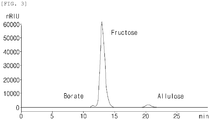
- the psicose fraction in the case of using sodium ions was 62100 ppm, which is a significantly higher value than 0.5 ppm. Additionally, the purities of a psicose in psicose fractions were 99.350% (DS%, w/w) ( FIG. 3 ), 99.150% (DS%, w/w) and 90.850% (DS%, w/w), respectively.
- the recovery rate of the borate were found to be approximately 100% for the borate fraction in the case of using calcium ions and strontium ions and the recovery rate of the fructose was 99.264%, which was a high recovery rate (borate content in borate fraction/(psicose fraction + borate fraction) ⁇ 100).
- a fructose and a borate which are the raw materials used for producing a psicose, can be separated while obtaining a high-purity psicose using the SMB chromatography (see Table 2 and FIG. 3 ), and therefore it could be confirmed that the fructose and the borate remaining after production of the psicose could be reused ( FIG. 4 ).
- the purity of psicose in a psicose fraction was 99% (DS%, w/w) or higher and 0.5 ppm or less of boron concentration in drinking water recommended by WHO was satisfied, whereby it could be confirmed that SMB chromatography is applicable for such a borate content in feed.
- the contents of borate, psicose and D-fructose in the feed are as the Table 3 below.
- Experimental example 2 Experimental example 3
- Experimental example 4 Experimental example 5
- Experimental example 6 Borate content in feed (DS%, w/w) 0.00 6.25 11.76 16.67 21.05 25.00 Content of psicose fraction (DS %, w/w) Borate 0 0.000015 0.000021 0.000032 0.000044 0.000137 D-fructose 0.78 0.75 0.68 0.56 0.54 1.23 Psicose 99.22 99.25 99.32 99.44 99.46 98.77 *DS: Dry solid
Landscapes
- Chemical & Material Sciences (AREA)
- Organic Chemistry (AREA)
- Life Sciences & Earth Sciences (AREA)
- Engineering & Computer Science (AREA)
- Zoology (AREA)
- Wood Science & Technology (AREA)
- Health & Medical Sciences (AREA)
- General Health & Medical Sciences (AREA)
- Biochemistry (AREA)
- Genetics & Genomics (AREA)
- Chemical Kinetics & Catalysis (AREA)
- Biotechnology (AREA)
- General Engineering & Computer Science (AREA)
- Bioinformatics & Cheminformatics (AREA)
- Microbiology (AREA)
- General Chemical & Material Sciences (AREA)
- Molecular Biology (AREA)
- Analytical Chemistry (AREA)
- Sustainable Development (AREA)
- Preparation Of Compounds By Using Micro-Organisms (AREA)
- Saccharide Compounds (AREA)
- Solid-Sorbent Or Filter-Aiding Compositions (AREA)
Applications Claiming Priority (2)
| Application Number | Priority Date | Filing Date | Title |
|---|---|---|---|
| KR20170079637 | 2017-06-23 | ||
| PCT/KR2018/007100 WO2018236184A2 (fr) | 2017-06-23 | 2018-06-22 | Procédé de production de d-psicose à partir d'un complexe de d-psicose-borate à l'aide d'une chromatographie et composition contenant du d-psicose |
Publications (2)
| Publication Number | Publication Date |
|---|---|
| EP3643786A2 true EP3643786A2 (fr) | 2020-04-29 |
| EP3643786A4 EP3643786A4 (fr) | 2021-04-07 |
Family
ID=64737320
Family Applications (1)
| Application Number | Title | Priority Date | Filing Date |
|---|---|---|---|
| EP18820578.5A Pending EP3643786A4 (fr) | 2017-06-23 | 2018-06-22 | Procédé de production de d-psicose à partir d'un complexe de d-psicose-borate à l'aide d'une chromatographie et composition contenant du d-psicose |
Country Status (10)
| Country | Link |
|---|---|
| US (1) | US11028420B2 (fr) |
| EP (1) | EP3643786A4 (fr) |
| JP (1) | JP6950142B2 (fr) |
| KR (1) | KR101981430B1 (fr) |
| CN (1) | CN110785496B (fr) |
| AU (1) | AU2018289182B2 (fr) |
| CA (1) | CA3067985C (fr) |
| MX (1) | MX2019015499A (fr) |
| RU (1) | RU2748664C1 (fr) |
| WO (1) | WO2018236184A2 (fr) |
Cited By (5)
| Publication number | Priority date | Publication date | Assignee | Title |
|---|---|---|---|---|
| EP4431614A1 (fr) | 2023-03-15 | 2024-09-18 | Annikki GmbH | Procédé de préparation de solutions aqueuses contenant de la d-psicose ou de la l-psicose |
| WO2024189215A2 (fr) | 2023-03-15 | 2024-09-19 | Annikki Gmbh | Procédé de production d'une solution aqueuse contenant du d-psicose |
| EP4446422A2 (fr) | 2023-03-15 | 2024-10-16 | Annikki GmbH | Procédé de préparation d'une solution aqueuse contenant de la l-psicose |
| EP4464786A1 (fr) | 2023-05-15 | 2024-11-20 | Annikki GmbH | Procédé de préparation de solutions aqueuses contenant de la d-psicose ou de la l-psicose |
| WO2024249194A1 (fr) * | 2023-05-26 | 2024-12-05 | Corn Products Development, Inc. | Procédés permettant d'augmenter la récupération d'allulose à partir de solutions mélangées d'allulose/fructose |
Families Citing this family (2)
| Publication number | Priority date | Publication date | Assignee | Title |
|---|---|---|---|---|
| KR20210157022A (ko) | 2020-06-19 | 2021-12-28 | 박경화 | 창틀에 탈부착 가능한 환풍 장치 |
| WO2025153524A1 (fr) | 2024-01-16 | 2025-07-24 | Savanna Ingredients Gmbh | Procédé de synthèse et de purification d'allulose |
Family Cites Families (10)
| Publication number | Priority date | Publication date | Assignee | Title |
|---|---|---|---|---|
| GB1585174A (en) | 1976-06-16 | 1981-02-25 | Ici Ltd | Separation of sugars from mixtures |
| US20080292765A1 (en) * | 2007-05-22 | 2008-11-27 | The Coca-Cola Company | Sweetness Enhancers, Sweetness Enhanced Sweetener Compositions, Methods for Their Formulation, and Uses |
| KR101384992B1 (ko) | 2009-01-15 | 2014-04-17 | 서희동 | 해양 심층수로부터 음료수를 생산하는 방법 |
| KR20110035805A (ko) | 2009-09-30 | 2011-04-06 | 씨제이제일제당 (주) | 사이코스-에피머화 효소의 고정화 및 이를 이용한 사이코스의 제조방법 |
| KR101030192B1 (ko) | 2010-07-13 | 2011-04-20 | 서울시립대학교 산학협력단 | 결정화 공정을 채용한 해수 내 보론의 제거방법 |
| CN102533711A (zh) * | 2012-02-22 | 2012-07-04 | 江南大学 | 一种d-塔格糖3-差向异构酶固定化方法 |
| GB2508586B (en) * | 2012-09-27 | 2020-09-02 | Tate & Lyle Ingredients Americas Llc | A protein |
| KR101455759B1 (ko) | 2013-04-23 | 2014-10-28 | 씨제이제일제당(주) | 사이코스 에피머화 효소 변이체 및 이를 이용한 사이코스의 제조 방법 |
| KR101455795B1 (ko) | 2013-06-14 | 2014-10-31 | (주)엘이엔티 | 엔진 흡기계 |
| KR20160062349A (ko) | 2014-11-25 | 2016-06-02 | 씨제이제일제당 (주) | 고순도 d-사이코스를 제조하는 방법 |
-
2018
- 2018-06-21 KR KR1020180071631A patent/KR101981430B1/ko active Active
- 2018-06-22 RU RU2020102450A patent/RU2748664C1/ru active
- 2018-06-22 US US16/624,973 patent/US11028420B2/en active Active
- 2018-06-22 AU AU2018289182A patent/AU2018289182B2/en active Active
- 2018-06-22 CA CA3067985A patent/CA3067985C/fr active Active
- 2018-06-22 MX MX2019015499A patent/MX2019015499A/es unknown
- 2018-06-22 JP JP2019570973A patent/JP6950142B2/ja active Active
- 2018-06-22 CN CN201880042035.8A patent/CN110785496B/zh active Active
- 2018-06-22 EP EP18820578.5A patent/EP3643786A4/fr active Pending
- 2018-06-22 WO PCT/KR2018/007100 patent/WO2018236184A2/fr not_active Ceased
Cited By (6)
| Publication number | Priority date | Publication date | Assignee | Title |
|---|---|---|---|---|
| EP4431614A1 (fr) | 2023-03-15 | 2024-09-18 | Annikki GmbH | Procédé de préparation de solutions aqueuses contenant de la d-psicose ou de la l-psicose |
| WO2024189215A2 (fr) | 2023-03-15 | 2024-09-19 | Annikki Gmbh | Procédé de production d'une solution aqueuse contenant du d-psicose |
| EP4446422A2 (fr) | 2023-03-15 | 2024-10-16 | Annikki GmbH | Procédé de préparation d'une solution aqueuse contenant de la l-psicose |
| EP4520839A2 (fr) | 2023-03-15 | 2025-03-12 | Annikki GmbH | Procédé de préparation d'une solution aqueuse contenant de la d-psicose |
| EP4464786A1 (fr) | 2023-05-15 | 2024-11-20 | Annikki GmbH | Procédé de préparation de solutions aqueuses contenant de la d-psicose ou de la l-psicose |
| WO2024249194A1 (fr) * | 2023-05-26 | 2024-12-05 | Corn Products Development, Inc. | Procédés permettant d'augmenter la récupération d'allulose à partir de solutions mélangées d'allulose/fructose |
Also Published As
| Publication number | Publication date |
|---|---|
| US20200172945A1 (en) | 2020-06-04 |
| WO2018236184A2 (fr) | 2018-12-27 |
| BR112019027301A2 (pt) | 2020-07-14 |
| CN110785496B (zh) | 2024-02-09 |
| CA3067985A1 (fr) | 2018-12-27 |
| RU2748664C1 (ru) | 2021-05-28 |
| MX2019015499A (es) | 2020-08-03 |
| US11028420B2 (en) | 2021-06-08 |
| JP6950142B2 (ja) | 2021-10-13 |
| KR20190000821A (ko) | 2019-01-03 |
| JP2020523999A (ja) | 2020-08-13 |
| AU2018289182A1 (en) | 2020-01-16 |
| AU2018289182B2 (en) | 2020-10-22 |
| CN110785496A (zh) | 2020-02-11 |
| WO2018236184A3 (fr) | 2019-03-28 |
| KR101981430B1 (ko) | 2019-05-23 |
| CA3067985C (fr) | 2023-04-04 |
| EP3643786A4 (fr) | 2021-04-07 |
Similar Documents
| Publication | Publication Date | Title |
|---|---|---|
| EP3643786A2 (fr) | Procédé de production de d-psicose à partir d'un complexe de d-psicose-borate à l'aide d'une chromatographie et composition contenant du d-psicose | |
| KR102072695B1 (ko) | 재순환을 이용한 사이코스의 제조방법 및 장치 | |
| KR102004941B1 (ko) | 효율적인 사이코스의 제조 방법 | |
| JP4822030B2 (ja) | ベタインを分離するための方法 | |
| US20130317210A1 (en) | Tagatose production using simulated moving bed separation | |
| US9150938B2 (en) | Tagatose production from deproteinized whey and purification by continuous chromatography | |
| CN110072871A (zh) | 制造阿洛酮糖的方法 | |
| EP3564250A2 (fr) | Procédé de purification d'un produit de réaction de conversion d'allulose | |
| CA1077032A (fr) | Extraction du sucre en presence dans des melangers | |
| EP0327016B1 (fr) | Procédé d'isolement et de récupération de l'érythritol d'un milieu de culture le contenant | |
| WO2024086623A1 (fr) | Procédé de séparation de sel et de sucre | |
| US20140275518A1 (en) | L-glucose production from l-glusose/l-mannose mixtures using simulated moving bed separation | |
| KR20250107129A (ko) | 당알콜 조성물 | |
| JPH0648992B2 (ja) | 糖液の分離法 | |
| BR112019027301B1 (pt) | Método para produzir d-psicose a partir de complexo de d-psicose borato usando cromatografia e composição contendo a d-psicose | |
| JPH02286695A (ja) | オリゴ糖の分離方法 | |
| CN120513250A (zh) | 利用离子交换纯化含有阿洛酮糖的溶液的方法 | |
| JPH0512358B2 (fr) | ||
| JPH04183395A (ja) | マンニトールの分離精製方法 | |
| EP2878210A1 (fr) | Procédé de préparation de galactose à partir de mélèze et procédé de préparation de tagatose à l'aide de galactose | |
| JPH0734751B2 (ja) | エリスリトール含有培養液からのエリスリトールの分離・回収方法 |
Legal Events
| Date | Code | Title | Description |
|---|---|---|---|
| STAA | Information on the status of an ep patent application or granted ep patent |
Free format text: STATUS: THE INTERNATIONAL PUBLICATION HAS BEEN MADE |
|
| PUAI | Public reference made under article 153(3) epc to a published international application that has entered the european phase |
Free format text: ORIGINAL CODE: 0009012 |
|
| STAA | Information on the status of an ep patent application or granted ep patent |
Free format text: STATUS: REQUEST FOR EXAMINATION WAS MADE |
|
| 17P | Request for examination filed |
Effective date: 20191217 |
|
| AK | Designated contracting states |
Kind code of ref document: A2 Designated state(s): AL AT BE BG CH CY CZ DE DK EE ES FI FR GB GR HR HU IE IS IT LI LT LU LV MC MK MT NL NO PL PT RO RS SE SI SK SM TR |
|
| AX | Request for extension of the european patent |
Extension state: BA ME |
|
| DAV | Request for validation of the european patent (deleted) | ||
| DAX | Request for extension of the european patent (deleted) | ||
| A4 | Supplementary search report drawn up and despatched |
Effective date: 20210310 |
|
| RIC1 | Information provided on ipc code assigned before grant |
Ipc: B01D 15/36 20060101ALI20210303BHEP Ipc: C12P 19/24 20060101ALI20210303BHEP Ipc: C12P 19/02 20060101AFI20210303BHEP Ipc: B01D 15/18 20060101ALI20210303BHEP Ipc: C07H 1/06 20060101ALI20210303BHEP |
|
| P01 | Opt-out of the competence of the unified patent court (upc) registered |
Effective date: 20230606 |