EP3643801A1 - Aluminiumbasierte legierung - Google Patents
Aluminiumbasierte legierung Download PDFInfo
- Publication number
- EP3643801A1 EP3643801A1 EP17915161.8A EP17915161A EP3643801A1 EP 3643801 A1 EP3643801 A1 EP 3643801A1 EP 17915161 A EP17915161 A EP 17915161A EP 3643801 A1 EP3643801 A1 EP 3643801A1
- Authority
- EP
- European Patent Office
- Prior art keywords
- alloy
- content
- range
- silicon
- iron
- Prior art date
- Legal status (The legal status is an assumption and is not a legal conclusion. Google has not performed a legal analysis and makes no representation as to the accuracy of the status listed.)
- Pending
Links
- 239000000956 alloy Substances 0.000 title claims abstract description 75
- 229910045601 alloy Inorganic materials 0.000 title claims abstract description 74
- 229910052782 aluminium Inorganic materials 0.000 title claims abstract description 25
- XAGFODPZIPBFFR-UHFFFAOYSA-N aluminium Chemical compound [Al] XAGFODPZIPBFFR-UHFFFAOYSA-N 0.000 title claims abstract description 25
- 239000004411 aluminium Substances 0.000 title abstract 3
- XEEYBQQBJWHFJM-UHFFFAOYSA-N Iron Chemical compound [Fe] XEEYBQQBJWHFJM-UHFFFAOYSA-N 0.000 claims abstract description 33
- 229910052706 scandium Inorganic materials 0.000 claims abstract description 27
- 239000011777 magnesium Substances 0.000 claims abstract description 26
- 229910052726 zirconium Inorganic materials 0.000 claims abstract description 26
- 229910052749 magnesium Inorganic materials 0.000 claims abstract description 25
- FYYHWMGAXLPEAU-UHFFFAOYSA-N Magnesium Chemical compound [Mg] FYYHWMGAXLPEAU-UHFFFAOYSA-N 0.000 claims abstract description 24
- 229910052710 silicon Inorganic materials 0.000 claims abstract description 22
- 239000010703 silicon Substances 0.000 claims abstract description 22
- QCWXUUIWCKQGHC-UHFFFAOYSA-N Zirconium Chemical compound [Zr] QCWXUUIWCKQGHC-UHFFFAOYSA-N 0.000 claims abstract description 21
- SIXSYDAISGFNSX-UHFFFAOYSA-N scandium atom Chemical compound [Sc] SIXSYDAISGFNSX-UHFFFAOYSA-N 0.000 claims abstract description 19
- 239000011651 chromium Substances 0.000 claims abstract description 15
- 239000011572 manganese Substances 0.000 claims abstract description 15
- 230000005496 eutectics Effects 0.000 claims abstract description 14
- 229910052742 iron Inorganic materials 0.000 claims abstract description 14
- 239000002245 particle Substances 0.000 claims abstract description 14
- OYPRJOBELJOOCE-UHFFFAOYSA-N Calcium Chemical compound [Ca] OYPRJOBELJOOCE-UHFFFAOYSA-N 0.000 claims abstract description 11
- 229910052791 calcium Inorganic materials 0.000 claims abstract description 11
- 239000011575 calcium Substances 0.000 claims abstract description 11
- 229910052684 Cerium Inorganic materials 0.000 claims abstract description 10
- VYZAMTAEIAYCRO-UHFFFAOYSA-N Chromium Chemical compound [Cr] VYZAMTAEIAYCRO-UHFFFAOYSA-N 0.000 claims abstract description 10
- GWXLDORMOJMVQZ-UHFFFAOYSA-N cerium Chemical compound [Ce] GWXLDORMOJMVQZ-UHFFFAOYSA-N 0.000 claims abstract description 10
- 229910052804 chromium Inorganic materials 0.000 claims abstract description 10
- WPBNNNQJVZRUHP-UHFFFAOYSA-L manganese(2+);methyl n-[[2-(methoxycarbonylcarbamothioylamino)phenyl]carbamothioyl]carbamate;n-[2-(sulfidocarbothioylamino)ethyl]carbamodithioate Chemical compound [Mn+2].[S-]C(=S)NCCNC([S-])=S.COC(=O)NC(=S)NC1=CC=CC=C1NC(=S)NC(=O)OC WPBNNNQJVZRUHP-UHFFFAOYSA-L 0.000 claims abstract description 8
- 239000011159 matrix material Substances 0.000 claims abstract description 7
- 229910000838 Al alloy Inorganic materials 0.000 claims abstract description 6
- XUIMIQQOPSSXEZ-UHFFFAOYSA-N Silicon Chemical compound [Si] XUIMIQQOPSSXEZ-UHFFFAOYSA-N 0.000 claims description 20
- 238000000926 separation method Methods 0.000 claims description 19
- 239000010936 titanium Substances 0.000 claims description 15
- 229910052719 titanium Inorganic materials 0.000 claims description 13
- RTAQQCXQSZGOHL-UHFFFAOYSA-N Titanium Chemical compound [Ti] RTAQQCXQSZGOHL-UHFFFAOYSA-N 0.000 claims description 12
- 238000000137 annealing Methods 0.000 claims description 10
- 229910052748 manganese Inorganic materials 0.000 claims description 7
- PWHULOQIROXLJO-UHFFFAOYSA-N Manganese Chemical compound [Mn] PWHULOQIROXLJO-UHFFFAOYSA-N 0.000 claims description 4
- 238000005272 metallurgy Methods 0.000 abstract description 2
- 239000002244 precipitate Substances 0.000 abstract 4
- 239000000463 material Substances 0.000 description 16
- 239000000203 mixture Substances 0.000 description 14
- 238000005728 strengthening Methods 0.000 description 11
- 239000000126 substance Substances 0.000 description 10
- 230000000694 effects Effects 0.000 description 8
- 230000015572 biosynthetic process Effects 0.000 description 7
- 238000005096 rolling process Methods 0.000 description 7
- 230000007797 corrosion Effects 0.000 description 6
- 238000005260 corrosion Methods 0.000 description 6
- 239000013078 crystal Substances 0.000 description 6
- 229910052802 copper Inorganic materials 0.000 description 5
- 239000010949 copper Substances 0.000 description 5
- 239000000843 powder Substances 0.000 description 5
- 229910052725 zinc Inorganic materials 0.000 description 5
- 239000011701 zinc Substances 0.000 description 5
- 230000015556 catabolic process Effects 0.000 description 4
- 238000001816 cooling Methods 0.000 description 4
- -1 flakes Substances 0.000 description 4
- 238000010438 heat treatment Methods 0.000 description 4
- 239000012535 impurity Substances 0.000 description 4
- 238000000034 method Methods 0.000 description 4
- 229910018134 Al-Mg Inorganic materials 0.000 description 3
- 229910018467 Al—Mg Inorganic materials 0.000 description 3
- OKTJSMMVPCPJKN-UHFFFAOYSA-N Carbon Chemical compound [C] OKTJSMMVPCPJKN-UHFFFAOYSA-N 0.000 description 3
- RYGMFSIKBFXOCR-UHFFFAOYSA-N Copper Chemical compound [Cu] RYGMFSIKBFXOCR-UHFFFAOYSA-N 0.000 description 3
- HCHKCACWOHOZIP-UHFFFAOYSA-N Zinc Chemical compound [Zn] HCHKCACWOHOZIP-UHFFFAOYSA-N 0.000 description 3
- 230000006866 deterioration Effects 0.000 description 3
- 229910052735 hafnium Inorganic materials 0.000 description 3
- 238000004519 manufacturing process Methods 0.000 description 3
- 238000004881 precipitation hardening Methods 0.000 description 3
- 238000012360 testing method Methods 0.000 description 3
- ZOXJGFHDIHLPTG-UHFFFAOYSA-N Boron Chemical compound [B] ZOXJGFHDIHLPTG-UHFFFAOYSA-N 0.000 description 2
- PXHVJJICTQNCMI-UHFFFAOYSA-N Nickel Chemical compound [Ni] PXHVJJICTQNCMI-UHFFFAOYSA-N 0.000 description 2
- 229910052771 Terbium Inorganic materials 0.000 description 2
- 239000000654 additive Substances 0.000 description 2
- 238000004458 analytical method Methods 0.000 description 2
- 229910052790 beryllium Inorganic materials 0.000 description 2
- ATBAMAFKBVZNFJ-UHFFFAOYSA-N beryllium atom Chemical compound [Be] ATBAMAFKBVZNFJ-UHFFFAOYSA-N 0.000 description 2
- 229910052796 boron Inorganic materials 0.000 description 2
- 238000005266 casting Methods 0.000 description 2
- 238000005516 engineering process Methods 0.000 description 2
- 229910002804 graphite Inorganic materials 0.000 description 2
- 239000010439 graphite Substances 0.000 description 2
- 238000002360 preparation method Methods 0.000 description 2
- GZCRRIHWUXGPOV-UHFFFAOYSA-N terbium atom Chemical compound [Tb] GZCRRIHWUXGPOV-UHFFFAOYSA-N 0.000 description 2
- 229910052720 vanadium Inorganic materials 0.000 description 2
- 229910052727 yttrium Inorganic materials 0.000 description 2
- 229910052691 Erbium Inorganic materials 0.000 description 1
- WHXSMMKQMYFTQS-UHFFFAOYSA-N Lithium Chemical compound [Li] WHXSMMKQMYFTQS-UHFFFAOYSA-N 0.000 description 1
- BQCADISMDOOEFD-UHFFFAOYSA-N Silver Chemical compound [Ag] BQCADISMDOOEFD-UHFFFAOYSA-N 0.000 description 1
- ATJFFYVFTNAWJD-UHFFFAOYSA-N Tin Chemical compound [Sn] ATJFFYVFTNAWJD-UHFFFAOYSA-N 0.000 description 1
- ZGMCLEXFYGHRTK-UHFFFAOYSA-N [Fe].[Ce] Chemical compound [Fe].[Ce] ZGMCLEXFYGHRTK-UHFFFAOYSA-N 0.000 description 1
- 239000013543 active substance Substances 0.000 description 1
- 230000003679 aging effect Effects 0.000 description 1
- 229910000905 alloy phase Inorganic materials 0.000 description 1
- 239000012298 atmosphere Substances 0.000 description 1
- 229910052797 bismuth Inorganic materials 0.000 description 1
- JCXGWMGPZLAOME-UHFFFAOYSA-N bismuth atom Chemical compound [Bi] JCXGWMGPZLAOME-UHFFFAOYSA-N 0.000 description 1
- 229910052793 cadmium Inorganic materials 0.000 description 1
- 229910052799 carbon Inorganic materials 0.000 description 1
- 229910017052 cobalt Inorganic materials 0.000 description 1
- 239000010941 cobalt Substances 0.000 description 1
- GUTLYIVDDKVIGB-UHFFFAOYSA-N cobalt atom Chemical compound [Co] GUTLYIVDDKVIGB-UHFFFAOYSA-N 0.000 description 1
- 238000009749 continuous casting Methods 0.000 description 1
- 238000002425 crystallisation Methods 0.000 description 1
- 230000008025 crystallization Effects 0.000 description 1
- 238000004512 die casting Methods 0.000 description 1
- 238000001125 extrusion Methods 0.000 description 1
- 230000002349 favourable effect Effects 0.000 description 1
- 239000013505 freshwater Substances 0.000 description 1
- 239000007789 gas Substances 0.000 description 1
- 229910052732 germanium Inorganic materials 0.000 description 1
- GNPVGFCGXDBREM-UHFFFAOYSA-N germanium atom Chemical compound [Ge] GNPVGFCGXDBREM-UHFFFAOYSA-N 0.000 description 1
- 230000005484 gravity Effects 0.000 description 1
- 238000007542 hardness measurement Methods 0.000 description 1
- 238000000265 homogenisation Methods 0.000 description 1
- 229910052747 lanthanoid Inorganic materials 0.000 description 1
- 150000002602 lanthanoids Chemical class 0.000 description 1
- 239000007788 liquid Substances 0.000 description 1
- 229910052744 lithium Inorganic materials 0.000 description 1
- 238000002844 melting Methods 0.000 description 1
- 230000008018 melting Effects 0.000 description 1
- 229910052751 metal Inorganic materials 0.000 description 1
- 239000002184 metal Substances 0.000 description 1
- 229910052759 nickel Inorganic materials 0.000 description 1
- 239000012299 nitrogen atmosphere Substances 0.000 description 1
- 239000008188 pellet Substances 0.000 description 1
- 230000008092 positive effect Effects 0.000 description 1
- 238000003825 pressing Methods 0.000 description 1
- 238000007639 printing Methods 0.000 description 1
- 230000001737 promoting effect Effects 0.000 description 1
- 239000013535 sea water Substances 0.000 description 1
- 229910052709 silver Inorganic materials 0.000 description 1
- 239000004332 silver Substances 0.000 description 1
- 238000005507 spraying Methods 0.000 description 1
- 238000009864 tensile test Methods 0.000 description 1
- 229910052723 transition metal Inorganic materials 0.000 description 1
- 150000003624 transition metals Chemical class 0.000 description 1
- LEONUFNNVUYDNQ-UHFFFAOYSA-N vanadium atom Chemical compound [V] LEONUFNNVUYDNQ-UHFFFAOYSA-N 0.000 description 1
- XLYOFNOQVPJJNP-UHFFFAOYSA-N water Substances O XLYOFNOQVPJJNP-UHFFFAOYSA-N 0.000 description 1
- VWQVUPCCIRVNHF-UHFFFAOYSA-N yttrium atom Chemical compound [Y] VWQVUPCCIRVNHF-UHFFFAOYSA-N 0.000 description 1
Images
Classifications
-
- C—CHEMISTRY; METALLURGY
- C22—METALLURGY; FERROUS OR NON-FERROUS ALLOYS; TREATMENT OF ALLOYS OR NON-FERROUS METALS
- C22C—ALLOYS
- C22C21/00—Alloys based on aluminium
- C22C21/06—Alloys based on aluminium with magnesium as the next major constituent
- C22C21/08—Alloys based on aluminium with magnesium as the next major constituent with silicon
-
- C—CHEMISTRY; METALLURGY
- C22—METALLURGY; FERROUS OR NON-FERROUS ALLOYS; TREATMENT OF ALLOYS OR NON-FERROUS METALS
- C22C—ALLOYS
- C22C21/00—Alloys based on aluminium
- C22C21/06—Alloys based on aluminium with magnesium as the next major constituent
-
- C—CHEMISTRY; METALLURGY
- C22—METALLURGY; FERROUS OR NON-FERROUS ALLOYS; TREATMENT OF ALLOYS OR NON-FERROUS METALS
- C22C—ALLOYS
- C22C21/00—Alloys based on aluminium
-
- C—CHEMISTRY; METALLURGY
- C22—METALLURGY; FERROUS OR NON-FERROUS ALLOYS; TREATMENT OF ALLOYS OR NON-FERROUS METALS
- C22F—CHANGING THE PHYSICAL STRUCTURE OF NON-FERROUS METALS AND NON-FERROUS ALLOYS
- C22F1/00—Changing the physical structure of non-ferrous metals or alloys by heat treatment or by hot or cold working
- C22F1/04—Changing the physical structure of non-ferrous metals or alloys by heat treatment or by hot or cold working of aluminium or alloys based thereon
- C22F1/047—Changing the physical structure of non-ferrous metals or alloys by heat treatment or by hot or cold working of aluminium or alloys based thereon of alloys with magnesium as the next major constituent
Definitions
- the invention relates to the field of metallurgy of aluminum-based materials and can be used to produce articles (including welded structures) operated in corrosive environments (humid atmosphere, fresh or sea water, and other corrosive environments) and under high-load conditions, including at elevated and cryogenic temperatures.
- the alloy material can be produced in the form of rolled products (plates, sheets, rolled sheet materials), pressed profiles and pipes, forged products, other wrought semifinished articles, as well as powders, flakes, pellets, etc., with subsequent printing of the finished articles.
- the proposed alloy is intended for application primarily in transportation unit elements operable under load, such as aircrafts, hulls of motorboats and other ships, upper decks, skin panels for automobile bodies, tanks for automobile and railway transport, including for transporting chemically active substances, for application in the food industry, etc.
- 5xxx wrought alloys of the Al-Mg system are widely applied in articles operating in corrosive environments. In particular, they are intended for use in sea and river water (waterborne transport, pipelines, etc.), and tanks for transporting liquefied gases and chemically active liquids.
- the main drawback of 5xxx alloys is the low annealed strength of wrought semifinished articles. For example, the yield point of 5083 alloys after annealing typically does not exceed 150 MPa (Promyshlennye Alyuminievye Splavy (Industrial Aluminum Alloys): Reference Book. S. G. Alieva, M. B. Altman, S. M. Ambartsumyan, et al. Moscow: Metallurgiya, 1984 ).
- a material developed by Alcoa is known (patent RU 2431692 ).
- the alloy contains (wt.%): 5.1-6.5% magnesium, 0.4-1.2% manganese, 0.45-1.5% zinc, up to 0.2% zirconium, up to 0.3% chromium, up to 0.2% titanium, up to 0.5% iron, up to 0.4% silicon, 0.002-0.25% copper, up to 0.01% calcium, up to 0.01% beryllium, at least one element from the group consisting of boron and carbon, each up to 0.06%; at least one element from the group consisting of bismuth, lead, tin, each up to 0.1%, scandium, silver, lithium, each up to 0.5%, vanadium, cerium, yttrium, each up to 0.25%; at least one element from the group consisting of nickel and cobalt, each up to 0.25%, aluminum, and the remainder being unavoidable impurities.
- One of the drawbacks of this alloy is its relatively poor general strength, which limits its application
- a strengthening effect much greater than that of 5083 alloy is produced with simultaneously present scandium and zirconium additives.
- the effect is obtained due to the much more abundant formation of secondary separations (with a typical size of 5-20 nm) that are resistant to high-temperature heating during deformation processing and subsequent annealing of the wrought semifinished articles, ensuring greater strength.
- a material based on the Al-Mg system is known, doped with simultaneously added zirconium and scandium.
- FSUE CRISM Prometey has proposed a material known as 1575-1 alloy, disclosed in patent RU 2268319 . The alloy is stronger than 5083 and 1565 alloys.
- the proposed material contains (wt.%): 5.5-6.5% magnesium, 0.10-0.20% scandium, 0.5-1.0% manganese, 0.10-0.25% chromium, 0.05-0.20% zirconium, 0.02-0.15% titanium, 0.1-1.0% zinc, 0.003-0.015% boron, 0.0002-0.005% beryllium, and the remainder being aluminum.
- the drawbacks of this material include a high magnesium content, which negatively affects performance in deformation processing and leads to reduced corrosion resistance in certain cases if the ⁇ -Al 8 Mg 5 phase is present in the final structure.
- the alloy based on the Al-Mg-Sc system additionally comprises elements selected from the group consisting of Hf, Mn, Zr, Cu, and Zn, more specifically (wt.%): 1.0-8.0% Mg, 0.05-0.6% Sc, as well as 0.05-0.20% Hf and/or 0.05-0.20% Zr, 0.5-2.0% Cu and/or 0.5-2.0% Zn.
- the material may further contain 0.1-0.8 wt.% Mn.
- the drawbacks of this material include relatively poor strength at the lower end of the magnesium content range, while magnesium content at the upper end results in low corrosion resistance and low performance in deformation processing. Attaining a high level of properties requires controlling the ratio of the sizes of particles formed by such elements as Sc, Hf, Mn, and Zr.
- the aluminum-based alloy contains (wt.%) 3-7% magnesium, 0.05-0.2% zirconium, 0.2-1.2% manganese, up to 0.15% silicon, and about 0.05-0.5% of elements forming secondary separations selected from the group consisting of Sc, Er, Y, Cd, Ho, Hf, and the remainder being aluminum, accidental elements and impurities.
- the chosen prototype was the technical solution disclosed in patent US6531004 by Eadstechnik Gmbh, where a weldable, corrosion-resistant material strengthened by Al-Zr-Sc ternary phase was proposed.
- the alloy contains (wt.%) the following main elements: 5-6% magnesium, 0.05-0.15% zirconium, 0.05-0.12% manganese, 0.01-0.2% titanium, 0.05-0.5% total scandium, terbium, and optionally at least one additional element selected from the group consisting of a number of lanthanides, in which scandium and terbium are present as mandatory elements, and at least one element selected from the group consisting of 0.1-0.2% copper and 0.1-0.4% zinc, and the remainder being aluminum and unavoidable impurities of not more than 0.1% silicon.
- the drawbacks of this material include the presence of rare and expensive elements. Furthermore, this material may be insufficiently resistant to high-temperature heating during process heating.
- the main problem common to all of the above-mentioned alloys is poor performance in deformation processing due to substantial strengthening of the cast ingot upon homogenizing (heterogenizing) annealing.
- the present invention provides a new, inexpensive, high-strength aluminum alloy with high physical and mechanical properties, performance, and corrosion resistance, in particular, high mechanical properties after annealing (at least 400 MPa tensile strength, at least 300 MPa yield point, and at least 15% relative elongation), and high performance in deformation processing.
- the technical result of the invention is the solution of the posed problem, providing high performance in deformation processing due to the presence of eutectic Fe-containing alloy phases, accompanied by increased mechanical properties due to the formation of compact particles of eutectic phases and secondary separation of the Zr-containing phase with a L1 2 crystal lattice.
- the solution to the posed problem and said technical result are ensured by proposing an aluminum alloy containing zirconium, iron, manganese, chromium, scandium, and optionally magnesium, wherein the alloy contains silicon and at least one eutectics forming element selected from the group consisting of cerium and calcium.
- the structure of the alloy is an aluminum matrix containing primarily silicon and optionally magnesium, secondary separations of Al 3 (Zr,Sc) phases with a L1 2 lattice and a size of no more than 20 nm, secondary separations of Al 6 Mn and Al 7 Cr, and eutectic phases containing iron, calcium and cerium having a mean particle size of not more than 1 ⁇ m, with the following phase ratios (wt.%):
- the alloy contains the elements in the following ratio (wt.%): Magnesium 4.0-5.8; Zirconium 0.08-0.17; Manganese 0.4-1.2; Chromium 0.1-0.2; Titanium 0.04-0.2; Scandium 0.08-0.15; Cerium 0.10-0.50;
- the structure of the aluminum alloy should comprise an aluminum solution maximally doped with magnesium and a maximum number of secondary separation particles, in particular, phases of Al 6 Mn having a mean size of up to 200 nm, Al 7 Cr having a mean size of up to 50 nm, and Al 3 (Zr,X) particles, where element X is Ti and/or Sc, with a L1 2 lattice having a mean size of up to 10 nm and a mean interparticle distance of not more than 50 nm.
- the increased strength effect in this case is provided by the combined favorable impact of hard solution strengthening of the aluminum solution due to magnesium and due to secondary phases containing manganese, chromium, zirconium, scandium, and titanium, resistant to high temperature heating. Further additional doping of the alloy with silicon and/or germanium reduces the solubility of zirconium, scandium and titanium in the aluminum solution, increasing the number of particles of secondary separations with a size of up to 10 nm and thus increasing strengthening efficiency.
- Magnesium amounting to 4.0-5.2 wt.% is required to increase the overall level of mechanical properties due to hard solution strengthening.
- the effect of this element will result in reduced performance in pressure processing (for example, ingot rolling), leading to a substantial deterioration of the product yield upon deformation.
- a content below 4 wt.% will not ensure the minimum required strength level.
- Zirconium, scandium and titanium in amounts of 0.08-0.50 wt.%, 0.05-0.15 wt.% and 0.04-0.2 wt.%, respectively, are required to attain the target strength due to dispersion hardening with formation of secondary separations of L1 2 crystal lattice metastable phases of Al 3 Zr and/or Al 3 (Zr,X), where X is Ti or Sc.
- zirconium, scandium and titanium redistribute between the aluminum matrix and secondary separations of the metastable phase of Al 3 Zr with a L1 2 lattice.
- Zirconium concentrations in the alloy above 0.50 wt.% require elevated temperatures for melt preparation, which is not technically possible in certain cases in conditions of production melt preparation.
- Zirconium, scandium and titanium content below the claimed level will not ensure the minimally required strength level due to an insufficient amount of secondary separations of metastable phases with a L1 2 lattice.
- Chromium amounting to 0.1-0.4 wt.% is required to increase the overall level of the mechanical properties due to dispersion hardening with formation of the Al 7 Cr secondary phase.
- the effect of this element will result in reduced performance in pressure processing (for example, ingot rolling), leading to a substantial deterioration of the product yield upon deformation.
- a content below 0.1 wt.% will not ensure the minimum required strength level.
- Manganese amounting to 0.4-1.2 wt.% is required to increase the overall level of the mechanical properties due to dispersion hardening with formation of the Al 6 Mn secondary phase.
- the effect of this element will result in reduced performance in pressure processing (for example, ingot rolling) due to possible formation of the corresponding primary crystals, leading to a substantial deterioration of the product yield upon deformation.
- a content below 0.4 wt.% will not ensure the minimum required strength level.
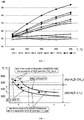
- Silicon in the claimed amounts is required, first of all, to accelerate the breakdown of the supersaturated hard aluminum solution.
- Fig. 1 schematically depicts this positive effect.
- the alloys were prepared in a resistance furnace in graphite crucibles using the following charging materials: aluminum (99.99), copper (99.9), magnesium (99.90) and double masters (Al-10Mn, Al-10Zr, Al-2Sc, Al-10Fe, Al-10Cr, Al-12Si).
- the number of phase components and the liquidus point (T 1 ) were calculated using the Thermo-Calc software (TTAL5 database). The melting and casting temperature was chosen based upon the condition T 1 + 50°C.
- the claimed alloy compositions were prepared using two methods: ingot technology and powder technology.
- the ingots were produced by gravity die casting in a metal mold and semi-continuous casting in a graphite crystallizer with cooling rates in the 20 and 50 K/sec crystallization range, respectively.
- the powders were produced by spraying in a nitrogen atmosphere. Depending on the powder particle size, the cooling rate was 10,000 K/sec and higher.
- Ingot deformation was performed on a laboratory rolling mill and horizontal press with an initial blank temperature of 450°C. Extrusion was performed on a horizontal press with a maximum pressing force of 1,000 tons.
- the chemical composition was determined on an ARL4460 spectrometer.
- the tensile strength was tested on turned specimens with a 50 mm gage length at a testing rate of 10 mm/min. Electrical conductivity was estimated using the eddy-current method. Hardness was determined by the Brinell method (load: 62.5 kgf, ball diameter: 2.5 mm, exposure time: 30 sec). All tests were performed at room temperature.
- the most preferred silicon concentration is 0.14 wt.%.
- alloys No. 12, 13 and 16 had cracks at the edges upon rolling.
- alloy No. 15 produced no cracks upon rolling, which is explained by the presence of the eutectic phase promoting a more homogeneous deformation and, as a result, the absence of cracks upon sheet rolling.
- magnesium concentration even the presence of the eutectic component does not exclude crack formation.
- alloys No. 11 and 14 do not meet the requirements of mechanical properties.
- the composition of alloy 15 is the most preferred for production of rolled sheet materials.
- alloy No. 15 (Table 2) and the alloy with a chemical composition listed in Table 4 were used to prepare samples in the form of ingots and powder for four cooling rates, primarily to evaluate the sizes of structural components of eutectic phases and the presence/absence of primary crystals.
- Table 4 Chemical Composition of the Experimental Alloy Alloy No. Chemical composition, wt.% Zr Fe Mn Cr Sc Ce Mg Si 17 0.5 0.14 0.40 0.17 0.11 5.0 3.1 0.14 Table 5. Structural Parameters of the Experimental Alloys Cooling Rate, K/sec Alloy No.
Landscapes
- Chemical & Material Sciences (AREA)
- Engineering & Computer Science (AREA)
- Materials Engineering (AREA)
- Mechanical Engineering (AREA)
- Metallurgy (AREA)
- Organic Chemistry (AREA)
- Physics & Mathematics (AREA)
- Thermal Sciences (AREA)
- Crystallography & Structural Chemistry (AREA)
- Manufacture Of Metal Powder And Suspensions Thereof (AREA)
Applications Claiming Priority (1)
| Application Number | Priority Date | Filing Date | Title |
|---|---|---|---|
| PCT/RU2017/000439 WO2018236241A1 (ru) | 2017-06-21 | 2017-06-21 | Сплав на основе алюминия |
Publications (2)
| Publication Number | Publication Date |
|---|---|
| EP3643801A1 true EP3643801A1 (de) | 2020-04-29 |
| EP3643801A4 EP3643801A4 (de) | 2020-11-11 |
Family
ID=64737775
Family Applications (1)
| Application Number | Title | Priority Date | Filing Date |
|---|---|---|---|
| EP17915161.8A Pending EP3643801A4 (de) | 2017-06-21 | 2017-06-21 | Aluminiumbasierte legierung |
Country Status (6)
| Country | Link |
|---|---|
| US (1) | US11168383B2 (de) |
| EP (1) | EP3643801A4 (de) |
| JP (2) | JP7229181B2 (de) |
| KR (2) | KR20200030035A (de) |
| RU (1) | RU2683399C1 (de) |
| WO (1) | WO2018236241A1 (de) |
Families Citing this family (18)
| Publication number | Priority date | Publication date | Assignee | Title |
|---|---|---|---|---|
| CN112204165B (zh) * | 2018-06-28 | 2023-09-01 | 株式会社爱发科 | 铝合金靶材及其制造方法 |
| DE102019209458A1 (de) * | 2019-06-28 | 2020-12-31 | Airbus Defence and Space GmbH | Cr-reiche Al-Legierung mit hoher Druck- und Scherfestigkeit |
| RU2714564C1 (ru) * | 2019-08-15 | 2020-02-18 | Общество с ограниченной ответственностью "Объединенная Компания РУСАЛ Инженерно-технологический центр" | Литейный алюминиевый сплав |
| RU2716566C1 (ru) * | 2019-12-18 | 2020-03-12 | Федеральное государственное автономное образовательное учреждение высшего образования "Национальный исследовательский технологический университет "МИСиС" | Способ получения деформированных полуфабрикатов из алюминиево-кальциевого композиционного сплава |
| WO2021133200A1 (ru) | 2019-12-27 | 2021-07-01 | Общество с ограниченной ответственностью "Объединенная Компания РУСАЛ Инженерно-технологический центр" | Сплав на основе алюминия |
| RU2745595C1 (ru) * | 2020-09-16 | 2021-03-29 | Общество с ограниченной ответственностью "Институт легких материалов и технологий" | Литейный алюминиевый сплав |
| KR102539804B1 (ko) * | 2020-10-27 | 2023-06-07 | 한국생산기술연구원 | 알루미늄 합금 및 이의 제조방법 |
| EP4251778A4 (de) * | 2020-11-24 | 2025-12-03 | Arconic Tech Llc | Verbesserte 5xxx-aluminiumlegierungen |
| DE102020131823A1 (de) * | 2020-12-01 | 2022-06-02 | Airbus Defence and Space GmbH | Aluminiumlegierung und Verfahren zur additiven Herstellung von Leichtbauteilen |
| KR102578420B1 (ko) | 2021-03-19 | 2023-09-14 | 덕산산업주식회사 | 극저온 용융알루미늄 도금 강재 및 그 제조방법 |
| EP4159344A1 (de) | 2021-09-30 | 2023-04-05 | Airbus (S.A.S.) | Aluminium-nickel-legierung zur herstellung eines wärmeleitenden teils wie z.b. eines wärmetauschers |
| CN113957298B (zh) * | 2021-10-26 | 2022-04-08 | 山东省科学院新材料研究所 | 一种低残余应力金刚石颗粒增强铝基复合材料的制备方法 |
| CN115679164B (zh) * | 2022-11-23 | 2023-12-01 | 中铝材料应用研究院有限公司 | 5xxx铝合金及其制备方法 |
| CN116287817B (zh) * | 2023-02-09 | 2023-10-13 | 江苏同生高品合金科技有限公司 | 一种含铈元素的高强度合金锭及其加工工艺 |
| CN116162826A (zh) * | 2023-02-28 | 2023-05-26 | 芜湖舜富精密压铸科技有限公司 | 一种非热处理型高强韧压铸铝合金及其制备方法 |
| CN117702016B (zh) * | 2023-12-18 | 2025-12-26 | 昆明理工大学 | 一种高强高韧铝镁硅系合金的制备方法 |
| CN119640106B (zh) * | 2024-12-30 | 2026-04-21 | 上海交通大学 | Al-Mg-Zn-Mn系合金及其制备方法及合金件 |
| CN120505546B (zh) * | 2025-05-28 | 2026-04-17 | 运城康道合金科技有限公司 | 一种高强高导电率铝合金挤压件及其制备方法 |
Family Cites Families (19)
| Publication number | Priority date | Publication date | Assignee | Title |
|---|---|---|---|---|
| DE2462118C2 (de) * | 1973-05-17 | 1985-05-30 | Alcan Research and Development Ltd., Montreal, Quebec | Barren aus einer Aluminium-Eisen-Legierung |
| US5624632A (en) * | 1995-01-31 | 1997-04-29 | Aluminum Company Of America | Aluminum magnesium alloy product containing dispersoids |
| JPH0995750A (ja) * | 1995-09-30 | 1997-04-08 | Kobe Steel Ltd | 耐熱性に優れたアルミニウム合金 |
| US6531004B1 (en) * | 1998-08-21 | 2003-03-11 | Eads Deutschland Gmbh | Weldable anti-corrosive aluminium-magnesium alloy containing a high amount of magnesium, especially for use in aviation |
| US6139653A (en) | 1999-08-12 | 2000-10-31 | Kaiser Aluminum & Chemical Corporation | Aluminum-magnesium-scandium alloys with zinc and copper |
| EP1158063A1 (de) * | 2000-05-22 | 2001-11-28 | Norsk Hydro A/S | Korrosionsbeständige Aluminiumlegierung |
| RU2268319C1 (ru) | 2004-05-20 | 2006-01-20 | Федеральное Государственное Унитарное Предприятие "Центральный Научно-Исследовательский Институт Конструкционных Материалов "Прометей" (Фгуп "Цнии Км "Прометей") | Деформируемый термически неупрочняемый сплав на основе алюминия |
| ATE524571T2 (de) * | 2005-08-16 | 2011-09-15 | Aleris Aluminum Koblenz Gmbh | Hochfeste schweissbare al-mg-legierung |
| EP1975263A4 (de) * | 2006-01-12 | 2012-03-07 | Furukawa Sky Aluminum Corp | Aluminiumlegierungen für das hochtemperatur- und hochgeschwindigkeitsformen, herstellungsverfahren dafür und verfahren zur herstellung von aluminiumlegierungsformen |
| JP4996854B2 (ja) * | 2006-01-12 | 2012-08-08 | 古河スカイ株式会社 | 高温高速成形用アルミニウム合金材及びその製造方法、並びにアルミニウム合金成形品の製造方法 |
| EP2396436B1 (de) * | 2010-04-07 | 2013-07-24 | Rheinfelden Alloys GmbH & Co. KG | Aluminiumdruckgusslegierung |
| RU2431692C1 (ru) | 2010-06-18 | 2011-10-20 | Закрытое акционерное общество "Алкоа Металлург Рус" | Сплав на основе алюминия и изделие, выполненное из этого сплава |
| EP2546373A1 (de) * | 2011-07-13 | 2013-01-16 | Aleris Aluminum Koblenz GmbH | Verfahren zur Herstellung eines Al-Mg-Legierungsblechprodukts |
| KR101581607B1 (ko) * | 2011-12-02 | 2015-12-30 | 가부시키가이샤 유에이씨제이 | 알루미늄 합금재를 이용한 열교환기용 핀재와 이를 포함하는 알루미늄 합금 구조체 |
| EP2653579B1 (de) * | 2012-04-17 | 2014-10-15 | Georg Fischer Druckguss GmbH & Co. KG | Aluminium-Legierung |
| DE102012011161B4 (de) * | 2012-06-05 | 2014-06-18 | Outokumpu Vdm Gmbh | Nickel-Chrom-Aluminium-Legierung mit guter Verarbeitbarkeit, Kriechfestigkeit und Korrosionsbeständigkeit |
| CN104294111B (zh) * | 2013-07-16 | 2016-06-01 | 大力神铝业股份有限公司 | 一种运煤敞车用铝合金板材的制造方法 |
| US9945018B2 (en) * | 2014-11-26 | 2018-04-17 | Honeywell International Inc. | Aluminum iron based alloys and methods of producing the same |
| US10822675B2 (en) * | 2015-03-06 | 2020-11-03 | NanoAL LLC | High temperature creep resistant aluminum superalloys |
-
2017
- 2017-06-21 EP EP17915161.8A patent/EP3643801A4/de active Pending
- 2017-06-21 WO PCT/RU2017/000439 patent/WO2018236241A1/ru not_active Ceased
- 2017-06-21 KR KR1020197038553A patent/KR20200030035A/ko not_active Ceased
- 2017-06-21 KR KR1020227044488A patent/KR102541307B1/ko active Active
- 2017-06-21 RU RU2018102056A patent/RU2683399C1/ru active
- 2017-06-21 JP JP2019570556A patent/JP7229181B2/ja active Active
-
2019
- 2019-12-20 US US16/724,114 patent/US11168383B2/en active Active
-
2022
- 2022-05-06 JP JP2022076649A patent/JP2022115991A/ja active Pending
Also Published As
| Publication number | Publication date |
|---|---|
| EP3643801A4 (de) | 2020-11-11 |
| KR102541307B1 (ko) | 2023-06-13 |
| KR20200030035A (ko) | 2020-03-19 |
| RU2683399C1 (ru) | 2019-03-28 |
| WO2018236241A1 (ru) | 2018-12-27 |
| JP2022115991A (ja) | 2022-08-09 |
| US11168383B2 (en) | 2021-11-09 |
| JP7229181B2 (ja) | 2023-02-27 |
| US20200140976A1 (en) | 2020-05-07 |
| JP2020524744A (ja) | 2020-08-20 |
| KR20230004934A (ko) | 2023-01-06 |
Similar Documents
| Publication | Publication Date | Title |
|---|---|---|
| US11168383B2 (en) | Aluminum-based alloy | |
| CA3006318C (en) | High strength 6xxx aluminum alloys and methods of making the same | |
| EP3265595B1 (de) | Hochfeste 7xxx-aluminiumlegierungen und verfahren zur herstellung davon | |
| CA2582972C (en) | Copper/zinc/silicon alloy, use and production thereof | |
| CN101233252B (zh) | 高强度可焊Al-Mg合金 | |
| US12344919B2 (en) | Aluminum-based alloy | |
| US6726878B1 (en) | High strength aluminum based alloy and the article made thereof | |
| EP2929061B1 (de) | Hitzebeständige legierung auf aluminiumbasis und herstellungsverfahren | |
| CN113174500A (zh) | 一种提高5083合金o态折弯性能的方法 | |
| KR102589799B1 (ko) | 고강도 알루미늄-계 합금 및 그로부터 물품을 생산하기 위한 방법 | |
| CN113481416A (zh) | 一种高性能Al-Zn-Mg-Cu系合金 | |
| RU2165996C1 (ru) | Высокопрочный сплав на основе алюминия и изделие, выполненное из него | |
| RU2184165C2 (ru) | Сплав на основе алюминия и изделие, выполненное из этого сплава | |
| EP2006403B1 (de) | Legierung auf aluminiumbasis | |
| CN117947309B (zh) | 一种高强耐蚀铜合金棒材及其制备方法 | |
| RU2858258C2 (ru) | Лёгкий высокопрочный коррозионно-стойкий материал из алюминиевого сплава и способ его получения | |
| RU2800435C1 (ru) | Сплав на основе алюминия | |
| JP2009221531A (ja) | 冷間加工用Al−Mg系アルミニウム合金押出材及びその製造方法 | |
| WO2024117936A1 (ru) | Сплав на основе алюминия | |
| EP4656753A1 (de) | Aluminium-scandium-legierung und verfahren zur herstellung davon |
Legal Events
| Date | Code | Title | Description |
|---|---|---|---|
| STAA | Information on the status of an ep patent application or granted ep patent |
Free format text: STATUS: THE INTERNATIONAL PUBLICATION HAS BEEN MADE |
|
| PUAI | Public reference made under article 153(3) epc to a published international application that has entered the european phase |
Free format text: ORIGINAL CODE: 0009012 |
|
| STAA | Information on the status of an ep patent application or granted ep patent |
Free format text: STATUS: REQUEST FOR EXAMINATION WAS MADE |
|
| 17P | Request for examination filed |
Effective date: 20200117 |
|
| AK | Designated contracting states |
Kind code of ref document: A1 Designated state(s): AL AT BE BG CH CY CZ DE DK EE ES FI FR GB GR HR HU IE IS IT LI LT LU LV MC MK MT NL NO PL PT RO RS SE SI SK SM TR |
|
| AX | Request for extension of the european patent |
Extension state: BA ME |
|
| DAV | Request for validation of the european patent (deleted) | ||
| DAX | Request for extension of the european patent (deleted) | ||
| A4 | Supplementary search report drawn up and despatched |
Effective date: 20201014 |
|
| RIC1 | Information provided on ipc code assigned before grant |
Ipc: C22C 21/08 20060101ALI20201008BHEP Ipc: C22C 21/00 20060101AFI20201008BHEP |
|
| STAA | Information on the status of an ep patent application or granted ep patent |
Free format text: STATUS: EXAMINATION IS IN PROGRESS |
|
| 17Q | First examination report despatched |
Effective date: 20210923 |