EP3644548B1 - Système d'échange de clés et procédé d'échange de clés - Google Patents
Système d'échange de clés et procédé d'échange de clés Download PDFInfo
- Publication number
- EP3644548B1 EP3644548B1 EP18820430.9A EP18820430A EP3644548B1 EP 3644548 B1 EP3644548 B1 EP 3644548B1 EP 18820430 A EP18820430 A EP 18820430A EP 3644548 B1 EP3644548 B1 EP 3644548B1
- Authority
- EP
- European Patent Office
- Prior art keywords
- key
- terminal
- transaction
- user
- secret
- Prior art date
- Legal status (The legal status is an assumption and is not a legal conclusion. Google has not performed a legal analysis and makes no representation as to the accuracy of the status listed.)
- Active
Links
Images



Classifications
-
- H—ELECTRICITY
- H04—ELECTRIC COMMUNICATION TECHNIQUE
- H04L—TRANSMISSION OF DIGITAL INFORMATION, e.g. TELEGRAPHIC COMMUNICATION
- H04L9/00—Cryptographic mechanisms or cryptographic arrangements for secret or secure communications; Network security protocols
- H04L9/08—Key distribution or management, e.g. generation, sharing or updating, of cryptographic keys or passwords
- H04L9/0816—Key establishment, i.e. cryptographic processes or cryptographic protocols whereby a shared secret becomes available to two or more parties, for subsequent use
- H04L9/0819—Key transport or distribution, i.e. key establishment techniques where one party creates or otherwise obtains a secret value, and securely transfers it to the other(s)
- H04L9/0822—Key transport or distribution, i.e. key establishment techniques where one party creates or otherwise obtains a secret value, and securely transfers it to the other(s) using key encryption key
-
- H—ELECTRICITY
- H04—ELECTRIC COMMUNICATION TECHNIQUE
- H04L—TRANSMISSION OF DIGITAL INFORMATION, e.g. TELEGRAPHIC COMMUNICATION
- H04L63/00—Network architectures or network communication protocols for network security
- H04L63/06—Network architectures or network communication protocols for network security for supporting key management in a packet data network
- H04L63/061—Network architectures or network communication protocols for network security for supporting key management in a packet data network for key exchange, e.g. in peer-to-peer networks
-
- G—PHYSICS
- G06—COMPUTING OR CALCULATING; COUNTING
- G06F—ELECTRIC DIGITAL DATA PROCESSING
- G06F21/00—Security arrangements for protecting computers, components thereof, programs or data against unauthorised activity
- G06F21/10—Protecting distributed programs or content, e.g. vending or licensing of copyrighted material ; Digital rights management [DRM]
- G06F21/105—Arrangements for software license management or administration, e.g. for managing licenses at corporate level
-
- H—ELECTRICITY
- H04—ELECTRIC COMMUNICATION TECHNIQUE
- H04L—TRANSMISSION OF DIGITAL INFORMATION, e.g. TELEGRAPHIC COMMUNICATION
- H04L9/00—Cryptographic mechanisms or cryptographic arrangements for secret or secure communications; Network security protocols
- H04L9/06—Cryptographic mechanisms or cryptographic arrangements for secret or secure communications; Network security protocols the encryption apparatus using shift registers or memories for block-wise or stream coding, e.g. DES systems or RC4; Hash functions; Pseudorandom sequence generators
- H04L9/0618—Block ciphers, i.e. encrypting groups of characters of a plain text message using fixed encryption transformation
- H04L9/0637—Modes of operation, e.g. cipher block chaining [CBC], electronic codebook [ECB] or Galois/counter mode [GCM]
-
- H—ELECTRICITY
- H04—ELECTRIC COMMUNICATION TECHNIQUE
- H04L—TRANSMISSION OF DIGITAL INFORMATION, e.g. TELEGRAPHIC COMMUNICATION
- H04L9/00—Cryptographic mechanisms or cryptographic arrangements for secret or secure communications; Network security protocols
- H04L9/08—Key distribution or management, e.g. generation, sharing or updating, of cryptographic keys or passwords
- H04L9/0816—Key establishment, i.e. cryptographic processes or cryptographic protocols whereby a shared secret becomes available to two or more parties, for subsequent use
- H04L9/0838—Key agreement, i.e. key establishment technique in which a shared key is derived by parties as a function of information contributed by, or associated with, each of these
- H04L9/0841—Key agreement, i.e. key establishment technique in which a shared key is derived by parties as a function of information contributed by, or associated with, each of these involving Diffie-Hellman or related key agreement protocols
-
- H—ELECTRICITY
- H04—ELECTRIC COMMUNICATION TECHNIQUE
- H04L—TRANSMISSION OF DIGITAL INFORMATION, e.g. TELEGRAPHIC COMMUNICATION
- H04L9/00—Cryptographic mechanisms or cryptographic arrangements for secret or secure communications; Network security protocols
- H04L9/50—Cryptographic mechanisms or cryptographic arrangements for secret or secure communications; Network security protocols using hash chains, e.g. blockchains or hash trees
-
- H—ELECTRICITY
- H04—ELECTRIC COMMUNICATION TECHNIQUE
- H04W—WIRELESS COMMUNICATION NETWORKS
- H04W12/00—Security arrangements; Authentication; Protecting privacy or anonymity
- H04W12/04—Key management, e.g. using generic bootstrapping architecture [GBA]
- H04W12/047—Key management, e.g. using generic bootstrapping architecture [GBA] without using a trusted network node as an anchor
- H04W12/0471—Key exchange
Definitions
- the present invention relates to a key exchange system and a key exchange method having forward secrecy on a blockchain.
- a technique called blockchain has been used in the cryptocurrencies such as bitcoin (registered trademark).
- the blockchain technique reliability of information exchanged among participants is guaranteed by a process of consensus building in a network formed by all the participants. Soundness of the blockchain is maintained by preventing illegal acts such as tampering and double spending in the entire system (Non-patent document 1).
- the blockchain is obtained by collecting, in units called blocks, deal information (transactions) of a cryptocurrency and others among the participants.
- the blockchain functions as one enormous ledger shared by the participants in a P2P (Peer To Peer) network.
- Non-patent document 1 As illustrated in Fig. 8 , deal information (transactions) of a cryptocurrency is represented by a chain of digital signatures.
- Fig. 9 generated transactions are collected into a block by a blockchain generating device under predetermined conditions. A new block is linked to the existing blockchain in the P2P network. The updated blockchain is shared by computers (terminals of the participants).
- the blockchain generating device gathers transactions not included in the blockchain and generates a new block (an n+1-th block) including the gathered transactions and a hash value (256 bits) of a block (an n-th block) at the end of the present blockchain.
- the blockchain generating device searches for an appropriate value with which all of several leading bits of the hash value are "0" when a cryptographic hash function (SHA-256) is applied to the new block (the n+1-th block).
- the blockchain generating device links the new block (the n+1-th block) including the appropriate value to the end of the present blockchain and broadcasts the new block. In this way, the blockchain is constructed on the P2P network. Thereafter, a blockchain verifying device verifies the broadcasted new block and shares a result of the verification with other terminals.
- Patent document 1 discloses a technique applied to license management of digital contents.
- a common key for decrypting the content is passed to a user together with license information of use via the blockchain.
- the common key is secret information not desired to be known by people other than the user.
- key exchange is carried out using a public key cryptography via the blockchain and an encrypted common key is registered in the blockchain.
- Patent document 1 Japanese Patent Application Publication No. 2017-50763
- Non-patent document 1 Kenji Saito, "Bitcoin-Digital Megalith Money without Human Presence”, WI DE technical report MCCORRY PATRICK ET AL: “Authenticated Key Exchange over Bitcoin”, 9 December 2015 relates to realizing end-to-end secure communication between Bitcoin users in a post-transaction scenario without requiring any trusted third party or additional authentication credentials.
- a transaction registered in the blockchain is shared by all participants and permanently accumulated in the blockchain.
- a general blockchain represented by bitcoin registered trademark
- secret information is encrypted by a public key of a user and decrypted by a secret key paired with the public key. If the secret key used for the decryption leaks, all kinds of secret information for which the secret key is used can be decrypted. That is, with a method of simply using a public key cryptography, it is difficult to safely conceal encrypted secret information over a long term.
- An objective of the present invention devised in view of such circumstances is to provide a key exchange system and a key exchange method for safely concealing secret information over a long term when the secret information is recorded on a blockchain.
- One aspect of the present invention is a key exchange system including a first terminal and a second terminal connected to each other via a network in which a blockchain is constructed.
- the first terminal includes: a license issuing unit that generates a first transaction including a first public key and an issued license responding to a license request; a first key storage region that retains a first secret key; and a first encrypting and decrypting unit that generates a common key using deal-specific information, which is at least one of the first transaction, a second transaction, and a parameter of a specific block, together with a second public key and the first secret key.
- the second terminal includes: a license requesting unit that generates the second transaction including the second public key and the license request; a second key storage region that retains a second secret key; and a second encrypting and decrypting unit that generates the common key using the deal-specific information, the first public key, and the second secret key.
- the first encrypting and decrypting unit encrypts secret information using the common key generated by the first encrypting and decrypting unit.
- the second encrypting and decrypting unit decrypts the encrypted secret information acquired via the network using the common key generated by the second encrypting and decrypting unit.
- One aspect of the present invention is a key exchange method executed by a key exchange system including a first terminal and a second terminal connected to each other via a network in which a blockchain is constructed.
- the key exchange method includes: retaining a first secret key by the first terminal; retaining a second secret key by the second terminal; generating a second transaction including a second public key and a license request by the second terminal; generating a first transaction including a first public key and an issued license responding to the license request by the first terminal; generating a common key by the first terminal using deal-specific information, which is at least one of the first transaction, the second transaction, and a parameter of a specific block, together with the second public key, and the first secret key; encrypting secret information by the first terminal using the common key generated by the first terminal; generating the common key by the second terminal using the deal-specific information, the first public key, and the second secret key; and decrypting the encrypted secret information acquired via the network by the second terminal using the common key generated by the second terminal.
- a key exchange system and a key exchange method for safely concealing secret information over a long term when the secret information is recorded on a blockchain are provided.
- Fig. 1 is a diagram illustrating the configuration of a key exchange system 5 according to a first embodiment.
- the key exchange system 5 includes multiple terminals (a user A terminal 1, a user B terminal 2, and another terminal 3) .
- the terminals are information processing devices used by the users.
- Each of the multiple terminals may be, for example, a personal computer (PC) or a smartphone.
- the multiple terminals are connected in an independent distributed manner via a P2P network 4 (a blockchain network; simply referred to as network as well) _ to be capable of communicating with one another.
- a P2P network 4 a blockchain network; simply referred to as network as well
- the key exchange system 5 may include two or more other terminals 3.
- a program for realizing a deal of a digital cryptocurrency is installed in each of the multiple terminals configuring the key exchange system 5.
- the terminals acquire a blockchain and a transaction via the P2P network 4.
- the multiple terminals monitor illegal acts and share a sole blockchain.
- the transaction treated by the key exchange system 5 includes evidence data of a deal clearly describing a sender and a destination and attached with an electronic signature of the sender.
- Each of the multiple terminals configuring the key exchange system 5 functions as a blockchain generating device, a blockchain verifying device, or a transaction generating device according to a role in deals of the digital cryptocurrency.
- the blockchain generating device links a new block to an existing blockchain, in which blocks including multiple transactions are linked, to generate an updated blockchain.
- the new block includes a transaction generated after generation of the existing blockchain.
- the new block generated by the blockchain generating device is shared by the other terminals via the P2P network 4. In this way, a blockchain is constructed on the P2P network 4.
- the blockchain verifying device verifies the blockchain generated by the blockchain generating device.
- a result of the verification of the blockchain verifying device is shared by the other terminals via the P2P network 4.
- the transaction generating device generates a transaction involved in the deal of the digital cryptocurrency.
- the transaction generated by the transaction generating device is shared by the other terminals via the P2P network 4.
- Each of the multiple terminals includes an encryption processing unit 10, a blockchain storing unit 30, a blockchain control unit 40, and a transaction issuing unit 50.
- the encryption processing unit 10 executes processing concerning, for example, encryption and decryption. Details of the encryption processing unit 10 are explained below. In the following explanation, the other terminal 3 is excluded from terminals that share secret information S. Therefore, in Fig. 1 , the encryption processing unit 10 of the other terminal 3 is not illustrated.
- the blockchain storing unit 30 is a storage device that stores the blockchain shared by the multiple terminals as explained above.
- the blockchain storing unit 30 may be configured by at least one of a semiconductor storage device and a magnetic storage device.
- the blockchain control unit 40 executes control concerning storage of a blockchain.
- the blockchain control unit 40 has a role of retaining the latest blockchain in the terminal (causing the blockchain storing unit 30 to store the latest blockchain) in cooperation with the other terminals in an independent distributed manner.
- the blockchain control unit 40 may read out a blockchain from the blockchain storing unit 30 according to a request from the encryption processing unit 10 and output the blockchain to the encryption processing unit 10.
- the transaction issuing unit 50 generates a transaction involved in a deal, for example, when the terminal functions as the transaction generating device.
- the transaction issuing unit 50 broadcasts the generated transaction to the other terminals via the P2P network 4.
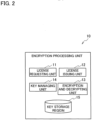
- Fig. 2 is a diagram illustrating a detailed configuration of the encryption processing unit 10.
- the encryption processing unit 10 includes a license requesting unit 11, a license issuing unit 12, an encrypting and decrypting unit 13, a key managing unit 14, and a key storage region 15.
- the license requesting unit 11 generates a transaction including a public key and a license request.
- the public key is generated by the key managing unit 14.
- the license requesting unit 11 outputs the generated transaction to the transaction issuing unit 50.
- the transaction generated by the license requesting unit 11 is broadcasted to the other terminals by the transaction issuing unit 50 via the P2P network 4.
- the license issuing unit 12 generates a transaction including a public key and an issued license.
- the license issuing unit 12 outputs the generated transaction to the transaction issuing unit 50.
- the transaction generated by the license issuing unit 12 is broadcasted to the other terminals by the transaction issuing unit 50 via the P2P network 4.
- the encrypting and decrypting unit 13 executes processing concerning encryption and decryption.
- the encrypting and decrypting unit 13 acquires, from the P2P network 4, a public key of a partner that shares the secret information S.
- the encrypting and decrypting unit 13 calculates a session key (a disposable encryption key effective for only a certain time) using a secret key or the like of the user stored in the key storage region 15.
- the encrypting and decrypting unit 13 encrypts the secret information S using the calculated session key.
- the encrypting and decrypting unit 13 decrypts the encrypted secret information S using the session key.
- the encrypting and decrypting unit 13 may use the session key stored in the key storage region 15 or may calculate a session key again.
- the encrypted secret information S can be registered in a blockchain by being included in the transaction by a predetermined method.
- the key managing unit 14 executes processing concerning a public key and a secret key.
- the key managing unit 14 executes generation, reference, and deletion of a public key and a secret key.
- the key managing unit 14 is used by other modules (e. g. , the license requesting unit 11, the license issuing unit 12, and the encrypting and decrypting unit 13) .
- an ECDH (Elliptic Curve Diffie-Hellman) key exchange scheme is used for the generation of a public key and a secret key.
- the key storage region 15 stores (retains) the secret key generated by the key managing unit 14.
- the key storage region 15 may temporarily store the session key calculated by the encrypting and decrypting unit 13.
- the user A is a user of the user A terminal 1 (a first terminal) .
- the user B is a user of the user B terminal 2 (a second terminal).
- Fig. 3 is a sequence chart for explaining the key exchange method according to this embodiment.
- the user A illustrated in Fig. 3 means the user A terminal 1.
- the user B illustrated in Fig. 3 means the user B terminal 2.
- the secret information S is information not open to the public generated by the user A.
- Fig. 3 illustrates a sequence of key exchange in which the user B requests a license of the user A concerning inspection (or use) of the secret information S and the user A approves the request and open the secret information S to only the user B. All communications are performed by transactions issued by the users. Exchange of data such as a public key is performed via the blockchain. As explained above, ECDH key exchange is adopted in this embodiment.
- the user A and the user B generate keys using the same elliptical curve.
- a program for generating keys using a specific one elliptical curve may be installed in the user A terminal 1 and the user B terminal 2. At this time, the program installed in common in the user A terminal 1 and the user B terminal 2 executed by a processor to function as the encryption processing unit 10.
- the key managing unit 14 of the user B terminal 2 generates a secret key esk b (a second secret key) and a public key EPK b (a second public key) using an elliptical curve cryptography ((1) of Fig. 3 ).
- the key storage region 15 (a second key storage region) of the user B terminal 2 retains the generated secret key esk b .
- the user B terminal 2 generates a transaction T b (a second transaction) including a license request (that is, information indicating that a license for, for example, inspection of the secret information S is requested) and the public key EPK b for the ECDH key exchange and broadcasts the transaction T b via the P2P network 4 ((2) of Fig. 3 ) .
- the transaction T b is generated by the license requesting unit 11 and output to the transaction issuing unit 50.
- the transaction T b is broadcasted by the transaction issuing unit 50.
- the license request may include an identifier, a flag value, or the like for specifying the secret information S.
- a block (a block N-1 illustrated in Fig. 3 ) including the transaction T b , in which the public key EPK b is stored, is added to the blockchain by a process for generating an updated blockchain.
- the other terminal 3 functioning as the blockchain generating device may generate a new block.
- the user A terminal 1 confirms the license request included in the transaction T b .
- the user A terminal 1 acquires the public key EPK b ((3) of Fig. 3 ) .
- the public key EPK b of the user B is shared by the user A according to the process of (1) to (3) of Fig. 3 .
- the key managing unit 14 of the user A terminal 1 generates a secret key esk a (a first secret key) and a public key EPK a (a first public key) using an elliptical curve cryptography ((4) of Fig. 3 ).
- the key storage region 15 (a first key storage region) of the user A terminal 1 retains the generated secret key esk a .
- the user A terminal 1 generates a transaction T a (a first transaction) including an issued license (that is, information indicating that, for example, inspection of the secret information S is approved and a license is issued for the license request) and the public key EPK a for the ECDH key exchange and broadcasts the transaction T a via the P2P network 4 ((5) of Fig. 3 ) .
- the transaction T a is generated by the license issuing unit 12 and output to the transaction issuing unit 50.
- the transaction T a is broadcasted by the transaction issuing unit 50.
- the issued license may include an identifier, a flag value, or the like for specifying the license request from the user B.
- a block (a block N illustrated in Fig. 3 ) including the transaction T a , in which the public key EPK a is stored, is added to the blockchain by a process for generating an updated blockchain.
- the other terminal 3 functioning as the blockchain generating device may generate an updated blockchain.
- the user B terminal 2 confirms the issued license included in the transaction T a .
- the user B terminal 2 acquires the public key EPK a ((6) of Fig. 3 ).
- the public key EPK a of the user A is shared by the user B according to the process of (4) to (6) of Fig. 3 .
- a value ⁇ calculated by a public key of a partner and a secret key of a user is the same value for the user A and the user B. Therefore, the user A and the user B are capable of generating the same key (a common key) from the value ⁇ using a key derivation function KDF determined beforehand.
- the user A and the user B can encrypt and decrypt, in a common key encryption scheme such as AES-GCM, the secret information S using the common key obtained by the key derivation function KDF.
- the common key is calculated by giving values to parameters of the key derivation function KDF. If the common key is calculated using only the value ⁇ as a parameter of the key derivation function KDF, it is likely that all kinds of information encrypted by the common key are decrypted when the secret key of the user A (or the secret key of the user B) leaks. Therefore, "related transactions" and "a parameter of a related block (a specific block) " recognized by both of the user A and the user B are further used as parameters of the key derivation function KDF. Consequently, the common key calculated by the key derivation function KDF is a session key, that is, a disposable encryption key effective for a certain time.
- the value ⁇ of Expression (B) is calculated by the above Expression (A).
- Expression (B) the transaction T b including the license request and the transaction T a including the issued license are used as "related transactions”.
- a number N of a block in which the transaction T a is stored is used as "a parameter of a related block”.
- the transactions T a and T b and the number N of the block are values decided for each deal. That is, the transactions T a and T b and the number N of the block are information peculiar to each deal on the P2P network 4. Therefore, a session key calculated using the transactions T a and T b and the number N of the block is a key peculiar to each deal.
- the encrypting and decrypting unit 13 (a first encrypting and decrypting unit) of the user A terminal 1 calculates the value ⁇ from the secret key esk a and the public key EPK b according to Expression (A) .
- the user A terminal 1 generates the session key (a common key) k according to Expression (B) ((8) of Fig. 3 ; a first common key generating step).
- the user A terminal 1 broadcasts a transaction including the secret information S encrypted using the session key k to the other terminals via the P2P network 4 ((9) of Fig. 3 ) .
- the encrypting and decrypting unit 13 encrypts the secret information S using the session key.
- the encrypted secret information S is included in the transaction by the predetermined method and output to the transaction issuing unit 50.
- the transaction issuing unit 50 broadcasts the generated transaction to the other terminals via the P2P network 4.
- the encrypting and decrypting unit 13 calculates the value ⁇ from the secret key esk b and the public key EPK a according to Expression (A).
- the user B terminal 2 generates the session key (the common key) k according to Expression (B) ((7) of Fig. 3 ; a second common key generating step).
- the encrypting and decrypting unit 13 of the user B terminal 2 decrypts, using the session key k, the encrypted secret key S acquired via the P2P network 4 ((10) of Fig. 3 ).
- the secret information S is encrypted and decrypted by the common key k generated according to the above Expressions (A) and (B) .
- the common key k is calculated using "related transactions" and "a parameter of a related block", which are values decided for each deal. Accordingly, k is a session key peculiar to each deal. Therefore, the key exchange system (and the key exchange method on the system) according to this embodiment has forward secrecy and can safely conceal secret information over a long term when the secret information is recorded on a blockchain.
- the secret information S is shared by the two persons (the user A and the user B) in the key exchange system 5 according to the first embodiment.
- the key exchange system 5 according to a second embodiment is expanded such that the secret information S is shared by a group of a large number of people.
- users belonging to the group use a common key used in the entire group (a group common key).
- the group common key is generated by a root user having a management authority among the users belonging to the group.
- the users belonging to the group encrypt shared information with the group common key and arrange the shared information in a place where the other users can acquire the shared information (for example, register the shared information in a blockchain).
- the users belonging to the group decrypt encrypted shared information with the group common key.
- the shared information is one kind of information that should be concealed from users other than the users of the group.
- the secret information S encrypted using the session key is transmitted and received between the two persons .
- the secret information S (a target of encryption and decryption by the session key) between the two persons may be, for example, information itself or may be a password or an encryption key for accessing the information.
- an encrypted group common key is transmitted and received between the root user and each of "users (client users) belonging to the group other than the root user" . That is, in this embodiment, the secret information S between the two persons is the group common key.
- transmission and reception of the group common key between the two persons is executed by the number of client users.
- a session key between a root user U 1 and a client user U d is represented as k d (d is an integer equal to or larger than 2).
- the group common key is represented as k.
- the configuration of the key exchange system 5 according to this embodiment is similar to the configuration in the first embodiment.
- the user A terminal 1 illustrated in Fig. 1 corresponds to a terminal of the root user U 1 .
- the user B terminal 2 illustrated in Fig. 1 corresponds to a terminal of the client user U d .
- n is an integer equal to or larger than 3 users
- each of client users U 2 , U 3 , ..., and U n has a peculiar terminal. That is, the key exchange system 5 according to this embodiment can have a configuration including multiple the user B terminals 2 illustrated in Fig. 1 .
- the encryption processing unit 10 of the user A terminal 1 has the same configuration as the encryption processing unit 10 of the user B terminal 2.
- the root user U 1 manages, for example, generation of the group common key. Therefore, an encryption processing unit 10a of the terminal of the root user U 1 has a configuration different from the configuration of an encryption processing unit 10b of the terminal of the client user U d .
- Fig. 4 is a diagram illustrating the configuration of the encryption processing unit 10a for the root user U 1 .
- the encryption processing unit 10a includes the license requesting unit 11, the license issuing unit 12, a session-key encrypting unit 13a, the key managing unit 14, the key storage region 15, a group-common-key encrypting and decrypting unit 16, a group-common-key managing unit 17, and a group-common-key storage region 18. Explanation of the license requesting unit 11, the license issuing unit 12, the key managing unit 14, and the key storage region 15 is omitted because the explanation is the same as the explanation in the first embodiment (see Fig. 2 ) .
- the session-key encrypting unit 13a acquires a public key of the client user U d from the P2P network 4.
- the session-key encrypting unit 13a calculates a session key between the root user U 1 and the client user U d using a secret key or the like of the root user U 1 stored in the key storage region 15.
- the session-key encrypting unit 13a encrypts, using the calculated session key, a group common key acquired via the group-common-key managing unit 17.
- the encrypted group common key can be registered in the blockchain by being included in a transaction by the predetermined method.
- the group-common-key encrypting and decrypting unit 16 encrypts shared information using a group common key stored in the group-common-key storage region 18.
- the encrypted shared information can be registered in the blockchain by being included in the transaction by the predetermined method.
- the group-common-key encrypting and decrypting unit 16 decrypts the encrypted shared information using the group common key.
- the group-common-key managing unit 17 executes processing concerning the group common key.
- the group-common-key managing unit 17 executes generation, reference, and deletion of the group common key.
- the group-common-key managing unit 17 updates the group common key, for example, at the time of deletion of the client user U d .
- the group-common-key managing unit 17 executes association with the group common key and the added client user U d and stores the group common key in the group-common-key storage region 18.
- the group-common-key managing unit 17 discards the group common key stored in the group-common-key storage region 18 to that point.
- the group-common-key managing unit 17 generates a group common key anew. That is, in the case of the deletion of the client user U d (withdrawal from the group), the group-common-key managing unit 17 generates a group common key anew in order to prevent illegal use by the withdrawn client user U d .
- the group-common-key storage region 18 stores (retains) the group common key generated by the group-common-key managing unit 17.
- Fig. 5 is a diagram illustrating the configuration of the encryption processing unit 10b for the client user U d .
- the encryption processing unit 10b includes the license requesting unit 11, the license issuing unit 12, a session-key decrypting unit 13b, the key managing unit 14, the key storage region 15, and the group-common-key encrypting and decrypting unit 16. Explanation of the license requesting unit 11, the license issuing unit 12, the key managing unit 14, and the key storage region 15 is omitted because the explanation is the same as the explanation in the first embodiment (see Fig. 2 ).
- the session-key decrypting unit 13b acquires a public key of the root user U 1 from the P2P network 4.
- the session-key decrypting unit 13b calculates a session key between the root user U 1 and the client user U d using a secret key or the like of the client user U d stored in the key storage region 15.
- the session-key decrypting unit 13b decrypts, using the calculated session key, an encrypted group common key acquired from the blockchain.
- the group-common-key encrypting and decrypting unit 16 encrypts share information using the group common key decrypted by the session-key decrypting unit 13b.
- the encrypted shared information can be registered in the blockchain by being included in a transaction by the predetermined method.
- the group-common-key encrypting and decrypting unit 16 decrypts the encrypted shared information using the group common key.
- the group-common-key encrypting and decrypting unit 16 of the encryption processing unit 10b has the same configuration and the same function as the configuration and the function of the group-common-key encrypting and decrypting unit 16 of the encryption processing unit 10a except that a method of acquisition of the group common key is different.
- the root user U 1 is a user of the user A terminal 1.
- the client user U d is a user of the user B terminal 2.
- each of the client users U d uses the user B terminal 2 of the client user U d .
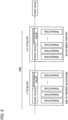
- Fig. 6 is a sequence chart for explaining the key exchange method according to this embodiment.
- Fig. 7 is a sequence chart following Fig. 6 .
- the root user U 1 illustrated in Fig. 6 and Fig. 7 means the user A terminal 1.
- the group-common-key managing unit 17 of the user A terminal 1 generates the group common key k ((1) of Fig. 6 ).
- the group common key k is one kind of information that should be concealed from users other than the users (the root user U 1 and the client users U d ) of the group.
- the root user U 1 carries out ECDH key exchange between the root user U 1 and the client users U d and shares a session key k d ((2) of Fig. 6 ) .
- the session key k d is different for each of the client users U d .
- the root user U 1 encrypts the group common key k with the session key k d and distributes the group common key k to the client users U d ((3) of Fig. 7 ).
- the client user U d decrypts the group common key k with the session key k d and acquires the group common key k ((4) of Fig. 7 ).
- the root user U 1 executes, for each of the client users U d , the key exchange method for each of the client users U d using the session key k d ((2) of Fig. 6 and ( 3 ) and (4) of Fig. 7 ).
- the key exchange method executed using the session key k d corresponds to the key exchange method in the first embodiment executed using the secret information S as the group common key k. That is, explanation of details of the key exchange method executed using the session k d is omitted because the details of the key exchange method is the same as the details of the key exchange method in the first embodiment.
- the root user U 1 performs key exchange (sharing of the group common key k) in order for each of the four client users U d .
- the key exchange system and the key exchange method for safely concealing the secret information S over a long term when the secret information S is recorded on the blockchain are realized.
- the second embodiment it is possible to safely share the secret information S over a long term in a group of a large number of people.
- the ECDH key exchange scheme is used when a key is generated.
- a DH key exchange scheme, an RSA key exchange scheme, an MQV key exchange scheme, an HMQV key exchange scheme, or the like may be used instead of the ECDH key exchange system.
- a number N-1 of a block in which the transaction T b is stored may be used as "a parameter of a related block".
- a size of a block of the number N or N-1 of the block may be used as "a parameter of a related block” rather than the number N or N-1 of the block.
- transactions different from the transactions T a and T b may be used as "related transactions” .
- related transactions data of the entire transactions may be used or data of a part of the transactions (for example, a part of data including at least an electronic signature) may be used.
- the hardware capable of executing the program command is not limited to a personal computer, a smartphone, and the like and includes, for example, a dedicated computer, a work station, a PCS (Personal Communications System; a personal mobile communication system), a mobile (cellular) telephone having a data processing function, a tablet terminal, a game machine, an electronic note pad, a laptop computer, a GPS (Global Positioning System) receiver, or other programmable data processing devices.
- various operation or control methods are executed by a program command (software) and/or a program module or the like executed by one or more processors.
- the one or more processors include, for example, a microprocessor, a CPU (Central Processing Unit), an ASIC (Application Specific Integrated Circuit), a DSP (Digital Signal Processor), a PLD (Programmable Logic Device), an FPGA (Field Programmable Gate Array), or a combination of any ones of these devices.
- a microprocessor Central Processing Unit
- ASIC Application Specific Integrated Circuit
- DSP Digital Signal Processor
- PLD Programmable Logic Device
- FPGA Field Programmable Gate Array
Landscapes
- Engineering & Computer Science (AREA)
- Computer Security & Cryptography (AREA)
- Computer Networks & Wireless Communication (AREA)
- Signal Processing (AREA)
- Theoretical Computer Science (AREA)
- Software Systems (AREA)
- General Engineering & Computer Science (AREA)
- Computer Hardware Design (AREA)
- Physics & Mathematics (AREA)
- Technology Law (AREA)
- General Physics & Mathematics (AREA)
- Multimedia (AREA)
- Computing Systems (AREA)
- Financial Or Insurance-Related Operations Such As Payment And Settlement (AREA)
Claims (5)
- Système d'échange de clés (5) comprenant un premier terminal (1) et un second terminal (2) connectés l'un à l'autre via un réseau (4) dans lequel une chaîne de blocs est construite, dans lequel
le premier terminal (1) comprend :une unité de délivrance de licence (12) configurée pour générer une première transaction incluant une première clé publique et une licence délivrée en réponse à une demande de licence ;une première région de stockage de clés (15) configurée pour conserver une première clé secrète ; etune première unité de chiffrement et déchiffrement (13) configurée pour générer une clé commune au moyen d'informations spécifiques à une négociation, incluant la première transaction, une seconde transaction et un paramètre d'un bloc spécifique, ainsi que d'une seconde clé publique et de la première clé secrète,le second terminal (2) comprend :une unité de demande de licence (11) configurée pour générer la seconde transaction incluant la seconde clé publique et la demande de licence ;une seconde région de stockage de clés (15) configurée pour conserver une seconde clé secrète ; etune seconde unité de chiffrement et déchiffrement (13) configurée pour générer la clé commune au moyen des informations spécifiques à une négociation, de la première clé publique et de la seconde clé secrète,la première unité de chiffrement et déchiffrement (13) est configurée pour chiffrer des informations secrètes (S) au moyen de la clé commune générée par la première unité de chiffrement et déchiffrement (13), etla seconde unité de chiffrement et déchiffrement (13) est configurée pour déchiffrer les informations secrètes (S) chiffrées acquises via le réseau au moyen de la clé commune générée par la seconde unité de chiffrement et déchiffrement (13), dans lequel le paramètre du bloc spécifique est un nombre unique attribué à un bloc dans lequel la première transaction ou la seconde transaction est stockée. - Système d'échange de clés (5) selon la revendication 1, dans lequelles informations secrètes (S) sont une clé commune de groupe, etle second terminal est capable d'acquérir des informations partagées chiffrées par la clé commune de groupe via le réseau.
- Système d'échange de clés (5) selon la revendication 2, dans lequel une pluralité des seconds terminaux est présente, et la pluralité de seconds terminaux est configurée pour générer respectivement des clés communes différentes les unes des autres.
- Système d'échange de clés (5) selon l'une quelconque des revendications 1 à 3, dans lequel la première clé publique, la seconde clé publique, la première clé secrète et la seconde clé secrète sont générées dans un mécanisme d'échange de clés ECDH.
- Procédé d'échange de clés exécuté par un système d'échange de clés incluant un premier terminal (1) et un second terminal (2) connectés l'un à l'autre via un réseau (4) dans lequel une chaîne de blocs est construite,
le procédé d'échange de clés comprenant :la conservation d'une première clé secrète par le premier terminal (1) ;la conservation d'une seconde clé secrète par le second terminal (2) ;la génération d'une seconde transaction incluant une seconde clé publique et une demande de licence par le second terminal (2) ;la génération d'une première transaction incluant une première clé publique et une licence délivrée en réponse à la demande de licence par le premier terminal ;la génération d'une clé commune par le premier terminal (1) au moyen d'informations spécifiques à une négociation incluant la première transaction, la seconde transaction et un paramètre d'un bloc spécifique, ainsi que de la seconde clé publique et de la première clé secrète ;le chiffrement d'informations secrètes (S) par le premier terminal au moyen de la clé commune générée par le premier terminal ;la génération de la clé commune par le second terminal au moyen des informations spécifiques à une négociation, de la première clé publique et de la seconde clé secrète ; etle déchiffrement des informations secrètes (S) chiffrées acquises via le réseau par le second terminal au moyen de la clé commune générée par le second terminal ;dans lequel le paramètre du bloc spécifique est un nombre unique attribué à un bloc dans lequel la première transaction ou la seconde transaction est stockée.
Applications Claiming Priority (2)
| Application Number | Priority Date | Filing Date | Title |
|---|---|---|---|
| JP2017121633 | 2017-06-21 | ||
| PCT/JP2018/023380 WO2018235845A1 (fr) | 2017-06-21 | 2018-06-20 | Système d'échange de clés et procédé d'échange de clés |
Publications (3)
| Publication Number | Publication Date |
|---|---|
| EP3644548A1 EP3644548A1 (fr) | 2020-04-29 |
| EP3644548A4 EP3644548A4 (fr) | 2021-02-24 |
| EP3644548B1 true EP3644548B1 (fr) | 2023-07-26 |
Family
ID=64737201
Family Applications (1)
| Application Number | Title | Priority Date | Filing Date |
|---|---|---|---|
| EP18820430.9A Active EP3644548B1 (fr) | 2017-06-21 | 2018-06-20 | Système d'échange de clés et procédé d'échange de clés |
Country Status (4)
| Country | Link |
|---|---|
| US (1) | US11424913B2 (fr) |
| EP (1) | EP3644548B1 (fr) |
| JP (1) | JP6882705B2 (fr) |
| WO (1) | WO2018235845A1 (fr) |
Families Citing this family (14)
| Publication number | Priority date | Publication date | Assignee | Title |
|---|---|---|---|---|
| GB201811263D0 (en) * | 2018-07-10 | 2018-08-29 | Netmaster Solutions Ltd | A method and system for managing digital using a blockchain |
| JP2022002351A (ja) * | 2018-09-20 | 2022-01-06 | ソニーグループ株式会社 | 情報処理装置、情報処理方法、およびプログラム |
| JP7369772B2 (ja) * | 2018-12-10 | 2023-10-26 | アルゴランド,インコーポレイテッド | 公正な電子交換を実施するための仮想ブロックチェーンプロトコルの利用 |
| JP7300845B2 (ja) * | 2019-02-15 | 2023-06-30 | 三菱重工業株式会社 | 制御装置、産業用制御システムおよび暗号鍵寿命延長方法 |
| GB201905348D0 (en) | 2019-04-16 | 2019-05-29 | Nchain Holdings Ltd | Computer implemented method and system for encrypting data |
| US11663347B2 (en) * | 2019-04-26 | 2023-05-30 | Jpmorgan Chase Bank, N.A. | Systems and methods for maintaining immutable data access logs with privacy |
| CN110147684B (zh) * | 2019-05-24 | 2023-07-25 | 众安信息技术服务有限公司 | 用于实现区块链数据隐私保护的方法及设备 |
| JP6980288B2 (ja) * | 2019-08-20 | 2021-12-15 | 株式会社chaintope | 情報処理方法、情報処理システム、及びサーバシステム |
| CN111445250B (zh) * | 2020-04-16 | 2023-04-11 | 中国银行股份有限公司 | 一种区块链密钥测试方法及装置 |
| JP7462903B2 (ja) * | 2020-07-01 | 2024-04-08 | 日本電信電話株式会社 | 利用者端末、認証者端末、登録者端末、管理システムおよびプログラム |
| JP7665725B2 (ja) * | 2020-07-16 | 2025-04-21 | セールスフォース,インコーポレイティッド | 鍵共有を使用するデータのセキュア化 |
| JP7468682B2 (ja) * | 2020-10-07 | 2024-04-16 | 日本電信電話株式会社 | 識別子変更管理装置、識別子変更管理方法及び識別子変更管理プログラム |
| GB2605784A (en) * | 2021-04-09 | 2022-10-19 | Vodafone Group Services Ltd | SIM cryptographic key storage |
| CN114154988B (zh) * | 2021-12-03 | 2024-09-24 | 福建师范大学 | 基于国产区块链的匿名密钥协商方法 |
Family Cites Families (7)
| Publication number | Priority date | Publication date | Assignee | Title |
|---|---|---|---|---|
| US5588060A (en) | 1994-06-10 | 1996-12-24 | Sun Microsystems, Inc. | Method and apparatus for a key-management scheme for internet protocols |
| EP0693836A1 (fr) * | 1994-06-10 | 1996-01-24 | Sun Microsystems, Inc. | Procédé et dispositif pour un schéma de maniement de clef pour protocoles internet |
| CN106296184A (zh) * | 2015-06-05 | 2017-01-04 | 地气股份有限公司 | 电子货币管理方法及电子货币系统 |
| US10402792B2 (en) * | 2015-08-13 | 2019-09-03 | The Toronto-Dominion Bank | Systems and method for tracking enterprise events using hybrid public-private blockchain ledgers |
| JP6452156B2 (ja) | 2015-09-03 | 2019-01-16 | 日本電信電話株式会社 | 許諾情報管理システム、利用者端末、権利者端末、許諾情報管理方法、および、許諾情報管理プログラム |
| US10103885B2 (en) * | 2016-01-20 | 2018-10-16 | Mastercard International Incorporated | Method and system for distributed cryptographic key provisioning and storage via elliptic curve cryptography |
| FR3076420B1 (fr) * | 2017-12-29 | 2020-02-07 | Commissariat A L'energie Atomique Et Aux Energies Alternatives | Methode d'echange de cles par contrat intelligent deploye sur une chaine de blocs |
-
2018
- 2018-06-20 EP EP18820430.9A patent/EP3644548B1/fr active Active
- 2018-06-20 US US16/621,000 patent/US11424913B2/en active Active
- 2018-06-20 JP JP2019525649A patent/JP6882705B2/ja active Active
- 2018-06-20 WO PCT/JP2018/023380 patent/WO2018235845A1/fr not_active Ceased
Also Published As
| Publication number | Publication date |
|---|---|
| US11424913B2 (en) | 2022-08-23 |
| EP3644548A4 (fr) | 2021-02-24 |
| JPWO2018235845A1 (ja) | 2020-05-21 |
| JP6882705B2 (ja) | 2021-06-02 |
| EP3644548A1 (fr) | 2020-04-29 |
| US20200127818A1 (en) | 2020-04-23 |
| WO2018235845A1 (fr) | 2018-12-27 |
Similar Documents
| Publication | Publication Date | Title |
|---|---|---|
| US11424913B2 (en) | Key exchange system and key exchange method | |
| US11876897B2 (en) | Right holder terminal, permission information management method, and permission information management program | |
| CN111797415A (zh) | 基于区块链的数据共享方法、电子设备和存储介质 | |
| CN109525390B (zh) | 用于终端设备保密通信的量子密钥无线分发方法及系统 | |
| US20190074968A1 (en) | Method, apparatus and system for data encryption and decryption | |
| EP3310095A1 (fr) | Serveur de bord, son procédé de commande de communication de cryptage et terminal | |
| US8396218B2 (en) | Cryptographic module distribution system, apparatus, and program | |
| CN110049016B (zh) | 区块链的数据查询方法、装置、系统、设备及存储介质 | |
| CN109067522B (zh) | 一种随机数可验证秘密共享方法 | |
| JP2018500843A (ja) | クラウドストレージ方法及びシステム | |
| KR20120132708A (ko) | 클라우드 컴퓨팅 환경에서의 접근 권한 분산 관리 장치 및 그 방법 | |
| US10063655B2 (en) | Information processing method, trusted server, and cloud server | |
| CN112966287A (zh) | 获取用户数据的方法、系统、设备和计算机可读介质 | |
| CN109361511A (zh) | 数据传输方法、网络设备及计算机存储介质 | |
| CN110519222B (zh) | 基于一次性非对称密钥对和密钥卡的外网接入身份认证方法和系统 | |
| US12170720B2 (en) | Location-key encryption system | |
| CN106973070A (zh) | 一种大数据计算托管服务安全认证系统和方法 | |
| CN106953917B (zh) | 数据同步方法及系统 | |
| CN111327415A (zh) | 一种联盟链数据保护方法及装置 | |
| CN104796411A (zh) | 一种数据在云端和移动端安全传输存储及使用的方法 | |
| CN116155491B (zh) | 安全芯片的对称密钥同步方法及安全芯片装置 | |
| JP2005175992A (ja) | 証明書配布システムおよび証明書配布方法 | |
| CN121012615A (zh) | 一种抗量子密钥封装方法、装置、介质和设备 | |
| CN111224921A (zh) | 安全传输方法和安全传输系统 | |
| KR101595056B1 (ko) | 인터클라우드 환경에서의 데이터 공유 시스템 및 공유 방법 |
Legal Events
| Date | Code | Title | Description |
|---|---|---|---|
| STAA | Information on the status of an ep patent application or granted ep patent |
Free format text: STATUS: THE INTERNATIONAL PUBLICATION HAS BEEN MADE |
|
| PUAI | Public reference made under article 153(3) epc to a published international application that has entered the european phase |
Free format text: ORIGINAL CODE: 0009012 |
|
| STAA | Information on the status of an ep patent application or granted ep patent |
Free format text: STATUS: REQUEST FOR EXAMINATION WAS MADE |
|
| 17P | Request for examination filed |
Effective date: 20191128 |
|
| AK | Designated contracting states |
Kind code of ref document: A1 Designated state(s): AL AT BE BG CH CY CZ DE DK EE ES FI FR GB GR HR HU IE IS IT LI LT LU LV MC MK MT NL NO PL PT RO RS SE SI SK SM TR |
|
| AX | Request for extension of the european patent |
Extension state: BA ME |
|
| DAV | Request for validation of the european patent (deleted) | ||
| DAX | Request for extension of the european patent (deleted) | ||
| A4 | Supplementary search report drawn up and despatched |
Effective date: 20210125 |
|
| RIC1 | Information provided on ipc code assigned before grant |
Ipc: H04L 9/08 20060101ALI20210119BHEP Ipc: H04L 29/06 20060101AFI20210119BHEP Ipc: H04W 12/0471 20210101ALI20210119BHEP |
|
| STAA | Information on the status of an ep patent application or granted ep patent |
Free format text: STATUS: EXAMINATION IS IN PROGRESS |
|
| 17Q | First examination report despatched |
Effective date: 20210909 |
|
| REG | Reference to a national code |
Ref country code: DE Ref legal event code: R079 Free format text: PREVIOUS MAIN CLASS: H04L0009080000 Ipc: H04L0009400000 Ref country code: DE Ref legal event code: R079 Ref document number: 602018054182 Country of ref document: DE Free format text: PREVIOUS MAIN CLASS: H04L0009080000 Ipc: H04L0009400000 |
|
| GRAP | Despatch of communication of intention to grant a patent |
Free format text: ORIGINAL CODE: EPIDOSNIGR1 |
|
| STAA | Information on the status of an ep patent application or granted ep patent |
Free format text: STATUS: GRANT OF PATENT IS INTENDED |
|
| RIC1 | Information provided on ipc code assigned before grant |
Ipc: H04L 9/00 20060101ALI20220728BHEP Ipc: H04W 12/0471 20210101ALI20220728BHEP Ipc: H04L 9/08 20060101ALI20220728BHEP Ipc: H04L 9/40 20220101AFI20220728BHEP |
|
| INTG | Intention to grant announced |
Effective date: 20220901 |
|
| GRAJ | Information related to disapproval of communication of intention to grant by the applicant or resumption of examination proceedings by the epo deleted |
Free format text: ORIGINAL CODE: EPIDOSDIGR1 |
|
| STAA | Information on the status of an ep patent application or granted ep patent |
Free format text: STATUS: EXAMINATION IS IN PROGRESS |
|
| GRAP | Despatch of communication of intention to grant a patent |
Free format text: ORIGINAL CODE: EPIDOSNIGR1 |
|
| STAA | Information on the status of an ep patent application or granted ep patent |
Free format text: STATUS: GRANT OF PATENT IS INTENDED |
|
| INTC | Intention to grant announced (deleted) | ||
| INTG | Intention to grant announced |
Effective date: 20230215 |
|
| GRAS | Grant fee paid |
Free format text: ORIGINAL CODE: EPIDOSNIGR3 |
|
| GRAA | (expected) grant |
Free format text: ORIGINAL CODE: 0009210 |
|
| STAA | Information on the status of an ep patent application or granted ep patent |
Free format text: STATUS: THE PATENT HAS BEEN GRANTED |
|
| AK | Designated contracting states |
Kind code of ref document: B1 Designated state(s): AL AT BE BG CH CY CZ DE DK EE ES FI FR GB GR HR HU IE IS IT LI LT LU LV MC MK MT NL NO PL PT RO RS SE SI SK SM TR |
|
| REG | Reference to a national code |
Ref country code: CH Ref legal event code: EP |
|
| REG | Reference to a national code |
Ref country code: IE Ref legal event code: FG4D |
|
| REG | Reference to a national code |
Ref country code: DE Ref legal event code: R096 Ref document number: 602018054182 Country of ref document: DE |
|
| REG | Reference to a national code |
Ref country code: LT Ref legal event code: MG9D |
|
| REG | Reference to a national code |
Ref country code: NL Ref legal event code: MP Effective date: 20230726 |
|
| REG | Reference to a national code |
Ref country code: AT Ref legal event code: MK05 Ref document number: 1593232 Country of ref document: AT Kind code of ref document: T Effective date: 20230726 |
|
| PG25 | Lapsed in a contracting state [announced via postgrant information from national office to epo] |
Ref country code: NL Free format text: LAPSE BECAUSE OF FAILURE TO SUBMIT A TRANSLATION OF THE DESCRIPTION OR TO PAY THE FEE WITHIN THE PRESCRIBED TIME-LIMIT Effective date: 20230726 |
|
| PG25 | Lapsed in a contracting state [announced via postgrant information from national office to epo] |
Ref country code: GR Free format text: LAPSE BECAUSE OF FAILURE TO SUBMIT A TRANSLATION OF THE DESCRIPTION OR TO PAY THE FEE WITHIN THE PRESCRIBED TIME-LIMIT Effective date: 20231027 |
|
| PG25 | Lapsed in a contracting state [announced via postgrant information from national office to epo] |
Ref country code: IS Free format text: LAPSE BECAUSE OF FAILURE TO SUBMIT A TRANSLATION OF THE DESCRIPTION OR TO PAY THE FEE WITHIN THE PRESCRIBED TIME-LIMIT Effective date: 20231126 |
|
| PG25 | Lapsed in a contracting state [announced via postgrant information from national office to epo] |
Ref country code: SE Free format text: LAPSE BECAUSE OF FAILURE TO SUBMIT A TRANSLATION OF THE DESCRIPTION OR TO PAY THE FEE WITHIN THE PRESCRIBED TIME-LIMIT Effective date: 20230726 Ref country code: RS Free format text: LAPSE BECAUSE OF FAILURE TO SUBMIT A TRANSLATION OF THE DESCRIPTION OR TO PAY THE FEE WITHIN THE PRESCRIBED TIME-LIMIT Effective date: 20230726 Ref country code: PT Free format text: LAPSE BECAUSE OF FAILURE TO SUBMIT A TRANSLATION OF THE DESCRIPTION OR TO PAY THE FEE WITHIN THE PRESCRIBED TIME-LIMIT Effective date: 20231127 Ref country code: NO Free format text: LAPSE BECAUSE OF FAILURE TO SUBMIT A TRANSLATION OF THE DESCRIPTION OR TO PAY THE FEE WITHIN THE PRESCRIBED TIME-LIMIT Effective date: 20231026 Ref country code: LV Free format text: LAPSE BECAUSE OF FAILURE TO SUBMIT A TRANSLATION OF THE DESCRIPTION OR TO PAY THE FEE WITHIN THE PRESCRIBED TIME-LIMIT Effective date: 20230726 Ref country code: LT Free format text: LAPSE BECAUSE OF FAILURE TO SUBMIT A TRANSLATION OF THE DESCRIPTION OR TO PAY THE FEE WITHIN THE PRESCRIBED TIME-LIMIT Effective date: 20230726 Ref country code: IS Free format text: LAPSE BECAUSE OF FAILURE TO SUBMIT A TRANSLATION OF THE DESCRIPTION OR TO PAY THE FEE WITHIN THE PRESCRIBED TIME-LIMIT Effective date: 20231126 Ref country code: HR Free format text: LAPSE BECAUSE OF FAILURE TO SUBMIT A TRANSLATION OF THE DESCRIPTION OR TO PAY THE FEE WITHIN THE PRESCRIBED TIME-LIMIT Effective date: 20230726 Ref country code: GR Free format text: LAPSE BECAUSE OF FAILURE TO SUBMIT A TRANSLATION OF THE DESCRIPTION OR TO PAY THE FEE WITHIN THE PRESCRIBED TIME-LIMIT Effective date: 20231027 Ref country code: FI Free format text: LAPSE BECAUSE OF FAILURE TO SUBMIT A TRANSLATION OF THE DESCRIPTION OR TO PAY THE FEE WITHIN THE PRESCRIBED TIME-LIMIT Effective date: 20230726 Ref country code: AT Free format text: LAPSE BECAUSE OF FAILURE TO SUBMIT A TRANSLATION OF THE DESCRIPTION OR TO PAY THE FEE WITHIN THE PRESCRIBED TIME-LIMIT Effective date: 20230726 |
|
| PG25 | Lapsed in a contracting state [announced via postgrant information from national office to epo] |
Ref country code: PL Free format text: LAPSE BECAUSE OF FAILURE TO SUBMIT A TRANSLATION OF THE DESCRIPTION OR TO PAY THE FEE WITHIN THE PRESCRIBED TIME-LIMIT Effective date: 20230726 |
|
| PG25 | Lapsed in a contracting state [announced via postgrant information from national office to epo] |
Ref country code: ES Free format text: LAPSE BECAUSE OF FAILURE TO SUBMIT A TRANSLATION OF THE DESCRIPTION OR TO PAY THE FEE WITHIN THE PRESCRIBED TIME-LIMIT Effective date: 20230726 |
|
| REG | Reference to a national code |
Ref country code: DE Ref legal event code: R097 Ref document number: 602018054182 Country of ref document: DE |
|
| PG25 | Lapsed in a contracting state [announced via postgrant information from national office to epo] |
Ref country code: SM Free format text: LAPSE BECAUSE OF FAILURE TO SUBMIT A TRANSLATION OF THE DESCRIPTION OR TO PAY THE FEE WITHIN THE PRESCRIBED TIME-LIMIT Effective date: 20230726 Ref country code: RO Free format text: LAPSE BECAUSE OF FAILURE TO SUBMIT A TRANSLATION OF THE DESCRIPTION OR TO PAY THE FEE WITHIN THE PRESCRIBED TIME-LIMIT Effective date: 20230726 Ref country code: ES Free format text: LAPSE BECAUSE OF FAILURE TO SUBMIT A TRANSLATION OF THE DESCRIPTION OR TO PAY THE FEE WITHIN THE PRESCRIBED TIME-LIMIT Effective date: 20230726 Ref country code: EE Free format text: LAPSE BECAUSE OF FAILURE TO SUBMIT A TRANSLATION OF THE DESCRIPTION OR TO PAY THE FEE WITHIN THE PRESCRIBED TIME-LIMIT Effective date: 20230726 Ref country code: DK Free format text: LAPSE BECAUSE OF FAILURE TO SUBMIT A TRANSLATION OF THE DESCRIPTION OR TO PAY THE FEE WITHIN THE PRESCRIBED TIME-LIMIT Effective date: 20230726 Ref country code: CZ Free format text: LAPSE BECAUSE OF FAILURE TO SUBMIT A TRANSLATION OF THE DESCRIPTION OR TO PAY THE FEE WITHIN THE PRESCRIBED TIME-LIMIT Effective date: 20230726 Ref country code: SK Free format text: LAPSE BECAUSE OF FAILURE TO SUBMIT A TRANSLATION OF THE DESCRIPTION OR TO PAY THE FEE WITHIN THE PRESCRIBED TIME-LIMIT Effective date: 20230726 |
|
| PLBE | No opposition filed within time limit |
Free format text: ORIGINAL CODE: 0009261 |
|
| STAA | Information on the status of an ep patent application or granted ep patent |
Free format text: STATUS: NO OPPOSITION FILED WITHIN TIME LIMIT |
|
| 26N | No opposition filed |
Effective date: 20240429 |
|
| PG25 | Lapsed in a contracting state [announced via postgrant information from national office to epo] |
Ref country code: SI Free format text: LAPSE BECAUSE OF FAILURE TO SUBMIT A TRANSLATION OF THE DESCRIPTION OR TO PAY THE FEE WITHIN THE PRESCRIBED TIME-LIMIT Effective date: 20230726 |
|
| PG25 | Lapsed in a contracting state [announced via postgrant information from national office to epo] |
Ref country code: BG Free format text: LAPSE BECAUSE OF FAILURE TO SUBMIT A TRANSLATION OF THE DESCRIPTION OR TO PAY THE FEE WITHIN THE PRESCRIBED TIME-LIMIT Effective date: 20230726 |
|
| PG25 | Lapsed in a contracting state [announced via postgrant information from national office to epo] |
Ref country code: BG Free format text: LAPSE BECAUSE OF FAILURE TO SUBMIT A TRANSLATION OF THE DESCRIPTION OR TO PAY THE FEE WITHIN THE PRESCRIBED TIME-LIMIT Effective date: 20230726 |
|
| REG | Reference to a national code |
Ref country code: DE Ref legal event code: R119 Ref document number: 602018054182 Country of ref document: DE |
|
| PG25 | Lapsed in a contracting state [announced via postgrant information from national office to epo] |
Ref country code: MC Free format text: LAPSE BECAUSE OF FAILURE TO SUBMIT A TRANSLATION OF THE DESCRIPTION OR TO PAY THE FEE WITHIN THE PRESCRIBED TIME-LIMIT Effective date: 20230726 |
|
| REG | Reference to a national code |
Ref country code: CH Ref legal event code: PL |
|
| PG25 | Lapsed in a contracting state [announced via postgrant information from national office to epo] |
Ref country code: LU Free format text: LAPSE BECAUSE OF NON-PAYMENT OF DUE FEES Effective date: 20240620 |
|
| GBPC | Gb: european patent ceased through non-payment of renewal fee |
Effective date: 20240620 |
|
| PG25 | Lapsed in a contracting state [announced via postgrant information from national office to epo] |
Ref country code: DE Free format text: LAPSE BECAUSE OF NON-PAYMENT OF DUE FEES Effective date: 20250101 |
|
| PG25 | Lapsed in a contracting state [announced via postgrant information from national office to epo] |
Ref country code: IE Free format text: LAPSE BECAUSE OF NON-PAYMENT OF DUE FEES Effective date: 20240620 |
|
| PG25 | Lapsed in a contracting state [announced via postgrant information from national office to epo] |
Ref country code: CH Free format text: LAPSE BECAUSE OF NON-PAYMENT OF DUE FEES Effective date: 20240630 Ref country code: BE Free format text: LAPSE BECAUSE OF NON-PAYMENT OF DUE FEES Effective date: 20240630 |
|
| PG25 | Lapsed in a contracting state [announced via postgrant information from national office to epo] |
Ref country code: FR Free format text: LAPSE BECAUSE OF NON-PAYMENT OF DUE FEES Effective date: 20240630 |
|
| PG25 | Lapsed in a contracting state [announced via postgrant information from national office to epo] |
Ref country code: GB Free format text: LAPSE BECAUSE OF NON-PAYMENT OF DUE FEES Effective date: 20240620 |
|
| REG | Reference to a national code |
Ref country code: BE Ref legal event code: MM Effective date: 20240630 |
|
| PGFP | Annual fee paid to national office [announced via postgrant information from national office to epo] |
Ref country code: IT Payment date: 20250624 Year of fee payment: 8 |
|
| PG25 | Lapsed in a contracting state [announced via postgrant information from national office to epo] |
Ref country code: CY Free format text: LAPSE BECAUSE OF FAILURE TO SUBMIT A TRANSLATION OF THE DESCRIPTION OR TO PAY THE FEE WITHIN THE PRESCRIBED TIME-LIMIT; INVALID AB INITIO Effective date: 20180620 |
|
| PG25 | Lapsed in a contracting state [announced via postgrant information from national office to epo] |
Ref country code: HU Free format text: LAPSE BECAUSE OF FAILURE TO SUBMIT A TRANSLATION OF THE DESCRIPTION OR TO PAY THE FEE WITHIN THE PRESCRIBED TIME-LIMIT; INVALID AB INITIO Effective date: 20180620 |