EP3645598B1 - Procédé de fabrication additive au moyen de matériau de construction thermoplastique réticulé de façon radicalaire - Google Patents
Procédé de fabrication additive au moyen de matériau de construction thermoplastique réticulé de façon radicalaire Download PDFInfo
- Publication number
- EP3645598B1 EP3645598B1 EP18733881.9A EP18733881A EP3645598B1 EP 3645598 B1 EP3645598 B1 EP 3645598B1 EP 18733881 A EP18733881 A EP 18733881A EP 3645598 B1 EP3645598 B1 EP 3645598B1
- Authority
- EP
- European Patent Office
- Prior art keywords
- free
- build material
- radically crosslinkable
- radically
- precursor
- Prior art date
- Legal status (The legal status is an assumption and is not a legal conclusion. Google has not performed a legal analysis and makes no representation as to the accuracy of the status listed.)
- Active
Links
Images

Classifications
-
- C—CHEMISTRY; METALLURGY
- C09—DYES; PAINTS; POLISHES; NATURAL RESINS; ADHESIVES; COMPOSITIONS NOT OTHERWISE PROVIDED FOR; APPLICATIONS OF MATERIALS NOT OTHERWISE PROVIDED FOR
- C09D—COATING COMPOSITIONS, e.g. PAINTS, VARNISHES OR LACQUERS; FILLING PASTES; CHEMICAL PAINT OR INK REMOVERS; INKS; CORRECTING FLUIDS; WOODSTAINS; PASTES OR SOLIDS FOR COLOURING OR PRINTING; USE OF MATERIALS THEREFOR
- C09D11/00—Inks
- C09D11/02—Printing inks
- C09D11/10—Printing inks based on artificial resins
- C09D11/102—Printing inks based on artificial resins containing macromolecular compounds obtained by reactions other than those only involving unsaturated carbon-to-carbon bonds
-
- C—CHEMISTRY; METALLURGY
- C08—ORGANIC MACROMOLECULAR COMPOUNDS; THEIR PREPARATION OR CHEMICAL WORKING-UP; COMPOSITIONS BASED THEREON
- C08G—MACROMOLECULAR COMPOUNDS OBTAINED OTHERWISE THAN BY REACTIONS ONLY INVOLVING UNSATURATED CARBON-TO-CARBON BONDS
- C08G18/00—Polymeric products of isocyanates or isothiocyanates
- C08G18/06—Polymeric products of isocyanates or isothiocyanates with compounds having active hydrogen
- C08G18/08—Processes
- C08G18/16—Catalysts
- C08G18/22—Catalysts containing metal compounds
- C08G18/24—Catalysts containing metal compounds of tin
- C08G18/244—Catalysts containing metal compounds of tin tin salts of carboxylic acids
- C08G18/246—Catalysts containing metal compounds of tin tin salts of carboxylic acids containing also tin-carbon bonds
-
- B—PERFORMING OPERATIONS; TRANSPORTING
- B29—WORKING OF PLASTICS; WORKING OF SUBSTANCES IN A PLASTIC STATE IN GENERAL
- B29C—SHAPING OR JOINING OF PLASTICS; SHAPING OF MATERIAL IN A PLASTIC STATE, NOT OTHERWISE PROVIDED FOR; AFTER-TREATMENT OF THE SHAPED PRODUCTS, e.g. REPAIRING
- B29C64/00—Additive manufacturing, i.e. manufacturing of three-dimensional [3D] objects by additive deposition, additive agglomeration or additive layering, e.g. by 3D printing, stereolithography or selective laser sintering
- B29C64/10—Processes of additive manufacturing
- B29C64/106—Processes of additive manufacturing using only liquids or viscous materials, e.g. depositing a continuous bead of viscous material
- B29C64/124—Processes of additive manufacturing using only liquids or viscous materials, e.g. depositing a continuous bead of viscous material using layers of liquid which are selectively solidified
-
- B—PERFORMING OPERATIONS; TRANSPORTING
- B32—LAYERED PRODUCTS
- B32B—LAYERED PRODUCTS, i.e. PRODUCTS BUILT-UP OF STRATA OF FLAT OR NON-FLAT, e.g. CELLULAR OR HONEYCOMB, FORM
- B32B27/00—Layered products comprising a layer of synthetic resin
- B32B27/40—Layered products comprising a layer of synthetic resin comprising polyurethanes
-
- B—PERFORMING OPERATIONS; TRANSPORTING
- B33—ADDITIVE MANUFACTURING TECHNOLOGY
- B33Y—ADDITIVE MANUFACTURING, i.e. MANUFACTURING OF THREE-DIMENSIONAL [3D] OBJECTS BY ADDITIVE DEPOSITION, ADDITIVE AGGLOMERATION OR ADDITIVE LAYERING, e.g. BY 3D PRINTING, STEREOLITHOGRAPHY OR SELECTIVE LASER SINTERING
- B33Y10/00—Processes of additive manufacturing
-
- B—PERFORMING OPERATIONS; TRANSPORTING
- B33—ADDITIVE MANUFACTURING TECHNOLOGY
- B33Y—ADDITIVE MANUFACTURING, i.e. MANUFACTURING OF THREE-DIMENSIONAL [3D] OBJECTS BY ADDITIVE DEPOSITION, ADDITIVE AGGLOMERATION OR ADDITIVE LAYERING, e.g. BY 3D PRINTING, STEREOLITHOGRAPHY OR SELECTIVE LASER SINTERING
- B33Y30/00—Apparatus for additive manufacturing; Details thereof or accessories therefor
-
- B—PERFORMING OPERATIONS; TRANSPORTING
- B33—ADDITIVE MANUFACTURING TECHNOLOGY
- B33Y—ADDITIVE MANUFACTURING, i.e. MANUFACTURING OF THREE-DIMENSIONAL [3D] OBJECTS BY ADDITIVE DEPOSITION, ADDITIVE AGGLOMERATION OR ADDITIVE LAYERING, e.g. BY 3D PRINTING, STEREOLITHOGRAPHY OR SELECTIVE LASER SINTERING
- B33Y70/00—Materials specially adapted for additive manufacturing
-
- C—CHEMISTRY; METALLURGY
- C07—ORGANIC CHEMISTRY
- C07C—ACYCLIC OR CARBOCYCLIC COMPOUNDS
- C07C269/00—Preparation of derivatives of carbamic acid, i.e. compounds containing any of the groups, the nitrogen atom not being part of nitro or nitroso groups
- C07C269/02—Preparation of derivatives of carbamic acid, i.e. compounds containing any of the groups, the nitrogen atom not being part of nitro or nitroso groups from isocyanates with formation of carbamate groups
-
- C—CHEMISTRY; METALLURGY
- C08—ORGANIC MACROMOLECULAR COMPOUNDS; THEIR PREPARATION OR CHEMICAL WORKING-UP; COMPOSITIONS BASED THEREON
- C08G—MACROMOLECULAR COMPOUNDS OBTAINED OTHERWISE THAN BY REACTIONS ONLY INVOLVING UNSATURATED CARBON-TO-CARBON BONDS
- C08G18/00—Polymeric products of isocyanates or isothiocyanates
- C08G18/06—Polymeric products of isocyanates or isothiocyanates with compounds having active hydrogen
- C08G18/28—Polymeric products of isocyanates or isothiocyanates with compounds having active hydrogen characterised by the compounds used containing active hydrogen
- C08G18/67—Unsaturated compounds having active hydrogen
- C08G18/671—Unsaturated compounds having only one group containing active hydrogen
- C08G18/672—Esters of acrylic or alkyl acrylic acid having only one group containing active hydrogen
-
- C—CHEMISTRY; METALLURGY
- C08—ORGANIC MACROMOLECULAR COMPOUNDS; THEIR PREPARATION OR CHEMICAL WORKING-UP; COMPOSITIONS BASED THEREON
- C08G—MACROMOLECULAR COMPOUNDS OBTAINED OTHERWISE THAN BY REACTIONS ONLY INVOLVING UNSATURATED CARBON-TO-CARBON BONDS
- C08G18/00—Polymeric products of isocyanates or isothiocyanates
- C08G18/06—Polymeric products of isocyanates or isothiocyanates with compounds having active hydrogen
- C08G18/70—Polymeric products of isocyanates or isothiocyanates with compounds having active hydrogen characterised by the isocyanates or isothiocyanates used
- C08G18/72—Polyisocyanates or polyisothiocyanates
- C08G18/73—Polyisocyanates or polyisothiocyanates acyclic
-
- C—CHEMISTRY; METALLURGY
- C08—ORGANIC MACROMOLECULAR COMPOUNDS; THEIR PREPARATION OR CHEMICAL WORKING-UP; COMPOSITIONS BASED THEREON
- C08G—MACROMOLECULAR COMPOUNDS OBTAINED OTHERWISE THAN BY REACTIONS ONLY INVOLVING UNSATURATED CARBON-TO-CARBON BONDS
- C08G18/00—Polymeric products of isocyanates or isothiocyanates
- C08G18/06—Polymeric products of isocyanates or isothiocyanates with compounds having active hydrogen
- C08G18/70—Polymeric products of isocyanates or isothiocyanates with compounds having active hydrogen characterised by the isocyanates or isothiocyanates used
- C08G18/72—Polyisocyanates or polyisothiocyanates
- C08G18/77—Polyisocyanates or polyisothiocyanates having heteroatoms in addition to the isocyanate or isothiocyanate nitrogen and oxygen or sulfur
- C08G18/78—Nitrogen
- C08G18/79—Nitrogen characterised by the polyisocyanates used, these having groups formed by oligomerisation of isocyanates or isothiocyanates
- C08G18/798—Nitrogen characterised by the polyisocyanates used, these having groups formed by oligomerisation of isocyanates or isothiocyanates containing urethdione groups
-
- C—CHEMISTRY; METALLURGY
- C08—ORGANIC MACROMOLECULAR COMPOUNDS; THEIR PREPARATION OR CHEMICAL WORKING-UP; COMPOSITIONS BASED THEREON
- C08G—MACROMOLECULAR COMPOUNDS OBTAINED OTHERWISE THAN BY REACTIONS ONLY INVOLVING UNSATURATED CARBON-TO-CARBON BONDS
- C08G18/00—Polymeric products of isocyanates or isothiocyanates
- C08G18/06—Polymeric products of isocyanates or isothiocyanates with compounds having active hydrogen
- C08G18/70—Polymeric products of isocyanates or isothiocyanates with compounds having active hydrogen characterised by the isocyanates or isothiocyanates used
- C08G18/81—Unsaturated isocyanates or isothiocyanates
- C08G18/8108—Unsaturated isocyanates or isothiocyanates having only one isocyanate or isothiocyanate group
- C08G18/8116—Unsaturated isocyanates or isothiocyanates having only one isocyanate or isothiocyanate group esters of acrylic or alkylacrylic acid having only one isocyanate or isothiocyanate group
-
- C—CHEMISTRY; METALLURGY
- C09—DYES; PAINTS; POLISHES; NATURAL RESINS; ADHESIVES; COMPOSITIONS NOT OTHERWISE PROVIDED FOR; APPLICATIONS OF MATERIALS NOT OTHERWISE PROVIDED FOR
- C09D—COATING COMPOSITIONS, e.g. PAINTS, VARNISHES OR LACQUERS; FILLING PASTES; CHEMICAL PAINT OR INK REMOVERS; INKS; CORRECTING FLUIDS; WOODSTAINS; PASTES OR SOLIDS FOR COLOURING OR PRINTING; USE OF MATERIALS THEREFOR
- C09D11/00—Inks
- C09D11/02—Printing inks
- C09D11/10—Printing inks based on artificial resins
- C09D11/101—Inks specially adapted for printing processes involving curing by wave energy or particle radiation, e.g. with UV-curing following the printing
-
- G—PHYSICS
- G03—PHOTOGRAPHY; CINEMATOGRAPHY; ANALOGOUS TECHNIQUES USING WAVES OTHER THAN OPTICAL WAVES; ELECTROGRAPHY; HOLOGRAPHY
- G03F—PHOTOMECHANICAL PRODUCTION OF TEXTURED OR PATTERNED SURFACES, e.g. FOR PRINTING, FOR PROCESSING OF SEMICONDUCTOR DEVICES; MATERIALS THEREFOR; ORIGINALS THEREFOR; APPARATUS SPECIALLY ADAPTED THEREFOR
- G03F7/00—Photomechanical, e.g. photolithographic, production of textured or patterned surfaces, e.g. printing surfaces; Materials therefor, e.g. comprising photoresists; Apparatus specially adapted therefor
- G03F7/0037—Production of three-dimensional images
-
- B—PERFORMING OPERATIONS; TRANSPORTING
- B29—WORKING OF PLASTICS; WORKING OF SUBSTANCES IN A PLASTIC STATE IN GENERAL
- B29K—INDEXING SCHEME ASSOCIATED WITH SUBCLASSES B29B, B29C OR B29D, RELATING TO MOULDING MATERIALS OR TO MATERIALS FOR MOULDS, REINFORCEMENTS, FILLERS OR PREFORMED PARTS, e.g. INSERTS
- B29K2075/00—Use of PU, i.e. polyureas or polyurethanes or derivatives thereof, as moulding material
-
- B—PERFORMING OPERATIONS; TRANSPORTING
- B33—ADDITIVE MANUFACTURING TECHNOLOGY
- B33Y—ADDITIVE MANUFACTURING, i.e. MANUFACTURING OF THREE-DIMENSIONAL [3D] OBJECTS BY ADDITIVE DEPOSITION, ADDITIVE AGGLOMERATION OR ADDITIVE LAYERING, e.g. BY 3D PRINTING, STEREOLITHOGRAPHY OR SELECTIVE LASER SINTERING
- B33Y70/00—Materials specially adapted for additive manufacturing
- B33Y70/10—Composites of different types of material, e.g. mixtures of ceramics and polymers or mixtures of metals and biomaterials
Definitions
- Coating agents that cure through two independent processes are generally referred to as dual cure systems.
- the binder components contained in them usually have different functional groups that generally crosslink independently of one another under suitable conditions.
- Conventional state-of-the-art dual cure systems have radiation- and thermally curable groups, with particularly advantageous properties being obtained when isocyanate and hydroxy groups are used as thermally crosslinking functions.
- the disadvantage of such solutions is that the reactivity of the NCO groups and/or the presence of catalysts for the second curing mechanism limits the pot life of the coating agent.
- One class of dual cure systems contains blocked isocyanates. After deblocking at a suitable temperature, the NCO groups are available for reactions with polyols.
- the disadvantages of using blocked isocyanates are the high viscosity typical of blocked isocyanates and the usually very high deblocking temperature.
- Dual cure systems can have advantages in coating applications and when used as adhesives in what is known as shadow curing. This refers to the curing mechanism that is not photochemical but, for example, thermal. The coating or adhesive can then continue to cure even on complex-shaped substrates with shadows compared to an exposure lamp.
- additive manufacturing processes are those processes in which objects are built up layer by layer. They therefore differ significantly from other methods for producing objects such as milling or drilling. In the latter processes, an object is processed in such a way that it receives its final geometry by removing material.
- Additive manufacturing processes use different materials and process techniques to To build up objects layer by layer.
- One group of additive manufacturing processes uses radically cross-linkable resins, which, if necessary, obtain their final strength in the formed object via a second curing mechanism. Examples of such processes are stereolithography processes and the so-called DLP process derived from them.
- the disadvantages of conventional dual cure systems in terms of pot life mean that unused build material is difficult to reuse and that the planned build times for a product must not exceed the pot life.
- WO 2016/181402 A1 discloses a method for producing a polymeric three-dimensional object by printing a photopolymerizable material in the melt into an object with a storable first shape which is deformable to a metastable shape and which can change to the first shape above a trigger temperature of the polymer.
- a polycaprolactone is reacted with isocyanatoethyl methacrylate and the resulting macromonomer is processed into an object as a melt in a 3D printer at 90 °C using UV light (385 nm).
- WO 2016/181149 A1 Metal for making an object
- WO 2015/200189 A1 Three-dimensional objects produced from materials having multiple mechanisms of hardening
- WO 2016/039986 A1 Build materials having a metallic appearance for 3D printing
- US 2001/0025061 A1 Thermally stable photopolymer composition and light transmissive device
- One object of the present invention is to at least partially overcome at least one disadvantage of the prior art. Furthermore, the invention has the object of providing an additive manufacturing process in which the objects to be produced from a construction material with more than one mechanism for increasing the mechanical strength can be obtained as cost-efficiently and/or individually and/or in a resource-saving manner as possible, which particularly concerns the recyclability of construction material.
- the radically crosslinkable building material comprises a thermoplastic radically crosslinkable polyurethane with a urethane group content of ⁇ 5% by weight and a photoinitiator and is heated in step II) to a processing temperature which is greater than the melting point, determined by means of dynamic differential calorimetry, first heating, at a heating rate of 20 K/min, of the radically crosslinkable polyurethane.
- step IV) is carried out: IV) carrying out a chemical reaction in the precursor obtained after step III) so as to obtain the object.
- the object is thus obtained in at least two production stages.
- the first production stage can be regarded as the construction stage.
- This construction stage can be realized by means of beam-optical additive manufacturing processes such as the DLP (digital light processing) process and is the subject of steps I), II) and III).
- the second production stage can be regarded as
- build material in the context of the present invention.
- step I) of the process a radically cross-linked build material is deposited on a carrier. This is usually the first step in DLP processes. In this way, a layer of build material bonded to the carrier is obtained which corresponds to a first selected cross section of the precursor.
- step II) is repeated until the desired precursor is formed.
- step II) a radically cross-linked build material is deposited on a previously applied layer of the build material, so that a further layer of the build material is obtained which corresponds to another selected cross-section of the precursor and which is connected to the previously applied layer.
- the previously applied layer of the build material can be the first layer from step I) or a layer from a previous run of step II).
- the deposition of a radically cross-linked building material takes place at least in step II) (preferably also in step I) by exposing and/or irradiating a selected area of a radically cross-linkable building material, corresponding to the cross-section of the object selected in each case.
- radically cross-linkable building material and "radically cross-linked building material” are used.
- the radically cross-linkable building material is converted into the radically cross-linked building material by exposing and/or irradiating, which triggers radical cross-linking reactions.
- "Exposing” here is understood to mean the effect of light in the range between near IR and near UV light (1400 nm to 315 nm wavelength). The other shorter wavelength ranges are covered by the term “irradiating”, for example far UV light, X-rays, gamma radiation and also electron beams.
- the selection of the respective cross-section is conveniently carried out using a CAD program with which a model of the object to be manufactured has been created. This operation is also called “slicing” and serves as the basis for controlling the exposure and/or irradiation of the radically cross-linkable construction material.
- the radically crosslinkable build-up material comprises a thermoplastic radically crosslinkable polyurethane with a urethane group content of ⁇ 5% by weight and a Photoinitiator.
- the urethane group content can be calculated in a known manner, given the NCO content and the OH number of the reactants used to produce the polyurethane.
- the urethane group content is preferably ⁇ 5% by weight to ⁇ 50% by weight, based on the total weight of the polyurethane. More preferably, it is ⁇ 10% by weight to ⁇ 40% by weight, particularly preferably ⁇ 15% by weight to ⁇ 30% by weight.
- the radically crosslinkable polyurethane can be obtained, for example, from the reaction of an NCO-terminated polyurethane with a hydroxyalkyl (meth)acrylate.
- Another approach is the reaction of an OH-terminated polyurethane with NCO-terminated (meth)acrylates such as isocyanatoethyl (meth)acrylate.
- Suitable diisocyanates for producing the polyurethanes are, for example, those which have a molecular weight in the range of 140 to 400 g/mol and which contain aliphatically, cycloaliphatically, araliphatically and/or aromatically bound isocyanate groups, such as: B.
- BDI 1,4-diisocyanatobutane
- PDI 1,5-diisocyanatopentane
- HDI 1,6-diisocyanatohexane
- 2-methyl-1,5-diisocyanatopentane 1,5-diisocyanato-2,2-dimethylpentane, 2,2,4- or 2,4,4-trimethyl-1,6-diisocyanatohexane
- 1,10-diisocyanatodecane 1,3- and 1,4-diisocyanatocyclohexane
- 1,3-diisocyanato-2-methylcyclohexane 1,3-diisocyanato-4-methylcyclohexane
- suitable polyols are preferably linear polyether, polyester, polyacrylate, polyepoxide or polycarbonate polyols.
- prepolymers such as polyether, polyester, polyacrylate, polyepoxide or polycarbonate prepolymers can also be used as starting materials for polyurethane formation.
- Suitable hydroxyalkyl (meth)acrylates include alkoxyalkyl (meth)acrylates with 2 to 12 carbon atoms in the hydroxyalkyl radical. Preference is given to 2-hydroxyethyl acrylate, which is used in The addition of propylene oxide to acrylic acid produces a mixture of isomers or 4-hydroxybutyl acrylate, as well as the analogous methacrylates.
- the radically crosslinkable building material is heated to a processing temperature which is greater than the melting point of the radically crosslinkable polyurethane.
- the melting point is expediently determined by means of DSC (differential scanning calorimetry).
- the temperature can be ⁇ 2 °C to ⁇ 100 °C, preferably ⁇ 5 °C to ⁇ 80 °C and more preferably ⁇ 10 °C to ⁇ 60 °C above the melting point of the radically crosslinkable polyurethane determined by means of DSC.
- the processing temperature of the building material is above room temperature (RT) of 23 °C.
- the processing temperature of the building material is at least 5 °C, or preferably at least 10 °C, or preferably at least 25 °C, or preferably at least 50 °C above room temperature (RT) of 23 °C.
- the method according to the invention is carried out in such a way that at least some of the layers of the radically cross-linked building material deposited in previously carried out steps II) are kept at a temperature above their melting point, whereby the material is cross-linked in the melt, i.e. the gel point has been exceeded.
- This can be, for example, the last 100, preferably the last 50 or particularly preferably the last 15 layers.
- the gel point is considered to have been reached when the graphs of the storage modulus G ⁇ and the loss modulus G" intersect in a dynamic mechanical analysis (DMA) with a plate/plate oscillation viscometer according to ISO 6721-10 at 20 °C.
- DMA dynamic mechanical analysis
- This particular embodiment is preferred because it allows the precursor to be transferred to the product with minimal stress and at the same time the lower layers form a good adhesion to the next build-up layer.
- the method according to the invention offers two alternatives. Either no further chemical reaction can be carried out in the precursor obtained or such a chemical reaction is carried out.
- the precursor is defined as the object to be obtained as soon as it has reached a temperature of 20 °C (for example by removing it from the 3D printer and allowing it to cool).
- the object has an increased mechanical strength compared to the precursor and the manufacturing process with regard to this object is completed.
- step IV follows step III). in which a chemical reaction is carried out in the precursor or its radically cross-linked building material. This reaction can be initiated thermally, for example. This also gives the object increased mechanical strength compared to the precursor.
- the material remains in the state of a cross-linked polymer melt until the precursor is removed from the device used to produce it.
- step IV) is carried out when all of the deposited build material of the precursor has reached its gel point.
- the gel point is considered to have been reached when the graphs of the storage modulus G' and the loss modulus G" intersect in a dynamic mechanical analysis (DMA) with a plate/plate oscillation viscometer according to ISO 6721-10 at 20 °C.
- the radically cross-linked build material can have a storage modulus G ⁇ (DMA, plate/plate oscillation viscometer according to ISO 6721-10 at 20 °C and a shear rate of 1/s) of ⁇ 10 6 Pa.
- the radically crosslinkable building material can also contain additives such as fillers, UV stabilizers, radical inhibitors, antioxidants, mold release agents, water scavengers, slip additives, defoamers, flow agents, rheology additives, flame retardants and/or pigments.
- additives such as fillers, UV stabilizers, radical inhibitors, antioxidants, mold release agents, water scavengers, slip additives, defoamers, flow agents, rheology additives, flame retardants and/or pigments.
- auxiliaries and additives with the exception of fillers and flame retardants, are usually present in an amount of less than 10% by weight, preferably less than 5% by weight, particularly preferably up to 3% by weight, based on the radically crosslinkable building material.
- Flame retardants are usually present in amounts of at most 70% by weight, preferably at most 50% by weight, particularly preferably at most 30% by weight, calculated as the total amount of flame retardants used based on the total weight of the radically crosslinkable building
- Suitable fillers are, for example, SiO2, AlOHs, Al 2 O 3 , CaCO 3 , metal pigments such as TiO 2 and other known conventional fillers. These fillers are preferably used in amounts of at most 70% by weight, preferably at most 50% by weight, particularly preferably at most 30% by weight, calculated as the total amount of fillers used based on the total weight of the radically crosslinkable construction material.
- the fillers are at least partially fibrous in nature with an aspect ratio of > 10 to ⁇ 5000.
- Preferred fiber lengths are > 5 micrometers to ⁇ 100 micrometers, preferred fiber densities are > 0.9 g/cm 3 to ⁇ 2 g/cm 3 , more preferably > 0.95 g/cm 3 to ⁇ 1.6 g/cm 3 .
- Exemplary fibers are carbon fibers, PE fibers, polyamide fibers, Polyimide fibers, polyester fibers, cotton fibers, rayon fibers, flax fibers, jute fibers, polyurethane fibers. Polyurethane fibers and PE fibers are particularly preferred.
- Suitable UV stabilizers can preferably be selected from the group consisting of piperidine derivatives, such as 4-benzoyloxy-2,2,6,6-tetramethylpiperidine, 4-benzoyloxy-1,2,2,6,6-pentamethylpiperidine, bis-(2,2,6,6-tetra-methyl-4-piperidyl)-sebacate, bis(1,2,2,6,6-pentamethyl-1-4-piperidinyl)-sebacate, bis-(2,2,6,6-tetramethyl-4-piperidyl)-suberate, bis-(2,2,6,6-tetramethyl-4-piperidyl)-dodecanedioate; Benzophenone derivatives, such as 2,4-dihydroxy-, 2-hydroxy-4-methoxy-, 2-hydroxy-4-octoxy-, 2-hydroxy-4-dodecyloxy- or 2,2'-dihydroxy-4-dodecyloxy-benzophenone; Benzotriazole derivatives,
- Particularly preferred UV stabilizers are those that completely absorb radiation with a wavelength of ⁇ 400 nm. These include, for example, the benzotriazole derivatives mentioned.
- Very particularly preferred UV stabilizers are 2-(5-chloro-2H-benzotriazol-2-yl)-6-(1,1-dimethylethyl)-4-methylphenol, 2-(2H-benzotriazol-2-yl)-4-(1,1,3,3-tetramethylbutyl)phenol and/or 2-(5-chloro-2H-benzotriazol-2-yl)-4,6-bis(1,1-dimethylethyl)phenol.
- one or more of the UV stabilizers mentioned as examples are added to the radically crosslinkable building material, preferably in amounts of 0.001 to 3.0% by weight, particularly preferably 0.005 to 2% by weight, calculated as the total amount of UV stabilizers used based on the total weight of the radically crosslinkable building material.
- Suitable antioxidants are preferably sterically hindered phenols, which can preferably be selected from the group consisting of 2,6-di-tert-butyl-4-methylphenol (ionol), pentaerythritol tetrakis(3-(3,5-di-tert-butyl-4-hydroxyphenyl)propionate), octadecyl 3-(3,5-di-tert-butyl-4-hydroxyphenyl)propionate, triethylene glycol bis(3-tert-butyl-4-hydroxy-5-methylphenyl)propionate, 2,2'-thio-bis(4-methyl-6-tert-butylphenol) and 2,2'-thiodiethyl bis[3-(3,5-di-tert-butyl-4-hydroxyphenyl)propionate].
- ionol 2,6-di-tert-butyl-4-methylphenol (ionol)
- antioxidants are preferably used in amounts of 0.01 to 3.0 wt.%, particularly preferably 0.02 to 2.0 wt.%, calculated as the total amount of antioxidants used, based on the total weight of the radically crosslinkable building material.
- Suitable radical inhibitors or retarders are particularly those that specifically inhibit uncontrolled radical polymerization of the formulation outside the desired (irradiated) area. These are crucial for good edge sharpness and imaging accuracy in the precursor. Suitable radical inhibitors must be selected according to the desired radical yield from the irradiation/exposure step and the polymerization rate and reactivity/selectivity of the double bond carriers.
- Suitable radical inhibitors are, for example, 2,2-(2,5-thiophenediyl)bis(5-tert-butylbenzoxazole), phenothiazine, hydroquinones, hydroquinone ethers, quinone alkyds and nitroxyl compounds and mixtures thereof, benzoquinones, copper salts, pyrocatechols, cresols, nitrobenzene and oxygen.
- antioxidants are preferably used in amounts of 0.001% by weight to 3% by weight, based on the total weight of the radically crosslinkable building material.
- the radically crosslinkable polyurethane has a melting point or glass transition point of ⁇ 25 °C, or preferably ⁇ 30 °C, or preferably ⁇ 35 °C to ⁇ 150 °C, more preferably ⁇ 40 °C to ⁇ 120 °C (determined by DSC).
- the radically crosslinkable polyurethane preferably has a viscosity (DIN EN ISO 2884-1) at RT of ⁇ 10000 mPas, or preferably ⁇ 20000 mPas, or preferably ⁇ 25000 mPas, or is a solid.
- the build material In the presence of the photoinitiator at the processing temperature, the build material has a pot life of preferably ⁇ 1 hour, or preferably ⁇ 1.5 hours to ⁇ 5 hours, more preferably ⁇ 2 hours to ⁇ 4 hours. Pot life in the sense of the invention is understood to mean the time in which the viscosity of the build resin doubles.
- thermally activatable radical donors such as peroxides are also present, which preferably react unreacted double bonds in a tempering process carried out in step IV) at temperatures above the recommended decomposition temperatures for these radical donors.
- the radically crosslinkable building material contains further functional groups in blocked or unblocked form that are different from radically crosslinkable functional groups and are capable of entering into a reaction other than radical crosslinking to increase the mechanical strength in the building material.
- a reaction to increase the mechanical strength is understood to mean not only a crosslinking reaction but also any other reaction by which the elastic modulus (DIN 53504) of the object obtained by the process according to the invention increases by ⁇ 10% (preferably ⁇ 20%, more preferably ⁇ 50%) at 20 °C.
- an increase in the tensile strength (DIN 53504) of the object obtained by the process according to the invention at 20 °C by ⁇ 10% (preferably ⁇ 20%, more preferably ⁇ 50%) can be used as a criterion for this.
- Examples of such reactions are addition and condensation reactions.
- a mechanical strengthening of the object takes place in a third way after these reactions have taken place.
- the radically crosslinkable building material contains a polyamine component.
- a chemical reaction can thus take place in the building material (optionally in the presence of urethanization catalysts and/or transesterification catalysts).
- the urethane groups formed by addition can open reversibly, at least partially, under these conditions, whereby free NCO groups to react with the amino groups of the polyamine component to form urea groups. In this way, the average molecular weight of the polyurethane can be increased.
- polyamines with an average functionality of > 2 the crosslinking density in the building material can also be increased.
- a further reaction can also be the opening of the ester bonds and reaction with polyamines to form amides. This can also preferably result in post-curing of the building material after the precursor has been obtained. The same applies if the building material comprises a polyester polymer.
- Catalysts that can be used according to the invention are those that accelerate the urethanization reaction as well as the reverse reaction to isocyanates and polyols and/or an amidation of the urethane bond to ureas, and/or those that accelerate an amidation of ester groups to amides.
- Suitable catalysts for this are known to the person skilled in the art and can be effective under acidic, basic and neutral pH conditions.
- the transamidation reaction is carried out without the addition of additional catalysts.
- Suitable amines for the polyamine component are in particular aliphatic polyamines with an average amine functionality of ⁇ 2, preferably symmetrical aliphatic polyamines with an average amine functionality of ⁇ 2 (linear or alicyclic polyamines with fixed geometries with respect to their cis or trans configurations).
- the polyamine component has an average number of Zerewitinoff-active H atoms of ⁇ 4.
- the polyamine component contains one or more compounds from the group: adipic acid dihydrazide, ethylenediamine, diethylenetriamine, triethylenetetramine, tetraethylenepentamine, pentaethylenehexamine, dipropylenetriamine, hexamethylenediamine, hydrazine, isophoronediamine, (4,4'- and/or 2,4'-)diaminodicyclohexylmethane, (4,4'- and/or 2,4'-)diamino-3,3'-dimethyldicyclohexylmethane and N-(2-aminoethyl-)2-aminoethanol.
- adipic acid dihydrazide ethylenediamine, diethylenetriamine, triethylenetetramine, tetraethylenepentamine, pentaethylenehexamine, dipropylenetriamine, hexamethylenediamine, hydrazine, isophoronediamine, (4,4'-
- the polyamine component is present in a proportion of ⁇ 0.1% by weight to ⁇ 25% by weight, based on the weight of the building material.
- the radically crosslinkable building material contains blocked or unblocked NCO groups. If the NCO groups are blocked, the process according to the invention further comprises the step of unblocking these NCO groups. After Once they are unblocked, they are available for further reactions.
- the blocking agent is selected so that the NCO groups are at least partially unblocked upon heating in the process according to the invention.
- blocking agents are alcohols, lactams, oximes, malonic esters, alkyl acetoacetates, triazoles, phenols, imidazoles, pyrazoles and amines, such as butanone oxime, diisopropylamine, 1,2,4-triazole, dimethyl-1,2,4-triazole, imidazole, diethyl malonate, acetoacetic ester, acetone oxime, 3,5-dimethylpyrazole, ⁇ -caprolactam, N-methyl-, N-ethyl-, N-(iso)propyl-, N-n-butyl-, N-iso-butyl-, N-tert-butyl-benzylamine or 1,1-dimethylbenzylamine, N-alkyl-N-1,1-dimethylmethylphenylamine, ad
- the radically crosslinkable building material contains an isocyanate trimerization catalyst.
- the trimerization catalyst is preferably potassium acetate, potassium acetate in combination with a crown ether, potassium acetate in combination with a polyethylene glycol, potassium acetate in combination with a polypropylene glycol, tin octoate, sodium phenolate, potassium hydroxide, trioctylphosphine, tributyltin oxide or a mixture of at least two of the aforementioned catalysts.
- the reaction to increase the mechanical strength is thus the formation of isocyanurates from free NCO groups. This leads to further crosslinking of the building material.
- the tin compounds of formulas F-I, F-II and F-III are thermally unstable. Below a certain temperature, they do not exhibit any technically meaningful catalytic activity for the reaction of NCO groups with functional groups that carry Zerewitinoff-active H atoms. Urethanization and urea formation are particularly noteworthy here. Above a certain temperature, however, the catalytic activity increases sharply. Without being limited to a theory, it is assumed that the ligands Sn center then dissociate completely or partially and therefore the Sn center is available as a catalyst. In this respect, one can speak of thermally latent catalysts. Because the NCO groups present in the building material do not react below this temperature, the building material can also be easily recycled.
- the catalyst can be incorporated into the product during the polyisocyanate polyaddition reaction.
- a particular advantage of these incorporable catalysts is their greatly reduced fogging behavior.
- the content of the tin compounds of formulas F-I, F-II and/or F-III in the building material can depend on the type of isocyanates on which the building material is based. If NCO groups bonded to an aromatic C atom predominate, the content can be ⁇ 100 ppm, based on the total weight of the building material. If NCO groups bonded to an aliphatic C atom predominate, the content can be ⁇ 3000 ppm, based on the total weight of the building material.
- unblocked NCO groups are present in the building material.
- NCO-reactive compounds with Zerewitinoff-active H atoms.
- These can be, for example, low molecular weight diols (e.g. 1,2-ethanediol, 1,3- or 1,2-propanediol, 1,4-butanediol, 1,5-petanediol, 1,6-hexanediol), triols (e.g. Glycerine, trimethylolpropane) and tetraols (e.g.
- pentaerythritol short-chain amino alcohols
- polyamines but also higher molecular weight polyhydroxy compounds
- polyether polyols such as polyether polyols, polyester polyols, polycarbonate polyols, polysiloxane polyols, polyamines and polyether polyamines as well as polybutadiene polyols.
- the radically crosslinkable building material contains groups with Zerewitinoff-active H atoms and the blocking agent is an isocyanate or the blocking agent is selected such that after deblocking of the NCO group, no release of the blocking agent takes place as a free molecule or as part of other molecules or parts of molecules. Then, after deblocking, the functional groups obtained can react with compounds with at least two Zerewitinoff-active H atoms, thus increasing the mechanical strength or crosslinking.
- deblocking of the NCO groups does not have to take place within the meaning of the present invention. necessarily mean that an NCO group is obtained again. Rather, this can also mean that a functional group such as an acyl cation group can be obtained after deblocking, which reacts with other functional groups that have Zerewitinoff-active H atoms to form a covalent bond.
- the reaction is carried out until ⁇ 50%, preferably ⁇ 30% and more preferably ⁇ 20% of the blocked isocyanate groups originally present in the curable component are still present. This can be determined by means of surface IR spectroscopy. It is further preferred that after step IV) ⁇ 50%, ⁇ 60%, ⁇ 70% or ⁇ 80% of the NCO groups deblocked in the curable component react with the compound with at least two Zerewitinoff-active H atoms.
- NCO-reactive compounds with Zerewitinoff-active H atoms.
- These can be, for example, low molecular weight diols (e.g. 1,2-ethanediol, 1,3- or 1,2-propanediol, 1,4-butanediol, 1,5-petanediol, 1,6-hexanediol), triols (e.g. glycerol, trimethylolpropane) and tetraols (e.g.
- pentaerythritol short-chain amino alcohols
- polyamines but also higher molecular weight polyhydroxy compounds
- polyether polyols such as polyether polyols, polyester polyols, polycarbonate polyols, polysiloxane polyols, polyamines and polyether polyamines as well as polybutadiene polyols.
- the blocking agent is selected from the group consisting of organic isocyanates, lactams, glycerol carbonate, a compound according to the general formula (I): in which X is an electron-withdrawing group, R 1 and R 2 independently of one another represent the radicals H, C 1 -C 20 -(cyclo)alkyl, C 6 -C 24 -aryl, C 1 -C 20 -(cyclo)alkyl ester or amide, C 6 -C 24 -aryl ester or amide, mixed aliphatic/aromatic radicals having 1 to 24 carbon atoms, which may also be part of a 4 to 8-membered ring, and n is an integer from 0 to 5, or a combination of at least two of these.
- R 1 and R 2 independently of one another represent the radicals H, C 1 -C 20 -(cyclo)alkyl, C 6 -C 24 -aryl, C 1 -C 20 -(cyclo)alkyl este
- the electron-withdrawing group X can be any substituent that leads to a CH acidity of the ⁇ -position hydrogen.
- These can be, for example, ester groups, Amide groups, sulfoxide groups, sulfone groups, nitro groups, phosphonate groups, nitrile groups, isonitrile groups, polyhaloalkyl groups, halogens such as fluorine, chlorine or carbonyl groups.
- Nitrile and ester groups are preferred, particularly preferred are carboxylic acid methyl ester and carboxylic acid ethyl ester groups.
- compounds of the general formula (I) whose ring optionally contains heteroatoms such as oxygen, sulfur or nitrogen atoms.
- Preferred compounds of the general formula (I) are cyclopentanone-2-carboxymethyl ester and -carboxyethyl ester, cyclopentanone-2-carbonitrile, cyclohexanone-2-carboxymethyl ester and -carboxyethyl ester or cyclopentanone-2-carbonylmethyl. Particularly preferred are cyclopentanone-2-carboxymethyl ester and -carboxyethyl ester and cyclohexanone-2-carboxymethyl ester and -carboxyethyl ester.
- the cyclopentanone systems are easily obtainable industrially by a Dieckmann condensation of dimethyl adipate or diethyl adipate.
- Cyclohexanone-2-carboxymethyl ester can be prepared by hydrogenation of methyl salicylate.
- blocking agents are glycerol carbonate, lactams such as s-caprolactam or isocyanates themselves.
- the NCO group to be blocked can react with the NCO group of the blocking agent to form uretdione.
- the reverse reaction leads to the formation of the NCO groups, which react with the available chain extenders. It is particularly preferred if the blocking agent and the compound with the NCO group to be blocked are identical. In this case, the blocking involves dimerization of the compound in question. This and the reaction with polyol and polyamine are shown as examples in the following scheme.
- step II) exposes and/or irradiates a plurality of energy beams simultaneously onto the selected region of the layer of the radically crosslinkable construction material, corresponding to the respectively selected cross-section of the precursor.
- the additive manufacturing process of DLP technology is covered when the plurality of energy beams generate the image to be provided by exposure and/or irradiation via an array of individually controllable micromirrors.
- step II) the deposited layers of the radically crosslinked building material are heated to a temperature above the melting point of the radically crosslinkable polyurethane.
- the temperature can be ⁇ 10 °C to ⁇ 100 °C, preferably ⁇ 20 °C to ⁇ 80 °C and more preferably ⁇ 30 °C to ⁇ 60 °C above the melting point of the radically crosslinkable polyurethane determined by means of DSC.
- the third post-curing mechanisms as described above can proceed faster and/or more comprehensively.
- step IV) carrying out the chemical reaction involves heating to a temperature above the melting point of the radically crosslinkable polyurethane.
- the chemical reaction is preferably carried out with heating above room temperature RT of 23°C, preferably at a temperature in a range from 50 to 200°C, or preferably in a range from 60 to 180°C, or preferably in a range from 80 to 150°C.
- Another object of the present invention is a system for producing an article in an additive manufacturing process from a precursor, comprising a carrier that can be lifted against the direction of gravity, a build-up unit containing a molten build-up material underneath the carrier and an irradiation and/or exposure unit for irradiating and/or exposing molten build-up material underneath the carrier, wherein the build-up material comprises a thermoplastic radically crosslinkable polyurethane and a photoinitiator and that the radically crosslinkable polyurethane has a melting point, determined by means of dynamic differential calorimetry, first heating, at a heating rate of 20 K/min, of ⁇ 50 °C.
- Another object of the present invention is the use of a radically crosslinkable construction material in an additive manufacturing process in a Processing temperature of ⁇ 50 °C, wherein the radically crosslinkable building material comprises a thermoplastic radically crosslinkable polyurethane with a urethane group content of ⁇ 5% by weight and a melting point, determined by means of dynamic differential calorimetry, first heating, at a heating rate of 20 K/min, of ⁇ 50 °C and a photoinitiator.
- the building material including preferred variants and ranges, reference is made to the above statements on the process according to the invention in order to avoid repetition.
- a polymer which can be obtained from the radical crosslinking of a thermoplastic radically crosslinkable polyurethane with a urethane group content of ⁇ 5% by weight, wherein the radically crosslinkable polyurethane is heated to a processing temperature which is greater than the melting point of the radically crosslinkable polyurethane and wherein further functional groups, different from radically crosslinkable functional groups, are present in the radically crosslinkable polyurethane in blocked or unblocked form, which enter into a crosslinking reaction in the building material which is different from radical crosslinking.
- the building material including preferred variants and ranges, reference is made to the above statements on the process according to the invention in order to avoid repetition.
- a coating comprising a polymer according to the invention.
- the coating is a varnish or an adhesive.
- a storage container 100 provides a molten building material 200.
- the storage container 100 is expediently thermally insulated and/or has a controlled heating device in order to temper the molten building material 200 to a predetermined temperature.
- the molten building material 200 is fed to the building unit 400 via a pump 300.
- the molten building material is present in the form of a layer 210, the thickness of which correlates with the thickness of a layer of the precursor 700 to be built up layer by layer.
- the building unit 400 is thermally insulated and/or has a controlled heating device so that the layer 210 remains in the molten state.
- the bottom of the building unit 400 is covered by a transparent bottom 410, which is made of quartz glass, for example.
- the precursor 700 to be built up, which is connected to it, is moved against the direction of gravity, in FIG. 1 through symbolized by the arrow pointing upwards.
- An exposure unit 600 exposes the layer 210 of the molten building material according to the respective cross section of the precursor to be built up. This is in FIG. 1 symbolized by " hv ".
- a radical cross-linking of the molten building material takes place in the layer 210 in a predetermined area, with a layer 710 being deposited on a previously deposited layer of the radically cross-linked building material.
- the carrier 500 is then raised by a predetermined distance and the layer 210 is completed by means of the pump 300.
- the precursor 700 to be built up is obtained from individual layers. Since parts of the precursor 700 that have already been formed are no longer heated, their temperature drops and further mechanical solidification occurs through solidification. In FIG. 1 It is not shown how the precursor 700 is optionally thermally post-treated so that further solidification occurs.
- a storage container 100 provides a building material 220 in granular form.
- the storage container 100 can be thermally insulated and/or have a controlled heating device in order to temper the building material 220 to a predetermined temperature.
- the building material melted thereby reaches the building unit 400 via a heatable extruder screw 310.
- the melted building material is present in the form of a layer 210, the thickness of which correlates with the thickness of a layer of the precursor 700 to be built up layer by layer.
- the building unit 400 is thermally insulated and/or has a controlled heating device so that the layer 210 remains in the molten state.
- the bottom of the building unit 400 is formed by a transparent bottom 410, which is made of quartz glass, for example.
- the precursor 700 to be built up, which is connected to it, is guided by a carrier 500 against the direction of gravity, in FIG. 2 symbolized by the arrow pointing upwards.
- An exposure unit 600 exposes the layer 210 of the molten building material according to the respective cross section of the precursor to be built up. This is in FIG. 1 symbolized by "hv" .
- a radical cross-linking of the molten building material takes place in the layer 210 in a predetermined area, with a layer 710 being deposited on a previously deposited layer of the radically cross-linked building material.
- the carrier 500 is then raised by a predetermined distance and the layer 210 is completed by means of the pump 300.
- the precursor 700 to be built up is obtained from individual layers. Since parts of the precursor 700 that have already been formed are no longer heated, their temperature drops and further mechanical solidification occurs through solidification. In FIG. 2 It is not shown how the precursor 700 is optionally thermally post-treated so that there is further solidification.
- RT room temperature
- the phase transitions were determined using DSC (Differential Scanning Calorimetry) with a Mettler DSC 12E (Mettler Toledo GmbH, G funnelen, DE) in accordance with DIN EN 61006. Calibration was carried out using the melting onset temperature of indium and lead. 10 mg of substance were weighed into standard capsules. The measurement was carried out by heating twice from -50 °C to +150 °C at a heating rate of 20 K/min followed by cooling at a cooling rate of 320 K/min. Cooling was carried out using liquid nitrogen. Nitrogen was used as the purge gas. The values given are based on the evaluation of the first heating curve, since changes in the sample during the measurement process at high temperatures are possible for the reactive systems examined due to the temperature load in the DSC. The melting temperatures T m were obtained from the temperatures at the maxima of the heat flow curves. The glass transition temperature T g was determined from the temperature at half the height of a glass transition step.
- the infrared spectra were measured on a Bruker FT-IR spectrometer equipped with an ATR unit.
- a FT-IR spectrometer (Tensor II) from Bruker was used.
- the sample was contacted with the Platinum ATR unit.
- the contacted area of the sample was 2 x 2 mm.
- the IR radiation penetrates the sample at a wavelength of 3-4 ⁇ m, depending on the wave number.
- An absorption spectrum was then created from the sample.
- a baseline correction was carried out on all spectra and a standardization in the wave number range 2600-3200 (CH2, CH3).
- the interpolation of the "free" NCO group was carried out in the wave number range 2170-2380.
- the modulus of elasticity was determined on cured polymer films in a tensile test according to DIN 53371.
- microhardness was determined using a Fischerscope H100C device and the Martens hardness was calculated using DIN EN ISO 14577-1b based on the force-penetration curve.
- the pot life was determined as the time until the viscosity doubles at processing temperature.
- the half-life of the photoinitiator at processing temperature was determined as a 10% solution in d8 toluene at processing temperature.
- the degradation was determined based on initiator-specific signals of the product spectrum using 1H or 13C NMR spectroscopy.
- 2-(2-dimethylaminoethoxy)ethanol with an OH number of 421 mg KOH/ was reacted with an amount of isocyanate of polyisocyanate A that was equimolar to the OH number (approx. 23 wt.% isocyanate) by dropwise addition with stirring and cooling at room temperature until no more OH was detectable and the isocyanate concentration after titration was ⁇ 0.5%.
- oligomeric starting polyisocyanate A1 were mixed with 41.67 g of hydroxyethyl methacrylate, 0.05 g of BHT and 0.02 g of DBTL at room temperature while stirring and then heated to 50°C for 3 h and then stirred until the isocyanate concentration was ⁇ 0.5%.
- oligomeric starting polyisocyanate B 59.75 g of the oligomeric starting polyisocyanate B were mixed with 40.18 g of hydroxyethyl methacrylate, 0.05 g of BHT and 0.02 g of DBTL at room temperature while stirring and then heated to 50°C for 3 h and then stirred until the isocyanate concentration was ⁇ 0.5%. After cooling to room temperature, a urethane acrylate was obtained that was solid at 23°C and had a viscosity of 330 mPas at 75°C. Urethane content: approx. 18%.
- HDI 39.2 g of HDI are mixed with 60.74 g of hydroxyethyl methacrylate, 0.05 g of BHT and 0.02 g of DBTL at room temperature while stirring. The mixture is then heated to 50°C for 3 hours and then stirred until the isocyanate concentration is ⁇ 0.5%. After cooling to room temperature, a urethane acrylate is obtained that is solid at 23°C and has a viscosity of 63 mPas at 75°C. Urethane content: approx. 27%.
- the radically curable building materials according to Examples 1 to 6, as listed in the table below, were weighed in a glass vessel and brought to a temperature of 75°C and homogenized at 75°C with stirring.
- the radically curable building materials according to Examples 1 to 8 were then applied to a glass plate preheated to 80°C using a doctor blade with a gap of 400 ⁇ m.
- the coated glass substrates were then cured at a resin temperature of approximately 75°C in a UV curing system from Superfici with mercury and gallium radiation sources at a belt speed of 2.5 m/min.
- the lamp power and belt speed resulted in a radiation intensity of 2600 mJ/cm 2 , which acted on the coatings in the form of a film.
- UV-cured films of Examples 6 to 8 on the glass substrates were stored in a drying oven at 130 °C under air atmosphere for 1 hour.
- Example 1 Example 1 2 3* 4* Input materials Weight [g] Ebecryl 4101 10 C1 10 C2* 10 C3* 10 Omniwheel 1173 0.3 0.3 0.3 0.3 0.3 Results of the tests on the formulations Evaluation at room temperature fluid fluid firmly firmly Viscosity at processing temperature of 75°C [mPas] 250 1250 330 63 T g first heating [°C] -43.5 -16.5 -29 -2.2 T m first heating [°C] - - 52.5 73.7 Results of tests on UV-cured formulations Rating Movie solid clear film solid clear film solid clear film solid clear film Martens hardness [N/mm 2 ] 5.95 97.67 86.91 186.13 Young’s modulus (tensile test) [MPa] 38 2060 1790 2680 T g first heating [°C] 1.5 122 109 123 Example 5* 6* Input materials Weight [g] C2* 8th C3* 7 Ebecryl® 4141 3 Poly
- Examples 3 to 6 according to the invention contain cloudy white urethane acrylates that are solid at room temperature and have a melting point above room temperature. In comparison to non-inventive examples 1 and 2, they are characterized by significantly higher hardnesses and E-moduli, based on the functionality of the isocyanates used, and softening points after UV curing, while at the same time producing clear, transparent films.
- Examples 5 and 6 according to the invention show the successful combination of reactive compositions that are not miscible at room temperature by means of a first UV curing above the melting point of the solid urethane acrylates with subsequent heat curing of the reactive components to form additional network points and the resulting improvement in mechanical properties. Furthermore, examples up to 6 according to the invention show that it is possible to produce metastable dual-cure reactive mixtures below the melting point of the urethane acrylates that have a shelf life of > 1 month before use. Shelf life is understood here to mean a viscosity increase of a maximum of 50%.
Landscapes
- Chemical & Material Sciences (AREA)
- Engineering & Computer Science (AREA)
- Materials Engineering (AREA)
- Organic Chemistry (AREA)
- Manufacturing & Machinery (AREA)
- Chemical Kinetics & Catalysis (AREA)
- Medicinal Chemistry (AREA)
- Health & Medical Sciences (AREA)
- Polymers & Plastics (AREA)
- Physics & Mathematics (AREA)
- Wood Science & Technology (AREA)
- Life Sciences & Earth Sciences (AREA)
- Mechanical Engineering (AREA)
- Optics & Photonics (AREA)
- General Physics & Mathematics (AREA)
- Polyurethanes Or Polyureas (AREA)
Claims (13)
- Procédé pour la fabrication d'un objet, dans un procédé de fabrication additive à partir d'un précurseur (700), comprenant les étapes :I) dépôt d'une couche de matériau de construction réticulé par voie radicalaire, qui correspond à une première section transversale sélectionnée du précurseur, sur un support ;II) dépôt d'une couche de matériau de construction réticulé par voie radicalaire (710), qui correspond à une autre section transversale sélectionnée du précurseur, sur une couche appliquée au préalable du matériau de construction réticulé par voie radicalaire ;III) répétition de l'étape II) jusqu'à ce que le précurseur soit formé ;le dépôt d'un matériau de construction réticulé par voie radicalaire (710) étant effectué, au moins dans l'étape II), par éclairage et/ou irradiation d'une zone sélectionnée d'un matériau de construction réticulable par voie radicalaire, correspondant à la section transversale à chaque fois sélectionnée du précurseur ;le support (500) étant agencé dans un récipient, le récipient mettant à disposition le matériau de construction réticulable par voie radiculaire, le support (500) pouvant être soulevé verticalement à l'opposé du sens de la gravité et, en outre, avant chaque étape II),le support (500) étant soulevé sur un trajet prédéterminé, de telle sorte qu'il se forme, sous la couche la plus basse vue dans la direction verticale du matériau de construction, une couche du matériau de construction réticulable par voie radicalaire ;caractérisé en ce quele matériau de construction réticulable par voie radicalaire comprend un polyuréthane thermoplastique réticulable par voie radicalaire présentant une teneur en groupes uréthane ≥ 5% en poids et un photo-initiateur ;le matériau de construction réticulable par voie radicalaire dans l'étape II) est chauffé à une température de mise en oeuvre qui est supérieure au point de fusion, déterminé par calorimétrie différentielle dynamique, premier chauffage, à une vitesse de chauffage de 20 K/min, du polyuréthane réticulable par voie radicalaire ;le polyuréthane réticulable par voie radicalaire présente un point de fusion, déterminé par calorimétrie différentielle dynamique, premier chauffage, à une vitesse de chauffage de 20 K/min, ≥ 50°C ;et en ce que, après l'étape III), le précurseur présentant une température de 20°C est défini comme l'objet ou en ce que l'étape IV) est réalisée après l'étape III :IV) réalisation d'une réaction chimique du précurseur obtenu après l'étape III), de telle sorte que l'objet est obtenu.
- Procédé selon la revendication 1, caractérisé en ce que le polyuréthane réticulable par voie radicalaire présente, à la température de mise en oeuvre, une viscosité (DIN EN ISO 2884-1) ≤ 10.000 mPa.s et/ou le photo-initiateur présente, à la température de mise en oeuvre, une durée de demi-vie pour sa dégradation thermique ≥ 1 heure.
- Procédé selon la revendication 1 ou 2, caractérisé en ce que le matériau de construction réticulable par voie radicalaire présente d'autres groupes fonctionnels, différents des groupes fonctionnels réticulables par voie radicalaire, sous forme bloquée ou non bloquée, qui sont en mesure de participer à une réaction différente d'une réticulation par voie radicalaire en vue d'augmenter la résistance mécanique dans le matériau de construction.
- Procédé selon la revendication 3, caractérisé en ce que le matériau de construction réticulable par voie radicalaire contient un composant polyamine.
- Procédé selon la revendication 3, caractérisé en ce que le matériau de construction réticulable par voie radicalaire contient des groupes NCO bloqués ou non bloqués.
- Procédé selon la revendication 5, caractérisé en ce que le matériau de construction réticulable par voie radicalaire contient un catalyseur de trimérisation d'isocyanate.
- Procédé selon la revendication 5 ou 6, caractérisé en ce que le matériau de construction réticulable par voie radicalaire contient des groupes présentant des atomes d'H actifs selon Zerewitinoff et un ou plusieurs composés cycliques de l'étain de formule F-I, F-II et/ou F-III :
 D représente -O-, -S- ou -N(R1)-R1 représentant un radical saturé ou insaturé, linéaire ou ramifié, aliphatique ou cycloaliphatique, ou un radical aromatique ou araliphatique le cas échéant substitué, comprenant jusqu'à 20 atomes de carbone, qui peut le cas échéant contenir des hétéroatomes de la série oxygène, soufre, azote, ou représentant hydrogène ou le radical
 ou R1 et L3 représentant ensemble -Z-L5- ;D* représente -O- ou -S- ;X, Y et Z représentent des radicaux identiques ou différents choisis parmi les radicaux alkylène des formules -C(R2)(R3)-, -C(R2) (R3) -C(R4) (R5) - ou -C(R2) (R3) -C(R4) (R5) -C(R6) (R7) - ou des radicaux ortho-arylène des formules
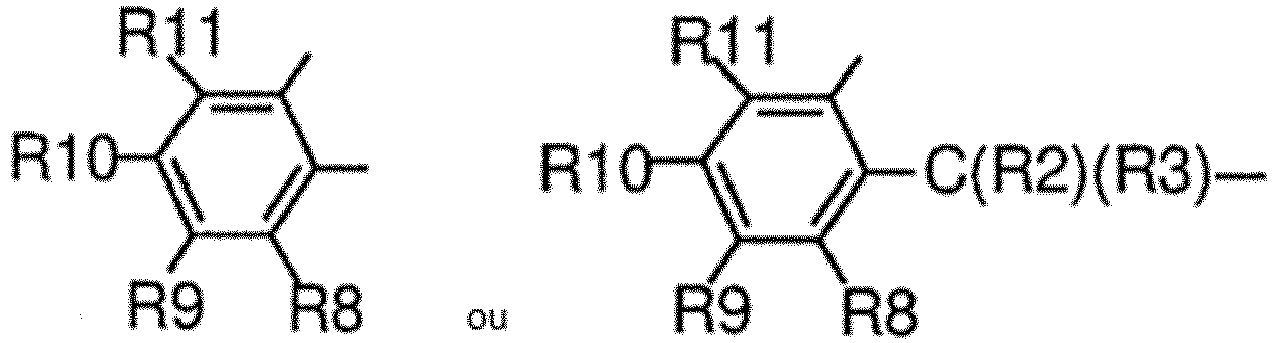 R2 à R11 représentant, indépendamment les uns des autres, des radicaux saturés ou insaturés, linéaires ou ramifiés, aliphatiques ou cycloaliphatiques, ou des radicaux aromatiques ou araliphatiques le cas échéant substitués, comprenant jusqu'à 20 atomes de carbone, qui peuvent le cas échéant contenir des hétéroatomes de la série oxygène, soufre, azote, ou représentant hydrogène ;L1, L2 et L5 représentent indépendamment les uns des autres -O-, -S-, -OC(=O)-, -OC(=S)-, -SC(=O)-, -SC(=S)-, -OS(=O)2O-, -OS(=O)2- ou -N(R12)-,R12 représentant un radical saturé ou insaturé, linéaire ou ramifié, aliphatique ou cycloaliphatique, ou un radical aromatique ou araliphatique le cas échéant substitué, comprenant jusqu'à 20 atomes de carbone, qui peut le cas échéant contenir des hétéroatomes de la série oxygène, soufre, azote, ou représentant hydrogène ;L3 et L4 représentent, indépendamment l'un de l'autre, -OH, -SH, -OR13, -Hal, -OC(=O)R14, -SR15, -OC( =S)R16, -OS(=O)2OR17, -OS(=O)2R18 ou -NR19R20, ou L3 et L4 représentent ensemble -L1-X-D-Y-L2-,R13 à R20 représentant, indépendamment les uns des autres, des radicaux saturés ou insaturés, linéaires ou ramifiés, aliphatiques ou cycloaliphatiques, ou des radicaux aromatiques ou araliphatiques le cas échéant substitués, comprenant jusqu'à 20 atomes de carbone, qui peuvent le cas échéant contenir des hétéroatomes de la série oxygène, soufre, azote, ou représentant hydrogène,
 - Procédé selon l'une des revendications 5 à 7, caractérisé en ce que le matériau de construction réticulable par voie radicalaire contient des groupes présentant des atomes d'H actifs selon Zerewitinoff et en ce que l'agent de blocage est un isocyanate ou l'agent de blocage est choisi de manière telle qu'après un déblocage du groupe NCO aucune libération de l'agent de blocage en tant que molécule libre ou en tant que partie d'autres molécules ou de parties moléculaires ne se produit.
- Procédé selon l'une des revendications 1 à 8, caractérisé en ce que dans l'étape II), une multitude de rayons énergétiques éclairent et/ou irradient simultanément la zone sélectionnée de la couche de matériau de construction réticulable par voie radicalaire, conformément à la section transversale respective sélectionnée du précurseur.
- Procédé selon l'une des revendications 1 à 9, caractérisé en ce que dans l'étape IV), la réalisation de la réaction chimique comporte le chauffage à une température supérieure au point de fusion du polyuréthane réticulable par voie radicalaire.
- Système pour la fabrication d'un objet dans un procédé de fabrication additive à partir d'un précurseur, comprenant un support (500) pouvant être soulevé à l'opposé du sens de la gravité, une unité de construction (400) contenant un matériau de construction (210) fondu sous le support et une unité d'irradiation et/ou d'éclairage (600) destinée à irradier et/ou à éclairer le matériau de construction (210) fondu sous le support (500), caractérisé en ce que le matériau de construction comprend un polyuréthane thermoplastique réticulable par voie radicalaire et un photo-initiateur et en ce que le polyuréthane réticulable par voie radicalaire présente un point de fusion, déterminé par calorimétrie différentielle dynamique, premier chauffage, à une vitesse de chauffage de 20 K/min, ≥ 50°C.
- Système selon la revendication 11, caractérisé en ce que le polyuréthane réticulable par voie radicalaire présente, à la température de mise en oeuvre, une viscosité (DIN EN ISO 2884-1) ≤ 10.000 mPa.s ;le photo-initiateur présente, à la température de mise en oeuvre, une durée de demi-vie pour sa dégradation thermique ≥ 1 heure et/oule matériau de construction réticulable par voie radicalaire présente d'autres groupes fonctionnels, différents des groupes fonctionnels réticulables par voie radicalaire, sous forme bloquée ou non bloquée, qui sont en mesure de participer à une réaction différente d'une réticulation par voie radicalaire en vue d'augmenter la résistance mécanique dans le matériau de construction.
- Utilisation d'un matériau de construction réticulable par voie radicalaire dans un procédé de fabrication additive à une température de mise en oeuvre ≥ 50°C,
caractérisée en ce que
le matériau de construction réticulable par voie radicalaire comprend un polyuréthane thermoplastique réticulable par voie radicalaire présentant une teneur en groupes uréthane ≥ 5% en poids et un point de fusion, déterminé par calorimétrie différentielle dynamique, premier chauffage, à une vitesse de chauffage de 20 K/min, ≥ 50°C et un photo-initiateur.
Applications Claiming Priority (2)
| Application Number | Priority Date | Filing Date | Title |
|---|---|---|---|
| EP17179206 | 2017-06-30 | ||
| PCT/EP2018/067557 WO2019002540A1 (fr) | 2017-06-30 | 2018-06-29 | Procédé de fabrication additive avec un matériau constitutif thermoplastique réticulable par voie radicalaire |
Publications (3)
| Publication Number | Publication Date |
|---|---|
| EP3645598A1 EP3645598A1 (fr) | 2020-05-06 |
| EP3645598C0 EP3645598C0 (fr) | 2024-06-19 |
| EP3645598B1 true EP3645598B1 (fr) | 2024-06-19 |
Family
ID=59296712
Family Applications (1)
| Application Number | Title | Priority Date | Filing Date |
|---|---|---|---|
| EP18733881.9A Active EP3645598B1 (fr) | 2017-06-30 | 2018-06-29 | Procédé de fabrication additive au moyen de matériau de construction thermoplastique réticulé de façon radicalaire |
Country Status (4)
| Country | Link |
|---|---|
| US (1) | US12617955B2 (fr) |
| EP (1) | EP3645598B1 (fr) |
| CN (1) | CN110799566A (fr) |
| WO (1) | WO2019002540A1 (fr) |
Families Citing this family (5)
| Publication number | Priority date | Publication date | Assignee | Title |
|---|---|---|---|---|
| WO2021183116A1 (fr) * | 2020-03-11 | 2021-09-16 | Hewlett-Packard Development Company, L.P. | Kits d'impression en trois dimensions comprenant des dihydrazides |
| EP4092064A1 (fr) | 2021-05-17 | 2022-11-23 | Covestro Deutschland AG | Résine photo- et thermodurcissable utile pour la fabrication additive |
| EP4116348A1 (fr) | 2021-07-09 | 2023-01-11 | Covestro Deutschland AG | Résine photo- et thermodurcissable utile dans des procédés de fabrication additive |
| EP4166331A1 (fr) | 2021-10-12 | 2023-04-19 | Covestro Deutschland AG | Résine photo- et thermodurcissable utile dans des procédés de fabrication additive |
| EP4234602A1 (fr) * | 2022-02-28 | 2023-08-30 | Covestro Deutschland AG | Utilisation de catalyseurs spéciaux pour la fabrication de revêtements polyuréthane |
Family Cites Families (12)
| Publication number | Priority date | Publication date | Assignee | Title |
|---|---|---|---|---|
| GB899948A (fr) * | 1900-01-01 | |||
| TW262537B (fr) | 1993-07-01 | 1995-11-11 | Allied Signal Inc | |
| DE102004012902A1 (de) * | 2004-03-17 | 2005-10-06 | Bayer Materialscience Ag | Herstellung von neuen strahlenhärtenden Bindemitteln |
| DE102009051445A1 (de) | 2009-10-30 | 2011-05-05 | Bayer Materialscience Ag | Verwendung spezieller Katalysatoren für die Herstellung von Polyurethanbeschichtungen |
| JP5757959B2 (ja) | 2010-01-22 | 2015-08-05 | ルブリゾル アドバンスド マテリアルズ, インコーポレイテッド | 架橋可能な熱可塑性ポリウレタン |
| PL2591037T3 (pl) * | 2010-07-05 | 2017-05-31 | Huntsman International Llc | Sieciowalne termoplastyczne poliuretany |
| BR112016029766A2 (pt) * | 2014-06-23 | 2017-08-22 | Carbon Inc | métodos de produção de objetos tridimensionais de poliuretano a partir de materiais tendo múltiplos mecanismos de endurecimento |
| US9650526B2 (en) | 2014-09-09 | 2017-05-16 | 3D Systems, Inc. | Method of printing a three-dimensional article |
| GB201508178D0 (en) | 2015-05-13 | 2015-06-24 | Photocentric Ltd | Method for making an object |
| WO2016181402A1 (fr) | 2015-05-14 | 2016-11-17 | Yissum Research Development Company Of The Hebrew University Of Jerusalem Ltd | Traitement de polymères thermodurcis à mémoire de forme pour obtenir des formes 3d complexes |
| JP7189015B2 (ja) * | 2015-12-22 | 2022-12-13 | カーボン,インコーポレイテッド | 二重硬化樹脂を用いた積層造形のための二重前駆体樹脂システム |
| US11535568B2 (en) * | 2016-11-30 | 2022-12-27 | Hrl Laboratories, Llc | Monomer formulations and methods for 3D printing of preceramic polymers |
-
2018
- 2018-06-29 EP EP18733881.9A patent/EP3645598B1/fr active Active
- 2018-06-29 CN CN201880044166.XA patent/CN110799566A/zh active Pending
- 2018-06-29 US US16/621,761 patent/US12617955B2/en active Active
- 2018-06-29 WO PCT/EP2018/067557 patent/WO2019002540A1/fr not_active Ceased
Also Published As
| Publication number | Publication date |
|---|---|
| US12617955B2 (en) | 2026-05-05 |
| US20200140707A1 (en) | 2020-05-07 |
| WO2019002540A1 (fr) | 2019-01-03 |
| EP3645598C0 (fr) | 2024-06-19 |
| EP3645598A1 (fr) | 2020-05-06 |
| CN110799566A (zh) | 2020-02-14 |
Similar Documents
| Publication | Publication Date | Title |
|---|---|---|
| EP3538584B1 (fr) | Procédé de fabrication d'un objet à partir d'un précurseur et utilisation d'une résine réticulable par voie radicalaire dans un procédé de fabrication additive | |
| EP3548522B1 (fr) | Procédé de fabrication d'un objet à partir d'un précurseur et utilisation d'une résine réticulable par voie radicalaire dans un procédé de fabrication additive | |
| EP3645598A1 (fr) | Procédé de fabrication additive avec un matériau constitutif thermoplastique réticulable par voie radicalaire | |
| EP1634903B1 (fr) | Préparation de nouveaux liants durcissables par rayonnement | |
| EP3852675B1 (fr) | Appareil orthodontique d'orthopédie maxillaire imprimée en 3d à partir de polymères réticulés | |
| EP1118627B2 (fr) | Polyuréthanes résistants aux intempéries durcissables par rayonnement | |
| WO2004005363A1 (fr) | Produits de polymerisation par addition contenant des groupes uretdione | |
| DE102004012903A1 (de) | Niedrigviskose Allophanate mit aktinisch härtbaren Gruppen | |
| EP3601398B1 (fr) | Procédé de polymérisation double au moyen de catalyseurs à l'étain latents par voie thermique | |
| EP2307473B1 (fr) | Procédé pour produire des prépolymères durcissables par rayonnement contenant des groupements uréthane | |
| DE102004043537A1 (de) | Herstellung von neuen strahlenhärtenden Bindemitteln | |
| DE102004043539A1 (de) | Niedrigviskose Allophanate mit aktinisch härtbaren Gruppen | |
| EP3794049B1 (fr) | Procédé de fabrication d'un polymère polyisocyanate et d'une matière plastique de polyisocyanurate | |
| EP3638725B1 (fr) | Procédé de fabrication additive faisant appel aux amines pour le post-durcissement | |
| EP3694897B1 (fr) | Procédé de fabrication d'un polymère réticulaire pour former des oxazolidinones | |
| EP3707188B1 (fr) | Procédé de fabrication d'un objet et utilisation d'une résine réticulable par voie radicalaire dans un procédé de fabrication additive | |
| DE102012217549A1 (de) | Monomerarme NCO-Prepolymere und ihre Verwendung | |
| EP0839845B1 (fr) | Polyisocyanates bloqués avec HALS-stabilisateur incorporé | |
| EP3628694A1 (fr) | Systèmes de revêtements à faible teneur en solvant pour textiles | |
| DE19801322A1 (de) | Diisocyanate mit Allophanatgruppen abgeleitet von alicyclischen Alkoholen | |
| EP4574864A1 (fr) | Mélange de polyisocyanates | |
| WO2020156937A1 (fr) | Prépolymères terminés par isocyanate pour des revêtements de textile |
Legal Events
| Date | Code | Title | Description |
|---|---|---|---|
| STAA | Information on the status of an ep patent application or granted ep patent |
Free format text: STATUS: UNKNOWN |
|
| STAA | Information on the status of an ep patent application or granted ep patent |
Free format text: STATUS: THE INTERNATIONAL PUBLICATION HAS BEEN MADE |
|
| PUAI | Public reference made under article 153(3) epc to a published international application that has entered the european phase |
Free format text: ORIGINAL CODE: 0009012 |
|
| STAA | Information on the status of an ep patent application or granted ep patent |
Free format text: STATUS: REQUEST FOR EXAMINATION WAS MADE |
|
| 17P | Request for examination filed |
Effective date: 20200130 |
|
| AK | Designated contracting states |
Kind code of ref document: A1 Designated state(s): AL AT BE BG CH CY CZ DE DK EE ES FI FR GB GR HR HU IE IS IT LI LT LU LV MC MK MT NL NO PL PT RO RS SE SI SK SM TR |
|
| AX | Request for extension of the european patent |
Extension state: BA ME |
|
| DAV | Request for validation of the european patent (deleted) | ||
| DAX | Request for extension of the european patent (deleted) | ||
| STAA | Information on the status of an ep patent application or granted ep patent |
Free format text: STATUS: EXAMINATION IS IN PROGRESS |
|
| 17Q | First examination report despatched |
Effective date: 20221026 |
|
| RAP1 | Party data changed (applicant data changed or rights of an application transferred) |
Owner name: STRATASYS, INC. |
|
| GRAP | Despatch of communication of intention to grant a patent |
Free format text: ORIGINAL CODE: EPIDOSNIGR1 |
|
| STAA | Information on the status of an ep patent application or granted ep patent |
Free format text: STATUS: GRANT OF PATENT IS INTENDED |
|
| INTG | Intention to grant announced |
Effective date: 20240227 |
|
| GRAS | Grant fee paid |
Free format text: ORIGINAL CODE: EPIDOSNIGR3 |
|
| GRAA | (expected) grant |
Free format text: ORIGINAL CODE: 0009210 |
|
| STAA | Information on the status of an ep patent application or granted ep patent |
Free format text: STATUS: THE PATENT HAS BEEN GRANTED |
|
| AK | Designated contracting states |
Kind code of ref document: B1 Designated state(s): AL AT BE BG CH CY CZ DE DK EE ES FI FR GB GR HR HU IE IS IT LI LT LU LV MC MK MT NL NO PL PT RO RS SE SI SK SM TR |
|
| REG | Reference to a national code |
Ref country code: GB Ref legal event code: FG4D Free format text: NOT ENGLISH |
|
| REG | Reference to a national code |
Ref country code: CH Ref legal event code: EP |
|
| REG | Reference to a national code |
Ref country code: DE Ref legal event code: R096 Ref document number: 502018014755 Country of ref document: DE |
|
| U01 | Request for unitary effect filed |
Effective date: 20240717 |
|
| U07 | Unitary effect registered |
Designated state(s): AT BE BG DE DK EE FI FR IT LT LU LV MT NL PT SE SI Effective date: 20240812 |
|
| PG25 | Lapsed in a contracting state [announced via postgrant information from national office to epo] |
Ref country code: HR Free format text: LAPSE BECAUSE OF FAILURE TO SUBMIT A TRANSLATION OF THE DESCRIPTION OR TO PAY THE FEE WITHIN THE PRESCRIBED TIME-LIMIT Effective date: 20240619 |
|
| PG25 | Lapsed in a contracting state [announced via postgrant information from national office to epo] |
Ref country code: GR Free format text: LAPSE BECAUSE OF FAILURE TO SUBMIT A TRANSLATION OF THE DESCRIPTION OR TO PAY THE FEE WITHIN THE PRESCRIBED TIME-LIMIT Effective date: 20240920 |
|
| U20 | Renewal fee for the european patent with unitary effect paid |
Year of fee payment: 7 Effective date: 20240919 |
|
| PG25 | Lapsed in a contracting state [announced via postgrant information from national office to epo] |
Ref country code: NO Free format text: LAPSE BECAUSE OF FAILURE TO SUBMIT A TRANSLATION OF THE DESCRIPTION OR TO PAY THE FEE WITHIN THE PRESCRIBED TIME-LIMIT Effective date: 20240919 Ref country code: HR Free format text: LAPSE BECAUSE OF FAILURE TO SUBMIT A TRANSLATION OF THE DESCRIPTION OR TO PAY THE FEE WITHIN THE PRESCRIBED TIME-LIMIT Effective date: 20240619 Ref country code: GR Free format text: LAPSE BECAUSE OF FAILURE TO SUBMIT A TRANSLATION OF THE DESCRIPTION OR TO PAY THE FEE WITHIN THE PRESCRIBED TIME-LIMIT Effective date: 20240920 Ref country code: RS Free format text: LAPSE BECAUSE OF FAILURE TO SUBMIT A TRANSLATION OF THE DESCRIPTION OR TO PAY THE FEE WITHIN THE PRESCRIBED TIME-LIMIT Effective date: 20240919 |
|
| PG25 | Lapsed in a contracting state [announced via postgrant information from national office to epo] |
Ref country code: PL Free format text: LAPSE BECAUSE OF FAILURE TO SUBMIT A TRANSLATION OF THE DESCRIPTION OR TO PAY THE FEE WITHIN THE PRESCRIBED TIME-LIMIT Effective date: 20240619 |
|
| PG25 | Lapsed in a contracting state [announced via postgrant information from national office to epo] |
Ref country code: IS Free format text: LAPSE BECAUSE OF FAILURE TO SUBMIT A TRANSLATION OF THE DESCRIPTION OR TO PAY THE FEE WITHIN THE PRESCRIBED TIME-LIMIT Effective date: 20241019 |
|
| PG25 | Lapsed in a contracting state [announced via postgrant information from national office to epo] |
Ref country code: CZ Free format text: LAPSE BECAUSE OF FAILURE TO SUBMIT A TRANSLATION OF THE DESCRIPTION OR TO PAY THE FEE WITHIN THE PRESCRIBED TIME-LIMIT Effective date: 20240619 |
|
| PG25 | Lapsed in a contracting state [announced via postgrant information from national office to epo] |
Ref country code: SK Free format text: LAPSE BECAUSE OF FAILURE TO SUBMIT A TRANSLATION OF THE DESCRIPTION OR TO PAY THE FEE WITHIN THE PRESCRIBED TIME-LIMIT Effective date: 20240619 Ref country code: RO Free format text: LAPSE BECAUSE OF FAILURE TO SUBMIT A TRANSLATION OF THE DESCRIPTION OR TO PAY THE FEE WITHIN THE PRESCRIBED TIME-LIMIT Effective date: 20240619 |
|
| PG25 | Lapsed in a contracting state [announced via postgrant information from national office to epo] |
Ref country code: ES Free format text: LAPSE BECAUSE OF FAILURE TO SUBMIT A TRANSLATION OF THE DESCRIPTION OR TO PAY THE FEE WITHIN THE PRESCRIBED TIME-LIMIT Effective date: 20240619 Ref country code: SM Free format text: LAPSE BECAUSE OF FAILURE TO SUBMIT A TRANSLATION OF THE DESCRIPTION OR TO PAY THE FEE WITHIN THE PRESCRIBED TIME-LIMIT Effective date: 20240619 |
|
| PG25 | Lapsed in a contracting state [announced via postgrant information from national office to epo] |
Ref country code: SM Free format text: LAPSE BECAUSE OF FAILURE TO SUBMIT A TRANSLATION OF THE DESCRIPTION OR TO PAY THE FEE WITHIN THE PRESCRIBED TIME-LIMIT Effective date: 20240619 Ref country code: SK Free format text: LAPSE BECAUSE OF FAILURE TO SUBMIT A TRANSLATION OF THE DESCRIPTION OR TO PAY THE FEE WITHIN THE PRESCRIBED TIME-LIMIT Effective date: 20240619 Ref country code: RO Free format text: LAPSE BECAUSE OF FAILURE TO SUBMIT A TRANSLATION OF THE DESCRIPTION OR TO PAY THE FEE WITHIN THE PRESCRIBED TIME-LIMIT Effective date: 20240619 Ref country code: PL Free format text: LAPSE BECAUSE OF FAILURE TO SUBMIT A TRANSLATION OF THE DESCRIPTION OR TO PAY THE FEE WITHIN THE PRESCRIBED TIME-LIMIT Effective date: 20240619 Ref country code: IS Free format text: LAPSE BECAUSE OF FAILURE TO SUBMIT A TRANSLATION OF THE DESCRIPTION OR TO PAY THE FEE WITHIN THE PRESCRIBED TIME-LIMIT Effective date: 20241019 Ref country code: ES Free format text: LAPSE BECAUSE OF FAILURE TO SUBMIT A TRANSLATION OF THE DESCRIPTION OR TO PAY THE FEE WITHIN THE PRESCRIBED TIME-LIMIT Effective date: 20240619 Ref country code: CZ Free format text: LAPSE BECAUSE OF FAILURE TO SUBMIT A TRANSLATION OF THE DESCRIPTION OR TO PAY THE FEE WITHIN THE PRESCRIBED TIME-LIMIT Effective date: 20240619 |
|
| REG | Reference to a national code |
Ref country code: CH Ref legal event code: PL |
|
| PG25 | Lapsed in a contracting state [announced via postgrant information from national office to epo] |
Ref country code: MC Free format text: LAPSE BECAUSE OF FAILURE TO SUBMIT A TRANSLATION OF THE DESCRIPTION OR TO PAY THE FEE WITHIN THE PRESCRIBED TIME-LIMIT Effective date: 20240619 |
|
| PG25 | Lapsed in a contracting state [announced via postgrant information from national office to epo] |
Ref country code: MC Free format text: LAPSE BECAUSE OF FAILURE TO SUBMIT A TRANSLATION OF THE DESCRIPTION OR TO PAY THE FEE WITHIN THE PRESCRIBED TIME-LIMIT Effective date: 20240619 |
|
| PG25 | Lapsed in a contracting state [announced via postgrant information from national office to epo] |
Ref country code: IE Free format text: LAPSE BECAUSE OF NON-PAYMENT OF DUE FEES Effective date: 20240629 |
|
| PG25 | Lapsed in a contracting state [announced via postgrant information from national office to epo] |
Ref country code: CH Free format text: LAPSE BECAUSE OF NON-PAYMENT OF DUE FEES Effective date: 20240630 |
|
| PLBE | No opposition filed within time limit |
Free format text: ORIGINAL CODE: 0009261 |
|
| STAA | Information on the status of an ep patent application or granted ep patent |
Free format text: STATUS: NO OPPOSITION FILED WITHIN TIME LIMIT |
|
| 26N | No opposition filed |
Effective date: 20250320 |
|
| GBPC | Gb: european patent ceased through non-payment of renewal fee |
Effective date: 20240919 |
|
| U20 | Renewal fee for the european patent with unitary effect paid |
Year of fee payment: 8 Effective date: 20250520 |
|
| PG25 | Lapsed in a contracting state [announced via postgrant information from national office to epo] |
Ref country code: GB Free format text: LAPSE BECAUSE OF NON-PAYMENT OF DUE FEES Effective date: 20240919 |
|
| PG25 | Lapsed in a contracting state [announced via postgrant information from national office to epo] |
Ref country code: CY Free format text: LAPSE BECAUSE OF FAILURE TO SUBMIT A TRANSLATION OF THE DESCRIPTION OR TO PAY THE FEE WITHIN THE PRESCRIBED TIME-LIMIT; INVALID AB INITIO Effective date: 20180629 |
|
| PG25 | Lapsed in a contracting state [announced via postgrant information from national office to epo] |
Ref country code: HU Free format text: LAPSE BECAUSE OF FAILURE TO SUBMIT A TRANSLATION OF THE DESCRIPTION OR TO PAY THE FEE WITHIN THE PRESCRIBED TIME-LIMIT; INVALID AB INITIO Effective date: 20180629 |