EP3646563B1 - Procédé, système et produit-programme d'ordinateur permettant de déterminer la solvabilité d'un échange d'actifs numériques - Google Patents
Procédé, système et produit-programme d'ordinateur permettant de déterminer la solvabilité d'un échange d'actifs numériques Download PDFInfo
- Publication number
- EP3646563B1 EP3646563B1 EP18825320.7A EP18825320A EP3646563B1 EP 3646563 B1 EP3646563 B1 EP 3646563B1 EP 18825320 A EP18825320 A EP 18825320A EP 3646563 B1 EP3646563 B1 EP 3646563B1
- Authority
- EP
- European Patent Office
- Prior art keywords
- zero
- component
- commitment
- knowledge
- knowledge algorithm
- Prior art date
- Legal status (The legal status is an assumption and is not a legal conclusion. Google has not performed a legal analysis and makes no representation as to the accuracy of the status listed.)
- Active
Links
Images



Classifications
-
- G—PHYSICS
- G06—COMPUTING OR CALCULATING; COUNTING
- G06Q—INFORMATION AND COMMUNICATION TECHNOLOGY [ICT] SPECIALLY ADAPTED FOR ADMINISTRATIVE, COMMERCIAL, FINANCIAL, MANAGERIAL OR SUPERVISORY PURPOSES; SYSTEMS OR METHODS SPECIALLY ADAPTED FOR ADMINISTRATIVE, COMMERCIAL, FINANCIAL, MANAGERIAL OR SUPERVISORY PURPOSES, NOT OTHERWISE PROVIDED FOR
- G06Q20/00—Payment architectures, schemes or protocols
- G06Q20/38—Payment protocols; Details thereof
- G06Q20/40—Authorisation, e.g. identification of payer or payee, verification of customer or shop credentials; Review and approval of payers, e.g. check credit lines or negative lists
- G06Q20/403—Solvency checks
-
- H—ELECTRICITY
- H04—ELECTRIC COMMUNICATION TECHNIQUE
- H04L—TRANSMISSION OF DIGITAL INFORMATION, e.g. TELEGRAPHIC COMMUNICATION
- H04L9/00—Cryptographic mechanisms or cryptographic arrangements for secret or secure communications; Network security protocols
- H04L9/32—Cryptographic mechanisms or cryptographic arrangements for secret or secure communications; Network security protocols including means for verifying the identity or authority of a user of the system or for message authentication, e.g. authorization, entity authentication, data integrity or data verification, non-repudiation, key authentication or verification of credentials
- H04L9/3218—Cryptographic mechanisms or cryptographic arrangements for secret or secure communications; Network security protocols including means for verifying the identity or authority of a user of the system or for message authentication, e.g. authorization, entity authentication, data integrity or data verification, non-repudiation, key authentication or verification of credentials using proof of knowledge, e.g. Fiat-Shamir, GQ, Schnorr, ornon-interactive zero-knowledge proofs
-
- G—PHYSICS
- G06—COMPUTING OR CALCULATING; COUNTING
- G06Q—INFORMATION AND COMMUNICATION TECHNOLOGY [ICT] SPECIALLY ADAPTED FOR ADMINISTRATIVE, COMMERCIAL, FINANCIAL, MANAGERIAL OR SUPERVISORY PURPOSES; SYSTEMS OR METHODS SPECIALLY ADAPTED FOR ADMINISTRATIVE, COMMERCIAL, FINANCIAL, MANAGERIAL OR SUPERVISORY PURPOSES, NOT OTHERWISE PROVIDED FOR
- G06Q20/00—Payment architectures, schemes or protocols
- G06Q20/04—Payment circuits
- G06Q20/06—Private payment circuits, e.g. involving electronic currency used among participants of a common payment scheme
- G06Q20/065—Private payment circuits, e.g. involving electronic currency used among participants of a common payment scheme using e-cash
-
- G—PHYSICS
- G06—COMPUTING OR CALCULATING; COUNTING
- G06Q—INFORMATION AND COMMUNICATION TECHNOLOGY [ICT] SPECIALLY ADAPTED FOR ADMINISTRATIVE, COMMERCIAL, FINANCIAL, MANAGERIAL OR SUPERVISORY PURPOSES; SYSTEMS OR METHODS SPECIALLY ADAPTED FOR ADMINISTRATIVE, COMMERCIAL, FINANCIAL, MANAGERIAL OR SUPERVISORY PURPOSES, NOT OTHERWISE PROVIDED FOR
- G06Q20/00—Payment architectures, schemes or protocols
- G06Q20/22—Payment schemes or models
- G06Q20/223—Payment schemes or models based on the use of peer-to-peer networks
-
- G—PHYSICS
- G06—COMPUTING OR CALCULATING; COUNTING
- G06Q—INFORMATION AND COMMUNICATION TECHNOLOGY [ICT] SPECIALLY ADAPTED FOR ADMINISTRATIVE, COMMERCIAL, FINANCIAL, MANAGERIAL OR SUPERVISORY PURPOSES; SYSTEMS OR METHODS SPECIALLY ADAPTED FOR ADMINISTRATIVE, COMMERCIAL, FINANCIAL, MANAGERIAL OR SUPERVISORY PURPOSES, NOT OTHERWISE PROVIDED FOR
- G06Q20/00—Payment architectures, schemes or protocols
- G06Q20/38—Payment protocols; Details thereof
- G06Q20/382—Payment protocols; Details thereof insuring higher security of transaction
- G06Q20/3827—Use of message hashing
-
- G—PHYSICS
- G06—COMPUTING OR CALCULATING; COUNTING
- G06Q—INFORMATION AND COMMUNICATION TECHNOLOGY [ICT] SPECIALLY ADAPTED FOR ADMINISTRATIVE, COMMERCIAL, FINANCIAL, MANAGERIAL OR SUPERVISORY PURPOSES; SYSTEMS OR METHODS SPECIALLY ADAPTED FOR ADMINISTRATIVE, COMMERCIAL, FINANCIAL, MANAGERIAL OR SUPERVISORY PURPOSES, NOT OTHERWISE PROVIDED FOR
- G06Q20/00—Payment architectures, schemes or protocols
- G06Q20/38—Payment protocols; Details thereof
- G06Q20/382—Payment protocols; Details thereof insuring higher security of transaction
- G06Q20/3829—Payment protocols; Details thereof insuring higher security of transaction involving key management
-
- G—PHYSICS
- G06—COMPUTING OR CALCULATING; COUNTING
- G06Q—INFORMATION AND COMMUNICATION TECHNOLOGY [ICT] SPECIALLY ADAPTED FOR ADMINISTRATIVE, COMMERCIAL, FINANCIAL, MANAGERIAL OR SUPERVISORY PURPOSES; SYSTEMS OR METHODS SPECIALLY ADAPTED FOR ADMINISTRATIVE, COMMERCIAL, FINANCIAL, MANAGERIAL OR SUPERVISORY PURPOSES, NOT OTHERWISE PROVIDED FOR
- G06Q20/00—Payment architectures, schemes or protocols
- G06Q20/38—Payment protocols; Details thereof
- G06Q20/389—Keeping log of transactions for guaranteeing non-repudiation of a transaction
-
- G—PHYSICS
- G06—COMPUTING OR CALCULATING; COUNTING
- G06Q—INFORMATION AND COMMUNICATION TECHNOLOGY [ICT] SPECIALLY ADAPTED FOR ADMINISTRATIVE, COMMERCIAL, FINANCIAL, MANAGERIAL OR SUPERVISORY PURPOSES; SYSTEMS OR METHODS SPECIALLY ADAPTED FOR ADMINISTRATIVE, COMMERCIAL, FINANCIAL, MANAGERIAL OR SUPERVISORY PURPOSES, NOT OTHERWISE PROVIDED FOR
- G06Q40/00—Finance; Insurance; Tax strategies; Processing of corporate or income taxes
- G06Q40/02—Banking, e.g. interest calculation or account maintenance
-
- G—PHYSICS
- G06—COMPUTING OR CALCULATING; COUNTING
- G06Q—INFORMATION AND COMMUNICATION TECHNOLOGY [ICT] SPECIALLY ADAPTED FOR ADMINISTRATIVE, COMMERCIAL, FINANCIAL, MANAGERIAL OR SUPERVISORY PURPOSES; SYSTEMS OR METHODS SPECIALLY ADAPTED FOR ADMINISTRATIVE, COMMERCIAL, FINANCIAL, MANAGERIAL OR SUPERVISORY PURPOSES, NOT OTHERWISE PROVIDED FOR
- G06Q40/00—Finance; Insurance; Tax strategies; Processing of corporate or income taxes
- G06Q40/04—Trading; Exchange, e.g. stocks, commodities, derivatives or currency exchange
-
- H—ELECTRICITY
- H04—ELECTRIC COMMUNICATION TECHNIQUE
- H04L—TRANSMISSION OF DIGITAL INFORMATION, e.g. TELEGRAPHIC COMMUNICATION
- H04L63/00—Network architectures or network communication protocols for network security
- H04L63/08—Network architectures or network communication protocols for network security for authentication of entities
-
- H—ELECTRICITY
- H04—ELECTRIC COMMUNICATION TECHNIQUE
- H04L—TRANSMISSION OF DIGITAL INFORMATION, e.g. TELEGRAPHIC COMMUNICATION
- H04L9/00—Cryptographic mechanisms or cryptographic arrangements for secret or secure communications; Network security protocols
- H04L9/06—Cryptographic mechanisms or cryptographic arrangements for secret or secure communications; Network security protocols the encryption apparatus using shift registers or memories for block-wise or stream coding, e.g. DES systems or RC4; Hash functions; Pseudorandom sequence generators
- H04L9/0643—Hash functions, e.g. MD5, SHA, HMAC or f9 MAC
-
- H—ELECTRICITY
- H04—ELECTRIC COMMUNICATION TECHNIQUE
- H04L—TRANSMISSION OF DIGITAL INFORMATION, e.g. TELEGRAPHIC COMMUNICATION
- H04L9/00—Cryptographic mechanisms or cryptographic arrangements for secret or secure communications; Network security protocols
- H04L9/32—Cryptographic mechanisms or cryptographic arrangements for secret or secure communications; Network security protocols including means for verifying the identity or authority of a user of the system or for message authentication, e.g. authorization, entity authentication, data integrity or data verification, non-repudiation, key authentication or verification of credentials
- H04L9/3236—Cryptographic mechanisms or cryptographic arrangements for secret or secure communications; Network security protocols including means for verifying the identity or authority of a user of the system or for message authentication, e.g. authorization, entity authentication, data integrity or data verification, non-repudiation, key authentication or verification of credentials using cryptographic hash functions
-
- H—ELECTRICITY
- H04—ELECTRIC COMMUNICATION TECHNIQUE
- H04L—TRANSMISSION OF DIGITAL INFORMATION, e.g. TELEGRAPHIC COMMUNICATION
- H04L9/00—Cryptographic mechanisms or cryptographic arrangements for secret or secure communications; Network security protocols
- H04L9/32—Cryptographic mechanisms or cryptographic arrangements for secret or secure communications; Network security protocols including means for verifying the identity or authority of a user of the system or for message authentication, e.g. authorization, entity authentication, data integrity or data verification, non-repudiation, key authentication or verification of credentials
- H04L9/3236—Cryptographic mechanisms or cryptographic arrangements for secret or secure communications; Network security protocols including means for verifying the identity or authority of a user of the system or for message authentication, e.g. authorization, entity authentication, data integrity or data verification, non-repudiation, key authentication or verification of credentials using cryptographic hash functions
- H04L9/3239—Cryptographic mechanisms or cryptographic arrangements for secret or secure communications; Network security protocols including means for verifying the identity or authority of a user of the system or for message authentication, e.g. authorization, entity authentication, data integrity or data verification, non-repudiation, key authentication or verification of credentials using cryptographic hash functions involving non-keyed hash functions, e.g. modification detection codes [MDCs], MD5, SHA or RIPEMD
-
- H—ELECTRICITY
- H04—ELECTRIC COMMUNICATION TECHNIQUE
- H04L—TRANSMISSION OF DIGITAL INFORMATION, e.g. TELEGRAPHIC COMMUNICATION
- H04L9/00—Cryptographic mechanisms or cryptographic arrangements for secret or secure communications; Network security protocols
- H04L9/32—Cryptographic mechanisms or cryptographic arrangements for secret or secure communications; Network security protocols including means for verifying the identity or authority of a user of the system or for message authentication, e.g. authorization, entity authentication, data integrity or data verification, non-repudiation, key authentication or verification of credentials
- H04L9/3247—Cryptographic mechanisms or cryptographic arrangements for secret or secure communications; Network security protocols including means for verifying the identity or authority of a user of the system or for message authentication, e.g. authorization, entity authentication, data integrity or data verification, non-repudiation, key authentication or verification of credentials involving digital signatures
-
- H—ELECTRICITY
- H04—ELECTRIC COMMUNICATION TECHNIQUE
- H04L—TRANSMISSION OF DIGITAL INFORMATION, e.g. TELEGRAPHIC COMMUNICATION
- H04L9/00—Cryptographic mechanisms or cryptographic arrangements for secret or secure communications; Network security protocols
- H04L9/32—Cryptographic mechanisms or cryptographic arrangements for secret or secure communications; Network security protocols including means for verifying the identity or authority of a user of the system or for message authentication, e.g. authorization, entity authentication, data integrity or data verification, non-repudiation, key authentication or verification of credentials
- H04L9/3263—Cryptographic mechanisms or cryptographic arrangements for secret or secure communications; Network security protocols including means for verifying the identity or authority of a user of the system or for message authentication, e.g. authorization, entity authentication, data integrity or data verification, non-repudiation, key authentication or verification of credentials involving certificates, e.g. public key certificate [PKC] or attribute certificate [AC]; Public key infrastructure [PKI] arrangements
-
- H—ELECTRICITY
- H04—ELECTRIC COMMUNICATION TECHNIQUE
- H04L—TRANSMISSION OF DIGITAL INFORMATION, e.g. TELEGRAPHIC COMMUNICATION
- H04L9/00—Cryptographic mechanisms or cryptographic arrangements for secret or secure communications; Network security protocols
- H04L9/32—Cryptographic mechanisms or cryptographic arrangements for secret or secure communications; Network security protocols including means for verifying the identity or authority of a user of the system or for message authentication, e.g. authorization, entity authentication, data integrity or data verification, non-repudiation, key authentication or verification of credentials
- H04L9/3297—Cryptographic mechanisms or cryptographic arrangements for secret or secure communications; Network security protocols including means for verifying the identity or authority of a user of the system or for message authentication, e.g. authorization, entity authentication, data integrity or data verification, non-repudiation, key authentication or verification of credentials involving time stamps, e.g. generation of time stamps
-
- H—ELECTRICITY
- H04—ELECTRIC COMMUNICATION TECHNIQUE
- H04L—TRANSMISSION OF DIGITAL INFORMATION, e.g. TELEGRAPHIC COMMUNICATION
- H04L9/00—Cryptographic mechanisms or cryptographic arrangements for secret or secure communications; Network security protocols
- H04L9/50—Cryptographic mechanisms or cryptographic arrangements for secret or secure communications; Network security protocols using hash chains, e.g. blockchains or hash trees
-
- G—PHYSICS
- G06—COMPUTING OR CALCULATING; COUNTING
- G06Q—INFORMATION AND COMMUNICATION TECHNOLOGY [ICT] SPECIALLY ADAPTED FOR ADMINISTRATIVE, COMMERCIAL, FINANCIAL, MANAGERIAL OR SUPERVISORY PURPOSES; SYSTEMS OR METHODS SPECIALLY ADAPTED FOR ADMINISTRATIVE, COMMERCIAL, FINANCIAL, MANAGERIAL OR SUPERVISORY PURPOSES, NOT OTHERWISE PROVIDED FOR
- G06Q2220/00—Business processing using cryptography
-
- H—ELECTRICITY
- H04—ELECTRIC COMMUNICATION TECHNIQUE
- H04L—TRANSMISSION OF DIGITAL INFORMATION, e.g. TELEGRAPHIC COMMUNICATION
- H04L2209/00—Additional information or applications relating to cryptographic mechanisms or cryptographic arrangements for secret or secure communication H04L9/00
- H04L2209/56—Financial cryptography, e.g. electronic payment or e-cash
Definitions
- R be an efficiently computable binary relation which consists of pairs of the form (s, w) where s is a statement and w is a witness.
- R(s, w) 1 ⁇ .
- a zero-knowledge proof for L lets a prover P convince a verifier V that s ⁇ L for a common input s without revealing w.
- a proof of knowledge captures not only the truth of a statement s ⁇ L, but also that the prover "possesses" a witness w to this fact.
- a non-interactive proof is where P sends only one message to V, and V decides whether to accept or not based on its input, the message, and any public parameters.
- a ZKP of solvency would allow a cryptocurrency exchange to verify to its users that it controls sufficient funds without revealing the amount or distribution of said funds and liabilities. Without cryptographic proofs of solvency, exchanges may be relegated to soliciting third-party auditors to verify funds, which requires users to trust the third-party auditor, and the auditor to maintain the privacy of the data. Therefore, there is a need in the art for efficient ZKPs of statements of solvency.
- Provisions Privacy-preserving Proofs of Solvency for Bitcoin Exchanges, Association for Computing Machinery (ACM) Conference on Computer and Communications Security (CCS), 2015 .
- the common reference string for proving the statement can become extremely large (e.g., gigabytes, in the case of ZCash). It would be beneficial to have a system of ZKPs to prove smaller individual compound statements, where the output of one statement is the input of another, and therein reduce the size of the common reference string.
- a computer-implemented method for determining solvency of a digital asset exchange system comprising: identifying, with at least one processor, a plurality of blockchain addresses corresponding to a plurality of users of the digital asset exchange system, each blockchain address of the plurality of blockchain addresses comprising a value generated by hashing a public key corresponding to a private key controlled by the digital asset exchange system, such that the public key and the private key are not exposed on a blockchain network; generating, with at least one processor, a first commitment to an amount of digital assets corresponding to the plurality of blockchain addresses; generating, with at least one processor, a second commitment to a balance of each user of the plurality of users; generating, with at least one processor, a first component of a zero-knowledge algorithm configured to receive, as input, the first commitment, and to output a value generated based on each public key corresponding to each blockchain address, such that the first component of the zero-knowledge algorithm proves to a verifying system that the digital
- a system for determining solvency of a digital asset exchange system comprising: a secure data storage device comprising a plurality of public/private key pairs for a plurality of users of the digital asset exchange system; and at least one processor in communication with a blockchain network, the at least one processor programmed or configured to: identify a plurality of blockchain addresses corresponding to the plurality of users of the digital asset exchange system, each blockchain address of the plurality of blockchain addresses comprising a value generated by hashing a public key corresponding to a private key controlled by the digital asset exchange system and stored on the secure data storage device, such that the public key and the private key are not exposed on the blockchain network; generate a first commitment to an amount of digital assets corresponding to the plurality of blockchain addresses; generate a second commitment to a balance of each user of the plurality of users; generate a first component of a zero-knowledge algorithm configured to receive, as input, the first commitment, and to output a value generated based on each public key corresponding to each blockchain address
- the first component of the zero-knowledge algorithm comprises a zkSNARK protocol
- the second component of the zero-knowledge algorithm comprises a Sigma protocol.
- the first component of the zero-knowledge algorithm is a Boolean function.
- the second component of the zero-knowledge algorithm is an algebraic function.
- determining that the digital asset exchange system is solvent comprises determining if an output of the algebraic function is an input to the Boolean function.
- the blockchain network comprises the Bitcoin public blockchain network.
- the first commitment comprises a first point along an elliptic curve
- the second commitment comprises a second point along an elliptic curve.
- a computer program product for determining solvency of a digital asset exchange system, comprising at least one non-transitory computer-readable medium including program instructions that, when executed by at least one processor, cause the at least one processor to: identify a plurality of blockchain addresses of a blockchain network corresponding to a plurality of users of the digital asset exchange system, each blockchain address of the plurality of blockchain addresses comprising a value generated by hashing a public key corresponding to a private key controlled by the digital asset exchange system and stored on the secure data storage device, such that the public key and the private key are not exposed on a blockchain network; generate a first commitment to an amount of digital assets corresponding to the plurality of blockchain addresses; generate a second commitment to a balance of each user of the plurality of users; generate a first component of a zero-knowledge algorithm configured to receive, as input, the first commitment, and to output a value generated based on each public key corresponding to each blockchain address, such that the first component of the zero-knowledge algorithm proves
- the first component of the zero-knowledge algorithm comprises a zkSNARK protocol
- the second component of the zero-knowledge algorithm comprises a Sigma protocol.
- the first component of the zero-knowledge algorithm is a Boolean function.
- the second component of the zero-knowledge algorithm is an algebraic function.
- determining that the digital asset exchange system is solvent comprises determining if an output of the algebraic function is an input to the Boolean function.
- the blockchain network comprises the Bitcoin public blockchain network.
- the first commitment comprises a first point along an elliptic curve
- the second commitment comprises a second point along an elliptic curve.
- a computer-implemented method for generating and verifying anonymous digital certificates comprising: generating, with at least one processor of a proving system, a digital signature by encrypting a hashed message with a private key based on an asymmetrical encryption algorithm; communicating, with the at least one processor, the digital signature to a verifying system; generating, with the at least one processor, a commitment to a message used to generate the hashed message; generating, with the at least one processor, a first component of a zero-knowledge algorithm configured to receive, as input, the commitment, and output a value based on the message used to generate the hashed message; generating, with the at least one processor, a second component of the zero-knowledge algorithm configured to receive, as input, the commitment, and output a value based on the private key used to generate the digital signature; and generating, with the at least one processor, the zero-knowledge algorithm based on the first component and the second component.
- the commitment to the message comprises a point along an elliptic curve.
- the method includes verifying, by at least one processor of the verifying system, the digital signature based on the commitment and the zero-knowledge algorithm.
- the first component of the zero-knowledge algorithm comprises a zkSNARK protocol
- the second component of the zero-knowledge algorithm comprises a Sigma protocol.
- the first component of the zero-knowledge algorithm is a Boolean function.
- the second component of the zero-knowledge algorithm is an algebraic function.
- determining that the digital asset exchange system is solvent comprises determining if an output of the algebraic function is an input to the Boolean function.
- a system for generating and verifying anonymous digital certificates comprising: a secure data storage device comprising a private key of a public/private key pair and a message; and a proving computer comprising at least one processor programmed or configured to: generate a digital signature by encrypting a hash of the message with the private key based on an asymmetrical encryption algorithm; communicate the digital signature to a verifying computer; generate a commitment to the message; generate a first component of a zero-knowledge algorithm configured to receive, as input, the commitment, and output a value based on the message used to generate the hashed message; generate a second component of the zero-knowledge algorithm configured to receive, as input, the commitment, and output a value based on the private key used to generate the digital signature; generate the zero-knowledge algorithm based on the first component and the second component; and communicate the zero-knowledge algorithm to the verifying computer.
- a computer program product for generating and verifying anonymous digital certificates, comprising at least one non-transitory computer-readable medium including program instructions that, when executed by at least one processor, cause the at least one processor to: generate a digital signature by encrypting a hash of the message with a private key based on an asymmetrical encryption algorithm; communicate the digital signature to a verifying computer; generate a commitment to the message; generate a first component of a zero-knowledge algorithm configured to receive, as input, the commitment, and output a value based on the message used to generate the hashed message; generate a second component of the zero-knowledge algorithm configured to receive, as input, the commitment, and output a value based on the private key used to generate the digital signature; generate the zero-knowledge algorithm based on the first component and the second component; and communicate the zero-knowledge algorithm to the verifying computer.
- the commitment to the message comprises a point along an elliptic curve.
- the first component of the zero-knowledge algorithm comprises a zkSNARK protocol
- the second component of the zero-knowledge algorithm comprises a Sigma protocol.
- the first component of the zero-knowledge algorithm is a Boolean function.
- the second component of the zero-knowledge algorithm is an algebraic function.
- the at least one processor is further causes to verify the digital signature based on the zero-knowledge algorithm by determining that an output of the algebraic function is an input to the Boolean function.
- a new framework for ZKP proofs of compound statements that contain both algebraic and non-algebraic functions, by efficiently combining zkSNARKs and Sigma protocols is provided.
- EC elliptic curve
- a range of "1 to 10" is intended to include all sub-ranges between (and including) the recited minimum value of 1 and the recited maximum value of 10, that is, having a minimum value equal to or greater than 1 and a maximum value of equal to or less than 10.
- digital asset refers to a unit of value that exists in an electronic, digital form, such as not limited to cryptocurrency units, license keys, smart contracts, and/or the like.
- a “digital asset exchange” and a “digital asset exchange system” refer to one or more computing devices configured to manage and control digital assets.
- cryptocurrency refers to a digital currency in which cryptographic techniques are used to create and regulate the distribution thereof.
- cryptocurrencies are maintained, transferred, and created in a decentralized blockchain network without a central authority, such as a financial institution, acting as an intermediary.
- Cryptocurrencies may include Bitcoin, Ethereum, XRP, Bitcoin Cash, Litecoin, ZeroCash, and/or other digital currencies.
- zkSNARK zero-knowledge Succinct Non-interactive ARgument of Knowledge refers to a non-interactive zero-knowledge argument of knowledge for a relation R with a Succinctness property which means that, for any s and w, the length of the proof ⁇ is given by
- poly( ⁇ ) ⁇ polylog(
- Sigma protocol refers to a two-party interactive protocol with the following structure. Let P (the prover) and V (the verifier) be two parties with common input s and a private input w for P. In a Sigma protocol, P sends a message a, V replies with a random ⁇ -bit string r, P then sends a message e, and V decides to accept or reject based on the transcript (a, r, e).
- the term “commitment” refers to a value generated based on one or more inputs such that the value can be published without revealing the one or more inputs.
- generating a commitment based on an input may involve processing that input with one or more hash or elliptic curve algorithms.
- a commitment may be represented by a point along a curve as identified by x and y coordinates.
- the function "Com(x)” is used to denote a commitment to variable x.
- zero-knowledge algorithm refers to one or more functions, processes, and/or calculations configured to verify that a system or entity has knowledge of or access to one or more values, such as but not limited to private keys corresponding to public keys in an asymmetric cryptography schema.
- a zero-knowledge algorithm may include proofs that a verifying system can calculate with given inputs on both sides.
- Non-limiting embodiments of the invention may be implemented on one or more computing devices including at least one processor, such as but not limited to one or more servers, computers, mobile devices, and/or the like.
- the terms “proving system” and “proving computer” refer to one or more computing devices operated by a user or entity seeking to prove that it has access to a secret key or secret information.
- the terms “verifying system” and “verifying computer” refer to one or more computing devices operated by a user or entity seeking to verify that the proving system has the secret key or secret information without itself having access to it. It will be appreciated that various other implementations are possible.
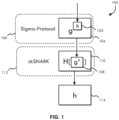
- a private key 102 " x " for which there corresponds one or more public keys 104 " g x " or "y.”
- a private key 102 may be a 256-bit number (although, some implementations may use between 128 and 512 bits).
- a public key 104 is derived from the private key 102, generally by elliptic-curve conversion.
- a public key 104 may be a 65 byte number, including 32 bytes corresponding to an "X" coordinate integer of the elliptic curve and 32 bytes corresponding to a "Y' coordinate integer of the elliptic curve.
- a sigma-protocol ZKP 106 may be used to prove that a cryptocurrency exchange knows (and presumably controls) the private key 102 corresponding to the public key 104.
- the output of the sigma-protocol ZKP 106 function may be used as the input 108 of a hash algorithm 110.
- the compound statements may be any suitable combination or hybrid of functions, such as algebraic-algebraic, arithmetic-algebraic, algebraic-arithmetic, arithmetic-arithmetic, and/or the like. It will be appreciated that other configurations of ZKP are possible.
- the addition operation over elliptic curve points is defined over F t
- the commitment scheme may be defined over a different group of size q . While this difference may be addressed by using two different commitment schemes in groups of different orders, it would require performing the Complex Multiplication method to choose an elliptic curve group of a specific order which is inefficient and wastes computational resources. This method may also apply to a situation where T is also private and committed to.
- the system 2000 includes an exchange system 202, which may include a cryptocurrency exchange that holds private keys corresponding to blockchain addresses for a plurality of users.
- the exchange system 202 functions as a proving system and includes one or more processors, a secure data storage device 206 for storing users' private keys, and a distributed ledger 208.
- the system 2000 also includes a plurality of distributed nodes 214, 216 each hosting the distributed ledger 208. It will be appreciated that, in some embodiments, numerous nodes 214, 216 may host the distributed ledger 208 and that the exchange system 202 may not host the distributed ledger 208. In the example shown in FIG.
- a user device 211 functions as a verifying system and accesses the exchange system 202 to check a user's balance, trade digital assets, deposit funds in fiat currency or cryptocurrency, withdraw digital assets, and/or the like.
- the user device 211 may access the exchange system 202 via a network 210, such as the Internet, and interacts with one or more digital assets through one or more graphical user interfaces (GUI) 212 displayed on the user device 211.
- GUI graphical user interfaces
- the user may request that the exchange system 202 validate its own solvency and confirm that the exchange system 202 holds the private keys that correspond to its total digital assets.
- the exchange system 202 holds a private key that corresponds to a public key uniquely corresponding to the user.
- the public key for a user may be kept secret by the user; however, because the distributed ledger 208 identifies the user's blockchain address with a hash of the user's public key rather than the public key itself.
- the exchange system 202 demonstrates that it controls sufficient reserves to settle each customer's account such that, if the exchange loses a large amount of digital assets in an attack, the exchange would not be able to provide computational statements that prove its solvency. Thus, customers will find out about the attack quickly and take necessary actions.
- a Bitcoin address is a 160-bit hash of the public portion of a public/private ECDSA keypair, where the public portion is derived from the private key by doing an exponentiation operation on the secp256k1 curve. Because Bitcoin addresses do not reveal the public key of the public/private key pair, and instead only a hash, the Bitcoin address can remain anonymous.
- H is a hash function such as SHA-256.
- the statement has both algebraic ( g X ) and Boolean (hash function H ) components, where the algebraic component relates the private key and public key, and the Boolean component relates the public key and hashed public key.
- the exchange system 202 is configured to perform three primary tasks to prove its solvency: (1) a proof of liabilities that allows customers (verifying systems 211) to verify that their accounts are included in the total; (2) a proof of assets which shows that the exchange has a certain amount of reserves; and (3) a proof that the reserves cover the liabilities to an acceptable degree.
- the balance associated with a Bitcoin address h is represented by: bal(h).
- the exchange system 202 also generates a component of a zero-knowledge algorithm configured to prove that the exchange system has committed to its total liability and that each customer's respective balances are included in that total commitment.
- the exchange may map each customer to an entry, such as an identifier, in a data structure representing the exchange system's liabilities, such as a liability list.
- each customer may be provided with an identifier, such as an account number, user name, email address, and/or the like, and the exchange system utilizes a hash-based commitment scheme to commit to those customer identifiers.
- the exchange system 202 Once the exchange system 202 generates components of a zero-knowledge algorithm configured to prove the exchange system's total assets and total liabilities, the exchange system 202 generates a zero-knowledge algorithm configured to prove that the exchange system is solvent by proving that Z Assets lZ Liab , is a commitment to 0.
- the exchange system identifies a plurality of blockchain addresses that it controls.
- the exchange system may identify a plurality of public blockchain addresses that correspond to each of a plurality of public/private key pairs that are maintained by the exchange system 202.
- the blockchain address may include a hashed public key, as an example, to maintain the secrecy of both the public and private key.
- the exchange system may generate a set of hashes for each public blockchain address it controls a corresponding key for.
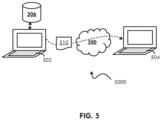
- a proving system 502 is in communication with a verifying system 504. It will be appreciated that the proving system 502 and verifying system 504 may be one or more of any type of computing device, such as a server computer, mobile device, and/or the like.
- the proving system 502 has access to a secret private key and message stored in a secure data storage device 506.
- the proving system generates an anonymous digital signature 510 by hashing the message according to a hash function and signing the hashed message with the private key by applying one or more cryptographic operations such as an RSA or elliptic curve algorithm.
- the proving system 502 communicates the anonymous digital signature 510 to the verifying system 504.
- the verifying system may have access to the hashed message or, in some examples, the proving system 502 may communicate the hashed message to the verifying system.
- the proving system 502 communicates with the verifying system through at least one network environment 500. It will be appreciated that the proving system 502 may communicate in a secure manner as to stay anonymous. In some examples, the proving system 502 may only indirectly communicate with the verifying system 504 through an intermediary system (not shown in FIG. 5 ) to preserve anonymity.
- the proving system 502 generates a commitment to the message and private key, communicates the commitment to the verifying system 504, and generates a zero-knowledge algorithm configured to facilitate the verifying system 504 to verify the anonymous digital signature 510 without having access to the message or the private key.
- the verifying system 504 receives this data and executes the zero-knowledge algorithm to verify the anonymous digital signature 510 given the commitment and the public key.
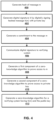
- a method for verifying access to or knowledge of a secret value is shown according to a non-limiting embodiment.
- the method shown in FIG. 6 may be used in any number of use cases and scenarios in which a proving system seeks to prove access to or knowledge of a value while keeping the value and any identifying information secret.
- the proving system generates a commitment to the secret value.
- the value is processed with a Boolean function.
- the value may be processed with a hash function.
- the hashed value is processed by an algebraic function, such as an elliptic curve function.
- the final result which is the product of performing the algebraic function on the hashed value, is communicated to a verifying system along with the commitment at step 606.
- the proving system generates a first component of a zero-knowledge algorithm that corresponds to the Boolean function applied at step 602.
- the first component may include a zkSNARK statement.
- the proving system generates a second component of a zero-knowledge algorithm that corresponds to the algebraic function applied in step 604.
- the second component may include a Sigma protocol statement. The first and second components of the zero-knowledge algorithm are used to construct the zero-knowledge algorithm given the commitments generated at step 600.
- the zero-knowledge algorithm is executed by a verifying system to determine if an output of the elliptic curve function used at step 604 is equal to the input of the Boolean function used at step 602.
- the zero-knowledge algorithm allows this to be performed by the verifying system having the generated commitment. If the verifying system executes the zero-knowledge algorithm at step 612 and determines that the proof completes, the method proceed to step 614 in which the verifying system verifies the result. If the verifying system executes the zero-knowledge algorithm at step 612 and determines that the proof does not complete, the method proceeds to step 616 in which the verifying system rejects the verification.
Landscapes
- Engineering & Computer Science (AREA)
- Business, Economics & Management (AREA)
- Computer Security & Cryptography (AREA)
- Accounting & Taxation (AREA)
- Finance (AREA)
- Strategic Management (AREA)
- Physics & Mathematics (AREA)
- General Business, Economics & Management (AREA)
- General Physics & Mathematics (AREA)
- Theoretical Computer Science (AREA)
- Computer Networks & Wireless Communication (AREA)
- Signal Processing (AREA)
- Development Economics (AREA)
- Economics (AREA)
- Marketing (AREA)
- Technology Law (AREA)
- Power Engineering (AREA)
- Computer Hardware Design (AREA)
- Computing Systems (AREA)
- General Engineering & Computer Science (AREA)
- Data Exchanges In Wide-Area Networks (AREA)
- Financial Or Insurance-Related Operations Such As Payment And Settlement (AREA)
- Storage Device Security (AREA)
Claims (9)
- Procédé mis en œuvre par ordinateur de détermination de la solvabilité d'un système d'échange d'actifs numériques, comprenant :l'identification (300), avec au moins un processeur, d'une pluralité d'adresses de chaîne de blocs correspondant à une pluralité d'utilisateurs du système d'échange d'actifs numériques, chaque adresse de chaîne de blocs de la pluralité d'adresses de chaîne de blocs comprenant une valeur générée par hachage d'une clé publique correspondant à une clé privée commandée par le système d'échange d'actifs numériques, de sorte que la clé publique et la clé privée ne sont pas exposées sur un réseau de chaîne de blocs ;la génération (304), avec au moins un processeur, d'un premier engagement à une quantité d'actifs numériques correspondant à la pluralité d'adresses de chaîne de blocs ;la génération (306), avec au moins un processeur, d'un deuxième engagement à un solde de chaque utilisateur de la pluralité d'utilisateurs ;la génération (308), avec au moins un processeur, d'une première composante d'un algorithme à divulgation nulle de connaissance configurée pour recevoir, en tant qu'entrée, le premier engagement, et de délivrer en sortie une valeur générée sur la base de chaque clé publique correspondant à chaque adresse de chaîne de blocs, de telle sorte que la première composante de l'algorithme à divulgation nulle de connaissance prouve à un système de vérification que le système d'échange d'actifs numériques a accès à chaque clé publique correspondant à chaque adresse de chaîne de blocs, dans lequel la première composante de l'algorithme à divulgation nulle de connaissance est une fonction booléenne ;la génération (310), avec au moins un processeur, d'une deuxième composante de l'algorithme à divulgation nulle de connaissance configurée pour recevoir, en tant qu'entrée, le deuxième engagement, et pour délivrer en sortie une valeur générée sur la base de chaque solde d'utilisateur, de telle sorte que la deuxième composante de l'algorithme à divulgation nulle de connaissance prouve à un système de vérification que chaque solde d'utilisateur est inclus dans la quantité d'actifs numériques, dans lequel la deuxième composante de l'algorithme à divulgation nulle de connaissance est une fonction algébrique ; etla détermination (312), avec au moins un processeur, du fait que le système d'échange d'actifs numériques est solvable sur la base de l'algorithme à divulgation nulle de connaissance, ladite détermination comprenant le fait de déterminer si une sortie de la fonction algébrique est une entrée de la fonction booléenne.
- Procédé mis en œuvre par ordinateur selon la revendication 1, dans lequel la première composante de l'algorithme à divulgation nulle de connaissance comprend un protocole zkSNARK, et dans lequel la deuxième composante de l'algorithme à divulgation nulle de connaissance comprend un protocole Sigma.
- Procédé mis en œuvre par ordinateur selon la revendication 1 ou 2, dans lequel le réseau à chaîne de blocs comprend le réseau à chaîne de blocs public Bitcoin.
- Procédé mis en œuvre par ordinateur selon l'une quelconque des revendications précédentes, dans lequel le premier engagement comprend un premier point le long d'une courbe elliptique, et dans lequel le deuxième engagement comprend un deuxième point le long d'une courbe elliptique.
- Système (2000) de détermination de la solvabilité d'un système d'échange d'actifs numériques, comprenant :un dispositif de stockage de données sécurisé (206) comprenant une pluralité de paires de clés publiques/privées pour une pluralité d'utilisateurs du système d'échange d'actifs numériques ; etau moins un processeur (202) en communication avec un réseau à chaîne de blocs (214, 216), l'au moins un processeur étant programmé ou configuré pour :identifier une pluralité d'adresses de chaîne de blocs correspondant à la pluralité d'utilisateurs du système d'échange d'actifs numériques, chaque adresse de chaîne de blocs de la pluralité d'adresses de chaîne de blocs comprenant une valeur générée par hachage d'une clé publique correspondant à une clé privée commandée par le système d'échange d'actifs numériques et stockée sur le dispositif de stockage de données sécurisé, de telle sorte que la clé publique et la clé privée ne sont pas exposées sur le réseau de chaîne de blocs ;générer un premier engagement à une quantité d'actifs numériques correspondant à la pluralité d'adresses de chaîne de blocs ;générer un deuxième engagement à un solde de chaque utilisateur de la pluralité d'utilisateurs ;générer une première composante d'un algorithme à divulgation nulle de connaissance configurée pour recevoir, en tant qu'entrée, le premier engagement, et délivrer en sortie une valeur générée sur la base de chaque clé publique correspondant à chaque adresse de chaîne de blocs, de telle sorte que la première composante de l'algorithme à divulgation nulle de connaissance prouve à un système de vérification que le système d'échange d'actifs numériques a accès à chaque clé publique correspondant à chaque adresse de chaîne de blocs, dans lequel la première composante de l'algorithme à divulgation nulle de connaissance est une fonction booléenne ;générer une deuxième composante de l'algorithme à divulgation nulle de connaissance configurée pour recevoir, en tant qu'entrée, le deuxième engagement, et pour délivrer en sortie une valeur générée sur la base de chaque solde d'utilisateur, de telle sorte que la deuxième composante de l'algorithme à divulgation nulle de connaissance prouve à un système de vérification que chaque solde d'utilisateur est inclus dans la quantité d'actifs numériques, dans lequel la deuxième composante de l'algorithme à divulgation nulle de connaissance est une fonction algébrique ; etdéterminer que le système d'échange d'actifs numériques est solvable sur la base de l'algorithme à divulgation nulle de connaissance, ladite détermination comprenant le fait de déterminer si une sortie de la fonction algébrique est une entrée de la fonction booléenne.
- Système selon la revendication 5, dans lequel la première composante de l'algorithme à divulgation nulle de connaissance comprend un protocole zkSNARK, et dans lequel la deuxième composante de l'algorithme à divulgation nulle de connaissance comprend un protocole Sigma.
- Système selon la revendication 5 ou 6, dans lequel le réseau à chaîne de blocs comprend le réseau à chaîne de blocs public Bitcoin.
- Système selon l'une quelconque des revendications 5 à 7, dans lequel le premier engagement comprend un premier point le long d'une courbe elliptique, et dans lequel le deuxième engagement comprend un deuxième point le long d'une courbe elliptique.
- Produit de programme d'ordinateur pour la détermination de la solvabilité d'un système d'échange d'actifs numériques, comprenant au moins un support non transitoire lisible par ordinateur comportant des instructions de programme qui, lorsqu'elles sont exécutées par au moins un processeur, amènent l'au moins un processeur à réaliser le procédé de l'une quelconque des revendications 1 à 4.
Applications Claiming Priority (3)
| Application Number | Priority Date | Filing Date | Title |
|---|---|---|---|
| US201762527519P | 2017-06-30 | 2017-06-30 | |
| US201862690389P | 2018-06-27 | 2018-06-27 | |
| PCT/US2018/040553 WO2019006446A1 (fr) | 2017-06-30 | 2018-07-02 | Procédé, système et produit-programme d'ordinateur permettant de déterminer la solvabilité d'un échange d'actifs numériques |
Publications (3)
| Publication Number | Publication Date |
|---|---|
| EP3646563A1 EP3646563A1 (fr) | 2020-05-06 |
| EP3646563A4 EP3646563A4 (fr) | 2021-03-10 |
| EP3646563B1 true EP3646563B1 (fr) | 2023-12-13 |
Family
ID=64742733
Family Applications (1)
| Application Number | Title | Priority Date | Filing Date |
|---|---|---|---|
| EP18825320.7A Active EP3646563B1 (fr) | 2017-06-30 | 2018-07-02 | Procédé, système et produit-programme d'ordinateur permettant de déterminer la solvabilité d'un échange d'actifs numériques |
Country Status (5)
| Country | Link |
|---|---|
| US (2) | US11645658B2 (fr) |
| EP (1) | EP3646563B1 (fr) |
| CN (1) | CN111108732A (fr) |
| SG (1) | SG11201912538QA (fr) |
| WO (1) | WO2019006446A1 (fr) |
Families Citing this family (42)
| Publication number | Priority date | Publication date | Assignee | Title |
|---|---|---|---|---|
| US9892460B1 (en) | 2013-06-28 | 2018-02-13 | Winklevoss Ip, Llc | Systems, methods, and program products for operating exchange traded products holding digital math-based assets |
| US10354325B1 (en) | 2013-06-28 | 2019-07-16 | Winklevoss Ip, Llc | Computer-generated graphical user interface |
| US11282139B1 (en) * | 2013-06-28 | 2022-03-22 | Gemini Ip, Llc | Systems, methods, and program products for verifying digital assets held in a custodial digital asset wallet |
| GB201717251D0 (en) * | 2017-10-20 | 2017-12-06 | Palantir Technologies Inc | Serving assets in a networked environment |
| US11909860B1 (en) | 2018-02-12 | 2024-02-20 | Gemini Ip, Llc | Systems, methods, and program products for loaning digital assets and for depositing, holding and/or distributing collateral as a token in the form of digital assets on an underlying blockchain |
| US10438290B1 (en) | 2018-03-05 | 2019-10-08 | Winklevoss Ip, Llc | System, method and program product for generating and utilizing stable value digital assets |
| US11308487B1 (en) | 2018-02-12 | 2022-04-19 | Gemini Ip, Llc | System, method and program product for obtaining digital assets |
| EP3769466B1 (fr) | 2018-03-23 | 2025-06-18 | nChain Licensing AG | Système et procédé mis en oeuvre par ordinateur pour permettre une preuve de connaissance nulle |
| WO2019217936A1 (fr) * | 2018-05-10 | 2019-11-14 | Civic Technologies, Inc. | Éligibilité pour accès à des biens et services réservés au moyen de preuves à connaissance nulle |
| GB2576081A (en) * | 2018-06-03 | 2020-02-05 | Vvow Company Ltd | Peer-to-peer cryptocurrency and crypto asset trading platform |
| US10887100B2 (en) | 2018-11-09 | 2021-01-05 | Ares Technologies, Inc. | Systems and methods for distributed key storage |
| US20200211099A1 (en) * | 2018-12-31 | 2020-07-02 | Finicity Corporation | Decentralized Customer-Controlled Credit Verification |
| US11374771B2 (en) * | 2019-03-08 | 2022-06-28 | Ares Technologies, Inc. | Methods and systems for implementing mixed protocol certificates |
| SG10201903151WA (en) | 2019-04-09 | 2019-09-27 | Qed It Systems Ltd | Private issuance of assets and applications thereof |
| CN109862046B (zh) * | 2019-04-10 | 2020-08-14 | 南京大学 | 一种联盟链中可追溯匿名方法 |
| US10790990B2 (en) * | 2019-06-26 | 2020-09-29 | Alibaba Group Holding Limited | Ring signature-based anonymous transaction |
| GB2587028A (en) * | 2019-09-16 | 2021-03-17 | Nchain Holdings Ltd | Cryptographically linked identities |
| US11574373B1 (en) * | 2020-04-20 | 2023-02-07 | MFTB Holdco, Inc. | Multi-party virtual showing system with configurable independent communication channels and data |
| US11769577B1 (en) | 2020-01-15 | 2023-09-26 | Ledgerdomain Inc. | Decentralized identity authentication framework for distributed data |
| US11081219B1 (en) | 2020-01-15 | 2021-08-03 | Ledgerdomain Inc. | Secure messaging in a machine learning blockchain network |
| US12105842B1 (en) * | 2020-01-15 | 2024-10-01 | Ledgerdomain Inc. | Verifiable credentialling and message content provenance authentication |
| CN111373694B (zh) * | 2020-02-21 | 2023-05-02 | 香港应用科技研究院有限公司 | 零知识证明硬件加速器及其方法 |
| CN113378212B (zh) * | 2020-03-10 | 2023-04-28 | 深圳市迅雷网络技术有限公司 | 区块链系统及信息处理方法、系统、装置、计算机介质 |
| US20210336789A1 (en) * | 2020-03-30 | 2021-10-28 | Facebook, Inc. | Deterministic sparse-tree based cryptographic proof of liabilities |
| CN111800275A (zh) * | 2020-07-09 | 2020-10-20 | 深圳壹账通智能科技有限公司 | 零知识协议参数初始化方法、装置及存储介质 |
| US11700125B2 (en) | 2020-10-05 | 2023-07-11 | Redcom Laboratories, Inc. | zkMFA: zero-knowledge based multi-factor authentication system |
| CN113239374B (zh) * | 2021-05-11 | 2024-02-02 | 中国联合网络通信集团有限公司 | 资源兑换方法和节点服务器 |
| CN113411384B (zh) * | 2021-06-10 | 2022-09-27 | 华中科技大学 | 针对物联网数据安全共享过程中隐私保护的系统及方法 |
| CN113724078B (zh) * | 2021-07-14 | 2023-06-16 | 成都金控征信有限公司 | 一种基于zk-snark的区块链积分用户鉴权认证方法 |
| US12445288B2 (en) * | 2021-12-13 | 2025-10-14 | International Business Machines Corporation | Multi-issuer anonymous credentials for permissioned blockchains |
| US12512994B2 (en) * | 2022-10-31 | 2025-12-30 | Royal Bank Of Canada | System and method for zero-knowledge facial recognition |
| US11741215B1 (en) | 2022-11-07 | 2023-08-29 | Ledgerdomain Inc. | Recipient credentialing leveraging private keys on keystores read by provisioned devices |
| US11736290B1 (en) | 2022-11-07 | 2023-08-22 | Ledgerdomain Inc. | Management of recipient credentials leveraging private keys on keystores read by provisioned devices |
| US11848754B1 (en) | 2022-11-07 | 2023-12-19 | Ledgerdomain Inc. | Access delegation leveraging private keys on keystores read by provisioned devices |
| US11741216B1 (en) | 2022-11-07 | 2023-08-29 | Ledgerdomain Inc. | Credential revocation leveraging private keys on keystores read by provisioned devices |
| US12500769B2 (en) * | 2022-12-06 | 2025-12-16 | Orema Yazilim Anoni̇m Şi̇rketi̇ | Authentication system and method with zero-knowledge proof |
| CN116389164B (zh) * | 2023-05-26 | 2023-09-12 | 建信金融科技有限责任公司 | 数据的检测方法及装置 |
| CN117278213B (zh) * | 2023-10-31 | 2024-02-09 | 杭州趣链科技有限公司 | 基于多项式承诺的方法、电子设备及可读存储介质 |
| US12603781B2 (en) * | 2023-12-15 | 2026-04-14 | Zkrypto Inc. | Method of contracting reserves using Pedersen commitment and method of proving reserves using zero-knowledge proof algorithm based on Pedersen commitment |
| CN117792652B (zh) * | 2023-12-22 | 2025-12-09 | 南方电网科学研究院有限责任公司 | 一种分布式资源集群的调节能力可信验证方法 |
| CN119583210B (zh) * | 2024-12-30 | 2025-10-17 | 西北工业大学 | 基于门限ecdsa签名的分布式匿名通信方法及系统 |
| CN120355418A (zh) * | 2025-04-03 | 2025-07-22 | 中国计量大学 | 一种基于区块链的数字资产凭证分解与交易验证方法 |
Family Cites Families (4)
| Publication number | Priority date | Publication date | Assignee | Title |
|---|---|---|---|---|
| GB201309702D0 (en) * | 2013-05-30 | 2013-07-17 | Certivox Ltd | Security |
| FR3018378A1 (fr) * | 2014-03-12 | 2015-09-11 | Enrico Maim | Systeme et procede transactionnels a architecture repartie fondees sur des transactions de transferts d'unites de compte entre adresses |
| CN106296138A (zh) * | 2016-08-09 | 2017-01-04 | 西安电子科技大学 | 基于部分盲签名技术的比特币支付系统及其方法 |
| CN106788985A (zh) * | 2016-11-25 | 2017-05-31 | 中国电子科技集团公司第三十研究所 | 一种第三方可监管的隐身地址实现方法 |
-
2018
- 2018-07-02 CN CN201880043164.9A patent/CN111108732A/zh active Pending
- 2018-07-02 US US16/624,618 patent/US11645658B2/en active Active
- 2018-07-02 EP EP18825320.7A patent/EP3646563B1/fr active Active
- 2018-07-02 SG SG11201912538QA patent/SG11201912538QA/en unknown
- 2018-07-02 WO PCT/US2018/040553 patent/WO2019006446A1/fr not_active Ceased
-
2023
- 2023-03-24 US US18/125,864 patent/US12067575B2/en active Active
Non-Patent Citations (1)
| Title |
|---|
| SASSON ELI BEN ET AL: "Zerocash: Decentralized Anonymous Payments from Bitcoin", 2014 IEEE SYMPOSIUM ON SECURITY AND PRIVACY, IEEE, 18 May 2014 (2014-05-18), pages 459 - 474, XP032686152, ISSN: 1081-6011, [retrieved on 20141113], DOI: 10.1109/SP.2014.36 * |
Also Published As
| Publication number | Publication date |
|---|---|
| SG11201912538QA (en) | 2020-01-30 |
| US20200219099A1 (en) | 2020-07-09 |
| US11645658B2 (en) | 2023-05-09 |
| CN111108732A (zh) | 2020-05-05 |
| EP3646563A4 (fr) | 2021-03-10 |
| EP3646563A1 (fr) | 2020-05-06 |
| US12067575B2 (en) | 2024-08-20 |
| WO2019006446A1 (fr) | 2019-01-03 |
| US20230245131A1 (en) | 2023-08-03 |
Similar Documents
| Publication | Publication Date | Title |
|---|---|---|
| US12067575B2 (en) | Method, system, and computer program product for determining solvency of a digital asset exchange | |
| CN109937557B (zh) | 用于信息保护的系统和方法 | |
| US12309196B2 (en) | Identifying denial-of-service attacks | |
| EP3563553A1 (fr) | Procédé de signature d'un nouveau bloc dans un réseau consensuel à chaîne de blocs distribuée | |
| Androulaki et al. | Hiding transaction amounts and balances in bitcoin | |
| CN104184588A (zh) | 基于身份的不可拆分数字签名方法 | |
| CN114747172A (zh) | 加密链接身份 | |
| Zeng et al. | Blockchain-assisted cross-domain data sharing in industrial IoT | |
| Yang et al. | Verifiable and redactable blockchain for internet of vehicles data sharing | |
| Zhang et al. | A novel privacy protection of permissioned blockchains with conditionally anonymous ring signature | |
| Xue et al. | A privacy-enhanced traceable anonymous transaction scheme for blockchain | |
| Mrabet et al. | Generalized secure and dynamic decentralized reputation system with a dishonest majority | |
| Sui et al. | AuxChannel: Enabling efficient bi-directional channel for scriptless blockchains | |
| Jiang et al. | A fair multi-party contract signing scheme based on off-chain protocols and on-chain smart contracts: R. Jiang et al. | |
| US20220138005A1 (en) | Distributed computing system and method of operation thereof | |
| CN115131018A (zh) | 基于区块链的隐私交易的方法及相关产品 | |
| Jin et al. | Blockchain based publicly auditable multi-party computation with cheater detection | |
| Adouth et al. | Blockchain‐based certificateless public auditing with privacy‐preserving for cloud‐based cyber‐physical systems | |
| Reyes-Macedo et al. | A threshold-blind signature scheme and its application in blockchain-based systems | |
| Bultel et al. | Improving the efficiency of report and trace ring signatures | |
| Li et al. | Implementation and preliminary evaluation of an auditable confidentiality mechanism for DeFi | |
| Yang et al. | An Efficient Consortium Blockchain Dual Privacy Protection Scheme | |
| Piccolo | Distributed ledger technology in the capital market: Shared versus private information in a permissioned blockchain | |
| Youn et al. | ID‐Based Optimistic Fair Exchange Scheme Based on RSA | |
| Lv et al. | Faster threshold-SM2 with identifiable abort and non-interactive online signing |
Legal Events
| Date | Code | Title | Description |
|---|---|---|---|
| STAA | Information on the status of an ep patent application or granted ep patent |
Free format text: STATUS: THE INTERNATIONAL PUBLICATION HAS BEEN MADE |
|
| PUAI | Public reference made under article 153(3) epc to a published international application that has entered the european phase |
Free format text: ORIGINAL CODE: 0009012 |
|
| STAA | Information on the status of an ep patent application or granted ep patent |
Free format text: STATUS: REQUEST FOR EXAMINATION WAS MADE |
|
| 17P | Request for examination filed |
Effective date: 20200130 |
|
| AK | Designated contracting states |
Kind code of ref document: A1 Designated state(s): AL AT BE BG CH CY CZ DE DK EE ES FI FR GB GR HR HU IE IS IT LI LT LU LV MC MK MT NL NO PL PT RO RS SE SI SK SM TR |
|
| AX | Request for extension of the european patent |
Extension state: BA ME |
|
| DAV | Request for validation of the european patent (deleted) | ||
| DAX | Request for extension of the european patent (deleted) | ||
| A4 | Supplementary search report drawn up and despatched |
Effective date: 20210208 |
|
| RIC1 | Information provided on ipc code assigned before grant |
Ipc: H04L 9/32 20060101ALI20210202BHEP Ipc: G06Q 20/06 20120101ALI20210202BHEP Ipc: G06Q 20/38 20120101ALI20210202BHEP Ipc: G06Q 20/22 20120101ALI20210202BHEP Ipc: H04L 29/06 20060101AFI20210202BHEP Ipc: G06Q 20/40 20120101ALI20210202BHEP Ipc: G06Q 40/04 20120101ALI20210202BHEP |
|
| REG | Reference to a national code |
Ref country code: DE Ref legal event code: R079 Free format text: PREVIOUS MAIN CLASS: H04L0029060000 Ipc: H04L0009400000 Ref country code: DE Ref legal event code: R079 Ref document number: 602018062688 Country of ref document: DE Free format text: PREVIOUS MAIN CLASS: H04L0029060000 Ipc: H04L0009400000 |
|
| P01 | Opt-out of the competence of the unified patent court (upc) registered |
Effective date: 20230511 |
|
| GRAP | Despatch of communication of intention to grant a patent |
Free format text: ORIGINAL CODE: EPIDOSNIGR1 |
|
| STAA | Information on the status of an ep patent application or granted ep patent |
Free format text: STATUS: GRANT OF PATENT IS INTENDED |
|
| RIC1 | Information provided on ipc code assigned before grant |
Ipc: H04L 9/00 20060101ALI20230530BHEP Ipc: H04L 9/32 20060101ALI20230530BHEP Ipc: G06Q 40/02 20120101ALI20230530BHEP Ipc: G06Q 40/04 20120101ALI20230530BHEP Ipc: G06Q 20/40 20120101ALI20230530BHEP Ipc: G06Q 20/38 20120101ALI20230530BHEP Ipc: G06Q 20/22 20120101ALI20230530BHEP Ipc: G06Q 20/06 20120101ALI20230530BHEP Ipc: H04L 9/40 20220101AFI20230530BHEP |
|
| INTG | Intention to grant announced |
Effective date: 20230630 |
|
| GRAS | Grant fee paid |
Free format text: ORIGINAL CODE: EPIDOSNIGR3 |
|
| GRAA | (expected) grant |
Free format text: ORIGINAL CODE: 0009210 |
|
| STAA | Information on the status of an ep patent application or granted ep patent |
Free format text: STATUS: THE PATENT HAS BEEN GRANTED |
|
| AK | Designated contracting states |
Kind code of ref document: B1 Designated state(s): AL AT BE BG CH CY CZ DE DK EE ES FI FR GB GR HR HU IE IS IT LI LT LU LV MC MK MT NL NO PL PT RO RS SE SI SK SM TR |
|
| REG | Reference to a national code |
Ref country code: GB Ref legal event code: FG4D |
|
| REG | Reference to a national code |
Ref country code: CH Ref legal event code: EP |
|
| REG | Reference to a national code |
Ref country code: DE Ref legal event code: R096 Ref document number: 602018062688 Country of ref document: DE |
|
| REG | Reference to a national code |
Ref country code: IE Ref legal event code: FG4D |
|
| PG25 | Lapsed in a contracting state [announced via postgrant information from national office to epo] |
Ref country code: GR Free format text: LAPSE BECAUSE OF FAILURE TO SUBMIT A TRANSLATION OF THE DESCRIPTION OR TO PAY THE FEE WITHIN THE PRESCRIBED TIME-LIMIT Effective date: 20240314 |
|
| REG | Reference to a national code |
Ref country code: LT Ref legal event code: MG9D |
|
| PG25 | Lapsed in a contracting state [announced via postgrant information from national office to epo] |
Ref country code: LT Free format text: LAPSE BECAUSE OF FAILURE TO SUBMIT A TRANSLATION OF THE DESCRIPTION OR TO PAY THE FEE WITHIN THE PRESCRIBED TIME-LIMIT Effective date: 20231213 |
|
| REG | Reference to a national code |
Ref country code: NL Ref legal event code: MP Effective date: 20231213 |
|
| PG25 | Lapsed in a contracting state [announced via postgrant information from national office to epo] |
Ref country code: ES Free format text: LAPSE BECAUSE OF FAILURE TO SUBMIT A TRANSLATION OF THE DESCRIPTION OR TO PAY THE FEE WITHIN THE PRESCRIBED TIME-LIMIT Effective date: 20231213 |
|
| PG25 | Lapsed in a contracting state [announced via postgrant information from national office to epo] |
Ref country code: LT Free format text: LAPSE BECAUSE OF FAILURE TO SUBMIT A TRANSLATION OF THE DESCRIPTION OR TO PAY THE FEE WITHIN THE PRESCRIBED TIME-LIMIT Effective date: 20231213 Ref country code: GR Free format text: LAPSE BECAUSE OF FAILURE TO SUBMIT A TRANSLATION OF THE DESCRIPTION OR TO PAY THE FEE WITHIN THE PRESCRIBED TIME-LIMIT Effective date: 20240314 Ref country code: ES Free format text: LAPSE BECAUSE OF FAILURE TO SUBMIT A TRANSLATION OF THE DESCRIPTION OR TO PAY THE FEE WITHIN THE PRESCRIBED TIME-LIMIT Effective date: 20231213 Ref country code: BG Free format text: LAPSE BECAUSE OF FAILURE TO SUBMIT A TRANSLATION OF THE DESCRIPTION OR TO PAY THE FEE WITHIN THE PRESCRIBED TIME-LIMIT Effective date: 20240313 |
|
| REG | Reference to a national code |
Ref country code: AT Ref legal event code: MK05 Ref document number: 1641422 Country of ref document: AT Kind code of ref document: T Effective date: 20231213 |
|
| PG25 | Lapsed in a contracting state [announced via postgrant information from national office to epo] |
Ref country code: NL Free format text: LAPSE BECAUSE OF FAILURE TO SUBMIT A TRANSLATION OF THE DESCRIPTION OR TO PAY THE FEE WITHIN THE PRESCRIBED TIME-LIMIT Effective date: 20231213 |
|
| PG25 | Lapsed in a contracting state [announced via postgrant information from national office to epo] |
Ref country code: SE Free format text: LAPSE BECAUSE OF FAILURE TO SUBMIT A TRANSLATION OF THE DESCRIPTION OR TO PAY THE FEE WITHIN THE PRESCRIBED TIME-LIMIT Effective date: 20231213 Ref country code: RS Free format text: LAPSE BECAUSE OF FAILURE TO SUBMIT A TRANSLATION OF THE DESCRIPTION OR TO PAY THE FEE WITHIN THE PRESCRIBED TIME-LIMIT Effective date: 20231213 Ref country code: NO Free format text: LAPSE BECAUSE OF FAILURE TO SUBMIT A TRANSLATION OF THE DESCRIPTION OR TO PAY THE FEE WITHIN THE PRESCRIBED TIME-LIMIT Effective date: 20240313 Ref country code: NL Free format text: LAPSE BECAUSE OF FAILURE TO SUBMIT A TRANSLATION OF THE DESCRIPTION OR TO PAY THE FEE WITHIN THE PRESCRIBED TIME-LIMIT Effective date: 20231213 Ref country code: LV Free format text: LAPSE BECAUSE OF FAILURE TO SUBMIT A TRANSLATION OF THE DESCRIPTION OR TO PAY THE FEE WITHIN THE PRESCRIBED TIME-LIMIT Effective date: 20231213 Ref country code: HR Free format text: LAPSE BECAUSE OF FAILURE TO SUBMIT A TRANSLATION OF THE DESCRIPTION OR TO PAY THE FEE WITHIN THE PRESCRIBED TIME-LIMIT Effective date: 20231213 |
|
| PG25 | Lapsed in a contracting state [announced via postgrant information from national office to epo] |
Ref country code: IS Free format text: LAPSE BECAUSE OF FAILURE TO SUBMIT A TRANSLATION OF THE DESCRIPTION OR TO PAY THE FEE WITHIN THE PRESCRIBED TIME-LIMIT Effective date: 20240413 |
|
| PG25 | Lapsed in a contracting state [announced via postgrant information from national office to epo] |
Ref country code: CZ Free format text: LAPSE BECAUSE OF FAILURE TO SUBMIT A TRANSLATION OF THE DESCRIPTION OR TO PAY THE FEE WITHIN THE PRESCRIBED TIME-LIMIT Effective date: 20231213 Ref country code: AT Free format text: LAPSE BECAUSE OF FAILURE TO SUBMIT A TRANSLATION OF THE DESCRIPTION OR TO PAY THE FEE WITHIN THE PRESCRIBED TIME-LIMIT Effective date: 20231213 |
|
| PG25 | Lapsed in a contracting state [announced via postgrant information from national office to epo] |
Ref country code: SK Free format text: LAPSE BECAUSE OF FAILURE TO SUBMIT A TRANSLATION OF THE DESCRIPTION OR TO PAY THE FEE WITHIN THE PRESCRIBED TIME-LIMIT Effective date: 20231213 |
|
| PG25 | Lapsed in a contracting state [announced via postgrant information from national office to epo] |
Ref country code: SM Free format text: LAPSE BECAUSE OF FAILURE TO SUBMIT A TRANSLATION OF THE DESCRIPTION OR TO PAY THE FEE WITHIN THE PRESCRIBED TIME-LIMIT Effective date: 20231213 Ref country code: SK Free format text: LAPSE BECAUSE OF FAILURE TO SUBMIT A TRANSLATION OF THE DESCRIPTION OR TO PAY THE FEE WITHIN THE PRESCRIBED TIME-LIMIT Effective date: 20231213 Ref country code: RO Free format text: LAPSE BECAUSE OF FAILURE TO SUBMIT A TRANSLATION OF THE DESCRIPTION OR TO PAY THE FEE WITHIN THE PRESCRIBED TIME-LIMIT Effective date: 20231213 Ref country code: IT Free format text: LAPSE BECAUSE OF FAILURE TO SUBMIT A TRANSLATION OF THE DESCRIPTION OR TO PAY THE FEE WITHIN THE PRESCRIBED TIME-LIMIT Effective date: 20231213 Ref country code: IS Free format text: LAPSE BECAUSE OF FAILURE TO SUBMIT A TRANSLATION OF THE DESCRIPTION OR TO PAY THE FEE WITHIN THE PRESCRIBED TIME-LIMIT Effective date: 20240413 Ref country code: EE Free format text: LAPSE BECAUSE OF FAILURE TO SUBMIT A TRANSLATION OF THE DESCRIPTION OR TO PAY THE FEE WITHIN THE PRESCRIBED TIME-LIMIT Effective date: 20231213 Ref country code: CZ Free format text: LAPSE BECAUSE OF FAILURE TO SUBMIT A TRANSLATION OF THE DESCRIPTION OR TO PAY THE FEE WITHIN THE PRESCRIBED TIME-LIMIT Effective date: 20231213 Ref country code: AT Free format text: LAPSE BECAUSE OF FAILURE TO SUBMIT A TRANSLATION OF THE DESCRIPTION OR TO PAY THE FEE WITHIN THE PRESCRIBED TIME-LIMIT Effective date: 20231213 |
|
| PG25 | Lapsed in a contracting state [announced via postgrant information from national office to epo] |
Ref country code: PL Free format text: LAPSE BECAUSE OF FAILURE TO SUBMIT A TRANSLATION OF THE DESCRIPTION OR TO PAY THE FEE WITHIN THE PRESCRIBED TIME-LIMIT Effective date: 20231213 Ref country code: PT Free format text: LAPSE BECAUSE OF FAILURE TO SUBMIT A TRANSLATION OF THE DESCRIPTION OR TO PAY THE FEE WITHIN THE PRESCRIBED TIME-LIMIT Effective date: 20240415 |
|
| PG25 | Lapsed in a contracting state [announced via postgrant information from national office to epo] |
Ref country code: PT Free format text: LAPSE BECAUSE OF FAILURE TO SUBMIT A TRANSLATION OF THE DESCRIPTION OR TO PAY THE FEE WITHIN THE PRESCRIBED TIME-LIMIT Effective date: 20240415 Ref country code: PL Free format text: LAPSE BECAUSE OF FAILURE TO SUBMIT A TRANSLATION OF THE DESCRIPTION OR TO PAY THE FEE WITHIN THE PRESCRIBED TIME-LIMIT Effective date: 20231213 |
|
| REG | Reference to a national code |
Ref country code: DE Ref legal event code: R097 Ref document number: 602018062688 Country of ref document: DE |
|
| PG25 | Lapsed in a contracting state [announced via postgrant information from national office to epo] |
Ref country code: DK Free format text: LAPSE BECAUSE OF FAILURE TO SUBMIT A TRANSLATION OF THE DESCRIPTION OR TO PAY THE FEE WITHIN THE PRESCRIBED TIME-LIMIT Effective date: 20231213 |
|
| PLBE | No opposition filed within time limit |
Free format text: ORIGINAL CODE: 0009261 |
|
| STAA | Information on the status of an ep patent application or granted ep patent |
Free format text: STATUS: NO OPPOSITION FILED WITHIN TIME LIMIT |
|
| PG25 | Lapsed in a contracting state [announced via postgrant information from national office to epo] |
Ref country code: SI Free format text: LAPSE BECAUSE OF FAILURE TO SUBMIT A TRANSLATION OF THE DESCRIPTION OR TO PAY THE FEE WITHIN THE PRESCRIBED TIME-LIMIT Effective date: 20231213 |
|
| PG25 | Lapsed in a contracting state [announced via postgrant information from national office to epo] |
Ref country code: SI Free format text: LAPSE BECAUSE OF FAILURE TO SUBMIT A TRANSLATION OF THE DESCRIPTION OR TO PAY THE FEE WITHIN THE PRESCRIBED TIME-LIMIT Effective date: 20231213 Ref country code: DK Free format text: LAPSE BECAUSE OF FAILURE TO SUBMIT A TRANSLATION OF THE DESCRIPTION OR TO PAY THE FEE WITHIN THE PRESCRIBED TIME-LIMIT Effective date: 20231213 |
|
| 26N | No opposition filed |
Effective date: 20240916 |
|
| PG25 | Lapsed in a contracting state [announced via postgrant information from national office to epo] |
Ref country code: MC Free format text: LAPSE BECAUSE OF FAILURE TO SUBMIT A TRANSLATION OF THE DESCRIPTION OR TO PAY THE FEE WITHIN THE PRESCRIBED TIME-LIMIT Effective date: 20231213 |
|
| REG | Reference to a national code |
Ref country code: CH Ref legal event code: PL |
|
| PG25 | Lapsed in a contracting state [announced via postgrant information from national office to epo] |
Ref country code: LU Free format text: LAPSE BECAUSE OF NON-PAYMENT OF DUE FEES Effective date: 20240702 |
|
| PG25 | Lapsed in a contracting state [announced via postgrant information from national office to epo] |
Ref country code: LU Free format text: LAPSE BECAUSE OF NON-PAYMENT OF DUE FEES Effective date: 20240702 |
|
| PG25 | Lapsed in a contracting state [announced via postgrant information from national office to epo] |
Ref country code: CH Free format text: LAPSE BECAUSE OF NON-PAYMENT OF DUE FEES Effective date: 20240731 Ref country code: BE Free format text: LAPSE BECAUSE OF NON-PAYMENT OF DUE FEES Effective date: 20240731 |
|
| REG | Reference to a national code |
Ref country code: BE Ref legal event code: MM Effective date: 20240731 |
|
| PGFP | Annual fee paid to national office [announced via postgrant information from national office to epo] |
Ref country code: GB Payment date: 20250619 Year of fee payment: 8 |
|
| PGFP | Annual fee paid to national office [announced via postgrant information from national office to epo] |
Ref country code: FR Payment date: 20250620 Year of fee payment: 8 |
|
| PG25 | Lapsed in a contracting state [announced via postgrant information from national office to epo] |
Ref country code: IE Free format text: LAPSE BECAUSE OF NON-PAYMENT OF DUE FEES Effective date: 20240702 |
|
| PG25 | Lapsed in a contracting state [announced via postgrant information from national office to epo] |
Ref country code: FI Free format text: LAPSE BECAUSE OF FAILURE TO SUBMIT A TRANSLATION OF THE DESCRIPTION OR TO PAY THE FEE WITHIN THE PRESCRIBED TIME-LIMIT Effective date: 20231213 |
|
| PGFP | Annual fee paid to national office [announced via postgrant information from national office to epo] |
Ref country code: DE Payment date: 20250620 Year of fee payment: 8 |
|
| PG25 | Lapsed in a contracting state [announced via postgrant information from national office to epo] |
Ref country code: CY Free format text: LAPSE BECAUSE OF FAILURE TO SUBMIT A TRANSLATION OF THE DESCRIPTION OR TO PAY THE FEE WITHIN THE PRESCRIBED TIME-LIMIT; INVALID AB INITIO Effective date: 20180702 |
|
| PG25 | Lapsed in a contracting state [announced via postgrant information from national office to epo] |
Ref country code: HU Free format text: LAPSE BECAUSE OF FAILURE TO SUBMIT A TRANSLATION OF THE DESCRIPTION OR TO PAY THE FEE WITHIN THE PRESCRIBED TIME-LIMIT; INVALID AB INITIO Effective date: 20180702 |