EP3647399A1 - Wasserlöslicher multikammereinheitsdosisartikel - Google Patents
Wasserlöslicher multikammereinheitsdosisartikel Download PDFInfo
- Publication number
- EP3647399A1 EP3647399A1 EP18203471.0A EP18203471A EP3647399A1 EP 3647399 A1 EP3647399 A1 EP 3647399A1 EP 18203471 A EP18203471 A EP 18203471A EP 3647399 A1 EP3647399 A1 EP 3647399A1
- Authority
- EP
- European Patent Office
- Prior art keywords
- water
- soluble
- unit dose
- dose article
- detergent composition
- Prior art date
- Legal status (The legal status is an assumption and is not a legal conclusion. Google has not performed a legal analysis and makes no representation as to the accuracy of the status listed.)
- Withdrawn
Links
Images

Classifications
-
- C—CHEMISTRY; METALLURGY
- C11—ANIMAL OR VEGETABLE OILS, FATS, FATTY SUBSTANCES OR WAXES; FATTY ACIDS THEREFROM; DETERGENTS; CANDLES
- C11D—DETERGENT COMPOSITIONS; USE OF SINGLE SUBSTANCES AS DETERGENTS; SOAP OR SOAP-MAKING; RESIN SOAPS; RECOVERY OF GLYCEROL
- C11D17/00—Detergent materials or soaps characterised by their shape or physical properties
- C11D17/04—Detergent materials or soaps characterised by their shape or physical properties combined with or containing other objects
- C11D17/041—Compositions releasably affixed on a substrate or incorporated into a dispensing means
- C11D17/042—Water soluble or water disintegrable containers or substrates containing cleaning compositions or additives for cleaning compositions
- C11D17/045—Multi-compartment
-
- C—CHEMISTRY; METALLURGY
- C11—ANIMAL OR VEGETABLE OILS, FATS, FATTY SUBSTANCES OR WAXES; FATTY ACIDS THEREFROM; DETERGENTS; CANDLES
- C11D—DETERGENT COMPOSITIONS; USE OF SINGLE SUBSTANCES AS DETERGENTS; SOAP OR SOAP-MAKING; RESIN SOAPS; RECOVERY OF GLYCEROL
- C11D3/00—Other compounding ingredients of detergent compositions covered in group C11D1/00
- C11D3/16—Organic compounds
- C11D3/37—Polymers
- C11D3/3746—Macromolecular compounds obtained by reactions only involving carbon-to-carbon unsaturated bonds
- C11D3/3753—Polyvinylalcohol; Ethers or esters thereof
-
- C—CHEMISTRY; METALLURGY
- C11—ANIMAL OR VEGETABLE OILS, FATS, FATTY SUBSTANCES OR WAXES; FATTY ACIDS THEREFROM; DETERGENTS; CANDLES
- C11D—DETERGENT COMPOSITIONS; USE OF SINGLE SUBSTANCES AS DETERGENTS; SOAP OR SOAP-MAKING; RESIN SOAPS; RECOVERY OF GLYCEROL
- C11D3/00—Other compounding ingredients of detergent compositions covered in group C11D1/00
- C11D3/43—Solvents
-
- C—CHEMISTRY; METALLURGY
- C11—ANIMAL OR VEGETABLE OILS, FATS, FATTY SUBSTANCES OR WAXES; FATTY ACIDS THEREFROM; DETERGENTS; CANDLES
- C11D—DETERGENT COMPOSITIONS; USE OF SINGLE SUBSTANCES AS DETERGENTS; SOAP OR SOAP-MAKING; RESIN SOAPS; RECOVERY OF GLYCEROL
- C11D2111/00—Cleaning compositions characterised by the objects to be cleaned; Cleaning compositions characterised by non-standard cleaning or washing processes
- C11D2111/10—Objects to be cleaned
- C11D2111/12—Soft surfaces, e.g. textile
Definitions
- Water-soluble unit dose articles are liked by consumers as they are convenient and efficient to use. Such water-soluble unit dose articles often comprise laundry detergent compositions. Without wishing to be bound by theory, each unit dose article in principle provides sufficient laundry detergent composition to wash a single load of laundry. However, a large variety of washing machines with a wide spread of possible load sizes co-exist in market. The wash conditions are influenced by the level of soil and also the types of fabrics being washed. Therefore, detergent manufacturers typically develop water soluble unit dose articles targeting average load sizes, for example, 6 to 8kg, with moderate soil levels. For large laundry loads and/or heavily soiled fabrics, typically the use of two such unit dose articles are recommended as this will provide a larger volume of laundry detergent composition.
- a first aspect of the present invention is a water-soluble multicompartment unit dose article, wherein the water-soluble multicompartment unit dose article comprises; between 35g and 75g, preferably between 40g and 60g of a laundry detergent composition, wherein the laundry detergent composition is the total laundry detergent composition present across all the compartments present and the laundry detergent composition is a liquid, a powder, or a mixture thereof; and at least a first water-soluble film and a second water-soluble film, wherein the first and second water-soluble films are sealed together to create sealed film and wherein the sealed film defines at least a first internal compartment and a second internal compartment; and wherein, the weight ratio of laundry detergent to total water-soluble film in the water-soluble multicompartment unit dose article is at least 45:1, preferably between 45:1 and 70:1, more preferably between 45:1 and 60:1.
- a second aspect of the present invention is use of a water-soluble unit dose article according to the present invention to reduce instances of residues on fabrics following a fabric wash operation.
- the present invention is a water-soluble multicompartment unit dose article comprising a water-soluble film and a laundry detergent composition.
- the water-soluble film is described in more detail below.
- the laundry detergent composition is described in more detail below.
- the water-soluble unit dose article comprises at least a first water-soluble film and a second water-soluble film, wherein the first and second water-soluble films are sealed together to create sealed film and wherein the sealed film defines at least a first internal compartment and a second internal compartment.
- At least one compartment comprises the laundry detergent composition, however the laundry detergent composition may be comprised in at least two compartments or even at least three compartments.
- the water-soluble film is sealed such that the liquid laundry detergent composition does not leak out of the compartments during storage. However, upon addition of the water-soluble unit dose article to water, the water-soluble film dissolves and releases the contents of the internal compartment into the wash liquor.
- Each compartment should be understood as meaning a closed internal space within the unit dose article, which holds the laundry detergent composition.
- the unit dose article is manufactured such that the water-soluble films completely surround the laundry detergent composition and in doing so defines the compartment in which the laundry detergent composition resides.
- the film is described in more detail below.
- the unit dose article comprises at least two compartments, or even at least three compartments.
- the compartments may be arranged in superposed orientation, i.e. one positioned on top of the other.
- the compartments may be positioned in a side-by-side orientation, i.e. one orientated next to the other.
- the compartments may even be orientated in a 'tyre and rim' arrangement, i.e. a first compartment is positioned next to a second compartment, but the first compartment at least partially surrounds the second compartment but does not completely enclose the second compartment.
- one compartment may be completely enclosed within another compartment.
- One of the compartments may be smaller than the other compartment.
- the unit dose article comprises at least three compartments, two of the compartments may be smaller than the third compartment, and preferably the smaller compartments are superposed on the larger compartment.
- the superposed compartments preferably are orientated side-by-side.
- the laundry detergent composition according to the present invention may be comprised in at least one of the compartments. It may for example be comprised in just one compartment, or may be comprised in two compartments, or even in three compartments.
- Each compartment may comprise the same or different compositions.
- the different compositions could all be in the same form, or they may be in different forms, for example liquid or powder.
- the weight ratio of laundry detergent to total water-soluble film in the water-soluble multicompartment unit dose article is at least 45:1, preferably between 45:1 and 70:1, more preferably between 45:1 and 60:1.
- total water-soluble film' we herein mean all the film used to make the water-soluble unit dose article.
- the weight ratio is based on the total weight of film in both the first and second films combined.
- laundry detergent we herein mean the weight of laundry detergent composition should be calculated as all laundry detergent composition present across all the compartments and not calculated as the weight of laundry detergent composition in one compartment only.
- the water-soluble unit dose article comprises between 35g and 75g, preferably between 40g and 60g of a laundry detergent, preferably all liquid laundry detergent.
- the water-soluble unit dose article may comprise between 35ml and 75ml, preferably between 40ml and 60ml of a liquid laundry detergent.
- the weight ratio of laundry detergent composition to total sealed film is at least 150:1, preferably at least 160:1, more preferably between 180:1 and 300:1, most preferably between 200:1 and 250:1.
- 'total sealed film' we herein mean the weight of all film present in the water-soluble unit dose article that is present in the seal area.
- the seal area may include a flange area or may be devoid of a flange area.
- a flange area is arranged around the perimeter of the water-soluble multicompartment unit dose article, and the flange comprises sealed film from at least the first water-soluble film and the second water-soluble film. In other words, the flange area protrudes out from the water-soluble unit dose article and comprises sealed film.
- 'seal area we herein mean both the inner seal area as defined as the areas of film sealed together to define the individual compartments without the presence of a flange as well as the outer seal area defining a flange (if present) of the water-soluble unit dose article.
- the flange excludes the inner seal areas.
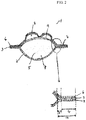
- FIG.1 discloses a water-soluble unit dose article (1) according to the present invention.
- the water-soluble unit dose article (1) comprises a first water-soluble film (2) and a second water-soluble film (3) which are sealed together.
- Unit dose article (1) also includes a flange (4).
- the laundry detergent composition (5) is comprised within the water-soluble soluble unit dose article (1).
- FIG.2 discloses a cross-sectional view of a water-soluble unit dose article according to the present invention (1).
- the cross-section discloses the first water-soluble film (2), the second water-soluble film (3) and a third water-soluble film (6).
- the water-soluble unit dose article (1) comprises a first compartment (7), a second compartment (8) and a third compartment (9).
- the water-soluble unit dose article (1) comprises a seal area (10), which comprises an inner seal area (11) and a flange (4).
- the second water-soluble film (3) and the third water-soluble film (6) are sealed together to define the second compartment (8) and the third compartment (9).
- the weight ratio of laundry detergent composition to total sealed film in the flange is at least 175:1, preferably at least 200:1, more preferably between 225:1 and 400:1, most preferably between 250:1 and 300:1.
- the water-soluble multicompartment unit dose article comprises at least a third water-soluble film wherein at least the first water-soluble film, the second water-soluble film and the third water-soluble film are sealed together to create sealed film, for example to create a so-called superposed multi-compartment water-soluble unit dose article, in which one of the at least 3 films will act as a middle film to physically separate the superposed compartment(s) from the bottom compartment(s).
- the water soluble unit dose article might comprise 4 water soluble films, in which 2 water soluble films are partially or fully sealed together to form a middle film to physically separate the superposed compartment(s) from the bottom compartment(s).
- the water-soluble unit dose article comprises exactly 3 water-soluble films, more preferably exactly 3 water-soluble films defining a superposed multi-compartment water-soluble unit dose article.
- the flange comprises sealed film from at least the first water-soluble film, the second water-soluble film and the third water-soluble film.
- the inner seal area can be created by sealing 2 of the 3 water-soluble films together to create physically separated individual compartments or can be create by sealing the 3 films together to create physically separated individual compartments.
- the inner seal is created by sealing solely 2 of the 3 water soluble films together.
- the water-soluble multicompartment unit dose article including a flange has a length and a width wherein each of the length and width are independently greater than 50mm, preferably between 50mm and 75mm, more preferably between 55mm and 65mm, preferably wherein the width to length ratio is between 0.5 and 1.5, preferably between 0.75 and 1.25, even more preferably between 0.85 and 1.15, most preferably between 0.9 and 1.1.
- the water-soluble multicompartment unit dose article further has a height, wherein the height is greater than 20mm, preferably between 25mm and 50mm, more preferably between 30mm and 40mm, and wherein each of the width to height and length to height ratio including a flange independently are between 1 and 2, preferably between 1.25 and 1.9, most preferably between 1.5 and 1.8.
- the water-soluble multicompartment unit dose article excluding the presence of any flange has a length and a width wherein each of the length and width are independently greater than 45mm, preferably between 45mm and 70mm, more preferably between 45mm and 60mm, preferably wherein the width to length ratio is between 0.5 and 1.5, preferably between 0.75 and 1.25, even more preferably between 0.85 and 1.15, most preferably between 0.9 and 1.1.
- the water-soluble multicompartment unit dose article further has a height, wherein the height is greater than 20mm, preferably between 25mm and 50mm, more preferably between 30mm and 40mm, and wherein each of the width to height and length to height ratio excluding the presence of any flange independently are between 1 and 2, preferably between 1.20 and 1.8, most preferably between 1.3 and 1.6.
- multi-compartment water soluble unit dose articles have become more common within the laundry detergent market, the multi-compartment element providing formulators the flexibility of co-formulating intrinsically incompatible materials together within the same product. It is believed that the residues seen on fabrics may be at least partially due to undissolved film material. Multi-compartment water soluble unit dose articles require more sealed film and the sealed film area is the most stressed area with respect to dissolution. Therefore, undissolved film residues may be even more dominant for multi-compartment compared to single compartment water soluble articles.
- the film of the present invention is soluble or dispersible in water.
- the water-soluble film preferably has a thickness of from 20 to 150 micron, preferably 35 to 125 micron, even more preferably 50 to 110 micron, most preferably about 76 micron.
- the film has a water-solubility of at least 50%, preferably at least 75% or even at least 95%, as measured by the method set out here after using a glass-filter with a maximum pore size of 20 microns: 5 grams ⁇ 0.1 gram of film material is added in a pre-weighed 3L beaker and 2L ⁇ 5ml of distilled water is added. This is stirred vigorously on a magnetic stirrer, Labline model No. 1250 or equivalent and 5 cm magnetic stirrer, set at 600 rpm, for 30 minutes at 30°C. Then, the mixture is filtered through a folded qualitative sintered-glass filter with a pore size as defined above (max. 20 micron). The water is dried off from the collected filtrate by any conventional method, and the weight of the remaining material is determined (which is the dissolved or dispersed fraction). Then, the percentage solubility or dispersability can be calculated.
- Preferred film materials are preferably polymeric materials.
- the film material can, for example, be obtained by casting, blow-moulding, extrusion or blown extrusion of the polymeric material, as known in the art.
- Preferred polymers, copolymers or derivatives thereof suitable for use as pouch material are selected from polyvinyl alcohols, polyvinyl pyrrolidone, polyalkylene oxides, acrylamide, acrylic acid, cellulose, cellulose ethers, cellulose esters, cellulose amides, polyvinyl acetates, polycarboxylic acids and salts, polyaminoacids or peptides, polyamides, polyacrylamide, copolymers of maleic/acrylic acids, polysaccharides including starch and gelatine, natural gums such as xanthum and carragum.
- More preferred polymers are selected from polyacrylates and water-soluble acrylate copolymers, methylcellulose, carboxymethylcellulose sodium, dextrin, ethylcellulose, hydroxyethyl cellulose, hydroxypropyl methylcellulose, maltodextrin, polymethacrylates, and most preferably selected from polyvinyl alcohols, polyvinyl alcohol copolymers and hydroxypropyl methyl cellulose (HPMC), and combinations thereof.
- the level of polymer in the pouch material for example a PVA polymer, is at least 60%.
- the polymer can have any weight average molecular weight, preferably from about 1000 to 1,000,000, more preferably from about 10,000 to 300,000 yet more preferably from about 20,000 to 150,000.
- the water-soluble film comprises polyvinyl alcohol polymer or copolymer, preferably a blend of polyvinylalcohol polymers and/or polyvinylalcohol copolymers, preferably selected from sulphonated and carboxylated anionic polyvinylalcohol copolymers especially carboxylated anionic polyvinylalcohol copolymers, most preferably a blend of a polyvinylalcohol homopolymer and a carboxylated anionic polyvinylalcohol copolymer.
- Preferred films exhibit good dissolution in cold water, meaning unheated distilled water.
- Preferably such films exhibit good dissolution at temperatures of 24°C, even more preferably at 10°C.
- good dissolution it is meant that the film exhibits water-solubility of at least 50%, preferably at least 75% or even at least 95%, as measured by the method set out here after using a glass-filter with a maximum pore size of 20 microns, described above.
- Preferred films are those supplied by Monosol under the trade references M8630, M8900, M8779, M8310.
- the film may be opaque, transparent or translucent.
- the film may comprise a printed area.
- the area of print may be achieved using standard techniques, such as flexographic printing or inkjet printing.
- the film may comprise an aversive agent, for example a bittering agent.
- Suitable bittering agents include, but are not limited to, naringin, sucrose octaacetate, quinine hydrochloride, denatonium benzoate, or mixtures thereof.
- Any suitable level of aversive agent may be used in the film. Suitable levels include, but are not limited to, 1 to 5000ppm, or even 100 to 2500ppm, or even 250 to 2000rpm.
- the water-soluble multicompartment unit dose article comprises between 35g and 75g, preferably between 40g and 60g of a laundry detergent wherein the laundry detergent composition is the total laundry detergent composition present across all the compartments present.
- the weight of laundry detergent composition should be calculated as all laundry detergent composition present across all the compartments present and not calculated as the level of laundry detergent composition in one compartment only.
- the water-soluble unit dose article may comprise between 35ml and 75ml, preferably between 40ml and 60ml, of a liquid laundry detergent composition.
- the laundry detergent composition may be a powder, a liquid or a mixture thereof, preferably a liquid.
- liquid laundry detergent composition refers to any laundry detergent composition comprising a liquid capable of wetting and treating a fabric, and includes, but is not limited to, liquids, gels, pastes, dispersions and the like.
- the liquid composition can include solids or gases in suitably subdivided form, but the liquid composition excludes forms which are non-fluid overall, such as tablets or granules.
- the laundry detergent composition may comprise solid particulates or may be a single homogenous solid.
- the powder laundry detergent composition comprises particles.
- the powder laundry detergent composition comprises individual solid particles as opposed to the solid being a single homogenous solid.
- the particles may be free-flowing or may be compacted, preferably free-flowing.
- the laundry detergent composition can be used in a fabric hand wash operation or may be used in an automatic machine fabric wash operation.
- the laundry detergent composition comprises a non-soap surfactant.
- the non-soap surfactant is preferably selected from non-soap anionic surfactant, non-ionic surfactant or a mixture thereof.
- the laundry detergent composition comprises between 10% and 60%, more preferably between 20% and 55% by weight of the laundry detergent composition of the non-soap surfactant.
- the anionic non-soap surfactant comprises linear alkylbenzene sulphonate, alkyl sulphate, alkoxylated alkyl sulphate or a mixture thereof.
- the alkoxylated alkyl sulphate is an ethoxylated alkyl sulphate.
- the laundry detergent composition comprises between 5% and 60%, preferably between 15% and 55%, more preferably between 25% and 50%, most preferably between 30% and 45% by weight of the detergent composition of the non-soap anionic surfactant.
- the non-soap anionic surfactant comprises linear alkylbenzene sulphonate and alkoxylated alkyl sulphate, wherein the ratio of linear alkylbenzene sulphonate to alkoxylated alkyl sulphate preferably the weight ratio of linear alkylbenzene sulphonate to ethoxylated alkyl sulphate is from 1:10 to 10:1, preferably from 6:1 to 1:6, more preferably from 4:1 to 1:4, even more preferably from 3:1 to 1:1.
- the weight ratio of linear alkylbenzene sulphonate to ethoxylated alkyl sulphate is from 1:2 to 1:4.
- the alkoxylated alkyl sulphate can be derived from a synthetic alcohol or a natural alcohol, or from a blend thereof, pending the desired average alkyl carbon chain length and average degree of branching.
- the synthetic alcohol is made following the Ziegler process, OXO-process, modified OXO-process, the Fischer Tropsch process, Guerbet process or a mixture thereof.
- the naturally derived alcohol is derived from natural oils, preferably coconut oil, palm kernel oil or a mixture thereof.
- the laundry detergent composition comprises between 0% and 15%, preferably between 0.01% and 12%, more preferably between 0.1% and 10%, most preferably between 0.15% and 7% by weight of the laundry detergent composition of a non-ionic surfactant.
- the non-ionic surfactant is preferably selected from alcohol alkoxylate, Ziegler-synthesized alcohol alkoxylate, an oxo-synthesized alcohol alkoxylate, Guerbet alcohol alkoxylates, alkyl phenol alcohol alkoxylates or a mixture thereof.
- the laundry preferably liquid laundry detergent composition comprises between 1.5% and 20%, more preferably between 2% and 15%, even more preferably between 3% and 10%, most preferably between 4% and 8% by weight of the laundry detergent composition of soap, preferably a fatty acid salt, more preferably an amine neutralized fatty acid salt, wherein preferably the amine is an alkanolamine more preferably selected from monoethanolamine, diethanolamine, triethanolamine or a mixture thereof, more preferably monoethanolamine.
- the laundry detergent composition comprises a non-aqueous solvent, preferably wherein the non-aqueous solvent is selected from 1,2-propanediol, dipropylene glycol, tripropyleneglycol, glycerol, sorbitol, polypropylene glycol or a mixture thereof, preferably wherein the polypropyleneglycol has a molecular weight of 400.
- the liquid laundry detergent composition comprises between 10% and 40%, preferably between 15% and 30% by weight of the liquid laundry detergent composition of the non-aqueous solvent.
- the non-aqueous solvents ensure appropriate levels of film plasticization so the film is not too brittle and not too 'floppy'.
- having the correct degree of plasticization will also facilitate film dissolution when exposed to water during the wash process.
- the liquid laundry detergent composition comprises between 0.5% and 15%, preferably between 5% and 13% by weight of the liquid laundry detergent composition of water.
- the laundry detergent composition comprises an ingredient selected from the list comprising cationic polymers, polyester terephthalates, amphiphilic graft co-polymers, carboxymethylcellulose, enzymes, perfumes, encapsulated perfumes, bleach or a mixture thereof.
- the laundry detergent composition may comprise an adjunct ingredient, wherein the adjunct ingredient is selected from ethanol, ethyleneglycol, polyethyleneglycol, hueing dyes, aesthetic dyes, enzymes, builders preferably citric acid, chelants, cleaning polymers, dispersants, dye transfer inhibitor polymers, fluorescent whitening agent, opacifier, antifoam, preservatives, anti-oxidants, or a mixture thereof.
- the chelant is selected from aminocarboxylate chelants, aminophosphonate chelants, or a mixture thereof.
- the laundry detergent composition has a pH between 6 and 10, more preferably between 6.5 and 8.9, most preferably between 7 and 8, wherein the pH of the laundry detergent composition is measured as a 10% dilution in demineralized water at 20°C.
- the liquid laundry detergent composition may be Newtonian or non-Newtonian.
- the liquid laundry detergent composition is non-Newtonian.
- a non-Newtonian liquid has properties that differ from those of a Newtonian liquid, more specifically, the viscosity of non-Newtonian liquids is dependent on shear rate, while a Newtonian liquid has a constant viscosity independent of the applied shear rate. The decreased viscosity upon shear application for non-Newtonian liquids is thought to further facilitate liquid detergent dissolution.
- the liquid laundry detergent composition described herein can have any suitable viscosity depending on factors such as formulated ingredients and purpose of the composition.
- the composition may have a viscosity value, at a shear rate of 20s-1 and a temperature of 20°C, of 100 to 3,000 cP, alternatively 200 to 2,000 cP, alternatively 300 to 1,000 cP, following the method described herein.
- the composition may have a high shear viscosity value, at a shear rate of 20s-1 and a temperature of 20°C, of 100 to 3,000 cP, alternatively 300 to 2,000 cP, alternatively 500 to 1,000 cP, and a low shear viscosity value, at a shear rate of 1 s-1 and a temperature of 20°C, of 500 to 100,000 cP, alternatively 1000 to 10,000 cP, alternatively 1,300 to 5,000 cP, following the method described herein.
- Methods to measure viscosity are known in the art. According to the present disclosure, viscosity measurements are carried out using a rotational rheometer e.g. TA instruments AR550.
- the instrument includes a 40mm 2° or 1 ° cone fixture with a gap of around 50-60 ⁇ for isotropic liquids, or a 40mm flat steel plate with a gap of 1000 ⁇ for particles containing liquids.
- the measurement is carried out using a flow procedure that contains a conditioning step, a peak hold and a continuous ramp step.
- the conditioning step involves the setting of the measurement temperature at 20°C, a pre-shear of 10 seconds at a shear rate of 10s1, and an equilibration of 60 seconds at the selected temperature.
- the peak hold involves applying a shear rate of 0.05s1 at 20°C for 3min with sampling every 10s.
- the continuous ramp step is performed at a shear rate from 0.1 to 1200s1 for 3min at 20°C to obtain the full flow profile.
- An aspect of the present invention is the use of a water-soluble unit dose article according to the present invention to reduce instances of residues on fabrics following a fabric wash operation.
- a further aspect of the present invention is a method of washing comprising the steps of adding the water-soluble unit dose article according to the present invention to sufficient water to dilute the laundry detergent composition by a factor of at least 200 fold, preferably between 250 and 3000 fold, more preferably between 250 and 1500 fold, most preferably between 500 and 1500 fold to create a wash liquor and contacting fabrics to be washed with said wash liquor.
- the water-soluble film dissolves releasing the internal laundry detergent composition into the water.
- the laundry detergent composition disperses in the water to create the wash liquor.
- the wash liquor may comprise between 10L and 75L, preferably between 20L and 70L, more preferably between 30L and 65L of water.
- the wash liquor is at a temperature of between 5°C and 90°C, preferably between 10°C and 60°C, more preferably between 12°C and 45°C, most preferably between 15°C and 40°C.
- washing the fabrics in the wash liquor takes between 5 minutes and 50 minutes, preferably between 5 minutes and 40 minutes, more preferably between 5 minutes and 30 minutes, even more preferably between 5 minutes and 20 minutes, most preferably between 6 minutes and 18 minutes to complete.
- the wash liquor comprises between 1kg and 20 kg, preferably between 5kg and 20kg, most preferably between 10 and 20 kg of fabrics.
- the wash liquor may comprise water of any hardness preferably varying between 0 gpg to 40gpg.
- a water soluble unit dose pouch residue test was conducted under full scale washing machine conditions following the test method described herein, cross-comparing a 46ml water soluble unit dose pouch, comprising a detergent to film-ratio according to the invention, with two 23ml identical water soluble unit dose pouches comprising a film to detergent-ratio outside the scope of the invention. The same detergent composition was used across all water soluble unit dose pouches.
- Detergent composition Table 1 : Unit dose detergent composition
- Raw Material Detergent composition (wt%) C25 HAE2.5S 14.7 HLAS 21.55 Lutensol XL100 0.755 Nonionic surfactant (C24-9) 0.9 Nonionic surfactant (C45-7) 2.8 Fatty Acid 5.93 Citric Acid 0.847 DiPropyleneGlycol (DPG) 0.16 Glycerine 4.79 Propanediol 13.95 Water 10.59 DTPA 0.84 Ethoxylated polyethyleneimine (PEI600EO20) 3.67 Amphiphilic graft copolymer 3.2 Brightener 49 0.188 Monoethanolamine (MEA) 7.96 Minors (incl. enzymes, anti-foam, anti-oxidant, preservatives, dyes, perfume,.%) Balance to 100%
- the above detergent composition was enclosed in a multi-compartment water soluble unit dose pouch according to Figure 1 , using water soluble PVOH film, as supplied by the Monosol company.
- This pouch has been made through vacuum assisted first film deformation in a first cavity to create the bottom compartment, filling the bottom compartment with detergent composition, and closing the open bottom compartment with the 2 pre-formed closed side by side top compartments.
- 3 films have consequently been used to generate this pouch, i.e. 2 outer and 1 middle film layer.
- the outer seal area consequently consists of 3 film layers
- the inner seal area between the 2 side by side top compartments comprises 2 film layers.
- the same pouch shape has been used for inventive and comparative example pouches, the inventive and comparative pouch examples solely differing in relative footprint dimensions to enable different detergent volume enclosure.
- This test single variably, i.e. at equal total detergent consumption, simulates the consumer choice of dosing 2 smaller size unit dose pouches outside the scope of the invention, versus 1 larger size unit dose pouch according to the invention, e.g. when facing highly soiled and/or larger size washing loads.
- a 20 minutes wash cycle at 20°C water has been selected on a Electrolux W565H programmable washing machine (programmable Condition 3).
- the water soluble pouch(es) have been enclosed within an orange knitted cloth (supplied by Calderon; 27x27 cm in size and are preconditioned before use by 2 washes in 15 gpg water at 60C and no detergent), i.e. one larger size pouch for the inventive example and 2 smaller size pouches together in one knitted cloth for the comparative example, and washed together with 3kg of mixed balance load (composition : mixed cotton and polycotton).
- the orange knitted cloths are consequently cut open and visually inspected for amount of water soluble unit dose pouch residues (without any fabric drying step).
- the test has been built to enable discrimination of test formulations towards their ability to minimize remaining pouch residues under stretched washing condition (cold water, short cycle, pouch within cloth entrapment).
Landscapes
- Chemical & Material Sciences (AREA)
- Life Sciences & Earth Sciences (AREA)
- Engineering & Computer Science (AREA)
- Chemical Kinetics & Catalysis (AREA)
- Oil, Petroleum & Natural Gas (AREA)
- Wood Science & Technology (AREA)
- Organic Chemistry (AREA)
- Detergent Compositions (AREA)
Priority Applications (5)
| Application Number | Priority Date | Filing Date | Title |
|---|---|---|---|
| EP18203471.0A EP3647399A1 (de) | 2018-10-30 | 2018-10-30 | Wasserlöslicher multikammereinheitsdosisartikel |
| EP19205911.1A EP3647400A1 (de) | 2018-10-30 | 2019-10-29 | Wasserlöslicher multikammereinheitsdosisartikel |
| US16/666,452 US11401489B2 (en) | 2018-10-30 | 2019-10-29 | Water-soluble multicompartment unit dose article |
| PCT/US2019/058425 WO2020092282A1 (en) | 2018-10-30 | 2019-10-29 | Water-soluble multicompartment unit dose article |
| US17/847,639 US20220315869A1 (en) | 2018-10-30 | 2022-06-23 | Water-soluble multicompartment unit dose article |
Applications Claiming Priority (1)
| Application Number | Priority Date | Filing Date | Title |
|---|---|---|---|
| EP18203471.0A EP3647399A1 (de) | 2018-10-30 | 2018-10-30 | Wasserlöslicher multikammereinheitsdosisartikel |
Publications (1)
| Publication Number | Publication Date |
|---|---|
| EP3647399A1 true EP3647399A1 (de) | 2020-05-06 |
Family
ID=64048808
Family Applications (2)
| Application Number | Title | Priority Date | Filing Date |
|---|---|---|---|
| EP18203471.0A Withdrawn EP3647399A1 (de) | 2018-10-30 | 2018-10-30 | Wasserlöslicher multikammereinheitsdosisartikel |
| EP19205911.1A Withdrawn EP3647400A1 (de) | 2018-10-30 | 2019-10-29 | Wasserlöslicher multikammereinheitsdosisartikel |
Family Applications After (1)
| Application Number | Title | Priority Date | Filing Date |
|---|---|---|---|
| EP19205911.1A Withdrawn EP3647400A1 (de) | 2018-10-30 | 2019-10-29 | Wasserlöslicher multikammereinheitsdosisartikel |
Country Status (3)
| Country | Link |
|---|---|
| US (2) | US11401489B2 (de) |
| EP (2) | EP3647399A1 (de) |
| WO (1) | WO2020092282A1 (de) |
Cited By (2)
| Publication number | Priority date | Publication date | Assignee | Title |
|---|---|---|---|---|
| WO2020205825A1 (en) * | 2019-04-01 | 2020-10-08 | The Procter & Gamble Company | Water-soluble unit dose article comprising a water-soluble film comprising a polyvinyl alcohol polymer comprising an anionic monomer unit |
| EP4001391A1 (de) * | 2020-11-20 | 2022-05-25 | The Procter & Gamble Company | Wasserlöslicher einheitsdosisartikel mit einem nichtionischen fettalkylesteralkoxylattensid und einem nichtionischen alkoxylierten alkoholtensid |
Families Citing this family (16)
| Publication number | Priority date | Publication date | Assignee | Title |
|---|---|---|---|---|
| AU201713679S (en) * | 2017-01-12 | 2017-08-16 | Henkel Ag & Co Kgaa | Chamber pouches |
| USD914284S1 (en) * | 2017-11-07 | 2021-03-23 | The Procter & Gamble Company | Single-dose laundry detergent pod |
| EP3647399A1 (de) * | 2018-10-30 | 2020-05-06 | The Procter & Gamble Company | Wasserlöslicher multikammereinheitsdosisartikel |
| EP3719108A1 (de) | 2019-04-01 | 2020-10-07 | The Procter & Gamble Company | Wasserlöslicher einheitsdosisartikel mit einem wasserlöslichen film mit einem wasserlöslichen polyvinylalkoholpolymer |
| ES2932508T3 (es) * | 2020-05-08 | 2023-01-20 | Procter & Gamble | Recipiente de producto detergente con cierre |
| HUE066917T2 (hu) | 2020-07-03 | 2024-09-28 | Unilever Ip Holdings B V | Egységdózis kapszula |
| WO2022002620A1 (en) | 2020-07-03 | 2022-01-06 | Unilever Ip Holdings B.V. | A unit dose capsule |
| DE102020212100A1 (de) | 2020-09-25 | 2022-03-31 | Henkel Ag & Co. Kgaa | Konzentrierte fließfähige Waschmittelzubereitung mit verbesserten Eigenschaften |
| EP3978590B1 (de) * | 2020-10-05 | 2024-10-30 | The Procter & Gamble Company | Wasserlöslicher einheitsdosisartikel mit einem ersten nichtionischen tensid und einem zweiten nichtionischen tensid |
| ES2960743T3 (es) * | 2021-04-06 | 2024-03-06 | Fameccanica Data Spa | Recipiente de papel o cartón a prueba de niños |
| USD1088343S1 (en) | 2022-05-11 | 2025-08-12 | People Against Dirty Holdings Limited | Packet |
| WO2023225266A1 (en) * | 2022-05-19 | 2023-11-23 | Boston Scientific Scimed, Inc. | Unit dose pack for cleaning surgical instruments |
| US20240132811A1 (en) * | 2022-10-10 | 2024-04-25 | The Procter & Gamble Company | Water-soluble multicompartment unit dose article |
| EP4353808A1 (de) * | 2022-10-10 | 2024-04-17 | The Procter & Gamble Company | Wasserlöslicher einheitsdosisartikel mit mehreren fächern |
| WO2024108538A1 (en) * | 2022-11-25 | 2024-05-30 | The Procter & Gamble Company | Water-soluble unit dose article |
| WO2024151572A1 (en) * | 2023-01-09 | 2024-07-18 | The Procter & Gamble Company | Superposed multi-sectioned water-soluble unit dose automatic dishwashing detergent pouch |
Citations (5)
| Publication number | Priority date | Publication date | Assignee | Title |
|---|---|---|---|---|
| US7517847B2 (en) * | 2005-05-13 | 2009-04-14 | The Procter & Gamble Company | Bleaching product comprising a water-soluble film coated with bleaching agents |
| US20110188784A1 (en) * | 2010-01-29 | 2011-08-04 | Denome Frank William | Water-soluble film having blend of pvoh polymers, and packets made therefrom |
| EP2924104A1 (de) * | 2014-03-24 | 2015-09-30 | The Procter and Gamble Company | Wäscheeinheitsdosisartikel |
| EP3138898A1 (de) * | 2015-09-04 | 2017-03-08 | The Procter and Gamble Company | Mit einem aversiven oder bitteren wirkstoff enthaldenden film umgehülltes wasserlösliches portioniertes waschmittel wobei der aversive wirkstoff sich meistens im rand oder kanten des films befindet |
| EP3138899A1 (de) * | 2015-09-04 | 2017-03-08 | The Procter and Gamble Company | Einheitsdosiswaschartikel mit im wasserlöslichen umhüllungsmaterial eingesetzten bitteren wirkstoffen und verfahren im zusammenhang damit |
Family Cites Families (15)
| Publication number | Priority date | Publication date | Assignee | Title |
|---|---|---|---|---|
| ES2187807T3 (es) * | 1996-08-19 | 2003-06-16 | Procter & Gamble | Composiciones detergentes para la colada que comprenden profragancias beta-cetoestericas. |
| US6995126B2 (en) | 2000-04-28 | 2006-02-07 | The Procter & Gamble Company | Pouched compositions |
| US6878679B2 (en) | 2000-04-28 | 2005-04-12 | The Procter & Gamble Company | Pouched compositions |
| GB2369094A (en) * | 2000-11-17 | 2002-05-22 | Procter & Gamble | Packaging assembly for sheets of water-soluble sachets |
| US8940676B2 (en) | 2000-11-27 | 2015-01-27 | The Procter & Gamble Company | Detergent products, methods and manufacture |
| WO2003044155A1 (en) | 2001-11-19 | 2003-05-30 | Unilever N.V. | Detergent sachets |
| EP1851298B1 (de) * | 2005-02-17 | 2010-03-24 | The Procter and Gamble Company | Zusammensetzung für die gewebepflege |
| GB201011602D0 (en) | 2010-07-09 | 2010-08-25 | Univ London Pharmacy | Delivery of hydrophilic peptides |
| ES2529502T3 (es) * | 2011-09-13 | 2015-02-20 | The Procter & Gamble Company | Artículos estables en dosis unitaria solubles en agua |
| US9404071B2 (en) * | 2012-12-06 | 2016-08-02 | The Procter & Gamble Company | Use of composition to reduce weeping and migration through a water soluble film |
| EP2857485A1 (de) * | 2013-10-07 | 2015-04-08 | WeylChem Switzerland AG | Beutel mit mehreren Fächern mit alkanolaminfreien Reinigungszusammensetzungen, Waschverfahren und Verwendung zum Waschen und Reinigen von Textilien und Geschirr |
| EP2924102A1 (de) | 2014-03-24 | 2015-09-30 | The Procter and Gamble Company | Wäscheeinheitsdosisartikel |
| KR20170004260A (ko) | 2015-07-01 | 2017-01-11 | 삼성전기주식회사 | 인쇄회로기판 및 그 제조방법 |
| DE102018209707A1 (de) * | 2018-06-15 | 2019-12-19 | Henkel Ag & Co. Kgaa | Portionseinheit eines Reinigungsmittels |
| EP3647399A1 (de) * | 2018-10-30 | 2020-05-06 | The Procter & Gamble Company | Wasserlöslicher multikammereinheitsdosisartikel |
-
2018
- 2018-10-30 EP EP18203471.0A patent/EP3647399A1/de not_active Withdrawn
-
2019
- 2019-10-29 EP EP19205911.1A patent/EP3647400A1/de not_active Withdrawn
- 2019-10-29 WO PCT/US2019/058425 patent/WO2020092282A1/en not_active Ceased
- 2019-10-29 US US16/666,452 patent/US11401489B2/en active Active
-
2022
- 2022-06-23 US US17/847,639 patent/US20220315869A1/en not_active Abandoned
Patent Citations (5)
| Publication number | Priority date | Publication date | Assignee | Title |
|---|---|---|---|---|
| US7517847B2 (en) * | 2005-05-13 | 2009-04-14 | The Procter & Gamble Company | Bleaching product comprising a water-soluble film coated with bleaching agents |
| US20110188784A1 (en) * | 2010-01-29 | 2011-08-04 | Denome Frank William | Water-soluble film having blend of pvoh polymers, and packets made therefrom |
| EP2924104A1 (de) * | 2014-03-24 | 2015-09-30 | The Procter and Gamble Company | Wäscheeinheitsdosisartikel |
| EP3138898A1 (de) * | 2015-09-04 | 2017-03-08 | The Procter and Gamble Company | Mit einem aversiven oder bitteren wirkstoff enthaldenden film umgehülltes wasserlösliches portioniertes waschmittel wobei der aversive wirkstoff sich meistens im rand oder kanten des films befindet |
| EP3138899A1 (de) * | 2015-09-04 | 2017-03-08 | The Procter and Gamble Company | Einheitsdosiswaschartikel mit im wasserlöslichen umhüllungsmaterial eingesetzten bitteren wirkstoffen und verfahren im zusammenhang damit |
Cited By (2)
| Publication number | Priority date | Publication date | Assignee | Title |
|---|---|---|---|---|
| WO2020205825A1 (en) * | 2019-04-01 | 2020-10-08 | The Procter & Gamble Company | Water-soluble unit dose article comprising a water-soluble film comprising a polyvinyl alcohol polymer comprising an anionic monomer unit |
| EP4001391A1 (de) * | 2020-11-20 | 2022-05-25 | The Procter & Gamble Company | Wasserlöslicher einheitsdosisartikel mit einem nichtionischen fettalkylesteralkoxylattensid und einem nichtionischen alkoxylierten alkoholtensid |
Also Published As
| Publication number | Publication date |
|---|---|
| EP3647400A1 (de) | 2020-05-06 |
| US11401489B2 (en) | 2022-08-02 |
| US20200131457A1 (en) | 2020-04-30 |
| WO2020092282A1 (en) | 2020-05-07 |
| US20220315869A1 (en) | 2022-10-06 |
Similar Documents
| Publication | Publication Date | Title |
|---|---|---|
| US20220315869A1 (en) | Water-soluble multicompartment unit dose article | |
| CA2992311C (en) | Water-soluble unit dose article | |
| US10323220B2 (en) | Laundry detergent composition comprising a cyclic diamine and an amphoteric/anionic surfactant mixture | |
| CN105307949A (zh) | 多隔室水溶性胶囊 | |
| WO2022062752A1 (en) | Water-soluble unit dose article comprising amine oxide surfactant, diol solvent and polyol solvent | |
| US20190048298A1 (en) | Water-soluble unit dose article comprising an amphiphilic graft polymer and a polyester terephthalate | |
| CA3013938C (en) | Use of the combination of a cationic polysaccharide polymer and an anionic non-soap surfactant | |
| CA3046279C (en) | Use of polyester terephthalate to reduce malodour on fabrics | |
| EP3495466A1 (de) | Verwendung einer flüssigwaschmittelzusammensetzung | |
| EP3363884A1 (de) | Verwendung einer flüssigen wäschewaschmittelzusammensetzung in wasserlöslichen einheitsdosisartikeln zur minimierung von nebenwirkungen bei versehentlicher exposition mit inhaltsstoffen | |
| EP3441445A1 (de) | Wasserlöslicher einheitsdosisartikel mit einem amphiphilen pfropfpolymer und carboxymethylcellulose | |
| US20230365888A1 (en) | Water-soluble unit dose article | |
| WO2018125553A1 (en) | Water-soluble unit dose article comprising zwitterionic polyamine | |
| EP3279302A1 (de) | Wasserlöslicher einheitsdosisartikel mit hydriertem rizinusöl | |
| EP3279305B1 (de) | Artikel mit wasserlöslicher einheitsdosis mit einem cyclischen diamin | |
| EP3363882A1 (de) | Verwendung einer flüssigen wäschewaschmittelzusammensetzung zur minimierung von nebenwirkungen bei versehentlicher exposition mit inhaltsstoffen von wasserlöslichen einheitsdosisartikeln | |
| EP3363885A1 (de) | Verwendung einer flüssigen wäschewaschmittelzusammensetzung zur minimierung von erbrechen- und narkosewirkungen bei versehentlicher exposition mit inhaltsstoffen von wasserlöslichen einheitsdosisartikeln | |
| EP3363888A1 (de) | Verwendung einer flüssigen wäschewaschmittelzusammensetzung zur minimierung von nebenwirkungen bei versehentlicher exposition mit inhaltsstoffen von wasserlöslichen einheitsdosisartikeln | |
| EP3363887A1 (de) | Verwendung einer flüssigen wäschewaschmittelzusammensetzung zur minimierung von nebenwirkungen bei versehentlicher exposition mit inhaltsstoffen von wasserlöslichen einheitsdosisartikeln | |
| US20240132812A1 (en) | Water-soluble multicompartment unit dose article | |
| EP3342850A1 (de) | Artikel mit wasserlöslicher einheitsdosis mit einem zwitterionischen polyamin | |
| WO2024250143A1 (en) | Water-soluble unit dose article comprising liquid laundry detergent composition which comprises polyethylene glycol and anti-mite agent | |
| EP3363883A1 (de) | Verwendung einer flüssigen wäschewaschmittelzusammensetzung zur minimierung von nebenwirkungen bei versehentlicher exposition mit inhaltsstoffen von wasserlöslichen einheitsdosisartikeln | |
| EP3372664A2 (de) | Verwendung einer flüssigen wäschewaschmittelzusammensetzung zur minimierung von nebenwirkungen bei versehentlicher exposition mit inhaltsstoffen von wasserlöslichen einheitsdosisartikeln |
Legal Events
| Date | Code | Title | Description |
|---|---|---|---|
| PUAI | Public reference made under article 153(3) epc to a published international application that has entered the european phase |
Free format text: ORIGINAL CODE: 0009012 |
|
| AK | Designated contracting states |
Kind code of ref document: A1 Designated state(s): AL AT BE BG CH CY CZ DE DK EE ES FI FR GB GR HR HU IE IS IT LI LT LU LV MC MK MT NL NO PL PT RO RS SE SI SK SM TR |
|
| AX | Request for extension of the european patent |
Extension state: BA ME |
|
| STAA | Information on the status of an ep patent application or granted ep patent |
Free format text: STATUS: THE APPLICATION HAS BEEN WITHDRAWN |
|
| 18W | Application withdrawn |
Effective date: 20201105 |