EP3647979A1 - Techniques d'attestation de dispositif - Google Patents
Techniques d'attestation de dispositif Download PDFInfo
- Publication number
- EP3647979A1 EP3647979A1 EP19206402.0A EP19206402A EP3647979A1 EP 3647979 A1 EP3647979 A1 EP 3647979A1 EP 19206402 A EP19206402 A EP 19206402A EP 3647979 A1 EP3647979 A1 EP 3647979A1
- Authority
- EP
- European Patent Office
- Prior art keywords
- attestation
- validation
- secret code
- hashed
- identifier
- Prior art date
- Legal status (The legal status is an assumption and is not a legal conclusion. Google has not performed a legal analysis and makes no representation as to the accuracy of the status listed.)
- Granted
Links
Images




Classifications
-
- G—PHYSICS
- G06—COMPUTING OR CALCULATING; COUNTING
- G06F—ELECTRIC DIGITAL DATA PROCESSING
- G06F21/00—Security arrangements for protecting computers, components thereof, programs or data against unauthorised activity
- G06F21/30—Authentication, i.e. establishing the identity or authorisation of security principals
- G06F21/44—Program or device authentication
-
- G—PHYSICS
- G06—COMPUTING OR CALCULATING; COUNTING
- G06F—ELECTRIC DIGITAL DATA PROCESSING
- G06F21/00—Security arrangements for protecting computers, components thereof, programs or data against unauthorised activity
- G06F21/30—Authentication, i.e. establishing the identity or authorisation of security principals
- G06F21/45—Structures or tools for the administration of authentication
- G06F21/46—Structures or tools for the administration of authentication by designing passwords or checking the strength of passwords
-
- G—PHYSICS
- G06—COMPUTING OR CALCULATING; COUNTING
- G06F—ELECTRIC DIGITAL DATA PROCESSING
- G06F21/00—Security arrangements for protecting computers, components thereof, programs or data against unauthorised activity
- G06F21/50—Monitoring users, programs or devices to maintain the integrity of platforms, e.g. of processors, firmware or operating systems
- G06F21/57—Certifying or maintaining trusted computer platforms, e.g. secure boots or power-downs, version controls, system software checks, secure updates or assessing vulnerabilities
-
- G—PHYSICS
- G06—COMPUTING OR CALCULATING; COUNTING
- G06F—ELECTRIC DIGITAL DATA PROCESSING
- G06F21/00—Security arrangements for protecting computers, components thereof, programs or data against unauthorised activity
- G06F21/60—Protecting data
- G06F21/602—Providing cryptographic facilities or services
-
- G—PHYSICS
- G06—COMPUTING OR CALCULATING; COUNTING
- G06F—ELECTRIC DIGITAL DATA PROCESSING
- G06F21/00—Security arrangements for protecting computers, components thereof, programs or data against unauthorised activity
- G06F21/60—Protecting data
- G06F21/62—Protecting access to data via a platform, e.g. using keys or access control rules
- G06F21/6218—Protecting access to data via a platform, e.g. using keys or access control rules to a system of files or objects, e.g. local or distributed file system or database
-
- G—PHYSICS
- G06—COMPUTING OR CALCULATING; COUNTING
- G06F—ELECTRIC DIGITAL DATA PROCESSING
- G06F21/00—Security arrangements for protecting computers, components thereof, programs or data against unauthorised activity
- G06F21/60—Protecting data
- G06F21/62—Protecting access to data via a platform, e.g. using keys or access control rules
- G06F21/6218—Protecting access to data via a platform, e.g. using keys or access control rules to a system of files or objects, e.g. local or distributed file system or database
- G06F21/6245—Protecting personal data, e.g. for financial or medical purposes
-
- G—PHYSICS
- G06—COMPUTING OR CALCULATING; COUNTING
- G06F—ELECTRIC DIGITAL DATA PROCESSING
- G06F21/00—Security arrangements for protecting computers, components thereof, programs or data against unauthorised activity
- G06F21/60—Protecting data
- G06F21/64—Protecting data integrity, e.g. using checksums, certificates or signatures
-
- G—PHYSICS
- G06—COMPUTING OR CALCULATING; COUNTING
- G06F—ELECTRIC DIGITAL DATA PROCESSING
- G06F21/00—Security arrangements for protecting computers, components thereof, programs or data against unauthorised activity
- G06F21/70—Protecting specific internal or peripheral components, in which the protection of a component leads to protection of the entire computer
- G06F21/71—Protecting specific internal or peripheral components, in which the protection of a component leads to protection of the entire computer to assure secure computing or processing of information
- G06F21/73—Protecting specific internal or peripheral components, in which the protection of a component leads to protection of the entire computer to assure secure computing or processing of information by creating or determining hardware identification, e.g. serial numbers
-
- H—ELECTRICITY
- H04—ELECTRIC COMMUNICATION TECHNIQUE
- H04L—TRANSMISSION OF DIGITAL INFORMATION, e.g. TELEGRAPHIC COMMUNICATION
- H04L9/00—Cryptographic mechanisms or cryptographic arrangements for secret or secure communications; Network security protocols
- H04L9/32—Cryptographic mechanisms or cryptographic arrangements for secret or secure communications; Network security protocols including means for verifying the identity or authority of a user of the system or for message authentication, e.g. authorization, entity authentication, data integrity or data verification, non-repudiation, key authentication or verification of credentials
- H04L9/3236—Cryptographic mechanisms or cryptographic arrangements for secret or secure communications; Network security protocols including means for verifying the identity or authority of a user of the system or for message authentication, e.g. authorization, entity authentication, data integrity or data verification, non-repudiation, key authentication or verification of credentials using cryptographic hash functions
-
- H—ELECTRICITY
- H04—ELECTRIC COMMUNICATION TECHNIQUE
- H04L—TRANSMISSION OF DIGITAL INFORMATION, e.g. TELEGRAPHIC COMMUNICATION
- H04L9/00—Cryptographic mechanisms or cryptographic arrangements for secret or secure communications; Network security protocols
- H04L9/32—Cryptographic mechanisms or cryptographic arrangements for secret or secure communications; Network security protocols including means for verifying the identity or authority of a user of the system or for message authentication, e.g. authorization, entity authentication, data integrity or data verification, non-repudiation, key authentication or verification of credentials
- H04L9/3236—Cryptographic mechanisms or cryptographic arrangements for secret or secure communications; Network security protocols including means for verifying the identity or authority of a user of the system or for message authentication, e.g. authorization, entity authentication, data integrity or data verification, non-repudiation, key authentication or verification of credentials using cryptographic hash functions
- H04L9/3239—Cryptographic mechanisms or cryptographic arrangements for secret or secure communications; Network security protocols including means for verifying the identity or authority of a user of the system or for message authentication, e.g. authorization, entity authentication, data integrity or data verification, non-repudiation, key authentication or verification of credentials using cryptographic hash functions involving non-keyed hash functions, e.g. modification detection codes [MDCs], MD5, SHA or RIPEMD
-
- H—ELECTRICITY
- H04—ELECTRIC COMMUNICATION TECHNIQUE
- H04W—WIRELESS COMMUNICATION NETWORKS
- H04W12/00—Security arrangements; Authentication; Protecting privacy or anonymity
- H04W12/06—Authentication
-
- H—ELECTRICITY
- H04—ELECTRIC COMMUNICATION TECHNIQUE
- H04L—TRANSMISSION OF DIGITAL INFORMATION, e.g. TELEGRAPHIC COMMUNICATION
- H04L2209/00—Additional information or applications relating to cryptographic mechanisms or cryptographic arrangements for secret or secure communication H04L9/00
- H04L2209/80—Wireless
- H04L2209/805—Lightweight hardware, e.g. radio-frequency identification [RFID] or sensor
Definitions
- the present techniques relate to the field of electronic devices. More particularly, they relate to providing an attestation for enabling a device to attest to an assertion concerning the device.
- Cryptographic techniques can be provided which store detailed attestation information on the device which allow an external entity to verify that such events have occurred.
- such techniques typically require the storage of a large quantity of information on the device itself.
- memory storage capacity, processing power and communication bandwidth can be extremely constrained hence making such approaches infeasible.
- the storage of such information on the device may allow for the possibility for the information to be extracted and duplicated to another device to create a "forged" device which could falsely attest that the forged device has undergone the attested to events.
- a method for providing an attestation for enabling a device to attest to an assertion concerning the device comprising: generating an attestation identifier and a base-secret code corresponding to the attestation identifier; providing the attestation identifier and a validation-secret code to a validation apparatus for storage in conjunction with the assertion, wherein the validation-secret code is based on the base-secret code; providing the attestation identifier and a device-secret code to a manufacturer or adapter for provision to a device, wherein the device-secret code is based on the base-secret code.
- the provision of different secret codes to different entities mitigates the risk that a secret code could be extracted from one entity and used to create a forged version of another entity.
- extracting the validation-secret code from the validation apparatus may not allow determination of what device-secret code was provide to the manufacturer or adapter hence mitigating the impact of data theft from the validation apparatus.
- the present approach allows for the assertion itself to be stored remote from the device hence saving storage space on the device.
- the attestation identifier is generated using an attestation generator.
- the attestation generator may be a physically separate device from the validation apparatus or both the attestation generator and validation apparatus may be located in the same physical device.
- the attestation generator generates the device-secret code and/or the validation-secret code.
- the attestation identifier and the device-secret code are provided by the manufacturer or adapter to the device. Thereby, thereby the device-secret code is distributed to the device under the control of the manufacturer or adapter. Thus, this distribution can be done without the direct involvement of, or provision of information about the distribution to, the validation apparatus or the device which generates the attestation identifier and base-secret code (e.g. an attestation generator).
- the device-secret code is the same as the base-secret code. Therefore, the need for additional processing to generate the device-secret code can be avoided.
- the base-secret code is not provided to the validation apparatus.
- the validation apparatus does not have access to the base-secret code, a theft of information from the validation apparatus would not allow a malicious entity to generate the device-secret code (which is based on the base-secret code) and hence the information could not be used to create a forged device.
- the validation-secret code is generated by hashing the base-secret code using a first predetermined hash function.
- a one-way function e.g. a hash function
- this generation of the validation-secret code is carried out by an attestation generator prior to provision of the validation-secret code to the validation apparatus.
- the base-secret code is provided to the attestation generator and the attestation generator generates the validation-secret code itself.
- the device-secret code is the same as the base-secret code, and in response to provision of the attestation identifier and the device-secret code to the device, the device hashes the device-secret code using the first predetermined hash function to generate the validation-secret code.
- the device hashes the device-secret code using the first predetermined hash function to generate the validation-secret code.
- a derivative secret code the validation-secret code
- a one-way function e.g. a hash function
- the device further hashes the validation-secret code in combination with one or more items of locally available information using a second predetermined hash function to generate a hashed-value.
- the device generates a further derivative secret code (hashed-value) which can only be generated using the locally available information.
- the hashed-value can only be generated by devices which have access to the device's locally available information hence limiting the devices which can generate the hashed value.
- the validating entity need only have access to the locally available information at the time of validation. In other words the device can keep the locally available information private up to this point.
- the device need not store the validation-secret code and hence a theft of information from the device would not allow for the validation of attestations regarding the device.
- the first predetermined hash function and second predetermined hash function use the same computational function but operate on different data inputs. Thereby, only a single computational hashing function need be stored on the device thus saving space and, in general, allowing for further hardware/software optimisation of the performance of the hashing function.
- the attestation identifier and device-secret code are the initial attestation identifier and initial device-secret code provided to the device the one or more items of locally available information comprise a device identifier, and when the attestation identifier and device-secret code are not the initial attestation identifier and initial device-secret code provided to the device the one or more items of locally stored information comprise a previous hashed-value.
- the use of the second predetermined hash function on the initial attestation identifier / device-secret code generates a hashed-value tied to the device itself by using the identifier of the device. Further, by using a previous hashed-value when using the second predetermined hash function on attestation identifiers / device-secret codes subsequent to the initial attestation identifier / device-secret code, the generated further hashed-value will be based in part on previous hashed-value(s).
- the further hashed-value acts as a "digest" of all previous hashed-values input directly or indirectly (i.e. where the second predetermined hash function has been iteratively applied to a chain of previous hashed-values corresponding to a plurality of previous attestation identifiers and device-secret codes).
- the "digest” can be used in validating the attestations corresponding to all the attestation identifiers / device-secret codes which went into making it, without the requirement to store all intermediated hashed-values on the device.
- the previous hashed-value is the most recent previous hashed-value.
- the second predetermined hash function is iteratively applied to all previous hashed-values and hence the final hashed-value can be used in validating the attestations corresponding to all the attestation identifiers / device-secret codes which have been received by the device.
- the device after generation of the hashed-value the device stores the hashed-value but does not store the device-secret code or validation-secret code. Thereby, even if malicious party gains access to the information stored on the device, the information stolen would not allow the malicious party to create a forged device or to validate attestations concerning the device.
- the device only stores the most recent hashed-value.
- the most recent hashed-value can act as a "digest" of all previous hashed-values
- the storage of the most recent hashed-value is sufficient to validate the attestations corresponding to each of the previous hashed-values without the need to consume storage on the device by storing the previous hashed-values themselves.
- the device further hashes the validation-secret code in combination with the attestation identifier to generate the hashed-value.
- the device after generation of the hashed-value the device stores the attestation identifier. Thereby, the device can itself directly provide the information which identifies which attestation(s) the hashed-value corresponds to and which in certain examples is necessary to validate the attestation(s).
- the one or more items of locally available information further comprise metadata.
- the metadata can establish that specific information (e.g. information about the internal status of the device, an information payload, information received by the device from external sources) was available to the device at the time the hashed-value was generated.
- the metadata may include some or all of the code present on the device and one or more public keys stored on the device.
- the metadata may include information related to the state of the device software (e.g. software name, version, hash/public key used to sign the software), time/date that the hashed-value was generated, the human/machine operation(s) involved, or the geographic location where the operation took(s) place.
- the device after generation of the hashed-value the device stores the metadata. Thereby, the device can itself directly provide the metadata which in certain examples is necessary to validate the attestation(s).
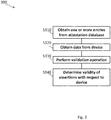
- a method for a validation apparatus to validate an attestation from a device attesting to an assertion concerning the device comprising: obtaining from an attestation database one or more entries, each entry comprising an attestation identifier, a validation-secret code and an assertion; obtaining from the device one or more attestation identifiers and a hashed-value; performing a validation operation on the one or more attestation identifiers obtained from the device together with the corresponding validation-secret codes obtained from the attestation database to validate the hashed-value obtained from the device; determining whether the one or more assertions associated with the one or more attestation identifiers obtained from the device are valid in respect of the device in dependence on a validation result of the validation operation.
- the device simply provides one or more attestation identifiers and a hashed-value to the validation apparatus but does not providing the assertion itself (i.e. the actual semantic meaning of the attestation) which is retrieved from a separate attestation database. It is also explicitly contemplated, that in certain examples the assertion may additionally or alternatively be stored on the device itself.
- the validation apparatus is able to validate whether various attestations in respect of the device are correct without the need for the device itself to store the validation-secret code or the assertion hence saving space. This furthermore, reduces the risk of theft of information form either the device or attestation database as neither entity stores information which alone or in combination would allow a forged device to be created. Yet further, in order to validate an attestation, information from both the device and attestation database would have to be obtained.
- the attestation database is located on the same physical device and/or is part of the validation apparatus. In other examples, the attestation database is located on a separate physical device from the validation apparatus.
- a device identifier is further obtained from the device, and wherein the validation operation is further performed on the device identifier. Thereby, it can be determined that the assertions are valid specifically in respect of a particular device identifier where, in general, at least the manufacturer / adapter is aware of which physical device the device identifier belongs to.
- metadata is further obtained from the device, and wherein the validation operation is further performed on the metadata.
- the validation apparatus can prove that the metadata was known at the time the hashed-value was generated.
- metadata may be obtained from the device to prove that the metadata was known at the time that the attempt to validate the attestation form the device was made.
- the validation operation comprises at least one hash function per attestation identifier obtained from the device and wherein each hash function iteratively acts on the result of the previous hash function with each successive hash function taking as an input at least an attestation identifier not previously used as an input in the previous hash functions.
- a plurality of attestation identifiers are obtained from the device and only one hashed-value corresponding to the most recent hashed-value is obtained from the device, and it is determined whether all or none of the plurality of assertions associated with the plurality of attestation identifiers obtained from the device are valid in respect of the device in dependence on the validation result by the validation operation.
- a plurality of assertions may be validated with only having to receive a single hashed-value from the device thus saving communication bandwidth and the need for the device to store more than the single most recent hashed-value.
- a plurality of attestation identifiers are obtained from the device and a plurality of hashed-values are obtained from the device, and the validation operation comprises a plurality of validation operations whereby it is determined whether subsets of the plurality of assertions associated with the plurality of attestation identifiers obtained from the device are valid in dependence on the validation results of the plurality of validation operations.
- the validation apparatus is able to separately validate subsets of assertions so, in the event of a negative validation, it is possible to at least partially identify which specific subset of assertion(s) are false.
- it may be possible to narrow down the source of the false assertions e.g. to a particularly interacting device or entity.
- a hashed-value may be obtained for every two, three or four, attestation identifiers.
- the validation apparatus obtains from the attestation database a plurality of validation-secret codes and assertions in association with a particular attestation identifier, and when the particular attestation identifier is obtained from the device the validation operation is attempted with each of the possible validation-secret codes.
- shorter attestation identifiers may be used (hence saving storage space on the device) while still allowing for the attestation to be validated in a reasonable time. For example, if there are three validation-secret codes and three assertions for each attestation identifier, at worst the validation operation needs to be attempted three times to determine which if any assertions are valid. If, however, the first assertion tested is shown to be valid, in some examples, the validation operations would not check the second and third assertions.
- a method for a device to store information on the device enabling the device to attest to an assertion concerning the device comprising: receiving, at the device, a base-secret code and a corresponding attestation identifier; hashing, at the device and using a first predetermined hash function, the base-secret code to generate a validation-secret code; hashing, at the device and using a second predetermined hash function, the validation-secret code in combination with one or more items of locally available information using a second predetermined hash function to generate a hashed-value; wherein after generation of the hashed-value the device stores the hashed-value.
- the device By performing two hashes at the device to generate a hashed-value which is stored, the device does not need to store either the base-secret code or validation-secret code. This thereby allows the device to save space but also be resistant to replication, since if the hashed-value is stolen from the device (e.g. because only the hashed-value is stored on the device) a forged device cannot be created. A forgery cannot be created since the base-secret code cannot, in general, be recreated from the hashed-value as the two hashing operations performed by the device are one-way operations, and therefore the base-secret code cannot be provided to a second device to create a forgery.
- a computer program for controlling a device to perform any of the above-described methods.
- the computer program is stored on a storage medium.
- an apparatus comprising: processing circuitry to perform data processing; and data storage storing a computer program for controlling the processing circuitry to perform any of the above-described methods.
- FIG 1 shows a schematic illustration of a system 100 for implementing examples of the disclosure.
- the system comprises an attestation generator 110, a manufacturer / adapter 120, a device 130, validation apparatus 140 and an attestation database 150.
- a manufacturer / adapter 120 for implementing examples of the disclosure.
- linkages between the various elements represent communication channels between the elements. These communication channels may be implemented using a wired electrical connection (e.g. Ethernet), using a wired optical connection (e.g. a fibre optic cable), a wireless radio connection (e.g. Wi-Fi®, Bluetooth®, ZigBee®) or using any other suitable technology which allows the elements to communicate data.
- a wired electrical connection e.g. Ethernet
- a wired optical connection e.g. a fibre optic cable
- a wireless radio connection e.g. Wi-Fi®, Bluetooth®, ZigBee®
- the manufacturer / adapter 120 may have a direct link to the attestation database 150, or the attestation generator 110 may be directly linked to the device 130. It will also be appreciated that in certain examples not all of the linkages shown may be present. For example, the linkage between the device 130 and validation apparatus 140 may not be present and instead the device 130 may communicate with the validation apparatus 140 via the manufacturer / adapter 120 and the attestation generator 110.
- linkages may be permanent and instead may be transitory or periodic.
- the manufacturer / adapter 120 may only be connected to the device 130 during manufacture or adaptation and as another example the connection between the device 130 and validation apparatus 140 may only be available specifically while the device is being validated.
- the attestation generator 110 is responsible for the generation of attestation identifier(s) and corresponding base-secret code(s).
- the attestation generator is a centralised server controlled by a first party that is in overall control of the attestation process.
- the manufacturer / adapter 120 is the entity responsible for provision of attestation identifier(s) and corresponding base-secret code(s) to the device 130.
- the manufacturer / adapter 120 corresponds to manufacturing, assembly or adaptation equipment controlled by a second party which is, at least in part, responsible for producing the finished device 130.
- the device 130 is the entity about which attestations to assertions concerning the device are being made.
- the device corresponds to an Internet of Things (loT) device.
- LoT Internet of Things
- Such loT devices are typically very small computing devices such as sensors, actuators or other devices in the loT, for which memory storage capacity, processing power and communication bandwidth can be extremely constrained.
- the validation apparatus 140 is the entity which acts to validate whether assertions concerning the device are valid.
- the validation apparatus is a server controlled by the first party (i.e. the same party as the attestation generator).
- the validation apparatus is a cloud hosted web service.
- the attestation database 150 is the entity which stores information linking the attestation identifiers with assertions together with a secret code used in validating assertions regarding the device.
- the attestation database is located on the same physical device and/or is part of the validation apparatus. In other examples, the attestation database is located on a separate physical device from the validation apparatus and connected by a communication channel (linkage).
- the elements may be implemented as software or hardware modules of a larger entity.
- the attestation generator 110 and validation apparatus 140 may be located on the same physical / logical device.
- the manufacturer / adapter 120 and validation apparatus 140 may be located on the same physical / logical device.
- system 100 may include a plurality of various of the elements.
- the system 100 may act on a plurality of devices 130 such that each can have assertions in respect of itself validated.
- system 100 may include a plurality of manufacturers / adapters 120 which may all act on a single device 130 or may each act on different devices 130.
- Figure 2 shows a schematic illustration of a method 200 for providing an attestation for enabling a device 130 to attest to an assertion concerning the device 130 which includes the following steps.
- an attestation identifier and a base-secret code corresponding to the attestation identifier are generated.
- the generation is performed by the attestation generator 110.
- the attestation identifier and a validation-secret code are provided to the validation apparatus 140, the validation-secret code being based on the base-secret code.
- the attestation identifier and a validation-secret code are provided by the attestation generator 110.
- the base-secret code is not provided to the validation apparatus 140.
- the validation-secret code is generated by hashing the base-secret code using a first predetermined hash function.
- the first predetermined hash function may be a cryptographic hashing function to further enhance security of the "one-way" function. Examples of suitable hashing algorithms include MD5, the family of SHA (e.g. SHA-256) or any other suitable hashing algorithm. It is also explicitly contemplated that in some examples the first predetermined hash function may be a non-cryptographic hashing function such as a cyclic redundancy check.
- the validation-secret code is generated at the attestation generator 110 and sent to the validation apparatus 140 such that the validation apparatus 140 never has access to the base-secret code. In other examples, the base-secret code is sent to the validation apparatus 140 which performs the hash using the first hashing algorithm to arrive at the validation-secret code.
- the attestation identifier and a device-secret code are provided to the manufacturer or adapter 120 for provision to the device 130.
- the attestation identifier and a device-secret code are provided by the attestation generator 110.
- the device secret-code is the same as the base-secret code.
- the attestation identifier and device-secret code are provided by the manufacturer or adapter 120 to the device 130.
- the device-secret code is the same as the base-secret code and wherein in response to provision of the attestation identifier and the device-secret code to the device 130, the device 130 hashes the device-secret code using the first predetermined hash function to generate the validation-secret code.
- This first predetermined hash function is the same as that used to provide the validation-secret code to the validation apparatus 140 thus both the validation apparatus 140 and device 130 end up with a copy of the same validation-secret code without this code being distributed to both devices.
- the device then further hashes the validation-secret code in combination with one or more items of locally available information using a second predetermined hash function to generate a hashed-value.
- the second predetermined hash function may be the same computational function (e.g. SHA-256) as that used for the first predetermined hash function but simply operating on different inputs.
- the device 130 may use different locally available information depending on whether the attestation identifier and device-secret code it receives are the initial (i.e. first) such attestation identifier and device-secret code received or subsequently received attestation identifiers and device-secret codes.
- the attestation identifier and device-secret code are the initial attestation identifier and initial device-secret code provided to the device 130 the one or more items of locally available information comprise a device identifier
- the attestation identifier and device-secret code are not the initial attestation identifier and initial device-secret code provided to the device 130 the one or more items of locally stored information comprise a previous hashed-value.
- the second predetermined hash function is iteratively applied each time a new attestation identifier and device-secret code are received taking the previous hashed-value of a previous iteration of the second predetermined hash function.
- This can be thought of as making the final hashed-value a "digest" of at least some of the previous hashed-values and accordingly of their corresponding attestation identifiers and device-secret codes which went into generating these previous hashed-values.
- the previous hashed-value is the previous hashed-value such that final hashed-value, through this iterative operation, acts as digest of all hashed-values generated on the device 130.
- the hashed-value is stored by the device 130 but the corresponding device-secret code and validation-secret code are discarded such that they are not stored on the device 130. Further, in some examples, only the very most recent hashed-value is stored with all previous hashed-values being discarded after the most recent hashed-value is generated. As previously described, as the most recent hashed-value can act as a digest of all previous hashed-values it is still possible to check the validity of all the previous hashed-values even though the hashed-values themselves have been discarded.
- the second predetermined hash function can additionally take as input the attestation identifier and/or metadata (e.g. information about the internal status of the device, an information payload, information received by the device from external sources).
- the metadata may include some or all of the code present on the device and one or more public keys stored on the device. Additionally or alternatively, the metadata may include information related to the state of the device software (e.g. software name, version, hash/public key used to sign the software), time/date that the hashed-value was generated, the human/machine operation(s) involved, or the geographic location where the operation took(s) place.
- these additionally inputs can also be stored on the device 130 after the hashed-value has been generated.
- step S230 can be performed before step S220 and step S240 can be performed at any point after step S230 has been performed.
- Figure 3 shows a schematic illustration of a method 300 for the validation apparatus 140 to validate an attestation from a device 130 attesting to an assertion concerning the device 130 which comprises the following steps.
- the validation apparatus 140 obtains from the attestation database 150 one or more entries, each entry including an attestation identifier, a validation-secret code and an assertion.
- a plurality of validation-secret codes and assertions in association with a particular attestation identifier are obtained by the validation apparatus 140 from the attestation database 150.
- the attestation identifier may not uniquely identify a particular validation-secret code and assertion.
- the validation apparatus 140 obtains from the device 130 one or more attestation identifiers and a hashed-value.
- a device identifier and/or metadata is also obtained from the device.
- a plurality of attestation identifiers are obtained from the device but only one hashed-value corresponding to the most recent hashed-value is obtained from the device 130.
- a plurality of attestation identifiers are obtained from the device and a plurality of hashed-values are obtained from the device.
- the validation apparatus 140 preforms a validation operation on the one or more attestation identifiers obtained from the device 130 together with the corresponding validation-secret codes obtained from the attestation database 150 to validate the hashed-value obtained from the device 130.
- the validation operation is further performed on the device identifier and/or metadata.
- the validation operation includes at least one hash function per attestation identifier obtained from the device 130.
- Each hash function iteratively acts on the result of the previous hash function with each successive hash function taking as an input at least an attestation identifier not previously used as an input in the previous hash functions.
- the hashed-value received by the validation apparatus 140 was generated through iterative operations performed on the device 130 (i.e.
- the validation operation is able to iteratively act on this "digest" hashed-value to successively validate each "layer” of the received hashed-value and hence ultimately validate the entire chain of hashed-values.
- the validation operation determines whether all or none of the plurality of assertions associated with the plurality of attestation identifiers obtained from the device are valid in respect of the device in dependence on the validation result by the validation operation.
- the validation operation includes a plurality of individual validation operations whereby it is determined whether subsets of the plurality of assertions associated with the plurality of attestation identifiers obtained from the device are valid in dependence on the validation results of the plurality of validation operations.
- the validation operation is attempted in relation to the attestation identifier obtained from the device with each of the possible validation-secret codes. In other words, the validation operation is attempted for every possible validation-secret code associated with the non-unique attestation identifier.
- the validation apparatus 140 determines whether the one or more assertions associated with the one or more attestation identifiers obtained from the device 130 are valid in respect of the device 130 in dependence on a validation result of the validation operation.
- step S320 can be performed before step S310.
- FIG. 4 schematically illustrates example information content 400 of an attestation database 150.
- five fields are shown: Attestation Identifier, Validation-Secret Code, Assertion, Additional Field 1 and Additional Field 2.
- Three example entries are shown.
- the first row has an Attestation Identifier of 1001, a Validation-Secret Code of AB47EF89 and an Assertion of Device Property 1 (e.g. has a security region 630 of data storage 620).
- the second row has an Attestation Identifier of 1002, a Validation-Secret Code of 749DABE6 and an Assertion of Event 1 (e.g. has had communications I/F 640 installed by specific manufacturer / adapter 120).
- the third row has an Attestation Identifier of 1003, a Validation-Secret Code of BF56DEF0 and an Assertion of Quality Assurance 1 (e.g. the integrity of an OS stored in data storage 620 has been verified).
- each row has two Additional Fields, 1 and 2. These can contain any additional information desired, for example, the specific manufacturer / adapter that a particular attestation identifier has been assigned two or the number of times that a request to validate a particular assertion has been made. It is contemplated, that substantially any desired information could be stored in these fields.
- the field(s) may include an identifier (e.g. the device identifier) of the device or devices where the attestation has previously been seen and wherein the field(s) are updated during the validation of the attestation.
- this example information content 400 of an attestation database 150 is just one possible format.
- the information content may have fewer or greater number of rows and columns.
- the information content may have zero, one, three, four or five Additional Fields.
- the information content may have substantially any number of rows required.
- the particular format shown for the entries for the Attestation Identifier, Validation-Secret Code and Assertion are just one example format.
- the Attestation Identifier and Validation-Secret Code could comprise a greater or fewer number of symbols and these symbols could, for example, be made up from decimal numerals, hexadecimal numerals or an ASCII character set.
- Figure 5 shows a schematic illustration of a method 500 for a device 130 to store information on the device 130 enabling the device 130 to attest to an assertion concerning the device 130 which includes the following steps.
- a base-secret code and a corresponding attestation identifier is received at the device 130.
- the base-secret code is hashed at the device 130 using a first predetermined hash function to generate a validation-secret code.
- the validation-secret code is hashed at the device in combination with one or more items of locally available information using a second predetermined hash function to generate a hashed-value.
- the hashed-value is stored on the device 130.
- FIG. 6 schematically illustrates an example of an electronic device 600.
- the device has processing circuitry 610 for performing data processing in response to program instructions, data storage 620 for storing data and instructions to be processed by the processing circuitry 610.
- the data storage 620 may have a secure region 630 which is protected by hardware mechanisms (e.g. using memory protection units or security mechanisms providing a trusted execution environment) or by software mechanisms (e.g. encryption), so that data stored in a secure region 630 is inaccessible to software not executing within a trusted environment.
- the device 600 has a communications interface 640 for communicating with external devices.
- communications interface 640 could use any other range of different communication protocols, such as Ethernet, WiFi®, Bluetooth®, ZigBee®, etc.
- the device may have one or more sensors 650 for sensing certain external conditions such as temperature, pressure, the proximity of a nearby user, etc.
- the specific sensors 650 provided may depend on the purpose of the device. It will be appreciated that Figure 6 is merely an example of possible hardware that may be provided in the device and other components may also be provided. For example, some devices for which user interaction is expected may be provided with a display and/or a user interface module in order to display information to the user and receive input from the user. Other types of devices may simply be sensors which capture data and transmit the data to an external device and so these types of devices may not need a user interface or display. It will be appreciated that the processing circuitry may be more powerful and the data storage may be greater for electronic devices 600 when implementing any of an attestation generator 110, manufacturer / adapter 120, validation apparatus 140 or attestation database 150 than when implementing a device 130.
- a computer program may comprise instructions for controlling an apparatus to perform any of the methods discussed above (including methods performed on any of the attestation generator 110, manufacturer / adapter 120, device 130, validation apparatus 140 and the attestation database 150.
- the program can be stored on a storage medium.
- the storage medium may be a non-transitory recording medium or a transitory signal medium.
- the words “configured to" are used to mean that an element of an apparatus has a configuration able to carry out the defined operation.
- a “configuration” means an arrangement or manner of interconnection of hardware or software.
- the apparatus may have dedicated hardware which provides the defined operation, or a processor or other processing device may be programmed to perform the function.
- Configured to does not imply that the apparatus element needs to be changed in any way in order to provide the defined operation.
Landscapes
- Engineering & Computer Science (AREA)
- Computer Security & Cryptography (AREA)
- Theoretical Computer Science (AREA)
- Computer Hardware Design (AREA)
- General Engineering & Computer Science (AREA)
- Physics & Mathematics (AREA)
- Software Systems (AREA)
- General Physics & Mathematics (AREA)
- Health & Medical Sciences (AREA)
- General Health & Medical Sciences (AREA)
- Bioethics (AREA)
- Signal Processing (AREA)
- Computer Networks & Wireless Communication (AREA)
- Databases & Information Systems (AREA)
- Mathematical Physics (AREA)
- Medical Informatics (AREA)
- Mobile Radio Communication Systems (AREA)
- Storage Device Security (AREA)
Applications Claiming Priority (1)
| Application Number | Priority Date | Filing Date | Title |
|---|---|---|---|
| GB1817901.0A GB2578628B (en) | 2018-11-01 | 2018-11-01 | Device attestation techniques |
Publications (3)
| Publication Number | Publication Date |
|---|---|
| EP3647979A1 true EP3647979A1 (fr) | 2020-05-06 |
| EP3647979B1 EP3647979B1 (fr) | 2023-06-14 |
| EP3647979C0 EP3647979C0 (fr) | 2023-06-14 |
Family
ID=64655689
Family Applications (1)
| Application Number | Title | Priority Date | Filing Date |
|---|---|---|---|
| EP19206402.0A Active EP3647979B1 (fr) | 2018-11-01 | 2019-10-31 | Techniques d'attestation de dispositif |
Country Status (5)
| Country | Link |
|---|---|
| US (1) | US11232190B2 (fr) |
| EP (1) | EP3647979B1 (fr) |
| JP (1) | JP7536437B2 (fr) |
| CN (1) | CN111143817B (fr) |
| GB (1) | GB2578628B (fr) |
Cited By (2)
| Publication number | Priority date | Publication date | Assignee | Title |
|---|---|---|---|---|
| US20210021606A1 (en) * | 2015-11-25 | 2021-01-21 | Yaron Gvili | Selectivity in privacy and verification with applications |
| US12284191B2 (en) | 2015-11-25 | 2025-04-22 | Yaron Gvili | Selectivity in privacy and verification with applications |
Families Citing this family (2)
| Publication number | Priority date | Publication date | Assignee | Title |
|---|---|---|---|---|
| US10585882B1 (en) | 2019-09-23 | 2020-03-10 | Trace, LLC | Systems and methods for writing updates to and/or reading previously stored updates of assets implemented as smart contracts on a decentralized database |
| US11972440B1 (en) * | 2020-06-05 | 2024-04-30 | Trace Labs Llc | Systems and methods for providing a decentralized anti-counterfeit solution for supply chain tracking using single-use codes |
Citations (4)
| Publication number | Priority date | Publication date | Assignee | Title |
|---|---|---|---|---|
| US20130212369A1 (en) * | 2010-09-22 | 2013-08-15 | International Business Machines Corporation | Attesting use of an interactive component during a boot process |
| US20160072626A1 (en) * | 2014-09-09 | 2016-03-10 | Microsoft Corporation | Cryptographically-verifiable attestation label |
| EP3346415A2 (fr) * | 2017-01-10 | 2018-07-11 | Trustonic Limited | Attestation d'événement pour un dispositif électronique |
| WO2018150154A1 (fr) * | 2017-02-20 | 2018-08-23 | Trustonic Limited | Attestation anonyme |
Family Cites Families (43)
| Publication number | Priority date | Publication date | Assignee | Title |
|---|---|---|---|---|
| GB2405974B (en) * | 2000-03-31 | 2005-04-27 | Intel Corp | Platform and method for remote attestation of a platform |
| US8281374B2 (en) * | 2005-09-14 | 2012-10-02 | Oracle International Corporation | Attested identities |
| JP2005038411A (ja) * | 2003-06-30 | 2005-02-10 | Sony Corp | 機器認証情報組込システム、端末機器、機器認証情報処理方法、機器認証情報処理プログラム、提供サーバ、機器認証情報提供方法、機器認証情報提供プログラム、及び記憶媒体 |
| US20060005009A1 (en) * | 2004-06-30 | 2006-01-05 | International Business Machines Corporation | Method, system and program product for verifying an attribute of a computing device |
| US20080046752A1 (en) * | 2006-08-09 | 2008-02-21 | Stefan Berger | Method, system, and program product for remotely attesting to a state of a computer system |
| US7996891B2 (en) * | 2008-01-30 | 2011-08-09 | International Business Machines Corporation | Systems, methods and computer program products for generating anonymous assertions |
| US8225110B2 (en) * | 2009-01-09 | 2012-07-17 | Telefonaktiebolaget Lm Ericsson (Publ) | Cryptographic protection of usage restrictions in electronic devices |
| US9077543B2 (en) * | 2009-10-09 | 2015-07-07 | Apple Inc. | Methods and apparatus for digital attestation |
| CN102725737B (zh) * | 2009-12-04 | 2016-04-20 | 密码研究公司 | 可验证防泄漏的加密和解密 |
| CN102986163B (zh) * | 2010-03-05 | 2015-11-25 | 交互数字专利控股公司 | 给设备提供安全性的方法和装置 |
| WO2012112833A2 (fr) * | 2011-02-17 | 2012-08-23 | Taasera, Inc. | Système et procédé pour une attestation d'application |
| EP2533457B8 (fr) * | 2011-06-10 | 2019-12-11 | BlackBerry Limited | Clés publiques certifiées implicitement |
| TWI546692B (zh) * | 2011-10-27 | 2016-08-21 | 電子戰協會公司 | 包括與已知電路板資訊有關之電路測試及驗證等特徵的裝置鑑別之系統及方法 |
| EP2605178B1 (fr) * | 2011-12-02 | 2018-10-17 | BlackBerry Limited | Procédé et dispositif permettant la notification sécurisée d'identité |
| US9413538B2 (en) * | 2011-12-12 | 2016-08-09 | Microsoft Technology Licensing, Llc | Cryptographic certification of secure hosted execution environments |
| US9411962B2 (en) * | 2012-07-18 | 2016-08-09 | Sequitur Labs Inc. | System and methods for secure utilization of attestation in policy-based decision making for mobile device management and security |
| AU2014222350B2 (en) * | 2013-02-26 | 2016-12-08 | Visa International Service Association | Systems, methods and devices for performing passcode authentication |
| US8854115B2 (en) * | 2013-03-05 | 2014-10-07 | Lsi Corporation | Preventing electronic device counterfeits |
| US9171163B2 (en) * | 2013-03-15 | 2015-10-27 | Intel Corporation | Mutually assured data sharing between distrusting parties in a network environment |
| CA2902285A1 (fr) * | 2013-03-15 | 2014-09-18 | Ologn Technologies Ag | Systemes, procedes et appareils d'attestation a distance |
| US10270748B2 (en) * | 2013-03-22 | 2019-04-23 | Nok Nok Labs, Inc. | Advanced authentication techniques and applications |
| EP2905718A1 (fr) * | 2014-02-05 | 2015-08-12 | Thomson Licensing | Dispositif et procédé de génération de certificat |
| US9680872B1 (en) * | 2014-03-25 | 2017-06-13 | Amazon Technologies, Inc. | Trusted-code generated requests |
| US9363087B2 (en) * | 2014-10-02 | 2016-06-07 | Microsoft Technology Licensing, Inc. | End-to-end security for hardware running verified software |
| US9565169B2 (en) * | 2015-03-30 | 2017-02-07 | Microsoft Technology Licensing, Llc | Device theft protection associating a device identifier and a user identifier |
| GB201508035D0 (en) * | 2015-05-12 | 2015-06-24 | Critical Blue Ltd | Crowd sourced fingerprinting |
| US10193858B2 (en) * | 2015-12-22 | 2019-01-29 | Mcafee, Llc | Attestation device custody transfer protocol |
| US10536271B1 (en) * | 2016-01-10 | 2020-01-14 | Apple Inc. | Silicon key attestation |
| US10333705B2 (en) * | 2016-04-30 | 2019-06-25 | Civic Technologies, Inc. | Methods and apparatus for providing attestation of information using a centralized or distributed ledger |
| CN106230784B (zh) * | 2016-07-20 | 2020-09-18 | 新华三技术有限公司 | 一种设备验证方法及装置 |
| US10554630B2 (en) | 2017-01-04 | 2020-02-04 | Facebook, Inc. | Systems and methods for secure password transmission and verification |
| US10546130B1 (en) * | 2017-02-24 | 2020-01-28 | United States Of America As Represented By The Secretary Of The Air Force | Timed attestation process |
| EP3416334B1 (fr) * | 2017-06-15 | 2020-01-15 | Accenture Global Solutions Limited | Identité biométrique portable sur une couche de stockage de données distribuées |
| US10503892B2 (en) * | 2017-06-25 | 2019-12-10 | Microsoft Technology Licensing, Llc | Remote attestation for multi-core processor |
| US10819696B2 (en) * | 2017-07-13 | 2020-10-27 | Microsoft Technology Licensing, Llc | Key attestation statement generation providing device anonymity |
| GB2566265B (en) * | 2017-09-01 | 2020-05-13 | Trustonic Ltd | Post-manufacture generation of device certificate and private key for public key infrastructure |
| GB2566264B (en) * | 2017-09-01 | 2020-05-13 | Trustonic Ltd | Application certificate |
| US10621350B2 (en) * | 2017-10-02 | 2020-04-14 | Microsoft Technology Licensing, Llc | System integrity using attestation for virtual trusted platform module |
| US10635821B2 (en) * | 2017-10-13 | 2020-04-28 | Baidu Usa Llc | Method and apparatus for launching a device |
| US11153303B2 (en) * | 2017-11-15 | 2021-10-19 | Citrix Systems, Inc. | Secure authentication of a device through attestation by another device |
| US10715536B2 (en) * | 2017-12-29 | 2020-07-14 | Square, Inc. | Logical validation of devices against fraud and tampering |
| US10999081B2 (en) * | 2018-04-12 | 2021-05-04 | Microsoft Technology Licensing, Llc | Dynamic certificate management for a distributed authentication system |
| US11271908B2 (en) * | 2018-07-31 | 2022-03-08 | Hewlett Packard Enterprise Development Lp | Systems and methods for hiding identity of transacting party in distributed ledger transaction by hashing distributed ledger transaction ID using secured representation of distributed ledger address of transacting party as a key |
-
2018
- 2018-11-01 GB GB1817901.0A patent/GB2578628B/en active Active
-
2019
- 2019-10-04 US US16/592,971 patent/US11232190B2/en active Active
- 2019-10-25 JP JP2019194632A patent/JP7536437B2/ja active Active
- 2019-10-30 CN CN201911045345.8A patent/CN111143817B/zh active Active
- 2019-10-31 EP EP19206402.0A patent/EP3647979B1/fr active Active
Patent Citations (4)
| Publication number | Priority date | Publication date | Assignee | Title |
|---|---|---|---|---|
| US20130212369A1 (en) * | 2010-09-22 | 2013-08-15 | International Business Machines Corporation | Attesting use of an interactive component during a boot process |
| US20160072626A1 (en) * | 2014-09-09 | 2016-03-10 | Microsoft Corporation | Cryptographically-verifiable attestation label |
| EP3346415A2 (fr) * | 2017-01-10 | 2018-07-11 | Trustonic Limited | Attestation d'événement pour un dispositif électronique |
| WO2018150154A1 (fr) * | 2017-02-20 | 2018-08-23 | Trustonic Limited | Attestation anonyme |
Cited By (3)
| Publication number | Priority date | Publication date | Assignee | Title |
|---|---|---|---|---|
| US20210021606A1 (en) * | 2015-11-25 | 2021-01-21 | Yaron Gvili | Selectivity in privacy and verification with applications |
| US11558398B2 (en) * | 2015-11-25 | 2023-01-17 | Yaron Gvili | Selectivity in privacy and verification with applications |
| US12284191B2 (en) | 2015-11-25 | 2025-04-22 | Yaron Gvili | Selectivity in privacy and verification with applications |
Also Published As
| Publication number | Publication date |
|---|---|
| US20200143031A1 (en) | 2020-05-07 |
| US11232190B2 (en) | 2022-01-25 |
| JP2020071880A (ja) | 2020-05-07 |
| CN111143817B (zh) | 2025-03-07 |
| GB2578628B (en) | 2021-09-15 |
| EP3647979B1 (fr) | 2023-06-14 |
| GB2578628A (en) | 2020-05-20 |
| JP7536437B2 (ja) | 2024-08-20 |
| GB201817901D0 (en) | 2018-12-19 |
| CN111143817A (zh) | 2020-05-12 |
| EP3647979C0 (fr) | 2023-06-14 |
Similar Documents
| Publication | Publication Date | Title |
|---|---|---|
| US11388012B2 (en) | Application certificate | |
| US10410018B2 (en) | Cryptographic assurances of data integrity for data crossing trust boundaries | |
| EP3647979B1 (fr) | Techniques d'attestation de dispositif | |
| US11582042B2 (en) | Industrial data verification using secure, distributed ledger | |
| CN108140093B (zh) | 使用用于设备的硬件信任根来迁移秘密 | |
| US10079855B2 (en) | Password breach registry | |
| CN111694591A (zh) | 证书更新方法、装置、系统、服务端及计算机存储介质 | |
| CN110460588B (zh) | 实现信息验证的方法、装置、计算机系统和存储介质 | |
| US20210357198A1 (en) | Controlled scope of authentication key for software update | |
| EP4158515A1 (fr) | Serveur de stockage de données et dispositifs clients permettant de stocker des données de manière sécurisée | |
| KR102702681B1 (ko) | 전자 장치 및 전자 장치에서의 인증 방법 | |
| EP4040720A1 (fr) | Carte d'identité sécurisée utilisant des fonctions inclonables | |
| CN117134993A (zh) | 基于可累加承诺验证的检索密文可检测方法及设备 | |
| CN120112907A (zh) | 用于车辆软件的远程证明的数字影子 | |
| US11449372B1 (en) | System for enforcing use of schemas and interfaces | |
| CN110443039A (zh) | 插件安全性的检测方法、装置以及电子设备 | |
| CN118611931A (zh) | 登录验证方法、装置、计算机设备、可读存储介质 | |
| CN116010926A (zh) | 登陆认证方法、装置、计算机设备和存储介质 | |
| CN111478770A (zh) | 安全校验方法、装置、计算机设备和存储介质 | |
| EP4690863A1 (fr) | Procédé de fonctionnement d'un système de télécommunications et système de télécommunications | |
| GB2628570A (en) | Method of operating a telecommunications system and a telecommunications system | |
| CN119808127A (zh) | 一种基于分布式图数据库的加解密方法和装置 | |
| CN116451199A (zh) | 访问请求处理方法、装置、设备、存储介质和计算机产品 | |
| CN121985330A (zh) | 密钥生成方法、装置、设备、存储介质、计算机程序产品 | |
| CN120562397A (zh) | 一种事务处理方法、装置、存储介质及电子设备 |
Legal Events
| Date | Code | Title | Description |
|---|---|---|---|
| PUAI | Public reference made under article 153(3) epc to a published international application that has entered the european phase |
Free format text: ORIGINAL CODE: 0009012 |
|
| STAA | Information on the status of an ep patent application or granted ep patent |
Free format text: STATUS: THE APPLICATION HAS BEEN PUBLISHED |
|
| AK | Designated contracting states |
Kind code of ref document: A1 Designated state(s): AL AT BE BG CH CY CZ DE DK EE ES FI FR GB GR HR HU IE IS IT LI LT LU LV MC MK MT NL NO PL PT RO RS SE SI SK SM TR |
|
| AX | Request for extension of the european patent |
Extension state: BA ME |
|
| STAA | Information on the status of an ep patent application or granted ep patent |
Free format text: STATUS: REQUEST FOR EXAMINATION WAS MADE |
|
| 17P | Request for examination filed |
Effective date: 20201106 |
|
| RAP1 | Party data changed (applicant data changed or rights of an application transferred) |
Owner name: TRUSTONIC LIMITED |
|
| RBV | Designated contracting states (corrected) |
Designated state(s): AL AT BE BG CH CY CZ DE DK EE ES FI FR GB GR HR HU IE IS IT LI LT LU LV MC MK MT NL NO PL PT RO RS SE SI SK SM TR |
|
| STAA | Information on the status of an ep patent application or granted ep patent |
Free format text: STATUS: EXAMINATION IS IN PROGRESS |
|
| 17Q | First examination report despatched |
Effective date: 20211105 |
|
| GRAP | Despatch of communication of intention to grant a patent |
Free format text: ORIGINAL CODE: EPIDOSNIGR1 |
|
| STAA | Information on the status of an ep patent application or granted ep patent |
Free format text: STATUS: GRANT OF PATENT IS INTENDED |
|
| INTG | Intention to grant announced |
Effective date: 20220707 |
|
| GRAJ | Information related to disapproval of communication of intention to grant by the applicant or resumption of examination proceedings by the epo deleted |
Free format text: ORIGINAL CODE: EPIDOSDIGR1 |
|
| STAA | Information on the status of an ep patent application or granted ep patent |
Free format text: STATUS: EXAMINATION IS IN PROGRESS |
|
| GRAP | Despatch of communication of intention to grant a patent |
Free format text: ORIGINAL CODE: EPIDOSNIGR1 |
|
| STAA | Information on the status of an ep patent application or granted ep patent |
Free format text: STATUS: GRANT OF PATENT IS INTENDED |
|
| INTC | Intention to grant announced (deleted) | ||
| INTG | Intention to grant announced |
Effective date: 20221129 |
|
| GRAS | Grant fee paid |
Free format text: ORIGINAL CODE: EPIDOSNIGR3 |
|
| GRAA | (expected) grant |
Free format text: ORIGINAL CODE: 0009210 |
|
| STAA | Information on the status of an ep patent application or granted ep patent |
Free format text: STATUS: THE PATENT HAS BEEN GRANTED |
|
| RAP3 | Party data changed (applicant data changed or rights of an application transferred) |
Owner name: TRUSTONIC LIMITED |
|
| AK | Designated contracting states |
Kind code of ref document: B1 Designated state(s): AL AT BE BG CH CY CZ DE DK EE ES FI FR GB GR HR HU IE IS IT LI LT LU LV MC MK MT NL NO PL PT RO RS SE SI SK SM TR |
|
| RIN1 | Information on inventor provided before grant (corrected) |
Inventor name: HAYTON, RICHARD |
|
| REG | Reference to a national code |
Ref country code: CH Ref legal event code: EP |
|
| P01 | Opt-out of the competence of the unified patent court (upc) registered |
Effective date: 20230515 |
|
| REG | Reference to a national code |
Ref country code: DE Ref legal event code: R096 Ref document number: 602019030938 Country of ref document: DE |
|
| REG | Reference to a national code |
Ref country code: AT Ref legal event code: REF Ref document number: 1579744 Country of ref document: AT Kind code of ref document: T Effective date: 20230715 |
|
| U01 | Request for unitary effect filed |
Effective date: 20230614 |
|
| U07 | Unitary effect registered |
Designated state(s): AT BE BG DE DK EE FI FR IT LT LU LV MT NL PT SE SI Effective date: 20230619 |
|
| P04 | Withdrawal of opt-out of the competence of the unified patent court (upc) registered |
Effective date: 20230623 |
|
| REG | Reference to a national code |
Ref country code: LT Ref legal event code: MG9D |
|
| PG25 | Lapsed in a contracting state [announced via postgrant information from national office to epo] |
Ref country code: NO Free format text: LAPSE BECAUSE OF FAILURE TO SUBMIT A TRANSLATION OF THE DESCRIPTION OR TO PAY THE FEE WITHIN THE PRESCRIBED TIME-LIMIT Effective date: 20230914 Ref country code: ES Free format text: LAPSE BECAUSE OF FAILURE TO SUBMIT A TRANSLATION OF THE DESCRIPTION OR TO PAY THE FEE WITHIN THE PRESCRIBED TIME-LIMIT Effective date: 20230614 |
|
| U20 | Renewal fee for the european patent with unitary effect paid |
Year of fee payment: 5 Effective date: 20231018 |
|
| PG25 | Lapsed in a contracting state [announced via postgrant information from national office to epo] |
Ref country code: RS Free format text: LAPSE BECAUSE OF FAILURE TO SUBMIT A TRANSLATION OF THE DESCRIPTION OR TO PAY THE FEE WITHIN THE PRESCRIBED TIME-LIMIT Effective date: 20230614 Ref country code: HR Free format text: LAPSE BECAUSE OF FAILURE TO SUBMIT A TRANSLATION OF THE DESCRIPTION OR TO PAY THE FEE WITHIN THE PRESCRIBED TIME-LIMIT Effective date: 20230614 Ref country code: GR Free format text: LAPSE BECAUSE OF FAILURE TO SUBMIT A TRANSLATION OF THE DESCRIPTION OR TO PAY THE FEE WITHIN THE PRESCRIBED TIME-LIMIT Effective date: 20230915 |
|
| PG25 | Lapsed in a contracting state [announced via postgrant information from national office to epo] |
Ref country code: SK Free format text: LAPSE BECAUSE OF FAILURE TO SUBMIT A TRANSLATION OF THE DESCRIPTION OR TO PAY THE FEE WITHIN THE PRESCRIBED TIME-LIMIT Effective date: 20230614 |
|
| PG25 | Lapsed in a contracting state [announced via postgrant information from national office to epo] |
Ref country code: IS Free format text: LAPSE BECAUSE OF FAILURE TO SUBMIT A TRANSLATION OF THE DESCRIPTION OR TO PAY THE FEE WITHIN THE PRESCRIBED TIME-LIMIT Effective date: 20231014 |
|
| PG25 | Lapsed in a contracting state [announced via postgrant information from national office to epo] |
Ref country code: SM Free format text: LAPSE BECAUSE OF FAILURE TO SUBMIT A TRANSLATION OF THE DESCRIPTION OR TO PAY THE FEE WITHIN THE PRESCRIBED TIME-LIMIT Effective date: 20230614 Ref country code: SK Free format text: LAPSE BECAUSE OF FAILURE TO SUBMIT A TRANSLATION OF THE DESCRIPTION OR TO PAY THE FEE WITHIN THE PRESCRIBED TIME-LIMIT Effective date: 20230614 Ref country code: RO Free format text: LAPSE BECAUSE OF FAILURE TO SUBMIT A TRANSLATION OF THE DESCRIPTION OR TO PAY THE FEE WITHIN THE PRESCRIBED TIME-LIMIT Effective date: 20230614 Ref country code: IS Free format text: LAPSE BECAUSE OF FAILURE TO SUBMIT A TRANSLATION OF THE DESCRIPTION OR TO PAY THE FEE WITHIN THE PRESCRIBED TIME-LIMIT Effective date: 20231014 Ref country code: CZ Free format text: LAPSE BECAUSE OF FAILURE TO SUBMIT A TRANSLATION OF THE DESCRIPTION OR TO PAY THE FEE WITHIN THE PRESCRIBED TIME-LIMIT Effective date: 20230614 |
|
| PG25 | Lapsed in a contracting state [announced via postgrant information from national office to epo] |
Ref country code: PL Free format text: LAPSE BECAUSE OF FAILURE TO SUBMIT A TRANSLATION OF THE DESCRIPTION OR TO PAY THE FEE WITHIN THE PRESCRIBED TIME-LIMIT Effective date: 20230614 |
|
| REG | Reference to a national code |
Ref country code: DE Ref legal event code: R097 Ref document number: 602019030938 Country of ref document: DE |
|
| PLBE | No opposition filed within time limit |
Free format text: ORIGINAL CODE: 0009261 |
|
| STAA | Information on the status of an ep patent application or granted ep patent |
Free format text: STATUS: NO OPPOSITION FILED WITHIN TIME LIMIT |
|
| 26N | No opposition filed |
Effective date: 20240315 |
|
| PG25 | Lapsed in a contracting state [announced via postgrant information from national office to epo] |
Ref country code: MC Free format text: LAPSE BECAUSE OF FAILURE TO SUBMIT A TRANSLATION OF THE DESCRIPTION OR TO PAY THE FEE WITHIN THE PRESCRIBED TIME-LIMIT Effective date: 20230614 |
|
| REG | Reference to a national code |
Ref country code: CH Ref legal event code: PL |
|
| PG25 | Lapsed in a contracting state [announced via postgrant information from national office to epo] |
Ref country code: CH Free format text: LAPSE BECAUSE OF NON-PAYMENT OF DUE FEES Effective date: 20231031 |
|
| PG25 | Lapsed in a contracting state [announced via postgrant information from national office to epo] |
Ref country code: CH Free format text: LAPSE BECAUSE OF NON-PAYMENT OF DUE FEES Effective date: 20231031 |
|
| PG25 | Lapsed in a contracting state [announced via postgrant information from national office to epo] |
Ref country code: IE Free format text: LAPSE BECAUSE OF NON-PAYMENT OF DUE FEES Effective date: 20231031 |
|
| PG25 | Lapsed in a contracting state [announced via postgrant information from national office to epo] |
Ref country code: IE Free format text: LAPSE BECAUSE OF NON-PAYMENT OF DUE FEES Effective date: 20231031 |
|
| U20 | Renewal fee for the european patent with unitary effect paid |
Year of fee payment: 6 Effective date: 20241015 |
|
| P05 | Withdrawal of opt-out of the competence of the unified patent court (upc) changed |
Free format text: CASE NUMBER: APP_528263/2023 Effective date: 20230619 |
|
| PG25 | Lapsed in a contracting state [announced via postgrant information from national office to epo] |
Ref country code: CY Free format text: LAPSE BECAUSE OF FAILURE TO SUBMIT A TRANSLATION OF THE DESCRIPTION OR TO PAY THE FEE WITHIN THE PRESCRIBED TIME-LIMIT; INVALID AB INITIO Effective date: 20191031 |
|
| PG25 | Lapsed in a contracting state [announced via postgrant information from national office to epo] |
Ref country code: HU Free format text: LAPSE BECAUSE OF FAILURE TO SUBMIT A TRANSLATION OF THE DESCRIPTION OR TO PAY THE FEE WITHIN THE PRESCRIBED TIME-LIMIT; INVALID AB INITIO Effective date: 20191031 |
|
| U20 | Renewal fee for the european patent with unitary effect paid |
Year of fee payment: 7 Effective date: 20251016 |
|
| PG25 | Lapsed in a contracting state [announced via postgrant information from national office to epo] |
Ref country code: TR Free format text: LAPSE BECAUSE OF FAILURE TO SUBMIT A TRANSLATION OF THE DESCRIPTION OR TO PAY THE FEE WITHIN THE PRESCRIBED TIME-LIMIT Effective date: 20230614 |
|
| PGFP | Annual fee paid to national office [announced via postgrant information from national office to epo] |
Ref country code: GB Payment date: 20251016 Year of fee payment: 7 |