EP3648047B1 - Système de gant/enregistrement - Google Patents
Système de gant/enregistrement Download PDFInfo
- Publication number
- EP3648047B1 EP3648047B1 EP18823032.0A EP18823032A EP3648047B1 EP 3648047 B1 EP3648047 B1 EP 3648047B1 EP 18823032 A EP18823032 A EP 18823032A EP 3648047 B1 EP3648047 B1 EP 3648047B1
- Authority
- EP
- European Patent Office
- Prior art keywords
- glove
- work
- worker
- tag
- information
- Prior art date
- Legal status (The legal status is an assumption and is not a legal conclusion. Google has not performed a legal analysis and makes no representation as to the accuracy of the status listed.)
- Active
Links
Images



Classifications
-
- G—PHYSICS
- G06—COMPUTING OR CALCULATING; COUNTING
- G06K—GRAPHICAL DATA READING; PRESENTATION OF DATA; RECORD CARRIERS; HANDLING RECORD CARRIERS
- G06K7/00—Methods or arrangements for sensing record carriers, e.g. for reading patterns
- G06K7/10—Methods or arrangements for sensing record carriers, e.g. for reading patterns by electromagnetic radiation, e.g. optical sensing; by corpuscular radiation
- G06K7/10009—Methods or arrangements for sensing record carriers, e.g. for reading patterns by electromagnetic radiation, e.g. optical sensing; by corpuscular radiation sensing by radiation using wavelengths larger than 0.1 mm, e.g. radio-waves or microwaves
- G06K7/10366—Methods or arrangements for sensing record carriers, e.g. for reading patterns by electromagnetic radiation, e.g. optical sensing; by corpuscular radiation sensing by radiation using wavelengths larger than 0.1 mm, e.g. radio-waves or microwaves the interrogation device being adapted for miscellaneous applications
- G06K7/10376—Methods or arrangements for sensing record carriers, e.g. for reading patterns by electromagnetic radiation, e.g. optical sensing; by corpuscular radiation sensing by radiation using wavelengths larger than 0.1 mm, e.g. radio-waves or microwaves the interrogation device being adapted for miscellaneous applications the interrogation device being adapted for being moveable
- G06K7/10396—Methods or arrangements for sensing record carriers, e.g. for reading patterns by electromagnetic radiation, e.g. optical sensing; by corpuscular radiation sensing by radiation using wavelengths larger than 0.1 mm, e.g. radio-waves or microwaves the interrogation device being adapted for miscellaneous applications the interrogation device being adapted for being moveable the interrogation device being wearable, e.g. as a glove, bracelet, or ring
-
- G—PHYSICS
- G06—COMPUTING OR CALCULATING; COUNTING
- G06Q—INFORMATION AND COMMUNICATION TECHNOLOGY [ICT] SPECIALLY ADAPTED FOR ADMINISTRATIVE, COMMERCIAL, FINANCIAL, MANAGERIAL OR SUPERVISORY PURPOSES; SYSTEMS OR METHODS SPECIALLY ADAPTED FOR ADMINISTRATIVE, COMMERCIAL, FINANCIAL, MANAGERIAL OR SUPERVISORY PURPOSES, NOT OTHERWISE PROVIDED FOR
- G06Q50/00—Information and communication technology [ICT] specially adapted for implementation of business processes of specific business sectors, e.g. utilities or tourism
- G06Q50/04—Manufacturing
-
- G—PHYSICS
- G06—COMPUTING OR CALCULATING; COUNTING
- G06Q—INFORMATION AND COMMUNICATION TECHNOLOGY [ICT] SPECIALLY ADAPTED FOR ADMINISTRATIVE, COMMERCIAL, FINANCIAL, MANAGERIAL OR SUPERVISORY PURPOSES; SYSTEMS OR METHODS SPECIALLY ADAPTED FOR ADMINISTRATIVE, COMMERCIAL, FINANCIAL, MANAGERIAL OR SUPERVISORY PURPOSES, NOT OTHERWISE PROVIDED FOR
- G06Q10/00—Administration; Management
- G06Q10/06—Resources, workflows, human or project management; Enterprise or organisation planning; Enterprise or organisation modelling
- G06Q10/063—Operations research, analysis or management
-
- B—PERFORMING OPERATIONS; TRANSPORTING
- B25—HAND TOOLS; PORTABLE POWER-DRIVEN TOOLS; MANIPULATORS
- B25J—MANIPULATORS; CHAMBERS PROVIDED WITH MANIPULATION DEVICES
- B25J21/00—Chambers provided with manipulation devices
- B25J21/02—Glove-boxes, i.e. chambers in which manipulations are performed by the human hands in gloves built into the chamber walls; Gloves therefor
-
- G—PHYSICS
- G06—COMPUTING OR CALCULATING; COUNTING
- G06K—GRAPHICAL DATA READING; PRESENTATION OF DATA; RECORD CARRIERS; HANDLING RECORD CARRIERS
- G06K19/00—Record carriers for use with machines and with at least a part designed to carry digital markings
- G06K19/06—Record carriers for use with machines and with at least a part designed to carry digital markings characterised by the kind of the digital marking, e.g. shape, nature, code
- G06K19/067—Record carriers with conductive marks, printed circuits or semiconductor circuit elements, e.g. credit or identity cards also with resonating or responding marks without active components
- G06K19/07—Record carriers with conductive marks, printed circuits or semiconductor circuit elements, e.g. credit or identity cards also with resonating or responding marks without active components with integrated circuit chips
- G06K19/0723—Record carriers with conductive marks, printed circuits or semiconductor circuit elements, e.g. credit or identity cards also with resonating or responding marks without active components with integrated circuit chips the record carrier comprising an arrangement for non-contact communication, e.g. wireless communication circuits on transponder cards, non-contact smart cards or RFIDs
-
- G—PHYSICS
- G06—COMPUTING OR CALCULATING; COUNTING
- G06K—GRAPHICAL DATA READING; PRESENTATION OF DATA; RECORD CARRIERS; HANDLING RECORD CARRIERS
- G06K7/00—Methods or arrangements for sensing record carriers, e.g. for reading patterns
- G06K7/10—Methods or arrangements for sensing record carriers, e.g. for reading patterns by electromagnetic radiation, e.g. optical sensing; by corpuscular radiation
- G06K7/10009—Methods or arrangements for sensing record carriers, e.g. for reading patterns by electromagnetic radiation, e.g. optical sensing; by corpuscular radiation sensing by radiation using wavelengths larger than 0.1 mm, e.g. radio-waves or microwaves
-
- G—PHYSICS
- G06—COMPUTING OR CALCULATING; COUNTING
- G06K—GRAPHICAL DATA READING; PRESENTATION OF DATA; RECORD CARRIERS; HANDLING RECORD CARRIERS
- G06K7/00—Methods or arrangements for sensing record carriers, e.g. for reading patterns
- G06K7/10—Methods or arrangements for sensing record carriers, e.g. for reading patterns by electromagnetic radiation, e.g. optical sensing; by corpuscular radiation
- G06K7/10009—Methods or arrangements for sensing record carriers, e.g. for reading patterns by electromagnetic radiation, e.g. optical sensing; by corpuscular radiation sensing by radiation using wavelengths larger than 0.1 mm, e.g. radio-waves or microwaves
- G06K7/10366—Methods or arrangements for sensing record carriers, e.g. for reading patterns by electromagnetic radiation, e.g. optical sensing; by corpuscular radiation sensing by radiation using wavelengths larger than 0.1 mm, e.g. radio-waves or microwaves the interrogation device being adapted for miscellaneous applications
- G06K7/10415—Methods or arrangements for sensing record carriers, e.g. for reading patterns by electromagnetic radiation, e.g. optical sensing; by corpuscular radiation sensing by radiation using wavelengths larger than 0.1 mm, e.g. radio-waves or microwaves the interrogation device being adapted for miscellaneous applications the interrogation device being fixed in its position, such as an access control device for reading wireless access cards, or a wireless ATM
- G06K7/10425—Methods or arrangements for sensing record carriers, e.g. for reading patterns by electromagnetic radiation, e.g. optical sensing; by corpuscular radiation sensing by radiation using wavelengths larger than 0.1 mm, e.g. radio-waves or microwaves the interrogation device being adapted for miscellaneous applications the interrogation device being fixed in its position, such as an access control device for reading wireless access cards, or a wireless ATM the interrogation device being arranged for interrogation of record carriers passing by the interrogation device
-
- G—PHYSICS
- G06—COMPUTING OR CALCULATING; COUNTING
- G06Q—INFORMATION AND COMMUNICATION TECHNOLOGY [ICT] SPECIALLY ADAPTED FOR ADMINISTRATIVE, COMMERCIAL, FINANCIAL, MANAGERIAL OR SUPERVISORY PURPOSES; SYSTEMS OR METHODS SPECIALLY ADAPTED FOR ADMINISTRATIVE, COMMERCIAL, FINANCIAL, MANAGERIAL OR SUPERVISORY PURPOSES, NOT OTHERWISE PROVIDED FOR
- G06Q10/00—Administration; Management
- G06Q10/08—Logistics, e.g. warehousing, loading or distribution; Inventory or stock management
- G06Q10/083—Shipping
- G06Q10/0833—Tracking
-
- G—PHYSICS
- G06—COMPUTING OR CALCULATING; COUNTING
- G06Q—INFORMATION AND COMMUNICATION TECHNOLOGY [ICT] SPECIALLY ADAPTED FOR ADMINISTRATIVE, COMMERCIAL, FINANCIAL, MANAGERIAL OR SUPERVISORY PURPOSES; SYSTEMS OR METHODS SPECIALLY ADAPTED FOR ADMINISTRATIVE, COMMERCIAL, FINANCIAL, MANAGERIAL OR SUPERVISORY PURPOSES, NOT OTHERWISE PROVIDED FOR
- G06Q10/00—Administration; Management
- G06Q10/10—Office automation; Time management
-
- G—PHYSICS
- G07—CHECKING-DEVICES
- G07C—TIME OR ATTENDANCE REGISTERS; REGISTERING OR INDICATING THE WORKING OF MACHINES; GENERATING RANDOM NUMBERS; VOTING OR LOTTERY APPARATUS; ARRANGEMENTS, SYSTEMS OR APPARATUS FOR CHECKING NOT PROVIDED FOR ELSEWHERE
- G07C9/00—Individual registration on entry or exit
- G07C9/20—Individual registration on entry or exit involving the use of a pass
- G07C9/29—Individual registration on entry or exit involving the use of a pass the pass containing active electronic elements, e.g. smartcards
-
- H—ELECTRICITY
- H10—SEMICONDUCTOR DEVICES; ELECTRIC SOLID-STATE DEVICES NOT OTHERWISE PROVIDED FOR
- H10P—GENERIC PROCESSES OR APPARATUS FOR THE MANUFACTURE OR TREATMENT OF DEVICES COVERED BY CLASS H10
- H10P95/00—Generic processes or apparatus for manufacture or treatments not covered by the other groups of this subclass
-
- Y—GENERAL TAGGING OF NEW TECHNOLOGICAL DEVELOPMENTS; GENERAL TAGGING OF CROSS-SECTIONAL TECHNOLOGIES SPANNING OVER SEVERAL SECTIONS OF THE IPC; TECHNICAL SUBJECTS COVERED BY FORMER USPC CROSS-REFERENCE ART COLLECTIONS [XRACs] AND DIGESTS
- Y02—TECHNOLOGIES OR APPLICATIONS FOR MITIGATION OR ADAPTATION AGAINST CLIMATE CHANGE
- Y02P—CLIMATE CHANGE MITIGATION TECHNOLOGIES IN THE PRODUCTION OR PROCESSING OF GOODS
- Y02P90/00—Enabling technologies with a potential contribution to greenhouse gas [GHG] emissions mitigation
- Y02P90/30—Computing systems specially adapted for manufacturing
Definitions
- the present invention relates to a glove/logging system for recording and storing information on the operator name and the status of use for a work glove used in a device such as an isolator and a glove box in a time-series manner.
- a work performed in a clean atmosphere such as a work at a manufacturing stage of pharmaceutical products or a work at a manufacturing stage of semiconductors or electronic components
- the works are performed in a clean work environment in which an inside is kept in a dust-free/sterile state so that contaminants do not enter from an external environment.
- clean rooms are generally used.
- a worker wearing dust-free clothes performs a work.
- a work is performed by constructing a more highly clean zone in the clean room.
- an isolator or a glove box (hereinafter collectively referred to as "isolator") is used.
- Isolator a chamber sealed from an external environment is used, and a worker performs a work from an outside of this chamber through the glove or the like.
- This type of isolator is particularly called as "sterile isolator”.
- RABS restricted-access barrier system
- a zone surrounded by wall surfaces with a lower part open is provided in a part of the clean room, and a laminar flow (hereinafter referred to as a "laminar flow") of clean air in unidirectional air flow flowing from an upper side to a lower side is made to flow therein and strict access restriction is set for workers.
- laminar flow a laminar flow of clean air in unidirectional air flow flowing from an upper side to a lower side is made to flow therein and strict access restriction is set for workers.
- a worker performs a work through a work glove or the like provided on the wall surface.
- An isolator is airtightly shielded from an external environment for workers to work.
- the outside air is purified by a filter to be supplied into a chamber, while the air in the chamber is purified by a filter to be discharged to an outside. Accordingly, such an isolator can principally be used both as a sterile isolator and a contained isolator.
- an isolator depending on a purpose thereof, can provide further safety improvement by adjusting the air pressure in a chamber. Specifically, if the purpose is to keep sterile, the pressure in a chamber is set higher than the outside air pressure (hereinafter referred to as "positive pressure"). Due to air flow from the chamber to an outside, even if air leak occurs from the chamber, entry of floating bacteria and the like from the outside to the chamber is prevented.
- positive pressure the outside air pressure
- the airtightness of a work glove seems a particularly essential factor to maintain a high-level internal sterile environment at the boundary between the inside and outside of a sterile isolator or RABS.
- a work glove in frequent use by a worker is prone to failures such as pinholes and cracks on the main body, and its subsequent airtightness breakdown fails to maintain a high-level internal sterile environment.
- the airtightness of a work glove seems a particularly essential factor to protect workers from contamination harmful to human health derived from chemical substances, microorganisms and the like at the boundary of a contained isolator and the outside. Failures such as pinholes and cracks are generated on the main body of a work glove, and its subsequent airtightness breakdown allows chemical substances and microorganisms harmful to human health to leak into an external environment and workers to be contaminated.
- a work glove such as the frequency of use, the period of use, and the details of work be precisely recorded and the airtightness of a work glove be inspected or the glove be replaced in accordance with prescribed rules.
- a work glove is actually managed by mainly inspecting failures thereof after the elapse of a certain period of time.
- each type of airtightness inspection device (generally referred to as "glove tester") is employed.
- the following Patent Document 1 proposes a device for inspecting negative-pressure glove for airtightness provided with a negative-pressure chamber.
- the device covers a connecting member for attaching a work glove to an isolator (hereinafter referred to as "glove port") with a chamber base of the negative-pressure chamber to form a negative-pressure space between a work glove and the negative-pressure chamber. Accordingly, the device detects leakage of the air from the work glove and the attaching portion to inspect failure.
- Patent Documents 2 and 3 both disclose a work glove for use in an isolator which also includes an RFID chip. The chip is, however, located in the edge of the glove (see item 5 in figure 1 of D1; items 28, 30, 32 in figure 1 of D3) which is used to attach the glove to the isolator. The RFID reader is also not located at the opening of the glove port.
- the device described in the above Patent Document 1 inspects the airtightness by checking failure of a work glove for a certain period of time, but unfortunately fails to consider the status of use for the work glove.
- the inspection is conducted by finding out failures one after another in accordance with prescribed rules, and ensuring the safety requires an increased frequency of inspections and the resulting increases in workload, which makes the entire inspection inefficient.
- each work glove with a certain period of elapsed time from the start of use, is replaced in accordance with prescribed rules.
- each work glove is managed by the request from workers. Under the circumstances, the individual pair of work gloves are prone to different loads due to a different state of use requested by each worker, improper timing of replacement, failure of requests, and difference in the details of work.
- the present invention was made in view of the situation to solve the problems, and has an object to provide a glove/logging system capable of accurately determining periods for glove airtightness inspection and replacement and improving the safety of a work glove in use and the work efficiency by recording and storing the status of use such as the operator name, the frequency of use, the period of use, and the details of work for an individual pair of work gloves attached to a device such as an isolator, and retroactively checking improper work and device abnormalities by tracing glove operations upon occurrence of operational abnormalities.
- inventors of the present invention have carried out an extended investigation to find that the status of use for an individual pair of work gloves can accurately be recorded and stored by attaching RFID tags to each worker and the individual pair of work gloves, and RFID readers to a working chamber and an isolator. Based on that information, the present invention was accomplished.
- a glove/logging system (30) is, according to description in claim 1, a system for recording and storing information on the status of use for a work glove (20) attached to a device such as an isolator (10) placed inside a working chamber, including:
- the present invention is, according to description in claim 2, the glove/logging system according to claim 1, characterized in that the operator tag includes one or more RFID chips (31a), each attached to right and left wrists (A1) of each worker, such that the operator tag passes through the inside of the reception region when a worker inserts an arm into the work glove or removes the arm from the work glove.
- the operator tag includes one or more RFID chips (31a), each attached to right and left wrists (A1) of each worker, such that the operator tag passes through the inside of the reception region when a worker inserts an arm into the work glove or removes the arm from the work glove.
- the present invention is, according to description in claim 3, the glove/logging system according to claim 1 or 2, characterized in that
- the present invention is, according to description in claim 4, the glove/logging system according to any one of claims 1 to 3, including a second reader as required in addition to the reader for communicating information with the information device, characterized in that the operator tag is configured to communicate information with the information device via the reader or the second reader when a worker attaches the operator tag thereto, whereby at least one of the following operations is performed:
- the glove/logging system records and stores information on the status of use for a work glove attached to a device such as an isolator placed inside a working chamber.
- the glove/logging system includes an operator tag, a glove tag, a reader, and an information device.
- the operator tag is attached to each worker working at the device.
- the glove tag is attached to the work glove attached to the device.
- the reader includes an antenna that defines an opening of a glove port for attaching the work glove to the device as a principal reception region. Additionally, the reader receives information from the operator tag that passes through the reception region or stops therein via the antenna or the glove tag to communicate the information with the information device. Consequently, the information from the operator tag that passes through the reception region or stops therein or the glove tag is recorded and stored in the information device.
- the above configuration can record and store the status of use such as the operator name, the frequency of use, the period of use, and the details of work for an individual pair of work gloves attached to a device such as an isolator. Accordingly, periods for glove airtightness inspection and replacement can accurately be determined based on such information, and improvement in the safety of a work glove in use and work efficiency can be realized.
- the operator tag includes one or more RFID chips.
- the operator tags are each attached to right and left wrists of each worker.
- the operator tag is attached so as to pass through the inside of the reception region of the antenna when a worker inserts an arm into the work glove or removes the arm from the work glove. Consequently, when the worker inserts the arm into the work glove or removes the arm from the work glove, worker's actions are read by the reader via the antenna to accurately record and store worker's and work information in the information device.
- the glove tag includes one or more RFID chips.
- the glove tag is attached to an arm portion of the work glove.
- the work glove is inserted into the inside of the device. Meanwhile, when the worker isn't working, the work glove is taken out of the device.
- the glove tag is attached to a position outside the reception region of the antenna while the worker is working, and a position inside the reception region of the antenna where it stops when the worker isn't working. Consequently, the status of use for a work glove and worker's actions are read by the reader via the antenna, and worker's and work information are accurately recorded and stored in the information device.
- the glove/logging system may include a second reader as required in addition to a reader for communicating information with the information device.
- the operator tag communicates information with the information device via the reader or the second reader when a worker attaches the operator tag thereto.
- operations of confirming the worker or writing the identification, confirming the right or left arm of the worker or writing the identification, confirming the worker to enter or leave a working chamber, and confirming the details of work in a recording device are performed. At least one of these operations is taken. Consequently, not only worker's and work information but also much more information can be recorded and stored.
- Each of the above configurations can provide a glove/logging system capable of accurately determining periods for glove airtightness inspection and replacement and improving the safety of a work glove in use and the work efficiency by recording and storing the status of use such as the operator name, the frequency of use, the period of use, and the details of work for an individual pair of work gloves attached to a device such as an isolator, and retroactively checking improper work and device abnormalities by tracing glove operations upon occurrence of operational abnormalities.
- the first embodiment relates to a glove/logging system included in an isolator placed in a clean room.
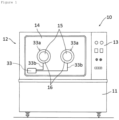
- FIG. 1 is a front elevational view showing an isolator including a glove/logging system according to the first embodiment.
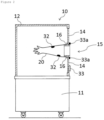
- FIG. 2 is a cross-sectional left lateral view of the isolator.
- an isolator 10 is composed of a frame 11 placed on the floor of a clean room (not shown), a chamber 12 placed on the frame 11, and a control panel 13 joined at a wall portion on the right side of the chamber 12 (see FIG. 1 ).
- the chamber 12 is composed of a housing made of stainless steel airtightly shielded from an external environment, including a filter unit for air suction and discharge (not shown) and a blower (not shown) for discharging the air inside the chamber 12 to the outside after filtering the same in a filter unit.
- the chamber 12 is provided at a wall portion on the front side with a clear glass window 14 allowing for visual confirmation inside the chamber (see FIG. 1 ).
- the glass window 14 includes 2 circular operation openings 15 for connecting the outside and the inside of the chamber 12.
- a glove port (attaching frame) 16 for airtightly attaching a work glove and a work glove 20 made of a synthetic resin (see FIG. 2 ) attached to the glove port 16.
- FIG. 2 expediently shows the work glove 20 in a horizontal and enlarged manner.
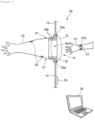
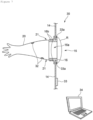
- FIG. 3 is a block diagram of the glove/logging system according to the first embodiment showing the state of non-communication.
- FIG. 3 is a cross-sectional view showing that the work glove 20 is attached to the glove port 16 attached to the operation opening 15 of the glass window 14 of the isolator 10. Specifically, the glove port 16 is inserted into the operation opening 15 and fixed to the glass window 14, and an insertion portion 16a for a worker to insert an arm is formed on the inner periphery of the glove port 16.
- a base end portion (upper arm portion) 21 of the work glove 20 attached to the glove port 16 is fixed to the outer periphery on the inner side (left side in the figure) of the chamber 12 of the glove port 16 by 2 O-rings 16b.
- FIG. 3 shows the glove/logging system 30 included in the isolator 10.
- the glove/logging system 30 is composed of a wristband (operator tag) 31, a glove tag 32, a reader 33 for reading information from each of the tangs, and a personal computer 34 as an information device.
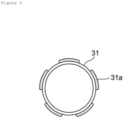
- the wristband 31 includes a plurality of RFID (radio frequency identification) chips 31a on the outer periphery.
- RFID radio frequency identification
- 5 RFID chips are equally spaced on the outer periphery of the wristband 31 (see FIGS. 4 and 5 ). The reason that a plurality of RFID chips is equally spaced on the outer periphery of the wristband 31 will be described later.
- the wristband 31 is attached to a wrist A1 of a worker A (not shown) (see FIGS. 3 and 4 ). To right and left wrists of the worker attached different wristbands 31 as operator tags to write information such that right and left hands of the worker A are identified. The details of writing information in the wristband will be described later.
- the glove tag 32 includes a RFID chip in which information for identifying the attached work glove 20 is written.
- the glove tag 32 is attached to a portion on the inside where an arm of the work glove 20 is inserted, but a portion not on the outside where the arm is exposed to the chamber 12. This is because that an attaching portion of the glove tag 32 is configured not to affect the sterile condition maintained inside the chamber 12.
- 2 glove tags 32 are attached to 2 portions (see FIG. 3 ).
- One tag 32 is attached around a base end portion (upper arm portion) 21 of the work glove 20 and to a lower portion thereof.
- the other tag 32 is attached around the center of an arm portion of the work glove 20 and to an upper portion thereof. The reason that the glove tags 32 are attached at these positions will be described later.
- the reader 33 is placed outside the glass window 14 of the isolator 10 and at a position on the lower left side (see FIG. 1 ).
- the reader 33 is provided inside with an antenna switching substrate, a reader substrate, an interface substrate, a conversion connector, a Wi-Fi conversion adapter, and a mobile battery.
- the reader 33 has a reader-and-writer function (for both of reading/writing) as required.
- the reader 33 includes 2 loop antennas 33a for receiving information written on each of the RFID chips of the wristband 31 and the glove tag 32.
- the 2 loop antennas 33a are fixed on the outer periphery of the right and left glove ports 16 (see FIGS. 1 and 2 ).
- the 2 loop antennas 33a are each connected to the reader 33 by wires 33b (see FIG. 1 ).
- a reception region R of each of the loop antennas 33a is exclusively near the operation opening 15 of the glove port, mainly near the insertion portion 16a for a worker to insert the arm.
- the size of the reception region R of the loop antenna 33a and the receiving sensitivity of the reader 33 will be described later.
- the personal computer 34 (hereinafter referred to as "PC 34") is configured to communicate with the reader 33 by wireless LAN and receive information from each of the RFID chips read by the reader 33. If the reader 33 has a reader-and-writer function, the PC 34 writes information on each of the RFID chips via the reader 33.
- To the PC 34 are inputted beforehand information for identifying the isolator 10, information for identifying the glove tag 32 attached to the right and left work gloves 20, information for identifying each of the workers, information for identifying the right and left wristbands 31 of each of the workers, and information for identifying the state of working of each of the workers.
- the PC 34 includes a calculation software for accumulating workers and working time, recording the details of work, and recording and storing accumulated working time for an individual work glove 20 from such information.
- the isolator 10 includes the chamber 12 under a sterile condition of grade A, and is placed on the floor of a clean room (not shown) (see FIGS. 1 and 2 ).
- the basic configuration of the glove/logging system 30 is described as above.
- the worker A working inside the clean room attaches wristbands 31 to right and left wrists. Subsequently, the worker A allows the reader 33 to read information on the right and left wristbands 31, and the PC 34 to input its ID and password. In this case, the PC 34 in communication with the reader 33 collates the inputted ID and password and stored information to identify the worker A and the right and left arms. Instead of checking the worker A and the right and left wristbands 31, the information on the worker A as an operator and the right and left arms may be inputted to the right and left wristband 31 at this stage by using the reader 33 including a reader-and-writer function (for both of reading/writing).
- FIG. 3 is a block diagram of the glove/logging system 30 as described above showing the state of non-communication.
- the right and left wristbands 31 of the worker A are outside the reception region R of the loop antenna 33a included in the reader 33. Accordingly, the reader 33 neither detects the wristband 31 nor reads the information.
- FIG. 6 is a block diagram of the glove/logging system showing the state of communication.
- the right and left wristbands 31 of the worker A are inside the reception region R of the loop antenna 33a included in the reader 33. Accordingly, the reader 33 can detect the wristband 31 and read the information.
- the information on the wristband 31 read by the reader 33 is transmitted to the PC 34.
- the PC 34 is set beforehand so as to give an alarm to prevent false work.
- the size of the reception region R of the loop antenna 33a and the receiving sensitivity of the reader 33 will be described.
- the receiving sensitivity of the reader 33 is made higher and the reception region R of the loop antenna 33a is set wider. Even if the receiving sensitivity of the reader 33 is set lower to some extent, the reception regions R of right and left glove ports 16 are considerably overlapped, thereby falsely confirming arm's insertion into either right or left glove port 16.
- the receiving sensitivity of the reader 33 is made as low as possible to limit the reception region R of the loop antenna 33a primarily at or around the insertion portion 16a of the glove port 16.
- the reason that a plurality of RFID chips is equally spaced on the outer periphery of the wristband 31 will be described.
- the reception region R of the loop antenna 33a is limited around the insertion portion 16a to make the receiving sensitivity of the reader 33 considerably low.
- too low receiving sensitivity of the reader 33 may allow the reader 33 to fail to detect the wristband 31 inserted into the left glove port 16.
- the loop antenna 33a may not receive information from RFID chips 31a of the wristband 31. In this case, it is not possible to accurately record the state of the worker A's working.
- the loop antenna 33a of the right glove port 16 into which the left arm is not inserted detects one RFID chip 31a of the wristband 31 on the left wrist. From these results, the PC 34 in communication with the reader 33 can properly judge that the left arm is inserted into the left glove port 16.
- the receiving sensitivity of the reader 33 is made as low as possible to limit the reception region R of the loop antenna 33a primarily around the insertion portion 16a of the glove port 16.
- this measure is extremely difficult to take, and the reader 33 can falsely detect other wristbands on non-workers.
- the PC 34 is programed to regard the detection as irrelevant noise.
- the PC 34 can record and store the time for the worker A to insert both of the right and left arms or either arm into the glove port 16 and then start working at the isolator 10. Similarly, the PC 34 can record and store the time for the worker A to remove both of the right and left arms or either arm from the glove port 16 and then finish working at the isolator 10. From these records, information such as worker A's working time and the accumulated working time can be recorded and stored. In addition, criteria for judging whether the work has been completed properly and smoothly or not can be provided by collating the details of work and the previous record of the worker A. Further, the accumulated working time (accumulated operating time) by a plurality of workers for each of the work gloves 20 attached to the right and left glove ports 16 can be determined.
- FIG. 7 is a block diagram of a glove/logging system at a position of a work glove that is working showing the state of non-communication.
- an arm of the worker A is not illustrated.
- the work glove 20 is inserted into the inside of the chamber 12, and 2 glove tags 32 are outside the reception region R of the loop antenna 33a included in the reader 33.
- the reader 33 neither detects the glove tag 32 nor reads the information.
- This state is judged as that the work glove 20 is used during work.
- the reader 33 can detect the glove tag 32.
- the PC 34 is programed not to falsely confirm that the state is not during work.
- FIG. 8 is a block diagram of a glove/logging system at a position of a work glove that is not working showing the state of communication.
- the work glove 20 is taken out of the chamber 12, and 2 glove tags 32 are inside the reception region R of the loop antenna 33a included in the reader 33.
- the reader 33 can detect the glove tag 32 and read the information.
- the reader 33 transmits the information on the glove tag 32 read to the PC 34. This state is properly judged as that the work glove 20 is not working.
- one glove tag is attached around the base end portion (upper arm portion) 21 of the work glove 20 and on the lower side as described above.
- the other one glove tag is attached around the center of an arm portion of the work glove 20 and on the upper side. Whether the work glove 20 is working or not can more properly be judged by attaching glove tags 32 at 2 locations. In this way, the accumulated working time (accumulated operating time) of each of the work gloves 20 can be determined. A comparison of the results collected from the glove tag 32 and the results collected from the above wristband 31 can more accurately determine each of the details of work and the state of each of the work gloves 20.
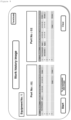
- FIG. 9 is a display screen of a monitor of the glove/logging system, and a sample work history image.
- FIG. 9 clearly shows the name of each worker, work start time, work termination time, and working time for port No: 1 (left glove port) and port No: 2 (right glove port) of equipment No: 1 (isolator).
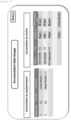
- FIG. 10 is a display screen of a monitor of the glove/logging system, and a sample accumulated data image.
- FIG. 10 clearly shows the accumulated working time for port No: 1 (left glove port) and port No: 2 (right glove port) of equipment No: 1 (isolator) for accumulation by equipment/port.
- FIG. 10 clearly shows the working time of right and left arms for each worker for accumulation by worker.
- the isolator 10 includes a chamber 12 under a sterile condition of grade A, and is placed on the floor of a clean room (not shown) (see FIGS. 1 and 2 ).
- the basic configuration of the glove/logging system 30 is the same as in the above-described first embodiment, and the second embodiment includes additional components.
- a second reader (not shown) including a reader-and-writer function (for both of reading/writing) is placed outside a door of the clean room.
- a worker A outside the clean room attaches individual wristbands 31 to right and left wrists. Subsequently, the worker A allows the second reader to read information on the right and left wristbands 31, and the PC 34 to input its ID and password. In this case, the PC 34 in communication with the second reader collates the inputted ID and password and the stored information to identify the worker A and the right and left arms. Instead of checking the worker A and the right and left wristbands 31, the information on the worker A as an operator and right and left arms may be inputted to the right and left wristbands 31 at this stage.
- the door of the clean room will be opened and the time for the worker A to enter the room will be recorded in the PC 34 by checking the worker A and the right and left wristbands 31.
- the worker A performs the same operation as he/she leaves the room, the time for the worker A to leave the clean room and the duration to stay there will be recorded in the PC 34.
- the worker A who has entered the clean room starts working at the isolator 10.
- the operation from the start to finish of the work at the isolator 10 in the second embodiment is the same as in the above-described first embodiment, and it is not described herein.
- the present invention can provide a glove/logging system capable of accurately determining periods for glove airtightness inspection and replacement and improving the safety of a work glove in use and the work efficiency by recording and storing the status of use such as the operator name, the frequency of use, the period of use, and the details of work for an individual pair of work gloves attached to a device such as an isolator, and retroactively checking improper work and device abnormalities by tracing glove operations upon occurrence of operational abnormalities.
Landscapes
- Engineering & Computer Science (AREA)
- Physics & Mathematics (AREA)
- Business, Economics & Management (AREA)
- General Physics & Mathematics (AREA)
- Theoretical Computer Science (AREA)
- Health & Medical Sciences (AREA)
- Human Resources & Organizations (AREA)
- Economics (AREA)
- Strategic Management (AREA)
- Toxicology (AREA)
- General Health & Medical Sciences (AREA)
- General Business, Economics & Management (AREA)
- Tourism & Hospitality (AREA)
- Marketing (AREA)
- Entrepreneurship & Innovation (AREA)
- Computer Vision & Pattern Recognition (AREA)
- Electromagnetism (AREA)
- Artificial Intelligence (AREA)
- Operations Research (AREA)
- Quality & Reliability (AREA)
- Computer Networks & Wireless Communication (AREA)
- Primary Health Care (AREA)
- Manufacturing & Machinery (AREA)
- Development Economics (AREA)
- Computer Hardware Design (AREA)
- Microelectronics & Electronic Packaging (AREA)
- Data Mining & Analysis (AREA)
- Educational Administration (AREA)
- Game Theory and Decision Science (AREA)
- Robotics (AREA)
- Mechanical Engineering (AREA)
- Gloves (AREA)
- Management, Administration, Business Operations System, And Electronic Commerce (AREA)
- Manipulator (AREA)
Claims (3)
- Système d'enregistrement (30) permettant d'enregistrer des informations sur l'état d'utilisation d'un gant de travail (20) fixé à un dispositif tel qu'un isolateur (10) placé à l'intérieur d'une salle blanche, le système comprenant :une étiquette d'opérateur comprenant une ou plusieurs puces RFID (31a) fixées à chaque travailleur travaillant sur le dispositif;une étiquette de gant (32) comprenant une ou plusieurs puces RFID (31a) fixées au gant de travail (20) fixé au dispositif ;un lecteur et encodeur RFID (33) comprenant une antenne pour lire des informations provenant de ces étiquettes ; etun ordinateur personnel (34) pour enregistrer des informations en communiquant les informations avec le lecteur et encodeur RFID (33), dans lequell'antenne est configurée pour définir une ouverture d'un port de gant (16) permettant de fixer le gant de travail (20) au dispositif comme une région de réception principale (R), etle lecteur et encodeur RFID (33) est configuré pour recevoir des informations par l'intermédiaire de l'antenne à partir de l'étiquette d'opérateur ou de l'étiquette de gant pour communiquer les informations avec l'ordinateur personnel (34), les informations sont reçues par l'intermédiaire de l'antenne lorsque l'étiquette d'opérateur ou l'étiquette de gant (32) traverse la région de réception (R) ou s'y arrête ;l'étiquette de gant (32) du gant de travail (20) est positionnée à l'extérieur de la région de réception (R) pendant qu'un travailleur travaille avec le gant de travail (20) inséré à l'intérieur du dispositif, etl'étiquette de gant (32) du gant de travail (20) est fixée de manière à s'arrêter à l'intérieur de la région de réception (R) lorsqu'un travailleur ne travaille pas et que le gant de travail (20) est retiré du dispositif.
- Système d'enregistrement (30) selon la revendication 1, dans lequel
l'étiquette d'opérateur comprend une ou plusieurs puces RFID (31a), chacune fixée aux poignets droit et gauche de chaque travailleur, de sorte que l'étiquette d'opérateur passe par l'intérieur de la région de réception (R) lorsqu'un travailleur insère un bras dans le gant de travail (20) ou retire le bras du gant de travail (20). - Système d'enregistrement (30) selon l'une quelconque des revendications 1 ou 2, comprenantun second lecteur et encodeur RFID (33) en plus du lecteur et encodeur RFID (33) pour communiquer des informations avec l'ordinateur personnel (34), dans lequell'étiquette d'opérateur est configurée pour communiquer des informations à l'ordinateur personnel (34) par l'intermédiaire du lecteur et encodeur RFID (33) ou du second lecteur et encodeur RFID (33) lorsque l'étiquette d'opérateur traverse la région de réception ou s'y arrête.
Applications Claiming Priority (2)
| Application Number | Priority Date | Filing Date | Title |
|---|---|---|---|
| JP2017123879A JP6886697B2 (ja) | 2017-06-26 | 2017-06-26 | グローブ・ロギングシステム |
| PCT/JP2018/022234 WO2019003886A1 (fr) | 2017-06-26 | 2018-06-11 | Système de gant/enregistrement |
Publications (3)
| Publication Number | Publication Date |
|---|---|
| EP3648047A1 EP3648047A1 (fr) | 2020-05-06 |
| EP3648047A4 EP3648047A4 (fr) | 2021-04-14 |
| EP3648047B1 true EP3648047B1 (fr) | 2024-02-21 |
Family
ID=64743020
Family Applications (1)
| Application Number | Title | Priority Date | Filing Date |
|---|---|---|---|
| EP18823032.0A Active EP3648047B1 (fr) | 2017-06-26 | 2018-06-11 | Système de gant/enregistrement |
Country Status (6)
| Country | Link |
|---|---|
| US (1) | US11900205B2 (fr) |
| EP (1) | EP3648047B1 (fr) |
| JP (1) | JP6886697B2 (fr) |
| KR (1) | KR102488977B1 (fr) |
| CN (1) | CN110800015B (fr) |
| WO (1) | WO2019003886A1 (fr) |
Cited By (1)
| Publication number | Priority date | Publication date | Assignee | Title |
|---|---|---|---|---|
| WO2026046503A1 (fr) * | 2024-08-27 | 2026-03-05 | Skan Ag | Dispositif de surveillance pour une manipulation dans un environnement commandé |
Families Citing this family (11)
| Publication number | Priority date | Publication date | Assignee | Title |
|---|---|---|---|---|
| DK3771525T5 (da) * | 2019-07-30 | 2023-01-16 | Skan Ag | Anordning til beskyttelse mod uautoriseret indgreb med en arbejdshandske i en indeslutning |
| WO2021161956A1 (fr) | 2020-02-13 | 2021-08-19 | 株式会社エアレックス | Système de journalisation totale |
| CN113684444B (zh) * | 2021-08-06 | 2023-08-04 | 昆山国显光电有限公司 | 支撑条及张网方法 |
| CN114330384B (zh) * | 2021-11-24 | 2024-06-25 | 南京邮电大学 | 一种基于无源rfid相位信息的手臂运动轨迹追踪方法 |
| CN118525310A (zh) * | 2021-12-06 | 2024-08-20 | 费森尤斯卡比奥地利有限公司 | 用于监控关键制药操作的系统和方法 |
| KR20240017224A (ko) | 2022-07-28 | 2024-02-07 | 삼성중공업 주식회사 | 전기 추진 선박 |
| KR20240017207A (ko) | 2022-07-28 | 2024-02-07 | 삼성중공업 주식회사 | 전기 추진 선박 |
| KR20240040253A (ko) | 2022-09-21 | 2024-03-28 | 삼성중공업 주식회사 | 동력 발생 시스템 및 이를 포함하는 전기 추진 선박 |
| KR20240041072A (ko) | 2022-09-22 | 2024-03-29 | 삼성중공업 주식회사 | 전기 추진 선박 |
| FR3147967A1 (fr) * | 2023-04-20 | 2024-10-25 | Piercan | Procede de gestion d’un gant |
| JP7766838B1 (ja) * | 2025-08-17 | 2025-11-10 | 紘一 口野 | Nfcスマートペット首輪 |
Family Cites Families (15)
| Publication number | Priority date | Publication date | Assignee | Title |
|---|---|---|---|---|
| JP4685260B2 (ja) | 2001-03-19 | 2011-05-18 | 株式会社エアレックス | 陰圧式グローブ気密性検査装置及びその検査方法 |
| JP2006043569A (ja) * | 2004-08-03 | 2006-02-16 | Fuji Electric Systems Co Ltd | アイソレータ管理システム、その方法、プログラム |
| US7819934B2 (en) * | 2006-07-14 | 2010-10-26 | Xcellerex, Inc. | Environmental containment systems |
| JP5209354B2 (ja) * | 2008-03-24 | 2013-06-12 | パナソニックヘルスケア株式会社 | アイソレータ |
| CN102065909B (zh) * | 2008-08-20 | 2014-01-29 | 松下健康医疗器械株式会社 | 隔离器 |
| US9563835B2 (en) * | 2010-09-01 | 2017-02-07 | Quake Global, Inc. | Methods and apparatus for automatic identification wristband |
| FR2984791B1 (fr) * | 2011-12-23 | 2014-02-21 | Getinge La Calhene | Installation comportant une boite a gants et un dispositif de changement de gant integrant un suivi du changement des gants |
| DE202012010698U1 (de) * | 2012-11-09 | 2012-11-27 | Jung-Gummitechnik Gmbh | Dreifinger-Glovebox-Handschuh |
| WO2014141664A1 (fr) * | 2013-03-10 | 2014-09-18 | 国立大学法人名古屋大学 | Procédé de gravure et appareil de gravure |
| US9811955B2 (en) * | 2014-06-25 | 2017-11-07 | Amazon Technologies, Inc. | Wearable RFID devices with manually activated RFID tags |
| US9514342B1 (en) * | 2015-06-18 | 2016-12-06 | Tyco Fire & Security Gmbh | Wearable radio frequency identification enabled devices |
| US11048891B1 (en) * | 2015-12-30 | 2021-06-29 | Palo Alto Research Center Incorporated | Computer-implemented system and method for tracking and authenticating interactions |
| CN109219856A (zh) * | 2016-03-24 | 2019-01-15 | 宝利根 T·R 有限公司 | 用于人类及机器人协作的系统及方法 |
| CA3053281A1 (fr) * | 2017-02-21 | 2018-08-30 | Centre For Commercialization Of Regenerative Medicine | Procede et systeme de surveillance et d'enregistrement electroniques d'un processus dans un espace a empoussierement controle |
| WO2018187557A1 (fr) * | 2017-04-05 | 2018-10-11 | Microsensor Labs, LLC | Système et procédé de détection de proximité de parties mobiles dans des locaux |
-
2017
- 2017-06-26 JP JP2017123879A patent/JP6886697B2/ja active Active
-
2018
- 2018-06-11 KR KR1020207001298A patent/KR102488977B1/ko active Active
- 2018-06-11 CN CN201880042691.8A patent/CN110800015B/zh active Active
- 2018-06-11 US US16/624,085 patent/US11900205B2/en active Active
- 2018-06-11 EP EP18823032.0A patent/EP3648047B1/fr active Active
- 2018-06-11 WO PCT/JP2018/022234 patent/WO2019003886A1/fr not_active Ceased
Cited By (1)
| Publication number | Priority date | Publication date | Assignee | Title |
|---|---|---|---|---|
| WO2026046503A1 (fr) * | 2024-08-27 | 2026-03-05 | Skan Ag | Dispositif de surveillance pour une manipulation dans un environnement commandé |
Also Published As
| Publication number | Publication date |
|---|---|
| US20230229877A1 (en) | 2023-07-20 |
| JP6886697B2 (ja) | 2021-06-16 |
| US11900205B2 (en) | 2024-02-13 |
| CN110800015A (zh) | 2020-02-14 |
| WO2019003886A1 (fr) | 2019-01-03 |
| EP3648047A4 (fr) | 2021-04-14 |
| EP3648047A1 (fr) | 2020-05-06 |
| CN110800015B (zh) | 2022-11-15 |
| JP2019008565A (ja) | 2019-01-17 |
| KR102488977B1 (ko) | 2023-01-13 |
| KR20200023373A (ko) | 2020-03-04 |
Similar Documents
| Publication | Publication Date | Title |
|---|---|---|
| EP3648047B1 (fr) | Système de gant/enregistrement | |
| US10417896B2 (en) | System and method for monitoring procedure compliance | |
| Njoroge et al. | Risk management in the clinical laboratory | |
| ES2761223T3 (es) | Sistema de análisis utilizado en una operación de inspección de mantenimiento | |
| CN104519824B (zh) | 用于同时识别多个外科器械的装置和方法 | |
| KR20180023665A (ko) | 공기질 정보 제공 시스템 | |
| JP2010233478A (ja) | 細胞処理施設における安全管理システム | |
| US20250037408A1 (en) | System and Method for Monitoring Critical Pharmaceutical Operations | |
| EP3693875B1 (fr) | Dispositif de traitement de produit alimentaire, système de gestion de dispositif de traitement de produit alimentaire et procédé de gestion de dispositif de traitement de produit alimentaire | |
| JP7671480B2 (ja) | トータル・ロギングシステム | |
| KR20240127134A (ko) | 스마트 안전관리 시스템 | |
| CN105283769B (zh) | 分析系统的试剂盒的识别和监测的设备和方法 | |
| CN112334930A (zh) | 一种样本检测信息管理方法以及样本检测设备 | |
| US20110000282A1 (en) | Passive glovebox glove leak detector | |
| JP2014083272A (ja) | 薬品製造システム | |
| KR20210058457A (ko) | 머신비전 장치 | |
| US20110100095A1 (en) | Passive Glovebox Glove Leak Detector | |
| JP6501476B2 (ja) | 無線タグを用いた採血管管理システム | |
| JP7504894B2 (ja) | 技術的機器に関する監査記録を提供するためのコンピュータ実装方法、システム、およびコンピュータプログラム | |
| JP3250222U (ja) | スマートフュームフード | |
| KR20230090677A (ko) | 밀폐공간 모니터링 시스템 및 그 방법 | |
| Santosh et al. | Advancing Cleanroom Contamination Control Strategies with Automation and AI: Current Status and Future perspectives in the Manufacturing of Parenterals. | |
| KR102958444B1 (ko) | 유해가스를 모니터링하는 공기질 모니터링 장치 | |
| US20260081011A1 (en) | Compliance monitoring system | |
| JP7092837B2 (ja) | 体外診断システムのための装置および作動方法 |
Legal Events
| Date | Code | Title | Description |
|---|---|---|---|
| STAA | Information on the status of an ep patent application or granted ep patent |
Free format text: STATUS: THE INTERNATIONAL PUBLICATION HAS BEEN MADE |
|
| PUAI | Public reference made under article 153(3) epc to a published international application that has entered the european phase |
Free format text: ORIGINAL CODE: 0009012 |
|
| STAA | Information on the status of an ep patent application or granted ep patent |
Free format text: STATUS: REQUEST FOR EXAMINATION WAS MADE |
|
| 17P | Request for examination filed |
Effective date: 20200116 |
|
| AK | Designated contracting states |
Kind code of ref document: A1 Designated state(s): AL AT BE BG CH CY CZ DE DK EE ES FI FR GB GR HR HU IE IS IT LI LT LU LV MC MK MT NL NO PL PT RO RS SE SI SK SM TR |
|
| AX | Request for extension of the european patent |
Extension state: BA ME |
|
| DAV | Request for validation of the european patent (deleted) | ||
| DAX | Request for extension of the european patent (deleted) | ||
| A4 | Supplementary search report drawn up and despatched |
Effective date: 20210312 |
|
| RIC1 | Information provided on ipc code assigned before grant |
Ipc: G06Q 10/08 20120101AFI20210305BHEP Ipc: G06Q 10/06 20120101ALI20210305BHEP Ipc: G06Q 10/10 20120101ALI20210305BHEP Ipc: G06Q 50/04 20120101ALI20210305BHEP Ipc: H01L 21/02 20060101ALI20210305BHEP Ipc: A41D 19/015 20060101ALI20210305BHEP Ipc: B25J 21/02 20060101ALI20210305BHEP |
|
| STAA | Information on the status of an ep patent application or granted ep patent |
Free format text: STATUS: EXAMINATION IS IN PROGRESS |
|
| 17Q | First examination report despatched |
Effective date: 20220923 |
|
| REG | Reference to a national code |
Ref country code: DE Ref legal event code: R079 Free format text: PREVIOUS MAIN CLASS: G06Q0050040000 Ipc: G06Q0010083300 Ref country code: DE Ref legal event code: R079 Ref document number: 602018065604 Country of ref document: DE Free format text: PREVIOUS MAIN CLASS: G06Q0050040000 Ipc: G06Q0010083300 |
|
| GRAP | Despatch of communication of intention to grant a patent |
Free format text: ORIGINAL CODE: EPIDOSNIGR1 |
|
| STAA | Information on the status of an ep patent application or granted ep patent |
Free format text: STATUS: GRANT OF PATENT IS INTENDED |
|
| RIC1 | Information provided on ipc code assigned before grant |
Ipc: B25J 21/02 20060101ALI20230906BHEP Ipc: G06Q 50/04 20120101ALI20230906BHEP Ipc: G06Q 10/10 20120101ALI20230906BHEP Ipc: G06Q 10/063 20230101ALI20230906BHEP Ipc: G06Q 10/0833 20230101AFI20230906BHEP |
|
| INTG | Intention to grant announced |
Effective date: 20230922 |
|
| GRAS | Grant fee paid |
Free format text: ORIGINAL CODE: EPIDOSNIGR3 |
|
| GRAA | (expected) grant |
Free format text: ORIGINAL CODE: 0009210 |
|
| STAA | Information on the status of an ep patent application or granted ep patent |
Free format text: STATUS: THE PATENT HAS BEEN GRANTED |
|
| AK | Designated contracting states |
Kind code of ref document: B1 Designated state(s): AL AT BE BG CH CY CZ DE DK EE ES FI FR GB GR HR HU IE IS IT LI LT LU LV MC MK MT NL NO PL PT RO RS SE SI SK SM TR |
|
| REG | Reference to a national code |
Ref country code: GB Ref legal event code: FG4D |
|
| REG | Reference to a national code |
Ref country code: CH Ref legal event code: EP |
|
| REG | Reference to a national code |
Ref country code: IE Ref legal event code: FG4D |
|
| REG | Reference to a national code |
Ref country code: DE Ref legal event code: R096 Ref document number: 602018065604 Country of ref document: DE |
|
| REG | Reference to a national code |
Ref country code: LT Ref legal event code: MG9D |
|
| REG | Reference to a national code |
Ref country code: NL Ref legal event code: MP Effective date: 20240221 |
|
| PG25 | Lapsed in a contracting state [announced via postgrant information from national office to epo] |
Ref country code: IS Free format text: LAPSE BECAUSE OF FAILURE TO SUBMIT A TRANSLATION OF THE DESCRIPTION OR TO PAY THE FEE WITHIN THE PRESCRIBED TIME-LIMIT Effective date: 20240621 |
|
| PG25 | Lapsed in a contracting state [announced via postgrant information from national office to epo] |
Ref country code: LT Free format text: LAPSE BECAUSE OF FAILURE TO SUBMIT A TRANSLATION OF THE DESCRIPTION OR TO PAY THE FEE WITHIN THE PRESCRIBED TIME-LIMIT Effective date: 20240221 |
|
| PG25 | Lapsed in a contracting state [announced via postgrant information from national office to epo] |
Ref country code: GR Free format text: LAPSE BECAUSE OF FAILURE TO SUBMIT A TRANSLATION OF THE DESCRIPTION OR TO PAY THE FEE WITHIN THE PRESCRIBED TIME-LIMIT Effective date: 20240522 |
|
| REG | Reference to a national code |
Ref country code: AT Ref legal event code: MK05 Ref document number: 1659747 Country of ref document: AT Kind code of ref document: T Effective date: 20240221 |
|
| PG25 | Lapsed in a contracting state [announced via postgrant information from national office to epo] |
Ref country code: RS Free format text: LAPSE BECAUSE OF FAILURE TO SUBMIT A TRANSLATION OF THE DESCRIPTION OR TO PAY THE FEE WITHIN THE PRESCRIBED TIME-LIMIT Effective date: 20240521 Ref country code: HR Free format text: LAPSE BECAUSE OF FAILURE TO SUBMIT A TRANSLATION OF THE DESCRIPTION OR TO PAY THE FEE WITHIN THE PRESCRIBED TIME-LIMIT Effective date: 20240221 Ref country code: NL Free format text: LAPSE BECAUSE OF FAILURE TO SUBMIT A TRANSLATION OF THE DESCRIPTION OR TO PAY THE FEE WITHIN THE PRESCRIBED TIME-LIMIT Effective date: 20240221 |
|
| PG25 | Lapsed in a contracting state [announced via postgrant information from national office to epo] |
Ref country code: ES Free format text: LAPSE BECAUSE OF FAILURE TO SUBMIT A TRANSLATION OF THE DESCRIPTION OR TO PAY THE FEE WITHIN THE PRESCRIBED TIME-LIMIT Effective date: 20240221 |
|
| PG25 | Lapsed in a contracting state [announced via postgrant information from national office to epo] |
Ref country code: AT Free format text: LAPSE BECAUSE OF FAILURE TO SUBMIT A TRANSLATION OF THE DESCRIPTION OR TO PAY THE FEE WITHIN THE PRESCRIBED TIME-LIMIT Effective date: 20240221 |
|
| PG25 | Lapsed in a contracting state [announced via postgrant information from national office to epo] |
Ref country code: RS Free format text: LAPSE BECAUSE OF FAILURE TO SUBMIT A TRANSLATION OF THE DESCRIPTION OR TO PAY THE FEE WITHIN THE PRESCRIBED TIME-LIMIT Effective date: 20240521 Ref country code: NO Free format text: LAPSE BECAUSE OF FAILURE TO SUBMIT A TRANSLATION OF THE DESCRIPTION OR TO PAY THE FEE WITHIN THE PRESCRIBED TIME-LIMIT Effective date: 20240521 Ref country code: NL Free format text: LAPSE BECAUSE OF FAILURE TO SUBMIT A TRANSLATION OF THE DESCRIPTION OR TO PAY THE FEE WITHIN THE PRESCRIBED TIME-LIMIT Effective date: 20240221 Ref country code: LT Free format text: LAPSE BECAUSE OF FAILURE TO SUBMIT A TRANSLATION OF THE DESCRIPTION OR TO PAY THE FEE WITHIN THE PRESCRIBED TIME-LIMIT Effective date: 20240221 Ref country code: IS Free format text: LAPSE BECAUSE OF FAILURE TO SUBMIT A TRANSLATION OF THE DESCRIPTION OR TO PAY THE FEE WITHIN THE PRESCRIBED TIME-LIMIT Effective date: 20240621 Ref country code: HR Free format text: LAPSE BECAUSE OF FAILURE TO SUBMIT A TRANSLATION OF THE DESCRIPTION OR TO PAY THE FEE WITHIN THE PRESCRIBED TIME-LIMIT Effective date: 20240221 Ref country code: GR Free format text: LAPSE BECAUSE OF FAILURE TO SUBMIT A TRANSLATION OF THE DESCRIPTION OR TO PAY THE FEE WITHIN THE PRESCRIBED TIME-LIMIT Effective date: 20240522 Ref country code: FI Free format text: LAPSE BECAUSE OF FAILURE TO SUBMIT A TRANSLATION OF THE DESCRIPTION OR TO PAY THE FEE WITHIN THE PRESCRIBED TIME-LIMIT Effective date: 20240221 Ref country code: ES Free format text: LAPSE BECAUSE OF FAILURE TO SUBMIT A TRANSLATION OF THE DESCRIPTION OR TO PAY THE FEE WITHIN THE PRESCRIBED TIME-LIMIT Effective date: 20240221 Ref country code: BG Free format text: LAPSE BECAUSE OF FAILURE TO SUBMIT A TRANSLATION OF THE DESCRIPTION OR TO PAY THE FEE WITHIN THE PRESCRIBED TIME-LIMIT Effective date: 20240221 Ref country code: AT Free format text: LAPSE BECAUSE OF FAILURE TO SUBMIT A TRANSLATION OF THE DESCRIPTION OR TO PAY THE FEE WITHIN THE PRESCRIBED TIME-LIMIT Effective date: 20240221 |
|
| PG25 | Lapsed in a contracting state [announced via postgrant information from national office to epo] |
Ref country code: PL Free format text: LAPSE BECAUSE OF FAILURE TO SUBMIT A TRANSLATION OF THE DESCRIPTION OR TO PAY THE FEE WITHIN THE PRESCRIBED TIME-LIMIT Effective date: 20240221 Ref country code: PT Free format text: LAPSE BECAUSE OF FAILURE TO SUBMIT A TRANSLATION OF THE DESCRIPTION OR TO PAY THE FEE WITHIN THE PRESCRIBED TIME-LIMIT Effective date: 20240621 |
|
| PG25 | Lapsed in a contracting state [announced via postgrant information from national office to epo] |
Ref country code: SE Free format text: LAPSE BECAUSE OF FAILURE TO SUBMIT A TRANSLATION OF THE DESCRIPTION OR TO PAY THE FEE WITHIN THE PRESCRIBED TIME-LIMIT Effective date: 20240221 Ref country code: PT Free format text: LAPSE BECAUSE OF FAILURE TO SUBMIT A TRANSLATION OF THE DESCRIPTION OR TO PAY THE FEE WITHIN THE PRESCRIBED TIME-LIMIT Effective date: 20240621 Ref country code: PL Free format text: LAPSE BECAUSE OF FAILURE TO SUBMIT A TRANSLATION OF THE DESCRIPTION OR TO PAY THE FEE WITHIN THE PRESCRIBED TIME-LIMIT Effective date: 20240221 Ref country code: LV Free format text: LAPSE BECAUSE OF FAILURE TO SUBMIT A TRANSLATION OF THE DESCRIPTION OR TO PAY THE FEE WITHIN THE PRESCRIBED TIME-LIMIT Effective date: 20240221 |
|
| PG25 | Lapsed in a contracting state [announced via postgrant information from national office to epo] |
Ref country code: DK Free format text: LAPSE BECAUSE OF FAILURE TO SUBMIT A TRANSLATION OF THE DESCRIPTION OR TO PAY THE FEE WITHIN THE PRESCRIBED TIME-LIMIT Effective date: 20240221 |
|
| PG25 | Lapsed in a contracting state [announced via postgrant information from national office to epo] |
Ref country code: SM Free format text: LAPSE BECAUSE OF FAILURE TO SUBMIT A TRANSLATION OF THE DESCRIPTION OR TO PAY THE FEE WITHIN THE PRESCRIBED TIME-LIMIT Effective date: 20240221 |
|
| PG25 | Lapsed in a contracting state [announced via postgrant information from national office to epo] |
Ref country code: EE Free format text: LAPSE BECAUSE OF FAILURE TO SUBMIT A TRANSLATION OF THE DESCRIPTION OR TO PAY THE FEE WITHIN THE PRESCRIBED TIME-LIMIT Effective date: 20240221 Ref country code: CZ Free format text: LAPSE BECAUSE OF FAILURE TO SUBMIT A TRANSLATION OF THE DESCRIPTION OR TO PAY THE FEE WITHIN THE PRESCRIBED TIME-LIMIT Effective date: 20240221 |
|
| PG25 | Lapsed in a contracting state [announced via postgrant information from national office to epo] |
Ref country code: SK Free format text: LAPSE BECAUSE OF FAILURE TO SUBMIT A TRANSLATION OF THE DESCRIPTION OR TO PAY THE FEE WITHIN THE PRESCRIBED TIME-LIMIT Effective date: 20240221 |
|
| PG25 | Lapsed in a contracting state [announced via postgrant information from national office to epo] |
Ref country code: SM Free format text: LAPSE BECAUSE OF FAILURE TO SUBMIT A TRANSLATION OF THE DESCRIPTION OR TO PAY THE FEE WITHIN THE PRESCRIBED TIME-LIMIT Effective date: 20240221 Ref country code: SK Free format text: LAPSE BECAUSE OF FAILURE TO SUBMIT A TRANSLATION OF THE DESCRIPTION OR TO PAY THE FEE WITHIN THE PRESCRIBED TIME-LIMIT Effective date: 20240221 Ref country code: RO Free format text: LAPSE BECAUSE OF FAILURE TO SUBMIT A TRANSLATION OF THE DESCRIPTION OR TO PAY THE FEE WITHIN THE PRESCRIBED TIME-LIMIT Effective date: 20240221 Ref country code: EE Free format text: LAPSE BECAUSE OF FAILURE TO SUBMIT A TRANSLATION OF THE DESCRIPTION OR TO PAY THE FEE WITHIN THE PRESCRIBED TIME-LIMIT Effective date: 20240221 Ref country code: DK Free format text: LAPSE BECAUSE OF FAILURE TO SUBMIT A TRANSLATION OF THE DESCRIPTION OR TO PAY THE FEE WITHIN THE PRESCRIBED TIME-LIMIT Effective date: 20240221 Ref country code: CZ Free format text: LAPSE BECAUSE OF FAILURE TO SUBMIT A TRANSLATION OF THE DESCRIPTION OR TO PAY THE FEE WITHIN THE PRESCRIBED TIME-LIMIT Effective date: 20240221 |
|
| REG | Reference to a national code |
Ref country code: DE Ref legal event code: R097 Ref document number: 602018065604 Country of ref document: DE |
|
| PG25 | Lapsed in a contracting state [announced via postgrant information from national office to epo] |
Ref country code: IT Free format text: LAPSE BECAUSE OF FAILURE TO SUBMIT A TRANSLATION OF THE DESCRIPTION OR TO PAY THE FEE WITHIN THE PRESCRIBED TIME-LIMIT Effective date: 20240221 |
|
| PLBE | No opposition filed within time limit |
Free format text: ORIGINAL CODE: 0009261 |
|
| STAA | Information on the status of an ep patent application or granted ep patent |
Free format text: STATUS: NO OPPOSITION FILED WITHIN TIME LIMIT |
|
| PG25 | Lapsed in a contracting state [announced via postgrant information from national office to epo] |
Ref country code: IT Free format text: LAPSE BECAUSE OF FAILURE TO SUBMIT A TRANSLATION OF THE DESCRIPTION OR TO PAY THE FEE WITHIN THE PRESCRIBED TIME-LIMIT Effective date: 20240221 |
|
| 26N | No opposition filed |
Effective date: 20241122 |
|
| PG25 | Lapsed in a contracting state [announced via postgrant information from national office to epo] |
Ref country code: MC Free format text: LAPSE BECAUSE OF FAILURE TO SUBMIT A TRANSLATION OF THE DESCRIPTION OR TO PAY THE FEE WITHIN THE PRESCRIBED TIME-LIMIT Effective date: 20240221 |
|
| PG25 | Lapsed in a contracting state [announced via postgrant information from national office to epo] |
Ref country code: LU Free format text: LAPSE BECAUSE OF NON-PAYMENT OF DUE FEES Effective date: 20240611 |
|
| GBPC | Gb: european patent ceased through non-payment of renewal fee |
Effective date: 20240611 |
|
| PG25 | Lapsed in a contracting state [announced via postgrant information from national office to epo] |
Ref country code: IE Free format text: LAPSE BECAUSE OF NON-PAYMENT OF DUE FEES Effective date: 20240611 |
|
| PG25 | Lapsed in a contracting state [announced via postgrant information from national office to epo] |
Ref country code: BE Free format text: LAPSE BECAUSE OF NON-PAYMENT OF DUE FEES Effective date: 20240630 Ref country code: SI Free format text: LAPSE BECAUSE OF FAILURE TO SUBMIT A TRANSLATION OF THE DESCRIPTION OR TO PAY THE FEE WITHIN THE PRESCRIBED TIME-LIMIT Effective date: 20240221 |
|
| PG25 | Lapsed in a contracting state [announced via postgrant information from national office to epo] |
Ref country code: FR Free format text: LAPSE BECAUSE OF NON-PAYMENT OF DUE FEES Effective date: 20240630 |
|
| PG25 | Lapsed in a contracting state [announced via postgrant information from national office to epo] |
Ref country code: GB Free format text: LAPSE BECAUSE OF NON-PAYMENT OF DUE FEES Effective date: 20240611 |
|
| REG | Reference to a national code |
Ref country code: BE Ref legal event code: MM Effective date: 20240630 |
|
| PGFP | Annual fee paid to national office [announced via postgrant information from national office to epo] |
Ref country code: DE Payment date: 20250626 Year of fee payment: 8 |
|
| PGFP | Annual fee paid to national office [announced via postgrant information from national office to epo] |
Ref country code: CH Payment date: 20250701 Year of fee payment: 8 |
|
| PG25 | Lapsed in a contracting state [announced via postgrant information from national office to epo] |
Ref country code: CY Free format text: LAPSE BECAUSE OF FAILURE TO SUBMIT A TRANSLATION OF THE DESCRIPTION OR TO PAY THE FEE WITHIN THE PRESCRIBED TIME-LIMIT; INVALID AB INITIO Effective date: 20180611 |
|
| PG25 | Lapsed in a contracting state [announced via postgrant information from national office to epo] |
Ref country code: HU Free format text: LAPSE BECAUSE OF FAILURE TO SUBMIT A TRANSLATION OF THE DESCRIPTION OR TO PAY THE FEE WITHIN THE PRESCRIBED TIME-LIMIT; INVALID AB INITIO Effective date: 20180611 |