EP3648200A2 - Procédé pour prédire l'aptitude au traitement d'une suspension d'électrode et sélectionner un liant d'électrode - Google Patents
Procédé pour prédire l'aptitude au traitement d'une suspension d'électrode et sélectionner un liant d'électrode Download PDFInfo
- Publication number
- EP3648200A2 EP3648200A2 EP18861548.8A EP18861548A EP3648200A2 EP 3648200 A2 EP3648200 A2 EP 3648200A2 EP 18861548 A EP18861548 A EP 18861548A EP 3648200 A2 EP3648200 A2 EP 3648200A2
- Authority
- EP
- European Patent Office
- Prior art keywords
- active material
- binder
- slurry
- electrode active
- formula
- Prior art date
- Legal status (The legal status is an assumption and is not a legal conclusion. Google has not performed a legal analysis and makes no representation as to the accuracy of the status listed.)
- Pending
Links
Images

Classifications
-
- H—ELECTRICITY
- H01—ELECTRIC ELEMENTS
- H01M—PROCESSES OR MEANS, e.g. BATTERIES, FOR THE DIRECT CONVERSION OF CHEMICAL ENERGY INTO ELECTRICAL ENERGY
- H01M4/00—Electrodes
- H01M4/02—Electrodes composed of, or comprising, active material
- H01M4/04—Processes of manufacture in general
-
- H—ELECTRICITY
- H01—ELECTRIC ELEMENTS
- H01B—CABLES; CONDUCTORS; INSULATORS; SELECTION OF MATERIALS FOR THEIR CONDUCTIVE, INSULATING OR DIELECTRIC PROPERTIES
- H01B1/00—Conductors or conductive bodies characterised by the conductive materials; Selection of materials as conductors
- H01B1/20—Conductive material dispersed in non-conductive organic material
- H01B1/24—Conductive material dispersed in non-conductive organic material the conductive material comprising carbon-silicon compounds, carbon or silicon
-
- H—ELECTRICITY
- H01—ELECTRIC ELEMENTS
- H01M—PROCESSES OR MEANS, e.g. BATTERIES, FOR THE DIRECT CONVERSION OF CHEMICAL ENERGY INTO ELECTRICAL ENERGY
- H01M10/00—Secondary cells; Manufacture thereof
- H01M10/05—Accumulators with non-aqueous electrolyte
- H01M10/052—Li-accumulators
- H01M10/0525—Rocking-chair batteries, i.e. batteries with lithium insertion or intercalation in both electrodes; Lithium-ion batteries
-
- H—ELECTRICITY
- H01—ELECTRIC ELEMENTS
- H01M—PROCESSES OR MEANS, e.g. BATTERIES, FOR THE DIRECT CONVERSION OF CHEMICAL ENERGY INTO ELECTRICAL ENERGY
- H01M4/00—Electrodes
- H01M4/02—Electrodes composed of, or comprising, active material
- H01M4/13—Electrodes for accumulators with non-aqueous electrolyte, e.g. for lithium-accumulators; Processes of manufacture thereof
- H01M4/133—Electrodes based on carbonaceous material, e.g. graphite-intercalation compounds or CFx
-
- H—ELECTRICITY
- H01—ELECTRIC ELEMENTS
- H01M—PROCESSES OR MEANS, e.g. BATTERIES, FOR THE DIRECT CONVERSION OF CHEMICAL ENERGY INTO ELECTRICAL ENERGY
- H01M4/00—Electrodes
- H01M4/02—Electrodes composed of, or comprising, active material
- H01M4/13—Electrodes for accumulators with non-aqueous electrolyte, e.g. for lithium-accumulators; Processes of manufacture thereof
- H01M4/139—Processes of manufacture
-
- H—ELECTRICITY
- H01—ELECTRIC ELEMENTS
- H01M—PROCESSES OR MEANS, e.g. BATTERIES, FOR THE DIRECT CONVERSION OF CHEMICAL ENERGY INTO ELECTRICAL ENERGY
- H01M4/00—Electrodes
- H01M4/02—Electrodes composed of, or comprising, active material
- H01M4/13—Electrodes for accumulators with non-aqueous electrolyte, e.g. for lithium-accumulators; Processes of manufacture thereof
- H01M4/139—Processes of manufacture
- H01M4/1393—Processes of manufacture of electrodes based on carbonaceous material, e.g. graphite-intercalation compounds or CFx
-
- H—ELECTRICITY
- H01—ELECTRIC ELEMENTS
- H01M—PROCESSES OR MEANS, e.g. BATTERIES, FOR THE DIRECT CONVERSION OF CHEMICAL ENERGY INTO ELECTRICAL ENERGY
- H01M4/00—Electrodes
- H01M4/02—Electrodes composed of, or comprising, active material
- H01M4/36—Selection of substances as active materials, active masses, active liquids
- H01M4/362—Composites
- H01M4/364—Composites as mixtures
-
- H—ELECTRICITY
- H01—ELECTRIC ELEMENTS
- H01M—PROCESSES OR MEANS, e.g. BATTERIES, FOR THE DIRECT CONVERSION OF CHEMICAL ENERGY INTO ELECTRICAL ENERGY
- H01M4/00—Electrodes
- H01M4/02—Electrodes composed of, or comprising, active material
- H01M4/36—Selection of substances as active materials, active masses, active liquids
- H01M4/58—Selection of substances as active materials, active masses, active liquids of inorganic compounds other than oxides or hydroxides, e.g. sulfides, selenides, tellurides, halogenides or LiCoFy; of polyanionic structures, e.g. phosphates, silicates or borates
- H01M4/583—Carbonaceous material, e.g. graphite-intercalation compounds or CFx
- H01M4/587—Carbonaceous material, e.g. graphite-intercalation compounds or CFx for inserting or intercalating light metals
-
- H—ELECTRICITY
- H01—ELECTRIC ELEMENTS
- H01M—PROCESSES OR MEANS, e.g. BATTERIES, FOR THE DIRECT CONVERSION OF CHEMICAL ENERGY INTO ELECTRICAL ENERGY
- H01M4/00—Electrodes
- H01M4/02—Electrodes composed of, or comprising, active material
- H01M4/62—Selection of inactive substances as ingredients for active masses, e.g. binders, fillers
- H01M4/621—Binders
- H01M4/622—Binders being polymers
-
- H—ELECTRICITY
- H01—ELECTRIC ELEMENTS
- H01M—PROCESSES OR MEANS, e.g. BATTERIES, FOR THE DIRECT CONVERSION OF CHEMICAL ENERGY INTO ELECTRICAL ENERGY
- H01M4/00—Electrodes
- H01M4/02—Electrodes composed of, or comprising, active material
- H01M4/62—Selection of inactive substances as ingredients for active masses, e.g. binders, fillers
- H01M4/624—Electric conductive fillers
-
- G—PHYSICS
- G01—MEASURING; TESTING
- G01N—INVESTIGATING OR ANALYSING MATERIALS BY DETERMINING THEIR CHEMICAL OR PHYSICAL PROPERTIES
- G01N15/00—Investigating characteristics of particles; Investigating permeability, pore-volume or surface-area of porous materials
- G01N15/02—Investigating particle size or size distribution
-
- H—ELECTRICITY
- H01—ELECTRIC ELEMENTS
- H01M—PROCESSES OR MEANS, e.g. BATTERIES, FOR THE DIRECT CONVERSION OF CHEMICAL ENERGY INTO ELECTRICAL ENERGY
- H01M4/00—Electrodes
- H01M4/02—Electrodes composed of, or comprising, active material
- H01M2004/021—Physical characteristics, e.g. porosity, surface area
-
- H—ELECTRICITY
- H01—ELECTRIC ELEMENTS
- H01M—PROCESSES OR MEANS, e.g. BATTERIES, FOR THE DIRECT CONVERSION OF CHEMICAL ENERGY INTO ELECTRICAL ENERGY
- H01M4/00—Electrodes
- H01M4/02—Electrodes composed of, or comprising, active material
- H01M2004/026—Electrodes composed of, or comprising, active material characterised by the polarity
- H01M2004/027—Negative electrodes
-
- Y—GENERAL TAGGING OF NEW TECHNOLOGICAL DEVELOPMENTS; GENERAL TAGGING OF CROSS-SECTIONAL TECHNOLOGIES SPANNING OVER SEVERAL SECTIONS OF THE IPC; TECHNICAL SUBJECTS COVERED BY FORMER USPC CROSS-REFERENCE ART COLLECTIONS [XRACs] AND DIGESTS
- Y02—TECHNOLOGIES OR APPLICATIONS FOR MITIGATION OR ADAPTATION AGAINST CLIMATE CHANGE
- Y02E—REDUCTION OF GREENHOUSE GAS [GHG] EMISSIONS, RELATED TO ENERGY GENERATION, TRANSMISSION OR DISTRIBUTION
- Y02E60/00—Enabling technologies; Technologies with a potential or indirect contribution to GHG emissions mitigation
- Y02E60/10—Energy storage using batteries
Definitions
- the present application claims priority to Korean Patent Application No. 10-2017-0126526 filed on September 28, 2017 in the Republic of Korea, the disclosures of which are incorporated herein by reference.
- the present disclosure relates to a method for predicting process compatibility, such as a change in viscosity, of electrode slurry in the manufacture of an electrode for an electrochemical device and selecting a suitable type and content of binder.
- lithium secondary batteries having high energy density and operating voltage, long cycle life and a low self-discharge rate have been commercialized and used widely.
- Such lithium secondary batteries have been developed in a model capable of realizing high voltage and high capacity corresponding to the consumers' needs. To realize high capacity, it is required to optimize the four main elements of a lithium secondary battery, i.e., a positive electrode material, negative electrode material, separator and an electrolyte, in a limited space.
- the negative electrode includes a negative electrode mixture layer formed on at least one surface of a current collector, and the negative electrode mixture layer is prepared by applying and drying negative electrode slurry containing a negative electrode active material, binder polymer, conductive material and a dispersion medium.
- the binder polymer functions to fix the electrode active material stably in the electrode and to prevent detachment of particles.
- the binder polymer tends to increase the viscosity of electrode slurry or tends to be gelled with the lapse of time.
- filter blocking and an increase in viscosity occur during the manufacture and transport of negative electrode slurry. This may result in disposal or coating defects of the negative electrode slurry. Therefore, there is a need for a method for preparing negative electrode slurry for a secondary battery which undergoes a small change with the lapse of time.
- the present disclosure is directed to providing a method for predicting process compatibility, such as a change in viscosity and phase stability, of electrode slurry and selecting a suitable electrode slurry composition and binder ingredient and content, in the manufacture of an electrode for an electrochemical device.
- a method for selecting electrode slurry which can judge phase stability of electrode slurry.
- a method for selecting electrode slurry which includes determining particle size distribution of composite particles in a mixed sample containing a plurality of electrode active material particles, a polymer resin for a binder and a solvent, and comparing the particle size distribution with particle size distribution of the electrode active material particles to judge phase stability of electrode slurry.
- the method for selecting electrode slurry as defined in the first embodiment wherein the mixed sample includes an electrode active material, a polymer resin for a binder and a solvent, and the electrode active material is a carbonaceous material and the solvent is water.
- the method for selecting electrode slurry as defined in the first or the second embodiment wherein the mixed sample includes an electrode active material, a polymer resin for a binder and a solvent, and the binder is used in an amount of 0.05-0.3 parts by weight based on 1 part by weight of the electrode active material and the solvent is used in an amount of 8-15 parts by weight based on 1 part by weight of the electrode active material.
- the method for selecting electrode slurry as defined in any one of the first to the fifth embodiments wherein D 50 of the composite particles in the mixed sample is compared with D 50 of the negative electrode active material particles.
- the method for selecting electrode slurry as defined in any one of the first to the sixth embodiments which further includes comparing D 10 and/or D 90 of the composite particles in the sample with D 10 and/or D 90 of the negative electrode active material particles.
- the method for selecting electrode slurry as defined in any one of the first to the seventh embodiments wherein the binder introduced to the mixed sample is selected as a binder for preparing electrode slurry, when the condition of Formula 1 is satisfied: D 50 of composite particles ⁇ D 50 of negative electrode active material particles ⁇ A , wherein A is 0.001-10.0.
- each A independently represents 0.001-10.0.
- the method for selecting electrode slurry as defined in any one of the first to the ninth embodiments, wherein the binder introduced to the mixed sample is selected as a binder for preparing electrode slurry, when the condition of Formula 2 and the condition of Formula 3 are satisfied in addition to the condition of Formula 1: D 10 of composite particles ⁇ D 10 of negative electrode active material particles ⁇ A D 90 of composite particles ⁇ D 90 of negative electrode active material particles ⁇ A
- each A independently represents 1-3.
- the method for selecting electrode slurry as defined in any one of the first to the tenth embodiments wherein A ranges from 0.001-10.0 in Formula 1 to Formula 3, and A is determined considering at least one selected from the introduced materials, slurry concentration, processing time, transport distance of slurry, temperature of slurry, temperature condition of slurry storage place, humidity condition of slurry storage plate and slurry storage time.
- the present disclosure it is possible to predict phase stability of electrode slurry through a simple method of determining a change in viscosity of the electrode slurry. Therefore, only the electrode slurry having high phase stability is selected before electrode slurry is introduced to a process for manufacturing an electrode. Then, the selected electrode slurry is introduced to the process to provide an improved effect of process efficiency.
- the expression 'one portion is connected to another portion' covers not only 'a portion is directly connected to another portion' but also 'one portion is connected to another portion by way of the other element interposed between them.
- the terms 'approximately', 'substantially', or the like are used as meaning contiguous from or to the stated numerical value, when an acceptable preparation and material error unique to the stated meaning is suggested, and are used for the purpose of preventing an unconscientious invader from unduly using the stated disclosure including an accurate or absolute numerical value provided to help understanding of the present disclosure.
- any Markush-type expression means a combination or mixture of one or more elements selected from the group of elements disclosed in the Markush-type expression, and refers to the presence of one or more elements selected from the group.
- 'A and/or B' means 'A, B or both of them'.
- a method for selecting electrode slurry which includes determining a composition and preparation condition of electrode slurry causing no change in viscosity or gelling, and providing electrode slurry prepared with the composition under the preparation condition.
- the method according to the present disclosure relates to a method for selecting electrode slurry which includes predicting phase stability of electrode slurry through a simple process, and preliminarily determining ingredients, composition and preparation condition of electrode slurry suitable for introducing to an actual process for manufacturing an electrode.
- a method for selecting ingredients and/or contents of a binder for an electrode suitable for preparing electrode slurry may be carried out by preparing a mixed sample for a test containing an electrode active material and a binder, determining the particle size distribution of the composite particles contained in the sample, and comparing the particle size distribution with the particle size distribution of the electrode active material particles.
- the mixed sample may include an electrode active material and a binder. According to the present disclosure, it is possible to prepare electrode slurry having excellent process efficiency, based on the data of the type and content of a binder obtained from the above-mentioned method.
- a mixed sample for a test is prepared (S10).
- the mixed sample includes ingredients used for manufacturing an electrode for an electrochemical device.
- the mixed sample includes an electrode active material, a polymer resin for a binder and a solvent.
- the mixed sample may further include a conductive material.
- the mixed sample include, as an electrode active material, a negative electrode active material or a positive electrode active material.
- the negative electrode active material may be a carbonaceous material, wherein the mixed sample may be prepared in an aqueous base including water.
- the polymer resin for a binder may be a particle-shaped polymer.
- the mixed sample may include an electrode active material, conductive material, or the like, in an aqueous emulsion containing a particle-shaped polymer.
- the scope of the present disclosure is not limited to any specific ingredients contained in slurry. The ingredients are not particularly limited, as long as they are used for manufacturing an electrode for an electrochemical device.
- the aqueous emulsion covers any dispersion of particle-shaped polymer in an aqueous solvent, such as water.
- the ingredients such as an electrode active material, binder, conductive material, solvent, or the like may be selected from candidate groups for the ingredients to be used for preparing electrode slurry.
- the mixed sample is prepared in order to test the processability of the ingredients to be used for preparing electrode slurry, before preparing the slurry.
- the electrochemical device includes any types of devices carrying out electrochemical reactions.
- the electrochemical device include any types of primary batteries, secondary batteries, fuel cell, solar cells or capacitors.
- the secondary batteries lithium secondary batteries, including lithium metal secondary batteries, lithium ion secondary batteries, lithium polymer secondary batteries or lithium ion polymer secondary batteries, are preferred.
- the mixed sample may be prepared by agitation to carry out mixing of the ingredients contained in the sample.
- agitation rate, time, or the like are not particularly limited.
- various processing conditions, such as agitation rate or time, used for preparing each mixed sample may be recorded.
- the processing conditions applied to the preparation of the corresponding mixed sample may be applied to the preparation of electrode slurry so that they may be reproduced.
- agitation of the mixed sample may be carried out by agitation using a magnetic stick or mechanical agitation.
- the mixed sample may be prepared by introducing an electrode active material and a binder into a solvent.
- the binder may be used in an amount of 0.05-0.3 parts by weight based on 1 part by weight of the electrode active material
- the solvent may be used in an amount of 8-15 parts by weight based on 1 part by weight of the electrode active material.
- the particle size distribution of the composite particles in the mixed sample prepared in (S10) is determined (S20).
- the composite particles are formed by aggregation of solid contents in the ingredients introduced into the mixed sample.
- the mixed sample includes an electrode active material and a polymer resin for a binder as solid contents
- the composite particles includes at least one of the electrode active material and the polymer resin for a binder.
- the mixed sample further includes a conductive material
- the composite particles may include at least one of the electrode active material, the polymer resin for a binder and the conductive material. Then, the particle size distribution of the mixed sample is compared with the particle size distribution of the electrode active material particles (S30).
- the inventors of the present disclosure have found that there is a certain correlation between the particle size distribution of the composite particles and that of the electrode active material particles and such a correlation becomes a factor affecting a change in viscosity and/or gelling of slurry.
- the present disclosure is based on this finding.
- D 10 of composite particles ⁇ D 10 of negative electrode active material particles ⁇ A A 0.001 ⁇ 10.0 .
- D 90 of composite particles ⁇ D 90 of negative electrode active material particles ⁇ A A 0.001 ⁇ 10.0 .
- the particle diameter of the composite particles is compared with that of the negative electrode active material particles, and then it is checked whether the particle diameters satisfy the condition of the above Formula 1 or not.
- the particle diameters satisfy the above Formula 1 and Formula 2, or the above Formula 1 and Formula 3.
- the determination may be carried out by checking whether or not the particle diameters satisfy the above Formulae in terms of D 50 and D 10 , or D 50 and D 90 .
- the composite particles according to the present disclosure result from the aggregation of the binder and active material. It is thought that processability is decreased, as the particle diameter of the composite particles is increased. Thus, according to an embodiment of the present disclosure, the processability may be evaluated based on the average particle diameter D 50 of the particles. In addition, when more strict criteria are required depending on processing conditions, a combination satisfying the above Formulae in terms of D 10 and/or D 90 together with D 50 may be selected. According to an embodiment of the present disclosure, the particle size distribution may be determined by using a particle size distribution measuring system, such as Particle Size Distribution (PSD) using a laser diffraction method. In addition, based on the results of measurement, particle sizes may be expressed as integrated values from a smaller particle diameter side.
- PSD Particle Size Distribution
- the particle diameter (D 10 ) can be defined as the particle diameter corresponding to 10% on the volume average particle diameter basis, i.e., as the particle diameter corresponding to 10% of the total volume when particle diameters are measured and the volumes are integrated from smaller particles.
- the particle diameter (D 50 ) can be defined as the particle diameter corresponding to 50% on the volume average particle diameter basis, i.e., as the particle diameter corresponding to 50% of the total volume when particle diameters are measured and the volumes are integrated from smaller particles.
- the particle diameter (D 90 ) can be defined as the particle diameter corresponding to 90% on the volume average particle diameter basis, i.e., as the particle diameter corresponding to 90% of the total volume when particle diameters are measured and the volumes are integrated from smaller particles.
- the ingredients introduced into the mixed sample are selected as ingredients applicable to preparation of electrode slurry (S40).
- the expression 'selected as ingredients for electrode slurry' means that the combination of ingredients, particularly the combination of the ingredients introduced into the mixed sample, and more particularly the combination of the active material with binder ingredients introduced to the mixed sample is suitable in terms of processability. Otherwise, it means that the combination of the active material, binder and the solvent introduced into the mixed sample is suitable in terms of processability.
- a dispersion medium such as a solvent
- the ingredients selected from the above-mentioned steps are used to prepare electrode slurry (S50).
- the electrode slurry may include an electrode active material, binder and a solvent.
- the electrode active material and binder may be the same ingredients as used for the mixed sample.
- the above Formula 1 to Formula 3 may represent values modified suitably depending on various conditions, such as conditions of a process for manufacturing an electrode, types of ingredients contained in a mixed sample, solid content of slurry, or the like.
- A may be selected suitably within a range of 0.001-10.00 depending on the conditions of preparation of electrode slurry.
- A may be 0.1 or more, 1.0 or more, or 1.5 or more, and 7.0 or less, 5.0 or less, or 3.0 or less, within the above-defined range.
- A may be 0.1-5.0.
- A may be 0.1-3.0, or 0.1-2.0.
- composite particles result from aggregation of a binder with an active material. It is thought that processability is decreased, as the particle diameter of composite particles is increased.
- the above Formulae are designed to screen a combination of a binder with an active material providing an excessively large particle diameter of composite particles through mixed samples. When the particle diameter of composite particles is within predetermined multiple number ranges based on the particle diameter of an active material, the corresponding combination is selected as materials for an electrode. If A is set to an excessively large number more than 10, it is not possible to perform screening suitably.
- A may be predetermined suitably considering processing conditions, such as introduced materials, slurry concentration, processing time, slurry transport distance, slurry temperature, temperature and/or humidity conditions of slurry storage places, slurry storage time, or the like, within the above-defined range. For example, when the slurry transport distance is short, A may be increased within the above-defined range. On the contrary, when the slurry transport distance is increased, A may be decreased to strict the range of particle diameters of composite particles strictly.
- the method according to the present disclosure may provide relatively accurate data for predicting phase stability of slurry.
- the method according to the present disclosure may be applied to a case wherein there is a difficulty in determining the accurate types of introduced ingredients.
- the method according to the present disclosure is not based on the individual characteristics of each of the ingredients for an electrode but is based on the data obtained through the particle size distribution of composite particles determined in a mixed sample for a test after the mixed sample is prepared. Therefore, although particular characteristics of each ingredient may affect a change in viscosity of the subsequently prepared electrode slurry, the method of determining the particle size distribution of composite particles and comparing the particle size distribution with that of electrode active material particles according to the present disclosure does not require determination of particular characteristics of each ingredient. For example, when a binder is selected, it is not required to determine the particular molecular weight of each binder or the like.
- the present disclosure is directed to determining whether electrode slurry prepared by introducing selected ingredients at a predetermined ratio has high processability or not. By virtue of such characteristics, the method according to the present disclosure allows a blind test for ingredients, particularly binders, introduced to an electrode
- the conductive material may be any conventional conductive material used for manufacturing an electrode.
- the conductive material include any one selected from carbon nanotubes, acetylene black, carbon black, natural graphite, artificial graphite, ketjen black and carbon black, or a combination of two or more of them.
- the conductive material has a particle diameter of 1-100 ⁇ m, preferably 3-30 ⁇ m. When the particle diameter of the conductive material is smaller than the above-defined range, it is difficult to control generation of aggregates of conductive material particles. Meanwhile, when the particle diameter of the conductive material is larger than the above-defined range, phase stability of slurry may be degraded undesirably.
- the conductive material may be carbon nanotubes (CNT).
- CNT carbon nanotubes
- Carbon nanotubes are excellent in terms of strength, heat conductivity, heat stability and copper conductivity. However, such characteristics can be accomplished when carbon nanotubes are distributed homogeneously and carbon nanotubes are in contact with an active material to the highest degree. Therefore, there is a need for carbon nanotubes to be isolated as much as possible, i.e., to be distributed without aggregation.
- the dispersion medium used for preparing negative electrode slurry for a secondary battery according to an embodiment of the present disclosure is not particularly limited, as long as it dissolves a thickener suitably.
- the dispersion medium that may be used includes an aqueous dispersion medium, such as water or an organic solvent as which can be mixed homogeneously with water (lower alcohol or lower ketone), a non-aqueous dispersion medium, such as N-methyl pyrrolidone (NMP), or the like.
- the negative electrode active material include, but are not limited to: carbonaceous materials, such as natural graphite, artificial graphite, expanded graphite, carbon fibers, non-graphitizable carbon, carbon black, carbon nanotubes, fullerene and activated carbon; metals capable of alloying with lithium, such as Al, Si, Sn, Ag, Bi, Mg, Zn, In, Ge, Pb, Pd, Pt and Ti, and compounds containing such elements; metals, compounds thereof and composites of carbon with graphitic materials; lithium-containing nitrides.
- carbonaceous materials are more preferred.
- Such natural graphite may be prepared in spherical shapes by pulverization and particle formation of a crude scale-like natural graphite material.
- the prepared spherical natural graphite has a minimized specific surface area to reduce decomposition of an electrolyte on the active material surface. Therefore, when the spherically particle-shaped natural graphite is used in combination with scale-like natural graphite, it is possible to increase the packing density and energy density of an electrode.
- the binder polymer may be at least one selected from the group consisting of styrene-butadiene rubber (SBR), polyvinylidene fluoride (PVdF), polyhexafluoropropylene-co-polyvinylidene fluoride (PVdF-co-HFP), poly(vinyl acetate), polyvinyl alcohol, polyethylene oxide, polyvinyl pyrrolidone, alkylated polyethylene oxide, polyvinyl ether, poly(methyl methacrylate), poly(ethyl acrylate), polytetrafluoroethylene (PTFE), polyvinyl chloride, polyacrylonitrile, polyvinyl pyridine, acrylonitrile-butadiene rubber and ethylene propylene diene monomer (EPDM). More preferably, the binder polymer may be styrene-butadiene rubber (SBR).
- SBR styrene-butadiene rubber
- PVdF polyvin
- the styrene-butadiene rubber has strong adhesion to provide an effect as a binder even in a small amount, and is suitable for manufacturing an aqueous electrode by combining carboxymethyl cellulose having high water solubility and good properties as a thickener with styrene-butadiene rubber as a binder.
- the content of each of the ingredients of slurry may be varied suitably depending on the characteristics of a negative electrode to be finished or a battery including the negative electrode without departing from the scope of the present disclosure.
- the negative electrode slurry according to the present disclosure may further include additives, such as a stabilizing agent, flame retardant, lubricant, antioxidant, plasticizer, dispersant and an antistatic agent, within the acceptable range.
- the electrochemical device includes any device carrying out electrochemical reactions and particular examples thereof include any types of primary batteries, secondary batteries, fuel cells, solar cells, or capacitors, such as super capacitor devices.
- the secondary batteries lithium secondary batteries, including lithium metal secondary batteries, lithium ion secondary batteries, lithium polymer secondary batteries or lithium ion polymer secondary batteries, are preferred.
- the lithium secondary battery includes a positive electrode, a negative electrode and a separator interposed between the negative electrode and the positive electrode.
- the negative electrode may be obtained by applying and drying the above-described negative electrode slurry on a negative electrode current collector.
- the negative electrode current may be any metal having high conductivity, as long as it allows easy adhesion of a negative electrode mixture and shows no reactivity within the voltage range of an electrochemical device.
- the current collector particular examples include stainless steel, aluminum, nickel, titanium, baked carbon, or aluminum or stainless steel surface-treated with carbon, nickel, titanium, silver, or the like.
- the current collector may have fine surface irregularities formed on the surface thereof to increase the adhesion of a negative electrode active material, and may have various shapes, such as a film, sheet, foil, net, porous body, foam or non-woven web body.
- the current collector may be foil prepared by using aluminum, nickel or a combination thereof, or a stack of substrates made of the above-mentioned materials.
- the positive electrode may be obtained by applying and drying a mixture of a positive electrode active material, a conductive material and a binder on a positive electrode current collector. If desired, the mixture may further include a filler.
- the positive electrode active material include, but are not limited to: layered compounds such as lithium cobalt oxide (LiCoO 2 ) and lithium nickel oxide (LiNiO 2 ), or those compounds substituted with one or more transition metals; lithium manganese oxides such as those represented by the chemical formula of Li 1+x Mn 2-x O 4 (wherein x is 0-0.33), LiMnO 3 , LiMn 2 O 3 and LiMnO 2 ; lithium copper oxide (Li 2 CuO 2 ); vanadium oxides such as LiV 3 O 8 , LiV 3 O 4 , V 2 O 5 or Cu 2 V 2 O 7 ; Ni-site type lithium nickel oxides represented by the chemical formula of LiNi 1-x M x O 2 (wherein M is Co, Mn, Al, Cu, Fe,
- the positive electrode current collector is formed to have a thickness of 3-500 ⁇ m.
- the positive electrode current collector is not particularly limited, as long as it causes no chemical change in the corresponding battery and has high conductivity.
- Particular examples of the positive electrode current collector may include stainless steel; aluminum; nickel; titanium; baked carbon; copper; stainless steel surface-treated with carbon, nickel, titanium or silver; or the like. It is possible to increase the adhesion of a positive electrode active material by forming fine surface irregularities on the surface of a current collector.
- the positive electrode current collector may have various shapes, such as a film, sheet, foil, net, porous body, foam and a non-woven web body.
- the binder for a positive electrode active material is an ingredient which assists the binding between an active material with a conductive material and the binding to a current collector.
- the binder is added in an amount of 1-50 wt% based on the total weight of the positive electrode mixture.
- the binder may be high-molecular weight polyacrylonitrile-co-acrylate, but is not limited thereto.
- binder examples include polyvinylidene fluoride, polyvinyl alcohol, carboxymethyl cellulose (CMC), starch, hydroxypropyl cellulose, regenerated cellulose, polyvinyl pyrrolidone, tetrafluoroethylene, polyethylene, polypropylene, ethylene-propylene-diene terpolymer (EPDM), sulfonated EPDM, styrene-butyrene rubber, fluororubber, various copolymers, or the like.
- CMC carboxymethyl cellulose
- EPDM ethylene-propylene-diene terpolymer
- EPDM ethylene-propylene-diene terpolymer
- EPDM ethylene-propylene-diene terpolymer
- sulfonated EPDM styrene-butyrene rubber
- fluororubber various copolymers, or the like.
- the separator is interposed between the positive electrode and the negative electrode, and may be an insulating thin film having high ion permeability and mechanical strength.
- the separator may have a pore diameter and thickness of 0.01-10 ⁇ m and 5-300 ⁇ m, respectively.
- Particular examples of the separator include: olefinic polymers, such as polypropylene having chemical resistance and hydrophobicity; sheets or non-woven webs made of glass fibers or polyethylene; or the like.
- the secondary battery according to the present disclosure may be obtained by introducing and sealing an electrode assembly formed by stacking the positive electrode and negative electrode alternately with the separator interposed therebetween into a casing material, such as a battery casing, together with an electrolyte. Any conventional methods for manufacturing secondary batteries may be used with no particular limitation.
- Electrode slurry was prepared according to the compositions as shown in Table 2.
- the active material ingredient and binder ingredient used for the electrode slurry according to each of Examples and Comparative Example were the same as used for each mixed sample.
- the active material, conductive material and the thickener were introduced to a small amount of solvent and mixed to obtain high-viscosity slurry.
- the thickener is not introduced at once but only a portion of the thickener is introduced.
- the remaining thickener and solvent were introduced.
- the binder was introduced and mixed.
- Each slurry was introduced to a mixer and agitated under 25 rpm.
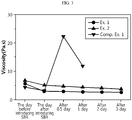
- the slurry was sampled with the lapse of agitation time and the viscosity was measured by using a rheometer (T.A. Instrument) depending on shear rate.
- the results are shown in FIG. 3 .
- the viscosity value in FIG. 3 is based on a shear rate of 1.0 (1/s). It can be seen from FIG. 3 that the mixed samples according to Examples 1 and 2 show little change in viscosity with time, but the mixed sample according to Comparative Example 1 shows an increase in viscosity of about 4 times of the initial viscosity after 0.5 days (12 hours).
Landscapes
- Chemical & Material Sciences (AREA)
- Chemical Kinetics & Catalysis (AREA)
- Electrochemistry (AREA)
- General Chemical & Material Sciences (AREA)
- Engineering & Computer Science (AREA)
- Manufacturing & Machinery (AREA)
- Materials Engineering (AREA)
- Composite Materials (AREA)
- Physics & Mathematics (AREA)
- Dispersion Chemistry (AREA)
- Health & Medical Sciences (AREA)
- Life Sciences & Earth Sciences (AREA)
- Analytical Chemistry (AREA)
- Biochemistry (AREA)
- General Health & Medical Sciences (AREA)
- General Physics & Mathematics (AREA)
- Immunology (AREA)
- Pathology (AREA)
- Spectroscopy & Molecular Physics (AREA)
- Inorganic Chemistry (AREA)
- Battery Electrode And Active Subsutance (AREA)
Applications Claiming Priority (2)
| Application Number | Priority Date | Filing Date | Title |
|---|---|---|---|
| KR20170126526 | 2017-09-28 | ||
| PCT/KR2018/011409 WO2019066480A2 (fr) | 2017-09-28 | 2018-09-27 | Procédé pour prédire l'aptitude au traitement d'une suspension d'électrode et sélectionner un liant d'électrode |
Publications (2)
| Publication Number | Publication Date |
|---|---|
| EP3648200A2 true EP3648200A2 (fr) | 2020-05-06 |
| EP3648200A4 EP3648200A4 (fr) | 2020-06-03 |
Family
ID=65902305
Family Applications (1)
| Application Number | Title | Priority Date | Filing Date |
|---|---|---|---|
| EP18861548.8A Pending EP3648200A4 (fr) | 2017-09-28 | 2018-09-27 | Procédé pour prédire l'aptitude au traitement d'une suspension d'électrode et sélectionner un liant d'électrode |
Country Status (5)
| Country | Link |
|---|---|
| US (1) | US11735735B2 (fr) |
| EP (1) | EP3648200A4 (fr) |
| KR (1) | KR102267599B1 (fr) |
| CN (1) | CN110679014B (fr) |
| WO (1) | WO2019066480A2 (fr) |
Families Citing this family (10)
| Publication number | Priority date | Publication date | Assignee | Title |
|---|---|---|---|---|
| EP3530619B1 (fr) * | 2016-10-21 | 2026-04-08 | Kuraray Co., Ltd. | Matériau carboné et son procédé de production |
| CN110296916A (zh) * | 2019-05-29 | 2019-10-01 | 合肥国轩高科动力能源有限公司 | 一种高压实磷酸铁锂材料批次压实稳定性检测判定的方法 |
| PL4068425T3 (pl) * | 2020-09-21 | 2025-11-17 | Lg Energy Solution, Ltd. | Zawiesina na katodę do baterii litowo-siarkowej, katoda do baterii litowo-siarkowej wytwarzana z jej zastosowaniem, oraz bateria litowo-siarkowa zawierająca ją |
| WO2022108411A1 (fr) | 2020-11-20 | 2022-05-27 | 주식회사 엘지에너지솔루션 | Procédé de fabrication de batterie secondaire aux ions de lithium |
| CN113720732B (zh) * | 2021-08-20 | 2022-09-13 | 中南大学 | 负极浆料稳定性的预测方法、系统及存储介质 |
| JP2025014074A (ja) * | 2021-10-06 | 2025-01-29 | 株式会社村田製作所 | 二次電池およびその製造方法 |
| KR20240117078A (ko) * | 2021-11-30 | 2024-07-31 | 니폰 제온 가부시키가이샤 | 복합 입자 및 그 제조 방법, 전기 화학 소자용 전극, 그리고 전기 화학 소자 |
| CN115274025B (zh) * | 2022-09-28 | 2022-12-06 | 深圳先进技术研究院 | 锂离子电池浆料黏度预测方法、装置及相关设备 |
| CN116297020B (zh) * | 2023-04-06 | 2026-01-02 | 深圳智造无维科技有限公司 | 一种锂电池浆料粘度预测方法、系统及其电子设备 |
| KR102859728B1 (ko) * | 2023-10-25 | 2025-09-12 | (주)포스코퓨처엠 | 리튬 이차 전지용 양극 활물질의 입자 강도 측정방법 |
Family Cites Families (28)
| Publication number | Priority date | Publication date | Assignee | Title |
|---|---|---|---|---|
| KR19980040000A (ko) | 1996-11-28 | 1998-08-17 | 구자홍 | 솔더 페이스트(solder paste) 점도변화 계측장치 |
| WO2004075319A1 (fr) * | 2003-02-20 | 2004-09-02 | Mitsubishi Chemical Corporation | Substance active pour electrode negative de batterie auxiliaire au lithium, electrode negative de batterie auxiliaire au lithium r batterie auxiliaire au lithium |
| JP4729716B2 (ja) | 2003-02-20 | 2011-07-20 | 三菱化学株式会社 | リチウム二次電池負極及びリチウム二次電池 |
| WO2007116718A1 (fr) * | 2006-03-30 | 2007-10-18 | Zeon Corporation | Particules composites pour electrode d'element electrochimique, procede pour produire des particules composees pour l'electrode d'element electrochimique et electrode d'element electrochimique |
| CA2623407A1 (fr) | 2008-02-28 | 2009-08-28 | Hydro-Quebec | Materiau d'electrode composite |
| JP5458689B2 (ja) | 2008-06-25 | 2014-04-02 | 三菱化学株式会社 | 非水系二次電池用複合黒鉛粒子、それを含有する負極材料、負極及び非水系二次電池 |
| JP5013123B2 (ja) | 2008-08-25 | 2012-08-29 | Tdk株式会社 | スラリーの製造方法 |
| JP2012527518A (ja) * | 2009-05-18 | 2012-11-08 | ザ、リージェンツ、オブ、ザ、ユニバーシティ、オブ、カリフォルニア | リチウムイオン電池電極用の導電性ポリマーバインダ |
| JP5483092B2 (ja) | 2010-05-11 | 2014-05-07 | トヨタ自動車株式会社 | 電池と電池用電極およびその製造方法 |
| US9214668B2 (en) * | 2010-06-02 | 2015-12-15 | The Regents Of The University Of California | Si composite electrode with Li metal doping for advanced lithium-ion battery |
| WO2013042720A1 (fr) * | 2011-09-20 | 2013-03-28 | 日産化学工業株式会社 | Composition de bouillie pour utilisation dans la formation d'électrode de batterie secondaire au lithium-ion, contenant une fibre de cellulose en tant que liant, et électrode de batterie secondaire au lithium-ion |
| JP5614592B2 (ja) * | 2011-10-12 | 2014-10-29 | トヨタ自動車株式会社 | 二次電池用電極の製造方法 |
| CN103493257B (zh) * | 2012-04-24 | 2017-03-22 | 株式会社Lg 化学 | 用于提高输出的锂二次电池复合电极用活性材料和包含所述活性材料的锂二次电池 |
| JP6287097B2 (ja) * | 2012-12-05 | 2018-03-07 | 日本ゼオン株式会社 | 正極用複合粒子用のスラリー組成物および正極用複合粒子の製造方法 |
| KR101496309B1 (ko) | 2013-08-09 | 2015-02-26 | 오씨아이 주식회사 | 음극활물질용 실리콘 슬러리 및 탄소-실리콘 복합체 |
| KR101689753B1 (ko) * | 2013-10-30 | 2016-12-26 | 주식회사 엘지화학 | 활물질 슬러리의 점도 조절이 가능한 활물질 슬러리 믹싱 시스템 및 이를 이용한 활물질 슬러리의 점도 조절 방법 |
| JP6485359B2 (ja) * | 2013-12-26 | 2019-03-20 | 日本ゼオン株式会社 | 電気化学素子電極用複合粒子 |
| KR102311781B1 (ko) * | 2014-04-28 | 2021-10-08 | 니폰 제온 가부시키가이샤 | 전기 화학 소자 전극용 복합 입자의 제조 방법 |
| US10193150B2 (en) * | 2014-07-07 | 2019-01-29 | Hitachi Metals, Ltd. | Lithium ion secondary battery cathode material, lithium ion secondary battery cathode and lithium ion secondary battery that use same, and method for manufacturing lithium ion secondary battery cathode material |
| GB2529410A (en) | 2014-08-18 | 2016-02-24 | Nexeon Ltd | Electroactive materials for metal-ion batteries |
| KR20160061167A (ko) * | 2014-11-21 | 2016-05-31 | 삼성에스디아이 주식회사 | 무기물층이 코팅된 전극, 그 제조 방법 및 이를 구비한 이차 전지 |
| CN104880384A (zh) | 2015-05-13 | 2015-09-02 | 合肥国轩高科动力能源股份公司 | 一种锂离子电池正极浆料稳定性的评价方法 |
| KR101985801B1 (ko) * | 2015-07-02 | 2019-06-04 | 주식회사 엘지화학 | 전극 활물질 슬러리 점도 제어 방법 및 전극 활물질 슬러리 제조장치 |
| CN105140483A (zh) * | 2015-08-07 | 2015-12-09 | 田东 | 一种改性锂电池负极材料的制备方法 |
| CN105738827B (zh) | 2016-03-28 | 2018-11-02 | 合肥国轩高科动力能源有限公司 | 一种锂离子电池导电浆料综合性能评价方法 |
| KR20170126526A (ko) | 2016-05-09 | 2017-11-20 | 주식회사 큐브인 | 스크린도어의 투명 디스플레이 설치구조 |
| CN106124363B (zh) | 2016-07-14 | 2019-07-30 | 曙鹏科技(深圳)有限公司 | 一种锂离子电池正负极浆料稳定性的评测方法 |
| JP6889404B2 (ja) * | 2017-11-01 | 2021-06-18 | トヨタ自動車株式会社 | 負極の製造方法、負極およびリチウムイオン二次電池 |
-
2018
- 2018-09-27 US US16/612,144 patent/US11735735B2/en active Active
- 2018-09-27 WO PCT/KR2018/011409 patent/WO2019066480A2/fr not_active Ceased
- 2018-09-27 EP EP18861548.8A patent/EP3648200A4/fr active Pending
- 2018-09-27 KR KR1020180115002A patent/KR102267599B1/ko active Active
- 2018-09-27 CN CN201880035145.1A patent/CN110679014B/zh active Active
Also Published As
| Publication number | Publication date |
|---|---|
| US20200176776A1 (en) | 2020-06-04 |
| US11735735B2 (en) | 2023-08-22 |
| CN110679014A (zh) | 2020-01-10 |
| KR20190037149A (ko) | 2019-04-05 |
| EP3648200A4 (fr) | 2020-06-03 |
| WO2019066480A2 (fr) | 2019-04-04 |
| CN110679014B (zh) | 2023-04-04 |
| WO2019066480A3 (fr) | 2019-05-23 |
| KR102267599B1 (ko) | 2021-06-21 |
Similar Documents
| Publication | Publication Date | Title |
|---|---|---|
| US11735735B2 (en) | Method for predicting processability of electrode slurry and selecting electrode binder | |
| EP3641029B1 (fr) | Matériau actif d'anode destiné à un dispositif électrochimique, anode comportant ledit matériau actif d'anode et dispositif électrochimique comportant ladite anode | |
| KR101966774B1 (ko) | 이차전지용 음극, 이의 제조방법 및 이를 포함하는 이차전지 | |
| EP3675243A2 (fr) | Électrode négative pour accumulateur au lithium, son procédé de fabrication et accumulateur au lithium la comprenant | |
| US11264659B2 (en) | Rechargeable lithium-hydroxide based non-aqueous lithium oxygen batteries | |
| US20170207497A1 (en) | Charging and discharging method for lithium secondary battery | |
| KR102268078B1 (ko) | 리튬 이차전지용 전극의 설계 방법 및 이를 포함하는 리튬 이차전지용 전극의 제조방법 | |
| EP4109593A1 (fr) | Anode et batterie secondaire la comprenant | |
| EP3863090B1 (fr) | Matériau actif d'électrode négative pour batterie secondaire, son procédé de production, et électrode négative pour batterie secondaire et batterie secondaire au lithium comprenant le même | |
| CN102918687A (zh) | 负极活性物质的评价方法和负极活性物质 | |
| CN109863629B (zh) | 用于制备锂二次电池用的正极浆料的方法和由此获得的用于锂二次电池的正极 | |
| US10700387B2 (en) | Low resistance negative electrode having excellent adhesiveness and lithium secondary battery comprising the same | |
| EP3951955A1 (fr) | Composition de liant pour anode, anode et batterie secondaire | |
| KR102088858B1 (ko) | 흡습성 물질을 포함하는 리튬 이차전지용 전극 및 이를 포함하는 리튬 이차전지 | |
| EP2621001A1 (fr) | Électrode positif, son procédé de fabrication et batterie au lithium comprenant l'électrode positif | |
| KR102454481B1 (ko) | 전극 슬러리의 공정성 예측 및 선정 방법 | |
| CN118696429A (zh) | 正极和使用其制造的锂二次电池 | |
| KR102732504B1 (ko) | 이차 전지용 음극 슬러리 제조 방법 | |
| JP5578370B2 (ja) | 二次電池用電極及びその製造方法 | |
| KR20170034773A (ko) | 리튬 이차전지의 집전체용 금속 메쉬 박판, 이를 포함하는 리튬 이차전지용 전극 및 리튬 이차전지 | |
| KR20170112345A (ko) | 리튬 이차전지용 전극 제조 방법 | |
| US12406998B2 (en) | Positive electrode slurry including oxalic acid, preparation method thereof, positive electrode for secondary battery, and secondary battery | |
| EP4447157A1 (fr) | Matériau actif de cathode et procédé de fabrication associé | |
| EP4276944B1 (fr) | Électrode positive comprenant composite soufre-carbone et batterie secondaire lithium-ion la comprenant | |
| EP4465387A1 (fr) | Cathode et batterie secondaire au lithium la comprenant |
Legal Events
| Date | Code | Title | Description |
|---|---|---|---|
| STAA | Information on the status of an ep patent application or granted ep patent |
Free format text: STATUS: THE INTERNATIONAL PUBLICATION HAS BEEN MADE |
|
| PUAI | Public reference made under article 153(3) epc to a published international application that has entered the european phase |
Free format text: ORIGINAL CODE: 0009012 |
|
| STAA | Information on the status of an ep patent application or granted ep patent |
Free format text: STATUS: REQUEST FOR EXAMINATION WAS MADE |
|
| 17P | Request for examination filed |
Effective date: 20200131 |
|
| AK | Designated contracting states |
Kind code of ref document: A2 Designated state(s): AL AT BE BG CH CY CZ DE DK EE ES FI FR GB GR HR HU IE IS IT LI LT LU LV MC MK MT NL NO PL PT RO RS SE SI SK SM TR |
|
| AX | Request for extension of the european patent |
Extension state: BA ME |
|
| A4 | Supplementary search report drawn up and despatched |
Effective date: 20200506 |
|
| RIC1 | Information provided on ipc code assigned before grant |
Ipc: H01M 4/04 20060101ALI20200428BHEP Ipc: H01M 4/587 20100101ALI20200428BHEP Ipc: H01M 4/62 20060101ALI20200428BHEP Ipc: H01M 4/133 20100101AFI20200428BHEP Ipc: H01M 4/02 20060101ALN20200428BHEP Ipc: H01M 4/1393 20100101ALI20200428BHEP Ipc: G01N 15/02 20060101ALN20200428BHEP |
|
| DAV | Request for validation of the european patent (deleted) | ||
| DAX | Request for extension of the european patent (deleted) | ||
| RAP1 | Party data changed (applicant data changed or rights of an application transferred) |
Owner name: LG ENERGY SOLUTION LTD. |
|
| RAP3 | Party data changed (applicant data changed or rights of an application transferred) |
Owner name: LG ENERGY SOLUTION, LTD. |
|
| STAA | Information on the status of an ep patent application or granted ep patent |
Free format text: STATUS: EXAMINATION IS IN PROGRESS |
|
| 17Q | First examination report despatched |
Effective date: 20220509 |