EP3648443B1 - Verwaltung einer kommunikation zwischen einem anrufenden kommunikations-endgerät mit einer haupt-anrufskennung und einer neben-anrufskennung, und einem angerufenen kommunikations-endgerät. - Google Patents
Verwaltung einer kommunikation zwischen einem anrufenden kommunikations-endgerät mit einer haupt-anrufskennung und einer neben-anrufskennung, und einem angerufenen kommunikations-endgerät. Download PDFInfo
- Publication number
- EP3648443B1 EP3648443B1 EP19205275.1A EP19205275A EP3648443B1 EP 3648443 B1 EP3648443 B1 EP 3648443B1 EP 19205275 A EP19205275 A EP 19205275A EP 3648443 B1 EP3648443 B1 EP 3648443B1
- Authority
- EP
- European Patent Office
- Prior art keywords
- communication
- call identifier
- terminal
- identifier
- main
- Prior art date
- Legal status (The legal status is an assumption and is not a legal conclusion. Google has not performed a legal analysis and makes no representation as to the accuracy of the status listed.)
- Active
Links
Images


Classifications
-
- H—ELECTRICITY
- H04—ELECTRIC COMMUNICATION TECHNIQUE
- H04M—TELEPHONIC COMMUNICATION
- H04M3/00—Automatic or semi-automatic exchanges
- H04M3/42—Systems providing special services or facilities to subscribers
- H04M3/42136—Administration or customisation of services
- H04M3/4217—Managing service interactions
-
- H—ELECTRICITY
- H04—ELECTRIC COMMUNICATION TECHNIQUE
- H04M—TELEPHONIC COMMUNICATION
- H04M3/00—Automatic or semi-automatic exchanges
- H04M3/42—Systems providing special services or facilities to subscribers
- H04M3/42025—Calling or Called party identification service
- H04M3/42034—Calling party identification service
- H04M3/42042—Notifying the called party of information on the calling party
-
- H—ELECTRICITY
- H04—ELECTRIC COMMUNICATION TECHNIQUE
- H04M—TELEPHONIC COMMUNICATION
- H04M3/00—Automatic or semi-automatic exchanges
- H04M3/42—Systems providing special services or facilities to subscribers
- H04M3/436—Arrangements for screening incoming calls, i.e. evaluating the characteristics of a call before deciding whether to answer it
-
- H—ELECTRICITY
- H04—ELECTRIC COMMUNICATION TECHNIQUE
- H04M—TELEPHONIC COMMUNICATION
- H04M2201/00—Electronic components, circuits, software, systems or apparatus used in telephone systems
- H04M2201/18—Comparators
-
- H—ELECTRICITY
- H04—ELECTRIC COMMUNICATION TECHNIQUE
- H04M—TELEPHONIC COMMUNICATION
- H04M2203/00—Aspects of automatic or semi-automatic exchanges
- H04M2203/35—Aspects of automatic or semi-automatic exchanges related to information services provided via a voice call
- H04M2203/354—Reverse directory service
-
- H—ELECTRICITY
- H04—ELECTRIC COMMUNICATION TECHNIQUE
- H04M—TELEPHONIC COMMUNICATION
- H04M3/00—Automatic or semi-automatic exchanges
- H04M3/42—Systems providing special services or facilities to subscribers
- H04M3/42025—Calling or Called party identification service
- H04M3/42034—Calling party identification service
- H04M3/42059—Making use of the calling party identifier
Definitions
- the field of the invention is that of the management of a communication between two communication terminals. More specifically, the invention relates to communication services allowing a user to have several call identifiers associated with the same communication terminal.
- Some communication services currently offer to allocate one or more secondary call identifier(s) to the communication terminal of a calling user, who already has a primary call identifier.
- the main call identifier is an MSISDN identifier (in English “Mobile Station International Subscriber Directory Number”) uniquely corresponding to the card SIM (in English “Subscriber Identity Module”) which is provided by the operator of the mobile network with which the user has registered.
- MSISDN identifier in English “Mobile Station International Subscriber Directory Number”
- SIM in English “Subscriber Identity Module”
- this identifier is the telephone number of the mobile terminal in this mobile network, known to the public.
- Such services make it possible, for example, to guarantee the anonymity of the user, and are offered to him in particular when the calling subscriber wishes to advertise on a website dedicated to this purpose, such as for example a classifieds site, a dating site, a personal or professional social network, etc...
- the user is then offered a secondary call identifier that he can use to contact by telephone any person who has left his contact details on the dedicated website, without having to reveal their main call identifier to this person.
- the calling user can also be reached on this secondary call identifier.
- this possibility of having several call identifiers for the same terminal has other advantages than the simple guarantee of anonymity of the calling terminal.
- the user can have several call identifiers that he can then use in different contexts. For example, he can reserve the use of his main call identifier for communications established in a professional context, and use one or more secondary call identifiers for communications in his private sphere, for example a first call identifier secondary to communicate with his family and friends, and a second secondary call identifier reserved for his exchanges via social networks.
- Such a communication service operates as follows.
- the user who wishes to benefit from it registers beforehand with a platform managing this service by providing his personal details, and in particular his main call identifier.
- a secondary call identifier is then allocated to it and then recorded in the platform in correspondence with its main identifier.
- the user downloads the application dedicated to this service on his phone.
- the user wishes to establish communication with a called communication terminal, he sends to the communication management platform, via the application, a message containing his main call identifier and a call identifier of the user that he wants to call.
- a call for example voice, is triggered to the call identifier of the communication terminal called.
- This call is intercepted by a communication network router which retrieves the secondary identifier of the calling terminal from the communication management platform, then sends a call from this secondary identifier to the main call identifier of the terminal of the called user. Finally, the router establishes communication between the calling terminal and the called terminal.
- this situation can also prove to be problematic.
- the user of the calling terminal does sales prospecting, it is unlikely that the user of the called terminal will accept an incoming call from a call identifier secondary that he would not have previously recorded in his address book, if the terminal called has not subscribed to a reverse directory service allowing him, for example, to identify the company or company issuing the call.
- the professional activity of the calling user can therefore be hindered by the use of a secondary call identifier.
- the user may have difficulty reaching his friends when he uses a secondary call identifier that the latter do not recognize as belonging to one of their known contacts.
- SIP Session Initiation Protocol
- Document D3 ( US 2007/105531 A1 - Schroeder BS JR ) concerns the optimization of the use of multiple virtual identities associated with a main identity of a mobile communication terminal. More particularly, D3 seeks to facilitate the use of multiple virtual identities from a mobile communication terminal.
- the invention meets this need by proposing a method for managing a communication between a calling communication terminal and a called communication terminal, the calling communication terminal having a permanent main call identifier and at least a temporary secondary call identifier stored, by associating with said primary call identifier, in at least one communication management device.
- the invention is based on an entirely new and inventive approach to the management of communications between calling and called terminals when the calling terminal has a permanent main call identifier (conventionally, its main telephone number known to the public ) and one or more temporary secondary call identifiers (i.e. one or more other telephone numbers which he has acquired from the operator of his mobile communication network).
- a permanent main call identifier conventionally, its main telephone number known to the public
- one or more temporary secondary call identifiers i.e. one or more other telephone numbers which he has acquired from the operator of his mobile communication network.
- these different communication management methods implemented respectively in a communication management platform for the first, and in the communication terminal called for the second, are based on the sending, by the communication management platform, of a notification intended for the called communication terminal, which contains the main call identifier of the calling terminal, but also the secondary call identifier that it uses to establish the communication with the called terminal, and identification information of the user of the calling terminal.
- This identification information of the user of the calling terminal can take various forms: it can be textual information of the surname/first name type, or name of the company on behalf of which the user works, or more precisely the name of a department within this company; it can also be an image, such as the user's photo or company logo; it can also be a video or an animated image, for example an advertisement for the company in which the user works or for one of its products; this identification information can also take the form of a hyperlink which points to an Internet site, for example a hyperlink which points to the name of the calling user's company or its logo.
- the sending of such a notification by the communication management platform to the called terminal enriches the knowledge of the called user on the context of the incoming communication, in order to allow him to decide whether he must accept or refuse incoming communication.
- the called terminal can check whether the calling user corresponds to a contact that he would have already registered in his address book. . If so, this allows him to directly display, for the called user, the contact information stored in the address book in association with this main telephone number, even though the incoming call is established on based on a temporary secondary call identifier not known to the called user.
- the permanent main call identifier e.g. the MSISDN
- the called terminal can however display the identification information of the calling user contained in the notification received from the communication management platform (logo, company name, etc.).
- the called user thus has more information about the person who is trying to reach him, and therefore the context of this call. He can then make an informed decision as to whether to accept or reject this incoming communication.
- main call identifier denotes a call identifier permanently associated with a communication terminal identified in the communication network of an operator.
- a primary call identifier cannot be changed without termination of the contract with the network operator.
- a main call identifier is the MSISDN call number uniquely corresponding to the SIM card.
- secondary call identifier designates a call identifier temporarily associated with a communication terminal: such a temporary call identifier is generated in the operator's communication network at the request of the user of the communication terminal, for a limited (but possibly long) period. Such a secondary call identifier is, in essence, volatile.
- all the call identifiers of a communication terminal in the operator's network have a tree structure, the root of which is the terminal's permanent main call identifier, and whose call identifiers secondary form as many deciduous leaves of the structure.
- a communication session between a calling terminal and a called terminal can then be established from either a main call identifier or a secondary call identifier.
- CRUD operations for "Create, Read, Update, Delete”
- They allow the called communication terminal to manage the database associated with the address book of the user's contacts, for example by recording therein the secondary call identifier of a contact already known in association with its identifier. main call, or by recording the calling user's identification information contained in the notification (for example the logo of his company).
- the called communication terminal in the event of the presence of the main call identifier in the address book, updates, in the of addresses, a contact associated with a user of the calling terminal, by adding the secondary call identifier and/or the identification information included in the notification received.
- the called terminal enriches the information contained in the address book for this particular contact, by recording its new telephone number, and the profile information that it wanted to inform with the communication management platform.
- the main call identifier and of the secondary call identifier in the address book also comprises, at the end of the incoming communication, a display, by the called terminal, a message proposing to save the identification information, in association with the secondary call identifier and/or the main call identifier, in the address book.
- the called user can easily create a new contact in his address book, in which he stores the various information contained in the notification. received from the communication management platform (main telephone number, secondary telephone number, user profile information).
- such a method for managing an incoming communication by a called terminal also comprises a verification that the main call identifier and/or the secondary call identifier is a blocked call identifier, and, if so, rejecting the incoming call initiated from the secondary call identifier.
- the performance of the anti-spam mechanisms is improved: if the called user has already blocked the main telephone number of an annoying calling user, he can, thanks to the information contained in the notification he receives, directly identify that the secondary telephone number used for the incoming communication is associated with the same calling terminal, and therefore rejects the call directly. It can also enrich the database of telephone numbers associated with spam, by recording this secondary call identifier there.
- the invention also relates to a computer program product comprising program code instructions for the implementation of a communication management method by a communication management device as described previously, when it is executed by a processor. It also relates to a computer program product comprising program code instructions for the implementation of a method for managing incoming communication by a called communication terminal as described previously, when it is executed by a processor.
- the invention also relates to a recording medium readable by a computer on which is recorded a computer program comprising program code instructions for the execution of the steps of one of the two communication management methods according to the invention as described above.
- Such recording medium can be any entity or device capable of storing the program.
- the medium may comprise a storage means, such as a ROM, for example a CD ROM or a microelectronic circuit ROM, or else a magnetic recording means, for example a USB key or a hard disk.
- such a recording medium may be a transmissible medium such as an electrical or optical signal, which may be conveyed via an electrical or optical cable, by radio or by other means, so that the program computer it contains is executable remotely.
- the program according to the invention can in particular be downloaded onto a network, for example the Internet network.
- the recording medium may be an integrated circuit in which the program is incorporated, the circuit being adapted to execute or to be used in the execution of the aforementioned display control method.
- Such a device is for example a service platform managing the allocation of secondary call identifiers to subscribers of a mobile communication network, such as the O-IONA ® platform developed by Orange ® .
- the communication management device, the communication terminal and the aforementioned corresponding computer programs have at least the same advantages as those conferred by the communication management methods according to the present invention.
- the general principle of the invention is based on the sending, by a communication management platform, of a notification, prior to the establishment of a communication between a calling communication terminal and a called communication terminal, comprising the permanent primary call identifier of the calling terminal, its temporary secondary call identifier used to initiate the communication, and additional identification information of the calling user.
- This notification is sent to the called terminal, which can use its content to facilitate the identification, by the called user, of the calling user.
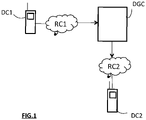
- FIG 1 schematically illustrates a system in which the methods for managing a communication according to one embodiment of the invention are implemented.
- some well-known elements of this system are not shown.
- Such elements are for example servers, nodes, base stations, gateways or even other entities of the telecommunications network used in this system.
- the system comprises a first communication device DC1 capable of establishing a communication intended for a second communication device DC2.
- the communication device DC1 is a mobile telephone comprising a SIM card provided with a unique subscriber identifier called IMSI (English abbreviation of “International Mobile Subscriber Identity”). In a manner known per se, this identifier is used to identify the communication device DC1 in its home communication network RC1, that is to say the network with which the user UT1 of the communication device DC1 has subscribed. .
- the network RC1 is of the mobile type such as a GSM network (English abbreviation of “Global System for Mobile communications”) or UMTS (English abbreviation of “Universal Mobile Telecommunications System”) or LTE (English abbreviation of “Long Term Evolution”).
- the IMSI identifier is associated with a main call identifier MSISDN, denoted IAP1, which is a "physical" telephone number, in the sense that it is the telephone number associated with the SIM card allowing the device to be reached. communication DC1.
- IAP1 a "physical" telephone number, in the sense that it is the telephone number associated with the SIM card allowing the device to be reached. communication DC1.
- the main call identifier IAP1 cannot be changed unless you cancel the contract with the telephone company and obtain another SIM card.
- the main call identifier is a permanent identifier added to the communication device DC1 in the network RC1.
- the communication device DC1 is for example a landline telephone attached to a private PABX (Private Automatic Branch eXchange) telephone exchange.
- PABX Primary Automatic Branch eXchange
- the main call identifier IAP1 of the communication device DC1 could be different from a telephone number.
- it could consist of metadata associated with the user UT1 of the communication device DC1, such as in particular an image or information about the user, such as his name and his address.
- the first communication device DC1 also has one or more secondary call identifier(s) IAS1, which are additional telephone numbers for reaching the communication device and initiating communications to other communication devices.
- IAS1 secondary call identifier(s)
- the secondary call identifier IAS1 is a so-called “virtual" call number, that is to say which has a limited lifespan according to the needs of the user UT1, because it is generated in the call network (in particular via IMS/SIP platforms) and at the request of the user.
- the user UT1 only needs this secondary call identifier IAS1 for a day, a week or a month.
- IAS1 secondary call identifier or "secondary number”
- All the "secondary numbers” are linked to the main number, or main call identifier IAP1, in particular thanks to a Database Management System (SGBD) in the IMS/SIP network for example, to be able to manage the identity of calls through all the "secondary numbers” and thus know to whom this or that "secondary number” belongs.
- the secondary call identifier IAS1 is an additional call identifier associated with the main call identifier IAP1 and whose nature is volatile.
- the second communication device DC2 is able to receive the communication initiated by the communication device DC1.
- the communication device DC2 is also provided with a main call identifier IAP2.
- the communication device DC2 is a mobile telephone attached to a communication network RC2 of the mobile type.
- the communication device DC2 can also be a landline telephone attached to a switched telecommunications network or even a communication server, such as for example an emergency call reception server.
- the second communication device DC2 may or may not also have one or more secondary call identifier(s) IAS2.
- the communication networks RC1 and RC2 can form a single communication network of the same telecommunications operator.
- the term “communication” is understood to mean a conventional voice call or any other communication session of the data and/or audio and/or video type initiated by the communication device DC1 intended for the DC2 communications.
- the communication management platform DGC comprises physical and/or software resources, in particular a processing circuit CT1 for implementing the communication management method according to one embodiment of the invention, the processing circuit CT1 containing a processor PROC1 controlled by a computer program PG1.
- the code instructions of the computer program PG1 are for example loaded into a RAM memory, denoted MR1, before being executed by the processing circuit CT1.
- such identification information comprises, on the one hand, the main call identifier IAP1 of the communication device DC1 (for example the identifier MSISDN of the communication device DC1, the landline number of the user UT1 of the communication device DC1, the IP address or the permanent email address of the user UT1), and on the other hand one or more identification information (label) that the user UT1 wishes to associate with a secondary call identifier (for example, a hypertext link to his company's website, a logo, a name, a title, etc.).
- a secondary call identifier for example, a hypertext link to his company's website, a logo, a name, a title, etc.
- the second storage module MST2 contains such information for all the communication devices DCi having subscribed, with the DGC platform, to the service for assigning secondary call identifiers.
- the communication interfaces COM10, COM11, as well as the profile manager GP, are controlled by the processor PROC1 of the processing circuit CT1.
- the aforementioned secondary call identifiers IAS 1 , IAS 2 ,..., IAS m ,..., IAS J are part of a pool assigned by the administrator of the DGC platform to a supplier partner service with which the user UT1 of the communication device DC1 has previously registered. In other words, this pool of secondary call identifiers is reserved for the service to which the user UT1 has subscribed.
- a secondary call identifier selected from the pool of secondary call identifiers IAS 1 , IAS 2 ,..., IAS m ,..., IAS J , for example the identifier IAS m is associated with the information d identification relating to the communication device DC1, which are stored in the storage module MST2.
- the selected secondary call identifier IAS m is a telephone number.
- the secondary call identifier can be an alias, a pseudonym or a network identity of the MSISDN type, IP address, email address, E.164 address, SIP address.
- this secondary call identifier can be recorded in association with an identifier IDS of the service with which the user UT1 of the first communication device DC1 has subscribed.
- this secondary identifier has a period of validity which corresponds for example to the duration of subscription to this service or for a predetermined period, set in advance by the administrator of the DGC communication management platform.
- the profile manager GP is connected to a switching center CMT which is able to process the path of the communication established from the communication device DC1 to the communication device DC2, as shown in the figure 1 .
- the exchanges between the switching center CMT and the profile manager GP conform for example to the SIP (Session Initiation Protocol) protocol.
- the CMT switching center is well known per se. In the example represented, it corresponds for example to a mobile switching center “MSC” (Mobile Switching Centre) of a mobile telecommunications network.
- the switching center CMT could be a local switch of a fixed telecommunications network. It will be noted that in the fixed telecommunications network, the local switch processes local calls between subscribers of the same switch as well as the origination and arrival of traffic with the other switches.
- the CMT switching center is characterized by two main functions.
- This first function also processes the level of signaling established during the communication between the two communication devices, that is to say the level corresponding to the signaling of the messages exchanged via the various entities of the communication network.
- the second main function is a "Media” function for processing the entire Media part of the communication between the two communication devices.
- Such a function corresponds to the “Media” level for processing textual and/or audio data and/or images/videos exchanged between the two communication devices during communication.
- the communication management platform DGC could contain only the profile manager GP, the switching center CMT being hosted at another place in the network but still functionally connected to the profile manager GP.
- the communication device DC2 here a mobile telephone, comprises physical and/or software resources, in particular a processing circuit CT2 to implement the exchanges with the communication management platform DGC of the figure 1 and 2 prior to the communication to be established, then once said communication has been established.
- the processing circuit CT2 contains a processor PROC2 controlled by a computer program PG2.
- the code instructions of the computer program PG2 are for example loaded into a RAM memory, denoted MR2, before being executed by the processing circuit CT2.
- Such a notification may also include instructions for managing the address book of the communication management device DC2, in the form of CRUD operations (for English “Create, Read, Update, Delete”), to allow the setting updating an existing contact associated with the user UT1 (for example, to add, in an existing contact, known from a main call identifier, a new secondary call identifier).
- CRUD operations for English “Create, Read, Update, Delete”
- the TEL download module of the communication DC2 is further configured to download, from the communication management platform DGC, an AEC application dedicated to the management of a communication in accordance with an embodiment of the present invention.
- Such an application notably has the function of allowing the user UT2 of the communication terminal DC2 to connect to the communication management platform DGC, to configure therein his secondary call identifiers, and the identification information (label) they wish to associate with it.
- This information is transmitted to the profile manager GP, and recorded in association in the storage module MST2, as described above.
- the communication interfaces COM20, COM21, the downloading module TEL, as well as the module INT for processing user interactions, are controlled by the processor PROC2 of the processing circuit CT2.
- the method for managing a communication according to the invention is implemented in the case where the user UT1 of the communication device DC1 wishes to initiate a communication from a secondary call identifier IAS1 of this last to the communication device DC2 of the figure 1 .
- the DGC platform verifies that the user UT1 is authenticated by comparing the identification information contained in the message received with that recorded in the storage module MST2 of the figure 2 , and extracts from this module MST2 the main call identifier IAP1 and the identification information ( label ) associated with the secondary call identifier IAS1 for this communication terminal DC1.
- the first example above corresponds to the case of a notification with a new secondary telephone number, used to establish a communication.
- the main telephone number MSISDN of the user UT1 is already registered in the address book of the terminal called DC2, the operations “create, ⁇ IAS1: +33715458796 ⁇ ” allow this secondary IAS1 telephone number to be saved in the contact associated with UT1.
- the second example above corresponds, in a professional call context for example, to an update of the name of the company associated with UT1.
- the communication terminal called DC2 proceeds, upon receipt of the notification sent by the communication management platform DGC, to the verification Verif(IAP1) of the presence of the main call identifier IAP1 of the calling terminal DC1 in its book of addresses, during a step referenced ST3.
- Such an address book is for example recorded in the memory MR2 of the processing circuit CT2, and lists all the contacts known to the user UT2.
- This verification consists for example of verifying the presence of the MSISDN of the calling terminal DC1 in the address book.
- the communication terminal DC2 sends an acknowledgment of receipt ACK to the communication management platform DGC during a step referenced ST4.
- the terminal DC2 Furthermore, if, during the verification step ST3, the terminal DC2 has identified the main call identifier IAP1 as being already recorded in its address book, it then updates the corresponding contact associated with the user UT1, during a step ST3B CRUD(IAP1), from the CRUD instructions contained in the notification received during the step ST2, and from the corresponding contact data cont_data. For example, he adds, in the contact associated with the user UT1, the new secondary telephone number IAS1.
- the communication management platform DGC then routes, thanks to the switching center CMT, the incoming communication ReqCom(IAS1, IAP2) initiated by the calling terminal DC1 to the called terminal DC2.
- the user UT2 therefore has information about the identity of the user UT1 who is trying to reach him, although he does not know the secondary telephone number used by this last. He can then make an informed decision as to whether to accept or reject this incoming communication.
- end of communication messages FIN are transmitted by the called terminal DC2 to the communication management platform DGC during a step ST7, then by the communication management platform DGC to the calling terminal DC1 during a step ST8.
- the management method of the invention advantageously makes it possible to propagate known antispam mechanisms and call blocking procedures to secondary call identifiers, as illustrated in figure 5 .
- the called terminal DC2 proceeds, during a step ST3, to the verification of the existence of the main call identifier IAP1 of the calling terminal DC1 in its address book.
- the information provided in the notification received at step ST2 indeed enables it to establish a correspondence between the primary call identifier IAP1, for example the MSISDN, and the secondary call identifier IAS1 used by the calling terminal DC1.
- the terminal DC2 automatically verifies the presence of the main call identifier IAP1 or of the secondary call identifier IAS1 in a list of call identifiers deemed undesirable.
- the latter updates, during a step referenced ST11 Update_Spam, the list of undesirable call identifiers by adding the secondary call identifier IAS1.
- the terminal DC2 On receipt ST5 of the incoming communication ReqCom(IAS1, IAP2), the terminal DC2 can automatically proceed to its rejection RejCom(IAS1, IAP2) during a step referenced ST12. This rejection is propagated from the communication management platform DGC to the calling terminal DC1 during a step referenced ST13.
- This solution does not require any manual intervention on the part of the UT2 user to block a secondary call identifier if he has already identified that the main call identifier or another secondary call identifier of the same calling terminal was undesirable. This therefore constitutes a particularly effective solution for combating spam, in the case where the calling terminal regularly changes secondary telephone numbers.
- the solution of the invention has multiple advantages, both from the point of view of the calling terminal and of the called terminal.
Landscapes
- Engineering & Computer Science (AREA)
- Signal Processing (AREA)
- Telephonic Communication Services (AREA)
- Mobile Radio Communication Systems (AREA)
Claims (12)
- Verfahren zur Verwaltung einer Kommunikation zwischen einem anrufenden Kommunikationsendgerät (DC1) und einem angerufenen Kommunikationsendgerät (DC2),wobei das anrufende Kommunikationsendgerät über eine permanente Hauptanrufskennung (IAP1) und mindestens eine temporäre Nebenanrufskennung (IAS1), die in Verbindung mit der Hauptanrufskennung in mindestens einer Kommunikationsverwaltungsvorrichtung (DGC) aufgezeichnet ist, verfügt, wobei es die Haupt- und die Nebenanrufskennung beide ermöglichen, eine Kommunikation mit dem angerufenen Endgerät (DC2) zu initiieren oder eine Weiterleitung einer Kommunikation zu dem anrufenden Endgerät (DC1) herzustellen,dadurch gekennzeichnet, dass, wenn das anrufende Kommunikationsendgerät (DC1) eine Kommunikation mit dem angerufenen Kommunikationsendgerät (DC2) auf Grundlage der mindestens einen Nebenanrufskennung initiiert, die mindestens eine Kommunikationsverwaltungsvorrichtung (DGC) Folgendes umsetzt:- Aussenden (ST2), zu dem angerufenen Endgerät, vor der Initiierung der Kommunikation, einer Nachricht, die mindestens die Hauptanrufskennung (IAP1), die mindestens eine Nebenanrufskennung (IAS1) und mindestens eine Identifikationsinformation (label) eines Nutzers (UT1) des anrufenden Endgeräts, die mit der Nebenanrufskennung verbunden ist, beinhaltet;- Weiterleiten (ST5) der Kommunikation zu dem angerufenen Endgerät unter Verwendung der mindestens einen Nebenanrufskennung,und dass es ferner vor der Initiierung der Kommunikation ein Aufzeichnen, in Verbindung mit der mindestens einen Nebenanrufskennung (IAS1), der Hauptanrufskennung (IAP1) und der mindestens einen Identifikationsinformation (label) durch die Kommunikationsverwaltungsvorrichtung (DGC) beinhaltet.
- Verfahren nach Anspruch 1, dadurch gekennzeichnet, dass die Nachricht ferner eine Anweisung (CRUD) zur Verwaltung eines Kontakts, der mit dem Nutzer des anrufenden Endgeräts verbunden ist, beinhaltet, wobei die Verwaltungsanweisung zu der Gruppe gehört, die Folgendes beinhaltet:- eine Erstellungsanweisung;- eine Leseanweisung;- eine Aktualisierungsanweisung;- eine Löschanweisung.
- Computerprogramm, das Programmcodeanweisungen zur Ausführung der Schritte des Verfahrens zur Verwaltung einer Kommunikation nach einem beliebigen der Ansprüche 1 und 2 beinhaltet, wenn das Programm von einem Prozessor einer Kommunikationsverwaltungsvorrichtung ausgeführt wird.
- Computerlesbares Aufzeichnungsmedium, auf dem ein Computerprogramm aufgezeichnet ist, das Programmcodeanweisungen zur Ausführung der Schritte des Verfahrens zur Verwaltung einer Kommunikation nach einem beliebigen der Ansprüche 1 und 2 beinhaltet, wenn das Programm von einem Prozessor einer Kommunikationsverwaltungsvorrichtung ausgeführt wird.
- Kommunikationsverwaltungsvorrichtung (DGC) zur Herstellung einer Kommunikation zwischen einem anrufenden Kommunikationsendgerät (DC1) und einem angerufenen Kommunikationsendgerät (DC2),wobei die Kommunikationsverwaltungsvorrichtung (DGC) eine Verarbeitungsschaltung (CT1) beinhaltet, die dazu konfiguriert ist, eine permanente Hauptanrufskennung (IAP1) und mindestens eine temporäre Nebenanrufskennung (IAS1) des anrufenden Kommunikationsendgeräts (DC1) in Verbindung miteinander aufzuzeichnen, wobei es die Haupt- und die Nebenanrufskennung beide ermöglichen, eine Kommunikation mit dem angerufenen Endgerät (DC2) zu initiieren oder eine Weiterleitung der Kommunikation zu dem anrufenden Endgerät (DC1) herzustellen,dadurch gekennzeichnet, dass die Verarbeitungsschaltung (CT1) ferner zu Folgendem konfiguriert ist:- Empfangen (ST1) einer Kommunikation, die durch das anrufende Kommunikationsendgerät initiiert wird, auf Grundlage der mindestens einen Nebenanrufskennung, für das angerufene Kommunikationsendgerät;- Aussenden (ST2), zu dem angerufenen Endgerät, vor dem Empfang der Kommunikation, einer Nachricht, die mindestens die Hauptanrufskennung, die mindestens eine Nebenanrufskennung und mindestens eine Identifikationsinformation eines Nutzers des anrufenden Endgeräts, die mit der Nebenanrufskennung verbunden ist, beinhaltet;- Weiterleiten (ST5) der Kommunikation zu dem angerufenen Endgerät unter Verwendung der mindestens einen Nebenanrufskennung,und dass sie ferner ein Speicherungsmodul (MST2) beinhaltet, das dazu konfiguriert ist, vor der Initiierung der Kommunikation die Hauptanrufskennung (IAP1) und die mindestens eine Identifikationsinformation (label) in Verbindung mit der mindestens einen Nebenanrufskennung (IAS1) aufzuzeichnen.
- Verfahren zur Verwaltung einer eingehenden Kommunikation durch ein angerufenes Kommunikationsendgerät (DC2),wobei die eingehende Kommunikation durch ein anrufendes Kommunikationsendgerät (DC1) initiiert wird, das über eine permanente Hauptanrufskennung (IAP1) und mindestens eine temporäre Nebenanrufskennung (IAS1), die in Verbindung mit der Hauptanrufskennung in mindestens einer Kommunikationsverwaltungsvorrichtung (DGC) aufgezeichnet ist, verfügt,dadurch gekennzeichnet, dass, wenn die eingehende Kommunikation auf Grundlage der mindestens einen Nebenanrufskennung initiiert wird, das angerufene Kommunikationsendgerät Folgendes umsetzt:- Empfangen (ST2) einer Nachricht vor der Initiierung der Kommunikation, die mindestens die Hauptanrufskennung, die mindestens eine Nebenanrufskennung und mindestens eine Identifikationsinformation eines Nutzers des anrufenden Endgeräts, die mit der Nebenanrufskennung verbunden ist, beinhaltet;- Prüfen (ST3), ob die Hauptanrufskennung in einem Adressbuch des angerufenen Kommunikationsendgeräts vorhanden ist;- bei Empfang (ST5) der eingehenden Kommunikation:o falls die Hauptanrufskennung in dem Adressbuch vorhanden ist, Anzeigen (ST6) einer Nutzerkennung, die in Verbindung mit der vorhandenen Anrufskennung in dem Adressbuch gespeichert ist;o falls die Hauptanrufskennung und die mindestens eine Nebenanrufskennung in dem Adressbuch nicht vorhanden sind, Anzeigen (ST6) der mindestens einen Identifikationsinformation, die in der empfangenen Nachricht enthalten ist.
- Verfahren zur Verwaltung einer eingehenden Kommunikation nach Anspruch 6, dadurch gekennzeichnet, dass es, falls die Hauptanrufskennung in dem Adressbuch vorhanden ist, einen Kontakt, der mit einem Nutzer des anrufenden Endgeräts verbunden ist, in dem Adressbuch aktualisiert (ST3B), indem es die mindestens eine Nebenanrufskennung und/oder die Identifikationsinformation, die in der empfangenen Nachricht enthalten sind, hinzufügt.
- Verfahren zur Verwaltung einer eingehenden Kommunikation nach einem beliebigen der Ansprüche 6 und 7, dadurch gekennzeichnet, dass es, falls die Hauptanrufskennung und die mindestens eine Nebenanrufskennung in dem Adressbuch nicht vorhanden sind, nach Abschluss der eingehenden Kommunikation ferner ein Anzeigen (ST9) einer Meldung beinhaltet, welche vorschlägt, die mindestens eine Identifikationsinformation in Verbindung mit der mindestens einen Nebenanrufskennung und/oder der Hauptanrufskennung in dem Adressbuch aufzuzeichnen.
- Verfahren zur Verwaltung einer eingehenden Kommunikation nach einem beliebigen der Ansprüche 6 bis 8, dadurch gekennzeichnet, dass es ferner eine Prüfung, ob die Hauptanrufskennung und/oder die mindestens eine Nebenanrufskennung eine gesperrte Anrufskennung sind, und falls ja, eine Zurückweisung der eingehenden Kommunikation, die auf Grundlage der mindestens einen Nebenanrufskennung initiiert wird, beinhaltet.
- Computerprogramm, das Programmcodeanweisungen zur Ausführung der Schritte des Verfahrens zur Verwaltung einer eingehenden Kommunikation nach einem beliebigen der Ansprüche 6 bis 9 beinhaltet, wenn das Programm von einem Prozessor eines angerufenen Kommunikationsendgeräts ausgeführt wird.
- Computerlesbares Aufzeichnungsmedium, auf dem ein Computerprogramm aufgezeichnet ist, das Programmcodeanweisungen zur Ausführung der Schritte des Verfahrens zur Verwaltung einer eingehenden Kommunikation nach einem beliebigen der Ansprüche 6 bis 9 beinhaltet, wenn das Programm von einem Prozessor eines angerufenen Kommunikationsendgeräts ausgeführt wird.
- Kommunikationsendgerät (DC2), das eine Verarbeitungsschaltung (CT2) beinhaltet, die dazu konfiguriert ist, eine eingehende Kommunikation zu verarbeiten, die durch ein anrufendes Kommunikationsendgerät (DC1) initiiert wird, das über eine permanente Hauptanrufskennung (IAP1) und mindestens eine temporäre Nebenanrufskennung (IAS1), die in Verbindung mit der Hauptanrufskennung in mindestens einer Kommunikationsverwaltungsvorrichtung (DGC) aufgezeichnet ist, verfügt,
dadurch gekennzeichnet, dass die Verarbeitungsschaltung (CT2), wenn die eingehende Kommunikation auf Grundlage der mindestens einen Nebenanrufskennung initiiert wird, ferner zu Folgendem konfiguriert ist:- Empfangen (ST2) einer Nachricht vor der Initiierung der Kommunikation, die mindestens die Hauptanrufskennung, die mindestens eine Nebenanrufskennung und mindestens eine Identifikationsinformation eines Nutzers des anrufenden Endgeräts, die mit der Nebenanrufskennung verbunden ist, beinhaltet;- Durchführen einer Prüfung (ST3), ob die Hauptanrufskennung in einem Adressbuch des angerufenen Kommunikationsendgeräts vorhanden ist;- bei Empfang (ST5) der eingehenden Kommunikation:o falls die Hauptanrufskennung in dem Adressbuch vorhanden ist, Anzeigen (ST6) einer Nutzerkennung, die in Verbindung mit der vorhandenen Anrufskennung in dem Adressbuch gespeichert ist;o falls die Hauptanrufskennung und die mindestens eine Nebenanrufskennung in dem Adressbuch nicht vorhanden sind, Anzeigen (ST6) der mindestens einen Identifikationsinformation, die in der empfangenen Nachricht enthalten ist.
Applications Claiming Priority (1)
| Application Number | Priority Date | Filing Date | Title |
|---|---|---|---|
| FR1860159A FR3088159A1 (fr) | 2018-11-05 | 2018-11-05 | Gestion d'une communication entre un terminal de communication appelant, disposant d'un identifiant d'appel principal et d'un identifiant d'appel secondaire, et un terminal de communication appele. |
Publications (2)
| Publication Number | Publication Date |
|---|---|
| EP3648443A1 EP3648443A1 (de) | 2020-05-06 |
| EP3648443B1 true EP3648443B1 (de) | 2022-08-17 |
Family
ID=65685661
Family Applications (1)
| Application Number | Title | Priority Date | Filing Date |
|---|---|---|---|
| EP19205275.1A Active EP3648443B1 (de) | 2018-11-05 | 2019-10-25 | Verwaltung einer kommunikation zwischen einem anrufenden kommunikations-endgerät mit einer haupt-anrufskennung und einer neben-anrufskennung, und einem angerufenen kommunikations-endgerät. |
Country Status (3)
| Country | Link |
|---|---|
| US (1) | US11368576B2 (de) |
| EP (1) | EP3648443B1 (de) |
| FR (1) | FR3088159A1 (de) |
Families Citing this family (1)
| Publication number | Priority date | Publication date | Assignee | Title |
|---|---|---|---|---|
| US10811014B1 (en) * | 2018-06-28 | 2020-10-20 | Amazon Technologies, Inc. | Contact list reconciliation and permissioning |
Citations (2)
| Publication number | Priority date | Publication date | Assignee | Title |
|---|---|---|---|---|
| US20110034156A1 (en) * | 2009-08-04 | 2011-02-10 | Gatti John M | Systems and methods for disambiguating entries in a contacts list database implemented on a mobile device |
| US20160100050A1 (en) * | 2014-10-02 | 2016-04-07 | Lenovo (Singapore) Pte, Ltd. | Identifying an unknown contact |
Family Cites Families (22)
| Publication number | Priority date | Publication date | Assignee | Title |
|---|---|---|---|---|
| US6697461B1 (en) * | 2000-02-15 | 2004-02-24 | Bell Atlantic Services Network | Methods and apparatus for providing call screening and other communication services |
| US8406389B2 (en) * | 2001-03-09 | 2013-03-26 | Research In Motion Limited | Advanced voice and data operations in a mobile data communication device |
| JP2004153779A (ja) * | 2002-09-04 | 2004-05-27 | Nec Corp | 通信端末装置、電話機、発信者情報通知システム及びそれに用いる発信者情報通知方法並びそのプログラム |
| US7912497B2 (en) * | 2005-03-25 | 2011-03-22 | Isidore Eustace P | Single wireless communication device with multiple, concurrent subscriber number capability |
| US20070105531A1 (en) * | 2005-11-04 | 2007-05-10 | Ascenna Mobile, Inc. | Dynamic Processing of Virtual Identities for Mobile Communications Devices |
| US20080159502A1 (en) * | 2006-12-28 | 2008-07-03 | General Instrument Corporation | Method and Apparatus For Providing Caller Identification Information |
| US9008298B2 (en) * | 2008-06-10 | 2015-04-14 | Verizon Patent And Licensing Inc. | Automatic denial of call request |
| US20090323926A1 (en) * | 2008-06-30 | 2009-12-31 | Shaham Eliezer | Methods and systems for voice communication |
| US20110026468A1 (en) * | 2009-07-28 | 2011-02-03 | Conrad Daniel R | Multi-network telephone connections |
| US10973059B2 (en) * | 2011-07-27 | 2021-04-06 | Vonage America, Llc | Systems and methods of providing communications services |
| CN103051464A (zh) * | 2011-10-14 | 2013-04-17 | 腾讯科技(深圳)有限公司 | 维护通讯录的方法及群组通讯录管理平台 |
| US8548444B2 (en) * | 2012-01-20 | 2013-10-01 | Intuit Inc. | Linking a name to a phone number in a text message based on a contact list in a mobile device |
| US20130203397A1 (en) * | 2012-02-02 | 2013-08-08 | Joel Vidal | Phone that prevents accidental dialing to a contact |
| US9160807B2 (en) * | 2012-04-12 | 2015-10-13 | Absolute Software Corporation | System and method for deriving a name for association with a device |
| US9313252B2 (en) * | 2012-04-20 | 2016-04-12 | Microsoft Technology Licensing, Llc | Binding crud-type protocols in distributed agreement protocols |
| US9820116B2 (en) * | 2015-05-13 | 2017-11-14 | T-Mobile Usa, Inc. | Routing multiple numbers for one telecommunications device |
| US9729702B2 (en) * | 2015-05-13 | 2017-08-08 | T-Mobile Usa, Inc. | Client application enabling multiple line call termination and origination |
| US9781255B1 (en) * | 2015-06-08 | 2017-10-03 | Sprint Communications Company L.P. | Authentication of phone call origination |
| US9826087B2 (en) * | 2015-08-03 | 2017-11-21 | T-Mobile Usa, Inc. | Originating a voice call from a selected number using a temporary routing number |
| FR3042372A1 (fr) * | 2015-10-08 | 2017-04-14 | Contact Identification System | Aide a l'etablissement d'une communication telephonique par provision d'informations sur l'utilisateur appelant |
| US10841755B2 (en) * | 2017-07-01 | 2020-11-17 | Phoneic, Inc. | Call routing using call forwarding options in telephony networks |
| US10250745B2 (en) * | 2017-08-28 | 2019-04-02 | T-Mobile Usa, Inc. | Identifying the cellular number on a cellular device capable of supporting multiple cellular numbers |
-
2018
- 2018-11-05 FR FR1860159A patent/FR3088159A1/fr not_active Withdrawn
-
2019
- 2019-10-25 EP EP19205275.1A patent/EP3648443B1/de active Active
- 2019-11-05 US US16/674,615 patent/US11368576B2/en active Active
Patent Citations (2)
| Publication number | Priority date | Publication date | Assignee | Title |
|---|---|---|---|---|
| US20110034156A1 (en) * | 2009-08-04 | 2011-02-10 | Gatti John M | Systems and methods for disambiguating entries in a contacts list database implemented on a mobile device |
| US20160100050A1 (en) * | 2014-10-02 | 2016-04-07 | Lenovo (Singapore) Pte, Ltd. | Identifying an unknown contact |
Also Published As
| Publication number | Publication date |
|---|---|
| US20200145529A1 (en) | 2020-05-07 |
| FR3088159A1 (fr) | 2020-05-08 |
| EP3648443A1 (de) | 2020-05-06 |
| US11368576B2 (en) | 2022-06-21 |
Similar Documents
| Publication | Publication Date | Title |
|---|---|---|
| US8577341B2 (en) | Methods and apparatus for providing messaging using voicemail | |
| EP2769526B1 (de) | Verfahren zum austausch von informationen in bezug auf verbesserte kommunikationsdienste | |
| EP3182671B1 (de) | Verfahren und vorrichtung für einen messaging-dienst | |
| EP3648443B1 (de) | Verwaltung einer kommunikation zwischen einem anrufenden kommunikations-endgerät mit einer haupt-anrufskennung und einer neben-anrufskennung, und einem angerufenen kommunikations-endgerät. | |
| EP3800874B1 (de) | Verfahren und vorrichtung zur umleitung einer kommunikationsanfrage | |
| FR3046002A1 (fr) | Gestion d'une communication entre deux terminaux de communication | |
| EP3311559B1 (de) | Einrichtung einer kommunikation durch zuweisung zu einem anrufenden endgerät eines zwischenanrufidentifikators für die kommunikation | |
| EP1583339A1 (de) | Verfahren und Server für Fernsprechanrufleitweglenkung | |
| WO2019052860A1 (fr) | Procede de mise en liaison telephonique d'un terminal de communication a numero multiple | |
| EP3482577B1 (de) | Einrichtung einer kommunikation durch zuweisung eines zwischenanrufidentifikators für die kommunikation zu einem anrufenden endgerät | |
| EP3391680B1 (de) | Verfahren zur verwaltung von mindestens einer kommunikation, entsprechende vorrichtung und softwaremodulprogramm | |
| EP2843923A2 (de) | Vorrichtung und Verfahren zur Anreicherung einer Kommunikation | |
| EP2819074B1 (de) | Verfahren zum Verwalten eines entfernten Benutzer-Adressbuchs, entsprechendes Computerprogramm und entsprechender Anwendungsserver | |
| WO2019063920A1 (fr) | Procédé de gestion d'un échec d'établissement d'une communication entre un premier et un second terminal | |
| FR3018027A1 (fr) | Procede et dispositif de decouverte des capacites de communication relatives a un utilisateur d'un terminal | |
| EP2541874A1 (de) | Kommunikationsverfahren und -system innerhalb einer heterogenen Benutzergemeinschaft | |
| EP4264977A1 (de) | Verfahren und vorrichtung zur verwaltung einer notnummerntabelle, lokaleinrichtung und verwaltungssystem | |
| WO2021234250A1 (fr) | Procede de notification d'un terminal mobile | |
| FR3004048A1 (fr) | Procede de notification d'un lien d'acces a un message et systeme de messagerie | |
| FR3080512A1 (fr) | Procede et systeme de detection de coupures de communications mobiles et de retablissement automatique des communications. | |
| FR2887726A1 (fr) | Procede de personnalisation de la carte de visite d'un appelant selon l'identite d'un appele |
Legal Events
| Date | Code | Title | Description |
|---|---|---|---|
| PUAI | Public reference made under article 153(3) epc to a published international application that has entered the european phase |
Free format text: ORIGINAL CODE: 0009012 |
|
| STAA | Information on the status of an ep patent application or granted ep patent |
Free format text: STATUS: THE APPLICATION HAS BEEN PUBLISHED |
|
| AK | Designated contracting states |
Kind code of ref document: A1 Designated state(s): AL AT BE BG CH CY CZ DE DK EE ES FI FR GB GR HR HU IE IS IT LI LT LU LV MC MK MT NL NO PL PT RO RS SE SI SK SM TR |
|
| AX | Request for extension of the european patent |
Extension state: BA ME |
|
| RAP1 | Party data changed (applicant data changed or rights of an application transferred) |
Owner name: ORANGE |
|
| STAA | Information on the status of an ep patent application or granted ep patent |
Free format text: STATUS: REQUEST FOR EXAMINATION WAS MADE |
|
| STAA | Information on the status of an ep patent application or granted ep patent |
Free format text: STATUS: EXAMINATION IS IN PROGRESS |
|
| 17P | Request for examination filed |
Effective date: 20201105 |
|
| RBV | Designated contracting states (corrected) |
Designated state(s): AL AT BE BG CH CY CZ DE DK EE ES FI FR GB GR HR HU IE IS IT LI LT LU LV MC MK MT NL NO PL PT RO RS SE SI SK SM TR |
|
| 17Q | First examination report despatched |
Effective date: 20201130 |
|
| RAP3 | Party data changed (applicant data changed or rights of an application transferred) |
Owner name: ORANGE |
|
| GRAP | Despatch of communication of intention to grant a patent |
Free format text: ORIGINAL CODE: EPIDOSNIGR1 |
|
| STAA | Information on the status of an ep patent application or granted ep patent |
Free format text: STATUS: GRANT OF PATENT IS INTENDED |
|
| INTG | Intention to grant announced |
Effective date: 20211216 |
|
| GRAJ | Information related to disapproval of communication of intention to grant by the applicant or resumption of examination proceedings by the epo deleted |
Free format text: ORIGINAL CODE: EPIDOSDIGR1 |
|
| STAA | Information on the status of an ep patent application or granted ep patent |
Free format text: STATUS: EXAMINATION IS IN PROGRESS |
|
| GRAP | Despatch of communication of intention to grant a patent |
Free format text: ORIGINAL CODE: EPIDOSNIGR1 |
|
| STAA | Information on the status of an ep patent application or granted ep patent |
Free format text: STATUS: GRANT OF PATENT IS INTENDED |
|
| INTC | Intention to grant announced (deleted) | ||
| INTG | Intention to grant announced |
Effective date: 20220406 |
|
| GRAS | Grant fee paid |
Free format text: ORIGINAL CODE: EPIDOSNIGR3 |
|
| GRAA | (expected) grant |
Free format text: ORIGINAL CODE: 0009210 |
|
| STAA | Information on the status of an ep patent application or granted ep patent |
Free format text: STATUS: THE PATENT HAS BEEN GRANTED |
|
| AK | Designated contracting states |
Kind code of ref document: B1 Designated state(s): AL AT BE BG CH CY CZ DE DK EE ES FI FR GB GR HR HU IE IS IT LI LT LU LV MC MK MT NL NO PL PT RO RS SE SI SK SM TR |
|
| REG | Reference to a national code |
Ref country code: CH Ref legal event code: EP |
|
| REG | Reference to a national code |
Ref country code: DE Ref legal event code: R096 Ref document number: 602019018323 Country of ref document: DE |
|
| REG | Reference to a national code |
Ref country code: IE Ref legal event code: FG4D Free format text: LANGUAGE OF EP DOCUMENT: FRENCH |
|
| REG | Reference to a national code |
Ref country code: AT Ref legal event code: REF Ref document number: 1512926 Country of ref document: AT Kind code of ref document: T Effective date: 20220915 |
|
| REG | Reference to a national code |
Ref country code: NL Ref legal event code: MP Effective date: 20220817 |
|
| REG | Reference to a national code |
Ref country code: LT Ref legal event code: MG9D |
|
| PG25 | Lapsed in a contracting state [announced via postgrant information from national office to epo] |
Ref country code: SE Free format text: LAPSE BECAUSE OF FAILURE TO SUBMIT A TRANSLATION OF THE DESCRIPTION OR TO PAY THE FEE WITHIN THE PRESCRIBED TIME-LIMIT Effective date: 20220817 Ref country code: RS Free format text: LAPSE BECAUSE OF FAILURE TO SUBMIT A TRANSLATION OF THE DESCRIPTION OR TO PAY THE FEE WITHIN THE PRESCRIBED TIME-LIMIT Effective date: 20220817 Ref country code: PT Free format text: LAPSE BECAUSE OF FAILURE TO SUBMIT A TRANSLATION OF THE DESCRIPTION OR TO PAY THE FEE WITHIN THE PRESCRIBED TIME-LIMIT Effective date: 20221219 Ref country code: NO Free format text: LAPSE BECAUSE OF FAILURE TO SUBMIT A TRANSLATION OF THE DESCRIPTION OR TO PAY THE FEE WITHIN THE PRESCRIBED TIME-LIMIT Effective date: 20221117 Ref country code: NL Free format text: LAPSE BECAUSE OF FAILURE TO SUBMIT A TRANSLATION OF THE DESCRIPTION OR TO PAY THE FEE WITHIN THE PRESCRIBED TIME-LIMIT Effective date: 20220817 Ref country code: LV Free format text: LAPSE BECAUSE OF FAILURE TO SUBMIT A TRANSLATION OF THE DESCRIPTION OR TO PAY THE FEE WITHIN THE PRESCRIBED TIME-LIMIT Effective date: 20220817 Ref country code: LT Free format text: LAPSE BECAUSE OF FAILURE TO SUBMIT A TRANSLATION OF THE DESCRIPTION OR TO PAY THE FEE WITHIN THE PRESCRIBED TIME-LIMIT Effective date: 20220817 Ref country code: FI Free format text: LAPSE BECAUSE OF FAILURE TO SUBMIT A TRANSLATION OF THE DESCRIPTION OR TO PAY THE FEE WITHIN THE PRESCRIBED TIME-LIMIT Effective date: 20220817 |
|
| REG | Reference to a national code |
Ref country code: AT Ref legal event code: MK05 Ref document number: 1512926 Country of ref document: AT Kind code of ref document: T Effective date: 20220817 |
|
| PG25 | Lapsed in a contracting state [announced via postgrant information from national office to epo] |
Ref country code: PL Free format text: LAPSE BECAUSE OF FAILURE TO SUBMIT A TRANSLATION OF THE DESCRIPTION OR TO PAY THE FEE WITHIN THE PRESCRIBED TIME-LIMIT Effective date: 20220817 Ref country code: IS Free format text: LAPSE BECAUSE OF FAILURE TO SUBMIT A TRANSLATION OF THE DESCRIPTION OR TO PAY THE FEE WITHIN THE PRESCRIBED TIME-LIMIT Effective date: 20221217 Ref country code: HR Free format text: LAPSE BECAUSE OF FAILURE TO SUBMIT A TRANSLATION OF THE DESCRIPTION OR TO PAY THE FEE WITHIN THE PRESCRIBED TIME-LIMIT Effective date: 20220817 Ref country code: GR Free format text: LAPSE BECAUSE OF FAILURE TO SUBMIT A TRANSLATION OF THE DESCRIPTION OR TO PAY THE FEE WITHIN THE PRESCRIBED TIME-LIMIT Effective date: 20221118 |
|
| PG25 | Lapsed in a contracting state [announced via postgrant information from national office to epo] |
Ref country code: SM Free format text: LAPSE BECAUSE OF FAILURE TO SUBMIT A TRANSLATION OF THE DESCRIPTION OR TO PAY THE FEE WITHIN THE PRESCRIBED TIME-LIMIT Effective date: 20220817 Ref country code: RO Free format text: LAPSE BECAUSE OF FAILURE TO SUBMIT A TRANSLATION OF THE DESCRIPTION OR TO PAY THE FEE WITHIN THE PRESCRIBED TIME-LIMIT Effective date: 20220817 Ref country code: ES Free format text: LAPSE BECAUSE OF FAILURE TO SUBMIT A TRANSLATION OF THE DESCRIPTION OR TO PAY THE FEE WITHIN THE PRESCRIBED TIME-LIMIT Effective date: 20220817 Ref country code: DK Free format text: LAPSE BECAUSE OF FAILURE TO SUBMIT A TRANSLATION OF THE DESCRIPTION OR TO PAY THE FEE WITHIN THE PRESCRIBED TIME-LIMIT Effective date: 20220817 Ref country code: CZ Free format text: LAPSE BECAUSE OF FAILURE TO SUBMIT A TRANSLATION OF THE DESCRIPTION OR TO PAY THE FEE WITHIN THE PRESCRIBED TIME-LIMIT Effective date: 20220817 Ref country code: AT Free format text: LAPSE BECAUSE OF FAILURE TO SUBMIT A TRANSLATION OF THE DESCRIPTION OR TO PAY THE FEE WITHIN THE PRESCRIBED TIME-LIMIT Effective date: 20220817 |
|
| REG | Reference to a national code |
Ref country code: DE Ref legal event code: R097 Ref document number: 602019018323 Country of ref document: DE |
|
| PG25 | Lapsed in a contracting state [announced via postgrant information from national office to epo] |
Ref country code: SK Free format text: LAPSE BECAUSE OF FAILURE TO SUBMIT A TRANSLATION OF THE DESCRIPTION OR TO PAY THE FEE WITHIN THE PRESCRIBED TIME-LIMIT Effective date: 20220817 Ref country code: MC Free format text: LAPSE BECAUSE OF FAILURE TO SUBMIT A TRANSLATION OF THE DESCRIPTION OR TO PAY THE FEE WITHIN THE PRESCRIBED TIME-LIMIT Effective date: 20220817 Ref country code: EE Free format text: LAPSE BECAUSE OF FAILURE TO SUBMIT A TRANSLATION OF THE DESCRIPTION OR TO PAY THE FEE WITHIN THE PRESCRIBED TIME-LIMIT Effective date: 20220817 |
|
| REG | Reference to a national code |
Ref country code: CH Ref legal event code: PL |
|
| PLBE | No opposition filed within time limit |
Free format text: ORIGINAL CODE: 0009261 |
|
| STAA | Information on the status of an ep patent application or granted ep patent |
Free format text: STATUS: NO OPPOSITION FILED WITHIN TIME LIMIT |
|
| REG | Reference to a national code |
Ref country code: BE Ref legal event code: MM Effective date: 20221031 |
|
| PG25 | Lapsed in a contracting state [announced via postgrant information from national office to epo] |
Ref country code: LU Free format text: LAPSE BECAUSE OF NON-PAYMENT OF DUE FEES Effective date: 20221025 Ref country code: AL Free format text: LAPSE BECAUSE OF FAILURE TO SUBMIT A TRANSLATION OF THE DESCRIPTION OR TO PAY THE FEE WITHIN THE PRESCRIBED TIME-LIMIT Effective date: 20220817 |
|
| 26N | No opposition filed |
Effective date: 20230519 |
|
| PG25 | Lapsed in a contracting state [announced via postgrant information from national office to epo] |
Ref country code: LI Free format text: LAPSE BECAUSE OF NON-PAYMENT OF DUE FEES Effective date: 20221031 Ref country code: CH Free format text: LAPSE BECAUSE OF NON-PAYMENT OF DUE FEES Effective date: 20221031 |
|
| PG25 | Lapsed in a contracting state [announced via postgrant information from national office to epo] |
Ref country code: SI Free format text: LAPSE BECAUSE OF FAILURE TO SUBMIT A TRANSLATION OF THE DESCRIPTION OR TO PAY THE FEE WITHIN THE PRESCRIBED TIME-LIMIT Effective date: 20220817 |
|
| PG25 | Lapsed in a contracting state [announced via postgrant information from national office to epo] |
Ref country code: BE Free format text: LAPSE BECAUSE OF NON-PAYMENT OF DUE FEES Effective date: 20221031 |
|
| PG25 | Lapsed in a contracting state [announced via postgrant information from national office to epo] |
Ref country code: IE Free format text: LAPSE BECAUSE OF NON-PAYMENT OF DUE FEES Effective date: 20221025 |
|
| PG25 | Lapsed in a contracting state [announced via postgrant information from national office to epo] |
Ref country code: HU Free format text: LAPSE BECAUSE OF FAILURE TO SUBMIT A TRANSLATION OF THE DESCRIPTION OR TO PAY THE FEE WITHIN THE PRESCRIBED TIME-LIMIT; INVALID AB INITIO Effective date: 20191025 |
|
| PG25 | Lapsed in a contracting state [announced via postgrant information from national office to epo] |
Ref country code: CY Free format text: LAPSE BECAUSE OF FAILURE TO SUBMIT A TRANSLATION OF THE DESCRIPTION OR TO PAY THE FEE WITHIN THE PRESCRIBED TIME-LIMIT Effective date: 20220817 |
|
| PG25 | Lapsed in a contracting state [announced via postgrant information from national office to epo] |
Ref country code: MK Free format text: LAPSE BECAUSE OF FAILURE TO SUBMIT A TRANSLATION OF THE DESCRIPTION OR TO PAY THE FEE WITHIN THE PRESCRIBED TIME-LIMIT Effective date: 20220817 Ref country code: IT Free format text: LAPSE BECAUSE OF FAILURE TO SUBMIT A TRANSLATION OF THE DESCRIPTION OR TO PAY THE FEE WITHIN THE PRESCRIBED TIME-LIMIT Effective date: 20220817 |
|
| PG25 | Lapsed in a contracting state [announced via postgrant information from national office to epo] |
Ref country code: BG Free format text: LAPSE BECAUSE OF FAILURE TO SUBMIT A TRANSLATION OF THE DESCRIPTION OR TO PAY THE FEE WITHIN THE PRESCRIBED TIME-LIMIT Effective date: 20220817 |
|
| PG25 | Lapsed in a contracting state [announced via postgrant information from national office to epo] |
Ref country code: MT Free format text: LAPSE BECAUSE OF FAILURE TO SUBMIT A TRANSLATION OF THE DESCRIPTION OR TO PAY THE FEE WITHIN THE PRESCRIBED TIME-LIMIT Effective date: 20220817 |
|
| PGFP | Annual fee paid to national office [announced via postgrant information from national office to epo] |
Ref country code: GB Payment date: 20250923 Year of fee payment: 7 |
|
| PGFP | Annual fee paid to national office [announced via postgrant information from national office to epo] |
Ref country code: FR Payment date: 20250924 Year of fee payment: 7 |
|
| PG25 | Lapsed in a contracting state [announced via postgrant information from national office to epo] |
Ref country code: TR Free format text: LAPSE BECAUSE OF FAILURE TO SUBMIT A TRANSLATION OF THE DESCRIPTION OR TO PAY THE FEE WITHIN THE PRESCRIBED TIME-LIMIT Effective date: 20220817 |
|
| PGFP | Annual fee paid to national office [announced via postgrant information from national office to epo] |
Ref country code: DE Payment date: 20250923 Year of fee payment: 7 |