EP3649397B1 - Luftgestütztes system zum austausch von modularen beleuchtungsleuchten - Google Patents
Luftgestütztes system zum austausch von modularen beleuchtungsleuchten Download PDFInfo
- Publication number
- EP3649397B1 EP3649397B1 EP18827957.4A EP18827957A EP3649397B1 EP 3649397 B1 EP3649397 B1 EP 3649397B1 EP 18827957 A EP18827957 A EP 18827957A EP 3649397 B1 EP3649397 B1 EP 3649397B1
- Authority
- EP
- European Patent Office
- Prior art keywords
- module
- lighting module
- engagement
- lighting
- socket
- Prior art date
- Legal status (The legal status is an assumption and is not a legal conclusion. Google has not performed a legal analysis and makes no representation as to the accuracy of the status listed.)
- Not-in-force
Links
Images






Classifications
-
- F—MECHANICAL ENGINEERING; LIGHTING; HEATING; WEAPONS; BLASTING
- F21—LIGHTING
- F21S—NON-PORTABLE LIGHTING DEVICES; SYSTEMS THEREOF; VEHICLE LIGHTING DEVICES SPECIALLY ADAPTED FOR VEHICLE EXTERIORS
- F21S8/00—Lighting devices intended for fixed installation
- F21S8/08—Lighting devices intended for fixed installation with a standard
-
- F—MECHANICAL ENGINEERING; LIGHTING; HEATING; WEAPONS; BLASTING
- F21—LIGHTING
- F21V—FUNCTIONAL FEATURES OR DETAILS OF LIGHTING DEVICES OR SYSTEMS THEREOF; STRUCTURAL COMBINATIONS OF LIGHTING DEVICES WITH OTHER ARTICLES, NOT OTHERWISE PROVIDED FOR
- F21V21/00—Supporting, suspending, or attaching arrangements for lighting devices; Hand grips
- F21V21/36—Hoisting or lowering devices, e.g. for maintenance
-
- B—PERFORMING OPERATIONS; TRANSPORTING
- B25—HAND TOOLS; PORTABLE POWER-DRIVEN TOOLS; MANIPULATORS
- B25J—MANIPULATORS; CHAMBERS PROVIDED WITH MANIPULATION DEVICES
- B25J15/00—Gripping heads and other end effectors
-
- B—PERFORMING OPERATIONS; TRANSPORTING
- B64—AIRCRAFT; AVIATION; COSMONAUTICS
- B64D—EQUIPMENT FOR FITTING IN OR TO AIRCRAFT; FLIGHT SUITS; PARACHUTES; ARRANGEMENT OR MOUNTING OF POWER PLANTS OR PROPULSION TRANSMISSIONS IN AIRCRAFT
- B64D1/00—Dropping, ejecting, releasing or receiving articles, liquids, or the like, in flight
- B64D1/22—Taking-up articles from earth's surface
-
- F—MECHANICAL ENGINEERING; LIGHTING; HEATING; WEAPONS; BLASTING
- F21—LIGHTING
- F21S—NON-PORTABLE LIGHTING DEVICES; SYSTEMS THEREOF; VEHICLE LIGHTING DEVICES SPECIALLY ADAPTED FOR VEHICLE EXTERIORS
- F21S8/00—Lighting devices intended for fixed installation
- F21S8/08—Lighting devices intended for fixed installation with a standard
- F21S8/085—Lighting devices intended for fixed installation with a standard of high-built type, e.g. street light
- F21S8/086—Lighting devices intended for fixed installation with a standard of high-built type, e.g. street light with lighting device attached sideways of the standard, e.g. for roads and highways
-
- F—MECHANICAL ENGINEERING; LIGHTING; HEATING; WEAPONS; BLASTING
- F21—LIGHTING
- F21V—FUNCTIONAL FEATURES OR DETAILS OF LIGHTING DEVICES OR SYSTEMS THEREOF; STRUCTURAL COMBINATIONS OF LIGHTING DEVICES WITH OTHER ARTICLES, NOT OTHERWISE PROVIDED FOR
- F21V17/00—Fastening of component parts of lighting devices, e.g. shades, globes, refractors, reflectors, filters, screens, grids or protective cages
- F21V17/002—Fastening of component parts of lighting devices, e.g. shades, globes, refractors, reflectors, filters, screens, grids or protective cages with provision for interchangeability, i.e. component parts being especially adapted to be replaced by another part with the same or a different function
-
- F—MECHANICAL ENGINEERING; LIGHTING; HEATING; WEAPONS; BLASTING
- F21—LIGHTING
- F21V—FUNCTIONAL FEATURES OR DETAILS OF LIGHTING DEVICES OR SYSTEMS THEREOF; STRUCTURAL COMBINATIONS OF LIGHTING DEVICES WITH OTHER ARTICLES, NOT OTHERWISE PROVIDED FOR
- F21V19/00—Fastening of light sources or lamp holders
- F21V19/04—Fastening of light sources or lamp holders with provision for changing light source, e.g. turret
-
- F—MECHANICAL ENGINEERING; LIGHTING; HEATING; WEAPONS; BLASTING
- F21—LIGHTING
- F21V—FUNCTIONAL FEATURES OR DETAILS OF LIGHTING DEVICES OR SYSTEMS THEREOF; STRUCTURAL COMBINATIONS OF LIGHTING DEVICES WITH OTHER ARTICLES, NOT OTHERWISE PROVIDED FOR
- F21V21/00—Supporting, suspending, or attaching arrangements for lighting devices; Hand grips
- F21V21/10—Pendants, arms, or standards; Fixing lighting devices to pendants, arms, or standards
- F21V21/116—Fixing lighting devices to arms or standards
-
- F—MECHANICAL ENGINEERING; LIGHTING; HEATING; WEAPONS; BLASTING
- F21—LIGHTING
- F21V—FUNCTIONAL FEATURES OR DETAILS OF LIGHTING DEVICES OR SYSTEMS THEREOF; STRUCTURAL COMBINATIONS OF LIGHTING DEVICES WITH OTHER ARTICLES, NOT OTHERWISE PROVIDED FOR
- F21V23/00—Arrangement of electric circuit elements in or on lighting devices
- F21V23/06—Arrangement of electric circuit elements in or on lighting devices the elements being coupling devices, e.g. connectors
-
- B—PERFORMING OPERATIONS; TRANSPORTING
- B64—AIRCRAFT; AVIATION; COSMONAUTICS
- B64U—UNMANNED AERIAL VEHICLES [UAV]; EQUIPMENT THEREFOR
- B64U10/00—Type of UAV
- B64U10/10—Rotorcrafts
- B64U10/13—Flying platforms
- B64U10/16—Flying platforms with five or more distinct rotor axes, e.g. octocopters
-
- B—PERFORMING OPERATIONS; TRANSPORTING
- B64—AIRCRAFT; AVIATION; COSMONAUTICS
- B64U—UNMANNED AERIAL VEHICLES [UAV]; EQUIPMENT THEREFOR
- B64U2101/00—UAVs specially adapted for particular uses or applications
- B64U2101/25—UAVs specially adapted for particular uses or applications for manufacturing or servicing
- B64U2101/26—UAVs specially adapted for particular uses or applications for manufacturing or servicing for manufacturing, inspections or repairs
-
- B—PERFORMING OPERATIONS; TRANSPORTING
- B64—AIRCRAFT; AVIATION; COSMONAUTICS
- B64U—UNMANNED AERIAL VEHICLES [UAV]; EQUIPMENT THEREFOR
- B64U2201/00—UAVs characterised by their flight controls
- B64U2201/20—Remote controls
-
- F—MECHANICAL ENGINEERING; LIGHTING; HEATING; WEAPONS; BLASTING
- F21—LIGHTING
- F21W—INDEXING SCHEME ASSOCIATED WITH SUBCLASSES F21K, F21L, F21S and F21V, RELATING TO USES OR APPLICATIONS OF LIGHTING DEVICES OR SYSTEMS
- F21W2131/00—Use or application of lighting devices or systems not provided for in codes F21W2102/00-F21W2121/00
- F21W2131/10—Outdoor lighting
- F21W2131/103—Outdoor lighting of streets or roads
Definitions
- the present disclosure relates to an airborne system for replacing modular lighting luminaire comprising a lighting module having a light source and a socket module which is configured to be attached to a luminaire support wherein the lighting module may be releasable connected to the socket module.
- modular street light luminaire may comprise a socket module which is attached to a lamppost and a lighting module with a protective housing that encloses a light source.
- the lighting module is removable attachable to the socket module so that it may be removed and replaced with a new lighting module in few actions.
- An example of a modular street light luminaire is disclosed in WO2013115722A1 .
- a remotely operated lorry based system for replacing street light luminaire has been developed.
- the system is described in WO2013115721A1 and is based on a robot with grip claws that is carried on an extendable arm on a lorry.
- the driver of the lorry may remotely control the robot to remove and replace modular street light luminaire on the end of a lamppost.
- the system of WO2013115721A1 While proven effective and reliable, there are still drawbacks with the system of WO2013115721A1 .
- the lorry may present an obstruction to the traffic in the street where it operates. It may further be complicated to manoeuvre the lorry in narrow streets or residential areas.
- the system is also relatively costly since it involves an expensive vehicle and several expensive components such as the robot and the extendable arm.
- CN106524019 relates to maintenance of street lights and describes how a cylindrical lamp module 7 with a light source 1 with a rod shaped electrical contact 15 may be mounted in a cylindrical socket module 13 that is arranged on a lamp pole. Mounting of the lamp module 7 in the socket module 13 may be performed by a Unmanned Aerial Vehicle.
- a disadvantage of CN106524019 is that it comprises a complicated locking device for locking the lamp module 7 to the socket module 13.
- the locking device comprises a spring biased support 3 with two steel spheres 2 that are configured to cooperate with two sphere-shaped recesses 10 in the lamp module 1.
- an electromagnet 6 is used to force the support 3 downwards against the action of the spring 4 to release the spheres 2 from the recesses 10 in the lamp module. Since the locking device is arranged in the socket module 13 it is not accessible for the UAV and it is therefore necessary to utilize personnel on the ground for switching the power to the electromagnet on or off. This increases the cost for maintenance of street lights.
- an object of the present disclosure to provide a system for replacing modular lighting luminaire that solves or at least mitigates one of the problems.
- it is an object of the present to provide an effective and flexible system for replacing modular lighting luminaire.
- Yet a further object of the present disclosure it to provide a system for replacing modular lighting luminaire that is easy to operate and may be realized and operated at low cost.
- a further object is to provide a simple system for replacing modular lighting luminaire that may be operated with a minimum of personnel.
- it is an object of the present disclosure to provide a system for replacing modular lighting luminaire that allows for simple mounting of a lighting module onto a socket module.
- a further object of the present disclosure is to provide a system for replacing modular lighting luminaire in which the unmanned aerial vehicle easily and reliable may be operated to engage a lighting module and to disconnect the lighting module from the socket module.
- the system for replacing modular lighting luminaire relies on the insight that a lighting module of modular lighting luminaire, in particular street light luminaire, may be attached or detached from a socket module on e.g. a lamppost, by an unmanned aerial vehicle (UAV).
- UAV unmanned aerial vehicle
- the UAV may fly to a street light luminaire that needs service, disconnect the lighting module that contains the light source from a socket module on the lamppost and transport the disconnected lighting module to a service location. Subsequently, the UAV may return with a replacement lighting module and attach it to the socket module on the lamppost.
- the entire replacement process including unlocking and disconnecting the lighting module from the socket module, is performed through the air which results in an fast and effective system for replacing street lighting luminaire since the system is independent of the traffic situation on the road or the need for long devious routes to reach the lighting luminaire that needs service.
- the system for replacing modular lighting luminaire comprises a releasable locking means for releasable locking the socket module and the lighting module to each other.
- This releasable locking means is arranged in the lighting module. This makes the locking means accessible for the UAV which in turn allows the engagement means of UAV to be configured disconnect the lighting module 200 from the socket module 300 or connect the lighting module 200 with the socket module 300 without assistance of personnel on the ground.
- the unmanned aerial vehicle 500 comprises a first and a second engagement means 530.1, 530.2.
- the engagement means 530.1, 530.2 are arranged on opposite sides of the unmanned aerial vehicle 500 and comprises an elongate engagement portion 532.1, 532.2 for engaging the lower side 214 of the lighting module 200.
- the engagement means 530.1, 530.2 are thereby arranged to be pivoted around a vertical rotation axis Y from a position A in which the engagement portions 532.1, 532.2 extend outside the lower side 214 of the lighting module 200 to a position B in which the engagement portions 532.1, 532.2 at least partially extend over the lower side 214 of the lighting module 200 and thereby engages the lighting module 200.
- the locking means 240.1, 240.2 is movable between a locked position C in which the locking means 240.1, 240.2 is in locking engagement with a lower side 322 of the socket module 300 and a released position D in which the locking means 240.1, 240.2 is out of engagement with the lower side 322 of the socket module 300.
- the engagement means 530.1, 530.2 thereby comprises at least one release actuator 600.1, 600.2 that is arranged to move the locking means 100 from the locked position C to the released position D.
- the release actuator 600.1, 600.2 is arranged on the engagement portion 532.1, 532.2 of the engagement means 530.1, 530.2. This ensures that the release actuator is in optimal position for unlocking the lighting module from the socket module.
- the engagement means 530.1, 530.2 comprises a guide element 700.1, 700.2 for guiding the position of the lighting module 200 relative the socket module 300 during mounting the lighting module 200 onto the socket module 300.
- the guide element 700.1, 700.2 has a front face 701 and a rear face 702 and is arranged on the engagement elements 530.1, 530.2 such that when the engagement means 530.1, 530.2 are in position A the front face 701 is facing away from the center axis Q of the lighting module 200 and the rear face is facing the center axis Q of the lighting module 200, and when the engagement means 530.1, 530.2 are in position B, the front face 701 is facing the front portion 211 of the lighting module 200 and the rear face 702 is facing the rear portion 212 of the socket module 100.
- the rear face 702 of the guide element 700.1, 700.2 is at least partially in contact with a front support surface 325 of the socket module 300 and thereby prevents the front portion 211 of the lighting module 200 from contacting the socket module 300. This greatly reduces the risk of damaging the cover glass of the lighting module and makes mounting of the lighting module onto the socket module faster and more efficient.
- FIG. 1 shows a modular street lighting luminaire 100 comprising a lighting module 200 and a socket module 300 that are connected to each other. Also indicated in figure 1 is a portion of a luminaire support 400 to which the socket module 300 is attached.
- the luminaire support 400 is attached to the ground (not shown) and may be in the form of a lamppost such as an elongate pipe or rod.
- the modular lighting luminaire is configured for outdoor use.
- the lighting module 200 comprises an elongate housing 210 having an upper side 213, a lower side 214 and a front portion 211 which comprises a light source (not shown) in the form of one or more lightbulbs or LED or the like.
- the light source is arranged on the lower side 214 of the elongate housing.
- the rear portion 212 of the housing 210 is connected to the socket module 300.
- the lower side 214 of the housing 210 is directed towards the luminaire support 400 and thus towards the ground so that light from the light source is directed towards the ground.
- the upper side 214 of the housing 210 is directed oppositely away from luminaire support 400 and thus away from the ground.
- FIG. 2 shown the lighting module 200 in perspective view from below.
- the elongate housing has a rear end 217, a front end 218 and two opposite elongate sides 215, 216 extending between the rear end 217 and the front end 218.
- a longitudinal center axis Q of the lighting module 200 extends between the elongate sides 215, 216 and from the rear end 217 and the front end 218.
- the front portion of the housing 210 comprises the light source 220 which may be covered by a protective transparent layer 222, e.g. glass.
- the rear portion of the housing 210 comprises a receiving space 250 for receiving a receiving part 320 of the socket module 300 (as will be described hereinafter).
- the receiving space 250 is a recess which is limited by two opposite side walls 252, 253, which extends parallel with the elongate sides 215, 216 of the housing, and a rear wall 251 in the rear end 217 of the housing 210.
- the receiving space 250 may further be limited by a front wall 254 which extends between the opposite side walls 252, 253 and parallel with the rear wall 251.
- the receiving space 250 is open towards the lower side 214 of the housing 210 (see fig 1 ) to allow the receiving part 320 of the socket module 300 to be received in the receiving space 250.
- the upper side 213 of the housing 210 forms an upper wall of the receiving space 250 (see fig 1 ).
- a first electric contact 260 is arranged in the receiving space 250. The first electrical contact is electrically connected to the light source.
- the lighting module 200 further comprises a locking means 240.1, 240.2 for releasable locking the lighting module 200 to the socket module 300 when the first and the socket modules are connected.
- the lighting module 200 comprises a first and a second a locking means 240.1, 240.2.
- the locking means 240.1, 240.2 comprises a respective protruding element 241.1, 241.2, such as a latch or tongue that may rest on the lower side 322 of the receiving part 320 (as will be described under figure 4 ).
- the locking means 240.1, 204.2 may be integrally formed by e.g.
- a sheet of spring steel may comprise a respective fastening portion 242.1, 242.2 that is attached to and extends from the inner surface of the upper side 213 of the housing 210.
- the protruding portion 241.1, 241.2 extends from the respective fastening portion 242.1, 242.2.
- the locking means 240.1, 240.2 may be biased towards the longitudinal center axis Q of the lighting module 200 such that when the locking means 240.1, 240.2 are subjected to a pulling force away from the center axis Q, the locking means 240.1, 240.2 may flex outwards towards the elongated sides 215, 216 of the housing 210 of the lighting module 200 and come out of contact with a lower side 322 of the receiving part 320 (see figure 4 ).
- FIG. 3 shows the socket module 300 which comprises a socket 310 having a lower side 312 which may be attached to a luminaire support, such as a lamppost.
- a receiving part 320 for releasable engagement with the lighting module 200 is attached to the socket 310.
- the receiving part 320 further has a flat lower side 322.
- the receiving part 320 is configured such that its contour and dimensions approximately corresponds to the contour and the dimensions of the receiving space 250 in the lighting module 200.
- the receiving part 320 and the receiving space 250 are configured with regards to each other such that the receiving part 320 may be received with a form fit in the receiving space 230.
- the rear portion of the receiving part 320 comprises a protruding part 323 which is configured to contact the rear wall 251 of the engagement space 250 to guide the movement of the lighting module 200 during connection of the lighting module 200 and the socket module 300.
- the front portion of the receiving part comprises a substantial vertical support surface 325.
- the socket module 300 further comprises a second electric contact 360, which may be connected to a source of electric current.
- the electrical contact 360 may be arranged in a recess 326 in the receiving part.
- the recess 326 opens to upper side 321 of the receiving part.
- the first electric contact 260 in the lighting module 200 and the second electric contact in the socket module 300 are in electrical contact and electric current may be supplied to the light source 220 in the lighting module 200.
- the first electric contact 260 in the lighting module may be a female contact and the second electric contact 360 in the socket module may be a male contact, or vice versa.
- Figure 4 shows the modular lighting luminaire 100 in a view from below when the lighting module 200 and the socket module 300 are connected. That is, the receiving part 320 of the lighting module 300 is received in the receiving space 250 of the lighting module 200. In this situation, the locking means 240 on the lighting module 200 are in releasable locking engagement with the socket module 200. Thus, the protruding elements 241.1, 241.2 of the respective locking means 240.1, 240.2, rests on the lower side 322 of the receiving part 320.
- the locking means 240.1, 240.2 are biased towards the longitudinal center axis Q of the lighting module 200 such that when the locking means 240.1, 240.2 are subjected to a pulling force away from the center axis Q, the locking means 240.1, 240.2 may flex outwards towards the elongated sides 215, 216 of the housing 210 of the lighting module 200 and come out of contact with the lower side 322 of the receiving part 320.
- the housing 210 of the lighting module 200 and the socket 310 and the receiving part 320 of the socket module 300 preferably made of metal, such as alumina. Since the modular lighting luminaire is intended for outdoor use, the housing 310 and socket module 300 are of robust dimensions and weight. The housing 310 may weigh 5 - 10 kg.
- the system for replacing lighting luminaire further comprises an unmanned aerial vehicle (UAV) that comprises an engagement means for engaging the lighting module of the modular lighting luminaire.
- UAV unmanned aerial vehicle
- the UAV 500 is indicated schematically in figure 5 but will be described in detail in figure 6 .
- the UAV 500 may be a single-, dual- or multirotor UAV (such as is known in the art) and may be controlled remotely by a human operator or a computer on the ground.
- the system for replacing lighting luminaire further comprises a control unit 600 which may have an operator interface 610 which is configured to allow a human operator to control the UAV 500. For example to control the flight path and actuation of various means on the UAV.
- Conventional UAVs typically comprises these types of control systems and the control system will therefore only be briefly described.
- the operator interface 610 may for example comprise a joystick and/or a keyboard that allows a human operator to input manual control commands to steer and control functions of the UAV.
- the operators interface 610 may also comprise a display.
- the operator interface 610 is connected to a transmitter/receiver unit 620 for wireless communication with a transmitter/receiver unit 630 on the UAV 500.
- the transmitter/receiver unit 630 is further connected to an electronic controller 640 on the UAV which in turn is connected to operational features of the UAV such as navigational systems and motors for rotors and rudders or actuators for engagement means.
- the electronic controller 640 is configured to receive information from the operator interface and in dependency thereof control the performance of operational features of the UAV.
- the UAV 500 may also comprise camera 650, such a digital video camera which allows the operator to visually see the surroundings of the UAV on the display on the operator interface 610. This makes possible for the operator to control the UAV from a further remote position during detachment/attachment of a lighting module 200 from the socket module 300.
- the operator of the UAV may also be in a remote position in which the operator has direct visual contact with the UAV during detachment/attachment of a lighting module 200 from the socket module 300.
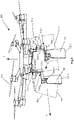
- FIG. 6 shows an UAV 500 according to an embodiment of the present disclosure.
- the UAV is a multi-rotor UAV and comprises eight rotors 510.
- the rotors 510 defines an upper side of the UAV 500. It is advantageous that the UAV has several rotors since it increases lifting strength and maneuverability of the UAV.
- the multi-rotor UAV is capable of hovering in the air above an object and to move in any direction through the air.
- a longitudinal center axis P of the UAV extends between the longitudinal sides of the UAV from the rear end 540.1 and to the front end 540.2 of the UAV. When the UAV engages a lighting module (not shown) the longitudinal center axis P of the UAV corresponds (i.e. overlaps) to center axis Q of the luminaire module.
- a vertical center axis R extends through the upper side of UAV and is orthogonal to the longitudinal center axis P.
- the UAV may comprise a cage 800 with a top wall 801, a circumferential wall 802 and an open bottom 803 hat faces downwards (see figure 8 ).
- the cage 800 is configured to receive the housing 210 of the lighting module 200 (not shown).
- the UAV 500 comprises an engagement means 530.1, 530.2 having an elongate engagement portion 532.1, 532.2 for engaging a lighting module 200 (not shown).
- the UAV 500 comprises a first and a second engagement means 530.1, 530.2 each having an elongate engagement portion 532.1, 532.2 for engaging a lighting module 200 (not shown).
- the first and the second engagement means 530.1, 530.2 are arranged on opposite sides of the UAV and spaced apart such that a lighting module (not shown) may be received between the first and the second engagement means 530.1, 530.2.
- each engagement means 530.1, 530.2 comprises a stem portion 531.1, 531.2 that extends in direction downwards from the UAV, i.e.
- the stem portion 531.1, 531.2 may extend substantially vertically downwards from the UAV 500.
- the stem portions 531.1, 531.2 of the first and the second engagement means 530.1, 530.2 may be arranged to extend from a respective carrier 540 on opposite sides of the UAV.
- the engagement portion 532.1, 532.2 extends substantially orthogonally from the respective stem portion 531,1, 531.2 (i.e. from the distal portion thereof).
- the engagement means 530.1, 530.2 may be L-shaped and formed by bars of ridged material, such as metal.
- the engagement portions 532.1, 532.2 are configured to engage a lighting module 200 and secure the lighting module to the UAV during flight.
- the engagement portions 532.1, 532.2 are there of such length that they respectively approximately extend over half the width of the lighting luminaire.
- the upper surface of the engagement portions 532.1, 532.2 is substantially flat in order to abut against the lower side 214 of the lighting module.
- a release actuator 560.1, 560.2 for the locking means 240 (see figure 7 ) is attached to the lower side of the engagement portions 532.1, 532.2.
- the engagement means 530.1, 530.2 are pivotally arranged to the UAV such that the engagement means 530.1, 530.2 may be pivoted around a respective vertical rotation axis Y that is parallel with the vertical center axis R of the UAV.
- the engagement means are thereby pivotal from a position A in which the respective engagement portion 532.1, 532.2 extends substantially parallel with, or away from the longitudinal center axis P of the UAV to a position B in which the engagement portion 532.1, 532.2 is directed towards the longitudinal center axis P of the UAV, for example orthogonal to the longitudinal center axis P.
- the engagement means 530.1, 530.2 are in position A.
- Figure 10 shows the engagement means 530.1, 530.2 in position B.
- the UAV comprises a first and second vertical rotation shaft 533.1, 533.2, which is arranged to pivotally couple the engagement means 530.1, 530.2 to the UAV.
- the vertical rotation shafts 533.1, 533.2 couples the engagement means 530.1, 530.2 to a carrier 540 that is arranged on the UAV.
- the rotation shafts 533.1, 533.2 thereby forms the pivot axis Y.
- the UAV further comprise a first and a second drive unit 534.1, 534.2, such as an electrical motor, for pivoting the engagement means 530.1, 530.2 around the respective rotation axis Y.
- the stem portions 531.1, 531.2 are attached to a respective vertical rotation shaft 533.1, 533.2 and the respective first and second drive unit 534.1,534.2 are arranged to rotate the rotation shafts 533.1,533.2 around the rotation axis Y and thereby pivot the engagement means 530.1, 530.2.
- the engagement portion 532.1, 532.2 extends orthogonal from the vertical stem portion 531.1, 531.2. Therefore, when the engagement means 530.1, 530.2 are pivoted, or rotated, around the vertical rotation axis Y, the engagement portion 532.1, 532.2 is pivoted in a plane that is parallel with the longitudinal center axis P and orthogonal to the vertical center axis R of the UAV.
- the engagement means may be journalled, i.e. rotationally coupled, to the rotation shafts and the drive unit may be arranged to pivot or rotate the engagement means around the rotation shaft.
- the rotational shafts 533.1, 533.2 are coupled to the stem portions 531.1, 531.2 of the engagement means 530.1, 530.2 and to the carrier 540 of the UAV such that a hinge is formed between the carrier 540 and the engagement means 530.1, 530.2.
- the rotational shafts 533.1, 533.2 are thereby coupled to a first hinge part 534.1, 534.2 and a second hinge part 535.1, 535.2.
- the first hinge part 534.1, 534.2 is attached to the stem portion 531.1, 531.2 of the engagement means 530.1, 530.2.
- the second hinge part 535.1, 535.2 is attached to the carrier 540 of the UAV.
- the rotational shafts 533.1, 533.2 may also be directly attached to the engagement means 530.1, 530.2 .
- the UAV further comprises is a first and second guide means 700.1, 700.2 which may be elongated plates that extends vertically in direction downwards from the engagement portions 532.1, 532.2.
- the guide means 700.1, 700.2 has a front face 701 and a rear face 702. When the engagement portions 532 are in position A the front face 701 faces away from longitudinal center axis P and the rear face 702 faces the longitudinal center axis P.
- Figure 7 shows a detailed view from below of the UAV 500.
- a first and a second release actuator 560.1, 560.2 is arranged on the lower side 570.1, 570.2 of the respective engagement portions 532.1, 532.2.
- the release actuators 560.1, 560.2 comprises respectively an actuator drive 561.1, 561.2 that is coupled to a first end of an elongated actuator rod 562.1, 562.2.
- the actuator rods 562.1, 562.2 are arranged such that their second free ends are directed upwards, i.e. away from the lower side 570.1, 570.2 of the engagement portions 531.1, 531.2. This allows the actuator rods 562.1, 562.2 to engage the locking means 240.1, 240.2.
- the actuator drives 561.1, 561.2 which may be an electrical motor is arranged to turn the first end of the respective actuator rod 562.1, 562.2 in clockwise/anti clockwise direction between a first position C and a second position D.
- the position C is a locked position in which the locking means 240.1, 240.2 are in locking engagement with a lower side 322 of the socket module 300 (see figure 4 ). That is, the protruding part 241.1, 241.2 of the locking means 240.1, 240.2 is resting on the lower surface 322 of the socket module 300.
- Position D is a released position D in which the locking means 240.1, 240.2 is out of engagement with the lower side 322 of the socket module 300
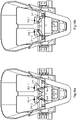
- the lighting module 200 is seen view from below and the socket module 300 is omitted in figures 9 , 10a , 10b and 14 .
- the socket module 300 is visible in figures 8 , 11 and 13 .
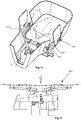
- figure 8 shows a situation in which an UAV 500 that carries a lighting module 200 approaches a socket module 300.
- Figure 9 shows a view from below of the UAV in figure 8 .
- the engagement means 530.1, 530.2 are pivoted into position B in which the engagement portions 532.1. 532.2 of the engagement means 530.1, 530.2 extends over the lower side of the 214 of the lighting module 200 and thereby engages the lighting module 200 and secures it to the UAV (not show).
- the guide elements 700.1 and 700.2 are thereby directed such that the front faces 701 are directed towards (i.e. faces) the front portion 211 of the lighting module 200 and the rear faces 702 are directed towards the rear portion 212 of the lighting module.
- the front and rear faces 701, 702 of the guide elements 700.1 and 700.2 thereby extend between the elongated sides 215, 216 of the housing of the lighting module in a position between the receiving space 250 and the light source 220 (these features are indicated in figure 2 ).
- the respective release actuator 560.1, 560.2 is operated to open the locking means 240.1, 540.2 such that the receiving part 320 of the socket module 300 may be received into the receiving space 220 of the lighting module (not shown).
- the respective release actuator 560.1, 560.2 is thereby operated to the move the locking means 240.1, 240.2 from the closed position C of figure 10a to the open position D shown in figure 10b .
- the distance between the protruding parts 241.1, 241.2 of the locking means 240 is increased between the closed position C and the open position D.
- the UAV 500 has descended towards the socket module 300 such that the rear face 702 of the guide element 700.1 bears against the front support surface 325 of the socket module 300.
- the rear face 702 of the guide means 700.1 may be in sliding contact with the front support surface 325 of the socket module.
- the lighting module 200 is thereby guided such that any contact between the receiving part 320 of the socket module 300 and light source 320 or the cover glass 222 is prevented (not shown). Thereby is the risk of damage to the cover glass or light source advantageously minimized.
- the guide means 700.1, 700.1 further effectively guides the lighting module 200 such that the receiving space 250 of the lighting module is aligned with the receiving part 320 of the socket module. This facilitates connection between the lighting module and the socket module
- Figure 12 shows the final step of mounting the lighting module 200 onto the socket module 300.
- the receiving part 320 of the socket module 300 is thereby received in the receiving space 250 of the lighting housing.
- the electrical contact 260 in the receiving space 250 is automatically placed in electrical connection with the electrical contact of the socket module.
- the release actuator 56 is operated to move the actuator rod to position C.
- the pre-biased locking means 240 thereby returns towards the center axis Q of the lighting module such that the protruding parts 241.1, 241.2 come into locking engagement with the lower side of the socket module 300.
- the engagement means 530.1 530.2 are pivoted to the position A in which the engagement portions 532.1, 532.2 extend outside the lower side 214 of the lighting module 200.
- “outside the lower side 214 of the lighting module” is meant that the engagement portion is outside the elongate sides 215, 216 of the lighting module.
- the longitudinal center axis Q of the lighting module 200 is inside the elongate sides 215, 216.
- the engagement portions 532.1, 532.2 may thereby extend substantially parallel with, or away from, the center axis Q of the lighting luminaire 200.
- the UAV 500 may now leave the lighting luminaire 200 and take off.
- system for replacing modular lighting luminaire relates to street light luminaire, or street lighting luminaire.
- system for replacing lighting luminaire of the also is suitable for other modular lighting luminaire such as modular luminaire for sports stadiums, tunnels, power towers, bridges, rail roads, airports and so on.
Landscapes
- Engineering & Computer Science (AREA)
- General Engineering & Computer Science (AREA)
- Aviation & Aerospace Engineering (AREA)
- Robotics (AREA)
- Mechanical Engineering (AREA)
- Non-Portable Lighting Devices Or Systems Thereof (AREA)
- Arrangement Of Elements, Cooling, Sealing, Or The Like Of Lighting Devices (AREA)
Claims (14)
- System zum Auswechseln einer modularen Beleuchtungsleuchte in der Luft,
wobei das System eine Beleuchtungsleuchte (100) umfasst, die ein Beleuchtungsmodul (200) und ein Sockelmodul (300) umfasst, die so konfiguriert sind, dass sie lösbar miteinander verbunden werden können, wobei:das Sockelmodul (300) einen Sockel (310), der so konfiguriert ist, dass er an einem Leuchtenträger (400) befestigt werden kann, und ein Aufnahmeteil (320), das so konfiguriert ist, dass es in einem Aufnahmeraum (250) des Beleuchtungsmoduls (200) aufgenommen werden kann, und einen elektrischen Kontakt (360) umfasst, der so konfiguriert ist, dass er mit einer elektrischen Stromquelle verbunden werden kann,wobei das Beleuchtungsmodul (200) ein längliches Gehäuse (210) mit einer Oberseite (213) und einer Unterseite (214) sowie einen vorderen Abschnitt (211) mit einer Lichtquelle (220) und einen hinteren Abschnitt (212) mit dem Aufnahmeraum (250) zur lösbaren Aufnahme des Aufnahmeteils (320) Sockelmoduls (300) aufweist und damit das Beleuchtungsmodul (200) mit dem Sockelmodul (300) und einem mit der Lichtquelle (220) verbundenen elektrischen Kontakt (260) verbindet, und wobeidas Beleuchtungsmodul (200) ein lösbares Verriegelungsmittel (240.1, 240.2) umfasst, das in dem Gehäuse (210) angeordnet ist, um das Beleuchtungsmodul (200) lösbar mit dem Sockelmodul (300) zu verriegeln;dadurch gekennzeichnet, dass das System ferner ein unbemanntes Luftfahrzeug (500) umfasst, das so konfiguriert ist, dass es ferngesteuert werden kann, und ein Eingriffsmittel (530.1, 530.2) umfasst, das so konfiguriert ist, dass es mit dem Beleuchtungsmodul (200) in Eingriff kommt, so dass das unbemannte Luftfahrzeug (500) das Beleuchtungsmodul (200) von dem Sockelmodul (300) trennen oder das Beleuchtungsmodul (200) mit dem Sockelmodul (300) verbinden kann, und dassdas Eingriffsmittel (530.1, 530.2) des unbemannten Luftfahrzeugs (500) so konfiguriert ist, dass es das Verriegelungsmittel (240.1, 240.2) aus dem Verriegelungseingriff mit dem Sockelmodul (300) löst. - System nach Anspruch 1, wobei das Aufnahmeteil (320) des Sockelmoduls (300) eine Unterseite (322) aufweist und wobei das Verriegelungsmittel (240.1, 240.2) in einem Zustand des Verriegelungseingriffs mit dem Sockelmodul (300) auf der Unterseite (322) des Aufnahmeteils (320) aufliegt und in einem gelösten Zustand außer Kontakt mit der Unterseite des Aufnahmeteils (320) ist.
- System nach Anspruch 1 oder 2, wobei das unbemannte Luftfahrzeug (500) ein erstes und ein zweites Eingriffsmittel (530.1, 530.2) umfasst, wobeidie Eingriffsmittel (530.1, 530.2) auf gegenüberliegenden Seiten des unbemannten Luftfahrzeugs (500) angeordnet sind und einen länglichen Eingriffsabschnitt (532.1, 532.2) zum Eingriff mit der Unterseite (214) des Beleuchtungsmoduls (200) umfassen, wobeidie Eingriffsmittel (530.1, 530.2) so angeordnet sind, dass sie um eine jeweilige vertikale Schwenkachse (Y) aus einer Position (A), in der sich die Eingriffsabschnitte (532.1, 532.2) außerhalb der Unterseite (214) des Beleuchtungsmoduls (200) erstrecken, in eine Position (B) geschwenkt werden können, in der sich die Eingriffsabschnitte (532.1, 532.2) zumindest teilweise über die Unterseite (214) des Beleuchtungsmoduls (200) erstrecken und dadurch mit dem Beleuchtungsmodul (200) in Eingriff kommen.
- System nach Anspruch 3, wobei das unbemannte Luftfahrzeug (500) eine erste und eine zweite vertikale Drehachse (533.1, 533.2) aufweist, die die Schwenkachse (Y) bilden, die so angeordnet sind, dass sie die Eingriffsmittel (530.1, 530.2) schwenkbar mit dem unbemannten Luftfahrzeug (500) koppeln, und eine Antriebseinheit (534.1, 534.2) zum Schwenken der Eingriffsmittel (530.1,530.2) um die jeweilige Drehachse (Y).
- System nach Anspruch 4, wobei die Eingriffsmittel (530.1, 530.2) an der jeweiligen ersten und zweiten vertikalen Drehachse (533.1, 533.2) angebracht sind und wobei die Antriebseinheit (534.1, 534.2) so angeordnet ist, dass sie die erste und zweite vertikale Drehachse (533.1, 533.2) dreht.
- System nach Anspruch 4, wobei die Eingriffsmittel (530.1, 530.2) an der jeweiligen ersten und zweiten Drehachse (533.1, 533.2) gelagert sind und wobei die Antriebseinheit (534.1, 534.2) so angeordnet ist, dass sie die ersten und zweiten Eingriffsmittel (530.1, 530.2) um die erste und zweite Drehachse (533.1, 533.2) dreht.
- System nach einem der Ansprüche 3 bis 6, wobei die Eingriffsmittel (530.1, 530.2) jeweils einen länglichen Schaftabschnitt (531.1, 531.2) und einen Eingriffsabschnitt (532.1, 532.2) umfassen, der sich im Wesentlichen orthogonal von dem Schaftabschnitt (531.1, 531.2) erstreckt und so konfiguriert ist, dass er sich zumindest teilweise über die Unterseite (214) des Beleuchtungsmoduls (200) in der Position (B) erstreckt.
- System nach einem der Ansprüche 5 oder 7, wobei die Eingriffsabschnitte (532.1, 532.2) in einer Ebene schwenkbar sind, die parallel zu einer Längsmittelachse P des unbemannten Luftfahrzeugs (500) und orthogonal zu einer vertikalen Mittelachse R des unbemannten Luftfahrzeugs (500) liegt.
- System nach einem der Ansprüche 5 bis 8, wobeidas Beleuchtungsmodul (200) ein erstes und ein zweites Verriegelungsmittel (240.1, 240.2) umfasst, die jeweils zwischen einer verriegelten Position (C), in der die Verriegelungsmittel (240.1, 240.1) in Verriegelungseingriff mit einer Unterseite (322) des Sockelmoduls (300) stehen, und einer gelösten Position (D), in der die Verriegelungsmittel (240.1, 240.2) außer Eingriff mit der Unterseite (322) des Sockelmoduls (300) sind, bewegbar sind, und wobeidie Eingriffsmittel (530.1, 530.2) jeweils ein Freigabebetätigungselement (560.1, 560.2) umfassen, das so angeordnet ist, dass es die Verriegelungsmittel (240.1, 240.2) von der verriegelten Position (C) in die gelöste Position (D) bewegt.
- System nach Anspruch 8, wobei die Freigabebetätigungselemente (560.1, 560.2) jeweils an dem Eingriffsabschnitt (532.1, 532.2) der Eingriffsmittels (530.1, 530.2) angeordnet sind.
- System nach einem der Ansprüche 5 bis 9, wobei
das erste und das zweite Eingriffsmittel (530.1, 530.2) ein Führungselement (700.1, 700.2) zum Führen der Position des Beleuchtungsmoduls (200) relativ zu dem Sockelmodul (300) während der Montage des Beleuchtungsmoduls (200) auf dem Sockelmodul (300) aufweist, wobei das Führungselement (700.1, 700.2) eine Vorderseite (701) und eine Rückseite (702) aufweist und so an den Eingriffselementen (530.1, 530.2) angeordnet ist, dass wenn die Eingriffsmittel (530.1, 530. 2) in Position (A) sind, die Vorderseite (701) von der Mittelachse (Q) des Beleuchtungsmoduls (200) abgewandt ist und die Rückseite der Mittelachse (Q) des Beleuchtungsmoduls (200) zugewandt ist, und wenn die Eingriffsmittel (530.1, 530.2) in Position (B) sind, die Vorderseite (701) dem vorderen Abschnitt (211) des Beleuchtungsmoduls (200) zugewandt ist und die Rückseite (702) dem hinteren Teil (212) des Sockelmoduls (100) zugewandt ist. - System nach Anspruch 11, wobei das Führungselement (700.1, 700.2) eine Platte ist und an dem Eingriffsabschnitt (532.1, 532.2) des Eingriffsmittels (530.1, 530.1) angebracht ist und sich im Wesentlichen vertikal nach unten erstreckt.
- System nach Anspruch 11 oder 12, wobei
das Führungselement (700.1, 700.2) so ausgestaltet ist, dass bei der Montage des Beleuchtungsmoduls (200) auf dem Sockelmodul (300) die Rückseite (702) des Führungselements (700.1, 700.2) zumindest teilweise eine vordere Auflagefläche (325) des Sockelmoduls (300) berühren kann, wodurch verhindert wird, dass der vordere Teil (211) des Beleuchtungsmoduls (200) das Sockelmodul (300) berührt. - System nach einem der Ansprüche 1 bis 13, das für den Austausch einer modularen Straßenbeleuchtungsleuchte konfiguriert ist und bei dem der Leuchtenträger (400) ein Laternenpfahl ist.
Applications Claiming Priority (2)
| Application Number | Priority Date | Filing Date | Title |
|---|---|---|---|
| SE1750889 | 2017-07-06 | ||
| PCT/SE2018/050741 WO2019009797A1 (en) | 2017-07-06 | 2018-07-06 | AIRBORNE SYSTEM FOR REPLACING A MODULAR LIGHTING LUMINAIRE |
Publications (3)
| Publication Number | Publication Date |
|---|---|
| EP3649397A1 EP3649397A1 (de) | 2020-05-13 |
| EP3649397A4 EP3649397A4 (de) | 2021-03-31 |
| EP3649397B1 true EP3649397B1 (de) | 2022-03-30 |
Family
ID=64950264
Family Applications (1)
| Application Number | Title | Priority Date | Filing Date |
|---|---|---|---|
| EP18827957.4A Not-in-force EP3649397B1 (de) | 2017-07-06 | 2018-07-06 | Luftgestütztes system zum austausch von modularen beleuchtungsleuchten |
Country Status (6)
| Country | Link |
|---|---|
| US (1) | US20200132286A1 (de) |
| EP (1) | EP3649397B1 (de) |
| JP (1) | JP2020525982A (de) |
| CN (1) | CN110831856A (de) |
| CA (1) | CA3068809A1 (de) |
| WO (1) | WO2019009797A1 (de) |
Families Citing this family (8)
| Publication number | Priority date | Publication date | Assignee | Title |
|---|---|---|---|---|
| SE1850296A1 (en) * | 2018-03-16 | 2019-09-17 | Strihl Scandinavia Ab | A method and a system for replacing existing lighting luminaire with replacement lighting luminaire |
| HK1247779A2 (zh) * | 2018-06-15 | 2018-09-28 | 李隽义 | 用於无人机升降灯具的连接结构 |
| US10661898B2 (en) * | 2018-06-21 | 2020-05-26 | Cimcon Lighting, Inc. | Unmanned aerial vehicle for infrastructure maintenance |
| US11097796B2 (en) * | 2018-11-29 | 2021-08-24 | Saudi Arabian Oil Company | Articulated magnet-bearing legs for UAV landing on curved surfaces |
| US11679875B2 (en) * | 2020-12-03 | 2023-06-20 | Saudi Arabian Oil Company | Mechanism for docking a magnetic crawler into a UAV |
| USD1049450S1 (en) * | 2021-05-23 | 2024-10-29 | Shenzhen Snc Opto Electronic Co., Ltd | LED lamp |
| CN219154417U (zh) * | 2023-02-01 | 2023-06-09 | 保视杰科技有限公司 | 一种带转向灯的房车摄像头 |
| KR102950342B1 (ko) | 2025-07-12 | 2026-04-09 | 주식회사 정호 | 드론을 이용한 유니트 교체시스템 및 그 방법 |
Family Cites Families (11)
| Publication number | Priority date | Publication date | Assignee | Title |
|---|---|---|---|---|
| FR2844029B1 (fr) * | 2002-08-30 | 2004-11-26 | Airstar | Ballon pour enseigne lumineuse comprenant une enveloppe gonflable a pression interne autoregulee |
| WO2011066031A2 (en) * | 2009-09-09 | 2011-06-03 | Aerovironment, Inc. | Elevon control system |
| WO2011145018A1 (en) * | 2010-05-18 | 2011-11-24 | Koninklijke Philips Electronics N.V. | Push-pull ssl module and socket |
| JP5794211B2 (ja) * | 2011-09-30 | 2015-10-14 | 市光工業株式会社 | 車両用灯具の半導体型光源ユニット、車両用灯具 |
| SE537318C2 (sv) | 2012-02-01 | 2015-04-07 | Strihl Scandinavia Ab | System för byte av gatubeslysningsarmatur |
| SE537327C2 (sv) | 2012-02-01 | 2015-04-07 | Strihl Scandinavia Ab | Enkelt monterbar belysningsarmatur med anordning för inpassning |
| US9629220B2 (en) * | 2013-08-05 | 2017-04-18 | Peter Panopoulos | Sensor-based controllable LED lighting system with repositionable components and method |
| US10227134B2 (en) * | 2015-04-14 | 2019-03-12 | ETAK Systems, LLC | Using drones to lift personnel up cell towers |
| US9596617B2 (en) * | 2015-04-14 | 2017-03-14 | ETAK Systems, LLC | Unmanned aerial vehicle-based systems and methods associated with cell sites and cell towers |
| CN105563496A (zh) * | 2016-03-05 | 2016-05-11 | 山东亿昌照明科技有限公司 | 可远程控制的路灯维修专用智能机器人 |
| CN106524019B (zh) * | 2016-12-31 | 2022-09-30 | 上海复展智能科技股份有限公司 | 一种可用无人机安装的路灯灯具的灯杆接口 |
-
2018
- 2018-07-06 CN CN201880044732.7A patent/CN110831856A/zh active Pending
- 2018-07-06 WO PCT/SE2018/050741 patent/WO2019009797A1/en not_active Ceased
- 2018-07-06 US US16/627,595 patent/US20200132286A1/en not_active Abandoned
- 2018-07-06 JP JP2019572079A patent/JP2020525982A/ja active Pending
- 2018-07-06 EP EP18827957.4A patent/EP3649397B1/de not_active Not-in-force
- 2018-07-06 CA CA3068809A patent/CA3068809A1/en active Pending
Also Published As
| Publication number | Publication date |
|---|---|
| US20200132286A1 (en) | 2020-04-30 |
| CA3068809A1 (en) | 2019-01-10 |
| EP3649397A4 (de) | 2021-03-31 |
| EP3649397A1 (de) | 2020-05-13 |
| CN110831856A (zh) | 2020-02-21 |
| WO2019009797A1 (en) | 2019-01-10 |
| JP2020525982A (ja) | 2020-08-27 |
Similar Documents
| Publication | Publication Date | Title |
|---|---|---|
| EP3649397B1 (de) | Luftgestütztes system zum austausch von modularen beleuchtungsleuchten | |
| EP3073177B1 (de) | System zum austauschen von strassenlaternen | |
| US9972205B2 (en) | Remote controlled mobile traffic control system and method | |
| WO2019177528A1 (en) | A method and a system for airborne replacement of existing lighting luminaire with replacement lighting luminaire | |
| US10657810B2 (en) | Remote controlled mobile traffic control system and method | |
| US20230257139A1 (en) | Products, Systems, and Methods for an Autonomous Drone Docking Station | |
| US20190100331A1 (en) | Unmanned aerial vehicle (uav) recharging/refuelling station | |
| EP1886904A2 (de) | Kletterroboter für Reinigung | |
| JP6897319B2 (ja) | インフラ設備 | |
| CN115781756A (zh) | 基于无人机平台的单灯控制器空中自动化更换装置 | |
| KR20190057824A (ko) | 드론을 이용한 가로등기구 교체시스템 및 그 방법 | |
| CN211083860U (zh) | 一种带电作业绝缘斗臂车夜间作业高空智能照明灯 | |
| BR102013013343A2 (pt) | Robô instalação e remoção de esfera de sinalização aérea | |
| CN213453125U (zh) | 一种适用于机场场道工程的易拆卸助航指示灯 | |
| CN219017092U (zh) | 一种具有远程操控信号功能的临时信号灯 | |
| CN119347737B (zh) | 一种基于智慧交通的辅助安装机器人 | |
| CN115298129A (zh) | 起重机系统、起重机及移动体 | |
| CN208272588U (zh) | 一种架空输电导线清雪系统 | |
| CA3103293A1 (en) | Apparatus and method for installing and replacing light fixture devices | |
| CN121404574A (zh) | 无人机 | |
| BR102019004634A2 (pt) | Esfera de sinalização aérea, aparelho de içamento e método para instalação de esfera de sinalização, e, método para desinstalação de esfera de sinalização | |
| BR102020015437B1 (pt) | Módulo robótico para instalação/remoção de sinalização aérea em cabo terra | |
| JP2004026464A (ja) | 機器の設置装置および設置方法 |
Legal Events
| Date | Code | Title | Description |
|---|---|---|---|
| STAA | Information on the status of an ep patent application or granted ep patent |
Free format text: STATUS: THE INTERNATIONAL PUBLICATION HAS BEEN MADE |
|
| PUAI | Public reference made under article 153(3) epc to a published international application that has entered the european phase |
Free format text: ORIGINAL CODE: 0009012 |
|
| STAA | Information on the status of an ep patent application or granted ep patent |
Free format text: STATUS: REQUEST FOR EXAMINATION WAS MADE |
|
| 17P | Request for examination filed |
Effective date: 20200128 |
|
| AK | Designated contracting states |
Kind code of ref document: A1 Designated state(s): AL AT BE BG CH CY CZ DE DK EE ES FI FR GB GR HR HU IE IS IT LI LT LU LV MC MK MT NL NO PL PT RO RS SE SI SK SM TR |
|
| AX | Request for extension of the european patent |
Extension state: BA ME |
|
| DAV | Request for validation of the european patent (deleted) | ||
| DAX | Request for extension of the european patent (deleted) | ||
| A4 | Supplementary search report drawn up and despatched |
Effective date: 20210225 |
|
| RIC1 | Information provided on ipc code assigned before grant |
Ipc: B25J 15/00 20060101ALI20210219BHEP Ipc: F21W 111/02 20060101ALI20210219BHEP Ipc: B25J 9/00 20060101ALI20210219BHEP Ipc: F21V 19/04 20060101ALI20210219BHEP Ipc: F21S 8/08 20060101ALI20210219BHEP Ipc: F21W 131/103 20060101ALI20210219BHEP Ipc: F21S 2/00 20160101AFI20210219BHEP Ipc: B64C 39/02 20060101ALI20210219BHEP |
|
| GRAP | Despatch of communication of intention to grant a patent |
Free format text: ORIGINAL CODE: EPIDOSNIGR1 |
|
| STAA | Information on the status of an ep patent application or granted ep patent |
Free format text: STATUS: GRANT OF PATENT IS INTENDED |
|
| INTG | Intention to grant announced |
Effective date: 20211027 |
|
| GRAS | Grant fee paid |
Free format text: ORIGINAL CODE: EPIDOSNIGR3 |
|
| GRAA | (expected) grant |
Free format text: ORIGINAL CODE: 0009210 |
|
| STAA | Information on the status of an ep patent application or granted ep patent |
Free format text: STATUS: THE PATENT HAS BEEN GRANTED |
|
| AK | Designated contracting states |
Kind code of ref document: B1 Designated state(s): AL AT BE BG CH CY CZ DE DK EE ES FI FR GB GR HR HU IE IS IT LI LT LU LV MC MK MT NL NO PL PT RO RS SE SI SK SM TR |
|
| REG | Reference to a national code |
Ref country code: GB Ref legal event code: FG4D |
|
| REG | Reference to a national code |
Ref country code: CH Ref legal event code: EP |
|
| REG | Reference to a national code |
Ref country code: SE Ref legal event code: TRGR |
|
| REG | Reference to a national code |
Ref country code: AT Ref legal event code: REF Ref document number: 1479509 Country of ref document: AT Kind code of ref document: T Effective date: 20220415 |
|
| REG | Reference to a national code |
Ref country code: DE Ref legal event code: R096 Ref document number: 602018033122 Country of ref document: DE |
|
| REG | Reference to a national code |
Ref country code: IE Ref legal event code: FG4D |
|
| REG | Reference to a national code |
Ref country code: NL Ref legal event code: FP |
|
| REG | Reference to a national code |
Ref country code: LT Ref legal event code: MG9D |
|
| PG25 | Lapsed in a contracting state [announced via postgrant information from national office to epo] |
Ref country code: RS Free format text: LAPSE BECAUSE OF FAILURE TO SUBMIT A TRANSLATION OF THE DESCRIPTION OR TO PAY THE FEE WITHIN THE PRESCRIBED TIME-LIMIT Effective date: 20220330 Ref country code: NO Free format text: LAPSE BECAUSE OF FAILURE TO SUBMIT A TRANSLATION OF THE DESCRIPTION OR TO PAY THE FEE WITHIN THE PRESCRIBED TIME-LIMIT Effective date: 20220630 Ref country code: LT Free format text: LAPSE BECAUSE OF FAILURE TO SUBMIT A TRANSLATION OF THE DESCRIPTION OR TO PAY THE FEE WITHIN THE PRESCRIBED TIME-LIMIT Effective date: 20220330 Ref country code: HR Free format text: LAPSE BECAUSE OF FAILURE TO SUBMIT A TRANSLATION OF THE DESCRIPTION OR TO PAY THE FEE WITHIN THE PRESCRIBED TIME-LIMIT Effective date: 20220330 Ref country code: BG Free format text: LAPSE BECAUSE OF FAILURE TO SUBMIT A TRANSLATION OF THE DESCRIPTION OR TO PAY THE FEE WITHIN THE PRESCRIBED TIME-LIMIT Effective date: 20220630 |
|
| PGFP | Annual fee paid to national office [announced via postgrant information from national office to epo] |
Ref country code: SE Payment date: 20220621 Year of fee payment: 5 Ref country code: NL Payment date: 20220616 Year of fee payment: 5 Ref country code: GB Payment date: 20220616 Year of fee payment: 5 |
|
| REG | Reference to a national code |
Ref country code: AT Ref legal event code: MK05 Ref document number: 1479509 Country of ref document: AT Kind code of ref document: T Effective date: 20220330 |
|
| PG25 | Lapsed in a contracting state [announced via postgrant information from national office to epo] |
Ref country code: LV Free format text: LAPSE BECAUSE OF FAILURE TO SUBMIT A TRANSLATION OF THE DESCRIPTION OR TO PAY THE FEE WITHIN THE PRESCRIBED TIME-LIMIT Effective date: 20220330 Ref country code: GR Free format text: LAPSE BECAUSE OF FAILURE TO SUBMIT A TRANSLATION OF THE DESCRIPTION OR TO PAY THE FEE WITHIN THE PRESCRIBED TIME-LIMIT Effective date: 20220701 Ref country code: FI Free format text: LAPSE BECAUSE OF FAILURE TO SUBMIT A TRANSLATION OF THE DESCRIPTION OR TO PAY THE FEE WITHIN THE PRESCRIBED TIME-LIMIT Effective date: 20220330 |
|
| PGFP | Annual fee paid to national office [announced via postgrant information from national office to epo] |
Ref country code: FR Payment date: 20220616 Year of fee payment: 5 |
|
| PG25 | Lapsed in a contracting state [announced via postgrant information from national office to epo] |
Ref country code: SM Free format text: LAPSE BECAUSE OF FAILURE TO SUBMIT A TRANSLATION OF THE DESCRIPTION OR TO PAY THE FEE WITHIN THE PRESCRIBED TIME-LIMIT Effective date: 20220330 Ref country code: SK Free format text: LAPSE BECAUSE OF FAILURE TO SUBMIT A TRANSLATION OF THE DESCRIPTION OR TO PAY THE FEE WITHIN THE PRESCRIBED TIME-LIMIT Effective date: 20220330 Ref country code: RO Free format text: LAPSE BECAUSE OF FAILURE TO SUBMIT A TRANSLATION OF THE DESCRIPTION OR TO PAY THE FEE WITHIN THE PRESCRIBED TIME-LIMIT Effective date: 20220330 Ref country code: PT Free format text: LAPSE BECAUSE OF FAILURE TO SUBMIT A TRANSLATION OF THE DESCRIPTION OR TO PAY THE FEE WITHIN THE PRESCRIBED TIME-LIMIT Effective date: 20220801 Ref country code: ES Free format text: LAPSE BECAUSE OF FAILURE TO SUBMIT A TRANSLATION OF THE DESCRIPTION OR TO PAY THE FEE WITHIN THE PRESCRIBED TIME-LIMIT Effective date: 20220330 Ref country code: EE Free format text: LAPSE BECAUSE OF FAILURE TO SUBMIT A TRANSLATION OF THE DESCRIPTION OR TO PAY THE FEE WITHIN THE PRESCRIBED TIME-LIMIT Effective date: 20220330 Ref country code: CZ Free format text: LAPSE BECAUSE OF FAILURE TO SUBMIT A TRANSLATION OF THE DESCRIPTION OR TO PAY THE FEE WITHIN THE PRESCRIBED TIME-LIMIT Effective date: 20220330 Ref country code: AT Free format text: LAPSE BECAUSE OF FAILURE TO SUBMIT A TRANSLATION OF THE DESCRIPTION OR TO PAY THE FEE WITHIN THE PRESCRIBED TIME-LIMIT Effective date: 20220330 |
|
| PGFP | Annual fee paid to national office [announced via postgrant information from national office to epo] |
Ref country code: DE Payment date: 20220616 Year of fee payment: 5 |
|
| PG25 | Lapsed in a contracting state [announced via postgrant information from national office to epo] |
Ref country code: PL Free format text: LAPSE BECAUSE OF FAILURE TO SUBMIT A TRANSLATION OF THE DESCRIPTION OR TO PAY THE FEE WITHIN THE PRESCRIBED TIME-LIMIT Effective date: 20220330 Ref country code: IS Free format text: LAPSE BECAUSE OF FAILURE TO SUBMIT A TRANSLATION OF THE DESCRIPTION OR TO PAY THE FEE WITHIN THE PRESCRIBED TIME-LIMIT Effective date: 20220730 Ref country code: AL Free format text: LAPSE BECAUSE OF FAILURE TO SUBMIT A TRANSLATION OF THE DESCRIPTION OR TO PAY THE FEE WITHIN THE PRESCRIBED TIME-LIMIT Effective date: 20220330 |
|
| REG | Reference to a national code |
Ref country code: DE Ref legal event code: R097 Ref document number: 602018033122 Country of ref document: DE |
|
| PG25 | Lapsed in a contracting state [announced via postgrant information from national office to epo] |
Ref country code: DK Free format text: LAPSE BECAUSE OF FAILURE TO SUBMIT A TRANSLATION OF THE DESCRIPTION OR TO PAY THE FEE WITHIN THE PRESCRIBED TIME-LIMIT Effective date: 20220330 |
|
| PLBE | No opposition filed within time limit |
Free format text: ORIGINAL CODE: 0009261 |
|
| STAA | Information on the status of an ep patent application or granted ep patent |
Free format text: STATUS: NO OPPOSITION FILED WITHIN TIME LIMIT |
|
| PG25 | Lapsed in a contracting state [announced via postgrant information from national office to epo] |
Ref country code: MC Free format text: LAPSE BECAUSE OF FAILURE TO SUBMIT A TRANSLATION OF THE DESCRIPTION OR TO PAY THE FEE WITHIN THE PRESCRIBED TIME-LIMIT Effective date: 20220330 |
|
| REG | Reference to a national code |
Ref country code: CH Ref legal event code: PL |
|
| 26N | No opposition filed |
Effective date: 20230103 |
|
| REG | Reference to a national code |
Ref country code: BE Ref legal event code: MM Effective date: 20220731 |
|
| PG25 | Lapsed in a contracting state [announced via postgrant information from national office to epo] |
Ref country code: LU Free format text: LAPSE BECAUSE OF NON-PAYMENT OF DUE FEES Effective date: 20220706 Ref country code: LI Free format text: LAPSE BECAUSE OF NON-PAYMENT OF DUE FEES Effective date: 20220731 Ref country code: CH Free format text: LAPSE BECAUSE OF NON-PAYMENT OF DUE FEES Effective date: 20220731 |
|
| PG25 | Lapsed in a contracting state [announced via postgrant information from national office to epo] |
Ref country code: SI Free format text: LAPSE BECAUSE OF FAILURE TO SUBMIT A TRANSLATION OF THE DESCRIPTION OR TO PAY THE FEE WITHIN THE PRESCRIBED TIME-LIMIT Effective date: 20220330 Ref country code: BE Free format text: LAPSE BECAUSE OF NON-PAYMENT OF DUE FEES Effective date: 20220731 |
|
| PG25 | Lapsed in a contracting state [announced via postgrant information from national office to epo] |
Ref country code: IT Free format text: LAPSE BECAUSE OF FAILURE TO SUBMIT A TRANSLATION OF THE DESCRIPTION OR TO PAY THE FEE WITHIN THE PRESCRIBED TIME-LIMIT Effective date: 20220330 Ref country code: IE Free format text: LAPSE BECAUSE OF NON-PAYMENT OF DUE FEES Effective date: 20220706 |
|
| REG | Reference to a national code |
Ref country code: DE Ref legal event code: R119 Ref document number: 602018033122 Country of ref document: DE |
|
| REG | Reference to a national code |
Ref country code: SE Ref legal event code: EUG |
|
| REG | Reference to a national code |
Ref country code: NL Ref legal event code: MM Effective date: 20230801 |
|
| GBPC | Gb: european patent ceased through non-payment of renewal fee |
Effective date: 20230706 |
|
| PG25 | Lapsed in a contracting state [announced via postgrant information from national office to epo] |
Ref country code: NL Free format text: LAPSE BECAUSE OF NON-PAYMENT OF DUE FEES Effective date: 20230801 |
|
| PG25 | Lapsed in a contracting state [announced via postgrant information from national office to epo] |
Ref country code: NL Free format text: LAPSE BECAUSE OF NON-PAYMENT OF DUE FEES Effective date: 20230801 Ref country code: MK Free format text: LAPSE BECAUSE OF FAILURE TO SUBMIT A TRANSLATION OF THE DESCRIPTION OR TO PAY THE FEE WITHIN THE PRESCRIBED TIME-LIMIT Effective date: 20220330 Ref country code: DE Free format text: LAPSE BECAUSE OF NON-PAYMENT OF DUE FEES Effective date: 20240201 Ref country code: CY Free format text: LAPSE BECAUSE OF FAILURE TO SUBMIT A TRANSLATION OF THE DESCRIPTION OR TO PAY THE FEE WITHIN THE PRESCRIBED TIME-LIMIT Effective date: 20220330 Ref country code: GB Free format text: LAPSE BECAUSE OF NON-PAYMENT OF DUE FEES Effective date: 20230706 |
|
| PG25 | Lapsed in a contracting state [announced via postgrant information from national office to epo] |
Ref country code: SE Free format text: LAPSE BECAUSE OF NON-PAYMENT OF DUE FEES Effective date: 20230707 Ref country code: HU Free format text: LAPSE BECAUSE OF FAILURE TO SUBMIT A TRANSLATION OF THE DESCRIPTION OR TO PAY THE FEE WITHIN THE PRESCRIBED TIME-LIMIT; INVALID AB INITIO Effective date: 20180706 Ref country code: FR Free format text: LAPSE BECAUSE OF NON-PAYMENT OF DUE FEES Effective date: 20230731 |
|
| PG25 | Lapsed in a contracting state [announced via postgrant information from national office to epo] |
Ref country code: MT Free format text: LAPSE BECAUSE OF FAILURE TO SUBMIT A TRANSLATION OF THE DESCRIPTION OR TO PAY THE FEE WITHIN THE PRESCRIBED TIME-LIMIT Effective date: 20220330 |
|
| PG25 | Lapsed in a contracting state [announced via postgrant information from national office to epo] |
Ref country code: TR Free format text: LAPSE BECAUSE OF FAILURE TO SUBMIT A TRANSLATION OF THE DESCRIPTION OR TO PAY THE FEE WITHIN THE PRESCRIBED TIME-LIMIT Effective date: 20220330 |