EP3649792B1 - Procédé de transmission d'un état de traitement dans une application d'adaptation audiologique pour un appareil auditif - Google Patents
Procédé de transmission d'un état de traitement dans une application d'adaptation audiologique pour un appareil auditif Download PDFInfo
- Publication number
- EP3649792B1 EP3649792B1 EP18730741.8A EP18730741A EP3649792B1 EP 3649792 B1 EP3649792 B1 EP 3649792B1 EP 18730741 A EP18730741 A EP 18730741A EP 3649792 B1 EP3649792 B1 EP 3649792B1
- Authority
- EP
- European Patent Office
- Prior art keywords
- audiological
- application
- processing
- information
- data
- Prior art date
- Legal status (The legal status is an assumption and is not a legal conclusion. Google has not performed a legal analysis and makes no representation as to the accuracy of the status listed.)
- Active
Links
Images


Classifications
-
- H—ELECTRICITY
- H04—ELECTRIC COMMUNICATION TECHNIQUE
- H04R—LOUDSPEAKERS, MICROPHONES, GRAMOPHONE PICK-UPS OR LIKE ACOUSTIC ELECTROMECHANICAL TRANSDUCERS; ELECTRIC HEARING AIDS; PUBLIC ADDRESS SYSTEMS
- H04R25/00—Electric hearing aids
- H04R25/70—Adaptation of deaf aid to hearing loss, e.g. initial electronic fitting
-
- H—ELECTRICITY
- H04—ELECTRIC COMMUNICATION TECHNIQUE
- H04R—LOUDSPEAKERS, MICROPHONES, GRAMOPHONE PICK-UPS OR LIKE ACOUSTIC ELECTROMECHANICAL TRANSDUCERS; ELECTRIC HEARING AIDS; PUBLIC ADDRESS SYSTEMS
- H04R2225/00—Details of deaf aids covered by H04R25/00, not provided for in any of its subgroups
- H04R2225/55—Communication between hearing aids and external devices via a network for data exchange
Definitions
- the invention relates to a method for transmitting a processing status in an audiological adjustment application for a hearing device, wherein biological and/or audiometric data of a user of the hearing device are stored as input values of the audiological adjustment application in a plurality of processing groups, typed to one, with a first processing mode a given point in time corresponds to active processing of the data in the first processing group by the audiological adjustment application, and the processing state of the audiological adjustment application with regard to the hearing aid that is present at a point in time is produced by the biological and/or audiometric data of the user from the first processing group in the first processing mode to be provided.
- Hearing aids are usually used to compensate or correct hearing impairment or hearing loss in general. Although different manifestations of hearing loss can be summarized in individual medical diagnosis groups depending on their similarity, hearing loss is an individual phenomenon, so that a hearing aid for correction or compensation of the hearing loss must be adapted to its specific, individual manifestation, like this one currently available to the user of the hearing aid.
- a change in the hearing ability of the user over time for example if the hearing ability in certain frequency bands continues to decrease over a certain period of time, can also make it necessary to readjust the hearing device, ie in particular its settings for signal processing.
- Such an adjustment is often made with the help of an audiological Adaptation application, which is usually provided by the manufacturer of a hearing device or on its behalf, and by means of which access and in particular a determination of individual parameters for the signal processing of the hearing device is possible.
- audiometric data is provided, which provides information about the specific, individual hearing loss of the user, so that the parameters of the hearing aid can be adjusted in the audiological adjustment application, taking these audiometric data into account.
- the hearing aid is adjusted using the audiological adjustment application by a suitably trained audiologist or hearing aid acoustician.
- a suitably trained audiologist or hearing aid acoustician In developing countries in particular, however, the ratio between users of hearing aids and hearing aid acousticians or audiologists is so high that a user of a hearing aid often visits a medical nursing station or similar there, the staff of which has medical-technical knowledge, but no special audiological knowledge enjoyed education. In most cases, the medical-technical staff in such a nursing ward therefore carry out the adaptation to the extent that their own level of knowledge allows. Even if this can usually lead to somewhat useful results for the user of the hearing device with regard to the basic usability of the hearing device, situations often arise in which the medical-technical staff is dependent on information or help from a trained audiologist.
- the U.S. 2012/0 250 858 A1 discloses a way of sequentially distributing the use of an application to different devices.
- a user input instructs a first device on which the application is being used to transfer the running application together with all relevant data to be processed and information regarding a processing status or progress to the second device, on which the Use of the application can be continued immediately.
- the transmission is encrypted via a server in which each device can be created as its own user identity.
- a backup of the processing and status data relevant to the use of the application is created based on a corresponding triggering event, which does not necessarily have to be given by a user input, but can also be determined automatically in the first device that runs the application.
- a server which receives the backup data it can be determined on the basis of information for synchronization with other devices on which other device the use of the application is to be continued, so that the relevant data is made available to this device.
- the invention is therefore based on the object of specifying a method by which a processing status in an audiological adjustment application for a hearing aid can be transmitted to another location by linking the data used by the user of the hearing aid and/or to continue the adjustment in the same place processing state can be preserved at a later point in time.
- the stated object is achieved according to the invention by a method for transmitting a processing status in an audiological adjustment application for a hearing device, with data from a user of the hearing device, in particular biological and/or audiometric data and/or data for hearing device adjustment from an intermediate process of a fitting, being used as input values for the audiological adaptation application are transmitted to a central memory and stored there in a typified form in a plurality of processing groups, with first information about the identity of the user being encoded together with second information about at least one first processing mode at a first point in time in a first user area, the first Processing mode corresponds to a processing of the data of the first processing group that is active at a given point in time by the audiological adaptation application, the first and second coded at the first point in time information is decoded at a second point in time, the user's data being loaded from the central memory at least from the first processing group into the audiological adjustment application, and the processing state of the audiological adjustment application relating to the hearing aid that was present at the first point in time being
- the fitting application processes data which, in addition to the identity of the hearing device user, can also include his biological data, his audiometric data and data on the current settings of his hearing devices. In this way, the fitting application collects and processes data as it occurs during the process of fitting a hearing aid, which may last for many months. This process ends with the final adjustment of his hearing aids.
- the audiometric data which are transmitted in particular as input values of the audiological adjustment application to the central memory and stored there, are in particular values of a tone audiogram, i.e. the hearing ability of a corresponding test signal resolved by frequency band with regard to given standard values, values for spatial hearing ability with regard to a binaural test signal , values for a frequency-dependent discomfort threshold, data on speech intelligibility or data from a real-ear unaided gain measurement.
- the biological data include, in particular, the age and gender of the user, as well as organic medical diagnoses, such as organic damage to an eardrum, but also medical diagnoses that have no relation whatsoever to hearing.
- the audiological adjustment application can be designed in such a way that an independent computer unit is coordinated with it and, in particular, specially developed for it, so that the computer unit is not intended for any other use, or on the other hand it can also be used on a general computer unit on which other applications that are in principle separate from the audiological fitting application can run.
- a central memory includes, in particular, a memory that stores the biological and/or audiometric data of a plurality of users of hearing aids, and for this purpose can also be connected to a plurality of computer units, at least for the respective transmission and storage process, on which the audiological fitting application is running.
- the central memory is spatially separated from the computer unit executing the audiological adjustment application.
- the central memory is a cloud-based memory, i.e. a memory in a data center, which can be accessed decentrally via an Internet connection by users, preferably with the appropriate authorization.
- the typification of the biological and/or audiometric data into a plurality of processing groups is carried out here in particular on the basis of their sequence in a comprehensive process of fitting hearing aids where they are recorded for the first time.
- his identity when fitting a future user with a hearing aid, his identity can be recorded at the beginning, and his biological data such as date of birth or gender can also be recorded, so that identity and biological data can be recorded in a data structure of the appropriate type.
- the hearing loss can be measured, resulting in a tone audiogram, the data of which can also be recorded in the format of a corresponding type and, in particular, saved and transmitted to the central memory at a given point in time.
- the hearing loss can also be measured with hearing aids, which, however, are usually different from the final hearing aid for the user.
- the result is called an "in situ audiogram", ie an audiogram taken 'in the situation'('insitu').
- the hearing aid acoustician select a suitable hearing aid and add a number of acoustic coupling pieces to it, which ensure that the sound outlet is held in the user's auditory canal.
- a type designation of the selected hearing aid and an attached coupling piece can also be included in a data structure of the appropriate type.
- processing groups For this purpose, a division into processing groups according to common terms that are generally used and familiar to audiologists is preferably used, for example into the following groups: gain and compression settings, frequency compression settings, microphone directivity settings, background noise suppression settings, classification-based sound optimization settings and sound therapy settings. as used for tinnitus.
- the typification preferably takes place in the audiological adaptation application before the transmission to the central memory.
- a first user area includes, in particular, the computer unit on which the audiological adjustment application is carried out, as well as its immediate spatial environment; in the latter case, the coding of the first information and the second information can in particular also take place by photographing the screen of said computer unit.
- a corresponding storage in the central memory can also take place, for example by linking the command for coding the said information with a corresponding storage command.
- the correct data of the relevant user of the hearing aid can be accessed based on the first information, and on the one hand the correct processing group can be selected within this data on the basis of the second information, on the other hand with the correctly provided biological and/audiological data of the relevant first processing group, the first processing mode of the audiological adjustment application can also be restored as it was at the first point in time when the first and second information was encoded.
- the processing state of the audiological adjustment application that is present at the first point in time with regard to the hearing aid is preferably established in the first user area at the second point in time or after the second point in time.
- This allows hearing aids of other users to be adjusted between the first point in time and the second point in time using the audiological adjustment application on said computer unit.
- the processing state of the audiological adaptation application with regard to the hearing aid that is present at the first point in time is favorably established in a second user area at the second point in time or after the second point in time.
- a corresponding expert for example an audiologist or a hearing aid acoustician
- the encoded first information and the encoded second information are transmitted from the first user area to the second user area.
- the first piece of information and the second piece of information are encoded in such a way that only a single data packet, which can be regarded as contiguous within the framework of the transmission protocol, has to be transmitted.
- a representation of a graphical user interface of the audiological adjustment application is optically recorded on a computer unit executing the audiological adjustment application for coding the second information, the at least first processing mode of the audiological adjustment application being recognized on the basis of the optically recorded representation of the graphical user interface.
- the transmission of the processing status of the audiological adjustment application present at the first point in time can be decoupled from the computer unit executing it and in particular from the connection between the computer unit and the central memory.
- the processing status can also be transmitted if the connection between the computer unit, which carries out the audiological adjustment application, and the central memory does not have the required stability at a point in time desired for the transmission.
- the complexity of the audiological adjustment application can be reduced by recognizing the at least first processing mode by means of optical detection and the accompanying, already mentioned, decoupling of the transmission of the processing status from the computer unit.
- the position of a number of elements of an application window of the graphical user interface is preferably detected.
- the elements whose position is to be recorded here are.
- the respective boundary edges and/or recognize the relevant application window and a tab or tab overhanging a boundary edge and/or an inscription or designation in a frame or tab of the application window. Due to the usual IT structure of an audiological adjustment application, such elements often have a standardized representation, so that distinguishing features between 2 application windows relating to different processing modes occur at predictable positions, so that the optical detection can concentrate on said positions.
- the optical detection is carried out using a mobile phone or a tablet PC.
- a camera installed in the mobile phone or in the tablet PC is used here, with the optical detection being able to take place in such a way that a photograph of the graphical user interface is first taken with the camera, and then the coding of the second information and preferably also the first information based on this photograph - via a corresponding pattern recognition - takes place.
- an independent mobile application can also be installed on the mobile phone or the tablet PC, which has direct access to the camera and which is specially designed for recognizing the second piece of information and for and in particular also the first piece of information and for the corresponding coding is set up.
- Encryption preferably takes place when the first information and the second information are encoded.
- the first information and/or the second information can be encrypted in such a way that decryption in the cryptographic sense is possible without major additional effort, but the encoded first and second information is not sent as plain text as a basic security level. This can be the case, for example, when coding in an XMPP message and/or in a QR code.
- the invention also mentions an audiological adaptation application which is set up for the transmission of its processing status using the prescribed method.
- the audiological adjustment application has corresponding program interfaces for transmitting biological and/or audiometric data of the user of a hearing device being adjusted to a central memory, and in particular the audiological adjustment application is set up to use the first information and the second information to determine a specific processing status , particularly with regard to the editing modes concerned.
- the audiological adjustment application is preferably also set up to decode the encoded first information and second information.
- a method is shown schematically in a block diagram, which transfers a processing state 1 of an audiological adjustment application 2 for a hearing aid 4 from a first user area 6 to a second user area 8 .
- the audiological adjustment application 2 is carried out on a first computer unit 10, which has a first screen 12, in order to adjust the hearing device 4 of a specific user 14 in the process.
- the person 16 who carries out the adjustment of the hearing device 4 in the first user area is medical-technical personnel without specific audiological training.
- the audiological adjustment application 2 can now cause this to emit a series of test tones via a wireless or wired signal connection 18 between the first computer unit 10 and the hearing aid 4, with the hearing ability of the user 14 for said test tones are registered in the audiological fitting application 2.
- the audiometric values 20 determined in this way are transmitted by the person 16 to the first computer unit 10 via a signal connection 22 to a central memory 24 and stored there when a corresponding storage command is given by the person 16 .
- the central memory 24 is provided by a cloud.
- the settings for signal processing in the hearing device 4 are now adapted to the audiological requirements of the user 14 via the signal connection 18 by the person 16 by means of appropriate inputs via the first computer unit 10 and their implementation by the audiological adjustment application 2.
- the person 16 performing the adjustment can use a mobile phone 26 take a photograph of the first screen 12 of the first computer unit 10 .
- the processing state 1 present at a first point in time t1 which corresponds to the point in time when the photograph was taken, is displayed on the first computer unit by means of a corresponding additional application or by an extension of the audiological adjustment application 2 using the graphical representation shown on the first screen 12 UI detected using optical capture.
- information about the identity of the user 14 is also transmitted to the mobile phone 26 as part of the optical detection of the processing status 1 of the audiological adjustment application 2 by the mobile phone 26 .
- this can be done by displaying corresponding information about the identity of the user 14 on the first screen 12 and thus directly including the photograph in the mobile phone 26, with the display possibly being in the form of a patient code.
- the additional application on the mobile phone 26, which is set up to recognize the processing status of the audiological adjustment application 2 from the photograph can also send a corresponding request to the first Computer unit 10 provide so that it sends the corresponding information about the user 14, for example, via Bluetooth in response.
- the information determined about the processing status 1 of the audiological adjustment application 2 and about the identity of the user 14 is encoded by the mobile phone 26 of the person 16 who is adjusting the hearing aid 4 and transmitted to a mobile phone 28 of an audiologist 30 .
- the coding can be in the form of a QR code 32, for example.
- the audiologist 30 is located in the second user area 8 which is spatially separated from the first user area 6 and which has a second computer unit 34 .
- the audiological adjustment application 2 is now also executed on the second computer unit 34 .
- the second computer unit 34 is set up to trigger the QR code 32 on the mobile phone 28 of the audiologist 30, for example by means of a corresponding reading device which is connected to the second computer unit 34, or also by a corresponding wireless signal transmission between the mobile phone 28 , and the second computer unit 34, for example via Bluetooth.
- a second point in time t2 is defined at the same time.
- FIG 2 1 is a schematic block diagram of an alternative embodiment of the method figure 1 shown.
- the audiologist 30 carries out a processing operation of the audiological adjustment application 2 on the first computer unit 10 .
- This processing operation can consist, for example, in the acquisition of audiometric values 20 using the hearing device 4 .
- the audiologist 30 has not yet fully completed the processing operation or the adjustment of the hearing aid 4, but has to leave the first user area 6, for example in order to also adjust hearing aids elsewhere, then he can use his cell phone 28 to first screen 12 given processing state of the audiological adjustment application 2 from photograph, whereby as in the basis of figure 1
- the information about the processing status 1 and the identity of the user 14 is encoded in a QR code 32 .
- the second user area 8 here consists in the fact that the audiologist 30 himself continues the processing while on the move, with the second computer unit presently being provided in a laptop.
- the audiologist 30 can thus adjust individual settings for the hearing device 4 using the audiometric values 20 correspondingly downloaded from the central memory 24 to the second computer unit 34 .
- These adjusted settings can now be stored in the central memory 24 so that a person 16 who continues to adjust the hearing aid 4 in the absence of the audiologist 30 only needs to transfer the settings edited in this way to the hearing aid 4 .
- FIG 3 1 is a schematic of a graphical user interface 40 of the audiological adjustment application 2 1 and 2 shown, which has a plurality of application windows 42.
- the application windows 42 are distributed over the entire image area 44 according to a fixed, predetermined geometric pattern, with several of the application windows 42 being arranged “one behind the other” in individual sub-areas 46 and therefore each provided with a tab 48 for a corresponding selection. Based on this When visualizing the graphical user interface 40, tab 48 can now be recognized which of the application windows 42 is currently in the foremost front of the graphical user interface 40, ie in which of the application windows 42 the relevant data and/or values are actually processed.
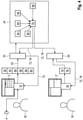
- a central memory 24 is shown schematically in a block diagram, to which a first computer unit 10 is connected via a signal connection 22 and a first interface 52 and a second computer unit 34 is connected via a second interface 54 and a signal connection 36 .
- An audiologist 30 runs an audiological adjustment application 2 on the first computer unit 10 , which is set up in particular for acquiring audiometric data 20 of a hearing device user (not shown in detail) and for adjusting a hearing device 4 .
- a person 16 runs another audiological adjustment application 2′, which is also set up for the above-described applications of the audiological adjustment application 2, but differs in its IT structure and its individual functions may not be compatible with it is.
- the person 16 can either also be an audiologist or be a medical-technical staff without specific audiological training.
- the audiometric data 20 of a user of the hearing aid 4 recorded using the audiological adjustment application 2 can now be transmitted via the signal connection 22, but also other settings resulting from the adjustment of the hearing aid 4 with regard to signal processing 55, such as amplification and compression settings, settings of a Frequency compression, settings for the directivity of the microphones, settings for noise suppression, or settings for classification-based sound optimization, with regard to sound therapy 56, such as that used for tinnitus is used, a smoothing function 58, details of measurement conditions 59 of an audiometric measurement, or details of sound envelopes 60 are passed through the first interface 52 to the central memory 24.
- amplification and compression settings settings of a Frequency compression
- settings for the directivity of the microphones settings for noise suppression
- settings for classification-based sound optimization with regard to sound therapy 56, such as that used for tinnitus is used
- sound therapy 56 such as that used for tinnitus is used
- a smoothing function 58 details of measurement conditions 59 of an audiometric measurement,
- the data mentioned are sorted according to necessary data 62 and optional data 64 in standardized form and preferably depending on the processing group in the sense of processing modes 50 3 saved, patient information 65 on the identity of the user of the hearing aid 4 and the hearing aid type and model added to the necessary data, as well as additional identification information 66 on the processor of the data - in this case on the audiologist - such as name and address and possibly organization.
- Data 62 that needs to be recorded with regard to the user, optional data 64 which can in particular relate to special functions of the signal processing settings of the hearing device 4 , and identification information 66 of the audiologist 30 are therefore available in a standardized form in the central memory 24 .
- a report generator 70 in the central memory 24 now creates a report 72 about the adjustment of the hearing aid 4 and about the data of its user, and via the first interface 52 in one for the audiological adjustment application 2 readable and processable format to the first computer unit 10, where the audiologist 30 receives the report 72 and can check it.
- the person 16 can first download the report 72 through the second interface 54 to the second computer unit 34, with the second interface 54 ensuring the compatibility of the data in the report 72 with the audiological fitting application 2' used on the second computer unit, for example by the standardized format components of the report 72 generated in the report generator 70 to the Requirements of the audiological adjustment application 2' are adjusted with regard to a representation.
- the first interface 52 and the second interface 54 are preferably matched to the relevant audiological adjustment application 2 or 2′.
- an updated report 78 can be created with the new and, if applicable, the already existing data or parts thereof together with the new identification information 66 ′ by the report generator 70 using the format template 68 , which can be sent via the second interface 54 to the second Computer unit 34 is issued in a format that can be read and processed by the audiological adjustment application 2'. If required, the audiologist 30 can also download this updated report 78 to the first computer unit 10 via the first interface 52 in a format that the audiological adjustment application 2 can read and process.
Landscapes
- Health & Medical Sciences (AREA)
- General Health & Medical Sciences (AREA)
- Neurosurgery (AREA)
- Otolaryngology (AREA)
- Physics & Mathematics (AREA)
- Engineering & Computer Science (AREA)
- Acoustics & Sound (AREA)
- Signal Processing (AREA)
- Circuit For Audible Band Transducer (AREA)
- Measurement Of The Respiration, Hearing Ability, Form, And Blood Characteristics Of Living Organisms (AREA)
- Telephonic Communication Services (AREA)
Claims (11)
- Procédé pour le transfert d'un état de traitement (1) dans une application d'adaptation audiologique (2, 2') pour une aide auditive (4),dans lequel des données (20) d'un utilisateur (14) de l'aide auditive (4) sont transférées en tant que valeurs d'entrée de l'application d'adaptation audiologique (2) à une mémoire centrale (24) et y sont stockées de manière typée dans plusieurs groupes de traitement parmi une pluralité de groupes de traitement,dans lequel, à un premier instant (t1), dans un premier domaine d'application (6) une première information concernant l'identité de l'utilisateur (14) est codée avec une deuxième information concernant au moins un premier mode de traitement (50), dans lequel le premier mode de traitement (50) correspond à un traitement actif des données d'un premier groupe de traitement par l'application d'adaptation audiologique (2, 2') à un instant donné, dans lequel la première et la deuxième information codée au premier instant (t1) sont décodées à un deuxième instant (t2),dans lequel les données biologiques et/ou audiométriques (20) de l'utilisateur (14) au moins à partir du premier groupe de traitement (50) sont chargées de la mémoire centrale (24) dans l'application d'adaptation audiologique (2, 2'), etdans lequel, sur la base de la première et deuxième information décodée, l'état de traitement (1) de l'application d'adaptation audiologique (2, 2') par rapport à l'aide auditive (4), tel qu'il est donné au premier moment (t1), est rétabli en fournissant les données (20) de l'utilisateur (14) du premier groupe de traitement au moins dans le premier mode de traitement (50).
- Procédé selon la revendication 1,
dans lequel l'état de traitement (1) de l'application d'adaptation audiologique (2, 2') par rapport à l'aide auditive (4), tel qu'il était donné au premier instant (t1), est rétabli au deuxième instant (t2) ou après le deuxième instant (t2) dans le premier domaine d'application (6). - Procédé selon la revendication 1,
dans lequel l'état de traitement (1) de l'application d'adaptation audiologique (2, 2') par rapport à l'aide auditive (4), tel qu'il est donné au premier instant (t1), est rétabli dans un deuxième domaine d'application (8) au deuxième instant (t2) ou après le deuxième instant (t2). - Procédé selon la revendication 3,
dans lequel la première information codée et la deuxième information codée sont transférées du premier domaine d'application (6) au deuxième domaine d'application (8). - Procédé selon l'une des revendications précédentes,dans lequel, pour un codage de la deuxième information, une représentation d'une interface utilisateur graphique (40) de l'application d'adaptation audiologique (2) sur une unité informatique (10) exécutant l'application d'adaptation audiologique (2, 2') est détectée optiquement, etdans lequel, à la base de la représentation optique détectée optiquement de l'interface utilisateur graphique (40), au moins le premier mode de traitement (50) de l'application d'adaptation audiologique (40) est reconnu.
- Procédé selon la revendication 5,
dans lequel, pour une reconnaissance d'au moins le premier mode de traitement (50) de l'application d'adaptation audiologique (2, 2'), une détection de la position d'un certain nombre d'éléments d'une fenêtre d'application (42) de l'interface utilisateur graphique (40) est effectuée. - Procédé selon la revendication 5 ou la revendication 6,
dans lequel la détectée optique est effectuée au moyen d'un téléphone mobile (26) ou d'une tablette PC. - Procédé selon l'une des revendications précédentes,
dans lequel lors du codage de la première information et de la deuxième information, un cryptage est effectué. - Procédé selon la revendication 8,
dans lequel le codage de la première information et de la deuxième information est effectué par un message XMPP et/ou un code QR (32). - Procédé selon l'une des revendications précédentes,
dans lequel, en tant que données (20) de l'utilisateur (14), des données biologiques et/ou audiométriques et/ou des données de réglage de l'aide auditive (4) sont transmises à la mémoire centrale (24) en tant que valeurs d'entrée de l'application d'adaptation audiologique (2) et y sont stockées de manière typifiée. - Application d'adaptation audiologique (2, 2'), configurée pour transférer son état de traitement (1) au moyen du procédé selon l'une des revendications précédentes.
Applications Claiming Priority (1)
| Application Number | Priority Date | Filing Date | Title |
|---|---|---|---|
| PCT/EP2018/065190 WO2019233602A1 (fr) | 2018-06-08 | 2018-06-08 | Procédé de transmission d'un état de traitement dans une application d'adaptation audiologique pour un appareil auditif |
Publications (2)
| Publication Number | Publication Date |
|---|---|
| EP3649792A1 EP3649792A1 (fr) | 2020-05-13 |
| EP3649792B1 true EP3649792B1 (fr) | 2022-03-23 |
Family
ID=62597498
Family Applications (1)
| Application Number | Title | Priority Date | Filing Date |
|---|---|---|---|
| EP18730741.8A Active EP3649792B1 (fr) | 2018-06-08 | 2018-06-08 | Procédé de transmission d'un état de traitement dans une application d'adaptation audiologique pour un appareil auditif |
Country Status (4)
| Country | Link |
|---|---|
| EP (1) | EP3649792B1 (fr) |
| CN (1) | CN111492673B (fr) |
| DK (1) | DK3649792T3 (fr) |
| WO (1) | WO2019233602A1 (fr) |
Families Citing this family (2)
| Publication number | Priority date | Publication date | Assignee | Title |
|---|---|---|---|---|
| EP4017029A1 (fr) * | 2020-12-16 | 2022-06-22 | Sivantos Pte. Ltd. | Système, procédé et programme informatique pour aider interactivement un utilisateur à évaluer une perte auditive |
| WO2024235478A1 (fr) * | 2023-05-15 | 2024-11-21 | Sivantos Pte. Ltd. | Procédé de fonctionnement d'un système d'aide auditive |
Family Cites Families (16)
| Publication number | Priority date | Publication date | Assignee | Title |
|---|---|---|---|---|
| JP2002288125A (ja) * | 2001-03-27 | 2002-10-04 | Just Syst Corp | 作業状態再現システム、作業状態再現方法 |
| JP4817814B2 (ja) * | 2004-11-19 | 2011-11-16 | 富士通株式会社 | アプリケーション状態情報転送システム |
| US9313585B2 (en) * | 2008-12-22 | 2016-04-12 | Oticon A/S | Method of operating a hearing instrument based on an estimation of present cognitive load of a user and a hearing aid system |
| US9736600B2 (en) * | 2010-05-17 | 2017-08-15 | Iii Holdings 4, Llc | Devices and methods for collecting acoustic data |
| US9223611B2 (en) * | 2010-12-28 | 2015-12-29 | Microsoft Technology Licensing, Llc | Storing and resuming application runtime state |
| US9613028B2 (en) * | 2011-01-19 | 2017-04-04 | Apple Inc. | Remotely updating a hearing and profile |
| US9337999B2 (en) * | 2011-04-01 | 2016-05-10 | Intel Corporation | Application usage continuum across platforms |
| US20130041790A1 (en) * | 2011-08-12 | 2013-02-14 | Sivakumar Murugesan | Method and system for transferring an application state |
| US8990343B2 (en) * | 2012-07-30 | 2015-03-24 | Google Inc. | Transferring a state of an application from a first computing device to a second computing device |
| US9776078B2 (en) * | 2012-10-02 | 2017-10-03 | Razer (Asia-Pacific) Pte. Ltd. | Application state backup and restoration across multiple devices |
| EP2736273A1 (fr) * | 2012-11-23 | 2014-05-28 | Oticon A/s | Dispositif d'écoute comprenant une interface pour signaler la qualité de communication et/ou la charge du porteur sur l'environnement |
| WO2014094858A1 (fr) * | 2012-12-20 | 2014-06-26 | Widex A/S | Prothèse auditive, et procédé pour améliorer l'intelligibilité de la parole d'un signal audio |
| CN108028055A (zh) * | 2015-10-19 | 2018-05-11 | 索尼公司 | 信息处理装置、信息处理系统和程序 |
| DE102016209329B4 (de) * | 2016-05-30 | 2017-12-21 | Sivantos Pte. Ltd. | Verfahren zur automatisierten Ermittlung von Parameterwerten für ein Hörhilfegerät |
| DE102016216054A1 (de) * | 2016-08-25 | 2018-03-01 | Sivantos Pte. Ltd. | Verfahren und Einrichtung zur Einstellung eines Hörhilfegeräts |
| CN107911528A (zh) * | 2017-12-15 | 2018-04-13 | 刘方辉 | 一种基于智能手机的听力补偿系统及其自助验配方法 |
-
2018
- 2018-06-08 WO PCT/EP2018/065190 patent/WO2019233602A1/fr not_active Ceased
- 2018-06-08 DK DK18730741.8T patent/DK3649792T3/da active
- 2018-06-08 EP EP18730741.8A patent/EP3649792B1/fr active Active
- 2018-06-08 CN CN201880081448.7A patent/CN111492673B/zh active Active
Non-Patent Citations (1)
| Title |
|---|
| None * |
Also Published As
| Publication number | Publication date |
|---|---|
| EP3649792A1 (fr) | 2020-05-13 |
| CN111492673A (zh) | 2020-08-04 |
| CN111492673B (zh) | 2022-02-11 |
| DK3649792T3 (da) | 2022-06-20 |
| WO2019233602A1 (fr) | 2019-12-12 |
Similar Documents
| Publication | Publication Date | Title |
|---|---|---|
| EP3528513B1 (fr) | Procédé d'ajustement des paramètres d'un système auditif | |
| DE102016209329B4 (de) | Verfahren zur automatisierten Ermittlung von Parameterwerten für ein Hörhilfegerät | |
| EP3288293A1 (fr) | Procédé et dispositif de réglage d'un appareil de correction auditive | |
| DE102011087569A1 (de) | Verfahren zum Anpassen einer Hörvorrichtung durch eine formale Sprache | |
| EP1898669A2 (fr) | Ajustement d'appareil auditif spécifique au sexe | |
| DE102017200597B4 (de) | Verfahren zum Betrieb eines Hörsystems und Hörsystem | |
| EP3649792B1 (fr) | Procédé de transmission d'un état de traitement dans une application d'adaptation audiologique pour un appareil auditif | |
| EP3429457A1 (fr) | Procédé pour déterminer de manière automatique une fonction individuelle d'une carte de niveaux selon la méthode de mesure des produits de distorsion des émissions oto-acoustiques (pdeoa) de l'ouïe chez l'homme ou l'animal | |
| EP3836139B1 (fr) | Procédé d'accouplement de deux appareils auditifs ainsi qu'appareil auditif | |
| EP2229010A2 (fr) | Procédé de compensation d'un bruit parasite dans un appareil auditif, appareil auditif et procédé d'adaptation de celui-ci | |
| DE102007035172A1 (de) | Hörsystem mit visualisierter psychoakustischer Größe und entsprechendes Verfahren | |
| EP2214422B1 (fr) | Procédé et dispositif auditif pour le réglage d'un appareil auditif à partir de données enregistrées | |
| EP1906702B1 (fr) | Procédé destiné au contrôle de commande d'un dispositif auditif et dispositif auditif correspondant | |
| DE102016105970A1 (de) | Vorrichtung zum Unterstützen des Sprach- und/oder Hörtrainings nach einer Cochlear Implantation | |
| DE102008060056B4 (de) | Verfahren und Hörgerätesystem zur Anpassung einer bimodalen Versorgung | |
| Hollfelder et al. | Influence of directional microphones on listening effort in middle ear implant users | |
| DE102016207936A1 (de) | Verfahren zum Betrieb eines Hörgeräts | |
| DE10064210B4 (de) | Verfahren sowie System zur Funktionsüberprüfung und/oder Anpassung eines von einer Person getragenen Hörhilfegerätes | |
| EP1353529A1 (fr) | Auralisation basée sur internet de la déficience auditive | |
| DE102009048071A1 (de) | Verfahren und Vorrichtung zum Einstellen eines Hörgeräts unter Berücksichtigung einer Raumakustik | |
| WO2019242860A1 (fr) | Procédé de transmission d'informations pour l'adaptation d'une aide auditive | |
| DE102023211756A1 (de) | Hörinstrumentenkonfigurationssystem | |
| DE102014112098A1 (de) | Vorrichtung und Verfahren zur Prüfung und/oder Anpassung eines Hörgerätes | |
| WO2024235478A1 (fr) | Procédé de fonctionnement d'un système d'aide auditive | |
| DE102010007450A1 (de) | Verfahren und Anordnung zur Anpassung einer Hörvorrichtung |
Legal Events
| Date | Code | Title | Description |
|---|---|---|---|
| STAA | Information on the status of an ep patent application or granted ep patent |
Free format text: STATUS: UNKNOWN |
|
| STAA | Information on the status of an ep patent application or granted ep patent |
Free format text: STATUS: THE INTERNATIONAL PUBLICATION HAS BEEN MADE |
|
| PUAI | Public reference made under article 153(3) epc to a published international application that has entered the european phase |
Free format text: ORIGINAL CODE: 0009012 |
|
| STAA | Information on the status of an ep patent application or granted ep patent |
Free format text: STATUS: REQUEST FOR EXAMINATION WAS MADE |
|
| 17P | Request for examination filed |
Effective date: 20200204 |
|
| AK | Designated contracting states |
Kind code of ref document: A1 Designated state(s): AL AT BE BG CH CY CZ DE DK EE ES FI FR GB GR HR HU IE IS IT LI LT LU LV MC MK MT NL NO PL PT RO RS SE SI SK SM TR |
|
| AX | Request for extension of the european patent |
Extension state: BA ME |
|
| GRAP | Despatch of communication of intention to grant a patent |
Free format text: ORIGINAL CODE: EPIDOSNIGR1 |
|
| STAA | Information on the status of an ep patent application or granted ep patent |
Free format text: STATUS: GRANT OF PATENT IS INTENDED |
|
| INTG | Intention to grant announced |
Effective date: 20200901 |
|
| GRAJ | Information related to disapproval of communication of intention to grant by the applicant or resumption of examination proceedings by the epo deleted |
Free format text: ORIGINAL CODE: EPIDOSDIGR1 |
|
| STAA | Information on the status of an ep patent application or granted ep patent |
Free format text: STATUS: REQUEST FOR EXAMINATION WAS MADE |
|
| GRAP | Despatch of communication of intention to grant a patent |
Free format text: ORIGINAL CODE: EPIDOSNIGR1 |
|
| STAA | Information on the status of an ep patent application or granted ep patent |
Free format text: STATUS: GRANT OF PATENT IS INTENDED |
|
| INTC | Intention to grant announced (deleted) | ||
| INTG | Intention to grant announced |
Effective date: 20210205 |
|
| GRAS | Grant fee paid |
Free format text: ORIGINAL CODE: EPIDOSNIGR3 |
|
| DAV | Request for validation of the european patent (deleted) | ||
| DAX | Request for extension of the european patent (deleted) | ||
| RAP1 | Party data changed (applicant data changed or rights of an application transferred) |
Owner name: ASCHOFF, STEFAN Owner name: SIVANTOS PTE. LTD. |
|
| GRAA | (expected) grant |
Free format text: ORIGINAL CODE: 0009210 |
|
| STAA | Information on the status of an ep patent application or granted ep patent |
Free format text: STATUS: THE PATENT HAS BEEN GRANTED |
|
| RAP3 | Party data changed (applicant data changed or rights of an application transferred) |
Owner name: SIVANTOS PTE. LTD. |
|
| AK | Designated contracting states |
Kind code of ref document: B1 Designated state(s): AL AT BE BG CH CY CZ DE DK EE ES FI FR GB GR HR HU IE IS IT LI LT LU LV MC MK MT NL NO PL PT RO RS SE SI SK SM TR |
|
| REG | Reference to a national code |
Ref country code: GB Ref legal event code: FG4D Free format text: NOT ENGLISH |
|
| REG | Reference to a national code |
Ref country code: CH Ref legal event code: EP |
|
| REG | Reference to a national code |
Ref country code: DE Ref legal event code: R096 Ref document number: 502018009174 Country of ref document: DE |
|
| REG | Reference to a national code |
Ref country code: IE Ref legal event code: FG4D Free format text: LANGUAGE OF EP DOCUMENT: GERMAN |
|
| REG | Reference to a national code |
Ref country code: AT Ref legal event code: REF Ref document number: 1478262 Country of ref document: AT Kind code of ref document: T Effective date: 20220415 |
|
| REG | Reference to a national code |
Ref country code: DK Ref legal event code: T3 Effective date: 20220617 |
|
| REG | Reference to a national code |
Ref country code: LT Ref legal event code: MG9D |
|
| REG | Reference to a national code |
Ref country code: NL Ref legal event code: MP Effective date: 20220323 |
|
| PG25 | Lapsed in a contracting state [announced via postgrant information from national office to epo] |
Ref country code: SE Free format text: LAPSE BECAUSE OF FAILURE TO SUBMIT A TRANSLATION OF THE DESCRIPTION OR TO PAY THE FEE WITHIN THE PRESCRIBED TIME-LIMIT Effective date: 20220323 Ref country code: RS Free format text: LAPSE BECAUSE OF FAILURE TO SUBMIT A TRANSLATION OF THE DESCRIPTION OR TO PAY THE FEE WITHIN THE PRESCRIBED TIME-LIMIT Effective date: 20220323 Ref country code: NO Free format text: LAPSE BECAUSE OF FAILURE TO SUBMIT A TRANSLATION OF THE DESCRIPTION OR TO PAY THE FEE WITHIN THE PRESCRIBED TIME-LIMIT Effective date: 20220623 Ref country code: LT Free format text: LAPSE BECAUSE OF FAILURE TO SUBMIT A TRANSLATION OF THE DESCRIPTION OR TO PAY THE FEE WITHIN THE PRESCRIBED TIME-LIMIT Effective date: 20220323 Ref country code: HR Free format text: LAPSE BECAUSE OF FAILURE TO SUBMIT A TRANSLATION OF THE DESCRIPTION OR TO PAY THE FEE WITHIN THE PRESCRIBED TIME-LIMIT Effective date: 20220323 Ref country code: BG Free format text: LAPSE BECAUSE OF FAILURE TO SUBMIT A TRANSLATION OF THE DESCRIPTION OR TO PAY THE FEE WITHIN THE PRESCRIBED TIME-LIMIT Effective date: 20220623 |
|
| PG25 | Lapsed in a contracting state [announced via postgrant information from national office to epo] |
Ref country code: LV Free format text: LAPSE BECAUSE OF FAILURE TO SUBMIT A TRANSLATION OF THE DESCRIPTION OR TO PAY THE FEE WITHIN THE PRESCRIBED TIME-LIMIT Effective date: 20220323 Ref country code: GR Free format text: LAPSE BECAUSE OF FAILURE TO SUBMIT A TRANSLATION OF THE DESCRIPTION OR TO PAY THE FEE WITHIN THE PRESCRIBED TIME-LIMIT Effective date: 20220624 Ref country code: FI Free format text: LAPSE BECAUSE OF FAILURE TO SUBMIT A TRANSLATION OF THE DESCRIPTION OR TO PAY THE FEE WITHIN THE PRESCRIBED TIME-LIMIT Effective date: 20220323 |
|
| PG25 | Lapsed in a contracting state [announced via postgrant information from national office to epo] |
Ref country code: NL Free format text: LAPSE BECAUSE OF FAILURE TO SUBMIT A TRANSLATION OF THE DESCRIPTION OR TO PAY THE FEE WITHIN THE PRESCRIBED TIME-LIMIT Effective date: 20220323 |
|
| PG25 | Lapsed in a contracting state [announced via postgrant information from national office to epo] |
Ref country code: SM Free format text: LAPSE BECAUSE OF FAILURE TO SUBMIT A TRANSLATION OF THE DESCRIPTION OR TO PAY THE FEE WITHIN THE PRESCRIBED TIME-LIMIT Effective date: 20220323 Ref country code: SK Free format text: LAPSE BECAUSE OF FAILURE TO SUBMIT A TRANSLATION OF THE DESCRIPTION OR TO PAY THE FEE WITHIN THE PRESCRIBED TIME-LIMIT Effective date: 20220323 Ref country code: RO Free format text: LAPSE BECAUSE OF FAILURE TO SUBMIT A TRANSLATION OF THE DESCRIPTION OR TO PAY THE FEE WITHIN THE PRESCRIBED TIME-LIMIT Effective date: 20220323 Ref country code: PT Free format text: LAPSE BECAUSE OF FAILURE TO SUBMIT A TRANSLATION OF THE DESCRIPTION OR TO PAY THE FEE WITHIN THE PRESCRIBED TIME-LIMIT Effective date: 20220725 Ref country code: ES Free format text: LAPSE BECAUSE OF FAILURE TO SUBMIT A TRANSLATION OF THE DESCRIPTION OR TO PAY THE FEE WITHIN THE PRESCRIBED TIME-LIMIT Effective date: 20220323 Ref country code: EE Free format text: LAPSE BECAUSE OF FAILURE TO SUBMIT A TRANSLATION OF THE DESCRIPTION OR TO PAY THE FEE WITHIN THE PRESCRIBED TIME-LIMIT Effective date: 20220323 Ref country code: CZ Free format text: LAPSE BECAUSE OF FAILURE TO SUBMIT A TRANSLATION OF THE DESCRIPTION OR TO PAY THE FEE WITHIN THE PRESCRIBED TIME-LIMIT Effective date: 20220323 |
|
| PG25 | Lapsed in a contracting state [announced via postgrant information from national office to epo] |
Ref country code: PL Free format text: LAPSE BECAUSE OF FAILURE TO SUBMIT A TRANSLATION OF THE DESCRIPTION OR TO PAY THE FEE WITHIN THE PRESCRIBED TIME-LIMIT Effective date: 20220323 Ref country code: IS Free format text: LAPSE BECAUSE OF FAILURE TO SUBMIT A TRANSLATION OF THE DESCRIPTION OR TO PAY THE FEE WITHIN THE PRESCRIBED TIME-LIMIT Effective date: 20220723 Ref country code: AL Free format text: LAPSE BECAUSE OF FAILURE TO SUBMIT A TRANSLATION OF THE DESCRIPTION OR TO PAY THE FEE WITHIN THE PRESCRIBED TIME-LIMIT Effective date: 20220323 |
|
| REG | Reference to a national code |
Ref country code: DE Ref legal event code: R097 Ref document number: 502018009174 Country of ref document: DE |
|
| PLBE | No opposition filed within time limit |
Free format text: ORIGINAL CODE: 0009261 |
|
| STAA | Information on the status of an ep patent application or granted ep patent |
Free format text: STATUS: NO OPPOSITION FILED WITHIN TIME LIMIT |
|
| PG25 | Lapsed in a contracting state [announced via postgrant information from national office to epo] |
Ref country code: MC Free format text: LAPSE BECAUSE OF FAILURE TO SUBMIT A TRANSLATION OF THE DESCRIPTION OR TO PAY THE FEE WITHIN THE PRESCRIBED TIME-LIMIT Effective date: 20220323 |
|
| REG | Reference to a national code |
Ref country code: BE Ref legal event code: MM Effective date: 20220630 |
|
| 26N | No opposition filed |
Effective date: 20230102 |
|
| PG25 | Lapsed in a contracting state [announced via postgrant information from national office to epo] |
Ref country code: LU Free format text: LAPSE BECAUSE OF NON-PAYMENT OF DUE FEES Effective date: 20220608 Ref country code: IE Free format text: LAPSE BECAUSE OF NON-PAYMENT OF DUE FEES Effective date: 20220608 |
|
| PG25 | Lapsed in a contracting state [announced via postgrant information from national office to epo] |
Ref country code: SI Free format text: LAPSE BECAUSE OF FAILURE TO SUBMIT A TRANSLATION OF THE DESCRIPTION OR TO PAY THE FEE WITHIN THE PRESCRIBED TIME-LIMIT Effective date: 20220323 Ref country code: BE Free format text: LAPSE BECAUSE OF NON-PAYMENT OF DUE FEES Effective date: 20220630 |
|
| PG25 | Lapsed in a contracting state [announced via postgrant information from national office to epo] |
Ref country code: IT Free format text: LAPSE BECAUSE OF FAILURE TO SUBMIT A TRANSLATION OF THE DESCRIPTION OR TO PAY THE FEE WITHIN THE PRESCRIBED TIME-LIMIT Effective date: 20220323 |
|
| PG25 | Lapsed in a contracting state [announced via postgrant information from national office to epo] |
Ref country code: MK Free format text: LAPSE BECAUSE OF FAILURE TO SUBMIT A TRANSLATION OF THE DESCRIPTION OR TO PAY THE FEE WITHIN THE PRESCRIBED TIME-LIMIT Effective date: 20220323 Ref country code: CY Free format text: LAPSE BECAUSE OF FAILURE TO SUBMIT A TRANSLATION OF THE DESCRIPTION OR TO PAY THE FEE WITHIN THE PRESCRIBED TIME-LIMIT Effective date: 20220323 |
|
| PG25 | Lapsed in a contracting state [announced via postgrant information from national office to epo] |
Ref country code: HU Free format text: LAPSE BECAUSE OF FAILURE TO SUBMIT A TRANSLATION OF THE DESCRIPTION OR TO PAY THE FEE WITHIN THE PRESCRIBED TIME-LIMIT; INVALID AB INITIO Effective date: 20180608 |
|
| PG25 | Lapsed in a contracting state [announced via postgrant information from national office to epo] |
Ref country code: TR Free format text: LAPSE BECAUSE OF FAILURE TO SUBMIT A TRANSLATION OF THE DESCRIPTION OR TO PAY THE FEE WITHIN THE PRESCRIBED TIME-LIMIT Effective date: 20220323 |
|
| REG | Reference to a national code |
Ref country code: AT Ref legal event code: MM01 Ref document number: 1478262 Country of ref document: AT Kind code of ref document: T Effective date: 20230608 |
|
| PG25 | Lapsed in a contracting state [announced via postgrant information from national office to epo] |
Ref country code: MT Free format text: LAPSE BECAUSE OF FAILURE TO SUBMIT A TRANSLATION OF THE DESCRIPTION OR TO PAY THE FEE WITHIN THE PRESCRIBED TIME-LIMIT Effective date: 20220323 |
|
| PG25 | Lapsed in a contracting state [announced via postgrant information from national office to epo] |
Ref country code: AT Free format text: LAPSE BECAUSE OF NON-PAYMENT OF DUE FEES Effective date: 20230608 |
|
| PG25 | Lapsed in a contracting state [announced via postgrant information from national office to epo] |
Ref country code: AT Free format text: LAPSE BECAUSE OF NON-PAYMENT OF DUE FEES Effective date: 20230608 |
|
| PGFP | Annual fee paid to national office [announced via postgrant information from national office to epo] |
Ref country code: DE Payment date: 20250520 Year of fee payment: 8 |
|
| PGFP | Annual fee paid to national office [announced via postgrant information from national office to epo] |
Ref country code: GB Payment date: 20250520 Year of fee payment: 8 Ref country code: DK Payment date: 20250520 Year of fee payment: 8 |
|
| PGFP | Annual fee paid to national office [announced via postgrant information from national office to epo] |
Ref country code: FR Payment date: 20250520 Year of fee payment: 8 |
|
| PGFP | Annual fee paid to national office [announced via postgrant information from national office to epo] |
Ref country code: CH Payment date: 20250701 Year of fee payment: 8 |
|
| PGFP | Annual fee paid to national office [announced via postgrant information from national office to epo] |
Ref country code: AT Payment date: 20260410 Year of fee payment: 5 |