EP3649983A1 - Dentalprothesen-herstellverfahren - Google Patents
Dentalprothesen-herstellverfahren Download PDFInfo
- Publication number
- EP3649983A1 EP3649983A1 EP18205735.6A EP18205735A EP3649983A1 EP 3649983 A1 EP3649983 A1 EP 3649983A1 EP 18205735 A EP18205735 A EP 18205735A EP 3649983 A1 EP3649983 A1 EP 3649983A1
- Authority
- EP
- European Patent Office
- Prior art keywords
- base
- prosthesis
- positive model
- dental prosthesis
- dental
- Prior art date
- Legal status (The legal status is an assumption and is not a legal conclusion. Google has not performed a legal analysis and makes no representation as to the accuracy of the status listed.)
- Granted
Links
Images


Classifications
-
- A—HUMAN NECESSITIES
- A61—MEDICAL OR VETERINARY SCIENCE; HYGIENE
- A61C—DENTISTRY; APPARATUS OR METHODS FOR ORAL OR DENTAL HYGIENE
- A61C13/00—Dental prostheses; Making same
- A61C13/34—Making or working of models, e.g. preliminary castings, trial dentures; Dowel pins [4]
-
- A—HUMAN NECESSITIES
- A61—MEDICAL OR VETERINARY SCIENCE; HYGIENE
- A61C—DENTISTRY; APPARATUS OR METHODS FOR ORAL OR DENTAL HYGIENE
- A61C13/00—Dental prostheses; Making same
- A61C13/0003—Making bridge-work, inlays, implants or the like
- A61C13/0006—Production methods
- A61C13/0019—Production methods using three dimensional printing
-
- A—HUMAN NECESSITIES
- A61—MEDICAL OR VETERINARY SCIENCE; HYGIENE
- A61C—DENTISTRY; APPARATUS OR METHODS FOR ORAL OR DENTAL HYGIENE
- A61C13/00—Dental prostheses; Making same
- A61C13/0003—Making bridge-work, inlays, implants or the like
- A61C13/0004—Computer-assisted sizing or machining of dental prostheses
-
- A—HUMAN NECESSITIES
- A61—MEDICAL OR VETERINARY SCIENCE; HYGIENE
- A61C—DENTISTRY; APPARATUS OR METHODS FOR ORAL OR DENTAL HYGIENE
- A61C13/00—Dental prostheses; Making same
- A61C13/01—Palates or other bases or supports for the artificial teeth; Making same
- A61C13/04—Palates or other bases or supports for the artificial teeth; Making same made by casting
-
- A—HUMAN NECESSITIES
- A61—MEDICAL OR VETERINARY SCIENCE; HYGIENE
- A61C—DENTISTRY; APPARATUS OR METHODS FOR ORAL OR DENTAL HYGIENE
- A61C13/00—Dental prostheses; Making same
- A61C13/08—Artificial teeth; Making same
- A61C13/081—Making teeth by casting or moulding
-
- A—HUMAN NECESSITIES
- A61—MEDICAL OR VETERINARY SCIENCE; HYGIENE
- A61C—DENTISTRY; APPARATUS OR METHODS FOR ORAL OR DENTAL HYGIENE
- A61C13/00—Dental prostheses; Making same
- A61C13/10—Fastening of artificial teeth to denture palates or the like
- A61C13/1003—Fastening of artificial teeth to denture palates or the like by embedding in base material
- A61C13/1013—Arch forms
- A61C13/1016—Methods or apparatus for mounting, holding or positioning a set of teeth
-
- A—HUMAN NECESSITIES
- A61—MEDICAL OR VETERINARY SCIENCE; HYGIENE
- A61C—DENTISTRY; APPARATUS OR METHODS FOR ORAL OR DENTAL HYGIENE
- A61C13/00—Dental prostheses; Making same
- A61C13/20—Methods or devices for soldering, casting, moulding or melting
- A61C13/206—Injection moulding
-
- A—HUMAN NECESSITIES
- A61—MEDICAL OR VETERINARY SCIENCE; HYGIENE
- A61C—DENTISTRY; APPARATUS OR METHODS FOR ORAL OR DENTAL HYGIENE
- A61C5/00—Filling or capping teeth
- A61C5/70—Tooth crowns; Making thereof
- A61C5/77—Methods or devices for making crowns
-
- A—HUMAN NECESSITIES
- A61—MEDICAL OR VETERINARY SCIENCE; HYGIENE
- A61C—DENTISTRY; APPARATUS OR METHODS FOR ORAL OR DENTAL HYGIENE
- A61C13/00—Dental prostheses; Making same
- A61C13/0003—Making bridge-work, inlays, implants or the like
- A61C13/0006—Production methods
- A61C13/0013—Production methods using stereolithographic techniques
-
- B—PERFORMING OPERATIONS; TRANSPORTING
- B33—ADDITIVE MANUFACTURING TECHNOLOGY
- B33Y—ADDITIVE MANUFACTURING, i.e. MANUFACTURING OF THREE-DIMENSIONAL [3D] OBJECTS BY ADDITIVE DEPOSITION, ADDITIVE AGGLOMERATION OR ADDITIVE LAYERING, e.g. BY 3D PRINTING, STEREOLITHOGRAPHY OR SELECTIVE LASER SINTERING
- B33Y80/00—Products made by additive manufacturing
Definitions
- the invention relates to a dental prosthesis manufacturing method according to the preamble of claim 1 and a dental prosthesis according to the preamble of claim 15.
- the production is carried out by first scanning the patient's mouth and creating a virtual model for the dental prosthesis using CAD / CAM software.
- the impression can also be taken in a classic manner and the impression can then be scanned.
- the dental prosthesis can be both a full prosthesis and a partial prosthesis.
- the virtual model is converted into reality in such a way that suitable ready-made teeth are selected and a denture base is produced in a milled form.
- the list can also be set up virtually, thus ensuring that no reworking is required, or at most one such as a polish.
- the prosthesis is modeled in wax.
- the wax model is cast, for example with plaster or a similar material.
- the hardened plaster mold, the muffle, is thermally treated to remove the positive model made of wax.
- "Remove” means any type of removal, for example scalding, dissolving, burning out, etc.
- a lost shape is created, which is then poured out with prosthetic raw material, for example PMMA-MMA mixtures.
- An advantageous embodiment for the provision of a mold is the Ivobase method, which works with a cuvette.
- the process injects the reaction mass under pressure and maintains it during the polymerization process, which is started and controlled by a detailed temperature control.
- the polymerization shrinkage occurring is compensated at the front and the workpiece obtained differs significantly less from the existing negative shape than is the case with conventional production.
- the blank disc is milled in a suitable manner, as it is from the EP 3 064 170 A1 has become known.
- the invention has for its object to provide a dental prosthesis manufacturing method according to the preamble of claim 1 and a dental prosthesis manufactured herewith according to the preamble of claim 15, which are easy to implement and inexpensive to carry out.
- the above-mentioned positive model for producing a dental prosthesis is generated by 3D printing.
- 3D printing of the dental arch which can also be referred to as a dental arch, and the prosthesis base is preferably carried out separately.
- the two materials are injected into a cuvette using the Ivobase method. It is preferred here that the shape for the toothed ring is first created and the tooth material is injected there.
- the basic positive model is then attached to the ring gear and embedded together with it.
- the base positive model is removed and the resulting space is filled with base material by indexing.
- the order is reversed. Then the base is first created by injection, and then the spider positive model is attached to the base and embedded together with it.
- the dental arch positive model is removed and the resulting space is filled with dental material by injection.
- the positive model as soon as it is generated by 3D printing, is already used for the try-in at the patient.
- This step saves a lot of work and time, and the positive model also has a dual function for the first time.
- Ivobase injectors can easily be used in many dental laboratories.
- the dentist only needs an inexpensive 3D printer for, for example, 1000 to 2000 €.
- the prosthesis base and the dental arches can be made of PMMA, so that there is a low affinity for plaque, the oral stability is good and the teeth are not prone to discoloration. Furthermore, the bond between the two sprayed materials is excellent.
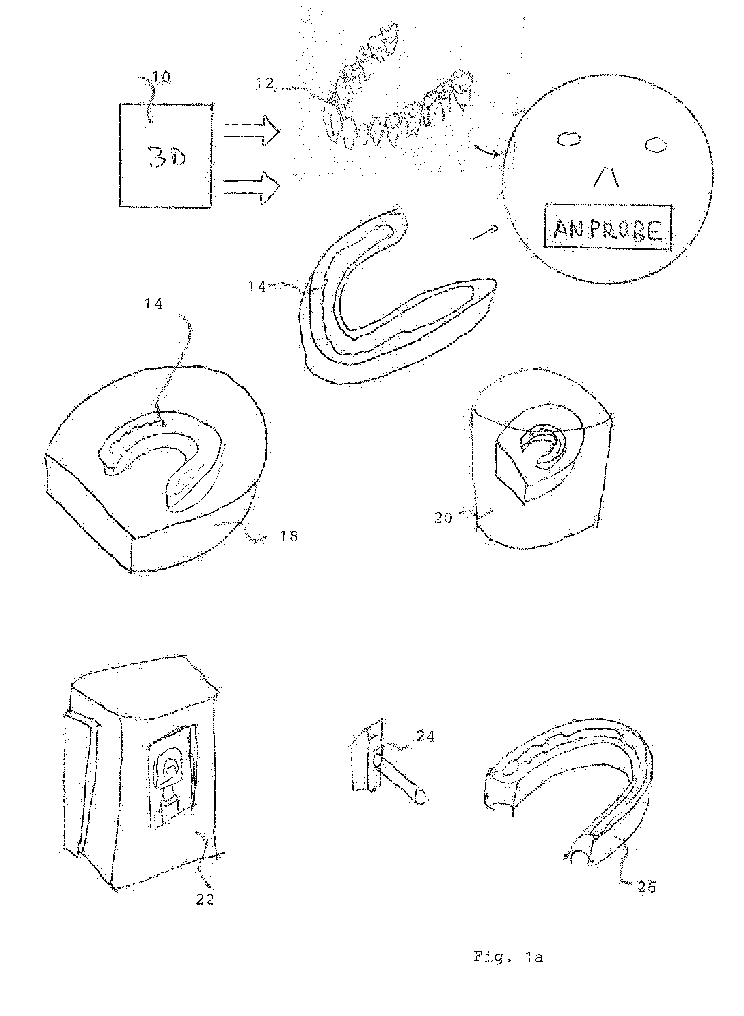
- a 3D printer 10 is provided, by means of which a toothed ring 12 and a prosthesis base 14 are produced from inexpensive 3D printing material as positive models.
- the gear rim is also called the dental arch.
- these two positive models can be put together quickly and used for a trial fitting on the patient. This step can also be omitted.
- the toothed ring 12 can also be generated first in a corresponding manner.
- the prosthesis base is first created.
- the prosthesis base model 14 is inserted into a cuvette 18 and with a suitable one Cast negative molding material, i.e. a casting compound such as silicone or plaster.
- the casting compound together with the positive model is placed in a brewing pot 20 and the positive model is removed.
- the cuvette 18 is now inserted in a known manner in an injector such as the IvoBase injector from Ivoclar Vüradent AG.
- Prosthetic base material is provided and injected into the cuvette.
- the prosthesis base material is pressurized and thereby enters the cavity of the negative mold, which corresponds to the prosthesis base positive model.
- the injection pressure is preferably first applied at a moderate level and then increased to the full value thereafter.
- the negative form fills with denture base material, taking care that the air there can escape on the opposite side without losing base material.
- the cuvette 18 is dimensioned so that it can withstand the injection pressure.
- the cuvette is preferably constructed in two parts and accordingly has an upper side and a lower side which are essentially parallel to the occlusal plane.
- the two halves of the cuvette are pressed together with the injection pressure with a force that exceeds the injection pressure, for example with 10,000 N.
- the entire injection process may take an hour, for example, but also more or less.
- the casting mold ie the hardened casting compound, is removed with a suitable percussion instrument 24.
- the prosthesis base is already made of prosthesis base material.
- the positive model of the dental arch 12 is assembled with the finished prosthesis base 26.
- a hybrid model consisting of a dental restoration part (namely the prosthesis base) and a positive model is implemented at this time.
- prosthesis base 26 and dental arch positive model 12 is now inserted into the cleaned and newly provided cuvette 18 and cast again with a suitable casting compound, plaster or silicone, for example, being able to be used.
- the positive model of the dental arch is liquefied in the brew pot 20 or in any other suitable removal device and is removed to that extent.
- the temperature is to be selected so that it lies above the melting temperature of the positive model, but below the softening temperature of the prosthesis base 26.
- This negative form is now reinserted into the injector 22 and dental arch material is injected in the same manner as described above, but adapted to the material.
- This step can also be constructed in two parts, by first injecting dentine material and then incisal material, in a corresponding sequence.
- the dental arch model is divided into a dentine positive model and a cutting material positive model.
- the polymerization is carried out in the same manner as described above.
- the finished prosthesis is then typically processed, i.e. cleaned, in particular in the interdental spaces, and polished.
- step 50 a scan of the oral cavity is created and a 3D model of the prosthesis including dental arch is created.
- step 52 the base of the prosthesis is calculated from the model, including the adhesive joint.
- the desired dividing line between the dental arch and the denture base is therefore determined.
- the prosthesis base and the dental arch are printed three-dimensionally as a positive model in step 54.
- An inexpensive 3D printer known per se can be used here.
- the prosthetic base model is now placed in a mold according to alternative A and cast with plaster. Alternatively, it can be cast with silicone. This happens in step 56.
- the positive model is removed in step 58 in variant A, for example by scalding.
- the plaster mold or silicone mold is placed in a cuvette in step 60.
- the basic model can also be introduced into a cuvette according to alternative B and this can be cast with silicone or plaster, according to step 62.
- step 64 the positive model is removed, for example by thermal treatment.
- the two alternatives A and B end with steps 60 and 64, respectively, and as in Fig. 2b in the next step 66, the cuvette with the negative form is inserted into an injector 22 in both cases.
- the base material is injected in step 68 and the cuvette in the injection 22 is heated while maintaining the injection pressure.
- step 70 further base material is injected and injected, whereby any existing air bubbles are removed or separated and it is ensured that material shrinkage does not occur later.
- the potting material is removed so that the finished prosthesis base 26 is exposed. It will be cleaned if necessary.
- step 72 After the polymerization in step 72, the cuvette and its contents are removed from the injector. The cuvette cools and the toothed rim model 12 generated in step 54 is applied to the existing prosthesis base 26 in step 74. The combination of the positive model of the ring gear and the finished prosthesis base 26 is cast again.
- step 76 the ring gear model is removed, for example by thermal treatment at 50 degrees. At this temperature, the prosthesis base does not yet melt or soften, so that the existing negative shape extends between the finished prosthesis base and the casting compound that has surrounded the positive model of the toothed rim.
- the cuvette is reinserted into the injector in step 78, and tooth material is injected into the existing cavity of the dental arch or dental arch in step 80.
- step 84 The injection pressure is maintained and the thermal treatment is carried out until all cavities are filled in step 82, so that polymerisation can take place in step 84.
- the cuvette is cooled and removed from the injector in a manner known per se.
- a devesting takes place, for example with the percussion instrument 24, in step 86.
- step 88 post-processing takes place, for example by polishing.
- the prosthesis is now complete.
- step 56 the ring gear model is replaced of the base model, and first used it in the following steps.
- thermoplastics via FDM would be possible at low cost.
- water soluble materials could be used which could then be dissolved by water in removal steps 58, 64 and 76.
- Any suitable materials can be considered for the casting compound, gypsum-free materials actually being preferred. Curable foams made of polyurethane could also be used. Silicones are also possible, but comparatively expensive.
Landscapes
- Health & Medical Sciences (AREA)
- Oral & Maxillofacial Surgery (AREA)
- Dentistry (AREA)
- Epidemiology (AREA)
- Life Sciences & Earth Sciences (AREA)
- Animal Behavior & Ethology (AREA)
- General Health & Medical Sciences (AREA)
- Public Health (AREA)
- Veterinary Medicine (AREA)
- Engineering & Computer Science (AREA)
- Manufacturing & Machinery (AREA)
- Chemical & Material Sciences (AREA)
- Materials Engineering (AREA)
- Dental Prosthetics (AREA)
Abstract
Description
- Die Erfindung betrifft ein Dentalprothesen-Herstellverfahren, gemäß dem Oberbegriff von Anspruch 1 sowie, sowie eine Dentalprothese gemäß dem Oberbegriff von Anspruch 15.
- Derartige Dentalprothesen und Herstellverfahren für die Herstellung dieser sind seit langem bekannt.
- Typischerweise erfolgt die Herstellung so, dass zunächst der Mund des Patienten gescannt wird und über eine CAD/CAM-Software ein virtuelles Modell für die Dentalprothese erstellt wird.
- Alternativ kann auch in klassischer Weise abgeformt werden, und die Abformung dann gescannt werden.
- Die Dentalprothese kann hierbei sowohl eine Vollprothese als auch eine Teilprothese sein.
- In einem ersten Verfahren wird das virtuelle Modell so in die Realität umgesetzt, dass passende Konfektionszähne ausgewählt werden und eine Prothesenbasis in gefräster Form hergestellt wird.
- Im nächsten Schritt dieses Verfahrens werden die Zähne nun probeweise aufgestellt, und gegebenenfalls bestehende okklusale Fehlstellen werden beseitigt.
- Die Aufstellung kann auch virtuell erfolgen, und damit sichergestellt werden, dass keine Nacharbeitung erforderlich ist, oder höchstens eine solche wie eine Politur.
- In einem bereits aus Kostengründen verbreiteten anderen Verfahren erfolgt eine Modellation der Prothese in Wachs. Das Wachsmodell wird vergossen, beispielsweise mit Gips oder einem ähnlichen Material.
- Die ausgehärtete Gipsform, die Muffel, wird thermisch behandelt, um das aus Wachs bestehende Positivmodell zu entfernen. Hierbei ist unter "entfernen" eine beliebige Art des Entfernens zu verstehen, also beispielsweise Ausbrühen, Auflösen, Ausbrennen usw.
- Es entsteht eine verlorene Form, die dann mit Prothesen-Rohmaterial, beispielsweise PMMA-MMA-Mischungen, ausgegossen wird.
- Eine vorteilhafte Ausgestaltung für die Bereitstellung einer Form ist das Ivobase-Verfahren, das mit einer Küvette arbeitet. Das Verfahren injiziert die Reaktionsmasse unter Druck und hält diesen während des Polymerisationsprozesses, der durch ein detailierte Temperatursteuerung gestartet und gesteuert wird, aufrecht. Dadurch erfolgt vorne zu eine Kompensation des auftretenden Polymerisationsschrumpfes und das erhaltene Werkstück weicht deutlich weniger von der vorhandenen Negativ-Form ab, als dies bei er konventionellen Herstellung der Fall ist.
- Die bislang bekannten Verfahren erfordern entweder ein erhebliches Maß an manueller Arbeit, die lediglich teilweise durch Computerhilfe unterstützt werden kann, wie die Modellherstellung.
- Zum anderen erfordern sie erhebliche Investitionen für die Beschaffung einer CAM-Vorrichtung mit der zugehörigen Fräsmaschine, wobei die Investitionen im deutlich fünfstelligen Euro-Bereich liegen.
- Konventionelle, abtragende Verfahren zur Herstellung von Prothesen greifen entweder auf konfektionierte Zähne oder auf Rohlinge aus Zahnmaterial (Scheiben) zurück. Erstere haben die Problematik einer festgelegten Form und Grösse, was eine entsprechende Lagerhaltung und Einschränkung der Individualisierbarkeit nach sich zieht. Mit der Verwendung von Zahnmaterial-Scheiben muss zusätzlich zur oftmals teuren Prothesenbasismaterial-Scheibe noch eine weitere Scheibe gekauft und bearbeitet werden.
- Um die Kosten wenigstens in gewissem Maße zu reduzieren, ist es auch bereits vorgeschlagen worden, sowohl die Zähne, die gemeinsam einen Zahnbogen oder bei Teilprothesen mindestens einen Teilzahnbogen bilden, als auch die Prothesenbasis aus einem gemeinsamen Rohling, der sowohl fleischfarbenes als auch zahnfarbenes Material aufweist, herzustellen.
- Hierzu wird die Rohling-Scheibe in geeigneter Weise gefräst, wie es aus der
EP 3 064 170 A1 bekannt geworden ist. - Demgegenüber liegt der Erfindung die Aufgabe zugrunde, ein Dentalprothesenherstellverfahren gemäß dem Oberbegriff von Anspruch 1 sowie eine hiermit hergestellte Dentalprothese gemäß dem Oberbegriff von Anspruch 15 zu schaffen, die einfach zu realisieren und preisgünstig durchzuführen sind.
- Diese Aufgabe wird erfindungsgemäß durch Anspruch 1 bzw. 15 gelöst. Vorteilhafte Weiterbildungen ergeben sich aus den Unteransprüchen.
- Erfindungsgemäß ist es vorgesehen, dass das vorstehend genannte Positivmodell für Erzeugung einer Dentalprothese durch 3D-Druck erzeugt wird. Bevorzugt erfolgt das 3D-Drucken des Zahnbogens, der auch als Zahnkranz bezeichnet werden kann, und der Prothesenbasis separat.
- Erfindungsgemäß ist so die Verwendung preisgünstiger Materialien möglich, und auch die rasche Erzeugung der Positiv-Modelle ohne manuelle Nachbearbeitung.
- Erfindungsgemäß günstig ist es, wenn die beiden Materialien nach dem Ivobase-Verfahren in eine Küvette injiziert werden. Hierbei wird bevorzugt, dass zunächst die Form für den Zahnkranz erstellt und das Zahnmaterial dort injiziert wird.
- Nach dem Aushärten wird dann das Basis-Positivmodell auf dem Zahnkranz angebracht und mit diesem gemeinsam eingebettet.
- Das Basis-Positivmodell wird entfernt und der so entstandene Freiraum mit Basismaterial durch Indizieren aufgefüllt.
- In modifizierter, aber ebenfalls bevorzugter Ausgestaltung ist die Reihenfolge umgekehrt vorgesehen. Dann wird zunächst die Basis durch Injizieren erzeugt, und dann das Zahnkranz-Positivmodell auf der Basis angebracht und mit dieser gemeinsam eingebettet.
- Das Zahnkranz-Positivmodell wird entfernt und der so entstandene Freiraum mit Zahnmaterial durch Injizieren aufgefüllt.
- In einer besonders günstigen Ausgestaltung ist es vorgesehen, dass das Positivmodell, sobald es fertig durch 3D-Druck erzeugt ist, auch bereits für die Einprobe beim Patienten verwendet wird.
- Durch diesen Schritt lässt sich erheblich Arbeit und Zeit sparen, und das Positivmodell hat zudem erstmals eine Doppelfunktion.
- Als 3D-Drucker kommen beliebige geeignete Ausgestaltungen mit ausreichender Präzision in Betracht. Kostengünstige Lösungen sind bevorzugt, wie beispielsweise FDM.
- Besonders günstig ist es auch, dass in vielen zahntechnischen Laboren bereits vorhandene Ivobase-Injektoren ohne weiteres weiter verwendet werden können.
- Der Zahnarzt benötigt lediglich einen preisgünstigen 3D-Drucker für beispielsweise 1000 bis 2000 €.
- Günstig ist es auch, dass die Mund-Situation des Patienten sowohl nach statischen als auch nach gnathologischen Gesichtspunkten berücksichtigt werden kann. Dies stellt einen erheblichen Fortschritt gegenüber der Verwendung von Konfektionszähnen dar, die stets Kompromisse hinsichtlich der Formgebung eingehen müssen.
- Dies gilt in besonderem Maße für Teilprothesen, die eine Anpassung an bestehende Zähne des Patienten erfordern.
- Erfindungsgemäß ist es günstig, dass trotz der Verwendung des Ivobase-Injector-Systems die Vorteile digitaler Techniken ausgenutzt werden können. Es ist ein CAD-Design sowohl der Prothesenbasis als auch der Zähne möglich, bei Bedarf auch mit Autokorrektur.
- Es ist auch möglich, eine zusätzliche integrierte Schrumpfkompensation vorzusehen, indem die Positivmodelle mit einem entsprechenden Übermaß gefertigt werden, um noch eine bessere Präzision zu erreichen.
- Noch besser ist, während der Injektion den Injektionsdruck so lange aufrechtzuerhalten, bis der Schrumpf kompensiert ist.
- Erfindungsgemäß günstig ist es ferner, dass die Prothesenbasis und die Zahnbögen aus PMMA gefertigt werden können, so dass eine niedrige Affinität für Plaque besteht, die Mundbeständigkeit gut ist und die Zähne nicht zu Verfärbungen neigen. Des Weiteren ist der Verbund zwischen den zwei gespritzten Materialien dann ausgezeichnet.
- Erfindungsgemäß ist insofern ein teilautomatisierter Spritzgussprozess mit einer guten Ästhetik vorgesehen. Im Vergleich zu abtragenden Prozessen wird erheblich weniger Material benötigt, und die Investitionskosten sind deutlich geringer. Die Lagerhaltung von Prothesenzähnen in mannigfaltigen Grössen und Formen entfällt, durch die Verwendung (weniger) zahnfarbener Systemkapseln.
- Weitere Vorteile, Einzelheiten und Merkmale ergeben sich aus der nachfolgenden Beschreibung mehrerer Ausführungsbeispiele der Erfindung anhand der Zeichnung.
- Es zeigen:
-
Fig. 1a und1b eine schematische Darstellung eines Ivobase-Injektors zur Durchführung des erfindungsgemäßen Verfahrens; und -
Fig. 2a ,2b und2c ein Ablaufdiagramm zur Erläuterung des erfindungsgemäßen Verfahrens in einer Ausführungsform. - Die technischen Voraussetzung für die Erfindung sind in den
Fig. 1a und1b in einer Ausführungsform der Erfindung schematisch dargestellt. - Es ist ein 3D-Drucker 10 vorgesehen, mit dem nach Vorgabe ein Zahnkranz 12 und eine Prothesenbasis 14 aus preisgünstigem 3D-Druck Material als Positivmodelle erzeugt werden. Der Zahnkranz wird auch als Zahnbogen bezeichnet.
- Bei Bedarf lassen sich diese beiden Positivmodelle kurzerhand zusammenfügen und für eine Anprobe am Patienten verwenden. Dieser Schritt kann aber auch entfallen.
- Nachfolgend wird eine der beiden Möglichkeiten hinsichtlich der Reihenfolge der Handhabung beschreiben, nämlich die Erzeugung der Basis 14 als erstes.
- Es versteht sich, dass anstelle dessen in entsprechender Weise auch der Zahnkranz 12 zuerst erzeugt werden kann.
- In diesem Ausführungsbeispiel wird zunächst die Prothesenbasis erzeugt. Hierzu wird das Prothesenbasismodell 14 in eine Küvette 18 eingelegt und mit einer geeigneten Negativformerstellungsmaterial, also einer Vergussmasse wie Silikon oder Gips, vergossen.
- Nach Erhärten der Vergussmasse wird die Vergussmasse samt dem Positivmodell in einen Brühtopf 20 eingelegt und das Positivmodell entfernt.
- Damit verbleibt eine Negativform. Die Negativform wird nun erneut in die Küvette 18 eingelegt, sofern sie nicht bereits in dieser ist.
- Die Küvette 18 wird nun in an sich bekannter Weise in einem Injektor wie beispielsweise den Injektor IvoBase der Firma Ivoclar Vüradent AG eingelegt.
- Es wird Prothesenbasis-Material bereitgestellt und in die Küvette injiziert. Das Prothesenbasis-Material wird unter Druck gesetzt und gelangt hierdurch in den Hohlraum der Negativform, der dem Prothesenbasis-Positivmodell entspricht.
- Bevorzugt wird der Injektionsdruck zunächst in mäßiger Höhe ausgeübt und hieran anschließend auf den vollen Wert erhöht.
- Die Negativform füllt sich mit Prothesenbasis-Material, wobei dafür Sorge getragen wird, dass die dort vorhandene Luft an der gegenüberliegenden Seite entweichen kann, ohne dass Basismaterial verloren geht.
- Unter Aufrechterhaltung des Injektionsdruck wird die für die Polymerisation erforderliche Wärme zugeführt, und Druck und Wärme werden für die Injektionszeit gehalten.
- Sobald die Polymerisation abgeschlossen ist, wird der Druck kontinuierlich reduziert und die Temperatur ebenso.
- Es versteht sich, das die Küvette 18 so bemessen ist, dass sie dem Injektionsdruck standhalten kann. Bevorzugt ist die Küvette zweiteilig aufgebaut und hat dementsprechend eine Oberseite und eine Unterseite, die im wesentlichen parallel zur Okklusionsebene sind.
- Die beiden Hälften der Küvette werden mit dem Injektionsdruck mit einer Kraft zusammen gedrückt, die den Injektionsdruck übersteigt, also beispielsweise mit 10000 N.
- Je nach verwendetem Dentalrestaurationsmaterial kann der gesamte Injektionsprozess beispielsweise eine Stunde dauern, aber auch mehr oder weniger.
- Nach dem Abkühlen wird die Vergussform, also die ausgehärtete Vergussmasse, mit einem geeigneten Schlaginstrument 24 entfernt.
- Die Prothesenbasis ist insofern bereits aus Prothesenbasis-Material fertiggestellt.
- Zu diesem Zeitpunkt wird das Positivmodell des Zahnbogens 12 mit der fertigen Prothesenbasis 26 zusammengefügt.
- Erfindungsgemäß ist insofern zu diesem Zeitpunkt ein Hybridmodell aus einem Dentalrestaurationsteil (nämlich der Prothesenbasis) und einem Positivmodell realisiert.
- Die Kombination aus Prothesenbasis 26 und Zahnbogen-Positivmodell 12 wird nun in die gereinigte und neu bereitgestellte Küvette 18 eingelegt und erneut mit einer geeigneten Vergussmasse vergossen, wobei wiederum beispielsweise Gips oder Silikon zum Einsatz gelangen können.
- Nach Erhärten der Vergussmasse wird in dem Brühtopf 20 oder einer beliebigen anderen geeigneten Entfernvorrichtung das Positivmodell des Zahnbogens verflüssigt und insofern entfernt.
- Hierbei ist die Temperatur so zu wählen, dass sie oberhalb der Schmelztemperatur des Positivsmodells, jedoch unterhalb der Erweichungstemperatur der Prothesenbasis 26 liegt.
- In diesem Zustand besteht insofern eine Negativform für den Zahnbogen, bestehend aus der Vergussmasse und der Prothesenbasis 26.
- Diese Negativform wird nun erneut in den Injektor 22 eingesetzt, und es wird Zahnbogenmaterial injiziert, in der gleichen Weise wie zuvor beschreiben, jedoch angepasst an das Material.
- Dieser Schritt kann auch zweiteilig aufgebaut sein, indem zunächst Dentinmasse und dann Schneidemasse injiziert wird, in sinngemäßer Abfolge. Bei dieser mehrteiligen Lösung ist das Zahnbogenmodell in ein Dentin-Positivmodell und ein Schneidemassen-Positivmodell ausgeteilt.
- Nach Aufbauen des Injektionsdrucks und Erwärmen, während der Injektionsdruck gehalten wird, wird die Polymerisation durchgeführt, in der gleichen Weise wie zuvor beschrieben.
- Hieran anschließend wird abgekühlt, und die Vergussmasse wird von der fertigen Prothese entfernt, beispielsweise ebenfalls mittels eines Schlaginstrument 24.
Die fertige Prothese wird dann typischerweise nach bearbeitet, also gereinigt, insbesondere in den Zahnzwischenräumen, und poliert. - Die hier beschriebenen Verfahrensschritte sind in den
Fig. 2a bis 2c in einer leicht modifizierten Ausgestaltung des Verfahrens in Form eines Flussdiagramms dargestellt. - Im Schritt 50 wird ein Scan der Mundraums erstellt und es wird ein 3D-Modell der Prothese inklusive Zahnbogen erstellt.
- Im Schritt 52 wird die Prothesenbasis aus dem Modell berechnet, einschließlich der Klebefuge. Es wird also die erwünschte Trennlinie zwischen dem Zahnbogen und der Prothesenbasis festgelegt.
- Es versteht sich, das anstelledessen auch in klassischer Weise eine Abformung mit Abformmaterial erfolgen kann, und der so hergestellte Abdruck gescannt werden kann. Hierdurch lässt sich die Verwendung vom Intraoralscannern und die gegebenenfalls bestehende Ungenauigkeit durch Patientenbewegung und so weiter vermeiden.
- In der Ausführungsform gemäß der
Fig. 2 werden in Schritt 54 die Prothesenbasis und der Zahnkranz als Positivmodell dreidimensional gedruckt. Hierbei kann ein an sich bekannter preisgünstiger 3D-Drucker zum Einsatz gelangen. - Das Prothesenbasismodell wird nun gemäß der Alternative A in eine Form eingelegt und mit Gips vergossen. Alternativ kann auch mit Silikon vergossen werden. Dies geschieht im Schritt 56.
- Das Positivmodell wird in Schritt 58 in der Variante A entfernt, beispielsweise durch ausbrühen.
- Die Gipsform oder Silikonform wird im Schritt 60 in eine Küvette eingelegt.
- Alternativ zu den Schritten 56 bis 60 kann auch gemäß Alternative B das Basismodell in eine Küvette eingebracht werden und diese mit Silikon oder Gips vergossen werden, gemäß Schritt 62.
- Dann wird gemäß Schritt 64 das Positivmodell entfernt, beispielsweise durch thermische Behandlung.
- Mit den Schritten 60 beziehungsweise 64 enden die beiden Alternativen A und B, und wie in
Fig. 2b wird im nächsten Schritt 66 in beiden Fällen die Küvette mit der Negativform in einen Injektor 22 eingesetzt. - Das Basismaterial wird im Schritt 68 injiziert und unter Aufrechterhaltung des Injektionsdrucks wird die Küvette im Injektion 22 erwärmt.
- Im Schritt 70 erfolgt ein Nachverpressen und Injizieren weiteren Basismaterials, wodurch gegebenenfalls bestehende Luftbläschen entfernt beziehungsweise abgeschieden werden und sichergestellt wird, dass es nicht später zum Materialschrumpf kommt.
- Das Vergussmaterial wird entfernt, so dass die fertige Prothesenbasis 26 frei liegt. Sie wird bei Bedarf noch gereinigt.
- Nach dem Polymerisieren im Schritt 72 wird die Küvette samt ihrem Inhalt aus dem Injektor entnommen. Die Küvette kühlt ab und das im Schritt 54 erzeugte Zahnkranzmodell 12 wird im Schritt 74 auf die bestehende Prothesenbasis 26 aufgebracht. Die Kombination aus dem Positivmodell des Zahnkranzes und der fertigen Prothesenbasis 26 wird erneut vergossen.
- Im Schritt 76 wird das Zahnkranzmodell entfernt, beispielsweise durch thermische Behandlung bei 50 Grad. Bei dieser Temperatur schmilzt oder erweicht die Prothesenbasis noch nicht, so dass die bestehende Negativform sich zwischen der fertigen Prothesenbasis und der Vergussmasse, die das Positivmodell des Zahnkranzes über umgeben hat, erstreckt.
- Die Küvette wird in diesem Zustand im Schritt 78 erneut in den Injektor eingesetzt, und es wird Zahnmaterial im Schritt 80 in den bestehenden Hohlraum des Zahnbogens oder Zahnkranzes injiziert.
- Der Injektionsdruck wird aufrechterhalten und es erfolgt die thermische Behandlung, bis im Schritt 82 sämtliche Hohlräume gefüllt sind, so dass im Schritt 84 polymerisiert werden kann.
- In an sich bekannter Weise erfolgt Abkühlen und Entnahme der Küvette aus dem Injektor.
- Es erfolgt ein Ausbetten, beispielsweise mit dem Schlaginstrument 24, im Schritt 86.
- In Schritt 88 erfolgt ein Nachbearbeiten zum Beispiel durch Polieren. Die Prothese ist damit fertiggestellt.
- Während hier wiederum die Ausführungsform mit der Erstellungen der Basis als erstes realisiert ist, versteht es sich, dass anstelledessen auch der Zahnbogen oder -kranz zuerst erzeugt werden kann. Dann wird in Schritt 56 das Zahnkranzmodell anstelle des Basismodells verwendet, und dieses zuerst in den folgenden Schritten verwendet.
- Es versteht sich, dass ohne weiteres zahlreiche Alternativen beim erfindungsgemäßen Verfahren realisiert werden können. Beispielsweise könnte auch in einem Drucktopf eine mechanische Pressung stattfinden, und dann die Polymerisation wie zuvor beschrieben vollzogen werden.
- Für das 3D-Drucken können beliebige Rapid-Prototyping-Verfahren alternativ verwendet werden. Beispielsweise wäre die Realisierung von Thermoplasten über FDM preisgünstig möglich. Alternativ könnten wasserlösliche Materialien verwendet werden, die dann in den Entfernungs-Schritten 58, 64 und 76 durch Wasser aufgelöst werden könnten.
- Für die Vergussmasse kommen beliebige geeignete Materialien in Betracht, wobei eigentlich gipsfreie Materialien bevorzugt sind. Infrage kämen auch aushärtende Schäume aus Polyuretan. Silikone sind ebenfalls möglich, jedoch vergleichsweise teuer.
Claims (15)
- Dentalprothesen-Herstellverfahren, bei welchem ein Positivmodell der herzustellenden Prothesen-Basis oder Teilprothesen-Basis additiv oder subtraktiv erzeugt wird, dann mit einem aushärtenden Negativformerstellungsmaterial, insbesondere Gips, umgossen wird, wobei in einem weiteren Schritt nach Aushärten des Gießmaterials das Positivmodell entfernt wird, insbesondere durch Wärmeeinwirkung entfernt wird, und wobei die so erstellte Negativform der Basis mit Prothesenmaterial gefüllt und ausgehärtet wird, dadurch gekennzeichnet, dass je ein Positivmodell für den Zahnkranz und die Basis durch 3D-Druck erzeugt wird und dass, insbesondere danach, die Basis, insbesondere durch Injizieren, erzeugt wird, dass dann das Zahnkranz-Positivmodell auf die Basis aufgebracht und mit dieser gemeinsam eingebettet wird, dass dann das Zahnkranz-Positivmodell entfernt wird und der so entstandene Freiraum mit Zahnmaterial durch Injizieren aufgefüllt wird.
- Dentalprothesen-Herstellverfahren, bei welchem ein Positivmodell der herzustellenden Prothesen-Basis oder Teilprothesen-Basis additiv oder subtraktiv erzeugt wird, dann mit einem aushärtende Negativformerstellungsmaterial, insbesondere Gips umgossen wird, wobei in einem weiteren Schritt nach Aushärten des Gießmaterials das Positivmodell entfernt wird, insbesondere durch Wärmeeinwirkung entfernt wird, und wobei die so erstellte Negativform der Basis mit Prothesenmaterial gefüllt und ausgehärtet wird, dadurch gekennzeichnet, dass je ein Positivmodell für den Zahnkranz und die Basis durch 3D-Druck erzeugt wird und dass, insbesondere danach, der Zahnkranz, insbesondere durch Injizieren, erzeugt wird, dass dann das Basis-Positivmodell auf den Zahnkranz aufgebracht und mit diesem gemeinsam eingebettet wird, dass dann das Basis-Positivmodell entfernt wird und der so entstandene Freiraum mit Basismaterial durch Injizieren aufgefüllt wird.
- Dentalprothesen-Herstellverfahren nach Anspruch 1 oder 2, dadurch gekennzeichnet, dass das Positivmodell für die Einprobe beim Patienten verwendet wird.
- Dentalprothesen-Herstellverfahren nach Anspruch 3, dadurch gekennzeichnet, dass nach oder bei der Einprobe Korrekturen an dem Positivmodell vor dessen weiterer Verwendung vorgenommen werden.
- Dentalprothesen-Herstellverfahren nach Anspruch 1, 2 oder 3, dadurch gekennzeichnet, dass die Herstellung der Dentalprothese in mindestens zwei Schritten vorgenommen wird, wobei in einem Schritt ein Positivmodell der Prothesenbasis per 3D-Druck erzeugt wird, mit Gießmaterial zur Bildung einer Gießform vergossen wird, die Gießform ausgebrüht wird, und in die so erzeugte Gießform Prothesenbasis-Material eingespritzt wird.
- Dentalprothesen-Herstellverfahren nach Anspruch 1 oder 2, dadurch gekennzeichnet, dass die Herstellung der Dentalprothese in mindestens zwei Schritten vorgenommen wird, wobei in einem Schritt ein Positivmodell des Zahnkranzes per 3D-Druck erzeugt wird, mit Gießmaterial zur Bildung einer Gießform vergossen wird, die Gießform ausgebrüht wird, und in die so erzeugte Gießform Zahnkranz-Material eingespritzt wird.
- Dentalprothesen-Herstellverfahren nach einem der vorhergehenden Ansprüche, dadurch gekennzeichnet, das in einem anderen Schritt ein Positivmodell des für die Prothese benötigten Zahnkranz additiv oder subtraktiv erstellt wird, auf die davor hergestellte Prothesenbasis aufgesetzt wird, vergossen wird, die ausgehärtete Gießform entfernt wird und die so entstandene - negative - Gießform für den Zahnkranz mindestens als Teil der Form für das Einspritzen des Zahnkranzes verwendet wird, wobei insbesondere das Einspritzen in 2 Schritten erfolgt so dass erst Dentinmasse und dann Schneidenmasse eingespritzt wird..
- Dentalprothesen-Herstellverfahren nach Anspruch 6, dadurch gekennzeichnet, dass ein weiterer Teil der Form für das Einspritzen des Zahnkranzes ein gingivaler Teil der fertig gespritzten Prothesenbasis ist.
- Dentalprothesen-Herstellverfahren nach einem der vorhergehenden Ansprüche, dadurch gekennzeichnet, dass das Ausbetten der Prothesenbasis zusammen mit dem Ausbetten der Zähne oder des Zahnkranzes erfolgt, nachdem Prothesenbasis und Zahnkranz aneinander polymerisiert sind, oder dass diese miteinander verklebt werden .
- Dentalprothesen-Herstellverfahren nach einem der vorhergehenden Ansprüche, dadurch gekennzeichnet, dass das Positivmodell aus einem formstabilen, 3D-Druck-Material, hergestellt ist, insbesondere aus Mono(meth)acrylaten oder Di(meth)acrylaten die in einem Stereolithographie-Gerät oder einem MJM-Gerät verarbeitet werden können und insbesondere gut entfernbar sind.
- Dentalprothesen-Herstellverfahren nach einem der vorhergehenden Ansprüche, dadurch gekennzeichnet, dass das Positivmodell aus Wachs oder Thermoplaste in einem kostengünstigen 3D-Drucker (z.B. FDM-Typ, Stereolithographie-Drucker oder gemäß dem MJM-Verfahren) hergestellt ist und/oder mit einem FDM-Filament-Drucker hergestellt ist und als Kunststoffmaterial Polylactide, PP, PE, ABS, PETG und/oder gefüllte Filamente eingesetzt sind.
- Dentalprothesen-Herstellverfahren nach einem der folgenden Ansprüche, dadurch gekennzeichnet, dass das Einspritzen des Prothesen-Materials, des Prothesenbasis-Materials und/oder des Zahnkranz-Materials über einen Ivobase-Injektor erfolgt, oder einer anderen Spritzgießvorrichtung, die einen Luftauslass aufweist, der sich beim Auftreffen des Materials automatisch schließt.
- Dentalprothesen-Herstellverfahren nach einem der vorhergehenden Ansprüche, dadurch gekennzeichnet, dass die Negativform in einer Küvette, insbesondere mit einer oberen und einer unteren Küvettenhälfte, die voneinander trennbar sind, erzeugt wird.
- Dentalprothesen-Herstellverfahren nach einem der vorhergehenden Ansprüche, dadurch gekennzeichnet, dass das Zahnkranz-Material mit Präpolymer-Füllstoffen, anorganischen Füllstoffen oder anorganisch gefüllten Polymerfüllstoffen gefüllt ist.
- Dentalprothese, mit einer Prothesenbasis und einem mit diesem verbundenen Zahnkranz, dadurch gekennzeichnet, dass sie durch ein Verfahren gemäß einem der vorhergehenden Ansprüche hergestellt ist.
Priority Applications (3)
| Application Number | Priority Date | Filing Date | Title |
|---|---|---|---|
| EP18205735.6A EP3649983B1 (de) | 2018-11-12 | 2018-11-12 | Dentalprothesen-herstellverfahren |
| ES18205735T ES2913428T3 (es) | 2018-11-12 | 2018-11-12 | Procedimiento de producción de prótesis dentales |
| US16/658,231 US20200146791A1 (en) | 2018-11-12 | 2019-10-21 | Dental Prosthesis Manufacturing Method |
Applications Claiming Priority (1)
| Application Number | Priority Date | Filing Date | Title |
|---|---|---|---|
| EP18205735.6A EP3649983B1 (de) | 2018-11-12 | 2018-11-12 | Dentalprothesen-herstellverfahren |
Publications (2)
| Publication Number | Publication Date |
|---|---|
| EP3649983A1 true EP3649983A1 (de) | 2020-05-13 |
| EP3649983B1 EP3649983B1 (de) | 2022-04-20 |
Family
ID=64277608
Family Applications (1)
| Application Number | Title | Priority Date | Filing Date |
|---|---|---|---|
| EP18205735.6A Not-in-force EP3649983B1 (de) | 2018-11-12 | 2018-11-12 | Dentalprothesen-herstellverfahren |
Country Status (3)
| Country | Link |
|---|---|
| US (1) | US20200146791A1 (de) |
| EP (1) | EP3649983B1 (de) |
| ES (1) | ES2913428T3 (de) |
Cited By (1)
| Publication number | Priority date | Publication date | Assignee | Title |
|---|---|---|---|---|
| JP2022132783A (ja) * | 2021-03-01 | 2022-09-13 | 株式会社松風 | 加熱軟化型義歯床原型 |
Families Citing this family (14)
| Publication number | Priority date | Publication date | Assignee | Title |
|---|---|---|---|---|
| ES2874777T3 (es) | 2012-10-30 | 2021-11-05 | Univ Southern California | Aparato de ortodoncia con arco de alambre encajado a presión, antideslizante |
| CN117695035A (zh) | 2016-04-18 | 2024-03-15 | 斯威夫特健康系统有限公司 | 具有非滑动的绑扎弓丝的牙齿正畸矫正器 |
| CN115024842B (zh) | 2017-01-31 | 2025-01-28 | 斯威夫特健康系统有限公司 | 混合正畸弓丝 |
| US11612458B1 (en) | 2017-03-31 | 2023-03-28 | Swift Health Systems Inc. | Method of tongue preconditioning in preparation for lingual orthodontic treatment |
| CN110740704B (zh) | 2017-04-21 | 2021-10-29 | 斯威夫特健康系统有限公司 | 间接粘接托盘、非滑动正畸矫正器和使用其的配准系统 |
| US20200275996A1 (en) | 2019-03-01 | 2020-09-03 | Swift Health Systems Inc. | Indirect bonding trays with bite turbo and orthodontic auxiliary integration |
| CN114727853B (zh) | 2019-10-31 | 2024-10-01 | 斯威夫特健康系统有限公司 | 间接正畸粘合系统和方法 |
| CN116075279A (zh) | 2020-06-11 | 2023-05-05 | 斯威夫特健康系统公司 | 具有非滑动弓形件的正畸矫正器 |
| CN112123675A (zh) * | 2020-07-22 | 2020-12-25 | 四川大学 | 一种上颌隐形tpa的制作系统及其制作方法 |
| US12268571B2 (en) | 2021-03-12 | 2025-04-08 | Swift Health Systems Inc. | Indirect orthodontic bonding systems and methods |
| FR3121031B1 (fr) * | 2021-03-25 | 2023-11-03 | Circle Centrale De Referencement | Procede de fabrication d’une prothese dentaire et moule en coquilles configure pour mettre en œuvre le procede |
| WO2023033870A1 (en) | 2021-09-03 | 2023-03-09 | Swift Health Systems Inc. | Method of administering adhesive to bond orthodontic brackets |
| US12193908B2 (en) | 2021-09-03 | 2025-01-14 | Swift Health Systems, Inc. | Orthodontic appliance with non-sliding archform |
| USD1043994S1 (en) | 2022-01-06 | 2024-09-24 | Swift Health Systems Inc. | Archwire |
Citations (5)
| Publication number | Priority date | Publication date | Assignee | Title |
|---|---|---|---|---|
| DE102013003913A1 (de) * | 2013-03-07 | 2014-09-11 | Amann Girrbach Ag | Verfahren zur Herstellung einer Prothesenbasis |
| US20160100917A1 (en) * | 2012-08-10 | 2016-04-14 | Cmp Industries Llc | Molded denture and method and apparatus of making same |
| EP3064170A1 (de) | 2015-03-04 | 2016-09-07 | Ivoclar Vivadent AG | Dentale prothese |
| WO2018069317A1 (en) * | 2016-10-10 | 2018-04-19 | 3Shape A/S | Common placement support for artificial teeth |
| WO2018102862A1 (en) * | 2016-12-08 | 2018-06-14 | John Fung | Dental prosthetic moulds and moulding methods |
-
2018
- 2018-11-12 EP EP18205735.6A patent/EP3649983B1/de not_active Not-in-force
- 2018-11-12 ES ES18205735T patent/ES2913428T3/es active Active
-
2019
- 2019-10-21 US US16/658,231 patent/US20200146791A1/en not_active Abandoned
Patent Citations (5)
| Publication number | Priority date | Publication date | Assignee | Title |
|---|---|---|---|---|
| US20160100917A1 (en) * | 2012-08-10 | 2016-04-14 | Cmp Industries Llc | Molded denture and method and apparatus of making same |
| DE102013003913A1 (de) * | 2013-03-07 | 2014-09-11 | Amann Girrbach Ag | Verfahren zur Herstellung einer Prothesenbasis |
| EP3064170A1 (de) | 2015-03-04 | 2016-09-07 | Ivoclar Vivadent AG | Dentale prothese |
| WO2018069317A1 (en) * | 2016-10-10 | 2018-04-19 | 3Shape A/S | Common placement support for artificial teeth |
| WO2018102862A1 (en) * | 2016-12-08 | 2018-06-14 | John Fung | Dental prosthetic moulds and moulding methods |
Cited By (1)
| Publication number | Priority date | Publication date | Assignee | Title |
|---|---|---|---|---|
| JP2022132783A (ja) * | 2021-03-01 | 2022-09-13 | 株式会社松風 | 加熱軟化型義歯床原型 |
Also Published As
| Publication number | Publication date |
|---|---|
| EP3649983B1 (de) | 2022-04-20 |
| ES2913428T3 (es) | 2022-06-02 |
| US20200146791A1 (en) | 2020-05-14 |
Similar Documents
| Publication | Publication Date | Title |
|---|---|---|
| EP3649983B1 (de) | Dentalprothesen-herstellverfahren | |
| EP3229724B1 (de) | Verfahren zur herstellung einer dentalprothese mit einer schablone | |
| DE102012007706B4 (de) | Verfahren zum Herstellen eines künstlichen Gebisses | |
| EP3223742A1 (de) | Herstellung einer dentalprothese durch aufdrucken der prothesenbasis auf die prothesenzähne | |
| DE102017108592B4 (de) | Verfahren zur Herstellung einer Dentalprothese mit parallelen Wurzeln der Prothesenzähne | |
| EP1543797B1 (de) | Verfahren zum Herstellen einer dentalkeramischen Struktur | |
| EP2464306B1 (de) | Verfahren zur Herstellung einer Total- oder Teil-Zahnprothese | |
| DE102022134561B4 (de) | Verfahren zur Herstellung einer Dentalprothese durch Auffüllen eines Zwischenraums | |
| EP3852677B1 (de) | Vorprodukt zur herstellung von prothesenzähnen und verfahren zu dessen herstellung und verarbeitung | |
| EP0796063B1 (de) | Verfahren zur patientenspezifischen herstellung von und versorgung mit zahnprothetischen werkstücken | |
| WO2017005905A1 (de) | Vorrichtung und verfahren zur halterung von prothesenzähnen | |
| EP3525718B1 (de) | In wachs eingebetteter vorgeformter prothesenbasisrohling | |
| DE102021112178B4 (de) | Verfahren und Vorrichtung zur Herstellung einer Dentalprothese | |
| DE102014108632A1 (de) | "Prothesenbasis sowie Verfahren zur stoffschlüssigen Verbindung mindestens eines künstlichen Zahns mit einer Prothesenbasis" | |
| DE102020122214B4 (de) | Verfahren und Vorrichtung zum Kürzen von Prothesenzähnen für Dentalprothesen | |
| EP3395286B1 (de) | Herstellungsverfahren für einen positioner | |
| DE102024130874A1 (de) | Verfahren zur Herstellung einer Dentalprothese mit Stützstruktur | |
| WO2026087106A1 (de) | Verfahren zur herstellung einer dentalprothese mit stützstruktur | |
| DE102024123889A1 (de) | Verfahren zur Herstellung einer Dentalprothese mit einem Fixierschlüssel als Abstandshalter | |
| DE102018125083A1 (de) | Verfahren zur Herstellung einer Zahnprothese | |
| AT512985B1 (de) | Verfahren zum Herstellen eines Zahnersatzes | |
| EP1818040A1 (de) | Verfahren zur Herstellung von Zahnrestaurationen bzw. Zahnersatzteilen |
Legal Events
| Date | Code | Title | Description |
|---|---|---|---|
| PUAI | Public reference made under article 153(3) epc to a published international application that has entered the european phase |
Free format text: ORIGINAL CODE: 0009012 |
|
| STAA | Information on the status of an ep patent application or granted ep patent |
Free format text: STATUS: THE APPLICATION HAS BEEN PUBLISHED |
|
| AK | Designated contracting states |
Kind code of ref document: A1 Designated state(s): AL AT BE BG CH CY CZ DE DK EE ES FI FR GB GR HR HU IE IS IT LI LT LU LV MC MK MT NL NO PL PT RO RS SE SI SK SM TR |
|
| AX | Request for extension of the european patent |
Extension state: BA ME |
|
| STAA | Information on the status of an ep patent application or granted ep patent |
Free format text: STATUS: REQUEST FOR EXAMINATION WAS MADE |
|
| 17P | Request for examination filed |
Effective date: 20201111 |
|
| RBV | Designated contracting states (corrected) |
Designated state(s): AL AT BE BG CH CY CZ DE DK EE ES FI FR GB GR HR HU IE IS IT LI LT LU LV MC MK MT NL NO PL PT RO RS SE SI SK SM TR |
|
| GRAP | Despatch of communication of intention to grant a patent |
Free format text: ORIGINAL CODE: EPIDOSNIGR1 |
|
| STAA | Information on the status of an ep patent application or granted ep patent |
Free format text: STATUS: GRANT OF PATENT IS INTENDED |
|
| RIC1 | Information provided on ipc code assigned before grant |
Ipc: B33Y 80/00 20150101ALN20211025BHEP Ipc: A61C 13/36 20060101ALI20211025BHEP Ipc: A61C 13/01 20060101ALI20211025BHEP Ipc: A61C 13/20 20060101ALI20211025BHEP Ipc: A61C 13/34 20060101ALI20211025BHEP Ipc: A61C 13/08 20060101ALI20211025BHEP Ipc: A61C 13/00 20060101AFI20211025BHEP |
|
| INTG | Intention to grant announced |
Effective date: 20211111 |
|
| GRAS | Grant fee paid |
Free format text: ORIGINAL CODE: EPIDOSNIGR3 |
|
| GRAA | (expected) grant |
Free format text: ORIGINAL CODE: 0009210 |
|
| STAA | Information on the status of an ep patent application or granted ep patent |
Free format text: STATUS: THE PATENT HAS BEEN GRANTED |
|
| AK | Designated contracting states |
Kind code of ref document: B1 Designated state(s): AL AT BE BG CH CY CZ DE DK EE ES FI FR GB GR HR HU IE IS IT LI LT LU LV MC MK MT NL NO PL PT RO RS SE SI SK SM TR |
|
| REG | Reference to a national code |
Ref country code: GB Ref legal event code: FG4D Free format text: NOT ENGLISH |
|
| REG | Reference to a national code |
Ref country code: CH Ref legal event code: EP |
|
| REG | Reference to a national code |
Ref country code: IE Ref legal event code: FG4D Free format text: LANGUAGE OF EP DOCUMENT: GERMAN |
|
| REG | Reference to a national code |
Ref country code: DE Ref legal event code: R096 Ref document number: 502018009425 Country of ref document: DE |
|
| REG | Reference to a national code |
Ref country code: AT Ref legal event code: REF Ref document number: 1484592 Country of ref document: AT Kind code of ref document: T Effective date: 20220515 |
|
| REG | Reference to a national code |
Ref country code: ES Ref legal event code: FG2A Ref document number: 2913428 Country of ref document: ES Kind code of ref document: T3 Effective date: 20220602 |
|
| REG | Reference to a national code |
Ref country code: LT Ref legal event code: MG9D |
|
| REG | Reference to a national code |
Ref country code: NL Ref legal event code: MP Effective date: 20220420 |
|
| PG25 | Lapsed in a contracting state [announced via postgrant information from national office to epo] |
Ref country code: NL Free format text: LAPSE BECAUSE OF FAILURE TO SUBMIT A TRANSLATION OF THE DESCRIPTION OR TO PAY THE FEE WITHIN THE PRESCRIBED TIME-LIMIT Effective date: 20220420 |
|
| PG25 | Lapsed in a contracting state [announced via postgrant information from national office to epo] |
Ref country code: SE Free format text: LAPSE BECAUSE OF FAILURE TO SUBMIT A TRANSLATION OF THE DESCRIPTION OR TO PAY THE FEE WITHIN THE PRESCRIBED TIME-LIMIT Effective date: 20220420 Ref country code: PT Free format text: LAPSE BECAUSE OF FAILURE TO SUBMIT A TRANSLATION OF THE DESCRIPTION OR TO PAY THE FEE WITHIN THE PRESCRIBED TIME-LIMIT Effective date: 20220822 Ref country code: NO Free format text: LAPSE BECAUSE OF FAILURE TO SUBMIT A TRANSLATION OF THE DESCRIPTION OR TO PAY THE FEE WITHIN THE PRESCRIBED TIME-LIMIT Effective date: 20220720 Ref country code: LT Free format text: LAPSE BECAUSE OF FAILURE TO SUBMIT A TRANSLATION OF THE DESCRIPTION OR TO PAY THE FEE WITHIN THE PRESCRIBED TIME-LIMIT Effective date: 20220420 Ref country code: HR Free format text: LAPSE BECAUSE OF FAILURE TO SUBMIT A TRANSLATION OF THE DESCRIPTION OR TO PAY THE FEE WITHIN THE PRESCRIBED TIME-LIMIT Effective date: 20220420 Ref country code: GR Free format text: LAPSE BECAUSE OF FAILURE TO SUBMIT A TRANSLATION OF THE DESCRIPTION OR TO PAY THE FEE WITHIN THE PRESCRIBED TIME-LIMIT Effective date: 20220721 Ref country code: FI Free format text: LAPSE BECAUSE OF FAILURE TO SUBMIT A TRANSLATION OF THE DESCRIPTION OR TO PAY THE FEE WITHIN THE PRESCRIBED TIME-LIMIT Effective date: 20220420 Ref country code: BG Free format text: LAPSE BECAUSE OF FAILURE TO SUBMIT A TRANSLATION OF THE DESCRIPTION OR TO PAY THE FEE WITHIN THE PRESCRIBED TIME-LIMIT Effective date: 20220720 |
|
| PG25 | Lapsed in a contracting state [announced via postgrant information from national office to epo] |
Ref country code: RS Free format text: LAPSE BECAUSE OF FAILURE TO SUBMIT A TRANSLATION OF THE DESCRIPTION OR TO PAY THE FEE WITHIN THE PRESCRIBED TIME-LIMIT Effective date: 20220420 Ref country code: PL Free format text: LAPSE BECAUSE OF FAILURE TO SUBMIT A TRANSLATION OF THE DESCRIPTION OR TO PAY THE FEE WITHIN THE PRESCRIBED TIME-LIMIT Effective date: 20220420 Ref country code: LV Free format text: LAPSE BECAUSE OF FAILURE TO SUBMIT A TRANSLATION OF THE DESCRIPTION OR TO PAY THE FEE WITHIN THE PRESCRIBED TIME-LIMIT Effective date: 20220420 Ref country code: IS Free format text: LAPSE BECAUSE OF FAILURE TO SUBMIT A TRANSLATION OF THE DESCRIPTION OR TO PAY THE FEE WITHIN THE PRESCRIBED TIME-LIMIT Effective date: 20220820 |
|
| REG | Reference to a national code |
Ref country code: DE Ref legal event code: R097 Ref document number: 502018009425 Country of ref document: DE |
|
| PG25 | Lapsed in a contracting state [announced via postgrant information from national office to epo] |
Ref country code: SM Free format text: LAPSE BECAUSE OF FAILURE TO SUBMIT A TRANSLATION OF THE DESCRIPTION OR TO PAY THE FEE WITHIN THE PRESCRIBED TIME-LIMIT Effective date: 20220420 Ref country code: SK Free format text: LAPSE BECAUSE OF FAILURE TO SUBMIT A TRANSLATION OF THE DESCRIPTION OR TO PAY THE FEE WITHIN THE PRESCRIBED TIME-LIMIT Effective date: 20220420 Ref country code: RO Free format text: LAPSE BECAUSE OF FAILURE TO SUBMIT A TRANSLATION OF THE DESCRIPTION OR TO PAY THE FEE WITHIN THE PRESCRIBED TIME-LIMIT Effective date: 20220420 Ref country code: EE Free format text: LAPSE BECAUSE OF FAILURE TO SUBMIT A TRANSLATION OF THE DESCRIPTION OR TO PAY THE FEE WITHIN THE PRESCRIBED TIME-LIMIT Effective date: 20220420 Ref country code: DK Free format text: LAPSE BECAUSE OF FAILURE TO SUBMIT A TRANSLATION OF THE DESCRIPTION OR TO PAY THE FEE WITHIN THE PRESCRIBED TIME-LIMIT Effective date: 20220420 Ref country code: CZ Free format text: LAPSE BECAUSE OF FAILURE TO SUBMIT A TRANSLATION OF THE DESCRIPTION OR TO PAY THE FEE WITHIN THE PRESCRIBED TIME-LIMIT Effective date: 20220420 |
|
| PLBE | No opposition filed within time limit |
Free format text: ORIGINAL CODE: 0009261 |
|
| STAA | Information on the status of an ep patent application or granted ep patent |
Free format text: STATUS: NO OPPOSITION FILED WITHIN TIME LIMIT |
|
| 26N | No opposition filed |
Effective date: 20230123 |
|
| PG25 | Lapsed in a contracting state [announced via postgrant information from national office to epo] |
Ref country code: AL Free format text: LAPSE BECAUSE OF FAILURE TO SUBMIT A TRANSLATION OF THE DESCRIPTION OR TO PAY THE FEE WITHIN THE PRESCRIBED TIME-LIMIT Effective date: 20220420 |
|
| PG25 | Lapsed in a contracting state [announced via postgrant information from national office to epo] |
Ref country code: SI Free format text: LAPSE BECAUSE OF FAILURE TO SUBMIT A TRANSLATION OF THE DESCRIPTION OR TO PAY THE FEE WITHIN THE PRESCRIBED TIME-LIMIT Effective date: 20220420 |
|
| PG25 | Lapsed in a contracting state [announced via postgrant information from national office to epo] |
Ref country code: MC Free format text: LAPSE BECAUSE OF FAILURE TO SUBMIT A TRANSLATION OF THE DESCRIPTION OR TO PAY THE FEE WITHIN THE PRESCRIBED TIME-LIMIT Effective date: 20220420 |
|
| REG | Reference to a national code |
Ref country code: CH Ref legal event code: PL |
|
| P01 | Opt-out of the competence of the unified patent court (upc) registered |
Effective date: 20230607 |
|
| REG | Reference to a national code |
Ref country code: BE Ref legal event code: MM Effective date: 20221130 |
|
| PG25 | Lapsed in a contracting state [announced via postgrant information from national office to epo] |
Ref country code: LI Free format text: LAPSE BECAUSE OF NON-PAYMENT OF DUE FEES Effective date: 20221130 Ref country code: CH Free format text: LAPSE BECAUSE OF NON-PAYMENT OF DUE FEES Effective date: 20221130 |
|
| PG25 | Lapsed in a contracting state [announced via postgrant information from national office to epo] |
Ref country code: LU Free format text: LAPSE BECAUSE OF NON-PAYMENT OF DUE FEES Effective date: 20221112 |
|
| PG25 | Lapsed in a contracting state [announced via postgrant information from national office to epo] |
Ref country code: IE Free format text: LAPSE BECAUSE OF NON-PAYMENT OF DUE FEES Effective date: 20221112 |
|
| PGFP | Annual fee paid to national office [announced via postgrant information from national office to epo] |
Ref country code: GB Payment date: 20230928 Year of fee payment: 6 |
|
| PG25 | Lapsed in a contracting state [announced via postgrant information from national office to epo] |
Ref country code: BE Free format text: LAPSE BECAUSE OF NON-PAYMENT OF DUE FEES Effective date: 20221130 |
|
| PGFP | Annual fee paid to national office [announced via postgrant information from national office to epo] |
Ref country code: ES Payment date: 20231205 Year of fee payment: 6 |
|
| PGFP | Annual fee paid to national office [announced via postgrant information from national office to epo] |
Ref country code: IT Payment date: 20231115 Year of fee payment: 6 Ref country code: FR Payment date: 20231009 Year of fee payment: 6 Ref country code: DE Payment date: 20231017 Year of fee payment: 6 |
|
| PG25 | Lapsed in a contracting state [announced via postgrant information from national office to epo] |
Ref country code: HU Free format text: LAPSE BECAUSE OF FAILURE TO SUBMIT A TRANSLATION OF THE DESCRIPTION OR TO PAY THE FEE WITHIN THE PRESCRIBED TIME-LIMIT; INVALID AB INITIO Effective date: 20181112 |
|
| PG25 | Lapsed in a contracting state [announced via postgrant information from national office to epo] |
Ref country code: CY Free format text: LAPSE BECAUSE OF FAILURE TO SUBMIT A TRANSLATION OF THE DESCRIPTION OR TO PAY THE FEE WITHIN THE PRESCRIBED TIME-LIMIT Effective date: 20220420 |
|
| PG25 | Lapsed in a contracting state [announced via postgrant information from national office to epo] |
Ref country code: MK Free format text: LAPSE BECAUSE OF FAILURE TO SUBMIT A TRANSLATION OF THE DESCRIPTION OR TO PAY THE FEE WITHIN THE PRESCRIBED TIME-LIMIT Effective date: 20220420 |
|
| PG25 | Lapsed in a contracting state [announced via postgrant information from national office to epo] |
Ref country code: MT Free format text: LAPSE BECAUSE OF FAILURE TO SUBMIT A TRANSLATION OF THE DESCRIPTION OR TO PAY THE FEE WITHIN THE PRESCRIBED TIME-LIMIT Effective date: 20220420 |
|
| PG25 | Lapsed in a contracting state [announced via postgrant information from national office to epo] |
Ref country code: BG Free format text: LAPSE BECAUSE OF FAILURE TO SUBMIT A TRANSLATION OF THE DESCRIPTION OR TO PAY THE FEE WITHIN THE PRESCRIBED TIME-LIMIT Effective date: 20220420 |
|
| PG25 | Lapsed in a contracting state [announced via postgrant information from national office to epo] |
Ref country code: BG Free format text: LAPSE BECAUSE OF FAILURE TO SUBMIT A TRANSLATION OF THE DESCRIPTION OR TO PAY THE FEE WITHIN THE PRESCRIBED TIME-LIMIT Effective date: 20220420 |
|
| REG | Reference to a national code |
Ref country code: AT Ref legal event code: MM01 Ref document number: 1484592 Country of ref document: AT Kind code of ref document: T Effective date: 20231112 |
|
| PG25 | Lapsed in a contracting state [announced via postgrant information from national office to epo] |
Ref country code: AT Free format text: LAPSE BECAUSE OF NON-PAYMENT OF DUE FEES Effective date: 20231112 |
|
| PG25 | Lapsed in a contracting state [announced via postgrant information from national office to epo] |
Ref country code: AT Free format text: LAPSE BECAUSE OF NON-PAYMENT OF DUE FEES Effective date: 20231112 |
|
| REG | Reference to a national code |
Ref country code: DE Ref legal event code: R119 Ref document number: 502018009425 Country of ref document: DE |
|
| GBPC | Gb: european patent ceased through non-payment of renewal fee |
Effective date: 20241112 |
|
| PG25 | Lapsed in a contracting state [announced via postgrant information from national office to epo] |
Ref country code: DE Free format text: LAPSE BECAUSE OF NON-PAYMENT OF DUE FEES Effective date: 20250603 |
|
| PG25 | Lapsed in a contracting state [announced via postgrant information from national office to epo] |
Ref country code: IT Free format text: LAPSE BECAUSE OF NON-PAYMENT OF DUE FEES Effective date: 20241112 |
|
| PG25 | Lapsed in a contracting state [announced via postgrant information from national office to epo] |
Ref country code: GB Free format text: LAPSE BECAUSE OF NON-PAYMENT OF DUE FEES Effective date: 20241112 |
|
| PG25 | Lapsed in a contracting state [announced via postgrant information from national office to epo] |
Ref country code: FR Free format text: LAPSE BECAUSE OF NON-PAYMENT OF DUE FEES Effective date: 20241130 |
|
| PG25 | Lapsed in a contracting state [announced via postgrant information from national office to epo] |
Ref country code: TR Free format text: LAPSE BECAUSE OF FAILURE TO SUBMIT A TRANSLATION OF THE DESCRIPTION OR TO PAY THE FEE WITHIN THE PRESCRIBED TIME-LIMIT Effective date: 20220420 |
|
| REG | Reference to a national code |
Ref country code: ES Ref legal event code: FD2A Effective date: 20251230 |
|
| PG25 | Lapsed in a contracting state [announced via postgrant information from national office to epo] |
Ref country code: ES Free format text: LAPSE BECAUSE OF NON-PAYMENT OF DUE FEES Effective date: 20241113 |
|
| PGFP | Annual fee paid to national office [announced via postgrant information from national office to epo] |
Ref country code: AT Payment date: 20260410 Year of fee payment: 5 |