EP3650246B1 - Mélange de caoutchouc réticulable au soufre, caoutchouc vulcanisé et pneumatique de véhicule - Google Patents
Mélange de caoutchouc réticulable au soufre, caoutchouc vulcanisé et pneumatique de véhicule Download PDFInfo
- Publication number
- EP3650246B1 EP3650246B1 EP18205723.2A EP18205723A EP3650246B1 EP 3650246 B1 EP3650246 B1 EP 3650246B1 EP 18205723 A EP18205723 A EP 18205723A EP 3650246 B1 EP3650246 B1 EP 3650246B1
- Authority
- EP
- European Patent Office
- Prior art keywords
- rubber
- rubber mixture
- phr
- formula
- groups
- Prior art date
- Legal status (The legal status is an assumption and is not a legal conclusion. Google has not performed a legal analysis and makes no representation as to the accuracy of the status listed.)
- Active
Links
Classifications
-
- C—CHEMISTRY; METALLURGY
- C08—ORGANIC MACROMOLECULAR COMPOUNDS; THEIR PREPARATION OR CHEMICAL WORKING-UP; COMPOSITIONS BASED THEREON
- C08K—Use of inorganic or non-macromolecular organic substances as compounding ingredients
- C08K5/00—Use of organic ingredients
- C08K5/54—Silicon-containing compounds
- C08K5/5406—Silicon-containing compounds containing elements other than oxygen or nitrogen
-
- B—PERFORMING OPERATIONS; TRANSPORTING
- B60—VEHICLES IN GENERAL
- B60C—VEHICLE TYRES; TYRE INFLATION; TYRE CHANGING; CONNECTING VALVES TO INFLATABLE ELASTIC BODIES IN GENERAL; DEVICES OR ARRANGEMENTS RELATED TO TYRES
- B60C1/00—Tyres characterised by the chemical composition or the physical arrangement or mixture of the composition
-
- B—PERFORMING OPERATIONS; TRANSPORTING
- B60—VEHICLES IN GENERAL
- B60C—VEHICLE TYRES; TYRE INFLATION; TYRE CHANGING; CONNECTING VALVES TO INFLATABLE ELASTIC BODIES IN GENERAL; DEVICES OR ARRANGEMENTS RELATED TO TYRES
- B60C1/00—Tyres characterised by the chemical composition or the physical arrangement or mixture of the composition
- B60C1/0016—Compositions of the tread
-
- C—CHEMISTRY; METALLURGY
- C08—ORGANIC MACROMOLECULAR COMPOUNDS; THEIR PREPARATION OR CHEMICAL WORKING-UP; COMPOSITIONS BASED THEREON
- C08K—Use of inorganic or non-macromolecular organic substances as compounding ingredients
- C08K3/00—Use of inorganic substances as compounding ingredients
- C08K3/02—Elements
- C08K3/04—Carbon
-
- C—CHEMISTRY; METALLURGY
- C08—ORGANIC MACROMOLECULAR COMPOUNDS; THEIR PREPARATION OR CHEMICAL WORKING-UP; COMPOSITIONS BASED THEREON
- C08K—Use of inorganic or non-macromolecular organic substances as compounding ingredients
- C08K3/00—Use of inorganic substances as compounding ingredients
- C08K3/34—Silicon-containing compounds
- C08K3/36—Silica
-
- B—PERFORMING OPERATIONS; TRANSPORTING
- B29—WORKING OF PLASTICS; WORKING OF SUBSTANCES IN A PLASTIC STATE IN GENERAL
- B29B—PREPARATION OR PRETREATMENT OF THE MATERIAL TO BE SHAPED; MAKING GRANULES OR PREFORMS; RECOVERY OF PLASTICS OR OTHER CONSTITUENTS OF WASTE MATERIAL CONTAINING PLASTICS
- B29B7/00—Mixing; Kneading
- B29B7/74—Mixing; Kneading using other mixers or combinations of mixers, e.g. of dissimilar mixers ; Plant
- B29B7/7476—Systems, i.e. flow charts or diagrams; Plants
- B29B7/7495—Systems, i.e. flow charts or diagrams; Plants for mixing rubber
Definitions
- the invention relates to a sulfur-crosslinkable rubber mixture, a vulcanizate and a vehicle tire.
- the rubber composition of the tread largely determines the driving characteristics of a tire, especially a pneumatic vehicle tire.
- the rubber mixtures used in belts, hoses and straps, especially in areas subject to high mechanical stress, are essentially responsible for the stability and durability of these rubber items. Therefore, very high demands are placed on these rubber mixtures for pneumatic vehicle tires, belts, straps and hoses.
- organosilanes are used to make the silica hydrophobic and thereby create a bond between the filler and the polymer.
- the silica is within the Rubber mixture has a good distribution, ie it is easily dispersible.
- Silicas in particular which have a relatively high specific surface, are known to be very difficult to disperse in rubber mixtures.
- Polysulfidic organosilanes are bound to the polymer.
- different silanes have different influences on the physical properties of the rubber mixture.
- WO2008083242A1 It is known that the silanes described there with cyclic units, so-called “silated core polysulfides” (SCP), improve abrasion behavior but at the same time have no influence on rolling resistance behavior.
- SCP silanes described there with cyclic units
- monomeric silanes such as mercaptosilanes, improve rolling resistance behavior but are associated with significantly worse processability, reduced wet grip behavior and greater abrasion loss.
- Protected mercaptosilanes i.e.
- mercaptosilanes in which the mercapto group is blocked only slightly improve rolling resistance at the expense of wet grip and abrasion, although the stiffness, i.e. the handling potential, is reduced.
- the use of a silica-silane system is limited in compounds containing natural rubber as the sole polymer or as the main polymer component, i.e. a proportion of more than 50 phr, due to high abrasion losses and lower reinforcement compared to compounds containing carbon black as the sole or main filler.
- US 7,625,965 B2 A rubber mixture with 100 phr of natural rubber is described, which contains more than 50 phr of silica and an alkoxysilane with a benzyl chloride unit.
- it can be seen that even such a silane in rubber mixtures with more than 50 phr of silica and 3 phr of carbon black still has weaknesses in terms of rolling resistance behavior.
- JP 2012-158679 A discloses a rubber mixture comprising a silane of the general formula (R 1 R 2 R 3 Si-) m X n (-R 4 -Y) r .
- JP 2011-225730 A discloses a rubber mixture comprising an organic silane of the general formula R 1 R 2 R 3 Si-R 4 -R 5 -CR 6 (3-m) -X m .
- US 7 625 965 B2 discloses a rubber mixture comprising a silane of the general formula [X 1 X 2 X 3 Si-] d (G) a [-Y-(CR 3-e -Z e ) b ] c .
- US 2010/036018 A1 discloses a rubber mixture comprising a halogen-containing aralkylsilane of the general formula X 1 X 2 X 3 Si-C(R 1 ) 2-a (Z 1 a )-G-(CR 3-c -Z 2 c ) b .
- the invention is therefore based on the object of providing a silica-containing rubber mixture which improves the level of properties, in particular including rolling resistance behavior, abrasion and reinforcing effect, while the other physical properties remain at approximately the same level.
- such a rubber mixture has an improved level of properties and in particular shows improved rolling resistance behavior and in particular an optimized reinforcing effect, without negatively affecting the other physical properties.
- a further subject matter of the present invention is a vulcanizate of at least one rubber mixture according to the invention.
- a further subject matter of the present invention is a vehicle tire which has at least one vulcanizate according to the invention of the rubber mixture according to the invention in at least one component.
- the vehicle tire preferably has the at least one vulcanizate at least in the tread.
- the vulcanizate according to the invention and the vehicle tire according to the invention are characterized by an improvement in rolling resistance behavior. At the same time, they have very good handling behavior and a very good level of abrasion.
- the rubber mixture according to the invention can be used for both the cap and the base.
- at least the cap or at least the base or at least the cap and the base comprise at least one vulcanizate according to the invention of the rubber mixture according to the invention.
- the rubber mixture according to the invention is also suitable for treads which consist of different tread mixtures arranged next to one another and/or one below the other (multi-component treads).
- vehicle tires are understood to mean pneumatic vehicle tires and solid rubber tires, including tires for industrial and construction vehicles, truck, car and two-wheeler tires.
- the rubber mixture according to the invention is also suitable for other components of vehicle tires, such as in particular the horn profile, as well as for inner tire components.
- the rubber mixture according to the invention is also suitable for other technical rubber articles, such as bellows, conveyor belts, air springs, belts, straps or hoses, as well as shoe soles.
- a further object of the present invention is the use of the rubber mixture according to the invention for producing a rubber article, in particular an air spring, a bellows, conveyor belt, strap, belt, hose, rubber band, profile, a seal, a membrane, tactile sensors for medical applications or robot applications, or a shoe sole or parts thereof.
- the phr (parts per hundred parts of rubber by weight) used in this document is the quantity commonly used in the rubber industry for mixture recipes.
- the dosage of the parts by weight of the individual substances in this document is based on 100 parts by weight of the total mass of all rubbers present in the mixture with a molecular weight M w according to GPC of greater than 20,000 g/mol.
- the phf (parts per hundred parts of filler by weight) used in this document is the quantity commonly used in the rubber industry for
- Coupling agents for fillers In the context of the present application, phf refers to the silica present, which means that other fillers that may be present, such as carbon black, are not included in the calculation of the amount of silane.
- the rubber mixture is sulfur-crosslinkable and contains at least one diene rubber for this purpose.
- the diene rubber is preferably selected from the group consisting of natural polyisoprene and/or synthetic polyisoprene and/or epoxidized polyisoprene and/or butadiene rubber and/or butadiene-isoprene rubber and/or solution-polymerized styrene-butadiene rubber and/or emulsion-polymerized styrene-butadiene rubber and/or styrene-isoprene rubber and/or liquid rubbers with a molecular weight M w of greater than 20,000 g/mol and/or halobutyl rubber and/or polynorbornene and/or isoprene-isobutylene copolymer and/or ethylene-propylene-diene rubber and/or nitrile rubber and/or chloroprene rubber and/or acrylate rubber and/or Fluororubber and/or silicone rubber and/or polysulfide rubber and/or epic
- nitrile rubber hydrogenated acrylonitrile-butadiene rubber, chloroprene rubber, butyl rubber, halobutyl rubber or ethylene-propylene-diene rubber are used in the manufacture of technical rubber articles such as belts, straps and hoses and/or shoe soles.
- the mixture compositions known to the person skilled in the art for these rubbers - which are special with regard to fillers, plasticizers, vulcanization systems and additives - are preferred.
- the rubber compound is particularly suitable for vehicle tires, although it can in principle be used in any component, such as the tread, the sidewall, the horn profile, as well as in other so-called body components.
- the diene rubber is selected from the group consisting of natural polyisoprene (NR), synthetic polyisoprene (IR), butadiene rubber (BR), solution polymerized styrene-butadiene rubber (SSBR), emulsion polymerized styrene-butadiene rubber (ESBR), butyl rubber (IIR) and halobutyl rubber.
- NR natural polyisoprene
- IR synthetic polyisoprene
- BR butadiene rubber
- SSBR solution polymerized styrene-butadiene rubber
- ESBR emulsion polymerized styrene-butadiene rubber
- IIR butyl rubber
- halobutyl rubber halobutyl rubber
- the diene rubber is selected from the group consisting of natural polyisoprene (NR), synthetic polyisoprene (IR), butadiene rubber (BR), solution-polymerized styrene-butadiene rubber (SSBR) and emulsion-polymerized styrene-butadiene rubber (ESBR).
- NR natural polyisoprene
- IR synthetic polyisoprene
- BR butadiene rubber
- SSBR solution-polymerized styrene-butadiene rubber
- ESBR emulsion-polymerized styrene-butadiene rubber
- the rubber mixture contains at least one natural polyisoprene, preferably in amounts of 2 to 100 phr, and according to a particularly advantageous embodiment of the invention 70 to 100 phr. This achieves particularly good processability of the rubber mixture according to the invention and optimized tear properties.
- the rubber mixture contains at least one polybutadiene (butadiene rubber), preferably in amounts of 2 to 100 phr, and according to a particularly advantageous embodiment of the invention 5 to 50 phr, very particularly preferably 10 to 25 phr. This achieves particularly good abrasion and tear properties and good processability with low hysteresis loss of the rubber mixture according to the invention.
- polybutadiene butadiene rubber
- the rubber mixture contains at least one styrene-butadiene rubber (SBR), preferably in amounts of 2 to 100 phr, and according to a particularly advantageous embodiment of the invention 25 to 90 phr, very particularly preferably 65 to 90 phr.
- SBR styrene-butadiene rubber
- the SBR is preferably an SSBR, which results in optimized hysteresis properties.
- the rubber mixture contains a polymer blend of two or more of the above-mentioned rubbers NR, BR and SBR, preferably SSBR, in all conceivable combinations, the sum of all rubbers contained being 100 phr.
- the natural and/or synthetic polyisoprene in all embodiments can be either cis-1,4-polyisoprene or 3,4-polyisoprene.
- Polyisoprene can be obtained by stereospecific polymerization in solution with Ziegler-Natta catalysts or using finely divided lithium alkyls.
- the use of cis-1,4-polyisoprenes with a cis 1,4 content of > 90% by weight is preferred.
- Natural rubber (NR) is such a cis-1,4 polyisoprene, where the cis-1,4 content in the natural rubber is greater than 99% by weight.
- NR natural rubber
- a mixture of one or more natural polyisoprenes with one or more synthetic polyisoprene(s) is also conceivable.
- natural rubber is understood to mean naturally occurring rubber that can be obtained from Hevea rubber trees and "non-Hevea” sources.
- Non-Hevea sources are, for example, Guayule shrubs and dandelions such as TKS (Taraxacum kok-saghyz; Russian dandelion).
- a low-cis polybutadiene is, for example, Li-BR (lithium-catalyzed butadiene rubber) with a cis content of 20 to 50%.
- Li-BR lithium-catalyzed butadiene rubber
- the polybutadiene(s) used can be end-group modified with modifications and functionalizations and/or functionalized along the polymer chains.
- the modification can be with hydroxy groups and/or ethoxy groups and/or epoxy groups and/or siloxane groups and/or amino groups and/or aminosiloxane and/or carboxy groups and/or phthalocyanine groups and/or silane sulfide groups.
- functionalizations other modifications known to the expert, also referred to as functionalizations, are also possible.
- Metal atoms can be part of such functionalizations.
- styrene-butadiene rubber styrene-butadiene copolymer
- SSBR solution-polymerized styrene-butadiene rubber
- ESBR emulsion-polymerized styrene-butadiene rubber
- the styrene-butadiene copolymer used can be end-group modified with the modifications and functionalizations mentioned above for polybutadiene and/or functionalized along the polymer chains.
- the rubber mixture contains 5 to 500 phr of at least one silica.
- the silica can be the silica types known to the person skilled in the art that are suitable as fillers for tire rubber mixtures. However, it is particularly preferred to use a finely divided, precipitated silica that has a nitrogen surface area (BET surface area) (according to DIN ISO 9277 and DIN 66132) of 35 to 400 m 2 /g, preferably 35 to 350 m 2 /g, particularly preferably 85 to 320 m 2 /g and very particularly preferably 120 to 235 m 2 /g, and a CTAB surface area (according to ASTM D 3765) of 30 to 400 m 2 /g, preferably 30 to 330 m 2 /g, particularly preferably 80 to 300 m 2 /g and very particularly preferably 115 to 200 m 2 /g.
- BET surface area nitrogen surface area
- CTAB surface area accordinging to ASTM D 3765
- Such silicas lead to particularly good physical properties of the vulcanizates in rubber mixtures for tire treads, for example.
- Silicas that can be used include, for example, Ultrasil ® VN3 (trade name) from Evonik as well as highly dispersible silicas, so-called HD silicas (e.g. Zeosil ® 1165 MP from Solvay).
- the rubber mixture according to the invention contains 5 to 400 phr, preferably 5 to 300 phr, of at least one silica.
- the rubber mixture contains 10 to 200 phr and very particularly preferably 20 to 180 phr, again preferably 20 to 100 phr, of at least one silica.
- the rubber mixture according to the invention contains 5 to 150 phr of at least one carbon black, in particular at least one industrial carbon black.
- the carbon black has an iodine number according to ASTM D 1510, which is also referred to as iodine adsorption number, of between 30 and 250 g/kg, preferably 30 to 180 g/kg, particularly preferably 40 to 180 g/kg, and very particularly preferably 40 to 130 g/kg, and a DBP number according to ASTM D 2414 of 30 to 200 ml/100 g, preferably 70 to 200 ml/100g, particularly preferably 90 to 200 ml/100g.
- ASTM D 1510 which is also referred to as iodine adsorption number
- the DBP number according to ASTM D 2414 determines the specific absorption volume of a carbon black or a light filler using dibutyl phthalate.
- the weight ratio of the amount of silica to the amount of carbon black is 17:1 to 1:20.
- the rubber mixture contains 5 to 20 phr of at least one carbon black and 10 to 100 phr, preferably 20 to 100 phr of at least one silica.
- the rubber mixture according to the invention can contain further fillers, for example in amounts of 0.1 to 50 phr.
- the other (non-reinforcing) fillers in the context of the present invention include aluminosilicates, kaolin, chalk, starch, magnesium oxide, titanium dioxide or rubber gels as well as fibers (such as aramid fibers, glass fibers, carbon fibers, cellulose fibers).
- CNT carbon nanotubes
- HCF hollow carbon fibers
- modified CNT containing one or more functional groups, such as hydroxy, carboxy and carbonyl groups graphite and graphene and so-called "carbon-silica dual-phase filler”.
- Zinc oxide is not one of the fillers in the context of the present invention.
- radicals R 1 and bridges of one or more silanes via radicals R 1 can be combined with each other within a silyl group.
- the silicon atom is part of a ring system.
- silanes according to formula I) and/or II are bridged together, they share a radical R 1 or are linked to one another via an oxygen atom by combining two Si-R 1 groups. In this way, more than two silanes can also be linked to one another.
- two silanes according to formula I) and/or II) are bridged to one another via an oxygen atom or the radicals R 1. In this way, more than two silanes can also be linked to one another, for example via dialkoxy groups.
- the rubber mixture can thus also contain oligomers which are formed by hydrolysis and condensation or by bridging by means of dialkoxy groups as R 1 of the silanes of the formula I) and/or.
- the silanes according to formulas I) and II) comprise, by the condition that in formula I) and II), in each (R 1 ) o Si group at least one R 1 is selected from those possibilities mentioned above in which this R 1 i) is bonded to the silicon atom via an oxygen atom or ii) is a halide, in each case at least one radical R 1 which can serve as a leaving group.
- these are alkoxy groups, phenoxy groups or all other of the groups mentioned which are bonded to the silicon atom with an oxygen atom, or halides.
- radicals R 1 comprise alkyl groups having 1 to 10 carbon atoms (C 1 -C 10 alkyl group) or alkoxy groups having 1 to 10 carbon atoms (C 1 -C 10 alkoxy group) or halides; alkoxy groups having 1 to 10 carbon atoms (C 1 -C 10 alkoxy group) are particularly preferred.
- each silyl group at least one R 1 is a C 1 -C 10 alkoxy group, preferably C 1 -C 6 alkoxy group.
- the radicals R 1 within a silyl group (R 1 ) o are Si- and alkoxy groups with 1 or 2 carbon atoms, i.e. methoxy groups or ethoxy groups, very particularly preferably ethoxy groups, where o is 3.
- the remaining radicals R 1 are preferably alkyl groups with 1 to 10 carbon atoms or halides or alkoxy groups with 1 to 10 carbon atoms, preferably 1 or 2 carbon atoms, i.e. methoxy groups or ethoxy groups, very particularly preferably ethoxy groups.
- ethoxy groups in the formulas of the silanes are abbreviated to EtO or OEt.
- alkoxy groups like ethoxy groups, are bonded to the silicon atom Si via the oxygen atom O.
- X in the formulas I) and II) is a halide, preferably chloride or bromide or iodide.
- X in formula I) and formula II) is chloride.
- the aromatic groups A of formulas I) and II) can in principle be any aromatic group.
- the aromatic groups A can contain heteroatoms and/or carry substituents R 5 (for a respective hydrogen atom) on one or more atoms of the aromatic skeleton, in addition to the substituents according to the formula.
- R 5 means additional substituents as part of the aromatic group A, which in the case of two or more substituents may independently be the same or different.
- the aromatic groups A are selected from the group consisting of phenyl, naphthyl, anthryl, phenanthryl, pyridyl, pyridazyl, pyrimidyl, pyrazyl, triazyl, quinolyl, pyrrolyl, furanyl, thiophenyl, pyrazolyl, imidazolyl, thiazolyl and oxazolyl radicals and derivatives of the groups mentioned, where derivatives include that the aromatic group carries one or more additional substituents R 5 .
- the groups mentioned are designated as in the case of a simple bond to these groups, even if the groups have at least two links within the structure, as in any case in formula I).
- the IUPAC designation would be "phenylene".
- phenyl in the context of the present invention includes both terminal phenyl groups and phenylene groups. The same applies to all other groups mentioned, unless explicitly stated otherwise.
- the substituent(s) R 5 in formula II) comprise any conceivable substituents, such as in particular alkyl, alkoxy, hydroxy, carboxy, amine groups or -C(R 3 2 )-X groups or hydrocarbon radicals which contain 1 to 30 carbon atoms and may contain heteroatoms and/or double bonds and/or further aromatic groups and/or may be branched.
- a in formula I) is a phenyl radical, i.e. a benzene ring.
- -(R 2 )-Si(R 1 ) o and -C(R 3 2 )-X are preferably attached in the meta or para position to one another.
- a in formula II) is a phenyl residue, i.e. a benzene ring.
- a in formula II) is a phenyl radical additionally substituted by R 5 , i.e. a substituted benzene ring.
- (R 1 ) o Si-(R 4 -) k -C(R 3 X)- and R 5 are preferably attached in meta- or para-position to each other.
- R 5 is -C(R 3 2 )-X, where R 3 is both preferably hydrogen atoms and X is preferably a halide, preferably chloride.
- R 2 is an alkylene group having 1 to 30 carbon atoms, preferably 1 to 20 carbon atoms, particularly preferably 2 to 10 carbon atoms, very particularly preferably 2 to 8 carbon atoms, for example and in particular 2 carbon atoms and thus an ethylene radical.
- k is equal to 1, and thus the radical R 4 is present.
- R 4 is an alkylene group having 1 to 30 carbon atoms, preferably 1 to 20 carbon atoms, particularly preferably 1 to 10 carbon atoms, very particularly preferably 1 to 8 carbon atoms, for example and in particular 1 carbon atom and thus a methylene radical which together with the radical -C(R 3 X)- according to the formula forms a substituted ethylene radical.
- R 3 in formula II) or at least one R 3 in formula I) is a hydrogen atom.
- both R 3 in formula I) are hydrogen atoms and the steric hindrance at the functional group -C(R 3 2 )X is thus particularly low.
- A phenyl, i.e. a benzene ring
- n in formula XI) is 0, whereby R 2 is an ethylene radical.
- the conflicting objectives of reinforcement and rolling resistance are resolved at a particularly high level, i.e. the rubber mixture has a particularly high level of properties.
- the rubber mixture with a silane according to formula XI) has increased rigidity. This in turn is an indicator of improved handling behavior.
- the silane according to formula II) has the following structure according to formula XII): Here the groups and indices are defined as for formula XI).
- the silane according to formula II) has the following structure according to formula XIII): Here the groups and indices are defined as for formula XI).
- the rubber mixture contains at least one silane B according to formula I).
- the rubber mixture contains at least one silane B according to formula II).
- the rubber mixture contains at least one silane B according to formula I) and at least one silane B according to formula II).
- the amount of silane B is preferably 0.1 to 30 phf, preferably 1 to 22 phf, particularly preferably 2 to 18.5 phf, most preferably 2 to 10 phf.
- the quantities stated refer to the total amount of silanes contained according to formula I) and II).
- silane bin is used in combination with one or more silanes from the prior art.
- the silanes contained according to the invention can be applied to a carrier, for example wax, polymer or carbon black, and added in this form to the rubber mixture.
- the silanes contained according to the invention can be applied to a silica, whereby the bonding can be physical or chemical.
- the rubber mixture can contain further activators and/or agents for the binding of fillers, in particular carbon black.
- fillers in particular carbon black.
- these can be, for example, the EP 2589619 A1 disclosed compound S-(3-aminopropyl)thiosulphuric acid and/or its metal salts, which results in very good physical properties of the rubber mixture, particularly when combined with at least one carbon black as a filler.
- plasticizers known to the person skilled in the art, such
- the plasticizer is preferably selected from the group consisting of the above-mentioned plasticizers.
- the plasticizer is particularly preferably selected from the group consisting of hydrocarbon resins, liquid polymers and mineral oils.
- mineral oil When using mineral oil, it is preferably selected from the group consisting of DAE (Distillated Aromatic Extracts) and/or RAE (Residual Aromatic Extract) and/or TDAE (Treated Distillated Aromatic Extracts) and/or MES (Mild Extracted Solvents) and/or naphthenic oils.
- the rubber mixture contains at least one mineral oil plasticizer, preferably at least TDAE and/or RAE as plasticizer. This results in particularly good processability, in particular good miscibility of the rubber mixture.
- the rubber mixture contains at least one liquid polymer as a plasticizer.
- the rubber mixture contains at least one hydrocarbon resin as a plasticizer.
- hydrocarbon resins are polymers that are made up of monomers, whereby the hydrocarbon resin is formally made up of derivatives of the monomers by linking the monomers to one another.
- these hydrocarbon resins are not rubbers within the scope of the present invention.
- the term "hydrocarbon resins" within the scope of the present application includes resins that have carbon atoms and hydrogen atoms and can optionally have heteroatoms, such as in particular oxygen atoms.
- the hydrocarbon resin can be a homopolymer or a copolymer. In the present application, homopolymer is understood to mean a polymer that, according to Römpp Online Version 3.28, "has been formed from monomers of only one type".
- the monomers can be all monomers of hydrocarbon resins known to the person skilled in the art, such as aliphatic C 5 monomers, other unsaturated compounds that can be cationically polymerized, containing aromatics and/or terpenes and/or alkenes and/or cycloalkenes.
- the hydrocarbon resin is selected from the group consisting of aliphatic C 5 resins and hydrocarbon resins of alpha-methylstyrene and styrene.
- the hydrocarbon resin preferably has a softening point according to ASTM E 28 (ring and ball) of 10 to 180 °C, particularly preferably 60 to 150 °C, most preferably 80 to 99 °C. Furthermore, the hydrocarbon resin preferably has a molecular weight Mw of 500 to 4000 g/mol, preferably 1300 to 2500 g/mol.
- the proportion of the total amount of other additives is preferably 3 to 150 phr, preferably 3 to 100 phr and particularly preferably 5 to 80 phr.
- the total amount of other additives may include zinc oxide (ZnO).
- ZnO zinc oxide
- This may be any type of zinc oxide known to the person skilled in the art, such as ZnO granules or powder.
- the zinc oxide used conventionally generally has a BET surface area of less than 10 m 2 /g.
- a zinc oxide with a BET surface area of 10 to 100 m 2 /g such as so-called “nano-zinc oxides" can also be used.
- a suitable adhesive system often in the form of adhesive resins, is usually added to the rubber mixture.
- Vulcanization is preferably carried out in the presence of sulfur and/or sulfur donors and with the aid of vulcanization accelerators, whereby some vulcanization accelerators can also act as sulfur donors. Sulfur and/or other sulfur donors and one or more accelerators are added to the rubber mixture in the last mixing step.
- the accelerator is selected from the group consisting of thiazole accelerators and/or mercapto accelerators and/or sulfenamide accelerators and/or thiocarbamate accelerators and/or thiuram accelerators and/or thiophosphate accelerators and/or thiourea accelerators and/or xanthate accelerators and/or guanidine accelerators and/or polyetheramine accelerators.
- At least one sulfenamide accelerator selected from the group consisting of N-cyclohexyl-2-benzothiazolesulfenamide (CBS) and/or N,N-dicyclohexylbenzothiazole-2-sulfenamide (DCBS) and/or benzothiazyl-2-sulfenemorpholide (MBS) and/or N-tert-butyl-2-benzothiazylsulfenamide (TBBS).
- CBS N-cyclohexyl-2-benzothiazolesulfenamide
- DCBS N,N-dicyclohexylbenzothiazole-2-sulfenamide
- MFS benzothiazyl-2-sulfenemorpholide
- TBBS N-tert-butyl-2-benzothiazylsulfenamide
- sulfur-donating substances known to the person skilled in the art can be used as the sulfur-donating substance.
- this is preferably selected from the group containing, for example, thiuram disulfides, such as tetrabenzylthiuram disulfide (TBzTD) and/or tetramethylthiuram disulfide (TMTD) and/or tetraethylthiuram disulfide (TETD), and/or thiuram tetrasulfides, such as dipentamethylenethiuram tetrasulfide (DPTT), and/or dithiophosphates, such as
- thiuram disulfides such as tetrabenzylthiuram disulfide (TBzTD) and/or tetramethylthiuram disulfide (TMTD) and/or tetraethylthiuram disulfide (TETD)
- thiuram tetrasulfides such as dipentamethylenethiuram
- DipDis bis-(diisopropyl)thiophosphoryl disulfide) and/or bis(O,O-2-ethylhexyl-thiophosphoryl)polysulfide (e.g. Rhenocure SDT 50 ® , Rheinchemie GmbH) and/or zinc dichloryldithiophosphate (e.g. Rhenocure ZDT/S ® , Rheinchemie GmbH) and/or zinc alkyldithiophosphate, and/or 1,6-bis(N,N-dibenzylthiocarbamoyldithio)hexane and/or diarylpolysulfides and/or dialkylpolysulfides.
- Bis-(diisopropyl)thiophosphoryl disulfide) and/or bis(O,O-2-ethylhexyl-thiophosphoryl)polysulfide e.g. Rhenocure SDT 50 ® , Rheinchemie GmbH
- This system contains a vulcanizing agent which crosslinks with a functionality greater than four and at least one vulcanization accelerator.
- the required amount of additional sulfur in the form of elemental sulfur and/or additional sulfur donor depends on the application of the respective rubber mixture.
- the respective amounts of addition are known to the person skilled in the art.
- the amounts in the case of a rubber mixture for the bead of vehicle tires are, for example, 0 to 5 phr.
- the amount of elemental sulfur to be added is preferably 0 to 4 phr.
- a sulfenamide accelerator particularly preferably TBBS
- DPG diphenylguanidine
- the amount of DPG is 0 to 5 phr, preferably 0.1 to 3 phr, particularly preferably 0.5 to 2.5 phr, very particularly preferably 1 to 2.5 phr.
- a sulfenamide accelerator particularly preferably CBS
- polyetheramine accelerators for example Jeffamine ® D230
- the amount of polyetheramine accelerators, for example Jeffamine ® D230 is 0.1 to 5 phr, preferably 0.1 to 3 phr, particularly preferably 0.5 to 2.5 phr, very particularly preferably 1 to 2.5 phr.
- vulcanization retarders can be present in the rubber mixture.
- vulcanized and crosslinked are used synonymously in the context of the present invention.
- the rubber mixture according to the invention described above is particularly suitable for use in vehicle tires, in particular pneumatic vehicle tires.
- use in all tire components is conceivable, in particular in a tread, in particular in the cap of a tread with a cap/base construction, as already described above.
- the mixture is preferably formed into a tread shape as a ready-mix before vulcanization and applied as usual during the manufacture of the vehicle tire blank.
- the rubber mixture according to the invention for use as a sidewall or other body mixture in vehicle tires is produced as already described.
- the difference lies in the shaping after the extrusion process or calendering the mixture.
- the resulting shapes of the still unvulcanized rubber mixture for one or more different body mixtures are then used to construct a green tire.
- the body mixture is the rubber mixture for the other components of a tire, such as the separating plate, inner core (inner layer), core profile, belt, shoulder, belt profile, carcass, bead reinforcement, bead profile, horn profile and bandage.
- the extruded, still unvulcanized mixture is brought into the appropriate shape and is often provided with reinforcements, e.g. synthetic fibers or steel cords, during or after the process. This usually results in a multi-layer structure consisting of one and/or more layers of rubber mixture, one and/or more layers of the same and/or different reinforcements and one and/or more further layers of the same and/or another rubber mixture.
- the comparison mixtures are marked with V, the mixtures according to the invention are marked with E.
- the quantity of silanes in phf refers to the respective amount of silica.
- the rubber mixture according to the invention shows an improved property profile compared to the comparison mixtures, in particular with regard to abrasion and rolling resistance behavior and the reinforcing effect.
- the rubber mixture according to the invention has an improved reinforcing effect, which can be seen from the higher values for M200 and M300 and thus a higher stiffness at high elongations (200% and 300% respectively).
- the rubber mixture according to the invention therefore also has improved handling behavior.
Landscapes
- Chemical & Material Sciences (AREA)
- Health & Medical Sciences (AREA)
- Chemical Kinetics & Catalysis (AREA)
- Medicinal Chemistry (AREA)
- Polymers & Plastics (AREA)
- Organic Chemistry (AREA)
- Engineering & Computer Science (AREA)
- Mechanical Engineering (AREA)
- Compositions Of Macromolecular Compounds (AREA)
Claims (10)
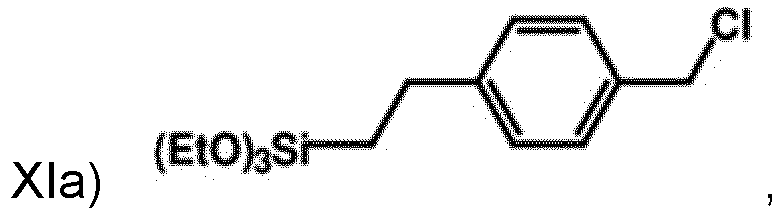
- Mélange de caoutchouc réticulable au soufre, contenant au moins les constituants suivants :- au moins un caoutchouc diénique et- 5 à 500 pcc d'au moins une silice et- 5 à 150 pcc d'au moins une suie et- un mélange des silanes B selon la formule XIa) et selon la formule XIb)

- Mélange de caoutchouc selon la revendication 1, caractérisé en ce que le rapport en poids de la quantité de silice à la quantité de suie vaut 17:1 à 1:20.
- Mélange de caoutchouc selon l'une des revendications précédentes, caractérisé en ce qu'il contient 5 à 20 pcc d'au moins une suie et 10 à 100 pcc, de préférence 20 à 100 pcc d'une silice.
- Mélange de caoutchouc selon l'une des revendications précédentes, caractérisé en ce qu'il contient 0,1 à 30 parties par cent parties de charge en poids de silane B.
- Mélange de caoutchouc selon l'une des revendications précédentes, caractérisé en ce qu'il contient les silanes selon la formule XIa) et la formule XIb) dans un rapport en poids de 5:1 à 1:5.
- Mélange de caoutchouc selon l'une des revendications précédentes, caractérisé en ce que le caoutchouc diénique est choisi dans le groupe constitué par le polyisoprène naturel (NR), le polyisoprène synthétique (IR), le caoutchouc de butadiène (BR), le caoutchouc de styrène-butadiène polymérisé en solution (SSBR) et le caoutchouc de styrène-butadiène polymérisé en émulsion (ESBR).
- Produit de vulcanisation qui est obtenu par vulcanisation par le soufre d'au moins un mélange de caoutchouc selon l'une des revendications 1 à 6.
- Pneumatique pour véhicule, caractérisé en ce qu'il présente dans au moins un élément au moins un produit de vulcanisation selon la revendication 7.
- Pneumatique pour véhicule selon la revendication 8, caractérisé en ce qu'il présente au moins un produit de vulcanisation selon la revendication 7 dans la bande de roulement.
- Utilisation d'un mélange de caoutchouc selon l'une des revendications 1 à 6 pour la fabrication d'un article en caoutchouc, en particulier d'un ressort pneumatique, d'un soufflet, d'une bande transporteuse, d'une sangle, d'une courroie, d'un tuyau, d'une bande en caoutchouc, d'un profilé, d'un joint, d'une membrane, de capteurs tactiles pour des applications médicales ou robotiques ou d'une semelle de chaussure ou des parties de celle-ci.
Priority Applications (1)
| Application Number | Priority Date | Filing Date | Title |
|---|---|---|---|
| EP18205723.2A EP3650246B1 (fr) | 2018-11-12 | 2018-11-12 | Mélange de caoutchouc réticulable au soufre, caoutchouc vulcanisé et pneumatique de véhicule |
Applications Claiming Priority (1)
| Application Number | Priority Date | Filing Date | Title |
|---|---|---|---|
| EP18205723.2A EP3650246B1 (fr) | 2018-11-12 | 2018-11-12 | Mélange de caoutchouc réticulable au soufre, caoutchouc vulcanisé et pneumatique de véhicule |
Publications (2)
| Publication Number | Publication Date |
|---|---|
| EP3650246A1 EP3650246A1 (fr) | 2020-05-13 |
| EP3650246B1 true EP3650246B1 (fr) | 2025-01-08 |
Family
ID=64277603
Family Applications (1)
| Application Number | Title | Priority Date | Filing Date |
|---|---|---|---|
| EP18205723.2A Active EP3650246B1 (fr) | 2018-11-12 | 2018-11-12 | Mélange de caoutchouc réticulable au soufre, caoutchouc vulcanisé et pneumatique de véhicule |
Country Status (1)
| Country | Link |
|---|---|
| EP (1) | EP3650246B1 (fr) |
Family Cites Families (7)
| Publication number | Priority date | Publication date | Assignee | Title |
|---|---|---|---|---|
| US7968636B2 (en) | 2006-12-28 | 2011-06-28 | Continental Ag | Tire compositions and components containing silated cyclic core polysulfides |
| US7625965B2 (en) | 2007-02-08 | 2009-12-01 | Momentive Performance Materials Inc. | Rubber composition, process of preparing same and articles made therefrom |
| US8143336B2 (en) * | 2008-08-07 | 2012-03-27 | Momentive Performance Materials Inc. | Activated halo-containing aralkylsilane composition, process of preparing same and rubber compositions made therefrom |
| US8182626B2 (en) | 2008-10-30 | 2012-05-22 | Continental Ag | Tire composition with improved vulcanizing agent |
| JP2011225730A (ja) * | 2010-04-20 | 2011-11-10 | Bridgestone Corp | ゴム組成物およびそれを用いたタイヤ |
| JP2012012456A (ja) | 2010-06-30 | 2012-01-19 | Sumitomo Chemical Co Ltd | S−(3−アミノプロピル)チオ硫酸および/またはその金属塩の使用方法 |
| JP2012158679A (ja) * | 2011-01-31 | 2012-08-23 | Sumitomo Rubber Ind Ltd | タイヤ用ゴム組成物及び空気入りタイヤ |
-
2018
- 2018-11-12 EP EP18205723.2A patent/EP3650246B1/fr active Active
Also Published As
| Publication number | Publication date |
|---|---|
| EP3650246A1 (fr) | 2020-05-13 |
Similar Documents
| Publication | Publication Date | Title |
|---|---|---|
| EP3303004B2 (fr) | Mélange de caoutchouc et pneu de véhicule | |
| DE102015218745B4 (de) | Kautschukmischung und Fahrzeugreifen | |
| EP3717276B1 (fr) | Mélange de caoutchouc réticulable au soufre, vulcanisat de ce mélange de caoutchouc et pneu de véhicule | |
| EP3103655B2 (fr) | Mélange de caoutchouc et pneu de vehicule | |
| EP3717560B1 (fr) | Mélange de caoutchouc réticulable au soufre, vulcanisat de ce mélange de caoutchouc et pneu de véhicule | |
| EP3103654B2 (fr) | Mélange de caoutchouc et pneu de vehicule | |
| EP3717557B1 (fr) | Mélange de caoutchouc réticulable au soufre, vulcanisat de ce mélange de caoutchouc et pneu de véhicule | |
| EP3717275B1 (fr) | Mélange de caoutchouc réticulable au soufre, vulcanisat de ce mélange de caoutchouc et pneu de véhicule | |
| EP2977227B1 (fr) | Mélange de caoutchouc réticulable au soufre et pneu | |
| EP3717277B1 (fr) | Mélange de caoutchouc réticulable au soufre, vulcanisat de ce mélange de caoutchouc et pneu de véhicule | |
| EP3594283B1 (fr) | Mélange de caoutchouc réticulable au soufre, caoutchouc vulcanisé et pneumatiques de véhicule | |
| EP4079538B1 (fr) | Mélange de caoutchouc réticulable au soufre, vulcanisat du mélange de caoutchouc et pneumatique de véhicule | |
| DE102021213846A1 (de) | Schwefelvernetzbare Kautschukmischung, Vulkanisat der Kautschukmischung und Fahrzeugreifen | |
| DE102019212916A1 (de) | Vernetzbare Kautschukmischung, Vulkanisat und Fahrzeugreifen | |
| EP4001359B1 (fr) | Mélange de caoutchouc réticulable au soufre, vulcanisation de mélange de caoutchouc et pneumatique de véhicule | |
| EP3650246B1 (fr) | Mélange de caoutchouc réticulable au soufre, caoutchouc vulcanisé et pneumatique de véhicule | |
| DE102022212613A1 (de) | Schwefelvernetzbare Kautschukmischung, Vulkanisat der Kautschukmischung und Fahrzeugreifen | |
| EP3650245B1 (fr) | Mélange de caoutchouc réticulable au soufre, caoutchouc vulcanisé et pneumatique de véhicule | |
| EP3792306B1 (fr) | Mélange de caoutchouc réticulable au soufre, caoutchouc vulcanisé et pneumatiques de véhicule | |
| DE102019207526B4 (de) | Schwefelvernetzbare Kautschukmischung, Vulkanisat und Verwendung in einem Fahrzeugreifen | |
| DE102022210845A1 (de) | Schwefelvernetzbare Kautschukmischung, Vulkanisat der Kautschukmischung und Fahrzeugreifen | |
| DE102022212853A1 (de) | Schwefelvernetzbare Kautschukmischung, Vulkanisat der Kautschukmischung und Fahrzeugreifen | |
| DE102022212859A1 (de) | Schwefelvernetzbare Kautschukmischung, Vulkanisat der Kautschukmischung und Fahrzeugreifen | |
| DE102024205557A1 (de) | Schwefelvernetzbare Kautschukmischung, Vulkanisat der Kautschukmischung und Fahrzeugreifen | |
| DE102020215465A1 (de) | Schwefelvernetzbare Kautschukmischung, Vulkanisat und Fahrzeugreifen |
Legal Events
| Date | Code | Title | Description |
|---|---|---|---|
| PUAI | Public reference made under article 153(3) epc to a published international application that has entered the european phase |
Free format text: ORIGINAL CODE: 0009012 |
|
| STAA | Information on the status of an ep patent application or granted ep patent |
Free format text: STATUS: THE APPLICATION HAS BEEN PUBLISHED |
|
| AK | Designated contracting states |
Kind code of ref document: A1 Designated state(s): AL AT BE BG CH CY CZ DE DK EE ES FI FR GB GR HR HU IE IS IT LI LT LU LV MC MK MT NL NO PL PT RO RS SE SI SK SM TR |
|
| AX | Request for extension of the european patent |
Extension state: BA ME |
|
| STAA | Information on the status of an ep patent application or granted ep patent |
Free format text: STATUS: REQUEST FOR EXAMINATION WAS MADE |
|
| 17P | Request for examination filed |
Effective date: 20201113 |
|
| RAP1 | Party data changed (applicant data changed or rights of an application transferred) |
Owner name: CONTINENTAL REIFEN DEUTSCHLAND GMBH |
|
| RBV | Designated contracting states (corrected) |
Designated state(s): AL AT BE BG CH CY CZ DE DK EE ES FI FR GB GR HR HU IE IS IT LI LT LU LV MC MK MT NL NO PL PT RO RS SE SI SK SM TR |
|
| STAA | Information on the status of an ep patent application or granted ep patent |
Free format text: STATUS: EXAMINATION IS IN PROGRESS |
|
| 17Q | First examination report despatched |
Effective date: 20210426 |
|
| RAP3 | Party data changed (applicant data changed or rights of an application transferred) |
Owner name: CONTINENTAL REIFEN DEUTSCHLAND GMBH |
|
| GRAP | Despatch of communication of intention to grant a patent |
Free format text: ORIGINAL CODE: EPIDOSNIGR1 |
|
| STAA | Information on the status of an ep patent application or granted ep patent |
Free format text: STATUS: GRANT OF PATENT IS INTENDED |
|
| INTG | Intention to grant announced |
Effective date: 20240729 |
|
| P01 | Opt-out of the competence of the unified patent court (upc) registered |
Free format text: CASE NUMBER: APP_47463/2024 Effective date: 20240816 |
|
| GRAS | Grant fee paid |
Free format text: ORIGINAL CODE: EPIDOSNIGR3 |
|
| GRAA | (expected) grant |
Free format text: ORIGINAL CODE: 0009210 |
|
| STAA | Information on the status of an ep patent application or granted ep patent |
Free format text: STATUS: THE PATENT HAS BEEN GRANTED |
|
| AK | Designated contracting states |
Kind code of ref document: B1 Designated state(s): AL AT BE BG CH CY CZ DE DK EE ES FI FR GB GR HR HU IE IS IT LI LT LU LV MC MK MT NL NO PL PT RO RS SE SI SK SM TR |
|
| REG | Reference to a national code |
Ref country code: GB Ref legal event code: FG4D Free format text: NOT ENGLISH |
|
| REG | Reference to a national code |
Ref country code: CH Ref legal event code: EP |
|
| REG | Reference to a national code |
Ref country code: DE Ref legal event code: R096 Ref document number: 502018015482 Country of ref document: DE |
|
| REG | Reference to a national code |
Ref country code: IE Ref legal event code: FG4D Free format text: LANGUAGE OF EP DOCUMENT: GERMAN |
|
| REG | Reference to a national code |
Ref country code: LT Ref legal event code: MG9D |
|
| REG | Reference to a national code |
Ref country code: NL Ref legal event code: MP Effective date: 20250108 |
|
| PG25 | Lapsed in a contracting state [announced via postgrant information from national office to epo] |
Ref country code: NL Free format text: LAPSE BECAUSE OF FAILURE TO SUBMIT A TRANSLATION OF THE DESCRIPTION OR TO PAY THE FEE WITHIN THE PRESCRIBED TIME-LIMIT Effective date: 20250108 |
|
| PG25 | Lapsed in a contracting state [announced via postgrant information from national office to epo] |
Ref country code: RS Free format text: LAPSE BECAUSE OF FAILURE TO SUBMIT A TRANSLATION OF THE DESCRIPTION OR TO PAY THE FEE WITHIN THE PRESCRIBED TIME-LIMIT Effective date: 20250408 |
|
| PG25 | Lapsed in a contracting state [announced via postgrant information from national office to epo] |
Ref country code: FI Free format text: LAPSE BECAUSE OF FAILURE TO SUBMIT A TRANSLATION OF THE DESCRIPTION OR TO PAY THE FEE WITHIN THE PRESCRIBED TIME-LIMIT Effective date: 20250108 |
|
| PG25 | Lapsed in a contracting state [announced via postgrant information from national office to epo] |
Ref country code: PL Free format text: LAPSE BECAUSE OF FAILURE TO SUBMIT A TRANSLATION OF THE DESCRIPTION OR TO PAY THE FEE WITHIN THE PRESCRIBED TIME-LIMIT Effective date: 20250108 |
|
| PG25 | Lapsed in a contracting state [announced via postgrant information from national office to epo] |
Ref country code: ES Free format text: LAPSE BECAUSE OF FAILURE TO SUBMIT A TRANSLATION OF THE DESCRIPTION OR TO PAY THE FEE WITHIN THE PRESCRIBED TIME-LIMIT Effective date: 20250108 |
|
| PG25 | Lapsed in a contracting state [announced via postgrant information from national office to epo] |
Ref country code: NO Free format text: LAPSE BECAUSE OF FAILURE TO SUBMIT A TRANSLATION OF THE DESCRIPTION OR TO PAY THE FEE WITHIN THE PRESCRIBED TIME-LIMIT Effective date: 20250408 Ref country code: IS Free format text: LAPSE BECAUSE OF FAILURE TO SUBMIT A TRANSLATION OF THE DESCRIPTION OR TO PAY THE FEE WITHIN THE PRESCRIBED TIME-LIMIT Effective date: 20250508 |
|
| PG25 | Lapsed in a contracting state [announced via postgrant information from national office to epo] |
Ref country code: HR Free format text: LAPSE BECAUSE OF FAILURE TO SUBMIT A TRANSLATION OF THE DESCRIPTION OR TO PAY THE FEE WITHIN THE PRESCRIBED TIME-LIMIT Effective date: 20250108 |
|
| PG25 | Lapsed in a contracting state [announced via postgrant information from national office to epo] |
Ref country code: LV Free format text: LAPSE BECAUSE OF FAILURE TO SUBMIT A TRANSLATION OF THE DESCRIPTION OR TO PAY THE FEE WITHIN THE PRESCRIBED TIME-LIMIT Effective date: 20250108 Ref country code: PT Free format text: LAPSE BECAUSE OF FAILURE TO SUBMIT A TRANSLATION OF THE DESCRIPTION OR TO PAY THE FEE WITHIN THE PRESCRIBED TIME-LIMIT Effective date: 20250508 |
|
| PG25 | Lapsed in a contracting state [announced via postgrant information from national office to epo] |
Ref country code: GR Free format text: LAPSE BECAUSE OF FAILURE TO SUBMIT A TRANSLATION OF THE DESCRIPTION OR TO PAY THE FEE WITHIN THE PRESCRIBED TIME-LIMIT Effective date: 20250409 Ref country code: BG Free format text: LAPSE BECAUSE OF FAILURE TO SUBMIT A TRANSLATION OF THE DESCRIPTION OR TO PAY THE FEE WITHIN THE PRESCRIBED TIME-LIMIT Effective date: 20250108 |
|
| PG25 | Lapsed in a contracting state [announced via postgrant information from national office to epo] |
Ref country code: SE Free format text: LAPSE BECAUSE OF FAILURE TO SUBMIT A TRANSLATION OF THE DESCRIPTION OR TO PAY THE FEE WITHIN THE PRESCRIBED TIME-LIMIT Effective date: 20250108 |
|
| PG25 | Lapsed in a contracting state [announced via postgrant information from national office to epo] |
Ref country code: SM Free format text: LAPSE BECAUSE OF FAILURE TO SUBMIT A TRANSLATION OF THE DESCRIPTION OR TO PAY THE FEE WITHIN THE PRESCRIBED TIME-LIMIT Effective date: 20250108 |
|
| REG | Reference to a national code |
Ref country code: DE Ref legal event code: R097 Ref document number: 502018015482 Country of ref document: DE |
|
| PG25 | Lapsed in a contracting state [announced via postgrant information from national office to epo] |
Ref country code: DK Free format text: LAPSE BECAUSE OF FAILURE TO SUBMIT A TRANSLATION OF THE DESCRIPTION OR TO PAY THE FEE WITHIN THE PRESCRIBED TIME-LIMIT Effective date: 20250108 |
|
| PG25 | Lapsed in a contracting state [announced via postgrant information from national office to epo] |
Ref country code: CZ Free format text: LAPSE BECAUSE OF FAILURE TO SUBMIT A TRANSLATION OF THE DESCRIPTION OR TO PAY THE FEE WITHIN THE PRESCRIBED TIME-LIMIT Effective date: 20250108 Ref country code: EE Free format text: LAPSE BECAUSE OF FAILURE TO SUBMIT A TRANSLATION OF THE DESCRIPTION OR TO PAY THE FEE WITHIN THE PRESCRIBED TIME-LIMIT Effective date: 20250108 |
|
| PG25 | Lapsed in a contracting state [announced via postgrant information from national office to epo] |
Ref country code: RO Free format text: LAPSE BECAUSE OF FAILURE TO SUBMIT A TRANSLATION OF THE DESCRIPTION OR TO PAY THE FEE WITHIN THE PRESCRIBED TIME-LIMIT Effective date: 20250108 |
|
| PG25 | Lapsed in a contracting state [announced via postgrant information from national office to epo] |
Ref country code: SK Free format text: LAPSE BECAUSE OF FAILURE TO SUBMIT A TRANSLATION OF THE DESCRIPTION OR TO PAY THE FEE WITHIN THE PRESCRIBED TIME-LIMIT Effective date: 20250108 |
|
| PLBE | No opposition filed within time limit |
Free format text: ORIGINAL CODE: 0009261 |
|
| STAA | Information on the status of an ep patent application or granted ep patent |
Free format text: STATUS: NO OPPOSITION FILED WITHIN TIME LIMIT |
|
| 26N | No opposition filed |
Effective date: 20251009 |
|
| PGFP | Annual fee paid to national office [announced via postgrant information from national office to epo] |
Ref country code: DE Payment date: 20251130 Year of fee payment: 8 |
|
| PGFP | Annual fee paid to national office [announced via postgrant information from national office to epo] |
Ref country code: FR Payment date: 20251126 Year of fee payment: 8 |
|
| PG25 | Lapsed in a contracting state [announced via postgrant information from national office to epo] |
Ref country code: IT Free format text: LAPSE BECAUSE OF FAILURE TO SUBMIT A TRANSLATION OF THE DESCRIPTION OR TO PAY THE FEE WITHIN THE PRESCRIBED TIME-LIMIT Effective date: 20250108 |