EP3650970A1 - Procédé et dispositif de simulation assistée par ordinateur d'un système technique modulaire - Google Patents
Procédé et dispositif de simulation assistée par ordinateur d'un système technique modulaire Download PDFInfo
- Publication number
- EP3650970A1 EP3650970A1 EP18205462.7A EP18205462A EP3650970A1 EP 3650970 A1 EP3650970 A1 EP 3650970A1 EP 18205462 A EP18205462 A EP 18205462A EP 3650970 A1 EP3650970 A1 EP 3650970A1
- Authority
- EP
- European Patent Office
- Prior art keywords
- module
- simulation
- specific
- virtual
- model
- Prior art date
- Legal status (The legal status is an assumption and is not a legal conclusion. Google has not performed a legal analysis and makes no representation as to the accuracy of the status listed.)
- Granted
Links
Images

Classifications
-
- G—PHYSICS
- G05—CONTROLLING; REGULATING
- G05B—CONTROL OR REGULATING SYSTEMS IN GENERAL; FUNCTIONAL ELEMENTS OF SUCH SYSTEMS; MONITORING OR TESTING ARRANGEMENTS FOR SUCH SYSTEMS OR ELEMENTS
- G05B19/00—Program-control systems
- G05B19/02—Program-control systems electric
- G05B19/418—Total factory control, i.e. centrally controlling a plurality of machines, e.g. direct or distributed numerical control [DNC], flexible manufacturing systems [FMS], integrated manufacturing systems [IMS] or computer integrated manufacturing [CIM]
- G05B19/41885—Total factory control, i.e. centrally controlling a plurality of machines, e.g. direct or distributed numerical control [DNC], flexible manufacturing systems [FMS], integrated manufacturing systems [IMS] or computer integrated manufacturing [CIM] characterised by modeling, simulation of the manufacturing system
-
- G—PHYSICS
- G05—CONTROLLING; REGULATING
- G05B—CONTROL OR REGULATING SYSTEMS IN GENERAL; FUNCTIONAL ELEMENTS OF SUCH SYSTEMS; MONITORING OR TESTING ARRANGEMENTS FOR SUCH SYSTEMS OR ELEMENTS
- G05B17/00—Systems involving the use of models or simulators of said systems
- G05B17/02—Systems involving the use of models or simulators of said systems electric
-
- G—PHYSICS
- G05—CONTROLLING; REGULATING
- G05B—CONTROL OR REGULATING SYSTEMS IN GENERAL; FUNCTIONAL ELEMENTS OF SUCH SYSTEMS; MONITORING OR TESTING ARRANGEMENTS FOR SUCH SYSTEMS OR ELEMENTS
- G05B2219/00—Program-control systems
- G05B2219/20—Pc systems
- G05B2219/23—Pc programming
- G05B2219/23456—Model machine for simulation
-
- G—PHYSICS
- G06—COMPUTING OR CALCULATING; COUNTING
- G06F—ELECTRIC DIGITAL DATA PROCESSING
- G06F30/00—Computer-aided design [CAD]
- G06F30/20—Design optimisation, verification or simulation
-
- Y—GENERAL TAGGING OF NEW TECHNOLOGICAL DEVELOPMENTS; GENERAL TAGGING OF CROSS-SECTIONAL TECHNOLOGIES SPANNING OVER SEVERAL SECTIONS OF THE IPC; TECHNICAL SUBJECTS COVERED BY FORMER USPC CROSS-REFERENCE ART COLLECTIONS [XRACs] AND DIGESTS
- Y02—TECHNOLOGIES OR APPLICATIONS FOR MITIGATION OR ADAPTATION AGAINST CLIMATE CHANGE
- Y02P—CLIMATE CHANGE MITIGATION TECHNOLOGIES IN THE PRODUCTION OR PROCESSING OF GOODS
- Y02P90/00—Enabling technologies with a potential contribution to greenhouse gas [GHG] emissions mitigation
- Y02P90/02—Total factory control, e.g. smart factories, flexible manufacturing systems [FMS] or integrated manufacturing systems [IMS]
Definitions
- the invention relates to a method and a device for computer-aided simulation of a modular technical system, a corresponding virtual module being generated for a respective real module of the technical system.
- Modular process plants can be used increasingly in process engineering, e.g. in the chemical or pharmaceutical industry.
- Process engineering modules also known as modular process units, are generally used for this, which are self-contained and can be interconnected by a module integrator to form complex overall systems.
- the interconnection of modules enables the planning and conversion time of new systems to be reduced.
- the modules can each include their own control or automation technology, which can be controlled by a central processor orchestration level (Process Orchestration Layer) during operation of the modular system or across modules without processor orchestration level.
- Standard description languages such as the Standard Module Type Package, or MTP for short, can be used to describe the module types, which describes the interfaces, services and functions of the automation technology of the modules and enables the integration of the modules into a processor orchestration level.
- Virtual commissioning can take place before a modular process plant is actually commissioned. This can be done, for example, using real ("hardware-in-the-loop", HiL for short) or emulated control ("software-in-the-loop", SiL for short, or “model-in-the-loop", MiL for short) and / or be implemented as a simulation of the process behavior.
- the virtual commissioning for each module requires simulation models of the process and emulations of the automation technology, which can be orchestrated according to the plant topology. As a rule, the required simulation models and emulations are not available, are not supplied by the module manufacturer and / or are based on different software. Virtual commissioning of a system from modules from different manufacturers is therefore associated with a great deal of effort or is impossible, since the automation technology and / or the process integrated in the module can only be known to one manufacturer.
- the method according to the invention can in particular be implemented as a computer-implemented method.
- the method can be carried out by a device which comprises at least one processor.
- a “processor” can be understood to mean, for example, a machine or an electronic circuit.
- a processor can in particular be a main processor (English: Central Processing Unit, CPU), a microprocessor or a microcontroller, for example an application-specific integrated circuit or a digital signal processor, possibly in combination with a storage unit for storing program instructions, a server, etc. act.
- CPU Central Processing Unit
- microprocessor or a microcontroller for example an application-specific integrated circuit or a digital signal processor, possibly in combination with a storage unit for storing program instructions, a server, etc. act.
- a “modular technical system” can be understood to mean, in particular, a modular system, a modular process system, or a modular production system.
- the modular technical system comprises at least one module.
- a “module” can in particular include a hardware module, a subsystem or a system module, such as e.g. Devices or pumps.
- a module can also be called a modular process unit.
- Components of a module can be, in particular, actuators, sensors, process connections, control and communication interfaces and your own automation technology.
- a “virtual module” can be understood as a data container, in particular with a fixed (data) structure, as a predetermined exchange format or as a data structure that can in particular be partially executable.
- a virtual module forms in particular a real module, ie it includes virtual or simulated components of the real module.
- the virtual module can comprise at least one controller and a module-specific simulation model, with at least one description, for example regarding details and executability, being assigned in each case.
- the controller and the at least one simulation model of the virtual module can preferably be coupled to one another via a communication level in the virtual module, so that, for example, control data can be transmitted from the controller to the simulation model.
- a "computer-aided simulation” can be understood in particular to mean a simulation of the operation and / or the processes of a modular technical system and / or a virtual commissioning.
- Virtual commissioning includes, for example, various tests, such as signal tests, testing the field devices or the process behavior. When testing the process behavior, different processed media or substances can be modeled.
- the control or automation technology of a module or the entire system can be tested using virtual commissioning. In particular, only the real automation or control hardware can be used, ie a so-called "hardware-in-the-loop" approach can be implemented.
- the virtual module comprises a controller, which can also be referred to as a virtual controller, and which can be present in particular as a hardware project or as an emulation.
- the control of the virtual module is in the form of a hardware project, the virtual module can be coupled to a real control which at least corresponds to the control of the real module.
- the control can also be present as an emulation in the virtual module.
- a virtual module according to the invention for a respective real module can preferably be generated and supplied by a module manufacturer.
- Data in particular module-specific data, e.g. Configuration and / or specification data of the real module determined and read.
- the data can be acquired, for example, by means of a sensor or derived from a description of the real module.
- the virtual module is generated depending on this module-specific data.
- the virtual module comprises at least one module-specific simulation model together with an assigned model type information.
- the simulation model includes, for example, information on process technology, actuators or sensors, process technology connections, communication for control, simulated physical interfaces and control options, input-output interfaces for cross-model exchange of variables or parameters and the like.
- the module-specific simulation model can in particular be pre-generated and / or pre-configured and provided in this way.
- a module manufacturer can generate at least one corresponding simulation model.
- the virtual module preferably comprises a multiplicity of module-specific simulation models, each of which is assigned model type information, for example in order to to be able to easily carry out various types of simulations.
- the module-specific simulation model and / or the control of the virtual module can, for example, also be implemented as a link to a manufacturer's homepage and / or an IP address for direct execution on a manufacturer's server.
- a virtual module includes the information necessary to easily configure and simulate a modular system in a simulation environment. For example, in the event of a change in a configuration of the real modular system using virtual modules, the system configuration can be checked virtually. Based on a standardized methodology and a specified encapsulation of the individual components of the virtual module in a data container, the creation of a virtual commissioning of a modular technical system can be automated and it is in particular possible to implement it independently of a specific simulation software. A modeling effort can be reduced and / or modeling errors can be avoided, since the virtual module can include all the information required for a simulation of the modular system, which are provided as data containers. With real modules from different manufacturers, virtual commissioning can be created without additional effort and / or specific simulation tools.
- the model type information can include information on the type of the simulation model, on the execution and / or on the level of detail of the simulation model.
- Model type information can in particular be understood as a description of the respective module-specific simulation model.
- Model type information can in particular be understood as a description of the respective module-specific simulation model.
- the module-specific simulation model can have a first interface, via which the cross-model variables of the module-specific simulation model are exchanged.
- each module-specific simulation model that is integrated in the virtual module can have at least one first interface.
- variables can be exchanged across models via the first interface.
- Variables can be defined as cross-module or module-internal and include, for example, physical quantities or signals.
- a coupling with other virtual modules can preferably be established via the first interface, for example to set up the modular technical system virtually.
- the first interface thus includes, in particular, those couplings, for example to exchange signals or physical quantities, which the real module also has.
- the module-specific simulation model can have a second interface, via which parameter values and / or functions for the module-specific simulation model can be read in, and the module-specific simulation model can thus be configured.
- each module-specific simulation model that is integrated in the virtual module can have at least one second interface.
- parameter values and / or functions and / or secondary simulation models can be read in via this second interface.
- Secondary simulation models can, for example, be encapsulated in functions and thus called up by a module-specific simulation model.
- a secondary simulation model can include, for example, a simulation of a reaction kinetics.
- customer-specific parameter values, parameterized functions or the like can be entered for a simulation model via the second interface.
- access to a database can be realized.
- the module-specific simulation model can be configured using the inputs via the second interface and then executed.
- the module-specific simulation model can comprise a third interface for cross-module communication, and status data of a module-specific one can be transmitted via the third interface Simulation model can be read in and / or read out.
- the virtual module preferably comprises at least one third interface.
- a third interface can be implemented, for example, as a communication interface, a user interface (human-machine interface) or a connection to a central control or processor orchestration level.
- status data required for virtual commissioning can be exchanged via the third interface.
- error states can be read out or set.
- the third interface enables, in particular, data transmission or data exchange, e.g. the entry of control commands.
- the third interface enables the input of status data and / or the output of status data of a simulation model.
- State data include, in particular, states of a simulation model at a specific point in time. For example, error and / or validation states of the simulation model can be set and / or read out in this way.
- status data of a module-specific simulation model can be output via an evaluation unit.
- An evaluation unit can be, for example, an operating screen for displaying states or the like. In particular, internal status data of a simulation model can be displayed.
- a further module-specific simulation model to which further model type information is assigned, can be integrated in the virtual module.
- the virtual module is preferably set up in such a way that further module-specific simulation models can be integrated. This enables, for example, additional simulation types to be set up using the virtual module.
- the virtual module can be encapsulated and / or encrypted and made available in this way.
- the virtual module can be provided, for example, as an encapsulated and / or encrypted data container.
- a known method for data encapsulation and / or cryptographic encryption of data can be used.
- Simulation type information can be provided or specified in particular by a plant integrator depending on the requirements for the simulation of the modular technical system. For example, it includes the type of Tests, such as signal test, field device test, or automation test.
- the modular technical system can be simulated in a simulation environment or a simulator by means of the virtual modules for each existing real module.
- the virtual modules preferably include all the information required for setting up and performing a simulation.
- the configuration and / or topology of the virtual system from the virtual modules takes place in accordance with the configuration information of the real system.
- the required simulation model can be determined on the basis of a comparison of the simulation type information and the model type information.
- the technical system can be configured and / or controlled depending on a result of the simulation of the modules carried out.
- Another aspect of the invention relates to a device for computer-aided simulation of a modular technical system, which has at least one processor which is set up to carry out a method according to the invention.
- the invention relates to a computer program product which can be loaded directly into a programmable computer, comprising program code parts which, when the program is executed by a computer, cause the computer to carry out the method / the steps of a method and a computer-readable storage medium with a computer program product according to the invention.
- a computer program product can, for example, on a storage medium, such as a memory card, USB stick, CD-ROM, DVD, a non-volatile / permanent storage medium (non-transitory storage medium) or in the form of a downloadable one File provided or delivered by a server on a network.
- a storage medium such as a memory card, USB stick, CD-ROM, DVD, a non-volatile / permanent storage medium (non-transitory storage medium) or in the form of a downloadable one File provided or delivered by a server on a network.
- a (relevant) specialist with knowledge of the method claim (s) is of course aware of all the usual ways of implementing the invention in the prior art, so that in particular an independent disclosure in the description is not required.
- these customary implementation variants known to the person skilled in the art can only be implemented using hardware (components) or exclusively using software (components).
- the specialist can do so within the framework of his professional Can largely choose any combinations according to the invention from hardware (components) and software (components) in order to implement implementation variants according to the invention.
- Figure 1 shows an embodiment of a method according to the invention for computer-based simulation of a modular technical system.
- a modular technical system can in particular be a modular process plant, for example for the chemical or pharmaceutical industry.
- the method can in particular be implemented as a computer-implemented method, at least some of the steps of the method being carried out by a processor.
- a modular technical system can comprise several modules, which can be configured interchangeably.
- the modules can each include their own control or automation technology, which controls sensors and / or actuators of the module, for example.
- Different modules can preferably be coupled to one another via physical interfaces.
- a module can implement a process step of a process and / or only part of a process step.
- the control of a process of a modular technical system can in particular be controlled via a central processor orchestration level, which controls the control of a respective module.
- a simulation of the technical system ie a virtual start-up, can preferably be carried out.
- This can be, for example, a pure signal test, a test of the field device layer, a test of the process dynamics, or a transient test of the process behavior.
- various operating actions, different system specifications and / or error scenarios can be run through.
- Virtual commissioning can take place in a suitable engineering environment or simulation environment.
- a virtual module is generated for a respective real module of the modular technical system as a function of module-specific data of the corresponding real module.
- the module-specific data of the real module can be, for example, configuration data or specification data.
- a virtual module can be implemented as a data container, in particular as a data structure, an executable data structure with a predefined structure, as exemplified in Figure 3 shown.
- a virtual module is in particular set up in such a way that it can emulate or simulate a module-specific process by means of a module-specific simulation model and / or the control of the corresponding real module. Since a virtual module comprises both a controller and at least one module-specific simulation model, a simulation of the corresponding real module can thus be set up in a simulation environment.
- a virtual module preferably comprises a plurality of module-specific simulation models, each of which is assigned model type information.
- the module-specific simulation models can in particular be generated in advance. For example, they represent a process running in the module.
- the virtual module comprises an emulated controller or a control project including an interface for connection to a real controller for controlling a module-specific process.
- the virtual module can include a third interface for cross-module communication.
- the virtual module can be connected to a virtual system with other virtual modules, in particular in a simulation environment, via the third interface.
- the third interface allows data exchange across module boundaries, such as output status data of a module-specific simulation model to an evaluation unit.
- the virtual module is generated analogously to the real module, i.e.
- the virtual module includes in particular an image of all control options, interfaces, capabilities and functions like the real module and therefore allows a simulation of the entire modular technical system to be implemented.
- the virtual module comprises a large number of different simulation models with different model type information, so that, for example, different types of simulations of the module and / or the modular system can be carried out.
- the virtual module comprises a controller, which can be designed, for example, as an emulated controller.
- the virtual module can in particular be provided as an encapsulated and / or encrypted data container.
- a virtual module is preferably set up in such a way that it can be put together in a simulation environment together with other virtual modules to form a virtual technical system.
- a virtual module comprises a module-specific controller and at least one module-specific simulation model, which are advantageously coupled to one another via a communication level, so that the real module, the controller of the real module and / or a process of the real module can be simulated.
- the virtual modules can be stored on a storage unit, a database or on a server.
- Step S3 identifies all real modules for a modular technical system to be simulated and provides corresponding virtual modules for them. This is done depending on a given configuration information of the modular technical system, which includes, for example, information about the plant topology from the processor orchestration level, information about links between the modules and their variable exchange and / or information from, for example, the MTP description. In addition, it is determined in step S3 on the basis of predetermined simulation type information which type of simulation and / or which type of control is to be carried out.
- the virtual modules provided are read into a suitable simulation environment.
- a commissioning engineer or system integrator of a modular process system can read the virtual modules into a suitable engineering environment.
- the virtual modules are coupled to one another depending on the configuration information in the simulation environment, i.e. Interfaces of the simulation models are interconnected in such a way that variables can be exchanged.
- a commissioning engineer or system integrator can thus set up a virtual image of the modular technical system depending on the configuration information.
- the simulation model of a respective virtual module is selected, the model type information of which corresponds or suffices to a predetermined simulation type information.
- the simulation type information determines in particular the type of virtual commissioning, e.g. Signal test, process test, hardware-in-the-loop, software-in-the-loop or model-in-the-loop for control.
- the virtual modules are interconnected in the simulation environment, for a respective virtual module the corresponding simulation models and / or the corresponding control type are selected and configured in accordance with the simulation type information.
- the system integrator Before running the simulation, i.e. Before virtual commissioning, the system integrator can set parameter values and / or functions for the respective module-specific simulation models via their respective second interfaces, step S4.
- parameters and / or functions can be defined that are not specified by the manufacturer of a module. For example, customer-specific parameters such as Material data, read in and the respective module-specific simulation model configured accordingly.
- the modular technical system can be simulated using the simulation based on the virtual modules.
- various error scenarios and / or the process behavior can be simulated with the aid of a computer, step S5.
- Internal status data of a module-specific process simulation model can be sent to an evaluation unit, e.g. an operating screen.
- status data of a module-specific simulation model can be set to predefined values in order to simulate an error scenario.
- Step S6 of the method comprises the transmission of the result of the virtual commissioning to, for example, a plant integrator.
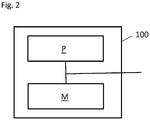
- Figure 2 shows a device 100 according to the invention in a block diagram.
- the device 100 is designed to carry out a method according to the invention.
- the device 100 comprises at least one processor P that executes at least one method step of the method.
- the device 100 according to the invention can comprise at least one storage unit M, in particular to store and provide at least one virtual module.
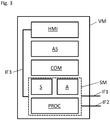
- Figure 3 shows a schematic representation of a virtual module VM, after integration into a simulation environment, which is generated according to a method according to the invention, is coupled with other virtual modules according to configuration information of the modular technical system in order to enable a simulation of a modular technical system.
- the virtual module VM in particular emulates a corresponding real module, that is to say it comprises in particular all the components and capabilities of a real module and is in particular set up to carry out different simulation scenarios.
- the virtual module VM therefore enables various types of simulation to be implemented for virtual commissioning.
- a virtual module VM is provided as a data container.
- the data container is preferably generated with a predetermined structure.
- a virtual module VM comprises at least one simulation model SM, which simulates or simulates a module-specific process PROC and the connection to actuators A and / or sensors S.
- the module-specific simulation model SM includes in particular information on process technology, actuators, sensors, process technology connections, communication, and input / output interfaces for cross-model exchange of variables / parameters.
- the module-specific simulation model SM is described by an assigned model type information.
- the model type information is preferably provided with the simulation model SM.
- the model type information can be, for example, across models be encoded.
- the model type information includes in particular information on the type of the simulation model, such as signal test or process dynamics test, on the execution or executability and / or on the level of detail of the simulation model SM.
- the virtual module VM preferably comprises a large number of module-specific simulation models SM, which each differ, for example, in the level of detail.
- Each module-specific simulation model SM includes in particular at least a first interface IF1 and a second interface IF2.
- the first interface IF1 enables the exchange of cross-model variables of the module-specific simulation model SM. Cross-model variables can in particular be exchanged across modules and / or within modules. In other words, the first interface IF1 can be viewed as a simulated physical interface and control option.
- the second interface IF2 enables, in particular, configuration of the respective simulation model SM. The second interface IF2 thus allows in particular access to the virtual module VM from the outside.
- the virtual module VM and / or the simulation models SM can in particular comprise further interfaces.
- the virtual module VM comprises a controller AS, which is available either as an emulation, as a control project, as a simplified model of the control logic or as a simplified functional automation logic.
- a control project can be implemented as a file, for example.
- the control can be assigned control type information from which the type of control and the capabilities can be derived.
- An emulation of the control can be understood as an image of the real control.
- the controller AS of the virtual module VM is coupled to the process simulation via a communication level COM. The communication can take place, for example, according to a communication protocol.
- the third interface is IF3 of the virtual module VM coupled to the at least one module-specific simulation model SM. Via the third interface IF3, for example, status data of a module-specific simulation model SM can be read out and transmitted to an evaluation unit or to an HMI operating screen.
- the feasibility of the simulation model SM and / or the controller AS can in particular be available in different variants.
- the execution can, for example, be tool-specific, i.e. the execution requires a defined tool, e.g. a simulation software.
- the execution can be tool-specific, i.e. the simulation models and / or the controller are provided in accordance with a defined standard format so that it can be loaded into various simulation tools and executed there.
- simulation models and / or the controller can be defined in such a way that they can be provided in an executable manner, i.e. For example, as a standardized executable, for which no specified tool is required for execution.
- the executability of the simulation models and control models is preferably defined for each virtual module.
- the data container of a virtual module VM can, for example, be structured according to a tree structure.
- the format and structure of a virtual module VM are preferably the same for each virtual module and are therefore compatible with one another.
- the tree structure can include a folder structure that can be compatible, for example, with a standardized description such as the MTP description.
- a folder structure that can be compatible, for example, with a standardized description such as the MTP description.
- per simulation model and control the implementation ie tool-specific, tool-non-specific or executable.
- Each module-specific simulation model is assigned model type information, which can be implemented, for example, as an XML file.
Landscapes
- Engineering & Computer Science (AREA)
- Physics & Mathematics (AREA)
- General Physics & Mathematics (AREA)
- Automation & Control Theory (AREA)
- Manufacturing & Machinery (AREA)
- General Engineering & Computer Science (AREA)
- Quality & Reliability (AREA)
- Testing And Monitoring For Control Systems (AREA)
- Debugging And Monitoring (AREA)
- Management, Administration, Business Operations System, And Electronic Commerce (AREA)
Priority Applications (4)
| Application Number | Priority Date | Filing Date | Title |
|---|---|---|---|
| EP18205462.7A EP3650970B8 (fr) | 2018-11-09 | 2018-11-09 | Procédé et dispositif de simulation assistée par ordinateur d'un système technique modulaire |
| US17/292,300 US11988998B2 (en) | 2018-11-09 | 2019-10-30 | Method and apparatus for computer aided simulation of a modular technical system |
| CN201980088542.XA CN113260935B (zh) | 2018-11-09 | 2019-10-30 | 对模块化技术系统进行计算机辅助仿真的方法和设备 |
| PCT/EP2019/079651 WO2020094476A1 (fr) | 2018-11-09 | 2019-10-30 | Procédé et dispositif de simulation assistée par ordinateur d'un système technique modulaire |
Applications Claiming Priority (1)
| Application Number | Priority Date | Filing Date | Title |
|---|---|---|---|
| EP18205462.7A EP3650970B8 (fr) | 2018-11-09 | 2018-11-09 | Procédé et dispositif de simulation assistée par ordinateur d'un système technique modulaire |
Publications (3)
| Publication Number | Publication Date |
|---|---|
| EP3650970A1 true EP3650970A1 (fr) | 2020-05-13 |
| EP3650970B1 EP3650970B1 (fr) | 2021-12-29 |
| EP3650970B8 EP3650970B8 (fr) | 2022-02-09 |
Family
ID=64308526
Family Applications (1)
| Application Number | Title | Priority Date | Filing Date |
|---|---|---|---|
| EP18205462.7A Active EP3650970B8 (fr) | 2018-11-09 | 2018-11-09 | Procédé et dispositif de simulation assistée par ordinateur d'un système technique modulaire |
Country Status (4)
| Country | Link |
|---|---|
| US (1) | US11988998B2 (fr) |
| EP (1) | EP3650970B8 (fr) |
| CN (1) | CN113260935B (fr) |
| WO (1) | WO2020094476A1 (fr) |
Cited By (4)
| Publication number | Priority date | Publication date | Assignee | Title |
|---|---|---|---|---|
| CN111818128A (zh) * | 2020-06-15 | 2020-10-23 | 北京空间飞行器总体设计部 | 基于容器云的组件化仿真模型运行控制系统、方法及介质 |
| DE102020130022A1 (de) | 2020-11-13 | 2022-05-19 | Festo Se & Co. Kg | Überprüfen einer Kompatibilität eines neu zu integrierenden Prozessmoduls einer Automatisierungsanlage |
| EP4095632A1 (fr) * | 2021-05-28 | 2022-11-30 | Siemens Aktiengesellschaft | Procédé et système de gestion des alarmes dans les installations de production modulaires |
| DE102023101880A1 (de) * | 2023-01-26 | 2024-08-01 | Audi Hungaria Zrt | Verfahren zur Inbetriebnahme einer automatisierten Karosseriebauanlage |
Families Citing this family (4)
| Publication number | Priority date | Publication date | Assignee | Title |
|---|---|---|---|---|
| EP3828652A1 (fr) * | 2019-11-26 | 2021-06-02 | Siemens Aktiengesellschaft | Procédé et dispositif d'essai destinés aux essais d'une commande de comportement autonome pour un système technique |
| EP3929679B1 (fr) * | 2020-06-23 | 2026-05-20 | ABB Schweiz AG | Système d'ingénierie pour l'orchestration d'une installation industrielle |
| EP4160331A1 (fr) * | 2021-10-01 | 2023-04-05 | Abb Schweiz Ag | Vérification de la résilience des centrales modulaires |
| CN116611167B (zh) * | 2023-05-24 | 2025-04-15 | 东风汽车集团股份有限公司 | 轮胎系统的动力学仿真模型文件生成方法及装置 |
Citations (1)
| Publication number | Priority date | Publication date | Assignee | Title |
|---|---|---|---|---|
| WO2011026021A2 (fr) * | 2009-08-31 | 2011-03-03 | Siemens Product Lifecycle Management Software Inc. | Système et procédé de création d'objets mécatroniques basés sur des fonctions |
Family Cites Families (12)
| Publication number | Priority date | Publication date | Assignee | Title |
|---|---|---|---|---|
| WO2008013968A2 (fr) * | 2006-07-28 | 2008-01-31 | Vast Systems Technology Corporation | Procédé et appareil de modification d'un modèle de processeur virtuel pour une simulation de matériels et de logiciels |
| US20120239374A1 (en) * | 2011-03-18 | 2012-09-20 | General Electric Company | System and method of simulating input/output modules in a control system |
| US11972177B2 (en) * | 2013-11-08 | 2024-04-30 | Rockwell Automation Technologies, Inc. | Interface for data exchange between industrial controllers and simulation applications for simulating a machine |
| US10755003B2 (en) * | 2013-11-08 | 2020-08-25 | Rockwell Automation Technologies, Inc. | Time synchronization of signal transmission intervals for simulating a machine in industrial automation |
| WO2015120066A1 (fr) * | 2014-02-04 | 2015-08-13 | Ingersoll-Rand Company | Système et procédé de modélisation, de simulation, d'optimisation, et/ou de création de cotation |
| WO2016112383A1 (fr) * | 2015-01-10 | 2016-07-14 | University Of Florida Research Foundation, Inc. | Attributs de simulation combinant réalité et suivi modulaire mélangés |
| US10496061B2 (en) * | 2015-03-16 | 2019-12-03 | Rockwell Automation Technologies, Inc. | Modeling of an industrial automation environment in the cloud |
| US10193762B2 (en) * | 2016-08-11 | 2019-01-29 | Rescale, Inc. | Dynamic optimization of simulation resources |
| US10892058B2 (en) * | 2017-09-29 | 2021-01-12 | K2M, Inc. | Systems and methods for simulating spine and skeletal system pathologies |
| US11080441B2 (en) * | 2017-10-12 | 2021-08-03 | Suntracker Technologies Ltd. | Supervised training data generation for interior environment simulation |
| US11054803B2 (en) * | 2018-07-13 | 2021-07-06 | Delta Electronics, Inc. | Motor drive, production system and method thereof with quality measuring and mechanism diagnosing functions using real and virtual system modules |
| US11249464B2 (en) * | 2019-06-10 | 2022-02-15 | Fisher-Rosemount Systems, Inc. | Industrial control system architecture for real-time simulation and process control |
-
2018
- 2018-11-09 EP EP18205462.7A patent/EP3650970B8/fr active Active
-
2019
- 2019-10-30 CN CN201980088542.XA patent/CN113260935B/zh active Active
- 2019-10-30 US US17/292,300 patent/US11988998B2/en active Active
- 2019-10-30 WO PCT/EP2019/079651 patent/WO2020094476A1/fr not_active Ceased
Patent Citations (1)
| Publication number | Priority date | Publication date | Assignee | Title |
|---|---|---|---|---|
| WO2011026021A2 (fr) * | 2009-08-31 | 2011-03-03 | Siemens Product Lifecycle Management Software Inc. | Système et procédé de création d'objets mécatroniques basés sur des fonctions |
Non-Patent Citations (2)
| Title |
|---|
| DELIVERABLE D1: "AVANTI - Test methodology for virtual commissioning based on behaviour simulation of production systems", 30 April 2014 (2014-04-30), XP055179868, Retrieved from the Internet <URL:http://www.avanti-project.de/files/AVANTI_D1_1_State_of_the_Art_public.pdf> [retrieved on 20150327] * |
| MARTIN BERGERT ET AL: "Durchgängige Verhaltensmodellierung von Betriebsmitteln zur Erzeugung digitaler Simulationsmodelle von Fertigungssystemen", ATP EDITION - AUTOMATISIERUNGSTECHNISCHE PRAXIS BD. 50 NR. 07 (2008), 1 July 2008 (2008-07-01), pages 61 - 66, XP055593046, Retrieved from the Internet <URL:http://ojs.di-verlag.de/index.php/atp_edition/article/view/2058> [retrieved on 20190529] * |
Cited By (7)
| Publication number | Priority date | Publication date | Assignee | Title |
|---|---|---|---|---|
| CN111818128A (zh) * | 2020-06-15 | 2020-10-23 | 北京空间飞行器总体设计部 | 基于容器云的组件化仿真模型运行控制系统、方法及介质 |
| CN111818128B (zh) * | 2020-06-15 | 2023-06-09 | 北京空间飞行器总体设计部 | 基于容器云的组件化仿真模型运行控制系统、方法及介质 |
| DE102020130022A1 (de) | 2020-11-13 | 2022-05-19 | Festo Se & Co. Kg | Überprüfen einer Kompatibilität eines neu zu integrierenden Prozessmoduls einer Automatisierungsanlage |
| EP4095632A1 (fr) * | 2021-05-28 | 2022-11-30 | Siemens Aktiengesellschaft | Procédé et système de gestion des alarmes dans les installations de production modulaires |
| WO2022248228A1 (fr) * | 2021-05-28 | 2022-12-01 | Siemens Aktiengesellschaft | Procédé et système de gestion d'alarmes dans des installations de production modulaires |
| US12117822B2 (en) | 2021-05-28 | 2024-10-15 | Siemens Aktiengesellschaft | Method and system for managing alarms in modular production installations |
| DE102023101880A1 (de) * | 2023-01-26 | 2024-08-01 | Audi Hungaria Zrt | Verfahren zur Inbetriebnahme einer automatisierten Karosseriebauanlage |
Also Published As
| Publication number | Publication date |
|---|---|
| US11988998B2 (en) | 2024-05-21 |
| CN113260935B (zh) | 2025-01-07 |
| EP3650970B8 (fr) | 2022-02-09 |
| WO2020094476A1 (fr) | 2020-05-14 |
| EP3650970B1 (fr) | 2021-12-29 |
| CN113260935A (zh) | 2021-08-13 |
| US20210397146A1 (en) | 2021-12-23 |
Similar Documents
| Publication | Publication Date | Title |
|---|---|---|
| EP3650970B1 (fr) | Procédé et dispositif de simulation assistée par ordinateur d'un système technique modulaire | |
| EP2801872B1 (fr) | Dispositif de test pour le test d'un appareil de commande virtuel | |
| EP2911024B1 (fr) | Procédé de mise en service d'un réseau d'automatisation industriel | |
| EP2685382B1 (fr) | Procédé et dispositif de création et de test d'un programme d'appareil de commande | |
| EP3379351B1 (fr) | Procédé de fonctionnement d'un dispositif d'automatisation et dispositif d'automatisation | |
| DE19639424A1 (de) | Entwurfsverfahren für die Anlagentechnik und rechnergestütztes Projektierungssystem zur Verwendung bei diesem Verfahren | |
| DE102005063162A1 (de) | Verfahren zum Testen von Gerätebeschreibungen für Feldgeräte der Automatisierungstechnik | |
| EP3079028A1 (fr) | Procédé de planification et d'ingénierie, outil de logiciel et outil de simulation pour une solution d'automatisation | |
| DE102015015963B4 (de) | Formgebungsanlage sowie Verfahren zu deren Betreiben | |
| DE10223158B4 (de) | Prozess-Steuersystem | |
| EP3207386B1 (fr) | Contrôle d'un module fonctionnel d'un système d'automatisation | |
| EP3916493B1 (fr) | Prévision d'un état d'un système technique | |
| DE102016107797A1 (de) | Verfahren zur Konfiguration eines zum Testen eines elektronischen Steuergeräts eingerichteten Testgeräts | |
| WO2014154281A1 (fr) | Configuration, basée sur des objets, d'une installation de processus industriel et/ou de fabrication | |
| EP2930624A1 (fr) | Procédé et dispositif de production et de traitement de tests | |
| EP4083719A1 (fr) | Génération d'un modèle de simulation assistée par ordinateur pour une installation d'automatisation | |
| EP1866715B1 (fr) | Système de conception pour concevoir un système de commande et une méthode pour examiner la tâche technologique du système de commande pendant la conception du dit système de commande | |
| DE102016121788A1 (de) | Konfiguration einer Automatisierungsanlage | |
| EP4123396A1 (fr) | Technique destinée à la réalisation d'une visualisation pour une installation technique d'automatisation dotée d'une commande à mémoire programmable | |
| EP3696621A1 (fr) | Procédé et appareil mis en uvre par ordinateur permettant de commander un système technique modulaire | |
| EP3874334B1 (fr) | Dispositif et procédé de conception de projets itératifs et interactifs d'une station d'e/s pour une commande d'automatisation | |
| DE102016101853A1 (de) | Computerimplementiertes Verfahren zur Simulation eines Restbus-Steuergeräteverbundes | |
| DE102017120013A1 (de) | Verfahren zur Konfiguration eines zum Testen eines elektronischen Steuergeräts eingerichteten Testgeräts sowie Konfigurationssystem | |
| WO2025098629A1 (fr) | Mise en service virtuelle basée sur l'émulation pour systèmes de commande de processus | |
| EP4641326A1 (fr) | Système de surveillance pour un automate programmable industriel |
Legal Events
| Date | Code | Title | Description |
|---|---|---|---|
| PUAI | Public reference made under article 153(3) epc to a published international application that has entered the european phase |
Free format text: ORIGINAL CODE: 0009012 |
|
| STAA | Information on the status of an ep patent application or granted ep patent |
Free format text: STATUS: THE APPLICATION HAS BEEN PUBLISHED |
|
| AK | Designated contracting states |
Kind code of ref document: A1 Designated state(s): AL AT BE BG CH CY CZ DE DK EE ES FI FR GB GR HR HU IE IS IT LI LT LU LV MC MK MT NL NO PL PT RO RS SE SI SK SM TR |
|
| AX | Request for extension of the european patent |
Extension state: BA ME |
|
| STAA | Information on the status of an ep patent application or granted ep patent |
Free format text: STATUS: REQUEST FOR EXAMINATION WAS MADE |
|
| 17P | Request for examination filed |
Effective date: 20201111 |
|
| RBV | Designated contracting states (corrected) |
Designated state(s): AL AT BE BG CH CY CZ DE DK EE ES FI FR GB GR HR HU IE IS IT LI LT LU LV MC MK MT NL NO PL PT RO RS SE SI SK SM TR |
|
| STAA | Information on the status of an ep patent application or granted ep patent |
Free format text: STATUS: EXAMINATION IS IN PROGRESS |
|
| 17Q | First examination report despatched |
Effective date: 20210225 |
|
| RIC1 | Information provided on ipc code assigned before grant |
Ipc: G05B 19/418 20060101AFI20210621BHEP Ipc: G05B 17/02 20060101ALI20210621BHEP |
|
| GRAP | Despatch of communication of intention to grant a patent |
Free format text: ORIGINAL CODE: EPIDOSNIGR1 |
|
| STAA | Information on the status of an ep patent application or granted ep patent |
Free format text: STATUS: GRANT OF PATENT IS INTENDED |
|
| INTG | Intention to grant announced |
Effective date: 20210806 |
|
| GRAS | Grant fee paid |
Free format text: ORIGINAL CODE: EPIDOSNIGR3 |
|
| GRAA | (expected) grant |
Free format text: ORIGINAL CODE: 0009210 |
|
| STAA | Information on the status of an ep patent application or granted ep patent |
Free format text: STATUS: THE PATENT HAS BEEN GRANTED |
|
| AK | Designated contracting states |
Kind code of ref document: B1 Designated state(s): AL AT BE BG CH CY CZ DE DK EE ES FI FR GB GR HR HU IE IS IT LI LT LU LV MC MK MT NL NO PL PT RO RS SE SI SK SM TR |
|
| REG | Reference to a national code |
Ref country code: GB Ref legal event code: FG4D Free format text: NOT ENGLISH |
|
| REG | Reference to a national code |
Ref country code: CH Ref legal event code: EP |
|
| RAP4 | Party data changed (patent owner data changed or rights of a patent transferred) |
Owner name: TECHNISCHE UNIVERSITAET DRESDEN Owner name: SIEMENS AKTIENGESELLSCHAFT |
|
| REG | Reference to a national code |
Ref country code: CH Ref legal event code: PK Free format text: BERICHTIGUNG B8 |
|
| REG | Reference to a national code |
Ref country code: AT Ref legal event code: REF Ref document number: 1459157 Country of ref document: AT Kind code of ref document: T Effective date: 20220115 |
|
| REG | Reference to a national code |
Ref country code: IE Ref legal event code: FG4D Free format text: LANGUAGE OF EP DOCUMENT: GERMAN |
|
| REG | Reference to a national code |
Ref country code: DE Ref legal event code: R096 Ref document number: 502018008317 Country of ref document: DE |
|
| REG | Reference to a national code |
Ref country code: LT Ref legal event code: MG9D |
|
| PG25 | Lapsed in a contracting state [announced via postgrant information from national office to epo] |
Ref country code: RS Free format text: LAPSE BECAUSE OF FAILURE TO SUBMIT A TRANSLATION OF THE DESCRIPTION OR TO PAY THE FEE WITHIN THE PRESCRIBED TIME-LIMIT Effective date: 20211229 Ref country code: LT Free format text: LAPSE BECAUSE OF FAILURE TO SUBMIT A TRANSLATION OF THE DESCRIPTION OR TO PAY THE FEE WITHIN THE PRESCRIBED TIME-LIMIT Effective date: 20211229 Ref country code: FI Free format text: LAPSE BECAUSE OF FAILURE TO SUBMIT A TRANSLATION OF THE DESCRIPTION OR TO PAY THE FEE WITHIN THE PRESCRIBED TIME-LIMIT Effective date: 20211229 Ref country code: BG Free format text: LAPSE BECAUSE OF FAILURE TO SUBMIT A TRANSLATION OF THE DESCRIPTION OR TO PAY THE FEE WITHIN THE PRESCRIBED TIME-LIMIT Effective date: 20220329 |
|
| REG | Reference to a national code |
Ref country code: NL Ref legal event code: MP Effective date: 20211229 |
|
| PG25 | Lapsed in a contracting state [announced via postgrant information from national office to epo] |
Ref country code: SK Free format text: LAPSE BECAUSE OF FAILURE TO SUBMIT A TRANSLATION OF THE DESCRIPTION OR TO PAY THE FEE WITHIN THE PRESCRIBED TIME-LIMIT Effective date: 20211229 Ref country code: SE Free format text: LAPSE BECAUSE OF FAILURE TO SUBMIT A TRANSLATION OF THE DESCRIPTION OR TO PAY THE FEE WITHIN THE PRESCRIBED TIME-LIMIT Effective date: 20211229 Ref country code: NO Free format text: LAPSE BECAUSE OF FAILURE TO SUBMIT A TRANSLATION OF THE DESCRIPTION OR TO PAY THE FEE WITHIN THE PRESCRIBED TIME-LIMIT Effective date: 20220329 Ref country code: LV Free format text: LAPSE BECAUSE OF FAILURE TO SUBMIT A TRANSLATION OF THE DESCRIPTION OR TO PAY THE FEE WITHIN THE PRESCRIBED TIME-LIMIT Effective date: 20211229 Ref country code: HR Free format text: LAPSE BECAUSE OF FAILURE TO SUBMIT A TRANSLATION OF THE DESCRIPTION OR TO PAY THE FEE WITHIN THE PRESCRIBED TIME-LIMIT Effective date: 20211229 Ref country code: GR Free format text: LAPSE BECAUSE OF FAILURE TO SUBMIT A TRANSLATION OF THE DESCRIPTION OR TO PAY THE FEE WITHIN THE PRESCRIBED TIME-LIMIT Effective date: 20220330 |
|
| PG25 | Lapsed in a contracting state [announced via postgrant information from national office to epo] |
Ref country code: NL Free format text: LAPSE BECAUSE OF FAILURE TO SUBMIT A TRANSLATION OF THE DESCRIPTION OR TO PAY THE FEE WITHIN THE PRESCRIBED TIME-LIMIT Effective date: 20211229 |
|
| PG25 | Lapsed in a contracting state [announced via postgrant information from national office to epo] |
Ref country code: SM Free format text: LAPSE BECAUSE OF FAILURE TO SUBMIT A TRANSLATION OF THE DESCRIPTION OR TO PAY THE FEE WITHIN THE PRESCRIBED TIME-LIMIT Effective date: 20211229 Ref country code: RO Free format text: LAPSE BECAUSE OF FAILURE TO SUBMIT A TRANSLATION OF THE DESCRIPTION OR TO PAY THE FEE WITHIN THE PRESCRIBED TIME-LIMIT Effective date: 20211229 Ref country code: PT Free format text: LAPSE BECAUSE OF FAILURE TO SUBMIT A TRANSLATION OF THE DESCRIPTION OR TO PAY THE FEE WITHIN THE PRESCRIBED TIME-LIMIT Effective date: 20220429 Ref country code: ES Free format text: LAPSE BECAUSE OF FAILURE TO SUBMIT A TRANSLATION OF THE DESCRIPTION OR TO PAY THE FEE WITHIN THE PRESCRIBED TIME-LIMIT Effective date: 20211229 Ref country code: EE Free format text: LAPSE BECAUSE OF FAILURE TO SUBMIT A TRANSLATION OF THE DESCRIPTION OR TO PAY THE FEE WITHIN THE PRESCRIBED TIME-LIMIT Effective date: 20211229 Ref country code: CZ Free format text: LAPSE BECAUSE OF FAILURE TO SUBMIT A TRANSLATION OF THE DESCRIPTION OR TO PAY THE FEE WITHIN THE PRESCRIBED TIME-LIMIT Effective date: 20211229 |
|
| PG25 | Lapsed in a contracting state [announced via postgrant information from national office to epo] |
Ref country code: PL Free format text: LAPSE BECAUSE OF FAILURE TO SUBMIT A TRANSLATION OF THE DESCRIPTION OR TO PAY THE FEE WITHIN THE PRESCRIBED TIME-LIMIT Effective date: 20211229 |
|
| PG25 | Lapsed in a contracting state [announced via postgrant information from national office to epo] |
Ref country code: IS Free format text: LAPSE BECAUSE OF FAILURE TO SUBMIT A TRANSLATION OF THE DESCRIPTION OR TO PAY THE FEE WITHIN THE PRESCRIBED TIME-LIMIT Effective date: 20220429 |
|
| REG | Reference to a national code |
Ref country code: DE Ref legal event code: R097 Ref document number: 502018008317 Country of ref document: DE |
|
| PG25 | Lapsed in a contracting state [announced via postgrant information from national office to epo] |
Ref country code: DK Free format text: LAPSE BECAUSE OF FAILURE TO SUBMIT A TRANSLATION OF THE DESCRIPTION OR TO PAY THE FEE WITHIN THE PRESCRIBED TIME-LIMIT Effective date: 20211229 Ref country code: AL Free format text: LAPSE BECAUSE OF FAILURE TO SUBMIT A TRANSLATION OF THE DESCRIPTION OR TO PAY THE FEE WITHIN THE PRESCRIBED TIME-LIMIT Effective date: 20211229 |
|
| PLBE | No opposition filed within time limit |
Free format text: ORIGINAL CODE: 0009261 |
|
| STAA | Information on the status of an ep patent application or granted ep patent |
Free format text: STATUS: NO OPPOSITION FILED WITHIN TIME LIMIT |
|
| 26N | No opposition filed |
Effective date: 20220930 |
|
| PG25 | Lapsed in a contracting state [announced via postgrant information from national office to epo] |
Ref country code: SI Free format text: LAPSE BECAUSE OF FAILURE TO SUBMIT A TRANSLATION OF THE DESCRIPTION OR TO PAY THE FEE WITHIN THE PRESCRIBED TIME-LIMIT Effective date: 20211229 |
|
| PG25 | Lapsed in a contracting state [announced via postgrant information from national office to epo] |
Ref country code: MC Free format text: LAPSE BECAUSE OF FAILURE TO SUBMIT A TRANSLATION OF THE DESCRIPTION OR TO PAY THE FEE WITHIN THE PRESCRIBED TIME-LIMIT Effective date: 20211229 |
|
| REG | Reference to a national code |
Ref country code: CH Ref legal event code: PL |
|
| REG | Reference to a national code |
Ref country code: BE Ref legal event code: MM Effective date: 20221130 |
|
| PG25 | Lapsed in a contracting state [announced via postgrant information from national office to epo] |
Ref country code: LI Free format text: LAPSE BECAUSE OF NON-PAYMENT OF DUE FEES Effective date: 20221130 Ref country code: CH Free format text: LAPSE BECAUSE OF NON-PAYMENT OF DUE FEES Effective date: 20221130 |
|
| PG25 | Lapsed in a contracting state [announced via postgrant information from national office to epo] |
Ref country code: LU Free format text: LAPSE BECAUSE OF NON-PAYMENT OF DUE FEES Effective date: 20221109 |
|
| PG25 | Lapsed in a contracting state [announced via postgrant information from national office to epo] |
Ref country code: IE Free format text: LAPSE BECAUSE OF NON-PAYMENT OF DUE FEES Effective date: 20221109 |
|
| PG25 | Lapsed in a contracting state [announced via postgrant information from national office to epo] |
Ref country code: BE Free format text: LAPSE BECAUSE OF NON-PAYMENT OF DUE FEES Effective date: 20221130 |
|
| PG25 | Lapsed in a contracting state [announced via postgrant information from national office to epo] |
Ref country code: HU Free format text: LAPSE BECAUSE OF FAILURE TO SUBMIT A TRANSLATION OF THE DESCRIPTION OR TO PAY THE FEE WITHIN THE PRESCRIBED TIME-LIMIT; INVALID AB INITIO Effective date: 20181109 |
|
| PG25 | Lapsed in a contracting state [announced via postgrant information from national office to epo] |
Ref country code: CY Free format text: LAPSE BECAUSE OF FAILURE TO SUBMIT A TRANSLATION OF THE DESCRIPTION OR TO PAY THE FEE WITHIN THE PRESCRIBED TIME-LIMIT Effective date: 20211229 |
|
| PG25 | Lapsed in a contracting state [announced via postgrant information from national office to epo] |
Ref country code: MK Free format text: LAPSE BECAUSE OF FAILURE TO SUBMIT A TRANSLATION OF THE DESCRIPTION OR TO PAY THE FEE WITHIN THE PRESCRIBED TIME-LIMIT Effective date: 20211229 |
|
| PG25 | Lapsed in a contracting state [announced via postgrant information from national office to epo] |
Ref country code: TR Free format text: LAPSE BECAUSE OF FAILURE TO SUBMIT A TRANSLATION OF THE DESCRIPTION OR TO PAY THE FEE WITHIN THE PRESCRIBED TIME-LIMIT Effective date: 20211229 |
|
| PG25 | Lapsed in a contracting state [announced via postgrant information from national office to epo] |
Ref country code: MT Free format text: LAPSE BECAUSE OF FAILURE TO SUBMIT A TRANSLATION OF THE DESCRIPTION OR TO PAY THE FEE WITHIN THE PRESCRIBED TIME-LIMIT Effective date: 20211229 |
|
| REG | Reference to a national code |
Ref country code: AT Ref legal event code: MM01 Ref document number: 1459157 Country of ref document: AT Kind code of ref document: T Effective date: 20231109 |
|
| PG25 | Lapsed in a contracting state [announced via postgrant information from national office to epo] |
Ref country code: AT Free format text: LAPSE BECAUSE OF NON-PAYMENT OF DUE FEES Effective date: 20231109 |
|
| PG25 | Lapsed in a contracting state [announced via postgrant information from national office to epo] |
Ref country code: AT Free format text: LAPSE BECAUSE OF NON-PAYMENT OF DUE FEES Effective date: 20231109 |
|
| PGFP | Annual fee paid to national office [announced via postgrant information from national office to epo] |
Ref country code: GB Payment date: 20251211 Year of fee payment: 8 |
|
| PGFP | Annual fee paid to national office [announced via postgrant information from national office to epo] |
Ref country code: IT Payment date: 20251125 Year of fee payment: 8 |
|
| PGFP | Annual fee paid to national office [announced via postgrant information from national office to epo] |
Ref country code: FR Payment date: 20251114 Year of fee payment: 8 |
|
| PGFP | Annual fee paid to national office [announced via postgrant information from national office to epo] |
Ref country code: DE Payment date: 20260119 Year of fee payment: 8 |
|
| PGFP | Annual fee paid to national office [announced via postgrant information from national office to epo] |
Ref country code: AT Payment date: 20260410 Year of fee payment: 5 |