EP3653473A1 - Hybrid component - Google Patents
Hybrid component Download PDFInfo
- Publication number
- EP3653473A1 EP3653473A1 EP18206227.3A EP18206227A EP3653473A1 EP 3653473 A1 EP3653473 A1 EP 3653473A1 EP 18206227 A EP18206227 A EP 18206227A EP 3653473 A1 EP3653473 A1 EP 3653473A1
- Authority
- EP
- European Patent Office
- Prior art keywords
- component
- metal component
- metal
- fiber composite
- pockets
- Prior art date
- Legal status (The legal status is an assumption and is not a legal conclusion. Google has not performed a legal analysis and makes no representation as to the accuracy of the status listed.)
- Granted
Links
Images

Classifications
-
- B—PERFORMING OPERATIONS; TRANSPORTING
- B62—LAND VEHICLES FOR TRAVELLING OTHERWISE THAN ON RAILS
- B62D—MOTOR VEHICLES; TRAILERS
- B62D29/00—Superstructures, understructures, or sub-units thereof, characterised by the material thereof
- B62D29/001—Superstructures, understructures, or sub-units thereof, characterised by the material thereof characterised by combining metal and synthetic material
- B62D29/005—Superstructures, understructures, or sub-units thereof, characterised by the material thereof characterised by combining metal and synthetic material preformed metal and synthetic material elements being joined together, e.g. by adhesives
Definitions
- the present invention relates to a hybrid component, in particular for a motor vehicle body.
- Hybrid components i.e. components that consist of parts made of different materials, have been used in motor vehicles in the last few years, especially in premium vehicles, which go through the usual mass production process for automobiles, including cathodic replacement painting or painting.
- such hybrid components are used as body components.
- Fiber composite components cannot usually be thermally bonded to metallic materials, and highly automated, mechanical joining techniques such as semi-hollow punch rivets cause damage to the components, the impact of which on the long-term properties is difficult to assess.
- Fiber composite components are usually connected to the metallic components of the rest of the body with the help of adhesive - sometimes in combination with mechanical joining elements.
- the connection between fiber composite and metal component is made either in advance in the course of a "subassembly", directly in the bodyshell line or after painting in assembly. All known joining processes show advantages and disadvantages in terms of properties, technical risk and costs.
- screws In addition to various structural adhesives, screws, blind rivets, flow hole screws and occasionally semi-hollow punch rivets are currently used as mechanical joining elements for connecting fiber composite to metal components.
- the DE 10 2014 019 024 A1 discloses a hybrid semi-finished product, in particular for a body structure of a motor vehicle, with at least a first component made of a metal, which is designed for joining to a fiber-reinforced structure, with a second component made of a thermoplastic or thermosetting fiber-reinforced plastic, which is made by means of a material or positive connection or non-positive connection is connected to the first component, the at least one first component being a sheet metal molded part which is at least partially received in a respective opening provided in the second component.
- a motor vehicle hybrid component in particular a structural or chassis component, comprising a metal component and a plastic component connected to it, the metal component and the plastic component including a metallic component Interlocking layer are connected to one another, the interlocking layer being integrally joined to the metal component and the interlocking layer having recesses and struts which are encapsulated by the plastic component.
- a hybrid component in particular for a motor vehicle body, comprising a first metal component, a second metal component and a fiber composite component arranged between the first and second metal components, the fiber composite component having a plurality of spaced-apart tongues in a flange region, the first metal component to the tongues corresponding to the second metal component more spaced pockets, the tongues are each received in the pockets, wherein in intermediate areas that lie between the pockets and in which the first metal component is less spaced from the second metal component, the first metal component and the second metal component are attached to each other.
- a fiber composite component is used for reinforcement between two metal components.
- one of the metal components has the first metal component, more spaced pockets from the second metal component, that is, shapes of the first metal component or on the first metal component that have a covering that is further away from the second metal component than a covering of the first metal component in an intermediate region between the pockets.
- a cavity is formed in the pockets, so that tongues, ie extensions, of the fiber composite component can be accommodated in the cavity of the pockets.
- the fiber composite component can thus reach the flange area of the hybrid component in sections and also reinforce the flange area. Connection techniques such as rivets, screws and the like can still be used in this flange area to connect the two metal components together and do not destroy the fiber composite component in between, since this is only in the adjacent pockets, in the form of tongues, but not in the for the metal-metal connection used intermediate areas.
- the invention thus makes it possible to mechanically or thermally connect the first metal component that is in contact with the fiber composite part, preferably also bonded to it, without penetration or damage to the fiber composite component, with another metal component, the second metal component.
- the connecting flanges or flange areas are therefore particularly stiff.
- the mass of the motor vehicle body can be reduced and / or the mechanical properties can be improved.
- the first and second metal component and the fiber composite component are preferably flat components, at least the flange regions are flat.
- the first and the second metal component can in particular be metal sheets.
- the several spaced-apart tongues of the fiber composite component preferably form a crenellated structure.
- the pockets are preferably designed as deformations of the first metal component, in particular as beads.
- the walls of the first metal component are therefore further away from the second metal component in the deformations or beads which form the pockets than in the intermediate regions.
- the tongues of the fiber composite component lie in the pockets, i.e. in the deformations or beads.
- the intermediate areas are designed as deformations of the first metal component, in particular as beads.
- the walls of the first metal component are therefore closer to the second metal component in the deformations or beads than in the pockets.
- the tongues of the fiber composite component lie in the pockets, that is between the deformations or beads.
- the first metal component and the second metal component are preferably fastened to one another in the intermediate regions by means of conventional positive and / or non-positive and / or integral connections, in particular by means of rivets or screws or by welding.
- the fiber composite component is preferably bonded to the first metal component and / or the fiber composite component is bonded to the second metal component at least in the flange region.
- the adhesive can be arranged in the pockets and / or in the intermediate areas.
- the fiber composite component is particularly preferably bonded to both the first metal component and the second metal component in the pockets and the spaces.
- the pockets and intermediate areas of the first metal component preferably merge into a common, essentially flat, surface.
- deformations that form the pockets or gaps therefore end at the end of the flange region.
- the first metal component, together with the fiber composite component is preferably assigned to a first body module, that is to say, together, possibly supplemented by further components, form the first body module.
- the second metal component is assigned to a second body module, so it forms - again possibly together with other components - the second body module.
- the two body modules can be manufactured or processed independently of one another. According to the invention, the first body module and the second body module can be fastened to one another in the flange region described, so that the tongues of the fiber composite component lie in the pockets of the first metal component and are arranged after the joining between the two metal components, which are fastened to one another in the intermediate regions by means of conventional joining elements .
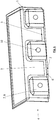
- FIG. 1 A hybrid component according to the invention is shown, which comprises a flat first metal component 1, a flat second metal component 2, and also a flat fiber composite component 3 arranged between the first and second metal components 1, 2.
- the three components have a flange area 4 in a peripheral zone for mutual connection on.
- the flange area 4 is angled relative to the rest of the course of the respective flat components 1, 2, 3.
- the fiber composite component 3 has a plurality of tongues 5 spaced apart from one another, which together form a crenellated structure.
- the first metal component 1 has beads 8, which form deformations of the first metal component 1, which are arranged in intermediate regions 7 of the first metal component 1, in which no tongues 5 of the fiber composite component 3 lie.
- the tongues 5 of the fiber composite component 3 lie in pockets 6, which is formed by a covering of the first metal component 1, which is spaced apart from the second metal component 2 more than the distance between the first metal component 1 and the second metal component 2 in the intermediate regions 7, since the Walling in the intermediate areas 7 are moved closer together.
- the pockets 6 correspond to the tongues 5, since they are arranged in the same positions and are large enough to accommodate the tongues 5 in the pockets 6.
- the first metal component 1 and the second metal component 2 are each attached to one another by means of at least one joining element 10, in particular by means of a punch rivet or through a weld spot.
- the fiber composite component 3 on the one hand and the first metal component 1 and the second metal component on the opposite side are in the flange region 4 2, on the other hand glued with adhesive 9 (in Fig. 2 only shown between fiber composite component 3 and second metal component 2).
- the adhesive 9 is arranged in the pockets 6 and in the intermediate areas 7.
- the first metal component 1 extends flat outside the flange area 4, so that the pockets 6 and intermediate areas 7 of the first metal component 1 merge into a common flat surface outside the flange area 4, since the beads 8 are formed only in the flange area 4.
- Fig. 2 could show a sectional view that is essentially - except for a lateral displacement - the embodiment of FIG Fig. 1 could accordingly.
- Another view of the Fig. 2 is that another embodiment of the invention is shown here, in which the pockets 6 themselves are designed as deformations of the first metal component 1, in particular as beads 8.
- the tongues 5 of the fiber composite component 3 therefore lie in the pockets 6 and thus in the beads 8.
- the walls of the first metal component 1 and the second metal component 2 are closer to one another and the two metal components 1, 2 are joined together by means of a joining element 10 added.
- the flanges are designed such that the fiber composite part 3 in the areas where the metal component 1 is to be connected to another metal component 2 (also metal sheet), for example in order to introduce the fiber composite component 3 and the metal component 1 into a vehicle body, is excluded and thus has tongues 5 in the flange region 4.
- the metal component 1 in turn has pockets 6 in the flange area 4 in order to accommodate the tongues 5 of the fiber composite component 3 and to ensure direct contact of the metal components 1 and 2 (metal sheet 1 and 2) in the areas of the metal-metal connection.
- the entire flange area 4 is also joined with adhesive 9, the fiber composite component 3 being connected to the metal components 1, 2 on both sides by adhesive connections.
- the adhesive 9 can also serve to reduce the risk of corrosion in the connection area.
Landscapes
- Engineering & Computer Science (AREA)
- Architecture (AREA)
- Structural Engineering (AREA)
- Chemical & Material Sciences (AREA)
- Combustion & Propulsion (AREA)
- Transportation (AREA)
- Mechanical Engineering (AREA)
- Connection Of Plates (AREA)
- Body Structure For Vehicles (AREA)
Abstract
Ein Hybridbauteil, insbesondere für eine Kraftfahrzeug-Karosserie, umfassend ein erstes Metallbauteil (1), ein zweites Metallbauteil (2) und ein zwischen erstem und zweitem Metallbauteil (1, 2) angeordnetes Faserverbundbauteil (3), wobei in einem Flanschbereich (4) das Faserverbundbauteil (3) mehrere voneinander beabstandete Zungen (5) aufweist, wobei das erste Metallbauteil (1) zu den Zungen (5) korrespondierende, gegenüber dem zweiten Metallbauteil (2) mehr beabstandete Taschen (6) aufweist, wobei die Zungen (5) jeweils in den Taschen (6) aufgenommen sind, wobei in Zwischenbereichen (7), die zwischen den Taschen (6) liegen und in welchen das erste Metallbauteil (1) weniger beabstandet zum zweiten Metallbauteil (2) liegt, das erste Metallbauteil (1) und das zweite Metallbauteil (2) aneinander befestigt sind.A hybrid component, in particular for a motor vehicle body, comprising a first metal component (1), a second metal component (2) and a fiber composite component (3) arranged between the first and second metal components (1, 2), the The fiber composite component (3) has a plurality of tongues (5) spaced apart from one another, the first metal component (1) having pockets (6) corresponding to the tongues (5) and more spaced apart than the second metal component (2), the tongues (5) each are received in the pockets (6), the first metal component (1) and the second metal component (2) are attached to one another.
Description
Die vorliegende Erfindung betrifft ein Hybridbauteil, insbesondere für eine Kraftfahrzeug- Karosserie.The present invention relates to a hybrid component, in particular for a motor vehicle body.
Hybridbauteile, also Bauteile die Teile aus verschiedenen Materialien umfassen, finden in den letzten Jahren Anwendung in Kraftfahrzeugen, vor allem in Premium-Fahrzeugen, welche den üblichen Massenfertigungsprozess für Automobile, inklusive kathodischer Tauschlackierung bzw. Lackierprozess, durchlaufen. Insbesondere werden solche Hybridbauteile als Karosseriebauteile eingesetzt.Hybrid components, i.e. components that consist of parts made of different materials, have been used in motor vehicles in the last few years, especially in premium vehicles, which go through the usual mass production process for automobiles, including cathodic replacement painting or painting. In particular, such hybrid components are used as body components.
Das Fügen verschiedener Materialien zu einem Hybridbauteil, insbesondere zwischen Metallbauteilen und Faserverbundbauteilen, ist nach wie vor problematisch.The joining of different materials to a hybrid component, in particular between metal components and fiber composite components, is still problematic.
Faserverbundbauteile können üblicherweise mit metallischen Werkstoffen nicht thermisch verbunden werden und hochautomatisierte, mechanische Fügetechniken wie Halbhohlstanznieten führen zu Schädigungen der Bauteile, deren Einfluss auf die Langzeiteigenschaften schwierig abzuschätzen ist.Fiber composite components cannot usually be thermally bonded to metallic materials, and highly automated, mechanical joining techniques such as semi-hollow punch rivets cause damage to the components, the impact of which on the long-term properties is difficult to assess.
Kohlenstofffaserverstärkte Kunststoffe führen in Verbindung mit metallischen Werkstoffen durch ihr hohes elektrochemisches Potential zu Herausforderungen hinsichtlich Korrosionsschutz.Carbon fiber-reinforced plastics, combined with metallic materials, pose challenges in terms of corrosion protection due to their high electrochemical potential.
Faserverbundbauteile werden üblicherweise mit den metallischen Bauteilen der restlichen Karosserie mit Hilfe von Klebstoff - teilweise in Kombination mit mechanischen Fügeelementen - verbunden. Die Verbindung zwischen Faserverbund- und Metallbauteil wird dabei entweder im Vorfeld im Zuge eines "Subassemblies", direkt in der Rohbau-Linie oder nach der Lackierung in der Montage hergestellt. Alle bekannten Füge-Prozesse zeigen Vor- und Nachteile hinsichtlich Eigenschaften, technischem Risiko und Kosten.Fiber composite components are usually connected to the metallic components of the rest of the body with the help of adhesive - sometimes in combination with mechanical joining elements. The connection between fiber composite and metal component is made either in advance in the course of a "subassembly", directly in the bodyshell line or after painting in assembly. All known joining processes show advantages and disadvantages in terms of properties, technical risk and costs.
Neben unterschiedlichen Strukturklebstoffen finden aktuell Schrauben, Blindnieten, Fließlochschrauben und vereinzelt Halbhohlstanznieten als mechanische Fügeelemente für die Verbindung von Faserverbund- zu Metallbauteilen Einsatz.In addition to various structural adhesives, screws, blind rivets, flow hole screws and occasionally semi-hollow punch rivets are currently used as mechanical joining elements for connecting fiber composite to metal components.
Die
Aus der
Es ist eine Aufgabe der Erfindung, ein Hybridbauteil, insbesondere für eine Kraftfahrzeug-Karosserie, anzugeben, dass eine hohe Torsionssteifigkeit aufweist und dabei kostengünstig in großer Stückzahl gefertigt werden kann oder kostengünstig und im Zuge eines Fertigungsprozesses für hohe Stückzahlen in eine Kraftfahrzeug-Karosserie eingebracht werden kann.It is an object of the invention to provide a hybrid component, in particular for a motor vehicle body, that has a high torsional rigidity and can be inexpensively manufactured in large numbers or can be introduced inexpensively and in the course of a manufacturing process for large quantities into a motor vehicle body can.
Die Lösung der Aufgabe erfolgt durch ein Hybridbauteil, insbesondere für eine Kraftfahrzeug-Karosserie, umfassend ein erstes Metallbauteil, ein zweites Metallbauteil und ein zwischen erstem und zweitem Metallbauteil angeordnetes Faserverbundbauteil, wobei in einem Flanschbereich das Faserverbundbauteil mehrere voneinander beabstandete Zungen aufweist, wobei das erste Metallbauteil zu den Zungen korrespondierende, gegenüber dem zweiten Metallbauteil mehr beabstandete Taschen aufweist, wobei die Zungen jeweils in den Taschen aufgenommen sind, wobei in Zwischenbereichen, die zwischen den Taschen liegen und in welchen das erste Metallbauteil weniger beabstandet zum zweiten Metallbauteil liegt, das erste Metallbauteil und das zweite Metallbauteil aneinander befestigt sind.The object is achieved by a hybrid component, in particular for a motor vehicle body, comprising a first metal component, a second metal component and a fiber composite component arranged between the first and second metal components, the fiber composite component having a plurality of spaced-apart tongues in a flange region, the first metal component to the tongues corresponding to the second metal component more spaced pockets, the tongues are each received in the pockets, wherein in intermediate areas that lie between the pockets and in which the first metal component is less spaced from the second metal component, the first metal component and the second metal component are attached to each other.
Erfindungsgemäß wird ein Faserverbundbauteil zur Verstärkung zwischen zwei Metallbauteilen eingesetzt. In einem Verbindungsbereich, also Flanschbereich, der drei Materiallagen weist eines der Metallbauteile, das erste Metallbauteil, vom zweiten Metallbauteil mehr beabstandete Taschen auf, also Formen des ersten Metallbauteils oder am ersten Metallbauteil die eine Bewandung aufweisen, die vom zweiten Metallbauteil weiter entfernt liegt als eine Bewandung des ersten Metallbauteils in einem Zwischenbereich, zwischen den Taschen. Dadurch wird in den Taschen ein Hohlraum gebildet, so dass in den Hohlraum der Taschen Zungen, also Fortsätze, des Faserverbundbauteils aufgenommen werden können.According to the invention, a fiber composite component is used for reinforcement between two metal components. In a connection area, that is to say the flange area, of the three material layers, one of the metal components has the first metal component, more spaced pockets from the second metal component, that is, shapes of the first metal component or on the first metal component that have a covering that is further away from the second metal component than a covering of the first metal component in an intermediate region between the pockets. As a result, a cavity is formed in the pockets, so that tongues, ie extensions, of the fiber composite component can be accommodated in the cavity of the pockets.
Das Faserverbundbauteil kann so abschnittsweise in den Flanschbereich des Hybridbauteils gelangen und auch den Flanschbereich verstärken. Verbindungstechniken wie Nieten, Schrauben und dergleichen können dennoch in diesem Flanschbereich eingesetzt werden, um die beiden Metallbauteile miteinander zu verbinden und zerstören dabei nicht das dazwischenliegende Faserverbundbauteil, da dieses lediglich in den benachbarten Taschen, in Form von Zungen, vorliegt, nicht jedoch in den für die Metall-Metall-Verbindung genutzten Zwischenbereichen.The fiber composite component can thus reach the flange area of the hybrid component in sections and also reinforce the flange area. Connection techniques such as rivets, screws and the like can still be used in this flange area to connect the two metal components together and do not destroy the fiber composite component in between, since this is only in the adjacent pockets, in the form of tongues, but not in the for the metal-metal connection used intermediate areas.
Durch die Erfindung wird somit ermöglicht, das an dem Faserverbundteil anliegende, vorzugsweise mit diesem auch verklebte erste Metallbauteil ohne Durchdringung oder Schädigung des Faserverbundbauteils mit einem weiteren Metallbauteil, dem zweiten Metallbauteil, mechanisch oder thermisch zu verbinden. Die Verbindungsflansche bzw. Flanschbereiche sind dadurch besonders steif ausgeführt.The invention thus makes it possible to mechanically or thermally connect the first metal component that is in contact with the fiber composite part, preferably also bonded to it, without penetration or damage to the fiber composite component, with another metal component, the second metal component. The connecting flanges or flange areas are therefore particularly stiff.
Erfindungsgemäße Ausbildungen der Flanschbereiche für die Verbindung von Faserverbund- zu Metallbauteilen können zu folgenden Vorteilen führen:
- Keine Schädigung von Faserverbundkomponenten durch mechanische Fügeelemente oder thermische Metall-Metall-Verbindung und damit verbundenes, reduziertes Risiko hinsichtlich Bauteilqualität,
- Reduktion des Korrosionspotentials durch Vermeidung des Kontaktes mit beispielsweise mechanischen Fügelementen,
- Keine Änderungen der an sich üblichen Fügetechniken an der Rohbaulinie notwendig,
- Keine Verwendung von mechanischen Fügetechniken mit nur geringem Automatisierungspotential, wie zum Beispiel Blindnieten, notwendig,
- Versteifung der Verbindungsflansche, also Flanschbereiche, und damit der Bauteilverbindung sowie dadurch bessere Eigenschaften der Konstruktion bei Verwendung in einer Gesamtkarosserie.
- No damage to fiber composite components due to mechanical joining elements or thermal metal-metal connection and the associated, reduced risk with regard to component quality,
- Reduction of the corrosion potential by avoiding contact with mechanical joining elements, for example,
- No changes to the usual joining techniques on the bodyshell line necessary,
- No need to use mechanical joining techniques with only a small automation potential, such as blind rivets,
- Stiffening of the connecting flanges, i.e. flange areas, and thus the component connection, and thus better properties of the construction when used in an overall body.
Durch den Einsatz eines erfindungsgemäßen Hybridbauteils können die Masse der Kraftfahrzeug-Karosserie reduziert und/oder die mechanischen Eigenschaften verbessert werden.By using a hybrid component according to the invention, the mass of the motor vehicle body can be reduced and / or the mechanical properties can be improved.
Das erste und zweite Metallbauteil und das Faserverbundbauteil sind bevorzugt flächige Bauteile, zumindest sind die Flanschbereiche flächig ausgebildet. Das erste und das zweite Metallbauteil können insbesondere Metallbleche sein.The first and second metal component and the fiber composite component are preferably flat components, at least the flange regions are flat. The first and the second metal component can in particular be metal sheets.
Bevorzugt bilden die mehreren voneinander beabstandeten Zungen des Faserverbundbauteils zusammen eine zinnenartige Struktur.The several spaced-apart tongues of the fiber composite component preferably form a crenellated structure.
Vorzugsweise sind die Taschen als Verformungen des ersten Metallbauteils, insbesondere als Sicken, ausgebildet. Die Wände des ersten Metallbauteils sind daher in den Verformungen bzw. Sicken, die die Taschen bilden, weiter vom zweiten Metallbauteil entfernt als in den Zwischenbereichen. Die Zungen des Faserverbundbauteils liegen in den Taschen, also in den Verformungen bzw. Sicken.The pockets are preferably designed as deformations of the first metal component, in particular as beads. The walls of the first metal component are therefore further away from the second metal component in the deformations or beads which form the pockets than in the intermediate regions. The tongues of the fiber composite component lie in the pockets, i.e. in the deformations or beads.
In einer anderen Ausführungsform sind die Zwischenbereiche als Verformungen des ersten Metallbauteils, insbesondere als Sicken, ausgebildet. Die Wände des ersten Metallbauteils sind daher in den Verformungen bzw. Sicken näher am zweiten Metallbauteil als in den Taschen. Die Zungen des Faserverbundbauteils liegen in den Taschen, also zwischen den Verformungen bzw. Sicken.In another embodiment, the intermediate areas are designed as deformations of the first metal component, in particular as beads. The walls of the first metal component are therefore closer to the second metal component in the deformations or beads than in the pockets. The tongues of the fiber composite component lie in the pockets, that is between the deformations or beads.
Vorzugsweise sind das erste Metallbauteil und das zweite Metallbauteil in den Zwischenbereichen mittels üblichen form- und/oder kraft- und/oder stoffschlüssigen Verbindungen aneinander befestigt, insbesondere mittels Nieten oder Schrauben oder durch Schweißen.The first metal component and the second metal component are preferably fastened to one another in the intermediate regions by means of conventional positive and / or non-positive and / or integral connections, in particular by means of rivets or screws or by welding.
Bevorzugt ist zumindest im Flanschbereich das Faserverbundbauteil mit dem ersten Metallbauteil verklebt und/oder das Faserverbundbauteil mit dem zweiten Metallbauteil verklebt. Der Klebstoff kann in den Taschen und/oder in den Zwischenbereichen angeordnet sein. Besonders bevorzugt ist das Faserverbundbauteil sowohl mit dem ersten Metallbauteil als auch mit dem zweiten Metallbauteil in den Taschen und den Zwischenräumen verklebt.The fiber composite component is preferably bonded to the first metal component and / or the fiber composite component is bonded to the second metal component at least in the flange region. The adhesive can be arranged in the pockets and / or in the intermediate areas. The fiber composite component is particularly preferably bonded to both the first metal component and the second metal component in the pockets and the spaces.
Außerhalb des Flanschbereichs gehen bevorzugt die Taschen und Zwischenbereiche des ersten Metallbauteils in eine gemeinsame, im Wesentlichen ebene, Fläche über. Insbesondere enden daher Verformungen, die die Taschen oder Zwischenräume bilden, am Ende des Flanschbereichs.Outside the flange area, the pockets and intermediate areas of the first metal component preferably merge into a common, essentially flat, surface. In particular, deformations that form the pockets or gaps therefore end at the end of the flange region.
Vorzugsweise ist das erste Metallbauteil zusammen mit dem Faserverbundbauteil einem ersten Karosseriemodul zugeordnet, bilden also zusammen - eventuell ergänzt durch weitere Bauteile - das erste Karosseriemodul. Das zweite Metallbauteil ist einem zweiten Karosseriemodul zugeordnet, bildet also - wiederum eventuell zusammen mit weiteren Bauteilen - das zweite Karosseriemodul. Die beiden Karosseriemodule können unabhängig voneinander hergestellt oder bearbeitet worden sein. Das erste Karosseriemodul und das zweite Karosseriemodul können erfindungsgemäß im beschriebenen Flanschbereich aneinander befestigt werden, so dass die Zungen des Faserverbundbauteils in den Taschen des ersten Metallbauteils liegen und nach dem Fügen zwischen den beiden Metallbauteilen angeordnet sind, die in den Zwischenbereichen mittels konventioneller Fügeelemente aneinander befestigt sind.The first metal component, together with the fiber composite component, is preferably assigned to a first body module, that is to say, together, possibly supplemented by further components, form the first body module. The second metal component is assigned to a second body module, so it forms - again possibly together with other components - the second body module. The two body modules can be manufactured or processed independently of one another. According to the invention, the first body module and the second body module can be fastened to one another in the flange region described, so that the tongues of the fiber composite component lie in the pockets of the first metal component and are arranged after the joining between the two metal components, which are fastened to one another in the intermediate regions by means of conventional joining elements .
Die Erfindung wird im Folgenden beispielhaft unter Bezugnahme auf die Zeichnungen beschrieben.
- Fig. 1
- ist eine schematische dreidimensionale Ansicht eines erfindungsgemäßen Hybridbauteils.
- Fig. 2
- ist eine Schnittansicht im Flanschbereich eines erfindungsgemäßen Hybridbauteils in einer weiteren Ausführungsform.
- Fig. 1
- is a schematic three-dimensional view of a hybrid component according to the invention.
- Fig. 2
- is a sectional view in the flange area of a hybrid component according to the invention in a further embodiment.
In
In dem Flanschbereich 4 weist das Faserverbundbauteil 3 mehrere voneinander beabstandete Zungen 5 auf, die zusammen eine zinnenartige Struktur bilden.In the
Das erste Metallbauteil 1 weist Sicken 8 auf, die Verformungen des ersten Metallbauteils 1 bilden, die in Zwischenbereichen 7 des ersten Metallbauteils 1 angeordnet sind, in welchen keine Zungen 5 des Faserverbundbauteils 3 liegen.The
Die Zungen 5 des Faserverbundbauteils 3 liegen in Taschen 6, die durch eine Bewandung des ersten Metallbauteils 1 gebildet wird, die gegenüber dem zweiten Metallbauteil 2 mehr beabstandet ist, als der Abstand zwischen erstem Metallbauteil 1 und zweitem Metallbauteil 2 in den Zwischenbereichen 7, da die Bewandungen durch die Sickenbildung in den Zwischenbereichen 7 näher aneinander gerückt sind.The
Die Taschen 6 korrespondieren zu den Zungen 5, da sie an den selben Positionen angeordnet sind und groß genug ausgebildet sind, um die Zungen 5 jeweils in die Taschen 6 aufzunehmen.The
In den Zwischenbereichen 7, die zwischen den Taschen 6 liegen und in welchen das erste Metallbauteil 1 weniger beabstandet zum zweiten Metallbauteil 2 liegt, sind das erste Metallbauteil 1 und das zweite Metallbauteil 2 mittels jeweils zumindest eines Fügeelements 10 aneinander befestigt, insbesondere durch eine Stanzniet oder durch einen Schweißpunkt.In the
Zusätzlich zur Verbindung der Metallbauteile 1, 2 aneinander, sind im Flanschbereich 4 das Faserverbundbauteil 3 einerseits und das erste Metallbauteil 1, sowie an der gegenüberliegenden Seite das zweiten Metallbauteil 2, andererseits mittels Klebstoff 9 verklebt (in
Wie in
Insgesamt werden daher bevorzugt für die Verbindung eines Faserverbundbauteils 3 zu einem Metallbauteil 1 (Metallblech) über eine Klebeverbindung die Flansche derart ausgeführt, dass das Faserverbundteil 3 in den Bereichen, wo das Metallbauteil 1 mit einem weiteren Metallbauteil 2 (ebenfalls Metallblech) verbunden werden soll, beispielsweise um das Faserverbundbauteil 3 und das Metallbauteil 1 in eine Fahrzeugkarosserie einzubringen, ausgenommen ist und somit im Flanschbereich 4 über Zungen 5 verfügt.Overall, therefore, for the connection of a
Das Metallbauteil 1 verfügt wiederum über Taschen 6 im Flanschbereich 4 um die Zungen 5 des Faserverbundbauteils 3 aufzunehmen und einen direkten Kontakt der Metallbauteile 1 und 2 (Metallblech 1 und 2) in den Bereichen der Metall-Metall-Verbindung sicherzustellen.The
Für eine Versteifung der Verbindung ist der gesamte Flanschbereich 4 außerdem mit Klebstoff 9 gefügt, wobei das Faserverbundbauteil 3 hierbei beidseitig über Klebeverbindungen mit den Metallbauteilen 1, 2 verbunden ist. Der Klebstoff 9 kann außerdem dazu dienen das Korrosionsrisiko im Verbindungsbereich zu senken.In order to stiffen the connection, the
- 11
- erstes Metallbauteilfirst metal component
- 22nd
- zweites Metallbauteilsecond metal component
- 33rd
- FaserverbundbauteilComposite component
- 44th
- FlanschbereichFlange area
- 55
- Zungetongue
- 66
- Taschebag
- 77
- ZwischenbereichIntermediate area
- 88th
- SickeSurround
- 99
- Klebstoffadhesive
- 1010th
- FügeelementJoining element
Claims (7)
dadurch gekennzeichnet, dass in einem Flanschbereich (4) das Faserverbundbauteil (3) mehrere voneinander beabstandete Zungen (5) aufweist, wobei das erste Metallbauteil (1) zu den Zungen (5) korrespondierende, gegenüber dem zweiten Metallbauteil (2) mehr beabstandete Taschen (6) aufweist, wobei die Zungen (5) jeweils in den Taschen (6) aufgenommen sind, wobei in Zwischenbereichen (7), die zwischen den Taschen (6) liegen und in welchen das erste Metallbauteil (1) weniger beabstandet zum zweiten Metallbauteil (2) liegt, das erste Metallbauteil (1) und das zweite Metallbauteil (2) aneinander befestigt sind.Hybrid component, in particular for a motor vehicle body, comprising a first metal component (1), a second metal component (2) and a fiber composite component (3) arranged between the first and second metal component (1, 2),
characterized in that in a flange region (4) the fiber composite component (3) has a plurality of spaced tongues (5), the first metal component (1) corresponding to the tongues (5) and being more spaced apart from the second metal component (2) 6), the tongues (5) each being received in the pockets (6), with intermediate regions (7) lying between the pockets (6) and in which the first metal component (1) is less distant from the second metal component ( 2), the first metal component (1) and the second metal component (2) are attached to one another.
dadurch gekennzeichnet, dass die mehreren voneinander beabstandeten Zungen (5) des Faserverbundbauteils (3) zusammen eine zinnenartige Struktur bilden.Hybrid component according to claim 1,
characterized in that the plurality of spaced-apart tongues (5) of the fiber composite component (3) together form a crenellated structure.
dadurch gekennzeichnet, dass die Taschen (6) als Verformungen des ersten Metallbauteils (1), insbesondere als Sicken (8), ausgebildet sind oder dass die Zwischenbereiche (7) als Verformungen des ersten Metallbauteils, insbesondere als Sicken (8), ausgebildet sind.Hybrid component according to at least one of the preceding claims,
characterized in that the pockets (6) are designed as deformations of the first metal component (1), in particular as beads (8), or in that the intermediate regions (7) are designed as deformations of the first metal component, in particular as beads (8).
dadurch gekennzeichnet, dass das erste Metallbauteil (1) und das zweite Metallbauteil (2) in den Zwischenbereichen (7) mittels üblichen form- und/oder kraft- und/oder stoffschlüssigen Verbindungen aneinander befestigt sind, insbesondere mittels Nieten oder Schrauben oder durch Schweißen.Hybrid component according to at least one of the preceding claims,
characterized in that the first metal component (1) and the second metal component (2) are fastened to one another in the intermediate regions (7) by means of conventional positive and / or non-positive and / or material connections, in particular by means of rivets or screws or by welding.
dadurch gekennzeichnet, dass im Flanschbereich (4) das Faserverbundbauteil (3) mit dem ersten Metallbauteil (1) verklebt ist und/oder das Faserverbundbauteil (3) mit dem zweiten Metallbauteil (2) verklebt ist, wobei der Klebstoff (9) in den Taschen (6) und/oder in den Zwischenbereichen (7) angeordnet ist.Hybrid component according to at least one of the preceding claims,
characterized in that in the flange area (4) the fiber composite component (3) is glued to the first metal component (1) and / or the fiber composite component (3) is glued to the second metal component (2), the adhesive (9) in the pockets (6) and / or in the intermediate areas (7).
dadurch gekennzeichnet, dass die Taschen (6) und Zwischenbereiche (7) des ersten Metallbauteils (1) außerhalb des Flanschbereichs (4) in eine gemeinsame ebene Fläche übergehen.Hybrid component according to at least one of the preceding claims,
characterized in that the pockets (6) and intermediate regions (7) of the first metal component (1) merge outside of the flange region (4) into a common flat surface.
dadurch gekennzeichnet, dass das erste Metallbauteil (1) zusammen mit dem Faserverbundbauteil (3) einem ersten Karosseriemodul zugeordnet ist und das zweite Metallbauteil (2) einem zweiten Karosseriemodul zugeordnet ist, wobei das erste Karosseriemodul und das zweite Karosseriemodul im Flanschbereich (4) aneinander befestigt sind.Hybrid component according to at least one of the preceding claims,
characterized in that the first metal component (1) together with the fiber composite component (3) is assigned to a first body module and the second metal component (2) is assigned to a second body module, the first body module and the second body module being fastened to one another in the flange region (4).
Priority Applications (1)
| Application Number | Priority Date | Filing Date | Title |
|---|---|---|---|
| EP18206227.3A EP3653473B1 (en) | 2018-11-14 | 2018-11-14 | Hybrid component |
Applications Claiming Priority (1)
| Application Number | Priority Date | Filing Date | Title |
|---|---|---|---|
| EP18206227.3A EP3653473B1 (en) | 2018-11-14 | 2018-11-14 | Hybrid component |
Publications (2)
| Publication Number | Publication Date |
|---|---|
| EP3653473A1 true EP3653473A1 (en) | 2020-05-20 |
| EP3653473B1 EP3653473B1 (en) | 2022-02-09 |
Family
ID=64316383
Family Applications (1)
| Application Number | Title | Priority Date | Filing Date |
|---|---|---|---|
| EP18206227.3A Active EP3653473B1 (en) | 2018-11-14 | 2018-11-14 | Hybrid component |
Country Status (1)
| Country | Link |
|---|---|
| EP (1) | EP3653473B1 (en) |
Citations (6)
| Publication number | Priority date | Publication date | Assignee | Title |
|---|---|---|---|---|
| US20040028858A1 (en) * | 2001-05-23 | 2004-02-12 | Stephan Schnell | Composite component and process for its production |
| DE102006007253A1 (en) | 2006-02-15 | 2007-08-23 | Benteler Automobiltechnik Gmbh | Motor vehicle-hybrid component e.g. structure- or chassis component, has metal component and plastic component connected with each other by integration of form-closure layer that is adhesively joined with metal component |
| DE102013018562A1 (en) * | 2013-11-05 | 2014-05-08 | Daimler Ag | Multi-layer sandwich component, useful in motor vehicle, comprises two cover layers connected via set of connecting portions, where one of cover layers has indentations facing opposite to the other cover layer |
| WO2015098538A1 (en) * | 2013-12-25 | 2015-07-02 | トヨタ自動車株式会社 | Bonded structure of dissimilar materials |
| DE102014019024A1 (en) | 2014-12-18 | 2016-06-23 | Daimler Ag | Hybrid semi-finished product, in particular for a body structure of a motor vehicle |
| US20170327157A1 (en) * | 2014-12-23 | 2017-11-16 | Renault S.A.S. | Method for producing a hybrid-structure part of a motor vehicle and corresponding hybrid-structure part |
-
2018
- 2018-11-14 EP EP18206227.3A patent/EP3653473B1/en active Active
Patent Citations (6)
| Publication number | Priority date | Publication date | Assignee | Title |
|---|---|---|---|---|
| US20040028858A1 (en) * | 2001-05-23 | 2004-02-12 | Stephan Schnell | Composite component and process for its production |
| DE102006007253A1 (en) | 2006-02-15 | 2007-08-23 | Benteler Automobiltechnik Gmbh | Motor vehicle-hybrid component e.g. structure- or chassis component, has metal component and plastic component connected with each other by integration of form-closure layer that is adhesively joined with metal component |
| DE102013018562A1 (en) * | 2013-11-05 | 2014-05-08 | Daimler Ag | Multi-layer sandwich component, useful in motor vehicle, comprises two cover layers connected via set of connecting portions, where one of cover layers has indentations facing opposite to the other cover layer |
| WO2015098538A1 (en) * | 2013-12-25 | 2015-07-02 | トヨタ自動車株式会社 | Bonded structure of dissimilar materials |
| DE102014019024A1 (en) | 2014-12-18 | 2016-06-23 | Daimler Ag | Hybrid semi-finished product, in particular for a body structure of a motor vehicle |
| US20170327157A1 (en) * | 2014-12-23 | 2017-11-16 | Renault S.A.S. | Method for producing a hybrid-structure part of a motor vehicle and corresponding hybrid-structure part |
Also Published As
| Publication number | Publication date |
|---|---|
| EP3653473B1 (en) | 2022-02-09 |
Similar Documents
| Publication | Publication Date | Title |
|---|---|---|
| EP2709858B1 (en) | Carrier used as a chassis component | |
| DE102011050139B4 (en) | Reinforcement structure for the front part of a vehicle body | |
| DE102013012058A1 (en) | Upper vehicle body structure of a vehicle and method of providing the same | |
| WO2013034323A1 (en) | Hybrid component and method for producing a hybrid component | |
| EP1954550B1 (en) | Hybrid-structure assembly support | |
| DE102009040735A1 (en) | Side wall | |
| DE102013014209A1 (en) | Vehicle body with structural component | |
| DE102009042189A1 (en) | Vehicle body construction in the area of the A-pillar and disk cross member and associated production process | |
| DE102010031774A1 (en) | Roof i.e. sun roof, module arrangement for passenger car, has adhesive bead provided between roof panel element and body of vehicle, and retaining elements connected with panel element by rivet joints and with body by screw connections | |
| EP2881309B1 (en) | Side wall or roof of a box body of a commercial vehicle | |
| EP2360036A1 (en) | Motor vehicle component and method for its production | |
| EP2786922B1 (en) | Body of a motor vehicle made of plastic elements and connection thereof | |
| DE102009010913A1 (en) | Modular system for use in motor vehicle body, has two different roof modules, where one roof module is connected to roof frames of two side panel structures within area of b-columns by two reinforcement elements | |
| DE102006051609A1 (en) | Motor vehicle's wheel-guiding guider, has uprisings pointing together within main wall sections and contacting switching units, and join patches guided with one another, where units are spaced apart from each other in edges of patches | |
| EP2559609B1 (en) | Reinforcement frame and method for applying a reinforcement frame in a vehicle body | |
| DE102023109892A1 (en) | Vehicle roof system and method for assembling a vehicle roof system | |
| DE102010021137A1 (en) | Body component for motor vehicle, particularly passenger car, has bonded blank, particular customized plate with two laminar subareas made from different metal alloys | |
| DE102022121049A1 (en) | body of a vehicle | |
| DE102016006195A1 (en) | Automotive body | |
| EP3617043B1 (en) | Fixing device | |
| EP3653473B1 (en) | Hybrid component | |
| DE102020209298A1 (en) | Body for a vehicle | |
| DE102009056986A1 (en) | Body for motor vehicle i.e. passenger car, has frame element extending in vehicle transverse direction, where lateral roof frame elements are connected with each other on frame element, which is assigned to attachable roof module | |
| DE102017219701A1 (en) | Vehicle roof and motor vehicle with vehicle roof | |
| DE102015000979B3 (en) | Frame element, in particular side wall frame element, for a vehicle body and method for producing a frame member for a vehicle body |
Legal Events
| Date | Code | Title | Description |
|---|---|---|---|
| PUAI | Public reference made under article 153(3) epc to a published international application that has entered the european phase |
Free format text: ORIGINAL CODE: 0009012 |
|
| STAA | Information on the status of an ep patent application or granted ep patent |
Free format text: STATUS: THE APPLICATION HAS BEEN PUBLISHED |
|
| AK | Designated contracting states |
Kind code of ref document: A1 Designated state(s): AL AT BE BG CH CY CZ DE DK EE ES FI FR GB GR HR HU IE IS IT LI LT LU LV MC MK MT NL NO PL PT RO RS SE SI SK SM TR |
|
| AX | Request for extension of the european patent |
Extension state: BA ME |
|
| STAA | Information on the status of an ep patent application or granted ep patent |
Free format text: STATUS: REQUEST FOR EXAMINATION WAS MADE |
|
| 17P | Request for examination filed |
Effective date: 20201020 |
|
| RBV | Designated contracting states (corrected) |
Designated state(s): AL AT BE BG CH CY CZ DE DK EE ES FI FR GB GR HR HU IE IS IT LI LT LU LV MC MK MT NL NO PL PT RO RS SE SI SK SM TR |
|
| GRAP | Despatch of communication of intention to grant a patent |
Free format text: ORIGINAL CODE: EPIDOSNIGR1 |
|
| STAA | Information on the status of an ep patent application or granted ep patent |
Free format text: STATUS: GRANT OF PATENT IS INTENDED |
|
| INTG | Intention to grant announced |
Effective date: 20211111 |
|
| GRAS | Grant fee paid |
Free format text: ORIGINAL CODE: EPIDOSNIGR3 |
|
| GRAA | (expected) grant |
Free format text: ORIGINAL CODE: 0009210 |
|
| STAA | Information on the status of an ep patent application or granted ep patent |
Free format text: STATUS: THE PATENT HAS BEEN GRANTED |
|
| AK | Designated contracting states |
Kind code of ref document: B1 Designated state(s): AL AT BE BG CH CY CZ DE DK EE ES FI FR GB GR HR HU IE IS IT LI LT LU LV MC MK MT NL NO PL PT RO RS SE SI SK SM TR |
|
| REG | Reference to a national code |
Ref country code: GB Ref legal event code: FG4D Free format text: NOT ENGLISH |
|
| REG | Reference to a national code |
Ref country code: CH Ref legal event code: EP Ref country code: AT Ref legal event code: REF Ref document number: 1467341 Country of ref document: AT Kind code of ref document: T Effective date: 20220215 |
|
| REG | Reference to a national code |
Ref country code: DE Ref legal event code: R096 Ref document number: 502018008726 Country of ref document: DE |
|
| REG | Reference to a national code |
Ref country code: IE Ref legal event code: FG4D Free format text: LANGUAGE OF EP DOCUMENT: GERMAN |
|
| REG | Reference to a national code |
Ref country code: LT Ref legal event code: MG9D |
|
| REG | Reference to a national code |
Ref country code: NL Ref legal event code: MP Effective date: 20220209 |
|
| PG25 | Lapsed in a contracting state [announced via postgrant information from national office to epo] |
Ref country code: SE Free format text: LAPSE BECAUSE OF FAILURE TO SUBMIT A TRANSLATION OF THE DESCRIPTION OR TO PAY THE FEE WITHIN THE PRESCRIBED TIME-LIMIT Effective date: 20220209 Ref country code: RS Free format text: LAPSE BECAUSE OF FAILURE TO SUBMIT A TRANSLATION OF THE DESCRIPTION OR TO PAY THE FEE WITHIN THE PRESCRIBED TIME-LIMIT Effective date: 20220209 Ref country code: PT Free format text: LAPSE BECAUSE OF FAILURE TO SUBMIT A TRANSLATION OF THE DESCRIPTION OR TO PAY THE FEE WITHIN THE PRESCRIBED TIME-LIMIT Effective date: 20220609 Ref country code: NO Free format text: LAPSE BECAUSE OF FAILURE TO SUBMIT A TRANSLATION OF THE DESCRIPTION OR TO PAY THE FEE WITHIN THE PRESCRIBED TIME-LIMIT Effective date: 20220509 Ref country code: NL Free format text: LAPSE BECAUSE OF FAILURE TO SUBMIT A TRANSLATION OF THE DESCRIPTION OR TO PAY THE FEE WITHIN THE PRESCRIBED TIME-LIMIT Effective date: 20220209 Ref country code: LT Free format text: LAPSE BECAUSE OF FAILURE TO SUBMIT A TRANSLATION OF THE DESCRIPTION OR TO PAY THE FEE WITHIN THE PRESCRIBED TIME-LIMIT Effective date: 20220209 Ref country code: HR Free format text: LAPSE BECAUSE OF FAILURE TO SUBMIT A TRANSLATION OF THE DESCRIPTION OR TO PAY THE FEE WITHIN THE PRESCRIBED TIME-LIMIT Effective date: 20220209 Ref country code: ES Free format text: LAPSE BECAUSE OF FAILURE TO SUBMIT A TRANSLATION OF THE DESCRIPTION OR TO PAY THE FEE WITHIN THE PRESCRIBED TIME-LIMIT Effective date: 20220209 Ref country code: BG Free format text: LAPSE BECAUSE OF FAILURE TO SUBMIT A TRANSLATION OF THE DESCRIPTION OR TO PAY THE FEE WITHIN THE PRESCRIBED TIME-LIMIT Effective date: 20220509 |
|
| PG25 | Lapsed in a contracting state [announced via postgrant information from national office to epo] |
Ref country code: PL Free format text: LAPSE BECAUSE OF FAILURE TO SUBMIT A TRANSLATION OF THE DESCRIPTION OR TO PAY THE FEE WITHIN THE PRESCRIBED TIME-LIMIT Effective date: 20220209 Ref country code: LV Free format text: LAPSE BECAUSE OF FAILURE TO SUBMIT A TRANSLATION OF THE DESCRIPTION OR TO PAY THE FEE WITHIN THE PRESCRIBED TIME-LIMIT Effective date: 20220209 Ref country code: GR Free format text: LAPSE BECAUSE OF FAILURE TO SUBMIT A TRANSLATION OF THE DESCRIPTION OR TO PAY THE FEE WITHIN THE PRESCRIBED TIME-LIMIT Effective date: 20220510 Ref country code: FI Free format text: LAPSE BECAUSE OF FAILURE TO SUBMIT A TRANSLATION OF THE DESCRIPTION OR TO PAY THE FEE WITHIN THE PRESCRIBED TIME-LIMIT Effective date: 20220209 |
|
| PG25 | Lapsed in a contracting state [announced via postgrant information from national office to epo] |
Ref country code: IS Free format text: LAPSE BECAUSE OF FAILURE TO SUBMIT A TRANSLATION OF THE DESCRIPTION OR TO PAY THE FEE WITHIN THE PRESCRIBED TIME-LIMIT Effective date: 20220609 |
|
| REG | Reference to a national code |
Ref country code: DE Ref legal event code: R081 Ref document number: 502018008726 Country of ref document: DE Owner name: MAGNA STEYR FAHRZEUGTECHNIK GMBH & CO KG, AT Free format text: FORMER OWNER: MAGNA STEYR FAHRZEUGTECHNIK AG & CO KG, GRAZ, AT |
|
| PG25 | Lapsed in a contracting state [announced via postgrant information from national office to epo] |
Ref country code: SM Free format text: LAPSE BECAUSE OF FAILURE TO SUBMIT A TRANSLATION OF THE DESCRIPTION OR TO PAY THE FEE WITHIN THE PRESCRIBED TIME-LIMIT Effective date: 20220209 Ref country code: SK Free format text: LAPSE BECAUSE OF FAILURE TO SUBMIT A TRANSLATION OF THE DESCRIPTION OR TO PAY THE FEE WITHIN THE PRESCRIBED TIME-LIMIT Effective date: 20220209 Ref country code: RO Free format text: LAPSE BECAUSE OF FAILURE TO SUBMIT A TRANSLATION OF THE DESCRIPTION OR TO PAY THE FEE WITHIN THE PRESCRIBED TIME-LIMIT Effective date: 20220209 Ref country code: EE Free format text: LAPSE BECAUSE OF FAILURE TO SUBMIT A TRANSLATION OF THE DESCRIPTION OR TO PAY THE FEE WITHIN THE PRESCRIBED TIME-LIMIT Effective date: 20220209 Ref country code: DK Free format text: LAPSE BECAUSE OF FAILURE TO SUBMIT A TRANSLATION OF THE DESCRIPTION OR TO PAY THE FEE WITHIN THE PRESCRIBED TIME-LIMIT Effective date: 20220209 Ref country code: CZ Free format text: LAPSE BECAUSE OF FAILURE TO SUBMIT A TRANSLATION OF THE DESCRIPTION OR TO PAY THE FEE WITHIN THE PRESCRIBED TIME-LIMIT Effective date: 20220209 |
|
| REG | Reference to a national code |
Ref country code: DE Ref legal event code: R097 Ref document number: 502018008726 Country of ref document: DE |
|
| PG25 | Lapsed in a contracting state [announced via postgrant information from national office to epo] |
Ref country code: AL Free format text: LAPSE BECAUSE OF FAILURE TO SUBMIT A TRANSLATION OF THE DESCRIPTION OR TO PAY THE FEE WITHIN THE PRESCRIBED TIME-LIMIT Effective date: 20220209 |
|
| PLBE | No opposition filed within time limit |
Free format text: ORIGINAL CODE: 0009261 |
|
| STAA | Information on the status of an ep patent application or granted ep patent |
Free format text: STATUS: NO OPPOSITION FILED WITHIN TIME LIMIT |
|
| 26N | No opposition filed |
Effective date: 20221110 |
|
| PG25 | Lapsed in a contracting state [announced via postgrant information from national office to epo] |
Ref country code: SI Free format text: LAPSE BECAUSE OF FAILURE TO SUBMIT A TRANSLATION OF THE DESCRIPTION OR TO PAY THE FEE WITHIN THE PRESCRIBED TIME-LIMIT Effective date: 20220209 |
|
| PG25 | Lapsed in a contracting state [announced via postgrant information from national office to epo] |
Ref country code: MC Free format text: LAPSE BECAUSE OF FAILURE TO SUBMIT A TRANSLATION OF THE DESCRIPTION OR TO PAY THE FEE WITHIN THE PRESCRIBED TIME-LIMIT Effective date: 20220209 |
|
| REG | Reference to a national code |
Ref country code: CH Ref legal event code: PL |
|
| REG | Reference to a national code |
Ref country code: BE Ref legal event code: MM Effective date: 20221130 |
|
| PG25 | Lapsed in a contracting state [announced via postgrant information from national office to epo] |
Ref country code: LI Free format text: LAPSE BECAUSE OF NON-PAYMENT OF DUE FEES Effective date: 20221130 Ref country code: IT Free format text: LAPSE BECAUSE OF FAILURE TO SUBMIT A TRANSLATION OF THE DESCRIPTION OR TO PAY THE FEE WITHIN THE PRESCRIBED TIME-LIMIT Effective date: 20220209 Ref country code: CH Free format text: LAPSE BECAUSE OF NON-PAYMENT OF DUE FEES Effective date: 20221130 |
|
| PG25 | Lapsed in a contracting state [announced via postgrant information from national office to epo] |
Ref country code: LU Free format text: LAPSE BECAUSE OF NON-PAYMENT OF DUE FEES Effective date: 20221114 |
|
| PG25 | Lapsed in a contracting state [announced via postgrant information from national office to epo] |
Ref country code: IE Free format text: LAPSE BECAUSE OF NON-PAYMENT OF DUE FEES Effective date: 20221114 |
|
| PG25 | Lapsed in a contracting state [announced via postgrant information from national office to epo] |
Ref country code: BE Free format text: LAPSE BECAUSE OF NON-PAYMENT OF DUE FEES Effective date: 20221130 |
|
| PG25 | Lapsed in a contracting state [announced via postgrant information from national office to epo] |
Ref country code: HU Free format text: LAPSE BECAUSE OF FAILURE TO SUBMIT A TRANSLATION OF THE DESCRIPTION OR TO PAY THE FEE WITHIN THE PRESCRIBED TIME-LIMIT; INVALID AB INITIO Effective date: 20181114 |
|
| PG25 | Lapsed in a contracting state [announced via postgrant information from national office to epo] |
Ref country code: CY Free format text: LAPSE BECAUSE OF FAILURE TO SUBMIT A TRANSLATION OF THE DESCRIPTION OR TO PAY THE FEE WITHIN THE PRESCRIBED TIME-LIMIT Effective date: 20220209 |
|
| PG25 | Lapsed in a contracting state [announced via postgrant information from national office to epo] |
Ref country code: MK Free format text: LAPSE BECAUSE OF FAILURE TO SUBMIT A TRANSLATION OF THE DESCRIPTION OR TO PAY THE FEE WITHIN THE PRESCRIBED TIME-LIMIT Effective date: 20220209 |
|
| PG25 | Lapsed in a contracting state [announced via postgrant information from national office to epo] |
Ref country code: MT Free format text: LAPSE BECAUSE OF FAILURE TO SUBMIT A TRANSLATION OF THE DESCRIPTION OR TO PAY THE FEE WITHIN THE PRESCRIBED TIME-LIMIT Effective date: 20220209 |
|
| REG | Reference to a national code |
Ref country code: AT Ref legal event code: MM01 Ref document number: 1467341 Country of ref document: AT Kind code of ref document: T Effective date: 20231114 |
|
| PG25 | Lapsed in a contracting state [announced via postgrant information from national office to epo] |
Ref country code: AT Free format text: LAPSE BECAUSE OF NON-PAYMENT OF DUE FEES Effective date: 20231114 |
|
| PG25 | Lapsed in a contracting state [announced via postgrant information from national office to epo] |
Ref country code: AT Free format text: LAPSE BECAUSE OF NON-PAYMENT OF DUE FEES Effective date: 20231114 |
|
| REG | Reference to a national code |
Ref country code: DE Ref legal event code: R082 Ref document number: 502018008726 Country of ref document: DE Representative=s name: EULER, MATTHIAS, DR., DE |
|
| PG25 | Lapsed in a contracting state [announced via postgrant information from national office to epo] |
Ref country code: TR Free format text: LAPSE BECAUSE OF FAILURE TO SUBMIT A TRANSLATION OF THE DESCRIPTION OR TO PAY THE FEE WITHIN THE PRESCRIBED TIME-LIMIT Effective date: 20220209 |
|
| PGFP | Annual fee paid to national office [announced via postgrant information from national office to epo] |
Ref country code: DE Payment date: 20251119 Year of fee payment: 8 |
|
| PGFP | Annual fee paid to national office [announced via postgrant information from national office to epo] |
Ref country code: GB Payment date: 20251121 Year of fee payment: 8 |
|
| PGFP | Annual fee paid to national office [announced via postgrant information from national office to epo] |
Ref country code: FR Payment date: 20251126 Year of fee payment: 8 |
|
| PGFP | Annual fee paid to national office [announced via postgrant information from national office to epo] |
Ref country code: AT Payment date: 20260410 Year of fee payment: 5 |