EP3653518B1 - Procédé et unité d'alimentation de deux plaques d'emballage dans une machine d'emballage - Google Patents
Procédé et unité d'alimentation de deux plaques d'emballage dans une machine d'emballage Download PDFInfo
- Publication number
- EP3653518B1 EP3653518B1 EP19209270.8A EP19209270A EP3653518B1 EP 3653518 B1 EP3653518 B1 EP 3653518B1 EP 19209270 A EP19209270 A EP 19209270A EP 3653518 B1 EP3653518 B1 EP 3653518B1
- Authority
- EP
- European Patent Office
- Prior art keywords
- wrapping sheet
- initial
- wrapping
- initial wrapping
- separation line
- Prior art date
- Legal status (The legal status is an assumption and is not a legal conclusion. Google has not performed a legal analysis and makes no representation as to the accuracy of the status listed.)
- Active
Links
Images









Classifications
-
- B—PERFORMING OPERATIONS; TRANSPORTING
- B65—CONVEYING; PACKING; STORING; HANDLING THIN OR FILAMENTARY MATERIAL
- B65B—MACHINES, APPARATUS OR DEVICES FOR, OR METHODS OF, PACKAGING ARTICLES OR MATERIALS; UNPACKING
- B65B19/00—Packaging rod-shaped or tubular articles susceptible to damage by abrasion or pressure, e.g. cigarettes, cigars, macaroni, spaghetti, drinking straws or welding electrodes
- B65B19/02—Packaging cigarettes
- B65B19/12—Inserting the cigarettes, or wrapped groups thereof, into preformed containers
- B65B19/20—Inserting the cigarettes, or wrapped groups thereof, into preformed containers into boxes with hinged lids
-
- B—PERFORMING OPERATIONS; TRANSPORTING
- B65—CONVEYING; PACKING; STORING; HANDLING THIN OR FILAMENTARY MATERIAL
- B65B—MACHINES, APPARATUS OR DEVICES FOR, OR METHODS OF, PACKAGING ARTICLES OR MATERIALS; UNPACKING
- B65B19/00—Packaging rod-shaped or tubular articles susceptible to damage by abrasion or pressure, e.g. cigarettes, cigars, macaroni, spaghetti, drinking straws or welding electrodes
- B65B19/02—Packaging cigarettes
- B65B19/22—Wrapping the cigarettes; Packaging the cigarettes in containers formed by folding wrapping material around formers
- B65B19/223—Wrapping the cigarettes; Packaging the cigarettes in containers formed by folding wrapping material around formers in a curved path; in a combination of straight and curved paths, e.g. on rotary tables or other endless conveyors
-
- B—PERFORMING OPERATIONS; TRANSPORTING
- B65—CONVEYING; PACKING; STORING; HANDLING THIN OR FILAMENTARY MATERIAL
- B65B—MACHINES, APPARATUS OR DEVICES FOR, OR METHODS OF, PACKAGING ARTICLES OR MATERIALS; UNPACKING
- B65B19/00—Packaging rod-shaped or tubular articles susceptible to damage by abrasion or pressure, e.g. cigarettes, cigars, macaroni, spaghetti, drinking straws or welding electrodes
- B65B19/02—Packaging cigarettes
- B65B19/22—Wrapping the cigarettes; Packaging the cigarettes in containers formed by folding wrapping material around formers
- B65B19/228—Preparing and feeding blanks
-
- B—PERFORMING OPERATIONS; TRANSPORTING
- B65—CONVEYING; PACKING; STORING; HANDLING THIN OR FILAMENTARY MATERIAL
- B65D—CONTAINERS FOR STORAGE OR TRANSPORT OF ARTICLES OR MATERIALS, e.g. BAGS, BARRELS, BOTTLES, BOXES, CANS, CARTONS, CRATES, DRUMS, JARS, TANKS, HOPPERS, FORWARDING CONTAINERS; ACCESSORIES, CLOSURES, OR FITTINGS THEREFOR; PACKAGING ELEMENTS; PACKAGES
- B65D85/00—Containers, packaging elements or packages, specially adapted for particular articles or materials
- B65D85/07—Containers, packaging elements or packages, specially adapted for particular articles or materials for compressible or flexible articles
- B65D85/08—Containers, packaging elements or packages, specially adapted for particular articles or materials for compressible or flexible articles rod-shaped or tubular
- B65D85/10—Containers, packaging elements or packages, specially adapted for particular articles or materials for compressible or flexible articles rod-shaped or tubular for cigarettes
- B65D85/1036—Containers formed by erecting a rigid or semi-rigid blank
- B65D85/1045—Containers formed by erecting a rigid or semi-rigid blank having a cap-like lid hinged to an edge
Definitions
- the present invention relates to a feeding method and to a feeding unit to feed two wrapping sheets in a packing machine.
- the present invention finds advantageous application to a cigarette packing machine which produces packets of cigarettes known as "twin" each containing two distinct groups of cigarettes, wrapped in respective separate wraps, to which the following disclosure will make explicit reference without thereby losing generality.
- a packet of cigarettes commercially known as "twin” has been known for several years and comprises a rigid outer container which houses two groups of identical cigarettes therein (namely " twin” from which the commercial name of the packet of cigarettes), which are arranged beside one another and wrapped in corresponding wrapping sheets.
- Italian patent application 102015000062561 describes a packing machine for producing a "twin" packet of cigarettes comprising: a forming unit where the groups of cigarettes are formed in succession, a first wrapping unit where, around each group of cigarettes, a wrapping sheet is folded to form a corresponding inner wrap, a coupling unit where the inner wraps are coupled two-by-two so as to form the content of the packets of cigarettes, and a second wrapping unit where a collar and a blank are folded around each pair of inner wraps so as to form an outer container.
- a first feeding unit is coupled to the first wrapping unit, which, at each machine cycle, feeds two side-by-side twin wrapping sheets which are folded around two groups of cigarettes so as to form two inner wraps.
- the wrapping unit comprises two unwinding stations supporting two respective separate and distinct reels from which two separate and distinct tapes of wrapping material are unwound, and two transversal cutting stations in which each tape of wrapping material is cut transversely to separate a wrapping sheet from the tape of wrapping material.
- the two wrapping sheets that are fed together with the first wrapping unit are separate from one another and independent from the outset.
- this embodiment is expensive and bulky (since it requires the presence of two separate unwinding stations supporting two respective reels and two independent paths for two separate and distinct tapes of wrapping material) and above all it makes the management of the wrapping material complicated as it is necessary to cyclically replace the exhausted reel in two distinct unwinding stations.
- the wrapping unit comprises a single unwinding station supporting a single reel from which a single tape of wrapping material with a double width is unwound; a longitudinal cutting station is arranged between the unwinding station and the two transversal cutting stations in which the tape of wrapping material with a double width is divided into two separate and distinct tapes of wrapping material.
- this embodiment is still relatively expensive and bulky (since it requires the presence of two independent paths for two separate and distinct tapes of wrapping material).
- US Patent US4617780 describes a feeding method to feed two wrapping sheets in a cigarette packing machine; the feeding method comprises the steps of: feeding an initial wrapping sheet with a double width; making a partial cutting line in the initial wrapping sheet; folding the initial wrapping sheet around two groups of cigarettes by using the partial cutting line for folding; and finally cutting the already folded initial wrapping sheet in half by means of a rotating blade to divide the initial wrapping sheet into two wrapping sheets (obviously already folded around respective groups of cigarettes) .
- cutting the already folded initial wrapping sheet in half by means of the rotating blade is particularly complex since it requires the folding of the initial wrapping sheet to be performed with very high precision so that the partial cutting line is perfectly aligned with the rotating blade; in fact, if the partial cutting line is not aligned with the rotating blade, when the rotating blade arrives in proximity of the partial cutting line, uncontrolled (and clearly unwanted) tears can occur in the initial wrapping sheet.
- the object of the present invention is to provide a feeding method and unit to feed two wrapping sheets in a packing machine, the which feeding method and unit are free from the drawbacks described above and in particular make it easier and cheaper to manufacture the packing machine.
- a feeding method and a unit to feed two wrapping sheets in a packing machine are provided, according to what is claimed in the attached claims.
- number 1 denotes, as a whole, a " twin" rigid packet of cigarettes comprising a rigid outer container 2 provided with a hinged lid and a pair of inner wraps 3, which are arranged beside one another and are housed inside the outer container 2.
- Each inner wrap 3 (better illustrated in Figure 3 ) encloses a group 4 of cigarettes (illustrated in Figure 4 ) having a parallelepiped shape and having a removable tear-off portion at the top, which is removed so as to allow access to the cigarettes.
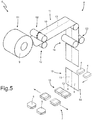
- Each inner wrap 3 is made by folding, in a known manner, a final wrapping sheet 5 (schematically illustrated in Figure 5 ), which has a rectangular shape, around the group 4 of cigarettes.
- Each inner wrap 3 can be devoid of stabilization (i.e. the corresponding final wrapping sheet 5 has no connections between the overlapping parts and therefore must always be firmly held to prevent the folds from unfolding due to elastic return), it can be stabilized by using glue, or it can be stabilized by heat-sealing (in the latter case the inner wrap 3 is normally hermetically sealed).
- Each rigid outer container 2 provided with the hinged lid is made by folding, in a known manner, a blank having an elongated rectangular shape around a pair of side-by-side inner wraps 3.
- number 6 denotes as a whole a packing machine (only partially illustrated in Figure 5 ) which is designed for producing the packet 1 of cigarettes described above (in particular in the version in which the inner wrap 3 is sealed and stabilized by heat-sealing).
- the packing machine 6 comprises a forming unit (not illustrated in Figure 5 ) in which groups 4 of cigarettes are formed in succession, a wrapping unit 7 (only partially illustrated in Figures 5 and 6 ) in which around each group 4 of cigarettes the final wrapping sheet 5 is folded to form the corresponding inner wrap 3.
- the packing machine 6 comprises a coupling unit (not illustrated in Figure 5 ) in which the inner wraps 3 (i.e. the groups 4 of cigarettes contained in the inner wraps 3) are joined two at a time to form the content of the packets 1 of cigarettes.
- the packing machine 6 comprises a wrapping unit (not illustrated in Figure 5 ) in which at least one collar (eventually also two distinct collars) and one blank is folded around each pair of inner wraps 3 (i.e. each pair of groups 4 of cigarettes contained in the inner wraps 3) to form the corresponding outer container 2 (according to another embodiment, no collars are provided).
- the packing machine 6 comprises a feeding unit 8 which is coupled to the wrapping unit 7 and is designed to feed, to the wrapping unit 7 itself and at each cycle, two final wrapping sheets 5 (still joined to one another as described in the following).
- the feeding unit 8 comprises an unwinding station S1 in which a tape 10 of wrapping material having a double width with respect to the width of the final wrapping sheets 5 is unwound from a reel 9; that is, the width of the tape 10 of wrapping material is equal to the width of two final wrapping sheets 5 placed side by side.
- the feeding unit 8 comprises a feeding line 11 which feeds the tape 10 of wrapping material from the reel 9 (from which the tape 10 of wrapping material is unwound) to the wrapping unit 7; the feeding line 11 is made up of idle return drums (known and partially illustrated) and pairs of motorized rollers (between which the tape 10 of wrapping material is "stretched" and that are also known and not illustrated).
- a weakening station S2 is arranged along the feeding line 11, where a weakening device 12 is provided, which performs a pre-weakened separation line 13 on the centreline plane of the tape 10 of wrapping material; the separation line 13 locally weakens the initial wrapping sheet 15 to facilitate and guide the subsequent tearing of the initial wrapping sheet 15 (as will be better described in the following) and maintains the unity and integrity of the wrapping sheet 15.
- a separation station S3 is arranged along the feeding line 11, where a cutting device 14 is provided, which cyclically performs a transversal cut of the tape 10 of wrapping material to separate, from the tape 10 of wrapping material itself, a series of initial wrapping sheets 15.
- Each initial wrapping sheet 15 (exactly like the tape 10 of wrapping material) is twice the width of the width of the final wrapping sheets 5; that is, the width of the initial wrapping sheet 15 is equal to the width of two final wrapping sheets 5 placed side by side (as better illustrated in Figure 7 ).
- each initial wrapping sheet 15 (exactly like the tape 10 of wrapping material) centrally has the pre-weakened separation line 13 (made by the weakening device 12) which divides the initial wrapping sheet 15 into two equal halves, each of which corresponds to a final wrapping sheet 5; in other words, each initial wrapping sheet 15 is formed by two final wrapping sheets 5 placed side by side and separate from one another by the pre-weakened separation line 13 (as better illustrated in Figure 7 ).
- the feeding line 11 terminates in an interception station S4 (which is part of the wrapping unit 7), in which each initial wrapping sheet 15 is coupled (in the manner described below) to two corresponding groups 4 of cigarettes which advance together side by side and spaced apart from one another.
- the wrapping unit 7 comprises an advancing conveyor 16 (schematized by a pusher) for advancing together a pair of groups 4 of cigarettes along a straight forward path which passes through the interception station S4 and ends at a wrapping wheel 17.
- the final wrapping sheet 15 is advanced along a feeding path perpendicular to, and intersecting with, an advancing path of the two groups 4 of cigarettes; in this way, the final wrapping sheet 15 is advanced in front of the two groups 4 of cigarettes so that the two groups 4 of cigarettes in their advancement intercept the final wrapping sheet 15 and determine the progressive "U" folding of the final wrapping sheet 15.
- the wrapping wheel 17 rotates, with intermittent motion, around a rotation axis 18 perpendicular to the plane of Figure 6 and supports four peripheral pockets 19, each of which is designed to receive and house two groups 4 of cigarettes wrapped in a final wrapping sheet 15.
- a final wrapping sheet 15 folds in a "U"-shape around two groups 4 of cigarettes; folding devices (known and not illustrated) are arranged around the periphery of the wrapping wheel 17 which fold the final wrapping sheet 15 into a tube-shape around two groups 4 of cigarettes forming a tubular wrap having two open opposite ends.
- the wrapping unit 7 comprises a dividing device 20 (schematically illustrated in Figure 6 ) which is designed to divide the initial wrapping sheet 15 into two by applying a traction (force) which causes a tear along the pre-weakened separation line 13; in other words, the dividing device 20 applies a traction (force) to the initial wrapping sheet 15 (folded in a tube-shape around two groups 4 of cigarettes) to tear the initial wrapping sheet 15 along the pre-weakened separation line 13 and therefore obtain two final wrapping sheets 5 (each of which is folded into a tube-shape around a corresponding group 4 of cigarettes).
- a traction (force) which causes a tear along the pre-weakened separation line 13
- the dividing device 20 applies a traction (force) to the initial wrapping sheet 15 (folded in a tube-shape around two groups 4 of cigarettes) to tear the initial wrapping sheet 15 along the pre-weakened separation line 13 and therefore obtain two final wrapping sheets 5 (each of which is folded into a tube-shape around a corresponding group 4 of
- the dividing device 20 applies a traction (force) to the initial wrapping sheet 15 which causes a tear along the pre-weakened separation line 13 and therefore allows to move a final wrapping sheet 5 away from the other final wrapping sheet 5.
- the dividing device 20 is nothing more than a diverter which moves the two groups 4 of cigarettes partially wrapped in the respective final wrapping sheets 5 away from one another, causing a consequent tearing of the initial wrapping sheet 15 along the pre-weakened separation line 13.
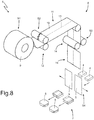
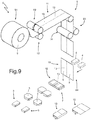
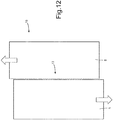
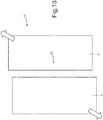
- the dividing device 20 generates a tear along the pre-weakened separation line 13 of each initial wrapping sheet 15 by applying to the two halves of the initial wrapping sheet 15 (i.e. to the two final wrapping sheets 5 which make up the initial wrapping sheet 15 and which are divided by the pre-weakened separation line 13) a traction (force) in opposite directions; this traction (force) in opposite directions can be directed transversely (i.e. perpendicular to the pre-weakened separation line 13) as illustrated in Figure 8 , it can be directed longitudinally (i.e. parallel to the pre-weakened separation line 13) as illustrated in the Figure 10 , or it can be directed obliquely (i.e. both with a transverse component and with a longitudinal component) as illustrated in Figure 11 .
- the traction (force) in opposite directions lies in a horizontal plane; alternatively, the traction (force) could lie in a vertical plane (as illustrated in Figure 14 ) or in an inclined plane (i.e. neither perfectly horizontal nor perfectly vertical).
- the traction (force) that separates the two final wrapping sheets 5 from the initial wrapping sheet 15 could also be (at least partially) caused by a contrasting element C (fixed or mobile) against which the initial wrapping sheet 15 impacts during its advancement; in particular the area of the separation line 13 of the initial wrapping sheet 15 impacts against the contrasting element C during the advancement of initial wrapping sheet 15 itself.
- the dividing device 20 could comprise a contrast element C (fixed or mobile) against which the initial wrapping sheet 15 impacts during its advancement.
- the contrasting element C creates a division (a tear) by breaking through the initial wrapping sheet 15 along the separation line 13.
- the initial wrapping sheet 15 does not have the separation line 13 and the two final wrapping sheets 5 are divided from one another by means of a cut (i.e. a cut instead of the tear along the pre-weakened separation line 13).
- the wrapping unit 7 comprises folding devices (known and not illustrated) which are arranged downstream of the dividing device 20 and complete the folding of each final wrapping sheet 5 around the corresponding group 4 of cigarettes to form an inner wrap 3; said folding devices operate in parallel to produce two inner wraps 3 in parallel starting from the division of the initial wrapping sheet 15 folded around two groups 4 of cigarettes.
- the dividing device 20 is arranged downstream of the wrapping wheel 17 and divides each initial wrapping sheet 15 into two when the initial wrapping sheet 15 itself has been folded in a tube-shape around the two groups 4 of cigarettes; alternatively, the dividing device 20 could be arranged further downstream (and therefore the dividing device 20 divides each initial wrapping sheet 15 into two after further folding operations of the initial wrapping sheet 15 have been performed) or it could be arranged further upstream (and therefore the dividing device 20 divides each initial wrapping sheet 15 into two when the initial wrapping sheet 15 itself is folded only in a "U"-shape around two groups 4 of cigarettes or has not yet been folded around two groups 4 of cigarettes).
- each initial wrapping sheet 15 could be divided into the two corresponding final wrapping sheets 5 even before coupling the initial wrapping sheet 15 (i.e. the two corresponding final wrapping sheets 5) to two groups 4 of cigarettes.
- the inner wrap 3 is preferably (but not necessarily) sealed and stabilized by heat-sealing.
- the inner wrap 3 is sealed and stabilized by heat-sealing and is made according to what is described in the patent application WO2010136968A1 and in the patent application EP2008935A1 .
- the formation of the tubular wrap occurs by forming in the initial wrapping sheet 15 (folded around both groups 4 of cigarettes) a transversal welding fin at the rear wall (as described in the patent application WO2010136968A1 ); at the end of the welding the transversal welding fin is folded by 90° against the rear wall (also in this case as described in the patent application WO2010136968A1 ).
- the two opposite open ends are folded by means of the so-called " gift-wrap" described in patent application EP2008935A1 .
- the initial wrapping sheet 15 is torn along the separation line 13 (in one of the manners described above) to divide and then remove the two final wrapping sheets 5 (i.e. the two inner wrap 3) and the folding of the final wrapping sheets 5 (i.e. of the two inner wraps 3) is completed by folding the upper and lower edges of each open side end of the tubular wrap one above the other and above the previously folded " nibs".
- the tube-like folding of the initial wrapping sheet 15 (hence the formation of the transversal welding fin) and the 90° folding of the four front "nibs” takes place in the wrapping wheel 17 (which can be shaped like the wrapping wheel described in the patent application WO2010136968A1 ) while the 90° folding of the four rear " nibs" takes place downstream of the wrapping wheel 17 (before the dividing device 20). Downstream of the dividing device 20, the folding of the upper and lower edges and therefore the stabilization thereof by heat-sealing takes place in another wrapping wheel or in a straight and horizontal folding beam.
- connections breakable, as part of the separation line 13
- the function of said connections in the end portions of the initial wrapping sheet 15 forming the transversal welding fin is to guarantee the clear separation between the transversal welding fin of a final wrapping sheet 5 and the transversal welding fin of the other final wrapping sheet 5 (i.e. ensuring that part of a transversal welding fin of a final wrapping sheet 5 does not " invade” the area of the transversal welding fin of the other final wrapping sheet 5).
- the pre-weakened separation line 13 of each initial wrapping sheet 15 comprises a non-through incision which is obtained through the initial wrapping sheet 15 and extends without interruptions from one end to the other of the initial wrapping sheet 15 (i.e. said incision 21 is continuous and devoid of interruptions from one end to the other of initial wrapping sheet 15); in this case, the division of initial wrapping sheet 15 into two involves tearing the residual wrapping material present within the non-through incision.
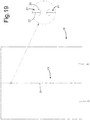
- the separation line 13 comprises a plurality of through incisions 21 which are obtained through the initial wrapping sheet 15, are aligned with one another, and are separated from one another, i.e. between a through incision 21 and the subsequent (adjacent) through incision 21 there is a section in which the initial wrapping sheet 15 is still intact; in this case, the division of the initial wrapping sheet 15 into two involves tearing the wrapping material remaining between two successive (adjacent) through incisions 21.
- the through incisions 21 arranged at opposite ends of the initial wrapping sheet 15 extend until the edge of the initial wrapping sheet 15. According to a different embodiment not illustrated, the through incisions 21 arranged at opposite ends of the initial wrapping sheet 15 do not extend up to the edge of the initial wrapping sheet 15, that is, they end a little before the edge of the initial wrapping sheet 15.
- each through incision 21 has a central portion 22 with a straight shape and at least an end portion 23 with a curved shape (i.e. the two peripheral through incisions 21 have only one curved end portion 23, while the central through incisions 21 have two curved end portions 23).
- each through incision 21 the central portion 22 is connected without interruptions to (at least one) end portion 23; in the embodiment illustrated in Figure 20 , in each through incision 21 the central portion 22 is separated and spaced from (at least one) end portion 23, i.e. the central portion 22 does not touch the (at least one) end portion 23.
- each through incision 21 the central portion 22 connects to (at least one) end portion 23 without forming sharp edges, i.e. with connecting curves devoid of sharp edges (i.e. of discontinuity) .
- each end portion 23 has a curvilinear shape which can be an arc of a circle (as illustrated in Figures 16-20 ) or a circle, or a complete circumference (as illustrated in Figure 15 ).
- the disadvantage of the embodiment illustrated in Figure 15 which provides a circle shape for each end portion 23, is that the manufacturing of the end portion 23 produces a scrap (i.e. a residue of the processing consisting of a small segment of wrapping material which detaches from the initial wrapping sheet 15 and must be somehow recovered and disposed of).
- each end portion 23 has an arc of a circle-like shape and extends over at least 180°: in the embodiments illustrated in Figures 17 , 19 and 20 each end portion 23 has an arc of a circle-like shape and extends for about 180 °, while in the embodiments illustrated in Figures 16 and 18 each end portion 23 has an arc of a circle-like shape and extends for about 270 °.
- each end portion 23 has an arc of a circle-like shape and the arc of a circle is facing the opposite side of the central portion 22.
- each end portion 23 has an arc of a circle-like shape and the arc of a circle faces the central portion 22.
- each final wrapping sheet 5 the inner edge (corresponding to the edge where the pre-weakened separation line 13 was located) is completely hidden from view as it is completely covered during the folding of the final wrapping sheet 5 around the corresponding group 4 of cigarettes; consequently, the tearing of the wrapping sheet 5 along the pre-weakened separation line 13 does not entail any aesthetic penalty to the inner wrap 3 obtained by folding the wrapping sheet 5 around the corresponding group 4 of cigarettes.
- the initial wrapping sheets 15 come from the tape 10 of wrapping material unwound from the reel 9 (i.e. they are cyclically separated from the tape 10 of wrapping material unwound from the reel 9); according to a different and perfectly equivalent embodiment not illustrated, the initial wrapping sheets 15 are, from the beginning, separated from one another and come from a stack housed in a hopper.
- each initial wrapping sheet 15 has a double width and is divided into two final wrapping sheets 5; according to other embodiments not illustrated, each initial wrapping sheet 15 has a greater width (for example triple or quadruple) and is therefore divided into three or four final wrapping sheets 5.
- initial wrapping sheet 15 is divided into two only and solely by tearing along the pre-weakened separation line 13 and without any type of cutting performed by a cutting tool, i.e. without any cutting tool touching the initial wrapping sheet 15. Consequently, no cutting tool is required to divide the initial wrapping sheet 15 into two.
- the embodiment illustrated in the attached Figures refers to the manufacturing of a packet of cigarettes, but the present invention is applicable, without substantial modifications, also to the manufacturing of any other type of cylindrical-shaped packet of smoking articles (for example a packet of cigars, a packet of electronic cigarettes of the liquid vaporization type, a packet of new generation cigarettes without tobacco combustion...) or even any other type of packet of articles, including non-smoking ones (for example, medicinal products, food products, hygiene products ).
- non-smoking ones for example, medicinal products, food products, hygiene products .
- the packing machine 6 described above has numerous advantages.
- the separation of the initial wrapping sheet 15 can take place even when the folding of the initial wrapping sheet 15 has not been very precise, since by applying the separation force to the initial wrapping sheet 15 the initial wrapping sheet 15 itself divides into the two wrapping sheets 5 always and only along the initial pre-weakened separation line 13 regardless of the exact position of the pre-weakened separation line 13.
- the packing machine 6 described above is particularly simple to implement in that it provides a single feeding line 11 to feed the tape 10 of wrapping material (and therefore the initial wrapping sheets 15) which reaches the wrapping unit 7 and, in some embodiments, also continues in the first part of the wrapping unit 7. In this way, the number of parts forming both the feeding unit 8 to feed the final wrapping sheets 5, and the wrapping unit 7 is minimized.
- the dividing device 20 is nothing more than a diverter which separates the two groups 4 of cigarettes partially wrapped in the respective final wrapping sheets 5 (or, in some embodiments, moves the two final wrapping sheets 5 apart from one another before the coupling with the two groups 4 of cigarettes) causing a consequent tearing of the initial wrapping sheet 15 along the pre-weakened separation line 13; consequently, also the dividing device 20 is simple and inexpensive to manufacture and of modest dimensions.
Landscapes
- Engineering & Computer Science (AREA)
- Mechanical Engineering (AREA)
- Wrapping Of Specific Fragile Articles (AREA)
- Basic Packing Technique (AREA)
Claims (14)
- Procédé pour apporter deux feuilles d'enveloppement (5) dans une machine d'emballage (6), en particulier pour des articles pour fumeurs ; le procédé d'apport comprend les étapes de :apport d'une feuille d'enveloppement initiale (15) d'une double largeur;division de la feuille d'enveloppement initiale (15) d'une double largeur en deux de façon à obtenir deux feuilles d'enveloppement finales (5) d'une seule largeur;réalisation d'une ligne de séparation (13) pré-affaiblie dans la feuille d'enveloppement initiale (15) ; etdivision de la feuille d'enveloppement initiale (15) en deux en appliquant seulement et uniquement une force, qui provoque une déchirure le long de la ligne de séparation (13) pré-affaiblie ;dans lequel la ligne de séparation (13) comprend une pluralité d'incisions traversantes (21), qui sont obtenues à travers la feuille d'enveloppement initiale (15), sont alignées les unes avec les autres, et sont séparées les unes des autres ; etdans lequel la division de la feuille d'enveloppement initiale (15) en deux implique le déchirement du matériau d'enveloppement présent entre deux incisions traversantes (21) adjacentes ;le procédé d'apport est caractérisé en ce que chaque incision traversante (21) a une portion centrale (22) de forme droite et au moins une portion d'extrémité (23) de forme courbée.
- Procédé d'apport selon la revendication 1 et comprenant l'étape supplémentaire d'application à la feuille d'enveloppement initiale (15) d'une force, qui tend à éloigner une feuille d'enveloppement finale (5) de l'autre feuille d'enveloppement finale (5).
- Procédé d'apport selon la revendication 1 ou 2, dans lequel les incisions traversantes (21) agencées à des extrémités opposées de la feuille d'enveloppement initiale (15) s'étendent jusqu'au bord de la feuille d'enveloppement initiale (15).
- Procédé d'apport selon la revendication 1, 2 ou 3, dans lequel, dans chaque incision traversante (21), la portion centrale (22) est reliée à la portion d'extrémité (23) sans interruptions.
- Procédé d'apport selon la revendication 4, dans lequel dans chaque incision traversante (21) la portion centrale (22) est jointe à la portion d'extrémité (23) sans former de bords vifs.
- Procédé d'apport selon la revendication 1, 2 ou 3, dans lequel dans chaque incision traversante (21) la portion centrale (22) est séparée et espacée de la portion d'extrémité (23).
- Procédé d'apport selon l'une des revendications 1 à 6, dans lequel la portion d'extrémité (23) a la forme d'un cercle.
- Procédé d'apport selon l'une des revendications 1 à 6, dans lequel la portion d'extrémité (23) a la forme d'un arc de cercle et s'étend sur au moins 180°.
- Procédé d'apport selon la revendication 8, dans lequel l'arc de cercle est tourné vers le côté opposé de la portion centrale (22).
- Procédé d'apport selon la revendication 8, dans lequel l'arc de cercle est tourné vers la portion centrale (22).
- Procédé selon l'une des revendications 1 à 10, dans lequel la force provoquant la déchirure le long de la ligne de séparation (13) pré-affaiblie est générée par un dispositif (20) comprenant un élément contrastant (C), qui est heurté par la feuille d'enveloppement initiale (15) pendant son avancée.
- Procédé selon l'une des revendications 1 à 11, dans lequel la ligne de séparation (13) affaiblit localement la feuille d'enveloppement initiale (15) pour faciliter et guider le déchirement ultérieur de la feuille d'enveloppement initiale (15) et maintient l'unité et l'intégrité de la feuille d'enveloppement (15).
- Procédé selon l'une des revendications 1 à 12, dans lequel la feuille d'enveloppement initiale (15) est divisée en deux seulement et uniquement par un déchirement le long de la ligne de séparation (13) pré-affaiblie et sans un quelconque type de coupe réalisée par un outil coupant, c'est-à-dire sans outil coupant touchant la feuille d'enveloppement initiale (15).
- Unité (8) pour apporter deux feuilles d'enveloppement (5) dans une machine d'emballage (6), en particulier pour des articles pour fumeurs ; l'unité d'apport (8) comprenant :une ligne d'apport (11) pour apporter une feuille d'enveloppement initiale (15) de double largeur;un dispositif de division (20) pour diviser la feuille d'enveloppement initiale (15) de double largeur en deux de façon à obtenir deux feuilles d'enveloppement finales (5) d'une seule largeur ; etun dispositif d'affaiblissement (12) pour réaliser dans la feuille d'enveloppement initiale (15) une ligne de séparation (13) pré-affaiblie comprenant une pluralité d'incisions traversantes (21), qui sont obtenues à travers la feuille d'enveloppement initiale (15), sont alignées les unes avec les autres, et sont séparées les unes des autres ; etdans lequel le dispositif de division (20) est conçu pour diviser la feuille d'enveloppement initiale (15) en deux en appliquant une force, qui provoque une déchirure le long de la ligne de séparation (13) pré-affaiblie et implique le déchirement du matériau d'enveloppement présent entre deux incisions traversantes (21) adjacentes ;l'unité d'apport (8) est caractérisée en ce que le dispositif d'affaiblissement (12) est configuré pour réaliser dans la feuille d'enveloppement initiale (15) la ligne de séparation (13) pré-affaiblie de sorte que chaque incision traversante (21) ait une portion centrale (22) de forme droite et au moins une portion d'extrémité (23) de forme courbée.
Priority Applications (1)
| Application Number | Priority Date | Filing Date | Title |
|---|---|---|---|
| PL19209270T PL3653518T3 (pl) | 2018-11-14 | 2019-11-14 | Sposób podawania i jednostka do podawania dwóch arkuszy owijających w maszynie pakującej |
Applications Claiming Priority (1)
| Application Number | Priority Date | Filing Date | Title |
|---|---|---|---|
| IT102018000010313A IT201800010313A1 (it) | 2018-11-14 | 2018-11-14 | Metodo ed unità di alimentazione di due fogli di incarto in una macchina impacchettatrice |
Publications (2)
| Publication Number | Publication Date |
|---|---|
| EP3653518A1 EP3653518A1 (fr) | 2020-05-20 |
| EP3653518B1 true EP3653518B1 (fr) | 2021-08-11 |
Family
ID=65496880
Family Applications (1)
| Application Number | Title | Priority Date | Filing Date |
|---|---|---|---|
| EP19209270.8A Active EP3653518B1 (fr) | 2018-11-14 | 2019-11-14 | Procédé et unité d'alimentation de deux plaques d'emballage dans une machine d'emballage |
Country Status (3)
| Country | Link |
|---|---|
| EP (1) | EP3653518B1 (fr) |
| IT (1) | IT201800010313A1 (fr) |
| PL (1) | PL3653518T3 (fr) |
Families Citing this family (7)
| Publication number | Priority date | Publication date | Assignee | Title |
|---|---|---|---|---|
| US12098048B2 (en) * | 2021-02-05 | 2024-09-24 | George Jones | Wrapping paper storage and dispensing device |
| IT202300024918A1 (it) * | 2023-11-23 | 2025-05-23 | Gd Spa | Unita' di incarto e metodo di incarto per produrre un pacchetto di articoli da fumo contenente due incarti sigillati ed affiancati |
| IT202300024936A1 (it) * | 2023-11-23 | 2025-05-23 | Gd Spa | Unita' di incarto e metodo di incarto per produrre un pacchetto di articoli da fumo contenente due incarti sigillati ed affiancati |
| IT202300027927A1 (it) | 2023-12-22 | 2025-06-22 | Gd Spa | Metodo di incarto ed unita' di incarto per produrre insieme due incarti sigillati contenenti due corrispondenti gruppi di articoli da fumo |
| WO2025253238A1 (fr) | 2024-06-05 | 2025-12-11 | G.D S.P.A. | Unité d'emballage et procédé de production, conjointement, de deux paquets scellés contenant deux groupes correspondants d'articles à fumer |
| EP4663560A1 (fr) | 2024-06-05 | 2025-12-17 | G.D S.p.A. | Unité d'emballage et procédé de fabrication de deux emballages scellés l'un à l'autre, par pliage simultané de deux feuilles d'emballage autour de deux groupes correspondants d'articles à fumer |
| EP4667370A1 (fr) | 2024-06-05 | 2025-12-24 | G.D S.p.A. | Unité d'emballage pour produire, ensemble, deux emballages scellés contenant deux groupes correspondants d'articles à fumer |
Family Cites Families (8)
| Publication number | Priority date | Publication date | Assignee | Title |
|---|---|---|---|---|
| DE3332950A1 (de) * | 1983-09-13 | 1985-03-28 | Focke & Co, 2810 Verden | Verfahren und vorrichtung zum einhuellen von zigaretten-packungen in folien-zuschnitte |
| DE3733129C2 (de) | 1987-10-01 | 1999-02-18 | Focke & Co | Vorrichtung zum Trennen einer Materialbahn in zwei Teilbahnen |
| DE3735675A1 (de) * | 1987-10-22 | 1989-05-18 | Focke & Co | Verfahren und vorrichtung zum herstellen und foerdern von packungs-zuschnitten |
| IT1285503B1 (it) | 1996-01-31 | 1998-06-08 | Gd Spa | Metodo per l'incarto di prodotti |
| DE19726324A1 (de) * | 1997-06-20 | 1998-12-24 | Focke & Co | Verfahren und Vorrichtung zum Herstellen von Klappschachteln |
| US7827767B2 (en) | 2007-06-26 | 2010-11-09 | G.D Societa' Per Azioni | Method and packing machine for combining an insert and a group of cigarettes |
| IT1395530B1 (it) | 2009-05-27 | 2012-09-28 | Carletti | Metodo, e relativo apparato, per la gestione ed il condizionamento della produzione di energia da impianti fotovoltaici |
| EP2894103B1 (fr) * | 2014-01-10 | 2016-09-07 | Robert Bosch Gmbh | Procédé et dispositif d'emballage de produits alimentaires en portions individuelles |
-
2018
- 2018-11-14 IT IT102018000010313A patent/IT201800010313A1/it unknown
-
2019
- 2019-11-14 EP EP19209270.8A patent/EP3653518B1/fr active Active
- 2019-11-14 PL PL19209270T patent/PL3653518T3/pl unknown
Also Published As
| Publication number | Publication date |
|---|---|
| IT201800010313A1 (it) | 2020-05-14 |
| EP3653518A1 (fr) | 2020-05-20 |
| PL3653518T3 (pl) | 2021-12-20 |
Similar Documents
| Publication | Publication Date | Title |
|---|---|---|
| EP3653518B1 (fr) | Procédé et unité d'alimentation de deux plaques d'emballage dans une machine d'emballage | |
| EP2814665B1 (fr) | Emballage à bande de renfort déchirable | |
| EP1839845B2 (fr) | Procédé de production d'un matériau de suremballage, et paquet doté du matériau produit | |
| US4617780A (en) | Method and apparatus for wrapping cigarette packets in film blanks | |
| EP2874887B2 (fr) | Procédé d'emballage et machine pour produire un emballage étanche contenant un groupe d'articles de tabac | |
| CN101070101A (zh) | 生产香烟盒的方法和包装机 | |
| EP3070006B1 (fr) | Procédé et machine d'emballage pour plier une enveloppe autour d'un groupe d'articles de tabac | |
| WO2025133735A1 (fr) | Procédé d'emballage et unité d'emballage pour produire, ensemble, deux enveloppes scellées contenant deux groupes correspondants d'articles à fumer | |
| EP1206385A2 (fr) | Procedes et systemes d'emballage | |
| IT201800010315A1 (it) | Metodo di incarto per realizzare contemporaneamente due confezioni | |
| EP4717613A1 (fr) | Machine d'emballage et procédé d'emballage pour produire un paquet rigide pour articles à fumer avec un couvercle articulé | |
| WO2025253238A1 (fr) | Unité d'emballage et procédé de production, conjointement, de deux paquets scellés contenant deux groupes correspondants d'articles à fumer | |
| WO2025248013A1 (fr) | Machine et procédé de production d'emballages hermétiques | |
| HK1201232B (en) | Packaging with reinforcing tear strip | |
| HK1201231B (en) | Packaging with tear strips |
Legal Events
| Date | Code | Title | Description |
|---|---|---|---|
| PUAI | Public reference made under article 153(3) epc to a published international application that has entered the european phase |
Free format text: ORIGINAL CODE: 0009012 |
|
| STAA | Information on the status of an ep patent application or granted ep patent |
Free format text: STATUS: THE APPLICATION HAS BEEN PUBLISHED |
|
| AK | Designated contracting states |
Kind code of ref document: A1 Designated state(s): AL AT BE BG CH CY CZ DE DK EE ES FI FR GB GR HR HU IE IS IT LI LT LU LV MC MK MT NL NO PL PT RO RS SE SI SK SM TR |
|
| AX | Request for extension of the european patent |
Extension state: BA ME |
|
| STAA | Information on the status of an ep patent application or granted ep patent |
Free format text: STATUS: REQUEST FOR EXAMINATION WAS MADE |
|
| 17P | Request for examination filed |
Effective date: 20201109 |
|
| RBV | Designated contracting states (corrected) |
Designated state(s): AL AT BE BG CH CY CZ DE DK EE ES FI FR GB GR HR HU IE IS IT LI LT LU LV MC MK MT NL NO PL PT RO RS SE SI SK SM TR |
|
| GRAP | Despatch of communication of intention to grant a patent |
Free format text: ORIGINAL CODE: EPIDOSNIGR1 |
|
| STAA | Information on the status of an ep patent application or granted ep patent |
Free format text: STATUS: GRANT OF PATENT IS INTENDED |
|
| RIC1 | Information provided on ipc code assigned before grant |
Ipc: B65D 85/10 20060101ALI20210225BHEP Ipc: B65B 19/22 20060101ALI20210225BHEP Ipc: B65B 19/20 20060101AFI20210225BHEP |
|
| INTG | Intention to grant announced |
Effective date: 20210318 |
|
| GRAS | Grant fee paid |
Free format text: ORIGINAL CODE: EPIDOSNIGR3 |
|
| GRAA | (expected) grant |
Free format text: ORIGINAL CODE: 0009210 |
|
| STAA | Information on the status of an ep patent application or granted ep patent |
Free format text: STATUS: THE PATENT HAS BEEN GRANTED |
|
| AK | Designated contracting states |
Kind code of ref document: B1 Designated state(s): AL AT BE BG CH CY CZ DE DK EE ES FI FR GB GR HR HU IE IS IT LI LT LU LV MC MK MT NL NO PL PT RO RS SE SI SK SM TR |
|
| REG | Reference to a national code |
Ref country code: CH Ref legal event code: EP |
|
| REG | Reference to a national code |
Ref country code: DE Ref legal event code: R096 Ref document number: 602019006796 Country of ref document: DE |
|
| REG | Reference to a national code |
Ref country code: IE Ref legal event code: FG4D Ref country code: AT Ref legal event code: REF Ref document number: 1419173 Country of ref document: AT Kind code of ref document: T Effective date: 20210915 |
|
| REG | Reference to a national code |
Ref country code: LT Ref legal event code: MG9D |
|
| REG | Reference to a national code |
Ref country code: NL Ref legal event code: MP Effective date: 20210811 |
|
| REG | Reference to a national code |
Ref country code: AT Ref legal event code: MK05 Ref document number: 1419173 Country of ref document: AT Kind code of ref document: T Effective date: 20210811 |
|
| PG25 | Lapsed in a contracting state [announced via postgrant information from national office to epo] |
Ref country code: RS Free format text: LAPSE BECAUSE OF FAILURE TO SUBMIT A TRANSLATION OF THE DESCRIPTION OR TO PAY THE FEE WITHIN THE PRESCRIBED TIME-LIMIT Effective date: 20210811 Ref country code: SE Free format text: LAPSE BECAUSE OF FAILURE TO SUBMIT A TRANSLATION OF THE DESCRIPTION OR TO PAY THE FEE WITHIN THE PRESCRIBED TIME-LIMIT Effective date: 20210811 Ref country code: ES Free format text: LAPSE BECAUSE OF FAILURE TO SUBMIT A TRANSLATION OF THE DESCRIPTION OR TO PAY THE FEE WITHIN THE PRESCRIBED TIME-LIMIT Effective date: 20210811 Ref country code: AT Free format text: LAPSE BECAUSE OF FAILURE TO SUBMIT A TRANSLATION OF THE DESCRIPTION OR TO PAY THE FEE WITHIN THE PRESCRIBED TIME-LIMIT Effective date: 20210811 Ref country code: BG Free format text: LAPSE BECAUSE OF FAILURE TO SUBMIT A TRANSLATION OF THE DESCRIPTION OR TO PAY THE FEE WITHIN THE PRESCRIBED TIME-LIMIT Effective date: 20211111 Ref country code: LT Free format text: LAPSE BECAUSE OF FAILURE TO SUBMIT A TRANSLATION OF THE DESCRIPTION OR TO PAY THE FEE WITHIN THE PRESCRIBED TIME-LIMIT Effective date: 20210811 Ref country code: HR Free format text: LAPSE BECAUSE OF FAILURE TO SUBMIT A TRANSLATION OF THE DESCRIPTION OR TO PAY THE FEE WITHIN THE PRESCRIBED TIME-LIMIT Effective date: 20210811 Ref country code: FI Free format text: LAPSE BECAUSE OF FAILURE TO SUBMIT A TRANSLATION OF THE DESCRIPTION OR TO PAY THE FEE WITHIN THE PRESCRIBED TIME-LIMIT Effective date: 20210811 Ref country code: PT Free format text: LAPSE BECAUSE OF FAILURE TO SUBMIT A TRANSLATION OF THE DESCRIPTION OR TO PAY THE FEE WITHIN THE PRESCRIBED TIME-LIMIT Effective date: 20211213 Ref country code: NO Free format text: LAPSE BECAUSE OF FAILURE TO SUBMIT A TRANSLATION OF THE DESCRIPTION OR TO PAY THE FEE WITHIN THE PRESCRIBED TIME-LIMIT Effective date: 20211111 |
|
| PG25 | Lapsed in a contracting state [announced via postgrant information from national office to epo] |
Ref country code: LV Free format text: LAPSE BECAUSE OF FAILURE TO SUBMIT A TRANSLATION OF THE DESCRIPTION OR TO PAY THE FEE WITHIN THE PRESCRIBED TIME-LIMIT Effective date: 20210811 Ref country code: GR Free format text: LAPSE BECAUSE OF FAILURE TO SUBMIT A TRANSLATION OF THE DESCRIPTION OR TO PAY THE FEE WITHIN THE PRESCRIBED TIME-LIMIT Effective date: 20211112 |
|
| PG25 | Lapsed in a contracting state [announced via postgrant information from national office to epo] |
Ref country code: NL Free format text: LAPSE BECAUSE OF FAILURE TO SUBMIT A TRANSLATION OF THE DESCRIPTION OR TO PAY THE FEE WITHIN THE PRESCRIBED TIME-LIMIT Effective date: 20210811 |
|
| PG25 | Lapsed in a contracting state [announced via postgrant information from national office to epo] |
Ref country code: DK Free format text: LAPSE BECAUSE OF FAILURE TO SUBMIT A TRANSLATION OF THE DESCRIPTION OR TO PAY THE FEE WITHIN THE PRESCRIBED TIME-LIMIT Effective date: 20210811 |
|
| REG | Reference to a national code |
Ref country code: DE Ref legal event code: R097 Ref document number: 602019006796 Country of ref document: DE |
|
| PG25 | Lapsed in a contracting state [announced via postgrant information from national office to epo] |
Ref country code: SM Free format text: LAPSE BECAUSE OF FAILURE TO SUBMIT A TRANSLATION OF THE DESCRIPTION OR TO PAY THE FEE WITHIN THE PRESCRIBED TIME-LIMIT Effective date: 20210811 Ref country code: SK Free format text: LAPSE BECAUSE OF FAILURE TO SUBMIT A TRANSLATION OF THE DESCRIPTION OR TO PAY THE FEE WITHIN THE PRESCRIBED TIME-LIMIT Effective date: 20210811 Ref country code: RO Free format text: LAPSE BECAUSE OF FAILURE TO SUBMIT A TRANSLATION OF THE DESCRIPTION OR TO PAY THE FEE WITHIN THE PRESCRIBED TIME-LIMIT Effective date: 20210811 Ref country code: EE Free format text: LAPSE BECAUSE OF FAILURE TO SUBMIT A TRANSLATION OF THE DESCRIPTION OR TO PAY THE FEE WITHIN THE PRESCRIBED TIME-LIMIT Effective date: 20210811 Ref country code: CZ Free format text: LAPSE BECAUSE OF FAILURE TO SUBMIT A TRANSLATION OF THE DESCRIPTION OR TO PAY THE FEE WITHIN THE PRESCRIBED TIME-LIMIT Effective date: 20210811 Ref country code: AL Free format text: LAPSE BECAUSE OF FAILURE TO SUBMIT A TRANSLATION OF THE DESCRIPTION OR TO PAY THE FEE WITHIN THE PRESCRIBED TIME-LIMIT Effective date: 20210811 |
|
| PLBE | No opposition filed within time limit |
Free format text: ORIGINAL CODE: 0009261 |
|
| STAA | Information on the status of an ep patent application or granted ep patent |
Free format text: STATUS: NO OPPOSITION FILED WITHIN TIME LIMIT |
|
| PG25 | Lapsed in a contracting state [announced via postgrant information from national office to epo] |
Ref country code: MC Free format text: LAPSE BECAUSE OF FAILURE TO SUBMIT A TRANSLATION OF THE DESCRIPTION OR TO PAY THE FEE WITHIN THE PRESCRIBED TIME-LIMIT Effective date: 20210811 |
|
| 26N | No opposition filed |
Effective date: 20220512 |
|
| PG25 | Lapsed in a contracting state [announced via postgrant information from national office to epo] |
Ref country code: LU Free format text: LAPSE BECAUSE OF NON-PAYMENT OF DUE FEES Effective date: 20211114 Ref country code: IT Free format text: LAPSE BECAUSE OF FAILURE TO SUBMIT A TRANSLATION OF THE DESCRIPTION OR TO PAY THE FEE WITHIN THE PRESCRIBED TIME-LIMIT Effective date: 20210811 Ref country code: BE Free format text: LAPSE BECAUSE OF NON-PAYMENT OF DUE FEES Effective date: 20211130 |
|
| REG | Reference to a national code |
Ref country code: BE Ref legal event code: MM Effective date: 20211130 |
|
| PG25 | Lapsed in a contracting state [announced via postgrant information from national office to epo] |
Ref country code: SI Free format text: LAPSE BECAUSE OF FAILURE TO SUBMIT A TRANSLATION OF THE DESCRIPTION OR TO PAY THE FEE WITHIN THE PRESCRIBED TIME-LIMIT Effective date: 20210811 |
|
| PG25 | Lapsed in a contracting state [announced via postgrant information from national office to epo] |
Ref country code: IE Free format text: LAPSE BECAUSE OF NON-PAYMENT OF DUE FEES Effective date: 20211114 |
|
| PG25 | Lapsed in a contracting state [announced via postgrant information from national office to epo] |
Ref country code: FR Free format text: LAPSE BECAUSE OF NON-PAYMENT OF DUE FEES Effective date: 20211130 |
|
| PG25 | Lapsed in a contracting state [announced via postgrant information from national office to epo] |
Ref country code: CY Free format text: LAPSE BECAUSE OF FAILURE TO SUBMIT A TRANSLATION OF THE DESCRIPTION OR TO PAY THE FEE WITHIN THE PRESCRIBED TIME-LIMIT Effective date: 20210811 |
|
| REG | Reference to a national code |
Ref country code: CH Ref legal event code: PL |
|
| P01 | Opt-out of the competence of the unified patent court (upc) registered |
Effective date: 20230529 |
|
| PG25 | Lapsed in a contracting state [announced via postgrant information from national office to epo] |
Ref country code: LI Free format text: LAPSE BECAUSE OF NON-PAYMENT OF DUE FEES Effective date: 20221130 Ref country code: HU Free format text: LAPSE BECAUSE OF FAILURE TO SUBMIT A TRANSLATION OF THE DESCRIPTION OR TO PAY THE FEE WITHIN THE PRESCRIBED TIME-LIMIT; INVALID AB INITIO Effective date: 20191114 Ref country code: CH Free format text: LAPSE BECAUSE OF NON-PAYMENT OF DUE FEES Effective date: 20221130 |
|
| PG25 | Lapsed in a contracting state [announced via postgrant information from national office to epo] |
Ref country code: MK Free format text: LAPSE BECAUSE OF FAILURE TO SUBMIT A TRANSLATION OF THE DESCRIPTION OR TO PAY THE FEE WITHIN THE PRESCRIBED TIME-LIMIT Effective date: 20210811 |
|
| GBPC | Gb: european patent ceased through non-payment of renewal fee |
Effective date: 20231114 |
|
| PG25 | Lapsed in a contracting state [announced via postgrant information from national office to epo] |
Ref country code: MT Free format text: LAPSE BECAUSE OF FAILURE TO SUBMIT A TRANSLATION OF THE DESCRIPTION OR TO PAY THE FEE WITHIN THE PRESCRIBED TIME-LIMIT Effective date: 20210811 |
|
| PG25 | Lapsed in a contracting state [announced via postgrant information from national office to epo] |
Ref country code: GB Free format text: LAPSE BECAUSE OF NON-PAYMENT OF DUE FEES Effective date: 20231114 |
|
| PG25 | Lapsed in a contracting state [announced via postgrant information from national office to epo] |
Ref country code: GB Free format text: LAPSE BECAUSE OF NON-PAYMENT OF DUE FEES Effective date: 20231114 |
|
| PG25 | Lapsed in a contracting state [announced via postgrant information from national office to epo] |
Ref country code: TR Free format text: LAPSE BECAUSE OF FAILURE TO SUBMIT A TRANSLATION OF THE DESCRIPTION OR TO PAY THE FEE WITHIN THE PRESCRIBED TIME-LIMIT Effective date: 20210811 |
|
| PGFP | Annual fee paid to national office [announced via postgrant information from national office to epo] |
Ref country code: DE Payment date: 20251128 Year of fee payment: 7 |
|
| PGFP | Annual fee paid to national office [announced via postgrant information from national office to epo] |
Ref country code: PL Payment date: 20251021 Year of fee payment: 7 |