EP3654395B1 - Diode électroluminescente organique ayant une efficacité élevée - Google Patents
Diode électroluminescente organique ayant une efficacité élevée Download PDFInfo
- Publication number
- EP3654395B1 EP3654395B1 EP18831305.0A EP18831305A EP3654395B1 EP 3654395 B1 EP3654395 B1 EP 3654395B1 EP 18831305 A EP18831305 A EP 18831305A EP 3654395 B1 EP3654395 B1 EP 3654395B1
- Authority
- EP
- European Patent Office
- Prior art keywords
- carbon atoms
- substituted
- unsubstituted
- chemical formula
- ring
- Prior art date
- Legal status (The legal status is an assumption and is not a legal conclusion. Google has not performed a legal analysis and makes no representation as to the accuracy of the status listed.)
- Active
Links
Images

Classifications
-
- H—ELECTRICITY
- H10—SEMICONDUCTOR DEVICES; ELECTRIC SOLID-STATE DEVICES NOT OTHERWISE PROVIDED FOR
- H10K—ORGANIC ELECTRIC SOLID-STATE DEVICES
- H10K85/00—Organic materials used in the body or electrodes of devices covered by this subclass
- H10K85/60—Organic compounds having low molecular weight
- H10K85/631—Amine compounds having at least two aryl rest on at least one amine-nitrogen atom, e.g. triphenylamine
- H10K85/633—Amine compounds having at least two aryl rest on at least one amine-nitrogen atom, e.g. triphenylamine comprising polycyclic condensed aromatic hydrocarbons as substituents on the nitrogen atom
-
- C—CHEMISTRY; METALLURGY
- C07—ORGANIC CHEMISTRY
- C07D—HETEROCYCLIC COMPOUNDS
- C07D307/00—Heterocyclic compounds containing five-membered rings having one oxygen atom as the only ring hetero atom
- C07D307/94—Heterocyclic compounds containing five-membered rings having one oxygen atom as the only ring hetero atom spiro-condensed with carbocyclic rings or ring systems, e.g. griseofulvins
-
- C—CHEMISTRY; METALLURGY
- C07—ORGANIC CHEMISTRY
- C07D—HETEROCYCLIC COMPOUNDS
- C07D209/00—Heterocyclic compounds containing five-membered rings, condensed with other rings, with one nitrogen atom as the only ring hetero atom
- C07D209/56—Ring systems containing three or more rings
- C07D209/96—Spiro-condensed ring systems
-
- C—CHEMISTRY; METALLURGY
- C07—ORGANIC CHEMISTRY
- C07D—HETEROCYCLIC COMPOUNDS
- C07D333/00—Heterocyclic compounds containing five-membered rings having one sulfur atom as the only ring hetero atom
- C07D333/50—Heterocyclic compounds containing five-membered rings having one sulfur atom as the only ring hetero atom condensed with carbocyclic rings or ring systems
-
- C—CHEMISTRY; METALLURGY
- C07—ORGANIC CHEMISTRY
- C07D—HETEROCYCLIC COMPOUNDS
- C07D405/00—Heterocyclic compounds containing both one or more hetero rings having oxygen atoms as the only ring hetero atoms, and one or more rings having nitrogen as the only ring hetero atom
- C07D405/02—Heterocyclic compounds containing both one or more hetero rings having oxygen atoms as the only ring hetero atoms, and one or more rings having nitrogen as the only ring hetero atom containing two hetero rings
- C07D405/04—Heterocyclic compounds containing both one or more hetero rings having oxygen atoms as the only ring hetero atoms, and one or more rings having nitrogen as the only ring hetero atom containing two hetero rings directly linked by a ring-member-to-ring-member bond
-
- C—CHEMISTRY; METALLURGY
- C07—ORGANIC CHEMISTRY
- C07D—HETEROCYCLIC COMPOUNDS
- C07D405/00—Heterocyclic compounds containing both one or more hetero rings having oxygen atoms as the only ring hetero atoms, and one or more rings having nitrogen as the only ring hetero atom
- C07D405/14—Heterocyclic compounds containing both one or more hetero rings having oxygen atoms as the only ring hetero atoms, and one or more rings having nitrogen as the only ring hetero atom containing three or more hetero rings
-
- C—CHEMISTRY; METALLURGY
- C07—ORGANIC CHEMISTRY
- C07D—HETEROCYCLIC COMPOUNDS
- C07D407/00—Heterocyclic compounds containing two or more hetero rings, at least one ring having oxygen atoms as the only ring hetero atoms, not provided for by group C07D405/00
- C07D407/14—Heterocyclic compounds containing two or more hetero rings, at least one ring having oxygen atoms as the only ring hetero atoms, not provided for by group C07D405/00 containing three or more hetero rings
-
- C—CHEMISTRY; METALLURGY
- C07—ORGANIC CHEMISTRY
- C07D—HETEROCYCLIC COMPOUNDS
- C07D409/00—Heterocyclic compounds containing two or more hetero rings, at least one ring having sulfur atoms as the only ring hetero atoms
- C07D409/02—Heterocyclic compounds containing two or more hetero rings, at least one ring having sulfur atoms as the only ring hetero atoms containing two hetero rings
- C07D409/12—Heterocyclic compounds containing two or more hetero rings, at least one ring having sulfur atoms as the only ring hetero atoms containing two hetero rings linked by a chain containing hetero atoms as chain links
-
- C—CHEMISTRY; METALLURGY
- C07—ORGANIC CHEMISTRY
- C07D—HETEROCYCLIC COMPOUNDS
- C07D409/00—Heterocyclic compounds containing two or more hetero rings, at least one ring having sulfur atoms as the only ring hetero atoms
- C07D409/14—Heterocyclic compounds containing two or more hetero rings, at least one ring having sulfur atoms as the only ring hetero atoms containing three or more hetero rings
-
- C—CHEMISTRY; METALLURGY
- C07—ORGANIC CHEMISTRY
- C07D—HETEROCYCLIC COMPOUNDS
- C07D491/00—Heterocyclic compounds containing in the condensed ring system both one or more rings having oxygen atoms as the only ring hetero atoms and one or more rings having nitrogen atoms as the only ring hetero atoms, not provided for by groups C07D451/00 - C07D459/00, C07D463/00, C07D477/00 or C07D489/00
- C07D491/02—Heterocyclic compounds containing in the condensed ring system both one or more rings having oxygen atoms as the only ring hetero atoms and one or more rings having nitrogen atoms as the only ring hetero atoms, not provided for by groups C07D451/00 - C07D459/00, C07D463/00, C07D477/00 or C07D489/00 in which the condensed system contains two hetero rings
- C07D491/04—Ortho-condensed systems
- C07D491/044—Ortho-condensed systems with only one oxygen atom as ring hetero atom in the oxygen-containing ring
- C07D491/048—Ortho-condensed systems with only one oxygen atom as ring hetero atom in the oxygen-containing ring the oxygen-containing ring being five-membered
-
- C—CHEMISTRY; METALLURGY
- C07—ORGANIC CHEMISTRY
- C07D—HETEROCYCLIC COMPOUNDS
- C07D491/00—Heterocyclic compounds containing in the condensed ring system both one or more rings having oxygen atoms as the only ring hetero atoms and one or more rings having nitrogen atoms as the only ring hetero atoms, not provided for by groups C07D451/00 - C07D459/00, C07D463/00, C07D477/00 or C07D489/00
- C07D491/02—Heterocyclic compounds containing in the condensed ring system both one or more rings having oxygen atoms as the only ring hetero atoms and one or more rings having nitrogen atoms as the only ring hetero atoms, not provided for by groups C07D451/00 - C07D459/00, C07D463/00, C07D477/00 or C07D489/00 in which the condensed system contains two hetero rings
- C07D491/10—Spiro-condensed systems
-
- C—CHEMISTRY; METALLURGY
- C07—ORGANIC CHEMISTRY
- C07D—HETEROCYCLIC COMPOUNDS
- C07D491/00—Heterocyclic compounds containing in the condensed ring system both one or more rings having oxygen atoms as the only ring hetero atoms and one or more rings having nitrogen atoms as the only ring hetero atoms, not provided for by groups C07D451/00 - C07D459/00, C07D463/00, C07D477/00 or C07D489/00
- C07D491/12—Heterocyclic compounds containing in the condensed ring system both one or more rings having oxygen atoms as the only ring hetero atoms and one or more rings having nitrogen atoms as the only ring hetero atoms, not provided for by groups C07D451/00 - C07D459/00, C07D463/00, C07D477/00 or C07D489/00 in which the condensed system contains three hetero rings
- C07D491/14—Ortho-condensed systems
- C07D491/153—Ortho-condensed systems the condensed system containing two rings with oxygen as ring hetero atom and one ring with nitrogen as ring hetero atom
-
- C—CHEMISTRY; METALLURGY
- C07—ORGANIC CHEMISTRY
- C07D—HETEROCYCLIC COMPOUNDS
- C07D491/00—Heterocyclic compounds containing in the condensed ring system both one or more rings having oxygen atoms as the only ring hetero atoms and one or more rings having nitrogen atoms as the only ring hetero atoms, not provided for by groups C07D451/00 - C07D459/00, C07D463/00, C07D477/00 or C07D489/00
- C07D491/12—Heterocyclic compounds containing in the condensed ring system both one or more rings having oxygen atoms as the only ring hetero atoms and one or more rings having nitrogen atoms as the only ring hetero atoms, not provided for by groups C07D451/00 - C07D459/00, C07D463/00, C07D477/00 or C07D489/00 in which the condensed system contains three hetero rings
- C07D491/20—Spiro-condensed systems
-
- C—CHEMISTRY; METALLURGY
- C07—ORGANIC CHEMISTRY
- C07D—HETEROCYCLIC COMPOUNDS
- C07D493/00—Heterocyclic compounds containing oxygen atoms as the only ring hetero atoms in the condensed system
- C07D493/02—Heterocyclic compounds containing oxygen atoms as the only ring hetero atoms in the condensed system in which the condensed system contains two hetero rings
- C07D493/04—Ortho-condensed systems
-
- C—CHEMISTRY; METALLURGY
- C07—ORGANIC CHEMISTRY
- C07D—HETEROCYCLIC COMPOUNDS
- C07D493/00—Heterocyclic compounds containing oxygen atoms as the only ring hetero atoms in the condensed system
- C07D493/02—Heterocyclic compounds containing oxygen atoms as the only ring hetero atoms in the condensed system in which the condensed system contains two hetero rings
- C07D493/10—Spiro-condensed systems
-
- C—CHEMISTRY; METALLURGY
- C07—ORGANIC CHEMISTRY
- C07D—HETEROCYCLIC COMPOUNDS
- C07D493/00—Heterocyclic compounds containing oxygen atoms as the only ring hetero atoms in the condensed system
- C07D493/12—Heterocyclic compounds containing oxygen atoms as the only ring hetero atoms in the condensed system in which the condensed system contains three hetero rings
- C07D493/20—Spiro-condensed systems
-
- C—CHEMISTRY; METALLURGY
- C07—ORGANIC CHEMISTRY
- C07D—HETEROCYCLIC COMPOUNDS
- C07D493/00—Heterocyclic compounds containing oxygen atoms as the only ring hetero atoms in the condensed system
- C07D493/22—Heterocyclic compounds containing oxygen atoms as the only ring hetero atoms in the condensed system in which the condensed system contains four or more hetero rings
-
- C—CHEMISTRY; METALLURGY
- C07—ORGANIC CHEMISTRY
- C07D—HETEROCYCLIC COMPOUNDS
- C07D495/00—Heterocyclic compounds containing in the condensed system at least one hetero ring having sulfur atoms as the only ring hetero atoms
- C07D495/02—Heterocyclic compounds containing in the condensed system at least one hetero ring having sulfur atoms as the only ring hetero atoms in which the condensed system contains two hetero rings
- C07D495/04—Ortho-condensed systems
-
- C—CHEMISTRY; METALLURGY
- C07—ORGANIC CHEMISTRY
- C07D—HETEROCYCLIC COMPOUNDS
- C07D495/00—Heterocyclic compounds containing in the condensed system at least one hetero ring having sulfur atoms as the only ring hetero atoms
- C07D495/02—Heterocyclic compounds containing in the condensed system at least one hetero ring having sulfur atoms as the only ring hetero atoms in which the condensed system contains two hetero rings
- C07D495/10—Spiro-condensed systems
-
- C—CHEMISTRY; METALLURGY
- C07—ORGANIC CHEMISTRY
- C07D—HETEROCYCLIC COMPOUNDS
- C07D517/00—Heterocyclic compounds containing in the condensed system at least one hetero ring having selenium, tellurium, or halogen atoms as ring hetero atoms
- C07D517/12—Heterocyclic compounds containing in the condensed system at least one hetero ring having selenium, tellurium, or halogen atoms as ring hetero atoms in which the condensed system contains three hetero rings
- C07D517/20—Spiro-condensed systems
-
- C—CHEMISTRY; METALLURGY
- C07—ORGANIC CHEMISTRY
- C07D—HETEROCYCLIC COMPOUNDS
- C07D519/00—Heterocyclic compounds containing more than one system of two or more relevant hetero rings condensed among themselves or condensed with a common carbocyclic ring system not provided for in groups C07D453/00 or C07D455/00
-
- C—CHEMISTRY; METALLURGY
- C07—ORGANIC CHEMISTRY
- C07F—ACYCLIC, CARBOCYCLIC OR HETEROCYCLIC COMPOUNDS CONTAINING ELEMENTS OTHER THAN CARBON, HYDROGEN, HALOGEN, OXYGEN, NITROGEN, SULFUR, SELENIUM OR TELLURIUM
- C07F7/00—Compounds containing elements of Groups 4 or 14 of the Periodic Table
- C07F7/02—Silicon compounds
- C07F7/08—Compounds having one or more C—Si linkages
- C07F7/0803—Compounds with Si-C or Si-Si linkages
- C07F7/081—Compounds with Si-C or Si-Si linkages comprising at least one atom selected from the elements N, O, halogen, S, Se or Te
- C07F7/0812—Compounds with Si-C or Si-Si linkages comprising at least one atom selected from the elements N, O, halogen, S, Se or Te comprising a heterocyclic ring
-
- C—CHEMISTRY; METALLURGY
- C07—ORGANIC CHEMISTRY
- C07F—ACYCLIC, CARBOCYCLIC OR HETEROCYCLIC COMPOUNDS CONTAINING ELEMENTS OTHER THAN CARBON, HYDROGEN, HALOGEN, OXYGEN, NITROGEN, SULFUR, SELENIUM OR TELLURIUM
- C07F7/00—Compounds containing elements of Groups 4 or 14 of the Periodic Table
- C07F7/02—Silicon compounds
- C07F7/08—Compounds having one or more C—Si linkages
- C07F7/0803—Compounds with Si-C or Si-Si linkages
- C07F7/081—Compounds with Si-C or Si-Si linkages comprising at least one atom selected from the elements N, O, halogen, S, Se or Te
- C07F7/0812—Compounds with Si-C or Si-Si linkages comprising at least one atom selected from the elements N, O, halogen, S, Se or Te comprising a heterocyclic ring
- C07F7/0816—Compounds with Si-C or Si-Si linkages comprising at least one atom selected from the elements N, O, halogen, S, Se or Te comprising a heterocyclic ring said ring comprising Si as a ring atom
-
- C—CHEMISTRY; METALLURGY
- C07—ORGANIC CHEMISTRY
- C07F—ACYCLIC, CARBOCYCLIC OR HETEROCYCLIC COMPOUNDS CONTAINING ELEMENTS OTHER THAN CARBON, HYDROGEN, HALOGEN, OXYGEN, NITROGEN, SULFUR, SELENIUM OR TELLURIUM
- C07F7/00—Compounds containing elements of Groups 4 or 14 of the Periodic Table
- C07F7/30—Germanium compounds
-
- H—ELECTRICITY
- H10—SEMICONDUCTOR DEVICES; ELECTRIC SOLID-STATE DEVICES NOT OTHERWISE PROVIDED FOR
- H10K—ORGANIC ELECTRIC SOLID-STATE DEVICES
- H10K71/00—Manufacture or treatment specially adapted for the organic devices covered by this subclass
- H10K71/10—Deposition of organic active material
-
- H—ELECTRICITY
- H10—SEMICONDUCTOR DEVICES; ELECTRIC SOLID-STATE DEVICES NOT OTHERWISE PROVIDED FOR
- H10K—ORGANIC ELECTRIC SOLID-STATE DEVICES
- H10K85/00—Organic materials used in the body or electrodes of devices covered by this subclass
- H10K85/40—Organosilicon compounds, e.g. TIPS pentacene
-
- H—ELECTRICITY
- H10—SEMICONDUCTOR DEVICES; ELECTRIC SOLID-STATE DEVICES NOT OTHERWISE PROVIDED FOR
- H10K—ORGANIC ELECTRIC SOLID-STATE DEVICES
- H10K85/00—Organic materials used in the body or electrodes of devices covered by this subclass
- H10K85/60—Organic compounds having low molecular weight
- H10K85/631—Amine compounds having at least two aryl rest on at least one amine-nitrogen atom, e.g. triphenylamine
- H10K85/636—Amine compounds having at least two aryl rest on at least one amine-nitrogen atom, e.g. triphenylamine comprising heteroaromatic hydrocarbons as substituents on the nitrogen atom
-
- H—ELECTRICITY
- H10—SEMICONDUCTOR DEVICES; ELECTRIC SOLID-STATE DEVICES NOT OTHERWISE PROVIDED FOR
- H10K—ORGANIC ELECTRIC SOLID-STATE DEVICES
- H10K85/00—Organic materials used in the body or electrodes of devices covered by this subclass
- H10K85/60—Organic compounds having low molecular weight
- H10K85/649—Aromatic compounds comprising a hetero atom
- H10K85/657—Polycyclic condensed heteroaromatic hydrocarbons
- H10K85/6576—Polycyclic condensed heteroaromatic hydrocarbons comprising only sulfur in the heteroaromatic polycondensed ring system, e.g. benzothiophene
-
- H—ELECTRICITY
- H10—SEMICONDUCTOR DEVICES; ELECTRIC SOLID-STATE DEVICES NOT OTHERWISE PROVIDED FOR
- H10K—ORGANIC ELECTRIC SOLID-STATE DEVICES
- H10K50/00—Organic light-emitting devices
- H10K50/10—OLEDs or polymer light-emitting diodes [PLED]
- H10K50/11—OLEDs or polymer light-emitting diodes [PLED] characterised by the electroluminescent [EL] layers
-
- H—ELECTRICITY
- H10—SEMICONDUCTOR DEVICES; ELECTRIC SOLID-STATE DEVICES NOT OTHERWISE PROVIDED FOR
- H10K—ORGANIC ELECTRIC SOLID-STATE DEVICES
- H10K50/00—Organic light-emitting devices
- H10K50/10—OLEDs or polymer light-emitting diodes [PLED]
- H10K50/14—Carrier transporting layers
- H10K50/15—Hole transporting layers
-
- H—ELECTRICITY
- H10—SEMICONDUCTOR DEVICES; ELECTRIC SOLID-STATE DEVICES NOT OTHERWISE PROVIDED FOR
- H10K—ORGANIC ELECTRIC SOLID-STATE DEVICES
- H10K50/00—Organic light-emitting devices
- H10K50/10—OLEDs or polymer light-emitting diodes [PLED]
- H10K50/14—Carrier transporting layers
- H10K50/16—Electron transporting layers
-
- H—ELECTRICITY
- H10—SEMICONDUCTOR DEVICES; ELECTRIC SOLID-STATE DEVICES NOT OTHERWISE PROVIDED FOR
- H10K—ORGANIC ELECTRIC SOLID-STATE DEVICES
- H10K50/00—Organic light-emitting devices
- H10K50/10—OLEDs or polymer light-emitting diodes [PLED]
- H10K50/17—Carrier injection layers
-
- H—ELECTRICITY
- H10—SEMICONDUCTOR DEVICES; ELECTRIC SOLID-STATE DEVICES NOT OTHERWISE PROVIDED FOR
- H10K—ORGANIC ELECTRIC SOLID-STATE DEVICES
- H10K50/00—Organic light-emitting devices
- H10K50/10—OLEDs or polymer light-emitting diodes [PLED]
- H10K50/17—Carrier injection layers
- H10K50/171—Electron injection layers
-
- H—ELECTRICITY
- H10—SEMICONDUCTOR DEVICES; ELECTRIC SOLID-STATE DEVICES NOT OTHERWISE PROVIDED FOR
- H10K—ORGANIC ELECTRIC SOLID-STATE DEVICES
- H10K85/00—Organic materials used in the body or electrodes of devices covered by this subclass
- H10K85/60—Organic compounds having low molecular weight
- H10K85/649—Aromatic compounds comprising a hetero atom
- H10K85/657—Polycyclic condensed heteroaromatic hydrocarbons
- H10K85/6574—Polycyclic condensed heteroaromatic hydrocarbons comprising only oxygen in the heteroaromatic polycondensed ring system, e.g. cumarine dyes
Definitions
- the present disclosure pertains to an organic light-emitting diode having high efficiency and, more particularly, to an organic light-emitting diode exhibiting high efficiency, in which a material having a specific structure is used for a hole injecting layer or a hole transport layer in a light-emitting layer.
- OLEDs Organic light-emitting diodes
- self-luminescence are used to create digital displays with the advantage of having a wide viewing angle and being able to be made thinner and lighter than liquid crystal displays.
- an OLED display exhibits a very fast response time. Accordingly, OLEDs find applications in the full color display field or the illumination field.
- organic light-emitting phenomenon refers to a phenomenon in which electrical energy is converted to light energy by means of an organic material.
- An organic light-emitting diode using the organic light-emitting phenomenon has a structure usually including an anode, a cathode, and an organic layer interposed therebetween.
- the organic layer may have, for the most part, a multilayer structure consisting of different materials, for example, a hole injecting layer, a hole transport layer, a light-emitting layer, an electron transport layer, and an electron injecting layer in order to enhance the efficiency and stability of the organic light-emitting diode.
- a voltage between the two electrodes injects a hole from the anode and an electron from the cathode to the organic layer.
- the hole and the electron recombine to produce an exciton.
- the exciton returns to the ground state from the excited state, the molecule of the organic layer emits light.
- Such an organic light-emitting diode is known to have characteristics such as self-luminescence, high luminance, high efficiency, low driving voltage, a wide viewing angle, high contrast, and high-speed response.
- Materials used as organic layers in OLEDs may be divided into luminescent materials and charge transport materials, for example, a hole injecting material, a hole transport material, an electron injection material, and an electron transport material according to the functions thereof and, as needed, further into an electron-blocking material or a hole-blocking material.
- Korean Patent No. 10-1074193 (issued October 14, 2011 ), which describes an organic light-emitting diode using as a hole transport layer a compound having a core structure in which a carbazole structure is fused with at least one benzene ring
- Korean Patent No. 10-1455156 (issued October 27, 2014 ), which describes an organic light-emitting diode in which the HOMO energy level of an auxiliary light-emitting layer is set between those of a hole transport layer and a light-emitting layer.
- WO 2015/022051 A1 discloses an OLED device comprising an anode, a hole transporting layer, an electroluminescent layer and a cathode.
- the hole transporting layer comprises a material of the following Formula (1):
- US 2017/133600 A1 discloses several compounds falling under general chemical formula 1 of WO 2015/022051 A1 and chemical formulas A and B of the present original application and their use in a electroluminiscent layer of an OLED.
- CN 105 778 891 discloses several compounds falling under chemical formula B of the present original application and their use in a hole injection layer or a hole transporting layer of an OLED.
- the purpose of the present disclosure is to provide a novel organic light-emitting diode (OLED) with high efficiency, wherein a hole injecting layer or hole transport layer material having a specific structure is employed.
- OLED organic light-emitting diode
- the present disclosure provides an organic light-emitting diode of claim 1. Preferred embodiments are set forth in the subclaims.
- the organic light-emitting diode according to the present disclosure can exhibit more improved emission efficacy than conventional organic light-emitting diodes.
- FIG. 1 is a schematic view of an organic light-emitting diode according to an embodiment of the present disclosure.
- the present disclosure provides an organic light-emitting diode, comprising: a first electrode; a second electrode facing the first electrode; a hole injecting layer or a hole transport layer interposed between the first electrode and the second electrode; and a light-emitting layer, wherein the hole injecting layer or the hole transport layer comprises at least one of the amine compounds represented by the following Chemical Formula A or B: wherein,
- the expression indicating the number of carbon atoms such as "a substituted or unsubstituted alkyl of 1 to 24 carbon atoms", "a substituted or unsubstituted aryl of 6 to 24 carbon atoms", etc. means the total number of carbon atoms of, for example, the alkyl or aryl radical or moiety alone, exclusive of the number of carbon atoms of substituents attached thereto. For instance, a phenyl group with a butyl at the para position falls within the scope of an aryl of 6 carbon atoms, even though it is substituted with a butyl radical of 4 carbon atoms.
- aryl means an organic radical, derived from an aromatic hydrocarbon by removing one hydrogen atom. Further, the aromatic system may include a fused ring that is formed by adjacent substituents on the aryl radical.
- aryl examples include phenyl, o-biphenyl, m-biphenyl, p-biphenyl, o-terphenyl, m-terphenyl, p-terphenyl, naphthyl, anthryl, phenanthryl, pyrenyl, indenyl, fluorenyl, tetrahydronaphthyl, perylenyl, chrysenyl, naphthacenyl, and fluoranthenyl at least one hydrogen atom of which may be substituted by a deuterium atom, a halogen atom, a hydroxy, a nitro, a cyano, a silyl, an amino (-NH2, -NH(R), -N(R') (R") wherein R' and R" are each independently an alkyl of 1 to 10 alkyl, in this case, called “alkylamino”), an amidino, a
- the substituent heteroaryl used in the compound of the present disclosure refers to a heteroaromatic radical bearing one to four heteroatoms selected from among N, O, P, Se, Te, Si, Ge, and S in each ring of the aryl, wherein the two or more rings may be fused.
- One or more hydrogen atoms on the heteroaryl may be substituted by the same substituents as on the aryl.
- heteromatic ring refers to an individual ring in an aromatic hydrocarbon system, which bears as a ring member at least one and preferably one to four heteroatoms selected from among N, O, P, Se, Te, Si, Ge, and S, wherein the rings of the aromatic hydrocarbon system may be fused to each other.
- One or more hydrogen atoms on the heteroaromatic ring may be substituted by the same substituents as on the heteroaryl.
- substituent alkyl useful in the present disclosure include methyl, ethyl, propyl, isobutyl, sec-butyl, tert-butyl, pentyl, iso-amyl, and hexyl. At least one hydrogen atom of the alkyl may be substituted by the same substituent as in the aryl.
- substituent alkoxy useful in the compound of the present disclosure include methoxy, ethoxy, propoxy, isobutyloxy, sec-butyloxy, pentyloxy, iso-amyloxy, and hexyloxy. At least one hydrogen atom of the alkoxy may be substituted by the same substituent as in the aryl.
- silyl useful in the compound of the present disclosure are trimethylsilyl, triethylsilyl, triphenylsilyl, trimethoxysilyl, dimethoxyphenylsilyl, diphenylmethylsilyl, diphenylvinylsilyl, methylcyclobutylsilyl, and dimethylfurylsilyl.
- One or more hydrogen atoms of the silyl may be substituted by the same substituent as in the aryl.
- the amine compound represented by Chemical Formula A or B used in the organic light-emitting diode according to the present disclosure, is characterized in that two adjacent carbon atoms within the A 2 ring in Chemical Formula A are linked to respective * of structure formula Q 1 to form a fused ring, and two adjacent carbon atoms within the A 1 ring in Chemical Formula B are linked to respective * of structure formula Q 2 to form a fused ring and two adjacent carbon atoms within the A 2 ring in Chemical Formula B are linked to respective * of structure formula Q 1 to form a fused ring, wherein the A 1 ring and the A 2 ring within Chemical Formulas A and B both bear an amine group.
- the use of the amine compound of Chemical Formula A or B having such structural features in the hole injecting layer or hole transport layer guarantees high emission efficacy in the organic light-emitting diode.
- the amine compound represented by Chemical Formula A or B may be used in a hole transport layer.
- a 1 , A 2 , E, and F in [Chemical Formula A] or [Chemical Formula B], which may be the same or different, are each independently a substituted or unsubstituted aromatic hydrocarbon ring of 6 to 50 carbon atoms.
- a 1 , A 2 , E, and F in [Chemical Formula A] or [Chemical Formula B] each correspond to a substituted or unsubstituted aromatic hydrocarbon ring of 6 to 50 carbon atoms as mentioned above, the substituted or unsubstituted aromatic hydrocarbon rings of 6 to 50 carbon atoms may be the same or different and are each independently one selected from among [Structural Formula 10] to [Structural Formula 21]: wherein
- linkers L 1 to L 12 in Chemical Formulas A and B may each be independently a single bond or any one selected from among the following Structural Formulas 22 to 30.
- p1 and p2, r1 and r2, and s1 and s2 may each be 1 or 2:
- each of the unsubstituted carbon atoms of the aromatic ring moiety is bound with a hydrogen atom or a deuterium atom.
- the moieties R 1 and R 2 in Chemical Formula A and Chemical Formula B_ are same or different and are each a substituted or unsubstituted aryl of 6 to 50 carbon atoms which remains unconnected.
- the amine compound represented by Chemical Formula A or B may be any one of the compounds represented by the following Chemical Formulas 32, 37, 39, 46 to 87, 94 to 99, 103 to 108, 111 to 117, 120, 121, 123, 125 to 142, 144 (compounds represented by the following Chemical Formulas 1 to 31, 33 to 36, 38, 40 to 45, 88 to 93, 100 to 102, 109, 110, 118, 119, 122, 124, and 143 are Reference Examples not included within the scope of the present invention), but is not limited to:
- one or two of A 1 , A 2 , E, and F in Chemical Formulas A and B may be independently a substituted or unsubstituted heteroaromatic ring of 2 to 40 carbon atoms.
- one of A 1 , A 2 , E, and F in Chemical Formulas A and B may be a substituted or unsubstituted heteroaromatic ring of 2 to 40 carbon atoms.
- the amine compound represented by Chemical Formula A or B may be used in either the hole injecting layer or the hole transport layer only or both of the hole injecting layer or the hole transport layer.
- the other layer in which the amine compound is not used may employ a typically available compound.
- an electron donating molecule having a low ionization potential is used as a material in a hole transport layer.
- diamine, triamine or tetraamine derivatives having a triphenylamine skeleton are employed, as exemplified by N,N'-bis(3-methylphenyl)-N,N'-diphenyl-[1,1-biphenyl]-4,4'-diamine (TPD) and N,N'-di(naphthalen-1-yl)-N,N'-diphenylbenzidine (a-NPD).
- the hole injecting layer material when the amine compound represented by Chemical Formula A or B is used in only a hole injecting layer (HIL), which is provided beneath the hole transport layer, no particular limitations are imposed on the hole injecting layer material, as long as it is one that is typically used in the art. Examples include CuPc (copperphthalocyanine), and the starburst amines TCTA (4,4',4"-tri(N-carbazolyl)triphenyl-amine), and m-MTDATA (4,4',4"-tris-(3-methylphenylphenyl amino)triphenylamine) .
- HIL hole injecting layer
- the light-emitting layer in the organic light-emitting diode according to the present invention may comprise a host and a dopant.
- the dopant may include at least one of the amine compound represented by the following Chemical Formula D1 or D2.
- various well-known dopant materials may be used in combination in the organic light-emitting diode.
- a 31 , A 32 , E 1 , and F 1 in the compounds represented by Chemical Formula D1 and Chemical Formula D2, which may be the same or different, may each be independently a substituted or unsubstituted aromatic hydrocarbon ring of 6 to 50 carbon atoms.
- a 31 , A 32 , E 1 , and F 1 in [Chemical Formula D1] or [Chemical Formula D2] each correspond to a substituted or unsubstituted aromatic hydrocarbon ring of 6 to 50 carbon atoms as mentioned above, the substituted or unsubstituted aromatic hydrocarbon rings of 6 to 50 carbon atoms may be the same or different and are each independently one selected from among [Structural Formula 10] to [Structural Formula 21]: wherein,
- the linkers L 21 to L 32 in Chemical Formulas D1 and D2 may be the same or different and may each be independently a single bond or any one selected from the following [Structural Chemical 22] to [Structural Chemical 30], wherein p11 to p14, r11 to r14, and s11 to s14 may each be 1 or 2 and x1 may be 1:
- each of unsubstituted carbon atoms of the aromatic ring moiety may be bound with a hydrogen atom or a deuterium atom.
- x and y may each be 1 and z may be 0 (zero).
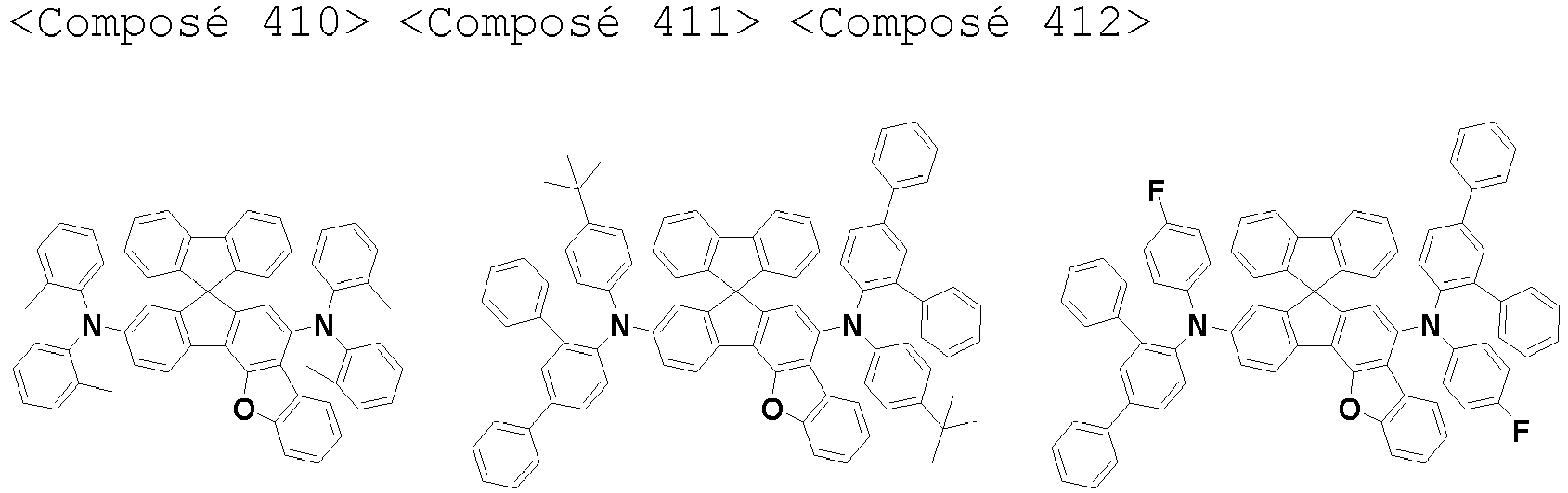
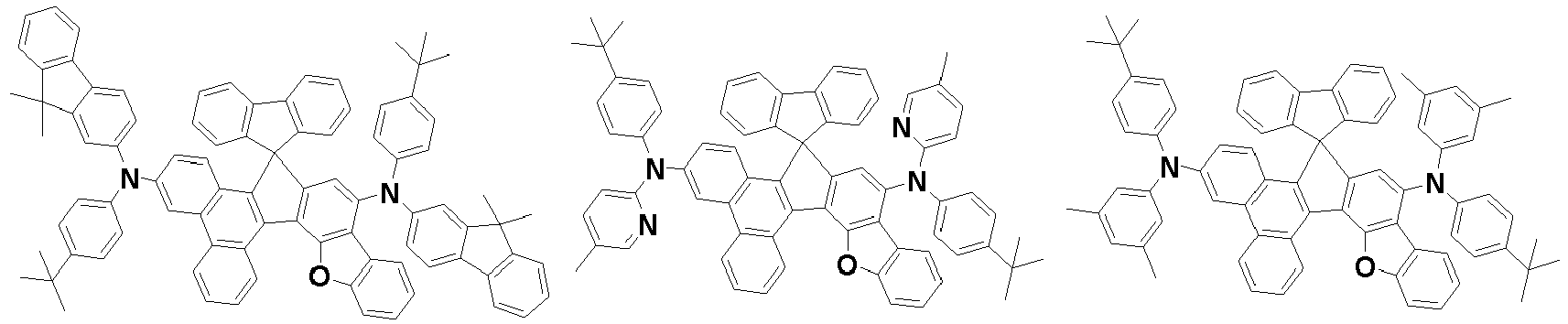
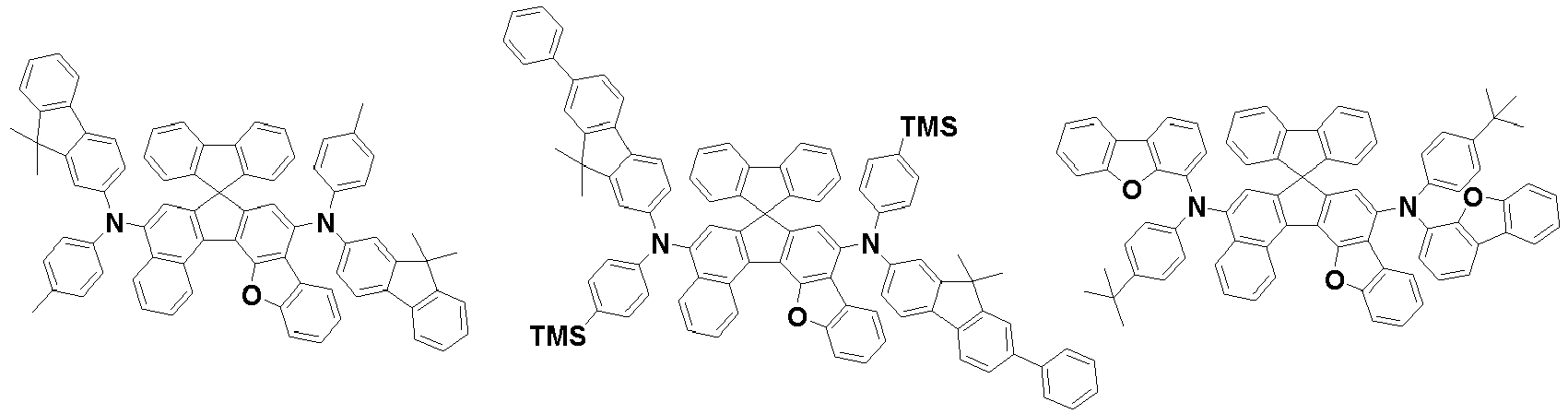
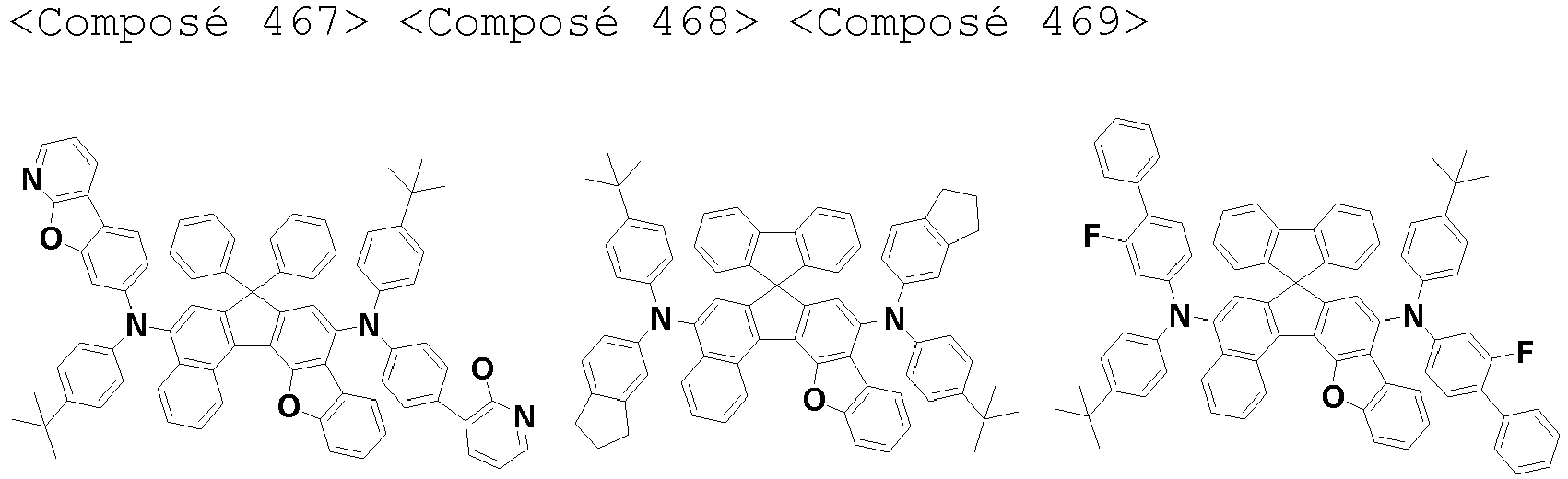
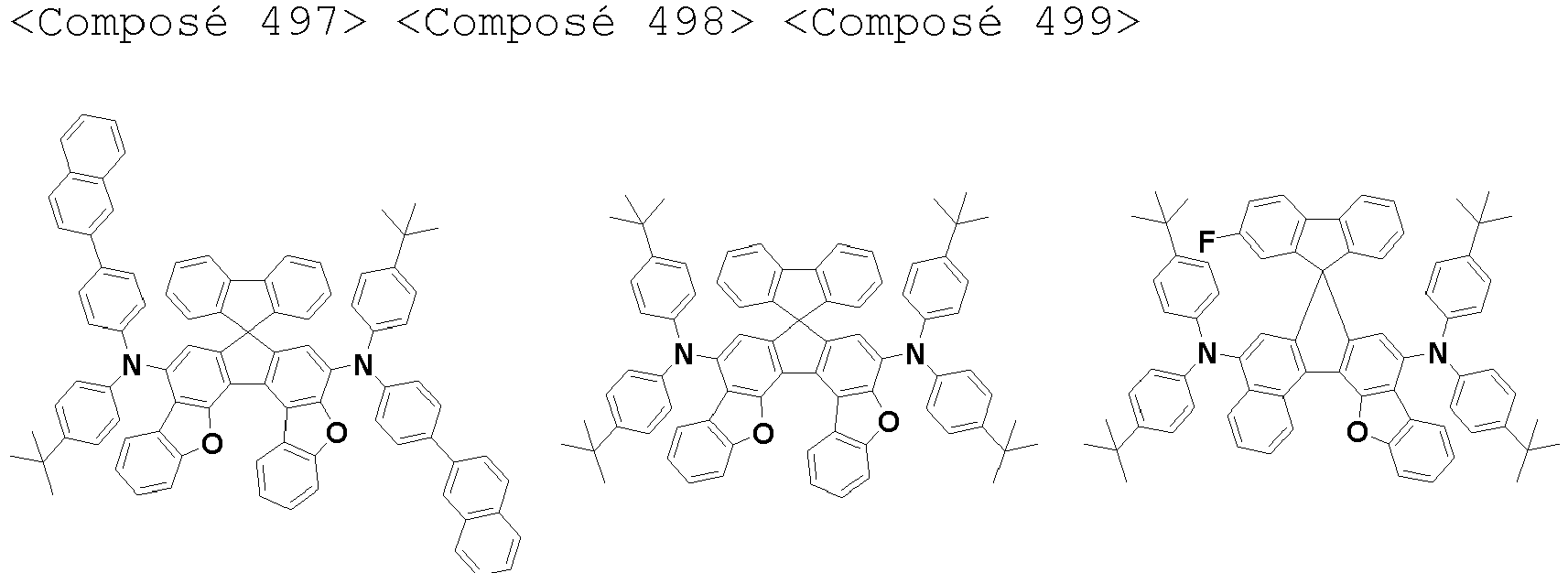
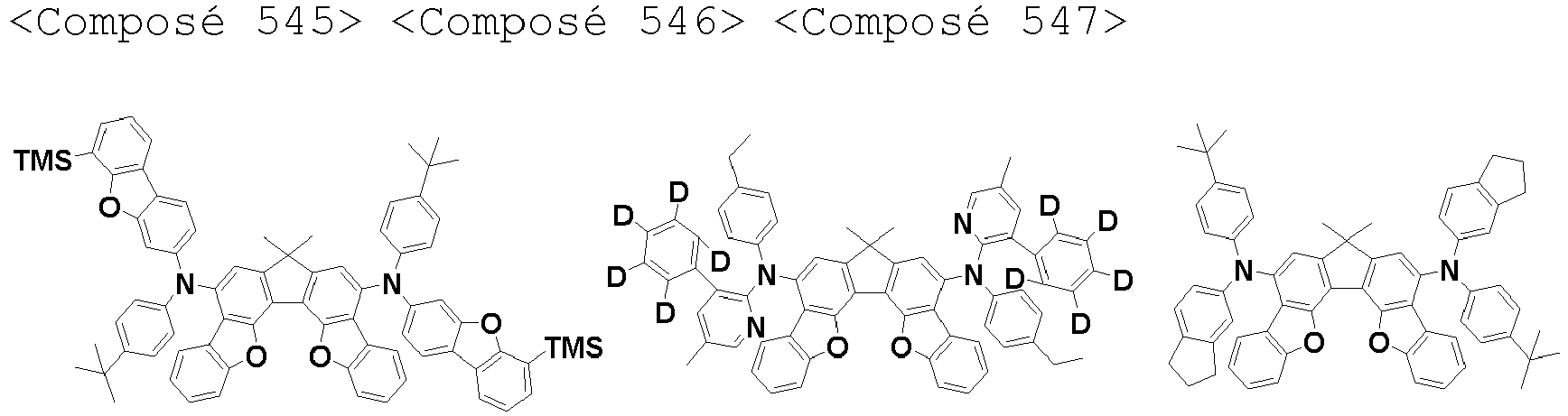
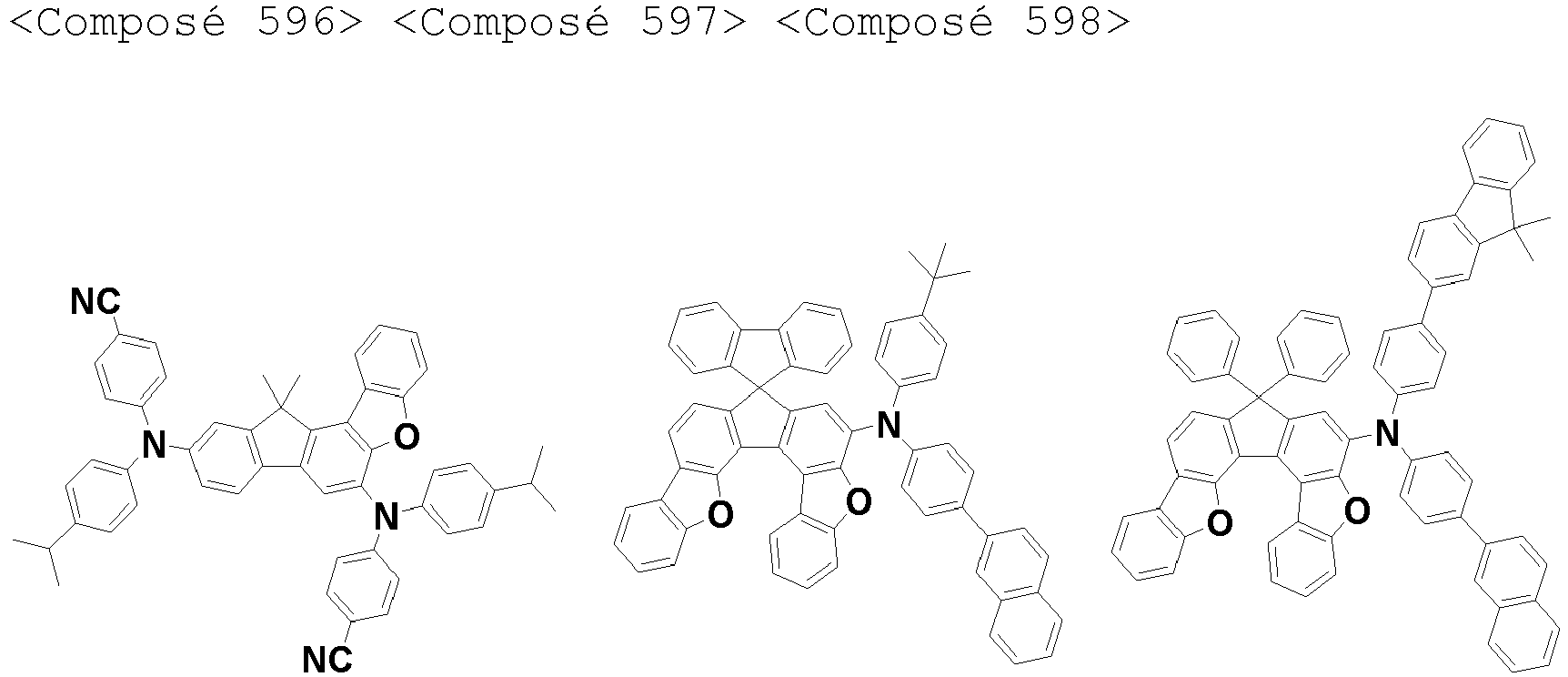
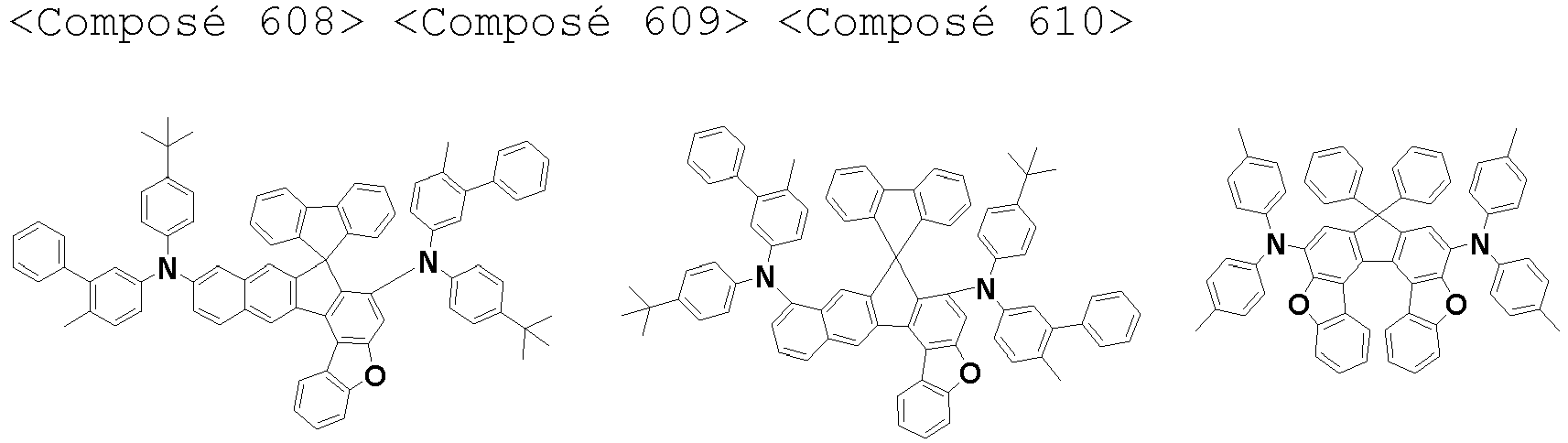
- the amine compound represented by Chemical Formula D1 or D2 may be any one selected from the following Compound 401 to Compound 639, but is not limited thereto:
- the host used in the light-emitting layer may include at least one compound represented by the following [Chemical Formula H] and may further various well-known host materials: wherein, X 1 to X 10 , which may be the same or different, are each independently selected from the group consisting of a hydrogen atom, a deuterium atom, a substituted or unsubstituted alkyl of 1 to 30 carbon atoms, a substituted or unsubstituted alkenyl of 2 to 30 carbon atoms, a substituted or unsubstituted cycloalkyl of 3 to 30 carbon atoms, a substituted or unsubstituted cycloalkenyl of 5 to 30 carbon atoms, a substituted or unsubstituted alkoxy of 1 to 30 carbon atoms, a substituted or unsubstituted aryloxy of 6 to 30 carbon atoms, a substituted or unsubstituted alkylthioxy of 1 to 30 carbon atom
- the host may be represented by any one selected from [Compound 701] to [Compound 896], but is not limited thereto:
- the content of the dopant may range from about 0.01 to 20 parts by weight, based on 100 parts by weight of the host, but is not limited thereto.
- a material for use in the electron transport layer of the present disclosure functions to stably carry the electrons injected from the electron injection electrode (cathode), and may be an electron transport material known in the art.
- the electron transport material known in the art include quinoline derivatives, particularly, tris(8-quinolinorate)aluminium (Alq3), Liq, TAZ, BAlq, beryllium bis(benzoquinolin-10-olate) (Bebq 2 ), compound 201, compound 202, BCP, and oxadiazole derivatives such as PBD, BMD, and BND, but are not limited thereto:
- organic metal compound represented by Chemical Formula F may be used, either alone or in combination with the aforementioned electron transport layer material in the present disclosure: wherein,
- Y's which may be the same or different, are each one selected from among, but not limited to, the following [Structural Formula C1] to [Structural Formula C39]: wherein, R's, which may be the same or different, are each independently selected from among a hydrogen atom, a deuterium atom, a halogen, a cyano, a substituted or unsubstituted alkyl of 1 to 30 carbon atoms, a substituted or unsubstituted aryl of 6 to 30 carbon atoms, a substituted or unsubstituted heteroaryl of 3 to 30 carbon atoms, a substituted or unsubstituted alkoxy of 1 to 30 carbon atoms, a substituted or unsubstituted cycloalkyl of 3 to 30 carbon atoms, a substituted or unsubstituted alkenyl of 2 to 30 carbon atoms, a substituted or unsubstituted al
- An electron injecting layer that functions to facilitate electron injection from the cathode, thus improving the power efficiency of the diode, may be further deposited on the electron transport layer. So long as it is conventionally used in the art, any material can be available for the electron injecting layer without particular limitations. Examples include LiF, NaCl, CsF, Li 2 O, and BaO. A deposition condition of the EIL may be almost the same as that for the hole injection layer.
- the electron injecting layer may range in thickness from about 1 ⁇ to about 100 ⁇ and particularly from about 3 ⁇ to about 90 ⁇ . Given the thickness range for the electron injecting layer, the diode can exhibit satisfactory electron injection properties without actually elevating a driving voltage.
- the first electrode is an anode and the second electrode is a cathode.
- the organic light-emitting diode may further comprise at least one of a functional layer capable of both hole injection and hole transport, an electron transport layer, and an electron injecting layer, wherein the electron transport layer and the electron injecting layer may be sequentially disposed between between the light-emitting layer and the cathode.
- a hole injecting layer, a hole transport layer, and a light-emitting layer are sequentially deposited between the first electrode and the second electrode, wherein the hole injecting layer or the hole transport layer comprises at least one of the amine compounds represented by Chemical Formula A or B; and the light-emitting layer comprises at least one of the amine compounds represented by Chemical Formula D1 and D2.
- an organic layer comprises at least one organic compound
- the expression "(an organic layer) comprises at least one organic compound” is construed to mean that the organic layer may comprise one organic compound falling within the scope of the present disclosure or two or more different compounds falling within the scope of the present disclosure.
- the hole injecting layer, the hole transport layer, the electron blocking layer, the light-emitting layer, the electron transport layer, and the electron injecting layer may be deposited using a deposition process or a solution process.
- the deposition process is a process by which a material is vaporized in a vacuum or at a low pressure and deposited to form a layer
- the solution process is a method in which a material is dissolved in a solvent and applied for the formation of a thin film by means of inkjet printing, roll-to-roll coating, screen printing, spray coating, dip coating, spin coating, etc.
- the organic light-emitting diode of the present disclosure may be applied to a device selected from among flat display devices, flexible display devices, monochrome or grayscale flat illumination devices, and monochrome or grayscale flexible illumination devices.
- FIG. 1 is a schematic cross-sectional view of the structure of an organic light-emitting diode according to some embodiments of the present disclosure.
- the organic light-emitting diode includes an anode 20, a hole transport layer 40, an organic light-emitting layer 50, an electron transport layer 60, and a cathode 80, and optionally a hole injecting layer 30 or an electron injecting layer 70.
- one or two intermediate layers may be further formed in the organic light-emitting diode.
- FIG. 1 With regard to the fabrication of the organic light-emitting diode of the present disclosure.
- a substrate 10 is coated with an anode electrode material to form an anode 20.
- an anode electrode material may be used as the substrate 10.
- an organic substrate or transparent plastic substrate that exhibits excellent transparency, surface smoothness, ease of handling, and waterproofness.
- the anode electrode material indium tin oxide (ITO), indium zinc oxide (IZO), tin oxide (SnO 2 ), or zinc oxide (ZnO), which are transparent and superior in terms of conductivity, may be used.
- a hole injection layer material is applied on the anode electrode 20 by thermal deposition in a vacuum or by spin coating to form a hole injection layer 30. Subsequently, using thermal deposition in a vacuum or spin coating, a hole transport layer material is applied to the hole injection layer 30 to form a hole transport layer 40.
- an organic light-emitting layer 50 is deposited on the hole transport layer 40, optionally followed by the formation of a hole barrier layer (not shown) on the organic light-emitting layer 50 by deposition in a vacuum or by spin coating.
- a hole barrier layer (not shown) on the organic light-emitting layer 50 by deposition in a vacuum or by spin coating.
- the hole barrier layer serves to prevent the introduction of holes into the cathode. Any material that has a higher ionization potential than the light-emitting compound and which is also able to carry electrons may be used for the hole barrier layer without limitation. Representative among hole barrier materials are BAlq, BCP, and TPBI.
- the organic light-emitting diode according to the present disclosure can be advantageously improved in efficiency.
- the use of the material represented by Chemical Formula D1 or D2 in the light-emitting layer guarantee more improved efficiency to the organic light-emitting diode.
- an electron transport layer 60 may be deposited on the hole barrier layer and may then be overlaid with an electron injection layer 70.
- a cathode metal is deposited on the electron injection layer 70 by thermal deposition in a vacuum to form a cathode 80, thus obtaining an organic EL diode.
- the cathode may be made of lithium (Li), magnesium (Mg), aluminum (Al), aluminum-lithium (Al-Li), calcium (Ca), magnesium-indium (Mg-In), or magnesium-silver (Mg-Ag).
- a transparent cathode made of ITO or IZO may be employed.
- the organic layer thus formed was separated, dried over magnesium sulfate, and concentrated in a vacuum.
- the concentrate was purified by column chromatography and recrystallized in dichloromethane and acetone to yield the compound of Chemical Formula 2 as a solid (2.9 g, 38%).
- 1-bromo-4-(2-naphthyl)benzene (9.9 g, 0.035 mol), aniline (3.6 g, 0.039 mol), tris(dibenzylideneacetone)dipalladium(0) (0.65 g, 0.0007 mol), sodium tert-butoxide (6.79 g, 0.0706 mol), 2,2'-bis(diphenylphosphino)-1,1'-binaphthalene (0.44 g, 0.0007 mol), and toluene (100 ml) were stirred together under reflux for 3 hours.
- An ITO glass substrate was patterned to have a translucent area of 2 mm ⁇ 2 mm and cleansed.
- the ITO glass was mounted in a vacuum chamber that was then set to have a base pressure of 1 ⁇ 10 -6 torr.
- films were sequentially formed of DNTPD (400 ⁇ ) and each of the compounds (200 ⁇ ) listed in Table 1 below.
- a light-emitting layer (250 ⁇ ) was formed of [BH] as a host and 3wt% of each of the compounds list in Table 1 as a dopant and covered with [HBL] (50 ⁇ ) to form a hole barrier layer.
- [Chemical Formula E-1] was deposited to form an electron transport layer (200 ⁇ ), on which an electron injecting layer of [Chemical Formula E-2] (5 ⁇ ) was formed and then covered with an Al layer (1000 ⁇ ) to fabricate an organic light-emitting diode.
- the organic light-emitting diodes thus obtained were measured at 0.4 mA for luminescence properties:
- An organic light-emitting diode was fabricated in the same manner as in Example 1, with the exception that the conventional compound [HT] was used, instead of the compounds used for the hole transport layer in Examples 1 to 13.
- the luminescence of the organic light-emitting diodes thus obtained was measured at 0.4 mA and the measurements are summarized in Table 1.
- the structure of [HT] is as follows:
- the organic light-emitting diodes of Examples 1 to 21 have greater emission efficiencies compared to those of Comparative Examples 1 and 2. Particularly, the organic light-emitting diodes of Examples 1 to 13 and 16 to 21 exhibit very improved emission efficiencies and are thus highly industrially applicable.
- the organic light-emitting diode of the present invention is expected to be highly industrially applicable.
Landscapes
- Chemical & Material Sciences (AREA)
- Organic Chemistry (AREA)
- Physics & Mathematics (AREA)
- Engineering & Computer Science (AREA)
- Materials Engineering (AREA)
- Spectroscopy & Molecular Physics (AREA)
- Optics & Photonics (AREA)
- Manufacturing & Machinery (AREA)
- Electroluminescent Light Sources (AREA)
Claims (15)
- Diode électroluminescente organique, comprenant :une première électrode (20) ; une seconde électrode (80) faisant face à la première électrode (20) ;une couche d'injection de trous (30) ou une couche de transport de trous (40) interposée entre la première électrode (20) et la seconde électrode (80) ; etune couche photoémettrice (50),dans laquelle la couche d'injection de trous (30) ou la couche de transport de trous (40) comprend au moins un des composés aminés représentés par la Formule chimique A ou B suivante :


 A1, A2, E, et F, qui peuvent être identiques ou différents, sont chacun indépendamment un cycle hydrocarboné aromatique substitué ou non substitué ayant de 6 à 50 atomes de carbone, ou un cycle hétéroaromatique substitué ou non substitué ayant de 2 à 40 atomes de carbone ;
deux atomes de carbone adjacents dans le cycle aromatique de A1 et deux atomes de carbone adjacents dans le cycle aromatique de A2 formant un cycle à 5 chaînons ayant un atome de carbone relié aux deux substituants R1 et R2, établissant ainsi une structure cyclique condensée ;les segments de liaison L1 à L6, qui peuvent être identiques ou différents, sont choisis chacun indépendamment parmi une liaison simple, un groupe alkylène substitué ou non substitué ayant de 1 à 60 atomes de carbone, un groupe alcénylène substitué ou non substitué ayant de 2 à 60 atomes de carbone, un groupe alcynylène substitué ou non substitué ayant de 2 à 60 atomes de carbone, un groupe cycloalkylène substitué ou non substitué ayant de 3 à 60 atomes de carbone, un groupe hétérocycloalkylène substitué ou non substitué ayant de 2 à 60 atomes de carbone, un groupe arylène substitué ou non substitué ayant de 6 à 60 atomes de carbone, et un groupe hétéroarylène substitué ou non substitué ayant de 2 à 60 atomes de carbone ;M est choisi parmi N-R3, CR4R5, SiR6R7, GeR8R9, O, S, et Se ;R1 à R9 et Ar1 à Ar4, qui peuvent être identiques ou différents, sont choisis chacun indépendamment parmi un atome d'hydrogène, un atome de deutérium, un groupe alkyle substitué ou non substitué ayant de 1 à 30 atomes de carbone, un groupe aryle substitué ou non substitué ayant de 6 à 50 atomes de carbone, un groupe alcényle substitué ou non substitué ayant de 2 à 30 atomes de carbone, un groupe alcynyle substitué ou non substitué ayant de 2 à 20 atomes de carbone, un groupe cycloalkyle substitué ou non substitué ayant de 3 à 30 atomes de carbone, un groupe cycloalcényle substitué ou non substitué ayant de 5 à 30 atomes de carbone, un groupe hétéroaryle substitué ou non substitué ayant de 2 à 50 atomes de carbone, un groupe hétérocycloalkyle substitué ou non substitué ayant de 2 à 30 atomes de carbone, un groupe alcoxy substitué ou non substitué ayant de 1 à 30 atomes de carbone, un groupe aryloxy substitué ou non substitué ayant de 6 à 30 atomes de carbone, un groupe alkylthioxy substitué ou non substitué ayant de 1 à 30 atomes de carbone, un groupe arylthioxy substitué ou non substitué ayant de 6 à 30 atomes de carbone, un groupe alkylamino substitué ou non substitué ayant de 1 à 30 atomes de carbone, un groupe arylamino substitué ou non substitué ayant de 6 à 30 atomes de carbone, un groupe alkylsilyle substitué ou non substitué ayant de 1 à 30 atomes de carbone, un groupe arylsilyle substitué ou non substitué ayant de 6 à 30 atomes de carbone, un groupe alkylgermanium substitué ou non substitué ayant de 1 à 30 atomes de carbone, un groupe arylgermanium substitué ou non substitué ayant de 1 à 30 atomes de carbone, un groupe cyano, un groupe nitro, et un atome d'halogène,R1 et R2 dans la Formule chimique A et la Formule chimique B n'étant pas liés l'un à l'autre,p1 et p2, r1 et r2, et s1 et s2 sont chacun indépendamment un nombre entier valant de 1 à 3, parmi lesquels lorsque l'un quelconque de ceux-ci est égal ou supérieur à 2, les segments de liaison L1 à L6 correspondants peuvent être identiques ou différents,Ar1 et Ar2 peuvent être reliés l'un à l'autre pour former un cycle et Ar3 et Ar4 peuvent être reliés l'un à l'autre pour former un cycle ;deux atomes de carbone adjacents dans le cycle A2 dans la Formule chimique A sont liés aux * respectifs de la formule structurale Q2 pour former un cycle condensé, etdeux atomes de carbone adjacents dans le cycle A1 dans la Formule chimique B sont liés aux * respectifs de la formule structurale Q2 pour former un cycle condensé et deux atomes de carbone adjacents dans le cycle A2 dans la Formule chimique B sont liés aux * respectifs de la formule structurale Q2 pour former un cycle condensé,le terme « substitué » dans l'expression « substitué ou non substitué » utilisée pour la Formule chimique A et la Formule chimique B signifiant porteur d'au moins un substituant choisi dans le groupe constitué par un atome de deutérium, un groupe cyano, un atome d'halogène, un groupe hydroxy, un groupe nitro, un groupe alkyle ayant de 1 à 24 atomes de carbone, un groupe alkyle halogéné ayant de 1 à 24 atomes de carbone, un groupe alcényle ayant de 2 à 24 atomes de carbone, un groupe alcynyle ayant de 2 à 24 atomes de carbone, un groupe hétéroalkyle ayant de 1 à 24 atomes de carbone, un groupe aryle ayant de 6 à 24 atomes de carbone, un groupe arylalkyle ayant de 7 à 24 atomes de carbone, un groupe hétéroaryle ayant de 2 à 24 atomes de carbone ou un groupe hétéroarylalkyle ayant de 2 à 24 atomes de carbone, un groupe alcoxy ayant de 1 à 24 atomes de carbone, un groupe alkylamino ayant de 1 à 24 atomes de carbone, un groupe arylamino ayant de 6 à 24 atomes de carbone, un groupe hétéroarylamino ayant de 1 à 24 atomes de carbone, un groupe alkylsilyle ayant de 1 à 24 atomes de carbone, un groupe arylsilyle ayant de 6 à 24 atomes de carbone, et un groupe aryloxy ayant de 6 à 24 atomes de carbone. - Diode électroluminescente organique selon la revendication 1, dans laquelle A1, A2, E, et F dans la Formule chimique A ou la Formule chimique B, qui peuvent être identiques ou différents, sont chacun indépendamment un cycle hydrocarboné aromatique substitué ou non substitué ayant de 6 à 50 atomes de carbone.
- Diode électroluminescente organique selon la revendication 2, dans laquelle les cycles hydrocarbonés aromatiques substitués ou non substitués ayant de 6 à 50 atomes de carbone sont identiques ou différents et sont chacun indépendamment l'un quelconque choisi parmi les cycles de [Formule structurale 10] à [Formule structurale 21] :


 « * » désigne un site de liaison pour la formation d'un cycle à 5 chaînons portant l'atome de carbone lié aux substituants R1 et R2 ou un site de liaison pour la formation d'un cycle à 5 chaînons portant M des Formules structurales Q1 et Q2 ;lorsque l'un des cycles hydrocarbonés aromatiques de la [Formule structurale 10] à la [Formule structurale 21] pour A1 ou A2 est lié à la Formule structurale Q1 ou à la Formule structurale Q2, deux atomes de carbone adjacents du cycle hydrocarboné aromatique occupent les positions respectives * de la Formule structurale Q1 ou Q2 pour former un cycle condensé ;R est tel que défini pour R1 et R2 ci-dessus ; et m est un nombre entier valant de 1 à 8, lorsque m est égal ou supérieur à 2 ou lorsque R existe sous forme de radicaux multiples, les R résultants pouvant être identiques ou différents.
 - Diode électroluminescente organique selon la revendication 1, dans laquelle le composé aminé représenté par la Formule chimique A ou B est contenu dans la couche de transport de trous (40).
- Diode électroluminescente organique selon la revendication 1, dans laquelle les segments de liaison L1 à L6 dans les Formules chimiques A et B sont identiques ou différents et sont chacun indépendamment une liaison simple ou un groupement quelconque choisi parmi les Formules structurales 22 à 30 suivantes, et p1 et p2, r1 et r2, et s1 et s2 valent chacun 1 ou 2 :



- Diode électroluminescente organique selon la revendication 1, dans laquelle R1 et R2 dans la Formule chimique A et la Formule chimique B sont identiques ou différents et sont chacun un groupe aryle substitué ou non substitué ayant de 6 à 50 atomes de carbone qui reste non relié.
- Diode électroluminescente organique selon la revendication 1, dans laquelle le composé aminé représenté par la Formule chimique A ou B est l'un quelconque des composés représentés par les Formules chimiques suivantes 32, 37, 39, 46 à 87, 94 à 99, 103 à 108, 111 à 117, 120, 121, 123, 125 à 142, 144 :
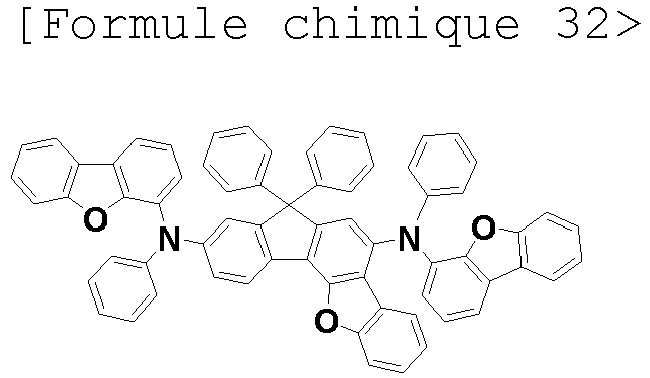

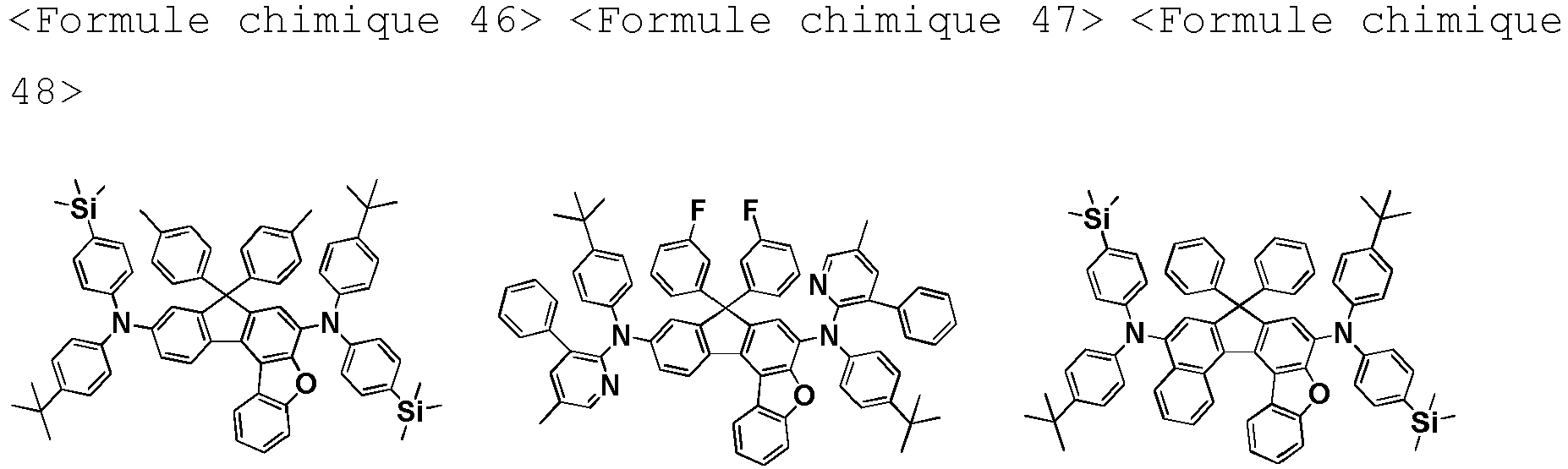


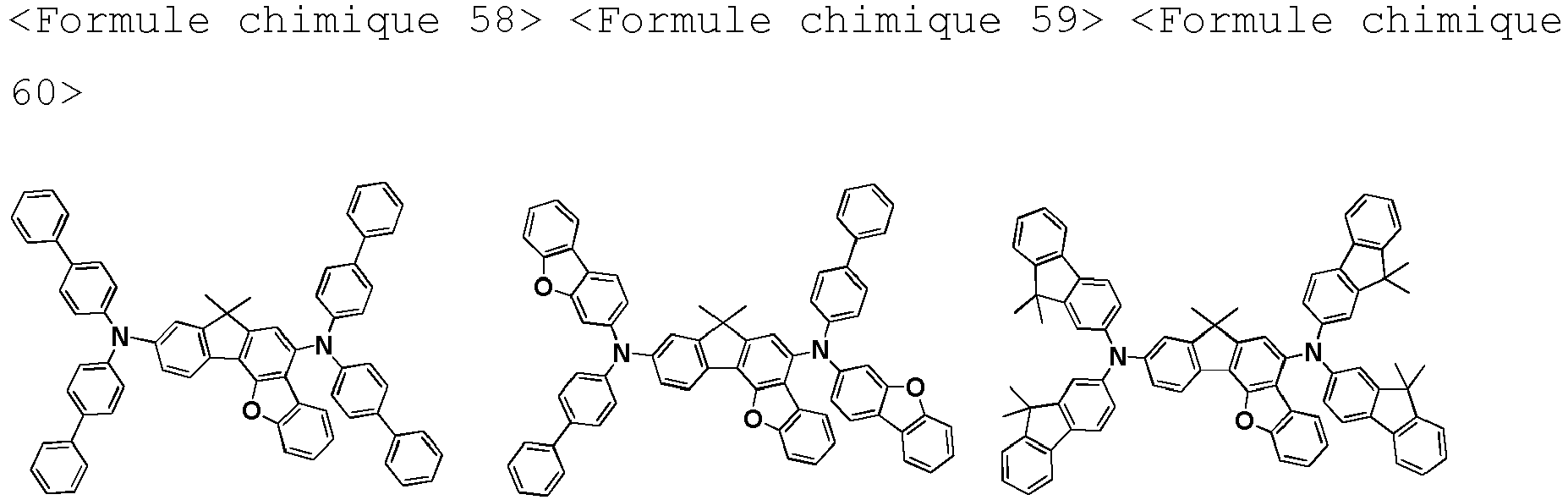




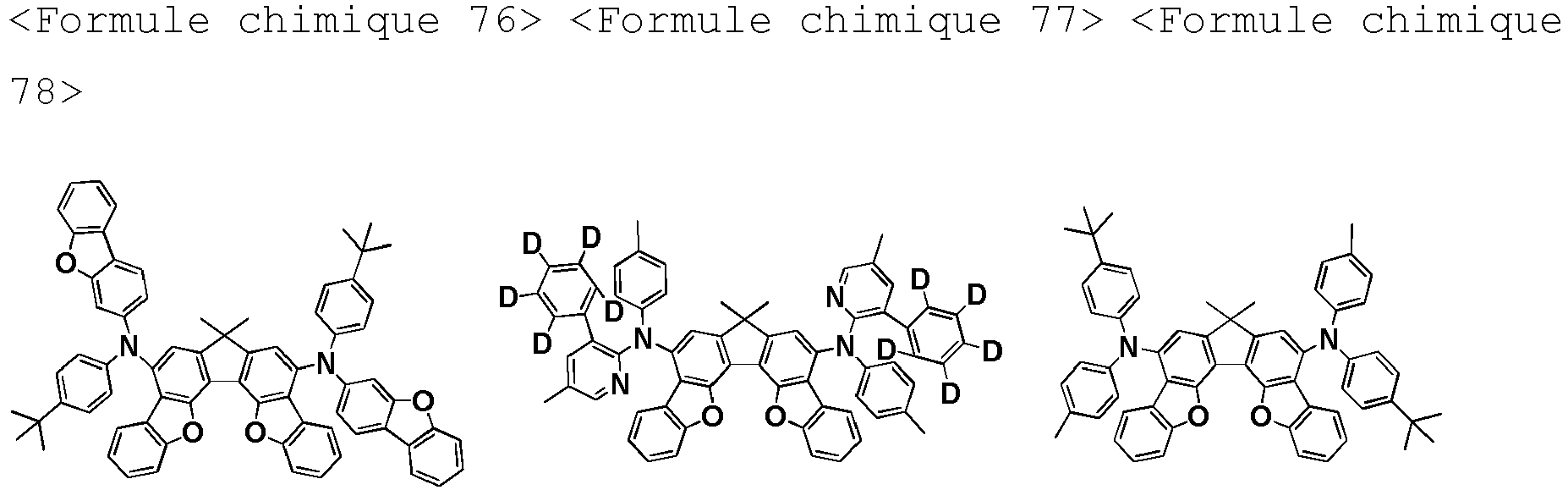


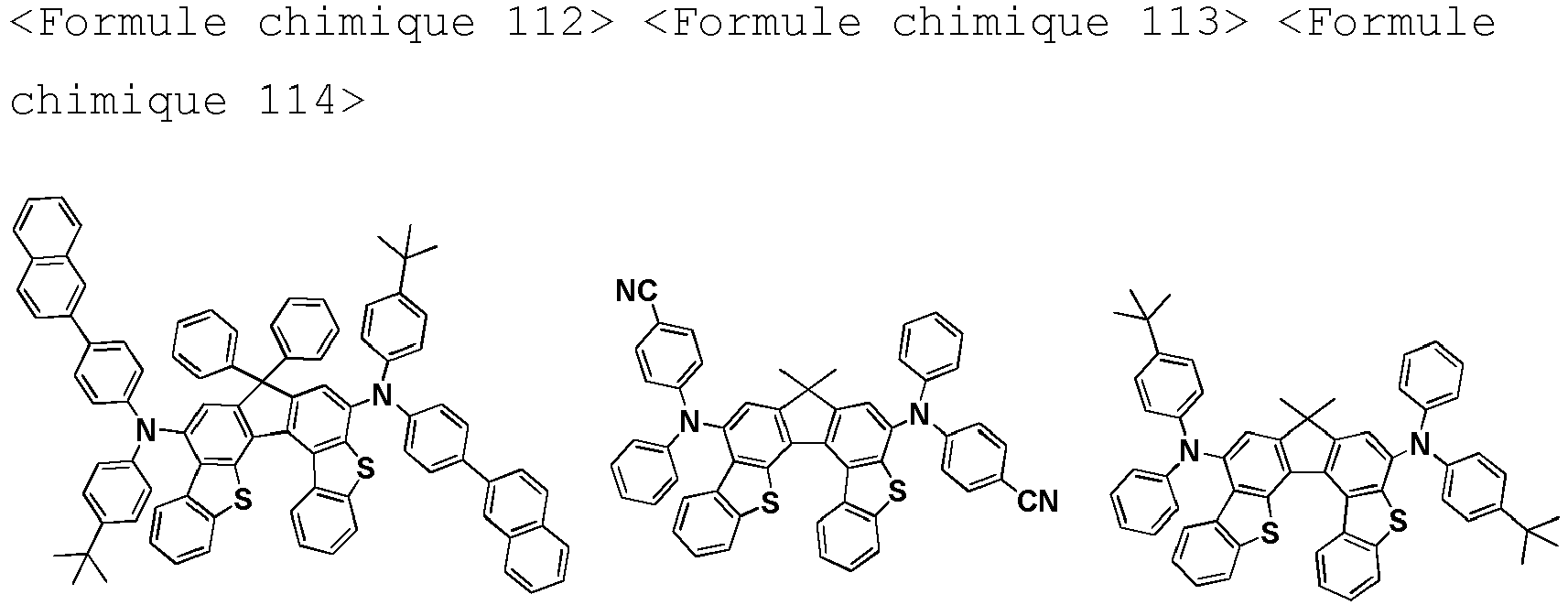

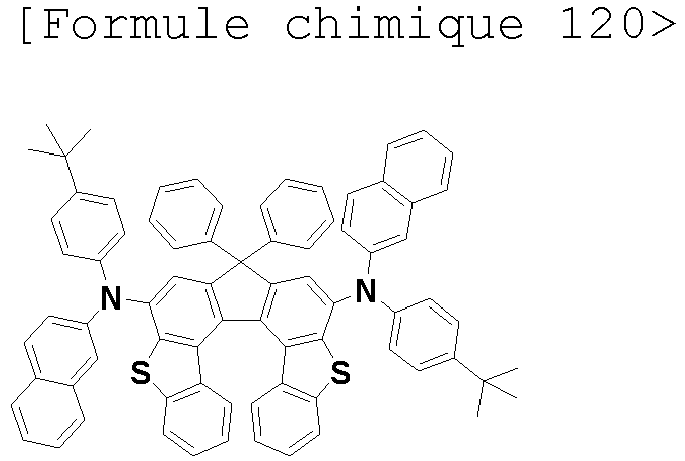


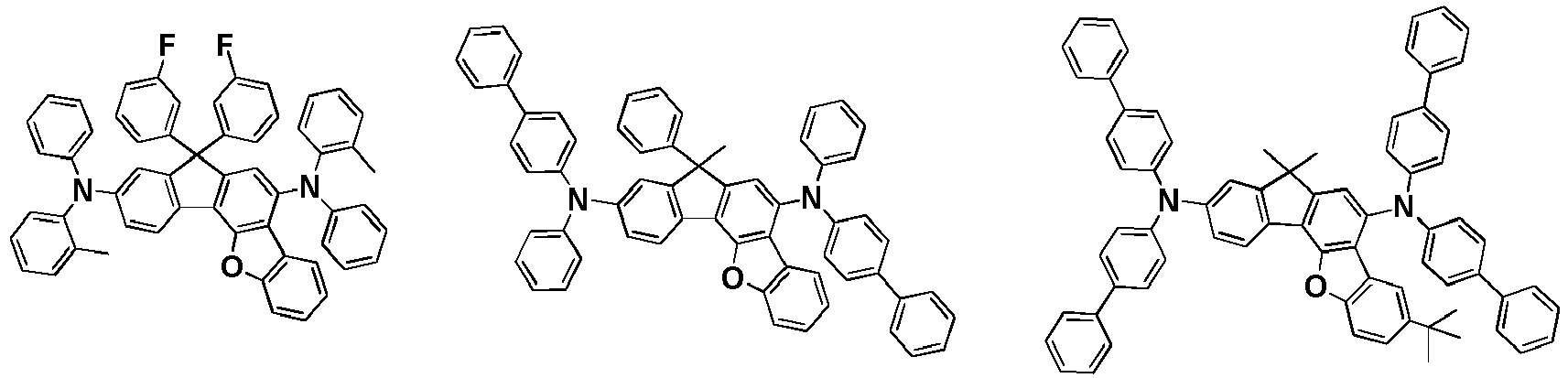





- Diode électroluminescente organique selon la revendication 1, dans laquelle un ou deux parmi A1, A2, E, et F dans les Formules chimiques A et B sont chacun indépendamment un cycle hétéroaromatique substitué ou non substitué ayant de 2 à 40 atomes de carbone.
- Diode électroluminescente organique selon la revendication 8, dans laquelle un parmi A1, A2, E, et F dans les Formules chimiques A et B est un cycle hétéroaromatique substitué ou non substitué ayant de 2 à 40 atomes de carbone.
- Diode électroluminescente organique selon la revendication 1, dans laquelle la couche photoémettrice comprend au moins un des composés aminés représentés par les Formules chimiques D1 et D2 suivantes :
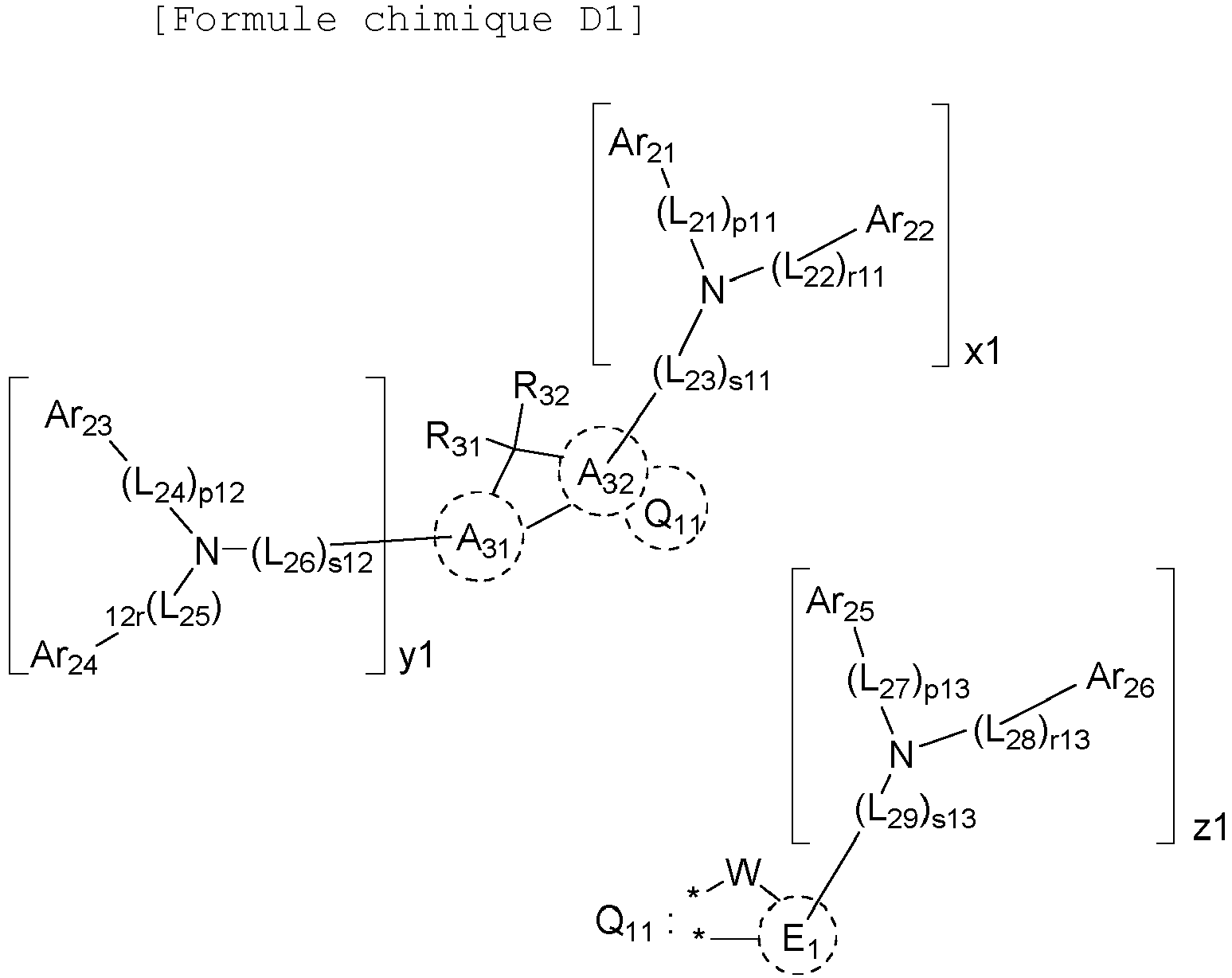
 A31, A32, E1 et F1, qui peuvent être identiques ou différents, sont chacun indépendamment un cycle hydrocarboné aromatique substitué ou non substitué ayant de 6 à 50 atomes de carbone, ou un cycle hétéroaromatique substitué ou non substitué ayant de 2 à 40 atomes de carbone ;
deux atomes de carbone adjacents dans le cycle aromatique de A31 et deux atomes de carbone adjacents dans le cycle aromatique de A32 forment un cycle à 5 chaînons ayant un atome de carbone relié aux deux substituants R31 et R32, établissant ainsi une structure cyclique condensée ;les segments de liaison L21 à L32, qui peuvent être identiques ou différents, sont choisis chacun indépendamment parmi une liaison simple, un groupe alkylène substitué ou non substitué ayant de 1 à 60 atomes de carbone, un groupe alcénylène substitué ou non substitué ayant de 2 à 60 atomes de carbone, un groupe alcynylène substitué ou non substitué ayant de 2 à 60 atomes de carbone, un groupe cycloalkylène substitué ou non substitué ayant de 3 à 60 atomes de carbone, un groupe hétérocycloalkylène substitué ou non substitué ayant de 2 à 60 atomes de carbone, un groupe arylène substitué ou non substitué ayant de 6 à 60 atomes de carbone et un groupe hétéroarylène substitué ou non substitué ayant de 2 à 60 atomes de carbone ;W est choisi parmi N-R33, CR34R35, SiR36R37, GeR38R39, O, S, et Se ;R31 à R39 et Ar21 à Ar28, qui peuvent être identiques ou différents, sont choisis chacun indépendamment parmi un atome d'hydrogène, un atome de deutérium, un groupe alkyle substitué ou non substitué ayant de 1 à 30 atomes de carbone, un groupe aryle substitué ou non substitué ayant de 6 à 50 atomes de carbone, un groupe alcényle substitué ou non substitué ayant de 2 à 30 atomes de carbone, un groupe alcynyle substitué ou non substitué ayant de 2 à 20 atomes de carbone, un groupe cycloalkyle substitué ou non substitué ayant de 3 à 30 atomes de carbone, un groupe cycloalcényle substitué ou non substitué ayant de 5 à 30 atomes de carbone, un groupe hétéroaryle substitué ou non substitué ayant de 2 à 50 atomes de carbone, un groupe hétérocycloalkyle substitué ou non substitué ayant de 2 à 30 atomes de carbone, un groupe alcoxy substitué ou non substitué ayant de 1 à 30 atomes de carbone, un groupe aryloxy substitué ou non substitué ayant de 6 à 30 atomes de carbone, un groupe alkylthioxy substitué ou non substitué ayant de 1 à 30 atomes de carbone, un groupe arylthioxy substitué ou non substitué ayant de 5 à 30 atomes de carbone, un groupe alkylamino substitué ou non substitué ayant de 1 à 30 atomes de carbone, un groupe arylamino substitué ou non substitué ayant de 5 à 30 atomes de carbone, un groupe alkylsilyle substitué ou non substitué ayant de 1 à 30 atomes de carbone, un groupe arylsilyle substitué ou non substitué ayant de 5 à 30 atomes de carbone, un groupe alkylgermanium substitué ou non substitué ayant de 1 à 30 atomes de carbone, un groupe arylgermanium substitué ou non substitué ayant de 1 à 30 atomes de carbone, un groupe cyano, un groupe nitro et un atome d'halogène,
R31 et R32 pouvant être liés l'un à l'autre pour former un cycle aliphatique ou aromatique mono- ou polycyclique qui peut porter au moins un hétéroatome choisi parmi N, O, P, Si, S, Ge, Se, et Te en tant que chaînon formant le cycle ;p11 à p14, r11 à r14, et s11 à s14 sont chacun indépendamment un nombre entier valant de 1 à 3, parmi lesquels lorsque l'un quelconque de ceux-ci est égal ou supérieur à 2, les segments de liaison correspondants L21 à L32 peuvent être identiques ou différents,x1 est un nombre entier valant 1 ou 2, et y1 et z1, qui peuvent être identiques ou différents, sont chacun indépendamment un nombre entier valant de 0 à 3 ;une liaison peut être établie entre Ar21 et Ar22, entre Ar23 et Ar24, entre Ar25 et Ar26, et entre Ar27 et Ar28 pour former des cycles respectifs ;deux atomes de carbone adjacents dans le cycle A32 dans la Formule chimique D1 sont liés aux * respectifs de la Formule structurale Q11 pour former un cycle condensé, etdeux atomes de carbone adjacents dans le cycle A32 dans la Formule chimique D2 sont liés aux * respectifs de la Formule structurale Q12 pour former un cycle condensé et deux atomes de carbone adjacents dans le cycle A32 dans la Formule chimique D2 sont liés aux * respectifs de la Formule structurale Q11 pour former un cycle condensé. - Diode électroluminescente organique selon la revendication 10, dans laquelle A31, A32, E2, et F2 dans les composés représentés par la Formule chimique D1 et la Formule chimique D2 sont identiques ou différents et sont chacun indépendamment un cycle hydrocarboné aromatique substitué ou non substitué ayant de 6 à 50 atomes de carbone.
- Diode électroluminescente organique selon la revendication 10, dans laquelle les segments de liaison L21 à L32 dans les Formules chimiques D1 et D2 sont identiques ou différents et sont chacun indépendamment une liaison simple ou un groupement quelconque choisi parmi ceux de [Formule structurale 22] à [Formule structurale 30] suivantes, p11 à p14, r11 à r14, et s11 à s14 valent chacun 1 ou 2, et x1 est 1 :


- Diode électroluminescente organique selon la revendication 12, dans laquelle le composé aminé représenté par la Formule chimique D1 ou D2 est l'un quelconque choisi parmi les composés 401 à 639 suivants :
















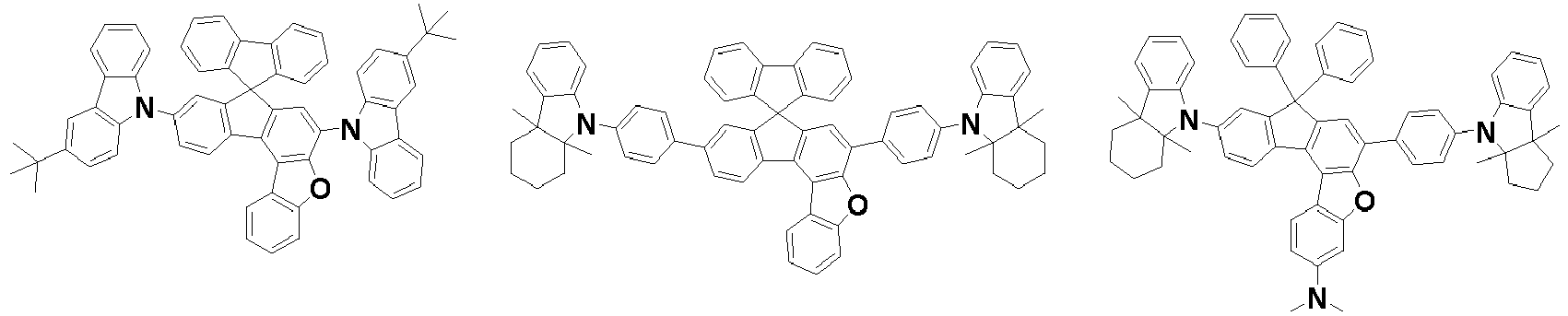


- Diode électroluminescente organique selon la revendication 1, dans laquelle la diode électroluminescente organique comprend en outre au moins une parmi une couche d'injection de trous (30), une couche de transport de trous (40), une couche fonctionnelle capable à la fois d'injection de trous et de transport de trous, une couche de transport d'électrons (60), et une couche d'injection d'électrons (70) en plus de la couche photoémettrice (50).
- Diode électroluminescente organique selon la revendication 1, dans laquelle la diode électroluminescente organique est utilisée pour un dispositif choisi parmi un dispositif d'affichage plat, un dispositif d'affichage flexible, un dispositif d'éclairage plat monochrome ou en nuances de gris, et un dispositif d'éclairage flexible monochrome ou en nuances de gris.
Applications Claiming Priority (2)
| Application Number | Priority Date | Filing Date | Title |
|---|---|---|---|
| KR20170087728 | 2017-07-11 | ||
| PCT/KR2018/007876 WO2019013556A1 (fr) | 2017-07-11 | 2018-07-11 | Diode électroluminescente organique ayant une efficacité élevée |
Publications (4)
| Publication Number | Publication Date |
|---|---|
| EP3654395A1 EP3654395A1 (fr) | 2020-05-20 |
| EP3654395A4 EP3654395A4 (fr) | 2021-04-07 |
| EP3654395B1 true EP3654395B1 (fr) | 2024-08-28 |
| EP3654395B9 EP3654395B9 (fr) | 2024-11-06 |
Family
ID=65002041
Family Applications (1)
| Application Number | Title | Priority Date | Filing Date |
|---|---|---|---|
| EP18831305.0A Active EP3654395B9 (fr) | 2017-07-11 | 2018-07-11 | Diode électroluminescente organique ayant une efficacité élevée |
Country Status (5)
| Country | Link |
|---|---|
| US (1) | US11532792B2 (fr) |
| EP (1) | EP3654395B9 (fr) |
| KR (1) | KR102637968B1 (fr) |
| CN (1) | CN110832657B (fr) |
| WO (1) | WO2019013556A1 (fr) |
Families Citing this family (7)
| Publication number | Priority date | Publication date | Assignee | Title |
|---|---|---|---|---|
| KR101817775B1 (ko) * | 2015-11-12 | 2018-01-11 | 에스에프씨주식회사 | 신규한 유기발광 화합물 및 이를 포함하는 유기 발광 소자 |
| EP3904346B1 (fr) * | 2019-02-28 | 2024-08-28 | LG Chem, Ltd. | Nouveau composé et dispositif électroluminescent organique le comprenant |
| KR102691961B1 (ko) * | 2019-07-15 | 2024-08-02 | 주식회사 엘지화학 | 화합물, 이를 포함하는 코팅 조성물, 이를 이용한 유기 발광 소자 및 이의 제조방법 |
| CN112794804B (zh) * | 2019-11-14 | 2023-10-24 | 石家庄诚志永华显示材料有限公司 | 螺芴衍生物及其应用 |
| EP4190771A4 (fr) * | 2020-07-29 | 2024-08-21 | SFC Co., Ltd. | Nouveau composé hétérocyclique et dispositif électroluminescent organique le comprenant |
| CN115160156B (zh) * | 2021-04-01 | 2024-08-09 | 广东聚华印刷显示技术有限公司 | 有机化合物、聚合物、组合物及其应用 |
| CN113735694B (zh) * | 2021-09-14 | 2024-09-13 | 西安瑞联新材料股份有限公司 | 一种合成9-卤-7H-苯并[c]芴-7-酮的方法 |
Citations (1)
| Publication number | Priority date | Publication date | Assignee | Title |
|---|---|---|---|---|
| CN105778891A (zh) * | 2016-03-11 | 2016-07-20 | 中节能万润股份有限公司 | 有机光电材料、其制备方法以及包括该有机材料的有机电致发光器件 |
Family Cites Families (21)
| Publication number | Priority date | Publication date | Assignee | Title |
|---|---|---|---|---|
| US9196845B2 (en) | 2008-08-22 | 2015-11-24 | Lg Chem, Ltd. | Material for organic electronic device, and organic electronic device using same |
| US20120286251A1 (en) * | 2011-05-09 | 2012-11-15 | Soo-Jin Park | Novel compound and organic light-emitting device including the same |
| KR101455156B1 (ko) | 2012-11-13 | 2014-10-27 | 덕산하이메탈(주) | 유기전기 소자용 화합물, 이를 이용한 유기전기소자 및 그 전자 장치 |
| KR20140125576A (ko) * | 2013-04-19 | 2014-10-29 | 롬엔드하스전자재료코리아유한회사 | 신규한 유기 전계 발광 화합물 및 이를 포함하는 유기 전계 발광 소자 |
| JP6567520B2 (ja) * | 2013-08-15 | 2019-08-28 | メルク パテント ゲーエムベーハー | 電子素子のための材料 |
| KR102030354B1 (ko) * | 2014-05-13 | 2019-10-10 | 에스에프씨주식회사 | 방향족 아민기를 포함하는 헤테로고리 화합물 및 이를 포함하는 유기 발광 소자 |
| KR102356301B1 (ko) * | 2014-07-25 | 2022-01-26 | 호도가야 가가쿠 고교 가부시키가이샤 | 유기 일렉트로 루미네센스 소자 |
| KR102030377B1 (ko) * | 2014-07-28 | 2019-10-10 | 에스에프씨주식회사 | 헤테로고리를 포함하는 축합 플루오렌 유도체 |
| KR101969415B1 (ko) * | 2015-02-23 | 2019-08-13 | 에스에프씨주식회사 | 저전압구동이 가능하며 고효율을 갖는 유기 발광 소자 |
| KR102630643B1 (ko) * | 2015-05-27 | 2024-01-31 | 삼성디스플레이 주식회사 | 유기 발광 소자 |
| KR102593531B1 (ko) | 2015-05-27 | 2023-10-26 | 삼성디스플레이 주식회사 | 유기 발광 소자 |
| KR20160141361A (ko) * | 2015-05-27 | 2016-12-08 | 삼성디스플레이 주식회사 | 유기 발광 소자 |
| KR102002031B1 (ko) * | 2015-06-12 | 2019-07-23 | 에스에프씨주식회사 | 고효율을 갖는 유기 발광 소자 |
| KR102002034B1 (ko) * | 2015-07-09 | 2019-07-22 | 에스에프씨주식회사 | 고효율과 장수명을 갖는 유기 발광 소자 |
| KR102002023B1 (ko) * | 2015-07-14 | 2019-07-22 | 에스에프씨주식회사 | 고효율의 유기 발광 소자 |
| EP3333241B1 (fr) * | 2015-08-06 | 2022-10-05 | SFC Co., Ltd. | Élément électroluminescent organique ayant une efficacité élevée |
| KR101976408B1 (ko) * | 2015-11-10 | 2019-05-16 | 에스에프씨주식회사 | 저전압구동이 가능하며 고효율의 유기 발광 소자 |
| KR101817775B1 (ko) * | 2015-11-12 | 2018-01-11 | 에스에프씨주식회사 | 신규한 유기발광 화합물 및 이를 포함하는 유기 발광 소자 |
| KR102469075B1 (ko) * | 2015-11-12 | 2022-11-24 | 에스에프씨 주식회사 | 고효율 특성을 갖는 유기 발광 소자 |
| KR102656066B1 (ko) * | 2015-11-13 | 2024-04-09 | 에스에프씨 주식회사 | 신규한 아민 화합물 및 이를 포함하는 유기 발광 소자 |
| WO2018160003A1 (fr) * | 2017-02-28 | 2018-09-07 | 주식회사 엘지화학 | Composé hétérocyclique et dispositif électroluminescent organique le comprenant |
-
2018
- 2018-07-11 EP EP18831305.0A patent/EP3654395B9/fr active Active
- 2018-07-11 US US16/625,752 patent/US11532792B2/en active Active
- 2018-07-11 WO PCT/KR2018/007876 patent/WO2019013556A1/fr not_active Ceased
- 2018-07-11 KR KR1020180080725A patent/KR102637968B1/ko active Active
- 2018-07-11 CN CN201880044760.9A patent/CN110832657B/zh active Active
Patent Citations (1)
| Publication number | Priority date | Publication date | Assignee | Title |
|---|---|---|---|---|
| CN105778891A (zh) * | 2016-03-11 | 2016-07-20 | 中节能万润股份有限公司 | 有机光电材料、其制备方法以及包括该有机材料的有机电致发光器件 |
Also Published As
| Publication number | Publication date |
|---|---|
| CN110832657A (zh) | 2020-02-21 |
| US20200127209A1 (en) | 2020-04-23 |
| KR20190006930A (ko) | 2019-01-21 |
| EP3654395B9 (fr) | 2024-11-06 |
| WO2019013556A1 (fr) | 2019-01-17 |
| EP3654395A1 (fr) | 2020-05-20 |
| CN110832657B (zh) | 2023-10-24 |
| KR102637968B1 (ko) | 2024-02-19 |
| EP3654395A4 (fr) | 2021-04-07 |
| US11532792B2 (en) | 2022-12-20 |
Similar Documents
| Publication | Publication Date | Title |
|---|---|---|
| EP3269790B1 (fr) | Diode électroluminescente organique à efficacité élevée | |
| EP3266848B1 (fr) | Élément organique électroluminescent apte à commande basse tension et ayant une longue durée de vie | |
| CN107004776B (zh) | 具有高效率和长寿命的有机发光元件 | |
| JP6533825B2 (ja) | 複素環を含む縮合フルオレン誘導体 | |
| KR102091695B1 (ko) | 고효율을 갖는 유기 발광 소자 | |
| EP3915979B1 (fr) | Composés deutérés pour éléments électroluminescents organiques et éléments électroluminescents organiques les comprenant et ayant une longue durée de vie | |
| EP3144302B1 (fr) | Composé hétérocyclique contenant un groupe amine aromatique et dispositif électroluminescent organique comportant celui-ci | |
| EP3654395B1 (fr) | Diode électroluminescente organique ayant une efficacité élevée | |
| JP2020083896A (ja) | 多環芳香族誘導体化合物及びこれを用いた有機発光素子 | |
| KR102656066B1 (ko) | 신규한 아민 화합물 및 이를 포함하는 유기 발광 소자 | |
| EP3754737B1 (fr) | Composé organique pour diode électroluminescente organique et diode électroluminescente organique l'incluant | |
| EP4137486A1 (fr) | Nouveau composé d'anthracène et élément électroluminescent organique comprenant celui-ci | |
| KR102352838B1 (ko) | 다환 방향족 유도체 화합물 및 이를 이용한 유기발광소자 | |
| KR20210095587A (ko) | 다환 방향족 유도체 화합물 및 이를 이용한 유기발광소자 | |
| EP4123738A1 (fr) | Diode électroluminescente organique hautement efficace et durable | |
| EP3981855A1 (fr) | Composé pour élément électroluminescent organique et élément électroluminescent organique le comprenant | |
| KR20220048445A (ko) | 보론 함유 다환 고리 화합물 및 이를 이용한 유기발광소자 | |
| KR20210117218A (ko) | 다환 방향족 유도체 화합물을 이용한 유기발광소자 | |
| KR102692181B1 (ko) | 저전압구동이 가능하며 고효율의 유기 발광 소자 | |
| JP2025148422A (ja) | 新規な複素環式化合物及びそれを含む有機発光素子 | |
| KR20180010409A (ko) | 신규한 안트라센 유도체 및 이를 포함하는 유기 발광 소자 | |
| KR102924937B1 (ko) | 축합 고리를 갖는 아민 화합물 및 이를 포함하는 유기발광소자 | |
| KR102278852B1 (ko) | 신규한 방향족 유기발광 화합물 및 이를 포함하는 유기 발광 소자 | |
| KR20250063840A (ko) | 유기 화합물 및 이를 포함하는 유기발광소자 | |
| KR20220069803A (ko) | 다환 고리 화합물 및 이를 이용한 유기발광소자 |
Legal Events
| Date | Code | Title | Description |
|---|---|---|---|
| STAA | Information on the status of an ep patent application or granted ep patent |
Free format text: STATUS: THE INTERNATIONAL PUBLICATION HAS BEEN MADE |
|
| PUAI | Public reference made under article 153(3) epc to a published international application that has entered the european phase |
Free format text: ORIGINAL CODE: 0009012 |
|
| STAA | Information on the status of an ep patent application or granted ep patent |
Free format text: STATUS: REQUEST FOR EXAMINATION WAS MADE |
|
| 17P | Request for examination filed |
Effective date: 20191227 |
|
| AK | Designated contracting states |
Kind code of ref document: A1 Designated state(s): AL AT BE BG CH CY CZ DE DK EE ES FI FR GB GR HR HU IE IS IT LI LT LU LV MC MK MT NL NO PL PT RO RS SE SI SK SM TR |
|
| AX | Request for extension of the european patent |
Extension state: BA ME |
|
| DAV | Request for validation of the european patent (deleted) | ||
| DAX | Request for extension of the european patent (deleted) | ||
| REG | Reference to a national code |
Ref country code: DE Ref legal event code: R079 Free format text: PREVIOUS MAIN CLASS: H01L0051000000 Ipc: H01L0051540000 Ref country code: DE Ref legal event code: R079 Ref document number: 602018073729 Country of ref document: DE Free format text: PREVIOUS MAIN CLASS: H01L0051000000 Ipc: H01L0051540000 |
|
| A4 | Supplementary search report drawn up and despatched |
Effective date: 20210309 |
|
| RIC1 | Information provided on ipc code assigned before grant |
Ipc: C09K 11/06 20060101ALI20210303BHEP Ipc: H01L 51/54 20060101AFI20210303BHEP Ipc: C07D 307/94 20060101ALI20210303BHEP |
|
| STAA | Information on the status of an ep patent application or granted ep patent |
Free format text: STATUS: EXAMINATION IS IN PROGRESS |
|
| 17Q | First examination report despatched |
Effective date: 20230710 |
|
| REG | Reference to a national code |
Ref country code: DE Ref legal event code: R079 Free format text: PREVIOUS MAIN CLASS: H01L0051540000 Ipc: H10K0085600000 Ref country code: DE Ref legal event code: R079 Ref document number: 602018073729 Country of ref document: DE Free format text: PREVIOUS MAIN CLASS: H01L0051540000 Ipc: H10K0085600000 |
|
| RIC1 | Information provided on ipc code assigned before grant |
Ipc: H10K 50/15 20230101ALN20240131BHEP Ipc: C07D 519/00 20060101ALI20240131BHEP Ipc: C07D 495/10 20060101ALI20240131BHEP Ipc: C07D 495/04 20060101ALI20240131BHEP Ipc: C07D 493/22 20060101ALI20240131BHEP Ipc: C07D 493/20 20060101ALI20240131BHEP Ipc: C07D 493/10 20060101ALI20240131BHEP Ipc: C07D 493/04 20060101ALI20240131BHEP Ipc: C07D 491/20 20060101ALI20240131BHEP Ipc: C07D 491/153 20060101ALI20240131BHEP Ipc: C07D 491/10 20060101ALI20240131BHEP Ipc: C07D 491/048 20060101ALI20240131BHEP Ipc: C07D 409/14 20060101ALI20240131BHEP Ipc: C07D 409/12 20060101ALI20240131BHEP Ipc: C07D 407/14 20060101ALI20240131BHEP Ipc: C07D 405/14 20060101ALI20240131BHEP Ipc: C07D 405/04 20060101ALI20240131BHEP Ipc: C07D 333/50 20060101ALI20240131BHEP Ipc: C07D 209/96 20060101ALI20240131BHEP Ipc: C07D 307/94 20060101ALI20240131BHEP Ipc: H10K 85/60 20230101AFI20240131BHEP |
|
| GRAP | Despatch of communication of intention to grant a patent |
Free format text: ORIGINAL CODE: EPIDOSNIGR1 |
|
| STAA | Information on the status of an ep patent application or granted ep patent |
Free format text: STATUS: GRANT OF PATENT IS INTENDED |
|
| INTG | Intention to grant announced |
Effective date: 20240313 |
|
| RIN1 | Information on inventor provided before grant (corrected) |
Inventor name: LEE, JIWON Inventor name: KIM, SUNG WOO Inventor name: LEE, YU-RIM Inventor name: SHIN, YOONA Inventor name: YOO, JUNG-HO Inventor name: PARK, SANG-WOO Inventor name: CHA, SOON-WOOK |
|
| P01 | Opt-out of the competence of the unified patent court (upc) registered |
Effective date: 20240424 |
|
| GRAS | Grant fee paid |
Free format text: ORIGINAL CODE: EPIDOSNIGR3 |
|
| GRAA | (expected) grant |
Free format text: ORIGINAL CODE: 0009210 |
|
| STAA | Information on the status of an ep patent application or granted ep patent |
Free format text: STATUS: THE PATENT HAS BEEN GRANTED |
|
| AK | Designated contracting states |
Kind code of ref document: B1 Designated state(s): AL AT BE BG CH CY CZ DE DK EE ES FI FR GB GR HR HU IE IS IT LI LT LU LV MC MK MT NL NO PL PT RO RS SE SI SK SM TR |
|
| REG | Reference to a national code |
Ref country code: GB Ref legal event code: FG4D |
|
| REG | Reference to a national code |
Ref country code: CH Ref legal event code: EP |
|
| REG | Reference to a national code |
Ref country code: DE Ref legal event code: R096 Ref document number: 602018073729 Country of ref document: DE |
|
| REG | Reference to a national code |
Ref country code: IE Ref legal event code: FG4D |
|
| REG | Reference to a national code |
Ref country code: CH Ref legal event code: PK Free format text: BERICHTIGUNG B9 |
|
| REG | Reference to a national code |
Ref country code: NL Ref legal event code: FP |
|
| REG | Reference to a national code |
Ref country code: LT Ref legal event code: MG9D |
|
| PG25 | Lapsed in a contracting state [announced via postgrant information from national office to epo] |
Ref country code: NO Free format text: LAPSE BECAUSE OF FAILURE TO SUBMIT A TRANSLATION OF THE DESCRIPTION OR TO PAY THE FEE WITHIN THE PRESCRIBED TIME-LIMIT Effective date: 20241128 |
|
| REG | Reference to a national code |
Ref country code: AT Ref legal event code: MK05 Ref document number: 1719335 Country of ref document: AT Kind code of ref document: T Effective date: 20240828 |
|
| PG25 | Lapsed in a contracting state [announced via postgrant information from national office to epo] |
Ref country code: PT Free format text: LAPSE BECAUSE OF FAILURE TO SUBMIT A TRANSLATION OF THE DESCRIPTION OR TO PAY THE FEE WITHIN THE PRESCRIBED TIME-LIMIT Effective date: 20241230 Ref country code: GR Free format text: LAPSE BECAUSE OF FAILURE TO SUBMIT A TRANSLATION OF THE DESCRIPTION OR TO PAY THE FEE WITHIN THE PRESCRIBED TIME-LIMIT Effective date: 20241129 Ref country code: PL Free format text: LAPSE BECAUSE OF FAILURE TO SUBMIT A TRANSLATION OF THE DESCRIPTION OR TO PAY THE FEE WITHIN THE PRESCRIBED TIME-LIMIT Effective date: 20240828 Ref country code: FI Free format text: LAPSE BECAUSE OF FAILURE TO SUBMIT A TRANSLATION OF THE DESCRIPTION OR TO PAY THE FEE WITHIN THE PRESCRIBED TIME-LIMIT Effective date: 20240828 |
|
| PG25 | Lapsed in a contracting state [announced via postgrant information from national office to epo] |
Ref country code: BG Free format text: LAPSE BECAUSE OF FAILURE TO SUBMIT A TRANSLATION OF THE DESCRIPTION OR TO PAY THE FEE WITHIN THE PRESCRIBED TIME-LIMIT Effective date: 20240828 |
|
| PG25 | Lapsed in a contracting state [announced via postgrant information from national office to epo] |
Ref country code: LV Free format text: LAPSE BECAUSE OF FAILURE TO SUBMIT A TRANSLATION OF THE DESCRIPTION OR TO PAY THE FEE WITHIN THE PRESCRIBED TIME-LIMIT Effective date: 20240828 |
|
| PG25 | Lapsed in a contracting state [announced via postgrant information from national office to epo] |
Ref country code: IS Free format text: LAPSE BECAUSE OF FAILURE TO SUBMIT A TRANSLATION OF THE DESCRIPTION OR TO PAY THE FEE WITHIN THE PRESCRIBED TIME-LIMIT Effective date: 20241228 Ref country code: AT Free format text: LAPSE BECAUSE OF FAILURE TO SUBMIT A TRANSLATION OF THE DESCRIPTION OR TO PAY THE FEE WITHIN THE PRESCRIBED TIME-LIMIT Effective date: 20240828 |
|
| PG25 | Lapsed in a contracting state [announced via postgrant information from national office to epo] |
Ref country code: HR Free format text: LAPSE BECAUSE OF FAILURE TO SUBMIT A TRANSLATION OF THE DESCRIPTION OR TO PAY THE FEE WITHIN THE PRESCRIBED TIME-LIMIT Effective date: 20240828 |
|
| PG25 | Lapsed in a contracting state [announced via postgrant information from national office to epo] |
Ref country code: RS Free format text: LAPSE BECAUSE OF FAILURE TO SUBMIT A TRANSLATION OF THE DESCRIPTION OR TO PAY THE FEE WITHIN THE PRESCRIBED TIME-LIMIT Effective date: 20241128 Ref country code: ES Free format text: LAPSE BECAUSE OF FAILURE TO SUBMIT A TRANSLATION OF THE DESCRIPTION OR TO PAY THE FEE WITHIN THE PRESCRIBED TIME-LIMIT Effective date: 20240828 |
|
| PG25 | Lapsed in a contracting state [announced via postgrant information from national office to epo] |
Ref country code: RS Free format text: LAPSE BECAUSE OF FAILURE TO SUBMIT A TRANSLATION OF THE DESCRIPTION OR TO PAY THE FEE WITHIN THE PRESCRIBED TIME-LIMIT Effective date: 20241128 Ref country code: PT Free format text: LAPSE BECAUSE OF FAILURE TO SUBMIT A TRANSLATION OF THE DESCRIPTION OR TO PAY THE FEE WITHIN THE PRESCRIBED TIME-LIMIT Effective date: 20241230 Ref country code: PL Free format text: LAPSE BECAUSE OF FAILURE TO SUBMIT A TRANSLATION OF THE DESCRIPTION OR TO PAY THE FEE WITHIN THE PRESCRIBED TIME-LIMIT Effective date: 20240828 Ref country code: NO Free format text: LAPSE BECAUSE OF FAILURE TO SUBMIT A TRANSLATION OF THE DESCRIPTION OR TO PAY THE FEE WITHIN THE PRESCRIBED TIME-LIMIT Effective date: 20241128 Ref country code: LV Free format text: LAPSE BECAUSE OF FAILURE TO SUBMIT A TRANSLATION OF THE DESCRIPTION OR TO PAY THE FEE WITHIN THE PRESCRIBED TIME-LIMIT Effective date: 20240828 Ref country code: IS Free format text: LAPSE BECAUSE OF FAILURE TO SUBMIT A TRANSLATION OF THE DESCRIPTION OR TO PAY THE FEE WITHIN THE PRESCRIBED TIME-LIMIT Effective date: 20241228 Ref country code: HR Free format text: LAPSE BECAUSE OF FAILURE TO SUBMIT A TRANSLATION OF THE DESCRIPTION OR TO PAY THE FEE WITHIN THE PRESCRIBED TIME-LIMIT Effective date: 20240828 Ref country code: GR Free format text: LAPSE BECAUSE OF FAILURE TO SUBMIT A TRANSLATION OF THE DESCRIPTION OR TO PAY THE FEE WITHIN THE PRESCRIBED TIME-LIMIT Effective date: 20241129 Ref country code: FI Free format text: LAPSE BECAUSE OF FAILURE TO SUBMIT A TRANSLATION OF THE DESCRIPTION OR TO PAY THE FEE WITHIN THE PRESCRIBED TIME-LIMIT Effective date: 20240828 Ref country code: ES Free format text: LAPSE BECAUSE OF FAILURE TO SUBMIT A TRANSLATION OF THE DESCRIPTION OR TO PAY THE FEE WITHIN THE PRESCRIBED TIME-LIMIT Effective date: 20240828 Ref country code: BG Free format text: LAPSE BECAUSE OF FAILURE TO SUBMIT A TRANSLATION OF THE DESCRIPTION OR TO PAY THE FEE WITHIN THE PRESCRIBED TIME-LIMIT Effective date: 20240828 Ref country code: AT Free format text: LAPSE BECAUSE OF FAILURE TO SUBMIT A TRANSLATION OF THE DESCRIPTION OR TO PAY THE FEE WITHIN THE PRESCRIBED TIME-LIMIT Effective date: 20240828 |
|
| PG25 | Lapsed in a contracting state [announced via postgrant information from national office to epo] |
Ref country code: DK Free format text: LAPSE BECAUSE OF FAILURE TO SUBMIT A TRANSLATION OF THE DESCRIPTION OR TO PAY THE FEE WITHIN THE PRESCRIBED TIME-LIMIT Effective date: 20240828 Ref country code: SM Free format text: LAPSE BECAUSE OF FAILURE TO SUBMIT A TRANSLATION OF THE DESCRIPTION OR TO PAY THE FEE WITHIN THE PRESCRIBED TIME-LIMIT Effective date: 20240828 Ref country code: RO Free format text: LAPSE BECAUSE OF FAILURE TO SUBMIT A TRANSLATION OF THE DESCRIPTION OR TO PAY THE FEE WITHIN THE PRESCRIBED TIME-LIMIT Effective date: 20240828 |
|
| PG25 | Lapsed in a contracting state [announced via postgrant information from national office to epo] |
Ref country code: EE Free format text: LAPSE BECAUSE OF FAILURE TO SUBMIT A TRANSLATION OF THE DESCRIPTION OR TO PAY THE FEE WITHIN THE PRESCRIBED TIME-LIMIT Effective date: 20240828 |
|
| PG25 | Lapsed in a contracting state [announced via postgrant information from national office to epo] |
Ref country code: CZ Free format text: LAPSE BECAUSE OF FAILURE TO SUBMIT A TRANSLATION OF THE DESCRIPTION OR TO PAY THE FEE WITHIN THE PRESCRIBED TIME-LIMIT Effective date: 20240828 |
|
| PG25 | Lapsed in a contracting state [announced via postgrant information from national office to epo] |
Ref country code: SK Free format text: LAPSE BECAUSE OF FAILURE TO SUBMIT A TRANSLATION OF THE DESCRIPTION OR TO PAY THE FEE WITHIN THE PRESCRIBED TIME-LIMIT Effective date: 20240828 |
|
| REG | Reference to a national code |
Ref country code: DE Ref legal event code: R097 Ref document number: 602018073729 Country of ref document: DE |
|
| PLBE | No opposition filed within time limit |
Free format text: ORIGINAL CODE: 0009261 |
|
| STAA | Information on the status of an ep patent application or granted ep patent |
Free format text: STATUS: NO OPPOSITION FILED WITHIN TIME LIMIT |
|
| 26N | No opposition filed |
Effective date: 20250530 |
|
| PGFP | Annual fee paid to national office [announced via postgrant information from national office to epo] |
Ref country code: NL Payment date: 20250723 Year of fee payment: 8 |
|
| PG25 | Lapsed in a contracting state [announced via postgrant information from national office to epo] |
Ref country code: SE Free format text: LAPSE BECAUSE OF FAILURE TO SUBMIT A TRANSLATION OF THE DESCRIPTION OR TO PAY THE FEE WITHIN THE PRESCRIBED TIME-LIMIT Effective date: 20240828 |
|
| PGFP | Annual fee paid to national office [announced via postgrant information from national office to epo] |
Ref country code: DE Payment date: 20250724 Year of fee payment: 8 |
|
| PGFP | Annual fee paid to national office [announced via postgrant information from national office to epo] |
Ref country code: IT Payment date: 20250731 Year of fee payment: 8 |
|
| PGFP | Annual fee paid to national office [announced via postgrant information from national office to epo] |
Ref country code: GB Payment date: 20250724 Year of fee payment: 8 |
|
| PGFP | Annual fee paid to national office [announced via postgrant information from national office to epo] |
Ref country code: FR Payment date: 20250723 Year of fee payment: 8 |
|
| REG | Reference to a national code |
Ref country code: CH Ref legal event code: H13 Free format text: ST27 STATUS EVENT CODE: U-0-0-H10-H13 (AS PROVIDED BY THE NATIONAL OFFICE) Effective date: 20260224 |
|
| PG25 | Lapsed in a contracting state [announced via postgrant information from national office to epo] |
Ref country code: LU Free format text: LAPSE BECAUSE OF NON-PAYMENT OF DUE FEES Effective date: 20250711 |
|
| REG | Reference to a national code |
Ref country code: BE Ref legal event code: MM Effective date: 20250731 |
|
| PG25 | Lapsed in a contracting state [announced via postgrant information from national office to epo] |
Ref country code: BE Free format text: LAPSE BECAUSE OF NON-PAYMENT OF DUE FEES Effective date: 20250731 |
|
| PG25 | Lapsed in a contracting state [announced via postgrant information from national office to epo] |
Ref country code: CH Free format text: LAPSE BECAUSE OF NON-PAYMENT OF DUE FEES Effective date: 20250731 |