EP3654643A1 - Procédé et appareil de traitement de balance des blancs - Google Patents
Procédé et appareil de traitement de balance des blancs Download PDFInfo
- Publication number
- EP3654643A1 EP3654643A1 EP18831888.5A EP18831888A EP3654643A1 EP 3654643 A1 EP3654643 A1 EP 3654643A1 EP 18831888 A EP18831888 A EP 18831888A EP 3654643 A1 EP3654643 A1 EP 3654643A1
- Authority
- EP
- European Patent Office
- Prior art keywords
- white balance
- gain value
- image
- shot object
- balance processing
- Prior art date
- Legal status (The legal status is an assumption and is not a legal conclusion. Google has not performed a legal analysis and makes no representation as to the accuracy of the status listed.)
- Granted
Links
Images


Classifications
-
- H—ELECTRICITY
- H04—ELECTRIC COMMUNICATION TECHNIQUE
- H04N—PICTORIAL COMMUNICATION, e.g. TELEVISION
- H04N23/00—Cameras or camera modules comprising electronic image sensors; Control thereof
- H04N23/80—Camera processing pipelines; Components thereof
- H04N23/84—Camera processing pipelines; Components thereof for processing colour signals
- H04N23/88—Camera processing pipelines; Components thereof for processing colour signals for colour balance, e.g. white-balance circuits or colour temperature control
-
- G—PHYSICS
- G06—COMPUTING OR CALCULATING; COUNTING
- G06T—IMAGE DATA PROCESSING OR GENERATION, IN GENERAL
- G06T7/00—Image analysis
- G06T7/50—Depth or shape recovery
- G06T7/521—Depth or shape recovery from laser ranging, e.g. using interferometry; from the projection of structured light
-
- G—PHYSICS
- G06—COMPUTING OR CALCULATING; COUNTING
- G06T—IMAGE DATA PROCESSING OR GENERATION, IN GENERAL
- G06T7/00—Image analysis
- G06T7/90—Determination of colour characteristics
-
- G—PHYSICS
- G06—COMPUTING OR CALCULATING; COUNTING
- G06V—IMAGE OR VIDEO RECOGNITION OR UNDERSTANDING
- G06V40/00—Recognition of biometric, human-related or animal-related patterns in image or video data
- G06V40/10—Human or animal bodies, e.g. vehicle occupants or pedestrians; Body parts, e.g. hands
- G06V40/16—Human faces, e.g. facial parts, sketches or expressions
- G06V40/168—Feature extraction; Face representation
- G06V40/171—Local features and components; Facial parts ; Occluding parts, e.g. glasses; Geometrical relationships
-
- H—ELECTRICITY
- H04—ELECTRIC COMMUNICATION TECHNIQUE
- H04N—PICTORIAL COMMUNICATION, e.g. TELEVISION
- H04N23/00—Cameras or camera modules comprising electronic image sensors; Control thereof
- H04N23/10—Cameras or camera modules comprising electronic image sensors; Control thereof for generating image signals from different wavelengths
-
- G—PHYSICS
- G06—COMPUTING OR CALCULATING; COUNTING
- G06T—IMAGE DATA PROCESSING OR GENERATION, IN GENERAL
- G06T2207/00—Indexing scheme for image analysis or image enhancement
- G06T2207/30—Subject of image; Context of image processing
- G06T2207/30196—Human being; Person
- G06T2207/30201—Face
Definitions
- the disclosure relates to the technical field of mobile terminals, and particularly to a white balance processing method and device.
- a FACE AWB algorithm is started to perform white balance regulation on an image upon a camera detects a face, which may result in the problems of inaccurate image white balance regulation, color cast and poor user experience.
- the disclosure is intended to solve one of the abovementioned technical problems in the related art at least to a certain extent.
- the disclosure discloses a white balance processing method, which solves the problems of inaccurate image white balance regulation, color cast and poor user experience caused by the fact that a living body-based FACE AWB is started to regulate an image responsive to detecting that a non-living shot object includes a face.
- the disclosure also discloses a white balance processing device.
- the disclosure also discloses a computer device.
- the disclosure also discloses a computer-readable storage medium.
- the disclosure also discloses a computer program product.
- a first aspect of embodiments of the disclosure discloses a white balance processing method, which may include the following operations.
- a living shot object is imaged to obtain an image to be processed.
- a white balance gain value is calculated according to an area of a target region including a face in the image.
- the target region includes a face region or a portrait region.
- White balance processing is performed on the image according to the white balance gain value.
- the living shot object is imaged to obtain the image to be processed, the white balance gain value is calculated according to the area occupied by the target region including the face in the image, the target region including the face region or the portrait region, and white balance processing is performed on the image according to the white balance gain value.
- Living body recognition is performed on a human body, so as to solve the problems of inaccurate image white balance regulation, color cast and poor user experience caused by the fact that a living body-based FACE AWB is started to regulate an image responsive to detecting that a non-living shot object includes a face.
- a second aspect of the embodiments of the disclosure discloses a white balance processing device, which may include an imaging module, a calculation module and a white balance module.
- the imaging module may be configured to image a living shot object to obtain an image to be processed.
- the calculation module may be configured to calculate a white balance gain value according to an area of a target region including a face in the image.
- the target region includes a face region or a portrait region.
- the white balance module may be configured to perform white balance processing on the image according to the white balance gain value.
- the imaging module is configured to image the living shot object to obtain the image to be processed
- the calculation module is configured to calculate the white balance gain value according to the area occupied by the target region including the face in the image
- the white balance module is configured to perform white balance processing on the image according to the white balance gain value.
- Living body recognition is performed on a human body, so as to solve the problems of inaccurate image white balance regulation, color cast and poor user experience caused by the fact that a living body-based FACE AWB is started to regulate an image responsive to detecting that a non-living shot object includes a face.
- a third aspect of the embodiments of the disclosure discloses a computer device, which may include a memory, a processor and a computer program stored in the memory and capable of running in the processor.
- the processor executes the program to implement the white balance processing method of the first aspect of the embodiments.
- a fourth aspect of the embodiments of the disclosure discloses a computer-readable storage medium, in which a computer program may be stored.
- the program is executed by a processor to implement the white balance processing method of the first aspect of the embodiments.
- a fifth aspect of the embodiments of the disclosure discloses a computer program product.
- An instruction in the program product is executed by a processor to execute the white balance processing method of the first aspect of the embodiments.
- FIG. 1 is a schematic flowchart of a white balance processing method according to an embodiment of the disclosure. As illustrated in FIG. 1 , the method includes the following operations.
- a living shot object is imaged to obtain an image to be processed.
- the shot object is shot and imaged, it is necessary to determine whether the shot object is a living body at first, namely determining whether the shot object is not a still three-dimensional doll or plane image including a face but a living person.
- the living shot object is imaged to obtain the image that requires the white balance processing.
- a camera may be a dual camera, a depth camera (Red-Green-Blue Depth (RGBD) camera), a structured light or Time of Flight (TOF) camera, which will not be enumerated herein.
- RGBD Red-Green-Blue Depth
- TOF Time of Flight
- a white balance gain value is calculated according to an area of a target region including a face in the image.
- the target region includes a face region or a portrait region.
- an area proportion of the target region in the image is calculated according to the area occupied by the target region in the image.
- a first gain value and second gain value of each color component are calculated according to the area proportion to obtain the white balance gain value.
- the first gain value is used to regulate the face in the image to a skin color.
- the second gain value is different from the first gain value, and the second gain value is a gain value determined according to the portrait region to regulate white balance and is calculated according to each color component in the portrait region.
- white balance processing is performed on the image according to the white balance gain value.
- Red (R) value and Blue (B) value data of each regulated pixel are calculated according to the calculated target white balance gain value, thereby achieving color correction.
- a present camera since a human eye is most sensitive to light with a Green (G) light wavelength (480nm-600nm) in a frequency spectrum and the number of green pixels acquired in a Bayer array is greatest, a present camera usually fixes a gain value of a component G and then regulates gain values of a component R and a component B to regulate the component R and the component B respectively.
- G Green
- the living shot object is imaged to obtain the image to be processed, the white balance gain value is calculated according to the area occupied by the target region including the face in the image, the target region including the face region or the portrait region, and white balance processing is performed on the image according to the white balance gain value.
- Living body recognition is performed on a human body, so as to solve the problems of inaccurate image white balance regulation, color cast and poor user experience caused by the fact that a living body-based FACE AWB is started to regulate an image responsive to detecting that a non-living shot object includes a face.
- FIG. 2 is a schematic flowchart of another white balance processing method according to an embodiment of the disclosure. A method for performing living body recognition on the shot object is further described clearly. As illustrated in FIG. 2 , before the operation in 101, the method may further include the following operations.
- the shot object is previewed to obtain multiple frames of preview images.
- the camera acquires images in a preview mode, and the images acquired by the camera are recorded in units of frames to obtain the multiple frames of preview images at different time.
- a frame is a single video image of a minimum unit in a video animation, namely a frame is a still image.
- the multiple frames of preview images obtained by previewing contain imaging time information.
- postures of the shot object in the multiple frames of preview images are identified, and when there is a change on the postures of the shot object in the multiple frames of preview images, the shot object is identified as a living shot object.
- an edge of a body structure of the shot object is rendered.
- the body structure includes at least one of a mouse, eyes, arms, legs, hands or feet.
- the posture of the shot object is identified according to the rendered edge.
- the multiple frames of preview images obtained by previewing contain time information, and the multiple frames of preview images are sequentially numbered in ascending order according to an acquisition time sequence of the multiple frames of preview images, for example, the number of the first frame of image is 1, the number of the second frame of image is 2, ..., then positions of the rendered edges of the body structure in the multiple frames of preview images are sequentially compared according to the numbers.
- the position of the edge of the body structure obviously changes, it is indicated that the posture of the shot object changes, thereby identifying the shot object to be living.
- the method further includes the following operations. Depth information of at least one frame of preview image is acquired, and it is identified whether the shot object is in a plane form or a three-dimensional form according to the depth information.
- the shot object when the shot object is in the plane form, it is indicated that the shot object is non-living and, for example, may be a plane image of a portrait, while a face skin color of a non-living body is greatly different from a face skin color of a living body and adopting a living body-based FACE AWB algorithm for the non-living body may not obtain an accurate calculation result and, for example, may make a black-and-white image obviously red when being displayed on a computer.
- the shot object When the shot object is in the three-dimensional form, through the operations in 201 and 202, it may further be identified whether the shot object is a living body, and when the shot object is a living body, namely the shot object is a living person, the FACE AWB algorithm for a living body may be adopted for white balance regulation.
- all the multiple frames of images obtained by previewing include depth information of pixels, and the depth information of all the pixels in the at least one frame of preview image is acquired.
- an average value of the depth information of a small part of pixels is calculated according to the obtained depth information of all the pixels, and the depth information of the other pixels is compared with the average value respectively.
- the preset threshold may be calculated by statistics on samples and may be set by those skilled in the art according to a specific circumstance.
- the living shot object is imaged to obtain the image to be processed, the white balance gain value is calculated according to the area occupied by the target region including the face in the image, the target region including the face region or the portrait region, and white balance processing is performed on the image according to the white balance gain value.
- Living body recognition is performed on a human body, so as to solve the problems of inaccurate image white balance regulation, color cast and poor user experience caused by the fact that a living body-based FACE AWB is started to regulate an image responsive to detecting that a non-living shot object includes a face.
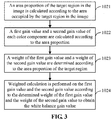
- FIG. 3 is a flowchart of another white balance processing method according to an embodiment of the disclosure. Based on the operation in 102, a method for calculating the white balance gain value of the image is explained more clearly. As illustrated in FIG. 3 , the operation in 102 may further include the following actions.
- an area proportion of the target region in the image is calculated according to the area occupied by the target region in the image.
- the target region is the face region or the portrait region.
- the areas occupied by the face region and the portrait region in the image may be calculated to further calculate area proportions of the face region and the portrait region in the image.
- the image is divided into multiple sub-blocks, and each sub-block has the same area.
- a target picture is divided into m ⁇ n sub-blocks, a length of each sub-block is 1/m of a length of the target picture, and a width of each sub-block is 1/n of a width of the target picture. Therefore, an area of each sub-block is 1/m ⁇ n, where m and n are positive integers, and preferably, m is 9 and n is 7.
- the acquired m ⁇ n sub-blocks are searched for sub-blocks in a coordinate interval of the face region and sub-blocks including an edge of the coordinate interval of the face region to obtain all the sub-blocks in the face region.
- An area of each sub-block is known, so that the area of the face region may be calculated.
- All sub-blocks in the portrait region may be found by the same method.
- An area of each sub-block is known, so that the area occupied by the portrait region in the image may be calculated.
- a quotient obtained by dividing the area occupied by the target region by a total area of the image is the area proportion of the target region.
- a first gain value and a second gain value of each color component are calculated according to the area proportion.
- the first gain value is used to regulate the face in the image to the skin color.
- the skin color of the face in the image is a normal face skin color, and if the skin color of the face in the image is not a normal skin color, the first gain value capable of regulating the skin color of the face to the normal skin color is generated.
- color components of all the pixels of the face region are acquired, a color of each pixel is represented by a color component (R, G, B), and the color vectors of each pixel may be averaged to calculate a color vector corresponding to the skin color of the face. It is determined whether R, G and B values corresponding to the skin color of the face are within the range of R, G and B values corresponding to the normal face skin color.
- R, G and B values corresponding to the skin color of the face are not within the range of R, G and B values corresponding to the normal face skin color
- the R, G and B values corresponding to the skin color of the face are adjusted through a gain value to be within the range of R, G and B values corresponding to the normal face skin color, and the gain value is the first gain value.
- the range of R, G and B values corresponding to the normal face skin color may be determined according to R, G and B values provided in a color matrix CC.
- the R, G and B values in the color matrix CC may be obtained according to a CIE color space provided by the Commission Internationale de L'Eclairage.
- the second gain value is different from the first gain value.
- the second gain value refers to a gain value determined according to the portrait region to adjust white balance and is calculated according to each color component in the portrait region.
- an average value of the three components R, G and B in the color vectors of all the pixels tends to be balanced (1:1:1), and a relatively accurate white balance gain value, i.e., the second gain value, may be obtained by a grayscale weighting algorithm.
- the portrait region is divided into a plurality of sub-blocks, color vectors of all pixels in each sub-block are acquired, and each pixel is represented by a color vector (R, G, B). Then an average value and standard deviation of three channels R, G and B in each sub-block are calculated, and the standard deviation of each sub-block is weighted (the low-correlated sub-blocks are discarded and the high-correlated sub-blocks are reserved) to reduce influence of a large-area single color and make the image colorful. An average value of the three channels R, G and B weighted with the standard deviation is further calculated, and a gain coefficient of the three channels R, G and B is calculated to obtain the second gain value.
- a weight of the first gain value and a weight of the second gain value are determined according to the area proportion of the target region.
- the target region is the face region or the portrait region.
- the portrait region includes the face region and a body region and thus occupies an area larger than the area of the face region, and when it is determined that the area occupied by the face region in the image is less than the preset area threshold, it is necessary to adopt a calculation manner of calculating the target white balance gain value based on the area proportion of the portrait region in the image instead.
- the target white balance gain value calculated by adjusting the weights of the first gain value and the second gain value based on the area proportion of the face region in the image is also relatively accurate.
- the weight of the first gain value is set to be K, and the weight of the second gain value is determined to be 1-K.
- a value of K is determined according to the area proportion of the target region. In general, the area proportion is positively correlated to the value of K.
- weighted calculation is performed on the first gain value and the second gain value according to the determined weight of the first gain value and the weight of the second gain value to obtain the white balance gain value.
- the living shot object is imaged to obtain the image to be processed, the white balance gain value is calculated according to the area occupied by the target region including the face in the image, the target region including the face region or the portrait region, and white balance processing is performed on the image according to the white balance gain value.
- Living body recognition is performed on a human body, so as to solve the problems of inaccurate image white balance regulation, color cast and poor user experience caused by the fact that a living body-based FACE AWB is started to regulate an image responsive to detecting that a non-living shot object includes a face.
- the disclosure also discloses a white balance processing device.
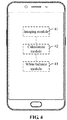
- FIG. 4 is a structure diagram of a white balance processing device according to an embodiment of the disclosure. As illustrated in FIG. 4 , the device includes an imaging module 41, a calculation module 42 and a white balance module 43.
- the imaging module 41 is configured to image a living shot object to obtain an image to be processed.
- the calculation module 42 is configured to calculate a white balance gain value according to an area of a target region including a face in the image.
- the target region includes a face region or a portrait region.
- the white balance module 43 is configured to perform white balance processing on the image according to the white balance gain value.
- the imaging module is configured to image the living shot object to obtain the image to be processed
- the calculation module is configured to calculate the white balance gain value according to the area occupied by the target region including the face in the image
- the white balance module is configured to perform white balance processing on the image according to the white balance gain value.
- Living body recognition is performed on a human body, so as to solve the problems of inaccurate image white balance regulation, color cast and poor user experience caused by the fact that a living FACE AWB is started to regulate an image responsive to detecting that a non-living shot object includes a face.
- FIG. 5 is a structure diagram of another white balance processing device according to an embodiment of the disclosure. Based on the previous embodiment, as illustrated in FIG. 5 , the device further includes a previewing module 44, a first recognition module 45, an acquisition module 46, a second recognition module 47 and a determination module 48.
- the previewing module 44 is configured to preview the shot object to obtain multiple frames of preview images.
- the first recognition module 45 is configured to identify postures of the shot object in the multiple frames of preview images and identify, when there is a change on the postures of the shot object in the multiple frames of preview images, the shot object as a living shot object.
- the acquisition module 46 is configured to acquire depth information of at least one frame of preview image.
- the second recognition module 47 is configured to identify whether the shot object is in a plane form according to the depth information.
- the determination module 48 is configured to determine that the shot object is in a three-dimensional form.
- the acquisition module 46 may specifically be configured to perform synchronization imaging between a structured light camera or a depth camera and a camera for capturing the preview image to obtain the depth information of the preview image.
- the calculation module 42 may further include a first calculation unit 421 and a second calculation unit 422.
- the first calculation unit 421 is configured to calculate an area proportion of the target region in the image according to the area occupied by the target region in the image.
- the second calculation unit 422 is configured to calculate a first gain value and a second gain value of each color component according to the area proportion to obtain the white balance gain value.
- the first gain value is used to regulate the face in the image to a skin color and the second gain value is different from the first gain value.
- the second calculation unit 422 may further include a first determination subunit 4221 and a second calculation subunit 4222.
- the determination subunit 4221 is configured to determine a weight of the first gain value and a weight of the second gain value according to the area proportion.
- the second calculation subunit 4222 is configured to perform weighted calculation on the first gain value and the second gain value according to the determined weight of the first gain value and the weight of the second gain value to obtain the white balance gain value.
- the calculation module 42 may further include a determination unit.
- the determination unit is configured to determine, when an area occupied by the face region in the image is not less than a preset area threshold, the face region as the target region.
- the determination unit is further configured to determine, when the area occupied by the face region in the image is less than the preset area threshold, the portrait region as the target region.
- the imaging module is configured to image the living shot object to obtain the image to be processed
- the calculation module is configured to calculate the white balance gain value according to the area occupied by the target region including the face in the image
- the white balance module is configured to perform white balance processing on the image according to the white balance gain value.
- Living body recognition is performed on a human body, so as to solve the problems of inaccurate image white balance regulation, color cast and poor user experience caused by the fact that a living FACE AWB is started to regulate an image responsive to detecting that a non-living shot object includes a face.
- the disclosure also discloses a computer device, which includes a memory, a processor and a computer program stored in the memory and capable of running in the processor.
- the processor executes the program to implement the white balance processing method of the method embodiments.
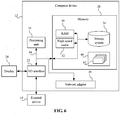
- FIG. 6 is a block diagram of an exemplary computer device suitable for implementing implementation modes of the disclosure.
- the computer device 12 illustrated in FIG. 6 is only an example and should not form any limit to the functions and scope of application of the embodiments of the disclosure.
- the computer device 12 is embodied in form of a universal computer device.
- Components of the computer device 12 may include, but not limited to: one or more processors or processing units 16, a system memory 28 and a bus 18 connecting different system components (including the system memory 28 and the processing unit 16).
- the bus 18 represents one or more of several types of bus structures, including a memory bus or memory controller, a peripheral bus, an accelerated graphics port, a processor or a local bus adopting any bus structure in multiple bus structures.
- these system structures include, but not limited to, an Industry Standard Architecture (ISA) bus, a Micro Channel Architecture (MAC) bus, an enhanced ISA bus, a Video Electronics Standards Association (VESA) local bus and a Peripheral Component Interconnection (PCI) bus.
- ISA Industry Standard Architecture
- MAC Micro Channel Architecture
- VESA Video Electronics Standards Association
- PCI Peripheral Component Interconnection
- the computer device 12 typically includes multiple computer system-readable media. These media may be any available medium that the computer device 12 may access, including volatile and nonvolatile media and movable and immovable media.
- the memory 28 may include a computer system-readable medium in form of a nonvolatile memory, for example, a Random Access Memory (RAM) 30 and/or a high-speed cache memory 32.
- the computer device 12 may further include another movable/immovable and volatile/nonvolatile computer system storage medium. Only as an example, a storage system 34 may be configured to read and write an immovable and nonvolatile magnetic medium (not illustrated in FIG. 6 and usually called a "hard disk drive"). Although not illustrated in FIG.
- a magnetic disk drive configured to read and write a movable nonvolatile magnetic disk (for example, a "floppy disk") and an optical disk drive configured to read and write a movable nonvolatile optical disk (for example, a Compact Disc Read Only Memory (CD-ROM), a Digital Video Disc Read Only Memory (DVD-ROM) or another optical medium)
- each drive may be connected with the bus 18 through one or more data medium interfaces.
- the memory 28 may include at least one program product.
- the program product includes a group of (for example, at least one) program modules, and these program modules are configured to execute the functions of each embodiment of the disclosure.
- a program/utility tool 40 with a group of (at least one) program modules 42 may be stored in, for example, the memory 28.
- a program module 42 includes, but not limited to, an operating system, one or more application programs, another program module and program data, and each or certain combination of these examples may include implementation of a network environment.
- the program module 42 usually executes the functions and/or method in the embodiments described in the disclosure.
- the computer device 12 may also communicate with one or more external devices 14 (for example, a keyboard, a pointing device and a display 24), and may further communicate with one or more devices through which a user may interact with the computer device 12 and/or communicate with any device (for example, a network card and a modem) through which the computer device 12 may communicate with one or more other computer devices. Such communication may be implemented through an Input/Output (I/O) interface 22.
- the computer device 12 may further communicate with one or more networks (for example, a Local Area Network (LAN) and a Wide Area Network (WAN) and/or public network, for example, the Internet) through a network adapter 20. As illustrated in FIG.
- LAN Local Area Network
- WAN Wide Area Network
- public network for example, the Internet
- the network adapter 20 communicates with the other modules of the computer device 12 through the bus 18. It is to be understood that, although not illustrated in the figure, other hardware and/or software modules may be used in combination with the computer device 12, including, but not limited to, a microcode, a device driver, a redundant processing unit, an external disk drive array, a Redundant Array of Independent Disks (RAID) system, a magnetic tape drive, a data backup storage system and the like.
- RAID Redundant Array of Independent Disks
- the processing unit 16 runs the program stored in the system memory 28, to execute various function applications and data processing, for example, implementing the method mentioned in the abovementioned embodiments.
- the disclosure also discloses a computer-readable storage medium, in which a computer program is stored.
- the program is executed by a processor to implement the white balance processing method in the abovementioned method embodiments.
- the disclosure also discloses a computer program product.
- An instruction in the computer program product is executed by a processor to implement the white balance processing method in the abovementioned method embodiments.
- first and second are only adopted for description and should not be understood to indicate or imply relative importance or implicitly indicate the number of indicated technical features. Therefore, a feature defined by “first” and “second” may explicitly or implicitly indicate inclusion of at least one such feature.
- “multiple” means at least two, for example, two and three, unless otherwise limited definitely and specifically.
- Any process or method in the flowcharts or described herein in another manner may be understood to represent a module, segment or part including codes of one or more executable instructions configured to realize specific logic functions or operations of the process and, moreover, the scope of the preferred implementation mode of the disclosure includes other implementation, not in a sequence illustrated or discussed herein, including execution of the functions basically simultaneously or in an opposite sequence according to the involved functions. This should be understood by those skilled in the art of the embodiments of the disclosure.
- Logics and/or operations represented in the flowcharts or described herein in another manner, for example, may be considered as a fixed sequence list of executable instructions configured to realize the logic functions and may specifically implemented in any computer-readable medium for an instruction execution system, device or equipment (for example, a computer-based system, a system including a processor or another system capable of reading instructions from the instruction execution system, device or equipment and executing the instructions) to use or for use in combination with the instruction execution system, device or equipment.
- "computer-readable medium” may be any device capable of including, storing, communicating with, propagating or transmitting a program for the instruction execution system, device or equipment to use or for use in combination with the instruction execution system, device or equipment.
- a more specific example (non-exhaustive list) of the computer-readable medium includes: an electric connection portion (electronic device) with one or more wires, a portable computer disk (magnetic device), an RAM, a Read-Only Memory (ROM), an Erasable Programmable ROM (EPROM) (or flash memory), an optical fiber device and a portable CD-ROM.
- the computer-readable medium may even be paper or another medium on which the program may be printed because, for example, the paper or the other medium may be optically scanned then edited, explained or, when necessary, processed in another proper manner to obtain the program in an electronic manner for storage in the computer memory.
- each part of the disclosure may be implemented by hardware, software, firmware or a combination thereof.
- multiple operations or methods may be implemented by software or firmware stored in a memory and executed by a proper instruction execution system.
- any one or combination of the following technologies well-known in the art may be adopted for implementation: a discrete logic circuit with a logic gate circuit configured to realize a logic function for a data signal, an application-specific integrated circuit with a proper combined logic gate circuit, a Programmable Gate Array (PGA), a Field Programmable Gate Array (FPGA) and the like.
- each functional unit in each embodiment of the disclosure may be integrated into a processing module, each unit may also physically exist independently, and two or more than two units may also be integrated into a module.
- the integrated module may be implemented in a hardware form and may also be implemented in form of software functional module. When being implemented in form of software functional module and sold or used as an independent product, the integrated module may be stored in a computer-readable storage medium.
- the storage medium may be a ROM, a magnetic disk, an optical disk or the like.
Landscapes
- Engineering & Computer Science (AREA)
- Multimedia (AREA)
- Physics & Mathematics (AREA)
- Signal Processing (AREA)
- Computer Vision & Pattern Recognition (AREA)
- Theoretical Computer Science (AREA)
- General Physics & Mathematics (AREA)
- Health & Medical Sciences (AREA)
- Oral & Maxillofacial Surgery (AREA)
- General Health & Medical Sciences (AREA)
- Optics & Photonics (AREA)
- Human Computer Interaction (AREA)
- Color Television Image Signal Generators (AREA)
- Processing Of Color Television Signals (AREA)
- Image Processing (AREA)
Applications Claiming Priority (2)
| Application Number | Priority Date | Filing Date | Title |
|---|---|---|---|
| CN201710557602.0A CN107277479B (zh) | 2017-07-10 | 2017-07-10 | 白平衡处理方法和装置 |
| PCT/CN2018/094084 WO2019011148A1 (fr) | 2017-07-10 | 2018-07-02 | Procédé et appareil de traitement de balance des blancs |
Publications (3)
| Publication Number | Publication Date |
|---|---|
| EP3654643A1 true EP3654643A1 (fr) | 2020-05-20 |
| EP3654643A4 EP3654643A4 (fr) | 2020-07-22 |
| EP3654643B1 EP3654643B1 (fr) | 2021-08-04 |
Family
ID=60072456
Family Applications (1)
| Application Number | Title | Priority Date | Filing Date |
|---|---|---|---|
| EP18831888.5A Active EP3654643B1 (fr) | 2017-07-10 | 2018-07-02 | Procédé et appareil de traitement de balance des blancs |
Country Status (4)
| Country | Link |
|---|---|
| US (1) | US11082677B2 (fr) |
| EP (1) | EP3654643B1 (fr) |
| CN (1) | CN107277479B (fr) |
| WO (1) | WO2019011148A1 (fr) |
Cited By (1)
| Publication number | Priority date | Publication date | Assignee | Title |
|---|---|---|---|---|
| CN112699857A (zh) * | 2021-03-24 | 2021-04-23 | 北京远鉴信息技术有限公司 | 基于人脸姿态的活体验证方法、装置及电子设备 |
Families Citing this family (11)
| Publication number | Priority date | Publication date | Assignee | Title |
|---|---|---|---|---|
| CN107343189B (zh) * | 2017-07-10 | 2019-06-21 | Oppo广东移动通信有限公司 | 白平衡处理方法和装置 |
| CN107277479B (zh) | 2017-07-10 | 2020-06-05 | Oppo广东移动通信有限公司 | 白平衡处理方法和装置 |
| CN107277480B (zh) * | 2017-07-10 | 2019-03-29 | Oppo广东移动通信有限公司 | 白平衡同步方法、装置和终端设备 |
| CN113011210B (zh) * | 2019-12-19 | 2022-09-16 | 北京百度网讯科技有限公司 | 视频处理方法和装置 |
| CN112468794B (zh) * | 2020-11-27 | 2022-08-23 | 维沃移动通信有限公司 | 图像处理方法、装置、电子设备及可读存储介质 |
| CN113284199A (zh) * | 2021-05-24 | 2021-08-20 | 艾酷软件技术(上海)有限公司 | 图像灰度区域确定方法、电子设备及服务器 |
| CN113378691B (zh) * | 2021-06-08 | 2024-05-17 | 衡阳览众科技有限公司 | 基于实时用户行为分析的智能家居管理系统及方法 |
| CN113850214B (zh) * | 2021-09-29 | 2025-03-28 | 蚂蚁区块链科技(上海)有限公司 | 针对活体检测的注入攻击识别方法及装置 |
| CN114387548B (zh) * | 2021-12-31 | 2025-03-21 | 北京旷视科技有限公司 | 视频及活体检测方法、系统、设备、存储介质及程序产品 |
| CN114374830B (zh) * | 2022-01-06 | 2024-03-08 | 杭州海康威视数字技术股份有限公司 | 图像白平衡方法、电子设备及计算机可读存储介质 |
| US20240193731A1 (en) * | 2022-12-12 | 2024-06-13 | Google Llc | Face region based automatic white balance in images |
Family Cites Families (20)
| Publication number | Priority date | Publication date | Assignee | Title |
|---|---|---|---|---|
| US6975759B2 (en) * | 2002-06-25 | 2005-12-13 | Koninklijke Philips Electronics N.V. | Method and system for white balancing images using facial color as a reference signal |
| JP4284448B2 (ja) * | 2005-01-28 | 2009-06-24 | 富士フイルム株式会社 | 画像処理装置及び方法 |
| JP4217698B2 (ja) * | 2005-06-20 | 2009-02-04 | キヤノン株式会社 | 撮像装置及び画像処理方法 |
| US20090092297A1 (en) * | 2005-07-19 | 2009-04-09 | Konica Minolta Holdings, Inc. | Image processing apparatus, image processing system and image processing program |
| US20070031060A1 (en) * | 2005-08-04 | 2007-02-08 | Canon Kabushiki Kaisha | Image processing apparatus, method for calculating white balance evaluation value, program including program code for realizing the method for calculating white balance evaluation value, and storage medium for storing the program |
| KR100851981B1 (ko) * | 2007-02-14 | 2008-08-12 | 삼성전자주식회사 | 비디오 영상에서 실 객체 판별 방법 및 장치 |
| JP5066398B2 (ja) * | 2007-06-29 | 2012-11-07 | 富士フイルム株式会社 | 画像処理装置および方法並びにプログラム |
| JP4906627B2 (ja) * | 2007-07-31 | 2012-03-28 | キヤノン株式会社 | 画像処理装置、画像処理方法、コンピュータプログラム及び記憶媒体 |
| JP5113514B2 (ja) * | 2007-12-27 | 2013-01-09 | キヤノン株式会社 | ホワイトバランス制御装置およびホワイトバランス制御方法 |
| JP5398156B2 (ja) * | 2008-03-04 | 2014-01-29 | キヤノン株式会社 | ホワイトバランス制御装置およびその制御方法並びに撮像装置 |
| JP4702441B2 (ja) * | 2008-12-05 | 2011-06-15 | ソニー株式会社 | 撮像装置及び撮像方法 |
| CN103905804B (zh) * | 2012-12-26 | 2016-03-02 | 联想(北京)有限公司 | 一种调整白平衡的方法及电子设备 |
| JP2014209681A (ja) * | 2013-04-16 | 2014-11-06 | リコーイメージング株式会社 | 色調調整装置および色調調整方法 |
| CN104751110B (zh) * | 2013-12-31 | 2018-12-04 | 汉王科技股份有限公司 | 一种活体检测方法和装置 |
| JP6410454B2 (ja) * | 2014-04-03 | 2018-10-24 | キヤノン株式会社 | 画像処理装置、画像処理方法及びプログラム |
| WO2016070300A1 (fr) * | 2014-11-07 | 2016-05-12 | Xiaoou Tang | Système et procédé pour détecter un utilisateur authentique |
| CN106529379A (zh) | 2015-09-15 | 2017-03-22 | 阿里巴巴集团控股有限公司 | 一种活体识别方法及设备 |
| CN106548121A (zh) | 2015-09-23 | 2017-03-29 | 阿里巴巴集团控股有限公司 | 一种活体识别的测试方法及装置 |
| CN105956518A (zh) * | 2016-04-21 | 2016-09-21 | 腾讯科技(深圳)有限公司 | 一种人脸识别方法、装置和系统 |
| CN107277479B (zh) * | 2017-07-10 | 2020-06-05 | Oppo广东移动通信有限公司 | 白平衡处理方法和装置 |
-
2017
- 2017-07-10 CN CN201710557602.0A patent/CN107277479B/zh active Active
-
2018
- 2018-07-02 EP EP18831888.5A patent/EP3654643B1/fr active Active
- 2018-07-02 WO PCT/CN2018/094084 patent/WO2019011148A1/fr not_active Ceased
-
2019
- 2019-12-26 US US16/727,646 patent/US11082677B2/en active Active
Cited By (1)
| Publication number | Priority date | Publication date | Assignee | Title |
|---|---|---|---|---|
| CN112699857A (zh) * | 2021-03-24 | 2021-04-23 | 北京远鉴信息技术有限公司 | 基于人脸姿态的活体验证方法、装置及电子设备 |
Also Published As
| Publication number | Publication date |
|---|---|
| CN107277479A (zh) | 2017-10-20 |
| WO2019011148A1 (fr) | 2019-01-17 |
| CN107277479B (zh) | 2020-06-05 |
| US11082677B2 (en) | 2021-08-03 |
| EP3654643A4 (fr) | 2020-07-22 |
| US20200137369A1 (en) | 2020-04-30 |
| EP3654643B1 (fr) | 2021-08-04 |
Similar Documents
| Publication | Publication Date | Title |
|---|---|---|
| US11082677B2 (en) | White balance processing method and apparatus | |
| US11064174B2 (en) | White balance processing method and apparatus | |
| CN106973278B (zh) | 一种参照人脸色彩特征的自动白平衡装置及方法 | |
| CN107277356B (zh) | 逆光场景的人脸区域处理方法和装置 | |
| US9196071B2 (en) | Image splicing method and apparatus | |
| US11200653B2 (en) | Local histogram matching with global regularization and motion exclusion for multi-exposure image fusion | |
| CN106878695A (zh) | 白平衡处理的方法、装置和计算机设备 | |
| CN104735362A (zh) | 拍照方法和装置 | |
| EP3429201A1 (fr) | Procédé, dispositif informatique et support d'informations lisible par ordinateur non volatile pour traiter l'équilibre des blancs | |
| US20120013642A1 (en) | Image processing apparatus, image processing method, and recording medium | |
| CN112672066B (zh) | 图像处理设备、图像拍摄设备、控制方法及存储介质 | |
| JP5414216B2 (ja) | 撮像装置、その制御方法及びプログラム | |
| KR102776442B1 (ko) | 글로벌 정규화 및 모션 배제를 포함하는 로컬 히스토그램 매칭을 수행하는 전자 장치 및 방법 | |
| JP6937603B2 (ja) | 画像処理装置およびその制御方法、プログラム、並びに記憶媒体 | |
| US20240251154A1 (en) | Image capture apparatus, image processing apparatus, and method | |
| EP3935601B1 (fr) | Mise en correspondance d'histogramme local avec régularisation globale et exclusion de mouvement pour fusion d'image à expositions multiples | |
| JP4522229B2 (ja) | 画像処理方法及びその装置 | |
| WO2021025445A1 (fr) | Mise en correspondance d'histogramme local avec régularisation globale et exclusion de mouvement pour fusion d'image à expositions multiples | |
| JP4208889B2 (ja) | 画像処理方法、装置および記録媒体 | |
| JP4411357B2 (ja) | 画像処理方法、装置および記録媒体 | |
| JP2008147714A (ja) | 画像処理装置およびその方法 | |
| JP2005167735A (ja) | 画像データ処理装置、画像データ処理方法、並びに、記録媒体 |
Legal Events
| Date | Code | Title | Description |
|---|---|---|---|
| STAA | Information on the status of an ep patent application or granted ep patent |
Free format text: STATUS: THE INTERNATIONAL PUBLICATION HAS BEEN MADE |
|
| PUAI | Public reference made under article 153(3) epc to a published international application that has entered the european phase |
Free format text: ORIGINAL CODE: 0009012 |
|
| STAA | Information on the status of an ep patent application or granted ep patent |
Free format text: STATUS: REQUEST FOR EXAMINATION WAS MADE |
|
| 17P | Request for examination filed |
Effective date: 20200123 |
|
| AK | Designated contracting states |
Kind code of ref document: A1 Designated state(s): AL AT BE BG CH CY CZ DE DK EE ES FI FR GB GR HR HU IE IS IT LI LT LU LV MC MK MT NL NO PL PT RO RS SE SI SK SM TR |
|
| AX | Request for extension of the european patent |
Extension state: BA ME |
|
| A4 | Supplementary search report drawn up and despatched |
Effective date: 20200624 |
|
| RIC1 | Information provided on ipc code assigned before grant |
Ipc: H04N 9/73 20060101AFI20200618BHEP |
|
| DAV | Request for validation of the european patent (deleted) | ||
| DAX | Request for extension of the european patent (deleted) | ||
| STAA | Information on the status of an ep patent application or granted ep patent |
Free format text: STATUS: EXAMINATION IS IN PROGRESS |
|
| 17Q | First examination report despatched |
Effective date: 20201218 |
|
| GRAP | Despatch of communication of intention to grant a patent |
Free format text: ORIGINAL CODE: EPIDOSNIGR1 |
|
| STAA | Information on the status of an ep patent application or granted ep patent |
Free format text: STATUS: GRANT OF PATENT IS INTENDED |
|
| INTG | Intention to grant announced |
Effective date: 20210503 |
|
| GRAS | Grant fee paid |
Free format text: ORIGINAL CODE: EPIDOSNIGR3 |
|
| GRAA | (expected) grant |
Free format text: ORIGINAL CODE: 0009210 |
|
| STAA | Information on the status of an ep patent application or granted ep patent |
Free format text: STATUS: THE PATENT HAS BEEN GRANTED |
|
| AK | Designated contracting states |
Kind code of ref document: B1 Designated state(s): AL AT BE BG CH CY CZ DE DK EE ES FI FR GB GR HR HU IE IS IT LI LT LU LV MC MK MT NL NO PL PT RO RS SE SI SK SM TR |
|
| REG | Reference to a national code |
Ref country code: GB Ref legal event code: FG4D |
|
| REG | Reference to a national code |
Ref country code: AT Ref legal event code: REF Ref document number: 1418215 Country of ref document: AT Kind code of ref document: T Effective date: 20210815 |
|
| REG | Reference to a national code |
Ref country code: CH Ref legal event code: EP |
|
| REG | Reference to a national code |
Ref country code: DE Ref legal event code: R096 Ref document number: 602018021405 Country of ref document: DE |
|
| REG | Reference to a national code |
Ref country code: IE Ref legal event code: FG4D |
|
| REG | Reference to a national code |
Ref country code: LT Ref legal event code: MG9D |
|
| REG | Reference to a national code |
Ref country code: NL Ref legal event code: MP Effective date: 20210804 |
|
| REG | Reference to a national code |
Ref country code: AT Ref legal event code: MK05 Ref document number: 1418215 Country of ref document: AT Kind code of ref document: T Effective date: 20210804 |
|
| PG25 | Lapsed in a contracting state [announced via postgrant information from national office to epo] |
Ref country code: FI Free format text: LAPSE BECAUSE OF FAILURE TO SUBMIT A TRANSLATION OF THE DESCRIPTION OR TO PAY THE FEE WITHIN THE PRESCRIBED TIME-LIMIT Effective date: 20210804 Ref country code: ES Free format text: LAPSE BECAUSE OF FAILURE TO SUBMIT A TRANSLATION OF THE DESCRIPTION OR TO PAY THE FEE WITHIN THE PRESCRIBED TIME-LIMIT Effective date: 20210804 Ref country code: SE Free format text: LAPSE BECAUSE OF FAILURE TO SUBMIT A TRANSLATION OF THE DESCRIPTION OR TO PAY THE FEE WITHIN THE PRESCRIBED TIME-LIMIT Effective date: 20210804 Ref country code: RS Free format text: LAPSE BECAUSE OF FAILURE TO SUBMIT A TRANSLATION OF THE DESCRIPTION OR TO PAY THE FEE WITHIN THE PRESCRIBED TIME-LIMIT Effective date: 20210804 Ref country code: BG Free format text: LAPSE BECAUSE OF FAILURE TO SUBMIT A TRANSLATION OF THE DESCRIPTION OR TO PAY THE FEE WITHIN THE PRESCRIBED TIME-LIMIT Effective date: 20211104 Ref country code: AT Free format text: LAPSE BECAUSE OF FAILURE TO SUBMIT A TRANSLATION OF THE DESCRIPTION OR TO PAY THE FEE WITHIN THE PRESCRIBED TIME-LIMIT Effective date: 20210804 Ref country code: LT Free format text: LAPSE BECAUSE OF FAILURE TO SUBMIT A TRANSLATION OF THE DESCRIPTION OR TO PAY THE FEE WITHIN THE PRESCRIBED TIME-LIMIT Effective date: 20210804 Ref country code: PT Free format text: LAPSE BECAUSE OF FAILURE TO SUBMIT A TRANSLATION OF THE DESCRIPTION OR TO PAY THE FEE WITHIN THE PRESCRIBED TIME-LIMIT Effective date: 20211206 Ref country code: NO Free format text: LAPSE BECAUSE OF FAILURE TO SUBMIT A TRANSLATION OF THE DESCRIPTION OR TO PAY THE FEE WITHIN THE PRESCRIBED TIME-LIMIT Effective date: 20211104 Ref country code: HR Free format text: LAPSE BECAUSE OF FAILURE TO SUBMIT A TRANSLATION OF THE DESCRIPTION OR TO PAY THE FEE WITHIN THE PRESCRIBED TIME-LIMIT Effective date: 20210804 |
|
| PG25 | Lapsed in a contracting state [announced via postgrant information from national office to epo] |
Ref country code: PL Free format text: LAPSE BECAUSE OF FAILURE TO SUBMIT A TRANSLATION OF THE DESCRIPTION OR TO PAY THE FEE WITHIN THE PRESCRIBED TIME-LIMIT Effective date: 20210804 Ref country code: LV Free format text: LAPSE BECAUSE OF FAILURE TO SUBMIT A TRANSLATION OF THE DESCRIPTION OR TO PAY THE FEE WITHIN THE PRESCRIBED TIME-LIMIT Effective date: 20210804 Ref country code: GR Free format text: LAPSE BECAUSE OF FAILURE TO SUBMIT A TRANSLATION OF THE DESCRIPTION OR TO PAY THE FEE WITHIN THE PRESCRIBED TIME-LIMIT Effective date: 20211105 |
|
| PG25 | Lapsed in a contracting state [announced via postgrant information from national office to epo] |
Ref country code: NL Free format text: LAPSE BECAUSE OF FAILURE TO SUBMIT A TRANSLATION OF THE DESCRIPTION OR TO PAY THE FEE WITHIN THE PRESCRIBED TIME-LIMIT Effective date: 20210804 |
|
| PG25 | Lapsed in a contracting state [announced via postgrant information from national office to epo] |
Ref country code: DK Free format text: LAPSE BECAUSE OF FAILURE TO SUBMIT A TRANSLATION OF THE DESCRIPTION OR TO PAY THE FEE WITHIN THE PRESCRIBED TIME-LIMIT Effective date: 20210804 |
|
| REG | Reference to a national code |
Ref country code: DE Ref legal event code: R097 Ref document number: 602018021405 Country of ref document: DE |
|
| PG25 | Lapsed in a contracting state [announced via postgrant information from national office to epo] |
Ref country code: SM Free format text: LAPSE BECAUSE OF FAILURE TO SUBMIT A TRANSLATION OF THE DESCRIPTION OR TO PAY THE FEE WITHIN THE PRESCRIBED TIME-LIMIT Effective date: 20210804 Ref country code: SK Free format text: LAPSE BECAUSE OF FAILURE TO SUBMIT A TRANSLATION OF THE DESCRIPTION OR TO PAY THE FEE WITHIN THE PRESCRIBED TIME-LIMIT Effective date: 20210804 Ref country code: RO Free format text: LAPSE BECAUSE OF FAILURE TO SUBMIT A TRANSLATION OF THE DESCRIPTION OR TO PAY THE FEE WITHIN THE PRESCRIBED TIME-LIMIT Effective date: 20210804 Ref country code: EE Free format text: LAPSE BECAUSE OF FAILURE TO SUBMIT A TRANSLATION OF THE DESCRIPTION OR TO PAY THE FEE WITHIN THE PRESCRIBED TIME-LIMIT Effective date: 20210804 Ref country code: CZ Free format text: LAPSE BECAUSE OF FAILURE TO SUBMIT A TRANSLATION OF THE DESCRIPTION OR TO PAY THE FEE WITHIN THE PRESCRIBED TIME-LIMIT Effective date: 20210804 Ref country code: AL Free format text: LAPSE BECAUSE OF FAILURE TO SUBMIT A TRANSLATION OF THE DESCRIPTION OR TO PAY THE FEE WITHIN THE PRESCRIBED TIME-LIMIT Effective date: 20210804 |
|
| PLBE | No opposition filed within time limit |
Free format text: ORIGINAL CODE: 0009261 |
|
| STAA | Information on the status of an ep patent application or granted ep patent |
Free format text: STATUS: NO OPPOSITION FILED WITHIN TIME LIMIT |
|
| 26N | No opposition filed |
Effective date: 20220506 |
|
| PG25 | Lapsed in a contracting state [announced via postgrant information from national office to epo] |
Ref country code: IT Free format text: LAPSE BECAUSE OF FAILURE TO SUBMIT A TRANSLATION OF THE DESCRIPTION OR TO PAY THE FEE WITHIN THE PRESCRIBED TIME-LIMIT Effective date: 20210804 |
|
| PG25 | Lapsed in a contracting state [announced via postgrant information from national office to epo] |
Ref country code: SI Free format text: LAPSE BECAUSE OF FAILURE TO SUBMIT A TRANSLATION OF THE DESCRIPTION OR TO PAY THE FEE WITHIN THE PRESCRIBED TIME-LIMIT Effective date: 20210804 |
|
| PG25 | Lapsed in a contracting state [announced via postgrant information from national office to epo] |
Ref country code: MC Free format text: LAPSE BECAUSE OF FAILURE TO SUBMIT A TRANSLATION OF THE DESCRIPTION OR TO PAY THE FEE WITHIN THE PRESCRIBED TIME-LIMIT Effective date: 20210804 |
|
| REG | Reference to a national code |
Ref country code: CH Ref legal event code: PL |
|
| GBPC | Gb: european patent ceased through non-payment of renewal fee |
Effective date: 20220702 |
|
| REG | Reference to a national code |
Ref country code: BE Ref legal event code: MM Effective date: 20220731 |
|
| PG25 | Lapsed in a contracting state [announced via postgrant information from national office to epo] |
Ref country code: LU Free format text: LAPSE BECAUSE OF NON-PAYMENT OF DUE FEES Effective date: 20220702 Ref country code: LI Free format text: LAPSE BECAUSE OF NON-PAYMENT OF DUE FEES Effective date: 20220731 Ref country code: FR Free format text: LAPSE BECAUSE OF NON-PAYMENT OF DUE FEES Effective date: 20220731 Ref country code: CH Free format text: LAPSE BECAUSE OF NON-PAYMENT OF DUE FEES Effective date: 20220731 |
|
| PG25 | Lapsed in a contracting state [announced via postgrant information from national office to epo] |
Ref country code: GB Free format text: LAPSE BECAUSE OF NON-PAYMENT OF DUE FEES Effective date: 20220702 Ref country code: BE Free format text: LAPSE BECAUSE OF NON-PAYMENT OF DUE FEES Effective date: 20220731 |
|
| P01 | Opt-out of the competence of the unified patent court (upc) registered |
Effective date: 20230412 |
|
| PG25 | Lapsed in a contracting state [announced via postgrant information from national office to epo] |
Ref country code: IE Free format text: LAPSE BECAUSE OF NON-PAYMENT OF DUE FEES Effective date: 20220702 |
|
| PGFP | Annual fee paid to national office [announced via postgrant information from national office to epo] |
Ref country code: DE Payment date: 20230726 Year of fee payment: 6 |
|
| PG25 | Lapsed in a contracting state [announced via postgrant information from national office to epo] |
Ref country code: MK Free format text: LAPSE BECAUSE OF FAILURE TO SUBMIT A TRANSLATION OF THE DESCRIPTION OR TO PAY THE FEE WITHIN THE PRESCRIBED TIME-LIMIT Effective date: 20210804 Ref country code: CY Free format text: LAPSE BECAUSE OF FAILURE TO SUBMIT A TRANSLATION OF THE DESCRIPTION OR TO PAY THE FEE WITHIN THE PRESCRIBED TIME-LIMIT Effective date: 20210804 |
|
| PG25 | Lapsed in a contracting state [announced via postgrant information from national office to epo] |
Ref country code: HU Free format text: LAPSE BECAUSE OF FAILURE TO SUBMIT A TRANSLATION OF THE DESCRIPTION OR TO PAY THE FEE WITHIN THE PRESCRIBED TIME-LIMIT; INVALID AB INITIO Effective date: 20180702 |
|
| PG25 | Lapsed in a contracting state [announced via postgrant information from national office to epo] |
Ref country code: TR Free format text: LAPSE BECAUSE OF FAILURE TO SUBMIT A TRANSLATION OF THE DESCRIPTION OR TO PAY THE FEE WITHIN THE PRESCRIBED TIME-LIMIT Effective date: 20210804 |
|
| PG25 | Lapsed in a contracting state [announced via postgrant information from national office to epo] |
Ref country code: MT Free format text: LAPSE BECAUSE OF FAILURE TO SUBMIT A TRANSLATION OF THE DESCRIPTION OR TO PAY THE FEE WITHIN THE PRESCRIBED TIME-LIMIT Effective date: 20210804 |
|
| REG | Reference to a national code |
Ref country code: DE Ref legal event code: R119 Ref document number: 602018021405 Country of ref document: DE |
|
| PG25 | Lapsed in a contracting state [announced via postgrant information from national office to epo] |
Ref country code: DE Free format text: LAPSE BECAUSE OF NON-PAYMENT OF DUE FEES Effective date: 20250201 |