EP3654698B1 - Procédé permettant d'effectuer un processus de transfert pour un terminal de réseau radio mobile dans un réseau radio mobile, appareils correspondants pour effectuer des étapes du procédé, véhicule et dispositif de gestion de réseau central et programmes informatiques correspondants - Google Patents
Procédé permettant d'effectuer un processus de transfert pour un terminal de réseau radio mobile dans un réseau radio mobile, appareils correspondants pour effectuer des étapes du procédé, véhicule et dispositif de gestion de réseau central et programmes informatiques correspondants Download PDFInfo
- Publication number
- EP3654698B1 EP3654698B1 EP18206635.7A EP18206635A EP3654698B1 EP 3654698 B1 EP3654698 B1 EP 3654698B1 EP 18206635 A EP18206635 A EP 18206635A EP 3654698 B1 EP3654698 B1 EP 3654698B1
- Authority
- EP
- European Patent Office
- Prior art keywords
- vehicle
- road participant
- travel route
- base station
- road
- Prior art date
- Legal status (The legal status is an assumption and is not a legal conclusion. Google has not performed a legal analysis and makes no representation as to the accuracy of the status listed.)
- Active
Links
Images



Classifications
-
- H—ELECTRICITY
- H04—ELECTRIC COMMUNICATION TECHNIQUE
- H04W—WIRELESS COMMUNICATION NETWORKS
- H04W4/00—Services specially adapted for wireless communication networks; Facilities therefor
- H04W4/02—Services making use of location information
- H04W4/029—Location-based management or tracking services
-
- G—PHYSICS
- G08—SIGNALLING
- G08G—TRAFFIC CONTROL SYSTEMS
- G08G1/00—Traffic control systems for road vehicles
- G08G1/01—Detecting movement of traffic to be counted or controlled
- G08G1/0104—Measuring and analyzing of parameters relative to traffic conditions
- G08G1/0108—Measuring and analyzing of parameters relative to traffic conditions based on the source of data
- G08G1/012—Measuring and analyzing of parameters relative to traffic conditions based on the source of data from other sources than vehicle or roadside beacons, e.g. mobile networks
-
- G—PHYSICS
- G08—SIGNALLING
- G08G—TRAFFIC CONTROL SYSTEMS
- G08G1/00—Traffic control systems for road vehicles
- G08G1/09—Arrangements for giving variable traffic instructions
- G08G1/0962—Arrangements for giving variable traffic instructions having an indicator mounted inside the vehicle, e.g. giving voice messages
- G08G1/0968—Systems involving transmission of navigation instructions to the vehicle
- G08G1/096805—Systems involving transmission of navigation instructions to the vehicle where the transmitted instructions are used to compute a route
- G08G1/096827—Systems involving transmission of navigation instructions to the vehicle where the transmitted instructions are used to compute a route where the route is computed onboard
-
- H—ELECTRICITY
- H04—ELECTRIC COMMUNICATION TECHNIQUE
- H04L—TRANSMISSION OF DIGITAL INFORMATION, e.g. TELEGRAPHIC COMMUNICATION
- H04L67/00—Network arrangements or protocols for supporting network services or applications
- H04L67/01—Protocols
- H04L67/12—Protocols specially adapted for proprietary or special-purpose networking environments, e.g. medical networks, sensor networks, networks in vehicles or remote metering networks
-
- H—ELECTRICITY
- H04—ELECTRIC COMMUNICATION TECHNIQUE
- H04W—WIRELESS COMMUNICATION NETWORKS
- H04W36/00—Hand-off or reselection arrangements
- H04W36/24—Reselection being triggered by specific parameters
- H04W36/30—Reselection being triggered by specific parameters by measured or perceived connection quality data
- H04W36/305—Handover due to radio link failure
-
- H—ELECTRICITY
- H04—ELECTRIC COMMUNICATION TECHNIQUE
- H04W—WIRELESS COMMUNICATION NETWORKS
- H04W4/00—Services specially adapted for wireless communication networks; Facilities therefor
- H04W4/30—Services specially adapted for particular environments, situations or purposes
- H04W4/38—Services specially adapted for particular environments, situations or purposes for collecting sensor information
-
- H—ELECTRICITY
- H04—ELECTRIC COMMUNICATION TECHNIQUE
- H04W—WIRELESS COMMUNICATION NETWORKS
- H04W4/00—Services specially adapted for wireless communication networks; Facilities therefor
- H04W4/30—Services specially adapted for particular environments, situations or purposes
- H04W4/40—Services specially adapted for particular environments, situations or purposes for vehicles, e.g. vehicle-to-pedestrians [V2P]
-
- H—ELECTRICITY
- H04—ELECTRIC COMMUNICATION TECHNIQUE
- H04W—WIRELESS COMMUNICATION NETWORKS
- H04W8/00—Network data management
- H04W8/26—Network addressing or numbering for mobility support
-
- G—PHYSICS
- G08—SIGNALLING
- G08G—TRAFFIC CONTROL SYSTEMS
- G08G1/00—Traffic control systems for road vehicles
- G08G1/01—Detecting movement of traffic to be counted or controlled
- G08G1/0104—Measuring and analyzing of parameters relative to traffic conditions
- G08G1/0108—Measuring and analyzing of parameters relative to traffic conditions based on the source of data
- G08G1/0112—Measuring and analyzing of parameters relative to traffic conditions based on the source of data from the vehicle, e.g. floating car data [FCD]
-
- G—PHYSICS
- G08—SIGNALLING
- G08G—TRAFFIC CONTROL SYSTEMS
- G08G1/00—Traffic control systems for road vehicles
- G08G1/01—Detecting movement of traffic to be counted or controlled
- G08G1/0104—Measuring and analyzing of parameters relative to traffic conditions
- G08G1/0125—Traffic data processing
- G08G1/0133—Traffic data processing for classifying traffic situation
-
- G—PHYSICS
- G08—SIGNALLING
- G08G—TRAFFIC CONTROL SYSTEMS
- G08G1/00—Traffic control systems for road vehicles
- G08G1/01—Detecting movement of traffic to be counted or controlled
- G08G1/0104—Measuring and analyzing of parameters relative to traffic conditions
- G08G1/0137—Measuring and analyzing of parameters relative to traffic conditions for specific applications
- G08G1/0141—Measuring and analyzing of parameters relative to traffic conditions for specific applications for traffic information dissemination
-
- G—PHYSICS
- G08—SIGNALLING
- G08G—TRAFFIC CONTROL SYSTEMS
- G08G1/00—Traffic control systems for road vehicles
- G08G1/09—Arrangements for giving variable traffic instructions
- G08G1/0962—Arrangements for giving variable traffic instructions having an indicator mounted inside the vehicle, e.g. giving voice messages
- G08G1/0967—Systems involving transmission of highway information, e.g. weather, speed limits
- G08G1/096766—Systems involving transmission of highway information, e.g. weather, speed limits where the system is characterised by the origin of the information transmission
- G08G1/096775—Systems involving transmission of highway information, e.g. weather, speed limits where the system is characterised by the origin of the information transmission where the origin of the information is a central station
-
- H—ELECTRICITY
- H04—ELECTRIC COMMUNICATION TECHNIQUE
- H04W—WIRELESS COMMUNICATION NETWORKS
- H04W36/00—Hand-off or reselection arrangements
- H04W36/24—Reselection being triggered by specific parameters
- H04W36/32—Reselection being triggered by specific parameters by location or mobility data, e.g. speed data
- H04W36/322—Reselection being triggered by specific parameters by location or mobility data, e.g. speed data by location data
-
- H—ELECTRICITY
- H04—ELECTRIC COMMUNICATION TECHNIQUE
- H04W—WIRELESS COMMUNICATION NETWORKS
- H04W84/00—Network topologies
- H04W84/005—Moving wireless networks
Definitions
- the invention relates to a method for transferring a mobile network subscriber station in a handover process in a mobile network.
- the proposal further relates to a mobile radio network subscriber station and a mobile radio network management unit for use in the method, as well as a vehicle.
- the mobile network is a cellular network which is divided into mobile radio cells. Each mobile radio cell is served by a base station.
- a handover procedure or hand-off a mobile network subscriber station when moving through the radio cells is transferred from one radio cell to another during a telephone call or a data connection without interruption of this connection.
- 3GPP based UMTS 3GPP based UMTS
- HSPA High Speed Packet Access
- LTE Long Term Evolution
- 5G 5th Generationан ⁇
- a handover procedure (national roaming) takes place depending on the channel quality and the state of the mobile radio network (quality of the radio channel, the utilization of the currently used cell, the distance to the base station).
- quality of the radio channel the utilization of the currently used cell, the distance to the base station.
- the most common reason for changing the radio cell in a cellular network is when a subscriber station UE (user equipment) moves to the edge of the service area of the associated base station (eNodeB) and moves into the coverage area of an adjacent mobile radio cell. Then, this subscriber station is forwarded by the mobile network operator to another base station with which he should connect to remain connected to the network.
- the typical handover procedures specified in the respective mobile radio standard are based on measurements of the field strength or other parameters which describe the quality of the communication channel, also known as the CQI report (Channel Quality Indicator).
- V2X vehicle to everything communication
- OCU on-board connectivity unit
- Legacy vehicles without V2X communication capability do not exchange any data with eNodeBs.
- the route of a legacy vehicle can be important for the eNodeB management as there might be classical UEs in use by the passengers in the vehicle.
- the route of a legacy vehicle will influence the power adjustment of the neighbour cells by handovers, especially when a large number of these cars is heading toward this base station, thus increasing the future handover and the probability of having resource usage requirement.
- VLCE Vehicle Location Control Entity
- a mobile communication handover method which takes into account information about special equipment of the mobile telephone network subscriber station during a handover process for the mobile telephone network subscriber station is known.
- the information about special equipment of the mobile telephone network subscriber station is transmitted from the mobile telephone network subscriber station to a mobile telephone network management unit, which takes the information about the special equipment into account during the handover process.
- the advantage is that the vehicle is passed on to the mobile radio cell in which it can reliably continue the transmission of the sensor data. Other radio cells to which the mobile station could be handed over, but for which the QoS requirements are not fulfilled are avoided.
- A2 methods and systems for location-based prearranged hand-off may include pre-arranging hand-off of communication services with a mobile communication device (MCD) based on present and future locations of the MCD and the availability of wireless services in the locations.
- MCD mobile communication device
- the MCD may include location-determining capability which may include one or more of: a global navigation satellite system, triangulation, and ultra-wideband positioning. A travel route of the MCD may be anticipated utilizing the locations.
- the travel route may traverse one or more wireless coverage areas and the hand-off of communication services with the MCD may be configured when the MCD is expected to enter a wireless coverage area with a desired network resource allocation, which may include one or more of: bandwidth, data transfer rate, cost, power requirements, channel conditions, quality of service, and secure communications capability.
- Configurable MCD attributes may include antennas, beam forming, codes, and modulation.
- a prediction agent process which collects travel information of a vehicle, and determines a profile of the vehicle, which is indicative of real-time resource requirements of the vehicle.
- the prediction agent process also predicts a path of the vehicle based on the travel information, and determines a next resource node along the predicted path having real-time resources corresponding to the real-time resource requirements of the vehicle.
- the prediction agent process informs the next resource node of the profile of the vehicle and the predicted time of arrival. This causes the next resource node to operate the real-time resources for the vehicle for the predicted time of arrival.
- the method includes a selection of those mobile devices whose data are intended to be acquired and transmitted to a data acquisition computer depending on a connection status of the mobile devices in the mobile radio network.
- Normally, mobile cells are logically arranged as hexagons. If an UE is going to approach a cell border; the eNodeB informs the neighbouring cell about an UE handover via the X2 interface. The choice of the informed neighbour eNodeB is dependent on the UE position. If the UE is close to two neighbour cells, the eNodeB from cell can perform the handover toward the wrong cell and a new handover to the next cell would be required to correct this mistake. This is considered a problem which needs to be solved.
- This object is achieved by a method for performing a handover process for a mobile radio network terminal in a mobile radio network according to claim 1, by an observer vehicle according to claim 6, by an apparatus according to claim 7, and corresponding computer programs according to claim 8 and 9.
- the newly developed systems for cooperative driving or autonomous driving are designed so that the vehicles observe each other and also mutually inform each other about certain observations.
- Sensor data or derived observation data can also be exchanged between the vehicles for this purpose.
- the proposal concerns a method for performing a handover process for a mobile radio network terminal in a mobile radio network, wherein the mobile radio network comprises the mobile radio network terminal, a plurality of base stations, a core network management component, and an observer vehicle, wherein said mobile radio network terminal is a user equipment device of a road participant moving on the road.
- the road participant could be a passenger of an observed vehicle.
- the method comprises the steps of the observer vehicle observing the road participant with surroundings observation means comprised in the observer vehicle, predicting a travel route for said road participant, estimating the position of said road participant, and providing the base station to which said vehicle with surroundings observation means is logged on with information about the predicted travel route and the estimated position, wherein the predicted travel route includes information about a radio cell to which the road participant is travelling.
- the method comprises the step of the base station to which the observer vehicle is logged on forwarding the information about the predicted travel route and the estimated position to a core network management component.
- the method comprises the steps of the core network management component evaluating said forwarded information about the predicted travel route and the estimated position, associating the information about the estimated position with an identification number or code of a user equipment device logged on to the base station of a radio cell to which the road participant is logged on, wherein said associating is performed based on a matching operation in which the estimated position of the road participant is matched with positions of user equipment devices logged on to the base station of said radio cell to which the road participant is logged on, and informing the base station of said radio cell to which the road participant is travelling according to the predicted travel route to prepare for taking over said user equipment of the road participant in said handover process.
- the proposed method has the following advantages: In the worst case scenario, the cell to which the handover happens mistakenly had no workload and therefore had adjusted the cell power to a minimum. In order to prepare for the announced handover process, an eNodeB boot up of the cell power is required for the purpose to perform the handover process. This procedure is inefficient also in terms of energy consumption, especially if the wrong cell was chosen for the handover process. Since there is much traffic on public roads, such erroneous handover could concern a large flock of UEs making the problem even worse. The proposed method reliably avoids such inefficient handover behaviour. Energy consumption is reduced and the overall network throughput is increased.
- the message with the information about the predicted travel route also includes an information about the estimated position of the observed road participant. This is important since the core network device needs to identify the UE of the road participant for preparing the handover process. This could best be done based on position information.
- the core network management device associates the information about the position of the road participant with an identification number or code of a user equipment device logged on to the base station of said cell to which the observed road participant is logged on.
- the observation means comprise surroundings sensors in the observer vehicle, which is further equipped with an on-board connectivity unit that supports mobile communication in said mobile radio network. It is noted that the observed vehicle is not equipped with such on-board connectivity unit and concerns thus a legacy vehicle hereinafter also called "oldtimer”.
- the surroundings sensors comprise any one or more of a light detection and ranging sensor LIDAR, a radio detection and ranging sensor RADAR, and a video camera.
- Such sensors take images which could be evaluated by image processing means to estimate a travel route of a road participant.
- said observation means further comprise a computing unit in which an evaluation of the information from the surroundings sensors is performed and the position of the observed road participant is estimated.
- the position could be estimated based on image processing and could be further enhanced by the use of a detailed surroundings map.
- association is performed based on a matching operation in which the estimated position of the observed road participant is matched with the positions of the user equipment devices logged to the base station of said cell to which the observed road participant is logged on. It is noted that the core network management device supporting the handover process regularly does not have any information about the identity of such legacy vehicles.
- the identification number or code is any one or more of a telephone number, International Mobile Equipment Identity number IMEI, or International Mobile Subscriber Identity IMSI.
- the apparatus comprises observation means and a processing device which is adapted to perform the steps of observing the road participant with surroundings observation means, predicting a travel route for said road participant, estimating a position of said road participant, and providing a base station to which said observer vehicle is logged on with information about the predicted travel route and the estimated position, wherein the predicted travel route includes information about a radio cell to which the road participant is travelling.
- this processing device is a microcontroller, microprocessor or microcomputer.
- a processing device which is adapted to perform the steps of evaluating forwarded information about a predicted travel route and an estimated position of a road participant, wherein the predicted travel route includes information about a radio cell to which the road participant is travelling, associating the information about the estimated position with an identification number or code of a user equipment device logged on to the base station of a radio cell to which the road participant is logged on, wherein said associating is performed based on a matching operation in which the estimated position of the road participant is matched with positions of user equipment devices logged on to the base station of said radio cell to which the road participant is logged on, and informing the base station of said radio cell to which the road participant is travelling according to the predicted travel route to prepare for taking over said user equipment of the road participant in a handover process
- processor or “controller” should not be construed to refer exclusively to hardware capable of executing software, and may implicitly include, without limitation, digital signal processor (DSP) hardware, read only memory (ROM) for storing software, random access memory (RAM), and nonvolatile storage.
- DSP digital signal processor
- ROM read only memory
- RAM random access memory
- any switches shown in the figures are conceptual only. Their function may be carried out through the operation of program logic, through dedicated logic, through the interaction of program control and dedicated logic, or even manually, the particular technique being selectable by the implementer as more specifically understood from the context.
- any element expressed as a means for performing a specified function is intended to encompass any way of performing that function including, for example, a) a combination of circuit elements that performs that function or b) software in any form, including, therefore, firmware, microcode or the like, combined with appropriate circuitry for executing that software to perform the function.
- the disclosure as defined by such claims resides in the fact that the functionalities provided by the various recited means are combined and brought together in the manner which the claims call for. It is thus regarded that any means that can provide those functionalities are equivalent to those shown herein.
- Fig. 1 shows the system architecture for the proposal.
- Reference number 10 denotes a vehicle.
- the depicted vehicle is exemplified as a passenger vehicle in the form of a car. It may be any type of a vehicle. Examples of other types of vehicles are: buses, motorcycles, commercial vehicles, in particular trucks, agricultural machinery, construction machinery, rail vehicles, etc. The use of the invention would be generally in land vehicles, rail vehicles, watercrafts and aircrafts possible.
- the vehicle 10 is equipped with an on-board connectivity module 160 including corresponding antenna such that the vehicle 10 can participate in any form of a mobile communication service.
- Fig. 1 illustrates that vehicle 10 may transmit and receive signals to and from a base station 210 of a mobile communication service provider.
- Such base station 210 may be an eNodeB base station of an LTE or 5G mobile communication service provider.
- the base station 210 and the corresponding equipment is part of an LTE or 5G mobile communication network with a plurality of network cells where each cell is served by one base station 210.
- the network architecture is explained based on the example of the LTE (Long Term Evolution) network architecture and comprises the three subsystems: the User Equipment (UE), the Access Network (AN) and the Core Network (CN).
- UE User Equipment
- AN Access Network
- CN Core Network
- the E-UTRAN is the Access Network for LTE; it uses OFDMA in the radio interface to communicate with the User Equipment.
- a so-called Evolved Packet Core (EPC) is used in the Core Network to provide an all-IP architecture to give access to various services e.g. Internet service.
- the UE can be a personal device, e.g. a smart phone, a smart watch, a tablet computer, notebook or laptop computer or the like.
- any LTE network infrastructure contains IP elements such as routers, DHCP servers and DNS servers.
- the IP packet transfer service between the UEs and an external network is called EPS Bearer Service.
- the packet transfer service provided by the Access Network is called E-UTRAN Radio Access Bearer (ERAB).
- E-UTRAN Radio Access Bearer E-UTRAN Radio Access Bearer
- the base station 210 in Fig. 1 is positioned close to a main road on which the vehicles 10 are driving.
- a mobile terminal corresponds to a user equipment UE, which allows a user to access network services, connecting to the UTRAN or Evolved-UTRAN via the radio interface.
- user equipment corresponds to a smart phone.
- mobile terminals are also used in the vehicles 10.
- the vehicles 10 are equipped with said on-board connectivity module OCU 160.
- This OCU corresponds to an LTE communication module with which the vehicle 10 can receive mobile data in downstream direction and can send such data in upstream direction.
- the Evolved UMTS Terrestrial Radio Acess Network E-UTRAN of LTE consists of a plurality of eNodeBs, providing the E-UTRA user plane (PDCP/RLC/MAC/PHY) and control plane (RRC) protocol terminations towards the UE.
- the eNodeBs are interconnected with each other by means of the so-called X2 interface.
- the eNodeBs are also connected by means of the so-called S1 interface to the EPC (Evolved Packet Core) 200, more specifically to the MME (Mobility Management Entity) by means of the S1-MME and to the Serving Gateway (S-GW) by means of the S1-U interface.
- EPC Evolved Packet Core
- MME Mobility Management Entity
- S-GW Serving Gateway
- an E-UTRAN Access Network only contains ENodeBs that allow connectivity between the UEs and the EPC Core Network.
- a base station 210 communicates with the other elements of the system through 3 interfaces: E-UTRAN Uu, S1 and X2.
- the interface E-UTRAN Uu also known as LTE Uu or simply LTE radio interface, allows data transfer between the ENodeB and the UEs.
- the vehicles 10 equipped with OCU unit 160 can also be regarded as UE devices. All the functions and protocols needed for this transfer and the control operations of the E-UTRAN Uu interface are implemented in the eNodeB.
- the eNodeB 210 connects with the EPC Core Network 200 through the S1 interface.
- the eNodeBs 210 can connect between them using the X2 interface. These connections can be used to exchange signaling messages to handle the radio resources (e.g. to reduce interference) and also to manage traffic when users move from one eNodeB 210 to another during a handover procedure.
- Fig. 1 shows that eNodeB 210 is connected to the EPC 200 via the S1 interface and that EPC 200 is connected to the Internet 300.
- the backend server 320 to which the vehicles 10 may send messages to and receive messages from is also connected to the Internet 300.
- the backend server 320 In the field of cooperative and autonomous driving the backend server 320 typically is located in a traffic control center.
- a core network management device is labeled.
- the S1 interface may be realized with wireless communication technology such as with the help of microwave radio communication by means of directional antennas or wired communication technology based on fiber cables.
- an infrastructure network component is also shown. This may be exemplified by a road-side unit RSU 310.
- RSU 310 road-side unit
- ETSI TS 136 213 V13.0.0 2016-05
- Evolved Universal Terrestrial Radio Access (E-UTRA) Physical layer procedures (3GPP TS 36.213 version 13.0.0 Release 13) is mentioned.
- LTE stands for high transmission rates and short response times. The increase in the transmission rate is achieved in LTE by better modulation methods, more flexible frequency usage and larger channel bandwidths. According to the specifications, LTE currently has a transmission rate of more than 300 MBit / s in the downlink and 75 MBit / s in the uplink per 20 MHz band and minus the overhead.
- the transmission speed of LTE is essentially dependent on the frequency range, the channel width, the distance to the base station 20 and the number of participants within the mobile radio cell. The more users use the bandwidth at the same time, the lower the transmission rate per subscriber.
- LTE uses scalable and individual channels so that several mobile devices can transmit data at the same time.
- Special algorithms select the appropriate channels, taking into account the influences from the environment.
- the carriers are used for transmission, which are the cheapest for the user at its respective location.
- Fig. 2 The principle of the handover operation is shown in Fig. 2 .
- the vehicle 10 moves in the picture from left to right.
- the vehicle 10 is registered at the beginning of the handover process as a mobile radio subscriber station at the base station 210a.
- the terminal constantly measures the signal strength and quality of the current cell as well as the field strength of neighbouring cells - in GSM it measures the received signal strength of the Broadcast Control Channel (BCCH).
- the measurement results are sent to the Base Station Controller (BSC) (GSM every 480 ms).
- BSC Base Station Controller
- the BSC makes the decision about the need for a handover. Before the handover can be performed, a suitable channel must be reserved by the BSC responsible for the target cell. Only when this has been successful can the BSC give the mobile network subscriber station the handover command.
- the quality of the radio connection can be improved at the expense of the network capacity by the mobile station being in soft handover more often, that is to say connected to several base stations more frequently at the same time.
- a simultaneous improvement in the quality of the radio connection and the network capacity can be achieved, for example, by optimizing the base station antenna parameters.
- E-UTRAN Evolved Universal Terrestrial Radio Access Network
- S1AP S1 Application Protocol
- Fig. 3 shows schematically a block diagram of the vehicle's 10 board electronics system.
- Part of the board electronics system is an infotainment system which comprises: the touch-sensitive display unit 20, a computing device 40, an input unit 50, and a memory 60.
- the display unit 20 includes both a display area for displaying variable graphical information and an operator interface (touch-sensitive layer) arranged above the display area) for inputting commands by a user.
- the memory device 60 is connected to the computing device 40 via a further data line 80.
- a pictogram directory and / or symbol directory is deposited with the pictograms and / or symbols for possible overlays of additional information.
- the other parts of the infotainment system such as camera 150, radio 140, navigation device 130, telephone 120 and instrument cluster 110 are connected via the data bus 100 with the computing device 40.
- data bus 100 is the high-speed variant of the CAN bus according to ISO standard 11898-2 into consideration.
- Ethernetbased bus system such as IEEE 802.03cg is another example.
- Bus systems in which the data transmission via optical fibers happens are also usable. Examples are the MOST Bus (Media Oriented System Transport) or the D2B Bus (Domestic Digital Bus).
- MOST Bus Media Oriented System Transport
- D2B Bus Domestic Digital Bus
- the vehicle 10 is equipped with a communication module 160.
- This communication module 160 is often referred to as an on-board connectivity module OCU as mentioned above. It can be used for mobile communication, e.g. mobile communication according to the LTE standard, according to Long Term Evolution.
- Reference numeral 172 denotes an engine control unit.
- the reference numeral 174 corresponds to an ESC control unit corresponding to electronic stability control and the reference numeral 176 denotes a transmission control unit.
- CAN bus system controller area network
- the modern motor vehicle can also have further components such as further surroundings scanning sensors like a LIDAR (Light Detection and Ranging) sensor 186 or RADAR (Radio Detection and Ranging) sensor and more video cameras, e.g. as a front camera, rear camera or side camera.
- Such sensors are used more and more in vehicles for surroundings observation.
- Further control devices such as an automatic driving control unit ADC 184 and an adaptive cruise control unit ACC 182, etc., may be provided in the motor vehicle.
- the RADAR and LIDAR sensors could be used for scanning a range up to 250 m or 150 m and the cameras cover a range from 30 to 120 m.
- the components 182 to 186 are connected to another communication bus 102.
- Ethernet-Bus is a choice for this communication bus 102 due to its higher bandwidth for data transport.
- One Ethernet-Bus adapted to the special needs of car communication is standardized in the IEEE 802.1Q specification.
- V2V communication may be received via V2V communication from other road participants. Particularly for those road participants not being in line of sight LOS to the observing vehicle it is very advantageous to receive the information about their position and motion via V2V communication.
- Reference number 190 denotes an on-board diagnosis interface.
- the gateway 30 For the purpose of transmitting the vehicle-relevant sensor data or derived data therefrom via the communication interface 160 to another vehicle or to a central computer 320, or a core network device 220, the gateway 30 is provided. This is connected to the different bus systems 100, 102, 104 and 106. The gateway 30 is adapted to convert the data it receives via the one bus the transmission format of the other bus so that it can be distributed in the packets specified there. For the forwarding of this data to the outside, i.e. to another motor vehicle or to central computer 320 or the core network device 220, the on-board unit 160 is equipped with the communication interface to receive these data packets and, in turn, to convert them into the transmission format of the correspondingly used mobile radio standard. The gateway 30 takes all the necessary format conversions if data are to be exchanged between the different bus systems if required.
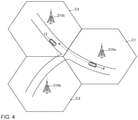
- Radio cells C1 to C3 are logically depicted as a hexagon.
- Fig. 4 shows that a legacy vehicle 14 is driving on a road in radio cell C1.
- Legacy vehicle here means that the vehicle 14 is not equipped with an on-board communication unit.
- the passengers inside these vehicles 14 make use of UEs as well when travelling in the vehicles 14.
- a mobile communication system such as LTE or 5G if an UE is approaching a cell border; the eNodeB informs the neighbouring cell about an UE handover via the X2 interface. The informed neighbour eNodeB is dependent from the UE position.
- the eNodeB from cell C1 needs to decide which eNodeB from which neighbour cell it wants to inform to perform the handover operation. In the situation depicted in Fig. 4 it may happen that the wrong eNodeB will be informed.
- the vehicle 10 when approaching the cell border may take two different paths. It may go straight, thereby entering cell C3. It may also turn left, thereby entering radio cell C2. If eNodeB 210a of cell C1 informs the wrong eNodeB then a new handover operation to the right radio cell will be required.
- the observer vehicle 12 is equipped with surroundings observing sensors 150, 186 as depicted in Fig. 3 . Also it is equipped with an on-board connectivity unit 160. Since the observer vehicle 12 is equipped with OCU 160 it will participate in V2V and V2X communication which includes a thorough message exchange between vehicles such as in particular common awareness messages CAM which includes the reference position of the vehicles broadcasting the CAM message.
- V2V and V2X communication which includes a thorough message exchange between vehicles such as in particular common awareness messages CAM which includes the reference position of the vehicles broadcasting the CAM message.
- the format and use of CAM messages is standardized and it is referred to the ETSI standard ETSI TS 102 637-2 V1.2.1 (2011-03) for further details.
- the observer vehicle 12 will learn that the approaching vehicle 14 is a legacy vehicle. What it does then is predicting the travel route for the observed legacy vehicle 14. This could be performed in the following manner: It periodically determines the position of the observed vehicle. When it finds that the vehicle 10 stays on the same lane when approaching the road crossing and does not blink to indicate a left turn, it predicts that the observed vehicle will go straight and records a corresponding information about the predicted travel route. It then will inform the eNodeB 210c about this travel route.
- travel route here includes that just the information into which radio cell the observed legacy vehicle 14 will move is transferred.
- ENodeB 210c hence informs a core network device 220 which is responsible for the handover preparation.
- the core network device 220 is the mobility management entity MME which is part of the EPC.
- the message on the X2 interface which is directed to the core network device 220 contains the predicted travel route and also the current position of the observed legacy vehicle 14.
- the core network device 220 controls the handover process.
- the proposed handover mechanism comprises the following phases:
- MME will inform eNodeB 210c to prepare for handover.
- MME will inform eNodeB 210b to prepare for handover.
- Fig. 5 it is also seen that the observed legacy vehicle 14 is blinking to indicate a left turn from which the observer vehicle is concludes that it will move into cell C2.
- the proposed method and apparatus may be implemented in various forms of hardware, software, firmware, special purpose processors, or a combination thereof.
- Special purpose processors may include application specific integrated circuits (ASICs), reduced instruction set computers (RISCs) and/or field programmable gate arrays (FPGAs).
- ASICs application specific integrated circuits
- RISCs reduced instruction set computers
- FPGAs field programmable gate arrays
- the proposed method and apparatus is implemented as a combination of hardware and software.
- the software is preferably implemented as an application program tangibly embodied on a program storage device.
- the application program may be uploaded to and executed by a machine comprising any suitable architecture.
- the machine is implemented on a computer platform having hardware such as one or more central processing units (CPU), a random access memory (RAM), and input/output (I/O) interface(s).
- CPU central processing units
- RAM random access memory
- I/O input/output
- the computer platform also includes an operating system and microinstruction code.
- the various processes and functions described herein may either be part of the microinstruction code or part of the application program (or a combination thereof), which is executed via the operating system.
- various other peripheral devices may be connected to the computer platform such as an additional data storage device and a printing device.
- the elements shown in the figures may be implemented in various forms of hardware, software or combinations thereof. Preferably, these elements are implemented in a combination of hardware and software on one or more appropriately programmed general-purpose devices, which may include a processor, memory and input/output interfaces.
- general-purpose devices which may include a processor, memory and input/output interfaces.
- the phrase "coupled" is defined to mean directly connected to or indirectly connected with through one or more intermediate components. Such intermediate components may include both hardware and software based components.
- the observation means including a processing device which evaluates the data from the observation means and predicts the travel route for the observed vehicle could be installed in an infrastructure component positioned at road crossings. Of course this component would then inform the corresponding eNodeB.
Landscapes
- Engineering & Computer Science (AREA)
- Computer Networks & Wireless Communication (AREA)
- Signal Processing (AREA)
- General Physics & Mathematics (AREA)
- Physics & Mathematics (AREA)
- Chemical & Material Sciences (AREA)
- General Health & Medical Sciences (AREA)
- Medical Informatics (AREA)
- Computing Systems (AREA)
- Analytical Chemistry (AREA)
- Health & Medical Sciences (AREA)
- Databases & Information Systems (AREA)
- Radar, Positioning & Navigation (AREA)
- Remote Sensing (AREA)
- Mobile Radio Communication Systems (AREA)
- Traffic Control Systems (AREA)
Claims (9)
- Procédé d'exécution d'un processus de transfert intercellulaire pour un terminal de réseau radio mobile dans un réseau radio mobile, dans lequel le réseau radio mobile comprend le terminal de réseau radio mobile, une pluralité de stations de base (210b, 210c), un composant de gestion de réseau central (220), et un véhicule observateur (12), dans lequel ledit terminal de réseau radio mobile est un dispositif d'équipement utilisateur d'un usager de la route (14) se déplaçant sur la route, en particulier un passager d'un véhicule, le procédé comprenant :- le véhicule observateur (12) observant l'usager de la route (14) avec des moyens d'observation de l'environnement compris dans le véhicule observateur (12), prédisant une route de déplacement pour ledit usager de la route (14), estimant la position dudit usager de la route (14) et fournissant à la station de base (210c) à laquelle ledit véhicule observateur (12) est connecté des informations concernant la route de déplacement prédite et la position estimée, la route de déplacement prédite incluant des informations concernant une cellule radio (C2, C3) sur laquelle l'usager de la route (14) se déplace ;le procédé comprenant en outre :- la station de base à laquelle le véhicule observateur (12) est connecté (210c) transmettant les informations concernant la route de déplacement prédite et la position estimée à un composant de gestion de réseau central (220) ; et- le composant de gestion de réseau central (220) évaluant lesdites informations transmises concernant la route de déplacement prédite et la position estimée, associant les informations concernant la position estimée à un nombre ou un code d'identification d'un dispositif d'équipement utilisateur connecté à la station de base d'une cellule radio (C1) à laquelle l'usager de la route (14) est connecté, ladite association étant exécutée sur la base d'une opération de correspondance dans laquelle la position estimée de l'usager de la route (14) correspond à des positions des dispositifs d'équipement utilisateur connectés à la station de base (210a) de ladite cellule radio (C1) à laquelle l'usager de la route (14) est connecté, et informant la station de base (210b, 210c) de la cellule radio (C2, C3) sur laquelle l'usager de la route (14) se déplace en fonction de la route de déplacement prédite pour préparer la prise en charge dudit équipement utilisateur de l'usager de la route (14) dans ledit processus de transfert intercellulaire.
- Procédé selon la revendication 1, dans lequel lesdits moyens d'observation compris dans le véhicule observateur (12) comprennent des capteurs d'environnement (150, 186), et le véhicule observateur (12) étant équipé d'une unité de connectivité embarquée (160) qui prend en charge une communication mobile dans ledit réseau radio mobile.
- Procédé selon la revendication 2, dans lequel lesdits capteurs d'environnement (150, 186) comprennent un ou plusieurs éléments parmi un capteur de télémétrie et de détection de lumière LIDAR (186), un capteur de télémétrie et de radiodétection RADAR et une caméra vidéo (150).
- Procédé selon l'une quelconque des revendications 2 ou 3, dans lequel lesdits moyens d'observation comprennent en outre une unité informatique (40) dans laquelle une évaluation des informations provenant des capteurs d'environnement (150, 186) est effectuée et la position de l'usager de la route (14) observé est estimée.
- Procédé selon l'une quelconque des revendications précédentes, dans lequel ledit numéro ou code d'identification est l'un quelconque d'un ou plusieurs éléments parmi un numéro de téléphone, un numéro d'identité d'équipement mobile international IMEI ou une identité d'abonné mobile international IMSI.
- Véhicule observateur (12) comprenant :des moyens d'observation etun dispositif de traitement qui est adapté pour effectuer les étapes consistant à observer un usager de la route (14) avec des moyens d'observation de l'environnement, prédisant une route de déplacement pour ledit usager de la route (14), estimant une position dudit usager de la route (14) et fournissant à une station de base (210c) à laquelle ledit véhicule observateur (12) est connecté des informations concernant la route de déplacement prédite et la position estimée, la route de déplacement prédite incluant des informations concernant une cellule radio (C2, C3) sur laquelle l'usager de la route (14) se déplace.
- Composant de gestion de réseau central (220) comprenant :
un dispositif de traitement qui est adapté pour effectuer les étapes consistant à évaluer des informations transmises concernant une route de déplacement prédite et une position estimée d'un usager de la route (14), la route de déplacement prédite incluant des informations concernant une cellule radio (C2, C3) sur laquelle l'usager de la route (14) se déplace, associant les informations concernant la position estimée à un nombre ou un code d'identification d'un dispositif d'équipement utilisateur connecté à la station de base d'une cellule radio (C1) à laquelle l'usager de la route (14) est connecté, ladite association étant exécutée sur la base d'une opération de correspondance dans laquelle la position estimée de l'usager de la route (14) correspond à des positions des dispositifs d'équipement utilisateur connectés à la station de base (210a) de ladite cellule radio (C1) à laquelle l'usager de la route (14) est connecté, et informant la station de base (210b, 210c) de la cellule radio (C2, C3) sur laquelle l'usager de la route (14) se déplace en fonction de la route de déplacement prédite pour préparer la prise en charge dudit équipement utilisateur de l'usager de la route (14) dans un processus de transfert intercellulaire. - Programme informatique comprenant un code de programme qui, lorsqu'il est exécuté dans un dispositif de traitement d'un véhicule observateur (12), amène le dispositif de traitement à mettre en œuvre les étapes exécutées par le véhicule observateur (12) dans le procédé selon l'une quelconque des revendications 1 à 5.
- Programme informatique comprenant un code de programme qui, lorsqu'il est exécuté dans un dispositif de traitement d'un composant de gestion de réseau central (220), amène le dispositif de traitement à mettre en œuvre les étapes exécutées par le composant de gestion de réseau central (220) dans le procédé selon l'une quelconque des revendications 1 à 5.
Priority Applications (3)
| Application Number | Priority Date | Filing Date | Title |
|---|---|---|---|
| EP18206635.7A EP3654698B1 (fr) | 2018-11-16 | 2018-11-16 | Procédé permettant d'effectuer un processus de transfert pour un terminal de réseau radio mobile dans un réseau radio mobile, appareils correspondants pour effectuer des étapes du procédé, véhicule et dispositif de gestion de réseau central et programmes informatiques correspondants |
| US16/679,946 US10764808B2 (en) | 2018-11-16 | 2019-11-11 | Method for performing a handover process for a mobile radio network terminal in a mobile radio network, corresponding apparatuses for performing the method, transportation vehicle and core network management device, and corresponding computer programs |
| CN201911119337.3A CN111200788B (zh) | 2018-11-16 | 2019-11-15 | 实行切换过程的方法、装置、车辆和核心网络管理设备 |
Applications Claiming Priority (1)
| Application Number | Priority Date | Filing Date | Title |
|---|---|---|---|
| EP18206635.7A EP3654698B1 (fr) | 2018-11-16 | 2018-11-16 | Procédé permettant d'effectuer un processus de transfert pour un terminal de réseau radio mobile dans un réseau radio mobile, appareils correspondants pour effectuer des étapes du procédé, véhicule et dispositif de gestion de réseau central et programmes informatiques correspondants |
Publications (2)
| Publication Number | Publication Date |
|---|---|
| EP3654698A1 EP3654698A1 (fr) | 2020-05-20 |
| EP3654698B1 true EP3654698B1 (fr) | 2022-01-19 |
Family
ID=64331858
Family Applications (1)
| Application Number | Title | Priority Date | Filing Date |
|---|---|---|---|
| EP18206635.7A Active EP3654698B1 (fr) | 2018-11-16 | 2018-11-16 | Procédé permettant d'effectuer un processus de transfert pour un terminal de réseau radio mobile dans un réseau radio mobile, appareils correspondants pour effectuer des étapes du procédé, véhicule et dispositif de gestion de réseau central et programmes informatiques correspondants |
Country Status (3)
| Country | Link |
|---|---|
| US (1) | US10764808B2 (fr) |
| EP (1) | EP3654698B1 (fr) |
| CN (1) | CN111200788B (fr) |
Families Citing this family (10)
| Publication number | Priority date | Publication date | Assignee | Title |
|---|---|---|---|---|
| CN109196889B (zh) * | 2016-05-30 | 2020-08-14 | 华为技术有限公司 | 用户信息获取方法、标识对应关系保存方法及装置与设备 |
| US10785634B1 (en) * | 2019-03-08 | 2020-09-22 | Telefonaktiebolaget Lm Ericsson (Publ) | Method for end-to-end (E2E) user equipment (UE) trajectory network automation based on future UE location |
| EP4136596A1 (fr) * | 2020-04-17 | 2023-02-22 | Telefonaktiebolaget LM ERICSSON (PUBL) | Procédé et système de partage de données entre exploitants de réseau permettant de prendre en charge une qualité de service (qos) sans fil pour des véhicules connectés |
| US12052629B2 (en) * | 2020-05-18 | 2024-07-30 | Qualcomm Incorporated | Using sidelink between vehicle-mounted relays to optimize user equipment mobility |
| US11172019B1 (en) * | 2020-08-28 | 2021-11-09 | Tencent America LLC | Systems and methods for unmanned aerial system communication |
| CN114257954B (zh) * | 2021-11-30 | 2023-06-27 | 中国联合网络通信集团有限公司 | 用户设备的行为轨迹的定位方法、装置及可读存储介质 |
| CN118318456A (zh) * | 2021-12-01 | 2024-07-09 | 华为技术有限公司 | 感测辅助移动性管理 |
| CN114828128B (zh) * | 2022-02-25 | 2023-08-22 | 北京邮电大学 | 高速移动列车的多小区通信覆盖方法及相关设备 |
| WO2025030252A1 (fr) * | 2023-08-04 | 2025-02-13 | Qualcomm Incorporated | Transfert d'application d'évaluation de sécurité de véhicule entre des dispositifs de réseau |
| CN121194267B (zh) * | 2025-11-25 | 2026-02-03 | 江西省交投养护科技集团有限公司 | 一种面向自动驾驶的混合通信网络无缝切换方法 |
Family Cites Families (13)
| Publication number | Priority date | Publication date | Assignee | Title |
|---|---|---|---|---|
| JP3704022B2 (ja) * | 2000-04-25 | 2005-10-05 | 株式会社東芝 | 無線通信システム、無線制御局および無線通信方法 |
| US20040058678A1 (en) | 2002-09-23 | 2004-03-25 | Detorbal Rene Fernand Emile | Method and apparatus for facilitating handovers for a group of mobile radios |
| US9467923B2 (en) | 2008-02-07 | 2016-10-11 | Broadcom Corporation | Method and system for location-based prearranged hand-off |
| GB2496165A (en) | 2011-11-03 | 2013-05-08 | Renesas Mobile Corp | Method and Apparatus for Handover Using Predicted Vehicular Locations |
| JP6430799B2 (ja) * | 2014-11-28 | 2018-11-28 | 株式会社デンソー | 車両の走行制御装置 |
| EP3300553B1 (fr) * | 2015-06-29 | 2023-12-27 | Sony Group Corporation | Allocation de ressources dans un systeme de telecommunication mobile |
| CN105578506B (zh) * | 2015-12-22 | 2019-03-05 | 北京交通大学 | 一种轨道交通高速移动环境下基于信道信息的切换方法 |
| GB2548376A (en) * | 2016-03-16 | 2017-09-20 | Fujitsu Ltd | Group handover with moving cells |
| US10320923B2 (en) * | 2016-09-01 | 2019-06-11 | Cisco Technology, Inc. | Predictive resource preparation and handoff for vehicle-to-infrastructure systems |
| DE102016226045B4 (de) | 2016-12-22 | 2023-06-07 | Volkswagen Aktiengesellschaft | Verfahren zur Umbuchung einer Mobilfunknetz-Teilnehmerstation bei einem Handover-Vorgang in einem Mobilfunknetz, sowie Mobilfunknetz-Teilnehmerstation und Mobilfunknetz-Verwaltungseinheit zur Verwendung bei dem Verfahren sowie Fahrzeug |
| DE102017200100B3 (de) * | 2017-01-05 | 2018-03-15 | Volkswagen Aktiengesellschaft | Verfahren zur kollektiven Erfassung von Daten in einem Mobilfunknetz sowie Datenerfassungsrechner und Mobilfunknetz-Verwaltungseinheit zur Verwendung bei dem Verfahren |
| US10783647B2 (en) * | 2018-05-24 | 2020-09-22 | Cisco Technology, Inc. | Real-time object tracking |
| EP3634017B1 (fr) * | 2018-10-02 | 2024-03-06 | Volkswagen Aktiengesellschaft | Prediction de la qualite de service pour une liaison de communication d'un dispositif d'un vehicule sur une voie de voyage planifiee |
-
2018
- 2018-11-16 EP EP18206635.7A patent/EP3654698B1/fr active Active
-
2019
- 2019-11-11 US US16/679,946 patent/US10764808B2/en active Active
- 2019-11-15 CN CN201911119337.3A patent/CN111200788B/zh active Active
Also Published As
| Publication number | Publication date |
|---|---|
| CN111200788B (zh) | 2021-10-15 |
| EP3654698A1 (fr) | 2020-05-20 |
| US20200162990A1 (en) | 2020-05-21 |
| CN111200788A (zh) | 2020-05-26 |
| US10764808B2 (en) | 2020-09-01 |
Similar Documents
| Publication | Publication Date | Title |
|---|---|---|
| US10764808B2 (en) | Method for performing a handover process for a mobile radio network terminal in a mobile radio network, corresponding apparatuses for performing the method, transportation vehicle and core network management device, and corresponding computer programs | |
| EP3634017B1 (fr) | Prediction de la qualite de service pour une liaison de communication d'un dispositif d'un vehicule sur une voie de voyage planifiee | |
| US11418970B2 (en) | Method for transmitting and receiving signals related to QOS prediction in a wireless communication system and apparatus therefor | |
| EP3700108B1 (fr) | Procédé de support d'une première station mobile afin de prédire la qualité de canal d'une communication sans fil décentralisée planifiée vers une station partenaire de communication et station mobile | |
| US10916128B2 (en) | Method for data communication between at least two participants of a wireless communication system, corresponding control unit and transportation vehicle equipped with a control unit, and computer program | |
| EP3905732B1 (fr) | Procédé et appareil pour gérer une communication entre une station de base d'un système de communication mobile cellulaire et au moins un partenaire de communication mobile, programme informatique, appareil pour la réalisation des étapes du procédé et véhicule | |
| US10271246B2 (en) | Method for transferring a mobile network subscriber station in a handover process in a mobile network, mobile network subscriber station, and mobile network management unit for use in the method and vehicle | |
| GB2574908A (en) | Network and control thereof | |
| US11323898B2 (en) | Method for monitoring the quality of a data connection, subscriber station, and network management unit for use in the method | |
| EP4021028A1 (fr) | Procédé par lequel un dispositif transmet et recoit un cpm dans un système de communication sans fil permettant de prendre en charge une liaison latérale, et dispositif associé | |
| US12219444B2 (en) | Method for controlling vehicle driving by first device in wireless communication system supporting sidelink, and device therefor | |
| US12483867B2 (en) | Method by which V2X vehicle transmits virtual V2X message in wireless communication system supporting sidelink, and device therefor | |
| US12225477B2 (en) | Method by which terminal performs sidelink communication in wireless communication system for supporting sidelink, and apparatus therefor | |
| CN116250286A (zh) | 车辆用无线通信装置、通信控制方法 | |
| CN116114242A (zh) | 车辆用无线通信装置、通信控制方法 | |
| EP3621323B1 (fr) | Procédé d'établissement d'une représentation de canal abstrait pour une communication entre au moins deux partenaires de communication mobile, appareil de mise en oeuvre d'une étape du procédé, véhicule et programme informatique | |
| US20260052357A1 (en) | Method for transmitting message in wireless communication system and apparatus therefor | |
| US20260095966A1 (en) | Systems and methods for configuring unmanned aerial vehicle (uav) multi-rat dual connectivity (mrdc) | |
| US20260089560A1 (en) | Method for transmitting data file in wireless communication system and device therefor | |
| KR20180093166A (ko) | 무선 백홀 장치 | |
| JP2025155904A (ja) | 端末 |
Legal Events
| Date | Code | Title | Description |
|---|---|---|---|
| PUAI | Public reference made under article 153(3) epc to a published international application that has entered the european phase |
Free format text: ORIGINAL CODE: 0009012 |
|
| STAA | Information on the status of an ep patent application or granted ep patent |
Free format text: STATUS: THE APPLICATION HAS BEEN PUBLISHED |
|
| AK | Designated contracting states |
Kind code of ref document: A1 Designated state(s): AL AT BE BG CH CY CZ DE DK EE ES FI FR GB GR HR HU IE IS IT LI LT LU LV MC MK MT NL NO PL PT RO RS SE SI SK SM TR |
|
| AX | Request for extension of the european patent |
Extension state: BA ME |
|
| STAA | Information on the status of an ep patent application or granted ep patent |
Free format text: STATUS: REQUEST FOR EXAMINATION WAS MADE |
|
| 17P | Request for examination filed |
Effective date: 20201120 |
|
| RBV | Designated contracting states (corrected) |
Designated state(s): AL AT BE BG CH CY CZ DE DK EE ES FI FR GB GR HR HU IE IS IT LI LT LU LV MC MK MT NL NO PL PT RO RS SE SI SK SM TR |
|
| STAA | Information on the status of an ep patent application or granted ep patent |
Free format text: STATUS: EXAMINATION IS IN PROGRESS |
|
| 17Q | First examination report despatched |
Effective date: 20210420 |
|
| GRAP | Despatch of communication of intention to grant a patent |
Free format text: ORIGINAL CODE: EPIDOSNIGR1 |
|
| STAA | Information on the status of an ep patent application or granted ep patent |
Free format text: STATUS: GRANT OF PATENT IS INTENDED |
|
| RIC1 | Information provided on ipc code assigned before grant |
Ipc: G08G 1/0967 20060101ALN20210802BHEP Ipc: G08G 1/123 20060101ALN20210802BHEP Ipc: G08G 1/01 20060101ALN20210802BHEP Ipc: H04W 84/00 20090101ALN20210802BHEP Ipc: H04W 36/32 20090101AFI20210802BHEP |
|
| INTG | Intention to grant announced |
Effective date: 20210819 |
|
| RAP3 | Party data changed (applicant data changed or rights of an application transferred) |
Owner name: VOLKSWAGEN AKTIENGESELLSCHAFT |
|
| RIC1 | Information provided on ipc code assigned before grant |
Ipc: G08G 1/0967 20060101ALN20210806BHEP Ipc: G08G 1/123 20060101ALN20210806BHEP Ipc: G08G 1/01 20060101ALN20210806BHEP Ipc: H04W 84/00 20090101ALN20210806BHEP Ipc: H04W 36/32 20090101AFI20210806BHEP |
|
| GRAS | Grant fee paid |
Free format text: ORIGINAL CODE: EPIDOSNIGR3 |
|
| GRAA | (expected) grant |
Free format text: ORIGINAL CODE: 0009210 |
|
| STAA | Information on the status of an ep patent application or granted ep patent |
Free format text: STATUS: THE PATENT HAS BEEN GRANTED |
|
| AK | Designated contracting states |
Kind code of ref document: B1 Designated state(s): AL AT BE BG CH CY CZ DE DK EE ES FI FR GB GR HR HU IE IS IT LI LT LU LV MC MK MT NL NO PL PT RO RS SE SI SK SM TR |
|
| REG | Reference to a national code |
Ref country code: GB Ref legal event code: FG4D |
|
| REG | Reference to a national code |
Ref country code: CH Ref legal event code: EP |
|
| REG | Reference to a national code |
Ref country code: DE Ref legal event code: R096 Ref document number: 602018029724 Country of ref document: DE |
|
| REG | Reference to a national code |
Ref country code: AT Ref legal event code: REF Ref document number: 1464488 Country of ref document: AT Kind code of ref document: T Effective date: 20220215 |
|
| REG | Reference to a national code |
Ref country code: IE Ref legal event code: FG4D |
|
| REG | Reference to a national code |
Ref country code: LT Ref legal event code: MG9D |
|
| REG | Reference to a national code |
Ref country code: NL Ref legal event code: MP Effective date: 20220119 |
|
| REG | Reference to a national code |
Ref country code: AT Ref legal event code: MK05 Ref document number: 1464488 Country of ref document: AT Kind code of ref document: T Effective date: 20220119 |
|
| PG25 | Lapsed in a contracting state [announced via postgrant information from national office to epo] |
Ref country code: NL Free format text: LAPSE BECAUSE OF FAILURE TO SUBMIT A TRANSLATION OF THE DESCRIPTION OR TO PAY THE FEE WITHIN THE PRESCRIBED TIME-LIMIT Effective date: 20220119 |
|
| PG25 | Lapsed in a contracting state [announced via postgrant information from national office to epo] |
Ref country code: SE Free format text: LAPSE BECAUSE OF FAILURE TO SUBMIT A TRANSLATION OF THE DESCRIPTION OR TO PAY THE FEE WITHIN THE PRESCRIBED TIME-LIMIT Effective date: 20220119 Ref country code: RS Free format text: LAPSE BECAUSE OF FAILURE TO SUBMIT A TRANSLATION OF THE DESCRIPTION OR TO PAY THE FEE WITHIN THE PRESCRIBED TIME-LIMIT Effective date: 20220119 Ref country code: PT Free format text: LAPSE BECAUSE OF FAILURE TO SUBMIT A TRANSLATION OF THE DESCRIPTION OR TO PAY THE FEE WITHIN THE PRESCRIBED TIME-LIMIT Effective date: 20220519 Ref country code: NO Free format text: LAPSE BECAUSE OF FAILURE TO SUBMIT A TRANSLATION OF THE DESCRIPTION OR TO PAY THE FEE WITHIN THE PRESCRIBED TIME-LIMIT Effective date: 20220419 Ref country code: LT Free format text: LAPSE BECAUSE OF FAILURE TO SUBMIT A TRANSLATION OF THE DESCRIPTION OR TO PAY THE FEE WITHIN THE PRESCRIBED TIME-LIMIT Effective date: 20220119 Ref country code: HR Free format text: LAPSE BECAUSE OF FAILURE TO SUBMIT A TRANSLATION OF THE DESCRIPTION OR TO PAY THE FEE WITHIN THE PRESCRIBED TIME-LIMIT Effective date: 20220119 Ref country code: ES Free format text: LAPSE BECAUSE OF FAILURE TO SUBMIT A TRANSLATION OF THE DESCRIPTION OR TO PAY THE FEE WITHIN THE PRESCRIBED TIME-LIMIT Effective date: 20220119 Ref country code: BG Free format text: LAPSE BECAUSE OF FAILURE TO SUBMIT A TRANSLATION OF THE DESCRIPTION OR TO PAY THE FEE WITHIN THE PRESCRIBED TIME-LIMIT Effective date: 20220419 |
|
| PG25 | Lapsed in a contracting state [announced via postgrant information from national office to epo] |
Ref country code: PL Free format text: LAPSE BECAUSE OF FAILURE TO SUBMIT A TRANSLATION OF THE DESCRIPTION OR TO PAY THE FEE WITHIN THE PRESCRIBED TIME-LIMIT Effective date: 20220119 Ref country code: LV Free format text: LAPSE BECAUSE OF FAILURE TO SUBMIT A TRANSLATION OF THE DESCRIPTION OR TO PAY THE FEE WITHIN THE PRESCRIBED TIME-LIMIT Effective date: 20220119 Ref country code: GR Free format text: LAPSE BECAUSE OF FAILURE TO SUBMIT A TRANSLATION OF THE DESCRIPTION OR TO PAY THE FEE WITHIN THE PRESCRIBED TIME-LIMIT Effective date: 20220420 Ref country code: FI Free format text: LAPSE BECAUSE OF FAILURE TO SUBMIT A TRANSLATION OF THE DESCRIPTION OR TO PAY THE FEE WITHIN THE PRESCRIBED TIME-LIMIT Effective date: 20220119 Ref country code: AT Free format text: LAPSE BECAUSE OF FAILURE TO SUBMIT A TRANSLATION OF THE DESCRIPTION OR TO PAY THE FEE WITHIN THE PRESCRIBED TIME-LIMIT Effective date: 20220119 |
|
| PG25 | Lapsed in a contracting state [announced via postgrant information from national office to epo] |
Ref country code: IS Free format text: LAPSE BECAUSE OF FAILURE TO SUBMIT A TRANSLATION OF THE DESCRIPTION OR TO PAY THE FEE WITHIN THE PRESCRIBED TIME-LIMIT Effective date: 20220519 |
|
| REG | Reference to a national code |
Ref country code: DE Ref legal event code: R097 Ref document number: 602018029724 Country of ref document: DE |
|
| PG25 | Lapsed in a contracting state [announced via postgrant information from national office to epo] |
Ref country code: SM Free format text: LAPSE BECAUSE OF FAILURE TO SUBMIT A TRANSLATION OF THE DESCRIPTION OR TO PAY THE FEE WITHIN THE PRESCRIBED TIME-LIMIT Effective date: 20220119 Ref country code: SK Free format text: LAPSE BECAUSE OF FAILURE TO SUBMIT A TRANSLATION OF THE DESCRIPTION OR TO PAY THE FEE WITHIN THE PRESCRIBED TIME-LIMIT Effective date: 20220119 Ref country code: RO Free format text: LAPSE BECAUSE OF FAILURE TO SUBMIT A TRANSLATION OF THE DESCRIPTION OR TO PAY THE FEE WITHIN THE PRESCRIBED TIME-LIMIT Effective date: 20220119 Ref country code: EE Free format text: LAPSE BECAUSE OF FAILURE TO SUBMIT A TRANSLATION OF THE DESCRIPTION OR TO PAY THE FEE WITHIN THE PRESCRIBED TIME-LIMIT Effective date: 20220119 Ref country code: DK Free format text: LAPSE BECAUSE OF FAILURE TO SUBMIT A TRANSLATION OF THE DESCRIPTION OR TO PAY THE FEE WITHIN THE PRESCRIBED TIME-LIMIT Effective date: 20220119 Ref country code: CZ Free format text: LAPSE BECAUSE OF FAILURE TO SUBMIT A TRANSLATION OF THE DESCRIPTION OR TO PAY THE FEE WITHIN THE PRESCRIBED TIME-LIMIT Effective date: 20220119 |
|
| PLBE | No opposition filed within time limit |
Free format text: ORIGINAL CODE: 0009261 |
|
| STAA | Information on the status of an ep patent application or granted ep patent |
Free format text: STATUS: NO OPPOSITION FILED WITHIN TIME LIMIT |
|
| PG25 | Lapsed in a contracting state [announced via postgrant information from national office to epo] |
Ref country code: AL Free format text: LAPSE BECAUSE OF FAILURE TO SUBMIT A TRANSLATION OF THE DESCRIPTION OR TO PAY THE FEE WITHIN THE PRESCRIBED TIME-LIMIT Effective date: 20220119 |
|
| 26N | No opposition filed |
Effective date: 20221020 |
|
| PG25 | Lapsed in a contracting state [announced via postgrant information from national office to epo] |
Ref country code: SI Free format text: LAPSE BECAUSE OF FAILURE TO SUBMIT A TRANSLATION OF THE DESCRIPTION OR TO PAY THE FEE WITHIN THE PRESCRIBED TIME-LIMIT Effective date: 20220119 |
|
| P01 | Opt-out of the competence of the unified patent court (upc) registered |
Effective date: 20230523 |
|
| PG25 | Lapsed in a contracting state [announced via postgrant information from national office to epo] |
Ref country code: MC Free format text: LAPSE BECAUSE OF FAILURE TO SUBMIT A TRANSLATION OF THE DESCRIPTION OR TO PAY THE FEE WITHIN THE PRESCRIBED TIME-LIMIT Effective date: 20220119 |
|
| REG | Reference to a national code |
Ref country code: CH Ref legal event code: PL |
|
| REG | Reference to a national code |
Ref country code: BE Ref legal event code: MM Effective date: 20221130 |
|
| PG25 | Lapsed in a contracting state [announced via postgrant information from national office to epo] |
Ref country code: LI Free format text: LAPSE BECAUSE OF NON-PAYMENT OF DUE FEES Effective date: 20221130 Ref country code: IT Free format text: LAPSE BECAUSE OF FAILURE TO SUBMIT A TRANSLATION OF THE DESCRIPTION OR TO PAY THE FEE WITHIN THE PRESCRIBED TIME-LIMIT Effective date: 20220119 Ref country code: CH Free format text: LAPSE BECAUSE OF NON-PAYMENT OF DUE FEES Effective date: 20221130 |
|
| PG25 | Lapsed in a contracting state [announced via postgrant information from national office to epo] |
Ref country code: LU Free format text: LAPSE BECAUSE OF NON-PAYMENT OF DUE FEES Effective date: 20221116 |
|
| PG25 | Lapsed in a contracting state [announced via postgrant information from national office to epo] |
Ref country code: IE Free format text: LAPSE BECAUSE OF NON-PAYMENT OF DUE FEES Effective date: 20221116 |
|
| PG25 | Lapsed in a contracting state [announced via postgrant information from national office to epo] |
Ref country code: BE Free format text: LAPSE BECAUSE OF NON-PAYMENT OF DUE FEES Effective date: 20221130 |
|
| PG25 | Lapsed in a contracting state [announced via postgrant information from national office to epo] |
Ref country code: HU Free format text: LAPSE BECAUSE OF FAILURE TO SUBMIT A TRANSLATION OF THE DESCRIPTION OR TO PAY THE FEE WITHIN THE PRESCRIBED TIME-LIMIT; INVALID AB INITIO Effective date: 20181116 |
|
| PG25 | Lapsed in a contracting state [announced via postgrant information from national office to epo] |
Ref country code: CY Free format text: LAPSE BECAUSE OF FAILURE TO SUBMIT A TRANSLATION OF THE DESCRIPTION OR TO PAY THE FEE WITHIN THE PRESCRIBED TIME-LIMIT Effective date: 20220119 |
|
| PG25 | Lapsed in a contracting state [announced via postgrant information from national office to epo] |
Ref country code: MK Free format text: LAPSE BECAUSE OF FAILURE TO SUBMIT A TRANSLATION OF THE DESCRIPTION OR TO PAY THE FEE WITHIN THE PRESCRIBED TIME-LIMIT Effective date: 20220119 |
|
| PG25 | Lapsed in a contracting state [announced via postgrant information from national office to epo] |
Ref country code: MT Free format text: LAPSE BECAUSE OF FAILURE TO SUBMIT A TRANSLATION OF THE DESCRIPTION OR TO PAY THE FEE WITHIN THE PRESCRIBED TIME-LIMIT Effective date: 20220119 |
|
| PG25 | Lapsed in a contracting state [announced via postgrant information from national office to epo] |
Ref country code: TR Free format text: LAPSE BECAUSE OF FAILURE TO SUBMIT A TRANSLATION OF THE DESCRIPTION OR TO PAY THE FEE WITHIN THE PRESCRIBED TIME-LIMIT Effective date: 20220119 |
|
| PGFP | Annual fee paid to national office [announced via postgrant information from national office to epo] |
Ref country code: DE Payment date: 20251130 Year of fee payment: 8 |
|
| PGFP | Annual fee paid to national office [announced via postgrant information from national office to epo] |
Ref country code: GB Payment date: 20251125 Year of fee payment: 8 |
|
| PGFP | Annual fee paid to national office [announced via postgrant information from national office to epo] |
Ref country code: FR Payment date: 20251124 Year of fee payment: 8 |