EP3655477B1 - Polymzusammensetzungen, die kristalline polymere und einen stabilisator enthalten - Google Patents
Polymzusammensetzungen, die kristalline polymere und einen stabilisator enthalten Download PDFInfo
- Publication number
- EP3655477B1 EP3655477B1 EP18749974.4A EP18749974A EP3655477B1 EP 3655477 B1 EP3655477 B1 EP 3655477B1 EP 18749974 A EP18749974 A EP 18749974A EP 3655477 B1 EP3655477 B1 EP 3655477B1
- Authority
- EP
- European Patent Office
- Prior art keywords
- weight
- mole
- polymer composition
- polymer
- antioxidant
- Prior art date
- Legal status (The legal status is an assumption and is not a legal conclusion. Google has not performed a legal analysis and makes no representation as to the accuracy of the status listed.)
- Active
Links
Images



Classifications
-
- C—CHEMISTRY; METALLURGY
- C08—ORGANIC MACROMOLECULAR COMPOUNDS; THEIR PREPARATION OR CHEMICAL WORKING-UP; COMPOSITIONS BASED THEREON
- C08G—MACROMOLECULAR COMPOUNDS OBTAINED OTHERWISE THAN BY REACTIONS ONLY INVOLVING UNSATURATED CARBON-TO-CARBON BONDS
- C08G63/00—Macromolecular compounds obtained by reactions forming a carboxylic ester link in the main chain of the macromolecule
- C08G63/02—Polyesters derived from hydroxycarboxylic acids or from polycarboxylic acids and polyhydroxy compounds
- C08G63/12—Polyesters derived from hydroxycarboxylic acids or from polycarboxylic acids and polyhydroxy compounds derived from polycarboxylic acids and polyhydroxy compounds
- C08G63/16—Dicarboxylic acids and dihydroxy compounds
- C08G63/18—Dicarboxylic acids and dihydroxy compounds the acids or hydroxy compounds containing carbocyclic rings
- C08G63/181—Acids containing aromatic rings
- C08G63/183—Terephthalic acids
-
- C—CHEMISTRY; METALLURGY
- C08—ORGANIC MACROMOLECULAR COMPOUNDS; THEIR PREPARATION OR CHEMICAL WORKING-UP; COMPOSITIONS BASED THEREON
- C08K—Use of inorganic or non-macromolecular organic substances as compounding ingredients
- C08K5/00—Use of organic ingredients
- C08K5/04—Oxygen-containing compounds
- C08K5/13—Phenols; Phenolates
-
- C—CHEMISTRY; METALLURGY
- C08—ORGANIC MACROMOLECULAR COMPOUNDS; THEIR PREPARATION OR CHEMICAL WORKING-UP; COMPOSITIONS BASED THEREON
- C08K—Use of inorganic or non-macromolecular organic substances as compounding ingredients
- C08K5/00—Use of organic ingredients
- C08K5/0008—Organic ingredients according to more than one of the "one dot" groups of C08K5/01 - C08K5/59
- C08K5/005—Stabilisers against oxidation, heat, light, ozone
-
- C—CHEMISTRY; METALLURGY
- C08—ORGANIC MACROMOLECULAR COMPOUNDS; THEIR PREPARATION OR CHEMICAL WORKING-UP; COMPOSITIONS BASED THEREON
- C08K—Use of inorganic or non-macromolecular organic substances as compounding ingredients
- C08K5/00—Use of organic ingredients
- C08K5/04—Oxygen-containing compounds
- C08K5/13—Phenols; Phenolates
- C08K5/134—Phenols containing ester groups
- C08K5/1345—Carboxylic esters of phenolcarboxylic acids
-
- C—CHEMISTRY; METALLURGY
- C08—ORGANIC MACROMOLECULAR COMPOUNDS; THEIR PREPARATION OR CHEMICAL WORKING-UP; COMPOSITIONS BASED THEREON
- C08K—Use of inorganic or non-macromolecular organic substances as compounding ingredients
- C08K5/00—Use of organic ingredients
- C08K5/49—Phosphorus-containing compounds
- C08K5/51—Phosphorus bound to oxygen
- C08K5/52—Phosphorus bound to oxygen only
- C08K5/524—Esters of phosphorous acids, e.g. of H3PO3
- C08K5/526—Esters of phosphorous acids, e.g. of H3PO3 with hydroxyaryl compounds
-
- C—CHEMISTRY; METALLURGY
- C08—ORGANIC MACROMOLECULAR COMPOUNDS; THEIR PREPARATION OR CHEMICAL WORKING-UP; COMPOSITIONS BASED THEREON
- C08L—COMPOSITIONS OF MACROMOLECULAR COMPOUNDS
- C08L25/00—Compositions of, homopolymers or copolymers of compounds having one or more unsaturated aliphatic radicals, each having only one carbon-to-carbon double bond, and at least one being terminated by an aromatic carbocyclic ring; Compositions of derivatives of such polymers
- C08L25/02—Homopolymers or copolymers of hydrocarbons
- C08L25/04—Homopolymers or copolymers of styrene
- C08L25/08—Copolymers of styrene
- C08L25/14—Copolymers of styrene with unsaturated esters
-
- C—CHEMISTRY; METALLURGY
- C08—ORGANIC MACROMOLECULAR COMPOUNDS; THEIR PREPARATION OR CHEMICAL WORKING-UP; COMPOSITIONS BASED THEREON
- C08L—COMPOSITIONS OF MACROMOLECULAR COMPOUNDS
- C08L67/00—Compositions of polyesters obtained by reactions forming a carboxylic ester link in the main chain; Compositions of derivatives of such polymers
- C08L67/02—Polyesters derived from dicarboxylic acids and dihydroxy compounds
-
- C—CHEMISTRY; METALLURGY
- C08—ORGANIC MACROMOLECULAR COMPOUNDS; THEIR PREPARATION OR CHEMICAL WORKING-UP; COMPOSITIONS BASED THEREON
- C08L—COMPOSITIONS OF MACROMOLECULAR COMPOUNDS
- C08L2201/00—Properties
- C08L2201/08—Stabilised against heat, light or radiation or oxydation
Definitions
- This invention relates to combinations of additives to improve thermal oxidative stability, color properties, and/or flow of crystalline condensation polymers.
- Polyesters and other polymeric materials degrade during processing and usage due to exposures such as heat, processing time, storage time, ultraviolet light, or other potential conditions.
- Primary antioxidants are free radical scavengers that generally terminate free radical chain propagation by donating a hydrogen atom.
- primary antioxidants can include hindered phenols and secondary aromatic amines.
- Secondary antioxidants are hydroperoxide radical decomposers that operate by decomposing the radical into stable non-reactive products and are typically divalent sulfur or trivalent phosphorous.
- Combinations of primary antioxidants and secondary antioxidants have been previously used to improve stability of thermoplastic materials during processing and throughout their service life. However, even with the use of these additives, there is room for improvement in the stability of these materials during processing and service life.
- polymeric material that has improved oxidative stability, improved hydrolytic stability and/or improved viscosity, as well as other improved properties, for use in various applications, e.g., after being heated at elevated temperatures and/or for time periods greater than typically needed for standard molding and extrusion processes.
- these applications are 3D printing and Light Emitting Diodes (LED).
- CN 106317798 discloses a high-fluidity, low-melting-point and inflaming-retarding poly(butylene) terephthalate (PBT)/poly(ethylene) terephthalate (PET) resin composition and a preparation method thereof.
- the composition is prepared from, by weight, 10-76.4 parts of PBT resin, 10-76.4 parts of low-melting-point PET resin, 0-15 parts of flexibilizer, 10-20 parts of bromine containing fire retardant, 3-5 parts of inflaming-retarding synergist and 0.6 part of antioxygen.
- the low-melting-point PET resin is special PET resin with the melting point ranging from 190 °C to 230 °;
- the flexibilizer is at least one of ethylene-vinyl acetate, ethylene-methyl acrylate, ethylene-ethyl acrylate, acrylate-butyl acrylate, low-density polyethylene, a maleic anhydride grafted ethylene-octylene copolymer, an ethylene-ethyl acrylate-glycidyl ester copolymer and an ethylene-butyl acrylatel-glycidyl ester copolymer, and the bromine containing fire retardant is at least one of brominated polystyrene, decabromodiphenyl ethane, brominated polycarbonate, brominated epoxy and the like.
- the resin composition can be widely applied to injection molding products.
- the crystalline polymer compositions of the invention demonstrate improved properties, including but not limited to: improved thermal oxidative stability, improved hydrolytic stability, lower zero shear viscosity, molecular weight stability, inherent viscosity stability, improved color stability, melt viscosity stability, lower number of carboxyl end groups, and/or combinations of two or more these properties.
- the invention relates to a polymer composition
- a polymer composition comprising:
- a polymer composition comprising:
- a polymer composition comprising:
- a polymer composition comprising:
- a polymer composition comprising:
- a polymer composition comprising:
- a polymer composition comprising:
- the invention relates to a method for stabilizing any of the thermoplastic, crystalline polymers useful in the invention against surface oxidative degradation, comprising: incorporating into the polymer an effective stabilizing amount of the stabilizer composition of the invention.
- the polymer composition can have improved properties, for example, for color stability, thermal oxidative stability, melt viscosity stability, inherent viscosity stability, zero shear viscosity, and/or melt stability as can be expressed in number of carboxyl end groups.
- the improvements observed were unpredictable and greater than would be expected from the sum of the individual effects of each additive on the polymer and/or greater than what would be expected from other combinations of additives, such as combinations of primary antioxidants and secondary antioxidants without the chain extending agents.
- the present invention involves the use of primary antioxidants, secondary antioxidants and chain extending additives which can inhibit the thermal oxidative and hydrolytic degradation of polymers, optionally held at elevated temperatures for extended periods of time and can improve polymer flow.
- the polymers useful in the invention can comprise crystalline condensation polymers.
- Crystalline condensation polymers useful in the invention can include but are not limited to, at least one of liquid crystalline polyesters/amides/imides, polyesteramides, polyimides, polyetherimides, polybenzimidazole, polybenzoxazoles, polyimines, polyesters, copolyesters, polyamides (e.g. Nylon 6,6 or Nylon 6), or mixtures thereof. All of these polymers can be susceptible to thermal oxidative and hydrolytic degradation. Polycaprolactone, polycaprolactam, while not typically synthesized use condensation polymerization, are also susceptible to hydrolytic degradation and are included within the scope of this invention.
- the polymers useful in the polymer composition of the invention can be thermoplastic.
- the polymer composition useful in the invention comprises at least one crystalline polyester.
- Polyesters useful in the present invention comprise residues of at least one aromatic diacid and residues of at least one glycol.
- copolyester is intended to include “polyesters” and is understood to mean a synthetic polymer prepared by the reaction of one or more difunctional carboxylic acids and/or multifunctional carboxylic acids with one or more difunctional hydroxyl compounds and/or multifunctional hydroxyl compounds.
- the difunctional carboxylic acid can be a dicarboxylic acid and the difunctional hydroxyl compound can be a dihydric alcohol such as, for example, glycols.
- the interchangeable terms "diacid” or “dicarboxylic acid” include multifunctional acids, such as branching agents.
- the term "glycol” as used in this application includes, but is not limited to, diols, glycols, and/or multifunctional hydroxyl compounds.
- the difunctional carboxylic acid may be a hydroxy carboxylic acid such as, for example, p-hydroxybenzoic acid, and the difunctional hydroxyl compound may be an aromatic nucleus bearing 2 hydroxyl substituents such as, for example, hydroquinone.
- the term "residue,” as used herein, means any organic structure incorporated into a polymer through a polycondensation and/or an esterification reaction from the corresponding monomer.
- the term "repeating unit,” as used herein, means an organic structure having a dicarboxylic acid residue and a diol residue bonded through an ester group.
- the dicarboxylic acid residues may be derived from a dicarboxylic acid monomer or its associated acid halides, esters, half-esters, salts, half-salts, anhydrides, mixed anhydrides, or mixtures thereof, useful in a reaction process with a diol to make polyester.
- terephthalic acid is intended to include terephthalic acid itself and residues thereof as well as any derivative of terephthalic acid, including its associated acid halides, esters, half-esters, salts, half-salts, anhydrides, mixed anhydrides, or mixtures thereof or residues thereof useful in a reaction process with a diol to make polyester.
- modifying aromatic diacid means an aromatic dicarboxylic acid other the terephthalic acid.
- modifying glycol means a glycol other than 1,4-cyclohexanedimethanol.
- terephthalic acid may be used as the starting material.
- dimethyl terephthalate may be used as the starting material.
- mixtures of terephthalic acid and dimethyl terephthalate may be used as the starting material and/or as an intermediate material.
- polyesterethers are included within the definition of polyesters within the scope of this invention.
- polyesters and copolyesters of the present invention are readily prepared by methods well known in the art, for example, as described in U.S. Patent No. 2,012,267 . More particularly, the reactions for preparing the copolyesters are usually carried out at temperatures of about 150° C to about 300° C in the presence of polycondensation catalysts such as titanium tetrachloride, manganese diacetate, antimony oxide, dibutyl tin diacetate, zinc chloride, or combinations thereof. The catalysts are typically employed in amounts of 10 to 1000 ppm, based on total weight of the reactants.
- polycondensation catalysts such as titanium tetrachloride, manganese diacetate, antimony oxide, dibutyl tin diacetate, zinc chloride, or combinations thereof.
- the catalysts are typically employed in amounts of 10 to 1000 ppm, based on total weight of the reactants.
- the polymer composition useful in the invention can contain at least one polymer comprising cyclohexanedimethanol, e.g. 1,4-cyclohexanedimethanol. In one embodiment, the polymer composition useful in the invention can contain at least one polymer comprising ethylene glycol.
- Condensation polymers are also susceptible to hydrolytic degradation if not pre-dried or if they are held at elevated temperatures in moist air for a long period of time.
- Condensation polymers are any polymer where monomers react during polycondensation to create a polymer and a by-product such as water or methanol is produced. The polymerization reaction is reversible; thus, condensation polymers should be pre-dried before processing.
- the crystalline polyesters useful in the present invention typically can be prepared from dicarboxylic acids and diols which react in substantially equal proportions and are incorporated into the polyester polymer as their corresponding residues.
- the polyesters of the present invention therefore, can contain substantially equal molar proportions of acid residues (100 mole%) and diol (and/or multifunctional hydroxyl compounds) residues (100 mole%) such that the total moles of repeating units is equal to 100 mole%.
- the mole percentages provided in the present disclosure therefore, may be based on the total moles of acid residues, the total moles of diol residues, or the total moles of repeating units.
- a polyester containing 70 mole% terephthalic acid means the polyester contains 70 mole% terephthalic acid residues out of a total of 100 mole% acid residues. Thus, there are 70 moles of terephthalic acid residues among every 100 moles of acid residues.
- a polyester containing 30 mole% 1,4-cyclohexanedimethanol residues means the polyester contains 30 mole% 1,4-cyclohexanedimethanol residues out of a total of 100 mole% diol residues. Thus, there are 30 moles of 1,4-cyclohexanedimethanol residues among every 100 moles of diol residues.
- the polyester or copolyesters comprise compositions with a single diacid or combinations of diacids such as terephthalic acid or phthalic acid or other diacids with 8 to 20 carbon atoms, with combinations of modifying glycols such as cyclohexanedimethanol or ethylene glycol or other glycols with 2 to 20 carbon atoms.
- terephthalic acid, or an ester thereof makes up most or all of the dicarboxylic acid component used to form the polyesters useful in the invention.
- terephthalic acid residues can make up a portion or all of the dicarboxylic acid component used to form the present polyester at a concentration of at least 70 mole%, such as at least 80 mole%, at least 90 mole%, at least 95 mole%, at least 99 mole%, or 100 mole%.
- polyesters with high amounts of terephthalic acid can be used in order to produce higher impact strength properties.
- terephthalic acid and "dimethyl terephthalate” are used interchangeably herein.
- dimethyl terephthalate is part or all of the dicarboxylic acid component used to make the polyesters useful in the present invention. In all embodiments, ranges of from 70 to 100 mole%; or 80 to 100 mole%; or 90 to 100 mole%; or 95 to 100 mole%; or 98 to 100 mole%; or 99 to 100 mole%; or 100 mole% terephthalic acid and/or dimethyl terephthalate and/or mixtures thereof may be used.
- the dicarboxylic acid component of the crystalline polyesters useful in the invention can comprise up to 50 mole%, up to 40 mole%, up to 30 mole%, up to 20 mole%, up to 10 mole%, up to 5 mole%, or up to 1 mole% of one or more modifying aromatic dicarboxylic acids.
- Yet another embodiment contains 0 mole% modifying aromatic dicarboxylic acids.
- the amount of one or more modifying aromatic dicarboxylic acids can range from any of these preceding endpoint values including, for example, from 0.01 to 30 mole%, from 0.01 to 20 mole%, from 0.01 to 10 mole%, from 0.01 to 5 mole%, or from 0.01 to 1 mole% of one or more modifying aromatic dicarboxylic acids.
- modifying aromatic dicarboxylic acids that may be used in the present invention include, but are not limited to, those having up to 20 carbon atoms.
- modifying aromatic dicarboxylic acids which may be used in this invention include, but are not limited to, isophthalic acid, 4,4-biphenyldicarboxylic acid, 1,4-, 1,5-, 2,6-, 2,7-naphthalenedicarboxylic acid, and trans-4,4-stilbenedicarboxylic acid, and esters thereof.
- isophthalic acid is the modifying aromatic dicarboxylic acid.
- dimethyl isophthalate is used.
- dimethyl naphthalate is used.
- the carboxylic acid component of the polyesters useful in the invention can be further modified with up to 10 mole%, such as up to 5 mole% or up to 1 mole% of one or more aliphatic dicarboxylic acids containing 2-16 carbon atoms, such as, for example, malonic, succinic, glutaric, adipic, pimelic, suberic, azelaic and dodecanedioic dicarboxylic acids or their corresponding esters including but not limited to dimethyl adipate, dimethyl glutarate and dimethyl succinate.
- aliphatic dicarboxylic acids containing 2-16 carbon atoms such as, for example, malonic, succinic, glutaric, adipic, pimelic, suberic, azelaic and dodecanedioic dicarboxylic acids or their corresponding esters including but not limited to dimethyl adipate, dimethyl glutarate and dimethyl succinate.
- Certain embodiments can also comprise 0.01 or more mole%, such as 0.1 or more mole%, 1 or more mole%, 5 or more mole%, or 10 or more mole% of one or more modifying aliphatic dicarboxylic acids. Yet another embodiment contains 0 mole% modifying aliphatic dicarboxylic acids. Thus, if present, it is contemplated that the amount of one or more modifying aliphatic dicarboxylic acids can range from any of these preceding endpoint values including, for example, from 0.01 to 10 mole% and from 0.1 to 10 mole%. The total mole% of the dicarboxylic acid component is 100 mole%.
- esters of terephthalic acid and esters of the other modifying dicarboxylic acids may be used instead of the dicarboxylic acids.
- Suitable examples of dicarboxylic acid esters include, but are not limited to, the dimethyl, diethyl, dipropyl, diisopropyl, dibutyl, and diphenyl esters.
- the esters are chosen from at least one of the following: methyl, ethyl, propyl, and phenyl esters.
- the polyesters useful in the invention can contain less than 30 mole% of one or more modifying glycols. In another embodiment, the polyesters useful in the invention can contain 20 mole% or less of one or more modifying glycols. In another embodiment, the polyesters useful in the invention can contain 10 mole% or less of one or more modifying glycols. In another embodiment, the polyesters useful in the invention can contain 5 mole% or less of one or more modifying glycols. In another embodiment, the polyesters useful in the invention may contain 0 mole% modifying glycols. Certain embodiments can also contain 0.01 or more mole%, such as 0.1 or more mole%, 1 or more mole% of one or more modifying glycols. Thus, if present, it is contemplated that the amount of one or more modifying glycols can range from any of these preceding endpoint values including, for example, from 0.01 to 15 mole% and from 0.1 to 10 mole%.
- Modifying glycols useful in the polyesters useful in the invention can contain 2 to 16 carbon atoms.
- suitable modifying glycols useful in the polyesters described herein include, but are not limited glycols selected from ethylene glycol, diethylene glycol, triethylene glycol, isosorbide, propane-1,3-diol, butane-1,4-diol, 2,2-dimethylpropane-1,3-diol (neopentyl glycol), 2,2,4,4,-tetramethyl-1,3-cyclobutanediol, pentane-1,5-diol, hexane-1,6-diol, 1,4-cyclohexanedimethanol, 3-methyl-pentanediol-(2,4), 2-methylpentanediol-(1,4), 2,2,4-tri-methylpentane-diol-(1,3), 2-ethylhexanediol-(1,3), 2,2-
- the modifying glycol can be a glycol other than ethylene glycol and 1,4-cyclohexanedimethanol, for example.
- the polyesters useful in the polyester compositions and/or the polyesterethers of the invention can comprise from 0 to 10 mole% of at least one branching agent, for example, 0.01 to 5 mole% or 0.01 to 4 mole% or from 0.01 to 3 mole% or from 0.01 to 2 mole% or from 0.01 to about 1.5 mole% or from 0.01 to 1 mole% or from 0.1 to 5 mole% or 0.1 to 4 mole% or from 0.1 to 3 mole% or from 0.1 to 2 mole% or from 0.1 to about 1.5 mole% or from 0.1 to 1 mole or from 0.5 to 5 mole% or 0.5 to 4 mole% or from 0.5 to 3 mole% or from 0.5 to 2 mole% or from 0.5 to about 1.5 mole% or from 0.5 to 1 mole% or from 1 to 5 mole% or 1 to 4 mole% or from 1 to 3 mole% or from 1 to 2 mole% or from 0.1 to 0.7 mole%, or 0.1 to 0.5 mole%, based the
- branching monomers include, but are not limited to, multifunctional acids or multifunctional alcohols such as trimellitic acid, trimellitic anhydride, pyromellitic dianhydride, trimethylolpropane, trimethylolethane, glycerol, pentaerythritol, citric acid, tartaric acid, 3-hydroxyglutaric acid, pentaerythritol, sorbitol, 1,2,6-hexanetriol, glycerine tetra-maleaic anhydride, and trimesic acid, and the like, and mixtures thereof.
- multifunctional acids or multifunctional alcohols such as trimellitic acid, trimellitic anhydride, pyromellitic dianhydride, trimethylolpropane, trimethylolethane, glycerol, pentaerythritol, citric acid, tartaric acid, 3-hydroxyglutaric acid, pentaerythritol, sorbitol, 1,2,6-he
- At least one of trimellitic acid, trimellitic anhydride, trimesic acid, pentaerythritol, glycerine, tetra-maleaic anhydride, and trimer acid can be used as the branching agent.
- the branching monomer may be added to the polyester reaction mixture or blended with the polyester in the form of a concentrate as described, for example, in U.S. Patent Nos. 5,654,347 and 5,696,176 .
- the crystalline polymers and/or crystalline polyesters useful in the invention can comprise residues of 1,4-cyclohexanedimethanol in any amount, included but not limited to at least one of the following amounts: 0 to 15 mole%, 60 to 100 mole%; 70 to 100 mole%; 65 to 100 mole%; 60 to 100 mole%; from 50 to 100 mole%; from 80 to 100 mole%; 90 to 100 mole%; or 95 to 100 mole%.
- the crystalline polyesters may be prepared by any method known to one of ordinary skill in the art.
- the polymer compositions can comprise crystalline copolyesters selected from any of the traditional compositions described as polyethylene terephthalate (PET), glycol modified PET (PETG), acid modified PET (PETA), glycol modified poly(cyclohexylene dimethylene terephthalate) (PCTG), poly(cyclohexylene dimethylene terephthalate) (PCT), acid modified poly(cyclohexylene dimethylene terephthalate) (PCTA), and any of the foregoing polymers modified with 2,2,4,4-tetramethylcyclobutane-1,3-diol (TMCD polyesters).
- PET polyethylene terephthalate
- PET glycol modified PET
- PETA acid modified PET
- PCTG glycol modified poly(cyclohexylene dimethylene terephthalate)
- PCT poly(cyclohexylene dimethylene terephthalate)
- PCTA acid modified poly(cyclohexylene dimethylene terephthalate)
- TMCD polyesters 2,2,4,4
- the crystalline polyester useful in the polymer compositions of the invention can comprise residues of isosorbide.
- the isosorbide polymer can also comprise residues of ethylene glycol and/or cyclohexanedimethanol.
- terephthalic acid can be present in an amount of from 70 to 100 mole%.
- Modifying dicarboxylic acids may be present in an amount of up to 30 mole%.
- the modifying dicarboxylic acid can be isophthalic acid.
- Aliphatic diacids can also be present in the terephthalic acid based polyesters of the invention.
- the polymer compositions of the invention can include copolyesters comprising residues of 70 to 100 mole% terephthalic acid, and optionally, 0.01 to 30 mole%, or 0.01 to 20 mole%, or 0.01 to 10 mole%, or 0.01 to 5 mole% of isophthalic acid, or esters there and/or mixtures thereof.
- the polymer compositions of the invention can include copolyesters comprising 1,4-cyclohexanedimethanol and, optionally, ethylene glycol.
- the polymer compositions of the invention can include copolyesters comprising from 50 mole% to 100 mole%, or from 60 mole% to 100 mole%, or from 65 mole% to 100 mole%, or from 70 mole% to 100 mole%, or from 75 mole% to 100 mole%, or from 80 mole% to 100 mole%, or from 90 mole% from to 100 mole%, or 95 mole% to 100 mole%, of residues of 1,4-cyclohexanedimethanol and, optionally, from 0 mole% to 50 mole%, or from 0 mole% to 40 mole%, or from 0 mole% to 35 mole%, or from 0 mole% to 30 mole%, or from 0 mole% to 25 mole%, or from 0 mole% to 20
- the polymer compositions of the invention can include copolyesters comprising residues of 99 to 100 mole% terephthalic acid and residues of 99 to 100 mole% 1,4-cyclohexanedimethanol.
- the polymer compositions of the invention may can include copolyesters comprising residues of 70 to 100 mole% terephthalic acid, and optionally, 0.01 to 30 mole%, or 0.01 to 20 mole%, or 0.01 to 10 mole%, or 0.01 to 5 mole% of isophthalic acid, or esters there and/or mixtures thereof; and a diol component comprising: (a) from 50 mole% to 100 mole%, or from 60 mole% to 100 mole%, or from 65 mole% to 100 mole%, or from 70 mole% to 100 mole%, or from 75 mole% to 100 mole%, or from 80 mole% to 100 mole%, or from 90 mole% from to 100 mole%, or 95 mole% to 100 mole%, of residues of 1,4-cyclohexanedimethanol and, optionally, from 0 mole% to 50 mole%, or from 0 mole% to 40 mole%, or from 0 mole
- the diol component can comprise from 10 mole% to 40 mole%, or from 15 mole% to 35 mole%, or from 20 mole% to 35 mole%, or from 20 mole% to 30 mole%, or from 20 mole% to 40 mole%, or from 20 mole% to 35 mole%, of residues of isosorbide; from 30 mole% to 70 mole%, or from 40 mole% to 70 mole%, or from 45 mole% to 65 mole%, or from 45 mole% to 60 mole%, or from 45 mole% to 55 mole%, or from 47 mole% to 65 mole%, or from 48 mole% from to 65 mole%, or 49 mole% to 65 mole%, or 50 mole% to 65 mole%, or from 47 mole% to 60 mole%, or from 48 mole% from to 60 mole%, or 49 mole% to 60 mole%, or 50 mole% to 60 mole%, of residues of 1,4-cyclohe
- the diol component can comprise from 18 mole% to 35 mole%, or from 20 mole% to 35 mole%, of residues of isosorbide; from 40 mole% to 58 mole%, or from 45 mole% to 55 mole%, of residues of 1,4-cyclohexanedimethanol; and, from 15 mole% to 25 mole%, or from 20 mole% to 25 mole%, of residues of ethylene glycol.
- the Tg of the polyesters or copolyesters useful in the invention can be, but is not limited to, at least one of the following ranges: -10 to 130°C; -10 to 125°C; -10 to 120°C; -10 to 115°C; -10 to 110°C; -10 to 105°C; -10 to 70°C; -10 to 65°C; -10 to 60°C; -10 to 55°C; -10 to 50°C; -10 to 45°C; -10 to 40°C; -10 to 35°C; -10 to 30°C; -10 to 25°C; - 10 to 20°C; -10 to 15°C; -5 to 130°C; -5 to 125°C; -5 to 120°C; -5 to 115°C; -5 to 110°C; -5 to 105°C; -5 to 70°C; -5 to 65°C; -5 to 60°C; -5 to 55°C; -5 to 50°C; -5 to to
- the polyesters useful in the invention may exhibit at least one of the following initial inherent viscosities as determined in 60/40 (wt/wt) phenol/ tetrachloroethane at a concentration of 0.5 g/100 ml at 25°C: one of the following ranges: 0.50 to 1 dL/g; 0.50 to 0.85 dL/g; 0.50 to 80 dL/g; 0.55 to 1 dL/g; 0.55 to 0.85 dL/g; 0.55 to 0.80 dL/g; 0.60 to 0.78 dL/g; 0.60 to 1.0 dL/g; or 0.60 to 0.80 dL/g.
- polyester compositions useful in the invention can possess at least one of the inherent viscosity ranges described herein and at least one of the monomer ranges for the compositions described herein unless otherwise stated. It is also contemplated that the polyester compositions useful in the invention can possess at least one of the Tg ranges described herein and at least one of the monomer ranges for the compositions described herein unless otherwise stated. It is also contemplated that the polyester compositions useful in the invention can possess at least one of the Tg ranges described herein, at least one of the inherent viscosity ranges described herein and at least one of the monomer ranges for the compositions described herein unless otherwise stated.
- the present invention employs a primary antioxidant of the hindered phenol type, a secondary antioxidant in the phosphite family and a chain extending agent with epoxide functionalities.
- the primary antioxidants useful in this invention include a phenolic antioxidant.
- Hindered phenols and hindered amines are the main types of primary antioxidants used in thermoplastics.
- a hindered phenolic antioxidant including the relative phenol content, which affects its reactivity, and the molecular weight sufficiently high to ensure that the antioxidant does not migrate easily out of the polymer.
- the phenolic antioxidant can be sterically hindered and/or relatively non-volatile.
- suitable phenolic antioxidants include hydroquinone, arylamine antioxidants such as 4,4'-bis( ⁇ , ⁇ -dimethylbenzyl)diphenylamine, hindered phenol antioxidants such as 2,6-di-tert-butyl-4-methylphenol, butylated p-phenyl-phenol and 2-( ⁇ -methylcyclohexyl)-4,6-dimethylphenol; bis-phenols such as 2,2'-methylenebis-(6-tert-butyl-4-methylphenol), 4,4'bis(2,6-di-tert-butylphenol), 4,4'-methylenebis(6-tert-butyl-2-methylphenol), 4,4'-butylene-bis(6-tert-butyl-3-methylphenol), methylenebis(2,6di-tertbutylphenol), 4,4'-thiobis(6-tert-butylphenol),
- the primary antioxidant comprises pentaerythritol tetrakis[3-(3,5-di-t-butyl-4-hydroxyphenyl)propionate] which is commercially available as Irganox TM 1010 antioxidant.
- the antioxidant is a primary antioxidant, a secondary antioxidant, or combinations thereof.
- the primary antioxidant is selected from at least one hindered phenol, at least one secondary aryl amine, or a combination thereof.
- the at least one hindered phenol useful in the polymer compositions of the invention comprises one or more compounds selected from triethylene glycol bis[3-(3-t-butyl-5-methyl-4-hydroxyphenyl)propionate], 1,6-hexanediolbis[3-(3,5-di-t-butyl-4-hydroxyphenyl)propionate], 2,4-bis(n-octylthio)-6-(4-hydroxy-3,5-di-t-butylanilino)-1,3,5-triazine, pentaerythrityl tetrakis[3-(3,5-di-t-butyl-4-hydroxyphenyl)propionate] according to the invention, 2,2-thiodiethylene bis[3-(3,5-di-t-butyl-4-hydroxyphenyl)propionate], octadecyl 3-(3,5-di-t-butyl-4-hydroxyphenyl)
- the phenolic antioxidants useful in the polymer compositions of the invention can be octadecyl-3-(3,5-di-tert.butyl-4-hydroxyphenyl)-propionate ( CAS number 2082-79-3 ); pentaerythritol tetrakis[3-(3,5-di-t-butyl-4-hydroxyphenyl)propionate] ( CAS# 6683-198 , otherwise known as Irganox TM 1010), according to the invention; N,N'-hexane-1,6-diyl-bis[3-(3,5-ditert-butyl-4-hydroxyphenyl]propionamide] (CAS# 23128-747-, Irganox TM 1098); benzenepropanoic acid 3,5-bis(1,1-dimethylethyl)-4-hydroxyoctadecyl ester (Irganox TM 1076).
- the hindered phenol comprises octadecyl-3-(3,5-di-t-butyl-4-hydroxyphenyl)-propionate.
- at least one hindered phenol is 3,5-bis(1,1-dimethylethyl)-4-hydroxy-2,2-bis[[3-[3,5-bis(1,1-dimethylethyl)-4-hydroxyphenyl]-1-oxopropoxy]methyl]-1,3-propanediyl ester.
- the phenolic antioxidant is present in the amount of from 0.01 to 5 weight%, or from 0.01 weight% to 4 weight%, or from 0.01 weight% to 3 weight%, or from 0.01 weight% to 2.0 weight%, or from 0.01 weight% to 1.0 weight%, or from 0.01 weight% to 0.90 weight%, or from 0.01 weight% to 0.80 weight%, or from 0.01 weight% to 0.75 weight%, or from 0.01 to 0.70 weight%, or from 0.01 to 0.60 weight%, or from 0.01 weight% to 0.50 weight%, or from 0.01 to 0.40 weight%, or from 0.01 weight% to 0.30 weight%, or from 0.10 weight% to 5 weight%, or from 0.10 weight% to 4 weight%, or from 0.10 weight% to 3 weight%, or from 0.10 weight% to 2.0 weight%, or from 0.10 weight% to 1.0 weight%, or from 0.10 weight% to 0.90 weight%, or from 0.10 weight% to 0.80 weight%, or from 0.10 weight% to 0.75 weight%, or from 0.10 weight
- the primary antioxidant e.g., phenolic antioxidant
- the primary antioxidant can be used in an amount of from 0.01 to 3.0 weight%, based on the total weight of polymer composition being 100 weight%.
- the primary antioxidant is preset in an amount from 0.01 weight% to 2.5 weight%.
- the primary antioxidant is present in an amount from 0.25 weight% to 2.5 weight%.
- the primary antioxidant is present in an amount from 0.25 weight% to 2.0 weight%.
- the primary antioxidant is present in an amount from 0.1 weight% to 1.0 weight%.
- the primary antioxidant is present in an amount from 0.2 weight% to 0.75 weight%.
- the primary antioxidant can be present (total loading) in the polymer compositions of the invention in the amount of from 0.01 weight% to 5 weight% or from 0.01 weight% to 4 weight% or from 0.01 weight to 3 weight% or from 0.01 to 2.0 weight% or from 0.01 to 1.5 or from 0.01 to 1 weight% or from 0.01 to 0.75 weight% or from 0.01 to 0.50 weight% or from or from 0.10 weight% to 5 weight% or from 0.10 weight% to 4 weight% or from 0.10 weight to 3 weight% or from 0.10 to 2.0 weight% or from 0.10 to 1.5 or from 0.10 to 1 weight% or from 0.10 to 0.75 weight% or from 0.10 to 0.60 weight%, based on the total weight of the polymer composition equaling 100 weight%.
- the primary antioxidant can be present (total loading) in the polymer compositions of the invention in the amount of from 0.01 to 2.0 weight% or from 0.10 to 2.0 weight% or from 0.01 to 1.0, or from 0.10 to 1 weight%, or from 0.10 to 0.75 weight%, based on the total weight of the polymer composition equaling 100 weight%.
- a secondary antioxidant is used in the present invention. Molecular weight, reactivity and hydrolytic stability can be considered in the choice of secondary antioxidant. Some examples of secondary antioxidants are thiodipropionates, phosphites and metal salts. Thiopropionates are mostly used in polyolefins.
- the secondary antioxidant comprises at least one phosphite.
- the secondary antioxidant can be selected from an organophosphate or thioester, or a combination thereof.
- the secondary anti-oxidant comprises one or more compounds selected from tris(nonylphenyl) phosphite [Weston TM 399, available from Addivant, Connecticut], tetrakis(2,4-di-tert-butylphenyl) [1,1-biphenyl]-4,4'-diylbisphosphonite, tris(2,4-di-tert-butylphenyl)phosphite (Irgafos TM 168, available from BASF), bis(2,4-di-tert-butylphenyl)pentaerythritol diphosphite, bis(2,4-dicumylphenyl)pentaerythritoldiphosphite, and distearyl pentaerythritol diphosphite.
- the secondary antioxidant comprises one or more compounds selected from
- the polymer composition of the invention contains at least one phosphite comprising an aryl phosphite or an aryl monophosphite.
- aryl monophosphite refers to a phosphite stabilizer which contains:(1) one phosphorus atom per molecule; and (2) at least one aryloxide (which may also be referred to as a phenoxide) radical which is bonded to the phosphorus.
- the aryl monophosphite contains C 1 to C 20, or C 1 to C 10, or C 2 -C 6 alkyl substituents on at least one of the aryloxide groups.
- Example of C 1 to C 20 alkyl substituents include but are not limited to methyl, ethyl, n-propyl, isopropyl, n-butyl, sec-butyl and iso-butyl, tertiary butyl, pentyl, hexyl, octyl, nonyl, and decyl.
- Preferred aryl groups include but are not limited to phenyl and naphthyl.
- the phosphites useful in the invention comprise tertiary butyl substituted aryl phosphites.
- the aryl monophosphite comprises at least one of triphenyl phosphite, phenyl dialkyl phosphites, alkyl diphenyl phosphites, tri(nonylphenyl) phosphite, tris-(2,4-di-t-butylphenyl)phosphite according to the invention, bis(2,4-di-t-butyl-6-methylphenyl)ethyl phosphite, (believed to be Irgafos TM 38, available from BASF), 2,2,2-nitrilo[triethyltris(3,3,5,5-tetra-tert-butyl-1,1-biphenyl-diyl)phosphite (believed to be Irgafos TM 12,
- the aryl monophosphite is selected from one or more of tris-(2,4-di-t-butylphenyl)phosphite, bis(2,4-di-t-butyl-6-methylphenyl)ethyl phosphite, and 2,2,2-nitrilo[triethyltris(3,3,5,5-tetra-tert-butyl-1,1-biphenyl-diyl)phosphite.
- an aryl monophosphite useful in the invention is tris-(2,4-di-t-butylphenyl)phosphite.
- suitable secondary antioxidant additives include, for example, organic phosphites such as, tris(nonylphenyl) phosphite, tris(2,4-di-t-butylphenyl)phosphite according to the invention, bis(2,4-di-t-butylphenyl)pentaerythritol diphosphite, distearyl pentaerythritol diphosphite or the like; or combinations comprising at least one of the foregoing antioxidants.
- organic phosphites such as, tris(nonylphenyl) phosphite, tris(2,4-di-t-butylphenyl)phosphite according to the invention, bis(2,4-di-t-butylphenyl)pentaerythritol diphosphite, distearyl pentaerythritol diphosphite or the like; or combinations comprising at least one of the
- the secondary antioxidant is present in an amount from 0.01 weight% to 3.0 weight%, or from 0.01 weight% to 5 weight%, or from 0.10 weight% to 5 weight%, or from 0.10 weight% to 4 weight%, or from 0.10 weight% to 3 weight%, or from 0.10 weight% to 2 weight%, or from 0.10 weight% to 1 weight%, or from 0.10 weight% to 1 weight%, or from 0.10 weight% to 0.50 weight%, or from 0.25 weight% to 1 weight%, or from 0.25 weight% to 0.75 weight%, based on the total weight of the polymer composition.
- the secondary antioxidant is present in an amount from 0.01 weight% to 2.5 weight%. In still another aspect, the secondary antioxidant is present in an amount from 0.5 weight% to 2.5 weight%. In yet another aspect, the secondary antioxidant is present in an amount from 0.5 weight% to 2.0 weight%. In still another aspect, the secondary antioxidant is present in an amount from 0.05 weight% to 0.75 weight%. In still another aspect, the secondary antioxidant is present in an amount from 0.05 weight% to 0.75 weight%.
- the weight ratio of primary antioxidant to secondary antioxidant present in the polymer compositions useful in the invention can be from 5:1 to 1:5. In certain aspects of the invention, the weight ratio of primary antioxidant to secondary antioxidant can be 5:1 or 4:1 or 3:1 or 2:1 or 1:1 or 1:2 or 1:3 or 1:4 or 1:5. In certain aspects of the invention, the weight ratio of primary to secondary antioxidant is 1:1 or 1:2 or 1:3 or 1:4 or 1:5. In certain aspects of the invention, the weight ratio of primary antioxidant to secondary antioxidant is 2:1 to 1:2, e.g., 2:1 or 1:2.
- the weight ratio of primary antioxidant to secondary antioxidant is in the range from 1:1.1 to 1:4, or 1:1.2 to 1:4, or 1:1.5 to 1:4, or 1:1.6 to 1:4, or 1:1.8 to 1:4, or 1:2 to 1:4, or 1:1.1 to 1:3, or 1:1.2 to 1:3, or 1:1.5 to 1:3, or 1:1.6 to 1:3, or 1:1.8 to 1:3, or 1:2 to 1:3.
- the polymer compositions of the invention comprise at least one chain extending agent.
- Suitable chain extending agents include, but are not limited to, multifunctional (including, but not limited to, bifunctional) isocyanates, multifunctional epoxides, including for example, phenoxy resins.
- the chain extending agents have epoxide dependent groups.
- the chain extending additive can be one or more styrene-acrylate copolymers with epoxide functionalities.
- the chain extending additive is one or more copolymers of glycidyl methacylate and styrene.
- chain extending agents may be added at the end of the polymerization process or after the polymerization process. If added after the polymerization process, chain extending agents can be incorporated by compounding or by addition during conversion processes such as injection molding or extrusion.
- the amount of chain extending agent used can vary depending on the specific monomer composition used and the physical properties desired but is generally about 0.1 percent by weight to about 10 percent by weight, or about 0.1 to about 5 percent by weight, based on the total weight of the polymer.
- Chain extending additives can also be added during melt processing to build molecular weight through 'reactive extrusion' or 'reactive chain coupling or any other process known in the art.
- Chain extending agents useful in the invention can include, but are not limited to, copolymers of glycidyl methacrylate (GMA) with alkenes, copolymers of GMA with alkenes and acrylic esters, copolymers of GMA with alkenes and vinyl acetate, copolymers of GMA and styrene according to the invention.
- Suitable alkenes comprise ethylene, propylene, and mixtures of two or more of the foregoing.
- Suitable acrylic esters comprise alkyl acrylate monomers, including, but not limited to, methyl acrylate, ethyl acrylate, propyl acrylate, butyl acrylate, and combinations of the foregoing alkyl acrylate monomers.
- the acrylic ester can be used in an amount of 15 weight% to 35 weight%, based on the total amount of monomer used in the copolymer, or in any other range described herein.
- vinyl acetate can be used in an amount of 4 weight% to 10 weight% based on the total amount of monomer used in the copolymer.
- the chain extender comprises acrylic esters comprising monomers selected from alkyl acrylate monomers, including, but not limited to, methyl acrylate, ethyl acrylate, propyl acrylate, butyl acrylate, and combinations thereof.
- the chain extender is a copolymer comprising at least one acrylic ester and styrene.
- suitable chain extending agents comprise ethylene-glycidyl acrylate copolymers, ethylene-glycidyl methacrylate copolymers, ethylene-glycidyl methacrylate-vinyl acetate copolymers, ethylene-glycidyl methacrylate-alkyl acrylate copolymers, ethylene-glycidyl methacrylate-methyl acrylate copolymers, ethylene-glycidyl methacrylate-ethyl acrylate copolymers, and ethylene-glycidyl methacrylate-butyl acrylate copolymers.
- Examples of useful chain extending agents include but are not limited to Joncryl 4368, Joncryl TM 4468 (a copolymer of glycidyl methacrylate with styrene, according to the invention), Joncryl TM 4368, Joncryl TM 4470, Joncryl TM 4370, Joncryl TM 4400, Joncryl TM 4300, Joncryl TM 4480, Joncryl TM 4380, Joncryl TM 4485, Joncryl TM 4385, and mixtures thereof commercially available from BASF Corporation, New Jersey.
- the chain extending agents can be styrene-acrylate copolymers with glycidyl groups.
- the chain extending agent is a copolymer of glycidyl methacrylate and styrene.
- the polymeric chain extending agent can have an average of greater than or equal to 2 pendant epoxy groups per molecule, greater than or equal to 3 pendant epoxy groups per molecule; or an average of greater than or equal to 4 pendant epoxy groups per molecule; or an average of greater than or equal to 5 pendant epoxy groups per molecule; or an average of greater than or equal to 6 pendant epoxy groups per molecule; or an average of greater than or equal to 7 pendant epoxy groups per molecule; or more specifically, an average of greater than or equal to 8 pendant epoxy groups per molecule, or, more specifically, an average of greater than or equal to 11 pendant epoxy groups per molecule, or, more specifically, an average of greater than or equal to 15 pendant epoxy groups per molecule, or, more specifically, an average of greater than or equal to 17 pendant epoxy groups per molecule.
- the chain extending agent can have from 2 to 20 pendant epoxy groups per molecule, or from 5 to 20 pendant epoxy groups per molecule, or from 2 to 15 pendant epoxy groups per molecule, or from 2 to 10 pendant epoxy groups per molecule, or from 2 to 8 pendant epoxy groups per molecule, or 3 to 20 pendant epoxy groups per molecule, or from 3 to 15 pendant epoxy groups per molecule, or from 3 to 10 pendant epoxy groups per molecule, or from 5 to 10 pendant epoxy groups per molecule, or from 3 to 8 pendant groups per molecule, or from 3 to 7 pendant epoxy groups per molecule.
- the composition comprises 0.1 weight% to 20 weight% of polymeric chain extending agent, based on the total weight of the composition.
- the composition can comprise less than or equal to 15 weight%, or, more specifically less than or equal to 10 weight%, or, even more specifically, less than or equal to 8 weight% chain extending agent.
- the composition may comprise greater than or equal to 0.5 weight%, or greater than or equal to 1 weight%, or greater than or equal to 4 weight% chain extending agent, based on the total weight of the polymer composition equaling 100 weight%.
- the chain extending agent can be present (total loading) in the polymer composition of the invention in the amount of from 0.01 weight% to 5 weight%, or from 0.01 weight% to 4 weight%, or from 0.01 weight% to 3 weight%, or from 0.01 weight% to 2, weight% or from 0.01 weight% to 1 weight%, or from 0.10 weight% to 5 weight%, or from 0.10 weight% to 4 weight%, or from 0.10 weight% to 3 weight%, or from 0.10 weight% to 2 weight%, or from 0.10 weight to 1.5 weight%, or from 0.10 weight% to 1 weight, or from 0.25 weight% to 5 weight%, or from 0.25 weight% to 4 weight%, or from 0.25 weight% to 3 weight%, or from 0.25 weight% to 2 weight%, or from 0.25 weight to 1.5 weight%, or from 0.25 weight% to 1 weight, or from 0.25 weight% to 0.75 weight%, or from 0.50 weight% to 5 weight%, or from 0.50 weight% to 4 weight%, or from 0.50 weight% to 3
- the chain extending agent can be present (total loading) in the polymer composition of the invention in the amount of from 0.40 weight% to 0.90 weight%, or from 0.50 weight% to 0.80 weight%, or from 0.55 weight% to 0.75 weight%.
- the chain extending agent is present (total loading) in the polymer composition of the invention in the amount of from 0.01 weight% to 1 weight% or from 0.10 weight% to 1 weight% or from based on the total weight of the polymer composition.
- the initial amount of the chain extending agent used and order of addition will depend upon the specific chain extending agent chosen and the specific amounts of polyester employed.
- the weight ratio of chain extending agent to primary antioxidant present in the polymer compositions useful in the invention can be from 5:1 to 1:5. In certain aspects of the invention, the weight ratio of chain extending agent to primary antioxidant can be 5:1 or 4:1 or 3:1 or 2:1 or 1:1 or 1:2 or 1:3 or 1:4 or 1:5. In certain aspects of the invention, the weight ratio of chain extending agent to primary antioxidant is 3:1 to 1:2.
- the weight ratio of chain extending agent to primary antioxidant is in the range from 1.1:1 to 4:1, or 1.5:1 to 4:1, or 2:1 to 4:1, or 2.5:1 to 4:1, or 1.1:1 to 3.5:1, or 1.5:1 to 3.5:1, or 2:1 to 3.5:1, or 2.5:1 to 3.5:1, or 1.1:1 to 3:1, or 1.5:1 to 3:1, or 2:1 to 3:1, or 2.5:1 to 3:1.
- the weight ratio of chain extending agent to primary antioxidant is 1:2 or 3:1.
- the weight ratio of chain extending agent to secondary antioxidant present in the polymer compositions useful in the invention can be from 5:1 to 1:5. In certain aspects of the invention, the weight ratio of chain extending agent to secondary antioxidant can be 5:1 or 4:1 or 3:1 or 2:1 or 1:1 or 1:2 or 1:3 or 1:4 or 1:5. In another embodiment, the weight ratio of chain extending agent to secondary antioxidant is 2:1 to 3:1 or 1.5:1 or 1.3:1. In another embodiment, the weight ratio of chain extending agent to secondary antioxidant is 1:1 to 3:1, or 1:1 to 2:1, or 1.3:1.
- the polymer composition comprises: (1) at least one hindered phenolic antioxidant that comprises one or more compounds selected from pentaerythritol tetrakis[3-(3,5-di-t-butyl-4-hydroxyphenyl)propionate according to the invention, octadecyl-3-(3,5-di-t-butyl-4-hydroxyphenyl)-propionate, N,N'-hexane-1,6-diyl-bis[3-(3,5-ditert-butyl-4-hydroxyphenyl)propionamide, benzenepropanoic acid 3,5-bis(1,1-dimethylethyl)-4-hydroxyoctadecyl ester, and octadecyl-3-(3,5-di-tert.butyl-4-hydroxyphenyl)-propionate ( CAS number 2082 ); (2) at least one phosphite that is chosen from tri
- the polymer composition comprises at least one hindered phenolic antioxidant that is pentaerythritol tetrakis[3-(3,5-di-t-butyl-4-hydroxyphenyl)propionate; at least one phosphite that is tris(2,4-di-tert-butylphenyl)phosphite; and at least one chain extending agent that is Joncryl TM 4468 additive.
- a primary antioxidant is incorporated in the hindered phenol family, i.e., Irganox tm 1010 commercially available from BASF Corporation, New Jersey, in the amounts of .01 to about 2.0 % by weight, a secondary antioxidant in the phosphite family, i.e., Irgafos 168 commercially available from BASF Corporation, New Jersey, in the amounts of .01 to 2.0 % by weight, and a chain extending agent in the styrene-acrylate copolymer family, i.e., Joncryl 4468 commercially available from BASF Corporation, New Jersey, in the amounts from 0.01 to 2.0 % by weight into a polyester or copolyester.
- a primary antioxidant is incorporated in the hindered phenol family, i.e., Irganox tm 1010 commercially available from BASF Corporation, New Jersey, in the amounts of .01 to about 2.0 % by weight
- the polymer composition comprises (1) at least one phenolic antioxidant in the amount of from 0.01 weight% to 2.0 weight%, (2) at least one phosphite in the amount of from 0.10 weight% to 1.0 weight%, and (3) said chain extending agent in the amount of from 0.25 weight% to 2.0 weight percent, based on the total weight of the polymer composition.
- the polymer composition comprises (1) at least one phenolic antioxidant in the amount of from 0.01 weight% to 1.0 weight%, (2) at least one phosphite in the amount of 0.01 weight% to 1.0 weight%, or from 0.25 weight% to 0.75 weight%, and (3) at least one chain extending agent in the amount of 0.25 weight% to 1.0 weight%.
- the polymer composition comprises (1) at least one phenolic antioxidant in the amount of from 0.10 weight% to 0.50 weight%, (2) at least one phosphite in the amount of 0.10 weight% to 1.0 weight%, or from 0.25 weight% to 0.75 weight%, and (3) at least one chain extending agent in the amount of 0.25 weight% to 1.0 weight%, or from 0.40 weight% to 0.90 weight%.
- weight percentages specified herein can also be combined with the ratios of additives to each other that are specified. They can also be combined with the particular classifications of additives that are described herein.
- the weight ratios of one additive to another or weight percentages of additives are calculated based on the weight of the additive compared to the total weight of the polymer composition at the time of loading the additive into the composition (total loading) wherein all components equal 100 weight%.
- the stabilizer compositions useful in the invention can improve or maintain color, reduce the loss of number average molecular weight, and/or inherent viscosity, and/or reduce the total number of carboxyl end groups, under the conditions as specified herein.
- Blends of these antioxidants, chain extending agent and polyesters and copolyesters can be produced using typical plastics compounding and extrusion techniques or could be added during the polymerization process to produce pellets. These fully compounded or prepared pellets can be processed using convention polymer processing methods, or concentrates of the above additives can be prepared and diluted with neat polyesters and copolyesters, to make sheet, film, injection molded articles, and blow molded articles, using conventional thermoplastic processing methods. To make stabilized compositions, blends of these antioxidants, chain extending agent and polyesters and copolyesters can either be prepared directly during the polymerization process or compounded to produce pellets using typical plastics compounding and extrusion techniques. To make powdered compositions that are useful for 3D printing applications or powder coating of metals or other substrates, the compounded pellets can be subsequently ground and reduced in size at cryogenic temperatures.
- polymer compositions useful in this invention may also contain from 0.01 to 25% by weight or 0.01 to 20% by weight or 0.01 to 15% by weight or 0.01 to 10% by weight or 0.01 to 5% by weight of the total weight of the polymer composition of common additives such as colorants, dyes, mold release agents, flame retardants, plasticizers, nucleating agents, stabilizers, including but not limited to, UV stabilizers, thermal stabilizers and/or reaction products thereof, fillers, and impact modifiers.
- common additives such as colorants, dyes, mold release agents, flame retardants, plasticizers, nucleating agents, stabilizers, including but not limited to, UV stabilizers, thermal stabilizers and/or reaction products thereof, fillers, and impact modifiers.
- Examples of typical commercially available impact modifiers well known in the art and useful in this invention include, but are not limited to, ethylene/propylene terpolymers; functionalized polyolefins, such as those containing methyl acrylate and/or glycidyl methacrylate; styrene-based block copolymer impact modifiers and various acrylic core/shell type impact modifiers.
- UV additives can be incorporated into articles of manufacture through addition to the bulk, through application of a hard coat, or through coextrusion of a cap layer. Residues of such additives are also contemplated as part of the polymer composition.
- Reinforcing materials may be useful in the polymer compositions of this invention.
- the reinforcing materials may include, but are not limited to, carbon filaments, silicates, mica, clay, talc, titanium dioxide, Wollastonite, glass flakes, glass beads and fibers, and polymeric fibers and combinations thereof.
- the reinforcing materials are glass, such as, fibrous glass filaments, mixtures of glass and talc, glass and mica, and glass and polymeric fibers.
- the polymer useful in the polymer compositions of this invention can be blended with any other polymer known in the art.
- the polymer compositions of the invention can comprise at least one polymer chosen from at least one of the following: poly(etherimides), polyphenylene oxides, poly(phenylene oxide)/polystyrene blends, polystyrene resins, polyphenylene sulfides, polyphenylene sulfide/sulfones, poly(ester-carbonates), polycarbonates, polysulfones, polysulfone ethers, and poly(ether-ketones).
- the polymer compositions of the invention and/or the polymer blends of the invention exclude: (1) polycarbonates; (2) bisphenol A polycarbonates; (3) blends of polycarbonate and poly(butylene) terephthalate (PBT); (4) poly(butylene) terephthalate or polyesters containing butanediol; (5) terephthalate based polyesters containing butanediol and bisphenol A polycarbonates; (6) poly(arylene) ethers; (7) cellulose esters; (8) polypropylene; (9) PET homopolymer; (10) carbon nanotubes; and/or (11) polyphosphates.
- certain additional polymers other than the ones described in the polymer compositions of the invention can be present in an amount of 50 weight% or less, or 40 weight% or less, or 30 weight% or less, or 20 weight% or less, or 10 weight% or less, or 5 weight% or less; in another embodiment, 0.01 to 50 weight%, or 1 to 50 weight%, or 5 to 50 weight%, or 0.01 to 40 weight%, or 0.01 to 30 weight% or 0.01 to 20 weight%, or 0.01 to 10 weight% or 0.01 to 5 weight%.
- An effective amount of the stabilizing composition can be determined by understanding fitness for use requirements, target properties and/or target criteria for various applications and/or thermoplastic processing conditions and/or when the chosen property is preserved during processing.
- aging refers to any standard known to one of ordinary skill in the art, and alternatively, is defined as being heated for at least three hours at 200°C or as being heated for at least twenty-four hours at 175°C.
- the polymers or polymer blends useful in the invention and/or the polymer compositions of the invention, with or without toners can have color values L*, a* and b* which can be determined using a Hunter Lab Ultrascan Spectra Colorimeter manufactured by Hunter Associates Lab Inc., Reston, Va.
- the color determinations are averages of values measured on either pellets, or powders, or particles less in size than 300 microns, of the polymers or plaques or other items injection molded or extruded from them.
- the plaque is typically an molded plaque having the following dimensions: 3.2 mm thick ⁇ 101.6 mm ⁇ 101.6 mm (1/8 inch thick ⁇ 4 inch ⁇ 4 inch).
- Color values are determined by the L*a*b* color system of the CIE (International Commission on Illumination) (translated), wherein L* represents the lightness coordinate, a* represents the red/green coordinate, and b* represents the yellow/blue coordinate, as determined by the L*a*b* color system measured following ASTM D 6290-98 and ASTM E308-99.
- CIE International Commission on Illumination
- the color values provided in this application were measured using polymer pellets of a size determined by weighing 50 pellets, with the 50 pellets weighing approximately 0.8 grams. The color was measured by using enough of the pellets (of the size 0.8g/50 pellets) to fill a container 51mm ⁇ 53mm ⁇ 33mm (to define the optical path). The color values were determined using a Hunter Lab Ultrascan Pro in reflectance mode, as determined by the L*a*b* color system measured following ASTM D 6290-98 and ASTM E308-99.
- the initial b* color values and/or ⁇ b* color values for the polymers useful in the invention, with or without the presence of dyes/colorants can be present in one of the following ranges: -10 to 10; -10 to 9; -10 to 8; -10 to 7; -10 to 6; -10 to 5; -10 to 4; -10 to 3; -10 to 2; from -5 to 9; -5 to 8; -5 to 7; -5 to 6; -5 to 5; -5 to 4; -5 to 3; -5 to 2; 0 to 9; 0 to 8; 0 to 7; 0 to 6; 0 to 5; 0 to 4; 0 to 3; 0 to 2; 1 to 10; 1 to 9; 1 to 8; 1 to 7; 1 to 6; 1 to 5; 1 to 4; 1 to 3; and 1 to 2.
- the initial b* color value of the polymers useful in the invention are measured prior to aging (for semi-crystalline polymers/polyesters) but after being heated at 200°C for 15 minutes (for crystalline polymers/polyesters).
- the ⁇ b* color value for the polymer compositions useful in the invention is the difference between the initial b* color value and the final b* color value after aging.
- the initial b* color values and/or the ⁇ b* color values for the polymers useful in the invention can be present in one of the following ranges: less than 10, or less than 9, or less than 8, or less than 7, or less than 6, or less than 5, or less than 4, or less than 3, or less than 2, or less than 1, according to the L*, a* and b* color system of the CIE (International Commission on Illumination); the ⁇ b* color values for all polymers useful in the invention are measured after being heated for at least three hours at 200°C or, alternatively, after being heated for at least twenty-four hours at 175°C, according to the L*, a* and b* color system of the CIE (International Commission on Illumination).
- the initial b* color value for the polymers useful in the invention is less than 5 and the ⁇ b* color value is less than 5 of said polymer composition.
- the initial b* color value for the polymers useful in the invention and the ⁇ b* color value of said polymer composition is less than 10 or less than 5 or less than 2.
- Zero shear viscosity is useful in some applications where fast polymer flow during/after rapid heating of the polymer is important.
- the zero shear viscosities of the polymer compositions useful in the invention can be in the following ranges: the final polymer has zero shear viscosity of 100 to 1,000,000 poise at 170°C to 325 °C, or at 300°C to 325 °C.
- Zero shear viscosity, as used herein, is determined by ASTM D4440 at a shear-rate of 1 1/s.
- the addition of the antioxidants can lower the zero-shear viscosity of the polymers thus improving their ability to flow more readily in certain processes including ones in which they are not subjected to external force to form them into an article.
- the melt viscosities of the polymer useful in the invention can be in the following ranges: a melt viscosity of from about 10 to 100,000 Pa ⁇ s (100 to 1,000,000 poise) as measured at 170°C to 325°C or at 250°C to 300°C at a shear rate of 10 1/s as determined using ASTM D4440.
- the polymer compositions of the invention unpredictably undergo equal to or less than a 10% loss of either number average molecular weight (Mn) or weight average molecular weight (Mw) after being heated for at least three hours at 200°C when the polymers useful in the invention are used in combination with the primary antioxidants, the secondary antioxidants and the chain extenders useful in the invention.
- Mn number average molecular weight
- Mw weight average molecular weight
- the polymer compositions of the invention unpredictably undergo equal to or less than a 10% loss of either number average molecular weight (Mn) or weight average molecular weight (Mw) after being heated for at least three hours at 200°C or after being heated for at least twenty-four hours at 175°C when the polymers useful in the invention are used in combination with the primary antioxidants, the secondary antioxidants and chain extenders useful in the invention.
- Mn number average molecular weight
- Mw weight average molecular weight
- the polymer composition(s) of the invention can have a loss in weight average molecular weight (Mw) or number average molecular weight (Mn) of 10% or less, or 9% or less, or 8% or less, or 8% or less, or 7% or less, or 6% or less, or 5% or less, or 4% or less or 3% or less, after being heated for at least three hours at 200°C or, alternatively, after being heated for at least twenty-four hours at 175°C.
- Mw weight average molecular weight
- Mn number average molecular weight
- the polymer composition(s) of the invention can have a loss in inherent viscosity, of 10% or less, or 9% or less, or 8% or less, or 8% or less, or 7% or less, or 6% or less, or 5% or less, or 4% or less, or 3% or less, after being heated either for at least three hours at 200°C or, alternatively, after being heated for at least twenty-four hours at 175°C.
- the polymer composition(s) of the invention can have a combination of: (1) a ⁇ b* color value less than 10 or less than 5 according to the L*, a* and b* color system of the CIE (International Commission on Illumination) and (2) a loss in weight average molecular weight (Mw) or number average molecular weight (Mn) of 10% or less, after being heated for at least three hours at 200°C or, alternatively, after being heated for at least twenty-four hours at 175°C.
- CIE International Commission on Illumination
- the polymer composition(s) of the invention can have a combination of: (1) a ⁇ b* color value less than 10 or less than 5 or less than 3 or less than 2 according to the L*, a* and b* color system of the CIE (International Commission on Illumination) and (2) a loss in inherent viscosity of 10% or less or 5% or less or 3% or less, after being heated for at least three hours at 200°C or, alternatively, after being heated for at least twenty-four hours at 175°C.
- CIE International Commission on Illumination
- the average number of carboxyl end groups present on the condensation polymer useful in the invention is 20 or less, or 19 or less, or 18 or less, or 17 or less, or 16 or less, or 15 or less, or 14 or less, or 13 or less, or 12 or less, or 11 or less, or 10 or less, or 9 or less, or 8 or less, or 8 or less, or 7 or less, or 6 or less, or 5 or less, or 4 or less, or 3 or less, after being heated either for at least three hours at 200°C or, alternatively, after being heated for at least twenty-four hours at 175°C.
- the polymer composition(s) of the invention can an average number of carboxyl end groups numbering 20 or less, 15 or less, 10 or less, 6 or less, 5 or less, or, 3 or less, after being heated either for at least three hours at 200°C or, alternatively, after being heated for at least twenty-four hours at 175°C.
- the polymer composition(s) of the invention can have a combination of: (1) a ⁇ b* color value less than 10 or less than 5 or less than 3 or less than 2 according to the L*, a* and b* color system of the CIE (International Commission on Illumination), (2) a loss in inherent viscosity of 10% or less or 5% or less or 3% or less, and (3) an average number of carboxyl end groups of 20 or less, 15 or less, 10 or less, or 6 or less, or 5 or less, after being heated either for at least three hours at 200°C or, alternatively, after being heated for at least twenty-four hours at 175°C.
- CIE International Commission on Illumination
- the polymer composition(s) of the invention can have a combination of: (1) a ⁇ b* color value less than 10 or less than 5 or less than 3 or less than 2 according to the L*, a* and b* color system of the CIE (International Commission on Illumination), (2) a loss in weight average molecular weight (Mw) or number average molecular weight (Mn) of 10% or less, and (3) a zero shear viscosity of 10 to 100,000 Pa ⁇ s (100 to 1,000,000 poise) as measured at 170°C to 325°C, after being heated for at least three hours at 200°C or, alternatively, after being heated for at least twenty-four hours at 175°C.
- CIE International Commission on Illumination
- the polymer composition(s) of the invention can have a combination of: (1) a ⁇ b* color value less than 10 or less than 5 or less than 3 or less than 2 according to the L*, a* and b* color system of the CIE (International Commission on Illumination), (2) a loss in inherent viscosity of 10% or less or 5% or less or 3% or less, (3) number of carboxyl end groups of 20 or less, 15 or less, 10 or less, or 6 or less, or 5 or less, and (4) a melt viscosity of from 10 to 100,000 Pa ⁇ s (100 poise to 1,000,000 poise) measured at 170°C to 325°C, the latter being measured using ASTM Method D4440, after being heated either for at least three hours at 200°C or, alternatively, after being heated for at least twenty-four hours at 175°C.
- CIE International Commission on Illumination
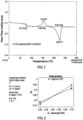
- the polymers of the invention are semicrystalline. Degree of crystallinity is measured herein by differential scanning calorimeter (DSC) using ASTM Method D3418 and is determined by a DSC curve and the difference in the enthalpy of crystallization exotherm and the enthalpy of fusion (melting) endotherm, as illustrated further below, and is reported herein as percent crystallinity.
- DSC differential scanning calorimeter
- the degree of crystallization can be determined using a Perkin-Elmer Model DSC-2 differential scanning calorimeter and plotting heat flow versus temperature using a 7.5 mg sample and heating the sample in N 2 purge at 20°C/min from RT to 325°C.
- the degree of crystallization is determined from the plot by calculating the area of the crystallization peak above the steady state heat flow and the area of the melting peak below the steady state heat flow, calculating the difference in areas and dividing by a constant based on the theoretical heat of fusion for 100% crystalline, e.g. for PCTA (29 cal/g).
- An example of a degree of crystallization calculation is shown in Figure 1 .
- an amorphous polymer refers to a polymer having a degree of crystallinity below 1%.
- crystalline polymer and semi-crystalline polymer are used interchangeably and refer to a polymer having a degree of crystallinity of 1% or greater.
- the polymers useful in this invention can have an initial level of crystallinity of from 1% to 100%, where the intial level is measured before being heated.
- Certain polymers useful in this invention can have a final crystallinity of from 1% to 60%, where the final crystallinity is measured after being heated either for at least three hours at 200°C or, alternatively, after being heated for at least twenty-four hours at 175°C.
- the polymers useful in this invention can have a final crystallinity of from 1 to 40%.
- the polymers useful in this invention can have a crystalline melting point of from 165° to 350°C; or a lower limit (of the range) from equal to or greater than 280°C; from equal to or greater than 275°C; from equal to or greater than 270°C; from equal to or greater than 255°C; from equal to or greater than 250°C; or from equal to or greater than 200°C, or from equal to or greater than 170°C as measured by differential scanning calorimetry (DSC) at 20 degrees C/minute according to ASTM Method 3418.
- DSC differential scanning calorimetry
- the invention further relates to articles of manufacture comprising any of the polymers and blends described above.
- the present invention could have usefulness in multiple applications. Areas that could benefit are applications that are at high temperatures and humidity levels for extended periods of time. These could include applications in the 3D printing of thermoplastic powders, additive printing and/or additive manufacturing, powder coating of metal articles, LED lighting, filter media, electrical and electronic, under the hood automotive applications, maritime, aerospace, thermoplastic powder coatings and the chemical process industries, surgical simulation devices, and orthotic and prosthetic devices.
- HSS High Speed Sintering
- SLS Selective Laser Sintering
- IR infrared
- CO2 laser is used to heat the powders.
- the powders are often held at very high temperatures just below their melting point for up to 24 hours to minimize the heat output from the IR lamp.
- Polymers held at these high temperatures and times can undergo thermal oxidative degradation and hydrolytic degradation, if they are a condensation polymer. This can cause the molecular weight to drop and the polymer to discolor and render it unrecyclable and un-processable.
- LED light emitting diodes
- Compounded plastic materials are used as reflector materials in the construction of LEDs both to provide control over the direction of emitted light as well as to protect the actual diode from damage.
- These compounded plastic materials can be thermoplastic or thermoset based on the needs of the LED in the application. For example, high power LEDs, with energy input requires >1.0 watts typically use thermoset materials due to the heat generated in use.
- Lower wattage LEDs can use thermoplastic materials that can be injection molded. These injection molded materials are cheaper to process and can include a range of conventional materials. During the assembly of LEDs, the diode is soldered to the LEAD frame and this soldering process requires that the thermoplastic materials are dimensionally stable during the soldering process. This requires that material to be semi-crystalline with a crystalline melting point in excess of 280°C. Additionally, since these molded thermoplastic parts reflect the LED light from the diode, they can provide high reflectivity during the lifetime of the application. Low color and high color stability, measured via color measurements as described herein, before and after aging, is often used as a proxy for reflectivity.
- these parts should also have high mechanical properties because they protect the diode from damage and survive various processing steps without breaking.
- the properties of reflectivity and high mechanical strength can be improved by compounding various base resin with other additives.
- These additives can provide enhanced "whiteness” as is the case for titanium dioxide and they can provide high toughness as is the case for inorganic fillers like glass fiber.
- Stabilizers and nucleating agents can also be added to improve stability and increase the rate of crystallization respectively.
- US Patent Application 2007/0213458 discloses the use of PCT compounds in Light-Emitting Diode Assembly Housings.
- thermoplastic resin undergoes thermal and shear induced degradation. Additionally, waste material that is not converted into usable parts should be recycled to reduce to overall cost of the material. For these reasons, the compounded thermoplastic material must be stable to processing without significant loss of the original performance. Additionally, the molded parts can maintain high reflectivity and high mechanical strength throughout the lifetime of the application, which in the case of LEDs, could be as long as 20+ years.
- This invention describes an optimized combination of additives that improves the process robustness of the compounded PCT resins. Improvements in reflectivity are measured via color and color stability using the color measurement as described herein. Reprocessability is measured via inherent viscosity (IV) before and after an extrusion or processing step.
- the invention further relates to articles of manufacture comprising any of the polymers, polymer compositions or polymer blends described above.
- polyester compositions are useful in articles of manufacture including, but not limited to, fibers, filaments, films, sheets, containers, extruded, calendered, and/or molded articles including, but not limited to, injection molded articles, extruded articles, cast extrusion articles, profile extrusion articles, melt spun articles, thermoformed articles, extrusion molded articles, injection blow molded articles, injection stretch blow molded articles, extrusion blow molded articles and extrusion stretch blow molded articles.
- the polyester compositions useful in the invention may be used in various types of film and/or sheet, including but not limited to extruded film(s) and/or sheet(s), calendered film(s) and/or sheet(s), compression molded film(s) and/or sheet(s), solution casted film(s) and/or sheet(s).
- Methods of making film and/or sheet include but are not limited to extrusion, calendering, compression molding, and solution casting.
- the polymer compositions and/or polymer blend compositions can be useful in forming fibers, films, light diffusing articles, light diffusing sheets, light reflecting articles, light reflecting sheets, light emitting diodes, 3D powders or other materials, 3D articles containing powders or other materials.
- the extruded sheet can be further modified using typical fabrication techniques such as thermoforming, cold bending, hot bending, adhesive bonding, cutting, drilling, laser cutting, etc. to create shapes useful for application as light reflectors and/or light diffusers.
- the light reflector article comprising the polymer compositions of the invention can comprise at least one inorganic light reflecting additive, for example, titanium dioxide, barium sulfate, calcium carbonate or mixtures thereof.
- the light reflecting article can comprise at least one additive chosen from glass fibers, impact modifiers, or stabilizers.
- membrane backing It can be a film, or a woven or nonwoven (wetlaid or melt blown/melt spun) mat. Improved temperature, chemical resistance, and/or hydrolytic resistance would be relevant to it as well;
- spun-laid nonwoven webs using processes well known in the art such as meltblowing and spunbond processes, wherein the continuous PCT fiber is spun from a pellet and laid into a nonwoven fabric in a single processing step; dry-laid or wet-laid nonwoven webs using processes well known in the art such as carding or air-laid processes, wherein PCT fiber is first spun in one process, chopped into staple fiber and laid into nonwoven fabric in a secondary step, using dry-laying technologies;
- Such nonwoven webs can be useful for air and liquid filtration media, particularly those filtration applications which are routinely exposed to high temperatures (80- 200°C) or corrosive chemicals.
- Wet laid webs is a common method for producing
- Machine clothing comprising monofilament, multifilament fibers, films or sheet, with improved thermal stability over existing PCT, PCT copolymers and additive formulations, to enables use in high temperature manufacturing environments, including for example belts used in the dryer section of paper and tissue making processes.
- Dry-laid media can include high temperature and/or chemically resistant bag house filters and variation thereof used to capture pollutants, such as those in in coal burning power plants, and various manufacturing processes.
- Certain embodiments would include using the polymer compositions of the invention in film application.
- High temperature processes may include variations of lead free soldering processes on films requiring good registration, flexibility, and/or optical clarity, as standalone or part of a multilayer system that may include inks, coatings, and/or other functionality.
- wt means "weight”.
- the inherent viscosity of the polymers, for example, the polyesters was determined in 60/40 (wt/wt) phenol/tetrachloroethane at a concentration of 0.5 g/100 ml at 25°C.
- PCT poly(cyclohexylenedimethylene) terephthalate
- CEG carboxyl chain ends
- the response of CEG is directly impacted by the concentrations of primary antioxidant, secondary antioxidant, and chain extender individually, but is also affected by the interaction of primary antioxidant and chain extender.
- the correlation coefficients (R 2 ) are very high for this response.
- the overall composition can be optimized to provide the most stable range of compositions.
- the Design Expert software can be used to help evaluate optimal ranges by using a Desirability Function. Desirability is an objective function that ranges from zero outside of the limits to one at the goal. The numerical optimization establishes a point that maximizes the desirability function. The characteristics of a goal may be altered by adjusting the weight or importance based on the target criteria.
- D an objective function
- D X
- the Desired Composition was selected using the following target criteria:
- contour plots provide a range of compositions to meet the target criteria based on data input into the software from the compositions previously teste. Another way to evaluate the invention is with a contour overlay plot. In a contour overlay plot, the range of properties achieved as specific parts of the composition changes can be seen. Contour overlay plots are shown in Figures 7 and 8 herein.
- Araldite ECN 1299 ( CAS# 29690-82-2 ) is an epoxy novolac resin made by Huntsman Advanced Materials, in The Woodlands, TX; Ultranox 626, ( CAS# 26741-53-7 ), is a bis (2,4-di-t-butylphenyl) pentaerythritol diphosphate made by Addivant, Danbury, CT.
Landscapes
- Chemical & Material Sciences (AREA)
- Health & Medical Sciences (AREA)
- Chemical Kinetics & Catalysis (AREA)
- Medicinal Chemistry (AREA)
- Polymers & Plastics (AREA)
- Organic Chemistry (AREA)
- Compositions Of Macromolecular Compounds (AREA)
- Polyesters Or Polycarbonates (AREA)
Claims (13)
- Polymerzusammensetzung aufweisend:(A) mindestens ein semikristallines Polymer, und(B) eine Stabilisatorzusammensetzung aufweisend:(1) mindestens ein primäres Antioxidationsmittel aufweisend mindestens ein phenolisches Antioxidationsmittel; und(2) mindestens ein sekundäres Antioxidationsmittel aufweisend mindestens ein Phosphit, und(3) mindestens ein Kettenverlängerungsmittel;wobei der Δb* Wert der besagten Polymerzusammensetzung weniger als 10 ist, entsprechend dem L*, a* und b* Farbsystem der CIE ("International Commission on Illumination" - Internationale Beleuchtungskommission) nach Erhitzen für mindestens drei Stunden bei 200 °C oder nach Erhitzen für mindestens vierundzwanzig Stunden bei 175 °C;charakterisiert dadurch, dassbesagtes, mindestens eines phenolisches Antioxidationsmittel Pentaerythritol-tetrakis[3-(3,5-di-t-butyl-4-hydroxyphenyl)propionat ist;besagtes mindestens eines Phosphit Tris(2,4-di-tert-butylphenyl)phosphit ist; undbesagtes mindestens eines Kettenverlängerungsmittel ein Copolymer aus Glycidylmethacrylat und Styrol ist.
- Polymerzusammensetzung nach Anspruch 1, wobei das Polymer ein finales Kristallinitäts-Niveau von 1% bis 40% hat, gemessen nach ASTM Methode D3418 wie beschrieben in der Beschreibung.
- Polymerzusammensetzung nach irgendeinem der Ansprüche 1 oder 2, wobei besagtes Polymer einen anfänglichen kristallinen Schmelzpunkt gleich oder größer als 250 °C besitzt, gemessen durch Differential-Scanning-Kalorimetrie bei 20 °C/Minute.
- Polymerzusammensetzung nach irgendeinem der Ansprüche 1 bis 3, wobei besagtes Polymer aufweist mindestens ein Polyester aufweisend:(a) Disäure-Reste aufweisend von etwa 90 bis etwa 100 Molprozent Terephthalsäure (TPA) Reste und 0 bis 10 Molprozent Isophthalsäure (IPA) Reste; und(b) Diol-Reste aufweisend von etwa 90 bis etwa 100 Molprozent 1,4-Cyclohexandimethanol (CHDM) Reste;wobei die Summe der Disäure-Reste 100 Mol% ist und wobei die Summe der Diol-Reste 100 Mol-% ist.
- Polymerzusammensetzung nach irgendeinem der Ansprüche 1 bis 3, wobei besagtes semi-kristallines Polymer ausgewählt ist aus flüssigen kristallinen Polyestern/Amiden/Imiden, Polyamiden, Polyesteramiden, Polyimiden, Polyetherimiden, Polybenzimidazol, Polybenzoxazolen, Polyiminen, Polystyrol, Polytetrafluoroethylen, Poly(hexamethylenadipamid), Polycaprolactam, Poly(ethylenterephthalat), und Poly(butylenterephthalat), Polyethylen, Poly(cyclohexylendimethylenterephthalat), Nylon 6.6, oder Nylon 6.
- Polymerzusammensetzung nach irgendeinem der Ansprüche 1 bis 5 besitzend eine inhärente Viskosität im Bereich von 0,50 bis 1,0 dL/g, bestimmt in 60/40 (Gew./Gew.) Phenol/Tetrachlorethan bei einer Konzentration von 0,5 g/100 mL bei 25 °C.
- Polymerzusammensetzung nach irgendeinem der Ansprüche 1 bis 6, wobei das phenolische Antioxidationsmittel in einer Menge im Bereich von 0,01 bis 1,0 Gewichts-% vorliegt, basierend auf dem Gesamtgewicht der Polymerzusammensetzung entsprechend 100 Gewichts-%.
- Polymerzusammensetzung nach irgendeinem der Ansprüche 1 bis 7, wobei das Phosphit in einer Menge von 0,10 Gewichts-% bis 1 Gewichts-% vorliegt, basierend auf dem Gesamtgewicht der Polymerzusammensetzung entsprechend 100 Gewichts-%.
- Polymerzusammensetzung nach irgendeinem der Ansprüche 1 bis 8, wobei das Gewichtsverhältnis des phenolischen Antioxidationsmittels zu Phosphit von 1:1,1 bis 1:4 ist, basierend auf dem Gesamtgewicht der Polymerzusammensetzung.
- Polymerzusammensetzung nach irgendeinem der Ansprüche 1 bis 9, wobei besagtes Kettenverlängerungsmittel im Durchschnitt mehr als oder gleich 4 seitenständige Epoxidgruppen pro Molekül hat.
- Polymerzusammensetzung nach irgendeinem der Ansprüche 1 bis 10, wobei das mindestens eine Kettenverlängerungsmittel in einer Menge im Bereich von 0.20 Gewichts-% bis 2.0 Gewichts-% vorliegt, basierend auf dem gesamten Gewichtsprozent der Polymerzusammensetzung entsprechend 100 Gewichts-%.
- Polymerzusammensetzung nach irgendeinem der Ansprüche 1 bis 11, wobei das Gewichtsverhältnis des Kettenverlängerungsmittels zum primären Antioxidationsmittel im Bereich von 1,1:1 bis 4:1 ist.
- Polymerzusammensetzung nach irgendeinem der Ansprüche 1 bis 12, wobei (1) das mindestens eine phenolische Antioxidationsmittel in einer Menge von 0,10 Gewichts-% bis 0,5 Gewichts-% vorliegt, (2) das mindestens eine Phosphit in einer Menge von 0,25 Gewichts-% bis 0,75 Gewichts-% vorliegt, und (3) das Kettenverlängerungsmittel in einer Menge von 0,40 Gewichts-% bis 0,90 Gewichts-% vorliegt, basierend auf dem Gesamtgewicht der Polymerzusammensetzung.
Applications Claiming Priority (2)
| Application Number | Priority Date | Filing Date | Title |
|---|---|---|---|
| US201762534979P | 2017-07-20 | 2017-07-20 | |
| PCT/US2018/042395 WO2019018345A1 (en) | 2017-07-20 | 2018-07-17 | POLYMER COMPOSITIONS COMPRISING CRYSTALLINE POLYMERS AND A STABILIZER COMPOSITION |
Publications (2)
| Publication Number | Publication Date |
|---|---|
| EP3655477A1 EP3655477A1 (de) | 2020-05-27 |
| EP3655477B1 true EP3655477B1 (de) | 2023-10-25 |
Family
ID=63104067
Family Applications (1)
| Application Number | Title | Priority Date | Filing Date |
|---|---|---|---|
| EP18749974.4A Active EP3655477B1 (de) | 2017-07-20 | 2018-07-17 | Polymzusammensetzungen, die kristalline polymere und einen stabilisator enthalten |
Country Status (4)
| Country | Link |
|---|---|
| US (1) | US11629224B2 (de) |
| EP (1) | EP3655477B1 (de) |
| CN (1) | CN111133043A (de) |
| WO (1) | WO2019018345A1 (de) |
Families Citing this family (3)
| Publication number | Priority date | Publication date | Assignee | Title |
|---|---|---|---|---|
| EP3911703A1 (de) | 2019-01-18 | 2021-11-24 | Eastman Chemical Company | Polymerzusammensetzungen mit verbesserter witterungsbeständigkeit |
| EP4096916B1 (de) * | 2020-01-27 | 2023-11-08 | DSM IP Assets B.V. | Schichtmaterial |
| WO2024059564A1 (en) * | 2022-09-12 | 2024-03-21 | Align Technology, Inc. | Systems and methods for teeth whitening simulation |
Family Cites Families (30)
| Publication number | Priority date | Publication date | Assignee | Title |
|---|---|---|---|---|
| US2012267A (en) | 1929-08-01 | 1935-08-27 | Du Pont | Alkylene ester of polybasic acids |
| US4524165A (en) | 1983-10-24 | 1985-06-18 | Eastman Kodak Company | Stabilized copolyesterether compositions suitable for outdoor applications |
| US4885119A (en) | 1986-08-26 | 1989-12-05 | W. R. Grace & Co. | Method of making a multilayer film |
| US4897453A (en) | 1988-07-29 | 1990-01-30 | Eastman Kodak Company | Compatible blends of polyester-ethers and polycarbonates |
| EP0497818B1 (de) * | 1989-10-23 | 1995-09-20 | Eastman Chemical Company | Poly(1,4-cyclohexylendimethylenterephthalat) mit verbesserter schmelzstabilität |
| IL110514A0 (en) | 1993-10-04 | 1994-10-21 | Eastman Chem Co | Concentrates for improving polyester compositions and a method for preparing such compositions |
| US5696176A (en) | 1995-09-22 | 1997-12-09 | Eastman Chemical Company | Foamable polyester compositions having a low level of unreacted branching agent |
| ES2198679T3 (es) | 1997-09-29 | 2004-02-01 | Ciba Specialty Chemicals Holding Inc. | Granulados de estabilizadores epoxidados, exentos de polvillo, y procedimiento para su fabricacion. |
| TW585880B (en) * | 1999-08-05 | 2004-05-01 | Daicel Chem | Process for producing polyester block copolymer |
| US6984694B2 (en) * | 2002-02-01 | 2006-01-10 | Johnson Polymer, Llc | Oligomeric chain extenders for processing, post-processing and recycling of condensation polymers, synthesis, compositions and applications |
| US7119141B2 (en) * | 2003-08-20 | 2006-10-10 | General Electric Company | Polyester molding composition |
| US7169880B2 (en) | 2003-12-04 | 2007-01-30 | Eastman Chemical Company | Shaped articles from cycloaliphatic polyester compositions |
| US8007885B2 (en) * | 2005-09-14 | 2011-08-30 | Georgios Topoulos | Light-emitting diode assembly housing comprising poly(cyclohexanedimethanol terephthalate) compositions |
| ATE444981T1 (de) * | 2005-10-28 | 2009-10-15 | Eastman Chem Co | Aus 2,2,4,4-tetramethyl-1,3-cyclobutandiol und 1, 4-cyclohexandimethanol gebildete polyesterzusammensetzungen umfassendes restaurantgeschirr |
| US9062196B2 (en) * | 2007-09-28 | 2015-06-23 | Sabic Global Technologies B.V. | High heat polycarbonates, methods of making, and articles formed therefrom |
| US20090170985A1 (en) | 2007-12-28 | 2009-07-02 | Rina Ai | Polyester-polyamide compositions, articles, and method of manufacture thereof |
| JP5377869B2 (ja) | 2008-03-07 | 2013-12-25 | ウィンテックポリマー株式会社 | 難燃性樹脂組成物及び被覆電線 |
| WO2009120211A1 (en) | 2008-03-28 | 2009-10-01 | Basf Corporation | Polymeric compositions for plastic strapping |
| CA2782155A1 (en) * | 2009-12-02 | 2011-06-09 | Basf Se | Stabilizer composition for filled polymers and nanocomposites |
| KR20130090787A (ko) * | 2010-05-21 | 2013-08-14 | 티코나 엘엘씨 | 안정화제를 포함하는 고온 중합체 합금 |
| KR20210060652A (ko) | 2010-10-01 | 2021-05-26 | 바스프 에스이 | 스티렌 (메트)아크릴 올리고머 |
| US9453119B2 (en) * | 2011-04-14 | 2016-09-27 | Ticona Llc | Polymer composition for producing articles with light reflective properties |
| US20120319031A1 (en) * | 2011-06-15 | 2012-12-20 | Thermal Solution Resources, Llc | Thermally conductive thermoplastic compositions |
| JP2016504459A (ja) | 2012-12-18 | 2016-02-12 | ティコナ・エルエルシー | 発光ダイオードアセンブリ用の成形反射体 |
| KR102049411B1 (ko) | 2013-06-11 | 2019-11-27 | 에스케이케미칼 주식회사 | 내약품성이 우수한 고분자 수지 조성물 |
| EP3009478B1 (de) * | 2013-06-13 | 2023-11-22 | Kuraray Co., Ltd. | Polyamidzusammensetzung und daraus hergestellter formartikel |
| KR101677884B1 (ko) * | 2013-10-18 | 2016-11-18 | 도레이 카부시키가이샤 | 폴리아미드 수지 조성물, 제조 방법, 성형품 |
| CN105524399B (zh) | 2015-12-29 | 2018-08-31 | 银禧工程塑料(东莞)有限公司 | 一种3d打印的聚合物材料及其制备方法 |
| CN106317798A (zh) * | 2016-08-05 | 2017-01-11 | 上海金发科技发展有限公司 | 一种高流动性低熔点的阻燃pbt/pet树脂组合物及其制备方法 |
| CN107746554A (zh) | 2017-12-01 | 2018-03-02 | 上海金发科技发展有限公司 | 一种仿陶瓷阻燃pet/abs树脂组合物及其制备方法 |
-
2018
- 2018-07-17 WO PCT/US2018/042395 patent/WO2019018345A1/en not_active Ceased
- 2018-07-17 EP EP18749974.4A patent/EP3655477B1/de active Active
- 2018-07-17 CN CN201880061371.7A patent/CN111133043A/zh active Pending
- 2018-07-17 US US16/631,881 patent/US11629224B2/en active Active
Also Published As
| Publication number | Publication date |
|---|---|
| WO2019018345A1 (en) | 2019-01-24 |
| US20200148813A1 (en) | 2020-05-14 |
| CN111133043A (zh) | 2020-05-08 |
| US11629224B2 (en) | 2023-04-18 |
| EP3655477A1 (de) | 2020-05-27 |
Similar Documents
| Publication | Publication Date | Title |
|---|---|---|
| US11492484B2 (en) | Polymer compositions having improved properties of thermal stability, color, and/or flow | |
| US5173357A (en) | Tear-resistant polyester film and laminated sheets comprised of the same | |
| EP3655477B1 (de) | Polymzusammensetzungen, die kristalline polymere und einen stabilisator enthalten | |
| US8969443B2 (en) | Flame retardant copolyester compositions | |
| EP0672717A1 (de) | Feuerfeste Polymerzusammensetzung und daraus geformte Gegenstände | |
| US12247115B2 (en) | Polymer compositions with improved weathering resistance | |
| US20240352276A1 (en) | Process of making articles comprising polyester/polyester elastomer compositions | |
| WO2022266300A1 (en) | Process for making molded articles | |
| WO2022266284A1 (en) | Polyester/polyester elastomer compositions | |
| CN114729153A (zh) | 具有改进的抗冲击性和耐候性的脂族共聚酯组合物 | |
| WO2022266297A1 (en) | Articles comprising polyester/polyester elastomer compositions | |
| WO2022266289A1 (en) | Process for making polyester/polyester elastomer compositions | |
| JP3953844B2 (ja) | ポリブチレンテレフタレート系樹脂組成物、及びそれを用いた成形品 | |
| WO2022266299A1 (en) | Process for making polyester/polyester elastomer compositions | |
| WO2024158786A1 (en) | Flame retardant copolyester compositions | |
| JP2003055540A (ja) | ポリエステル樹脂組成物 | |
| JPH0987498A (ja) | 難燃性ポリエチレンテレフタレート系樹脂組成物 |
Legal Events
| Date | Code | Title | Description |
|---|---|---|---|
| STAA | Information on the status of an ep patent application or granted ep patent |
Free format text: STATUS: UNKNOWN |
|
| STAA | Information on the status of an ep patent application or granted ep patent |
Free format text: STATUS: THE INTERNATIONAL PUBLICATION HAS BEEN MADE |
|
| PUAI | Public reference made under article 153(3) epc to a published international application that has entered the european phase |
Free format text: ORIGINAL CODE: 0009012 |
|
| STAA | Information on the status of an ep patent application or granted ep patent |
Free format text: STATUS: REQUEST FOR EXAMINATION WAS MADE |
|
| 17P | Request for examination filed |
Effective date: 20200109 |
|
| AK | Designated contracting states |
Kind code of ref document: A1 Designated state(s): AL AT BE BG CH CY CZ DE DK EE ES FI FR GB GR HR HU IE IS IT LI LT LU LV MC MK MT NL NO PL PT RO RS SE SI SK SM TR |
|
| AX | Request for extension of the european patent |
Extension state: BA ME |
|
| DAV | Request for validation of the european patent (deleted) | ||
| DAX | Request for extension of the european patent (deleted) | ||
| STAA | Information on the status of an ep patent application or granted ep patent |
Free format text: STATUS: EXAMINATION IS IN PROGRESS |
|
| 17Q | First examination report despatched |
Effective date: 20201201 |
|
| GRAP | Despatch of communication of intention to grant a patent |
Free format text: ORIGINAL CODE: EPIDOSNIGR1 |
|
| STAA | Information on the status of an ep patent application or granted ep patent |
Free format text: STATUS: GRANT OF PATENT IS INTENDED |
|
| RIC1 | Information provided on ipc code assigned before grant |
Ipc: C08K 5/134 20060101ALN20230524BHEP Ipc: C08L 25/14 20060101ALI20230524BHEP Ipc: C08K 5/526 20060101ALI20230524BHEP Ipc: C08L 67/02 20060101ALI20230524BHEP Ipc: C08K 5/13 20060101AFI20230524BHEP |
|
| INTG | Intention to grant announced |
Effective date: 20230612 |
|
| P01 | Opt-out of the competence of the unified patent court (upc) registered |
Effective date: 20230725 |
|
| GRAS | Grant fee paid |
Free format text: ORIGINAL CODE: EPIDOSNIGR3 |
|
| GRAA | (expected) grant |
Free format text: ORIGINAL CODE: 0009210 |
|
| STAA | Information on the status of an ep patent application or granted ep patent |
Free format text: STATUS: THE PATENT HAS BEEN GRANTED |
|
| AK | Designated contracting states |
Kind code of ref document: B1 Designated state(s): AL AT BE BG CH CY CZ DE DK EE ES FI FR GB GR HR HU IE IS IT LI LT LU LV MC MK MT NL NO PL PT RO RS SE SI SK SM TR |
|
| REG | Reference to a national code |
Ref country code: GB Ref legal event code: FG4D |
|
| REG | Reference to a national code |
Ref country code: CH Ref legal event code: EP |
|
| REG | Reference to a national code |
Ref country code: DE Ref legal event code: R096 Ref document number: 602018059978 Country of ref document: DE |
|
| REG | Reference to a national code |
Ref country code: IE Ref legal event code: FG4D |
|
| REG | Reference to a national code |
Ref country code: LT Ref legal event code: MG9D |
|
| REG | Reference to a national code |
Ref country code: NL Ref legal event code: MP Effective date: 20231025 |
|
| REG | Reference to a national code |
Ref country code: AT Ref legal event code: MK05 Ref document number: 1624620 Country of ref document: AT Kind code of ref document: T Effective date: 20231025 |
|
| PG25 | Lapsed in a contracting state [announced via postgrant information from national office to epo] |
Ref country code: NL Free format text: LAPSE BECAUSE OF FAILURE TO SUBMIT A TRANSLATION OF THE DESCRIPTION OR TO PAY THE FEE WITHIN THE PRESCRIBED TIME-LIMIT Effective date: 20231025 |
|
| PG25 | Lapsed in a contracting state [announced via postgrant information from national office to epo] |
Ref country code: GR Free format text: LAPSE BECAUSE OF FAILURE TO SUBMIT A TRANSLATION OF THE DESCRIPTION OR TO PAY THE FEE WITHIN THE PRESCRIBED TIME-LIMIT Effective date: 20240126 |
|
| PG25 | Lapsed in a contracting state [announced via postgrant information from national office to epo] |
Ref country code: IS Free format text: LAPSE BECAUSE OF FAILURE TO SUBMIT A TRANSLATION OF THE DESCRIPTION OR TO PAY THE FEE WITHIN THE PRESCRIBED TIME-LIMIT Effective date: 20240225 |
|
| PG25 | Lapsed in a contracting state [announced via postgrant information from national office to epo] |
Ref country code: LT Free format text: LAPSE BECAUSE OF FAILURE TO SUBMIT A TRANSLATION OF THE DESCRIPTION OR TO PAY THE FEE WITHIN THE PRESCRIBED TIME-LIMIT Effective date: 20231025 |
|
| PG25 | Lapsed in a contracting state [announced via postgrant information from national office to epo] |
Ref country code: AT Free format text: LAPSE BECAUSE OF FAILURE TO SUBMIT A TRANSLATION OF THE DESCRIPTION OR TO PAY THE FEE WITHIN THE PRESCRIBED TIME-LIMIT Effective date: 20231025 |
|
| PG25 | Lapsed in a contracting state [announced via postgrant information from national office to epo] |
Ref country code: ES Free format text: LAPSE BECAUSE OF FAILURE TO SUBMIT A TRANSLATION OF THE DESCRIPTION OR TO PAY THE FEE WITHIN THE PRESCRIBED TIME-LIMIT Effective date: 20231025 |
|
| PG25 | Lapsed in a contracting state [announced via postgrant information from national office to epo] |
Ref country code: LT Free format text: LAPSE BECAUSE OF FAILURE TO SUBMIT A TRANSLATION OF THE DESCRIPTION OR TO PAY THE FEE WITHIN THE PRESCRIBED TIME-LIMIT Effective date: 20231025 Ref country code: IS Free format text: LAPSE BECAUSE OF FAILURE TO SUBMIT A TRANSLATION OF THE DESCRIPTION OR TO PAY THE FEE WITHIN THE PRESCRIBED TIME-LIMIT Effective date: 20240225 Ref country code: GR Free format text: LAPSE BECAUSE OF FAILURE TO SUBMIT A TRANSLATION OF THE DESCRIPTION OR TO PAY THE FEE WITHIN THE PRESCRIBED TIME-LIMIT Effective date: 20240126 Ref country code: ES Free format text: LAPSE BECAUSE OF FAILURE TO SUBMIT A TRANSLATION OF THE DESCRIPTION OR TO PAY THE FEE WITHIN THE PRESCRIBED TIME-LIMIT Effective date: 20231025 Ref country code: BG Free format text: LAPSE BECAUSE OF FAILURE TO SUBMIT A TRANSLATION OF THE DESCRIPTION OR TO PAY THE FEE WITHIN THE PRESCRIBED TIME-LIMIT Effective date: 20240125 Ref country code: AT Free format text: LAPSE BECAUSE OF FAILURE TO SUBMIT A TRANSLATION OF THE DESCRIPTION OR TO PAY THE FEE WITHIN THE PRESCRIBED TIME-LIMIT Effective date: 20231025 Ref country code: PT Free format text: LAPSE BECAUSE OF FAILURE TO SUBMIT A TRANSLATION OF THE DESCRIPTION OR TO PAY THE FEE WITHIN THE PRESCRIBED TIME-LIMIT Effective date: 20240226 |
|
| PG25 | Lapsed in a contracting state [announced via postgrant information from national office to epo] |
Ref country code: SE Free format text: LAPSE BECAUSE OF FAILURE TO SUBMIT A TRANSLATION OF THE DESCRIPTION OR TO PAY THE FEE WITHIN THE PRESCRIBED TIME-LIMIT Effective date: 20231025 Ref country code: RS Free format text: LAPSE BECAUSE OF FAILURE TO SUBMIT A TRANSLATION OF THE DESCRIPTION OR TO PAY THE FEE WITHIN THE PRESCRIBED TIME-LIMIT Effective date: 20231025 Ref country code: PL Free format text: LAPSE BECAUSE OF FAILURE TO SUBMIT A TRANSLATION OF THE DESCRIPTION OR TO PAY THE FEE WITHIN THE PRESCRIBED TIME-LIMIT Effective date: 20231025 Ref country code: NO Free format text: LAPSE BECAUSE OF FAILURE TO SUBMIT A TRANSLATION OF THE DESCRIPTION OR TO PAY THE FEE WITHIN THE PRESCRIBED TIME-LIMIT Effective date: 20240125 Ref country code: LV Free format text: LAPSE BECAUSE OF FAILURE TO SUBMIT A TRANSLATION OF THE DESCRIPTION OR TO PAY THE FEE WITHIN THE PRESCRIBED TIME-LIMIT Effective date: 20231025 Ref country code: HR Free format text: LAPSE BECAUSE OF FAILURE TO SUBMIT A TRANSLATION OF THE DESCRIPTION OR TO PAY THE FEE WITHIN THE PRESCRIBED TIME-LIMIT Effective date: 20231025 |
|
| PG25 | Lapsed in a contracting state [announced via postgrant information from national office to epo] |
Ref country code: DK Free format text: LAPSE BECAUSE OF FAILURE TO SUBMIT A TRANSLATION OF THE DESCRIPTION OR TO PAY THE FEE WITHIN THE PRESCRIBED TIME-LIMIT Effective date: 20231025 |
|
| PG25 | Lapsed in a contracting state [announced via postgrant information from national office to epo] |
Ref country code: CZ Free format text: LAPSE BECAUSE OF FAILURE TO SUBMIT A TRANSLATION OF THE DESCRIPTION OR TO PAY THE FEE WITHIN THE PRESCRIBED TIME-LIMIT Effective date: 20231025 |
|
| REG | Reference to a national code |
Ref country code: DE Ref legal event code: R097 Ref document number: 602018059978 Country of ref document: DE |
|
| PG25 | Lapsed in a contracting state [announced via postgrant information from national office to epo] |
Ref country code: SK Free format text: LAPSE BECAUSE OF FAILURE TO SUBMIT A TRANSLATION OF THE DESCRIPTION OR TO PAY THE FEE WITHIN THE PRESCRIBED TIME-LIMIT Effective date: 20231025 |
|
| PG25 | Lapsed in a contracting state [announced via postgrant information from national office to epo] |
Ref country code: SM Free format text: LAPSE BECAUSE OF FAILURE TO SUBMIT A TRANSLATION OF THE DESCRIPTION OR TO PAY THE FEE WITHIN THE PRESCRIBED TIME-LIMIT Effective date: 20231025 Ref country code: SK Free format text: LAPSE BECAUSE OF FAILURE TO SUBMIT A TRANSLATION OF THE DESCRIPTION OR TO PAY THE FEE WITHIN THE PRESCRIBED TIME-LIMIT Effective date: 20231025 Ref country code: RO Free format text: LAPSE BECAUSE OF FAILURE TO SUBMIT A TRANSLATION OF THE DESCRIPTION OR TO PAY THE FEE WITHIN THE PRESCRIBED TIME-LIMIT Effective date: 20231025 Ref country code: IT Free format text: LAPSE BECAUSE OF FAILURE TO SUBMIT A TRANSLATION OF THE DESCRIPTION OR TO PAY THE FEE WITHIN THE PRESCRIBED TIME-LIMIT Effective date: 20231025 Ref country code: EE Free format text: LAPSE BECAUSE OF FAILURE TO SUBMIT A TRANSLATION OF THE DESCRIPTION OR TO PAY THE FEE WITHIN THE PRESCRIBED TIME-LIMIT Effective date: 20231025 Ref country code: DK Free format text: LAPSE BECAUSE OF FAILURE TO SUBMIT A TRANSLATION OF THE DESCRIPTION OR TO PAY THE FEE WITHIN THE PRESCRIBED TIME-LIMIT Effective date: 20231025 Ref country code: CZ Free format text: LAPSE BECAUSE OF FAILURE TO SUBMIT A TRANSLATION OF THE DESCRIPTION OR TO PAY THE FEE WITHIN THE PRESCRIBED TIME-LIMIT Effective date: 20231025 |
|
| PLBE | No opposition filed within time limit |
Free format text: ORIGINAL CODE: 0009261 |
|
| STAA | Information on the status of an ep patent application or granted ep patent |
Free format text: STATUS: NO OPPOSITION FILED WITHIN TIME LIMIT |
|
| 26N | No opposition filed |
Effective date: 20240726 |
|
| PG25 | Lapsed in a contracting state [announced via postgrant information from national office to epo] |
Ref country code: SI Free format text: LAPSE BECAUSE OF FAILURE TO SUBMIT A TRANSLATION OF THE DESCRIPTION OR TO PAY THE FEE WITHIN THE PRESCRIBED TIME-LIMIT Effective date: 20231025 |
|
| PG25 | Lapsed in a contracting state [announced via postgrant information from national office to epo] |
Ref country code: SI Free format text: LAPSE BECAUSE OF FAILURE TO SUBMIT A TRANSLATION OF THE DESCRIPTION OR TO PAY THE FEE WITHIN THE PRESCRIBED TIME-LIMIT Effective date: 20231025 |
|
| PG25 | Lapsed in a contracting state [announced via postgrant information from national office to epo] |
Ref country code: MC Free format text: LAPSE BECAUSE OF FAILURE TO SUBMIT A TRANSLATION OF THE DESCRIPTION OR TO PAY THE FEE WITHIN THE PRESCRIBED TIME-LIMIT Effective date: 20231025 |
|
| REG | Reference to a national code |
Ref country code: CH Ref legal event code: PL |
|
| PG25 | Lapsed in a contracting state [announced via postgrant information from national office to epo] |
Ref country code: LU Free format text: LAPSE BECAUSE OF NON-PAYMENT OF DUE FEES Effective date: 20240717 |
|
| GBPC | Gb: european patent ceased through non-payment of renewal fee |
Effective date: 20240717 |
|
| PG25 | Lapsed in a contracting state [announced via postgrant information from national office to epo] |
Ref country code: LU Free format text: LAPSE BECAUSE OF NON-PAYMENT OF DUE FEES Effective date: 20240717 |
|
| PG25 | Lapsed in a contracting state [announced via postgrant information from national office to epo] |
Ref country code: CH Free format text: LAPSE BECAUSE OF NON-PAYMENT OF DUE FEES Effective date: 20240731 Ref country code: BE Free format text: LAPSE BECAUSE OF NON-PAYMENT OF DUE FEES Effective date: 20240731 |
|
| PG25 | Lapsed in a contracting state [announced via postgrant information from national office to epo] |
Ref country code: GB Free format text: LAPSE BECAUSE OF NON-PAYMENT OF DUE FEES Effective date: 20240717 |
|
| REG | Reference to a national code |
Ref country code: BE Ref legal event code: MM Effective date: 20240731 |
|
| PGFP | Annual fee paid to national office [announced via postgrant information from national office to epo] |
Ref country code: FR Payment date: 20250612 Year of fee payment: 8 |
|
| PG25 | Lapsed in a contracting state [announced via postgrant information from national office to epo] |
Ref country code: IE Free format text: LAPSE BECAUSE OF NON-PAYMENT OF DUE FEES Effective date: 20240717 |
|
| PG25 | Lapsed in a contracting state [announced via postgrant information from national office to epo] |
Ref country code: FI Free format text: LAPSE BECAUSE OF FAILURE TO SUBMIT A TRANSLATION OF THE DESCRIPTION OR TO PAY THE FEE WITHIN THE PRESCRIBED TIME-LIMIT Effective date: 20231025 |
|
| PGFP | Annual fee paid to national office [announced via postgrant information from national office to epo] |
Ref country code: DE Payment date: 20250616 Year of fee payment: 8 |
|
| PG25 | Lapsed in a contracting state [announced via postgrant information from national office to epo] |
Ref country code: CY Free format text: LAPSE BECAUSE OF FAILURE TO SUBMIT A TRANSLATION OF THE DESCRIPTION OR TO PAY THE FEE WITHIN THE PRESCRIBED TIME-LIMIT; INVALID AB INITIO Effective date: 20180717 |
|
| PG25 | Lapsed in a contracting state [announced via postgrant information from national office to epo] |
Ref country code: HU Free format text: LAPSE BECAUSE OF FAILURE TO SUBMIT A TRANSLATION OF THE DESCRIPTION OR TO PAY THE FEE WITHIN THE PRESCRIBED TIME-LIMIT; INVALID AB INITIO Effective date: 20180717 |