EP3656285B1 - Procédé et dispositif d'étalonnage d'un dispositif de suivi oculaire - Google Patents
Procédé et dispositif d'étalonnage d'un dispositif de suivi oculaire Download PDFInfo
- Publication number
- EP3656285B1 EP3656285B1 EP19204663.9A EP19204663A EP3656285B1 EP 3656285 B1 EP3656285 B1 EP 3656285B1 EP 19204663 A EP19204663 A EP 19204663A EP 3656285 B1 EP3656285 B1 EP 3656285B1
- Authority
- EP
- European Patent Office
- Prior art keywords
- eye
- eye data
- user
- gaze direction
- acquired
- Prior art date
- Legal status (The legal status is an assumption and is not a legal conclusion. Google has not performed a legal analysis and makes no representation as to the accuracy of the status listed.)
- Active
Links
Images



Classifications
-
- G—PHYSICS
- G06—COMPUTING OR CALCULATING; COUNTING
- G06F—ELECTRIC DIGITAL DATA PROCESSING
- G06F3/00—Input arrangements for transferring data to be processed into a form capable of being handled by the computer; Output arrangements for transferring data from processing unit to output unit, e.g. interface arrangements
- G06F3/01—Input arrangements or combined input and output arrangements for interaction between user and computer
- G06F3/011—Arrangements for interaction with the human body, e.g. for user immersion in virtual reality
- G06F3/013—Eye tracking input arrangements
-
- G—PHYSICS
- G06—COMPUTING OR CALCULATING; COUNTING
- G06T—IMAGE DATA PROCESSING OR GENERATION, IN GENERAL
- G06T7/00—Image analysis
- G06T7/80—Analysis of captured images to determine intrinsic or extrinsic camera parameters, i.e. camera calibration
-
- G—PHYSICS
- G06—COMPUTING OR CALCULATING; COUNTING
- G06V—IMAGE OR VIDEO RECOGNITION OR UNDERSTANDING
- G06V40/00—Recognition of biometric, human-related or animal-related patterns in image or video data
- G06V40/10—Human or animal bodies, e.g. vehicle occupants or pedestrians; Body parts, e.g. hands
- G06V40/18—Eye characteristics, e.g. of the iris
-
- G—PHYSICS
- G06—COMPUTING OR CALCULATING; COUNTING
- G06V—IMAGE OR VIDEO RECOGNITION OR UNDERSTANDING
- G06V40/00—Recognition of biometric, human-related or animal-related patterns in image or video data
- G06V40/10—Human or animal bodies, e.g. vehicle occupants or pedestrians; Body parts, e.g. hands
- G06V40/18—Eye characteristics, e.g. of the iris
- G06V40/19—Sensors therefor
Definitions
- the present disclosure relates generally to methods, systems and devices for calibrating an eye-tracking device to suit an individual user.
- eye-tracking systems are known in the art. Such systems may, for example, be employed to allow a user to indicate a location at a computer display by looking at that point.
- the eye-tracking system may capture images of the user's face, and then employ image processing to extract key features from the user's face, such as a pupil center and glints from illuminators illuminating the user's face. The extracted features may then be employed to determine where at the display the user is looking.
- the user For a user to have an accurate and precise eye-tracking experience the user needs to calibrate the eye tracker. This is typically done by looking at a given set of reference points for a certain amount of time and acquiring eye data of the user related to the gaze direction of the user. Once the set of reference points have been looked upon by the user a calibration profile is established, defining the characteristics of at least one of the person's eyes.
- This calibration profile may contain data on the characteristics of the user's eye(s), for instance, the interocular distance (IOD), inter-pupillary distance (IPD), pupil size, pupil size variations, bright pupil contrast, dark pupil contrast, corneal radius and the like. This information may be pre-existing in the calibration profile or may be incorporated into the calibration profile at the time of analysis. Alternatively, default parameters may be stored in the eye tracker to serve as an initial starting point.
- the calibration process can be time-consuming and tedious. Reducing the amount of time spent in this process is key for a good eye-tracking experience. Consequently, there exists a need for improvement when it comes to facilitating calibration in eye-tracking devices.
- Patent document US2016/0029883 A1 is such an example of gaze-tracking device using previous calibration date when there is a match between present and past calibration sets of measurements.
- Other example of performing a calibration of a gaze-tracking device can be found in patent document US2016/0134863 A1 .
- An object of embodiments of the invention is to provide a device and a method which improves the eye-tracking experience for a user with respect to the calibration process. It may be possible to achieve these objects, and others, by using methods, devices and computer programs as defined in the attached independent claims.
- a method for calibrating an eye-tracking device to suit a user of the eye-tracking device wherein a calibration setting of the eye-tracking device associated with a user is calculated based on acquired eye data of the user when looking at a set of reference points, the method comprising the steps of: displaying a reference point of the set to the user; acquiring, by means of at least one camera of the eye-tracking device, eye data for at least one of the eyes of the user when looking at the reference point; comparing the acquired eye data to stored eye data sets related to the reference point, wherein each of the stored eye data sets is associated with a calibration setting of the eye-tracking device; and if the acquired eye data matches one of the stored eye data sets, abandoning the calibration process and loading the calibration setting associated with the matching stored eye data.
- the time needed for the calibration process is significantly reduced while achieving a viable calibration which suits the user to a high degree.
- the method further comprises: repeating the steps of displaying reference points and acquiring eye data for the remaining reference points in the set; calculating a calibration setting based on the acquired eye data for all the reference points in the set; and storing the calculated calibration setting and the acquired eye data for all the reference points in the set. If no match is found, the calibration process continues in the conventional way wherein the calibration setting and associated eye data are stored for future use during subsequent calibration of the eye-tracking device to a user.
- a match is determined if the difference between the acquired eye data and the stored eye data does not exceed a predetermined threshold value.
- the threshold defines a limit for the comparison of the acquired and the stored eye data and ensures that a determined match provides a viable calibration for the user.
- the step of acquiring eye data comprises determining a gaze direction offset between a gaze direction of at least one of the eyes of the user and the reference point and the step of comparing eye data comprises comparing the acquired gaze direction offset with stored gaze direction offsets.
- the gaze direction offset is one example of eye data frequently used in the field of eye-tracking and provides a simple and reliable way of comparing acquired and stored eye data.
- the method further comprises acquiring the gaze direction offset for both eyes. Using data from both eyes of the user increases the precision and reliability of the method in determining a suitable calibration setting.
- the step of comparing further comprises determining a relation between the gaze direction offsets of the left eye and the right eye and comparing the determined relation with a corresponding relation between stored gaze direction offsets of the left eye and the right eye.
- the relation between the gaze direction offsets of the left eye and the right eye comprises the distance from the gaze direction offsets of the left eye and the right eye to the reference point, respectively, and/or the angle between the gaze direction offsets of the left eye and the right eye.
- the step of acquiring eye data further comprises determining one of an interocular distance (IOD) and an inter-pupillary distance (IPD), and the step of comparing eye data comprises comparing the acquired IOD or IPD with stored IODs or IPDs.
- IOD interocular distance
- IPD inter-pupillary distance
- Using data related to the distance between the eyes is further increases the precision and reliability of the method in determining a suitable calibration setting. Additionally, by combining different eye data in two or more steps, a first comparison may exclude non-viable calibrations to reduce the number of comparisons in subsequent steps, thereby achieving a faster calibration process.
- an eye-tracking device operable for tracking a gaze direction of a user, wherein a calibration setting of the eye-tracking device associated with a user is calculated based on acquired eye data of the user when looking at a set of reference points
- the device comprising at least one camera; processing circuitry; and a memory, said memory containing instructions executable by said processing circuitry, whereby said eye-tracking device is operative for: displaying a reference point of the set to the user; acquiring, by means of the camera, data for at least one of the eyes of the user when looking at the reference point; comparing the acquired eye data to stored eye data sets related to the reference point, wherein each of the stored eye data sets is associated with a calibration setting of the eye-tracking device; and if the acquired eye data matches one of the stored eye data sets, abandoning the calibration process and loading the calibration setting associated with the matching stored eye data.
- the eye-tracking is further operative for, if the acquired eye data does not match any of the stored eye data sets, repeating the steps of displaying reference points and acquiring eye data for the remaining reference points in the set, calculating a calibration setting based on the acquired eye data for all the reference points in the set and storing the calculated calibration setting and the acquired eye data for all the reference points in the set.
- a match is determined if the difference between the acquired eye data and the stored eye data does not exceed a predetermined threshold value.
- the eye-tracking device is further operative for determining a gaze direction offset between a gaze direction of at least one of the eyes of the user and the reference point; and comparing the acquired gaze direction offset with stored gaze direction offsets.
- the eye-tracking device is further operative for acquiring the gaze direction offset for both eyes.
- the eye-tracking device is further operative for determining a relation between the gaze direction offsets of the left eye and the right eye and comparing the determined relation with a corresponding relation between stored gaze direction offsets of the left eye and the right eye.
- the relation between the gaze direction offsets of the left eye and the right eye comprises the distance from the gaze direction offsets of the left eye and the right eye to the reference point, respectively, and/or the angle between the gaze direction offset of the left eye and the right eye.
- the eye-tracking device is further operative for determining one of an interocular distance (IOD) and an inter-pupillary distance (IPD), and comparing the acquired IOD or IPD with stored IODs or IPDs.
- IOD interocular distance
- IPD inter-pupillary distance
- a computer program comprising computer readable code means to be run in an eye-tracking device for tracking a gaze direction of a user, wherein a calibration setting of the eye-tracking device associated with a user is calculated based on acquired eye data of the user when looking at a set of reference points, which computer readable code means when run in the eye-tracking device causes the eye-tracking device to perform the following steps: displaying a reference point of the set to the user; acquiring, by means of at least one camera of the eye-tracking device, eye data for at least one of the eyes of the user when looking at the reference point; comparing the acquired eye data to stored eye data sets related to the reference point, wherein each of the stored eye data sets is associated with a calibration setting of the eye-tracking device; and if the acquired eye data matches one of the stored eye data sets, abandoning the calibration process and loading the calibration setting associated with the matching stored eye data.
- a carrier containing the computer program according to the third aspect wherein the carrier is one of an electronic signal, optical signal, radio signal or computer readable storage medium.
- a method for calibrating an eye-tracking device to suit a user of the eye-tracking device reduces the time spent in the calibration process of an eye-tracking device to improve the eye-tracking experience of the user.
- the experience of eye-tracking for the user can be improved by enabling fast calibration to a pre-existing calibration setting of the eye-tracking device.
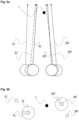
- Fig. 1a illustrates the gaze direction of a user when looking at a reference point 1 generated and displayed by an eye-tracking device.
- Fig. 1 is a top view in a horizontal plane, parallel to a transverse or axial plane of the user.
- the gaze direction of each eye of the user illustrated by the arrows 2L and 2R, does not coincide with the reference point 1 but is rather offset in relation to the reference point 1.
- the offset of the gaze direction is determined by performing a ray vs plane intersection test. More specifically, the intersection between the ray defined by the gaze direction 2L, 2R of the respective eye and a vertical plane substantially perpendicular to the user and containing the reference point 1.
- interocular distance is defined as the distance between the center of the left eye and the center of the right eye of the user and is substantially a constant, fixed value independent of the movement of the eyes.
- interpupillary distance is defined as the distance between the centers of the pupil of the left eye and the pupil of the right eye of the user and may vary as the user moves the eyes when looking at different objects, e.g. near objects or far away, or objects to the left or to the right of the user.
- Fig. 1b the vertical intersection plane containing the reference point 1 is illustrated.
- the points of intersection 3L and 3R corresponding to the gaze direction offsets 3L, 3R of the left eye and the right eye, respectively are separated from the reference point 1 by distances dL and dR, respectively, and present different angular orientations with respect to the reference point.
- the angle ⁇ between the gaze direction offsets 3L, 3R of the left eye and the right eye, respectively, with the reference point 1 defining the origin, is also illustrated in Fig. 1b .
- the eye tracker may have default parameters to start with.
- Default calibration creates a semi-unique pattern of eye data per user.
- the unique pattern created when using default calibration can be stored together with a performed calibration and compared against if the user looks at the same reference points again.
- the calibration process according to the present invention will only require the user to look at one reference point in order to determine a match with the user's previously stored calibration setting.
- the calibration process may also be used to quickly load a suitable calibration setting for a new user.
- the invention proposed matches eye data against other existing eye data to try and see if there is a similar calibration available. In embodiments, this is achieved by comparing the user's gaze direction offset, interocular distance IOD and/or interpupillary distance IPD as defined above to corresponding stored gaze direction offsets, IODs and/or IPDs.
- Fig. 2a illustrates in a top view similar to Fig. 1a , a situation with pre-existing calibration settings associated with stored eye data of first and second prior users.
- the first prior user is illustrated using dashed lines and the second prior user with dot-dashed lines.
- the current user is illustrated using solid lines.
- the gaze direction 2L, 2R in relation to reference point 1 of the current user differs significantly from the gaze direction 2L', 2R' of the first prior user but corresponds to a high degree to the gaze direction 2L", 2R" of the second prior user.
- a stored calibration setting associated with the second prior user would provide a good match for the current user.
- the gaze direction offsets 3L, 3R of the left eye and the right, respectively, of the current user are shown as points on the vertical plane together with the stored gaze direction offsets 3L', 3R'; 3L", 3R" of the first and second prior users.
- the corresponding points on the plane are compared and if the distance between them is within a certain amount it is considered a viable calibration.
- the gaze direction offsets 3L, 3R of the current user differ significantly from the gaze directions offsets 3L', 3R' of the first prior user, whereas they correspond closely with the gaze directions offsets 3L", 3R" of the second prior user.
- a dashed circle centered on each of the gaze direction offsets 3L, 3R of the current user is shown representing a threshold value for the comparison between the gaze direction offsets.
- the gaze direction offsets 3L", 3R" of the second prior user each lies within the threshold represented by the respective dashed circle centered on the gaze direction offsets 3L, 3R of the current user, they provide a match in the context of the present invention.
- the gaze direction offset with the smallest difference is selected. This may be achieved e.g. by successively decreasing the threshold (decreasing the radius of the dashed circle) until only one single stored gaze direction offset matches the acquired gaze direction offset 3L, 3R of the current user.
- Fig. 3 in conjunction with Figs. 1 and 2 , shows an embodiment of a method for calibrating an eye-tracking device 600, wherein the eye-tracking device 600 comprises at least one camera 10.
- a calibration setting of the eye-tracking device 600 associated with a user is calculated based on acquired eye data of the user when looking at a set of reference points 1.
- the method may in some embodiments be performed by the eye-tracking device 600, and in some embodiments, the method may be performed elsewhere using data obtained from the eye-tracking device 600, for example in a cloud environment to which the eye-tracking device 600 is operatively connected.
- the method comprises displaying 202 a reference point 1 of the set to the user.
- the method further comprises acquiring 204 eye data for at least one of the eyes of the user when looking at the reference point 1.
- the method further comprises comparing 206 the acquired eye data to stored eye data sets related to the reference point 1, wherein each of the stored eye data sets is associated with a calibration setting of the eye-tracking device.
- the method further comprises, if the acquired eye data matches one of the stored eye data sets, abandoning 208 the calibration process and loading 210 the calibration setting associated with the matching stored eye data.
- the step of acquiring 204 eye data comprises determining a gaze direction offset 3L, 3R between a gaze direction 2L, 2R of at least one of the eyes of the user and the reference point 1, and the step of comparing 206 eye data comprises comparing the acquired gaze direction offset 3L, 3R with stored gaze direction offsets 3L', 3R'; 3L", 3R".
- the step of acquiring 204 eye data comprises determining one of an interocular distance (IOD) and an interpupillary distance (IPD) of the user, and the step of comparing 206 eye data comprises comparing the acquired IOD or IPD with stored IODs or IPDs.
- IOD interocular distance
- IPD interpupillary distance
- the acquired eye data may, of course, include other relevant values and measurements related to the user and may be combined and compared in various ways and any order.
- the IOD and/or IPD may be used in a first comparison to exclude stored IODs and/or IPDs which do not match and then a second comparison may be performed using the acquired gaze direction offsets 3L, 3R to find the most closely matching stored gaze direction offsets 3L', 3R'; 3L", 3R".
- the gaze direction offsets may be compared before the IODs and/or IPDs.
- a match is determined if the difference between the acquired eye data and the stored eye data does not exceed a predetermined threshold value.
- Fig. 4 in conjunction with Figs. 1 and 2 , shows the further steps of the method for calibrating an eye-tracking device 600 in the case wherein the acquired eye data does not match any of the stored eye data sets.
- the method further comprises repeating 212 steps 202 and 204 for the remaining reference points in the set.
- the method further comprises calculating 214 a calibration setting based on the acquired eye data for all the reference points in the set.
- the method further comprises storing 216 the calculated calibration setting and the acquired eye data for all the reference points in the set.
- Fig. 5 in conjunction with Fig. 1 , shows an eye-tracking device 600, capable of tracking the eyes of a user.
- the eye-tracking device 600 comprises processing circuitry 603 and a memory 604.
- the processing circuitry 603 may comprise one or more programmable processors, application-specific integrated circuits, field programmable gate arrays or combinations of these (not shown) adapted to execute instructions.
- the memory contains instructions executable by said processing circuitry, whereby the eye-tracking device 600 is operative for displaying a reference point 1 of the set to the user.
- the eye-tracking device 600 is further operative for acquiring eye data for at least one of the eyes of the user when looking at the reference point 1.
- the eye-tracking device 600 is further operative for comparing the acquired eye data to stored eye data sets related to the reference point, wherein each of the stored eye data sets is associated with a calibration setting of the eye-tracking device 600.
- the eye-tracking device 600 is further operative for if the acquired eye data matches one of the stored eye data sets, abandoning the calibration process and loading the calibration setting associated with the matching stored eye data.
- the eye-tracking device 600 is further operative for, if the acquired eye data does not match any of the stored eye data sets, repeating the steps of displaying a reference point and acquiring eye data for the remaining reference points in the set, calculating a calibration setting based on the acquired eye data for all the reference points in the set and storing the calculated calibration setting and the acquired eye data for all the reference points in the set.
- a match is determined if the difference between the acquired eye data and the stored eye data does not exceed a predetermined threshold value.
- the eye-tracking device 600 is further operative for determining a gaze direction offset between a gaze direction of at least one of the eyes of the user and the reference point; and comparing the acquired gaze direction offset with stored gaze direction offsets.
- the eye-tracking device 600 is further operative for acquiring the gaze direction offset for both eyes.
- the eye-tracking device 600 is further operative for determining a relation between the gaze direction offsets of the left eye and the right eye and comparing the determined relation with a corresponding relation between stored gaze direction offsets of the left eye and the right eye.
- the relation between the gaze direction offsets of the left eye and the right eye comprises the distance dL, dR from the gaze direction offsets of the left eye and the right eye to the reference point, respectively, and/or the angle ⁇ between the gaze direction offset of the left eye and the right eye.
- the distances dL, dR and/or the angle ⁇ may be used to further establish a closest fit between the current user and stored calibration settings. This may be carried out in several steps wherein after identifying a number of suitable stored calibration settings by comparing the acquired gaze direction offsets 3L, 3R with the stored gaze direction offsets 3L', 3R'; 3L", 3R", the relation between the gaze direction offsets (distance dL, dR and/or angle ⁇ ) may be used to further differentiate between the candidates of suitable stored calibration settings to find the optimal one, i.e. the one with the smallest difference in comparison with the acquired eye data of the current user.
- the eye-tracking device 600 is further operative for determining one of an interocular distance (IOD) and an inter-pupillary distance (IPD); and comparing the acquired IOD or IPD with stored IODs or IPDs.
- IOD interocular distance
- IPD inter-pupillary distance
- the feature(s) of the eye-tracking device 600 e.g. the processing circuitry 603 and the memory 604, which perform the method steps may be a group of network nodes, wherein functionality for performing the method are spread out over different physical, or virtual, nodes of the network.
- the feature(s) of the eye-tracking device 600 which perform the method steps may be a cloud-solution, i.e. the feature(s) of the eye-tracking device 600 which perform the method steps may be deployed as cloud computing resources that may be distributed in the network.
- the eye-tracking device 600 may further comprise a communication unit 602, which may be considered to comprise conventional means for communicating with relevant entities, such as other computers or devices to which it is operatively connected.
- the instructions executable by said processing circuitry 603 may be arranged as a computer program 605 stored e.g. in the memory 604.
- the processing circuitry 603 and the memory 604 may be arranged in a sub-arrangement 601.
- the sub-arrangement 601 may be a microprocessor and adequate software and storage therefor, a Programmable Logic Device, PLD, or other electronic component(s)/processing circuit(s) configured to perform the methods mentioned above.
- the computer program 605 may comprise computer readable code means, which when run in an eye-tracking device 600 causes the eye-tracking device 600 to perform the steps described in any of the described embodiments of the eye-tracking device 600.
- the computer program 605 may be carried by a computer program product connectable to the processing circuitry 603.
- the computer program product may be the memory 604.
- the memory 604 may be realized as for example a RAM (Random-access memory), ROM (Read-Only Memory) or an EEPROM (Electrical Erasable Programmable ROM).
- the computer program may be carried by a separate computer-readable medium, such as a CD, DVD or flash memory, from which the program could be downloaded into the memory 604.
- the computer program may be stored on a server or any other entity connected to the eye-tracking device 600, to which the eye-tracking device 600 has access via the communication unit 602. The computer program may then be downloaded from the server into the memory 604.
Landscapes
- Engineering & Computer Science (AREA)
- Theoretical Computer Science (AREA)
- General Physics & Mathematics (AREA)
- Physics & Mathematics (AREA)
- General Engineering & Computer Science (AREA)
- Human Computer Interaction (AREA)
- Ophthalmology & Optometry (AREA)
- Health & Medical Sciences (AREA)
- Multimedia (AREA)
- General Health & Medical Sciences (AREA)
- Computer Vision & Pattern Recognition (AREA)
- Eye Examination Apparatus (AREA)
- Measuring And Recording Apparatus For Diagnosis (AREA)
Claims (10)
- Procédé d'étalonnage d'un dispositif de suivi oculaire pour convenir à un utilisateur du dispositif de suivi oculaire (600), dans lequel un réglage d'étalonnage du dispositif de suivi oculaire (600) associé à l'utilisateur est calculé, pendant un processus d'étalonnage, sur la base de données oculaires acquises de l'utilisateur lorsqu'il regarde un ensemble de points de référence (1), le procédé comprenant les étapes consistant à :afficher (202) un point de référence de l'ensemble à l'utilisateur ;acquérir (204), au moyen d'au moins une caméra (10) du dispositif de suivi oculaire (600), des données oculaires pour au moins l'un des yeux de l'utilisateur lorsqu'il regarde le point de référence ;comparer (206) les données oculaires acquises à des ensembles de données oculaires précédemment stockées de l'utilisateur se rapportant au point de référence, dans lequel chacun des ensembles de données oculaires stockées est associé à un réglage d'étalonnage du dispositif de suivi oculaire ; etsi les données oculaires acquises correspondent à l'un des ensembles de données oculaires stockées, abandonner (208) le processus d'étalonnage et charger (210) le réglage d'étalonnage associé aux données oculaires stockées correspondantes ;dans lequel si les données oculaires acquises ne correspondent à aucun des ensembles de données oculaires stockées, le procédé comprend en outre :la répétition (212) des étapes (202) et (204) pour les points de référence restants dans l'ensemble ;le calcul (214) d'un réglage d'étalonnage sur la base des données oculaires acquises pour tous les points de référence dans l'ensemble ; etle stockage (216) du réglage d'étalonnage calculé et des données oculaires acquises pour tous les points de référence dans l'ensemble ;dans lequel l'acquisition (204) de données oculaires comprend la détermination d'un décalage de direction de regard (3L, 3R) entre une direction de regard (2L, 2R) d'au moins l'un des yeux de l'utilisateur et du point de référence (1) et la comparaison (206) des données oculaires comprend la comparaison du décalage de direction de regard acquis (3L, 3R) avec des décalages de direction de regard stockés (3L', 3R' ; 3L", 3R").
- Procédé selon la revendication 1, dans lequel une correspondance est déterminée si la différence entre les données oculaires acquises et les données oculaires stockées ne dépasse pas une valeur seuil prédéterminée.
- Procédé selon la revendication 1 ou la revendication 2, comprenant en outre l'acquisition du décalage de direction de regard (3L, 3R) pour les deux yeux.
- Procédé selon la revendication 3, dans lequel la comparaison (206) des décalages de direction de regard acquis (3L, 3R) comprend la détermination d'une relation entre les décalages de direction de regard (3L, 3R) de l'œil gauche et de l'œil droit et la comparaison de la relation déterminée avec une relation correspondante entre des décalages de direction de regard stockés (3L', 3R' ; 3L ", 3R") de l'œil gauche et de l'œil droit.
- Procédé selon la revendication 4, dans lequel la relation entre les décalages de direction de regard de l'œil gauche et de l'œil droit comprend la distance (dL, dR) à partir des décalages de direction de regard (3L, 3R) de l'œil gauche et de l'œil droit au point de référence (1), respectivement, et/ou l'angle (α) entre les décalages de direction du regard (3L, 3R) de l'œil gauche et de l'œil droit.
- Procédé selon l'une quelconque des revendications précédentes, dans lequel l'acquisition (204) de données oculaires comprend en outre la détermination de l'un parmi un écart interoculaire (IOD) et un écart interpupillaire (IPD) de l'utilisateur, et la comparaison (206) des données oculaires comprend en outre la comparaison des IOD ou IPD acquis avec des IOD ou des IPD stockés.
- Dispositif de suivi oculaire (600) pouvant fonctionner pour suivre une direction de regard d'un utilisateur, dans lequel un réglage d'étalonnage du dispositif de suivi oculaire associé à l'utilisateur est calculé, pendant un processus d'étalonnage, sur la base de données oculaires acquises de l'utilisateur lorsqu'il regarde un ensemble de points de référence, le dispositif comprenant :au moins une caméra (10) ;une circuiterie de traitement (603) ; etune mémoire (604), ladite mémoire (604) contenant des instructions exécutables par ladite circuiterie de traitement (603), moyennant quoi ledit dispositif de suivi oculaire (600) peut fonctionner pour :afficher un point de référence (1) de l'ensemble à l'utilisateur ;acquérir, au moyen de la caméra (10), des données oculaires pour au moins l'un des yeux de l'utilisateur lorsqu'il regarde le point de référence (1) ;comparer les données oculaires acquises à des ensembles de données oculaires précédemment stockées de l'utilisateur se rapportant au point de référence, dans lequel chacun des ensembles de données oculaires stockées est associé à un réglage d'étalonnage du dispositif de suivi oculaire (600) ; etsi les données oculaires acquises correspondent à l'un des ensembles de données oculaires stockées, abandonner le processus d'étalonnage et charger le réglage d'étalonnage associé aux données oculaires stockées correspondantes ;dans lequel si les données oculaires acquises ne correspondent à aucun des ensembles de données oculaires stockées :répéter l'affichage d'un point de référence et acquérir des données oculaires pour les points de référence restants dans l'ensemble ;calculer un réglage d'étalonnage sur la base des données oculaires acquises pour tous les points de référence dans l'ensemble ; etstocker le réglage d'étalonnage calculé et les données oculaires acquises pour tous les points de référence dans l'ensemble ;dans lequel l'acquisition de données oculaires comprend la détermination d'un décalage de direction de regard (3L, 3R) entre une direction de regard (2L, 2R) d'au moins l'un des yeux de l'utilisateur et le point de référence (1) et la comparaison des données oculaires comprend la comparaison du décalage de direction de regard acquis (3L, 3R) avec des décalages de direction de regard stockés (3L', 3R' ; 3L", 3R").
- Dispositif de suivi oculaire selon la revendication 7, pouvant en outre fonctionner pour réaliser le procédé selon l'une quelconque des revendications 2 à 6.
- Programme informatique (605) comprenant un moyen de code lisible par un ordinateur à exécuter dans un dispositif de suivi oculaire (600) pour suivre une direction de regard d'un utilisateur, dans lequel un réglage d'étalonnage du dispositif de suivi oculaire (600) associé à l'utilisateur est calculé, pendant un processus d'étalonnage, sur la base de données oculaires acquises de l'utilisateur lorsqu'il regarde un ensemble de points de référence, lequel moyen de code lisible par ordinateur (605) lorsqu'il est exécuté dans le dispositif de suivi oculaire (600) amène le dispositif de suivi oculaire (600) à réaliser les étapes suivantes :afficher (202) un point de référence de l'ensemble à l'utilisateur ;acquérir (204), au moyen d'au moins une caméra (10) du dispositif de suivi oculaire (600), des données oculaires pour au moins l'un des yeux de l'utilisateur lorsqu'il regarde le point de référence ;comparer (206) les données oculaires acquises à des ensembles de données oculaires précédemment stockées de l'utilisateur se rapportant au point de référence, dans lequel chacun des ensembles de données oculaires stockées est associé à un réglage d'étalonnage du dispositif de suivi oculaire ; etsi les données oculaires acquises correspondent à l'un des ensembles de données oculaires stockées, abandonner (208) le processus d'étalonnage et charger (210) le réglage d'étalonnage associé aux données oculaires stockées correspondantes ;dans lequel si les données oculaires acquises ne correspondent à aucun des ensembles de données oculaires stockées :répéter (212) les étapes (202) et (204) pour les points de référence restants dans l'ensemble ;calculer (214) un réglage d'étalonnage sur la base des données oculaires acquises pour tous les points de référence dans l'ensemble ; etstocker (216) le réglage d'étalonnage calculé et les données oculaires acquises pour tous les points de référence dans l'ensemble ;dans lequel l'acquisition (204) des données oculaires comprend la détermination d'un décalage de direction de regard (3L, 3R) entre une direction de regard (2L, 2R) d'au moins l'un des yeux de l'utilisateur et du point de référence (1) et la comparaison (206) des données oculaires comprend la comparaison du décalage de direction de regard acquis (3L, 3R) avec des décalages de direction de regard stockés (3L', 3R' ; 3L", 3R").
- Porteuse contenant le programme informatique (605) selon la revendication 9, dans laquelle la porteuse est l'un parmi un signal électronique, un signal optique, un signal radio ou un support de stockage lisible par ordinateur.
Applications Claiming Priority (1)
| Application Number | Priority Date | Filing Date | Title |
|---|---|---|---|
| SE1851425 | 2018-11-15 |
Publications (2)
| Publication Number | Publication Date |
|---|---|
| EP3656285A1 EP3656285A1 (fr) | 2020-05-27 |
| EP3656285B1 true EP3656285B1 (fr) | 2023-04-19 |
Family
ID=68342538
Family Applications (1)
| Application Number | Title | Priority Date | Filing Date |
|---|---|---|---|
| EP19204663.9A Active EP3656285B1 (fr) | 2018-11-15 | 2019-10-22 | Procédé et dispositif d'étalonnage d'un dispositif de suivi oculaire |
Country Status (4)
| Country | Link |
|---|---|
| US (1) | US10936063B2 (fr) |
| EP (1) | EP3656285B1 (fr) |
| CN (1) | CN111190482B (fr) |
| ES (1) | ES2945789T3 (fr) |
Families Citing this family (5)
| Publication number | Priority date | Publication date | Assignee | Title |
|---|---|---|---|---|
| CN111639017B (zh) | 2020-05-29 | 2024-05-07 | 京东方科技集团股份有限公司 | 测量眼球追踪设备延迟量的方法、设备、眼球追踪系统 |
| CN113934288A (zh) * | 2020-06-29 | 2022-01-14 | 北京七鑫易维信息技术有限公司 | 针对移动平台的注视轨迹分析系统和方法 |
| CN111857333B (zh) * | 2020-06-29 | 2022-09-13 | 维沃移动通信有限公司 | 眼动追踪方法、装置及电子设备 |
| SE546205C2 (en) * | 2022-06-21 | 2024-07-02 | Tobii Ab | Method and system for determining a current gaze direction |
| US12204689B2 (en) | 2022-09-27 | 2025-01-21 | Tobii Dynavox Ab | Method, system, and computer program product for drawing and fine-tuned motor controls |
Family Cites Families (16)
| Publication number | Priority date | Publication date | Assignee | Title |
|---|---|---|---|---|
| KR101255219B1 (ko) * | 2011-10-13 | 2013-04-24 | 상명대학교 산학협력단 | 시선 추적 방법 및 이를 적용한 장치 |
| EP3200046A1 (fr) * | 2011-10-27 | 2017-08-02 | Tobii Technology AB | Gestion de la puissance d'un système d'oculométrie |
| GB201305726D0 (en) * | 2013-03-28 | 2013-05-15 | Eye Tracking Analysts Ltd | A method for calibration free eye tracking |
| EP2886041A1 (fr) * | 2013-12-17 | 2015-06-24 | ESSILOR INTERNATIONAL (Compagnie Générale d'Optique) | Procédé d'étalonnage d'un dispositif d'oculométrie monté sur la tête |
| US9760772B2 (en) * | 2014-03-20 | 2017-09-12 | Lc Technologies, Inc. | Eye image stimuli for eyegaze calibration procedures |
| WO2015154882A1 (fr) * | 2014-04-11 | 2015-10-15 | The Eye Tribe Aps | Systèmes et procédés d'étalonnage de suivi oculaire |
| DE102014008852B4 (de) * | 2014-06-14 | 2024-07-04 | Audi Ag | Kalibrierung eines Kraftfahrzeug-Eyetrackingsystems |
| US9936195B2 (en) * | 2014-11-06 | 2018-04-03 | Intel Corporation | Calibration for eye tracking systems |
| US20160131902A1 (en) * | 2014-11-12 | 2016-05-12 | Anthony J. Ambrus | System for automatic eye tracking calibration of head mounted display device |
| EP3217858B1 (fr) * | 2014-11-14 | 2020-04-01 | Apple Inc. | Système de suivi de l' il et procédé de détection de l' il directeur |
| CN112667069A (zh) * | 2015-03-13 | 2021-04-16 | 苹果公司 | 用于自动识别眼睛追踪设备的至少一个用户的方法以及眼睛追踪设备 |
| CN108604116A (zh) * | 2015-09-24 | 2018-09-28 | 托比股份公司 | 能够进行眼睛追踪的可穿戴设备 |
| US9983709B2 (en) * | 2015-11-02 | 2018-05-29 | Oculus Vr, Llc | Eye tracking using structured light |
| KR101732618B1 (ko) * | 2016-02-02 | 2017-05-08 | 동국대학교 산학협력단 | 시선 추적 장치 및 방법 |
| KR101857466B1 (ko) * | 2017-06-16 | 2018-05-15 | 주식회사 비주얼캠프 | 헤드 마운트 디스플레이 및 그 캘리브레이션 방법 |
| TWI704501B (zh) * | 2018-08-09 | 2020-09-11 | 宏碁股份有限公司 | 可由頭部操控的電子裝置與其操作方法 |
-
2019
- 2019-10-22 EP EP19204663.9A patent/EP3656285B1/fr active Active
- 2019-10-22 ES ES19204663T patent/ES2945789T3/es active Active
- 2019-11-12 CN CN201911099824.8A patent/CN111190482B/zh active Active
- 2019-11-12 US US16/681,030 patent/US10936063B2/en active Active
Also Published As
| Publication number | Publication date |
|---|---|
| CN111190482B (zh) | 2024-01-26 |
| CN111190482A (zh) | 2020-05-22 |
| ES2945789T3 (es) | 2023-07-07 |
| US20200192474A1 (en) | 2020-06-18 |
| EP3656285A1 (fr) | 2020-05-27 |
| US10936063B2 (en) | 2021-03-02 |
Similar Documents
| Publication | Publication Date | Title |
|---|---|---|
| EP3656285B1 (fr) | Procédé et dispositif d'étalonnage d'un dispositif de suivi oculaire | |
| EP4137037B1 (fr) | Fiabilité de données de suivi du regard pour l' il gauche et droit | |
| US10016131B2 (en) | Eye tracking system and method to detect the dominant eye | |
| US9164580B2 (en) | Calibration of eye tracking system | |
| US20180357475A1 (en) | Authentication device and authentication method | |
| US20130088516A1 (en) | Object displaying apparatus, object displaying system, and object displaying method | |
| CN108038884B (zh) | 校准方法、装置、存储介质和处理器 | |
| US20140341473A1 (en) | Apparatus and method for enhancing user recognition | |
| CN108478184A (zh) | 基于vr的视力测量方法及装置、vr设备 | |
| KR102695517B1 (ko) | 동공 거리 결정 방법 및 장치 | |
| KR20090004348A (ko) | 개인 식별 장치, 개인 식별 방법, 식별 사전 데이터의 갱신방법, 및 식별 사전 데이터의 갱신 프로그램 | |
| CN112667069A (zh) | 用于自动识别眼睛追踪设备的至少一个用户的方法以及眼睛追踪设备 | |
| US11925416B2 (en) | Method of performing an eye examination test | |
| CN106200941B (zh) | 一种虚拟场景的控制方法及电子设备 | |
| CN109032351B (zh) | 注视点函数确定方法、注视点确定方法、装置及终端设备 | |
| EP3617993A1 (fr) | Dispositif de collationnement, procédé de collationnement et programme de collationnement | |
| JP2023533839A (ja) | 人の視力を評価する方法及びシステム | |
| KR20190070179A (ko) | 사용자 등록 장치 및 방법 | |
| CN114863200B (zh) | 视线估计方法、设备及存储介质 | |
| WO2015079054A1 (fr) | Estimation de regard à partir de points de mesure oculaire non étalonnés | |
| JP7570491B2 (ja) | 操作支援方法 | |
| CN113495613B (zh) | 眼球追踪校准方法及装置 | |
| EP4089628B1 (fr) | Dispositif d'estimation de ligne de visée, procédé d'estimation de ligne de visée, dispositif de génération de modèle et procédé de génération de modèle | |
| CN117419638A (zh) | 一种头戴式显示器佩戴位置校准方法、系统、设备和介质 | |
| EP4172723B1 (fr) | Procédé mis en uvre par ordinateur pour déterminer une position d'un centre de rotation d'un il à l'aide d'un dispositif mobile, dispositif mobile et programme informatique |
Legal Events
| Date | Code | Title | Description |
|---|---|---|---|
| PUAI | Public reference made under article 153(3) epc to a published international application that has entered the european phase |
Free format text: ORIGINAL CODE: 0009012 |
|
| STAA | Information on the status of an ep patent application or granted ep patent |
Free format text: STATUS: THE APPLICATION HAS BEEN PUBLISHED |
|
| AK | Designated contracting states |
Kind code of ref document: A1 Designated state(s): AL AT BE BG CH CY CZ DE DK EE ES FI FR GB GR HR HU IE IS IT LI LT LU LV MC MK MT NL NO PL PT RO RS SE SI SK SM TR |
|
| AX | Request for extension of the european patent |
Extension state: BA ME |
|
| STAA | Information on the status of an ep patent application or granted ep patent |
Free format text: STATUS: REQUEST FOR EXAMINATION WAS MADE |
|
| 17P | Request for examination filed |
Effective date: 20201123 |
|
| RBV | Designated contracting states (corrected) |
Designated state(s): AL AT BE BG CH CY CZ DE DK EE ES FI FR GB GR HR HU IE IS IT LI LT LU LV MC MK MT NL NO PL PT RO RS SE SI SK SM TR |
|
| RAP3 | Party data changed (applicant data changed or rights of an application transferred) |
Owner name: TOBII AB |
|
| RAP3 | Party data changed (applicant data changed or rights of an application transferred) |
Owner name: TOBII AB |
|
| GRAP | Despatch of communication of intention to grant a patent |
Free format text: ORIGINAL CODE: EPIDOSNIGR1 |
|
| STAA | Information on the status of an ep patent application or granted ep patent |
Free format text: STATUS: GRANT OF PATENT IS INTENDED |
|
| INTG | Intention to grant announced |
Effective date: 20230119 |
|
| RIC1 | Information provided on ipc code assigned before grant |
Ipc: A61B 3/11 20060101ALI20230113BHEP Ipc: G06F 18/00 20230101ALI20230113BHEP Ipc: G06F 3/01 20060101ALI20230113BHEP Ipc: A61B 3/113 20060101AFI20230113BHEP |
|
| GRAS | Grant fee paid |
Free format text: ORIGINAL CODE: EPIDOSNIGR3 |
|
| GRAA | (expected) grant |
Free format text: ORIGINAL CODE: 0009210 |
|
| STAA | Information on the status of an ep patent application or granted ep patent |
Free format text: STATUS: THE PATENT HAS BEEN GRANTED |
|
| AK | Designated contracting states |
Kind code of ref document: B1 Designated state(s): AL AT BE BG CH CY CZ DE DK EE ES FI FR GB GR HR HU IE IS IT LI LT LU LV MC MK MT NL NO PL PT RO RS SE SI SK SM TR |
|
| REG | Reference to a national code |
Ref country code: GB Ref legal event code: FG4D |
|
| REG | Reference to a national code |
Ref country code: CH Ref legal event code: EP |
|
| REG | Reference to a national code |
Ref country code: DE Ref legal event code: R096 Ref document number: 602019027672 Country of ref document: DE |
|
| REG | Reference to a national code |
Ref country code: IE Ref legal event code: FG4D |
|
| REG | Reference to a national code |
Ref country code: AT Ref legal event code: REF Ref document number: 1560599 Country of ref document: AT Kind code of ref document: T Effective date: 20230515 |
|
| REG | Reference to a national code |
Ref country code: ES Ref legal event code: FG2A Ref document number: 2945789 Country of ref document: ES Kind code of ref document: T3 Effective date: 20230707 |
|
| P01 | Opt-out of the competence of the unified patent court (upc) registered |
Effective date: 20230601 |
|
| REG | Reference to a national code |
Ref country code: LT Ref legal event code: MG9D |
|
| REG | Reference to a national code |
Ref country code: NL Ref legal event code: MP Effective date: 20230419 |
|
| REG | Reference to a national code |
Ref country code: AT Ref legal event code: MK05 Ref document number: 1560599 Country of ref document: AT Kind code of ref document: T Effective date: 20230419 |
|
| PG25 | Lapsed in a contracting state [announced via postgrant information from national office to epo] |
Ref country code: NL Free format text: LAPSE BECAUSE OF FAILURE TO SUBMIT A TRANSLATION OF THE DESCRIPTION OR TO PAY THE FEE WITHIN THE PRESCRIBED TIME-LIMIT Effective date: 20230419 |
|
| PG25 | Lapsed in a contracting state [announced via postgrant information from national office to epo] |
Ref country code: SE Free format text: LAPSE BECAUSE OF FAILURE TO SUBMIT A TRANSLATION OF THE DESCRIPTION OR TO PAY THE FEE WITHIN THE PRESCRIBED TIME-LIMIT Effective date: 20230419 Ref country code: PT Free format text: LAPSE BECAUSE OF FAILURE TO SUBMIT A TRANSLATION OF THE DESCRIPTION OR TO PAY THE FEE WITHIN THE PRESCRIBED TIME-LIMIT Effective date: 20230821 Ref country code: NO Free format text: LAPSE BECAUSE OF FAILURE TO SUBMIT A TRANSLATION OF THE DESCRIPTION OR TO PAY THE FEE WITHIN THE PRESCRIBED TIME-LIMIT Effective date: 20230719 Ref country code: AT Free format text: LAPSE BECAUSE OF FAILURE TO SUBMIT A TRANSLATION OF THE DESCRIPTION OR TO PAY THE FEE WITHIN THE PRESCRIBED TIME-LIMIT Effective date: 20230419 |
|
| PG25 | Lapsed in a contracting state [announced via postgrant information from national office to epo] |
Ref country code: RS Free format text: LAPSE BECAUSE OF FAILURE TO SUBMIT A TRANSLATION OF THE DESCRIPTION OR TO PAY THE FEE WITHIN THE PRESCRIBED TIME-LIMIT Effective date: 20230419 Ref country code: PL Free format text: LAPSE BECAUSE OF FAILURE TO SUBMIT A TRANSLATION OF THE DESCRIPTION OR TO PAY THE FEE WITHIN THE PRESCRIBED TIME-LIMIT Effective date: 20230419 Ref country code: LV Free format text: LAPSE BECAUSE OF FAILURE TO SUBMIT A TRANSLATION OF THE DESCRIPTION OR TO PAY THE FEE WITHIN THE PRESCRIBED TIME-LIMIT Effective date: 20230419 Ref country code: LT Free format text: LAPSE BECAUSE OF FAILURE TO SUBMIT A TRANSLATION OF THE DESCRIPTION OR TO PAY THE FEE WITHIN THE PRESCRIBED TIME-LIMIT Effective date: 20230419 Ref country code: IS Free format text: LAPSE BECAUSE OF FAILURE TO SUBMIT A TRANSLATION OF THE DESCRIPTION OR TO PAY THE FEE WITHIN THE PRESCRIBED TIME-LIMIT Effective date: 20230819 Ref country code: HR Free format text: LAPSE BECAUSE OF FAILURE TO SUBMIT A TRANSLATION OF THE DESCRIPTION OR TO PAY THE FEE WITHIN THE PRESCRIBED TIME-LIMIT Effective date: 20230419 Ref country code: GR Free format text: LAPSE BECAUSE OF FAILURE TO SUBMIT A TRANSLATION OF THE DESCRIPTION OR TO PAY THE FEE WITHIN THE PRESCRIBED TIME-LIMIT Effective date: 20230720 Ref country code: AL Free format text: LAPSE BECAUSE OF FAILURE TO SUBMIT A TRANSLATION OF THE DESCRIPTION OR TO PAY THE FEE WITHIN THE PRESCRIBED TIME-LIMIT Effective date: 20230419 |
|
| PG25 | Lapsed in a contracting state [announced via postgrant information from national office to epo] |
Ref country code: FI Free format text: LAPSE BECAUSE OF FAILURE TO SUBMIT A TRANSLATION OF THE DESCRIPTION OR TO PAY THE FEE WITHIN THE PRESCRIBED TIME-LIMIT Effective date: 20230419 |
|
| PG25 | Lapsed in a contracting state [announced via postgrant information from national office to epo] |
Ref country code: SK Free format text: LAPSE BECAUSE OF FAILURE TO SUBMIT A TRANSLATION OF THE DESCRIPTION OR TO PAY THE FEE WITHIN THE PRESCRIBED TIME-LIMIT Effective date: 20230419 |
|
| REG | Reference to a national code |
Ref country code: DE Ref legal event code: R097 Ref document number: 602019027672 Country of ref document: DE |
|
| PG25 | Lapsed in a contracting state [announced via postgrant information from national office to epo] |
Ref country code: SM Free format text: LAPSE BECAUSE OF FAILURE TO SUBMIT A TRANSLATION OF THE DESCRIPTION OR TO PAY THE FEE WITHIN THE PRESCRIBED TIME-LIMIT Effective date: 20230419 Ref country code: SK Free format text: LAPSE BECAUSE OF FAILURE TO SUBMIT A TRANSLATION OF THE DESCRIPTION OR TO PAY THE FEE WITHIN THE PRESCRIBED TIME-LIMIT Effective date: 20230419 Ref country code: RO Free format text: LAPSE BECAUSE OF FAILURE TO SUBMIT A TRANSLATION OF THE DESCRIPTION OR TO PAY THE FEE WITHIN THE PRESCRIBED TIME-LIMIT Effective date: 20230419 Ref country code: EE Free format text: LAPSE BECAUSE OF FAILURE TO SUBMIT A TRANSLATION OF THE DESCRIPTION OR TO PAY THE FEE WITHIN THE PRESCRIBED TIME-LIMIT Effective date: 20230419 Ref country code: DK Free format text: LAPSE BECAUSE OF FAILURE TO SUBMIT A TRANSLATION OF THE DESCRIPTION OR TO PAY THE FEE WITHIN THE PRESCRIBED TIME-LIMIT Effective date: 20230419 Ref country code: CZ Free format text: LAPSE BECAUSE OF FAILURE TO SUBMIT A TRANSLATION OF THE DESCRIPTION OR TO PAY THE FEE WITHIN THE PRESCRIBED TIME-LIMIT Effective date: 20230419 |
|
| PLBE | No opposition filed within time limit |
Free format text: ORIGINAL CODE: 0009261 |
|
| STAA | Information on the status of an ep patent application or granted ep patent |
Free format text: STATUS: NO OPPOSITION FILED WITHIN TIME LIMIT |
|
| 26N | No opposition filed |
Effective date: 20240122 |
|
| PG25 | Lapsed in a contracting state [announced via postgrant information from national office to epo] |
Ref country code: SI Free format text: LAPSE BECAUSE OF FAILURE TO SUBMIT A TRANSLATION OF THE DESCRIPTION OR TO PAY THE FEE WITHIN THE PRESCRIBED TIME-LIMIT Effective date: 20230419 |
|
| PG25 | Lapsed in a contracting state [announced via postgrant information from national office to epo] |
Ref country code: SI Free format text: LAPSE BECAUSE OF FAILURE TO SUBMIT A TRANSLATION OF THE DESCRIPTION OR TO PAY THE FEE WITHIN THE PRESCRIBED TIME-LIMIT Effective date: 20230419 Ref country code: MC Free format text: LAPSE BECAUSE OF FAILURE TO SUBMIT A TRANSLATION OF THE DESCRIPTION OR TO PAY THE FEE WITHIN THE PRESCRIBED TIME-LIMIT Effective date: 20230419 |
|
| REG | Reference to a national code |
Ref country code: CH Ref legal event code: PL |
|
| REG | Reference to a national code |
Ref country code: BE Ref legal event code: MM Effective date: 20231031 |
|
| PG25 | Lapsed in a contracting state [announced via postgrant information from national office to epo] |
Ref country code: LU Free format text: LAPSE BECAUSE OF NON-PAYMENT OF DUE FEES Effective date: 20231022 |
|
| PG25 | Lapsed in a contracting state [announced via postgrant information from national office to epo] |
Ref country code: LU Free format text: LAPSE BECAUSE OF NON-PAYMENT OF DUE FEES Effective date: 20231022 |
|
| PG25 | Lapsed in a contracting state [announced via postgrant information from national office to epo] |
Ref country code: CH Free format text: LAPSE BECAUSE OF NON-PAYMENT OF DUE FEES Effective date: 20231031 |
|
| PG25 | Lapsed in a contracting state [announced via postgrant information from national office to epo] |
Ref country code: CH Free format text: LAPSE BECAUSE OF NON-PAYMENT OF DUE FEES Effective date: 20231031 |
|
| PG25 | Lapsed in a contracting state [announced via postgrant information from national office to epo] |
Ref country code: BE Free format text: LAPSE BECAUSE OF NON-PAYMENT OF DUE FEES Effective date: 20231031 |
|
| PG25 | Lapsed in a contracting state [announced via postgrant information from national office to epo] |
Ref country code: IE Free format text: LAPSE BECAUSE OF NON-PAYMENT OF DUE FEES Effective date: 20231022 |
|
| PG25 | Lapsed in a contracting state [announced via postgrant information from national office to epo] |
Ref country code: IE Free format text: LAPSE BECAUSE OF NON-PAYMENT OF DUE FEES Effective date: 20231022 |
|
| PG25 | Lapsed in a contracting state [announced via postgrant information from national office to epo] |
Ref country code: BG Free format text: LAPSE BECAUSE OF FAILURE TO SUBMIT A TRANSLATION OF THE DESCRIPTION OR TO PAY THE FEE WITHIN THE PRESCRIBED TIME-LIMIT Effective date: 20230419 |
|
| PG25 | Lapsed in a contracting state [announced via postgrant information from national office to epo] |
Ref country code: BG Free format text: LAPSE BECAUSE OF FAILURE TO SUBMIT A TRANSLATION OF THE DESCRIPTION OR TO PAY THE FEE WITHIN THE PRESCRIBED TIME-LIMIT Effective date: 20230419 |
|
| PG25 | Lapsed in a contracting state [announced via postgrant information from national office to epo] |
Ref country code: CY Free format text: LAPSE BECAUSE OF FAILURE TO SUBMIT A TRANSLATION OF THE DESCRIPTION OR TO PAY THE FEE WITHIN THE PRESCRIBED TIME-LIMIT; INVALID AB INITIO Effective date: 20191022 |
|
| PG25 | Lapsed in a contracting state [announced via postgrant information from national office to epo] |
Ref country code: HU Free format text: LAPSE BECAUSE OF FAILURE TO SUBMIT A TRANSLATION OF THE DESCRIPTION OR TO PAY THE FEE WITHIN THE PRESCRIBED TIME-LIMIT; INVALID AB INITIO Effective date: 20191022 |
|
| PGFP | Annual fee paid to national office [announced via postgrant information from national office to epo] |
Ref country code: IT Payment date: 20250923 Year of fee payment: 7 |
|
| PGFP | Annual fee paid to national office [announced via postgrant information from national office to epo] |
Ref country code: GB Payment date: 20250923 Year of fee payment: 7 |
|
| PGFP | Annual fee paid to national office [announced via postgrant information from national office to epo] |
Ref country code: FR Payment date: 20250925 Year of fee payment: 7 |
|
| PG25 | Lapsed in a contracting state [announced via postgrant information from national office to epo] |
Ref country code: TR Free format text: LAPSE BECAUSE OF FAILURE TO SUBMIT A TRANSLATION OF THE DESCRIPTION OR TO PAY THE FEE WITHIN THE PRESCRIBED TIME-LIMIT Effective date: 20230419 |
|
| PGFP | Annual fee paid to national office [announced via postgrant information from national office to epo] |
Ref country code: DE Payment date: 20250923 Year of fee payment: 7 |
|
| PGFP | Annual fee paid to national office [announced via postgrant information from national office to epo] |
Ref country code: ES Payment date: 20251103 Year of fee payment: 7 |