EP3657295B1 - Verfahren zur steuerung der entladung einer glasplatte in einem verfahren zum tempern von glasplatten - Google Patents
Verfahren zur steuerung der entladung einer glasplatte in einem verfahren zum tempern von glasplatten Download PDFInfo
- Publication number
- EP3657295B1 EP3657295B1 EP18844566.2A EP18844566A EP3657295B1 EP 3657295 B1 EP3657295 B1 EP 3657295B1 EP 18844566 A EP18844566 A EP 18844566A EP 3657295 B1 EP3657295 B1 EP 3657295B1
- Authority
- EP
- European Patent Office
- Prior art keywords
- glass plate
- heating element
- heating
- heating furnace
- turn
- Prior art date
- Legal status (The legal status is an assumption and is not a legal conclusion. Google has not performed a legal analysis and makes no representation as to the accuracy of the status listed.)
- Active
Links
Images

Classifications
-
- C—CHEMISTRY; METALLURGY
- C03—GLASS; MINERAL OR SLAG WOOL
- C03B—MANUFACTURE, SHAPING, OR SUPPLEMENTARY PROCESSES
- C03B27/00—Tempering or quenching glass products
- C03B27/04—Tempering or quenching glass products using gas
- C03B27/0417—Controlling or regulating for flat or bent glass sheets
-
- C—CHEMISTRY; METALLURGY
- C03—GLASS; MINERAL OR SLAG WOOL
- C03B—MANUFACTURE, SHAPING, OR SUPPLEMENTARY PROCESSES
- C03B27/00—Tempering or quenching glass products
- C03B27/012—Tempering or quenching glass products by heat treatment, e.g. for crystallisation; Heat treatment of glass products before tempering by cooling
-
- C—CHEMISTRY; METALLURGY
- C03—GLASS; MINERAL OR SLAG WOOL
- C03B—MANUFACTURE, SHAPING, OR SUPPLEMENTARY PROCESSES
- C03B29/00—Reheating glass products for softening or fusing their surfaces; Fire-polishing; Fusing of margins
- C03B29/04—Reheating glass products for softening or fusing their surfaces; Fire-polishing; Fusing of margins in a continuous way
- C03B29/06—Reheating glass products for softening or fusing their surfaces; Fire-polishing; Fusing of margins in a continuous way with horizontal displacement of the products
- C03B29/08—Glass sheets
-
- G—PHYSICS
- G05—CONTROLLING; REGULATING
- G05D—SYSTEMS FOR CONTROLLING OR REGULATING NON-ELECTRIC VARIABLES
- G05D23/00—Control of temperature
- G05D23/19—Control of temperature characterised by the use of electric means
- G05D23/30—Automatic controllers with an auxiliary heating device affecting the sensing element, e.g. for anticipating change of temperature
-
- G—PHYSICS
- G05—CONTROLLING; REGULATING
- G05D—SYSTEMS FOR CONTROLLING OR REGULATING NON-ELECTRIC VARIABLES
- G05D7/00—Control of flow
-
- Y—GENERAL TAGGING OF NEW TECHNOLOGICAL DEVELOPMENTS; GENERAL TAGGING OF CROSS-SECTIONAL TECHNOLOGIES SPANNING OVER SEVERAL SECTIONS OF THE IPC; TECHNICAL SUBJECTS COVERED BY FORMER USPC CROSS-REFERENCE ART COLLECTIONS [XRACs] AND DIGESTS
- Y02—TECHNOLOGIES OR APPLICATIONS FOR MITIGATION OR ADAPTATION AGAINST CLIMATE CHANGE
- Y02P—CLIMATE CHANGE MITIGATION TECHNOLOGIES IN THE PRODUCTION OR PROCESSING OF GOODS
- Y02P40/00—Technologies relating to the processing of minerals
- Y02P40/50—Glass production, e.g. reusing waste heat during processing or shaping
- Y02P40/57—Improving the yield, e-g- reduction of reject rates
Definitions
- the present invention relates to a glass plate production technology, and in particular, to a method for controlling discharging of a glass plate in a glass plate tempering technology process.
- the glass plate In a tempering technology of a glass plate, the glass plate is first heated to a softening temperature (for example, 600°C to 700°C), and then is rapidly cooled, to complete tempering. Heating the glass plate is an important technology control process.
- a heating process of the glass plate is usually controlled by using a heating time, that is, the heating time of the glass plate is estimated by multiplying a thickness of the glass plate by a time coefficient, and the glass plate is moved out of the furnace after a specified heating time is reached.
- a heating time that is, the heating time of the glass plate is estimated by multiplying a thickness of the glass plate by a time coefficient, and the glass plate is moved out of the furnace after a specified heating time is reached.
- tempering stress does not reach a standard, or flatness of the glass plate is unqualified.
- An excessive heating time may result in some energy waste and increase production costs.
- Experience and quality of operators are heavily relied on. This not only increases labor costs, but is also disadvantageous to improvement of a qualified rate of products and long-term stability of quality.
- a Chinese patent application discloses a glass plate heating method in a glass plate tempering process, and provides that: several temperature sensors for detecting a temperature of a glass plate in a heating section are disposed in the heating section of a glass plate tempering furnace; when the temperature sensor detects that the temperature of the glass plate reaches or approaches a specified temperature in a heating process of the glass plate, the glass plate is moved out of the heating section.
- the method resolves the technical disadvantage caused by controlling the heating process of the glass plate by relying on the heating time and the operation experience, the following technical problems still exist: 1. In the heating process of the glass plate, heating rates of parts are inconsistent, and a monitoring method is non-contact monitoring.
- the temperature sensor To monitor the temperature of the glass plate, the temperature sensor needs to stay in a high temperature environment for a long time. Reliability of a detection result may be affected by a furnace temperature in an environment, and consequently it is different to distinguish whether a detected temperature is the furnace temperature or the temperature of the glass plate. 3. Because the glass plate in the heating furnace is in a moving state, the temperature sensor cannot track a temperature at a same point of the glass plate in real time, and a detected temperature cannot completely reflect an actual temperature of the glass plate.
- CN105621871 relates to a glass toughening system and a preparation method of toughened glass using a controller.
- An objective of the present invention is to provide a method for controlling discharging of a glass plate in a glass plate tempering technology process to resolve a problem in the prior art that: when a surface temperature of a glass plate is directly monitored by using a sensor, the sensor is likely to be affected by an ambient temperature in a heating furnace, resulting in inaccurate measurement, and that the glass plate may be discharged too early or too late, consequently leading to a largely increased waste rate of the glass plate, and waste of resources.
- a method for controlling discharging of a glass plate in a glass plate tempering technology process is provided, and used for controlling a discharging action of a glass plate after a heating process is completed in a heating furnace.
- a monitoring unit monitors a working parameter of a heating element in real time, performs filtering on the working parameter of the heating element, and then transmits the filtered working parameter of the heating element to a control unit.
- the control unit compares the received working parameter of the heating element with a specified threshold.
- the control unit After the working parameter of the heating element reaches a maximum value or a minimum value, when the working parameter reaches the specified threshold during another change, the control unit sends an instruction to a drive mechanism.
- the drive mechanism acts to directly move the glass plate out of the heating furnace or move the glass plate out of the heating furnace after a time delay, so as to complete a glass plate heating process.
- the control unit is a PLC or a PC.
- An electric heating element is adopted as the heating element, and a working parameter of the heating element is a total power of the heating element in the heating furnace; after the glass plate is fed into the heating furnace, the monitoring unit monitors the total power of the heating element in real time, performs filtering on the total power of the heating element, and then transmits the filtered total power of the heating element to the control unit to compare the filtered total power with a specified threshold W 1 ; after the total power of the heating element reaches the maximum value, when the total power is less than or equal to the threshold W 1 during a falling process, the control unit sends an instruction to the drive mechanism; and the drive mechanism acts to directly move the glass plate out of the heating furnace or move the glass plate out of the heating furnace after a time delay, so as to complete the glass plate heating process.
- the monitoring unit is an electricity meter, and the total power of the heating element is monitored by using the electricity meter.
- An electric heating element is adopted as the heating element, and a working parameter of the heating element is a total current value of the heating element in the heating furnace; after the glass plate is fed into the heating furnace, the monitoring unit monitors a real-time total current value of the heating element in real time, performs filtering on the total current value of the heating element, and then transmits the filtered total current value to the control unit to compare the filtered total current value with a specified threshold A 1 ; after the total current value of the heating element reaches the maximum value, when the total current value is less than or equal to the threshold A 1 during a falling process, the control unit sends an instruction to the drive mechanism of the heating furnace; and the drive mechanism acts to directly move the glass plate out of the heating furnace or move the glass plate out of the heating furnace after a time delay, so as to complete the glass plate heating process.
- the monitoring unit is an ammeter, and the total current value of the heating element is monitored by using the ammeter.
- a working parameter of the heating element is a turn-on ratio of all heating elements in the heating furnace;
- the turn-on ratio of the heating element is a percentage of a quantity of the heating elements in a working state in a quantity of all heating elements;
- the monitoring unit monitors the turn-on ratio of the heating element in real time, performs filtering on the detected turn-on ratio, and then transmits the filtered turn-on ratio to the control unit to compare the filtered turn-on ratio with a threshold K 1 ; after the turn-on ratio of the heating element reaches the maximum value, when the turn-on ratio is less than or equal to the threshold K 1 during a falling process, the control unit sends an instruction to the drive mechanism; and the drive mechanism acts to directly move the glass plate out of the heating furnace or move the glass plate out of the heating furnace after a time delay, so as to complete the glass plate heating process.
- the turn-on ratio is calculated by running a formula: the quantity of the heating elements in the working state/the total quantity of the heating elements, after the quantity of the heating elements in the working state is detected by the monitoring unit.
- Either an electric heating element or a gas heating element is adopted as the heating element, and a working parameter of the heating element is a turn-off ratio of all heating elements in the heating furnace; the turn-off ratio of the heating element is a percentage of a quantity of the heating elements in an off state in a quantity of all heating elements; after the glass plate is fed into the heating furnace, the monitoring unit monitors the turn-off ratio of the heating element in real time, performs filtering on the detected turn-off ratio of the heating element, and then transmits the filtered turn-off ratio to the control unit to compare the filtered turn-off ratio with a threshold D 1 ; after the turn-off ratio of the heating element reaches the minimum value, when the turn-off ratio is greater than or equal to the threshold D 1 during a rising process, the control unit sends an instruction to the drive mechanism of the heating furnace; and the drive mechanism acts to directly move the glass plate out of the heating furnace or move the glass plate out of the heating furnace after a time delay, so as to complete the glass plate heating process.
- the turn-off ratio is calculated by running a formula: 1-the quantity of the heating elements in the working state/the total quantity of the heating elements, after the quantity of the heating elements in the working state is detected by the monitoring unit.
- a gas heating element is adopted as the heating element, and a working parameter of the heating element is a gas flow value of the gas heating element in the heating furnace; after the glass plate is fed into the heating furnace, the monitoring unit monitors the gas flow value of the gas heating element in real time, performs filtering on the gas flow value, and then transmits the filtered gas flow value to the control unit to compare the filtered gas flow value with a specified threshold R 1 ; after the gas flow value of the heating element reaches the maximum value, when the gas flow value is less than or equal to the threshold R 1 during a falling process, the control unit sends an instruction to the drive mechanism; and the drive mechanism acts to directly move the glass plate out of the heating furnace or move the glass plate out of the heating furnace after a time delay, so as to complete the glass plate heating process.
- the monitoring unit is a gas flowmeter, and the gas flow value of the heating element is monitored by using the gas flowmeter.
- the threshold is input into the control unit manually through a human-machine interface.
- a corresponding standard threshold is determined according to no-load running, and a corresponding correction coefficient is selected.
- K is selected according to an ambient temperature.
- a method of selecting the correction coefficient K is described below by using the total power of the heating element as an example. If the ambient temperature is higher than room temperature, K is usually set to be less than 1. Because if an external temperature is too high, heat dissipation of the heating furnace is reduced, heat dissipated to the outside is reduced in the no-load state, thereby reducing heat generated by the heating element. As a result, the threshold needs to be reduced.
- K is usually set to be greater than 1, because if an external temperature is too low, heat dissipation of the heating furnace is increased, further the heat dissipated to the outside is increased in the no-load state, thereby increasing the heat generated by the heating element. As a result, the threshold needs to be increased. If an ambient temperature is equal to room temperature, K is set to 1, that is, the threshold is not adjusted. After the correction coefficient is determined, and a corresponding standard threshold is corrected, a corresponding threshold is determined, and then the threshold is input into the control unit by an operator.
- the filtering is digital filtering or analog filtering.
- the "working temperature" in the present invention refers to a specified heating temperature when the heating furnace heats different types of glass plates in a glass plate tempering technology, and the specified heating temperature can be adjusted according to the type of the glass plate. This is common knowledge of a person skilled in the art, and details are not described herein again.
- the "reach the specified threshold” means that the working parameter of the heating element is less than or equal to the threshold in a falling process; or the working parameter of the heating element is greater than or equal to the threshold in a rising process.
- a control process of a heating control method of the present invention is as follows: First, a to-be-used heating furnace is determined, a working temperature of the heating furnace is adjusted according to a type of a to-be-heated glass plate (for example, a low-radiation coated glass plate or white glass) and thickness information, the heating furnace in a state in which an ambient temperature is room temperature is run in a no-load state to the working temperature, a total power value of the heating element in the state is monitored, five total power values at different moments are measured, and an average of the five values is obtained, where the average is a standard threshold W 0 ; an ambient temperature is measured, and a correction coefficient is determined with reference to a correction coefficient table (a correction coefficient K in the table is obtained by using the following calculation method: respectively monitoring total power values of the heating element when the heating furnace that is run in a no-load state reaches the working temperature at different ambient temperatures, and dividing each total power
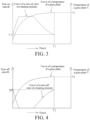
- the total power of the heating element is monitored by an electricity meter in real time. Because the glass plate starts to absorb heat when entering the heating furnace from a lower temperature state, a temperature in the heating furnace is lowered at this moment. To keep a constant-temperature working state of the heating furnace, a quantity of heating elements in a working state is increased to provide more heat. In this case, a total heating power of the heating element increases rapidly, reaches a maximum value within a specific period of time, and then remains unchanged; as the temperature of the glass plate is gradually increased, a difference between the temperature of the glass plate and temperature in the furnace is gradually reduced.
- the electricity meter connected to the heating element detects that the total power of the heating element is less than or equal to a specified threshold W 1 again after reaching a maximum value
- the detected total power of the heating element in a falling process is less than or equal to the specified threshold W 1 , that is, when the total heating power detected at a second time is less than or equal to the specified threshold W 1
- a corresponding moment T1 when the glass plate is heated to a suitable temperature t1 that satisfies the tempering technology is determined.
- a curve in the figure is a curve diagram after filtering is performed on a data curve according to a change of the detected total power of the heating element. That is, at a moment T1, a control unit sends an instruction to a drive mechanism to move the glass plate out of the heating furnace, so as to complete the heating process and enter a next procedure.
- a control process of a heating control method of the present invention is as follows: First, a to-be-used heating furnace is determined, a working temperature of the heating furnace is adjusted according to a type of a to-be-heated glass plate (for example, a low-radiation coated glass plate or white glass) and thickness information, the heating furnace in a state in which an ambient temperature is room temperature is run in a no-load state to the working temperature, the total current of the heating element in the state is monitored, five total currents at different moments are measured, and an average of the five values is obtained, where the average is a standard threshold A 0 ; an ambient temperature is measured, and a correction coefficient is determined with reference to a correction coefficient table (a correction coefficient K in the table is obtained by using the following calculation method: respectively monitoring total current values of the heating element when the heating furnace that is run in a no-load state reaches the working temperature at different ambient temperatures, and dividing each total current value by
- the total current of the heating element is monitored by an ammeter in real time. Because the glass plate starts to absorb heat when entering the heating furnace from a lower temperature state, a temperature in the heating furnace is lowered at this moment. To keep a constant-temperature working state of the heating furnace, a quantity of heating elements in a working state is increased to provide more heat. In this case, a total heating current of the heating element increases rapidly, reaches a maximum value within a specific period of time, and then remains unchanged; as the temperature of the glass plate is gradually increased, a difference between the temperature of the glass plate and temperature in the furnace is gradually reduced.
- a speed at which the glass plate absorbs the heat in the heating furnace is reduced, the temperature of the glass plate in the heating furnace tends to be constant, a quantity of the heating elements in the working state is gradually reduced, and the total current of the heating element is gradually reduced.
- the electricity meter connected to the heating element detects that the total current of the heating element is less than or equal to a specified threshold A1 again, the detected total current of the heating element in a falling process is less than or equal to the specified threshold A1, that is, a corresponding moment T1 when the glass plate is heated to a suitable temperature t1 that satisfies the tempering technology is determined. In this case, as shown in FIG.
- a control unit sends an instruction to a drive mechanism to move the glass plate out of the heating furnace, so as to complete the heating process and enter a next procedure.
- a control process of a heating control method of the present invention is as follows: First, a to-be-used heating furnace is determined, a working temperature of the heating furnace is adjusted according to a type of a to-be-heated glass plate (for example, a low-radiation coated glass plate or white glass) and thickness information, the heating furnace in a state in which an ambient temperature is room temperature is run in a no-load state to the working temperature, a turn-on ratio of the heating element in the state is monitored, five turn-on ratios at different moments are measured, and an average of the five values is obtained, where the average is a standard threshold K 0 ; an ambient temperature is measured, and a correction coefficient is determined with reference to a correction coefficient table (a correction coefficient K in the table is obtained by using the following calculation method: respectively monitoring turn-on ratios of the heating element when the heating furnace that is run in a no-load state reaches the working temperature at different ambient temperatures
- the turn-on ratio of the heating element is calculated by running a formula: the quantity of the heating elements in the working state/the total quantity of the heating elements, after the quantity of the heating elements in the working state is detected by the monitoring unit in real time. Because the glass plate starts to absorb heat when entering the heating furnace from a lower temperature state, a temperature in the heating furnace is lowered at this moment. To keep a constant-temperature working state, a quantity of heating elements in a working state is increased to provide more heat.
- the turn-on ratio of the heating element increases rapidly, reaches a maximum value within a specific period of time, and then remains unchanged; as the temperature of the glass plate is gradually increased, a difference between the temperature of the glass plate and temperature in the furnace is gradually reduced.
- a speed at which the glass plate absorbs the heat in the heating furnace is reduced, the temperature of the glass plate in the heating furnace tends to be constant, a quantity of the heating elements in the working state is gradually reduced, and the turn-on ratio of the heating element is gradually reduced.
- the detected turn-on ratio of the heating element in a falling process is less than or equal to the specified threshold K 1 , that is, a corresponding moment T1 when the glass plate is heated to a suitable temperature t1 that satisfies the tempering technology is determined.
- a curve in the figure is a curve diagram after filtering is performed on a data curve according to a change of the turn-on ratio of the detected heating element. That is, at a moment T1, a control unit sends an instruction to a drive mechanism to move the glass plate out of the heating furnace, so as to complete the heating process and enter a next procedure.
- a control process of a heating control method of the present invention is as follows: First, a to-be-used heating furnace is determined, a working temperature of the heating furnace is adjusted according to a type of a to-be-heated glass plate (for example, a low-radiation coated glass plate or white glass) and thickness information, the heating furnace in a state in which an ambient temperature is room temperature is run in a no-load state to the working temperature, the turn-off ratio of the heating element in the state is monitored, five turn-off ratios at different moments are measured, and an average of the five values is obtained, where the average is a standard threshold D 0 ; an ambient temperature is measured, and a correction coefficient is determined with reference to a correction coefficient table (a correction coefficient K in the table is obtained by using the following calculation method: respectively monitoring turn-off ratios of the heating element when the heating furnace that is run in a no-load state reaches the working temperature at different ambient temperatures,
- the turn-off ratio of the heating element is calculated by running a formula: 1-the quantity of the heating elements in the working state/the total quantity of the heating elements, after the quantity of the heating elements in the working state is detected by the monitoring unit in real time. Because the glass plate starts to absorb heat when entering the heating furnace from a lower temperature state, a temperature in the heating furnace is lowered at this moment. To keep a constant working state, a quantity of heating elements in a working state is increased to provide more heat.
- the turn-off ratio of the heating element decreases, reaches a minimum value within a specific period of time, and then remains unchanged; as the temperature of the glass plate is gradually increased, a difference between the temperature of the glass plate and temperature in the furnace is gradually reduced.
- a speed at which the glass plate absorbs the heat in the heating furnace is reduced, the temperature of the glass plate in the heating furnace tends to be constant, a quantity of the heating elements in the working state is gradually reduced, and the turn-off ratio of the heating element is gradually increased.
- the detected turn-off ratio of the heating element in a rising process is less than or equal to the specified threshold D 1 , that is, a corresponding moment T1 when the glass plate is heated to a suitable temperature t1 that satisfies the tempering technology is determined.
- a curve in the figure is a curve diagram after filtering is performed on a data curve according to a change of the turn-off ratio of the detected heating element. That is, at a moment T1, a control unit sends an instruction to a drive mechanism to move the glass plate out of the heating furnace, so as to complete the heating process and enter a next procedure.
- a control process of a heating control method of the present invention is as follows: First, a to-be-used heating furnace is determined, a working temperature of the heating furnace is adjusted according to a type of a to-be-heated glass plate (for example, a low-radiation coated glass plate or white glass) and thickness information, the heating furnace in a state in which an ambient temperature is room temperature is run in a no-load state to the working temperature, a gas flow value of the heating element in the state is monitored, five gas flow values at different moments are measured, and an average of the five values is obtained, where the average is a standard threshold R 0 ; a ambient temperature is measured, and a correction coefficient is determined with reference to a correction coefficient table (a correction coefficient K in the table is obtained by using the following calculation method: respectively monitoring gas flow values of the heating element when the heating furnace that is run in a no-load state reaches the working temperature at different ambient temperatures, and dividing
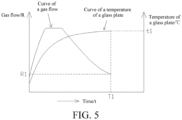
- the total gas flow value of the heating element is monitored by a gas flowmeter in real time. Because the glass plate starts to absorb heat when entering the heating furnace from a lower temperature state, a temperature in the heating furnace is lowered at this moment. To keep a constant-temperature working state of the heating furnace, a quantity of heating elements in a working state is increased to provide more heat. In this case, a gas flow value of the heating element increases rapidly, reaches a maximum value within a specific period of time, and then remains unchanged; as the temperature of the glass plate is gradually increased, a difference between the temperature of the glass plate and temperature in the furnace is gradually reduced.
- a speed at which the glass plate absorbs the heat in the heating furnace is reduced, the temperature of the glass plate in the heating furnace tends to be constant, a quantity of the heating elements in the working state is gradually reduced, and the gas flow value is gradually reduced.
- the gas flowmeter connected to the heating element detects that the gas flow value of the heating element is less than or equal to a specified threshold R 1 again, the detected gas flow value detected in a falling process is less than or equal to the specified threshold R 1 , that is, a corresponding moment T1 when the glass plate is heated to a suitable temperature t1 that satisfies the tempering technology is determined. In this case, as shown in FIG.
- a control unit sends an instruction to a drive mechanism to move the glass plate out of the heating furnace, so as to complete the heating process and enter a next procedure.
- the threshold W 1 , A 1 , K 1 , D 1 , and R 1 in foregoing Embodiment 1 to Embodiment 5 can be further obtained by using the following method: the operator inputs the correction coefficient K into the control unit through a human-machine interface, and the control unit calculates corresponding thresholds according to formulas.
- the "room temperature” in the present invention refers to 25°C, but a person skilled in the art will easily think of replacing "room temperature” with other temperatures, to obtain a corresponding standard threshold.
Landscapes
- Chemical & Material Sciences (AREA)
- Engineering & Computer Science (AREA)
- Physics & Mathematics (AREA)
- Materials Engineering (AREA)
- Organic Chemistry (AREA)
- Thermal Sciences (AREA)
- Automation & Control Theory (AREA)
- General Physics & Mathematics (AREA)
- Re-Forming, After-Treatment, Cutting And Transporting Of Glass Products (AREA)
- Waste-Gas Treatment And Other Accessory Devices For Furnaces (AREA)
- Container, Conveyance, Adherence, Positioning, Of Wafer (AREA)
- Control Of Temperature (AREA)
- Surface Treatment Of Glass (AREA)
- Tunnel Furnaces (AREA)
Claims (15)
- Verfahren zum Steuern von Ausleiten einer Glasplatte bei einem technischen Prozess zum Tempern von Glasplatten, wobei nach Einleiten der Glasplatte in einen Heizofen eine Überwachungs-Einheit einen Arbeitsparameter eines Heizelementes in Echtzeit überwacht, Filtern an dem Arbeitsparameter des Heizelementes durchführt und dann den gefilterten Arbeitsparameter des Heizelementes zu einer Steuerungs-Einheit überträgt,wobei die Steuerungs-Einheit den empfangenen Arbeitsparameter des Heizelementes mit einem vorgegebenen Schwellenwert vergleicht,dadurch gekennzeichnet, dass die Steuerungs-Einheit einen Befehl zu einem Antriebsmechanismus sendet, wenn der Arbeitsparameter den vorgegebenen Schwellenwert während einer weiteren Änderung erreicht, nachdem der Arbeitsparameter des Heizelementes einen Maximalwert oder einen Minimalwert erreicht hat,wobei der Antriebsmechanismus so wirkt, dass er die Glasplatte direkt aus dem Heizofen heraus bewegt oder die Glasplatte nach einer Zeitverzögerung aus dem Heizofen heraus bewegt, um damit einen Vorgang zum Erhitzen der Glasplatte abzuschließen.
- Verfahren zum Steuern von Ausleiten einer Glasplatte bei einem technischen Prozess zum Tempern von Glasplatten nach Anspruch 1, wobei ein elektrisches Heizelement als das Heizelement verwendet wird und der Arbeitsparameter des Heizelementes die Gesamtleistung des Heizelementes in dem Heizofen ist; die Überwachungs-Einheit, nachdem die Glasplatte in den Heizofen eingeleitet ist, die Gesamtleistung des Heizelementes in Echtzeit überwacht, Filtern an der Gesamtleistung des Heizelementes durchführt und dann die gefilterte Gesamtleistung des Heizelementes zu der Steuerungs-Einheit überträgt, um die gefilterte Gesamtleistung mit einem vorgegebenen Schwellenwert W1 zu vergleichen; die Steuerungs-Einheit, nachdem die Gesamtleistung des Heizelementes den Maximalwert erreicht hat, wenn die Gesamtleistung während eines Abfall-Prozesses unter oder auf dem Schwellenwert W1 liegt, einen Befehl zu dem Antriebsmechanismus sendet; und der Antriebsmechanismus so wirkt, dass er die Glasplatte direkt aus dem Heizofen heraus bewegt oder die Glasplatte nach einer Zeitverzögerung aus dem Heizofen heraus bewegt, um damit den Vorgang zum Erhitzen der Glasplatte abzuschließen.
- Verfahren zum Steuern von Ausleiten einer Glasplatte bei einem technischen Prozess zum Tempern von Glasplatten nach Anspruch 2, wobei die Überwachungs-Einheit ein Stromzähler ist.
- Verfahren zum Steuern von Ausleiten einer Glasplatte bei einem technischen Prozess zum Tempern von Glasplatten nach Anspruch 2, wobei der Schwellenwert W1 = W0 · K ist, wobei K ein Korrekturkoeffizient ist, ein Wertebereich von K 0,9 ≤ K ≤ 1,1 ist und W0 eine Gesamtleistung des Heizelementes ist, wenn der Heizofen in dem Leerlaufzustand bei Raumtemperatur die Arbeitstemperatur erreicht.
- Verfahren zum Steuern von Ausleiten einer Glasplatte bei einem technischen Prozess zum Tempern von Glasplatten nach Anspruch 1, wobei ein elektrisches Heizelement als das Heizelement verwendet wird und der Arbeitsparameter des Heizelementes der Gesamtstromwert des Heizelementes in dem Heizofen ist; die Überwachungs-Einheit, nachdem die Glasplatte in den Heizofen eingeleitet worden ist, den Gesamtstromwert des Heizelementes in Echtzeit überwacht, Filtern an dem Gesamtstromwert des Heizelementes durchführt und dann den gefilterten Gesamtstromwert zu der Steuerungs-Einheit überträgt, um den gefilterten Gesamtstromwert mit einem vorgegebenen Schwellenwert A1 zu vergleichen; die Steuerungs-Einheit, nachdem der Gesamtstromwert des Heizelementes den Maximalwert erreicht hat, wenn der Gesamtstromwert während eines Abfall-Prozesses unter oder auf dem Schwellenwert A1 liegt, einen Befehl zu dem Antriebsmechanismus sendet; und der Antriebsmechanismus so wirkt, dass er die Glasplatte direkt aus dem Heizofen heraus bewegt oder die Glasplatte nach einer Zeitverzögerung aus dem Heizofen heraus bewegt, um damit den Vorgang zum Erhitzen der Glasplatte abzuschließen.
- Verfahren zum Steuern von Ausleiten einer Glasplatte bei einem technischen Prozess zum Tempern von Glasplatten nach Anspruch 5, wobei die Überwachungs-Einheit ein Strommesser ist.
- Verfahren zum Steuern von Ausleiten einer Glasplatte bei einem technischen Prozess zum Tempern von Glasplatten nach Anspruch 5, wobei der Schwellenwert A1 = A0 · K ist, wobei K ein Korrekturkoeffizient ist, ein Wertebereich des Korrekturkoeffizienten 0,9 ≤ K ≤ 1,1 ist und A0 ein Gesamtstromwert des Heizelementes ist, wenn der Heizofen in dem Leerlaufzustand bei Raumtemperatur die Arbeitstemperatur erreicht.
- Verfahren zum Steuern von Ausleiten einer Glasplatte bei einem technischen Prozess zum Tempern von Glasplatten nach Anspruch 1, wobei ein elektrisches Heizelement oder ein Gas-Heizelement als das Heizelement verwendet wird und ein Arbeitsparameter des Heizelementes ein Einschalt-Verhältnis aller Heizelemente in dem Heizofen ist; das Einschalt-Verhältnis des Heizelementes ein Prozentsatz einer Menge der Heizelemente in einem Arbeitszustand von einer Menge aller Heizelemente ist, die Überwachungs-Einheit, nachdem die Glasplatte in den Heizofen eingeleitet worden ist, das Einschalt-Verhältnis des Heizelementes in Echtzeit überwacht, Filtern an dem erfassten Einschalt-Verhältnis des Heizelementes durchführt und dann das gefilterte Einschalt-Verhältnis zu der Steuerungs-Einheit überträgt, um das gefilterte Einschalt-Verhältnis mit einem Schwellenwert K1 zu vergleichen; die Steuerungs-Einheit, nachdem das Einschalt-Verhältnis des Heizelementes den Maximalwert erreicht hat, wenn das Einschalt-Verhältnis während eines Abfall-Prozesses unter oder auf dem Schwellenwert K1 liegt, einen Befehl zu dem Antriebsmechanismus sendet; und der Antriebsmechanismus so wirkt, dass er die Glasplatte direkt aus dem Heizofen heraus bewegt oder die Glasplatte nach einer Zeitverzögerung aus dem Heizofen heraus bewegt, um damit den Vorgang zum Erhitzen der Glasplatte abzuschließen.
- Verfahren zum Steuern von Ausleiten einer Glasplatte bei einem technischen Prozess zum Tempern von Glasplatten nach Anspruch 8, wobei das Einschaltverhältnis durch Ausführen einer Formel Menge der Heizelemente in dem Arbeitszustand/Gesamtmenge der Heizelemente berechnet wird, nachdem die Menge der Heizelemente in dem Arbeitszustand durch die Überwachungs-Einheit erfasst worden ist.
- Verfahren zum Steuern von Ausleiten einer Glasplatte bei einem technischen Prozess zum Tempern von Glasplatten nach Anspruch 8, wobei der Schwellenwert K1 = K0 · K ist, wobei K ein Korrekturkoeffizient ist, ein Wertebereich von K 0,9 ≤ K ≤1 ,1 ist und K0 ein Einschalt-Verhältnis des Heizelementes ist, wenn der Heizofen in dem Leerlaufzustand bei Raumtemperatur die Arbeitstemperatur erreicht.
- Verfahren zum Steuern von Ausleiten einer Glasplatte bei einem technischen Prozess zum Tempern von Glasplatten nach Anspruch 1, wobei entweder ein elektrisches Heizelement oder ein Gas-Heizelement als das Heizelement verwendet wird und ein Arbeitsparameter des Heizelementes ein Ausschalt-Verhältnis aller Heizelemente in dem Heizofen ist; das Ausschalt-Verhältnis des Heizelementes ein Prozentsatz einer Menge der Heizelemente in einem AusZustand von einer Menge aller Heizelemente ist, die Überwachungs-Einheit, nachdem die Glasplatte in den Heizofen eingeleitet worden ist, das Ausschalt-Verhältnis des Heizelementes in Echtzeit überwacht, Filtern an dem erfassten Ausschalt-Verhältnis des Heizelementes durchführt und dann das gefilterte Ausschalt-Verhältnis zu der Steuerungs-Einheit überträgt, um das gefilterte Ausschalt-Verhältnis mit einem Schwellenwert D1 zu vergleichen; die Steuerungs-Einheit, nachdem das Ausschalt-Verhältnis des Heizelementes den Minimalwert erreicht hat, wenn das Ausschalt-Verhältnis während eines Anstiegs-Prozesses über oder auf dem Schwellenwert D1 liegt, einen Befehl zu dem Antriebsmechanismus sendet; und der Antriebsmechanismus so wirkt, dass er die Glasplatte direkt aus dem Heizofen heraus bewegt oder die Glasplatte nach einer Zeitverzögerung aus dem Heizofen heraus bewegt, um damit den Vorgang zum Erhitzen der Glasplatte abzuschließen.
- Verfahren zum Steuern von Ausleiten einer Glasplatte bei einem technischen Prozess zum Tempern von Glasplatten nach Anspruch 11, wobei das Ausschalt-Verhältnis durch Ausführen einer Formel 1 - Menge der Heizelemente in dem Arbeitszustand/Gesamtmenge der Heizelemente berechnet wird, nachdem die Menge der Heizelemente in dem Arbeitszustand durch die Überwachungs-Einheit erfasst worden ist.
- Verfahren zum Steuern von Ausleiten einer Glasplatte bei einem technischen Prozess zum Tempern von Glasplatten nach Anspruch 11, wobei der Schwellenwert D1 = D0 · K ist, wobei K ein Korrekturkoeffizient ist, ein Wertebereich von K 0,9 ≤ K ≤ 1,1 ist und D0 ein Ausschalt-Verhältnis des Heizelementes ist, wenn der Heizofen in dem Leerlaufzustand bei Raumtemperatur die Arbeitstemperatur erreicht.
- Verfahren zum Steuern von Ausleiten einer Glasplatte bei einem technischen Prozess zum Tempern von Glasplatten nach Anspruch 1, wobei ein Gasheizelement als das Heizelement verwendet wird und ein Arbeitsparameter des Heizelementes der Gasströmungswert des Heizelementes in dem Heizofen ist; die Überwachungs-Einheit, nachdem die Glasplatte in den Heizofen eingeführt worden ist, den Gasströmungswert des Heizelementes in Echtzeit überwacht, eine Filterung an dem Gasströmungswert durchführt und dann den gefilterten Gasströmungswert zu der Steuerungs-Einheit überträgt, um den Gasströmungswert mit einem vorgegebenen Schwellenwert R1 zu vergleichen; die Steuerungs-Einheit, nachdem der Gasströmungswert des Heizelementes den Maximalwert erreicht hat, wenn der Gasströmungswert während eines Abfall-Prozesses unter oder auf dem Schwellenwert R1 liegt, einen Befehl zu dem Antriebsmechanismus sendet; und der Antriebsmechanismus so wirkt, dass er die Glasplatte direkt aus dem Heizofen heraus bewegt oder die Glasplatte nach einer Zeitverzögerung aus dem Heizofen heraus bewegt, um damit den Vorgang zum Erhitzen der Glasplatte abzuschließen.
- Verfahren zum Steuern von Ausleiten einer Glasplatte bei einem technischen Prozess zum Tempern von Glasplatten nach Anspruch 14,wobei die Überwachungs-Einheit ein Gas-Strömungsmesser ist; oderder Schwellenwert R1 = R0 · K ist, wobei K ein Korrekturkoeffizient ist, ein Wertebereich von K 0,95 ≤ K ≤ 1,05 ist, und R0 ein Gasströmungswert des Heizelementes ist, wenn der Heizofen in dem Leerlaufzustand bei Raumtemperatur die Arbeitstemperatur erreicht.
Applications Claiming Priority (2)
| Application Number | Priority Date | Filing Date | Title |
|---|---|---|---|
| CN201710667730.0A CN107515637B (zh) | 2017-08-07 | 2017-08-07 | 一种玻璃板钢化工艺过程控制方法 |
| PCT/CN2018/082667 WO2019029180A1 (zh) | 2017-08-07 | 2018-04-11 | 一种玻璃板钢化工艺过程中控制玻璃板出炉的方法 |
Publications (4)
| Publication Number | Publication Date |
|---|---|
| EP3657295A1 EP3657295A1 (de) | 2020-05-27 |
| EP3657295A4 EP3657295A4 (de) | 2020-07-22 |
| EP3657295B1 true EP3657295B1 (de) | 2023-06-14 |
| EP3657295C0 EP3657295C0 (de) | 2023-06-14 |
Family
ID=60722133
Family Applications (1)
| Application Number | Title | Priority Date | Filing Date |
|---|---|---|---|
| EP18844566.2A Active EP3657295B1 (de) | 2017-08-07 | 2018-04-11 | Verfahren zur steuerung der entladung einer glasplatte in einem verfahren zum tempern von glasplatten |
Country Status (10)
| Country | Link |
|---|---|
| US (1) | US11667556B2 (de) |
| EP (1) | EP3657295B1 (de) |
| JP (1) | JP6852222B2 (de) |
| KR (1) | KR102280818B1 (de) |
| CN (1) | CN107515637B (de) |
| AU (1) | AU2018312663B2 (de) |
| CA (1) | CA3071471C (de) |
| ES (1) | ES2954379T3 (de) |
| RU (1) | RU2737064C1 (de) |
| WO (1) | WO2019029180A1 (de) |
Families Citing this family (5)
| Publication number | Priority date | Publication date | Assignee | Title |
|---|---|---|---|---|
| CN107382045B (zh) * | 2017-08-07 | 2020-02-11 | 洛阳兰迪玻璃机器股份有限公司 | 一种玻璃板钢化工艺过程控制方法 |
| CN107515637B (zh) * | 2017-08-07 | 2020-08-28 | 洛阳兰迪玻璃机器股份有限公司 | 一种玻璃板钢化工艺过程控制方法 |
| CN110880074B (zh) * | 2019-11-20 | 2022-04-12 | 珠海格力电器股份有限公司 | 质量监控系统和方法及存储介质、服务器 |
| US20230212056A1 (en) | 2022-01-06 | 2023-07-06 | Cardinal Ig Company | Self-correcting haze parameters in a glass tempering system |
| CN119200709B (zh) * | 2024-11-27 | 2025-03-11 | 临涣焦化股份有限公司 | 一种适用于焦炭生产控制的回炉煤气温度控制系统 |
Family Cites Families (28)
| Publication number | Priority date | Publication date | Assignee | Title |
|---|---|---|---|---|
| US4071344A (en) * | 1976-10-14 | 1978-01-31 | Libbey-Owens-Ford Company | Glass sheet temperature control apparatus and method |
| FR2488423A1 (fr) * | 1980-08-06 | 1982-02-12 | Saint Gobain Vitrage | Procede et dispositif pour la regulation de la temperature d'une feuille de verre dans un four a plusieurs cellules |
| JPS62230637A (ja) * | 1986-03-31 | 1987-10-09 | Nippon Sheet Glass Co Ltd | 板ガラス成型装置 |
| FI101068B (fi) * | 1996-05-22 | 1998-04-15 | Uniglass Engineering Oy | Menetelmä ja laitteisto lasin lämmittämiseksi teloilla varustetussa ka rkaisu-uunissa |
| KR100326173B1 (ko) * | 1999-12-30 | 2002-02-27 | 윤종용 | 고순도 실리카 글래스 제조 공정의 열처리 제어 방법 |
| FI114631B (fi) * | 2001-10-01 | 2004-11-30 | Tamglass Ltd Oy | Menetelmä ja laite lasilevyjen lämmittämiseksi karkaisua varten |
| FI20035031A0 (fi) * | 2003-03-12 | 2003-03-12 | Tamglass Ltd Oy | Menetelmä ja laite turvalasituotannon seuraamiseksi tai käsittelyprosessin ohjaamiseksi |
| FI120734B (fi) * | 2004-04-07 | 2010-02-15 | Tamglass Ltd Oy | Menetelmä lasilevyjen lämmittämiseksi karkaisua varten ja menetelmää soveltava laite |
| JP2006083038A (ja) * | 2004-09-17 | 2006-03-30 | Nippon Sheet Glass Co Ltd | ガラス成形装置の加熱制御装置及びガラス成形方法 |
| WO2009100452A2 (en) * | 2008-02-10 | 2009-08-13 | Litesentry Corporation | Closed loop control system for the heat-treatment of glass |
| FI126760B (fi) * | 2010-01-11 | 2017-05-15 | Glaston Services Ltd Oy | Menetelmä ja laite lasilevyjen kannattamiseksi ja kuumentamiseksi kuumalla kaasutyynyllä |
| CN102834362B (zh) * | 2010-03-30 | 2015-12-16 | 旭硝子株式会社 | 玻璃板的强化方法及其装置 |
| CN202148251U (zh) * | 2011-07-21 | 2012-02-22 | 杭州精工机械有限公司 | 数控对流混合辐射加热方式的加热炉 |
| CN202472455U (zh) * | 2012-03-02 | 2012-10-03 | 洛阳北方玻璃技术股份有限公司 | 控制钢化玻璃被加热温度的装置 |
| CN102942300B (zh) * | 2012-12-03 | 2014-09-10 | 洛阳兰迪玻璃机器股份有限公司 | 基于线阵列紫外光探测器的玻璃几何参数测量系统 |
| CN203307211U (zh) | 2013-05-24 | 2013-11-27 | 张亚青 | Low-e玻璃钢化炉 |
| CN203307217U (zh) * | 2013-06-07 | 2013-11-27 | 浙江汉能玻璃技术有限公司 | 一种钢化玻璃变板面节能冷却风栅 |
| US9255033B2 (en) | 2013-08-16 | 2016-02-09 | Schott Corporation | Piezoelectric glass ceramic compositions and piezoelectric devices made therefrom |
| CN203786589U (zh) * | 2014-01-25 | 2014-08-20 | 凯茂科技(深圳)有限公司 | 化学钢化炉控制系统 |
| JP6691315B2 (ja) | 2014-04-03 | 2020-04-28 | 日本電気硝子株式会社 | ガラス |
| EP3174835B1 (de) * | 2014-07-31 | 2025-09-10 | Corning Incorporated | Verfahren zur thermischen vorspannung von glas |
| CN104773949A (zh) * | 2015-04-28 | 2015-07-15 | 洛阳北方玻璃技术股份有限公司 | 一种控制玻璃钢化过程中玻璃加热的方法 |
| CN204588984U (zh) * | 2015-05-06 | 2015-08-26 | 安徽亚盛技术开发有限责任公司 | 一种水平玻璃钢化炉放片段 |
| CN105621871A (zh) * | 2015-12-24 | 2016-06-01 | 山东师范大学 | 一种玻璃钢化系统及其钢化玻璃的制备方法 |
| CN106066627A (zh) * | 2016-06-01 | 2016-11-02 | 安瑞装甲材料(芜湖)科技有限公司 | 一种钢化玻璃生产控制系统 |
| CN107562024B (zh) | 2017-08-07 | 2021-01-29 | 洛阳兰迪玻璃机器股份有限公司 | 一种玻璃板钢化工艺过程控制方法 |
| CN107500519B (zh) | 2017-08-07 | 2020-02-07 | 洛阳兰迪玻璃机器股份有限公司 | 一种玻璃板钢化工艺过程控制方法 |
| CN107515637B (zh) | 2017-08-07 | 2020-08-28 | 洛阳兰迪玻璃机器股份有限公司 | 一种玻璃板钢化工艺过程控制方法 |
-
2017
- 2017-08-07 CN CN201710667730.0A patent/CN107515637B/zh active Active
-
2018
- 2018-04-11 KR KR1020207006742A patent/KR102280818B1/ko active Active
- 2018-04-11 AU AU2018312663A patent/AU2018312663B2/en active Active
- 2018-04-11 JP JP2020506244A patent/JP6852222B2/ja active Active
- 2018-04-11 ES ES18844566T patent/ES2954379T3/es active Active
- 2018-04-11 EP EP18844566.2A patent/EP3657295B1/de active Active
- 2018-04-11 RU RU2020109890A patent/RU2737064C1/ru active
- 2018-04-11 US US16/636,903 patent/US11667556B2/en active Active
- 2018-04-11 CA CA3071471A patent/CA3071471C/en active Active
- 2018-04-11 WO PCT/CN2018/082667 patent/WO2019029180A1/zh not_active Ceased
Also Published As
| Publication number | Publication date |
|---|---|
| KR20200038505A (ko) | 2020-04-13 |
| AU2018312663B2 (en) | 2021-04-08 |
| CA3071471A1 (en) | 2019-02-14 |
| CA3071471C (en) | 2023-07-25 |
| EP3657295A1 (de) | 2020-05-27 |
| US20200165154A1 (en) | 2020-05-28 |
| CN107515637A (zh) | 2017-12-26 |
| EP3657295C0 (de) | 2023-06-14 |
| RU2737064C1 (ru) | 2020-11-24 |
| CN107515637B (zh) | 2020-08-28 |
| WO2019029180A1 (zh) | 2019-02-14 |
| EP3657295A4 (de) | 2020-07-22 |
| ES2954379T3 (es) | 2023-11-21 |
| JP6852222B2 (ja) | 2021-03-31 |
| KR102280818B1 (ko) | 2021-07-23 |
| AU2018312663A1 (en) | 2020-03-26 |
| JP2020528871A (ja) | 2020-10-01 |
| US11667556B2 (en) | 2023-06-06 |
Similar Documents
| Publication | Publication Date | Title |
|---|---|---|
| CA3071471C (en) | Method for controlling discharging of glass plate in glass plate tempering technology process | |
| CN103809244B (zh) | 一种光纤热剥装置的加热控制系统及方法 | |
| KR102354154B1 (ko) | 유리판 강화 공정을 위한 수행 수단 제어 방법 | |
| CN104238592B (zh) | 一种快速恒温箱自适应控制方法和控制系统 | |
| CN107562024B (zh) | 一种玻璃板钢化工艺过程控制方法 | |
| CN108784340B (zh) | 液体加热微沸腾控制方法 | |
| CN107500519B (zh) | 一种玻璃板钢化工艺过程控制方法 | |
| CN202472455U (zh) | 控制钢化玻璃被加热温度的装置 | |
| CN201238404Y (zh) | 电加热温度的时间控制装置 | |
| CN106711807A (zh) | 一种配电柜智能控制系统 | |
| CN107522391B (zh) | 一种玻璃板钢化工艺过程控制方法 | |
| CN121957229A (zh) | 一种具有多区独立控温功能的电烤炉温度调节系统及方法 | |
| CN208432924U (zh) | 一种钢化玻璃生产炉温控制系统 | |
| CN107417079B (zh) | 一种玻璃板钢化工艺过程控制方法 | |
| CN120799996A (zh) | 一种熔铅炉体控制电路系统及控制方法 | |
| CN102528931B (zh) | 一种对外加剂加温的控制方法、装置及系统 | |
| CN107562085A (zh) | 一种玻璃板钢化工艺过程控制方法 |
Legal Events
| Date | Code | Title | Description |
|---|---|---|---|
| STAA | Information on the status of an ep patent application or granted ep patent |
Free format text: STATUS: THE INTERNATIONAL PUBLICATION HAS BEEN MADE |
|
| PUAI | Public reference made under article 153(3) epc to a published international application that has entered the european phase |
Free format text: ORIGINAL CODE: 0009012 |
|
| STAA | Information on the status of an ep patent application or granted ep patent |
Free format text: STATUS: REQUEST FOR EXAMINATION WAS MADE |
|
| 17P | Request for examination filed |
Effective date: 20200217 |
|
| AK | Designated contracting states |
Kind code of ref document: A1 Designated state(s): AL AT BE BG CH CY CZ DE DK EE ES FI FR GB GR HR HU IE IS IT LI LT LU LV MC MK MT NL NO PL PT RO RS SE SI SK SM TR |
|
| AX | Request for extension of the european patent |
Extension state: BA ME |
|
| REG | Reference to a national code |
Ref country code: DE Ref legal event code: R079 Ref document number: 602018051938 Country of ref document: DE Free format text: PREVIOUS MAIN CLASS: G05D0023300000 Ipc: C03B0027040000 |
|
| A4 | Supplementary search report drawn up and despatched |
Effective date: 20200618 |
|
| RIC1 | Information provided on ipc code assigned before grant |
Ipc: G05D 23/30 20060101ALI20200612BHEP Ipc: C03B 27/04 20060101AFI20200612BHEP Ipc: C03B 29/08 20060101ALI20200612BHEP Ipc: C03B 27/012 20060101ALI20200612BHEP |
|
| DAV | Request for validation of the european patent (deleted) | ||
| DAX | Request for extension of the european patent (deleted) | ||
| GRAP | Despatch of communication of intention to grant a patent |
Free format text: ORIGINAL CODE: EPIDOSNIGR1 |
|
| STAA | Information on the status of an ep patent application or granted ep patent |
Free format text: STATUS: GRANT OF PATENT IS INTENDED |
|
| INTG | Intention to grant announced |
Effective date: 20230105 |
|
| GRAS | Grant fee paid |
Free format text: ORIGINAL CODE: EPIDOSNIGR3 |
|
| GRAA | (expected) grant |
Free format text: ORIGINAL CODE: 0009210 |
|
| STAA | Information on the status of an ep patent application or granted ep patent |
Free format text: STATUS: THE PATENT HAS BEEN GRANTED |
|
| AK | Designated contracting states |
Kind code of ref document: B1 Designated state(s): AL AT BE BG CH CY CZ DE DK EE ES FI FR GB GR HR HU IE IS IT LI LT LU LV MC MK MT NL NO PL PT RO RS SE SI SK SM TR |
|
| REG | Reference to a national code |
Ref country code: CH Ref legal event code: EP |
|
| REG | Reference to a national code |
Ref country code: DE Ref legal event code: R096 Ref document number: 602018051938 Country of ref document: DE |
|
| REG | Reference to a national code |
Ref country code: AT Ref legal event code: REF Ref document number: 1579148 Country of ref document: AT Kind code of ref document: T Effective date: 20230715 |
|
| U01 | Request for unitary effect filed |
Effective date: 20230623 |
|
| U07 | Unitary effect registered |
Designated state(s): AT BE BG DE DK EE FI FR IT LT LU LV MT NL PT SE SI Effective date: 20230629 |
|
| REG | Reference to a national code |
Ref country code: LT Ref legal event code: MG9D |
|
| PG25 | Lapsed in a contracting state [announced via postgrant information from national office to epo] |
Ref country code: NO Free format text: LAPSE BECAUSE OF FAILURE TO SUBMIT A TRANSLATION OF THE DESCRIPTION OR TO PAY THE FEE WITHIN THE PRESCRIBED TIME-LIMIT Effective date: 20230914 |
|
| REG | Reference to a national code |
Ref country code: ES Ref legal event code: FG2A Ref document number: 2954379 Country of ref document: ES Kind code of ref document: T3 Effective date: 20231121 |
|
| PG25 | Lapsed in a contracting state [announced via postgrant information from national office to epo] |
Ref country code: RS Free format text: LAPSE BECAUSE OF FAILURE TO SUBMIT A TRANSLATION OF THE DESCRIPTION OR TO PAY THE FEE WITHIN THE PRESCRIBED TIME-LIMIT Effective date: 20230614 Ref country code: HR Free format text: LAPSE BECAUSE OF FAILURE TO SUBMIT A TRANSLATION OF THE DESCRIPTION OR TO PAY THE FEE WITHIN THE PRESCRIBED TIME-LIMIT Effective date: 20230614 Ref country code: GR Free format text: LAPSE BECAUSE OF FAILURE TO SUBMIT A TRANSLATION OF THE DESCRIPTION OR TO PAY THE FEE WITHIN THE PRESCRIBED TIME-LIMIT Effective date: 20230915 |
|
| PG25 | Lapsed in a contracting state [announced via postgrant information from national office to epo] |
Ref country code: SK Free format text: LAPSE BECAUSE OF FAILURE TO SUBMIT A TRANSLATION OF THE DESCRIPTION OR TO PAY THE FEE WITHIN THE PRESCRIBED TIME-LIMIT Effective date: 20230614 |
|
| PG25 | Lapsed in a contracting state [announced via postgrant information from national office to epo] |
Ref country code: IS Free format text: LAPSE BECAUSE OF FAILURE TO SUBMIT A TRANSLATION OF THE DESCRIPTION OR TO PAY THE FEE WITHIN THE PRESCRIBED TIME-LIMIT Effective date: 20231014 |
|
| PG25 | Lapsed in a contracting state [announced via postgrant information from national office to epo] |
Ref country code: SM Free format text: LAPSE BECAUSE OF FAILURE TO SUBMIT A TRANSLATION OF THE DESCRIPTION OR TO PAY THE FEE WITHIN THE PRESCRIBED TIME-LIMIT Effective date: 20230614 Ref country code: SK Free format text: LAPSE BECAUSE OF FAILURE TO SUBMIT A TRANSLATION OF THE DESCRIPTION OR TO PAY THE FEE WITHIN THE PRESCRIBED TIME-LIMIT Effective date: 20230614 Ref country code: RO Free format text: LAPSE BECAUSE OF FAILURE TO SUBMIT A TRANSLATION OF THE DESCRIPTION OR TO PAY THE FEE WITHIN THE PRESCRIBED TIME-LIMIT Effective date: 20230614 Ref country code: IS Free format text: LAPSE BECAUSE OF FAILURE TO SUBMIT A TRANSLATION OF THE DESCRIPTION OR TO PAY THE FEE WITHIN THE PRESCRIBED TIME-LIMIT Effective date: 20231014 Ref country code: CZ Free format text: LAPSE BECAUSE OF FAILURE TO SUBMIT A TRANSLATION OF THE DESCRIPTION OR TO PAY THE FEE WITHIN THE PRESCRIBED TIME-LIMIT Effective date: 20230614 |
|
| PG25 | Lapsed in a contracting state [announced via postgrant information from national office to epo] |
Ref country code: PL Free format text: LAPSE BECAUSE OF FAILURE TO SUBMIT A TRANSLATION OF THE DESCRIPTION OR TO PAY THE FEE WITHIN THE PRESCRIBED TIME-LIMIT Effective date: 20230614 |
|
| REG | Reference to a national code |
Ref country code: DE Ref legal event code: R097 Ref document number: 602018051938 Country of ref document: DE |
|
| PLBE | No opposition filed within time limit |
Free format text: ORIGINAL CODE: 0009261 |
|
| STAA | Information on the status of an ep patent application or granted ep patent |
Free format text: STATUS: NO OPPOSITION FILED WITHIN TIME LIMIT |
|
| U20 | Renewal fee for the european patent with unitary effect paid |
Year of fee payment: 7 Effective date: 20240327 |
|
| 26N | No opposition filed |
Effective date: 20240315 |
|
| PG25 | Lapsed in a contracting state [announced via postgrant information from national office to epo] |
Ref country code: MC Free format text: LAPSE BECAUSE OF FAILURE TO SUBMIT A TRANSLATION OF THE DESCRIPTION OR TO PAY THE FEE WITHIN THE PRESCRIBED TIME-LIMIT Effective date: 20230614 |
|
| PG25 | Lapsed in a contracting state [announced via postgrant information from national office to epo] |
Ref country code: MC Free format text: LAPSE BECAUSE OF FAILURE TO SUBMIT A TRANSLATION OF THE DESCRIPTION OR TO PAY THE FEE WITHIN THE PRESCRIBED TIME-LIMIT Effective date: 20230614 |
|
| REG | Reference to a national code |
Ref country code: CH Ref legal event code: PL |
|
| PG25 | Lapsed in a contracting state [announced via postgrant information from national office to epo] |
Ref country code: CH Free format text: LAPSE BECAUSE OF NON-PAYMENT OF DUE FEES Effective date: 20240430 |
|
| PG25 | Lapsed in a contracting state [announced via postgrant information from national office to epo] |
Ref country code: IE Free format text: LAPSE BECAUSE OF NON-PAYMENT OF DUE FEES Effective date: 20240411 |
|
| U20 | Renewal fee for the european patent with unitary effect paid |
Year of fee payment: 8 Effective date: 20250325 |
|
| PGFP | Annual fee paid to national office [announced via postgrant information from national office to epo] |
Ref country code: GB Payment date: 20250417 Year of fee payment: 8 Ref country code: ES Payment date: 20250512 Year of fee payment: 8 |
|
| PG25 | Lapsed in a contracting state [announced via postgrant information from national office to epo] |
Ref country code: CY Free format text: LAPSE BECAUSE OF FAILURE TO SUBMIT A TRANSLATION OF THE DESCRIPTION OR TO PAY THE FEE WITHIN THE PRESCRIBED TIME-LIMIT; INVALID AB INITIO Effective date: 20180411 |
|
| PG25 | Lapsed in a contracting state [announced via postgrant information from national office to epo] |
Ref country code: HU Free format text: LAPSE BECAUSE OF FAILURE TO SUBMIT A TRANSLATION OF THE DESCRIPTION OR TO PAY THE FEE WITHIN THE PRESCRIBED TIME-LIMIT; INVALID AB INITIO Effective date: 20180411 |
|
| U20 | Renewal fee for the european patent with unitary effect paid |
Year of fee payment: 9 Effective date: 20260326 |