EP3657510B1 - Systèmes et procédés d'entraînement robotique - Google Patents
Systèmes et procédés d'entraînement robotique Download PDFInfo
- Publication number
- EP3657510B1 EP3657510B1 EP19217029.8A EP19217029A EP3657510B1 EP 3657510 B1 EP3657510 B1 EP 3657510B1 EP 19217029 A EP19217029 A EP 19217029A EP 3657510 B1 EP3657510 B1 EP 3657510B1
- Authority
- EP
- European Patent Office
- Prior art keywords
- data
- individual
- robotic
- sensor module
- processor
- Prior art date
- Legal status (The legal status is an assumption and is not a legal conclusion. Google has not performed a legal analysis and makes no representation as to the accuracy of the status listed.)
- Active
Links
Images



Classifications
-
- A—HUMAN NECESSITIES
- A63—SPORTS; GAMES; AMUSEMENTS
- A63B—APPARATUS FOR PHYSICAL TRAINING, GYMNASTICS, SWIMMING, CLIMBING, OR FENCING; BALL GAMES; TRAINING EQUIPMENT
- A63B71/00—Games or sports accessories not covered in groups A63B1/00 - A63B69/00
- A63B71/06—Indicating or scoring devices for games or players, or for other sports activities
- A63B71/0686—Timers, rhythm indicators or pacing apparatus using electric or electronic means
-
- A—HUMAN NECESSITIES
- A63—SPORTS; GAMES; AMUSEMENTS
- A63B—APPARATUS FOR PHYSICAL TRAINING, GYMNASTICS, SWIMMING, CLIMBING, OR FENCING; BALL GAMES; TRAINING EQUIPMENT
- A63B21/00—Exercising apparatus for developing or strengthening the muscles or joints of the body by working against a counterforce, with or without measuring devices
- A63B21/0004—Exercising devices moving as a whole during exercise
-
- A—HUMAN NECESSITIES
- A63—SPORTS; GAMES; AMUSEMENTS
- A63B—APPARATUS FOR PHYSICAL TRAINING, GYMNASTICS, SWIMMING, CLIMBING, OR FENCING; BALL GAMES; TRAINING EQUIPMENT
- A63B24/00—Electric or electronic controls for exercising apparatus of preceding groups; Controlling or monitoring of exercises, sportive games, training or athletic performances
- A63B24/0075—Means for generating exercise programmes or schemes, e.g. computerized virtual trainer, e.g. using expert databases
-
- A—HUMAN NECESSITIES
- A63—SPORTS; GAMES; AMUSEMENTS
- A63B—APPARATUS FOR PHYSICAL TRAINING, GYMNASTICS, SWIMMING, CLIMBING, OR FENCING; BALL GAMES; TRAINING EQUIPMENT
- A63B24/00—Electric or electronic controls for exercising apparatus of preceding groups; Controlling or monitoring of exercises, sportive games, training or athletic performances
- A63B24/0087—Electric or electronic controls for exercising apparatus of groups A63B21/00 - A63B23/00, e.g. controlling load
-
- A—HUMAN NECESSITIES
- A63—SPORTS; GAMES; AMUSEMENTS
- A63B—APPARATUS FOR PHYSICAL TRAINING, GYMNASTICS, SWIMMING, CLIMBING, OR FENCING; BALL GAMES; TRAINING EQUIPMENT
- A63B69/00—Training appliances or apparatus for special sports
- A63B69/0028—Training appliances or apparatus for special sports for running, jogging or speed-walking
-
- A—HUMAN NECESSITIES
- A63—SPORTS; GAMES; AMUSEMENTS
- A63B—APPARATUS FOR PHYSICAL TRAINING, GYMNASTICS, SWIMMING, CLIMBING, OR FENCING; BALL GAMES; TRAINING EQUIPMENT
- A63B71/00—Games or sports accessories not covered in groups A63B1/00 - A63B69/00
- A63B71/06—Indicating or scoring devices for games or players, or for other sports activities
- A63B71/0619—Displays, user interfaces and indicating devices, specially adapted for sport equipment, e.g. display mounted on treadmills
- A63B71/0622—Visual, audio or audio-visual systems for entertaining, instructing or motivating the user
-
- G—PHYSICS
- G05—CONTROLLING; REGULATING
- G05D—SYSTEMS FOR CONTROLLING OR REGULATING NON-ELECTRIC VARIABLES
- G05D1/00—Control of position, course, altitude or attitude of land, water, air or space vehicles, e.g. using automatic pilots
- G05D1/20—Control system inputs
- G05D1/24—Arrangements for determining position or orientation
- G05D1/244—Arrangements for determining position or orientation using passive navigation aids external to the vehicle, e.g. markers, reflectors or magnetic means
-
- G—PHYSICS
- G05—CONTROLLING; REGULATING
- G05D—SYSTEMS FOR CONTROLLING OR REGULATING NON-ELECTRIC VARIABLES
- G05D1/00—Control of position, course, altitude or attitude of land, water, air or space vehicles, e.g. using automatic pilots
- G05D1/60—Intended control result
- G05D1/646—Following a predefined trajectory, e.g. a line marked on the floor or a flight path
-
- G—PHYSICS
- G05—CONTROLLING; REGULATING
- G05D—SYSTEMS FOR CONTROLLING OR REGULATING NON-ELECTRIC VARIABLES
- G05D1/00—Control of position, course, altitude or attitude of land, water, air or space vehicles, e.g. using automatic pilots
- G05D1/60—Intended control result
- G05D1/65—Following a desired speed profile
-
- G—PHYSICS
- G16—INFORMATION AND COMMUNICATION TECHNOLOGY [ICT] SPECIALLY ADAPTED FOR SPECIFIC APPLICATION FIELDS
- G16H—HEALTHCARE INFORMATICS, i.e. INFORMATION AND COMMUNICATION TECHNOLOGY [ICT] SPECIALLY ADAPTED FOR THE HANDLING OR PROCESSING OF MEDICAL OR HEALTHCARE DATA
- G16H20/00—ICT specially adapted for therapies or health-improving plans, e.g. for handling prescriptions, for steering therapy or for monitoring patient compliance
- G16H20/30—ICT specially adapted for therapies or health-improving plans, e.g. for handling prescriptions, for steering therapy or for monitoring patient compliance relating to physical therapies or activities, e.g. physiotherapy, acupressure or exercising
-
- A—HUMAN NECESSITIES
- A63—SPORTS; GAMES; AMUSEMENTS
- A63B—APPARATUS FOR PHYSICAL TRAINING, GYMNASTICS, SWIMMING, CLIMBING, OR FENCING; BALL GAMES; TRAINING EQUIPMENT
- A63B71/00—Games or sports accessories not covered in groups A63B1/00 - A63B69/00
- A63B71/06—Indicating or scoring devices for games or players, or for other sports activities
- A63B71/0619—Displays, user interfaces and indicating devices, specially adapted for sport equipment, e.g. display mounted on treadmills
- A63B71/0622—Visual, audio or audio-visual systems for entertaining, instructing or motivating the user
- A63B2071/0625—Emitting sound, noise or music
-
- A—HUMAN NECESSITIES
- A63—SPORTS; GAMES; AMUSEMENTS
- A63B—APPARATUS FOR PHYSICAL TRAINING, GYMNASTICS, SWIMMING, CLIMBING, OR FENCING; BALL GAMES; TRAINING EQUIPMENT
- A63B2220/00—Measuring of physical parameters relating to sporting activity
- A63B2220/80—Special sensors, transducers or devices therefor
- A63B2220/806—Video cameras
-
- G—PHYSICS
- G05—CONTROLLING; REGULATING
- G05D—SYSTEMS FOR CONTROLLING OR REGULATING NON-ELECTRIC VARIABLES
- G05D2105/00—Specific applications of the controlled vehicles
- G05D2105/60—Specific applications of the controlled vehicles for sport or gaming activities
-
- G—PHYSICS
- G05—CONTROLLING; REGULATING
- G05D—SYSTEMS FOR CONTROLLING OR REGULATING NON-ELECTRIC VARIABLES
- G05D2107/00—Specific environments of the controlled vehicles
- G05D2107/20—Land use
- G05D2107/24—Sports fields, e.g. golf courses
-
- G—PHYSICS
- G05—CONTROLLING; REGULATING
- G05D—SYSTEMS FOR CONTROLLING OR REGULATING NON-ELECTRIC VARIABLES
- G05D2109/00—Types of controlled vehicles
- G05D2109/10—Land vehicles
-
- G—PHYSICS
- G05—CONTROLLING; REGULATING
- G05D—SYSTEMS FOR CONTROLLING OR REGULATING NON-ELECTRIC VARIABLES
- G05D2111/00—Details of signals used for control of position, course, altitude or attitude of land, water, air or space vehicles
- G05D2111/10—Optical signals
Definitions
- the present invention relates to a robotic athletic training system for assisting an individual during an athletic activity in an environment and to a respective method of assisting an individual during an athletic activity in an environment.
- Typical methods include running on circular tracks of known lengths and employing a stop watch to record intervals or calculate speed.
- a running event such as a race
- other runners may be enlisted to aid in the effort and maintain a consistent pace.
- these runners may be called "rabbits" and are often paid to run only a portion of the race to ensure a fast opening pace.
- GPS and accelerometer based devices may be used to provide speed and distance information.
- Fitness monitoring devices have also been developed that are capable of recording information about an individual's performance during an athletic activity using sensors, and in some cases providing feedback about the individual's performance. Some fitness monitoring devices employ sensors attached to the individual's body, while other fitness monitoring devices rely on sensors attached to a piece of athletic equipment. Such sensors may be capable of measuring various physical and/or physiological parameters associated with the individual's physical activity.
- existing athletic/fitness activity monitoring, training, and coaching systems suffer from a number of drawbacks. Many existing systems are limited in the amount of feedback or coaching that they can give. Other systems may provide coaching feedback during the activity, but in a way that distracts that individual or interested observer from focusing on the ongoing athletic activity itself. And many existing systems do not provide physical targets for individuals to react to, or an adequate substitute for a training partner. These systems are not suitable for monitoring in many real world athletic competitive or training sessions.
- US 2008/0269016 A1 discloses a mobile unit configured to train an athlete.
- the mobile unit includes multiple sensors, communication devices and a mobility system.
- the mobile unit executes one or more training paths to simulate chasing associated with various sports.
- the mobile unit is capable of determining its own location and the location of the athlete throughout a training session, as well as other information.
- the mobile unit is configured to adapt the training path to stress weaknesses of the athlete with respect to various types of athletic skills.
- Embodiments of the present invention relate to a robotic training system, for example, an athletic training system for assisting an individual during an athletic activity in an environment.
- the system may include a mobile robotic platform, a sensor module including an array of optical sensors coupled to the mobile robotic platform and configured to obtain sensor data from the environment, a drive system configured to propel the mobile robotic platform, a steering system configured to steer the mobile robotic platform, and a processor.
- the processor may be configured to receive the sensor data from the sensor module, characterize the sensor data into one of edge data, color data, saturation data, threshold data, or keypoint data, and to control one of the drive system and the steering system to follow a path based on the characterized data.
- the sensor data comprises data related to variation of a surface of the environment.
- Embodiments of the present invention also relate to a robotic training system, for example, an athletic training system for assisting an individual during an athletic activity in an environment.
- the system may include a mobile robotic platform, a sensor module including an array of sensors coupled to the mobile robotic platform and configured to obtain data from the environment, a drive system configured to propel the mobile robotic platform, a steering system configured to steer the mobile robotic platform, and a processor.
- the processor may be configured to receive the data from the sensor module and to control one of the drive system and the steering system to follow a path based on the data.
- the data may include data related to variation of a surface of the environment.
- Embodiments of the present invention also relate to a method of training an individual, for example, assisting an individual during an athletic activity in an environment using a robotic athletic training system.
- the method may include controlling the robotic athletic training system with a processor of the robotic athletic training system to move the robotic athletic training system at a velocity, receiving data related to a surface of the environment over which the robotic athletic training system moves and on which the individual conducts their athletic activity with a vision system of the robotic athletic training system, comparing baseline possible surface characteristic data to the received surface data with the processor of the robotic athletic training system, and adjusting a travel direction of the robotic athletic training system in response to the comparison.
- invention or "present invention” as used herein is a non-limiting term and is not intended to refer to any single embodiment of the particular invention but encompasses all possible embodiments as described in the application.
- systems and methods are provided to enhance athletic training.
- the robotic platforms described herein may be autonomous or semi-autonomous small-scale vehicles.
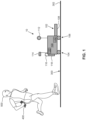
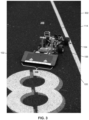
- the systems and methods may, for example, follow the lanes of a running track, and may be used as a virtual coach by providing audio, visual display and haptic feedback to runners and can instruct them to speed up or slow down to meet a specific goal of the run. Additionally, they may be used to set pacing for a runner, coach an individual through different workout intervals, collect athletic data, and record video for gait and/or technique analysis.
- the robotic training systems and methods may give runners a tangible target to focus their workouts. This may advantageously improve the quality of feedback, for example, by having the robotic training system gradually accelerate/decelerate. This is in contrast to coaching being given as discrete, separate steps, in order to avoid over instructing the individual (e.g., change pace to 8 minutes per mile, prepare to run a 30 second interval at maximum speed, etc.). Additionally, rather than telling the individual to accelerate to a certain pace or zone, the robotic training system may simply show them the pace through its motion. In some embodiments, robotic training system may adjust to the individual's ability (e.g., if the individual can't keep up the robotic training system may adjust the pace or direction).
- the robotic training system may provide for more granular training/coaching.
- the robotic training system may change velocity at a more frequent interval, e.g., by speeding up or slowing down gradually and having an individual follow the pace.
- other coaching methods attempting to verbally instruct an individual through granular or widely varying velocity risk over-coaching and overwhelming the individual.
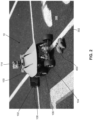
- the sensed surface variation data may be optical data, for example, data related to the relative position or composition of the paint or chalk line denoting a line on track 300.
- the sensed data e.g., optical data
- the sensed data may be characterized and/or quantified to identify certain features, such as edge data, color data, saturation data, threshold data, keypoint data, and the like. In some embodiments, these features may be configured to control the drive or steering systems 104/106.
- the sensors transmit data to processor 110, with the processor being further configured to adjust the drive system 104 or steering system 106 based on the data.
- the sensor array may include an array of sensors (e.g., infrared or "IR" sensors, photo-sensitive systems, CCD, CMOS, etc.), and transmit data related to which sensor is positioned over the paint or chalk line 302 denoting a lane on a track 300. Paint of chalk line composition, line edge relative angles, or other features may be detected. Speed or direction adjustments of the drive system 104 or steering system 106 may vary according to how many sensors sense the presence of the line, frequency of the frame rate, resolution of the captured data, or the relative angle of the edge of the line with respect to one or more sensors, for example. In some embodiments, speed or direction adjustments may vary according to the location of the sensor along the array that senses the presence of the line. In some embodiments, speed or direction adjustments may vary according to a predetermined threshold of time a particular sensor senses the presence of the line. In some embodiments, sensor position, time, or number of sensors sensing the presence of the line may vary the speed and/or direction.
- sensors e.g., inf
- robotic training system 10 of the present invention employing embodiments of sensor module 102 may provide natural, smooth feedback and coaching based on real world track surface conditions.
- additional sensor modules 102 may be employed, either physically integrated with robotic platform 100 or separate from robotic platform.
- sensor modules 102 may include additional sensors, for example, physiological sensors or the like.
- system 10 may be partially or wholly solar powered, which may advantageously extend the range of the device of limit the need for frequent charging or battery replacement.
- system 10 may further include a wireless transceiver 112 in communication with an electronic device 400 associated with an individual 500.
- the electronic device 400 may be, for example, a smart phone, a smart watch, a heads-up-display device, other smart apparel, a tablet, or any other type of suitable mobile computing device.
- transceiver 112 may receive data (e.g., electronic device data, or input data) from electronic device 400, transmitting that data to processor 110.
- processor 110 adjusts the drive system 104 or steering system 106 based on the data received from electronic device 400.
- the transceiver 112 receives data including programmed instructions to control the drive and steering systems 104/106 according to a workout program. In this way, embodiments including a communication with an electronic device 400 may advantageously allow for a higher level of accuracy or customization in the performance of the robotic training system 10.
- electronic device 400 may function as a sensor module 102.
- these programs could include instructions to provide coaching feedback to individual 500 during a workout, for example, a training run.
- individual 500 may receive coaching instruction, for example, or encouragement.
- these programs may include a simulated race, where robotic platform 100 may be programmed with prior race data such that it moves according to a race pace and individual 500 may attempt to beat the platform.
- these programs may include world record data, such that individuals 500 may "compete" against current world records.
- Transceiver 112 may be integral with robotic platform 100, or may be a separate unit. Additional details of the software platform and modules related to such programs along with programs and functions of the components are further discussed herein.
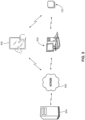
- Transceiver 112 may allow sensor module 102 to communicate, for example, with other locally or remotely located robotic platforms 100, or other standalone devices 600, via network 602, or server 604, for example, as shown in FIG. 5 . Communication between these components may be one way communication or two way communication.
- system 10 may include a user interface configured to receive input data and transmit the data to processor 110 which may adjust the drive or steering systems 104/106 based on the input data.
- the user interface may be displayed on electronic device 400, for example, or may be integrated directly into robotic platform 100.
- system 10 may include a video camera 114.
- Video camera 114 may be configured to record an individual during training, for example.
- video camera 114 may transmit video data to processor 110.
- processor 110 is configured to analyze physiological characteristics of the individual (e.g., analyze gait or foot strike characteristics, analyze other running form characteristics, recognize onset of fatigue, recognize perspiration levels, etc.).
- video camera 114 may be configured to record the surface an individual is running on, for example, or capture video of environmental surroundings.
- processor 110 may analyze, for example, gait characteristics such as foot strike type (e.g.
- video camera 114 may be configured to record the path ahead of the individual during training so as to record a first person-style view of the route traversed by the robotic training system 10 and the individual.
- the video camera 114 may pan around the environment to record video of competitors, spectators, or other items of interest. The panning may be autonomous or controlled by the individual or a third party such as a coach.
- additional robotic platforms 100 may be able to interact with one another based on sensor feedback.
- a land based robotic platform 100 may carry out training feedback functions to the individual 500, while an aerial based robotic platform 100 may include video camera 114 and carry out aforementioned video functions, based upon position of the land based robotic platform 100 or individual 500, for example.
- system 10 may include an audio feedback system 116.
- audio feedback system 116 is configured to provide information about a workout to an individual during the workout.
- audio feedback system 116 may provide audio coaching, for example to alert individual 500 to a change in the workout, to accelerate/decelerate, alert individual 500 of other individuals approaching, or to alert of other robotic platforms 100 (e.g., to urge slower runners to move to the right).
- Combined audio and visual feedback may enhance the coaching of an individual, as it more closely replicates one-on-one coaching between individuals, rather than an individual following only audio prompts.
- audio feedback system 116 may be configured to allow, for example, one-on-one coaching feedback from an individual's coach, in addition to feedback from the system 10.
- system 10 may include a display system 118.
- Display system 118 may be, for example, a projector, display screen, laser system, holographic display, paint/chalk display system, or the like.
- display system 118 is configured to provide information about a workout to an individual during the workout or other information or visual cues (e.g., display image on track or body of robotic platform 100, display a line to follow, follow distance, or workout details).
- display system 118 may display visual cues, such as time remaining, current speed, number of laps, etc.
- display system 118 may allow for video calling other individuals (e.g., friends or competitors).
- display system 118 may include a heads up display (HUD), for example, on a helmet, or electronic eyeglasses.
- the display system 118 may project information or images on the surface of the track ahead of the individual and/or ahead of the robotic training system 10, which may advantageously allow the individual to visual receive information without having to divert their field of view of otherwise break their form to view a display on a smartphone, smart watch, or other portable display.
- a display mounted on the robotic training system 10 itself may provide a similar benefit.
- system 10 may include an audio input system 120.
- Audio input system 120 may be configured to accept audio data and transmit the data to the processor to control system 10.
- audio input system 120 may function as a voice control/recognition system, and accept information such as individual 500 speaking commands to speed up or slow down, provide navigation, place an emergency call, place a call to a coach or trainer, place a video call to other individuals (e.g., friends or competitors), or post an update on a social media platform.
- Some embodiments are directed to a method of training including initiating programming data such that a robotic training system moves at a predetermined velocity, wherein the robotic training system includes a vision system configured to receive data related to a surface, receiving data related to a surface, comparing a baseline data of a desired surface to the received data, and adjusting a travel direction of the robotic system in response to the comparison.
- the data received related to a surface is optical data indicating the position of a line on a track.
- Existing systems often do not account for surface variation (e.g., if an individual begins running on a track but transitions to a grass field).
- embodiments of the present invention may provide variation in coaching feedback depending upon the surface upon which the athletic activity is performed (e.g., a field, artificial turf, track, sidewalk, etc.).
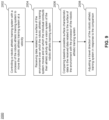
- the method may include controlling a robotic athletic training system with a processor of the robotic athletic training system to move the robotic athletic training system at a velocity.
- the method may then include receiving data related to a surface of the environment over which the robotic athletic training system moves and on which the individual conducts their athletic activity with a vision system of the robotic athletic training system at step 2004, comparing baseline possible surface characteristic data to the received data related to the surface of the environment with the processor of the robotic athletic training system at step 2006, and adjusting a travel direction of the robotic athletic training system in response to the comparison at step 2008.
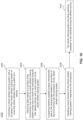
- Exemplary method 2100 shown at FIG. 10 may include each of the steps shown in method 2000. Further, the method may include the robotic training system providing coaching feedback to the individual during the athletic activity at step 2010.
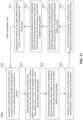
- Exemplary method 2200 shown at FIG. 11 may include each of the steps shown in methods 2000 and 2100. Additionally, the method may include receiving physiological sensor data at the robotic athletic training system about the individual from a sensor module coupled to the individual during the athletic activity at step 2012, comparing baseline possible surface characteristic data to the received data related to the surface of the environment with the processor of the robotic athletic training system at step 2014, and adjusting the velocity of the robotic athletic training system in response to the physiological data comparison at step 2016. Additionally, each of the methods may include an optional feedback loop from either step back to any previous step.
- the method further includes receiving physiological sensor data at a robotic training system 10 about an individual 500 from a sensor module associated with the individual 500 during an athletic activity engaged in by the individual.
- the method includes comparing the physiological sensor data received to baseline physiological data using a processor (for example processor 110), and adjusting the programming data based on the comparison such that the velocity (or direction) of the robotic training system is adjusted.
- the method further includes receiving personal information about the individual prior to receiving the physiological data.
- the personal information includes one of prior injury information, height, weight, gender, an athletic goal, intended athletic environment, intended athletic duration, intended workout intensity.
- the system or method may include receiving data about the individual from a sensor module associated with the individual during a first athletic activity engaged in by the individual.
- the method may also include receiving data about the individual from the sensor module associated with the individual during a second athletic activity engaged in by the individual, and determining a second characteristic based on the data related to the second athletic activity.
- the method may also include comparing the data received during the first/second athletic activities; and providing a recommendation about a workout.
- the first and second data received may include physiological characteristics (e.g. respiratory or cardiac data).
- the method may determine whether a characteristic of the second data represents an improvement over the first data.
- the method may include receiving data (e.g., motion data, physiological data, etc.) via local wired or wireless connection, or via a wide area network.
- the method may include monitoring the motion of an individual in substantially real-time during an athletic activity.
- a sensor module 102 may be provided and configured to obtain data relating to a physiological parameter of the individual 500 during an athletic activity.
- the systems and methods may be effected through software platform 1000 (which may be included in system 10), containing software modules, as shown in FIG. 6 , for example. In some embodiments, fewer modules may be included, or additional modules may be included. In some embodiments, modules may be removed or added, for example through a network connection.
- Programming data may include software platform 1000, for example, as shown in FIG. 6 , and include various modules. Each of the components in sensor module 102, for example, or electronic device 400, may feed the modules data that the modules use to formulate a response.
- programming data includes simulated race data such that the robotic training system moves at a race pace.
- the programming data includes feedback data such that the robotic training system provides coaching feedback to an individual during a workout.
- the systems and methods may be effected through software platform 1000 in an electronic device 400 in addition to or instead of in system 10.
- software platform 1000 may include highlight reel module 1100, including programming to capture video data from video camera 114 and compose a video montage or highlight reel.
- software platform 1000 may include a statistics module 1102.
- Statistics module 1102 may be programmed to display relevant statistics regarding the workout such as distance, time, pace, heart rate, physiological data, etc.
- statistics module 1102 may function as a workout coach, by providing instructions or feedback through display system 118 or audio feedback system 116.
- statistics module 1102 may include a lap counter, for example, in order allow an individual to run accurate distances in any lane.
- software platform 1000 may include a proximity awareness module 1104.
- Proximity awareness module 1104 may use additional sensor data (or data from sensor module 102) to guide robotic platform 100 around obstacles, for example, or to maintain a safe distance from an individual 500 using system 10.
- proximity awareness module 1104 may notify an individual running of other runners near the individual, or aware of other competitor's status in a race event, for example.
- proximity awareness 1104 module may optimize a route, for example, accounting for particular surfaces or geography, or may analyze a route taken by an individual (e.g., how an individual approaches corners, etc.).
- proximity awareness module 1104 may communicate with other robotic platforms 100.
- proximity awareness module 1104 may include, for example a radar system or ultrasonic system with radar sensors or ultrasonic sensors.
- software platform 1000 may include a strategy module 1106.
- Strategy module 1106 may include instructions to coach an individual for particular conditions (e.g., coaching a runner to slow down while traveling uphill or into headwind and accelerate for downhill or tailwind).
- Strategy module 1106 may use data from sensor module 102, for example vision sensor data, or additional sensor data, such as proximity sensor data.
- strategy module may coach the individual to adjust their performance, for example adjusting their gait, stride, or posture for different terrain (e.g., going uphill or downhill).
- data from video camera 114 may be used as an input to strategy module 1106 and coaching may be dependent upon video data analysis (e.g., fatigue or gait analysis).
- software platform 1000 may include a safety module 1108.
- Safety module may, for example, coach an individual running to slow down when approaching uneven or dangerous surface conditions, or when physiological data reaches unsafe levels.
- safety module may control driving or steering system 104/106 to avoid obstacles or brake if communication or other signals are lost or are abnormal.
- safety module may leave individual 500 and dial an emergency number if cellular coverage is unavailable.
- safety module 1108 may utilize data from sensor module 102 to maintain a predetermined position around individual 500, for example ahead, behind, or beside individual 500.
- safety module 1108 calculates an acceptable radius from individual 500 and adjusts based upon the path taken by individual 500.
- safety module 1108 may for example, pick up litter after a race along a race path.
- software platform 1000 may include a Fuel/Hydrate module 1110.
- Fuel/Hydrate module 1110 may utilize workout data, data from sensor module 102, etc., to coach individual 500 on proper food and water intake during a workout.
- robotic platform 1000 may include on board fluid and food to provide to individual 500.
- Fuel/Hydrate module 1110 may include a mist function, for example, if it is hot outside, or if individual 500 reaches a predetermined temperature as measured by sensor module 102.
- software platform 1000 includes Charge module 1112.
- Charge module 1112 may provide an energy source for long races to charge a phone, for example as electronic device 400.
- Charge module 1112 may activate, for example, Bluetooth charging when electronic device 400 charge level falls below a predetermined threshold. In this regard, charge module 1112 may provide additional energy to allow for longer training or running sessions of individual 500.
- software platform 1000 includes a Guide module 1114.
- Guide module 1114 may utilize audio system 116, for example, to serve as a guide for a blind individual 500.
- guide module 1114 may travel ahead of individual 500 and "scout" the area, for example.
- guide module 1114 may include a light, for example, an LED light that may be configured to turn on if the environment sensed by sensor module 102 drops below a predetermined light level threshold.
- software platform 1000 includes a Babysitter module 1116.
- Babysitter module 1116 may configure robotic platform such that it autonomously "walks" an individual's 500 baby around a predetermined path (e.g., around the block).
- babysitter module may "walk” an individual's canine companion.
- babysitter module 1116 may stream video data from video camera 114 to electronic device 400 for monitoring by individual 500.
- software platform 1000 includes a light module 1118 that may activate a light on robotic platform 100 to illuminate a path for individual to follow.
- software platform 100 includes vision module 1120.
- Vision module 1120 may, for example, utilize video camera 114, or sensor array 108, or additional sensors to achieve computer vision for system 10. In some embodiments, vision module 1120 may be a sub-module of other modules.
- software platform 1000 may include a Fetch module 1124.
- Fetch module 1124 may communicate with sensor module 102, and be configured to find and retrieve athletic equipment, for example, soccer balls, or golf balls.
- software platform 1000 includes a weather module 1126.
- Weather module 1126 may communicate with sensor module 102, for example, and record/report wind speed, temperature, humidity, etc. This data may be fed back into other modules, for example, to adjust workouts of individual based on weather information.
- software platform 1000 includes referee module 1128.
- Referee module 1128 may communicate with athletic equipment, for example soccer balls and the like.
- sensor module 102 may determine whether a soccer ball is out of bounds for example, or travels past a goal line.
- software platform 1000 includes skills module 1130.
- Skills module 1130 may configure robotic platform 100 to perform athletic maneuvers, for example, "kicking" soccer balls for goalie/player training.
- robotic platform 100 may be configured to travel in random or pseudorandom patterns, and have individual 500 follow it.
- Skills module 1130 may include a simulated race mode, such that individual 500 may attempt to follow the robotic platform 100 as it leads them through a simulated race.
- skills module 1130 may include a World Record mode. In the world record mode, the robotic platform 100 may lead individual 500 at a world record pace for a particular distance.
- world record mode may configure robotic platform 100 to "replay" world record or personal record performances so the runner can attempt to "hang on” as long as possible.
- drive system 104 may accelerate and decelerate at a specific pace, e.g., the acceleration at the start and the "kick" at the end of the race, for example.
- software platform 100 includes team module 1132.
- Team module 1132 may provide feedback to multiple individuals 500, or coordinate movement between.
- software platform 1000 includes a social module 1134, for example, to integrate with social networking platforms, or other communication systems such that an individual may stream video of their workout.
- social module 1134 may enable individual 500 to video chat with other individuals engaged in a workout.
- social module 1134 may allow for friends, family, or fans of an individual engaged in a workout to communicate with the individual, for example to cheer them on (e.g., transmit a song designed to encourage or "pump up" individual 500, or phone a friend when individual 500 is fatigued).
- social module 1134 may include communicating to a communication hub for services, (e.g., such as "On-Star").
- an educational section there may be an educational section. In some embodiments this may include information general to health and fitness, or more specialized information, such as information about running or a particular athletic activity.
- the system may archive individual 500 information in an acceptable way to allow for more storage room on the electronic device 400 or sensor module 104.
- Archival may include hard drive storage on site, cloud based storage, server storage, or any other acceptable storage medium.
- Examples of athletic goals may include training for a race, or other sporting event, improving individual fitness, simply enjoy running, or the like.
- Frequency intervals may include for example about 1-2 times per week, about 3-4 times per week, about 5-7 times per week, or the individual doesn't know.
- Length intervals may include for example about less than about 5 miles per week, about 5-10 miles per week, about 10-20 miles per week, greater than about 20 miles per week, or the individual doesn't know.
- Examples of intended athletic terrain environments may include roads, track, treadmill, trail, gym, or particular athletic fields designed for a specific sport. These features may be integrated into software platform 1000 and used to control robotic training system 10.
- Pairing is a process used in computer networking that helps set up an initial linkage between computing devices to allow communications between them. Pairing may occur wirelessly via a personal area network or local area network using, for example, the Bluetooth wireless protocols.
- the software platform 1000 may prompt the individual 500 to pair their electronic device 400 (or other sensors) to a sensor module 102, and may display updates to the individual 500 as to the status of the pairing.
- Sensor modules 102 may have a generic registration name in the system that identifies the sensor module as part of the system 10. Once paired, sensor modules may be identified by the name of the individual using that sensor module. For example a sensor might be registered as RSS0005 as a generic identification name, and the broadcast signal would include this name. Once paired that sensor module may change the broadcast signal to include a name corresponding to the particular individual using that sensor module, such as NAME01 or NAME02. Once the sensor modules 102 are paired, registration data and personal information collected from the individual 500 may be loaded onto the sensor modules.
- the method may include creating an account for the individual. This account may include obtaining personal information from the individual.
- the method may include receiving motion data related to the individual from a sensor module associated with the individual while the individual is engaged in an athletic activity, or other data received from robotic platform 100 and associated sensor modules 102.
- the method may include storing the personal information, and characteristics in association with the account for the individual.
- the electronic device 400 may be for example one of a desktop computer, a PDA device, MP3 player, an electronic watch having a sports operating mode, a workstation, mobile device (e.g., a mobile phone, personal digital assistant, tablet computer, or laptop), computer, server, compute cluster, server farm, game console, set-top box, kiosk, embedded system, a gym machine, dedicated electronic device, game console controller.
- electronic device 400 may include at least one processor and memory.
- Robotic training system 10 may be suitable for use by individuals 400 for individual athletic activities may be suitable for use by individuals 400 engaged in athletic activities such running or walking.
- the robotic training system 10 may also include or interact with robotic training system software platform 1000. Interface aspects of the robotic training system or robotic training system software could be, for example, presented to an individual 500 via a screen on the individual's 500 electronic device 400.
- software platform 1000 may be remotely hosted, for example, on a server.
- an individual may download software platform 1000 or various modules to a memory, for example, a flash drive, which may be coupled to the robotic training system 10 to program the robotic platform 100.
- additional sensors may be utilized, for example additional physiological sensors integrated within an existing piece of athletic activity monitoring equipment such as, for example, a heart rate monitoring device, a pedometer, and accelerometer-based monitoring device, positioning system receiver device (e.g. a GPS receiver), or other fitness monitoring device.
- a heart rate monitoring device e.g. a heart rate monitoring device
- a pedometer e.g. a pedometer
- accelerometer-based monitoring device e.g. a GPS receiver
- positioning system receiver device e.g. a GPS receiver
- Communication may also occur between the sensors, electronic device, and/or a remote server 604 via a network 602, for example, as shown in FIG. 5 .
- the network is the Internet.
- the Internet is a worldwide collection of servers, routers, switches and transmission lines that employ the Internet Protocol (TCP/IP) to communicate data.
- the network may also be employed for communication between any two or more of the sensors, the electronic device, the server, etc.
- information is directly communicated between the sensors or processor and the server via the network, thus bypassing the electronic device.
- a variety of information may be communicated between any of the components that may transmit or receive data or information.
- Such information may include, for example, performance parameter data, device settings (including sensor settings), software, and firmware.
- Communication among the various elements of the present invention may occur after the workout/athletic activity has been completed or in substantially real-time during the workout/athletic activity.
- the electronic device 400 may serve a variety of purposes including, for example, providing additional data processing, providing instructions to robotic platform 100; providing additional data storage, providing data visualization, providing additional sensor capabilities, relaying information to a network 602, providing for the playback of music or videos, or the like.
- the electronic device 400 illustrated in the figures may not be a dedicated electronic monitoring device; the electronic device 400 illustrated in the figures may be a mobile phone, dedicated fitness monitor, smart watch, tablet computer, etc.
- the sensor module 102 itself to be embodied by a mobile phone, or for the electronic device 400 to be a mobile phone.
- Including an electronic device 400 in the robotic training system 10, such as a mobile phone, may be desirable as mobile phones are commonly carried by individuals 400, even when engaging in athletic activities, and they are capable of providing significant additional computing and communication power at no additional cost to the individual 500.
- processing steps or other calculations recited herein may be capable of being performed by various embodiments of the robotic training system 10 disclosed herein, and are not necessarily limited to being performed by the sensor module 102, depending on the configuration of a particular embodiment of the present invention.
- any of the processing steps or other calculations recited herein may be performed, in various embodiments, by the sensor module 102, by a server computer 604, by an electronic device 400, and/or any other network component, or by more than one component.
- Embodiments of the present invention may involve the use of so-called "cloud computing.”
- Cloud computing may include the delivery of computing as a service rather than a product, whereby shared resources, software, and information are provided to computers and other devices as a utility over a network (typically the Internet).
- Cloud computing may entrust services (typically centralized) with an individual's 500 data, software and computation on a published application programming interface over a network.
- End users may access cloud-based applications through a web browser or a light weight desktop or mobile app while the business software and data are stored on servers at a remote location.
- Cloud application providers often strive to give the same or better service and performance than if the software programs were installed locally on end-user computers.
- Embodiments of the present invention may incorporate features of motion and performance monitoring systems. Exemplary motion monitoring and performance systems are disclosed in U.S. Patent App. No. 13/077,494, filed March 31, 2011 (which published as U.S. Patent App. Pub. No. 2012/0254934 ), and commonly owned U.S. Patent App. No. 13/797,361, filed March 12, 2013 (which published as U.S. Patent App. Pub. No. 2014/0266160 ).
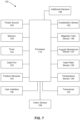
- the sensor module 102 may include processor 110 (processor 110 may also be a separate component).
- Sensor module 102 may include a power source 140, a memory 138, an acceleration sensor 142, a magnetic field sensor 146, and a transceiver 112 (transceiver 112 may be a separate component). These components are operatively connected to one another to carry out the functionality of the sensor module 102. In other embodiments, one or more of these sensor module 102 components may be omitted, or one or more additional components may be added.
- Processor 110 may be included in sensor module 102, or may be a separate component.
- Processor 110 may be adapted to implement application programs stored in the memory 138 of the sensor module 102.
- the processor 110 may also be capable of implementing analog or digital signal processing algorithms such as raw data reduction and filtering.
- processor 110 may be configured to receive raw data from sensors and process such data at the sensor module 102.
- the processor 110 is operatively connected to the power source 140, the memory 138, the acceleration sensor 142, the magnetic field sensor 146, and the transceiver 112.
- calibration of sensor module 102 is performed using, for example, received GPS signals from a position receiver 130.
- the received GPS signals can be used, for example, to determine a distance that an individual runs or walks during a workout.
- calibration of sensor module 102 may be prepared by using a counter (e.g., additional sensor 148) to count revolutions of an axle of drive system 104, for example.
- the power source 140 may be adapted to provide power to the sensor module 102.
- the power source 140 may be a battery.
- the power source may be built into the sensor module 102 or removable from the sensor module 102, and may be rechargeable or non-rechargeable.
- the power source 140 may be recharged by a cable attached to a charging source, such as a universal serial bus ("USB") FireWire, Ethernet, Thunderbolt, or headphone cable, attached to a personal computer.
- a charging source such as a universal serial bus (“USB") FireWire, Ethernet, Thunderbolt, or headphone cable
- USB universal serial bus
- the power source 140 may be recharged by inductive charging, wherein an electromagnetic field is used to transfer energy from an inductive charger to the power source 140 when the two are brought in close proximity, but need not be plugged into one another via a cable.
- a docking station may be used to facilitate charging.
- the sensor module 102 may be re-powered by replacing one power source 140 with another power source 140.
- Power source 140 may additionally power robotic platform 100, including drive and steering systems 104/106.
- the memory 138 may be adapted to store application program instructions and to store athletic activity data.
- the memory 138 may store application programs used to implement aspects of the functionality of the retail enhancement system 10 described herein.
- the memory 138 may store raw data, recorded data, and/or calculated data.
- the memory 138 may act as a data storage buffer.
- the memory 138 may include both read only memory and random access memory, and may further include memory cards or other removable storage devices.
- the memory 138 may store raw data, recorded data, and/or calculated data permanently, while in other embodiments the memory 138 may only store all or some data temporarily, such as in a buffer. In one embodiment of the present invention, the memory 138, and/or a buffer related thereto, may store data in memory locations of predetermined size such that only a certain quantity of data may be saved for a particular application of the present invention.
- the acceleration sensor 116 may be adapted to measure the acceleration of the sensor module 102. Accordingly, when the sensor module 102 is physically coupled to robotic platform 100, the acceleration sensor 116 may be capable of measuring the acceleration of the object 100, including the acceleration due to the earth's gravitational field, and may allow robotic platform to move with predetermined acceleration patterns. In one embodiment, the acceleration sensor 116 may include a tri-axial accelerometer that is capable of measuring acceleration in three orthogonal directions. In other embodiments one, two, three, or more separate accelerometers may be used.
- the magnetic field sensor 146 may be adapted to measure the strength and direction of magnetic fields in the vicinity of the sensor module 102. Accordingly, sensor module 102, utilizing the magnetic field sensor 146, may be capable of measuring the strength and direction of magnetic fields in the vicinity of the robotic platform 100, including the earth's magnetic field.
- the magnetic field sensor 146 may be a vector magnetometer. In other embodiments, the magnetic field sensor 146 may be a tri-axial magnetometer that is capable of measuring the magnitude and direction of a resultant magnetic vector for the total local magnetic field in three dimensions. In other embodiments one, two, three, or more separate magnetometers may be used.
- the acceleration sensor 116 and the magnetic field sensor 146 may be contained within a single accelerometer-magnetometer module bearing model number LSM303DLHC made by STMicroelectronics of Geneva, Switzerland.
- the sensor module 102 may include only one of the acceleration sensor 116 and the magnetic field sensor 146, and may omit the other if desired.
- the transceiver 122 depicted in FIG. 6 may enable the sensor module 102 to wirelessly communicate with other components of the robotic training system 10, such as those described in further detail below.
- the sensor module 102 and the other local components of the robotic training system 10 may communicate over a personal area network or local area network using, for example, one or more of the following protocols: ANT, ANT+ by Dynastream Innovations, Bluetooth, Bluetooth Low Energy Technology, BlueRobin, or suitable wireless personal or local area network protocols.
- Other known communication protocols suitable for a robotic training system 10 may also be used.
- the transceiver 122 is a low-power transceiver.
- the transceiver 122 may be a two-way communication transceiver 122, while in other embodiments the transceiver 122 may be a one-way transmitter or a one-way receiver.
- Wireless communication between the sensor module 102 and other components of the robotic training system 10 is described in further detail below.
- the sensor module 102 may be in wired communication with other components of the robotic training system 10 that does not rely on transceiver 122.
- a sensor module 102 having components such as those depicted in FIG. 6 may be physically coupled to robotic platform 100 during an athletic activity conducted by an individual 500. Sensor module 102 may further monitor changes in the spatial orientation of the individual's 500 body or a piece of the individual's athletic equipment or article of footwear, or to determine a correlation between body or equipment movement data and a characteristic such as gait characteristic. In some embodiments, sensor module 102, as described, may be used to monitor the surface of a track, for example, to follow chalk/paint line 302. In some embodiments, additional sensors not coupled to robotic platform 100 (e.g., other acceleration sensors, physiological sensors, etc.) may be responsible for collecting the data necessary to carry out the various monitoring calculations.
- an additional sensor module 102 may be integrated within an existing piece of athletic activity monitoring equipment possibly having additional or different sensors such as, for example, a heart rate monitoring device, a pedometer, and accelerometer-based monitoring device, or other fitness monitoring device.
- performance parameters may include physical parameters and/or physiological parameters associated with the individual's 500 athletic activity. Physical parameters measured may include, but are not limited to, time, distance, speed, pace, pedal count, wheel rotation count, rotation generally, stride count, stride length, airtime, stride rate, altitude, strain, impact force, jump force, force generally, and jump height. Physiological parameters measured may include, but are not limited to, heart rate, respiration rate, blood oxygen level, blood lactate level, blood flow, hydration level, calories burned, or body temperature.
- sensor module 102 may incorporate other additional components.
- sensor module 102 may incorporate an angular momentum sensor 124, a heart rate sensor 126, a temperature sensor 128, a position receiver 130, a data port 132, and a timer 134 operatively connected to one another to carry out the functionality of the sensor module 102.
- one or more of these sensor module 102 components may be omitted, or one or more additional components may be added.
- Memory 406 is used to store application program instructions (e.g., software platform 1000) and data.
- memory 406 stores programs, for example, used to implement all of the functionality of a typical electronic device.
- memory 406 includes both read only memory and random access memory.
- Audio unit 416 is used to process audio signals.
- voice signals picked up using a microphone are converted to digital signals so that they can be operated upon, for example, by processor 402.
- Audio unit 416 also converts, for example, digital audio signals into amplified analog audio signals that can be used to drive one or more speakers.
- audio unit 416 implements signal processing algorithms such as those available from Dolby Laboratories, Inc., which enhance the quality of music.
- cellular transceiver 414 is used to send data described herein to a location where it is analyzed, for example, by a professional trainer.
- the professional trainer can call or text message the individual and provide the individual substantially real-time feedback based on the data. If the individual wants to call the professional trainer, for example, during a workout, the individual can place a call to the professional trainer, for example, by tapping electronic device 400 to place a call to a stored telephone number. In one embodiment, tapping electronic device 400 sends a text message to the professional trainer requesting that the professional trainer call the individual.
- an electronic device does not include a display.
- information such as, for example, performance and/or feedback information is provided to an individual audibly during a workout, e.g., through sensor module 102, or other audio feedback.
- the information can be display to the individual, for example, after the workout using a computer display once the information has been transferred to the computer.
- the information can be transferred to a second processing device such as, for example, a sports watch during the workout and displayed to the individual during the workout on the display of the second processing device.
- an electronic device 400 can be formed, for example, by attaching a dongle (e.g., a small hardware device that protects software) to a conventional phone, a music file player, a personal digital assistant, et cetera.
- the dongle includes, for example, downloadable software that implements some or all of the sport functions described herein.
- the software includes a sport user interface written in the Java programming language.
- the software includes drivers, for example, that enable the software to be used with any ultra low power Bluetooth communications protocol compatible device. Other embodiments are compatible with other communications protocol compatible devices.
- a electronic device is a dedicated device (rather than a device such as, for example, a phone, a music file player, or a personal digital assistant) that implements the robotic training functions as detailed herein.
- a dedicated device rather than a device such as, for example, a phone, a music file player, or a personal digital assistant
- the sensor module 102 may then determine that the movement of an individual 500 indicates the occurrence of a movement to track. In one embodiment, the determination that the movement of the individual 500 indicates the occurrence of a movement to track occurs when a threshold data value is met for a predetermined period of time. For example, the sensor module 102 may determine that a movement of the individual has resulted in a threshold acceleration occurring for a predetermined period of time. This may initiate movement of the robotic platform 100.
- the data received may be transmitted to the remote computer during the athletic activity. In another embodiment, the data received may be transmitted to the remote computer after the athletic activity has been completed.
- the physiological data received may be compared to data associated with the individual 500 for the present athletic activity and data associated with the individual 500 from a previous athletic activity. In some embodiments, the data may be compared to data received during a different individual's 500 athletic activity.
- embodiments of the present invention may advantageously enable the individual 500 (or their coach, teammate, a spectator, friends, competitors, etc.) to obtain this or other information about the motion of the individual's 500 body or the motion of a piece of the individual's 500 athletic equipment during or after the course of the athletic activity.
- While various embodiments of the present invention are described in the context of the running, the present invention is not so limited and may be applied in a variety of different sports or athletic activities including, for example, sports of soccer (i.e., football), basketball baseball, bowling, boxing, cricket, cycling, football (i.e., American football), golf, hockey, lacrosse, rowing, rugby, running, skateboarding, skiing, surfing, swimming, table tennis, tennis, or volleyball, or during training sessions related thereto.
- sports of soccer i.e., football
- basketball baseball i.e., bowling, boxing, cricket, cycling
- football i.e., American football
- golf i.e., American football
- hockey lacrosse
- rowing rugby
- running skateboarding
- skiing surfing
- sensor module 102 embodiments such as those described above may enable an individual 500, to determine, for example, characteristics of a runner's motion.
- a sensor module 102 could be used to determine the speed, pace, distance traversed, locations traversed, or to discriminate between different surfaces (e.g., grass, street, or trail) and inclinations (e.g., uphill, flat, or downhill).
- the sensor module 102 may be mounted, for example, on a runner's torso, arm, hand, leg, foot, or head, or on or in their article of footwear, or integrated into robotic platform 100.
- the sensor module 102 may be capable of compensating for inherent deficiencies that may be present for various types of sensor contained within or in communication with the sensor module 102.
- Most real world sensors have limitations. For example, accelerometers, magnetometers, and gyroscopes may have accuracy issues, particularly when used at speeds of motion of the object 104 or under other conditions that differ from their initial calibration conditions.
- the sensor module 102 may communicate with other components of the robotic training system 10 via wired or wireless technologies. Communication between the sensor module 102 and other components of the robotic training system 10 may be desirable for a variety of reasons. For example, to the extent that the sensor module 102 records and stores athletic activity information, it may be useful to transmit this information to another electronic device for additional data processing, data visualization, sharing with others, comparison to previously recorded athletic activity information, or a variety of other purposes. As a further example, to the extent that the sensor module 102 has insufficient processing power, wide area network transmission capabilities, sensor capabilities, or other capabilities, these capabilities can be provided by other components of the robotic training system 10. With this in mind, possible communications means are described briefly below.
- Wired communication between the sensor module 102 and an electronic device 400 may be achieved, for example, by placing the sensor module 102-or a piece of athletic equipment 104 including the sensor module 102-in a docking unit that is attached to the electronic device 400 using a communications wire plugged into a communications port of the electronic device 400.
- wired communication between the sensor module 102 and the electronic device 400 may be achieved, for example, by connecting a cable between the sensor module 102-or a piece of athletic equipment including the sensor module 102-and the computer or standalone device 600.
- the data port 132 of the sensor module 102 and a communications port of the computer 600 may include USB ports.
- the cable connecting the sensor module 102 and the computer 600 may be a USB cable with suitable USB plugs including, but not limited to, USB-A or USB-B regular, mini, or micro plugs, or other suitable cable such as, for example, a FireWire, Ethernet or Thunderbolt cable.
- suitable USB plugs including, but not limited to, USB-A or USB-B regular, mini, or micro plugs, or other suitable cable such as, for example, a FireWire, Ethernet or Thunderbolt cable.
- such cables could be used to facilitate power transfer to a power source of the sensor module 102, in order to charge the power source.
- the power source may be recharged by inductive charging, or by using a docking station with a charging base.
- Wired connection to an electronic device 400 may be useful, for example, to upload athletic activity information from the sensor module 102 to the electronic device 400, or to download application software updates or settings from the electronic device 400 to the sensor module 102.
- Wireless communication between the sensor module 102-or a piece of athletic equipment including the sensor module 102-and the electronic device 400 may be achieved, for example, by way of a wireless wide area network (such as, for example, the Internet), a wireless local area network, or a wireless personal area network.
- a wireless wide area network such as, for example, the Internet
- a wireless local area network such as, for example, the Internet
- a wireless personal area network such as, for example, the Internet
- wireless personal area network such as, for example, the Internet
- the sensor module 102-or a piece of athletic equipment including the sensor module 102- may communicate with a wireless wide area network communications system such as that employed by mobile telephones.
- a wireless wide area network communication system may include a plurality of geographically distributed communication towers and base station systems.
- Communication towers may include one or more antennae supporting long-range two-way radio frequency communication wireless devices, such as sensor module 102.
- the radio frequency communication between antennae and the sensor module 102 may utilize radio frequency signals conforming to any known or future developed wireless protocol, for example, CDMA, GSM, EDGE, 3G, 4G, IEEE 802.x (e.g., IEEE 802.16 (WiMAX)), etc.
- the information transmitted over-the-air by the base station systems and the cellular communication towers to the sensor module 102 may be further transmitted to or received from one or more additional circuit-switched or packet-switched communication networks, including, for example, the Internet.
- sensor module 102 may communicate with an electronic device, such as a smart phone, that is also carried by the individual 500 during the athletic activity.
- an electronic device such as a smart phone
- the electronic device 400 may take the form of a mobile phone and may include at least a processor, a memory, user input controls, a positioning system receiver, a wireless wide area network (WWAN) transceiver, a visual display, and an audio unit.
- a visual display in the form of a LCD screen, and user input controls in the form of a physical keyboard and a scroll ball may be present.
- the memory of the electronic device 400 may be adapted to store application programs, software platforms or modules, used to implement aspects of the functionality of the robotic training system 10 described herein.
- application programs, software platforms or modules used to implement aspects of the functionality of the robotic training system 10 described herein.
- those of skill in the art will understand that all or part of the software may be stored on the server 604 and accessed over the network 602 and run remotely as a mobile web application, or stored locally in robotic platform 100, having a memory.
- robotic training system 10 may include a number of different software modules capable of providing training support or other robotic platform 100 interaction to individuals 500.
- Each module may support one or more graphical user interfaces ("GUIs") capable of being presented to an individual 500 using the system 10.
- GUIs graphical user interfaces
- a GUI may offer, for example, graphical elements, visual indicators, and/or text to represent information and actions available to the individual 500.
- the individual 500 may use a physical input device, such as keyboard or scroll ball to interact with the GUI of the system 10, for example, on electronic device 400.
- the individual 500 may use a touch screen to interact directly with what is displayed.
- touch screens such as, for example, resistive or capacitive touch screens, may be employed.
- the software configuration of software stored on an electronic device 400 may include a device operating system, which may be one of the commercially available mobile phone operating systems such as, for example, BlackBerry OS, iPhone OS, Windows Mobile, Symbian, LINUX, WebOS, or Android.
- the device operating system may also have an associated application programming interface through which middleware and application programs may access the services of the operating system.
- the various modules of the system 10 of the present invention may support GUIs through which an individual 500 can interact with the system 10 using the electronic device 400 just prior to and/or during an activity.
- the GUIs may be supported by a mobile device application being run on the electronic device 400.
- the GUIs may appear as web pages provided by the server 604 via a website that may be accessible to the individual 500 over the network 602 using a web browser on their electronic device 400.
- the GUIs may be considered to be part of the methods or systems of the present invention.
- the robotic training system 10 may be sold as a package, including a robotic platform 100, an electronic device 400, sensor modules 102 for multiple individuals 500 (e.g. runners), and a charger.
- Robotic training system 10 may recognize and record repeat usage of the robotic training system 10 over time, number of times various individuals store their data into a profile and update that data.
- the robotic training system 10 may also be able to integrate with various social media platforms, allowing individuals to share with their social network data regarding their gait characteristics, their usage of the robotic training system 10.
- program products, methods, and systems for providing robotic training services of the present invention can include any software application executed by one or more electronic devices 400.
- An electronic device 400 can be any type of computing device having one or more processors.
- the electronic device 400 can be a workstation, mobile device (e.g., a mobile phone, personal digital assistant, tablet computer, or laptop), computer, server, compute cluster, server farm, game console, set-top box, kiosk, embedded system, a gym machine, a retail system or retail enhancement system or other device having at least one processor and memory.
- Embodiments of the present invention may be software executed by a processor, firmware, hardware or any combination thereof in a computing device.
- Computer program medium and computer-usable medium may be used to generally refer to media such as a removable storage unit or a hard disk installed in hard disk drive.
- Computer program medium and computer-usable medium may also refer to memories, such as a main memory or a secondary memory, which can be memory semiconductors (e.g., DRAMs, etc.).
- Software platform may include or accept computer programs (also called computer control logic, programming data, etc.), which may be stored on main memory and/or secondary memory. Computer programs may also be received via a communications interface. Such computer programs, when executed, may enable computer systems of the present invention to implement embodiments described herein. Where embodiments are implemented using software, the software can be stored on a computer program product and loaded into a computer system using, for example, a removable storage drive, an interface, a hard drive, and/or communications interface.
- the computer programs when executed, can enable one or more processors to implement processes described above, such as the steps in the methods illustrated by the figures.
- the one or more processors can be part of a computing device incorporated in a clustered computing environment or server farm. Further, in some embodiments, the computing process performed by the clustered computing environment may be carried out across multiple processors located at the same or different locations.
- Software of the present invention may be stored on any computer-usable medium. Such software, when executed in one or more data processing device, causes the data processing device to operate as described herein. Embodiments of the invention employ any computer-usable or -readable medium, known now or in the future.
- Examples of computer-usable mediums include, but are not limited to, primary storage devices (e.g., any type of random access or read only memory), secondary storage devices (e.g., hard drives, floppy disks, CD ROMS, ZIP disks, tapes, magnetic storage devices, optical storage devices, MEMS, nano-technological storage devices, memory cards or other removable storage devices, etc.), and communication mediums (e.g., wired and wireless communications networks, local area networks, wide area networks, intranets, etc.).
- primary storage devices e.g., any type of random access or read only memory
- secondary storage devices e.g., hard drives, floppy disks, CD ROMS, ZIP disks, tapes
- magnetic storage devices e.g., magnetic tapes, magnetic storage devices, optical storage devices, MEMS, nano-technological storage devices, memory cards or other removable storage devices, etc.
- communication mediums e.g., wired and wireless communications networks, local area networks, wide area networks, intranets, etc.
Landscapes
- Health & Medical Sciences (AREA)
- General Health & Medical Sciences (AREA)
- Physical Education & Sports Medicine (AREA)
- Engineering & Computer Science (AREA)
- Life Sciences & Earth Sciences (AREA)
- Biophysics (AREA)
- Physics & Mathematics (AREA)
- General Physics & Mathematics (AREA)
- Automation & Control Theory (AREA)
- Remote Sensing (AREA)
- Radar, Positioning & Navigation (AREA)
- Aviation & Aerospace Engineering (AREA)
- Databases & Information Systems (AREA)
- Human Computer Interaction (AREA)
- Multimedia (AREA)
- Orthopedic Medicine & Surgery (AREA)
- Software Systems (AREA)
- Epidemiology (AREA)
- Medical Informatics (AREA)
- Public Health (AREA)
- Primary Health Care (AREA)
- Measurement Of The Respiration, Hearing Ability, Form, And Blood Characteristics Of Living Organisms (AREA)
- Medical Treatment And Welfare Office Work (AREA)
- Rehabilitation Tools (AREA)
- Toys (AREA)
Claims (14)
- Un système robotique d'entraînement athlétique (10) pour assister un individu (500) pendant une activité athlétique dans un environnement, comprenant :une plateforme robotique mobile (100) ;un module capteur (102) comprenant un réseau de capteurs (108) couplés à la plateforme robotique mobile, configuré pour obtenir des données provenant de l'environnement ;un système d'entraînement configuré pour propulser la plateforme robotique mobile ;un système de direction (106) configuré pour diriger la plateforme robotique mobile ;un processeur (110), le processeur étant configuré pour recevoir les données provenant du module capteur et pour contrôler l'un du système d'entraînement et du système de direction pour, sur la base des données, suivre un trajet, les données comprenant des données relatives à une variation d'une surface de l'environnement ; etune caméra vidéo (114) configurée pour enregistrer des données vidéo de l'individu lors de l'activité athlétique et pour transmettre au processeur les données vidéo,dans lequel le processeur est en outre configuré pour analyser des caractéristiques physiologiques de l'individu sur la base des données vidéo,dans lequel le système est configuré pour fournir à l'individu un retour d'entraîneur pendant l'activité athlétique, le retour d'entraîneur étant basé sur les données provenant du module capteur et sur les caractéristiques physiologiques de l'individu sur la base des données vidéo provenant de la caméra vidéo, etdans lequel l'analyse des caractéristiques physiologiques de l'individu comprend au moins l'une d'entre : l'analyse de caractéristiques de foulée ou d'impact du pied,l'analyse d'autres caractéristiques de forme de course à pied, la reconnaissance de l'apparition d'une fatigue, la reconnaissance de niveaux de transpiration.
- Le système de la revendication 1, dans lequel le réseau est un réseau de capteurs optiques et dans lequel le processeur est en outre configuré pour caractériser les données des capteurs entre l'une d'entre des données de bord, des données de seuil, ou des données de point remarquable.
- Le système de la revendication 1 ou 2, dans lequel les données de capteurs comprennent des données optiques capables d'indiquer la position d'une ligne sur une piste dans l'environnement.
- Le système de l'une des revendications précédentes, comprenant en outre :un émetteur/récepteur sans fil (112) configuré pour communiquer avec un dispositif électronique (400) associé à l'individu,dans lequel l'émetteur/récepteur est configuré pour recevoir des données en provenance du dispositif électronique et pour transmettre au processeur les données du dispositif électronique, etdans lequel le processeur est en outre configuré pour contrôler l'un du système d'entraînement et du système de direction sur la base des données du dispositif électronique.
- Le système de la revendication 4, dans lequel les données du dispositif électronique comprennent des instructions programmées pour contrôler les systèmes d'entraînement et de direction en fonction d'un programme d'exercices.
- Le système de l'une des revendications précédentes, comprenant en outre :une interface utilisateur (136) configurée pour recevoir des données d'entrée et transmettre au processeur les données d'entrée reçues,dans lequel le processeur est en outre configuré pour contrôler l'un du système d'entraînement et du système de direction sur la base des données d'entrée reçues en provenance de l'interface utilisateur.
- Le système de la revendication 6, dans lequel les données d'entrée comprennent des instructions programmées pour contrôler les systèmes d'entraînement et de direction en fonction d'un programme d'exercices.
- Le système de l'une des revendications précédentes, comprenant au moins l'un d'entre :un système de retour audio (116) configuré pour délivrer à l'individu des informations sur un programme d'exercices lors de l'activité athlétique ;un système d'affichage (118) configuré pour délivrer à l'individu des informations sur un programme d'exercices lors de l'activité athlétique ;un système d'entrée audio (120) configuré pour enregistrer des données audio et transmettre au processeur les données audio pour contrôler le système.
- Le système de l'une des revendications précédentes, dans lequel la caméra vidéo est en outre configurée pour enregistrer la surface sur laquelle l'individu est en train de courir, ou pour capturer une vidéo de l'environnement voisin.
- Le système de l'une des revendications précédentes, dans lequel le processeur est en outre configuré pour analyser au moins l'une d'entre : des caractéristiques de foulée, un rythme de pronation ou de supination, et un degré de pronation et de supination.
- Le système de l'une des revendications précédentes, dans lequel la caméra vidéo est configurée pour enregistrer le chemin devant l'individu pendant l'entraînement.
- Le système de l'une des revendications précédentes, dans lequel la caméra vidéo est configurée pour effectuer un panoramique autour de l'environnement pour enregistrer une vidéo d'au moins un parmi des concurrents, des spectateurs, ou d'autres éléments présentant un intérêt.
- Le système de la revendication précédente, dans lequel le panoramique est autonome ou contrôlé.
- Un procédé d'assistance à un individu lors d'une activité athlétique dans un environnement en utilisant un système robotique d'entraînement athlétique selon l'une des revendications précédentes, comprenant :le contrôle du système robotique d'entraînement athlétique avec le processeur du système robotique d'entraînement athlétique pour déplacer à une vitesse le système robotique d'entraînement athlétique ;la réception des données relatives à une surface de l'environnement sur laquelle se déplace le système robotique d'entraînement athlétique et sur laquelle l'individu exerce son activité athlétique, par un système de vision du système robotique d'entraînement athlétique ;la comparaison de données de caractéristiques de surface possibles de référentiel avec les données de surface reçues, par le processeur du système robotique d'entraînement athlétique ;l'ajustement d'une direction de parcours du système robotique d'entraînement athlétique, en réponse à la comparaison ;l'enregistrement de données vidéo de l'individu pendant l'activité athlétique ;l'analyse de caractéristiques physiologiques de l'individu, sur la base des données vidéo ;la délivrance à l'individu d'un retour d'entraîneur pendant l'activité athlétique, le retour d'entraîneur étant basé sur les données provenant du module capteur et sur les caractéristiques physiologiques de l'individu basées sur les données vidéo provenant de la caméra vidéo ;dans lequel l'analyse des caractéristiques physiologiques de l'individu comprend au moins l'une d'entre : l'analyse de la foulée ou de caractéristiques d'impact du pied, l'analyse d'autres caractéristiques de forme de course à pied, la reconnaissance de l'apparition de la fatigue, la reconnaissance de niveaux de transpiration.
Applications Claiming Priority (2)
| Application Number | Priority Date | Filing Date | Title |
|---|---|---|---|
| US15/277,657 US10722775B2 (en) | 2016-09-27 | 2016-09-27 | Robotic training systems and methods |
| EP17193112.4A EP3299070B1 (fr) | 2016-09-27 | 2017-09-26 | Systèmes et procédés d'entraînement robotique |
Related Parent Applications (1)
| Application Number | Title | Priority Date | Filing Date |
|---|---|---|---|
| EP17193112.4A Division EP3299070B1 (fr) | 2016-09-27 | 2017-09-26 | Systèmes et procédés d'entraînement robotique |
Publications (2)
| Publication Number | Publication Date |
|---|---|
| EP3657510A1 EP3657510A1 (fr) | 2020-05-27 |
| EP3657510B1 true EP3657510B1 (fr) | 2025-07-02 |
Family
ID=60083089
Family Applications (2)
| Application Number | Title | Priority Date | Filing Date |
|---|---|---|---|
| EP19217029.8A Active EP3657510B1 (fr) | 2016-09-27 | 2017-09-26 | Systèmes et procédés d'entraînement robotique |
| EP17193112.4A Active EP3299070B1 (fr) | 2016-09-27 | 2017-09-26 | Systèmes et procédés d'entraînement robotique |
Family Applications After (1)
| Application Number | Title | Priority Date | Filing Date |
|---|---|---|---|
| EP17193112.4A Active EP3299070B1 (fr) | 2016-09-27 | 2017-09-26 | Systèmes et procédés d'entraînement robotique |
Country Status (4)
| Country | Link |
|---|---|
| US (2) | US10722775B2 (fr) |
| EP (2) | EP3657510B1 (fr) |
| JP (1) | JP6740196B2 (fr) |
| CN (1) | CN107871530B (fr) |
Families Citing this family (26)
| Publication number | Priority date | Publication date | Assignee | Title |
|---|---|---|---|---|
| US7771320B2 (en) | 2006-09-07 | 2010-08-10 | Nike, Inc. | Athletic performance sensing and/or tracking systems and methods |
| US9339691B2 (en) | 2012-01-05 | 2016-05-17 | Icon Health & Fitness, Inc. | System and method for controlling an exercise device |
| US9254409B2 (en) | 2013-03-14 | 2016-02-09 | Icon Health & Fitness, Inc. | Strength training apparatus with flywheel and related methods |
| EP3623020B1 (fr) | 2013-12-26 | 2024-05-01 | iFIT Inc. | Mécanisme de résistance magnétique dans une machine de câble |
| WO2015138339A1 (fr) | 2014-03-10 | 2015-09-17 | Icon Health & Fitness, Inc. | Capteur de pression pour quantifier un travail |
| US10426989B2 (en) | 2014-06-09 | 2019-10-01 | Icon Health & Fitness, Inc. | Cable system incorporated into a treadmill |
| WO2015195965A1 (fr) | 2014-06-20 | 2015-12-23 | Icon Health & Fitness, Inc. | Dispositif de massage après une séance d'exercices |
| US10391361B2 (en) | 2015-02-27 | 2019-08-27 | Icon Health & Fitness, Inc. | Simulating real-world terrain on an exercise device |
| US10493349B2 (en) | 2016-03-18 | 2019-12-03 | Icon Health & Fitness, Inc. | Display on exercise device |
| US10272317B2 (en) | 2016-03-18 | 2019-04-30 | Icon Health & Fitness, Inc. | Lighted pace feature in a treadmill |
| US10625137B2 (en) | 2016-03-18 | 2020-04-21 | Icon Health & Fitness, Inc. | Coordinated displays in an exercise device |
| ITUA20162341A1 (it) * | 2016-04-06 | 2017-10-06 | Reaxing Srl | Sistema per effettuare attività motoria |
| US10671705B2 (en) | 2016-09-28 | 2020-06-02 | Icon Health & Fitness, Inc. | Customizing recipe recommendations |
| US11514812B2 (en) * | 2018-04-02 | 2022-11-29 | Pinegem Technologies LLC | Autonomous physical activity assistance systems and methods thereof |
| US11740630B2 (en) | 2018-06-12 | 2023-08-29 | Skydio, Inc. | Fitness and sports applications for an autonomous unmanned aerial vehicle |
| EP3588471A1 (fr) | 2018-06-28 | 2020-01-01 | West & Berg Holding AB | Aide à l'apprentissage de mouvement de sport en temps réel |
| KR102675698B1 (ko) | 2018-12-18 | 2024-06-20 | 삼성전자주식회사 | 자율 주행 방법 및 장치 |
| US11471741B2 (en) * | 2018-12-21 | 2022-10-18 | SurfaSense LLC | Adaptive tennis ball machine |
| IN201941052041A (fr) | 2019-12-16 | 2019-12-20 | Cricketronics Private Limited | |
| JP2021142588A (ja) * | 2020-03-10 | 2021-09-24 | 本田技研工業株式会社 | 移動体の操縦システム |
| WO2022011435A1 (fr) * | 2020-07-16 | 2022-01-20 | Mark Fisher | Appareil motorisé et procédé d'entraînement sportif |
| US20220171412A1 (en) * | 2020-11-30 | 2022-06-02 | At&T Intellectual Property I, L.P. | Autonomous aerial vehicle outdoor exercise companion |
| CN113332661B (zh) * | 2021-07-05 | 2022-12-02 | 东莞市本末科技有限公司 | 一种双电机抖动抵消健身装置 |
| PT117350B (pt) * | 2021-07-15 | 2024-01-04 | Inst Superior Tecnico | Plataforma móvel para estimulação física e reabilitação |
| US12176009B2 (en) * | 2021-12-30 | 2024-12-24 | Ifit Inc. | Systems and methods for synchronizing workout equipment with video files |
| KR102669062B1 (ko) * | 2023-06-21 | 2024-05-29 | (주)로보케어 | 운동 보조 서비스 제공 로봇 및 운동 보조 서비스 제공 방법 |
Family Cites Families (82)
| Publication number | Priority date | Publication date | Assignee | Title |
|---|---|---|---|---|
| US4031510A (en) * | 1975-12-19 | 1977-06-21 | King Frederick N | Speed detection system for automobiles and other motor-driven objects |
| US5083968A (en) * | 1988-11-29 | 1992-01-28 | Hart Frank J | Interactive toy |
| US5213555A (en) * | 1990-02-27 | 1993-05-25 | Hood Robert L | Exercise equipment information, communication and display system |
| US5716063A (en) * | 1995-03-20 | 1998-02-10 | Csia Research Foundation | Walking aid |
| US5568935A (en) * | 1995-06-09 | 1996-10-29 | Mason; William P. | Recumbent cycle with improved drive and steering |
| EP0958002A4 (fr) * | 1996-05-08 | 2001-03-28 | Real Vision Corp | Simulation en temps reel utilisant une detection de position |
| US5645279A (en) * | 1996-05-20 | 1997-07-08 | Reutlinger; Alicia L. | Vehicle history and trivia race game |
| US5938564A (en) * | 1998-02-02 | 1999-08-17 | Bachman; Ron G. | Track runner pacing device |
| US6155582A (en) * | 1998-09-29 | 2000-12-05 | Bourbeau; Charle | Bicycle coupling device |
| US6447424B1 (en) * | 2000-02-02 | 2002-09-10 | Icon Health & Fitness Inc | System and method for selective adjustment of exercise apparatus |
| US6540305B2 (en) * | 2000-03-20 | 2003-04-01 | Edward W. Phillips | Electric floor covering removal apparatus |
| US6746371B1 (en) * | 2000-04-28 | 2004-06-08 | International Business Machines Corporation | Managing fitness activity across diverse exercise machines utilizing a portable computer system |
| US6468086B1 (en) * | 2000-07-03 | 2002-10-22 | Shelly Brady-Koontz | Method of display of video images of exercises |
| US20040224740A1 (en) * | 2000-08-02 | 2004-11-11 | Ball Timothy James | Simulation system |
| US8306635B2 (en) * | 2001-03-07 | 2012-11-06 | Motion Games, Llc | Motivation and enhancement of physical and mental exercise, rehabilitation, health and social interaction |
| JP3849442B2 (ja) * | 2001-03-27 | 2006-11-22 | 株式会社日立製作所 | 自走式掃除機 |
| US6921351B1 (en) * | 2001-10-19 | 2005-07-26 | Cybergym, Inc. | Method and apparatus for remote interactive exercise and health equipment |
| US6733383B2 (en) * | 2002-05-17 | 2004-05-11 | Electronic Arts Inc. | Systems and methods for simulating game state changes responsive to an interrupt condition |
| US6793552B2 (en) * | 2002-12-20 | 2004-09-21 | Steven J. Derrah | Radio controlled surfboard with robotic rider controlled by two-string roto-wing |
| KR100648342B1 (ko) * | 2003-02-10 | 2006-11-23 | 엘지전자 주식회사 | 네비게이션 시스템 및 그 동작 방법 |
| JP2004267236A (ja) * | 2003-03-05 | 2004-09-30 | Hitachi Ltd | 自走式掃除機およびそれに用いる充電装置 |
| US7001313B1 (en) * | 2003-05-23 | 2006-02-21 | Crnkovich Gary M | Exercise assistance device |
| US7217224B2 (en) * | 2003-08-14 | 2007-05-15 | Tom Thomas | Virtual exercise system and method |
| US7220219B2 (en) * | 2003-10-07 | 2007-05-22 | Bci Manufacturing, Inc. | Bicycle treadmill having automatic speed and resistance adjustments |
| WO2005086866A2 (fr) * | 2004-03-09 | 2005-09-22 | Heartrate Games, Inc. | Systeme d'entrainement interactif pour utilisateurs |
| US20060204045A1 (en) * | 2004-05-27 | 2006-09-14 | Antonucci Paul R A | System and method for motion performance improvement |
| US7341294B2 (en) * | 2004-10-15 | 2008-03-11 | Thomas Wilson Olmstead | Tennis ball retrieval cart and practice hopper |
| US20060206246A1 (en) * | 2004-10-28 | 2006-09-14 | Walker Richard C | Second national / international management and security system for responsible global resourcing through technical management to brige cultural and economic desparity |
| JP4316477B2 (ja) * | 2004-11-18 | 2009-08-19 | パナソニック株式会社 | 移動ロボットの追従方法 |
| KR20070095407A (ko) * | 2005-01-26 | 2007-09-28 | 벤틀리 키네틱스 인코포레이티드 | 운동동작의 분석 및 지도를 위한 방법 및 시스템 |
| ATE522330T1 (de) * | 2005-09-30 | 2011-09-15 | Irobot Corp | Robotersystem mit kabelloser kommunikation mittels tcp/ip übertragung |
| US20070078018A1 (en) * | 2005-09-30 | 2007-04-05 | Norman Kellogg | Golf range with automated ranging system |
| ATE458437T1 (de) * | 2005-12-20 | 2010-03-15 | Wessel Werk Gmbh | Selbstfahrende saugreinigungsvorrichtung |
| US7481445B1 (en) * | 2006-03-28 | 2009-01-27 | Carmel Highland Inventions, Llc | Combination walker and wheelchair with improved ergonomic design |
| US20070269300A1 (en) * | 2006-05-17 | 2007-11-22 | Larry Menard | Variable speed motor driven hand truck |
| US20080023247A1 (en) * | 2006-07-27 | 2008-01-31 | Hall Mark L | Reverse drive safety system for vehicle |
| ATE472313T1 (de) * | 2006-09-15 | 2010-07-15 | Dashaway Company | Mobilisator für übung, rehabilitation und wellness |
| US8924248B2 (en) * | 2006-09-26 | 2014-12-30 | Fitbit, Inc. | System and method for activating a device based on a record of physical activity |
| US8346391B1 (en) | 2006-12-28 | 2013-01-01 | Science Applications International Corporation | Methods and systems for an autonomous robotic platform |
| US7625314B2 (en) * | 2007-04-30 | 2009-12-01 | Nike, Inc. | Adaptive training system with aerial mobility system |
| EP2574265B1 (fr) * | 2007-05-09 | 2015-10-14 | iRobot Corporation | Robot autonome de couverture compact |
| JP2008284157A (ja) * | 2007-05-17 | 2008-11-27 | Pilot Ink Co Ltd | 移動玩具及びそれを用いた移動玩具セット |
| US20090242285A1 (en) * | 2008-04-01 | 2009-10-01 | Whetstone Jr Henry M | Transportation cart with extendable arm and a throttle coupled thereto for controlling a motor and associated methods |
| US20100056238A1 (en) * | 2008-08-30 | 2010-03-04 | Terrell Ii James Richard | Racing management and information system |
| US9422018B2 (en) * | 2008-11-25 | 2016-08-23 | Fox Factory, Inc. | Seat post |
| EP3216495B1 (fr) * | 2008-11-25 | 2019-04-24 | Fox Factory, Inc. | Procédés et appareil de compétition virtuelle |
| US8702566B2 (en) * | 2008-12-23 | 2014-04-22 | Paul Mazzanobile | Speed and/or agility training devices and systems and methods for use thereof |
| EP2379179B1 (fr) * | 2008-12-23 | 2018-11-21 | Paul Mazzanobile | Dispositif d'entraînement à suivre |
| JP2011019627A (ja) * | 2009-07-14 | 2011-02-03 | Yasuhiro Shitan | トレーニングマシン、方法、および、プログラム |
| US9757639B2 (en) * | 2009-11-24 | 2017-09-12 | Seth E. Eisner Trust | Disparity correction for location-aware distributed sporting events |
| WO2011089506A1 (fr) | 2010-01-21 | 2011-07-28 | Stellenbosch University | Dispositif d'entraînement d'athlétisme |
| SI23421A (sl) * | 2010-07-07 | 2012-01-31 | Univerza V Ljubljani | Naprava za ugotavljanje in prikazovanje razlike vektorjev sil, ki ju izvaja par rok ali nog |
| US9090214B2 (en) * | 2011-01-05 | 2015-07-28 | Orbotix, Inc. | Magnetically coupled accessory for a self-propelled device |
| US9767257B2 (en) | 2011-03-31 | 2017-09-19 | Adidas Ag | Group performance monitoring system and method |
| CN103717117A (zh) * | 2011-08-02 | 2014-04-09 | 阿尔弗雷德·凯驰两合公司 | 可行驶的地板清洁机和用于操作地板清洁机的方法 |
| JP5968627B2 (ja) * | 2012-01-17 | 2016-08-10 | シャープ株式会社 | 掃除機、制御プログラム、および該制御プログラムを記録したコンピュータ読み取り可能な記録媒体 |
| CA2834833C (fr) * | 2012-02-29 | 2016-07-05 | Mizuno Corporation | Systeme de diagnostic de forme de course et procede de notation de forme de course |
| US9168419B2 (en) * | 2012-06-22 | 2015-10-27 | Fitbit, Inc. | Use of gyroscopes in personal fitness tracking devices |
| US8983662B2 (en) * | 2012-08-03 | 2015-03-17 | Toyota Motor Engineering & Manufacturing North America, Inc. | Robots comprising projectors for projecting images on identified projection surfaces |
| US9039547B2 (en) * | 2012-08-03 | 2015-05-26 | Michael Yeager | Personal sports simulation robot |
| EP3821863B1 (fr) * | 2012-08-17 | 2025-07-09 | Robert Karlovich | Dispositif d'aide à la mobilité |
| US9259634B1 (en) | 2012-10-08 | 2016-02-16 | Earl L. Bouse | Method and system for creating and controlling a vehicular robot athlete |
| US9483055B2 (en) * | 2012-12-28 | 2016-11-01 | Irobot Corporation | Autonomous coverage robot |
| WO2014112815A1 (fr) * | 2013-01-17 | 2014-07-24 | 엘지전자 주식회사 | Dispositif électrique d'aide à la marche |
| US9500464B2 (en) * | 2013-03-12 | 2016-11-22 | Adidas Ag | Methods of determining performance information for individuals and sports objects |
| US20160030825A1 (en) | 2013-03-14 | 2016-02-04 | Paul Mazzanobile | Multiple target speed and/or agility training systems |
| EP2973215B1 (fr) * | 2013-03-15 | 2023-05-17 | NIKE Innovate C.V. | Signaux de retroaction provenant de donnees d'image de performances athletiques |
| WO2014179707A1 (fr) * | 2013-05-02 | 2014-11-06 | Rolley David | Système et procédé de collecte, d'analyse et de rapport de données d'activité physique |
| JP2015047944A (ja) * | 2013-08-30 | 2015-03-16 | 船井電機株式会社 | 手動推進車両 |
| JP6270115B2 (ja) * | 2013-11-22 | 2018-01-31 | 地方独立行政法人東京都立産業技術研究センター | 運動支援システム及び運動支援プログラム |
| US9438824B2 (en) | 2014-09-17 | 2016-09-06 | Darren R. Kelley | Video recording assembly |
| EP2997872B1 (fr) * | 2014-09-20 | 2017-06-28 | Viking GmbH | Équipement automobile |
| US9798328B2 (en) * | 2014-10-10 | 2017-10-24 | Irobot Corporation | Mobile robot area cleaning |
| US9744670B2 (en) * | 2014-11-26 | 2017-08-29 | Irobot Corporation | Systems and methods for use of optical odometry sensors in a mobile robot |
| JP6075365B2 (ja) * | 2014-12-09 | 2017-02-08 | トヨタ自動車株式会社 | 歩行訓練システム |
| US20160292865A1 (en) * | 2015-04-02 | 2016-10-06 | Sportvision, Inc. | Automated framing and selective discard of parts of high resolution videos of large event space |
| JP2016220879A (ja) * | 2015-05-29 | 2016-12-28 | セイコーエプソン株式会社 | 運動計測装置、運動計測システム、運動計測方法、及び運動計測プログラム |
| US9827162B1 (en) * | 2015-11-04 | 2017-11-28 | David J. Vidmar | Mobile body unweighted sit and stand chair assembly and method of operation |
| CN105879305B (zh) * | 2016-04-12 | 2018-02-02 | 中国科学院合肥物质科学研究院 | 一种基于视频的跑步机自适应调速系统 |
| US10383552B2 (en) * | 2016-04-26 | 2019-08-20 | Toyota Jidosha Kabushiki Kaisha | Gait analysis medical assistance robot |
| US9789023B1 (en) * | 2016-09-29 | 2017-10-17 | Lunghwa University Of Science And Technology | Multi-function lower limb ambulation rehabilitation and walking assist device |
| US9849057B1 (en) * | 2016-11-18 | 2017-12-26 | More Joyful Living, LLC | Stroller rollator |
-
2016
- 2016-09-27 US US15/277,657 patent/US10722775B2/en active Active
-
2017
- 2017-09-26 EP EP19217029.8A patent/EP3657510B1/fr active Active
- 2017-09-26 EP EP17193112.4A patent/EP3299070B1/fr active Active
- 2017-09-26 JP JP2017184652A patent/JP6740196B2/ja active Active
- 2017-09-27 CN CN201710888791.XA patent/CN107871530B/zh active Active
-
2020
- 2020-06-29 US US16/914,678 patent/US20200338431A1/en not_active Abandoned
Also Published As
| Publication number | Publication date |
|---|---|
| EP3299070B1 (fr) | 2019-12-25 |
| US10722775B2 (en) | 2020-07-28 |
| US20180085654A1 (en) | 2018-03-29 |
| JP2018108339A (ja) | 2018-07-12 |
| JP6740196B2 (ja) | 2020-08-12 |
| CN107871530A (zh) | 2018-04-03 |
| EP3657510A1 (fr) | 2020-05-27 |
| CN107871530B (zh) | 2022-01-25 |
| EP3299070A1 (fr) | 2018-03-28 |
| US20200338431A1 (en) | 2020-10-29 |
Similar Documents
| Publication | Publication Date | Title |
|---|---|---|
| EP3657510B1 (fr) | Systèmes et procédés d'entraînement robotique | |
| US20240173592A1 (en) | Automatic cycling workout detection systems and methods | |
| US20240408448A1 (en) | Sport ball athletic activity monitoring methods and systems | |
| US12453898B2 (en) | Increasing accuracy in workout autodetection systems and methods | |
| US11150071B2 (en) | Methods of determining performance information for individuals and sports objects | |
| JP6039640B2 (ja) | フィットネスモニタリング方法、システム及びプログラム製品並びにその応用 | |
| JP5200142B2 (ja) | 場所認識フィットネスモニタリング方法 | |
| EP2650807B1 (fr) | Systèmes de surveillance d'activité physique et procédés | |
| Kim et al. | Development and Implementation of Mobile Gear for Skier Training System |
Legal Events
| Date | Code | Title | Description |
|---|---|---|---|
| PUAI | Public reference made under article 153(3) epc to a published international application that has entered the european phase |
Free format text: ORIGINAL CODE: 0009012 |
|
| STAA | Information on the status of an ep patent application or granted ep patent |
Free format text: STATUS: REQUEST FOR EXAMINATION WAS MADE |
|
| 17P | Request for examination filed |
Effective date: 20191217 |
|
| AC | Divisional application: reference to earlier application |
Ref document number: 3299070 Country of ref document: EP Kind code of ref document: P |
|
| AK | Designated contracting states |
Kind code of ref document: A1 Designated state(s): AL AT BE BG CH CY CZ DE DK EE ES FI FR GB GR HR HU IE IS IT LI LT LU LV MC MK MT NL NO PL PT RO RS SE SI SK SM TR |
|
| STAA | Information on the status of an ep patent application or granted ep patent |
Free format text: STATUS: EXAMINATION IS IN PROGRESS |
|
| 17Q | First examination report despatched |
Effective date: 20220512 |
|
| GRAP | Despatch of communication of intention to grant a patent |
Free format text: ORIGINAL CODE: EPIDOSNIGR1 |
|
| STAA | Information on the status of an ep patent application or granted ep patent |
Free format text: STATUS: GRANT OF PATENT IS INTENDED |
|
| INTG | Intention to grant announced |
Effective date: 20250203 |
|
| GRAS | Grant fee paid |
Free format text: ORIGINAL CODE: EPIDOSNIGR3 |
|
| GRAA | (expected) grant |
Free format text: ORIGINAL CODE: 0009210 |
|
| STAA | Information on the status of an ep patent application or granted ep patent |
Free format text: STATUS: THE PATENT HAS BEEN GRANTED |
|
| AC | Divisional application: reference to earlier application |
Ref document number: 3299070 Country of ref document: EP Kind code of ref document: P |
|
| AK | Designated contracting states |
Kind code of ref document: B1 Designated state(s): AL AT BE BG CH CY CZ DE DK EE ES FI FR GB GR HR HU IE IS IT LI LT LU LV MC MK MT NL NO PL PT RO RS SE SI SK SM TR |
|
| REG | Reference to a national code |
Ref country code: GB Ref legal event code: FG4D |
|
| REG | Reference to a national code |
Ref country code: CH Ref legal event code: EP |
|
| REG | Reference to a national code |
Ref country code: DE Ref legal event code: R096 Ref document number: 602017090377 Country of ref document: DE |
|
| REG | Reference to a national code |
Ref country code: IE Ref legal event code: FG4D |
|
| PGFP | Annual fee paid to national office [announced via postgrant information from national office to epo] |
Ref country code: DE Payment date: 20250820 Year of fee payment: 9 |
|
| PGFP | Annual fee paid to national office [announced via postgrant information from national office to epo] |
Ref country code: GB Payment date: 20250822 Year of fee payment: 9 |
|
| PGFP | Annual fee paid to national office [announced via postgrant information from national office to epo] |
Ref country code: FR Payment date: 20250820 Year of fee payment: 9 |
|
| REG | Reference to a national code |
Ref country code: NL Ref legal event code: MP Effective date: 20250702 |
|
| PG25 | Lapsed in a contracting state [announced via postgrant information from national office to epo] |
Ref country code: PT Free format text: LAPSE BECAUSE OF FAILURE TO SUBMIT A TRANSLATION OF THE DESCRIPTION OR TO PAY THE FEE WITHIN THE PRESCRIBED TIME-LIMIT Effective date: 20251103 |
|
| PG25 | Lapsed in a contracting state [announced via postgrant information from national office to epo] |
Ref country code: NL Free format text: LAPSE BECAUSE OF FAILURE TO SUBMIT A TRANSLATION OF THE DESCRIPTION OR TO PAY THE FEE WITHIN THE PRESCRIBED TIME-LIMIT Effective date: 20250702 |
|
| REG | Reference to a national code |
Ref country code: AT Ref legal event code: MK05 Ref document number: 1810229 Country of ref document: AT Kind code of ref document: T Effective date: 20250702 |
|
| PG25 | Lapsed in a contracting state [announced via postgrant information from national office to epo] |
Ref country code: IS Free format text: LAPSE BECAUSE OF FAILURE TO SUBMIT A TRANSLATION OF THE DESCRIPTION OR TO PAY THE FEE WITHIN THE PRESCRIBED TIME-LIMIT Effective date: 20251102 |
|
| PG25 | Lapsed in a contracting state [announced via postgrant information from national office to epo] |
Ref country code: NO Free format text: LAPSE BECAUSE OF FAILURE TO SUBMIT A TRANSLATION OF THE DESCRIPTION OR TO PAY THE FEE WITHIN THE PRESCRIBED TIME-LIMIT Effective date: 20251002 |
|
| REG | Reference to a national code |
Ref country code: LT Ref legal event code: MG9D |
|
| PG25 | Lapsed in a contracting state [announced via postgrant information from national office to epo] |
Ref country code: AT Free format text: LAPSE BECAUSE OF FAILURE TO SUBMIT A TRANSLATION OF THE DESCRIPTION OR TO PAY THE FEE WITHIN THE PRESCRIBED TIME-LIMIT Effective date: 20250702 |
|
| PG25 | Lapsed in a contracting state [announced via postgrant information from national office to epo] |
Ref country code: FI Free format text: LAPSE BECAUSE OF FAILURE TO SUBMIT A TRANSLATION OF THE DESCRIPTION OR TO PAY THE FEE WITHIN THE PRESCRIBED TIME-LIMIT Effective date: 20250702 |
|
| PG25 | Lapsed in a contracting state [announced via postgrant information from national office to epo] |
Ref country code: HR Free format text: LAPSE BECAUSE OF FAILURE TO SUBMIT A TRANSLATION OF THE DESCRIPTION OR TO PAY THE FEE WITHIN THE PRESCRIBED TIME-LIMIT Effective date: 20250702 |
|
| PG25 | Lapsed in a contracting state [announced via postgrant information from national office to epo] |
Ref country code: GR Free format text: LAPSE BECAUSE OF FAILURE TO SUBMIT A TRANSLATION OF THE DESCRIPTION OR TO PAY THE FEE WITHIN THE PRESCRIBED TIME-LIMIT Effective date: 20251003 |
|
| PG25 | Lapsed in a contracting state [announced via postgrant information from national office to epo] |
Ref country code: CZ Free format text: LAPSE BECAUSE OF FAILURE TO SUBMIT A TRANSLATION OF THE DESCRIPTION OR TO PAY THE FEE WITHIN THE PRESCRIBED TIME-LIMIT Effective date: 20250702 Ref country code: SE Free format text: LAPSE BECAUSE OF FAILURE TO SUBMIT A TRANSLATION OF THE DESCRIPTION OR TO PAY THE FEE WITHIN THE PRESCRIBED TIME-LIMIT Effective date: 20250702 |
|
| PG25 | Lapsed in a contracting state [announced via postgrant information from national office to epo] |
Ref country code: LV Free format text: LAPSE BECAUSE OF FAILURE TO SUBMIT A TRANSLATION OF THE DESCRIPTION OR TO PAY THE FEE WITHIN THE PRESCRIBED TIME-LIMIT Effective date: 20250702 |
|
| PG25 | Lapsed in a contracting state [announced via postgrant information from national office to epo] |
Ref country code: BG Free format text: LAPSE BECAUSE OF FAILURE TO SUBMIT A TRANSLATION OF THE DESCRIPTION OR TO PAY THE FEE WITHIN THE PRESCRIBED TIME-LIMIT Effective date: 20250702 Ref country code: PL Free format text: LAPSE BECAUSE OF FAILURE TO SUBMIT A TRANSLATION OF THE DESCRIPTION OR TO PAY THE FEE WITHIN THE PRESCRIBED TIME-LIMIT Effective date: 20250702 |
|
| PG25 | Lapsed in a contracting state [announced via postgrant information from national office to epo] |
Ref country code: RS Free format text: LAPSE BECAUSE OF FAILURE TO SUBMIT A TRANSLATION OF THE DESCRIPTION OR TO PAY THE FEE WITHIN THE PRESCRIBED TIME-LIMIT Effective date: 20251002 |
|
| PG25 | Lapsed in a contracting state [announced via postgrant information from national office to epo] |
Ref country code: ES Free format text: LAPSE BECAUSE OF FAILURE TO SUBMIT A TRANSLATION OF THE DESCRIPTION OR TO PAY THE FEE WITHIN THE PRESCRIBED TIME-LIMIT Effective date: 20250702 |
|
| PG25 | Lapsed in a contracting state [announced via postgrant information from national office to epo] |
Ref country code: RO Free format text: LAPSE BECAUSE OF FAILURE TO SUBMIT A TRANSLATION OF THE DESCRIPTION OR TO PAY THE FEE WITHIN THE PRESCRIBED TIME-LIMIT Effective date: 20250702 |
|
| PG25 | Lapsed in a contracting state [announced via postgrant information from national office to epo] |
Ref country code: SM Free format text: LAPSE BECAUSE OF FAILURE TO SUBMIT A TRANSLATION OF THE DESCRIPTION OR TO PAY THE FEE WITHIN THE PRESCRIBED TIME-LIMIT Effective date: 20250702 |
|
| PG25 | Lapsed in a contracting state [announced via postgrant information from national office to epo] |
Ref country code: DK Free format text: LAPSE BECAUSE OF FAILURE TO SUBMIT A TRANSLATION OF THE DESCRIPTION OR TO PAY THE FEE WITHIN THE PRESCRIBED TIME-LIMIT Effective date: 20250702 |
|
| PG25 | Lapsed in a contracting state [announced via postgrant information from national office to epo] |
Ref country code: IT Free format text: LAPSE BECAUSE OF FAILURE TO SUBMIT A TRANSLATION OF THE DESCRIPTION OR TO PAY THE FEE WITHIN THE PRESCRIBED TIME-LIMIT Effective date: 20250702 |
|
| PG25 | Lapsed in a contracting state [announced via postgrant information from national office to epo] |
Ref country code: SK Free format text: LAPSE BECAUSE OF FAILURE TO SUBMIT A TRANSLATION OF THE DESCRIPTION OR TO PAY THE FEE WITHIN THE PRESCRIBED TIME-LIMIT Effective date: 20250702 Ref country code: EE Free format text: LAPSE BECAUSE OF FAILURE TO SUBMIT A TRANSLATION OF THE DESCRIPTION OR TO PAY THE FEE WITHIN THE PRESCRIBED TIME-LIMIT Effective date: 20250702 |