EP3657724B1 - Procédés de transmission et de réception de données dans une communication à bande étroite, interphone et support d'informations - Google Patents
Procédés de transmission et de réception de données dans une communication à bande étroite, interphone et support d'informations Download PDFInfo
- Publication number
- EP3657724B1 EP3657724B1 EP19210447.9A EP19210447A EP3657724B1 EP 3657724 B1 EP3657724 B1 EP 3657724B1 EP 19210447 A EP19210447 A EP 19210447A EP 3657724 B1 EP3657724 B1 EP 3657724B1
- Authority
- EP
- European Patent Office
- Prior art keywords
- way radio
- transmitting
- receiving end
- data
- pilot signal
- Prior art date
- Legal status (The legal status is an assumption and is not a legal conclusion. Google has not performed a legal analysis and makes no representation as to the accuracy of the status listed.)
- Active
Links
Images

Classifications
-
- H—ELECTRICITY
- H04—ELECTRIC COMMUNICATION TECHNIQUE
- H04Q—SELECTING
- H04Q5/00—Selecting arrangements wherein two or more subscriber stations are connected by the same line to the exchange
- H04Q5/24—Selecting arrangements wherein two or more subscriber stations are connected by the same line to the exchange for two-party-line systems
-
- H—ELECTRICITY
- H04—ELECTRIC COMMUNICATION TECHNIQUE
- H04L—TRANSMISSION OF DIGITAL INFORMATION, e.g. TELEGRAPHIC COMMUNICATION
- H04L5/00—Arrangements affording multiple use of the transmission path
- H04L5/003—Arrangements for allocating sub-channels of the transmission path
- H04L5/0044—Allocation of payload; Allocation of data channels, e.g. PDSCH or PUSCH
-
- H—ELECTRICITY
- H04—ELECTRIC COMMUNICATION TECHNIQUE
- H04W—WIRELESS COMMUNICATION NETWORKS
- H04W4/00—Services specially adapted for wireless communication networks; Facilities therefor
- H04W4/80—Services using short range communication, e.g. near-field communication [NFC], radio-frequency identification [RFID] or low energy communication
-
- H—ELECTRICITY
- H04—ELECTRIC COMMUNICATION TECHNIQUE
- H04L—TRANSMISSION OF DIGITAL INFORMATION, e.g. TELEGRAPHIC COMMUNICATION
- H04L5/00—Arrangements affording multiple use of the transmission path
- H04L5/003—Arrangements for allocating sub-channels of the transmission path
- H04L5/0048—Allocation of pilot signals, i.e. of signals known to the receiver
-
- H—ELECTRICITY
- H04—ELECTRIC COMMUNICATION TECHNIQUE
- H04W—WIRELESS COMMUNICATION NETWORKS
- H04W52/00—Power management, e.g. Transmission Power Control [TPC] or power classes
- H04W52/02—Power saving arrangements
- H04W52/0209—Power saving arrangements in terminal devices
- H04W52/0212—Power saving arrangements in terminal devices managed by the network, e.g. network or access point is leader and terminal is follower
- H04W52/0216—Power saving arrangements in terminal devices managed by the network, e.g. network or access point is leader and terminal is follower using a pre-established activity schedule, e.g. traffic indication frame
-
- H—ELECTRICITY
- H04—ELECTRIC COMMUNICATION TECHNIQUE
- H04W—WIRELESS COMMUNICATION NETWORKS
- H04W52/00—Power management, e.g. Transmission Power Control [TPC] or power classes
- H04W52/02—Power saving arrangements
- H04W52/0209—Power saving arrangements in terminal devices
- H04W52/0261—Power saving arrangements in terminal devices managing power supply demand, e.g. depending on battery level
- H04W52/0274—Power saving arrangements in terminal devices managing power supply demand, e.g. depending on battery level by switching on or off the equipment or parts thereof
Definitions
- the present application relates to the field of communication technology, and in particular, to data transmitting and receiving methods in a narrow-band communication system, two-way radio and storage medium.
- Data communication between two-way radios is realized by modulating two different frequency signals representing 1 and 0 in an analog channel for the two-way radio.
- Data transmission for a two-way radio over an analog channel has some advantages, for example, it is easier to implement, it has better antinoise and anti-attenuation performances, and it is also widely applicable to medium-speed and low-speed data transmission.
- two-way radios when transmitting data over analog channels, shall conform to the requirements as stipulated FCC (Federal Communications Commission) standard.
- FCC Federal Communications Commission
- FCC Part 95 stipulates that a data transmission duration may not be greater than 1s, i.e. a data transmission duration each time is up to 1s.
- two-way radios usually employ a power-saving mechanism to save power. The mechanism is realized as follows: when a two-way radio is in a standby state (i.e.
- the two-way radio is not operated by a user, and in the meantime the channel does not receive a valid signal), it operates for a period of time and sleeps for a period of time, for example, 100ms for operation and 600ms for sleeping.
- a two-way radio at a transmitting end transmits data for 1s
- the two-way radio at the receiving end is most probably in a sleeping state.
- it will lead to data reception failure for the two-way radio at the receiving end or partial data lost.
- it may not guarantee the accuracy of data received by the two-way radio at the receiving end, and in the meantime may affect data volume transmitted.
- Aloha with preamble sampling for sporadic traffic in ad hoc wireless sensor networks discloses a method of analysis of performances of the Aloha protocol combined with the preamble sampling technique.
- the mentioned publication discloses that if the channel is found idle, the receiver goes back to sleep and if preamble is detected the receiver stays on and continuous to listen until the packet is received. Said publication further discloses that if preamble is detected the receiver stays on and continuous to listen until the packet is received.
- Document US2014/126442 A1 discloses system and method for low power wake-up signal implementation.
- the system as disclosed in US application includes a receiver configured to receive a wake-up message that is a portion of a wake-up sequence.
- the apparatus further includes a processing system operably coupled to the receiver and configured to wake the receiver for a period of time.
- the present application provides data transmitting and receiving methods in a narrow-band communication system, a two-way radio and a storage medium, in order to conform to the requirements as stipulated FCC standard and in the meantime to achieve the accuracy of data received by a two-way radio stipulated in FCC Part 95.
- the present application provides a computer-implemented data transmitting method in a narrow-band GMRS or FRS communication system, for data communication between a two-way radio at a transmitting end and a two-way radio at a receiving end, wherein the data transmitting method comprising: transmitting, by the two-way radio at the transmitting end, a pilot signal to the two-way radio at the receiving end, the pilot signal being used to set the two-way radio at the receiving end into an operating state and after transmitting the pilot signal by the two-way radio at the transmitting end, transmitting, by the two-way radio at the transmitting end, data to be transmitted to the two-way radio at the receiving end.
- the computer-implemented data transmitting method in a narrow-band GMRS or FRS communication system is characterized in that, the data transmitting method further comprising: after transmitting the pilot signal and before transmitting data to be transmitted by the two-way radio at the transmitting end, waiting for a period of time by the two-way radio at the transmitting end, during the period of time the transmitting state of the two-way radio at the transmitting end is not switched off, and a duration of the period of time is less than a time length for the two-way radio at the receiving end re-entering into a sleeping state from the operating state, and a sum of a duration of the pilot signal, the duration of the period of time and a duration for transmitting data to be transmitted is not greater than 1s.
- a two-way radio herein may also be called a walkie-talkie, or an interphone.
- a two-way radio herein may refer to a transceiver transmitting and receiving a signal using radio waves.
- a two-way radio herein may also refer to landline telephone that uses a metal wire or optical fibre telephone line for transmission.
- a a duration of the pilot signal is not less than a duration of a sleeping state of the two-way radio at the receiving end.
- the pilot signal transmitted by the two-way radio at the transmitting end may reliably wake up the two-way radio at the receiving end.
- a data transmission duration may be not greater than 1s, and also secures a certain degree of accuracy of data received by the two-way radio at the receiving end and data volume transmitted by the two-way radio at the transmitting end.
- the pilot signal includes at least one of a mute signal, a subsonic signal, and a tone signal, and the pilot signal is used to notify the two-way radio at the receiving end to switch off a speaker of the two-way radio at the receiving end, in addition to being used to set the two-way radio at the receiving end into an operating state.
- pilot signal is not limited to the above three signals. In practical applications, a signal can be used as the pilot signal as long as it does not contain any useful data.
- the user experience may be improved, since the sound resulting from the subsequent data received is an unpleasant noise.
- the present application further provides a computer-implemented data receiving method in a narrow-band GMRS or FRS communication system, for data communication between a two-way radio at a transmitting end and a two-way radio at a receiving end, wherein the data receiving method comprising: receiving, by the two-way radio at the receiving end, a pilot signal transmitted by the two-way radio at the transmitting end, setting, by the two-way radio at the receiving end, the two-way radio at the receiving end into an operating state according to the pilot signal, receiving, by the two-way radio at the receiving end in the operating state, data transmitted by the two-way radio at the transmitting end.
- the computer-implemented data receiving method in a narrow-band GMRS or FRS communication system is characterized in that after receiving the pilot signal by the two-way radio at the receiving end, waiting for a period of time and then receiving data by the two-way radio at the receiving end, and a duration of the period of time is less than a time length for the two-way radio at the receiving end re-entering into a sleeping state from the operating state.
- a duration of the pilot signal is not less than a duration of a sleeping state of the two-way radio at the receiving end.
- the pilot signal includes at least one of a mute signal, a subsonic signal, and a tone signal, and the pilot signal is used to notify the two-way radio at the receiving end to switch off a speaker of the two-way radio at the receiving end, in addition to being used to set the two-way radio at the receiving end into an operating state.
- the data receiving method in a narrow-band communication system may provide corresponding technical advantages as those discussed in the data transmitting method in a narrow-band communication system.
- the present application further correspondingly provides a two-way GMRS or FRS radio at a transmitting end, comprising: a communication module for transmitting a pilot signal, the pilot signal being used to set the two-way radio at a receiving end into an operating state, a data transmitting module for transmitting data to be transmitted to the two-way radio at the receiving end after the communication module transmits the pilot signal and a data processing module comprising means for controlling a transmitting state of the data transmitting module.
- the a two-way GMRS or FRS radio at a transmitting end is characterized in that after the communication module transmits the pilot signal and before the data transmitting module transmits data to be transmitted, the two-way radio at the transmitting end is adapted to wait for a period of time, during the period of time the data processing module does not switch off the transmitting state of the two-way radio at the transmitting end, and a duration of the period of time is less than a time length for the two-way radio at the receiving end re-entering into a sleeping state from the operating state, and a sum of a duration of the pilot signal, the duration of the period of time and a duration for transmitting data to be transmitted is not greater than 1s.
- the pilot signal is not less than a duration of a sleeping state of the two-way radio at the receiving end.
- the pilot signal includes at least one of a mute signal, a subsonic signal, and a tone signal, and the pilot signal is used to notify the two-way radio at the receiving end to switch off a speaker of the two-way radio at the receiving end, in addition to being used to set the two-way radio at the receiving end into an operating state.
- the two-way radio at a transmitting end may provide corresponding technical advantages as those discussed in the data transmitting method in a narrow-band communication system.
- the present application further correspondingly provides a two-way GMRS or FRS radio at a receiving end, comprising: a communication module (51) for receiving a pilot signal, a data processing module comprising means for setting the two-way radio at the receiving end into an operating state or a sleeping state according to the pilot signal and a data receiving module for receiving data transmitted by the two-way radio at the transmitting end in the operating state of the two-way radio at the receiving end.
- the two-way GMRS or FRS radio at a receiving end is characterized in that after the communication module receives the pilot signal, the data receiving module is adapted to wait for a period of time and then receives data, and a duration of the period of time is less than a time length for the data processing module to switch the two-way radio at the receiving end from the operating state into a sleeping state.
- a duration of the pilot signal is not less than a duration of a sleeping state of the two-way radio at the receiving end.
- the pilot signal includes at least one of a mute signal, a subsonic signal, and a tone signal, and the pilot signal is used to notify the two-way radio at the receiving end to switch off a speaker of the two-way radio at the receiving end, in addition to being used to set the two-way radio at the receiving end into an operating state.
- the two-way radio at a receiving end may provide corresponding technical advantages as those discussed in the data transmitting method in a narrow-band communication system.
- the present application further provides computer readable storage medium having one or more computer programs stored thereon, the one or more computer programs being executable by one or more processors in order to carry out steps of the data transmitting method in a narrow-band GMRS or FRS communication system. as described above.
- the present application further provides computer readable storage medium having one or more computer programs stored thereon, the one or more computer programs being executable by one or more processors in order to carry out steps of the data receiving method in a narrow-band GMRS or FRS communication system as described above.
- the computer readable storage medium according to the present application may provide corresponding technical advantages as those discussed in the data transmitting method in a narrow-band communication system.
- FSK Frequency Shift Keying
- MSK Minimum Frequency Shift Keying
- ASK Amplitude Shift Keying
- the present application generally can provide the following beneficial effects:
- the present application provides data transmitting and receiving methods in a narrow-band communication system, a two-way radio and a storage medium.
- the general idea of the present application is as follows: the two-way radio at the transmitting end firstly transmits a pilot signal, which activates the two-way radio at the receiving end into an operating state; the two-way radio at the transmitting end, after transmitting the pilot signal, transmits data to be transmitted to the two-way radio at the receiving end; the two-way radio at the receiving end, according to the pilot signal, switches the two-way radio at the receiving end into the operating state, and in its operating state receives data transmitted by the two-way radio at the transmitting end.
- This ensures that the two-way radio at the receiving end may receive data from the two-way radio at the transmitting end in real time, thereby improving the accuracy of data transmitted by the two-way radio at the transmitting end.
- Fig. 1 is an example of a flow chart of data transmitting method in a narrow-band communication system according to the present application. This method is mainly used for data communication between the two-way radios.
- the data transmitting method in a narrow-band communication system comprises the following steps: Step S101: transmitting, by the two-way radio at the transmitting end, a pilot signal to the two-way radio at the receiving end, the pilot signal being used to set the two-way radio at the receiving end into an operating state.
- the communication states of the two-way radios may include an operating state and a sleeping state.
- “Operating state” refers to a state in which a two-way radio may receive and transmit signals.
- “Sleeping state” refers to an abnormal operating state into which a two-way radio, when not being operated by a user and in the meantime not receiving a valid signal, may enter, with a purpose of saving power. When a two-way radio is in the sleeping state, it will not respond to the signal or data received.
- the "pilot signal" mentioned in Step S101 is used to set a two-way radio at the receiving end, when receiving data, to be in an operating state.
- the pilot signal includes, but is not limited to, one of a mute signal, a subsonic signal and a tone signal, or a combination thereof.
- Step S102 after transmitting the pilot signal by the two-way radio at the transmitting end, transmitting, by the two-way radio at the transmitting end, data to be transmitted to the two-way radio at the receiving end.
- the two-way radio at the transmitting end after transmitting the pilot signal, transmits data to be transmitted to the two-way radio at the receiving end, immediately or after a period of time.
- the period of time may be specifically determined according to actual situation.
- the two-way radio at the transmitting end transmits data. It ensures that the two-way radio at the receiving end may receive data from the two-way radio at the transmitting end in real time, thereby improving the accuracy of data transmitted by the two-way radio at the transmitting end.
- the two-way radio operates for a period of time and sleeps for a period of time during data transmission.
- the time slot of the pilot signal is set to be not less than that of the sleeping state of the two-way radio at the receiving end, i.e. the duration of the pilot signal is not less than that of the sleeping state of the two-way radio at the receiving end. Accordingly, it ensures that there may always exist a moment or a period of time at or during which the two-way radio at the receiving end, when receiving the pilot signal, is in an operating state.
- the two-way radio at the transmitting end may firstly transmit a mute signal in order to wake up the two-way radio at the receiving end, wherein the duration of the mute signal should be greater than the duration of the sleeping state of the two-way radio at the receiving end. Then, the two-way radio at the transmitting end switches off its transmitting state, and the duration for the transmitting state of the two-way radio at the transmitting end being off may be adjusted according to the actual situation, but generally should be less than a time length for the two-way radio at the receiving end re-entering into a sleeping state from the operating state again. Subsequently, the two-way radio at the transmitting end transmits valid data for a period of time not greater than 1s.
- FCC standard Part 95 has a time requirement (i.e. at most 1s) as to the data transmission duration for FRS and GMRS types of two-way radios. By means of switching off the transmitting state of the two-way radio at the transmitting end for a period of time, it ensures that the subsequent data transmission duration may be as long as 1s. Assuming that the transmitting state of the two-way radio at the transmitting end is not switched off, FCC standard may count the preceding pilot signal transmission duration into the data transmission duration (i.e. 1s), leading to violations (a data transmission duration exceeding 1s), or too little time for data transmission.
- the two-way radio at the transmitting end may add a certain special signal, such as a special sub-tone, to the wake-up mute signal.
- a certain special signal such as a special sub-tone
- pilot signals such as one or more audible tones.
- other types of pilot signals such as one or more audible tones.
- the user experience may be affected, since the sound resulting from the subsequent data received is an unpleasant noise.
- the two-way radio at the transmitting end under the condition that a sum of the duration of pilot signal, the duration for the two-way radio at the transmitting end switching off its transmitting state and the duration for transmitting data to be transmitted is not greater than a data transmission duration as stipulated in FCC standard, the two-way radio at the transmitting end, after transmitting the pilot signal and before transmitting data to be transmitted, further waits for a period of time, during the period of time the transmitting state of the two-way radio at the transmitting end is not switched off , and a duration of the period of time is less than a time length for the two-way radio at the receiving end re-entering into a sleeping state from the operating state again. In this way, a series of problems caused by frequent disconnection of the two-way radio at the transmitting end may be avoided.
- the two-way radio at the transmitting end immediately after transmitting the pilot signal, transmitting data to be transmitted to the two-way radio at the receiving end. This may avoid resource waste and improve efficiency.
- the present application further provides a data receiving method in a narrow-band communication system, for data communication between a two-way radio at a transmitting end and a two-way radio at a receiving end, the method comprises the following steps:
- a duration of the pilot signal is not less than a duration of a sleeping state of the two-way radio at the receiving end.
- the data receiving method further comprising: after receiving the pilot signal by the two-way radio at the receiving end, waiting for a period of time and then receiving data by the two-way radio at the receiving end, and a duration of the period of time is less than a time length for the two-way radio at the receiving end re-entering into a sleeping state from the operating state.
- the data receiving method further comprising: immediately after receiving the pilot signal by the two-way radio at the receiving end, receiving data by the two-way radio at the receiving end, wherein a sum of a duration of the pilot signal and a duration for receiving data is not greater than a data transmission duration as stipulated in Federal Communications Commission standard.
- the pilot signal includes at least one of a mute signal, a subsonic signal, and a tone signal.
- the pilot signal is used to notify the two-way radio at the receiving end to switch off a speaker, in addition to being used to set the two-way radio at the receiving end into an operating state.
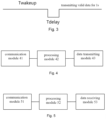
- Fig.4 is an example of a structure diagram of a two-way radio at a transmitting end according to the present application.
- the two-way radio at the transmitting end according to the present application comprises: a communication module 41 for transmitting a pilot signal, the pilot signal being used to set the two-way radio at a receiving end into an operating state; a data transmitting module 43 for transmitting data to be transmitted to the two-way radio at the receiving end after the communication module transmits the pilot signal; and a processing module 42 for controlling a transmitting state of the data transmitting module.
- the two-way radio at the transmitting end according to the present application has a corresponding configuration for carrying out each step of the above data transmitting method in a narrow-band communication system according to the present application.
- Fig.5 is an example of a structure diagram of a two-way radio at a receiving end according to the present application.
- the two-way radio at a receiving end according to the present application comprises: a communication module 51 for receiving a pilot signal; a processing module 52 for setting the two-way radio at the receiving end into an operating state or a sleeping state according to the pilot signal; and a data receiving module 53 for receiving data transmitted by the two-way radio at the transmitting end in the operating state of the two-way radio at the receiving end.
- the two-way radio at the receiving end according to the present application has a corresponding configuration for carrying out each step of the above data receiving method in a narrow-band communication system according to the present application.
- the present application also provides a computer readable storage medium, which is a volatile or nonvolatile, removable or non-removable medium for storing information, such as computer readable instructions, data structures, computer program modules, or other data.
- the computer readable storage medium may include, but is not limited to, a Random Access Memory (RAM), a Read-Only Memory (ROM), an Electrically Erasable Programmable Read Only Memory (EEPROM), flash memory or other memory technology, Compact Disc Read-Only Memory (CD-ROM), Digital Versatile Disc (DVD) or other optical disc storage, magnetic box, magnetic tape, disk storage or other magnetic storage device, or any other medium that may be used to store desired information and that can be accessed by computers.
- RAM Random Access Memory
- ROM Read-Only Memory
- EEPROM Electrically Erasable Programmable Read Only Memory
- CD-ROM Compact Disc Read-Only Memory
- DVD Digital Versatile Disc
- the computer readable storage medium may be used to store one or more computer programs, which may be executed by one or more processors to implement the steps of the data transmitting method in a narrow-band communication system or the steps of the data receiving method in a narrow-band communication system as in the above embodiments.
- This embodiment further provides a computer program (or referred to as computer software), which may be distributed on a computer readable medium, and may be executed by a computing device to implement at least one step of the data transmitting method in a narrow-band communication system or at least one step of the data receiving method in a narrow-band communication system as shown in the above embodiments; and in some cases, at least one of the steps shown or described may be performed in a sequence different from that described in the above embodiments.
- a computer program or referred to as computer software
- the present application further provides a computer program product comprising a computer readable device having a computer program as described above stored thereon.
- the computer readable device in this embodiment can include a computer readable storage medium as described above.
- the computer readable storage medium may specifically be an embedded CPU program, i.e. the computer readable storage medium is written into the embedded CPU by a writing software, and then a two-way radio is provided in the CPU with the computer readable storage medium to implement the data transmitting and receiving methods described above.
- communication media typically may include computer readable instructions, data structures, computer program modules or other data in a modulated data signal, such as a carrier wave or other transport mechanism, and may include any information delivery medium. Therefore, the present application is not limited to any particular combination of hardware and software.
Landscapes
- Engineering & Computer Science (AREA)
- Signal Processing (AREA)
- Computer Networks & Wireless Communication (AREA)
- Mobile Radio Communication Systems (AREA)
- Interconnected Communication Systems, Intercoms, And Interphones (AREA)
Claims (14)
- Méthode de transmission de données mise en œuvre par ordinateur dans un système de communication GMRS ou FRS à bande étroite, pour la communication de données entre une radio bidirectionnelle située à une extrémité émettrice et une radio bidirectionnelle située à une extrémité réceptrice, dans laquelle la méthode de transmission de données comprend :la transmission, par la radio bidirectionnelle située à l'extrémité émettrice, d'un signal pilote vers la radio bidirectionnelle située à l'extrémité réceptrice, le signal pilote étant utilisé pour mettre la radio bidirectionnelle située à l'extrémité réceptrice en état de fonctionnement (S101) ; etaprès transmission du signal pilote par la radio bidirectionnelle située à l'extrémité émettrice, la transmission, par la radio bidirectionnelle située à l'extrémité émettrice, des données à transmettre à la radio bidirectionnelle située à l'extrémité réceptrice (S102),caractérisée en ce que la méthode de transmission de données comprend par ailleurs :
après la transmission du signal pilote et avant la transmission des données à transmettre par la radio bidirectionnelle située à l'extrémité émettrice, une attente pendant un certain temps au niveau de la radio bidirectionnelle située à l'extrémité émettrice, pendant ce laps de temps, l'état d'émission de la radio bidirectionnelle située à l'extrémité émettrice n'est pas désactivé, et la durée de ce laps de temps est inférieure à la durée nécessaire pour que la radio bidirectionnelle située à l'extrémité réceptrice retourne de l'état de fonctionnement à l'état de veille, et la somme de la durée du signal pilote, de la durée du laps de temps et de la durée de la transmission des données à transmettre ne dépasse pas 1 s. - Méthode de transmission de données mise en œuvre par ordinateur dans un système de communication GMRS ou FRS à bande étroite selon la revendication 1, dans laquelle la durée du signal pilote n'est pas inférieure à la durée de l'état de veille de la radio bidirectionnelle située à l'extrémité réceptrice.
- Méthode de transmission de données mise en œuvre par ordinateur dans un système de communication GMRS ou FRS à bande étroite selon la revendication 1, dans laquelle le signal pilote comprend au moins un signal de sourdine, un signal subsonique et un signal de tonalité, et le signal pilote est utilisé pour notifier à la radio bidirectionnelle située à l'extrémité réceptrice d'éteindre un haut-parleur de la radio bidirectionnelle située à l'extrémité réceptrice, en plus d'être utilisé pour mettre la radio bidirectionnelle située à l'extrémité réceptrice en état de fonctionnement.
- Méthode de réception de données mise en œuvre par ordinateur dans un système de communication GMRS ou FRS à bande étroite, pour la communication de données entre une radio bidirectionnelle située à une extrémité émettrice et une radio bidirectionnelle située à une extrémité réceptrice, dans laquelle la méthode de réception de données comprend :la réception, par la radio bidirectionnelle située à l'extrémité réceptrice, d'un signal pilote transmis par la radio bidirectionnelle située à l'extrémité émettrice (S201) ;le réglage, par la radio bidirectionnelle située à l'extrémité réceptrice, de la radio bidirectionnelle située à l'extrémité réceptrice pour la mettre en état de fonctionnement en fonction du signal pilote (S202) ;la réception, par la radio bidirectionnelle située à l'extrémité réceptrice en état de fonctionnement, des données transmises par la radio bidirectionnelle située à l'extrémité émettrice (S203) ;caractérisée en ce que,après réception du signal pilote par la radio bidirectionnelle située à l'extrémité réceptrice, il y a une attente pendant un certain temps puis la réception de données par la radio bidirectionnelle située à l'extrémité réceptrice, et la durée du laps de temps est inférieure à la durée nécessaire pour que la radio bidirectionnelle située à l'extrémité réceptriceretourne de l'état de fonctionnement à l'état de veille.
- Méthode de réception de données mise en œuvre par ordinateur dans un système de communication GMRS ou FRS à bande étroite selon la revendication 4, dans laquelle la durée du signal pilote n'est pas inférieure à la durée de l'état de veille de la radio bidirectionnelle située à l'extrémité réceptrice.
- Méthode de réception de données mise en œuvre par ordinateur dans un système de communication GMRS ou FRS à bande étroite selon la revendication 4, dans laquelle le signal pilote comprend au moins un signal de sourdine, un signal subsonique et un signal de tonalité, et le signal pilote est utilisé pour notifier à la radio bidirectionnelle située à l'extrémité réceptrice d'éteindre un haut-parleur de la radio bidirectionnelle située à l'extrémité réceptrice, en plus d'être utilisé pour mettre la radio bidirectionnelle située à l'extrémité réceptrice en état de fonctionnement.
- Une radio bidirectionnelle GMRS ou FRS située à une extrémité émettrice, comprenant :un module de communication (41) pour transmettre un signal pilote, le signal pilote étant utilisé pour mettre la radio bidirectionnelle située à une extrémité réceptrice en état de fonctionnement ;un module de transmission de données (43) pour transmettre des données à la radio bidirectionnelle située à l'extrémité réceptrice après que le module de communication a transmis le signal pilote ; etun module de traitement des données (42) comprenant des moyens de contrôle d'un état de transmission du module de transmission des données ;caractérisée en ce que,après que le module de communication a transmis le signal pilote et avant que le module de transmission de données ne transmette les données à transmettre, la radio bidirectionnelle située à l'extrémité émettrice est adaptée pour attendre pendant un certain temps, pendant lequel le module de traitement de données ne désactive pas l'état de transmission de la radio bidirectionnelle située à l'extrémité émettrice, et la durée du laps de temps est inférieure à la durée nécessaire pour que la radio bidirectionnelle située à l'extrémité réceptrice retourne de l'état de fonctionnement à l'état de veille, et la somme de la durée du signal pilote, de la durée du laps de temps et de la durée de la transmission des données à transmettre ne dépasse pas 1 s.
- La radio bidirectionnelle GMRS ou FRS située à une extrémité émettrice selon la revendication 7, dans laquelle la durée du signal pilote n'est pas inférieure à la durée d'un état de veille de la radio bidirectionnelle située à l'extrémité réceptrice.
- La radio bidirectionnelle GMRS ou FRS située à une extrémité émettrice selon la revendication 7, dans laquelle le signal pilote comprend au moins un signal de sourdine, un signal subsonique et un signal de tonalité, et le signal pilote est utilisé pour notifier à la radio bidirectionnelle située à l'extrémité réceptrice d'éteindre un haut-parleur de la radio bidirectionnelle située à l'extrémité réceptrice, en plus d'être utilisé pour mettre la radio bidirectionnelle située à l'extrémité réceptrice en état de fonctionnement.
- Une radio bidirectionnelle GMRS ou FRS située à une extrémité réceptrice, comprenant :un module de communication (51) pour la réception d'un signal pilote ;un module de traitement des données (52) comprenant des moyens pour mettre la radio bidirectionnelle située à l'extrémité réceptrice en état de fonctionnement ou en état de veille en fonction du signal pilote ; etun module de réception de données (53) pour recevoir les données transmises par la radio bidirectionnelle située à l'extrémité émettrice pendant l'état de fonctionnement de la radio bidirectionnelle située à l'extrémité réceptrice,caractérisée en ce que,après que le module de communication a reçu le signal pilote, le module de réception des données est adapté pour attendre pendant un certain temps, puis recevoir des données, et la durée de la période est inférieure à la durée nécessaire au module de traitement des données pour faire passer la radio bidirectionnelle située à l'extrémité réceptrice de l'état de fonctionnement à l'état de veille.
- La radio bidirectionnelle GMRS ou FRS située à une extrémité réceptrice selon la revendication 10, dans laquelle la durée du signal pilote n'est pas inférieure à la durée d'un état de veille de la radio bidirectionnelle située à l'extrémité réceptrice.
- La radio bidirectionnelle GMRS ou FRS située à une extrémité réceptrice selon la revendication 10, dans laquelle le signal pilote comprend au moins un signal de sourdine, un signal subsonique et un signal de tonalité, et le signal pilote est utilisé pour notifier à la radio bidirectionnelle située à l'extrémité réceptrice d'éteindre un haut-parleur de la radio bidirectionnelle située à l'extrémité réceptrice, en plus d'être utilisé pour mettre la radio bidirectionnelle située à l'extrémité réceptrice en état de fonctionnement.
- Un support de stockage lisible par ordinateur sur lequel sont stockés un ou plusieurs programmes informatiques, le ou les programmes informatiques étant exécutables par un ou plusieurs processeurs afin de réaliser les étapes de la méthode de transmission de données dans un système de communication GMRS ou FRS à bande étroite selon la revendication 1.
- Un support de stockage lisible par ordinateur sur lequel sont stockés un ou plusieurs programmes informatiques, le ou les programmes informatiques étant exécutables par un ou plusieurs processeurs afin de réaliser les étapes de la méthode de réception de données dans un système de communication GMRS ou FRS à bande étroite selon la revendication 4.
Applications Claiming Priority (1)
| Application Number | Priority Date | Filing Date | Title |
|---|---|---|---|
| CN201811385502.5A CN111200763B (zh) | 2018-11-20 | 2018-11-20 | 窄带通讯数据发送方法、接收方法及对讲机、存储介质 |
Publications (3)
| Publication Number | Publication Date |
|---|---|
| EP3657724A1 EP3657724A1 (fr) | 2020-05-27 |
| EP3657724C0 EP3657724C0 (fr) | 2025-03-19 |
| EP3657724B1 true EP3657724B1 (fr) | 2025-03-19 |
Family
ID=68771340
Family Applications (1)
| Application Number | Title | Priority Date | Filing Date |
|---|---|---|---|
| EP19210447.9A Active EP3657724B1 (fr) | 2018-11-20 | 2019-11-20 | Procédés de transmission et de réception de données dans une communication à bande étroite, interphone et support d'informations |
Country Status (3)
| Country | Link |
|---|---|
| US (1) | US11259163B2 (fr) |
| EP (1) | EP3657724B1 (fr) |
| CN (1) | CN111200763B (fr) |
Families Citing this family (1)
| Publication number | Priority date | Publication date | Assignee | Title |
|---|---|---|---|---|
| CN116709386A (zh) * | 2023-07-13 | 2023-09-05 | 海能达通信股份有限公司 | 移动终端的通信方法和装置、存储介质及电子设备 |
Family Cites Families (13)
| Publication number | Priority date | Publication date | Assignee | Title |
|---|---|---|---|---|
| JPS5966258A (ja) * | 1982-10-07 | 1984-04-14 | Matsushita Electric Ind Co Ltd | インタ−ホン装置 |
| US9936442B1 (en) * | 2005-07-14 | 2018-04-03 | Binj Laboratories, Inc. | System and method for wrist band transmitter and system thereof |
| WO2010045954A1 (fr) * | 2008-10-22 | 2010-04-29 | Telecom Italia S.P.A. | Procédé servant à définir le fonctionnement d’un nœud de routage d’un réseau de communication sans fil asynchrone, nœud de réseau et réseau de communication mettant en place le procédé |
| CN102056028A (zh) * | 2010-12-30 | 2011-05-11 | 大唐微电子技术有限公司 | 一种降低数字对讲机功耗的方法及装置 |
| US9191891B2 (en) * | 2012-11-02 | 2015-11-17 | Qualcomm Incorporated | Systems and methods for low power wake-up signal implementation and operations for WLAN |
| CN103200465A (zh) * | 2013-03-14 | 2013-07-10 | 深圳市力同亚太科技有限公司 | 一种对讲机工作方法及对讲机 |
| CN104796166B (zh) * | 2014-01-16 | 2018-12-11 | 海能达通信股份有限公司 | 一种无线配件唤醒方法和无线配件 |
| US10356839B2 (en) * | 2014-11-04 | 2019-07-16 | Qualcomm Incorporated | Low power discontinuous reception with a second receiver |
| CN105049923B (zh) * | 2015-08-28 | 2019-03-01 | 小米科技有限责任公司 | 唤醒电子设备的方法及装置 |
| DE102016217163B4 (de) * | 2015-09-09 | 2020-10-22 | Robert Bosch Gmbh | Weckmechanismus mit geringer Leistungsaufnahme für drahtlose Vorrichtungen |
| US10615834B1 (en) * | 2017-07-28 | 2020-04-07 | Radio Design Group, Inc. | Two-way communication device with detachable transmitter and method of operation |
| US10368310B2 (en) * | 2017-08-09 | 2019-07-30 | Microsoft Technology Licensing, Llc | Power saving in a computing device that includes multiple radios |
| US11082922B2 (en) * | 2018-10-09 | 2021-08-03 | Qualcomm Incorporated | Techniques for improving power consumption state latency in wireless communications |
-
2018
- 2018-11-20 CN CN201811385502.5A patent/CN111200763B/zh active Active
-
2019
- 2019-11-19 US US16/687,741 patent/US11259163B2/en active Active
- 2019-11-20 EP EP19210447.9A patent/EP3657724B1/fr active Active
Non-Patent Citations (1)
| Title |
|---|
| FEDERAL COMMUNICATIONS COMMISSION: "PART 95-PERSONAL RADIO SERVICES", TITLE 47-TELECOMMUNICATION, 1 October 2009 (2009-10-01), pages 527 - 586, XP055831031, Retrieved from the Internet <URL:https://www.govinfo.gov/content/pkg/CFR-2009-title47-vol5/pdf/CFR-2009-title47-vol5-part95.pdf> [retrieved on 20210809] * |
Also Published As
| Publication number | Publication date |
|---|---|
| EP3657724A1 (fr) | 2020-05-27 |
| CN111200763B (zh) | 2021-11-26 |
| US11259163B2 (en) | 2022-02-22 |
| EP3657724C0 (fr) | 2025-03-19 |
| US20200162874A1 (en) | 2020-05-21 |
| CN111200763A (zh) | 2020-05-26 |
Similar Documents
| Publication | Publication Date | Title |
|---|---|---|
| US5613228A (en) | Gain adjustment method in two-way communication systems | |
| US8089909B2 (en) | Method of transmitting/receiving data in sensor network for reducing overhearing of sensor nodes | |
| CN110290574B (zh) | 一种数据传输方法、装置、设备、系统及存储介质 | |
| US8693355B2 (en) | Jitter buffer management for power savings in a wireless communication device | |
| WO2019005514A1 (fr) | Paquet de réveil utilisant différents taux d'échantillonnage | |
| CN111343120B (zh) | 一种信号处理方法及装置 | |
| EP1571866A3 (fr) | Système et procédé pour le réglage périodique en mode de sommeil dans un système de communication sans fil d'accès à bande large | |
| WO2012010676A1 (fr) | Système et procédé de réveil basse consommation destinés à des réseaux corporels sans fil | |
| KR101569927B1 (ko) | 신체 영역 네트워크 매체 액세스 제어 프로토콜들의 오버히어링 문제들을 해결하기 위한 기술들 | |
| KR20200046133A (ko) | 컴퓨팅 디바이스들에서의 전력 절약 기술들 | |
| JP2006014167A (ja) | 無線lanにおける省電力化方法/プログラム/記録媒体、端末局、無線lanシステム | |
| EP3657724B1 (fr) | Procédés de transmission et de réception de données dans une communication à bande étroite, interphone et support d'informations | |
| CN113938996B (zh) | 一种无线通信控制信息传输方法和设备 | |
| US8660617B1 (en) | WiMAX enhanced sleep mode | |
| ATE419681T1 (de) | Kommunikationssteuerung für aktiven transponder | |
| EP2034615B1 (fr) | Modèle de messagerie sans fil sécurisé | |
| JP2017063405A (ja) | 標準準拠無線信号を修正するデータ送信機 | |
| CN116235157A (zh) | 通过通信总线控制的计算设备中的节能技术 | |
| KR101026890B1 (ko) | 채널 기술자의 송수신을 향상시키는 방법 및 시스템 | |
| CN118555609B (zh) | 通信方法、系统及相关设备 | |
| US8670360B2 (en) | Method and system for transmitting a signal comprising preamble and a data frame | |
| CN110710316A (zh) | 一种时域资源信息的指示方法和装置 | |
| CN115633406A (zh) | 终端的控制方法、装置和系统 | |
| CN117641520A (zh) | 通信节能方法、通信终端和存储介质 | |
| CN108882345A (zh) | 蓝牙设备及其睡眠控制方法、装置、计算机可读存储介质 |
Legal Events
| Date | Code | Title | Description |
|---|---|---|---|
| PUAI | Public reference made under article 153(3) epc to a published international application that has entered the european phase |
Free format text: ORIGINAL CODE: 0009012 |
|
| STAA | Information on the status of an ep patent application or granted ep patent |
Free format text: STATUS: THE APPLICATION HAS BEEN PUBLISHED |
|
| AK | Designated contracting states |
Kind code of ref document: A1 Designated state(s): AL AT BE BG CH CY CZ DE DK EE ES FI FR GB GR HR HU IE IS IT LI LT LU LV MC MK MT NL NO PL PT RO RS SE SI SK SM TR |
|
| AX | Request for extension of the european patent |
Extension state: BA ME |
|
| STAA | Information on the status of an ep patent application or granted ep patent |
Free format text: STATUS: REQUEST FOR EXAMINATION WAS MADE |
|
| 17P | Request for examination filed |
Effective date: 20201127 |
|
| RBV | Designated contracting states (corrected) |
Designated state(s): AL AT BE BG CH CY CZ DE DK EE ES FI FR GB GR HR HU IE IS IT LI LT LU LV MC MK MT NL NO PL PT RO RS SE SI SK SM TR |
|
| STAA | Information on the status of an ep patent application or granted ep patent |
Free format text: STATUS: EXAMINATION IS IN PROGRESS |
|
| 17Q | First examination report despatched |
Effective date: 20210813 |
|
| GRAP | Despatch of communication of intention to grant a patent |
Free format text: ORIGINAL CODE: EPIDOSNIGR1 |
|
| STAA | Information on the status of an ep patent application or granted ep patent |
Free format text: STATUS: GRANT OF PATENT IS INTENDED |
|
| INTG | Intention to grant announced |
Effective date: 20241119 |
|
| GRAS | Grant fee paid |
Free format text: ORIGINAL CODE: EPIDOSNIGR3 |
|
| GRAA | (expected) grant |
Free format text: ORIGINAL CODE: 0009210 |
|
| STAA | Information on the status of an ep patent application or granted ep patent |
Free format text: STATUS: THE PATENT HAS BEEN GRANTED |
|
| AK | Designated contracting states |
Kind code of ref document: B1 Designated state(s): AL AT BE BG CH CY CZ DE DK EE ES FI FR GB GR HR HU IE IS IT LI LT LU LV MC MK MT NL NO PL PT RO RS SE SI SK SM TR |
|
| REG | Reference to a national code |
Ref country code: GB Ref legal event code: FG4D |
|
| REG | Reference to a national code |
Ref country code: CH Ref legal event code: EP |
|
| REG | Reference to a national code |
Ref country code: IE Ref legal event code: FG4D |
|
| REG | Reference to a national code |
Ref country code: DE Ref legal event code: R096 Ref document number: 602019067425 Country of ref document: DE |
|
| U01 | Request for unitary effect filed |
Effective date: 20250319 |
|
| U07 | Unitary effect registered |
Designated state(s): AT BE BG DE DK EE FI FR IT LT LU LV MT NL PT RO SE SI Effective date: 20250325 |
|
| PG25 | Lapsed in a contracting state [announced via postgrant information from national office to epo] |
Ref country code: RS Free format text: LAPSE BECAUSE OF FAILURE TO SUBMIT A TRANSLATION OF THE DESCRIPTION OR TO PAY THE FEE WITHIN THE PRESCRIBED TIME-LIMIT Effective date: 20250619 |
|
| PG25 | Lapsed in a contracting state [announced via postgrant information from national office to epo] |
Ref country code: NO Free format text: LAPSE BECAUSE OF FAILURE TO SUBMIT A TRANSLATION OF THE DESCRIPTION OR TO PAY THE FEE WITHIN THE PRESCRIBED TIME-LIMIT Effective date: 20250619 |
|
| PG25 | Lapsed in a contracting state [announced via postgrant information from national office to epo] |
Ref country code: HR Free format text: LAPSE BECAUSE OF FAILURE TO SUBMIT A TRANSLATION OF THE DESCRIPTION OR TO PAY THE FEE WITHIN THE PRESCRIBED TIME-LIMIT Effective date: 20250319 |
|
| PG25 | Lapsed in a contracting state [announced via postgrant information from national office to epo] |
Ref country code: GR Free format text: LAPSE BECAUSE OF FAILURE TO SUBMIT A TRANSLATION OF THE DESCRIPTION OR TO PAY THE FEE WITHIN THE PRESCRIBED TIME-LIMIT Effective date: 20250620 |
|
| PG25 | Lapsed in a contracting state [announced via postgrant information from national office to epo] |
Ref country code: SM Free format text: LAPSE BECAUSE OF FAILURE TO SUBMIT A TRANSLATION OF THE DESCRIPTION OR TO PAY THE FEE WITHIN THE PRESCRIBED TIME-LIMIT Effective date: 20250319 |
|
| PG25 | Lapsed in a contracting state [announced via postgrant information from national office to epo] |
Ref country code: ES Free format text: LAPSE BECAUSE OF FAILURE TO SUBMIT A TRANSLATION OF THE DESCRIPTION OR TO PAY THE FEE WITHIN THE PRESCRIBED TIME-LIMIT Effective date: 20250319 |
|
| PG25 | Lapsed in a contracting state [announced via postgrant information from national office to epo] |
Ref country code: PL Free format text: LAPSE BECAUSE OF FAILURE TO SUBMIT A TRANSLATION OF THE DESCRIPTION OR TO PAY THE FEE WITHIN THE PRESCRIBED TIME-LIMIT Effective date: 20250319 |
|
| PG25 | Lapsed in a contracting state [announced via postgrant information from national office to epo] |
Ref country code: CZ Free format text: LAPSE BECAUSE OF FAILURE TO SUBMIT A TRANSLATION OF THE DESCRIPTION OR TO PAY THE FEE WITHIN THE PRESCRIBED TIME-LIMIT Effective date: 20250319 |
|
| PG25 | Lapsed in a contracting state [announced via postgrant information from national office to epo] |
Ref country code: SK Free format text: LAPSE BECAUSE OF FAILURE TO SUBMIT A TRANSLATION OF THE DESCRIPTION OR TO PAY THE FEE WITHIN THE PRESCRIBED TIME-LIMIT Effective date: 20250319 |
|
| PG25 | Lapsed in a contracting state [announced via postgrant information from national office to epo] |
Ref country code: IS Free format text: LAPSE BECAUSE OF FAILURE TO SUBMIT A TRANSLATION OF THE DESCRIPTION OR TO PAY THE FEE WITHIN THE PRESCRIBED TIME-LIMIT Effective date: 20250719 |
|
| U20 | Renewal fee for the european patent with unitary effect paid |
Year of fee payment: 7 Effective date: 20251119 |
|
| PGFP | Annual fee paid to national office [announced via postgrant information from national office to epo] |
Ref country code: GB Payment date: 20251121 Year of fee payment: 7 |
|
| PLBE | No opposition filed within time limit |
Free format text: ORIGINAL CODE: 0009261 |
|
| STAA | Information on the status of an ep patent application or granted ep patent |
Free format text: STATUS: NO OPPOSITION FILED WITHIN TIME LIMIT |
|
| REG | Reference to a national code |
Ref country code: CH Ref legal event code: L10 Free format text: ST27 STATUS EVENT CODE: U-0-0-L10-L00 (AS PROVIDED BY THE NATIONAL OFFICE) Effective date: 20260128 |
|
| 26N | No opposition filed |
Effective date: 20251222 |