EP3658745B1 - Verfahren und dichtungsmedium zum stopfen eines bohrlochs - Google Patents
Verfahren und dichtungsmedium zum stopfen eines bohrlochs Download PDFInfo
- Publication number
- EP3658745B1 EP3658745B1 EP18838723.7A EP18838723A EP3658745B1 EP 3658745 B1 EP3658745 B1 EP 3658745B1 EP 18838723 A EP18838723 A EP 18838723A EP 3658745 B1 EP3658745 B1 EP 3658745B1
- Authority
- EP
- European Patent Office
- Prior art keywords
- well
- clay
- sealing medium
- casing
- quick clay
- Prior art date
- Legal status (The legal status is an assumption and is not a legal conclusion. Google has not performed a legal analysis and makes no representation as to the accuracy of the status listed.)
- Active
Links
Images



Classifications
-
- E—FIXED CONSTRUCTIONS
- E21—EARTH OR ROCK DRILLING; MINING
- E21B—EARTH OR ROCK DRILLING; OBTAINING OIL, GAS, WATER, SOLUBLE OR MELTABLE MATERIALS OR A SLURRY OF MINERALS FROM WELLS
- E21B33/00—Sealing or packing boreholes or wells
- E21B33/10—Sealing or packing boreholes or wells in the borehole
- E21B33/13—Methods or devices for cementing, for plugging holes, crevices or the like
-
- C—CHEMISTRY; METALLURGY
- C04—CEMENTS; CONCRETE; ARTIFICIAL STONE; CERAMICS; REFRACTORIES
- C04B—LIME, MAGNESIA; SLAG; CEMENTS; COMPOSITIONS THEREOF, e.g. MORTARS, CONCRETE OR LIKE BUILDING MATERIALS; ARTIFICIAL STONE; CERAMICS; REFRACTORIES; TREATMENT OF NATURAL STONE
- C04B14/00—Use of inorganic materials as fillers, e.g. pigments, for mortars, concrete or artificial stone; Treatment of inorganic materials specially adapted to enhance their filling properties in mortars, concrete or artificial stone
- C04B14/02—Granular materials, e.g. microballoons
- C04B14/04—Silica-rich materials; Silicates
- C04B14/10—Clay
-
- C—CHEMISTRY; METALLURGY
- C04—CEMENTS; CONCRETE; ARTIFICIAL STONE; CERAMICS; REFRACTORIES
- C04B—LIME, MAGNESIA; SLAG; CEMENTS; COMPOSITIONS THEREOF, e.g. MORTARS, CONCRETE OR LIKE BUILDING MATERIALS; ARTIFICIAL STONE; CERAMICS; REFRACTORIES; TREATMENT OF NATURAL STONE
- C04B28/00—Compositions of mortars, concrete or artificial stone, containing inorganic binders or the reaction product of an inorganic and an organic binder, e.g. polycarboxylate cements
- C04B28/001—Compositions of mortars, concrete or artificial stone, containing inorganic binders or the reaction product of an inorganic and an organic binder, e.g. polycarboxylate cements containing unburned clay
-
- C—CHEMISTRY; METALLURGY
- C09—DYES; PAINTS; POLISHES; NATURAL RESINS; ADHESIVES; COMPOSITIONS NOT OTHERWISE PROVIDED FOR; APPLICATIONS OF MATERIALS NOT OTHERWISE PROVIDED FOR
- C09K—MATERIALS FOR MISCELLANEOUS APPLICATIONS, NOT PROVIDED FOR ELSEWHERE
- C09K8/00—Compositions for drilling of boreholes or wells; Compositions for treating boreholes or wells, e.g. for completion or for remedial operations
- C09K8/42—Compositions for cementing, e.g. for cementing casings into boreholes; Compositions for plugging, e.g. for killing wells
-
- C—CHEMISTRY; METALLURGY
- C09—DYES; PAINTS; POLISHES; NATURAL RESINS; ADHESIVES; COMPOSITIONS NOT OTHERWISE PROVIDED FOR; APPLICATIONS OF MATERIALS NOT OTHERWISE PROVIDED FOR
- C09K—MATERIALS FOR MISCELLANEOUS APPLICATIONS, NOT PROVIDED FOR ELSEWHERE
- C09K8/00—Compositions for drilling of boreholes or wells; Compositions for treating boreholes or wells, e.g. for completion or for remedial operations
- C09K8/42—Compositions for cementing, e.g. for cementing casings into boreholes; Compositions for plugging, e.g. for killing wells
- C09K8/426—Compositions for cementing, e.g. for cementing casings into boreholes; Compositions for plugging, e.g. for killing wells for plugging
-
- C—CHEMISTRY; METALLURGY
- C09—DYES; PAINTS; POLISHES; NATURAL RESINS; ADHESIVES; COMPOSITIONS NOT OTHERWISE PROVIDED FOR; APPLICATIONS OF MATERIALS NOT OTHERWISE PROVIDED FOR
- C09K—MATERIALS FOR MISCELLANEOUS APPLICATIONS, NOT PROVIDED FOR ELSEWHERE
- C09K8/00—Compositions for drilling of boreholes or wells; Compositions for treating boreholes or wells, e.g. for completion or for remedial operations
- C09K8/42—Compositions for cementing, e.g. for cementing casings into boreholes; Compositions for plugging, e.g. for killing wells
- C09K8/46—Compositions for cementing, e.g. for cementing casings into boreholes; Compositions for plugging, e.g. for killing wells containing inorganic binders, e.g. Portland cement
-
- C—CHEMISTRY; METALLURGY
- C09—DYES; PAINTS; POLISHES; NATURAL RESINS; ADHESIVES; COMPOSITIONS NOT OTHERWISE PROVIDED FOR; APPLICATIONS OF MATERIALS NOT OTHERWISE PROVIDED FOR
- C09K—MATERIALS FOR MISCELLANEOUS APPLICATIONS, NOT PROVIDED FOR ELSEWHERE
- C09K8/00—Compositions for drilling of boreholes or wells; Compositions for treating boreholes or wells, e.g. for completion or for remedial operations
- C09K8/50—Compositions for plastering borehole walls, i.e. compositions for temporary consolidation of borehole walls
-
- C—CHEMISTRY; METALLURGY
- C09—DYES; PAINTS; POLISHES; NATURAL RESINS; ADHESIVES; COMPOSITIONS NOT OTHERWISE PROVIDED FOR; APPLICATIONS OF MATERIALS NOT OTHERWISE PROVIDED FOR
- C09K—MATERIALS FOR MISCELLANEOUS APPLICATIONS, NOT PROVIDED FOR ELSEWHERE
- C09K8/00—Compositions for drilling of boreholes or wells; Compositions for treating boreholes or wells, e.g. for completion or for remedial operations
- C09K8/56—Compositions for consolidating loose sand or the like around wells without excessively decreasing the permeability thereof
-
- E—FIXED CONSTRUCTIONS
- E21—EARTH OR ROCK DRILLING; MINING
- E21B—EARTH OR ROCK DRILLING; OBTAINING OIL, GAS, WATER, SOLUBLE OR MELTABLE MATERIALS OR A SLURRY OF MINERALS FROM WELLS
- E21B33/00—Sealing or packing boreholes or wells
- E21B33/10—Sealing or packing boreholes or wells in the borehole
- E21B33/13—Methods or devices for cementing, for plugging holes, crevices or the like
- E21B33/14—Methods or devices for cementing, for plugging holes, crevices or the like for cementing casings into boreholes
Definitions
- the invention concerns a method of sealing at least a portion of a well.
- the invention is concerned with sealing of a well in different stages of the lifetime of a well.
- Such sealing can be the sealing between a casing and the wall of the well during the early stages of the installation of a casing in a well, and the final sealing of the well when the well is abandoned.
- the invention also concerns a sealing medium for sealing of a well.
- well is used for different types of wells, such as a petroleum well, a coal seam gas well, a geothermal well, a well for injection of CO 2 , or a well for depositing of material.
- Prior art sealing with cement plugs as described above has the disadvantage that cement inevitably starts to crack up after a certain time period, or for instance in case of compaction and/or tectonic movement. When the cement plugs crack up, leakages may occur, and this could have detrimental consequences.
- Leakage do not only occur due to cracks in the cement plugs, but also due to cracks in the well in sections filled with drilling fluid, cement spacer, cement slurry, and/or mixtures of these. Leakage may also occur prior to formation of cracks in the cement plugs for instance because of uneven cementing. Also, in the upper part of the well, where the well cannot be filled with cement, leakage may occur when the production tree is removed.
- the invention has for its object to remedy or to reduce at least one of the drawbacks of the prior art, or at least to provide a useful alternative to prior art.
- the invention relates to a method for sealing according to claim 1.
- Quick clay is sometimes referred to as sensitive clay.
- Quick clay is a water-saturated clay that changes rapidly to a fluid state when jarred or crushed.
- Quick clay is any glaciomarine or marine clay which is stable as long as it retains its original ionic content or salt concentration, but which becomes unstable when lifted up close to sea level or above sea level and the salts are gradually washed/leached out of the clay.
- a concentration of less than 2 g/l of salt is regarded as the threshold for a clay deposit to be a potential quick clay if stirred. It was earlier considered that a low salt content, as a result of leaching, was the primary factor for the formation of quick clay.
- quick clay may include clay minerals like illite and chlorite, in addition to quartz as sand or silt, and some other minerals such as feldspars.
- quick clay do not contain smectites such as montmorillonite, vermiculite, or bentonite.
- the term "quick clay” also includes any naturally occurring or artificially made materials which have properties resembling those of naturally occurring quick clays.
- the term quick clay is herein also used to capture clay deposits which today have very low salt concentration due to leaching, but which are stable due to low water content. Just by adding water they will become liquefied and unstable.
- quick clay as used herein thus includes any natural or artificial material which has the ability to take the form of a thick liquid when being stirred/moved, to become more solid, but still flexible and unhardened when left to settle, and then being able to liquefy again if stirred.
- Clay minerals are so-called secondary minerals that have been formed by weathering of other silicates such as mica, amphibolites, and feldspar. Chemical weathering is a process whereby a mineral or rock is broken down by the action of water alone or in combination with substances from the air or the soil layers.
- CEC cation-exchange capacity
- a sealing means is obtained which is flexible and adjustable to any movement in the well.
- the casing may, instead of being fastened to the wall of the well by means of cement, be steadily, but not fixedly supported by quick clay filling the annulus between the casing and the wall of the well.
- Quick clay will not harden and thus will also not crack up during the lifetime of the well. If the quick clay is stirred or unsettled due to tectonic, or other, movement, it will readjust and resettle.
- Quick clay being flexible, will move into any new cracks and will also, for instance, fill areas wherein old casing is rusting away. Therefore, quick clay constitutes a safer and more reliable sealing medium for a well, than cement which is the most commonly used sealing medium in wells.
- the quick clay density was 2 g/cm 3 and the quick clay behaved like a fluid. Within a few days it settled. Water was added to reduce the density to 1.9 g/cm3, but after a week this slurry would also first gel, then harden so that the container could be turned upside down without any quick clay falling out. However, the quick clay would never solidify completely. Not even by adding salt it would get as hard and brittle as for instance concrete.
- the sedimentary deposits of most hydrocarbon bearing sedimentary basins include relatively large salt deposits making most basins quite saline.
- the North Sea, the Norwegian Sea and the Barents Sea are all quite saline basins where the salinity in the reservoir can reach saturation at 440 g/I water.
- the least saline basins offshore of Norway is the Garnbanken where there are salt layers, but no salt walls or diapers.
- quick clay sealing medium compared to prior art swelling clay plugs (like bentonite) is that the quick clay may be used in deeper wells. Because of the fast swelling of bentonite and similar plugging material, this may not be used for locations deeper than 2000 metres because the material would swell before it reaches the correct location.
- the sealing medium may in one embodiment consist only of quick clay.
- the sealing medium may be injected through a drill string. It is easier to target the relevant portion of the well when a drill string is used. The alternative would be to pump the sealing medium into the well directly from the surface.
- At least one casing string may be installed in the well.
- the portion of the well may be an annulus between the casing string and a wall of the well and/or an annulus between two casing strings.
- a leakage may occur in one of the annuli, the casing may then be perforated and the sealing medium containing the quick clay may be injected into the annulus, thus stopping the leakage.
- the entire annulus may be filled with quick clay containing material in order to prevent leakage, and to support the casing.
- Quick clay may render the conventional cementing of casing superfluous.
- the drill string may be provided with a mechanical plug, such as a bridge plug provided with a rubber seal for sealing the space between the casing string and the drill string such that the sealing medium is prevented from flowing back along the drill string during injection of sealing medium.
- a mechanical plug such as a bridge plug provided with a rubber seal for sealing the space between the casing string and the drill string such that the sealing medium is prevented from flowing back along the drill string during injection of sealing medium.
- the sealing medium comprising quick clay may be injected into the annulus during installation of the well.
- the effect of this is that the annulus will be filled with a material that is flexible and therefore will not crack up. Such a well will therefore be less prone to leakage than a conventional well.
- the sealing medium with quick clay is used instead of cement when installing the casing in the well, the pulling of the casing when the well is later to be abandoned, will be much easier.
- the method may, during abandonment of the well, comprise the step of:
- the step of disturbing the well may be performed by initiating the pulling of the casing like it would be done also in conventional wells (where the casing is cemented into place).
- the casing may be hammered on or pulled with high force such that the enclosing quick clay plug is disturbed.
- the method may comprise the step of filling the entire well with the sealing medium for plugging the well. This would render the well completely sealed, making sure that no leakage would occur after abandonment of the well. As mentioned above, the properties of the quick clay would cause the sealing medium to adjust to any tectonic, or other, movement in the ground and thus seal any new cracks in the surrounding rock.
- the method may comprise the step of altering the characteristics of the sealing medium by means of adding one of, or a combination of two or more of, water, salt, sand and silt.
- the characteristics of the sealing medium may be altered before and/or after injecting it into the well.
- adding more water to a quick clay will make it thinner such that it flows more easily.
- Adding salt ions to a quick clay mainly potassium and sodium ions, will make the clay more stable.
- Adding salt ions to the quick clay could be done in order for it to more quickly become stable after injection into the well.
- Adding sand, such as quartz or barite will change the density of the quick clay. The same goes for adding of silt, of any mineral.
- the invention also relates to a sealing medium according to claim 10.
- Said sealing medium may be used in the method according to claim 1.
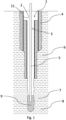
- Figure 1 shows a cross-section of an already existing well 1 having a wall 11, wherein a first casing string 2 and a second casing string 3 have been installed. It is illustrated that cement 4 fills the annulus between the casing strings 2, 3 and the wall 11 of the well 1, as well as the annulus between the casing strings 2, 3.
- a drill string 5 runs from the surface and down into the well 1.
- the well 1 has been drilled through a caprock 6 such as shale followed by a permeable layer 7, i.e. a reservoir rock, for instance sandstone.
- the well 1 has been further drilled into a source rock 8, again for instance shale.
- FIG. 1 illustrates that the well 1 is being filled with a sealing medium 9 containing quick clay.
- the sealing medium 9 will in the following be referred to as quick clay and the reference numeral 9 will be used both for quick clay and for sealing medium since a division of these does not make sense with regards to the drawings. It is referred to the definition of quick clay above, and it must be understood that by quick clay is herein meant any material with the faculties of quick clay.
- the sealing medium 9 of the invention has such faculties.
- the quick clay 9 is injected through the drill string 5.
- the quick clay 9 is injected in order to plug the well 1 such as to prevent leakage from the permeable layer 7 and to the surface when the well 1 is abandoned.
- Figure 2 shows the well 1 of Figure 1 wherein the drill string 5 has been further pulled out of the well 1 at the same time as the well 1 is being further filled with quick clay 9.
- the casing strings 2, 3 should be removed before filling up the well 1 with quick clay 9.
- Figure 3 shows the well 1 of Figure 1 and 2 wherein it is almost completely filled with quick clay 9.
- the drill string 5 is backed out of the well 1 as it pumps quick clay 9 into the well.
- the quick clay 9 is left to settle.
- the quick clay 9 is liquid, but when it is left to settle it gets more solid and stable.
- quick clay will never harden, and will thus always keep its flexible characteristics.
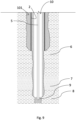
- FIG 4 shows a new well 10 in the process of being drilled by means of the drill string 5 comprising a drill bit 51.
- the wall of the well 10 is denoted 101.
- the strata of the ground are the same as in the previous example, namely caprock 6, reservoir rock 7, and source rock 8.
- the first casing string 2 has been installed.
- the drill bit 51, shown on Figure 4 has been replaced by a rubber sealing plug 52 arranged on the drill string 5.
- Quick clay 9 is then pumped down through the drill string 5, through the rubber sealing plug 52, and out into the casing 2 below the rubber sealing plug 52.
- the rubber sealing plug 52 prevents the quick clay 9 from returning up along the drill string 5, and thus the quick clay 9 will be squeezed in the annulus between the wall 101 and the casing 2.
- the quick clay 9 in this example replaces the cement of the conventional well 1 of Figure 1 .
- Figure 6 illustrates how the first casing 2, also called the conductor, has been installed such that quick clay 9 is closed in in the annulus between the conductor 2 and the wall 101 of the well 10, before the drilling of the well 10 has been continued.
- the second casing string 3 has been run down into the well 10, and again the drill bit 51, shown on Figures 4 and 6 , has been replaced by the rubber sealing plug 52 in order for quick clay 9 to be injected into the well 10 through the drill string 5 without returning back along the drill string 5.
- the quick clay 9 fills the annulus between the wall 101 of the well 10 and the second casing 3 as well as the annulus between the first casing 2 and the second casing 3.
- Figure 8 shows the well 10 ready for closing down after production has finished and all tools are pulled out of the well.
- the well 10 is ready for the "plug and abandon" procedure. Both casing strings 2, 3 are still in the well 10.
- the second casing string 3, shown in Figure 8 has been pulled out of the well 10 facilitated by the quick clay 9. Since the casing 3 was not cemented to the wall 101 of the well 10 or to the first casing string 2, the casing 3 could be removed mainly undamaged.
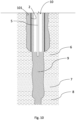
- the drill string 5 has been run into the well 10 and quick clay 9 is being pumped into the well 10 in order to plug it.
- the quick clay 9 reaches the level of the first casing 2, see Figure 10
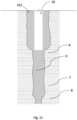
- the injection of quick clay 9 is discontinued, see Figure 11 , while the first casing 2 is removed.
- the entire well 10 is filled with quick clay 9.
- the quick clay 9 now constitutes one continuous plug through the entire well 10, or through an upper portion of the well 10.
Landscapes
- Chemical & Material Sciences (AREA)
- Life Sciences & Earth Sciences (AREA)
- Engineering & Computer Science (AREA)
- General Life Sciences & Earth Sciences (AREA)
- Organic Chemistry (AREA)
- Materials Engineering (AREA)
- Geology (AREA)
- Mining & Mineral Resources (AREA)
- Ceramic Engineering (AREA)
- Inorganic Chemistry (AREA)
- Geochemistry & Mineralogy (AREA)
- Physics & Mathematics (AREA)
- Fluid Mechanics (AREA)
- Environmental & Geological Engineering (AREA)
- Dispersion Chemistry (AREA)
- Structural Engineering (AREA)
- Chemical Kinetics & Catalysis (AREA)
- Civil Engineering (AREA)
- Curing Cements, Concrete, And Artificial Stone (AREA)
- Earth Drilling (AREA)
- Working Measures On Existing Buildindgs (AREA)
- Closing Of Containers (AREA)
Claims (10)
- Verfahren zum Abdichten mindestens eines Abschnitts eines Bohrlochs (1; 10), wobei das Verfahren die folgenden Schritte umfasst:- Injizieren eines Abdichtungsmediums, das Fließton (9) umfasst, in den Abschnitt des Bohrlochs (1; 10), der abgedichtet werden soll, wobei der Fließton während der Injektion in einem flüssigen Zustand ist; und- Verwenden des Fließtons, um den Abschnitt des Bohrlochs (1; 10) abzudichten, wobei der Fließton so konfiguriert ist, dass er flexibel ist und sich durch Wiederansiedlung an die Bewegung im Bohrloch anpassen kann.
- Verfahren nach Anspruch 1, wobei das Abdichtungsmedium (9) durch einen Bohrstrang (5) injiziert wird.
- Verfahren nach Anspruch 1 oder 2, wobei mindestens ein Auskleidungsstrang (2; 3) in dem Bohrloch (1; 10) installiert ist.
- Verfahren nach Anspruch 3, wobei der Abschnitt des Bohrlochs (1; 10) ein Ringraum zwischen dem Auskleidungsstrang (2; 3) und einer Wand (11; 101) des Bohrlochs (1; 10) und/oder ein Ringraum zwischen zwei Auskleidungssträngen (2, 3) ist.
- Verfahren nach Anspruch 3 oder 4 in Abhängigkeit von Anspruch 2, wobei der Bohrstrang (5) mit einem mechanischen Stopfen bereitgestellt wird, der mit einer Gummidichtung (52) zum Abdichten des Raums zwischen dem Auskleidungsstrang (2; 3) und dem Bohrstrang (5) bereitgestellt wird, so dass das Abdichtungsmedium (9) während der Injektion des Abdichtungsmediums (9) nicht entlang des Bohrstrangs (5) zurückfließen kann.
- Verfahren nach Anspruch 4 oder 5, wobei das Abdichtungsmedium (9) während der Installation des Auskleidungsstrangs (2, 3) in das Bohrloch (10) in den Ringraum injiziert wird.
- Verfahren nach Anspruch 6, wobei das Verfahren während der Stilllegung des Bohrlochs (10) weiter den folgenden Schritt umfasst:- Stören des Fließtons vor oder gleichzeitig mit dem Herausziehen der Auskleidungsstränge (2, 3), so dass der Fließton flüssiger wird und so das Herausziehen der Auskleidungsstränge erleichtert (2, 3).
- Verfahren nach einem der vorstehenden Ansprüche, weiter umfassend den folgenden Schritt:- Füllen des gesamten Bohrlochs (1; 10) mit dem Abdichtungsmedium (9) zum Verschließen des Bohrlochs (1; 10).
- Verfahren nach einem der vorstehenden Ansprüche, wobei das Verfahren weiter den folgenden Schritt umfasst:- Verändern der Eigenschaften des Abdichtungsmediums (9) durch die Zugabe von Wasser und/oder Salz und/oder Sand und/oder Schlick.
- Abdichtungsmedium (9) zum Abdichten eines Bohrlochs (1; 10), wobei das Abdichtungsmedium Fließton umfasst, wobei das Abdichtungsmedium in das Bohrloch injizierbar ist, dadurch gekennzeichnet, dass der Fließton konfiguriert ist: um in flüssigem Zustand zu sein, während er injiziert wird; einen Abschnitt des Bohrlochs abzudichten; und flexibel und an die Bewegung im Bohrloch durch Wiederansiedlung anpassbar zu sein.
Applications Claiming Priority (2)
| Application Number | Priority Date | Filing Date | Title |
|---|---|---|---|
| NO20171264A NO346687B1 (en) | 2017-07-28 | 2017-07-28 | Method and sealing medium for plugging of a well |
| PCT/NO2018/050196 WO2019022614A1 (en) | 2017-07-28 | 2018-07-23 | METHOD AND SEALING ENVIRONMENT FOR SEALING A WELL |
Publications (4)
| Publication Number | Publication Date |
|---|---|
| EP3658745A1 EP3658745A1 (de) | 2020-06-03 |
| EP3658745A4 EP3658745A4 (de) | 2021-06-30 |
| EP3658745B1 true EP3658745B1 (de) | 2025-03-05 |
| EP3658745C0 EP3658745C0 (de) | 2025-03-05 |
Family
ID=65040808
Family Applications (1)
| Application Number | Title | Priority Date | Filing Date |
|---|---|---|---|
| EP18838723.7A Active EP3658745B1 (de) | 2017-07-28 | 2018-07-23 | Verfahren und dichtungsmedium zum stopfen eines bohrlochs |
Country Status (5)
| Country | Link |
|---|---|
| US (1) | US11156058B2 (de) |
| EP (1) | EP3658745B1 (de) |
| AU (1) | AU2018306550B2 (de) |
| NO (1) | NO346687B1 (de) |
| WO (1) | WO2019022614A1 (de) |
Families Citing this family (3)
| Publication number | Priority date | Publication date | Assignee | Title |
|---|---|---|---|---|
| NO346687B1 (en) * | 2017-07-28 | 2022-11-21 | Cama Geoscience As | Method and sealing medium for plugging of a well |
| CN109723404B (zh) * | 2019-03-04 | 2024-04-16 | 中国煤炭地质总局广东煤炭地质局勘查院 | 煤系气探井裸眼堵漏装置及方法 |
| US20230086674A1 (en) * | 2021-09-20 | 2023-03-23 | Halliburton Energy Services, Inc. | Method to create a permanent plug by inducing movement in caprock |
Citations (6)
| Publication number | Priority date | Publication date | Assignee | Title |
|---|---|---|---|---|
| PL159733B3 (en) * | 1989-05-10 | 1993-01-29 | Kopalnia Wegla Kamiennego Jast | Filling mixture for filling abandoned workimgs or making an artifical roof |
| US5439056A (en) * | 1993-06-28 | 1995-08-08 | Shell Oil Company | Coal slag solidification of drilling fluid |
| WO1996020899A1 (en) * | 1995-01-04 | 1996-07-11 | Sofitech N.V. | Thixotropic materials |
| US6823939B2 (en) * | 2002-05-15 | 2004-11-30 | Halliburton Energy Services, Inc. | Methods of treating subterranean zones penetrated by well bores |
| WO2019022614A1 (en) * | 2017-07-28 | 2019-01-31 | Cama Geoscience As | METHOD AND SEALING ENVIRONMENT FOR SEALING A WELL |
| WO2020216649A1 (en) * | 2019-04-24 | 2020-10-29 | Interwell P&A As | Method of performing a permanent plugging and abandonment operation of a well and a permanent plugging and abandonment barrier formed by the method |
Family Cites Families (10)
| Publication number | Priority date | Publication date | Assignee | Title |
|---|---|---|---|---|
| US3557876A (en) * | 1969-04-10 | 1971-01-26 | Western Co Of North America | Method and composition for drilling and cementing of wells |
| US4372786A (en) * | 1981-07-09 | 1983-02-08 | Chevron Research Company | Stabilizing clay soil with chemical solutions |
| US4625802A (en) * | 1984-07-03 | 1986-12-02 | Marathon Oil Company | Potassium silicate clay stabilization process |
| US5423379A (en) * | 1989-12-27 | 1995-06-13 | Shell Oil Company | Solidification of water based muds |
| FR2692885B1 (fr) * | 1992-06-26 | 1995-07-07 | Sandoz Sa | Mortier et procede de cimentation pour retablir l'etancheite au niveau d'une nappe geologiquement impermeable. |
| US6102621A (en) * | 1998-05-01 | 2000-08-15 | Lockheed Martin Energy Research Corporation | Oxidative particle mixtures for groundwater treatment |
| US6547710B1 (en) * | 2000-11-14 | 2003-04-15 | Conocophillips Company | Sulfonated rubber compositions and processes therefor and therewith |
| WO2009105554A2 (en) | 2008-02-19 | 2009-08-27 | Chevron U.S.A. Inc. | Production and delivery of a fluid mixture to an annular volume of a wellbore |
| GB2545110B (en) * | 2014-09-25 | 2022-02-23 | Halliburton Energy Services Inc | Composition including a curable resin and organophilically-modified clay for subterranean oil well applications |
| US9845423B2 (en) * | 2015-04-29 | 2017-12-19 | Halliburton Energy Services, Inc. | Grout fluids for use in a geothermal well loop |
-
2017
- 2017-07-28 NO NO20171264A patent/NO346687B1/en unknown
-
2018
- 2018-07-23 AU AU2018306550A patent/AU2018306550B2/en active Active
- 2018-07-23 EP EP18838723.7A patent/EP3658745B1/de active Active
- 2018-07-23 US US16/634,015 patent/US11156058B2/en active Active
- 2018-07-23 WO PCT/NO2018/050196 patent/WO2019022614A1/en not_active Ceased
Patent Citations (6)
| Publication number | Priority date | Publication date | Assignee | Title |
|---|---|---|---|---|
| PL159733B3 (en) * | 1989-05-10 | 1993-01-29 | Kopalnia Wegla Kamiennego Jast | Filling mixture for filling abandoned workimgs or making an artifical roof |
| US5439056A (en) * | 1993-06-28 | 1995-08-08 | Shell Oil Company | Coal slag solidification of drilling fluid |
| WO1996020899A1 (en) * | 1995-01-04 | 1996-07-11 | Sofitech N.V. | Thixotropic materials |
| US6823939B2 (en) * | 2002-05-15 | 2004-11-30 | Halliburton Energy Services, Inc. | Methods of treating subterranean zones penetrated by well bores |
| WO2019022614A1 (en) * | 2017-07-28 | 2019-01-31 | Cama Geoscience As | METHOD AND SEALING ENVIRONMENT FOR SEALING A WELL |
| WO2020216649A1 (en) * | 2019-04-24 | 2020-10-29 | Interwell P&A As | Method of performing a permanent plugging and abandonment operation of a well and a permanent plugging and abandonment barrier formed by the method |
Non-Patent Citations (3)
| Title |
|---|
| "Plugging and abandonment of oil and gas wells", NPC NORTH AMERICAN RESOURCE DEVELOPMENT STUDY, 15 September 2011 (2011-09-15) * |
| ANONYMOUS: "PLUGGING AND ABANDONMENT OF OIL AND GAS WELLS", WORKING DOCUMENT OF THE NPC NORTH AMERICAN RESOURCE DEVELOPMENT STUDY, 15 September 2011 (2011-09-15), pages 1 - 21, XP055669474 * |
| GALINGO-ROSALES F. J. ET AL: "Structural breakdown and build-up in bentonite dispersions - ScienceDirect", APPLIED CLAY SCIENCE, 31 July 2006 (2006-07-31), pages 109 - 115, XP055855514, Retrieved from the Internet <URL:https://www.sciencedirect.com/science/article/pii/S0169131706000500> [retrieved on 20211027] * |
Also Published As
| Publication number | Publication date |
|---|---|
| WO2019022614A1 (en) | 2019-01-31 |
| NO20171264A1 (en) | 2019-01-29 |
| AU2018306550A1 (en) | 2020-02-13 |
| US20200208493A1 (en) | 2020-07-02 |
| NO346687B1 (en) | 2022-11-21 |
| EP3658745A4 (de) | 2021-06-30 |
| AU2018306550B2 (en) | 2021-07-22 |
| EP3658745A1 (de) | 2020-06-03 |
| US11156058B2 (en) | 2021-10-26 |
| EP3658745C0 (de) | 2025-03-05 |
Similar Documents
| Publication | Publication Date | Title |
|---|---|---|
| US9879401B2 (en) | Oil and gas well and field integrity protection system | |
| CN114837608A (zh) | 多段分级注浆再造采动覆岩隔水层方法 | |
| CA2385474C (en) | Method and plugging material for reducing formation fluid migration in wells | |
| US11156058B2 (en) | Method and sealing medium for plugging of a well | |
| Bujok et al. | Experimental modeling of abandoned shallow oil wells convergence | |
| RU2320849C2 (ru) | Способ строительства и эксплуатации скважин | |
| Englehardt et al. | New abandonment technology new materials and placement techniques | |
| RU2543162C1 (ru) | Способ защиты от карстовых проявлений | |
| RU2529197C1 (ru) | Способ подземного захоронения буровых отходов | |
| Wojtanowicz | Oilfield waste disposal control | |
| RU2282712C2 (ru) | Способ ликвидации скважины | |
| Abdullah et al. | Sinkhole investigation: An on-going case study in Kuwait | |
| US11807804B2 (en) | Method for sealing a bore | |
| RU2132467C1 (ru) | Способ изоляции подземного хранилища токсичных отходов в соленосных породах | |
| RU2499127C1 (ru) | Способ ликвидации скважины | |
| Holl et al. | First hand experience in a second hand borehole: Hydraulic experiments and scaling in the geothermal well Groß Schönebeck after reopening | |
| RU2068099C1 (ru) | Способ ликвидации сухих и частично заполненных жидкостью подземных полостей в каменной соли | |
| Newman et al. | Sinking a jacked caisson within the London Basin geological sequence for the Thames Water Ring Main extension | |
| RU2856810C1 (ru) | Способ предупреждения возникновения и развития межколонного давления и миграции флюида по межколонному пространству скважин | |
| Berest et al. | Dry mine abandonment | |
| RU2702455C1 (ru) | Способ ликвидации перетоков флюидов в скважине | |
| RU2704089C1 (ru) | Способ строительства скважины в сложных геологических условиях | |
| Omrcen et al. | Waste disposal by injection into deep wells | |
| Gasiński et al. | Percussion-rotary method of drilling large-diameter dewatering wells in ‘Bełchatów’liginte mine | |
| Uliasz et al. | Prevention of gas migration in the area of the Carpathian Foothills in the laboratory tests |
Legal Events
| Date | Code | Title | Description |
|---|---|---|---|
| STAA | Information on the status of an ep patent application or granted ep patent |
Free format text: STATUS: THE INTERNATIONAL PUBLICATION HAS BEEN MADE |
|
| PUAI | Public reference made under article 153(3) epc to a published international application that has entered the european phase |
Free format text: ORIGINAL CODE: 0009012 |
|
| STAA | Information on the status of an ep patent application or granted ep patent |
Free format text: STATUS: REQUEST FOR EXAMINATION WAS MADE |
|
| 17P | Request for examination filed |
Effective date: 20200113 |
|
| AK | Designated contracting states |
Kind code of ref document: A1 Designated state(s): AL AT BE BG CH CY CZ DE DK EE ES FI FR GB GR HR HU IE IS IT LI LT LU LV MC MK MT NL NO PL PT RO RS SE SI SK SM TR |
|
| AX | Request for extension of the european patent |
Extension state: BA ME |
|
| DAV | Request for validation of the european patent (deleted) | ||
| DAX | Request for extension of the european patent (deleted) | ||
| A4 | Supplementary search report drawn up and despatched |
Effective date: 20210531 |
|
| RIC1 | Information provided on ipc code assigned before grant |
Ipc: E21B 33/16 20060101AFI20210525BHEP Ipc: C09K 8/42 20060101ALI20210525BHEP Ipc: E21B 33/13 20060101ALI20210525BHEP |
|
| STAA | Information on the status of an ep patent application or granted ep patent |
Free format text: STATUS: EXAMINATION IS IN PROGRESS |
|
| 17Q | First examination report despatched |
Effective date: 20211103 |
|
| REG | Reference to a national code |
Ref country code: DE Ref legal event code: R079 Free format text: PREVIOUS MAIN CLASS: E21B0033160000 Ipc: C04B0014100000 Ref document number: 602018079888 Country of ref document: DE |
|
| GRAP | Despatch of communication of intention to grant a patent |
Free format text: ORIGINAL CODE: EPIDOSNIGR1 |
|
| GRAP | Despatch of communication of intention to grant a patent |
Free format text: ORIGINAL CODE: EPIDOSNIGR1 |
|
| STAA | Information on the status of an ep patent application or granted ep patent |
Free format text: STATUS: GRANT OF PATENT IS INTENDED |
|
| RIC1 | Information provided on ipc code assigned before grant |
Ipc: E21B 33/13 20060101ALI20240522BHEP Ipc: C09K 8/42 20060101ALI20240522BHEP Ipc: C04B 28/00 20060101ALI20240522BHEP Ipc: C09K 8/46 20060101ALI20240522BHEP Ipc: C04B 14/10 20060101AFI20240522BHEP |
|
| INTG | Intention to grant announced |
Effective date: 20240614 |
|
| GRAJ | Information related to disapproval of communication of intention to grant by the applicant or resumption of examination proceedings by the epo deleted |
Free format text: ORIGINAL CODE: EPIDOSDIGR1 |
|
| STAA | Information on the status of an ep patent application or granted ep patent |
Free format text: STATUS: EXAMINATION IS IN PROGRESS |
|
| INTC | Intention to grant announced (deleted) | ||
| GRAP | Despatch of communication of intention to grant a patent |
Free format text: ORIGINAL CODE: EPIDOSNIGR1 |
|
| STAA | Information on the status of an ep patent application or granted ep patent |
Free format text: STATUS: GRANT OF PATENT IS INTENDED |
|
| INTG | Intention to grant announced |
Effective date: 20241021 |
|
| GRAS | Grant fee paid |
Free format text: ORIGINAL CODE: EPIDOSNIGR3 |
|
| GRAA | (expected) grant |
Free format text: ORIGINAL CODE: 0009210 |
|
| STAA | Information on the status of an ep patent application or granted ep patent |
Free format text: STATUS: THE PATENT HAS BEEN GRANTED |
|
| AK | Designated contracting states |
Kind code of ref document: B1 Designated state(s): AL AT BE BG CH CY CZ DE DK EE ES FI FR GB GR HR HU IE IS IT LI LT LU LV MC MK MT NL NO PL PT RO RS SE SI SK SM TR |
|
| REG | Reference to a national code |
Ref country code: GB Ref legal event code: FG4D |
|
| REG | Reference to a national code |
Ref country code: CH Ref legal event code: EP |
|
| REG | Reference to a national code |
Ref country code: IE Ref legal event code: FG4D |
|
| REG | Reference to a national code |
Ref country code: DE Ref legal event code: R096 Ref document number: 602018079888 Country of ref document: DE |
|
| U01 | Request for unitary effect filed |
Effective date: 20250404 |
|
| U07 | Unitary effect registered |
Designated state(s): AT BE BG DE DK EE FI FR IT LT LU LV MT NL PT RO SE SI Effective date: 20250410 |
|
| PG25 | Lapsed in a contracting state [announced via postgrant information from national office to epo] |
Ref country code: RS Free format text: LAPSE BECAUSE OF FAILURE TO SUBMIT A TRANSLATION OF THE DESCRIPTION OR TO PAY THE FEE WITHIN THE PRESCRIBED TIME-LIMIT Effective date: 20250605 |
|
| PG25 | Lapsed in a contracting state [announced via postgrant information from national office to epo] |
Ref country code: ES Free format text: LAPSE BECAUSE OF FAILURE TO SUBMIT A TRANSLATION OF THE DESCRIPTION OR TO PAY THE FEE WITHIN THE PRESCRIBED TIME-LIMIT Effective date: 20250305 |
|
| PG25 | Lapsed in a contracting state [announced via postgrant information from national office to epo] |
Ref country code: NO Free format text: LAPSE BECAUSE OF FAILURE TO SUBMIT A TRANSLATION OF THE DESCRIPTION OR TO PAY THE FEE WITHIN THE PRESCRIBED TIME-LIMIT Effective date: 20250605 |
|
| PG25 | Lapsed in a contracting state [announced via postgrant information from national office to epo] |
Ref country code: HR Free format text: LAPSE BECAUSE OF FAILURE TO SUBMIT A TRANSLATION OF THE DESCRIPTION OR TO PAY THE FEE WITHIN THE PRESCRIBED TIME-LIMIT Effective date: 20250305 |
|
| PG25 | Lapsed in a contracting state [announced via postgrant information from national office to epo] |
Ref country code: GR Free format text: LAPSE BECAUSE OF FAILURE TO SUBMIT A TRANSLATION OF THE DESCRIPTION OR TO PAY THE FEE WITHIN THE PRESCRIBED TIME-LIMIT Effective date: 20250606 |
|
| U20 | Renewal fee for the european patent with unitary effect paid |
Year of fee payment: 8 Effective date: 20250708 |
|
| PG25 | Lapsed in a contracting state [announced via postgrant information from national office to epo] |
Ref country code: SM Free format text: LAPSE BECAUSE OF FAILURE TO SUBMIT A TRANSLATION OF THE DESCRIPTION OR TO PAY THE FEE WITHIN THE PRESCRIBED TIME-LIMIT Effective date: 20250305 |
|
| PG25 | Lapsed in a contracting state [announced via postgrant information from national office to epo] |
Ref country code: PL Free format text: LAPSE BECAUSE OF FAILURE TO SUBMIT A TRANSLATION OF THE DESCRIPTION OR TO PAY THE FEE WITHIN THE PRESCRIBED TIME-LIMIT Effective date: 20250305 |
|
| PGFP | Annual fee paid to national office [announced via postgrant information from national office to epo] |
Ref country code: GB Payment date: 20250711 Year of fee payment: 8 |
|
| PG25 | Lapsed in a contracting state [announced via postgrant information from national office to epo] |
Ref country code: CZ Free format text: LAPSE BECAUSE OF FAILURE TO SUBMIT A TRANSLATION OF THE DESCRIPTION OR TO PAY THE FEE WITHIN THE PRESCRIBED TIME-LIMIT Effective date: 20250305 |
|
| PG25 | Lapsed in a contracting state [announced via postgrant information from national office to epo] |
Ref country code: SK Free format text: LAPSE BECAUSE OF FAILURE TO SUBMIT A TRANSLATION OF THE DESCRIPTION OR TO PAY THE FEE WITHIN THE PRESCRIBED TIME-LIMIT Effective date: 20250305 |
|
| PG25 | Lapsed in a contracting state [announced via postgrant information from national office to epo] |
Ref country code: IS Free format text: LAPSE BECAUSE OF FAILURE TO SUBMIT A TRANSLATION OF THE DESCRIPTION OR TO PAY THE FEE WITHIN THE PRESCRIBED TIME-LIMIT Effective date: 20250705 |
|
| PLBE | No opposition filed within time limit |
Free format text: ORIGINAL CODE: 0009261 |
|
| STAA | Information on the status of an ep patent application or granted ep patent |
Free format text: STATUS: NO OPPOSITION FILED WITHIN TIME LIMIT |
|
| REG | Reference to a national code |
Ref country code: CH Ref legal event code: L10 Free format text: ST27 STATUS EVENT CODE: U-0-0-L10-L00 (AS PROVIDED BY THE NATIONAL OFFICE) Effective date: 20260114 |
|
| 26N | No opposition filed |
Effective date: 20251208 |
|
| REG | Reference to a national code |
Ref country code: CH Ref legal event code: H13 Free format text: ST27 STATUS EVENT CODE: U-0-0-H10-H13 (AS PROVIDED BY THE NATIONAL OFFICE) Effective date: 20260224 |
|
| PG25 | Lapsed in a contracting state [announced via postgrant information from national office to epo] |
Ref country code: CH Free format text: LAPSE BECAUSE OF NON-PAYMENT OF DUE FEES Effective date: 20250731 |