EP3658833B1 - Verfahren zur verwaltung einer inversiblen klimaanlage für ein kraftfahrzeug - Google Patents
Verfahren zur verwaltung einer inversiblen klimaanlage für ein kraftfahrzeug Download PDFInfo
- Publication number
- EP3658833B1 EP3658833B1 EP18755871.3A EP18755871A EP3658833B1 EP 3658833 B1 EP3658833 B1 EP 3658833B1 EP 18755871 A EP18755871 A EP 18755871A EP 3658833 B1 EP3658833 B1 EP 3658833B1
- Authority
- EP
- European Patent Office
- Prior art keywords
- cestim
- shcomp
- pcomp
- refrigerant fluid
- opening
- Prior art date
- Legal status (The legal status is an assumption and is not a legal conclusion. Google has not performed a legal analysis and makes no representation as to the accuracy of the status listed.)
- Active
Links
Images


Classifications
-
- F—MECHANICAL ENGINEERING; LIGHTING; HEATING; WEAPONS; BLASTING
- F25—REFRIGERATION OR COOLING; COMBINED HEATING AND REFRIGERATION SYSTEMS; HEAT PUMP SYSTEMS; MANUFACTURE OR STORAGE OF ICE; LIQUEFACTION SOLIDIFICATION OF GASES
- F25B—REFRIGERATION MACHINES, PLANTS OR SYSTEMS; COMBINED HEATING AND REFRIGERATION SYSTEMS; HEAT PUMP SYSTEMS
- F25B49/00—Arrangement or mounting of control or safety devices
- F25B49/02—Arrangement or mounting of control or safety devices for compression type machines, plants or systems
- F25B49/022—Compressor control arrangements
-
- F—MECHANICAL ENGINEERING; LIGHTING; HEATING; WEAPONS; BLASTING
- F25—REFRIGERATION OR COOLING; COMBINED HEATING AND REFRIGERATION SYSTEMS; HEAT PUMP SYSTEMS; MANUFACTURE OR STORAGE OF ICE; LIQUEFACTION SOLIDIFICATION OF GASES
- F25B—REFRIGERATION MACHINES, PLANTS OR SYSTEMS; COMBINED HEATING AND REFRIGERATION SYSTEMS; HEAT PUMP SYSTEMS
- F25B40/00—Subcoolers, desuperheaters or superheaters
- F25B40/02—Subcoolers
-
- F—MECHANICAL ENGINEERING; LIGHTING; HEATING; WEAPONS; BLASTING
- F25—REFRIGERATION OR COOLING; COMBINED HEATING AND REFRIGERATION SYSTEMS; HEAT PUMP SYSTEMS; MANUFACTURE OR STORAGE OF ICE; LIQUEFACTION SOLIDIFICATION OF GASES
- F25B—REFRIGERATION MACHINES, PLANTS OR SYSTEMS; COMBINED HEATING AND REFRIGERATION SYSTEMS; HEAT PUMP SYSTEMS
- F25B40/00—Subcoolers, desuperheaters or superheaters
- F25B40/06—Superheaters
-
- F—MECHANICAL ENGINEERING; LIGHTING; HEATING; WEAPONS; BLASTING
- F25—REFRIGERATION OR COOLING; COMBINED HEATING AND REFRIGERATION SYSTEMS; HEAT PUMP SYSTEMS; MANUFACTURE OR STORAGE OF ICE; LIQUEFACTION SOLIDIFICATION OF GASES
- F25B—REFRIGERATION MACHINES, PLANTS OR SYSTEMS; COMBINED HEATING AND REFRIGERATION SYSTEMS; HEAT PUMP SYSTEMS
- F25B41/00—Fluid-circulation arrangements
- F25B41/30—Expansion means; Dispositions thereof
- F25B41/39—Dispositions with two or more expansion means arranged in series, i.e. multi-stage expansion, on a refrigerant line leading to the same evaporator
-
- F—MECHANICAL ENGINEERING; LIGHTING; HEATING; WEAPONS; BLASTING
- F25—REFRIGERATION OR COOLING; COMBINED HEATING AND REFRIGERATION SYSTEMS; HEAT PUMP SYSTEMS; MANUFACTURE OR STORAGE OF ICE; LIQUEFACTION SOLIDIFICATION OF GASES
- F25B—REFRIGERATION MACHINES, PLANTS OR SYSTEMS; COMBINED HEATING AND REFRIGERATION SYSTEMS; HEAT PUMP SYSTEMS
- F25B5/00—Compression machines, plants or systems, with several evaporator circuits, e.g. for varying refrigerating capacity
- F25B5/04—Compression machines, plants or systems, with several evaporator circuits, e.g. for varying refrigerating capacity arranged in series
-
- F—MECHANICAL ENGINEERING; LIGHTING; HEATING; WEAPONS; BLASTING
- F25—REFRIGERATION OR COOLING; COMBINED HEATING AND REFRIGERATION SYSTEMS; HEAT PUMP SYSTEMS; MANUFACTURE OR STORAGE OF ICE; LIQUEFACTION SOLIDIFICATION OF GASES
- F25B—REFRIGERATION MACHINES, PLANTS OR SYSTEMS; COMBINED HEATING AND REFRIGERATION SYSTEMS; HEAT PUMP SYSTEMS
- F25B6/00—Compression machines, plants or systems, with several condenser circuits
- F25B6/04—Compression machines, plants or systems, with several condenser circuits arranged in series
-
- F—MECHANICAL ENGINEERING; LIGHTING; HEATING; WEAPONS; BLASTING
- F25—REFRIGERATION OR COOLING; COMBINED HEATING AND REFRIGERATION SYSTEMS; HEAT PUMP SYSTEMS; MANUFACTURE OR STORAGE OF ICE; LIQUEFACTION SOLIDIFICATION OF GASES
- F25B—REFRIGERATION MACHINES, PLANTS OR SYSTEMS; COMBINED HEATING AND REFRIGERATION SYSTEMS; HEAT PUMP SYSTEMS
- F25B2600/00—Control issues
- F25B2600/21—Refrigerant outlet evaporator temperature
-
- F—MECHANICAL ENGINEERING; LIGHTING; HEATING; WEAPONS; BLASTING
- F25—REFRIGERATION OR COOLING; COMBINED HEATING AND REFRIGERATION SYSTEMS; HEAT PUMP SYSTEMS; MANUFACTURE OR STORAGE OF ICE; LIQUEFACTION SOLIDIFICATION OF GASES
- F25B—REFRIGERATION MACHINES, PLANTS OR SYSTEMS; COMBINED HEATING AND REFRIGERATION SYSTEMS; HEAT PUMP SYSTEMS
- F25B2600/00—Control issues
- F25B2600/25—Control of valves
- F25B2600/2513—Expansion valves
Definitions
- the invention relates to a method for managing a motor vehicle air conditioning circuit in heat pump mode.
- Modern motor vehicles increasingly often include an air conditioning circuit.
- a refrigerant fluid passes successively through a compressor, a first heat exchanger, called a condenser, placed in contact with an air flow outside the motor vehicle to release heat, an expansion device and a second heat exchanger, called an evaporator, placed in contact with an air flow inside the motor vehicle to cool it.
- the expansion device is a thermostatic valve whose bulb is arranged downstream of the evaporator.
- the expansion device can also be an electronic expansion valve controlled by a central control unit.
- One of the aims of the present invention is therefore to remedy at least partially the drawbacks of the prior art and to propose a method for managing an improved reversible air conditioning circuit, particularly in heat pump mode.
- X1 being a value of (Pcomp_out - Pevap_out ) determined experimentally below which frost forms on the evapo-condenser
- X2 being a value of (Pcomp _ out - Pevap_out ) determined experimentally for which the first expansion device is at its minimum opening Cestim_min.
- Tcomp_out_max is the maximum temperature of the refrigerant fluid at the compressor outlet
- Pcomp_out is the refrigerant pressure at the compressor outlet
- Pcomp_in is the refrigerant pressure at the compressor inlet
- K is the cooling coefficient of the refrigerant fluid determined experimentally and variable depending on the refrigerant fluid.
- SHcomp_in_sp_min is between 3 and 10 °K and SHcomp_in_sp_max is between 8 and 15 °K.
- the calculation of Cestim(t) when decreasing Cestim so that Pevap_out is less than P is carried out according to the following formula:
- certain elements or parameters may be indexed, such as first element or second element as well as first parameter and second parameter or even first criterion and second criterion etc.
- it is a simple indexing to differentiate and name elements or parameters or criteria that are close but not identical. This indexing does not imply a priority of one element, parameter or criterion over another and such names can easily be interchanged without departing from the scope of the present description. This indexing also does not imply an order in time, for example, to assess this or that criterion.
- placed upstream means that an element is placed before another with respect to the direction of circulation of a fluid.
- placed downstream means that an element is placed after another with respect to the direction of circulation of the fluid.
- the condenser 5 is in particular intended to release heat energy from the refrigerant fluid into a first heat transfer fluid 50.
- This first heat transfer fluid 50 may for example be an internal air flow going towards the passenger compartment when the second heat exchanger is for example arranged in a heating, ventilation and air conditioning device.
- the first heat transfer fluid 50 is a fluid circulating in another temperature management loop, for example when the first heat exchanger is a two-fluid exchanger, this is particularly the case in the context of an indirect air conditioning circuit.
- the evapo-condenser 13 is intended to recover heat energy from a second heat transfer fluid 130 and to transfer it to the refrigerant fluid.
- This second heat transfer fluid 130 may for example be an air flow external to the vehicle when the second heat exchanger is for example arranged on the front face of the motor vehicle.
- the reversible air conditioning circuit 1 also comprises a central control unit 40.
- This central control unit 40 is in particular connected to the compressor 3 in order to control its speed and thus control the pressure of the refrigerant fluid.
- the central control unit 40 is also connected to the first expansion device 7 in order to control and command its opening and thus control the loss of pressure of the refrigerant fluid when it passes through it.
- the central control unit 40 can also be connected to a first sensor 41 of the temperature Text of the second heat transfer fluid 130 before it passes through the evaporator-condenser 13. More precisely, Text can correspond to the outside ambient temperature of the air.
- the central control unit 40 can be connected to a second sensor 42 of the pressure Pcomp_out of the refrigerant fluid at the outlet of the compressor 3.
- This second sensor 42 can in particular be arranged downstream of the compressor 3, between said compressor 3 and the condenser 5.
- the central control unit 40 can be connected to a third sensor 43 of the pressure Pcomp_in of the refrigerant fluid before it enters the compressor 3.
- This third sensor 43 can in particular be arranged upstream of the compressor 3, between the evapo-condenser 13 and said compressor 3.
- the central control unit 40 can be connected to a fourth sensor 44 of the temperature Tcomp_in of the refrigerant fluid before it enters the compressor 3.
- This fourth sensor 44 can in particular be arranged upstream of the compressor 3, between the evaporator-condenser 13 and said compressor 3.
- the third 43 and fourth 44 sensors may more particularly be only one pressure/temperature sensor arranged upstream of the compressor 3, between the evapo-condenser 13 and said compressor 3.
- the central control unit 40 can be connected to a fifth sensor 45 of the Tevapo temperature of the internal air flow 100 after it has passed through the evaporator 9.
- the central control unit 40 can be connected to a sixth sensor 46 of the temperature Tcond_out of the first heat transfer fluid 50 after it has passed through the condenser 5.
- the central control unit 40 can be connected to a seventh sensor 47 of the pressure Pevap_out of the refrigerant fluid at its outlet from the evaporator 9.
- This seventh sensor 47 can in particular be arranged downstream of the evaporator 9, between said evaporator 9 and the second expansion device 11.
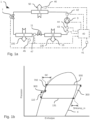
- the refrigerant In operation, in heat pump mode, as shown in the figure 1b , the refrigerant is in the gas phase at low pressure before entering the compressor 3. By passing through the compressor 3, the refrigerant undergoes an increase in its pressure and passes to high pressure as shown by arrow 300. The refrigerant then passes through the condenser 5 and transfers enthalpy to the first heat transfer fluid 50 as shown by arrow 500. The refrigerant crosses its saturation curve X a first time and passes into a two-phase state. The refrigerant can also cross its saturation curve X a second time to pass into the liquid phase. The difference between the temperature of the refrigerant at the outlet of the condenser 5 and its saturation temperature at this pressure is called subcooling SC.
- the refrigerant then passes through the first expansion device 7 and undergoes a first pressure loss to pass to intermediate pressure, as shown by arrow 700.
- the refrigerant again crosses its saturation curve X and passes into a two-phase state.
- the refrigerant then passes through the evaporator 9 in which the refrigerant transfers heat energy to the internal air flow 100, as shown by arrow 900.
- the refrigerant crosses its saturation curve X and then returns to the liquid phase.
- the refrigerant then passes through the second expansion device 7 and undergoes a second pressure loss to pass to low pressure, as shown by arrow 110.
- the refrigerant rejoins its saturation curve X and passes into a two-phase state.
- the refrigerant then passes through the evaporator-condenser 13 in which the refrigerant recovers heat energy from the second heat transfer fluid 130, as shown by arrow 131.
- the refrigerant passes through its saturation curve X and then returns to the gas phase.
- the reversible air conditioning circuit 1 may also comprise an internal heat exchanger 20 capable of allowing the exchange of heat energy between the refrigerant fluid at the outlet of the dual-fluid heat exchanger 5 and the refrigerant fluid at the outlet of the evaporator-condenser 13.
- This internal heat exchanger 20 comprises in particular an inlet and an outlet for refrigerant fluid coming from the dual-fluid heat exchanger 5, as well as an inlet and an outlet for refrigerant fluid coming from the evaporator-condenser 13.
- the steps are similar to those of Figures 1a and 1b , with the difference that the internal heat exchanger 20 absorbs enthalpy from the refrigerant fluid leaving the two-fluid heat exchanger and transfers it to the refrigerant fluid leaving the evaporator-condenser 13.
- the subcooling SC of the refrigerant fluid before it passes through the expansion device 7 and the superheating SHcomp_in of the refrigerant fluid before it enters the compressor 3 are both increased under the effect of the internal heat exchanger 20. This allows in particular an increase in the coefficient of performance of the air conditioning circuit 1.
- the air conditioning circuit 1 may for example be an indirect reversible air conditioning circuit 1 as illustrated in the figure 3 .
- This indirect reversible air conditioning circuit 1 can operate in different operating modes including a heat pump mode.
- the bypass line 30 can more specifically connect a first connection point 31 and a second connection point 32.
- the first connection point 31 is preferably arranged, in the direction of circulation of the refrigerant fluid, downstream of the evaporator 9, between said evaporator 9 and the evaporator-condenser 13. More particularly, and as illustrated in the figure 3 , the first connection point 31 is arranged between the evaporator 9 and the second expansion device 11. It is however entirely possible to imagine that the first connection point 31 is arranged between the second expansion device 11 and the evaporator-condenser 13 provided that the refrigerant fluid has the possibility of bypassing the second expansion device 11 or passing through it without suffering any loss of pressure.
- the second connection point 32 is preferably arranged downstream of the evapo-condenser 13, between said evapo-condenser 13 and the compressor 3.
- the first refrigerant loop A may comprise a dehydrating bottle 18 arranged downstream of the dual-fluid heat exchanger 5, more precisely between said dual-fluid heat exchanger 5 and the internal heat exchanger 20.
- a dehydrating bottle 18 arranged on the high-pressure side of the air conditioning circuit i.e. downstream of the compressor 3 and upstream of an expansion device, has a smaller footprint and a reduced cost compared to other phase separation solutions such as an accumulator which would be arranged on the low-pressure side of the air conditioning circuit, i.e. upstream of the compressor 3, in particular upstream of the internal heat exchanger 20.
- the first refrigerant loop A may comprise an accumulator arranged upstream of the compressor 3, more precisely between the second connection point 32 and said compressor 3 as a replacement for the dehydrating bottle 18.
- the indirect reversible air conditioning circuit 1 also includes a device for redirecting the refrigerant fluid from the evaporator 9 to the evaporator-condenser 13 or to the bypass pipe 30.
- Another alternative may also be to have a three-way valve at the first connection point 31.
- shut-off valve non-return valve, three-way valve or pressure reducing device with shut-off function are meant mechanical or electromechanical elements which can be controlled by the central control unit 40.
- the first refrigerant loop A may comprise, in addition to the internal heat exchanger 20, a second internal heat exchanger 20' allowing heat exchange between the high-pressure refrigerant at the outlet of the internal heat exchanger 20 and the low-pressure refrigerant circulating in the bypass line 30, i.e. coming from the first connection point 31.
- high-pressure refrigerant is meant a refrigerant that has undergone a pressure increase at the compressor 3 and that has not yet undergone a pressure loss due to the first expansion device 7.
- This second internal heat exchanger 20' comprises in particular a refrigerant inlet and outlet coming from the first connection point 31, as well as a high-pressure refrigerant inlet and outlet coming from the internal heat exchanger 20.
- At least one of the two internal heat exchangers 20, 20' may be a coaxial heat exchanger, that is to say comprising two coaxial tubes between which the heat exchanges take place.
- the internal heat exchanger 20 may be a coaxial internal heat exchanger with a length of between 50 and 120mm while the second internal heat exchanger 20' may be a coaxial internal heat exchanger with a length of between 200 and 700mm.
- the indirect reversible air conditioning circuit 1 comprises, within the second heat transfer fluid loop B, a device for redirecting the heat transfer fluid from the dual-fluid heat exchanger 5 to the first circulation pipe 70 and/or to the second circulation pipe 60.
- the device for redirecting the heat transfer fluid coming from the dual-fluid heat exchanger 5 may in particular comprise a fourth stop valve 63 arranged on the second circulation pipe 60 in order to block or not the first heat transfer fluid and prevent it from circulating in said second circulation pipe 60.
- the indirect reversible air conditioning circuit 1 may also include a flap 310 for obstructing the interior air flow 100 passing through the third heat exchanger 54.
- This embodiment makes it possible in particular to limit the number of valves on the second heat transfer fluid loop B and thus makes it possible to limit production costs.
- the device for redirecting the heat transfer fluid coming from the dual-fluid heat exchanger 5 may in particular comprise a fourth stop valve 63 arranged on the second circulation pipe 60 in order to block or not the heat transfer fluid and prevent it from circulating in said second circulation pipe 60, and a fifth stop valve arranged on the first circulation pipe 70 in order to block or not the heat transfer fluid and prevent it from circulating in said first circulation pipe 70.
- the second heat transfer fluid loop B may also comprise an electric heating element 55 for heating the heat transfer fluid.
- Said electric heating element 55 is in particular arranged, in the direction of circulation of the heat transfer fluid, downstream of the dual-fluid heat exchanger 5, between said dual-fluid heat exchanger 5 and the first junction point 61.
- the refrigerant does not pass through the bypass line 30 because the first shutoff valve 22 is closed.
- the refrigerant thus passes successively through the compressor 3, the condenser 5, the first expansion device 7, the evaporator 9, the second expansion device 11 and the evaporator-condenser 13.
- the refrigerant fluid passes successively through a compressor 3, a condenser 5, a first expansion device 7, an evaporator 9, a second expansion device 11 and an evapo-condenser 13.
- X2 corresponds to a value of ( Pcomp_out - Pevap_out ) determined experimentally for which the first expansion device 7 is at its minimum opening Cestim_min.
- Cestim_max and Cestim_min correspond to extreme opening values of the first expansion device 7 established experimentally for given operating parameters, such as Text and the compressor speed 3.
- Tsat ( Pcomp_in ) corresponds to the saturation temperature of the refrigerant fluid at its pressure Pcomp_in at the inlet of compressor 3.
- Tcomp_in_max_estim corresponds to the estimated maximum temperature of the refrigerant fluid at the inlet of compressor 3.
- Tcomp_in corresponds to the measured temperature of the refrigerant fluid at the inlet of compressor 3 and Tcomp_in_estim to the estimated temperature of the refrigerant fluid at the inlet of compressor 3.
- Tcomp_out_max corresponds to the maximum temperature of the refrigerant fluid at the outlet of compressor 3.
- Tcomp_out_max can be 130 °C. Beyond this temperature Tcomp_out_max compressor 3 risks being damaged and it can go into safety mode, i.e. stop working.
- Pcomp_out corresponds to the pressure of the refrigerant fluid at the outlet of compressor 3 and Pcomp_in to the pressure of the refrigerant fluid at the inlet of compressor 3.
- K corresponds to a cooling coefficient of the refrigerant determined experimentally and variable according to the refrigerant. For a refrigerant such as R134a, this cooling coefficient is 1.15.
- SHcomp_in_sp_min can be between 3 and 10 °K and SHcomp_in_sp_max between 8 and 15 °K.
- SHcomp_in_sp_min and SHcomp_in_sp_max are variable depending on the nature of the refrigerant fluid and the architecture of the air conditioning circuit 1.
- the control unit 10 In the second step of controlling the superheat Shcomp_in, if SHcomp_in is less than SHcomp_in_sp_min then the control unit 10 will decrease the opening of the expansion device 7 in order to increase the superheat SHcomp_in. If SHcomp_in is greater than SHcomp_in_sp_max then the control unit 10 will increase the opening of the expansion device 7 in order to reduce the superheat SHcomp_in.
- the increase or decrease in the opening of the expansion device 7 is preferably carried out by a proportional integral controller.
- SHcomp_in is between SHcomp_in_sp_min and SHcomp_in_sp_max, the increase or decrease in the opening of the expansion device 7 is preferably carried out by a proportional controller.
- the dotted lines show the evolution of the temperature of the interior air flow 100 at the outlet of the internal radiator 54 (curve 101b) and the opening of the expansion device 7 (curve 102b) after start-up for an air conditioning circuit using a management method according to the invention.
- the chosen refrigerant is R1234yf and the Text temperature is -18 °C. These results are nevertheless also valid for a refrigerant such as R134a.
- the management method according to the invention allows during the ramp-up of the compressor 3 a faster closing of the expansion device 7 which reaches an opening of 130 pulses after 8 min whereas according to the prior art, the expansion device only reaches this opening after 25 min.
- the overheating Shcomp_in at 20 min according to the prior art is 0 °K whereas thanks to the management method according to the invention, Shcomp_in is of the order of 4 °K (plus or minus 2 °K).
- the temperature of the internal air flow 100 at the outlet of the internal radiator 54 is of the order of 22 °C whereas with the management method according to the invention it is of the order of 27 °C or approximately an increase of 12% of the heating power.
- the management method may also include a step of protecting the evaporator 9 against overpressure of the refrigerant fluid in order to avoid damaging said evaporator 9.
- P corresponds to a limit operating pressure value of the evaporator 9.
- the central control unit 40 compares Cestim(t), which is the Cestim opening at a time t, with Cestim(t-1), which is the Cestim opening at time t-1. If Cestim(t) is greater than Cestim(t-1), in a first step, the central control unit 40 stops the superheat control SHcomp_in and maintains the opening of the first expansion device 7 at the value Cestim(t-1). In a second step, the central control unit 40 decreases Cestim so that Pevap_out is less than P.
- K1 being an integral type gain calculated according to ⁇ C / ⁇ Pevapo_out with ⁇ C being the variation of the opening of the expansion device 7 and ⁇ Pevapo_out the variation of Pevapo_out measured during experiments where the opening of the expansion device 7 is varied.
- the management method may include a step of protecting the compressor 3 against overpressure of the refrigerant fluid in order to avoid damaging said evaporator 9.
- Pcomp_in a pressure value between 0.01 and 0.2 bar.
- the central control unit 40 compares Cestim(t), which is the Cestim opening at a time t, with Cestim(t-1), which is the Cestim opening at time t-1. If Cestim(t) is greater than Cestim(t-1), in a first step, the central control unit 40 stops the control of the superheat SHcomp_in and maintains the opening of the first expansion device 7 at the value Cestim(t-1). In a second step, the central control unit 40 decreases Cestim so that Pcomp_in is less than P3.
- K2 being an integral type gain calculated according to ⁇ C / ⁇ Pcomp _ in with ⁇ C being the variation of the opening of the expansion device 7 and ⁇ Pcomp_in the variation of Pcomp_in measured during experiments where the opening of the expansion device 7 is varied.
- the management method according to the invention allows good management and good control of the opening of the expansion device 7 allowing increased heating power in heat pump mode.
Landscapes
- Engineering & Computer Science (AREA)
- Physics & Mathematics (AREA)
- Mechanical Engineering (AREA)
- Thermal Sciences (AREA)
- General Engineering & Computer Science (AREA)
- Air-Conditioning For Vehicles (AREA)
Claims (6)
- Verfahren zur Verwaltung eines indirekten reversiblen Klimaanlagenkreislaufs (1), in dem ein Kältemittel zirkuliert, wobei der reversible Klimaanlagenkreislauf (1) geeignet ist, in einem Wärmepumpenmodus betrieben zu werden, in dem das Kältemittel nacheinander fließt in:∘ einen Kompressor (3),∘ einen Kondensator (5), der dazu bestimmt ist, Wärmeenergie des Kältemittels in ein erstes Wärmeträgerfluid (50) abzugeben,∘ eine erste Entspannungsvorrichtung (7), in der das Kältemittel einen ersten Druckverlust erfährt,∘ einen Verdampfer (9), der dazu bestimmt ist, ebenfalls Wärmeenergie des Kältemittels in einen Innenluftstrom (100) des Kraftfahrzeugs abzugeben,∘ eine zweite Entspannungsvorrichtung (11), in der das Kältemittel einen zweiten Druckverlust erfährt, und∘ einen Verdampfer-Kondensator (13), der dazu bestimmt ist, Wärmeenergie eines zweiten Wärmeträgerfluids (130) zurückzugewinnen und sie an das Kältemittel zu übertragen,wobei der Klimaanlagenkreislauf (1) eine zentrale Regelungseinheit (40) umfasst, die geeignet ist, die Öffnung der ersten Entspannungsvorrichtung (7) zu regeln, wobei das Verfahren zur Verwaltung umfasst:- einen Schritt des Bestimmens:∘ der Öffnung Cestim der ersten Entspannungsvorrichtung (7) in Abhängigkeit von der Differenz zwischen dem Druck Pcomp_out des Kältemittels am Austritt des Kompressors (3) und dem Druck Pevap_out des Kältemittels am Austritt des Verdampfers (9), je nach der Temperatur Text des zweiten Wärmeträgerfluids (130) vor seinem Durchströmen des Verdampfer-Kondensators (13) und der Drehzahl des Kompressors (3),∘ einer Soll-Überhitzung SHcomp_in_sp in Abhängigkeit von der Temperatur Text des zweiten Wärmeträgerfluids (130) vor seinem Durchströmen des Verdampfer-Kondensators (13), wobei SHcomp_in_sp zwischen einer minimalen Überhitzung SHcomp_in_sp_min und einer maximalen Überhitzung Shcomp_in_sp_max liegt, und• einen Schritt des Öffnens der Entspannungsvorrichtung (7) je nach Cestim und des Regelns der Überhitzung SHcomp_in, indem die Öffnung der Entspannungsvorrichtung (7) so geändert wird, dass die Soll-Überhitzung SHcomp_in_sp erreicht wird und SHcomp_in zwischen SHcomp_in_sp_min und Shcomp_in_sp_max gehalten wird,wobei bei dem Verfahren SHcomp_in nach der folgenden Formel berechnet wird:
 • wenn Pcomp_out - Pevap_out kleiner als ein Wert X1 ist, Cestim in der Größenordnung ihrer geschätzten maximalen Öffnung Cestim_max der ersten Entspannungsvorrichtung (7) liegt,• wenn Pcomp_out - Pevap_out größer als X1 und kleiner als ein Wert X2 ist, Cestim zu ihrer geschätzten maximalen Öffnung hin Cestim_min abnimmt, je mehr Pcomp_out - Pevap_out zunimmt,• wenn Pcomp_out - Pevap_out größer als X2 ist, Cestim zunimmt, je mehr Pcomp_out - Pevap_out zunimmt,wobei X1 ein experimentell bestimmter Wert von Pcomp_out - Pevap_out ist, unter dem sich Raureif auf dem Verdampfer-Kondensator (13) bildet,wobei X2 ein experimentell bestimmter Wert von Pcomp_out - Pevap_out ist, bei dem die erste Entspannungsvorrichtung (7) bei ihrer minimalen Öffnung Cestim_min ist,Verfahren, bei dem die Bestimmung der Soll-Überhitzung SHcomp_in_sp dergestalt ist, dass:
 Tcomp_in_max_estim die geschätzte maximale Temperatur des Kältemittels am Eintritt des Kompressors (3) ist:
Tcomp_in_max_estim = K3 * (273,15 + Tcomp_out_max) / [(Pcomp_out / Pcomp_in) ^ (K - 1) / K)]  wobei Tcomp_in die gemessene Temperatur des Kältemittels am Eintritt des Kompressors (3) ist und Tcomp_in_estim die geschätzte Temperatur des Kältemittels am Eintritt des Kompressors (3) ist,Tcomp_out_max die maximale Temperatur des Kältemittels am Austritt des Kompressors (3) ist,Pcomp_out der Druck des Kältemittels am Austritt des Kompressors (3) ist,Pcomp_in der Druck des Kältemittels am Eintritt des Kompressors (3) ist undK der experimentell bestimmte und je nach Kältemittel variable Kühlkoeffizient des Kältemittels ist, Verfahren, bei dem, bei dem Schritt des Regelns der Überhitzung SHcomp_in:∘ wenn SHcomp_in kleiner als SHcomp_in_sp_min oder größer als Shcomp_in_sp_max ist, das Vergrößern oder Verkleinern der Öffnung der Entspannungsvorrichtung (7) von einem Proportional-Integral-Regler ausgeführt wird,∘ wenn SHcomp_in zwischen SHcomp_in_sp_min und Shcomp_in_sp_max liegt, das Vergrößern oder Verkleinern der Öffnung der Entspannungsvorrichtung (7) von einem Proportionalregler ausgeführt wird.
 - Verfahren zur Verwaltung eines Klimaanlagenkreislaufs (1) nach dem vorhergehenden Anspruch, dadurch gekennzeichnet, dass SHcomp_in_sp_min zwischen 3 und 10 °K liegt und SHcomp_in_sp_max zwischen 8 und 15 °K liegt.
- Verfahren zur Verwaltung eines Klimaanlagenkreislaufs (1) nach einem der vorhergehenden Ansprüche, dadurch gekennzeichnet, dass es einen Schritt des Schützens des Verdampfers (9) vor dem Überdruck des Kältemittels umfasst:∘ wenn Pevap_out zwischen P1 und P liegt, setzt die zentrale Regelungseinheit (40) die Regelung von Cestim fort, wobei P ein Grenzbetriebsdruckwert des Verdampfers (9) ist und P1 = P - µ1, wobei µ1 ein Druckwert ist, der zwischen 0,1 und 1 bar liegt,∘ wenn Pevap_out größer als P ist, vergleicht die zentrale Regelungseinheit (40) Cestim(t), die die Öffnung Cestim zu einem Zeitpunkt t ist, mit Cestim(t-1), die die Öffnung Cestim zum Zeitpunkt t-1 ist, wenn Cestim(t) größer als Cestim(t-1) ist, stoppt die zentrale Regelungseinheit (40) zunächst die Regelung der Überhitzung SHcomp_in und hält die Öffnung der ersten Entspannungsvorrichtung (7) auf dem Wert Cestim(t-1), verringert die zentrale Regelungseinheit (40) anschließend Cestim so, dass Pevap_out geringer als P ist.
- Verfahren zur Verwaltung eines Klimaanlagenkreislaufs (1) nach dem vorhergehenden Anspruch, dadurch gekennzeichnet, dass die Berechnung von Cestim(t) beim Verringern von Cestim, so dass Pevap_out geringer als P ist, nach der folgenden Formel ausgeführt wird:

- Verfahren zur Verwaltung eines Klimaanlagenkreislaufs (1) nach einem der vorhergehenden Ansprüche, dadurch gekennzeichnet, dass es einen Schritt des Schützens des Kompressors (3) vor dem Überdruck des Kältemittels umfasst:∘ wenn Pcomp_in zwischen P2 und P3 liegt, setzt die zentrale Regelungseinheit (40) die Regelung von Cestim fort, wobei P3 ein Grenzbetriebsdruckwert des Kompressors (3) ist und P2 = P - µ2, wobei µ2 ein Druckwert ist, der zwischen 0,01 und 0,2 bar liegt,∘ wenn Pcomp_in größer als P3 ist, vergleicht die zentrale Regelungseinheit (40) Cestim(t), die die Öffnung Cestim zu einem Zeitpunkt t ist, mit Cestim(t-1), die die Öffnung Cestim zum Zeitpunkt t-1 ist, wenn Cestim(t) größer als Cestim(t-1) ist, stoppt die zentrale Regelungseinheit (40) zunächst die Regelung der Überhitzung SHcomp_in und hält die Öffnung der ersten Entspannungsvorrichtung (7) auf dem Wert Cestim(t-1), verringert die zentrale Regelungseinheit (40) anschließend Cestim so, dass Pcomp_in geringer als P3 ist.
- Verfahren zur Verwaltung eines Klimaanlagenkreislaufs (1) nach dem vorhergehenden Anspruch, dadurch gekennzeichnet, dass die Berechnung von Cestim(t) bei der Verringerung von Cestim, so dass Pcomp_in geringer als P3 ist, nach der folgenden Formel ausgeführt wird:

Applications Claiming Priority (2)
| Application Number | Priority Date | Filing Date | Title |
|---|---|---|---|
| FR1757225A FR3069625B1 (fr) | 2017-07-28 | 2017-07-28 | Procede de gestion d’un circuit de climatisation inversible de vehicule automobile |
| PCT/FR2018/051923 WO2019020953A1 (fr) | 2017-07-28 | 2018-07-26 | Procede de gestion d'un circuit de climatisation inversible de vehicule automobile |
Publications (2)
| Publication Number | Publication Date |
|---|---|
| EP3658833A1 EP3658833A1 (de) | 2020-06-03 |
| EP3658833B1 true EP3658833B1 (de) | 2024-08-28 |
Family
ID=59811649
Family Applications (1)
| Application Number | Title | Priority Date | Filing Date |
|---|---|---|---|
| EP18755871.3A Active EP3658833B1 (de) | 2017-07-28 | 2018-07-26 | Verfahren zur verwaltung einer inversiblen klimaanlage für ein kraftfahrzeug |
Country Status (4)
| Country | Link |
|---|---|
| EP (1) | EP3658833B1 (de) |
| CN (1) | CN111051798B (de) |
| FR (1) | FR3069625B1 (de) |
| WO (1) | WO2019020953A1 (de) |
Family Cites Families (9)
| Publication number | Priority date | Publication date | Assignee | Title |
|---|---|---|---|---|
| JPH10281572A (ja) * | 1997-04-01 | 1998-10-23 | Denso Corp | 2次冷媒式冷凍機 |
| FR2913102B1 (fr) * | 2007-02-28 | 2012-11-16 | Valeo Systemes Thermiques | Installation de climatisation equipee d'une vanne de detente electrique |
| FR2928445B1 (fr) * | 2008-03-06 | 2014-01-03 | Valeo Systemes Thermiques Branche Thermique Habitacle | Methode de commande d'un organe de detente que comprend une boucle de climatisation d'une installation de ventilation, de chauffage et/ou de climatisation d'un vehicule |
| CN103033004B (zh) * | 2011-09-29 | 2016-03-30 | 杭州三花研究院有限公司 | 一种汽车空调系统电子膨胀阀的控制方法 |
| JP5799924B2 (ja) * | 2012-09-25 | 2015-10-28 | 株式会社デンソー | 冷凍サイクル装置 |
| JP6223753B2 (ja) * | 2013-09-04 | 2017-11-01 | サンデンホールディングス株式会社 | 車両用空気調和装置 |
| US20150059373A1 (en) * | 2013-09-05 | 2015-03-05 | Beckett Performance Products, Llc | Superheat and sub-cooling control of refrigeration system |
| US9874384B2 (en) * | 2016-01-13 | 2018-01-23 | Bergstrom, Inc. | Refrigeration system with superheating, sub-cooling and refrigerant charge level control |
| CN106904058B (zh) * | 2017-03-10 | 2019-12-31 | 安徽江淮汽车集团股份有限公司 | 热泵空调系统中电子膨胀阀控制方法及装置 |
-
2017
- 2017-07-28 FR FR1757225A patent/FR3069625B1/fr active Active
-
2018
- 2018-07-26 EP EP18755871.3A patent/EP3658833B1/de active Active
- 2018-07-26 WO PCT/FR2018/051923 patent/WO2019020953A1/fr not_active Ceased
- 2018-07-26 CN CN201880058638.7A patent/CN111051798B/zh active Active
Also Published As
| Publication number | Publication date |
|---|---|
| FR3069625B1 (fr) | 2019-12-27 |
| CN111051798A (zh) | 2020-04-21 |
| WO2019020953A1 (fr) | 2019-01-31 |
| EP3658833A1 (de) | 2020-06-03 |
| FR3069625A1 (fr) | 2019-02-01 |
| CN111051798B (zh) | 2021-12-17 |
Similar Documents
| Publication | Publication Date | Title |
|---|---|---|
| EP2933586B1 (de) | Eine Vorrichtung zur thermischen Konditionierung eines Raumes | |
| FR3070316B1 (fr) | Circuit de climatisation inversible indirect de vehicule automobile et procede de gestion associe | |
| EP3496964B1 (de) | Indirekter reversibler klimaanlagenkreislauf für ein kraftfahrzeug und zugehöriges betriebsverfahren | |
| WO2017212158A1 (fr) | Circuit de climatisation de véhicule automobile | |
| WO2020165511A1 (fr) | Dispositif de gestion thermique de vehicule automobile electrique ou hybride | |
| WO2018185415A1 (fr) | Circuit de climatisation inversible indirect de vehicule automobile et procede de gestion en mode degivrage | |
| WO2018185412A1 (fr) | Circuit de climatisation inversible indirect de vehicule automobile et procede de fonctionnement correspondant | |
| EP3914866B1 (de) | Klimaanlage eines kraftfahrzeugs und zugehöriges verwaltungsverfahren | |
| FR3122486A1 (fr) | Procédé de contrôle d’un dispositif de gestion thermique | |
| WO2018211200A1 (fr) | Circuit de climatisation inversible indirect de vehicule automobile et procede de de gestion en mode pompe a chaleur | |
| WO2021116564A1 (fr) | Dispositif de gestion thermique inversible | |
| EP3507114B1 (de) | Indirekter reversibler klimatisierungskreislauf für ein kraftfahrzeug und zugehöriges betriebsverfahren | |
| EP3658833B1 (de) | Verfahren zur verwaltung einer inversiblen klimaanlage für ein kraftfahrzeug | |
| EP3658832B1 (de) | Verfahren zur verwaltung einer klimaanlage für ein fahrzeug | |
| EP3630512B1 (de) | Verfahren zur verwaltung eines reversiblen klimaanlagenkreislaufs eines kraftfahrzeugs | |
| FR3058783A1 (fr) | Circuit de climatisation inversible indirect de vehicule automobile et procede de fonctionnement correspondant | |
| WO2018211199A1 (fr) | Circuit de climatisation inversible indirect de vehicule automobile et procede de gestion en mode de pompe a chaleur | |
| WO2020234057A1 (fr) | Dispositif de gestion thermique avec vanne de régulation de pression d'évaporation | |
| FR3092162A1 (fr) | Circuit de climatisation de véhicule automobile et procédé de gestion associé | |
| WO2019025705A1 (fr) | Procédé de gestion d'un circuit de climatisation inversible indirect de véhicule automobile | |
| FR3064944A1 (fr) | Circuit de climatisation inversible indirect de vehicule automobile et procede de fonctionnement correspondant | |
| FR3067796A1 (fr) | Circuit de chauffage a pompe a chaleur de vehicule automobile et procede de gestion associe | |
| WO2020165526A1 (fr) | Dispositif de gestion thermique d'un vehicule automobile avec vanne a pression constante | |
| WO2019020954A1 (fr) | Procede de gestion d'un circuit de climatisation inversible indirect de vehicule automobile | |
| FR3092654A1 (fr) | Dispositif de gestion thermique d’un véhicule automobile avec vanne à pression constante |
Legal Events
| Date | Code | Title | Description |
|---|---|---|---|
| STAA | Information on the status of an ep patent application or granted ep patent |
Free format text: STATUS: UNKNOWN |
|
| STAA | Information on the status of an ep patent application or granted ep patent |
Free format text: STATUS: THE INTERNATIONAL PUBLICATION HAS BEEN MADE |
|
| PUAI | Public reference made under article 153(3) epc to a published international application that has entered the european phase |
Free format text: ORIGINAL CODE: 0009012 |
|
| STAA | Information on the status of an ep patent application or granted ep patent |
Free format text: STATUS: REQUEST FOR EXAMINATION WAS MADE |
|
| 17P | Request for examination filed |
Effective date: 20200214 |
|
| AK | Designated contracting states |
Kind code of ref document: A1 Designated state(s): AL AT BE BG CH CY CZ DE DK EE ES FI FR GB GR HR HU IE IS IT LI LT LU LV MC MK MT NL NO PL PT RO RS SE SI SK SM TR |
|
| AX | Request for extension of the european patent |
Extension state: BA ME |
|
| DAV | Request for validation of the european patent (deleted) | ||
| DAX | Request for extension of the european patent (deleted) | ||
| STAA | Information on the status of an ep patent application or granted ep patent |
Free format text: STATUS: EXAMINATION IS IN PROGRESS |
|
| 17Q | First examination report despatched |
Effective date: 20201111 |
|
| P01 | Opt-out of the competence of the unified patent court (upc) registered |
Effective date: 20230528 |
|
| GRAP | Despatch of communication of intention to grant a patent |
Free format text: ORIGINAL CODE: EPIDOSNIGR1 |
|
| STAA | Information on the status of an ep patent application or granted ep patent |
Free format text: STATUS: GRANT OF PATENT IS INTENDED |
|
| RAP3 | Party data changed (applicant data changed or rights of an application transferred) |
Owner name: VALEO SYSTEMES THERMIQUES |
|
| INTG | Intention to grant announced |
Effective date: 20240403 |
|
| GRAS | Grant fee paid |
Free format text: ORIGINAL CODE: EPIDOSNIGR3 |
|
| GRAA | (expected) grant |
Free format text: ORIGINAL CODE: 0009210 |
|
| STAA | Information on the status of an ep patent application or granted ep patent |
Free format text: STATUS: THE PATENT HAS BEEN GRANTED |
|
| AK | Designated contracting states |
Kind code of ref document: B1 Designated state(s): AL AT BE BG CH CY CZ DE DK EE ES FI FR GB GR HR HU IE IS IT LI LT LU LV MC MK MT NL NO PL PT RO RS SE SI SK SM TR |
|
| REG | Reference to a national code |
Ref country code: GB Ref legal event code: FG4D Free format text: NOT ENGLISH |
|
| REG | Reference to a national code |
Ref country code: CH Ref legal event code: EP |
|
| REG | Reference to a national code |
Ref country code: DE Ref legal event code: R096 Ref document number: 602018073636 Country of ref document: DE |
|
| REG | Reference to a national code |
Ref country code: IE Ref legal event code: FG4D Free format text: LANGUAGE OF EP DOCUMENT: FRENCH |
|
| REG | Reference to a national code |
Ref country code: LT Ref legal event code: MG9D |
|
| PG25 | Lapsed in a contracting state [announced via postgrant information from national office to epo] |
Ref country code: NO Free format text: LAPSE BECAUSE OF FAILURE TO SUBMIT A TRANSLATION OF THE DESCRIPTION OR TO PAY THE FEE WITHIN THE PRESCRIBED TIME-LIMIT Effective date: 20241128 |
|
| REG | Reference to a national code |
Ref country code: AT Ref legal event code: MK05 Ref document number: 1718339 Country of ref document: AT Kind code of ref document: T Effective date: 20240828 |
|
| PG25 | Lapsed in a contracting state [announced via postgrant information from national office to epo] |
Ref country code: PT Free format text: LAPSE BECAUSE OF FAILURE TO SUBMIT A TRANSLATION OF THE DESCRIPTION OR TO PAY THE FEE WITHIN THE PRESCRIBED TIME-LIMIT Effective date: 20241230 Ref country code: NL Free format text: LAPSE BECAUSE OF FAILURE TO SUBMIT A TRANSLATION OF THE DESCRIPTION OR TO PAY THE FEE WITHIN THE PRESCRIBED TIME-LIMIT Effective date: 20240828 Ref country code: PL Free format text: LAPSE BECAUSE OF FAILURE TO SUBMIT A TRANSLATION OF THE DESCRIPTION OR TO PAY THE FEE WITHIN THE PRESCRIBED TIME-LIMIT Effective date: 20240828 Ref country code: GR Free format text: LAPSE BECAUSE OF FAILURE TO SUBMIT A TRANSLATION OF THE DESCRIPTION OR TO PAY THE FEE WITHIN THE PRESCRIBED TIME-LIMIT Effective date: 20241129 Ref country code: FI Free format text: LAPSE BECAUSE OF FAILURE TO SUBMIT A TRANSLATION OF THE DESCRIPTION OR TO PAY THE FEE WITHIN THE PRESCRIBED TIME-LIMIT Effective date: 20240828 |
|
| PG25 | Lapsed in a contracting state [announced via postgrant information from national office to epo] |
Ref country code: BG Free format text: LAPSE BECAUSE OF FAILURE TO SUBMIT A TRANSLATION OF THE DESCRIPTION OR TO PAY THE FEE WITHIN THE PRESCRIBED TIME-LIMIT Effective date: 20240828 |
|
| PG25 | Lapsed in a contracting state [announced via postgrant information from national office to epo] |
Ref country code: LV Free format text: LAPSE BECAUSE OF FAILURE TO SUBMIT A TRANSLATION OF THE DESCRIPTION OR TO PAY THE FEE WITHIN THE PRESCRIBED TIME-LIMIT Effective date: 20240828 |
|
| REG | Reference to a national code |
Ref country code: NL Ref legal event code: MP Effective date: 20240828 |
|
| PG25 | Lapsed in a contracting state [announced via postgrant information from national office to epo] |
Ref country code: IS Free format text: LAPSE BECAUSE OF FAILURE TO SUBMIT A TRANSLATION OF THE DESCRIPTION OR TO PAY THE FEE WITHIN THE PRESCRIBED TIME-LIMIT Effective date: 20241228 Ref country code: AT Free format text: LAPSE BECAUSE OF FAILURE TO SUBMIT A TRANSLATION OF THE DESCRIPTION OR TO PAY THE FEE WITHIN THE PRESCRIBED TIME-LIMIT Effective date: 20240828 |
|
| PG25 | Lapsed in a contracting state [announced via postgrant information from national office to epo] |
Ref country code: HR Free format text: LAPSE BECAUSE OF FAILURE TO SUBMIT A TRANSLATION OF THE DESCRIPTION OR TO PAY THE FEE WITHIN THE PRESCRIBED TIME-LIMIT Effective date: 20240828 |
|
| PG25 | Lapsed in a contracting state [announced via postgrant information from national office to epo] |
Ref country code: RS Free format text: LAPSE BECAUSE OF FAILURE TO SUBMIT A TRANSLATION OF THE DESCRIPTION OR TO PAY THE FEE WITHIN THE PRESCRIBED TIME-LIMIT Effective date: 20241128 Ref country code: ES Free format text: LAPSE BECAUSE OF FAILURE TO SUBMIT A TRANSLATION OF THE DESCRIPTION OR TO PAY THE FEE WITHIN THE PRESCRIBED TIME-LIMIT Effective date: 20240828 |
|
| PG25 | Lapsed in a contracting state [announced via postgrant information from national office to epo] |
Ref country code: RS Free format text: LAPSE BECAUSE OF FAILURE TO SUBMIT A TRANSLATION OF THE DESCRIPTION OR TO PAY THE FEE WITHIN THE PRESCRIBED TIME-LIMIT Effective date: 20241128 Ref country code: PT Free format text: LAPSE BECAUSE OF FAILURE TO SUBMIT A TRANSLATION OF THE DESCRIPTION OR TO PAY THE FEE WITHIN THE PRESCRIBED TIME-LIMIT Effective date: 20241230 Ref country code: PL Free format text: LAPSE BECAUSE OF FAILURE TO SUBMIT A TRANSLATION OF THE DESCRIPTION OR TO PAY THE FEE WITHIN THE PRESCRIBED TIME-LIMIT Effective date: 20240828 Ref country code: NO Free format text: LAPSE BECAUSE OF FAILURE TO SUBMIT A TRANSLATION OF THE DESCRIPTION OR TO PAY THE FEE WITHIN THE PRESCRIBED TIME-LIMIT Effective date: 20241128 Ref country code: NL Free format text: LAPSE BECAUSE OF FAILURE TO SUBMIT A TRANSLATION OF THE DESCRIPTION OR TO PAY THE FEE WITHIN THE PRESCRIBED TIME-LIMIT Effective date: 20240828 Ref country code: LV Free format text: LAPSE BECAUSE OF FAILURE TO SUBMIT A TRANSLATION OF THE DESCRIPTION OR TO PAY THE FEE WITHIN THE PRESCRIBED TIME-LIMIT Effective date: 20240828 Ref country code: IS Free format text: LAPSE BECAUSE OF FAILURE TO SUBMIT A TRANSLATION OF THE DESCRIPTION OR TO PAY THE FEE WITHIN THE PRESCRIBED TIME-LIMIT Effective date: 20241228 Ref country code: HR Free format text: LAPSE BECAUSE OF FAILURE TO SUBMIT A TRANSLATION OF THE DESCRIPTION OR TO PAY THE FEE WITHIN THE PRESCRIBED TIME-LIMIT Effective date: 20240828 Ref country code: GR Free format text: LAPSE BECAUSE OF FAILURE TO SUBMIT A TRANSLATION OF THE DESCRIPTION OR TO PAY THE FEE WITHIN THE PRESCRIBED TIME-LIMIT Effective date: 20241129 Ref country code: FI Free format text: LAPSE BECAUSE OF FAILURE TO SUBMIT A TRANSLATION OF THE DESCRIPTION OR TO PAY THE FEE WITHIN THE PRESCRIBED TIME-LIMIT Effective date: 20240828 Ref country code: ES Free format text: LAPSE BECAUSE OF FAILURE TO SUBMIT A TRANSLATION OF THE DESCRIPTION OR TO PAY THE FEE WITHIN THE PRESCRIBED TIME-LIMIT Effective date: 20240828 Ref country code: BG Free format text: LAPSE BECAUSE OF FAILURE TO SUBMIT A TRANSLATION OF THE DESCRIPTION OR TO PAY THE FEE WITHIN THE PRESCRIBED TIME-LIMIT Effective date: 20240828 Ref country code: AT Free format text: LAPSE BECAUSE OF FAILURE TO SUBMIT A TRANSLATION OF THE DESCRIPTION OR TO PAY THE FEE WITHIN THE PRESCRIBED TIME-LIMIT Effective date: 20240828 |
|
| PG25 | Lapsed in a contracting state [announced via postgrant information from national office to epo] |
Ref country code: RO Free format text: LAPSE BECAUSE OF FAILURE TO SUBMIT A TRANSLATION OF THE DESCRIPTION OR TO PAY THE FEE WITHIN THE PRESCRIBED TIME-LIMIT Effective date: 20240828 Ref country code: DK Free format text: LAPSE BECAUSE OF FAILURE TO SUBMIT A TRANSLATION OF THE DESCRIPTION OR TO PAY THE FEE WITHIN THE PRESCRIBED TIME-LIMIT Effective date: 20240828 Ref country code: SM Free format text: LAPSE BECAUSE OF FAILURE TO SUBMIT A TRANSLATION OF THE DESCRIPTION OR TO PAY THE FEE WITHIN THE PRESCRIBED TIME-LIMIT Effective date: 20240828 |
|
| PG25 | Lapsed in a contracting state [announced via postgrant information from national office to epo] |
Ref country code: EE Free format text: LAPSE BECAUSE OF FAILURE TO SUBMIT A TRANSLATION OF THE DESCRIPTION OR TO PAY THE FEE WITHIN THE PRESCRIBED TIME-LIMIT Effective date: 20240828 |
|
| PG25 | Lapsed in a contracting state [announced via postgrant information from national office to epo] |
Ref country code: CZ Free format text: LAPSE BECAUSE OF FAILURE TO SUBMIT A TRANSLATION OF THE DESCRIPTION OR TO PAY THE FEE WITHIN THE PRESCRIBED TIME-LIMIT Effective date: 20240828 |
|
| PG25 | Lapsed in a contracting state [announced via postgrant information from national office to epo] |
Ref country code: SK Free format text: LAPSE BECAUSE OF FAILURE TO SUBMIT A TRANSLATION OF THE DESCRIPTION OR TO PAY THE FEE WITHIN THE PRESCRIBED TIME-LIMIT Effective date: 20240828 Ref country code: IT Free format text: LAPSE BECAUSE OF FAILURE TO SUBMIT A TRANSLATION OF THE DESCRIPTION OR TO PAY THE FEE WITHIN THE PRESCRIBED TIME-LIMIT Effective date: 20240828 |
|
| REG | Reference to a national code |
Ref country code: DE Ref legal event code: R097 Ref document number: 602018073636 Country of ref document: DE |
|
| PLBE | No opposition filed within time limit |
Free format text: ORIGINAL CODE: 0009261 |
|
| STAA | Information on the status of an ep patent application or granted ep patent |
Free format text: STATUS: NO OPPOSITION FILED WITHIN TIME LIMIT |
|
| 26N | No opposition filed |
Effective date: 20250530 |
|
| PG25 | Lapsed in a contracting state [announced via postgrant information from national office to epo] |
Ref country code: SE Free format text: LAPSE BECAUSE OF FAILURE TO SUBMIT A TRANSLATION OF THE DESCRIPTION OR TO PAY THE FEE WITHIN THE PRESCRIBED TIME-LIMIT Effective date: 20240828 |
|
| PGFP | Annual fee paid to national office [announced via postgrant information from national office to epo] |
Ref country code: DE Payment date: 20250711 Year of fee payment: 8 |
|
| PGFP | Annual fee paid to national office [announced via postgrant information from national office to epo] |
Ref country code: FR Payment date: 20250730 Year of fee payment: 8 |
|
| REG | Reference to a national code |
Ref country code: CH Ref legal event code: H13 Free format text: ST27 STATUS EVENT CODE: U-0-0-H10-H13 (AS PROVIDED BY THE NATIONAL OFFICE) Effective date: 20260224 |
|
| PG25 | Lapsed in a contracting state [announced via postgrant information from national office to epo] |
Ref country code: LU Free format text: LAPSE BECAUSE OF NON-PAYMENT OF DUE FEES Effective date: 20250726 |
|
| GBPC | Gb: european patent ceased through non-payment of renewal fee |
Effective date: 20250726 |
|
| REG | Reference to a national code |
Ref country code: BE Ref legal event code: MM Effective date: 20250731 |
|
| PG25 | Lapsed in a contracting state [announced via postgrant information from national office to epo] |
Ref country code: GB Free format text: LAPSE BECAUSE OF NON-PAYMENT OF DUE FEES Effective date: 20250726 |
|
| PG25 | Lapsed in a contracting state [announced via postgrant information from national office to epo] |
Ref country code: BE Free format text: LAPSE BECAUSE OF NON-PAYMENT OF DUE FEES Effective date: 20250731 |
|
| PG25 | Lapsed in a contracting state [announced via postgrant information from national office to epo] |
Ref country code: CH Free format text: LAPSE BECAUSE OF NON-PAYMENT OF DUE FEES Effective date: 20250731 |