EP3660488A1 - Korrosionsbeständigkeitstestverfahren und korrosionsbeständigkeitstestvorrichtung für beschichtetes metallmaterial - Google Patents
Korrosionsbeständigkeitstestverfahren und korrosionsbeständigkeitstestvorrichtung für beschichtetes metallmaterial Download PDFInfo
- Publication number
- EP3660488A1 EP3660488A1 EP18841516.0A EP18841516A EP3660488A1 EP 3660488 A1 EP3660488 A1 EP 3660488A1 EP 18841516 A EP18841516 A EP 18841516A EP 3660488 A1 EP3660488 A1 EP 3660488A1
- Authority
- EP
- European Patent Office
- Prior art keywords
- corrosion resistance
- resistance test
- artificially damaged
- corrosion
- damaged portions
- Prior art date
- Legal status (The legal status is an assumption and is not a legal conclusion. Google has not performed a legal analysis and makes no representation as to the accuracy of the status listed.)
- Granted
Links
Images




Classifications
-
- G—PHYSICS
- G01—MEASURING; TESTING
- G01N—INVESTIGATING OR ANALYSING MATERIALS BY DETERMINING THEIR CHEMICAL OR PHYSICAL PROPERTIES
- G01N17/00—Investigating resistance of materials to the weather, to corrosion, or to light
- G01N17/02—Electrochemical measuring systems for weathering, corrosion or corrosion-protection measurement
-
- G—PHYSICS
- G01—MEASURING; TESTING
- G01N—INVESTIGATING OR ANALYSING MATERIALS BY DETERMINING THEIR CHEMICAL OR PHYSICAL PROPERTIES
- G01N17/00—Investigating resistance of materials to the weather, to corrosion, or to light
-
- G—PHYSICS
- G01—MEASURING; TESTING
- G01N—INVESTIGATING OR ANALYSING MATERIALS BY DETERMINING THEIR CHEMICAL OR PHYSICAL PROPERTIES
- G01N17/00—Investigating resistance of materials to the weather, to corrosion, or to light
- G01N17/006—Investigating resistance of materials to the weather, to corrosion, or to light of metals
Definitions
- the present invention relates to a method for a corrosion resistance test of and a corrosion resistance test apparatus for a coated metal material.
- the accelerated corrosion test such as a combined cycle test and a salt spray test has been performed.
- the accelerated corrosion test requires several months for evaluation. It is thus difficult to simply evaluate, for example, the film quality of the coating film to be coated on steel sheets made of different components or made under different baking conditions and to rapidly optimize coating conditions.
- the process control in coating factories, and the quality control relating to the rust prevention for vehicles it is desired to establish a quantitative evaluation method for rapidly and simply evaluating corrosion resistance of coated steel sheets.
- Patent Document 1 describes, as a technique for evaluating corrosion resistance of a coating applied to the surface of a metal member, a method in which a metal member having this coating and a counter electrode member are immersed in water or an electrolyte solution, the metal member is then electrically connected to a negative terminal side of a power supply for measurement, the counter electrode member is electrically connected to a positive terminal side of the power supply, and the anti-corrosive performance of the coating is evaluated on the basis of the oxygen diffusion-limited current flowing from the counter electrode member to the metal member through the coating.
- Patent Document 2 indicates that an electrode is disposed on a coating film surface side of a coated metal material via an electrolyte material, voltage is applied to between a base of the coated metal material and the surface of the coating film, and corrosion resistance of the coated metal material is evaluated on the basis of the current value at the time when electrical breakdown of the coating film occurs.
- Patent Document 3 indicates that an electrode is disposed on a coating film surface side of a coated metal material via an electrolyte material, an electrolyte material is permeated into the coating film on the coated metal material, a voltage is applied to between a base of the coated metal material and the surface of the coating film, and corrosion resistance of the coated metal material is evaluated on the basis of the value of the current flowing with application of the voltage.
- An object of the present invention is to provide a method and apparatus for the electrochemical corrosion resistance test.
- a corrosion model has been known in which metal corrosion proceeds through an anode reaction (oxidation) of generating free electrons by melting (ionizing) metal in contact with water and a cathode reaction (reduction) of generating a hydroxyl group OH - from dissolved oxygen in water by the free electrons occurred in parallel.
- an anode site and a cathode site are artificially formed in a coated metal material to accelerate corrosion.
- a method for a corrosion resistance test disclosed herein is for a coated metal material obtained by providing a metal base with a surface treatment film and includes:
- a corrosion resistance test apparatus for a coated metal material obtained by coating a metal base with a surface treatment film includes:
- one of the artificially damaged portions in the coated metal material is an anode site at which an elusion (oxidation) of metal in the metal base occurs.
- the other artificially damaged portion into which the electrons generated at the anode site flow through the metal base is a cathode site at which reduction occurs by the electrons.
- the eluted metal ions are attracted to an electrode (negative electrode) and react with dissolved oxygen in the aqueous electrolyte material or OH - generated by electrolysis of water at the electrode (negative electrode) to form iron hydroxide.
- electrode negative electrode
- electrons are supplied.
- corrosion of the coated metal material does not proceed, although metal in the metal base is ionized and a certain amount of ions are then dissolved in the aqueous electrolyte material.
- the generation of OH - at the cathode site corresponds to the cathode reaction in the corrosion model mentioned above.
- the corrosion resistance test can be said to be a reproduction of actual corrosion of the coated metal material in an accelerated manner by supplying current to the metal base through the external circuit.
- an underlayer treated surface (chemically converted surface) of the metal base is damaged by alkalization (generation of OH - .)
- adhesion of the surface treatment film is reduced (in the case of conducting no underlayer treatment, adhesion between the metal base and the surface treatment film is simply reduced), and the surface treatment film is expanded.
- hydrogen gas generated by electrolysis of water and reduction of H + accelerate the expansion of the surface treatment film. Accordingly, by examining the degree of the expansion of this surface treatment film, the corrosion progression rate of a sample in the corrosion resistance test can be determined.
- the aqueous electrolyte material any of various kinds of materials can be employed.
- the aqueous electrolyte material is a muddy material and is provided on faces of the surface treatment film at the artificially damaged portions.
- the aqueous electrolyte material if it is in a muddy state, can be provided on faces of the surface treatment film even when the surface treatment film is not flat.
- the aqueous electrolyte material can be formed into a muddy material by employing a clay mineral as an additive.
- a clay mineral a layered silicate mineral or zeolite can be employed, for example.
- the layered silicate mineral at least one selected from kaolinite, montmorillonite, sericite, illite, glauconite, chlorite, and talc can be preferably employed.
- As a supporting electrolyte (salt) at least one salt selected from sodium chloride, sodium sulfate, calcium chloride, calcium phosphate, potassium chloride, potassium nitrate, potassium hydrogen tartrate, and magnesium sulfate can be preferably employed.
- the aqueous electrolyte material may contain an organic solvent (acetone, ethanol, toluene, methanol, or the like).
- the content of the clay mineral in the aqueous electrolyte material is preferably from 1 mass% to 70 mass%.
- the content is preferably from 10 mass% to 50 mass% and more preferably from 20 mass% to 40 mass%.
- the content of the supporting electrolyte in the aqueous electrolyte material is preferably from 1 mass% to 20 mass%.
- the content is preferably from 3 mass% to 15 mass% and more preferably from 5 mass% to 10 mass%.
- the content of the organic solvent in the aqueous electrolyte material is preferably from 5% to 60% in terms of volume ratio with respect to water.
- the volume ratio is preferably from 10% to 40% and more preferably from 20% to 30%.
- electrodes at both ends of the external circuit can be buried in the aqueous electrolyte material.
- a carbon electrode, a platinum electrode, and the like can be used.
- perforated electrodes each having at least one through hole corresponding to the surface treatment film can be employed and are disposed preferably to be substantially parallel with the surface treatment film.
- each perforated electrode is formed in a ring shape having a through hole at the center thereof and is provided so that the through hole faces each artificially damaged portion.
- a mesh electrode may be employed as the perforated electrode.
- the mesh electrode may be disposed to be substantially parallel with the surface treatment film in a state in which the mesh electrode is buried in the aqueous electrolyte material.
- Each artificially damaged portion may be in any form such as a damaged portion, a puncture, or a scratch, as long as it penetrates the surface treatment film to a metal base.
- the exposed area of the metal base, formed by the artificially damaged portion is preferably from 0.005 mm 2 to 25 mm 2 , more preferably from 0.05 mm 2 to 4 mm 2 , and still more preferably from 0.13 mm 2 to 2.25 mm 2 .
- the distance between the two artificially damaged portions is preferably 2 cm or more and more preferably 3 cm or more in order to easily observe expansion of the surface treatment film at the cathode site.
- the current value is preferably from 10 ⁇ A to 10 mA, and more preferably from 100 ⁇ A to 5 mA or from 500 ⁇ A t ⁇ 2 mA.
- coated metal material suitable for applying to the corrosion resistance test examples include a coated metal material obtained by providing, as a surface treatment film, a resin coating, i.e., a coating film on a metal base.
- the metal base may be, for example, a steel material for forming an electric household appliance, a building material, or an automobile part, such as a steel plate cold commercial (SPCC), a galvanized alloy steel sheet (GA), a high-tensile strength steel sheet, or a hot stamping material, or may be a light alloy material.
- a chemical conversion coating (a phosphate coating (for example, a zinc phosphate coating), a chromate coating, or the like) may be formed on a surface of the metal base.
- the coating film includes, for example, an epoxy resin-based or acrylic resin-based cationic electrodeposition coating film (undercoat film) and may be a multilayered coating film obtained by overlaying a topcoat film on an electrodeposition coating film or by overlaying a surfacer film and a topcoat film on an electrodeposition coating film.
- undercoat film an epoxy resin-based or acrylic resin-based cationic electrodeposition coating film
- two artificially damaged portions spaced from each other in the coated metal material are electrically connected to each other by the external circuit via an aqueous electrolyte material, and current is supplied using one of the artificially damaged portions as an anode site and the other as a cathode site to proceed corrosion.
- the present corrosion resistance test can reproduce actual corrosion of the coated metal material in an accelerated manner and can evaluate corrosion resistance with high reliability.
- FIG. 1 illustrates a principle of a corrosion test.
- the reference numeral 1 denotes a coated metal material.
- a chemical conversion coating 3 is formed on a steel plate 2 serving as a metal base, and a resin coating film serving as a surface treatment film, i.e., an electrodeposition coating film 4 in the present embodiment is formed on the steel plate 2.
- Two artificially damaged portions 5 penetrating the electrodeposition coating film 4 and the chemical conversion coating 3 to the steel plate 2 are formed in the coated metal material 1 so as to be spaced from each other.
- the corrosion resistance test apparatus includes an external circuit 7 electrically connecting the two artificially damaged portions 5 in the coated metal material 1 via an aqueous electrolyte material 6 serving as a conductive material, and a direct constant current source 8 serving as a current supplier that supplies current to the steel plate 2 through the external circuit 7.
- cylindrical members 11 each having a larger diameter than each artificially damaged portion 5 are formed to be concentric with the respective artificially damaged portions 5.
- the aqueous electrolyte material 6 is placed in the cylindrical members 11 to be in contact with faces of the electrodeposition coating film 4 and enter the artificially damaged portions 5.
- Electrodes 12 are provided on both ends of the external circuit 7 and are buried in the aqueous electrolyte material 6 inside the cylindrical members 11.
- the aqueous electrolyte material 6 is a muddy material containing water, a clay mineral, and a supporting electrolyte.
- kaolinite which is a layered silicate mineral is employed as the clay mineral
- three kinds of supporting electrolyte i.e., sodium chloride, sodium sulfate, and calcium chloride, are employed as the supporting electrolyte.
- the content of the clay mineral is preferably from 1 mass% to 70 mass%
- the content of the supporting electrolyte is preferably from 1 mass% to 20 mass%.
- Each electrode 12 is a ring-shaped perforated electrode having a through hole 12a at the center thereof and is disposed to be parallel with the electrodeposition coating film 4 such that the through hole 12a faces each artificially damaged portion 5 and is concentric with the artificially damaged portion 5.
- galvanostat can be employed for example, and the current value thereof is controlled to be from 10 ⁇ A to 10 mA.
- a method for a corrosion resistance test of a coated metal material 1 using the corrosion resistance test apparatus is described in order of processes.
- Two artificially damaged portions 5 penetrating the surface treatment film (the electrodeposition coating film 4 and the chemical conversion coating 3) to the steel plate 2 are formed in the coated metal material 1 so as to be spaced from each other.
- the exposed area of the steel plate 2 by each artificially damaged portion 5 may be from 0.005 mm 2 to 25 mm 2 .
- the artificially damaged portions 5 are preferably formed by an indenter with a predetermined load using a Vickers hardness tester in order not to vary the size and depth of the artificially damaged portions 5, i.e., in order to form artificially damaged portions 5 quantitatively.
- the distance between the artificially damaged portions 5 is preferably 2 cm or more, more preferably 3 cm or more.
- the tip shape of the indenter is not limited to a quadrangular pyramid such as an indenter of the Vickers hardness tester to be described later, and various shapes having an appropriate diameter such as a spherical shape may be employed.
- Cylindrical members 11 surrounding the respective two artificially damaged portions 5 are placed on the electrodeposition coating film 4 of the coated metal material 1, and a predetermined amount of a muddy aqueous electrolyte material 6 is placed in the cylindrical members 11.
- ring-shaped perforated electrodes 12 in the external circuit 7 including a constant current source 8 are buried in the aqueous electrolyte material 6.
- the cylindrical members 11 are provided to be concentric with the respective artificially damaged portions 5.
- each perforated electrode 12 is provided to be parallel with the surface of the electrodeposition coating film 4 and to be concentric with each artificially damaged portion 5.
- the aqueous electrolyte material 6 contained in each cylindrical member 11 is in contact with the surface of the electrodeposition coating film 4 and enters each artificially damaged portion 5. Then, the artificially damaged portions are electrically connected to each other by an external circuit 7 via the aqueous electrolyte material 6 in contact with the artificially damaged portions.
- the constant current source 8 is actuated to supply current to the steel plate 2 of the coated metal material 1 through the external circuit 7 via the perforated electrodes 12, the aqueous electrolyte materials 6, and the electrodeposition coating film 4. It is preferred that the current supply is controlled so that the current will be a constant current from 10 ⁇ A t ⁇ 10 mA.
- the chemical conversion coating 3 is dissolved, and corrosion of the steel plate 2 proceeds by alkalization (generation of OH - ), and corrosion of the steel plate 2 proceeds (generation of hydrated iron oxide.)
- alkalization generation of OH -
- corrosion of the steel plate 2 proceeds (generation of hydrated iron oxide.)
- adhesion of the electrodeposition coating film 4 to the steel plate 2 is reduced.
- the generation of the hydrogen gas causes expansion of the electrodeposition coating film 4, and the corrosion of the steel plate 2 proceeds from the sites at the artificially damaged portions 5 to the periphery thereof.
- perforated electrodes 12 are disposed to surround the respective artificially damaged portions 5.
- voltage is applied to the electrodeposition coating film 4 around the artificially damaged portions 5 in a stable manner, so that the ions are efficiently transferred to the electrodeposition coating film 4, and water efficiently permeates into the electrodeposition coating film 4.
- hydrogen gas is generated in the artificially damaged portion 5 at the cathode site as described above, and this hydrogen gas passes through the through hole 12a of the perforated electrode 12.
- the aqueous electrolyte material 6 is a muddy material containing a clay mineral.
- water and ions easily permeate into the electrodeposition coating film 4 around the artificially damaged portions 5.
- the progression of corrosion at the cathode site appears as the progression of the expansion of the electrodeposition coating film 4, i.e., the increase in expanded area of the coating film. Accordingly, by observing the degree of the spread of this coating film expansion at the elapse of the predetermined time from the start of current supply, the corrosion resistance of the sample can be evaluated.
- the degree of the spread of the coating film expansion can be known by adhering an adhesive tape to the electrodeposition coating film 4 after the corrosion resistance test, peeling an expanding portion of the electrodeposition coating film 4, and measuring a diameter (hereinafter referred to as the "peeling diameter") of the exposed surface of the steel plate 2.
- the time of the corrosion resistance test for observing the spread of the coating film expansion may be, for example, from 0.5 hours to 24 hours.
- the time is, preferably from 1 hour to 10 hours, more preferably from 1 hour to 5 hours.
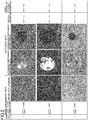
- FIGS. 2 and 3 Six kinds of samples (coated metal materials) which were different from each other in terms of the time for chemical conversion treatment with zinc phosphate and the baking conditions for electrodeposition coating, shown in FIGS. 2 and 3 were prepared.
- the metal base was a steel plate 2
- the electrodeposition coating film 4 had a thickness of 10 ⁇ m.
- Each sample was subjected to the present corrosion resistance test in an aspect shown in FIG. 1 .
- Two quadrangular artificially damaged portions 5 each with a diagonal length of 1 mm (each exposed area of the steel plate 2: 0.54 mm 2 ) reaching the steel plate were quantitatively formed using a Vickers hardness tester having an indenter with a quadrangular tip, i.e., formed by applying a load (test strength) of 30 kg such that the artificially damaged portions 5 are spaced 4 cm from each other.
- each artificially damaged portion 5 opened to the surface of each sample was 0.5 mm 2 corresponding to the area of the bottom surface.
- the exposed surface of the steel sheet 2 formed by each quadrangular artificially damaged portion 5 became a conical surface, and therefore, the exposed area of the steel sheet 2 was 0.54 mm 2 , which was larger than the opening area.
- aqueous electrolyte material 6 As an aqueous electrolyte material 6, a dilution obtained by diluting pseudo mud having pH 7 with a 5% saline solution (sodium chloride) to have 20% was used.
- a ring-shaped perforated electrodes (made of platinum) each with an outer diameter of about 32 mm and an inner diameter of about 30 mm were used.
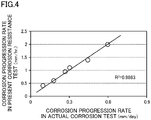
- FIGS. 2 and 3 show results of the present corrosion resistance test (appearances of the anode site, appearances of the cathode site before and after peeling, corrosion progression rates (spreading rates of coating film expansion), and the corrosion progression rates in the actual corrosion test (test in which pseudo mud was adhered to the artificial gushes and was then exposed to an environment at a temperature of 50°C and humidity of 98%)).
- the corrosion progression rate in the corrosion resistance test was lower (i.e., an increase in diameter due to spread of expansion was smaller) as the baking conditions of the electrodeposition coating film 4 became better (i.e., the baking temperature became higher or the baking time became longer), i.e., as the film quality of the electrodeposition coating film 4 became better. That is, the corrosion progression rate corresponds to the film quality of the electrodeposition coating film 4.
- the corrosion progression rates of the present corrosion resistance test was lower (i.e., an increase in diameter due to spread of expansion is smaller) in the sample 6 with a longer time for chemical conversion treatment. That is, the corrosion progression rate corresponds to the quality of the chemical conversion coating.
- the corrosion progression rate of the sample 3 with time for chemical conversion treatment of 30 seconds was lower than that of the sample 4 with time for chemical conversion treatment of 120 seconds.
- the corrosion progression rate in the actual corrosion test of the sample 3 was also lower than that of the sample 4.
- the kinds and forms of the deposits include five kinds of "water”, “5% NaCl (spray)", “5% CaCl (spray)", the “pseudo mud”, and "5% NaCl (immersion)."
- FIG. 5 indicates that the amount of water absorbed was small, and coating film expansion was barely observed even after the elapse of nine days in each of the cases of the water, the 5% NaCl (spray), and the 5% CaCl (spray).
- FIG. 6 indicates that the amount of water absorbed and the expansion occurrence rate after the elapse of nine days were considerably large in the case of the pseudo mud compared with the cases of water, the 5% NaCl (spray), and the 5% CaCl (spray).
- the cases with the same baking conditions for the electrodeposition coating film 4 at 150°C X20 mi nutes it was understood that the anount of water absorbed and the expansion occurrence rate were remarkably large in the case of the pseudo mud.
- FIG. 7 indicates that the amount of water absorbed and the expansion occurrence rate were high in the case of 5% NaCl (immersion) compared with the cases of the water, the 5% CaCl (spray), and the 5% CaCl (spray) but was considerably low compared with the case of the standard mud of FIG. 6 .
- FIG. 8 shows results of the corrosion inhibition period and the rate of water permeation into each coating film in the above-described five kinds with the same baking conditions at 150°C X20 minutes for the electrodeposition coating film 4.
- the time until the expansion occurrence rate reaches 0.5% was defined as the corrosion inhibition period.
- the rate of water permeation into the coating film was calculated on the basis of the time until the amount of water absorbed in the coating film reached 25 ⁇ g/mm 3 .
- FIG. 7 indicates that the corrosion inhibition period was short, i.e., the rate of water permeation into the coating film was considerably large in the case of the pseudo mud compared with the saline solution spray.
- a technique for supplying current to the metal base (steel plate) 2 is not limited to constant current control and may be constant voltage control.
- FIG. 9 is a plot of current supplied under the constant current control.
- FIG. 10 is a plot of current at the time when a constant voltage at which a current of about 1 mA flows is applied. In the corrosion resistance tests under the constant current control and under the constant voltage control, the test conditions other than the conditions of current supply were the same.
Landscapes
- Life Sciences & Earth Sciences (AREA)
- Biodiversity & Conservation Biology (AREA)
- Ecology (AREA)
- Environmental & Geological Engineering (AREA)
- Environmental Sciences (AREA)
- Physics & Mathematics (AREA)
- Health & Medical Sciences (AREA)
- Chemical & Material Sciences (AREA)
- Analytical Chemistry (AREA)
- Biochemistry (AREA)
- General Health & Medical Sciences (AREA)
- General Physics & Mathematics (AREA)
- Immunology (AREA)
- Pathology (AREA)
- Testing Resistance To Weather, Investigating Materials By Mechanical Methods (AREA)
Applications Claiming Priority (2)
| Application Number | Priority Date | Filing Date | Title |
|---|---|---|---|
| JP2017151600 | 2017-08-04 | ||
| PCT/JP2018/028447 WO2019026843A1 (ja) | 2017-08-04 | 2018-07-30 | 被覆金属材の耐食性試験方法及び耐食性試験装置 |
Publications (3)
| Publication Number | Publication Date |
|---|---|
| EP3660488A1 true EP3660488A1 (de) | 2020-06-03 |
| EP3660488A4 EP3660488A4 (de) | 2020-10-07 |
| EP3660488B1 EP3660488B1 (de) | 2023-03-15 |
Family
ID=65233845
Family Applications (1)
| Application Number | Title | Priority Date | Filing Date |
|---|---|---|---|
| EP18841516.0A Active EP3660488B1 (de) | 2017-08-04 | 2018-07-30 | Korrosionsbeständigkeitstestverfahren und korrosionsbeständigkeitstestvorrichtung für beschichtetes metallmaterial |
Country Status (5)
| Country | Link |
|---|---|
| US (1) | US11519844B2 (de) |
| EP (1) | EP3660488B1 (de) |
| JP (1) | JP6784335B2 (de) |
| CN (1) | CN111033224B (de) |
| WO (1) | WO2019026843A1 (de) |
Cited By (1)
| Publication number | Priority date | Publication date | Assignee | Title |
|---|---|---|---|---|
| EP3667293B1 (de) * | 2018-12-11 | 2022-02-02 | Mazda Motor Corporation | Verfahren zur prüfung der korrosionsbeständigkeit von beschichtetem metallmaterial |
Families Citing this family (13)
| Publication number | Priority date | Publication date | Assignee | Title |
|---|---|---|---|---|
| JP6784335B2 (ja) * | 2017-08-04 | 2020-11-11 | マツダ株式会社 | 被覆金属材の耐食性試験方法及び耐食性試験装置 |
| JP7104326B2 (ja) * | 2018-09-27 | 2022-07-21 | 日本電信電話株式会社 | 腐食性評価装置とその方法 |
| JP2020118468A (ja) * | 2019-01-18 | 2020-08-06 | マツダ株式会社 | 被覆金属材の耐食性試験装置 |
| JP6733844B1 (ja) * | 2020-04-15 | 2020-08-05 | マツダ株式会社 | 被覆金属材の耐食性試験方法及び耐食性試験装置 |
| JP6835280B1 (ja) | 2020-06-22 | 2021-02-24 | マツダ株式会社 | 傷の処理方法及び処理装置、並びに、被覆金属材の耐食性試験方法及び耐食性試験装置 |
| JP6835281B1 (ja) | 2020-06-22 | 2021-02-24 | マツダ株式会社 | 計測方法及び計測装置、並びに、被覆金属材の耐食性試験方法及び耐食性試験装置 |
| JP6801805B1 (ja) * | 2020-06-22 | 2020-12-16 | マツダ株式会社 | 計測方法及び計測装置、並びに、被覆金属材の耐食性試験方法及び耐食性試験装置 |
| JP6835279B1 (ja) * | 2020-06-22 | 2021-02-24 | マツダ株式会社 | 電極部装置、被覆金属材の耐食性試験方法及び耐食性試験装置 |
| JP6849140B1 (ja) * | 2020-07-30 | 2021-03-24 | マツダ株式会社 | 被覆金属材の耐食性試験装置及び耐食性試験方法 |
| JP7088396B1 (ja) * | 2021-10-01 | 2022-06-21 | マツダ株式会社 | 被覆金属材の耐食性試験方法、耐食性試験装置、耐食性試験用プログラム及び記録媒体 |
| JP7156481B1 (ja) * | 2021-10-01 | 2022-10-19 | マツダ株式会社 | 被覆金属材の耐食性試験方法、耐食性試験装置、耐食性試験用プログラム及び記録媒体 |
| JP2024057391A (ja) * | 2022-10-12 | 2024-04-24 | マツダ株式会社 | 腐食検査用測定装置 |
| CN116626140B (zh) * | 2023-05-31 | 2025-12-19 | 寰泰储能科技股份有限公司 | 材料耐受性测试装置及其使用方法 |
Family Cites Families (40)
| Publication number | Priority date | Publication date | Assignee | Title |
|---|---|---|---|---|
| JPS55149049A (en) * | 1979-05-10 | 1980-11-20 | Nippon Paint Co Ltd | Testing method for corrosion evaluation of coated metal material and its apparatus |
| GB2048491B (en) * | 1980-03-17 | 1983-08-03 | Nippon Paint Co Ltd | Method for evaluating corrosion of coated metallic material |
| JPS5948649A (ja) * | 1982-09-13 | 1984-03-19 | Nippon Paint Co Ltd | 塗装金属の耐食性評価装置 |
| US4515643A (en) * | 1982-10-22 | 1985-05-07 | Henkel Kommanditgesellschaft Auf Aktien | Method for determining and adjusting the potency and effectiveness of a metal phosphate conversion coating process |
| JPH04120453A (ja) * | 1990-09-12 | 1992-04-21 | Nippon Parkerizing Co Ltd | 塗装膜を施したアルミ缶胴またはアルミ缶蓋の耐食性試験方法 |
| EP0591802A3 (en) * | 1992-09-28 | 1994-06-08 | Hitachi Ltd | Method and apparatus for measuring degree of corrosion of metal materials |
| JPH07234202A (ja) * | 1994-02-23 | 1995-09-05 | Kinki Sharyo Co Ltd | コーティング物の付着性試験方法およびその装置 |
| JP3143780B2 (ja) * | 1996-06-10 | 2001-03-07 | 本田技研工業株式会社 | 金属素材と塗膜とよりなる試験体の耐食試験法および電解試験機 |
| US6365034B1 (en) * | 1997-05-07 | 2002-04-02 | Polymer Alloys Llc | High throughput electrochemical test for measuring corrosion resistance |
| JP3821004B2 (ja) * | 2002-02-08 | 2006-09-13 | スズキ株式会社 | 犠牲陽極の検査方法及び検査装置 |
| US7776606B2 (en) * | 2006-03-03 | 2010-08-17 | Concurrent Technologies Corporation | Processes to create discrete corrosion defects on substrates and establish corrosion NDI test standards |
| JP2007271501A (ja) | 2006-03-31 | 2007-10-18 | Osaka Gas Co Ltd | 被膜の防食評価方法 |
| FR2917519A1 (fr) * | 2006-09-27 | 2008-12-19 | Peugeot Citroen Automobiles Sa | Procede d'estimation de la corrosion |
| JP5108844B2 (ja) * | 2009-05-12 | 2012-12-26 | 住友電気工業株式会社 | 腐食試験方法 |
| US8888976B2 (en) * | 2009-01-02 | 2014-11-18 | Axalta Coating Systems Ip Co., Llc | Corrosion resistance evaluator |
| EP2656044A4 (de) * | 2010-12-21 | 2015-07-01 | Coatings Foreign Ip Co Llc | Verfahren zur beurteilung einer korrosionsbeständigkeit |
| JP2014505242A (ja) * | 2010-12-21 | 2014-02-27 | コーティングス フォーリン アイピー カンパニー, エルエルシー | 耐食性評価装置 |
| JP5830910B2 (ja) * | 2011-04-12 | 2015-12-09 | Jfeスチール株式会社 | 缶成型体の内容物に対する耐腐食性を評価する方法 |
| JP6061393B2 (ja) * | 2013-09-17 | 2017-01-18 | 公益財団法人鉄道総合技術研究所 | 劣化状態評価装置、劣化状態評価方法及び劣化状態評価プログラム |
| JP6213426B2 (ja) * | 2014-09-02 | 2017-10-18 | マツダ株式会社 | 塗装金属材の耐食性評価方法及び耐食性評価装置 |
| JP6436688B2 (ja) | 2014-09-02 | 2018-12-12 | 国立大学法人広島大学 | 塗装金属材の耐食性評価方法及び耐食性評価装置 |
| CN104911687A (zh) * | 2015-07-07 | 2015-09-16 | 安科工程技术研究院(北京)有限公司 | 埋地管道防腐层阴极剥离试验的方法和装置 |
| JP6784335B2 (ja) * | 2017-08-04 | 2020-11-11 | マツダ株式会社 | 被覆金属材の耐食性試験方法及び耐食性試験装置 |
| JP6565979B2 (ja) * | 2017-08-04 | 2019-08-28 | マツダ株式会社 | 被覆金属材の耐食性試験装置及び耐食性試験方法 |
| CN108548775A (zh) * | 2018-04-20 | 2018-09-18 | 攀枝花学院 | 搪瓷涂层电极及制备方法、耐腐蚀性测试方法 |
| JP6747495B2 (ja) * | 2018-12-11 | 2020-08-26 | マツダ株式会社 | 被覆金属材の耐食性試験方法 |
| JP2020118468A (ja) * | 2019-01-18 | 2020-08-06 | マツダ株式会社 | 被覆金属材の耐食性試験装置 |
| CN110044810B (zh) * | 2019-03-28 | 2021-12-31 | 中国船舶重工集团公司第七二五研究所 | 一种用于模拟深海环境下缝隙腐蚀研究的人工缝隙装置 |
| JP6733844B1 (ja) * | 2020-04-15 | 2020-08-05 | マツダ株式会社 | 被覆金属材の耐食性試験方法及び耐食性試験装置 |
| JP6835281B1 (ja) * | 2020-06-22 | 2021-02-24 | マツダ株式会社 | 計測方法及び計測装置、並びに、被覆金属材の耐食性試験方法及び耐食性試験装置 |
| JP6835279B1 (ja) * | 2020-06-22 | 2021-02-24 | マツダ株式会社 | 電極部装置、被覆金属材の耐食性試験方法及び耐食性試験装置 |
| CN111879695A (zh) * | 2020-06-22 | 2020-11-03 | 北京科技大学 | 一种涂层失效的实时监测方法及腐蚀监测传感器 |
| JP6835280B1 (ja) * | 2020-06-22 | 2021-02-24 | マツダ株式会社 | 傷の処理方法及び処理装置、並びに、被覆金属材の耐食性試験方法及び耐食性試験装置 |
| JP6801805B1 (ja) * | 2020-06-22 | 2020-12-16 | マツダ株式会社 | 計測方法及び計測装置、並びに、被覆金属材の耐食性試験方法及び耐食性試験装置 |
| JP6849140B1 (ja) * | 2020-07-30 | 2021-03-24 | マツダ株式会社 | 被覆金属材の耐食性試験装置及び耐食性試験方法 |
| CN112147021B (zh) * | 2020-08-10 | 2022-07-29 | 中国船舶重工集团公司第七二五研究所 | 一种金属钝化膜消长动态过程的电化学测试装置 |
| JP6835286B1 (ja) * | 2020-09-29 | 2021-02-24 | マツダ株式会社 | 被覆金属材の耐食性試験方法及び該方法に用いられる含水材料 |
| JP6835287B1 (ja) * | 2020-09-29 | 2021-02-24 | マツダ株式会社 | 被覆金属材の耐食性試験方法及び該方法に用いられる含水材料 |
| CN113777013B (zh) * | 2021-06-23 | 2023-11-21 | 武汉钢铁有限公司 | 一种耐蚀性试验样片及锌铝镁镀层钢耐蚀性能的测试方法 |
| CN113588417A (zh) * | 2021-06-24 | 2021-11-02 | 中国特种设备检测研究院 | 一种腐蚀环境下的金属涂层应力腐蚀测试方法及装置 |
-
2018
- 2018-07-30 JP JP2019534500A patent/JP6784335B2/ja active Active
- 2018-07-30 CN CN201880050709.9A patent/CN111033224B/zh active Active
- 2018-07-30 EP EP18841516.0A patent/EP3660488B1/de active Active
- 2018-07-30 WO PCT/JP2018/028447 patent/WO2019026843A1/ja not_active Ceased
- 2018-07-30 US US16/635,160 patent/US11519844B2/en active Active
Cited By (2)
| Publication number | Priority date | Publication date | Assignee | Title |
|---|---|---|---|---|
| EP3667293B1 (de) * | 2018-12-11 | 2022-02-02 | Mazda Motor Corporation | Verfahren zur prüfung der korrosionsbeständigkeit von beschichtetem metallmaterial |
| US11262329B2 (en) | 2018-12-11 | 2022-03-01 | Mazda Motor Corporation | Method of testing corrosion resistance of coated metal material |
Also Published As
| Publication number | Publication date |
|---|---|
| CN111033224A (zh) | 2020-04-17 |
| US20210010926A1 (en) | 2021-01-14 |
| WO2019026843A1 (ja) | 2019-02-07 |
| CN111033224B (zh) | 2022-08-05 |
| US11519844B2 (en) | 2022-12-06 |
| EP3660488A4 (de) | 2020-10-07 |
| EP3660488B1 (de) | 2023-03-15 |
| JPWO2019026843A1 (ja) | 2020-07-09 |
| JP6784335B2 (ja) | 2020-11-11 |
Similar Documents
| Publication | Publication Date | Title |
|---|---|---|
| US11519844B2 (en) | Corrosion resistance test method and corrosion resistance test apparatus for coated metal material | |
| US11262329B2 (en) | Method of testing corrosion resistance of coated metal material | |
| JP6565980B2 (ja) | 被覆金属材の耐食性試験装置及び被覆金属材の耐食性試験方法 | |
| JP6515963B2 (ja) | 被覆金属材の耐食性試験方法及び耐食性試験装置 | |
| JP6565979B2 (ja) | 被覆金属材の耐食性試験装置及び耐食性試験方法 | |
| US11566996B2 (en) | Corrosion resistance tester for coated metal material | |
| JP6733844B1 (ja) | 被覆金属材の耐食性試験方法及び耐食性試験装置 | |
| JP6813122B2 (ja) | 被覆金属材の耐食性試験方法 | |
| JP7516904B2 (ja) | 被覆金属材の耐食性試験方法及び試験片 | |
| JP6565665B2 (ja) | 電磁鋼板の耐食性評価方法 | |
| Hosseinirad et al. | Corrosion resistance and cathodic disbondment of epoxy coating applied on zinc phosphate conversion coating containing different amounts of cobalt ions | |
| Klengel et al. | A new method for prediction of corrosion processes in metallization systems for substrates and electrical contacts | |
| Indeir et al. | Development of (AC) DC/AC Cyclic Electrochemical Corrosion Evaluation Protocols for Accelerated Testing of PVD Metallic Coatings | |
| JP2025152153A (ja) | 被覆金属材の試験方法 | |
| Mjwana et al. | Study of Corrosion Behaviour of Carbon Steel in Evian Derived Solution from Electrochemical Techniques | |
| Jakab et al. | Corrosion behaviour of copper in sulphuric acid in the presence of N-methylaniline. |
Legal Events
| Date | Code | Title | Description |
|---|---|---|---|
| STAA | Information on the status of an ep patent application or granted ep patent |
Free format text: STATUS: THE INTERNATIONAL PUBLICATION HAS BEEN MADE |
|
| PUAI | Public reference made under article 153(3) epc to a published international application that has entered the european phase |
Free format text: ORIGINAL CODE: 0009012 |
|
| STAA | Information on the status of an ep patent application or granted ep patent |
Free format text: STATUS: REQUEST FOR EXAMINATION WAS MADE |
|
| 17P | Request for examination filed |
Effective date: 20200227 |
|
| AK | Designated contracting states |
Kind code of ref document: A1 Designated state(s): AL AT BE BG CH CY CZ DE DK EE ES FI FR GB GR HR HU IE IS IT LI LT LU LV MC MK MT NL NO PL PT RO RS SE SI SK SM TR |
|
| AX | Request for extension of the european patent |
Extension state: BA ME |
|
| A4 | Supplementary search report drawn up and despatched |
Effective date: 20200903 |
|
| RIC1 | Information provided on ipc code assigned before grant |
Ipc: G01N 17/02 20060101ALI20200828BHEP Ipc: G01N 17/00 20060101AFI20200828BHEP |
|
| DAV | Request for validation of the european patent (deleted) | ||
| DAX | Request for extension of the european patent (deleted) | ||
| STAA | Information on the status of an ep patent application or granted ep patent |
Free format text: STATUS: EXAMINATION IS IN PROGRESS |
|
| 17Q | First examination report despatched |
Effective date: 20220214 |
|
| GRAP | Despatch of communication of intention to grant a patent |
Free format text: ORIGINAL CODE: EPIDOSNIGR1 |
|
| STAA | Information on the status of an ep patent application or granted ep patent |
Free format text: STATUS: GRANT OF PATENT IS INTENDED |
|
| INTG | Intention to grant announced |
Effective date: 20221212 |
|
| GRAS | Grant fee paid |
Free format text: ORIGINAL CODE: EPIDOSNIGR3 |
|
| GRAA | (expected) grant |
Free format text: ORIGINAL CODE: 0009210 |
|
| STAA | Information on the status of an ep patent application or granted ep patent |
Free format text: STATUS: THE PATENT HAS BEEN GRANTED |
|
| AK | Designated contracting states |
Kind code of ref document: B1 Designated state(s): AL AT BE BG CH CY CZ DE DK EE ES FI FR GB GR HR HU IE IS IT LI LT LU LV MC MK MT NL NO PL PT RO RS SE SI SK SM TR |
|
| REG | Reference to a national code |
Ref country code: CH Ref legal event code: EP Ref country code: GB Ref legal event code: FG4D |
|
| REG | Reference to a national code |
Ref country code: DE Ref legal event code: R096 Ref document number: 602018047312 Country of ref document: DE |
|
| REG | Reference to a national code |
Ref country code: IE Ref legal event code: FG4D |
|
| REG | Reference to a national code |
Ref country code: AT Ref legal event code: REF Ref document number: 1554274 Country of ref document: AT Kind code of ref document: T Effective date: 20230415 |
|
| REG | Reference to a national code |
Ref country code: LT Ref legal event code: MG9D |
|
| REG | Reference to a national code |
Ref country code: NL Ref legal event code: MP Effective date: 20230315 |
|
| PG25 | Lapsed in a contracting state [announced via postgrant information from national office to epo] |
Ref country code: RS Free format text: LAPSE BECAUSE OF FAILURE TO SUBMIT A TRANSLATION OF THE DESCRIPTION OR TO PAY THE FEE WITHIN THE PRESCRIBED TIME-LIMIT Effective date: 20230315 Ref country code: NO Free format text: LAPSE BECAUSE OF FAILURE TO SUBMIT A TRANSLATION OF THE DESCRIPTION OR TO PAY THE FEE WITHIN THE PRESCRIBED TIME-LIMIT Effective date: 20230615 Ref country code: LV Free format text: LAPSE BECAUSE OF FAILURE TO SUBMIT A TRANSLATION OF THE DESCRIPTION OR TO PAY THE FEE WITHIN THE PRESCRIBED TIME-LIMIT Effective date: 20230315 Ref country code: LT Free format text: LAPSE BECAUSE OF FAILURE TO SUBMIT A TRANSLATION OF THE DESCRIPTION OR TO PAY THE FEE WITHIN THE PRESCRIBED TIME-LIMIT Effective date: 20230315 Ref country code: HR Free format text: LAPSE BECAUSE OF FAILURE TO SUBMIT A TRANSLATION OF THE DESCRIPTION OR TO PAY THE FEE WITHIN THE PRESCRIBED TIME-LIMIT Effective date: 20230315 |
|
| REG | Reference to a national code |
Ref country code: AT Ref legal event code: MK05 Ref document number: 1554274 Country of ref document: AT Kind code of ref document: T Effective date: 20230315 |
|
| PG25 | Lapsed in a contracting state [announced via postgrant information from national office to epo] |
Ref country code: SE Free format text: LAPSE BECAUSE OF FAILURE TO SUBMIT A TRANSLATION OF THE DESCRIPTION OR TO PAY THE FEE WITHIN THE PRESCRIBED TIME-LIMIT Effective date: 20230315 Ref country code: NL Free format text: LAPSE BECAUSE OF FAILURE TO SUBMIT A TRANSLATION OF THE DESCRIPTION OR TO PAY THE FEE WITHIN THE PRESCRIBED TIME-LIMIT Effective date: 20230315 Ref country code: GR Free format text: LAPSE BECAUSE OF FAILURE TO SUBMIT A TRANSLATION OF THE DESCRIPTION OR TO PAY THE FEE WITHIN THE PRESCRIBED TIME-LIMIT Effective date: 20230616 Ref country code: FI Free format text: LAPSE BECAUSE OF FAILURE TO SUBMIT A TRANSLATION OF THE DESCRIPTION OR TO PAY THE FEE WITHIN THE PRESCRIBED TIME-LIMIT Effective date: 20230315 |
|
| PG25 | Lapsed in a contracting state [announced via postgrant information from national office to epo] |
Ref country code: SM Free format text: LAPSE BECAUSE OF FAILURE TO SUBMIT A TRANSLATION OF THE DESCRIPTION OR TO PAY THE FEE WITHIN THE PRESCRIBED TIME-LIMIT Effective date: 20230315 Ref country code: RO Free format text: LAPSE BECAUSE OF FAILURE TO SUBMIT A TRANSLATION OF THE DESCRIPTION OR TO PAY THE FEE WITHIN THE PRESCRIBED TIME-LIMIT Effective date: 20230315 Ref country code: PT Free format text: LAPSE BECAUSE OF FAILURE TO SUBMIT A TRANSLATION OF THE DESCRIPTION OR TO PAY THE FEE WITHIN THE PRESCRIBED TIME-LIMIT Effective date: 20230717 Ref country code: ES Free format text: LAPSE BECAUSE OF FAILURE TO SUBMIT A TRANSLATION OF THE DESCRIPTION OR TO PAY THE FEE WITHIN THE PRESCRIBED TIME-LIMIT Effective date: 20230315 Ref country code: EE Free format text: LAPSE BECAUSE OF FAILURE TO SUBMIT A TRANSLATION OF THE DESCRIPTION OR TO PAY THE FEE WITHIN THE PRESCRIBED TIME-LIMIT Effective date: 20230315 Ref country code: CZ Free format text: LAPSE BECAUSE OF FAILURE TO SUBMIT A TRANSLATION OF THE DESCRIPTION OR TO PAY THE FEE WITHIN THE PRESCRIBED TIME-LIMIT Effective date: 20230315 Ref country code: AT Free format text: LAPSE BECAUSE OF FAILURE TO SUBMIT A TRANSLATION OF THE DESCRIPTION OR TO PAY THE FEE WITHIN THE PRESCRIBED TIME-LIMIT Effective date: 20230315 |
|
| PG25 | Lapsed in a contracting state [announced via postgrant information from national office to epo] |
Ref country code: SK Free format text: LAPSE BECAUSE OF FAILURE TO SUBMIT A TRANSLATION OF THE DESCRIPTION OR TO PAY THE FEE WITHIN THE PRESCRIBED TIME-LIMIT Effective date: 20230315 Ref country code: PL Free format text: LAPSE BECAUSE OF FAILURE TO SUBMIT A TRANSLATION OF THE DESCRIPTION OR TO PAY THE FEE WITHIN THE PRESCRIBED TIME-LIMIT Effective date: 20230315 Ref country code: IS Free format text: LAPSE BECAUSE OF FAILURE TO SUBMIT A TRANSLATION OF THE DESCRIPTION OR TO PAY THE FEE WITHIN THE PRESCRIBED TIME-LIMIT Effective date: 20230715 |
|
| REG | Reference to a national code |
Ref country code: DE Ref legal event code: R097 Ref document number: 602018047312 Country of ref document: DE |
|
| PLBE | No opposition filed within time limit |
Free format text: ORIGINAL CODE: 0009261 |
|
| STAA | Information on the status of an ep patent application or granted ep patent |
Free format text: STATUS: NO OPPOSITION FILED WITHIN TIME LIMIT |
|
| PG25 | Lapsed in a contracting state [announced via postgrant information from national office to epo] |
Ref country code: SI Free format text: LAPSE BECAUSE OF FAILURE TO SUBMIT A TRANSLATION OF THE DESCRIPTION OR TO PAY THE FEE WITHIN THE PRESCRIBED TIME-LIMIT Effective date: 20230315 Ref country code: DK Free format text: LAPSE BECAUSE OF FAILURE TO SUBMIT A TRANSLATION OF THE DESCRIPTION OR TO PAY THE FEE WITHIN THE PRESCRIBED TIME-LIMIT Effective date: 20230315 |
|
| 26N | No opposition filed |
Effective date: 20231218 |
|
| PG25 | Lapsed in a contracting state [announced via postgrant information from national office to epo] |
Ref country code: MC Free format text: LAPSE BECAUSE OF FAILURE TO SUBMIT A TRANSLATION OF THE DESCRIPTION OR TO PAY THE FEE WITHIN THE PRESCRIBED TIME-LIMIT Effective date: 20230315 |
|
| PG25 | Lapsed in a contracting state [announced via postgrant information from national office to epo] |
Ref country code: MC Free format text: LAPSE BECAUSE OF FAILURE TO SUBMIT A TRANSLATION OF THE DESCRIPTION OR TO PAY THE FEE WITHIN THE PRESCRIBED TIME-LIMIT Effective date: 20230315 |
|
| REG | Reference to a national code |
Ref country code: CH Ref legal event code: PL |
|
| REG | Reference to a national code |
Ref country code: BE Ref legal event code: MM Effective date: 20230731 |
|
| PG25 | Lapsed in a contracting state [announced via postgrant information from national office to epo] |
Ref country code: LU Free format text: LAPSE BECAUSE OF NON-PAYMENT OF DUE FEES Effective date: 20230730 |
|
| GBPC | Gb: european patent ceased through non-payment of renewal fee |
Effective date: 20230730 |
|
| PG25 | Lapsed in a contracting state [announced via postgrant information from national office to epo] |
Ref country code: LU Free format text: LAPSE BECAUSE OF NON-PAYMENT OF DUE FEES Effective date: 20230730 |
|
| REG | Reference to a national code |
Ref country code: IE Ref legal event code: MM4A |
|
| PG25 | Lapsed in a contracting state [announced via postgrant information from national office to epo] |
Ref country code: GB Free format text: LAPSE BECAUSE OF NON-PAYMENT OF DUE FEES Effective date: 20230730 Ref country code: CH Free format text: LAPSE BECAUSE OF NON-PAYMENT OF DUE FEES Effective date: 20230731 |
|
| PG25 | Lapsed in a contracting state [announced via postgrant information from national office to epo] |
Ref country code: IT Free format text: LAPSE BECAUSE OF FAILURE TO SUBMIT A TRANSLATION OF THE DESCRIPTION OR TO PAY THE FEE WITHIN THE PRESCRIBED TIME-LIMIT Effective date: 20230315 Ref country code: FR Free format text: LAPSE BECAUSE OF NON-PAYMENT OF DUE FEES Effective date: 20230731 Ref country code: BE Free format text: LAPSE BECAUSE OF NON-PAYMENT OF DUE FEES Effective date: 20230731 |
|
| PG25 | Lapsed in a contracting state [announced via postgrant information from national office to epo] |
Ref country code: IE Free format text: LAPSE BECAUSE OF NON-PAYMENT OF DUE FEES Effective date: 20230730 |
|
| PG25 | Lapsed in a contracting state [announced via postgrant information from national office to epo] |
Ref country code: IE Free format text: LAPSE BECAUSE OF NON-PAYMENT OF DUE FEES Effective date: 20230730 |
|
| PG25 | Lapsed in a contracting state [announced via postgrant information from national office to epo] |
Ref country code: BG Free format text: LAPSE BECAUSE OF FAILURE TO SUBMIT A TRANSLATION OF THE DESCRIPTION OR TO PAY THE FEE WITHIN THE PRESCRIBED TIME-LIMIT Effective date: 20230315 |
|
| PG25 | Lapsed in a contracting state [announced via postgrant information from national office to epo] |
Ref country code: BG Free format text: LAPSE BECAUSE OF FAILURE TO SUBMIT A TRANSLATION OF THE DESCRIPTION OR TO PAY THE FEE WITHIN THE PRESCRIBED TIME-LIMIT Effective date: 20230315 |
|
| PG25 | Lapsed in a contracting state [announced via postgrant information from national office to epo] |
Ref country code: CY Free format text: LAPSE BECAUSE OF FAILURE TO SUBMIT A TRANSLATION OF THE DESCRIPTION OR TO PAY THE FEE WITHIN THE PRESCRIBED TIME-LIMIT; INVALID AB INITIO Effective date: 20180730 |
|
| PG25 | Lapsed in a contracting state [announced via postgrant information from national office to epo] |
Ref country code: HU Free format text: LAPSE BECAUSE OF FAILURE TO SUBMIT A TRANSLATION OF THE DESCRIPTION OR TO PAY THE FEE WITHIN THE PRESCRIBED TIME-LIMIT; INVALID AB INITIO Effective date: 20180730 |
|
| PGFP | Annual fee paid to national office [announced via postgrant information from national office to epo] |
Ref country code: DE Payment date: 20250604 Year of fee payment: 8 |
|
| PG25 | Lapsed in a contracting state [announced via postgrant information from national office to epo] |
Ref country code: TR Free format text: LAPSE BECAUSE OF FAILURE TO SUBMIT A TRANSLATION OF THE DESCRIPTION OR TO PAY THE FEE WITHIN THE PRESCRIBED TIME-LIMIT Effective date: 20230315 |