EP3660498B1 - Capteur environnemental comportant un actionneur - Google Patents
Capteur environnemental comportant un actionneur Download PDFInfo
- Publication number
- EP3660498B1 EP3660498B1 EP18208705.6A EP18208705A EP3660498B1 EP 3660498 B1 EP3660498 B1 EP 3660498B1 EP 18208705 A EP18208705 A EP 18208705A EP 3660498 B1 EP3660498 B1 EP 3660498B1
- Authority
- EP
- European Patent Office
- Prior art keywords
- sensor
- actuator
- variable
- ambient
- gas
- Prior art date
- Legal status (The legal status is an assumption and is not a legal conclusion. Google has not performed a legal analysis and makes no representation as to the accuracy of the status listed.)
- Active
Links
Images

Classifications
-
- G—PHYSICS
- G01—MEASURING; TESTING
- G01N—INVESTIGATING OR ANALYSING MATERIALS BY DETERMINING THEIR CHEMICAL OR PHYSICAL PROPERTIES
- G01N27/00—Investigating or analysing materials by the use of electric, electrochemical, or magnetic means
- G01N27/02—Investigating or analysing materials by the use of electric, electrochemical, or magnetic means by investigating impedance
- G01N27/04—Investigating or analysing materials by the use of electric, electrochemical, or magnetic means by investigating impedance by investigating resistance
- G01N27/12—Investigating or analysing materials by the use of electric, electrochemical, or magnetic means by investigating impedance by investigating resistance of a solid body in dependence upon absorption of a fluid; of a solid body in dependence upon reaction with a fluid, for detecting components in the fluid
- G01N27/121—Investigating or analysing materials by the use of electric, electrochemical, or magnetic means by investigating impedance by investigating resistance of a solid body in dependence upon absorption of a fluid; of a solid body in dependence upon reaction with a fluid, for detecting components in the fluid for determining moisture content, e.g. humidity, of the fluid
-
- G—PHYSICS
- G01—MEASURING; TESTING
- G01K—MEASURING TEMPERATURE; MEASURING QUANTITY OF HEAT; THERMALLY-SENSITIVE ELEMENTS NOT OTHERWISE PROVIDED FOR
- G01K13/00—Thermometers specially adapted for specific purposes
- G01K13/02—Thermometers specially adapted for specific purposes for measuring temperature of moving fluids or granular materials capable of flow
-
- G—PHYSICS
- G01—MEASURING; TESTING
- G01D—MEASURING NOT SPECIALLY ADAPTED FOR A SPECIFIC VARIABLE; ARRANGEMENTS FOR MEASURING TWO OR MORE VARIABLES NOT COVERED IN A SINGLE OTHER SUBCLASS; TARIFF METERING APPARATUS; MEASURING OR TESTING NOT OTHERWISE PROVIDED FOR
- G01D21/00—Measuring or testing not otherwise provided for
- G01D21/02—Measuring two or more variables by means not covered by a single other subclass
-
- G—PHYSICS
- G01—MEASURING; TESTING
- G01K—MEASURING TEMPERATURE; MEASURING QUANTITY OF HEAT; THERMALLY-SENSITIVE ELEMENTS NOT OTHERWISE PROVIDED FOR
- G01K1/00—Details of thermometers not specially adapted for particular types of thermometer
-
- G—PHYSICS
- G01—MEASURING; TESTING
- G01K—MEASURING TEMPERATURE; MEASURING QUANTITY OF HEAT; THERMALLY-SENSITIVE ELEMENTS NOT OTHERWISE PROVIDED FOR
- G01K13/00—Thermometers specially adapted for specific purposes
- G01K13/02—Thermometers specially adapted for specific purposes for measuring temperature of moving fluids or granular materials capable of flow
- G01K13/024—Thermometers specially adapted for specific purposes for measuring temperature of moving fluids or granular materials capable of flow of moving gases
-
- G—PHYSICS
- G01—MEASURING; TESTING
- G01K—MEASURING TEMPERATURE; MEASURING QUANTITY OF HEAT; THERMALLY-SENSITIVE ELEMENTS NOT OTHERWISE PROVIDED FOR
- G01K15/00—Testing or calibrating of thermometers
- G01K15/005—Calibration
-
- G—PHYSICS
- G01—MEASURING; TESTING
- G01N—INVESTIGATING OR ANALYSING MATERIALS BY DETERMINING THEIR CHEMICAL OR PHYSICAL PROPERTIES
- G01N15/00—Investigating characteristics of particles; Investigating permeability, pore-volume or surface-area of porous materials
- G01N15/06—Investigating concentration of particle suspensions
-
- G—PHYSICS
- G01—MEASURING; TESTING
- G01N—INVESTIGATING OR ANALYSING MATERIALS BY DETERMINING THEIR CHEMICAL OR PHYSICAL PROPERTIES
- G01N27/00—Investigating or analysing materials by the use of electric, electrochemical, or magnetic means
- G01N27/02—Investigating or analysing materials by the use of electric, electrochemical, or magnetic means by investigating impedance
- G01N27/04—Investigating or analysing materials by the use of electric, electrochemical, or magnetic means by investigating impedance by investigating resistance
-
- G—PHYSICS
- G01—MEASURING; TESTING
- G01N—INVESTIGATING OR ANALYSING MATERIALS BY DETERMINING THEIR CHEMICAL OR PHYSICAL PROPERTIES
- G01N27/00—Investigating or analysing materials by the use of electric, electrochemical, or magnetic means
- G01N27/02—Investigating or analysing materials by the use of electric, electrochemical, or magnetic means by investigating impedance
- G01N27/04—Investigating or analysing materials by the use of electric, electrochemical, or magnetic means by investigating impedance by investigating resistance
- G01N27/12—Investigating or analysing materials by the use of electric, electrochemical, or magnetic means by investigating impedance by investigating resistance of a solid body in dependence upon absorption of a fluid; of a solid body in dependence upon reaction with a fluid, for detecting components in the fluid
-
- G—PHYSICS
- G01—MEASURING; TESTING
- G01N—INVESTIGATING OR ANALYSING MATERIALS BY DETERMINING THEIR CHEMICAL OR PHYSICAL PROPERTIES
- G01N33/00—Investigating or analysing materials by specific methods not covered by groups G01N1/00 - G01N31/00
- G01N33/0004—Gaseous mixtures, e.g. polluted air
- G01N33/0009—General constructional details of gas analysers, e.g. portable test equipment
-
- G—PHYSICS
- G01—MEASURING; TESTING
- G01N—INVESTIGATING OR ANALYSING MATERIALS BY DETERMINING THEIR CHEMICAL OR PHYSICAL PROPERTIES
- G01N33/00—Investigating or analysing materials by specific methods not covered by groups G01N1/00 - G01N31/00
- G01N33/0004—Gaseous mixtures, e.g. polluted air
- G01N33/0009—General constructional details of gas analysers, e.g. portable test equipment
- G01N33/0011—Sample conditioning
- G01N33/0016—Sample conditioning by regulating a physical variable, e.g. pressure or temperature
-
- G—PHYSICS
- G01—MEASURING; TESTING
- G01N—INVESTIGATING OR ANALYSING MATERIALS BY DETERMINING THEIR CHEMICAL OR PHYSICAL PROPERTIES
- G01N33/00—Investigating or analysing materials by specific methods not covered by groups G01N1/00 - G01N31/00
- G01N33/0004—Gaseous mixtures, e.g. polluted air
- G01N33/0009—General constructional details of gas analysers, e.g. portable test equipment
- G01N33/0027—General constructional details of gas analysers, e.g. portable test equipment concerning the detector
- G01N33/0036—General constructional details of gas analysers, e.g. portable test equipment concerning the detector specially adapted to detect a particular component
- G01N33/0047—Organic compounds
-
- G—PHYSICS
- G01—MEASURING; TESTING
- G01N—INVESTIGATING OR ANALYSING MATERIALS BY DETERMINING THEIR CHEMICAL OR PHYSICAL PROPERTIES
- G01N33/00—Investigating or analysing materials by specific methods not covered by groups G01N1/00 - G01N31/00
- G01N33/0004—Gaseous mixtures, e.g. polluted air
- G01N33/0009—General constructional details of gas analysers, e.g. portable test equipment
- G01N33/0073—Control unit therefor
-
- G—PHYSICS
- G01—MEASURING; TESTING
- G01N—INVESTIGATING OR ANALYSING MATERIALS BY DETERMINING THEIR CHEMICAL OR PHYSICAL PROPERTIES
- G01N15/00—Investigating characteristics of particles; Investigating permeability, pore-volume or surface-area of porous materials
- G01N2015/0023—Investigating dispersion of liquids
- G01N2015/0026—Investigating dispersion of liquids in gas, e.g. fog
-
- G—PHYSICS
- G01—MEASURING; TESTING
- G01N—INVESTIGATING OR ANALYSING MATERIALS BY DETERMINING THEIR CHEMICAL OR PHYSICAL PROPERTIES
- G01N15/00—Investigating characteristics of particles; Investigating permeability, pore-volume or surface-area of porous materials
- G01N2015/0042—Investigating dispersion of solids
- G01N2015/0046—Investigating dispersion of solids in gas, e.g. smoke
-
- G—PHYSICS
- G01—MEASURING; TESTING
- G01N—INVESTIGATING OR ANALYSING MATERIALS BY DETERMINING THEIR CHEMICAL OR PHYSICAL PROPERTIES
- G01N27/00—Investigating or analysing materials by the use of electric, electrochemical, or magnetic means
- G01N27/02—Investigating or analysing materials by the use of electric, electrochemical, or magnetic means by investigating impedance
- G01N27/04—Investigating or analysing materials by the use of electric, electrochemical, or magnetic means by investigating impedance by investigating resistance
- G01N27/12—Investigating or analysing materials by the use of electric, electrochemical, or magnetic means by investigating impedance by investigating resistance of a solid body in dependence upon absorption of a fluid; of a solid body in dependence upon reaction with a fluid, for detecting components in the fluid
- G01N27/128—Microapparatus
-
- G—PHYSICS
- G01—MEASURING; TESTING
- G01N—INVESTIGATING OR ANALYSING MATERIALS BY DETERMINING THEIR CHEMICAL OR PHYSICAL PROPERTIES
- G01N33/00—Investigating or analysing materials by specific methods not covered by groups G01N1/00 - G01N31/00
- G01N33/0004—Gaseous mixtures, e.g. polluted air
- G01N33/0006—Calibrating gas analysers
Definitions
- the present invention relates to a sensor unit with a sensor for sensing a variable of an ambient gas and an actuator.
- a further aspect of the invention relates to a method for determining an ambient value of a variable in a gas in the ambience of such sensor unit.
- Sensors integrated into electronic devices are ubiquitous, e.g. in mobile phones, wearables, IoT (internet of things) devices, or conventional sensing devices. They sense a variety of physical quantities of the ambience, and in particular of an ambient gas such as air, another gas, an aerosol, or a dispersion.
- the physical quantities may include but are not limited to one or more of humidity, temperature, a concentration of a gas, or a concentration of particulate matter in the ambient gas.
- the accuracy and reliability of measurements of such sensor may suffer from disturbances originating from the electronic device at least partly surrounding it.
- Common sources of disturbances may include one or more of a heat flow from components of the electronic device, outgassing or gas soaking from material of the electronic device, and others.
- Complex compensation algorithms have been developed in order to still return accurate and reliable values for the physical quantities in the ambience, i.e. outside of the electronic device. However, the performance of these algorithms is limited.
- US 2014/0134053 A1 discloses a portable electronic device with a housing, a chemical sensor arranged inside the housing and adapted to measure a property of at least one analyte, and a duct terminating at an opening in the housing for exposing the chemical sensor to the gas to be analyzed, and an actuator to generate a flow within the duct.
- US 2012/323440 A1 refers to a method for determining ambient air temperature outside of a vehicle with a sensor mounted on the vehicle.
- the method includes the steps of determining a road speed of the vehicle, comparing the determined road speed to a reference road speed value, if the determined road speed is below the reference road speed value, activating a device to move ambient air across the sensor, the ambient air being drawn from a location outside the vehicle, taking a temperature reading with the sensor, and, if the temperature reading is lower than a stored temperature value, storing the lower temperature reading as the ambient air temperature.
- US 2014/355649 A1 relates to a portable electronic device with one or more integrated temperature sensors for measuring an ambient temperature.
- a compensator is provided for reducing the difference between a sensor output and the ambient temperature with the compensator switching depending on environmental and/or handling conditions between a plurality of compensation modes selected dependent on measurements of one or more other integrated and/or external sensors.
- US 2018/143084 A1 describes a method for processing a signal supplied by a sensor.
- the method comprises receiving the sensed signal and compensating the sensed signal for a contribution caused by one or more components thermally coupled to the sensor.
- the compensated signal is compensated in its dynamics, and the dynamics adjusted compensated sensor signal is provided.
- the problem of improving accuracy and reliability in the determination of the ambient value of the physical quantity is solved by a sensor unit according to claim 1 and a method according to claim 14.
- the sensor unit may e.g. be an IoT device, a mobile phone, a wearable or any other sensor device.
- a sensor unit comprises a sensor for sensing a variable of an ambient gas, and an actuator for supplying the ambient gas to the sensor.
- Supplying the ambient gas shall include a direct supply of the ambient gas to the sensor, but shall also include an enhancement of the ambient gas in the vicinity of the sensor e.g. supported by other processes such as diffusion.
- the ambient gas may comprise one of a gas, an aerosol, or a dispersion, and may specifically refer to ambient air surrounding the sensor unit or to another ambient gas.
- Examples for the variable sensed by the sensor and representing the physical quantity to be measured include but are not limited to one or more of a humidity, a temperature, a gas concentration or a concentration of particulate matter of the ambient gas.
- the senor may also be configured to detect solids or liquids comprised in a gas, such as in an aerosol.
- the variable may refer to particulates in the ambient air, and the value of the variable may then refer to the concentration or the size of the particulate.
- the actuator may be a direct or indirect actuator, for instance include one or more of a fan, a pump, or a loudspeaker.
- the actuator may be electrically controllable.
- the invention may also be applied to devices which already comprise an actuator for different purposes, such as an air purifier with a fan. Further actuator arrangements are described in US 2014/0134053 A1 .
- the sensor unit comprises one or more components contributing to measurement results provided by the sensor such that a portion of the signal provided by the sensor stems from these one or more components rather than the ambience.
- such one or more components may cause a disturbance of a measurement of the sensor, e.g. through heat flow, outgassing or gas soaking of a material of the one or more components.
- the sensor is assumed to provide a measurement result that is disturbed by such one or more components, i.e. the sensor provides a disturbed value of the variable to be sensed, while an undisturbed value of the variable of the ambience is desired to be known, which undisturbed value is referred to as ambient value in the following.
- the sensor unit comprises an estimator for determining the ambient value of the variable absent the contribution of the one or more components.
- the ambient value is dependent on a first measurement result provided by the sensor in response to a first activation state of the actuator and a second measurement result provided by the sensor in response to a second activation state of the actuator, which second activation state is different from the first activation state.
- the first activation state may be an off state of the actuator and the second activation state may be an on state of the actuator.
- the first activation state may be a low power state of the actuator and the second activation state may be a high power state of the actuator exceeding the power consumed by the actuator in the low power state.
- the first activation state and the second activation state preferably differ in a flow of ambient gas which flow is caused or is supported to and/or away from the sensor. In this way, preferably the values of the variable sensed at the sensor under the first activation state and the second activation state of the actuator differ. Under the assumption that the ambient value of the variable in the ambient gas as well as the contribution of the one or more components are equal for the first measurement result and the second measurement result, the ambient value of the variable may be derived.
- the sensor unit may preferably comprise a channel with an inlet from and an outlet to the ambience, wherein the sensor is arranged in or at the channel for sensing the variable in the ambient gas passing the sensor.
- the actuator is advantageously arranged to supply the ambient gas from the inlet through the channel to the outlet thereby passing the sensor.
- the estimator is adapted to monitor the activation state of the actuator and to accept two measurement results provided by the sensor as the first and the second measurement result if a corresponding second activation state deviates from a corresponding first activation state by a minimum margin, preferably by a minimum margin in power.
- the estimator is adapted to accept the two measurement results as the first and the second measurement result only if in addition a time interval between the corresponding first and the corresponding second measurement is less than a threshold value.
- Accepting a measurement result in this context includes applying the corresponding measurement results in the determination of the ambient value.
- the condition on the time interval is supposed to ensure that the assumptions of a constant ambient value of the variable and a constant contribution of the one or more components to the measurement results are fulfilled.
- the assumptions may also be considered to be fulfilled if changes in the ambient value and the contribution of the one or more components are expected to remain within a defined range within the time interval or between the defined points in time, respectively.
- the estimator is preferably configured to determine the ambient value of the variable absent the contribution of the one or more components based on a flux of the physical quantity represented by the variable from the one or more components to the sensor equating a flux the physical quantity represented by the variable from the sensor to the ambience for each of the first and the second activation state of the actuator.
- the above equation of total flux further reduces to a simpler equation.
- This simpler equation may then be used to derive a ambient value of the variable in the ambience provided the first and second measurement results of the sensor are known, and provided transport and diffusive properties depending on the velocity v and the diffusivity D have been calibrated.
- the variable is a temperature of the ambient air
- the sensor is a temperature sensor
- the one or more components include electronic components emitting heat in response to being powered.
- Parameter ⁇ is an effective parameter depending on a thermal conductivity or diffusivity, respectively, of material between the components emitting heat and the temperature sensor, but independent of the convective flow effected by the actuator.
- Parameter ⁇ fan also is an effective parameter. If the actuator, e.g.
- ⁇ fan predominantly depends on a thermal diffusivity of material between the temperature sensor and the ambience, e.g. air in the channel and/or a casing of the sensor unit. If the actuator is switched on, ⁇ fan predominantly depends on parameter of the flow of the ambient gas to and from the temperature sensor effected by the actuator, i.e. on the velocity v in equation eq3. Hence ⁇ fan in particular has different values ⁇ fan1 and ⁇ fan2 for the actuator being switched on or off, or in low or high power mode, respectively.
- Equation eq5 may be solved as a system of equations to yield the ambient value of the ambient temperature T amb , if at least two measurements are performed under a first and a second activation state of the actuator, and if the effective parameters ⁇ fan1 , ⁇ fan2 and ⁇ are known, e.g. from calibration measurements. By performing more than two measurements at different activation states of the actuator, an optimization problem may be solved on the system of equations, resulting in an even more reliable ambient value of the ambient temperature.
- the variable is humidity of the ambient air
- the sensor is a humidity sensor
- the one more components include a component releasing or absorbing humidity.
- the one or more components in particular include a component of a housing of the sensor unit.
- the variable is a gas concentration in the ambient air
- the sensor is a gas sensor sensitive to the gas to be sensed
- the one or more components include a component releasing or absorbing the gas the sensor is sensitive to.
- These one or more components in particular include a component of a housing of the sensor unit, and in particular the gas concentration is a concentration of volatile organic compounds, and the gas sensor is sensitive to the volatile organic compounds.
- a similar sensor may include a sensor sensing the concentration of particulate matter, which the above described derivation is also applicable to.
- the transport processes to and from the sensor may be predominantly diffusive, if the actuator is switched off, relying on diffusion processes in the ambient gas within the channel itself. If the actuator is switched on, the transport of the species is effected predominantly by convection.
- the concentration c mat may be due to soaking processes in case of humidity measurements, or due to outgassing in case of gas concentration measurements, e.g. VOC.
- equation eq7 may be used to construct a system of equations for at least two measurements under different activation states of the actuator.
- the effective parameters ⁇ fan1 , ⁇ fan2 and ⁇ may either be assumed as known from calibration measurements, or they may be derived from the system of equations provided that enough measurements are taken.
- the underlying principle of the invention may further be exploited to perform a self-calibration of a sensor, e.g. a temperature sensor.
- a sensor e.g. a temperature sensor.
- T SHT T amb
- system parameters i.e. relevant parameters of heat transport such as ⁇ and ⁇ may be calibrated.
- the estimator of the sensor unit is used to eliminate cross-sensitivities between disturbing contributions originating from components and the different sensors, e.g. a temperature-dependence of a gas sensor.
- the sensor unit comprises two temperature sensors, in particular at different locations in the channel. The two temperature sensors may be influenced by disturbing contributions of the component in a different manner since the flow advects more or less heat. This in turn may be used to make measurements of the ambient value T amb of temperature in the ambience more accurate and reliable. Further details concerning different embodiments and applications of the sensor unit are given in the detailed description of the drawings.
- a method for determining an ambient value of a variable in a gas in an ambience of a sensor unit, according to claim 14.
- the sensor unit is provided and comprises a sensor for sensing the variable, an actuator for supplying the ambient gas to the sensor and one or more components contributing to measurement results provided by the sensor.
- the method comprises the steps of receiving a first measurement result in response to a first activation state of the actuator, receiving a second measurement result in response to a second activation state of the actuator, and determining the ambient value of the variable absent the contribution of the one or more components dependent on the first and the second measurement result.
- a computer program comprises computer program code means to cause a processing unit of an estimator of a sensor unit as described above to execute the estimator method steps according to the method of claim 14.
- Fig. 1 shows a schematic view of a sensor unit according to an embodiment of the present invention.
- the sensor unit may e.g. be an IoT (internet of things) device, a mobile phone, an air purifier, a particulate matter module, or any other sensor device. It comprises a housing 1 and a channel 2 which is connected to an ambience 6 of the sensor unit, i.e. to an ambient gas outside of the sensor unit. At least one sensor 3 measures a variable of the ambient gas.
- the sensor 3 may include one or more of a temperature sensor 3a, a humidity sensor 3b, and a gas sensor 3c, the latter e.g. sensing the concentration of VOC.
- the sensor unit further comprises an actuator 4, e.g.
- the actuator 4 preferably is controllable, e.g. electrically. It may have only two activation states, on and off, or it may be controllable into at least two on states, e.g. a low power and a high power mode. Different activation states of the actuator differ in the flow 5 of ambient gas which they cause in the channel 2, in particular in the flow velocity v. The different activation states may also be characterized by an amount of power consumed by the actuator 4, which preferably may be measured or controlled.
- the sensor unit comprises one or more components which disturb the measurements of sensors 3a-c, if all available.
- This may include a component 7a emitting heat which is transported to the sensors 3a and causes a measured value of a variable by the sensors 3a to differ from an ambient value of that variable in the ambience 6.
- component 7a may typically include one or more of a microcontroller, an RF module, a power converter, a display or a power supply.
- the transport of heat from the component 7a to the sensors 3a may be effected via heat conduction 8a, radiation or convection by a gas, of which conduction 8a is regarded as the predominant process.
- soaking processes 8b are particularly detrimental.
- Material 7b of the sensor unit - which material 7b may represent a component - may be soaked with water or water vapour, and in turn may release water or water vapour which reaches the sensor 3b, hence leading to wrong measurement results of an ambient humidity.
- outgassing 8c of a component or a material 7c of the sensor unit tampers measurements of a true gas concentration in the ambience 6. Outgassing is understood as the release of a gas species from components or a material.
- the sensor unit also comprises an estimator 9 which determines an ambient value of the sensed variable in the ambience 6.
- "Ambient value” means that a contribution of the components 7a, 7b or 7c disturbing the sensor measurements is absent.
- the estimator 9 uses measurement results provided by the one or more sensors 3a-c at different activation states of the actuator 4, in particular a first measurement result provided by the sensor 3 in response to a first activation state of the actuator 4 and a second measurement result provided by the sensor 3 in response to a second activation state of the actuator 4 different from the first activation state. This allows to eliminate the unknown contribution of the one or more components 7a-c.
- the estimator 9 comprises a memory with values of relevant transport parameters for the measured variables and for the different activation states. The transport parameter are in particular known from calibration measurements.
- the estimator 9 may either monitor passively the actuator 9, e.g. via its power intake which may be measured or taken from power levels the actuator is tuned, and accept measurements only for certain activation states, i.e. if the power intake fulfills certain criteria.
- At least two measurements at different activation states of the actuator 4 are required.
- Example 1 Measurement of ambient temperature.
- Fig. 2 shows a schematic view of a heat transport process assumed for deriving an ambient value of an ambient temperature according to an embodiment of the present invention. It is desired to determine the ambient value of the temperature T amb in the ambience 6. However, the temperature sensor 3a measures the value T SHT , which depends on T amb , but also on the temperature T heat of component 7a emitting heat. It is assumed that T heat is unknown, but that T heat , and hence the contribution of the component 7a, stays the same under varying activation states of the actuator 4, also called fan states. Also the temperature T amb in the ambience 6 is assumed to stay constant during the measurements at different fan states. The contribution of the component 7a is depicted in Fig.
- heat flux 8a which may be assumed to be predominantly conductive for most situations.
- the heat flux 8a contributes positively to an amount of heat contained in a small volume around the temperature sensor 3a, and hence to the temperature T SHT .
- heat is transported out of the volume, thereby lowering the temperature T SHT , predominantly by convective processes, i.e. by the flow 5 of ambient gas. This contribution is negative, and depends on the flow 5, in particular on its velocity v, which in turn depends on the activation state of the actuator 4: Q ⁇ amb 1 ⁇ Q ⁇ amb 2 for different activation states of the actuator 4.
- T amb F T SHT 1 T SHT 2 ⁇ fan 1 ⁇ fan 2 ⁇
- Fig. 3 shows a diagram of a sensed temperature T SHT depending on different heating states and different activation states (on, off) of the actuator, i.e. of the fan, according to an embodiment of the present invention.
- a time series of the sensed temperature T SHT is shown for normal internal heating, followed by more internal heating, all measurements being taken at constant ambient temperature T amb .
- the fan is in an off state, and the sensed temperature T SHT varies around a constant value T SHT1 .
- the fan is switched on, which leads to an enhanced heat transport away from the temperature sensor 3a, and hence at equal contribution of the component 7a, to a lower steady state T SHT2 .
- T SHT2 T SHT1 - ⁇ T_ ⁇ .
- T SHT2 T SHT1 - ⁇ T_ ⁇ .
- T SHT4 T SHT3 - ⁇ T_ ⁇ .
- T SHT recovers to T SHT3 .
- ⁇ T may vary as is expressed in the present example by ⁇ T_ ⁇ and ⁇ T_ ⁇ , dependent on the amount of internal heating, which may vary over time.
- Example 2 Measurement of ambient relative humidity.
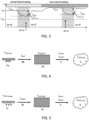
- Fig. 4 shows a schematic view of a water vapour transport process assumed for deriving an ambient value of humidity in the ambience according to an aspect of the present invention.
- a material or a component 7b of the sensor unit is soaking and/or outgassing water and/or water vapour. This leads to a contribution c H2C,mat to the concentration c H2O of water vapour, i.e. to relative humidity, in channel 2 and at the humidity sensor 3b.
- the humidity value c H2O,SHT measured by the sensor 3b depends on a relative humidity c H2O,amb in the ambience 6 and on the soaked/outgassed humidity c H2O,mat .
- an ambient value c H2O,amb in the ambience 6 may be determined from at least two measurement results c H2O,SHT of humidity at different fan states under the assumption that the contribution c H2O,mat of the soaking/outgassing component 7b as well as the ambient humidity c H2O,amb stay constant during the measurements.
- Example 3 Measurement of ambient total volatile organic compound (tVOC) concentration.
- Fig. 5 shows a schematic view of a transport process of volatile organic compounds (VOC) assumed for deriving an ambient value of tVOC concentration in the ambience 6 according to an aspect of the present invention.
- a sensed concentration c tVOC,SGP is dependent on a ambient value c tVOC,amb of the tVOC concentration in the ambience 6 and a contribution c tVOC,outgas of a material or component 7c of the sensor unit outgassing VOC.
- the relevant fluxes of VOC species from and towards the VOC sensor 3c are again labelled j amb and j outgas , respectively.
- c TVOC amb F c tVOC SGP 1 c tVOC SGP 2 ⁇ fan 1 ⁇ fan 2 ⁇
- the sensor unit and method of the invention may be applied to other signals and sensors, in particular other concentration measurements, e.g. a particulate matter sensor such as PM2.5.
- concentration measurements e.g. a particulate matter sensor such as PM2.5.
- the background concentration c B can be modified by an activation state of the actuator 4, e.g. a fan speed, such that the effective concentration c local is changed (eq23):
- R 1 a c B n If the fan lowers the background concentration by a factor f that was pre-characterized and remains constant over time, one obtains (eq24)
- R 2 a c B f n
- the underlying principle of the invention may further be exploited to perform a self-calibration of a temperature sensor 3a.
- T SHT T amb
- system parameters i.e. relevant parameters of heat transport such as ⁇ and ⁇ may be calibrated.
- the estimator 9 of the sensor unit of Fig. 1 is used to eliminate cross-sensitivities between disturbing contributions 8a-c originating from components 7a-c and the different sensors 3a-c, e.g. a temperature-dependence of the tVOC sensor 3c.
- the sensor unit comprises two temperature sensors 3a, in particular at different locations in the channel 2.
- the two temperature sensors 3a may be influenced by contributions of the component 7a in a different manner since the flow 5 advects more or less heat. This in turn may be used to make measurements of the ambient value T amb of temperature in the ambience 6 more accurate and reliable.
Landscapes
- Chemical & Material Sciences (AREA)
- Health & Medical Sciences (AREA)
- Life Sciences & Earth Sciences (AREA)
- Physics & Mathematics (AREA)
- General Physics & Mathematics (AREA)
- Engineering & Computer Science (AREA)
- Analytical Chemistry (AREA)
- Biochemistry (AREA)
- General Health & Medical Sciences (AREA)
- Immunology (AREA)
- Pathology (AREA)
- Medicinal Chemistry (AREA)
- Food Science & Technology (AREA)
- Combustion & Propulsion (AREA)
- Chemical Kinetics & Catalysis (AREA)
- Electrochemistry (AREA)
- Dispersion Chemistry (AREA)
- Investigating Or Analyzing Materials By The Use Of Electric Means (AREA)
Claims (15)
- Unité de détection comprenantun capteur (3) pour détecter une variable d'un gaz ambiant,un actionneur (4) pour fournir le gaz ambiant au capteur (3), etun ou plusieurs composants (7) qui contribuent aux résultats de mesure fournis par le capteur (3),caractérisée par un estimateur (9) conçu pour déterminer une valeur ambiante de la variable sans la contribution du ou des composants (7) en fonction d'un premier résultat de mesure fourni par le capteur (3) en réponse à un premier état d'activation de l'actionneur (4) et d'un deuxième résultat de mesure fourni par le capteur (3) en réponse à un deuxième état d'activation de l'actionneur (4) qui est différent du premier état d'activation,l'estimateur (9) étant configuré pour surveiller l'état d'activation de l'actionneur (3) et pour accepter deux résultats de mesure fournis par le capteur (3) comme étant le premier et le deuxième résultat de mesure lorsqu'un deuxième état d'activation correspondant diffère d'un premier état d'activation correspondant d'une marge minimale.
- Unité de détection selon la revendication 1,
dans laquelle l'estimateur (9) est configuré pour surveiller l'état d'activation de l'actionneur (3) et pour accepter les deux résultats de mesure fournis par le capteur (3) comme étant le premier et deuxième résultats de mesure lorsqu'un deuxième état d'activation correspondant diffère d'un premier état d'activation correspondant d'une marge de puissance minimale. - Unité de détection selon la revendication 1 ou la revendication 2,
l'estimateur (9) étant conçu de telle sorte qu'il n'accepte les deux résultats de mesure comme premier et deuxième résultats de mesure que si, en outre, un intervalle de temps entre la première mesure correspondante et la deuxième mesure correspondante est inférieur à une valeur seuil. - Unité de détection selon la revendication 3, dans laquelle l'intervalle de temps est dimensionné de manière à ce que la valeur ambiante de la variable et la contribution d'un ou de plusieurs composants (7) restent inchangées dans l'intervalle de temps ou qu'elles restent dans une plage définie dans l'intervalle de temps.
- Unité de détection selon l'une des revendications précédentes,
dans laquelle le premier état d'activation est un état de désactivation de l'actionneur (4) et dans laquelle le deuxième état d'activation est un état d'activation de l'actionneur (4). - Unité de détection selon l'une des revendications précédentes 1 à 4,
dans laquelle le premier état d'activation est un état de faible puissance de l'actionneur (4) et dans laquelle le deuxième état d'activation est un état de puissance élevée de l'actionneur (4), dépassant la puissance consommée par l'actionneur (4) dans l'état de faible puissance. - Unité de détection selon l'une des revendications précédentes,dans laquelle l'actionneur (4) est un actionneur qui peut être commandé électriquement au moins dans le premier et le deuxième état d'activation,l'actionneur comprenant un ou plusieurs d'un ventilateur, d'une pompe ou d'un haut-parleur.
- Unité de détection selon l'une des revendications précédentes,dans laquelle le capteur (3) est configuré pour détecter la variable du gaz ambiant, y compris un gaz, un aérosol ou une dispersion,en particulier, le capteur (3) étant configuré pour détecter la variable du gaz ambiant qui est l'air ambiant entourant l'unité de capteur.
- Unité de détection selon l'une des revendications précédentes,comprenant un canal (2) avec une entrée depuis et une sortie vers l'environnement (6),le capteur (3) étant disposé dans ou sur le canal (2) pour détecter la variable dans le gaz ambiant, etl'actionneur (4) étant agencé pour guider le gaz ambiant de l'entrée vers la sortie à travers le canal (2), en passant par le capteur (3).
- Unité de détection selon la revendication 8,dans laquelle la variable est une température (Tamb) de l'air ambiant,le capteur (3) est un capteur de température,le ou les composants (7) comprennent un composant électronique qui émet de la chaleur en réponse à son alimentation électrique.
- Unité de détection selon la revendication 8,dans laquelle la variable est l'humidité (cH2O,amb) de l'air ambiant,le capteur (3) est un capteur d'humidité,dans laquelle les un ou plusieurs composants (7) comprennent un composant libérant ou absorbant de l'humidité,en particulier, le ou les composants (7) comprennent un composant d'un boîtier (1) de l'unité de capteur.
- Unité de détection selon la revendication 8,la variable étant une concentration de gaz (camb) dans l'air ambiant,le capteur (3) étant un capteur de gaz sensible au gaz à détecter,dans laquelle les un ou plusieurs composants (7) comprennent un composant qui libère ou absorbe le gaz auquel le capteur est sensible,en particulier, les un ou plusieurs composants (7) comprennent un composant d'un boîtier (1) de l'unité de détection,en particulier dans laquelle la concentration de gaz est une concentration de composés organiques volatils (ctVOC,amb), et dans laquelle le capteur de gaz est sensible aux composés organiques volatils,en particulier dans laquelle le capteur de gaz est un capteur de gaz d'oxyde métallique et dans laquelle l'estimateur est configuré pour déterminer une sensibilité du capteur de gaz d'oxyde métallique en fonction du premier résultat de mesure et du deuxième résultat de mesure.
- Unité de détection selon l'une des revendications précédentes,dans laquelle l'estimateur (9) est configuré pour déterminer la valeur d'environnement camb de la variable sans la contribution cmat du ou des composants (7) sur la base d'un flux de la variable depuis le ou les composants (7) vers le capteur (3) correspondant à un flux de la variable depuis le capteur (3) vers l'environnement (6) pour les premier et deuxième états d'activation de l'actionneur (4), eten particulier dans laquelle l'estimateur (9) est configuré pour déterminer la valeur d'environnement camb de la variable sans la contribution cmat des un ou plusieurs composants en résolvant l'équation
 où cSHT est un résultat de mesure fourni par le capteur (3), α est un paramètre indiquant le flux de la variable depuis le capteur (3) vers l'environnement (6), et β est un paramètre indiquant le flux de la variable depuis le ou les composants (7) vers le capteur (3) .
 - Procédé de détermination d'une valeur ambiante (camb) d'une variable dans un gaz dans l'environnement (6) d'une unité de capteur, le procédé comprenant les étapes suivantes :fournir une unité de détection comprenant un capteur (3) pour détecter la variable, un actionneur (4) pour fournir le gaz ambiant au capteur (3) et un ou plusieurs composants (7) qui contribuent aux résultats de mesure (cSHT) fournis par le capteur (3),caractérisé par un estimateur (9) conçu pour déterminer une valeur ambiante de la variable sans la contribution des un ou plusieurs composants (7),dans lequel l'estimateur (9) surveille un état d'activation de l'actionneur (3) et accepte deux résultats de mesure fournis par le capteur (3) en tant que premier et deuxième résultats de mesure lorsqu'un deuxième état d'activation correspondant s'écarte d'un premier état d'activation correspondant d'une marge minimale, dans lequel le premier résultat de mesure (cSHT1) est reçu en réponse au premier état d'activation de l'actionneur (4), et dans lequel le deuxième résultat de mesure (cSHT2) est reçu en réponse au deuxième état d'activation de l'actionneur (4) ; etdans lequel l'estimateur (9) détermine la valeur d'environnement (camb) de la variable sans la contribution (cmat) d'un ou plusieurs composants (7) en fonction du premier résultat de mesure (cSHT1) et du deuxième résultat de mesure (cSHT2).
- Logiciel comprenant des moyens de code de logiciel pour amener une unité de traitement de l'estimateur (9) de l'unité de détection selon la revendication 1 à exécuter les étapes de procédé de l'estimateur selon la revendication 14.
Priority Applications (3)
| Application Number | Priority Date | Filing Date | Title |
|---|---|---|---|
| EP18208705.6A EP3660498B1 (fr) | 2018-11-27 | 2018-11-27 | Capteur environnemental comportant un actionneur |
| KR1020190153261A KR20200063999A (ko) | 2018-11-27 | 2019-11-26 | 액츄에이터를 갖는 주변 센서 |
| CN201911179158.9A CN111220300A (zh) | 2018-11-27 | 2019-11-27 | 具有致动器的环境传感器 |
Applications Claiming Priority (1)
| Application Number | Priority Date | Filing Date | Title |
|---|---|---|---|
| EP18208705.6A EP3660498B1 (fr) | 2018-11-27 | 2018-11-27 | Capteur environnemental comportant un actionneur |
Publications (2)
| Publication Number | Publication Date |
|---|---|
| EP3660498A1 EP3660498A1 (fr) | 2020-06-03 |
| EP3660498B1 true EP3660498B1 (fr) | 2024-08-07 |
Family
ID=64556679
Family Applications (1)
| Application Number | Title | Priority Date | Filing Date |
|---|---|---|---|
| EP18208705.6A Active EP3660498B1 (fr) | 2018-11-27 | 2018-11-27 | Capteur environnemental comportant un actionneur |
Country Status (3)
| Country | Link |
|---|---|
| EP (1) | EP3660498B1 (fr) |
| KR (1) | KR20200063999A (fr) |
| CN (1) | CN111220300A (fr) |
Families Citing this family (2)
| Publication number | Priority date | Publication date | Assignee | Title |
|---|---|---|---|---|
| CN113091796B (zh) * | 2021-04-06 | 2022-07-15 | 上海应用技术大学 | 传感器热响应性能检测装置 |
| WO2024020535A1 (fr) * | 2022-07-22 | 2024-01-25 | VOCNomics, LLC | Procédé et appareil de surveillance à distance de divers composés organiques |
Family Cites Families (5)
| Publication number | Priority date | Publication date | Assignee | Title |
|---|---|---|---|---|
| US8897958B2 (en) * | 2010-02-05 | 2014-11-25 | Volvo Group North America, Llc | Method for determining ambient air temperature outside of a vehicle |
| EP2728327B1 (fr) * | 2012-11-02 | 2020-02-19 | Sensirion AG | Dispositif électronique portable |
| US20140134053A1 (en) * | 2012-11-14 | 2014-05-15 | Sensirion Ag | Portable electronic device with chemical sensor |
| EP2808652B1 (fr) * | 2013-05-31 | 2016-11-16 | Sensirion AG | Dispositif électronique portable avec capteur de température intégré compensée par des donnes d'autre senseurs |
| EP3324164B1 (fr) * | 2016-11-21 | 2019-01-23 | Sensirion AG | Compensation d'un signal de capteur |
-
2018
- 2018-11-27 EP EP18208705.6A patent/EP3660498B1/fr active Active
-
2019
- 2019-11-26 KR KR1020190153261A patent/KR20200063999A/ko not_active Ceased
- 2019-11-27 CN CN201911179158.9A patent/CN111220300A/zh active Pending
Also Published As
| Publication number | Publication date |
|---|---|
| EP3660498A1 (fr) | 2020-06-03 |
| CN111220300A (zh) | 2020-06-02 |
| KR20200063999A (ko) | 2020-06-05 |
Similar Documents
| Publication | Publication Date | Title |
|---|---|---|
| US9995593B2 (en) | Method for operating a sensor array | |
| JP2801156B2 (ja) | 露点または気体濃度の測定方法と着氷予測装置 | |
| US8683845B2 (en) | Carbon dioxide sensor and associated method for generating a gas measurement value | |
| US10267702B2 (en) | Force sensor with compensation | |
| US7607823B2 (en) | Leak detector comprising a self-heated thermistor control circuit | |
| US20210048401A1 (en) | Sensor for determining the thermal capacity of natural gas | |
| US9829393B2 (en) | Method for determining the ambient temperature of a mobile device | |
| EP1859260A1 (fr) | Regulation retroactive de temperature pour capteurs de gaz a semi-conducteurs | |
| CN105008870B (zh) | 热式流体计测装置 | |
| US20210123822A1 (en) | Detecting and indicating stability in an industrial temperature dry block calibrator | |
| EP3660498A1 (fr) | Capteur environnemental comportant un actionneur | |
| WO2016111253A1 (fr) | Dispositif de mesure d'humidité | |
| CN109991265B (zh) | 一种自调节热导式气体传感器和气体检测装置 | |
| US6230559B1 (en) | Thermal type flow measuring instrument and temperature-error correcting apparatus thereof | |
| AU2006332047B8 (en) | Linear fire-detector alarming system based on data fusion and the method | |
| US9304098B2 (en) | Capacitive humidity sensor with hysteresis compensation | |
| JP5111180B2 (ja) | 熱式流量計 | |
| US20200278310A1 (en) | Method for operating a gas sensor device and gas sensor device | |
| JP3295894B2 (ja) | 湿度センサ | |
| US6112576A (en) | Gas analyzer with background gas compensation | |
| JP2006201156A (ja) | 分光計に使用される検出器の温度依存性補償のための装置および方法 | |
| CN114184724B (zh) | 一种色谱仪载气流量补偿方法、装置及其存储介质 | |
| JP2023159874A (ja) | センサ部品と酸化部品とを備えたガス検知装置およびガス検知方法 | |
| CN111133281A (zh) | 用于控制用于加热车辆的空气质量传感器的传感器元件的加热元件的方法和设备以及用于车辆的空气质量传感器系统 | |
| US12158440B2 (en) | Sensor device and method for operating a sensor device |
Legal Events
| Date | Code | Title | Description |
|---|---|---|---|
| PUAI | Public reference made under article 153(3) epc to a published international application that has entered the european phase |
Free format text: ORIGINAL CODE: 0009012 |
|
| STAA | Information on the status of an ep patent application or granted ep patent |
Free format text: STATUS: THE APPLICATION HAS BEEN PUBLISHED |
|
| AK | Designated contracting states |
Kind code of ref document: A1 Designated state(s): AL AT BE BG CH CY CZ DE DK EE ES FI FR GB GR HR HU IE IS IT LI LT LU LV MC MK MT NL NO PL PT RO RS SE SI SK SM TR |
|
| AX | Request for extension of the european patent |
Extension state: BA ME |
|
| STAA | Information on the status of an ep patent application or granted ep patent |
Free format text: STATUS: REQUEST FOR EXAMINATION WAS MADE |
|
| 17P | Request for examination filed |
Effective date: 20201111 |
|
| RBV | Designated contracting states (corrected) |
Designated state(s): AL AT BE BG CH CY CZ DE DK EE ES FI FR GB GR HR HU IE IS IT LI LT LU LV MC MK MT NL NO PL PT RO RS SE SI SK SM TR |
|
| STAA | Information on the status of an ep patent application or granted ep patent |
Free format text: STATUS: EXAMINATION IS IN PROGRESS |
|
| 17Q | First examination report despatched |
Effective date: 20220810 |
|
| P01 | Opt-out of the competence of the unified patent court (upc) registered |
Effective date: 20230602 |
|
| GRAP | Despatch of communication of intention to grant a patent |
Free format text: ORIGINAL CODE: EPIDOSNIGR1 |
|
| STAA | Information on the status of an ep patent application or granted ep patent |
Free format text: STATUS: GRANT OF PATENT IS INTENDED |
|
| RIC1 | Information provided on ipc code assigned before grant |
Ipc: G01N 15/06 20060101ALN20240302BHEP Ipc: G01N 33/00 20060101ALI20240302BHEP Ipc: G01N 27/12 20060101AFI20240302BHEP |
|
| INTG | Intention to grant announced |
Effective date: 20240318 |
|
| GRAS | Grant fee paid |
Free format text: ORIGINAL CODE: EPIDOSNIGR3 |
|
| GRAA | (expected) grant |
Free format text: ORIGINAL CODE: 0009210 |
|
| STAA | Information on the status of an ep patent application or granted ep patent |
Free format text: STATUS: THE PATENT HAS BEEN GRANTED |
|
| AK | Designated contracting states |
Kind code of ref document: B1 Designated state(s): AL AT BE BG CH CY CZ DE DK EE ES FI FR GB GR HR HU IE IS IT LI LT LU LV MC MK MT NL NO PL PT RO RS SE SI SK SM TR |
|
| REG | Reference to a national code |
Ref country code: GB Ref legal event code: FG4D |
|
| REG | Reference to a national code |
Ref country code: CH Ref legal event code: EP |
|
| REG | Reference to a national code |
Ref country code: IE Ref legal event code: FG4D |
|
| REG | Reference to a national code |
Ref country code: DE Ref legal event code: R096 Ref document number: 602018072692 Country of ref document: DE |
|
| REG | Reference to a national code |
Ref country code: LT Ref legal event code: MG9D |
|
| REG | Reference to a national code |
Ref country code: NL Ref legal event code: MP Effective date: 20240807 |
|
| PG25 | Lapsed in a contracting state [announced via postgrant information from national office to epo] |
Ref country code: NO Free format text: LAPSE BECAUSE OF FAILURE TO SUBMIT A TRANSLATION OF THE DESCRIPTION OR TO PAY THE FEE WITHIN THE PRESCRIBED TIME-LIMIT Effective date: 20241107 |
|
| REG | Reference to a national code |
Ref country code: AT Ref legal event code: MK05 Ref document number: 1711484 Country of ref document: AT Kind code of ref document: T Effective date: 20240807 |
|
| PG25 | Lapsed in a contracting state [announced via postgrant information from national office to epo] |
Ref country code: PT Free format text: LAPSE BECAUSE OF FAILURE TO SUBMIT A TRANSLATION OF THE DESCRIPTION OR TO PAY THE FEE WITHIN THE PRESCRIBED TIME-LIMIT Effective date: 20241209 Ref country code: NL Free format text: LAPSE BECAUSE OF FAILURE TO SUBMIT A TRANSLATION OF THE DESCRIPTION OR TO PAY THE FEE WITHIN THE PRESCRIBED TIME-LIMIT Effective date: 20240807 Ref country code: FI Free format text: LAPSE BECAUSE OF FAILURE TO SUBMIT A TRANSLATION OF THE DESCRIPTION OR TO PAY THE FEE WITHIN THE PRESCRIBED TIME-LIMIT Effective date: 20240807 Ref country code: PL Free format text: LAPSE BECAUSE OF FAILURE TO SUBMIT A TRANSLATION OF THE DESCRIPTION OR TO PAY THE FEE WITHIN THE PRESCRIBED TIME-LIMIT Effective date: 20240807 Ref country code: GR Free format text: LAPSE BECAUSE OF FAILURE TO SUBMIT A TRANSLATION OF THE DESCRIPTION OR TO PAY THE FEE WITHIN THE PRESCRIBED TIME-LIMIT Effective date: 20241108 |
|
| PG25 | Lapsed in a contracting state [announced via postgrant information from national office to epo] |
Ref country code: BG Free format text: LAPSE BECAUSE OF FAILURE TO SUBMIT A TRANSLATION OF THE DESCRIPTION OR TO PAY THE FEE WITHIN THE PRESCRIBED TIME-LIMIT Effective date: 20240807 |
|
| PG25 | Lapsed in a contracting state [announced via postgrant information from national office to epo] |
Ref country code: LV Free format text: LAPSE BECAUSE OF FAILURE TO SUBMIT A TRANSLATION OF THE DESCRIPTION OR TO PAY THE FEE WITHIN THE PRESCRIBED TIME-LIMIT Effective date: 20240807 |
|
| PG25 | Lapsed in a contracting state [announced via postgrant information from national office to epo] |
Ref country code: AT Free format text: LAPSE BECAUSE OF FAILURE TO SUBMIT A TRANSLATION OF THE DESCRIPTION OR TO PAY THE FEE WITHIN THE PRESCRIBED TIME-LIMIT Effective date: 20240807 Ref country code: IS Free format text: LAPSE BECAUSE OF FAILURE TO SUBMIT A TRANSLATION OF THE DESCRIPTION OR TO PAY THE FEE WITHIN THE PRESCRIBED TIME-LIMIT Effective date: 20241207 |
|
| PG25 | Lapsed in a contracting state [announced via postgrant information from national office to epo] |
Ref country code: HR Free format text: LAPSE BECAUSE OF FAILURE TO SUBMIT A TRANSLATION OF THE DESCRIPTION OR TO PAY THE FEE WITHIN THE PRESCRIBED TIME-LIMIT Effective date: 20240807 |
|
| PG25 | Lapsed in a contracting state [announced via postgrant information from national office to epo] |
Ref country code: ES Free format text: LAPSE BECAUSE OF FAILURE TO SUBMIT A TRANSLATION OF THE DESCRIPTION OR TO PAY THE FEE WITHIN THE PRESCRIBED TIME-LIMIT Effective date: 20240807 Ref country code: RS Free format text: LAPSE BECAUSE OF FAILURE TO SUBMIT A TRANSLATION OF THE DESCRIPTION OR TO PAY THE FEE WITHIN THE PRESCRIBED TIME-LIMIT Effective date: 20241107 |
|
| PG25 | Lapsed in a contracting state [announced via postgrant information from national office to epo] |
Ref country code: RS Free format text: LAPSE BECAUSE OF FAILURE TO SUBMIT A TRANSLATION OF THE DESCRIPTION OR TO PAY THE FEE WITHIN THE PRESCRIBED TIME-LIMIT Effective date: 20241107 Ref country code: PT Free format text: LAPSE BECAUSE OF FAILURE TO SUBMIT A TRANSLATION OF THE DESCRIPTION OR TO PAY THE FEE WITHIN THE PRESCRIBED TIME-LIMIT Effective date: 20241209 Ref country code: PL Free format text: LAPSE BECAUSE OF FAILURE TO SUBMIT A TRANSLATION OF THE DESCRIPTION OR TO PAY THE FEE WITHIN THE PRESCRIBED TIME-LIMIT Effective date: 20240807 Ref country code: NO Free format text: LAPSE BECAUSE OF FAILURE TO SUBMIT A TRANSLATION OF THE DESCRIPTION OR TO PAY THE FEE WITHIN THE PRESCRIBED TIME-LIMIT Effective date: 20241107 Ref country code: NL Free format text: LAPSE BECAUSE OF FAILURE TO SUBMIT A TRANSLATION OF THE DESCRIPTION OR TO PAY THE FEE WITHIN THE PRESCRIBED TIME-LIMIT Effective date: 20240807 Ref country code: LV Free format text: LAPSE BECAUSE OF FAILURE TO SUBMIT A TRANSLATION OF THE DESCRIPTION OR TO PAY THE FEE WITHIN THE PRESCRIBED TIME-LIMIT Effective date: 20240807 Ref country code: IS Free format text: LAPSE BECAUSE OF FAILURE TO SUBMIT A TRANSLATION OF THE DESCRIPTION OR TO PAY THE FEE WITHIN THE PRESCRIBED TIME-LIMIT Effective date: 20241207 Ref country code: HR Free format text: LAPSE BECAUSE OF FAILURE TO SUBMIT A TRANSLATION OF THE DESCRIPTION OR TO PAY THE FEE WITHIN THE PRESCRIBED TIME-LIMIT Effective date: 20240807 Ref country code: GR Free format text: LAPSE BECAUSE OF FAILURE TO SUBMIT A TRANSLATION OF THE DESCRIPTION OR TO PAY THE FEE WITHIN THE PRESCRIBED TIME-LIMIT Effective date: 20241108 Ref country code: FI Free format text: LAPSE BECAUSE OF FAILURE TO SUBMIT A TRANSLATION OF THE DESCRIPTION OR TO PAY THE FEE WITHIN THE PRESCRIBED TIME-LIMIT Effective date: 20240807 Ref country code: ES Free format text: LAPSE BECAUSE OF FAILURE TO SUBMIT A TRANSLATION OF THE DESCRIPTION OR TO PAY THE FEE WITHIN THE PRESCRIBED TIME-LIMIT Effective date: 20240807 Ref country code: BG Free format text: LAPSE BECAUSE OF FAILURE TO SUBMIT A TRANSLATION OF THE DESCRIPTION OR TO PAY THE FEE WITHIN THE PRESCRIBED TIME-LIMIT Effective date: 20240807 Ref country code: AT Free format text: LAPSE BECAUSE OF FAILURE TO SUBMIT A TRANSLATION OF THE DESCRIPTION OR TO PAY THE FEE WITHIN THE PRESCRIBED TIME-LIMIT Effective date: 20240807 |
|
| PG25 | Lapsed in a contracting state [announced via postgrant information from national office to epo] |
Ref country code: RO Free format text: LAPSE BECAUSE OF FAILURE TO SUBMIT A TRANSLATION OF THE DESCRIPTION OR TO PAY THE FEE WITHIN THE PRESCRIBED TIME-LIMIT Effective date: 20240807 Ref country code: DK Free format text: LAPSE BECAUSE OF FAILURE TO SUBMIT A TRANSLATION OF THE DESCRIPTION OR TO PAY THE FEE WITHIN THE PRESCRIBED TIME-LIMIT Effective date: 20240807 Ref country code: SM Free format text: LAPSE BECAUSE OF FAILURE TO SUBMIT A TRANSLATION OF THE DESCRIPTION OR TO PAY THE FEE WITHIN THE PRESCRIBED TIME-LIMIT Effective date: 20240807 |
|
| PG25 | Lapsed in a contracting state [announced via postgrant information from national office to epo] |
Ref country code: EE Free format text: LAPSE BECAUSE OF FAILURE TO SUBMIT A TRANSLATION OF THE DESCRIPTION OR TO PAY THE FEE WITHIN THE PRESCRIBED TIME-LIMIT Effective date: 20240807 |
|
| PG25 | Lapsed in a contracting state [announced via postgrant information from national office to epo] |
Ref country code: CZ Free format text: LAPSE BECAUSE OF FAILURE TO SUBMIT A TRANSLATION OF THE DESCRIPTION OR TO PAY THE FEE WITHIN THE PRESCRIBED TIME-LIMIT Effective date: 20240807 |
|
| PG25 | Lapsed in a contracting state [announced via postgrant information from national office to epo] |
Ref country code: SK Free format text: LAPSE BECAUSE OF FAILURE TO SUBMIT A TRANSLATION OF THE DESCRIPTION OR TO PAY THE FEE WITHIN THE PRESCRIBED TIME-LIMIT Effective date: 20240807 |
|
| REG | Reference to a national code |
Ref country code: DE Ref legal event code: R097 Ref document number: 602018072692 Country of ref document: DE |
|
| PLBE | No opposition filed within time limit |
Free format text: ORIGINAL CODE: 0009261 |
|
| STAA | Information on the status of an ep patent application or granted ep patent |
Free format text: STATUS: NO OPPOSITION FILED WITHIN TIME LIMIT |
|
| REG | Reference to a national code |
Ref country code: CH Ref legal event code: PL |
|
| PG25 | Lapsed in a contracting state [announced via postgrant information from national office to epo] |
Ref country code: MC Free format text: LAPSE BECAUSE OF FAILURE TO SUBMIT A TRANSLATION OF THE DESCRIPTION OR TO PAY THE FEE WITHIN THE PRESCRIBED TIME-LIMIT Effective date: 20240807 |
|
| PG25 | Lapsed in a contracting state [announced via postgrant information from national office to epo] |
Ref country code: LU Free format text: LAPSE BECAUSE OF NON-PAYMENT OF DUE FEES Effective date: 20241127 |
|
| REG | Reference to a national code |
Ref country code: CH Ref legal event code: PL |
|
| 26N | No opposition filed |
Effective date: 20250508 |
|
| GBPC | Gb: european patent ceased through non-payment of renewal fee |
Effective date: 20241127 |
|
| PG25 | Lapsed in a contracting state [announced via postgrant information from national office to epo] |
Ref country code: CH Free format text: LAPSE BECAUSE OF NON-PAYMENT OF DUE FEES Effective date: 20241130 |
|
| REG | Reference to a national code |
Ref country code: BE Ref legal event code: MM Effective date: 20241130 |
|
| PG25 | Lapsed in a contracting state [announced via postgrant information from national office to epo] |
Ref country code: SE Free format text: LAPSE BECAUSE OF FAILURE TO SUBMIT A TRANSLATION OF THE DESCRIPTION OR TO PAY THE FEE WITHIN THE PRESCRIBED TIME-LIMIT Effective date: 20240807 |
|
| PG25 | Lapsed in a contracting state [announced via postgrant information from national office to epo] |
Ref country code: GB Free format text: LAPSE BECAUSE OF NON-PAYMENT OF DUE FEES Effective date: 20241127 Ref country code: BE Free format text: LAPSE BECAUSE OF NON-PAYMENT OF DUE FEES Effective date: 20241130 |
|
| PG25 | Lapsed in a contracting state [announced via postgrant information from national office to epo] |
Ref country code: FR Free format text: LAPSE BECAUSE OF NON-PAYMENT OF DUE FEES Effective date: 20241130 |
|
| PG25 | Lapsed in a contracting state [announced via postgrant information from national office to epo] |
Ref country code: IE Free format text: LAPSE BECAUSE OF NON-PAYMENT OF DUE FEES Effective date: 20241127 |
|
| PGFP | Annual fee paid to national office [announced via postgrant information from national office to epo] |
Ref country code: DE Payment date: 20251118 Year of fee payment: 8 |
|
| PG25 | Lapsed in a contracting state [announced via postgrant information from national office to epo] |
Ref country code: IT Free format text: LAPSE BECAUSE OF FAILURE TO SUBMIT A TRANSLATION OF THE DESCRIPTION OR TO PAY THE FEE WITHIN THE PRESCRIBED TIME-LIMIT Effective date: 20240807 |
|
| PG25 | Lapsed in a contracting state [announced via postgrant information from national office to epo] |
Ref country code: HU Free format text: LAPSE BECAUSE OF FAILURE TO SUBMIT A TRANSLATION OF THE DESCRIPTION OR TO PAY THE FEE WITHIN THE PRESCRIBED TIME-LIMIT; INVALID AB INITIO Effective date: 20181127 |
|
| PG25 | Lapsed in a contracting state [announced via postgrant information from national office to epo] |
Ref country code: CY Free format text: LAPSE BECAUSE OF FAILURE TO SUBMIT A TRANSLATION OF THE DESCRIPTION OR TO PAY THE FEE WITHIN THE PRESCRIBED TIME-LIMIT; INVALID AB INITIO Effective date: 20181127 |