EP3660955A1 - Elektrode, energiespeicherelement und verfahren zur herstellung einer elektrode - Google Patents
Elektrode, energiespeicherelement und verfahren zur herstellung einer elektrode Download PDFInfo
- Publication number
- EP3660955A1 EP3660955A1 EP18837519.0A EP18837519A EP3660955A1 EP 3660955 A1 EP3660955 A1 EP 3660955A1 EP 18837519 A EP18837519 A EP 18837519A EP 3660955 A1 EP3660955 A1 EP 3660955A1
- Authority
- EP
- European Patent Office
- Prior art keywords
- binder
- intermediate layer
- electrode
- mass
- resistance
- Prior art date
- Legal status (The legal status is an assumption and is not a legal conclusion. Google has not performed a legal analysis and makes no representation as to the accuracy of the status listed.)
- Withdrawn
Links
- 238000000034 method Methods 0.000 title claims description 26
- 238000004519 manufacturing process Methods 0.000 title claims description 18
- 239000011230 binding agent Substances 0.000 claims abstract description 178
- 239000000945 filler Substances 0.000 claims abstract description 54
- 239000000126 substance Substances 0.000 claims abstract description 49
- 239000011149 active material Substances 0.000 claims abstract description 48
- 239000002904 solvent Substances 0.000 claims abstract description 42
- 239000000758 substrate Substances 0.000 claims abstract description 30
- 238000004146 energy storage Methods 0.000 claims description 45
- 229920000642 polymer Polymers 0.000 claims description 16
- BQCIDUSAKPWEOX-UHFFFAOYSA-N 1,1-Difluoroethene Chemical compound FC(F)=C BQCIDUSAKPWEOX-UHFFFAOYSA-N 0.000 claims description 9
- 239000010410 layer Substances 0.000 description 147
- 239000011255 nonaqueous electrolyte Substances 0.000 description 27
- 239000002612 dispersion medium Substances 0.000 description 21
- 229920005989 resin Polymers 0.000 description 20
- 239000011347 resin Substances 0.000 description 20
- 239000002033 PVDF binder Substances 0.000 description 16
- 238000005259 measurement Methods 0.000 description 16
- 229920002981 polyvinylidene fluoride Polymers 0.000 description 16
- XLYOFNOQVPJJNP-UHFFFAOYSA-N water Substances O XLYOFNOQVPJJNP-UHFFFAOYSA-N 0.000 description 15
- SECXISVLQFMRJM-UHFFFAOYSA-N N-Methylpyrrolidone Chemical compound CN1CCCC1=O SECXISVLQFMRJM-UHFFFAOYSA-N 0.000 description 14
- 238000010828 elution Methods 0.000 description 14
- OKTJSMMVPCPJKN-UHFFFAOYSA-N Carbon Chemical compound [C] OKTJSMMVPCPJKN-UHFFFAOYSA-N 0.000 description 13
- -1 sericite Inorganic materials 0.000 description 13
- PNEYBMLMFCGWSK-UHFFFAOYSA-N aluminium oxide Inorganic materials [O-2].[O-2].[O-2].[Al+3].[Al+3] PNEYBMLMFCGWSK-UHFFFAOYSA-N 0.000 description 12
- 239000011248 coating agent Substances 0.000 description 11
- 238000000576 coating method Methods 0.000 description 11
- 229910052731 fluorine Inorganic materials 0.000 description 11
- 239000006230 acetylene black Substances 0.000 description 10
- 239000002245 particle Substances 0.000 description 10
- ZMXDDKWLCZADIW-UHFFFAOYSA-N N,N-Dimethylformamide Chemical compound CN(C)C=O ZMXDDKWLCZADIW-UHFFFAOYSA-N 0.000 description 9
- 230000000052 comparative effect Effects 0.000 description 9
- 239000011737 fluorine Substances 0.000 description 9
- YCKRFDGAMUMZLT-UHFFFAOYSA-N Fluorine atom Chemical compound [F] YCKRFDGAMUMZLT-UHFFFAOYSA-N 0.000 description 8
- RYGMFSIKBFXOCR-UHFFFAOYSA-N Copper Chemical compound [Cu] RYGMFSIKBFXOCR-UHFFFAOYSA-N 0.000 description 6
- IAZDPXIOMUYVGZ-UHFFFAOYSA-N Dimethylsulphoxide Chemical compound CS(C)=O IAZDPXIOMUYVGZ-UHFFFAOYSA-N 0.000 description 6
- PXHVJJICTQNCMI-UHFFFAOYSA-N Nickel Chemical compound [Ni] PXHVJJICTQNCMI-UHFFFAOYSA-N 0.000 description 6
- 229910052782 aluminium Inorganic materials 0.000 description 6
- XAGFODPZIPBFFR-UHFFFAOYSA-N aluminium Chemical compound [Al] XAGFODPZIPBFFR-UHFFFAOYSA-N 0.000 description 6
- 239000003990 capacitor Substances 0.000 description 6
- 229910052751 metal Inorganic materials 0.000 description 6
- 239000002184 metal Substances 0.000 description 6
- VYPSYNLAJGMNEJ-UHFFFAOYSA-N Silicium dioxide Chemical compound O=[Si]=O VYPSYNLAJGMNEJ-UHFFFAOYSA-N 0.000 description 5
- 150000001875 compounds Chemical class 0.000 description 5
- 238000009826 distribution Methods 0.000 description 5
- 229910003002 lithium salt Inorganic materials 0.000 description 5
- 159000000002 lithium salts Chemical class 0.000 description 5
- 239000003960 organic solvent Substances 0.000 description 5
- KMTRUDSVKNLOMY-UHFFFAOYSA-N Ethylene carbonate Chemical compound O=C1OCCO1 KMTRUDSVKNLOMY-UHFFFAOYSA-N 0.000 description 4
- 239000004698 Polyethylene Substances 0.000 description 4
- 239000003575 carbonaceous material Substances 0.000 description 4
- 150000005678 chain carbonates Chemical class 0.000 description 4
- 239000011889 copper foil Substances 0.000 description 4
- 150000005676 cyclic carbonates Chemical class 0.000 description 4
- 239000003792 electrolyte Substances 0.000 description 4
- JBTWLSYIZRCDFO-UHFFFAOYSA-N ethyl methyl carbonate Chemical compound CCOC(=O)OC JBTWLSYIZRCDFO-UHFFFAOYSA-N 0.000 description 4
- 239000011256 inorganic filler Substances 0.000 description 4
- 229910003475 inorganic filler Inorganic materials 0.000 description 4
- 239000007788 liquid Substances 0.000 description 4
- 239000000463 material Substances 0.000 description 4
- 229920000573 polyethylene Polymers 0.000 description 4
- 150000003839 salts Chemical class 0.000 description 4
- 239000002562 thickening agent Substances 0.000 description 4
- 229920002134 Carboxymethyl cellulose Polymers 0.000 description 3
- HBBGRARXTFLTSG-UHFFFAOYSA-N Lithium ion Chemical compound [Li+] HBBGRARXTFLTSG-UHFFFAOYSA-N 0.000 description 3
- FXHOOIRPVKKKFG-UHFFFAOYSA-N N,N-Dimethylacetamide Chemical compound CN(C)C(C)=O FXHOOIRPVKKKFG-UHFFFAOYSA-N 0.000 description 3
- 239000004743 Polypropylene Substances 0.000 description 3
- YXFVVABEGXRONW-UHFFFAOYSA-N Toluene Chemical compound CC1=CC=CC=C1 YXFVVABEGXRONW-UHFFFAOYSA-N 0.000 description 3
- 230000003247 decreasing effect Effects 0.000 description 3
- 239000006185 dispersion Substances 0.000 description 3
- 230000000694 effects Effects 0.000 description 3
- 125000001153 fluoro group Chemical group F* 0.000 description 3
- 239000011229 interlayer Substances 0.000 description 3
- 229910001416 lithium ion Inorganic materials 0.000 description 3
- 239000011572 manganese Substances 0.000 description 3
- 150000002739 metals Chemical class 0.000 description 3
- 239000000203 mixture Substances 0.000 description 3
- VLKZOEOYAKHREP-UHFFFAOYSA-N n-Hexane Chemical compound CCCCCC VLKZOEOYAKHREP-UHFFFAOYSA-N 0.000 description 3
- 239000002798 polar solvent Substances 0.000 description 3
- 229920000098 polyolefin Polymers 0.000 description 3
- 229920001155 polypropylene Polymers 0.000 description 3
- 239000010935 stainless steel Substances 0.000 description 3
- 229910001220 stainless steel Inorganic materials 0.000 description 3
- 238000004804 winding Methods 0.000 description 3
- ZZXUZKXVROWEIF-UHFFFAOYSA-N 1,2-butylene carbonate Chemical compound CCC1COC(=O)O1 ZZXUZKXVROWEIF-UHFFFAOYSA-N 0.000 description 2
- VAYTZRYEBVHVLE-UHFFFAOYSA-N 1,3-dioxol-2-one Chemical compound O=C1OC=CO1 VAYTZRYEBVHVLE-UHFFFAOYSA-N 0.000 description 2
- DSMUTQTWFHVVGQ-UHFFFAOYSA-N 4,5-difluoro-1,3-dioxolan-2-one Chemical compound FC1OC(=O)OC1F DSMUTQTWFHVVGQ-UHFFFAOYSA-N 0.000 description 2
- BJWMSGRKJIOCNR-UHFFFAOYSA-N 4-ethenyl-1,3-dioxolan-2-one Chemical compound C=CC1COC(=O)O1 BJWMSGRKJIOCNR-UHFFFAOYSA-N 0.000 description 2
- SBLRHMKNNHXPHG-UHFFFAOYSA-N 4-fluoro-1,3-dioxolan-2-one Chemical compound FC1COC(=O)O1 SBLRHMKNNHXPHG-UHFFFAOYSA-N 0.000 description 2
- 229910000838 Al alloy Inorganic materials 0.000 description 2
- VTYYLEPIZMXCLO-UHFFFAOYSA-L Calcium carbonate Chemical compound [Ca+2].[O-]C([O-])=O VTYYLEPIZMXCLO-UHFFFAOYSA-L 0.000 description 2
- OIFBSDVPJOWBCH-UHFFFAOYSA-N Diethyl carbonate Chemical compound CCOC(=O)OCC OIFBSDVPJOWBCH-UHFFFAOYSA-N 0.000 description 2
- 229920002943 EPDM rubber Polymers 0.000 description 2
- UQSXHKLRYXJYBZ-UHFFFAOYSA-N Iron oxide Chemical compound [Fe]=O UQSXHKLRYXJYBZ-UHFFFAOYSA-N 0.000 description 2
- CPLXHLVBOLITMK-UHFFFAOYSA-N Magnesium oxide Chemical compound [Mg]=O CPLXHLVBOLITMK-UHFFFAOYSA-N 0.000 description 2
- 239000004642 Polyimide Substances 0.000 description 2
- 241000156302 Porcine hemagglutinating encephalomyelitis virus Species 0.000 description 2
- GWEVSGVZZGPLCZ-UHFFFAOYSA-N Titan oxide Chemical compound O=[Ti]=O GWEVSGVZZGPLCZ-UHFFFAOYSA-N 0.000 description 2
- XLOMVQKBTHCTTD-UHFFFAOYSA-N Zinc monoxide Chemical compound [Zn]=O XLOMVQKBTHCTTD-UHFFFAOYSA-N 0.000 description 2
- MCMNRKCIXSYSNV-UHFFFAOYSA-N Zirconium dioxide Chemical compound O=[Zr]=O MCMNRKCIXSYSNV-UHFFFAOYSA-N 0.000 description 2
- 229910045601 alloy Inorganic materials 0.000 description 2
- 239000000956 alloy Substances 0.000 description 2
- 238000004891 communication Methods 0.000 description 2
- 239000002131 composite material Substances 0.000 description 2
- 239000006258 conductive agent Substances 0.000 description 2
- 229910052802 copper Inorganic materials 0.000 description 2
- 239000010949 copper Substances 0.000 description 2
- 239000013078 crystal Substances 0.000 description 2
- 238000010586 diagram Methods 0.000 description 2
- IEJIGPNLZYLLBP-UHFFFAOYSA-N dimethyl carbonate Chemical compound COC(=O)OC IEJIGPNLZYLLBP-UHFFFAOYSA-N 0.000 description 2
- 229920001971 elastomer Polymers 0.000 description 2
- 239000011888 foil Substances 0.000 description 2
- 239000011521 glass Substances 0.000 description 2
- 229910021469 graphitizable carbon Inorganic materials 0.000 description 2
- 238000002347 injection Methods 0.000 description 2
- 239000007924 injection Substances 0.000 description 2
- 229910052809 inorganic oxide Inorganic materials 0.000 description 2
- NLYAJNPCOHFWQQ-UHFFFAOYSA-N kaolin Chemical compound O.O.O=[Al]O[Si](=O)O[Si](=O)O[Al]=O NLYAJNPCOHFWQQ-UHFFFAOYSA-N 0.000 description 2
- 229910052752 metalloid Inorganic materials 0.000 description 2
- 150000002738 metalloids Chemical class 0.000 description 2
- 238000002156 mixing Methods 0.000 description 2
- 239000004745 nonwoven fabric Substances 0.000 description 2
- 239000012766 organic filler Substances 0.000 description 2
- 229920000447 polyanionic polymer Polymers 0.000 description 2
- 229920001721 polyimide Polymers 0.000 description 2
- 229920001343 polytetrafluoroethylene Polymers 0.000 description 2
- 239000004810 polytetrafluoroethylene Substances 0.000 description 2
- 229920002620 polyvinyl fluoride Polymers 0.000 description 2
- 239000007774 positive electrode material Substances 0.000 description 2
- RUOJZAUFBMNUDX-UHFFFAOYSA-N propylene carbonate Chemical compound CC1COC(=O)O1 RUOJZAUFBMNUDX-UHFFFAOYSA-N 0.000 description 2
- 229910052710 silicon Inorganic materials 0.000 description 2
- 239000000377 silicon dioxide Substances 0.000 description 2
- 239000000243 solution Substances 0.000 description 2
- 230000001629 suppression Effects 0.000 description 2
- 229910052723 transition metal Inorganic materials 0.000 description 2
- 150000003624 transition metals Chemical class 0.000 description 2
- NZPSDGIEKAQVEZ-UHFFFAOYSA-N 1,3-benzodioxol-2-one Chemical compound C1=CC=CC2=C1OC(=O)O2 NZPSDGIEKAQVEZ-UHFFFAOYSA-N 0.000 description 1
- SROHGOJDCAODGI-UHFFFAOYSA-N 4,5-diphenyl-1,3-dioxol-2-one Chemical compound O1C(=O)OC(C=2C=CC=CC=2)=C1C1=CC=CC=C1 SROHGOJDCAODGI-UHFFFAOYSA-N 0.000 description 1
- OYOKPDLAMOMTEE-UHFFFAOYSA-N 4-chloro-1,3-dioxolan-2-one Chemical compound ClC1COC(=O)O1 OYOKPDLAMOMTEE-UHFFFAOYSA-N 0.000 description 1
- ZKOGUIGAVNCCKH-UHFFFAOYSA-N 4-phenyl-1,3-dioxolan-2-one Chemical compound O1C(=O)OCC1C1=CC=CC=C1 ZKOGUIGAVNCCKH-UHFFFAOYSA-N 0.000 description 1
- 229920000178 Acrylic resin Polymers 0.000 description 1
- 239000004925 Acrylic resin Substances 0.000 description 1
- 239000005995 Aluminium silicate Substances 0.000 description 1
- 229910052582 BN Inorganic materials 0.000 description 1
- PZNSFCLAULLKQX-UHFFFAOYSA-N Boron nitride Chemical compound N#B PZNSFCLAULLKQX-UHFFFAOYSA-N 0.000 description 1
- 229910000881 Cu alloy Inorganic materials 0.000 description 1
- LFQSCWFLJHTTHZ-UHFFFAOYSA-N Ethanol Chemical compound CCO LFQSCWFLJHTTHZ-UHFFFAOYSA-N 0.000 description 1
- 229920000219 Ethylene vinyl alcohol Polymers 0.000 description 1
- 229910000578 Li2CoPO4F Inorganic materials 0.000 description 1
- 229910010142 Li2MnSiO4 Inorganic materials 0.000 description 1
- 229910001367 Li3V2(PO4)3 Inorganic materials 0.000 description 1
- 229910013375 LiC Inorganic materials 0.000 description 1
- 229910011279 LiCoPO4 Inorganic materials 0.000 description 1
- 229910052493 LiFePO4 Inorganic materials 0.000 description 1
- 229910000668 LiMnPO4 Inorganic materials 0.000 description 1
- 229910013385 LiN(SO2C2F5)2 Inorganic materials 0.000 description 1
- 229910013392 LiN(SO2CF3)(SO2C4F9) Inorganic materials 0.000 description 1
- 229910013406 LiN(SO2CF3)2 Inorganic materials 0.000 description 1
- 229910013426 LiN(SO2F)2 Inorganic materials 0.000 description 1
- 229910014422 LiNi1/3Mn1/3Co1/3O2 Inorganic materials 0.000 description 1
- 229910013084 LiNiPO4 Inorganic materials 0.000 description 1
- 229910013876 LiPF2 Inorganic materials 0.000 description 1
- 229910012265 LiPO2F2 Inorganic materials 0.000 description 1
- 229910016049 LixMOy Inorganic materials 0.000 description 1
- 229910015329 LixMn2O4 Inorganic materials 0.000 description 1
- 229910015681 LixMnO3 Inorganic materials 0.000 description 1
- 229910014149 LixNiO2 Inorganic materials 0.000 description 1
- 229920000877 Melamine resin Polymers 0.000 description 1
- 239000004640 Melamine resin Substances 0.000 description 1
- 229920001774 Perfluoroether Polymers 0.000 description 1
- 229920003171 Poly (ethylene oxide) Polymers 0.000 description 1
- 229920002845 Poly(methacrylic acid) Polymers 0.000 description 1
- 239000004952 Polyamide Substances 0.000 description 1
- 239000004372 Polyvinyl alcohol Substances 0.000 description 1
- 229920001328 Polyvinylidene chloride Polymers 0.000 description 1
- 229910052581 Si3N4 Inorganic materials 0.000 description 1
- 229920002125 Sokalan® Polymers 0.000 description 1
- 229910000831 Steel Inorganic materials 0.000 description 1
- RTAQQCXQSZGOHL-UHFFFAOYSA-N Titanium Chemical compound [Ti] RTAQQCXQSZGOHL-UHFFFAOYSA-N 0.000 description 1
- NRTOMJZYCJJWKI-UHFFFAOYSA-N Titanium nitride Chemical compound [Ti]#N NRTOMJZYCJJWKI-UHFFFAOYSA-N 0.000 description 1
- 229920001807 Urea-formaldehyde Polymers 0.000 description 1
- SOXUFMZTHZXOGC-UHFFFAOYSA-N [Li].[Mn].[Co].[Ni] Chemical compound [Li].[Mn].[Co].[Ni] SOXUFMZTHZXOGC-UHFFFAOYSA-N 0.000 description 1
- USHGRFXQYJEHII-UHFFFAOYSA-M [O-]P(O)(O)=O.[Li+].F.F.F.F.F.F Chemical compound [O-]P(O)(O)=O.[Li+].F.F.F.F.F.F USHGRFXQYJEHII-UHFFFAOYSA-M 0.000 description 1
- 239000000654 additive Substances 0.000 description 1
- 239000005456 alcohol based solvent Substances 0.000 description 1
- WNROFYMDJYEPJX-UHFFFAOYSA-K aluminium hydroxide Chemical compound [OH-].[OH-].[OH-].[Al+3] WNROFYMDJYEPJX-UHFFFAOYSA-K 0.000 description 1
- 229910000323 aluminium silicate Inorganic materials 0.000 description 1
- 235000012211 aluminium silicate Nutrition 0.000 description 1
- DIZPMCHEQGEION-UHFFFAOYSA-H aluminium sulfate (anhydrous) Chemical compound [Al+3].[Al+3].[O-]S([O-])(=O)=O.[O-]S([O-])(=O)=O.[O-]S([O-])(=O)=O DIZPMCHEQGEION-UHFFFAOYSA-H 0.000 description 1
- HPTYUNKZVDYXLP-UHFFFAOYSA-N aluminum;trihydroxy(trihydroxysilyloxy)silane;hydrate Chemical compound O.[Al].[Al].O[Si](O)(O)O[Si](O)(O)O HPTYUNKZVDYXLP-UHFFFAOYSA-N 0.000 description 1
- 229910001588 amesite Inorganic materials 0.000 description 1
- 150000001408 amides Chemical class 0.000 description 1
- 150000001450 anions Chemical class 0.000 description 1
- 239000007864 aqueous solution Substances 0.000 description 1
- 239000004760 aramid Substances 0.000 description 1
- 229920003235 aromatic polyamide Polymers 0.000 description 1
- 229910021383 artificial graphite Inorganic materials 0.000 description 1
- 239000010425 asbestos Substances 0.000 description 1
- 239000000440 bentonite Substances 0.000 description 1
- 229910000278 bentonite Inorganic materials 0.000 description 1
- SVPXDRXYRYOSEX-UHFFFAOYSA-N bentoquatam Chemical compound O.O=[Si]=O.O=[Al]O[Al]=O SVPXDRXYRYOSEX-UHFFFAOYSA-N 0.000 description 1
- 229910001593 boehmite Inorganic materials 0.000 description 1
- 229910052796 boron Inorganic materials 0.000 description 1
- 229910000019 calcium carbonate Inorganic materials 0.000 description 1
- 239000000378 calcium silicate Substances 0.000 description 1
- 229910052918 calcium silicate Inorganic materials 0.000 description 1
- OYACROKNLOSFPA-UHFFFAOYSA-N calcium;dioxido(oxo)silane Chemical compound [Ca+2].[O-][Si]([O-])=O OYACROKNLOSFPA-UHFFFAOYSA-N 0.000 description 1
- 229910052799 carbon Inorganic materials 0.000 description 1
- 239000006229 carbon black Substances 0.000 description 1
- 235000019241 carbon black Nutrition 0.000 description 1
- XZXRBQFVMLTFHT-UHFFFAOYSA-N carbonic acid;ethynylbenzene Chemical compound OC(O)=O.C#CC1=CC=CC=C1 XZXRBQFVMLTFHT-UHFFFAOYSA-N 0.000 description 1
- 125000003178 carboxy group Chemical group [H]OC(*)=O 0.000 description 1
- 239000001768 carboxy methyl cellulose Substances 0.000 description 1
- 235000010948 carboxy methyl cellulose Nutrition 0.000 description 1
- 239000008112 carboxymethyl-cellulose Substances 0.000 description 1
- 239000000919 ceramic Substances 0.000 description 1
- CETPSERCERDGAM-UHFFFAOYSA-N ceric oxide Chemical compound O=[Ce]=O CETPSERCERDGAM-UHFFFAOYSA-N 0.000 description 1
- 229910000422 cerium(IV) oxide Inorganic materials 0.000 description 1
- 230000008859 change Effects 0.000 description 1
- 239000004927 clay Substances 0.000 description 1
- 229910052570 clay Inorganic materials 0.000 description 1
- 238000012790 confirmation Methods 0.000 description 1
- 229920001577 copolymer Polymers 0.000 description 1
- 230000001186 cumulative effect Effects 0.000 description 1
- 238000000354 decomposition reaction Methods 0.000 description 1
- GUJOJGAPFQRJSV-UHFFFAOYSA-N dialuminum;dioxosilane;oxygen(2-);hydrate Chemical compound O.[O-2].[O-2].[O-2].[Al+3].[Al+3].O=[Si]=O.O=[Si]=O.O=[Si]=O.O=[Si]=O GUJOJGAPFQRJSV-UHFFFAOYSA-N 0.000 description 1
- HNPSIPDUKPIQMN-UHFFFAOYSA-N dioxosilane;oxo(oxoalumanyloxy)alumane Chemical compound O=[Si]=O.O=[Al]O[Al]=O HNPSIPDUKPIQMN-UHFFFAOYSA-N 0.000 description 1
- ROORDVPLFPIABK-UHFFFAOYSA-N diphenyl carbonate Chemical compound C=1C=CC=CC=1OC(=O)OC1=CC=CC=C1 ROORDVPLFPIABK-UHFFFAOYSA-N 0.000 description 1
- NJLLQSBAHIKGKF-UHFFFAOYSA-N dipotassium dioxido(oxo)titanium Chemical compound [K+].[K+].[O-][Ti]([O-])=O NJLLQSBAHIKGKF-UHFFFAOYSA-N 0.000 description 1
- 239000002270 dispersing agent Substances 0.000 description 1
- 238000001035 drying Methods 0.000 description 1
- 239000000806 elastomer Substances 0.000 description 1
- 239000003995 emulsifying agent Substances 0.000 description 1
- 150000002148 esters Chemical class 0.000 description 1
- 150000002170 ethers Chemical class 0.000 description 1
- 238000011156 evaluation Methods 0.000 description 1
- 229920001973 fluoroelastomer Polymers 0.000 description 1
- 239000006232 furnace black Substances 0.000 description 1
- 150000004676 glycans Chemical class 0.000 description 1
- 239000010439 graphite Substances 0.000 description 1
- 229910002804 graphite Inorganic materials 0.000 description 1
- 229910052621 halloysite Inorganic materials 0.000 description 1
- 238000010438 heat treatment Methods 0.000 description 1
- 229920001519 homopolymer Polymers 0.000 description 1
- 150000002430 hydrocarbons Chemical class 0.000 description 1
- FAHBNUUHRFUEAI-UHFFFAOYSA-M hydroxidooxidoaluminium Chemical compound O[Al]=O FAHBNUUHRFUEAI-UHFFFAOYSA-M 0.000 description 1
- 125000002887 hydroxy group Chemical group [H]O* 0.000 description 1
- 230000006872 improvement Effects 0.000 description 1
- 239000010954 inorganic particle Substances 0.000 description 1
- 239000002608 ionic liquid Substances 0.000 description 1
- 150000002500 ions Chemical class 0.000 description 1
- 229910052622 kaolinite Inorganic materials 0.000 description 1
- 239000003273 ketjen black Substances 0.000 description 1
- 150000002596 lactones Chemical class 0.000 description 1
- MHCFAGZWMAWTNR-UHFFFAOYSA-M lithium perchlorate Chemical compound [Li+].[O-]Cl(=O)(=O)=O MHCFAGZWMAWTNR-UHFFFAOYSA-M 0.000 description 1
- 229910001486 lithium perchlorate Inorganic materials 0.000 description 1
- 229910001496 lithium tetrafluoroborate Inorganic materials 0.000 description 1
- QSZMZKBZAYQGRS-UHFFFAOYSA-N lithium;bis(trifluoromethylsulfonyl)azanide Chemical compound [Li+].FC(F)(F)S(=O)(=O)[N-]S(=O)(=O)C(F)(F)F QSZMZKBZAYQGRS-UHFFFAOYSA-N 0.000 description 1
- MCVFFRWZNYZUIJ-UHFFFAOYSA-M lithium;trifluoromethanesulfonate Chemical compound [Li+].[O-]S(=O)(=O)C(F)(F)F MCVFFRWZNYZUIJ-UHFFFAOYSA-M 0.000 description 1
- HCWCAKKEBCNQJP-UHFFFAOYSA-N magnesium orthosilicate Chemical compound [Mg+2].[Mg+2].[O-][Si]([O-])([O-])[O-] HCWCAKKEBCNQJP-UHFFFAOYSA-N 0.000 description 1
- 239000000395 magnesium oxide Substances 0.000 description 1
- 159000000003 magnesium salts Chemical class 0.000 description 1
- 239000000391 magnesium silicate Substances 0.000 description 1
- 229910052919 magnesium silicate Inorganic materials 0.000 description 1
- 235000019792 magnesium silicate Nutrition 0.000 description 1
- 229910044991 metal oxide Inorganic materials 0.000 description 1
- 150000004706 metal oxides Chemical class 0.000 description 1
- 239000010445 mica Substances 0.000 description 1
- 229910052618 mica group Inorganic materials 0.000 description 1
- 239000012046 mixed solvent Substances 0.000 description 1
- 239000000178 monomer Substances 0.000 description 1
- 229910052901 montmorillonite Inorganic materials 0.000 description 1
- 229910021382 natural graphite Inorganic materials 0.000 description 1
- 239000007773 negative electrode material Substances 0.000 description 1
- 229910052759 nickel Inorganic materials 0.000 description 1
- 150000004767 nitrides Chemical class 0.000 description 1
- 150000002825 nitriles Chemical class 0.000 description 1
- 239000012454 non-polar solvent Substances 0.000 description 1
- 230000003647 oxidation Effects 0.000 description 1
- 238000007254 oxidation reaction Methods 0.000 description 1
- 238000012856 packing Methods 0.000 description 1
- 230000035699 permeability Effects 0.000 description 1
- 239000005011 phenolic resin Substances 0.000 description 1
- 229910052698 phosphorus Inorganic materials 0.000 description 1
- 229920003229 poly(methyl methacrylate) Polymers 0.000 description 1
- 239000004584 polyacrylic acid Substances 0.000 description 1
- 229920002647 polyamide Polymers 0.000 description 1
- 239000004417 polycarbonate Substances 0.000 description 1
- 229920000515 polycarbonate Polymers 0.000 description 1
- 229920000728 polyester Polymers 0.000 description 1
- 239000004926 polymethyl methacrylate Substances 0.000 description 1
- 229920000137 polyphosphoric acid Polymers 0.000 description 1
- 229920001451 polypropylene glycol Polymers 0.000 description 1
- 229920001282 polysaccharide Polymers 0.000 description 1
- 239000005017 polysaccharide Substances 0.000 description 1
- 229920002451 polyvinyl alcohol Polymers 0.000 description 1
- 239000005033 polyvinylidene chloride Substances 0.000 description 1
- 159000000001 potassium salts Chemical class 0.000 description 1
- 238000003825 pressing Methods 0.000 description 1
- 239000003586 protic polar solvent Substances 0.000 description 1
- 229910052903 pyrophyllite Inorganic materials 0.000 description 1
- 230000009467 reduction Effects 0.000 description 1
- 230000004044 response Effects 0.000 description 1
- 229910052895 riebeckite Inorganic materials 0.000 description 1
- 239000005060 rubber Substances 0.000 description 1
- 239000004576 sand Substances 0.000 description 1
- 238000001878 scanning electron micrograph Methods 0.000 description 1
- 238000007789 sealing Methods 0.000 description 1
- HBMJWWWQQXIZIP-UHFFFAOYSA-N silicon carbide Chemical compound [Si+]#[C-] HBMJWWWQQXIZIP-UHFFFAOYSA-N 0.000 description 1
- 229910010271 silicon carbide Inorganic materials 0.000 description 1
- HQVNEWCFYHHQES-UHFFFAOYSA-N silicon nitride Chemical compound N12[Si]34N5[Si]62N3[Si]51N64 HQVNEWCFYHHQES-UHFFFAOYSA-N 0.000 description 1
- 159000000000 sodium salts Chemical class 0.000 description 1
- 239000007784 solid electrolyte Substances 0.000 description 1
- 241000894007 species Species 0.000 description 1
- 229910052596 spinel Inorganic materials 0.000 description 1
- 239000011029 spinel Substances 0.000 description 1
- 239000010959 steel Substances 0.000 description 1
- 229920003048 styrene butadiene rubber Polymers 0.000 description 1
- 150000003457 sulfones Chemical class 0.000 description 1
- 239000000454 talc Substances 0.000 description 1
- 229910052623 talc Inorganic materials 0.000 description 1
- 229910052715 tantalum Inorganic materials 0.000 description 1
- GUVRBAGPIYLISA-UHFFFAOYSA-N tantalum atom Chemical compound [Ta] GUVRBAGPIYLISA-UHFFFAOYSA-N 0.000 description 1
- 229910052718 tin Inorganic materials 0.000 description 1
- 229910052719 titanium Inorganic materials 0.000 description 1
- 239000010936 titanium Substances 0.000 description 1
- 239000003232 water-soluble binding agent Substances 0.000 description 1
- 239000002759 woven fabric Substances 0.000 description 1
- RUDFQVOCFDJEEF-UHFFFAOYSA-N yttrium(III) oxide Inorganic materials [O-2].[O-2].[O-2].[Y+3].[Y+3] RUDFQVOCFDJEEF-UHFFFAOYSA-N 0.000 description 1
- 239000011787 zinc oxide Substances 0.000 description 1
- 229910006525 α-NaFeO2 Inorganic materials 0.000 description 1
- 229910006596 α−NaFeO2 Inorganic materials 0.000 description 1
Images
Classifications
-
- H—ELECTRICITY
- H01—ELECTRIC ELEMENTS
- H01M—PROCESSES OR MEANS, e.g. BATTERIES, FOR THE DIRECT CONVERSION OF CHEMICAL ENERGY INTO ELECTRICAL ENERGY
- H01M4/00—Electrodes
- H01M4/02—Electrodes composed of, or comprising, active material
- H01M4/62—Selection of inactive substances as ingredients for active masses, e.g. binders, fillers
- H01M4/621—Binders
- H01M4/622—Binders being polymers
-
- H—ELECTRICITY
- H01—ELECTRIC ELEMENTS
- H01M—PROCESSES OR MEANS, e.g. BATTERIES, FOR THE DIRECT CONVERSION OF CHEMICAL ENERGY INTO ELECTRICAL ENERGY
- H01M4/00—Electrodes
- H01M4/02—Electrodes composed of, or comprising, active material
- H01M4/62—Selection of inactive substances as ingredients for active masses, e.g. binders, fillers
- H01M4/621—Binders
- H01M4/622—Binders being polymers
- H01M4/623—Binders being polymers fluorinated polymers
-
- H—ELECTRICITY
- H01—ELECTRIC ELEMENTS
- H01M—PROCESSES OR MEANS, e.g. BATTERIES, FOR THE DIRECT CONVERSION OF CHEMICAL ENERGY INTO ELECTRICAL ENERGY
- H01M4/00—Electrodes
- H01M4/02—Electrodes composed of, or comprising, active material
- H01M4/13—Electrodes for accumulators with non-aqueous electrolyte, e.g. for lithium-accumulators; Processes of manufacture thereof
-
- H—ELECTRICITY
- H01—ELECTRIC ELEMENTS
- H01M—PROCESSES OR MEANS, e.g. BATTERIES, FOR THE DIRECT CONVERSION OF CHEMICAL ENERGY INTO ELECTRICAL ENERGY
- H01M4/00—Electrodes
- H01M4/02—Electrodes composed of, or comprising, active material
- H01M4/13—Electrodes for accumulators with non-aqueous electrolyte, e.g. for lithium-accumulators; Processes of manufacture thereof
- H01M4/139—Processes of manufacture
-
- H—ELECTRICITY
- H01—ELECTRIC ELEMENTS
- H01M—PROCESSES OR MEANS, e.g. BATTERIES, FOR THE DIRECT CONVERSION OF CHEMICAL ENERGY INTO ELECTRICAL ENERGY
- H01M4/00—Electrodes
- H01M4/02—Electrodes composed of, or comprising, active material
- H01M4/36—Selection of substances as active materials, active masses, active liquids
- H01M4/362—Composites
- H01M4/366—Composites as layered products
-
- H—ELECTRICITY
- H01—ELECTRIC ELEMENTS
- H01M—PROCESSES OR MEANS, e.g. BATTERIES, FOR THE DIRECT CONVERSION OF CHEMICAL ENERGY INTO ELECTRICAL ENERGY
- H01M4/00—Electrodes
- H01M4/02—Electrodes composed of, or comprising, active material
- H01M4/64—Carriers or collectors
- H01M4/66—Selection of materials
- H01M4/665—Composites
- H01M4/667—Composites in the form of layers, e.g. coatings
-
- Y—GENERAL TAGGING OF NEW TECHNOLOGICAL DEVELOPMENTS; GENERAL TAGGING OF CROSS-SECTIONAL TECHNOLOGIES SPANNING OVER SEVERAL SECTIONS OF THE IPC; TECHNICAL SUBJECTS COVERED BY FORMER USPC CROSS-REFERENCE ART COLLECTIONS [XRACs] AND DIGESTS
- Y02—TECHNOLOGIES OR APPLICATIONS FOR MITIGATION OR ADAPTATION AGAINST CLIMATE CHANGE
- Y02E—REDUCTION OF GREENHOUSE GAS [GHG] EMISSIONS, RELATED TO ENERGY GENERATION, TRANSMISSION OR DISTRIBUTION
- Y02E60/00—Enabling technologies; Technologies with a potential or indirect contribution to GHG emissions mitigation
- Y02E60/10—Energy storage using batteries
Definitions
- the present invention relates to an electrode, an energy storage device, and a method for manufacturing the electrode.
- a nonaqueous electrolyte secondary battery represented by a lithium ion secondary battery is often used, for its high energy density, in, for example, electronic devices such as a personal computer and a communication terminal, and vehicles and the like.
- the nonaqueous electrolyte secondary battery generally includes a pair of electrodes composed of a sheet-like positive electrode and negative electrode and a nonaqueous electrolyte interposed between the electrodes.
- the nonaqueous electrolyte secondary battery is configured to allow ions to be transferred between both the electrodes for charge-discharge.
- Capacitors such as a lithium ion capacitor and an electric double layer capacitor are also widely used as energy storage devices other than the nonaqueous electrolyte secondary battery.
- the electrode normally has a structure in which an active material layer is layered on the surface of a conductive substrate.
- An electrode has also been developed, in which an intermediate layer is provided between a substrate and an active material layer in order to increase electric resistance (hereinafter sometimes simply referred to as "resistance") to make it difficult for a current to flow when the temperature of an energy storage device rises.
- resistance electric resistance
- the resistance of the electrode increases when the temperature rises, whereby the current can be reduced to further suppress temperature rise or the like.
- This temperature rise does not occur in a normal usage form, but may occur when the electrode is used in a form other than the normal usage form normally foreseen, such as misuse.
- Patent Document 1 JP-A-2015-038876
- the electrode having the intermediate layer and the active material layer as described above is generally produced by sequentially layering the intermediate layer and the active material layer by coating.
- a binder of the intermediate layer may be eluted.
- the increased elution amount of the binder in the intermediate layer affects the variation in resistance of an electrode to be obtained and a resistance increasing function when the temperature rises.
- the content of the binder in the intermediate layer is reduced, the elution amount is reduced, but the resistance increasing function when the temperature rises is insufficient.
- the present invention has been made based on the above circumstances, and an object thereof is to provide an electrode having a sufficient resistance increasing function when the temperature rises and suppressed variation in resistance, an energy storage device including the electrode, and a method for manufacturing the electrode.
- an electrode comprising: a conductive substrate; an intermediate layer layered on a surface of the substrate and containing a conductive substance and a first binder; and an active material layer layered on a surface of the intermediate layer and containing a second binder, wherein: each of the first binder and the second binder is an aqueous binder, or each of the first binder and the second binder is a nonaqueous solvent-based binder; and the intermediate layer further contains an insulating filler.
- Another aspect of the present invention is an energy storage device comprising the electrode.
- Another aspect of the present invention is a method for manufacturing an electrode, the method comprising the steps of layering an intermediate layer containing a conductive substance and a first binder on a surface of a conductive substrate; and layering an active material layer containing a second binder on a surface of the intermediate layer, wherein: each of the first binder and the second binder is an aqueous binder, or each of the first binder and the second binder is a nonaqueous solvent-based binder; and the intermediate layer further contains an insulating filler.
- the present invention can provide an electrode which has a sufficient resistance increasing function when the temperature rises and suppressed variation in resistance, an energy storage device including the electrode, and a method for manufacturing the electrode.
- An electrode according to an embodiment of the present invention comprises: a conductive substrate; an intermediate layer layered on a surface of the substrate and containing a conductive substance and a first binder; and an active material layer layered on a surface of the intermediate layer and containing a second binder, wherein: each of the first binder and the second binder is an aqueous binder, or each of the first binder and the second binder is a nonaqueous solvent-based binder; and the intermediate layer further contains an insulating filler.
- the electrode has a sufficient resistance increasing function when the temperature rises, and suppressed variation in resistance. That is, the electrode can exhibit a good shutdown function when the temperature rises.
- the reason why the present embodiment exhibits such an effect is not clear, but the following reason is presumed.
- the first binder contained in the intermediate layer is an aqueous binder, and a paste containing water as a dispersion medium is applied to the surface of the intermediate layer, the first binder is eluted in water in the paste.
- the first binder contained in the intermediate layer is a nonaqueous solvent-based binder, and a paste containing a nonaqueous solvent as a dispersion medium is applied to the surface of the intermediate layer, the first binder is eluted in the nonaqueous solvent in the paste. Meanwhile, if the content of the first binder in the intermediate layer is decreased, the elution amount is decreased, but a sufficient resistance increasing function when the temperature rises is not exhibited.
- the resistance increasing function when the temperature rises is due to the fact that the first binder expands due to heating, thereby reducing the number of contacts between the conductive substances. Therefore, by adding an insulating filler to the intermediate layer in addition to the conductive substance and the first binder, the elution amount of the first binder can be suppressed while a sufficient resistance increasing function is maintained when the temperature rises, whereby the variation in resistance can be suppressed.
- the reason why the elution amount of the first binder can be suppressed by adding the insulating filler is presumed that the content of the first binder is relatively decreased by adding the insulating filler, and voids formed by the conductive substance and the insulating filler are filled with the first binder, to allow the first binder to be present in a state where the first binder is less likely to be eluted. It is presumed that, when the temperature rises, the presence of the insulating filler contributes to reduction in the number of contacts between the conductive substances along with the volume expansion of the first binder, whereby a good resistance increasing function is exhibited.
- the "aqueous binder” refers to a water-soluble binder. Normally, the aqueous binder is used with water as a solvent or a dispersion medium.
- the "nonaqueous solvent-based binder” refers to a binder which is soluble in a solvent other than water. Normally, the nonaqueous solvent-based binder is used with a solvent (liquid) other than water as a solvent or a dispersion medium.
- a fluorine resin which is a nonaqueous solvent-based binder, and carboxymethyl cellulose (CMC) which is an aqueous binder, and the like are used in combination, CMC is generally dissolved in water, and the solution is used as a thickener. The solution is classified as the aqueous binder.
- the first binder is preferably a polymer having a structural unit derived from vinylidene fluoride.
- the use of such a polymer as the first binder makes it possible to further improve the resistance increasing function when the temperature rises and further suppress the variation in resistance.
- the volume of the insulating filler with respect to the total volume of the conductive substance and the insulating filler is preferably 20% or more and 95% or less. This makes it possible to optimize the volume ratio of the conductive substance and the insulating filler, further improve the resistance increasing function when the temperature rises while ensuring normal sufficient conductivity, and further suppress the variation in resistance.
- the content of the conductive substance in the intermediate layer is preferably 5% by mass or more and 60% by mass or less.
- the content of the conductive substance set to the above range makes it possible to improve the resistance increasing function when the temperature rises while ensuring normal sufficient conductivity.
- the content of the insulating filler in the intermediate layer is preferably 15% by mass or more and 80% by mass or less.
- the content of the insulating filler set to the above range makes it possible to further improve the resistance increasing function when the temperature rises while ensuring normal sufficient conductivity and further suppress the variation in resistance.
- the content of the first binder in the intermediate layer is preferably 10% by mass or more and 50% by mass or less.
- the content of the first binder set to the above range makes it possible to further improve the resistance increasing function when the temperature rises while ensuring normal sufficient conductivity and further suppress the variation in resistance.
- the content of the conductive substance is 30% by mass or more and 40% by mass or less; the content of the insulating filler is 20% by mass or more and 30% by mass or less; and the content of the first binder is 30% by mass or more and 50% by mass or less.
- the electrode is preferably a positive electrode.
- the effect of the present embodiment such as a more sufficient resistance increasing function when the temperature rises is more remarkably exhibited.
- the energy storage device is an energy storage device including the electrode.
- the electrode included in the energy storage device has a sufficient resistance increasing function when the temperature rises, and suppressed variation in resistance. Therefore, the energy storage device exhibits a good shutdown function when the temperature rises, and has high homogeneity.
- a method for manufacturing an electrode according to an embodiment of the present invention is a method for manufacturing an electrode, the method comprising the steps of layering an intermediate layer containing a conductive substance and a first binder on a surface of a conductive substrate; and layering an active material layer containing a second binder on a surface of the intermediate layer, wherein: each of the first binder and the second binder is an aqueous binder, or each of the first binder and the second binder is a nonaqueous solvent-based binder; and the intermediate layer further contains an insulating filler.
- the manufacturing method makes it possible to manufacture an electrode having a sufficient resistance increasing function when the temperature rises and suppressed variation in resistance.
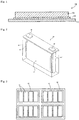
- An electrode 10 in Fig. 1 includes a substrate 11, an intermediate layer 12, and an active material layer 13.
- the substrate 11 has conductivity. Having "conductivity” means having a volume resistivity of 10 7 ⁇ cm or less which is measured in accordance with JIS-H-0505 (1975).
- the substrate 11 has a sheet shape.
- the electrode 10 When the electrode 10 is the positive electrode, metals such as aluminum, titanium, and tantalum, or alloys thereof are used as the material of the substrate 11 (positive electrode substrate). Among these, aluminum and an aluminum alloy are preferable from the balance among the potential resistance, conductivity level, and cost. That is, an aluminum foil is preferable as the positive electrode substrate. Examples of aluminum and the aluminum alloy include A1085P and A3003P specified in JIS-H-4000 (2014). Meanwhile, when the electrode 10 is a negative electrode, metals such as copper, nickel, stainless steel, and nickel-plated steel, or alloys thereof are used as the material of the substrate 11 (negative electrode substrate), and copper or a copper alloy is preferable. That is, a copper foil is preferable as the negative electrode substrate. Examples of the copper foil include a rolled copper foil and an electrolytic copper foil.
- the average thickness of the substrate 11 may be, for example, 5 ⁇ m or more and 30 pm or less.
- the "average thickness” refers to an average value of thicknesses measured using a digital micrometer M-30 manufactured by Sony Corporation at arbitrary ten points.
- the term “average thickness” is similarly defined for other members or the like.
- the intermediate layer 12 is layered on the surface of the substrate 11 in a state where an end part is left. That is, the end part of the surface of the substrate 11 is exposed.
- the intermediate layer may be layered on both the surfaces (front and back surfaces) of the substrate.
- the intermediate layer 12 contains a conductive substance, an insulating filler, and a first binder.
- the intermediate layer 12 contains the insulating filler, whereby the elution of the first binder is reduced, and as a result, the variation in resistance is suppressed.
- a known conductive agent is used as the conductive substance.
- the conductive substance include a carbon material, a metal, and conductive ceramic, and the carbon material is preferable.
- the carbon material include natural or artificial graphite, and carbon blacks such as furnace black, acetylene black, and ketjen black. Among these, acetylene black is preferable.
- the conductive substance is normally particulate.
- the conductive substance is particulate, whereby, when the first binder or the like expands when the temperature rises, the conductive substance particles are easily separated from each other, to allow an increase in resistance to be effectively provided.
- the median diameter (D50) of the conductive substance may be, for example, 1 nm or more and 20 pm or less.
- the use of the conductive substance having such a size makes it possible to largely increase the resistance when the temperature rises while ensuring normal sufficient flowability.
- the "median diameter” means a value (D50) at which a volumetric basis integrated distribution calculated based on JIS-Z-8819-2 (2001) is 50%.
- the median diameter (D50) can be measured by the following method. Measurement is performed using a laser diffraction particle size distribution measurement device ("SALD-2200" manufactured by Shimadzu Corporation) as a measurement device and WingSALD-2200 as measurement control software. A scattering measurement mode is employed.
- a wet cell in which a dispersion liquid circulates is irradiated with laser light to obtain a scattered light distribution from a measurement sample.
- particles of a sample to be measured are dispersed in a dispersion solvent.
- the scattered light distribution is approximated by a lognormal distribution, and a particle size corresponding to a cumulative degree of 50% (D50) is defined as the median diameter.
- D50 cumulative degree of 50%
- the median diameter based on the above measurement is confirmed to substantially coincide with a number average particle size measured by extracting 100 particles avoiding extremely large particles and extremely small particles from the scanning electron microscope (SEM) image of the intermediate layer.
- the lower limit of the content of the conductive substance in the intermediate layer 12 is preferably 5% by mass, more preferably 8% by mass, still more preferably 15% by mass, and yet still more preferably 30% by mass.
- the content of the conductive substance set to be equal to or greater than the above lower limit can ensure normal sufficient conductivity, and improve the resistance increasing function when the temperature rises.
- the upper limit of the content is preferably 60% by mass, more preferably 50% by mass, and still more preferably 40% by mass.
- the content of the conductive substance set to be equal to or less than the upper limit can improve the resistance increasing function when the temperature rises.
- the insulating filler may be either an inorganic filler or an organic filler, but it is preferably an inorganic filler.
- the use of the inorganic filler makes it possible to increase heat resistance.
- inorganic substances forming the inorganic filler include inorganic oxides such as silica, alumina, titania, zirconia, magnesia, ceria, yttria, zinc oxide, and iron oxide, inorganic nitrides such as silicon nitride, titanium nitride, and boron nitride, and other materials such as silicon carbide, calcium carbonate, aluminum sulfate, aluminum hydroxide, potassium titanate, talc, kaolin clay, kaolinite, boehmite, halloysite, pyrophyllite, montmorillonite, sericite, mica, amesite, bentonite, asbestos, aluminosilicate, calcium silicate, magnesium silicate, diatom earth, silica sand, and glass.
- inorganic oxides are preferable, and alumina is more preferable.
- organic substances forming the organic filler include polyolefins such as polyethylene and polypropylene, polyester, an acrylic resin, polyvinylidene chloride, polycarbonate, polyamide, a phenol resin, a melamine resin, and a urea resin. It is preferable that the organic substances are insoluble in a solvent which can disperse or dissolve the second binder.
- the lower limit of the median diameter (D50) of the insulating filler is preferably 0.001 pm, more preferably 0.005 pm, and still more preferably 0.01 pm. Meanwhile, the upper limit of the median diameter is preferably 5 pm, more preferably 1 pm, still more preferably 0.5 pm, yet still more preferably 0.1 pm, and particularly preferably 0.03 pm.
- the use of the insulating filler having such a particle size makes it possible to further improve the resistance increasing function when the temperature rises.
- the lower limit of the bulk density of the insulating filler is preferably 0.01 g/cm 3 , and more preferably 0.03 g/cm 3 .
- the upper limit of the bulk density is preferably 1 g/cm 3 , more preferably 0.5 g/cm 3 , still more preferably 0.2 g/cm 3 , and yet still more preferably 0.1 g/cm 3 .
- the use of the insulating filler having such a bulk density makes it possible to further improve the resistance increasing function when the temperature rises.
- the insulating filler having a low bulk density has high porosity. Therefore, the use of the insulating filler having a relatively low bulk density makes it easier to fill holes with the first binder to further reduce the elution of the first binder.
- the lower limit of the content of the insulating filler in the intermediate layer 12 is preferably 15% by mass, and more preferably 20% by mass.
- the content of the insulating filler set to be equal to or greater than the above lower limit can further suppress the elution of the first binder, and the variation in resistance.
- the upper limit of the content is preferably 80% by mass, more preferably 50% by mass, and still more preferably 30% by mass.
- the content of the insulating filler set to be equal to or less than the upper limit makes it possible to ensure normal sufficient conductivity and further improve the resistance increasing function when the temperature rises.
- the lower limit of the volume of the insulating filler with respect to the total volume of the conductive substance and the insulating filler is preferably 20%, more preferably 30%, and still more preferably 35%.
- the volume ratio of the insulating filler to the total of the conductive substance and the insulating filler is preferably 95%, more preferably 90%, still more preferably 85%, yet still more preferably 70%, and particularly preferably 50%.
- the volume ratio of the insulating filler with respect to the total of the conductive substance and the insulating filler set to be equal to or less than the above upper limit makes it possible to further improve the resistance increasing function when the temperature rises while ensuring normal sufficient conductivity.
- the first binder a binder which can fix the insulating particles and is electrochemically stable within the range of use is normally used.
- the first binder may be an aqueous binder or a nonaqueous solvent-based binder.
- the aqueous binder is not particularly limited as long as it is a polymer which is soluble or dispersible in water.
- the polymer which is soluble in water include a polymer containing a structural unit having a polar group such as a carboxy group or a hydroxyl group.
- the polymer dispersible in water include a rubber and an elastomer.
- the polymer which can be dispersed in water include a polymer which can be dispersed in water by an emulsifier.
- aqueous binder examples include polyvinyl alcohol, an ethylene-vinyl alcohol copolymer, polymethyl methacrylate, polyethylene oxide, polypropylene oxide, polyacrylic acid, polymethacrylic acid, styrene butadiene rubber (SBR), ethylene-propylene-diene rubber (EPDM), a fluoro-rubber, a polysaccharide polymer, and a mixture of a fluorine resin such as polyvinylidene fluoride (PVDF) and a thickener containing an aqueous paste such as carboxymethylcellulose (CMC).
- PVDF polyvinylidene fluoride
- CMC carboxymethylcellulose
- the nonaqueous solvent-based binder is not particularly limited as long as it is a polymer which is soluble or dispersible in the nonaqueous solvent.
- the nonaqueous solvent include aprotic polar solvents such as N-methyl-2-pyrrolidone (NMP), dimethylformamide (DMF), dimethylacetamide (DMA), and dimethyl sulfoxide (DMSO).
- NMP N-methyl-2-pyrrolidone
- DMF dimethylformamide
- DMA dimethylacetamide
- DMSO dimethyl sulfoxide
- Specific examples of the nonaqueous solvent-based binder include a fluorine resin, polyolefin (polyethylene, polypropylene, and the like), and polyimide.
- the nonaqueous solvent-based binder is preferably a fluorine resin from the viewpoint of heat resistance and the like.
- the fluorine resin refers to a resin containing a fluorine atom, and is normally a resin having a structural unit containing a fluorine atom.
- Examples of the fluorine resin include polytetrafluoroethylene (PTFE), polyvinylidene fluoride (PVDF), polyvinyl fluoride (PVF), and a perfluoroalkoxy fluorine resin (PFA).
- the fluorine resin is more preferably a polymer (PVDF) having a structural unit (-CH 2 CF 2 -) derived from vinylidene fluoride from the viewpoint of heat resistance and the like.
- the polymer having a structural unit derived from vinylidene fluoride may be a homopolymer of vinylidene fluoride or a copolymer of vinylidene fluoride and another monomer.
- the lower limit of the content ratio of the structural unit derived from vinylidene fluoride in the total structural unit of the polymer having a structural unit derived from vinylidene fluoride is preferably 50 mol%, may be 70 mol%, may be 90 mol%, or may be 99 mol%.
- the lower limit of the content of the first binder in the intermediate layer 12 is preferably 10% by mass, more preferably 20% by mass, and still more preferably 30% by mass.
- the content of the first binder set to the above lower limit or more makes it possible to further improve the resistance increasing function when the temperature rises.
- the upper limit of the content is preferably 50% by mass.
- the content of the first binder set to be equal to or lower than the above upper limit makes it possible to ensure normal sufficient conductivity and further suppress the variation in resistance.
- the content of the conductive substance is 30% by mass or more and 40% by mass or less; the content of the insulating filler is 20% by mass or more and 30% by mass or less; and the content of the first binder is 30% by mass or more and 50% by mass or less.
- the ratio of the three components in the intermediate layer 12 is optimized. The resistance increasing function when the temperature rises can be further improved while normal sufficient conductivity is ensured, and the variation in resistance can be further suppressed.
- the intermediate layer 12 may contain components other than the conductive substance, the insulating filler, and the first binder.
- examples of such other components include a thickener and a dispersant.
- the upper limit of the content of the components other than the conductive substance, the insulating filler, and the first binder in the intermediate layer 12 is preferably 20% by mass, more preferably 10% by mass, still more preferably 5% by mass, and particularly preferably 1% by mass. By setting the content of the other components to be equal to or less than the above upper limit, the effect of the present embodiment is more sufficiently exhibited.
- the lower limit of the average thickness of the intermediate layer 12 is, for example, preferably 0.1 pm, more preferably 1 pm, and still more preferably 3 pm.
- the upper limit of the average thickness is, for example, preferably 20 pm, and more preferably 10 pm.
- the lower limit of the mass per unit area of the intermediate layer 12 is, for example, preferably 0.1 g/m 2 , more preferably 1 g/m 2 , and still more preferably 3 g/m 2 .
- the upper limit of the mass per unit area is, for example, preferably 20 g/m 2 , and more preferably 10 g/m 2 .
- the active material layer 13 is layered on the surface of the intermediate layer 12.
- the active material layer 13 may be layered so as to completely cover the intermediate layer 12, or may be layered so that a part of the intermediate layer 12 is exposed.
- the active material layer 13 contains an active material and a second binder.
- the active material layer 13 may contain optional components such as a conductive substance, a thickener, and an insulating filler, as necessary.
- Examples of the active material (positive electrode active material) when the electrode 10 is the positive electrode include composite oxides represented by Li x MO y (M represents at least one transition metal) (such as Li x ,CoO 2 , Li x NiO 2 , Li x MnO 3 , Li x Ni ⁇ Co (1- ⁇ ) O 2 , and Li x Ni ⁇ Mn ⁇ Co (1- ⁇ - ⁇ ) O 2 , and Li 1+w Ni ⁇ Mn ⁇ Co (1- ⁇ - ⁇ -w) O 2 which have an ⁇ -NaFeO 2 layered crystal structure, and Li x Mn 2 O 4 and Li x Ni ⁇ Mn (2- ⁇ ) O 4 which have a spinel crystal structure) and polyanion compounds represented by Li w Me x (AO y ) z (Me represents at least one transition metal and A represents, for example, P, Si, B, or V) (such as LiFePO 4 , LiMnPO 4 , LiNiPO 4 , LiCoPO 4
- Examples of the active material (negative electrode active material) when the electrode 10 is the negative electrode include metals or metalloids such as Si and Sn; metal oxides or metalloid oxides such as a Si oxide and a Sn oxide; a polyphosphoric acid compound; and carbon materials such as graphite and non-graphitic carbon (easily graphitizable carbon or hardly graphitizable carbon).
- Examples of the second binder contained in the active material layer 13 include the same as the first binder contained in the intermediate layer 12 described above. However, when the first binder is an aqueous binder, the second binder is also an aqueous binder. When the first binder is a nonaqueous solvent-based binder, the second binder is also a nonaqueous solvent-based binder.
- the resin type of the first binder and the resin type of the second binder may not completely coincide with each other. That is, for example, when the first binder is PVDF which is a nonaqueous solvent-based binder, the second binder may be PVDF or a nonaqueous solvent-based binder other than PVDF.
- Each of the first binder and the second binder is preferably a nonaqueous solvent-based binder, more preferably a fluorine resin, and still more preferably a polymer having a structural unit derived from vinylidene fluoride.
- a resin is used, the heat resistance or the like of the electrode 10 is improved.
- the same kind of resin is used in the first binder and the second binder, a phenomenon that the first binder is eluted in the intermediate layer 12 is likely to occur when the active material layer 13 is formed by coating. Therefore, when the same kind of binder is used for the first binder and the second binder, the advantages of the present embodiment can be more effectively relished.
- the lower limit of the average thickness of the active material layer 13 is, for example, 5 ⁇ m, and preferably 20 ⁇ m. Meanwhile, the upper limit is, for example, 300 ⁇ m, and preferably 200 ⁇ m.
- the electrode 10 can be employed as either the positive electrode or the negative electrode, but it is preferably used as the positive electrode. When the electrode 10 is employed as the positive electrode, a particularly good resistance increasing function can be exhibited.
- the electrode 10 may be employed for both the positive electrode and the negative electrode.
- the method for manufacturing the electrode 10 is not particularly limited, but for example, it can be performed by the following method. That is, the method for manufacturing the electrode includes the steps of layering an intermediate layer 12 on the surface of a substrate 11 (step A) and layering an active material layer 13 on the surface of the intermediate layer 12 (step B).
- the intermediate layer 12 contains a conductive substance, an insulating filler, and a first binder.
- the active material layer 13 contains an active material and a second binder.
- each of the first binder and the second binder is an aqueous binder, or each of the first binder and the second binder is a nonaqueous solvent-based binder.
- the intermediate layer can be layered by coating an intermediate layer forming paste.
- the intermediate layer forming paste contains a conductive substance, an insulating filler, a first binder, and a dispersion medium.
- the first binder is an aqueous binder
- the dispersion medium is water.
- an organic solvent may be further contained as long as the solubility or the like of the first binder is not affected.
- the first binder is a nonaqueous solvent-based binder
- the dispersion medium is an organic solvent.
- water may further be contained as long as the solubility or the like of the first binder is not affected.
- organic solvent examples include aprotic polar solvents such as NMP, DMF, DMA, and DMSO, protic polar solvents such as alcohol, and nonpolar solvents such as hexane and toluene.
- aprotic polar solvent such as NMP, DMF, DMA, and DMSO
- protic polar solvents such as alcohol
- nonpolar solvents such as hexane and toluene.
- an aprotic polar solvent is preferable, and NMP is more preferable.
- the intermediate layer forming paste can be coated by a known method. Normally, after coating, the coated film is dried to volatilize the dispersion medium. Thereby, the intermediate layer 12 can be obtained.
- the active material layer can be layered by coating an active material layer forming paste.
- This active material layer forming paste contains an active material, a second binder, and a dispersion medium.
- the dispersion medium in the active material layer forming paste is the same as the dispersion medium in the intermediate layer forming paste.
- each of the first binder and the second binder is an aqueous binder
- each of the dispersion medium of the intermediate layer forming paste and the dispersion medium of the active material layer forming paste is water.
- each of the first binder and the second binder is a nonaqueous solvent-based binder
- each of the dispersion medium of the intermediate layer forming paste and the dispersion medium of the active material layer forming paste is an organic solvent.
- the dispersion medium of the intermediate layer forming paste and the dispersion medium of the active material layer forming paste may be the same type of organic solvent.
- both the dispersion media may be NMP.
- the active material layer forming paste can be coated by a known method. Normally, after coating, the coated film is dried to volatilize the dispersion medium. Thereby, the active material layer 13 can be obtained. The coated film may be pressed in the thickness direction. Thereby, the adhesiveness of the active material layer can be improved.
- the pressing can be performed using a known apparatus such as a roll press.
- the energy storage device includes a positive electrode, a negative electrode, and an electrolyte.
- a nonaqueous electrolyte secondary battery will be described as an example of the energy storage device.
- An electrode assembly is normally formed by alternately superposing the positive electrode and the negative electrode by layering or winding with a separator sandwiched therebetween.
- This electrode assembly is housed in a case, and the case is filled with a nonaqueous electrolyte.
- the nonaqueous electrolyte is interposed at least between the positive electrode and the negative electrode.
- a known aluminum case and resin case and the like which are normally used as a case of a secondary battery can be used.
- the above-described electrode 10 in Fig. 1 is employed as at least one of the positive electrode and the negative electrode provided in the energy storage device.
- Each of the positive electrode and the negative electrode may be the electrode 10 in Fig. 1 .
- a known electrode When the electrode 10 in Fig. 1 is not employed in one of the positive electrode and the negative electrode, a known electrode can be employed.
- the known electrode include (1) an electrode in which an active material layer is layered on the surface of a conductive substrate, for example, without an intermediate layer being interposed therebetween, (2) an electrode including an intermediate layer which does not contain an insulating filler, (3) an electrode in which an active material layer containing a nonaqueous solvent-based binder is layered on the surface of an intermediate layer containing an aqueous binder, and (4) an electrode in which an active material layer containing an aqueous binder is layered on the surface of an intermediate layer containing a nonaqueous solvent-based binder.
- a material of the separator for example, a woven fabric, a nonwoven fabric, or a porous resin film or the like is used.
- a porous resin film is preferable from the viewpoint of strength
- a nonwoven fabric is preferable from the viewpoint of liquid retainability of the nonaqueous electrolyte.
- a polyolefin such as polyethylene or polypropylene is preferable from the viewpoint of strength
- polyimide or aramid or the like is preferable from the viewpoint of resistance to oxidation and decomposition.
- An inorganic layer may be disposed between the separator and the electrode (normally the positive electrode).
- the inorganic layer is a porous layer which is also called a heat-resistant layer or the like. It is also possible to use a separator with an inorganic layer formed on one surface of a porous resin film.
- the inorganic layer normally includes inorganic particles and a binder, and may contain other components.
- nonaqueous electrolyte a known nonaqueous electrolyte which is normally used in a common nonaqueous electrolyte secondary battery can be used.
- the nonaqueous electrolyte contains a nonaqueous solvent, and an electrolyte salt dissolved in the nonaqueous solvent.
- nonaqueous solvent a known nonaqueous solvent which is normally used as a nonaqueous solvent of a common nonaqueous electrolyte for a secondary battery can be used.
- the nonaqueous solvent include cyclic carbonate, chain carbonate, esters, ethers, amides, sulfone, lactones, and nitriles. Among these, it is preferable to use at least cyclic carbonate or chain carbonate, and it is more preferable to use cyclic carbonate and chain carbonate in combination.
- cyclic carbonate examples include ethylene carbonate (EC), propylene carbonate (PC), butylene carbonate (BC), vinylene carbonate (VC), vinyl ethylene carbonate (VEC), chloroethylene carbonate, fluoroethylene carbonate (FEC), difluoroethylene carbonate (DFEC), styrene carbonate, catechol carbonate, 1-phenyl vinylene carbonate, and 1,2-diphenyl vinylene carbonate.
- chain carbonate examples include diethyl carbonate (DEC), dimethyl carbonate (DMC), ethyl methyl carbonate (EMC), and diphenyl carbonate.
- DEC diethyl carbonate
- DMC dimethyl carbonate
- EMC ethyl methyl carbonate
- diphenyl carbonate examples include diphenyl carbonate.
- Examples of the electrolyte salt include lithium salts, sodium salts, potassium salts, magnesium salts, and onium salts, with lithium salts being preferable.
- Examples of the lithium salt include inorganic lithium salts such as LiPF 6 , LiPO 2 F 2 , LiBF 4 , LiPF 2 (C 2 O 4 ) 2 , LiClO 4 , and LiN(SO 2 F) 2 , and lithium salts having a fluorinated hydrocarbon group such as LiSO 3 CF 3 , LiN(SO 2 CF 3 ) 2 , LiN(SO 2 C 2 F 5 ) 2 , LiN(SO 2 CF 3 )(SO 2 C 4 F 9 ), LiC(SO 2 CF 3 ) 3 , and LiC(SO 2 C 2 F 5 ) 3 .
- the nonaqueous electrolyte may contain other additives.
- a salt which is melted at normal temperature, an ionic liquid, or a polymer solid electrolyte or the like can also be used.
- the energy storage device can be manufactured by a known method.
- the method for manufacturing the energy storage device includes the steps of producing a positive electrode; producing a negative electrode; preparing a nonaqueous electrolyte; forming an electrode assembly in which the positive electrode and the negative electrode are alternately superposed by layering or winding the positive electrode and the negative electrode with a separator interposed between the electrodes; housing the positive electrode and the negative electrode (electrode assembly) in a battery case; and injecting the nonaqueous electrolyte into the battery case.
- the energy storage device can be obtained by sealing an injection port after the injection. At least one of the positive electrode and the negative electrode can be produced by the method described above as the "method for manufacturing an electrode".
- the present invention is not limited to the embodiments described above, and it is possible to implement the present invention not only by the aspects described above but also by an aspect with various changes and improvement.
- the energy storage device having a form of the nonaqueous electrolyte secondary battery is mainly described, but another energy storage device may be implemented.
- the other energy storage device include a capacitor (an electric double layer capacitor or a lithium ion capacitor) and an energy storage device that includes an aqueous solution as an electrolyte.
- Fig. 2 shows a schematic diagram of a rectangular energy storage device 20 (nonaqueous electrolyte secondary battery) which is an embodiment of an energy storage device according to the present invention.
- a rectangular energy storage device 20 nonaqueous electrolyte secondary battery
- FIG. 2 the inside of the case is seen through.
- an electrode assembly 21 is housed in a battery case 22.
- the electrode assembly 21 is formed by winding a positive electrode and a negative electrode with a separator interposed therebetween.
- the positive electrode is electrically connected to a positive electrode terminal 23 via a positive electrode lead 23'
- the negative electrode is electrically connected to a negative electrode terminal 24 via a negative electrode lead 24'.
- the above-described electrode 10 in Fig. 1 is employed.
- a nonaqueous electrolyte is injected into the battery case 22.
- the configuration of the energy storage device according to the present invention is not particularly limited, and exemplified are a cylindrical battery, a prismatic battery (rectangular battery), and a flat-type battery.
- the present invention can also be achieved as an energy storage apparatus including the plurality of energy storage devices.
- Fig. 3 shows one embodiment of the energy storage apparatus.
- an energy storage apparatus 30 includes a plurality of energy storage units 25.
- Each of the energy storage units 25 includes a plurality of energy storage devices 20.
- the energy storage apparatus 30 can be mounted as a power source for a vehicle such as an electric vehicle (EV), a hybrid vehicle (HEV), or a plug-in hybrid vehicle (PHEV).
- a vehicle such as an electric vehicle (EV), a hybrid vehicle (HEV), or a plug-in hybrid vehicle (PHEV).
- EV electric vehicle
- HEV hybrid vehicle
- PHEV plug-in hybrid vehicle
- An intermediate layer forming paste was prepared by mixing acetylene black (AB) as a conductive substance, alumina as an insulating filler, and PVDF as a first binder in a mass ratio of 31.3 : 20.8 : 47.9. NMP was used as a dispersion medium.
- the alumina used had a bulk density of 0.05 g/cm 3 and a median diameter of 0.013 pm.
- the volume ratio of the mixed AB and alumina was 60:40.
- a positive electrode active material lithium nickel manganese cobalt composite oxide (LiNi 1/3 Mn 1/3 Co 1/3 O 2 )
- a conductive agent acetylene black
- a binder PVDF
- the intermediate layer was formed by coating the intermediate layer forming paste onto the surface of an aluminum foil as a substrate, followed by drying.
- the active material layer forming paste was coated onto the surface of the intermediate layer and dried to form an active material layer.
- an electrode of Example 1 was obtained.
- the coating amount (mass per unit area of the intermediate layer) of the intermediate layer forming paste was 4.5 g/m 2 , and the average thickness of the obtained intermediate layer was 4.5 pm.
- the content of PVDF per unit volume of the intermediate layer determined from the mass ratio and the coating amount was 0.48 g/cm 3 .
- Electrodes of Examples 2 to 6 and Comparative Examples 1 and 2 were obtained in the same manner as Example 1 except for the composition of an intermediate layer forming paste (mass ratio of AB, alumina and PVDF), the bulk density and median diameter of alumina used, the coating amount of the intermediate layer forming paste (mass per unit area of intermediate layer) and the average thickness of the intermediate layer.
- Table 1 also shows the volume ratio of the mixed AB and alumina, and the content of PVDF per unit volume of the intermediate layer.
- Each of the obtained electrodes was sandwiched between a pair of metal jigs in a thickness direction, and resistance between the metal jigs was measured. This value is shown in Table 2 as an interlayer resistance value.
- Tomuseru (manufactured by Nippon Tomuseru Co., Ltd.) was used for measuring the resistance of the electrode.
- Tomuseru included a lower lid, an electrode plate, a separator, an electrode plate, a disc, a flat spring, and an upper lid.
- a separator previously immersed in a nonaqueous electrolyte was sandwiched between two positive electrodes, and these were placed at the inside of a packing existing on the stainless lower lid, At this time, the active material layers of the respective positive electrodes faced each other. Thereafter, the stainless steel disc and flat spring were placed, and finally the stainless steel upper lid was placed, and then fastened with a nut to be fixed.
- the fastening pressure at this time was set to 0.5 Nm.
- the nonaqueous electrolyte and separator used are as follows.
- LiPF 6 lithium phosphate hexafluoride
- a 30 ⁇ m-thick polyethylene microporous film having an air permeability of about 600 seconds/100 cc and processed into a circular shape with a diameter of 1.6 cm was used.
- a measurement cell was placed in a thermostatic bath, and alternating-current resistance at 1 kHz (amplitude: 5 mV) was measured while the temperature of the thermostatic bath was raised at 3°C/min. The temperature obtained by a temperature measuring terminal placed on the upper surface of the cell was recorded as the cell temperature.
- the extent of the elution amount of the binder was confirmed from the cross-sectional SEM of each of the obtained electrodes (positive electrode plate).
- the cross section (observation surface) of the positive electrode plate was exposed using a cross section polisher with a positive electrode plate sandwiched between glass plates.
- a measurement magnification ratio during cross-sectional SEM observation was adjusted in the range of 500 to 2000 times.
- the elution amount of the binder in the intermediate layer was determined from the degree of variation in the thickness of the intermediate layer in the obtained cross-sectional SEM image. The evaluation results are shown in Table 2.
- the intermediate layer contains only the conductive substance and the binder, it is impossible to achieve both a sufficient resistance increasing function when the temperature rises and suppression of variation in resistance.
- the addition of the insulating filler to the intermediate layer in addition to the conductive substance and the binder is found to make it possible to achieve both a sufficient resistance increasing function when the temperature rises and suppression of variation in resistance.
- the present invention can be applied to energy storage devices to be used as power sources for electronic devices such as personal computers and communication terminals, automobiles and the like, and energy storage device electrodes provided in the energy storage devices, and the like.
Landscapes
- Chemical & Material Sciences (AREA)
- Chemical Kinetics & Catalysis (AREA)
- Electrochemistry (AREA)
- General Chemical & Material Sciences (AREA)
- Engineering & Computer Science (AREA)
- Materials Engineering (AREA)
- Composite Materials (AREA)
- Manufacturing & Machinery (AREA)
- Battery Electrode And Active Subsutance (AREA)
- Electric Double-Layer Capacitors Or The Like (AREA)
Applications Claiming Priority (2)
| Application Number | Priority Date | Filing Date | Title |
|---|---|---|---|
| JP2017143392 | 2017-07-25 | ||
| PCT/JP2018/027651 WO2019022063A1 (ja) | 2017-07-25 | 2018-07-24 | 電極、蓄電素子、及び電極の製造方法 |
Publications (2)
| Publication Number | Publication Date |
|---|---|
| EP3660955A1 true EP3660955A1 (de) | 2020-06-03 |
| EP3660955A4 EP3660955A4 (de) | 2020-07-22 |
Family
ID=65040654
Family Applications (1)
| Application Number | Title | Priority Date | Filing Date |
|---|---|---|---|
| EP18837519.0A Withdrawn EP3660955A4 (de) | 2017-07-25 | 2018-07-24 | Elektrode, energiespeicherelement und verfahren zur herstellung einer elektrode |
Country Status (5)
| Country | Link |
|---|---|
| US (1) | US20200220176A1 (de) |
| EP (1) | EP3660955A4 (de) |
| JP (1) | JPWO2019022063A1 (de) |
| CN (1) | CN111164801A (de) |
| WO (1) | WO2019022063A1 (de) |
Families Citing this family (3)
| Publication number | Priority date | Publication date | Assignee | Title |
|---|---|---|---|---|
| JP7281934B2 (ja) * | 2019-03-25 | 2023-05-26 | 三洋化成工業株式会社 | リチウムイオン電池 |
| CN112435861B (zh) * | 2020-10-16 | 2022-01-11 | 惠州亿纬锂能股份有限公司 | 一种混合电容器的正极及其制备方法和用途 |
| JP2023074702A (ja) * | 2021-11-18 | 2023-05-30 | 株式会社Gsユアサ | 負極、非水電解質蓄電素子及び負極の製造方法 |
Family Cites Families (7)
| Publication number | Priority date | Publication date | Assignee | Title |
|---|---|---|---|---|
| JP2010146726A (ja) | 2007-11-30 | 2010-07-01 | Kyoritsu Kagaku Sangyo Kk | 導電性組成物 |
| KR101513821B1 (ko) * | 2010-10-21 | 2015-04-20 | 도요타지도샤가부시키가이샤 | 전지용 전극 및 그 이용 |
| JP2013062105A (ja) * | 2011-09-13 | 2013-04-04 | Hitachi Ltd | リチウムイオン二次電池 |
| US10446824B2 (en) * | 2011-11-15 | 2019-10-15 | Toyota Jidosha Kabushiki Kaisha | Nonaqueous electrolyte secondary battery |
| KR20150102008A (ko) * | 2012-11-19 | 2015-09-04 | 후루카와 덴키 고교 가부시키가이샤 | 집전체, 전극, 2차전지 및 커패시터 |
| WO2016024394A1 (ja) * | 2014-08-11 | 2016-02-18 | 株式会社Gsユアサ | 非水電解質蓄電素子用正極板、及び非水電解質蓄電素子 |
| JP6542031B2 (ja) * | 2014-09-29 | 2019-07-10 | パナソニック株式会社 | 非水電解質二次電池用正極及び非水電解質二次電池 |
-
2018
- 2018-07-24 US US16/632,999 patent/US20200220176A1/en not_active Abandoned
- 2018-07-24 JP JP2019532628A patent/JPWO2019022063A1/ja active Pending
- 2018-07-24 EP EP18837519.0A patent/EP3660955A4/de not_active Withdrawn
- 2018-07-24 WO PCT/JP2018/027651 patent/WO2019022063A1/ja not_active Ceased
- 2018-07-24 CN CN201880048970.5A patent/CN111164801A/zh active Pending
Also Published As
| Publication number | Publication date |
|---|---|
| JPWO2019022063A1 (ja) | 2020-07-27 |
| WO2019022063A1 (ja) | 2019-01-31 |
| EP3660955A4 (de) | 2020-07-22 |
| CN111164801A (zh) | 2020-05-15 |
| US20200220176A1 (en) | 2020-07-09 |
Similar Documents
| Publication | Publication Date | Title |
|---|---|---|
| CN101981728A (zh) | 二次电池用正极板、其制造方法及具有该正极板的二次电池 | |
| JP5818078B2 (ja) | 非水電解質二次電池の製造方法 | |
| KR20140027447A (ko) | 리튬 이온 이차 전지 | |
| EP3890074B1 (de) | Energiespeichervorrichtung und verfahren zur herstellung der energiespeichervorrichtung | |
| CN106133952B (zh) | 非水电解质二次电池 | |
| US20170054179A1 (en) | Nonaqueous electrolyte secondary battery | |
| US20220302436A1 (en) | Electrode, energy storage device, and method for manufacturing electrode | |
| US10249907B2 (en) | Nonaqueous electrolyte secondary battery, method for producing same and nonaqueous electrolyte | |
| JP2014157748A (ja) | 非水電解液二次電池の製造方法 | |
| JP6899312B2 (ja) | 非水電解質、及び非水電解質蓄電素子 | |
| JP6950342B2 (ja) | 負極及び非水電解質蓄電素子 | |
| EP3660955A1 (de) | Elektrode, energiespeicherelement und verfahren zur herstellung einer elektrode | |
| JP2018170113A (ja) | 正極及びリチウムイオン二次電池 | |
| WO2018155314A1 (ja) | 非水電解質蓄電素子及びその製造方法 | |
| CN117673509A (zh) | 单层参比电极 | |
| US12218342B2 (en) | Energy storage device | |
| CN105359310B (zh) | 负极活性物质、使用其的负极和锂离子二次电池 | |
| EP3605669B1 (de) | Energiespeichervorrichtung mit wasserfreiem elektrolyt | |
| JP2018032477A (ja) | 非水電解質蓄電素子及びその製造方法 | |
| US20250201840A1 (en) | Negative electrode mixture layer and liquid-based battery | |
| JP6992580B2 (ja) | 活物質およびそれを用いたリチウムイオン二次電池 | |
| JP6992577B2 (ja) | 活物質及びそれを用いたリチウムイオン二次電池 | |
| JP6863213B2 (ja) | 二次電池の製造方法 | |
| JP2018041669A (ja) | 電極材料、複合電極材料、負極、及び非水電解質二次電池 | |
| WO2018180829A1 (ja) | 蓄電素子 |
Legal Events
| Date | Code | Title | Description |
|---|---|---|---|
| STAA | Information on the status of an ep patent application or granted ep patent |
Free format text: STATUS: THE INTERNATIONAL PUBLICATION HAS BEEN MADE |
|
| PUAI | Public reference made under article 153(3) epc to a published international application that has entered the european phase |
Free format text: ORIGINAL CODE: 0009012 |
|
| STAA | Information on the status of an ep patent application or granted ep patent |
Free format text: STATUS: REQUEST FOR EXAMINATION WAS MADE |
|
| 17P | Request for examination filed |
Effective date: 20200211 |
|
| AK | Designated contracting states |
Kind code of ref document: A1 Designated state(s): AL AT BE BG CH CY CZ DE DK EE ES FI FR GB GR HR HU IE IS IT LI LT LU LV MC MK MT NL NO PL PT RO RS SE SI SK SM TR |
|
| AX | Request for extension of the european patent |
Extension state: BA ME |
|
| A4 | Supplementary search report drawn up and despatched |
Effective date: 20200619 |
|
| RIC1 | Information provided on ipc code assigned before grant |
Ipc: H01M 4/139 20100101ALI20200615BHEP Ipc: H01M 4/62 20060101ALI20200615BHEP Ipc: H01M 4/66 20060101ALI20200615BHEP Ipc: H01M 4/13 20100101AFI20200615BHEP |
|
| DAV | Request for validation of the european patent (deleted) | ||
| DAX | Request for extension of the european patent (deleted) | ||
| STAA | Information on the status of an ep patent application or granted ep patent |
Free format text: STATUS: EXAMINATION IS IN PROGRESS |
|
| 17Q | First examination report despatched |
Effective date: 20231103 |
|
| 18D | Application deemed to be withdrawn |
Effective date: 20240305 |