EP3660971B1 - Zusammensetzung für gelpolymerelektrolyt, gelpolymerelektrolyt davon hergestellt, und lithium-sekundär-batterie diesen umfassend - Google Patents
Zusammensetzung für gelpolymerelektrolyt, gelpolymerelektrolyt davon hergestellt, und lithium-sekundär-batterie diesen umfassend Download PDFInfo
- Publication number
- EP3660971B1 EP3660971B1 EP18883233.1A EP18883233A EP3660971B1 EP 3660971 B1 EP3660971 B1 EP 3660971B1 EP 18883233 A EP18883233 A EP 18883233A EP 3660971 B1 EP3660971 B1 EP 3660971B1
- Authority
- EP
- European Patent Office
- Prior art keywords
- polymer electrolyte
- gel polymer
- group
- composition
- compound
- Prior art date
- Legal status (The legal status is an assumption and is not a legal conclusion. Google has not performed a legal analysis and makes no representation as to the accuracy of the status listed.)
- Active
Links
Classifications
-
- H—ELECTRICITY
- H01—ELECTRIC ELEMENTS
- H01M—PROCESSES OR MEANS, e.g. BATTERIES, FOR THE DIRECT CONVERSION OF CHEMICAL ENERGY INTO ELECTRICAL ENERGY
- H01M10/00—Secondary cells; Manufacture thereof
- H01M10/05—Accumulators with non-aqueous electrolyte
- H01M10/052—Li-accumulators
-
- H—ELECTRICITY
- H01—ELECTRIC ELEMENTS
- H01M—PROCESSES OR MEANS, e.g. BATTERIES, FOR THE DIRECT CONVERSION OF CHEMICAL ENERGY INTO ELECTRICAL ENERGY
- H01M10/00—Secondary cells; Manufacture thereof
- H01M10/05—Accumulators with non-aqueous electrolyte
- H01M10/056—Accumulators with non-aqueous electrolyte characterised by the materials used as electrolytes, e.g. mixed inorganic/organic electrolytes
- H01M10/0564—Accumulators with non-aqueous electrolyte characterised by the materials used as electrolytes, e.g. mixed inorganic/organic electrolytes the electrolyte being constituted of organic materials only
- H01M10/0565—Polymeric materials, e.g. gel-type or solid-type
-
- H—ELECTRICITY
- H01—ELECTRIC ELEMENTS
- H01M—PROCESSES OR MEANS, e.g. BATTERIES, FOR THE DIRECT CONVERSION OF CHEMICAL ENERGY INTO ELECTRICAL ENERGY
- H01M10/00—Secondary cells; Manufacture thereof
- H01M10/05—Accumulators with non-aqueous electrolyte
- H01M10/056—Accumulators with non-aqueous electrolyte characterised by the materials used as electrolytes, e.g. mixed inorganic/organic electrolytes
- H01M10/0564—Accumulators with non-aqueous electrolyte characterised by the materials used as electrolytes, e.g. mixed inorganic/organic electrolytes the electrolyte being constituted of organic materials only
- H01M10/0566—Liquid materials
- H01M10/0567—Liquid materials characterised by the additives
-
- H—ELECTRICITY
- H01—ELECTRIC ELEMENTS
- H01M—PROCESSES OR MEANS, e.g. BATTERIES, FOR THE DIRECT CONVERSION OF CHEMICAL ENERGY INTO ELECTRICAL ENERGY
- H01M2300/00—Electrolytes
- H01M2300/0085—Immobilising or gelification of electrolyte
-
- Y—GENERAL TAGGING OF NEW TECHNOLOGICAL DEVELOPMENTS; GENERAL TAGGING OF CROSS-SECTIONAL TECHNOLOGIES SPANNING OVER SEVERAL SECTIONS OF THE IPC; TECHNICAL SUBJECTS COVERED BY FORMER USPC CROSS-REFERENCE ART COLLECTIONS [XRACs] AND DIGESTS
- Y02—TECHNOLOGIES OR APPLICATIONS FOR MITIGATION OR ADAPTATION AGAINST CLIMATE CHANGE
- Y02E—REDUCTION OF GREENHOUSE GAS [GHG] EMISSIONS, RELATED TO ENERGY GENERATION, TRANSMISSION OR DISTRIBUTION
- Y02E60/00—Enabling technologies; Technologies with a potential or indirect contribution to GHG emissions mitigation
- Y02E60/10—Energy storage using batteries
Definitions
- the present invention relates to a composition for a gel polymer electrolyte, a gel polymer electrolyte prepared therefrom, and a lithium secondary battery including the same, and more particularly, to a composition for a gel polymer electrolyte having improved battery safety by suppressing side reaction caused by a lithium salt, a gel polymer electrolyte prepared therefrom, and a lithium secondary battery including the same.
- lithium secondary batteries having high energy density and voltage have been commercialized and widely used.
- a lithium metal oxide is used as a positive electrode active material of a lithium secondary battery, and a lithium metal, a lithium alloy, crystalline or amorphous carbon, or a carbon composite is used as a negative electrode active material.
- a lithium secondary battery is produced by a process in which an electrode assembly is prepared by coating a current collector with an active material to an appropriate thickness and length or coating an active material itself to have a film shape, and then winding or laminating the resultant product together with an insulating separator, then the electrode assembly is accommodated into a container such as a can or a pouch, and an electrolyte is then injected into the container.
- An electrolyte applied to a lithium secondary battery is mainly classified into a liquid electrolyte, a gel polymer electrolyte, and a solid polymer electrolyte, and it is typically known that the safety of a battery increases but battery performance decreases in the following order: liquid electrolyte ⁇ gel polymer electrolyte ⁇ solid polymer electrolyte.
- liquid electrolyte ⁇ gel polymer electrolyte ⁇ solid polymer electrolyte Currently, it is known that the solid polymer electrolyte is not commercially available yet due to its inferior battery performance.
- PC propylene carbonate
- EC ethylene carbonate
- the ethylene carbonate has a high melting point, and thus has a limited workable temperature, and there is a problem that battery performance may be significantly deteriorated at a low temperature.
- containing moisture within a lithium secondary battery may cause deterioration of the battery performance.
- moisture may be contained inside an active material during the manufacturing process, or may be contained in a very small amount in an electrolyte.
- the lithium-titanium oxide used as a negative electrode active material is a zero-strain material due to an extremely low structural change during charging and discharging, and has excellent lifetime characteristics. Further, the lithium-titanium oxide forms a relatively high voltage band, and generates no dendrites, and thereby is known as a material having excellent safety and stability.
- the lithium-titanium oxide has an advantage of having electrode characteristics for rapid charging, that allows charging to be completed within a few minutes, but has a disadvantage of having the property of absorbing moisture in the air.
- the moisture contained in the electrode is decomposed to generate a large amount of gas.
- the moisture present in the electrolyte may react with the electrolyte by potential energy provided during the charging process to thereby generate a gas, and at this time, cells are swollen, resulting in deterioration in the reliability of the battery.
- LiPF 6 which is one of the lithium salts
- HF which is a strong acid
- the electrode active material component is eluted by the reaction
- the battery performance is deteriorated and lithium fluoride (LiF) is formed on the surface of the positive electrode to act as an electrical resistance in the electrode, and causes the lifetime of the battery to be shortened.
- LiF lithium fluoride
- EP 3203565 relates to a gel polymer electrolyte and a lithium secondary battery comprising the same.
- KR20140099864 relates to a nanostructure material for use in a lithium battery, especially, a rechargeable energy storage device such as a rechargeable second lithium battery and lithium-ion battery.
- KR20170034313 describes electrolyte additives for a lithium rechargeable battery and a manufacturing method thereof, an electrolyte including the same additives and a manufacturing method thereof, and a lithium rechargeable battery including the same additives.
- US2013302668 discloses an electrolyte for a secondary battery which includes a non-aqueous solvent and a lithium salt and a secondary battery including the same.
- the present invention provides a composition for gel polymer electrolyte, a gel polymer electrolyte prepared therefrom, and a lithium secondary battery including the same, wherein the composition allows the lithium secondary battery to have constant performances and also to have an improved safety, by suppressing the formation of HF which is an impurity derived from negative ions of a lithium salt during charging, and by reducing a side reaction.
- the present invention provides a composition for a gel polymer electrolyte including an oligomer represented by Formula 1 below, an additive, a polymerization initiator, a lithium salt, and a non-aqueous solvent.
- the additive includes at least one compound selected from the group consisting of an imide-based compound, and a compound having a Si-N-based bond.
- the imide-based compound may include a carbodiimide-based compound represented by Formula 2 below.
- Rio and Rio' are each independently one selected from the group consisting of an alkyl group having 1 to 12 carbon atoms and a cycloalkyl group having 3 to 12 carbon atoms.
- the compound having a Si-N-based bond may include a compound represented by Formula 3 below
- R 11 may be hydrogen or a silyl group that is substituted with an alkyl group having 1 to 5 carbon atoms or unsubstituted
- R 12 and R 13 are each independently one selected from the group consisting of hydrogen, a substituted or unsubstituted alkyl group having 1 to 5 carbon atoms, a hetero-atom-substituted or unsubstituted alkyl group having 1 to 5 carbon atoms, and a silyl group that is substituted with an alkyl group having 1 to 5 carbon atoms or unsubstituted
- the hetero-atom may be one selected from the group consisting of oxygen (O), nitrogen (N), and sulfur (S).
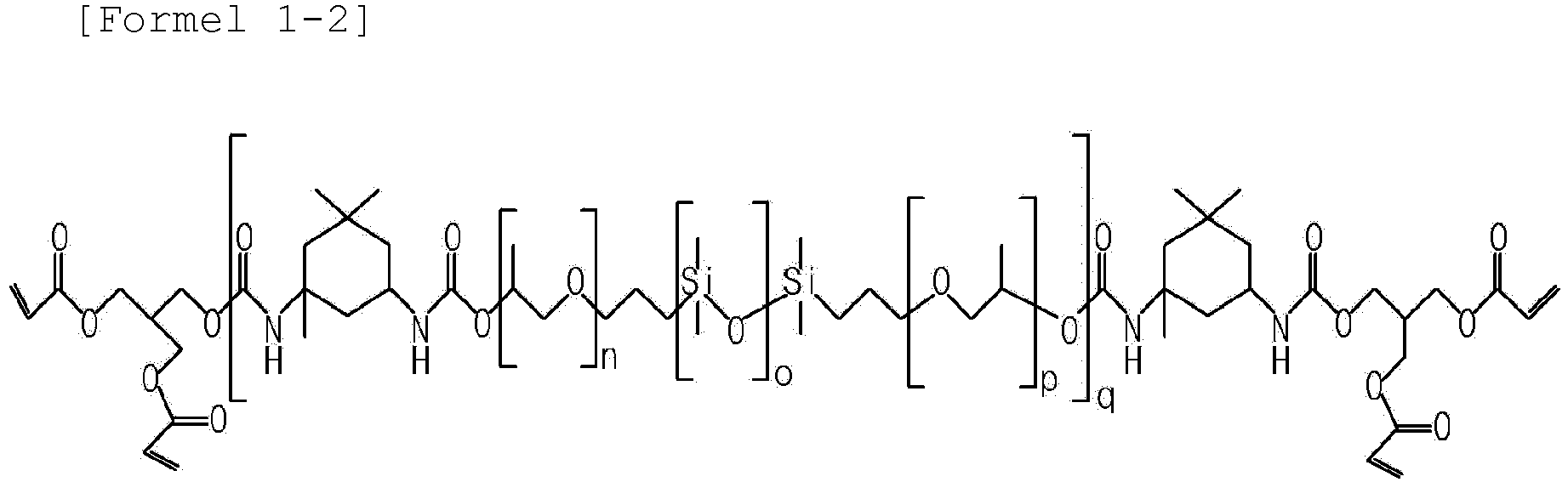
- the oligomer according to the present invention may include at least one compound selected from the group consisting of compounds represented by Formula 1-1 to 1-5.
- n, o, and p are each independently an integer of 1 to 30, and q is an integer of 1 to 100.
- the present invention provides a gel polymer electrolyte prepared using the composition for a gel polymer electrolyte and a lithium secondary battery including the same.
- a positive electrode active material may be prevented from eluting by suppressing the formation of HF, which is an impurity produced while an electrolyte is formed using a composition for a gel polymer electrolyte according to the present invention, thereby maintaining the battery capacity at a certain level or more.
- a battery having improved battery performance and safety may be achieved by suppressing the decomposition of a non-aqueous solvent constituting an electrolyte due to the reaction between HF and the electrolyte, or suppressing the occurrence of the side reaction with an electrode.
- ⁇ used in the description means a connected part between the same or different atoms or between the terminal parts of a formula unless otherwise indicated herein.
- composition for a gel polymer electrolyte according to the present invention includes an oligomer; an additive; a polymerization initiator; a lithium salt; and a non-aqueous solvent.
- the oligomer represented by Formula 1 may be three-dimensionally combined to form a polymer network through polymerization reaction, and may include a (meth)acrylate group, an amide group, an oxyalkylene group, and a siloxane group.
- a lithium secondary battery may be classified into a lithium secondary battery using a liquid electrolyte, and lithium polymer battery using a polymer electrolyte.
- a liquid electrolyte particularly, an ion conductive liquid electrolyte in which a lithium salt is dissolved in a non-aqueous organic solvent, has been generally used.
- the gel polymer electrolyte has a disadvantage of having a lower lithium-ion conductivity than a liquid electrolyte composed only of an electrolytic solution.
- the present invention uses a gel polymer electrolyte including a polymer network formed by three-dimensionally combining the oligomers.
- a gel polymer electrolyte formed by combining the oligomers the degree of freedom of lithium ions is increased by the negative ion immobilization and stabilization, thereby reducing the electric resistance, and achieving high lithium-ion conductivity.
- the polymer network formed from the oligomers has low volatility even at high temperature due to high thermal resistance and high-temperature durability, and thus exhibits high electrochemical stability.
- the oligomer is represented by Formula 1 below
- Each of A and A' is independently a unit including a (meth)acrylate group
- each of B and B' is independently a unit including an amide group
- each of C and C' is independently a unit including an oxyalkylene group
- D is a unit including a siloxane group
- k is an integer of 1 to 100.
- k may preferably be an integer of 1 to 50, and more preferably an integer of 1 to 30.
- the oligomer represented by Formula 1 has a suitable weight-average molecular weight (Mw).
- a weight-averaged molecular weight herein may mean a conversion value in terms of standard polystyrene as measured by gel permeation chromatograph (GPC), and unless otherwise specified, a molecular weight may mean a weight-averaged molecular weight.
- the weight-averaged molecular weight may be measured by gel permeation chromatograph (GPC). For example, a sample specimen with a certain concentration is prepared, and thereafter a GPC measurement system alliance 4 instrument is stabilized.
- the weight-averaged molecular weight (Mw) of an oligomer represented by Formula 1 may be controlled by the number of repeating units, and may be 1,000 to 20,000, particularly 1,000 to 15,000, and more particularly 1,000 to 10,000.
- Mw weight-averaged molecular weight
- the units A and A' are units including a (meth)acrylate group such that oligomers are combined into a three-dimensional structure to form a polymer network.
- the units A and A' may be derived from a monomer that includes, within a molecular structure, at least one monofunctional or polyfunctional (meth)acrylate or (meth)acrylic acid.
- the units A and A' may each independently include at least one unit represented by Formulae A-1 to A-5 below.
- R 1 may each independently be one selected from the group consisting of hydrogen, and a substituted or unsubstituted alkyl group having 1 to 6 carbon atoms.
- the units B and B' are each independently a unit including an amide group and are used for controlling ion transfer properties and imparting mechanical properties and adhesion in order to achieve a gel polymer electrolyte using the oligomer.
- the performance of the gel polymer electrolyte formed by the oligomer may be improved by stabilizing of negative ions generated by the side reaction of HF, and by suppressing of the generation of HF.
- the units B and B' may each independently include a unit represented by Formula B-1 below.
- R 2 is at least one selected from the group consisting of a linear or nonlinear alkylene group having 1 to 10 carbon atoms, a substituted or unsubstituted cycloalkylene group having 3 to 10 carbon atoms, a substituted or unsubstituted bicycloalkylene group having 6 to 20 carbon atoms, a substituted or unsubstituted arylene group having 6 to 20 carbon atoms, a unit represented by Formula R 2 -1 below, and a unit represented by Formula R 2 -2 below.
- R 2 may include at least one unit represented by Formulae R 2 -3 to R 2 -8 below.
- the units C and C' are each independently a unit including an oxyalkylene group to dissociate salts in the polymer network and to increase affinity with a surface having high polarity in a battery. More specifically, the units C and C' are used for controlling impregnability of a solvent, electrode affinity, and ion transfer capacity.
- the units C and C' may each independently include a unit represented by Formula C-1 below.
- R 3 is a substituted or unsubstituted, linear or nonlinear alkylene group having 1 to 10 carbon atoms, and 1 is an integer of 1 to 30.
- R 3 may be -CH2CH2- or -CHCH 3 CH 2 -.
- the unit D is a unit including a siloxane group for controlling mechanical properties and affinity with separator. Specifically, it is possible to form a structure for securing flexibility besides a rigid structure region achieved by an amide bond in a polymer network, and to improve the affinity with a polyolefin-based separator fabric using the low polarity. In particular, when the affinity with the polyolefin-based separator fabric is improved, an effect of further enhancing an ionic conductivity due to a decrease of resistance may be achieved as well. Meanwhile, when a siloxane group is included, the performance of the gel polymer electrolyte including the oligomer may be improved by stabilizing of negative ions generated by HF, and by suppressing the generation of HF.
- the unit D may include a unit represented by Formula D-1.
- R 8 and R 9 are a linear or nonlinear alkylene group having 1 to 5 carbon atoms
- R 4 , R 5 , R 6 and R 7 are each independently hydrogen, an alkyl group having 1 to 5 carbon atoms or an aryl group having 6 to 12 carbon atoms
- m is an integer of 1 to 500.
- m may be an integer of 10 to 500.
- the polarity of the oligomer may be decreased to improve the wetting property of the battery, and the formation of lithium dendrite on the electrode is suppressed by controlling the chemical reaction with the lithium metal, thereby improving the safety of the battery.
- the unit D represented by the Formula D-1 may be a unit represented by Formula D-2 below.
- R 4 , R 5 , R 6 , and R 7 are each independently hydrogen, and an alkyl group having 1 to 5 carbon atoms or an aryl group having 6 to 12 carbon atoms, where, m may be an integer of 1 to 500, and more preferably an integer of 10 to 500.
- the unit D represented by the Formula D-2 may include one among the units represented by Formulae D-3 and D-4 below.
- m is each an integer of 1 to 500. More preferably, m may be an integer of 10 to 500.
- the flame-retardant property of the gel polymer electrolyte prepared using the oligomer containing the unit may be improved, and the chemical reaction with the lithium metal electrode may be controlled, thereby improving the stability of the battery.
- the oligomer may be included in an amount of 0.5 to 20 parts by weight, preferably 1.0 to 20 parts by weight, and more preferably 1.5 to 20 parts by weight with respect to 100 parts by weight of the composition for a gel polymer electrolyte.
- the content of the oligomer is less than 0.5 parts by weight, a network reaction between the oligomers for forming the gel polymer electrolyte may be difficult to occur; and when the content of the oligomer is greater than 20 parts by weight, the viscosity of the gel polymer electrolyte exceeds a certain level, and therefore, the impregnability, wetting property, and electrochemical stability in the battery may be degraded.
- an additive includes at least one compound selected from the group consisting of an imide-based compound, and a compound having a Si-N-based bond.
- the gel polymer electrolyte composition includes a lithium salt and a non-aqueous solvent in addition to an oligomer, and generally, a fluoride-based lithium salt having a high ionic conductivity is widely used as a lithium salt.
- a fluoride-based lithium salt having a high ionic conductivity is widely used as a lithium salt.
- negative ions generated by the chemical reaction of a fluoride-based lithium salt react with a trace amount of moisture to produce by-products such as HF, and such by-products may cause decomposition of the organic solvent and electrode side reaction, thereby continuously deteriorating the performance of the battery.
- the high-temperature storability of a secondary battery may also be deteriorated due to the negative ions and the by-products.
- LiPF 6 when LiPF 6 is used as a lithium salt, a PF 6 - , which is a negative ion, loses electrons on a negative electrode side thereby resulting in PF 5 .
- the chemical reactions shown below may proceed as a chain reaction. LiPF 6 ⁇ LiF+PF 5 PF 5 +H 2 O ⁇ POF 3 +2HF POF 3 +H 2 O ⁇ POF 2 (OH)+HF POF 3 +2xLi + +2xe - ⁇ LixPF 3-x O+xLiF
- the decomposition of the organic solvent or the side reaction with the electrode may occur due to other by-products including HF being generated, thereby continuously deteriorating the performance of the battery.
- a method for removing moisture present in the electrolyte a method for suppressing the generation of HF by using an HF scavenger, a method for immobilizing and stabilizing negative ions generated from a lithium salt or the like may be used.
- the imide-based compound and the compound having the Si-N-based bond may remove moisture in the electrode by immobilizing H 2 O as in the reaction mechanism below, and may control the reaction with the negative ions generated from the lithium salt in the electrolyte, the generation of HF may be suppressed.
- HF may be generated during formation of a gel polymer electrolyte using the oligomer according to the present invention together with additives, the HF may collapse the polymer structure, and thus an electrolyte may not be formed appropriately.
- the gel polymer electrolyte may be easily formed by suppressing the generation of HF and stabilizing negative ions generated by HF.
- the generation of HF is inhibited to prevent the gel polymer from being damaged, to allow the mechanical properties to be maintained at a certain level or more.
- the imide-based compound may include a carbodiimide-based compound represented by Formula 2 below.
- R 10 and R 10 ' are each independently one selected from the group consisting of an alkyl group having 1 to 12 carbon atoms and a cycloalkyl group having 3 to 12 carbon atoms.
- the imide-based compound may include at least one compound selected from the group consisting of N,N'-dicyclopentylcarbodiimide, N,N'-dicyclohexylcarbodiimide and N,N'-dicycloheptylcarbodiimide, but is not limited thereto.
- the compound having a Si-N-based bond may include a compound represented by Formula 3 below.
- R 11 may be hydrogen or a silyl group that is substituted with an alkyl group having 1 to 5 carbon atoms or unsubstituted
- R 12 and R 13 are each independently one selected from the group consisting of hydrogen, a substituted or unsubstituted alkyl group having 1 to 5 carbon atoms, a hetero-atom-substituted or unsubstituted alkyl group having 1 to 5 carbon atoms, and a silyl group that is substituted with an alkyl group having 1 to 5 carbon atoms or unsubstituted
- the hetero-atom may be one selected from the group consisting of oxygen (O), nitrogen (N), and sulfur (S).
- the compound represented by Formula 3 may include at least one compound selected from the group consisting of 1,1,1,3,3,3-hexamethyldisilazane, heptamethyldisilazane, N,N-diethylaminotrimethylsilane and N,N,O-tris(trimethylsilyl)hydroxyamine.
- the compound having the Si-N-based bond may be 1,1,3,3,3-hexamethyldisilazane, but is not limited thereto.
- the additive may be included in an amount of 0.1 to 30 parts by weight, more preferably 0.1 to 10 parts by weight with respect to 100 parts by weight of a composition for a gel polymer electrolyte.
- the content of the additive satisfies the above-mentioned range, the gel polymer structure may be maintained by stabilizing the negative ion without deteriorating battery performance.
- the polymerization initiator is for polymerizing the oligomer of the present invention to form a polymer network configured in a three-dimensional structure, and a conventional polymerization initiator known in the art may be used without limitation.
- a photopolymerization initiator or a thermal polymerization initiator may be used as the polymerization initiator according to the polymerization method.
- representative examples of the photopolymerization initiator may include at least one compound selected from the group consisting of 2-hydroxy-2-methylpropiophenone (HMPP), 1-hydroxy-cyclohexylphenyl-ketone, benzophenone, 2-hydroxy-1-[4-(2-hydroxyethoxy)phenyl]-2-methyl-1-propanone, oxy-phenylacetic acid 2-[2-oxo-2-phenyl-acetoxy-ethoxy]-ethyl ester, oxy-phenyl-acetic 2-[2-hydroxyethoxy]-ethyl ester, alpha-dimethoxy-alpha-phenylacetophenone, 2-benzyl-2-(dimethylamino)-1-[4-(4-morpholinyl)phenyl]-1-butanone, 2-methyl-1-[4-(methylthio)phenyl]-2-(4-morpholinyl)-1-propanone, diphenyl(2,4,6-trimethylbenzoyl)-pho
- thermal polymerization initiator may include at least one compound selected from the group consisting of benzoyl peroxide, acetyl peroxide, dilauryl peroxide, di-tert-butyl peroxide, t-butyl peroxy-2-ethyl-hexanoate, cumyl hydroperoxide, hydrogen peroxide, 2,2'-azobis(2-cyanobutane), 2,2'-azobis(methylbutyronitrile), 2,2'-azobis(isobutyronitrile) (AIBN), and 2,2'-azobisdimethyl-valeronitrile (AMVN).
- benzoyl peroxide acetyl peroxide
- dilauryl peroxide di-tert-butyl peroxide
- t-butyl peroxy-2-ethyl-hexanoate cumyl hydroperoxide
- hydrogen peroxide 2,2'-azobis(2-cyanobutane), 2,2'-azobis(methyl
- the polymerization initiator may be decomposed in a battery by heat at a temperature of 30°C to 100°C or by light such as UV light at room temperature (5°C to 30°C) to form radicals, and may form cross-linking by free radical polymerization, thereby allowing oligomers to be polymerized.
- the polymerization initiator may be used in an amount of 0.01 to 5 parts by weight, preferably, 0.05 to 5 parts by weight, more preferably 0.1 to 5 parts by weight.
- the content of a polymerization initiator is used within the range, and the amount of an unreacted polymerization initiator which may adversely affect battery performance may be minimized.
- gelation may be appropriately performed.
- the lithium salt is used as an electrolyte salt in a lithium secondary battery, and is used as a medium for transferring ions.
- the lithium salt may include at least one compound selected from the group consisting of LiPF 6 , LiBF 4 , LiSbF 6 , LiAsF 6 , LiN(C 2 F 5 SO 2 ) 2 , LiN(CF 3 SO 2 ) 2 , CF 3 SO 3 Li, LiC(CF 3 SO 2 ) 3 , LiC 4 BO 8 , LiTFSI, LiFSI, and LiClO 4 , and may preferably include LiPF 6 , but is not limited thereto.
- the lithium salt may be included in an amount of 0.5 to 5 M, and preferably 0.5 to 4 M.
- the content of the lithium salt is less than the above range, charging and discharging of the battery may not be performed properly, and when the content of the lithium salt exceeds the above range, the viscosity of the gel polymer electrolyte may be increased and wetting property in the battery may be deteriorated, thereby degrading battery performance.
- a non-aqueous solvent is an electrolyte solvent, which is commonly used in a lithium secondary battery, as the non-aqueous solvent, for example, an ether, an ester (acetates, propionates), an amide, a linear carbonate or a cyclic carbonate, and a nitrile (acetonitrile, SN, etc.), may be used in a mixture of at least two thereof or alone.
- a carbonate-based electrolyte solvent including a cyclic carbonate, a linear carbonate or a carbonate compound which is a mixture thereof, may be used representatively.
- cyclic carbonate compound examples are a single compound a mixture including at least two compounds selected from the group consisting of ethylene carbonate (EC), propylene carbonate (PC), 1,2-butylene carbonate, 2,3-butylene carbonate, 1,2-pentylene carbonate, 2,3-pentylene carbonate, vinylene carbonate, and halides thereof.
- EC ethylene carbonate
- PC propylene carbonate
- 2,3-butylene carbonate 1,2-pentylene carbonate
- vinylene carbonate and halides thereof.
- linear carbonate compound a compound or a mixture including at least two compounds selected from the group consisting of dimethyl carbonate (DMC), diethyl carbonate (DEC), dipropyl carbonate (DPC), ethylmethyl carbonate (EMC), methylpropyl carbonate, and ethyl propyl carbonate (EPC), may representatively be used, but is not limited thereto.
- DMC dimethyl carbonate
- DEC diethyl carbonate
- DPC dipropyl carbonate
- EMC ethylmethyl carbonate
- EPC ethyl propyl carbonate
- a propylene carbonate and an ethylene carbonate which are cyclic carbonates, are organic solvents having high viscosity, and have a high dielectric constant and cause lithium salts in an electrolyte to be dissociated well, and therefore the propylene carbonate and the ethylene carbonate may preferably be used.
- a linear carbonate such as ethyl methyl carbonate, diethyl carbonate or dimethyl carbonate, having low viscosity and low dielectric constant
- an electrolyte having a high electrical conductivity may be obtained, and therefore the propylene carbonate and ethylene carbonate may be more preferably used.
- the ester may employ a single compound or a mixture including at least two selected from the group consisting of methyl acetate, ethyl acetate, propyl acetate, methyl propionate, ethyl propionate, ⁇ -butyrolactone, ⁇ -valerolactone, ⁇ -caprolactone, ⁇ -valerolactone, and ⁇ -caprolactone, but is not limited thereto.
- composition for a gel polymer electrolyte according to an embodiment of the present invention may optionally further include other additives, inorganic particles, and the like, which are capable of achieving properties known in the art, in order to impart effects of increasing the efficiency of polymer network formation reaction of the oligomer and decreasing resistance.
- additives such as vinylene carbonate (VC), vinyl ethylene carbonate (VEC), propane sultone (PS), succinonitrile (SN), adiponitrile (AdN), ethylene sulfate (ESa), propene sultone (PRS), fluoroethylene carbonate (FEC), LiPO 2 F 2 , Lithium difluorooxalatoborate (LiODFB), lithium bis-(oxalato)borate (LiBOB), 3-trimethoxysilanyl-propyl-N-aniline (TMSPa), tris(trimethylsilyl) phosphite (TMSPi), and LiBF 4 are applicable.
- inorganic particles having lithium ion transfer ability for example, lithium phosphate (Li 3 PO 4 ), lithium titanium phosphate (Li c Ti d (PO 4 ) 3 , 0 ⁇ d ⁇ 2, 0 ⁇ d ⁇ 3), lithium aluminum titanium phosphate (Li a1 Al b1 Ti c1 (PO 4 ) 3 , 0 ⁇ a1 ⁇ 2, 0 ⁇ b1 ⁇ 1, 0 ⁇ c1 ⁇ 3), (LiAlTiP)a2Ob2-based glass (0 ⁇ a2 ⁇ 4, 0 ⁇ b2 ⁇ 13) such as 14Li 2 O-9Al 2 O 3 -38TiO 2 -39P 2 O 5 , lithium lanthanum titanate (Li a3 La b3 TiO 3 , 0 ⁇ a3 ⁇ 2, 0 ⁇ b3 ⁇ 3), lithium germanium thiophosphate (Li a4 Ge b4 P c2 S d , 0 ⁇ a4 ⁇ 4, 0 ⁇ b4 ⁇ 1,
- a gel polymer electrolyte is prepared using the composition for a gel polymer electrolyte.
- the conventional gel polymer electrolyte has a problem that the ionic conductivity thereof is lower than a liquid electrolyte, and the stability and mechanical properties thereof are relatively poor when compared with a solid polymer electrolyte.
- a polymer network is formed using an oligomer including unit A including a fluorine-substituted or unsubstituted alkylene having 1 to 5 carbon atoms, units B and B' each independently including an amide group, units C and C' each independently including a (meth)acrylate group, and the ionic conductivity and mechanical properties may thus be improved.
- composition for a gel polymer electrolyte of the present invention contains an additive. Therefore, when the electrolyte is prepared from the composition for the gel polymer electrolyte, the formation of HF or reaction of HF with the electrolyte may be suppressed, thereby improving the safety of the battery.
- the gel polymer electrolyte according to the present invention is formed by polymerizing a composition for a gel polymer electrolyte according to a commonly known method in the art.
- a gel polymer electrolyte may be prepared through in-situ polymerization or coating polymerization.
- in-situ polymerization is a method of preparing a gel polymer through step (a) for inserting, into a battery case, an electrode assembly composed of a positive electrode, a negative electrode, and a separator disposed between the positive electrode and the negative electrode, and step (b) injecting, into the battery case, the composition for a gel polymer electrolyte according to the present invention and then polymerizing the resultant composition.
- the In-situ polymerization reaction in a lithium secondary battery is possible via E-beam, ⁇ -rays, and room temperature/high temperature aging process, and according to an embodiment of the present invention, the in-situ polymerization may be performed by thermal polymerization or photopolymerization.
- a polymerization time takes approximately 2 minutes to approximately 12 hours
- a thermal polymerization temperature may be 30°C to 100°C
- photopolymerization temperature may be a room temperature (5°C to 30°C).
- the in-situ polymerization reaction in a lithium secondary battery is performed to form a gel polymer electrolyte by injecting the composition for a gel polymer electrolyte into a battery cell, and then subjecting to gelation via polymerization reaction.
- the gel polymer electrolyte may be prepared in such a way that surfaces of an electrode and a separator are coated with the composition for a gel polymer electrolyte, is hardened (gelated) using heat or light such as ultraviolet (UV) light, an electrode assembly is then prepared by winding or stacking an electrode and/or a separator on which a gel polymer electrolyte is formed the electrode assembly is inserted into a battery case, and a conventional liquid electrolyte is re-injected thereinto.
- UV ultraviolet
- a secondary battery according to another embodiment of the present invention includes a negative electrode, a positive electrode, a separator disposed between the positive electrode and the negative electrode, and a gel polymer electrolyte.
- the gel polymer electrolyte is the same as described above, and particular explanation thereof will be omitted.
- the positive electrode may be prepared by coating on a positive electrode current collector with a positive electrode mixture slurry including a positive electrode active material, a binder, a conductive agent, a solvent, or the like.
- the positive electrode current collector is not particularly limited so long as having conductivity without causing chemical changes in the battery, and, for example, may employ stainless steel, aluminum, nickel, titanium, fired carbon, or aluminum or stainless steel that is surface-treated with carbon, nickel, titanium, silver, or the like.
- the positive electrode active material is a compound capable of reversibly intercalating and deintercalating lithium, and may specifically include a lithium composite metal oxide including lithium and one or more metals such as cobalt, manganese, nickel and aluminum.
- the lithium composite metal oxide may be a lithium-manganese-based oxide (e.g., LiMnO 2 , LiMn 2 O 4 , etc.), a lithium-cobalt-based oxide (e.g., LiCoO 2 , etc.), a lithium-nickel-based oxide (e.g., LiNiO 2 , etc.), a lithium-nickel-manganese-based oxide (e.g., LiNi 1-Y1 Mn Y1 O 2 (where 0 ⁇ Y1 ⁇ 1), LiMn 2-z1 Ni z1 O 4 (where 0 ⁇ Z1 ⁇ 2), etc.), a lithium-nickel-cobalt-based oxide (e.g., LiNi 1-Y2 Co Y2 O 2 (where
- the lithium composite metal oxide may be LiCoO 2 , LiMnO 2 , LiNiO 2 , a lithium nickelmanganesecobalt oxide (e.g., Li(Ni 0.6 Mn 0.2 Co 0.2 )O 2 , Li(Ni 0.5 Mn 0.3 Co 0.2 )O 2 , or a Li(Ni 0.8 Mn 0.1 Co 0.1 )O 2 , etc.), or a lithium nickelcobaltaluminum oxide (e.g., LiNi 0.8 Co 0.15 Al 0.05 O 2 , etc.), or the like, and when considering that the remarkably improved effect according to the control of the types and content ratio of constituent elements which form the lithium composite metal oxide, the lithium composite metal oxide may be Li(Ni 0.6 Mn 0.2 Co 0.2 )O 2 , Li(Ni 0.5 Mn 0.3 Co 0.2 )O 2 , Li(Ni 0.7 Mn 0.15
- the positive electrode active material may be included in an amount 60 to 98 wt%, preferably 70 to 98 wt%, and more preferably 80 to 98 wt%, based on a total solid content of the positive electrode mixture slurry excluding the solvent.
- the binder is a component that assists in binding between the active material and the conductive agent, etc. and in binding with the current collector.
- binder examples may be polyvinylidene fluoride, polyvinyl alcohol, carboxymethylcellulose (CMC), starch, hydroxypropylcellulose, regenerated cellulose, polyvinylpyrrolidone, tetrafluoroethylene, polyethylene (PE), polypropylene, an ethylene-propylene-diene terpolymer (EPDM), a sulfonated EPDM, a styrene-butadiene rubber, a fluorine rubber, various copolymers, and the like.
- CMC carboxymethylcellulose
- EPDM ethylene-propylene-diene terpolymer
- EPDM ethylene-propylene-diene terpolymer
- sulfonated EPDM a styrene-butadiene rubber
- fluorine rubber various copolymers, and the like.
- the binder may be included in an amount of 1 to 20 wt%, preferably 1 to 15 wt%, and more preferably 1 to 10 wt%, based on the total weight of the solid content of the positive electrode mixture slurry excluding the solvent.
- the conductive agent is a component for further improving conductivity of the positive electrode active material.
- Any conductive agent may be used without particular limitation, and may employ, for example, a conductive material, such as: graphite; carbon-based materials such as carbon black, acetylene black, Ketjen black, channel black, furnace black, lamp black, or thermal black; conductive fibers such as carbon fibers or metal fibers; metal powder such as carbon fluoride powder, aluminum powder, and nickel powder; conductive whiskers such as zinc oxide whiskers and potassium titanate whiskers; conductive metal oxide such as titanium oxide; or polyphenylene derivatives.
- a conductive material such as: graphite; carbon-based materials such as carbon black, acetylene black, Ketjen black, channel black, furnace black, lamp black, or thermal black; conductive fibers such as carbon fibers or metal fibers; metal powder such as carbon fluoride powder, aluminum powder, and nickel powder; conductive whiskers such as zinc oxide whiskers and potassium titanate whiskers; conductive metal oxide such as titanium oxide; or polyphenylene derivatives.
- a commercially available conductive agent include acetylene black-based products such as Chevron Chemical Company or Denka black (Denka Singapore Private Limited), Gulf Oil Company, Ketjen black, EC-based (Armak Company products), Vulcan XC-72 (Cabot Company products), and Super P (Timcal Co. products).
- the conductive agent may be commonly included in an amount of 1 to 20 wt%, preferably 1 to 15 wt%, and more preferably 1 to 10 wt%, based on the total weight of the solid content of the positive electrode mixture slurry excluding the solvent.
- the solvent may include an organic solvent such as N-methyl-2-pyrrolidone (NMP), and may be used in an amount satisfying a desirable viscosity is obtained when the positive electrode active material, and optional binder and the conductive agent are included.
- NMP N-methyl-2-pyrrolidone
- the solvent may be included such that the concentration of the solid content, which includes the positive electrode active material, and the optionally included binder and conductive agent, may be 50 to 95 wt%, preferably 70 to 95 wt%, and more preferably 70 to 90 wt%.
- the negative electrode may be produced by coating a negative electrode current collector with a negative electrode mixture slurry including a negative electrode active material, a binder, a conductive agent and a solvent, or may use a carbon (C) electrode or a metal itself as a negative electrode.
- a negative electrode current collector with a negative electrode mixture slurry including a negative electrode active material, a binder, a conductive agent and a solvent, or may use a carbon (C) electrode or a metal itself as a negative electrode.
- the negative electrode current collector is coated with the negative electrode mixture slurry, and the negative electrode current collector generally has a thickness of 3 to 500 ⁇ m.
- the negative electrode current collector is not particularly limited as long as it has a high conductivity without causing chemical changes in the battery, and may use, for example, copper, stainless steel, aluminum, nickel, titanium, fired carbon, copper or stainless steel which is surface-treated with carbon, nickel, titanium, silver, or the like, an aluminum-cadmium alloy, or the like.
- the negative electrode current collector may have fine irregularities on the surface thereof to improve the bonding strength of a negative electrode active material, and the negative electrode current collector may be used in various shapes such as a film, a sheet, a foil, a net, a porous body, a foam body, and a non-woven fabric body.
- the negative electrode active material may be, for example, one kind or at least two kinds selected from the group consisting of natural graphite, artificial graphite, a carbonaceous material; a lithium-containing titanium composite oxide (LTO), metals (Me): Si, Sn, Li, Zn, Mg, Cd, Ce, Ni or Fe; an alloy of the metals (Me); an oxide (MeOx) of the metals (Me); and a complex of the metals (Me) and carbon.
- LTO lithium-containing titanium composite oxide
- the negative electrode active material may be included in an amount of 80 to 99 wt%, preferably 85 to 99 wt%, and more preferably 90 to 98 wt% based on the total weight of the solid content of the negative electrode mixture slurry excluding the solvent.
- the binder is a component that assists in binding between a conductive agent, an active material, and a current collector.
- binder may include polyvinylidene fluoride (PVDF), polyvinyl alcohol, carboxymethyl cellulose (CMC), starch, hydroxypropyl cellulose, regenerated cellulose, polyvinylpyrrolidone, tetrafluoroethylene, polyethylene, polypropylene, an ethylene-propylene-diene polymer (EPDM), a sulfonated-EPDM, a styrene-butadiene rubber, a fluorine rubber, and various copolymers thereof, or the like.
- PVDF polyvinylidene fluoride
- CMC carboxymethyl cellulose
- EPDM ethylene-propylene-diene polymer
- sulfonated-EPDM a styrene-butadiene rubber
- fluorine rubber and various copolymers thereof, or the like.
- the binder may be commonly included in an amount of 1 to 20 wt%, preferably 1 to 15 wt%, and more preferably 1 to 10 wt%, based on the total weight of the solid content of the negative electrode mixture slurry excluding the solvent.
- the conductive agent is a component for further improving conductivity of the negative electrode active material.
- Such conductive agent is not particularly limited as long as it has conductivity without causing chemical changes in the battery, and may employ, for example, a conductive agent, such as: graphite such as natural graphite and artificial graphite; carbon black such as acetylene black, Ketjen black, channel black, furnace black, lamp black, and thermal black; conductive fibers such as carbon fibers and metal fibers; metal powder such as carbon fluoride powder, aluminum powder, and nickel powder; conductive whiskers such as zinc oxide whiskers and potassium titanate whiskers; conductive metal oxide such as titanium oxide; or polyphenylene derivatives, or the like, may be used.
- a conductive agent such as: graphite such as natural graphite and artificial graphite; carbon black such as acetylene black, Ketjen black, channel black, furnace black, lamp black, and thermal black; conductive fibers such as carbon fibers and metal fibers; metal powder such as carbon
- the conductive agent may be included in an amount of 1 to 20 wt%, preferably 1 to 15 wt%, and more preferably 1 to 10 wt%, based on the total weight of the solid content of the negative electrode mixture slurry excluding the solvent.
- the solvent may include water or an organic solvent, such as N-methyl-2-pyrrolidone (NMP), and may be used in an amount satisfying a desirable viscosity when the negative electrode active material, and an optional binder and a conductive agent are included.
- NMP N-methyl-2-pyrrolidone
- the solvent may be included such that the concentration of the solid content, which includes the negative electrode active material, and the optionally included binder and conductive agent, may be 50 to 95 wt%, and preferably 70 to 90 wt%.
- the negative electrode When metal itself is used as the negative electrode, the negative electrode may be formed from a metal thin film itself or prepared by physically bonding, rolling or vapor depositing the metal on the negative electrode current collector. Electro deposition or chemical vapor deposition may be used as deposition technique.
- the metal thin film itself or a metal formed on the negative electrode current collector through binding/rolling/depositing may include one metal or an alloy of two metals selected from the group consisting of lithium (Li), nickel (Ni), tin (Sn), copper (Cu), and indium (In).
- a separator may use a typically used porous polymer film, which is conventionally used as a separator.
- the separator may use, alone or in a laminated form, a porous polymer film formed from, for example, a polyolefin-based polymer, such as an ethylene homopolymer, a propylene homopolymer, an ethylene/butene copolymer, an ethylene/hexene copolymer, and an ethylene/methacrylate copolymer, or may use a typical porous non-woven fabric, for example, a non-woven fabric formed of high melting point glass fibers, or polyethylene terephthalate fibers.
- the separator is not limited thereto.
- the outer shape of the lithium secondary battery of the present invention is not particularly limited, and thus a cylindrical shape using a can, a prismatic shape, a pouch shape, or a coin shape, may be used.
- a battery module including the lithium secondary battery as a unit cell and a battery pack including the same are provided. Since the battery module and the battery pack include the secondary battery having high capacity, high rate capability characteristics, and may thus be used as a power source of medium- to large-sized devices including an electric vehicle, a hybrid electric vehicle, a plug-in hybrid electric vehicle, and a power storage system.
- a composition for gel polymer electrolyte was prepared by mixing ethylene carbonate (EC), and ethyl methyl carbonate (EMC) at a volume ratio of 3:7, adding 0.7 M of LiPF 6 , and 0.3 M of LiFSI to prepare a mixed solvent, and then adding, into 91.98 g of the prepared mixed solvent, 5 g of the oligomer represented by Formula 1-5 (weight-averaged molecular weight of 5000), and as additives, 0.2g of N,N'-dicyclohexylcarbodiimide, and 0.02 g of a polymerization initiator (AIBN), and, as other additives, 1.5 g of vinylene carbonate (VC), 0.5 g of propane sultone (PS), and 1 g of ethylene sulfate (ESa).
- EC ethylene carbonate
- EMC ethyl methyl carbonate
- a positive electrode mixture slurry was prepared by adding, into N-methyl-2-pyrrolidone (NMP) as a solvent, 94 wt% of LiNi 1/3 Co 1/3 Mn 1/3 O 2 (NCM) as a positive electrode active material, 3 wt% of carbon black as a conductive agent, and 3 wt% of PVDF as a binder.
- NMP N-methyl-2-pyrrolidone
- NCM LiNi 1/3 Co 1/3 Mn 1/3 O 2
- carbon black as a conductive agent
- PVDF 3 wt% of PVDF as a binder.
- a negative electrode mixture slurry was prepared by adding, into NMP as a solvent, 96 wt% of carbon powder as a negative electrode active material, 3 wt% of PVDF as a binder, and 1 wt% of carbon black as a conductive agent.
- An electrode assembly was prepared using the positive electrode, the negative electrode, and a separator formed of three layers of polypropylene/polyethylene/polypropylene (PP/PE/PP), the prepared composition for a gel polymer electrolyte was injected into the electrode assembly, the resultant mixture was left standing for 2 days, and the battery was heated at 60°C for 24 hours to manufacture a lithium secondary battery including the gel polymer electrolyte.
- PP/PE/PP polypropylene/polyethylene/polypropylene
- a lithium secondary battery including a gel polymer electrolyte was manufactured in the same manner as in Example 1 except that, as an additive, 0.5 g of 1,1,3,3,3-hexamethyldisilazane was used instead of 0.2 g of N,N'-dicyclohexylcarbodiimide unlike Example 1.
- a lithium secondary battery including a gel polymer electrolyte was manufactured in the same manner as in Example 1 except that 2 g of succinonitrile was added instead of 0.2 g of N,N'-dicyclohexylcarbodiimide unlike Example 1.
- a lithium secondary battery including a gel polymer electrolyte was manufactured in the same manner as in Example 1 except that 0.5 g of 1,1,3,3,3-hexamethyldisilazane, 2 g of succinonitrile, and 2 g of adiponitrile were added instead of 0.2 g of N,N'-dicyclohexylcarbodiimide unlike Example 1.
- a lithium secondary battery including a gel polymer electrolyte was manufactured in the same manner as in Example 1 except that 2 g of lithium tetrafluoroborate was added instead of 0.2 g of N,N'-dicyclohexylcarbodiimide unlike Example 1.
- An electrolyte was prepared by mixing ethylene carbonate (EC) and ethyl methyl carbonate (EMC) at a volume ratio of 3:7, and adding 0.7 M of LiPF 6 and 0.3 M of LiFSI, and then adding, as other additives, 1.5 g of vinylene carbonate (VC), 0.5 g of propane sultone (PS), and 1 g of ethylene sulfate (ESa).
- EC ethylene carbonate
- EMC ethyl methyl carbonate
- a positive electrode mixture slurry was prepared by adding into N-methyl-2-pyrrolidone (NMP) as a solvent, 94 wt% of LiNi 1/3 Co 1/3 Mn 1/3 O 2 (NCM) as a positive electrode active material, 3 wt% of carbon black as a conductive agent, and 3 wt% of PVDF as a binder.
- NMP N-methyl-2-pyrrolidone
- NCM LiNi 1/3 Co 1/3 Mn 1/3 O 2
- carbon black as a conductive agent
- PVDF 3 wt% of PVDF
- a negative electrode mixture slurry was prepared by adding into NMP as a solvent, 96 wt% of carbon powder as a negative electrode active material, 3 wt% of PVDF as a binder, and 1 wt% of carbon black as a conductive agent.
- a lithium secondary battery was manufactured using the positive electrode, the negative electrode, and a separator formed of three layers of polypropylene/polyethylene/polypropylene (PP/PE/PP), and the prepared electrolyte was injected into the electrode assembly.
- PP/PE/PP polypropylene/polyethylene/polypropylene
- a lithium secondary battery including a gel polymer electrolyte was prepared in the same manner as in Example 1 except that 5 g of an acrylate-based oligomer composed of dipentaerythritol pentaacrylate was used as an oligomer instead of 5 g of the oligomer of Formula 1-5 unlike Example 1.
- a lithium secondary battery including a gel polymer electrolyte was manufactured in the same manner as in Example 1 except that no additive was used unlike Example 1.
- the lithium secondary batteries manufactured according to Examples 1 and 2 and Reference Examples 3 to 5 and Comparative Examples 1 to 3 were set to have a state of charge (SOC) of 50% at 25°C, and were then discharged at a rate of 2.5 C rate using discharge pulse for 10 seconds, and then a resistance value for each lithium secondary battery was checked through the resulting voltage drop. As the results, the measured resistance values and voltage drop values are presented in Table 1 below. TABLE 1 Resistance (mohm) Voltage drop (V) Example 1 40 0.10 Example 2 48 0.12 Reference Example 3 60 0.15 Reference Example 4 68 0.17 Reference Example 5 71 0.18 Comparative Example 1 84 0.21 Comparative Example 2 148 0.37 Comparative Example 3 100 0.25
- each secondary battery was stored at a high temperature for 10 weeks under the conditions that the SOC was 100% (4.15 V), and the storage temperature was 60°C. Thereafter, the battery was set to an SOC of 50% at 25°C every week for each week, then discharging is performed for 10 seconds with a discharge pulse at 5 C rate to measure the resistance value, and thereafter the resistance variation rate was measured based on the resistance value measured at the beginning (0 week).
- the results thereof are presented in Table 3 below. TABLE 3 Resistance variation rate (%) after 10 weeks storage at 60°C Example 1 10.5 Example 2 12.0 Reference Example 3 12.7 Reference Example 4 13.5 Reference Example 5 15.2 Comparative Example 1 23.0 Comparative Example 2 73.2 Comparative Example 3 31.0
Landscapes
- Chemical & Material Sciences (AREA)
- Engineering & Computer Science (AREA)
- Manufacturing & Machinery (AREA)
- Chemical Kinetics & Catalysis (AREA)
- Electrochemistry (AREA)
- General Chemical & Material Sciences (AREA)
- General Physics & Mathematics (AREA)
- Inorganic Chemistry (AREA)
- Condensed Matter Physics & Semiconductors (AREA)
- Physics & Mathematics (AREA)
- Dispersion Chemistry (AREA)
- Secondary Cells (AREA)
- Materials Engineering (AREA)
Claims (10)
- Zusammensetzung für einen Gelpolymerelektrolyt, die Zusammensetzung umfassend:ein durch Formel 1 dargestelltes Oligomer;ein Additiv;einen Polymerisationsinitiator; undein nichtwässriges Lösungsmittel,wobei das Additiv mindestens eine Verbindung enthält, die aus der Gruppe bestehend aus einer Imidbasierten Verbindung und einer Verbindung mit einer Si-N-basierten Bindung ausgewählt ist,
 wobei in Formel 1A und A' jeweils unabhängig voneinander eine Einheit sind, die eine (Meth)Acrylatgruppe enthält,B und B' jeweils unabhängig voneinander eine Einheit sind, die eine Amidgruppe enthält,C und C' jeweils unabhängig voneinander eine Einheit sind, die eine Oxyalkylengruppe enthält,D eine Einheit ist, die eine Siloxangruppe enthält, undk eine ganze Zahl von 1 bis 100 ist.
 - Zusammensetzung für einen Gelpolymerelektrolyt gemäß Anspruch 1, wobei die Imid-basierte Verbindungeine durch Formel 2 dargestellte Carbodiimidbasierte Verbindung umfasst,
 wobei in Formel 2 R10 und R10' jeweils unabhängig voneinander ausgewählt sind aus der Gruppe bestehend aus einer Alkylgruppe mit 1 bis 12 Kohlenstoffatomen und einer Cycloalkylgruppe mit 3 bis 12 Kohlenstoffatomen.
 - Zusammensetzung für einen Gelpolymerelektrolyt gemäß Anspruch 1, wobei die Imid-basierte Verbindung mindestens eine Verbindung umfasst, die aus der Gruppe bestehend aus N,N'-Dicyclopentylcarbodiimid, N,N'-Dicyclohexylcarbodiimid und N,N'-Dicycloheptylcarbodiimid ausgewählt ist.
- Zusammensetzung für einen Gelpolymerelektrolyt gemäß Anspruch 1, wobei die Verbindung mit einer Si-N-basierten Bindungeine durch Formel 3 dargestellte Verbindung umfasst,
 wobei in Formel 3 R11 Wasserstoff oder eine Silylgruppe, die mit einer Alkylgruppe mit 1 bis 5 Kohlenstoffatomen substituiert oder unsubstituiert ist, ist, R12 und R13 jeweils unabhängig voneinander ausgewählt sind aus der Gruppe bestehend aus Wasserstoff, einer substituierten oder unsubstituierten Alkylgruppe mit 1 bis 5 Kohlenstoffatomen, einer Heteroatom-substituierten oder unsubstituierten Alkylgruppe mit 1 bis 5 Kohlenstoffatomen und einer Silylgruppe, die mit einer Alkylgruppe mit 1 bis 5 Kohlenstoffatomen substituiert oder unsubstituiert ist, und wobei das Heteroatom ausgewählt sein kann aus der Gruppe bestehend aus Sauerstoff (O), Stickstoff (N) und Schwefel (S).
 - Zusammensetzung für einen Gelpolymerelektrolyt gemäß Anspruch 1, wobei die Verbindung mit einer Si-N-basierten Bindung mindestens eine Verbindung umfasst, die aus der Gruppe bestehend aus 1,1,1,3,3,3-Hexamethyldisilizan, Heptamethyldisilizan, N,N-Diethylaminotrimethylsilan und N,N,O-Tris(trimethylsilyl)hydroxyamin ausgewählt ist.
- Zusammensetzung für einen Gelpolymerelektrolyt gemäß Anspruch 1, wobei das Additiv in einer Menge von 0,1 Gewichtsteilen bis 30 Gewichtsteilen bezogen auf Gewichtsteile der Zusammensetzung für einen Gelpolymerelektrolyt enthalten ist.
- Zusammensetzung für einen Gelpolymerelektrolyt gemäß Anspruch 1, wobei A und A' jeweils unabhängig voneinander mindestens eine durch die Formeln A-1 bis A-5 dargestellte Einheit umfasst,


- Zusammensetzung für einen Gelpolymerelektrolyt gemäß Anspruch 1, wobei das Oligomer mindestens eine Verbindung umfasst, die aus der Gruppe bestehend aus den durch die nachfolgenden Formeln 1-1 bis 1-5 dargestellten Verbindungen ausgewählt ist,



- Gelpolymerelektrolyt, hergestellt unter Verwendung einer Zusammensetzung für einen Gelpolymerelektrolyt gemäß Anspruch 1.
- Lithiumsekundärbatterie, umfassend:eine positive Elektrode;eine negative Elektrode;einen Separator, der zwischen der positiven Elektrode und der negativen Elektrode angeordnet ist; undden Gelpolymerelektrolyt gemäß Anspruch 9.
Applications Claiming Priority (3)
| Application Number | Priority Date | Filing Date | Title |
|---|---|---|---|
| KR20170163719 | 2017-11-30 | ||
| KR1020180147637A KR102287769B1 (ko) | 2017-11-30 | 2018-11-26 | 젤 폴리머 전해질용 조성물, 이로부터 제조되는 젤 폴리머 전해질 및 이를 포함하는 리튬 이차 전지 |
| PCT/KR2018/015122 WO2019108031A1 (ko) | 2017-11-30 | 2018-11-30 | 젤 폴리머 전해질용 조성물, 이로부터 제조되는 젤 폴리머 전해질 및 이를 포함하는 리튬 이차 전지 |
Publications (3)
| Publication Number | Publication Date |
|---|---|
| EP3660971A4 EP3660971A4 (de) | 2020-06-03 |
| EP3660971A1 EP3660971A1 (de) | 2020-06-03 |
| EP3660971B1 true EP3660971B1 (de) | 2022-08-17 |
Family
ID=66848390
Family Applications (1)
| Application Number | Title | Priority Date | Filing Date |
|---|---|---|---|
| EP18883233.1A Active EP3660971B1 (de) | 2017-11-30 | 2018-11-30 | Zusammensetzung für gelpolymerelektrolyt, gelpolymerelektrolyt davon hergestellt, und lithium-sekundär-batterie diesen umfassend |
Country Status (4)
| Country | Link |
|---|---|
| US (1) | US12062756B2 (de) |
| EP (1) | EP3660971B1 (de) |
| KR (1) | KR102287769B1 (de) |
| CN (1) | CN111386624B (de) |
Families Citing this family (7)
| Publication number | Priority date | Publication date | Assignee | Title |
|---|---|---|---|---|
| US11515556B1 (en) | 2018-01-22 | 2022-11-29 | North Carolina Agricultural And Technical State University | Solid electrolyte membrane and use thereof in batteries |
| KR102808790B1 (ko) * | 2020-05-28 | 2025-05-16 | 아사히 가세이 가부시키가이샤 | 비수계 이차 전지 및 비수계 전해액 |
| KR102739920B1 (ko) * | 2020-09-11 | 2024-12-09 | 주식회사 삼양사 | 고분자 전해질 조성물 및 이로부터 제조되는 고분자계 고체 전해질, 및 이 고분자계 고체 전해질을 포함하는 리튬 이차 전지 |
| CA3233258A1 (en) * | 2021-10-26 | 2023-05-04 | Lg Energy Solution, Ltd. | Non-aqueous electrolyte solution for lithium secondary battery and lithium secondary battery comprising the same |
| CN114865076A (zh) * | 2022-05-30 | 2022-08-05 | 远景动力技术(江苏)有限公司 | 电解质材料及其应用 |
| CN117352831A (zh) * | 2022-06-27 | 2024-01-05 | 张家港市国泰华荣化工新材料有限公司 | 一种半固态电解质及锂离子电池 |
| CN116093426B (zh) * | 2023-02-14 | 2024-10-01 | 武汉大学 | 一种电聚合凝胶电解质电池及其制备方法 |
Family Cites Families (16)
| Publication number | Priority date | Publication date | Assignee | Title |
|---|---|---|---|---|
| JP2002151093A (ja) * | 2000-11-10 | 2002-05-24 | Matsushita Electric Ind Co Ltd | 有機電解液電池 |
| JP2002251918A (ja) * | 2001-02-23 | 2002-09-06 | Mitsubishi Paper Mills Ltd | 非水系ゲル状組成物、及びこれを用いた電気化学素子 |
| KR20060075970A (ko) * | 2004-12-29 | 2006-07-04 | 주식회사 엘지화학 | 니트릴기 함유 화합물이 첨가된 전해액을 포함하는 리튬이차 전지 및 이의 제조방법 |
| KR100788162B1 (ko) | 2006-08-24 | 2007-12-21 | 성균관대학교산학협력단 | 고온 안정성 첨가제를 포함하는 리튬이차전지용 전해질 및이를 채용한 리튬이차전지 |
| US20100266905A1 (en) | 2007-09-19 | 2010-10-21 | Lg Chem, Ltd. | Non-aqueous electrolyte lithium secondary battery |
| KR20120022870A (ko) | 2010-04-09 | 2012-03-12 | 광조우 틴시 매티리얼스 테크놀로지 컴퍼니 리미티드 | 일종의 폴리머 리튬전지의 제조방법 |
| EP3896759A1 (de) * | 2011-10-05 | 2021-10-20 | OneD Material, Inc. | Aktivmaterialien aus siliciumnanostrukturen für lithiumionenbatterien und verfahren dafür sowie zusammensetzungen, komponenten und entsprechende elemente damit |
| US20130302668A1 (en) * | 2012-04-18 | 2013-11-14 | Lg Chem, Ltd. | Electrolyte for secondary battery and the secondary battery comprising the same |
| KR101558861B1 (ko) | 2012-07-10 | 2015-10-12 | 주식회사 엘지화학 | 전해액 첨가제를 포함하는 이차전지 |
| CN104885290B (zh) * | 2013-01-28 | 2018-06-08 | 株式会社杰士汤浅国际 | 非水电解质二次电池 |
| KR20150014185A (ko) * | 2013-07-29 | 2015-02-06 | 주식회사 엘지화학 | 이차전지용 액체 전해질 및 이를 포함하는 리튬 이차전지 |
| TWI553941B (zh) | 2013-10-29 | 2016-10-11 | Lg化學股份有限公司 | 凝膠聚合物電解質以及含有該電解質之鋰二次電池 |
| JP6481315B2 (ja) | 2014-09-30 | 2019-03-13 | 大日本印刷株式会社 | 加飾シート |
| CN106797048B (zh) * | 2014-10-02 | 2019-05-21 | 株式会社Lg化学 | 凝胶聚合物电解质和包括该凝胶聚合物电解质的锂二次电池 |
| WO2016053064A1 (ko) * | 2014-10-02 | 2016-04-07 | 주식회사 엘지화학 | 젤 폴리머 전해질 및 이를 포함하는 리튬 이차전지 |
| KR101702406B1 (ko) * | 2015-09-18 | 2017-02-03 | 울산과학기술원 | 리튬 이차 전지 |
-
2018
- 2018-11-26 KR KR1020180147637A patent/KR102287769B1/ko active Active
- 2018-11-30 US US16/638,673 patent/US12062756B2/en active Active
- 2018-11-30 CN CN201880053720.0A patent/CN111386624B/zh active Active
- 2018-11-30 EP EP18883233.1A patent/EP3660971B1/de active Active
Also Published As
| Publication number | Publication date |
|---|---|
| US20210194052A1 (en) | 2021-06-24 |
| KR102287769B1 (ko) | 2021-08-10 |
| KR20190064459A (ko) | 2019-06-10 |
| CN111386624A (zh) | 2020-07-07 |
| EP3660971A4 (de) | 2020-06-03 |
| US12062756B2 (en) | 2024-08-13 |
| EP3660971A1 (de) | 2020-06-03 |
| CN111386624B (zh) | 2023-09-19 |
Similar Documents
| Publication | Publication Date | Title |
|---|---|---|
| EP3660971B1 (de) | Zusammensetzung für gelpolymerelektrolyt, gelpolymerelektrolyt davon hergestellt, und lithium-sekundär-batterie diesen umfassend | |
| EP3654436B1 (de) | Gel-polymer-elektrolytzusammensetzung sowie gel-polymer-elektrolyt und lithium-sekundärbatterie damit | |
| EP3699993B1 (de) | Verfahren zur herstellung einer beutelartigen sekundärbatterie | |
| EP3703158B1 (de) | Separator für sekundärbatterie und lithiumsekundärbatterie diese enthaltend | |
| EP4080638A1 (de) | Lithiumsekundärbatterie | |
| EP3654437B1 (de) | Zusammensetzung für gelpolymerelektrolyt, daraus hergestellter gelpolymerelektrolyt und diesen enthaltende lithium-sekundär-batterie | |
| EP3657587B1 (de) | Zusammensetzung für gelpolymerelektrolyte, daraus hergestellter gelpolymerelektrolyt und lithiumsekundärbatterie damit | |
| CN110603681B (zh) | 用于凝胶聚合物电解质的组合物、由该组合物制备的凝胶聚合物电解质和包括该凝胶聚合物电解质的锂二次电池 | |
| KR102435007B1 (ko) | 젤 폴리머 전해질용 조성물, 이로부터 제조되는 젤 폴리머 전해질 및 이를 포함하는 리튬 이차 전지 | |
| EP3657588B1 (de) | Zusammensetzung für gelpolymerelektrolyt, daraus hergestellter gelpolymerelektrolyt und lithiumsekundärbatterie diese enthaltend | |
| KR102406744B1 (ko) | 겔 폴리머 전해질 및 이를 포함하는 리튬 이차전지 | |
| KR102452325B1 (ko) | 젤 폴리머 전해질용 조성물, 이로부터 제조되는 젤 폴리머 전해질 및 이를 포함하는 리튬 이차 전지 | |
| KR102516222B1 (ko) | 젤 폴리머 전해질용 조성물, 이로부터 제조되는 젤 폴리머 전해질 및 이를 포함하는 리튬 이차 전지 | |
| KR102426796B1 (ko) | 젤 폴리머 전해질용 조성물, 이로부터 제조되는 젤 폴리머 전해질 및 이를 포함하는 리튬 이차 전지 |
Legal Events
| Date | Code | Title | Description |
|---|---|---|---|
| STAA | Information on the status of an ep patent application or granted ep patent |
Free format text: STATUS: THE INTERNATIONAL PUBLICATION HAS BEEN MADE |
|
| PUAI | Public reference made under article 153(3) epc to a published international application that has entered the european phase |
Free format text: ORIGINAL CODE: 0009012 |
|
| STAA | Information on the status of an ep patent application or granted ep patent |
Free format text: STATUS: REQUEST FOR EXAMINATION WAS MADE |
|
| 17P | Request for examination filed |
Effective date: 20200224 |
|
| A4 | Supplementary search report drawn up and despatched |
Effective date: 20200424 |
|
| AK | Designated contracting states |
Kind code of ref document: A1 Designated state(s): AL AT BE BG CH CY CZ DE DK EE ES FI FR GB GR HR HU IE IS IT LI LT LU LV MC MK MT NL NO PL PT RO RS SE SI SK SM TR |
|
| AX | Request for extension of the european patent |
Extension state: BA ME |
|
| DAV | Request for validation of the european patent (deleted) | ||
| DAX | Request for extension of the european patent (deleted) | ||
| RAP1 | Party data changed (applicant data changed or rights of an application transferred) |
Owner name: LG ENERGY SOLUTION LTD. |
|
| RAP3 | Party data changed (applicant data changed or rights of an application transferred) |
Owner name: LG ENERGY SOLUTION, LTD. |
|
| GRAP | Despatch of communication of intention to grant a patent |
Free format text: ORIGINAL CODE: EPIDOSNIGR1 |
|
| STAA | Information on the status of an ep patent application or granted ep patent |
Free format text: STATUS: GRANT OF PATENT IS INTENDED |
|
| INTG | Intention to grant announced |
Effective date: 20220510 |
|
| GRAS | Grant fee paid |
Free format text: ORIGINAL CODE: EPIDOSNIGR3 |
|
| GRAA | (expected) grant |
Free format text: ORIGINAL CODE: 0009210 |
|
| STAA | Information on the status of an ep patent application or granted ep patent |
Free format text: STATUS: THE PATENT HAS BEEN GRANTED |
|
| AK | Designated contracting states |
Kind code of ref document: B1 Designated state(s): AL AT BE BG CH CY CZ DE DK EE ES FI FR GB GR HR HU IE IS IT LI LT LU LV MC MK MT NL NO PL PT RO RS SE SI SK SM TR |
|
| REG | Reference to a national code |
Ref country code: CH Ref legal event code: EP |
|
| REG | Reference to a national code |
Ref country code: DE Ref legal event code: R096 Ref document number: 602018039543 Country of ref document: DE |
|
| REG | Reference to a national code |
Ref country code: IE Ref legal event code: FG4D |
|
| REG | Reference to a national code |
Ref country code: AT Ref legal event code: REF Ref document number: 1512761 Country of ref document: AT Kind code of ref document: T Effective date: 20220915 |
|
| REG | Reference to a national code |
Ref country code: SE Ref legal event code: TRGR |
|
| REG | Reference to a national code |
Ref country code: NL Ref legal event code: MP Effective date: 20220817 |
|
| REG | Reference to a national code |
Ref country code: LT Ref legal event code: MG9D |
|
| PG25 | Lapsed in a contracting state [announced via postgrant information from national office to epo] |
Ref country code: RS Free format text: LAPSE BECAUSE OF FAILURE TO SUBMIT A TRANSLATION OF THE DESCRIPTION OR TO PAY THE FEE WITHIN THE PRESCRIBED TIME-LIMIT Effective date: 20220817 Ref country code: PT Free format text: LAPSE BECAUSE OF FAILURE TO SUBMIT A TRANSLATION OF THE DESCRIPTION OR TO PAY THE FEE WITHIN THE PRESCRIBED TIME-LIMIT Effective date: 20221219 Ref country code: NO Free format text: LAPSE BECAUSE OF FAILURE TO SUBMIT A TRANSLATION OF THE DESCRIPTION OR TO PAY THE FEE WITHIN THE PRESCRIBED TIME-LIMIT Effective date: 20221117 Ref country code: NL Free format text: LAPSE BECAUSE OF FAILURE TO SUBMIT A TRANSLATION OF THE DESCRIPTION OR TO PAY THE FEE WITHIN THE PRESCRIBED TIME-LIMIT Effective date: 20220817 Ref country code: LV Free format text: LAPSE BECAUSE OF FAILURE TO SUBMIT A TRANSLATION OF THE DESCRIPTION OR TO PAY THE FEE WITHIN THE PRESCRIBED TIME-LIMIT Effective date: 20220817 Ref country code: LT Free format text: LAPSE BECAUSE OF FAILURE TO SUBMIT A TRANSLATION OF THE DESCRIPTION OR TO PAY THE FEE WITHIN THE PRESCRIBED TIME-LIMIT Effective date: 20220817 Ref country code: FI Free format text: LAPSE BECAUSE OF FAILURE TO SUBMIT A TRANSLATION OF THE DESCRIPTION OR TO PAY THE FEE WITHIN THE PRESCRIBED TIME-LIMIT Effective date: 20220817 |
|
| REG | Reference to a national code |
Ref country code: AT Ref legal event code: MK05 Ref document number: 1512761 Country of ref document: AT Kind code of ref document: T Effective date: 20220817 |
|
| PG25 | Lapsed in a contracting state [announced via postgrant information from national office to epo] |
Ref country code: IS Free format text: LAPSE BECAUSE OF FAILURE TO SUBMIT A TRANSLATION OF THE DESCRIPTION OR TO PAY THE FEE WITHIN THE PRESCRIBED TIME-LIMIT Effective date: 20221217 Ref country code: HR Free format text: LAPSE BECAUSE OF FAILURE TO SUBMIT A TRANSLATION OF THE DESCRIPTION OR TO PAY THE FEE WITHIN THE PRESCRIBED TIME-LIMIT Effective date: 20220817 Ref country code: GR Free format text: LAPSE BECAUSE OF FAILURE TO SUBMIT A TRANSLATION OF THE DESCRIPTION OR TO PAY THE FEE WITHIN THE PRESCRIBED TIME-LIMIT Effective date: 20221118 |
|
| PG25 | Lapsed in a contracting state [announced via postgrant information from national office to epo] |
Ref country code: SM Free format text: LAPSE BECAUSE OF FAILURE TO SUBMIT A TRANSLATION OF THE DESCRIPTION OR TO PAY THE FEE WITHIN THE PRESCRIBED TIME-LIMIT Effective date: 20220817 Ref country code: RO Free format text: LAPSE BECAUSE OF FAILURE TO SUBMIT A TRANSLATION OF THE DESCRIPTION OR TO PAY THE FEE WITHIN THE PRESCRIBED TIME-LIMIT Effective date: 20220817 Ref country code: ES Free format text: LAPSE BECAUSE OF FAILURE TO SUBMIT A TRANSLATION OF THE DESCRIPTION OR TO PAY THE FEE WITHIN THE PRESCRIBED TIME-LIMIT Effective date: 20220817 Ref country code: DK Free format text: LAPSE BECAUSE OF FAILURE TO SUBMIT A TRANSLATION OF THE DESCRIPTION OR TO PAY THE FEE WITHIN THE PRESCRIBED TIME-LIMIT Effective date: 20220817 Ref country code: CZ Free format text: LAPSE BECAUSE OF FAILURE TO SUBMIT A TRANSLATION OF THE DESCRIPTION OR TO PAY THE FEE WITHIN THE PRESCRIBED TIME-LIMIT Effective date: 20220817 Ref country code: AT Free format text: LAPSE BECAUSE OF FAILURE TO SUBMIT A TRANSLATION OF THE DESCRIPTION OR TO PAY THE FEE WITHIN THE PRESCRIBED TIME-LIMIT Effective date: 20220817 |
|
| REG | Reference to a national code |
Ref country code: DE Ref legal event code: R097 Ref document number: 602018039543 Country of ref document: DE |
|
| PG25 | Lapsed in a contracting state [announced via postgrant information from national office to epo] |
Ref country code: SK Free format text: LAPSE BECAUSE OF FAILURE TO SUBMIT A TRANSLATION OF THE DESCRIPTION OR TO PAY THE FEE WITHIN THE PRESCRIBED TIME-LIMIT Effective date: 20220817 Ref country code: EE Free format text: LAPSE BECAUSE OF FAILURE TO SUBMIT A TRANSLATION OF THE DESCRIPTION OR TO PAY THE FEE WITHIN THE PRESCRIBED TIME-LIMIT Effective date: 20220817 |
|
| P01 | Opt-out of the competence of the unified patent court (upc) registered |
Effective date: 20230408 |
|
| PLBE | No opposition filed within time limit |
Free format text: ORIGINAL CODE: 0009261 |
|
| STAA | Information on the status of an ep patent application or granted ep patent |
Free format text: STATUS: NO OPPOSITION FILED WITHIN TIME LIMIT |
|
| PG25 | Lapsed in a contracting state [announced via postgrant information from national office to epo] |
Ref country code: MC Free format text: LAPSE BECAUSE OF FAILURE TO SUBMIT A TRANSLATION OF THE DESCRIPTION OR TO PAY THE FEE WITHIN THE PRESCRIBED TIME-LIMIT Effective date: 20220817 Ref country code: AL Free format text: LAPSE BECAUSE OF FAILURE TO SUBMIT A TRANSLATION OF THE DESCRIPTION OR TO PAY THE FEE WITHIN THE PRESCRIBED TIME-LIMIT Effective date: 20220817 |
|
| REG | Reference to a national code |
Ref country code: CH Ref legal event code: PL |
|
| 26N | No opposition filed |
Effective date: 20230519 |
|
| REG | Reference to a national code |
Ref country code: BE Ref legal event code: MM Effective date: 20221130 |
|
| PG25 | Lapsed in a contracting state [announced via postgrant information from national office to epo] |
Ref country code: LI Free format text: LAPSE BECAUSE OF NON-PAYMENT OF DUE FEES Effective date: 20221130 Ref country code: CH Free format text: LAPSE BECAUSE OF NON-PAYMENT OF DUE FEES Effective date: 20221130 |
|
| PG25 | Lapsed in a contracting state [announced via postgrant information from national office to epo] |
Ref country code: SI Free format text: LAPSE BECAUSE OF FAILURE TO SUBMIT A TRANSLATION OF THE DESCRIPTION OR TO PAY THE FEE WITHIN THE PRESCRIBED TIME-LIMIT Effective date: 20220817 Ref country code: LU Free format text: LAPSE BECAUSE OF NON-PAYMENT OF DUE FEES Effective date: 20221130 |
|
| PG25 | Lapsed in a contracting state [announced via postgrant information from national office to epo] |
Ref country code: IE Free format text: LAPSE BECAUSE OF NON-PAYMENT OF DUE FEES Effective date: 20221130 |
|
| PG25 | Lapsed in a contracting state [announced via postgrant information from national office to epo] |
Ref country code: BE Free format text: LAPSE BECAUSE OF NON-PAYMENT OF DUE FEES Effective date: 20221130 |
|
| PG25 | Lapsed in a contracting state [announced via postgrant information from national office to epo] |
Ref country code: HU Free format text: LAPSE BECAUSE OF FAILURE TO SUBMIT A TRANSLATION OF THE DESCRIPTION OR TO PAY THE FEE WITHIN THE PRESCRIBED TIME-LIMIT; INVALID AB INITIO Effective date: 20181130 |
|
| PG25 | Lapsed in a contracting state [announced via postgrant information from national office to epo] |
Ref country code: CY Free format text: LAPSE BECAUSE OF FAILURE TO SUBMIT A TRANSLATION OF THE DESCRIPTION OR TO PAY THE FEE WITHIN THE PRESCRIBED TIME-LIMIT Effective date: 20220817 |
|
| PG25 | Lapsed in a contracting state [announced via postgrant information from national office to epo] |
Ref country code: MK Free format text: LAPSE BECAUSE OF FAILURE TO SUBMIT A TRANSLATION OF THE DESCRIPTION OR TO PAY THE FEE WITHIN THE PRESCRIBED TIME-LIMIT Effective date: 20220817 Ref country code: IT Free format text: LAPSE BECAUSE OF FAILURE TO SUBMIT A TRANSLATION OF THE DESCRIPTION OR TO PAY THE FEE WITHIN THE PRESCRIBED TIME-LIMIT Effective date: 20220817 |
|
| PG25 | Lapsed in a contracting state [announced via postgrant information from national office to epo] |
Ref country code: BG Free format text: LAPSE BECAUSE OF FAILURE TO SUBMIT A TRANSLATION OF THE DESCRIPTION OR TO PAY THE FEE WITHIN THE PRESCRIBED TIME-LIMIT Effective date: 20220817 |
|
| PG25 | Lapsed in a contracting state [announced via postgrant information from national office to epo] |
Ref country code: MT Free format text: LAPSE BECAUSE OF FAILURE TO SUBMIT A TRANSLATION OF THE DESCRIPTION OR TO PAY THE FEE WITHIN THE PRESCRIBED TIME-LIMIT Effective date: 20220817 |
|
| PG25 | Lapsed in a contracting state [announced via postgrant information from national office to epo] |
Ref country code: TR Free format text: LAPSE BECAUSE OF FAILURE TO SUBMIT A TRANSLATION OF THE DESCRIPTION OR TO PAY THE FEE WITHIN THE PRESCRIBED TIME-LIMIT Effective date: 20220817 |
|
| PGFP | Annual fee paid to national office [announced via postgrant information from national office to epo] |
Ref country code: DE Payment date: 20251020 Year of fee payment: 8 |
|
| PGFP | Annual fee paid to national office [announced via postgrant information from national office to epo] |
Ref country code: GB Payment date: 20251023 Year of fee payment: 8 |
|
| PGFP | Annual fee paid to national office [announced via postgrant information from national office to epo] |
Ref country code: FR Payment date: 20251021 Year of fee payment: 8 |
|
| PGFP | Annual fee paid to national office [announced via postgrant information from national office to epo] |
Ref country code: SE Payment date: 20251021 Year of fee payment: 8 |
|
| PGFP | Annual fee paid to national office [announced via postgrant information from national office to epo] |
Ref country code: PL Payment date: 20251020 Year of fee payment: 8 |