EP3661113A1 - Procédé et dispositif de transfert des données dans un système de publication-abonnement - Google Patents
Procédé et dispositif de transfert des données dans un système de publication-abonnement Download PDFInfo
- Publication number
- EP3661113A1 EP3661113A1 EP18209579.4A EP18209579A EP3661113A1 EP 3661113 A1 EP3661113 A1 EP 3661113A1 EP 18209579 A EP18209579 A EP 18209579A EP 3661113 A1 EP3661113 A1 EP 3661113A1
- Authority
- EP
- European Patent Office
- Prior art keywords
- communication device
- key
- encrypted
- group
- message
- Prior art date
- Legal status (The legal status is an assumption and is not a legal conclusion. Google has not performed a legal analysis and makes no representation as to the accuracy of the status listed.)
- Withdrawn
Links
Images



Classifications
-
- H—ELECTRICITY
- H04—ELECTRIC COMMUNICATION TECHNIQUE
- H04L—TRANSMISSION OF DIGITAL INFORMATION, e.g. TELEGRAPHIC COMMUNICATION
- H04L9/00—Cryptographic mechanisms or cryptographic arrangements for secret or secure communications; Network security protocols
- H04L9/08—Key distribution or management, e.g. generation, sharing or updating, of cryptographic keys or passwords
- H04L9/0816—Key establishment, i.e. cryptographic processes or cryptographic protocols whereby a shared secret becomes available to two or more parties, for subsequent use
- H04L9/0819—Key transport or distribution, i.e. key establishment techniques where one party creates or otherwise obtains a secret value, and securely transfers it to the other(s)
- H04L9/083—Key transport or distribution, i.e. key establishment techniques where one party creates or otherwise obtains a secret value, and securely transfers it to the other(s) involving central third party, e.g. key distribution center [KDC] or trusted third party [TTP]
- H04L9/0833—Key transport or distribution, i.e. key establishment techniques where one party creates or otherwise obtains a secret value, and securely transfers it to the other(s) involving central third party, e.g. key distribution center [KDC] or trusted third party [TTP] involving conference or group key
-
- H—ELECTRICITY
- H04—ELECTRIC COMMUNICATION TECHNIQUE
- H04L—TRANSMISSION OF DIGITAL INFORMATION, e.g. TELEGRAPHIC COMMUNICATION
- H04L9/00—Cryptographic mechanisms or cryptographic arrangements for secret or secure communications; Network security protocols
- H04L9/006—Cryptographic mechanisms or cryptographic arrangements for secret or secure communications; Network security protocols involving public key infrastructure [PKI] trust models
-
- H—ELECTRICITY
- H04—ELECTRIC COMMUNICATION TECHNIQUE
- H04L—TRANSMISSION OF DIGITAL INFORMATION, e.g. TELEGRAPHIC COMMUNICATION
- H04L9/00—Cryptographic mechanisms or cryptographic arrangements for secret or secure communications; Network security protocols
- H04L9/08—Key distribution or management, e.g. generation, sharing or updating, of cryptographic keys or passwords
- H04L9/0816—Key establishment, i.e. cryptographic processes or cryptographic protocols whereby a shared secret becomes available to two or more parties, for subsequent use
- H04L9/0819—Key transport or distribution, i.e. key establishment techniques where one party creates or otherwise obtains a secret value, and securely transfers it to the other(s)
- H04L9/0825—Key transport or distribution, i.e. key establishment techniques where one party creates or otherwise obtains a secret value, and securely transfers it to the other(s) using asymmetric-key encryption or public key infrastructure [PKI], e.g. key signature or public key certificates
-
- H—ELECTRICITY
- H04—ELECTRIC COMMUNICATION TECHNIQUE
- H04L—TRANSMISSION OF DIGITAL INFORMATION, e.g. TELEGRAPHIC COMMUNICATION
- H04L9/00—Cryptographic mechanisms or cryptographic arrangements for secret or secure communications; Network security protocols
- H04L9/32—Cryptographic mechanisms or cryptographic arrangements for secret or secure communications; Network security protocols including means for verifying the identity or authority of a user of the system or for message authentication, e.g. authorization, entity authentication, data integrity or data verification, non-repudiation, key authentication or verification of credentials
- H04L9/3247—Cryptographic mechanisms or cryptographic arrangements for secret or secure communications; Network security protocols including means for verifying the identity or authority of a user of the system or for message authentication, e.g. authorization, entity authentication, data integrity or data verification, non-repudiation, key authentication or verification of credentials involving digital signatures
-
- H—ELECTRICITY
- H04—ELECTRIC COMMUNICATION TECHNIQUE
- H04L—TRANSMISSION OF DIGITAL INFORMATION, e.g. TELEGRAPHIC COMMUNICATION
- H04L9/00—Cryptographic mechanisms or cryptographic arrangements for secret or secure communications; Network security protocols
- H04L9/32—Cryptographic mechanisms or cryptographic arrangements for secret or secure communications; Network security protocols including means for verifying the identity or authority of a user of the system or for message authentication, e.g. authorization, entity authentication, data integrity or data verification, non-repudiation, key authentication or verification of credentials
- H04L9/3247—Cryptographic mechanisms or cryptographic arrangements for secret or secure communications; Network security protocols including means for verifying the identity or authority of a user of the system or for message authentication, e.g. authorization, entity authentication, data integrity or data verification, non-repudiation, key authentication or verification of credentials involving digital signatures
- H04L9/3255—Cryptographic mechanisms or cryptographic arrangements for secret or secure communications; Network security protocols including means for verifying the identity or authority of a user of the system or for message authentication, e.g. authorization, entity authentication, data integrity or data verification, non-repudiation, key authentication or verification of credentials involving digital signatures using group based signatures, e.g. ring or threshold signatures
-
- H—ELECTRICITY
- H04—ELECTRIC COMMUNICATION TECHNIQUE
- H04L—TRANSMISSION OF DIGITAL INFORMATION, e.g. TELEGRAPHIC COMMUNICATION
- H04L9/00—Cryptographic mechanisms or cryptographic arrangements for secret or secure communications; Network security protocols
- H04L9/32—Cryptographic mechanisms or cryptographic arrangements for secret or secure communications; Network security protocols including means for verifying the identity or authority of a user of the system or for message authentication, e.g. authorization, entity authentication, data integrity or data verification, non-repudiation, key authentication or verification of credentials
- H04L9/3263—Cryptographic mechanisms or cryptographic arrangements for secret or secure communications; Network security protocols including means for verifying the identity or authority of a user of the system or for message authentication, e.g. authorization, entity authentication, data integrity or data verification, non-repudiation, key authentication or verification of credentials involving certificates, e.g. public key certificate [PKC] or attribute certificate [AC]; Public key infrastructure [PKI] arrangements
-
- H—ELECTRICITY
- H04—ELECTRIC COMMUNICATION TECHNIQUE
- H04L—TRANSMISSION OF DIGITAL INFORMATION, e.g. TELEGRAPHIC COMMUNICATION
- H04L2209/00—Additional information or applications relating to cryptographic mechanisms or cryptographic arrangements for secret or secure communication H04L9/00
- H04L2209/80—Wireless
- H04L2209/805—Lightweight hardware, e.g. radio-frequency identification [RFID] or sensor
Definitions
- the present invention relates to a method and a computer program product for transmitting data in a publish-subscribe system. Furthermore, the present invention relates to a device for transmitting data in a publish-subscribe system and to such a publish-subscribe system.
- the technical field of the invention relates to the transmission of data in a publish-subscribe system, in particular the transmission of data in a publish-subscribe system between a first communication device and a second communication device.
- IoT Internet of Things
- industrial networks which are known from the telecommunications environment and the public Internet.
- components are also behind firewall systems and are therefore not directly accessible from the Internet.
- publish-subscribe systems are used here.
- Publish-subscribe systems are characterized in that conventionally no dedicated bidirectional communication connection is set up between two communication end devices, such as a server and a client, but that the communication takes place based on the topic.
- publish-subscribe systems both classic point-to-point communication and group communication can be used in order to reach a large number of systems in the most efficient way possible.
- load shedding a connection from decentralized ones Energy resources or the limitation of electricity feed in a smart grid system.
- This requirement of end-to-end security exists for point-to-point communication as well as for group communication in a publish-subscribe system.
- the requirement includes ensuring that messages must not be changed unauthorized both in group communication between several communication devices and in end-to-end communication between two communication devices.
- group communication comprises at least one message broker (transmission device) and two or more communication devices.
- the message broker is arranged between two or more communication devices within a group communication.
- the task of the message broker is on the one hand the authentication of the individual communication devices, on the other hand the distribution of, for example, digital certificates to requesting communication devices and the transmission of data to individual communication devices.
- the communication devices can subscribe to topics with the message broker and receive the corresponding messages when another communication device publishes a message to the message broker about the subscribed topic.
- the communication link between communication devices and message broker is protected via a transport encryption such as TLS, which integrity and ensures confidentiality and also enables authentication of the message broker.
- the message broker has asymmetrical key material and a corresponding X.509 certificate for authentication.
- the message broker is trustworthy, at least as far as the acceptance and delivery of data is concerned.
- no end-to-end security is achieved between the communication devices of the group, since on the one hand it may be that the message broker is not trustworthy and on the other hand the second communication device, which is a defined recipient, of the first communication device a message is not known.
- group communication comprises only the individual communication devices and no message broker.
- Multicast addresses can be assigned to different topics.
- the communication devices that are interested in a topic are then subscribers to one or more multicast addresses.
- the group communication can be secured by group keys, which are distributed to the individual communication devices of the group by means of a central key distribution server. This means that the messages can at least be saved within the group.
- end-to-end security between the group's communication devices is also not achieved, since all group communication devices can create, encrypt, modify and decrypt messages.
- topic-specific keys are derived from the distributed group key in order to form subgroups which in turn have a subgroup key in order to increase the security of the end-to-end communication.
- an object of the present invention is to improve the transmission of data in a publish-subscribe system.
- Step c) includes encrypting the message using the public key and then securing the encrypted message using the group key.
- step c) can also include that the message is secured using the group key and then the secured message is encrypted using the public key.
- secure refers to the application of the group key to the message.
- Encrypted refers to here and in Following the application of the public key for the point-to-point connection.
- an asymmetrically encrypted point-to-point connection between the first communication device and the second communication device is created in an existing group communication which is secured via the group key. This forms end-to-end encryption within the group between the first communication device and the second communication device.
- the end-to-end encryption makes it possible to transmit a message secured by means of the group key between the first communication device and the second communication device without the secured message from other communication devices within the group, and also not outside the group, can be modified and decrypted.
- a communication device that wants to send a secured message such as the first communication device, can only produce end-to-end encryption if it is in the same group as a specified recipient of the secured message, such as is the second communication device.
- the specified recipient can only decrypt the message encrypted using the asymmetrically encrypted point-to-point connection and secured using the group key if he is also able to decrypt the group encryption beforehand.
- the security of the message transmission between at least two communication devices within the group is increased, since manipulation and decryption of the encrypted and secured message through another communication device within the group that is not acting as the designated recipient.
- increased security is achieved, for example, in industrial protocols as well as in energy automation protocols through the more efficient use of the existing group communication, in which the end-to-end encryption is integrated into the existing group communication, while no additional new communication channels within open to the group.
- the publish-subscribe system is in particular a system which comprises at least one publisher who publishes data and one subscriber who can subscribe and receive data. Subscribing can also be understood as subscribing, for example. Publish-subscribe systems can also be referred to as publication and subscription systems. Publishing and subscribing to data is preferably topic-based. One therefore speaks in particular of a topic-based publish-subscribe system.
- the topic of the publish-subscribe system is, for example, a topic or a service of the publish-subscribe system.
- the topic can also be hierarchically structured, for example by means of a topic tree, for example topic 1, topic 2, topic 3.
- the communication device is in particular a device that is set up to communicate with another communication device and to exchange data.
- the first communication device is, for example, a server device.
- the second communication device is in particular a client device.
- the first communication device can also be designed as a client device.
- the second communication device can also be designed as a server device.
- the communication devices within the group, which are not the first communication device and the second communication device can be configured as a server device and / or as a client device.
- the group preferably comprises at least two communication devices which can transmit secured messages by means of a common group key.
- the group key is in particular a symmetrical cryptographic key. This means that the group key is preferably used for encrypting and decrypting messages by the communication devices within the group. Each communication device within the group can thus encrypt and / or decrypt and / or modify a message, for example.
- the key distribution server is configured here in particular in the publish-subscribe system as a central key distribution server or as a decentralized key distribution server on an intermediate node in the publish-subscribe system.
- the central key distribution server can preferably provide the group key to the communication devices of the group.
- the provision from step a) includes, in particular, supplying all communication devices in the group with identical symmetrical group keys.
- a requesting communication device In order for a requesting communication device to receive a symmetrical group key from the key distribution server, in particular an authentication of the requesting communication device is carried out on the key distribution server.
- the messages can thus be transmitted securely within the group.
- the message secured by means of a group key preferably ensures integrity and confidentiality. This type of communication within the group is referred to as secure group communication.
- the authentication preferably comprises cryptographic authentication methods.
- the provision from step b) is understood in particular to mean the provision of a key material to the first and the second communication device in order to use the key material to encrypt the point-to-point connection asymmetrically.
- the asymmetrically encryptable point-to-point connection is in particular a direct connection between the first and the second communication device.
- the asymmetrically encryptable point-to-point connection can also preferably be an indirect connection between the first communication device and the second communication device, in which another device is arranged between the first and the second communication device.
- the transmission of the secured message from step c) is in particular cryptographically secured.
- Cryptographically secured transmission can be implemented using a security protocol such as TLS (Transport Layer Security), SSL (Secure Socket Layer), SSH (Secure Shell), IPSec (Internet Protocol Security), which secures the entire data exchange.
- TLS Transport Layer Security
- SSL Secure Socket Layer
- SSH Secure Shell
- IPSec Internet Protocol Security
- a message is understood to mean in particular a digital data record, for example a sequence of zeros and ones, which are also referred to as bits, with a specific length.
- the data record is preferably arranged within a data frame.
- a message has, for example, a user data part, such as an executable command, configuration information, status information and / or a query command, and can furthermore include further components, such as an integrity check value (ICV). "integrity check value”) in the form of a digital signature, a hash value or the like.
- a point-to-point connection which can be encrypted by means of asymmetrical encryption is understood here to mean in particular a direct and immediate connection which is established between two communication devices, such as, for example, the first communication device and the second communication device within the group Publish-Subscribe-System is provided.
- the asymmetrically encrypted point-to-point connection and the group key provide end-to-end encryption between the first and the second communication device within the group, in which, for example, the first communication device encrypts and only the can decrypt the second communication device.
- the asymmetrically encryptable point-to-point connection can also be formed indirectly via a further device between the first communication device and the second communication device.
- the secured message is transmitted from the first communication device or the second communication device or a further communication device of the group to all communication devices of the group.
- the transmission of the secured message between the first communication device and the second communication device is carried out unidirectionally.
- the existing communication protocol of the group communication is expanded in order to be able to transmit the encrypted and secured message by the one to be transmitted Communication device is made visible, which communication device acts as the specified recipient of the encrypted and secured message.
- an extension is proposed which can be integrated into the existing communication protocol of group communication, such as OPC-UA, MQTT or XMPP in particular.
- a number Z, with Z 1 1, of certificates each comprising the at least one public key is distributed to the first communication device and / or to the second communication device by means of the key distribution server.
- the certificate is in particular a digital certificate that includes a public key.
- the digital certificate is designed according to the X.509 standard.
- the digital certificate contains, in particular, digital data which, for example, confirm properties of people or objects.
- the digital certificate is preferably used to confirm the identity of a holder, such as the second communication device, and to ensure the integrity and confidentiality of the transmitted data by means of cryptographic methods.
- Cryptographic methods include, for example, asymmetrical encryption methods and symmetrical encryption methods.
- RSA Raster, Shamir, Adleman
- ECDSA Elliptic Curve Digital Signature Algorithm
- AES Advanced Encryption Standard
- GMAC Galois Message Authentication Code
- the key distribution server distributes the group keys and the digital certificates, each comprising a public key, to the selected communication devices within the group.
- the digital certificates of the communication devices of the group can be stored locally on a storage unit, each communication device also having access to the digital certificates of the other communication devices.
- the public key is preferably a cryptographically confirmed key.
- the public key is not secret.
- the public key is distributed to other communication devices using a key distribution server.
- the public key can be used, in particular, to carry out public operations, that is to say to encrypt messages or to check digital signatures.
- a public key can be uniquely assigned to a communication device.
- the public key is particularly clearly identified by means of a fingerprint (for example a hash value).
- the first communication device encrypts the message using the public key of the second communication device, secures the encrypted message using the group key and transmits the secured and encrypted message to the second communication device.
- the second communication device then decrypts with its private key the secure message encrypted using the public key of the second communication device.
- the public key and the private key of the second communication device preferably form a key pair by means of which asymmetrical encryption of messages is implemented.
- the encrypted message is transmitted securely with the group key to all communication devices within the group and only the communication device, in this example the second communication device, is able to decrypt the transmitted secured and encrypted message by means of the private key .
- the private key of a communication device is preferably used to decrypt the encrypted and secure message or to sign the encrypted and secure message.
- a communication device such as the second communication device
- only one communication device has the private key for decrypting the encrypted and secured message.
- the private key of a communication device is particularly secret.
- the other communication devices within the group have no information about the secret private key of the communication device.
- a third communication device of the group is arranged as a transmission device between the first and the second communication device, the message from the first communication being secured by means of the group key and encrypted by means of the public key of the second communication device -Device is transmitted to the second communication device via the transmission device.
- the transmission device has the advantage that, in addition to the distribution of the symmetrical group key and the digital certificates, it is also set up to transmit at least one encrypted and secure message to at least one of the communication devices of the group. This enables a transmission of encrypted and secured messages not only only between two communication devices, such as the first communication device and the second communication device, but by means of the transmission device in particular encrypted and secured messages to all subscribers or selected communication Devices of the group are transmitted.
- the transmission device is preferably a device for transmitting messages, group keys and digital certificates in a publish-subscribe system and is designed in particular as a message broker.
- Publish-subscribe systems include, on the one hand, message broker-based processes and, on the other hand, broker-less based processes.
- subscribers can preferably subscribe to topics with the message broker and receive the corresponding messages when a publisher publishes a message for this topic via the message broker.
- the message broker includes in particular a directory with the digital certificates, that is to say also the public key of the communication devices within the group, and can transmit a public key, for example a communication device, to a requesting communication device.
- the message broker preferably transmits encrypted and secured messages to the subscribers by means of the group key.
- the message broker also distributes for example the symmetrical group key to the selected communication devices within the group.
- the message broker can also in particular check the authenticity of a requesting communication device by means of a digital signature of the requesting communication device.
- group communication comprises only the individual communication devices and no message broker. Multicast addresses are assigned to different topics. The communication devices that are interested in a topic are then subscribers to one or more multicast addresses.
- the third communication device can be designed as an LDAP memory ("Lightweight Directory Access Protocol" repository).
- connection from the first communication device via the transmission device to the second communication device preferably corresponds to an indirect and indirect point-to-point connection.
- the encrypted and secured message is thus preferably transmitted indirectly from the first communication device to the second communication device via the transmission device. This also creates end-to-end encryption.
- the key distribution server is designed as part of the transmission device.
- the key distribution server can also be configured externally to the transmission device.
- the key distribution server is in particular not part of the group, but only provides the group keys and digital certificates for the selected communication devices within the group. It is also conceivable, for example, that the key distribution server is designed as part of the group.
- an authentication of a transmission device and also an authorization check are carried out when requesting a group key.
- the message secured by means of the group key and encrypted by means of the public key of the second communication device is signed by means of a private key of the first communication device to form a digital signature, a data frame comprising the secured and encrypted message and the digital message Signature is transmitted from the first communication device to the second communication device.
- This embodiment is used in particular for messages that are too small, in which the asymmetrical encryption method is used directly.
- the asymmetrical encryption method used here increases the security of the message transmission.
- the authentication of a communication device can be checked by means of an electronic signature, the so-called digital signature, before the message transmission.
- a digital signature is understood to mean in particular a digital signature method in which a transmitter, for example the first communication device, signs the encrypted and secured message by means of its private key.
- the signing includes the calculation of a value, which is in particular part of the encrypted and secured message and / or the encrypted and secured message is attached. This value is particularly referred to as a "digital signature".
- a receiver for example the second communication device, can preferably check the authenticity of the first communication device and the integrity of the encrypted and secured message by means of the public key of the first communication device.
- a data frame preferably comprises a data record or a plurality of data records which comprise the encrypted and secured message and additional data, such as the digital signature and / or other security-relevant data, and in particular between the first communication device and the second communication device and / or between the message broker and at least one of the communication devices of the group and / or between an address and at least one of the communication devices of the group.
- additional data such as the digital signature and / or other security-relevant data
- a data frame includes, in particular, an identifier (ID, identification) of one or more communication devices which receive the encrypted and secured message, for example a Diffie-Hellmann parameter of the sending communication device, the key length of the individual keys, the size of the data frame, a unique identifier for a key derivation, such as HKDF (Hashed Message Authentication Code (HMAC) -based key derivation function), PBKDF2 (Password Based Key Derivation Function), or hash algorithms such as SHA-256, another unique identifier for the algorithm for Protection of the transmitted data within the data frame, an initialization vector for the algorithm, the encrypted and secured message and a check value for checking the integrity of the encrypted and secured message.
- HMAC Hashed Message Authentication Code
- PBKDF2 Password Based Key Derivation Function
- hash algorithms such as SHA-256
- another unique identifier for the algorithm for Protection of the transmitted data within the data frame an initialization vector for the algorithm, the encrypted and secured message and a
- the encrypted and secured message to be transmitted or transmitted contains public and private (secret) parts within the data frame.
- the public portions of the encrypted and secured message can preferably be read by the communication devices of the group to which the encrypted and secured message is transmitted, whereas the private portions can only be read by the communication device which acts as the designated recipient of the encrypted and secured message acts.
- An example of a public part is the header part of the publish-subscribe system, which all communication devices within the group have.
- Examples of the private part are the peer-to-peer information and the security information.
- the message secured by means of the group key is encrypted by a secret generated by the first communication device by means of the first communication device and the secret is encrypted by means of the public key of the second communication device by the first communication device, wherein a Data frame comprising the secure message encrypted by the secret and the secret encrypted by the public key of the second communication device is transmitted from the first communication device to the second communication device.
- This embodiment is used in particular for messages to be transmitted which have large amounts of data.
- the secret generated is in particular a symmetric key.
- a symmetrical key For example, a secure message can be encrypted and decrypted.
- the use of the symmetrical key to encrypt the secured message has the advantage that the amount of data is reduced compared to a pure asymmetrical encryption, in which a public key is used to encrypt the secured message. This reduction in the data to be encrypted asymmetrically can increase the speed at which the end-to-end protected message is encrypted.
- the message secured by means of the group key and encrypted by means of the secret is additionally signed by the first communication device using a private key to form a digital signature, the data frame additionally having the digital signature from the first communication device to the second communication device is transmitted.
- a key table comprising a number G, with G 1 1, of secrets is generated by means of the first communication device, the first communication device using a secret from the number G of secrets to encrypt the message secured by the group key and the secret is encrypted by means of the public key of the second communication device and the encrypted secret is signed by means of a private key of the first communication device in order to form a digital signature, a data frame comprising the secure and encrypted message, the digital signature and the secret encrypted by the public key of the second communication device from the first communication device is transmitted to the second communication device.
- the key table preferably comprises a number G, with G ⁇ 1, of secrets.
- the secret is designed in particular as a symmetrical key.
- Each symmetrical key of the key table has in particular a unique designation.
- the first communication device encrypts the secured message with the symmetrical key from a "line 8" of the key table.
- the unique designation "line 8" is encrypted by means of the public key of the second communication device.
- the message encrypted and secured by means of the symmetrical key and the unique designation of the symmetrical key encrypted by means of the public key are transmitted to the second communication device within the data frame.
- the second communication device then decrypts the unique designation using its private key and now receives information about which symmetric key is used in which "line” for encryption.
- the second communication device can decrypt the encrypted and secured message by means of the symmetrical key obtained from "line 8".
- the first communication device uses the public key of the second communication device as a fixed key part and generates its own key part, with the first communication device calculating a further secret comprising a combination of the fixed key part and the own key part and the further secret is used to encrypt the secured message, being a data frame comprising the secured and encrypted message and the own key portion is transmitted from the first communication device to the second communication device.
- the further secret is, for example, a symmetrical key, preferably a symmetrical key as a result of a Diffie-Hellmann key negotiation.
- the defined key part from the public key of the second communication device for example, is a fixed and public Diffie-Hellmann key part.
- the own key part is in particular the private Diffie-Hellmann key part.
- the symmetrical Diffie-Hellmann key with which the secured message is encrypted is formed by the combination of the public and the private key portion.
- the message secured by means of the group key and encrypted by means of the further secret is additionally signed by means of a private key of the first communication device to form a digital signature, the data frame additionally having the digital signature from the first communication device to the second communication device is transmitted.
- a number N of messages secured by means of the group key, with N 2 2 is transmitted bidirectionally and / or unidirectionally between the first and the second communication device via the encrypted point-to-point connection provided.
- the transmission of secure messages between the third communication device and / or the first communication device and / or the second communication device performed bidirectionally and / or unidirectionally.
- a key table comprising a number G, with G 2 2, of secrets is generated by means of the first communication device, a certain identifier being assigned to each of the secrets from the number G of secrets, the first communication device using a first of the secrets encrypted a first message secured by the group key and by means of a second of the secrets encrypted a second message secured by the group key, the key table being encrypted by the first communication device by means of the public key of the second communication device, the first communication device signs the encrypted key table to form a digital signature, a data frame comprising the secured and encrypted by the first secret first message, the secured and by the second secret v encrypted second message, the key table encrypted by the public key, the digital signature and the specific identifier for at least the first and second secret are transmitted from the first communication device to the second communication device.
- the secret in particular is a symmetric key.
- Each of the symmetric keys is assigned a unique name.
- a large number of secure messages can now be encrypted using the symmetric key. For example, a first message receives the symmetrical key from "line 8", a second message the symmetrical key from "line 2" and a third message the symmetrical key from "line 7". This makes each message a unique name assigned with which the second communication device can then decrypt the respective message.
- the first communication device uses the public key of the second communication device as a fixed key part and generates its own key part, the first communication device calculating a further secret comprising a combination of the fixed key part and the own key part and the further secret is stored by the first communication device, specific keys for the number N of messages secured by means of the group key for encrypting these being derived from the further secret by means of a key derivation function, a data frame having the number N of secured and encrypted Messages and the specific key and the own key portion is transmitted from the first communication device to the second communication device, the second communication cation device stores the further secret.
- a separate communication channel is set up between two communication devices in order to carry out an asymmetrically encrypted point-to-point connection outside the group.
- a computer program product which causes the method explained above to be carried out on a program-controlled device.
- a computer program product such as a computer program means
- a storage medium such as a memory card, USB stick, CD-ROM, DVD, Blue-Ray or in the form of a downloadable file from a server in a network.
- a storage medium such as a memory card, USB stick, CD-ROM, DVD, Blue-Ray or in the form of a downloadable file from a server in a network.
- a wireless communication network by transmitting a corresponding file with the computer program product or the computer program means.
- the respective unit for example the provision unit or the transmission unit, can be implemented in terms of hardware and / or software.
- the respective unit can be designed as a device or as part of a device, for example as a computer or as a microprocessor or as a control computer of a vehicle.
- the respective unit can be designed as a computer program product, as a function, as a routine, as part of a program code or as an executable object.
- a publish-subscribe system which comprises at least one key distribution server and a plurality of communication devices which can be coupled to the key distribution server and at least one device according to the third aspect.
- FIG. 4 shows a schematic flow diagram of an exemplary embodiment of a method for transmitting data in a publish-subscribe system 100
- Fig. 2 3 shows a schematic block diagram of an exemplary embodiment of the publish-subscribe system 100 for transmitting data.
- the publish-subscribe system 100 comprises a transmission device 300 and a group G comprising communication devices 101 to 104.
- the communication device 101 is referred to in particular as the first communication device, while communication device 102 is preferably referred to as a second communication device.
- the transmission device 300 is in particular designed as a third communication device within the group G and is preferably arranged between the first and the second communication device 101, 102.
- the message secured by means of the group key and encrypted by means of the public key of the second communication device 102 is transmitted from the first communication device 101 to the second communication device 102 via the transmission device 300.
- a key distribution server 200 is provided, which in the example of FIG Fig. 2 is formed as part of the transmission device 300.
- the embodiment of the Fig. 1 comprises the following method steps S101 to S103:
- step S101 a group key is selected by the key distribution server 200 to the group G from the communication devices 101, 102, 103, 104 to create group communication secured by the group key within the group G of the selected communication devices 101, 102 , 103, 104 are provided.
- a number Z, with Z 1 1, of certificates, each comprising the at least one public key, is distributed to the first communication device 101 and to the second communication device 102 by means of the key distribution server 200.
- step S102 asymmetric encryption is performed using a public key encryptable point-to-point connection between the first and the second communication devices 101, 102 of group G is provided.
- step S103 a message encrypted by means of the public key for the point-to-point connection and secured by means of the group key is transmitted between the first and the second communication devices 101, 102.
- the first communication device 101 preferably encrypts the message by means of the public key of the second communication device 102, secures the encrypted message by means of the group key and transmits the secure and encrypted message to the second communication device 102.
- the message which is secured by means of the group key and encrypted by means of the public key of the second communication device 102 is formed by means of a private key of the first communication device 101 in order to form a digital signature.
- a data frame comprising the secured and encrypted message and the digital signature is then transmitted from the first communication device 101 to the second communication device 102.
- the message secured by means of the group key is preferably encrypted by a secret generated by the first communication device 101 by means of the first communication device 101 and the secret is encrypted by means of the public key of the second communication device 102 by the first communication device 101. Then a data frame comprising the secured message encrypted by the secret and the public key of the second communication device encrypted secret transmitted from the first communication device 101 to the second communication device 102.
- the message secured by means of the group key and encrypted by means of the secret is additionally signed by the first communication device 101 by means of a private key to form a digital signature.
- the data frame comprising the digital signature is then additionally transmitted from the first communication device 101 to the second communication device 102.
- a key table comprising a number G, with G 1 1, of secrets is preferably generated by means of the first communication device 101.
- the first communication device 101 encrypts the message secured by the group key using a secret from the number G of secrets, and encrypts the secret using the public key of the second communication device 102 and signs the first communication device 101 using a private key Forming a digital signature the encrypted secret.
- a data frame comprising the secure and encrypted by the secret message, the digital signature and the secret encrypted by the public key of the second communication device 102 from the first communication device 101 to the second communication Device 102.
- the first communication device 101 uses in particular the public key of the second communication device 102 as a fixed key part and generates its own key part, with the first communication device 101 calculating a further secret comprising a combination of the fixed key part and the own key part and the further secret is used to encrypt the secured message. Thereupon a data frame comprising the secured and encrypted message and the own key portion is transmitted from the first communication device 101 to the second communication device 102.
- the message secured by means of the group key and encrypted by means of the further secret is preferably additionally signed by means of a private key of the first communication device 101 in order to form a digital signature.
- the data frame comprising the digital signature is then additionally transmitted from the first communication device 101 to the second communication device 102.
- a number N of messages secured by means of the group key, with N 2 2 is transmitted bidirectionally and / or unidirectionally between the first and the second communication devices 101, 102 via the encrypted point-to-point connection provided.
- a key table comprising a number G, with G 2 2, of secrets is preferably generated by means of the first communication device 101.
- a certain identification is assigned to each of the secrets from the number G of the secrets.
- the first communication device 101 preferably encrypts a first message secured by the group key using a first of the secrets and encrypts a second message secured by the group key using a second of the secrets.
- the key table is encrypted in particular by means of the public key of the second communication device 102 by the first communication device 101.
- the first communication device 101 signs the encrypted one Key table for the formation of a digital signature.
- a data frame comprising the secured and encrypted by the first secret first message, the secured and encrypted by the second secret second message, the key table encrypted by the public key, the digital signature and the specific identification for at least the first and second secret of of the first communication device 101 to the second communication device 102.
- the first communication device 101 uses in particular the public key of the second communication device 102 as a fixed key component and generates its own key component. In this case, the first communication device 101 calculates a further secret comprising a combination of the defined key part and the own key part and the further secret is stored by the first communication device 101. Furthermore, specific keys for the number N of messages secured by means of the group key for encrypting them are derived from the further secret by means of a key derivation function. A data frame comprising the number N of secured and encrypted messages and the specific keys and the individual key portion is then transmitted from the first communication device 101 to the second communication device 102. In particular, the second communication device 102 stores the further secret.
- FIG. 4 shows a schematic block diagram of an exemplary embodiment of a publish-subscribe system 100 for transmitting data with a transmission device 300, a key distribution server 200 and communication devices 101 to 104.
- a transmission device 300 a transmission device 300
- a key distribution server 200 a key distribution server 200 for transmitting data with a transmission device 300
- the key distribution server 200 outside of the transmission device 300.
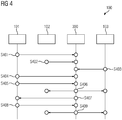
- Fig. 4 shows a schematic flow chart of an embodiment of a method for transmitting at least one message between the first communication device 101 and at least the second communication device 102 by means of a transmission device 300 within a publish-subscribe system 100.
- the publish-subscribe comprises System 100 a further communication device 103.
- the first communication device 101 is designed in particular as a server device.
- the second communication device 102 and the further communication device 103 are preferably designed as client devices.
- the transmission device 300 is designed, for example, as a message broker.
- the publish-subscribe system 100 Fig. 4 is preferably topic-based.
- the first communication device 101 is designed as a publisher, while the second communication device 102 and the further communication device 103 are designed as subscribers.
- the embodiment of the Fig. 4 comprises the following process steps S401 to S409:
- a topic such as “Measurement Sensor_ID”
- the transmission device 300 in particular has a public table of contents for the communication devices 102, 103 within the group G.
- the topics which the transmission device 300 receives from the first communication device 101 or further server devices can be viewed by the communication devices 102, 103.
- the communication devices 102, 103 each subscribe to the transmission device 300. This means that the communication devices 102, 103 are informed of all messages which are transmitted by the transmission device 300 via the topic "Measurement Sensor_ID" can be published by means of the first communication device 101.
- the first communication device 101 obtains information about which communication devices 102, 103 have subscribed to the topic "Measurement Sensor_ID". Since the second communication device 102 and the further communication device 103 have subscribed, but the second communication device 102 functions as a fixed receiver, the first communication device 101, that is to say the server device, asks for the digital certificate of the second communication Device 102 in order to obtain the public key of the second communication device 102 for later encryption of the secured message. This is due in particular to the fact that so far only the transmission device 300 and / or a key distribution server (not shown) has the digital certificates of the communication devices 102, 103.
- step S405 the first communication device 101 publishes a new value, the value “Value”, to the transmission device 300 for the topic “Measurement Sensor_ID”. This can be a measured value of a sensor of the sensor ID.
- step S406 the transmission device 300 now informs the subscribers, that is to say the second communication device 102 and the further communication device 103, that the first communication device 101 has published a new value under the topic “Measurement Sensor_ID”. However, the delivery device 300 does not yet receive one Information on how exactly the new value "Value” is formed.
- step S407 after successful authentication at the transmission device 300, the first communication device 101 receives the digital certificate of the second communication device 102 requested in step S404 and thus its public key. The first communication device 101 then encrypts the portion of the message with the public key of the second communication device 102 which the second communication device 102 is allowed to read, that is to say the value "Value”.
- step S408 the first communication device 101 publishes the message encrypted using the public key of the second communication device 102 and the message secured using the group key to the transmission device 300.
- the transmission device 300 transmits the encrypted and secured message to all subscribers, that is to say to the second communication device 102 and the further communication device 103.
- the second communication device 102 can use its private key to decrypt the portion of the encrypted and secured message which contains the value "Value", since the encrypted and secured message was previously encrypted using the public key of the second communication device 102 .
- the further communication device 103 is unable to decrypt the encrypted and secured message. This means end-to-end encryption when transmitting an encrypted and secured Realized message within the group between the first communication device 101 and the second communication device 102.
- Steps S401 to S407 are identical to the steps explained above.
- step S408 the first communication device 101 encrypts the message secured by means of the group key, which contains the value “Value”, with one of the symmetrical keys from the key table generated by the first communication device 101.
- the key table in turn is encrypted using the public key of the second communication device 102.
- the first communication device 101 then sends the encrypted and secured message and the encrypted key table to the transmission device 300 with a unique identifier of the symmetrical key used.
- step S409 the second communication device 102 receives the encrypted and secured message and the encrypted key table with the unique identifier of the symmetrical key used. Now the second communication device 102 can decrypt the encrypted key table by means of the private key and can then use the symmetrical key from the table by means of the unique identifier, with which the encrypted and secured message can be decrypted. This works when a new message is transmitted Process analogously. Another symmetric key is used for the new message.
- Fig. 5 shows a schematic block diagram of an exemplary embodiment of a publish-subscribe system 100 for transmitting data with a key distribution server 200 and communication devices 102, 103, 104.
- the key distribution of the group keys within group G is implemented via a key distribution server 200.
- the secured message to be transmitted is transmitted to an address A.
- the communication devices 102, 103, 104 that want to receive the secured message can subscribe to the address A.
- FIG. 4 shows a schematic block diagram of an exemplary embodiment of a device 10 for transmitting data in a publish-subscribe system 100.
- An example of the publish-subscribe system 100 is shown in FIG Fig. 2 shown.
- the device 10 comprises a first provision unit 11, a second provision unit 12 and a transmission unit 13.
- the first provision unit 11 is set up to send a group key through the key distribution server 200 to a group G selected from the communication devices 101, 102, 103, 104 in order to create group communication secured by the group key within the group G of the selected communication -Devices 101, 102, 103, 104 to provide.
- the second provision unit 12 is set up to provide a point-to-point connection that can be encrypted by means of a public key of asymmetrical encryption between a first and a second communication device 101, 102 of group G.
- the transmission unit 13 is set up to transmit a message encrypted by means of the public key for the point-to-point connection and secured by means of the group key between the first and the second communication devices 101, 102.
Landscapes
- Engineering & Computer Science (AREA)
- Computer Security & Cryptography (AREA)
- Computer Networks & Wireless Communication (AREA)
- Signal Processing (AREA)
- Data Exchanges In Wide-Area Networks (AREA)
- Information Transfer Between Computers (AREA)
Priority Applications (4)
| Application Number | Priority Date | Filing Date | Title |
|---|---|---|---|
| EP18209579.4A EP3661113A1 (fr) | 2018-11-30 | 2018-11-30 | Procédé et dispositif de transfert des données dans un système de publication-abonnement |
| PCT/EP2019/078173 WO2020108847A1 (fr) | 2018-11-30 | 2019-10-17 | Procédé et dispositif de transmission de données dans un système publier-s'abonner |
| EP19795127.0A EP3854022B1 (fr) | 2018-11-30 | 2019-10-17 | Procédé et dispositif de transfert des données dans un système de publication-abonnement |
| US17/297,235 US11838409B2 (en) | 2018-11-30 | 2019-10-17 | Method and apparatus for transferring data in a publish-subscribe system |
Applications Claiming Priority (1)
| Application Number | Priority Date | Filing Date | Title |
|---|---|---|---|
| EP18209579.4A EP3661113A1 (fr) | 2018-11-30 | 2018-11-30 | Procédé et dispositif de transfert des données dans un système de publication-abonnement |
Publications (1)
| Publication Number | Publication Date |
|---|---|
| EP3661113A1 true EP3661113A1 (fr) | 2020-06-03 |
Family
ID=64572123
Family Applications (2)
| Application Number | Title | Priority Date | Filing Date |
|---|---|---|---|
| EP18209579.4A Withdrawn EP3661113A1 (fr) | 2018-11-30 | 2018-11-30 | Procédé et dispositif de transfert des données dans un système de publication-abonnement |
| EP19795127.0A Active EP3854022B1 (fr) | 2018-11-30 | 2019-10-17 | Procédé et dispositif de transfert des données dans un système de publication-abonnement |
Family Applications After (1)
| Application Number | Title | Priority Date | Filing Date |
|---|---|---|---|
| EP19795127.0A Active EP3854022B1 (fr) | 2018-11-30 | 2019-10-17 | Procédé et dispositif de transfert des données dans un système de publication-abonnement |
Country Status (3)
| Country | Link |
|---|---|
| US (1) | US11838409B2 (fr) |
| EP (2) | EP3661113A1 (fr) |
| WO (1) | WO2020108847A1 (fr) |
Cited By (1)
| Publication number | Priority date | Publication date | Assignee | Title |
|---|---|---|---|---|
| EP4199413A4 (fr) * | 2020-08-14 | 2024-01-31 | Aisle Soft Corporation | Dispositif de terminal, programme d'ordinateur, système de communication et procédé de communication |
Families Citing this family (6)
| Publication number | Priority date | Publication date | Assignee | Title |
|---|---|---|---|---|
| JP2024536788A (ja) * | 2021-09-17 | 2024-10-08 | チェン リム、ハン | 通信リンク |
| US12160505B2 (en) * | 2021-12-21 | 2024-12-03 | Huawei Technologies Co. Ltd. | Methods, systems, and computer-readable storage media for organizing an online meeting |
| CN114338239B (zh) * | 2022-03-03 | 2023-09-01 | 福建天晴数码有限公司 | 一种数据加密传输的方法及其系统 |
| TWI819516B (zh) * | 2022-03-09 | 2023-10-21 | 瑞昱半導體股份有限公司 | 基於消息驗證的金鑰擴展的處理方法與電路 |
| CN115225673B (zh) * | 2022-07-14 | 2024-12-13 | 蔚来汽车科技(安徽)有限公司 | 车辆监控方法、设备和存储介质 |
| KR20240082836A (ko) * | 2022-12-02 | 2024-06-11 | 삼성에스디에스 주식회사 | 양자 내성 암호 기반 mqtt 통신 방법, 장치, 시스템 및 컴퓨터 프로그램 |
Citations (4)
| Publication number | Priority date | Publication date | Assignee | Title |
|---|---|---|---|---|
| US20050044356A1 (en) * | 1999-12-22 | 2005-02-24 | Sunil Srivastava | Method and apparatus for distributing and updating private keys of multicast group managers using directory replication |
| US20130142336A1 (en) * | 2010-05-14 | 2013-06-06 | Siemens Aktiengesellschaft | Method of group key generation and management for generic object oriented substantiation events model |
| DE102016222523A1 (de) | 2016-11-16 | 2018-05-17 | Siemens Aktiengesellschaft | Verfahren und Vorrichtung zum Übertragen von Daten in einem Topic-basierten Publish-Subscribe-System |
| US20180254892A1 (en) * | 2016-05-06 | 2018-09-06 | ZeroDB, Inc. | High-performance access management and data protection for distributed messaging applications |
Family Cites Families (8)
| Publication number | Priority date | Publication date | Assignee | Title |
|---|---|---|---|---|
| US20070276760A1 (en) * | 2004-04-30 | 2007-11-29 | Matsushita Electric Industrial Co., Ltd. | Digital Copyright Management Using Secure Device |
| US9277295B2 (en) * | 2006-06-16 | 2016-03-01 | Cisco Technology, Inc. | Securing media content using interchangeable encryption key |
| US8863227B2 (en) * | 2011-01-05 | 2014-10-14 | Futurewei Technologies, Inc. | Method and apparatus to create and manage a differentiated security framework for content oriented networks |
| EP2878112B1 (fr) * | 2012-07-27 | 2015-10-21 | Telefonaktiebolaget L M Ericsson (PUBL) | Session sécurisée pour un groupe de noeuds de réseau |
| WO2016126151A1 (fr) * | 2015-02-05 | 2016-08-11 | Mtouche Technology Berhad | Système pour établir une communication sécurisée entre plusieurs dispositifs de communication électroniques |
| CN106850195B (zh) * | 2016-04-18 | 2020-05-19 | 中国科学院信息工程研究所 | 一种即时通信中群组密钥协商与通信方法 |
| US10367792B2 (en) * | 2016-08-25 | 2019-07-30 | Orion Labs | End-to end encryption for personal communication nodes |
| US11528129B2 (en) * | 2017-06-04 | 2022-12-13 | Apple Inc. | Synchronizing content |
-
2018
- 2018-11-30 EP EP18209579.4A patent/EP3661113A1/fr not_active Withdrawn
-
2019
- 2019-10-17 WO PCT/EP2019/078173 patent/WO2020108847A1/fr not_active Ceased
- 2019-10-17 US US17/297,235 patent/US11838409B2/en active Active
- 2019-10-17 EP EP19795127.0A patent/EP3854022B1/fr active Active
Patent Citations (4)
| Publication number | Priority date | Publication date | Assignee | Title |
|---|---|---|---|---|
| US20050044356A1 (en) * | 1999-12-22 | 2005-02-24 | Sunil Srivastava | Method and apparatus for distributing and updating private keys of multicast group managers using directory replication |
| US20130142336A1 (en) * | 2010-05-14 | 2013-06-06 | Siemens Aktiengesellschaft | Method of group key generation and management for generic object oriented substantiation events model |
| US20180254892A1 (en) * | 2016-05-06 | 2018-09-06 | ZeroDB, Inc. | High-performance access management and data protection for distributed messaging applications |
| DE102016222523A1 (de) | 2016-11-16 | 2018-05-17 | Siemens Aktiengesellschaft | Verfahren und Vorrichtung zum Übertragen von Daten in einem Topic-basierten Publish-Subscribe-System |
Cited By (1)
| Publication number | Priority date | Publication date | Assignee | Title |
|---|---|---|---|---|
| EP4199413A4 (fr) * | 2020-08-14 | 2024-01-31 | Aisle Soft Corporation | Dispositif de terminal, programme d'ordinateur, système de communication et procédé de communication |
Also Published As
| Publication number | Publication date |
|---|---|
| US11838409B2 (en) | 2023-12-05 |
| US20220294613A1 (en) | 2022-09-15 |
| EP3854022A1 (fr) | 2021-07-28 |
| EP3854022B1 (fr) | 2025-08-20 |
| WO2020108847A1 (fr) | 2020-06-04 |
Similar Documents
| Publication | Publication Date | Title |
|---|---|---|
| EP3854022B1 (fr) | Procédé et dispositif de transfert des données dans un système de publication-abonnement | |
| EP3125492B1 (fr) | Procede et systeme de fabrication d'un canal de communication sur pour des terminaux | |
| EP3732605B1 (fr) | Dépôt et accès sûrs à des fichiers au moyen d'une application web | |
| EP3033855B1 (fr) | Assistance à un déchiffrement de données chiffrées | |
| DE102018216915A1 (de) | System und Verfahren für sichere Kommunikationen zwischen Steuereinrichtungen in einem Fahrzeugnetzwerk | |
| EP3031226B1 (fr) | Assistance pour l'utilisation d'une clé secrète | |
| DE102018102608A1 (de) | Verfahren zur Benutzerverwaltung eines Feldgeräts | |
| LU93024B1 (de) | Verfahren und Anordnung zum Aufbauen einer sicheren Kommunikation zwischen einer ersten Netzwerkeinrichtung (Initiator) und einer zweiten Netzwerkeinrichtung (Responder) | |
| EP3895387B1 (fr) | Module de communication | |
| EP3672142B1 (fr) | Procédé et système de transmission sécurisée d'un ensemble de données | |
| EP3516842B1 (fr) | Procédé et dispositif de transmission de données dans un système de publication-abonnement à base de sujets | |
| EP3910875B1 (fr) | Concept d'échange des informations clés cryptographiques | |
| EP3157192A1 (fr) | Procédé et système de déduction de code asymétrique | |
| EP3556047B1 (fr) | Module matériel de sécurité programmable et procédé pour un module matériel de sécurité programmable | |
| EP4270863A1 (fr) | Reconstruction sécurisée de clés privées | |
| DE102020003739A1 (de) | Verfahren zur Verteilung und Aushandlung von Schlüsselmaterial | |
| EP2932677B1 (fr) | Procede de transmission securisee d'un message electronique | |
| DE102023115999A1 (de) | Verfahren, Vorrichtung, System und Computerprogrammprodukt zur PQ-sicheren Aktualisierung einer Datenverarbeitungseinheit | |
| EP2685682A2 (fr) | Procédé et système de messagerie sécurisée | |
| DE102016207635A1 (de) | Verfahren und Vorrichtung zur Absicherung von Gerätezugriffen | |
| DE102010021655A1 (de) | Verfahren zum Bereitstellen von EDRM (Enterprise Digital Rights Management) geschützten Datenobjekten | |
| EP2649767B1 (fr) | Procédé pour coder un message textuel électronique | |
| EP3669508B1 (fr) | Transmission protégée des messages | |
| EP4704371A1 (fr) | Certificat numérique | |
| EP4280139A1 (fr) | Système de communication, procédé et produit de programme informatique pour fournir des documents d'un ou plusieurs émetteurs à au moins un récepteur |
Legal Events
| Date | Code | Title | Description |
|---|---|---|---|
| PUAI | Public reference made under article 153(3) epc to a published international application that has entered the european phase |
Free format text: ORIGINAL CODE: 0009012 |
|
| STAA | Information on the status of an ep patent application or granted ep patent |
Free format text: STATUS: THE APPLICATION HAS BEEN PUBLISHED |
|
| AK | Designated contracting states |
Kind code of ref document: A1 Designated state(s): AL AT BE BG CH CY CZ DE DK EE ES FI FR GB GR HR HU IE IS IT LI LT LU LV MC MK MT NL NO PL PT RO RS SE SI SK SM TR |
|
| AX | Request for extension of the european patent |
Extension state: BA ME |
|
| STAA | Information on the status of an ep patent application or granted ep patent |
Free format text: STATUS: REQUEST FOR EXAMINATION WAS MADE |
|
| 17P | Request for examination filed |
Effective date: 20201130 |
|
| RBV | Designated contracting states (corrected) |
Designated state(s): AL AT BE BG CH CY CZ DE DK EE ES FI FR GB GR HR HU IE IS IT LI LT LU LV MC MK MT NL NO PL PT RO RS SE SI SK SM TR |
|
| STAA | Information on the status of an ep patent application or granted ep patent |
Free format text: STATUS: EXAMINATION IS IN PROGRESS |
|
| STAA | Information on the status of an ep patent application or granted ep patent |
Free format text: STATUS: THE APPLICATION HAS BEEN WITHDRAWN |
|
| 17Q | First examination report despatched |
Effective date: 20210707 |
|
| 18W | Application withdrawn |
Effective date: 20210708 |