EP3661161A1 - Procédé et système d'accès à distance en vocal à des services d'assistants personnels vocaux - Google Patents
Procédé et système d'accès à distance en vocal à des services d'assistants personnels vocaux Download PDFInfo
- Publication number
- EP3661161A1 EP3661161A1 EP19209950.5A EP19209950A EP3661161A1 EP 3661161 A1 EP3661161 A1 EP 3661161A1 EP 19209950 A EP19209950 A EP 19209950A EP 3661161 A1 EP3661161 A1 EP 3661161A1
- Authority
- EP
- European Patent Office
- Prior art keywords
- communication
- voice
- assistant
- message
- voice assistant
- Prior art date
- Legal status (The legal status is an assumption and is not a legal conclusion. Google has not performed a legal analysis and makes no representation as to the accuracy of the status listed.)
- Granted
Links
Images


Classifications
-
- G—PHYSICS
- G10—MUSICAL INSTRUMENTS; ACOUSTICS
- G10L—SPEECH ANALYSIS TECHNIQUES OR SPEECH SYNTHESIS; SPEECH RECOGNITION; SPEECH OR VOICE PROCESSING TECHNIQUES; SPEECH OR AUDIO CODING OR DECODING
- G10L15/00—Speech recognition
- G10L15/28—Constructional details of speech recognition systems
- G10L15/30—Distributed recognition, e.g. in client-server systems, for mobile phones or network applications
-
- H—ELECTRICITY
- H04—ELECTRIC COMMUNICATION TECHNIQUE
- H04L—TRANSMISSION OF DIGITAL INFORMATION, e.g. TELEGRAPHIC COMMUNICATION
- H04L65/00—Network arrangements, protocols or services for supporting real-time applications in data packet communication
- H04L65/1066—Session management
- H04L65/1069—Session establishment or de-establishment
-
- G—PHYSICS
- G10—MUSICAL INSTRUMENTS; ACOUSTICS
- G10L—SPEECH ANALYSIS TECHNIQUES OR SPEECH SYNTHESIS; SPEECH RECOGNITION; SPEECH OR VOICE PROCESSING TECHNIQUES; SPEECH OR AUDIO CODING OR DECODING
- G10L13/00—Speech synthesis; Text to speech systems
-
- G—PHYSICS
- G10—MUSICAL INSTRUMENTS; ACOUSTICS
- G10L—SPEECH ANALYSIS TECHNIQUES OR SPEECH SYNTHESIS; SPEECH RECOGNITION; SPEECH OR VOICE PROCESSING TECHNIQUES; SPEECH OR AUDIO CODING OR DECODING
- G10L15/00—Speech recognition
- G10L15/08—Speech classification or search
-
- G—PHYSICS
- G10—MUSICAL INSTRUMENTS; ACOUSTICS
- G10L—SPEECH ANALYSIS TECHNIQUES OR SPEECH SYNTHESIS; SPEECH RECOGNITION; SPEECH OR VOICE PROCESSING TECHNIQUES; SPEECH OR AUDIO CODING OR DECODING
- G10L15/00—Speech recognition
- G10L15/22—Procedures used during a speech recognition process, e.g. man-machine dialogue
-
- H—ELECTRICITY
- H04—ELECTRIC COMMUNICATION TECHNIQUE
- H04L—TRANSMISSION OF DIGITAL INFORMATION, e.g. TELEGRAPHIC COMMUNICATION
- H04L63/00—Network architectures or network communication protocols for network security
- H04L63/08—Network architectures or network communication protocols for network security for authentication of entities
-
- H—ELECTRICITY
- H04—ELECTRIC COMMUNICATION TECHNIQUE
- H04L—TRANSMISSION OF DIGITAL INFORMATION, e.g. TELEGRAPHIC COMMUNICATION
- H04L65/00—Network arrangements, protocols or services for supporting real-time applications in data packet communication
- H04L65/10—Architectures or entities
- H04L65/102—Gateways
-
- H—ELECTRICITY
- H04—ELECTRIC COMMUNICATION TECHNIQUE
- H04L—TRANSMISSION OF DIGITAL INFORMATION, e.g. TELEGRAPHIC COMMUNICATION
- H04L65/00—Network arrangements, protocols or services for supporting real-time applications in data packet communication
- H04L65/1066—Session management
- H04L65/1101—Session protocols
- H04L65/1104—Session initiation protocol [SIP]
-
- H—ELECTRICITY
- H04—ELECTRIC COMMUNICATION TECHNIQUE
- H04L—TRANSMISSION OF DIGITAL INFORMATION, e.g. TELEGRAPHIC COMMUNICATION
- H04L65/00—Network arrangements, protocols or services for supporting real-time applications in data packet communication
- H04L65/40—Support for services or applications
- H04L65/403—Arrangements for multi-party communication, e.g. for conferences
-
- H—ELECTRICITY
- H04—ELECTRIC COMMUNICATION TECHNIQUE
- H04L—TRANSMISSION OF DIGITAL INFORMATION, e.g. TELEGRAPHIC COMMUNICATION
- H04L67/00—Network arrangements or protocols for supporting network services or applications
- H04L67/2866—Architectures; Arrangements
- H04L67/30—Profiles
- H04L67/306—User profiles
-
- H—ELECTRICITY
- H04—ELECTRIC COMMUNICATION TECHNIQUE
- H04M—TELEPHONIC COMMUNICATION
- H04M3/00—Automatic or semi-automatic exchanges
- H04M3/42—Systems providing special services or facilities to subscribers
- H04M3/42136—Administration or customisation of services
- H04M3/42153—Administration or customisation of services by subscriber
-
- H—ELECTRICITY
- H04—ELECTRIC COMMUNICATION TECHNIQUE
- H04M—TELEPHONIC COMMUNICATION
- H04M3/00—Automatic or semi-automatic exchanges
- H04M3/42—Systems providing special services or facilities to subscribers
- H04M3/487—Arrangements for providing information services, e.g. recorded voice services or time announcements
- H04M3/493—Interactive information services, e.g. directory enquiries ; Arrangements therefor, e.g. interactive voice response [IVR] systems or voice portals
- H04M3/4931—Directory assistance systems
-
- G—PHYSICS
- G06—COMPUTING OR CALCULATING; COUNTING
- G06F—ELECTRIC DIGITAL DATA PROCESSING
- G06F3/00—Input arrangements for transferring data to be processed into a form capable of being handled by the computer; Output arrangements for transferring data from processing unit to output unit, e.g. interface arrangements
- G06F3/16—Sound input; Sound output
- G06F3/167—Audio in a user interface, e.g. using voice commands for navigating, audio feedback
-
- G—PHYSICS
- G10—MUSICAL INSTRUMENTS; ACOUSTICS
- G10L—SPEECH ANALYSIS TECHNIQUES OR SPEECH SYNTHESIS; SPEECH RECOGNITION; SPEECH OR VOICE PROCESSING TECHNIQUES; SPEECH OR AUDIO CODING OR DECODING
- G10L15/00—Speech recognition
- G10L15/08—Speech classification or search
- G10L2015/088—Word spotting
-
- G—PHYSICS
- G10—MUSICAL INSTRUMENTS; ACOUSTICS
- G10L—SPEECH ANALYSIS TECHNIQUES OR SPEECH SYNTHESIS; SPEECH RECOGNITION; SPEECH OR VOICE PROCESSING TECHNIQUES; SPEECH OR AUDIO CODING OR DECODING
- G10L15/00—Speech recognition
- G10L15/22—Procedures used during a speech recognition process, e.g. man-machine dialogue
- G10L2015/223—Execution procedure of a spoken command
-
- H—ELECTRICITY
- H04—ELECTRIC COMMUNICATION TECHNIQUE
- H04L—TRANSMISSION OF DIGITAL INFORMATION, e.g. TELEGRAPHIC COMMUNICATION
- H04L65/00—Network arrangements, protocols or services for supporting real-time applications in data packet communication
- H04L65/60—Network streaming of media packets
- H04L65/65—Network streaming protocols, e.g. real-time transport protocol [RTP] or real-time control protocol [RTCP]
-
- H—ELECTRICITY
- H04—ELECTRIC COMMUNICATION TECHNIQUE
- H04M—TELEPHONIC COMMUNICATION
- H04M3/00—Automatic or semi-automatic exchanges
- H04M3/42—Systems providing special services or facilities to subscribers
- H04M3/42025—Calling or Called party identification service
- H04M3/42034—Calling party identification service
- H04M3/42059—Making use of the calling party identifier
-
- H—ELECTRICITY
- H04—ELECTRIC COMMUNICATION TECHNIQUE
- H04M—TELEPHONIC COMMUNICATION
- H04M7/00—Arrangements for interconnection between switching centres
- H04M7/006—Networks other than PSTN/ISDN providing telephone service, e.g. Voice over Internet Protocol (VoIP), including next generation networks with a packet-switched transport layer
- H04M7/0072—Speech codec negotiation
Definitions
- the invention belongs to the field of telecommunications and relates in particular to a method of remote access to a personal assistant adapted to receive voice commands spoken by a user.
- a voice assistant is a software application adapted to receive commands spoken orally in natural language and to return information by speech synthesis.
- These assistants are known in the form of software embedded on mobile terminals, such as tablets or smartphones.
- these assistants have also taken the form of connected objects comprising a microphone and a loudspeaker, suitable for interpreting commands spoken by users concerning for example searches on the Internet or requests for services, and for rendering the result. of the command by voice synthesis.
- Such “intelligent” connected objects are very popular with the public.
- a voice assistant generally cooperates with a remote server through an Internet connection.
- the assistant starts recording an audio stream by means of a microphone and transmits the recorded stream to the server via the Internet connection.
- the server implements a voice recognition algorithm in order to identify the user pronouncing the command among the users authorized to use the assistant and to interpret the recognized commands.
- the server can then either process the command or transmit the recognized command to the assistant so that it can be executed locally.
- the assistant then reproduces, via a loudspeaker, a response synthesized by a speech synthesis algorithm.
- a user can thus control the reading of a song by saying a sentence of the type “[ keyword ] plays a piece of the Rolling Stones” or consult the weather forecast by simply asking “[ keyword ] will it rain tomorrow ? "
- Some assistants also offer the possibility of being connected to a home automation system in order to allow a user to interact with their home by voice commands such as "[ keyword ], close the shutters" or "[ keyword ], reduces the ambient temperature by 2 degrees ”.
- the voice assistants can also establish telephone communications with other terminals or servers through a telecommunications network.
- the voice assistant then behaves like a “hands-free” telephone terminal by means of which it is possible to establish communications to other terminals by saying commands of the type “ [keyword] , call Bob”, “[word key] , hangs up "or” [keyword] , Accept the call”.
- the assistant or the server with which he is associated, then identifies the user from the timbre of his voice, accesses an address book of the identified user, searches for the number of "Bob In the address book and then makes a call to the corresponding number.
- Such assistants offer a voice interface between users and data hosted on servers or in databases.
- a method of remote access to a voice assistant is proposed, suitable for establishing telephone communications with a communication terminal through a telecommunications network.
- a server receives a telephone call from a terminal from which a user wishes to access the services offered by a voice assistant. After having identified the voice assistant using an identification data item transmitted in the communication, the server establishes a second communication intended for the voice assistant.
- the signaling used to establish the second communication includes a specific parameter allowing the voice assistant to activate a remote operating mode.
- the server abuts the first and the second communication, so that the audio stream coming from the terminal is directed in the audio channel established towards the assistant, and that the audio stream coming from the assistant is directed in the audio channel of the first communication intended for the terminal.
- the server acts as an intermediary between the calling terminal and the voice assistant.
- Such an arrangement makes it possible to offer a unique telephone number to all users wishing to access their voice assistant remotely, to control the rights of access to the assistant, and to insert a particular parameter in the establishment request. of remote access communication sent to the assistant. It is thus possible to access a voice assistant remotely from a conventional terminal which is not suitable for adding a particular parameter to call signaling.
- a user can transmit voice commands to an assistant when he is not within range of the assistant's microphone.
- the remote access method is such that it further comprises a step of obtaining authentication data from the calling terminal, the step of transmitting an establishment message communication to the voice assistant being conditioned by a validation step of the authentication element obtained.
- the method thus makes it possible to secure access to the assistant.
- the authentication data is for example a PIN code transmitted by the user of the terminal.
- the PIN code communicated is not validated by the server, the second communication intended for the voice assistant is not established.
- the identification data is a voice print obtained by analysis of the timbre of the user's voice. The user experience is thus improved.
- the identification data of the voice assistant obtained by means of the first communication is a call identifier of the calling terminal.
- the user does not have to communicate an identifier of the voice assistant with which to establish a communication.
- the server can for example have a table in which an identifier or an address of a voice assistant is associated with a telephone number, thus allowing an identification of a voice assistant to be contacted when a call is presented. .
- the presence of such a parameter in the call signaling allows a voice assistant to detect that the request for establishment of communication is on the initiative of a remote access server and not a conventional telephone call. , and activate a resource management mode suitable for remote access.
- the remote access method comprises a step of configuring a broadband codec for the first and the second communication.
- a broadband audio codec enables high-quality audio communication between the terminal and the voice assistant, thereby improving the efficiency of voice recognition of commands transmitted by the user.
- a codec with a wider band also allows better identification of the user from the timbre of his voice. Such an arrangement contributes to further improving the user experience.
- such a device also comprises an authentication module suitable for obtaining and verifying authentication data transmitted via the communication established with the calling terminal.
- the invention also relates to a server comprising a remote access device as described above.
- the reception by a voice assistant of a request for establishment of voice communication comprising a particular parameter causes the activation of a particular mode of operation allowing remote access.
- the voice assistant behaves differently depending on whether the incoming communication is a conventional voice communication or a remote access communication.
- the activation of the particular operating mode includes at least one step during which the voice recognition device, whether implemented by the assistant himself or by a server, receives the audio data coming from the terminal. remote instead of the audio signal captured by the microphone.
- the voice commands spoken orally by the remote user are transmitted via the established communication to the voice assistant and treated by the latter or by the server with which it is associated, as if it were a speech signal captured locally by the microphone.
- the audio signal synthesized by the voice assistant, or by the server with which it is associated, and intended to be reproduced by a local speaker in nominal operation of the assistant is transmitted to the remote terminal via the established communication. . In this way, the user can remotely hear the result of a voice command processed by the assistant.
- the method for processing a remote access request is such that the activation of the remote operating mode further comprises a configuration sub-step aimed at activating the recording of the audio stream.
- incoming communication by the capture device without a keyword being detected.
- the prior detection of a key word to identify a command spoken by a user is deactivated, any speech spoken by the user through the remote access communication being then treated by the assistant as a command.
- a voice assistant typically records a command when a predefined keyword is spoken by the user. For example, a voice assistant will ask a weather service when the phrase " [keyword], what is the weather forecast for tomorrow?" » But will ignore the command if the keyword is not detected beforehand.
- the purpose of such a provision is to prevent a voice assistant from interpreting user conversations within microphone range as commands. Confidentiality is thus improved.
- the words spoken by the user are exclusively intended for the voice assistant and the introduction of each command by a keyword is superfluous, confidentiality being provided by voice communication.
- the method thus proposes to simplify the interactions between the assistant and the user by a specific configuration of the assistant allowing the user to get rid of the keyword.
- the method for processing a remote access request is such that the activation of the remote operating mode further comprises a configuration sub-step aimed at activating a restriction of access to at least one assistant service.
- the method thus proposes to secure access to certain services offered by the assistant for which remote access is not desirable. Security is thus reinforced.
- the activation of a remote operating mode includes deactivation of the assistant's microphone and / or loudspeaker.
- the invention also relates to a voice assistant comprising a device for processing a remote access request as described above.
- the different steps of the remote access methods and of processing a remote access request are determined by instructions from computer programs.
- the invention also relates to a computer program comprising instructions for the execution of the steps of the method for processing a request for access to remote and / or instructions for executing the steps of the remote access method, when said program is executed by a processor.
- Such a program can use any programming language, and be in the form of source code, object code, or intermediate code between source code and object code, such as in a partially compiled form, or in any other desirable form.
- the invention relates to an information medium readable by a processor on which is recorded a computer program comprising instructions for the execution of the steps of the distribution method.
- the information medium can be any entity or device capable of storing the program.
- the support may include a storage means, such as a ROM, for example a CD ROM or a microelectronic circuit ROM, or else a magnetic recording means, for example a floppy disc or a disc. hard drive or flash memory.
- the information medium can be a transmissible medium such as an electrical or optical signal, which can be routed via an electrical or optical cable, by radio or by other means.
- the program according to the invention can in particular be downloaded from a network of the Internet type.
- the information medium can be an integrated circuit in which the program is incorporated, the circuit being adapted to execute or to be used in the execution of the processes in question.
- Servers, assistants, devices, programs and information carriers present at least advantages similar to those conferred by the corresponding processes.
- the figure 1 represents a voice assistant 100 within a local network 101.
- the local network 101 is interconnected with a telecommunications network 102 via a gateway 103.
- a gateway is for example a residential gateway of modem-router type .
- the voice assistant can thus access services offered by servers 104 and 105.
- a voice assistant such as assistant 100 includes an audio acquisition and playback device associated with a speaker and a microphone, a processor, and a memory into which software is loaded comprising instructions intended for be executed by the processor.
- the assistant 100 further comprises at least one communication interface, such as a WiFi or Ethernet network interface or an interface with a cellular data network, for example a 3G or 4G network, enabling it to send and receive messages. through a communication network.
- the software is configured to analyze the audio signal captured by a microphone in order to detect a keyword spoken by a user near the assistant.
- the keyword also allows the assistant to identify the person who pronounced the keyword among a plurality of preconfigured people based on characteristics of the timbre of the user's voice, in order to contextualize the requests.
- the assistant 100 records the commands pronounced by the user and transmits the digitized audio signal corresponding to the server 104.
- the server 104 has a voice recognition software thanks to which it interprets the request .
- the server 104 also performs a contextualization of the request, for example from the user having been identified and / or the place where the assistant is installed. Such a contextualization of the request allows for example the assistant 100 to return the local weather forecast when a user simply pronounces a command of the type “ [keyword] what will be the weather tomorrow? "
- the server 104 can consult various databases to obtain a response to the request. For example, the server 104 transmits the interpreted and contextualized request to a partner server 106 adapted to respond to it.
- the server 104 then returns the response obtained to the assistant.
- the response can be returned in the form of an audio signal produced by voice synthesis, or else the assistant 100 can itself, thanks to its software, synthesize a voice response.
- the assistant reproduces the vocalized response thanks to its rendering device.
- the assistant 100 further comprises a telephony module authorizing the establishment of voice communications with other terminals.
- the assistant 100 can establish voice communication with a telephone terminal 107 through the telecommunications network 102.
- the assistant can include a telephony module conforming to the DECT standard (Digital Enhanced Cordless Telecommunications) or CAT-iq (Cordless Advanced Technology-internet and quality) suitable for registering on a compatible base included in the residential gateway 103.
- the assistant 100 is seen as a conventional DECT handset.
- the user can control the telephony function by saying voice commands such as " [keyword], call my daughter", " [keyword], hang up", etc.
- voice commands such as " [keyword], call my daughter", " [keyword], hang up", etc.
- the voice assistant 100 being configured to establish telephone communications with other terminals, it is associated with a call identifier, such as a telephone number, a SIP URI or any other address enabling it to receive telephone calls. .
- This call number can be shared between several communication terminals of a domestic installation.
- the call identifier is not associated directly with the voice assistant 100, but with the residential gateway 103.
- the gateway 103 comprises a telephone base conforming to the DECT standard (Digital Enhanced Cordless Telecommunications) or CAT-iq (Cordless Advanced Technology-internet and quality) with which DECT terminals can register.
- the assistant 100 is seen as a conventional DECT terminal.
- Other compatible terminals can likewise be associated with the residential gateway.
- the gateway 103 when a call establishment message is received by the gateway 103, the gateway 103 conventionally transmits a call presentation signal CC-SETUP to all the terminals associated with the base.
- the assistant comprises a SIP communication module adapted to register directly with a communication service offered by the network 102, or with a SIP server included in the gateway 103.
- the figure 1 also illustrates a server 105 adapted to implement the remote access method according to the invention.
- the server 105 comprises a processor, a memory comprising computer program instructions adapted to be executed by the processor, and at least one network interface controlled by the instructions.
- the figure 5 represents on a chronogram messages exchanged between the terminal 107, the remote access server 105, the gateway 103 and the voice assistant 100.
- this diagram is not exhaustive and other messages can be exchanged between the different entities.
- the telecommunications network may also include other intermediary entities which are not represented on the figure 5 .
- the server 105 receives a communication establishment request from the terminal 107. This is for example a SIP INVITE message 500 for establishing an audio communication on the initiative terminal 107. The server then responds in a conventional manner with a SIP 200 OK 501 message, acknowledged by a SIP ACK 502 message. Following these message exchanges, a bidirectional RTP (Real-Time Transport Protocol) 503 audio stream is established between the terminal 107 and the remote access server 105.
- RTP Real-Time Transport Protocol
- the server 105 has a communication interface suitable for exchanging messages with terminals such as the terminal 107.
- the server 105 includes a communication interface suitable for establishing communications in accordance with the SIP, ISUP or still GSM, 3G or 4G communications.
- the server 105 also has a call number, such as an E.164 identifier or a SIP URI which can be dialed by the terminal 107 to establish the communication.
- the terminal 107 accesses the service via a “clic2call” type service.
- the user of the terminal 107 connects for example to a website, enters via a dedicated interface the telephone number of the terminal 107 with which he wishes to use his voice assistant remotely.
- the "Clic2call” service then generates a call to the number of terminal 107 in order to establish communication. The call then being initiated by the server, the user of the terminal 107 is not billed.
- the terminal 107 accesses the remote access service according to WebRTC technology (Web Real-Time Communication, or real-time communication for the Web, developed by the IETF and W3C), that is to say ie through an http connection.
- WebRTC technology Web Real-Time Communication, or real-time communication for the Web, developed by the IETF and W3C
- the server 105 obtains data identifying the voice assistant 100.
- the server 105 implements an interactive voice service inviting the user of the terminal 107 to indicate an identifier of the voice assistant to which he wishes to access remotely.
- the identifiers are for example provided by DTMF or voice commands.
- Such an identifier is for example a telephone number, an e-mail address, a customer account number, or even a unique identifier of the assistant, such as a serial number for example.
- the identifier is the call number of the terminal 107.
- the identifier is thus obtained by the server 105 directly from the communication establishment message.
- the server 105 can identify upon receipt of the communication the voice assistant concerned by the remote access request.
- the server 105 analyzes the communication establishment messages, such as the message 500, in order to extract the number from the calling terminal.
- the identifier of the calling terminal can be found in a “FROM” header of the SIP INVITE 500 message, or in a P-Asserted-Network-ID header of this same message.
- the identifier of the terminal 107 is previously associated with the voice assistant 100. This association is for example carried out via a web portal or a dedicated application and stored in a memory accessible by the server 105, for example in a database 108. In this way, the user of the terminal 107 does not have to transmit an identifier of the voice assistant: obtaining the assistant's identification data voice is automated, the user experience is improved.
- the server 105 also obtains authentication data, for example a PIN (Personal Identification Number) code, a voiceprint or a password.
- the authentication data can be transmitted by the terminal 107 via DTMF (Dual Tone Multi-Frequency).
- DTMF Dual Tone Multi-Frequency
- the server 105 can entrust the identification of the user to the server 104 which has functions provided for this purpose. Such an arrangement improves security by prohibiting access to a person who does not know the authentication data.
- the server 105 transmits a message establishing a second communication to the voice assistant 100, for example a SIP INVITE message 504.
- This message comprises at least one parameter suitable for activating a mode of remote operation of the voice assistant.
- the first scenario requires that the gateway be able to identify the voice assistant 100 among other communication terminals associated with it, which is for example possible when the communication terminals associated with the gateway 103 are SIP terminals capable of identify themselves in a registration message and transmit capacities, or even when they are terminals conforming to the DECT standard associated with a DECT base included in the gateway 103.
- the second scenario is to be considered when the gateway 103 cannot identify, among the connected terminals, a voice assistant capable of processing the remote access request.
- the assistant 100 receives the message 505 and searches in this message for the presence of the remote access parameter described above.
- the message 505 may have been retransmitted by the gateway in accordance with a communication protocol different from the communication protocol used between the server 105 and the gateway 103.
- the message 504 may be relayed by the gateway 103 to the assistant 100 in accordance DECT standard, in the form of a DECT 505 message.
- the message 505 is a SIP INVITE message.
- Message 505 can be a simple retransmission of message 504, or the gateway can generate a new SIP INVITE message including the remote access parameter.
- the message 505 is for example a CC-SETUP message in which the gateway inserts the received remote access parameter in message 504.
- the gateway 103 when the call presentation message received by the gateway 103 comprises at least one parameter adapted to activate a remote operating mode of the voice assistant as described above, the gateway transmits a signal call presentation only to the DECT terminal of the voice assistant. In this way, the other DECT terminals associated with the DECT base do not present the call when it is a remote access.
- Each DECT terminal has a specific identifier memorized by the DECT radio base of the gateway 103 during its pairing.
- a configuration interface of the gateway 103 it is therefore possible via a configuration interface of the gateway 103 to list the DECT terminal or terminals paired with the internal DECT base of the gateway 103, then to configure a rule consisting in presenting an incoming call only to the DECT terminal of the assistant 100 when the calling number is the number of the remote access server 105.
- a rule is for example stored in an association table stored in a memory of the gateway 103.
- the base and the terminals are for example a server and terminals conforming to the SIP standard.
- the DECT base of the gateway 103 can be configured to retrieve all or part of the parameters of the incoming SIP message and insert them when possible in the DECT protocol. For example, the specific certified SIP (PAI) or non-certified (FROM) calling number can be reported in the “Calling Party Number” field of the DECT CC-SETUP message.
- the gateway 103 can also specifically value certain fields of the DECT protocol, for example "Number Type”, “Numbering Plan”, “Presentation Indicator”, “Screening Indicator”, “Calling Party Address”, etc. so that the voice assistant 100 can detect this specific parameter and configure a remote access operating mode.
- the specific parameter included in the message 505 makes it possible to indicate to the voice assistant that he must adopt, in step 301, a particular operating mode comprising the replacement of the audio stream usually received by the microphone to record the voice commands. by the telephone voice stream received from the caller. In this way, the flow analyzed to detect voice commands is no longer the flow obtained via the microphone, but the flow received in the telephone communication.
- the audio stream obtained in response to a voice command and usually intended to be reproduced by the assistant's speaker is transmitted to the caller through the established telephone communication. In this way, the responses usually returned by the voice assistant 100 are transmitted to the terminal 107 and returned to its user.
- Such a modification of the routing of the incoming and outgoing audio streams can be carried out in different ways.
- the figures 4a , 4b and 4c schematically illustrate an architecture of a device 400 adapted to control the routing of the audio streams of the voice assistant 100 according to different particular operating modes.
- a device 400 is for example integrated into the voice assistant 100.
- the device 400 includes a communication module 401. It is for example a Wi-Fi or Ethernet network interface allowing the assistant to exchange data with other devices, such as the server 104 associated with the 'assistant.
- the module 401 makes it possible to send requests to the server 104 and to receive responses to these requests in accordance with the http protocol.
- the device 400 comprises modules 402 and 403 configurable for routing audio streams to different destination modules.
- the modules 402 and 403 are in an inactive state corresponding to a nominal operation of the assistant according to which the voice commands captured by the microphone 407 and the capture module 408 are routed to a voice recognition module 409 and the network interface 401 to be transmitted to the server 104, and according to which the responses received by the interface 401 are processed by a voice synthesis module 404 and a restitution system 405, 406.
- the flow path in the device 400 is shown in bold in the figures 4a , 4b and 4c .
- the modules 402 and 403 are for example implemented by a DSP processor (Digital Signal Processor) or by a general processing unit configured by program instructions adapted to route audio streams received on a particular input to a particular output.
- the modules 402 and 403 can also correspond to relays, transistors or any other component suitable for redirecting a signal received on an input to a particular output and controlled by a processing unit configured by computer program instructions.
- the configuration of the modules 402 and 403 is controlled by a processor according to the operating mode of the assistant 100 determined by the presence or not of the remote access parameter in the message 505 received.
- the figure 4b represents the routing device 400 in a configuration suitable for an operating mode of audio communication type.
- the assistant 100 behaves like a DECT telephone terminal.
- the module 403 is configured so that the streams captured by the acquisition device 408 and the microphone 407 are directed to the DECT communication module 412 through an outgoing communication processing device 411.
- the module 411 is for example an encoder suitable for compressing the audio stream captured in a format compatible with the communication standard implemented by the assistant 100.
- the configuration of the module 403 represented on the figure 4b also allows directing the audio stream received by the communication module DECT 412 and decoded by the communication module incoming communication processing 410 to the rendering module 405 and the loudspeaker 406.
- the figure 4c illustrates the routing device 400 in a particular operating mode which is the subject of the present invention.
- the module 402 is configured so that the audio stream coming from the voice synthesis module 404 is directed towards the audio processing module for outgoing communications 411, and so that the audio stream received via the incoming audio communication module 410 is directed to the voice recognition module 409.
- the audio stream received through a communication established with a correspondent is decoded by the module 410 then transmitted to the voice recognition module 409 before being transmitted to the server 104 via the communication interface 401.
- the response from the server 104 is received by the communication interface 401 and vocalized by the voice synthesis module 404, then the audio stream resulting from this processing is transmitted to the communication module. 411 encoding then to the correspondent via the DECT 412 communication module.
- the device 400 also comprises additional means for deactivating the loudspeaker when the particular operating mode of the figure 4c is activated. In this way, the voice commands spoken by the user of the terminal 107 are not restored locally by the voice assistant 100 during remote access. Confidentiality is thus preserved.
- additional means make it possible, in a particular embodiment, to deactivate the microphone 407 of the module 400. In this way, words spoken near the assistant 100 are not liable to interfere with commands spoken by the user of terminal 107 during remote access.
- Such loudspeaker and / or microphone deactivation means are for example an electromagnetic relay, a transistor, a DSP configured to block the corresponding audio inputs or outputs or any other means allowing the circuit between the synthesis module 404 to be cut. and the speaker 406, and / or to cut the circuit between the microphone 407 and the voice recognition module 409.
- step 302 when the message 505 includes the remote access parameter, the assistant adopts a particular operating mode including automatic off-hooking of the communication.
- the communication is immediately accepted by the voice assistant 100.
- the gateway 103 receives the message of acceptance of the communication by the voice assistant, it causes the cancellation of the call presentation on the other terminals that can be connected.
- Such an arrangement allows the establishment of a remote access communication with the voice assistant even when the gateway is not able to differentiate a terminal of the voice assistant type from a conventional telephone terminal.
- the voice assistant 100 determines that the communication is a remote access communication intended for it and automatically accepts the call.
- the voice assistant accepts the call by returning a response message 506, for example a DECT CC-CONNECT message or SIP 200 OK, depending on the technology used by the voice assistant.
- a response message 506 for example a DECT CC-CONNECT message or SIP 200 OK, depending on the technology used by the voice assistant.
- the sending of such a response is triggered by the detection of an appropriate voice command spoken by the user following the presentation of the call.
- the sending of this response is automatic when the establishment message includes the remote access parameter, that is to say that no user action is necessary on the assistant 100 to accept the call.
- the server 105 receives the call acceptance message 507 transmitted by the voice assistant 100 in step 203. It can be a simple retransmission of the message 506 when the protocol implemented between the assistant 100 and the gateway 103 is the same protocol as that used between the gateway 103 and the server 105, but it can be a different type of message when the assistant uses a protocol different from that implemented between the gateway 103 and the server 105.
- the server 105 can acknowledge the message 507 by sending for example a message 508 of SIP ACK type intended for the voice assistant 100 or the gateway 103. This message can be retransmitted by the gateway 103 to the assistant 100 in the form of a message 509 of SIP ACK or CC-CONNECT-ACK type if the terminal conforms to the DECT standard.
- a bidirectional audio connection 510, 511 is established between the server 105 and the voice assistant 100.
- the server 105 terminates the communication established with the terminal 107 and the communication established with the assistant 100.
- the abutment step 203 can be implemented according to a “back to back user agent” technique (B2BUA).
- B2BUA back to back user agent
- the server 105 comprises two SIP User Agents: one is responsible for communication with the terminal 107, the other with the voice assistant and / or the gateway 103.
- events affecting a communication are passed on by the server to the other communication. For example, when a “SIP BYE” message is received by the server 105 from the terminal 107, the server generates a SIP BYE message intended for the voice assistant.
- the server 105 relays the audio streams 511, 510 bidirectionally to the terminal 107 through the connection 504.
- the device represented on the figures 4a to 4c includes modules 404 and 409 for synthesis and speech recognition.
- the voice synthesis and voice recognition functions can be implemented on a server, for example on the server 104.
- the audio stream 510 received from the terminal 107 is transmitted to the server 104 in the form of an audio stream 512.
- the server 104 then performs voice recognition and executes the commands pronounced by the user of the terminal 107.
- the response to the request is vocalized by the server 104 from a text-to-speech module.
- the server 104 transmits the response to the user's command in the form of a synthesized audio stream 513.
- the configuration step 301 comprises the negotiation of a broadband codec, such as for example an audio codec G. 722 or WB-AMR.
- a broadband codec such as for example an audio codec G. 722 or WB-AMR.
- the voice assistant 100 and / or the gateway 103 analyze the capacities declared by the terminal 107 and / or the server 105 in the call establishment message 504 or 505 received. Such capacities are for example declared in a message of SDP (Session Description Protocol) type encapsulated in a SIP INVITE message.
- SDP Session Description Protocol
- the call acceptance message 506 sent by the voice assistant 100 comprises one or more broadband codecs supported by the assistant 100 compatible with the offer presented in the message 505.
- the timbre recognition algorithms for identifying the user, as well as the speech recognition algorithms produce improved results.
- the server 105 receives at step 200 a request to establish communication from the terminal 107
- the response message 501 comprises at least one broadband codec offer. In this way, the communication between the terminal 107 and the assistant is of high quality, allowing good performance of the audio processing algorithms.
- the invention thus makes it possible to deport from the assistant 100 to the terminal 107 the functions for capturing voice commands and rendering the responses.
- the user thus remotely accesses all the services offered by the assistant.
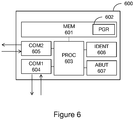
- the figure 6 represents the architecture of a device 600 adapted to implement the remote access method according to a particular embodiment.
- the device 600 comprises a storage space 601, for example a memory MEM, a processing unit 603 equipped for example with a processor PROC.
- the processing unit can be controlled by a program 602, for example a computer program PGR, comprising instructions configured to implement the remote access method when they are executed by the processor PROC.
- the instructions of the PGR program are in particular configured to implement the steps of establishing a first communication with a calling terminal, of obtaining, through the established communication, a data item identifying the voice assistant, transmission of a message establishing a second communication to the voice assistant, the message comprising at least one parameter suitable for activating a remote operating mode of the voice assistant, and terminating the first and second communication.
- the instructions of the PGR program are further configured to implement a step of obtaining authentication data from the calling terminal, the step of transmitting a communication establishment message. to the voice assistant then being conditioned by a validation step of the authentication element obtained.
- the PGR program is further configured to implement a step of configuring a broadband codec for the first and second communications.
- the instructions of the computer program 602 are for example loaded into a RAM memory (Random Access Memory in English) before being executed by the processor of the processing unit 603.
- the processor of the unit 603 processing implements the steps of the remote access method according to the instructions of the computer program 602.
- the device comprises, in addition to the memory 601, a first communication module 604 (COM1) allowing the device to connect to a telecommunications network and to establish telephone communications via the telecommunications network, and in particular to receive voice communication from a telephone terminal in accordance with a communication standard.
- the module 604 is for example an Ethernet, 2G, 3G or 4G network interface associated with a SIP User Agent suitable for receiving audio communications from or to other terminals.
- the device 600 also comprises an identification module 606, suitable for obtaining data for identifying a voice assistant through the communication established by the module 604, and obtaining an address for a voice assistant.
- the module 606 is for example implemented by computer program instructions executed by the processor PROC and configured to analyze the call signaling messages received by the communication module 604 to extract the identifier of an assistant therefrom. voice or data allowing to identify a particular voice assistant.
- the module 606 comprises for example computer program instructions making it possible to obtain a calling terminal identifier from a call signaling message, to consult a database in which the addresses of voice assistants are stored. in association with call numbers, and obtain the address of a particular voice assistant from the caller number obtained.
- the device 600 comprises a second communication module 605 (COM2) allowing the device to connect to a telecommunication network and to establish telephone communications via this network, and in particular to establish bidirectional audio communications to a voice assistant.
- the module 605 is for example an Ethernet, 2G, 3G, 4G network interface or any other suitable network interface to implement an audio communication establishment protocol such as SIP.
- the module 605 can be controlled by computer program instructions adapted to be executed by the processor PROC and configured to obtain an address of a voice assistant from a signaling message received in a first communication established via the module communication 604, and establish a second communication to the voice assistant whose address has been obtained, the establishment of the second communication comprising the sending of a message comprising at least one parameter suitable for activating a mode of remote operation of the voice assistant.
- the communication modules 604 and 605 can take the form of a single communication module.
- the device 600 finally comprises an abutment module 607.
- the abutment module 607 is for example implemented by computer program instructions adapted to be executed by a processor, for example the processor PROC, and configured to retransmit via the interface 604 of the audio data packets received on the interface 605, and vice versa. These instructions are also configured to relay the signaling messages received on the interface 604 to the interface 605, and vice versa.
- the device 600 further comprises an authentication module.
- the authentication module is for example implemented by computer program instructions adapted to be executed by a processor and configured to obtain authentication data, for example a PIN code, from the calling terminal via the module 604, the establishment of a communication intended for the voice assistant by the module 605 being conditioned by a step of validation of the authentication element obtained.
- a validation step comprises for example the comparison of a PIN code obtained with a code stored in association with the identifier of the voice assistant for which remote access is requested.
- the remote access device 600 is included in a server, for example in an application server (AS, for Application Server in English) of an IMS network.
- AS application server
Landscapes
- Engineering & Computer Science (AREA)
- Multimedia (AREA)
- Signal Processing (AREA)
- Computer Networks & Wireless Communication (AREA)
- Audiology, Speech & Language Pathology (AREA)
- Computational Linguistics (AREA)
- Health & Medical Sciences (AREA)
- Human Computer Interaction (AREA)
- Physics & Mathematics (AREA)
- Acoustics & Sound (AREA)
- General Business, Economics & Management (AREA)
- Business, Economics & Management (AREA)
- Computer Hardware Design (AREA)
- Computer Security & Cryptography (AREA)
- Computing Systems (AREA)
- General Engineering & Computer Science (AREA)
- Telephonic Communication Services (AREA)
Abstract
Description
- L'invention appartient au domaine des télécommunications et concerne en particulier un procédé d'accès à distance à un assistant personnel adapté pour recevoir des commandes vocales prononcées par un utilisateur.
- Un assistant vocal est une application logicielle adaptée pour recevoir des commandes prononcées oralement en langage naturel et pour restituer en retour des informations par synthèse vocale. Ces assistants sont connus sous la forme de logiciels embarqués sur des terminaux mobiles, tels que des tablettes ou des smartphones. Depuis quelques temps, ces assistants prennent aussi la forme d'objets connectés comprenant un microphone et un haut-parleur, adaptés pour interpréter des commandes prononcées par des utilisateurs concernant par exemple des recherches sur Internet ou des demandes de services, et pour restituer le résultat de la commande par synthèse vocale. De tels objets connectés « intelligents » sont très appréciés du public.
- Pour cela, un assistant vocal coopère généralement avec un serveur distant grâce à une connexion Internet. Lorsqu'un mot clef particulier prononcé par un utilisateur est détecté, l'assistant déclenche l'enregistrement d'un flux audio au moyen d'un microphone et transmet le flux enregistré au serveur via la connexion Internet. Le serveur met en œuvre un algorithme de reconnaissance vocale afin d'identifier l'utilisateur prononçant la commande parmi les utilisateurs habilités à utiliser l'assistant et d'interpréter les commandes reconnues. Le serveur peut alors soit traiter la commande, soit transmettre la commande reconnue à l'assistant pour qu'elle soit exécutée localement. L'assistant restitue ensuite, via un haut-parleur, une réponse synthétisée par un algorithme de synthèse vocale.
- Un utilisateur peut ainsi commander la lecture d'une chanson en prononçant une phrase du type « [mot clef] joue un morceau des Rolling Stones » ou consulter la météo en demandant simplement « [mot clef] est-ce qu'il va pleuvoir demain ? ».
- Certains assistants offrent en outre la possibilité d'être connectés à une installation domotique afin de permettre à un utilisateur d'interagir avec son habitation par des commandes vocales du type «[mot clef], ferme les volets» ou « [mot clef], réduit la température ambiante de 2 degrés ».
- Les assistants vocaux peuvent encore établir des communications téléphoniques avec d'autres terminaux ou serveurs au travers d'un réseau de télécommunication. L'assistant vocal se comporte alors comme un terminal téléphonique « mains libres » au moyen duquel il est possible d'établir des communications vers d'autres terminaux en prononçant des commandes du type « [mot clef], appelle Bob », «[mot clef], raccroche» ou «[mot clef], accepte l'appel». Pour appeler « Bob », l'assistant, ou le serveur auquel il est associé, identifie alors l'utilisateur à partir du timbre de sa voix, accède à un carnet d'adresses de l'utilisateur identifié, recherche le numéro de « Bob » dans le carnet d'adresses puis passe un appel vers le numéro correspondant.
- Ainsi, de tels assistants offrent une interface vocale entre les utilisateurs et des données hébergées sur des serveurs ou dans des bases de données.
- On constate toutefois que l'usage de ces appareils reste limité. Bien qu'il existe des applications mobiles dédiées à partir desquelles il est possible d'accéder à distance à certaines fonctions offertes par un assistant, d'autres fonctionnalités sont uniquement accessibles par commande vocale. La présence de l'utilisateur à proximité de l'appareil est alors requise, afin que le signal de parole puisse être capté par le microphone. Pourtant, il est parfois souhaitable de pouvoir commander à distance un tel appareil, en conservant l'accès à la totalité des fonctions offertes.
- Il existe donc un besoin pour une solution qui permette d'accéder à distance et de façon sécurisée à un assistant vocal tel que décrit précédemment.
- A cet effet, il est proposé un procédé d'accès à distance à un assistant vocal adapté pour établir des communications téléphoniques avec un terminal de communication au travers d'un réseau de télécommunications.
- Le procédé est remarquable en ce qu'il comporte les étapes suivantes :
- établissement d'une première communication avec un terminal appelant,
- obtention au travers de la communication établie, d'une donnée d'identification de l'assistant vocal,
- transmission d'un message d'établissement d'une seconde communication à destination de l'assistant vocal identifié, le message comprenant au moins un paramètre adapté pour activer un mode de fonctionnement à distance de l'assistant vocal,
- aboutement de la première et la seconde communication.
- Ainsi, un serveur reçoit un appel téléphonique en provenance d'un terminal à partir duquel un utilisateur souhaite accéder aux services offerts par un assistant vocal. Après avoir identifié l'assistant vocal grâce à une donnée d'identification transmise dans la communication, le serveur établit une seconde communication à destination de l'assistant vocal. La signalisation permettant d'établir la seconde communication comprend un paramètre particulier permettant à l'assistant vocal d'activer un mode de fonctionnement à distance. Une fois la seconde communication établie, le serveur aboute la première et la seconde communication, de manière à ce que le flux audio en provenance du terminal soit dirigé dans le canal audio établi vers l'assistant, et que le flux audio en provenance de l'assistant soit dirigé dans le canal audio de la première communication à destination du terminal. Le serveur joue un rôle d'intermédiaire entre le terminal appelant et l'assistant vocal. Une telle disposition permet d'offrir un numéro de téléphone unique à tous les utilisateurs souhaitant accéder à distance à leur assistant vocal, de contrôler les droits d'accès à l'assistant, et d'insérer un paramètre particulier dans la demande d'établissement de communication d'accès à distance envoyée à l'assistant. Il est ainsi possible d'accéder à distance à un assistant vocal à partir d'un terminal classique qui n'est pas adapté pour ajouter un paramètre particulier dans la signalisation d'appel.
- De cette façon, un utilisateur peut transmettre des commandes vocales à un assistant lorsqu'il n'est pas à portée du microphone de l'assistant.
- Selon une réalisation particulière, le procédé d'accès à distance est tel qu'il comprend en outre une étape d'obtention d'une donnée d'authentification en provenance du terminal appelant, l'étape de transmission d'un message d'établissement de communication à destination de l'assistant vocal étant conditionnée par une étape de validation de l'élément d'authentification obtenu.
- Le procédé permet ainsi de sécuriser l'accès à l'assistant. La donnée d'authentification est par exemple un code PIN transmis par l'utilisateur du terminal. Lorsque le code PIN communiqué n'est pas validé par le serveur, la seconde communication à destination de l'assistant vocal n'est pas établie. Selon une réalisation particulière, la donnée d'identification est une empreinte vocale obtenue par analyse du timbre de la voix de l'utilisateur. L'expérience utilisateur est ainsi améliorée.
- Selon un mode de réalisation particulier, la donnée d'identification de l'assistant vocal obtenue par l'intermédiaire de la première communication est un identifiant d'appel du terminal appelant. Ainsi, l'utilisateur n'a pas à communiquer un identifiant de l'assistant vocal avec lequel établir une communication. Pour cela, le serveur peut par exemple disposer d'une table dans laquelle un identifiant ou une adresse d'un assistant vocal est associé à un numéro de téléphone, permettant ainsi une identification d'un assistant vocal à contacter lorsqu'un appel est présenté.
- Selon un mode particulier de réalisation, le procédé est tel que la donnée adaptée pour activer un mode de fonctionnement particulier est un paramètre choisi parmi les paramètres suivants :
- Un N° d'appelant certifié, fourni par exemple dans un entête SIP (Session Initiation Protocol RFC3261) PAI (P-Asserted-Identity),
- Un N° d'appelant non certifié, contenu par exemple dans un entête « FROM » d'un message SIP,
- Un nom d'appelant fourni par un service CLIP (Calling Line Identification Presentation), typiquement dans le champ SIP DISPAY du PAI et/ou FROM
- Une information de localisation spécifique du terminal appelant, typiquement un champ SIP PANI (Private-Access Network Information)
- Une valeur particulière d'un entête SIP User Agent
- Un identifiant de serveur SIP spécifique,
- Un attribut du protocole SDP (Session Description Protocol, IETF RFC4566) spécifique du protocole SIP permettant de négocier le flux media,
- Une adresse IP source (Internet Protocol) spécifique d'un serveur,
- Un nom de domaine spécifique dans une URI (Uniform Ressource Identifier),
- Un entête SIP spécifique,
- Une extension du protocole ISUP/BICC (ISDN Signaling User Part/Bearer-Independent Call Control) dans le cas où l'interconnexion avec le monde circuit est utilisée, par exemple avec l'élément d'information « generic notification flag ».
- Ainsi, la présence d'un tel paramètre dans la signalisation d'appel permet à un assistant vocal de détecter que la demande d'établissement de communication est à l'initiative d'un serveur d'accès à distance et non un appel téléphonique classique, et d'activer un mode de gestion de ressources adapté à l'accès à distance.
- Selon une réalisation particulière, le procédé d'accès à distance comprend une étape de configuration d'un codec large bande pour la première et la seconde communication. Un codec audio large bande permet d'établir une communication audio de haute qualité entre le terminal et l'assistant vocal, permettant ainsi une meilleure efficacité de la reconnaissance vocale des commandes transmises par l'utilisateur. Un codec à bande élargie permet également une meilleure identification de l'utilisateur à partir du timbre de sa voix. Une telle disposition contribue à améliorer encore l'expérience utilisateur.
- Selon un autre aspect, l'invention concerne un dispositif d'accès à distance à un assistant vocal adapté pour établir des communications téléphoniques avec un terminal de communication au travers d'un réseau de télécommunications, le dispositif étant tel qu'il comporte:
- Un premier module de communication adapté pour établir une première communication avec un terminal appelant,
- Un module d'identification, adapté pour obtenir une donnée d'identification de l'assistant vocal au travers de la communication établie, et obtenir une adresse d'un assistant vocal,
- Un second module de communication, adapté pour transmettre vers l'adresse obtenue un message d'établissement d'une seconde communication, le message comprenant au moins un paramètre adapté pour activer un mode de fonctionnement à distance de l'assistant vocal identifié, et
- Un module aboutement de la première et la seconde communication, adapté pour retransmettre vers l'assistant vocal un flux audio en provenance du terminal, et pour retransmettre vers le terminal un flux audio en provenance de l'assistant vocal.
- Dans une réalisation particulière, un tel dispositif comprend en outre un module d'authentification adapté pour obtenir et vérifier une donnée d'authentification transmise via la communication établie avec le terminal appelant.
- L'invention concerne aussi un serveur comprenant un dispositif d'accès à distance tel que décrit précédemment.
- De façon complémentaire au procédé d'accès à distance, l'invention vise un procédé de traitement d'une demande d'accès à distance sur un assistant vocal adapté pour établir des communications téléphoniques avec un terminal de communication au travers d'un réseau de télécommunications, l'assistant vocal étant associé à un dispositif de reconnaissance vocale pour analyser une commande vocale prononcée par un utilisateur, l'analyse étant activée suite à la détection d'un mot clef par l'assistant vocal, et à un dispositif de synthèse vocale pour vocaliser une réponse à ladite commande vocale, le procédé étant tel qu'il comprend les étapes suivantes :
- réception d'un message d'établissement d'une communication vocale, le message comprenant au moins un paramètre d'accès à distance,
- activation d'un mode de fonctionnement particulier comprenant les sous-étapes suivantes:
- ∘ redirection d'un flux audio entrant de la communication téléphonique vers le dispositif de reconnaissance vocale associé, en remplacement du signal capturé par le microphone,
- ∘ redirection d'un flux audio issu du dispositif de synthèse vocale associé vers un canal audio sortant de la communication,
- Lorsque le mode de fonctionnement particulier est activé, transmission d'un message d'acceptation de la communication.
- Ainsi, la réception par un assistant vocal d'une demande d'établissement de communication vocale comprenant un paramètre particulier provoque l'activation d'un mode de fonctionnement particulier permettant un accès à distance. De cette façon, l'assistant vocal se comporte différemment selon que la communication entrante est une communication vocale classique ou une communication d'accès à distance. L'activation du mode de fonctionnement particulier comporte au moins une étape au cours de laquelle le dispositif de reconnaissance vocale, qu'il soit mis en œuvre par l'assistant lui-même ou par un serveur, reçoit les données audio en provenance du terminal distant à la place du signal audio capturé par le microphone. De cette façon, les commandes vocales prononcées oralement par l'utilisateur distant sont transmises via la communication établie jusqu'à l'assistant vocal et traitées par ce dernier ou par le serveur auquel il est associé, comme s'il s'agissait d'un signal de parole capturé localement par le microphone. De même, le signal audio synthétisé par l'assistant vocal, ou par le serveur auquel il est associé, et destiné à être restitué par un haut-parleur local dans un fonctionnement nominal de l'assistant est transmis au terminal distant via la communication établie. De cette façon, l'utilisateur peut entendre à distance le résultat d'une commande vocale traitée par l'assistant.
- Selon un mode de réalisation particulier, le procédé de traitement d'une demande d'accès à distance est tel que l'activation du mode de fonctionnement à distance comprend en outre une sous-étape de configuration visant à activer l'enregistrement du flux audio entrant de la communication par le dispositif de capture sans qu'un mot clef soit détecté. Autrement dit, la détection préalable d'un mot clef pour identifier une commande prononcée par un utilisateur est désactivée, toute parole prononcée par l'utilisateur au travers de la communication d'accès à distance étant alors traitée par l'assistant comme une commande.
- De manière classique, un assistant vocal enregistre une commande lorsqu'un mot clef prédéfini est prononcé par l'utilisateur. Par exemple, un assistant vocal interrogera un service météo lorsque la phrase « [mot clef], quel temps est prévu pour demain ? », mais ignorera la commande si le mot clef n'est pas détecté au préalable. Une telle disposition vise à éviter qu'un assistant vocal n'interprète comme des commandes les conversations des utilisateurs à portée de microphone. La confidentialité est ainsi améliorée. Dans un contexte d'accès à distance cependant, les paroles prononcées par l'utilisateur sont exclusivement destinées à l'assistant vocal et l'introduction de chaque commande par un mot clef est superflue, la confidentialité étant apportée par la communication vocale. Le procédé propose ainsi de simplifier les interactions entre l'assistant et l'utilisateur par une configuration spécifique de l'assistant permettant à l'utilisateur de s'affranchir du mot clef.
- Selon un mode particulier de réalisation, le procédé de traitement d'une demande d'accès à distance est tel que l'activation du mode de fonctionnement à distance comprend en outre une sous-étape de configuration visant à activer une restriction d'accès à au moins un service de l'assistant.
- Le procédé propose ainsi de sécuriser l'accès à certains services offerts par l'assistant pour lesquels un accès à distance n'est pas souhaitable. La sécurité est ainsi renforcée.
- Selon une réalisation particulière, l'activation d'un mode de fonctionnement à distance comprend la désactivation du microphone et/ou du haut-parleur de l'assistant.
- Une telle disposition permet de préserver la confidentialité des échanges lors d'un accès à distance à l'assistant vocal, le résultat des commandes n'étant pas vocalisé dans l'environnement immédiat de l'assistant.
- Selon un autre aspect, l'invention vise un dispositif de traitement d'une demande d'accès à distance à un assistant vocal adapté pour établir des communications téléphoniques avec un terminal de communication au travers d'un réseau de télécommunications, l'assistant vocal étant associé à un dispositif de reconnaissance vocale pour analyser une commande vocale prononcée par un utilisateur, l'analyse étant activée suite à la détection d'un mot clef par l'assistant vocal, et à un dispositif de synthèse vocale pour vocaliser une réponse à ladite commande vocale, le dispositif comprenant:
- un module de communication adapté pour recevoir un message d'établissement d'une communication vocale, le message comprenant au moins un paramètre adapté pour activer un mode de fonctionnement à distance de l'assistant vocal,
- un module d'activation d'un mode de fonctionnement à distance comprenant un module de routage audio adapté pour :
- ∘ rediriger un flux audio entrant de la communication téléphonique vers le dispositif de reconnaissance vocale en remplacement du signal capturé par le microphone,
- ∘ rediriger un flux audio issu du dispositif de synthèse vocale vers un canal audio sortant de la communication,
- L'invention concerne aussi un assistant vocal comprenant un dispositif de traitement d'une demande d'accès à distance tel que décrit précédemment.
- Dans un mode particulier de réalisation, les différentes étapes des procédés d'accès à distance et de traitement d'une demande d'accès à distance sont déterminées par des instructions de programmes d'ordinateurs.
- En conséquence, l'invention vise également un programme d'ordinateur comportant des instructions pour l'exécution des étapes du procédé de traitement d'une demande d'accès à distance et/ou des instructions pour l'exécution des étapes du procédé d'accès à distance, lorsque ledit programme est exécuté par un processeur.
- Un tel programme peut utiliser n'importe quel langage de programmation, et être sous la forme de code source, code objet, ou de code intermédiaire entre code source et code objet, tel que dans une forme partiellement compilée, ou dans n'importe quelle autre forme souhaitable.
- Enfin, l'invention concerne un support d'informations lisible par un processeur sur lequel est enregistré un programme d'ordinateur comprenant des instructions pour l'exécution des étapes du procédé de répartition.
- Le support d'informations peut être n'importe quelle entité ou dispositif capable de stocker le programme. Par exemple, le support peut comporter un moyen de stockage, tel qu'une ROM, par exemple un CD ROM ou une ROM de circuit microélectronique, ou encore un moyen d'enregistrement magnétique, par exemple une disquette (floppy disc) ou un disque dur ou encore une mémoire flash. D'autre part, le support d'informations peut être un support transmissible tel qu'un signal électrique ou optique, qui peut être acheminé via un câble électrique ou optique, par radio ou par d'autres moyens. Le programme selon l'invention peut être en particulier téléchargé sur un réseau de type Internet.
- Alternativement, le support d'informations peut être un circuit intégré dans lequel le programme est incorporé, le circuit étant adapté pour exécuter ou pour être utilisé dans l'exécution des procédés en question.
- Les serveurs, assistants, dispositifs, programmes et supports d'information présentent au moins des avantages analogues à ceux conférés par les procédés correspondants.
- Les différents modes ou caractéristiques de réalisation précités peuvent être ajoutés indépendamment ou en combinaison les uns avec les autres, aux étapes du procédé auquel ils se rapportent.
- D'autres caractéristiques et avantages de l'invention apparaîtront plus clairement à la lecture de la description suivante d'un mode de réalisation particulier, donné à titre d'exemple illustratif et non limitatif, et des dessins annexés, parmi lesquels :
- La
figure 1 illustre une architecture réseau adaptée pour mettre en œuvre l'invention selon une réalisation particulière, - La
figure 2 représente les principales étapes du procédé d'accès à distance, selon un mode particulier de réalisation, - La
figure 3 représente les principales étapes du procédé de traitement d'une demande d'accès à distance, selon un mode de réalisation particulier, - Les
figures 4a ,4b et4c illustrent de manière simplifiée l'architecture d'un dispositif de traitement d'une demande d'accès à distance adapté pour contrôler le routage des flux audio de l'assistant vocal dans un mode de réalisation particulier, - La
figure 5 représente sur un chronogramme des messages échangés pour mettre en œuvre l'invention selon un mode de réalisation particulier, et - la
figure 6 illustre l'architecture d'un dispositif adapté pour mettre en œuvre le procédé d'accès à distance selon un mode particulier de réalisation. - La
figure 1 représente un assistant vocal 100 au sein d'un réseau local 101. Le réseau local 101 est interconnecté avec un réseau de télécommunications 102 par l'intermédiaire d'une passerelle 103. Une telle passerelle est par exemple une passerelle résidentielle de type modem-routeur. L'assistant vocal peut ainsi accéder à des services offerts par des serveurs 104 et 105. - De manière classique, un assistant vocal tel que l'assistant 100 comprend un dispositif d'acquisition et de restitution audio associé à un haut-parleur et un microphone, un processeur, et une mémoire dans laquelle est chargé un logiciel comprenant des instructions destinées à être exécutées par le processeur. L'assistant 100 comprend en outre au moins une interface de communication, telle qu'une interface réseau Wifi ou Ethernet ou une interface avec un réseau de données cellulaire, par exemple un réseau 3G ou 4G, lui permettant d'envoyer et recevoir des messages au travers d'un réseau de communication.
- Le logiciel est configuré pour analyser le signal audio capturé par un microphone afin d'y détecter un mot clef prononcé par un utilisateur à proximité de l'assistant. Le mot clef permet en outre à l'assistant d'identifier la personne ayant prononcé le mot clef parmi une pluralité de personnes préconfigurées à partir de caractéristiques du timbre de la voix de l'utilisateur, dans le but de contextualiser les requêtes.
- Suite à la détection d'un mot clef, l'assistant 100 enregistre les commandes prononcées par l'utilisateur et transmet le signal audio numérisé correspondant au serveur 104. Le serveur 104 dispose d'un logiciel de reconnaissance vocale grâce auquel il interprète la requête. Le serveur 104 effectue également une mise en contexte de la requête, par exemple à partir de l'utilisateur ayant été identifié et/ou le lieu où est installé l'assistant. Une telle mise en contexte de la requête permet par exemple à l'assistant 100 de retourner la météo locale quand un utilisateur prononce simplement une commande du type « [mot clef] quel temps fera-t-il demain ? ».
- Le serveur 104 peut consulter diverses bases de données pour obtenir une réponse à la requête. Par exemple, le serveur 104 transmet la requête interprétée et contextualisée à un serveur partenaire 106 adapté pour y répondre.
- Le serveur 104 retourne ensuite la réponse obtenue à l'assistant. La réponse peut être retournée sous la forme d'un signal audio produit par synthèse vocale, ou bien l'assistant 100 peut lui-même, grâce à son logiciel, synthétiser une réponse vocale.
- Enfin, l'assistant restitue la réponse vocalisée grâce à son dispositif de restitution.
- L'assistant 100 comprend en outre un module de téléphonie autorisant l'établissement de communications vocales avec d'autres terminaux. Par exemple, l'assistant 100 peut établir une communication vocale avec un terminal téléphonique 107 au travers du réseau de télécommunication 102.
- Pour cela, l'assistant peut comprendre un module de téléphonie conforme à la norme DECT (Digital Enhanced Cordless Telecommunications) ou CAT-iq (Cordless Advanced Technology-internet and quality) adapté pour s'enregistrer sur une base compatible comprise dans la passerelle résidentielle 103. Ainsi, du point de vue de la passerelle, l'assistant 100 est vu comme un combiné DECT classique. L'utilisateur peut piloter la fonction téléphonie en prononçant des commandes vocales telles que « [mot clef], appelle ma fille », « [mot clef], raccorche », etc. Lorsqu'une communication est établie, la voix de l'utilisateur distant est restituée via le haut-parleur de l'assistant 100, et la voix de l'utilisateur local est capturée par le microphone de l'assistant puis transmise au correspondant.
- L'assistant vocal 100 étant configuré pour établir des communications téléphoniques avec d'autres terminaux, il est associé à un identifiant d'appel, tel qu'un numéro de téléphone, une SIP URI ou toute autre adresse lui permettant de recevoir des appels téléphoniques. Ce numéro d'appel peut être partagé entre plusieurs terminaux de communication d'une installation domestique.
- Selon une réalisation particulière, l'identifiant d'appel n'est pas associé directement à l'assistant vocal 100, mais à la passerelle résidentielle 103. La passerelle 103 comprend une base de téléphonie conforme à la norme DECT (Digital Enhanced Cordless Telecommunications) ou CAT-iq (Cordless Advanced Technology-internet and quality) auprès de laquelle des terminaux DECT peuvent s'enregistrer. Ainsi, du point de vue de la passerelle, l'assistant 100 est vu comme un terminal DECT classique. D'autres terminaux compatibles peuvent de la même façon être associés à la passerelle résidentielle. Dans ce cas, lorsqu'un message d'établissement d'appel est reçu par la passerelle 103, la passerelle 103 transmet de manière classique un signal de présentation d'appel CC-SETUP vers tous les terminaux associés à la base.
- Dans un autre mode de réalisation, l'assistant comprend un module de communication SIP adapté pour s'enregistrer directement auprès d'un service de communication offert par le réseau 102, ou auprès d'un serveur SIP compris dans la passerelle 103.
- La
figure 1 illustre également un serveur 105 adapté pour mettre en œuvre le procédé d'accès à distance selon l'invention. Le serveur 105 comprend un processeur, une mémoire comprenant des instructions de programme d'ordinateur adaptées pour être exécutées par le processeur, et au moins une interface réseau pilotée par les instructions. - Le procédé d'accès à distance va maintenant être décrit en relation avec les
figures 2 à 5 . - La
figure 5 représente sur un chronogramme des messages échangés entre le terminal 107, le serveur d'accès à distance 105, la passerelle 103 et l'assistant vocal 100. Bien entendu, ce schéma n'est pas exhaustif et d'autres messages peuvent être échangés entre les différentes entités. Le réseau de télécommunication peut en outre comprendre d'autres entités intermédiaires qui ne sont pas représentées sur lafigure 5 . - Lors d'une première étape 200, le serveur 105 reçoit une demande d'établissement de communication en provenance du terminal 107. Il s'agit par exemple d'un message SIP INVITE 500 d'établissement d'une communication audio à l'initiative du terminal 107. Le serveur répond alors de manière classique par un message SIP 200 OK 501, acquitté par un message SIP ACK 502. Suite à ces échanges de messages, un flux audio RTP (Real-Time Transport Protocol) 503 bidirectionnel est établi entre le terminal 107 et le serveur d'accès à distance 105. Bien entendu, d'autres protocoles de communication peuvent être mis en œuvre pour établir la communication entre le serveur 105 et le terminal 107.
- Pour cela, le serveur 105 dispose d'une interface de communication adaptée pour échanger des messages avec des terminaux tels que le terminal 107. Par exemple, le serveur 105 comprend une interface de communication adaptée pour établir des communications conformes au protocole SIP, ISUP ou encore des communications GSM, 3G ou 4G. Le serveur 105 dispose en outre d'un numéro d'appel, tel qu'un identifiant E.164 ou une SIP URI pouvant être composé par le terminal 107 pour établir la communication.
- Selon un mode particulier de réalisation, le terminal 107 accède au service via un service de type « clic2call ». Dans ce cas, l'utilisateur du terminal 107 se connecte par exemple à un site web, saisit via une interface prévue à cet effet le numéro de téléphone du terminal 107 avec lequel il souhaite utiliser à distance son assistant vocal. Le service « Clic2call » génère alors un appel vers le numéro du terminal 107 afin d'établir la communication. L'appel étant alors à l'initiative du serveur, l'utilisateur du terminal 107 n'est pas facturé.
- Selon une autre réalisation particulière, le terminal 107 accède au service d'accès à distance selon la technologie WebRTC (Web Real-Time Communication, ou communication en temps réel pour le Web, développé par l'IETF et W3C), c'est-à-dire au travers d'une connexion http. A l'étape 201, suite à l'établissement de la communication avec le terminal 107, le serveur 105 obtient une donnée d'identification de l'assistant vocal 100. Pour cela, le serveur 105 met en œuvre un service vocal interactif invitant l'utilisateur du terminal 107 à indiquer un identifiant de l'assistant vocal auquel il souhaite accéder à distance. Les identifiants sont par exemple fournis par DTMF ou commandes vocales. Un tel identifiant est par exemple un numéro de téléphone, une adresse de courrier électronique, un numéro de compte client, ou encore un identifiant unique de l'assistant, comme un numéro de série par exemple.
- Selon un mode particulier de réalisation, l'identifiant est le numéro d'appel du terminal 107. L'identifiant est ainsi obtenu par le serveur 105 directement à partir du message d'établissement de communication. De cette manière, le serveur 105 peut identifier dès la réception de la communication l'assistant vocal concerné par la demande d'accès à distance. Pour cela, le serveur 105 analyse les messages d'établissement de communication, comme le message 500, pour en extraire le numéro du terminal appelant. Dans le cas d'une communication établie conformément au protocole SIP, l'identifiant du terminal appelant peut être trouvé dans un entête « FROM » du message SIP INVITE 500, ou dans un entête P-Asserted-Network-ID de ce même message.
- Dans ce cas de figure, l'identifiant du terminal 107 est préalablement associé à l'assistant vocal 100. Cette association est par exemple réalisée par l'intermédiaire d'un portail web ou d'une application dédiée et mémorisée dans une mémoire accessible par le serveur 105, par exemple dans une base de données 108. De cette façon, l'utilisateur du terminal 107 n'a pas à transmettre un identifiant de l'assistant vocal : l'obtention de la donnée d'identification de l'assistant vocal est automatisée, l'expérience utilisateur est alors améliorée.
- Selon réalisation particulière, le serveur 105 obtient en outre une donnée d'authentification, par exemple un code PIN (Personal Identification Number), une empreinte vocale ou un mot de passe. La donnée d'authentification peut être transmise par le terminal 107 par l'intermédiaire de DTMF (Dual Tone Multi-Frequency). Lorsque la donnée d'authentification est une empreinte vocale, le serveur 105 peut confier l'identification de l'utilisateur au serveur 104 qui dispose de fonctions prévues à cet effet. Une telle disposition améliore la sécurité en interdisant l'accès à une personne qui ne connait pas la donnée d'authentification.
- A l'étape 202, le serveur 105 transmet un message d'établissement d'une seconde communication à destination de l'assistant vocal 100, par exemple un message SIP INVITE 504. Ce message comprend au moins un paramètre adapté pour activer un mode de fonctionnement à distance de l'assistant vocal.
- Un tel paramètre spécifique peut être un unique élément ou une combinaison d'éléments parmi les suivants:
- un entête SIP FROM. Il s'agit d'un numéro de l'appelant non certifié, dont l'acheminement est garanti par les réseaux de communication,
- un entête P-Asserted-id (PAI). Il s'agit d'un ou plusieurs numéros de l'appelant certifiés, au format SIP URI et au format TEL URI,
- un nom d'appelant (CNIP) présent dans le paramètre SIP DISPLAY de l'entête SIP FROM ou PAI,
- un attribut SDP (Session Description Protocol) spécifique, par exemple l'ajout d'une valeur transmise via l'attribut « a= » d'un message SDP, traditionnellement utilisé pour indiquer la direction d'un média (sendrecv, recvonly, sendonly, inactive), par exemple, « a= reverse »,
- un entête SIP User Agent
- un entête SIP Server,
- un nom de domaine spécifique de la Request-URI et/ou du TO, FROM, PAI, adresse de contact, ou tout autre champ adapté pour signaler une communication d'accès à distance,
- un entête SIP PANI permettant de fournir une information de localisation
- une adresse IP source correspondant au serveur 105.
- Le message 504 et le paramètre sont reçus par la passerelle 103. A la réception du message, la passerelle peut transmettre un message de signalisation d'appel entrant 505 :
- soit uniquement à l'assistant 100,
- soit à tous les terminaux de communication associés à la passerelle, parmi lesquels à l'assistant 100.
- Le premier cas de figure nécessite que la passerelle puisse identifier l'assistant vocal 100 parmi d'autres terminaux de communication qui lui sont associés, ce qui est par exemple envisageable lorsque les terminaux de communication associés à la passerelle 103 sont des terminaux SIP capables de s'identifier dans un message d'enregistrement et de transmettre des capacités, ou encore lorsqu'ils sont des terminaux conformes au standard DECT associés à une base DECT comprise dans la passerelle 103.
- Le second cas de figure est à envisager lorsque la passerelle 103 ne peut pas identifier, parmi les terminaux connectés, un assistant vocal capable de traiter la demande d'accès à distance.
- A l'étape 300, l'assistant 100 reçoit le message 505 et recherche dans ce message la présence du paramètre d'accès à distance décrit plus haut. Le message 505 peut avoir été retransmis par la passerelle conformément à un protocole de communication différent du protocole de communication utilisé entre le serveur 105 et la passerelle 103. Par exemple, le message 504 peut être relayé par la passerelle 103 vers l'assistant 100 conformément au standard DECT, sous la forme d'un message DECT 505.
- Lorsque l'assistant vocal est adapté pour établir des communications conformes au protocole SIP, le message 505 est un message SIP INVITE. Le message 505 peut être une simple retransmission du message 504, ou bien la passerelle peut générer un nouveau message SIP INVITE comprenant le paramètre d'accès à distance.
- Lorsque l'assistant vocal 100 est adapté pour s'enregistrer sur une base DECT interne à la passerelle 103 pour établir des communications, le message 505 est par exemple un message CC-SETUP dans lequel la passerelle insère le paramètre d'accès à distance reçu dans le message 504.
- Selon un mode particulier de réalisation, lorsque le message de présentation d'appel reçu par la passerelle 103 comprend au moins un paramètre adapté pour activer un mode de fonctionnement à distance de l'assistant vocal tel que décrit précédemment, la passerelle transmet un signal de présentation d'appel uniquement vers le terminal DECT de l'assistant vocal. De cette façon, les autres terminaux DECT associés à la base DECT ne présentent pas l'appel lorsqu'il s'agit d'un accès à distance. Chaque terminal DECT dispose d'un identifiant spécifique mémorisé par la base radio DECT de la passerelle 103 lors son appairage. Il est donc possible via une interface de configuration de la passerelle 103 de lister le ou les terminaux DECT appariés à la base DECT interne de la passerelle 103, puis de configurer une règle consistant à présenter un appel entrant uniquement au terminal DECT de l'assistant 100 quand le numéro d'appelant est le numéro du serveur d'accès à distance 105. Une telle règle est par exemple mémorisée dans une table d'association stockée dans une mémoire de la passerelle 103. Le même principe s'applique lorsque la base et les terminaux sont par exemple un serveur et des terminaux conformes au standard SIP.
- La base DECT de la passerelle 103 peut être configurée pour récupérer toute ou partie des paramètres du message SIP entrant et les insérer quand c'est possible dans le protocole DECT. Par exemple le numéro appelant SIP certifié (PAI) ou non certifié (FROM) spécifique peut être reporté dans le champ « Calling Party Number » du message DECT CC-SETUP. La passerelle 103 peut également valoriser spécifiquement certains champs du protocole DECT, par exemple « Number Type », « Numbering Plan », « Présentation Indicator », « Screening Indicator », « Calling Party Address », etc. afin que l'assistant vocal 100 puisse détecter ce paramètre spécifique et configurer un mode de fonctionnement d'accès à distance.
- Le paramètre spécifique compris dans le message 505 permet d'indiquer à l'assistant vocal qu'il doit adopter, à l'étape 301, un mode de fonctionnement particulier comprenant le remplacement du flux audio habituellement capté par le micro pour enregistrer les commandes vocales par le flux vocal téléphonique reçu de l'appelant. De cette façon, le flux analysé pour détecter des commandes vocales n'est plus le flux obtenu par l'intermédiaire du microphone, mais le flux reçu dans la communication téléphonique. En outre, le flux audio obtenu en réponse à une commande vocale et habituellement destiné à être restitué par le haut-parleur de l'assistant est transmis vers l'appelant au travers de la communication téléphonique établie. De cette façon, les réponses habituellement restituées par l'assistant vocal 100 sont transmises au terminal 107 et restituées à son utilisateur.
- Une telle modification du routage des flux audio entrant et sortant peut être réalisée de différentes manières.
- Les
figures 4a ,4b et4c illustrent de manière schématique une architecture d'un dispositif 400 adapté pour contrôler le routage des flux audio de l'assistant vocal 100 selon différents mode de fonctionnements particuliers. Un tel dispositif est par exemple intégré à l'assistant vocal 100. - Le dispositif 400 comprend un module de communication 401. Il s'agit par exemple d'une interface réseau Wi-Fi ou Ethernet permettant à l'assistant d'échanger des données avec d'autres dispositifs, tels que le serveur 104 associé à l'assistant. Par exemple, le module 401 permet d'envoyer des requêtes vers le serveur 104 et de recevoir des réponses à ces requêtes conformément au protocole http.
- Le dispositif 400 comprend des modules 402 et 403 configurables pour router des flux audio vers différents modules destinataires. Dans la configuration de la
figure 4a , les modules 402 et 403 sont dans un état inactif correspondant à un fonctionnement nominal de l'assistant selon lequel les commandes vocales capturées par le microphone 407 et le module de capture 408 sont routées vers un module de reconnaissance vocale 409 et l'interface réseau 401 pour être transmises au serveur 104, et selon lequel les réponses reçues par l'interface 401 sont traitées par un module 404 de synthèse vocale et un système de restitution 405, 406. Le parcours des flux dans le dispositif 400 est représenté en gras dans lesfigures 4a ,4b et4c . - Les modules 402 et 403 sont par exemple mis en œuvre par un processeur DSP (Digital Signal Processor) ou par une unité de traitement généraliste configuré par des instructions de programme adaptées pour router des flux audio reçus sur une entrée particulière vers une sortie particulière. Les modules 402 et 403 peuvent aussi correspondre à des relais, des transistors ou tout autre composant adaptés pour rediriger un signal reçu sur une entrée vers une sortie particulière et pilotés par une unité de traitement configurée par des instructions de programme d'ordinateur. La configuration des modules 402 et 403 est commandée par un processeur selon le mode de fonctionnement de l'assistant 100 déterminé par la présence ou non du paramètre d'accès à distance dans le message 505 reçu.
- La
figure 4b représente le dispositif de routage 400 dans une configuration adaptée pour un mode de fonctionnement de type communication audio. Dans ce mode de fonctionnement, l'assistant 100 se comporte comme un terminal téléphonique DECT. Dans cette configuration, le module 403 est configuré pour que les flux capturés par le dispositif d'acquisition 408 et le microphone 407 soient dirigés vers le module de communication DECT 412 au travers d'un dispositif de traitement de communication sortant 411. Le module 411 est par exemple un encodeur adapté pour compresser le flux audio capturé dans un format compatible avec le standard de communication mis en œuvre par l'assistant 100. La configuration du module 403 représenté sur lafigure 4b permet également de diriger le flux audio reçu par le module de communication DECT 412 et décodé par le module de traitement de communication entrant 410 vers le module de restitution 405 et le haut-parleur 406. - La
figure 4c illustre le dispositif de routage 400 dans un mode fonctionnement particulier objet de la présente invention. Dans cette configuration, le module 402 est configuré pour que le flux audio issu du module de synthèse vocale 404 soit dirigé vers le module de traitement audio pour les communications sortantes 411, et pour que le flux audio reçu via le module de communication audio entrant 410 soit dirigé vers le module de reconnaissance vocal 409. De cette façon, le flux audio reçu au travers d'une communication établie avec un correspondant est décodé par le module 410 puis transmis au module de reconnaissance vocale 409 avant d'être transmis au serveur 104 via l'interface de communication 401. De même, la réponse du serveur 104 est reçue par le l'interface de communication 401 et vocalisée par le module de synthèse vocale 404, puis le flux audio résultant de ce traitement est transmis au module d'encodage 411 puis au correspondant via le module de communication DECT 412. - Dans une réalisation particulière, le dispositif 400 comprend en outre des moyens supplémentaires pour désactiver le haut-parleur lorsque le mode de fonctionnement particulier de la
figure 4c est activé. De cette manière, les commandes vocales prononcées par l'utilisateur du terminal 107 ne sont pas restituées localement par l'assistant vocal 100 lors d'un accès à distance. La confidentialité est ainsi préservée. De même, des moyens supplémentaires permettent, dans un mode particulier de réalisation, de désactiver le microphone 407 du module 400. De cette manière, des paroles prononcées à proximité de l'assistant 100 ne risquent pas d'interférer avec des commandes prononcées par l'utilisateur du terminal 107 lors d'un accès à distance. De tels moyens de désactivation du haut-parleur et/ou du microphone sont par exemple un relai électromagnétique, un transistor, un DSP configuré pour bloquer les entrées ou sorties audio correspondantes ou tout autre moyen permettant de couper le circuit entre le module de synthèse 404 et le haut-parleur 406, et/ou de couper le circuit entre le microphone 407 et le module de reconnaissance vocale 409. - A l'étape 302, lorsque le message 505 comprend le paramètre d'accès à distance, l'assistant adopte un mode de fonctionnement particulier comprenant le décrochage automatique de la communication. Ainsi, la communication est immédiatement acceptée par l'assistant vocal 100. De cette façon, lorsque la passerelle 103 reçoit le message d'acceptation de la communication par l'assistant vocal, elle provoque l'annulation de la présentation d'appel sur les autres terminaux pouvant être connectés. Une telle disposition permet l'établissement d'une communication d'accès à distance avec l'assistant vocal même lorsque la passerelle n'est pas apte à différencier un terminal de type assistant vocal d'un terminal téléphonique classique. En effet, grâce au paramètre spécifique compris dans le message 505, l'assistant vocal 100 détermine que la communication est une communication d'accès à distance qui lui est destinée et accepte automatiquement l'appel.
- L'assistant vocal accepte l'appel en retournant un message 506 de réponse, par exemple un message DECT CC-CONNECT ou bien SIP 200 OK, selon la technologie utilisée par l'assistant vocal. De manière classique, l'envoi d'une telle réponse est déclenché par la détection d'une commande vocale appropriée prononcée par l'utilisateur suite à la présentation de l'appel. Dans le cadre de la présente invention toutefois, l'envoi de cette réponse est automatique lorsque le message d'établissement comprend le paramètre d'accès à distance, c'est-à-dire qu'aucune action utilisateur n'est nécessaire sur l'assistant 100 pour accepter l'appel.
- Le serveur 105 reçoit le message d'acceptation d'appel 507 transmis par l'assistant vocal 100 à l'étape 203. Il peut s'agir d'une simple retransmission du message 506 lorsque le protocole mis en œuvre entre l'assistant 100 et la passerelle 103 est le même protocole que celui utilisé entre la passerelle 103 et le serveur 105, mais il peut s'agir d'un type de message différent lorsque l'assistant utilise un protocole distinct de celui mis en œuvre entre la passerelle 103 et le serveur 105. A la réception du message, le serveur 105 peut acquitter le message 507 en envoyant par exemple un message 508 de type SIP ACK à destination de l'assistant vocal 100 ou de la passerelle 103. Ce message peut être retransmis par la passerelle 103 vers l'assistant 100 sous la forme d'un message 509 de type SIP ACK ou CC-CONNECT-ACK si le terminal est conforme au standard DECT.
- A ce stade, une connexion audio bidirectionnelle 510, 511 est établie entre le serveur 105 et l'assistant vocal 100.
- Le serveur 105 aboute la communication établie avec le terminal 107 et la communication établie avec l'assistant 100. L'étape 203 d'aboutement peut être mise en œuvre selon une technique « back to back user agent » (B2BUA). Dans un tel mode, le serveur 105 comprend deux agents utilisateur SIP (SIP User Agent) : un premier est chargé de la communication avec le terminal 107, l'autre avec l'assistant vocal et/ou la passerelle 103. Dans un tel mode, les évènements affectant une communication sont répercutés par le serveur sur l'autre communication. Par exemple, lorsqu'un message « SIP BYE » est reçu par le serveur 105 en provenance du terminal 107, le serveur génère un message SIP BYE à destination de l'assistant vocal. De même, le serveur 105 relaye de manière bidirectionnelle les flux audio 511, 510 vers le terminal 107 au travers de la connexion 504.
- Le dispositif représenté sur les
figures 4a à 4c comprend des modules 404 et 409 de synthèse et de reconnaissance vocale. Toutefois, dans d'autres modes de réalisation particuliers, les fonctions de synthèse vocale et de reconnaissance vocale peuvent être mise en œuvre sur un serveur, par exemple sur le serveur 104. Dans un tel cas, le flux audio 510 reçu en provenance du terminal 107 est transmis au serveur 104 sous la forme d'un flux audio 512. Le serveur 104 effectue alors une reconnaissance vocale et exécute les commandes prononcées par l'utilisateur du terminal 107. A l'inverse, la réponse à la requête est vocalisée par le serveur 104 à partir d'un module de synthèse vocale. Le serveur 104 transmet la réponse à la commande de l'utilisateur sous la forme d'un flux audio synthétisé 513. - Selon une réalisation particulière, lorsque l'assistant vocal détecte la présence du paramètre spécifique dans le message d'établissement de communication 505, l'étape de configuration 301 comprend la négociation d'un codec large bande, comme par exemple un codec audio G.722 ou WB-AMR. Pour cela, l'assistant vocal 100 et/ou la passerelle 103 analysent les capacités déclarées par le terminal 107 et/ou le serveur 105 dans le message d'établissement d'appel 504 ou 505 reçu. De telles capacités sont par exemple déclarées dans un message de type SDP (Session Description Protocol) encapsulé dans un message SIP INVITE. Lorsqu'au moins un codec large bande est proposé par le terminal 107 ou les serveur 105 dans le message 504 ou 505, le message d'acceptation d'appel 506 envoyé par l'assistant vocal 100 comprend un ou plusieurs codecs large bande supportés par l'assistant 100 compatible avec l'offre présente dans le message 505. Une telle disposition permet de garantir une bonne qualité de communication entre le terminal 107 et l'assistant. De cette façon, les algorithmes de reconnaissance du timbre permettant d'identifier l'utilisateur, ainsi que les algorithmes de reconnaissance vocale produisent des résultats améliorés. Selon ce mode de réalisation, quand le serveur 105 reçoit à l'étape 200 une demande d'établissement de communication en provenance du terminal 107, le message de réponse 501 comprend au moins une offre de codec large bande. De cette manière, la communication entre le terminal 107 et l'assistant est de haute qualité, permettant une bonne performance des algorithmes de traitement audio.
- L'invention permet ainsi de déporter depuis l'assistant 100 vers le terminal 107 les fonctions de capture des commandes vocales et la restitution des réponses. L'utilisateur accède ainsi à distance à l'intégralité des services offerts par l'assistant.
- La
figure 6 représente l'architecture d'un dispositif 600 adapté pour mettre en œuvre le procédé d'accès à distance selon un mode de réalisation particulier. - Le dispositif 600 comprend un espace de stockage 601, par exemple une mémoire MEM, une unité de traitement 603 équipée par exemple d'un processeur PROC. L'unité de traitement peut être pilotée par un programme 602, par exemple un programme d'ordinateur PGR, comprenant des instructions configurées pour mettre en œuvre le procédé d'accès à distance lorsqu'elles sont exécutées par le processeur PROC. Les instructions du programme PGR sont notamment configurées pour mettre en œuvre les étapes d'établissement d'une première communication avec un terminal appelant, d'obtention au travers de la communication établie, d'une donnée d'identification de l'assistant vocal, de transmission d'un message d'établissement d'une seconde communication à destination de l'assistant vocal, le message comprenant au moins un paramètre adapté pour activer un mode de fonctionnement à distance de l'assistant vocal, et d'aboutement de la première et la seconde communication.
- Selon une réalisation particulière, les instructions du programme PGR sont en outre configurées pour mettre en œuvre une étape d'obtention d'une donnée d'authentification en provenance du terminal appelant, l'étape de transmission d'un message d'établissement de communication à destination de l'assistant vocal étant alors conditionnée par une étape de validation de l'élément d'authentification obtenu.
- Dans un mode particulier de réalisation, le programme PGR est en outre configuré pour mettre en œuvre une étape de configuration d'un codec large bande pour la première et la seconde communication.
- À l'initialisation, les instructions du programme d'ordinateur 602 sont par exemple chargées dans une mémoire RAM (Random Access Memory en anglais) avant d'être exécutées par le processeur de l'unité de traitement 603. Le processeur de l'unité de traitement 603 met en œuvre les étapes du procédé d'accès à distance selon les instructions du programme d'ordinateur 602.
- Pour cela, le dispositif comprend, outre la mémoire 601, un premier module de communication 604 (COM1) permettant au dispositif de se connecter à un réseau de télécommunication et d'établir des communications téléphoniques par l'intermédiaire du réseau de télécommunications, et en particulier de recevoir une communication vocale en provenance d'un terminal téléphonique conformément à un standard de communication. Le module 604 est par exemple une interface réseau Ethernet, 2G, 3G ou 4G associée à un User Agent SIP adapté pour recevoir des communications audio en provenance ou vers d'autres terminaux.
- Le dispositif 600 comprend également un module d'identification 606, adapté pour obtenir une donnée d'identification d'un assistant vocal au travers de la communication établie par le module 604, et obtenir une adresse d'un assistant vocal. Le module 606 est par exemple mis en œuvre par des instructions de programme d'ordinateur exécutées par le processeur PROC et configurées pour analyser les messages de signalisation d'appels reçu par le module de communication 604 pour en extraire l'identifiant d'un assistant vocal ou une donnée permettant d'identifier un assistant vocal particulier. Le module 606 comprend par exemple des instructions de programme d'ordinateur permettant d'obtenir un identifiant de terminal appelant à partir d'un message de signalisation d'appel, de consulter une bases de données dans laquelle sont mémorisés des adresses d'assistants vocaux en association avec des numéros d'appels, et d'obtenir l'adresse d'un assistant vocal particulier à partir du numéro d'appelant obtenu.
- Le dispositif 600 comprend un second module de communication 605 (COM2) permettant au dispositif de se connecter à un réseau de télécommunication et d'établir des communications téléphoniques par l'intermédiaire de ce réseau, et en particulier d'établir des communications audio bidirectionnelles vers un assistant vocal. Le module 605 est par exemple une interface réseau Ethernet, 2G, 3G, 4G ou toute autre interface réseau adaptée pour mettre en œuvre un protocole d'établissement de communication audio tel que SIP. Le module 605 peut être piloté par des instructions de programme d'ordinateur adaptées pour être exécutées par le processeur PROC et configurées pour obtenir une adresse d'un assistant vocal à partir d'un message de signalisation reçu dans une première communication établie via le module de communication 604, et établir une seconde communication à destination de l'assistant vocal dont l'adresse a été obtenue, l'établissement de la seconde communication comprenant l'envoi d'un message comprenant au moins un paramètre adapté pour activer un mode de fonctionnement à distance de l'assistant vocal.
- Dans une réalisation particulière, les modules de communication 604 et 605 peuvent prendre la forme d'un unique module de communication.
- Le dispositif 600 comprend enfin un module d'aboutement 607. Le module d'aboutement 607 est par exemple mis en œuvre par des instructions de programme d'ordinateur adaptées pour être exécutées par un processeur, par exemple le processeur PROC, et configurées pour retransmettre via l'interface 604 des paquets de données audio reçus sur l'interface 605, et inversement. Ces instructions sont en outre configurées pour relayer les messages de signalisation reçus sur l'interface 604 vers l'interface 605, et inversement.
- Selon une réalisation particulière, le dispositif 600 comprend en outre un module d'authentification. Le module d'authentification est par exemple mis en œuvre par des instructions de programme d'ordinateur adaptées pour être exécutées par un processeur et configurées pour obtenir une donnée d'authentification, par exemple un code PIN, en provenance du terminal appelant via le module 604, l'établissement d'une communication à destination de l'assistant vocal par le module 605 étant conditionnée par une étape de validation de l'élément d'authentification obtenu. Une telle étape de validation comprend par exemple la comparaison d'un code PIN obtenu avec un code mémorisé en association avec l'identifiant de l'assistant vocal pour lequel un accès à distance est demandé.
- Selon un mode particulier de réalisation, le dispositif d'accès à distance 600 est compris dans un serveur, par exemple dans un serveur d'application (AS, pour Application Server en anglais) d'un réseau IMS.
Claims (15)
- Procédé d'accès à distance à un assistant vocal, l'assistant étant adapté pour établir des communications téléphoniques avec un terminal de communication au travers d'un réseau de télécommunications, le procédé étant caractérisé en ce qu'il comporte les étapes suivantes :- établissement (200) d'une première communication avec un terminal appelant,- obtention (201) au travers de la communication établie, d'une donnée d'identification de l'assistant vocal,- transmission (202) d'un message d'établissement d'une seconde communication à destination de l'assistant vocal identifié, le message comprenant au moins un paramètre adapté pour activer un mode de fonctionnement à distance de l'assistant vocal,- aboutement (203) de la première et la seconde communication.
- Procédé selon la revendication 1 tel qu'il comprend en outre une étape d'obtention d'une donnée d'authentification en provenance du terminal appelant, l'étape de transmission d'un message d'établissement de communication à destination de l'assistant vocal étant conditionnée par une étape de validation de l'élément d'authentification obtenu.
- Procédé selon l'une quelconque des revendications 1 ou 2 dans lequel la donnée d'identification de l'assistant vocal est un identifiant d'appel du terminal appelant.
- Procédé selon l'une quelconque des revendications précédentes dans lequel la donnée adaptée pour activer un mode de fonctionnement particulier est un paramètre sélectionné parmi les paramètres suivants :- un numéro d'appelant particulier,- un nom d'appelant particulier,- une information de géolocalisation particulière,- un entête particulier d'un message SIP,- une adresse IP source particulière.
- Procédé selon l'une quelconque des revendications précédentes comprenant une étape de configuration d'un codec large bande pour la première et la seconde communication.
- Dispositif d'accès à distance à un assistant vocal adapté pour établir des communications téléphoniques avec un terminal de communication au travers d'un réseau de télécommunications, le dispositif étant caractérisé en ce qu'il comporte:- Un premier module de communication (604) adapté pour établir une première communication avec un terminal appelant,- Un module d'identification (606), adapté pour obtenir une donnée d'identification de l'assistant vocal au travers de la communication établie, et obtenir une adresse d'un assistant vocal,- Un second module de communication (605), adapté pour transmettre vers l'adresse obtenue un message d'établissement d'une seconde communication, le message comprenant au moins un paramètre adapté pour activer un mode de fonctionnement à distance de l'assistant vocal identifié, et- Un module aboutement (607) de la première et la seconde communication, adapté pour retransmettre vers l'assistant vocal un flux audio en provenance du terminal, et pour retransmettre vers le terminal un flux audio en provenance de l'assistant vocal.
- Serveur comprenant un dispositif d'accès à distance selon la revendication 6.
- Procédé de traitement d'une demande d'accès à distance sur un assistant vocal adapté pour établir des communications téléphoniques avec un terminal de communication au travers d'un réseau de télécommunications, l'assistant vocal étant associé à un dispositif de reconnaissance vocale pour analyser une commande vocale prononcée par un utilisateur, l'analyse étant activée suite à la détection d'un mot clef par l'assistant vocal, et à un dispositif de synthèse vocale pour vocaliser une réponse à ladite commande vocale, le procédé étant caractérisé en ce qu'il comprend les étapes suivantes :- réception (300) d'un message d'établissement d'une communication vocale, le message comprenant au moins un paramètre d'accès à distance,- activation (301) d'un mode de fonctionnement particulier comprenant les sous-étapes suivantes:∘ redirection d'un flux audio entrant de la communication téléphonique vers le dispositif de reconnaissance vocale associé, en remplacement du signal capturé par le microphone,∘ redirection d'un flux audio issu du dispositif de synthèse vocale associé vers un canal audio sortant de la communication,- transmission (302) d'un message d'acceptation de la communication.
- Procédé selon la revendication 8 dans lequel l'activation du mode de fonctionnement à distance comprend en outre une sous-étape de configuration visant à activer l'enregistrement du flux audio entrant de la communication par le dispositif de capture sans qu'un mot clef soit détecté.
- Procédé selon l'une quelconque des revendications 8 à 9 dans lequel l'activation du mode de fonctionnement à distance comprend en outre une sous-étape de configuration visant à activer une restriction d'accès à au moins un service de l'assistant.
- Procédé selon l'une quelconque des revendications 8 à 10 dans lequel l'activation d'un mode de fonctionnement à distance comprend la désactivation du microphone et/ou du haut-parleur de l'assistant.
- Dispositif de traitement d'une demande d'accès à distance à un assistant vocal adapté pour établir des communications téléphoniques avec un terminal de communication au travers d'un réseau de télécommunications, l'assistant vocal étant associé à un dispositif de reconnaissance vocale (409) pour analyser une commande vocale prononcée par un utilisateur, l'analyse étant activée suite à la détection d'un mot clef par l'assistant vocal, et à un dispositif de synthèse vocale (404) pour vocaliser une réponse à ladite commande vocale, le dispositif étant caractérisé en ce qu'il comprend:- un module de communication (412) adapté pour recevoir un message d'établissement d'une communication vocale, le message comprenant au moins un paramètre adapté pour activer un mode de fonctionnement à distance de l'assistant vocal,- un module d'activation (402, 403) d'un mode de fonctionnement à distance comprenant un module de routage audio adapté pour :le module de communication (412) étant en outre adapté pour transmettre un message d'acceptation de la communication lorsque le mode de fonctionnement particulier est activé.∘ rediriger un flux audio entrant de la communication téléphonique vers le dispositif de reconnaissance vocale (409) en remplacement du signal capturé par le microphone (407, 408),∘ rediriger un flux audio issu du dispositif de synthèse vocale (404) vers un canal audio sortant de la communication,
- Assistant vocal comprenant un dispositif selon la revendication 12.
- Programme d'ordinateur comprenant des instructions pour mettre en œuvre un procédé d'accès à distance à un assistant vocal selon l'une quelconque des revendications 1 à 5 et/ou des instructions pour mettre en œuvre un procédé de traitement d'une demande d'accès à distance, lorsque le programme est exécuté par un processeur.
- Support d'information sur lequel est enregistré un programme selon la revendication 14.
Applications Claiming Priority (1)
| Application Number | Priority Date | Filing Date | Title |
|---|---|---|---|
| FR1872002A FR3089084A1 (fr) | 2018-11-28 | 2018-11-28 | Procédé d’accès à distance à un assistant personnel vocal |
Publications (2)
| Publication Number | Publication Date |
|---|---|
| EP3661161A1 true EP3661161A1 (fr) | 2020-06-03 |
| EP3661161B1 EP3661161B1 (fr) | 2023-12-27 |
Family
ID=66049276
Family Applications (1)
| Application Number | Title | Priority Date | Filing Date |
|---|---|---|---|
| EP19209950.5A Active EP3661161B1 (fr) | 2018-11-28 | 2019-11-19 | Procédé et système d'accès à distance en vocal à des services d'assistants personnels vocaux |
Country Status (4)
| Country | Link |
|---|---|
| US (1) | US11152004B2 (fr) |
| EP (1) | EP3661161B1 (fr) |
| CN (1) | CN111246021B (fr) |
| FR (1) | FR3089084A1 (fr) |
Families Citing this family (1)
| Publication number | Priority date | Publication date | Assignee | Title |
|---|---|---|---|---|
| US11683407B2 (en) * | 2020-04-01 | 2023-06-20 | Arris Enterprises Llc | System and method for digital assistant interface utilizing plain-old-telephone |
Citations (3)
| Publication number | Priority date | Publication date | Assignee | Title |
|---|---|---|---|---|
| EP2784774A1 (fr) * | 2013-03-29 | 2014-10-01 | Orange | Assistant personnel vocal téléphonique |
| US20160224774A1 (en) * | 2015-02-02 | 2016-08-04 | Bank Of America Corporation | Authenticating Customers Using Biometrics |
| US20170244834A1 (en) * | 2016-02-19 | 2017-08-24 | International Business Machines Corporation | Virtual voice response agent individually configured for a user |
Family Cites Families (21)
| Publication number | Priority date | Publication date | Assignee | Title |
|---|---|---|---|---|
| CN101272384A (zh) * | 2004-05-21 | 2008-09-24 | 语音移动有限公司 | 远程访问系统和方法以及其智能代理 |
| US9805395B2 (en) * | 2012-01-19 | 2017-10-31 | Dizpersion Corporation | Online marketing system and method |
| US20070043687A1 (en) * | 2005-08-19 | 2007-02-22 | Accenture Llp | Virtual assistant |
| US10134395B2 (en) * | 2013-09-25 | 2018-11-20 | Amazon Technologies, Inc. | In-call virtual assistants |
| US9699409B1 (en) * | 2016-02-17 | 2017-07-04 | Gong I.O Ltd. | Recording web conferences |
| CN107404563A (zh) * | 2016-05-20 | 2017-11-28 | 华为终端(东莞)有限公司 | 一种方法、装置及便携式电子设备 |
| DE102016213389A1 (de) * | 2016-07-21 | 2018-01-25 | Telequest & Internet Solutions Gmbh | Vorrichtung und Verfahren zur effizienten Realisierung anonymisierter IP-Telefonie |
| US9967382B2 (en) * | 2016-08-19 | 2018-05-08 | Amazon Technologies, Inc. | Enabling voice control of telephone device |
| US9953650B1 (en) * | 2016-12-08 | 2018-04-24 | Louise M Falevsky | Systems, apparatus and methods for using biofeedback for altering speech |
| US10691407B2 (en) * | 2016-12-14 | 2020-06-23 | Kyruus, Inc. | Methods and systems for analyzing speech during a call and automatically modifying, during the call, a call center referral interface |
| US10143027B1 (en) * | 2017-09-05 | 2018-11-27 | Amazon Technologies, Inc. | Device selection for routing of communications |
| US20190082043A1 (en) * | 2017-09-14 | 2019-03-14 | Tal Lavian | Systems and methods for visual presentation and selection of ivr menu |
| EP3679735A1 (fr) * | 2017-10-21 | 2020-07-15 | Apple Inc. | Domaine personnel pour un système d'assistant virtuel sur un dispositif collectif |
| US9967381B1 (en) * | 2017-11-03 | 2018-05-08 | Republic Wireless, Inc. | Virtual telephony assistant |
| US10880650B2 (en) * | 2017-12-10 | 2020-12-29 | Sonos, Inc. | Network microphone devices with automatic do not disturb actuation capabilities |
| JP7044415B2 (ja) * | 2017-12-31 | 2022-03-30 | 美的集団股▲フン▼有限公司 | ホームアシスタント装置を制御するための方法及びシステム |
| US10735365B2 (en) * | 2018-01-11 | 2020-08-04 | International Business Machines Corporation | Conversation attendant and assistant platform |
| US11133953B2 (en) * | 2018-05-11 | 2021-09-28 | Catherine Lois Shive | Systems and methods for home automation control |
| US10887444B2 (en) * | 2018-06-01 | 2021-01-05 | Nick Eubank | Device for communication with an analog telephone and telephone incorporating the same |
| US10929097B2 (en) * | 2018-06-26 | 2021-02-23 | ROVl GUIDES, INC. | Systems and methods for switching operational modes based on audio triggers |
| US11425118B2 (en) * | 2018-08-06 | 2022-08-23 | Giesecke+Devrient Mobile Security America, Inc. | Centralized gateway server for providing access to services |
-
2018
- 2018-11-28 FR FR1872002A patent/FR3089084A1/fr active Pending
-
2019
- 2019-11-19 EP EP19209950.5A patent/EP3661161B1/fr active Active
- 2019-11-27 US US16/698,270 patent/US11152004B2/en active Active
- 2019-11-28 CN CN201911188893.6A patent/CN111246021B/zh active Active
Patent Citations (3)
| Publication number | Priority date | Publication date | Assignee | Title |
|---|---|---|---|---|
| EP2784774A1 (fr) * | 2013-03-29 | 2014-10-01 | Orange | Assistant personnel vocal téléphonique |
| US20160224774A1 (en) * | 2015-02-02 | 2016-08-04 | Bank Of America Corporation | Authenticating Customers Using Biometrics |
| US20170244834A1 (en) * | 2016-02-19 | 2017-08-24 | International Business Machines Corporation | Virtual voice response agent individually configured for a user |
Also Published As
| Publication number | Publication date |
|---|---|
| US11152004B2 (en) | 2021-10-19 |
| EP3661161B1 (fr) | 2023-12-27 |
| FR3089084A1 (fr) | 2020-05-29 |
| US20200168228A1 (en) | 2020-05-28 |
| CN111246021B (zh) | 2024-04-12 |
| CN111246021A (zh) | 2020-06-05 |
Similar Documents
| Publication | Publication Date | Title |
|---|---|---|
| US20080181141A1 (en) | Enhanced voicemail processing | |
| JP2007195165A (ja) | 発呼側を検証するための方法、コンピュータ・プログラム、およびシステム | |
| EP3375153B1 (fr) | Procédé et dispositif de gestion d'une prise de parole depuis un terminal mobile, serveur, terminal, programme d'ordinateur et support d'enregistrement correspondants | |
| US7688954B2 (en) | System and method for identifying caller | |
| WO2010019713A1 (fr) | Architecture et distribution de service d'application activé par la voix | |
| EP3661161B1 (fr) | Procédé et système d'accès à distance en vocal à des services d'assistants personnels vocaux | |
| EP1869858A2 (fr) | Procede de lutte contre l'envoi d'information vocale non sollicitee | |
| EP3903476B1 (fr) | Procédé de traitement de messages vocaux, procédé de désactivation d'un codage dtmf et procédé de traitement d'une demande de désactivation d'un codage dtmf | |
| WO2007048975A1 (fr) | Procede et systeme de protection d'un lien d'acces a un serveur | |
| WO2019239029A1 (fr) | Procédé de traitement de messages par un dispositif d'un réseau de voix sur ip | |
| EP2819374B1 (fr) | Dispositif et un procédé d' établissement d' une communication destinée a une identité publique partagée | |
| Oran | Requirements for Distributed Control of Automatic Speech Recognition (ASR), Speaker Identification/Speaker Verification (SI/SV), and Text-to-Speech (TTS) Resources | |
| EP2614630B1 (fr) | Traitement de données pour la notification d'un équipement | |
| US20090029742A1 (en) | Method and apparatus for intercepting signals to change the ring mode of a mobile device | |
| WO2007077402A2 (fr) | Procede et dispositif de gestion des communications personnelles d'au moins un utilisateur | |
| KR20260047936A (ko) | 웹브라우저 기반 sip 통화 환경에서 ai 서비스를 제공하는 방법, 장치 및 컴퓨터 프로그램 | |
| EP2100430B1 (fr) | Procédé et système de télécommunication permettant à au moins deux utilisateurs distincts d'accéder à un meme ensemble d'informations | |
| EP1917793A1 (fr) | Service de personnalisation de communications par traitement des flux media audio et/ou video | |
| WO2010061132A1 (fr) | Traitement d'une demande de mise en communication par un dispositif de routage associe a une pluralite de terminaux | |
| EP1995930A2 (fr) | Procédé de transcodage de sessions de type SIP | |
| EP2207325A1 (fr) | Procédé de fourniture d'informations de présence d'un utilisateur dans un réseau | |
| FR3074351A1 (fr) | Procede et dispositif d'insertion musicale dans une communication telephonique | |
| FR3034944A1 (fr) | Procede et dispositif d'etablissement d'une communication |
Legal Events
| Date | Code | Title | Description |
|---|---|---|---|
| PUAI | Public reference made under article 153(3) epc to a published international application that has entered the european phase |
Free format text: ORIGINAL CODE: 0009012 |
|
| STAA | Information on the status of an ep patent application or granted ep patent |
Free format text: STATUS: THE APPLICATION HAS BEEN PUBLISHED |
|
| AK | Designated contracting states |
Kind code of ref document: A1 Designated state(s): AL AT BE BG CH CY CZ DE DK EE ES FI FR GB GR HR HU IE IS IT LI LT LU LV MC MK MT NL NO PL PT RO RS SE SI SK SM TR |
|
| AX | Request for extension of the european patent |
Extension state: BA ME |
|
| RAP1 | Party data changed (applicant data changed or rights of an application transferred) |
Owner name: ORANGE |
|
| STAA | Information on the status of an ep patent application or granted ep patent |
Free format text: STATUS: REQUEST FOR EXAMINATION WAS MADE |
|
| 17P | Request for examination filed |
Effective date: 20201201 |
|
| RBV | Designated contracting states (corrected) |
Designated state(s): AL AT BE BG CH CY CZ DE DK EE ES FI FR GB GR HR HU IE IS IT LI LT LU LV MC MK MT NL NO PL PT RO RS SE SI SK SM TR |
|
| RAP3 | Party data changed (applicant data changed or rights of an application transferred) |
Owner name: ORANGE |
|
| STAA | Information on the status of an ep patent application or granted ep patent |
Free format text: STATUS: EXAMINATION IS IN PROGRESS |
|
| 17Q | First examination report despatched |
Effective date: 20210820 |
|
| REG | Reference to a national code |
Ref country code: DE Ref legal event code: R079 Free format text: PREVIOUS MAIN CLASS: H04L0029080000 Ipc: G10L0013040000 Ref country code: DE Ref legal event code: R079 Ref document number: 602019043938 Country of ref document: DE Free format text: PREVIOUS MAIN CLASS: H04L0029080000 Ipc: G10L0013040000 |
|
| GRAP | Despatch of communication of intention to grant a patent |
Free format text: ORIGINAL CODE: EPIDOSNIGR1 |
|
| STAA | Information on the status of an ep patent application or granted ep patent |
Free format text: STATUS: GRANT OF PATENT IS INTENDED |
|
| RIC1 | Information provided on ipc code assigned before grant |
Ipc: G10L 15/22 20060101ALI20230127BHEP Ipc: H04M 3/42 20060101ALI20230127BHEP Ipc: G10L 13/04 20060101AFI20230127BHEP |
|
| INTG | Intention to grant announced |
Effective date: 20230303 |
|
| GRAJ | Information related to disapproval of communication of intention to grant by the applicant or resumption of examination proceedings by the epo deleted |
Free format text: ORIGINAL CODE: EPIDOSDIGR1 |
|
| STAA | Information on the status of an ep patent application or granted ep patent |
Free format text: STATUS: EXAMINATION IS IN PROGRESS |
|
| GRAP | Despatch of communication of intention to grant a patent |
Free format text: ORIGINAL CODE: EPIDOSNIGR1 |
|
| STAA | Information on the status of an ep patent application or granted ep patent |
Free format text: STATUS: GRANT OF PATENT IS INTENDED |
|
| INTC | Intention to grant announced (deleted) | ||
| INTG | Intention to grant announced |
Effective date: 20230719 |
|
| GRAS | Grant fee paid |
Free format text: ORIGINAL CODE: EPIDOSNIGR3 |
|
| GRAA | (expected) grant |
Free format text: ORIGINAL CODE: 0009210 |
|
| STAA | Information on the status of an ep patent application or granted ep patent |
Free format text: STATUS: THE PATENT HAS BEEN GRANTED |
|
| AK | Designated contracting states |
Kind code of ref document: B1 Designated state(s): AL AT BE BG CH CY CZ DE DK EE ES FI FR GB GR HR HU IE IS IT LI LT LU LV MC MK MT NL NO PL PT RO RS SE SI SK SM TR |
|
| REG | Reference to a national code |
Ref country code: GB Ref legal event code: FG4D Free format text: NOT ENGLISH |
|
| REG | Reference to a national code |
Ref country code: CH Ref legal event code: EP |
|
| REG | Reference to a national code |
Ref country code: DE Ref legal event code: R096 Ref document number: 602019043938 Country of ref document: DE |
|
| REG | Reference to a national code |
Ref country code: IE Ref legal event code: FG4D Free format text: LANGUAGE OF EP DOCUMENT: FRENCH |
|
| PG25 | Lapsed in a contracting state [announced via postgrant information from national office to epo] |
Ref country code: GR Free format text: LAPSE BECAUSE OF FAILURE TO SUBMIT A TRANSLATION OF THE DESCRIPTION OR TO PAY THE FEE WITHIN THE PRESCRIBED TIME-LIMIT Effective date: 20240328 |
|
| REG | Reference to a national code |
Ref country code: LT Ref legal event code: MG9D |
|
| PG25 | Lapsed in a contracting state [announced via postgrant information from national office to epo] |
Ref country code: LT Free format text: LAPSE BECAUSE OF FAILURE TO SUBMIT A TRANSLATION OF THE DESCRIPTION OR TO PAY THE FEE WITHIN THE PRESCRIBED TIME-LIMIT Effective date: 20231227 |
|
| PG25 | Lapsed in a contracting state [announced via postgrant information from national office to epo] |
Ref country code: ES Free format text: LAPSE BECAUSE OF FAILURE TO SUBMIT A TRANSLATION OF THE DESCRIPTION OR TO PAY THE FEE WITHIN THE PRESCRIBED TIME-LIMIT Effective date: 20231227 |
|
| PG25 | Lapsed in a contracting state [announced via postgrant information from national office to epo] |
Ref country code: LT Free format text: LAPSE BECAUSE OF FAILURE TO SUBMIT A TRANSLATION OF THE DESCRIPTION OR TO PAY THE FEE WITHIN THE PRESCRIBED TIME-LIMIT Effective date: 20231227 Ref country code: GR Free format text: LAPSE BECAUSE OF FAILURE TO SUBMIT A TRANSLATION OF THE DESCRIPTION OR TO PAY THE FEE WITHIN THE PRESCRIBED TIME-LIMIT Effective date: 20240328 Ref country code: FI Free format text: LAPSE BECAUSE OF FAILURE TO SUBMIT A TRANSLATION OF THE DESCRIPTION OR TO PAY THE FEE WITHIN THE PRESCRIBED TIME-LIMIT Effective date: 20231227 Ref country code: ES Free format text: LAPSE BECAUSE OF FAILURE TO SUBMIT A TRANSLATION OF THE DESCRIPTION OR TO PAY THE FEE WITHIN THE PRESCRIBED TIME-LIMIT Effective date: 20231227 Ref country code: BG Free format text: LAPSE BECAUSE OF FAILURE TO SUBMIT A TRANSLATION OF THE DESCRIPTION OR TO PAY THE FEE WITHIN THE PRESCRIBED TIME-LIMIT Effective date: 20240327 |
|
| REG | Reference to a national code |
Ref country code: NL Ref legal event code: MP Effective date: 20231227 |
|
| REG | Reference to a national code |
Ref country code: AT Ref legal event code: MK05 Ref document number: 1645296 Country of ref document: AT Kind code of ref document: T Effective date: 20231227 |
|
| PG25 | Lapsed in a contracting state [announced via postgrant information from national office to epo] |
Ref country code: NL Free format text: LAPSE BECAUSE OF FAILURE TO SUBMIT A TRANSLATION OF THE DESCRIPTION OR TO PAY THE FEE WITHIN THE PRESCRIBED TIME-LIMIT Effective date: 20231227 |
|
| PG25 | Lapsed in a contracting state [announced via postgrant information from national office to epo] |
Ref country code: SE Free format text: LAPSE BECAUSE OF FAILURE TO SUBMIT A TRANSLATION OF THE DESCRIPTION OR TO PAY THE FEE WITHIN THE PRESCRIBED TIME-LIMIT Effective date: 20231227 Ref country code: RS Free format text: LAPSE BECAUSE OF FAILURE TO SUBMIT A TRANSLATION OF THE DESCRIPTION OR TO PAY THE FEE WITHIN THE PRESCRIBED TIME-LIMIT Effective date: 20231227 Ref country code: NO Free format text: LAPSE BECAUSE OF FAILURE TO SUBMIT A TRANSLATION OF THE DESCRIPTION OR TO PAY THE FEE WITHIN THE PRESCRIBED TIME-LIMIT Effective date: 20240327 Ref country code: NL Free format text: LAPSE BECAUSE OF FAILURE TO SUBMIT A TRANSLATION OF THE DESCRIPTION OR TO PAY THE FEE WITHIN THE PRESCRIBED TIME-LIMIT Effective date: 20231227 Ref country code: LV Free format text: LAPSE BECAUSE OF FAILURE TO SUBMIT A TRANSLATION OF THE DESCRIPTION OR TO PAY THE FEE WITHIN THE PRESCRIBED TIME-LIMIT Effective date: 20231227 Ref country code: HR Free format text: LAPSE BECAUSE OF FAILURE TO SUBMIT A TRANSLATION OF THE DESCRIPTION OR TO PAY THE FEE WITHIN THE PRESCRIBED TIME-LIMIT Effective date: 20231227 |
|
| PG25 | Lapsed in a contracting state [announced via postgrant information from national office to epo] |
Ref country code: IS Free format text: LAPSE BECAUSE OF FAILURE TO SUBMIT A TRANSLATION OF THE DESCRIPTION OR TO PAY THE FEE WITHIN THE PRESCRIBED TIME-LIMIT Effective date: 20240427 |
|
| PG25 | Lapsed in a contracting state [announced via postgrant information from national office to epo] |
Ref country code: AT Free format text: LAPSE BECAUSE OF FAILURE TO SUBMIT A TRANSLATION OF THE DESCRIPTION OR TO PAY THE FEE WITHIN THE PRESCRIBED TIME-LIMIT Effective date: 20231227 Ref country code: CZ Free format text: LAPSE BECAUSE OF FAILURE TO SUBMIT A TRANSLATION OF THE DESCRIPTION OR TO PAY THE FEE WITHIN THE PRESCRIBED TIME-LIMIT Effective date: 20231227 |
|
| PG25 | Lapsed in a contracting state [announced via postgrant information from national office to epo] |
Ref country code: SK Free format text: LAPSE BECAUSE OF FAILURE TO SUBMIT A TRANSLATION OF THE DESCRIPTION OR TO PAY THE FEE WITHIN THE PRESCRIBED TIME-LIMIT Effective date: 20231227 |
|
| PG25 | Lapsed in a contracting state [announced via postgrant information from national office to epo] |
Ref country code: SM Free format text: LAPSE BECAUSE OF FAILURE TO SUBMIT A TRANSLATION OF THE DESCRIPTION OR TO PAY THE FEE WITHIN THE PRESCRIBED TIME-LIMIT Effective date: 20231227 Ref country code: SK Free format text: LAPSE BECAUSE OF FAILURE TO SUBMIT A TRANSLATION OF THE DESCRIPTION OR TO PAY THE FEE WITHIN THE PRESCRIBED TIME-LIMIT Effective date: 20231227 Ref country code: RO Free format text: LAPSE BECAUSE OF FAILURE TO SUBMIT A TRANSLATION OF THE DESCRIPTION OR TO PAY THE FEE WITHIN THE PRESCRIBED TIME-LIMIT Effective date: 20231227 Ref country code: IT Free format text: LAPSE BECAUSE OF FAILURE TO SUBMIT A TRANSLATION OF THE DESCRIPTION OR TO PAY THE FEE WITHIN THE PRESCRIBED TIME-LIMIT Effective date: 20231227 Ref country code: IS Free format text: LAPSE BECAUSE OF FAILURE TO SUBMIT A TRANSLATION OF THE DESCRIPTION OR TO PAY THE FEE WITHIN THE PRESCRIBED TIME-LIMIT Effective date: 20240427 Ref country code: EE Free format text: LAPSE BECAUSE OF FAILURE TO SUBMIT A TRANSLATION OF THE DESCRIPTION OR TO PAY THE FEE WITHIN THE PRESCRIBED TIME-LIMIT Effective date: 20231227 Ref country code: CZ Free format text: LAPSE BECAUSE OF FAILURE TO SUBMIT A TRANSLATION OF THE DESCRIPTION OR TO PAY THE FEE WITHIN THE PRESCRIBED TIME-LIMIT Effective date: 20231227 Ref country code: AT Free format text: LAPSE BECAUSE OF FAILURE TO SUBMIT A TRANSLATION OF THE DESCRIPTION OR TO PAY THE FEE WITHIN THE PRESCRIBED TIME-LIMIT Effective date: 20231227 |
|
| PG25 | Lapsed in a contracting state [announced via postgrant information from national office to epo] |
Ref country code: PL Free format text: LAPSE BECAUSE OF FAILURE TO SUBMIT A TRANSLATION OF THE DESCRIPTION OR TO PAY THE FEE WITHIN THE PRESCRIBED TIME-LIMIT Effective date: 20231227 Ref country code: PT Free format text: LAPSE BECAUSE OF FAILURE TO SUBMIT A TRANSLATION OF THE DESCRIPTION OR TO PAY THE FEE WITHIN THE PRESCRIBED TIME-LIMIT Effective date: 20240429 |
|
| PG25 | Lapsed in a contracting state [announced via postgrant information from national office to epo] |
Ref country code: PT Free format text: LAPSE BECAUSE OF FAILURE TO SUBMIT A TRANSLATION OF THE DESCRIPTION OR TO PAY THE FEE WITHIN THE PRESCRIBED TIME-LIMIT Effective date: 20240429 Ref country code: PL Free format text: LAPSE BECAUSE OF FAILURE TO SUBMIT A TRANSLATION OF THE DESCRIPTION OR TO PAY THE FEE WITHIN THE PRESCRIBED TIME-LIMIT Effective date: 20231227 |
|
| REG | Reference to a national code |
Ref country code: DE Ref legal event code: R097 Ref document number: 602019043938 Country of ref document: DE |
|
| PG25 | Lapsed in a contracting state [announced via postgrant information from national office to epo] |
Ref country code: DK Free format text: LAPSE BECAUSE OF FAILURE TO SUBMIT A TRANSLATION OF THE DESCRIPTION OR TO PAY THE FEE WITHIN THE PRESCRIBED TIME-LIMIT Effective date: 20231227 |
|
| PG25 | Lapsed in a contracting state [announced via postgrant information from national office to epo] |
Ref country code: DK Free format text: LAPSE BECAUSE OF FAILURE TO SUBMIT A TRANSLATION OF THE DESCRIPTION OR TO PAY THE FEE WITHIN THE PRESCRIBED TIME-LIMIT Effective date: 20231227 |
|
| PLBE | No opposition filed within time limit |
Free format text: ORIGINAL CODE: 0009261 |
|
| STAA | Information on the status of an ep patent application or granted ep patent |
Free format text: STATUS: NO OPPOSITION FILED WITHIN TIME LIMIT |
|
| 26N | No opposition filed |
Effective date: 20240930 |
|
| PG25 | Lapsed in a contracting state [announced via postgrant information from national office to epo] |
Ref country code: SI Free format text: LAPSE BECAUSE OF FAILURE TO SUBMIT A TRANSLATION OF THE DESCRIPTION OR TO PAY THE FEE WITHIN THE PRESCRIBED TIME-LIMIT Effective date: 20231227 |
|
| REG | Reference to a national code |
Ref country code: CH Ref legal event code: PL |
|
| PG25 | Lapsed in a contracting state [announced via postgrant information from national office to epo] |
Ref country code: MC Free format text: LAPSE BECAUSE OF FAILURE TO SUBMIT A TRANSLATION OF THE DESCRIPTION OR TO PAY THE FEE WITHIN THE PRESCRIBED TIME-LIMIT Effective date: 20231227 |
|
| PG25 | Lapsed in a contracting state [announced via postgrant information from national office to epo] |
Ref country code: LU Free format text: LAPSE BECAUSE OF NON-PAYMENT OF DUE FEES Effective date: 20241119 |
|
| REG | Reference to a national code |
Ref country code: CH Ref legal event code: PL |
|
| PG25 | Lapsed in a contracting state [announced via postgrant information from national office to epo] |
Ref country code: CH Free format text: LAPSE BECAUSE OF NON-PAYMENT OF DUE FEES Effective date: 20241130 |
|
| REG | Reference to a national code |
Ref country code: BE Ref legal event code: MM Effective date: 20241130 |
|
| PG25 | Lapsed in a contracting state [announced via postgrant information from national office to epo] |
Ref country code: BE Free format text: LAPSE BECAUSE OF NON-PAYMENT OF DUE FEES Effective date: 20241130 |
|
| PG25 | Lapsed in a contracting state [announced via postgrant information from national office to epo] |
Ref country code: IE Free format text: LAPSE BECAUSE OF NON-PAYMENT OF DUE FEES Effective date: 20241119 |
|
| PGFP | Annual fee paid to national office [announced via postgrant information from national office to epo] |
Ref country code: DE Payment date: 20251022 Year of fee payment: 7 |
|
| PGFP | Annual fee paid to national office [announced via postgrant information from national office to epo] |
Ref country code: GB Payment date: 20251023 Year of fee payment: 7 |
|
| PGFP | Annual fee paid to national office [announced via postgrant information from national office to epo] |
Ref country code: FR Payment date: 20251022 Year of fee payment: 7 |
|
| PG25 | Lapsed in a contracting state [announced via postgrant information from national office to epo] |
Ref country code: HU Free format text: LAPSE BECAUSE OF FAILURE TO SUBMIT A TRANSLATION OF THE DESCRIPTION OR TO PAY THE FEE WITHIN THE PRESCRIBED TIME-LIMIT; INVALID AB INITIO Effective date: 20191119 |
|
| PG25 | Lapsed in a contracting state [announced via postgrant information from national office to epo] |
Ref country code: CY Free format text: LAPSE BECAUSE OF FAILURE TO SUBMIT A TRANSLATION OF THE DESCRIPTION OR TO PAY THE FEE WITHIN THE PRESCRIBED TIME-LIMIT; INVALID AB INITIO Effective date: 20191119 |