EP3661161B1 - Verfahren und system zum sprachfernzugriff auf persönliche sprachassistenzdienste - Google Patents
Verfahren und system zum sprachfernzugriff auf persönliche sprachassistenzdienste Download PDFInfo
- Publication number
- EP3661161B1 EP3661161B1 EP19209950.5A EP19209950A EP3661161B1 EP 3661161 B1 EP3661161 B1 EP 3661161B1 EP 19209950 A EP19209950 A EP 19209950A EP 3661161 B1 EP3661161 B1 EP 3661161B1
- Authority
- EP
- European Patent Office
- Prior art keywords
- communication
- voice
- assistant
- message
- voice assistant
- Prior art date
- Legal status (The legal status is an assumption and is not a legal conclusion. Google has not performed a legal analysis and makes no representation as to the accuracy of the status listed.)
- Active
Links
Images




Classifications
-
- H—ELECTRICITY
- H04—ELECTRIC COMMUNICATION TECHNIQUE
- H04M—TELEPHONIC COMMUNICATION
- H04M3/00—Automatic or semi-automatic exchanges
- H04M3/42—Systems providing special services or facilities to subscribers
- H04M3/42025—Calling or Called party identification service
- H04M3/42034—Calling party identification service
- H04M3/42059—Making use of the calling party identifier
-
- G—PHYSICS
- G10—MUSICAL INSTRUMENTS; ACOUSTICS
- G10L—SPEECH ANALYSIS TECHNIQUES OR SPEECH SYNTHESIS; SPEECH RECOGNITION; SPEECH OR VOICE PROCESSING TECHNIQUES; SPEECH OR AUDIO CODING OR DECODING
- G10L15/00—Speech recognition
- G10L15/28—Constructional details of speech recognition systems
- G10L15/30—Distributed recognition, e.g. in client-server systems, for mobile phones or network applications
-
- H—ELECTRICITY
- H04—ELECTRIC COMMUNICATION TECHNIQUE
- H04L—TRANSMISSION OF DIGITAL INFORMATION, e.g. TELEGRAPHIC COMMUNICATION
- H04L65/00—Network arrangements, protocols or services for supporting real-time applications in data packet communication
- H04L65/1066—Session management
- H04L65/1069—Session establishment or de-establishment
-
- G—PHYSICS
- G10—MUSICAL INSTRUMENTS; ACOUSTICS
- G10L—SPEECH ANALYSIS TECHNIQUES OR SPEECH SYNTHESIS; SPEECH RECOGNITION; SPEECH OR VOICE PROCESSING TECHNIQUES; SPEECH OR AUDIO CODING OR DECODING
- G10L13/00—Speech synthesis; Text to speech systems
-
- G—PHYSICS
- G10—MUSICAL INSTRUMENTS; ACOUSTICS
- G10L—SPEECH ANALYSIS TECHNIQUES OR SPEECH SYNTHESIS; SPEECH RECOGNITION; SPEECH OR VOICE PROCESSING TECHNIQUES; SPEECH OR AUDIO CODING OR DECODING
- G10L15/00—Speech recognition
- G10L15/08—Speech classification or search
-
- G—PHYSICS
- G10—MUSICAL INSTRUMENTS; ACOUSTICS
- G10L—SPEECH ANALYSIS TECHNIQUES OR SPEECH SYNTHESIS; SPEECH RECOGNITION; SPEECH OR VOICE PROCESSING TECHNIQUES; SPEECH OR AUDIO CODING OR DECODING
- G10L15/00—Speech recognition
- G10L15/22—Procedures used during a speech recognition process, e.g. man-machine dialogue
-
- H—ELECTRICITY
- H04—ELECTRIC COMMUNICATION TECHNIQUE
- H04L—TRANSMISSION OF DIGITAL INFORMATION, e.g. TELEGRAPHIC COMMUNICATION
- H04L63/00—Network architectures or network communication protocols for network security
- H04L63/08—Network architectures or network communication protocols for network security for authentication of entities
-
- H—ELECTRICITY
- H04—ELECTRIC COMMUNICATION TECHNIQUE
- H04L—TRANSMISSION OF DIGITAL INFORMATION, e.g. TELEGRAPHIC COMMUNICATION
- H04L65/00—Network arrangements, protocols or services for supporting real-time applications in data packet communication
- H04L65/10—Architectures or entities
- H04L65/102—Gateways
-
- H—ELECTRICITY
- H04—ELECTRIC COMMUNICATION TECHNIQUE
- H04L—TRANSMISSION OF DIGITAL INFORMATION, e.g. TELEGRAPHIC COMMUNICATION
- H04L65/00—Network arrangements, protocols or services for supporting real-time applications in data packet communication
- H04L65/1066—Session management
- H04L65/1101—Session protocols
- H04L65/1104—Session initiation protocol [SIP]
-
- H—ELECTRICITY
- H04—ELECTRIC COMMUNICATION TECHNIQUE
- H04L—TRANSMISSION OF DIGITAL INFORMATION, e.g. TELEGRAPHIC COMMUNICATION
- H04L65/00—Network arrangements, protocols or services for supporting real-time applications in data packet communication
- H04L65/40—Support for services or applications
- H04L65/403—Arrangements for multi-party communication, e.g. for conferences
-
- H—ELECTRICITY
- H04—ELECTRIC COMMUNICATION TECHNIQUE
- H04L—TRANSMISSION OF DIGITAL INFORMATION, e.g. TELEGRAPHIC COMMUNICATION
- H04L67/00—Network arrangements or protocols for supporting network services or applications
- H04L67/2866—Architectures; Arrangements
- H04L67/30—Profiles
- H04L67/306—User profiles
-
- H—ELECTRICITY
- H04—ELECTRIC COMMUNICATION TECHNIQUE
- H04M—TELEPHONIC COMMUNICATION
- H04M3/00—Automatic or semi-automatic exchanges
- H04M3/42—Systems providing special services or facilities to subscribers
- H04M3/42136—Administration or customisation of services
- H04M3/42153—Administration or customisation of services by subscriber
-
- H—ELECTRICITY
- H04—ELECTRIC COMMUNICATION TECHNIQUE
- H04M—TELEPHONIC COMMUNICATION
- H04M3/00—Automatic or semi-automatic exchanges
- H04M3/42—Systems providing special services or facilities to subscribers
- H04M3/487—Arrangements for providing information services, e.g. recorded voice services or time announcements
- H04M3/493—Interactive information services, e.g. directory enquiries ; Arrangements therefor, e.g. interactive voice response [IVR] systems or voice portals
- H04M3/4931—Directory assistance systems
-
- G—PHYSICS
- G06—COMPUTING OR CALCULATING; COUNTING
- G06F—ELECTRIC DIGITAL DATA PROCESSING
- G06F3/00—Input arrangements for transferring data to be processed into a form capable of being handled by the computer; Output arrangements for transferring data from processing unit to output unit, e.g. interface arrangements
- G06F3/16—Sound input; Sound output
- G06F3/167—Audio in a user interface, e.g. using voice commands for navigating, audio feedback
-
- G—PHYSICS
- G10—MUSICAL INSTRUMENTS; ACOUSTICS
- G10L—SPEECH ANALYSIS TECHNIQUES OR SPEECH SYNTHESIS; SPEECH RECOGNITION; SPEECH OR VOICE PROCESSING TECHNIQUES; SPEECH OR AUDIO CODING OR DECODING
- G10L15/00—Speech recognition
- G10L15/08—Speech classification or search
- G10L2015/088—Word spotting
-
- G—PHYSICS
- G10—MUSICAL INSTRUMENTS; ACOUSTICS
- G10L—SPEECH ANALYSIS TECHNIQUES OR SPEECH SYNTHESIS; SPEECH RECOGNITION; SPEECH OR VOICE PROCESSING TECHNIQUES; SPEECH OR AUDIO CODING OR DECODING
- G10L15/00—Speech recognition
- G10L15/22—Procedures used during a speech recognition process, e.g. man-machine dialogue
- G10L2015/223—Execution procedure of a spoken command
-
- H—ELECTRICITY
- H04—ELECTRIC COMMUNICATION TECHNIQUE
- H04L—TRANSMISSION OF DIGITAL INFORMATION, e.g. TELEGRAPHIC COMMUNICATION
- H04L65/00—Network arrangements, protocols or services for supporting real-time applications in data packet communication
- H04L65/60—Network streaming of media packets
- H04L65/65—Network streaming protocols, e.g. real-time transport protocol [RTP] or real-time control protocol [RTCP]
-
- H—ELECTRICITY
- H04—ELECTRIC COMMUNICATION TECHNIQUE
- H04M—TELEPHONIC COMMUNICATION
- H04M7/00—Arrangements for interconnection between switching centres
- H04M7/006—Networks other than PSTN/ISDN providing telephone service, e.g. Voice over Internet Protocol (VoIP), including next generation networks with a packet-switched transport layer
- H04M7/0072—Speech codec negotiation
Definitions
- the invention belongs to the field of telecommunications and relates in particular to a method of remote access to a personal assistant adapted to receive voice commands spoken by a user.
- a voice assistant is a software application adapted to receive commands spoken orally in natural language and to return information by voice synthesis.
- These assistants are known in the form of embedded software on mobile terminals, such as tablets or smartphones.
- these assistants have also taken the form of connected objects comprising a microphone and a speaker, adapted to interpret commands spoken by users concerning, for example, Internet searches or requests for services, and to restore the result of voice synthesis control.
- Such “smart” connected objects are very popular with the public.
- a voice assistant generally cooperates with a remote server using an Internet connection.
- the assistant triggers the recording of an audio stream using a microphone and transmits the recorded stream to the server via the Internet connection.
- the server implements a voice recognition algorithm in order to identify the user pronouncing the command among the users authorized to use the assistant and to interpret the recognized commands.
- the server can then either process the command or pass the recognized command to the assistant for execution locally.
- the assistant then returns, via a speaker, a response synthesized by a speech synthesis algorithm.
- a user can thus order the playback of a song by saying a sentence such as “ [keyword] play a Rolling Stones song” or check the weather by simply asking “ [keyword] is it going to rain tomorrow ? ".
- Some assistants also offer the possibility of being connected to a home automation installation in order to allow a user to interact with their home using voice commands such as “ [keyword], close the shutters” or “ [keyword], reduces the ambient temperature by 2 degrees.
- Voice assistants can still establish telephone communications with other terminals or servers through a telecommunications network.
- the voice assistant then behaves like a “hands-free” telephone terminal by means of which it is possible to establish communications with other terminals by pronouncing commands such as “ [keyword], call Bob”, “[word key], hangs up” or “[keyword], Accept the call”.
- the assistant or the server with which it is associated, then identifies the user from the tone of his voice, accesses an address book of the identified user, searches for the number of “Bob » in the address book and then make a call to the corresponding number.
- Such assistants offer a voice interface between users and data hosted on servers or in databases.
- EP2784774 A1 shows a method provided for using a voice-activated personal voice assistant for a first user equipment via a wake-up command.
- US2017/244834 A1 shows a method of interacting with a user during a call using a virtual intelligent voice response agent.
- a server receives a telephone call from a terminal from which a user wishes to access the services offered by a voice assistant. After identifying the voice assistant using identification data transmitted in the communication, the server establishes a second communication intended for the voice assistant.
- the signaling allowing the second communication to be established includes a particular parameter allowing the voice assistant to activate an operating mode at distance.
- the server joins the first and second communication, so that the audio stream coming from the terminal is directed in the audio channel established towards the assistant, and that the audio stream coming from the assistant is directed in the audio channel of the first communication intended for the terminal.
- the server plays an intermediary role between the calling terminal and the voice assistant.
- Such a provision makes it possible to offer a single telephone number to all users wishing to remotely access their voice assistant, to control access rights to the assistant, and to insert a particular parameter in the establishment request remote access communication message sent to the assistant. It is thus possible to remotely access a voice assistant from a conventional terminal which is not suitable for adding a particular parameter in call signaling.
- the remote access method is such that it further comprises a step of obtaining authentication data from the calling terminal, the step of transmitting an establishment message communication intended for the voice assistant being conditioned by a step of validation of the authentication element obtained.
- the process thus makes it possible to secure access to the assistant.
- the authentication data is for example a PIN code transmitted by the user of the terminal.
- the PIN code communicated is not validated by the server, the second communication to the voice assistant is not established.
- the identification data is a voiceprint obtained by analysis of the timbre of the user's voice. The user experience is thus improved.
- the identification data of the voice assistant obtained via the first communication is a call identifier of the calling terminal.
- the user does not have to communicate an identifier of the voice assistant with which to establish communication.
- the server can for example have a table in which an identifier or an address of a voice assistant is associated with a telephone number, thus allowing identification of a voice assistant to contact when a call is presented .
- the presence of such a parameter in the call signaling allows a voice assistant to detect that the call establishment request is initiated by a remote access server and not a traditional telephone call. , and activate a resource management mode adapted to remote access.
- the remote access method comprises a step of configuring a broadband codec for the first and the second communication.
- a wideband audio codec allows high-quality audio communication to be established between the terminal and the voice assistant, thus enabling greater efficiency in voice recognition of commands transmitted by the user.
- a wideband codec also allows better identification of the user based on the timbre of their voice. Such a layout helps to further improve the user experience.
- such a device further comprises an authentication module adapted to obtain and verify authentication data transmitted via the communication established with the calling terminal.
- the invention also relates to a server comprising a remote access device as described above.
- the reception by a voice assistant of a request to establish voice communication comprising a particular parameter causes the activation of a particular operating mode allowing remote access.
- the voice assistant behaves differently depending on whether the incoming communication is a traditional voice communication or a remote access communication.
- Activation of the particular operating mode comprises at least one step during which the voice recognition device, whether implemented by the assistant itself or by a server, receives the audio data coming from the terminal remote instead of the audio signal captured by the microphone.
- the voice commands spoken orally by the remote user are transmitted via the established communication to the voice assistant and processed by the latter or by the server with which it is associated, as if they were a speech signal captured locally by the microphone.
- the audio signal synthesized by the voice assistant, or by the server with which it is associated, and intended to be reproduced by a local loudspeaker in nominal operation of the assistant is transmitted to the remote terminal via the established communication .
- the user can remotely hear the result of a voice command processed by the assistant.
- the method of processing a remote access request is such that the activation of the remote operating mode further comprises a configuration sub-step aimed at activating the recording of the audio stream incoming communication by the capture device without a keyword being detected.
- the prior detection of a keyword to identify a command spoken by a user is deactivated, any words spoken by the user through the remote access communication then being treated by the assistant as a command.
- a voice assistant records a command when a predefined keyword is spoken by the user. For example, a voice assistant will query a weather service when the phrase “ [keyword], what weather is forecast for tomorrow?” ", but will ignore the command if the keyword is not detected beforehand.
- a provision aims to prevent a voice assistant from interpreting user conversations within microphone range as commands. Confidentiality is thus improved.
- the words spoken by the user are exclusively intended for the voice assistant and the introduction of each command by a key word is superfluous, confidentiality being provided by voice communication.
- the method thus proposes to simplify the interactions between the assistant and the user by a specific configuration of the assistant allowing the user to free themselves from the keyword.
- the method of processing a remote access request is such that the activation of the remote operating mode further comprises a configuration sub-step aimed at activating an access restriction to at least one assistant service.
- the method thus proposes to secure access to certain services offered by the assistant for which remote access is not desirable. Security is thus reinforced.
- the activation of a remote operating mode comprises the deactivation of the microphone and/or the speaker of the assistant.
- the communication module being further adapted to transmit a communication acceptance message when the particular operating mode is activated.
- the invention also relates to a voice assistant comprising a device for processing a remote access request as described above.
- the different stages of the remote access methods and processing of a remote access request are determined by computer program instructions.
- the invention also relates to a computer program comprising instructions for executing the steps of the method for processing a request for access to distance and/or instructions for executing the steps of the remote access method, when said program is executed by a processor.
- Such a program may use any programming language, and be in the form of source code, object code, or intermediate code between source code and object code, such as in a partially compiled form, or in any other desirable form.
- the invention relates to an information medium readable by a processor on which is recorded a computer program comprising instructions for executing the steps of the above methods.
- the information carrier can be any entity or device capable of storing the program.
- the support may comprise a storage means, such as a ROM, for example a CD ROM or a microelectronic circuit ROM, or even a magnetic recording means, for example a floppy disk or a disk. hard drive or flash memory.
- the information carrier may be a transmissible medium such as an electrical or optical signal, which may be carried via an electrical or optical cable, by radio or by other means.
- the program according to the invention can in particular be downloaded onto an Internet type network.
- the information carrier may be an integrated circuit in which the program is incorporated, the circuit being adapted to execute or to be used in executing the methods in question.
- the servers, assistants, devices, programs and information carriers have at least advantages similar to those conferred by the corresponding methods.
- FIG. 1 represents a voice assistant 100 within a local network 101.
- the local network 101 is interconnected with a telecommunications network 102 via a gateway 103.
- a gateway is for example a residential gateway of the modem-router type .
- the voice assistant can thus access services offered by servers 104 and 105.
- a voice assistant such as the assistant 100 comprises an audio acquisition and restitution device associated with a speaker and a microphone, a processor, and a memory in which software is loaded comprising instructions intended to be executed by the processor.
- the assistant 100 further comprises at least one communication interface, such as a Wifi or Ethernet network interface or an interface with a cellular data network, for example a 3G or 4G network, allowing it to send and receive messages through a communications network.
- the software is configured to analyze the audio signal captured by a microphone in order to detect a key word spoken by a user near the assistant.
- the keyword also allows the assistant to identify the person who pronounced the keyword among a plurality of preconfigured people based on characteristics of the tone of the user's voice, with the aim of contextualizing the requests.
- the assistant 100 records the commands spoken by the user and transmits the digitized audio signal corresponding to the server 104.
- the server 104 has voice recognition software using which it interprets the request .
- the server 104 also puts the request into context, for example based on the user who has been identified and/or the location where the assistant is installed. Such contextualization of the request allows, for example, the assistant 100 to return the local weather when a user simply pronounces a command of the type “ [keyword] what will the weather be like tomorrow?” ".
- Server 104 may consult various databases to obtain a response to the query. For example, the server 104 transmits the interpreted and contextualized request to a partner server 106 adapted to respond to it.
- the server 104 then returns the response obtained to the assistant.
- the response can be returned in the form of an audio signal produced by voice synthesis, or the assistant 100 can itself, using its software, synthesize a voice response.
- the assistant restores the vocalized response using its restitution device.
- the assistant 100 further comprises a telephony module authorizing the establishment of voice communications with other terminals.
- the assistant 100 can establish voice communication with a telephone terminal 107 through the telecommunications network 102.
- the assistant may include a telephony module compliant with the DECT (Digital Enhanced Cordless Telecommunications) or CAT-iq (Cordless Advanced Technology-internet and quality) standard adapted to register on a compatible base included in the residential gateway 103.
- DECT Digital Enhanced Cordless Telecommunications
- CAT-iq Cordless Advanced Technology-internet and quality
- the voice assistant 100 being configured to establish telephone communications with other terminals, it is associated with a call identifier, such as a telephone number, a SIP URI or any other address allowing it to receive telephone calls .
- This call number can be shared between several communication terminals in a domestic installation.
- the call identifier is not associated directly with the voice assistant 100, but with the residential gateway 103.
- the gateway 103 includes a telephone base conforming to the DECT (Digital Enhanced Cordless Telecommunications) standard. or CAT-iq (Cordless Advanced Technology-internet and quality) with which DECT terminals can register.
- the assistant 100 is seen as a classic DECT terminal.
- Other compatible terminals can similarly be associated with the residential gateway.
- the gateway 103 when a call setup message is received by the gateway 103, the gateway 103 conventionally transmits a CC-SETUP call presentation signal to all terminals associated with the base.
- the assistant comprises a SIP communication module adapted to register directly with a communication service offered by the network 102, or with a SIP server included in the gateway 103.
- the server 105 includes a processor, a memory including computer program instructions adapted to be executed by the processor, and at least one network interface driven by the instructions.
- FIG. 5 represents on a chronogram messages exchanged between the terminal 107, the remote access server 105, the gateway 103 and the voice assistant 100.
- this diagram is not exhaustive and other messages can be exchanged between the different entities.
- the telecommunications network may also include other intermediate entities which are not represented on the Figure 5 .
- the server 105 receives a request to establish communication from the terminal 107.
- This is for example a SIP INVITE 500 message for establishing an audio communication on the initiative of the terminal 107.
- the server responds in a conventional manner with a SIP 200 OK message 501, acknowledged by a SIP ACK message 502.
- a bidirectional RTP (Real-Time Transport Protocol) 503 audio stream is established between the terminal 107 and the remote access server 105.
- RTP Real-Time Transport Protocol
- the server 105 has a communication interface adapted to exchange messages with terminals such as the terminal 107.
- the server 105 includes a communication interface adapted to establish communications conforming to the SIP, ISUP or still GSM, 3G or 4G communications.
- the server 105 also has a call number, such as an E.164 identifier or a SIP URI that can be dialed by the terminal 107 to establish the communication.
- the terminal 107 accesses the service via a “clic2call” type service.
- the user of the terminal 107 connects for example to a website, enters via an interface provided for this purpose the telephone number of the terminal 107 with which he wishes to use his voice assistant remotely.
- the “Clic2call” service then generates a call to the terminal number 107 in order to establish communication. Since the call is then initiated by the server, the user of terminal 107 is not billed.
- the terminal 107 accesses the remote access service according to WebRTC technology (Web Real-Time Communication, or real-time communication for the Web, developed by the IETF and W3C), i.e. i.e. through an http connection.
- WebRTC technology Web Real-Time Communication, or real-time communication for the Web, developed by the IETF and W3C
- the server 105 obtains identification data from the voice assistant 100.
- the server 105 implements an interactive voice service inviting the The user of the terminal 107 to indicate an identifier of the voice assistant to which he wishes to access remotely.
- Identifiers are for example provided by DTMF or voice commands.
- Such an identifier is for example a telephone number, an email address, a customer account number, or even a unique identifier of the assistant, such as a serial number for example.
- the identifier is the call number of the terminal 107.
- the identifier is thus obtained by the server 105 directly from the communication establishment message.
- the server 105 can identify upon receipt of the communication the voice assistant concerned by the remote access request.
- the server 105 analyzes the communication establishment messages, such as message 500, to extract the number of the calling terminal.
- the identifier of the calling terminal can be found in a “FROM” header of the SIP INVITE 500 message, or in a P-Asserted-Network-ID header of this same message.
- the identifier of the terminal 107 is previously associated with the voice assistant 100. This association is for example carried out via a web portal or a dedicated application and stored in a memory accessible by the server 105, for example in a database 108. In this way, the user of the terminal 107 does not have to transmit an identifier of the voice assistant: obtaining the identification data of the assistant voice is automated, the user experience is then improved.
- the server 105 also obtains authentication data, for example a PIN code (Personal Identification Number), a voiceprint or a password.
- the authentication data can be transmitted by the terminal 107 via DTMF (Dual Tone Multi-Frequency).
- DTMF Dual Tone Multi-Frequency
- the server 105 can entrust the identification of the user to the server 104 which has functions provided for this purpose. Such a provision improves security by prohibiting access to a person who does not know the authentication data.
- the server 105 transmits a message establishing a second communication to the voice assistant 100, for example a SIP INVITE message 504.
- This message includes at least one parameter adapted to activate a mode of communication. remote operation of the voice assistant.
- the first scenario requires that the gateway be able to identify the voice assistant 100 among other communication terminals associated with it, which is for example possible when the communication terminals associated with the gateway 103 are SIP terminals capable of identify themselves in a registration message and transmit capabilities, or even when they are terminals conforming to the DECT standard associated with a DECT base included in the gateway 103.
- the second scenario should be considered when the gateway 103 cannot identify, among the connected terminals, a voice assistant capable of processing the remote access request.
- the assistant 100 receives the message 505 and searches this message for the presence of the remote access parameter described above.
- the message 505 may have been retransmitted by the gateway in accordance with a communication protocol different from the communication protocol used between the server 105 and the gateway 103.
- the message 504 may be relayed by the gateway 103 to the assistant 100 in accordance with to the DECT standard, in the form of a DECT 505 message.
- message 505 is a SIP INVITE message.
- Message 505 may be a simple retransmission of message 504, or the gateway may generate a new SIP INVITE message including the remote access parameter.
- the message 505 is for example a CC-SETUP message in which the gateway inserts the remote access parameter received in message 504.
- the gateway 103 when the call presentation message received by the gateway 103 includes at least one parameter adapted to activate a remote operating mode of the voice assistant as described previously, the gateway transmits a signal of call presentation only to the voice assistant's DECT terminal. In this way, other DECT terminals associated with the DECT base do not present the call when it is a remote access.
- Each DECT terminal has a specific identifier memorized by the DECT radio base of the gateway 103 during pairing. It is therefore possible via a configuration interface of the gateway 103 to list the DECT terminal(s) paired with the internal DECT base of the gateway 103, then to configure a rule consisting of presenting an incoming call only to the assistant's DECT terminal.
- the calling number is the number of the remote access server 105.
- Such a rule is for example stored in an association table stored in a memory of the gateway 103.
- the same principle applies when the base and the terminals are for example a server and terminals conforming to the SIP standard.
- the DECT base of the gateway 103 can be configured to retrieve all or part of the parameters of the incoming SIP message and insert them when possible into the DECT protocol. For example, the specific certified (PAI) or non-certified (FROM) SIP calling number can be reported in the “Calling Party Number” field of the DECT CC-SETUP message.
- the gateway 103 can also specifically value certain fields of the DECT protocol, for example “Number Type”, “Numbering Plan”, “Presentation Indicator”, “Screening Indicator”, “Calling Party Address”, etc. so that the voice assistant 100 can detect this specific parameter and configure a remote access operating mode.
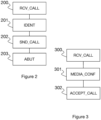
- the specific parameter included in message 505 makes it possible to indicate to the voice assistant that it must adopt, in step 301, a particular operating mode comprising the replacement of the audio stream usually picked up by the microphone to record voice commands by the telephone voice stream received from the caller.
- a particular operating mode comprising the replacement of the audio stream usually picked up by the microphone to record voice commands by the telephone voice stream received from the caller.
- the stream analyzed to detect voice commands is no longer the stream obtained via the microphone, but the stream received in the telephone communication.
- the audio stream obtained in response to a voice command and usually intended to be reproduced by the assistant's loudspeaker is transmitted to the caller through the established telephone connection. In this way, the responses usually returned by the voice assistant 100 are transmitted to the terminal 107 and returned to its user.
- Such modification of the routing of incoming and outgoing audio streams can be achieved in different ways.
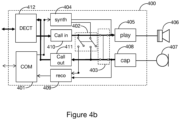
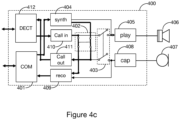
- THE figures 4a , 4b And 4c schematically illustrate an architecture of a device 400 adapted to control the routing of the audio streams of the voice assistant 100 according to different particular operating modes.
- a device 400 is for example integrated into the voice assistant 100.
- the device 400 includes a communication module 401.
- This is for example a Wi-Fi or Ethernet network interface allowing the assistant to exchange data with other devices, such as the server 104 associated with the 'assistant.
- module 401 makes it possible to send requests to server 104 and receive responses to these requests in accordance with the http protocol.
- the device 400 includes modules 402 and 403 configurable to route audio streams to different recipient modules.
- the modules 402 and 403 are in an inactive state corresponding to nominal operation of the assistant according to which the voice commands captured by the microphone 407 and the capture module 408 are routed to a voice recognition module 409 and the network interface 401 to be transmitted to the server 104, and according to which the responses received by the interface 401 are processed by a voice synthesis module 404 and a restitution system 405, 406.
- the flow path in the device 400 is represented in bold in THE figures 4a , 4b And 4c .
- Modules 402 and 403 are for example implemented by a DSP (Digital Signal Processor) processor or by a general processing unit configured by program instructions adapted to route audio streams received on a particular input to a particular output. Modules 402 and 403 can also correspond to relays, transistors or any other component adapted to redirect a signal received at an input to a particular output and controlled by a processing unit configured by computer program instructions. The configuration of modules 402 and 403 is controlled by a processor according to the operating mode of the assistant 100 determined by the presence or absence of the remote access parameter in the message 505 received.
- DSP Digital Signal Processor
- FIG 4b represents the routing device 400 in a configuration adapted for an audio communication type operating mode.
- the assistant 100 behaves like a DECT telephone terminal.
- the module 403 is configured so that the flows captured by the acquisition device 408 and the microphone 407 are directed to the DECT communication module 412 through an outgoing communication processing device 411.
- the module 411 is for example an encoder adapted to compress the audio stream captured in a format compatible with the communication standard implemented by the assistant 100.
- the configuration of the module 403 represented on the figure 4b also makes it possible to direct the audio stream received by the DECT 412 communication module and decoded by the incoming communication processing 410 towards the restitution module 405 and the loudspeaker 406.
- FIG. 4c illustrates the routing device 400 in a particular operating mode which is the subject of the present invention.
- the module 402 is configured so that the audio stream from the speech synthesis module 404 is directed to the audio processing module for outgoing communications 411, and so that the audio stream received via the incoming audio communication module 410 is directed to the voice recognition module 409.
- the audio stream received through a communication established with a correspondent is decoded by the module 410 then transmitted to the voice recognition module 409 before being transmitted to the server 104 via the communication interface 401.
- the response from the server 104 is received by the communication interface 401 and vocalized by the voice synthesis module 404, then the audio stream resulting from this processing is transmitted to the 411 encoding then to the correspondent via the DECT 412 communication module.
- the device 400 further comprises additional means for deactivating the loudspeaker when the particular operating mode of the figure 4c is activated.
- additional means make it possible, in a particular embodiment, to deactivate the microphone 407 of the module 400. In this way, words spoken near the assistant 100 do not risk interfering with commands spoken by the assistant. user of terminal 107 during remote access.
- Such means of deactivating the speaker and/or the microphone are for example an electromagnetic relay, a transistor, a DSP configured to block the corresponding audio inputs or outputs or any other means making it possible to cut the circuit between the synthesis module 404 and the speaker 406, and/or to cut the circuit between the microphone 407 and the voice recognition module 409.
- step 302 when the message 505 includes the remote access parameter, the assistant adopts a particular operating mode including automatic disconnection of the communication.
- the communication is immediately accepted by the voice assistant 100.
- the gateway 103 receives the message of acceptance of the communication by the voice assistant, it causes the cancellation of the call presentation on the other terminals that can be connected.
- Such an arrangement allows the establishment of remote access communication with the voice assistant even when the gateway is not capable of differentiating a voice assistant type terminal from a conventional telephone terminal.
- the voice assistant 100 determines that the communication is a remote access communication intended for it and automatically accepts the call.
- the voice assistant accepts the call by returning a response message 506, for example a DECT CC-CONNECT or SIP 200 OK message, depending on the technology used by the voice assistant.
- a response message 506 for example a DECT CC-CONNECT or SIP 200 OK message
- the sending of such a response is triggered by the detection of an appropriate voice command spoken by the user following the presentation of the call.
- the sending of this response is automatic when the establishment message includes the remote access parameter, that is to say that no user action is necessary on the 'assistant 100 to accept the call.
- the server 105 receives the call acceptance message 507 transmitted by the voice assistant 100 in step 203.
- This may be a simple retransmission of the message 506 when the protocol implemented between the assistant 100 and the gateway 103 is the same protocol as that used between the gateway 103 and the server 105, but it may be a different type of message when the assistant uses a protocol distinct from that implemented between the gateway 103 and the server 105.
- the server 105 can acknowledge the message 507 by sending for example a SIP ACK type message 508 to the voice assistant 100 or the gateway 103.
- This message can be retransmitted by the gateway 103 to the assistant 100 in the form of a message 509 of the SIP ACK or CC-CONNECT-ACK type if the terminal complies with the DECT standard.
- a two-way audio connection 510, 511 is established between the server 105 and the voice assistant 100.
- the server 105 abuts the communication established with the terminal 107 and the communication established with the assistant 100.
- the abutment step 203 can be implemented using a “back to back user agent” (B2BUA) technique.
- B2BUA back to back user agent
- the server 105 includes two SIP user agents: one is responsible for communicating with the terminal 107, the other with the voice assistant and/or the gateway 103.
- events affecting one communication are passed on by the server to the other communication. For example, when a “SIP BYE” message is received by the server 105 from the terminal 107, the server generates a SIP BYE message intended for the voice assistant.
- the server 105 bidirectionally relays the audio streams 511, 510 to the terminal 107 through the connection 504.
- the device shown on the figures 4a to 4c includes modules 404 and 409 for synthesis and voice recognition.
- the voice synthesis and voice recognition functions can be implemented on a server, for example on the server 104.
- the audio stream 510 received from the terminal 107 is transmitted to the server 104 in the form of an audio stream 512.
- the server 104 then performs voice recognition and executes the commands spoken by the user of the terminal 107.
- the response to the request is vocalized by the server 104 from a speech synthesis module.
- the server 104 transmits the response to the user's command in the form of a synthesized audio stream 513.
- the configuration step 301 includes the negotiation of a wideband codec, such as for example a G audio codec. 722 or WB-AMR.
- a wideband codec such as for example a G audio codec. 722 or WB-AMR.
- the voice assistant 100 and/or the gateway 103 analyze the capabilities declared by the terminal 107 and/or the server 105 in the call setup message 504 or 505 received.
- capabilities are for example declared in an SDP (Session Description Protocol) type message encapsulated in a SIP INVITE message.
- the call acceptance message 506 sent by the voice assistant 100 includes one or more broadband codecs supported by the assistant 100 compatible with the offer present in the message 505.
- Such an arrangement makes it possible to guarantee good quality of communication between the terminal 107 and the assistant. In this way, tone recognition algorithms to identify the user, as well as speech recognition algorithms produce improved results.
- the server 105 receives in step 200 a request to establish communication from the terminal 107
- the response message 501 includes at least one broadband codec offer. In this way, the communication between the terminal 107 and the assistant is of high quality, allowing good performance of the audio processing algorithms.
- the invention thus makes it possible to transfer from the assistant 100 to the terminal 107 the functions of capturing voice commands and restoring responses.
- the user thus remotely accesses all the services offered by the assistant.
- FIG. 6 represents the architecture of a device 600 adapted to implement the remote access method according to a particular embodiment.
- the device 600 includes a storage space 601, for example a MEM memory, a processing unit 603 equipped for example with a PROC processor.
- the processing unit can be controlled by a program 602, for example a computer program PGR, comprising instructions configured to implement the remote access method when they are executed by the processor PROC.
- the instructions of the PGR program are in particular configured to implement the steps of establishing a first communication with a calling terminal, obtaining, through the established communication, identification data of the voice assistant, transmitting a message establishing a second communication to the voice assistant, the message comprising at least one parameter adapted to activate a remote operating mode of the voice assistant, and successful completion of the first and second communication.
- the instructions of the PGR program are further configured to implement a step of obtaining authentication data from the calling terminal, the step of transmitting a communication establishment message intended for the voice assistant then being conditioned by a step of validation of the authentication element obtained.
- the PGR program is further configured to implement a step of configuring a wideband codec for the first and second communication.
- the instructions of the computer program 602 are for example loaded into a RAM memory (Random Access Memory in English) before being executed by the processor of the processing unit 603.
- the processor of the unit processing 603 implements the steps of the remote access method according to the instructions of the computer program 602.
- the device comprises, in addition to the memory 601, a first communication module 604 (COM1) allowing the device to connect to a telecommunications network and to establish telephone communications via the telecommunications network, and in particular to receive a voice communication from a telephone terminal in accordance with a communication standard.
- the module 604 is for example an Ethernet, 2G, 3G or 4G network interface associated with a SIP User Agent adapted to receive audio communications from or to other terminals.
- the device 600 also includes an identification module 606, adapted to obtain identification data from a voice assistant through the communication established by the module 604, and obtain an address of a voice assistant.
- the module 606 is for example implemented by computer program instructions executed by the processor PROC and configured to analyze the call signaling messages received by the communication module 604 to extract the identifier of an assistant. voice or data allowing the identification of a particular voice assistant.
- the module 606 includes, for example, computer program instructions making it possible to obtain a calling terminal identifier from a call signaling message, to consult a database in which the addresses of voice assistants are stored. in association with caller numbers, and to obtain the address of a particular voice assistant from the obtained caller number.
- the device 600 comprises a second communication module 605 (COM2) allowing the device to connect to a telecommunications network and to establish telephone communications via this network, and in particular to establish bidirectional audio communications to a voice assistant.
- Module 605 is for example an Ethernet, 2G, 3G, 4G network interface or any other suitable network interface. to implement an audio communication establishment protocol such as SIP.
- the module 605 may be controlled by computer program instructions adapted to be executed by the processor PROC and configured to obtain an address of a voice assistant from a signaling message received in a first communication established via the module communication 604, and establish a second communication intended for the voice assistant whose address has been obtained, the establishment of the second communication comprising the sending of a message comprising at least one parameter adapted to activate a mode of communication remote operation of the voice assistant.
- the communication modules 604 and 605 can take the form of a single communication module.
- the device 600 finally comprises a joining module 607.
- the joining module 607 is for example implemented by computer program instructions adapted to be executed by a processor, for example the PROC processor, and configured to retransmit via interface 604 audio data packets received on interface 605, and vice versa. These instructions are further configured to relay signaling messages received on interface 604 to interface 605, and vice versa.
- the device 600 further comprises an authentication module.
- the authentication module is for example implemented by computer program instructions adapted to be executed by a processor and configured to obtain authentication data, for example a PIN code, from the calling terminal via the module 604, the establishment of a communication intended for the voice assistant by the module 605 being conditioned by a step of validation of the authentication element obtained.
- a validation step includes for example the comparison of a PIN code obtained with a code stored in association with the identifier of the voice assistant for which remote access is requested.
- the remote access device 600 is included in a server, for example in an application server (AS, for Application Server in English) of an IMS network.
- AS application server
Landscapes
- Engineering & Computer Science (AREA)
- Multimedia (AREA)
- Signal Processing (AREA)
- Computer Networks & Wireless Communication (AREA)
- Audiology, Speech & Language Pathology (AREA)
- Computational Linguistics (AREA)
- Health & Medical Sciences (AREA)
- Human Computer Interaction (AREA)
- Physics & Mathematics (AREA)
- Acoustics & Sound (AREA)
- General Business, Economics & Management (AREA)
- Business, Economics & Management (AREA)
- Computer Hardware Design (AREA)
- Computer Security & Cryptography (AREA)
- Computing Systems (AREA)
- General Engineering & Computer Science (AREA)
- Telephonic Communication Services (AREA)
Claims (13)
- Verfahren für den Fernzugriff auf einen Sprachassistenten, wobei der Assistent geeignet ist, über ein Telekommunikationsnetz Telefonverbindungen mit einem Kommunikationsendgerät aufzubauen, und lokal oder aus der Ferne arbeiten kann, wobei das Verfahren von einem Fernzugriffsserver (105) durchgeführt wird und dadurch gekennzeichnet ist, dass es die folgenden Schritte aufweist:- Aufbau (200) einer ersten Verbindung mit einem anrufenden Endgerät (107),- Erhalt (201) eines Identifikationsdatenwerts des Sprachassistenten vom anrufenden Endgerät (107) über die aufgebaute Verbindung,- Übertragung (202) einer Aufbaunachricht einer zweiten Verbindung an den identifizierten Sprachassistenten, wobei die Nachricht mindestens einen Parameter enthält, der geeignet ist, einen Fernbetriebsmodus des Sprachassistenten zu aktivieren, der ermöglicht:- für die Erfassung einer Sprachsteuerung, den Ersatz des vom Mikrofon des Sprachassistenten aufgefangenen Signals durch einen vom anrufenden Endgerät (107) empfangenen telefonischen Sprachstrom,- für die Antwort auf die Sprachsteuerung, das Senden eines Antwort-Audiostroms an das anrufende Endgerät (107) an Stelle des Lautsprechers des Sprachassistenten,- Zusammenfügen (203) der ersten und der zweiten Verbindung.
- Verfahren nach Anspruch 1, derart, dass es außerdem einen Schritt des Erhalts eines Authentifizierungsdatenwerts vom anrufenden Endgerät enthält, wobei der Übertragungsschritt einer Verbindungsaufbaunachricht an den Sprachassistenten von einem Schritt der Validierung des erhaltenen Authentifizierungselements bedingt wird.
- Verfahren nach einem der Ansprüche 1 oder 2, wobei der Identifikationsdatenwert des Sprachassistenten eine Anrufkennung des anrufenden Endgeräts ist.
- Verfahren nach einem der vorhergehenden Ansprüche, wobei der Datenwert, der geeignet ist, einen bestimmten Betriebsmodus zu aktivieren, ein unter den folgenden Parametern ausgewählter Parameter ist:- eine bestimmte Anrufernummer,- ein bestimmter Anrufername,- eine bestimmte Geolokalisationsinformation,- eine bestimmte Kopfzeile einer SIP-Nachricht,- eine bestimmte IP-Quelladresse.
- Verfahren nach einem der vorhergehenden Ansprüche, das einen Schritt der Konfiguration eines Breitband-Codec für die erste und die zweite Verbindung enthält.
- Server für den Fernzugriff (105) auf einen Sprachassistenten, der geeignet ist, über ein Telekommunikationsnetz Telefonverbindungen mit einem Kommunikationsendgerät aufzubauen, und lokal oder aus der Ferne arbeiten kann, wobei der Server dadurch gekennzeichnet ist, dass er aufweist:- ein erstes Verbindungsmodul (604), das geeignet ist, eine erste Verbindung mit einem anrufenden Endgerät (107) aufzubauen,- ein Identifikationsmodul (606), das geeignet ist, einen Identifikationsdatenwert des Sprachassistenten über die aufgebaute Verbindung vom anrufenden Endgerät (107) zu erhalten und eine Adresse eines Sprachassistenten zu erhalten,- ein zweites Verbindungsmodul (605), das geeignet ist, eine Aufbaunachricht einer zweiten Verbindung an die erhaltene Adresse zu übertragen, wobei die Nachricht mindestens einen Parameter enthält, um einen Fernbetriebsmodus des identifizierten Sprachassistenten zu aktivieren, der erlaubt:- zur Erfassung einer Sprachsteuerung, den Ersatz des vom Mikrofon des Sprachassistenten aufgefangenen Signals durch einen vom anrufenden Endgerät (107) empfangenen telefonischen Sprachstrom,- zur Antwort auf die Sprachsteuerung, das Senden eines Antwort-Audiostroms an das anrufende Endgerät (107) an Stelle des Lautsprechers des Sprachassistenten, und- ein Zusammenfügungsmodul (607) der ersten und der zweiten Verbindung, das geeignet ist, einen vom Endgerät kommenden Audiostrom an den Sprachassistenten weiterzuleiten und einen vom Sprachassistenten kommenden Audiostrom an das Endgerät weiterzuleiten.
- Verfahren zur Verarbeitung einer Fernzugriffsanforderung auf einen Sprachassistenten (100), das geeignet ist, über ein Telekommunikationsnetz Telefonverbindungen mit einem Kommunikationsendgerät (107) aufzubauen, wobei der Sprachassistent einer Spracherkennungsvorrichtung (104, 100), um eine Sprachsteuerung zu analysieren, die von einem Benutzer des Kommunikationsendgeräts (107) ausgesprochen wird, wobei die Analyse nach der Erfassung eines Stichworts durch den Sprachassistenten aktiviert wird, und einer Sprachsynthesevorrichtung (100, 104) zugeordnet ist, um eine Antwort auf die Sprachsteuerung zu vokalisieren, wobei das Verfahren dadurch gekennzeichnet ist, dass es die folgenden Schritte enthält:- Empfang (300), von einem Fernzugriffsserver (105), einer Aufbaunachricht (SOS) einer Sprachverbindung, wobei die Nachricht mindestens einen Fernzugriffparameter enthält,- Aktivierung (301), abhängig vom empfangenen Fernzugriffparameter, eines bestimmten Betriebsmodus, der die folgenden Teilschritte enthält:o Deaktivierung des Mikrofons und des Lautsprechers des Assistenten,o Umleitung eines eingehenden Audiostroms der Telefonverbindung zur zugeordneten Spracherkennungsvorrichtung, als Ersatz des vom Mikrofon aufgefangenen Signals,o Umleitung eines von der zugeordneten Sprachsynthesevorrichtung stammenden Audiostroms zu einem Ausgangsaudiokanal der Verbindung,- Übertragung (302), an den Fernzugriffsserver, einer Annahmenachricht (507) der Verbindung.
- Verfahren nach Anspruch 7, wobei die Aktivierung des Fernbetriebsmodus außerdem einen Teilschritt der Konfiguration enthält, der zum Ziel hat, die Speicherung des eingehenden Audiostroms der Verbindung durch die Auffangvorrichtung zu aktivieren, ohne dass ein Stichwort erfasst wird.
- Verfahren nach einem der Ansprüche 7 bis 8, wobei die Aktivierung des Fernbetriebsmodus außerdem eine Konfigurations-Teilschritt enthält, der darauf abzielt, eine Zugriffsbeschränkung zu mindestens einem Dienst des Assistenten zu aktivieren.
- Verarbeitungsvorrichtung einer Anforderung des Fernzugriffs auf einen Sprachassistenten (100), die geeignet ist, über ein Telekommunikationsnetz Telefonverbindungen mit einem Kommunikationsendgerät (107) aufzubauen, wobei der Sprachassistent einer Spracherkennungsvorrichtung (409, 104), um eine von einem Benutzer ausgesprochene Sprachsteuerung zu analysieren, wobei die Analyse nach der Erfassung eines Stichworts durch den Sprachassistenten aktiviert wird, und einer Sprachsynthesevorrichtung (404, 104) zugeordnet ist, um eine Antwort auf die Sprachsteuerung zu vokalisieren, wobei die Vorrichtung dadurch gekennzeichnet ist, dass sie enthält:- ein Verbindungsmodul (412), das geeignet ist, eine Aufbaunachricht einer Sprachverbindung von einem Fernzugriffsserver (105) zu empfangen, wobei die Nachricht mindestens einen Parameter enthält, der geeignet ist, einen Fernbetriebsmodus des Sprachassistenten zu aktivieren,- ein Aktivierungsmodul (402, 403), abhängig vom empfangenen Fernzugriffsparameter, eines Fernbetriebsmodus, das ein Audio-Routing-Modul enthält, das geeignet ist, um:wobei das Verbindungsmodul (412) außerdem geeignet ist, eine Annahmenachricht der Verbindung an den Fernzugriffsserver zu übertragen, wenn der bestimmte Betriebsmodus aktiviert ist.o einen eingehenden Audiostrom der Telefonverbindung zur zugeordneten Spracherkennungsvorrichtung (409) umzuleiten, als Ersatz des vom Mikrofon aufgefangenen Signals (407, 408),o einen von der Sprachsynthesevorrichtung (404) stammenden Audiostrom zu einem Ausgangsaudiokanal der Verbindung umzuleiten,
- Sprachassistent, der eine Vorrichtung nach Anspruch 10 enthält.
- Computerprogramm, das Anweisungen, um ein Fernzugriffsverfahren auf einen Sprachassistenten nach einem der Ansprüche 1 bis 5 durchzuführen, und/oder Anweisungen enthält, um ein Verarbeitungsverfahren einer Fernzugriffsanforderung durchzuführen, wenn das Programm von einem Prozessor ausgeführt wird.
- Informationsträger, auf dem ein Programm nach Anspruch 12 gespeichert ist.
Applications Claiming Priority (1)
| Application Number | Priority Date | Filing Date | Title |
|---|---|---|---|
| FR1872002A FR3089084A1 (fr) | 2018-11-28 | 2018-11-28 | Procédé d’accès à distance à un assistant personnel vocal |
Publications (2)
| Publication Number | Publication Date |
|---|---|
| EP3661161A1 EP3661161A1 (de) | 2020-06-03 |
| EP3661161B1 true EP3661161B1 (de) | 2023-12-27 |
Family
ID=66049276
Family Applications (1)
| Application Number | Title | Priority Date | Filing Date |
|---|---|---|---|
| EP19209950.5A Active EP3661161B1 (de) | 2018-11-28 | 2019-11-19 | Verfahren und system zum sprachfernzugriff auf persönliche sprachassistenzdienste |
Country Status (4)
| Country | Link |
|---|---|
| US (1) | US11152004B2 (de) |
| EP (1) | EP3661161B1 (de) |
| CN (1) | CN111246021B (de) |
| FR (1) | FR3089084A1 (de) |
Families Citing this family (1)
| Publication number | Priority date | Publication date | Assignee | Title |
|---|---|---|---|---|
| US11683407B2 (en) * | 2020-04-01 | 2023-06-20 | Arris Enterprises Llc | System and method for digital assistant interface utilizing plain-old-telephone |
Family Cites Families (24)
| Publication number | Priority date | Publication date | Assignee | Title |
|---|---|---|---|---|
| CN101272384A (zh) * | 2004-05-21 | 2008-09-24 | 语音移动有限公司 | 远程访问系统和方法以及其智能代理 |
| US9805395B2 (en) * | 2012-01-19 | 2017-10-31 | Dizpersion Corporation | Online marketing system and method |
| US20070043687A1 (en) * | 2005-08-19 | 2007-02-22 | Accenture Llp | Virtual assistant |
| US20140297288A1 (en) * | 2013-03-29 | 2014-10-02 | Orange | Telephone voice personal assistant |
| US10134395B2 (en) * | 2013-09-25 | 2018-11-20 | Amazon Technologies, Inc. | In-call virtual assistants |
| US9424412B1 (en) * | 2015-02-02 | 2016-08-23 | Bank Of America Corporation | Authenticating customers using biometrics |
| US9699409B1 (en) * | 2016-02-17 | 2017-07-04 | Gong I.O Ltd. | Recording web conferences |
| US10091355B2 (en) * | 2016-02-19 | 2018-10-02 | International Business Machines Corporation | Virtual voice response agent individually configured for a user |
| CN107404563A (zh) * | 2016-05-20 | 2017-11-28 | 华为终端(东莞)有限公司 | 一种方法、装置及便携式电子设备 |
| DE102016213389A1 (de) * | 2016-07-21 | 2018-01-25 | Telequest & Internet Solutions Gmbh | Vorrichtung und Verfahren zur effizienten Realisierung anonymisierter IP-Telefonie |
| US9967382B2 (en) * | 2016-08-19 | 2018-05-08 | Amazon Technologies, Inc. | Enabling voice control of telephone device |
| US9953650B1 (en) * | 2016-12-08 | 2018-04-24 | Louise M Falevsky | Systems, apparatus and methods for using biofeedback for altering speech |
| US10691407B2 (en) * | 2016-12-14 | 2020-06-23 | Kyruus, Inc. | Methods and systems for analyzing speech during a call and automatically modifying, during the call, a call center referral interface |
| US10143027B1 (en) * | 2017-09-05 | 2018-11-27 | Amazon Technologies, Inc. | Device selection for routing of communications |
| US20190082043A1 (en) * | 2017-09-14 | 2019-03-14 | Tal Lavian | Systems and methods for visual presentation and selection of ivr menu |
| EP3679735A1 (de) * | 2017-10-21 | 2020-07-15 | Apple Inc. | Persönliche domäne für ein virtuelles assistenzsystem auf einer kommunalen vorrichtung |
| US9967381B1 (en) * | 2017-11-03 | 2018-05-08 | Republic Wireless, Inc. | Virtual telephony assistant |
| US10880650B2 (en) * | 2017-12-10 | 2020-12-29 | Sonos, Inc. | Network microphone devices with automatic do not disturb actuation capabilities |
| JP7044415B2 (ja) * | 2017-12-31 | 2022-03-30 | 美的集団股▲フン▼有限公司 | ホームアシスタント装置を制御するための方法及びシステム |
| US10735365B2 (en) * | 2018-01-11 | 2020-08-04 | International Business Machines Corporation | Conversation attendant and assistant platform |
| US11133953B2 (en) * | 2018-05-11 | 2021-09-28 | Catherine Lois Shive | Systems and methods for home automation control |
| US10887444B2 (en) * | 2018-06-01 | 2021-01-05 | Nick Eubank | Device for communication with an analog telephone and telephone incorporating the same |
| US10929097B2 (en) * | 2018-06-26 | 2021-02-23 | ROVl GUIDES, INC. | Systems and methods for switching operational modes based on audio triggers |
| US11425118B2 (en) * | 2018-08-06 | 2022-08-23 | Giesecke+Devrient Mobile Security America, Inc. | Centralized gateway server for providing access to services |
-
2018
- 2018-11-28 FR FR1872002A patent/FR3089084A1/fr active Pending
-
2019
- 2019-11-19 EP EP19209950.5A patent/EP3661161B1/de active Active
- 2019-11-27 US US16/698,270 patent/US11152004B2/en active Active
- 2019-11-28 CN CN201911188893.6A patent/CN111246021B/zh active Active
Also Published As
| Publication number | Publication date |
|---|---|
| US11152004B2 (en) | 2021-10-19 |
| FR3089084A1 (fr) | 2020-05-29 |
| US20200168228A1 (en) | 2020-05-28 |
| CN111246021B (zh) | 2024-04-12 |
| CN111246021A (zh) | 2020-06-05 |
| EP3661161A1 (de) | 2020-06-03 |
Similar Documents
| Publication | Publication Date | Title |
|---|---|---|
| US8311038B2 (en) | Instant internet browser based VoIP system | |
| EP3375153B1 (de) | Verfahren und vorrichtung zur verwaltung der sprechreihenfolge aus einem mobilen endgerät, sowie entsprechende server, endgerät, computerprogramm und speichermedium | |
| US7688954B2 (en) | System and method for identifying caller | |
| WO2010019713A1 (en) | Voice activated application service architecture and delivery | |
| US8934478B2 (en) | Managing telephony services using multiple users within a telephony control point in a home network | |
| EP3661161B1 (de) | Verfahren und system zum sprachfernzugriff auf persönliche sprachassistenzdienste | |
| US20160150073A1 (en) | Intelligent content recognition system | |
| EP1869858A2 (de) | Verfahren zur steuerung des sendens unangeforderter voice-informationen | |
| WO2007048975A1 (fr) | Procede et systeme de protection d'un lien d'acces a un serveur | |
| EP3808060B1 (de) | Nachrichtenverarbeitung in einem voice-over-ip-netz | |
| FR3091404A1 (fr) | Procédé de traitement de messages vocaux, procédé de désactivation d'un codage DTMF et procédé de traitement d'une demande de désactivation d'un codage DTMF. | |
| US20120106400A1 (en) | Home network enabled answering service | |
| EP2614630B1 (de) | Verarbeitung von daten zur benachrichtung einer vorrichtung | |
| EP1995930B1 (de) | Verfahren zur Transkodierung von Sitzungen vom Typ SIP | |
| WO2007077402A2 (fr) | Procede et dispositif de gestion des communications personnelles d'au moins un utilisateur | |
| KR20260047936A (ko) | 웹브라우저 기반 sip 통화 환경에서 ai 서비스를 제공하는 방법, 장치 및 컴퓨터 프로그램 | |
| EP2100430B1 (de) | Telekommunikationsverfahren und System mit Zugang zum selben Informationssatz für mindestens zwei verschiedene Benutzer | |
| EP1917793A1 (de) | Dienst zur personalisierung von kommunikationen mittels verarbeitung von audio- und/oder videomedienströmen | |
| FR3000357A1 (fr) | Procede de transfert de communication audio et/ou video depuis un premier terminal vers un deuxieme terminal | |
| EP1005206A1 (de) | Multimedia-Datenübertragungssystem | |
| EP2366245A1 (de) | Verarbeitung einer anforderung, kommunikation durch eine routeneinrichtung, die mit mehreren endgeräten assoziiert ist, einzuleiten | |
| EP2207325A1 (de) | Verfahren zur Bereitstellung von Anwesenheitsinformation des Benutzers in einem Netzwerk | |
| FR3029043A1 (fr) | Procede de notification de messages |
Legal Events
| Date | Code | Title | Description |
|---|---|---|---|
| PUAI | Public reference made under article 153(3) epc to a published international application that has entered the european phase |
Free format text: ORIGINAL CODE: 0009012 |
|
| STAA | Information on the status of an ep patent application or granted ep patent |
Free format text: STATUS: THE APPLICATION HAS BEEN PUBLISHED |
|
| AK | Designated contracting states |
Kind code of ref document: A1 Designated state(s): AL AT BE BG CH CY CZ DE DK EE ES FI FR GB GR HR HU IE IS IT LI LT LU LV MC MK MT NL NO PL PT RO RS SE SI SK SM TR |
|
| AX | Request for extension of the european patent |
Extension state: BA ME |
|
| RAP1 | Party data changed (applicant data changed or rights of an application transferred) |
Owner name: ORANGE |
|
| STAA | Information on the status of an ep patent application or granted ep patent |
Free format text: STATUS: REQUEST FOR EXAMINATION WAS MADE |
|
| 17P | Request for examination filed |
Effective date: 20201201 |
|
| RBV | Designated contracting states (corrected) |
Designated state(s): AL AT BE BG CH CY CZ DE DK EE ES FI FR GB GR HR HU IE IS IT LI LT LU LV MC MK MT NL NO PL PT RO RS SE SI SK SM TR |
|
| RAP3 | Party data changed (applicant data changed or rights of an application transferred) |
Owner name: ORANGE |
|
| STAA | Information on the status of an ep patent application or granted ep patent |
Free format text: STATUS: EXAMINATION IS IN PROGRESS |
|
| 17Q | First examination report despatched |
Effective date: 20210820 |
|
| REG | Reference to a national code |
Ref country code: DE Ref legal event code: R079 Free format text: PREVIOUS MAIN CLASS: H04L0029080000 Ipc: G10L0013040000 Ref country code: DE Ref legal event code: R079 Ref document number: 602019043938 Country of ref document: DE Free format text: PREVIOUS MAIN CLASS: H04L0029080000 Ipc: G10L0013040000 |
|
| GRAP | Despatch of communication of intention to grant a patent |
Free format text: ORIGINAL CODE: EPIDOSNIGR1 |
|
| STAA | Information on the status of an ep patent application or granted ep patent |
Free format text: STATUS: GRANT OF PATENT IS INTENDED |
|
| RIC1 | Information provided on ipc code assigned before grant |
Ipc: G10L 15/22 20060101ALI20230127BHEP Ipc: H04M 3/42 20060101ALI20230127BHEP Ipc: G10L 13/04 20060101AFI20230127BHEP |
|
| INTG | Intention to grant announced |
Effective date: 20230303 |
|
| GRAJ | Information related to disapproval of communication of intention to grant by the applicant or resumption of examination proceedings by the epo deleted |
Free format text: ORIGINAL CODE: EPIDOSDIGR1 |
|
| STAA | Information on the status of an ep patent application or granted ep patent |
Free format text: STATUS: EXAMINATION IS IN PROGRESS |
|
| GRAP | Despatch of communication of intention to grant a patent |
Free format text: ORIGINAL CODE: EPIDOSNIGR1 |
|
| STAA | Information on the status of an ep patent application or granted ep patent |
Free format text: STATUS: GRANT OF PATENT IS INTENDED |
|
| INTC | Intention to grant announced (deleted) | ||
| INTG | Intention to grant announced |
Effective date: 20230719 |
|
| GRAS | Grant fee paid |
Free format text: ORIGINAL CODE: EPIDOSNIGR3 |
|
| GRAA | (expected) grant |
Free format text: ORIGINAL CODE: 0009210 |
|
| STAA | Information on the status of an ep patent application or granted ep patent |
Free format text: STATUS: THE PATENT HAS BEEN GRANTED |
|
| AK | Designated contracting states |
Kind code of ref document: B1 Designated state(s): AL AT BE BG CH CY CZ DE DK EE ES FI FR GB GR HR HU IE IS IT LI LT LU LV MC MK MT NL NO PL PT RO RS SE SI SK SM TR |
|
| REG | Reference to a national code |
Ref country code: GB Ref legal event code: FG4D Free format text: NOT ENGLISH |
|
| REG | Reference to a national code |
Ref country code: CH Ref legal event code: EP |
|
| REG | Reference to a national code |
Ref country code: DE Ref legal event code: R096 Ref document number: 602019043938 Country of ref document: DE |
|
| REG | Reference to a national code |
Ref country code: IE Ref legal event code: FG4D Free format text: LANGUAGE OF EP DOCUMENT: FRENCH |
|
| PG25 | Lapsed in a contracting state [announced via postgrant information from national office to epo] |
Ref country code: GR Free format text: LAPSE BECAUSE OF FAILURE TO SUBMIT A TRANSLATION OF THE DESCRIPTION OR TO PAY THE FEE WITHIN THE PRESCRIBED TIME-LIMIT Effective date: 20240328 |
|
| REG | Reference to a national code |
Ref country code: LT Ref legal event code: MG9D |
|
| PG25 | Lapsed in a contracting state [announced via postgrant information from national office to epo] |
Ref country code: LT Free format text: LAPSE BECAUSE OF FAILURE TO SUBMIT A TRANSLATION OF THE DESCRIPTION OR TO PAY THE FEE WITHIN THE PRESCRIBED TIME-LIMIT Effective date: 20231227 |
|
| PG25 | Lapsed in a contracting state [announced via postgrant information from national office to epo] |
Ref country code: ES Free format text: LAPSE BECAUSE OF FAILURE TO SUBMIT A TRANSLATION OF THE DESCRIPTION OR TO PAY THE FEE WITHIN THE PRESCRIBED TIME-LIMIT Effective date: 20231227 |
|
| PG25 | Lapsed in a contracting state [announced via postgrant information from national office to epo] |
Ref country code: LT Free format text: LAPSE BECAUSE OF FAILURE TO SUBMIT A TRANSLATION OF THE DESCRIPTION OR TO PAY THE FEE WITHIN THE PRESCRIBED TIME-LIMIT Effective date: 20231227 Ref country code: GR Free format text: LAPSE BECAUSE OF FAILURE TO SUBMIT A TRANSLATION OF THE DESCRIPTION OR TO PAY THE FEE WITHIN THE PRESCRIBED TIME-LIMIT Effective date: 20240328 Ref country code: FI Free format text: LAPSE BECAUSE OF FAILURE TO SUBMIT A TRANSLATION OF THE DESCRIPTION OR TO PAY THE FEE WITHIN THE PRESCRIBED TIME-LIMIT Effective date: 20231227 Ref country code: ES Free format text: LAPSE BECAUSE OF FAILURE TO SUBMIT A TRANSLATION OF THE DESCRIPTION OR TO PAY THE FEE WITHIN THE PRESCRIBED TIME-LIMIT Effective date: 20231227 Ref country code: BG Free format text: LAPSE BECAUSE OF FAILURE TO SUBMIT A TRANSLATION OF THE DESCRIPTION OR TO PAY THE FEE WITHIN THE PRESCRIBED TIME-LIMIT Effective date: 20240327 |
|
| REG | Reference to a national code |
Ref country code: NL Ref legal event code: MP Effective date: 20231227 |
|
| REG | Reference to a national code |
Ref country code: AT Ref legal event code: MK05 Ref document number: 1645296 Country of ref document: AT Kind code of ref document: T Effective date: 20231227 |
|
| PG25 | Lapsed in a contracting state [announced via postgrant information from national office to epo] |
Ref country code: NL Free format text: LAPSE BECAUSE OF FAILURE TO SUBMIT A TRANSLATION OF THE DESCRIPTION OR TO PAY THE FEE WITHIN THE PRESCRIBED TIME-LIMIT Effective date: 20231227 |
|
| PG25 | Lapsed in a contracting state [announced via postgrant information from national office to epo] |
Ref country code: SE Free format text: LAPSE BECAUSE OF FAILURE TO SUBMIT A TRANSLATION OF THE DESCRIPTION OR TO PAY THE FEE WITHIN THE PRESCRIBED TIME-LIMIT Effective date: 20231227 Ref country code: RS Free format text: LAPSE BECAUSE OF FAILURE TO SUBMIT A TRANSLATION OF THE DESCRIPTION OR TO PAY THE FEE WITHIN THE PRESCRIBED TIME-LIMIT Effective date: 20231227 Ref country code: NO Free format text: LAPSE BECAUSE OF FAILURE TO SUBMIT A TRANSLATION OF THE DESCRIPTION OR TO PAY THE FEE WITHIN THE PRESCRIBED TIME-LIMIT Effective date: 20240327 Ref country code: NL Free format text: LAPSE BECAUSE OF FAILURE TO SUBMIT A TRANSLATION OF THE DESCRIPTION OR TO PAY THE FEE WITHIN THE PRESCRIBED TIME-LIMIT Effective date: 20231227 Ref country code: LV Free format text: LAPSE BECAUSE OF FAILURE TO SUBMIT A TRANSLATION OF THE DESCRIPTION OR TO PAY THE FEE WITHIN THE PRESCRIBED TIME-LIMIT Effective date: 20231227 Ref country code: HR Free format text: LAPSE BECAUSE OF FAILURE TO SUBMIT A TRANSLATION OF THE DESCRIPTION OR TO PAY THE FEE WITHIN THE PRESCRIBED TIME-LIMIT Effective date: 20231227 |
|
| PG25 | Lapsed in a contracting state [announced via postgrant information from national office to epo] |
Ref country code: IS Free format text: LAPSE BECAUSE OF FAILURE TO SUBMIT A TRANSLATION OF THE DESCRIPTION OR TO PAY THE FEE WITHIN THE PRESCRIBED TIME-LIMIT Effective date: 20240427 |
|
| PG25 | Lapsed in a contracting state [announced via postgrant information from national office to epo] |
Ref country code: AT Free format text: LAPSE BECAUSE OF FAILURE TO SUBMIT A TRANSLATION OF THE DESCRIPTION OR TO PAY THE FEE WITHIN THE PRESCRIBED TIME-LIMIT Effective date: 20231227 Ref country code: CZ Free format text: LAPSE BECAUSE OF FAILURE TO SUBMIT A TRANSLATION OF THE DESCRIPTION OR TO PAY THE FEE WITHIN THE PRESCRIBED TIME-LIMIT Effective date: 20231227 |
|
| PG25 | Lapsed in a contracting state [announced via postgrant information from national office to epo] |
Ref country code: SK Free format text: LAPSE BECAUSE OF FAILURE TO SUBMIT A TRANSLATION OF THE DESCRIPTION OR TO PAY THE FEE WITHIN THE PRESCRIBED TIME-LIMIT Effective date: 20231227 |
|
| PG25 | Lapsed in a contracting state [announced via postgrant information from national office to epo] |
Ref country code: SM Free format text: LAPSE BECAUSE OF FAILURE TO SUBMIT A TRANSLATION OF THE DESCRIPTION OR TO PAY THE FEE WITHIN THE PRESCRIBED TIME-LIMIT Effective date: 20231227 Ref country code: SK Free format text: LAPSE BECAUSE OF FAILURE TO SUBMIT A TRANSLATION OF THE DESCRIPTION OR TO PAY THE FEE WITHIN THE PRESCRIBED TIME-LIMIT Effective date: 20231227 Ref country code: RO Free format text: LAPSE BECAUSE OF FAILURE TO SUBMIT A TRANSLATION OF THE DESCRIPTION OR TO PAY THE FEE WITHIN THE PRESCRIBED TIME-LIMIT Effective date: 20231227 Ref country code: IT Free format text: LAPSE BECAUSE OF FAILURE TO SUBMIT A TRANSLATION OF THE DESCRIPTION OR TO PAY THE FEE WITHIN THE PRESCRIBED TIME-LIMIT Effective date: 20231227 Ref country code: IS Free format text: LAPSE BECAUSE OF FAILURE TO SUBMIT A TRANSLATION OF THE DESCRIPTION OR TO PAY THE FEE WITHIN THE PRESCRIBED TIME-LIMIT Effective date: 20240427 Ref country code: EE Free format text: LAPSE BECAUSE OF FAILURE TO SUBMIT A TRANSLATION OF THE DESCRIPTION OR TO PAY THE FEE WITHIN THE PRESCRIBED TIME-LIMIT Effective date: 20231227 Ref country code: CZ Free format text: LAPSE BECAUSE OF FAILURE TO SUBMIT A TRANSLATION OF THE DESCRIPTION OR TO PAY THE FEE WITHIN THE PRESCRIBED TIME-LIMIT Effective date: 20231227 Ref country code: AT Free format text: LAPSE BECAUSE OF FAILURE TO SUBMIT A TRANSLATION OF THE DESCRIPTION OR TO PAY THE FEE WITHIN THE PRESCRIBED TIME-LIMIT Effective date: 20231227 |
|
| PG25 | Lapsed in a contracting state [announced via postgrant information from national office to epo] |
Ref country code: PL Free format text: LAPSE BECAUSE OF FAILURE TO SUBMIT A TRANSLATION OF THE DESCRIPTION OR TO PAY THE FEE WITHIN THE PRESCRIBED TIME-LIMIT Effective date: 20231227 Ref country code: PT Free format text: LAPSE BECAUSE OF FAILURE TO SUBMIT A TRANSLATION OF THE DESCRIPTION OR TO PAY THE FEE WITHIN THE PRESCRIBED TIME-LIMIT Effective date: 20240429 |
|
| PG25 | Lapsed in a contracting state [announced via postgrant information from national office to epo] |
Ref country code: PT Free format text: LAPSE BECAUSE OF FAILURE TO SUBMIT A TRANSLATION OF THE DESCRIPTION OR TO PAY THE FEE WITHIN THE PRESCRIBED TIME-LIMIT Effective date: 20240429 Ref country code: PL Free format text: LAPSE BECAUSE OF FAILURE TO SUBMIT A TRANSLATION OF THE DESCRIPTION OR TO PAY THE FEE WITHIN THE PRESCRIBED TIME-LIMIT Effective date: 20231227 |
|
| REG | Reference to a national code |
Ref country code: DE Ref legal event code: R097 Ref document number: 602019043938 Country of ref document: DE |
|
| PG25 | Lapsed in a contracting state [announced via postgrant information from national office to epo] |
Ref country code: DK Free format text: LAPSE BECAUSE OF FAILURE TO SUBMIT A TRANSLATION OF THE DESCRIPTION OR TO PAY THE FEE WITHIN THE PRESCRIBED TIME-LIMIT Effective date: 20231227 |
|
| PG25 | Lapsed in a contracting state [announced via postgrant information from national office to epo] |
Ref country code: DK Free format text: LAPSE BECAUSE OF FAILURE TO SUBMIT A TRANSLATION OF THE DESCRIPTION OR TO PAY THE FEE WITHIN THE PRESCRIBED TIME-LIMIT Effective date: 20231227 |
|
| PLBE | No opposition filed within time limit |
Free format text: ORIGINAL CODE: 0009261 |
|
| STAA | Information on the status of an ep patent application or granted ep patent |
Free format text: STATUS: NO OPPOSITION FILED WITHIN TIME LIMIT |
|
| 26N | No opposition filed |
Effective date: 20240930 |
|
| PG25 | Lapsed in a contracting state [announced via postgrant information from national office to epo] |
Ref country code: SI Free format text: LAPSE BECAUSE OF FAILURE TO SUBMIT A TRANSLATION OF THE DESCRIPTION OR TO PAY THE FEE WITHIN THE PRESCRIBED TIME-LIMIT Effective date: 20231227 |
|
| REG | Reference to a national code |
Ref country code: CH Ref legal event code: PL |
|
| PG25 | Lapsed in a contracting state [announced via postgrant information from national office to epo] |
Ref country code: MC Free format text: LAPSE BECAUSE OF FAILURE TO SUBMIT A TRANSLATION OF THE DESCRIPTION OR TO PAY THE FEE WITHIN THE PRESCRIBED TIME-LIMIT Effective date: 20231227 |
|
| PG25 | Lapsed in a contracting state [announced via postgrant information from national office to epo] |
Ref country code: LU Free format text: LAPSE BECAUSE OF NON-PAYMENT OF DUE FEES Effective date: 20241119 |
|
| REG | Reference to a national code |
Ref country code: CH Ref legal event code: PL |
|
| PG25 | Lapsed in a contracting state [announced via postgrant information from national office to epo] |
Ref country code: CH Free format text: LAPSE BECAUSE OF NON-PAYMENT OF DUE FEES Effective date: 20241130 |
|
| REG | Reference to a national code |
Ref country code: BE Ref legal event code: MM Effective date: 20241130 |
|
| PG25 | Lapsed in a contracting state [announced via postgrant information from national office to epo] |
Ref country code: BE Free format text: LAPSE BECAUSE OF NON-PAYMENT OF DUE FEES Effective date: 20241130 |
|
| PG25 | Lapsed in a contracting state [announced via postgrant information from national office to epo] |
Ref country code: IE Free format text: LAPSE BECAUSE OF NON-PAYMENT OF DUE FEES Effective date: 20241119 |
|
| PGFP | Annual fee paid to national office [announced via postgrant information from national office to epo] |
Ref country code: DE Payment date: 20251022 Year of fee payment: 7 |
|
| PGFP | Annual fee paid to national office [announced via postgrant information from national office to epo] |
Ref country code: GB Payment date: 20251023 Year of fee payment: 7 |
|
| PGFP | Annual fee paid to national office [announced via postgrant information from national office to epo] |
Ref country code: FR Payment date: 20251022 Year of fee payment: 7 |
|
| PG25 | Lapsed in a contracting state [announced via postgrant information from national office to epo] |
Ref country code: HU Free format text: LAPSE BECAUSE OF FAILURE TO SUBMIT A TRANSLATION OF THE DESCRIPTION OR TO PAY THE FEE WITHIN THE PRESCRIBED TIME-LIMIT; INVALID AB INITIO Effective date: 20191119 |
|
| PG25 | Lapsed in a contracting state [announced via postgrant information from national office to epo] |
Ref country code: CY Free format text: LAPSE BECAUSE OF FAILURE TO SUBMIT A TRANSLATION OF THE DESCRIPTION OR TO PAY THE FEE WITHIN THE PRESCRIBED TIME-LIMIT; INVALID AB INITIO Effective date: 20191119 |