EP3661219A1 - System zur anpassung der kommunikationsqualität - Google Patents
System zur anpassung der kommunikationsqualität Download PDFInfo
- Publication number
- EP3661219A1 EP3661219A1 EP18859448.5A EP18859448A EP3661219A1 EP 3661219 A1 EP3661219 A1 EP 3661219A1 EP 18859448 A EP18859448 A EP 18859448A EP 3661219 A1 EP3661219 A1 EP 3661219A1
- Authority
- EP
- European Patent Office
- Prior art keywords
- receiver
- communication
- information
- environment information
- environment
- Prior art date
- Legal status (The legal status is an assumption and is not a legal conclusion. Google has not performed a legal analysis and makes no representation as to the accuracy of the status listed.)
- Ceased
Links
Images


Classifications
-
- H—ELECTRICITY
- H04—ELECTRIC COMMUNICATION TECHNIQUE
- H04N—PICTORIAL COMMUNICATION, e.g. TELEVISION
- H04N21/00—Selective content distribution, e.g. interactive television or video on demand [VOD]
- H04N21/20—Servers specifically adapted for the distribution of content, e.g. VOD servers; Operations thereof
- H04N21/25—Management operations performed by the server for facilitating the content distribution or administrating data related to end-users or client devices, e.g. end-user or client device authentication, learning user preferences for recommending movies
- H04N21/251—Learning process for intelligent management, e.g. learning user preferences for recommending movies
-
- G—PHYSICS
- G06—COMPUTING OR CALCULATING; COUNTING
- G06N—COMPUTING ARRANGEMENTS BASED ON SPECIFIC COMPUTATIONAL MODELS
- G06N20/00—Machine learning
-
- G—PHYSICS
- G06—COMPUTING OR CALCULATING; COUNTING
- G06N—COMPUTING ARRANGEMENTS BASED ON SPECIFIC COMPUTATIONAL MODELS
- G06N3/00—Computing arrangements based on biological models
- G06N3/004—Artificial life, i.e. computing arrangements simulating life
- G06N3/006—Artificial life, i.e. computing arrangements simulating life based on simulated virtual individual or collective life forms, e.g. social simulations or particle swarm optimisation [PSO]
-
- H—ELECTRICITY
- H04—ELECTRIC COMMUNICATION TECHNIQUE
- H04N—PICTORIAL COMMUNICATION, e.g. TELEVISION
- H04N21/00—Selective content distribution, e.g. interactive television or video on demand [VOD]
- H04N21/20—Servers specifically adapted for the distribution of content, e.g. VOD servers; Operations thereof
- H04N21/23—Processing of content or additional data; Elementary server operations; Server middleware
- H04N21/234—Processing of video elementary streams, e.g. splicing of video streams or manipulating encoded video stream scene graphs
- H04N21/2343—Processing of video elementary streams, e.g. splicing of video streams or manipulating encoded video stream scene graphs involving reformatting operations of video signals for distribution or compliance with end-user requests or end-user device requirements
- H04N21/23439—Processing of video elementary streams, e.g. splicing of video streams or manipulating encoded video stream scene graphs involving reformatting operations of video signals for distribution or compliance with end-user requests or end-user device requirements for generating different versions
-
- H—ELECTRICITY
- H04—ELECTRIC COMMUNICATION TECHNIQUE
- H04N—PICTORIAL COMMUNICATION, e.g. TELEVISION
- H04N21/00—Selective content distribution, e.g. interactive television or video on demand [VOD]
- H04N21/40—Client devices specifically adapted for the reception of or interaction with content, e.g. set-top-box [STB]; Operations thereof
- H04N21/41—Structure of client; Structure of client peripherals
- H04N21/422—Input-only peripherals, i.e. input devices connected to specially adapted client devices, e.g. global positioning system [GPS]
- H04N21/42202—Input-only peripherals, i.e. input devices connected to specially adapted client devices, e.g. global positioning system [GPS] environmental sensors, e.g. for detecting temperature, luminosity, pressure, earthquakes
-
- H—ELECTRICITY
- H04—ELECTRIC COMMUNICATION TECHNIQUE
- H04N—PICTORIAL COMMUNICATION, e.g. TELEVISION
- H04N21/00—Selective content distribution, e.g. interactive television or video on demand [VOD]
- H04N21/40—Client devices specifically adapted for the reception of or interaction with content, e.g. set-top-box [STB]; Operations thereof
- H04N21/43—Processing of content or additional data, e.g. demultiplexing additional data from a digital video stream; Elementary client operations, e.g. monitoring of home network or synchronising decoder's clock; Client middleware
- H04N21/442—Monitoring of processes or resources, e.g. detecting the failure of a recording device, monitoring the downstream bandwidth, the number of times a movie has been viewed, the storage space available from the internal hard disk
-
- H—ELECTRICITY
- H04—ELECTRIC COMMUNICATION TECHNIQUE
- H04N—PICTORIAL COMMUNICATION, e.g. TELEVISION
- H04N21/00—Selective content distribution, e.g. interactive television or video on demand [VOD]
- H04N21/40—Client devices specifically adapted for the reception of or interaction with content, e.g. set-top-box [STB]; Operations thereof
- H04N21/43—Processing of content or additional data, e.g. demultiplexing additional data from a digital video stream; Elementary client operations, e.g. monitoring of home network or synchronising decoder's clock; Client middleware
- H04N21/442—Monitoring of processes or resources, e.g. detecting the failure of a recording device, monitoring the downstream bandwidth, the number of times a movie has been viewed, the storage space available from the internal hard disk
- H04N21/44209—Monitoring of downstream path of the transmission network originating from a server, e.g. bandwidth variations of a wireless network
-
- H—ELECTRICITY
- H04—ELECTRIC COMMUNICATION TECHNIQUE
- H04N—PICTORIAL COMMUNICATION, e.g. TELEVISION
- H04N21/00—Selective content distribution, e.g. interactive television or video on demand [VOD]
- H04N21/40—Client devices specifically adapted for the reception of or interaction with content, e.g. set-top-box [STB]; Operations thereof
- H04N21/45—Management operations performed by the client for facilitating the reception of or the interaction with the content or administrating data related to the end-user or to the client device itself, e.g. learning user preferences for recommending movies, resolving scheduling conflicts
- H04N21/4508—Management of client data or end-user data
- H04N21/4524—Management of client data or end-user data involving the geographical location of the client
-
- H—ELECTRICITY
- H04—ELECTRIC COMMUNICATION TECHNIQUE
- H04N—PICTORIAL COMMUNICATION, e.g. TELEVISION
- H04N21/00—Selective content distribution, e.g. interactive television or video on demand [VOD]
- H04N21/40—Client devices specifically adapted for the reception of or interaction with content, e.g. set-top-box [STB]; Operations thereof
- H04N21/45—Management operations performed by the client for facilitating the reception of or the interaction with the content or administrating data related to the end-user or to the client device itself, e.g. learning user preferences for recommending movies, resolving scheduling conflicts
- H04N21/466—Learning process for intelligent management, e.g. learning user preferences for recommending movies
- H04N21/4662—Learning process for intelligent management, e.g. learning user preferences for recommending movies characterized by learning algorithms
-
- H—ELECTRICITY
- H04—ELECTRIC COMMUNICATION TECHNIQUE
- H04N—PICTORIAL COMMUNICATION, e.g. TELEVISION
- H04N21/00—Selective content distribution, e.g. interactive television or video on demand [VOD]
- H04N21/40—Client devices specifically adapted for the reception of or interaction with content, e.g. set-top-box [STB]; Operations thereof
- H04N21/47—End-user applications
- H04N21/478—Supplemental services, e.g. displaying phone caller identification, shopping application
- H04N21/4784—Supplemental services, e.g. displaying phone caller identification, shopping application receiving rewards
-
- H—ELECTRICITY
- H04—ELECTRIC COMMUNICATION TECHNIQUE
- H04N—PICTORIAL COMMUNICATION, e.g. TELEVISION
- H04N21/00—Selective content distribution, e.g. interactive television or video on demand [VOD]
- H04N21/60—Network structure or processes for video distribution between server and client or between remote clients; Control signalling between clients, server and network components; Transmission of management data between server and client, e.g. sending from server to client commands for recording incoming content stream; Communication details between server and client
- H04N21/63—Control signaling related to video distribution between client, server and network components; Network processes for video distribution between server and clients or between remote clients, e.g. transmitting basic layer and enhancement layers over different transmission paths, setting up a peer-to-peer communication via Internet between remote STB's; Communication protocols; Addressing
- H04N21/637—Control signals issued by the client directed to the server or network components
- H04N21/6373—Control signals issued by the client directed to the server or network components for rate control, e.g. request to the server to modify its transmission rate
-
- H—ELECTRICITY
- H04—ELECTRIC COMMUNICATION TECHNIQUE
- H04N—PICTORIAL COMMUNICATION, e.g. TELEVISION
- H04N21/00—Selective content distribution, e.g. interactive television or video on demand [VOD]
- H04N21/60—Network structure or processes for video distribution between server and client or between remote clients; Control signalling between clients, server and network components; Transmission of management data between server and client, e.g. sending from server to client commands for recording incoming content stream; Communication details between server and client
- H04N21/65—Transmission of management data between client and server
- H04N21/654—Transmission by server directed to the client
- H04N21/6547—Transmission by server directed to the client comprising parameters, e.g. for client setup
-
- H—ELECTRICITY
- H04—ELECTRIC COMMUNICATION TECHNIQUE
- H04N—PICTORIAL COMMUNICATION, e.g. TELEVISION
- H04N21/00—Selective content distribution, e.g. interactive television or video on demand [VOD]
- H04N21/60—Network structure or processes for video distribution between server and client or between remote clients; Control signalling between clients, server and network components; Transmission of management data between server and client, e.g. sending from server to client commands for recording incoming content stream; Communication details between server and client
- H04N21/65—Transmission of management data between client and server
- H04N21/658—Transmission by the client directed to the server
- H04N21/6582—Data stored in the client, e.g. viewing habits, hardware capabilities, credit card number
-
- H—ELECTRICITY
- H04—ELECTRIC COMMUNICATION TECHNIQUE
- H04N—PICTORIAL COMMUNICATION, e.g. TELEVISION
- H04N21/00—Selective content distribution, e.g. interactive television or video on demand [VOD]
- H04N21/80—Generation or processing of content or additional data by content creator independently of the distribution process; Content per se
- H04N21/83—Generation or processing of protective or descriptive data associated with content; Content structuring
- H04N21/845—Structuring of content, e.g. decomposing content into time segments
- H04N21/8456—Structuring of content, e.g. decomposing content into time segments by decomposing the content in the time domain, e.g. in time segments
Definitions
- the present invention relates to a communication quality adjusting system.
- Patent Literature 1 a technology for adjusting a distribution speed of content distributed to a terminal is disclosed.
- a plurality of areas divided in accordance with a communication environment state of a mobile terminal are generated inside a content distribution zone.
- an area to which a mobile terminal that is a content distribution destination belongs among the generated areas is identified on the basis of position information of the terminal that becomes a distribution destination.
- the speed of content distribution to a content distribution destination is adjusted.
- Patent Literature 1 Japanese Unexamined Patent Publication No. 2010-81103
- An object of one aspect of the present invention is to provide a communication quality adjusting system capable of inhibiting stopping of reproduction, generation of a block noise, and the like and causing content to be received with stable quality in a receiver.
- a communication quality adjusting system including: an acquisition unit configure to acquire environment information representing an environment, in which a receiver is placed, and having an effect on a communication state of the receiver; a criterion determining unit configure to determine a criterion associating a communication state of the receiver and a reception form used when the receiver receives content in accordance with the environment information acquired by the acquisition unit; and a control unit configure to perform control such that the receiver receives video content in the reception form corresponding to the communication state of the receiver on the basis of the criterion determined by the criterion determining unit.
- a criterion associating a communication state of the receiver and a reception form of the receiver is determined in accordance with environment information, and content can be received by the receiver in a reception form corresponding to the communication state. Since the criterion is determined in accordance with environment information, the receiver can receive video content in a reception form that differs in accordance with an environment even in the same communication state. Accordingly, stopping of reproduction, generation of a block noise, and the like are inhibited, and video content can be received with stable quality by the receiver.
- a communication quality adjusting system capable of suppressing stopping of reproduction, generation of a block noise, and the like and causing content to be received with stable quality in a receiver can be provided.
- Fig. 1 is a conceptual diagram illustrating a content distributing system including a communication quality adjusting system according to one embodiment.
- the content distributing system 1 includes a content distributing server 3, a receiver 10, and a communication quality adjusting server (a communication quality adjusting system) 20.
- the content distributing server 3, the receiver 10, and the communication quality adjusting server 20 are configured to be able to perform data communication with each other through a network 5.
- the content distributing server 3 and the communication quality adjusting server 20 are illustrated as mutually different devices in the example illustrated in the drawing, the content distributing server 3 and the communication quality adjusting server 20 may be configured as the same device.
- the content distributing server 3 is an information processing terminal such as a server computer and is a server that distributes video content through streaming.
- the content distributing server 3 is composed of hardware such as a CPU, a memory, a communication module, and the like.
- the content distributing server 3, for example, is managed by a company providing a video viewing service through the Internet.
- a user using the receiver 10, for example, can view video content on the receiver 10 by having a usage contract for a video viewing service with such a company.
- the content distributing server 3 stores a plurality of pieces of video data encoded in correspondence with different image qualities.
- the content distributing server 3 stores a plurality of pieces of video content and includes high-quality video data, intermediate-quality video data, and low-quality video data for each piece of video content.
- the high-quality video data is encoded at a high bit rate.
- the intermediate-quality video data is encoded at a bit rate lower than that of the high-quality video data.
- the low-quality video data is encoded at a bit rate that is even lower than that of the intermediate-quality video data.
- the content distributing server 3 distributes video data corresponding to a bit rate requested from the receiver 10 to the receiver 10.
- the receiver 10 is a terminal device that can receive video data distributed from the content distributing server 3.
- the receiver 10 may be a smartphone, a cellular phone, a tablet terminal, a personal digital assistant (PDA), a personal computer, a television set, a set-top box, or the like.
- the receiver 10 is a device that is carried and used by a user and has a function of performing radio communication by being connected to the network 5 such as a mobile communication network or the like.
- the receiver 10 is composed of hardware such as a central processing unit (CPU), a memory, a communication module, a display, a speaker, and the like. Although only one receiver 10 is illustrated in Fig. 1 , a plurality of receivers 10 can be simultaneously connected to the network 5.
- the receiver 10 includes a data acquiring unit 11, a reception control unit 12, and a quality acquiring unit 13.
- the data acquiring unit 11 can acquire data representing an environment in which the receiver 10 is placed using various sensors and the like included in the receiver 10.
- position information, acceleration information, and the like of the receiver 10 are included.
- the position information may be information representing latitude and longitude according to the Global Positioning System (GPS).
- GPS Global Positioning System
- the position information may be location registration information based on information of a base station of an area in which the receiver 10 is present, Wi-Fi position information based on a signal from an access point of Wi-Fi (a registered trademark) acquired by the receiver 10, or the like.
- the acceleration information can be acquired using an acceleration sensor disposed in the receiver.
- the data acquiring unit 11 can acquire communication environment information representing a communication environment in which the receiver 10 is placed.
- the communication environment information represents a communication level of the receiver 10 in the network 5 to which the receiver 10 is connected and, for example, may be a network speed set for each receiver 10 in a case in which a network speed is set in a plurality of communication levels in accordance with a radio wave intensity from a base station or the like.
- the data acquiring unit 11 acquires communication speed information representing an actual communication speed when the receiver 10 receives data through the network 5 separately from the communication environment information.
- the data acquiring unit 11 can also acquire time information representing a time when each piece of data is acquired as a part of the data of a sensor.
- the data acquiring unit 11 may regularly detect data of a sensor.
- the data acquiring unit 11 can transmit the position information, the acceleration information, the time information, the communication environment information, and the communication speed information of the receiver 10 that have been detected to the communication quality adjusting server 20 as environment information.
- the data acquiring unit 11 may accumulate each piece of data that has been acquired over a predetermined period.
- the reception control unit 12 controls parameters relating to a data reception form used when video content is received.
- the reception control unit 12 stores parameters such as a buffer size, a bit rate, and the like that are used when the receiver 10 receives video content.
- the reception control unit 12 transmits a distribution request including identification information of a user, identification information of content, a parameter relating to a reception form, and the like to the content distributing server 3.
- the reception control unit 12 controls a video reproduction process based on the parameter of the reception form. For the control of the video reproduction process, a known control method can be used.
- the quality acquiring unit 13 acquires actual reproduction quality when video content of the content distributing server 3 is reproduced by the receiver 10.
- the reproduction quality may be data relating to the amount of remaining data inside a buffer, presence/absence of video interruption, a degree of video interruption (the number of interruptions and the duration), presence/absence of a block noise, and the like.
- the quality acquiring unit 13 may directly store each piece of data representing reproduction quality or may convert each piece of data representing reproduction quality into a numerical value corresponding to the quality and store the converted numerical value.
- the quality acquiring unit 13 transmits the acquired data relating to the reproduction quality to the communication quality adjusting server 20.
- the communication quality adjusting server 20 is an information processing terminal such as a server computer or the like and transmits information of a reception form in which optimal reproduction quality can be acquired to the receiver 10.
- “optimal” does not refer to that which is most appropriate in an absolute sense, but that which is most appropriate under a predetermined condition.
- the communication quality adjusting server 20 is composed of hardware such as a CPU, a memory, a communication module, and the like.
- the communication quality adjusting server 20 includes an environment information acquiring unit 21, a criterion determining unit 22, and a distribution unit (control unit) 23.
- the environment information acquiring unit 21 acquires environment information that is environment information representing an environment in which the receiver 10 is placed and has an effect on a communication state of the receiver 10.
- the environment information includes position information representing the position of the receiver 10 and time information representing a time at which the receiver 10 performs communication.
- the environment information acquiring unit 21 acquires the position information, the acceleration information, the time information, and the communication environment information (a network speed) transmitted from the data acquiring unit of the receiver 10 to the communication quality adjusting server 20.
- the environment information acquiring unit 21 acquires the data relating to reproduction quality transmitted from the quality acquiring unit 13.
- the environment information acquiring unit 21 may accumulate each piece of data that has been acquired over a predetermined period.
- the criterion determining unit 22 determines (generates) a criterion associating the communication state of the receiver 10 with the reception form used when the receiver 10 receives video content in accordance with the environment information acquired by the environment information acquiring unit 21.
- the communication state is communication quality when the receiver 10 is receiving video content and, for example, may be a communication speed.
- the reception form is a reception condition set when the receiver 10 receives video content and may be parameters such as a buffer size, a bit rate, and the like.
- the criterion associating a communication state and a reception form with each other may be a pattern of a combination of the communication state and the reception form.
- An algorithm for acquiring a combination of a communication state and a reception form for which optimal reproduction quality can be acquired for environment information as an input has been derived through machine learning in the criterion determining unit 22.
- environment information representing that the movement speed of the receiver 10 is high it is assumed that the communication state of the receiver 10 may easily vary. In such a case, even when the communication state of the receiver 10 corresponds to the reception of a high bit rate, there are cases in which the receiver 10 cannot respond to the reception of a high bit rate in accordance with degradation of the communication state occurring thereafter.
- the criterion determining unit 22 can generate a combination of a communication state representing a high communication speed and a reception form representing a low bit rate as a criterion.
- the criterion determining unit 22 may generate a combination of a communication state representing a high communication speed and a reception form representing a large buffer size as a criterion.
- the criterion determining unit 22 generates a combination of a communication state representing a high communication speed (equal to or higher than 2 Mbps) and a reception form representing a bit rate (700 Kbps) of intermediate image quality, a combination of a communication state representing an intermediate communication speed (equal to or higher than 1 Mbps and lower than 2 Mbps) and a reception form representing a bit rate (350 Kbps) of low image quality, and a combination of a communication state representing a low communication speed (lower than 1 Mbps) and a reception form representing a bit rate (350 Kbps) of low image quality and a large buffer size as criteria.
- the criterion determining unit 22 generates a combination of a communication state representing a high communication speed (equal to or higher than 2 Mbps) and a reception form representing a bit rate (1.5 Mbps) of high image quality, a combination of a communication state representing an intermediate communication speed (equal to or higher than 1 Mbps and lower than 2 Mbps) and a reception form representing a bit rate (700 Kbps) of intermediate image quality, and a combination of a communication state representing a low communication speed (lower than 1 Mbps) and a reception form representing a bit rate (350 Kbps) of low image quality as criteria.
- the criteria may be switched in accordance with a time zone. For example, in a time zone (for example, in the morning) in which the network 5 is congested, further congestion of the network 5 may be inhibited by not selecting a high bit rate even for a high communication speed.
- the criterion determining unit 22 may generate a combination of a communication state representing a high communication speed (equal to or higher than 2 Mbps) and a reception form representing a bit rate (700 Kbps) of intermediate image quality, a combination of a communication state representing an intermediate communication speed (equal to or higher than 1 Mbps and lower than 2 Mbps) and a reception form representing a bit rate (700 Kbps) of intermediate image quality, and a combination of a communication state representing a low communication speed (lower than 1 Mbps) and a reception form representing a bit rate (350 Kbps) of low image quality as criteria.
- the criterion determining unit 22 may generate a combination of a communication state representing a high communication speed (equal to or higher than 2 Mbps) and a reception form representing a bit rate (1.5 Mbps) of high image quality, a combination of a communication state representing an intermediate communication speed (equal to or higher than 1 Mbps and lower than 2 Mbps) and a reception form representing a bit rate (700 Kbps) of intermediate image quality, and a combination of a communication state representing a low communication speed (lower than 1 Mbps) and a reception form representing a bit rate (350 Kbps) of low image quality as criteria.
- the criterion determining unit 22 improves the accuracy of the algorithm for generating criteria such that the criteria each associating a communication state of the receiver 10 and a reception form of the receiver 10 are optimized.
- the criterion determining unit 22 may improve the accuracy of the algorithm using a technology of machine learning (reinforcement learning).
- the criterion determining unit 22 outputs a combination of a communication state and a reception form in accordance with acquired environment information and acquires actual reproduction quality in the receiver 10.
- the criterion determining unit 22 strengthens the algorithm for acquiring an optimal combination of a communication state corresponding to the environment information and a reception form such that a reward is maximized when the reproduction quality is set as the reward.
- the distribution unit 23 distributes information including a reception form to the receiver 10 on the basis of the criteria determined by the criterion determining unit 22 such that the receiver 10 receives video content in the reception form corresponding to the communication state of the receiver 10.
- the distribution unit 23 distributes parameters (a buffer size and a bit rate) of the reception form corresponding to the communication state of the receiver 10 to the receiver 10 by referring to the criteria determined by the criterion determining unit 22.
- the parameters of the distributed reception form are stored in the reception control unit 12.
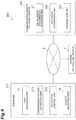
- Fig. 2 illustrates a sequence when video content is distributed from the content distributing server 3 to the receiver 10.
- environment information is transmitted from the receiver 10 to the communication quality adjusting server 20 (Step S1).
- this transmission may be triggered by access of the content distributing server 3 by the receiver 10.
- the receiver 10 transmits a current communication state of the receiver 10 to the communication quality adjusting server 20 in addition to the environment information.
- the communication quality adjusting server 20 that has received the environment information and the communication state from the receiver 10 determines a criterion associating the communication state of the receiver 10 with a reception form used when the receiver 10 receives content in accordance with the environment information (Step S2).
- the distribution unit 23 determines parameters (a bit rate and a buffer size) of the reception form that is optimal for the communication state by referring to the criterion.
- the determined parameters are transmitted to the receiver 10 by the distribution unit 23 (Step S3).
- parameters stored in the reception control unit 12 are updated with the newly received parameters.
- the reception control unit 12 transmits a distribution request for video content to the content distributing server 3 on the basis of the updated parameters (Step S4). For example, this transmission may be triggered by a user's operation on the receiver 10.
- the content distributing server 3 that has received a distribution request from the receiver 10 distributes video data having image quality corresponding to a parameter (a bit rate) included in the distribution request to the receiver 10 (Step S5). In this way, video content can be viewed using the receiver 10.
- the transmission of environment information and a communication state in Step S1 and the determination and transmission of parameters of a reception form in Steps S2 and S3 may be regularly executed (for example, every second) continuously also after the start of distribution of video content.
- the updated parameters are transmitted to the content distributing server 3.
- Fig. 3 illustrates a sequence for improving accuracy of an algorithm in the criterion determining unit 22 of the communication quality adjusting server 20.
- the improvement of accuracy of the algorithm in the criterion determining unit 22 may be executed during the distribution of video content illustrated in Fig. 2 .
- the improvement of accuracy of the algorithm in the criterion determining unit 22 may be executed when a predetermined amount of data transmitted from a plurality of receivers 10 is accumulated in the communication quality adjusting server 20.
- Step S11 video content is distributed from the content distributing server 3 to the receiver 10 (Step S11).
- environment information, a reception form, information representing an actual communication state, and information representing actual reproduction quality are regularly (for example, every second) transmitted from the receiver 10 to the communication quality adjusting server 20 (Step S12).
- the criterion determining unit 22 of the communication quality adjusting server 20 derives an algorithm for acquiring an optimal combination of a communication state and a reception form for the environment information on the basis of a known technology of machine learning with the environment information, the reception form, the information representing an actual communication state and the information representing actual reproduction quality as inputs and updates the algorithm (Step S13).
- a criterion associating a communication state of the receiver 10 and a reception form of the receiver 10 with each other is determined in accordance with environment information.
- the receiver 10 can receive video content in the reception form corresponding to the communication state. Since a different criterion can be generated in accordance with the acquired environment information, the receiver 10 can receive video content in a reception form that differs in accordance with an environment even in a similar communication state. Accordingly, stopping of reproduction, generation of a block noise, and the like are inhibited, and the receiver 10 can receive video content with stable quality.
- the environment information includes position information and time information of the receiver 10.
- a characteristic of a network for a mobile body there is a difference in a time zone in which the network is congested in accordance with a position.
- the environment information includes acceleration information of the receiver 10 as a state of the receiver 10.
- a speed of the receiver 10 can be estimated using the acceleration information.
- speed information of the receiver 10 is acquired on the basis of the acquired acceleration information by the criterion determining unit 22.
- a criterion associating a communication state and a reception form with each other can be generated in accordance with not only a network state but also a change in the state of the receiver 10.
- the criterion determining unit 22 When reproduction quality of content received by the receiver 10 is set as a reward, the criterion determining unit 22 performs machine learning of a combination of a communication state corresponding to environment information and a reception form such that the reward is maximized. In this way, changes in the communication environment that are difficult to predict can be responded in a flexible manner.
- the position information, the acceleration information, the time information, the communication environment information, the communication speed information, and the like have been described as the environment information, information other than these may be included in the environment information.
- a content distributing system determination of parameters of a reception form is executed by a receiver, which is different from the content distributing system according to the first embodiment.
- a receiver which is different from the content distributing system according to the first embodiment.
- the content distributing system includes a content distributing server 3, a receiver 10, and a communication quality adjusting server 20 (see Fig. 1 ).
- a criterion determining unit 22 of the communication quality adjusting server 20 determines a criterion associating a communication state of the receiver 10 with a reception form used when the receiver 10 receives video content in accordance with environment information acquired by an environment information acquiring unit 21.
- the environment information is patterned, and a criterion associating a communication state and a reception form is determined for each pattern. In other words, a plurality of criteria corresponding to mutually different pieces of environment information are determined.
- the criterion determining unit 22 stores environment information regarding 6 o'clock to 10 o'clock on weekdays of the A route road as one pattern in advance and determines a criterion associating a communication state and a reception form that are optimal to this pattern.
- the criterion determining unit 22 stores environment information regarding 18 o'clock to 23 o'clock on weekdays of the A route road as another pattern and determines a criterion associating a communication state and a reception form that are optimal to this pattern.
- the criterion determining unit 22 generates a combination of a communication state representing a high communication speed and a reception form representing a bit rate of intermediate image quality, a combination of a communication state representing an intermediate communication speed and a reception form representing a bit rate of low image quality, and a combination of a communication state representing a low communication speed and a reception form representing a bit rate of low image quality and a large buffer size as criteria.
- a communication state representing a high communication speed and a reception form representing a bit rate of intermediate image quality
- a combination of a communication state representing an intermediate communication speed and a reception form representing a bit rate of low image quality representing a bit rate of low image quality
- a large buffer size as criteria.
- the criterion determining unit 22 generates a combination of a communication state representing a high communication speed and a reception form representing a bit rate of high image quality, a combination of a communication state representing an intermediate communication speed and a reception form representing a bit rate of intermediate image quality, and a combination of a communication state representing a low communication speed and a reception form representing a bit rate of low image quality as criteria.
- the distribution unit 23 transmits the patterns and the criteria to the receiver 10.
- the reception control unit 12 of the receiver 10 stores the patterns and the criteria that have been received and determines a reception form on the basis of the pattern and the criteria.
- the reception control unit 12 acquires each piece of data acquired by the data acquiring unit 11.
- the reception control unit 12 selects a pattern that coincides the most with an environment in which the receiver 10 is placed from among the stored patterns on the basis of the position information, the time information, and the communication environment information that have been acquired.
- the reception control unit 12 determines a reception form (a bit rate and a buffer size) corresponding to the acquired communication state (the communication speed) on the basis of the criteria corresponding to the selected pattern.
- the reception control unit 12 can transmit a distribution request including parameters relating to the reception form and the like to the content distributing server 3.
- an optimal reception form can be determined only using the receiver 10. For this reason, a processing load on the communication quality adjusting server 20 side can be reduced.
- a content distributing system predicts a change in the environment of a receiver, which is different from the content distributing system according to the first embodiment.
- points different from those of the first embodiment will be mainly described, the same reference signs will be assigned to the same elements, and detailed description will be omitted.
- a content distributing system 200 includes a content distributing server 3, a receiver 210, and a communication quality adjusting server 220.
- the receiver 210 includes a data acquiring unit 11, an environment change estimating unit 211, a reception control unit 212, and a quality acquiring unit 13.
- the communication quality adjusting server 220 includes an environment information acquiring unit 21, a criterion determining unit 222, and a distribution unit 223.
- the environment change estimating unit 211 estimates a change in the communication environment on the basis of data accumulated in the past and current data that is acquired over time by the data acquiring unit 11. As the data accumulated in the past, data accumulated by the data acquiring unit 11 or data accumulated by the environment information acquiring unit 21 can be used. In a case in which the environment change estimating unit 211 acquires data accumulated in the past from the environment information acquiring unit 21, not only data relating to its own terminal but also data accumulated by the other receivers may be acquired together.
- the environment change estimating unit 211 estimates a movement speed and a movement route on the basis of a history of acceleration information, position information, and the like and estimates a movement destination of the receiver 210.
- a known behavior estimation technology may be used.
- the environment change estimating unit 211 estimates a communication environment at a movement destination on the basis of position information of the estimated movement destination and communication environment information accumulated in relation to the position information.
- a degree of easiness in a change in the communication speed during movement may be estimated by estimating the movement speed of the receiver 210.
- a change in the communication environment accompanied therewith may be predicted.
- the environment change estimating unit 211 may estimate a communication environment after elapse of a predetermined time at the current position of the receiver 210. Environment information after a change estimated by the environment change estimating unit 211 is transmitted to the communication quality adjusting server 220.
- the criterion determining unit 222 determines a criterion associating a communication state of the receiver 210 with a reception form used when the receiver receives video content in accordance with the environment information acquired by the data acquiring unit 11. In addition, the criterion determining unit 222 determines a criterion associating a communication state after change with a reception form in accordance with the environment information after change transmitted from the environment change estimating unit 211.
- the distribution unit 223 distributes information including a reception form to the receiver 210 on the basis of the criterion determined by the criterion determining unit 222 such that the receiver 210 receives video content in the reception form corresponding to the communication state of the receiver 210. In addition, the distribution unit 223 distributes information including the reception form determined in accordance with the environment information after change to the receiver.
- the reception control unit 212 of the receiver 210 controls parameters relating to the reception form of data at the time of receiving video content before the change in the environment of the receiver 210 such that the receiver 210 receives the video content in a reception form corresponding to the environment information after a predicted change.
- the reception control unit 212 can perform increasing of the buffer size, changing of the bit rate, and the like such that video content can be reproduced continuously before and after a change in the communication environment.
- the reception control unit 212 may store content of a low bit rate.
- the reception control unit 212 may control display of the display such that a guide "The communication environment is bad. Please wait for a moment" is displayed.
- a change in the environment in which the receiver 210 is placed is predicted, and environment information in the environment after the predicted change is acquired.
- the reception control unit 212 may acquire genre information of video content that a user is viewing and determine a reception form in correspondence with the genre information. For example, in a case in which the genre of video content is live broadcasting, the reception control unit 212 may set the buffer size to be small from a viewpoint of decreasing a time lag. In addition, in a case in which the genre of video content is sports, the reception control unit 212 may set the buffer size to be large together with setting the bit rate to be high such that a player in the video can be easily recognized.
- the receiver is not limited thereto.
- the receiver may be a stationary-type terminal such as a set-top box.
- the data acquiring unit of the receiver may acquire a type of line connected to the receiver as environment information.
- the data acquiring unit may acquire information indicating whether a place in which the receiver is installed is an apartment house or a detached house as environment information.
- the criterion determining unit can derive an algorithm for acquiring an optimal combination of a communication state and a reception form through machine learning on the basis of environment information or the like in which a line type and the like are included.
- the determination is not limited thereto.
- the receiver may have a function similar to that of the criterion determining unit, and criteria may be determined (generated) by the receiver.
- each block diagram used for description of the embodiment described above illustrates blocks in units of functions.
- Such functional blocks are realized by an arbitrary combination of at least one of hardware and software.
- a method for realizing each functional block is not particularly limited.
- each functional block may be realized by one device that is combined physically or logically or a plurality of devices by directly or indirectly (for example, using a wire, wirelessly, or the like) connecting two or more devices separated physically or logically.
- a functional block may be realized by combining software with one device or a plurality of devices described above.
- a functional block (component unit) realizing a function of transmitting is referred to as a transmitting unit or a transmitter.
- methods of realizing all the functions are not particularly limited.
- the content distributing server 3, the receiver 10, and the communication quality adjusting server 20 may function as a computer that performs the process of the method of the present disclosure.
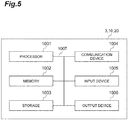
- Fig. 5 is a diagram illustrating one example of the hardware configuration of the content distributing server 3, the receiver 10, and the communication quality adjusting server 20 according to one embodiment of the present disclosure.
- the content distributing server 3, the receiver 10, and the communication quality adjusting server 20 described above may be physically configured as a computer device including a processor 1001, a memory 1002, a storage 1003, a communication device 1004, an input device 1005, an output device 1006, a bus 1007, and the like.
- a term “device” may be rephrased with a circuit, a device, a unit, or the like.
- the hardware configuration of the content distributing server 3, the receiver 10, and the communication quality adjusting server 20 may be configured to include one or a plurality of devices illustrated in the drawing and may be configured without including some devices.
- Each of the functions of the content distributing server 3, the receiver 10, and the communication quality adjusting server 20 is realized as the processor 1001 performs an arithmetic operation by causing predetermined software (a program) to be read onto hardware such as the processor 1001, the memory 1002, and the like, controls communication using the communication device 1004, and controls at least one of data reading and data writing for the memory 1002 and the storage 1003.
- predetermined software a program
- the processor 1001 controls the entire computer by operating an operating system.
- the processor 1001 may be configured by a central processing unit (CPU) including an interface with peripheral devices, a control device, an arithmetic operation device, a register, and the like.
- CPU central processing unit
- each of the functional units of the content distributing server 3, the receiver 10, and the communication quality adjusting server 20 may be realized by the processor 1001.
- the processor 1001 reads a program (a program code), a software module, data, and the like from at least one of the storage 1003 and the communication device 1004 into the memory 1002 and executes various processes in accordance with these.
- a program a program causing a computer to execute at least some of the operations described in the embodiment described above is used.
- each of the functional units of the content distributing server 3, the receiver 10, and the communication quality adjusting server 20 may be realized by a control program that is stored in the memory 1002 and operated by the processor 1001.
- the various processes described above have been described to be executed by one processor 1001, the processes may be executed simultaneously or sequentially by two or more processors 1001.
- the processor 1001 may be mounted using one or more chips.
- the program may be transmitted from a network through a telecommunication line.
- the memory 1002 is a computer-readable recording medium and, for example, may be configured by at least one of a read only memory (ROM), an erasable programmable ROM (EPROM), an electrically erasable programmable ROM (EEPROM), a random access memory (RAM), and the like.
- the memory 1002 may be referred to as a register, a cache, a main memory (a main storage device), or the like.
- the memory 1002 can store a program (a program code), a software module, and the like executable for performing a method according to one embodiment of the present disclosure.
- the storage 1003 is a computer-readable recording medium and, for example, may be configured by at least one of an optical disc such as a compact disc ROM (CD-ROM), a hard disk drive, a flexible disk, a magneto-optical disk (for example, a compact disc, a digital versatile disc, or a Blu-ray (registered trademark) disc), a smart card, a flash memory (for example, a card, a stick, or a key drive), a floppy (registered trademark) disk, a magnetic strip, and the like.
- the storage 1003 may be referred to as an auxiliary storage device.
- the storage medium described above, for example, may be a database including at least one of the memory 1002 and the storage 1003, a server, or any other appropriate medium.
- the communication device 1004 is hardware (a transmission/reception device) for performing inter-computer communication through at least one of a wired network and a wireless network and, for example, may be called also as a network device, a network controller, a network card, a communication module, or the like.
- the communication device 1004, for example, may be configured to include a high frequency switch, a duplexer, a filter, a frequency synthesizer, or the like for realizing at least one of frequency division duplex (FDD) and time division duplex (TDD).
- FDD frequency division duplex
- TDD time division duplex
- each of the functional units of the content distributing server 3, the receiver 10, and the communication quality adjusting server 20 described above may be realized by the communication device 1004.
- the input device 1005 is an input device (for example, a keyboard, a mouse, a microphone, a switch, buttons, a sensor, or the like) that accepts an input from the outside.
- the output device 1006 is an output device (for example, a display, a speaker, an LED lamp, or the like) that performs output to the outside.
- the input device 1005 and the output device 1006 may have an integrated configuration (for example, a touch panel).
- bus 1007 for communication of information.
- the bus 1007 may be configured as a single bus or buses different between devices.
- the content distributing server 3, the receiver 10, and the communication quality adjusting server 20 may be configured to include hardware such as a microprocessor, a digital signal processor (DSP), an application specific integrated circuit (ASIC), a programmable logic device (PLD), a field programmable gate array (FPGA), or the like, and a part or the whole of each functional block may be realized by the hardware.
- the processor 1001 may be mounted using at least one of such hardware components.
- Notification of information is not limited to an aspect/embodiment described in the present disclosure and may be performed using a difference method.
- the notification of information may be performed using physical layer signaling (for example, downlink control information (DCI and uplink control information (UCI)), upper layer signaling (for example, radio resource control (RRC) signaling, medium access control (MAC) signaling, a master information block (MIB), a system information block (SIB)), any other signal, or a combination thereof.
- RRC signaling may be referred to as an RRC message and, for example, may be an RRC connection setup message, an RRC connection reconfiguration message, or the like.
- Each aspect/embodiment described in the present disclosure may be applied to at least one of systems using long term evolution (LTE), LTE-Advanced (LTE-A), Super 3G, IMT-advanced, a 4th generation mobile communication system (4G), a 5th generation mobile communication system (5G), Future Ratio Access (FRA), New Radio (NR), W-CDMA (registered trademark), GSM (registered trademark), CDMA 2000, Ultra Mobile Broadband (UMB), IEEE 802.11 (Wi-Fi (registered trademark)), IEEE 802.16 (WiMAX (registered trademark)), IEEE 802.20, Ultra-Wideband (UWB), Bluetooth (registered trademark) and other appropriate systems and a next generation system extended based on these.
- a plurality of systems may be applied by being combined (for example, a combination of at least one of LTE and LTE-A and 5G or the like).
- a specific operation performed by a base station may be performed by an upper node thereof depending on the situation.
- various operations performed for communicating with a terminal may be performed by at least one of the base station and network nodes other than the base station (for example, an MME, an S-GW, and the like may be considered but is not limited thereto).
- the other network node may be a combination of a plurality of other network nodes (for example, the MME and the S-GW).
- Information and the like may be output from an upper layer (or a lower layer) to a lower layer (or an upper layer).
- the information and the like may be input and output through a plurality of network nodes.
- the input/output information and the like may be stored in a specific place (for example, a memory) or managed using a management table.
- the input/output information and the like may be overwritten, updated, or additionally written.
- the output information and the like may be deleted.
- the input information and the like may be transmitted to another device.
- a judgment may be performed using a value ("0" or "1") represented by one bit, may be performed using a Boolean value (true or false), or may be performed using a comparison between numerical values (for example, a comparison with a predetermined value).
- a notification of predetermined information (for example, a notification of being X) is not limited to be performed explicitly and may be performed implicitly (for example, a notification of the predetermined information is not performed).
- software, a command, information, and the like may be transmitted and received via a transmission medium.
- a transmission medium such as a coaxial cable, an optical fiber cable, a twisted pair, a digital subscriber line (DSL) or the like and a radio technology such as infrared rays, radio waves, microwaves, or the like
- a wiring technology such as a coaxial cable, an optical fiber cable, a twisted pair, a digital subscriber line (DSL) or the like
- a radio technology such as infrared rays, radio waves, microwaves, or the like
- Information, a signal, and the like described in the present disclosure may be represented using any one among other various technologies.
- data, an instruction, a command, information, a signal, a bit, a symbol, a chip, and the like described over the entire description presented above may be represented using a voltage, a current, radiowaves, a magnetic field or magnetic particles, an optical field or photons, or an arbitrary combination thereof.
- a term described in the present disclosure and a term that is necessary for understanding the present disclosure may be substituted with terms having the same meaning or a meaning similar thereto.
- a channel and a symbol may be a signal (signaling).
- a signal may be a message.
- a component carrier CC may be referred to as a carrier frequency, a cell, a frequency carrier, or the like.
- information, a parameter, and the like described in the present disclosure may be represented using absolute values, relative values from predetermined values, or other corresponding information.
- a radio resource may be indicated using an index.
- a name used for each parameter described above is not limited in any aspect.
- numerical equations using such parameters may be different from those that are explicitly disclosed in this specification.
- Various channels for example, a PUCCH, a PDCCH, and the like
- information elements can be identified using all the preferred names, and various names assigned to such various channels and information elements are not limited in any aspect.
- base station BS
- radio base station fixed station
- NodeB NodeB
- eNodeB eNodeB
- gNodeB gNodeB
- the base station can house one or a plurality of (for example, three) cells.
- the entire coverage area of the base station can be partitioned into a plurality of smaller areas, and, for each of the smaller areas, a communication service may be provided using a base station subsystem (for example, an indoor small base station (a remote radio head (RRH)).
- a base station subsystem for example, an indoor small base station (a remote radio head (RRH)
- RRH remote radio head
- a term such as "cell” or "sector” represents a part or the whole of a coverage area of at least one of a base station and a base station subsystem providing a communication service for this coverage.
- MS mobile station
- UE user equipment
- terminal terminal
- a mobile station may be called as a subscriber station, a mobile unit, a subscriber unit, a wireless unit, a remote unit, a mobile device, a wireless device, a wireless communication device, a remote device, a mobile subscriber station, an access terminal, a wireless terminal, a radio terminal, a remote terminal, a hand set, a user agent, a mobile client, a client, or any other appropriate term by persons skilled in the art.
- At least one of a base station and a mobile station may be referred to as a transmission device, a reception device, a communication device, or the like.
- at least one of a base station and a mobile station may be a device mounted in a moving body, a moving body, or the like.
- the moving body may be a vehicle (for example, a car, an airplane, or the like), a moving body moving in an unmanned manner (for example, drone, an automated driving vehicle, or the like), or a robot (a manned type or an unmanned type).
- at least one of a base station and a mobile station includes a device that does not necessarily move at the time of a communication operation.
- at least one of a base station and a mobile station may be an Internet of things (IOT) device such as a sensor or the like.
- IOT Internet of things
- a base station in the present disclosure may be rephrased by a user terminal.
- each aspect/embodiment of the present disclosure may be applied to a configuration acquired by replacing communication between a base station and a user terminal with communication among a plurality of user terminals (for example, may be referred to as Device-to-Device (D2D), Vehicle-to-Everything (V2X), or the like) or the like.
- D2D Device-to-Device
- V2X Vehicle-to-Everything
- a term such as "up”, “down”, or the like may be rephrased with a term corresponding to inter-terminal communication (for example, "side").
- an uplink channel, a downlink channel, or the like may be rephrased with a side channel.
- determining used in the present disclosure may include various operations of various types.
- the "determining,” for example, may include a case in which judging, calculating, computing, processing, deriving, investigating, looking up, search, or inquiry (for example, looking up a table, a database, or any other data structure), or ascertaining is regarded as “determining.”
- determining may include a case in which receiving (for example, receiving information), transmitting (for example, transmitting information), input, output, or accessing (for example, accessing data in a memory) is regarded as “determining.”
- “determining” may include a case in which resolving, selecting, choosing, establishing, comparing, or the like is regarded as “determining.”
- determining includes a case in which a certain operation is regarded as “determining.”
- “determining” may be rephrased with “assuming,” “expecting,” “considering,” or the like.
- connection means all the kinds of direct or indirect connection or coupling between two or more elements and may include presence of one or more intermediate elements between two elements that are mutually “connected” or “coupled.”
- Coupling or connection between elements may be physical coupling or connection, logical coupling or connection, or a combination thereof.
- connection may be rephrased with "access.”
- two elements may be considered as being mutually “connected” or “coupled” by using at least one of one or more wires, cables, and print electric connections and, as several non-limiting and non-comprehensive examples, by using electromagnetic energy such as electromagnetic energy having wavelengths in a radio frequency region, a microwave region, and a light (both visible light and non-visible light) region.
- each element does not generally limit the amount or the order of such an element.
- names may be used in the present disclosure as a convenient way for distinguishing two or more elements from each other. Accordingly, referring to the first and second elements does not mean that only the two elements are employed therein or the first element should precede the second element in a certain form.
- the present disclosure may include a plural form of a noun following such an article.
- an expression "A and B are different” may mean that "A and B are different from each other.” In addition, the expression may mean that "A and B are different from C.” Terms such as “separated,” “coupled,” and the like may be interpreted to be similar to being “different.”
Landscapes
- Engineering & Computer Science (AREA)
- Signal Processing (AREA)
- Multimedia (AREA)
- Databases & Information Systems (AREA)
- Computer Networks & Wireless Communication (AREA)
- Computing Systems (AREA)
- Theoretical Computer Science (AREA)
- Life Sciences & Earth Sciences (AREA)
- Physics & Mathematics (AREA)
- Software Systems (AREA)
- Ecology (AREA)
- Business, Economics & Management (AREA)
- Remote Sensing (AREA)
- Environmental Sciences (AREA)
- Environmental & Geological Engineering (AREA)
- Emergency Management (AREA)
- Biodiversity & Conservation Biology (AREA)
- Evolutionary Computation (AREA)
- General Physics & Mathematics (AREA)
- General Engineering & Computer Science (AREA)
- Mathematical Physics (AREA)
- Artificial Intelligence (AREA)
- Data Mining & Analysis (AREA)
- Molecular Biology (AREA)
- Health & Medical Sciences (AREA)
- Biomedical Technology (AREA)
- Computational Linguistics (AREA)
- Biophysics (AREA)
- General Health & Medical Sciences (AREA)
- Computer Vision & Pattern Recognition (AREA)
- Medical Informatics (AREA)
- Two-Way Televisions, Distribution Of Moving Picture Or The Like (AREA)
- Data Exchanges In Wide-Area Networks (AREA)
- Information Transfer Between Computers (AREA)
Applications Claiming Priority (2)
| Application Number | Priority Date | Filing Date | Title |
|---|---|---|---|
| JP2017182755 | 2017-09-22 | ||
| PCT/JP2018/034284 WO2019059134A1 (ja) | 2017-09-22 | 2018-09-14 | 通信品質調整システム |
Publications (2)
| Publication Number | Publication Date |
|---|---|
| EP3661219A1 true EP3661219A1 (de) | 2020-06-03 |
| EP3661219A4 EP3661219A4 (de) | 2020-07-15 |
Family
ID=65810308
Family Applications (1)
| Application Number | Title | Priority Date | Filing Date |
|---|---|---|---|
| EP18859448.5A Ceased EP3661219A4 (de) | 2017-09-22 | 2018-09-14 | System zur anpassung der kommunikationsqualität |
Country Status (5)
| Country | Link |
|---|---|
| US (1) | US11190839B2 (de) |
| EP (1) | EP3661219A4 (de) |
| JP (1) | JP6998020B2 (de) |
| KR (1) | KR102341584B1 (de) |
| WO (1) | WO2019059134A1 (de) |
Families Citing this family (6)
| Publication number | Priority date | Publication date | Assignee | Title |
|---|---|---|---|---|
| WO2020080873A1 (en) * | 2018-10-19 | 2020-04-23 | Samsung Electronics Co., Ltd. | Method and apparatus for streaming data |
| US11720997B2 (en) | 2018-10-19 | 2023-08-08 | Samsung Electronics Co.. Ltd. | Artificial intelligence (AI) encoding device and operating method thereof and AI decoding device and operating method thereof |
| US11373108B2 (en) * | 2019-07-10 | 2022-06-28 | Microsoft Technology Licensing, Llc | Reinforcement learning in real-time communications |
| CN114586371B (zh) * | 2019-10-14 | 2025-03-28 | 谷歌有限责任公司 | 使用自适应缓冲区流式传送视频内容的方法、系统和介质 |
| JP7630293B2 (ja) * | 2021-02-09 | 2025-02-17 | 日本放送協会 | レート制御サーバ、配信システム及びレート制御プログラム |
| JP7747060B2 (ja) * | 2021-11-10 | 2025-10-01 | Ntt株式会社 | 通信システム、通信方法、プログラム、及び制御装置 |
Family Cites Families (18)
| Publication number | Priority date | Publication date | Assignee | Title |
|---|---|---|---|---|
| WO2008108379A1 (ja) * | 2007-02-28 | 2008-09-12 | Nec Corporation | メディア配信システム、配信サーバ装置及びそれらに用いるメディア配信方法並びにそのプログラム |
| JP2009171427A (ja) * | 2008-01-18 | 2009-07-30 | Canon Inc | コンテンツ視聴システム、方法及びプログラム |
| JP5262510B2 (ja) | 2008-09-24 | 2013-08-14 | 富士通株式会社 | 配信速度制御装置および配信速度制御方法 |
| KR101582605B1 (ko) | 2009-01-05 | 2016-01-05 | 에스케이이노베이션 주식회사 | 필름 웹의 에지 컬 제어를 위한 핀치롤이 구비된 광학필름 제조장치 및 이를 이용한 광학필름 제조방법 |
| WO2011097762A1 (en) * | 2010-02-12 | 2011-08-18 | Thomson Licensing | Method for synchronized content playback |
| US9615126B2 (en) * | 2011-06-24 | 2017-04-04 | Google Technology Holdings LLC | Intelligent buffering of media streams delivered over internet |
| US8930559B2 (en) * | 2012-06-01 | 2015-01-06 | Verizon Patent And Licensing Inc. | Adaptive hypertext transfer protocol (“HTTP”) media streaming systems and methods |
| US8949874B1 (en) * | 2013-06-25 | 2015-02-03 | Google Inc. | Evaluating media channels |
| US9836271B2 (en) * | 2013-07-17 | 2017-12-05 | Booktrack Holdings Limited | Delivery of synchronised soundtracks for electronic media content |
| US9736651B2 (en) * | 2013-10-10 | 2017-08-15 | Verizon Patent And Licensing Inc. | Method and system for providing dash optimization for mobile devices |
| US10028011B2 (en) * | 2014-01-22 | 2018-07-17 | Verizon and Redbox Digital Entertainment Services, LLC | Predictive storage of broadcast content |
| US10165028B2 (en) | 2014-03-25 | 2018-12-25 | Intel Corporation | Context-aware streaming of digital content |
| US9497243B1 (en) * | 2014-09-30 | 2016-11-15 | Amazon Technologies, Inc. | Content delivery |
| US20160142745A1 (en) * | 2014-11-18 | 2016-05-19 | KBA2 Inc. | Management system to predict signal strength and bit rate |
| US10470091B2 (en) * | 2016-09-07 | 2019-11-05 | Viasat, Inc. | Variable size linear video content buffers for uninterrupted handover in a multi-beam satellite system |
| US10148990B2 (en) * | 2016-12-22 | 2018-12-04 | Cisco Technology, Inc. | Video streaming resource optimization |
| US10491964B2 (en) * | 2017-01-23 | 2019-11-26 | Cisco Technology, Inc. | Assisted acceleration for video streaming clients |
| US10587670B2 (en) * | 2017-12-29 | 2020-03-10 | Dish Network L.L.C. | Coverage optimized content buffering |
-
2018
- 2018-09-14 WO PCT/JP2018/034284 patent/WO2019059134A1/ja not_active Ceased
- 2018-09-14 EP EP18859448.5A patent/EP3661219A4/de not_active Ceased
- 2018-09-14 KR KR1020207010723A patent/KR102341584B1/ko active Active
- 2018-09-14 JP JP2019543620A patent/JP6998020B2/ja not_active Expired - Fee Related
- 2018-09-14 US US16/648,024 patent/US11190839B2/en not_active Expired - Fee Related
Also Published As
| Publication number | Publication date |
|---|---|
| KR20200077516A (ko) | 2020-06-30 |
| JPWO2019059134A1 (ja) | 2020-12-03 |
| KR102341584B1 (ko) | 2021-12-20 |
| WO2019059134A1 (ja) | 2019-03-28 |
| US11190839B2 (en) | 2021-11-30 |
| US20200280766A1 (en) | 2020-09-03 |
| EP3661219A4 (de) | 2020-07-15 |
| JP6998020B2 (ja) | 2022-02-10 |
Similar Documents
| Publication | Publication Date | Title |
|---|---|---|
| US11190839B2 (en) | Communication quality adjusting system | |
| JP2021141618A (ja) | ユーザ装置 | |
| US12095547B2 (en) | Base station and synchronization signal transmission method | |
| CA3023353C (en) | Measurement of received quality in wireless communications | |
| US20210400508A1 (en) | User device and base station device | |
| US10993068B2 (en) | Communication control device and communication control method | |
| US10959186B2 (en) | User equipment | |
| US10623910B2 (en) | Server device and communication method | |
| US10694458B2 (en) | User equipment, radio communication system, and communication method | |
| US20240244585A1 (en) | Re-evaluation of Sidelink Resources | |
| US12245194B2 (en) | User equipment | |
| US11818753B2 (en) | Random access wait time setting method | |
| JP2019212954A (ja) | 無線通信装置及び無線通信方法 | |
| JP7102424B2 (ja) | 基地局、測定動作制御方法及び無線通信システム | |
| US11277870B2 (en) | User equipment and preamble transmission meihod | |
| JP7837244B2 (ja) | 情報処理装置 | |
| US10674564B2 (en) | Base station, management apparatus and connection method | |
| JP7503385B2 (ja) | 駐車場管理システム | |
| JP2025107149A (ja) | 無線通信ネットワークにおけるネットワーク側機器によって実行される方法及びネットワーク側機器 | |
| JP2018173700A (ja) | レンタカー配車管理サーバ、プログラム |
Legal Events
| Date | Code | Title | Description |
|---|---|---|---|
| STAA | Information on the status of an ep patent application or granted ep patent |
Free format text: STATUS: THE INTERNATIONAL PUBLICATION HAS BEEN MADE |
|
| PUAI | Public reference made under article 153(3) epc to a published international application that has entered the european phase |
Free format text: ORIGINAL CODE: 0009012 |
|
| STAA | Information on the status of an ep patent application or granted ep patent |
Free format text: STATUS: REQUEST FOR EXAMINATION WAS MADE |
|
| 17P | Request for examination filed |
Effective date: 20200227 |
|
| AK | Designated contracting states |
Kind code of ref document: A1 Designated state(s): AL AT BE BG CH CY CZ DE DK EE ES FI FR GB GR HR HU IE IS IT LI LT LU LV MC MK MT NL NO PL PT RO RS SE SI SK SM TR |
|
| AX | Request for extension of the european patent |
Extension state: BA ME |
|
| A4 | Supplementary search report drawn up and despatched |
Effective date: 20200615 |
|
| RIC1 | Information provided on ipc code assigned before grant |
Ipc: H04N 21/2343 20110101ALI20200608BHEP Ipc: H04N 21/24 20110101AFI20200608BHEP Ipc: G06N 20/00 20190101ALI20200608BHEP Ipc: H04N 21/845 20110101ALI20200608BHEP Ipc: H04N 21/25 20110101ALI20200608BHEP Ipc: H04N 21/6547 20110101ALI20200608BHEP Ipc: H04N 21/658 20110101ALI20200608BHEP Ipc: H04N 21/442 20110101ALI20200608BHEP Ipc: H04N 21/45 20110101ALI20200608BHEP Ipc: H04N 21/422 20110101ALI20200608BHEP Ipc: H04N 21/6373 20110101ALI20200608BHEP Ipc: H04L 12/851 20130101ALI20200608BHEP |
|
| DAV | Request for validation of the european patent (deleted) | ||
| DAX | Request for extension of the european patent (deleted) | ||
| STAA | Information on the status of an ep patent application or granted ep patent |
Free format text: STATUS: EXAMINATION IS IN PROGRESS |
|
| 17Q | First examination report despatched |
Effective date: 20210323 |
|
| REG | Reference to a national code |
Ref country code: DE Ref legal event code: R003 |
|
| STAA | Information on the status of an ep patent application or granted ep patent |
Free format text: STATUS: THE APPLICATION HAS BEEN REFUSED |
|
| 18R | Application refused |
Effective date: 20241002 |