EP3661267A1 - Point d'accès et procédé permettant de mettre à jour des tables de transmission - Google Patents
Point d'accès et procédé permettant de mettre à jour des tables de transmission Download PDFInfo
- Publication number
- EP3661267A1 EP3661267A1 EP18306581.2A EP18306581A EP3661267A1 EP 3661267 A1 EP3661267 A1 EP 3661267A1 EP 18306581 A EP18306581 A EP 18306581A EP 3661267 A1 EP3661267 A1 EP 3661267A1
- Authority
- EP
- European Patent Office
- Prior art keywords
- mobile station
- access point
- message
- address
- processor
- Prior art date
- Legal status (The legal status is an assumption and is not a legal conclusion. Google has not performed a legal analysis and makes no representation as to the accuracy of the status listed.)
- Withdrawn
Links
- 238000000034 method Methods 0.000 title claims description 17
- 238000004891 communication Methods 0.000 claims abstract description 20
- 238000013475 authorization Methods 0.000 claims description 9
- 238000004590 computer program Methods 0.000 claims description 5
- 230000004044 response Effects 0.000 claims description 4
- 230000006870 function Effects 0.000 description 10
- 230000032683 aging Effects 0.000 description 5
- 238000010586 diagram Methods 0.000 description 3
- 230000005540 biological transmission Effects 0.000 description 2
- 230000001413 cellular effect Effects 0.000 description 2
- 230000007704 transition Effects 0.000 description 2
- 238000007796 conventional method Methods 0.000 description 1
- 230000003993 interaction Effects 0.000 description 1
- 238000013507 mapping Methods 0.000 description 1
- 230000008569 process Effects 0.000 description 1
- 238000012545 processing Methods 0.000 description 1
- 238000011144 upstream manufacturing Methods 0.000 description 1
Images


Classifications
-
- H—ELECTRICITY
- H04—ELECTRIC COMMUNICATION TECHNIQUE
- H04W—WIRELESS COMMUNICATION NETWORKS
- H04W12/00—Security arrangements; Authentication; Protecting privacy or anonymity
- H04W12/08—Access security
-
- H—ELECTRICITY
- H04—ELECTRIC COMMUNICATION TECHNIQUE
- H04W—WIRELESS COMMUNICATION NETWORKS
- H04W36/00—Hand-off or reselection arrangements
- H04W36/0005—Control or signalling for completing the hand-off
- H04W36/0011—Control or signalling for completing the hand-off for data sessions of end-to-end connection
- H04W36/0019—Control or signalling for completing the hand-off for data sessions of end-to-end connection adapted for mobile IP [MIP]
Definitions
- the present disclosure relates generally to wireless networks and in particular to wireless networks with multiple Access Points (APs).
- APs Access Points
- FIG. 1 illustrates an exemplary conventional system 100.
- the system 100 includes a local wireless network 105, such as a Wireless Local Area Network (WLAN), with a plurality of wireless Access Points (APs) 110, 120, 130 and a mobile station 140, which is connected to AP1 110.
- the WLAN can for example be a Wi-Fi network compatible with IEEE 802.11, a Bluetooth® network or a cellular network.
- the mobile station 140 can for example be a personal computer, a mobile phone (smartphone) or a tablet.
- each AP advantageously operates using a channel, i.e. frequencies, distinct from the channel of other network APs in order to avoid interference, the mobile station 140 generally being wirelessly connected to a single AP, such as for example AP1 110.
- a single AP such as for example AP1 110.
- AP1 110 AP1 110
- AP2 110 AP1 110
- AP2 AP2
- Reasons for handing over the mobile station include: load balancing between APs, signal strength problems owing to for instance movement of the mobile station.
- the APs 110, 120, 130 are generally connected through a switched backbone network 150 (wired or wireless), called a Distribution System (DS), which is typically a switched Ethernet network, but which also can be other kinds of backbone networks.
- DS Distribution System
- a bridge 160 is also connected to the backbone network 150.
- the bridge 160 can be said to be the link between the local wireless network 105 and an external network 170, such as the Internet, including other devices (not shown) such as servers. It is noted that a plurality of bridges can be connected to the backbone network 150.
- AP1 110 acts as a bridge between the local wireless network 105 and the switched backbone network 150.
- a bridge - for example one compliant with IEEE 802.1d, incorporated into IEEE 802.1Q and IEEE 802.1AC - typically employs a reverse path learning algorithm; i.e. from incoming frames (i.e. traffic) from a device (such as the mobile station 140), the bridge records the port and the source identifier, such as a MAC address, to determine which port to use when forwarding frames to that device.
- Such entries are kept in cache together with an ageing timer. When the ageing timer fires, the entry is removed from cache; in case the cache stores no entry for a destination (MAC) address of an incoming frame, the incoming frame is flooded, i.e. sent to all ports except the source port.
- a typical ageing timer is set to 300 seconds.
- no entry is added but the timer is reset.
- the mobile station 140 which is connected to AP1 110 receives a flow of traffic, typically an Internet Protocol (IP) flow, such as a video stream from a server (not shown) in the external network 170
- IP Internet Protocol
- the flow passes from the server, through the external network 170 to the bridge 160 that, using the cache entries, determines the AP to which it should forward the flow.
- the bridge 160 then, in this example, forwards the flow to AP1 110 that in turn forwards the flow to the mobile device 140.
- IP Internet Protocol
- the bridge 160 is not informed of the fact that the mobile station has roamed to AP2 and that incoming traffic should be forwarded through AP2 instead of AP1. Thus, the bridge 160 continues to forward incoming traffic to AP1 110. This situation persists until the cache entry for the mobile device 140 is cleared when the ageing timer expires or until the mobile device 140 sends traffic upstream through the bridge which causes the cache entry to be updated. This presupposed traffic going from the mobile station 140 to the bridge 160, but this is not always the case.
- IP Layer 3 i.e. the IP Layer.
- US 2016/0219479 requires the presence of a wireless access controller and storing of IP to Ethernet mappings, while CN 105451221 uses reverse address resolution to find the IP address of a mobile station and then sends an update message to the network to inform that it now handles traffic directed to the IP address.
- US 7849217 uses home agents and foreign agents to keep track of mobile stations.
- US 2008/0310300 discloses a routing system in which a mobile station associates with a base station and one-way traffic is sent to the mobile station.
- the base station starts a timer, typically set to half of the ageing timer already described; when the timer has expired, the base station determines if only one-way traffic was provided to the mobile station. If so, the base station sends a broadcast update packet to have forwarding tables update.
- the present principles are directed to an access point including a first communication interface configured for communication with wireless stations in a wireless network managed by the access point, a second communication interface configured for communication with devices in a backbone network comprising a further access point, and a processor configured to, in response to a mobile station being able to send traffic through the access point upon reception of the mobile station from the further access point in a handover, send, via the second communication interface, a message that causes the devices in the backbone network to update their forwarding tables so that traffic intended for the mobile station is sent to the access point.
- the present principles are directed to a method at a first access point managing a wireless network.
- the first access point receives a mobile station from a second access point in a handover, and, in response to the mobile station being able to send traffic through the access point, send over a backbone network, a message that causes devices in the backbone network to update their forwarding tables so that traffic intended for the mobile station is sent to the first access point.
- the present principles are directed to a computer program comprising program code instructions executable by a processor for implementing the steps of a method according to any embodiment of the second aspect.
- the present principles are directed to a computer program product which is stored on a non-transitory computer readable medium and comprises program code instructions executable by a processor for implementing the steps of a method according to any embodiment of the second aspect.
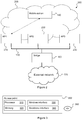
- FIG 2 illustrates an exemplary system 200 according to an embodiment of the present principles.
- the system 200 is quite similar to the conventional system in Figure 1 ; features like those in Figure 1 have the same reference signs.
- the system 200 includes a local wireless network 205, such as a Wireless Local Area Network (WLAN), with a plurality of wireless Access Points (APs) 210, 220, 230 and a mobile station 140, which is connected to AP1 110.
- the WLAN can for example be a Wi-Fi network compatible with IEEE 802.11, a Bluetooth® network or a cellular network.
- the mobile station 140 can for example be a personal computer, a mobile phone (smartphone) or a tablet.
- each AP advantageously operates using a channel, i.e. frequencies, distinct from the channel of other network APs in order to avoid interference, the mobile station 140 generally being wirelessly connected to a single AP, such as for example AP1 210.
- APs of an Extended Service Set can use the same channel, which can facilitate roaming.
- the mobile station 140 can roam or be roamed (i.e. hand over or be handed over) to another AP, such as AP2 220.
- the APs 210, 220, 230 can be connected through a switched backbone network 150 (wired or wireless), called a Distribution System (DS) such as a switched Ethernet network or other kind of suitable backbone networks.
- DS Distribution System
- At least one bridge 160 is also connected to the backbone network 150, and acts as a link between the local wireless network 205 and the external network 170, e.g. the Internet, including other devices (not shown) such as servers.
- the mobile station 140 When the mobile station 140 roams to a new AP, for example AP2 220, the mobile station is then associated with AP2. After association, the mobile station 140 is typically authorized by the AP to which it is now associated, i.e. AP2 220.
- AP2 Upon successful authorization, AP2 sends a message on the backbone network 150 on behalf of the mobile station 140, as if the mobile station 140 itself sent the message.
- the message can also be sent upon successful association, before the authorization.
- the message can be an Address Resolution Protocol (ARP) message with the Media Access Control (MAC) address of the mobile station 140 or any other suitable message containing the MAC address of the mobile station 140 as the source of the message.
- ARP Address Resolution Protocol
- MAC Media Access Control
- the devices connected to the backbone network 150 i.e. the bridge 160 and the other APs 210, 230, update their forwarding tables. Once the update is effected, any traffic sent from these devices to the mobile station 140 will be sent to the right AP, i.e. AP2; it is noted that special events such as a subsequent ongoing handover still can make these devices send traffic to the incorrect AP.
- FIG 3 illustrates an access point AP 300, such as AP2 in Figure 2 , according to an example embodiment of the present principles.
- the AP 300 includes at least one hardware processing unit (“processor") 310, memory 320 and at least one wireless communications interface 330, for example a Wi-Fi interface, configured to communicate with mobile stations, and a backbone interface 340 configured for communication with devices connected to a backbone network.
- processor hardware processing unit
- wireless communications interface 330 for example a Wi-Fi interface
- Wi-Fi interface for example a Wi-Fi interface
- Ethernet IEEE 802.3
- PLC power-line communication
- the processor 300 is configured to perform access point functions including transmission of the message as already described with reference to Figure 2 and to control the access point; the memory 310 is configured to store program code instructions that when executed by the processor 300 enables performing access point functions including transmission of the message as described herein.
- a computer program comprising such program code instructions executable by the processor is stored on non-transitory computer readable medium 370.
- Figure 4 illustrates a flow chart for a method 400 of receiving a roamed mobile station according to an embodiment of the present principles.
- step S410 a mobile station begins roaming from a first AP to a second AP.
- step S415 the second AP receives the roaming mobile station. This can be done by having the mobile station send an authentication request to the second AP that then typically grants authentication.
- An open key system authentication or a shared key system authentication can be used for the authentication; other possibilities are Fast Transition authentication, see IEEE 802.11r, and Simultaneous Authentication of Equals, see IEEE 802.11s.
- step S420 the second AP associates with the mobile station, which can be done using a conventional association method during which capabilities of the mobile station and the second AP can be exchanged.
- the second AP authorizes the mobile station. It is noted that this is sometimes referred to as a second authentication.
- the authorization which can be performed using any suitable conventional method, is for example used when WPA1 or WPA2 security is employed.
- step S440 the second AP sends a message to devices connected to a backbone network on behalf of the mobile station so that other devices connected to the backbone network can update their forwarding tables, as already described. It will be understood that the message when the second AP determines that the mobile station is connected, i.e. when the mobile station is able to receive and transmit data frames through the second AP.
- the second AP sends the message between steps S420 and S430, i.e. between the association and the authorization.
- the present principles can ensure that a message causing updates of other devices forwarding tables is sent upon successful roaming of a mobile station; this can be done before or after authorization of the mobile station. It is thus not necessary to, for example, determine an IP address of the mobile station; the update can thus occur earlier than in conventional solutions, which can lead to less loss of traffic for the mobile device.
- the message is sent before the mobile device is authorized, this can be done before traffic can be sent to or from the mobile station via the access point.
- processor or “controller” should not be construed to refer exclusively to hardware capable of executing software, and may implicitly include, without limitation, digital signal processor (DSP) hardware, read only memory (ROM) for storing software, random access memory (RAM), and non-volatile storage.
- DSP digital signal processor
- ROM read only memory
- RAM random access memory
- any switches shown in the figures are conceptual only. Their function may be carried out through the operation of program logic, through dedicated logic, through the interaction of program control and dedicated logic, or even manually, the particular technique being selectable by the implementer as more specifically understood from the context.
- any element expressed as a means for performing a specified function is intended to encompass any way of performing that function including, for example, a) a combination of circuit elements that performs that function or b) software in any form, including, therefore, firmware, microcode or the like, combined with appropriate circuitry for executing that software to perform the function.
- the disclosure as defined by such claims resides in the fact that the functionalities provided by the various recited means are combined and brought together in the manner which the claims call for. It is thus regarded that any means that can provide those functionalities are equivalent to those shown herein.
Landscapes
- Engineering & Computer Science (AREA)
- Computer Security & Cryptography (AREA)
- Computer Networks & Wireless Communication (AREA)
- Signal Processing (AREA)
- Mobile Radio Communication Systems (AREA)
Priority Applications (1)
| Application Number | Priority Date | Filing Date | Title |
|---|---|---|---|
| EP18306581.2A EP3661267A1 (fr) | 2018-11-29 | 2018-11-29 | Point d'accès et procédé permettant de mettre à jour des tables de transmission |
Applications Claiming Priority (1)
| Application Number | Priority Date | Filing Date | Title |
|---|---|---|---|
| EP18306581.2A EP3661267A1 (fr) | 2018-11-29 | 2018-11-29 | Point d'accès et procédé permettant de mettre à jour des tables de transmission |
Publications (1)
| Publication Number | Publication Date |
|---|---|
| EP3661267A1 true EP3661267A1 (fr) | 2020-06-03 |
Family
ID=64665341
Family Applications (1)
| Application Number | Title | Priority Date | Filing Date |
|---|---|---|---|
| EP18306581.2A Withdrawn EP3661267A1 (fr) | 2018-11-29 | 2018-11-29 | Point d'accès et procédé permettant de mettre à jour des tables de transmission |
Country Status (1)
| Country | Link |
|---|---|
| EP (1) | EP3661267A1 (fr) |
Citations (5)
| Publication number | Priority date | Publication date | Assignee | Title |
|---|---|---|---|---|
| US20080310300A1 (en) | 2007-06-12 | 2008-12-18 | Byoung-Jo Kim | Traffic Activity-Based Forwarding Table Updates For Ethernet-Based Mobile Access Networks |
| EP2237616A1 (fr) * | 2009-03-30 | 2010-10-06 | Alcatel Lucent | Procédé de réalisation d'un transfert intra-segments |
| WO2010121191A1 (fr) * | 2009-04-17 | 2010-10-21 | Qualcomm Incorporated | Communications de données sans fil utilisant la mobilité des flux ip |
| US7849217B2 (en) | 2003-04-30 | 2010-12-07 | Cisco Technology, Inc. | Mobile ethernet |
| WO2018044261A1 (fr) * | 2016-08-29 | 2018-03-08 | Ruckus Wireless, Inc. | Prise en charge de réseau pour un trafic localement délesté |
-
2018
- 2018-11-29 EP EP18306581.2A patent/EP3661267A1/fr not_active Withdrawn
Patent Citations (5)
| Publication number | Priority date | Publication date | Assignee | Title |
|---|---|---|---|---|
| US7849217B2 (en) | 2003-04-30 | 2010-12-07 | Cisco Technology, Inc. | Mobile ethernet |
| US20080310300A1 (en) | 2007-06-12 | 2008-12-18 | Byoung-Jo Kim | Traffic Activity-Based Forwarding Table Updates For Ethernet-Based Mobile Access Networks |
| EP2237616A1 (fr) * | 2009-03-30 | 2010-10-06 | Alcatel Lucent | Procédé de réalisation d'un transfert intra-segments |
| WO2010121191A1 (fr) * | 2009-04-17 | 2010-10-21 | Qualcomm Incorporated | Communications de données sans fil utilisant la mobilité des flux ip |
| WO2018044261A1 (fr) * | 2016-08-29 | 2018-03-08 | Ruckus Wireless, Inc. | Prise en charge de réseau pour un trafic localement délesté |
Similar Documents
| Publication | Publication Date | Title |
|---|---|---|
| US10206153B2 (en) | Control station, mobile station, mobile communication system and mobile communication method | |
| US8050232B2 (en) | Handover optimisation in a WLAN radio access network | |
| US7272123B2 (en) | System and method for handoff processing | |
| CN101822080B (zh) | 用于提供对多个移动性管理协议的支持的技术 | |
| JP2019004408A (ja) | 端末装置、コアネットワーク内の装置、データネットワーク内の装置、及び通信制御方法 | |
| JP2019004410A (ja) | 端末装置、コアネットワーク内の装置、データネットワーク内の装置、及び通信制御方法 | |
| CA2613673A1 (fr) | Procede, systeme et appareil permettant d'affecter et de gerer des adresses ip destinees a des clients sans fil, dans des reseaux locaux sans fil (wlan) | |
| JP2019004407A (ja) | 端末装置、コアネットワーク内の装置、データネットワーク内の装置、及び通信制御方法 | |
| CN102265676A (zh) | 控制站、移动台和移动通信系统 | |
| JP2019004409A (ja) | 端末装置、コアネットワーク内の装置、データネットワーク内の装置、及び通信制御方法 | |
| WO2020100637A1 (fr) | Ue et smf | |
| EP4054281B1 (fr) | Équipement utilisateur (ue) | |
| EP4451736A1 (fr) | Équipement utilisateur (ue) | |
| JP2021029007A (ja) | Ue、及び通信制御方法 | |
| US12574996B2 (en) | User equipment (UE) | |
| WO2020145305A1 (fr) | Ue et smf | |
| JP2025119074A (ja) | UE(User Equipment)およびAMF(Access and Mobility Management Function) | |
| US20250184869A1 (en) | Route selection process for handling congestion with relay proximity-based services | |
| KR101209936B1 (ko) | 무선 데이터 서비스를 위한 트래픽 제어 시스템 및 방법 | |
| US20260032563A1 (en) | User equipment (ue) | |
| EP4564991A1 (fr) | Ue (équipement d'utilisateur) | |
| Speicher | 3.2 5G Core Network | |
| JP2026020420A (ja) | UE(User Equipment) | |
| JP2026020421A (ja) | UE(User Equipment) | |
| WO2025239343A1 (fr) | Équipement utilisateur (ue) |
Legal Events
| Date | Code | Title | Description |
|---|---|---|---|
| PUAI | Public reference made under article 153(3) epc to a published international application that has entered the european phase |
Free format text: ORIGINAL CODE: 0009012 |
|
| STAA | Information on the status of an ep patent application or granted ep patent |
Free format text: STATUS: THE APPLICATION HAS BEEN PUBLISHED |
|
| AK | Designated contracting states |
Kind code of ref document: A1 Designated state(s): AL AT BE BG CH CY CZ DE DK EE ES FI FR GB GR HR HU IE IS IT LI LT LU LV MC MK MT NL NO PL PT RO RS SE SI SK SM TR |
|
| AX | Request for extension of the european patent |
Extension state: BA ME |
|
| STAA | Information on the status of an ep patent application or granted ep patent |
Free format text: STATUS: THE APPLICATION IS DEEMED TO BE WITHDRAWN |
|
| 18D | Application deemed to be withdrawn |
Effective date: 20201204 |