EP3662025B1 - Vorbehandlungszusammensetzungen, beschichtete aluminiumlegierungen und herstellungsverfahren dafür - Google Patents
Vorbehandlungszusammensetzungen, beschichtete aluminiumlegierungen und herstellungsverfahren dafür Download PDFInfo
- Publication number
- EP3662025B1 EP3662025B1 EP18753005.0A EP18753005A EP3662025B1 EP 3662025 B1 EP3662025 B1 EP 3662025B1 EP 18753005 A EP18753005 A EP 18753005A EP 3662025 B1 EP3662025 B1 EP 3662025B1
- Authority
- EP
- European Patent Office
- Prior art keywords
- ppm
- vol
- silane
- aluminum alloy
- corrosion
- Prior art date
- Legal status (The legal status is an assumption and is not a legal conclusion. Google has not performed a legal analysis and makes no representation as to the accuracy of the status listed.)
- Active
Links
Images







Classifications
-
- C—CHEMISTRY; METALLURGY
- C23—COATING METALLIC MATERIAL; COATING MATERIAL WITH METALLIC MATERIAL; CHEMICAL SURFACE TREATMENT; DIFFUSION TREATMENT OF METALLIC MATERIAL; COATING BY VACUUM EVAPORATION, BY SPUTTERING, BY ION IMPLANTATION OR BY CHEMICAL VAPOUR DEPOSITION, IN GENERAL; INHIBITING CORROSION OF METALLIC MATERIAL OR INCRUSTATION IN GENERAL
- C23C—COATING METALLIC MATERIAL; COATING MATERIAL WITH METALLIC MATERIAL; SURFACE TREATMENT OF METALLIC MATERIAL BY DIFFUSION INTO THE SURFACE, BY CHEMICAL CONVERSION OR SUBSTITUTION; COATING BY VACUUM EVAPORATION, BY SPUTTERING, BY ION IMPLANTATION OR BY CHEMICAL VAPOUR DEPOSITION, IN GENERAL
- C23C22/00—Chemical surface treatment of metallic material by reaction of the surface with a reactive liquid, leaving reaction products of surface material in the coating, e.g. conversion coatings, passivation of metals
- C23C22/05—Chemical surface treatment of metallic material by reaction of the surface with a reactive liquid, leaving reaction products of surface material in the coating, e.g. conversion coatings, passivation of metals using aqueous solutions
- C23C22/68—Chemical surface treatment of metallic material by reaction of the surface with a reactive liquid, leaving reaction products of surface material in the coating, e.g. conversion coatings, passivation of metals using aqueous solutions using aqueous solutions with pH between 6 and 8
-
- C—CHEMISTRY; METALLURGY
- C09—DYES; PAINTS; POLISHES; NATURAL RESINS; ADHESIVES; COMPOSITIONS NOT OTHERWISE PROVIDED FOR; APPLICATIONS OF MATERIALS NOT OTHERWISE PROVIDED FOR
- C09D—COATING COMPOSITIONS, e.g. PAINTS, VARNISHES OR LACQUERS; FILLING PASTES; CHEMICAL PAINT OR INK REMOVERS; INKS; CORRECTING FLUIDS; WOODSTAINS; PASTES OR SOLIDS FOR COLOURING OR PRINTING; USE OF MATERIALS THEREFOR
- C09D5/00—Coating compositions, e.g. paints, varnishes or lacquers, characterised by their physical nature or the effects produced; Filling pastes
- C09D5/08—Anti-corrosive paints
-
- C—CHEMISTRY; METALLURGY
- C23—COATING METALLIC MATERIAL; COATING MATERIAL WITH METALLIC MATERIAL; CHEMICAL SURFACE TREATMENT; DIFFUSION TREATMENT OF METALLIC MATERIAL; COATING BY VACUUM EVAPORATION, BY SPUTTERING, BY ION IMPLANTATION OR BY CHEMICAL VAPOUR DEPOSITION, IN GENERAL; INHIBITING CORROSION OF METALLIC MATERIAL OR INCRUSTATION IN GENERAL
- C23C—COATING METALLIC MATERIAL; COATING MATERIAL WITH METALLIC MATERIAL; SURFACE TREATMENT OF METALLIC MATERIAL BY DIFFUSION INTO THE SURFACE, BY CHEMICAL CONVERSION OR SUBSTITUTION; COATING BY VACUUM EVAPORATION, BY SPUTTERING, BY ION IMPLANTATION OR BY CHEMICAL VAPOUR DEPOSITION, IN GENERAL
- C23C22/00—Chemical surface treatment of metallic material by reaction of the surface with a reactive liquid, leaving reaction products of surface material in the coating, e.g. conversion coatings, passivation of metals
- C23C22/05—Chemical surface treatment of metallic material by reaction of the surface with a reactive liquid, leaving reaction products of surface material in the coating, e.g. conversion coatings, passivation of metals using aqueous solutions
- C23C22/06—Chemical surface treatment of metallic material by reaction of the surface with a reactive liquid, leaving reaction products of surface material in the coating, e.g. conversion coatings, passivation of metals using aqueous solutions using aqueous acidic solutions with pH less than 6
- C23C22/48—Chemical surface treatment of metallic material by reaction of the surface with a reactive liquid, leaving reaction products of surface material in the coating, e.g. conversion coatings, passivation of metals using aqueous solutions using aqueous acidic solutions with pH less than 6 not containing phosphates, hexavalent chromium compounds, fluorides or complex fluorides, molybdates, tungstates, vanadates or oxalates
- C23C22/56—Treatment of aluminium or alloys based thereon
-
- C—CHEMISTRY; METALLURGY
- C23—COATING METALLIC MATERIAL; COATING MATERIAL WITH METALLIC MATERIAL; CHEMICAL SURFACE TREATMENT; DIFFUSION TREATMENT OF METALLIC MATERIAL; COATING BY VACUUM EVAPORATION, BY SPUTTERING, BY ION IMPLANTATION OR BY CHEMICAL VAPOUR DEPOSITION, IN GENERAL; INHIBITING CORROSION OF METALLIC MATERIAL OR INCRUSTATION IN GENERAL
- C23F—NON-MECHANICAL REMOVAL OF METALLIC MATERIAL FROM SURFACE; INHIBITING CORROSION OF METALLIC MATERIAL OR INCRUSTATION IN GENERAL; MULTI-STEP PROCESSES FOR SURFACE TREATMENT OF METALLIC MATERIAL INVOLVING AT LEAST ONE PROCESS PROVIDED FOR IN CLASS C23 AND AT LEAST ONE PROCESS COVERED BY SUBCLASS C21D OR C22F OR CLASS C25
- C23F11/00—Inhibiting corrosion of metallic material by applying inhibitors to the surface in danger of corrosion or adding them to the corrosive agent
- C23F11/08—Inhibiting corrosion of metallic material by applying inhibitors to the surface in danger of corrosion or adding them to the corrosive agent in other liquids
-
- C—CHEMISTRY; METALLURGY
- C23—COATING METALLIC MATERIAL; COATING MATERIAL WITH METALLIC MATERIAL; CHEMICAL SURFACE TREATMENT; DIFFUSION TREATMENT OF METALLIC MATERIAL; COATING BY VACUUM EVAPORATION, BY SPUTTERING, BY ION IMPLANTATION OR BY CHEMICAL VAPOUR DEPOSITION, IN GENERAL; INHIBITING CORROSION OF METALLIC MATERIAL OR INCRUSTATION IN GENERAL
- C23F—NON-MECHANICAL REMOVAL OF METALLIC MATERIAL FROM SURFACE; INHIBITING CORROSION OF METALLIC MATERIAL OR INCRUSTATION IN GENERAL; MULTI-STEP PROCESSES FOR SURFACE TREATMENT OF METALLIC MATERIAL INVOLVING AT LEAST ONE PROCESS PROVIDED FOR IN CLASS C23 AND AT LEAST ONE PROCESS COVERED BY SUBCLASS C21D OR C22F OR CLASS C25
- C23F11/00—Inhibiting corrosion of metallic material by applying inhibitors to the surface in danger of corrosion or adding them to the corrosive agent
- C23F11/08—Inhibiting corrosion of metallic material by applying inhibitors to the surface in danger of corrosion or adding them to the corrosive agent in other liquids
- C23F11/18—Inhibiting corrosion of metallic material by applying inhibitors to the surface in danger of corrosion or adding them to the corrosive agent in other liquids using inorganic inhibitors
- C23F11/181—Nitrogen containing compounds
-
- C—CHEMISTRY; METALLURGY
- C23—COATING METALLIC MATERIAL; COATING MATERIAL WITH METALLIC MATERIAL; CHEMICAL SURFACE TREATMENT; DIFFUSION TREATMENT OF METALLIC MATERIAL; COATING BY VACUUM EVAPORATION, BY SPUTTERING, BY ION IMPLANTATION OR BY CHEMICAL VAPOUR DEPOSITION, IN GENERAL; INHIBITING CORROSION OF METALLIC MATERIAL OR INCRUSTATION IN GENERAL
- C23F—NON-MECHANICAL REMOVAL OF METALLIC MATERIAL FROM SURFACE; INHIBITING CORROSION OF METALLIC MATERIAL OR INCRUSTATION IN GENERAL; MULTI-STEP PROCESSES FOR SURFACE TREATMENT OF METALLIC MATERIAL INVOLVING AT LEAST ONE PROCESS PROVIDED FOR IN CLASS C23 AND AT LEAST ONE PROCESS COVERED BY SUBCLASS C21D OR C22F OR CLASS C25
- C23F11/00—Inhibiting corrosion of metallic material by applying inhibitors to the surface in danger of corrosion or adding them to the corrosive agent
- C23F11/08—Inhibiting corrosion of metallic material by applying inhibitors to the surface in danger of corrosion or adding them to the corrosive agent in other liquids
- C23F11/18—Inhibiting corrosion of metallic material by applying inhibitors to the surface in danger of corrosion or adding them to the corrosive agent in other liquids using inorganic inhibitors
- C23F11/182—Sulfur, boron or silicon containing compounds
-
- C—CHEMISTRY; METALLURGY
- C23—COATING METALLIC MATERIAL; COATING MATERIAL WITH METALLIC MATERIAL; CHEMICAL SURFACE TREATMENT; DIFFUSION TREATMENT OF METALLIC MATERIAL; COATING BY VACUUM EVAPORATION, BY SPUTTERING, BY ION IMPLANTATION OR BY CHEMICAL VAPOUR DEPOSITION, IN GENERAL; INHIBITING CORROSION OF METALLIC MATERIAL OR INCRUSTATION IN GENERAL
- C23F—NON-MECHANICAL REMOVAL OF METALLIC MATERIAL FROM SURFACE; INHIBITING CORROSION OF METALLIC MATERIAL OR INCRUSTATION IN GENERAL; MULTI-STEP PROCESSES FOR SURFACE TREATMENT OF METALLIC MATERIAL INVOLVING AT LEAST ONE PROCESS PROVIDED FOR IN CLASS C23 AND AT LEAST ONE PROCESS COVERED BY SUBCLASS C21D OR C22F OR CLASS C25
- C23F11/00—Inhibiting corrosion of metallic material by applying inhibitors to the surface in danger of corrosion or adding them to the corrosive agent
- C23F11/08—Inhibiting corrosion of metallic material by applying inhibitors to the surface in danger of corrosion or adding them to the corrosive agent in other liquids
- C23F11/18—Inhibiting corrosion of metallic material by applying inhibitors to the surface in danger of corrosion or adding them to the corrosive agent in other liquids using inorganic inhibitors
- C23F11/187—Mixtures of inorganic inhibitors
-
- C—CHEMISTRY; METALLURGY
- C23—COATING METALLIC MATERIAL; COATING MATERIAL WITH METALLIC MATERIAL; CHEMICAL SURFACE TREATMENT; DIFFUSION TREATMENT OF METALLIC MATERIAL; COATING BY VACUUM EVAPORATION, BY SPUTTERING, BY ION IMPLANTATION OR BY CHEMICAL VAPOUR DEPOSITION, IN GENERAL; INHIBITING CORROSION OF METALLIC MATERIAL OR INCRUSTATION IN GENERAL
- C23C—COATING METALLIC MATERIAL; COATING MATERIAL WITH METALLIC MATERIAL; SURFACE TREATMENT OF METALLIC MATERIAL BY DIFFUSION INTO THE SURFACE, BY CHEMICAL CONVERSION OR SUBSTITUTION; COATING BY VACUUM EVAPORATION, BY SPUTTERING, BY ION IMPLANTATION OR BY CHEMICAL VAPOUR DEPOSITION, IN GENERAL
- C23C2222/00—Aspects relating to chemical surface treatment of metallic material by reaction of the surface with a reactive medium
- C23C2222/20—Use of solutions containing silanes
Definitions
- Aluminum alloys are often employed in environments that may subject the alloy to corrosion.
- Aluminum alloys are often joined with dissimilar metals or alloys during motor vehicle, electronics, industrial, and transportation fabrication processes. Joining aluminum alloys to dissimilar metals or alloys can induce galvanic corrosion increasing corrosion risk. For example, when two dissimilar metals with dissimilar electrode potentials are joined together by physical or chemical means (e.g., welding an aluminum alloy to steel) and exposed to an electrolyte (e.g., impure water), one metal can act as an anode and the other can act as a cathode, forming a galvanic couple.
- physical or chemical means e.g., welding an aluminum alloy to steel
- an electrolyte e.g., impure water
- Joining aluminum alloys with dissimilar metals can be done several ways, including adhesives, rivets, screws, or other mechanical joining elements.
- one way of joining aluminum alloys with dissimilar metals and alloys i.e., galvanized steel
- one way of joining aluminum alloys with dissimilar metals and alloys is to bond the metals together using epoxy-based adhesives.
- the area where both materials overlap is critical regarding corrosion because the materials are in direct contact, particularly in regions with missing adhesive (or, likewise, in regions where the materials are in contact through rivets, screws or other mechanical joining elements).
- the combination is prone to galvanic corrosion.
- WO 2004/009714 A1 discloses a corrosion inhibiting composition
- a corrosion inhibiting composition comprising a water soluble organofunctional silane and a leachable inhibitor such as a leachable chromate inhibitor in a concentration ranging between 2,000 parts per million and 80,000 parts per million.
- Wim J. van Ooij et al. (Silicon Chemistry 2006, Vol. 3, pages 11-30 ) refers to the potential of silanes for chromate replacement in metal finishing industries.
- EP 1 852 523 A1 describes an aqueous metal surface-treating agent comprising an organic silicon compound, at least one organic polymer and optionally a metallic compound containing a bivalent or more metallic ion.
- US 2006/0134339 refers to a resin comprising colloidal metal oxide particles, a silane and a water dispersible polymer.
- Described herein is a joined structure, comprising an aluminum alloy treated with a pretreatment composition comprising: at least one rare earth metal or salt thereof and a solution comprising at least one silane, wherein the at least one rare earth metal or salt thereof is present in an amount of 50 to 7500 ppm and the solution comprising the at least one silane is present in an amount of 5 vol. % to 50 vol. %, and wherein the pretreatment composition further comprises an inorganic barrier-type corrosion inhibitor in an amount of 50 ppm to 5000 ppm, wherein the inorganic-barrier type corrosion inhibitor comprises clay particles, and another metal or alloy.
- the pretreatment compositions described herein comprise at least one rare earth metal or salt thereof and a solution containing at least one silane.
- the aluminum alloy comprises a surface coating.
- the surface coating comprises at least one rare earth metal or salt thereof dispersed in a matrix comprising at least one silane.
- the at least one rare earth metal or salt thereof is present in an amount of from 50 ppm to 3000 ppm (e.g., from greater than 100 ppm to less than 3000 ppm).
- the at least one rare earth metal or salt thereof comprises cerium, yttrium, ytterbium, lanthanum, or combinations thereof.
- the at least one rare earth metal or salt thereof comprises cerium (III) nitrate.
- a shate (also referred to as a sheet plate) generally has a thickness of from about 4 mm to about 15 mm.
- a shate may have a thickness of about 4 mm, about 5 mm, about 6 mm, about 7 mm, about 8 mm, about 9 mm, about 10 mm, about 11 mm, about 12 mm, about 13 mm, about 14 mm, or about 15 mm.
- the pretreatment compositions described herein include one or more inorganic chemical corrosion inhibitors.
- the inorganic chemical corrosion inhibitors for use in the pretreatment compositions include any inorganic chemical species capable of chemically inhibiting or preventing corrosion of an aluminum alloy, such as by reacting in some way to form a different chemical (e.g., an oxide) on the surface of the alloy and/or providing additional protection to the surface metal by being embedded in the coating.
- the inorganic chemical corrosion inhibitor is a rare earth metal salt.
- the rare earth metal salt includes a rare earth metal in an oxidation state of +1, +2, +3, +4, +5, or +6.
- the rare earth metal salt can be a cerium salt that includes cerium II ions, cerium III ions, or cerium IV ions.
- the salt is cerium (III) nitrate (Ce(NO 3 ) 3 ).
- the pretreatment compositions described herein include at least one silane.
- Suitable silanes for use in the pretreatment compositions can include, for example, (3-aminopropyl)triethoxysilane (APS), 1,2-bis(triethoxysilyl)ethane (BTSE), glycidyl-oxypropyl-trimethoxysilane (GPS), tetraethoxysilane (TEOS), vinyltriethoxysilane (VTES), bis[3-(trimethoxysilyl)propyl]amine, vinyltrimethoxysilane, methyltriethoxysilane (MTES), and combinations of these.
- the solution containing at least one silane form the matrix material on the pretreatment composition-treated alloy, as further described below.
- the at least one silane is also referred to herein as matrix components.
- the organic solvent(s) can be present in the solution in an amount of at least 5 vol. %, at least 10 vol. %, at least 15 vol. %, at least 20 vol. %, at least 25 vol. %, at least 30 vol. %, at least 35 vol. %, at least 40 vol. %, at least 45 vol. %, at least 50 vol. %, at least 55 vol. %, at least 60 vol. %, at least 65 vol. %, at least 70 vol. %, at least 75 vol.
- the silane-containing solution is an aqueous medium that can include, for example, acetone, ethanol, methanol, isopropanol, and/or ethyl acetate in amounts of up to 90 vol. % (e.g., up to 85 vol. %, up to 80 vol. %, up to 75 vol. %, up to 70 vol. %, up to 65 vol. %, up to 60 vol. %, up to 55 vol. %, up to 50 vol. %, up to 45 vol. %, up to 40 vol. %, up to 35 vol. %, up to 30 vol. %, up to 25 vol. %, up to 20 vol. %, up to 15 vol. %, or up to 10 vol. %).
- up to 90 vol. % e.g., up to 85 vol. %, up to 80 vol. %, up to 75 vol. %, up to 70 vol. %, up to 65 vol. %, up to 60 vol.
- the pretreatment compositions further includes an inorganic barrier-type corrosion inhibitor in an amount of 50 to 5000 ppm, wherein the inorganic-barrier type corrosion inhibitor comprises clay particles.
- the inorganic barrier-type inhibitors can stabilize a coating resulting from the pretreatment composition (i.e., making the resulting coating more inert to reaction) by creating a stronger silane network and denser structure. A stronger and denser coating, in turn, resists corrosion.
- the inorganic barrier-type corrosion inhibitors can be clay particles of any type. Clay particles can inhibit corrosion by reinforcing the silane matrix and producing a surface that is more resistive to corrosion attack as compared to an untreated surface.
- the inorganic chemical corrosion inhibitor and the inorganic barrier-type corrosion inhibitor can function in concert to enhance the corrosion resistance.
- cerium and clay particles are present in the pretreatment compositions.
- the cerium corrosion inhibitor precipitates as oxide and hydroxide species on the cathodic areas of the corroding metal or alloy, forming a cerium-rich layer on the metal or alloy.
- the clay particles prevent corrosion by densifying the silane matrix and/or by physically and/or chemically attaching to the surface while the rare earth metal is driven electrochemically to form the barrier layer.
- the amount of inorganic barrier-type corrosion inhibitor in the pretreatment composition is from 50 ppm to 5000 ppm (e.g., from 50 ppm to 4000 ppm, from 75 ppm to 3000 ppm, from 100 ppm to 2000 ppm, or from 500 ppm to 1500 ppm) or any value in between.
- the amount of inorganic barrier-type corrosion inhibitor can be 50 ppm, 100 ppm, 150 ppm, 200 ppm, 250 ppm, 300 ppm, 350 ppm, 400 ppm, 450 ppm, 500 ppm, 550 ppm, 600 ppm, 650 ppm, 700 ppm, 750 ppm, 800 ppm, 850 ppm, 900 ppm, 950 ppm, 1000 ppm, 1050 ppm, 1100 ppm, 1150 ppm, 1200 ppm, 1250 ppm, 1300 ppm, 1350 ppm, 1400 ppm, 1450 ppm, 1500 ppm, 1550 ppm, 1600 ppm, 1650 ppm, 1700 ppm, 1750 ppm, 1800 ppm, 1850 ppm, 1900 ppm, 1950 ppm, 2000 ppm, 2050 ppm, 2100 ppm, 2150 ppm,
- the pretreatment compositions can optionally include organic corrosion inhibitors.
- suitable organic corrosion inhibitors include mercaptobenzothiazole (MBT), benzotriazole (BTA), salicylaldoxime, dithiooxamide, quinaldic acid, thioacetamide, 8-hydroxyquinoline (HXQ), and mixtures thereof.
- the amount of organic corrosion inhibitor in the pretreatment composition can be from 50 to 5000 ppm (e.g., from 50 ppm to 4000 ppm, from 75 ppm to 3000 ppm, from 100 ppm to 2000 ppm, or from 500 ppm to 1500 ppm) or any value in between.
- the amount of inorganic barrier-type corrosion inhibitor can be 50 ppm, 100 ppm, 150 ppm, 200 ppm, 250 ppm, 300 ppm, 350 ppm, 400 ppm, 450 ppm, 500 ppm, 550 ppm, 600 ppm, 650 ppm, 700 ppm, 750 ppm, 800 ppm, 850 ppm, 900 ppm, 950 ppm, 1000 ppm, 1050 ppm, 1100 ppm, 1150 ppm, 1200 ppm, 1250 ppm, 1300 ppm, 1350 ppm, 1400 ppm, 1450 ppm, 1500 ppm, 1550 ppm, 1600 ppm, 1650 ppm, 1700 ppm, 1750 ppm, 1800 ppm, 1850 ppm, 1900 ppm, 1950 ppm, 2000 ppm, 2050 ppm, 2100 ppm, 2150 ppm,
- the pretreatment compositions can further include one or more additives such as adhesives, pigments, and/or surfactants.
- additives such as adhesives, pigments, and/or surfactants.
- the solution containing the at least one silane can be further diluted prior to combining with the other components to form the pretreatment composition.
- the solution containing the at least one silane can be diluted in water such that the silane is present in an amount of 5 vol. % to 50 vol. %, for example, such that the silane is present in an amount of 5 vol. % to 45 vol. %.
- the solution containing the silane is diluted in water such that the silane is present in an amount of 10 vol. %.
- a solution containing a silane and Ce(NO 3 ) 3 •6H 2 O can be diluted in water such that the silane is present in an amount of 8 vol. % to 12 vol. % and Ce(NO 3 ) 3 •6H 2 O is present in an amount of 450 ppm to 550 ppm.
- the solution containing the silane and Ce(NO 3 ) 3 •6H 2 O can be diluted in water such that the silane is present in an amount of 10 vol.% and the Ce(NO 3 ) 3 •6H 2 O is present in an amount of 500 ppm.
- the coatings described herein are suitable for providing corrosion protection to any metal or alloy (e.g., an aluminum alloy).
- the coatings disclosed herein which may also be referred to as a film or layer, inhibit galvanic corrosion, which can occur when aluminum alloy parts are joined together or joined to various non-aluminum based metals and alloys. While aluminum alloys are described and exemplified, the compositions described herein may also be used to treat other metals and alloys, including mild steel, galvanized steel, and magnesium alloys, to name a few.
- the metals and alloys have corrosion resistant coatings that include chemical corrosion inhibitors dispersed in a matrix.
- the joined structures have a surface coating layer that includes at least one inorganic chemical corrosion inhibitor and a matrix material formed from the silane-containing solution.
- the inorganic inhibitor can be embedded in the coating structure and involved in the overall process occurring at the metal surface, providing additional protection. In this sense, it may act as a barrier-type corrosion inhibitor, by, for example, reacting with the silane network and creating a denser structure.
- the inorganic chemical corrosion inhibitor includes at least one rare earth metal or a salt thereof.
- the surface coating layer including the inorganic chemical corrosion inhibitor protects the aluminum alloy surface from galvanic corrosion.
- the surface coating includes an inorganic chemical corrosion inhibitor and an inorganic barrier-type corrosion inhibitor.
- the inorganic chemical corrosion inhibitor (rare earth metal or salt thereof), in combination with one or more additional components as described above, is dispersed in a suitable matrix that will adhere to or chemically bond to the metal substrate to provide corrosion protection to the substrate.
- the matrix includes silane-based chemistries. In some non-limiting examples, the matrix is silane-based.
- the silane-based matrix can include, for example, (3-aminopropyl)triethoxysilane (APS), 1,2-bis(triethoxysilyl)ethane (BTSE), glycidyl-oxypropyl-trimethoxysilane (GPS), tetraethoxysilane (TEOS), vinyltriethoxysilane (VTES), bis[3-(trimethoxysilyl)propyl]amine, vinyltrimethoxysilane, methyltriethoxysilane (MTES), and/or a mixture thereof.
- the silane-based matrix promotes adhesion to the alloy surface.
- a silane matrix alone can provide some corrosion protection; however, to sufficiently resist corrosion, large coating densities, e.g., from 40 mg/m 2 to 80 mg/m 2 , are necessary. Such heavy coats are not accepted by, for example, the motor vehicle industry due to incompatibility with the paint process. The heavy coating densities required for corrosion protection are much larger than those used in the compositions described herein.
- a pretreatment composition including Ce(NO 3 ) 3 •6H 2 O in a silane matrix, as described herein provides good corrosion protection at silane matrix levels up to 80% less than those required for protection by a silane matrix alone.
- silane coating densities used in the compositions described herein are within the range compatible with motor vehicles industry painting processes (e.g., zinc-phosphating application, electroplating, and painting), where the coating density on the sheet to be painted can be up to 35 mg/m 2 .
- the amount of Si in the matrix material (e.g., silane) in the coating layer generally can be from 2 mg/m 2 to 35 mg/m 2 .
- the amount of Si in the matrix material can be 10 mg/m 2 to 13.5 mg/m 2 .
- the Si present in the matrix material can be 2 mg/m 2 , 3 mg/m 2 , 4 mg/m 2 , 5 mg/m 2 , 6 mg/m 2 , 7 mg/m 2 , 8 mg/m 2 , 9 mg/m 2 , 10 mg/m 2 , 11 mg/m 2 , 12 mg/m 2 , 13 mg/m 2 , 14 mg/m 2 , 15 mg/m 2 , 16 mg/m 2 , 17 mg/m 2 , 18 mg/m 2 , 19 mg/m 2 , 20 mg/m 2 , 21 mg/m 2 , 22 mg/m 2 , 23 mg/m 2 , 24 mg/m 2 , 25 mg/m 2 , 26 mg/m 2 , 27 mg/m 2 , 28 mg/m 2 , 29 mg/m 2 , 30 mg/m 2 , 31 mg/m 2 , 32 mg/m 2 , 33 mg/m 2 , 34 mg/m 2 , or 35 mg/m 2 , or any value in
- the coating weight/amount of Si on the metal or alloy can be measured by spectroscopic methods including X-ray fluorescence (XRF), glow discharge optical emission spectroscopy (GDOES), X-ray photoelectron spectroscopy (XPS), and other techniques providing information on coating weights.
- XRF X-ray fluorescence
- GDOES glow discharge optical emission spectroscopy
- XPS X-ray photoelectron spectroscopy
- the silane-based matrix serves as a vehicle to put the chemical inorganic corrosion inhibitor in close proximity to the aluminum alloy surface.
- the chemical corrosion inhibitor precipitates on a specific area of the corroding surface forming a barrier layer and thus inhibiting further corrosion.
- cerium ions precipitate and deposit on the aluminum surface and inhibit corrosion.
- Ce(NO 3 ) 3 •6H 2 O does not inhibit the adhesion of the silane matrix to the aluminum surface.
- Ce(NO 3 ) 3 •6H 2 O can be present in the coating in an amount of from 50 ppm to 5000 pm (e.g., from 100 ppm to 3000 ppm or from 300 ppm to an amount of 700 ppm).
- Ce(NO 3 ) 3 •6H 2 O can be present in the coating in an amount of 50 ppm, 100 ppm, 150 ppm, 200 ppm, 250 ppm, 300 ppm, 350 ppm, 400 ppm, 450 ppm, 500 ppm, 550 ppm, 600 ppm, 650 ppm, 700 ppm, 750 ppm, 800 ppm, 850 ppm, 900 ppm, 950 ppm, 1000 ppm, 1050 ppm, 1100 ppm, 1150 ppm, 1200 ppm, 1250 ppm, 1300 ppm, 1350 ppm, 1400 ppm, 1450 ppm, 1500 ppm, 1550 ppm, 1600 ppm, 1650 ppm, 1700 ppm, 1750 ppm, 1800 ppm, 1850 ppm, 1900 ppm, 1950 ppm, 2000 ppm, 2050 ppm, 2100
- the coating layer further includes an inorganic barrier-type corrosion inhibitor as described herein.
- the coating layer can optionally include organic corrosion inhibitors as described above.
- the coating layer can further include additives such as adhesives, pigments, and surfactants.
- the coated aluminum alloys are part of a joined structure including a coated aluminum alloy and another metal or alloy.
- the coated aluminum alloys can be part of a joined structure including the coated aluminum alloy and a second metal or alloy of a different composition.
- the coated aluminum alloy can be a 1xxx series alloy, a 2xxx series alloy, a 3xxx series alloy, a 4xxx series alloy, a 5xxx series alloy, a 6xxx series alloy, a 7xxx series alloy, or an 8xxx series alloy, prepared from a cast aluminum alloy product, that is joined to another alloy or metal.
- the aluminum alloy can be a 2xxx series aluminum alloy according to one of the following aluminum alloy designations: AA2001, A2002, AA2004, AA2005, AA2006, AA2007, AA2007A, AA2007B, AA2008, AA2009, AA2010, AA2011, AA2011A, AA2111, AA2111A, AA2111B, AA2012, AA2013, AA2014, AA2014A, AA2214, AA2015, AA2016, AA2017, AA2017A, AA2117, AA2018, AA2218, AA2618, AA2618A, AA2219, AA2319, AA2419, AA2519, AA2021, AA2022, AA2023, AA2024, AA2024A, AA2124, AA2224, AA2224A, AA2324, AA2424, AA2524, AA2624, AA2724, AA2824, AA2025,
- the aluminum alloy can be a 3xxx series aluminum alloy according to one of the following aluminum alloy designations: AA3002, AA3102, AA3003, AA3103, AA3103A, AA3103B, AA3203, AA3403, AA3004, AA3004A, AA3104, AA3204, AA3304, AA3005, AA3005A, AA3105, AA3105A, AA3105B, AA3007, AA3107, AA3207, AA3207A, AA3307, AA3009, AA3010, AA3110, AA3011, AA3012, AA3012A, AA3013, AA3014, AA3015, AA3016, AA3017, AA3019, AA3020, AA3021, AA3025, AA3026, AA3030, AA3130, or AA3065.
- the aluminum alloy can be a 4xxx series aluminum alloy according to one of the following aluminum alloy designations: AA4004, AA4104, AA4006, AA4007, AA4008, AA4009, AA4010, AA4013, AA4014, AA4015, AA4015A, AA4115, AA4016, AA4017, AA4018, AA4019, AA4020, AA4021, AA4026, AA4032, AA4043, AA4043A, AA4143, AA4343, AA4643, AA4943, AA4044, AA4045, AA4145, AA4145A, AA4046, AA4047, AA4047A, or AA4147.
- the aluminum alloy can be a 5xxx series aluminum alloy according to one of the following aluminum alloy designations: AA5005, AA5005A, AA5205, AA5305, AA5505, AA5605, AA5006, AA5106, AA5010, AA5110, AA5110A, AA5210, AA5310, AA5016, AA5017, AA5018, AA5018A, AA5019, AA5019A, AA5119, AA5119A, AA5021, AA5022, AA5023, AA5024, AA5026, AA5027, AA5028, AA5040, AA5140, AA5041, AA5042, AA5043, AA5049, AA5149, AA5249, AA5349, AA5449, AA5449A, AA5050, AA5050A, AA5050C, AA5150, AA5051, AA5051A, AA
- the aluminum alloy can be a 6xxx series aluminum alloy according to one of the following aluminum alloy designations: AA6101, AA6101A, AA6101B, AA6201, AA6201A, AA6401, AA6501, AA6002, AA6003, AA6103, AA6005, AA6005A, AA6005B, AA6005C, AA6105, AA6205, AA6305, AA6006, AA6106, AA6206, AA6306, AA6008, AA6009, AA6010, AA6110, AA6110A, AA6011, AA6111, AA6012, AA6012A, AA6013, AA6113, AA6014, AA6015, AA6016, AA6016A, AA6116, AA6018, AA6019, AA6020, AA6021, AA6022, AA6023, AA6024, AA6025, AA6026, AA6027,
- the aluminum alloy can be a 7xxx series aluminum alloy according to one of the following aluminum alloy designations: AA7011, AA7019, AA7020, AA7021, AA7039, AA7072, AA7075, AA7085, AA7108, AA7108A, AA7015, AA7017, AA7018, AA7019A, AA7024, AA7025, AA7028, AA7030, AA7031, AA7033, AA7035, AA7035A, AA7046, AA7046A, AA7003, AA7004, AA7005, AA7009, AA7010, AA7011, AA7012, AA7014, AA7016, AA7116, AA7122, AA7023, AA7026, AA7029, AA7129, AA7229, AA7032, AA7033, AA7034, AA7036, AA7136, AA7136
- the aluminum alloy can be an 8xxx series aluminum alloy according to one of the following aluminum alloy designations: AA8005, AA8006, AA8007, AA8008, AA8010, AA8011, AA8011A, AA8111, AA8211, AA8112, AA8014, AA8015, AA8016, AA8017, AA8018, AA8019, AA8021, AA8021A, AA8021B, AA8022, AA8023, AA8024, AA8025, AA8026, AA8030, AA8130, AA8040, AA8050, AA8150, AA8076, AA8076A, AA8176, AA8077, AA8177, AA8079, AA8090, AA8091, or AA8093.
- the aluminum alloy can be in any suitable temper.
- the other metal or alloy is galvanized steel.
- silane-based pretreatment compositions To prepare the silane-based pretreatment compositions, PERMATREAT 1003 A, commercially available from Chemetall (Frankfurt, Germany), was used without purification. Silane based pretreatment compositions were formulated by adding Ce(NO 3 ) 3 •6H 2 O to the PERMATREAT 1003 A solution. MMT was included in some of the silane-based pretreatment solutions. Organic inhibitors MBT and BTA were included in some of the silane-based pretreatment solutions.
- pretreatment compositions were prepared by the same general method.
- a magnetic stir bar was added to a 250 mL graduated flask.
- the desired amount of inhibitor-containing compound e.g., Ce(NO 3 ) 3 •6H 2 O and/or organic inhibitor
- the desired amount of matrix material e.g., silane containing solution
- the desired amount of matrix material was added to the solution. Purified water was further added to create a total volume of 250 mL. The solution was allowed to stir until stable. Solutions prone to precipitation were stirred until transferred to the roll coater.
- the clay particle powder was weighed to a quantity five times greater than the desired amount. The powder was then ground for 30 minutes by hand in a mortar such that the resulting powder was as fine as possible. The powder was added slowly to 100 mL of deionized water with continuous magnetic stirring. A 35% nitric acid solution (2-10 mL) was added to the aqueously-dispersed clay particles to help dissolution of the powder to avoid agglomeration. The solution was stirred rapidly for 30 minutes and was then exposed to strong ultrasonic agitation for 15 minutes. The solution was then magnetically stirred for 15 minutes. The solution was allowed to stand for 5 minutes. Any precipitated material was removed from the solution.
- Fig. 2 is a schematic illustration of the testing geometry.
- the aluminum alloy sheet 200 was completely coated with the pretreatment solution. Both aluminum alloy sheet 200 and steel sheet 220 were completely zinc-phosphated and coated with an electrocoating 230.
- the aluminum alloy sheet 200 was bonded to the steel sheet 220 with the adhesive 240.
- Metal wires 250 were embedded in the adhesive 240 to create the electrical contact.
- a controlled overlap 260 of 1 cm by 7 cm was employed in the test geometry. This geometry provided reproducible spacing for reliable test results.
- the sheets used in the examples included aluminum alloy 6014 and galvanized steel HX340LAD+Z10.
- the aluminum alloy composition is listed in Table 3, with impurities totaling up to 0.15 wt. % and the remainder Al. All values are provided in wt. %.
- Table 3 Alloy Si Fe Cu Mn Mg Cr Zn Ti V AA6014 0.3-0.6 0.35 0.25 0.05-0.2 0.4-0.8 0.2 0.1 0.1 0.05-0.2
- the steel composition is listed in Table 4. All values are provided in wt. %. Table 4 Alloy C Si Mn P S Ti Nb Al HX340LAD 0-0.11 0-0.5 0-1.0 0-0.025 0-0.025 0-0.15 0-0.09 0.015- No Max
- the copper-accelerated acetic acid-salt spray (CASS) test (ASTM B368) was employed to provide a corrosive environment in which the samples undergo galvanic corrosion.
- the CASS test duration was twenty (20) days. The substrates were then separated for corrosion evaluation.
- Aluminum alloy sheets were pretreated according to the methods described in Example 2. Formulations 1, 3, 15, and 16 were applied to an AA6014 aluminum alloy with a roll coater. Aluminum alloy and steel sheets were joined as described in Example 3. Aluminum alloy sheets and steel sheets were zinc-phosphated and electrocoated, except at the bonded and controlled overlap ( Fig. 2 ).
- Fig. 5 is a graph showing the effect of cerium ions on the corrosion resistance of silane.
- Aluminum alloys coated with Formulations 1 and 3 were compared to the non-pretreated sample (denoted "Etch only") to demonstrate the ability of the formulations to inhibit corrosion.
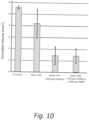
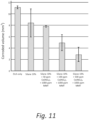
- the graph depicts corrosion resistance as the volume of metal removed during the CASS test. Less volume removed indicates higher resistance to corrosion.
- For the sample without any pretreatment coating about 11 mm 3 of metal was removed from the sample.
- the silane matrix without additives the volume of metal removed was reduced to about 8.5 mm 3 .
- Formulation 3 the coating containing both silane and cerium particles, provided enhanced corrosion resistance. With Formulation 3, only about 3 mm 3 of metal was removed.
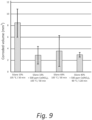
- Fig. 8 is a graph showing the effect of changing the silane concentration without added inhibitors.
- the aluminum alloy coated with a higher concentration silane solution, Formulation 15, was compared to the non-pretreated sample and a sample pretreated with Formulation 1 to demonstrate the ability of the neat silane matrix to inhibit corrosion.
- Formulation 15 enhanced the resistance to corrosion, as only about 3 mm 3 of metal was removed.
- Aluminum alloy sheets were treated according to the methods described in Example 2. Formulations 1 and 3 were applied onto the sheets with a roll coater and cured.
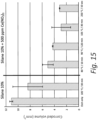
- Fig. 15 is a graph that presents the effect of various curing recipes on the corrosion resistance of the silane matrix containing 500 ppm of Ce(NO 3 ) 3 .
- Cure parameters included 105 °C for 30 minutes, 80 °C for 10 minutes, 90 °C for 2 hours, and 250 °C for 10 seconds. As shown in Fig. 15 , different cure parameters have little effect on the corrosion resistance.
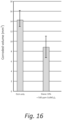
- % of a polyhydroxystyrene-containing compound (labeled as B2 10%), and a thin anodized film (labeled as TAF46) layer were compared (see Fig. 18 ).
- Each coated alloy displayed increased corrosion resistance as compared to the untreated alloy (etch only).
Landscapes
- Chemical & Material Sciences (AREA)
- Engineering & Computer Science (AREA)
- Materials Engineering (AREA)
- Organic Chemistry (AREA)
- Mechanical Engineering (AREA)
- Metallurgy (AREA)
- Inorganic Chemistry (AREA)
- General Chemical & Material Sciences (AREA)
- Chemical Kinetics & Catalysis (AREA)
- Life Sciences & Earth Sciences (AREA)
- Wood Science & Technology (AREA)
- Preventing Corrosion Or Incrustation Of Metals (AREA)
- Other Surface Treatments For Metallic Materials (AREA)
- Application Of Or Painting With Fluid Materials (AREA)
- Paints Or Removers (AREA)
Claims (8)
- Zusammengesetzte Struktur, umfassendeine Aluminiumlegierung, die mit einer Vorbehandlungszusammensetzung behandelt wurde, umfassend: mindestens ein Seltenerdmetall oder Salz davon und eine Lösung, die mindestens ein Silan umfasst, wobei das mindestens eine Seltenerdmetall oder Salz davon in einer Menge von 50 bis 7500 ppm vorhanden ist und die Lösung, die das mindestens eine Silan umfasst, in einer Menge von 5 Vol.-% bis 50 Vol.-% vorhanden ist, und wobei die Vorbehandlungszusammensetzung ferner einen Korrosionsinhibitor vom anorganischen Barriere-Typ in einer Menge von 50 ppm bis 5000 ppm umfasst, wobei der Korrosionsinhibitor vom anorganischen Barriere-Typ Tonteilchen umfasst, undein anderes Metall oder Legierung.
- Zusammengesetzte Struktur nach Anspruch 1, wobei das mindestens eine Seltenerdmetall oder Salz davon mindestens eines von Cer, Yttrium, Ytterbium, und Lanthan umfasst.
- Zusammengesetzte Struktur nach Anspruch 1 oder 2, wobei das mindestens eine Seltenerdmetall oder Salz davon Cer(III)-nitrat umfasst.
- Zusammengesetzte Struktur nach Anspruch 3, wobei das Cer(III)-nitrat in einer Menge von 500 ppm vorhanden ist und die Lösung, die das mindestens eine Silan umfasst, in einer Menge von 10 Vol.-% vorhanden ist.
- Zusammengesetzte Struktur nach den Ansprüchen 1-4, wobei das mindestens eine Seltenerdmetall oder Salz davon in einer Menge von 50 ppm bis 3000 ppm vorhanden ist und/oder,
wobei das mindestens eine Seltenerdmetall oder Salz davon in einer Menge von mehr als 100 ppm bis weniger als 3000 ppm vorhanden ist. - Zusammengesetzte Struktur nach einem der Ansprüche 1-5, wobei das mindestens eine Silan mindestens eines von (3-Aminopropyl)triethoxysilan, 1,2-Bis(triethoxysilyl)ethan, Glycidyloxypropyltrimethoxysilan, Tetraethoxysilan, Vinyltriethoxysilan, Bis[3(trimethoxysilyl)propyl]amin, Vinyltrimethoxysilan und Methyltriethoxysilan umfasst.
- Zusammengesetzte Struktur nach einem der Ansprüche 1-6, wobei die Tonteilchen Montmorillonit umfassen.
- Zusammengesetzte Struktur nach einem der Ansprüche 1-7, wobei Silizium auf einer Oberfläche der Aluminiumlegierung in einer Menge von 2 mg/m2 bis 35 mg/m2 vorhanden ist.
Applications Claiming Priority (3)
| Application Number | Priority Date | Filing Date | Title |
|---|---|---|---|
| US201762538993P | 2017-07-31 | 2017-07-31 | |
| US201762599873P | 2017-12-18 | 2017-12-18 | |
| PCT/US2018/044032 WO2019027822A1 (en) | 2017-07-31 | 2018-07-27 | PRETREATMENT COMPOSITIONS, COATED ALUMINUM ALLOYS AND PROCESSES FOR PRODUCING THE SAME |
Publications (2)
| Publication Number | Publication Date |
|---|---|
| EP3662025A1 EP3662025A1 (de) | 2020-06-10 |
| EP3662025B1 true EP3662025B1 (de) | 2024-07-10 |
Family
ID=63165554
Family Applications (1)
| Application Number | Title | Priority Date | Filing Date |
|---|---|---|---|
| EP18753005.0A Active EP3662025B1 (de) | 2017-07-31 | 2018-07-27 | Vorbehandlungszusammensetzungen, beschichtete aluminiumlegierungen und herstellungsverfahren dafür |
Country Status (8)
| Country | Link |
|---|---|
| US (1) | US11519076B2 (de) |
| EP (1) | EP3662025B1 (de) |
| JP (1) | JP6960520B2 (de) |
| KR (1) | KR20200036894A (de) |
| CN (2) | CN110945087A (de) |
| CA (1) | CA3071688C (de) |
| ES (1) | ES2983975T3 (de) |
| WO (1) | WO2019027822A1 (de) |
Families Citing this family (4)
| Publication number | Priority date | Publication date | Assignee | Title |
|---|---|---|---|---|
| EP4121488A1 (de) * | 2020-03-18 | 2023-01-25 | Novelis Inc. | Artikel aus aluminiumlegierung mit verbesserter haltbarkeit der verbindung und verfahren zum herstellen derselben |
| CA3167652A1 (en) * | 2020-04-24 | 2021-10-28 | Novelis Inc. | Thermally modified oxide based pretreatments for metals and methods of making the same |
| CN112575210A (zh) * | 2020-11-27 | 2021-03-30 | 李江巡 | 一种高强度耐腐蚀铝合金的制备工艺 |
| US11717804B1 (en) * | 2022-11-16 | 2023-08-08 | King Abdulaziz University | Modified nanoclay for heavy metal and salt removal from water |
Family Cites Families (19)
| Publication number | Priority date | Publication date | Assignee | Title |
|---|---|---|---|---|
| JP3857866B2 (ja) * | 2000-02-29 | 2006-12-13 | 日本ペイント株式会社 | ノンクロメート金属表面処理剤、表面処理方法および処理された塗装鋼材 |
| AU2003259218A1 (en) * | 2002-07-24 | 2004-02-09 | University Of Cincinnati | Reduced chromate silane film |
| US20060134339A1 (en) * | 2004-12-21 | 2006-06-22 | Shengxian Wang | Coating compositions and methods of making and using them |
| JP4683581B2 (ja) | 2005-02-02 | 2011-05-18 | 日本パーカライジング株式会社 | 水系金属材料表面処理剤、表面処理方法及び表面処理金属材料 |
| US7862862B2 (en) * | 2006-01-18 | 2011-01-04 | Nalco Company | Water dispersible silanes as corrosion-protection coatings and paint primers for metal pretreatment |
| FR2946664B1 (fr) * | 2009-06-15 | 2011-07-29 | Eads Europ Aeronautic Defence | Particules ceramiques et compositions de revetement comprenant lesdites particules |
| CN102174289A (zh) * | 2011-02-25 | 2011-09-07 | 上海交通大学 | 用于航空铝合金材料的表面防腐溶胶及其处理方法 |
| CN102153896B (zh) * | 2011-05-25 | 2013-02-13 | 上海奇佳化工有限公司 | 一种抗沉降电工钢水性环保绝缘涂料及其制备方法 |
| US20130081950A1 (en) * | 2011-09-30 | 2013-04-04 | Ppg Industries Ohio, Inc. | Acid cleaners for metal substrates and associated methods for cleaning and coating metal substrates |
| CN102977774B (zh) * | 2012-12-04 | 2015-10-14 | 安徽省宿州市龙华机械制造有限公司 | 一种含十八烷醇基聚氧乙烯醚的改性硅烷化表面前处理剂及其制备方法 |
| CN103451641A (zh) * | 2013-08-29 | 2013-12-18 | 安徽省宿州市龙华机械制造有限公司 | 一种含二苯乙基联苯酚聚氧乙烯醚的改性硅烷化金属表面前处理剂及其制备方法 |
| KR20160098171A (ko) | 2013-10-01 | 2016-08-18 | 타타 스틸 리미티드 | 합금화 용융아연도금 또는 아연도금 강의 표면을 처리하기 위한 크롬이 없는 수성 코팅물 |
| IN2013KO01135A (de) * | 2013-10-01 | 2015-04-10 | Tata Steel Ltd | |
| EP2915903B1 (de) * | 2014-03-05 | 2018-02-21 | The Boeing Company | Chromfreie Umwandlungsbeschichtung |
| CN104099593A (zh) * | 2014-06-19 | 2014-10-15 | 锐展(铜陵)科技有限公司 | 一种微量稀土铝合金表面处理剂 |
| CN105463436B (zh) * | 2015-07-27 | 2018-03-09 | 宝山钢铁股份有限公司 | 一种用于镀锌钢板的环保表面处理剂、镀锌钢板及镀锌钢板的制造方法 |
| CN105200408A (zh) * | 2015-09-16 | 2015-12-30 | 马鞍山杰创塑胶科技有限公司 | 一种热稳定性好铝型材稀土硅烷处理液及其制备方法 |
| CN105586587A (zh) * | 2016-03-25 | 2016-05-18 | 大连新锋钢管厂 | 一种箍筋表面防护工艺 |
| CN106119724B (zh) * | 2016-06-27 | 2019-01-01 | 滁州帝邦科技有限公司 | 一种用于水冷喷嘴的耐腐蚀钢的制备方法 |
-
2018
- 2018-07-27 KR KR1020207005564A patent/KR20200036894A/ko not_active Ceased
- 2018-07-27 JP JP2020505246A patent/JP6960520B2/ja active Active
- 2018-07-27 US US16/047,165 patent/US11519076B2/en active Active
- 2018-07-27 ES ES18753005T patent/ES2983975T3/es active Active
- 2018-07-27 WO PCT/US2018/044032 patent/WO2019027822A1/en not_active Ceased
- 2018-07-27 CA CA3071688A patent/CA3071688C/en active Active
- 2018-07-27 CN CN201880048637.4A patent/CN110945087A/zh active Pending
- 2018-07-27 EP EP18753005.0A patent/EP3662025B1/de active Active
- 2018-07-27 CN CN202410651535.9A patent/CN118563300A/zh active Pending
Also Published As
| Publication number | Publication date |
|---|---|
| ES2983975T3 (es) | 2024-10-28 |
| KR20200036894A (ko) | 2020-04-07 |
| CN118563300A (zh) | 2024-08-30 |
| WO2019027822A1 (en) | 2019-02-07 |
| EP3662025A1 (de) | 2020-06-10 |
| JP2020529497A (ja) | 2020-10-08 |
| US11519076B2 (en) | 2022-12-06 |
| JP6960520B2 (ja) | 2021-11-05 |
| CN110945087A (zh) | 2020-03-31 |
| US20190032225A1 (en) | 2019-01-31 |
| CA3071688C (en) | 2023-08-08 |
| CA3071688A1 (en) | 2019-02-07 |
Similar Documents
| Publication | Publication Date | Title |
|---|---|---|
| EP3662025B1 (de) | Vorbehandlungszusammensetzungen, beschichtete aluminiumlegierungen und herstellungsverfahren dafür | |
| JP3279611B2 (ja) | 非毒性、無機、耐食性コーティングで鋼をコーティングする方法 | |
| US7241371B2 (en) | Additive-assisted, cerium-based, corrosion-resistant e-coating | |
| EP2633099B1 (de) | Wässerige zusammensetzung zur vorbehandlung einer metallischen oberfläche vor einer weiteren beschichtung oder zur behandlung jener oberfläche | |
| Yasakau et al. | Smart self-healing coatings for corrosion protection of aluminium alloys | |
| Wittmar et al. | Hybrid sol–gel coatings doped with transition metal ions for the protection of AA 2024-T3 | |
| EP4028574B1 (de) | Oberflächenverändertes metallsubstrat und zugehöriges verfahren | |
| JP2023529705A (ja) | 表面改質のためのリン含有有機酸を用いたアルミニウム合金前処理 | |
| JP2000080309A (ja) | 耐食性塗料及びこれを塗装した耐食性鉄鋼材料 | |
| EP4407068A2 (de) | Aluminiumlegierungen und beschichtete aluminiumlegierungen mit hoher korrosionsbeständigkeit und verfahren zur herstellung davon | |
| EP1669475B1 (de) | Vorbehandlung für eine Metalloberfläche und Pulverbeschichtungsschritt für ein Fahrgestell | |
| WO2017195811A1 (ja) | アルミニウム合金材、接着樹脂層付きアルミニウム合金材、アルミニウム合金材の製造方法、及び接着樹脂層付きアルミニウム合金材の製造方法 | |
| JP7120652B2 (ja) | 腐食抑制剤 | |
| JP3371107B2 (ja) | 耐食性及び耐汚染性に優れた塗装鋼板 | |
| CN114423828B (zh) | 用于改善粘结性能的金属表面涂层及其制备方法 | |
| JP6278882B2 (ja) | 表面処理アルミニウム合金板およびその製造方法 | |
| Jhankal et al. | Electrochemical performance evaluation of ZnCo2O4 nanoflakes for hybrid supercapacitors | |
| JP7839097B2 (ja) | 改善された結合耐久性を示すアルミニウム合金物品及びその作製方法 | |
| JPS62278297A (ja) | 金属表面処理鋼板のクロメ−ト処理方法 | |
| Carneiro | Surface Modification of Nanocontainers of Corrosion Inhibitors for Improved Compatibility with Protective Polymer Coatings | |
| George et al. | Chromium-free conversion coating of aluminium-copper alloys | |
| JP3156495B2 (ja) | 無塗装AlまたはAl合金部材 | |
| Guo | An alternate to chromate conversion coatings for the corrosion protection of aluminum 2024-T3 | |
| JP2004176152A (ja) | 耐候性に優れた表面処理鋼材 | |
| Mogawer | Corrosion protection of aluminum alloys using a chromate conversion coating |
Legal Events
| Date | Code | Title | Description |
|---|---|---|---|
| STAA | Information on the status of an ep patent application or granted ep patent |
Free format text: STATUS: UNKNOWN |
|
| STAA | Information on the status of an ep patent application or granted ep patent |
Free format text: STATUS: THE INTERNATIONAL PUBLICATION HAS BEEN MADE |
|
| PUAI | Public reference made under article 153(3) epc to a published international application that has entered the european phase |
Free format text: ORIGINAL CODE: 0009012 |
|
| STAA | Information on the status of an ep patent application or granted ep patent |
Free format text: STATUS: REQUEST FOR EXAMINATION WAS MADE |
|
| 17P | Request for examination filed |
Effective date: 20200127 |
|
| AK | Designated contracting states |
Kind code of ref document: A1 Designated state(s): AL AT BE BG CH CY CZ DE DK EE ES FI FR GB GR HR HU IE IS IT LI LT LU LV MC MK MT NL NO PL PT RO RS SE SI SK SM TR |
|
| AX | Request for extension of the european patent |
Extension state: BA ME |
|
| RIN1 | Information on inventor provided before grant (corrected) |
Inventor name: BASSI, CORRADO Inventor name: BERNER, MICHELE EDITH Inventor name: RADERMACHER, CHRISTOPH ERNST JOSEPH |
|
| DAV | Request for validation of the european patent (deleted) | ||
| DAX | Request for extension of the european patent (deleted) | ||
| STAA | Information on the status of an ep patent application or granted ep patent |
Free format text: STATUS: EXAMINATION IS IN PROGRESS |
|
| 17Q | First examination report despatched |
Effective date: 20211210 |
|
| GRAP | Despatch of communication of intention to grant a patent |
Free format text: ORIGINAL CODE: EPIDOSNIGR1 |
|
| STAA | Information on the status of an ep patent application or granted ep patent |
Free format text: STATUS: GRANT OF PATENT IS INTENDED |
|
| INTG | Intention to grant announced |
Effective date: 20231017 |
|
| GRAJ | Information related to disapproval of communication of intention to grant by the applicant or resumption of examination proceedings by the epo deleted |
Free format text: ORIGINAL CODE: EPIDOSDIGR1 |
|
| STAA | Information on the status of an ep patent application or granted ep patent |
Free format text: STATUS: EXAMINATION IS IN PROGRESS |
|
| GRAP | Despatch of communication of intention to grant a patent |
Free format text: ORIGINAL CODE: EPIDOSNIGR1 |
|
| STAA | Information on the status of an ep patent application or granted ep patent |
Free format text: STATUS: GRANT OF PATENT IS INTENDED |
|
| INTC | Intention to grant announced (deleted) | ||
| INTG | Intention to grant announced |
Effective date: 20240215 |
|
| P01 | Opt-out of the competence of the unified patent court (upc) registered |
Effective date: 20240201 |
|
| GRAS | Grant fee paid |
Free format text: ORIGINAL CODE: EPIDOSNIGR3 |
|
| GRAA | (expected) grant |
Free format text: ORIGINAL CODE: 0009210 |
|
| STAA | Information on the status of an ep patent application or granted ep patent |
Free format text: STATUS: THE PATENT HAS BEEN GRANTED |
|
| AK | Designated contracting states |
Kind code of ref document: B1 Designated state(s): AL AT BE BG CH CY CZ DE DK EE ES FI FR GB GR HR HU IE IS IT LI LT LU LV MC MK MT NL NO PL PT RO RS SE SI SK SM TR |
|
| REG | Reference to a national code |
Ref country code: CH Ref legal event code: EP |
|
| REG | Reference to a national code |
Ref country code: DE Ref legal event code: R096 Ref document number: 602018071577 Country of ref document: DE |
|
| REG | Reference to a national code |
Ref country code: DE Ref legal event code: R082 Ref document number: 602018071577 Country of ref document: DE Representative=s name: WEICKMANN & WEICKMANN PATENT- UND RECHTSANWAEL, DE |
|
| REG | Reference to a national code |
Ref country code: ES Ref legal event code: FG2A Ref document number: 2983975 Country of ref document: ES Kind code of ref document: T3 Effective date: 20241028 |
|
| REG | Reference to a national code |
Ref country code: LT Ref legal event code: MG9D |
|
| REG | Reference to a national code |
Ref country code: NL Ref legal event code: MP Effective date: 20240710 |
|
| PG25 | Lapsed in a contracting state [announced via postgrant information from national office to epo] |
Ref country code: PT Free format text: LAPSE BECAUSE OF FAILURE TO SUBMIT A TRANSLATION OF THE DESCRIPTION OR TO PAY THE FEE WITHIN THE PRESCRIBED TIME-LIMIT Effective date: 20241111 |
|
| REG | Reference to a national code |
Ref country code: AT Ref legal event code: UEP Ref document number: 1702050 Country of ref document: AT Kind code of ref document: T Effective date: 20240710 |
|
| PG25 | Lapsed in a contracting state [announced via postgrant information from national office to epo] |
Ref country code: NL Free format text: LAPSE BECAUSE OF FAILURE TO SUBMIT A TRANSLATION OF THE DESCRIPTION OR TO PAY THE FEE WITHIN THE PRESCRIBED TIME-LIMIT Effective date: 20240710 |
|
| PG25 | Lapsed in a contracting state [announced via postgrant information from national office to epo] |
Ref country code: PT Free format text: LAPSE BECAUSE OF FAILURE TO SUBMIT A TRANSLATION OF THE DESCRIPTION OR TO PAY THE FEE WITHIN THE PRESCRIBED TIME-LIMIT Effective date: 20241111 Ref country code: NL Free format text: LAPSE BECAUSE OF FAILURE TO SUBMIT A TRANSLATION OF THE DESCRIPTION OR TO PAY THE FEE WITHIN THE PRESCRIBED TIME-LIMIT Effective date: 20240710 |
|
| PG25 | Lapsed in a contracting state [announced via postgrant information from national office to epo] |
Ref country code: NO Free format text: LAPSE BECAUSE OF FAILURE TO SUBMIT A TRANSLATION OF THE DESCRIPTION OR TO PAY THE FEE WITHIN THE PRESCRIBED TIME-LIMIT Effective date: 20241010 |
|
| PG25 | Lapsed in a contracting state [announced via postgrant information from national office to epo] |
Ref country code: FI Free format text: LAPSE BECAUSE OF FAILURE TO SUBMIT A TRANSLATION OF THE DESCRIPTION OR TO PAY THE FEE WITHIN THE PRESCRIBED TIME-LIMIT Effective date: 20240710 Ref country code: PL Free format text: LAPSE BECAUSE OF FAILURE TO SUBMIT A TRANSLATION OF THE DESCRIPTION OR TO PAY THE FEE WITHIN THE PRESCRIBED TIME-LIMIT Effective date: 20240710 Ref country code: GR Free format text: LAPSE BECAUSE OF FAILURE TO SUBMIT A TRANSLATION OF THE DESCRIPTION OR TO PAY THE FEE WITHIN THE PRESCRIBED TIME-LIMIT Effective date: 20241011 |
|
| PG25 | Lapsed in a contracting state [announced via postgrant information from national office to epo] |
Ref country code: BG Free format text: LAPSE BECAUSE OF FAILURE TO SUBMIT A TRANSLATION OF THE DESCRIPTION OR TO PAY THE FEE WITHIN THE PRESCRIBED TIME-LIMIT Effective date: 20240710 |
|
| PG25 | Lapsed in a contracting state [announced via postgrant information from national office to epo] |
Ref country code: LV Free format text: LAPSE BECAUSE OF FAILURE TO SUBMIT A TRANSLATION OF THE DESCRIPTION OR TO PAY THE FEE WITHIN THE PRESCRIBED TIME-LIMIT Effective date: 20240710 |
|
| PG25 | Lapsed in a contracting state [announced via postgrant information from national office to epo] |
Ref country code: IS Free format text: LAPSE BECAUSE OF FAILURE TO SUBMIT A TRANSLATION OF THE DESCRIPTION OR TO PAY THE FEE WITHIN THE PRESCRIBED TIME-LIMIT Effective date: 20241110 |
|
| PG25 | Lapsed in a contracting state [announced via postgrant information from national office to epo] |
Ref country code: HR Free format text: LAPSE BECAUSE OF FAILURE TO SUBMIT A TRANSLATION OF THE DESCRIPTION OR TO PAY THE FEE WITHIN THE PRESCRIBED TIME-LIMIT Effective date: 20240710 |
|
| PG25 | Lapsed in a contracting state [announced via postgrant information from national office to epo] |
Ref country code: RS Free format text: LAPSE BECAUSE OF FAILURE TO SUBMIT A TRANSLATION OF THE DESCRIPTION OR TO PAY THE FEE WITHIN THE PRESCRIBED TIME-LIMIT Effective date: 20241010 |
|
| PG25 | Lapsed in a contracting state [announced via postgrant information from national office to epo] |
Ref country code: RS Free format text: LAPSE BECAUSE OF FAILURE TO SUBMIT A TRANSLATION OF THE DESCRIPTION OR TO PAY THE FEE WITHIN THE PRESCRIBED TIME-LIMIT Effective date: 20241010 Ref country code: PL Free format text: LAPSE BECAUSE OF FAILURE TO SUBMIT A TRANSLATION OF THE DESCRIPTION OR TO PAY THE FEE WITHIN THE PRESCRIBED TIME-LIMIT Effective date: 20240710 Ref country code: NO Free format text: LAPSE BECAUSE OF FAILURE TO SUBMIT A TRANSLATION OF THE DESCRIPTION OR TO PAY THE FEE WITHIN THE PRESCRIBED TIME-LIMIT Effective date: 20241010 Ref country code: LV Free format text: LAPSE BECAUSE OF FAILURE TO SUBMIT A TRANSLATION OF THE DESCRIPTION OR TO PAY THE FEE WITHIN THE PRESCRIBED TIME-LIMIT Effective date: 20240710 Ref country code: IS Free format text: LAPSE BECAUSE OF FAILURE TO SUBMIT A TRANSLATION OF THE DESCRIPTION OR TO PAY THE FEE WITHIN THE PRESCRIBED TIME-LIMIT Effective date: 20241110 Ref country code: HR Free format text: LAPSE BECAUSE OF FAILURE TO SUBMIT A TRANSLATION OF THE DESCRIPTION OR TO PAY THE FEE WITHIN THE PRESCRIBED TIME-LIMIT Effective date: 20240710 Ref country code: GR Free format text: LAPSE BECAUSE OF FAILURE TO SUBMIT A TRANSLATION OF THE DESCRIPTION OR TO PAY THE FEE WITHIN THE PRESCRIBED TIME-LIMIT Effective date: 20241011 Ref country code: FI Free format text: LAPSE BECAUSE OF FAILURE TO SUBMIT A TRANSLATION OF THE DESCRIPTION OR TO PAY THE FEE WITHIN THE PRESCRIBED TIME-LIMIT Effective date: 20240710 Ref country code: BG Free format text: LAPSE BECAUSE OF FAILURE TO SUBMIT A TRANSLATION OF THE DESCRIPTION OR TO PAY THE FEE WITHIN THE PRESCRIBED TIME-LIMIT Effective date: 20240710 |
|
| REG | Reference to a national code |
Ref country code: CH Ref legal event code: PL |
|
| PG25 | Lapsed in a contracting state [announced via postgrant information from national office to epo] |
Ref country code: LU Free format text: LAPSE BECAUSE OF NON-PAYMENT OF DUE FEES Effective date: 20240727 |
|
| PG25 | Lapsed in a contracting state [announced via postgrant information from national office to epo] |
Ref country code: LU Free format text: LAPSE BECAUSE OF NON-PAYMENT OF DUE FEES Effective date: 20240727 |
|
| REG | Reference to a national code |
Ref country code: DE Ref legal event code: R097 Ref document number: 602018071577 Country of ref document: DE |
|
| PG25 | Lapsed in a contracting state [announced via postgrant information from national office to epo] |
Ref country code: RO Free format text: LAPSE BECAUSE OF FAILURE TO SUBMIT A TRANSLATION OF THE DESCRIPTION OR TO PAY THE FEE WITHIN THE PRESCRIBED TIME-LIMIT Effective date: 20240710 Ref country code: DK Free format text: LAPSE BECAUSE OF FAILURE TO SUBMIT A TRANSLATION OF THE DESCRIPTION OR TO PAY THE FEE WITHIN THE PRESCRIBED TIME-LIMIT Effective date: 20240710 Ref country code: SM Free format text: LAPSE BECAUSE OF FAILURE TO SUBMIT A TRANSLATION OF THE DESCRIPTION OR TO PAY THE FEE WITHIN THE PRESCRIBED TIME-LIMIT Effective date: 20240710 |
|
| PG25 | Lapsed in a contracting state [announced via postgrant information from national office to epo] |
Ref country code: CH Free format text: LAPSE BECAUSE OF NON-PAYMENT OF DUE FEES Effective date: 20240731 Ref country code: MC Free format text: LAPSE BECAUSE OF FAILURE TO SUBMIT A TRANSLATION OF THE DESCRIPTION OR TO PAY THE FEE WITHIN THE PRESCRIBED TIME-LIMIT Effective date: 20240710 Ref country code: EE Free format text: LAPSE BECAUSE OF FAILURE TO SUBMIT A TRANSLATION OF THE DESCRIPTION OR TO PAY THE FEE WITHIN THE PRESCRIBED TIME-LIMIT Effective date: 20240710 |
|
| PG25 | Lapsed in a contracting state [announced via postgrant information from national office to epo] |
Ref country code: CZ Free format text: LAPSE BECAUSE OF FAILURE TO SUBMIT A TRANSLATION OF THE DESCRIPTION OR TO PAY THE FEE WITHIN THE PRESCRIBED TIME-LIMIT Effective date: 20240710 |
|
| PG25 | Lapsed in a contracting state [announced via postgrant information from national office to epo] |
Ref country code: SK Free format text: LAPSE BECAUSE OF FAILURE TO SUBMIT A TRANSLATION OF THE DESCRIPTION OR TO PAY THE FEE WITHIN THE PRESCRIBED TIME-LIMIT Effective date: 20240710 |
|
| PLBE | No opposition filed within time limit |
Free format text: ORIGINAL CODE: 0009261 |
|
| STAA | Information on the status of an ep patent application or granted ep patent |
Free format text: STATUS: NO OPPOSITION FILED WITHIN TIME LIMIT |
|
| 26N | No opposition filed |
Effective date: 20250411 |
|
| PGFP | Annual fee paid to national office [announced via postgrant information from national office to epo] |
Ref country code: GB Payment date: 20250619 Year of fee payment: 8 |
|
| PG25 | Lapsed in a contracting state [announced via postgrant information from national office to epo] |
Ref country code: IT Free format text: LAPSE BECAUSE OF NON-PAYMENT OF DUE FEES Effective date: 20240727 |
|
| PGFP | Annual fee paid to national office [announced via postgrant information from national office to epo] |
Ref country code: BE Payment date: 20250619 Year of fee payment: 8 |
|
| PGFP | Annual fee paid to national office [announced via postgrant information from national office to epo] |
Ref country code: FR Payment date: 20250620 Year of fee payment: 8 |
|
| PGFP | Annual fee paid to national office [announced via postgrant information from national office to epo] |
Ref country code: TR Payment date: 20250627 Year of fee payment: 8 |
|
| PG25 | Lapsed in a contracting state [announced via postgrant information from national office to epo] |
Ref country code: IE Free format text: LAPSE BECAUSE OF NON-PAYMENT OF DUE FEES Effective date: 20240727 |
|
| PG25 | Lapsed in a contracting state [announced via postgrant information from national office to epo] |
Ref country code: SE Free format text: LAPSE BECAUSE OF FAILURE TO SUBMIT A TRANSLATION OF THE DESCRIPTION OR TO PAY THE FEE WITHIN THE PRESCRIBED TIME-LIMIT Effective date: 20240710 |
|
| PGFP | Annual fee paid to national office [announced via postgrant information from national office to epo] |
Ref country code: ES Payment date: 20250801 Year of fee payment: 8 |
|
| PGFP | Annual fee paid to national office [announced via postgrant information from national office to epo] |
Ref country code: DE Payment date: 20250620 Year of fee payment: 8 |
|
| PGFP | Annual fee paid to national office [announced via postgrant information from national office to epo] |
Ref country code: AT Payment date: 20250623 Year of fee payment: 8 |
|
| PG25 | Lapsed in a contracting state [announced via postgrant information from national office to epo] |
Ref country code: CY Free format text: LAPSE BECAUSE OF FAILURE TO SUBMIT A TRANSLATION OF THE DESCRIPTION OR TO PAY THE FEE WITHIN THE PRESCRIBED TIME-LIMIT; INVALID AB INITIO Effective date: 20180727 |
|
| PG25 | Lapsed in a contracting state [announced via postgrant information from national office to epo] |
Ref country code: HU Free format text: LAPSE BECAUSE OF FAILURE TO SUBMIT A TRANSLATION OF THE DESCRIPTION OR TO PAY THE FEE WITHIN THE PRESCRIBED TIME-LIMIT; INVALID AB INITIO Effective date: 20180727 |