EP3662026B9 - Composition de revêtement pour l'étanchéification de surfaces - Google Patents
Composition de revêtement pour l'étanchéification de surfaces Download PDFInfo
- Publication number
- EP3662026B9 EP3662026B9 EP17835821.4A EP17835821A EP3662026B9 EP 3662026 B9 EP3662026 B9 EP 3662026B9 EP 17835821 A EP17835821 A EP 17835821A EP 3662026 B9 EP3662026 B9 EP 3662026B9
- Authority
- EP
- European Patent Office
- Prior art keywords
- radical
- radicals
- weight
- formula
- coating compositions
- Prior art date
- Legal status (The legal status is an assumption and is not a legal conclusion. Google has not performed a legal analysis and makes no representation as to the accuracy of the status listed.)
- Active
Links
Classifications
-
- C—CHEMISTRY; METALLURGY
- C09—DYES; PAINTS; POLISHES; NATURAL RESINS; ADHESIVES; COMPOSITIONS NOT OTHERWISE PROVIDED FOR; APPLICATIONS OF MATERIALS NOT OTHERWISE PROVIDED FOR
- C09D—COATING COMPOSITIONS, e.g. PAINTS, VARNISHES OR LACQUERS; FILLING PASTES; CHEMICAL PAINT OR INK REMOVERS; INKS; CORRECTING FLUIDS; WOODSTAINS; PASTES OR SOLIDS FOR COLOURING OR PRINTING; USE OF MATERIALS THEREFOR
- C09D7/00—Features of coating compositions, not provided for in group C09D5/00; Processes for incorporating ingredients in coating compositions
- C09D7/40—Additives
- C09D7/60—Additives non-macromolecular
- C09D7/63—Additives non-macromolecular organic
-
- C—CHEMISTRY; METALLURGY
- C09—DYES; PAINTS; POLISHES; NATURAL RESINS; ADHESIVES; COMPOSITIONS NOT OTHERWISE PROVIDED FOR; APPLICATIONS OF MATERIALS NOT OTHERWISE PROVIDED FOR
- C09D—COATING COMPOSITIONS, e.g. PAINTS, VARNISHES OR LACQUERS; FILLING PASTES; CHEMICAL PAINT OR INK REMOVERS; INKS; CORRECTING FLUIDS; WOODSTAINS; PASTES OR SOLIDS FOR COLOURING OR PRINTING; USE OF MATERIALS THEREFOR
- C09D7/00—Features of coating compositions, not provided for in group C09D5/00; Processes for incorporating ingredients in coating compositions
-
- C—CHEMISTRY; METALLURGY
- C08—ORGANIC MACROMOLECULAR COMPOUNDS; THEIR PREPARATION OR CHEMICAL WORKING-UP; COMPOSITIONS BASED THEREON
- C08F—MACROMOLECULAR COMPOUNDS OBTAINED BY REACTIONS ONLY INVOLVING CARBON-TO-CARBON UNSATURATED BONDS
- C08F30/00—Homopolymers or copolymers of compounds having one or more unsaturated aliphatic radicals, each having only one carbon-to-carbon double bond, and containing phosphorus, selenium, tellurium or a metal
- C08F30/04—Homopolymers or copolymers of compounds having one or more unsaturated aliphatic radicals, each having only one carbon-to-carbon double bond, and containing phosphorus, selenium, tellurium or a metal containing a metal
- C08F30/08—Homopolymers or copolymers of compounds having one or more unsaturated aliphatic radicals, each having only one carbon-to-carbon double bond, and containing phosphorus, selenium, tellurium or a metal containing a metal containing silicon
-
- C—CHEMISTRY; METALLURGY
- C08—ORGANIC MACROMOLECULAR COMPOUNDS; THEIR PREPARATION OR CHEMICAL WORKING-UP; COMPOSITIONS BASED THEREON
- C08G—MACROMOLECULAR COMPOUNDS OBTAINED OTHERWISE THAN BY REACTIONS ONLY INVOLVING UNSATURATED CARBON-TO-CARBON BONDS
- C08G77/00—Macromolecular compounds obtained by reactions forming a linkage containing silicon with or without sulfur, nitrogen, oxygen or carbon in the main chain of the macromolecule
- C08G77/04—Polysiloxanes
- C08G77/20—Polysiloxanes containing silicon bound to unsaturated aliphatic groups
-
- C—CHEMISTRY; METALLURGY
- C08—ORGANIC MACROMOLECULAR COMPOUNDS; THEIR PREPARATION OR CHEMICAL WORKING-UP; COMPOSITIONS BASED THEREON
- C08K—Use of inorganic or non-macromolecular organic substances as compounding ingredients
- C08K5/00—Use of organic ingredients
- C08K5/0008—Organic ingredients according to more than one of the "one dot" groups of C08K5/01 - C08K5/59
- C08K5/005—Stabilisers against oxidation, heat, light, ozone
-
- C—CHEMISTRY; METALLURGY
- C08—ORGANIC MACROMOLECULAR COMPOUNDS; THEIR PREPARATION OR CHEMICAL WORKING-UP; COMPOSITIONS BASED THEREON
- C08K—Use of inorganic or non-macromolecular organic substances as compounding ingredients
- C08K5/00—Use of organic ingredients
- C08K5/04—Oxygen-containing compounds
- C08K5/13—Phenols; Phenolates
-
- C—CHEMISTRY; METALLURGY
- C08—ORGANIC MACROMOLECULAR COMPOUNDS; THEIR PREPARATION OR CHEMICAL WORKING-UP; COMPOSITIONS BASED THEREON
- C08K—Use of inorganic or non-macromolecular organic substances as compounding ingredients
- C08K5/00—Use of organic ingredients
- C08K5/16—Nitrogen-containing compounds
- C08K5/34—Heterocyclic compounds having nitrogen in the ring
- C08K5/3412—Heterocyclic compounds having nitrogen in the ring having one nitrogen atom in the ring
- C08K5/3432—Six-membered rings
-
- C—CHEMISTRY; METALLURGY
- C09—DYES; PAINTS; POLISHES; NATURAL RESINS; ADHESIVES; COMPOSITIONS NOT OTHERWISE PROVIDED FOR; APPLICATIONS OF MATERIALS NOT OTHERWISE PROVIDED FOR
- C09D—COATING COMPOSITIONS, e.g. PAINTS, VARNISHES OR LACQUERS; FILLING PASTES; CHEMICAL PAINT OR INK REMOVERS; INKS; CORRECTING FLUIDS; WOODSTAINS; PASTES OR SOLIDS FOR COLOURING OR PRINTING; USE OF MATERIALS THEREFOR
- C09D183/00—Coating compositions based on macromolecular compounds obtained by reactions forming in the main chain of the macromolecule a linkage containing silicon, with or without sulfur, nitrogen, oxygen, or carbon only; Coating compositions based on derivatives of such polymers
- C09D183/04—Polysiloxanes
-
- C—CHEMISTRY; METALLURGY
- C09—DYES; PAINTS; POLISHES; NATURAL RESINS; ADHESIVES; COMPOSITIONS NOT OTHERWISE PROVIDED FOR; APPLICATIONS OF MATERIALS NOT OTHERWISE PROVIDED FOR
- C09D—COATING COMPOSITIONS, e.g. PAINTS, VARNISHES OR LACQUERS; FILLING PASTES; CHEMICAL PAINT OR INK REMOVERS; INKS; CORRECTING FLUIDS; WOODSTAINS; PASTES OR SOLIDS FOR COLOURING OR PRINTING; USE OF MATERIALS THEREFOR
- C09D7/00—Features of coating compositions, not provided for in group C09D5/00; Processes for incorporating ingredients in coating compositions
- C09D7/20—Diluents or solvents
Definitions
- the invention relates to a method for sealing surfaces and to moisture-curing coating compositions based on silane-crosslinking prepolymers which can be used therefor.
- the invention particularly relates to a method for sealing external building surfaces, roofs and the like.
- bitumen sheeting Many sealing materials frequently used in the past, such as bitumen sheeting, have almost completely disappeared on complex roofs with many details, since when they are used it is extremely difficult to seal corners and edges. This problem was later solved by using molten bitumen, which created other dangers for the craftsman, such as inhaling toxic fumes and handling very hot liquids.
- a major disadvantage of aqueous emulsions is the physical drying of the materials, which takes a very long time, especially below a temperature of 15 ° C. On the other hand, drying on the surface is comparatively fast above 25 ° C, so that water inclusions and subsequent blistering can occur. This creates weak points in the coating that can lead to leaks.
- One-component polyurethane-based waterproofing systems usually contain large amounts of solvent in order to reduce the viscosity to an acceptable level for brush or roll applications in the roof area.
- Two-component polyurethane systems are very expensive by comparison and require complicated application technology. All polyurethane sealing systems contain highly toxic isocyanate compounds, the use of which is to be viewed critically in almost all do-it-yourself, but also in many craftsman applications.
- RTV-1 silicone coating formulations such as acetate or oxime systems give off bad-smelling or even harmful breakdown products when cured, e.g. acetic acid or oxime. Further disadvantages of these materials are the poor adhesion to a large number of building materials, the poor paintability and the inadequate weathering stability.
- a particularly advantageous technology is based on one-component moisture-curing coating compounds based on silane-terminated polymers.
- corresponding products are characterized by good processability, fast and complete Curing and its toxicological harmlessness.
- Materials based on this technology and their use as sealing materials for roof coatings are, for example, from EP-A 1 987 108 , EP-A-2,352,776 and EP-A-2 561 024 famous.
- Mixtures which, in addition to the silane-terminated polymers, also contain larger amounts of a reactive diluent are particularly advantageous.
- the advantage of such mixtures lies on the one hand in their low viscosity and correspondingly good processability and on the other hand in the fact that the reactive thinner is incorporated into the resulting network during curing and thus neither represents a VOC nor as a non-crosslinked and thus plasticizing component in the hardened mass remains.
- a common approach to solving the problem of insufficient UV resistance is the use of radical scavengers, in particular the use of so-called HALS products (hindered amine light stabilizers), whereby in many cases particularly good results are achieved if the HALS radical scavengers are used in combination with UV absorbers and / or antioxidants.
- HALS products hindered amine light stabilizers
- HALS stabilizers In many cases, particularly good results are achieved with HALS stabilizers. This is mainly due to the fact that, unlike conventional radical scavengers or antioxidants, they can do their job without being used up. They do not react irreversibly with radicals and / or peroxides, but are always regenerated via subsequent reactions - a sequence of reactions known to those skilled in the art as the Denisov cycle.
- US 2009/0124751 A1 describes moisture-crosslinkable compositions, in particular adhesives, which, in addition to silylated resin, can optionally contain UV stabilizers.
- DE 10 2008 043 825 describes a method for sealing surfaces using a moisture-crosslinkable composition which may optionally contain light stabilizers.
- the object was therefore to find a composition based on silane-terminated polymers for sealing surfaces, in particular roofs, which in this application shows a significantly improved and, in particular, long-lasting weather resistance.
- compositions according to the invention can ensure significantly improved and, above all, significantly more durable UV protection than conventional compositions with HALS stabilizers which have a maximum of two functional groups per molecule selected from the formula (II) and optionally have unsubstituted hydroxyphenyl groups.
- radicals R are alkyl radicals, such as methyl, ethyl, n-propyl, iso-propyl, 1-n-butyl, 2-n-butyl, isoButyl, tert-butyl, n- Pentyl, iso-pentyl, neo-pentyl, tert-pentyl radical; Hexyl radicals, such as the n-hexyl radical; Heptyl radicals, such as the n-heptyl radical; Octyl radicals, such as the n-octyl radical, iso-octyl radical and the 2,2,4-trimethylpentyl radical; Nonyl radicals, such as the n-nonyl radical; Decyl radicals, such as the n-decyl radical; Dodecyl radicals, such as the n-dodecyl radical; Octadecyl radicals, such as the n-o
- substituted radicals R are haloalkyl radicals, such as the 3,3,3-trifluoro-n-propyl radical, the 2,2,2,2 ', 2', 2'-hexafluoroisopropyl radical and the heptafluoroisopropyl radical, and haloaryl radicals, such as the o-, m- and p-chlorophenyl radical.
- the radical R is preferably a monovalent hydrocarbon radical having 1 to 6 carbon atoms, optionally substituted by halogen atoms, particularly preferably an alkyl radical having 1 or 2 carbon atoms, in particular the methyl radical.
- radicals R 1 are hydrogen, the radicals specified for R and optionally substituted hydrocarbon radicals bonded to the carbon atom via nitrogen, phosphorus, oxygen, sulfur, carbon or carbonyl groups.
- the radical R 1 is preferably a hydrogen atom or hydrocarbon radicals having 1 to 20 carbon atoms, in particular a hydrogen atom.
- radical R 2 are hydrogen or the examples given for radical R.
- the radical R 2 is preferably a hydrogen atom or alkyl radicals optionally substituted with halogen atoms and having 1 to 10 carbon atoms, particularly preferably alkyl radicals having 1 to 4 carbon atoms, in particular the methyl or ethyl radical.
- Polymers on which the polymer radical Y is based are to be understood in the context of the present invention as all polymers in which at least 50%, preferably at least 70%, particularly preferably at least 90%, of all bonds in the main chain are carbon-carbon, carbon- Are nitrogen or carbon-oxygen bonds.
- polymer radicals Y are polyester, polyether, polyurethane, polyalkylene and polyacrylate radicals.
- the radical R ' is preferably a group -CH (COOR ") - CH 2 -COOR” or an optionally substituted hydrocarbon radical having 1 to 20 carbon atoms, particularly preferably a linear, branched or cyclic alkyl group having 1 to 20 carbon atoms or an aryl group with 6 to 20 carbon atoms which is optionally substituted by halogen atoms.
- radicals R ' are cyclohexyl, cyclopentyl, n- and iso-propyl, n-, iso- and t-butyl, the various stereoisomers of the pentyl radical, hexyl radical or heptyl radical and the phenyl radical.
- the radicals R ′′ are preferably alkyl groups with 1 to 10 carbon atoms, particularly preferably methyl, ethyl or propyl radicals.
- Component (A) can have the groups - [(CR 1 2 ) b -SiR a (OR 2 ) 3-a ] attached in the manner described at any points in the polymer, such as chain and / or terminal.
- the radical Y is preferably polyurethane radicals or polyoxyalkylene radicals, particularly preferably chain-like polyurethane radicals or chain-like polyoxyalkylene radicals, each with 0 to 3 branching points and terminally attached groups - [(CR 1 2 ) b -SiR a (OR 2 ) 3-a ], where, in the context of the invention, all branches from the main chain with more than one carbon atom are to be understood as branching points are and the radicals and indices have the meanings given above.
- radical Y in formula (I) is chain-like polyurethane radicals or chain-like polyoxyalkylene radicals without branching points with end-attached groups - [(CR 1 2 ) b -SiR a (OR 2 ) 3-a ], the radicals and indices being the have the above meanings.
- the polyurethane radicals Y can preferably be produced from linear or branched polyoxyalkylenes, in particular from polypropylene glycols, and di- or polyisocyanates.
- the polyurethane radicals Y preferably have average molar masses M n (number average) of 400 to 30,000 g / mol, preferably from 4,000 to 20,000 g / mol.
- Suitable processes for the preparation of a corresponding component (A) and also examples of component (A) itself are, inter alia, in EP 1 093 482 B1 (Paragraphs [0014] - [0023], [0039] - [0055] and Example 1 and Comparative Example 1) or EP 1 641 854 B1 (Paragraphs [0014] - [0035], Examples 4 and 6 and Comparative Examples 1 and 2), which are to be included in the disclosure content of the present application.
- the number-average molar mass M n is determined in the context of the present invention by means of size exclusion chromatography (SEC) against polystyrene standard, in THF, at 60 ° C, flow rate 1.2 ml / min and detection with RI (refractive index detector) on a column set Styragel HR3-HR4-HR5-HR5 from Waters Corp. USA determined with an injection volume of 100 ⁇ l.
- SEC size exclusion chromatography
- Preferably at least 85%, particularly preferably at least 90%, in particular at least 95%, of all chain ends via -OC ( O) -NH- to the group - [(CR 1 2 ) b -SiR a (OR 2 ) 3- a ] bound.
- the polyoxyalkylene radicals Y preferably have average molar masses M n of from 4,000 to 30,000 g / mol, preferably from 8,000 to 20,000 g / mol.
- Suitable processes for the preparation of a corresponding component (A) and also examples of component (A) itself are, inter alia, in EP 1 535 940 B1 (Paragraphs [0005] - [0025] and Examples 1-3 and Comparative Examples 1-4) or EP 1 896 523 B1 (Paragraphs [0008] - [0047]), which are to be included in the disclosure content of the present application.
- the average molecular weights M n of the compounds (A) are preferably at least 400 g / mol, particularly preferably at least 4,000 g / mol, in particular at least 10,000 g / mol, and preferably at most 30,000 g / mol, particularly preferably at most 20,000 g / mol, in particular at most 19,000 g / mol.
- the viscosity of the compounds (A) is preferably at least 0.2 Pas, more preferably at least 1 Pas, particularly preferably at least 5 Pas, and preferably at most 700 Pas, preferably at most 100 Pas, in each case measured at 20.degree.
- the viscosity of non-pasty liquids is determined after heating to 23 ° C. with a DV 3 P rotary viscometer from A. Paar (Brookfield Systems) using spindle 6 at 5 Hz in accordance with ISO 2555.
- the compounds (A) used according to the invention are commercially available products or can be prepared by processes common in chemistry.
- the polymers (A) can be prepared by known processes, such as addition reactions, such as hydrosilylation, Michael addition, Diels-Alder addition or reactions between isocyanate-functional compounds with compounds which have isocyanate-reactive groups.
- the component (A) used according to the invention can contain only one type of compound of the formula (I) as well as mixtures of different types of compounds of the formula (I).
- Component (A) can exclusively contain compounds of the formula (I) in which more than 90%, preferably more than 95% and particularly preferably more than 98%, of all the silyl groups bonded to the radical Y are identical. However, it is then also possible to use a component (A) which at least partially contains compounds of the formula (I) in which different silyl groups are bonded to a radical Y.
- mixtures of different compounds of the formula (I) can also be used as component (A) in which a total of at least 2 different types of silyl groups bonded to radicals Y are present, but all silyl groups bonded to one radical Y are identical.
- the coating compositions (BS) according to the invention preferably contain compounds (A) in concentrations of at most 60% by weight, particularly preferably at most 40% by weight, and preferably at least 8% by weight, particularly preferably at least 12% by weight.
- radicals R 3 are the radicals given above for R and hydrogen atom, alkyl groups having 1 to 16 carbon atoms and derivatives of 1,3,5 triazine, which are preferably attached via an alkylene group.
- the radical R 3 is preferably a hydrogen atom or an unsubstituted hydrocarbon radical, particularly preferably a hydrogen atom or an alkyl group having 1 to 8 carbon atoms.
- radicals R 13 are the radicals given above for R 3 and a chemical bond to further structural elements of the stabilizer molecule.
- the radical R 13 is preferably a hydrogen atom or an unsubstituted hydrocarbon radical, particularly preferably a hydrogen atom or an alkyl group having 1 to 8 carbon atoms.
- the radical X is preferably a chemical bond to further structural elements of the stabilizer molecule, a hydrogen atom or an unsubstituted hydrocarbon radical, particularly preferably a hydrogen atom or an alkyl group with 1 to 8 carbon atoms.
- radicals Z are radicals -OR 13 or radicals -NR 13 2 , where R 13 has one of the meanings given above by way of example.
- the radical Z is preferably radicals -OR 13 or radicals -NR 13 2 , where R 13, independently of one another, represents a chemical bond to further structural elements of the stabilizer molecule, a hydrogen atom or an unsubstituted hydrocarbon radical.
- the radical Z is particularly preferably radicals -OR 13 or radicals -NR 13 2 , in particular -NR 13 2 , where R 13, independently of one another, represents a chemical bond to further structural elements of the stabilizer molecule.
- radicals R 4 are the radicals given above for R and the hydrogen atom.
- the radical R 4 is preferably a hydrogen atom.
- the HALS stabilizers (B) used according to the invention are preferably stabilizers (B1), (B2) or (B3) in which all functional groups of the formula (II) one of the formulas (IIa), (IIb), ( IIc), (IId), (IIe) or (IIf).
- the inventively used stabilizer (B) stabilizer (B3) having at least two functional groups with a 2,6-di-t -Butylphenol structure.
- B3 is Tinuvin® 144 from BASF SE (D-Ludwigshafen).
- the stabilizer (B) according to the invention is preferably a mixture (B1) or organic compounds (B2).
- the organic compounds (B2) are preferably those which contain at least 4, in particular at least 6, functional groups of the formula (II), preferably selected from the formulas (IIa) to (IIf).
- the mixtures of different organic compounds (B1) are preferably those which have on average at least 3, in particular at least 4, functional groups of the formula (II), preferably selected from the formulas (IIa) to (IIf), per molecule .
- the stabilizer mixtures (B1) preferably have average molar masses (M n ) of at least 1000 g / mol, particularly preferably of at least 2000 g / mol, in particular of at least 2500 g / mol.
- the stabilizers (B2) preferably have molar masses or average molar masses (M n ) of at least 1000 g / mol, particularly preferably of at least 2000 g / mol, in particular of at least 2500 g / mol.
- the stabilizers (B1) used according to the invention preferably contain exclusively or partly functional groups of the formulas (IIc) or (IIe).
- the stabilizers (B1) used according to the invention particularly preferably contain exclusively functional groups of the formulas (IIc) or (IIe).
- the stabilizers (B2) used according to the invention preferably contain exclusively or partly functional groups of the formulas (IIc) or (IIe).
- the stabilizers (B2) used according to the invention particularly preferably contain exclusively functional groups of the formulas (IIc) or (IIe).
- the stabilizers (B1), (B2) and (B3) used according to the invention have, in addition to the functional groups of the formula (II), preferably selected from the formulas (IIa) to (IIf), and optionally the optionally substituted hydroxyphenyl groups, further structural elements.
- This can be any organic structures, which preferably consist of building blocks selected from carbon, hydrogen, oxygen and nitrogen atoms.
- Particularly preferred structural elements are alkyl chains, aryl groups, ester groups, substituted and unsubstituted amine functions, ether groups, nitrogen-containing aromatics such as 1,3,5-triazines, in particular alkyl chains, ester groups, substituted and unsubstituted amine functions, 1,3,5-triazines.
- These structural elements and the functional groups that is to say groups of the formula (II) and optionally substituted hydroxyphenyl groups, can be linked to one another by chemical bonds in any desired arrangement.
- stabilizers (B2) and (B1) which are particularly preferred according to the invention are commercially available products such as Tinuvin® 622, chimassorb® 944, Chimassorb® 119 FDL or Chimassorb® 2020 from BASF SE (D-Ludwigshafen).
- the stabilizers (B2) or (B1) used according to the invention contain In addition to the functional groups of the formula (II), preferably selected from the formulas (IIa) to (IIf), particularly preferably formulas (IIc) or (IIe), also at least one structural unit which has UV-absorbing properties, in particular a structural unit with a benzophenone, an oxalanilide, a benzotriazole or a triazine structure, the triazine structure being particularly preferred as a structural unit with UV-absorbing properties.
- Examples of these particularly preferred stabilizers (B1) and (B2) are the products Chimassorb® 944, Chimassorb® 119 FDL or Chimassorb® 2020 from BASF SE (D-Ludwigshafen).
- the coating compositions (BS) according to the invention preferably contain at least 0.1 part by weight, preferably at least 0.5 part by weight, particularly preferably at least 1.0 part by weight, in particular at least 2.0 parts by weight, component (B), based in each case on 100 parts by weight of component (A ).
- the coating compositions (BS) according to the invention preferably contain at most 30 parts by weight, preferably at most 25 parts by weight, particularly preferably at most 20 parts by weight, in particular at most 15 parts by weight, component (B).
- the total proportion of components (A) and (B) in the composition (BS) according to the invention is at least 8% by weight, preferably at least 13% by weight.
- the coating compositions according to the invention contain (BS) in addition to components (A) and (B) have at least one further component.
- compositions (BS) according to the invention preferably contain at least one further component selected from reactive diluents (C), silicone resins (D) and non-reactive plasticizers (E), particularly preferably at least one further component selected from (C) or (D).
- the compositions (BS) according to the invention contain reactive diluents (C) in addition to components (A) and (B).
- the R 5 radical here has the same preferred and particularly preferred meanings as are described for the R radical.
- R 6 radical has the same preferred and particularly preferred meanings as are described for the R 2 radical.
- R 7 preferably represents an optionally substituted linear or branched alkyl group having 8 to 40 carbon atoms, in which the carbon chain can optionally be interrupted by oxygen atoms.
- the R 7 radical is particularly preferably a linear or branched alkyl radical having 8 to 20 carbon atoms.
- radicals R 7 are isooctyl, n-octyl, n-decyl, n-dodecyl, n-tetradecyl and n-hexadecyl radicals, very particularly preferably n-hexadecyl radicals.
- reactive diluents are isooctyltrimethoxysilane, isooctyltriethoxysilane, n-octyltrimethoxysilane, n-octyltrimethoxysilane, n-decyltrimethoxysilane, n-decyltriethoxysilane, n-Dodecyltrimethoxysiloan, n-dodecyltriethoxysilane, n-tetradecyltrimethoxysilane, n-tetradecyltriethoxysilane, n-hexadecyltrimethoxysilane, n-hexadecyltriethoxysilane and n-octadecyltriethoxysilane.
- the reactive diluents (C) optionally used according to the invention are commercially available products or can be prepared by methods customary in silicon chemistry.
- the amounts involved are preferably 10 to 300 parts by weight, particularly preferably 25 to 200 parts by weight, in particular 50 to 150 parts by weight, in each case based on 100 parts by weight of component (A).
- Component (D) consists preferably of at least 90% by weight of units of the formula (IV).
- Component (D) particularly preferably consists exclusively of units of the formula (IV).
- radicals R 8 are the aliphatic radicals given above for R.
- the R 8 radical can also be divalent aliphatic radicals which connect two silyl groups of the formula (IV) to one another, such as alkylene radicals with 1 to 10 carbon atoms, such as methylene, ethylene, propylene or butylene radicals.
- alkylene radicals with 1 to 10 carbon atoms such as methylene, ethylene, propylene or butylene radicals.
- a particularly common example of a divalent aliphatic radical is the ethylene radical.
- the radical R 8 is monovalent SiC-bonded aliphatic hydrocarbon radicals with 1 to 18 carbon atoms, optionally substituted with halogen atoms, particularly preferably aliphatic hydrocarbon radicals with 1 to 8 carbon atoms, such as methyl, ethyl, propyl, butyl -, n-octyl or i-octyl radicals, in particular around the i-octyl or methyl radical, the methyl radical being very particularly preferred.
- R 9 radical examples are hydrogen or the examples given for the R radical.
- the radical R 9 is preferably a hydrogen atom or alkyl radicals with 1 to 10 carbon atoms that are optionally substituted by halogen atoms, particularly preferably alkyl radicals with 1 to 4 carbon atoms, in particular the methyl or ethyl radical.
- radicals R 10 are the aromatic radicals given above for R.
- the radical R 10 is preferably a halogen atom-substituted, SiC-bonded aromatic hydrocarbon radical having 1 to 18 carbon atoms, such as, for example, ethylphenyl, toluyl, xylyl, chlorophenyl, naphthyl or styryl radicals, particularly preferably the phenyl radical.
- component (D) preference is given to using silicone resins in which at least 90% of all R 8 radicals are n-octyl, i-octyl or methyl radicals, with at least 90% of all R 8 radicals being particularly methyl radical.
- component (D) preference is given to using silicone resins in which at least 90% of all R 9 radicals are methyl, ethyl, propyl or isopropyl radicals.
- component (D) preference is given to using silicone resins in which at least 90% of all R 10 radicals are phenyl radicals.
- the silicone resins (D) optionally used according to the invention are preferably those which have at least 20%, particularly preferably at least 40%, of units of the formula (IV) in which d is 0, based in each case on the total number of units of the Formula (IV).
- the silicone resins (D) optionally used according to the invention are preferably those which, based in each case on the total number of units of the formula (IV), have at least 50%, particularly preferably at least 70%, units of the formula (IV), in where e stands for the value 0 or 1.
- the silicone resins (D) optionally used according to the invention are preferably those which, based in each case on the total number of units of the formula (IV), at least 20%, particularly preferably at least 40%, in particular at least 50%, units of the formula ( IV), in which f stands for the value 1.
- the silicone resins (D) optionally used according to the invention are particularly preferably those which exclusively contain units of the formula (IV) in which f is 1.
- the silicone resins (D) optionally used according to the invention are particularly preferably those which, based in each case on the total number of units of the formula (IV), at least 20%, particularly preferably at least 40%, in particular at least 50%, units of the formula (IV), in which f stands for the value 1 and d stands for the value 0.
- the silicone resins (D) optionally used according to the invention are preferably those which, based in each case on the total number of units of the formula (IV), at least 50%, preferably at least 60%, particularly preferably at least 70%, units of the formula ( IV), in which the sum d + f is 0 or 1.
- silicone resins (D) optionally used according to the invention are organopolysiloxane resins which essentially, preferably exclusively, consist of units selected from (Q) units of the formulas SiO 4/2 , Si (OR 9 ) O 3/2 , Si ( OR 9 ) 2 O 2/2 and Si (OR 9 ) 3 O 1/2 , (T) units of the formulas PhSiO 3/2 , PhSi (OR 9 ) O 2/2 , PhSi (OR 9 ) 2 O 1 / 2 , MeSiO 3/2 , Me-Si (OR 9 ) O 2/2 , MeSi (OR 9 ) 2 O 1/2 , i-OctSiO 3/2 , i-OctSi (OR 9 ) O 2/2 , i-OctSi (OR 9 ) 2 O 1/2 , n-OctSiO 3/2 , n-OctSi (OR 9 ) O 2/2 and n-OctSi
- silicone resins (D) optionally used according to the invention are organopolysiloxane resins which essentially, preferably exclusively, consist of units selected from T units of the formulas PhSiO 3/2 , PhSi (OR 9 ) O 2/2 and PhSi (OR 9 ) 2 O 1/2 and T units of the formulas MeSiO 3/2 , MeSi (OR 9 ) O 2/2 and MeSi (OR 9 ) 2 O 1/2 , where Me stands for methyl radical, Ph for phenyl radical and R 9 stand for hydrogen atom, methyl or ethyl radical.
- silicone resins (D) optionally used according to the invention are organopolysiloxane resins which essentially, preferably exclusively, consist of units selected from T units of the formulas PhSiO 3/2 , PhSi (OR 9 ) O 2/2 and PhSi ( OR 9 ) 2 O 1/2 , T units of the formulas MeSiO 3/2 , MeSi (OR 9 ) O 2/2 and MeSi (OR 9 ) 2 O 1/2 and D units of the formulas Me 2 SiO 2 / 2 and Me 2 Si (OR 9 ) O 1/2 , where Me stands for methyl radical, Ph stands for phenyl radical and R 9 stands for hydrogen atom, methyl or ethyl radical, with a molar ratio of phenyl silicone to methyl silicone units from 0.5 to 4.0.
- the content of D units in these silicone resins is preferably below 10% by weight.
- silicone resins (D) optionally used according to the invention are organopolysiloxane resins, 80%, preferably 90%, in particular exclusively, of T units of the formulas PhSiO 3/2 , PhSi (OR 9 ) O 2/2 and PhSi (OR 9 ) 2 O 1/2 , where Ph stands for phenyl radical and R 9 stands for hydrogen atom, methyl or ethyl radical, in each case based on the total number of units.
- the silicone resins (D) optionally used according to the invention preferably have an average molar mass (number average) M n of at least 400 g / mol and particularly preferably of at least 600 g / mol.
- the mean molar mass M n is preferably at most 400,000 g / mol, particularly preferably at most 10,000 g / mol, in particular at most 3,000 g / mol.
- the silicone resins (D) optionally used according to the invention can be either solid or liquid at 23 ° C. and 1000 hPa, silicone resins (D) preferably being liquid.
- the silicone resins (D) preferably have a viscosity at 23 ° C. of from 10 to 100,000 mPas, preferably from 50 to 50,000 mPas, in particular from 100 to 20,000 mPas.
- the silicone resins (D) optionally used according to the invention preferably have a polydispersity (M w / M n ) of at most 5, preferably of at most 3.
- the weight-average molar mass M w is determined by means of size exclusion chromatography (SEC) against polystyrene standard, in THF, at 60 ° C., flow rate 1.2 ml / min and detection with RI (refractive index detector ) on a column set Styragel HR3-HR4-HR5-HR5 from Waters Corp. USA determined with an injection volume of 100 ⁇ l.
- SEC size exclusion chromatography
- the silicone resins (D) can be used either in pure form or in the form of a mixture with a suitable solvent (DL).
- Solvents (DL) which can be used here are all compounds which are not reactive at room temperature with respect to components (A) to (D) and have a boiling point ⁇ 250 ° C. at 1013 mbar.
- optionally used solvents are ethers, such as diethyl ether, methyl t-butyl ether, ether derivatives of glycol and THF; Esters such as ethyl acetate, butyl acetate, and glycol esters; aliphatic hydrocarbons, such as pentane, cyclopentane, hexane, cyclohexane, heptane, octane or even longer-chain branched and unbranched alkanes; Ketones such as acetone and methyl ethyl ketone; Aromatics such as toluene, xylene, ethylbenzene and chlorobenzene; or also alcohols such as methanol, ethanol, glycol, propanol, iso-propanol, glycerine, butanol, iso-butanol and t-butanol.
- ethers such as diethyl ether, methyl
- a particularly preferred embodiment of the invention uses silicone resins which, with the exception of alcohols R 9 OH, are less than 0.1% by weight, preferably less than 0.05% by weight, particularly preferred contain less than 0.02% by weight, in particular less than 0.01% by weight, of solvent (DL), where R 9 has the meaning given above.
- silicone resins are used which, with the exception of alcohols R 9 OH, contain no solvents (DL) at all, R 9 having the meaning given above and alcohols R 9 OH in Amounts of preferably a maximum of 5% by weight, particularly preferably 0 to 1% by weight, as a rule due to the production process, are included.
- the silicone resins (D) optionally used according to the invention are commercially available products or can be prepared by methods customary in silicon chemistry.
- Commercially available examples are the resins SILRES® SY 231, SILRES® IC 231, SILRES® IC 368, SILRES® IC 678 or SILRES® BS 1268, GENIOSIL® LX 678 or GENIOSIL® LX 368 from Wacker Chemie AG, D-Munich.
- the amounts involved are preferably 25 to 500 parts by weight, particularly preferably 50 to 300 parts by weight, in particular 80 to 200 parts by weight, in each case based on 100 parts by weight of component (A).
- carboxylic ester plasticizers (E) are phthalic esters such as dioctyl phthalate, diisooctyl phthalate and diundecyl phthalate; perhydrogenated phthalic acid esters such as 1,2-cyclohexanedicarboxylic acid diisononyl ester and 1,2-cyclohexanedicarboxylic acid dioctyl ester; Adipic acid esters such as dioctyl adipate; Benzoic acid ester; Trimellitic acid esters, glycol esters; Esters of saturated alkanediols such as 2,2,4-trimethyl-1,3-pentanediol monoisobutyrate and 2,2,4-trimethyl-1,3-pentanediol diisobutyrate.
- phthalic esters such as dioctyl phthalate, diisooctyl phthalate and diundecyl phthalate
- polyether plasticizers (E) are, for example, polyethylene glycols, poly-THF and polypropylene glycols with molar masses of preferably 200 to 22,000 g / mol.
- component (E) is preferably a phthalic acid-free plasticizer, such as perhydrogenated phthalic acid esters, esters of trimellitic acid, polyesters or polyethers.
- the amounts involved are preferably 10 to 300 parts by weight, particularly preferably 40 to 250 parts by weight, in particular 70 to 200 parts by weight, in each case based on 100 parts by weight of component (A).
- the coating compositions (BS) according to the invention can contain all other substances which have also been used previously in silane-crosslinkable compositions and which are different from components (A) to (E), such as nitrogen-containing organosilicon compounds (F), fillers (G), catalysts (H), adhesion promoters (I), water scavengers (J), additives (K) and aggregates (L).
- the coating compositions (BS) according to the invention also contain at least one further component (F) in addition to components (A), (B) and, if appropriate, (C) to (E).
- the radicals R 11 are preferably hydrogen and optionally halogen-substituted hydrocarbon radicals with 1 to 18 carbon atoms, particularly preferably hydrogen and hydrocarbon radicals with 1 to 10 carbon atoms, especially methyl and ethyl.
- radical R 12 are the examples given for R.
- the radical R 12 is preferably a hydrocarbon radical optionally substituted with halogen atoms and having 1 to 18 carbon atoms, particularly preferably a hydrocarbon radical having 1 to 5 carbon atoms, in particular the methyl radical.
- radicals D are radicals of the formulas H 2 N (CH 2 ) 3 -, H 2 N (CH 2 ) 2 NH (CH 2 ) 3 -, H 2 N (CH 2 ) 2 NH (CH 2 ) 2 NH ( CH 2 ) 3 -, H 3 CNH (CH 2 ) 3 -, C 2 H 5 NH (CH 2 ) 3 -, C 3 H 7 NH (CH 2 ) 3 -, C 4 H 9 NH (CH 2 ) 3 -, C 5 H 11 NH (CH 2 ) 3 -, C 6 H 13 NH (CH 2 ) 3 -, C 7 H 15 NH (CH 2 ) 3 -, H 2 N (CH 2 ) 4 -, H 2 N-CH 2 -CH (CH 3) -CH 2 -, H 2 N (CH 2 ) 5 -, cyclo-C 5 H 9 NH (CH 2 ) 3 -, cyclo-C 6 H 11 NH (CH 2 ) 3 -
- the radical D is preferably the H 2 N (CH 2 ) 3 , H 2 N (CH 2 ) 2 NH (CH 2 ) 3 or cyclo-C 6 H 11 NH (CH 2 ) 3 radical.
- Examples of the silanes of the formula (V) optionally used according to the invention are H 2 N (CH 2 ) 3 -Si (OCH 3 ) 3 , H 2 N (CH 2 ) 3 -Si (OC 2 H 5 ) 3 , H 2 N (CH 2 ) 3 -Si (OCH 3 ) 2 CH 3 , H 2 N (CH 2 ) 3 -Si (OC 2 H 5 ) 2 CH 3 , H 2 N (CH 2 ) 2 NH (CH 2 ) 3 -Si (OCH 3 ) 3 , H 2 N (CH 2 ) 2 NH (CH 2 ) 3 -Si (OC 2 H 5 ) 3 , H 2 N (CH 2 ) 2 NH (CH 2 ) 3 -Si (OC 2 H 5 ) 3 , H 2 N (CH 2 ) 2 NH (CH 2 ) 3 -Si (OCH 3 ) 2 CH 3 , H 2 N (CH 2 ) 2 NH (CH 2 )
- organosilicon compounds (F) optionally used according to the invention can be used in the coating compositions according to the invention (BS) also take on the function of a curing catalyst or cocatalyst.
- organosilicon compounds (F) optionally used according to the invention can act as adhesion promoters and / or as water scavengers.
- organosilicon compounds (F) optionally used according to the invention are commercially available products or can be prepared by processes common in chemistry.
- the amounts involved are preferably 0.1 to 25 parts by weight, particularly preferably 0.5 to 15 parts by weight, in each case based on 100 parts by weight of component (A).
- the compositions according to the invention preferably contain component (F).
- the fillers (G) optionally used in the coating compositions (BS) according to the invention can be any previously known fillers.
- fillers (G) are non-reinforcing fillers, i.e. fillers with a BET surface area of preferably up to 50 m 2 / g, such as quartz, diatomaceous earth, calcium silicate, zirconium silicate, talc, kaolin, zeolites, metal oxide powders such as aluminum, titanium -, iron or zinc oxides or their mixed oxides, barium sulfate, calcium carbonate, mixed crystals of kaolin and quartz such as Sillitin V85, Silfit Z 91 or Aktifit VM from Hoffmann Mineral (D-Neuburg), gypsum, silicon nitride, silicon carbide, boron nitride, glass - and plastic powder, such as polyacrylonitrile powder; reinforcing fillers, i.e.
- fillers with a BET surface area of more than 50 m 2 / g such as pyrogenic silica, precipitated silica, precipitated chalk, carbon black, such as furnace black and acetylene black and silicon-aluminum mixed oxides with a large BET surface area;
- Aluminum trihydroxide, hollow spherical fillers such as ceramic microspheres, such as those available under the trade name Zeeospheres TM from 3M GmbH in D-Neuss, elastic plastic balls such as those obtainable under the trade name EXPANCEL® from AKZO NOBEL, Expancel in Sundsvall, Sweden, or glass balls; fibrous fillers such as asbestos and plastic fibers.
- the fillers mentioned can be made hydrophobic, for example by treatment with organosilanes or organosiloxanes or with stearic acid or by etherification of hydroxyl groups to alkoxy groups.
- the optionally used fillers (G) are preferably calcium carbonate, talc, aluminum trihydroxide or silica, the use of aluminum trihydroxide being particularly preferred, since this filler also has a fire-retardant effect.
- Preferred types of calcium carbonate are ground or precipitated and optionally surface-treated with fatty acids such as stearic acid or its salts.
- the preferred silica is preferably pyrogenic silica.
- Any fillers (G) used have a moisture content of preferably less than 1% by weight, particularly preferably less than 0.5% by weight.
- the amounts involved are preferably 10 to 1000 parts by weight, particularly preferably 50 to 500 parts by weight, in particular 70 to 300 parts by weight, in each case based on 100 parts by weight of constituent (A).
- the compositions according to the invention preferably contain fillers (G).
- the coating compositions (BS) according to the invention contain this particular combination of different fillers (G), they preferably contain 1 to 80 parts by weight, particularly preferably 5 to 40 parts by weight, of silica, in particular fumed silica, and preferably 10 to 500 parts by weight, particularly preferably 50 to 300 Parts by weight, calcium carbonate, aluminum trihydroxide, talc or mixtures of these materials, in each case based on 100 parts by weight of constituent (A).
- the coating compositions (BS) according to the invention preferably contain, in addition to one of the above-mentioned preferred filler combinations, titanium dioxide in amounts of 0.1 to 100 parts by weight, amounts of 2 to 50 parts by weight being particularly preferred and 1 to 20 parts by weight being particularly preferred , in each case based on 100 parts by weight of component (A).
- the catalysts (H) optionally used in the coating compositions (BS) according to the invention can be any hitherto known catalysts for compositions which cure by silane condensation.
- metal-containing curing catalysts (H) are organic titanium and tin compounds, for example titanic acid esters, such as tetrabutyl titanate, tetrapropyl titanate, tetraisopropyl titanate and titanium tetraacetylacetonate; Tin compounds such as dibutyl tin dilaurate, dibutyl tin maleate, dibutyl tin diacetate, dibutyl tin dioctanoate, dibutyl tin acetylacetonate, dibutyl tin oxides, and corresponding dioctyl tin compounds.
- titanic acid esters such as tetrabutyl titanate, tetrapropyl titanate, tetraisopropyl titanate and titanium tetraacetylacetonate
- Tin compounds such as dibutyl tin dilaurate, dibutyl tin maleate, dibutyl
- metal-free curing catalysts (H) are basic compounds such as triethylamine, tributylamine, 1,4-diazabicyclo [2.2.2] octane, 1,5-diazabicyclo [4.3.0] non-5-en, 1,8- Diazabicyclo [5.4.0] undec-7-ene, N, N-bis (N, N-dimethyl-2-aminoethyl) -methylamine, N, N-dimethylcyclohexylamine, N, N-dimethylphenylamine and N-ethylmorpholine.
- Acid compounds can also be used as catalyst (H), such as phosphoric acid and its esters, toluenesulfonic acid, sulfuric acid, nitric acid or even organic carboxylic acids, e.g. acetic acid and benzoic acid.
- H catalyst
- phosphoric acid and its esters such as phosphoric acid and its esters, toluenesulfonic acid, sulfuric acid, nitric acid or even organic carboxylic acids, e.g. acetic acid and benzoic acid.
- the coating compositions (BS) according to the invention contain catalysts (H), the amounts involved are preferably 0.01 to 20 parts by weight, particularly preferably 0.05 to 5 parts by weight, in each case based on 100 parts by weight of constituent (A).
- the catalysts (H) which may be used are metal-containing curing catalysts, preferably tin-containing catalysts.
- This embodiment of the invention is particularly preferred when component (A) is wholly or at least partially, ie at least 90% by weight, preferably at least 95% by weight, consists of compounds of the formula (I) in which b is not equal to 1.
- metal-containing catalysts (H), and in particular tin-containing catalysts can preferably be dispensed with if component (A) is wholly or at least partially, ie at least 10% by weight, preferably at least 20% by weight, consists of compounds of the formula (I) in which b is 1 and R 1 has the meaning of hydrogen atom.
- component (A) is wholly or at least partially, ie at least 10% by weight, preferably at least 20% by weight, consists of compounds of the formula (I) in which b is 1 and R 1 has the meaning of hydrogen atom.
- adhesion promoters (I) optionally used in the coating compositions (BS) according to the invention can be any adhesion promoters previously described for systems that cure by silane condensation.
- adhesion promoters (I) are epoxysilanes, such as glycidoxypropyltrimethoxysilane, glycidoxypropylmethyldimethoxysilane, glycidoxypropyltriethoxysilane or glycidoxypropylmethyldiethoxysilane, 2- (3-triethoxysilylpropyl) (3-triethoxysilylpropyl), 3-triethoxysilylpropyl, 3-propyl-trimethoxysilane, 3-propylpethoxysilane, 3-propylpethoxysilane, 3-propylpethoxysilane, 3propylpethoxysilane, 3propylpethoxysilane, 3propylpethoxysilane, 3propylpethoxysilpyl, 3propylpethyl urea, N- (trimethoxysilylmethyl) -urea, N- (methyldimethoxysilyl
- the coating compositions (BS) according to the invention contain adhesion promoters (I), the amounts involved are preferably 0.5 to 30 parts by weight, particularly preferably 1 to 10 parts by weight, in each case based on 100 parts by weight of coating compositions (BS).
- the water scavengers (J) optionally used in the coating compositions (BS) according to the invention can be any water scavengers described for systems that cure by silane condensation.
- water scavengers (J) are silanes such as vinyltrimethoxysilane, vinyltriethoxysilane, vinylmethyldimethoxysilane, phenyltrimethoxysilane, phenyltriethoxysilane, phenylmethyldimethoxysilane, O-methylcarbamatomethyl-methyldimethoxysilane, O-methyldimethoxysilane, O-methylcarbamatomethyl-trimethoxysilane, O-methylcarbamatomethyl-trimethoxysilane, O-methylcarbamethylcarbethane, and O-methylcarbamatomethyl-trimethoxysilane, O-methylcarbamatomethyl-trimethoxysilane, or -dethymethylcarbamethoxysilane, O-methylcarbamethoxysilane, and methyl-ethoxysilane, partial ethoxysilane, ethyl-trimethoxysilane, and
- the amounts involved are preferably 0.5 to 30 parts by weight, particularly preferably 1 to 10 parts by weight, in each case based on 100 parts by weight of coating compositions (BS).
- the coating compositions (BS) according to the invention preferably contain water scavengers (J).
- the additives (K) optionally used in the coating compositions (BS) according to the invention can be any additives known to date that are typical for silane-crosslinking systems.
- the additives (K) optionally used according to the invention are preferably antioxidants, UV absorbers, fungicides and pigments.
- UV absorbers are particularly preferably used as additives (K), since these, in combination with component (B) according to the invention, lead to additional UV stabilization of the compositions according to the invention.
- Examples of UV absorbers are Chimassorb® 82, Chimassorb® 90, Tinuvin® 99, Tinuvin® 101, Tinuvin® 109, Tinuvin® 1130, Tinuvin® 171, Tinuvin® 384, Tinuvin® 900, Tinuvin® 928, Tinuvin® 400, Tinuvin® 405, Tinuvin® 460, Tinuvin® 477, Tinuvin® 471, Tinuvin® 479 or Tinuvin® 400 from BASF SE (D-Ludwigshafen).
- the coating compositions (BS) according to the invention contain additives (K), the amounts involved are preferably 0.01 to 30 parts by weight, particularly preferably 0.1 to 20 parts by weight, in each case based on 100 parts by weight of constituent (A).
- the coating compositions (BS) according to the invention preferably contain additives (K), particularly preferably UV absorbers (K).
- the additives (L) optionally used according to the invention are preferably tetraalkoxysilanes, for example tetraethoxysilane and / or their partial condensates, the latter being particularly preferred, rheology additives, flame retardants and organic solvents.
- the rheology additives (L) are preferably polyamide waxes, hydrogenated castor oils or stearates.
- organic solvents (L) are the compounds already mentioned above as solvents (DL), preferably alcohols.
- organic solvents (L) are added to the coating compositions (BS) according to the invention.
- the coating compositions (BS) according to the invention contain one or more components (L), the amounts involved are preferably 0.5 to 200 parts by weight, particularly preferably 1 to 100 parts by weight, in particular 2 to 70 parts by weight, in each case based on 100 parts by weight of the component (A).
- the coating compositions (BS) according to the invention preferably contain no further constituents apart from components (A) to (L).
- the components used according to the invention can each be one type of such a component as well as a mixture of at least two types of a respective component.
- the coating compositions (BS) according to the invention are preferably one-component compositions which can be stored with the exclusion of water and which can be crosslinked at room temperature on ingress of water.
- compounds can also be part of two-component crosslinking systems in which OH-containing compounds, such as water, are added in a second component.
- the inventive coating compositions (BS) preferably have a viscosity at 20 ° C. of preferably at most 20,000 mPas, particularly preferably from 100 to 10,000 mPas, in particular from 500 to 5,000 mPas.
- inventive coating compositions (BS) preferably exhibit thixotropic behavior, i.e. they have a lower viscosity at high shear rates than at lower shear rates.
- compositions (BS) according to the invention can be produced in any manner known per se, such as, for example, by methods and mixing processes such as are customary for the production of moisture-curing compositions.
- the order in which the various components are mixed with one another can be varied as desired.
- the present invention also provides a process for producing the compositions according to the invention by mixing the individual components in any order.
- This mixing can take place at room temperature and the pressure of the surrounding atmosphere, i.e. about 900 to 1100 hPa. If desired, this mixing can also take place at higher temperatures, for example at temperatures in the range from 30 to 130.degree. It is also possible to mix temporarily or continuously under reduced pressure, for example at 30 up to 500 hPa absolute pressure to remove volatile compounds and / or air.
- Mixing according to the invention is preferably carried out with the exclusion of moisture.
- the process according to the invention can be carried out continuously or batchwise.
- one or more premixes of individual components can also be produced and these can then be mixed with one another.
- a particularly advantageous variant of the method according to the invention initially provides for the production of a so-called masterbatch (MS) in which one or more of the generally solid HALS stabilizers (B) in a concentration of at least 5% by weight, preferably of at least 10 % By weight, particularly preferably at least 20% by weight, in particular at least 30% by weight, are dissolved in one or more liquid components of the coating composition (BS).
- this liquid masterbatch (MS) is then used instead of the solid HALS stabilizer (B).
- Components (C), (D), (E), (F), (I), (J) or (L) can serve as suitable components for dissolving the HALS stabilizers (B), with components (C) , (D), (E) and (J) are preferred, and component (J) are particularly preferred.
- the masterbatch mixture (MS) is preferably a solution of one or more HALS stabilizers (B) in vinyl or phenyltrimethoxysilane or vinyl or phenyltriethoxysilane, in particular a solution in vinyltrimethoxysilane.
- UV absorbers and / or an antioxidant (K) are also added to the masterbatch mixture (MS).
- BS coating composition
- K antioxidant
- a production method for the coating composition (BS) using a masterbatch mixture (MS) is also the subject of the invention.
- compositions according to the invention or prepared according to the invention are outstandingly suitable for coating surfaces, preferably for sealing surfaces in the exterior area of buildings, in particular flat roofs, against the ingress of water.
- the invention also provides a method for coating surfaces by applying the coating composition (BS) according to the invention or prepared according to the invention to the surface to be coated, preferably for coating surfaces in the exterior of buildings, in particular for coating flat roofs.
- BS coating composition
- compositions (BS) according to the invention can be applied to the surfaces to be coated and allowed to cure in any desired and previously known manner.
- the application according to the invention is preferably carried out by means of a brush, roller, squeegee or commercial spray devices such as airless devices.
- the coating compositions (BS) according to the invention are preferably applied in a layer thickness of 0.1 mm to 50 mm, particularly preferably in a layer thickness of 0.2 mm to 20 mm, in particular in a layer thickness of 0.3 mm to 10 mm surface to be coated applied.
- Preferred examples of surfaces to which the coating compositions (BS) according to the invention can be applied are mineral building materials such as stones or concrete, metals, roofing felt, plastics, fiber fabrics, wood, glass or ceramics.
- the coating compositions (BS) according to the invention preferably show thixotropic behavior and can be applied to both horizontal and vertical surfaces.
- the usual water content of the air is sufficient for the crosslinking of the coating compositions (BS) according to the invention.
- the compositions according to the invention are preferably crosslinked at room temperature. If desired, it can also be carried out at temperatures higher or lower than room temperature, e.g. at -5 ° to 15 ° C or at 30 ° to 50 ° C and / or by means of concentrations of water that exceed the normal water content of the air.
- the crosslinking is preferably carried out at a pressure of 100 to 1100 hPa, in particular at the pressure of the surrounding atmosphere, that is to say about 900 to 1100 hPa.
- Moldings produced by crosslinking the compositions (BS) according to the invention or produced according to the invention are also provided.
- the moldings according to the invention are preferably coatings.
- compositions according to the invention have the advantage that they are easy to manufacture.
- crosslinkable compositions according to the invention have the advantage that they are distinguished by a very high storage stability and a high crosslinking rate.
- crosslinkable compositions according to the invention also have the advantage that they have an excellent adhesion profile and excellent elasticity. In addition, they are easy to paint over.
- crosslinkable compositions according to the invention have the advantage that they have a low viscosity and are therefore easy to process even in the solvent-free state.
- compositions according to the invention also have the advantage that coatings obtained therefrom are very weather-resistant. Whereas conventional HALS stabilizers are gradually washed out by rainwater when exposed to weathering, the stabilizers of the coatings according to the invention surprisingly remain in the coating to a far greater extent even when exposed to weathering.
- all viscosity data relate to a temperature of 25 ° C. Unless otherwise stated, the following examples are carried out at a pressure of the surrounding atmosphere, i.e. at around 1000 hPa, and at room temperature, i.e. at around 23 ° C., or at a temperature that results when the reactants are combined at room temperature without additional heating or cooling, and carried out at a relative humidity of about 50%. Furthermore, all parts and percentages are based on weight, unless otherwise stated.
- Tinuvin® 123 Bis - (2,2,6,6-tetramethyl-1- (octyloxy) -4-piperidinyl) decanedioic acid ester; CAS No .: 129757-67-1 ; available for purchase from BASF SE (D-Ludwigshafen)
- Tinuvin® 152 2,4- bis - [ N -butyl- N - (1-cyclohexyloxy-2,2,6,6-tetramethylpiperidin-4-yl) -amino] -6- (2-hydroxyethylamine) -1,3,5- triazines; CAS No .: 191743-75-6 ; available for purchase from BASF SE (D-Ludwigshafen) Tinuvin® 765: Mixture of bis (1,2,2,6,6-pentamethyl-4-piperidyl) sebacate and methyl 1,2,2,6,6-pentamethyl-4-piper
- Example 2a Preparation of a 1K coating formulation
- 84.1 g of silane-terminated polypropylene glycol with an average molar mass (Mn) of 12,000 Dalton and end groups of the formula -OC ( O) -NH- (CH 2 ) 3 -Si ( OCH 3 ) 3
- GENIOSIL® STP-E15 from Wacker Chemie AG, D-Munich
- 192.4 g of hexadecyltrimethoxysilane are mixed in a laboratory planetary mixer from PC-Laborsystem, equipped with two bar mixers, at approx.
- a sealing compound is obtained with a viscosity of 19500 mPas (Brookfield, spindle 6, 5.0 min -1 ) or 5200 mPas (Brookfield, spindle 6, 50 min -1 ).
- Example 2b Preparation of a 1K coating formulation
- Example 2c Preparation of a 1K coating formulation
- Example 2a The same procedure is followed as described in Example 2a, except that instead of the 20 g of Chimassorb® 2020 and the vinyltrimethoxysilane, 50 g of the masterbatch solution prepared in Example 1 are added.
- This masterbatch solution also contains 20 g of Chimassorb® 2020, but has the advantages over the pure stabilizer of being liquid and, with the Tinuvin® 400, also containing 10 g of a UV absorber.
- Example 2d Preparation of a 1K coating formulation
- Example 2a The same procedure is followed as described in Example 2a, except that an identical amount of Tinuvin® 144 is used instead of the Chimassorb® 2020.
- Example 3a Determination of skin formation times and mechanical properties
- the coating formulations obtained in Examples 2a to 2d and V2e to V2g are applied in a 2 mm thick layer to PE film and stored in a standard climate (23 ° C. and 50% relative humidity). During curing, the formation of a skin is tested every 5 minutes. To do this, a dry laboratory spatula is carefully placed on the surface of the sample and pulled upwards. If the sample sticks to the finger, no skin has yet formed. If there is no longer any sample sticking to the finger, a skin has formed. The corresponding time is given in Table 1.
- the coating formulations of Examples 2a to 2d and V2e to V2g are each spread out on milled Teflon plates with a depth of 2 mm and held for 2 weeks at 23 ° C., 50% rel. Hardened humidity.
- Shore A hardness is determined in accordance with DIN 53505.
- films each 0.5 mm thick and 45 by 45 mm in size are produced by doctoring the respective formulation onto a PE film using a 550 ⁇ m doctor blade and then applying it for 2 weeks 23 ° C and 50% rel. Humidity can be allowed to harden.
- the fully cured films are detached from the PE film, and an area of 35 by 45 mm is weathered in a Xenotest Beta LM from Atlas. Weathering takes place in accordance with the DIN EN ISO 11341 standard and simulates outdoor weathering. In one cycle, 12 minutes of rain and 108 minutes of dry weathering alternate in each case.
- the radiation spectrum largely corresponds to that of sunlight, and UV radiation has a strength of approx. 60 W / mm 2 .
- the humidity in the Xenotester is 40-60% and a temperature of 38 ° C. The results obtained in Table 2 are obtained.
- Table 2 The numerical values given in Table 2 correspond to the weathering day on which the event given in the first column was observed for the first time.
- Table 2 ⁇ /b> example 2a 2 B 2c 2d V2e V2f V2g Stabilizer used Chi. 2020 Chi. 994 Chi. 2020 Tin 144 Tin. 152 Tin. 765 Tin. 123 Individual liquid spots > 200 > 200 > 200 44 6th 23 7th Film completely decomposed > 200 > 200 > 200 58 16 28 12th
- the formulations from Examples 2a to 2c were unchanged after 200 days. Even after 250 days, the particularly preferred formulations from Examples 2a and 2b still showed no liquid spots, but had become somewhat softer. The particularly preferred formulation from Example 2c was still completely unchanged even after 250 days.
- Example 4a Preparation of a 1K coating formulation
- a sealing compound is obtained with a viscosity of 14200 mPas (Brookfield, spindle 6, 5.0 min -1 ) or 5400 mPas (Brookfield, spindle 6, 50 min -1 ).
- Example 4b Preparation of a 1K coating formulation
- Example 4c Preparation of a 1K coating formulation
- Example 4a The same procedure is followed as described in Example 4a, except that instead of the 20 g of Chimassorb® 2020 and the vinyltrimethoxysilane, 50 g of the masterbatch solution prepared in Example 1 are added.
- This masterbatch solution also contains 20 g of Chimassorb® 2020, but has the advantages over the pure stabilizer of being liquid and, with the Tinuvin® 400, also containing 10 g of a UV absorber.
- Example 5a Determination of skin formation times and mechanical properties
- films each 0.5 mm thick and 45 by 45 cm in size are produced by applying the respective formulation to a PE film using a 550 ⁇ m doctor blade and then applying it for 2 weeks 23 ° C, 50% rel. Humidity can be allowed to harden.
- Table 4 The numerical values given in Table 4 correspond to the weathering day on which the event given in the first column was observed for the first time.
- the formulations from Examples 4a to 4c were unchanged after 200 days. Even after 250 days, the particularly preferred formulations from Examples 4a and 4b still showed no liquid spots, but had become somewhat softer. The particularly preferred formulation from Example 4c was still completely unchanged even after 250 days.
Landscapes
- Chemical & Material Sciences (AREA)
- Organic Chemistry (AREA)
- Chemical Kinetics & Catalysis (AREA)
- Polymers & Plastics (AREA)
- Health & Medical Sciences (AREA)
- Medicinal Chemistry (AREA)
- Materials Engineering (AREA)
- Wood Science & Technology (AREA)
- Engineering & Computer Science (AREA)
- Life Sciences & Earth Sciences (AREA)
- Paints Or Removers (AREA)
- Application Of Or Painting With Fluid Materials (AREA)
- Compositions Of Macromolecular Compounds (AREA)
- Sealing Material Composition (AREA)
Claims (13)
- Compositions de revêtement (BS) durcissant sous l'effet de l'humidité, contenant(A) au moins un composé de formule
Y-[(CR1 2)b-SiRa(OR2)3-a]x (I),
dans laquelleY signifie un radical polymère x-valent, lié par azote, oxygène, soufre ou carbone,R peut être identique ou différent et représente un radical hydrocarboné monovalent, le cas échéant substitué, lié par SiC,R1 peut être identique ou différent et représente un atome d'hydrogène ou un radical hydrocarboné monovalent, le cas échéant substitué, qui peut être lié à l'atome de carbone par l'intermédiaire d'azote, de phosphore, d'oxygène, de soufre ou d'un groupe carbonyle,R2 peut être identique ou différent et représente un atome d'hydrogène ou un radical hydrocarboné monovalent, le cas échéant substitué,x vaut un nombre entier de 1 à 10,a peut être identique ou différent et vaut 0, 1 ou 2 etb peut être identique ou différent et vaut un nombre entier de 1 à 10,(B) un ou plusieurs stabilisants de type HALS, qui sont choisis parmià condition qu'au moins un des radicaux X ou R13 dans la formule (II) représente une liaison chimique à d'autres éléments structuraux de la molécule de stabilisant.(B1) le mélange de différents composés organiques, qui présentent par molécule au moins un groupe fonctionnel de formule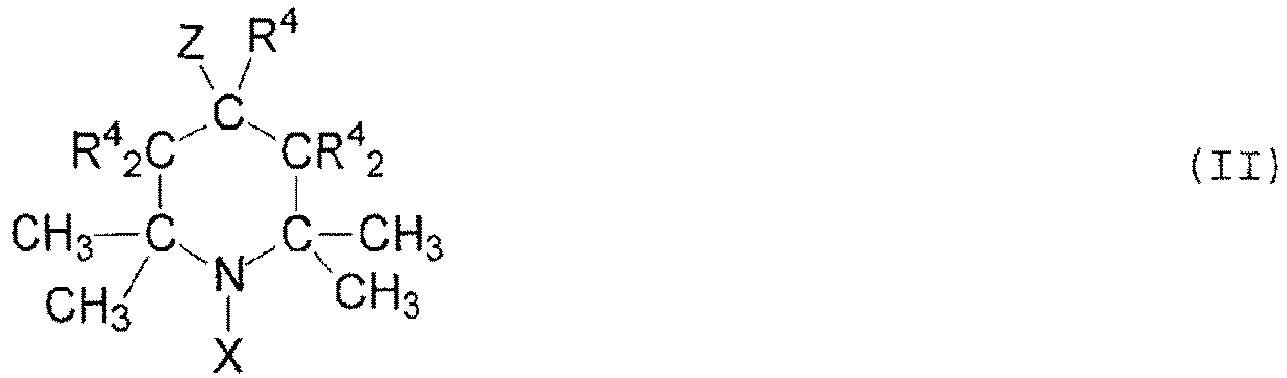 (B2) les composés organiques présentant au moins trois groupes fonctionnels de formule (II) et(B3) les composés organiques présentant au moins trois groupes fonctionnels, choisis parmi les groupes fonctionnels de formule (II) et les groupes hydroxyphényle le cas échéant substituésdans laquelleX représente un radical R3 monovalent lié par N, un radical -OR3 ou un radical -C(=O)R3 ou une liaison chimique à d'autres éléments structuraux de la molécule de stabilisant,Z représente un atome d'hydrogène, un radical -OR13 ou un groupe NR13 2,R3 peut être identique ou différent et représente un atome d'hydrogène ou un radical hydrocarboné monovalent, le cas échéant substitué, qui peut être interrompu par des atomes d'oxygène, des groupes ester ou des groupes amine,R13 peut être identique ou différent et présente une signification indiquée pour R3 ou une liaison chimique à d'autres éléments structuraux de la molécule de stabilisant etR4 peut être identique ou différent et représente un atome d'hydrogène ou un radical hydrocarboné monovalent, le cas échéant substitué,
 - Compositions de revêtement selon la revendication 1, caractérisées en ce qu'il s'agit, pour le stabilisant (B), de mélanges (B1) ou de composés organiques (B2).
- Compositions de revêtement selon la revendication 1 ou 2, caractérisées en ce qu'elles contiennent, en plus des composants (A) et (B), au moins un autre composant choisi parmi les diluants réactifs (C), les résines siliconées (D) et les plastifiants non réactifs (E).
- Compositions de revêtement selon l'une ou plusieurs des revendications 1 à 3, caractérisées en ce qu'elles contiennent, en plus des composants (A) et (B), au moins un autre composant choisi parmi les diluants réactifs (C) et les résines siliconées (D).
- Compositions de revêtement selon l'une ou plusieurs des revendications 1 à 4, caractérisées en ce qu'elles contiennent, en plus des composants (A) et (B), des diluants réactifs (C).
- Procédé pour la préparation des compositions selon l'une ou plusieurs des revendications 1 à 5 par mélange des différents composants dans un ordre quelconque.
- Procédé selon la revendication 6, caractérisé en ce qu'on prépare ce qu'on appelle un lot maître (MS), un ou plusieurs stabilisants de type HALS (B) étant dissous en une concentration d'au moins 5% en poids dans un ou plusieurs composants liquides de la composition de revêtement (BS).
- Procédé pour le revêtement de surfaces par application de la composition de revêtement (BS) selon l'une ou plusieurs des revendications 1 à 5 ou préparée selon la revendication 6 ou 7 sur la surface à revêtir.
- Procédé selon la revendication 8, caractérisé en ce qu'il s'agit, pour les surfaces sur lesquelles les compositions de revêtement (BS) peuvent être appliquées, de matériaux de construction minéraux, comme la pierre ou le béton, de métaux, de feutres de toiture, de matériaux synthétiques, de tissus fibreux, de bois, de verre ou de céramique.
- Procédé selon la revendication 8 ou 9, caractérisé en ce que les compositions de revêtement (BS) sont appliquées en une épaisseur de couche de 0,1 mm à 50 mm sur la surface à revêtir.
- Procédé selon l'une ou plusieurs des revendications 8 à 10, caractérisé en ce que les surfaces sont revêtues dans la zone externe de bâtiments.
- Corps façonnés, fabriqués par réticulation des compositions (BS) selon l'une ou plusieurs des revendications 1 à 5 ou préparées selon la revendication 6 ou 7.
- Corps façonnés selon la revendication 12, caractérisés en ce qu'il s'agit de revêtements.
Applications Claiming Priority (1)
| Application Number | Priority Date | Filing Date | Title |
|---|---|---|---|
| PCT/EP2017/083103 WO2019114990A1 (fr) | 2017-12-15 | 2017-12-15 | Composition de revêtement pour l'étanchéification de surfaces |
Publications (3)
| Publication Number | Publication Date |
|---|---|
| EP3662026A1 EP3662026A1 (fr) | 2020-06-10 |
| EP3662026B1 EP3662026B1 (fr) | 2020-11-04 |
| EP3662026B9 true EP3662026B9 (fr) | 2021-08-11 |
Family
ID=61054307
Family Applications (1)
| Application Number | Title | Priority Date | Filing Date |
|---|---|---|---|
| EP17835821.4A Active EP3662026B9 (fr) | 2017-12-15 | 2017-12-15 | Composition de revêtement pour l'étanchéification de surfaces |
Country Status (6)
| Country | Link |
|---|---|
| US (1) | US11643557B2 (fr) |
| EP (1) | EP3662026B9 (fr) |
| JP (1) | JP7035191B2 (fr) |
| KR (1) | KR102416921B1 (fr) |
| CN (1) | CN111465659B (fr) |
| WO (1) | WO2019114990A1 (fr) |
Families Citing this family (11)
| Publication number | Priority date | Publication date | Assignee | Title |
|---|---|---|---|---|
| DE102020117919A1 (de) | 2020-07-07 | 2022-01-13 | Franken Systems Gmbh | 2-Komponenten-Beschichtungszusammensetzung zur Bauwerksabdichtung |
| DE102020123563A1 (de) | 2020-09-09 | 2022-03-10 | Franken Systems Gmbh | Beschichtungszusammensetzungen zur Grundierung bituminöser Untergründe |
| DE102021107569A1 (de) | 2021-03-25 | 2022-09-29 | Franken Systems Gmbh | 2-Komponenten-Beschichtungszusammensetzung zur Bauwerksabdichtung mit Katalysator-Cokatalysator-System |
| DE202022103247U1 (de) | 2022-06-09 | 2022-06-30 | Franken Systems Gmbh | 2-Komponenten-Systeme und deren Verwendung als Spachtel- und Reparatur- und Ausgleichsmassen |
| DE102023110890A1 (de) | 2023-04-27 | 2024-10-31 | Franken Systems Gmbh | 2-Komponenten-Haftprimer zur Kombination mit Flüssigkunststoffen |
| KR102711774B1 (ko) * | 2024-01-23 | 2024-09-30 | 주식회사 성진엠텍 | 글라스 라이닝 조립식 소화조 및 그 시공방법 |
| DE102024109455A1 (de) | 2024-04-04 | 2025-10-09 | Franken Systems Gmbh | Haftprimer-Komposition zur Kombination mit Flüssigkunststoffen |
| EP4653509A1 (fr) | 2024-05-23 | 2025-11-26 | FRANKEN SYSTEMS GmbH | Matières plastiques liquides réactives contenant du graphite expansé |
| DE102025119929A1 (de) | 2024-05-23 | 2025-11-27 | Franken Systems Gmbh | Verfahren zur Sanierung von wärmegedämmten Flachdächern unter gleichzeitiger Verbesserung des Brandschutzes und Dachaufbau mit intumeszierender Dachbeschichtung |
| EP4653631A1 (fr) | 2024-05-23 | 2025-11-26 | FRANKEN SYSTEMS GmbH | Procédé de fabrication de toits plats isolés thermiquement avec protection contre l'incendie et structure de toit améliorée avec revêtement intumescent |
| DE202024103996U1 (de) | 2024-07-18 | 2024-09-18 | Franken Systems Gmbh | Abdichtung für Bauwerkdetails |
Family Cites Families (17)
| Publication number | Priority date | Publication date | Assignee | Title |
|---|---|---|---|---|
| DE19908562A1 (de) | 1998-03-25 | 1999-10-07 | Henkel Kgaa | Polyurethan und polyurethanhaltige Zubereitung |
| US20030082388A1 (en) * | 2001-07-23 | 2003-05-01 | General Electric Company | Stabilized polyorganosiloxane composition, method and coated bulb |
| DE10330288A1 (de) | 2003-07-04 | 2005-02-03 | Consortium für elektrochemische Industrie GmbH | Alkoxysilanterminierte Prepolymere |
| DE10355318A1 (de) | 2003-11-27 | 2005-06-23 | Wacker-Chemie Gmbh | Verfahren zur Herstellung von organyloxysilylterminierten Polymeren |
| DE102005029169A1 (de) | 2005-06-23 | 2006-12-28 | Wacker Chemie Ag | Kontinuierliche polymeranaloge Umsetzung von reaktiven Silanmonomeren mit funktionalisierten Polymeren |
| RU2420554C2 (ru) | 2006-02-14 | 2011-06-10 | Бостик С.А. | Однокомпонентная безводная композиция для покрытий, предназначенная для герметизации строительных конструкций и плоских крыш |
| US7781513B2 (en) | 2007-11-14 | 2010-08-24 | Momentive Performance Materials Inc. | Two-part moisture-curable resin composition and adhesive, sealant and coating compositions based thereon |
| DE102008042632A1 (de) | 2008-10-06 | 2010-04-08 | Wacker Chemie Ag | Vernetzbare Massen auf der Basis von Organosiliciumverbindungen |
| DE102008043825A1 (de) | 2008-11-18 | 2010-05-20 | Wacker Chemie Ag | Verfahren zum Abdichten von Oberflächen |
| DE102010028143A1 (de) | 2010-04-23 | 2011-10-27 | Wacker Chemie Ag | Beschichtungszusammensetzung zum Abdichten von Oberflächen |
| DE102011003425B4 (de) * | 2011-02-01 | 2015-01-08 | Henkel Ag & Co. Kgaa | Verwendung einer härtbaren Zusammensetzung mit kombinierten Stabilisatoren |
| US8859674B2 (en) * | 2011-03-31 | 2014-10-14 | Momentive Performance Materials Inc. | Moisture curable silylated polymer compositions with improved adhesion to concrete |
| US9920224B2 (en) * | 2012-01-30 | 2018-03-20 | Dow Global Technologies Llc | Water based primer composition for bonding glass into a structure |
| DE102012214427A1 (de) | 2012-08-14 | 2014-02-20 | Wacker Chemie Ag | Mehrkomponentige vernetzbare Massen auf Basis von organyloxy-silanterminierten Polymeren |
| JP6475615B2 (ja) * | 2013-05-30 | 2019-02-27 | 株式会社カネカ | 硬化性組成物およびその硬化物 |
| US20170015817A1 (en) * | 2014-03-31 | 2017-01-19 | Jnc Corporation | Silicon compound, resin composition for coating agent, molded article, and image display device |
| WO2017099154A1 (fr) | 2015-12-07 | 2017-06-15 | 株式会社カネカ | Composition durcissable et produit durci associé |
-
2017
- 2017-12-15 CN CN201780096742.0A patent/CN111465659B/zh active Active
- 2017-12-15 KR KR1020207014758A patent/KR102416921B1/ko active Active
- 2017-12-15 JP JP2020528230A patent/JP7035191B2/ja active Active
- 2017-12-15 WO PCT/EP2017/083103 patent/WO2019114990A1/fr not_active Ceased
- 2017-12-15 EP EP17835821.4A patent/EP3662026B9/fr active Active
- 2017-12-15 US US16/954,036 patent/US11643557B2/en active Active
Also Published As
| Publication number | Publication date |
|---|---|
| CN111465659B (zh) | 2022-09-27 |
| US11643557B2 (en) | 2023-05-09 |
| WO2019114990A1 (fr) | 2019-06-20 |
| KR102416921B1 (ko) | 2022-07-05 |
| JP2021506992A (ja) | 2021-02-22 |
| US20210079235A1 (en) | 2021-03-18 |
| KR20200074979A (ko) | 2020-06-25 |
| EP3662026A1 (fr) | 2020-06-10 |
| CN111465659A (zh) | 2020-07-28 |
| JP7035191B2 (ja) | 2022-03-14 |
| EP3662026B1 (fr) | 2020-11-04 |
Similar Documents
| Publication | Publication Date | Title |
|---|---|---|
| EP3662026B1 (fr) | Composition de revêtement pour l'étanchéification de surfaces | |
| EP2831192B1 (fr) | Matières réticulables à base de polymères à terminaison organyloxysilane | |
| EP3371270B1 (fr) | Matières réticulables à base de polymères à terminaison organyloxysilane | |
| EP2885339B1 (fr) | Matières réticulables comportant plusieurs constituants, à base de polymères à terminaison organyloxy-silane | |
| EP3149095B2 (fr) | Matières réticulables à base de polymères à terminaison organyloxysilane | |
| EP3131997B1 (fr) | Matières réticulables à base de polymères à terminaison organyloxysilane | |
| EP2744842B1 (fr) | Matières réticulables à base de polymères à terminaison organyloxysilane | |
| EP2918648B1 (fr) | Composition de revêtement destinée à étanchéifier des surfaces | |
| EP2812387B1 (fr) | Matières à base de polymères à terminaison organyloxysilane | |
| EP2931815B1 (fr) | Compositions réticulables à base de polymères à terminaison organyloxysilane | |
| EP3143071B1 (fr) | Matières réticulables à base de polymères à terminaison organyloxysilane | |
| DE102015201099A1 (de) | Vernetzbare Beschichtungsmassen auf Basis von organyloxysilanterminierten Polymeren | |
| DE102011006130B4 (de) | Vernetzbare Massen auf Basis von organyloxysilanterminierten Polymeren, Verfahren zur Herstellung und Verwendung als Kleb- und Dichtstoffe sowie aus den Massen erhältliche Formkörper | |
| DE102011006128A1 (de) | Vernetzbare Massen auf Basis von Organyloxysilanterminierten Polymeren | |
| WO2025040232A1 (fr) | Compositions réticulables à base de polymères à terminaison organyloxysilane | |
| EP4263717A1 (fr) | Procédé de production de matériaux réticulables à base de polymères à terminaison organyloxysilane |
Legal Events
| Date | Code | Title | Description |
|---|---|---|---|
| STAA | Information on the status of an ep patent application or granted ep patent |
Free format text: STATUS: UNKNOWN |
|
| STAA | Information on the status of an ep patent application or granted ep patent |
Free format text: STATUS: THE INTERNATIONAL PUBLICATION HAS BEEN MADE |
|
| PUAI | Public reference made under article 153(3) epc to a published international application that has entered the european phase |
Free format text: ORIGINAL CODE: 0009012 |
|
| STAA | Information on the status of an ep patent application or granted ep patent |
Free format text: STATUS: REQUEST FOR EXAMINATION WAS MADE |
|
| 17P | Request for examination filed |
Effective date: 20200306 |
|
| AK | Designated contracting states |
Kind code of ref document: A1 Designated state(s): AL AT BE BG CH CY CZ DE DK EE ES FI FR GB GR HR HU IE IS IT LI LT LU LV MC MK MT NL NO PL PT RO RS SE SI SK SM TR |
|
| AX | Request for extension of the european patent |
Extension state: BA ME |
|
| GRAP | Despatch of communication of intention to grant a patent |
Free format text: ORIGINAL CODE: EPIDOSNIGR1 |
|
| STAA | Information on the status of an ep patent application or granted ep patent |
Free format text: STATUS: GRANT OF PATENT IS INTENDED |
|
| INTG | Intention to grant announced |
Effective date: 20200626 |
|
| GRAS | Grant fee paid |
Free format text: ORIGINAL CODE: EPIDOSNIGR3 |
|
| GRAA | (expected) grant |
Free format text: ORIGINAL CODE: 0009210 |
|
| STAA | Information on the status of an ep patent application or granted ep patent |
Free format text: STATUS: THE PATENT HAS BEEN GRANTED |
|
| AK | Designated contracting states |
Kind code of ref document: B1 Designated state(s): AL AT BE BG CH CY CZ DE DK EE ES FI FR GB GR HR HU IE IS IT LI LT LU LV MC MK MT NL NO PL PT RO RS SE SI SK SM TR |
|
| DAV | Request for validation of the european patent (deleted) | ||
| DAX | Request for extension of the european patent (deleted) | ||
| REG | Reference to a national code |
Ref country code: GB Ref legal event code: FG4D Free format text: NOT ENGLISH |
|
| REG | Reference to a national code |
Ref country code: CH Ref legal event code: EP |
|
| REG | Reference to a national code |
Ref country code: AT Ref legal event code: REF Ref document number: 1330802 Country of ref document: AT Kind code of ref document: T Effective date: 20201115 |
|
| REG | Reference to a national code |
Ref country code: IE Ref legal event code: FG4D Free format text: LANGUAGE OF EP DOCUMENT: GERMAN |
|
| REG | Reference to a national code |
Ref country code: DE Ref legal event code: R096 Ref document number: 502017008102 Country of ref document: DE |
|
| GRAT | Correction requested after decision to grant or after decision to maintain patent in amended form |
Free format text: ORIGINAL CODE: EPIDOSNCDEC |
|
| REG | Reference to a national code |
Ref country code: NL Ref legal event code: FP |
|
| PG25 | Lapsed in a contracting state [announced via postgrant information from national office to epo] |
Ref country code: NO Free format text: LAPSE BECAUSE OF FAILURE TO SUBMIT A TRANSLATION OF THE DESCRIPTION OR TO PAY THE FEE WITHIN THE PRESCRIBED TIME-LIMIT Effective date: 20210204 Ref country code: GR Free format text: LAPSE BECAUSE OF FAILURE TO SUBMIT A TRANSLATION OF THE DESCRIPTION OR TO PAY THE FEE WITHIN THE PRESCRIBED TIME-LIMIT Effective date: 20210205 Ref country code: FI Free format text: LAPSE BECAUSE OF FAILURE TO SUBMIT A TRANSLATION OF THE DESCRIPTION OR TO PAY THE FEE WITHIN THE PRESCRIBED TIME-LIMIT Effective date: 20201104 Ref country code: RS Free format text: LAPSE BECAUSE OF FAILURE TO SUBMIT A TRANSLATION OF THE DESCRIPTION OR TO PAY THE FEE WITHIN THE PRESCRIBED TIME-LIMIT Effective date: 20201104 Ref country code: PT Free format text: LAPSE BECAUSE OF FAILURE TO SUBMIT A TRANSLATION OF THE DESCRIPTION OR TO PAY THE FEE WITHIN THE PRESCRIBED TIME-LIMIT Effective date: 20210304 |
|
| PG25 | Lapsed in a contracting state [announced via postgrant information from national office to epo] |
Ref country code: IS Free format text: LAPSE BECAUSE OF FAILURE TO SUBMIT A TRANSLATION OF THE DESCRIPTION OR TO PAY THE FEE WITHIN THE PRESCRIBED TIME-LIMIT Effective date: 20210304 Ref country code: PL Free format text: LAPSE BECAUSE OF FAILURE TO SUBMIT A TRANSLATION OF THE DESCRIPTION OR TO PAY THE FEE WITHIN THE PRESCRIBED TIME-LIMIT Effective date: 20201104 Ref country code: LV Free format text: LAPSE BECAUSE OF FAILURE TO SUBMIT A TRANSLATION OF THE DESCRIPTION OR TO PAY THE FEE WITHIN THE PRESCRIBED TIME-LIMIT Effective date: 20201104 Ref country code: SE Free format text: LAPSE BECAUSE OF FAILURE TO SUBMIT A TRANSLATION OF THE DESCRIPTION OR TO PAY THE FEE WITHIN THE PRESCRIBED TIME-LIMIT Effective date: 20201104 Ref country code: BG Free format text: LAPSE BECAUSE OF FAILURE TO SUBMIT A TRANSLATION OF THE DESCRIPTION OR TO PAY THE FEE WITHIN THE PRESCRIBED TIME-LIMIT Effective date: 20210204 Ref country code: ES Free format text: LAPSE BECAUSE OF FAILURE TO SUBMIT A TRANSLATION OF THE DESCRIPTION OR TO PAY THE FEE WITHIN THE PRESCRIBED TIME-LIMIT Effective date: 20201104 |
|
| REG | Reference to a national code |
Ref country code: LT Ref legal event code: MG9D |
|
| PG25 | Lapsed in a contracting state [announced via postgrant information from national office to epo] |
Ref country code: HR Free format text: LAPSE BECAUSE OF FAILURE TO SUBMIT A TRANSLATION OF THE DESCRIPTION OR TO PAY THE FEE WITHIN THE PRESCRIBED TIME-LIMIT Effective date: 20201104 |
|
| PG25 | Lapsed in a contracting state [announced via postgrant information from national office to epo] |
Ref country code: RO Free format text: LAPSE BECAUSE OF FAILURE TO SUBMIT A TRANSLATION OF THE DESCRIPTION OR TO PAY THE FEE WITHIN THE PRESCRIBED TIME-LIMIT Effective date: 20201104 Ref country code: SK Free format text: LAPSE BECAUSE OF FAILURE TO SUBMIT A TRANSLATION OF THE DESCRIPTION OR TO PAY THE FEE WITHIN THE PRESCRIBED TIME-LIMIT Effective date: 20201104 Ref country code: CZ Free format text: LAPSE BECAUSE OF FAILURE TO SUBMIT A TRANSLATION OF THE DESCRIPTION OR TO PAY THE FEE WITHIN THE PRESCRIBED TIME-LIMIT Effective date: 20201104 Ref country code: EE Free format text: LAPSE BECAUSE OF FAILURE TO SUBMIT A TRANSLATION OF THE DESCRIPTION OR TO PAY THE FEE WITHIN THE PRESCRIBED TIME-LIMIT Effective date: 20201104 Ref country code: LT Free format text: LAPSE BECAUSE OF FAILURE TO SUBMIT A TRANSLATION OF THE DESCRIPTION OR TO PAY THE FEE WITHIN THE PRESCRIBED TIME-LIMIT Effective date: 20201104 Ref country code: SM Free format text: LAPSE BECAUSE OF FAILURE TO SUBMIT A TRANSLATION OF THE DESCRIPTION OR TO PAY THE FEE WITHIN THE PRESCRIBED TIME-LIMIT Effective date: 20201104 |
|
| REG | Reference to a national code |
Ref country code: CH Ref legal event code: PL |
|
| REG | Reference to a national code |
Ref country code: DE Ref legal event code: R097 Ref document number: 502017008102 Country of ref document: DE |
|
| PG25 | Lapsed in a contracting state [announced via postgrant information from national office to epo] |
Ref country code: DK Free format text: LAPSE BECAUSE OF FAILURE TO SUBMIT A TRANSLATION OF THE DESCRIPTION OR TO PAY THE FEE WITHIN THE PRESCRIBED TIME-LIMIT Effective date: 20201104 Ref country code: MC Free format text: LAPSE BECAUSE OF FAILURE TO SUBMIT A TRANSLATION OF THE DESCRIPTION OR TO PAY THE FEE WITHIN THE PRESCRIBED TIME-LIMIT Effective date: 20201104 |
|
| PLBE | No opposition filed within time limit |
Free format text: ORIGINAL CODE: 0009261 |
|
| STAA | Information on the status of an ep patent application or granted ep patent |
Free format text: STATUS: NO OPPOSITION FILED WITHIN TIME LIMIT |
|
| 26N | No opposition filed |
Effective date: 20210805 |
|
| PG25 | Lapsed in a contracting state [announced via postgrant information from national office to epo] |
Ref country code: LU Free format text: LAPSE BECAUSE OF NON-PAYMENT OF DUE FEES Effective date: 20201215 Ref country code: AL Free format text: LAPSE BECAUSE OF FAILURE TO SUBMIT A TRANSLATION OF THE DESCRIPTION OR TO PAY THE FEE WITHIN THE PRESCRIBED TIME-LIMIT Effective date: 20201104 Ref country code: IE Free format text: LAPSE BECAUSE OF NON-PAYMENT OF DUE FEES Effective date: 20201215 |
|
| PG25 | Lapsed in a contracting state [announced via postgrant information from national office to epo] |
Ref country code: LI Free format text: LAPSE BECAUSE OF NON-PAYMENT OF DUE FEES Effective date: 20201231 Ref country code: CH Free format text: LAPSE BECAUSE OF NON-PAYMENT OF DUE FEES Effective date: 20201231 Ref country code: SI Free format text: LAPSE BECAUSE OF FAILURE TO SUBMIT A TRANSLATION OF THE DESCRIPTION OR TO PAY THE FEE WITHIN THE PRESCRIBED TIME-LIMIT Effective date: 20201104 |
|
| PG25 | Lapsed in a contracting state [announced via postgrant information from national office to epo] |
Ref country code: IS Free format text: LAPSE BECAUSE OF FAILURE TO SUBMIT A TRANSLATION OF THE DESCRIPTION OR TO PAY THE FEE WITHIN THE PRESCRIBED TIME-LIMIT Effective date: 20210304 Ref country code: TR Free format text: LAPSE BECAUSE OF FAILURE TO SUBMIT A TRANSLATION OF THE DESCRIPTION OR TO PAY THE FEE WITHIN THE PRESCRIBED TIME-LIMIT Effective date: 20201104 Ref country code: MT Free format text: LAPSE BECAUSE OF FAILURE TO SUBMIT A TRANSLATION OF THE DESCRIPTION OR TO PAY THE FEE WITHIN THE PRESCRIBED TIME-LIMIT Effective date: 20201104 Ref country code: CY Free format text: LAPSE BECAUSE OF FAILURE TO SUBMIT A TRANSLATION OF THE DESCRIPTION OR TO PAY THE FEE WITHIN THE PRESCRIBED TIME-LIMIT Effective date: 20201104 |
|
| PG25 | Lapsed in a contracting state [announced via postgrant information from national office to epo] |
Ref country code: MK Free format text: LAPSE BECAUSE OF FAILURE TO SUBMIT A TRANSLATION OF THE DESCRIPTION OR TO PAY THE FEE WITHIN THE PRESCRIBED TIME-LIMIT Effective date: 20201104 |
|
| P01 | Opt-out of the competence of the unified patent court (upc) registered |
Effective date: 20230519 |
|
| REG | Reference to a national code |
Ref country code: AT Ref legal event code: MM01 Ref document number: 1330802 Country of ref document: AT Kind code of ref document: T Effective date: 20221215 |
|
| PG25 | Lapsed in a contracting state [announced via postgrant information from national office to epo] |
Ref country code: AT Free format text: LAPSE BECAUSE OF NON-PAYMENT OF DUE FEES Effective date: 20221215 |
|
| PG25 | Lapsed in a contracting state [announced via postgrant information from national office to epo] |
Ref country code: AT Free format text: LAPSE BECAUSE OF NON-PAYMENT OF DUE FEES Effective date: 20221215 |
|
| REG | Reference to a national code |
Ref country code: DE Ref legal event code: R081 Ref document number: 502017008102 Country of ref document: DE Owner name: WACKER CHEMIE AG, DE Free format text: FORMER OWNERS: BASF SE, 67063 LUDWIGSHAFEN, DE; WACKER CHEMIE AG, 81737 MUENCHEN, DE Ref country code: DE Ref legal event code: R081 Ref document number: 502017008102 Country of ref document: DE Owner name: BASF SE, DE Free format text: FORMER OWNERS: BASF SE, 67063 LUDWIGSHAFEN, DE; WACKER CHEMIE AG, 81737 MUENCHEN, DE |
|
| PGFP | Annual fee paid to national office [announced via postgrant information from national office to epo] |
Ref country code: DE Payment date: 20251211 Year of fee payment: 9 |
|
| PGFP | Annual fee paid to national office [announced via postgrant information from national office to epo] |
Ref country code: GB Payment date: 20251219 Year of fee payment: 9 |
|
| PGFP | Annual fee paid to national office [announced via postgrant information from national office to epo] |
Ref country code: IT Payment date: 20251223 Year of fee payment: 9 |
|
| PGFP | Annual fee paid to national office [announced via postgrant information from national office to epo] |
Ref country code: NL Payment date: 20251219 Year of fee payment: 9 Ref country code: FR Payment date: 20251229 Year of fee payment: 9 |
|
| PGFP | Annual fee paid to national office [announced via postgrant information from national office to epo] |
Ref country code: BE Payment date: 20251219 Year of fee payment: 9 |
|
| PGFP | Annual fee paid to national office [announced via postgrant information from national office to epo] |
Ref country code: AT Payment date: 20260410 Year of fee payment: 5 |