EP3662466B1 - Commande active de bruit de route - Google Patents
Commande active de bruit de route Download PDFInfo
- Publication number
- EP3662466B1 EP3662466B1 EP17754100.0A EP17754100A EP3662466B1 EP 3662466 B1 EP3662466 B1 EP 3662466B1 EP 17754100 A EP17754100 A EP 17754100A EP 3662466 B1 EP3662466 B1 EP 3662466B1
- Authority
- EP
- European Patent Office
- Prior art keywords
- noise
- vehicle
- signal
- road
- sound
- Prior art date
- Legal status (The legal status is an assumption and is not a legal conclusion. Google has not performed a legal analysis and makes no representation as to the accuracy of the status listed.)
- Active
Links
Images

Classifications
-
- G—PHYSICS
- G10—MUSICAL INSTRUMENTS; ACOUSTICS
- G10K—SOUND-PRODUCING DEVICES; METHODS OR DEVICES FOR PROTECTING AGAINST, OR FOR DAMPING, NOISE OR OTHER ACOUSTIC WAVES IN GENERAL; ACOUSTICS NOT OTHERWISE PROVIDED FOR
- G10K11/00—Methods or devices for transmitting, conducting or directing sound in general; Methods or devices for protecting against, or for damping, noise or other acoustic waves in general
- G10K11/16—Methods or devices for protecting against, or for damping, noise or other acoustic waves in general
- G10K11/175—Methods or devices for protecting against, or for damping, noise or other acoustic waves in general using interference effects; Masking sound
- G10K11/178—Methods or devices for protecting against, or for damping, noise or other acoustic waves in general using interference effects; Masking sound by electro-acoustically regenerating the original acoustic waves in anti-phase
- G10K11/1787—General system configurations
- G10K11/17879—General system configurations using both a reference signal and an error signal
- G10K11/17881—General system configurations using both a reference signal and an error signal the reference signal being an acoustic signal, e.g. recorded with a microphone
-
- G—PHYSICS
- G10—MUSICAL INSTRUMENTS; ACOUSTICS
- G10K—SOUND-PRODUCING DEVICES; METHODS OR DEVICES FOR PROTECTING AGAINST, OR FOR DAMPING, NOISE OR OTHER ACOUSTIC WAVES IN GENERAL; ACOUSTICS NOT OTHERWISE PROVIDED FOR
- G10K11/00—Methods or devices for transmitting, conducting or directing sound in general; Methods or devices for protecting against, or for damping, noise or other acoustic waves in general
- G10K11/16—Methods or devices for protecting against, or for damping, noise or other acoustic waves in general
- G10K11/175—Methods or devices for protecting against, or for damping, noise or other acoustic waves in general using interference effects; Masking sound
- G10K11/178—Methods or devices for protecting against, or for damping, noise or other acoustic waves in general using interference effects; Masking sound by electro-acoustically regenerating the original acoustic waves in anti-phase
- G10K11/1785—Methods, e.g. algorithms; Devices
- G10K11/17853—Methods, e.g. algorithms; Devices of the filter
- G10K11/17854—Methods, e.g. algorithms; Devices of the filter the filter being an adaptive filter
-
- G—PHYSICS
- G10—MUSICAL INSTRUMENTS; ACOUSTICS
- G10K—SOUND-PRODUCING DEVICES; METHODS OR DEVICES FOR PROTECTING AGAINST, OR FOR DAMPING, NOISE OR OTHER ACOUSTIC WAVES IN GENERAL; ACOUSTICS NOT OTHERWISE PROVIDED FOR
- G10K11/00—Methods or devices for transmitting, conducting or directing sound in general; Methods or devices for protecting against, or for damping, noise or other acoustic waves in general
- G10K11/16—Methods or devices for protecting against, or for damping, noise or other acoustic waves in general
- G10K11/175—Methods or devices for protecting against, or for damping, noise or other acoustic waves in general using interference effects; Masking sound
- G10K11/178—Methods or devices for protecting against, or for damping, noise or other acoustic waves in general using interference effects; Masking sound by electro-acoustically regenerating the original acoustic waves in anti-phase
- G10K11/1781—Methods or devices for protecting against, or for damping, noise or other acoustic waves in general using interference effects; Masking sound by electro-acoustically regenerating the original acoustic waves in anti-phase characterised by the analysis of input or output signals, e.g. frequency range, modes, transfer functions
- G10K11/17821—Methods or devices for protecting against, or for damping, noise or other acoustic waves in general using interference effects; Masking sound by electro-acoustically regenerating the original acoustic waves in anti-phase characterised by the analysis of input or output signals, e.g. frequency range, modes, transfer functions characterised by the analysis of the input signals only
- G10K11/17823—Reference signals, e.g. ambient acoustic environment
-
- G—PHYSICS
- G10—MUSICAL INSTRUMENTS; ACOUSTICS
- G10K—SOUND-PRODUCING DEVICES; METHODS OR DEVICES FOR PROTECTING AGAINST, OR FOR DAMPING, NOISE OR OTHER ACOUSTIC WAVES IN GENERAL; ACOUSTICS NOT OTHERWISE PROVIDED FOR
- G10K11/00—Methods or devices for transmitting, conducting or directing sound in general; Methods or devices for protecting against, or for damping, noise or other acoustic waves in general
- G10K11/16—Methods or devices for protecting against, or for damping, noise or other acoustic waves in general
- G10K11/175—Methods or devices for protecting against, or for damping, noise or other acoustic waves in general using interference effects; Masking sound
- G10K11/178—Methods or devices for protecting against, or for damping, noise or other acoustic waves in general using interference effects; Masking sound by electro-acoustically regenerating the original acoustic waves in anti-phase
- G10K11/1787—General system configurations
- G10K11/17873—General system configurations using a reference signal without an error signal, e.g. pure feedforward
-
- G—PHYSICS
- G10—MUSICAL INSTRUMENTS; ACOUSTICS
- G10K—SOUND-PRODUCING DEVICES; METHODS OR DEVICES FOR PROTECTING AGAINST, OR FOR DAMPING, NOISE OR OTHER ACOUSTIC WAVES IN GENERAL; ACOUSTICS NOT OTHERWISE PROVIDED FOR
- G10K11/00—Methods or devices for transmitting, conducting or directing sound in general; Methods or devices for protecting against, or for damping, noise or other acoustic waves in general
- G10K11/16—Methods or devices for protecting against, or for damping, noise or other acoustic waves in general
- G10K11/175—Methods or devices for protecting against, or for damping, noise or other acoustic waves in general using interference effects; Masking sound
- G10K11/178—Methods or devices for protecting against, or for damping, noise or other acoustic waves in general using interference effects; Masking sound by electro-acoustically regenerating the original acoustic waves in anti-phase
- G10K11/1787—General system configurations
- G10K11/17875—General system configurations using an error signal without a reference signal, e.g. pure feedback
-
- H—ELECTRICITY
- H04—ELECTRIC COMMUNICATION TECHNIQUE
- H04R—LOUDSPEAKERS, MICROPHONES, GRAMOPHONE PICK-UPS OR LIKE ACOUSTIC ELECTROMECHANICAL TRANSDUCERS; ELECTRIC HEARING AIDS; PUBLIC ADDRESS SYSTEMS
- H04R1/00—Details of transducers, loudspeakers or microphones
- H04R1/02—Casings; Cabinets ; Supports therefor; Mountings therein
- H04R1/025—Arrangements for fixing loudspeaker transducers, e.g. in a box, furniture
-
- H—ELECTRICITY
- H04—ELECTRIC COMMUNICATION TECHNIQUE
- H04R—LOUDSPEAKERS, MICROPHONES, GRAMOPHONE PICK-UPS OR LIKE ACOUSTIC ELECTROMECHANICAL TRANSDUCERS; ELECTRIC HEARING AIDS; PUBLIC ADDRESS SYSTEMS
- H04R1/00—Details of transducers, loudspeakers or microphones
- H04R1/20—Arrangements for obtaining desired frequency or directional characteristics
- H04R1/32—Arrangements for obtaining desired frequency or directional characteristics for obtaining desired directional characteristic only
- H04R1/40—Arrangements for obtaining desired frequency or directional characteristics for obtaining desired directional characteristic only by combining a number of identical transducers
- H04R1/406—Arrangements for obtaining desired frequency or directional characteristics for obtaining desired directional characteristic only by combining a number of identical transducers microphones
-
- H—ELECTRICITY
- H04—ELECTRIC COMMUNICATION TECHNIQUE
- H04R—LOUDSPEAKERS, MICROPHONES, GRAMOPHONE PICK-UPS OR LIKE ACOUSTIC ELECTROMECHANICAL TRANSDUCERS; ELECTRIC HEARING AIDS; PUBLIC ADDRESS SYSTEMS
- H04R3/00—Circuits for transducers
- H04R3/005—Circuits for transducers for combining the signals of two or more microphones
-
- G—PHYSICS
- G10—MUSICAL INSTRUMENTS; ACOUSTICS
- G10K—SOUND-PRODUCING DEVICES; METHODS OR DEVICES FOR PROTECTING AGAINST, OR FOR DAMPING, NOISE OR OTHER ACOUSTIC WAVES IN GENERAL; ACOUSTICS NOT OTHERWISE PROVIDED FOR
- G10K11/00—Methods or devices for transmitting, conducting or directing sound in general; Methods or devices for protecting against, or for damping, noise or other acoustic waves in general
- G10K11/18—Methods or devices for transmitting, conducting or directing sound
- G10K11/26—Sound-focusing or directing, e.g. scanning
- G10K11/34—Sound-focusing or directing, e.g. scanning using electrical steering of transducer arrays, e.g. beam steering
- G10K11/341—Circuits therefor
- G10K11/346—Circuits therefor using phase variation
-
- G—PHYSICS
- G10—MUSICAL INSTRUMENTS; ACOUSTICS
- G10K—SOUND-PRODUCING DEVICES; METHODS OR DEVICES FOR PROTECTING AGAINST, OR FOR DAMPING, NOISE OR OTHER ACOUSTIC WAVES IN GENERAL; ACOUSTICS NOT OTHERWISE PROVIDED FOR
- G10K11/00—Methods or devices for transmitting, conducting or directing sound in general; Methods or devices for protecting against, or for damping, noise or other acoustic waves in general
- G10K11/18—Methods or devices for transmitting, conducting or directing sound
- G10K11/26—Sound-focusing or directing, e.g. scanning
- G10K11/34—Sound-focusing or directing, e.g. scanning using electrical steering of transducer arrays, e.g. beam steering
- G10K11/341—Circuits therefor
- G10K11/348—Circuits therefor using amplitude variation
-
- G—PHYSICS
- G10—MUSICAL INSTRUMENTS; ACOUSTICS
- G10K—SOUND-PRODUCING DEVICES; METHODS OR DEVICES FOR PROTECTING AGAINST, OR FOR DAMPING, NOISE OR OTHER ACOUSTIC WAVES IN GENERAL; ACOUSTICS NOT OTHERWISE PROVIDED FOR
- G10K2210/00—Details of active noise control [ANC] covered by G10K11/178 but not provided for in any of its subgroups
- G10K2210/10—Applications
- G10K2210/128—Vehicles
- G10K2210/1282—Automobiles
- G10K2210/12821—Rolling noise; Wind and body noise
-
- G—PHYSICS
- G10—MUSICAL INSTRUMENTS; ACOUSTICS
- G10K—SOUND-PRODUCING DEVICES; METHODS OR DEVICES FOR PROTECTING AGAINST, OR FOR DAMPING, NOISE OR OTHER ACOUSTIC WAVES IN GENERAL; ACOUSTICS NOT OTHERWISE PROVIDED FOR
- G10K2210/00—Details of active noise control [ANC] covered by G10K11/178 but not provided for in any of its subgroups
- G10K2210/30—Means
- G10K2210/301—Computational
- G10K2210/3026—Feedback
-
- G—PHYSICS
- G10—MUSICAL INSTRUMENTS; ACOUSTICS
- G10K—SOUND-PRODUCING DEVICES; METHODS OR DEVICES FOR PROTECTING AGAINST, OR FOR DAMPING, NOISE OR OTHER ACOUSTIC WAVES IN GENERAL; ACOUSTICS NOT OTHERWISE PROVIDED FOR
- G10K2210/00—Details of active noise control [ANC] covered by G10K11/178 but not provided for in any of its subgroups
- G10K2210/30—Means
- G10K2210/301—Computational
- G10K2210/3027—Feedforward
-
- G—PHYSICS
- G10—MUSICAL INSTRUMENTS; ACOUSTICS
- G10K—SOUND-PRODUCING DEVICES; METHODS OR DEVICES FOR PROTECTING AGAINST, OR FOR DAMPING, NOISE OR OTHER ACOUSTIC WAVES IN GENERAL; ACOUSTICS NOT OTHERWISE PROVIDED FOR
- G10K2210/00—Details of active noise control [ANC] covered by G10K11/178 but not provided for in any of its subgroups
- G10K2210/30—Means
- G10K2210/301—Computational
- G10K2210/3028—Filtering, e.g. Kalman filters or special analogue or digital filters
-
- G—PHYSICS
- G10—MUSICAL INSTRUMENTS; ACOUSTICS
- G10K—SOUND-PRODUCING DEVICES; METHODS OR DEVICES FOR PROTECTING AGAINST, OR FOR DAMPING, NOISE OR OTHER ACOUSTIC WAVES IN GENERAL; ACOUSTICS NOT OTHERWISE PROVIDED FOR
- G10K2210/00—Details of active noise control [ANC] covered by G10K11/178 but not provided for in any of its subgroups
- G10K2210/30—Means
- G10K2210/301—Computational
- G10K2210/3046—Multiple acoustic inputs, multiple acoustic outputs
-
- H—ELECTRICITY
- H04—ELECTRIC COMMUNICATION TECHNIQUE
- H04R—LOUDSPEAKERS, MICROPHONES, GRAMOPHONE PICK-UPS OR LIKE ACOUSTIC ELECTROMECHANICAL TRANSDUCERS; ELECTRIC HEARING AIDS; PUBLIC ADDRESS SYSTEMS
- H04R2499/00—Aspects covered by H04R or H04S not otherwise provided for in their subgroups
- H04R2499/10—General applications
- H04R2499/13—Acoustic transducers and sound field adaptation in vehicles
Definitions
- the disclosure relates to active road noise control systems and methods (generally referred to as "systems").
- Document EP 3 188 181 A1 discloses an active noise cancellation system that includes a source separation algorithm.
- the source separation algorithm enables the identification of acoustic inputs from a particular sound source based on a reference signal generated with one or more microphones. Consequently, the identified acoustic inputs can be cancelled or damped in a targeted listening location via an acoustic correction signal, where the acoustic correction signal is generated based on a sound source separated from the reference signal.
- the reference signal can be generated with a microphone, even though such a reference signal may include a combination of multiple acoustic inputs.
- noise sources that cannot be individually measured, for example with an accelerometer mounted to a vibrating structure, can still be identified and actively cancelled.
- Document WO 97/08683 A1 discloses an active noise control system with a plurality of error sensor arrays which provide signals on lines to beam forming and beam steering logic which cause the to exhibit acoustic response profiles, respectively.
- the profiles intersect in a predefined region to be quieted.
- the logic provides signals on lines, one for each region to be quieted, to active noise control logic which also receives inputs from feedforward sensing microphones and provides output signals to acoustic speakers which generate anti-noise to cancel the noise in the quiet region.
- the quiet region may be selectively positioned to any region in the room by steering the beams.
- the system may have a plurality of distributed sensors which, when taken together, have an overall maximum (main lobe) acoustic response at a predetermined selectable quiet region.
- Land based vehicles when driven on roads and other surfaces, generate noise known as road noise.
- road noise Even in modern vehicles, cabin occupants may be exposed to road noise that is transmitted through the structure, e.g. tires-suspension-body-cabin path, and through airborne paths, e.g. tires-body-cabin path, to the cabin.
- Active noise, vibration, and harshness (NVH) control technologies also known as active road noise control (RNC) systems, can be used to reduce these noise components without modifying the vehicle's structure as in active vibration technologies.
- NRC active road noise control
- active road noise control technologies may employ complex noise sensor arrangements throughout the vehicle structure in order to properly observe road noise related signals, particularly signals related to road noise originating from moving parts such as rolling wheels. It is desirable to reduce the road noise experienced by cabin occupants more efficiently.
- An active road noise control system for a vehicle includes a noise sensing microphone array configured to generate a multiplicity of noise sense signals representative of road noise originating from road noise sources in or at the vehicle, wherein the noise sensing microphone array comprises at least three microphones arranged in a line or plane at or around a wheel arch, and one or two beamformers configured to process the multiplicity of noise sense signals to generate a first reference signal and a second reference signal, and to provide, in connection with the noise sensing microphone array, a sensitivity characteristic that comprises two main lobes, one main lobe being directed to a first road noise source representing noise that originates from a boundary between the wheel and a road, and the other main lobe being directed to a second noise source representing noise that originates from a hub of the wheel.
- the system further includes an error microphone arrangement configured to pick up sound at or close to the listening position and to provide an error signal representative of the picked-up sound, wherein the error microphone arrangement comprises one or more microphones.
- the system further includes a first active road noise control filter configured to iteratively and adaptively process the first reference signal and the error signal to provide a first noise reducing signal, and a second active road noise control filter configured to iteratively and adaptively process the second reference signal and the error signal to provide a second noise reducing signal.
- the system further includes a first loudspeaker arrangement disposed in an interior of the vehicle and configured to generate, from the noise reducing signal, noise reducing sound at a listening position in the interior of the vehicle, the first loudspeaker arrangement comprising one or more loudspeakers, and a second loudspeaker arrangement disposed in the interior of the vehicle and configured to generate, from the second noise reducing signal, noise reducing sound at the listening position in the interior of the vehicle, the second loudspeaker arrangement comprising one or more loudspeakers.
- An active road noise control method for a vehicle includes picking up noise at a multiplicity of positions in or on the vehicle by means of a noise sensing microphone array, the noise sensing microphone array comprising a multiplicity of microphones, and generating a multiplicity of noise sense signals representative of road noise originating from road noise sources in or at the vehicle, wherein the noise sensing microphone array, and processing according to one or two beamforming schemes the multiplicity of noise sense signals to generate a first reference signal and a second reference signal, and to provide a sensitivity characteristic for picking up the noise that comprises two main lobes, one main lobe being directed to a first road noise source representing noise that originates from a boundary between the wheel and a road, and the other main lobe being directed to a second noise source representing noise that originates from a hub of the wheel.
- the method further includes picking up sound at or close to the listening position and providing an error signal representative of the picked-up sound by means of an error microphone arrangement, wherein the error microphone arrangement comprises one or more microphones.
- the method further includes iteratively and adaptively processing the first reference signal and the error signal to provide a first noise reducing signal, and iteratively and adaptively processing the second reference signal and the error signal to provide a second noise reducing signal.
- the method further includes generating at a first position in an interior of the vehicle, from the first noise reducing signal, noise reducing sound at a listening position in the interior of the vehicle, and generating at a second position in the interior of the vehicle, from the second noise reducing signal, second noise reducing sound at the listening position in the interior of the vehicle.
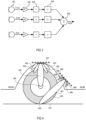
- airborne road noise from one or more road noise sources 101 is monitored with acoustic sensors or an array of acoustic sensors (herein also referred to as noise sensing arrays or noise sensing microphone arrays) such as, e.g., one or more arrays of noise sensing microphones 102 that each picks up airborne road noise and generates corresponding noise sense signals.
- the noise sense signals are pre-processed, e.g., with a single or multi-channel beamformer 103, and serve upon pre-processing as one or more reference signals for a road noise control 104.
- an (optional) arrangement with one or more error microphones 105 may be placed in close proximity of a listening position within an interior of the vehicle, to provide additionally one or more error signals for the road noise control 104.
- the airborne road noise from road noise source 101 transferred via one or more primary paths 106 interferes (is summed up) with noise reducing sound from the noise control 104 transferred via one or more secondary paths 107.
- the active road noise control 104 may include, e.g., one or more noise reduction filters employed in a feedforward noise control structure or in a structure including a feedforward noise control structure, and may iteratively and adaptively process the one or more reference signals and (optionally) the one or more error signals to provide a noise reducing signal to a loudspeaker arrangement that includes one or more loudspeakers in the interior of the vehicle to generate noise reducing sound.
- one or more noise reduction filters employed in a feedforward noise control structure or in a structure including a feedforward noise control structure, and may iteratively and adaptively process the one or more reference signals and (optionally) the one or more error signals to provide a noise reducing signal to a loudspeaker arrangement that includes one or more loudspeakers in the interior of the vehicle to generate noise reducing sound.
- the noise reduction filters may be iteratively and adaptively tuned to achieve maximum noise reduction or noise cancellation so that, at the arrangement with one or more error microphones 105, the airborne road noise from the road noise source 101 transferred via the one or more primary paths 106 is destructively superimposed with the noise reducing sound from noise control 104 transferred via the one or more secondary paths 107.
- the noise sensing signals output by the (at least one) noise sensing array i.e., of the noise sensing microphones thereof, are pre-processed in order to achieve maximum coherence between the output signals of the (at least one) noise sensing array and the sound that occurs at the listening position, e.g., represented by the error signal(s) output by the error microphone(s). Signals are coherent if they have the same frequency and maintain a constant phase offset relative to each other.
- the (at least one) noise sensing microphone array may have a planar structure, e.g., an octagon or any other regular structure, such that is able to capture the complex radiation pattern of the tire noise.
- active control of airborne road noise employs specific signal pre-processing techniques in combination with acoustic sensor arrays in order to capture the radiating noise pattern from a rolling wheel, e.g., its tire.
- an acoustic beamforming technique is employed for pre-processing to more accurately capture the road noise from the wheel so that the coherence between the reference signal(s) and the sound that occurs at the listening position, represented by the error signal(s), can be increased, resulting in an improved road noise control performance, particularly in terms of accuracy and/or frequency range.
- the exemplary active road noise control also employs specific signal processing for signals related to one or more secondary paths, which allows for creating one or more quiet zones around one (e.g., a passenger's head) or more (e.g., a passenger's ears) listening positions.
- the system may further include radiating a noise reducing signal with a headrest loudspeaker arrangement, i.e., one or more loudspeakers that are disposed in a headrest in the interior of the vehicle, to generate noise reducing sound at the one or more listening positions in order to further enhance active road noise control.
- the noise reducing signal is generated by picking up road noise occurring in or at one or more wheel wells (wheel arches) of the vehicle with one or more noise sensing arrays and by specific pre-processing, e.g., by way of one or more beamforming schemes.
- an exemplary dual-channel feedforward active road noise control system is implemented in a vehicle 200.
- a linear (shown) or planar (not shown) noise sensing microphone array 202-204 which includes at least three microphones 202, 203 and 204 and which may be arranged in a line (plane) at an upper position of a wheel arch 205 that encompasses an upper part of the wheel 201.
- the noise sensing microphone array 202-104 outputs noise sense signals x 1 (n), x 2 (n) and x 3 (n) which represent the picked-up road noise and which corresponds more or less with road noise audible in an interior 206 of the vehicle 200. Further, an error signal e(n) representing noise present in the interior 206 is picked-up by an acoustic sensor, e.g., an error microphone 207 arranged in a headrest 208 of a seat (e.g., a driver's seat) in the interior 206. The seat, particularly its headrest 208, defines a listening position in the interior 206.
- an acoustic sensor e.g., an error microphone 207 arranged in a headrest 208 of a seat (e.g., a driver's seat) in the interior 206.
- the seat particularly its headrest 208, defines a listening position in the interior 206.
- Road noise originating from a wheel hub 209 is acoustically transferred via an airborne primary path to the error microphone 207 according to a transfer characteristic P H (z).
- Road noise originating from a boundary 210 between the wheel (tire) and the road is acoustically transferred via another airborne primary path to the error microphone 207 according to a transfer characteristic P R (z).
- the transfer function F' R (z) models (i.e., ideally equals or at least approximates) a transfer function F R (z) which represents the transfer characteristics between a loudspeaker arrangement 214 and the error microphone 207.
- the loudspeaker arrangement 214 includes one or more loudspeakers disposed in the headrest (or elsewhere in the interior).
- a noise reduction signal y R (n) that inversely corresponds to noise from the wheel-road boundary audible at the listening position in the interior 206 is generated, based on the identified transfer characteristic W R (z) and the reference signal x BR (n), by the active road noise control filter arrangement that includes at least the controllable filter 211 and the filter controller 212. From the noise reduction signal y R (n) sound that is ideally inverse to the road noise that originates from a boundary 210 between the wheel (tire) and the road and that is audible at the listening position is generated to be radiated by the headrest loudspeaker arrangement 214 for destructively superimposing with the road noise audible at the listening position.
- LMS least mean square
- the transfer function F' M (z) models (i.e., is ideally equal to or at least approximates) a transfer function F H (z) which represents the transfer characteristics between a loudspeaker arrangement 219 and the error microphone 207.
- the loudspeaker arrangement 219 includes one or more loudspeakers and is disposed somewhere in the interior 206, e.g., dashboard, doors, trunk, rear shelf, etc. or the headrest 208.
- a noise reduction signal y H (n) that inversely corresponds to the noise from the wheel hub audible at the listening position in the interior 206 is generated, based on the identified transfer characteristic W H (z) and the reference signal x BH (n), by the active road noise control filter arrangement that includes at least the controllable filter 216 and filter controller 217. From the noise reduction signal y H (n), sound that is ideally inverse to the road noise that originates from the wheel hub noise and that is audible at the listening position is generated to be radiated by the loudspeaker arrangement 219 for destructively superimposing with the road noise at the listening position.
- the reference signals x BR (n) and x BH (n) are derived from the noise sense signals x 1 (n), x 2 (n) and x 3 (n), by way of beamformer 215 or alternatively by two separate beamformers (not shown) that both are supplied with the noise sense signals x 1 (n), x 2 (n) x 3 (n) or with two sets of noise sensing signals from two separate noise sensing arrays (not shown).
- the beamformer 215 processes the noise sense signals x 1 (n), x 2 (n) and x 3 (n) to generate in combination with the noise sensing array two separately steerable beams, also referred to as main lobes, of a (spatial) sensitivity characteristic.
- Sensitivity of a sound sensor or sound sensing system is the ratio of an output signal to an input sound pressure.
- the main lobe is, thus, the directivity pattern of such a sensor or system exhibiting the highest sensitivity, in contrast to side lobes which exhibit lower sensitivities.
- filters 213, 218 are employed as shown in Figure 2 , a dual-channel feedforward filtered-x LMS control structure is implemented, but other control structures, e.g., any single-channel structures or any other multi-channel structures with additional channels, additional microphones and additional loudspeakers may be applied as well.
- FIG. 3 An exemplary implementation of the beamformer 215 is described below with reference to Figure 3 where road noise is recorded by an array of a multiplicity (i) of microphones 301 (such as, e.g., microphones 202, 203, 204 used in the system shown in Figure 2 ) to provide a multiplicity (i) of noise sense signals x 1 (n), x 2 (n),..., x 1 (n), i being the number of microphones that form basis for the beamforming.
- the noise sense signals x 1 (n), x 2 (n),..., x i (n) are amplified with a multiplicity (i) of gains a 1 , a 2 , ...
- the amplified and delayed noise sense signals x 1 (n), x 2 (n), ..., x i (n) are weighted by way of coefficient elements 304 that apply a multiplicity (i) of coefficients c 1 , c 2 ,..., c i , with which the beam (e.g., main lobe) is steered, to the respective input signals, e.g., the noise sense signals x 1 (n), x 2 (n) and x 3 (n), and finally being summed up by way of a summer 305 which provides a reference signal x B (n).
- the reference signal x B (n) can be utilized as the reference signal x BR (n) or reference signal x BH (n) in the example described above in connection with Figure 2 .
- the two reference signals x BR (n) and x BH (n) can also be generated at the same time, for example, by employing two beamformers with the same microphone array or different microphone arrays, or providing additional coefficient elements for each amplified and delayed noise sense signals x 1 (n), x 2 (n) and x 3 (n) in combination with an additional summer.
- fixed filters can be used for the synthesis of the reference signals.
- other beamforming algorithms and methods can be used to generate the reference signals x B (n), x BR (n) and x BH (n).
- the noise sense signals x 1 (n), x 2 (n), ..., x i (n) are processed in the beamformer 215 according to a beamforming scheme (e.g, algorithm, process, method, etc.) that allows for separating complex incoherent wheel noise sources.
- the cancellation of the cross-terms that are generated due to the complex wheel radiation pattern are removed through adequate processing (e.g., beamforming) and, accordingly, the coherence between the reference signals and the error signals at the listening position(s), e.g., passengers' head or ears, is increased.
- adequate processing e.g., beamforming
- a noise sensing microphone array 401 in combination with a beamformer arrangement may provide a sensitivity characteristic that includes a main lobe 402 and a multiplicity of side lobes 403.
- the main lobe 402 is directed to one noise source, e.g., a hub 404 of a wheel 405.
- Another noise sensing microphone array 406 in combination with another beamformer arrangement may provide a sensitivity characteristic that includes a main lobe 407 and a multiplicity of side lobes 408.
- the main lobe 407 is directed to another noise source, e.g., a boundary 409 between the wheel 405 (i.e., its tire) and a road surface 409.
- the two noise sensing microphone arrays 401 and 406 are disposed at or around a wheel arch 411.
- the noise sensing microphone array 401 may be disposed straight above the wheel 405, and the noise sensing microphone array 407 may be disposed behind the wheel 405.
- Headrest 501 may have a cover and one or more structural elements that form a headrest body 502.
- Headrest 501 may comprise a pair of support pillars (not shown) that engage the top of a vehicle seat (not shown) and may be movable up and down by way of a mechanism integrated into the seat.
- Headrest body 502 has front surface 503 that supports a user's head 504, thereby defining preferential positions 505 and 506 of user's ears 507 and 508.
- Preferential positions are where the respective ear is at or close to this particular position most of the time (>50%) during intended use, and may form desired listening positions at which, for example, quiet zones are to be established.
- Headrest 501 further includes two loudspeakers 513 and 514 integrated in the headrest body 502. Loudspeakers 513 and 514 each have principal transmitting directions 515, 516 into which they radiate maximum sound energy.
- Headrest 501 has at its surface 503 an inward-curving (concave) shape with two planar end sections 503a, 503b and a planar intermediate section 503c in which the end sections are folded inwards by angles 519 and 520, respectively, of about 30 degrees, but any other angle between 10 and 50 degrees is applicable as well.
- one of microphones 509 and 510 and one of loudspeakers 513 and 514 are positioned.
- loudspeakers 513 and 514 are arranged closer to the outer periphery of the surface 503 than microphones 509 and 510.
- Loudspeakers 513 and 514 are arranged such that their principal transmitting directions 515 and 516 each have one of angles 517 and 518 at preferential positions 505 and 506 of greater than 20 degree, e.g., 30 degrees with regard to the respective principal receiving directions of microphones 509 and 510.
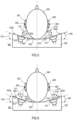
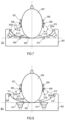
- An exemplary headrest 601 shown in Figure 6 is similar to headrest 501 shown in Figure 5 , however, the microphone positions and loudspeaker positions have been reversed and all positions have been shifted towards the outer peripheries of planar end sections 503a and 503b of front surface 503. Loudspeakers 513 and 514 are arranged such that their principal transmitting directions 515 and 516 have angles 517 and 518 at preferential positions 505 and 506 of greater than 30 degrees with regard to the respective principal receiving direction of microphones 509 and 510.
- An exemplary headrest 701 shown in Figure 7 is similar to headrest 501 shown in Figure 5 , however, front surface 503 of the headrest 701 has an inward-curving, rounded shape extending much further around the longitudinal axis of head 504, and it has curved end sections 503d and 503e and a curved intermediate section 503f. Loudspeakers 513 and 514 are arranged in peripheral sections 503d and 503e of headrest 501 and thus have a more laterally protruding level from intermediate section 503f of surface 503 than in the previous examples. Microphones 509 and 510 are positioned almost directly behind user's ears 507 and 508.
- loudspeakers 513 and 514 are arranged such that their principal transmitting directions 515 and 516 have angles 517 and 518 at preferential positions 505 and 506 of greater than 45 degrees with regard to the respective principal receiving direction of microphones 509 and 510.
- Headrest 801 shown in Figure 8 is similar to headrest 501 shown in Figure 7 , however, the microphone positions and loudspeaker positions are reversed and the positions of the microphones have been shifted towards the outer peripheries of curved end sections 503d and 503e of front surface 503. In the examples shown in Figures 5 to 8 , two quiet zones are established around the preferential positions 505 and 506.
- the embodiments of the present disclosure generally provide for a plurality of circuits, electrical devices, and/or at least one controller. All references to the circuits, the at least one controller, and other electrical devices and the functionality provided by each, are not intended to be limited to encompassing only what is illustrated and described herein. While particular labels may be assigned to the various circuit(s), controller(s) and other electrical devices disclosed, such labels are not intended to limit the scope of operation for the various circuit(s), controller(s) and other electrical devices. Such circuit(s), controller(s) and other electrical devices may be combined with each other and/or separated in any manner based on the particular type of electrical implementation that is desired.
- any system as disclosed herein may include any number of microprocessors, integrated circuits, memory devices (e.g., FLASH, random access memory (RAM), read only memory (ROM), electrically programmable read only memory (EPROM), electrically erasable programmable read only memory (EEPROM), or other suitable variants thereof) and software which co-act with one another to perform operation(s) disclosed herein.
- any system as disclosed may utilize any one or more microprocessors to execute a computer-program that is embodied in a non-transitory computer readable medium that is programmed to perform any number of the functions as disclosed.
- any controller as provided herein includes a housing and a various number of microprocessors, integrated circuits, and memory devices, (e.g., FLASH, random access memory (RAM), read only memory (ROM), electrically programmable read only memory (EPROM), and/or electrically erasable programmable read only memory (EEPROM).
- FLASH random access memory
- ROM read only memory
- EPROM electrically programmable read only memory
- EEPROM electrically erasable programmable read only memory
Landscapes
- Physics & Mathematics (AREA)
- Engineering & Computer Science (AREA)
- Acoustics & Sound (AREA)
- Multimedia (AREA)
- Signal Processing (AREA)
- Health & Medical Sciences (AREA)
- Otolaryngology (AREA)
- General Health & Medical Sciences (AREA)
- Fittings On The Vehicle Exterior For Carrying Loads, And Devices For Holding Or Mounting Articles (AREA)
- Soundproofing, Sound Blocking, And Sound Damping (AREA)
Claims (7)
- Système de commande active de bruit de route pour un véhicule (200), le système comprenant :un réseau de microphones de détection de bruit (202-204 ; 401, 406) configuré pour générer une multiplicité de signaux de détection de bruit (x1(n), x2(n), x3(n)) représentatifs du bruit de route provenant de sources de bruit de route dans ou au niveau du véhicule (200), dans lequel le réseau de microphones de détection de bruit (202-204 ; 401, 406) comprend au moins trois microphones disposés en ligne ou dans un plan au niveau ou autour d'un passage de roue ;un ou deux formeurs de faisceaux (215) configurés pour traiter la multiplicité de signaux de détection de bruit (x1(n), x2(n), x3(n)) pour générer un premier signal de référence (xBR(n)) et un second signal de référence (xBH(n)), et pour fournir, en relation avec le réseau de microphones de détection de bruit (202-204 ; 401, 406), une caractéristique de sensibilité qui comprend deux lobes principaux, un lobe principal (407) étant dirigé vers une première source de bruit de route représentant un bruit provenant d'une limite entre la roue (201) et une route, et l'autre lobe principal (402) étant dirigé vers une seconde source de bruit représentant un bruit provenant d'un moyeu (209) de la roue (201) ;un agencement de microphones d'erreur (207) configuré pour capturer le son au niveau ou à proximité de la position d'écoute et pour fournir un signal d'erreur (e(n)) représentatif du son capturé ; dans lequel l'agencement de microphones d'erreur (207) comprend un ou plusieurs microphones ;un premier filtre de commande active de bruit de route (211, 212, 213) configuré pour traiter de manière itérative et adaptative le premier signal de référence (xBR(n)) et le signal d'erreur (e(n)) pour fournir un premier signal de réduction de bruit (yR(n)) ;un second filtre de commande active de bruit de route (216, 217, 218) configuré pour traiter de manière itérative et adaptative le second signal de référence (xBH(n)) et le signal d'erreur (e(n)) pour fournir un second signal de réduction du bruit (YH(n)) ;un premier agencement de haut-parleurs (214) disposé à l'intérieur (206) du véhicule (200) et configuré pour générer, à partir du signal de réduction de bruit (yR(n)), un son de réduction de bruit à une position d'écoute à l'intérieur (206) du véhicule (200), le premier agencement de haut-parleurs (214) comprenant un ou plusieurs haut-parleurs ; etun second agencement de haut-parleurs (219) disposé à l'intérieur (206) du véhicule (200) et configuré pour générer, à partir du second signal de réduction de bruit (yH(n)), un son de réduction de bruit à la position d'écoute à l'intérieur (206) du véhicule (200), le second agencement de haut-parleurs (214) comprenant un ou plusieurs haut-parleurs.
- Système selon la revendication 1, comprenant également :un appui-tête (208) disposé à proximité de la position d'écoute ; dans lequelau moins l'un parmi : un ou plusieurs haut-parleurs du premier agencement de haut-parleurs (214) et un ou plusieurs microphones de l'agencement de microphones d'erreur (207) sont disposés au niveau, sur ou dans l'appui-tête (208).
- Système selon l'une quelconque des revendications 1 ou 2, dans lequel le formeur de faisceaux (215) est un formeur de faisceaux à retard et à somme.
- Procédé de commande active de bruit de route pour un véhicule (200), le procédé comprenant :la capture de bruit à une multiplicité de positions dans ou sur le véhicule (200) au moyen d'un réseau de microphones de détection de bruit (202-204 ; 401, 406), le réseau de microphones de détection de bruit comprenant une multiplicité de microphones, et la génération d'une multiplicité de signaux de détection de bruit (x1(n), x2(n), x3(n)) représentatifs du bruit de route provenant de sources de bruit de route dans ou au niveau du véhicule (200), dans lequel le réseau de microphones de détection de bruit (202-204 ; 401, 406) comprend au moins trois microphones disposés en ligne ou dans un plan au niveau ou autour d'un passage de roue ;le traitement selon un ou deux mécanismes de formation de faisceaux de la multiplicité de signaux de détection de bruit (x1(n), x2(n), x3(n)) pour générer un premier signal de référence (xBR(n)) et un second signal de référence (xBH(n)), et pour fournir, une caractéristique de sensibilité pour capturer le bruit qui comprend deux lobes principaux, un lobe principal (407) étant dirigé vers une première source de bruit de route représentant un bruit provenant d'une limite entre la roue (201) et une route, et l'autre lobe principal (402) étant dirigé vers une seconde source de bruit représentant un bruit provenant d'un moyeu (209) de la roue (201) ;la capture du son au niveau ou à proximité de la position d'écoute et la fourniture d'un signal d'erreur (e(n)) représentatif du son capturé au moyen d'un agencement de microphones d'erreur (207) ; dans lequel l'agencement de microphones d'erreur (207) comprend un ou plusieurs microphones ;le traitement itératif et adaptatif du premier signal de référence (xBR(n)) et du signal d'erreur (e(n)) pour fournir un premier signal de réduction de bruit ;le traitement itératif et adaptatif du second signal de référence (XBH(n)) et du signal d'erreur (e(n)) pour fournir un second signal de réduction de bruit ;la génération, à une première position à l'intérieur (206) du véhicule (200), à partir du premier signal de réduction de bruit (yR(n)), d'un premier son de réduction de bruit à une position d'écoute à l'intérieur (206) du véhicule (200) ; etla génération au niveau d'une seconde position à l'intérieur (206) du véhicule (200), à partir du second signal de réduction de bruit (yH(n)), d'un second son de réduction de bruit au niveau de la position d'écoute à l'intérieur (206) du véhicule (200).
- Procédé selon la revendication 4, dans lequel au moins l'une parmi : la génération, à partir du signal de réduction de bruit, du son de réduction de bruit et la capture du son au niveau ou à proximité de la position d'écoute pour fournir le signal d'erreur (e(n)) se produit au niveau, sur ou dans un appui-tête (208) disposé à proximité de la position d'écoute.
- Procédé selon la revendication 4 ou 5, dans lequel le mécanisme de formation de faisceaux est un mécanisme de formation de faisceaux à retard et à somme.
- Véhicule (200) comprenant un système de commande active de bruit de route selon l'une quelconque des revendications 1 à 4.
Applications Claiming Priority (1)
| Application Number | Priority Date | Filing Date | Title |
|---|---|---|---|
| PCT/EP2017/069407 WO2019024984A1 (fr) | 2017-08-01 | 2017-08-01 | Commande active de bruit de route |
Publications (2)
| Publication Number | Publication Date |
|---|---|
| EP3662466A1 EP3662466A1 (fr) | 2020-06-10 |
| EP3662466B1 true EP3662466B1 (fr) | 2024-05-01 |
Family
ID=59649669
Family Applications (1)
| Application Number | Title | Priority Date | Filing Date |
|---|---|---|---|
| EP17754100.0A Active EP3662466B1 (fr) | 2017-08-01 | 2017-08-01 | Commande active de bruit de route |
Country Status (5)
| Country | Link |
|---|---|
| US (1) | US11587544B2 (fr) |
| EP (1) | EP3662466B1 (fr) |
| KR (1) | KR20200035033A (fr) |
| CN (1) | CN110998715A (fr) |
| WO (1) | WO2019024984A1 (fr) |
Families Citing this family (14)
| Publication number | Priority date | Publication date | Assignee | Title |
|---|---|---|---|---|
| US11535136B2 (en) * | 2019-03-08 | 2022-12-27 | Harman International Industries, Incorporated | Headrest with integrated nose and loudspeaker enclosure |
| EP3764348A1 (fr) * | 2019-07-11 | 2021-01-13 | Faurecia Creo AB | Procédé et appareil de sélection d'un sous-ensemble d'une pluralité d'entrées d'un système d'entrées multiples et de sortie unique |
| EP3764349B1 (fr) | 2019-07-11 | 2023-05-24 | Faurecia Creo AB | Procédé et système de régulation du bruit |
| FR3118264B1 (fr) * | 2020-12-23 | 2023-11-03 | Psa Automobiles Sa | Procédé restitution sonore permettant de générer des zones d’écoute différenciées dans un espace clos tel qu’un habitable de véhicule |
| CN113658576A (zh) * | 2021-08-12 | 2021-11-16 | 西安艾科特声学科技有限公司 | 一种用于管道有源噪声控制的系统及方法 |
| CN113920973B (zh) * | 2021-10-11 | 2024-09-10 | 聊城大学 | 建筑空间降噪方法、装置和系统 |
| US12217733B2 (en) * | 2022-02-04 | 2025-02-04 | Harman International Industries, Incorporated | Road noise cancellation shaping filters |
| CN115273786B (zh) * | 2022-07-01 | 2025-01-03 | 广州汽车集团股份有限公司 | 一种车辆主动降噪方法、装置及存储介质 |
| CN118486288A (zh) * | 2023-02-13 | 2024-08-13 | 本田技研工业株式会社 | 主动式降噪装置 |
| CN116597805A (zh) * | 2023-06-21 | 2023-08-15 | 上海声茵科技有限公司 | 一种主动降噪系统 |
| KR20250007869A (ko) | 2023-07-06 | 2025-01-14 | 현대자동차주식회사 | 노이즈 제어 장치 및 그 방법 |
| US20260004764A1 (en) * | 2024-06-27 | 2026-01-01 | Harman Becker Automotive Systems Gmbh | Systems and methods for dynamic reference signal selection and gain adjustment in adaptive noise cancellation systems |
| CN119673138B (zh) * | 2024-12-20 | 2025-12-05 | 南京大学 | 一种基于相干约束的鲁棒性主动路噪控制方法 |
| CN119943022A (zh) * | 2025-02-11 | 2025-05-06 | Xg科技私人有限公司 | 噪声控制方法、装置、芯片及车辆 |
Family Cites Families (11)
| Publication number | Priority date | Publication date | Assignee | Title |
|---|---|---|---|---|
| US5699437A (en) * | 1995-08-29 | 1997-12-16 | United Technologies Corporation | Active noise control system using phased-array sensors |
| JP4066197B2 (ja) * | 2005-02-24 | 2008-03-26 | ソニー株式会社 | マイクロフォン装置 |
| US20090066499A1 (en) * | 2007-07-17 | 2009-03-12 | Enhanced Vehicle Acoustics, Inc. | External sound generating system and method |
| US8233352B2 (en) * | 2009-08-17 | 2012-07-31 | Broadcom Corporation | Audio source localization system and method |
| CN201666815U (zh) * | 2009-10-23 | 2010-12-08 | 江苏省交通科学研究院股份有限公司 | 汽车噪声综合测试系统 |
| DE112014003723B4 (de) * | 2013-08-12 | 2024-06-06 | Analog Devices, Inc. | Systeme und Verfahren zur Rauschunterdrückung |
| US9591404B1 (en) * | 2013-09-27 | 2017-03-07 | Amazon Technologies, Inc. | Beamformer design using constrained convex optimization in three-dimensional space |
| EP3040984B1 (fr) * | 2015-01-02 | 2022-07-13 | Harman Becker Automotive Systems GmbH | Agencement de zone acoustique avec suppression vocale par zone |
| JP2016167645A (ja) * | 2015-03-09 | 2016-09-15 | アイシン精機株式会社 | 音声処理装置及び制御装置 |
| US9959859B2 (en) * | 2015-12-31 | 2018-05-01 | Harman International Industries, Incorporated | Active noise-control system with source-separated reference signal |
| US20170278504A1 (en) * | 2016-03-28 | 2017-09-28 | Colin Fraser Ross | Actively controlled quiet headspace |
-
2017
- 2017-08-01 EP EP17754100.0A patent/EP3662466B1/fr active Active
- 2017-08-01 WO PCT/EP2017/069407 patent/WO2019024984A1/fr not_active Ceased
- 2017-08-01 US US16/634,848 patent/US11587544B2/en active Active
- 2017-08-01 KR KR1020207002794A patent/KR20200035033A/ko not_active Ceased
- 2017-08-01 CN CN201780093581.XA patent/CN110998715A/zh active Pending
Also Published As
| Publication number | Publication date |
|---|---|
| CN110998715A (zh) | 2020-04-10 |
| US20200219478A1 (en) | 2020-07-09 |
| US11587544B2 (en) | 2023-02-21 |
| WO2019024984A1 (fr) | 2019-02-07 |
| KR20200035033A (ko) | 2020-04-01 |
| EP3662466A1 (fr) | 2020-06-10 |
Similar Documents
| Publication | Publication Date | Title |
|---|---|---|
| US11587544B2 (en) | Active road noise control | |
| EP3662464B1 (fr) | Régulation active de bruit de route | |
| US10403258B2 (en) | Silent zone generation | |
| US11495205B2 (en) | Silent zone generation | |
| EP4165626B1 (fr) | Système d'annulation de bruit actif intégré dans un siège pour véhicules en mouvement | |
| US10497357B2 (en) | Active noise reduction earphones | |
| US20170150256A1 (en) | Audio enhancement | |
| KR101103794B1 (ko) | 멀티 빔 음향시스템 | |
| CN107850482B (zh) | 噪声和振动感测 | |
| CN112805778A (zh) | 用于使用麦克风投射进行噪声消除的系统和方法 | |
| EP3188181B1 (fr) | Système de régulation du bruit actif avec un signal de référence séparé à la source | |
| CN121545486A (zh) | 一种商用车风噪主动降噪方法、系统及商用车 |
Legal Events
| Date | Code | Title | Description |
|---|---|---|---|
| STAA | Information on the status of an ep patent application or granted ep patent |
Free format text: STATUS: UNKNOWN |
|
| STAA | Information on the status of an ep patent application or granted ep patent |
Free format text: STATUS: THE INTERNATIONAL PUBLICATION HAS BEEN MADE |
|
| PUAI | Public reference made under article 153(3) epc to a published international application that has entered the european phase |
Free format text: ORIGINAL CODE: 0009012 |
|
| STAA | Information on the status of an ep patent application or granted ep patent |
Free format text: STATUS: REQUEST FOR EXAMINATION WAS MADE |
|
| 17P | Request for examination filed |
Effective date: 20200110 |
|
| AK | Designated contracting states |
Kind code of ref document: A1 Designated state(s): AL AT BE BG CH CY CZ DE DK EE ES FI FR GB GR HR HU IE IS IT LI LT LU LV MC MK MT NL NO PL PT RO RS SE SI SK SM TR |
|
| AX | Request for extension of the european patent |
Extension state: BA ME |
|
| DAV | Request for validation of the european patent (deleted) | ||
| DAX | Request for extension of the european patent (deleted) | ||
| STAA | Information on the status of an ep patent application or granted ep patent |
Free format text: STATUS: EXAMINATION IS IN PROGRESS |
|
| 17Q | First examination report despatched |
Effective date: 20220125 |
|
| GRAP | Despatch of communication of intention to grant a patent |
Free format text: ORIGINAL CODE: EPIDOSNIGR1 |
|
| STAA | Information on the status of an ep patent application or granted ep patent |
Free format text: STATUS: GRANT OF PATENT IS INTENDED |
|
| GRAS | Grant fee paid |
Free format text: ORIGINAL CODE: EPIDOSNIGR3 |
|
| GRAA | (expected) grant |
Free format text: ORIGINAL CODE: 0009210 |
|
| STAA | Information on the status of an ep patent application or granted ep patent |
Free format text: STATUS: THE PATENT HAS BEEN GRANTED |
|
| INTG | Intention to grant announced |
Effective date: 20240311 |
|
| P01 | Opt-out of the competence of the unified patent court (upc) registered |
Effective date: 20240314 |
|
| AK | Designated contracting states |
Kind code of ref document: B1 Designated state(s): AL AT BE BG CH CY CZ DE DK EE ES FI FR GB GR HR HU IE IS IT LI LT LU LV MC MK MT NL NO PL PT RO RS SE SI SK SM TR |
|
| REG | Reference to a national code |
Ref country code: GB Ref legal event code: FG4D |
|
| REG | Reference to a national code |
Ref country code: CH Ref legal event code: EP |
|
| REG | Reference to a national code |
Ref country code: DE Ref legal event code: R096 Ref document number: 602017081551 Country of ref document: DE |
|
| REG | Reference to a national code |
Ref country code: IE Ref legal event code: FG4D |
|
| REG | Reference to a national code |
Ref country code: LT Ref legal event code: MG9D |
|
| REG | Reference to a national code |
Ref country code: NL Ref legal event code: MP Effective date: 20240501 |
|
| PG25 | Lapsed in a contracting state [announced via postgrant information from national office to epo] |
Ref country code: IS Free format text: LAPSE BECAUSE OF FAILURE TO SUBMIT A TRANSLATION OF THE DESCRIPTION OR TO PAY THE FEE WITHIN THE PRESCRIBED TIME-LIMIT Effective date: 20240901 |
|
| PG25 | Lapsed in a contracting state [announced via postgrant information from national office to epo] |
Ref country code: BG Free format text: LAPSE BECAUSE OF FAILURE TO SUBMIT A TRANSLATION OF THE DESCRIPTION OR TO PAY THE FEE WITHIN THE PRESCRIBED TIME-LIMIT Effective date: 20240501 |
|
| PG25 | Lapsed in a contracting state [announced via postgrant information from national office to epo] |
Ref country code: FI Free format text: LAPSE BECAUSE OF FAILURE TO SUBMIT A TRANSLATION OF THE DESCRIPTION OR TO PAY THE FEE WITHIN THE PRESCRIBED TIME-LIMIT Effective date: 20240501 Ref country code: HR Free format text: LAPSE BECAUSE OF FAILURE TO SUBMIT A TRANSLATION OF THE DESCRIPTION OR TO PAY THE FEE WITHIN THE PRESCRIBED TIME-LIMIT Effective date: 20240501 |
|
| PG25 | Lapsed in a contracting state [announced via postgrant information from national office to epo] |
Ref country code: GR Free format text: LAPSE BECAUSE OF FAILURE TO SUBMIT A TRANSLATION OF THE DESCRIPTION OR TO PAY THE FEE WITHIN THE PRESCRIBED TIME-LIMIT Effective date: 20240802 |
|
| PG25 | Lapsed in a contracting state [announced via postgrant information from national office to epo] |
Ref country code: PT Free format text: LAPSE BECAUSE OF FAILURE TO SUBMIT A TRANSLATION OF THE DESCRIPTION OR TO PAY THE FEE WITHIN THE PRESCRIBED TIME-LIMIT Effective date: 20240902 |
|
| REG | Reference to a national code |
Ref country code: AT Ref legal event code: MK05 Ref document number: 1683525 Country of ref document: AT Kind code of ref document: T Effective date: 20240501 |
|
| PG25 | Lapsed in a contracting state [announced via postgrant information from national office to epo] |
Ref country code: NL Free format text: LAPSE BECAUSE OF FAILURE TO SUBMIT A TRANSLATION OF THE DESCRIPTION OR TO PAY THE FEE WITHIN THE PRESCRIBED TIME-LIMIT Effective date: 20240501 |
|
| PG25 | Lapsed in a contracting state [announced via postgrant information from national office to epo] |
Ref country code: ES Free format text: LAPSE BECAUSE OF FAILURE TO SUBMIT A TRANSLATION OF THE DESCRIPTION OR TO PAY THE FEE WITHIN THE PRESCRIBED TIME-LIMIT Effective date: 20240501 |
|
| PG25 | Lapsed in a contracting state [announced via postgrant information from national office to epo] |
Ref country code: AT Free format text: LAPSE BECAUSE OF FAILURE TO SUBMIT A TRANSLATION OF THE DESCRIPTION OR TO PAY THE FEE WITHIN THE PRESCRIBED TIME-LIMIT Effective date: 20240501 |
|
| PG25 | Lapsed in a contracting state [announced via postgrant information from national office to epo] |
Ref country code: PL Free format text: LAPSE BECAUSE OF FAILURE TO SUBMIT A TRANSLATION OF THE DESCRIPTION OR TO PAY THE FEE WITHIN THE PRESCRIBED TIME-LIMIT Effective date: 20240501 |
|
| PG25 | Lapsed in a contracting state [announced via postgrant information from national office to epo] |
Ref country code: LV Free format text: LAPSE BECAUSE OF FAILURE TO SUBMIT A TRANSLATION OF THE DESCRIPTION OR TO PAY THE FEE WITHIN THE PRESCRIBED TIME-LIMIT Effective date: 20240501 |
|
| PG25 | Lapsed in a contracting state [announced via postgrant information from national office to epo] |
Ref country code: PT Free format text: LAPSE BECAUSE OF FAILURE TO SUBMIT A TRANSLATION OF THE DESCRIPTION OR TO PAY THE FEE WITHIN THE PRESCRIBED TIME-LIMIT Effective date: 20240902 Ref country code: PL Free format text: LAPSE BECAUSE OF FAILURE TO SUBMIT A TRANSLATION OF THE DESCRIPTION OR TO PAY THE FEE WITHIN THE PRESCRIBED TIME-LIMIT Effective date: 20240501 Ref country code: NO Free format text: LAPSE BECAUSE OF FAILURE TO SUBMIT A TRANSLATION OF THE DESCRIPTION OR TO PAY THE FEE WITHIN THE PRESCRIBED TIME-LIMIT Effective date: 20240801 Ref country code: NL Free format text: LAPSE BECAUSE OF FAILURE TO SUBMIT A TRANSLATION OF THE DESCRIPTION OR TO PAY THE FEE WITHIN THE PRESCRIBED TIME-LIMIT Effective date: 20240501 Ref country code: LV Free format text: LAPSE BECAUSE OF FAILURE TO SUBMIT A TRANSLATION OF THE DESCRIPTION OR TO PAY THE FEE WITHIN THE PRESCRIBED TIME-LIMIT Effective date: 20240501 Ref country code: IS Free format text: LAPSE BECAUSE OF FAILURE TO SUBMIT A TRANSLATION OF THE DESCRIPTION OR TO PAY THE FEE WITHIN THE PRESCRIBED TIME-LIMIT Effective date: 20240901 Ref country code: HR Free format text: LAPSE BECAUSE OF FAILURE TO SUBMIT A TRANSLATION OF THE DESCRIPTION OR TO PAY THE FEE WITHIN THE PRESCRIBED TIME-LIMIT Effective date: 20240501 Ref country code: GR Free format text: LAPSE BECAUSE OF FAILURE TO SUBMIT A TRANSLATION OF THE DESCRIPTION OR TO PAY THE FEE WITHIN THE PRESCRIBED TIME-LIMIT Effective date: 20240802 Ref country code: FI Free format text: LAPSE BECAUSE OF FAILURE TO SUBMIT A TRANSLATION OF THE DESCRIPTION OR TO PAY THE FEE WITHIN THE PRESCRIBED TIME-LIMIT Effective date: 20240501 Ref country code: ES Free format text: LAPSE BECAUSE OF FAILURE TO SUBMIT A TRANSLATION OF THE DESCRIPTION OR TO PAY THE FEE WITHIN THE PRESCRIBED TIME-LIMIT Effective date: 20240501 Ref country code: BG Free format text: LAPSE BECAUSE OF FAILURE TO SUBMIT A TRANSLATION OF THE DESCRIPTION OR TO PAY THE FEE WITHIN THE PRESCRIBED TIME-LIMIT Effective date: 20240501 Ref country code: AT Free format text: LAPSE BECAUSE OF FAILURE TO SUBMIT A TRANSLATION OF THE DESCRIPTION OR TO PAY THE FEE WITHIN THE PRESCRIBED TIME-LIMIT Effective date: 20240501 Ref country code: RS Free format text: LAPSE BECAUSE OF FAILURE TO SUBMIT A TRANSLATION OF THE DESCRIPTION OR TO PAY THE FEE WITHIN THE PRESCRIBED TIME-LIMIT Effective date: 20240801 |
|
| PG25 | Lapsed in a contracting state [announced via postgrant information from national office to epo] |
Ref country code: DK Free format text: LAPSE BECAUSE OF FAILURE TO SUBMIT A TRANSLATION OF THE DESCRIPTION OR TO PAY THE FEE WITHIN THE PRESCRIBED TIME-LIMIT Effective date: 20240501 |
|
| PG25 | Lapsed in a contracting state [announced via postgrant information from national office to epo] |
Ref country code: EE Free format text: LAPSE BECAUSE OF FAILURE TO SUBMIT A TRANSLATION OF THE DESCRIPTION OR TO PAY THE FEE WITHIN THE PRESCRIBED TIME-LIMIT Effective date: 20240501 |
|
| PG25 | Lapsed in a contracting state [announced via postgrant information from national office to epo] |
Ref country code: CZ Free format text: LAPSE BECAUSE OF FAILURE TO SUBMIT A TRANSLATION OF THE DESCRIPTION OR TO PAY THE FEE WITHIN THE PRESCRIBED TIME-LIMIT Effective date: 20240501 |
|
| PG25 | Lapsed in a contracting state [announced via postgrant information from national office to epo] |
Ref country code: SK Free format text: LAPSE BECAUSE OF FAILURE TO SUBMIT A TRANSLATION OF THE DESCRIPTION OR TO PAY THE FEE WITHIN THE PRESCRIBED TIME-LIMIT Effective date: 20240501 Ref country code: RO Free format text: LAPSE BECAUSE OF FAILURE TO SUBMIT A TRANSLATION OF THE DESCRIPTION OR TO PAY THE FEE WITHIN THE PRESCRIBED TIME-LIMIT Effective date: 20240501 |
|
| PG25 | Lapsed in a contracting state [announced via postgrant information from national office to epo] |
Ref country code: SM Free format text: LAPSE BECAUSE OF FAILURE TO SUBMIT A TRANSLATION OF THE DESCRIPTION OR TO PAY THE FEE WITHIN THE PRESCRIBED TIME-LIMIT Effective date: 20240501 |
|
| PG25 | Lapsed in a contracting state [announced via postgrant information from national office to epo] |
Ref country code: SM Free format text: LAPSE BECAUSE OF FAILURE TO SUBMIT A TRANSLATION OF THE DESCRIPTION OR TO PAY THE FEE WITHIN THE PRESCRIBED TIME-LIMIT Effective date: 20240501 Ref country code: SK Free format text: LAPSE BECAUSE OF FAILURE TO SUBMIT A TRANSLATION OF THE DESCRIPTION OR TO PAY THE FEE WITHIN THE PRESCRIBED TIME-LIMIT Effective date: 20240501 Ref country code: RO Free format text: LAPSE BECAUSE OF FAILURE TO SUBMIT A TRANSLATION OF THE DESCRIPTION OR TO PAY THE FEE WITHIN THE PRESCRIBED TIME-LIMIT Effective date: 20240501 Ref country code: EE Free format text: LAPSE BECAUSE OF FAILURE TO SUBMIT A TRANSLATION OF THE DESCRIPTION OR TO PAY THE FEE WITHIN THE PRESCRIBED TIME-LIMIT Effective date: 20240501 Ref country code: DK Free format text: LAPSE BECAUSE OF FAILURE TO SUBMIT A TRANSLATION OF THE DESCRIPTION OR TO PAY THE FEE WITHIN THE PRESCRIBED TIME-LIMIT Effective date: 20240501 Ref country code: CZ Free format text: LAPSE BECAUSE OF FAILURE TO SUBMIT A TRANSLATION OF THE DESCRIPTION OR TO PAY THE FEE WITHIN THE PRESCRIBED TIME-LIMIT Effective date: 20240501 |
|
| REG | Reference to a national code |
Ref country code: DE Ref legal event code: R097 Ref document number: 602017081551 Country of ref document: DE |
|
| PG25 | Lapsed in a contracting state [announced via postgrant information from national office to epo] |
Ref country code: IT Free format text: LAPSE BECAUSE OF FAILURE TO SUBMIT A TRANSLATION OF THE DESCRIPTION OR TO PAY THE FEE WITHIN THE PRESCRIBED TIME-LIMIT Effective date: 20240501 |
|
| PLBE | No opposition filed within time limit |
Free format text: ORIGINAL CODE: 0009261 |
|
| STAA | Information on the status of an ep patent application or granted ep patent |
Free format text: STATUS: NO OPPOSITION FILED WITHIN TIME LIMIT |
|
| REG | Reference to a national code |
Ref country code: CH Ref legal event code: PL |
|
| 26N | No opposition filed |
Effective date: 20250204 |
|
| PG25 | Lapsed in a contracting state [announced via postgrant information from national office to epo] |
Ref country code: LU Free format text: LAPSE BECAUSE OF NON-PAYMENT OF DUE FEES Effective date: 20240801 |
|
| PG25 | Lapsed in a contracting state [announced via postgrant information from national office to epo] |
Ref country code: SI Free format text: LAPSE BECAUSE OF FAILURE TO SUBMIT A TRANSLATION OF THE DESCRIPTION OR TO PAY THE FEE WITHIN THE PRESCRIBED TIME-LIMIT Effective date: 20240501 Ref country code: CH Free format text: LAPSE BECAUSE OF NON-PAYMENT OF DUE FEES Effective date: 20240831 Ref country code: MC Free format text: LAPSE BECAUSE OF FAILURE TO SUBMIT A TRANSLATION OF THE DESCRIPTION OR TO PAY THE FEE WITHIN THE PRESCRIBED TIME-LIMIT Effective date: 20240501 |
|
| REG | Reference to a national code |
Ref country code: BE Ref legal event code: MM Effective date: 20240831 |
|
| PG25 | Lapsed in a contracting state [announced via postgrant information from national office to epo] |
Ref country code: BE Free format text: LAPSE BECAUSE OF NON-PAYMENT OF DUE FEES Effective date: 20240831 |
|
| PG25 | Lapsed in a contracting state [announced via postgrant information from national office to epo] |
Ref country code: FR Free format text: LAPSE BECAUSE OF NON-PAYMENT OF DUE FEES Effective date: 20240831 |
|
| PG25 | Lapsed in a contracting state [announced via postgrant information from national office to epo] |
Ref country code: IE Free format text: LAPSE BECAUSE OF NON-PAYMENT OF DUE FEES Effective date: 20240801 |
|
| PG25 | Lapsed in a contracting state [announced via postgrant information from national office to epo] |
Ref country code: SE Free format text: LAPSE BECAUSE OF FAILURE TO SUBMIT A TRANSLATION OF THE DESCRIPTION OR TO PAY THE FEE WITHIN THE PRESCRIBED TIME-LIMIT Effective date: 20240501 |
|
| PGFP | Annual fee paid to national office [announced via postgrant information from national office to epo] |
Ref country code: DE Payment date: 20250724 Year of fee payment: 9 |
|
| PGFP | Annual fee paid to national office [announced via postgrant information from national office to epo] |
Ref country code: GB Payment date: 20250725 Year of fee payment: 9 |
|
| PG25 | Lapsed in a contracting state [announced via postgrant information from national office to epo] |
Ref country code: CY Free format text: LAPSE BECAUSE OF FAILURE TO SUBMIT A TRANSLATION OF THE DESCRIPTION OR TO PAY THE FEE WITHIN THE PRESCRIBED TIME-LIMIT; INVALID AB INITIO Effective date: 20170801 |
|
| PG25 | Lapsed in a contracting state [announced via postgrant information from national office to epo] |
Ref country code: HU Free format text: LAPSE BECAUSE OF FAILURE TO SUBMIT A TRANSLATION OF THE DESCRIPTION OR TO PAY THE FEE WITHIN THE PRESCRIBED TIME-LIMIT; INVALID AB INITIO Effective date: 20170801 |
|
| PG25 | Lapsed in a contracting state [announced via postgrant information from national office to epo] |
Ref country code: TR Free format text: LAPSE BECAUSE OF FAILURE TO SUBMIT A TRANSLATION OF THE DESCRIPTION OR TO PAY THE FEE WITHIN THE PRESCRIBED TIME-LIMIT Effective date: 20240501 |
|
| PG25 | Lapsed in a contracting state [announced via postgrant information from national office to epo] |
Ref country code: LT Free format text: LAPSE BECAUSE OF FAILURE TO SUBMIT A TRANSLATION OF THE DESCRIPTION OR TO PAY THE FEE WITHIN THE PRESCRIBED TIME-LIMIT Effective date: 20240501 |