EP3662883A1 - Bei raumtemperatur festes natürliches kosmetisches reinigungsmittel - Google Patents
Bei raumtemperatur festes natürliches kosmetisches reinigungsmittel Download PDFInfo
- Publication number
- EP3662883A1 EP3662883A1 EP19208779.9A EP19208779A EP3662883A1 EP 3662883 A1 EP3662883 A1 EP 3662883A1 EP 19208779 A EP19208779 A EP 19208779A EP 3662883 A1 EP3662883 A1 EP 3662883A1
- Authority
- EP
- European Patent Office
- Prior art keywords
- weight
- cleaning agent
- oil
- cosmetic cleaning
- agent according
- Prior art date
- Legal status (The legal status is an assumption and is not a legal conclusion. Google has not performed a legal analysis and makes no representation as to the accuracy of the status listed.)
- Withdrawn
Links
- 239000002537 cosmetic Substances 0.000 title claims abstract description 35
- 239000012459 cleaning agent Substances 0.000 title claims abstract description 31
- 239000007787 solid Substances 0.000 title claims abstract description 8
- KWIUHFFTVRNATP-UHFFFAOYSA-N glycine betaine Chemical compound C[N+](C)(C)CC([O-])=O KWIUHFFTVRNATP-UHFFFAOYSA-N 0.000 claims abstract description 30
- 235000014113 dietary fatty acids Nutrition 0.000 claims abstract description 19
- 239000000194 fatty acid Substances 0.000 claims abstract description 19
- 229930195729 fatty acid Natural products 0.000 claims abstract description 19
- 150000004665 fatty acids Chemical class 0.000 claims abstract description 19
- 239000000344 soap Substances 0.000 claims abstract description 11
- 229960003237 betaine Drugs 0.000 claims abstract description 10
- -1 alkali metal salts Chemical class 0.000 claims abstract description 7
- 229910052783 alkali metal Inorganic materials 0.000 claims abstract description 3
- 229920001285 xanthan gum Polymers 0.000 claims description 37
- 239000003795 chemical substances by application Substances 0.000 claims description 16
- 239000003921 oil Substances 0.000 claims description 16
- 235000019198 oils Nutrition 0.000 claims description 16
- 125000004432 carbon atom Chemical group C* 0.000 claims description 15
- 239000004094 surface-active agent Substances 0.000 claims description 12
- XLYOFNOQVPJJNP-UHFFFAOYSA-N water Substances O XLYOFNOQVPJJNP-UHFFFAOYSA-N 0.000 claims description 10
- GJCOSYZMQJWQCA-UHFFFAOYSA-N 9H-xanthene Chemical compound C1=CC=C2CC3=CC=CC=C3OC2=C1 GJCOSYZMQJWQCA-UHFFFAOYSA-N 0.000 claims description 7
- 150000001447 alkali salts Chemical class 0.000 claims description 6
- OSCJHTSDLYVCQC-UHFFFAOYSA-N 2-ethylhexyl 4-[[4-[4-(tert-butylcarbamoyl)anilino]-6-[4-(2-ethylhexoxycarbonyl)anilino]-1,3,5-triazin-2-yl]amino]benzoate Chemical compound C1=CC(C(=O)OCC(CC)CCCC)=CC=C1NC1=NC(NC=2C=CC(=CC=2)C(=O)NC(C)(C)C)=NC(NC=2C=CC(=CC=2)C(=O)OCC(CC)CCCC)=N1 OSCJHTSDLYVCQC-UHFFFAOYSA-N 0.000 claims description 4
- QAOWNCQODCNURD-UHFFFAOYSA-L Sulfate Chemical compound [O-]S([O-])(=O)=O QAOWNCQODCNURD-UHFFFAOYSA-L 0.000 claims description 4
- 229910052784 alkaline earth metal Inorganic materials 0.000 claims description 4
- QGZKDVFQNNGYKY-UHFFFAOYSA-O Ammonium Chemical compound [NH4+] QGZKDVFQNNGYKY-UHFFFAOYSA-O 0.000 claims description 3
- 150000001342 alkaline earth metals Chemical class 0.000 claims description 3
- 235000019864 coconut oil Nutrition 0.000 claims description 3
- 239000003240 coconut oil Substances 0.000 claims description 3
- 229910052739 hydrogen Inorganic materials 0.000 claims description 3
- 239000001257 hydrogen Substances 0.000 claims description 3
- 159000000000 sodium salts Chemical class 0.000 claims description 3
- 150000001340 alkali metals Chemical class 0.000 claims description 2
- 125000005210 alkyl ammonium group Chemical group 0.000 claims description 2
- 229930195712 glutamate Natural products 0.000 claims description 2
- LPUQAYUQRXPFSQ-DFWYDOINSA-M monosodium L-glutamate Chemical compound [Na+].[O-]C(=O)[C@@H](N)CCC(O)=O LPUQAYUQRXPFSQ-DFWYDOINSA-M 0.000 claims description 2
- 239000011734 sodium Substances 0.000 claims description 2
- 229940079781 sodium cocoyl glutamate Drugs 0.000 claims description 2
- 125000002252 acyl group Chemical group 0.000 claims 1
- 239000003599 detergent Substances 0.000 claims 1
- 125000004435 hydrogen atom Chemical class [H]* 0.000 claims 1
- 239000000230 xanthan gum Substances 0.000 description 29
- 235000010493 xanthan gum Nutrition 0.000 description 29
- 229940082509 xanthan gum Drugs 0.000 description 29
- VKOBVWXKNCXXDE-UHFFFAOYSA-N icosanoic acid Chemical compound CCCCCCCCCCCCCCCCCCCC(O)=O VKOBVWXKNCXXDE-UHFFFAOYSA-N 0.000 description 26
- 239000000047 product Substances 0.000 description 17
- 125000000217 alkyl group Chemical group 0.000 description 16
- 235000013399 edible fruits Nutrition 0.000 description 12
- 239000000203 mixture Substances 0.000 description 12
- 239000004615 ingredient Substances 0.000 description 9
- 235000013162 Cocos nucifera Nutrition 0.000 description 8
- 244000060011 Cocos nucifera Species 0.000 description 8
- 229920002907 Guar gum Polymers 0.000 description 8
- 235000010417 guar gum Nutrition 0.000 description 8
- 240000000950 Hippophae rhamnoides Species 0.000 description 6
- 235000003145 Hippophae rhamnoides Nutrition 0.000 description 6
- 125000003342 alkenyl group Chemical group 0.000 description 6
- POULHZVOKOAJMA-UHFFFAOYSA-N dodecanoic acid Chemical compound CCCCCCCCCCCC(O)=O POULHZVOKOAJMA-UHFFFAOYSA-N 0.000 description 6
- 239000000665 guar gum Substances 0.000 description 6
- 229960002154 guar gum Drugs 0.000 description 6
- 238000010438 heat treatment Methods 0.000 description 6
- 239000000126 substance Substances 0.000 description 6
- LQJBNNIYVWPHFW-UHFFFAOYSA-N 20:1omega9c fatty acid Natural products CCCCCCCCCCC=CCCCCCCCC(O)=O LQJBNNIYVWPHFW-UHFFFAOYSA-N 0.000 description 5
- 235000019482 Palm oil Nutrition 0.000 description 5
- 239000002540 palm oil Substances 0.000 description 5
- 229920001282 polysaccharide Polymers 0.000 description 5
- 239000005017 polysaccharide Substances 0.000 description 5
- 239000002994 raw material Substances 0.000 description 5
- XDOFQFKRPWOURC-UHFFFAOYSA-N 16-methylheptadecanoic acid Chemical compound CC(C)CCCCCCCCCCCCCCC(O)=O XDOFQFKRPWOURC-UHFFFAOYSA-N 0.000 description 4
- LPLLVINFLBSFRP-UHFFFAOYSA-N 2-methylamino-1-phenylpropan-1-one Chemical compound CNC(C)C(=O)C1=CC=CC=C1 LPLLVINFLBSFRP-UHFFFAOYSA-N 0.000 description 4
- 241000132539 Cosmos Species 0.000 description 4
- 235000005956 Cosmos caudatus Nutrition 0.000 description 4
- ZQPPMHVWECSIRJ-UHFFFAOYSA-N Oleic acid Natural products CCCCCCCCC=CCCCCCCCC(O)=O ZQPPMHVWECSIRJ-UHFFFAOYSA-N 0.000 description 4
- 235000009827 Prunus armeniaca Nutrition 0.000 description 4
- 244000018633 Prunus armeniaca Species 0.000 description 4
- 229920002472 Starch Polymers 0.000 description 4
- 239000002253 acid Substances 0.000 description 4
- 150000001875 compounds Chemical class 0.000 description 4
- GHVNFZFCNZKVNT-UHFFFAOYSA-N decanoic acid Chemical compound CCCCCCCCCC(O)=O GHVNFZFCNZKVNT-UHFFFAOYSA-N 0.000 description 4
- ZQPPMHVWECSIRJ-MDZDMXLPSA-N elaidic acid Chemical compound CCCCCCCC\C=C\CCCCCCCC(O)=O ZQPPMHVWECSIRJ-MDZDMXLPSA-N 0.000 description 4
- IPCSVZSSVZVIGE-UHFFFAOYSA-N hexadecanoic acid Chemical compound CCCCCCCCCCCCCCCC(O)=O IPCSVZSSVZVIGE-UHFFFAOYSA-N 0.000 description 4
- FUZZWVXGSFPDMH-UHFFFAOYSA-N hexanoic acid Chemical compound CCCCCC(O)=O FUZZWVXGSFPDMH-UHFFFAOYSA-N 0.000 description 4
- QXJSBBXBKPUZAA-UHFFFAOYSA-N isooleic acid Natural products CCCCCCCC=CCCCCCCCCC(O)=O QXJSBBXBKPUZAA-UHFFFAOYSA-N 0.000 description 4
- WWZKQHOCKIZLMA-UHFFFAOYSA-N octanoic acid Chemical compound CCCCCCCC(O)=O WWZKQHOCKIZLMA-UHFFFAOYSA-N 0.000 description 4
- CNVZJPUDSLNTQU-SEYXRHQNSA-N petroselinic acid Chemical compound CCCCCCCCCCC\C=C/CCCCC(O)=O CNVZJPUDSLNTQU-SEYXRHQNSA-N 0.000 description 4
- 150000004804 polysaccharides Chemical class 0.000 description 4
- FDRCDNZGSXJAFP-UHFFFAOYSA-M sodium chloroacetate Chemical compound [Na+].[O-]C(=O)CCl FDRCDNZGSXJAFP-UHFFFAOYSA-M 0.000 description 4
- 235000019698 starch Nutrition 0.000 description 4
- 244000144725 Amygdalus communis Species 0.000 description 3
- 241000196324 Embryophyta Species 0.000 description 3
- 239000005639 Lauric acid Substances 0.000 description 3
- 244000124853 Perilla frutescens Species 0.000 description 3
- 235000020224 almond Nutrition 0.000 description 3
- LHIJANUOQQMGNT-UHFFFAOYSA-N aminoethylethanolamine Chemical compound NCCNCCO LHIJANUOQQMGNT-UHFFFAOYSA-N 0.000 description 3
- 229920001222 biopolymer Polymers 0.000 description 3
- 235000004426 flaxseed Nutrition 0.000 description 3
- LQJBNNIYVWPHFW-QXMHVHEDSA-N gadoleic acid Chemical compound CCCCCCCCCC\C=C/CCCCCCCC(O)=O LQJBNNIYVWPHFW-QXMHVHEDSA-N 0.000 description 3
- 235000014571 nuts Nutrition 0.000 description 3
- 238000006384 oligomerization reaction Methods 0.000 description 3
- 238000004806 packaging method and process Methods 0.000 description 3
- OYHQOLUKZRVURQ-NTGFUMLPSA-N (9Z,12Z)-9,10,12,13-tetratritiooctadeca-9,12-dienoic acid Chemical compound C(CCCCCCC\C(=C(/C\C(=C(/CCCCC)\[3H])\[3H])\[3H])\[3H])(=O)O OYHQOLUKZRVURQ-NTGFUMLPSA-N 0.000 description 2
- WRIDQFICGBMAFQ-UHFFFAOYSA-N (E)-8-Octadecenoic acid Natural products CCCCCCCCCC=CCCCCCCC(O)=O WRIDQFICGBMAFQ-UHFFFAOYSA-N 0.000 description 2
- KBPLFHHGFOOTCA-UHFFFAOYSA-N 1-Octanol Chemical compound CCCCCCCCO KBPLFHHGFOOTCA-UHFFFAOYSA-N 0.000 description 2
- OXEDXHIBHVMDST-UHFFFAOYSA-N 12Z-octadecenoic acid Natural products CCCCCC=CCCCCCCCCCCC(O)=O OXEDXHIBHVMDST-UHFFFAOYSA-N 0.000 description 2
- WNWHHMBRJJOGFJ-UHFFFAOYSA-N 16-methylheptadecan-1-ol Chemical compound CC(C)CCCCCCCCCCCCCCCO WNWHHMBRJJOGFJ-UHFFFAOYSA-N 0.000 description 2
- QSBYPNXLFMSGKH-UHFFFAOYSA-N 9-Heptadecensaeure Natural products CCCCCCCC=CCCCCCCCC(O)=O QSBYPNXLFMSGKH-UHFFFAOYSA-N 0.000 description 2
- 235000011437 Amygdalus communis Nutrition 0.000 description 2
- 239000005632 Capric acid (CAS 334-48-5) Substances 0.000 description 2
- 239000005635 Caprylic acid (CAS 124-07-2) Substances 0.000 description 2
- 235000007466 Corylus avellana Nutrition 0.000 description 2
- 244000007835 Cyamopsis tetragonoloba Species 0.000 description 2
- WQZGKKKJIJFFOK-QTVWNMPRSA-N D-mannopyranose Chemical group OC[C@H]1OC(O)[C@@H](O)[C@@H](O)[C@@H]1O WQZGKKKJIJFFOK-QTVWNMPRSA-N 0.000 description 2
- 235000001950 Elaeis guineensis Nutrition 0.000 description 2
- 244000127993 Elaeis melanococca Species 0.000 description 2
- LFQSCWFLJHTTHZ-UHFFFAOYSA-N Ethanol Chemical compound CCO LFQSCWFLJHTTHZ-UHFFFAOYSA-N 0.000 description 2
- WQZGKKKJIJFFOK-GASJEMHNSA-N Glucose Natural products OC[C@H]1OC(O)[C@H](O)[C@@H](O)[C@@H]1O WQZGKKKJIJFFOK-GASJEMHNSA-N 0.000 description 2
- WHUUTDBJXJRKMK-VKHMYHEASA-N L-glutamic acid Chemical compound OC(=O)[C@@H](N)CCC(O)=O WHUUTDBJXJRKMK-VKHMYHEASA-N 0.000 description 2
- 235000004431 Linum usitatissimum Nutrition 0.000 description 2
- 240000006240 Linum usitatissimum Species 0.000 description 2
- 235000014826 Mangifera indica Nutrition 0.000 description 2
- 240000007228 Mangifera indica Species 0.000 description 2
- LRHPLDYGYMQRHN-UHFFFAOYSA-N N-Butanol Chemical compound CCCCO LRHPLDYGYMQRHN-UHFFFAOYSA-N 0.000 description 2
- 244000090896 Nigella sativa Species 0.000 description 2
- 240000007817 Olea europaea Species 0.000 description 2
- 239000005642 Oleic acid Substances 0.000 description 2
- 235000021314 Palmitic acid Nutrition 0.000 description 2
- 244000025272 Persea americana Species 0.000 description 2
- 235000008673 Persea americana Nutrition 0.000 description 2
- CNVZJPUDSLNTQU-UHFFFAOYSA-N Petroselaidic acid Natural products CCCCCCCCCCCC=CCCCCC(O)=O CNVZJPUDSLNTQU-UHFFFAOYSA-N 0.000 description 2
- 235000021355 Stearic acid Nutrition 0.000 description 2
- 235000018936 Vitellaria paradoxa Nutrition 0.000 description 2
- 241001135917 Vitellaria paradoxa Species 0.000 description 2
- DTOSIQBPPRVQHS-PDBXOOCHSA-N alpha-linolenic acid Chemical compound CC\C=C/C\C=C/C\C=C/CCCCCCCC(O)=O DTOSIQBPPRVQHS-PDBXOOCHSA-N 0.000 description 2
- 235000020661 alpha-linolenic acid Nutrition 0.000 description 2
- 239000007864 aqueous solution Substances 0.000 description 2
- 244000052616 bacterial pathogen Species 0.000 description 2
- 235000021028 berry Nutrition 0.000 description 2
- WQZGKKKJIJFFOK-VFUOTHLCSA-N beta-D-glucose Chemical compound OC[C@H]1O[C@@H](O)[C@H](O)[C@@H](O)[C@@H]1O WQZGKKKJIJFFOK-VFUOTHLCSA-N 0.000 description 2
- 235000021324 borage oil Nutrition 0.000 description 2
- 235000014121 butter Nutrition 0.000 description 2
- 239000001913 cellulose Substances 0.000 description 2
- 229920002678 cellulose Polymers 0.000 description 2
- 238000004140 cleaning Methods 0.000 description 2
- 239000007859 condensation product Substances 0.000 description 2
- 230000003750 conditioning effect Effects 0.000 description 2
- NOPFSRXAKWQILS-UHFFFAOYSA-N docosan-1-ol Chemical compound CCCCCCCCCCCCCCCCCCCCCCO NOPFSRXAKWQILS-UHFFFAOYSA-N 0.000 description 2
- 239000003925 fat Substances 0.000 description 2
- 235000019197 fats Nutrition 0.000 description 2
- 238000005187 foaming Methods 0.000 description 2
- BXWNKGSJHAJOGX-UHFFFAOYSA-N hexadecan-1-ol Chemical compound CCCCCCCCCCCCCCCCO BXWNKGSJHAJOGX-UHFFFAOYSA-N 0.000 description 2
- ZSIAUFGUXNUGDI-UHFFFAOYSA-N hexan-1-ol Chemical compound CCCCCCO ZSIAUFGUXNUGDI-UHFFFAOYSA-N 0.000 description 2
- 238000005984 hydrogenation reaction Methods 0.000 description 2
- 150000002462 imidazolines Chemical class 0.000 description 2
- SIOLDWZBFABPJU-UHFFFAOYSA-N isotridecanoic acid Chemical compound CC(C)CCCCCCCCCC(O)=O SIOLDWZBFABPJU-UHFFFAOYSA-N 0.000 description 2
- 235000015110 jellies Nutrition 0.000 description 2
- KQQKGWQCNNTQJW-UHFFFAOYSA-N linolenic acid Natural products CC=CCCC=CCC=CCCCCCCCC(O)=O KQQKGWQCNNTQJW-UHFFFAOYSA-N 0.000 description 2
- 229960004488 linolenic acid Drugs 0.000 description 2
- 235000021388 linseed oil Nutrition 0.000 description 2
- 239000000944 linseed oil Substances 0.000 description 2
- 239000007788 liquid Substances 0.000 description 2
- 238000000034 method Methods 0.000 description 2
- WQEPLUUGTLDZJY-UHFFFAOYSA-N n-Pentadecanoic acid Natural products CCCCCCCCCCCCCCC(O)=O WQEPLUUGTLDZJY-UHFFFAOYSA-N 0.000 description 2
- 229930014626 natural product Natural products 0.000 description 2
- GLDOVTGHNKAZLK-UHFFFAOYSA-N octadecan-1-ol Chemical compound CCCCCCCCCCCCCCCCCCO GLDOVTGHNKAZLK-UHFFFAOYSA-N 0.000 description 2
- QIQXTHQIDYTFRH-UHFFFAOYSA-N octadecanoic acid Chemical compound CCCCCCCCCCCCCCCCCC(O)=O QIQXTHQIDYTFRH-UHFFFAOYSA-N 0.000 description 2
- OQCDKBAXFALNLD-UHFFFAOYSA-N octadecanoic acid Natural products CCCCCCCC(C)CCCCCCCCC(O)=O OQCDKBAXFALNLD-UHFFFAOYSA-N 0.000 description 2
- 229960002446 octanoic acid Drugs 0.000 description 2
- 150000002482 oligosaccharides Polymers 0.000 description 2
- SECPZKHBENQXJG-FPLPWBNLSA-N palmitoleic acid Chemical compound CCCCCC\C=C/CCCCCCCC(O)=O SECPZKHBENQXJG-FPLPWBNLSA-N 0.000 description 2
- 229920000642 polymer Polymers 0.000 description 2
- 150000003138 primary alcohols Chemical class 0.000 description 2
- 239000001944 prunus armeniaca kernel oil Substances 0.000 description 2
- 235000005713 safflower oil Nutrition 0.000 description 2
- 239000003813 safflower oil Substances 0.000 description 2
- 150000003839 salts Chemical class 0.000 description 2
- 239000002689 soil Substances 0.000 description 2
- 239000008107 starch Substances 0.000 description 2
- 239000007858 starting material Substances 0.000 description 2
- 239000008117 stearic acid Substances 0.000 description 2
- 239000003760 tallow Substances 0.000 description 2
- 238000005496 tempering Methods 0.000 description 2
- HLZKNKRTKFSKGZ-UHFFFAOYSA-N tetradecan-1-ol Chemical compound CCCCCCCCCCCCCCO HLZKNKRTKFSKGZ-UHFFFAOYSA-N 0.000 description 2
- TUNFSRHWOTWDNC-HKGQFRNVSA-N tetradecanoic acid Chemical compound CCCCCCCCCCCCC[14C](O)=O TUNFSRHWOTWDNC-HKGQFRNVSA-N 0.000 description 2
- AQWHMKSIVLSRNY-UHFFFAOYSA-N trans-Octadec-5-ensaeure Natural products CCCCCCCCCCCCC=CCCCC(O)=O AQWHMKSIVLSRNY-UHFFFAOYSA-N 0.000 description 2
- KJIOQYGWTQBHNH-UHFFFAOYSA-N undecanol Chemical compound CCCCCCCCCCCO KJIOQYGWTQBHNH-UHFFFAOYSA-N 0.000 description 2
- 235000015112 vegetable and seed oil Nutrition 0.000 description 2
- CFOQKXQWGLAKSK-KTKRTIGZSA-N (13Z)-docosen-1-ol Chemical compound CCCCCCCC\C=C/CCCCCCCCCCCCO CFOQKXQWGLAKSK-KTKRTIGZSA-N 0.000 description 1
- OBETXYAYXDNJHR-SSDOTTSWSA-M (2r)-2-ethylhexanoate Chemical compound CCCC[C@@H](CC)C([O-])=O OBETXYAYXDNJHR-SSDOTTSWSA-M 0.000 description 1
- MJYQFWSXKFLTAY-OVEQLNGDSA-N (2r,3r)-2,3-bis[(4-hydroxy-3-methoxyphenyl)methyl]butane-1,4-diol;(2r,3r,4s,5s,6r)-6-(hydroxymethyl)oxane-2,3,4,5-tetrol Chemical compound OC[C@H]1O[C@@H](O)[C@H](O)[C@@H](O)[C@@H]1O.C1=C(O)C(OC)=CC(C[C@@H](CO)[C@H](CO)CC=2C=C(OC)C(O)=CC=2)=C1 MJYQFWSXKFLTAY-OVEQLNGDSA-N 0.000 description 1
- ALSTYHKOOCGGFT-KTKRTIGZSA-N (9Z)-octadecen-1-ol Chemical compound CCCCCCCC\C=C/CCCCCCCCO ALSTYHKOOCGGFT-KTKRTIGZSA-N 0.000 description 1
- CUXYLFPMQMFGPL-WPOADVJFSA-N (9Z,11E,13E)-octadeca-9,11,13-trienoic acid Chemical compound CCCC\C=C\C=C\C=C/CCCCCCCC(O)=O CUXYLFPMQMFGPL-WPOADVJFSA-N 0.000 description 1
- DJYWKXYRGAMLRE-QXMHVHEDSA-N (z)-icos-9-en-1-ol Chemical compound CCCCCCCCCC\C=C/CCCCCCCCO DJYWKXYRGAMLRE-QXMHVHEDSA-N 0.000 description 1
- TVPWKOCQOFBNML-SEYXRHQNSA-N (z)-octadec-6-en-1-ol Chemical compound CCCCCCCCCCC\C=C/CCCCCO TVPWKOCQOFBNML-SEYXRHQNSA-N 0.000 description 1
- CFOQKXQWGLAKSK-UHFFFAOYSA-N 13-docosen-1-ol Natural products CCCCCCCCC=CCCCCCCCCCCCCO CFOQKXQWGLAKSK-UHFFFAOYSA-N 0.000 description 1
- SMZOUWXMTYCWNB-UHFFFAOYSA-N 2-(2-methoxy-5-methylphenyl)ethanamine Chemical compound COC1=CC=C(C)C=C1CCN SMZOUWXMTYCWNB-UHFFFAOYSA-N 0.000 description 1
- NIXOWILDQLNWCW-UHFFFAOYSA-N 2-Propenoic acid Natural products OC(=O)C=C NIXOWILDQLNWCW-UHFFFAOYSA-N 0.000 description 1
- QTBSBXVTEAMEQO-UHFFFAOYSA-M Acetate Chemical compound CC([O-])=O QTBSBXVTEAMEQO-UHFFFAOYSA-M 0.000 description 1
- 235000006667 Aleurites moluccana Nutrition 0.000 description 1
- 235000019489 Almond oil Nutrition 0.000 description 1
- 244000226021 Anacardium occidentale Species 0.000 description 1
- 244000105624 Arachis hypogaea Species 0.000 description 1
- 244000125300 Argania sideroxylon Species 0.000 description 1
- 235000016108 Argania sideroxylon Nutrition 0.000 description 1
- 235000000832 Ayote Nutrition 0.000 description 1
- 240000004355 Borago officinalis Species 0.000 description 1
- 240000002791 Brassica napus Species 0.000 description 1
- 235000011291 Brassica nigra Nutrition 0.000 description 1
- 244000180419 Brassica nigra Species 0.000 description 1
- 235000004977 Brassica sinapistrum Nutrition 0.000 description 1
- DPUOLQHDNGRHBS-UHFFFAOYSA-N Brassidinsaeure Natural products CCCCCCCCC=CCCCCCCCCCCCC(O)=O DPUOLQHDNGRHBS-UHFFFAOYSA-N 0.000 description 1
- 235000004936 Bromus mango Nutrition 0.000 description 1
- 240000001548 Camellia japonica Species 0.000 description 1
- 235000006467 Camellia japonica Nutrition 0.000 description 1
- 241000526900 Camellia oleifera Species 0.000 description 1
- 244000052707 Camellia sinensis Species 0.000 description 1
- 244000025254 Cannabis sativa Species 0.000 description 1
- 235000012766 Cannabis sativa ssp. sativa var. sativa Nutrition 0.000 description 1
- 235000012765 Cannabis sativa ssp. sativa var. spontanea Nutrition 0.000 description 1
- 235000009467 Carica papaya Nutrition 0.000 description 1
- 240000006432 Carica papaya Species 0.000 description 1
- WLYGSPLCNKYESI-RSUQVHIMSA-N Carthamin Chemical compound O[C@@H]1[C@@H](O)[C@H](O)[C@@H](CO)O[C@H]1[C@@]1(O)C(O)=C(C(=O)\C=C\C=2C=CC(O)=CC=2)C(=O)C(\C=C\2C([C@](O)([C@H]3[C@@H]([C@@H](O)[C@H](O)[C@@H](CO)O3)O)C(O)=C(C(=O)\C=C\C=3C=CC(O)=CC=3)C/2=O)=O)=C1O WLYGSPLCNKYESI-RSUQVHIMSA-N 0.000 description 1
- 241000208809 Carthamus Species 0.000 description 1
- 235000003255 Carthamus tinctorius Nutrition 0.000 description 1
- 244000020518 Carthamus tinctorius Species 0.000 description 1
- 241000332822 Cedrus libani Species 0.000 description 1
- 241000723382 Corylus Species 0.000 description 1
- 240000009226 Corylus americana Species 0.000 description 1
- 235000001543 Corylus americana Nutrition 0.000 description 1
- 241000195493 Cryptophyta Species 0.000 description 1
- 240000004244 Cucurbita moschata Species 0.000 description 1
- 235000009854 Cucurbita moschata Nutrition 0.000 description 1
- 235000009804 Cucurbita pepo subsp pepo Nutrition 0.000 description 1
- 125000003436 D-mannopyranosyl group Chemical group [H]OC([H])([H])[C@@]1([H])OC([H])(*)[C@@]([H])(O[H])[C@@]([H])(O[H])[C@]1([H])O[H] 0.000 description 1
- RPNUMPOLZDHAAY-UHFFFAOYSA-N Diethylenetriamine Chemical compound NCCNCCN RPNUMPOLZDHAAY-UHFFFAOYSA-N 0.000 description 1
- URXZXNYJPAJJOQ-UHFFFAOYSA-N Erucic acid Natural products CCCCCCC=CCCCCCCCCCCCC(O)=O URXZXNYJPAJJOQ-UHFFFAOYSA-N 0.000 description 1
- IAJILQKETJEXLJ-UHFFFAOYSA-N Galacturonsaeure Natural products O=CC(O)C(O)C(O)C(O)C(O)=O IAJILQKETJEXLJ-UHFFFAOYSA-N 0.000 description 1
- 235000010469 Glycine max Nutrition 0.000 description 1
- 244000068988 Glycine max Species 0.000 description 1
- 235000004341 Gossypium herbaceum Nutrition 0.000 description 1
- 240000002024 Gossypium herbaceum Species 0.000 description 1
- 235000019487 Hazelnut oil Nutrition 0.000 description 1
- 244000020551 Helianthus annuus Species 0.000 description 1
- 235000003222 Helianthus annuus Nutrition 0.000 description 1
- UFHFLCQGNIYNRP-UHFFFAOYSA-N Hydrogen Chemical compound [H][H] UFHFLCQGNIYNRP-UHFFFAOYSA-N 0.000 description 1
- 241000221089 Jatropha Species 0.000 description 1
- 241001048891 Jatropha curcas Species 0.000 description 1
- 235000009496 Juglans regia Nutrition 0.000 description 1
- 240000007049 Juglans regia Species 0.000 description 1
- 208000007976 Ketosis Diseases 0.000 description 1
- 241000208467 Macadamia Species 0.000 description 1
- 235000019493 Macadamia oil Nutrition 0.000 description 1
- 229920000881 Modified starch Polymers 0.000 description 1
- 235000016698 Nigella sativa Nutrition 0.000 description 1
- 235000002725 Olea europaea Nutrition 0.000 description 1
- 240000007594 Oryza sativa Species 0.000 description 1
- 235000007164 Oryza sativa Nutrition 0.000 description 1
- 239000004435 Oxo alcohol Substances 0.000 description 1
- 235000021319 Palmitoleic acid Nutrition 0.000 description 1
- 235000008753 Papaver somniferum Nutrition 0.000 description 1
- 235000019483 Peanut oil Nutrition 0.000 description 1
- 235000019495 Pecan oil Nutrition 0.000 description 1
- 235000004347 Perilla Nutrition 0.000 description 1
- 235000010627 Phaseolus vulgaris Nutrition 0.000 description 1
- 244000046052 Phaseolus vulgaris Species 0.000 description 1
- 235000019497 Pistachio oil Nutrition 0.000 description 1
- LCTONWCANYUPML-UHFFFAOYSA-M Pyruvate Chemical compound CC(=O)C([O-])=O LCTONWCANYUPML-UHFFFAOYSA-M 0.000 description 1
- 235000019484 Rapeseed oil Nutrition 0.000 description 1
- 235000019485 Safflower oil Nutrition 0.000 description 1
- 244000000231 Sesamum indicum Species 0.000 description 1
- 235000003434 Sesamum indicum Nutrition 0.000 description 1
- 244000040738 Sesamum orientale Species 0.000 description 1
- 244000044822 Simmondsia californica Species 0.000 description 1
- 235000004433 Simmondsia californica Nutrition 0.000 description 1
- 235000009184 Spondias indica Nutrition 0.000 description 1
- 235000019486 Sunflower oil Nutrition 0.000 description 1
- 235000006468 Thea sinensis Nutrition 0.000 description 1
- 235000021307 Triticum Nutrition 0.000 description 1
- 244000098338 Triticum aestivum Species 0.000 description 1
- 241000219094 Vitaceae Species 0.000 description 1
- 235000014787 Vitis vinifera Nutrition 0.000 description 1
- 240000006365 Vitis vinifera Species 0.000 description 1
- 235000019498 Walnut oil Nutrition 0.000 description 1
- 241000589636 Xanthomonas campestris Species 0.000 description 1
- 240000008042 Zea mays Species 0.000 description 1
- 235000016383 Zea mays subsp huehuetenangensis Nutrition 0.000 description 1
- 235000002017 Zea mays subsp mays Nutrition 0.000 description 1
- 150000001299 aldehydes Chemical class 0.000 description 1
- 150000001323 aldoses Chemical class 0.000 description 1
- 150000007933 aliphatic carboxylic acids Chemical class 0.000 description 1
- 125000001931 aliphatic group Chemical group 0.000 description 1
- 239000003513 alkali Substances 0.000 description 1
- 229910001413 alkali metal ion Inorganic materials 0.000 description 1
- ZOJBYZNEUISWFT-UHFFFAOYSA-N allyl isothiocyanate Chemical compound C=CCN=C=S ZOJBYZNEUISWFT-UHFFFAOYSA-N 0.000 description 1
- 239000008168 almond oil Substances 0.000 description 1
- 125000003550 alpha-D-galactosyl group Chemical group C1([C@H](O)[C@@H](O)[C@@H](O)[C@H](O1)CO)* 0.000 description 1
- AEMOLEFTQBMNLQ-WAXACMCWSA-N alpha-D-glucuronic acid Chemical compound O[C@H]1O[C@H](C(O)=O)[C@@H](O)[C@H](O)[C@H]1O AEMOLEFTQBMNLQ-WAXACMCWSA-N 0.000 description 1
- OBETXYAYXDNJHR-UHFFFAOYSA-N alpha-ethylcaproic acid Natural products CCCCC(CC)C(O)=O OBETXYAYXDNJHR-UHFFFAOYSA-N 0.000 description 1
- 150000001412 amines Chemical class 0.000 description 1
- 229920001586 anionic polysaccharide Polymers 0.000 description 1
- 150000004836 anionic polysaccharides Chemical class 0.000 description 1
- 239000010478 argan oil Substances 0.000 description 1
- 235000021302 avocado oil Nutrition 0.000 description 1
- 239000008163 avocado oil Substances 0.000 description 1
- 230000003796 beauty Effects 0.000 description 1
- 239000010474 borage seed oil Substances 0.000 description 1
- 239000010495 camellia oil Substances 0.000 description 1
- 235000009120 camo Nutrition 0.000 description 1
- 239000002775 capsule Substances 0.000 description 1
- 150000001735 carboxylic acids Chemical class 0.000 description 1
- 235000020226 cashew nut Nutrition 0.000 description 1
- 239000004359 castor oil Substances 0.000 description 1
- 235000019438 castor oil Nutrition 0.000 description 1
- 150000001768 cations Chemical class 0.000 description 1
- 239000010627 cedar oil Substances 0.000 description 1
- 235000010980 cellulose Nutrition 0.000 description 1
- 229960000541 cetyl alcohol Drugs 0.000 description 1
- 235000005607 chanvre indien Nutrition 0.000 description 1
- 238000006243 chemical reaction Methods 0.000 description 1
- 239000007795 chemical reaction product Substances 0.000 description 1
- SECPZKHBENQXJG-UHFFFAOYSA-N cis-palmitoleic acid Natural products CCCCCCC=CCCCCCCCC(O)=O SECPZKHBENQXJG-UHFFFAOYSA-N 0.000 description 1
- 235000019868 cocoa butter Nutrition 0.000 description 1
- 229940110456 cocoa butter Drugs 0.000 description 1
- 229940096386 coconut alcohol Drugs 0.000 description 1
- 238000009833 condensation Methods 0.000 description 1
- 230000005494 condensation Effects 0.000 description 1
- 239000000470 constituent Substances 0.000 description 1
- 235000005687 corn oil Nutrition 0.000 description 1
- 239000002285 corn oil Substances 0.000 description 1
- 235000012343 cottonseed oil Nutrition 0.000 description 1
- 239000002385 cottonseed oil Substances 0.000 description 1
- 238000011161 development Methods 0.000 description 1
- 230000018109 developmental process Effects 0.000 description 1
- 235000015872 dietary supplement Nutrition 0.000 description 1
- NAPSCFZYZVSQHF-UHFFFAOYSA-N dimantine Chemical compound CCCCCCCCCCCCCCCCCCN(C)C NAPSCFZYZVSQHF-UHFFFAOYSA-N 0.000 description 1
- 229950010007 dimantine Drugs 0.000 description 1
- IUNMPGNGSSIWFP-UHFFFAOYSA-N dimethylaminopropylamine Chemical compound CN(C)CCCN IUNMPGNGSSIWFP-UHFFFAOYSA-N 0.000 description 1
- 238000004821 distillation Methods 0.000 description 1
- 229960000735 docosanol Drugs 0.000 description 1
- LQZZUXJYWNFBMV-UHFFFAOYSA-N dodecan-1-ol Chemical compound CCCCCCCCCCCCO LQZZUXJYWNFBMV-UHFFFAOYSA-N 0.000 description 1
- 229940079593 drug Drugs 0.000 description 1
- 239000003814 drug Substances 0.000 description 1
- DPUOLQHDNGRHBS-KTKRTIGZSA-N erucic acid Chemical compound CCCCCCCC\C=C/CCCCCCCCCCCC(O)=O DPUOLQHDNGRHBS-KTKRTIGZSA-N 0.000 description 1
- 235000008524 evening primrose extract Nutrition 0.000 description 1
- 239000010475 evening primrose oil Substances 0.000 description 1
- 229940089020 evening primrose oil Drugs 0.000 description 1
- 235000019387 fatty acid methyl ester Nutrition 0.000 description 1
- 150000002191 fatty alcohols Chemical class 0.000 description 1
- 235000013312 flour Nutrition 0.000 description 1
- 239000008103 glucose Substances 0.000 description 1
- 229930182478 glucoside Natural products 0.000 description 1
- 150000008131 glucosides Chemical class 0.000 description 1
- 125000002791 glucosyl group Chemical group C1([C@H](O)[C@@H](O)[C@H](O)[C@H](O1)CO)* 0.000 description 1
- 229940049906 glutamate Drugs 0.000 description 1
- 229960002989 glutamic acid Drugs 0.000 description 1
- ZEMPKEQAKRGZGQ-XOQCFJPHSA-N glycerol triricinoleate Natural products CCCCCC[C@@H](O)CC=CCCCCCCCC(=O)OC[C@@H](COC(=O)CCCCCCCC=CC[C@@H](O)CCCCCC)OC(=O)CCCCCCCC=CC[C@H](O)CCCCCC ZEMPKEQAKRGZGQ-XOQCFJPHSA-N 0.000 description 1
- 235000021021 grapes Nutrition 0.000 description 1
- 239000008169 grapeseed oil Substances 0.000 description 1
- 150000003977 halocarboxylic acids Chemical class 0.000 description 1
- 239000010468 hazelnut oil Substances 0.000 description 1
- 239000011487 hemp Substances 0.000 description 1
- 239000010460 hemp oil Substances 0.000 description 1
- 150000002431 hydrogen Chemical class 0.000 description 1
- 125000002887 hydroxy group Chemical group [H]O* 0.000 description 1
- 239000008274 jelly Substances 0.000 description 1
- 229940119170 jojoba wax Drugs 0.000 description 1
- 150000002584 ketoses Chemical class 0.000 description 1
- 239000010469 macadamia oil Substances 0.000 description 1
- 235000009973 maize Nutrition 0.000 description 1
- 238000012986 modification Methods 0.000 description 1
- 230000004048 modification Effects 0.000 description 1
- 235000019426 modified starch Nutrition 0.000 description 1
- 230000003020 moisturizing effect Effects 0.000 description 1
- 239000008164 mustard oil Substances 0.000 description 1
- 229940043348 myristyl alcohol Drugs 0.000 description 1
- QOHMWDJIBGVPIF-UHFFFAOYSA-N n',n'-diethylpropane-1,3-diamine Chemical compound CCN(CC)CCCN QOHMWDJIBGVPIF-UHFFFAOYSA-N 0.000 description 1
- YPLIFKZBNCNJJN-UHFFFAOYSA-N n,n-bis(ethylamino)ethanamine Chemical compound CCNN(CC)NCC YPLIFKZBNCNJJN-UHFFFAOYSA-N 0.000 description 1
- NYIODHFKZFKMSU-UHFFFAOYSA-N n,n-bis(methylamino)ethanamine Chemical compound CCN(NC)NC NYIODHFKZFKMSU-UHFFFAOYSA-N 0.000 description 1
- SWVGZFQJXVPIKM-UHFFFAOYSA-N n,n-bis(methylamino)propan-1-amine Chemical compound CCCN(NC)NC SWVGZFQJXVPIKM-UHFFFAOYSA-N 0.000 description 1
- YWWNNLPSZSEZNZ-UHFFFAOYSA-N n,n-dimethyldecan-1-amine Chemical compound CCCCCCCCCCN(C)C YWWNNLPSZSEZNZ-UHFFFAOYSA-N 0.000 description 1
- YWFWDNVOPHGWMX-UHFFFAOYSA-N n,n-dimethyldodecan-1-amine Chemical compound CCCCCCCCCCCCN(C)C YWFWDNVOPHGWMX-UHFFFAOYSA-N 0.000 description 1
- NHLUVTZJQOJKCC-UHFFFAOYSA-N n,n-dimethylhexadecan-1-amine Chemical compound CCCCCCCCCCCCCCCCN(C)C NHLUVTZJQOJKCC-UHFFFAOYSA-N 0.000 description 1
- QMHNQZGXPNCMCO-UHFFFAOYSA-N n,n-dimethylhexan-1-amine Chemical compound CCCCCCN(C)C QMHNQZGXPNCMCO-UHFFFAOYSA-N 0.000 description 1
- UQKAOOAFEFCDGT-UHFFFAOYSA-N n,n-dimethyloctan-1-amine Chemical compound CCCCCCCCN(C)C UQKAOOAFEFCDGT-UHFFFAOYSA-N 0.000 description 1
- SFBHPFQSSDCYSL-UHFFFAOYSA-N n,n-dimethyltetradecan-1-amine Chemical compound CCCCCCCCCCCCCCN(C)C SFBHPFQSSDCYSL-UHFFFAOYSA-N 0.000 description 1
- FFDYDKFAQVYKSM-UHFFFAOYSA-N n-ethyl-n-methyldodecan-1-amine Chemical compound CCCCCCCCCCCCN(C)CC FFDYDKFAQVYKSM-UHFFFAOYSA-N 0.000 description 1
- GOQYKNQRPGWPLP-UHFFFAOYSA-N n-heptadecyl alcohol Natural products CCCCCCCCCCCCCCCCCO GOQYKNQRPGWPLP-UHFFFAOYSA-N 0.000 description 1
- OMEMQVZNTDHENJ-UHFFFAOYSA-N n-methyldodecan-1-amine Chemical compound CCCCCCCCCCCCNC OMEMQVZNTDHENJ-UHFFFAOYSA-N 0.000 description 1
- XJINZNWPEQMMBV-UHFFFAOYSA-N n-methylhexan-1-amine Chemical compound CCCCCCNC XJINZNWPEQMMBV-UHFFFAOYSA-N 0.000 description 1
- 229920005615 natural polymer Polymers 0.000 description 1
- 239000002736 nonionic surfactant Substances 0.000 description 1
- 239000010466 nut oil Substances 0.000 description 1
- ALSTYHKOOCGGFT-MDZDMXLPSA-N oleyl alcohol Chemical compound CCCCCCCC\C=C\CCCCCCCCO ALSTYHKOOCGGFT-MDZDMXLPSA-N 0.000 description 1
- XMLQWXUVTXCDDL-UHFFFAOYSA-N oleyl alcohol Natural products CCCCCCC=CCCCCCCCCCCO XMLQWXUVTXCDDL-UHFFFAOYSA-N 0.000 description 1
- 229940055577 oleyl alcohol Drugs 0.000 description 1
- 125000001117 oleyl group Chemical group [H]C([*])([H])C([H])([H])C([H])([H])C([H])([H])C([H])([H])C([H])([H])C([H])([H])C([H])([H])/C([H])=C([H])\C([H])([H])C([H])([H])C([H])([H])C([H])([H])C([H])([H])C([H])([H])C([H])([H])C([H])([H])[H] 0.000 description 1
- 235000008390 olive oil Nutrition 0.000 description 1
- 239000004006 olive oil Substances 0.000 description 1
- 238000009329 organic farming Methods 0.000 description 1
- 230000008520 organization Effects 0.000 description 1
- 239000003346 palm kernel oil Substances 0.000 description 1
- 235000019865 palm kernel oil Nutrition 0.000 description 1
- 239000000312 peanut oil Substances 0.000 description 1
- 239000010470 pecan oil Substances 0.000 description 1
- 230000000704 physical effect Effects 0.000 description 1
- 239000010471 pistachio oil Substances 0.000 description 1
- 229940082415 pistachio oil Drugs 0.000 description 1
- 239000010491 poppyseed oil Substances 0.000 description 1
- 239000000843 powder Substances 0.000 description 1
- ROSDSFDQCJNGOL-UHFFFAOYSA-N protonated dimethyl amine Natural products CNC ROSDSFDQCJNGOL-UHFFFAOYSA-N 0.000 description 1
- 235000015136 pumpkin Nutrition 0.000 description 1
- 239000008171 pumpkin seed oil Substances 0.000 description 1
- 235000009566 rice Nutrition 0.000 description 1
- 238000000926 separation method Methods 0.000 description 1
- 235000011803 sesame oil Nutrition 0.000 description 1
- 239000008159 sesame oil Substances 0.000 description 1
- 229940057910 shea butter Drugs 0.000 description 1
- 229910001415 sodium ion Inorganic materials 0.000 description 1
- 235000012424 soybean oil Nutrition 0.000 description 1
- 239000003549 soybean oil Substances 0.000 description 1
- 125000004079 stearyl group Chemical group [H]C([*])([H])C([H])([H])C([H])([H])C([H])([H])C([H])([H])C([H])([H])C([H])([H])C([H])([H])C([H])([H])C([H])([H])C([H])([H])C([H])([H])C([H])([H])C([H])([H])C([H])([H])C([H])([H])C([H])([H])C([H])([H])[H] 0.000 description 1
- 239000004575 stone Substances 0.000 description 1
- 239000002600 sunflower oil Substances 0.000 description 1
- 150000003512 tertiary amines Chemical class 0.000 description 1
- 239000002383 tung oil Substances 0.000 description 1
- 229940057402 undecyl alcohol Drugs 0.000 description 1
- 239000008170 walnut oil Substances 0.000 description 1
- 238000005406 washing Methods 0.000 description 1
- 239000010508 watermelon seed oil Substances 0.000 description 1
- 239000010497 wheat germ oil Substances 0.000 description 1
- 239000002023 wood Substances 0.000 description 1
Classifications
-
- A—HUMAN NECESSITIES
- A61—MEDICAL OR VETERINARY SCIENCE; HYGIENE
- A61K—PREPARATIONS FOR MEDICAL, DENTAL OR TOILETRY PURPOSES
- A61K8/00—Cosmetics or similar toiletry preparations
- A61K8/18—Cosmetics or similar toiletry preparations characterised by the composition
- A61K8/30—Cosmetics or similar toiletry preparations characterised by the composition containing organic compounds
- A61K8/40—Cosmetics or similar toiletry preparations characterised by the composition containing organic compounds containing nitrogen
- A61K8/41—Amines
- A61K8/416—Quaternary ammonium compounds
-
- A—HUMAN NECESSITIES
- A61—MEDICAL OR VETERINARY SCIENCE; HYGIENE
- A61K—PREPARATIONS FOR MEDICAL, DENTAL OR TOILETRY PURPOSES
- A61K47/00—Medicinal preparations characterised by the non-active ingredients used, e.g. carriers or inert additives; Targeting or modifying agents chemically bound to the active ingredient
- A61K47/44—Oils, fats or waxes according to two or more groups of A61K47/02-A61K47/42; Natural or modified natural oils, fats or waxes, e.g. castor oil, polyethoxylated castor oil, montan wax, lignite, shellac, rosin, beeswax or lanolin
-
- A—HUMAN NECESSITIES
- A61—MEDICAL OR VETERINARY SCIENCE; HYGIENE
- A61K—PREPARATIONS FOR MEDICAL, DENTAL OR TOILETRY PURPOSES
- A61K8/00—Cosmetics or similar toiletry preparations
- A61K8/02—Cosmetics or similar toiletry preparations characterised by special physical form
- A61K8/0216—Solid or semisolid forms
-
- A—HUMAN NECESSITIES
- A61—MEDICAL OR VETERINARY SCIENCE; HYGIENE
- A61K—PREPARATIONS FOR MEDICAL, DENTAL OR TOILETRY PURPOSES
- A61K8/00—Cosmetics or similar toiletry preparations
- A61K8/18—Cosmetics or similar toiletry preparations characterised by the composition
- A61K8/30—Cosmetics or similar toiletry preparations characterised by the composition containing organic compounds
- A61K8/33—Cosmetics or similar toiletry preparations characterised by the composition containing organic compounds containing oxygen
- A61K8/36—Carboxylic acids; Salts or anhydrides thereof
-
- A—HUMAN NECESSITIES
- A61—MEDICAL OR VETERINARY SCIENCE; HYGIENE
- A61K—PREPARATIONS FOR MEDICAL, DENTAL OR TOILETRY PURPOSES
- A61K8/00—Cosmetics or similar toiletry preparations
- A61K8/18—Cosmetics or similar toiletry preparations characterised by the composition
- A61K8/30—Cosmetics or similar toiletry preparations characterised by the composition containing organic compounds
- A61K8/33—Cosmetics or similar toiletry preparations characterised by the composition containing organic compounds containing oxygen
- A61K8/36—Carboxylic acids; Salts or anhydrides thereof
- A61K8/361—Carboxylic acids having more than seven carbon atoms in an unbroken chain; Salts or anhydrides thereof
-
- A—HUMAN NECESSITIES
- A61—MEDICAL OR VETERINARY SCIENCE; HYGIENE
- A61K—PREPARATIONS FOR MEDICAL, DENTAL OR TOILETRY PURPOSES
- A61K8/00—Cosmetics or similar toiletry preparations
- A61K8/18—Cosmetics or similar toiletry preparations characterised by the composition
- A61K8/30—Cosmetics or similar toiletry preparations characterised by the composition containing organic compounds
- A61K8/40—Cosmetics or similar toiletry preparations characterised by the composition containing organic compounds containing nitrogen
- A61K8/42—Amides
-
- A—HUMAN NECESSITIES
- A61—MEDICAL OR VETERINARY SCIENCE; HYGIENE
- A61K—PREPARATIONS FOR MEDICAL, DENTAL OR TOILETRY PURPOSES
- A61K8/00—Cosmetics or similar toiletry preparations
- A61K8/18—Cosmetics or similar toiletry preparations characterised by the composition
- A61K8/30—Cosmetics or similar toiletry preparations characterised by the composition containing organic compounds
- A61K8/40—Cosmetics or similar toiletry preparations characterised by the composition containing organic compounds containing nitrogen
- A61K8/44—Aminocarboxylic acids or derivatives thereof, e.g. aminocarboxylic acids containing sulfur; Salts; Esters or N-acylated derivatives thereof
-
- A—HUMAN NECESSITIES
- A61—MEDICAL OR VETERINARY SCIENCE; HYGIENE
- A61K—PREPARATIONS FOR MEDICAL, DENTAL OR TOILETRY PURPOSES
- A61K8/00—Cosmetics or similar toiletry preparations
- A61K8/18—Cosmetics or similar toiletry preparations characterised by the composition
- A61K8/30—Cosmetics or similar toiletry preparations characterised by the composition containing organic compounds
- A61K8/40—Cosmetics or similar toiletry preparations characterised by the composition containing organic compounds containing nitrogen
- A61K8/44—Aminocarboxylic acids or derivatives thereof, e.g. aminocarboxylic acids containing sulfur; Salts; Esters or N-acylated derivatives thereof
- A61K8/442—Aminocarboxylic acids or derivatives thereof, e.g. aminocarboxylic acids containing sulfur; Salts; Esters or N-acylated derivatives thereof substituted by amido group(s)
-
- A—HUMAN NECESSITIES
- A61—MEDICAL OR VETERINARY SCIENCE; HYGIENE
- A61K—PREPARATIONS FOR MEDICAL, DENTAL OR TOILETRY PURPOSES
- A61K8/00—Cosmetics or similar toiletry preparations
- A61K8/18—Cosmetics or similar toiletry preparations characterised by the composition
- A61K8/72—Cosmetics or similar toiletry preparations characterised by the composition containing organic macromolecular compounds
- A61K8/73—Polysaccharides
-
- A—HUMAN NECESSITIES
- A61—MEDICAL OR VETERINARY SCIENCE; HYGIENE
- A61K—PREPARATIONS FOR MEDICAL, DENTAL OR TOILETRY PURPOSES
- A61K8/00—Cosmetics or similar toiletry preparations
- A61K8/18—Cosmetics or similar toiletry preparations characterised by the composition
- A61K8/92—Oils, fats or waxes; Derivatives thereof, e.g. hydrogenation products thereof
-
- A—HUMAN NECESSITIES
- A61—MEDICAL OR VETERINARY SCIENCE; HYGIENE
- A61Q—SPECIFIC USE OF COSMETICS OR SIMILAR TOILETRY PREPARATIONS
- A61Q19/00—Preparations for care of the skin
- A61Q19/10—Washing or bathing preparations
-
- A—HUMAN NECESSITIES
- A61—MEDICAL OR VETERINARY SCIENCE; HYGIENE
- A61Q—SPECIFIC USE OF COSMETICS OR SIMILAR TOILETRY PREPARATIONS
- A61Q5/00—Preparations for care of the hair
- A61Q5/02—Preparations for cleaning the hair
-
- C—CHEMISTRY; METALLURGY
- C11—ANIMAL OR VEGETABLE OILS, FATS, FATTY SUBSTANCES OR WAXES; FATTY ACIDS THEREFROM; DETERGENTS; CANDLES
- C11D—DETERGENT COMPOSITIONS; USE OF SINGLE SUBSTANCES AS DETERGENTS; SOAP OR SOAP-MAKING; RESIN SOAPS; RECOVERY OF GLYCEROL
- C11D17/00—Detergent materials or soaps characterised by their shape or physical properties
- C11D17/0047—Detergents in the form of bars or tablets
-
- A—HUMAN NECESSITIES
- A61—MEDICAL OR VETERINARY SCIENCE; HYGIENE
- A61K—PREPARATIONS FOR MEDICAL, DENTAL OR TOILETRY PURPOSES
- A61K2800/00—Properties of cosmetic compositions or active ingredients thereof or formulation aids used therein and process related aspects
- A61K2800/20—Chemical, physico-chemical or functional or structural properties of the composition as a whole
- A61K2800/30—Characterized by the absence of a particular group of ingredients
Definitions
- the present invention relates to natural solid cleaning and conditioning agents for skin and in particular hair, which satisfy the increased consumer desire for ecologically acceptable and natural products.
- the BDIH label is known here as a distinguishing mark for products that meet the strict requirements for real natural cosmetics.
- the cleaning agents according to the invention are solid at 25 ° C.
- Solid substances in the sense of the present application are three-dimensional form-stable structures which are not liquid or gaseous, i.e. maintain their external shape even without a vessel surrounding them.
- the term "solid”, on the other hand, says nothing about density or elasticity or other physical properties, so that jellies, jelly, churning, etc. can also be firm in the sense of the invention as long as they are dimensionally stable at 25 ° C.
- the cleaning agents according to the invention contain, as the first ingredient, one or more soap (s) in a total amount of all alkali salts of fatty acids of 5 to 90% by weight.
- the soap (s) are / are used with particular preference within narrow quantity ranges.
- cosmetic cleaning agents preferred according to the invention are characterized in that they contain 10 to 89% by weight, preferably 20 to 88% by weight, more preferably 30 to 87% by weight, even more preferably 40 to 86% by weight and in particular Contain 50 to 85 wt .-% alkali salts of fatty acids (soaps).
- Fatty acids are aliphatic carboxylic acids of the formula R 1 CO-OH , in which R 1 CO represents an aliphatic, linear or branched acyl radical having 6 to 22 carbon atoms and 0 and / or 1, 2 or 3 double bonds.
- Typical examples are caproic acid, caprylic acid, 2-ethylhexanoic acid, capric acid, lauric acid, isotridecanoic acid, myristic acid, palmitic acid, palmitoleic acid, stearic acid, isostearic acid, oleic acid, elaidic acid, petroselinic acid, linoleic acid, linolenic acid, elaeostearic acid, gynecolic acid and arachic acid, arachidic acid, and arachic acid, arachidic acid, arachidic acid, and arachidic acid, arachidic acid, and arachidic acid, arachidic acid, and arachidic acid, arachidic acid, and arachidic acid, as well as mixtures thereof, arachidic acid and arachidic acid that occur, for example, in the pressure splitting of natural fats and oils.
- fatty acids with 12 to 18 carbon atoms such as coconut, palm, palm kernel or tallow fatty acid
- coconut fatty acids are preferred, with regard to the present invention, the use of coconut fatty acids is particularly preferred and the use of raw materials from palm oil should be avoided.
- Particularly preferred cleaning agents according to the invention are free from soaps which have been produced from palm oil.
- the sodium salts are particularly preferred for their application properties in the context of the present invention.
- Particularly preferred cosmetic cleaning agents according to the invention contain 10 to 89% by weight, preferably 20 to 88% by weight, more preferably 30 to 87% by weight, even more preferably 40 to 86% by weight and in particular 50 to 85% by weight.
- -% sodium salts of C 12-18 fatty acids are particularly preferred.
- the cleaning agents according to the invention contain 2 to 50% by weight of aclyglutamate (s) as the second ingredient.
- aclyglutamate s
- These compounds are made from L-glutamic acid and naturally occurring fatty acids and are characterized by low foaming and good washing power.
- the cosmetic cleaning agents according to the invention particularly preferably contain 3 to 40% by weight, preferably 4 to 35% by weight, more preferably 5 to 30% by weight, even more preferably 6 to 25% by weight and in particular 7.5 up to 15% by weight of acylglutamates of the formula (I) in the R 1 CO for a linear or branched acyl radical having 6 to 22 carbon atoms and 0 and / or 1, 2 or 3 double bonds and X for hydrogen, an alkali metal and / or alkaline earth metal, ammonium, alkylammonium or alkanolammonium or Glucammonium- stands.
- alkali metal ions and in particular sodium ions are particularly preferred, and it should be based on the use of raw materials Palm oil can be dispensed with.
- Particularly preferred cleaning agents according to the invention are free from acylglutamates which have been produced from palm oil.
- Very particularly preferred cosmetic cleaning agents according to the invention are characterized in that they contain an acyl glutamate in which X is Na and R 1 CO is an acyl radical which is derived from coconut oil (INCI: Sodium Cocoyl Glutamate).
- the cosmetic cleaning agents according to the invention - based on their weight - less than 1% by weight, preferably less than 0.5% by weight, more preferably less than 0.5% by weight and in particular less than 0.1% by weight of sulfate-containing surfactant (s), with extremely preferred agents being completely free of sulfate-containing surfactants.
- Alkyl and alkenyl oligoglycosides are known nonionic surfactants, which are distinguished by the formula R 1 O- [G] p can be described in which R 1 is an alkyl and / or alkenyl radical having 4 to 22 carbon atoms, G is a sugar radical having 5 or 6 carbon atoms and p is a number from 1 to 10. They can be obtained according to the relevant procedures in preparative organic chemistry.
- the alkyl and / or alkenyl oligoglycosides can be derived from aldoses or ketoses with 5 or 6 carbon atoms, preferably glucose.
- the preferred alkyl and / or alkenyl oligoglycosides are thus alkyl and / or alkenyl oligo glucosides .
- the index number p in the general formula indicates the degree of oligomerization (DP), ie the distribution of mono- and oligoglycosides, and stands for a number between 1 and 10.
- the value p for a certain alkyl oligo-glycoside is an analytically determined arithmetic quantity, which usually represents a fractional number.
- Alkyl and / or alkenyl oligoglycosides with an average degree of oligomerization p of 1.1 to 3.0 are preferably used. From an application point of view, preference is given to those alkyl and / or alkenyl oligoglycosides whose degree of oligomerization is less than 1.7 and is in particular between 1.2 and 1.4.
- the alkyl or alkenyl radical R 1 can be derived from primary alcohols having 4 to 11, preferably 8 to 10, carbon atoms. Typical examples are butanol, capro alcohol, caprylic alcohol, capric alcohol and undecyl alcohol and their technical mixtures, such as those used for the hydrogenation of technical fatty acid methyl esters or in the course of the hydrogenation of Aldehydes can be obtained from Roelen's oxosynthesis.
- the alkyl or alkenyl radical R 1 can also be derived from primary alcohols having 12 to 22, preferably 12 to 14, carbon atoms.
- Typical examples are lauryl alcohol, myristyl alcohol, cetyl alcohol, palmoleyl alcohol, stearyl alcohol, isostearyl alcohol, oleyl alcohol, elaidyl alcohol, petroselinyl alcohol, arachyl alcohol, gadoleyl alcohol, behenyl alcohol, erucyl alcohol, brassidyl alcohol and the technical mixtures described above, which can be obtained as well as their technical mixtures.
- Alkyl oligoglucosides based on hardened C 12/14 coconut alcohol with a DP of 1 to 3 are preferred.
- Preferred cleaning agents according to the invention are characterized in that they contain 0.1 to 10% by weight, preferably 0.25 to 7.5% by weight, more preferably 0.5 to 5% by weight, even more preferably 0.75 Contain up to 2.5 wt .-% and in particular 1 to 2 wt .-% surfactant (s) from the group of alkyl oligo- and polysaccharides.
- Betaines are known surfactants which are predominantly prepared by carboxyalkylation, preferably carboxymethylation, of aminic compounds.
- the starting materials are preferably condensed with halocarboxylic acids or their salts, in particular with sodium chloroacetate, one mol of salt being formed per mole of betaine.
- unsaturated carboxylic acids such as acrylic acid, is also possible.
- betaines are the carboxyalkylation products of secondary and in particular tertiary amines, which are distinguished by the formula can be described in which R 1 for alkyl and / or alkenyl radicals with 6 to 22 carbon atoms, R 2 for hydrogen or alkyl radicals with 1 to 4 carbon atoms, R 3 for alkyl radicals with 1 to 4 carbon atoms, n for numbers from 1 to 6 and X represents an alkali and / or alkaline earth metal or ammonium.
- Typical examples are the carboxymethylation products of hexylmethylamine, hexyldimethylamine, octyldimethylamine, decyldimethylamine, dodecylmethylamine, dodecyldimethylamine, Dodecylethylmethylamin, C 12/14 -Kokosalkyldimethylamin, myristyldimethylamine, cetyldimethylamine, stearyldimethylamine, stearyl, oleyl, C 16/18 tallow alkyl dimethyl amine and technical mixtures thereof.
- Carboxyalkylation products of amidoamines which are characterized by the formula, are also suitable can be described in which R 4 CO represents an aliphatic acyl radical having 6 to 22 carbon atoms and 0 or 1 to 3 double bonds, m represents numbers from 1 to 3 and R 2 , R 3 , n and X have the meanings given above.
- Typical examples are reaction products of fatty acids with 6 to 22 carbon atoms, namely caproic acid, caprylic acid, capric acid, lauric acid, myristic acid, palmitic acid, palmoleic acid, stearic acid, isostearic acid, oleic acid, elaidic acid, petroselinic acid, linoleic acid, linolenic acid, arenachic acid, gadoleic acid, gadoleic acid, gadoleic acid, galenic acid and erucic acid and its technical mixtures, with N, N-dimethylaminoethylamine, N, N-dimethylaminopropylamine, N, N-diethylaminoethylamine and N, N-diethylaminopropylamine, which are condensed with sodium chloroacetate. It is preferred to use a condensation product of C 8/18 coconut fatty acid N, N-dimethylaminopropylamide with sodium
- imidazolines are also suitable as suitable starting materials for the betaines to be used in accordance with the invention, which are represented by the formula can be described in which R 5 is an alkyl radical having 5 to 21 carbon atoms, R 6 is a hydroxyl group, an OCOR 5 or NHCOR 5 radical and m is 2 or 3.
- R 5 is an alkyl radical having 5 to 21 carbon atoms
- R 6 is a hydroxyl group
- an OCOR 5 or NHCOR 5 radical an OCOR 5 or NHCOR 5 radical
- m is 2 or 3.
- These substances are also known substances which can be obtained, for example, by cyclizing condensation of 1 or 2 moles of fatty acid with polyhydric amines, such as, for example, aminoethylethanolamine (AEEA) or diethylene triamine.
- AEEA aminoethylethanolamine
- the corresponding carboxyalkylation products are mixtures of different open-chain betaines.
- Typical examples are condensation products of the above-ment
- Preferred cleaning agents according to the invention are characterized in that they contain 0.5 to 15% by weight, preferably 1 to 10% by weight, more preferably 1.5 to 7.5% by weight, even more preferably 2 to 6% by weight. -% and in particular 2.5 to 5 wt .-% surfactant (s) from the group of betaines.
- the cleaning agents according to the invention contain 0.1 to 10% by weight betaine ( N, N, N -trimethylammonioacetate or N, N, N -trimethylglycine) as the third ingredient.
- Betaine is preferably used both within narrow quantitative ranges and from native sources.
- cosmetic cleaning agents according to the invention which contain 0.1 to 10% by weight, preferably 0.2 to 9% by weight, more preferably 0.3 to 8% by weight, even more preferably 0.4 to 7% by weight .-%, still more preferably 0.45 to 6 wt .-% and in particular 0.5 to 5 wt .-% natural betaine.
- the agents according to the invention can contain at least one natural, not chemically modified polymer.
- Such substances also referred to as biopolymers, come in particular from the group of polysaccharides.
- the use of cellulose, starch, guar gum or xanthan is particularly preferred.
- the agents according to the invention if they contain a biopolymer, contain 0.1 to 5% by weight of guar gum (INCI name guar gum).
- Guaran also called guar gum, is a plant gum. The chemical compound from the group of polysaccharides is the main component of guar gum (or guar flour for short). Guaran consists of D-mannopyranose units which are linked together like chains via ⁇ -glycosidic bonds. In addition, every second mannopyranose unit carries ⁇ -D-galactopyranosyl residues via a bond.
- the guar gum is preferably used in narrower quantity ranges.
- preferred cleaning agents according to the invention are characterized in that they contain 0.2 to 4% by weight, preferably 0.3 to 3.5% by weight, more preferably 0.4 to 3% by weight, even more preferably 0, Contain 45 to 2.5 wt .-% and in particular 0.5 to 2 wt .-% guar.
- the agents according to the invention can preferably contain 0.1 to 5% by weight of xanthan (INCI name xanthan gum).
- xanthan gum is a natural renewable raw material and is excreted as an anionic polysaccharide by the bacterium Xanthomonas campestris .
- the molecular weight of the xanthan gum used is preferably 2 ⁇ 10 6 to 20 ⁇ 10 6 g / mol.
- Xanthan gum contains D-glucose, D-mannose, D-glucuronic acid, acetate and pyruvate as molecular building blocks in a possible molar ratio of 28 to 30 to 20 to 17 to 5.1 to 6.3.
- the polymer backbone of the xanthan gum is formed from a cellulose chain made from ⁇ -1,4-bound glucose units.
- Xanthan contains structural units of the following formula
- heat-treated xanthan gum is to be understood as meaning xanthan gum which is exposed to heat of at least 40 ° C.
- the resulting heat-treated xanthan gum has improved dispersibility and is faster to disperse in water than xanthan gum that has not been subjected to heat treatment.
- the preferably suitable heat-treated xanthan gum has a viscosity of at least 25,000 to 40,000 mPa.s in a 1% strength by weight aqueous solution (Brookfield DV-I viscometer, spindle # 6 at 23 ° C. and 10 rpm).
- heat-treated xanthan gums provide a pH of 4.0 to 6.0 at 23 ° C. when a 1% strength by weight aqueous solution is prepared.
- the heat-treated xanthan gum preferred according to the invention was obtained by tempering xanthan gum at a temperature of at least 60 ° C., in particular at least 100 ° C. Tempering can be accomplished by a variety of known methods, such as furnace, fluidized bed, infrared, or microwave heat treatment. In the context of the aforementioned heat treatments, it is again preferred if the xanthan gum has a water content of less than 25% by weight, in particular less than 8% by weight, very particularly preferably less than 3% by weight, before the heat treatment .
- heat-treated xanthan gum which has been obtained in the xanthan gum with a water content of less than 25% by weight at a temperature of at least 60 ° C. (in particular at least 100 ° C.) for is heat treated for at least 30 minutes.
- the preferred duration of the aforementioned heat treatments of the xanthan gum - in particular with said water content - at a temperature of at least 60 ° C (in particular at least 100 ° C) is at least 1 hour.
- the particularly preferred duration of the aforementioned heat treatments of the xanthan gum - in particular with the preferred water content - at a temperature of at least 60 ° C (in particular at least 100 ° C) is at least 2.5 hours.
- the xanthan gum - regardless of whether it is heat-treated or non-heat-treated or a mixture of the two - is preferably used in narrower quantity ranges.
- preferred cleaning agents according to the invention are characterized in that they have 0.1 to 10% by weight, preferably 0.25 to 9% by weight, more preferably 0.5 to 8% by weight, even more preferably 0.75 to 7% by weight and in particular 1 to 6% by weight of xanthan.
- the agents according to the invention are preferably formulated with little water. This serves on the one hand to ensure the firm form of the offer, and on the other hand to avoid unnecessary product volumes, which would lead to higher packaging and tram sports.
- Cosmetic cleaning agents preferred according to the invention are characterized in that they contain less than 25% by weight, preferably less than 20% by weight, more preferably less than 15% by weight, even more preferably less than 10% by weight and in particular 0 , 1 to 5 wt .-% water.
- the agents according to the invention can particularly preferably contain further constituents, natural skin-care and moisturizing substances being particularly suitable.
- the use of native oils is particularly preferred, so that cosmetic cleaning agents are preferred which still contain 0.1 to 10% by weight, preferably 0.25 to 9% by weight, more preferably 0.5 to 8% by weight more preferably 0.75 to 7% by weight and in particular 1 to 6% by weight of natural Oil (s) included.
- the agents according to the invention particularly preferably contain one or more of the oils mentioned below in a total amount of oil as defined above: aça ⁇ oil, algae oil, argan oil (from the fruits of the argan tree), avocado oil (from the flesh of the avocado of the avocado tree), babaçu oil, cottonseed oil (from the seeds of the cotton plant), borage oil or borage seed oil (from the seeds of the borage plant), cupuagu butter, cashew nut oil, safflower oil (also called “safflower oil", from the seeds of safflower or Carthamus), peanut oil (from the fruit of Peanut plant), hazelnut oil (from the hazelnuts of the hazelnut bush), hemp oil (from the seeds of the hemp), jatropha oil (from the seeds of the Jatropha curcas), jojoba oil (actually a liquid wax; from the seeds of jojoba), camellia oil (from the seeds Camellia oleifera, Camellia sinensis or Camellia japonica,
- the agents according to the invention can contain further ingredients, whereby attention should be paid to the use of COSMOS-certified raw materials with regard to the task.
- composition can be produced as an example (all figures in% by weight):
Landscapes
- Health & Medical Sciences (AREA)
- Life Sciences & Earth Sciences (AREA)
- Veterinary Medicine (AREA)
- Public Health (AREA)
- General Health & Medical Sciences (AREA)
- Animal Behavior & Ethology (AREA)
- Epidemiology (AREA)
- Birds (AREA)
- Chemical & Material Sciences (AREA)
- Oil, Petroleum & Natural Gas (AREA)
- Dermatology (AREA)
- Emergency Medicine (AREA)
- Medicinal Chemistry (AREA)
- Pharmacology & Pharmacy (AREA)
- Organic Chemistry (AREA)
- Wood Science & Technology (AREA)
- Chemical Kinetics & Catalysis (AREA)
- Engineering & Computer Science (AREA)
- Cosmetics (AREA)
- Detergent Compositions (AREA)
Abstract
Description
- Die vorliegende Erfindung betrifft natürliche feste Reinigungs- und Konditioniermittel für Haut und insbesondere Haar, welche den gesteigerten Verbraucherwunsch nach ökologisch akzeptablen und natürlichen Produkten befriedigen.
- Es besteht derzeit ein erhöhtes Verbraucherinteresse an kosmetischen Produkten, die ein Naturkosmetik-Label tragen und frei von diskutierten Inhaltstoffen sind. Um dem Verbraucher die Sicherheit zu geben, ein ökologisch einwandfreies und sicher natürliches Produkt zu erwerben, gibt es etliche Zertifizierungsgesellschaften, die nach Prüfung des Einzelfalles entsprechender Siegel vergeben.
Bekannt ist hier unter anderem das BDIH-Label als Erkennungszeichen für Produkte, die den strengen Anforderungen an echte Naturkosmetik gerecht werden. Aktuell verfügen rund 200 Lizenznehmer mit über 300 Marken über das BDIH-Label (Bundesverband der Industrie- und Handelsunternehmen für Arzneimittel, Reformwaren, Nahrungsergänzungs- und kosmetische Mittel, kurz BDIH). Etwa 40 befinden sich im europäischen Ausland und weitere 40 außerhalb Europas. In Summe gibt es derzeit rund 9000 Produkte, die mit dem BDIH-Siegel deklariert sind. Ergänzend zum BDIH-Siegel für kontrollierte Naturkosmetik wurden weitere Siegel, beispielsweise das französische "Ecocert"-Label etabliert. "Organic" steht für die gleichen Inhaltsstoffanforderungen wie bei einem weiteren, dem "NaTrue- Siegel". Gleiches gilt für "Made with organic ingredients". Auf amerikanischen Produkten gibt es das "USDA-Siegel", in England zusätzlich das Label "Soil Association".
Seit 2010 wurde ein weiteres Siegel mit Namen "Cosmos" für den Bereich der Natur- und Biokosmetik etabliert. Das neue Label ist bindend für sämtliche Neuentwicklungen von Natur- und Biokosmetik. Es gilt für sämtliche Mitglieder von BDIH, Cosmebio, ICEA, Ecocert und Soil Association. Sie repräsentieren im Kollektiv das weltweit größte System zur Zertifizierung von Bio-Beautyprodukten. Seit dieser Zeit werden Produkte der Mitglieder, gemäß internationalem Cosmos-Standard AISBL, zertifiziert. Mehrere tausend Rohstoffe und auch Produkte haben in dieser Zeit bereits die Anforderungsprüfungen erfolgreich bestanden. Alle Erzeugnisse, die nach dem 1.1.2017 als Natur- oder Biokosmetik angemeldet und geprüft werden, erhalten dann die Cosmos- Zertifizierung der jeweiligen Mitgliederorganisation. So gibt es beispielsweise Cosmos-BDIH oder Cosmos- Ecocert-Label.
Unterschieden wird in die Kontrolle von Naturkosmetik sowie in die Zertifizierung von Bio-Produkten. Letztere muss zusätzlich geforderte Anteile von Inhaltsstoffen aus biologischem Anbau nachweisen. So müssen bei einem Bio-Kosmetikprodukt mindestens 95 Prozent der gewonnenen pflanzlichen Bestandteile aus ökologischer Landwirtschaft stammen. - 0arüber hinaus geht der Trend zu Produkten, die auf eine Plastikumverpackung verzichten können. Hier bieten sich wasserarme Systeme wie Seifen und Syndets an. Um gleichzeitig eine gute Perfomance an Haut und Haar bei gleichzeitiger Mildheit zu garantieren, stehen nur wenige schäumende Tenside in Pulverform zur Verfügung, die auch dem Cosmos-Standard entsprechen.
- Es besteht daher ein Bedarf an kosmetischen Reinigungs- und Konditioniermitteln für Haut und insbesondere Haar, die Cosmos-zertifizierbar sind und mit einem deutlich reduzierten Verpackungsaufwand vertrieben werden können.
- Der vorliegenden Erfindung lag die Aufgabe zugrunde, die vorstehenden genannten Probleme zu lösen. Die der Erfindung zugrundeliegende Aufgabe wird gelöst durch den Gegenstand von Anspruch 1. Ein erster Gegenstand der Erfindung ist ein bei 25°C festes kosmetisches Reinigungsmittel, enthaltend -jeweils bezogen auf sein Gewicht -
- a) 5 bis 90 Gew.-% Alkalisalze von Fettsäuren (Seifen);
- b) 2 bis 50 Gew.-% Aclyglutamat(e);
- c) 0,1 bis 10 Gew.-% Betain (N,N,N-Trimethylammonioacetat bzw. N,N,N-Trimethylglycin).
- Die erfindungsgemäßen Reinigungsmittel sind bei 25°C fest. Feste Stoffe im Sinne der vorliegenden Anmeldung sind dreidimensionale formstabile Gebilde, die nicht flüssig oder gasförmig sind, d.h. ihre äußere Form auch ohne ein sie umgebendes Gefäß aufrechterhalten. Über Dichte oder Elastizität bzw. weitere physikalische Eigenschaften sagt der Begriff "fest" hingegen nichts aus, so dass auch Gallerten, Sülzen, Buttern usw. fest im Sinne der Erfindung sein können, solange sie bei 25°C formstabil sind.
- Die erfindungsgemäßen Reinigungsmittel enthalten als ersten Inhaltsstoff eine oder mehrere Seife(n) in einer Gesamtmenge aller Alkalisaze von fettsäuren von 5 bis 90 Gew.-%. Mit besonderem Vorzug wird/werden die Seife(n) innerhalb engerer Mengenbereiche eingesetzt. Hier sind erfindungsgemäß bevorzugte kosmetische Reinigungsmittel dadurch gekennzeichnet, dass sie 10 bis 89 Gew.-%, vorzugsweise 20 bis 88 Gew.-%, weiter bevorzugt 30 bis 87 Gew.-%, noch weiter bevorzugt 40 bis 86 Gew.-% und insbesondere 50 bis 85 Gew.-% Alkalisalze von Fettsäuren (Seifen) enthalten.
- Fettsäuren sind aliphatische Carbonsäuren der Formel R1CO-OH, in der R1CO für einen aliphatischen, linearen oder verzweigten Acylrest mit 6 bis 22 Kohlenstoffatomen und 0 und/oder 1, 2 oder 3 Doppelbindungen steht. Typische Beispiele sind Capronsäure, Caprylsäure, 2-Ethylhexansäure, Caprinsäure, Laurinsäure, Isotridecansäure, Myristinsäure, Palmitinsäure, Palmitoleinsäure, Stearinsäure, Isostearinsäure, Ölsäure, Elaidinsäure, Petroselinsäure, Linolsäure, Linolensäure, Elaeostearinsäure, Arachinsäure, Gadoleinsäure, Behensäure und Erucasäure sowie deren technische Mischungen, die z.B. bei der Druckspaltung von natürlichen Fetten und Ölen anfallen. Bevorzugt sind technische Fettsäuren mit 12 bis 18 Kohlenstoffatomen, wie beispielsweise Kokos-, Palm-, Palmkern- oder Talgfettsäure, wobei im Hinblick auf die vorliegende Erfindung der Einsatz von Kokosfettsäuren besonders bevorzugt ist und auf den Einsatz von Rohstoffen aus Palmöl verzichtet werden sollte.
- Besonders bevorzugte erfindungsgemäße Reinigungsmittel sind frei von Seifen, welche aus Palmöl hergestellt wurden.
- Unter den Alkalisalzen sind die Natriumsalze wegen ihrer anwendungstechnischen Eigenschaften im Rahmen der vorliegenden Erfindung besonders bevorzugt. Besonders bevorzugte erfindungsgemäße kosmetische Reinigungsmittel enthalten 10 bis 89 Gew.-%, vorzugsweise 20 bis 88 Gew.-%, weiter bevorzugt 30 bis 87 Gew.-%, noch weiter bevorzugt 40 bis 86 Gew.-% und insbesondere 50 bis 85 Gew.-% Natriumsalze von C12-18-Fettsäuren.
- Die erfindungsgemäßen Reinigungsmittel enthalten als zweiten Inhaltsstoff 2 bis 50 Gew.-% Aclyglutamat(e). Diese Verbindungen werden aus L-Glutaminsäure und in der Natur vorkommenden Fettsäuren hergestellt und zeichnen sich durch geringes Schaumbildungs- und gutes Waschvermögen aus.
- Mit besonderem Vorzug enthalten die erfindungsgemäßen kosmetische Reinigungsmittel 3 bis 40 Gew.-%, vorzugsweise 4 bis 35 Gew.-%, weiter bevorzugt 5 bis 30 Gew.-%, noch weiter bevorzugt 6 bis 25 Gew.-% und insbesondere 7,5 bis 15 Gew.-% Acylglutamate der Formel (I)

- Wiederum im Hinblick auf die Zertifizierungsmöglichkeit als Naturkosmetik ist es im Rahmen der vorliegenden Erfindung bevorzugt, als Kation X Alkalimetallionen und insbesondere Natriumionen einzusetzen, Bei der Fettresten ist wie bei den Seifen der Einsatz von Kokosfettsäuren besonders bevorzugt, und es sollte auf den Einsatz von Rohstoffen aus Palmöl verzichtet werden.
- Besonders bevorzugte erfindungsgemäße Reinigungsmittel sind frei von Acylglutamaten, welche aus Palmöl hergestellt wurden.
- Ganz besonders bevorzugte erfindungsgemäße kosmetische Reinigungsmittel sind dadurch gekennzeichnet, dass sie ein Acylglutamat enthalten, in dem X für Na und R1CO für einen Acylrest steht, der von Kokosöl abgeleitet ist (INCI: Sodium Cocoyl Glutamate).
- Die erfindungsgemäßen Mittel können zusätzlich zu der bzw. den Seife(n) und dem bzw. den Acylglutamat(en) weitere Tenside enthalten. Im Hinblick auf die eingangs erwähnte Problematik und die Hautfreundlichkeit der Mittel hat es sich als vorteilhaft erwiesen, wenn nur Tenside aus bestimmten Stoffgruppen eingesetzt werden. Als besonders vorteilhaft im Hinblick auf die Verbraucherakzeptanz, die Hautfreundlichkeit und die Anwendungeigenschaften haben sich erfindungsgemäße kosmetische Reinigungsmittel erwiesen, die ausschließlich Tensid(e) aus den Gruppen der
- Alkyloligo- und -polysaccharide
- Betaine
- Es ist insbesondere bevorzugt, wenn die erfindungsgemäßen kosmetischen Reinigungsmittel - bezogen auf ihr Gewicht - weniger als 1 Gew.-%, vorzugsweise weniger als 0,5 Gew.-%, weiter bevorzugt weniger als 0,5 Gew.-% und insbesondere weniger als 0,1 Gew.-% Sulfat-haltige(s) Tensid(e) enthalten, wobei äußerst bevorzugte Mittel vollständig frei sind von sulfathaltigen Tensiden.
- Die optional mit Vorzug einsetzbaren Tenside werden nachstehend beschrieben.
Alkyl- und Alkenyloligoglykoside stellen bekannte nichtionische Tenside dar, die sich durch die Formel
R1O-[G] p
beschreiben lassen, in der R1 für einen Alkyl- und/oder Alkenylrest mit 4 bis 22 Kohlenstoffatomen, G für einen Zuckerrest mit 5 oder 6 Kohlenstoffatomen und p für Zahlen von 1 bis 10 steht. Sie können nach den einschlägigen Verfahren der präparativen organischen Chemie erhalten werden. - Die Alkyl- und/oder Alkenyloligoglykoside können sich von Aldosen bzw. Ketosen mit 5 oder 6 Kohlen-stoffatomen, vorzugsweise der Glucose ableiten. Die bevorzugten Alkyl- und/oder Alkenyloligoglykoside sind somit Alkyl- und/oder Alkenyloligoglucoside. Die Indexzahl p in der allgemeinen Formel gibt den Oligomerisierungsgrad (DP), d. h. die Verteilung von Mono- und Oligoglykosiden an und steht für eine Zahl zwischen 1 und 10. Während p in einer gegebenen Verbindung stets ganzzahlig sein muß und hier vor allem die Werte p = 1 bis 6 annehmen kann, ist der Wert p für ein bestimmtes Alkyloligo-glykosid eine analytisch ermittelte rechnerische Größe, die meistens eine gebrochene Zahl darstellt. Vorzugsweise werden Alkyl- und/oder Alkenyloligoglykoside mit einem mittleren Oligomerisierungsgrad p von 1,1 bis 3,0 eingesetzt. Aus anwendungstechnischer Sicht sind solche Alkyl- und/oder Alkenyloligoglykoside bevorzugt, deren Oligomerisierungsgrad kleiner als 1,7 ist und insbesondere zwischen 1,2 und 1,4 liegt. Der Alkyl- bzw. Alkenylrest R1 kann sich von primären Alkoholen mit 4 bis 11, vorzugsweise 8 bis 10 Kohlenstoffatomen ableiten. Typische Beispiele sind Butanol, Capronalkohol, Caprylalkohol, Caprinalkohol und Undecylalkohol sowie deren technische Mischungen, wie sie beispielsweise bei der Hydrierung von technischen Fettsäuremethylestern oder im Verlauf der Hydrierung von Aldehyden aus der Roelen'schen Oxosynthese erhalten werden. Bevorzugt sind Alkyloligoglucoside der Kettenlänge C8-C10 (DP = 1 bis 3), die als Vorlauf bei der destillativen Auftrennung von technischem C8-C18-Kokosfettalkohol anfallen und mit einem Anteil von weniger als 6 Gew.-% C12-Alkohol verunreinigt sein können sowie Alkyloligoglucoside auf Basis technischer C9/11-Oxoalkohole (DP = 1 bis 3). Der Alkyl- bzw. Alkenylrest R1 kann sich ferner auch von primären Alkoholen mit 12 bis 22, vorzugsweise 12 bis 14 Kohlenstoffatomen ableiten. Typische Beispiele sind Laurylalkohol, My-ristylalkohol, Cetylalkohol, Palmoleylalkohol, Stearylalkohol, Isostearylalkohol, Oleylalkohol, Elaidyl-alkohol, Petroselinylalkohol, Arachylalkohol, Gadoleylalkohol, Behenylalkohol, Erucylalkohol, Brassidylalkohol sowie deren technische Gemische, die wie oben beschrieben erhalten werden kön-nen. Bevorzugt sind Alkyloligoglucoside auf Basis von gehärtetem C12/14-Kokosalkohol mit einem DP von 1 bis 3.
- Bevorzugte erfindungsgemäße Reinigungsmittel sind dadurch gekennzeichnet, dass sie 0,1 bis 10 Gew.-%, vorzugsweise 0,25 bis 7,5 Gew.-%, weiter bevorzugt 0,5 bis 5 Gew.-%, noch weiter bevorzugt 0,75 bis 2,5 Gew.-% und insbesondere 1 bis 2 Gew.-% Tensid(e) aus der Gruppe der Alkyloligo- und -polysaccharide enthalten.
- Betaine stellen bekannte Tenside dar, die überwiegend durch Carboxyalkylierung, vorzugsweise Carb-oxymethylierung von aminischen Verbindungen hergestellt werden. Vorzugsweise werden die Aus-gangsstoffe mit Halogencarbonsäuren oder deren Salzen, insbesondere mit Natriumchloracetat kon-densiert, wobei pro Mol Betain ein Mol Salz gebildet wird. Ferner ist auch die Anlagerung von unge-sättigten Carbonsäuren, wie beispielsweise Acrylsäure möglich. Beispiele für geeignete Betaine stellen die Carboxyalkylierungsprodukte von sekundären und insbesondere tertiären Aminen dar, die sich durch die Formel

- Weiterhin kommen auch Carboxyalkylierungsprodukte von Amidoaminen in Betracht, die sich durch die Formel

- Weiterhin kommen als geeignete Ausgangsstoffe für die im Sinne der Erfindung einzusetzenden Betaine auch Imidazoline in Betracht, die sich durch die Formel

- Bevorzugte erfindungsgemäße Reinigungsmittel sind dadurch gekennzeichnet, dass sie 0,5 bis 15 Gew.-%, vorzugsweise 1 bis 10 Gew.-%, weiter bevorzugt 1,5 bis 7,5 Gew.-%, noch weiter bevorzugt 2 bis 6 Gew.-% und insbesondere 2,5 bis 5 Gew.-% Tensid(e) aus der Gruppe der Betaine enthalten.
- Die erfindungsgemäßen Reinigungsmittel enthalten als dritten Inhaltsstoff 0,1 bis 10 Gew.-% Betain (N,N,N-Trimethylammonioacetat bzw. N,N,N-Trimethylglycin). Vorzugsweise wird Betain sowohl innerhalb engerer Mengenbereiche als auch aus nativen Quellen eingesetzt.
- Hier sind erfindungsgemäße kosmetische Reinigungsmittel bevorzugt, die 0,1 bis 10 Gew.-%, vorzugsweise 0,2 bis 9 Gew.-%, weiter bevorzugt 0,3 bis 8 Gew.-%, noch weiter bevorzugt 0,4 bis 7 Gew.-%, noch weiter bevorzugt 0,45 bis 6 Gew.-% und insbesondere 0,5 bis 5 Gew.-% natürliches Betain enthalten.
- Als weiteren Inhaltsstoff können die erfindungsgemäßen Mittel mindestens ein natürliches, nicht chemisch modifiziertes Polymer enthalten. Solche auch als Biopolymere bezeichneten Substanzen stammen insbesondere aus der Gruppe der Polysaccharide. Besonders bevorzugt ist der Einsatz von Cellulose, Stärke, Guar Gum oder Xanthan.
- "Nicht chemisch modifiziert" bedeutet, dass das natürliche Polymer keinen chemischen Reaktionen unterworfen wurde, um seine Eigenschaften zu beeinflussen. Physikalische Modifikationen hingegen sind möglich und z.B. bei Stärke und Xanthan geläufig (vorverkleisterte, gekochte, kaltquellende oder instantisierte Stärken, wärmebehandeltes Xanthan). Physikalisch modifizierte Stärken sind den nativen Stärken gleichgestellt, weil sie nur thermisch behandelt, d. h. gekocht sind.
- Mit besonderem Vorzug enthalten die erfindungsgemäßen Mittel, wenn sie ein Biopolymer enthalten, 0,1 bis 5 Gew.-% Guaran (INCI-Bezeichnung Guar Gum).
Guaran, auch Guargummi genannt, ist ein Pflanzengummi. Die chemische Verbindung aus der Gruppe der Polysaccharide ist Hauptbestandteil von Guarkernmehl (oder kurz Guarmehl). Guaran besteht aus D-Mannopyranoseeinheiten, die über β--glycosidische Bindungen kettenartig miteinander verknüpft sind. Außerdem trägt jede zweite Mannopyranoseeinheit über eine -Bindung α-D-Galactopyranosyl-Reste.
- Vorzugsweise wird das Guar Gum in engeren Mengenbereichen eingesetzt. Hier sind bevorzugte erfindungsgemäße Reinigungsmittel dadurch gekennzeichnet, dass sie 0,2 bis 4 Gew.-%, vorzugsweise 0,3 bis 3,5 Gew.-%, weiter bevorzugt 0,4 bis 3 Gew.-%, noch weiter bevorzugt 0,45 bis 2,5 Gew.-% und insbesondere 0,5 bis 2 Gew.-% Guaran enthalten.
- Die erfindungsgemäßen Mittel können, wenn sie ein Biopolymer enthalten, vorzugsweise 0,1 bis 5 Gew.-% Xanthan (INCI-Bezeichnung Xanthan Gum) enthalten. Xanthangummi ist ein natürlicher, nachwachsender Rohstoff und wird als ein anionisches Polysaccharid vom Bakterium Xanthomonas campestris ausgeschieden.
Das Molkülgewicht des eingesetzten Xanthangummis beträgt bevorzugt 2·106 bis 20·106 g/mol. Als Molekülbausteine enthält Xanthangummi D-Glucose, D-Mannose, D-Glucuronsäure, Acetat und Pyruvat in einem etwaigen molaren Verhältnis von 28 zu 30 zu 20 zu 17 zu 5,1 bis 6,3. Das Polymerrückgrat des Xanthangummis bildet sich aus einer Cellulose-Kette aus β-1,4-gebundenen Glucoseeinheiten. Xanthan enthält Struktureinheiten der folgenden Formel
- In den erfindungsgemäßen kosmetischen Mitteln kann auch gegebenenfalls wärmebehandeltes Xanthangummi eingesetzt werden.
In einer bevorzugten Ausführungsform enthält das erfindungsgemäße Mittel als Xanthangummi - wärmebehandeltes Xanthangummi oder
- eine Mischung aus Xanthangummi und wärmebehandeltem Xanthangummi.
- Bei Anwendung einer Mischung aus Xanthangummi und wärmebehandeltem Xanthangummi hat es sich als besonders wirksam herausgestellt, das Xanthangummi und das wärmebehandelte Xanthangummi in einem Gewichtsverhältnisbereich von 2 zu 1 bis 1 zu 20, insbesondere von 1 zu 2 bis 1 zu 10, einzusetzen.
- Unter wärmebehandeltem Xanthangummi ist erfindungsgemäß Xanthangummi zu verstehen, welches Wärme von mindestens 40°C ausgesetzt wird. Das resultierende wärmebehandelte Xanthangummi weist eine verbesserte Dispergierbarkeit auf und lässt sich schneller in Wasser dispergieren, als Xanthangummi, das keiner Wärmebehandlung ausgesetzt wurde. Das bevorzugt geeignete wärmebehandelte Xanthangummi weist in einer 1 Gew.-%-igen wässrigen Lösung eine Viskosität von mindestens 25000 bis 40000 mPa.s (Brookfield DV-I Viskosimeter, Spindel #6 bei 23°C und 10 U/min) auf. Bevorzugt verwendbare, wärmebehandelte Xanthangummis liefern bei Herstellung einer 1 Gew.-%-igen, wässrigen Lösung einen pH-Wert von 4.0 bis 6.0 bei 23°C.
- Das erfindungsgemäß bevorzugte wärmebehandelte Xanthangummi wurde durch temperieren von Xanthangummi bei einer Temperatur von mindestens 60°C, insbesondere von mindestens 100°C erhalten. Das Temperieren kann durch eine Vielzahl von bekannten Verfahren bewirkt werden, wie beispielsweise durch Ofen-, Fließbett-, Infrarot- oder Mikrowellenwärmebehandlung. Im Rahmen der vorgenannten Wärmebehandlungen ist es wiederum bevorzugt, wenn das Xanthangummi vor der Wärmebehandlung einen Wassergehalt von weniger als 25 Gew.-%, insbesondere von weniger als 8 Gew.-%, ganz besonders bevorzugt von weniger als 3 Gew.-%, aufweist. Es ist erfindungsgemäß weiterhin bevorzugt in dem erfindungsgemäß Mittel solches wärmebehandeltes Xanthangummi einzusetzen, das erhalten wurde, in dem Xanthangummi mit einem Wassergehalt von weniger als 25 Gew.-% bei einer Temperatur von mindestens 60°C (insbesondere von mindestens 100°C), für mindestens 30 Minuten wärmebehandelt wird. Es ist erfindungsgemäß besonders bevorzugt in dem erfindungsgemäß Mittel solches wärmebehandeltes Xanthangummi einzusetzen, in dem Xanthangummi mit einem Wassergehalt von weniger als 8 Gew.-% bei einer Temperatur von mindestens 60°C (insbesondere von mindestens 100°C), für mindestens 30 Minuten wärmebehandelt wird. Die bevorzugte Dauer der vorgenannten Wärmebehandlungen des Xanthangummis - insbesondere mit besagtem Wassergehalt - bei einer Temperatur von mindestens 60°C (insbesondere von mindestens 100°C) beträgt mindestens 1 Stunde. Die besonders bevorzugte Dauer der vorgenannten Wärmebehandlungen des Xanthangummis - insbesondere mit dem bevorzugten Wassergehalt - bei einer Temperatur von mindestens 60°C (insbesondere von mindestens 100°C) beträgt mindestens 2,5 Stunden.
- Vorzugsweise wird das Xanthan Gum - unabhängig davon, ob es sich um wärmebehandeltes oder nicht wärmebehandeltes oder eine Mischung beider handelt - in engeren Mengenbereichen eingesetzt. Hier sind bevorzugte erfindungsgemäße Reinigungsmittel dadurch gekennzeichnet, dass sie 0,1 bis 10 Gew.-%, vorzugsweise 0,25 bis 9 Gew.-%, weiter bevorzugt 0,5 bis 8 Gew.-%, noch weiter bevorzugt 0,75 bis 7 Gew.-% und insbesondere 1 bis 6 Gew.-% Xanthan enthalten.
- Die erfindungsgemäßen Mittel werden vorzugsweise wasserarm formuliert. Dies dient einerseits der Sicherstellung der festen Angebotsform, andererseits der Vermeidung unnötiger Produktvolumina, welche zu höherem Verpackungs- und Tramsportaufwand führen würden. Erfindungsgemäß bevorzugte kosmetische Reinigungsmittel sind dadurch gekennzeichnet, dass sie weniger als 25 Gew.-%, vorzugsweise weniger als 20 Gew.-%, weiter bevorzugt weniger als 15 Gew.-%, noch weiter bevorzugt weniger als 10 Gew.-% und insbesondere 0,1 bis 5 Gew.-% Wasser enthalten.
- Mit besonderem Vorzug können die erfindungsgemäßen Mittel weitere Bestandteile enthalten, wobei insbesondere natürliche hautpflegende und rückfettende Substanzen geeignet sind. Besonders bevorzugt ist der Einsatz nativer Öle, so dass kosmetische Reinigungsmittel bevorzugt sind, die 0,1 bis 10 Gew.-%, vorzugsweise 0,25 bis 9 Gew.-%, weiter bevorzugt 0,5 bis 8 Gew.-%, noch weiter bevorzugt 0,75 bis 7 Gew.-% und insbesondere 1 bis 6 Gew.-% natürliche(s) Öl(e) enthalten.
- Mit besonderem Vorzug enthalten die erfindungsgemäßen Mittel eines oder mehrere der nachstehend genannten Öle in einer Öl-Gesamtmenge wie vorstehend definiert: Açaíöl, Algenöl, Arganöl (aus den Früchten des Arganbaums), Avocadoöl (aus dem Fruchtfleisch der Avocado des Avocadobaums), Babaçuöl, Baumwollsamenöl (aus den Samen der Baumwollpflanze), Borretschöl oder Borretschsamenöl (aus den Samen der Borretschpflanze), Cupuagu-Butter, Cashew-Schalenöl, Distelöl (auch "Safloröl" genannt, aus den Samen der Färberdistel oder Carthamus), Erdnussöl (aus der Frucht der Erdnusspflanze), Haselnussöl (aus den Haselnüssen des Haselnussbusches), Hanföl (aus den Samen des Speisehanfs), Jatrophaöl (aus dem Samen der Jatropha curcas), Jojobaöl (eigentlich ein flüssiges Wachs; aus den Samen des Jojobastrauchs), Kamelieöl (aus den Samen der Camellia oleifera, Camellia sinensis oder Camellia japonica, Kakaobutter, Kokosöl (aus dem Samenfleisch der Kokosnuss, der Baumfrucht der Kokospalme), Kürbiskernöl (auch als Kernöl bezeichnet; aus den Samenkernen des Steirischen Ölkürbis), Leinöl (aus den reifen Leinsamen des Lein), Leindotteröl (aus den Samen des Leindotters, Familie der Kreuzblütengewächse), Macadamiaöl (aus den Nüssen des Macadamiabaums), Maiskeimöl (aus den Keimen von Mais), Mandelöl (aus den Mandeln des Mandelbaums), Mangobutter (aus Mangifera indica), Marillenkernöl bzw. Aprikosenkernöl (aus dem Aprikosenkern - also der Mandel des Aprikosensteins - der Aprikose bzw. Marille), Mohnöl (aus den Samenkörnern des Mohns), Nachtkerzenöl, Olivenöl (aus dem Fruchtfleisch und dem Kern der Olive, der Frucht des Olivenbaums, Palmöl (aus dem Fruchtfleisch der Palmfrucht, der Frucht der Ölpalme), Palmkernöl (aus den Kernen der Palmfrucht, der Frucht der Ölpalme), Papayaöl, Pistazienöl, Pekannussöl, Perillaöl aus den Samen der der Perilla-Pflanze (Shiso, Sesamblatt), Rapsöl (aus dem Samen von Raps, Familie der Kreuzblütengewächse), Reisöl, Rizinusöl (aus dem Samen des Wunderbaums), Sanddornöl (aus dem Fruchtfleisch der Sanddornbeere, der Frucht des Sanddornstrauches), Sanddornkernöl (aus den Kernen der Sanddornbeere, der Frucht des Sanddornstrauches), Senföl (aus den Samenkörnern des Schwarzen Senfs), Schwarzkümmelöl (aus den Samen der Fruchtkapsel der Schwarzkümmelpflanze), Sesamöl (aus den Samen der Sesampflanze), Sheabutter (aus den Samen des Sheanussbaums), Sojaöl (aus den Bohnen der Sojabohne), Sonnenblumenöl (aus den Kernen der Sonnenblume), Tungöl, Walnussöl (aus den Kernen der Nüsse des Walnussbaums), Wassermelonensamenöl, Traubenkernöl (aus den Kernen der Früchte (Weintraube) der Weinpflanze bzw. Weinrebe), Weizenkeimöl (aus den Keimen des Weizens), Zedernöl (aus dem Holz der Libanonzeder).
- Die erfindungsgemäßen Mittel können weitere Inhaltsstoffe enthalten, wobei im Hinblick auf die Aufgabenstellung auf den Einsatz COSMOS-zertifizierter Rohstoffe geachtet werden sollte.
- Folgende Zusammensetzung können beispielhaft hergestellt werden (alle Angaben in Gew.-%):

Claims (10)
- Bei 25°C festes kosmetisches Reinigungsmittel, enthaltend, jeweils bezogen auf sein Gewicht,a) 5 bis 90 Gew.-% Alkalisalze von Fettsäuren (Seifen);b) 2 bis 50 Gew.-% Aclyglutamat(e);c) 0,1 bis 10 Gew.-% Betain (N,N,N-Trimethylammonioacetat bzw. N,N,N-Trimethylglycin).
- Kosmetisches Reinigungsmittel nach Anspruch 1, dadurch gekennzeichnet, dass es 10 bis 89 Gew.-%, vorzugsweise 20 bis 88 Gew.-%, weiter bevorzugt 30 bis 87 Gew.-%, noch weiter bevorzugt 40 bis 86 Gew.-% und insbesondere 50 bis 85 Gew.-% Alkalisalze von Fettsäuren (Seifen) enthält.
- Kosmetisches Reinigungsmittel nach einem der vorangehenden Ansprüche, dadurch gekennzeichnet, dass es 10 bis 89 Gew.-%, vorzugsweise 20 bis 88 Gew.-%, weiter bevorzugt 30 bis 87 Gew.-%, noch weiter bevorzugt 40 bis 86 Gew.-% und insbesondere 50 bis 85 Gew.-% Natriumsalze von C12-18-Fettsäuren enthält.
- Kosmetisches Reinigungsmittel nach einem der vorangehenden Ansprüche, dadurch gekennzeichnet, dass es 3 bis 40 Gew.-%, vorzugsweise 4 bis 35 Gew.-%, weiter bevorzugt 5 bis 30 Gew.-%, noch weiter bevorzugt 6 bis 25 Gew.-% und insbesondere 7,5 bis 15 Gew.-% Acylglutamate der Formel (I) enthält
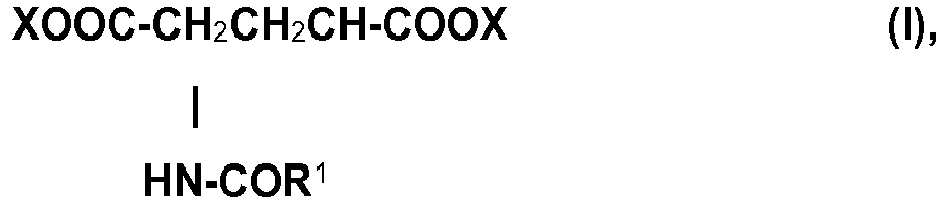
- Kosmetisches Reinigungsmittel nach Anspruch 4, dadurch gekennzeichnet, dass es ein Acylglutamat enthält, in dem X für Na und R1CO für einen Acylrest steht, der von Kokosöl abgeleitet ist (INCI: Sodium Cocoyl Glutamate).
- Kosmetisches Reinigungsmittel nach einem der vorangehenden Ansprüche, dadurch gekennzeichnet, dass es 0,1 bis 10 Gew.-%, vorzugsweise 0,2 bis 9 Gew.-%, weiter bevorzugt 0,3 bis 8 Gew.-%, noch weiter bevorzugt 0,4 bis 7 Gew.-%, noch weiter bevorzugt 0,45 bis 6 Gew.-% und insbesondere 0,5 bis 5 Gew.-% natürliches Betain enthält.
- Kosmetisches Reinigungsmittel nach einem der vorangehenden Ansprüche, dadurch gekennzeichnet, dass es 0,1 bis 10 Gew.-%, vorzugsweise 0,25 bis 9 Gew.-%, weiter bevorzugt 0,5 bis 8 Gew.-%, noch weiter bevorzugt 0,75 bis 7 Gew.-% und insbesondere 1 bis 6 Gew.-% Xanthan enthält.
- Kosmetisches Reinigungsmittel nach einem der vorangehenden Ansprüche, dadurch gekennzeichnet, dass es weniger als 25 Gew.-%, vorzugsweise weniger als 20 Gew.-%, weiter bevorzugt weniger als 15 Gew.-%, noch weiter bevorzugt weniger als 10 Gew.-% und insbesondere 0,1 bis 5 Gew.-% Wasser enthält.
- Kosmetisches Reinigungsmittel nach einem der vorangehenden Ansprüche, dadurch gekennzeichnet, dass es 0,1 bis 10 Gew.-%, vorzugsweise 0,25 bis 9 Gew.-%, weiter bevorzugt 0,5 bis 8 Gew.-%, noch weiter bevorzugt 0,75 bis 7 Gew.-% und insbesondere 1 bis 6 Gew.-% natürliche(s) Öl(e) enthält.
- Kosmetisches Reinigungsmittel nach einem der vorangehenden Ansprüche, dadurch gekennzeichnet, dass es - bezogen auf sein Gewicht - weniger als 1 Gew.-%, vorzugsweise weniger als 0,5 Gew.-%, weiter bevorzugt weniger als 0,5 Gew.-% und insbesondere weniger als 0,1 Gew.-% Sulfat-haltige(s) Tensid(e) enthält, wobei äußerst bevorzugte Mittel vollständig frei sind von sulfathaltigen Tensiden.
Applications Claiming Priority (1)
| Application Number | Priority Date | Filing Date | Title |
|---|---|---|---|
| DE102018221038.1A DE102018221038A1 (de) | 2018-12-05 | 2018-12-05 | bei Raumtemperatur festes natürliches kosmetisches Reinigungsmittel |
Publications (1)
| Publication Number | Publication Date |
|---|---|
| EP3662883A1 true EP3662883A1 (de) | 2020-06-10 |
Family
ID=68581358
Family Applications (1)
| Application Number | Title | Priority Date | Filing Date |
|---|---|---|---|
| EP19208779.9A Withdrawn EP3662883A1 (de) | 2018-12-05 | 2019-11-13 | Bei raumtemperatur festes natürliches kosmetisches reinigungsmittel |
Country Status (3)
| Country | Link |
|---|---|
| US (1) | US20200179253A1 (de) |
| EP (1) | EP3662883A1 (de) |
| DE (1) | DE102018221038A1 (de) |
Citations (1)
| Publication number | Priority date | Publication date | Assignee | Title |
|---|---|---|---|---|
| EP1857534A1 (de) * | 2005-03-01 | 2007-11-21 | Ajinomoto Co., Inc. | Waschmittel |
Family Cites Families (1)
| Publication number | Priority date | Publication date | Assignee | Title |
|---|---|---|---|---|
| EP2774481B1 (de) * | 2013-03-08 | 2018-06-13 | Symrise AG | Antimikrobielle Zusammensetzungen |
-
2018
- 2018-12-05 DE DE102018221038.1A patent/DE102018221038A1/de not_active Withdrawn
-
2019
- 2019-11-06 US US16/675,925 patent/US20200179253A1/en not_active Abandoned
- 2019-11-13 EP EP19208779.9A patent/EP3662883A1/de not_active Withdrawn
Patent Citations (1)
| Publication number | Priority date | Publication date | Assignee | Title |
|---|---|---|---|---|
| EP1857534A1 (de) * | 2005-03-01 | 2007-11-21 | Ajinomoto Co., Inc. | Waschmittel |
Non-Patent Citations (2)
| Title |
|---|
| DATABASE GNPD [online] MINTEL; 1 September 2004 (2004-09-01), ANONYMOUS: "Moisture Soap", XP055684625, retrieved from www.gnpd.com Database accession no. 296270 * |
| DATABASE GNPD [online] MINTEL; 25 June 2018 (2018-06-25), ANONYMOUS: "Multipack Bar Soaps", XP055684936, retrieved from www.gnpd.com Database accession no. 5770207 * |
Also Published As
| Publication number | Publication date |
|---|---|
| US20200179253A1 (en) | 2020-06-11 |
| DE102018221038A1 (de) | 2020-06-10 |
Similar Documents
| Publication | Publication Date | Title |
|---|---|---|
| DE69418477T2 (de) | Alkylglykosiden enthaltendes konzentrat und seine anwendungen | |
| DE102019210484A1 (de) | Combar für die Haut- und Haarbehandlung | |
| DE69618940T2 (de) | Tensidzusammensetzungen | |
| DE202008018605U1 (de) | Stabile flüssige Reinigungszusammensetzungen mit einem Fettsäureacylisethionat-Tensid | |
| DE102018220854A1 (de) | Natürlich verdickte kosmetische Reinigungsmittel | |
| DE202008018621U1 (de) | Fettsäureacylisethionattensidprodukt-enthaltende flüssige Reinigungsmittelzusammensetzungen stabilisiert mit einer Mischung von lang- und kurzkettigen Fettsäuren/Fettseifen | |
| EP0784609B2 (de) | Verfahren zur herstellung von pumpfähigen wässrigen tensidkonzentraten | |
| WO2012168126A2 (de) | Verfahren zur herstellung eines transparenten kosmetischen reinigungsmittels | |
| EP0780464B1 (de) | Verfahren zur Herstellung hellfarbiger, niedrigviskoser Tensidkonzentrate | |
| EP0817827B1 (de) | Verfahren zur herstellung wässriger tensidkonzentrate | |
| DE102007041494A1 (de) | Kosmetisches Reinigungsmittel mit niedrigem pH | |
| EP3662882A1 (de) | Bei raumtemperatur festes natürliches kosmetisches reinigungsmittel | |
| DE102018221038A1 (de) | bei Raumtemperatur festes natürliches kosmetisches Reinigungsmittel | |
| WO1999010469A1 (de) | Stückseifen enthaltend fettsäurepolyglycolestersulfate | |
| DE102005013132A1 (de) | Hautfreundliche Detergensgemische | |
| DE19703745C2 (de) | Stückseifen | |
| EP0836471A1 (de) | Hautpflegemittel enthaltend nichtionische tenside und kationische biopolymere | |
| WO1996041858A1 (de) | Verdünnte wässrige tensidlösung mit erhöhter viskosität | |
| DE60101548T2 (de) | Eine neue familie von zusammenstellungen aus alkylpolyglykosiden und fettdiolen, insbesondere verwendbar für die bereitung von stabilen emulsionen mit einem guten trübungseffekt | |
| DE60213095T2 (de) | Hochviskoses flüssigwaschmittel enthaltend einen verdickungsmittel aus hydroxyalkylierter mehrwertiger alkoholetherverbindung | |
| EP0999822A1 (de) | Wässrige perlglanzkonzentrate | |
| EP3721945A1 (de) | Kosmetische reinigungszubereitung | |
| EP0918085B1 (de) | C8-C22-Carbonsäureamidethersulfate in hautmilden Tensidkombinationen | |
| DE19508857A1 (de) | Verfahren zur Kristallisationsinhibierung von Tensidkonzentraten | |
| DE19530221A1 (de) | Milde, schaumstarke Detegensgemische |
Legal Events
| Date | Code | Title | Description |
|---|---|---|---|
| PUAI | Public reference made under article 153(3) epc to a published international application that has entered the european phase |
Free format text: ORIGINAL CODE: 0009012 |
|
| STAA | Information on the status of an ep patent application or granted ep patent |
Free format text: STATUS: REQUEST FOR EXAMINATION WAS MADE |
|
| 17P | Request for examination filed |
Effective date: 20191113 |
|
| AK | Designated contracting states |
Kind code of ref document: A1 Designated state(s): AL AT BE BG CH CY CZ DE DK EE ES FI FR GB GR HR HU IE IS IT LI LT LU LV MC MK MT NL NO PL PT RO RS SE SI SK SM TR |
|
| AX | Request for extension of the european patent |
Extension state: BA ME |
|
| STAA | Information on the status of an ep patent application or granted ep patent |
Free format text: STATUS: EXAMINATION IS IN PROGRESS |
|
| STAA | Information on the status of an ep patent application or granted ep patent |
Free format text: STATUS: THE APPLICATION HAS BEEN WITHDRAWN |
|
| 17Q | First examination report despatched |
Effective date: 20221104 |
|
| 18W | Application withdrawn |
Effective date: 20221118 |