EP3662960A1 - Medizinische vorrichtung - Google Patents
Medizinische vorrichtung Download PDFInfo
- Publication number
- EP3662960A1 EP3662960A1 EP18841609.3A EP18841609A EP3662960A1 EP 3662960 A1 EP3662960 A1 EP 3662960A1 EP 18841609 A EP18841609 A EP 18841609A EP 3662960 A1 EP3662960 A1 EP 3662960A1
- Authority
- EP
- European Patent Office
- Prior art keywords
- operating line
- medical device
- rotating member
- device body
- operating
- Prior art date
- Legal status (The legal status is an assumption and is not a legal conclusion. Google has not performed a legal analysis and makes no representation as to the accuracy of the status listed.)
- Pending
Links
- 238000005452 bending Methods 0.000 claims abstract description 249
- 229920005989 resin Polymers 0.000 claims description 79
- 239000011347 resin Substances 0.000 claims description 79
- 230000008878 coupling Effects 0.000 claims description 67
- 238000010168 coupling process Methods 0.000 claims description 67
- 238000005859 coupling reaction Methods 0.000 claims description 67
- 230000007246 mechanism Effects 0.000 claims description 63
- 238000004804 winding Methods 0.000 description 56
- 239000010410 layer Substances 0.000 description 55
- 239000000463 material Substances 0.000 description 34
- 239000003550 marker Substances 0.000 description 23
- 210000004204 blood vessel Anatomy 0.000 description 10
- -1 polytetrafluoroethylene Polymers 0.000 description 10
- 239000002033 PVDF binder Substances 0.000 description 8
- 230000007423 decrease Effects 0.000 description 8
- 229920001343 polytetrafluoroethylene Polymers 0.000 description 8
- 239000004810 polytetrafluoroethylene Substances 0.000 description 8
- 229920002981 polyvinylidene fluoride Polymers 0.000 description 8
- 229910000679 solder Inorganic materials 0.000 description 8
- 238000006243 chemical reaction Methods 0.000 description 6
- 239000002184 metal Substances 0.000 description 6
- 229910052751 metal Inorganic materials 0.000 description 6
- 239000007769 metal material Substances 0.000 description 6
- 229920001774 Perfluoroether Polymers 0.000 description 4
- 239000004952 Polyamide Substances 0.000 description 4
- 239000004698 Polyethylene Substances 0.000 description 4
- 239000004642 Polyimide Substances 0.000 description 4
- 239000004743 Polypropylene Substances 0.000 description 4
- 239000005038 ethylene vinyl acetate Substances 0.000 description 4
- 230000002093 peripheral effect Effects 0.000 description 4
- 229920001200 poly(ethylene-vinyl acetate) Polymers 0.000 description 4
- 229920002647 polyamide Polymers 0.000 description 4
- 229920000573 polyethylene Polymers 0.000 description 4
- 229920000139 polyethylene terephthalate Polymers 0.000 description 4
- 239000005020 polyethylene terephthalate Substances 0.000 description 4
- 229920001721 polyimide Polymers 0.000 description 4
- 229920001155 polypropylene Polymers 0.000 description 4
- 229910001220 stainless steel Inorganic materials 0.000 description 4
- 239000010935 stainless steel Substances 0.000 description 4
- WFKWXMTUELFFGS-UHFFFAOYSA-N tungsten Chemical compound [W] WFKWXMTUELFFGS-UHFFFAOYSA-N 0.000 description 4
- 229910052721 tungsten Inorganic materials 0.000 description 4
- 239000010937 tungsten Substances 0.000 description 4
- 239000004677 Nylon Substances 0.000 description 2
- 238000009954 braiding Methods 0.000 description 2
- DQXBYHZEEUGOBF-UHFFFAOYSA-N but-3-enoic acid;ethene Chemical compound C=C.OC(=O)CC=C DQXBYHZEEUGOBF-UHFFFAOYSA-N 0.000 description 2
- 230000006835 compression Effects 0.000 description 2
- 238000007906 compression Methods 0.000 description 2
- 229920001971 elastomer Polymers 0.000 description 2
- 239000000806 elastomer Substances 0.000 description 2
- 238000000034 method Methods 0.000 description 2
- 229920001778 nylon Polymers 0.000 description 2
- 230000010355 oscillation Effects 0.000 description 2
- 229920002312 polyamide-imide Polymers 0.000 description 2
- 239000004814 polyurethane Substances 0.000 description 2
- 239000004800 polyvinyl chloride Substances 0.000 description 2
- 238000009751 slip forming Methods 0.000 description 2
- 239000002344 surface layer Substances 0.000 description 2
- 230000000694 effects Effects 0.000 description 1
- 238000003780 insertion Methods 0.000 description 1
- 230000037431 insertion Effects 0.000 description 1
Images









Classifications
-
- A—HUMAN NECESSITIES
- A61—MEDICAL OR VETERINARY SCIENCE; HYGIENE
- A61M—DEVICES FOR INTRODUCING MEDIA INTO, OR ONTO, THE BODY; DEVICES FOR TRANSDUCING BODY MEDIA OR FOR TAKING MEDIA FROM THE BODY; DEVICES FOR PRODUCING OR ENDING SLEEP OR STUPOR
- A61M25/00—Catheters; Hollow probes
- A61M25/01—Introducing, guiding, advancing, emplacing or holding catheters
- A61M25/0105—Steering means as part of the catheter or advancing means; Markers for positioning
- A61M25/0133—Tip steering devices
- A61M25/0147—Tip steering devices with movable mechanical means, e.g. pull wires
-
- A—HUMAN NECESSITIES
- A61—MEDICAL OR VETERINARY SCIENCE; HYGIENE
- A61B—DIAGNOSIS; SURGERY; IDENTIFICATION
- A61B5/00—Measuring for diagnostic purposes; Identification of persons
- A61B5/68—Arrangements of detecting, measuring or recording means, e.g. sensors, in relation to patient
- A61B5/6846—Arrangements of detecting, measuring or recording means, e.g. sensors, in relation to patient specially adapted to be brought in contact with an internal body part, i.e. invasive
- A61B5/6847—Arrangements of detecting, measuring or recording means, e.g. sensors, in relation to patient specially adapted to be brought in contact with an internal body part, i.e. invasive mounted on an invasive device
-
- A—HUMAN NECESSITIES
- A61—MEDICAL OR VETERINARY SCIENCE; HYGIENE
- A61M—DEVICES FOR INTRODUCING MEDIA INTO, OR ONTO, THE BODY; DEVICES FOR TRANSDUCING BODY MEDIA OR FOR TAKING MEDIA FROM THE BODY; DEVICES FOR PRODUCING OR ENDING SLEEP OR STUPOR
- A61M25/00—Catheters; Hollow probes
-
- A—HUMAN NECESSITIES
- A61—MEDICAL OR VETERINARY SCIENCE; HYGIENE
- A61M—DEVICES FOR INTRODUCING MEDIA INTO, OR ONTO, THE BODY; DEVICES FOR TRANSDUCING BODY MEDIA OR FOR TAKING MEDIA FROM THE BODY; DEVICES FOR PRODUCING OR ENDING SLEEP OR STUPOR
- A61M25/00—Catheters; Hollow probes
- A61M25/01—Introducing, guiding, advancing, emplacing or holding catheters
- A61M25/0105—Steering means as part of the catheter or advancing means; Markers for positioning
- A61M25/0133—Tip steering devices
- A61M25/0136—Handles therefor
-
- A—HUMAN NECESSITIES
- A61—MEDICAL OR VETERINARY SCIENCE; HYGIENE
- A61M—DEVICES FOR INTRODUCING MEDIA INTO, OR ONTO, THE BODY; DEVICES FOR TRANSDUCING BODY MEDIA OR FOR TAKING MEDIA FROM THE BODY; DEVICES FOR PRODUCING OR ENDING SLEEP OR STUPOR
- A61M25/00—Catheters; Hollow probes
- A61M25/01—Introducing, guiding, advancing, emplacing or holding catheters
- A61M25/0105—Steering means as part of the catheter or advancing means; Markers for positioning
- A61M25/0133—Tip steering devices
- A61M25/0147—Tip steering devices with movable mechanical means, e.g. pull wires
- A61M2025/015—Details of the distal fixation of the movable mechanical means
-
- A—HUMAN NECESSITIES
- A61—MEDICAL OR VETERINARY SCIENCE; HYGIENE
- A61M—DEVICES FOR INTRODUCING MEDIA INTO, OR ONTO, THE BODY; DEVICES FOR TRANSDUCING BODY MEDIA OR FOR TAKING MEDIA FROM THE BODY; DEVICES FOR PRODUCING OR ENDING SLEEP OR STUPOR
- A61M25/00—Catheters; Hollow probes
- A61M25/0043—Catheters; Hollow probes characterised by structural features
- A61M25/005—Catheters; Hollow probes characterised by structural features with embedded materials for reinforcement, e.g. wires, coils, braids
-
- A—HUMAN NECESSITIES
- A61—MEDICAL OR VETERINARY SCIENCE; HYGIENE
- A61M—DEVICES FOR INTRODUCING MEDIA INTO, OR ONTO, THE BODY; DEVICES FOR TRANSDUCING BODY MEDIA OR FOR TAKING MEDIA FROM THE BODY; DEVICES FOR PRODUCING OR ENDING SLEEP OR STUPOR
- A61M25/00—Catheters; Hollow probes
- A61M25/01—Introducing, guiding, advancing, emplacing or holding catheters
- A61M25/0105—Steering means as part of the catheter or advancing means; Markers for positioning
- A61M25/0108—Steering means as part of the catheter or advancing means; Markers for positioning using radio-opaque or ultrasound markers
-
- A—HUMAN NECESSITIES
- A61—MEDICAL OR VETERINARY SCIENCE; HYGIENE
- A61M—DEVICES FOR INTRODUCING MEDIA INTO, OR ONTO, THE BODY; DEVICES FOR TRANSDUCING BODY MEDIA OR FOR TAKING MEDIA FROM THE BODY; DEVICES FOR PRODUCING OR ENDING SLEEP OR STUPOR
- A61M25/00—Catheters; Hollow probes
- A61M25/01—Introducing, guiding, advancing, emplacing or holding catheters
- A61M25/0105—Steering means as part of the catheter or advancing means; Markers for positioning
- A61M25/0133—Tip steering devices
- A61M25/0138—Tip steering devices having flexible regions as a result of weakened outer material, e.g. slots, slits, cuts, joints or coils
Definitions
- the present invention relates to a medical device.
- Patent Document 1 As an elongated medical device, such as a catheter capable of bending a distal end part, a type having operating lines is known (for example, Patent Document 1).
- a plurality of hollow tubes are disposed around a central lumen, and operating lines are respectively inserted through the two hollow tubes that face each other via the central lumen.
- distal ends of the operating lines are fixed to the distal end part of the catheter.
- the catheter of this document is configured to bend rear ends of the operating lines. Accordingly, the distal end part of the catheter can be bent by selecting and pulling an operating line.
- Patent Document 1 Japanese Unexamined Patent Application, First Publication No. 2013-48711
- the distal end part is not easily bent in an outward direction. This is because, if an operating line located on an out-course side of the curve is pulled to bend a distal end of the catheter in the outward direction, the catheter rotates around the axis of the catheter within the curved blood vessel in a direction in which the path of the operating line to be pulled becomes short.
- the invention has been made in view of the above problem, and provides a medical device, such as a catheter having a structure capable of more reliably bending the distal end part in a desired direction.
- the invention has been made in view of the above problems, and provides a medical device, such as a catheter having a structure capable of suitably realizing operability according to various needs.
- the invention provides a medical device including an elongated medical device body; a first operating line and a second operating line that are inserted in an axial direction of the medical device body; and a bending operating part for performing a bending operation of a distal end part of the medical device body by pulling the first operating line and the second operating line, at an intermediate part and a proximal end part in the axial direction of the medical device body, the first operating line and the second operating line extending in parallel so as to be spaced apart from each other in a circumferential direction of the medical device body, and at a distal end part in the axial direction of the medical device body, a first operating line and a second operating line being curved and joined together so as to approach each other in the circumferential direction of the medical device body gradually toward a distal end side.
- the invention provides an elongated medical device body; a first operating line and a second operating line that are inserted in an axial direction of the medical device body; and a bending operating part for performing a bending operation of a distal end part of the medical device body by pulling the first operating line and the second operating line, the bending operating part including a rotating member that is rotatably journaled and to which a proximal end part of the first operating line and a proximal end part of the second operating line are fixed, a moving mechanism that moves the rotating member in a pulling direction in which the first operating line and the second operating line are pulled, and an opposite direction opposite to the pulling direction, and an operation receiving part that operates in response to a user's operation, and the rotating member moves in the pulling direction and the opposite direction as power of the operation receiving part is transmitted to the rotating member via the moving mechanism.
- Various components of medical devices related to the present embodiments do not need to be individually independent, and it is allowed that a plurality of components are formed as one member, one component is formed by a plurality of members, a certain component is a portion of another component, a portion of a certain component and a portion of another component duplicate overlap each other, and the like.
- the distal end part refers to a predetermined length region including an end (distal end) on an insertion distal end side of a medical device in respective units of the medical device.
- the proximal end part refers to a predetermined length region including an end (proximal end) on a proximal end side of the medical device in respective units of the medical device.
- an axis refers to a central axis along a longitudinal direction of a medical device body.
- the longitudinal section of the medical device refers to a section obtained by cutting the medical device along the axis.
- the cross-section of the medical device refers to a cross-section obtained by cutting the medical device in a plane orthogonal to the axis.
- Embodiment 1-1 will be described with reference to FIG. 1 to FIG. 8(b) .
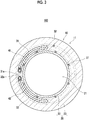
- FIG. 1 is a sectional view along line A-A of FIG. 2 .
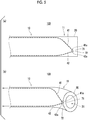
- FIG. 5(a) and FIG. 5(b) are schematic views for showing a bending motion when a distal end part 11 of a medical device body 10 is seen in the direction of arrow A of FIG. 4 , FIG. 5(a) shows a state before the bending, and FIG. 5(b) shows a bent state.
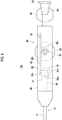
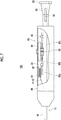
- FIG. 7 a housing 86 of a bending operating part 80 is broken partially to show the internal structure of the housing 86.
- FIG. 8(a) and FIG. 8(b) a middle portion of the medical device body 10 in the longitudinal direction is broken and omitted.
- a portion closer to a proximal end side than the omitted portion and a portion closer to the distal end side than the omitted portion have rotational phases around the axis of the medical device body 10 that are different from each other by 90 degrees.
- a medical device 100 related to the present embodiment includes the elongated medical device body 10, a first operating line 41 and a second operating line 42 that are inserted in an axial direction of the medical device body 10, and the bending operating part 80 ( FIG. 6 , FIG. 7 ) for performing the bending operation of the distal end part 11 of the medical device body 10 by pulling the first operating line 41 and the second operating line 42.
- the first operating line 41 and the second operating line 42 extend in parallel so as to be spaced apart from each other in a circumferential direction of the medical device body 10.
- the first operating line 41 and the second operating line 42 are curved and joined together so as to approach each other in the circumferential direction of the medical device body 10 gradually toward the distal end side.
- first operating line 41 and the second operating line 42 are close to each other means that a distal end 41a of the first operating line 41 and a distal end 42a of the second operating line 42 are joined together. It is preferable that the distal end 41a of the first operating line 41 and the distal end 42a of the second operating line 42 are close to each other at a distance smaller than the thickness of a resin tube 20 to be described below.
- the distal end part 11 of the medical device body 10 can be bent as shown in FIG. 5(a) and FIG. 5(b) by pulling both of the first operating line 41 and the second operating line 42.
- the load of pulling the distal end part 11 of the medical device body 10 with the first operating line 41 and the load of pulling the distal end part 11 with the second operating line 42 can be balanced with each other. Therefore, occurrence of a phenomenon in which the medical device body 10 rotates around the axis such that the first operating line 41 or the second operating line 42 tends to take a shortcut can be limited.
- a direction in which the distal end part 11 can be bent by pulling the operating line is one direction.
- the medical device 100 is, typically, a catheter.
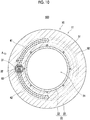
- the medical device body 10 includes the resin tube 20 of which an inner cavity is as a lumen 21.
- the resin tube 20 has a layer structure including a hollow tubular inner layer 22 of which an inner cavity is the lumen 21, and a hollow tubular outer layer 23 that is formed coaxially with the inner layer 22 and at an outer periphery of the inner layer 22.
- the inner layer 22 and the outer layer 23 are respectively made of resin materials.
- An inner peripheral surface of the outer layer 23 is joined to an outer peripheral surface of the inner layer 22.
- a resin material constituting the inner layer 22 and a resin material constituting the outer layer 23 may be different from each other, or may be the same as each other.
- a hydrophilic coat may be formed on an outer surface layer of the medical device body 10 as necessary.
- the lumen 21 is continuously formed from a distal end of the medical device body 10 to a proximal end thereof, and opens at the distal end and the proximal end of the medical device body 10, respectively.
- the medical device body 10 further includes a first hollow tube 31 and a second hollow tube 32 that are buried in the resin tube 20.
- the first operating line 41 is inserted through the first hollow tube 31, and the second operating line 42 is inserted through the second hollow tube 32.
- the first hollow tube 31 and the second hollow tube 32 are respectively sublumen tubes, and inner cavities of these sublumen tubes are sublumens. That is, the operating lines (the first operating line 41, the second operating line 42) are respectively inserted through the sublumens.
- the internal diameters of the first hollow tube 31 and the second hollow tube 32 are smaller than the internal diameter of the lumen 21.
- the first operating line 41 and the second operating line 42 are respectively constituted of thin lines, such as metal or resin.
- the first hollow tube 31 and the second hollow tube 32 are disposed avoiding a position on an in-course side when the distal end part 11 of the medical device body 10 is bent. Therefore, the bending of the distal end part 11 can be easily performed. Since the first hollow tube 31 and the second hollow tube 32 are spaced apart from the in-course side, particularly on a further proximal end side in the distal end part 11, the bending becomes easy.
- the first hollow tube 31 and the second hollow tube 32 are curved so as to approach each other in the circumferential direction of the medical device body 10 gradually toward the distal end side. Accordingly, the first operating line 41 within the first hollow tube 31 and the second operating line 42 within the second hollow tube 32 are curved so as to approach each other in the circumferential direction of the medical device body 10 gradually toward the distal end side.
- first hollow tube 31 and the second hollow tube 32 do not intersect each other. Additionally, the first operating line 41 and the second operating line 42 do not intersect each other.
- the medical device body 10 is configured to include the resin tube 20 having the lumen 21, and the first hollow tube 31 and the second hollow tube 32 that are buried in the resin tube 20 and allows the first operating line 41 and the second operating line 42 to be respectively inserted therethrough.
- the first hollow tube 31 and the second hollow tube 32 are curved so as to approach each other in the circumferential direction of the medical device body 10 gradually toward the distal end side.
- a region where the first operating line 41 and the second operating line 42 approach each other in the circumferential direction of the medical device body 10 gradually toward the distal end side in the axial direction of the medical device body 10 is referred to as a curved region 15.
- a proximal end position 15a of the curved region 15 is a position where the first operating line 41 and the second operating line 42 starts to be curved toward each other
- a distal end position 15b of the curved region 15 is a position where the first operating line 41 and the second operating line 42 finishes being curved toward each other.
- the distal end position 15b of the curved region 15 is a position where the distal ends 41a and 42a of the first operating line 41 and the second operating line 42 are disposed, or a position in the vicinity thereof.
- the distal end 41a of the first operating line 41 protrudes from a distal end 31a of the first hollow tube 31.
- the distal end 42a of the second operating line 42 protrudes from a distal end 32a of the second hollow tube 32.
- the distal end 41a is located in the vicinity of the distal end 31a, and the distal end 42a is located in the vicinity of the distal end 32a.
- the medical device body 10 includes, for example, a braid layer 51 buried in the resin tube 20. Accordingly, the medical device body 10 is reinforced by the braid layer 51.
- the braid layer 51 is configured by braiding two or more wires.
- the braid layer 51 is disposed, for example, around the inner layer 22.
- first hollow tube 31 and the second hollow tube 32 are disposed, for example, on a further radially outer side (at a position far from the axis of the medical device body 10) of the medical device body 10 than the braid layer 51.
- the medical device body 10 further includes a winding wire 52 buried in the resin tube 20.
- the winding wire 52 is wound on a further radially outer side of the medical device body 10 than the braid layer 51, the first hollow tube 31, and the second hollow tube 32.
- the winding wire 52 constrains the first hollow tube 31 and the second hollow tube 32 to the braid layer 51.
- the first hollow tube 31 and the second hollow tube 32 are disposed along an outer periphery of the braid layer 51 (refer to FIG. 3 and FIG. 4 ).
- the distance between the first hollow tube 31 and the second hollow tube 32 in the circumferential direction of the medical device body 10 decreases gradually toward the distal end side, and the distance between the first operating line 41 and the second operating line 42 in the circumferential direction of the medical device body 10 decreases gradually toward the distal end side.
- first hollow tube 31 and the second hollow tube 32 are deformed in a curved shape, for example, on a further distal end side than the proximal end position 15a of the curved region 15.
- the first hollow tube 31 and the second hollow tube 32 may be respectively fixed to at least one of the braid layer 51 or the inner layer 22 at the proximal end position 15a of the curved region 15, or a distal end of the winding wire 52 may be disposed at the proximal end position 15a of the curved region 15, and the first hollow tube 31 and the second hollow tube 32 may not be constrained by the winding wire 52 on a further distal end side than the proximal end position 15a.
- the first operating line 41 and the second operating line 42 are disposed at positions that face each other in the circumferential direction of the medical device body 10.
- the first operating line 41 and the second operating line 42 face each other by 180 degrees in the circumferential direction of the medical device body 10 with the axis of the medical device body 10 as a reference.
- the first operating line 41 and the second operating line 42 face each other by 180 degrees in the circumferential direction of the medical device body 10. That is, at the intermediate part 12, the proximal end part 13, and the proximal end position 15a of the curved region 15, the phase difference between the first operating line 41 and the second operating line 42 in the circumferential direction of the medical device body 10 is 180 degrees.
- the phase difference between the first operating line 41 and the second operating line 42 in the circumferential direction of the medical device body 10 decreases gradually toward the distal end side in the curved region 15, and at the distal end position 15b of the curved region 15, for example, the phase difference is about 0.
- the first operating line 41 and the second operating line 42 are rotated by 90 degrees in the circumferential direction of the medical device body 10 in the curved region 15.
- first operating line 41 and the second operating line 42 disposed at positions that face each other in the circumferential direction of the medical device body 10 is not limited to this example, and means that the first operating line 41 and the second operating line 42 are spaced apart from each other by 120 degrees or more in the circumferential direction of the medical device body 10.
- the first hollow tube 31 and the second hollow tube 32 face each other 180 degrees in the circumferential direction of the medical device body 10 with the axis of the medical device body 10 as a reference. That is, at the intermediate part 12, the proximal end part 13, and the proximal end position 15a of the curved region 15, the phase difference between the first hollow tube 31 and the second hollow tube 32 in the circumferential direction of the medical device body 10 is 180 degrees. The phase difference decreases gradually toward the distal end side in the curved region 15.
- the distal end part 11 of the medical device body 10 is provided with a ringshaped marker 70 made of a radiopaque metallic material.
- the marker 70 is disposed coaxially with the lumen 21 and around the lumen 21.
- the marker 70 is disposed, for example, around the braid layer 51.
- the distal end 41a of the first operating line 41 is fixed to the marker 70 by a first fixing part 71 that is, for example, spot-shaped solder.
- the distal end 42a of the second operating line 42 is fixed to the marker 70 by the first fixing part 71 that is, for example, spot-shaped solder.
- the first fixing part 71 and the second fixing part 72 are disposed, for example, at an end part of the marker 70 on the proximal end side.
- the distal end 41a of the first operating line 41 and the distal end 42a of the second operating line 42 are coupled to each other. That is, the distal ends of the first operating line 41 and the second operating line 42 are coupled to each other.
- first fixing part 71 and the second fixing part 72 are adjacent to and in contact with each other. That is, the first fixing part 71 and the second fixing part 72 are integrated with each other.
- distal end 41a and the distal end 42a may be fixed to the marker 70 by a single fixing part.
- a hub 90 provided at a proximal end part of the medical device body 10 will be described with reference to FIGS. 6 and 7 .
- the hub 90 has a coupling part 93 for inserting an injector (syringe), which is not shown, from a proximal end of the hub 90.
- a thread groove is formed at an outer periphery of the coupling part 93 so that the syringe can be detachably fixed.
- Two wing parts 92 which face each other via an axis of the hub 90, are provided at an outer periphery of the hub 90.
- the proximal end part of the medical device body 10 is inserted into and fixed to a distal end part of the hub 90. Accordingly, the lumen 21 inside the medical device body 10 and an internal space of the hub 90 communicate with each other.
- the housing 86 of the bending operating part 80 to be described below is connected and fixed to a distal end side of the hub 90.
- the medical device 100 includes the bending operating part 80 for performing the bending operation of the distal end part 11 of the medical device body 10 by pulling the first operating line 41 and the second operating line 42.
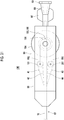
- the bending operating part 80 is configured to include a rotating member 81 that is rotatably journaled and is engaged with the first operating line 41 and the second operating line 42, and to which a proximal end part of the first operating line 41 and a proximal end part of the second operating line 42 are fixed, and a moving mechanism that moves the rotating member 81 in a pulling direction in which the first operating line 41 and the second operating line 42 are pulled, and an opposite direction opposite to the pulling direction.
- the rotating member 81 is, for example, a pulley.
- a certain member is rotatable includes not only an aspect in which the member is rotatable 360 degrees or more but also an aspect in which only oscillation in a predetermined angle range of less than 360 degrees is possible.
- the rotating member 81 has an engaging part formed in a circular shape centered on a rotation center of the rotating member 81, and the first operating line 41 and the second operating line 42 are engaged with the engaging part.
- the engaging part of the rotating member 81 is not limited to the circular shape, and may have a circular shape.
- the rotating member 81 has the engaging part that is engaged with the first operating line 41 and the second operating line, and the engaging part is formed in a circular shape or circular-arc shape centered on the rotation center of the rotating member 81.
- the moving mechanism is configured to include a forward/backward movable member 82 and a pinion 83.
- the forward/backward movable member 82 includes a holding part 82a that rotatably holds the rotating member 81, and a rod-shaped part 82b that extends from the holding part 82a to a proximal end side of the medical device body 10.
- a rack part 82c is formed in the rod-shaped part 82b.
- the bending operating part 80 further includes a housing 86 that is a body part of the bending operating part 80, a dial operating part 84 rotatably journaled to the housing 86, a pinion 83 provided integrally with the dial operating part 84, and a guide 85 (for example, a pair of front and rear guides 85) that is provided on an inner surface of the housing 86 to guide the rod-shaped part 82b in a longitudinal direction of the rod-shaped part 82b.
- a guide 85 for example, a pair of front and rear guides 85
- the proximal end part 13 of the medical device body 10 is guided to a proximal end side of the housing 86 through the inside of the housing 86, and is inserted into and fixed to the distal end part of the hub 90.
- a rotating shaft of the dial operating part 84 extends in the direction orthogonal to an axis direction of the medical device body 10 within the housing 86.
- the pinion 83 is formed integrally with the dial operating part 84 on one face side of the dial operating part 84, and is disposed coaxially with the rotating shaft of the dial operating part 84.
- a gear at an outer periphery of the pinion 83 meshes with a gear of the rack part 82c of the forward/backward movable member 82.
- At least a portion of the dial operating part 84 is exposed to the outside of the housing 86 so that an operation in which an operator who performs the operation of the medical device 100 rotates the dial operating part 84 can be performed from the outside of the housing 86.
- the first operating line 41 and the second operating line 42 are delivered from the medical device body 10 within the housing 86.
- the proximal end part of the first operating line 41 is wound around the rotating member 81, for example, by one and a half turns, and a proximal end of the first operating line 41 is fixed to the rotating member 81 by a first fixing part 81a ( FIG. 6 ).
- the second operating line 42 is wound around the rotating member 81, for example, by one and a half turns, and a proximal end of the second operating line 42 is fixed to the rotating member 81 by a second fixing part 81b ( FIG. 6 ).
- a winding direction of the first operating line 41 and a winding direction of the second operating line 42 around the rotating member 81 are mutually opposite directions. For this reason, the rotational angle of the rotating member 81 is autonomously adjusted to an angle at which the tension of the first operating line 41 and the tension of the second operating line 42 are balanced with each other.
- the pinion 83 integral with the dial operating part 84 rotates about an axis.
- the forward/backward movable member 82 having the rack part 82c moves forward (moves to a distal end side of the medical device body 10) or moves backward (moves to the proximal end side of the medical device body 10) in the axial direction of the medical device body 10 relative to the housing 86.
- the bending operating part 80 includes an operation receiving part (dial operating part 84) that operates in response to the operation of a user (operator), and as the power of the operation receiving part to the rotating member 81 via the moving mechanism, the rotating member 81 is adapted to move in the pulling direction and the direction opposite to the pulling direction.
- dial operating part 84 an operation receiving part that operates in response to the operation of a user (operator), and as the power of the operation receiving part to the rotating member 81 via the moving mechanism, the rotating member 81 is adapted to move in the pulling direction and the direction opposite to the pulling direction.
- the operation receiving part (dial operating part 84) is journaled in a rotationally operable manner
- the moving mechanism includes the pinion 83 provided integrally and coaxially with the operation receiving part, and a rack member (forward/backward movable member 82) that moves forward and backward in an interlocking manner with the rotation of the pinion 83, and the rotating member 81 is journaled to the rack member.
- both of the first operating line 41 and the second operating line 42 are pulled to the proximal end side of the medical device body 10 if the dial operating part 84 is rotated in the clockwise direction in FIG. 8(b) . Therefore, the distal end part 11 of the medical device body 10 is bent in one direction.
- the bending operating part 80 is configured to receive the operation performed by a user with a rotating mechanism (dial operating part 84) and convert a force applied to the rotating mechanism by this operation into a forward/backward movement in the axial direction of the medical device body 10 with a conversion mechanism constituted of the pinion 83 and the rack (rack part 82c).
- resin materials such as polytetrafluoroethylene (PTFE), polyvinylidene fluoride (PVDF), and perfluoroalkoxy fluororesin (PFA), can be used.
- PTFE polytetrafluoroethylene
- PVDF polyvinylidene fluoride
- PFA perfluoroalkoxy fluororesin
- resin materials such as polyethylene (PE), polyamide (PA), nylon elastomer, polyurethane (PU), ethylene-vinyl acetate resin (EVA), polyvinyl chloride (PVC), or polypropylene (PP), can be used.
- PE polyethylene
- PA polyamide
- PA nylon elastomer
- PU polyurethane
- EVA ethylene-vinyl acetate resin
- PVC polyvinyl chloride
- PP polypropylene
- resin materials such as polytetrafluoroethylene (PTFE), polyvinylidene fluoride (PVDF), and perfluoroalkoxy fluororesin (PFA), can be used.
- PTFE polytetrafluoroethylene
- PVDF polyvinylidene fluoride
- PFA perfluoroalkoxy fluororesin
- the materials of the wire may be, for example, resin materials.
- the materials of the wire may be, for example, resin materials.
- the distal end part 11 of the medical device body 10 can be bent by pulling both of the first operating line 41 and the second operating line 42.
- a load for pulling the distal end part 11 of the medical device body 10 with the first operating line 41, and a load for pulling the distal end part 11 with the second operating line 42 can be balanced with each other. Therefore, the occurrence of the phenomenon in which the medical device body 10 rotates around the axis such that the first operating line 41 or the second operating line 42 tends to take a shortcut can be limited.
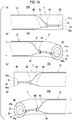
- FIG. 11(a) and FIG. 11(b) are schematic views for showing the bending motion when the distal end part 11 of the medical device body 10 is seen in the direction of arrow A of FIG. 10 , FIG. 11(a) shows the state before the bending, and FIG. 11(b) shows the bent state.
- the medical device 100 related to the present embodiment is different from the medical device 100 related to the above Embodiment 1-1 in terms of points to be described below, and is configured similarly to the medical device 100 related to the above Embodiment 1-1 in terms of the other points.
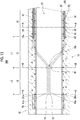
- the parallel region 16 where the first operating line 41 and the second operating line 42 extend in parallel close to each other is formed between the distal end (distal end position 15b) of the curved region 15, and the distal ends 41a and 42a of the first operating line 41 and the second operating line 42.
- the medical device body 10 is configured to include the resin tube 20 having the lumen 21, the first operating line 41 and the second operating line 42 are inserted around the lumen 21 of the resin tube 20, the first operating line 41 and the second operating line 42 are close to each other at a distance smaller than the thickness of the resin tube 20, at the distal end (distal end position 15b) of the curved region 15 curved such that the first operating line 41 and the second operating line 42 approach each other in the circumferential direction of the medical device body 10 gradually toward the distal end side, and the parallel region 16 where the first operating line 41 and the second operating line 42 extend in parallel close to each other is formed between the distal end (distal end position 15b) of the curved region 15, and the distal ends 41a and 42a of the first operating line 41 and the second operating line 42.
- the first hollow tube 31 and the second hollow tube 32 extend in parallel in abutment with or close to each other.
- the medical device 100 further includes the annular member 60 buried in the resin tube 20 at the distal end part of the curved region 15.
- the annular member 60 is configured to have a rigidity higher than the resin tube 20, and have an external diameter smaller than the thickness of the resin tube 20 (refer to FIG. 10 ).
- first operating line 41 and the second operating line 42 are inserted through the annular member 60.
- the fluctuations of the paths of the first operating line 41 and the second operating line 42 can be more reliably limited.
- the first hollow tube 31 and the second hollow tube 32 are inserted through the annular member 60.
- the medical device body 10 is buried in the resin tube 20, and are configured to include the first hollow tube 31 and the second hollow tube 32 through which the first operating line 41 and the second operating line 42 are respectively inserted, the first hollow tube 31 and the second hollow tube 32 are inserted through the annular member 60, and in the curved region 15, the first hollow tube 31 and the second hollow tube 32 are curved so as to approach each other in the circumferential direction of the medical device body 10 gradually toward the distal end side.
- the annular member 60 can be made of, for example, metal or hard resin.
- the distal end part 11 of the medical device body 10 can be bent as shown in FIG. 11(a) and FIG. 11(b) .
- the bending angle in the parallel region 16 becomes steeper than the bending angle in the curved region 15.
- the distance (the distance L2 shown in FIG. 9 ) from the distal end (distal end position 15b) of the curved region 15 to the distal ends 41a and 42a of the first operating line 41 and the second operating line 42 in the axial direction of the medical device body 10 is longer than the distance (the distance L1 shown in FIG. 9 ) from the proximal end (proximal end position 15a) of the curved region 15 to the distal end (distal end position 15b) thereof.
- the distal end part 11 can be more easily bent.
- the bending of the distal end part 11 can be caused mainly in the parallel region 16. For this reason, the friction between the first operating line 41 and the first hollow tube 31 in the curved region 15 and the friction between the second operating line 42 and the second hollow tube 32 can be substantially uniformly maintained irrespective of the bending angle of the distal end part 11. Therefore, the magnitude of a force required for pulling the first operating line 41 and the second operating line 42 can be substantially uniformly maintained irrespective of the bending angle of the distal end part 11.
- the distance (distance L1 shown in FIG. 9 ) from the proximal end (proximal end position 15a) of the curved region 15 to the distal end (distal end position 15b) thereof in the axial direction of the medical device body 10 is longer than the distance (distance L2 shown in FIG. 9 ) from the distal end (distal end position 15b) of the curved region 15 to the distal ends 41a and 42a of the first operating line 41 and the second operating line 42.
- the flexibility of the distal end part 11 can be limited to some extent.
- the curving of the first operating line 41, the second operating line 42, the first hollow tube 31, and the second hollow tube 32 in the curved region 15 can be made gentle. Therefore, the friction between the first operating line 41 and the first hollow tube 31 in the curved region 15 and the friction between the second operating line 42 and the second hollow tube 32 can be reduced.
- the length region where the first hollow tube 31 and the second hollow tube 32 translate close to each other in the distal end part 11 of the medical device body 10, that is, the length region with high rigidity is high becomes short. Therefore, excellent selectivity (excellent blood vessel selectivity or the like) when the distal end part 11 of the medical device body 10 is bent and is made to enter a branched body cavity can be obtained.
- the distance L1 and the distance L2 may be the same. In this case, the smoothness of the pulling of the first operating line 41 and the second operating line 42 and the excellent selectivity when the distal end part 11 of the medical device body 10 is bent and is made to enter a branched body cavity can be obtained in a well-balanced manner.
- FIG. 16(a) and FIG. 16(b) are schematic views for showing a bending motion when the distal end part 11 of the medical device body 10 is seen in the direction of arrow A of FIG. 15 , FIG. 16(a) shows a state before the bending, and FIG. 16(b) shows a bent state.
- FIG. 16(c) and FIG. 16(d) are schematic views for showing a bending motion when the distal end part 11 of the medical device body 10 is seen in the direction of arrow B of FIG. 15 , FIG. 16(c) shows a state before the bending, and FIG. 16(d) shows a bent state.
- FIG. 18(a), FIG. 18(b), and FIG. 18(c) a middle portion of the medical device body 10 in the longitudinal direction is broken and omitted.
- a portion closer to a proximal end side than the omitted portion and a portion closer to the distal end side than the omitted portion have rotational phases around the axis of the medical device body 10 that are different from each other by 90 degrees.
- the medical device 100 related to the present embodiment is different from the medical device 100 related to the above Embodiment 1-2 in terms of points to be described below, and is configured similarly to the medical device 100 related to the above Embodiment 1-2 in terms of the other points.
- the medical device 100 related to the present embodiment includes a third operating line 43 and a fourth operating line 44 that are inserted in the axial direction of the medical device body 10.
- the third operating line 43 and the fourth operating line 44 are respectively constituted of thin wires, such as metal or resin, similarly to the first operating line 41 and the second operating line 42.
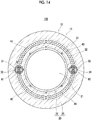
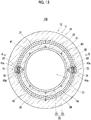
- the medical device body 10 further includes a third hollow tube 33 and a fourth hollow tube 34 that are buried in the resin tube 20.
- the third operating line 43 is inserted through the third hollow tube 33, and the fourth operating line 44 is inserted through the fourth hollow tube 34.
- the third hollow tube 33 and the fourth hollow tube 34 are respectively the same sublumen tubes as the first hollow tube 31 and the second hollow tube 32, and inner cavities of these sublumen tubes are sublumens. That is, the operating lines (the third operating line 43, the fourth operating line 44) are respectively inserted through the sublumens.
- the internal diameters of the third hollow tube 33 and the fourth hollow tube 34 are smaller than the internal diameter of the lumen 21.
- the first hollow tube 31 and the third hollow tube 33 extend in parallel in abutment with or close to each other, and the second hollow tube 32 and the fourth hollow tube 34 extend in parallel in abutment with or close to each other (refer to FIG. 13 ).
- the first hollow tube 31 and the third hollow tube 33 extend in parallel in abutment with or close to each other, and the second hollow tube 32 and the fourth hollow tube 34 extend in parallel in abutment with or close to each other.
- the third hollow tube 33 and the fourth hollow tube 34 are curved so as to approach each other in the circumferential direction of the medical device body 10 gradually toward the distal end side. Accordingly, the third operating line 43 within the third hollow tube 33 and the fourth operating line 44 within the fourth hollow tube 34 are curved so as to approach each other in the circumferential direction of the medical device body 10 gradually toward the distal end side.
- a direction in which the third hollow tube 33 and the third operating line 43 are curved in the curved region 15 is a direction symmetrical to a direction in which the first hollow tube 31 and the first operating line 41 are curved.
- a direction in which the fourth hollow tube 34 and the fourth operating line 44 are curved in the curved region 15 is a direction symmetrical to a direction in which the second hollow tube 32 and the second operating line 42 are curved.
- the respective hollow tubes do not intersect other hollow tubes.
- the respective operating lines do not intersect other operating lines.
- the third operating line 43 and the fourth operating line 44 extend in parallel close to each other.
- the third hollow tube 33 and the fourth hollow tube 34 extend in parallel in abutment with or close to each other.
- a distal end 43a of the third operating line 43 protrudes from a distal end of the third hollow tube 33.
- a distal end 44a of the fourth operating line 44 protrudes from a distal end of the fourth hollow tube 34.
- the distal end 43a of the third operating line 43 is fixed to the marker 70 by a third fixing part 73 that is, for example, spot-shaped solder ( FIG. 15 ).
- the distal end 44a of the fourth operating line 44 is fixed to the marker 70 by the fourth fixing part 74 that is, for example, spot-shaped solder.
- the third fixing part 73 and the fourth fixing part 74 are disposed, for example, at an end part of the marker 70 on the proximal end side.
- the distal end 43 a of the third operating line 43 and the distal end 44a of the fourth operating line 44 are coupled to each other. That is, the distal ends of the third operating line 43 and the fourth operating line 44 are coupled to each other.
- the third fixing part 73 and the fourth fixing part 74 are adjacent to and in contact with each other. That is, the third fixing part 73 and the fourth fixing part 74 are integrated with each other.
- distal end 43a and the distal end 44a may be fixed to the marker 70 by a single fixing part.
- the medical device 100 includes a first annular member 61 buried in the resin tube 20 at the distal end part of the curved region 15 instead of the annular member 60.
- the first annular member 61 is the same as the annular member 60 in Embodiment 1-2, and the first hollow tube 31 and the second hollow tube 32 are inserted through the first annular member 61.
- the medical device 100 includes a second annular member 62 buried in the resin tube 20 at the distal end part of the curved region 15.
- the second annular member 62 is the same as the first annular member 61.
- the third hollow tube 33 and the fourth hollow tube 34 are inserted through the second annular member 62.
- the first annular member 61 and the second annular member 62 are disposed to face each other in the circumferential direction of the medical device body 10.
- the distal end part 11 of the medical device body 10 can be bent in one direction as shown in FIG. 16(a) and FIG. 16(b) .
- the distal end part 11 of the medical device body 10 can be bent in an opposite direction opposite to the above one direction as shown in FIG. 16(c) and FIG. 16.(d) .
- the bending operating part 80 includes a first bending operating part 180 for performing the bending operation of the distal end part 11 of the medical device body 10 by pulling the first operating line 41 and the second operating line 42, and a second bending operating part 280 for performing the bending operation of the distal end part 11 of the medical device body 10 by pulling the third operating line 43 and the fourth operating line 44.
- the first bending operating part 180 includes a first rotating member 181, a first forward/backward movable member 182, a first pinion 183, a first dial operating part 184, and a first guide 185.
- the first rotating member 181, the first forward/backward movable member 182, the first pinion 183, the first dial operating part 184, and the first guide 185 are respectively equivalent to the rotating member 81, the forward/backward movable member 82, the pinion 83, the dial operating part 84, and the guide 85 that are described in Embodiment 1-1.
- the first forward/backward movable member 182 includes a first holding part 182a, a first rod-shaped part 182b, and a first rack part 182c that are respectively equivalent to the holding part 82a, the rod-shaped part 82b, and the rack part 82c.
- Embodiment 1-1 similarly to the first operating line 41 and the second operating line 42 being wound around and fixed to the rotating member 81, the first operating line 41 and the second operating line 42 are wound around and fixed to the first rotating member 181.
- the second bending operating part 280 includes a second rotating member 281, a second forward/backward movable member 282, a second pinion 283, a second dial operating part 284, and a second guide 285.
- the second rotating member 281, the second forward/backward movable member 282, the second pinion 283, the second dial operating part 284, and the second guide 285 are the same as the first rotating member 181, the first forward/backward movable member 182, the first pinion 183, the first dial operating part 184, and the first guide 185.
- the second forward/backward movable member 282 includes a second holding part 282a, a second rod-shaped part 282b, and a second rack part 282c that are respectively the same as the first holding part 182a, the first rod-shaped part 182b, and the first rack part 182c.
- the third operating line 43 and the fourth operating line 44 are wound around and fixed to the second rotating member 281.
- the second bending operating part 280 is disposed vertically symmetrically with respect to the first bending operating part 180 in FIG. 17 .
- the first dial operating part 184 by rotating the first dial operating part 184 to move the first forward/backward movable member 182 and the first rotating member 181 backward, the first operating line 41 and the second operating line 42 can be pulled to bend the distal end part 11 of the medical device body 10 in one direction ( FIG. 18(b) ).
- the third operating line 43 and the fourth operating line 44 can be pulled to bend the distal end part 11 of the medical device body 10 in the direction opposite respect to the above one direction ( FIG. 18(c) ).
- the medical device 100 includes the second bending operating part 280 for performing the bending operation of the distal end part 11 of the medical device body 10 in a direction different from the bending direction of the distal end part 11 of the medical device body 10 by the pulling of the first operating line 41 and the second operating line 42, by pulling the third operating line 43 and the fourth operating line 44.
- the third operating line 43 and the fourth operating line 44 extend in parallel so as to be spaced apart from each other in the circumferential direction of the medical device body 10, and at the distal end part 11 in the axial direction of the medical device body 10, the third operating line 43 and the fourth operating line 44 are curved and joined together so as to approach each other in the circumferential direction of the medical device body 10 gradually toward the distal end side.
- the third operating line 43 and the fourth operating line 44 are pulled at a time by the operation on the second bending operating part 280.
- the second bending operating part 280 is configured to include a second rotating member 281 that is rotatably journaled and is engaged with the third operating line 43 and the fourth operating line 44, and to which a proximal end part of the third operating line 43 and a proximal end part of the fourth operating line 44 are fixed, and a second moving mechanism that moves the second rotating member 281 in a second pulling direction in which the third operating line 43 and the fourth operating line 44 are pulled, and an opposite direction opposite to the second pulling direction.
- the second rotating member 281 has a second engaging part that is engaged with the third operating line 43 and the fourth operating line 44, and the second engaging part is formed in a circular shape or circular-arc shape centered on the rotation center of the second rotating member 281.
- the second bending operating part 280 includes a second operation receiving part (second dial operating part 284) that operates in response to a user's operation, and as the power of the second operation receiving part is transmitted to the second rotating member 281 via the second moving mechanism, the second rotating member 281 moves in the second pulling direction and the direction opposite to the second pulling direction.
- second dial operating part 284 operates in response to a user's operation, and as the power of the second operation receiving part is transmitted to the second rotating member 281 via the second moving mechanism, the second rotating member 281 moves in the second pulling direction and the direction opposite to the second pulling direction.
- the second operation receiving part (second dial operating part 284) is journaled in a rotationally operable manner
- the second moving mechanism includes the second pinion 283 provided integrally and coaxially with the second operation receiving part, and a second rack member (second forward/backward movable member 282) that moves forward and backward in an interlocking manner with the rotation of the second pinion 283, and the second rotating member 281 is journaled to the second rack member.
- the medical device 100 related to the present embodiment is different from the medical device 100 related to the above Embodiment 1-1 in terms of points to be described below, and is configured similarly to the medical device 100 related to the above Embodiment 1-1 in terms of the other points.
- an easily bendable part 110 in which the flexibility of the medical device body 10 is locally high is formed in a region between the first operating line 41 and the second operating line 42 in the circumferential direction of the distal end part 11 of the medical device body 10 or a region located opposite to the region with respect to the axis of the medical device body 10.
- the tension acting on the first operating line 41 and the second operating line 42 during the bending operation can be reduced.
- the occurrence of the phenomenon in which the medical device body 10 rotates around the axis such that the first operating line 41 or the second operating line 42 tends to take a shortcut can be limited.
- easily bendable parts 110 are formed both in the region between the first operating line 41 and the second operating line 42 in the circumferential direction of the distal end part 11 of the medical device body 10 or the region located opposite to the region with respect to the axis of the medical device body 10.
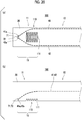
- the easily bendable part 110 is configured to include a notched part 111 formed on an outer surface side of the medical device body 10.
- the notched part 111 can be formed in, for example, a shape gouged out in an arc as shown in FIG. 19(b) . Accordingly, the distal end part 11 can be more steeply bent.
- the medical device 100 related to the present embodiment is different from the medical device 100 related to the above Embodiment 1-1 in terms of points to be described below, and is configured similarly to the medical device 100 related to the above Embodiment 1-1 in terms of the other points.
- an easily bendable part 110 in which the flexibility of the medical device body 10 is locally high is formed in a region between the first operating line 41 and the second operating line 42 in the circumferential direction of the distal end part 11 of the medical device body 10 or a region located opposite to the region with respect to the axis of the medical device body 10.
- the tension acting on the first operating line 41 and the second operating line 42 during the bending operation can be reduced.
- the occurrence of the phenomenon in which the medical device body 10 rotates around the axis such that the first operating line 41 or the second operating line 42 tends to take a shortcut can be limited.
- the easily bendable part 110 is formed in the region between the first operating line 41 and the second operating line 42 in the circumferential direction of the distal end part 11 of the medical device body 10 or the easily bendable part 110 is not formed in the region located opposite to the region with respect to the axis of the medical device body 10.
- easily bendable parts 110 may be formed both in the region between the first operating line 41 and the second operating line 42 in the circumferential direction of the distal end part 11 of the medical device body 10 or the region located opposite to the region with respect to the axis of the medical device body 10.
- the easily bendable part 110 is configured to include a notched part 111 formed on an outer surface side of the medical device body 10.
- the medical device body 10 has a plurality of notched parts 111 disposed adjacent to each other in the axial direction of the medical device body 10.
- the notched parts 111 are elongated in the circumferential direction of the medical device body 10, and the sectional shape thereof is a wedge shape.
- the distal end part 11 of the medical device body 10 is easily bent in the initial stage of the bending. However, if a certain amount of bending angle is reached, wedge-shaped inclined surfaces come in contact with each other, so that further bending becomes difficult (if a certain amount of bending angle is reached, rigidity become high).
- the distal end part 11 of the medical device body 10 has excellent deformation resistance against compression in the axial direction when being pushed into a body cavity, the blood-vessels selectivity of the medical device 100 is excellent.
- Embodiment 1-6 will be described with reference to FIG. 21 .
- the medical device 100 related to the present embodiment is different from the medical device 100 related to the above Embodiment 1-3 in terms of points to be described below, and is configured similarly to the medical device 100 related to the above Embodiment 1-3 in terms of the other points.
- the configuration of the bending operating part 80 is different from the above Embodiment 1-3.
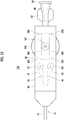
- the bending operating part 80 includes the housing 86, the first rotating member 181, the second rotating member 281, a dial operating part 194 (third rotating member), a first coupling wire 192 that couples the first rotating member 181 and the dial operating part 194 to each other, and a second coupling wire 193 that couples the second rotating member 281 and the dial operating part 194 to each other.
- Each of the first rotating member 181 and the second rotating member 281 is, for example, a pulley.
- a rotating shaft of the first rotating member 181 extends, for example, in a direction orthogonal to the axis direction (leftward-rightward direction in FIG. 21 ) of the medical device body 10 within the housing 86.
- the rotating shaft of the first rotating member 181 is held by the housing 86 so as to be rotatable around the axis of the rotating shaft and movable relative to the housing 86 in the axis direction (leftward-rightward direction in FIG. 21 ) of the medical device body 10 within the housing 86.
- the rotating shaft of the first rotating member 181 is journaled by an elongated hole (not shown) formed in the housing 86.
- a rotating shaft of the second rotating member 281 extends, for example, in the direction orthogonal to the axis direction of the medical device body 10 within the housing 86.
- the rotating shaft of the second rotating member 281 is held by the housing 86 so as to be rotatable around the axis of the rotating shaft and movable relative to the housing 86 in the axis direction of the medical device body 10 within the housing 86.
- the rotating shaft of the first rotating member 181 and the rotating shaft of the second rotating member 281 are parallel to each other. However, these rotating shafts may not be parallel to each other.
- the first operating line 41, the second operating line 42, the third operating line 43, and the fourth operating line 44 are delivered from the medical device body 10 within the housing 86.
- the proximal end part of the first operating line 41 is wound around the first rotating member 181, for example, by one and a half turns, and the proximal end of the first operating line 41 is fixed to the rotating member 181.
- the second operating line 42 is wound around the first rotating member 181, for example, by one and a half turns, and a proximal end of the second operating line 42 is fixed to the first rotating member 181.
- a winding direction of the first operating line 41 and a winding direction of the second operating line 42 around the first rotating member 181 are mutually opposite directions. For this reason, the rotational angle of the first rotating member 181 is autonomously adjusted to an angle at which the tension of the first operating line 41 and the tension of the second operating line 42 are balanced with each other.
- the proximal end part of the third operating line 43 is wound around the second rotating member 281, for example, by one and a half turns, and a proximal end of the third operating line 43 is fixed to the second rotating member 281.
- the fourth operating line 44 is wound around the second rotating member 281, for example, by one and a half turns, and a proximal end of the fourth operating line 44 is fixed to the second rotating member 281.
- a winding direction of the third operating line 43 and a winding direction of the fourth operating line 44 around the second rotating member 281 are mutually opposite directions. For this reason, the rotational angle of the second rotating member 281 is autonomously adjusted to an angle at which the tension of the third operating line 43 and the tension of the fourth operating line 44 are balanced with each other.
- the dial operating part 194 is rotatably journaled to the housing 86.
- a rotating shaft of the dial operating part 194 extends in the direction orthogonal to the axis direction of the medical device body 10 within the housing 86.
- the rotating shaft of the dial operating part 194 is parallel to the rotating shaft of the first rotating member 181 and the rotating shaft of the second rotating member 281.
- the rotating shaft of the dial operating part 194 may not be parallel to the rotating shaft of the first rotating member 181 and the rotating shaft of the second rotating member 281.
- At least a portion of the dial operating part 194 is exposed to the outside of the housing 86 so that the operation in which an operator who performs the operation of the medical device 100 rotates the dial operating part 194 can be performed from the outside of the housing 86.
- the dial operating part 194 includes, for example, a body part formed in a disk shape, and a winding part 191 fixed to one surface side of the body part.
- the winding part 191 is, for example, a cylindrical bobbin.
- the winding part 191 is disposed coaxially with the rotating shaft of the dial operating part 194.
- a distal end of the first coupling wire 192 is coupled to the rotating shaft of the first rotating member 181.
- a proximal end part of the first coupling wire 192 is wound around the winding part 191, for example, by one and a half turns, and a proximal end of the first coupling wire 192 is fixed to the winding part 191 in a first coupling region 195.
- a distal end of the second coupling wire 193 is coupled to the rotating shaft of the second rotating member 281.
- a proximal end part of the second coupling wire 193 is wound around the winding part 191, for example, by one and a half turns, and a proximal end of the second coupling wire 193 is fixed to the winding part 191 in a second coupling region 196.
- a winding direction of the first coupling wire 192 and a winding direction of the second coupling wire 193 around the winding part 191 are mutually opposite directions.
- the first coupling wire 192 or the second coupling wire 193 is selectively wound around the winding part 191. Therefore, the first rotating member 181 or the second rotating member 281 is selectively pulled to the proximal end side.
- the first coupling wire 192 is wound around the winding part 191. Therefore, the first rotating member 181 is pulled to the proximal end side. Therefore, since both of the first operating line 41 and the second operating line 42 are pulled to the proximal end side of the medical device body 10, the distal end part 11 of the medical device body 10 is bent in one direction.
- the operation of pulling both of the first operating line 41 and the second operating line 42 and the operation of pulling both of the third operating line 43 and the fourth operating line 44 can be performed by the operation on one dial operating part 194.
- the medical device 100 related to the present embodiment includes the third operating line 43 and the fourth operating line 44 that are inserted in the axial direction of the medical device body 10.
- the third operating line 43 and the fourth operating line 44 extend in parallel so as to be spaced apart from each other in the circumferential direction of the medical device body 10, and at the distal end part 11 in the axial direction of the medical device body 10, the third operating line 43 and the fourth operating line 44 are curved and joined together so as to approach each other in the circumferential direction of the medical device body 10 gradually toward the distal end side.
- the operation on the bending operating part 80 allows the third operating line 43 and the fourth operating line 44 to be pulled and allows the distal end part 11 of the medical device body 10 to be bent in a direction different from the bending direction of the distal end part 11 of the medical device body 10 by the pulling of the first operating line 41 and the second operating line 42.
- the bending operating part 80 includes the first rotating member 181, the second rotating member 281, and the third rotating member (dial operating part 194) that are rotatably journaled, the rotating shaft of the first rotating member 181 is coupled to the first coupling region 195 in the third rotating member, and the rotating shaft of the second rotating member 281 is coupled to the second coupling region 196 in the third rotating member.
- proximal end part of the first operating line 41 and the proximal end part of the second operating line 42 are fixed to the first rotating member 181
- proximal end part of the third operating line 43 and the proximal end part of the fourth operating line 44 are fixed to the second rotating member 281.
- the third rotating member rotates in one direction
- the first rotating member 181 is pulled and the first operating line 41 and the second operating line 42 are pulled, thereby bending the distal end part 11 of the medical device body 10
- the second rotating member 281 is pulled and the third operating line 43 and the fourth operating line 44 are pulled, thereby bending the distal end part 11 of the medical device body 10 in the direction (for example, opposite direction) different from the pulling direction of the distal end part 11 of the medical device body 10 by the pulling of the first operating line 41 and the second operating line 42.
- Embodiment 1-6 an example in which the rotating shaft of the first rotating member 181 is coupled to the third rotating member (dial operating part 194) via a wire (first coupling wire 192) and the rotating shaft of the second rotating member 281 is coupled to the third rotating member via a wire (second coupling wire 193) has been described.
- the invention is not limited to this example.
- the rotating shaft of the first rotating member 181 may be directly journaled to the first coupling region in the third rotating member, and the rotating shaft of the second rotating member 281 may be journaled to the second coupling region in the third rotating member.
- the third coupling member does not need to include the above winding part 191.
- Embodiment 1-7 will be described with reference to FIG. 22 .
- the medical device 100 related to the present embodiment is different from the medical device 100 related to the above Embodiment 1-6 in terms of points to be described below, and is configured similarly to the medical device 100 related to the above Embodiment 1-6 in terms of the other points.
- the configuration of the bending operating part 80 is different from the above Embodiment 1-6.
- the bending operating part 80 does not include the winding part 191, the first coupling wire 192, and the second coupling wire 193 that are shown in FIG. 21 .
- the bending operating part 80 includes a pinion 197, a first rack member 198, a second rack member 199, and a guide 200 that are shown in FIG. 22 .
- the pinion 197 is formed integrally with the dial operating part 194 on one surface of the disk-shaped dial operating part 194, and is disposed coaxially with the rotating shaft of the dial operating part 194.
- the first rack member 198 is a rod-shaped member that extends in the axis direction of the medical device body 10 within the housing 86.
- the first rotating member 181 is rotatably journaled to a distal end part of the first rack member 198.
- a rack which meshes with a gear at an outer periphery of the pinion 197, is formed on one side surface of the first rack member 198.
- the bending operating part 80 includes, for example, a pair of front and rear guides 200 that are provided corresponding to the first rack member 198.
- the first rack member 198 is linearly guided by the guides 200 so as to be linearly movable forward and backward in the axis direction of the medical device body 10 within the housing 86.
- the second rack member 199 is a rod-shaped member that extends in the axis direction of the medical device body 10 within the housing 86.
- the second rotating member 281 is rotatably journaled to a distal end part of the second rack member 199.
- the rack which meshes with the gear at the outer periphery of the pinion 197, is formed on one side surface of the second rack member 199.
- the bending operating part 80 includes, for example, a pair of front and rear guides 200 that are provided corresponding to the second rack member 199.
- the second rack member 199 is linearly guided by the guides 200 so as to be linearly movable forward and backward in the axis direction of the medical device body 10 within the housing 86.
- engagement and fixation of the first operating line 41 with respect to the first rotating member 181 and the second operating line 42 and engagement and fixation of the third operating line 43 with respect to the second rotating member 281 and the fourth operating line 44 are the same as those of Embodiment 1-6.
- the rotational angle of the first rotating member 181 is autonomously adjusted to an angle at which the tension of the first operating line 41 and the tension of the second operating line 42 are balanced with each other, and the rotational angle of the second rotating member 281 is autonomously adjusted to an angle at which the tension of the third operating line 43 and the tension of the fourth operating line 44 are balanced with each other.
- the first rack member 198 or the second rack member 199 which respectively meshes with the pinion 197, selectively moves to the proximal end side.
- the second rack member 199 moves to the proximal end side when the first rack member 198 moves to the proximal end side, and the first rack member 198 moves to the distal end side when the second rack member 199 moves to the distal end side.
- the bending operating part 80 includes the first rotating member 181, the second rotating member 281, and the third rotating member (dial operating part 194) that are rotatably journaled, the pinion 197 provided integrally and coaxially with the third rotating member, the first rack member 198 to which the rotating shaft of the first rotating member 181 is coupled and which moves forward and backward in an interlocking manner with the rotation of the pinion 197, and the second rack member 199 to which the rotating shaft of the second rotating member 281 is coupled and which moves forward and backward always in an opposite direction opposite to the forward/backward movement direction of the first rack member 198 in an interlocking manner with the rotation of the pinion 197.
- the proximal end part of the first operating line 41 and the proximal end part of the second operating line 42 are fixed to the first rotating member 181, and the proximal end part of the third operating line 43 and the proximal end part of the fourth operating line 44 are fixed to the second rotating member 281.
- the third rotating member (dial operating part 194) rotates in one direction, the first rotating member 181 is pulled via the first rack member 198 and the first operating line 41 and the second operating line 42 are pulled, thereby bending the distal end part 11 of the medical device body 10.
- the second rotating member 281 is pulled via the second rack member 199 and the third operating line 43 and the fourth operating line 44 are pulled, thereby bending the distal end part 11 of the medical device body 10 in the direction different from the bending direction of the distal end part 11 of the medical device body 10 by the pulling of the first operating line 41 and the second operating line 42.
- the rotating mechanism of the bending operating part 80 is the dial operating part 84 has been described in the above Embodiment 1-1.
- the rotating mechanism of the bending operating part 80 may be others (for example, a rotary lever or the like) than the dial operating part 84.
- the conversion mechanism of the bending operating part 80 is configured to include the rack (rack part 82c) and the pinion 83 has been described in the above Embodiment 1-1.
- the bending operating part 80 may be configured to include other conversion mechanisms (for example, a cam, a link mechanism, a pin, a guide with a groove, or the like).
- first operating line 41 and the second operating line 42 are constituted of separate thin lines.
- each of the first operating line 41 and the second operating line 42 may be constituted of a portion of one thin line. That is, the one thin line may be folded at the distal ends 41a and 42a.
- each of the third operating line 43 and the fourth operating line 44 may be constituted of a portion of one thin line. That is, the one thin line may be folded at the distal ends 43a and 44a.
- proximal end part of the first operating line 41 and the proximal end part of the second operating line 42 are individually fixed to the bending operating part 80 has been described in the above respective embodiments.
- the proximal end of the first operating line 41 and the proximal end of the second operating line 42 may be are connected to each other, and may be looped (looped in a portion engaged with the rotating member 81) in the bending operating part 80.
- proximal end part of the third operating line 43 and the proximal end part of the fourth operating line 44 are individually fixed to the second bending operating part 280 .
- the proximal end of the third operating line 43 and the proximal end of the fourth operating line 44 may be connected to each other, and may be looped (looped in the portion engaged with the second rotating member 281) in the second bending operating part 280.
- the rotating shaft of the first dial operating part 184 and the rotating shaft of the second dial operating part 284 do not need to be disposed coaxially with each other.
- the first dial operating part 184 and the second dial operating part 284 may be disposed at positions different from each other in the axial direction of the medical device body 10.
- Embodiment 2-1 will be described with reference to FIG. 1 to FIG. 8(b) .
- FIG. 1 is the sectional view along line A-A of FIG. 2 .
- FIG. 5(a) and FIG. 5(b) are schematic views for showing the bending motion when the distal end part 11 of the medical device body 10 is seen in the direction of arrow A of FIG. 4 , FIG. 5(a) shows the state before the bending, and FIG. 5(b) shows the bent state.
- FIG. 7 the housing 86 of the bending operating part 80 is broken partially to show the internal structure of the housing 86.
- FIG. 8(a) and FIG. 8(b) the middle portion of the medical device body 10 in the longitudinal direction is broken and omitted.
- the portion closer to the proximal end side than the omitted portion and the portion closer to the distal end side than the omitted portion have rotational phases around the axis of the medical device body 10 that are different from each other by 90 degrees.
- the medical device 100 related to the present embodiment includes the elongated medical device body 10, the first operating line 41 and the second operating line 42 that are inserted in the axial direction of the medical device body 10, and the bending operating part 80 ( FIG. 6 , FIG. 7 ) for performing the bending operation of the distal end part 11 of the medical device body 10 by pulling the first operating line 41 and the second operating line 42.
- the bending operating part 80 includes the rotating member 81 that is rotatably journaled and to which the proximal end part of the first operating line 41 and the proximal end part of the second operating line 42 are fixed, the moving mechanism that moves the rotating member 81 in the pulling direction in which the first operating line 41 and the second operating line 42 are pulled, and the direction opposite to the pulling direction, and the operation receiving part (for example, the dial operating part 84) that operates in response to the operation of a user (operator). Then, as the power of the operation receiving part is transmitted to the rotating member 81 via the moving mechanism, the rotating member 81 is adapted to move in the above pulling direction and the direction opposite to the above pulling direction.
- both of the first operating line 41 and the second operating line 42, which are fixed to the rotating member 81, can be pulled.
- the operability according to various needs can be suitably realized, within a range according to the arrangement (the first operating line 41 and the second operating line 42 in the present embodiment) of the operating lines.
- the distal end part 11 of the medical device body 10 can be bent as shown in FIG. 5(a) and FIG. 5(b) .
- the load of pulling the distal end part 11 of the medical device body 10 with the first operating line 41 and the load of pulling the distal end part 11 with the second operating line 42 can be balanced with each other. Therefore, the occurrence of the phenomenon in which the medical device body 10 rotates around the axis such that the first operating line 41 or the second operating line 42 tends to take a shortcut can be limited.
- the first operating line 41 and the second operating line 42 extend in parallel so as to be spaced apart from each other in the circumferential direction of the medical device body 10.
- the first operating line 41 and the second operating line 42 are curved and joined together so as to approach each other in the circumferential direction of the medical device body 10 gradually toward the distal end side.
- first operating line 41 and the second operating line 42 are close to each other means that the distal end 41a of the first operating line 41 and the distal end 42a of the second operating line 42 are joined together. It is preferable that the distal end 41a of the first operating line 41 and the distal end 42a of the second operating line 42 are close to each other at a distance smaller than the thickness of the resin tube 20 to be described below.
- the direction in which the distal end part 11 can be bent by pulling the operating line is one direction.
- the distal end part when the distal end part is further bent after passing through a body cavity, such as a curved blood vessel, the distal end part can be easily bent in an inward direction of the curve. However, the distal end part is not easily bent in an outward direction.
- the catheter may rotate in a direction in which the path of the pulled operating line becomes short and around the axis of the catheter within a curved blood vessel.
- the medical device 100 is, typically, a catheter.
- the medical device body 10 includes the resin tube 20 of which the inner cavity is as the lumen 21.
- the resin tube 20 has the layer structure including the hollow tubular inner layer 22 of which the inner cavity is the lumen 21, and the hollow tubular outer layer 23 that is formed coaxially with the inner layer 22 and at the outer periphery of the inner layer 22.
- the inner layer 22 and the outer layer 23 are respectively made of resin materials.
- the inner peripheral surface of the outer layer 23 is joined to the outer peripheral surface of the inner layer 22.
- the resin material constituting the inner layer 22 and the resin material constituting the outer layer 23 may be different from each other, or may be the same as each other.
- the hydrophilic coat may be formed on the outer surface layer of the medical device body 10 as necessary.
- the lumen 21 is continuously formed from the distal end of the medical device body 10 to the proximal end thereof, and opens at the distal end and the proximal end of the medical device body 10, respectively.
- the medical device body 10 further includes the first hollow tube 31 and the second hollow tube 32 that are buried in the resin tube 20.
- the first operating line 41 is inserted through the first hollow tube 31, and the second operating line 42 is inserted through the second hollow tube 32.
- the first hollow tube 31 and the second hollow tube 32 are respectively sublumen tubes, and the inner cavities of these sublumen tubes are sublumens. That is, the operating lines (the first operating line 41, the second operating line 42) are respectively inserted through the sublumens.
- the internal diameters of the first hollow tube 31 and the second hollow tube 32 are smaller than the internal diameter of the lumen 21.
- the first operating line 41 and the second operating line 42 are respectively constituted of thin lines, such as metal or resin.
- the first hollow tube 31 and the second hollow tube 32 are disposed avoiding the position on the in-course side when the distal end part 11 of the medical device body 10 is bent. Therefore, the bending of the distal end part 11 can be easily performed. Since the first hollow tube 31 and the second hollow tube 32 are spaced apart from the in-course side, particularly on a further proximal end side in the distal end part 11, the bending becomes easy.
- the first hollow tube 31 and the second hollow tube 32 are curved so as to approach each other in the circumferential direction of the medical device body 10 gradually toward the distal end side. Accordingly, the first operating line 41 within the first hollow tube 31 and the second operating line 42 within the second hollow tube 32 are curved so as to approach each other in the circumferential direction of the medical device body 10 gradually toward the distal end side.
- first hollow tube 31 and the second hollow tube 32 do not intersect each other. Additionally, the first operating line 41 and the second operating line 42 do not intersect each other.
- the medical device body 10 is configured to include the resin tube 20 having the lumen 21, and the first hollow tube 31 and the second hollow tube 32 that are buried in the resin tube 20 and allows the first operating line 41 and the second operating line 42 to be respectively inserted therethrough.
- the first hollow tube 31 and the second hollow tube 32 are curved so as to approach each other in the circumferential direction of the medical device body 10 gradually toward the distal end side.
- the region where the first operating line 41 and the second operating line 42 approach each other in the circumferential direction of the medical device body 10 gradually toward the distal end side in the axial direction of the medical device body 10 is referred to as the curved region 15.
- the proximal end position 15a of the curved region 15 is a position where the first operating line 41 and the second operating line 42 starts to be curved toward each other
- the distal end position 15b of the curved region 15 is a position where the first operating line 41 and the second operating line 42 finishes being curved toward each other.
- the distal end position 15b of the curved region 15 is a position where the distal ends 41a and 42a of the first operating line 41 and the second operating line 42 are disposed, or a position in the vicinity thereof.
- the distal end 41a of the first operating line 41 protrudes from the distal end 31a of the first hollow tube 31.
- the distal end 42a of the second operating line 42 protrudes from the distal end 32a of the second hollow tube 32.
- the distal end 41a is located in the vicinity of the distal end 31a, and the distal end 42a is located in the vicinity of the distal end 32a.
- the medical device body 10 includes, for example, the braid layer 51 buried in the resin tube 20. Accordingly, the medical device body 10 is reinforced by the braid layer 51.
- the braid layer 51 is configured by braiding two or more wires.
- the braid layer 51 is disposed, for example, around the inner layer 22.
- first hollow tube 31 and the second hollow tube 32 are disposed, for example, on a further radially outer side (at a position far from the axis of the medical device body 10) of the medical device body 10 than the braid layer 51.
- the medical device body 10 further includes the winding wire 52 buried in the resin tube 20.
- the winding wire 52 is wound on a further radially outer side of the medical device body 10 than the braid layer 51, the first hollow tube 31, and the second hollow tube 32.
- the winding wire 52 constrains the first hollow tube 31 and the second hollow tube 32 with respect to the braid layer 51.
- the first hollow tube 31 and the second hollow tube 32 are disposed along the outer periphery of the braid layer 51 (refer to FIG. 3 and FIG. 4 ).
- the distance between the first hollow tube 31 and the second hollow tube 32 in the circumferential direction of the medical device body 10 decreases gradually toward the distal end side, and the distance between the first operating line 41 and the second operating line 42 in the circumferential direction of the medical device body 10 decreases gradually toward the distal end side.
- first hollow tube 31 and the second hollow tube 32 are deformed in a curved shape, for example, on a further distal end side than the proximal end position 15a of the curved region 15.
- the first hollow tube 31 and the second hollow tube 32 may be respectively fixed to at least one of the braid layer 51 or the inner layer 22 at the proximal end position 15a of the curved region 15, or the distal end of the winding wire 52 may be disposed at the proximal end position 15a of the curved region 15, and the first hollow tube 31 and the second hollow tube 32 may not be constrained by the winding wire 52 on a further distal end side than the proximal end position 15a.
- the first operating line 41 and the second operating line 42 are disposed at positions that face each other in the circumferential direction of the medical device body 10.
- the first operating line 41 and the second operating line 42 face each other by 180 degrees in the circumferential direction of the medical device body 10 with the axis of the medical device body 10 as a reference.
- the first operating line 41 and the second operating line 42 face each other by 180 degrees in the circumferential direction of the medical device body 10. That is, at the intermediate part 12, the proximal end part 13, and the proximal end position 15a of the curved region 15, the phase difference between the first operating line 41 and the second operating line 42 in the circumferential direction of the medical device body 10 is 180 degrees.
- the phase difference between the first operating line 41 and the second operating line 42 in the circumferential direction of the medical device body 10 decreases gradually toward the distal end side in the curved region 15, and at the distal end position 15b of the curved region 15, for example, the phase difference is about 0.
- the first operating line 41 and the second operating line 42 are rotated by 90 degrees in the circumferential direction of the medical device body 10 in the curved region 15.
- first operating line 41 and the second operating line 42 disposed at positions that face each other in the circumferential direction of the medical device body 10 is not limited to this example, and means that the first operating line 41 and the second operating line 42 are spaced apart from each other by 120 degrees or more in the circumferential direction of the medical device body 10.
- the first hollow tube 31 and the second hollow tube 32 face each other 180 degrees in the circumferential direction of the medical device body 10 with the axis of the medical device body 10 as a reference. That is, at the intermediate part 12, the proximal end part 13, and the proximal end position 15a of the curved region 15, the phase difference between the first hollow tube 31 and the second hollow tube 32 in the circumferential direction of the medical device body 10 is 180 degrees. The phase difference decreases gradually toward the distal end side in the curved region 15.
- the distal end part 11 of the medical device body 10 is provided with a ringshaped marker 70 made of a radiopaque metallic material.
- the marker 70 is disposed coaxially with the lumen 21 and around the lumen 21.
- the marker 70 is disposed, for example, around the braid layer 51.
- the distal end 41a of the first operating line 41 is fixed to the marker 70 by the first fixing part 71 that is, for example, spot-shaped solder.
- the distal end 42a of the second operating line 42 is fixed to the marker 70 by the first fixing part 71 that is, for example, spot-shaped solder.
- the first fixing part 71 and the second fixing part 72 are disposed, for example, at the end part of the marker 70 on the proximal end side.
- the distal end 41a of the first operating line 41 and the distal end 42a of the second operating line 42 are coupled to each other. That is, the distal ends of the first operating line 41 and the second operating line 42 are coupled to each other.
- first fixing part 71 and the second fixing part 72 are adjacent to and in contact with each other. That is, the first fixing part 71 and the second fixing part 72 are integrated with each other.
- distal end 41a and the distal end 42a may be fixed to the marker 70 by a single fixing part.
- the hub 90 has the coupling part 93 for inserting an injector (syringe), which is not shown, from the proximal end of the hub 90.
- the thread groove is formed at an outer periphery of the coupling part 93 so that the syringe can be detachably fixed.
- the two wing parts 92 which face each other via the axis of the hub 90, are provided at the outer periphery of the hub 90.
- the proximal end part of the medical device body 10 is inserted into and fixed to the distal end part of the hub 90. Accordingly, the lumen 21 inside the medical device body 10 and the internal space of the hub 90 communicate with each other.
- the housing 86 of the bending operating part 80 to be described below is connected and fixed to the distal end side of the hub 90.
- the medical device 100 includes the bending operating part 80 for performing the bending operation of the distal end part 11 of the medical device body 10 by pulling the first operating line 41 and the second operating line 42.
- the bending operating part 80 is configured to include the rotating member 81 that is rotatably journaled and is engaged with the first operating line 41 and the second operating line 42, and to which the proximal end part of the first operating line 41 and the proximal end part of the second operating line 42 are fixed, and the moving mechanism that moves the rotating member 81 in the pulling direction in which the first operating line 41 and the second operating line 42 are pulled, and the direction opposite to the pulling direction.
- the rotating member 81 is, for example, a pulley.
- a certain member is rotatable includes not only an aspect in which the member is rotatable 360 degrees or more but also an aspect in which only oscillation in a predetermined angle range of less than 360 degrees is possible.
- the rotating member 81 has the engaging part formed in a circular shape centered on the rotation center of the rotating member 81, and the first operating line 41 and the second operating line 42 are engaged with the engaging part.
- the engaging part of the rotating member 81 is not limited to the circular shape, and may have a circular shape.
- the rotating member 81 has the engaging part that is engaged with the first operating line 41 and the second operating line, and the engaging part is formed in a circular shape or circular-arc shape centered on the rotation center of the rotating member 81.
- the moving mechanism is configured to include the forward/backward movable member 82 and the pinion 83.
- the forward/backward movable member 82 includes the holding part 82a that rotatably holds the rotating member 81, and the rod-shaped part 82b that extends from the holding part 82a to the proximal end side of the medical device body 10.
- the rack part 82c is formed in the rod-shaped part 82b.
- the bending operating part 80 further includes the housing 86 that is a body part of the bending operating part 80, the dial operating part 84 rotatably journaled to the housing 86, the pinion 83 provided integrally with the dial operating part 84, and the guide 85 (for example, the pair of front and rear guides 85) that is provided on the inner surface of the housing 86 to guide the rod-shaped part 82b in the longitudinal direction of the rod-shaped part 82b.
- the guide 85 for example, the pair of front and rear guides 85
- the proximal end part 13 of the medical device body 10 is guided to the proximal end side of the housing 86 through the inside of the housing 86, and is inserted into and fixed to the distal end part of the hub 90.
- the rotating shaft of the dial operating part 84 extends in the direction orthogonal to the axis direction of the medical device body 10 within the housing 86.
- the pinion 83 is formed integrally with the dial operating part 84 on one face side of the dial operating part 84, and is disposed coaxially with the rotational axis of the dial operating part 84.
- the gear at the outer periphery of the pinion 83 meshes with the gear of the rack part 82c of the forward/backward movable member 82.
- At least a portion of the dial operating part 84 is exposed to the outside of the housing 86 so that the operation in which an operator who performs the operation of the medical device 100 rotates the dial operating part 84 can be performed from the outside of the housing 86.
- the entire rotating member 81 is housed in the housing 86. That is, the bending operating part 80 includes the housing 86, and the entire rotating member 81 is housed in the housing 86.
- the first operating line 41 and the second operating line 42 are delivered from the medical device body 10 within the housing 86.
- the proximal end part of the first operating line 41 is wound around the rotating member 81, for example, by one and a half turns, and the proximal end of the first operating line 41 is fixed to the rotating member 81 by the first fixing part 81a ( FIG. 6 ).
- the second operating line 42 is wound around the rotating member 81, for example, by one and a half turns, and the proximal end of the second operating line 42 is fixed to the rotating member 81 by the second fixing part 81b ( FIG. 6 ).
- the winding direction of the first operating line 41 and the winding direction of the second operating line 42 around the rotating member 81 are mutually opposite directions. For this reason, the rotational angle of the rotating member 81 is autonomously adjusted to an angle at that the tension of the first operating line 41 and the tension of the second operating line 42 are balanced with each other.
- the pinion 83 integral with the dial operating part 84 rotates about an axis.
- the forward/backward movable member 82 having the rack part 82c moves forward (moves to the distal end side of the medical device body 10) or moves backward (moves to the proximal end side of the medical device body 10) in the axial direction of the medical device body 10 relative to the housing 86.
- the operation receiving part (dial operating part 84) is journaled in a rotationally operable manner
- the moving mechanism includes the pinion 83 provided integrally and coaxially with the operation receiving part, and the rack member (forward/backward movable member 82) that moves forward and backward in an interlocking manner with the rotation of the pinion 83, and the rotating member 81 is journaled to the rack member.
- both of the first operating line 41 and the second operating line 42 are pulled to the proximal end side of the medical device body 10 if the dial operating part 84 is rotated in the clockwise direction in FIG. 8(b) . Therefore, the distal end part 11 of the medical device body 10 is bent in one direction.
- the bending operating part 80 is configured to receive the operation performed by a user with the rotating mechanism (dial operating part 84) and convert a force applied to the rotating mechanism by this operation into a forward/backward movement in the axial direction of the medical device body 10 with the conversion mechanism constituted of the pinion 83 and the rack (rack part 82c).
- resin materials such as polytetrafluoroethylene (PTFE), polyvinylidene fluoride (PVDF), and perfluoroalkoxy fluororesin (PFA), can be used.
- PTFE polytetrafluoroethylene
- PVDF polyvinylidene fluoride
- PFA perfluoroalkoxy fluororesin
- resin materials such as polyethylene (PE), polyamide (PA), nylon elastomer, polyurethane (PU), ethylene-vinyl acetate resin (EVA), polyvinyl chloride (PVC), or polypropylene (PP), can be used.
- PE polyethylene
- PA polyamide
- PA nylon elastomer
- PU polyurethane
- EVA ethylene-vinyl acetate resin
- PVC polyvinyl chloride
- PP polypropylene
- resin materials such as polytetrafluoroethylene (PTFE), polyvinylidene fluoride (PVDF), and perfluoroalkoxy fluororesin (PFA), can be used.
- PTFE polytetrafluoroethylene
- PVDF polyvinylidene fluoride
- PFA perfluoroalkoxy fluororesin
- the materials of the wire may be, for example, resin materials.
- the materials of the wire may be, for example, resin materials.
- the distal end part 11 of the medical device body 10 can be bent by pulling both of the first operating line 41 and the second operating line 42.
- the load for pulling the distal end part 11 of the medical device body 10 with the first operating line 41, and the load for pulling the distal end part 11 with the second operating line 42 can be balanced with each other. Therefore, the occurrence of the phenomenon in which the medical device body 10 rotates around the axis such that the first operating line 41 or the second operating line 42 tends to take a shortcut can be limited.
- FIG. 11(a) and FIG. 11(b) are schematic views for showing a bending motion when the distal end part 11 of the medical device body 10 is seen in the direction of arrow A of FIG. 10 , FIG. 11(a) shows a state before the bending, and FIG. 11(b) shows a bent state.
- the medical device 100 related to the present embodiment is different from the medical device 100 related to the above Embodiment 2-1 in terms of points to be described below, and is configured similarly to the medical device 100 related to the above Embodiment 2-1 in terms of the other points.
- the parallel region 16 where the first operating line 41 and the second operating line 42 extend in parallel close to each other is formed between a distal end (distal end position 15b) of the curved region 15, and the distal ends 41a and 42a of the first operating line 41 and the second operating line 42.
- the medical device body 10 is configured to include the resin tube 20 having the lumen 21, the first operating line 41 and the second operating line 42 are inserted around the lumen 21 of the resin tube 20, the first operating line 41 and the second operating line 42 are close to each other at a distance smaller than the thickness of the resin tube 20, at the distal end (distal end position 15b) of the curved region 15 curved such that the first operating line 41 and the second operating line 42 approach each other in the circumferential direction of the medical device body 10 gradually toward the distal end side, and the parallel region 16 where the first operating line 41 and the second operating line 42 extend in parallel close to each other is formed between the distal end (distal end position 15b) of the curved region 15, and the distal ends 41a and 42a of the first operating line 41 and the second operating line 42.
- the first hollow tube 31 and the second hollow tube 32 extend in parallel in abutment with or close to each other.
- the medical device 100 further includes an annular member 60 buried in the resin tube 20 at the distal end part of the curved region 15.
- the annular member 60 is configured to have a rigidity higher than the resin tube 20, and have an external diameter smaller than the thickness of the resin tube 20 (refer to FIG. 10 ).
- first operating line 41 and the second operating line 42 are inserted through the annular member 60.
- the fluctuations of the paths of the first operating line 41 and the second operating line 42 can be more reliably limited.
- the first hollow tube 31 and the second hollow tube 32 are inserted through the annular member 60.
- the medical device body 10 is buried in the resin tube 20, and are configured to include the first hollow tube 31 and the second hollow tube 32 through which the first operating line 41 and the second operating line 42 are respectively inserted, the first hollow tube 31 and the second hollow tube 32 are inserted through the annular member 60, and in the curved region 15, the first hollow tube 31 and the second hollow tube 32 are curved so as to approach each other in the circumferential direction of the medical device body 10 gradually toward the distal end side.
- the annular member 60 can be made of, for example, metal or hard resin.
- the distal end part 11 of the medical device body 10 can be bent as shown in FIG. 11(a) and FIG. 11(b) .
- the bending angle in the parallel region 16 becomes steeper than the bending angle in the curved region 15.
- the distance (the distance L2 shown in FIG. 9 ) from the distal end (distal end position 15b) of the curved region 15 to the distal ends 41a and 42a of the first operating line 41 and the second operating line 42 in the axial direction of the medical device body 10 is longer than the distance (the distance L1 shown in FIG. 9 ) from the proximal end (proximal end position 15a) of the curved region 15 to the distal end (distal end position 15b) thereof.
- the distal end part 11 can be more easily bent.
- the bending of the distal end part 11 can be caused mainly in the parallel region 16. For this reason, the friction between the first operating line 41 and the first hollow tube 31 in the curved region 15 and the friction between the second operating line 42 and the second hollow tube 32 can be substantially uniformly maintained irrespective of the bending angle of the distal end part 11. Therefore, the magnitude of a force required for pulling the first operating line 41 and the second operating line 42 can be substantially uniformly maintained irrespective of the bending angle of the distal end part 11.
- the distance (distance L1 shown in FIG. 9 ) from the proximal end (proximal end position 15a) of the curved region 15 to the distal end (distal end position 15b) thereof in the axial direction of the medical device body 10 is longer than the distance (distance L2 shown in FIG. 9 ) from the distal end (distal end position 15b) of the curved region 15 to the distal ends 41a and 42a of the first operating line 41 and the second operating line 42.
- the flexibility of the distal end part 11 can be limited to some extent.
- the curving of the first operating line 41, the second operating line 42, the first hollow tube 31, and the second hollow tube 32 in the curved region 15 can be made gentle. Therefore, the friction between the first operating line 41 and the first hollow tube 31 in the curved region 15 and the friction between the second operating line 42 and the second hollow tube 32 can be reduced.
- the length region where the first hollow tube 31 and the second hollow tube 32 translate close to each other in the distal end part 11 of the medical device body 10, that is, the length region with high rigidity is high becomes short. Therefore, excellent selectivity (excellent blood vessel selectivity or the like) when the distal end part 11 of the medical device body 10 is bent and is made to enter a branched body cavity can be obtained.
- the distance L1 and the distance L2 may be the same. In this case, the smoothness of the pulling of the first operating line 41 and the second operating line 42 and the excellent selectivity when the distal end part 11 of the medical device body 10 is bent and is made to enter a branched body cavity can be obtained in a well-balanced manner.
- FIG. 16(a) and FIG. 16(b) are schematic views for showing the bending motion when the distal end part 11 of the medical device body 10 is seen in the direction of arrow A of FIG. 15 , FIG. 16(a) shows the state before the bending, and FIG. 16(b) shows the bent state.
- FIG. 16(c) and FIG. 16(d) are schematic views for showing the bending motion when the distal end part 11 of the medical device body 10 is seen in the direction of arrow B of FIG. 15 , FIG. 16(c) shows the state before the bending, and FIG. 16(d) shows the bent state.
- FIG. 18(a), FIG. 18(b), and FIG. 18(c) the middle portion of the medical device body 10 in the longitudinal direction is broken and omitted.
- a portion closer to a proximal end side than the omitted portion and a portion closer to the distal end side than the omitted portion have rotational phases around the axis of the medical device body 10 that are different from each other by 90 degrees.
- the medical device 100 related to the present embodiment is different from the medical device 100 related to the above Embodiment 2-2 in terms of points to be described below, and is configured similarly to the medical device 100 related to the above Embodiment 2-2 in terms of the other points.
- the medical device 100 related to the present embodiment includes the third operating line 43 and the fourth operating line 44 that are inserted in the axial direction of the medical device body 10.
- the third operating line 43 and the fourth operating line 44 are respectively constituted of thin wires, such as metal or resin, similarly to the first operating line 41 and the second operating line 42.
- the medical device body 10 further includes the third hollow tube 33 and the fourth hollow tube 34 that are buried in the resin tube 20.
- the third operating line 43 is inserted through the third hollow tube 33, and the fourth operating line 44 is inserted through the fourth hollow tube 34.
- the third hollow tube 33 and the fourth hollow tube 34 are respectively the same sublumen tubes as the first hollow tube 31 and the second hollow tube 32, and inner cavities of these sublumen tubes are sublumens. That is, the operating lines (the third operating line 43, the fourth operating line 44) are respectively inserted through the sublumens.
- the internal diameters of the third hollow tube 33 and the fourth hollow tube 34 are smaller than the internal diameter of the lumen 21.
- the first hollow tube 31 and the third hollow tube 33 extend in parallel in abutment with or close to each other, and the second hollow tube 32 and the fourth hollow tube 34 extend in parallel in abutment with or close to each other (refer to FIG. 13 ).
- the first hollow tube 31 and the third hollow tube 33 extend in parallel in abutment with or close to each other, and the second hollow tube 32 and the fourth hollow tube 34 extend in parallel in abutment with or close to each other.
- the third hollow tube 33 and the fourth hollow tube 34 are curved so as to approach each other in the circumferential direction of the medical device body 10 gradually toward the distal end side. Accordingly, the third operating line 43 within the third hollow tube 33 and the fourth operating line 44 within the fourth hollow tube 34 are curved so as to approach each other in the circumferential direction of the medical device body 10 gradually toward the distal end side.
- the direction in which the third hollow tube 33 and the third operating line 43 are curved in the curved region 15 is a direction symmetrical to the direction in which the first hollow tube 31 and the first operating line 41 are curved.
- the direction in which the fourth hollow tube 34 and the fourth operating line 44 are curved in the curved region 15 is a direction symmetrical to the direction in which the second hollow tube 32 and the second operating line 42 are curved.
- the respective hollow tubes do not intersect other hollow tubes.
- the respective operating lines do not intersect other operating lines.
- the third operating line 43 and the fourth operating line 44 extend in parallel close to each other.
- the third hollow tube 33 and the fourth hollow tube 34 extend in parallel in abutment with or close to each other.
- the distal end 43a of the third operating line 43 protrudes from the distal end of the third hollow tube 33.
- the distal end 44a of the fourth operating line 44 protrudes from the distal end of the fourth hollow tube 34.
- the distal end 43a of the third operating line 43 is fixed to the marker 70 by the third fixing part 73 that is, for example, spot-shaped solder ( FIG. 15 ).
- the distal end 44a of the fourth operating line 44 is fixed to the marker 70 by the fourth fixing part 74 that is, for example, spot-shaped solder.
- the third fixing part 73 and the fourth fixing part 74 are disposed, for example, at the end part of the marker 70 on the proximal end side.
- the distal end 43 a of the third operating line 43 and the distal end 44a of the fourth operating line 44 are coupled to each other. That is, the distal ends of the third operating line 43 and the fourth operating line 44 are coupled to each other.
- the third fixing part 73 and the fourth fixing part 74 are adjacent to and in contact with each other. That is, the third fixing part 73 and the fourth fixing part 74 are integrated with each other.
- distal end 43a and the distal end 44a may be fixed to the marker 70 by a single fixing part.
- the medical device 100 includes the first annular member 61 buried in the resin tube 20 at the distal end part of the curved region 15 instead of the annular member 60.
- the first annular member 61 is the same as the annular member 60 in Embodiment 2-2, and the first hollow tube 31 and the second hollow tube 32 are inserted through the first annular member 61.
- the medical device 100 includes the second annular member 62 buried in the resin tube 20 at the distal end part of the curved region 15.
- the second annular member 62 is the same as the first annular member 61.
- the third hollow tube 33 and the fourth hollow tube 34 are inserted through the second annular member 62.
- the first annular member 61 and the second annular member 62 are disposed to face each other in the circumferential direction of the medical device body 10.
- the distal end part 11 of the medical device body 10 can be bent in one direction as shown in FIG. 16(a) and FIG. 16(b) .
- the distal end part 11 of the medical device body 10 can be bent in an opposite direction opposite to the above one direction as shown in FIG. 16(c) and FIG. 16.(d) .
- the bending operating part 80 includes the first bending operating part 180 for performing the bending operation of the distal end part 11 of the medical device body 10 by pulling the first operating line 41 and the second operating line 42, and the second bending operating part 280 for performing the bending operation of the distal end part 11 of the medical device body 10 by pulling the third operating line 43 and the fourth operating line 44.
- the first bending operating part 180 includes the first rotating member 181, the first forward/backward movable member 182, a first pinion 183, the first dial operating part 184, and the first guide 185.
- the first rotating member 181, the first forward/backward movable member 182, the first pinion 183, the first dial operating part 184, and the first guide 185 are respectively equivalent to the rotating member 81, the forward/backward movable member 82, the pinion 83, the dial operating part 84, and the guide 85 that are described in Embodiment 2-1.
- the first forward/backward movable member 182 includes the first holding part 182a, the first rod-shaped part 182b, and the first rack part 182c that are respectively equivalent to the holding part 82a, the rod-shaped part 82b, and the rack part 82c.
- Embodiment 2-1 similarly to the first operating line 41 and the second operating line 42 operating line being wound around and fixed to the rotating member 81, the first operating line 41 and the second operating line 42 operating line are wound around and fixed to the first rotating member 181.
- the second bending operating part 280 includes the second rotating member 281, the second forward/backward movable member 282, the second pinion 283, the second dial operating part 284, and the second guide 285.
- the second rotating member 281, the second forward/backward movable member 282, the second pinion 283, the second dial operating part 284, and the second guide 285 are the same as the first rotating member 181, the first forward/backward movable member 182, the first pinion 183, the first dial operating part 184, and the first guide 185.
- the second forward/backward movable member 282 includes the second holding part 282a, the second rod-shaped part 282b, and the second rack part 282c that are respectively the same as the first holding part 182a, the first rod-shaped part 182b, and the first rack part 182c.
- the third operating line 43 and the fourth operating line 44 are wound around and fixed to the second rotating member 281.
- the second bending operating part 280 is disposed vertically symmetrically with respect to the first bending operating part 180 in FIG. 17 .
- the first dial operating part 184 by rotating the first dial operating part 184 to move the first forward/backward movable member 182 and the first rotating member 181 backward, the first operating line 41 and the second operating line 42 can be pulled to bend the distal end part 11 of the medical device body 10 in one direction ( FIG. 18(b) ).
- the third operating line 43 and the fourth operating line 44 can be pulled to bend the distal end part 11 of the medical device body 10 in the direction opposite respect to the above one direction ( FIG. 18(c) ).
- the medical device 100 includes the second bending operating part 280 for performing the bending operation of the distal end part 11 of the medical device body 10 in a direction different from the direction of the bending of the distal end part 11 of the medical device body 10 by the pulling of the first operating line 41 and the second operating line 42, by pulling the third operating line 43 and the fourth operating line 44.
- the third operating line 43 and the fourth operating line 44 extend in parallel so as to be spaced apart from each other in the circumferential direction of the medical device body 10, and at the distal end part 11 in the axial direction of the medical device body 10, the third operating line 43 and the fourth operating line 44 are curved and joined together so as to approach each other in the circumferential direction of the medical device body 10 gradually toward the distal end side.
- the third operating line 43 and the fourth operating line 44 are pulled at a time by the operation on the second bending operating part 280.
- the second bending operating part 280 includes the second rotating member 281 that is rotatably journaled and to which the proximal end part of the third operating line 43 and the proximal end part of the fourth operating line 44 are fixed, the second moving mechanism that moves the second rotating member 281 in a second pulling direction in which the third operating line 43 and the fourth operating line 44 are pulled, and an opposite direction opposite to the second pulling direction, and the second operation receiving part (for example, the second dial operating part 284) that operates in response to a user's (operator's) operation. Then, as the power of the second operation receiving part is transmitted to the second rotating member 281 via the second moving mechanism, the second rotating member 281 is adapted to move in the second pulling direction and the direction opposite to the second pulling direction.
- the second pulling direction is the same direction as the above pulling direction.
- the third operating line 43 and the fourth operating line 44 are engaged with the second rotating member 281, and the proximal end part of the third operating line 43 and the proximal end part of the fourth operating line 44 are fixed to the second rotating member 281.
- the bending operating part 80 includes the housing 86. Also, the entire rotating member (first rotating member 181) and the entire second rotating member 281 are housed in the housing 86.
- the second rotating member 281 has the second engaging part that is engaged with the third operating line 43 and the fourth operating line 44, and the second engaging part is formed in a circular shape or circular-arc shape centered on the rotation center of the second rotating member 281.
- the second operation receiving part (second dial operating part 284) is journaled in a rotationally operable manner
- the second moving mechanism includes the second pinion 283 provided integrally and coaxially with the second operation receiving part, and the second rack member (second forward/backward movable member 282) that moves forward and backward in an interlocking manner with the rotation of the second pinion 283, and the second rotating member 281 is journaled to the second rack member.
- the medical device 100 related to the present embodiment is different from the medical device 100 related to the above Embodiment 2-1 in terms of points to be described below, and is configured similarly to the medical device 100 related to the above Embodiment 2-1 in terms of the other points.
- the easily bendable part 110 in which the flexibility of the medical device body 10 is locally high is formed in the region between the first operating line 41 and the second operating line 42 in the circumferential direction of the distal end part 11 of the medical device body 10 or the region located opposite to the region with respect to the axis of the medical device body 10.
- the tension acting on the first operating line 41 and the second operating line 42 during the bending operation can be reduced.
- the occurrence of the phenomenon in which the medical device body 10 rotates around the axis such that the first operating line 41 or the second operating line 42 tends to take a shortcut can be limited.
- the easily bendable parts 110 are formed both in the region between the first operating line 41 and the second operating line 42 in the circumferential direction of the distal end part 11 of the medical device body 10 or the region located opposite to the region with respect to the axis of the medical device body 10.
- the easily bendable part 110 is configured to include the notched part 111 formed on the outer surface side of the medical device body 10.
- the notched part 111 can be formed in, for example, a shape gouged out in an arc as shown in FIG. 19(b) .
- the distal end part 11 can be more steeply bent.
- the medical device 100 related to the present embodiment is different from the medical device 100 related to the above Embodiment 2-1 in terms of points to be described below, and is configured similarly to the medical device 100 related to the above Embodiment 2-1 in terms of the other points.
- an easily bendable part 110 in which the flexibility of the medical device body 10 is locally high is formed in the region between the first operating line 41 and the second operating line 42 in the circumferential direction of the distal end part 11 of the medical device body 10 or the region located opposite to the region with respect to the axis of the medical device body 10.
- the tension acting on the first operating line 41 and the second operating line 42 during the bending operation can be reduced.
- the occurrence of the phenomenon in which the medical device body 10 rotates around the axis such that the first operating line 41 or the second operating line 42 tends to take a shortcut can be limited.
- the easily bendable part 110 is formed in the region between the first operating line 41 and the second operating line 42 in the circumferential direction of the distal end part 11 of the medical device body 10 or the easily bendable part 110 is not formed in the region located opposite to the region with respect to the axis of the medical device body 10.
- the easily bendable parts 110 may be formed both in the region between the first operating line 41 and the second operating line 42 in the circumferential direction of the distal end part 11 of the medical device body 10 or the region located opposite to the region with respect to the axis of the medical device body 10.
- the easily bendable part 110 is configured to include the notched part 111 formed on the outer surface side of the medical device body 10.
- the medical device body 10 has the plurality of notched parts 111 disposed adjacent to each other in the axial direction of the medical device body 10.
- the notched parts 111 are elongated in the circumferential direction of the medical device body 10, and the sectional shape thereof is a wedge shape.
- the distal end part 11 of the medical device body 10 is easily bent in the initial stage of the bending. However, if a certain amount of bending angle is reached, wedge-shaped inclined surfaces come in contact with each other, so that further bending becomes difficult (if a certain amount of bending angle is reached, rigidity becomes high).
- the distal end part 11 of the medical device body 10 has excellent deformation resistance against compression in the axial direction when being pushed into a body cavity, the blood-vessels selectivity of the medical device 100 is excellent.
- Embodiment 2-6 will be described with reference to FIG. 21 .
- the medical device 100 related to the present embodiment is different from the medical device 100 related to the above Embodiment 2-3 in terms of points to be described below, and is configured similarly to the medical device 100 related to the above Embodiment 2-3 in terms of the other points.
- the configuration of the bending operating part 80 is different from the above Embodiment 2-3.
- the bending operating part 80 includes the housing 86, the first rotating member 181 (rotating member), the second rotating member 281, the dial operating part 194 (third rotating member), the first coupling wire 192 that couples the first rotating member 181 and the dial operating part 194 to each other, and the second coupling wire 193 that couples the second rotating member 281 and the dial operating part 194 to each other.
- Each of the first rotating member 181 and the second rotating member 281 is, for example, a pulley.
- the rotating shaft of the first rotating member 181 extends, for example, in a direction orthogonal to the axis direction (leftward-rightward direction in FIG. 21 ) of the medical device body 10 within the housing 86.
- the rotating shaft of the first rotating member 181 is held by the housing 86 so as to be rotatable around the axis of the rotating shaft and movable relative to the housing 86 in the axis direction (leftward-rightward direction in FIG. 21 ) of the medical device body 10 within the housing 86.
- the rotating shaft of the first rotating member 181 is journaled by an elongated hole (not shown) formed in the housing 86.
- the rotating shaft of the second rotating member 281 extends, for example, in the direction orthogonal to the axis direction of the medical device body 10 within the housing 86.
- the rotating shaft of the second rotating member 281 is held by the housing 86 so as to be rotatable around the axis of the rotating shaft and movable relative to the housing 86 in the axis direction (leftward-rightward direction in FIG. 21 ) of the medical device body 10 within the housing 86.
- the rotating shaft of the first rotating member 181 and the rotating shaft of the second rotating member 281 are parallel to each other. However, these rotating shafts may not be parallel to each other.
- the first operating line 41, the second operating line 42, the third operating line 43, and the fourth operating line 44 are delivered from the medical device body 10 within the housing 86.
- the proximal end part of the first operating line 41 is wound around the first rotating member 181, for example, by one and a half turns, and the proximal end of the first operating line 41 is fixed to the first rotating member 181.
- the second operating line 42 is wound around the first rotating member 181, for example, by one and a half turns, and a proximal end of the second operating line 42 is fixed to the first rotating member 181.
- the winding direction of the first operating line 41 and the winding direction of the second operating line 42 around the first rotating member 181 are mutually opposite directions. For this reason, the rotational angle of the first rotating member 181 is autonomously adjusted to an angle at which the tension of the first operating line 41 and the tension of the second operating line 42 are balanced with each other.
- the proximal end part of the third operating line 43 is wound around the second rotating member 281, for example, by one and a half turns, and the proximal end of the third operating line 43 is fixed to the second rotating member 281.
- the fourth operating line 44 is wound around the second rotating member 281, for example, by one and a half turns, and the proximal end of the fourth operating line 44 is fixed to the second rotating member 281.
- the winding direction of the third operating line 43 and the winding direction of the fourth operating line 44 around the second rotating member 281 are mutually opposite directions. For this reason, the rotational angle of the second rotating member 281 is autonomously adjusted to an angle at which the tension of the third operating line 43 and the tension of the fourth operating line 44 are balanced with each other.
- the dial operating part 194 is rotatably journaled to the housing 86.
- the rotating shaft of the dial operating part 194 extends in the direction orthogonal to the axis direction of the medical device body 10 within the housing 86.
- the rotating shaft of the dial operating part 194 is parallel to the rotating shaft of the first rotating member 181 and the rotating shaft of the second rotating member 281.
- the rotating shaft of the dial operating part 194 may not be parallel to the rotating shaft of the first rotating member 181 and the rotating shaft of the second rotating member 281.
- At least a portion of the dial operating part 194 is exposed to the outside of the housing 86 so that the operation in which an operator who performs the operation of the medical device 100 rotates the dial operating part 194 can be performed from the outside of the housing 86.
- the dial operating part 194 includes, for example, the body part formed in a disk shape, and the winding part 191 fixed to one surface side of the body part.
- the winding part 191 is, for example, a cylindrical bobbin.
- the winding part 191 is disposed coaxially with the rotating shaft of the dial operating part 194.
- the distal end of the first coupling wire 192 is coupled to the rotating shaft of the first rotating member 181.
- the proximal end part of the first coupling wire 192 is wound around the winding part 191, for example, by one and a half turns, and the proximal end of the first coupling wire 192 is fixed to the winding part 191 in a first coupling region 195.
- the distal end of the second coupling wire 193 is coupled to the rotating shaft of the second rotating member 281.
- the proximal end part of the second coupling wire 193 is wound around the winding part 191, for example, by one and a half turns, and the proximal end of the second coupling wire 193 is fixed to the winding part 191 in a second coupling region 196.
- the winding direction of the first coupling wire 192 and the winding direction of the second coupling wire 193 around the winding part 191 are mutually opposite directions.
- the first coupling wire 192 or the second coupling wire 193 is selectively wound around the winding part 191. Therefore, the first rotating member 181 or the second rotating member 281 is selectively pulled to the proximal end side.
- the first coupling wire 192 is wound around the winding part 191. Therefore, the first rotating member 181 is pulled to the proximal end side. Therefore, since both of the first operating line 41 and the second operating line 42 are pulled to the proximal end side of the medical device body 10, the distal end part 11 of the medical device body 10 is bent in one direction.
- the operation of pulling both of the first operating line 41 and the second operating line 42 and the operation of pulling both of the third operating line 43 and the fourth operating line 44 can be performed by the operation on one dial operating part 194.
- the medical device 100 related to the present embodiment includes the third operating line 43 and the fourth operating line 44 that are inserted in the axial direction of the medical device body 10, and the operation on the bending operating part 80 allows the third operating line 43 and the fourth operating line 44 to be pulled and allows the distal end part 11 of the medical device body 10 to be bent in a direction different from the bending direction of the distal end part 11 of the medical device body 10 by the pulling of the first operating line 41 and the second operating line 42.
- the bending operating part 80 further includes the second rotating member 281 and the third rotating member (dial operating part 194) that are rotatably journaled, in addition to the rotating member (first rotating member 181), the rotating shaft of the rotating member is coupled to the first coupling region 195 in the third rotating member, and the rotating shaft of the second rotating member 281 is coupled to the second coupling region 196 in the third rotating member.
- proximal end part of the first operating line 41 and the proximal end part of the second operating line 42 are fixed to the rotating member, and the proximal end part of the third operating line 43 and the proximal end part of the fourth operating line 44 are fixed to the second rotating member 281.
- the rotating member is pulled and the first operating line 41 and the second operating line 42 are pulled, thereby bending the distal end part 11 of the medical device body 10
- the second rotating member 281 is pulled and the third operating line 43 and the fourth operating line 44 are pulled, thereby bending the distal end part 11 of the medical device body 10 in the direction (for example, opposite direction) different from the pulling direction of the distal end part 11 of the medical device body 10 by the pulling of the first operating line 41 and the second operating line 42.
- the rotating shaft of the rotating member may be directly journaled to the first coupling region in the third rotating member, and the rotating shaft of the second rotating member 281 may be journaled to the second coupling region in the third rotating member.
- the third coupling member does not need to include the above winding part 191.
- Embodiment 2-7 will be described with reference to FIG. 22 .
- the medical device 100 related to the present embodiment is different from the medical device 100 related to the above Embodiment 2-6 in terms of points to be described below, and is configured similarly to the medical device 100 related to the above Embodiment 2-6 in terms of the other points.
- the configuration of the bending operating part 80 is different from the above Embodiment 2-6.
- the bending operating part 80 does not include the winding part 191, the first coupling wire 192, and the second coupling wire 193 that are shown in FIG. 21 .
- the bending operating part 80 includes the pinion 197, the first rack member 198, the second rack member 199, and the guide 200 that are shown in FIG. 22 .
- the pinion 197 is formed integrally with the dial operating part 194 on one surface of the disk-shaped dial operating part 194, and is disposed coaxially with the rotating shaft of the dial operating part 194.
- the first rack member 198 is a rod-shaped member that extends in the axis direction of the medical device body 10 within the housing 86.
- the first rotating member 181 (rotating member) is rotatably journaled to the distal end part of the first rack member 198.
- the rack which meshes with the gear at the outer periphery of the pinion 197, is formed on one side surface of the first rack member 198.
- the bending operating part 80 includes, for example, the pair of front and rear guides 200 that are provided corresponding to the first rack member 198.
- the first rack member 198 is linearly guided by the guides 200 so as to be linearly movable forward and backward in the axis direction of the medical device body 10 within the housing 86.
- the second rack member 199 is a rod-shaped member that extends in the axis direction of the medical device body 10 within the housing 86.
- the second rotating member 281 is rotatably journaled to the distal end part of the second rack member 199.
- the rack which meshes with the gear at the outer periphery of the pinion 197, is formed on one side surface of the second rack member 199.
- the bending operating part 80 includes, for example, the pair of front and rear guides 200 that are provided corresponding to the second rack member 199.
- the second rack member 199 is linearly guided by the guides 200 so as to be linearly movable forward and backward in the axis direction of the medical device body 10 within the housing 86.
- the rotational angle of the first rotating member 181 is autonomously adjusted to an angle at which the tension of the first operating line 41 and the tension of the second operating line 42 are balanced with each other, and the rotational angle of the second rotating member 281 is autonomously adjusted to an angle at which the tension of the third operating line 43 and the tension of the fourth operating line 44 are balanced with each other.
- the first rack member 198 or the second rack member 199 which respectively meshes with the pinion 197, selectively moves to the proximal end side.
- the second rack member 199 moves to the proximal end side when the first rack member 198 moves to the proximal end side, and the first rack member 198 moves to the distal end side when the second rack member 199 moves to the distal end side.
- the bending operating part 80 includes the second rotating member 281 and the third rotating member (dial operating part 194) that are rotatably journaled, the pinion 197 provided integrally and coaxially with the third rotating member, the first rack member 198 to which the rotating shaft of the first rotating member 181 is coupled and which moves forward and backward in an interlocking manner with the rotation of the pinion 197, and the second rack member 199 to which the rotating shaft of the second rotating member 281 is coupled and which moves forward and backward always in the direction opposite to the forward/backward movement direction of the first rack member 198 in an interlocking manner with the rotation of the pinion 197, in addition to the rotating member (first rotating member 181).
- the proximal end part of the first operating line 41 and the proximal end part of the second operating line 42 are fixed to the rotating member (first rotating member 181), and the proximal end part of the third operating line 43 and the proximal end part of the fourth operating line 44 are fixed to the second rotating member 281.
- the third rotating member (dial operating part 194) rotates in one direction, the first rotating member 181 is pulled via the first rack member 198 and the first operating line 41 and the second operating line 42 are pulled, thereby bending the distal end part 11 of the medical device body 10.
- the second rotating member 281 is pulled via the second rack member 199 and the third operating line 43 and the fourth operating line 44 are pulled, thereby bending the distal end part 11 of the medical device body 10 in the direction different from the bending direction of the distal end part 11 of the medical device body 10 by the pulling of the first operating line 41 and the second operating line 42.
- the rotating mechanism of the bending operating part 80 is the dial operating part 84 has been described in the above Embodiment 2-1.
- the rotating mechanism of the bending operating part 80 may be others (for example, a rotary lever or the like) than the dial operating part 84.
- the conversion mechanism of the bending operating part 80 is configured to include the rack (rack part 82c) and the pinion 83 has been described in the above Embodiment 2-1.
- the bending operating part 80 may be configured to include other conversion mechanisms (for example, a cam, a link mechanism, a pin, a guide with a groove, or the like).
- first operating line 41 and the second operating line 42 are constituted of separate thin lines.
- each of the first operating line 41 and the second operating line 42 may be constituted of a portion of one thin line. That is, the one thin line may be folded at the distal ends 41a and 42a.
- each of the third operating line 43 and the fourth operating line 44 may be constituted of a portion of one thin line. That is, the one thin line may be folded at the distal ends 43a and 44a.
- proximal end part of the first operating line 41 and the proximal end part of the second operating line 42 are individually fixed to the bending operating part 80 has been described in the above respective embodiments.
- the proximal end of the first operating line 41 and the proximal end of the second operating line 42 may be are connected to each other, and may be looped (looped in a portion engaged with the rotating member 81) in the bending operating part 80.
- proximal end part of the third operating line 43 and the proximal end part of the fourth operating line 44 are individually fixed to the second bending operating part 280 .
- the proximal end of the third operating line 43 and the proximal end of the fourth operating line 44 may be connected to each other, and may be looped (looped in the portion engaged with the second rotating member 281) in the second bending operating part 280.
- the rotating shaft of the first dial operating part 184 and the rotating shaft of the second dial operating part 284 do not need to be disposed coaxially with each other.
- the first dial operating part 184 and the second dial operating part 284 may be disposed at positions different from each other in the axial direction of the medical device body 10.
- Embodiment 2-1 an example in which the number of operating lines provided in the medical device 100 is two and two operating lines are joined together has been described.
- Embodiment 2-3 an example in which the number of operating lines provided in the medical device 100 is four and these operating lines are joined together has been described.
- the medical device 100 may have a configuration in which two operating lines extend in parallel from distal ends of the operating lines to proximal ends thereof and the operating lines are not joined together.
- the two operating lines are disposed at positions that face each other in the circumferential direction of the medical device body 10.
- the medical device body 10 can be stiffened, and the medical device body 10 can be held in a bent shape along the bending of the body cavity.
- the medical device 100 may be an active catheter in which the bending operation of the distal end part 11 is allowed by the operating lines, or may be of a type in which the operating lines are used exclusively for stiffening the medical device body 10.
- the medical device 100 is the active catheter, the distal end part 11 is further bent in a state where the medical device body 10 is stiffened as described above. Accordingly, the occurrence of the phenomenon in which the medical device body 10 rotates around the axis such that the operating lines tend to take a shortcut can be limited.
- the medical device body 10 can be stiffened and the shape thereof can be maintained, or, the distal end part 11 can be further bent in that state.
- the present embodiment includes the following technical ideas.
- the present embodiment includes the following technical ideas.
Landscapes
- Health & Medical Sciences (AREA)
- Life Sciences & Earth Sciences (AREA)
- Engineering & Computer Science (AREA)
- Biomedical Technology (AREA)
- Biophysics (AREA)
- Public Health (AREA)
- Heart & Thoracic Surgery (AREA)
- Veterinary Medicine (AREA)
- Animal Behavior & Ethology (AREA)
- General Health & Medical Sciences (AREA)
- Hematology (AREA)
- Anesthesiology (AREA)
- Pulmonology (AREA)
- Mechanical Engineering (AREA)
- Surgery (AREA)
- Physics & Mathematics (AREA)
- Molecular Biology (AREA)
- Medical Informatics (AREA)
- Pathology (AREA)
- Media Introduction/Drainage Providing Device (AREA)
Applications Claiming Priority (4)
| Application Number | Priority Date | Filing Date | Title |
|---|---|---|---|
| JP2017150210 | 2017-08-02 | ||
| JP2018015534A JP7651251B2 (ja) | 2017-08-02 | 2018-01-31 | 医療機器 |
| JP2018015535A JP7555174B2 (ja) | 2017-08-02 | 2018-01-31 | 医療機器 |
| PCT/JP2018/029023 WO2019026995A1 (ja) | 2017-08-02 | 2018-08-02 | 医療機器 |
Publications (2)
| Publication Number | Publication Date |
|---|---|
| EP3662960A1 true EP3662960A1 (de) | 2020-06-10 |
| EP3662960A4 EP3662960A4 (de) | 2021-05-05 |
Family
ID=65475204
Family Applications (1)
| Application Number | Title | Priority Date | Filing Date |
|---|---|---|---|
| EP18841609.3A Pending EP3662960A4 (de) | 2017-08-02 | 2018-08-02 | Medizinische vorrichtung |
Country Status (6)
| Country | Link |
|---|---|
| US (1) | US11577050B2 (de) |
| EP (1) | EP3662960A4 (de) |
| JP (2) | JP7651251B2 (de) |
| CN (1) | CN110769889A (de) |
| IL (1) | IL271850B2 (de) |
| TW (1) | TWI827545B (de) |
Cited By (1)
| Publication number | Priority date | Publication date | Assignee | Title |
|---|---|---|---|---|
| EP3970776A1 (de) * | 2020-08-26 | 2022-03-23 | Freudenberg Medical, LLC | Griffanordnung zur steuerung eines lenkbaren katheters |
Families Citing this family (3)
| Publication number | Priority date | Publication date | Assignee | Title |
|---|---|---|---|---|
| CN110327106A (zh) * | 2019-08-16 | 2019-10-15 | 西安市红会医院 | 一种椎体骨水泥注射装置 |
| CN113041476A (zh) * | 2019-12-27 | 2021-06-29 | 杭州唯强医疗科技有限公司 | 简便型可调弯导管 |
| JP7623356B2 (ja) * | 2020-03-30 | 2025-01-28 | テルモ株式会社 | 医療器具および医療器具セット |
Family Cites Families (20)
| Publication number | Priority date | Publication date | Assignee | Title |
|---|---|---|---|---|
| US5413107A (en) * | 1994-02-16 | 1995-05-09 | Tetrad Corporation | Ultrasonic probe having articulated structure and rotatable transducer head |
| US20030109778A1 (en) * | 1997-06-20 | 2003-06-12 | Cardiac Assist Devices, Inc. | Electrophysiology/ablation catheter and remote actuator therefor |
| US6527779B1 (en) | 2000-07-10 | 2003-03-04 | Endotex Interventional Systems, Inc. | Stent delivery device |
| US9320503B2 (en) * | 2001-11-28 | 2016-04-26 | Medtronic Vascular, Inc. | Devices, system, and methods for guiding an operative tool into an interior body region |
| US7594903B2 (en) | 2002-09-25 | 2009-09-29 | Abbott Cardiovascular Systems Inc. | Controlling shaft bending moment and whipping in a tendon deflection or other tendon system |
| US20060252993A1 (en) * | 2005-03-23 | 2006-11-09 | Freed David I | Medical devices and systems |
| US7771416B2 (en) * | 2007-06-14 | 2010-08-10 | Ethicon Endo-Surgery, Inc. | Control mechanism for flexible endoscopic device and method of use |
| JP5747449B2 (ja) | 2010-06-04 | 2015-07-15 | 住友ベークライト株式会社 | カテーテル |
| JP2013048711A (ja) | 2011-08-31 | 2013-03-14 | Japan Lifeline Co Ltd | 先端偏向操作可能カテーテル |
| WO2014093457A1 (en) | 2012-12-13 | 2014-06-19 | Imricor Medical Systems, Inc. | Mri compatible handle and steerable sheath |
| US9101269B2 (en) | 2011-12-15 | 2015-08-11 | Biosense Webster (Israel), Ltd. | Self-holding medical device control handle with cam actuated clutch mechanism |
| JP6440926B2 (ja) * | 2012-08-03 | 2018-12-19 | 住友ベークライト株式会社 | 医療機器 |
| JP6089864B2 (ja) * | 2013-03-27 | 2017-03-08 | 住友ベークライト株式会社 | 医療用機器および医療用機器の製造方法 |
| US9095682B2 (en) | 2013-04-30 | 2015-08-04 | St. Jude Medical Luxembourg Holding S.À.R.L. | Control handles for catheters |
| NZ630751A (en) * | 2014-05-01 | 2016-03-31 | ResMed Humidification Technologies GmbH | Humidifying chamber for humidifying breathable gas |
| JP6265859B2 (ja) * | 2014-07-28 | 2018-01-24 | オリンパス株式会社 | 処置具駆動装置 |
| CR20170245A (es) * | 2014-12-05 | 2017-09-14 | Edwards Lifesciences Corp | Cateter dirigible con cable de tracción |
| US10188833B2 (en) | 2015-01-21 | 2019-01-29 | Medtronic Vascular, Inc. | Guide catheter with steering mechanisms |
| CN106072909B (zh) * | 2016-06-17 | 2018-02-02 | 冯晶晶 | 卡肩式医用口罩 |
| CN106072910B (zh) * | 2016-06-17 | 2018-02-02 | 冯晶晶 | 卡头式医用口罩的制造方法 |
-
2018
- 2018-01-31 JP JP2018015534A patent/JP7651251B2/ja active Active
- 2018-01-31 JP JP2018015535A patent/JP7555174B2/ja active Active
- 2018-08-02 EP EP18841609.3A patent/EP3662960A4/de active Pending
- 2018-08-02 TW TW107126875A patent/TWI827545B/zh active
- 2018-08-02 IL IL271850A patent/IL271850B2/en unknown
- 2018-08-02 CN CN201880041529.4A patent/CN110769889A/zh active Pending
- 2018-08-02 US US16/624,604 patent/US11577050B2/en active Active
Cited By (2)
| Publication number | Priority date | Publication date | Assignee | Title |
|---|---|---|---|---|
| EP3970776A1 (de) * | 2020-08-26 | 2022-03-23 | Freudenberg Medical, LLC | Griffanordnung zur steuerung eines lenkbaren katheters |
| US11654262B2 (en) | 2020-08-26 | 2023-05-23 | Freudenberg Medical, Llc | Handle assembly for controlling a steerable catheter |
Also Published As
| Publication number | Publication date |
|---|---|
| JP2019025297A (ja) | 2019-02-21 |
| TW201909951A (zh) | 2019-03-16 |
| IL271850B2 (en) | 2024-01-01 |
| EP3662960A4 (de) | 2021-05-05 |
| IL271850A (en) | 2020-02-27 |
| JP2019025298A (ja) | 2019-02-21 |
| TWI827545B (zh) | 2024-01-01 |
| JP7651251B2 (ja) | 2025-03-26 |
| JP7555174B2 (ja) | 2024-09-24 |
| IL271850B1 (en) | 2023-09-01 |
| CN110769889A (zh) | 2020-02-07 |
| US20200121893A1 (en) | 2020-04-23 |
| US11577050B2 (en) | 2023-02-14 |
Similar Documents
| Publication | Publication Date | Title |
|---|---|---|
| US11577050B2 (en) | Medical device | |
| EP2937110B1 (de) | Medizinische vorrichtung | |
| US20180021546A1 (en) | High load steerable shaft and method for cardiac catheter | |
| US20170252025A1 (en) | Steering tool with controlled distal flexibility | |
| EP2015823A1 (de) | Griffanordnung für lenkbare schleuse | |
| US11890428B2 (en) | Catheter | |
| JP6225172B2 (ja) | 作動部材、および医療器具 | |
| US11571549B2 (en) | Medical device | |
| CN111375120B (zh) | 可调弯导管 | |
| JP6089864B2 (ja) | 医療用機器および医療用機器の製造方法 | |
| WO2019026995A1 (ja) | 医療機器 | |
| US12156638B2 (en) | Medical device and treatment system | |
| EP4454694A1 (de) | Medizinische vorrichtung | |
| JP7462378B2 (ja) | 医療機器 | |
| JP7043858B2 (ja) | 医療機器 | |
| JP2025063587A (ja) | 医療用カテーテルハンドルおよびそれを備えたカテーテル | |
| JP2024136428A (ja) | カテーテルハンドルおよびそれを備えたカテーテル | |
| JP2023094820A (ja) | カテーテル | |
| JP2019013484A (ja) | 医療機器 |
Legal Events
| Date | Code | Title | Description |
|---|---|---|---|
| STAA | Information on the status of an ep patent application or granted ep patent |
Free format text: STATUS: THE INTERNATIONAL PUBLICATION HAS BEEN MADE |
|
| PUAI | Public reference made under article 153(3) epc to a published international application that has entered the european phase |
Free format text: ORIGINAL CODE: 0009012 |
|
| STAA | Information on the status of an ep patent application or granted ep patent |
Free format text: STATUS: REQUEST FOR EXAMINATION WAS MADE |
|
| 17P | Request for examination filed |
Effective date: 20191217 |
|
| AK | Designated contracting states |
Kind code of ref document: A1 Designated state(s): AL AT BE BG CH CY CZ DE DK EE ES FI FR GB GR HR HU IE IS IT LI LT LU LV MC MK MT NL NO PL PT RO RS SE SI SK SM TR |
|
| AX | Request for extension of the european patent |
Extension state: BA ME |
|
| DAV | Request for validation of the european patent (deleted) | ||
| DAX | Request for extension of the european patent (deleted) | ||
| A4 | Supplementary search report drawn up and despatched |
Effective date: 20210407 |
|
| RIC1 | Information provided on ipc code assigned before grant |
Ipc: A61M 25/092 20060101AFI20210330BHEP |
|
| STAA | Information on the status of an ep patent application or granted ep patent |
Free format text: STATUS: EXAMINATION IS IN PROGRESS |
|
| 17Q | First examination report despatched |
Effective date: 20240328 |