EP3663334A1 - Résine renforcée de fibres et procédé pour sa fabrication - Google Patents
Résine renforcée de fibres et procédé pour sa fabrication Download PDFInfo
- Publication number
- EP3663334A1 EP3663334A1 EP18840668.0A EP18840668A EP3663334A1 EP 3663334 A1 EP3663334 A1 EP 3663334A1 EP 18840668 A EP18840668 A EP 18840668A EP 3663334 A1 EP3663334 A1 EP 3663334A1
- Authority
- EP
- European Patent Office
- Prior art keywords
- fiber
- resin
- catalyst
- reinforced resin
- curing agent
- Prior art date
- Legal status (The legal status is an assumption and is not a legal conclusion. Google has not performed a legal analysis and makes no representation as to the accuracy of the status listed.)
- Granted
Links
Images


Classifications
-
- C—CHEMISTRY; METALLURGY
- C08—ORGANIC MACROMOLECULAR COMPOUNDS; THEIR PREPARATION OR CHEMICAL WORKING-UP; COMPOSITIONS BASED THEREON
- C08J—WORKING-UP; GENERAL PROCESSES OF COMPOUNDING; AFTER-TREATMENT NOT COVERED BY SUBCLASSES C08B, C08C, C08F, C08G or C08H
- C08J5/00—Manufacture of articles or shaped materials containing macromolecular substances
- C08J5/04—Reinforcing macromolecular compounds with loose or coherent fibrous material
- C08J5/06—Reinforcing macromolecular compounds with loose or coherent fibrous material using pretreated fibrous materials
- C08J5/08—Reinforcing macromolecular compounds with loose or coherent fibrous material using pretreated fibrous materials glass fibres
-
- C—CHEMISTRY; METALLURGY
- C08—ORGANIC MACROMOLECULAR COMPOUNDS; THEIR PREPARATION OR CHEMICAL WORKING-UP; COMPOSITIONS BASED THEREON
- C08J—WORKING-UP; GENERAL PROCESSES OF COMPOUNDING; AFTER-TREATMENT NOT COVERED BY SUBCLASSES C08B, C08C, C08F, C08G or C08H
- C08J5/00—Manufacture of articles or shaped materials containing macromolecular substances
- C08J5/04—Reinforcing macromolecular compounds with loose or coherent fibrous material
- C08J5/0405—Reinforcing macromolecular compounds with loose or coherent fibrous material with inorganic fibres
- C08J5/042—Reinforcing macromolecular compounds with loose or coherent fibrous material with inorganic fibres with carbon fibres
-
- C—CHEMISTRY; METALLURGY
- C08—ORGANIC MACROMOLECULAR COMPOUNDS; THEIR PREPARATION OR CHEMICAL WORKING-UP; COMPOSITIONS BASED THEREON
- C08J—WORKING-UP; GENERAL PROCESSES OF COMPOUNDING; AFTER-TREATMENT NOT COVERED BY SUBCLASSES C08B, C08C, C08F, C08G or C08H
- C08J5/00—Manufacture of articles or shaped materials containing macromolecular substances
- C08J5/04—Reinforcing macromolecular compounds with loose or coherent fibrous material
- C08J5/06—Reinforcing macromolecular compounds with loose or coherent fibrous material using pretreated fibrous materials
-
- C—CHEMISTRY; METALLURGY
- C08—ORGANIC MACROMOLECULAR COMPOUNDS; THEIR PREPARATION OR CHEMICAL WORKING-UP; COMPOSITIONS BASED THEREON
- C08K—Use of inorganic or non-macromolecular organic substances as compounding ingredients
- C08K3/00—Use of inorganic substances as compounding ingredients
- C08K3/02—Elements
- C08K3/04—Carbon
- C08K3/046—Carbon nanorods, nanowires, nanoplatelets or nanofibres
-
- D—TEXTILES; PAPER
- D06—TREATMENT OF TEXTILES OR THE LIKE; LAUNDERING; FLEXIBLE MATERIALS NOT OTHERWISE PROVIDED FOR
- D06M—TREATMENT, NOT PROVIDED FOR ELSEWHERE IN CLASS D06, OF FIBRES, THREADS, YARNS, FABRICS, FEATHERS OR FIBROUS GOODS MADE FROM SUCH MATERIALS
- D06M13/00—Treating fibres, threads, yarns, fabrics or fibrous goods made from such materials, with non-macromolecular organic compounds; Such treatment combined with mechanical treatment
- D06M13/10—Treating fibres, threads, yarns, fabrics or fibrous goods made from such materials, with non-macromolecular organic compounds; Such treatment combined with mechanical treatment with compounds containing oxygen
- D06M13/184—Carboxylic acids; Anhydrides, halides or salts thereof
-
- D—TEXTILES; PAPER
- D06—TREATMENT OF TEXTILES OR THE LIKE; LAUNDERING; FLEXIBLE MATERIALS NOT OTHERWISE PROVIDED FOR
- D06M—TREATMENT, NOT PROVIDED FOR ELSEWHERE IN CLASS D06, OF FIBRES, THREADS, YARNS, FABRICS, FEATHERS OR FIBROUS GOODS MADE FROM SUCH MATERIALS
- D06M15/00—Treating fibres, threads, yarns, fabrics, or fibrous goods made from such materials, with macromolecular compounds; Such treatment combined with mechanical treatment
- D06M15/19—Treating fibres, threads, yarns, fabrics, or fibrous goods made from such materials, with macromolecular compounds; Such treatment combined with mechanical treatment with synthetic macromolecular compounds
- D06M15/37—Macromolecular compounds obtained otherwise than by reactions only involving carbon-to-carbon unsaturated bonds
- D06M15/55—Epoxy resins
-
- C—CHEMISTRY; METALLURGY
- C08—ORGANIC MACROMOLECULAR COMPOUNDS; THEIR PREPARATION OR CHEMICAL WORKING-UP; COMPOSITIONS BASED THEREON
- C08J—WORKING-UP; GENERAL PROCESSES OF COMPOUNDING; AFTER-TREATMENT NOT COVERED BY SUBCLASSES C08B, C08C, C08F, C08G or C08H
- C08J2300/00—Characterised by the use of unspecified polymers
- C08J2300/10—Polymers characterised by the presence of specified groups, e.g. terminal or pendant functional groups
-
- C—CHEMISTRY; METALLURGY
- C08—ORGANIC MACROMOLECULAR COMPOUNDS; THEIR PREPARATION OR CHEMICAL WORKING-UP; COMPOSITIONS BASED THEREON
- C08J—WORKING-UP; GENERAL PROCESSES OF COMPOUNDING; AFTER-TREATMENT NOT COVERED BY SUBCLASSES C08B, C08C, C08F, C08G or C08H
- C08J2363/00—Characterised by the use of epoxy resins; Derivatives of epoxy resins
-
- C—CHEMISTRY; METALLURGY
- C08—ORGANIC MACROMOLECULAR COMPOUNDS; THEIR PREPARATION OR CHEMICAL WORKING-UP; COMPOSITIONS BASED THEREON
- C08J—WORKING-UP; GENERAL PROCESSES OF COMPOUNDING; AFTER-TREATMENT NOT COVERED BY SUBCLASSES C08B, C08C, C08F, C08G or C08H
- C08J2363/00—Characterised by the use of epoxy resins; Derivatives of epoxy resins
- C08J2363/04—Epoxynovolacs
Definitions
- the present invention relates to a fiber-reinforced resin, and a method for producing the fiber-reinforced resin.
- Fiber-reinforced resins obtained by reinforcing a resin with fiber are excellent in strength and elastic modulus while being light in weight, and are therefore used in many fields such as automobiles, railways, aircraft and building members. Many of them are thermosetting fiber-reinforced resins in which a thermosetting resin is combined with glass fiber or carbon fiber. However, the fiber-reinforced resin has a bonding surface between different kinds of materials such as fiber and resin. Thus, in the case where a fiber-reinforced resin is thermally expanded and thermally shrunk due to a temperature change, a difference in thermal expansion coefficient between materials causes distortion. Occurrence of distortion results in cracking and peeling at bonding interface, and leading to deterioration of reliability of the fiber-reinforced resin. Thus, a fiber-reinforced resin having high reliability is desired.
- a fiber-reinforced resin is excellent in adhesiveness between fiber and resin for suppressing cracking and peeling.
- a method is normally carried out in which fiber is subjected to oxidation treatment such as gas phase oxidation or liquid phase oxidation to introduce oxygen-containing functional groups to the fiber surface.
- PTL 1 discloses carbon fiber in which the strand elastic modulus is 30t/mm 2 or more, the surface oxygen concentration O/C of the carbon fiber, which is measured by X-ray photoelectron spectroscopy, is 0.20 or less, and the surface oxygen concentration O/C, and the surface hydroxyl group concentration index S and the surface carboxyl group concentration index K of the carbon fiber, which are measured by chemical modification X-ray photoelectron spectroscopy, satisfy a predetermined relationship.
- PATENT LITERATURE 1 Japanese Patent Application H04-361619 A
- the present invention has been made in view of the above-mentioned problems, and an object to be achieved by the present invention is to provide a fiber-reinforced resin having higher interfacial adhesiveness between fiber and resin than before, and a method for producing the fiber-reinforced resin.
- the subject matter of the present invention relates to a fiber-reinforced resin in which a resin is combined with fiber.
- the resin has a dynamic covalent bond which is reversibly dissociated and bound by an external stimulus, and at least one of a catalyst for accelerating dissociation and binding of the dynamic covalent bond and a curing agent for resin is supported on a surface of the fiber.
- a catalyst for accelerating dissociation and binding of the dynamic covalent bond and a curing agent for resin is supported on a surface of the fiber.
- the present invention it is possible to provide a fiber-reinforced resin having higher interfacial adhesiveness between fiber and resin than before, and a method for producing the fiber-reinforced resin.
- FIG. 1 is a sectional view of a fiber-reinforced resin 10 having a catalyst 2 supported on a surface of fiber 3.
- the fiber-reinforced resin 10 includes a resin 1 and fiber 3, with the catalyst 2 supported on the surface of the fiber 3.
- the resin 1 has a dynamic covalent bond which is reversibly dissociated and bound by an external stimulus (e.g. heat or light).
- the catalyst 2 accelerates dissociation and binding of the dynamic covalent bond.
- the dynamic covalent bond is a covalent bond which can be reversibly dissociated and bound by an external stimulus.
- the dynamic covalent bond is incorporated in a network structure of the resin 1.
- the network structure is changed by the dynamic covalent bond.
- Examples of the resin 1 having a dynamic covalent bond include those having an ester bond, an imine bond, a quaternary ammonium salt bond, an oxazoline bond, a spiroorthoester bond, a boric acid ester bond or a disulfide bond. Specific examples thereof include epoxy resins. Among them, resins having a structure including a monomer which forms an ester bond at the time of curing, or an ester bond as a monomer backbone are preferable from the viewpoint of mechanical strength.
- the monomer which forms an ester bond at the time of curing is composed of an epoxy compound having a polyfunctional epoxy group and a carboxylic anhydride or a polyvalent carboxylic acid as a curing agent.
- the epoxy compound is preferably a bisphenol A-type resin, a novolac-type resin, cycloaliphatic resin or a glycidylamine resin.
- epoxy examples include, but are not limited to, bisphenol A diglycidyl ether phenol, bisphenol F diglycidyl ether, bisphenol S diglycidyl ether, resorcinol diglycidyl ether, hexahydrobisphenol A diglycidyl ether, polypropylene glycol diglycidyl ether, neopentyl glycol diglycidyl ether, phthalic acid diglycidyl ester, dimer acid diglycidyl ester, triglycidyl isocyanurate, tetraglycidyl diaminodiphenylmethane, tetraglycidyl metaxylenediamine, cresol novolac polyglycidyl ether, tetrabromobisphenol A diglycidyl ether and bisphenol hexafluoroacetone diglycidyl ether.
- the catalyst 2 is preferably one that is uniformly dispersed in a raw material solution (described later) of the fiber-reinforced resin 10.
- the catalyst 2 which accelerates interesterification include, but are not limited to, zinc acetate (II), zinc (II) acetylacetonate, zinc naphthenate (II), acetylacetone iron (III), acetylacetone cobalt (II), aluminum isopropoxide, titanium isopropoxide, methoxide(triphenylphosphine) copper (I) complexes, ethoxide(triphenylphosphine) copper (I) complexes, propoxide(triphenylphosphine) copper (I) complexes, isopropoxide(triphenylphosphine) copper (I) complexes, methoxidebis(triphenylphosphine) copper (II) complexes, ethoxidebis(triphenylphosphine) copper (
- Examples of the fiber 3 include inorganic fibers and organic fibers.
- Examples of the inorganic fibers include aramid fibers, glass fibers, asbestos fibers, carbon fibers, silica fibers, silica/alumina fibers, alumina fibers, zirconia fibers, potassium titanate fibers, tyrano fibers, silicon carbide fibers and metal fibers.
- Examples of the organic fibers include high-strength polyethylene fibers, polyacetal fibers, aliphatic or aromatic polyamide fibers, polyacrylate fibers, fluorine fibers, boron fibers, polyacrylonitrile fibers, aramid fibers and PBO(poly-p-phenylenebenzobisoxazole) fibers. These fibers can be used alone, or in combination of two or more thereof.
- organic fibers, particularly carbon fibers are preferable from the viewpoint of mechanical strength and the like.
- Carbon fibers can be classified into synthetic polymer-derived carbon fibers (polyacrylonitrile-based carbon fibers, polyvinyl alcohol-based carbon fibers, rayon-based carbon fibers, etc.) and mineral-derived carbon fibers (pitch-based carbon fibers etc.) on the basis of raw materials thereof.
- synthetic polymer-derived carbon fibers are preferable from the viewpoint of mechanical strength.
- the catalyst 2 is localized at the bonding interface between the resin 1 and the fiber 3 (i.e. the surface of the fiber 3), resulting in development of reversible dissociation and binding.
- the catalyst 2 which accelerates recombination of binding, and functional groups bound to the dynamic covalent bond are localized on the surface of the fiber 3 to relax stress occurring at the interface between the resin 1 and the fiber 3, leading to suppression of cracking and peeling.
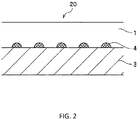
- FIG. 2 is a sectional view of a fiber-reinforced resin 20 with a curing agent 4 supported on the surface of the fiber 3.
- the catalyst 2 is supported, and in the example shown in FIG. 2 , instead of the catalyst 2, the curing agent 4 for curing the resin 1 is supported on the surface of the fiber 3. Even in such a configuration, stress occurring at the interface between the resin 1 and the fiber 2 is relaxed, leading to suppression of cracking and peeling.
- Examples of the curing agent 4 include acid anhydrides and carboxylic acids.
- Examples thereof include carboxylic anhydrides and polyvalent carboxylic acids. Specific examples thereof include, but are not limited to, phthalic anhydride, tetrahydrophthalic anhydride, hexahydrophthalic anhydride, methyltetrahydrophthalic anhydride, 3-dodecenylsuccinic anhydride, octenylsuccinic anhydride, methylhexahydrophthalic anhydride, methylnadic anhydride, dodecylsuccinic anhydride, chlorendic anhydride, pyromellitic anhydride, benzophenonetetracarboxylic anhydride, ethylene glycol bis(anhydrotrimate), methylcyclohexenetetracarboxylic anhydride, trimellitic anhydride, polyazelaic anhydride, ethylene glycol bisanhydrotrimellitate, 1,2,3,4-buta
- FIG. 3 is a sectional view of the fiber-reinforced resin 20 in which either the catalyst 2 or the curing agent 4 is not supported on the surface of the fiber 3. That is, in the fiber-reinforced resin 30, the resin 1 and the fiber 3 are provided, and a stress concentration portion 5 where stress is concentrated when stress is applied is present at the bonding interface between the resin 1 and the fiber 3. The stress concentration portion 5 is present as a part of the resin 1. Therefore, when the stress concentration portion 5 is present as a part of the resin 1, cracking and peeling occur between the stress concentration portion 5 and the fiber 3 because the resin 1 is homogenously formed.
- the fiber-reinforced resin is obtained by using at least one of a monomer which forms a dynamic covalent bond at the time of curing and a monomer which has a structure including a dynamic covalent bond and which is capable of forming a crosslinked structure (or using a mixture of both the monomers). That is, the fiber-reinforced resin is obtained by passing through a support step of bringing fiber into contact with an organic solution in which at least one of a catalyst and a curing agent (hereinafter, referred to a catalyst etc.) is dispersed, and then drying the fiber to support the catalyst etc. on a surface of the fiber; and a resin contact curing step of bringing the resin solution into contact with the fiber obtained through the support step and having the catalyst etc. supported on the surface thereof, and then performing curing.
- a support step of bringing fiber into contact with an organic solution in which at least one of a catalyst and a curing agent (hereinafter, referred to a catalyst etc.) is dispersed, and then drying the
- the fiber having the catalyst or the curing agent (or both) supported on the surface thereof is impregnated with the monomer, and cured by heating or the like to obtain the fiber-reinforced resin.
- the fiber is impregnated with a mixture containing the monomer and the catalyst or the curing agent, heated and cured to obtain the fiber-reinforced resin.
- the curing time and the curing temperature which vary depending on the types of the above-mentioned ingredients, are appropriately adjusted according to the purpose.
- the fiber-reinforced resin obtained after curing has a dynamic covalent bond inside the resin and a catalyst for accelerating recombination of the dynamic supply bond (in the case of the fiber reinforced catalyst 10).
- This catalyst causes exchange reaction.
- a chemical reaction formula of interesterification which is one form of dynamic covalent bonding is shown below.
- R, R' and R" each represent an arbitrary chemical structure.
- the catalyst etc. is supported on the surface of the fiber in the fiber-reinforced resin of the present embodiment.
- the method for supporting the catalyst etc. on the fiber surface is not particularly limited, and examples thereof include a method in which fiber is soaked with a solution of the catalyst etc., and dried; and a method in which the fiber surface is subjected to oxidation treatment to chemically bind the catalyst etc.
- the solvent to be used for the solution can be arbitrarily selected according to the type of the catalyst etc. to be used, and examples thereof include alcohols, ketones, ethers, hydrocarbons, cellosolves, amides, sulfoxides, nitriles, nitro compounds and organic acids. These solvents can be used alone, or in combination of two or more thereof.
- a method for oxidation treatment in the method in which the fiber surface is subjected to oxidation treatment to chemically binding the catalyst etc. a method can be applied in which the surface of fiber is oxidized with ozone, UV or the like, and the surface is chemically bound with a coupling agent having a structure of the catalyst etc.
- the coupling agent include imidazole silane coupling agents.
- Carbon fiber (CO6343 manufactured by Toray Industries, Inc.) was immersed in an ethyl acetate solution with zinc (II) acetylacetonate (manufactured by Wako Pure Chemical Industries, Ltd.) dissolved as a catalyst with a concentration of 1 mol/L, and was then dried at 40°C for 24 hours. Accordingly, the catalyst was supported on the surface of the carbon fiber.
- II zinc acetylacetonate
- test piece was heated from -50°C to 150°C at a rate of 5°C/min using a temperature cycle tester, then cooled from 150°C to -50°C at a rate of 5°C/min.
- a cross-section of a bonding interface between the resin and the fiber in a test piece after a total of 10 cycles with the above cycle set to 1 cycle was observed by X-ray CT. The result showed that the resin and the fiber were sufficiently bonded together, and the resin was not peeled at the interface.
- Carbon fiber (CO6343 manufactured by Toray Industries, Inc.) was immersed in an ethyl acetate solution with a curing agent (HN-2200 manufactured by Hitachi Chemical Co., Ltd.) dissolved therein with a concentration of 1 mol/L, and was then dried at 40°C for 24 hours. Accordingly, the curing agent was supported on the surface of the carbon fiber.
- a curing agent HN-2200 manufactured by Hitachi Chemical Co., Ltd.
- 0.1 mol equivalent of zinc (II) acetylacetonate manufactured by Wako Pure Chemical Industries, Ltd.
- the carbon fiber having the catalyst supported thereon was impregnated with this solution in vacuum, and heated at 120°C for 12 hours to cure the mixture.
- a fiber-reinforced resin test piece was obtained as a resin having a curing agent supported on the fiber surface.
- the obtained test piece was subjected to the same temperature cycle test as in Example 1, a bonding interface between the resin and the fiber in a test piece after 10 cycles was observed by X-ray CT. The result showed that the resin and the fiber were sufficiently bonded together, and the resin was not peeled at the interface.
- Carbon fiber (CO6343 manufactured by Toray Industries, Inc.) was immersed in an ethyl acetate solution with bis( ⁇ -epithiopropyl) disulfide dissolved as a curing agent with a concentration of 1 mol/L, and was then dried at 40°C for 24 hours. Accordingly, the curing agent was supported on the surface of the carbon fiber.
- the obtained test piece was subjected to the same temperature cycle test as in Example 1, a bonding interface between the resin and the fiber in a test piece after 10 cycles was observed by X-ray CT. The result showed that the resin and the fiber were sufficiently bonded together, and the resin was not peeled at the interface.
- Glass fiber (WF110D100BS6 manufactured by Nitto Boseki Co., Ltd.) was immersed in an ethyl acetate solution with zinc (II) acetylacetonate (manufactured by Wako Pure Chemical Industries, Ltd.) dissolved as a catalyst with a concentration of 1 mol/L, and was then dried at 40°C for 24 hours. Accordingly, the catalyst was supported on the surface of the carbon fiber.
- II zinc acetylacetonate
- the obtained test piece was subjected to the same temperature cycle test as in Example 1, a bonding interface between the resin and the fiber in a test piece after 10 cycles was observed by X-ray CT. The result showed that the resin and the fiber were sufficiently bonded together, and the resin was not peeled at the interface.
- test piece was subjected to the same temperature cycle test as in Example 1, a bonding interface between the resin and the fiber in a test piece after 10 cycles was observed by X-ray CT. The result showed that peeling occurred at the interface between the resin and the fiber.
- test piece was subjected to the same temperature cycle test as in Example 1, a bonding interface between the resin and the fiber in a test piece after 10 cycles was observed by X-ray CT. The result showed that peeling occurred at the interface between the resin and the fiber.
Landscapes
- Chemical & Material Sciences (AREA)
- Engineering & Computer Science (AREA)
- Materials Engineering (AREA)
- Chemical Kinetics & Catalysis (AREA)
- Organic Chemistry (AREA)
- Health & Medical Sciences (AREA)
- Medicinal Chemistry (AREA)
- Polymers & Plastics (AREA)
- Manufacturing & Machinery (AREA)
- Textile Engineering (AREA)
- Nanotechnology (AREA)
- Inorganic Chemistry (AREA)
- Reinforced Plastic Materials (AREA)
- Treatments For Attaching Organic Compounds To Fibrous Goods (AREA)
Applications Claiming Priority (2)
| Application Number | Priority Date | Filing Date | Title |
|---|---|---|---|
| JP2017149426A JP6942000B2 (ja) | 2017-08-01 | 2017-08-01 | 繊維強化樹脂及びその製造方法 |
| PCT/JP2018/010427 WO2019026328A1 (fr) | 2017-08-01 | 2018-03-16 | Résine renforcée de fibres et procédé pour sa fabrication |
Publications (3)
| Publication Number | Publication Date |
|---|---|
| EP3663334A1 true EP3663334A1 (fr) | 2020-06-10 |
| EP3663334A4 EP3663334A4 (fr) | 2021-04-28 |
| EP3663334B1 EP3663334B1 (fr) | 2026-02-25 |
Family
ID=65232483
Family Applications (1)
| Application Number | Title | Priority Date | Filing Date |
|---|---|---|---|
| EP18840668.0A Active EP3663334B1 (fr) | 2017-08-01 | 2018-03-16 | Résine renforcée de fibres et procédé pour sa fabrication |
Country Status (4)
| Country | Link |
|---|---|
| EP (1) | EP3663334B1 (fr) |
| JP (1) | JP6942000B2 (fr) |
| CN (1) | CN110945060B (fr) |
| WO (1) | WO2019026328A1 (fr) |
Families Citing this family (2)
| Publication number | Priority date | Publication date | Assignee | Title |
|---|---|---|---|---|
| JP7570892B2 (ja) * | 2020-11-10 | 2024-10-22 | 株式会社日立製作所 | 樹脂組成物、樹脂硬化物及び繊維強化樹脂 |
| JP7759193B2 (ja) * | 2021-05-11 | 2025-10-23 | 株式会社日立製作所 | 樹脂複合体、樹脂複合体の製造方法、及び樹脂複合体の解体方法 |
Family Cites Families (12)
| Publication number | Priority date | Publication date | Assignee | Title |
|---|---|---|---|---|
| JP2530767B2 (ja) | 1991-06-04 | 1996-09-04 | 東レ株式会社 | 炭素繊維及びその製造方法 |
| US8703285B2 (en) * | 2008-08-19 | 2014-04-22 | The Board Of Trustees Of The University Of Illinois | Interfacial functionalization for self-healing composites |
| US9884944B2 (en) * | 2010-05-19 | 2018-02-06 | Drexel University | Remendable interfaces for polymer composites |
| FR2970712B1 (fr) * | 2011-01-24 | 2014-05-09 | Centre Nat Rech Scient | Resines et composites thermodurs epoxy anhydrides pouvant etre faconnes a chaud et recycles |
| JP5733301B2 (ja) * | 2011-01-27 | 2015-06-10 | 東レ株式会社 | 繊維強化複合材料rtm成形用エポキシ樹脂組成物、繊維強化複合材料およびその製造方法 |
| CN102558591B (zh) * | 2011-12-22 | 2014-05-07 | 中国科学院宁波材料技术与工程研究所 | 纤维增强pcbt热塑性复合材料电动车底板的制备方法 |
| EP3778783A1 (fr) * | 2012-03-07 | 2021-02-17 | The Regents of The University of California | Procédé bio-inspiré pour obtenir des nanocomposites dynamiques multifonctionnels |
| WO2015138804A1 (fr) * | 2014-03-12 | 2015-09-17 | The Regents Of The Univerity Of Colorado, A Body Corporate | Nouveaux polymères malléables réticulés de manière covalente et procédés d'utilisation |
| JP2015214661A (ja) * | 2014-05-13 | 2015-12-03 | 株式会社日立製作所 | 樹脂、風力発電用ブレード、電子部品、モータコイル及びケーブル |
| JP2017088739A (ja) * | 2015-11-11 | 2017-05-25 | 株式会社日立製作所 | 複合体、電気機器、モータ、変圧器、構造体、移動体及び複合体の製造方法 |
| WO2018006090A1 (fr) * | 2016-07-01 | 2018-01-04 | Georgia Tech Research Corporation | Procédés de recyclage et de reformation de polymères thermodurcissables et leurs composites |
| JP2019025841A (ja) * | 2017-08-01 | 2019-02-21 | 株式会社日立製作所 | 繊維強化樹脂複合体及びその製造装置 |
-
2017
- 2017-08-01 JP JP2017149426A patent/JP6942000B2/ja active Active
-
2018
- 2018-03-16 CN CN201880049426.2A patent/CN110945060B/zh active Active
- 2018-03-16 EP EP18840668.0A patent/EP3663334B1/fr active Active
- 2018-03-16 WO PCT/JP2018/010427 patent/WO2019026328A1/fr not_active Ceased
Also Published As
| Publication number | Publication date |
|---|---|
| JP6942000B2 (ja) | 2021-09-29 |
| CN110945060A (zh) | 2020-03-31 |
| WO2019026328A1 (fr) | 2019-02-07 |
| CN110945060B (zh) | 2022-04-19 |
| EP3663334B1 (fr) | 2026-02-25 |
| EP3663334A4 (fr) | 2021-04-28 |
| JP2019026781A (ja) | 2019-02-21 |
Similar Documents
| Publication | Publication Date | Title |
|---|---|---|
| KR100817982B1 (ko) | 가공 송전선 인장선용 고분자 복합 선재 및 그 제조방법 | |
| JP5403184B1 (ja) | 繊維強化複合材料 | |
| CN104271667B (zh) | 可固化环氧树脂组合物和由其制造的复合材料 | |
| CA2595543C (fr) | Cable de plastique renforce de fibres support de lignes aeriennes, son procede de fabrication, et lignes aeriennes l'utilisant | |
| US4656090A (en) | Low viscosity epoxy resin compositions | |
| CN104861760B (zh) | 石墨烯复合涂层 | |
| KR20160132040A (ko) | 사이징제 도포 강화 섬유, 사이징제 도포 강화 섬유의 제조 방법, 프리프레그 및 섬유 강화 복합 재료 | |
| TW201819357A (zh) | 用於發電機和馬達之基於環氧樹脂的電絕緣系統 | |
| JP5606619B2 (ja) | 回転機コイルおよびその製造方法 | |
| CN1062545A (zh) | 耐热性树脂组合物、制品及方法 | |
| JP2002518567A5 (fr) | ||
| KR20130062915A (ko) | 강인화제로서 폴리(프로필렌 옥사이드) 폴리올을 포함하는 에폭시 수지 조성물 | |
| JP2013018142A (ja) | 自己修復性積層構造体及び自己融着絶縁電線 | |
| JP6294225B2 (ja) | 空心リアクトルの含浸方法、含浸空心リアクトル、および含浸システムの使用 | |
| EP3663334B1 (fr) | Résine renforcée de fibres et procédé pour sa fabrication | |
| CN112048151A (zh) | 一种用于拉挤成型工艺制备芳纶复合芯的树脂组合物 | |
| JP6240560B2 (ja) | マトリックス材 | |
| JP7411493B2 (ja) | 繊維強化樹脂及びその製造方法 | |
| JP7570892B2 (ja) | 樹脂組成物、樹脂硬化物及び繊維強化樹脂 | |
| JP4449531B2 (ja) | 繊維強化樹脂線状物およびその製造方法 | |
| CN112592666B (zh) | 一种耐360℃高温环氧胶黏剂及其制备方法及应用 | |
| US5350815A (en) | Copper bonding epoxy resin compositions, resin coated copper articles and method | |
| CN116005458B (zh) | 一种催化型上浆剂的设计及低吸湿复合材料的制备方法 | |
| JPH11213757A (ja) | マイカテープ | |
| EP2702083A1 (fr) | Compositions de résine contenant des résines époxyde modifiées avec de l'acide sorbique |
Legal Events
| Date | Code | Title | Description |
|---|---|---|---|
| STAA | Information on the status of an ep patent application or granted ep patent |
Free format text: STATUS: THE INTERNATIONAL PUBLICATION HAS BEEN MADE |
|
| PUAI | Public reference made under article 153(3) epc to a published international application that has entered the european phase |
Free format text: ORIGINAL CODE: 0009012 |
|
| STAA | Information on the status of an ep patent application or granted ep patent |
Free format text: STATUS: REQUEST FOR EXAMINATION WAS MADE |
|
| 17P | Request for examination filed |
Effective date: 20200302 |
|
| AK | Designated contracting states |
Kind code of ref document: A1 Designated state(s): AL AT BE BG CH CY CZ DE DK EE ES FI FR GB GR HR HU IE IS IT LI LT LU LV MC MK MT NL NO PL PT RO RS SE SI SK SM TR |
|
| AX | Request for extension of the european patent |
Extension state: BA ME |
|
| DAV | Request for validation of the european patent (deleted) | ||
| DAX | Request for extension of the european patent (deleted) | ||
| A4 | Supplementary search report drawn up and despatched |
Effective date: 20210329 |
|
| RIC1 | Information provided on ipc code assigned before grant |
Ipc: C08J 5/06 20060101AFI20210323BHEP Ipc: D06M 13/184 20060101ALI20210323BHEP Ipc: C08K 5/00 20060101ALI20210323BHEP |
|
| STAA | Information on the status of an ep patent application or granted ep patent |
Free format text: STATUS: EXAMINATION IS IN PROGRESS |
|
| 17Q | First examination report despatched |
Effective date: 20240412 |
|
| REG | Reference to a national code |
Ref country code: DE Ref legal event code: R079 Free format text: PREVIOUS MAIN CLASS: C08J0005060000 Ipc: C08J0005080000 Ref country code: DE Ref legal event code: R079 Ref document number: 602018089433 Country of ref document: DE Free format text: PREVIOUS MAIN CLASS: C08J0005060000 Ipc: C08J0005080000 |
|
| GRAP | Despatch of communication of intention to grant a patent |
Free format text: ORIGINAL CODE: EPIDOSNIGR1 |
|
| STAA | Information on the status of an ep patent application or granted ep patent |
Free format text: STATUS: GRANT OF PATENT IS INTENDED |
|
| RIC1 | Information provided on ipc code assigned before grant |
Ipc: C08J 5/08 20060101AFI20251006BHEP Ipc: C08J 5/06 20060101ALI20251006BHEP Ipc: C08J 5/04 20060101ALI20251006BHEP Ipc: C08K 3/04 20060101ALI20251006BHEP Ipc: D06M 15/55 20060101ALI20251006BHEP Ipc: D06M 13/184 20060101ALI20251006BHEP |
|
| INTG | Intention to grant announced |
Effective date: 20251024 |
|
| GRAS | Grant fee paid |
Free format text: ORIGINAL CODE: EPIDOSNIGR3 |
|
| GRAA | (expected) grant |
Free format text: ORIGINAL CODE: 0009210 |
|
| STAA | Information on the status of an ep patent application or granted ep patent |
Free format text: STATUS: THE PATENT HAS BEEN GRANTED |
|
| AK | Designated contracting states |
Kind code of ref document: B1 Designated state(s): AL AT BE BG CH CY CZ DE DK EE ES FI FR GB GR HR HU IE IS IT LI LT LU LV MC MK MT NL NO PL PT RO RS SE SI SK SM TR |
|
| REG | Reference to a national code |
Ref country code: CH Ref legal event code: F10 Free format text: ST27 STATUS EVENT CODE: U-0-0-F10-F00 (AS PROVIDED BY THE NATIONAL OFFICE) Effective date: 20260225 Ref country code: GB Ref legal event code: FG4D |
|
| REG | Reference to a national code |
Ref country code: DE Ref legal event code: R096 Ref document number: 602018089433 Country of ref document: DE |
|
| REG | Reference to a national code |
Ref country code: IE Ref legal event code: FG4D |
|
| PGFP | Annual fee paid to national office [announced via postgrant information from national office to epo] |
Ref country code: GB Payment date: 20260331 Year of fee payment: 9 |
|
| PGFP | Annual fee paid to national office [announced via postgrant information from national office to epo] |
Ref country code: DE Payment date: 20260331 Year of fee payment: 9 |
|
| REG | Reference to a national code |
Ref country code: NL Ref legal event code: MP Effective date: 20260225 |
|
| PG25 | Lapsed in a contracting state [announced via postgrant information from national office to epo] |
Ref country code: RS Free format text: LAPSE BECAUSE OF FAILURE TO SUBMIT A TRANSLATION OF THE DESCRIPTION OR TO PAY THE FEE WITHIN THE PRESCRIBED TIME-LIMIT Effective date: 20260525 |
|
| PG25 | Lapsed in a contracting state [announced via postgrant information from national office to epo] |
Ref country code: ES Free format text: LAPSE BECAUSE OF FAILURE TO SUBMIT A TRANSLATION OF THE DESCRIPTION OR TO PAY THE FEE WITHIN THE PRESCRIBED TIME-LIMIT Effective date: 20260225 |
|
| PG25 | Lapsed in a contracting state [announced via postgrant information from national office to epo] |
Ref country code: PL Free format text: LAPSE BECAUSE OF FAILURE TO SUBMIT A TRANSLATION OF THE DESCRIPTION OR TO PAY THE FEE WITHIN THE PRESCRIBED TIME-LIMIT Effective date: 20260225 |
|
| PG25 | Lapsed in a contracting state [announced via postgrant information from national office to epo] |
Ref country code: GR Free format text: LAPSE BECAUSE OF FAILURE TO SUBMIT A TRANSLATION OF THE DESCRIPTION OR TO PAY THE FEE WITHIN THE PRESCRIBED TIME-LIMIT Effective date: 20260526 |
|
| REG | Reference to a national code |
Ref country code: LT Ref legal event code: MG9D |
|
| PG25 | Lapsed in a contracting state [announced via postgrant information from national office to epo] |
Ref country code: LT Free format text: LAPSE BECAUSE OF FAILURE TO SUBMIT A TRANSLATION OF THE DESCRIPTION OR TO PAY THE FEE WITHIN THE PRESCRIBED TIME-LIMIT Effective date: 20260225 |
|
| PG25 | Lapsed in a contracting state [announced via postgrant information from national office to epo] |
Ref country code: NO Free format text: LAPSE BECAUSE OF FAILURE TO SUBMIT A TRANSLATION OF THE DESCRIPTION OR TO PAY THE FEE WITHIN THE PRESCRIBED TIME-LIMIT Effective date: 20260525 |
|
| PG25 | Lapsed in a contracting state [announced via postgrant information from national office to epo] |
Ref country code: FI Free format text: LAPSE BECAUSE OF FAILURE TO SUBMIT A TRANSLATION OF THE DESCRIPTION OR TO PAY THE FEE WITHIN THE PRESCRIBED TIME-LIMIT Effective date: 20260225 Ref country code: SE Free format text: LAPSE BECAUSE OF FAILURE TO SUBMIT A TRANSLATION OF THE DESCRIPTION OR TO PAY THE FEE WITHIN THE PRESCRIBED TIME-LIMIT Effective date: 20260225 Ref country code: AT Free format text: LAPSE BECAUSE OF FAILURE TO SUBMIT A TRANSLATION OF THE DESCRIPTION OR TO PAY THE FEE WITHIN THE PRESCRIBED TIME-LIMIT Effective date: 20260225 |
|
| REG | Reference to a national code |
Ref country code: AT Ref legal event code: MK05 Ref document number: 1890794 Country of ref document: AT Kind code of ref document: T Effective date: 20260225 |
|
| PG25 | Lapsed in a contracting state [announced via postgrant information from national office to epo] |
Ref country code: HR Free format text: LAPSE BECAUSE OF FAILURE TO SUBMIT A TRANSLATION OF THE DESCRIPTION OR TO PAY THE FEE WITHIN THE PRESCRIBED TIME-LIMIT Effective date: 20260225 |
|
| PG25 | Lapsed in a contracting state [announced via postgrant information from national office to epo] |
Ref country code: PT Free format text: LAPSE BECAUSE OF FAILURE TO SUBMIT A TRANSLATION OF THE DESCRIPTION OR TO PAY THE FEE WITHIN THE PRESCRIBED TIME-LIMIT Effective date: 20260625 Ref country code: IS Free format text: LAPSE BECAUSE OF FAILURE TO SUBMIT A TRANSLATION OF THE DESCRIPTION OR TO PAY THE FEE WITHIN THE PRESCRIBED TIME-LIMIT Effective date: 20260625 |
|
| PG25 | Lapsed in a contracting state [announced via postgrant information from national office to epo] |
Ref country code: NL Free format text: LAPSE BECAUSE OF FAILURE TO SUBMIT A TRANSLATION OF THE DESCRIPTION OR TO PAY THE FEE WITHIN THE PRESCRIBED TIME-LIMIT Effective date: 20260225 |
|
| PG25 | Lapsed in a contracting state [announced via postgrant information from national office to epo] |
Ref country code: LV Free format text: LAPSE BECAUSE OF FAILURE TO SUBMIT A TRANSLATION OF THE DESCRIPTION OR TO PAY THE FEE WITHIN THE PRESCRIBED TIME-LIMIT Effective date: 20260225 |
|
| PG25 | Lapsed in a contracting state [announced via postgrant information from national office to epo] |
Ref country code: BG Free format text: LAPSE BECAUSE OF FAILURE TO SUBMIT A TRANSLATION OF THE DESCRIPTION OR TO PAY THE FEE WITHIN THE PRESCRIBED TIME-LIMIT Effective date: 20260225 |