EP3663346A1 - Reactive siloxanes - Google Patents
Reactive siloxanes Download PDFInfo
- Publication number
- EP3663346A1 EP3663346A1 EP18210035.4A EP18210035A EP3663346A1 EP 3663346 A1 EP3663346 A1 EP 3663346A1 EP 18210035 A EP18210035 A EP 18210035A EP 3663346 A1 EP3663346 A1 EP 3663346A1
- Authority
- EP
- European Patent Office
- Prior art keywords
- siloxanes
- branched
- siloxane
- acetoxy
- acid
- Prior art date
- Legal status (The legal status is an assumption and is not a legal conclusion. Google has not performed a legal analysis and makes no representation as to the accuracy of the status listed.)
- Granted
Links
Classifications
-
- C—CHEMISTRY; METALLURGY
- C08—ORGANIC MACROMOLECULAR COMPOUNDS; THEIR PREPARATION OR CHEMICAL WORKING-UP; COMPOSITIONS BASED THEREON
- C08G—MACROMOLECULAR COMPOUNDS OBTAINED OTHERWISE THAN BY REACTIONS ONLY INVOLVING UNSATURATED CARBON-TO-CARBON BONDS
- C08G77/00—Macromolecular compounds obtained by reactions forming a linkage containing silicon with or without sulfur, nitrogen, oxygen or carbon in the main chain of the macromolecule
- C08G77/04—Polysiloxanes
- C08G77/38—Polysiloxanes modified by chemical after-treatment
-
- C—CHEMISTRY; METALLURGY
- C08—ORGANIC MACROMOLECULAR COMPOUNDS; THEIR PREPARATION OR CHEMICAL WORKING-UP; COMPOSITIONS BASED THEREON
- C08G—MACROMOLECULAR COMPOUNDS OBTAINED OTHERWISE THAN BY REACTIONS ONLY INVOLVING UNSATURATED CARBON-TO-CARBON BONDS
- C08G77/00—Macromolecular compounds obtained by reactions forming a linkage containing silicon with or without sulfur, nitrogen, oxygen or carbon in the main chain of the macromolecule
- C08G77/04—Polysiloxanes
- C08G77/14—Polysiloxanes containing silicon bound to oxygen-containing groups
-
- C—CHEMISTRY; METALLURGY
- C08—ORGANIC MACROMOLECULAR COMPOUNDS; THEIR PREPARATION OR CHEMICAL WORKING-UP; COMPOSITIONS BASED THEREON
- C08G—MACROMOLECULAR COMPOUNDS OBTAINED OTHERWISE THAN BY REACTIONS ONLY INVOLVING UNSATURATED CARBON-TO-CARBON BONDS
- C08G77/00—Macromolecular compounds obtained by reactions forming a linkage containing silicon with or without sulfur, nitrogen, oxygen or carbon in the main chain of the macromolecule
- C08G77/04—Polysiloxanes
- C08G77/14—Polysiloxanes containing silicon bound to oxygen-containing groups
- C08G77/18—Polysiloxanes containing silicon bound to oxygen-containing groups to alkoxy or aryloxy groups
Definitions
- the invention relates to a process for the production of linear or branched siloxanes which carry terminal acetoxy functions, and to a process for the production of linear or branched polyether siloxanes starting from these acetoxysiloxanes.
- the unpublished European patent application EP18189073.2 describes a process for the preparation of siloxanes carrying trifluoromethanesulfonic acid-containing acetoxy groups, in which cyclic siloxanes, in particular comprising D 4 (octamethylcyclotetrasiloxane) and / or D 5 (decamethylcyclopentasiloxane), and / or mixtures of cyclically branched siloxanes of the D / T type using tronic acid as trifluoromethane Catalyst can be reacted with acetic anhydride and with the addition of acetic acid.
- cyclic siloxanes in particular comprising D 4 (octamethylcyclotetrasiloxane) and / or D 5 (decamethylcyclopentasiloxane)
- cyclically branched siloxanes of the D / T type using tronic acid as trifluoromethane Catalyst can be reacted with acetic
- silanes and / or siloxanes with higher contents of bound Si-alkoxy and / or SiOH groups which can be determined by means of 29 Si NMR spectroscopy, than in the variant of the embodiment marked with b) EP18189073.2 are suitable for the production of acetoxysiloxanes and in particular also of branched siloxanes which carry terminal acetoxy functions, and in no way limited to mixtures of cyclically branched siloxanes.
- the reaction system according to the invention thus comprises at least the reactants a) and / or b) and / or c) and optionally d) and also a reaction medium with e), acetic anhydride, perfluoroalkanesulfonic acid and optionally acetic acid also taking an active part in the reaction process, as shown in more detail below becomes.
- the reaction system according to the invention comprises, in particular, consists of: components a) and e). In another preferred embodiment, the reaction system according to the invention comprises, in particular, consists of: components b) and e). In yet another preferred embodiment, the reaction system according to the invention comprises, in particular, consists of: components c) and e). In a preferred embodiment, this comprises reaction system according to the invention, in particular consists of: components a), d) and e). In another preferred embodiment, the reaction system according to the invention comprises, in particular, consists of: components b), d) and e). In yet another preferred embodiment the reaction system according to the invention comprises, in particular, consists of: components c), d) and e).
- the reaction system according to the invention comprises, in particular, consists of: components a), b) and e). In yet another preferred embodiment, the reaction system according to the invention comprises, in particular, consists of: components a), c) and e). In another preferred embodiment, the reaction system according to the invention comprises, in particular, consists of: components b), c) and e). In a preferred embodiment, the reaction system according to the invention comprises, in particular, consists of: components a), b), d) and e). In yet another preferred embodiment, the reaction system according to the invention comprises, in particular, consists of: components a), c), d) and e).
- the reaction system according to the invention comprises, in particular, consists of: components b), c), d) and e).
- the reaction system according to the invention comprises, in particular, consists of: components a), b), c) and e).
- the reaction system according to the invention comprises, in particular, consists of: components a), b), c), d) and e).
- component e) comprises in particular acetic anhydride, trifluoromethanesulfonic acid and acetic acid.
- DT cycles in the sense of the invention are cyclically branched siloxanes of the D / T type, which consist exclusively of siloxanes having D and T units. It is preferred that the sum of the total of the D and T units present in the siloxane matrix and having Si-alkoxy and / or SiOH groups, which can be determined by means of 29 Si NMR spectroscopy, is 2 2 mol percent, preferably less than 1 mol percent, or but is greater than 2 and less than 10 mole percent.
- Simple siloxane classes are composed only of D units and, for the purposes of this invention, octamethylcyclotetrasiloxane (D 4 ), decamethylcyclopentasiloxane (D 5 ), dodecamethylcyclohexasiloxane (D 6 ) and / or mixtures thereof are particularly preferred.
- An advantage of the reaction system claimed according to the invention is the controlled, reproducible production of linear and / or branched siloxanes carrying terminal acetoxy functions with short reaction times.
- the reaction medium according to the invention contains both starting materials such as silanes and / or siloxanes carrying alkoxy groups and also silanes and / or siloxanes and / or siloxanes and / or hydroxyl groups-containing silanes and / or siloxanes, and if appropriate in the presence of simple siloxane cycles and / or, if appropriate, in the presence of DT cycles in the sense of an overall reaction, which comprises both condensing and equilibrating substeps, such a complete conversion that the resulting terminal acetoxy functional siloxanes possibly still have portions of SiOH and / or SiOR groups which are below the detection limit detectable by 29 Si NMR.
- the condensation reaction also comes from the presence of hydroxyl-containing silanes and / or siloxanes f) 2 ⁇ Si-OH ⁇ ⁇ Si-O-Si ⁇ + H 2 O the following reactions are relevant: g) H 2 O + Ac 2 O ⁇ 2 AcOH and h) H 2 O + 2 ⁇ Si-OAc ⁇ ⁇ Si-O-Si ⁇ + 2 AcOH
- At least one reaction partner contains a T and / or Q group ( ⁇ Si corresponds to silane radical and / or any silicone radical containing T and / or Q structures).
- hydroxyl-containing silanes and / or siloxanes is dispensed with, which is particularly attractive from the point of view of waste avoidance, since only a simple acetic acid alkyl ester is removed as a by-product - for example by distillation - from the reaction system .
- Dispensing here means that less than 5 percent by weight of Si-bonded hydroxyl groups, based on the reactant matrix, are present. In particular, in this preferred embodiment, no proportions of Si-bonded hydroxyl groups are present in the reactant matrix.
- acetic acid is formed as a by-product, which is also evident from the abovementioned. exemplary sub-steps d), e), f), g) and h) can be seen.
- the acetic acid can also be removed from the reaction system, for example by distillation.
- reaction medium according to the invention comprising acetic anhydride, perfluoroalkanesulfonic acid and preferably, enables remarkably and is not foreseeable for the person skilled in the art Acetic acid, the reproducible provision of structure-defined, linear or branched acetoxysiloxanes.
- siloxanes bearing acetoxy groups according to the invention are excellent starting materials, in particular for the production of polyether siloxanes, which, as surface-active surfactants, enter into demanding technical applications, for example for the production of polyurethane foam stabilizers, defoamers, paint and dispersion additives, demulsifiers and the like. to take.
- the production process according to the invention runs very quickly under very moderate reaction conditions, avoids complex reaction sequences, exotic catalysts, by-products which are difficult to separate and is preferably carried out without the use of hydroxyl-bearing silanes and / or siloxanes.
- Reaction equation 1) shows the reaction of methyltriethoxysilane with one equivalent of acetic anhydride, which gives off the acetoxy-functionalized silane CH 3 Si (OEt) 2 OAc (I) with elimination of ethyl acetate, cf. above.
- disiloxane (III) could now be equilibrated, for example with siloxane cycles under acid catalysis, to give a branched siloxane carrying terminal acetoxy groups.
- reaction equation 4 Another way of the process claimed according to the invention is shown in reaction equation 4, in which methyltriethoxysilane is first equilibrated with siloxane cycles to give a single-branched siloxane (IV) CH 3 SiD a D b D c (OEt) 3 which has ethoxy end groups.
- the indices a, b, c used for the equilibrated D units in the formula are also intended to make it clear that the length of the individual branches of the branched siloxane (IV) in the equilibrium equilibrium can also be different.
- reaction equation 5 The reaction of (IV) with one equivalent of acetic anhydride produces the single-branched siloxane (V) carrying one acetoxy and two ethoxy groups (V) (reaction equation 5)) with the liberation of ethyl acetate.
- Example 1 This example of the preparation of branched, terminal acetoxy group-bearing siloxanes, shown in reaction equations 4) to 7), is shown in Example 1 according to the invention, where there is a structural degree of branching of 3 ( ⁇ 2 in reaction equations 4) to 7)) is aimed for.
- Example 1 makes it clear that the stoichiometric use of the reactants and also by suitable choice of the reaction conditions make it very simple To a sophisticated, molecular target structure.
- Example 1 also clarifies that the reaction of silanes bearing alkoxy groups and / or siloxanes bearing alkoxy groups with acetic anhydride as shown there is analogous to reaction equations 5) to 7), an overall reaction characterized by exothermicity (temperature increase of 40 ° C.).
- the time of addition of the silane and / or siloxane carrying acetoxy groups used in the reaction medium is not very critical and can be varied over a wide range.
- hydroxyl-containing siloxanes can be converted directly into the reaction medium comprising acetic anhydride, perfluoroalkanesulfonic acid and preferably acetic acid to form a siloxane which carries terminal acetoxy groups.
- reaction equation 6 A reaction system that also includes siloxane cycles is shown in reaction equation 6).
- PDM siloxanes on the market in particular ⁇ , ⁇ -polydimethylsiloxane diols
- hydroxyl-bearing siloxanes thus gives direct access to ⁇ , ⁇ -diacetoxypolydimethylsiloxanes.
- Example 1 thus illustrates the case in which a branched silicone equilibrate carrying alkoxy groups is reacted as the sole reactant with the reaction medium, consisting of acetic anhydride, trifluoromethanesulfonic acid and acetic acid, in a controlled manner to give a branched siloxane carrying acetoxy groups.
- the reaction medium consisting of acetic anhydride, trifluoromethanesulfonic acid and acetic acid
- Example 2 With a modification of the route followed in Example 1, it is also possible according to the invention to initially charge all reactants directly with the reaction medium with thorough mixing from the start and then to react them by heating and removing volatile by-products (Example 2 according to the invention). This corresponds to a preferred embodiment.
- reaction lines 1) to 6) do not represent any restriction of the claimed subject matter.
- this combinatorial example of the reactants given by way of example for illustration, reveals that there are still many possibilities for combinations which can be used according to the invention by adding the respective reaction systems further reactants expanded.
- Dimethyldialkoxysilanes, methyltrialkoxysilanes and / or ortho-alkyl silicic acid esters Si (OR) 4 are preferably used as alkoxysilanes.
- Preferred alkoxysiloxanes can be obtained, for example, from acid equilibrations of dimethyldialkoxysilanes or methyltrialkoxysilanes with simple siloxane cycles (for example D 4 / D 5 ) or can also be obtained, for example, by the reaction of corresponding acetoxysiloxane precursors with alcohols with elimination of alkyl acetate.
- the use of ethanol is particularly preferred.
- the preferably used amount of acetic anhydride is measured by the desired molecular target structure, whereby the possible entry of acetanes carrying silanes and / or siloxanes but also the entry of hydroxy-functional silanes and / or siloxanes which may be carried out must be taken into account stoichiometrically.
- it is important to avoid large excesses of acetic anhydride in the reaction mixture since in the case of excess acetic anhydride, the resulting linear or branched siloxanes carrying acetoxy groups tend to be shifted to lower molar masses, which causes a deviation from the desired target structure.
- the water content (molecularly bound and / but also free water) which may have been introduced, for example via hydroxy-functional silanes and / or siloxanes, should also be taken into account stoichiometrically, since every mole of water cleaves one mole Acetic anhydride or a further linkage of siloxanes carrying acetoxy groups leads in the sense of the above reactions g) and h).
- This preferred procedure can also serve to eliminate any uncertainties when using silanes and / or siloxanes carrying alkoxy groups.
- Diacetoxydimethylsilane and triacetoxymethylsilane are preferably used as acetoxysilanes. If acetoxysiloxanes are used, preference is given to those described in the as yet unpublished European patent application EP18189073.2 are described.
- D 3 hexamethylcyclotrisiloxane
- D 4 octamethylcyclotetrasiloxane
- D 5 decamethylcyclopentasiloxane
- D 6 dodecamethylcyclohexasiloxane
- D 4 and / or D 5 are preferably used.
- Dimethylsilanol (CH 3 ) Si (OH) 2 , methylsilanol (CH 3 Si (OH) 3 ) and ortho-silica Si (OH) 4 are preferably used as the hydroxy-functional silanes.
- acetic acid is used in amounts of 0.4 to 3.5 percent by weight, preferably 0.5 to 3 percent by weight, preferably 0.8 to 1.8 percent by weight, particularly preferably in amounts of 1.0 to 1, Add 5 percent by weight based on the reaction system.
- Perfluorobutanesulfonic acid or trifluoromethanesulfonic acid is preferably used as the perfluoroalkanesulfonic acid, but in particular trifluoromethanesulfonic acid.
- the catalyst perfluoroalkanesulfonic acid namely in particular trifluoromethanesulfonic acid, is used according to a preferred embodiment of the invention in amounts of 0.1 to 1.0 percent by mass, preferably 0.1 to 0.3 percent by mass, based on the reaction system.
- the procedure according to the invention is preferably as follows.
- the total cyclic content determined by gas chromatography is defined as the sum of the D 4 -, D 5 -, D 6 contents based on the siloxane matrix and determined after the derivatization of the ⁇ , ⁇ -diacetoxypolydimethylsiloxanes or the branched acetoxy groups Siloxanes to the corresponding ⁇ , ⁇ -diisopropoxypolydimethylsiloxanes or the branched siloxanes carrying isopropoxy groups.
- the derivatization to the ⁇ , ⁇ -diisopropoxypolydimethylsiloxanes or the branched siloxanes bearing isopropoxy groups is deliberately chosen in order to avoid a thermally induced cleavage reaction of the ⁇ , ⁇ -diacetoxypolydimethylsiloxanes or the branched acetoxoxy groups under the conditions of gas chromatographic analysis prevent (for the cleavage reaction see, inter alia J. Pola et al., Collect. Czech. Chem. Commun. 1974, 39 (5), 1169-1176 and also W. Simmler, Houben-Weyl, Methods of Organic Chemistry, Vol. VI / 2, 4th Edition, O-Metal Derivates of Organic Hydroxy Compounds p. 162 ff )).
- the term “end equilibrated” means that the equilibrium equilibrium has been reached, which is established at a temperature of 23 ° C. and a pressure of 1013.25 hPa.
- the total cyclic content determined by gas chromatography can be defined as the sum of the D 4 -, D 5 -, D 6 contents based on the siloxane matrix and determined after derivatization of the ⁇ , ⁇ -diacetoxypolydimethylsiloxanes to the corresponding ⁇ , ⁇ -Diisopropoxypolydimethylsiloxanen or after the derivatization of the branched acetoxysiloxanes can be used to the corresponding branched isopropoxysiloxanes.
- acetic acid according to the invention enables the problem of falling below the usual equilibrium proportions of about 13 percent by weight of the total cycle content for the linear ⁇ , ⁇ -diacetoxypolydimethylsiloxanes and of about 8 percent by weight of the total cycle content for the branched acetoxysiloxanes.
- the reaction is first carried out in a temperature range from 40 to 120 ° C. and then to ensure the final equilibration in the temperature range from 140 to 160 ° C. and in this case over a period of 4 to 10 hours.
- Another object of the present invention relates to trifluoromethanesulfonic acid, end-equilibrated linear ⁇ , ⁇ -acetoxy group-bearing siloxanes, which total cycle contents, defined as the sum of the content portions of the cyclic siloxanes comprising D 4 , D 5 and D 6 based on the siloxane matrix and determined by gas chromatography after their derivatization to the corresponding linear ⁇ , ⁇ -isopropoxysiloxanes of less than 13, preferably less than 12 percent by weight, preferably produced by a method according to the invention as described above.
- Another object of the present invention relates to trifluoromethanesulfonic acid, end-equilibrated branched siloxanes containing acetoxy groups, preferably prepared as described herein, that they have total cycle contents, defined as the sum of the proportions of the cyclic siloxanes comprising D 4 , D 5 and D 6, based on the siloxane matrix and determined by gas chromatography have their derivatization to the corresponding branched isopropoxysiloxanes of less than 8, preferably less than 7 percent by weight.
- TMS 79.49 MHz
- the GPC's (gel permeation chromatography) are used using THF as the mobile phase on a column combination SDV 1000 / 10000A, length 65 cm, ID 0.80 at a temperature of 30 ° C. on a SECcurity 2 GPC system 1260 (PSS polymer Standards Service GmbH).
- the total cyclic content determined by gas chromatography is defined as the sum of the D 4 -, D 5 -, D 6 contents based on the siloxane matrix and determined after the derivatization of the ⁇ , ⁇ -diacetoxypolydimethylsiloxanes or the branched acetoxy groups Siloxanes to the corresponding ⁇ , ⁇ -diisopropoxypolydimethylsiloxanes or the branched siloxanes carrying isopropoxy groups.
- the derivatization to the ⁇ , ⁇ -diisopropoxypolydimethylsiloxanes or the branched siloxanes bearing isopropoxy groups is deliberately chosen in order to avoid a thermally induced cleavage reaction of the ⁇ , ⁇ -diacetoxypolydimethylsiloxanes or the branched, siloxane groups under the conditions of gas chromatographic analysis to prevent (for the cleavage reaction see, inter alia J. Pola et al., Collect. Czech. Chem. Commun. 1974, 39 (5), 1169-1176 and also W. Simmler, Houben-Weyl, Methods of Organic Chemistry, Vol. VI / 2, 4th Edition, O-Metal Derivates of Organic Hydroxy Compounds p. 162 ff )).
- 35.8 g of methyltriethoxysilane (0.263 mol) together with 166.3 g of decamethylcyclopentasiloxane (D 5 ) (0.448 mol) are introduced into a 500 ml four-necked round-bottomed flask with KPG stirrer, internal thermometer and reflux condenser together with 166.3 g of decamethylcyclopentasiloxane (D 5 ) (0.448 mol) with stirring at 23 ° C. and with 0.51 g of trifluoromethanesulfonic acid (0.25 m% based on the batch) was added and the mixture was equilibrated at 60 ° C. for 4 hours.
- the reflux condenser is then replaced by a distillation bridge.
- reaction mixture is then left to react at 150 ° C. for 6 hours, and the reaction mixture is allowed to cool to 23 ° C.
- the levels of siloxane classes (D 4 , D 5 and D 6 ) are calculated based solely on the siloxane content.
- the reaction mixture is heated to 150 ° C. within 30 minutes. In the temperature range between 105 ° C and 120 ° C, 49.8 g of distillate are removed (41.3 g theoretical amount).
- the analysis of the distillate shows that it consists of ethyl acetate and some entrained acetic acid.
- reaction mixture is then left to react at 150 ° C. for 6 hours, and the reaction mixture is allowed to cool to 23 ° C.
- the levels of siloxane classes (D 4 , D 5 and D 6 ) are calculated based solely on the siloxane content.
- 35.8 g of methyltriethoxysilane (0.263 mol) together with 166.3 g of decamethylcyclopentasiloxane (D 5 ) (0.448 mol) are introduced into a 500 ml four-necked round-bottomed flask with KPG stirrer, internal thermometer and reflux condenser together with 166.3 g of decamethylcyclopentasiloxane (D 5 ) (0.448 mol) with stirring at 23 ° C. and with 0.51 g of trifluoromethanesulfonic acid (0.25 m% based on the batch) was added and the mixture was equilibrated at 60 ° C. for 4 hours.
- the reflux condenser is then replaced by a distillation bridge.
- reaction mixture is then left to react at 150 ° C. for 6 hours, and the reaction mixture is allowed to cool to 23 ° C.
- the levels of siloxane classes (D 4 , D 5 and D 6 ) are calculated based solely on the siloxane content.
Landscapes
- Chemical & Material Sciences (AREA)
- Health & Medical Sciences (AREA)
- Chemical Kinetics & Catalysis (AREA)
- Medicinal Chemistry (AREA)
- Polymers & Plastics (AREA)
- Organic Chemistry (AREA)
- General Chemical & Material Sciences (AREA)
- Silicon Polymers (AREA)
Abstract
Beschrieben werden (i) Reaktionssysteme zur Herstellung Acetoxyfunktionen tragender Siloxane, umfassend a) Alkoxygruppen tragende Silane und/oder Siloxane und/oder b) Acetoxygruppen tragende Silane und/oder Siloxane, c) Hydroxygruppen tragende Silane und/oder Siloxane c) gegebenenfalls einfache Siloxanzyklen und/oder DT-Zyklen, d) ein Reaktionsmedium, umfassend Essigsäureanhydrid, Perfluoralkansulfonsäure sowie vorzugsweise Essigsäure, (ii) ein Verfahren zur Herstellung linearer oder verzweigter Acetoxyfunktionen tragender Siloxane sowie deren Verwendung zur Herstellung von Polyethersiloxanen.Described are (i) reaction systems for the production of siloxanes bearing acetoxy functions, comprising a) silanes and / or siloxanes bearing alkoxy groups and / or b) silanes and / or siloxanes bearing acetoxy groups, c) silanes and / or siloxanes bearing hydroxyl groups c) optionally simple siloxane cycles and / or DT cycles, d) a reaction medium comprising acetic anhydride, perfluoroalkanesulfonic acid and preferably acetic acid, (ii) a process for the preparation of linear or branched siloxanes carrying acetoxy functions and their use for the preparation of polyether siloxanes.
Description
Die Erfindung betrifft ein Verfahren zur Herstellung linearer oder verzweigter, terminale Acetoxyfunktionen tragender Siloxane, sowie ein Verfahren zur Herstellung linearer oder verzweigter Polyethersiloxane ausgehend von diesen Acetoxysiloxanen.The invention relates to a process for the production of linear or branched siloxanes which carry terminal acetoxy functions, and to a process for the production of linear or branched polyether siloxanes starting from these acetoxysiloxanes.
Die noch nicht veröffentlichte Europäische Patentanmeldung
Als bevorzugte Varianten zur Herstellung verzweigter, Acetoxygruppen tragender Siloxane wird dort ausgeführt, dass man zyklisch-verzweigte Siloxane vom D/T-Typ (= DT-Zyklen), genauer
- a) Mischungen zyklischer-verzweigter Siloxane vom D/T-Typ, die ausschließlich aus D- und T-Einheiten aufweisenden Siloxanen bestehen und deren mit 29Si-NMR-Spektroskopie bestimmbarer summarischer Anteil der in der Siloxanmatrix vorhandenen D- und T-Einheiten, die Si-Alkoxy- und/oder SiOH-Gruppen aufweisen, ≤ 2 Molprozent, bevorzugt kleiner 1 Molprozent ist, und die bevorzugt zumindest 5 Gewichtsprozent Siloxancyclen, wie vorzugsweise Oktamethylcyclotetrasiloxan (D4), Dekamethylcyclopentasiloxan (D5) und/oder deren Mischungen enthalten
oder aber - b) Mischungen zyklischer-verzweigter, ausschließlich D- und T-Einheiten aufweisender Siloxane deren mit 29Si-NMR-Spektroskopie bestimmbarer summarischer Anteil der in der Siloxanmatrix vorhandenen D- und T-Einheiten, die Si-Alkoxy- und/oder SiOH-Gruppen aufweisen, größer 2 und kleiner 10 Molprozent sind,
einsetzt.
- a) Mixtures of cyclic branched siloxanes of the D / T type, which consist exclusively of siloxanes having D and T units and whose summary portion, which can be determined by means of 29 Si NMR spectroscopy, of the D and T units present in the siloxane matrix, which have Si-alkoxy and / or SiOH groups, ≤ 2 mole percent, preferably less than 1 mole percent, and which preferably contain at least 5 weight percent siloxane cycles, such as preferably octamethylcyclotetrasiloxane (D 4 ), decamethylcyclopentasiloxane (D 5 ) and / or mixtures thereof
or but - b) Mixtures of cyclic-branched siloxanes containing only D and T units, their summary portion, which can be determined by means of 29 Si NMR spectroscopy, of the D and T units present in the siloxane matrix, the Si alkoxy and / or SiOH groups have greater than 2 and less than 10 mole percent,
starts.
Überwaschenderweise wurde jetzt gefunden, dass auch Silane und/oder Siloxane mit höheren via 29Si-NMR-Spektroskopie bestimmbaren Gehalten an gebundenen Si-Alkoxy- und/oder SiOH-Gruppen als in der mit b) gekennzeichneten Ausführungsvariante der
Die Lehre der
In den dort die Umsetzung mit Acetanhydrid beschreibenden Beispielen 1, 4, 5 und 6 sind allerdings überaus lange Reaktionszeiten von bis zu 88 Stunden, aber mindestens 24 Stunden angegeben. Dortige Angaben zu Acetoxygehalt, respektive Viskosität erlauben allerdings nicht, das dabei jeweils erzielte Äquilibrierergebnis zu beurteilen. Darüber hinaus gereicht die dortige Nutzung von Pyridin den Umsetzungen mit Blick auf eine mögliche betriebliche Herstellung zum Nachteil.In Examples 1, 4, 5 and 6, which describe the reaction with acetic anhydride there, extremely long reaction times of up to 88 hours, but at least 24 hours, are given. However, information there about the acetoxy content and viscosity do not allow the equilibration result obtained to be assessed. In addition, the use of pyridine there is disadvantageous to the reactions with a view to possible operational production.
Überaschenderweise wurde im Rahmen der vorliegenden Erfindung gefunden, dass sich ein Reaktionssystem, umfassend (insbesondere im Wesentlichen bestehend aus)
- Alkoxygruppen tragende Silane und/oder Siloxane
und/oder - Acetoxygruppen tragende Silane und/oder Siloxane,
und/oder - Hydroxygruppen tragende Silane und/oder Siloxane
- gegebenenfalls in Gegenwart von einfachen Siloxanzyklen und/ oder
- gegebenenfalls in Gegenwart von DT-Zyklen,
nach kurzen Reaktionszeiten zu linearen und/oder verzweigten, terminale Acetoxyfunktionen tragenden Siloxanen umsetzen lässt.
Gegenstand der Erfindung ist daher ein Reaktionssystem zur Herstellung Acetoxyfunktionen tragender Siloxane, umfassend (insbesondere bestehend aus)
- a) Alkoxygruppen tragende Silane und/oder Siloxane und/oder
- b) Acetoxygruppen tragende Silane und/oder Siloxane und/oder
- c) Hydroxygruppen enthaltende Silane und/oder Siloxane,
- d) gegebenenfalls einfache Siloxanzyklen und/ oder DT-Zyklen,
- e) ein Reaktionsmedium, umfassend Essigsäureanhydrid, Perfluoralkansulfonsäure (insbesondere Trifluormethansulfonsaure) sowie vorzugsweise Essigsäure.
- Silanes and / or siloxanes carrying alkoxy groups
and or - Silanes and / or siloxanes carrying acetoxy groups,
and or - Silanes and / or siloxanes bearing hydroxyl groups
- optionally in the presence of simple siloxane cycles and / or
- optionally in the presence of DT cycles,
after short reaction times can be converted into linear and / or branched siloxanes carrying terminal acetoxy functions.
The invention therefore relates to a reaction system for producing siloxanes which carry acetoxy functions, comprising (in particular consisting of)
- a) silanes and / or siloxanes carrying alkoxy groups and / or
- b) silanes and / or siloxanes and / or carrying acetoxy groups
- c) hydroxyl-containing silanes and / or siloxanes,
- d) optionally simple siloxane cycles and / or DT cycles,
- e) a reaction medium comprising acetic anhydride, perfluoroalkanesulfonic acid (especially trifluoromethanesulfonic acid) and preferably acetic acid.
Das erfindungsgemäße Reaktionssystem umfasst also zumindest die Reaktanden a) und/ oder b) und/ oder c) und ggf. d) sowie mit e) ein Reaktionsmedium, wobei auch Essigsäureanhydrid, Perfluoralkansulfonsäure und optional Essigsäure am Umsetzungsprozess aktiv teilhaben, wie weiter unten genauer gezeigt wird.The reaction system according to the invention thus comprises at least the reactants a) and / or b) and / or c) and optionally d) and also a reaction medium with e), acetic anhydride, perfluoroalkanesulfonic acid and optionally acetic acid also taking an active part in the reaction process, as shown in more detail below becomes.
In einer bevorzugten Ausführungsform umfasst das erfindungsgemäße Reaktionssystem, insbesondere besteht aus: Komponenten a) und e). In einer anderen bevorzugten Ausführungsform umfasst das erfindungsgemäße Reaktionssystem, insbesondere besteht aus: Komponenten b) und e). In einer wieder anderen bevorzugten Ausführungsform umfasst das erfindungsgemäße Reaktionssystem, insbesondere besteht aus: Komponenten c) und e). In einer bevorzugten Ausführungsform umfasst das erfindungsgemäße Reaktionssystem, insbesondere besteht aus: Komponenten a), d) und e). In einer anderen bevorzugten Ausführungsform umfasst das erfindungsgemäße Reaktionssystem, insbesondere besteht aus: Komponenten b), d) und e). In einer wieder anderen bevorzugten Ausführungsform umfasst das erfindungsgemäße Reaktionssystem, insbesondere besteht aus: Komponenten c), d) und e). In einer bevorzugten Ausführungsform umfasst das erfindungsgemäße Reaktionssystem, insbesondere besteht aus: Komponenten a), b) und e). In einer wieder anderen bevorzugten Ausführungsform umfasst das erfindungsgemäße Reaktionssystem, insbesondere besteht aus: Komponenten a), c) und e). In einer anderen bevorzugten Ausführungsform umfasst das erfindungsgemäße Reaktionssystem, insbesondere besteht aus: Komponenten b),c) und e). In einer bevorzugten Ausführungsform umfasst das erfindungsgemäße Reaktionssystem, insbesondere besteht aus: Komponenten a), b), d) und e). In einer wieder anderen bevorzugten Ausführungsform umfasst das erfindungsgemäße Reaktionssystem, insbesondere besteht aus: Komponenten a), c), d) und e). In einer anderen bevorzugten Ausführungsform umfasst das erfindungsgemäße Reaktionssystem, insbesondere besteht aus: Komponenten b),c),d) und e). In einer bevorzugten Ausführungsform umfasst das erfindungsgemäße Reaktionssystem, insbesondere besteht aus: Komponenten a),b),c) und e). In einer anderen bevorzugten Ausführungsform umfasst das erfindungsgemäße Reaktionssystem, insbesondere besteht aus: Komponenten a),b),c),d) und e). In jeder dieser vorgenannten Ausführungsformen umfasst die Komponente e) insbesondere Essigsäureanhydrid, Trifluormethansulfonsäure sowie Essigsäure.In a preferred embodiment, the reaction system according to the invention comprises, in particular, consists of: components a) and e). In another preferred embodiment, the reaction system according to the invention comprises, in particular, consists of: components b) and e). In yet another preferred embodiment, the reaction system according to the invention comprises, in particular, consists of: components c) and e). In a preferred embodiment, this comprises reaction system according to the invention, in particular consists of: components a), d) and e). In another preferred embodiment, the reaction system according to the invention comprises, in particular, consists of: components b), d) and e). In yet another preferred embodiment the reaction system according to the invention comprises, in particular, consists of: components c), d) and e). In a preferred embodiment, the reaction system according to the invention comprises, in particular, consists of: components a), b) and e). In yet another preferred embodiment, the reaction system according to the invention comprises, in particular, consists of: components a), c) and e). In another preferred embodiment, the reaction system according to the invention comprises, in particular, consists of: components b), c) and e). In a preferred embodiment, the reaction system according to the invention comprises, in particular, consists of: components a), b), d) and e). In yet another preferred embodiment, the reaction system according to the invention comprises, in particular, consists of: components a), c), d) and e). In another preferred embodiment, the reaction system according to the invention comprises, in particular, consists of: components b), c), d) and e). In a preferred embodiment, the reaction system according to the invention comprises, in particular, consists of: components a), b), c) and e). In another preferred embodiment, the reaction system according to the invention comprises, in particular, consists of: components a), b), c), d) and e). In each of the aforementioned embodiments, component e) comprises in particular acetic anhydride, trifluoromethanesulfonic acid and acetic acid.
DT-Zyklen im Sinne der Erfindung sind zyklisch-verzweigte Siloxane vom D/T-Typ, die ausschließlich aus D- und T-Einheiten aufweisenden Siloxanen bestehen. Bevorzugt ist dass deren mit 29Si-NMR-Spektroskopie bestimmbarer summarischer Anteil der in der Siloxanmatrix vorhandenen D- und T-Einheiten, die Si-Alkoxy- und/oder SiOH-Gruppen aufweisen, ≤ 2 Molprozent, bevorzugt kleiner 1 Molprozent ist, oder aber größer 2 und kleiner 10 Molprozent ist.DT cycles in the sense of the invention are cyclically branched siloxanes of the D / T type, which consist exclusively of siloxanes having D and T units. It is preferred that the sum of the total of the D and T units present in the siloxane matrix and having Si-alkoxy and / or SiOH groups, which can be determined by means of 29 Si NMR spectroscopy, is 2 2 mol percent, preferably less than 1 mol percent, or but is greater than 2 and less than 10 mole percent.
Einfache Siloxancyclen sind nur aus D-Einheiten aufgebaut und im Sinne dieser Erfindung besonders bevorzugt sind Oktamethylcyclotetrasiloxan (D4), Dekamethylcyclopentasiloxan (D5), Dodecamethylcyclohexasiloxan (D6) und/oder deren Mischungen.Simple siloxane classes are composed only of D units and, for the purposes of this invention, octamethylcyclotetrasiloxane (D 4 ), decamethylcyclopentasiloxane (D 5 ), dodecamethylcyclohexasiloxane (D 6 ) and / or mixtures thereof are particularly preferred.
Ein Vorteil des erfindungsgemäß beanspruchten Reaktionssystems besteht in der kontrollierten, reproduzierbaren Herstellung von linearen und/ oder verzweigten, terminale Acetoxyfunktionen tragenden Siloxanen bei kurzen Reaktionszeiten.An advantage of the reaction system claimed according to the invention is the controlled, reproducible production of linear and / or branched siloxanes carrying terminal acetoxy functions with short reaction times.
Es wurde überraschenderweise gefunden, dass das erfindungsgemäße Reaktionsmedium sowohl Edukte wie Alkoxygruppen tragende Silane und/oder Siloxane als auch Acetoxygruppen tragende Silane und/oder Siloxane und/oder Hydroxygruppen enthaltende Silanen und/oder Siloxane, und das gegebenenfalls noch in Gegenwart von einfachen Siloxanzyklen und/ oder gegebenenfalls in Gegenwart von DT-Zyklen im Sinne einer Gesamtreaktion, die sowohl kondensierende als auch äquilibrierende Teilschritte umfasst, eine so vollständige Umsetzung ermöglicht, dass die resultierenden terminale Acetoxyfunktionen tragenden Siloxane allenfalls noch Anteile von SiOH- und/oder SiOR-Gruppen aufweisen, die unterhalb der mit 29Si-NMR erfassbaren Nachweisgrenze liegen.It has surprisingly been found that the reaction medium according to the invention contains both starting materials such as silanes and / or siloxanes carrying alkoxy groups and also silanes and / or siloxanes and / or siloxanes and / or hydroxyl groups-containing silanes and / or siloxanes, and if appropriate in the presence of simple siloxane cycles and / or, if appropriate, in the presence of DT cycles in the sense of an overall reaction, which comprises both condensing and equilibrating substeps, such a complete conversion that the resulting terminal acetoxy functional siloxanes possibly still have portions of SiOH and / or SiOR groups which are below the detection limit detectable by 29 Si NMR.
Welche Bedeutung dem erfindungsgemäß beanspruchten Reaktionsmedium im Sinne einer zügigen und vollständigen Reaktionsführung zukommt, wird deutlich, wenn man zum Beispiel die Arbeit von
In einer späteren Publikation (
Ohne sich im Folgenden auf theoretische Überlegungen festzulegen, belegen allerdings die erfindungsgemäß durchgeführten Experimente, dass neben den unter den Bedingungen der bei sauren Äquilibrierungen in charakteristischer Weise ablaufenden SiOSi- Reorganisationsreaktionen (Äquilibrierung) und auch gegebenenfalls bei Präsenz von Hydroxygruppen enthaltende Silanen und/ oder Siloxanen ablaufenden Kondensationsreaktionen, gemäß 2 Si-OH → ≡Si-O-Si≡ + H2O, den folgenden, im erfindungsgemäß Essigsäureanhydrid, Perfluoralkansulfonsäure sowie vorzugsweise Essigsäure umfassenden Reaktionsmedium ablaufenden Teilschritten eine ganz besondere Bedeutung zukommt, die hier exemplarisch skizziert werden:
a) ≡Si-OR + Ac2O → ≡Si-OAc + ROAc
b) ≡Si-OR + ≡Si-OAc → ≡Si-O-Si≡ + ROAc
c) ≡Si-O-Si≡ + Ac2O → 2 ≡Si-OAc
sowie für den im Fall, dass Hydroxygruppen enthaltende Silane und/ oder Siloxane zugegen sind, auch:
d) ≡SiOH + Ac2O → ≡Si-OAc + AcOH
e) ≡SiOH + ≡Si-OAc → ≡Si-O-Si≡ + AcOH
- mit ≡Si = silanischer Rest und/ oder beliebige Silikonreste bedeutet
- mit R = Alkylrest, verzweigter Alkylrest, Cycloalkylrest mit 1 bis 10 Kohlenstoffatomen, vorzugsweise mit 1 bis 4, besonders bevorzugt mit 2 Kohlenstoffatomen (= Ethyl-) ROAc = Essigsäurealkylester
- Ac = Acetylrest (CH3C(O)) und
- AcOH = Essigsäure und
- Ac2O = Essigsäureanhydrid.
a) ≡Si-OR + Ac 2 O → ≡Si-OAc + ROAc
b) ≡Si-OR + ≡Si-OAc → ≡Si-O-Si≡ + ROAc
c) ≡Si-O-Si≡ + Ac 2 O → 2 ≡Si-OAc
as well as, in the event that hydroxyl-containing silanes and / or siloxanes are present, also:
d) ≡SiOH + Ac 2 O → ≡Si-OAc + AcOH
e) ≡SiOH + ≡Si-OAc → ≡Si-O-Si≡ + AcOH
- with ≡Si = silanic residue and / or any silicone residue means
- with R = alkyl radical, branched alkyl radical, cycloalkyl radical with 1 to 10 carbon atoms, preferably with 1 to 4, particularly preferably with 2 carbon atoms (= ethyl) ROAc = alkyl acetate
- Ac = acetyl residue (CH 3 C (O)) and
- AcOH = acetic acid and
- Ac 2 O = acetic anhydride.
Sollte Wasser, das auch aus der Präsenz von Hydroxygruppen enthaltenden Silanen und/oder Siloxanen stammenden Kondensationsreaktion gemäß
f) 2 ≡Si-OH → ≡Si-O-Si≡ + H2O
entstehen könnte, zugegen sein, sind folgende Reaktionen relevant:
g) H2O + Ac2O → 2 AcOH
und
h) H2O + 2 ≡Si-OAc → ≡Si-O-Si≡ + 2 AcOH
According to water, the condensation reaction also comes from the presence of hydroxyl-containing silanes and / or siloxanes
f) 2 ≡Si-OH → ≡Si-O-Si≡ + H 2 O
the following reactions are relevant:
g) H 2 O + Ac 2 O → 2 AcOH
and
h) H 2 O + 2 ≡Si-OAc → ≡Si-O-Si≡ + 2 AcOH
Die vorstehend skizzierten Teilschritte a) bis h) basieren auf theoretischen Überlegungen und dienen lediglich der vereinfachten Veranschaulichung der Erfindung und sollen das Verständnis der Erfindung erleichtern. Sie stellen keinerlei Beschränkung des beanspruchten Gegenstandes dar.The partial steps a) to h) outlined above are based on theoretical considerations and only serve to simplify the illustration of the invention and are intended to facilitate understanding of the invention. They do not represent any limitation of the claimed subject matter.
Als Referenz zu der im Rahmen dieser Schrift verwendeten M-, D-, T-, Q-Nomenklatur zur Beschreibung der Baueinheiten von Organopolysiloxanen sei
Bei der erfindungsgemäßen Herstellung verzweigter terminale Acetoxyfunktionen tragender Siloxane, enthält mindestens ein Reaktionspartner eine T- und/ oder Q-Gruppe (≡Si entspricht silanischer Rest und/ oder beliebiger Silikonrest enthaltend T- und/ oder Q-Strukturen).In the production of branched terminal acetoxy functions bearing siloxanes according to the invention, at least one reaction partner contains a T and / or Q group (≡Si corresponds to silane radical and / or any silicone radical containing T and / or Q structures).
Zur Herstellung Acetoxygruppen tragender Siloxane, insbesondere beim Aufbau verzweigter Acetoxygruppen tragender Siloxane, ist ein Eintrag von Wasser nicht erforderlich, um die gewünschten Zielstrukturen zu erhalten. Die o.g. Teilschritte a), b) und c) verdeutlichen dies exemplarisch.For the production of siloxanes bearing acetoxy groups, in particular when building branched siloxanes bearing acetoxy groups, it is not necessary to introduce water in order to obtain the desired target structures. The above Sub-steps a), b) and c) illustrate this by way of example.
Dieser erfindungsgemäße Befund ist für den Fachmann in keiner Weise vorhersehbar, weil nach geübtem Stand der Technik für den gezielten Einbau von T- und/ oder Q-Einheiten in ein Siloxangerüst der Eintrag von Wasser und sei es in Form des Einsatzes von Hydroxygruppen enthaltenden Silanen und/ oder Siloxanen unabdingbar ist.This finding according to the invention is in no way foreseeable by a person skilled in the art, because according to the state of the art for the targeted incorporation of T and / or Q units into a siloxane structure, the entry of water, be it in the form of the use of hydroxyl-containing silanes and / or siloxanes is essential.
Daher wird in einer bevorzugten Ausführungsform der Erfindung auf den Einsatz von Hydroxygruppen enthaltenden Silanen und/ oder Siloxanen verzichtet, was unter dem Aspekt der Abfallvermeidung besonders attraktiv ist, da als Nebenprodukt nur ein einfach - zum Beispiel durch Destillation - aus dem Reaktionssystem zu entfernender Essigsäurealkylester entsteht. Verzichten bedeutet hierbei, dass weniger als 5 Gewichtsprozent Si-gebundener Hydroxygruppen bezogen auf die Reaktandmatrix vorhanden sind. Insbesondere sind bei dieser bevorzugten Ausführungsform keinerlei Anteile Si-gebundener Hydroxygruppen in der Reaktandmatrix enthalten.In a preferred embodiment of the invention, therefore, the use of hydroxyl-containing silanes and / or siloxanes is dispensed with, which is particularly attractive from the point of view of waste avoidance, since only a simple acetic acid alkyl ester is removed as a by-product - for example by distillation - from the reaction system . Dispensing here means that less than 5 percent by weight of Si-bonded hydroxyl groups, based on the reactant matrix, are present. In particular, in this preferred embodiment, no proportions of Si-bonded hydroxyl groups are present in the reactant matrix.
Werden hingegen in einer weniger bevorzugten Ausführungsform der Erfindung Hydroxygruppen enthaltende Silane und/oder Siloxane eingesetzt, so entsteht hierbei Essigsäure als Nebenprodukt, was auch aus den o.g. exemplarischen Teilschritten d), e), f), g) und h) ersehen werden kann. Auch die Essigsäure kann zum Beispiel destillativ aus dem Reaktionsystem entfernt werden.However, if, in a less preferred embodiment of the invention, hydroxyl-containing silanes and / or siloxanes are used, acetic acid is formed as a by-product, which is also evident from the abovementioned. exemplary sub-steps d), e), f), g) and h) can be seen. The acetic acid can also be removed from the reaction system, for example by distillation.
Liegt daher ein Reaktionssystem vor, umfassend Alkoxygruppen tragendene Silane und/oder Siloxane, und/oder
Acetoxygruppen tragende Silane/ Siloxane,
und/oder Hydroxygruppen enthaltende Silane und/oder Siloxane,
und gegebenenfalls noch einfache Siloxanzyklen und/oder DT-Zyklen,
so entstehen bei der Herstellung der Acetoxyfunktionen tragenden Siloxane sowohl Essigsäureakylester als auch ggf. Essigsäure, die man als Nebenprodukte zum Beispiel destillativ abtrennen kann.There is therefore a reaction system comprising silanes and / or siloxanes carrying alkoxy groups, and / or
Silanes / siloxanes carrying acetoxy groups,
and / or silanes and / or siloxanes containing hydroxyl groups,
and possibly also simple siloxane cycles and / or DT cycles,
Thus, in the preparation of the siloxanes carrying acetoxy functions, both ethyl acetate and optionally acetic acid are formed, which can be separated off as by-products, for example by distillation.
Verblüffend und für den Fachmann nicht vorhersehbar ermöglich das erfindungsgemäße Reaktionsmedium, umfassend Essigsäureanhydrid, Perfluoralkansulfonsäure sowie vorzugsweise Essigsäure, die reproduzierbare Bereitstellung strukturdefinierter, linearer oder verzweigter Acetoxysiloxane.The reaction medium according to the invention, comprising acetic anhydride, perfluoroalkanesulfonic acid and preferably, enables amazingly and is not foreseeable for the person skilled in the art Acetic acid, the reproducible provision of structure-defined, linear or branched acetoxysiloxanes.
Die erfindungsgemäß resultierenden Acetoxygruppen tragenden Siloxane sind vorzügliche Edukte insbesondere für die Herstellung von Polyethersiloxanen, die als grenzflächenaktive Tenside Eingang in anspruchsvolle technische Anwendungen, wie zum Beispiel für die Herstellung von Polyurethanschaumstabilisatoren, Entschäumern, Lack- und Dispergieradditiven, Dismulgatoren u.ä. nehmen.The siloxanes bearing acetoxy groups according to the invention are excellent starting materials, in particular for the production of polyether siloxanes, which, as surface-active surfactants, enter into demanding technical applications, for example for the production of polyurethane foam stabilizers, defoamers, paint and dispersion additives, demulsifiers and the like. to take.
Das erfindungsgemäße Herstellverfahren läuft sehr zügig unter sehr moderaten Reaktionsbedingungen, vermeidet aufwendige Reaktionssequenzen, exotische Katalysatoren, schwierig abzutrennende Nebenprodukte und wird vorzugsweise unter Verzicht auf den Einsatz von Hydroxygruppen tragenden Silanen und/ oder Siloxanen durchgeführt.The production process according to the invention runs very quickly under very moderate reaction conditions, avoids complex reaction sequences, exotic catalysts, by-products which are difficult to separate and is preferably carried out without the use of hydroxyl-bearing silanes and / or siloxanes.
Nachfolgend wird das erfindungsgemäße Prinzip bei der Herstellung verzweigter, Acetoxygruppen tragender (III) und auch verzweigter, zudem terminale Acetoxygruppen tragender Siloxane (VII) rein beispielhaft veranschaulicht, wobei zur Vereinfachung der formelmäßigen Darstellung und zudem auch unter Berücksichtigung einer bevorzugten Ausführungsform des erfindungsgemäßen Verfahrens in Gänze auf den Einsatz von Hydroxygruppen enthaltenden Silanen und/ oder Siloxanen verzichtet wird:
1) CH3Si(OEt)3 + Ac2O → CH3Si(OEt)2OAc (I) + EtOAc
2) CH3Si(OEt)2OAc + CH3Si(OEt)3 → CH3Si(OEt)2OSi(OEt)2CH3 (II) + EtOAc
3) CH3Si(OEt)2OSi(OEt)2CH3 + 4 Ac2O → CH3Si(OAc)2OSi(OAc)2CH3 (III) + 4 EtOAc
The principle according to the invention in the production of branched siloxanes (III) carrying acetoxy groups (III) and also branched siloxanes (VII) also carrying terminal acetoxy groups is illustrated purely by way of example, with the simplification of the formula and also taking into account a preferred embodiment of the method according to the invention in its entirety the use of silanes and / or siloxanes containing hydroxyl groups is dispensed with:
1) CH 3 Si (OEt) 3 + Ac 2 O → CH 3 Si (OEt) 2 OAc (I) + EtOAc
2) CH 3 Si (OEt) 2 OAc + CH 3 Si (OEt) 3 → CH 3 Si (OEt) 2 OSi (OEt) 2 CH 3 (II) + EtOAc
3) CH 3 Si (OEt) 2 OSi (OEt) 2 CH 3 + 4 Ac 2 O → CH 3 Si (OAc) 2 OSi (OAc) 2 CH 3 (III) + 4 EtOAc
Dieses Aufbauprinzip ist gleichfalls beschreibend, wenn an Stelle des Methyltriethoxysilans ein Voräquilibrat zum Beispiel gewonnen aus Methyltriethoxysilan mit Siloxanzyklen (z.B. D5) (= CH3SiDaDbDc(OEt)3) eingesetzt wird, zum Beispiel:
4) CH3Si(OEt)3 + (a+b+c) D 5/(a+b+c) → CH3SiDaDbDc(OEt)3 (IV)
5) CH3SiDaDbDc(OEt)3 + Ac2O → CH3Si(DaOEt)(DbOEt)Dc(OAc) (V) + EtOAc
6) CH3Si(DaOEt)(DbOEt)Dc(OAc) + CH3SiDaDbDc(OEt)3 → CH3Si(DaOEt)(DbOEt)Dc----DcSiCH3(DaOEt)(DbOEt) (VI) + EtOAc
7) CH3Si(DaOEt)(DbOEt)Dc----DcSiCH3(DaOEt)(DbOEt) + 4 Ac2O → CH3Si(DaOAc)(DbOAc)Dc----DcSiCH3(DaOAc)(DbOAc) (VII) + 4 EtOAc
This design principle is also descriptive if a pre-equilibrate obtained from methyltriethoxysilane with siloxane cycles (e.g. D 5 ) (= D 3 ) (= CH 3 SiD a D b D c (OEt) 3 ) is used instead of the methyl triethoxysilane, for example:
4) CH 3 Si (OEt) 3 + (a + b + c) D 5 / (a + b + c) → CH 3 SiD a D b D c (OEt) 3 (IV)
5) CH 3 SiD a D b D c (OEt) 3 + Ac 2 O → CH 3 Si (D a OEt) (D b OEt) D c (OAc) (V) + EtOAc
6) CH 3 Si (D a OEt) (D b OEt) D c (OAc) + CH 3 SiD a D b D c (OEt) 3 → CH 3 Si (D a OEt) (D b OEt) D c - --- D c SiCH 3 (D a OEt) (D b OEt) (VI) + EtOAc
7) CH 3 Si (D a OEt) (D b OEt) D c ---- D c SiCH 3 (D a OEt) (D b OEt) + 4 Ac 2 O → CH 3 Si (D a OAc) ( D b OAc) D c ---- D c SiCH 3 (D a OAc) (D b OA c ) (VII) + 4 EtOAc
Alle hier beispielhaft dargestellten Teilreaktionen werden mit Hilfe starker Brönstedtsäuren, bevorzugt mit Perfluoralkylsulfonsäuren, besonders bevorzugt mit Trifluormethansulfonsäure katalysiert.All partial reactions shown here as examples are catalyzed with the help of strong Bronsted acids, preferably with perfluoroalkylsulfonic acids, particularly preferably with trifluoromethanesulfonic acid.
Die gerade skizzierten exemplarischen Reaktionsgleichungen 1) bis 7) stellen keinerlei Beschränkung des beanspruchten Gegenstandes dar und werden wie folgt erläutert:The exemplary reaction equations 1) to 7) just outlined do not represent any restriction of the claimed subject matter and are explained as follows:
Die Reaktionsgleichung 1) zeigt die Umsetzung von Methyltriethoxysilan mit einem Äquivalent Essigsäureanhydrid, die unter Abspaltung von Ethylacetat das Acetoxy-funktionalisierte Silan CH3Si(OEt)2OAc (I) ergibt, vgl. oben.Reaction equation 1) shows the reaction of methyltriethoxysilane with one equivalent of acetic anhydride, which gives off the acetoxy-functionalized silane CH 3 Si (OEt) 2 OAc (I) with elimination of ethyl acetate, cf. above.
Dessen konsekutive Umsetzung mit einem Äquivalent Methyltriethoxysilan führt unter Ethylacetatfreisetzung zu einem SiOSi-verknüpften, Alkoxy-funktionalisierten Molekül (II) (Reaktionsgleichung 2)).Its consecutive implementation with one equivalent of methyltriethoxysilane leads to the release of ethyl acetate to a SiOSi-linked, alkoxy-functionalized molecule (II) (reaction equation 2)).
Die Umsetzung von (II) mit 4 Äquivalenten Essigsäureanhydrid erzeugt wiederum unter Ethylacetatfreisetzung ein Disiloxan (III), das 4 Acetoxygruppen trägt
(Reaktionsgleichung 3)).The reaction of (II) with 4 equivalents of acetic anhydride in turn produces a disiloxane (III) which releases 4 acetoxy groups with the liberation of ethyl acetate
(Reaction equation 3)).
In einem weiteren, aber nicht im Schema dargestellten Schritt, könnte Disiloxan (III) nun zum Beispiel mit Siloxanzyklen unter Säurekatalyse zu einem verzweigten, terminale Acetoxygruppen tragenden Siloxan äquilibriert werden.In a further step, but not shown in the diagram, disiloxane (III) could now be equilibrated, for example with siloxane cycles under acid catalysis, to give a branched siloxane carrying terminal acetoxy groups.
Einen anderen Weg des erfindungsgemäß beanspruchten Verfahren weist die Reaktionsgleichung 4, bei der Methyltriethoxysilan zunächst mit Siloxanzyklen zu einem einfach verzweigten, Ethoxyendgruppen aufweisenden Siloxan (IV) CH3SiDaDbDc(OEt)3 äquilibriert wird. Die für die einäquilibrierten D-Einheiten in der Formel verwendeten Indizes a, b, c sollen zudem deutlich machen, dass auch die individuellen Zweige des verzweigten Siloxans (IV) im Äquilibriergleichgewicht in ihrer Länge verschieden sein können.Another way of the process claimed according to the invention is shown in reaction equation 4, in which methyltriethoxysilane is first equilibrated with siloxane cycles to give a single-branched siloxane (IV) CH 3 SiD a D b D c (OEt) 3 which has ethoxy end groups. The indices a, b, c used for the equilibrated D units in the formula are also intended to make it clear that the length of the individual branches of the branched siloxane (IV) in the equilibrium equilibrium can also be different.
Durch die Umsetzung von (IV) mit einem Äquivalent Essigsäureanhydrid entsteht unter Ethylacetatfreisetzung das einfach verzweigte, eine Acetoxy- und zwei Ethoxygruppen tragende Siloxan (V) (Reaktionsgleichung 5)).The reaction of (IV) with one equivalent of acetic anhydride produces the single-branched siloxane (V) carrying one acetoxy and two ethoxy groups (V) (reaction equation 5)) with the liberation of ethyl acetate.
Durch stöchiometrische Umsetzung von (V) mit (IV) findet unter Freisetzung von Ethylacetat die Kondensation zu (VI) unter Bildung einer SiOSi-Bindung statt (Reaktionsgleichung 6)).By stoichiometric reaction of (V) with (IV) the condensation to (VI ) takes place with the liberation of ethyl acetate with the formation of a SiOSi bond (reaction equation 6)).
Das zweifach verzweigte, 4 Ethoxyendgruppen tragende Siloxan (VI) wird dann mit 4 Äquivalenten Essigsäureanhydrid in das zweifach verzweigte, 4 Acetoxyendgruppen tragende Siloxan (VII) umgewandelt, wobei 4 Äquivalente Ethylacetat freigesetzt werden (Reaktionsgleichung 7)).The double-branched, 4 ethoxy end group-bearing siloxane (VI) is then converted with 4 equivalents of acetic anhydride into the double branched, 4 acetoxy end group bearing siloxane (VII) , 4 equivalents of ethyl acetate being released (reaction equation 7)).
Dieser in den Reaktionsgleichungen 4) bis 7) exemplarisch aufgezeigte Weg der Herstellung verzweigter, terminale Acetoxygruppen tragender Siloxane ist im erfindungsgemäßen Beispiel 1 gezeigt, wobei dort ein struktureller Verzweigungsgrad von 3
(≠ 2 in Reaktionsgleichungen 4) bis 7)) angestrebt wird.This example of the preparation of branched, terminal acetoxy group-bearing siloxanes, shown in reaction equations 4) to 7), is shown in Example 1 according to the invention, where there is a structural degree of branching of 3
(≠ 2 in reaction equations 4) to 7)) is aimed for.
Jenseits der in den Reaktionsgleichungen 4) bis 7) (aber auch in 1) bis 3)) sehr detailliert gezeigten Teilreaktionen, macht das erfindungsgemäße Beispiel 1 deutlich, dass man durch den stöchiometrischen Einsatz der Reaktanden und zudem durch geeignete Wahl der Reaktionsbedingungen in sehr einfacher Weise zu einer anspruchsvollen, molekularen Zielstruktur gelangt.Beyond the partial reactions shown in great detail in reaction equations 4) to 7) (but also in 1) to 3)), Example 1 according to the invention makes it clear that the stoichiometric use of the reactants and also by suitable choice of the reaction conditions make it very simple To a sophisticated, molecular target structure.
Zugleich verdeutlicht das erfindungsgemäße Beispiel 1 auch, dass die Umsetzung von Alkoxygruppen tragenden Silanen und/oder wie dort gezeigt Alkoxygruppen tragenden Siloxanen mit Essigsäureanhydrid analog Reaktionsgleichungen 5) bis 7) eine von Exothermie gekennzeichnete Gesamtreaktion ist (Temperaturanstieg um 40°C).At the same time, Example 1 according to the invention also clarifies that the reaction of silanes bearing alkoxy groups and / or siloxanes bearing alkoxy groups with acetic anhydride as shown there is analogous to reaction equations 5) to 7), an overall reaction characterized by exothermicity (temperature increase of 40 ° C.).
Im Sinne eines sequenzierten Vorgehens sieht Beispiel 1 zunächst die trifluormethansulfonsaure Äqulibrierung eines terminale Ethoxygruppen aufweisenden, verzweigten Siloxans vor (= Voräquilibrat), das dann durch Hinzugabe von Essigsäureanhydrid und Essigsäure in das angestrebte, verzweigte terminale Acetoxygruppen tragende Siloxan umgewandelt wird. Da das Voräquilibrat noch Trifluormethansulfonsäure enthält, entsteht im zweiten Schritt durch die Hinzugabe von Essigsäureanhydrid und Essigsäure das erfindungsgemäß beanspruchte Reaktionsmedium.In the sense of a sequenced procedure, example 1 first provides for the trifluoromethanesulfonic acid equilibration of a branched siloxane having terminal ethoxy groups (= pre-equilibrate), which is then converted into the desired, branched terminal acetoxy group-bearing siloxane by adding acetic anhydride and acetic acid. Since the pre-equilibrate still contains trifluoromethanesulfonic acid, the reaction medium claimed according to the invention is formed in the second step by adding acetic anhydride and acetic acid.
Der Zugabezeitpunkt des im Reaktionsmedium eingesetzten Acetoxygruppen tragenden Silans und/ oder Siloxans ist wenig kritisch und kann über einen weiten Bereich variiert werden. So ist erfindungsgemäß auch die in-situ Herstellung des Acetoxygruppen tragenden Silans und/oder Siloxans aus nicht Acetoxygruppen tragenden Vorläufern wie gegebenenfalls einfachen Siloxanzyklen, DT-Zyklen und/oder Hydroxygruppen enthaltenden Silanen und/oder Siloxanen im Reaktionsmedium umfassend Essigsäureanhydrid, Perfluoralkansulfonsäure und vorzugsweise Essigsäure, möglich.The time of addition of the silane and / or siloxane carrying acetoxy groups used in the reaction medium is not very critical and can be varied over a wide range. According to the invention, the in-situ preparation of the silane and / or siloxane carrying acetoxy groups from precursors not bearing acetoxy groups, such as simple siloxane cycles, DT cycles and / or silanes and / or siloxanes containing hydroxyl groups, in the reaction medium, including acetic anhydride, perfluoroalkanesulfonic acid and preferably acetic acid, possible.
In einer erfindungsgemäßen Ausführungsform kann man zum Beispiel Hydroxygruppen enthaltende Siloxane unmittelbar im Reaktionsmedium umfassend Essigsäureanhydrid, Perfluoralkansulfonsäure und vorzugsweise Essigsäure zu einem, terminale Acetoxygruppen tragenden Siloxan umsetzen. Ein noch Siloxanzyklen mitumfassendes Reaktionssystem ist in Reaktionsgleichung 6) dargestellt.In one embodiment of the invention, for example, hydroxyl-containing siloxanes can be converted directly into the reaction medium comprising acetic anhydride, perfluoroalkanesulfonic acid and preferably acetic acid to form a siloxane which carries terminal acetoxy groups. A reaction system that also includes siloxane cycles is shown in reaction equation 6).
Beispielsweise erschließt der erfindungsgemäße Einsatz von im Markt befindlichen PDM-Siloxanen (insbesondere α,ω-Polydimethyl-siloxandiolen) als Hydroxygruppen tragenden Siloxanen somit unmittelbar den Zugang zu α,ω-Diacetoxypolydimethylsiloxanen.For example, the use according to the invention of PDM siloxanes on the market (in particular α, ω-polydimethylsiloxane diols) as hydroxyl-bearing siloxanes thus gives direct access to α, ω-diacetoxypolydimethylsiloxanes.
Die Erfinder haben festgestellt, dass man in der Wahl der Zusammensetzung des erfindungsgemäß definierten Reaktionssystems frei ist, sofern dieses im erfindungsgemäßen Reaktionsmedium, umfassend Essigsäureanhydrid, Perfluoralkansulfonsäure und vorzugsweise Essigsäure, umgesetzt wird. Es wurde überraschend festgestellt, dass das erfindungsgemäße Reaktionsmedium, umfassend Essigsäureanhydrid, Perfluoralkansulfonsäure und vorzugsweise Essigsäure, bei beliebig zusammengesetzten Reaktionssystemen, umfassend
- Alkoxygruppen tragende Silane und/oder Siloxane
und/oder - Acetoxygruppen tragende Silane und/oder Siloxane,
und/oder - Hydroxygruppen enthaltende Silane und/oder Siloxane
- gegebenenfalls einfache Siloxanzyklen
- gegebenenfalls DT-Zyklen,
- Silanes and / or siloxanes carrying alkoxy groups
and or - Silanes and / or siloxanes carrying acetoxy groups,
and or - Silanes and / or siloxanes containing hydroxyl groups
- if necessary, simple siloxane cycles
- if necessary, DT cycles,
So verdeutlicht das erfindungsgemäße Beispiel 1 den Fall, dass ein terminale Alkoxygruppen tragendes, verzweigtes Silikonäquilibrat als alleiniger Reaktand mit dem Reaktionsmedium, dort bestehend aus Essigsäureanhydrid, Trifluormethansulfonsäure und Essigsäure, kontrolliert zu einem terminale Acetoxygruppen tragenden, verzweigten Siloxan umgesetzt wird.Example 1 according to the invention thus illustrates the case in which a branched silicone equilibrate carrying alkoxy groups is reacted as the sole reactant with the reaction medium, consisting of acetic anhydride, trifluoromethanesulfonic acid and acetic acid, in a controlled manner to give a branched siloxane carrying acetoxy groups.
Unter Abwandlung des in Beispiel 1 beschrittenen Weges ist es ebenfalls erfindungsgemäß möglich, alle Reaktanden von Beginn an direkt mit dem Reaktionsmedium unter guter Durchmischung vorzulegen und dann durch Erhitzen und Entfernen flüchtiger Nebenprodukte zur Umsetzung zu bringen (erfindungsgemäßes Beispiel 2). Dies entspricht einer bevorzugten Ausführungsform.With a modification of the route followed in Example 1, it is also possible according to the invention to initially charge all reactants directly with the reaction medium with thorough mixing from the start and then to react them by heating and removing volatile by-products (Example 2 according to the invention). This corresponds to a preferred embodiment.
Abhängig von der angestrebten Struktur des terminale Acetoxygruppen tragenden Siloxans kann im Rahmen dieser Erfindung ein sequenziertes Vorgehen (analog Beispiel 1) oder aber ein konzertiertes Vorgehen (analog Beispiel 2) vorteilhaft sein, was beides jeweils bevorzugten Ausführungsformen der Erfindung entspricht.Depending on the desired structure of the terminal siloxane carrying acetoxy groups, a sequenced procedure (analogous to Example 1) or a concerted procedure (analogous to Example 2) can be advantageous in the context of this invention, which corresponds to both preferred embodiments of the invention.
So ist es beim Aufbau verzweigter terminale Acetoxygruppen tragender Siloxane, die zum Beispiel mehrere T-Einheiten im mittleren Siloxangerüst enthalten, präferiert, erst ein Voräquilibrat herzustellen, in dessen mittlerer molekularer Struktur die T-Einheiten bereits von durch D-Einheiten gebildeten Zweigen umgeben sind (vergleiche hierzu die Formel (IV) CH3SiDaDbDc(OEt)3 in Reaktionsgleichungen 4) und 5)). Dies entspricht einer bevorzugten Ausführungsform.For example, when building up branched siloxanes carrying terminal acetoxy groups and containing, for example, several T units in the middle siloxane skeleton, it is preferred to first produce a pre-equilibrate in the middle molecular structure of which the T units are already surrounded by branches formed by D units ( compare the formula (IV) CH 3 SiD a D b D c (OEt) 3 in reaction equations 4) and 5)). This corresponds to a preferred embodiment.
Für den Fachmann erschließt sich diese bevorzugte Verfahrensweise dadurch, weil es gilt, Kumulationen von unmittelbar miteinander verknüpften T-Einheiten zu vermeiden, da diese direkt über Siloxanylbrücken unmittelbar miteinander verknüpften T-Einheiten im späteren Reaktionsverlauf nur sehr schwierig zu separieren sind. Wie man der Literatur entlehnen kann, ist das Aufbrechen homologer, aus T-Einheiten bestehender Siloxanketten gerade unter Säurekatalyse schwierig. Zum Reaktivitätsverhalten von M-, D, und T-Einheiten sei auf
Im Falle linearer, α,ω-Diacetoxypolydimethylsiloxane stellt sich diese Aufgabe nicht, so dass man alle Reaktanden zusammen mit dem erfindungsgemäßen Reaktionsmedium (also in konzertierter Weise) vorlegen und zur Umsetzung bringen kann. Dies entspricht einer bevorzugten Ausführungsform.In the case of linear, .alpha.,. Omega.-diacetoxypolydimethylsiloxanes, this task does not arise, so that all reactants can be introduced together with the reaction medium according to the invention (ie in a concerted manner) and brought to implementation. This corresponds to a preferred embodiment.
Die erfindungsgemäß beliebig zusammengesetzten Reaktionssysteme umfassen beispielsweise die Reaktanden, die nachfolgend vereinfacht und exemplarisch dargestellt sind:
1) AcO-Dx-OAc + D5 + Ac2O → 2 AcO-Dx+5/2-OAc
2) AcO-Dx-OAc + HO-Dy-OH + Ac2O → AcO-Dx+y-OAc + 2 HOAc
3) RO-Dx-OR + D5 + 2 Ac2O → AcODx+5-OAc + 2 ROAc
4) b (DT)OH/OR + bx D5 + Ac2O → (D5x+1T)b OAc + b AcOH + b ROAc
5) AcO-Dx-OAc + RO-Dy-OR + Ac2O → AcO-Dx+y-OAc + 2 ROAc
6) HO-Dx-OH + b D5 + 2 Ac2O → AcO-Dx+5b-OAc + 2 AcOH,
wobei hierin:
- in 1) ein Acetoxysilan (X = 1) und/ oder lineares Acetoxysiloxan (X > 1) mit Siloxanzyklen,
- in 2) ein Acetoxysilan (X = 1) und/ oder lineares Acetoxysiloxan (X > 1) mit einem hydroxyfunktionellen Silan (y = 1) und/ oder Siloxan (y > 1),
- in 3) ein Alkoxysilan (X = 1) und/ oder lineares Alkoxysiloxan (X > 1) mit Siloxanzyklen,
- in 4) Hydroxy/ Alkoxyfunktionelle DT-Zyklen, die gleiche molare Anteile an OH/ OR- Gruppen aufweisen, mit Siloxanzyklen und
- in 5) ein Acetoxysilan (X = 1) und/ oder lineares Acetoxysiloxan (X > 1) mit einem Alkoxysilan (X = 1) und/ oder linearen Alkoxysiloxan (X > 1) und
- in 6) ein hydroxyfunktionelles, lineares Siloxan mit Siloxanzyklen abgebildet sind. In allen Reaktionen umfasst das Reaktionsmedium Essigsäureanhydrid, Perfluoralkansulfonsäure sowie vorzugsweise Essigsäure.
1) AcO-D x -OAc + D 5 + Ac 2 O → 2 AcO-D x + 5/2 -OAc
2) AcO-D x -OAc + HO-D y -OH + Ac 2 O → AcO- Dx + y -OAc + 2 HOAc
3) RO-D x -OR + D 5 + 2 Ac 2 O → AcOD x + 5 -OAc + 2 ROAc
4) b (DT) OH / OR + bx D 5 + Ac 2 O → (D 5x + 1 T) b OAc + b AcOH + b ROAc
5) AcO-D x -OAc + RO-D y -OR + Ac 2 O → AcO-D x + y -OAc + 2 ROAc
6) HO-Dx-OH + b D 5 + 2 Ac 2 O → AcO-D x + 5b -OAc + 2 AcOH,
where:
- in 1) an acetoxysilane (X = 1) and / or linear acetoxysiloxane (X> 1) with siloxane cycles,
- in 2) an acetoxysilane (X = 1) and / or linear acetoxysiloxane (X> 1) with a hydroxy-functional silane (y = 1) and / or siloxane (y> 1),
- 3) an alkoxysilane (X = 1) and / or linear alkoxysiloxane (X> 1) with siloxane cycles,
- in 4) Hydroxy / alkoxy-functional DT cycles, which have the same molar proportions of OH / OR groups, with siloxane cycles and
- in 5) an acetoxysilane (X = 1) and / or linear acetoxysiloxane (X> 1) with an alkoxysilane (X = 1) and / or linear alkoxysiloxane (X> 1) and
- 6) a hydroxy-functional, linear siloxane with siloxane cycles are shown. In all reactions, the reaction medium comprises acetic anhydride, perfluoroalkanesulfonic acid and preferably acetic acid.
Die Struktur (D5x+1T)b OAc aus Reaktionszeile 4) soll hierin stellvertretend für ein verzweigtes, T-Strukturen enthaltendes Acetoxysiloxan mit terminalen Acetoxygruppen stehen, wobei
b(5x+1) die gesamten D-Einheiten (= b(a+1)+2a+2) in Formel 1 darstellt und R1 für den Methylrest steht:

b (5x + 1) represents the total D units (= b (a + 1) + 2a + 2) in formula 1 and R 1 represents the methyl radical:
Die vorgenannten Reaktionszeilen 1) bis 6) stellen keinerlei Beschränkung des beanspruchten Gegenstandes dar. Für den Fachmann erschließt sich aus dieser beispielhaft zur Veranschaulichung wiedergegeben Kombinatorik der Reaktanden, dass sich noch mannigfache Möglichkeiten an erfindungsgemäß nutzbaren Kombinationen dadurch ergeben, indem man die jeweiligen Reaktionssysteme durch Hinzunahme weiterer Reaktanden erweitert.The above-mentioned reaction lines 1) to 6) do not represent any restriction of the claimed subject matter. For those skilled in the art, this combinatorial example of the reactants, given by way of example for illustration, reveals that there are still many possibilities for combinations which can be used according to the invention by adding the respective reaction systems further reactants expanded.
Bevorzugt werden als Alkoxysilane Dimethyldialkoxysilane, Methyltrialkoxysilane und/oder ortho-Alkylkieselsäureester Si(OR)4 eingesetzt. Der Rest R bedeutet hierbei Alkylrest, verzweigter Alkylrest, Cycloalkylrest mit 1 bis 10 Kohlenstoffatomen, vorzugsweise mit 1 bis 4, besonders bevorzugt mit 2 Kohlenstoffatomen ( = Ethyl-).Dimethyldialkoxysilanes, methyltrialkoxysilanes and / or ortho-alkyl silicic acid esters Si (OR) 4 are preferably used as alkoxysilanes. The radical R here means alkyl radical, branched alkyl radical, cycloalkyl radical with 1 to 10 carbon atoms, preferably with 1 to 4, particularly preferably with 2 carbon atoms (= ethyl).
Bevorzugt werden als Alkoxysiloxane lineare und/oder verzweigte Alkoxysiloxane der Formeln:

- mit m = 1 bis 300, vorzugsweise 12 bis 150, besonders bevorzugt m = 20 bis 80, oder CH3SiDaDbDc(OR)3 oder SiDaDbDcDd(OR)4
- mit a,b,c und d jeweils unabhängig voneinander 1 bis 100, vorzugsweise 2 bis 50, besonders bevorzugt 10 bis 30 und
- R = Alkylrest, verzweigter Alkylrest, Cycloalkylrest mit 1 bis 10 Kohlenstoffatomen, vorzugsweise mit 1 bis 4, besonders bevorzugt mit 2 Kohlenstoffatomen (= Ethyl-)
eingesetzt.
- with m = 1 to 300, preferably 12 to 150, particularly preferably m = 20 to 80, or CH 3 SiD a D b D c (OR) 3 or SiDaDbDcDd (OR) 4
- with a, b, c and d each independently of one another 1 to 100, preferably 2 to 50, particularly preferably 10 to 30 and
- R = alkyl radical, branched alkyl radical, cycloalkyl radical with 1 to 10 carbon atoms, preferably with 1 to 4, particularly preferably with 2 carbon atoms (= ethyl)
used.
Bevorzugt eingesetzte Alkoxysiloxane sind zum Beispiel aus sauren Äquilibrierungen von Dimethyldialkoxysilanen oder Methyltrialkoxysilanen mit einfachen Siloxanzyklen (zum Beispiel D4/D5) zugänglich oder können aber auch beispielsweise durch die Reaktion entsprechender Acetoxysiloxanvorstufen mit Alkoholen unter Abspaltung von Essigsäurealkylester gewonnen werden. Besonders bevorzugt ist der Einsatz von Ethanol.Preferred alkoxysiloxanes can be obtained, for example, from acid equilibrations of dimethyldialkoxysilanes or methyltrialkoxysilanes with simple siloxane cycles (for example D 4 / D 5 ) or can also be obtained, for example, by the reaction of corresponding acetoxysiloxane precursors with alcohols with elimination of alkyl acetate. The use of ethanol is particularly preferred.
Erfindungsgemäß bemisst sich die vorzugsweise eingesetzte Menge an Essigsäureanhydrid an der angestrebten molekularen Zielstruktur, wobei der eventuelle Eintrag von Acetoxygruppen tragenden Silanen und/oder Siloxanen aber auch der gegebenenfalls erfolgende Eintrag von hydroxyfunktionellen Silanen/ und oder Siloxanen stöchiometrisch zu berücksichtigen sind. Für den Fachmann verständlich, gilt es, im Reaktionsansatz große Überschüsse an Essigsäureanhydrid zu vermeiden, da im Falle überschüssig eingesetzten Essigsäureanhydrids, die entstehenden linearen oder verzweigten Acetoxygruppen tragenden Siloxane tendenziell zu niederen Molmassen verschoben werden, was eine Abweichung von der angestrebten Zielstruktur bedingt.According to the invention, the preferably used amount of acetic anhydride is measured by the desired molecular target structure, whereby the possible entry of acetanes carrying silanes and / or siloxanes but also the entry of hydroxy-functional silanes and / or siloxanes which may be carried out must be taken into account stoichiometrically. For the person skilled in the art, it is important to avoid large excesses of acetic anhydride in the reaction mixture, since in the case of excess acetic anhydride, the resulting linear or branched siloxanes carrying acetoxy groups tend to be shifted to lower molar masses, which causes a deviation from the desired target structure.
Ebenfalls sollte auch der gegebenenfalls zum Beispiel über eingesetzte hydroxyfunktionelle Silane und/ oder Siloxane eingetragene Wassergehalt (molekular gebunden und/ aber auch freies Wasser) stöchiometrisch berücksichtigt werden, da jedes Mol Wasser zu einer Spaltung eines Mols Essigsäureanhydrid oder auch zu einer weiteren Verknüpfung von Acetoxygruppen tragenden Siloxanen führt im Sinne der o.g. Reaktionen g) und h).Likewise, the water content (molecularly bound and / but also free water) which may have been introduced, for example via hydroxy-functional silanes and / or siloxanes, should also be taken into account stoichiometrically, since every mole of water cleaves one mole Acetic anhydride or a further linkage of siloxanes carrying acetoxy groups leads in the sense of the above reactions g) and h).
Im Falle unklarer Herkunft der eingesetzten Reaktanden und der damit gegebenenfalls verbundenen, unsicheren analytischen Bewertung der Funktionalität der darin vertretenen Acetoxy-, respektive Hydroxyfunktionellen Silane und/ oder Siloxane (inklusive des darin gegebenenfalls enthaltenen freien Wassers) empfehlen sich wenige orientierende Vorversuche zur Herstellung der angestrebten Zielstruktur, um die jeweilige Rezeptur mit entsprechender Sicherheit zu definieren.If the origin of the reactants used is unclear and the associated, uncertain analytical evaluation of the functionality of the acetoxy- or hydroxy-functional silanes and / or siloxanes (including the free water which may be contained therein), few preliminary tests are recommended for the production of the desired target structure to define the respective recipe with corresponding certainty.
Dieses bevorzugte Vorgehen kann gleichfalls dazu dienen, eventuelle Unsicherheiten beim Einsatz von Alkoxygruppen tragenden Silanen und/oder Siloxanen auszuräumen.This preferred procedure can also serve to eliminate any uncertainties when using silanes and / or siloxanes carrying alkoxy groups.
Als Acetoxysilane werden bevorzugt Diacetoxydimethylsilan und Triacetoxymethylsilan eingesetzt. Im Falle des Einsatzes von Acetoxysiloxanen werden bevorzugt solche eingesetzt, die in der noch nicht veröffentlichten Europäischen Patentanmeldung
Bevorzugt werden als einfache Siloxanzyklen D3 (Hexamethylcyclotrisiloxan), D4 (Octamethylcyclotetrasiloxan), D5 (Dekamethylcyclopentasiloxan, D6 (Dodekamethylcyclohexasiloxan) eingesetzt. Vorzugsweise werden D4 und/oder D5, besonders bevorzugt D5 eingesetzt.D 3 (hexamethylcyclotrisiloxane), D 4 (octamethylcyclotetrasiloxane), D 5 (decamethylcyclopentasiloxane, D 6 (dodecamethylcyclohexasiloxane) are preferably used as simple siloxane cycles. D 4 and / or D 5 , particularly preferably D 5, are preferably used.
Bevorzugt werden als hydroxyfunktionelle Silane Dimethylsilanol (CH3)Si(OH)2, Methylsilanol (CH3Si(OH)3) und ortho-Kieselsäure Si(OH)4 eingesetzt.Dimethylsilanol (CH 3 ) Si (OH) 2 , methylsilanol (CH 3 Si (OH) 3 ) and ortho-silica Si (OH) 4 are preferably used as the hydroxy-functional silanes.
Bevorzugt werden als hydroxyfunktionelle Siloxane α,ω-Polydimethylsiloxandiole (PDM-Siloxane) der Formel:

Als zyklisch verzweigte Siloxane vom DT-Typ (DT-Zyklen) werden vorzugsweise
- a) Mischungen zyklischer-verzweigter Siloxane vom D/T-Typ, die ausschließlich aus D- und T-Einheiten aufweisenden Siloxanen bestehen und deren mit 29Si-NMR-Spektroskopie bestimmbarer summarischer Anteil der in der Siloxanmatrix vorhandenen D- und T-Einheiten, die Si-Alkoxy- und/oder SiOH-Gruppen aufweisen, ≤ 2 Molprozent, bevorzugt kleiner 1 Molprozent ist, und die bevorzugt zumindest 5 Gewichtsprozent Siloxancyclen, wie vorzugsweise Oktamethylcyclotetrasiloxan (D4), Dekamethylcyclopentasiloxan (D5) und/oder deren Mischungen enthalten oder aber
- b) auch Mischungen zyklischer-verzweigter, ausschließlich D- und T-Einheiten aufweisender Siloxane deren mit 29Si-NMR-Spektroskopie bestimmbarer summarischer Anteil der in der Siloxanmatrix vorhandenen D- und T-Einheiten, die Si-Alkoxy- und/oder SiOH-Gruppen aufweisen, größer 2 und kleiner 10 Molprozent sind, eingesetzt.
- a) Mixtures of cyclic branched siloxanes of the D / T type, which consist exclusively of siloxanes having D and T units and whose summary portion, which can be determined by means of 29 Si NMR spectroscopy, of the D and T units present in the siloxane matrix, which have Si-alkoxy and / or SiOH groups, ≤ 2 mole percent, preferably less than 1 mole percent, and which preferably contain at least 5 weight percent siloxane cycles, such as preferably octamethylcyclotetrasiloxane (D 4 ), decamethylcyclopentasiloxane (D 5 ) and / or mixtures thereof or but
- b) also mixtures of cyclic-branched siloxanes containing only D and T units, the summary proportion of the D and T units present in the siloxane matrix which can be determined using 29 Si NMR spectroscopy, the Si alkoxy and / or SiOH Have groups greater than 2 and less than 10 mole percent are used.
Gemäß einer bevorzugten Ausführungsform der Erfindung setzt man Essigsäure in Mengen von 0,4 bis 3,5 Gewichtsprozent, vorzugsweise 0,5 bis 3 Gewichtsprozent, bevorzugt 0,8 bis 1,8 Gewichtsprozent, besonders bevorzugt in Mengen von 1,0 bis 1,5 Gewichtsprozent bezogen auf das Reaktionssystem hinzu.According to a preferred embodiment of the invention, acetic acid is used in amounts of 0.4 to 3.5 percent by weight, preferably 0.5 to 3 percent by weight, preferably 0.8 to 1.8 percent by weight, particularly preferably in amounts of 1.0 to 1, Add 5 percent by weight based on the reaction system.
Bevorzugt wird als Perfluoralkansulfonsäure Perfluorbutansulfonsäure oder Trifluormethansulfonsäure eingesetzt, insbesondere aber Trifluormethansulfonsäure.Perfluorobutanesulfonic acid or trifluoromethanesulfonic acid is preferably used as the perfluoroalkanesulfonic acid, but in particular trifluoromethanesulfonic acid.
Der Katalysator Perfluoralkansulfonsäure, nämlich insbesondere Trifluormethansulfonsäure, wird gemäß einer bevorzugten Ausführungsform der Erfindung in Mengen von 0,1 bis 1,0 Massenprozent, bevorzugt 0,1 bis 0,3 Massenprozent, bezogen auf das Reaktionssystem, eingesetzt.The catalyst perfluoroalkanesulfonic acid, namely in particular trifluoromethanesulfonic acid, is used according to a preferred embodiment of the invention in amounts of 0.1 to 1.0 percent by mass, preferably 0.1 to 0.3 percent by mass, based on the reaction system.
Zur Absicherung der erzielten Äquilibrierqualität in den Acetoxygruppen tragenden Siloxanen geht man erfindungsgemäß bevorzugt wie folgt vor.To ensure the achieved equilibration quality in the siloxanes carrying acetoxy groups, the procedure according to the invention is preferably as follows.
Als Indikator für das Erreichen des Äquilibriergleichgewichtes wird der gaschromatographisch bestimmte Gesamtcylengehalt definiert als die Summe der D4-, D5-, D6-Gehalte bezogen auf die Siloxanmatrix und festgestellt nach der Derivatisierung der α,ω-Diacetoxypolydimethylsiloxane bzw. der verzweigten Acetoxygruppen tragenden Siloxane zu den entsprechenden α,ω-Diisopropoxypolydimethylsiloxanen bzw. den verzweigten, Isopropoxygruppen tragenden Siloxanen herangezogen. Die Derivatisierung zu den α,ω-Diisopropoxypolydimethylsiloxanen bzw. den verzweigten, Isopropoxygruppen tragenden Siloxanen wird hierbei bewusst gewählt, um eine unter den Bedingungen der gaschromatographischen Analyse gegebenenfalls erfolgende, thermisch induzierte Rückspaltungsreaktion der α,ω-Diacetoxypolydimethylsiloxane bzw. der verzweigten Acetoxygruppen tragenden Siloxane zu verhindern (zur Rückspaltungsreaktion siehe u.a.
Mit dem Begriff "endäquilibriert" ist im Sinne der Erfindung gemeint, dass das Äquilibriergleichgewicht erreicht worden, das sich bei einer Temperatur von 23°C und einem Druck von 1013,25 hPa einstellt. Als Indikator für das Erreichen des Äquilibriergleichgewichtes kann der gaschromatographisch bestimmte Gesamtcylengehalt definiert als die Summe der D4-, D5-, D6-Gehalte bezogen auf die Siloxanmatrix und festgestellt nach der Derivatisierung der α,ω-Diacetoxypolydimethylsiloxane zu den entsprechenden α,ω-Diisopropoxypolydimethylsiloxanen beziehungsweise nach der Derivatisierung der verzweigten Acetoxysiloxane zu den entsprechenden verzweigten Isopropoxysiloxanen herangezogen werden.In the context of the invention, the term “end equilibrated” means that the equilibrium equilibrium has been reached, which is established at a temperature of 23 ° C. and a pressure of 1013.25 hPa. As an indicator for reaching equilibrium equilibrium, the total cyclic content determined by gas chromatography can be defined as the sum of the D 4 -, D 5 -, D 6 contents based on the siloxane matrix and determined after derivatization of the α, ω-diacetoxypolydimethylsiloxanes to the corresponding α, ω -Diisopropoxypolydimethylsiloxanen or after the derivatization of the branched acetoxysiloxanes can be used to the corresponding branched isopropoxysiloxanes.
Der erfindungsgemäße Einsatz der Essigsäure ermöglicht hier die problemlose Unterschreitung sonst üblicher Gleichgewichtsanteile von etwa 13 Gewichtsprozent des Gesamtcyclengehaltes bei den linearen α,ω-Diacetoxypolydimethylsiloxanen und von etwa 8 Gewichtsprozent des Gesamtcyclengehaltes bei den verzweigten Acetoxysiloxanen.The use of acetic acid according to the invention enables the problem of falling below the usual equilibrium proportions of about 13 percent by weight of the total cycle content for the linear α, ω-diacetoxypolydimethylsiloxanes and of about 8 percent by weight of the total cycle content for the branched acetoxysiloxanes.
Demzufolge entspricht es einer bevorzugten Ausführungsform wenn Gleichgewichtsanteile des Gesamtcyclengehaltes von kleiner 13, vorzugsweise kleiner 12 Gewichtsprozent bei den linearen α,ω-Diacetoxypolydimethylsiloxanen. und Gleichgewichtsanteile des Gesamtcyclengehaltes von kleiner 8, vorzugsweise kleiner 7 Gewichtsprozent bei den verzweigten Acetoxysiloxanen unterschritten werdenAccordingly, it corresponds to a preferred embodiment if equilibrium fractions of the total cycle content of less than 13, preferably less than 12 percent by weight for the linear α, ω-diacetoxypolydimethylsiloxanes. and equilibrium proportions of the total cycle content of less than 8, preferably less than 7 percent by weight in the branched acetoxysiloxanes
Gemäß einer bevorzugten Ausführungsform führt man die Umsetzung zunächst in einem Temperaturbereich von 40 bis 120°C und danach zur Sicherstellung der Endäquilibrierung im Temperaturbereich von 140 bis 160°C und hierbei über einen Zeitraum von 4 bis 10 Stunden durch.According to a preferred embodiment, the reaction is first carried out in a temperature range from 40 to 120 ° C. and then to ensure the final equilibration in the temperature range from 140 to 160 ° C. and in this case over a period of 4 to 10 hours.
Erfindungsgemäß wurde weiterhin festgestellt, dass es für das optische Erscheinungsbild der erhaltenen Acetoxysiloxane vorteilhaft sein kann, wenn man das Reaktionsmedium, umfassend Essigsäureanhydrid, Perfluoralkansulfonsäure sowie vorzugsweise Essigsäure so partioniert, dass man zunächst die Perfluoralkansulfonsäure kombiniert mit Essigsäure zum Einsatz bringt und erst dann durch Zugabe von Essigsäureanhydrid ergänzt. Diese Beobachtung ist in den Beispielen 1, 2 und 3 wiedergegeben. Dies entspricht einer bevorzugten Ausführungsform.According to the invention it was also found that it can be advantageous for the optical appearance of the acetoxysiloxanes obtained if the reaction medium comprising acetic anhydride, perfluoroalkanesulfonic acid and preferably acetic acid is partitioned in such a way that the perfluoroalkanesulfonic acid is first used in combination with acetic acid and only then by adding Acetic anhydride supplemented. This observation is shown in Examples 1, 2 and 3. This corresponds to a preferred embodiment.
Ein weiterer Gegenstand der vorliegenden Erfindung betrifft trifluormethansulfonsaure, endäquilibrierte lineare α,ω-Acetoxygruppen-tragende Siloxane, welche Gesamtcyclengehalte, definiert als Summe der Gehaltsanteile der zyklischen Siloxane umfassend D4, D5 und D6 bezogen auf die Siloxanmatrix und gaschromatographisch ermittelt nach deren Derivatisierung zu den entsprechenden linearen α,ω-Isopropoxysiloxanen von kleiner 13, vorzugsweise kleiner 12 Gewichtsprozent aufweisen, vorzugsweise hergestellt nach einem erfindungsgemäßen Verfahren wie zuvor beschrieben.Another object of the present invention relates to trifluoromethanesulfonic acid, end-equilibrated linear α, ω-acetoxy group-bearing siloxanes, which total cycle contents, defined as the sum of the content portions of the cyclic siloxanes comprising D 4 , D 5 and D 6 based on the siloxane matrix and determined by gas chromatography after their derivatization to the corresponding linear α, ω-isopropoxysiloxanes of less than 13, preferably less than 12 percent by weight, preferably produced by a method according to the invention as described above.
Ein weiterer Gegenstand der vorliegenden Erfindung betrifft trifluormethansulfonsaure, endäquilibrierte verzweigte Acetoxygruppen-tragende Siloxane vorzugsweise hergestellt wie hierin beschriebem, dass sie Gesamtcyclengehalte, definiert als Summe der Gehaltsanteile der zyklischen Siloxane umfassend D4, D5 und D6 bezogen auf die Siloxanmatrix und gaschromatographisch ermittelt nach deren Derivatisierung zu den entsprechenden verzweigten Isopropoxysiloxanen von kleiner 8, vorzugsweise kleiner 7 Gewichtsprozent aufweisen.Another object of the present invention relates to trifluoromethanesulfonic acid, end-equilibrated branched siloxanes containing acetoxy groups, preferably prepared as described herein, that they have total cycle contents, defined as the sum of the proportions of the cyclic siloxanes comprising D 4 , D 5 and D 6, based on the siloxane matrix and determined by gas chromatography have their derivatization to the corresponding branched isopropoxysiloxanes of less than 8, preferably less than 7 percent by weight.
Die folgenden Beispiele dienen dem Fachmann allein zur Erläuterung dieser Erfindung und stellen keinerlei Beschränkung des beanspruchten Gegenstandes dar. Die Bestimmung der Wassergehalte erfolgt grundsätzlich mit der Karl-Fischer-Methode in Anlehnung an DIN 51777, DGF E-III 10 und DGF C-III 13a. Die 29Si-NMR-Spektroskopie diente in allen Beispielen der Reaktionsverfolgung.The following examples serve the person skilled in the art solely to explain this invention and do not represent any restriction of the claimed subject matter. The water contents are generally determined using the Karl Fischer method in accordance with DIN 51777, DGF E-III 10 and DGF C-III 13a . 29 Si NMR spectroscopy was used in all examples to monitor the reaction.
Die 29Si-NMR-Proben werden im Rahmen dieser Erfindung bei einer Messfrequenz von 79,49 MHz in einem Bruker Avance III Spektrometer, das mit einem Probenkopf 287430 mit 10 mm Spaltbreite ausgestattet ist, bei 22°C gelöst in CDCl3 und gegen Tetramethylsilan (TMS) als externem Standard [d(29Si) = 0,0 ppm] gemessen.In the context of this invention, the 29 Si NMR samples are dissolved in CDCl 3 and against tetramethylsilane at 22 ° C. in a Bruker Avance III spectrometer, which is equipped with a 287430 probe head with a 10 mm slit width, at a measurement frequency of 79.49 MHz (TMS) measured as an external standard [d ( 29 Si) = 0.0 ppm].
Die GPC's (Gel-Permeations-Chromatographie) werden unter Verwendung von THF als mobiler Phase an einer Säulenkombination SDV 1000/10000A, Länge 65 cm, ID 0,80 bei einer Temperatur von 30°C an einem SECcurity2 GPC System 1260 (PSS Polymer Standards Service GmbH) aufgenommen.The GPC's (gel permeation chromatography) are used using THF as the mobile phase on a column combination SDV 1000 / 10000A, length 65 cm, ID 0.80 at a temperature of 30 ° C. on a SECcurity 2 GPC system 1260 (PSS polymer Standards Service GmbH).
Die Gaschromatogramme werden an einem GC-Gerät des Typs GC 7890B der Fa. Agilent Technologies ausgestattet mit einer Säule vom Typ HP-1; 30m x 0,32mm ID x 0,25µm dF (Agilent Technologies Nr. 19091Z-413E) und Wasserstoff als Trägergas mit folgenden Parametern aufgenommen:
- Detektor: FID; 310°C
- Injektor: Split; 290°C
- Mode: constant flow 2 mL/min
- Temperaturprogramm: 60°C mit 8°C/min -150°C mit 40°C/min - 300°C 10 min.
- Detector: FID; 310 ° C
- Injector: split; 290 ° C
- Mode: constant flow 2 mL / min
- Temperature program: 60 ° C with 8 ° C / min -150 ° C with 40 ° C / min - 300 ° C 10 min.
Als Indikator für das Erreichen des Äquilibriergleichgewichtes wird der gaschromatographisch bestimmte Gesamtcylengehalt definiert als die Summe der D4-, D5-, D6-Gehalte bezogen auf die Siloxanmatrix und festgestellt nach der Derivatisierung der α,ω-Diacetoxypolydimethylsiloxane bzw. der verzweigten Acetoxygruppen tragenden Siloxane zu den entsprechenden α,ω-Diisopropoxypolydimethylsiloxanen bzw. den verzweigten, Isopropoxygruppen tragenden Siloxanen herangezogen. Die Derivatisierung zu den α,ω-Diisopropoxypolydimethylsiloxanen bzw. den verzweigten, Isopropoxygruppen tragenden Siloxanen wird hierbei bewusst gewählt, um eine unter den Bedingungen der gaschromatographischen Analyse gegebenenfalls erfolgende, thermisch induzierte Rückspaltungsreaktion der α,ω-Diacetoxypolydimethylsiloxane bzw. der verzweigten, Acetoxygruppen tragenden Siloxane zu verhindern (zur Rückspaltungsreaktion siehe u.a.
In einem 500-ml-Vierhalsrundkolben mit KPG-Rührer, Innenthermometer und aufgesetztem Rückflusskühler werden 35,8 g Methyltriethoxysilan (0,263 mol) zusammen mit 166,3 g Dekamethylcyclopentasiloxan (D5) (0,448 mol) unter Rühren bei 23°C vorgelegt und mit 0,51 g Trifluormethansulfonsäure (0,25 m-% bezogen auf den Ansatz) versetzt und für 4 Stunden bei 60°C äquilibriert.35.8 g of methyltriethoxysilane (0.263 mol) together with 166.3 g of decamethylcyclopentasiloxane (D 5 ) (0.448 mol) are introduced into a 500 ml four-necked round-bottomed flask with KPG stirrer, internal thermometer and reflux condenser together with 166.3 g of decamethylcyclopentasiloxane (D 5 ) (0.448 mol) with stirring at 23 ° C. and with 0.51 g of trifluoromethanesulfonic acid (0.25 m% based on the batch) was added and the mixture was equilibrated at 60 ° C. for 4 hours.
Anschließend werden 55,0 g Essigsäureanhydrid und 3,9 g Essigsäure innerhalb von 5 Minuten hinzugefügt, wobei der Reaktionsansatz eine bräunliche Färbung annimmt. Während der Zugabe ist ein Temperaturanstieg der Reaktionsmischung auf 100°C zu beobachten.55.0 g of acetic anhydride and 3.9 g of acetic acid are then added over the course of 5 minutes, during which the reaction mixture assumes a brownish color. A temperature rise of the reaction mixture to 100 ° C. can be observed during the addition.
Der Rückflusskühler wird dann durch eine Destillationsbrücke ausgetauscht.The reflux condenser is then replaced by a distillation bridge.
Mit weiterem Aufheizen auf 150°C geht im Temperaturbereich zwischen 105°C und 120°C ein Destillat über, dessen zu 45,3 g (41,3 g theoretische Menge) bestimmt wurde. Die Analytik des Destillats (1H-NMR und pH-Wertmessung mit Universalindikatorpapier) weist aus, dass es aus Ethylacetat und etwas mitgerissener Essigsäure besteht.With further heating to 150 ° C., a distillate passes over in the temperature range between 105 ° C. and 120 ° C., the distillate of which was determined to be 45.3 g (41.3 g theoretical amount). The analysis of the distillate ( 1 H-NMR and pH value measurement with universal indicator paper) shows that it consists of ethyl acetate and some entrained acetic acid.
Danach lässt man noch den Reaktionsansatz für 6 Stunden bei 150°C reagieren, und lässt den Reaktionsansatz auf 23°C abkühlen.The reaction mixture is then left to react at 150 ° C. for 6 hours, and the reaction mixture is allowed to cool to 23 ° C.
Erhalten wird ein bräunlich, klares trifluormethansulfonsaures, verzweigtes, terminale Acetoxyfunktionen tragendes Siloxan, dessen Zielstruktur durch die begleitende 29Si-NMR-Spektroskopie belegt wird. Gleichfalls sichert die 29Si-NMR-Spektroskopie ab, dass im Rahmen der Messgenauigkeit keinerlei Anteile von SiOH/ SiOR-Gruppen zugegen sind.A brownish, clear trifluoromethanesulfonic acid, branched, terminal acetoxy functional siloxane is obtained, the target structure of which is confirmed by the accompanying 29 Si NMR spectroscopy. Likewise, the 29 Si NMR spectroscopy ensures that no portions of SiOH / SiOR groups are present within the scope of the measurement accuracy.
Unmittelbar nach der Synthese werden 100,0 g dieses trifluormethansulfonsauren, äquilibrierten verzweigten Acetoxysiloxans in einem 250-ml-Vierhalsrundkolben ausgerüstet mit mit KPG-Rührer, Innenthermometer und aufgesetztem Rückflusskühler zusammen mit 23,2 g eines über Molekularsieb getrockneten Isopropanols unter Rühren bei 22°C vermischt. Die Reaktionsmischung wird dann durch Einleiten gasförmigen Ammoniaks (NH3) bis zur alkalischen Reaktion (feuchtes Universalindikatorpapier) beaufschlagt und dann noch 45 Minuten bei dieser Temperatur nachgerührt. Die ausgefallenen Salze werden mit Hilfe eines Faltenfilters abgetrennt.Immediately after the synthesis, 100.0 g of this trifluoromethanesulfonic acid, equilibrated branched acetoxysiloxane are equipped in a 250 ml four-necked round bottom flask equipped with a KPG stirrer, internal thermometer and a reflux condenser together with 23.2 g of an isopropanol dried over molecular sieves while stirring at 22 ° C mixed. The reaction mixture is then charged by introducing gaseous ammonia (NH 3 ) to an alkaline reaction (moist universal indicator paper) and then stirred for a further 45 minutes at this temperature. The precipitated salts are separated using a pleated filter.
Isoliert wird eine farblos, klare Flüssigkeit deren begleitendes 29Si-NMR-Spektrum die quantitative Umwandlung des verzweigten Acetoxysiloxans in ein verzweigtes Isopropoxysiloxan belegt.A colorless, clear liquid is isolated, the accompanying 29 Si NMR spectrum of which confirms the quantitative conversion of the branched acetoxysiloxane into a branched isopropoxysiloxane.
Ein Aliquot dieses verzweigten Isopropoxysiloxans wird entnommen und gaschromatographisch analysiert. Das Gaschromatogramm weist folgende Gehalte (Angaben in Massenprozent) auf:
Unter Berücksichtigung des Isopropanolüberschusses und des Ethylacetatgehalts sind hierbei die Gehalte an Siloxancyclen (D4, D5 und D6) allein bezogen auf den Siloxananteil berechnet.Taking into account the excess of isopropanol and the ethyl acetate content, the levels of siloxane classes (D 4 , D 5 and D 6 ) are calculated based solely on the siloxane content.
In einem 500-ml-Vierhalsrundkolben mit KPG-Rührer, Innenthermometer und aufgesetzter Destillationsbrücke mit Destillatvorlage werden 35,8 g Methyltriethoxysilan (0,263 mol) zusammen mit 166,3 g Dekamethylcyclopentasiloxan (D5) (0,448 mol) zusammen mit 55,0 g Essigsäureanhydrid und 3,9 g Essigsäure unter Rühren bei 23°C vorgelegt und mit 0,51 g Trifluormethansulfonsäure (0,25 m-% bezogen auf den Ansatz) versetzt. Die Temperatur der Reaktionsmischung steigt auf 50°C.35.8 g of methyltriethoxysilane (0.263 mol) together with 166.3 g of decamethylcyclopentasiloxane (D 5 ) (0.448 mol) together with 55.0 g of acetic anhydride are placed in a 500 ml four-necked round bottom flask with KPG stirrer, internal thermometer and attached distillation bridge with distillate receiver and 3.9 g of acetic acid with stirring at 23 ° C and mixed with 0.51 g of trifluoromethanesulfonic acid (0.25 m% based on the batch). The temperature of the reaction mixture rises to 50 ° C.
Innerhalb von 30 Minuten wird die Reaktionsmischung auf 150°C erhitzt. Im Temperaturbereich zwischen 105°C und 120°C werden 49,8 g Destillat abgenommen (41,3 g theoretische Menge). Die Analytik des Destillats (1H-NMR und pH-Wertmessung mit Universalindikatorpapier) weist aus, dass es aus Ethylacetat und etwas mitgerissener Essigsäure besteht.The reaction mixture is heated to 150 ° C. within 30 minutes. In the temperature range between 105 ° C and 120 ° C, 49.8 g of distillate are removed (41.3 g theoretical amount). The analysis of the distillate ( 1 H-NMR and pH value measurement with universal indicator paper) shows that it consists of ethyl acetate and some entrained acetic acid.
Danach lässt man noch den Reaktionsansatz für 6 Stunden bei 150°C reagieren, und lässt den Reaktionsansatz auf 23°C abkühlen.The reaction mixture is then left to react at 150 ° C. for 6 hours, and the reaction mixture is allowed to cool to 23 ° C.
Erhalten wird ein braunes, klares trifluormethansulfonsaures, verzweigtes, terminale Acetoxyfunktionen tragendes Siloxan, dessen Zielstruktur durch die begleitende 29Si-NMR-Spektroskopie belegt wird. Gleichfalls sichert die 29Si-NMR-Spektroskopie ab, dass im Rahmen der Messgenauigkeit keinerlei Anteile von SiOH/ SiOR-Gruppen zugegen sind.A brown, clear trifluoromethanesulfonic acid, branched, terminal acetoxy functional siloxane is obtained, the target structure of which is confirmed by the accompanying 29 Si NMR spectroscopy. Likewise, the 29 Si NMR spectroscopy ensures that no portions of SiOH / SiOR groups are present within the scope of the measurement accuracy.
Unmittelbar nach der Synthese werden 100,0 g dieses trifluormethansulfonsauren, äquilibrierten verzweigten Acetoxysiloxans in einem 250-ml-Vierhalsrundkolben ausgerüstet mit KPG-Rührer, Innenthermometer und aufgesetztem Rückflusskühler zusammen mit 23,2 g eines über Molekularsieb getrockneten Isopropanols unter Rühren bei 22°C vermischt. Die Reaktionsmischung wird dann durch Einleiten gasförmigen Ammoniaks (NH3) bis zur alkalischen Reaktion (feuchtes Universalindikatorpapier) beaufschlagt und dann noch 45 Minuten bei dieser Temperatur nachgerührt. Die ausgefallenen Salze werden mit Hilfe eines Faltenfilters abgetrennt.Immediately after the synthesis, 100.0 g of this trifluoromethanesulfonic acid, equilibrated branched acetoxysiloxane are mixed in a 250 ml four-necked round bottom flask equipped with a KPG stirrer, internal thermometer and reflux condenser together with 23.2 g of an isopropanol dried over molecular sieves while stirring at 22 ° C . The reaction mixture is then charged by introducing gaseous ammonia (NH 3 ) to an alkaline reaction (moist universal indicator paper) and then stirred for a further 45 minutes at this temperature. The precipitated salts are separated using a pleated filter.
Isoliert wird eine farblos, klare Flüssigkeit deren begleitendes 29Si-NMR-Spektrum die quantitative Umwandlung des verzweigten Acetoxysiloxans in ein verzweigtes Isopropoxysiloxan belegt.A colorless, clear liquid is isolated, the accompanying 29 Si NMR spectrum of which confirms the quantitative conversion of the branched acetoxysiloxane into a branched isopropoxysiloxane.
Ein Aliquot dieses verzweigten Isopropoxysiloxans wird entnommen und gaschromatographisch analysiert. Das Gaschromatogramm weist folgende Gehalte (Angaben in Massenprozent) auf:
Unter Berücksichtigung des Isopropanolüberschusses und des Ethylacetatgehalts sind hierbei die Gehalte an Siloxancyclen (D4, D5 und D6) allein bezogen auf den Siloxananteil berechnet.Taking into account the excess of isopropanol and the ethyl acetate content, the levels of siloxane classes (D 4 , D 5 and D 6 ) are calculated based solely on the siloxane content.
In einem 500-ml-Vierhalsrundkolben mit KPG-Rührer, Innenthermometer und aufgesetztem Rückflusskühler werden 35,8 g Methyltriethoxysilan (0,263 mol) zusammen mit 166,3 g Dekamethylcyclopentasiloxan (D5) (0,448 mol) unter Rühren bei 23°C vorgelegt und mit 0,51 g Trifluormethansulfonsäure (0,25 m-% bezogen auf den Ansatz) versetzt und für 4 Stunden bei 60°C äquilibriert.35.8 g of methyltriethoxysilane (0.263 mol) together with 166.3 g of decamethylcyclopentasiloxane (D 5 ) (0.448 mol) are introduced into a 500 ml four-necked round-bottomed flask with KPG stirrer, internal thermometer and reflux condenser together with 166.3 g of decamethylcyclopentasiloxane (D 5 ) (0.448 mol) with stirring at 23 ° C. and with 0.51 g of trifluoromethanesulfonic acid (0.25 m% based on the batch) was added and the mixture was equilibrated at 60 ° C. for 4 hours.
Anschließend werden 6,8 g Essigsäure hinzugefügt und man rührt weitere 30 Minuten bei 60°C. 55,0 g Essigsäureanhydrid werden innerhalb von 5 Minuten hinzugegeben. Während der Zugabe ist ein Temperaturanstieg auf 100°C zu beobachten und die Reaktionsmischung bleibt nahezu farblos.6.8 g of acetic acid are then added and the mixture is stirred at 60 ° C. for a further 30 minutes. 55.0 g of acetic anhydride are added within 5 minutes. A temperature rise to 100 ° C. can be observed during the addition and the reaction mixture remains almost colorless.
Der Rückflusskühler wird dann durch eine Destillationsbrücke ausgetauscht.The reflux condenser is then replaced by a distillation bridge.
Mit weiterem Aufheizen auf 150°C geht im Temperaturbereich zwischen 105°C und 120°C ein Destillat über, dessen zu 50,1 g (41,3 g theoretische Menge) bestimmt wurde. Die Analytik des Destillats (1H-NMR und pH-Wertmessung mit Universalindikatorpapier) weist aus, dass es aus Ethylacetat und mitgerissener Essigsäure besteht.With further heating to 150 ° C., a distillate passes over in the temperature range between 105 ° C. and 120 ° C., the distillate of which was determined to be 50.1 g (41.3 g theoretical amount). The analysis of the distillate ( 1 H-NMR and pH value measurement with universal indicator paper) shows that it consists of ethyl acetate and entrained acetic acid.
Danach lässt man noch den Reaktionsansatz für 6 Stunden bei 150°C reagieren, und lässt den Reaktionsansatz auf 23°C abkühlen.The reaction mixture is then left to react at 150 ° C. for 6 hours, and the reaction mixture is allowed to cool to 23 ° C.
Erhalten wird ein nahezu farbloses, klares trifluormethansulfonsaures, verzweigtes, terminale Acetoxyfunktionen tragendes Siloxan, dessen Zielstruktur durch die begleitende 29Si-NMR-Spektroskopie belegt wird. Gleichfalls sichert die 29Si-NMR-Spektroskopie ab, dass im Rahmen der Messgenauigkeit keinerlei Anteile von SiOH/ SiOR-Gruppen zugegen sind.An almost colorless, clear trifluoromethanesulfonic acid, branched siloxane carrying terminal acetoxy functions is obtained, the target structure of which is confirmed by the accompanying 29 Si NMR spectroscopy. Likewise, the 29 Si NMR spectroscopy ensures that no portions of SiOH / SiOR groups are present within the scope of the measurement accuracy.
Unmittelbar nach der Synthese werden 100,0 g dieses trifluormethansulfonsauren, äquilibrierten verzweigten Acetoxysiloxans in einem 250-ml-Vierhalsrundkolben ausgerüstet mit KPG-Rührer, Innenthermometer und aufgesetztem Rückflusskühler zusammen mit 23,2 g eines über Molekularsieb getrockneten Isopropanols unter Rühren bei 22°C vermischt. Die Reaktionsmischung wird dann durch Einleiten gasförmigen Ammoniaks (NH3) bis zur alkalischen Reaktion (feuchtes Universalindikatorpapier) beaufschlagt und dann noch 45 Minuten bei dieser Temperatur nachgerührt. Die ausgefallenen Salze werden mit Hilfe eines Faltenfilters abgetrennt.Immediately after the synthesis, 100.0 g of this trifluoromethanesulfonic acid, equilibrated branched acetoxysiloxane are mixed in a 250 ml four-necked round bottom flask equipped with a KPG stirrer, internal thermometer and reflux condenser together with 23.2 g of an isopropanol dried over molecular sieves while stirring at 22 ° C . The reaction mixture is then charged by introducing gaseous ammonia (NH 3 ) to an alkaline reaction (moist universal indicator paper) and then stirred for a further 45 minutes at this temperature. The precipitated salts are separated using a pleated filter.
Isoliert wird eine farblos, klare Flüssigkeit deren begleitendes 29Si-NMR-Spektrum die quantitative Umwandlung des verzweigten Acetoxysiloxans in ein verzweigtes Isopropoxysiloxan belegt.A colorless, clear liquid is isolated, the accompanying 29Si-NMR spectrum of which confirms the quantitative conversion of the branched acetoxysiloxane into a branched isopropoxysiloxane.
Ein Aliquot dieses verzweigten Isopropoxysiloxans wird entnommen und gaschromatographisch analysiert. Das Gaschromatogramm weist folgende Gehalte (Angaben in Massenprozent) auf:
Unter Berücksichtigung des Isopropanolüberschusses und des Ethylacetatgehalts sind hierbei die Gehalte an Siloxancyclen (D4, D5 und D6) allein bezogen auf den Siloxananteil berechnet.Taking into account the excess of isopropanol and the ethyl acetate content, the levels of siloxane classes (D 4 , D 5 and D 6 ) are calculated based solely on the siloxane content.
Claims (17)
und/oder, DT-Zyklen eingesetzt werden.Reaction system according to Claim 1 for the production of branched terminal siloxanes carrying acetoxy functions, characterized in that a silane and / or siloxane containing at least one T and / or Q group and / or an acetoxy group bearing at least one T and / or carrying siloxanes Q group-containing silane / siloxane,
and / or, DT cycles are used.
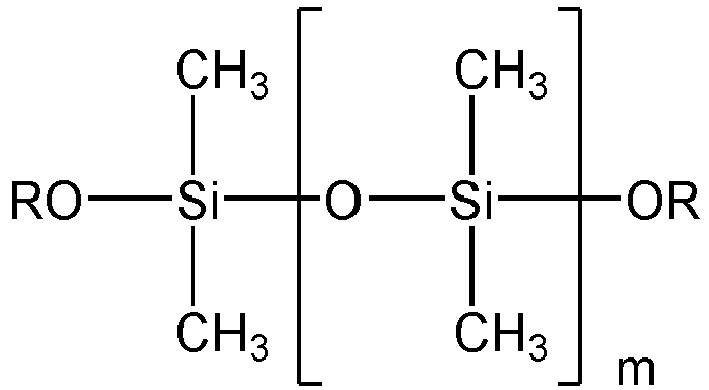
oder
CH3SiDaDbDc(OR)3
oder
SiDaDbDcDd(OR)4
mit a,b,c und d jeweils unbhängig voneinander 1 bis 100, vorzugsweise 2 bis 50, besonders bevorzugt 10 bis 30 und
R = Alkylrest, verzweigter Alkylrest, Cycloalkylrest mit 1 bis 10 Kohlenstoffatomen, vorzugsweise mit 1 bis 4, besonders bevorzugt R = Ethyl-.Reaction system according to one of claims 1 to 4, characterized in that linear and / or branched alkoxysiloxanes are used, preferably those of the formula:
or
CH 3 SiD a D b D c (OR) 3
or
SiDaDbDcDd (OR) 4
with a, b, c and d each independently of one another 1 to 100, preferably 2 to 50, particularly preferably 10 to 30 and
R = alkyl radical, branched alkyl radical, cycloalkyl radical with 1 to 10 carbon atoms, preferably with 1 to 4, particularly preferably R = ethyl.

Priority Applications (6)
| Application Number | Priority Date | Filing Date | Title |
|---|---|---|---|
| EP18210035.4A EP3663346B1 (en) | 2018-12-04 | 2018-12-04 | Reactive siloxanes |
| ES18210035T ES2970332T3 (en) | 2018-12-04 | 2018-12-04 | Reactive Siloxanes |
| PCT/EP2019/081728 WO2020114762A1 (en) | 2018-12-04 | 2019-11-19 | Reactive siloxanes |
| CA3121101A CA3121101C (en) | 2018-12-04 | 2019-11-19 | Reactive siloxanes |
| CN201980080370.1A CN113166474B (en) | 2018-12-04 | 2019-11-19 | Reactive Siloxane |
| US17/297,372 US11795275B2 (en) | 2018-12-04 | 2019-11-19 | Reactive siloxanes |
Applications Claiming Priority (1)
| Application Number | Priority Date | Filing Date | Title |
|---|---|---|---|
| EP18210035.4A EP3663346B1 (en) | 2018-12-04 | 2018-12-04 | Reactive siloxanes |
Publications (2)
| Publication Number | Publication Date |
|---|---|
| EP3663346A1 true EP3663346A1 (en) | 2020-06-10 |
| EP3663346B1 EP3663346B1 (en) | 2023-11-15 |
Family
ID=64901288
Family Applications (1)
| Application Number | Title | Priority Date | Filing Date |
|---|---|---|---|
| EP18210035.4A Active EP3663346B1 (en) | 2018-12-04 | 2018-12-04 | Reactive siloxanes |
Country Status (5)
| Country | Link |
|---|---|
| US (1) | US11795275B2 (en) |
| EP (1) | EP3663346B1 (en) |
| CN (1) | CN113166474B (en) |
| ES (1) | ES2970332T3 (en) |
| WO (1) | WO2020114762A1 (en) |
Cited By (6)
| Publication number | Priority date | Publication date | Assignee | Title |
|---|---|---|---|---|
| US11332591B2 (en) | 2019-05-28 | 2022-05-17 | Evonik Operations Gmbh | Production of PU foams |
| US11472822B2 (en) | 2019-05-28 | 2022-10-18 | Evonik Operations Gmbh | Process for purifying acetoxysiloxanes |
| US11591448B2 (en) | 2020-03-27 | 2023-02-28 | Evonik Operations Gmbh | Physical reutilization of siliconized sheets |
| EP4349882A1 (en) | 2022-08-12 | 2024-04-10 | Evonik Operations GmbH | Preparation of alkoxysiloxanes |
| EP4349884A1 (en) | 2022-08-12 | 2024-04-10 | Evonik Operations GmbH | Method for preparing alkoxysiloxanes from waste silicone |
| EP4497868A1 (en) | 2023-07-27 | 2025-01-29 | Evonik Operations GmbH | Material recycling of siliconized papers |
Families Citing this family (12)
| Publication number | Priority date | Publication date | Assignee | Title |
|---|---|---|---|---|
| EP3719076A1 (en) | 2019-04-01 | 2020-10-07 | Evonik Operations GmbH | Aqueous polyorganosiloxane hybrid resin dispersion |
| EP3744752B1 (en) | 2019-05-28 | 2024-10-16 | Evonik Operations GmbH | Method for the preparation of non-cyclic alkoxyfunctional polysiloxanes |
| EP3744764A1 (en) | 2019-05-28 | 2020-12-02 | Evonik Operations GmbH | Production of sioc-linked siloxanes |
| ES2990990T3 (en) | 2019-05-28 | 2024-12-02 | Evonik Operations Gmbh | Customized SiOC-based polyethersiloxanes |
| EP3954740A1 (en) | 2020-08-14 | 2022-02-16 | Evonik Operations GmbH | Defoamer composition based on polysiloxanes with organofunctionally modified polysiloxanes |
| US11732092B2 (en) | 2020-10-19 | 2023-08-22 | Evonik Operations Gmbh | Upcycling process for processing silicone wastes |
| EP4011992A1 (en) | 2020-12-09 | 2022-06-15 | Evonik Operations GmbH | Curable condensation compounds on the basis of alkoxy-functional polysiloxanes |
| US12060460B2 (en) | 2021-04-29 | 2024-08-13 | Evonik Operations Gmbh | Process for producing endcapped, liquid siloxanes from silicone wastes |
| EP4119597A1 (en) | 2021-07-14 | 2023-01-18 | Evonik Operations GmbH | Molecular weight structure of low-molecular alpha, omega-polysiloxane diols |
| CA3180684A1 (en) | 2021-11-25 | 2023-05-25 | Evonik Operations Gmbh | Curable condensation compounds based on alkoxy-functional polysiloxanes |
| CN114524940B (en) * | 2022-02-22 | 2023-05-26 | 江苏省农业科学院 | A Method for Surface Modification of Wheat Straw Based on Coupling of Plasma and Hyperbranching |
| CN119192582B (en) * | 2024-10-22 | 2025-12-05 | 南京大学 | A method for preparing low-viscosity vinyl-containing fluorinated hyperbranched organosilicon resin |
Citations (5)
| Publication number | Priority date | Publication date | Assignee | Title |
|---|---|---|---|---|
| US3032532A (en) | 1962-05-01 | Xcyloxy-endblocked diorgano- | ||
| EP0003285A1 (en) * | 1978-01-21 | 1979-08-08 | Bayer Ag | Process for preparing organopolysiloxanes having functional groups |
| WO2014002919A1 (en) * | 2012-06-28 | 2014-01-03 | Dow Corning Toray Co., Ltd. | Coating agent, electrical-electronic equipment, and method for protecting metal parts of electrical-electronic equipment |
| WO2014104388A2 (en) * | 2012-12-28 | 2014-07-03 | Dow Corning Toray Co., Ltd. | Curable silicone composition, cured product thereof, and optical semiconductor device |
| WO2017185737A1 (en) * | 2016-04-26 | 2017-11-02 | Guangdong Biomax Si&F New Material Co., Ltd. | A method for preparing organopolysiloxane resins |
Family Cites Families (135)
| Publication number | Priority date | Publication date | Assignee | Title |
|---|---|---|---|---|
| BE558554A (en) | 1956-06-26 | |||
| NL128599C (en) | 1963-08-07 | 1970-04-15 | ||
| US3356758A (en) | 1963-08-07 | 1967-12-05 | Union Carbide Corp | Siloxane-oxyalkylene block copolymers and process therefor |
| US4066680A (en) * | 1976-10-18 | 1978-01-03 | Sws Silicones Corporation | Process for making alpha,omega-siloxanediols |
| CA1125780A (en) | 1977-10-28 | 1982-06-15 | Eugene R. Martin | Process for making alpha-omega-diacyloxysiloxanes |
| DE4116987C1 (en) | 1991-05-24 | 1992-07-30 | Th. Goldschmidt Ag, 4300 Essen, De | |
| DE4239246C1 (en) | 1992-11-21 | 1993-12-16 | Goldschmidt Ag Th | Process for the preparation of SiH-containing organopolysiloxanes |
| DE4313130C1 (en) | 1993-04-22 | 1994-05-26 | Goldschmidt Ag Th | Silanes and organosilicon hydrides prodn. - by redn. of corresp. silicon halides with non-pyrophoric storage magnesium hydride in THF etc., with continuous removal of halide deposits |
| DE4320920C1 (en) | 1993-06-24 | 1994-06-16 | Goldschmidt Ag Th | New silane cpds. used as surfactant in aq. media - comprise ether and hydrophilic gps., and are stable against hydrolysis in acid and alkali |
| DE4330059C1 (en) | 1993-09-06 | 1994-10-20 | Goldschmidt Ag Th | Silanes containing hydrophilic groups, their preparation and use as surfactants in aqueous media |
| DE4336602A1 (en) | 1993-10-27 | 1995-05-04 | Goldschmidt Ag Th | Process for the production of aluminum hydrogen (AlH¶3¶) by reacting magnesium hydride with aluminum halide |
| DE4415556C1 (en) | 1994-04-27 | 1995-06-01 | Goldschmidt Ag Th | New unsatd. organo:silyl or organo:siloxanyl derivs. of glycerol ether(s) |
| US5856548A (en) | 1997-05-17 | 1999-01-05 | Th. Goldschmidt Ag | Process for preparing dimethylmonochlorosilane |
| DE19859759C1 (en) | 1998-12-23 | 2000-06-29 | Goldschmidt Ag Th | Method and device for carrying out continuous hydrosilylation reactions |
| CA2298240C (en) | 1999-02-24 | 2007-08-21 | Goldschmidt Ag | Synergistic catalyst system and process for carrying out hydrosilylation reactions |
| WO2002068506A1 (en) | 2001-02-27 | 2002-09-06 | Goldschmidt Ag | Method for treating polyether siloxanes |
| DE50200338D1 (en) | 2002-03-26 | 2004-05-13 | Goldschmidt Ag Th | Use of organofunctionally modified polysiloxanes for the production of flexible polyurethane foams |
| DE10232115A1 (en) | 2002-07-16 | 2004-02-05 | Goldschmidt Ag | Organopolysiloxanes for defoaming aqueous systems |
| DE10232908A1 (en) | 2002-07-19 | 2004-01-29 | Goldschmidt Ag | Use of organically modified polysiloxanes containing phenyl derivatives as dispersants and wetting agents for fillers and pigments in aqueous pigment pastes and color or coating formulations |
| ES2213728T3 (en) | 2002-09-26 | 2004-09-01 | Goldschmidt Ag | NEW SILOXANE COMPOUNDS AND THEIR USE AS HOMOGENEIZATION AGENTS IN SEPARATION AGENTS WITH A MATEATED EFFECT FOR THE PRODUCTION OF MOLDED BODIES FROM SYNTHETIC MATERIALS WITH MATTERED SURFACES. |
| ATE321087T1 (en) | 2002-12-21 | 2006-04-15 | Goldschmidt Gmbh | METHOD FOR PROCESSING POLYETHER SILOXANES |
| DE10301355A1 (en) | 2003-01-16 | 2004-07-29 | Goldschmidt Ag | Equilibration of siloxanes |
| DE10337309A1 (en) | 2003-08-14 | 2005-03-10 | Goldschmidt Ag Th | Production of (organo)silanes, used as precursors in chemical vapor deposition of dielectric for semiconductor industry, uses magnesium hydride etherate complex in apolar solvent for reducing halide |
| EP1520870B1 (en) | 2003-10-04 | 2006-01-25 | Goldschmidt GmbH | Process for manufacturing organic silicon compounds |
| JP2006160831A (en) * | 2004-12-03 | 2006-06-22 | Dow Corning Toray Co Ltd | Method for producing organopolysiloxane |
| DE102005001039B4 (en) | 2005-01-07 | 2017-11-09 | Evonik Degussa Gmbh | Process for the preparation of equilibration products of organosiloxanes and the organopolysiloxanes obtainable in this way |
| DE102005039398A1 (en) | 2005-08-20 | 2007-02-22 | Goldschmidt Gmbh | Process for the preparation of addition products of compounds containing SiH groups to olefin-containing reactants in aqueous media |
| DE102005039931A1 (en) | 2005-08-24 | 2007-03-01 | Goldschmidt Gmbh | Process for the preparation of SiOC-linked linear polydimethylsiloxane-polyoxyalkylene block copolymers |
| DE102005051939A1 (en) | 2005-10-29 | 2007-05-03 | Goldschmidt Gmbh | Dehydrogenative condensation of alcohol with organo-hydrogen-siloxane in presence of quat. ammonium hydroxide catalyst, used to make modified polyorgano-siloxane for use e.g. as emulsifier or in release coatings |
| DE102005057857A1 (en) | 2005-12-03 | 2010-02-25 | Evonik Goldschmidt Gmbh | Block-type polyether-modified polysiloxanes and their use for the preparation of cosmetic formulations |
| DE102006061350A1 (en) | 2006-12-22 | 2008-06-26 | Evonik Goldschmidt Gmbh | Process for the preparation of SiOC-linked, linear polydimethylsiloxane-polyoxyalkylene block copolymers and their use |
| DE102006061353A1 (en) | 2006-12-22 | 2008-06-26 | Evonik Goldschmidt Gmbh | Process for the reaction of polyorganosiloxanes and their use |
| DE102006061351A1 (en) | 2006-12-22 | 2008-06-26 | Evonik Goldschmidt Gmbh | Process for the preparation of SiOC-linked, linear polydimethylsiloxane-polyoxyalkylene block copolymers and their use |
| DE102007003578A1 (en) * | 2007-01-24 | 2008-07-31 | Wacker Chemie Ag | Process for the preparation of polymerizable silicones |
| DE102007035646A1 (en) | 2007-07-27 | 2009-01-29 | Evonik Goldschmidt Gmbh | About SIC and via carboxylic acid ester groups linked linear polydimethylsiloxane-polyoxyalkylene block copolymers, a process for their preparation and their use |
| DE102007041028A1 (en) | 2007-08-29 | 2009-03-05 | Evonik Goldschmidt Gmbh | Use of ester-modified organopolysiloxanes for the preparation of cosmetic or pharmaceutical compositions |
| DE102007046736A1 (en) | 2007-09-28 | 2009-04-02 | Evonik Goldschmidt Gmbh | Use of linear siloxanes and process for their preparation |
| DE102007055485A1 (en) | 2007-11-21 | 2009-06-04 | Evonik Goldschmidt Gmbh | Process for the preparation of branched SiH-functional polysiloxanes and their use for the preparation of SiC- and SiOC-linked, branched organomodified polysiloxanes |
| DE102007055484A1 (en) | 2007-11-21 | 2009-05-28 | Evonik Goldschmidt Gmbh | Process for the preparation of polydimethylsiloxanes on sulfonic acid cation exchange resins |
| DE102007057146A1 (en) | 2007-11-28 | 2009-06-04 | Evonik Goldschmidt Gmbh | Process for the preparation of polyether alcohols with DMC catalysts using special additives with aromatic hydroxy functionalization |
| DE102007057145A1 (en) | 2007-11-28 | 2009-06-04 | Evonik Goldschmidt Gmbh | Process for the preparation of polyether alcohols with DMC catalysts using compounds bearing SiH groups as additives |
| DE102008000266A1 (en) | 2008-02-11 | 2009-08-13 | Evonik Goldschmidt Gmbh | The invention relates to the use of foam stabilizers, which are produced on the basis of renewable raw materials, for the production of polyurethane foams |
| DE102008000360A1 (en) | 2008-02-21 | 2009-08-27 | Evonik Goldschmidt Gmbh | New alkoxysilyl-carrying polyether alcohols by alkoxylation of epoxide-functional alkoxysilanes to double metal cyanide (DMC) catalysts, and to processes for their preparation |
| DE102008000903A1 (en) | 2008-04-01 | 2009-10-08 | Evonik Goldschmidt Gmbh | New polyether alcohols carrying organosiloxane groups by alkoxylation of epoxide-functional (poly) organosiloxanes on double metal cyanide (DMC) catalysts, and also processes for their preparation |
| DE102008002713A1 (en) | 2008-06-27 | 2009-12-31 | Evonik Goldschmidt Gmbh | New polyether siloxanes containing alkoxylation products by direct alkoxylation of organo-modified alpha, omega-dihydroxysiloxanes on double metal cyanide (DMC) catalysts, and to processes for their preparation |
| DE102008041601A1 (en) | 2008-08-27 | 2010-03-04 | Evonik Goldschmidt Gmbh | Process for the preparation of branched SiH-functional polysiloxanes and their use for the preparation of liquid, SiC or SiOC-linked, branched organomodified polysiloxanes |
| DE102008042181B4 (en) | 2008-09-18 | 2020-07-23 | Evonik Operations Gmbh | Equilibration of siloxanes on water-containing sulfonic acid cation exchange resins |
| DE102008043218A1 (en) | 2008-09-24 | 2010-04-01 | Evonik Goldschmidt Gmbh | Polymeric materials and adhesives and coating materials based on multialkoxysilyl-functional prepolymers |
| DE102008043245A1 (en) | 2008-10-29 | 2010-05-06 | Evonik Goldschmidt Gmbh | Silicone polyether copolymer systems and processes for their preparation by alkoxylation reaction |
| DE102008043343A1 (en) | 2008-10-31 | 2010-05-06 | Evonik Goldschmidt Gmbh | Silicone polyether block copolymers with defined polydispersity in the polyoxyalkylene part and their use as stabilizers for the production of polyurethane foams |
| US8283422B2 (en) | 2008-12-05 | 2012-10-09 | Evonik Goldschmidt Gmbh | Polyethersiloxanes carrying alkoxysilyl groups and method for production thereof |
| DE102009022628A1 (en) | 2008-12-05 | 2010-06-10 | Evonik Goldschmidt Gmbh | Method for modifying surfaces |
| DE102009019002B3 (en) | 2009-04-16 | 2010-11-25 | Astrium Gmbh | Bubble trap for fuel tanks in spacecraft |
| DE102009002417A1 (en) | 2009-04-16 | 2010-10-21 | Evonik Goldschmidt Gmbh | Use of organomodified silicone branched siloxanes for the preparation of cosmetic or pharmaceutical compositions |
| DE102009003274A1 (en) | 2009-05-20 | 2010-11-25 | Evonik Goldschmidt Gmbh | Compositions containing polyether-polysiloxane copolymers |
| DE102009022627A1 (en) | 2009-05-25 | 2010-12-02 | Evonik Goldschmidt Gmbh | Reactive silyl-bearing hydroxyl compounds as ceramic binder |
| DE102009022630A1 (en) | 2009-05-25 | 2010-12-02 | Evonik Goldschmidt Gmbh | Emulsions based on silyl-group-bearing hydroxyl compounds |
| DE102009022631A1 (en) | 2009-05-25 | 2010-12-16 | Evonik Goldschmidt Gmbh | Curable silyl group-containing compositions and their use |
| DE102009034607A1 (en) | 2009-07-24 | 2011-01-27 | Evonik Goldschmidt Gmbh | Novel silicone polyether copolymers and processes for their preparation |
| DE102009028640A1 (en) | 2009-08-19 | 2011-02-24 | Evonik Goldschmidt Gmbh | Curable composition containing urethane-containing silylated polymers and their use in sealants and adhesives, binders and / or surface modifiers |
| DE102009028636A1 (en) | 2009-08-19 | 2011-02-24 | Evonik Goldschmidt Gmbh | Novel urethane-containing silylated prepolymers and process for their preparation |
| DE102010001350A1 (en) | 2010-01-29 | 2011-08-04 | Evonik Goldschmidt GmbH, 45127 | Novel linear polydimethylsiloxane-polyether copolymers having amino and / or quaternary ammonium groups and their use |
| DE102010001528A1 (en) | 2010-02-03 | 2011-08-04 | Evonik Goldschmidt GmbH, 45127 | New particles and composite particles, their uses and a new process for their preparation from alkoxysilyl-bearing alkoxylation products |
| DE102010001531A1 (en) | 2010-02-03 | 2011-08-04 | Evonik Goldschmidt GmbH, 45127 | Novel organomodified siloxanes with primary amino functions, novel organomodified siloxanes with quaternary ammonium functions and the process for their preparation |
| DE102010002180A1 (en) | 2010-02-22 | 2011-08-25 | Evonik Goldschmidt GmbH, 45127 | Nitrogen-containing silicon-organic graft copolymers |
| DE102010002178A1 (en) | 2010-02-22 | 2011-08-25 | Evonik Goldschmidt GmbH, 45127 | Process for the preparation of amine-amide-functional siloxanes |
| DE102010029723A1 (en) | 2010-06-07 | 2011-12-08 | Evonik Goldschmidt Gmbh | Process for the preparation of organic silicon compounds |
| DE102010031087A1 (en) | 2010-07-08 | 2012-01-12 | Evonik Goldschmidt Gmbh | Novel polyester-modified organopolysiloxanes |
| DE102010062156A1 (en) | 2010-10-25 | 2012-04-26 | Evonik Goldschmidt Gmbh | Polysiloxanes with nitrogen-containing groups |
| DE102011005607A1 (en) | 2011-03-16 | 2012-09-20 | Evonik Goldschmidt Gmbh | Process for the preparation of organomodified polysiloxanes |
| DE102011076019A1 (en) | 2011-05-18 | 2012-11-22 | Evonik Goldschmidt Gmbh | Alkoxylation products and processes for their preparation by means of DMC catalysts |
| DE102011079465A1 (en) | 2011-07-20 | 2013-01-24 | Evonik Goldschmidt Gmbh | Process for the reduction of carboxylic acid esters or lactones to the corresponding ethers |
| DE102011109540A1 (en) | 2011-08-03 | 2013-02-07 | Evonik Goldschmidt Gmbh | Alkylcarbonate end-capped polyethersilioxanes and process for their preparation |
| DE102011085492A1 (en) | 2011-10-31 | 2013-05-02 | Evonik Goldschmidt Gmbh | New amino group-containing siloxanes, process for their preparation and use |
| DE102011088787A1 (en) | 2011-12-16 | 2013-06-20 | Evonik Industries Ag | Siloxan lemon and its application |
| DE102012202521A1 (en) | 2012-02-20 | 2013-08-22 | Evonik Goldschmidt Gmbh | Branched polysiloxanes and their use |
| DE102012202527A1 (en) | 2012-02-20 | 2013-08-22 | Evonik Goldschmidt Gmbh | Compositions containing polymers and metal atoms or ions and their use |
| DE102012203737A1 (en) | 2012-03-09 | 2013-09-12 | Evonik Goldschmidt Gmbh | Modified alkoxylation products having at least one non-terminal alkoxysilyl group and containing a plurality of urethane groups and their use |
| DE102012210553A1 (en) | 2012-06-22 | 2013-12-24 | Evonik Industries Ag | Silicone polyethers and process for their preparation from methylidene-bearing polyethers |
| DE102012210556A1 (en) | 2012-06-22 | 2013-12-24 | Evonik Industries Ag | Preparing ether compounds, comprises converting carbonyl compounds in presence of reducing agent comprising compounds having silicon hydride functional group, and catalyst comprising indium- or gallium compounds, and precipitating catalyst |
| JP6081774B2 (en) * | 2012-10-30 | 2017-02-15 | 東レ・ダウコーニング株式会社 | Curable silicone composition, cured product thereof, and optical semiconductor device |
| DE102013208328A1 (en) | 2013-05-07 | 2014-11-13 | Evonik Industries Ag | Polyoxyalkylenes with pendant long-chain acyloxy and process for their preparation by means of DMC catalysts |
| DE102013106906A1 (en) | 2013-07-01 | 2015-01-08 | Evonik Industries Ag | Siloxane polymers having a central polysiloxane polymer block with terminal organofunctional radicals comprising urea and / or carbamate groups and amino acid radicals |
| DE102013106905A1 (en) | 2013-07-01 | 2015-01-08 | Evonik Industries Ag | Siloxane polymers having a central polysiloxane polymer block having organofunctional radicals each having at least two bivalent groups selected from urea and / or carbamate groups and at least one UV / Vis chromophore as the remainder |
| DE102013213655A1 (en) | 2013-07-12 | 2015-01-15 | Evonik Industries Ag | Curable silyl group-containing compositions with improved storage stability |
| DE102013214081A1 (en) | 2013-07-18 | 2015-01-22 | Evonik Industries Ag | Novel amino acid modified siloxanes, process for their preparation and use |
| DE102013216787A1 (en) | 2013-08-23 | 2015-02-26 | Evonik Degussa Gmbh | Guanidinruppen containing semi-organic silicon group-containing compounds |
| DE102013216751A1 (en) | 2013-08-23 | 2015-02-26 | Evonik Industries Ag | Modified alkoxylation products containing alkoxysilyl groups containing urethane groups and their use |
| DE102014209407A1 (en) | 2014-05-19 | 2015-11-19 | Evonik Degussa Gmbh | Highly active double metal cyanide catalysts and process for their preparation |
| DE102014209408A1 (en) | 2014-05-19 | 2015-11-19 | Evonik Degussa Gmbh | Ethoxylate preparation using highly active double metal cyanide catalysts |
| DE102014211680A1 (en) | 2014-06-18 | 2015-02-26 | Evonik Industries Ag | Optimized processes for the preparation of siloxanes with regeneration-free reuse of the ion exchange resins |
| DE102014213507A1 (en) | 2014-07-11 | 2016-01-14 | Evonik Degussa Gmbh | Platinum-containing composition |
| DE102014215382A1 (en) | 2014-08-05 | 2016-02-11 | Evonik Degussa Gmbh | Nitrogen containing compounds suitable for use in the production of polyurethanes |
| EP3020749B1 (en) | 2014-11-12 | 2020-09-30 | Evonik Operations GmbH | Method for the production of compositions containing platinum |
| DK3050910T3 (en) | 2015-01-28 | 2017-02-27 | Evonik Degussa Gmbh | MODIFIED ALCOXYLING PRODUCTS, WHICH HAVE AT LEAST A NON-TERMINAL ALCOXYSILYL GROUP, WITH INCREASED STOCK STABILITY AND IMPROVED EXTENSION, AND THE POLYMES USED THEREOF |
| LT3168274T (en) | 2015-11-11 | 2018-09-10 | Evonik Degussa Gmbh | Curable polymers |
| LT3168273T (en) | 2015-11-11 | 2018-09-10 | Evonik Degussa Gmbh | Curable polymers |
| EP3380542A1 (en) | 2015-11-26 | 2018-10-03 | Evonik Degussa GmbH | Binder systems containing alkoxysilane groups-carrying prepolymers and epoxide compounds, and the use thereof |
| EP3202816B1 (en) | 2016-02-04 | 2018-09-19 | Evonik Degussa GmbH | Adhesive materials containing alkoxysilyl with improved tearing resistance |
| ES2814123T3 (en) | 2016-04-04 | 2021-03-26 | Evonik Operations Gmbh | Treatment of alkaline catalyzed alkoxylation products |
| EP3272331B1 (en) | 2016-07-22 | 2018-07-04 | Evonik Degussa GmbH | Method for the preparation of siloxanes-containing glycerin substituents |
| EP3321304B1 (en) | 2016-11-15 | 2019-06-19 | Evonik Degussa GmbH | Mixtures of cyclic branched d/t-type siloxanes and their ensuing products |
| PL3401353T3 (en) | 2017-05-08 | 2021-12-13 | Evonik Operations Gmbh | Mixtures of cyclic branched d/t-type siloxanes and their ensuing products |
| EP3415548B1 (en) | 2017-06-13 | 2020-03-25 | Evonik Operations GmbH | Method for producing sic-linked polyether siloxanes |
| EP3415547B1 (en) | 2017-06-13 | 2020-03-25 | Evonik Operations GmbH | Method for producing sic-linked polyether siloxanes |
| EP3438158B1 (en) | 2017-08-01 | 2020-11-25 | Evonik Operations GmbH | Production of sioc-linked siloxanes |
| EP3467006B1 (en) | 2017-10-09 | 2022-11-30 | Evonik Operations GmbH | Mixtures of cyclic branched d/t-type siloxanes and their ensuing products |
| EP3470475B1 (en) | 2017-10-13 | 2021-01-27 | Evonik Operations GmbH | Curable composition for coatings with anti-adhesive property |
| US10787464B2 (en) | 2017-10-17 | 2020-09-29 | Evonik Operations Gmbh | Zinc ketoiminate complexes as catalysts for the production of polyurethanes |
| EP3492513B1 (en) | 2017-11-29 | 2021-11-03 | Evonik Operations GmbH | Method of manufacturing sioc linked polyether branched in siloxane section |
| EP3611216A1 (en) * | 2018-08-15 | 2020-02-19 | Evonik Operations GmbH | Linear polydimethylsiloxane polyoxyalkylene block copolymers of structure type aba |
| WO2019219446A1 (en) | 2018-05-17 | 2019-11-21 | Evonik Degussa Gmbh | Linear polydimethylsiloxane-polyoxyalkylene block copolymers of the structural type aba |
| US11359056B2 (en) | 2018-05-17 | 2022-06-14 | Evonik Operations Gmbh | Linear polydimethylsiloxane-polyoxyalkylene block copolymers of the structure type ABA |
| EP3611214A1 (en) | 2018-08-15 | 2020-02-19 | Evonik Operations GmbH | Sioc-linked, linear polydimethylsiloxane polyoxyalkylene block copolymers |
| EP3611215A1 (en) | 2018-08-15 | 2020-02-19 | Evonik Operations GmbH | Method for producing acetoxy groups carrying siloxanes |
| ES2989053T3 (en) * | 2018-08-15 | 2024-11-25 | Evonik Operations Gmbh | Polydimethylsiloxane-polyoxyalkylene block copolymers of the ABA structural type |
| EP3744756B1 (en) | 2019-05-28 | 2024-07-03 | Evonik Operations GmbH | Acetoxy systems |
| ES2998233T3 (en) | 2019-05-28 | 2025-02-19 | Evonik Operations Gmbh | Method for producing siloxanes bearing acetoxy groups |
| EP3744760A1 (en) | 2019-05-28 | 2020-12-02 | Evonik Operations GmbH | Method of manufacturing sioc linked polyether branched in siloxane section |
| ES2913783T3 (en) | 2019-05-28 | 2022-06-06 | Evonik Operations Gmbh | Procedure for the purification of acetoxysiloxanes |
| EP3744774B1 (en) | 2019-05-28 | 2021-09-01 | Evonik Operations GmbH | Method for recycling of silicones |
| EP3744745A1 (en) | 2019-05-28 | 2020-12-02 | Evonik Operations GmbH | Production of pu foams |
| ES2990990T3 (en) | 2019-05-28 | 2024-12-02 | Evonik Operations Gmbh | Customized SiOC-based polyethersiloxanes |
| ES2986717T3 (en) | 2019-05-28 | 2024-11-12 | Evonik Operations Gmbh | Process for the production of SiOC-linked polyethersiloxanes branched in the siloxane part |
| EP3744752B1 (en) | 2019-05-28 | 2024-10-16 | Evonik Operations GmbH | Method for the preparation of non-cyclic alkoxyfunctional polysiloxanes |
| EP3744761B1 (en) | 2019-05-28 | 2021-06-30 | Evonik Operations GmbH | Sioc-based polyether siloxanes |
| PL3744762T3 (en) | 2019-05-28 | 2025-03-31 | Evonik Operations Gmbh | Method for the preparation of polyoxyalkylene polysiloxane block polymerisates |
| EP3744764A1 (en) | 2019-05-28 | 2020-12-02 | Evonik Operations GmbH | Production of sioc-linked siloxanes |
| EP3744754B1 (en) | 2019-05-28 | 2024-10-02 | Evonik Operations GmbH | Method for producing siloxanes bearing acetoxy groups |
| CN114430757A (en) | 2019-09-27 | 2022-05-03 | 赢创运营有限公司 | Silicone (meth) acrylates, method for the production thereof and use thereof in curable compositions |
| ES2924476T3 (en) | 2020-01-08 | 2022-10-07 | Evonik Operations Gmbh | Formulation and its use as defoamer |
| EP3865527A1 (en) | 2020-02-14 | 2021-08-18 | Evonik Operations GmbH | Production of pu foams |
| EP3865531B1 (en) | 2020-02-14 | 2025-05-28 | Evonik Operations GmbH | Sioc-linked, linear polydimethylsiloxane polyoxyalkylene block copolymers |
| EP3885096B1 (en) | 2020-03-27 | 2024-02-14 | Evonik Operations GmbH | Recycling of siliconized flat/planar sheets |
| ES3035011T3 (en) | 2020-06-02 | 2025-08-27 | Evonik Operations Gmbh | Linear acetoxy group bearing siloxanes and secondary products |
-
2018
- 2018-12-04 EP EP18210035.4A patent/EP3663346B1/en active Active
- 2018-12-04 ES ES18210035T patent/ES2970332T3/en active Active
-
2019
- 2019-11-19 WO PCT/EP2019/081728 patent/WO2020114762A1/en not_active Ceased
- 2019-11-19 CN CN201980080370.1A patent/CN113166474B/en active Active
- 2019-11-19 US US17/297,372 patent/US11795275B2/en active Active
Patent Citations (5)
| Publication number | Priority date | Publication date | Assignee | Title |
|---|---|---|---|---|
| US3032532A (en) | 1962-05-01 | Xcyloxy-endblocked diorgano- | ||
| EP0003285A1 (en) * | 1978-01-21 | 1979-08-08 | Bayer Ag | Process for preparing organopolysiloxanes having functional groups |
| WO2014002919A1 (en) * | 2012-06-28 | 2014-01-03 | Dow Corning Toray Co., Ltd. | Coating agent, electrical-electronic equipment, and method for protecting metal parts of electrical-electronic equipment |
| WO2014104388A2 (en) * | 2012-12-28 | 2014-07-03 | Dow Corning Toray Co., Ltd. | Curable silicone composition, cured product thereof, and optical semiconductor device |
| WO2017185737A1 (en) * | 2016-04-26 | 2017-11-02 | Guangdong Biomax Si&F New Material Co., Ltd. | A method for preparing organopolysiloxane resins |
Non-Patent Citations (6)
| Title |
|---|
| J. POLA ET AL., COLLECT. CZECH. CHEM. COMMUN., vol. 39, no. 5, 1974, pages 1169 - 1176 |
| M. JAUMANN ET AL., MACROMOL. CHEM. PHYS., vol. 204, 2003, pages 1014 - 1026 |
| M.A. BROOK: "Silicon in Organic, Organometallic and Polymer Chemistry", 2000, JOHN WILEY & SONS, INC., pages: 264 |
| MACROMOLECULES, vol. 19, 2006, pages 1701 - 1708 |
| W. NOLL: "Chemie und Technologie der Silicone", 1960, VERLAG CHEMIE GMBH, pages: 2 |
| W. SIMMLER; HOUBEN-WEYL: "Methods of Organic Chemistry", vol. VI/2, article "O-Metal Derivates of Organic Hydroxy Compounds", pages: 162 ff |
Cited By (6)
| Publication number | Priority date | Publication date | Assignee | Title |
|---|---|---|---|---|
| US11332591B2 (en) | 2019-05-28 | 2022-05-17 | Evonik Operations Gmbh | Production of PU foams |
| US11472822B2 (en) | 2019-05-28 | 2022-10-18 | Evonik Operations Gmbh | Process for purifying acetoxysiloxanes |
| US11591448B2 (en) | 2020-03-27 | 2023-02-28 | Evonik Operations Gmbh | Physical reutilization of siliconized sheets |
| EP4349882A1 (en) | 2022-08-12 | 2024-04-10 | Evonik Operations GmbH | Preparation of alkoxysiloxanes |
| EP4349884A1 (en) | 2022-08-12 | 2024-04-10 | Evonik Operations GmbH | Method for preparing alkoxysiloxanes from waste silicone |
| EP4497868A1 (en) | 2023-07-27 | 2025-01-29 | Evonik Operations GmbH | Material recycling of siliconized papers |
Also Published As
| Publication number | Publication date |
|---|---|
| CN113166474B (en) | 2024-05-14 |
| US20220033587A1 (en) | 2022-02-03 |
| ES2970332T3 (en) | 2024-05-28 |
| EP3663346B1 (en) | 2023-11-15 |
| WO2020114762A1 (en) | 2020-06-11 |
| US11795275B2 (en) | 2023-10-24 |
| CA3121101A1 (en) | 2020-06-11 |
| CN113166474A (en) | 2021-07-23 |
Similar Documents
| Publication | Publication Date | Title |
|---|---|---|
| EP3663346B1 (en) | Reactive siloxanes | |
| EP3744756B1 (en) | Acetoxy systems | |
| EP3744762B1 (en) | Method for the preparation of polyoxyalkylene polysiloxane block polymerisates | |
| EP3467006B1 (en) | Mixtures of cyclic branched d/t-type siloxanes and their ensuing products | |
| EP3401353B1 (en) | Mixtures of cyclic branched d/t-type siloxanes and their ensuing products | |
| EP3744754B1 (en) | Method for producing siloxanes bearing acetoxy groups | |
| EP3492513B1 (en) | Method of manufacturing sioc linked polyether branched in siloxane section | |
| EP1679335B1 (en) | Siloxane block-copolymers | |
| EP3611215A1 (en) | Method for producing acetoxy groups carrying siloxanes | |
| EP3744759A1 (en) | Method of manufacturing sioc linked polyether branched in siloxane section | |
| EP0675151B1 (en) | Branched polysiloxane-polyether copolymers, preparation and use | |
| DE3103705A1 (en) | "PLATINO-SILOXANE COMPLEX CATALYST AND PREPARATIONS CONTAINING THIS CATALYST" | |
| EP3744753A1 (en) | Method for purifying acetoxy siloxanes | |
| EP3321304A1 (en) | Mixtures of cyclic branched d/t-type siloxanes and their ensuing products | |
| EP0927734B1 (en) | Continuous process for the production of polyorganosiloxanes | |
| EP0002745A1 (en) | Curable organopolysiloxane compositions containing titanium esters | |
| EP0659803A2 (en) | Process for the production of organopolysiloxanes having carbon-silicon bonded secondary aminoalkyl groups | |
| DE19800021A1 (en) | Process for the preparation of polyorganosiloxane resins containing mono- and tetrafunctional units | |
| EP3611216A1 (en) | Linear polydimethylsiloxane polyoxyalkylene block copolymers of structure type aba | |
| DE2902436A1 (en) | PROCESS FOR PRODUCING SOLVENT-FREE SILICONE RESINS AND PRODUCTS THEREOF | |
| EP0626414B1 (en) | Organosilicon group containing phosphazenes, process for their preparation and their use | |
| EP2493962A1 (en) | Method for producing (hydroxymethyl)polysiloxanes | |
| EP2050777A2 (en) | Multistage process for preparing organopolysiloxanes comprising aminoalkyl groups | |
| EP1852455B1 (en) | Process for the preparation of organosilicon compounds having urethane groups | |
| DE69522745T2 (en) | Process for the degradation of polysiloxanes |
Legal Events
| Date | Code | Title | Description |
|---|---|---|---|
| PUAI | Public reference made under article 153(3) epc to a published international application that has entered the european phase |
Free format text: ORIGINAL CODE: 0009012 |
|
| STAA | Information on the status of an ep patent application or granted ep patent |
Free format text: STATUS: THE APPLICATION HAS BEEN PUBLISHED |
|
| AK | Designated contracting states |
Kind code of ref document: A1 Designated state(s): AL AT BE BG CH CY CZ DE DK EE ES FI FR GB GR HR HU IE IS IT LI LT LU LV MC MK MT NL NO PL PT RO RS SE SI SK SM TR |
|
| AX | Request for extension of the european patent |
Extension state: BA ME |
|
| STAA | Information on the status of an ep patent application or granted ep patent |
Free format text: STATUS: REQUEST FOR EXAMINATION WAS MADE |
|
| 17P | Request for examination filed |
Effective date: 20201204 |
|
| RBV | Designated contracting states (corrected) |
Designated state(s): AL AT BE BG CH CY CZ DE DK EE ES FI FR GB GR HR HU IE IS IT LI LT LU LV MC MK MT NL NO PL PT RO RS SE SI SK SM TR |
|
| GRAP | Despatch of communication of intention to grant a patent |
Free format text: ORIGINAL CODE: EPIDOSNIGR1 |
|
| STAA | Information on the status of an ep patent application or granted ep patent |
Free format text: STATUS: GRANT OF PATENT IS INTENDED |
|
| INTG | Intention to grant announced |
Effective date: 20230703 |
|
| RIN1 | Information on inventor provided before grant (corrected) |
Inventor name: BROETZMANN, ANDRE Inventor name: FIEDEL, MICHAEL Inventor name: FAVRESSE, PHILLIPPE Inventor name: DUDZIK, HORST Inventor name: KNOTT, WILFRIED |
|
| P01 | Opt-out of the competence of the unified patent court (upc) registered |
Effective date: 20230816 |
|
| GRAS | Grant fee paid |
Free format text: ORIGINAL CODE: EPIDOSNIGR3 |
|
| GRAA | (expected) grant |
Free format text: ORIGINAL CODE: 0009210 |
|
| STAA | Information on the status of an ep patent application or granted ep patent |
Free format text: STATUS: THE PATENT HAS BEEN GRANTED |
|
| AK | Designated contracting states |
Kind code of ref document: B1 Designated state(s): AL AT BE BG CH CY CZ DE DK EE ES FI FR GB GR HR HU IE IS IT LI LT LU LV MC MK MT NL NO PL PT RO RS SE SI SK SM TR |
|
| REG | Reference to a national code |
Ref country code: CH Ref legal event code: EP Ref country code: GB Ref legal event code: FG4D Free format text: NOT ENGLISH |
|
| REG | Reference to a national code |
Ref country code: DE Ref legal event code: R096 Ref document number: 502018013626 Country of ref document: DE |
|
| REG | Reference to a national code |
Ref country code: IE Ref legal event code: FG4D Free format text: LANGUAGE OF EP DOCUMENT: GERMAN |
|
| REG | Reference to a national code |
Ref country code: LT Ref legal event code: MG9D |
|
| REG | Reference to a national code |
Ref country code: NL Ref legal event code: MP Effective date: 20231115 |
|
| PG25 | Lapsed in a contracting state [announced via postgrant information from national office to epo] |
Ref country code: GR Free format text: LAPSE BECAUSE OF FAILURE TO SUBMIT A TRANSLATION OF THE DESCRIPTION OR TO PAY THE FEE WITHIN THE PRESCRIBED TIME-LIMIT Effective date: 20240216 |
|
| PG25 | Lapsed in a contracting state [announced via postgrant information from national office to epo] |
Ref country code: IS Free format text: LAPSE BECAUSE OF FAILURE TO SUBMIT A TRANSLATION OF THE DESCRIPTION OR TO PAY THE FEE WITHIN THE PRESCRIBED TIME-LIMIT Effective date: 20240315 |
|
| PG25 | Lapsed in a contracting state [announced via postgrant information from national office to epo] |
Ref country code: LT Free format text: LAPSE BECAUSE OF FAILURE TO SUBMIT A TRANSLATION OF THE DESCRIPTION OR TO PAY THE FEE WITHIN THE PRESCRIBED TIME-LIMIT Effective date: 20231115 |
|
| PG25 | Lapsed in a contracting state [announced via postgrant information from national office to epo] |
Ref country code: NL Free format text: LAPSE BECAUSE OF FAILURE TO SUBMIT A TRANSLATION OF THE DESCRIPTION OR TO PAY THE FEE WITHIN THE PRESCRIBED TIME-LIMIT Effective date: 20231115 |
|
| PG25 | Lapsed in a contracting state [announced via postgrant information from national office to epo] |
Ref country code: NL Free format text: LAPSE BECAUSE OF FAILURE TO SUBMIT A TRANSLATION OF THE DESCRIPTION OR TO PAY THE FEE WITHIN THE PRESCRIBED TIME-LIMIT Effective date: 20231115 Ref country code: LT Free format text: LAPSE BECAUSE OF FAILURE TO SUBMIT A TRANSLATION OF THE DESCRIPTION OR TO PAY THE FEE WITHIN THE PRESCRIBED TIME-LIMIT Effective date: 20231115 Ref country code: IS Free format text: LAPSE BECAUSE OF FAILURE TO SUBMIT A TRANSLATION OF THE DESCRIPTION OR TO PAY THE FEE WITHIN THE PRESCRIBED TIME-LIMIT Effective date: 20240315 Ref country code: GR Free format text: LAPSE BECAUSE OF FAILURE TO SUBMIT A TRANSLATION OF THE DESCRIPTION OR TO PAY THE FEE WITHIN THE PRESCRIBED TIME-LIMIT Effective date: 20240216 Ref country code: BG Free format text: LAPSE BECAUSE OF FAILURE TO SUBMIT A TRANSLATION OF THE DESCRIPTION OR TO PAY THE FEE WITHIN THE PRESCRIBED TIME-LIMIT Effective date: 20240215 Ref country code: PT Free format text: LAPSE BECAUSE OF FAILURE TO SUBMIT A TRANSLATION OF THE DESCRIPTION OR TO PAY THE FEE WITHIN THE PRESCRIBED TIME-LIMIT Effective date: 20240315 |
|
| REG | Reference to a national code |
Ref country code: ES Ref legal event code: FG2A Ref document number: 2970332 Country of ref document: ES Kind code of ref document: T3 Effective date: 20240528 |
|
| PG25 | Lapsed in a contracting state [announced via postgrant information from national office to epo] |
Ref country code: SE Free format text: LAPSE BECAUSE OF FAILURE TO SUBMIT A TRANSLATION OF THE DESCRIPTION OR TO PAY THE FEE WITHIN THE PRESCRIBED TIME-LIMIT Effective date: 20231115 Ref country code: RS Free format text: LAPSE BECAUSE OF FAILURE TO SUBMIT A TRANSLATION OF THE DESCRIPTION OR TO PAY THE FEE WITHIN THE PRESCRIBED TIME-LIMIT Effective date: 20231115 Ref country code: PL Free format text: LAPSE BECAUSE OF FAILURE TO SUBMIT A TRANSLATION OF THE DESCRIPTION OR TO PAY THE FEE WITHIN THE PRESCRIBED TIME-LIMIT Effective date: 20231115 Ref country code: NO Free format text: LAPSE BECAUSE OF FAILURE TO SUBMIT A TRANSLATION OF THE DESCRIPTION OR TO PAY THE FEE WITHIN THE PRESCRIBED TIME-LIMIT Effective date: 20240215 Ref country code: LV Free format text: LAPSE BECAUSE OF FAILURE TO SUBMIT A TRANSLATION OF THE DESCRIPTION OR TO PAY THE FEE WITHIN THE PRESCRIBED TIME-LIMIT Effective date: 20231115 Ref country code: HR Free format text: LAPSE BECAUSE OF FAILURE TO SUBMIT A TRANSLATION OF THE DESCRIPTION OR TO PAY THE FEE WITHIN THE PRESCRIBED TIME-LIMIT Effective date: 20231115 |
|
| PG25 | Lapsed in a contracting state [announced via postgrant information from national office to epo] |
Ref country code: DK Free format text: LAPSE BECAUSE OF FAILURE TO SUBMIT A TRANSLATION OF THE DESCRIPTION OR TO PAY THE FEE WITHIN THE PRESCRIBED TIME-LIMIT Effective date: 20231115 |
|
| PG25 | Lapsed in a contracting state [announced via postgrant information from national office to epo] |
Ref country code: CZ Free format text: LAPSE BECAUSE OF FAILURE TO SUBMIT A TRANSLATION OF THE DESCRIPTION OR TO PAY THE FEE WITHIN THE PRESCRIBED TIME-LIMIT Effective date: 20231115 |
|
| PG25 | Lapsed in a contracting state [announced via postgrant information from national office to epo] |
Ref country code: SK Free format text: LAPSE BECAUSE OF FAILURE TO SUBMIT A TRANSLATION OF THE DESCRIPTION OR TO PAY THE FEE WITHIN THE PRESCRIBED TIME-LIMIT Effective date: 20231115 |
|
| PG25 | Lapsed in a contracting state [announced via postgrant information from national office to epo] |
Ref country code: SM Free format text: LAPSE BECAUSE OF FAILURE TO SUBMIT A TRANSLATION OF THE DESCRIPTION OR TO PAY THE FEE WITHIN THE PRESCRIBED TIME-LIMIT Effective date: 20231115 Ref country code: SK Free format text: LAPSE BECAUSE OF FAILURE TO SUBMIT A TRANSLATION OF THE DESCRIPTION OR TO PAY THE FEE WITHIN THE PRESCRIBED TIME-LIMIT Effective date: 20231115 Ref country code: RO Free format text: LAPSE BECAUSE OF FAILURE TO SUBMIT A TRANSLATION OF THE DESCRIPTION OR TO PAY THE FEE WITHIN THE PRESCRIBED TIME-LIMIT Effective date: 20231115 Ref country code: IT Free format text: LAPSE BECAUSE OF FAILURE TO SUBMIT A TRANSLATION OF THE DESCRIPTION OR TO PAY THE FEE WITHIN THE PRESCRIBED TIME-LIMIT Effective date: 20231115 Ref country code: EE Free format text: LAPSE BECAUSE OF FAILURE TO SUBMIT A TRANSLATION OF THE DESCRIPTION OR TO PAY THE FEE WITHIN THE PRESCRIBED TIME-LIMIT Effective date: 20231115 Ref country code: DK Free format text: LAPSE BECAUSE OF FAILURE TO SUBMIT A TRANSLATION OF THE DESCRIPTION OR TO PAY THE FEE WITHIN THE PRESCRIBED TIME-LIMIT Effective date: 20231115 Ref country code: CZ Free format text: LAPSE BECAUSE OF FAILURE TO SUBMIT A TRANSLATION OF THE DESCRIPTION OR TO PAY THE FEE WITHIN THE PRESCRIBED TIME-LIMIT Effective date: 20231115 |
|
| REG | Reference to a national code |
Ref country code: CH Ref legal event code: PL |
|
| REG | Reference to a national code |
Ref country code: DE Ref legal event code: R097 Ref document number: 502018013626 Country of ref document: DE |
|
| PG25 | Lapsed in a contracting state [announced via postgrant information from national office to epo] |
Ref country code: LU Free format text: LAPSE BECAUSE OF NON-PAYMENT OF DUE FEES Effective date: 20231204 |
|
| PG25 | Lapsed in a contracting state [announced via postgrant information from national office to epo] |
Ref country code: MC Free format text: LAPSE BECAUSE OF FAILURE TO SUBMIT A TRANSLATION OF THE DESCRIPTION OR TO PAY THE FEE WITHIN THE PRESCRIBED TIME-LIMIT Effective date: 20231115 |
|
| PG25 | Lapsed in a contracting state [announced via postgrant information from national office to epo] |
Ref country code: MC Free format text: LAPSE BECAUSE OF FAILURE TO SUBMIT A TRANSLATION OF THE DESCRIPTION OR TO PAY THE FEE WITHIN THE PRESCRIBED TIME-LIMIT Effective date: 20231115 Ref country code: LU Free format text: LAPSE BECAUSE OF NON-PAYMENT OF DUE FEES Effective date: 20231204 |
|
| PLBE | No opposition filed within time limit |
Free format text: ORIGINAL CODE: 0009261 |
|
| STAA | Information on the status of an ep patent application or granted ep patent |
Free format text: STATUS: NO OPPOSITION FILED WITHIN TIME LIMIT |
|
| REG | Reference to a national code |
Ref country code: IE Ref legal event code: MM4A |
|
| PG25 | Lapsed in a contracting state [announced via postgrant information from national office to epo] |
Ref country code: IE Free format text: LAPSE BECAUSE OF NON-PAYMENT OF DUE FEES Effective date: 20231204 |
|
| PG25 | Lapsed in a contracting state [announced via postgrant information from national office to epo] |
Ref country code: CH Free format text: LAPSE BECAUSE OF NON-PAYMENT OF DUE FEES Effective date: 20231231 |
|
| 26N | No opposition filed |
Effective date: 20240819 |
|
| PG25 | Lapsed in a contracting state [announced via postgrant information from national office to epo] |
Ref country code: SI Free format text: LAPSE BECAUSE OF FAILURE TO SUBMIT A TRANSLATION OF THE DESCRIPTION OR TO PAY THE FEE WITHIN THE PRESCRIBED TIME-LIMIT Effective date: 20231115 |
|
| PG25 | Lapsed in a contracting state [announced via postgrant information from national office to epo] |
Ref country code: SI Free format text: LAPSE BECAUSE OF FAILURE TO SUBMIT A TRANSLATION OF THE DESCRIPTION OR TO PAY THE FEE WITHIN THE PRESCRIBED TIME-LIMIT Effective date: 20231115 Ref country code: IE Free format text: LAPSE BECAUSE OF NON-PAYMENT OF DUE FEES Effective date: 20231204 Ref country code: CH Free format text: LAPSE BECAUSE OF NON-PAYMENT OF DUE FEES Effective date: 20231231 |
|
| REG | Reference to a national code |
Ref country code: AT Ref legal event code: MM01 Ref document number: 1631758 Country of ref document: AT Kind code of ref document: T Effective date: 20231204 |
|
| PG25 | Lapsed in a contracting state [announced via postgrant information from national office to epo] |
Ref country code: AT Free format text: LAPSE BECAUSE OF NON-PAYMENT OF DUE FEES Effective date: 20231204 |
|
| PG25 | Lapsed in a contracting state [announced via postgrant information from national office to epo] |
Ref country code: FI Free format text: LAPSE BECAUSE OF FAILURE TO SUBMIT A TRANSLATION OF THE DESCRIPTION OR TO PAY THE FEE WITHIN THE PRESCRIBED TIME-LIMIT Effective date: 20231115 |
|
| PG25 | Lapsed in a contracting state [announced via postgrant information from national office to epo] |
Ref country code: CY Free format text: LAPSE BECAUSE OF FAILURE TO SUBMIT A TRANSLATION OF THE DESCRIPTION OR TO PAY THE FEE WITHIN THE PRESCRIBED TIME-LIMIT; INVALID AB INITIO Effective date: 20181204 |
|
| PG25 | Lapsed in a contracting state [announced via postgrant information from national office to epo] |
Ref country code: HU Free format text: LAPSE BECAUSE OF FAILURE TO SUBMIT A TRANSLATION OF THE DESCRIPTION OR TO PAY THE FEE WITHIN THE PRESCRIBED TIME-LIMIT; INVALID AB INITIO Effective date: 20181204 |
|
| PG25 | Lapsed in a contracting state [announced via postgrant information from national office to epo] |
Ref country code: TR Free format text: LAPSE BECAUSE OF FAILURE TO SUBMIT A TRANSLATION OF THE DESCRIPTION OR TO PAY THE FEE WITHIN THE PRESCRIBED TIME-LIMIT Effective date: 20231115 |
|
| PGFP | Annual fee paid to national office [announced via postgrant information from national office to epo] |
Ref country code: DE Payment date: 20251211 Year of fee payment: 8 |
|
| PGFP | Annual fee paid to national office [announced via postgrant information from national office to epo] |
Ref country code: GB Payment date: 20251219 Year of fee payment: 8 |
|
| PGFP | Annual fee paid to national office [announced via postgrant information from national office to epo] |
Ref country code: FR Payment date: 20251229 Year of fee payment: 8 |
|
| PGFP | Annual fee paid to national office [announced via postgrant information from national office to epo] |
Ref country code: BE Payment date: 20251219 Year of fee payment: 8 |
|
| PGFP | Annual fee paid to national office [announced via postgrant information from national office to epo] |
Ref country code: ES Payment date: 20260130 Year of fee payment: 8 |